


Ashok Kumar | |
|---|---|
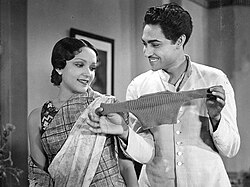
 Kumar in the 1943 movie Kismet | |
| Born | Kumudlal Kunjilal Ganguly 13 October 1911 |
| Died | 10 December 2001 (aged 90) Mumbai, Maharastra, India |
| Occupation | Actor, painter |
| Years active | 1936–1997 |
| Spouse(s) | Shobha Devi |
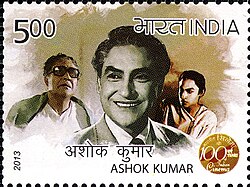
Ashok Kumar (Bengali: অশোক কুমার গাঙ্গুলী) (13 October 1911 – 10 December 2001) or Dadamoni was an Indian movie actor. The Government of India honored him with the Dadasaheb Phalke Award in 1988 and the Padma Bhushan in 1998 for his work to the Indian cinema.
Kumar was born Kumudlal Ganguly in Bhagalpur, Bengal Presidency. Kumar died at the age of 90 in Mumbai from heart failure at his home in Chembur.
Background and family
Ashok Kumar was born Kumudlal Ganguly to a Bengali Hindu family in Bhagalpur, Bengal Presidency, British India (present-day Bihar, India).[1] His father, Kunjlal Ganguly, was a lawyer while his mother, Gouri Devi, was a home-maker. Kumudlal was the eldest of four children. His only sister, Sati Devi, a few years younger to him, was married at a very young age to Sashadhar Mukherjee and became the matriarch of a large "film family". Next was his brother, Kalyan, more than 14 years younger (b.1926), who later took the screen name Anoop Kumar. Youngest of all was Abhas (b.1929), whose screen name was Kishore Kumar, who became a phenomenally successful playback singer of Hindi films. Although the eldest by several years, Kumudlal outlived all his siblings. In fact, he stopped celebrating his birthday after his youngest brother, Kishore, died on that very day in 1987.
While still a teenager and well before he had even given thought to a career in films, the young Kumudlal was married to Shobha, a girl of his own Bengali Brahmin community and similar family background, in a match arranged by their parents in the usual Indian way.[2] Their lifelong marriage was a harmonious and conventional one, and despite his film career, the couple retained a very middle-class outlook and value system, bringing up their children with traditional values in a remarkably simple home. They were the parents of one son, Aroop Ganguly, and three daughters named Bharati Patel, Rupa Verma and Preeti Ganguly. Aroop Kumar Ganguly worked in only one film, appearing as hero in Bezubaan (1962), which flopped at the box office. He then made a career in the corporate world. The eldest daughter, Bharati Patel, is the mother of the actress Anuradha Patel. His second daughter, Rupa Verma, is the widow of the actor and comedian Deven Verma. The youngest daughter, Preeti Ganguly, was the only one among his daughters to enter the film industry. She acted as a comedienne in several Hindi films during the 1970s and 1980s and died unmarried in 2012.[3]
Kumudlal's daughter Bharati married twice. Her first marriage was to a Mr. Patel, a Gujarati gentleman. By this marriage, she had one daughter, the actress Anuradha Patel, who is married to the actor Kanwaljeet Singh. Later, and much against the wishes of all her relatives, Bharati married Hameed Jaffrey, a Muslim, the brother of the actor Saeed Jaffrey.[4] By this second marriage, Bharati also acquired step-daughters, Geneviève and Shaheen, who were Hameed's daughters by his first wife Valerie Salway, a woman of Scottish, Irish, Portuguese and Italian heritage.[5] Geneviève married a Sindhi businessman named Jagdeep Advani. Their daughter is actress Kiara Advani. Thus, Ashok Kumar has no blood relationship with Kiara Advani and she is not his great-granddaughter, as is sometimes rumoured.
Early years
Reverently called Dadamoni (affectionate term for elder brother), Kumudlal Ganguly was born in Bhagalpur and educated at Presidency College of the University of Calcutta, Kolkata, where he studied to become a lawyer. However, his heart was not in his law studies. Ganguly was more interested in cinema, in which he dreamt of working as a technician.
Career and life
Early career (1936–42)
Kumudlal's father wanted him to become a lawyer and got him enrolled in a law college. However, Kumudlal failed his exams and, to escape acrimony at home, came to live with his sister in Mumbai for a few months, until the exams were held again. Kumudlal's sister Sati Devi had been married at a very young age to Sashadhar Mukherjee, who lived in Chembur in Mumbai and worked in a fairly senior position in the technical department of Bombay Talkies, a pioneering Indian film studio. Kumudlal wanted to earn some spending money for himself, and at his request, Sashadhar Mukherjee used his influence to get him a job as laboratory assistant at Bombay Talkies. This was in the early 1930s. The salary was quite decent; furthermore, Kumudlal was successful at his job and found the work interesting, which had not been the case with law college. He tried to convince his father that he would not become successful as a lawyer and that he would be able to earn a living as a technician or lab assistant. His father would not hear of this, and it required the intervention of Sashadhar Mukherjee before he finally reconciled himself to the situation and agreed to let Kumudlal abandon his law studies. Thus began the storied film career, not as an actor but as laboratory assistant, of the future Ashok Kumar.
.jpg)
Kumudlal was happy working as a laboratory assistant and remained in that position for some five years. His acting career started purely by accident. Shooting was already underway on the Bombay Talkies production Jeevan Naiya in 1936, when the male lead, Najm-ul-Hassan, eloped with his co-star Devika Rani, who happened to be the wife of Himanshu Rai, millionaire owner of Bombay Talkies. Rani subsequently returned to her husband who, out of spite, dismissed Hassan and summarily ordered Kumudlal to replace him. This he did against the advice of director Franz Osten, who reckoned that the young man did not have the good looks needed for an actor. Kumudlal was given the screen name Ashok Kumar, in keeping with the general trend in an era when actors concealed their real identities behind screen names.

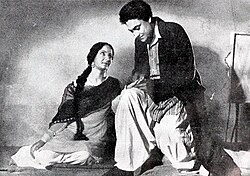
Ashok Kumar, as Kumudlal Ganguly was now known, started off his acting career reluctantly. His subsequent venture with Devika Rani in Achhut Kanya, the same year was one of the early blockbusters of Hindi cinema. Like several movies of that era, Achhut Kanya was a reformist piece featuring a Brahmin boy falling in love with a girl from the so-called untouchables in Indian society. The runaway success of Achhut Kanya cemented Ashok Kumar and Devika Rani as the most popular on-screen couple of that era.
The two did a string of films thereafter, including Janmabhoomi (1936), Izzat (1937), Savitri (1937), Vachan (1938) and Nirmala (1938). Their last on-screen venture was the 1941 movie Anjaan, whose failure at the box office brought an end to the legendary on-screen couple. Devika Rani was consistently the bigger star, with Ashok Kumar working in her shadow.
He started emerging from Devika Rani's shadow owing to pairing opposite Leela Chitnis, another actress who was senior to him in age as well as stature. Back-to-back successes with Kangan (1939), Bandhan (1940) and Azad (1940) saw Ashok Kumar emerge as a popular actor in his own right. The success of Jhoola (1941), in which he starred opposite Leela Chitnis, established him as one of the most bankable actors of the era.
Stardom (1943–50)
The Gyan Mukherjee directed 1943 movie Kismet, featuring Ashok Kumar as the first anti-hero in Indian Cinema smashed all existing box office records, becoming the first Hindi movie to gross 1 crore at the box office. The success of Kismet made Ashok Kumar the first superstar of Indian cinema. Such was his popularity at the time that, in the words of Manto, "Ashok's popularity grew each passing day. He seldom ventured out, but wherever he was spotted, he was mobbed. Traffic would come to a stop and often the police would have to use lathis to disperse his fans."[6]
.jpg)
After Kismet, Ashok Kumar became the most bankable star of the era, delivering a succession of box office successes with movies such as Chal Chal Re Naujawan (1944), Shikari (1946), Sajan (1947), Mahal (1949), Mashaal (1950), Sangram (1950) and Samadhi (1950). He produced several films for Bombay Talkies during the final years of the company including Ziddi (1948), which established the careers of Dev Anand and Pran, Neelkamal (1947), which marked the debut of Raj Kapoor, and the famous Mahal in 1949 in which he co-starred with Madhubala.
Post-stardom (1950s)
With the advent of the 1950s, Ashok Kumar switched over to more mature roles, with the exception of the 1958 classic Howrah Bridge, in which he starred alongside Madhubala. Despite the arrival of a younger crop of stars like Dev Anand, Dilip Kumar and Raj Kapoor, Ashok Kumar remained one of the stars of the era with hits like Afsana (1951), Nau Bahar (1952), Parineeta (1953), Bandish (1955), Ek Hi Raasta (1956), Ek Saal (1957) and Howrah Bridge (1958). His most successful film of that era was Deedar (1951), in which he played second lead to Dilip Kumar.

Ashok Kumar appeared frequently opposite Nalini Jaywant in several movies of the 1950s. He did around 17 films with Meena Kumari in a span of twenty years ranging from Tamasha in 1952 to 1972 magnum opus, Pakeezah. He played the suave cigarette-smoking criminal or police officer in several films in the mid to late 1950s, in what was the Indian film-noir movement.
Later Career (1960s and 1970s)
By the 1960s, Ashok Kumar switched over to character roles, variously playing the parent, uncle or grandparent, being careful never to be typecast. From a judge in Kanoon (1960), an aging freedom fighter in Bandini (1963), a caring brother in Mere Mehboob (1963), an aging priest in Chitralekha (1964), a vicious zamindar in Jawaab (1970) and a criminal in Victoria 203 (1971), he played a wide variety of roles.

Ashok Kumar played important roles in several landmark movies in the 1960s and 1970s, including Jewel Thief (1967), Aashirwad (1968) (for which he won a Filmfare Award as well as National Award in 1969), Purab aur Pashchim (1970), Pakeezah (1972), Mili (1975), Chhoti Si Baat (1975) and Khoobsurat (1980). Ashok Kumar and Pran were best friends and have acted in 27 films together from 1951-1987 and had 20 super-hit films together. Films like Purab Aur Pashchim, Victoria 203, Chor Ke Ghar Chor, Chori Mera Kaam, Adhikar (1971), Maan Gaye Ustad were major hits.
He teamed up with Shashi Kapoor and Rajesh Khanna in many films in 1970s and 1980s and acted as the main supporting actor in their films.
Last years and death
He acted in fewer films in the 1980s and 1990s, and occasionally appeared on television, most famously anchoring the first Indian soap opera Hum Log and appearing as the title character in the unforgettable Bahadur Shah Zafar. Ashok Kumar acted in three episodes of famous detective TV serial Tehkikaat with Vijay Anand and Saurabh shukla in an episode called A Lucky Draw - Murders after a lucky draw.[8]
Ashok Kumar's last film role was in the 1997 movie Aankhon Mein Tum Ho. Besides acting, he was an avid painter and a practitioner of homeopathy. A qualified homoeopath, Ashok Kumar earned a reputation for conjuring up miracle cures.[9] Altogether, he starred in over 275 films. He has done more than 30 Bengali dramas in Dhakuria.
Ashok Kumar died at the age of 90 in Mumbai on 10 December 2001 of heart failure at his residence in Chembur. The then Prime Minister Atal Bihari Vajpayee described him as "an inspiration... for many generations of aspiring actors."[10]
Other websites
{{Source}} is deprecated. Please use a more specific template. See the documentation for a list of suggested templates.
- Ashok Kumar on IMDb
 This short article about an actor or group of actors can be made longer. You can help Bharatpedia by adding to it.
- ↑ "Ashok Kumar: Lesser Known Facts – The Times of India". The Times of India. Archived from the original on 28 March 2018. Retrieved 27 March 2018.
- ↑ "Home alone: Ashok Kumar". Archived from the original on 5 February 2008.
- ↑ "Veteran actor Ashok Kumar passes away". Economic Times. 10 December 2001. Archived from the original on 31 December 2013. Retrieved 30 March 2012.
- ↑ "ये रही हैं सलमान खान की पहली गर्लफ्रेंड, होते-होते रह गई दोनों की शादी!". bhaskar.com. 10 February 2016. Archived from the original on 18 September 2016. Retrieved 27 March 2018.
- ↑ "Gene Junction: Kiara Alia Advani". vervemagazine.in. 2 February 2016. Archived from the original on 26 June 2019. Retrieved 27 March 2018.
- ↑ Stars from Another Sky by Saadat Hassan Manto
- ↑ "Sumitra Devi – An Unsurpassable Beauty Before the Genre of Suchitra Sen". Filmzack. Archived from the original on 6 May 2018. Retrieved 6 May 2018.
- ↑ Satyanveshi. "A Lucky Draw - Murders After A Lucky DrawTehkikaat Episode 32, 33, 34 (Starring Ashok Kumar)". Retrieved 2021-03-23.
- ↑ The Tribune – Windows – Main Feature-Breathing new life into samadhis by Roopinder Singh Archived 2 January 2017 at the Wayback Machine. Tribuneindia.com (15 December 2001). Retrieved on 9 November 2018.
- ↑ "BBC News – FILM – Bollywood star Ashok Kumar dies". bbc.co.uk. Archived from the original on 22 February 2014. Retrieved 1 August 2011.