



 Deekshabhoomi monument, located in Nagpur, Maharashtra, where B. R. Ambedkar converted to Buddhism in 1956, is the largest stupa in Asia.[1] | |
| Total population | |
|---|---|
 India 6,531,200 (2011) India 6,531,200 (2011) | |
| Regions with significant populations | |
| Maharashtra | |
| Languages | |
| Marathi | |
| Religion | |
| Buddhism | |
| Related ethnic groups | |
| Mahars • Marathi people |
Marathi Buddhists Marāṭhī Baud'dha) are Buddhists of Marathi ethnic and linguistic identity. The religious community resides in the Indian state of Maharashtra. They speak Marathi as their mother-tongue (first language). The Marathi Buddhist community is the largest Buddhist community in India. According to the 2011 Indian census, Marathi Buddhists constitute 5.81% of the population in Maharashtra, which is 77% of the total Buddhist population in India.[2]
History

Almost all Marathi Buddhists belong to the Navayana tradition, a 20th-century Buddhist revival movement in India that received its most substantial impetus from B. R. Ambedkar who called for the conversion to Buddhism by rejecting the caste-based society of Hinduism, that considered them to be the lowest in the hierarchy.[3]
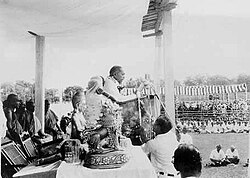
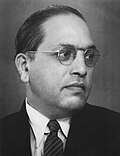
B. R. Ambedkar publicly converted on 14 October 1956, at Deekshabhoomi, Nagpur, over 20 years after he declared his intent to convert. He converted approximately 600,000 people to Buddhism.[4] The conversion ceremony was attended by Medharathi, his main disciple Bhoj Dev Mudit, and Mahastvir Bodhanand's Sri Lankan successor, Bhante Pragyanand.[5] Ambedkar asked Dalits not to get entangled in the existing branches of Buddhism (Theravada, Mahayana and Vajrayana), and called his version Navayana or 'Neo-Buddhism'. Ambedkar would die less than two months later, just after finishing his definitive work on Buddhism. Many Buddhists employ the term "Ambedkarite Buddhism" to designate the Buddhist movement, which started with Ambedkar's conversion.[5] Converted people call themselves "-Bauddha" i.e. Buddhists.
Population

Almost all Marathi Buddhists are converts from Hinduism. Most Buddhist Marathi people belong to the former Mahar community who adopted Buddhism with Ambedkar in 1956.[6][7]
In the 1951 census of India, In Maharashtra, 2,487 (0.01%) respondents said they were Buddhist. The 1961 census, taken after B. R. Ambedkar adopted Navayana Buddhism with his millions of followers in 1956, showed an increased to 2,789,501 (7.05%).[8]
Marathi Buddhists account for 77.36% of all Buddhists in India.[2] According to the 2011 Census of India there are 6.5 million Buddhists in Maharashtra but Buddhist leaders claim there are about 10 to 12 million Buddhists in Maharashtra. Among cities Mumbai has largest Buddhist population accounting for 4.85% of total Mumbai population. Almost 90 per cent of Navayana Buddhists live in the state.[9] 5,204,284 (79.68%) Marathi Buddhists belong to the Scheduled Caste category.[10]
Notable Marathi Buddhists
 | This article needs more citations. (January 2021) |
Business
- Milind Kamble, national president of Dalit Indian Chamber of Commerce and Industry[11]
- Kalpana Saroj (born 1961), entrepreneur and a Tedx speaker[12][13]
Law and Justice
- B. R. Ambedkar (1891-1956), jurist, barrister, and first Law and Justice Minister of India
- B. C. Kamble (born 1919), jurist and lawyer
- R. D. Bhandare (born 1916), governor of Bihar and Andhra Pradesh
- Bhushan Gavai (born 1960), justice in the Supreme Court of India[14]
Literature and activism
- Savita Ambedkar (1909–2003), social activist and writer
- Raja Dhale (1940–2019), social activist and writer
- Namdeo Dhasal (1949 2014), social activist and writer
- Suresh Bhat (1932–2003), poet
- Gangadhar Pantawne, writer, reviewer and Ambedkarite thinker
- Shankarrao Kharat, writer and member of the Maharashtra Legislative Council
- Dagdu Maruti Pawar, writer and poet
- Pradnya Daya Pawar, poet and fiction writer
- Arun Kamble, writer and social activist
- Baburao Bagul, writer and poet
- Bhau Panchbhai, poet, writer and activist
- Urmila Pawar, writer and activist
- Laxman Gaikwad, novelist
- Yashwant Manohar, poet and writer
- Vaman Kardak, poet and playwright
- Keshav Meshram, poet
- Sharankumar Limbale, author
- Datta Bhagat, Author
Acting and Music
- Adarsh Shinde, singer, musician[15]
- Vitthal Umap, singer[16]
- Bhalchandra Kadam, actor, comedian[17]
- Abhijeet Sawant, actor and singer
- Kushal Badrike, actor, comedian
- Vaishali Mhade, singer
- Abhijeet Kosambi, singer
- Surekha Punekar, Indian folk artist
- Prahlad Shinde, Singer
- Somnath Waghmare, documentary filmmaker and researcher
- Usha Jadhav, actress
Politics
- Yashwant Ambedkar, member of MLC
- Prakash Ambedkar, member of the parliament
- Anandraj Ambedkar, political activist
- Ramdas Athawale, state minister of India, and member of the parliament
- Rajkumar Badole, Social Justice And Assistance Minister, Maharashtra
- Bhaurao Gaikwad, Member of the parliament
- R. D. Bhandare, governor of Bihar and Andhra Pradesh[18]
- R. S. Gavai, Governor Bihar And Kerala, Member of the parliament, Former Chairman of Maharashtra Legislative Council
- Nitin Raut, cabinet minister and MLA[19]
- Rajendra Gavai, political activist
- Jogendra Kawade, cabinet minister, and Member of the Maharashtra Legislative Assembly
- Laxman Mane, political activist
- Eknath Gaikwad, MP and state minister
- Varsha Gaikwad, School Education Cabinet Minister of Maharashtra[19]
- Sulekha Kumbhare, minister
- Sanjay Bansode, state Minister of Maharashtra[19]
- Mukul Wasnik, minister for social justice and Empowerment
- Tukaram Shrangare, Union Minister For State For Communications
- Murlidhar Chandrakant Bhandare, Governor of Odisha
- Sudhakar Tukaram Shrangare, Member of Parliament
- Sunil Gaikwad, Member of Parliament
- Sharad Bansode, Member of Parliament
- Prakash Gajbhiye, Member of MLC
- Nashikrao Tirpude, 1st Deputy Chief Minister of Maharashtra
- Ramratan Janorkar, Mayor of Nagpur
- Suresh Mane, politician
- Waman Meshram, President Of Bahujan Kranti Morcha
- B. D. Khobragade, Deputy Chairman of the Rajya Sabha
- Balkrishna Ramchandra Wasnik, member of Parliament from Bhandara and Buldhana
- Avinash Mahatekar, State Minister of Maharashtra[20][21]
- Chandrakant Handore, Minister Of Maharashtra[22][23]
- Dadasaheb Rupwate, politician[24][25][26]
- N. M. Kamble, Indian Politician
Economists and Educationists
- Narendra Jadhav, economist, educationist and author
- Bhalchandra Mungekar, economist and author
- Sukhadeo Thorat, economist and author
- Shankarrao Kharat, Vice Chancellor of Dr BAMU Aurangabad
Political scientists
- Anand Teltumbde, scholar, writer, and civil rights activist
Sociologists
- Sharmila Rege, sociologist, feminist scholar and author of Writing Caste, Gender
Journalists
- Uttam Kamble, An Indian journalist who had been the Chief Editor of [[Sakal] Media Group and He is a post-modern author with around 63 published books
Sports
- Mona Meshram, cricketer
- Avinash Sable, athlete
Culture

Festivals
- Buddha Purnima, public holiday in Maharashtra
- Babasaheb Ambedkar Jayanti, public holiday in Maharashtra
- Dhammachakra Pravartan Day, public holiday in Maharashtra
- Vesak, public holiday in Maharashtra
See also
References
- ↑ Bhagwat, Ramu (19 December 2001). "Ambedkar memorial set up at Deekshabhoomi". The Times of India. Archived from the original on 16 October 2013. Retrieved 1 July 2013.
- ↑ 2.0 2.1 "Population by religion community – 2011". Census of India, 2011. The Registrar General & Census Commissioner, India. Archived from the original on 25 August 2015.
- ↑ Thomas Pantham; Vrajendra Raj Mehta; Vrajendra Raj Mehta (2006). Political Ideas in Modern India: thematic explorations. Sage Publications. p. 48. ISBN 0-7619-3420-0.
- ↑ Robert E. Buswell Jr.; Donald S. Lopez Jr. (2013). The Princeton Dictionary of Buddhism. Princeton University Press. p. 34. ISBN 978-1-4008-4805-8.
- ↑ 5.0 5.1 Bellwinkel-Schempp, Maren (2004). "Roots of Ambedkar Buddhism in Kanpur" (PDF). In Jondhale, Surendra; Beltz, Johannes (eds.). Reconstructing the World: B.R. Ambedkar and Buddhism in India (PDF). New Delhi: Oxford University Press. pp. 221–244 (PDF).
{{cite book}}: Check|archiveurl=value (help)CS1 maint: url-status (link) - ↑ Jaffrelot, Christophe (2005). "The 'Solution' of Conversion". Dr Ambedkar and Untouchability: Analysing and Fighting Caste. Orient Blackswan Publisher. pp. 119–131. ISBN 8178241560.
- ↑ Zelliot, Eleanor (1978). "Religion and Legitimation in the Mahar Movement". In Smith, Bardwell L. (ed.). Religion and the Legitimation of Power in South Asia. Leiden: Brill. pp. 88–90. ISBN 9004056742.
- ↑ Kantowsky, Detlef (1997). Buddhisten in Indien heute, Indica et Tibetica 30, 111
- ↑ "INDIA Indian Buddhists reject religious census". m.asianews.it.
- ↑ "बौद्ध बढ़े, चुनावी चर्चे में चढ़े". aajtak.intoday.in (in हिन्दी). Retrieved 30 January 2018.
- ↑ https://mumbaimirror.indiatimes.com/others/sunday-read/the-buddhism broadcast/articleshow/64716857.cms
- ↑ Pronoti, Datta (29 May 2010). "Caste No Bar". The Crest Mumbai. Archived from the original on 16 January 2018. Retrieved 12 November 2019.
- ↑ "Kalpana – Symbol of true grit". The Hans India. 31 August 2013. Retrieved 2018-01-16.
- ↑ Sikka, Sonia; Puri, Bindu; Beaman, Lori G. (2015-08-11). Living with Religious Diversity. Routledge. ISBN 9781317370987.
- ↑ https://www.bhaskar.com/maharashtra/pune/news/MH-PUN-HMU-wedding-pics-of-well-known-singer-adarsh-shinde-5007221-PHO.html
- ↑ https://divyamarathi.bhaskar.com/news/MAG-samir-paranjape-rasik-article-in-marathi-5473432-NOR.html
- ↑ "In the shadow of caste". DNA India. 23 September 2017.
- ↑ Jhā, Vikāsa Kumāra (1994). "Sattā ke sūtradhara: Ājādī ke bāda Bhārata".
- ↑ 19.0 19.1 19.2 https://divyamarathi.bhaskar.com/news/23-ministers-belong-to-the-maratha-community-in-thackeray-government-126408482.html
- ↑ "रिपाइचा फलटण मतदारसंघावर दावा : अविनाश महातेकर".
- ↑ "समाजकल्याण राज्यमंत्री अविनाश महातेकर यांची दीक्षाभूमीला भेट".
- ↑ Teltumbde, Anand. "Bombay High Court's 'Dalit' ruling has come in handy for the politics of Hindutva". Scroll.in.
- ↑ "Cabinet off-limits for sons & daughters - Indian Express". archive.indianexpress.com.
- ↑ "कालकथित दादासाहेब रुपवते स्मृतिदिनानिमित्त विशेष कार्यक्रमाचे आयोजन". www.saamana.com.
- ↑ "ज्येष्ठ आंबेडकरी कार्यकर्ते प्रेमानंद रुपवते यांचे निधन". Maharashtra Times.
- ↑ Pawar, J. V. "How India's Dalits had to cope when the backlash began after Ambedkar's death". Scroll.in.

