




->Issan Sumisu |
expanded lead additionally and cleaned formatting |
||
| Line 1: | Line 1: | ||
{{Short description|Indian | {{Short description|Indian politician (1909–1998)}} | ||
{{Hatnote|This is an Indian name; Elamkulam is the name of the place, Manakkal is the family name, Sankaran is his given name and Namboodiripad is the caste title.}} | |||
{{Use Indian English|date=December 2014}} | {{Use Indian English|date=December 2014}} | ||
{{Use dmy dates|date=May 2020}} | {{Use dmy dates|date=May 2020}} | ||
{{Infobox officeholder | {{Infobox officeholder | ||
| name | | name = E. M. S. Namboodiripad | ||
| | | honorific_prefix = ''[[Comrade]]'' | ||
| image | | image = EMS Namboodiripad 2001 stamp of India.jpg | ||
| office | | office = 1st [[Chief Minister of Kerala]] | ||
| term_start = 6 March 1967 | |||
| term_start | | term_end = 1 November 1969 | ||
| term_end | | predecessor = [[R. Shankar]] | ||
| predecessor | | successor = [[C. Achutha Menon]] | ||
| successor | | term_start1 = 5 April 1957 | ||
| term_end1 = 31 July 1959 | |||
| term_start1 | | predecessor1 = ''Office established'' | ||
| term_end1 | | successor1 = [[Pattom A. Thanu Pillai|Pattom Thanu Pillai]] | ||
| predecessor1 | | office2 = [[General Secretary]] of [[Communist Party of India]] | ||
| successor1 | | term_start2 = 29 April 1962 | ||
| office2 | | term_end2 = 11 April 1964 | ||
| term_start2 | | predecessor2 = [[Ajoy Ghosh]] | ||
| term_end2 | | successor2 = [[Chandra Rajeswara Rao]] | ||
| predecessor2 | | office3 = [[General Secretary]] of [[Communist Party of India (Marxist)]] | ||
| successor2 | | term_start3 = 8 April 1978 | ||
| office3 | | term_end3 = 9 January 1992 | ||
| term_start3 | | predecessor3 = [[P. Sundarayya]] | ||
| term_end3 | | successor3 = [[Harkishan Singh Surjeet]] | ||
| predecessor3 | | alma_mater = [[St. Thomas College, Thrissur]] | ||
| successor3 | | birth_name = Elamkulam Manakkal Sankaran Namboodiripad | ||
| alma_mater | | birth_date = {{birth date|1909|6|13|df=y}} | ||
| birth_date | | birth_place = [[Perinthalmanna]], Madras Presidency, British India<br>(now [[Malappuram district]], Kerala, India) | ||
| birth_place | | death_date = {{death date and age|df=yes|1998|3|19|1909|6|13}} | ||
| death_date | | death_place = [[Thiruvananthapuram]], Kerala, India | ||
| death_place | | spouse = Arya Antharjanam (1937–2002)<ref>{{cite web|url=https://timesofindia.indiatimes.com/india/EMS-wife-passes-away/articleshow/1302677556.cms|title=EMS' wife passes away|website=The Times of India|date=3 January 2002 |access-date=21 February 2019}}</ref> | ||
| spouse | | party = [[Communist Party of India (Marxist)]] (from 1964)|otherparty=[[Communist Party of India]] (before 1964) | ||
| party | | children = 4<ref>{{cite news |title=E.M. Sreedharan dead |url=http://www.thehindu.com/2002/11/15/stories/2002111505110400.htm |date=15 November 2002 |newspaper=[[The Hindu]] |access-date=6 June 2018}}{{dead link|date=April 2021|bot=medic}}{{cbignore|bot=medic}}</ref> | ||
| children | | residence = [[Thiruvananthapuram]] | ||
| residence | | website = [https://web.archive.org/web/20070818124625/http://www.keralacm.gov.in/ems.htm Government of Kerala] | ||
| website | | known_for = Co-founder of [[Communist Party of India (Marxist)]] | ||
}} | }} | ||
'''Elamkulam Manakkal Sankaran Namboodiripad''' ({{ipa|ml|eːlɐŋɡuɭɐm mɐnɐjkːɐl ʃɐŋɡɐɾɐn n̪ɐmbuːd̪iɾipːaːɖə̆|lang}}, 13 June 1909 – 19 March 1998) was an Indian communist politician, theorist, author and statesman who served as the first [[Chief Minister of Kerala]] in 1957–1959 and then again in 1967–1969. As a member of the [[Communist Party of India]] (CPI), he became the first [[Chief Minister (India)|Chief Minister]] in India not to be a member of the [[Indian National Congress]]. In 1964, he led a faction of the CPI that broke away to form the [[Communist Party of India (Marxist)]] (CPI(M)). | |||
'''Elamkulam Manakkal Sankaran Namboodiripad''' (13 June 1909 – 19 March 1998) | |||
As chief minister, | As chief minister, Namboodiripad pioneered radical land and educational reforms in Kerala, which helped it become the country's [[Kerala model|leader in social indicators]]. It is largely due to his commitment and guidance that the CPI(M), of which he was Politburo member and general secretary for 14 years, has become such a domineering political force, playing a vital role in India's new era of coalition politics.<ref>{{cite news | url= https://www.independent.co.uk/news/obituaries/obituary-e-m-s-namboodiripad-1153957.html | newspaper=[[The Independent]] | first=Kuldip | last= Singh | date=1 April 1998 | title=Obituary: E. M. S. Namboodiripad | access-date=20 May 2018 }}</ref> | ||
== | == Early life == | ||
E. M. Sankaran Namboodiripad was born on 13 June 1909, as the fourth son of Parameswaran Namboodiripad and Vishnudatha Antharjanam, at [[Elamkulam, Malappuram|Elamkulam]], situated on the banks of [[Thuthapuzha]] River, in [[Perinthalmanna taluk]] of the present [[Malappuram district]]. He belonged to a prominent Malayali [[Nambudiri|Nambudiri Brahmin]] family. His two elder brothers died before he was born, and the third brother was intellectually disabled. He lost his father when he was five. | |||
During | During the 1921 [[Malabar rebellion]] he moved to [[Irinjalakuda]] as the belligerent attacked his house.{{Clarify|reason=Who is "the belligerent" in this case?|date=August 2025}} In his early years, he was a close friend of Sr. P. M. Mathew. He was associated with [[V. T. Bhattathiripad]], [[M. R. Bhattathiripad]] and many others in the fight against the casteism and conservatism that existed in the [[Namboothiri]] community. He became one of the office-bearers of [[Valluvanad (southern Malabar)|Valluvanad]]u Yogaskshema Sabha, an organization of progressive Namboothiri youth. | ||
Namboodiripad graduated from [[St. Thomas College, Thrissur]]. During his college days, he was deeply associated with the [[Indian National Congress]] and the [[Indian independence movement]]. It is said{{By whom|date=August 2025}} he would walk 5–8 km to hear the firebrand Cochin politician [[V. J. Mathai]] speak.<ref>{{Cite web|url=https://www.newindianexpress.com/cities/kochi/2015/aug/18/resurrecting-the-legend-of-vettath-mathai-800849.html|title=Resurrecting the Legend of Vettath Mathai|website=The New Indian Express|date=18 August 2015 |access-date=2019-08-01}}</ref> | |||
Namboodiripad was well known for his stammer.<ref>{{cite news|author=K. M. Tampi|date=17 May 2001|title=A colourful personality fades out from the Kerala scene|newspaper=[[The Hindu]]|url=http://hindu.com/2001/05/17/stories/0217000m.htm|archive-url=https://web.archive.org/web/20030506234204/http://www.hindu.com/2001/05/17/stories/0217000m.htm|url-status=dead|archive-date=6 May 2003}}</ref> When asked if he always stammered, he would reply, "No, only when I speak."<ref name="Smita Mitra and John Mary">{{cite magazine|author=Smita Mitra and John Mary|date=14 March 2011|title=Streaming Syllables|url=http://www.outlookindia.com/article.aspx?270735|magazine=[[Outlook (Indian magazine)|Outlook India]]}}</ref> | |||
== | == Socialism == | ||
[[File:E-M-S-Namboodiripad (cropped).jpg|thumb|left|Namboodiripad in the late 1940s]] | |||
In 1934, he was one of the founders of [[Congress Socialist Party]], a socialist wing within the [[Indian National Congress]], and elected as its All India Joint Secretary from 1934 to 1940. He edited the Malayalam newspaper ''[[Prabhatham]]'' which was the organ of the Congress Socialist Party in Kerala.<ref>{{cite book|title=History of Mass Media |url=http://www.universityofcalicut.info/cuonline/exnotif/ex4235.pdf |publisher=[[University of Calicut]] |archive-url=https://web.archive.org/web/20161019033306/http://www.universityofcalicut.info/cuonline/exnotif/ex4235.pdf |archive-date=19 October 2016 |accessdate=11 February 2023 |pages=15–16}}</ref> During this period, he was also elected to the [[Madras Legislative Assembly]] (1939). | |||
He remained committed to socialist ideals, and his compassion towards the working class led him to join the [[Communism in India|Communist movement]]. The [[Government of India|Indian government]] considered him to be one of the founders of the [[Communist Party of India]] (CPI) in [[Kerala]], forcing him to go into hiding.{{When|date=March 2015|reason=from what year to what year?}} During the 1962 [[Sino-Indian war]], he was among leaders who aired China's view on the border issue. When the [[1964 split in the Communist Party of India|CPI split in 1964]], EMS stood with the [[Communist Party of India (Marxist)]] (CPI(M)). He was the leader of the [[Kerala]] state committee of CPI(M). He served as a member of the [[Central Committee]] and the [[Politburo]] of the CPI(M) until his death in 1998. EMS became [[general secretary]] in 1977, a designation he held until 1992. A [[marxism|Marxist]] scholar, he influenced the development of [[Kerala]], of which he was the first [[chief minister]]. | |||
== | == Election to state government == | ||
===Early days=== | |||
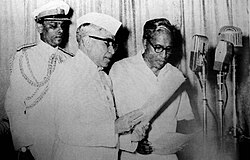
[[File:Swearing in of CPI cabinet in Kerala, April 1957.jpg|thumb|Swearing-in ceremony of Namboodiripad as first [[Chief Minister of Kerala]], April 1957]] | |||
{| class="sortable wikitable" | |||
|+ Kerala Assembly election results | |||
|- | |||
! |Election | |||
! |Year | |||
! |Party | |||
! |Constituency | |||
! |Result | |||
|- | |||
|[[Madras Legislative Assembly]] | |||
|[[1952 Madras State Legislative Assembly election|1952]] | |||
| rowspan="4" | [[Communist Party of India|CPI]] | |||
|Kozhikode | |||
|{{No2|Lost}} | |||
|- | |||
| rowspan="6" |[[Kerala Legislative Assembly]] | |||
|[[1957 Kerala Legislative Assembly election|1957]] | |||
|[[Thrikaripur Assembly constituency|Thrikaripur]] | |||
|{{yes2|Won}} | |||
|- | |||
|[[1960 Kerala Legislative Assembly election|1960]] | |||
| rowspan="4" |[[Pattambi Assembly constituency|Pattambi]] | |||
|{{yes2|Won}} | |||
|- | |||
|[[1965 Kerala Legislative Assembly election|1965]] | |||
|{{yes2|Won}} | |||
|- | |||
|[[1967 Kerala Legislative Assembly election|1967]] | |||
|rowspan = "3"| [[Communist Party of India (Marxist)|CPI(M)]] | |||
|{{yes2|Won}} | |||
|- | |||
|[[1970 Kerala Legislative Assembly election|1970]] | |||
|{{yes2|Won}} | |||
|- | |||
|[[1977 Kerala Legislative Assembly election|1977]] | |||
|[[Alathur Assembly constituency|Alathur]] | |||
|{{yes2|Won}} | |||
|} | |||
A [[Communist Party of India|Communist]]-led government under E. M. S. Namboodiripad resulted from the first elections for the new Kerala Legislative Assembly in 1957, making him the first communist leader in India to head a popularly elected government.<ref name=tornquist91>{{cite journal | author= Olle Törnquist | year= 1991 | title= Communists and democracy: Two Indian cases and one debate | journal= Bulletin of Concerned Asian Scholars | publisher= Committee of Concerned Asian Scholars | volume= 23 | issue= 2 | pages= 63–76 | issn= 0007-4810 | url= http://criticalasianstudies.org/assets/files/bcas/v23n02.pdf | doi= 10.1080/14672715.1991.10413152 | quote= The first democratically elected communist-led government in India actually came to power in 1957 in the southwest-Indian state of Kerala. Two years later this government was undemocratically toppled-by the union government and the Congress-I party with Indira Gandhi in the forefront. But the communists were reelected and led several of the following state governments. | access-date= 20 September 2011 | archive-url= https://web.archive.org/web/20110811034858/http://criticalasianstudies.org/assets/files/bcas/v23n02.pdf | archive-date= 11 August 2011 | url-status= dead }}</ref><ref name="SinghKarafin2009">{{cite book|author1=Sarina Singh|author2=Amy Karafin|author3=Anirban Mahapatra|title=South India|url=https://books.google.com/books?id=8KnLFpjEHpUC|access-date=6 January 2013|date=1 September 2009|publisher=Lonely Planet|isbn=978-1-74179-155-6}}</ref> It was the second ever communist government to be democratically elected, after communist success in the 1945 elections in the [[Republic of San Marino]], a [[European microstate|microstate in Europe]].<ref name=Hindu>{{cite news|title=50 years of development|url=https://www.thehindubusinessline.com/todays-paper/tp-others/tp-states/50-years-of-development/article1655056.ece?ref=archive|access-date=30 August 2013|newspaper=The Hindu|date=12 April 2007|author=K.G. Kumar}}</ref><ref name="Desai2006">{{cite book|author=Manali Desai|title=State Formation and Radical Democracy in India|url=https://books.google.com/books?id=60m9znJQmmkC&pg=PA142|access-date=31 August 2013|date=27 November 2006|publisher=Taylor & Francis|isbn=978-0-203-96774-4|page=142}}</ref><ref name="ChitkaraŚarmā1997">{{cite book|author1=Madan Gopal Chitkara|author2=Baṃśī Rāma Śarmā|title=Indian Republic: Issues and Perspective|url=https://books.google.com/books?id=7YrmNURVoroC&pg=PA134|access-date=18 November 2012|date=1 January 1997|publisher=APH Publishing|isbn=978-81-7024-836-1|page=134}}</ref><ref name="Mayne1999">{{cite book|author=Alan James Mayne|title=From Politics Past to Politics Future: An Integrated Analysis of Current and Emergent Paradigms|url=https://books.google.com/books?id=6MkTz6Rq7wUC&pg=PA59|access-date=30 August 2013|date=1 January 1999|publisher=Greenwood Publishing Group|isbn=978-0-275-96151-0|page=59}}</ref> On 5 April 1957 he was appointed as the first chief minister of Kerala. | |||
===Liberation struggle=== | |||
{{main|Liberation Struggle (Kerala)}} | |||
His government introduced the [[Land reform in Kerala|Land Reform Ordinance]] and [[Kerala Education Bill, 1957|Education Bill]]. In 1958, a period of anticommunist protest, the [[Vimochana Samaram]], began in response to the bills. | |||
== Election to | ====Visit from Nehru==== | ||
<!--This is also an excerpt in [[Liberation Struggle (Kerala)]]. Excerpts don't accept anchors | |||
-->On June 22, 1959, Prime Minister [[Jawaharlal Nehru]] had a meeting with EMS, and others. Nehru made the visit to personally examine the collapse of the state's law and order after the "liberation struggle" (vimochansamaram) against the EMS government. The movement was led by Christian churches and Hindu caste organisations such as the [[Nair Service Society]] (NSS) headed by [[Mannathu Padmanabha Pillai]]. The movement saw widespread violence and counter-violence. All along the Nehru's route from the airport to the Raj Bhavan, crowds demanded EMS ministry’s dismissal by the centre. Nehru asked EMS, "How could you make so many enemies in such a short time?" Upon Nehru's return to Delhi, EMS government was dismissed on July 31.<ref name="z061">{{cite book | last=Lal | first=Shiv | title=1991 Electoral Politics, Sectarian Or Dynastic: Manifestoes & statewise reports | publisher=Election Archives | date=1991 | isbn=978-81-7051-078-9 | url=https://books.google.com/books?id=_bOKAAAAMAAJ& | access-date=2025-11-23 | page=92}}</ref><ref name="f637">{{cite web | last=Radhakrishnan | first=M G | title=Rectification: An official party joke | website=mathrubhumi | date=2024-07-13 | url=https://english.mathrubhumi.com/columns/view-from-my-window/rectification-an-official-party-joke-column-by-m-g-radhakrishnan-96380de2 | access-date=2025-11-23}}</ref><ref name="t811">{{cite book | last=Sundararajan | first=Saroja | title=Sir C.P. Ramaswami Aiyar, a Biography | publisher=Allied Publishers | date=2002 | isbn=978-81-7764-326-8 | url=https://books.google.com/books?id=MyFuAAAAMAAJ | access-date=2025-11-23 | page=543|quote=Nair Service Society organised a violent campaign in Kerala in 1959 to " liberate " that State from the Communists}}</ref> Initially, Nehru was hesitant to dismiss a democratically elected government, but he was convinced by Congress President and his daughter, [[Indira Gandhi]].<ref>Moynihan, ''Dangerous Place'', 41</ref><ref>Godbole, [https://books.google.com/books?id=mYTmd3Kc0uEC&pg=PA84 ''Public Accountability and Transparency: The Imperatives of Good Governance''], 84.</ref> | |||
===Later times=== | |||
[[ | [[File:Nicolae Ceaușescu and E. M. S. Namboodiripad.jpg|thumb|Namboodiripad with Romanian President [[Nicolae Ceauşescu]] in 1979.]] | ||
Namboodiripad became the Chief Minister of Kerala for the second time in 1967 as the leader of a seven-party coalition ([[Saptakakshi Munnani]]) which included the CPI and Muslim League. Soon after becoming Chief Minister again, on 31 January 1968 he inaugurated a mechanized coir factory called Floorco in Pozhikkara, Paravur. This time Namboodiripad's tenure lasted for two and a half years, and the government fell on 24 October 1969 due to internal conflicts within the constituent parties. | |||
Namboodiripad was the Leader of Opposition in the [[Kerala Legislative Assembly]] from 1960 to 1964 and again from 1970 to 1977. His vision of decentralization of power and resources ([[People's Plan]]) and the Kerala Literacy Movement influenced Kerala society. He authored several books in English and Malayalam. Chintha Publication, Kerala has published all his books under the title, "E M S Sanchika". He also was well known as a journalist. | |||
During the 1962 [[Sino-Indian war]], other parties portrayed left-wing parties as pro-China, since both were communist. Namboodiripad stated that the left was focused on solving the border dispute through talks.<ref name="Namboodiripad's writings">{{cite news | url= http://www.hindu.com/br/2004/11/16/stories/2004111600451403.htm | title= Book Review: Namboodiripad's writings | first=B. R. P. |last=BHASKAR | newspaper= [[The Hindu]] | date= 16 November 2004 | access-date= 14 March 2015 }}</ref> | |||
== | === Ministries === | ||
Namboodiripad led two ministries in Kerala. | |||
{| class="wikitable" | {| class="wikitable" | ||
|+Details of the Ministries led by E. M. S. Namboodiripad | |+Details of the Ministries led by E. M. S. Namboodiripad | ||
| Line 108: | Line 133: | ||
|5 April 1957 | |5 April 1957 | ||
|31 July 1959 | |31 July 1959 | ||
|Dismissed under Article 356 in the aftermath of the so-called ''[[Vimochana Samaram|Liberation Struggle]]'' <ref>{{cite web|url=http://firstministry.kerala.gov.in/2017/04/01/vimochana-samaram/|title=Vimochana Samaram|website=First Ministry|access-date=21 February 2019}}</ref> | |Dismissed under Article 356 in the aftermath of the so-called ''[[Vimochana Samaram|Liberation Struggle]]'' <ref>{{cite web|url=http://firstministry.kerala.gov.in/2017/04/01/vimochana-samaram/|title=Vimochana Samaram|website=First Ministry|access-date=21 February 2019|archive-date=14 April 2019|archive-url=https://web.archive.org/web/20190414040714/http://firstministry.kerala.gov.in/2017/04/01/vimochana-samaram/|url-status=dead}}</ref> | ||
|- | |- | ||
|2 | |2 | ||
| Line 116: | Line 141: | ||
|Tendered resignation as a result of internal dissensions and subsequent loss of majority.<ref>{{cite web|url=https://www.thenewsminute.com/article/kerala-chronicles-when-coalition-7-political-parties-came-together-only-fall-apart-63905|title=Kerala chronicles: When a coalition of 7 political parties came together only to fall apart|website=Live Mint|date=19 June 2017|access-date=21 February 2019}}</ref> | |Tendered resignation as a result of internal dissensions and subsequent loss of majority.<ref>{{cite web|url=https://www.thenewsminute.com/article/kerala-chronicles-when-coalition-7-political-parties-came-together-only-fall-apart-63905|title=Kerala chronicles: When a coalition of 7 political parties came together only to fall apart|website=Live Mint|date=19 June 2017|access-date=21 February 2019}}</ref> | ||
|} | |} | ||
== Association with Progressive Movement for Arts and Letters == | == Association with Progressive Movement for Arts and Letters == | ||
| Line 125: | Line 147: | ||
== Death == | == Death == | ||
[[File:Ems hospital.JPG|thumb|The E.M.S. Memorial Co-operative Hospital in [[Perinthalmanna]]]] | [[File:Ems hospital.JPG|thumb|The E.M.S. Memorial Co-operative Hospital in [[Perinthalmanna]]]] | ||
Despite his age and failing health, Namboodiripad was still active in political and social fields. He actively campaigned during the [[1998 Indian general election|1998 general election]]. Soon after the results were declared, he contracted pneumonia, and was admitted to the Cosmopolitan hospital in [[Thiruvananthapuram]], where he died at 3:40 p.m. ([[Indian Standard Time|IST]]) on 19 March 1998, aged 88.<ref>{{cite news |title=E M S Namboodiripad dead |url=https://www.rediff.com/news/1998/mar/19ems.htm |access-date=7 November 2018 |work=Rediff.com |date=19 March 1998}}</ref> This was barely hours after he had dictated two articles for ''[[Deshabhimani]]'', a CPI (M) daily, and replies to a few letters.<ref name="death">{{cite magazine |last=Krishnakumar |first=R. |date=4–17 April 1998 |title=Farewell to EMS |url=http://www.frontlineonline.com/fl1507/15070040.htm |magazine=Frontline |access-date=30 March 2024 |archive-url=https://web.archive.org/web/20010219001750/http://www.frontlineonline.com/fl1507/15070040.htm |volume=15 |issue=7 |archive-date=19 February 2001}}</ref> | |||
The state government declared a seven-day mourning. His body was draped in the CPI (M) flag and was taken to AKG Centre in the city where members of his family paid their respects, before it was taken to Durbar Hall and was kept for [[Viewing (funeral)|viewing]], where members of the public, and party leaders and workers paid their respects. Thousands of people joined the funeral procession and he was [[State funeral|cremated with full state honours]] in Thycaud electric crematorium in Thiruvananthapuram.<ref name="death"/> | |||
President [[K. R. Narayanan]] condoled his death and stated: "A scholar, historian and journalist, he was above all an educator of the people as well as their leader. Unremittingly, for the last several decades, he analysed the socio-political scene from the firm-rootedness of his intellectual position and enriched Indian political thought to his very last days." [[Prime Minister of India|Prime Minister]] [[Atal Bihari Vajpayee]], who took office on the same day Namboodiripad died, recalled that Namboodiripad had brought to politics a sense of commitment and purpose and that he was a champion of the cause of the working classes and the downtrodden.<ref name="death"/> | |||
Three more deaths occurred in his family within five years after his death, starting with his daughter-in-law Dr. Yamuna in August 2001, and later followed by his wife Arya Antharjanam in January 2002 and elder son E. M. Sreedharan in November 2002. E. M. Sasi, his younger son, died on 24 January 2022 after suffering from a massive heart attack. | |||
== Family == | |||
Namboodiripad was married to Arya Antharjanam and had two sons – E. M. Sreedharan and E. M. Sasi – and two daughters – E. M. Malathy and E. M. Radha. His grandson (Sreedharan's son) [[Sujith Shankar]] is an actor. | |||
== | == Writing == | ||
{{Main|E. M. S. Namboodiripad bibliography}} | {{Main|E. M. S. Namboodiripad bibliography}} | ||
He was a writer and author of [[E. M. S. Namboodiripad bibliography|several literary works]] and his book on the history of Kerala is notable.<ref name="Namboodiripad's writings" /><ref>[[Ramachandra Guha]], ''[[India after Gandhi]]'', p 294</ref> | |||
== In popular culture == | == In popular culture == | ||
| Line 221: | Line 250: | ||
[[Category:1909 births]] | [[Category:1909 births]] | ||
[[Category:1998 deaths]] | [[Category:1998 deaths]] | ||
[[Category:Chief | [[Category:Chief ministers of Kerala]] | ||
[[Category:Communist Party of India (Marxist) politicians from Kerala]] | [[Category:Communist Party of India (Marxist) politicians from Kerala]] | ||
[[Category:Government Victoria College, Palakkad alumni]] | [[Category:Government Victoria College, Palakkad alumni]] | ||
[[Category:Indian atheists]] | [[Category:Indian atheists]] | ||
[[Category:Indian reformers]] | [[Category:Indian reformers]] | ||
[[Category: | [[Category:Indian independence activists]] | ||
[[Category:Malayali politicians]] | [[Category:Malayali politicians]] | ||
[[Category:Educators from Kerala]] | [[Category:Educators from Kerala]] | ||
[[Category:St. Thomas College, Thrissur alumni]] | [[Category:St. Thomas College, Thrissur alumni]] | ||
[[Category:Leaders of the | [[Category:Leaders of the opposition in Kerala]] | ||
[[Category:Chief ministers from Communist Party of India (Marxist)]] | [[Category:Chief ministers from Communist Party of India (Marxist)]] | ||
[[Category:Chief ministers from Communist Party of India]] | [[Category:Chief ministers from Communist Party of India]] | ||
[[Category:General | [[Category:General secretaries of the Communist Party of India (Marxist)]] | ||
[[Category:Kerala MLAs 1960–1964]] | [[Category:Kerala MLAs 1960–1964]] | ||
[[Category:Kerala MLAs 1970–1977]] | [[Category:Kerala MLAs 1970–1977]] | ||
| Line 240: | Line 269: | ||
[[Category:Indian male writers]] | [[Category:Indian male writers]] | ||
[[Category:Writers from Kerala]] | [[Category:Writers from Kerala]] | ||
[[Category: | [[Category:Politicians from Malappuram district]] | ||
[[Category:20th-century Indian non-fiction writers]] | [[Category:20th-century Indian non-fiction writers]] | ||
[[Category:20th-century Indian educational theorists]] | [[Category:20th-century Indian educational theorists]] | ||
| Line 254: | Line 283: | ||
[[Category:Brahmins who fought against discrimination]] | [[Category:Brahmins who fought against discrimination]] | ||
[[Category:Anti-caste activists]] | [[Category:Anti-caste activists]] | ||
[[Category:Prisoners and detainees of British India]] | |||
[[Category:Kerala MLAs 1965–1967]] | |||
Latest revision as of 11:57, 19 March 2026
E. M. S. Namboodiripad | |
|---|---|
 | |
| 1st Chief Minister of Kerala | |
| In office 6 March 1967 – 1 November 1969 | |
| Preceded by | R. Shankar |
| Succeeded by | C. Achutha Menon |
| In office 5 April 1957 – 31 July 1959 | |
| Preceded by | Office established |
| Succeeded by | Pattom Thanu Pillai |
| General Secretary of Communist Party of India | |
| In office 29 April 1962 – 11 April 1964 | |
| Preceded by | Ajoy Ghosh |
| Succeeded by | Chandra Rajeswara Rao |
| General Secretary of Communist Party of India (Marxist) | |
| In office 8 April 1978 – 9 January 1992 | |
| Preceded by | P. Sundarayya |
| Succeeded by | Harkishan Singh Surjeet |
| Personal details | |
| Born | Elamkulam Manakkal Sankaran Namboodiripad 13 June 1909 Perinthalmanna, Madras Presidency, British India (now Malappuram district, Kerala, India) |
| Died | 19 March 1998 (aged 88) Thiruvananthapuram, Kerala, India |
| Political party | Communist Party of India (Marxist) (from 1964) |
| Other political affiliations | Communist Party of India (before 1964) |
| Spouse(s) | Arya Antharjanam (1937–2002)[1] |
| Children | 4[2] |
| Residence | Thiruvananthapuram |
| Alma mater | St. Thomas College, Thrissur |
| Known for | Co-founder of Communist Party of India (Marxist) |
| Website | Government of Kerala |
Elamkulam Manakkal Sankaran Namboodiripad (Malayalam: [eːlɐŋɡuɭɐm mɐnɐjkːɐl ʃɐŋɡɐɾɐn n̪ɐmbuːd̪iɾipːaːɖə̆], 13 June 1909 – 19 March 1998) was an Indian communist politician, theorist, author and statesman who served as the first Chief Minister of Kerala in 1957–1959 and then again in 1967–1969. As a member of the Communist Party of India (CPI), he became the first Chief Minister in India not to be a member of the Indian National Congress. In 1964, he led a faction of the CPI that broke away to form the Communist Party of India (Marxist) (CPI(M)).
As chief minister, Namboodiripad pioneered radical land and educational reforms in Kerala, which helped it become the country's leader in social indicators. It is largely due to his commitment and guidance that the CPI(M), of which he was Politburo member and general secretary for 14 years, has become such a domineering political force, playing a vital role in India's new era of coalition politics.[3]
Early life[edit | edit source]
E. M. Sankaran Namboodiripad was born on 13 June 1909, as the fourth son of Parameswaran Namboodiripad and Vishnudatha Antharjanam, at Elamkulam, situated on the banks of Thuthapuzha River, in Perinthalmanna taluk of the present Malappuram district. He belonged to a prominent Malayali Nambudiri Brahmin family. His two elder brothers died before he was born, and the third brother was intellectually disabled. He lost his father when he was five.
During the 1921 Malabar rebellion he moved to Irinjalakuda as the belligerent attacked his house.[clarification needed] In his early years, he was a close friend of Sr. P. M. Mathew. He was associated with V. T. Bhattathiripad, M. R. Bhattathiripad and many others in the fight against the casteism and conservatism that existed in the Namboothiri community. He became one of the office-bearers of Valluvanadu Yogaskshema Sabha, an organization of progressive Namboothiri youth.
Namboodiripad graduated from St. Thomas College, Thrissur. During his college days, he was deeply associated with the Indian National Congress and the Indian independence movement. It is said[by whom?] he would walk 5–8 km to hear the firebrand Cochin politician V. J. Mathai speak.[4]
Namboodiripad was well known for his stammer.[5] When asked if he always stammered, he would reply, "No, only when I speak."[6]
Socialism[edit | edit source]
.jpg)
In 1934, he was one of the founders of Congress Socialist Party, a socialist wing within the Indian National Congress, and elected as its All India Joint Secretary from 1934 to 1940. He edited the Malayalam newspaper Prabhatham which was the organ of the Congress Socialist Party in Kerala.[7] During this period, he was also elected to the Madras Legislative Assembly (1939).
He remained committed to socialist ideals, and his compassion towards the working class led him to join the Communist movement. The Indian government considered him to be one of the founders of the Communist Party of India (CPI) in Kerala, forcing him to go into hiding.[when?] During the 1962 Sino-Indian war, he was among leaders who aired China's view on the border issue. When the CPI split in 1964, EMS stood with the Communist Party of India (Marxist) (CPI(M)). He was the leader of the Kerala state committee of CPI(M). He served as a member of the Central Committee and the Politburo of the CPI(M) until his death in 1998. EMS became general secretary in 1977, a designation he held until 1992. A Marxist scholar, he influenced the development of Kerala, of which he was the first chief minister.
Election to state government[edit | edit source]
Early days[edit | edit source]

| Election | Year | Party | Constituency | Result |
|---|---|---|---|---|
| Madras Legislative Assembly | 1952 | CPI | Kozhikode | Lost |
| Kerala Legislative Assembly | 1957 | Thrikaripur | Won | |
| 1960 | Pattambi | Won | ||
| 1965 | Won | |||
| 1967 | CPI(M) | Won | ||
| 1970 | Won | |||
| 1977 | Alathur | Won |
A Communist-led government under E. M. S. Namboodiripad resulted from the first elections for the new Kerala Legislative Assembly in 1957, making him the first communist leader in India to head a popularly elected government.[8][9] It was the second ever communist government to be democratically elected, after communist success in the 1945 elections in the Republic of San Marino, a microstate in Europe.[10][11][12][13] On 5 April 1957 he was appointed as the first chief minister of Kerala.
Liberation struggle[edit | edit source]
His government introduced the Land Reform Ordinance and Education Bill. In 1958, a period of anticommunist protest, the Vimochana Samaram, began in response to the bills.
Visit from Nehru[edit | edit source]
On June 22, 1959, Prime Minister Jawaharlal Nehru had a meeting with EMS, and others. Nehru made the visit to personally examine the collapse of the state's law and order after the "liberation struggle" (vimochansamaram) against the EMS government. The movement was led by Christian churches and Hindu caste organisations such as the Nair Service Society (NSS) headed by Mannathu Padmanabha Pillai. The movement saw widespread violence and counter-violence. All along the Nehru's route from the airport to the Raj Bhavan, crowds demanded EMS ministry’s dismissal by the centre. Nehru asked EMS, "How could you make so many enemies in such a short time?" Upon Nehru's return to Delhi, EMS government was dismissed on July 31.[14][15][16] Initially, Nehru was hesitant to dismiss a democratically elected government, but he was convinced by Congress President and his daughter, Indira Gandhi.[17][18]
Later times[edit | edit source]

Namboodiripad became the Chief Minister of Kerala for the second time in 1967 as the leader of a seven-party coalition (Saptakakshi Munnani) which included the CPI and Muslim League. Soon after becoming Chief Minister again, on 31 January 1968 he inaugurated a mechanized coir factory called Floorco in Pozhikkara, Paravur. This time Namboodiripad's tenure lasted for two and a half years, and the government fell on 24 October 1969 due to internal conflicts within the constituent parties.
Namboodiripad was the Leader of Opposition in the Kerala Legislative Assembly from 1960 to 1964 and again from 1970 to 1977. His vision of decentralization of power and resources (People's Plan) and the Kerala Literacy Movement influenced Kerala society. He authored several books in English and Malayalam. Chintha Publication, Kerala has published all his books under the title, "E M S Sanchika". He also was well known as a journalist.
During the 1962 Sino-Indian war, other parties portrayed left-wing parties as pro-China, since both were communist. Namboodiripad stated that the left was focused on solving the border dispute through talks.[19]
Ministries[edit | edit source]
Namboodiripad led two ministries in Kerala.
| Sl no. | Ministry | Date formed | Date dissolved | Remarks |
|---|---|---|---|---|
| 1 | First E. M. S. Namboodiripad ministry | 5 April 1957 | 31 July 1959 | Dismissed under Article 356 in the aftermath of the so-called Liberation Struggle [20] |
| 2 | Second E. M. S. Namboodiripad ministry | 6 March 1967 | 1 November 1969 | Tendered resignation as a result of internal dissensions and subsequent loss of majority.[21] |
Association with Progressive Movement for Arts and Letters[edit | edit source]
Namboodiripad, Kesari Balakrishna Pillai, Joseph Mundassery, M. P. Paul and K. Damodaran were architects of "JeevalSahitya Prastanam", renamed Purogamana Sahitya Prastanam (Progressive Association for Arts and Letters). Though the party considered Kesari one of the visionaries of the Progressive Movement for Arts and Letters in Kerala, serious differences of opinion emerged between full-time Communist Party activists and other personalities, namely Kesari and Mundassery. In this context, Namboodiripad famously accused Kesari of being a "petit-bourgeois intellectual", an appellation he retracted. Namboodiripad also acknowledged some of the earlier misconceptions of the Communist Party with respect to the Progressive Literature and Arts Movement. This debate is known as "Rupa Bhadrata Vivadam", an important milestone in the growth of modern Malayalam literature.
Death[edit | edit source]

Despite his age and failing health, Namboodiripad was still active in political and social fields. He actively campaigned during the 1998 general election. Soon after the results were declared, he contracted pneumonia, and was admitted to the Cosmopolitan hospital in Thiruvananthapuram, where he died at 3:40 p.m. (IST) on 19 March 1998, aged 88.[22] This was barely hours after he had dictated two articles for Deshabhimani, a CPI (M) daily, and replies to a few letters.[23]
The state government declared a seven-day mourning. His body was draped in the CPI (M) flag and was taken to AKG Centre in the city where members of his family paid their respects, before it was taken to Durbar Hall and was kept for viewing, where members of the public, and party leaders and workers paid their respects. Thousands of people joined the funeral procession and he was cremated with full state honours in Thycaud electric crematorium in Thiruvananthapuram.[23]
President K. R. Narayanan condoled his death and stated: "A scholar, historian and journalist, he was above all an educator of the people as well as their leader. Unremittingly, for the last several decades, he analysed the socio-political scene from the firm-rootedness of his intellectual position and enriched Indian political thought to his very last days." Prime Minister Atal Bihari Vajpayee, who took office on the same day Namboodiripad died, recalled that Namboodiripad had brought to politics a sense of commitment and purpose and that he was a champion of the cause of the working classes and the downtrodden.[23]
Three more deaths occurred in his family within five years after his death, starting with his daughter-in-law Dr. Yamuna in August 2001, and later followed by his wife Arya Antharjanam in January 2002 and elder son E. M. Sreedharan in November 2002. E. M. Sasi, his younger son, died on 24 January 2022 after suffering from a massive heart attack.
Family[edit | edit source]
Namboodiripad was married to Arya Antharjanam and had two sons – E. M. Sreedharan and E. M. Sasi – and two daughters – E. M. Malathy and E. M. Radha. His grandson (Sreedharan's son) Sujith Shankar is an actor.
Writing[edit | edit source]
He was a writer and author of several literary works and his book on the history of Kerala is notable.[19][24]
In popular culture[edit | edit source]
In the 2014 film Vasanthathinte Kanal Vazhikalil, Sudheesh reprises the role of Namboodiripad.[25]
See also[edit | edit source]
References[edit | edit source]
- ↑ "EMS' wife passes away". The Times of India. 3 January 2002. Retrieved 21 February 2019.
- ↑ "E.M. Sreedharan dead". The Hindu. 15 November 2002. Retrieved 6 June 2018.[dead link]
- ↑ Singh, Kuldip (1 April 1998). "Obituary: E. M. S. Namboodiripad". The Independent. Retrieved 20 May 2018.
- ↑ "Resurrecting the Legend of Vettath Mathai". The New Indian Express. 18 August 2015. Retrieved 1 August 2019.
- ↑ K. M. Tampi (17 May 2001). "A colourful personality fades out from the Kerala scene". The Hindu. Archived from the original on 6 May 2003.
- ↑ Smita Mitra and John Mary (14 March 2011). "Streaming Syllables". Outlook India.
- ↑ History of Mass Media (PDF). University of Calicut. pp. 15–16. Archived from the original (PDF) on 19 October 2016. Retrieved 11 February 2023.
- ↑ Olle Törnquist (1991). "Communists and democracy: Two Indian cases and one debate" (PDF). Bulletin of Concerned Asian Scholars. 23 (2). Committee of Concerned Asian Scholars: 63–76. doi:10.1080/14672715.1991.10413152. ISSN 0007-4810. Archived from the original (PDF) on 11 August 2011. Retrieved 20 September 2011.
The first democratically elected communist-led government in India actually came to power in 1957 in the southwest-Indian state of Kerala. Two years later this government was undemocratically toppled-by the union government and the Congress-I party with Indira Gandhi in the forefront. But the communists were reelected and led several of the following state governments.
- ↑ Sarina Singh; Amy Karafin; Anirban Mahapatra (1 September 2009). South India. Lonely Planet. ISBN 978-1-74179-155-6. Retrieved 6 January 2013.
- ↑ K.G. Kumar (12 April 2007). "50 years of development". The Hindu. Retrieved 30 August 2013.
- ↑ Manali Desai (27 November 2006). State Formation and Radical Democracy in India. Taylor & Francis. p. 142. ISBN 978-0-203-96774-4. Retrieved 31 August 2013.
- ↑ Madan Gopal Chitkara; Baṃśī Rāma Śarmā (1 January 1997). Indian Republic: Issues and Perspective. APH Publishing. p. 134. ISBN 978-81-7024-836-1. Retrieved 18 November 2012.
- ↑ Alan James Mayne (1 January 1999). From Politics Past to Politics Future: An Integrated Analysis of Current and Emergent Paradigms. Greenwood Publishing Group. p. 59. ISBN 978-0-275-96151-0. Retrieved 30 August 2013.
- ↑ Lal, Shiv (1991). 1991 Electoral Politics, Sectarian Or Dynastic: Manifestoes & statewise reports. Election Archives. p. 92. ISBN 978-81-7051-078-9. Retrieved 23 November 2025.
- ↑ Radhakrishnan, M G (13 July 2024). "Rectification: An official party joke". mathrubhumi. Retrieved 23 November 2025.
- ↑ Sundararajan, Saroja (2002). Sir C.P. Ramaswami Aiyar, a Biography. Allied Publishers. p. 543. ISBN 978-81-7764-326-8. Retrieved 23 November 2025.
Nair Service Society organised a violent campaign in Kerala in 1959 to " liberate " that State from the Communists
- ↑ Moynihan, Dangerous Place, 41
- ↑ Godbole, Public Accountability and Transparency: The Imperatives of Good Governance, 84.
- ↑ 19.0 19.1 BHASKAR, B. R. P. (16 November 2004). "Book Review: Namboodiripad's writings". The Hindu. Retrieved 14 March 2015.
- ↑ "Vimochana Samaram". First Ministry. Archived from the original on 14 April 2019. Retrieved 21 February 2019.
- ↑ "Kerala chronicles: When a coalition of 7 political parties came together only to fall apart". Live Mint. 19 June 2017. Retrieved 21 February 2019.
- ↑ "E M S Namboodiripad dead". Rediff.com. 19 March 1998. Retrieved 7 November 2018.
- ↑ 23.0 23.1 23.2 Krishnakumar, R. (4–17 April 1998). "Farewell to EMS". Frontline. Vol. 15, no. 7. Archived from the original on 19 February 2001. Retrieved 30 March 2024.
- ↑ Ramachandra Guha, India after Gandhi, p 294
- ↑ Nagarajan, Saraswathy (13 November 2014). "Ode to a brave patriot". The Hindu.
Further reading[edit | edit source]
- Bakshi, S. R. (1994), E. M. S. Namboodiripad: The Marxist Leader, New Delhi: Anmol Publisher, ISBN 978-8-1704-1703-3
- P. Govinda Pillai (2007), E. M. S. Namboodiripad (in മലയാളം), New Delhi: National Book Trust
- Multiple authors (1998), History Maker: E. M. S. Namboodiripad (1909–1998), Chennai: Frontline
- Chief Ministers, Ministers, and Leaders of Opposition of Kerala (PDF), Thiruvananthapuram: Secratriat of Kerala Legislature, 2018
External links[edit | edit source]
| Political offices | ||
|---|---|---|
| Preceded by (none) |
Chief Minister of Kerala 1957–1959 |
Succeeded by Pattom Thanupillai |
| Preceded by R. Sankar |
Chief Minister of Kerala 1967–1969 |
Succeeded by C. Achutha Menon |
| Party political offices | ||
| Preceded by P. Sundarayya |
General Secretary of the Communist Party of India (Marxist) 1978–1992 |
Succeeded by Harkishan Singh Surjeet |

- Pages using the JsonConfig extension
- Pages with Malayalam IPA
- 1909 births
- 1998 deaths
- Chief ministers of Kerala
- Communist Party of India (Marxist) politicians from Kerala
- Government Victoria College, Palakkad alumni
- Indian atheists
- Indian reformers
- Indian independence activists
- Malayali politicians
- Educators from Kerala
- St. Thomas College, Thrissur alumni
- Leaders of the opposition in Kerala
- Chief ministers from Communist Party of India (Marxist)
- Chief ministers from Communist Party of India
- General secretaries of the Communist Party of India (Marxist)
- Kerala MLAs 1960–1964
- Kerala MLAs 1970–1977
- Kerala MLAs 1977–1979
- Indian political writers
- Indian male writers
- Writers from Kerala
- Politicians from Malappuram district
- 20th-century Indian non-fiction writers
- 20th-century Indian educational theorists
- Malayalam-language writers
- Indian political philosophers
- 20th-century Indian philosophers
- Indian economics writers
- Indian Marxist journalists
- Indian Marxist writers
- 20th-century Indian journalists
- Journalists from Kerala
- Recipients of the Kerala Sahitya Akademi Award
- Brahmins who fought against discrimination
- Anti-caste activists
- Prisoners and detainees of British India
- Kerala MLAs 1965–1967