


m Removed empty portal template using script |
KateCurmi92 (talk | contribs) No edit summary |
||
| Line 4: | Line 4: | ||
{{Infobox military unit | {{Infobox military unit | ||
| unit_name = Free India Legion | | unit_name = Free India Legion | ||
| native_name = {{ | | native_name = {{langx|de|Legion Freies Indien}} | ||
| image = Flag of the Indian Legion.svg{{!}}border | | image = Flag of the Indian Legion.svg{{!}}border | ||
| image_size = | | image_size = | ||
| caption = Flag of the Indian Legion | | caption = Flag of the Indian Legion | ||
| country = {{flagcountry|Nazi Germany}} | | country = {{flagcountry|Nazi Germany}} | ||
| allegiance = {{flagicon image|1931 Flag of India.svg}} [[Azad Hind]] | |||
| dates = 1941 – May 1945 | | dates = 1941 – May 1945 | ||
| branch = {{army|Nazi Germany}} (1941–1944)<br>{{flagicon image|Flag Schutzstaffel.svg}} [[Waffen-SS]] (1944–1945) | | branch = {{army|Nazi Germany}} (1941–1944)<br>{{flagicon image|Flag Schutzstaffel.svg}} [[Waffen-SS]] (1944–1945) | ||
| Line 17: | Line 18: | ||
| command_structure = | | command_structure = | ||
| garrison = {{unbulleted list|[[Königsbrück]]|[[Lager Heuberg]]}} | | garrison = {{unbulleted list|[[Königsbrück]]|[[Lager Heuberg]]}} | ||
| battles = [[World War II]] | | battles = | ||
*[[Atlantic Wall]] | {{tree list}} | ||
*[[Italian campaign (World War II)|Italian Front]] | * [[World War II]] | ||
*[[Allied advance from Paris to the Rhine|Retreat from France]] | ** [[Atlantic Wall]] | ||
*[[Battle of Berlin]] | ** [[Italian campaign (World War II)|Italian Front]] | ||
** [[Allied advance from Paris to the Rhine|Retreat from France]] | |||
** [[Battle of Berlin]] | |||
{{tree list/end}} | |||
| battles_label = Engagements | | battles_label = Engagements | ||
| notable_commanders = {{plainlist| | | notable_commanders = {{plainlist| | ||
| Line 33: | Line 37: | ||
}} | }} | ||
The '''Indian Legion''' ({{ | The '''Indian Legion''' ({{langx|de|Indische Legion}}), officially the '''Free India Legion''' ({{langx|de|Legion Freies Indien}}) or '''950th (Indian) Infantry Regiment''' ({{langx|de|Infanterie-Regiment 950 (indisches)}}), was a military unit raised during the [[Second World War]] initially as part of the [[German Army (Wehrmacht)|German Army]] and later the ''[[Waffen-SS]]'' from August 1944. Intended to serve as a liberation force for [[British Raj|British-ruled India]], it was made up of Indian [[prisoners of war]] and [[Non-resident Indian and person of Indian origin|expatriates]] in Europe. Owing to its origins in the [[Indian independence movement]], it was known also as the "Tiger Legion", and the "Azad Hind Fauj". As part of the ''[[Waffen-SS]]'' it was known as the '''Indian Volunteer Legion of the Waffen-SS''' ({{langx|de|Indische Freiwilligen Legion der Waffen-SS}}). The transfer to the Waffen-SS was never fully executed and many members of the division refused to wear the new uniforms and insignia.{{sfn|Hartog|2001|p=208}} | ||
Indian independence leader [[Subhas Chandra Bose]] initiated the legion's formation, as part of his efforts to win India's independence by waging war against Britain, when he came to [[Berlin]] in 1941 seeking German aid. The initial recruits in 1941 were volunteers from the Indian students resident in Germany at the time, and a handful of the Indian prisoners of war who had been captured during the [[North African campaign]]. It | Indian independence leader [[Subhas Chandra Bose]] initiated the legion's formation, as part of his efforts to win India's independence by waging war against Britain, when he came to [[Berlin]] in 1941 seeking German aid. The initial recruits in 1941 were volunteers from the Indian students resident in Germany at the time, and a handful of the Indian prisoners of war who had been captured during the [[North African campaign]]. It later drew a larger number of Indian prisoners of war as volunteers. | ||
Though it was initially raised as an assault group that would form a pathfinder to a German–Indian joint invasion of the western frontiers of [[British India]], only a small contingent was ever put to its original intended purpose. A small contingent, including much of the Indian officer corps and enlisted leadership, was transferred to the [[Indian National Army]] in [[South-East Asian theatre of World War II|South-East Asia]]. The majority of the troops of the Indian Legion were given only non-combat duties in the | Though it was initially raised as an assault group that would form a pathfinder to a German–Indian joint invasion of the western frontiers of [[British India]], only a small contingent was ever put to its original intended purpose. A small contingent, including much of the Indian officer corps and enlisted leadership, was transferred to the [[Indian National Army]] in [[South-East Asian theatre of World War II|South-East Asia]]. The majority of the troops of the Indian Legion were given only non-combat duties in the Netherlands and in France until the [[Invasion of Normandy|Allied invasion]]. They saw action in the retreat from the [[Allied advance from Paris to the Rhine|Allied advance across France]], fighting mostly against the [[French Resistance]]. One company was sent to Italy in 1944, where it saw action against British and Polish troops and undertook anti-[[partisan (military)|partisan]] operations. | ||
At the time of the surrender of Nazi Germany in 1945, the remaining men of the Indian Legion made efforts to march to neutral | At the time of the surrender of Nazi Germany in 1945, the remaining men of the Indian Legion made efforts to march to neutral Switzerland over the [[Alps]], but they were captured by American and French troops and eventually shipped back to India to face charges of [[Treason#United Kingdom|treason]]. However, [[Indian National Army trials|the courts-martial of Indians who served with the Axis]] were not completed due to widespread outrage among soldiers and civilians. | ||
==Background== | ==Background== | ||
| Line 51: | Line 55: | ||
| footer = (left) Bose with [[Heinrich Himmler]], the Nazi Minister of Interior, head of the [[Schutzstaffel|SS]], and the [[Gestapo]], 1942; (right) Subhas Bose meeting [[Adolf Hitler]] | | footer = (left) Bose with [[Heinrich Himmler]], the Nazi Minister of Interior, head of the [[Schutzstaffel|SS]], and the [[Gestapo]], 1942; (right) Subhas Bose meeting [[Adolf Hitler]] | ||
}} | }} | ||
The idea of raising an armed force that would fight its way into India to bring down the [[British Raj]] goes back to the [[First World War]], when the [[Ghadar Party]] and the then nascent [[Indian Independence League]] formulated [[Hindu–German Conspiracy|plans to initiate rebellion]] in the [[British Indian Army]] from [[Punjab region|Punjab]] to [[Hong Kong]] with German support. This plan failed after information leaked to British intelligence, but only after many attempts at mutiny, and a [[1915 Singapore Mutiny|1915 mutiny of Indian troops in Singapore]].<ref>{{Cite journal | first = Amit K.| year = 1997| title = Defying Death: Nationalist Revolutionism in India, 1897–1938 |volume=25 |issue=9/10 |pages=3–27 | doi = 10.2307/3517678 | last1 = Gupta | journal = Social Scientist | jstor = 3517678}}</ref><ref>{{Cite journal| first= Thomas G. |date=April 1977| title = Germany and Indian Revolution, 1914–18|volume=12|issue=2|pages=255–272| doi = 10.1177/002200947701200203| last= Fraser| journal = Journal of Contemporary History|s2cid=161813088}}</ref> During World War II, all three of the major [[Axis | The idea of raising an armed force that would fight its way into India to bring down the [[British Raj]] goes back to the [[First World War]], when the [[Ghadar Party]] and the then nascent [[Indian Independence League]] formulated [[Hindu–German Conspiracy|plans to initiate rebellion]] in the [[British Indian Army]] from [[Punjab region|Punjab]] to [[Hong Kong]] with German support. This plan failed after information leaked to British intelligence, but only after many attempts at mutiny, and a [[1915 Singapore Mutiny|1915 mutiny of Indian troops in Singapore]].<ref>{{Cite journal | first = Amit K.| year = 1997| title = Defying Death: Nationalist Revolutionism in India, 1897–1938 |volume=25 |issue=9/10 |pages=3–27 | doi = 10.2307/3517678 | last1 = Gupta | journal = Social Scientist | jstor = 3517678}}</ref><ref>{{Cite journal| first= Thomas G. |date=April 1977| title = Germany and Indian Revolution, 1914–18|volume=12|issue=2|pages=255–272| doi = 10.1177/002200947701200203| last= Fraser| journal = Journal of Contemporary History|s2cid=161813088}}</ref> During World War II, all three of the major [[Axis powers]] sought to support armed revolutionary activities in India, and aided the recruitment of a military force from Indian [[prisoners of war]] (POWs) captured while serving in the British Indian Army, and [[Non-resident Indian and person of Indian origin|Indian expatriates]].<ref name=Douds>{{cite journal|last=Douds |first=G.J. |title=The men who never were: Indian POWs in the Second World War|journal=South Asia|year=2004|doi=10.1080/1479027042000236634|volume=27|issue=2 |pages=183–216|s2cid=144665659 }}</ref> | ||
The most notable and successful Indian force to fight with the Axis was the [[Indian National Army]] (INA) in southeast Asia, that [[First Indian National Army|came into being]] with the support of the [[Empire of Japan|Japanese Empire]] in April 1942. [[Kingdom of Italy#Fascist regime (1922–1943)|Fascist Italy]] also created the [[Battaglione Azad Hindoustan|Azad Hindustan Battalion]] ({{ | The most notable and successful Indian force to fight with the Axis was the [[Indian National Army]] (INA) in southeast Asia, that [[First Indian National Army|came into being]] with the support of the [[Empire of Japan|Japanese Empire]] in April 1942. [[Kingdom of Italy#Fascist regime (1922–1943)|Fascist Italy]] also created the [[Battaglione Azad Hindoustan|Azad Hindustan Battalion]] ({{langx|it|Battaglione Azad Hindoustan}}) in February 1942. This unit was formed from Indian POWs from their ''Centro I'' POW camp, and Italians previously resident in India and Persia, and ultimately served under the ''Ragruppamento Centri Militari'' alongside units of Arabs and colonial Italians. However, the effort had little acceptance from the Indians in the unit, who did not wish to serve under Italian officers.{{sfn|Lundari|1989|p=90}}{{sfn|Littlejohn|1994|p=127}} After Italy lost the [[Second Battle of El Alamein]], the Indians mutinied when told to fight in Libya. Consequently, the remnants of the battalion were disbanded in November 1942.<ref name="Public Relations Office"/>{{sfn|James|1997|p=598}} | ||
Although the [[Indian National Congress]] (INC), the organisation leading the struggle for Indian independence, had passed resolutions conditionally supporting the fight against fascism,<ref>{{cite web|publisher=Indian National Congress|title=The Congress and the Freedom Movement: World War II and the Congress|url=http://www.aicc.org.in/the_congress_and_the_freedom_movement.htm#the|work=AICC.org.in|access-date=20 July 2006|archive-url=https://web.archive.org/web/20060507091651/http://www.aicc.org.in/the_congress_and_the_freedom_movement.htm#the|archive-date=7 May 2006}}</ref> some Indian public opinion was more hostile toward Britain's unilateral decision to declare India a belligerent on the side of the Allies. Among the more rebellious Indian political leaders of the time was [[Subhas Chandra Bose]], a former INC president, who was viewed as a potent enough threat by the British that he was arrested when the war started.{{sfn|James|1997|p=554}} Bose escaped from house arrest in India in January 1941 and made his way through | Although the [[Indian National Congress]] (INC), the organisation leading the struggle for Indian independence, had passed resolutions conditionally supporting the fight against fascism,<ref>{{cite web|publisher=Indian National Congress|title=The Congress and the Freedom Movement: World War II and the Congress|url=http://www.aicc.org.in/the_congress_and_the_freedom_movement.htm#the|work=AICC.org.in|access-date=20 July 2006|archive-url=https://web.archive.org/web/20060507091651/http://www.aicc.org.in/the_congress_and_the_freedom_movement.htm#the|archive-date=7 May 2006}}</ref> some Indian public opinion was more hostile toward Britain's unilateral decision to declare India a belligerent on the side of the Allies. Among the more rebellious Indian political leaders of the time was [[Subhas Chandra Bose]], a former INC president, who was viewed as a potent enough threat by the British that he was arrested when the war started.{{sfn|James|1997|p=554}} Bose escaped from house arrest in India in January 1941 and made his way through Afghanistan to the [[Soviet Union]], with some help from Germany's military intelligence service, the [[Abwehr]]. Bose, ideologically a [[Communism|Communist]] was inclined to the Soviet Union for aid. | ||
Once he reached [[Moscow]], he did not receive the expected Soviet support for his plans for a popular uprising in India. The Soviets were navigating a complex geopolitical and strategic web and did not want to break any potential alliance with the [[Allies of World War II|Allies]] in case of an impending German invasion. The German [[ambassador]] in Moscow, [[Count von der Schulenberg]], soon arranged for Bose to go to [[Berlin]]. He arrived at the beginning of April 1941, and he met with foreign minister [[Joachim von Ribbentrop]] and later [[Adolf Hitler]].{{sfn|Kurowski|1997|p=136}} In Berlin, Bose set up the [[Free India Centre]] and [[Azad Hind Radio]], which commenced broadcasting to Indians on shortwave frequencies, reaching tens of thousands of Indians who had | Once he reached [[Moscow]], he did not receive the expected Soviet support for his plans for a popular uprising in India. The Soviets were navigating a complex geopolitical and strategic web and did not want to break any potential alliance with the [[Allies of World War II|Allies]] in case of an impending German invasion. The German [[ambassador]] in Moscow, [[Count von der Schulenberg]], soon arranged for Bose to go to [[Berlin]]. He arrived at the beginning of April 1941, and he met with foreign minister [[Joachim von Ribbentrop]] and later [[Adolf Hitler]].{{sfn|Kurowski|1997|p=136}} In Berlin, Bose set up the [[Free India Centre]] and [[Azad Hind Radio]], which commenced broadcasting to Indians on [[shortwave radio]] frequencies, reaching tens of thousands of Indians who had shortwave receivers.{{sfn|James|1997|p=555}}<ref name=Syonan/> Soon Bose's aim became to raise an army, which he imagined would march into India with German forces and trigger the downfall of the Raj.{{sfn|Günther|2003|p=24}} | ||
==Origin== | ==Origin== | ||
| Line 65: | Line 69: | ||
As the numbers of POWs joining the legion swelled, the legion was moved to [[Königsbrück]] for further training.{{sfn|Davis|1994|pp=21–22}} It was at Königsbrück that uniforms were first issued, in German ''[[feldgrau]]'' with the badge of the leaping tiger of ''Azad Hind''. The formation of the Indian National Army was announced by the [[Ministry of Public Enlightenment and Propaganda|German Propaganda Ministry]] in January 1942. It did not, however, take oath until 26 August 1942, as the ''Legion Freies Indien'' of the German Army. By May 1943, the numbers had swelled, aided by the enlistment as volunteers of Indian expatriates.{{sfn|Weale|1994|p= 213}} | As the numbers of POWs joining the legion swelled, the legion was moved to [[Königsbrück]] for further training.{{sfn|Davis|1994|pp=21–22}} It was at Königsbrück that uniforms were first issued, in German ''[[feldgrau]]'' with the badge of the leaping tiger of ''Azad Hind''. The formation of the Indian National Army was announced by the [[Ministry of Public Enlightenment and Propaganda|German Propaganda Ministry]] in January 1942. It did not, however, take oath until 26 August 1942, as the ''Legion Freies Indien'' of the German Army. By May 1943, the numbers had swelled, aided by the enlistment as volunteers of Indian expatriates.{{sfn|Weale|1994|p= 213}} | ||
Overall, there were about 15,000 Indian POWs in Europe, primarily held in Germany by 1943. While some remained loyal to the King-Emperor and treated Bose and the Legion with contempt, most were at least somewhat sympathetic to Bose's cause. While approximately 2,000<!-- need to check this number --> became legionnaires, some others did not complete their training | Overall, there were about 15,000 Indian POWs in Europe, primarily held in Germany by 1943. While some remained loyal to the King-Emperor and treated Bose and the Legion with contempt, most were at least somewhat sympathetic to Bose's cause{{Citation needed|date=January 2026}}. While approximately 2,000<!-- need to check this number --> became legionnaires, some others did not complete their training owing to various reasons and circumstances.{{sfn|Weale|1994|p= 213}}<ref>{{cite journal|doi=10.1017/S1356186312000600 |title= Reviews of Books: ''Subhas Chandra Bose in Nazi Germany: Politics, Intelligence and Propaganda 1941–43''. By Romain Hayes|first=Anton|last=Copley|journal= Journal of the Royal Asiatic Society |series=Third Series|volume=22|issue=3–4|pages=616–618|date=12 October 2012|s2cid= 154324415}}</ref> The maximum size of the Legion was 4,500.{{sfn|Müller|2009|p=55}} | ||
Bose sought and obtained agreement from the [[Oberkommando der Wehrmacht|German High Command]] for the rather remarkable terms | Bose sought and obtained agreement from the [[Oberkommando der Wehrmacht|German High Command]] for the rather remarkable terms under which the Legion would serve in German military. German soldiers would train the Indians in all branches of infantry and motorized units in using weapons under the strictest military discipline, in the same way a German formation was trained; the Indian legionnaires were not to be mixed with any German structures; they were not to be sent to any front other than in India for fighting against the British, but would be allowed to fight in self-defence at any other place. In all other respects, the legionnaires would enjoy the same facilities and amenities regarding pay, clothing, food, leave, etc., as German soldiers. As for the unit's eventual deployments in the Netherlands and France, they were ostensibly for training purposes, according to Bose's plans for the unit to be trained in some aspects of [[Coastal defence and fortification|coastal defence]].{{sfn|Ganpuley|1959|page=153}} After the invasion of France by the Allies, the unit was ordered back to Germany, so that it would not participate in fighting for German military interests. | ||
==Organization== | ==Organization== | ||
| Line 73: | Line 77: | ||
===Composition=== | ===Composition=== | ||
{{multiple image|perrow=2|total_width=440|caption_align=center | {{multiple image|perrow=2|total_width=440|caption_align=center | ||
| align = | | align = left | ||
|image_style = border:none; | |image_style = border:none; | ||
|background color = | |background color = | ||
| Line 81: | Line 85: | ||
| footer = (left) Soldiers of the Indian Legion, circa 1943; (right) A [[Sikh]] Soldier of the Azad Hind Fauj at a function in [[Berlin]] | | footer = (left) Soldiers of the Indian Legion, circa 1943; (right) A [[Sikh]] Soldier of the Azad Hind Fauj at a function in [[Berlin]] | ||
}} | }} | ||
The [[British Indian Army]] organised regiments and units on the basis of religion and regional or caste identity. Bose sought to end this practice and build up one unified Indian identity among the men who would fight for independence. Consequently, the Indian Legion was organised as mixed units so that | The [[British Indian Army]] organised regiments and units on the basis of religion and regional or caste identity. Bose sought to end this practice and build up one unified Indian identity among the men who would fight for independence. Consequently, the Indian Legion was organised as mixed units so that [[Hindus]], Muslims, [[Sikhs]] all served side by side.{{sfn|Littlejohn|1994|p=127}} Sources gave varying demographics for the Legion. Most sources put the demographics at two third Hindus, and one third other religions such as Muslims, Sikhs and Christians.{{sfn|Hartog|2001|p=66}}<ref>{{Cite web |date=2017-09-08 |title=A FORGOTTEN ARMY: THE LEGION FREIES INDIEN {{!}} Salute |url=https://salute.co.in/a-forgotten-army-the-legion-freies-indien/ |access-date=2023-10-13 |language=en-US}}</ref><ref>{{Cite web |last=Panag |first=Lt Gen H. S. |date=2017-11-21 |title=The Other Indian National Army |url=https://www.newslaundry.com/2017/11/21/the-other-indian-national-army-colours-the-free-india-legion |access-date=2023-10-13 |website=Newslaundry}}</ref> According to reports the unit consisted of 59 percent Hindus, 25 percent Muslims, 14 percent Sikhs and 2 percent Christians and Buddhists. (The proportion of Sikhs later rose to as high as 20 per cent). Compared to the distribution in the British Indian Army fighting the Germans, where Muslims made up 34 percent, Hindus 41 percent, and Sikhs 11 percent with Gurkhas and others making up 14 percent, the Indian Legion had a high proportion of Hindus and Sikhs and comparatively few Muslims.{{sfn|Hartog|2001|p=86}} (In fact, the [[All-India Muslim League|Muslim League]] was the only major Indian Independence movement that supported the British war effort.)<ref>{{cite web |last1=Harrell |first1=Daniel |title=A Man Alone: Muhammad Ali Jinnah and the All- India Muslim League’s Support for the British during World War II |url=https://history.unc.edu/wp-content/uploads/sites/804/2019/05/Harrell_AManAlone.pdf |website=history.unc.edu |access-date=13 April 2025}}</ref> | ||
The success of Bose's idea of developing a unified national identity was evident when [[Heinrich Himmler]] proposed in late 1943 | The success of Bose's idea of developing a unified national identity was evident when [[Heinrich Himmler]] proposed in late 1943, after Bose's departure, that the Muslim soldiers of the I.R. 950 be recruited into the new [[13th Waffen Mountain Division of the SS Handschar (1st Croatian)|''Handschar'' Division]]. The commander of the [[SS-Hauptamt|SS Head Office]], [[Gottlob Berger]], was obliged to point out that while the Bosnians of the "Handschar" perceived themselves as European, Indian Muslims perceived themselves as Indians.{{sfn|Lepre|1997|p=117}} Hitler, however, showed little enthusiasm for the I.R. 950, at one stage insisting that their weapons be handed over to the newly created [[18th SS Volunteer Panzergrenadier Division Horst Wessel|18th SS ''Horst Wessel'' Division]], exclaiming that "…the Indian Legion is a joke!"{{sfn|Littlejohn|1994|p=127}} | ||
===Uniform and standard=== | ===Uniform and standard=== | ||
The uniform issued to the Indian Legion were the standard German Army uniform of ''[[feldgrau]]'' in winter and ''[[khaki]]'' in summer. Additionally, the troops wore on their right upper arm a specially designed arm badge in the shape of a shield with three horizontal stripes of saffron, white, and green and | The uniform issued to the Indian Legion were the standard German Army uniform of ''[[feldgrau]]'' in winter and ''[[khaki]]'' in summer. Additionally, the troops wore on their right upper arm a specially designed arm badge in the shape of a shield with three horizontal stripes of saffron, white, and green and with a leaping tiger on the white middle band. The legend ''Freies Indien'' was inscribed in black on a white background above the tricolor. A saffron, white, and green transfer was also worn on the left side of their [[Stahlhelm|steel helmets]], similar to the black, white, and red decal German soldiers wore on their helmets. Sikhs in the legion were permitted to wear a turban as dictated by their religion instead of the usual peaked field cap, of a colour appropriate to their uniform. | ||
The standard of the Indian Legion, presented as the unit's colours in late 1942 or early 1943, | The Legion's transfer to the Waffen-SS meant they would be issued new uniforms and insignia. These were to follow the trend among foreign, largely non-Germanic SS units of having their own insignia as opposed to the standard SS runes. In the case of the Indian Legion, this meant most of its members would have a blank collar tab alongside their rank insignia. There was a proposal for the Legion to have their unique collar insignia featuring a tiger's head, though extremely few of these collar tabs were actually manufactured and even less were worn by the Legion's members. | ||
The standard of the Indian Legion, presented as the unit's colours in late 1942 or early 1943, used the same design as the arm badge previously issued to the men of the Legion. It consisted of saffron, white and green horizontal bands, from top to bottom; the white middle band was approximately three times the width of the coloured bands. The words "Azad" and "Hind" in white were inscribed over the saffron and green bands respectively, and over the white middle band was a leaping tiger. This is essentially the same design that the [[Azad Hind Government]] later adopted as their flag (although photographic evidence shows that the Indian National Army, at least during the Burma Campaign, used the ''Swaraj'' flag of the INC instead).{{sfn|Davis|1994|p=42}} | |||
===Decorations=== | ===Decorations=== | ||
| Line 112: | Line 118: | ||
It is doubtful that Subhas Chandra Bose envisaged the Free India Legion would ever be an army sufficient or strong enough to conduct an effective campaign across [[Persia]] into India on its own. Instead, the IR 950 was to become a pathfinder, preceding a larger Indo-German force in a Caucasian campaign into the western frontiers of British India, that would encourage public resentment of the Raj and incite the [[British Indian Army]] into revolt. | It is doubtful that Subhas Chandra Bose envisaged the Free India Legion would ever be an army sufficient or strong enough to conduct an effective campaign across [[Persia]] into India on its own. Instead, the IR 950 was to become a pathfinder, preceding a larger Indo-German force in a Caucasian campaign into the western frontiers of British India, that would encourage public resentment of the Raj and incite the [[British Indian Army]] into revolt. | ||
Following German defeat in Europe at [[Battle of Stalingrad|Stalingrad]] and in North Africa at [[Second Battle of El Alamein|El Alamein]], it became clear that an Axis assault through Persia or even the Soviet Union was unlikely. Meanwhile, Bose had travelled to the [[Far East]], where the Indian National Army was able to engage the Allies alongside the Japanese Army in Burma, and ultimately in northeastern India. The [[Oberkommando der Marine|German Naval High Command]] at this time made the decision to transfer much of the leadership and a segment of the Free India Legion to South Asia and on 21 January | Following German defeat in Europe at [[Battle of Stalingrad|Stalingrad]] and in North Africa at [[Second Battle of El Alamein|El Alamein]], it became clear that an Axis assault through Persia or even the Soviet Union was unlikely. Meanwhile, Bose had travelled to the [[Far East]], where the Indian National Army was able to engage the Allies alongside the Japanese Army in Burma, and ultimately in northeastern India. The [[Oberkommando der Marine|German Naval High Command]] at this time made the decision to transfer much of the leadership and a segment of the Free India Legion to South Asia, and on 21 January they were formally made a part of the Indian National Army. Most troops of the Indian Legion, however, remained in Europe through the war and were never utilised in their originally planned role. | ||
Adrian Weale has written that about 100 members of the Indian Legion were parachuted into eastern Persia in January 1942 tasked with infiltrating [[Baluchistan (Chief Commissioners Province)|Baluchistan Province]] as [[Operation Bajadere]].{{sfn|Weale|1994|pp=137–138}} However, Adrian O'Sullivan has described such an operation as being "mythical", as it was logistically impossible, and no documentary evidence | Adrian Weale has written that about 100 members of the Indian Legion were parachuted into eastern Persia in January 1942 tasked with infiltrating [[Baluchistan (Chief Commissioners Province)|Baluchistan Province]] as [[Operation Bajadere]].{{sfn|Weale|1994|pp=137–138}} However, Adrian O'Sullivan has described such an operation as being "mythical", as it was logistically impossible, and there is no documentary evidence of it taking place.{{sfn|O'Sullivan|2015|p=171}} | ||
===Netherlands and France=== | ===Netherlands and France=== | ||
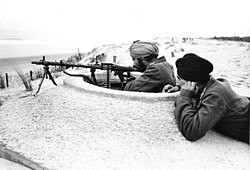
[[File:Bundesarchiv Bild 101I-263-1580-05, Atlantikwall, Soldaten der Legion "Freies Indien".jpg|thumb|Troops of the Indian Legion at the [[Atlantic Wall]] near Bordeaux, France, March 1944.]] | [[File:Bundesarchiv Bild 101I-263-1580-05, Atlantikwall, Soldaten der Legion "Freies Indien".jpg|thumb|Troops of the Indian Legion at the [[Atlantic Wall]] near Bordeaux, France, March 1944.]] | ||
The legion was transferred to [[Zeeland]] in the Netherlands in April 1943 as part of the [[Atlantic Wall]] and later to France in September 1943, attached to the [[344th Infantry Division (Wehrmacht)|344th Infantry Division]] and later the [[159th Infantry Division (Wehrmacht)|159th Infantry Division]] of the ''Wehrmacht''. From Beverloo in Belgium, the 1st Battalion was reassigned to [[Zandvoort]] in May 1943 where they stayed until relieved by the [[Georgian Legion (1941–1945)|Georgian Legion]] in August. In September 1943, the battalion was deployed on the Atlantic coast of [[Bordeaux]] on the [[Bay of Biscay]]. The 2nd Battalion moved from Beverloo to the island of [[Texel]] in May 1943 and stayed there until relieved | The legion was transferred to [[Zeeland]] in the Netherlands in April 1943 as part of the [[Atlantic Wall]] and later to France in September 1943, attached to the [[344th Infantry Division (Wehrmacht)|344th Infantry Division]] and later the [[159th Infantry Division (Wehrmacht)|159th Infantry Division]] of the ''Wehrmacht''. From Beverloo in Belgium, the 1st Battalion was reassigned to [[Zandvoort]] in May 1943 where they stayed until relieved by the [[Georgian Legion (1941–1945)|Georgian Legion]] in August. In September 1943, the battalion was deployed on the Atlantic coast of [[Bordeaux]] on the [[Bay of Biscay]]. The 2nd Battalion moved from Beverloo to the island of [[Texel]] in May 1943 and stayed there until relieved that September. From here, it was deployed to [[Les Sables-d'Olonne]] in France.{{sfn|Houterman|1997|p= 63}} The 3rd Battalion remained at [[Oldebroek]] as Corps Reserve until the end of September 1943,{{sfn|Houterman|1997|p= 63}} where they gained a "wild and loathsome"<ref name=Thomson/> reputation amongst the locals. | ||
===Transfer to the ''Waffen-SS''=== | ===Transfer to the ''Waffen-SS''=== | ||
The legion was stationed in the [[Lacanau]] (near [[Bordeaux]]) at the time of the [[Normandy landings]], and remained there for up to two months after [[D-Day]]. In July 1944, the legion was tasked with suppressing the [[French Resistance]] and capturing civilians for | The legion was stationed in the [[Lacanau]] (near [[Bordeaux]]) at the time of the [[Normandy landings]], and remained there for up to two months after [[D-Day]]. In July 1944, the legion was tasked with suppressing the [[French Resistance]] and capturing civilians for [[Forced labour under German rule during World War II|forced labour]]. Whilst suppressing the French resistance in August 1944, 25 legionaries deserted to the French Resistance. Despite being promised that they would be handed over to Allied Forces, the group of legionaries were executed by anarchist elements of the resistance.<ref>{{cite journal |last1=Oesterheld |first1=Joachhim |title=The Last Chapter of the Indian Legion |journal=Focus: South Asia and the World Wars |date=2015 |url=https://edoc.hu-berlin.de/bitstream/handle/18452/9147/34.pdf?sequence=1}}</ref> On 8 August 1944 Himmler authorised the legion's control to be transferred to the ''[[Waffen-SS]]'', as was that of every other foreign volunteer unit of the German Army.{{sfn|Littlejohn|1994|p=127}} | ||
On 15 August, the unit pulled out of Lacanau to make its way back to Germany. | The unit was renamed the ''Indische Freiwilligen Legion der Waffen-SS''. Command of the legion was very shortly transferred from [[Obersturmbannführer]] Kurt Krapp to ''Oberführer'' Heinz Bertling. The Indian personnel noticed a change of command was at hand and started to complain. Noting he wasn't "wanted", Bertling soon agreed to be relieved of command.{{sfn|Munoz|2002}} On 15 August, the unit pulled out of Lacanau to make its way back to Germany. On the second leg of this journey, from [[Poitiers]] to [[Châteauroux]], it suffered its first combat casualty, Lieutenant Ali Khan, while engaging French regular forces in the town of [[Dun-le-Poëlier|Dun]]. The unit also engaged with Allied [[armoured forces|armour]] at [[Nuits-Saint-Georges]] while retreating across the [[Loire]] to [[Dijon]]. It was regularly harassed by the French Resistance, suffering two more casualties (Lieutenant Kalu Ram and Captain Mela Ram). The unit moved from [[Remiremont]] through [[Alsace]] to [[Lager Heuberg|Camp Heuberg]] in Germany in the winter of 1944,{{sfn|Davis|1994|p=22}} where it stayed until March 1945. | ||
===Italy=== | ===Italy=== | ||
The 9th Company of the Legion (from the 2nd Battalion) also saw action in Italy. Having been deployed in the spring of 1944, it faced the British [[V Corps (United Kingdom)|V Corps]] and the Polish [[II Corps (Poland)|II Corps]] | The 9th Company of the Legion (from the 2nd Battalion) also saw action in Italy. Having been deployed in the spring of 1944, it faced the British [[V Corps (United Kingdom)|V Corps]] and the Polish [[II Corps (Poland)|II Corps]], until it was withdrawn from the front to be used in [[Anti-partisan operations in World War II|anti-partisan operations]]. It surrendered in Italy to the Allied forces in April 1945.{{sfn|Munoz|2002}} | ||
===End of the Legion=== | ===End of the Legion=== | ||
With the defeat of the Third Reich imminent in May 1945, the remainder of the Indian Legion stationed in Germany sought sanctuary in neutral Switzerland. They undertook a desperate {{convert|2.6|km|mi|adj=on}} march along the shores of [[Lake Constance]], attempting to enter Switzerland via the alpine passes. This was, | With the defeat of the Third Reich imminent in May 1945, the remainder of the Indian Legion stationed in Germany sought sanctuary in neutral Switzerland. They undertook a desperate {{convert|2.6|km|mi|adj=on}} march along the shores of [[Lake Constance]], attempting to enter Switzerland via the alpine passes. This was unsuccessful, and the legion was captured by US and French forces and delivered to British and Indian forces in Europe.<ref name=Augsburger>{{cite news|url=http://uk-muenchen.de/pdfPresse/20000819_AZ.pdf |title=Subhas Chandra Bose: Er wollte Freiheit für Indien|language=de|newspaper= Augsburger Zeitung|date=19 August 2000}}</ref> The captured troops were later shipped back to India, where a number were tried for treason.{{sfn|Davis|1994|p=22}} After the uproar [[Indian National Army trials|the trials of Indians who served with the Axis]] caused among civilians and the military of British India, the legion members' sentences were commuted. | ||
==Legacy== | ==Legacy== | ||
| Line 136: | Line 142: | ||
The integral association of the Free India Legion with Nazi Germany and the other Axis powers means its legacy is seen from two viewpoints, similarly to other nationalist movements that were aligned with Germany during the war, such as the Russian [[Russian Liberation Movement|Vlasov movement]]. One viewpoint sees it as a collaborationist unit of the Third Reich; the other views it as the realisation of a liberation army to fight against the British Raj.<ref name=DIL>{{cite journal|title=Die indische Legion – Ein Stück Deutsche Geschichte|first= Urmila|last= Goel|url=http://www.urmila.de/UDG/Biblio/legion.html|journal=Südasien|language=de|year= 2003|issue=4|pages=27–30}}</ref> | The integral association of the Free India Legion with Nazi Germany and the other Axis powers means its legacy is seen from two viewpoints, similarly to other nationalist movements that were aligned with Germany during the war, such as the Russian [[Russian Liberation Movement|Vlasov movement]]. One viewpoint sees it as a collaborationist unit of the Third Reich; the other views it as the realisation of a liberation army to fight against the British Raj.<ref name=DIL>{{cite journal|title=Die indische Legion – Ein Stück Deutsche Geschichte|first= Urmila|last= Goel|url=http://www.urmila.de/UDG/Biblio/legion.html|journal=Südasien|language=de|year= 2003|issue=4|pages=27–30}}</ref> | ||
Unlike the Indian National Army, conceived with the same doctrine,<ref name=Syonan>{{cite news|title=Axis War Makes Easier Task of Indians. Chandra Bose's Berlin Speech|newspaper=Syonan Sinbun|date=26 January 1943}}</ref> it has | Unlike the Indian National Army, conceived with the same doctrine,<ref name=Syonan>{{cite news|title=Axis War Makes Easier Task of Indians. Chandra Bose's Berlin Speech|newspaper=Syonan Sinbun|date=26 January 1943}}</ref> it has had little exposure since the end of the war, even in independent India. This is because it was far removed from India, unlike Burma, and because the Legion was so much smaller than the INA and was not engaged in its originally conceived role.<ref name=DIL/> Bose's plans for the Legion, and even the INA, were too grandiose for their military capability, and their fate was too strongly tied to that of the Axis powers.{{sfn|Lebra|1971|pp=190–191}} Looking at the legacy of Azad Hind, however, historians consider both movements' military and political actions (of which the Legion was one of the earliest elements, and an integral part of Bose's plans) and the indirect effect they had on the era's events. | ||
In German histories of the Second World War, the Legion is noted less than other foreign volunteer units. | In German histories of the Second World War, the Legion is noted less than other foreign volunteer units. Film-maker and author {{ill|Merle Kröger|de}}, however, made the 2003 mystery novel ''Cut!'' about soldiers from the Legion in France. She said she found them an excellent topic for a mystery because scarcely any Germans had heard of the Indians who volunteered for the German Army.<ref name=DIL/> | ||
===Perceptions as collaborators=== | ===Perceptions as collaborators=== | ||
In considering the history of the Free India Legion, the most controversial aspect is its integral link to Nazi Germany, with a widespread perception that they were [[Collaboration with Nazi Germany and Fascist Italy|collaborators with Nazi Germany]] by virtue of their uniform, oath and field of operation. The views of the founder and leader of the Azad Hind movement, Subhas Chandra Bose, were somewhat more nuanced than straightforward support for the Axis. During the 1930s Bose had organised and led protest marches against Japanese imperialism, and wrote an article attacking Japanese imperialism, although expressing admiration for other aspects of the Japanese regime.<ref>{{cite journal|last=Bose|first=Subhas|title=Japan's Role in the Far East|journal=Modern Review |date= October 1937|quote=Japan has done great things for herself and for Asia. Her reawakening at the dawn of the present century sent a thrill throughout our Continent. Japan has shattered the white man's prestige in the Far East and has put all the Western imperialist powers on the defensive – not only in the military but also in the economic sphere. She is extremely sensitive – and rightly so – about her self-respect as an Asiatic race. She is determined to drive out the Western powers from the Far East. But could not all this have been achieved without Imperialism, without dismembering the Chinese Republic, without humiliating another proud, cultured and ancient race? No, with all our admiration for Japan, where such admiration is due, our whole heart goes out to China in her hour of trial.}}, cited in {{harvnb|Bose|Bose|1997|p=190}}</ref> Bose's correspondence prior to 1939 also showed his deep disapproval of the racist practices and annulment of democratic institutions by the Nazis.<ref>Bose to Dr. Thierfelder of the Deutsche Akademie, Kurhaus Hochland, Badgastein, 25 March 1936. "Today I regret that I have to return to India with the conviction that the new nationalism of Germany is not only narrow and selfish but arrogant. The recent speech of Herr Hitler in Munich gives the essence of Nazi philosophy…The new racial philosophy which has a very weak scientific foundation stands for the glorification of the white races in general and the German race in particular. Herr Hitler has talked of the destiny of white races to rule over the rest of the world. But the historical fact is that up till now the Asiatics have dominated Europe more than have the Europeans dominated Asia. One only has to consider the repeated invasions of Europe by [[Mongols]], the Turks, the Arabs ([[Moors]]), the [[Huns]] and other Asiatic races to understand the strength of my argument…", cited in {{harvnb|Bose|Bose1997|p=155}}</ref> He nonetheless expressed admiration for the authoritarian methods which he saw in Italy and Germany during the 1930s, and thought they could be used in building an independent India.<ref>{{cite web|last=Sen|first=S. |year=1999|archive-url=https://web.archive.org/web/20050305012751/http://www.andaman.org/book/app-m/textm.htm |title=Subhas Chandra Bose 1897–1945|url=http://www.andaman.org/book/app-m/textm.htm|publisher=Andaman Association |archive-date=5 March 2005}}</ref> | In considering the history of the Free India Legion, the most controversial aspect is its integral link to Nazi Germany, with a widespread perception that they were [[Collaboration with Nazi Germany and Fascist Italy|collaborators with Nazi Germany]] by virtue of their uniform, oath and field of operation. The views of the founder and leader of the Azad Hind movement, Subhas Chandra Bose, were, however, somewhat more nuanced than straightforward support for the Axis. During the 1930s Bose had organised and led protest marches against Japanese imperialism, and wrote an article attacking Japanese imperialism, although expressing admiration for other aspects of the Japanese regime.<ref>{{cite journal|last=Bose|first=Subhas|title=Japan's Role in the Far East|journal=Modern Review |date= October 1937|quote=Japan has done great things for herself and for Asia. Her reawakening at the dawn of the present century sent a thrill throughout our Continent. Japan has shattered the white man's prestige in the Far East and has put all the Western imperialist powers on the defensive – not only in the military but also in the economic sphere. She is extremely sensitive – and rightly so – about her self-respect as an Asiatic race. She is determined to drive out the Western powers from the Far East. But could not all this have been achieved without Imperialism, without dismembering the Chinese Republic, without humiliating another proud, cultured and ancient race? No, with all our admiration for Japan, where such admiration is due, our whole heart goes out to China in her hour of trial.}}, cited in {{harvnb|Bose|Bose|1997|p=190}}</ref> Bose's correspondence prior to 1939 also showed his deep disapproval of the racist practices and annulment of democratic institutions by the Nazis.<ref>Bose to Dr. Thierfelder of the Deutsche Akademie, Kurhaus Hochland, Badgastein, 25 March 1936. "Today I regret that I have to return to India with the conviction that the new nationalism of Germany is not only narrow and selfish but arrogant. The recent speech of Herr Hitler in Munich gives the essence of Nazi philosophy…The new racial philosophy which has a very weak scientific foundation stands for the glorification of the white races in general and the German race in particular. Herr Hitler has talked of the destiny of white races to rule over the rest of the world. But the historical fact is that up till now the Asiatics have dominated Europe more than have the Europeans dominated Asia. One only has to consider the repeated invasions of Europe by [[Mongols]], the Turks, the Arabs ([[Moors]]), the [[Huns]] and other Asiatic races to understand the strength of my argument…", cited in {{harvnb|Bose|Bose1997|p=155}}</ref> He nonetheless expressed admiration for the authoritarian methods which he saw in Italy and Germany during the 1930s, and thought they could be used in building an independent India.<ref>{{cite web|last=Sen|first=S. |year=1999|archive-url=https://web.archive.org/web/20050305012751/http://www.andaman.org/book/app-m/textm.htm |title=Subhas Chandra Bose 1897–1945|url=http://www.andaman.org/book/app-m/textm.htm|publisher=Andaman Association |archive-date=5 March 2005}}</ref> | ||
Bose's view was not necessarily shared by the men of the Free India Legion, and they were not wholly party to Nazi ideology or in collaboration with the Nazi machinery. The Legion's volunteers were not merely motivated by the chance to escape imprisonment and earn money. Indeed, when the first POWs were brought to Annaburg and met with Subhas Chandra Bose, there was marked and open hostility towards him as a Nazi propaganda puppet.{{sfn|Toye|1959|p=63}} Once Bose's efforts and views had gained more sympathy, a persistent query among the POWs was 'How would the legionary stand in relation to the German soldier?'.{{sfn|Toye|1959|p=63}} The Indians were not prepared to simply fight for Germany's interests, after abandoning their oath to the King-Emperor. The Free India Centre—in charge of the legion after the departure of Bose—faced a number of grievances from legionaries. The foremost were that Bose had abandoned them and left them entirely in German hands, and a perception that the ''Wehrmacht'' was now going to use them in the Western Front instead of sending them to fight for independence.{{sfn|James|1997|p=553}} | Bose's view was not necessarily shared by the men of the Free India Legion, and they were not wholly party to Nazi ideology or in collaboration with the Nazi machinery. The Legion's volunteers were not merely motivated by the chance to escape imprisonment and earn money. Indeed, when the first POWs were brought to Annaburg and met with Subhas Chandra Bose, there was marked and open hostility towards him as a Nazi propaganda puppet.{{sfn|Toye|1959|p=63}} Once Bose's efforts and views had gained more sympathy, a persistent query among the POWs was 'How would the legionary stand in relation to the German soldier?'.{{sfn|Toye|1959|p=63}} The Indians were not prepared to simply fight for Germany's interests, after abandoning their oath to the King-Emperor. The Free India Centre—in charge of the legion after the departure of Bose—faced a number of grievances from legionaries. The foremost were that Bose had abandoned them and left them entirely in German hands, and a perception that the ''Wehrmacht'' was now going to use them in the Western Front instead of sending them to fight for independence.{{sfn|James|1997|p=553}} | ||
The attitude of the Legion's soldiers was similar to that of the Italian ''[[Battaglione Azad Hindoustan]]'', which had been of dubious loyalty to the Axis cause—it was disbanded after a mutiny.<ref name="Public Relations Office"/>{{sfn|James|1997|p=598}} In one instance, immediately prior to the first deployment of the Legion in the Netherlands in April 1943, after the departure of the 1st Battalion from Königsbrück, two companies within the 2nd Battalion refused to move until convinced by Indian leaders.{{sfn|James|1997|p=553}} Even in Asia, where the Indian National Army was much larger and fought the British directly, Bose faced similar obstacles at first. All of this goes to show that many of the men never possessed loyalty to the Nazi cause or ideology; the motivation of the Legion's men was to fight for India's independence.{{sfn|James|1997|p=553}} The unit did allegedly participate in atrocities, especially in the Médoc region in July 1944,{{sfn|Lormier|1998|pages=35–36}} and in the region of Ruffec, including rapes and child murder<ref name=Thomson>{{cite web|url= | The attitude of the Legion's soldiers was similar to that of the Italian ''[[Battaglione Azad Hindoustan]]'', which had been of dubious loyalty to the Axis cause—it was disbanded after a mutiny.<ref name="Public Relations Office"/>{{sfn|James|1997|p=598}} In one instance, immediately prior to the first deployment of the Legion in the Netherlands in April 1943, after the departure of the 1st Battalion from Königsbrück, two companies within the 2nd Battalion refused to move until convinced by Indian leaders.{{sfn|James|1997|p=553}} Even in Asia, where the Indian National Army was much larger and fought the British directly, Bose faced similar obstacles at first. All of this goes to show that many of the men never possessed loyalty to the Nazi cause or ideology; the motivation of the Legion's men was to fight for India's independence.{{sfn|James|1997|p=553}} The unit did allegedly participate in atrocities, especially in the Médoc region in July 1944,{{sfn|Lormier|1998|pages=35–36}} and in the region of Ruffec, including rapes and child murder,<ref name=Thomson>{{cite web|url=https://news.bbc.co.uk/2/hi/europe/3684288.stm|publisher= BBC|title= Hitler's Secret Indian Army|work=BBC News|first=Mike|last=Thomson|date= 23 September 2004 }}</ref> and in the department of [[Indre]] during their retreat,<ref>{{cite web|url=http://alaingievis.chez.com/HINDOUS/hindou.html|title= Le passage des Hindous dans le département de l'Indre (fin août 1944)|publisher= French official public archives, presented and annotated by Jean-Louis Laubry|language=fr|archive-url=https://web.archive.org/web/20120403001912/http://alaingievis.chez.com/HINDOUS/hindou.html|archive-date=3 April 2012}}</ref> and some elements of the unit also undertook anti-partisan operations in Italy. | ||
=== Role in Indian independence === | === Role in Indian independence === | ||
However, in political terms Bose may have been successful | However, events that occurred within India after the war indicate that in political terms Bose may have been successful.<ref name="Public Relations Office">Public Relations Office, London. War Office. 208/761A</ref>{{sfn|James|1997|p=598}} After the war, the soldiers and officers of the Free India Legion were brought as prisoners to India, where they were to be brought to trial in [[courts-martial]] along with Indians who had been in the INA. Their stories were seen as so inflammatory that, fearing mass revolts and uprisings across the empire, the British government forbade the [[BBC]] from broadcasting about them after the war.<ref name=Thomson/> Not much is known of any charges made against Free India Legion soldiers, but sentences issued following the [[Indian National Army trials]] that were initiated were commuted, or charges dropped, after widespread protest and several mutinies. | ||
As a condition of independence readily agreed to by the INC, members of the Free India Legion and INA were not allowed to serve in the post-independence Indian military, but they were all released before independence.{{sfn|Günther|2003|pp=112–113}} | As a condition of independence readily agreed to by the INC, members of the Free India Legion and INA were not allowed to serve in the post-independence Indian military, but they were all released before independence.{{sfn|Günther|2003|pp=112–113}} | ||
==See also== | ==See also== | ||
{{Portal|Germany}} | |||
*[[ | *[[Arzi Hukumat-e-Azad Hind]] | ||
*[[Battaglione Azad Hindoustan]] | *[[Battaglione Azad Hindoustan]] | ||
*[[British Free Corps]] | *[[British Free Corps]] | ||
*[[Free Arabian Legion]] | *[[Free Arabian Legion]] | ||
==References== | ==References== | ||
| Line 188: | Line 193: | ||
==External links== | ==External links== | ||
{{commonscatinline}} | |||
* [ | * [https://news.bbc.co.uk/2/hi/europe/3684288.stm Hitler's secret Indian army] – BBC News | ||
* [https://www.youtube.com/watch?v=2m_pl1-V6hk&list=TLPQMDgwODIwMjCWuHIBF1qoeQ&index=1 The Free India Legion, Hitler's Indian soldiers] – France 24 | * [https://www.youtube.com/watch?v=2m_pl1-V6hk&list=TLPQMDgwODIwMjCWuHIBF1qoeQ&index=1 The Free India Legion, Hitler's Indian soldiers] – France 24 | ||
{{Indian National Army}} | {{Indian National Army}} | ||
| Line 207: | Line 212: | ||
[[Category:National liberation armies]] | [[Category:National liberation armies]] | ||
[[Category:Subhas Chandra Bose]] | [[Category:Subhas Chandra Bose]] | ||
[[Category:Fascism in India]] | |||
[[Category:Fascist movements]] | |||
[[Category:Indian collaborators with Nazi Germany]] | |||
Latest revision as of 07:26, 24 March 2026
| Free India Legion | |
|---|---|
| German: Legion Freies Indien | |
 Flag of the Indian Legion | |
| Active | 1941 – May 1945 |
| Country |  Germany Germany |
| Allegiance |  Azad Hind Azad Hind |
| Branch |  German Army (1941–1944) German Army (1941–1944) Waffen-SS (1944–1945) Waffen-SS (1944–1945) |
| Type | Infantry |
| Size | 4,500 (maximum)[1] |
| Garrison/HQ | |
| Nickname(s) | "Tiger Legion" "Azad Hind Fauj" |
| Engagements | |
| Commanders | |
| Notable commanders |
|
| Insignia | |
| Badge |  |
| Banner |  |
The Indian Legion (German: Indische Legion), officially the Free India Legion (German: Legion Freies Indien) or 950th (Indian) Infantry Regiment (German: Infanterie-Regiment 950 (indisches)), was a military unit raised during the Second World War initially as part of the German Army and later the Waffen-SS from August 1944. Intended to serve as a liberation force for British-ruled India, it was made up of Indian prisoners of war and expatriates in Europe. Owing to its origins in the Indian independence movement, it was known also as the "Tiger Legion", and the "Azad Hind Fauj". As part of the Waffen-SS it was known as the Indian Volunteer Legion of the Waffen-SS (German: Indische Freiwilligen Legion der Waffen-SS). The transfer to the Waffen-SS was never fully executed and many members of the division refused to wear the new uniforms and insignia.[2]
Indian independence leader Subhas Chandra Bose initiated the legion's formation, as part of his efforts to win India's independence by waging war against Britain, when he came to Berlin in 1941 seeking German aid. The initial recruits in 1941 were volunteers from the Indian students resident in Germany at the time, and a handful of the Indian prisoners of war who had been captured during the North African campaign. It later drew a larger number of Indian prisoners of war as volunteers.
Though it was initially raised as an assault group that would form a pathfinder to a German–Indian joint invasion of the western frontiers of British India, only a small contingent was ever put to its original intended purpose. A small contingent, including much of the Indian officer corps and enlisted leadership, was transferred to the Indian National Army in South-East Asia. The majority of the troops of the Indian Legion were given only non-combat duties in the Netherlands and in France until the Allied invasion. They saw action in the retreat from the Allied advance across France, fighting mostly against the French Resistance. One company was sent to Italy in 1944, where it saw action against British and Polish troops and undertook anti-partisan operations.
At the time of the surrender of Nazi Germany in 1945, the remaining men of the Indian Legion made efforts to march to neutral Switzerland over the Alps, but they were captured by American and French troops and eventually shipped back to India to face charges of treason. However, the courts-martial of Indians who served with the Axis were not completed due to widespread outrage among soldiers and civilians.
Background[edit | edit source]


The idea of raising an armed force that would fight its way into India to bring down the British Raj goes back to the First World War, when the Ghadar Party and the then nascent Indian Independence League formulated plans to initiate rebellion in the British Indian Army from Punjab to Hong Kong with German support. This plan failed after information leaked to British intelligence, but only after many attempts at mutiny, and a 1915 mutiny of Indian troops in Singapore.[3][4] During World War II, all three of the major Axis powers sought to support armed revolutionary activities in India, and aided the recruitment of a military force from Indian prisoners of war (POWs) captured while serving in the British Indian Army, and Indian expatriates.[5]
The most notable and successful Indian force to fight with the Axis was the Indian National Army (INA) in southeast Asia, that came into being with the support of the Japanese Empire in April 1942. Fascist Italy also created the Azad Hindustan Battalion (Italian: Battaglione Azad Hindoustan) in February 1942. This unit was formed from Indian POWs from their Centro I POW camp, and Italians previously resident in India and Persia, and ultimately served under the Ragruppamento Centri Militari alongside units of Arabs and colonial Italians. However, the effort had little acceptance from the Indians in the unit, who did not wish to serve under Italian officers.[6][7] After Italy lost the Second Battle of El Alamein, the Indians mutinied when told to fight in Libya. Consequently, the remnants of the battalion were disbanded in November 1942.[8][9]
Although the Indian National Congress (INC), the organisation leading the struggle for Indian independence, had passed resolutions conditionally supporting the fight against fascism,[10] some Indian public opinion was more hostile toward Britain's unilateral decision to declare India a belligerent on the side of the Allies. Among the more rebellious Indian political leaders of the time was Subhas Chandra Bose, a former INC president, who was viewed as a potent enough threat by the British that he was arrested when the war started.[11] Bose escaped from house arrest in India in January 1941 and made his way through Afghanistan to the Soviet Union, with some help from Germany's military intelligence service, the Abwehr. Bose, ideologically a Communist was inclined to the Soviet Union for aid.
Once he reached Moscow, he did not receive the expected Soviet support for his plans for a popular uprising in India. The Soviets were navigating a complex geopolitical and strategic web and did not want to break any potential alliance with the Allies in case of an impending German invasion. The German ambassador in Moscow, Count von der Schulenberg, soon arranged for Bose to go to Berlin. He arrived at the beginning of April 1941, and he met with foreign minister Joachim von Ribbentrop and later Adolf Hitler.[12] In Berlin, Bose set up the Free India Centre and Azad Hind Radio, which commenced broadcasting to Indians on shortwave radio frequencies, reaching tens of thousands of Indians who had shortwave receivers.[13][14] Soon Bose's aim became to raise an army, which he imagined would march into India with German forces and trigger the downfall of the Raj.[15]
Origin[edit | edit source]

The first troops of the Indian Legion were recruited from Indian POWs captured at El Mekili, Libya during the battles for Tobruk. The German forces in the Western Desert selected a core group of 27 POWs as potential officers and they were flown to Berlin in May 1941, to be followed, after the Centro I experiment, by POWs being transferred from the Italian forces to Germany.[16] The number of POWs transferred to Germany grew to about 10,000 who were eventually housed at Annaburg camp, where Bose first met with them. A first group of 300 volunteers from the POWs and Indians expatriates in Germany were sent to Frankenberg camp near Chemnitz, to train and convince arriving POWs to join the legion.[17]
As the numbers of POWs joining the legion swelled, the legion was moved to Königsbrück for further training.[17] It was at Königsbrück that uniforms were first issued, in German feldgrau with the badge of the leaping tiger of Azad Hind. The formation of the Indian National Army was announced by the German Propaganda Ministry in January 1942. It did not, however, take oath until 26 August 1942, as the Legion Freies Indien of the German Army. By May 1943, the numbers had swelled, aided by the enlistment as volunteers of Indian expatriates.[16]
Overall, there were about 15,000 Indian POWs in Europe, primarily held in Germany by 1943. While some remained loyal to the King-Emperor and treated Bose and the Legion with contempt, most were at least somewhat sympathetic to Bose's cause[citation needed]. While approximately 2,000 became legionnaires, some others did not complete their training owing to various reasons and circumstances.[16][18] The maximum size of the Legion was 4,500.[1]
Bose sought and obtained agreement from the German High Command for the rather remarkable terms under which the Legion would serve in German military. German soldiers would train the Indians in all branches of infantry and motorized units in using weapons under the strictest military discipline, in the same way a German formation was trained; the Indian legionnaires were not to be mixed with any German structures; they were not to be sent to any front other than in India for fighting against the British, but would be allowed to fight in self-defence at any other place. In all other respects, the legionnaires would enjoy the same facilities and amenities regarding pay, clothing, food, leave, etc., as German soldiers. As for the unit's eventual deployments in the Netherlands and France, they were ostensibly for training purposes, according to Bose's plans for the unit to be trained in some aspects of coastal defence.[19] After the invasion of France by the Allies, the unit was ordered back to Germany, so that it would not participate in fighting for German military interests.
Organization[edit | edit source]
Composition[edit | edit source]


The British Indian Army organised regiments and units on the basis of religion and regional or caste identity. Bose sought to end this practice and build up one unified Indian identity among the men who would fight for independence. Consequently, the Indian Legion was organised as mixed units so that Hindus, Muslims, Sikhs all served side by side.[7] Sources gave varying demographics for the Legion. Most sources put the demographics at two third Hindus, and one third other religions such as Muslims, Sikhs and Christians.[20][21][22] According to reports the unit consisted of 59 percent Hindus, 25 percent Muslims, 14 percent Sikhs and 2 percent Christians and Buddhists. (The proportion of Sikhs later rose to as high as 20 per cent). Compared to the distribution in the British Indian Army fighting the Germans, where Muslims made up 34 percent, Hindus 41 percent, and Sikhs 11 percent with Gurkhas and others making up 14 percent, the Indian Legion had a high proportion of Hindus and Sikhs and comparatively few Muslims.[23] (In fact, the Muslim League was the only major Indian Independence movement that supported the British war effort.)[24]
The success of Bose's idea of developing a unified national identity was evident when Heinrich Himmler proposed in late 1943, after Bose's departure, that the Muslim soldiers of the I.R. 950 be recruited into the new Handschar Division. The commander of the SS Head Office, Gottlob Berger, was obliged to point out that while the Bosnians of the "Handschar" perceived themselves as European, Indian Muslims perceived themselves as Indians.[25] Hitler, however, showed little enthusiasm for the I.R. 950, at one stage insisting that their weapons be handed over to the newly created 18th SS Horst Wessel Division, exclaiming that "…the Indian Legion is a joke!"[7]
Uniform and standard[edit | edit source]
The uniform issued to the Indian Legion were the standard German Army uniform of feldgrau in winter and khaki in summer. Additionally, the troops wore on their right upper arm a specially designed arm badge in the shape of a shield with three horizontal stripes of saffron, white, and green and with a leaping tiger on the white middle band. The legend Freies Indien was inscribed in black on a white background above the tricolor. A saffron, white, and green transfer was also worn on the left side of their steel helmets, similar to the black, white, and red decal German soldiers wore on their helmets. Sikhs in the legion were permitted to wear a turban as dictated by their religion instead of the usual peaked field cap, of a colour appropriate to their uniform.
The Legion's transfer to the Waffen-SS meant they would be issued new uniforms and insignia. These were to follow the trend among foreign, largely non-Germanic SS units of having their own insignia as opposed to the standard SS runes. In the case of the Indian Legion, this meant most of its members would have a blank collar tab alongside their rank insignia. There was a proposal for the Legion to have their unique collar insignia featuring a tiger's head, though extremely few of these collar tabs were actually manufactured and even less were worn by the Legion's members.
The standard of the Indian Legion, presented as the unit's colours in late 1942 or early 1943, used the same design as the arm badge previously issued to the men of the Legion. It consisted of saffron, white and green horizontal bands, from top to bottom; the white middle band was approximately three times the width of the coloured bands. The words "Azad" and "Hind" in white were inscribed over the saffron and green bands respectively, and over the white middle band was a leaping tiger. This is essentially the same design that the Azad Hind Government later adopted as their flag (although photographic evidence shows that the Indian National Army, at least during the Burma Campaign, used the Swaraj flag of the INC instead).[26]
Decorations[edit | edit source]
In 1942, Bose instituted several medals and orders for service to Azad Hind. As was typical for German decorations, crossed swords were added when they were issued for action in combat. Nearly half of the soldiers of the legion received one of these decorations.[27]
Structure and units[edit | edit source]
The Indian Legion was organised as a standard German army infantry regiment of three battalions of four companies each, at least initially with exclusively German commissioned officers. It has been later referred to as Panzergrenadier Regiment 950 (indische), indicating the unit was partially motorised.[28] It was equipped with 81 motor vehicles and 700 horses.[29] In this structure, the legion came to consist of:
- I. Bataillon – infantry companies 1 to 4
- II. Bataillon – infantry companies 5 to 8
- III. Bataillon – infantry companies 9 to 12
- 13. Infanteriegeschütz Kompanie (infantry-gun company – armed with six 7.5 cm leichtes Infanteriegeschütz 18)
- 14. Panzerjäger Kompanie (anti-tank company – armed with six Panzerabwehrkanone)
- 15. Pionier Kompanie (engineer company)
- Ehrenwachkompanie (honour guard company)
It also included hospital, training, and maintenance staff.[29]
Operations[edit | edit source]


It is doubtful that Subhas Chandra Bose envisaged the Free India Legion would ever be an army sufficient or strong enough to conduct an effective campaign across Persia into India on its own. Instead, the IR 950 was to become a pathfinder, preceding a larger Indo-German force in a Caucasian campaign into the western frontiers of British India, that would encourage public resentment of the Raj and incite the British Indian Army into revolt.
Following German defeat in Europe at Stalingrad and in North Africa at El Alamein, it became clear that an Axis assault through Persia or even the Soviet Union was unlikely. Meanwhile, Bose had travelled to the Far East, where the Indian National Army was able to engage the Allies alongside the Japanese Army in Burma, and ultimately in northeastern India. The German Naval High Command at this time made the decision to transfer much of the leadership and a segment of the Free India Legion to South Asia, and on 21 January they were formally made a part of the Indian National Army. Most troops of the Indian Legion, however, remained in Europe through the war and were never utilised in their originally planned role.
Adrian Weale has written that about 100 members of the Indian Legion were parachuted into eastern Persia in January 1942 tasked with infiltrating Baluchistan Province as Operation Bajadere.[30] However, Adrian O'Sullivan has described such an operation as being "mythical", as it was logistically impossible, and there is no documentary evidence of it taking place.[31]
Netherlands and France[edit | edit source]

The legion was transferred to Zeeland in the Netherlands in April 1943 as part of the Atlantic Wall and later to France in September 1943, attached to the 344th Infantry Division and later the 159th Infantry Division of the Wehrmacht. From Beverloo in Belgium, the 1st Battalion was reassigned to Zandvoort in May 1943 where they stayed until relieved by the Georgian Legion in August. In September 1943, the battalion was deployed on the Atlantic coast of Bordeaux on the Bay of Biscay. The 2nd Battalion moved from Beverloo to the island of Texel in May 1943 and stayed there until relieved that September. From here, it was deployed to Les Sables-d'Olonne in France.[32] The 3rd Battalion remained at Oldebroek as Corps Reserve until the end of September 1943,[32] where they gained a "wild and loathsome"[33] reputation amongst the locals.
Transfer to the Waffen-SS[edit | edit source]
The legion was stationed in the Lacanau (near Bordeaux) at the time of the Normandy landings, and remained there for up to two months after D-Day. In July 1944, the legion was tasked with suppressing the French Resistance and capturing civilians for forced labour. Whilst suppressing the French resistance in August 1944, 25 legionaries deserted to the French Resistance. Despite being promised that they would be handed over to Allied Forces, the group of legionaries were executed by anarchist elements of the resistance.[34] On 8 August 1944 Himmler authorised the legion's control to be transferred to the Waffen-SS, as was that of every other foreign volunteer unit of the German Army.[7]
The unit was renamed the Indische Freiwilligen Legion der Waffen-SS. Command of the legion was very shortly transferred from Obersturmbannführer Kurt Krapp to Oberführer Heinz Bertling. The Indian personnel noticed a change of command was at hand and started to complain. Noting he wasn't "wanted", Bertling soon agreed to be relieved of command.[35] On 15 August, the unit pulled out of Lacanau to make its way back to Germany. On the second leg of this journey, from Poitiers to Châteauroux, it suffered its first combat casualty, Lieutenant Ali Khan, while engaging French regular forces in the town of Dun. The unit also engaged with Allied armour at Nuits-Saint-Georges while retreating across the Loire to Dijon. It was regularly harassed by the French Resistance, suffering two more casualties (Lieutenant Kalu Ram and Captain Mela Ram). The unit moved from Remiremont through Alsace to Camp Heuberg in Germany in the winter of 1944,[28] where it stayed until March 1945.
Italy[edit | edit source]
The 9th Company of the Legion (from the 2nd Battalion) also saw action in Italy. Having been deployed in the spring of 1944, it faced the British V Corps and the Polish II Corps, until it was withdrawn from the front to be used in anti-partisan operations. It surrendered in Italy to the Allied forces in April 1945.[35]
End of the Legion[edit | edit source]
With the defeat of the Third Reich imminent in May 1945, the remainder of the Indian Legion stationed in Germany sought sanctuary in neutral Switzerland. They undertook a desperate 2.6-kilometre (1.6 mi) march along the shores of Lake Constance, attempting to enter Switzerland via the alpine passes. This was unsuccessful, and the legion was captured by US and French forces and delivered to British and Indian forces in Europe.[36] The captured troops were later shipped back to India, where a number were tried for treason.[28] After the uproar the trials of Indians who served with the Axis caused among civilians and the military of British India, the legion members' sentences were commuted.
Legacy[edit | edit source]
The integral association of the Free India Legion with Nazi Germany and the other Axis powers means its legacy is seen from two viewpoints, similarly to other nationalist movements that were aligned with Germany during the war, such as the Russian Vlasov movement. One viewpoint sees it as a collaborationist unit of the Third Reich; the other views it as the realisation of a liberation army to fight against the British Raj.[37]
Unlike the Indian National Army, conceived with the same doctrine,[14] it has had little exposure since the end of the war, even in independent India. This is because it was far removed from India, unlike Burma, and because the Legion was so much smaller than the INA and was not engaged in its originally conceived role.[37] Bose's plans for the Legion, and even the INA, were too grandiose for their military capability, and their fate was too strongly tied to that of the Axis powers.[38] Looking at the legacy of Azad Hind, however, historians consider both movements' military and political actions (of which the Legion was one of the earliest elements, and an integral part of Bose's plans) and the indirect effect they had on the era's events.
In German histories of the Second World War, the Legion is noted less than other foreign volunteer units. Film-maker and author Merle Kröger, however, made the 2003 mystery novel Cut! about soldiers from the Legion in France. She said she found them an excellent topic for a mystery because scarcely any Germans had heard of the Indians who volunteered for the German Army.[37]
Perceptions as collaborators[edit | edit source]
In considering the history of the Free India Legion, the most controversial aspect is its integral link to Nazi Germany, with a widespread perception that they were collaborators with Nazi Germany by virtue of their uniform, oath and field of operation. The views of the founder and leader of the Azad Hind movement, Subhas Chandra Bose, were, however, somewhat more nuanced than straightforward support for the Axis. During the 1930s Bose had organised and led protest marches against Japanese imperialism, and wrote an article attacking Japanese imperialism, although expressing admiration for other aspects of the Japanese regime.[39] Bose's correspondence prior to 1939 also showed his deep disapproval of the racist practices and annulment of democratic institutions by the Nazis.[40] He nonetheless expressed admiration for the authoritarian methods which he saw in Italy and Germany during the 1930s, and thought they could be used in building an independent India.[41]
Bose's view was not necessarily shared by the men of the Free India Legion, and they were not wholly party to Nazi ideology or in collaboration with the Nazi machinery. The Legion's volunteers were not merely motivated by the chance to escape imprisonment and earn money. Indeed, when the first POWs were brought to Annaburg and met with Subhas Chandra Bose, there was marked and open hostility towards him as a Nazi propaganda puppet.[42] Once Bose's efforts and views had gained more sympathy, a persistent query among the POWs was 'How would the legionary stand in relation to the German soldier?'.[42] The Indians were not prepared to simply fight for Germany's interests, after abandoning their oath to the King-Emperor. The Free India Centre—in charge of the legion after the departure of Bose—faced a number of grievances from legionaries. The foremost were that Bose had abandoned them and left them entirely in German hands, and a perception that the Wehrmacht was now going to use them in the Western Front instead of sending them to fight for independence.[43]
The attitude of the Legion's soldiers was similar to that of the Italian Battaglione Azad Hindoustan, which had been of dubious loyalty to the Axis cause—it was disbanded after a mutiny.[8][9] In one instance, immediately prior to the first deployment of the Legion in the Netherlands in April 1943, after the departure of the 1st Battalion from Königsbrück, two companies within the 2nd Battalion refused to move until convinced by Indian leaders.[43] Even in Asia, where the Indian National Army was much larger and fought the British directly, Bose faced similar obstacles at first. All of this goes to show that many of the men never possessed loyalty to the Nazi cause or ideology; the motivation of the Legion's men was to fight for India's independence.[43] The unit did allegedly participate in atrocities, especially in the Médoc region in July 1944,[44] and in the region of Ruffec, including rapes and child murder,[33] and in the department of Indre during their retreat,[45] and some elements of the unit also undertook anti-partisan operations in Italy.
Role in Indian independence[edit | edit source]
However, events that occurred within India after the war indicate that in political terms Bose may have been successful.[8][9] After the war, the soldiers and officers of the Free India Legion were brought as prisoners to India, where they were to be brought to trial in courts-martial along with Indians who had been in the INA. Their stories were seen as so inflammatory that, fearing mass revolts and uprisings across the empire, the British government forbade the BBC from broadcasting about them after the war.[33] Not much is known of any charges made against Free India Legion soldiers, but sentences issued following the Indian National Army trials that were initiated were commuted, or charges dropped, after widespread protest and several mutinies.
As a condition of independence readily agreed to by the INC, members of the Free India Legion and INA were not allowed to serve in the post-independence Indian military, but they were all released before independence.[46]
See also[edit | edit source]
References[edit | edit source]
- ↑ 1.0 1.1 Müller 2009, p. 55.
- ↑ Hartog 2001, p. 208.
- ↑ Gupta, Amit K. (1997). "Defying Death: Nationalist Revolutionism in India, 1897–1938". Social Scientist. 25 (9/10): 3–27. doi:10.2307/3517678. JSTOR 3517678.
- ↑ Fraser, Thomas G. (April 1977). "Germany and Indian Revolution, 1914–18". Journal of Contemporary History. 12 (2): 255–272. doi:10.1177/002200947701200203. S2CID 161813088.
- ↑ Douds, G.J. (2004). "The men who never were: Indian POWs in the Second World War". South Asia. 27 (2): 183–216. doi:10.1080/1479027042000236634. S2CID 144665659.
- ↑ Lundari 1989, p. 90.
- ↑ 7.0 7.1 7.2 7.3 Littlejohn 1994, p. 127.
- ↑ 8.0 8.1 8.2 Public Relations Office, London. War Office. 208/761A
- ↑ 9.0 9.1 9.2 James 1997, p. 598.
- ↑ "The Congress and the Freedom Movement: World War II and the Congress". AICC.org.in. Indian National Congress. Archived from the original on 7 May 2006. Retrieved 20 July 2006.
- ↑ James 1997, p. 554.
- ↑ Kurowski 1997, p. 136.
- ↑ James 1997, p. 555.
- ↑ 14.0 14.1 "Axis War Makes Easier Task of Indians. Chandra Bose's Berlin Speech". Syonan Sinbun. 26 January 1943.
- ↑ Günther 2003, p. 24.
- ↑ 16.0 16.1 16.2 Weale 1994, p. 213.
- ↑ 17.0 17.1 Davis 1994, pp. 21–22.
- ↑ Copley, Anton (12 October 2012). "Reviews of Books: Subhas Chandra Bose in Nazi Germany: Politics, Intelligence and Propaganda 1941–43. By Romain Hayes". Journal of the Royal Asiatic Society. Third Series. 22 (3–4): 616–618. doi:10.1017/S1356186312000600. S2CID 154324415.
- ↑ Ganpuley 1959, p. 153.
- ↑ Hartog 2001, p. 66.
- ↑ "A FORGOTTEN ARMY: THE LEGION FREIES INDIEN | Salute". 8 September 2017. Retrieved 13 October 2023.
- ↑ Panag, Lt Gen H. S. (21 November 2017). "The Other Indian National Army". Newslaundry. Retrieved 13 October 2023.
- ↑ Hartog 2001, p. 86.
- ↑ Harrell, Daniel. "A Man Alone: Muhammad Ali Jinnah and the All- India Muslim League's Support for the British during World War II" (PDF). history.unc.edu. Retrieved 13 April 2025.
- ↑ Lepre 1997, p. 117.
- ↑ Davis 1994, p. 42.
- ↑ Littlejohn 1994, pp. 130–132.
- ↑ 28.0 28.1 28.2 Davis 1994, p. 22.
- ↑ 29.0 29.1 Caballero Jurado 1983, p. 31.
- ↑ Weale 1994, pp. 137–138.
- ↑ O'Sullivan 2015, p. 171.
- ↑ 32.0 32.1 Houterman 1997, p. 63.
- ↑ 33.0 33.1 33.2 Thomson, Mike (23 September 2004). "Hitler's Secret Indian Army". BBC News. BBC.
- ↑ Oesterheld, Joachhim (2015). "The Last Chapter of the Indian Legion" (PDF). Focus: South Asia and the World Wars.
- ↑ 35.0 35.1 Munoz 2002.
- ↑ "Subhas Chandra Bose: Er wollte Freiheit für Indien" (PDF). Augsburger Zeitung (in Deutsch). 19 August 2000.
- ↑ 37.0 37.1 37.2 Goel, Urmila (2003). "Die indische Legion – Ein Stück Deutsche Geschichte". Südasien (in Deutsch) (4): 27–30.
- ↑ Lebra 1971, pp. 190–191.
- ↑ Bose, Subhas (October 1937). "Japan's Role in the Far East". Modern Review.
Japan has done great things for herself and for Asia. Her reawakening at the dawn of the present century sent a thrill throughout our Continent. Japan has shattered the white man's prestige in the Far East and has put all the Western imperialist powers on the defensive – not only in the military but also in the economic sphere. She is extremely sensitive – and rightly so – about her self-respect as an Asiatic race. She is determined to drive out the Western powers from the Far East. But could not all this have been achieved without Imperialism, without dismembering the Chinese Republic, without humiliating another proud, cultured and ancient race? No, with all our admiration for Japan, where such admiration is due, our whole heart goes out to China in her hour of trial.
, cited in Bose & Bose 1997, p. 190 - ↑ Bose to Dr. Thierfelder of the Deutsche Akademie, Kurhaus Hochland, Badgastein, 25 March 1936. "Today I regret that I have to return to India with the conviction that the new nationalism of Germany is not only narrow and selfish but arrogant. The recent speech of Herr Hitler in Munich gives the essence of Nazi philosophy…The new racial philosophy which has a very weak scientific foundation stands for the glorification of the white races in general and the German race in particular. Herr Hitler has talked of the destiny of white races to rule over the rest of the world. But the historical fact is that up till now the Asiatics have dominated Europe more than have the Europeans dominated Asia. One only has to consider the repeated invasions of Europe by Mongols, the Turks, the Arabs (Moors), the Huns and other Asiatic races to understand the strength of my argument…", cited in Bose & Bose1997, p. 155
- ↑ Sen, S. (1999). "Subhas Chandra Bose 1897–1945". Andaman Association. Archived from the original on 5 March 2005.
- ↑ 42.0 42.1 Toye 1959, p. 63.
- ↑ 43.0 43.1 43.2 James 1997, p. 553.
- ↑ Lormier 1998, pp. 35–36.
- ↑ "Le passage des Hindous dans le département de l'Indre (fin août 1944)" (in français). French official public archives, presented and annotated by Jean-Louis Laubry. Archived from the original on 3 April 2012.
- ↑ Günther 2003, pp. 112–113.
Works cited[edit | edit source]
- Brown, Judith (1999). Modern India: The Origins of an Asian Democracy. The Short Oxford History of the Modern World (2nd ed.). New York: Oxford University Press.
- Bose, Sisir K.; Bose, Sugata, eds. (1997). The Essential Writings of Netaji Subhas Chandra Bose. Delhi: Oxford University Press.
- Caballero Jurado, Carlos (1983). Foreign Volunteers of the Wehrmacht 1941–45. Oxford: Osprey. ISBN 0850455243.
- Davis, Brian L. (1994). Flags of the Third Reich 2: Waffen-SS. Oxford: Osprey.
- Ganpuley, N. G. (1959). Netaji in Germany: A Little-known Chapter. Bombay: Bharatiya Vidya Bhavan.
- Günther, Luther (2003). Von Indien nach Annaburg: Indische Legion und Kriegsfegangene in Deutschland (in Deutsch). Berlin: verlag am park. ISBN 3-89793-065-X.
- Hartog, Rudolf (2001). The Sign of the Tiger: Subhas Chandra Bose and His Indian Legion in Germany, 1941–45. New Delhi: Rupa & Company. ISBN 978-81-7167-547-0.
- Houterman, J. N. (1997). Eastern Troops in Zeeland, The Netherlands, 1943–1945: Hitler's Osttruppen in the West. New York: Academic Publishing Group. ISBN 1891227009.
- James, Lawrence (1997). Raj: Making and Unmaking of British India. Preston, Lancashire: Abacus.
- Kurowski, F. (1997). The Brandenburgers: Global Mission. trans. D. Johnston. Winnipeg: J.J. Fedorowicz. ISBN 092199138X.
- Lebra, Joyce C. (1971). Jungle Alliance: Japan and the Indian National Army. Singapore: Asia Pacific Library.
- Lepre, George (1997). Himmler's Bosnian Division: The Waffen-SS Handschar Division 1943–1945. Atglen, Pennsylvania: Schiffer Military History. ISBN 0764301349.
- Littlejohn, David (1994) [1987]. Foreign Legions of the Third Reich. Vol. IV: Poland, the Ukraine, Bulgaria, Romania, Free India, Estonia, Latvia, Lithuania, Finland and Russia (2nd ed.). San Jose, California: R. James Bender. ISBN 0-912138-36-X.
- Lormier, Dominique (1998). La poche du Médoc (in français). Montreuil-Bellay: Éditions CMD. ISBN 2909826716.
- Lundari, G. (1989). I Paracadutisti Italiani 1937/45 (in italiano). Milan: Editrice Militare Italiana.
- Munoz, A. J. (2002). The East Came West: Muslim, Hindu & Buddhist Volunteers in the German Armed Forces, 1941–1945. Academic Publishing Books. ISBN 978-1891227394.
- O'Sullivan, Adrian (2015). Espionage and Counterintelligence in Occupied Persia (Iran): The Success of the Allied Secret Services, 1941-45. Springer. ISBN 978-1137555571.
- Müller, Rolf-Dieter (2009). "Afghanistan als militärisches Ziel deutscher Außenpolitik im Zeitalter der Weltkriege". In Chiari, Bernhard (ed.). Wegweiser zur Geschichte Afghanistans. Paderborn: Auftrag des MGFA. ISBN 978-3-506-76761-5.
- Toye, Hugh (1959). The Springing Tiger. London: Cassell.
- Weale, Adrian (1994). Renegades: Hitler's Englishmen. Weidenfeld & Nicolson. ISBN 0297814885.
External links[edit | edit source]
- Hitler's secret Indian army – BBC News
- The Free India Legion, Hitler's Indian soldiers – France 24

| Family |
|  | |||||
|---|---|---|---|---|---|---|---|
| Events | |||||||
| People |
| ||||||
| Legacy | |||||||
- Pages using the JsonConfig extension
- Disbanded armies
- Far-right politics in India
- Foreign volunteer units of the Wehrmacht
- Indian independence movement
- Infantry regiments of Germany
- Legions of the Waffen-SS
- Military units and formations established in 1942
- Military units and formations disestablished in 1945
- National liberation armies
- Subhas Chandra Bose
- Fascism in India
- Fascist movements
- Indian collaborators with Nazi Germany