










Ajay Kumar (talk | contribs) Created a new article |
Cinehub 022 (talk | contribs) m cleanup information per sources and cleaned formatting for clarity |
||
| Line 1: | Line 1: | ||
{{Short description|Military defensive construction}} | {{Short description|Military defensive construction}} | ||
{{Distinguish| | {{Redirect-several|Fort|Fortress|Stronghold|Fortification}} | ||
{{ | {{Distinguish|food fortification|fortified wine}} | ||
{{ | {{Use American English|date=January 2025}} | ||
{{Use mdy dates|date=January 2025}} | |||
{{more citations needed|date=January 2013}} | {{more citations needed|date=January 2013}} | ||
{{War}} | |||
[[File:Castillo San Felipe del Morro (10 of 1).jpg|thumb|[[Castillo San Felipe del Morro]], Puerto Rico. The fortress and walled city of [[Old San Juan]] are a UNESCO [[World Heritage Site]].]] | |||
A '''fortification''' (also called a '''fort''', '''fortress''', '''fastness''', or '''stronghold''') is a [[military]] [[construction]] designed for the defense of territories in [[war]]fare, and is used to establish rule in a region during [[peacetime]]. The term is derived from [[Latin]] {{lang|la|fortis}} ("strong") and {{lang|la|facere}} ("to make").{{sfn|Jackson|1911|p=679}} | |||
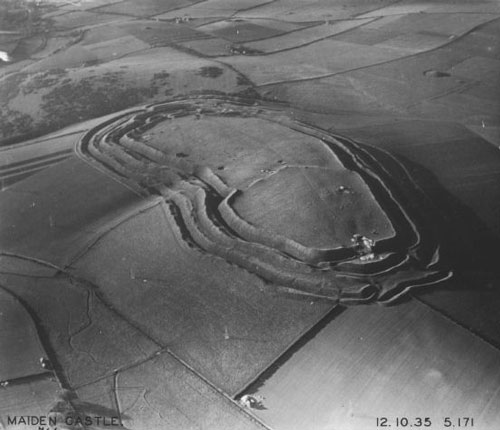
[[File:Aerial photograph of Maiden Castle, 1935.jpg|thumb|[[Maiden Castle, Dorset|Maiden Castle]] in 1935. The [[Iron Age]] [[hillfort]] was first built in 600 BC.]] | [[File:Aerial photograph of Maiden Castle, 1935.jpg|thumb|[[Maiden Castle, Dorset|Maiden Castle]] in 1935. The [[Iron Age]] [[hillfort]] was first built in 600 BC.]] | ||
The art of setting out a military camp or constructing a fortification traditionally has been called "castrametation" since the time of the [[Roman legion]]s. Fortification is usually divided into two branches: permanent fortification and field fortification. There is also an intermediate branch known as | From very early history to modern times, [[defensive wall]]s have often been necessary for cities to survive in an ever-changing world of [[invasion]] and [[conquest]]. Some settlements in the [[Indus Valley Civilization]] were the first small cities to be fortified. In [[ancient Greece]], large [[cyclopean]] stone walls fitted without mortar had been built in [[Mycenaean Greece]], such as the ancient site of [[Mycenae]]. A Greek ''[[Towns of ancient Greece#Military settlements|phrourion]]'' was a fortified collection of buildings used as a military [[garrison]], and is the equivalent of the [[ancient Roman|Roman]] [[castellum]] or fortress. These constructions mainly served the purpose of a watch tower, to guard certain roads, passes, and borders. Though smaller than a real fortress, they acted as a border guard rather than a real strongpoint to watch and maintain the border. | ||
The art of setting out a military camp or constructing a fortification traditionally has been called "castrametation" since the time of the [[Roman legion]]s. Fortification is usually divided into two branches: permanent fortification and field fortification. There is also an intermediate branch known as semipermanent fortification.{{sfn|Jackson|1911|p=680}} [[Castle]]s are fortifications which are regarded as being distinct from the generic fort or fortress in that they are a residence of a [[monarch]] or [[Nobility|noble]] and command a specific defensive territory. | |||
[[Castra|Roman forts]] and [[hill fort]]s were the main antecedents of castles in Europe, which emerged in the 9th century in the [[Carolingian Empire]]. The [[Early Middle Ages]] saw the creation of some towns built around castles. | [[Castra|Roman forts]] and [[hill fort]]s were the main antecedents of castles in Europe, which emerged in the 9th century in the [[Carolingian Empire]]. The [[Early Middle Ages]] saw the creation of some towns built around castles. | ||
| Line 20: | Line 22: | ||
The arrival of [[explosive shell]]s in the 19th century led to another stage in the evolution of fortification. [[Star fort]]s did not fare well against the effects of high explosives, and the intricate arrangements of bastions, flanking batteries and the carefully constructed lines of fire for the defending cannon could be rapidly disrupted by explosive shells. [[Steel]]-and-[[concrete]] fortifications were common during the 19th and early 20th centuries. The advances in modern warfare since [[World War I]] have made large-scale fortifications obsolete in most situations. | The arrival of [[explosive shell]]s in the 19th century led to another stage in the evolution of fortification. [[Star fort]]s did not fare well against the effects of high explosives, and the intricate arrangements of bastions, flanking batteries and the carefully constructed lines of fire for the defending cannon could be rapidly disrupted by explosive shells. [[Steel]]-and-[[concrete]] fortifications were common during the 19th and early 20th centuries. The advances in modern warfare since [[World War I]] have made large-scale fortifications obsolete in most situations. | ||
== | ==History== | ||
== | ===Early uses=== | ||
[[File:Han Tomb Brick - 3.jpg|thumb|[[Han dynasty]] tomb brick showing gate towers]] | [[File:Han Tomb Brick - 3.jpg|thumb|[[Han dynasty]] tomb brick showing gate towers]] | ||
Defensive fences for protecting humans and domestic animals against predators was used long before the appearance of writing and began "perhaps with primitive man blocking the entrances of his [[cave]]s for security from large [[carnivore]]s".<ref>{{cite web |last1=A. Wade |first1=Dale |title=THE USE OF FENCES FOR PREDATOR DAMAGE CONTROL |url=https://core.ac.uk/reader/188047270 |website=University of Nebraska - Lincoln |publisher=Wade, Dale A., "THE USE OF FENCES FOR PREDATOR DAMAGE CONTROL" (1982). Proceedings of the Tenth Vertebrate Pest Conference (1982). 47. |access-date=19 September 2024}}</ref> | |||
From very early history to modern times, [[Defensive wall|walls]] have been a necessity for many cities. [[Amnya Fort]] in western Siberia has been described by archeologists as one of the oldest known fortified settlements, as well as the northernmost Stone Age fort.<ref>{{cite journal |last1=Piezonka |first1=Henny |last2=Chairkina |first2=Natalya |last3=Dubovtseva |first3=Ekaterina |last4=Kosinskaya |first4=Lyubov |last5=Meadows |first5=John |last6=Schreiber |first6=Tanja |date=December 1, 2023 |title=The world's oldest-known promontory fort: Amnya and the acceleration of hunter-gatherer diversity in Siberia 8000 years ago |url=https://www.cambridge.org/core/journals/antiquity/article/worlds-oldestknown-promontory-fort-amnya-and-the-acceleration-of-huntergatherer-diversity-in-siberia-8000-years-ago/90559E4105F93528A6552B36C7236259 |journal=[[Antiquity (journal)|Antiquity]] |volume=97 |issue=396|pages=1381–1401 |doi=10.15184/aqy.2023.164 |doi-access=free }}</ref> In Bulgaria, near the town of [[Provadia]] a walled fortified settlement today called [[Solnitsata]] starting from 4700 BC had a diameter of about {{convert|300|ft}}, was home to 350 people living in two-story houses, and was encircled by a fortified wall. The huge walls around the settlement, which were built very tall and with stone blocks which are {{convert|6|ft|sp=us}} high and {{convert|4.5|ft|sp=us}} thick, make it one of the earliest walled settlements in Europe<ref>{{cite web |url=http://www.nbcnews.com/id/49645182 |archive-url=https://web.archive.org/web/20200402235426/http://www.nbcnews.com/id/49645182 |url-status=dead |archive-date=April 2, 2020 |title=Bulgaria claims to find Europe's oldest town |work=NBC News |date=2012-11-01 |access-date=2013-05-04 }}</ref><ref>{{cite news |url=https://www.bbc.co.uk/news/world-europe-20156681 |title= Europe's oldest prehistoric town unearthed in Bulgaria |publisher=BBC |date=2012-10-31 |access-date=2013-05-04 |url-status=live |archive-url=https://web.archive.org/web/20130611222256/http://www.bbc.co.uk/news/world-europe-20156681 |archive-date=2013-06-11 |work=BBC News }}</ref> but it is younger than the walled town of [[Sesklo]] in Greece from 6800 BC.<ref>{{cite web |url=http://www.greek-thesaurus.gr/neolithic-settlements-organization.html |title=Organization of neolithic settlements:house construction |publisher=Greek-thesaurus.gr |access-date=2013-05-04 |url-status=live |archive-url=https://web.archive.org/web/20130722215151/http://www.greek-thesaurus.gr/neolithic-settlements-organization.html |archive-date=2013-07-22 }}</ref><ref>{{cite web |url=http://odysseus.culture.gr/h/3/eh351.jsp?obj_id=2500 |title=Hellenic Ministry of Culture and Tourism | Sesklo |publisher=Odysseus.culture.gr |access-date=2013-05-04 |url-status=live |archive-url=https://web.archive.org/web/20130102060412/http://odysseus.culture.gr/h/3/eh351.jsp?obj_id=2500 |archive-date=2013-01-02 }}</ref> | |||
[[Uruk]] in ancient [[Sumer]] ([[Mesopotamia]]) is one of the world's oldest known [[walled cities]]. The Ancient Egyptians also built fortresses on the frontiers of the [[Nile Valley]] to protect against invaders from adjacent territories, as well as circle-shaped mud brick walls around their cities. Many of the fortifications of the ancient world were built with mud brick, often leaving them no more than mounds of dirt for today's archeologists. A massive prehistoric stone wall surrounded the ancient temple of [[Ness of Brodgar]] 3200 BC in [[Scotland]]. Named the "Great Wall of Brodgar" it was {{convert|4|m|ft|sp=us|abbr=on}} thick and {{convert|4|m|ft|sp=us|abbr=on}} tall. The wall had some symbolic or ritualistic function.<ref>{{cite web |author=The Ness of Brodgar Excavations |url=http://www.orkneyjar.com/archaeology/nessofbrodgar/excavation-background-2/the-great-wall-of-brodgar/ |title=The Ness of Brodgar Excavations – The 'Great Wall of Brodgar' |publisher=Orkneyjar.com |access-date=2013-05-04 |url-status=live |archive-url=https://web.archive.org/web/20130428094607/http://www.orkneyjar.com/archaeology/nessofbrodgar/excavation-background-2/the-great-wall-of-brodgar/ |archive-date=2013-04-28 }}</ref><ref>{{cite web |author=Alex Whitaker |url=http://www.ancient-wisdom.co.uk/scotlandness.htm |title=The Ness of Brodgar |publisher=Ancient-wisdom.co.uk |access-date=2013-05-04 |url-status=live |archive-url=https://web.archive.org/web/20130501034018/http://www.ancient-wisdom.co.uk/scotlandness.htm |archive-date=2013-05-01 }}</ref> The [[ancient Assyrians|Assyrians]] deployed large labor forces to build new [[palaces]], temples and defensive walls.<ref>{{cite book |title=Sir Banister Fletcher's A History of Architecture |first1=Banister |last1=Fletcher |first2=Dan |last2=Cruickshank |date=1996 |publisher=Architectural Press |isbn=0-7506-2267-9 |page=20}}</ref> | |||
===Bronze Age Europe=== | ===Bronze Age Europe=== | ||
In [[Bronze Age]] [[Malta (island)|Malta]], some settlements also began to be fortified. The most notable surviving example is [[Borġ in-Nadur]], where a bastion built in around 1500 BC was found | [[File:Borg in-Nadur ruins.jpeg|thumb|left|Remains of a fortified village, [[Borġ in-Nadur]], Malta. Borġ in-Nadur is a notable example of [[Bronze Age]] fortifications.]] | ||
In [[Bronze Age]] [[Malta (island)|Malta]], some settlements also began to be fortified. The most notable surviving example is [[Borġ in-Nadur]], where a bastion built in around 1500 BC was found. Exceptions were few—notably, ancient [[Sparta]] and ancient [[Rome]] did not have walls for a long time, choosing to rely on their militaries for defense instead. Initially, these fortifications were simple constructions of wood and earth, which were later replaced by mixed constructions of stones piled on top of each other without [[Mortar (masonry)|mortar]]. In [[ancient Greece]], large stone walls had been built in [[Mycenaean Greece]], such as the ancient site of [[Mycenae]] (famous for the huge stone blocks of its '[[cyclopean]]' walls). In [[Classical Greece|classical era Greece]], the city of [[Athens]] built two parallel stone walls, called the [[Long Walls]], that reached their fortified seaport at [[Piraeus]] a few miles away. | |||
In [[Central Europe]], the [[Celts]] built large fortified settlements known as [[oppidum|oppida]], whose walls seem partially influenced by those built in the [[Mediterranean]]. The fortifications were continuously being expanded and improved. Around 600 BC, in [[Heuneburg]], Germany, forts were constructed with a limestone foundation supported by a [[mudbrick]] wall approximately 4 | In [[Central Europe]], the [[Celts]] built large fortified settlements known as [[oppidum|oppida]], whose walls seem partially influenced by those built in the [[Mediterranean]]. The fortifications were continuously being expanded and improved. Around 600 BC, in [[Heuneburg]], Germany, forts were constructed with a limestone foundation supported by a [[mudbrick]] wall approximately 4 meters tall, probably topped by a roofed walkway, thus reaching a total height of 6 meters. The wall was clad with lime plaster, regularly renewed. Towers protruded outwards from it.<ref>{{cite web|last1=Focke|first1=Arne|title=Die Heuneburg an der oberen Donau: Die Siedlungsstrukturen|url=http://www.isentosamballerer.de/de/bibliothek/siedlungsstrukturen-heuneburg/befestigungen.html|website=isentosamballerer.de|date=2006|language=de}}{{dead link|date=August 2016|bot=medic}}{{cbignore|bot=medic}}</ref><ref>{{cite web|title=Erforschung und Geschichte der Heuneburg|url=http://www.heuneburg.de/heuneburg-kelten.htm|website=Celtic Museum Heuneburg|archive-url=https://web.archive.org/web/20070624231023/http://www.heuneburg.de/heuneburg-kelten.htm|archive-date=24 June 2007|language=de}}</ref> | ||
[[File:Bibracte Porte Rebout.jpg|thumb|Reconstructed walls of [[Bibracte]], a [[Gaulish]] ''[[oppidum]]'', showing the construction technique known as ''[[Murus Gallicus|murus gallicus]]''. ''Oppida'' were large fortified settlements used during the [[Iron Age]].]] | [[File:Bibracte Porte Rebout.jpg|thumb|Reconstructed walls of [[Bibracte]], a [[Gaulish]] ''[[oppidum]]'', showing the construction technique known as ''[[Murus Gallicus|murus gallicus]]''. ''Oppida'' were large fortified settlements used during the [[Iron Age]].]] | ||
| Line 54: | Line 44: | ||
===Bronze and Iron Age Near East=== | ===Bronze and Iron Age Near East=== | ||
{{ | {{See also|Casemate}} | ||
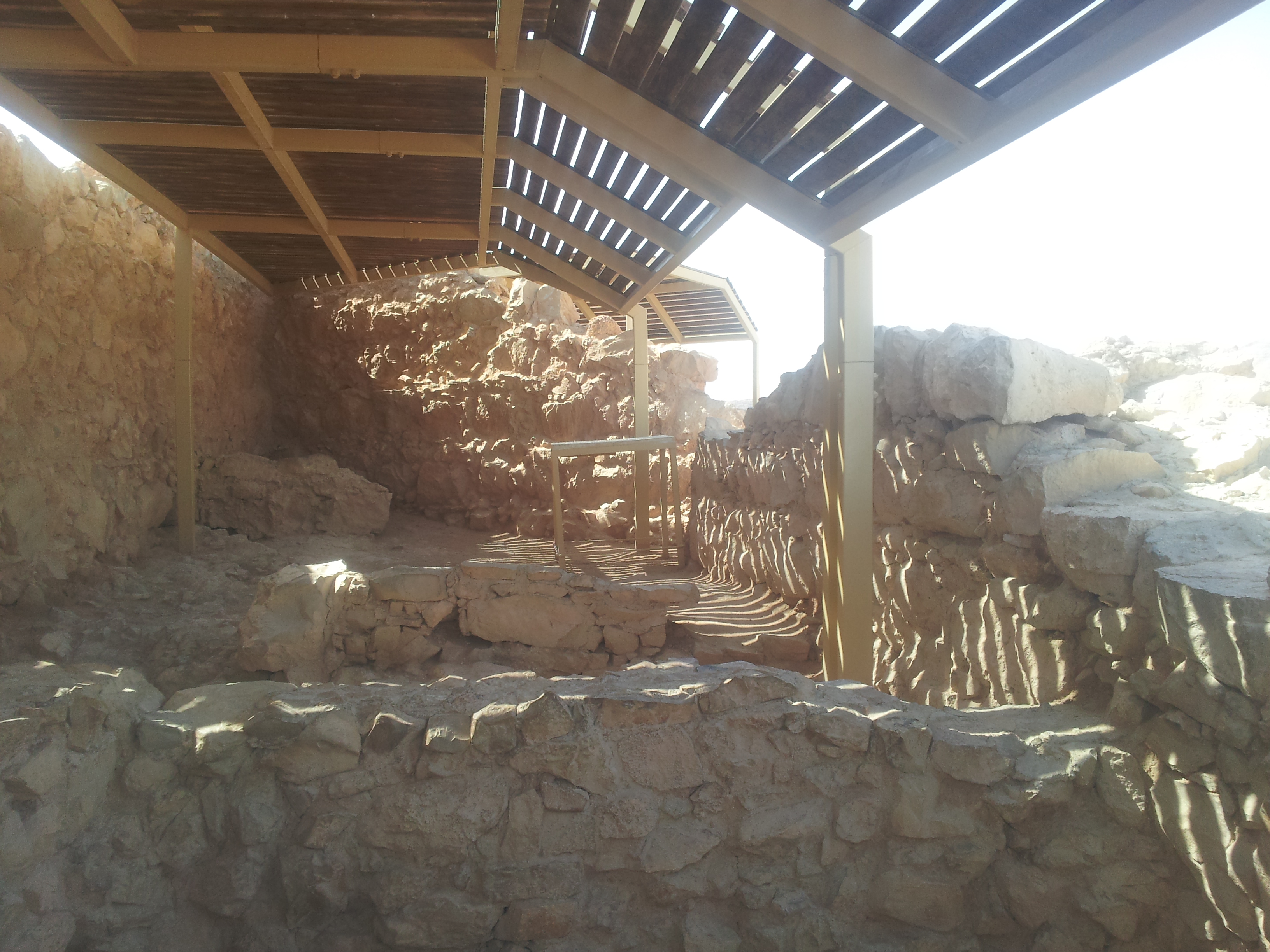
[[File:Casamata de Masada.jpg|thumb|right|An ancient casemate wall at [[Masada]]]] | [[File:Casamata de Masada.jpg|thumb|right|An ancient casemate wall at [[Masada]].]] | ||
The term ''casemate wall'' is used in the | |||
The term ''casemate wall'' is used in the archeology of [[Land of Israel|Israel]] and the wider [[Near East]], having the meaning of a double wall protecting a city<ref name=Safra>{{cite web |last=Emswiler |first=Elizabeth Anne |title=The Casemate Wall System of Khirbat Safra |pages=1, 3–15 |date=2020 |publisher=[[Andrews University]] |url=https://digitalcommons.andrews.edu/cgi/viewcontent.cgi?article=1156&context=theses |access-date=22 October 2021}}</ref> or fortress,<ref name=MGH>{{cite dictionary |title=Casemate wall |dictionary =McGraw-Hill Dictionary of Architecture and Construction |publisher=[[McGraw-Hill]] |via=[[The Free Dictionary]] |url=https://encyclopedia2.thefreedictionary.com/casemate+wall |access-date=16 July 2022}}</ref> with transverse walls separating the space between the walls into chambers.<ref name=Safra /> These could be used as such, for storage or residential purposes, or could be filled with soil and rocks during siege in order to raise the resistance of the outer wall against battering rams.<ref name=Safra /> Originally thought to have been introduced to the region by the [[Hittites]], this has been disproved by the discovery of examples predating their arrival, the earliest being at [[Ti'inik]] (Taanach) where such a wall has been dated to the [[16th century BC]].<ref>Emswiler (2020), pp. 7–9.</ref> Casemate walls became a common type of fortification in the Southern Levant between the Middle Bronze Age (MB) and Iron Age II, being more numerous during the Iron Age and peaking in Iron Age II (10th–6th century BC).<ref name=Safra /> However, the construction of casemate walls had begun to be replaced by sturdier solid walls by the [[9th century BC]], probably due the development of more effective battering rams by the [[Neo-Assyrian Empire]].<ref name=Safra /><ref name=EB>{{cite encyclopedia |author=[[Seton Lloyd|Lloyd, Seton H.F.]] |title=Syro-Palestinian art and architecture |encyclopedia=[[Encyclopædia Britannica]] |via= Britannica Online |url=https://www.britannica.com/art/Syro-Palestinian-art#ref419785 |access-date=16 July 2022}}</ref> Casemate walls could surround an entire settlement, but most only protected part of it.<ref>Emswiler (2020), p. 4.</ref> The three different types included freestanding casemate walls, then integrated ones where the inner wall was part of the outer buildings of the settlement, and finally filled casemate walls, where the rooms between the walls were filled with soil right away, allowing for a quick, but nevertheless stable construction of particularly high walls.<ref>Emswiler (2020), pp. 4–5.</ref> | |||
===Ancient Rome=== | ===Ancient Rome=== | ||
{{Main|Roman military frontiers and fortifications}} | |||
[[File:Celio - le mura tra porta san Sebastiano e porta Ardeatina 2004.JPG|thumb|An interior view of the [[Aurelian Walls]] near [[Porta San Sebastiano]]]] | |||
The [[ancient Rome|Romans]] fortified their cities with massive, mortar-bound stone walls. The most famous of these are the largely extant [[Aurelian Walls]] of [[Rome]] and the [[Theodosian Walls]] of [[Constantinople]], together with partial remains elsewhere. These are mostly city gates, like the [[Porta Nigra]] in [[Trier]] or [[Newport Arch]] in [[Lincoln, Lincolnshire|Lincoln]] | The [[ancient Rome|Romans]] fortified their cities with massive, mortar-bound stone walls. The most famous of these are the largely extant [[Aurelian Walls]] of [[Rome]] and the [[Theodosian Walls]] of [[Constantinople]], together with partial remains elsewhere. These are mostly city gates, like the [[Porta Nigra]] in [[Trier]] or [[Newport Arch]] in [[Lincoln, Lincolnshire|Lincoln]]. | ||
===Indian | [[Hadrian's Wall]] was built by the [[Roman Empire]] across the width of what is now [[northern England]] following a visit by [[List of Roman Emperors|Roman Emperor]] [[Hadrian]] (AD 76–138) in AD 122. | ||
{{ | |||
===Indian subcontinent=== | |||
{{Main|Forts in India|List of forts in India|List of forts in Pakistan|List of forts in Nepal}} | |||
[[File:Dholavira gujarat.jpg|thumb|Defensive wall of the ancient city of [[Dholavira]], Gujarat 2600 BCE]] | [[File:Dholavira gujarat.jpg|thumb|Defensive wall of the ancient city of [[Dholavira]], Gujarat 2600 BCE]] | ||
A number of forts dating from the [[Later Stone Age]] to the [[British Raj]] | A number of forts dating from the [[Later Stone Age]] to the [[British Raj]] are found in the mainland [[Indian subcontinent]] (modern day [[India]], [[Pakistan]], [[Bangladesh]] and [[Nepal]]). "Fort" is the word used in India for all old fortifications. Numerous [[Indus Valley civilisation|Indus Valley Civilization]] sites exhibit evidence of fortifications. By about 3500 BC, hundreds of small farming villages dotted the [[Indus]] floodplain. Many of these settlements had fortifications and planned streets. The stone and mud brick houses of [[Kot Diji]] were clustered behind massive stone flood dykes and defensive walls, for neighboring communities bickered constantly about the control of prime agricultural land.<ref>{{cite book |title=The Encyclopedia of World History: ancient, medieval, and modern, chronologically arranged |first1=Peter N. |last1=Stearns |first2=William Leonard |last2=Langer |date=2001 |publisher=Houghton Mifflin Books |isbn=0-395-65237-5 |page=17}}</ref> The fortification varies by site. While [[Dholavira]] has stone-built fortification walls, [[Harappa|Harrapa]] is fortified using baked bricks; sites such as [[Kalibangan]] exhibit [[mudbrick]] fortifications with bastions and [[Lothal]] has a quadrangular fortified layout. Evidence also suggested of fortifications in [[Mohenjo-daro]]. Even a small town—for instance, Kotada Bhadli, exhibiting sophisticated fortification-like bastions—shows that nearly all major and minor towns of the Indus Valley Civilization were fortified.<ref>{{Cite web|url=https://openaccess.leidenuniv.nl/bitstream/handle/1887/19437/Agressive%20Architecture.pdf?sequence=1|title=Agressive [sic] Architecture: Fortifications of the Indus Valley in the Mature Harappan phase | Student Repository}}</ref> Forts also appeared in urban cities of the Gangetic valley during the second urbanization period between 600 and 200 BC, and as many as 15 fortification sites have been identified by archeologists throughout the Gangetic valley, such as [[Kosambi|Kaushambi]], [[Mahasthangarh]], [[Pataliputra]], [[Mathura]], [[Ahichchhatra]], [[Rajgir]], and [[Lauria Nandangarh]]. The earliest [[Maurya Empire|Mauryan period]] brick fortification occurs in one of the stupa mounds of Lauria Nandangarh, which is 1.6 km in perimeter and oval in plan and encloses a habitation area.<ref>{{Cite journal|last=Barba|first=Federica|date=2004|title=The Fortified Cities of the Ganges Plain in the First Millennium B.C.|journal=East and West|volume=54|issue=1/4|pages=223–250|jstor=29757611}}</ref> [[Mundigak]] ({{Circa|2500 BC}}) in present-day south-east [[Afghanistan]] has defensive walls and square [[bastion]]s of sun dried bricks.<ref>{{cite book |title=Sir Banister Fletcher's A History of Architecture |first1=Banister |last1=Fletcher |first2=Dan |last2=Cruickshank |date=1996 |publisher=Architectural Press |isbn=0-7506-2267-9 |page=100}}</ref> | ||
[[File: | [[File:Jaisalmer forteresse.jpg|thumb|[[Jaisalmer Fort]], [[Rajasthan]], India]] | ||
India currently has over 180 forts, with the state of [[Maharashtra]] alone having over 70 forts, which are also known as ''durg'',<ref>''Durga'' is the [[Sanskrit]] word for "inaccessible place", hence "fort"</ref><ref name="Nossov-8"/><ref>{{Cite book |last=Hiltebeitel |first=Alf |author-link=Alf Hiltebeitel |year=1991 |title=The Cult of Draupadī: Mythologies: From Gingee to Kurukserta |location=Delhi, India |publisher=Motilal Banarsidass |volume=1 |page=[https://books.google.com/books?id=VncomfRVVhoC&pg=PA62 62] |isbn=978-81-208-1000-6}}</ref> many of them built by [[Shivaji]], founder of the [[Maratha Confederacy|Maratha Empire]]. | |||
[[ | A large majority of forts in India are in North India. The most notable forts are the [[Red Fort]] at [[Old Delhi]], the [[Agra Fort|Red Fort]] at [[Agra]], the [[Chittor Fort]] and [[Mehrangarh Fort]] in [[Rajasthan]], the [[Ranthambhor Fort]], [[Amer Fort]] and [[Jaisalmer Fort]] also in Rajasthan and [[Gwalior Fort]] in [[Madhya Pradesh]].<ref name="Nossov-8">{{Cite book|author=Nossov, Konstantin|year=2012|title=Indian Castles 1206–1526: The Rise and Fall of the Delhi Sultanate|edition=second|location=Oxford|publisher=Osprey Publishing|page=[https://books.google.com/books?id=pMydaF1yzM8C&pg=PA8 8]|isbn=978-1-78096-985-5}}</ref> | ||
[[ | |||
===Sri Lanka=== | [[Arthashastra]], the Indian treatise on military strategy describes six major types of forts differentiated by their major modes of defenses. | ||
[[File:Beauty of Sigiriya by Binuka.jpg|thumb|Rock | |||
Forts in [[Sri Lanka]] date back thousands of years with many being built by Sri Lankan kings | ==== Sri Lanka ==== | ||
Most of these were abandoned by the military | {{Main|Forts in Sri Lanka}} | ||
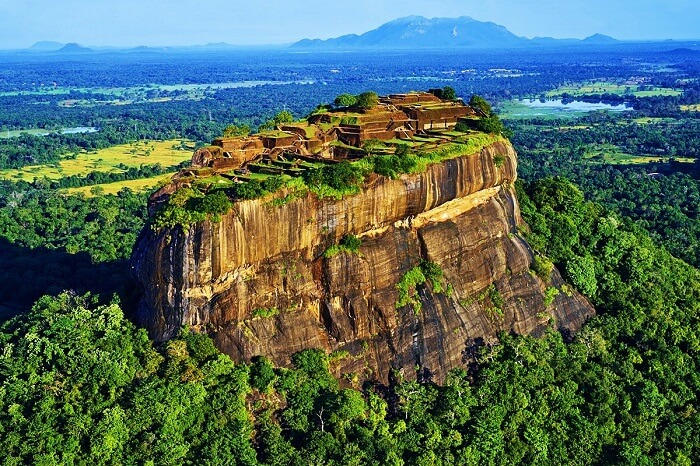
[[File:Beauty of Sigiriya by Binuka.jpg|thumb|Rock fort of [[Sigiriya]] built by King [[Kashyapa I of Anuradhapura]].]] | |||
Forts in [[Sri Lanka]] date back thousands of years, with many being built by Sri Lankan kings. These include several walled cities. With the outset of colonial rule in the [[Indian Ocean]], Sri Lanka was occupied by several major colonial empires that from time to time became the dominant power in the Indian Ocean. The colonists built several western-style forts, mostly in and around the coast of the island. The first to build colonial forts in Sri Lanka were the [[Portuguese Empire|Portuguese]]; these forts were captured and later expanded by the [[Dutch colonial empire|Dutch]]. The [[British Empire|British]] occupied these Dutch forts during the [[Napoleonic wars]]. Most of the colonial forts were garrisoned up until the early 20th century. The coastal forts had [[coastal artillery]] manned by the [[Ceylon Garrison Artillery]] during the two world wars. | |||
Most of these were abandoned by the military but retained civil administrative officers, while others retained military garrisons, which were more administrative than operational. Some were reoccupied by military units with the escalation of the [[Sri Lankan civil war|Sri Lankan Civil War]]; [[Jaffna fort]], for example, came under siege several times. | |||
===China=== | ===China=== | ||
{{See also|Chinese city wall|List of castles in China}} | |||
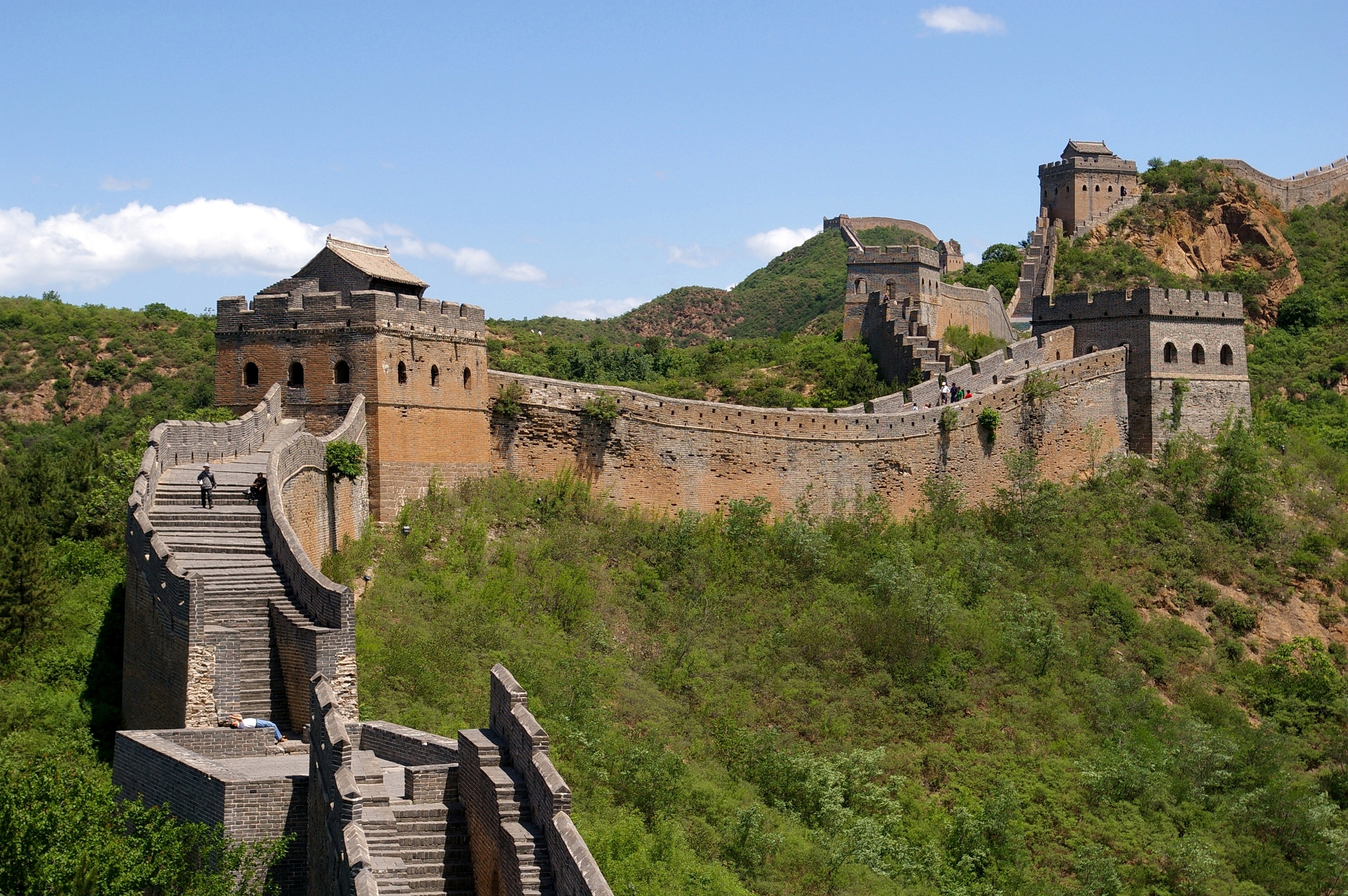
[[File:20090529 Great Wall 8185.jpg|thumb|The [[Great Wall of China]] near [[Jinshanling]]. The Great Wall was a series of fortifications built across the historical northern borders of China. ]] | [[File:20090529 Great Wall 8185.jpg|thumb|The [[Great Wall of China]] near [[Jinshanling]]. The Great Wall was a series of fortifications built across the historical northern borders of China. ]] | ||
In addition to the Great Wall, a number of Chinese cities also | Large tempered earth (i.e. [[rammed earth]]) walls were built in [[ancient China]] since the [[Shang dynasty]] ({{Circa|1600}}–1050 BC); the capital at ancient Ao had enormous walls built in this fashion (see [[siege]] for more info). Although stone walls were built in China during the [[Warring States]] (481–221 BC), mass conversion to stone architecture did not begin in earnest until the [[Tang dynasty]] (618–907 AD). The [[Great Wall of China]] had been built since the [[Qin dynasty]] (221–207 BC), although its present form was mostly an engineering feat and remodeling from the [[Ming dynasty]] (1368–1644 AD). | ||
In addition to the Great Wall, a number of Chinese cities also constructed [[defensive wall]]s to defend their cities. Notable [[Chinese city wall]]s include the city walls of [[Hangzhou City Walls|Hangzhou]], [[City Wall of Nanjing|Nanking]], the [[Old City (Shanghai)|Old City of Shanghai]], [[City Wall of Suzhou|Suzhou]], [[Fortifications of Xi'an|Xi'an]] and the [[walled villages of Hong Kong]]. The famous walls of the [[Forbidden City]] in [[Beijing]] were established in the early 15th century by the [[Yongle Emperor]]. The Forbidden City made up the inner portion of the [[Beijing city fortifications]]. | |||
===North America=== | |||
===={{anchor|Frontier forts}}Frontier forts==== | |||
In the United States, there are many examples of historical forts or [[Station (frontier defensive structure) |fortified "stations"]] - the name depended on the region. This was a structure built for defense against primarily [[Indigenous peoples of the Americas |Indian]] attacks in frontier areas. While some forts were sometimes used by [[militia]]s, state and federal military units, their primary purpose was for private or civilian defense. Sometimes a [[stockade]] would surround the building(s).<ref>{{cite web |title= [Kentucky Frontier] Migration & Settlement: Settling the Land |publisher=[[Western Kentucky University]] Libraries & Museum |url=http://www.wku.edu/library/museum/education/frontieronline/frontiermigration.htm |access-date= 2012-09-13 |url-status= dead |archive-url= https://web.archive.org/web/20110826054304/http://www.wku.edu/library/museum/education/frontieronline/frontiermigration.htm |archive-date= 2011-08-26 }}</ref> | |||
Examples of historic private or civilian fortified houses built include: | |||
*[[Fort Nelson (Kentucky)|Fort Nelson]] and [[Floyd's Station (Kentucky)|Floyd's Station]] and [[Low Dutch Station]] all in [[Kentucky]] | |||
*[[Old Las Vegas Mormon Fort State Historic Park|Mormon Fort]] and [[Mormon Station State Historic Park|Mormon Station]] in [[Nevada]] | |||
*[[Fort Buenaventura]], [[Cove Fort]], [[Fort Deseret]], and [[Fort Utah]] all in [[Utah]]. | |||
*[[Carpenter's Fort, Ohio|Carpenter's Fort]] in [[Ohio]] | |||
*[[Fort Bigham]], [[Fort Swatara]], the [[Heinrich Zeller House]], and [[Fort Depuy]], 18th-century fortified homesteads in Pennsylvania | |||
===Philippines=== | ===Philippines=== | ||
====Spanish colonial fortifications==== | |||
{{Main|Spanish colonial fortifications in the Philippines}} | |||
During the [[Spanish East Indies|Spanish Era]] several forts and outposts were built throughout the archipelago. Most notable is [[Intramuros]], the old [[defensive walls|walled]] city of Manila located along the southern bank of the [[Pasig River]].<ref>Luengo, Pedro. Intramuros: Arquitectura en Manila, 1739–1762. Madrid: Fundacion Universitaria Española, 2012</ref> The historic city was home to centuries-old churches, schools, convents, government buildings and residences, the best collection of Spanish colonial architecture before much of it was destroyed by the bombs of [[World War II]]. Of all the buildings within the 67-acre city, only one building, the San Agustin Church, survived the war. | During the [[Spanish East Indies|Spanish Era]] several forts and outposts were built throughout the archipelago. Most notable is [[Intramuros]], the old [[defensive walls|walled]] city of Manila located along the southern bank of the [[Pasig River]].<ref>Luengo, Pedro. Intramuros: Arquitectura en Manila, 1739–1762. Madrid: Fundacion Universitaria Española, 2012</ref> The historic city was home to centuries-old churches, schools, convents, government buildings and residences, the best collection of Spanish colonial architecture before much of it was destroyed by the bombs of [[World War II]]. Of all the buildings within the 67-acre city, only one building, the San Agustin Church, survived the war. | ||
Partial listing of Spanish forts: | Partial listing of Spanish forts: | ||
# [[Intramuros]], Manila | |||
# [[Intramuros]], | # [[Cuartel de Santo Domingo]], Santa Rosa, Laguna | ||
# [[Cuartel de Santo Domingo]], | # [[Cuyo Fort|Fuerza de Cuyo]], Cuyo, Palawan | ||
# [[Cuyo Fort|Fuerza de Cuyo]], | # [[Cagayancillo Fort|Fuerza de Cagayancillo]], Cagayancillo, Palawan | ||
# [[Cagayancillo Fort|Fuerza de Cagayancillo]], | # [[Fort Pilar|Real Fuerza de Nuestra Señora del Pilar de Zaragoza]], Zamboanga City | ||
# [[Fort Pilar|Real Fuerza de Nuestra Señora del Pilar de Zaragoza]], | # [[Fort San Felipe (Cavite)|Fuerza de San Felipe]], Cavite City | ||
# [[Fort San Felipe (Cavite)|Fuerza de San Felipe]], | # [[Fort San Pedro|Fuerza de San Pedro]], Cebu | ||
# [[Fort San Pedro|Fuerza de San Pedro]], | # [[Fuerte de la Concepcion y del Triunfo]], Ozamiz, Misamis Occidental | ||
# [[Fuerte | # [[Fort San Antonio Abad|Fuerza de San Antonio Abad]], Manila | ||
# [[Fort San Antonio Abad|Fuerza de San Antonio Abad]], | # [[Fort Pikit|Fuerza de Pikit]], Pikit, Cotabato | ||
# [[Fort Pikit|Fuerza de Pikit]], | # Fuerza de Santiago, [[Romblon, Romblon]] | ||
# | # Fuerza de Jolo, [[Jolo, Sulu]] | ||
# | # Fuerza de Masbate, [[Masbate]] | ||
# | # Fuerza de Bongabong, [[Bongabong, Oriental Mindoro]] | ||
# | # Cotta de Dapitan, [[Dapitan]], Zamboanga del Norte | ||
# | # Fuerte de Alfonso XII, [[Tukuran, Zamboanga del Sur]] | ||
# | # Fuerza de Bacolod, [[Bacolod, Lanao del Norte]] | ||
# | # Guinsiliban Watchtower, [[Guinsiliban, Camiguin]] | ||
# | # Laguindingan Watchtower, [[Laguindingan, Misamis Oriental]] | ||
# | # Kutang San Diego, [[Gumaca, Quezon]] | ||
# | # Baluarte Luna, [[Luna, La Union]] | ||
# | |||
====Local fortifications==== | ====Local fortifications==== | ||
{{Main|Ivatan people|Architecture of the Philippines}} | {{Main|Ivatan people|Architecture of the Philippines}} | ||
The Ivatan people of the northern islands of Batanes built their so-called ''[[idjang]]'' on hills and elevated areas<ref>{{cite web|url=http://www.filipiknow.net/archaeological-discoveries-in-the-philippines/|title=15 Most Intense Archaeological Discoveries in Philippine History|work=FilipiKnow|access-date=17 March 2015|url-status=live|archive-url=https://web.archive.org/web/20150315060732/http://www.filipiknow.net/archaeological-discoveries-in-the-philippines/|archive-date=15 March 2015}}</ref> to protect themselves during times of war. These fortifications were likened to European castles because of their purpose. Usually, the only entrance to the castles would be via a rope ladder that would only be lowered for the villagers and could be kept away when invaders arrived. | The Ivatan people of the northern islands of Batanes built their so-called ''[[idjang]]'' on hills and elevated areas<ref>{{cite web|url=http://www.filipiknow.net/archaeological-discoveries-in-the-philippines/|title=15 Most Intense Archaeological Discoveries in Philippine History|work=FilipiKnow|access-date=17 March 2015|url-status=live|archive-url=https://web.archive.org/web/20150315060732/http://www.filipiknow.net/archaeological-discoveries-in-the-philippines/|archive-date=15 March 2015}}</ref> to protect themselves during times of war. These fortifications were likened to European castles because of their purpose. Usually, the only entrance to the castles would be via a rope ladder that would only be lowered for the villagers and could be kept away when invaders arrived. | ||
[[File:American flag raised over Fort Santiago 8-13-1898.jpg|thumb|left|An American flag raised at the [[Fort Santiago]], 1898. Fort Santiago was a [[citadel]] that was a part of the [[Intramuros]], a walled city within Manila.]] | [[File:American flag raised over Fort Santiago 8-13-1898.jpg|thumb|left|An American flag raised at the [[Fort Santiago]], 1898. Fort Santiago was a [[citadel]] that was a part of the [[Intramuros]], a walled city within Manila.]] | ||
| Line 125: | Line 133: | ||
The [[Igorot people|Igorots]] built forts made of stone walls that averaged several meters in width and about two to three times the width in height around 2000 BC.<ref name="irwin">[http://www.livecebu.com/philhistory.htm#Ancientprspanish Ancient and Pre-Spanish Era of the Philippines] {{webarchive|url=https://web.archive.org/web/20151210190659/http://livecebu.com/philhistory.htm |date=2015-12-10 }}. Accessed September 04, 2008.</ref> | The [[Igorot people|Igorots]] built forts made of stone walls that averaged several meters in width and about two to three times the width in height around 2000 BC.<ref name="irwin">[http://www.livecebu.com/philhistory.htm#Ancientprspanish Ancient and Pre-Spanish Era of the Philippines] {{webarchive|url=https://web.archive.org/web/20151210190659/http://livecebu.com/philhistory.htm |date=2015-12-10 }}. Accessed September 04, 2008.</ref> | ||
The Muslim Filipinos of the south built strong [[fortresses]] called ''kota'' or ''moong'' to protect their communities. Usually, many of the occupants of these kotas are entire families rather than just warriors. Lords often had their own kotas to assert their right to rule, it served not only as a military installation but as a palace for the local Lord. It is said that at the height of the [[Sultanate of Maguindanao|Maguindanao Sultanate's | The Muslim Filipinos of the south built strong [[fortresses]] called ''kota'' or ''moong'' to protect their communities. Usually, many of the occupants of these kotas are entire families rather than just warriors. Lords often had their own kotas to assert their right to rule, it served not only as a military installation but as a palace for the local Lord. It is said that at the height of the [[Sultanate of Maguindanao|Maguindanao Sultanate]]'s power, they blanketed the areas around Western [[Mindanao]] with kotas and other fortifications to block the Spanish advance into the region. These kotas were usually made of stone and bamboo or other light materials and surrounded by trench networks. As a result, some of these kotas were burned easily or destroyed. With further Spanish campaigns in the region, the sultanate was subdued and a majority of kotas dismantled or destroyed. kotas were not only used by the Muslims as defense against Spaniards and other foreigners, renegades and rebels also built fortifications in defiance of other chiefs in the area.{{citation needed|date=January 2023}} During the American occupation, rebels built strongholds and the datus, rajahs, or sultans often built and reinforced their kotas in a desperate bid to maintain rule over their subjects and their land.<ref>{{cite web|url=http://www.morolandhistory.com/08.PG-Battle%20of%20Bayan/battle_of_bayan_p2.htm|title=The Battle of Bayan|access-date=17 March 2015|url-status=dead|archive-url=https://web.archive.org/web/20151230005052/http://www.morolandhistory.com/08.PG-Battle%20of%20Bayan/battle_of_bayan_p2.htm|archive-date=2015-12-30}}</ref> Many of these forts were also destroyed by American expeditions, as a result, very very few kotas still stand to this day. | ||
Notable | Notable kotas: | ||
* [[Kingdom of Maynila|Kota Selurong]]: an outpost of the [[Bruneian Empire]] in Luzon, later became the City of [[Manila]]. | * [[Kingdom of Maynila|Kota Selurong]]: an outpost of the [[Bruneian Empire]] in Luzon, later became the City of [[Manila]]. | ||
* [[Cotabato City|Kuta Wato/Kota Bato]]: Literally translates to "stone fort" the first known stone fortification in the country, its ruins exist as the "Kutawato Cave Complex"<ref>{{cite web|url=http://www.cotabatocity.net.ph/index.php?option=com_content&view=article&id=69&Itemid=79&limitstart=1|title= The Kutawato Caves|access-date=17 March 2015|url-status=live|archive-url=https://web.archive.org/web/20141016065601/http://www.cotabatocity.net.ph/index.php?option=com_content&view=article&id=69&Itemid=79&limitstart=1|archive-date=16 October 2014}}</ref> | * [[Cotabato City|Kuta Wato/Kota Bato]]: Literally translates to "stone fort" the first known stone fortification in the country, its ruins exist as the "Kutawato Cave Complex"<ref>{{cite web|url=http://www.cotabatocity.net.ph/index.php?option=com_content&view=article&id=69&Itemid=79&limitstart=1|title= The Kutawato Caves|access-date=17 March 2015|url-status=live|archive-url=https://web.archive.org/web/20141016065601/http://www.cotabatocity.net.ph/index.php?option=com_content&view=article&id=69&Itemid=79&limitstart=1|archive-date=16 October 2014}}</ref> | ||
| Line 133: | Line 141: | ||
===Pre-Islamic Arabia=== | ===Pre-Islamic Arabia=== | ||
====During Muhammad's lifetime==== | ====During Muhammad's lifetime==== | ||
{{Main|List of expeditions of Muhammad}} | {{Main|List of expeditions of Muhammad}} | ||
[[File:The Battle of the Trench.jpg|thumb|Map of | [[File:The Battle of the Trench.jpg|thumb|Map of defenses available during the [[Battle of the Trench]], 627. Muslim defenders repelled the Confederates using Medina's natural fortifications and makeshift trenches.]] | ||
During [[Muhammad]]'s era in Arabia, many tribes made use of fortifications. In the [[Battle of the Trench]], the largely outnumbered defenders of Medina, mainly [[Muslim]]s led by [[Prophets of Islam|Islamic prophet]] Muhammad, dug a [[Trench warfare|trench]], which together with Medina's natural fortifications, rendered the confederate [[cavalry]] (consisting of horses and [[Camel cavalry|camels]]) useless, locking the two sides in a stalemate. Hoping to make several attacks at once, the confederates persuaded the Medina-allied [[Banu Qurayza]] to attack the city from the south. However, [[Muhammad as a diplomat|Muhammad's diplomacy]] derailed the negotiations, and broke up the confederacy against him. The well-organized defenders, the sinking of confederate morale, and poor weather conditions caused the siege to end in a fiasco.<ref name =statesman>*{{cite book | last = Watt |first=William M. | author-link = William Montgomery Watt | title = Muhammad: Prophet and Statesman | publisher = [[Oxford University Press]] | year = 1974 | isbn = 978-0-19-881078-0 | page = [https://archive.org/details/muhammadprophets00watt/page/96 96] | url = https://archive.org/details/muhammadprophets00watt/page/96 }}</ref> | During [[Muhammad]]'s era in Arabia, many tribes made use of fortifications. In the [[Battle of the Trench]], the largely outnumbered defenders of Medina, mainly [[Muslim]]s led by [[Prophets of Islam|Islamic prophet]] Muhammad, dug a [[Trench warfare|trench]], which together with Medina's natural fortifications, rendered the confederate [[cavalry]] (consisting of horses and [[Camel cavalry|camels]]) useless, locking the two sides in a stalemate. Hoping to make several attacks at once, the confederates persuaded the Medina-allied [[Banu Qurayza]] to attack the city from the south. However, [[Muhammad as a diplomat|Muhammad's diplomacy]] derailed the negotiations, and broke up the confederacy against him. The well-organized defenders, the sinking of confederate morale, and poor weather conditions caused the siege to end in a fiasco.<ref name =statesman>*{{cite book | last = Watt |first=William M. | author-link = William Montgomery Watt | title = Muhammad: Prophet and Statesman | publisher = [[Oxford University Press]] | year = 1974 | isbn = 978-0-19-881078-0 | page = [https://archive.org/details/muhammadprophets00watt/page/96 96] | url = https://archive.org/details/muhammadprophets00watt/page/96 }}</ref> | ||
| Line 142: | Line 151: | ||
===Islamic world=== | ===Islamic world=== | ||
{{ | {{Further|Caravanserai|Kasbah|Ribat|Qalat (fortress)}} | ||
===Africa=== | ===Africa=== | ||
The [[walls of Benin]] are described as the world's second longest man-made structure, as well as the most extensive earthwork in the world, by the ''Guinness Book of Records, 1974''.<ref>{{cite book |first1=Henry Louis |last1=Gates |first2=Anthony |last2=Appiah |title=Africana: The Encyclopedia of the African and African American Experience |publisher=Basic Civitas Books |date=1999 |page=97 |isbn=0195170555}}</ref><ref>Osadolor, pp. 6–294</ref> | The entire city of [[Kerma]] in [[Nubia]] (present day Sudan) was encompassed by fortified walls surrounded by a ditch. Archeology has revealed various Bronze Age bastions and foundations constructed of stone together with either baked or unfired brick.<ref>{{cite book| last = Bianchi| first = Robert Steven| title = Daily Life of the Nubians| year = 2004| publisher = Greenwood Publishing Group| isbn = 978-0-313-32501-4| page = 83 }}</ref> | ||
The walls may have been constructed between the thirteenth and mid-fifteenth century CE<ref name="Ogundiran">{{cite journal |last1=Ogundiran |first1=Akinwumi |title=Four Millennia of Cultural History in Nigeria (ca. 2000 B.C.–A.D. 1900): Archaeological Perspectives |journal=Journal of World Prehistory |date=June 2005 |volume=19 |issue=2 |pages=133–168|doi=10.1007/s10963-006-9003-y |s2cid=144422848 }}</ref> or, during the first millennium CE.<ref name="Ogundiran"/><ref name="MacEachern">{{cite journal |last1=MacEachern |first1=Scott |title=Two thousand years of West African history |url=https://www.academia.edu/831918 |journal=African Archaeology: A Critical Introduction |date=January 2005 |publisher=Academia}}</ref> | |||
Strong citadels were also built other in areas of Africa. [[History of the Yoruba people|Yorubaland]] for example had several sites surrounded by the full range of earthworks and ramparts seen elsewhere, and sited on ground. This improved defensive potential—such as hills and ridges. Yoruba fortifications were often protected with a double wall of trenches and ramparts, and in the Congo forests concealed [[Ditch (fortification)|ditches]] and paths, along with the main works, often bristled with rows of sharpened stakes. Inner defenses were laid out to blunt an enemy penetration with a maze of defensive walls allowing for entrapment and [[crossfire]] on opposing forces.<ref name="Robert July p. 11-39">July, pp. 11–39</ref> | The [[walls of Benin]] are described as the world's second longest man-made structure, as well as the most extensive earthwork in the world, by the ''Guinness Book of Records, 1974''.<ref>{{cite book |first1=Henry Louis |last1=Gates |first2=Anthony |last2=Appiah |title=Africana: The Encyclopedia of the African and African American Experience |publisher=Basic Civitas Books |date=1999 |page=97 |isbn=0195170555}}</ref><ref>Osadolor, pp. 6–294</ref> The walls may have been constructed between the thirteenth and mid-fifteenth century CE<ref name="Ogundiran">{{cite journal |last1=Ogundiran |first1=Akinwumi |title=Four Millennia of Cultural History in Nigeria (ca. 2000 B.C.–A.D. 1900): Archaeological Perspectives |journal=Journal of World Prehistory |date=June 2005 |volume=19 |issue=2 |pages=133–168|doi=10.1007/s10963-006-9003-y |s2cid=144422848 }}</ref> or, during the first millennium CE.<ref name="Ogundiran"/><ref name="MacEachern">{{cite journal |last1=MacEachern |first1=Scott |title=Two thousand years of West African history |url=https://www.academia.edu/831918 |journal=African Archaeology: A Critical Introduction |date=January 2005 |publisher=Academia}}</ref> Strong citadels were also built other in areas of Africa. [[History of the Yoruba people|Yorubaland]] for example had several sites surrounded by the full range of earthworks and ramparts seen elsewhere, and sited on ground. This improved defensive potential—such as hills and ridges. Yoruba fortifications were often protected with a double wall of trenches and ramparts, and in the Congo forests concealed [[Ditch (fortification)|ditches]] and paths, along with the main works, often bristled with rows of sharpened stakes. Inner defenses were laid out to blunt an enemy penetration with a maze of defensive walls allowing for entrapment and [[crossfire]] on opposing forces.<ref name="Robert July p. 11-39">July, pp. 11–39</ref> | ||
[[File:Kankelefa 1849.png|thumb|The [[Tata (fortification)|tata]] of [[Kankelefa]] (1849)]] | |||
Between the 15th and 19th centuries, | |||
forts and walled cities were constructed on a large scale from the [[Senegal River]] to settlements of the [[Niger River]]. The types of fortification ranged from the [[Tata (fortification)|Tata]] to the [[Ribat]]. Stone castles and fortified villages were evident in Ethiopia since the 13th century. In [[Southern Africa]], urban centres were walled since the 13th century with notable examples at [[Kingdom of Mapungubwe|Mapungubwe]] and [[Great Zimbabwe]].<ref>{{cite book |url=https://books.google.com/books?id=PpZnEQAAQBAJ&pg=PA47&dq=tata+West+Africa+fortification&hl=en&newbks=1&newbks_redir=0&source=gb_mobile_search&ovdme=1&sa=X&ved=2ahUKEwjtgYz_rrCQAxXlUkEAHcyECls4ChC7BXoECAkQBw#v=onepage&q=tata%20West%20Africa%20fortification&f=false|last=Ettore Morelli|year=2025|title=African Thresholds: Borders and Places of Passage in Africa, c.1450 to Present|publisher=[[Brill Publishers]] |pages=47–49|isbn=9789004726970}}</ref> | |||
A military tactic of the [[Ashanti Empire|Ashanti]] was to create powerful log [[stockade]]s at key points. This was employed in later wars against the [[British Empire|British]] to block British advances. Some of these fortifications were over a hundred yards long, with heavy parallel tree trunks. They were impervious to destruction by artillery fire. Behind these stockades, numerous Ashanti soldiers were mobilized to check enemy movement. While formidable in construction, many of these strongpoints failed because Ashanti guns, gunpowder and bullets were poor, and provided little sustained killing power in defense. Time and time again British troops overcame or bypassed the stockades by mounting old-fashioned bayonet charges, after laying down some covering fire.<ref>The Ashanti campaign of 1900, (1908) By Sir Cecil Hamilton Armitage, Arthur Forbes Montanaro, (1901) Sands and Co. pp. 130–131</ref> | A military tactic of the [[Ashanti Empire|Ashanti]] was to create powerful log [[stockade]]s at key points. This was employed in later wars against the [[British Empire|British]] to block British advances. Some of these fortifications were over a hundred yards long, with heavy parallel tree trunks. They were impervious to destruction by artillery fire. Behind these stockades, numerous Ashanti soldiers were mobilized to check enemy movement. While formidable in construction, many of these strongpoints failed because Ashanti guns, gunpowder and bullets were poor, and provided little sustained killing power in defense. Time and time again British troops overcame or bypassed the stockades by mounting old-fashioned bayonet charges, after laying down some covering fire.<ref>The Ashanti campaign of 1900, (1908) By Sir Cecil Hamilton Armitage, Arthur Forbes Montanaro, (1901) Sands and Co. pp. 130–131</ref> | ||
===Medieval Europe=== | ===Medieval Europe=== | ||
{{Main|Medieval fortification}} | {{Main|Medieval fortification}} | ||
{{See also|Austrian walled towns}} | {{See also|Austrian walled towns}} | ||
[[File:Mury obronne Szprotawa.jpg|thumb|Medieval defensive walls and towers in [[Szprotawa]], Poland, made of field stone and [[bog iron]].]] | |||
[[Castra|Roman forts]] and [[hill fort]]s were the main antecedents of [[castle]]s in [[Europe]], which emerged in the 9th century in the [[Carolingian Empire]]. The [[Early Middle Ages]] saw the creation of some towns built around castles. These cities were only rarely protected by simple stone walls and more usually by a combination of both walls and [[Ditch (fortification)|ditches]]. From the 12th century, hundreds of settlements of all sizes were founded all across Europe, which very often obtained the right of fortification soon afterward. | [[Castra|Roman forts]] and [[hill fort]]s were the main antecedents of [[castle]]s in [[Europe]], which emerged in the 9th century in the [[Carolingian Empire]]. The [[Early Middle Ages]] saw the creation of some towns built around castles. These cities were only rarely protected by simple stone walls and more usually by a combination of both walls and [[Ditch (fortification)|ditches]]. From the 12th century, hundreds of settlements of all sizes were founded all across Europe, which very often obtained the right of fortification soon afterward. | ||
[[File:John Smith 1624 map of Bermuda with Forts 01.jpg|thumb|[[John Smith (explorer)|John Smith's | [[File:John Smith 1624 map of Bermuda with Forts 01.jpg|thumb|[[John Smith (explorer)|John Smith]]'s 1624 map of [[Bermuda]] with the first stone fortifications built by [[England]] in the [[New World]].]] | ||
The founding of urban | |||
During the [[Renaissance era]], the [[Republic of Venice|Venetian Republic]] raised great walls around cities, and the finest examples, among others, are in [[Nicosia]] (Cyprus), [[Rocca di Manerba del Garda (Lombardy) | The founding of urban centers was an important means of territorial expansion and many cities, especially in [[eastern Europe]], were founded precisely for this purpose during the period of [[Ostsiedlung]]. These cities are easy to recognize due to their regular layout and large market spaces. The fortifications of these settlements were continuously improved to reflect the current level of military development. During the [[Renaissance era]], the [[Republic of Venice|Venetian Republic]] raised great walls around cities, and the finest examples, among others, are in [[Nicosia]] (Cyprus), [[Rocca di Manerba del Garda]] (Lombardy), and [[Palmanova]] (Italy), or [[Dubrovnik]] (Croatia), which proved to be futile against attacks but still stand to this day. Unlike the Venetians, the [[Ottoman architecture|Ottomans]] used to build smaller fortifications but in greater numbers, and only rarely fortified entire settlements such as [[Počitelj]], [[Walled city of Vratnik|Vratnik]], and [[Walled city of Jajce|Jajce]] in [[Ottoman Bosnia|Bosnia]]. | ||
===Development after introduction of firearms=== | ===Development after introduction of firearms=== | ||
{{See also|Venetian Works of Defence between the 16th and 17th centuries: Stato da Terra – | {{See also|Venetian Works of Defence between the 16th and 17th centuries: Stato da Terra – Western Stato da Mar}} | ||
Medieval-style fortifications were largely made obsolete by the arrival of [[cannon]]s on the 14th century [[battle]]field. Fortifications in the age of [[black powder]] evolved into much lower structures with greater use of [[Ditch (fortification)|ditches]] and [[earthworks (engineering)|earth]] [[Rampart (fortification)|ramparts]] that would absorb and disperse the energy of cannon fire. Walls exposed to direct cannon fire were very vulnerable, so were sunk into ditches fronted by earth slopes. | Medieval-style fortifications were largely made obsolete by the arrival of [[cannon]]s on the 14th century [[battle]]field. Fortifications in the age of [[black powder]] evolved into much lower structures with greater use of [[Ditch (fortification)|ditches]] and [[earthworks (engineering)|earth]] [[Rampart (fortification)|ramparts]] that would absorb and disperse the energy of cannon fire. Walls exposed to direct cannon fire were very vulnerable, so were sunk into ditches fronted by earth slopes. | ||
This placed a heavy emphasis on the [[geometry]] of the fortification to allow defensive cannonry interlocking fields of fire to cover all approaches to the lower and thus more vulnerable walls. | This placed a heavy emphasis on the [[geometry]] of the fortification to allow defensive cannonry interlocking fields of fire to cover all approaches to the lower and thus more vulnerable walls. | ||
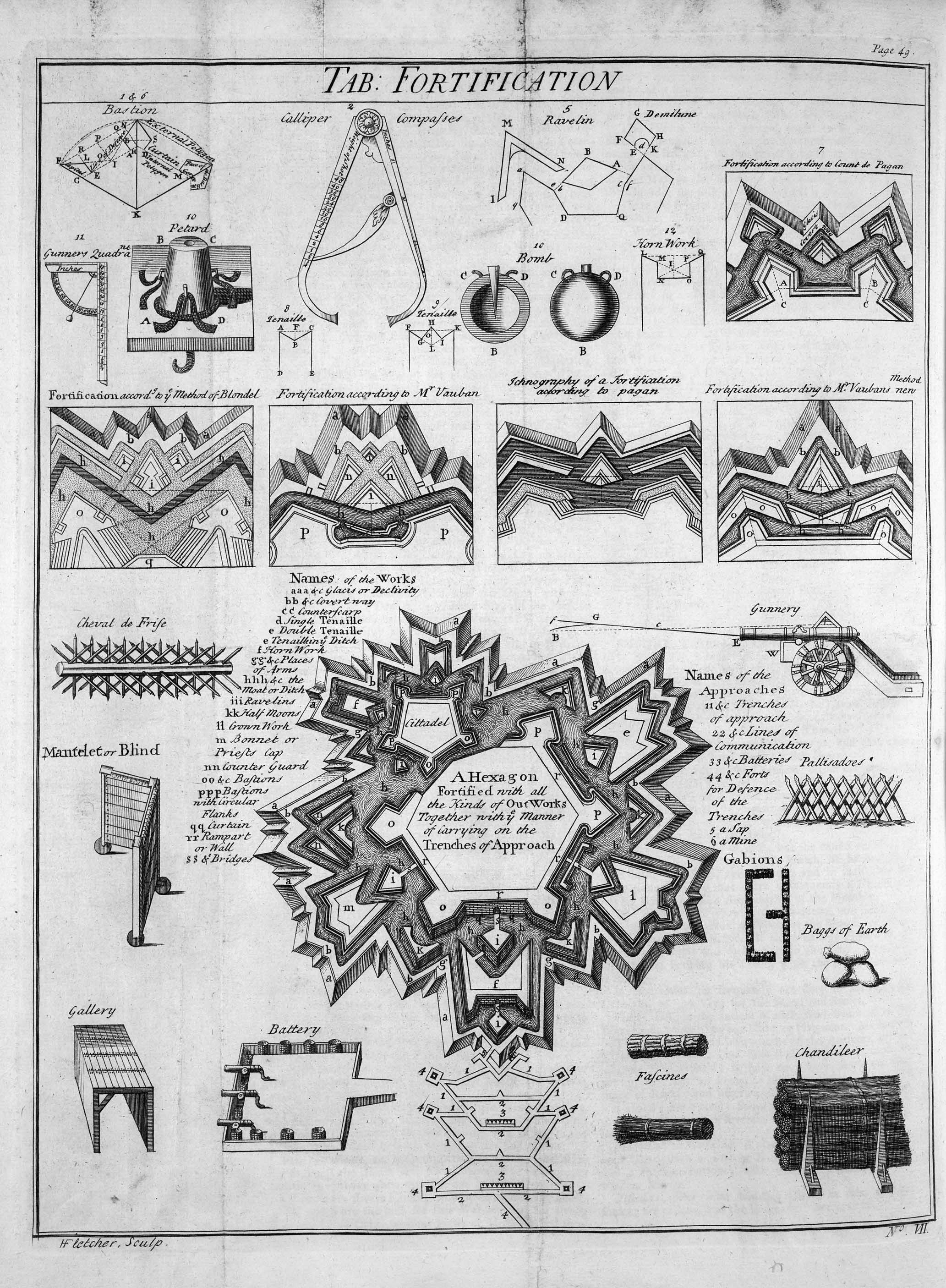
[[File:Table of Fortification, Cyclopaedia, Volume 1.jpg|thumb|upright|Table of a typical [[bastion fort]], 1728. The development of bastion forts resulted from the increased use of cannons and firearms in the 14th century.]] | [[File:Table of Fortification, Cyclopaedia, Volume 1.jpg|thumb|upright|Table of a typical [[bastion fort]], 1728. The development of bastion forts resulted from the increased use of cannons and firearms in the 14th century.]] | ||
The evolution of this new style of fortification can be seen in transitional forts such as Sarzanello<ref>Harris, J., [http://www.fsgfort.com/FortArt/Fort37Art1.htm "Sarzana and Sarzanello – Transitional Design and Renaissance Designers"] {{webarchive|url=https://web.archive.org/web/20110726181015/http://www.fsgfort.com/FortArt/Fort37Art1.htm |date=2011-07-26 }}, ''Fort'' ([[Fortress Study Group]]), No. 37, 2009, pp. 50–78</ref> in North West Italy which was built between 1492 and 1502. Sarzanello consists of both crenellated walls with towers typical of the medieval period but also has a [[ravelin]] like angular gun platform screening one of the curtain walls which is protected from flanking fire from the towers of the main part of the fort. Another example is the [[fortifications of Rhodes]] which were ''frozen'' in 1522 so that Rhodes is the only European walled town that still shows the transition between the classical medieval fortification and the modern ones.<ref name="restoration">{{Cite book | title = Medieval Town of Rhodes – Restoration Works (1985–2000) – Part One | publisher = Ministry of Culture – Works supervision committee for the monuments of the medieval town of Rhodes | year = 2001 | place = Rhodes}}</ref> | |||
The evolution of this new style of fortification can be seen in transitional forts such as [[Sarzana#History|Sarzanello]]<ref>Harris, J., [http://www.fsgfort.com/FortArt/Fort37Art1.htm "Sarzana and Sarzanello – Transitional Design and Renaissance Designers"] {{webarchive|url=https://web.archive.org/web/20110726181015/http://www.fsgfort.com/FortArt/Fort37Art1.htm |date=2011-07-26 }}, ''Fort'' ([[Fortress Study Group]]), No. 37, 2009, pp. 50–78</ref> in North West Italy which was built between 1492 and 1502. Sarzanello consists of both crenellated walls with towers typical of the medieval period but also has a [[ravelin]] like angular gun platform screening one of the curtain walls which is protected from flanking fire from the towers of the main part of the fort. Another example is the [[fortifications of Rhodes]] which were ''frozen'' in 1522 so that Rhodes is the only European walled town that still shows the transition between the classical medieval fortification and the modern ones.<ref name="restoration">{{Cite book | title = Medieval Town of Rhodes – Restoration Works (1985–2000) – Part One | publisher = Ministry of Culture – Works supervision committee for the monuments of the medieval town of Rhodes | year = 2001 | place = Rhodes}}</ref> A manual about the construction of fortification was published by [[Giovanni Battista Zanchi]] in 1554. | |||
Fortifications also extended in depth, with protected batteries for defensive cannonry, to allow them to engage attacking cannons to keep them at a distance and prevent them from bearing directly on the vulnerable walls. | Fortifications also extended in depth, with protected batteries for defensive cannonry, to allow them to engage attacking cannons to keep them at a distance and prevent them from bearing directly on the vulnerable walls. | ||
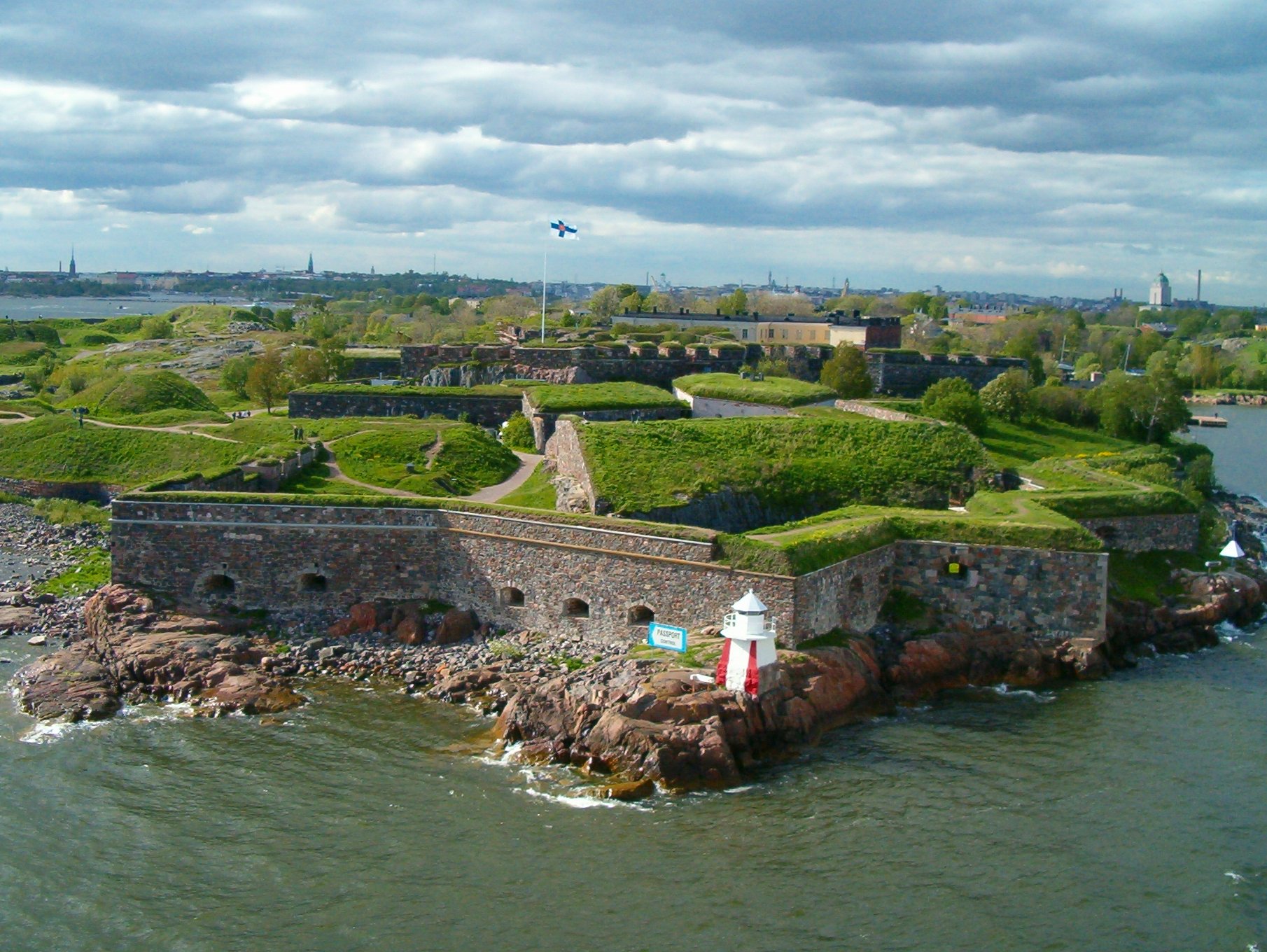
[[File:Suomenlinna.jpg|thumb|[[Suomenlinna]], a [[sea fortress]] from 18th century in [[Helsinki]], | [[File:Suomenlinna.jpg|thumb|[[Suomenlinna]], a [[sea fortress]] from 18th century in [[Helsinki]], Finland]] | ||
The result was [[Star fort|star shaped fortifications]] with tier upon tier of hornworks and [[bastion]]s, of which [[Fort Bourtange]] is an excellent example. There are also extensive fortifications from this era in the [[Northern Europe|Nordic]] states and in [[Great Britain|Britain]], the fortifications of [[Berwick-upon-Tweed]] and the | The result was [[Star fort|star shaped fortifications]] with tier upon tier of hornworks and [[bastion]]s, of which [[Fort Bourtange]] is an excellent example. There are also extensive fortifications from this era in the [[Northern Europe|Nordic]] states and in [[Great Britain|Britain]], the fortifications of [[Berwick-upon-Tweed]] and the harbor [[archipelago]] of [[Suomenlinna]] at [[Helsinki]] being fine examples. | ||
===19th century=== | ===19th century=== | ||
During the 18th century, it was found that the continuous [[enceinte]], or main defensive enclosure of a bastion fortress, could not be made large enough to accommodate the enormous field armies which were increasingly being employed in Europe; neither could the defenses be constructed far enough away from the fortress town to protect the inhabitants from bombardment by the besiegers, the range of whose guns was steadily increasing as better manufactured weapons were introduced. Therefore, since refortifying the [[Prussia]]n fortress cities of [[Koblenz]] and [[Köln]] after 1815, the principle of the '''ring fortress''' or '''girdle fortress''' was used: forts, each several hundred meters out from the original enceinte, were carefully sited so as to make best use of the terrain and to be capable of mutual support with neighboring forts.<ref>[https://prussia.online/Data/Book/th/the-forts-and-fortifications-of-europe-1815-1945/Kaufmann%20J.,%20Kaufmann%20H.%20The%20Forts%20and%20Fortifications%20of%20Europe,%201815-1945%20(2014),%20OCR.pdf The Forts and Fortifications of Europe 1815-1945]</ref> Gone were citadels surrounding towns: forts were to be moved some distance away from cities to keep the enemy at a distance so their artillery could not bombard said urbanized settlements. From now on a ring of forts were to be built at a spacing that would allow them to effectively cover the intervals between them. | |||
The arrival of [[explosive shell]]s in the 19th century led to yet another stage in the evolution of fortification. [[Star fort]]s did not fare well against the effects of high explosives and the intricate arrangements of bastions, flanking batteries and the carefully constructed lines of fire for the defending cannon could be rapidly disrupted by explosive shells. | The arrival of [[explosive shell]]s in the 19th century led to yet another stage in the evolution of fortification. [[Star fort]]s did not fare well against the effects of high explosives and the intricate arrangements of bastions, flanking batteries and the carefully constructed lines of fire for the defending cannon could be rapidly disrupted by explosive shells. | ||
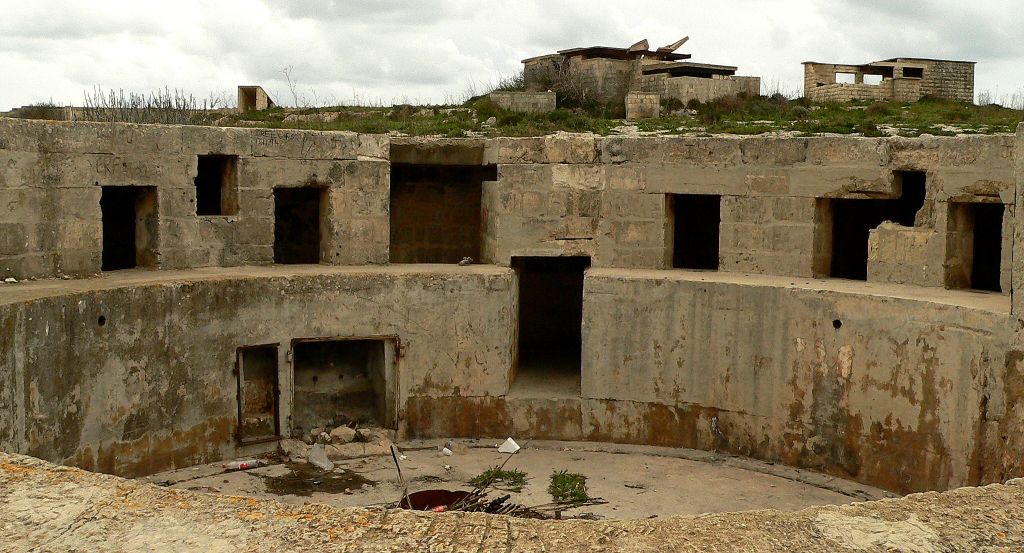
[[File:Malta Delimara one.jpg|thumb|left|The ditch and [[ | |||
Worse, the large open ditches surrounding forts of this type were an integral part of the defensive scheme, as was the covered way at the edge of the [[ | [[File:Malta Delimara one.jpg|thumb|left|The ditch and [[counterscarp]] of [[Fort Delimara]]. Built in 1878, Delimara was built as a typical [[polygonal fort]] ditches and counterscarps made to be very deep, vertically sided, and cut directly into the rocks.]] | ||
Worse, the large open ditches surrounding forts of this type were an integral part of the defensive scheme, as was the covered way at the edge of the [[counterscarp]]. The ditch was extremely vulnerable to bombardment with explosive shells. | |||
In response, military engineers evolved the [[Polygonal fort|polygonal]] style of fortification. The ditch became deep and vertically sided, cut directly into the native rock or soil, laid out as a series of straight lines creating the central fortified area that gives this style of fortification its name. | In response, military engineers evolved the [[Polygonal fort|polygonal]] style of fortification. The ditch became deep and vertically sided, cut directly into the native rock or soil, laid out as a series of straight lines creating the central fortified area that gives this style of fortification its name. | ||
Wide enough to be an impassable barrier for attacking troops | Wide enough to be an impassable barrier for attacking troops but narrow enough to be a difficult target for enemy shellfire, the ditch was swept by fire from defensive [[blockhouses]] set in the ditch as well as firing positions cut into the outer face of the ditch itself. | ||
The profile of the fort became very low indeed, surrounded outside the ditch covered by [[caponiers]] by a gently sloping open area so as to eliminate possible cover for enemy forces, while the fort itself provided a minimal target for enemy fire. The entrypoint became a sunken gatehouse in the inner face of the ditch, reached by a curving ramp that gave access to the gate via a rolling bridge that could be withdrawn into the gatehouse. | The profile of the fort became very low indeed, surrounded outside the ditch covered by [[caponiers]] by a gently sloping open area so as to eliminate possible cover for enemy forces, while the fort itself provided a minimal target for enemy fire. The entrypoint became a sunken gatehouse in the inner face of the ditch, reached by a curving ramp that gave access to the gate via a rolling bridge that could be withdrawn into the gatehouse. | ||
[[File:14-46-35-f-mutzig.jpg|thumb|The tunnels of [[Fort de Mutzig]], German fortifications built in 1893. By the 19th century, tunnels were used to connect [[blockhouse]]s and firing points in the ditch to the fort.]] | [[File:14-46-35-f-mutzig.jpg|thumb|The tunnels of [[Fort de Mutzig]], German fortifications built in 1893. By the 19th century, tunnels were used to connect [[blockhouse]]s and firing points in the ditch to the fort.]] | ||
Much of the fort moved underground. Deep passages and [[tunnel network]]s now connected the [[blockhouse]]s and firing points in the ditch to the fort proper, with [[magazine (artillery)|magazines]] and machine rooms deep under the surface. The guns, however, were often mounted in open emplacements and protected only by a [[parapet]]; both in order to keep a lower profile and also because experience with guns in closed [[casemate]]s had seen them put out of action by rubble as their own casemates were collapsed around them. | Much of the fort moved underground. Deep passages and [[tunnel network]]s now connected the [[blockhouse]]s and firing points in the ditch to the fort proper, with [[magazine (artillery)|magazines]] and machine rooms deep under the surface. The guns, however, were often mounted in open emplacements and protected only by a [[parapet]]; both in order to keep a lower profile and also because experience with guns in closed [[casemate]]s had seen them put out of action by rubble as their own casemates were collapsed around them. | ||
The new forts abandoned the principle of the bastion, which had also been made obsolete by advances in arms. The outline was a much-simplified polygon, surrounded by a ditch. These forts, built in masonry and shaped stone, were designed to shelter their garrison against bombardment. One organizing feature of the new system involved the construction of two defensive curtains: an outer line of forts, backed by an inner ring or line at critical points of terrain or junctions (see, for example, [[Séré de Rivières system]] in France). | The new forts abandoned the principle of the bastion, which had also been made obsolete by advances in arms. The outline was a much-simplified polygon, surrounded by a ditch. These forts, built in masonry and shaped stone, were designed to shelter their garrison against bombardment. One organizing feature of the new system involved the construction of two defensive curtains: an outer line of forts, backed by an inner ring or line at critical points of terrain or junctions (see, for example, [[Séré de Rivières system]] in France). | ||
| Line 200: | Line 216: | ||
===20th and 21st centuries=== | ===20th and 21st centuries=== | ||
[[File:Fort Campbell 09.jpg|thumb|Gun emplacement in [[Fort Campbell (Malta)|Fort Campbell]], built in the 1930s. Due to the threat of [[aerial warfare]], the buildings were placed at a distance from each other, making it difficult to find from the air.]] | [[File:Fort Campbell 09.jpg|thumb|Gun emplacement in [[Fort Campbell (Malta)|Fort Campbell]], built in the 1930s. Due to the threat of [[aerial warfare]], the buildings were placed at a distance from each other, making it difficult to find from the air.]] | ||
[[Steel]]-and-[[concrete]] fortifications were common during the 19th and early 20th centuries. However, the advances in modern warfare since [[World War I]] have made large-scale fortifications [[obsolete]] in most situations. In the 1930s and 1940s, some fortifications were built with designs taking into consideration the new threat of [[aerial warfare]], such as [[Fort Campbell (Malta)|Fort Campbell]] in Malta.<ref>{{cite web|last1=Mifsud|first1=Simon|title=Fort Campbell|url=http://www.militaryarchitecture.com/index.php/Fortifications/fort-campbell.html|website=MilitaryArchitecture.com|access-date=15 March 2015|date=14 September 2012|url-status=live|archive-url=https://web.archive.org/web/20151115113234/http://www.militaryarchitecture.com/index.php/Fortifications/fort-campbell.html|archive-date=15 November 2015}}</ref> Despite this, only underground [[bunker]]s are still able to provide some protection in modern wars. Many historical fortifications were demolished during the modern age, but a considerable number survive as popular tourist destinations and prominent local [[landmark]]s today. | [[Steel]]-and-[[concrete]] fortifications were common during the 19th and early 20th centuries. However, the advances in modern warfare since [[World War I]] have made large-scale fortifications [[obsolete]] in most situations. In the 1930s and 1940s, some fortifications were built with designs taking into consideration the new threat of [[aerial warfare]], such as [[Fort Campbell (Malta)|Fort Campbell]] in Malta.<ref>{{cite web|last1=Mifsud|first1=Simon|title=Fort Campbell|url=http://www.militaryarchitecture.com/index.php/Fortifications/fort-campbell.html|website=MilitaryArchitecture.com|access-date=15 March 2015|date=14 September 2012|url-status=live|archive-url=https://web.archive.org/web/20151115113234/http://www.militaryarchitecture.com/index.php/Fortifications/fort-campbell.html|archive-date=15 November 2015}}</ref> Despite this, only underground [[bunker]]s are still able to provide some protection in modern wars. Many historical fortifications were demolished during the modern age, but a considerable number survive as popular tourist destinations and prominent local [[landmark]]s today. | ||
The downfall of permanent fortifications had two causes: | The downfall of permanent fortifications had two causes: | ||
* The ever-escalating power, speed, and reach of artillery and airpower meant that almost any target that could be located could be destroyed if sufficient force were massed against it. As such, the more resources a defender devoted to reinforcing a fortification, the more combat power that fortification justified being devoted to destroying it, if the fortification's destruction was demanded by an attacker's strategy. From [[World War II]], [[bunker buster]]s were used against fortifications. By 1950, [[nuclear weapon]]s were capable of destroying entire cities and producing dangerous [[radiation]]. This led to the creation of civilian nuclear [[air raid shelter]]s. | * The ever-escalating power, speed, and reach of artillery and airpower meant that almost any target that could be located could be destroyed if sufficient force were massed against it. As such, the more resources a defender devoted to reinforcing a fortification, the more combat power that fortification justified being devoted to destroying it, if the fortification's destruction was demanded by an attacker's strategy. From [[World War II]], [[bunker buster]]s were used against fortifications. By 1950, [[nuclear weapon]]s were capable of destroying entire cities and producing dangerous [[radiation]]. This led to the creation of civilian nuclear [[air raid shelter]]s. | ||
* The second weakness of permanent fortification was its very permanency. Because of this, it was often easier to go around a fortification and, with the rise of mobile warfare in the beginning of World War II, this became a viable offensive choice. When a defensive line was too extensive to be entirely bypassed, massive offensive might could be massed against one part of the line allowing a breakthrough, after which the rest of the line could be bypassed. Such was the fate of the many defensive lines built before and during World War II, such as the [[Siegfried Line]], the [[Stalin Line]] and the [[Atlantic Wall]]. This was not the case with the [[Maginot Line]]; it was designed to force the Germans to invade other countries (Belgium or Switzerland) to go around it, and was successful in that sense.<ref>{{cite book |last=Halter |first=Marc |title=History of the Maginot Line |publisher=Moselle River |date=2011 |isbn=978-2-9523092-5-7}}{{page needed|date=August 2022}}</ref> | * The second weakness of permanent fortification was its very permanency. Because of this, it was often easier to go around a fortification and, with the rise of mobile warfare in the beginning of World War II, this became a viable offensive choice. When a defensive line was too extensive to be entirely bypassed, massive offensive might could be massed against one part of the line allowing a breakthrough, after which the rest of the line could be bypassed. Such was the fate of the many defensive lines built before and during World War II, such as the [[Siegfried Line]], the [[Stalin Line]], and the [[Atlantic Wall]]. This was not the case with the [[Maginot Line]]; it was designed to force the Germans to invade other countries (Belgium or Switzerland) to go around it, and was successful in that sense.<ref>{{cite book |last=Halter |first=Marc |title=History of the Maginot Line |publisher=Moselle River |date=2011 |isbn=978-2-9523092-5-7}}{{page needed|date=August 2022}}</ref> | ||
[[File:Image-GBU-24 Missile testmontage-gi BLU-109 bomb.jpg|thumb|left|upright|A [[GBU-24 Paveway III|GBU-24]] {{cvt|2000|lb}} bomb hits the ground. The development of [[bunker buster]]s, bombs designed to penetrate hardened targets buried underground, led to a decline in the use of fortifications.]] | [[File:Image-GBU-24 Missile testmontage-gi BLU-109 bomb.jpg|thumb|left|upright|A [[GBU-24 Paveway III|GBU-24]] {{cvt|2000|lb}} bomb hits the ground. The development of [[bunker buster]]s, bombs designed to penetrate hardened targets buried underground, led to a decline in the use of fortifications.]] | ||
Instead field fortification rose to dominate defensive action. Unlike the [[trench warfare]] which dominated World War I, these | Instead field fortification rose to dominate defensive action. Unlike the [[trench warfare]] which dominated World War I, these defenses were more temporary in nature. This was an advantage because since it was less extensive it formed a less obvious target for enemy force to be directed against. | ||
If sufficient power were massed against one point to penetrate it, the forces based there could be withdrawn and the line could be | If sufficient power were massed against one point to penetrate it, the forces based there could be withdrawn and the line could be reestablished relatively quickly. Instead of a supposedly impenetrable defensive line, such fortifications emphasized [[defense in depth]], so that as defenders were forced to pull back or were overrun, the lines of defenders behind them could take over the defense. | ||
Because the mobile offensives | Because the mobile offensives practiced by both sides usually focused on avoiding the strongest points of a [[defensive line]], these defenses were usually relatively thin and spread along the length of a line. The defense was usually not equally strong throughout, however. | ||
The strength of the defensive line in an area varied according to how rapidly an attacking force could progress in the terrain that was being defended—both the terrain the defensive line was built on and the ground behind it that an attacker might hope to break out into. This was both for reasons of the strategic value of the ground, and its defensive value. | The strength of the defensive line in an area varied according to how rapidly an attacking force could progress in the terrain that was being defended—both the terrain the defensive line was built on and the ground behind it that an attacker might hope to break out into. This was both for reasons of the strategic value of the ground, and its defensive value. | ||
This was possible because while offensive tactics were focused on mobility, so were defensive tactics. The dug-in | This was possible because while offensive tactics were focused on mobility, so were defensive tactics. The dug-in defenses consisted primarily of infantry and [[antitank gun]]s. Defending [[tank]]s and [[tank destroyer]]s would be concentrated in mobile [[brigade]]s behind the defensive line. If a major offensive was launched against a point in the line, mobile reinforcements would be sent to reinforce that part of the line that was in danger of failing. | ||
Thus the defensive line could be relatively thin because the bulk of the fighting power of the defenders was not concentrated in the line itself but rather in the mobile reserves. A notable exception to this rule was seen in the defensive lines at the [[Battle of Kursk]] during World War II, where German forces deliberately attacked the strongest part of the [[Soviet Union|Soviet]] | Thus the defensive line could be relatively thin because the bulk of the fighting power of the defenders was not concentrated in the line itself but rather in the mobile reserves. A notable exception to this rule was seen in the defensive lines at the [[Battle of Kursk]] during World War II, where German forces deliberately attacked the strongest part of the [[Soviet Union|Soviet]] defenses, seeking to crush them utterly. | ||
The [[terrain]] that was being defended was of primary importance because [[open terrain]] that tanks could move over quickly made possible rapid advances into the defenders' rear areas that were very dangerous to the defenders. Thus such terrain had to be defended at all costs. | The [[terrain]] that was being defended was of primary importance because [[open terrain]] that tanks could move over quickly made possible rapid advances into the defenders' rear areas that were very dangerous to the defenders. Thus such terrain had to be defended at all costs. | ||
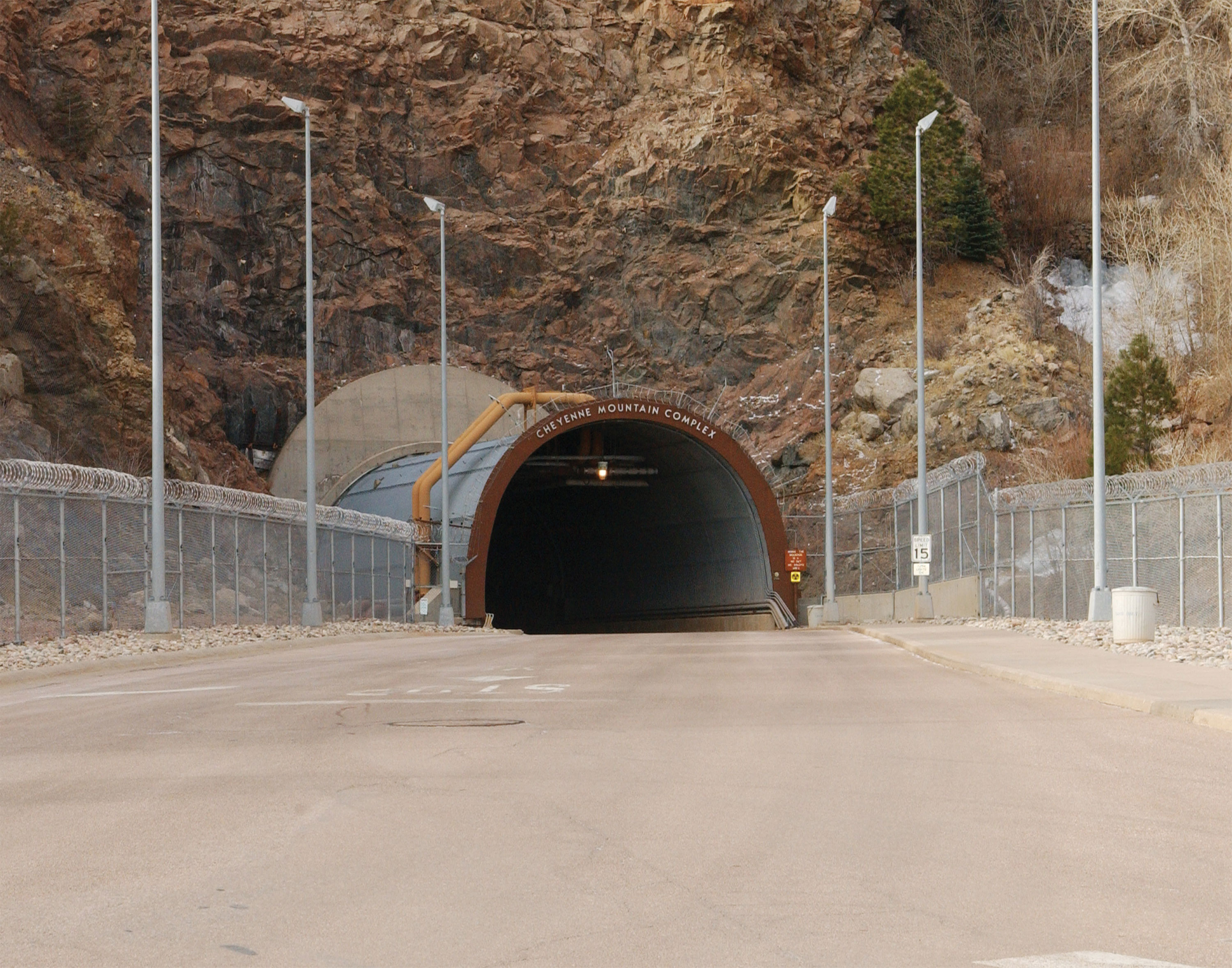
[[File:NORADNorth-Portal.jpg|thumb|[[Cheyenne Mountain Complex]] is an underground [[bunker]] used by [[North American Aerospace Defense Command]]. Cheyenne Mountain is an example of a mid-20th century fortification built deep in a mountain.]] | |||
In addition, since in theory the defensive line only had to hold out long enough for mobile reserves to reinforce it, terrain that did not permit rapid advance could be held more weakly because the enemy's advance into it would be slower, giving the defenders more time to reinforce that point in the line. For example, the [[Battle of the Hurtgen Forest]] in Germany during the closing stages of World War II is an excellent example of how difficult terrain could be used to the defenders' advantage. | In addition, since in theory the defensive line only had to hold out long enough for mobile reserves to reinforce it, terrain that did not permit rapid advance could be held more weakly because the enemy's advance into it would be slower, giving the defenders more time to reinforce that point in the line. For example, the [[Battle of the Hurtgen Forest]] in Germany during the closing stages of World War II is an excellent example of how difficult terrain could be used to the defenders' advantage. | ||
After World War II, [[intercontinental ballistic missile]]s capable of reaching much of the way around the world were developed, so speed became an essential characteristic of the strongest militaries and defenses. [[Missile silo]]s were developed, so missiles could be fired from the middle of a country and hit cities and targets in another country, and airplanes (and | After World War II, [[intercontinental ballistic missile]]s capable of reaching much of the way around the world were developed, so speed became an essential characteristic of the strongest militaries and defenses. [[Missile silo]]s were developed, so missiles could be fired from the middle of a country and hit cities and targets in another country, and airplanes (and [[aircraft carrier]]s) became major defenses and offensive weapons (leading to an expansion of the use of airports and airstrips as fortifications). Mobile defenses could be had underwater, too, in the form of [[ballistic missile submarine]]s capable of firing [[submarine launched ballistic missile]]s. Some bunkers in the mid to late 20th century came to be buried deep inside mountains and prominent rocks, such as [[Gibraltar]] and the [[Cheyenne Mountain Complex]]. On the ground itself, [[minefield]]s have been used as hidden defenses in modern warfare, often remaining long after the wars that produced them have ended. | ||
[[Demilitarized zone]]s along borders are arguably another type of fortification, although a passive kind, providing a buffer between potentially hostile militaries. | [[Demilitarized zone]]s along borders are arguably another type of fortification, although a passive kind, providing a buffer between potentially hostile militaries. | ||
===Military airfields=== | ===Military airfields=== | ||
[[Military airfield]]s offer a fixed "target rich" environment for even relatively small enemy forces, using [[hit-and-run tactics]] by ground forces, stand-off attacks (mortars and rockets), air attacks, or ballistic missiles. Key targets—aircraft, munitions, fuel, and vital technical personnel—can be protected by fortifications. | [[Military airfield]]s offer a fixed "target rich" environment for even relatively small enemy forces, using [[hit-and-run tactics]] by ground forces, stand-off attacks (mortars and rockets), air attacks, or ballistic missiles. Key targets—aircraft, munitions, fuel, and vital technical personnel—can be protected by fortifications. | ||
Aircraft can be protected by [[Revetment (aircraft)|revetment]]s, [[hesco barrier]]s, [[hardened aircraft shelter]]s and [[underground hangar]]s which will protect from many types of attack. Larger aircraft types tend to be based outside the operational | Aircraft can be protected by [[Revetment (aircraft)|revetment]]s, [[hesco barrier]]s, [[hardened aircraft shelter]]s and [[underground hangar]]s which will protect from many types of attack. Larger aircraft types tend to be based outside the operational theater. | ||
Munition storage follows safety rules which use fortifications (bunkers and bunds) to provide protection against accident and chain reactions (sympathetic detonations). Weapons for rearming aircraft can be stored in small fortified ''expense'' stores closer to the aircraft. At | Munition storage follows safety rules which use fortifications (bunkers and bunds) to provide protection against accident and chain reactions (sympathetic detonations). Weapons for rearming aircraft can be stored in small fortified ''expense'' stores closer to the aircraft. At Biên Hòa, South Vietnam, on the morning of May 16, 1965, as aircraft were being refueled and armed, a chain reaction explosion destroyed 13 aircraft, killed 34 personnel, and injured over 100; this, along with damage and losses of aircraft to enemy attack (by both [[Infiltration tactics|infiltration]] and stand-off attacks), led to the construction of revetments and shelters to protect aircraft throughout [[South Vietnam]]. | ||
Aircrew and ground personnel will need protection during enemy attacks and fortifications range from culvert section "duck and cover" shelters to permanent air | Aircrew and ground personnel will need protection during enemy attacks and fortifications range from culvert section "duck and cover" shelters to permanent air raid shelters. Soft locations with high personnel densities such as accommodation and messing facilities can have limited protection by placing prefabricated concrete walls or barriers around them, examples of barriers are [[Jersey Barrier]]s, T Barriers or Splinter Protection Units (SPUs). Older fortification may prove useful such as the old 'Yugo' pyramid shelters built in the 1980s which were used by US personnel on 8 Jan 2020 when Iran fired 11 ballistic missiles at [[Al Asad Airbase|Ayn al-Asad Airbase]] in Iraq. | ||
Fuel is volatile and has to comply with rules for storage which provide protection against accidents. Fuel in underground bulk fuel installations is well protected though valves and controls are vulnerable to enemy action. Above-ground tanks can be susceptible to attack. | Fuel is volatile and has to comply with rules for storage which provide protection against accidents. Fuel in underground bulk fuel installations is well protected though valves and controls are vulnerable to enemy action. Above-ground tanks can be susceptible to attack. | ||
| Line 242: | Line 260: | ||
Permanent (concrete) guard fortifications are safer, stronger, last longer and are more cost-effective than [[sandbag]] fortifications. Prefabricated positions can be made from concrete culvert sections. The British Yarnold Bunker is made from sections of a concrete pipe. | Permanent (concrete) guard fortifications are safer, stronger, last longer and are more cost-effective than [[sandbag]] fortifications. Prefabricated positions can be made from concrete culvert sections. The British Yarnold Bunker is made from sections of a concrete pipe. | ||
Guard | Guard towers provide an increased field of view but a lower level of protection. | ||
Dispersal and camouflage of assets can supplement fortifications against some forms of airfield attack. | Dispersal and camouflage of assets can supplement fortifications against some forms of airfield attack. | ||
==== | ====Counterinsurgency==== | ||
Just as in colonial periods, comparatively obsolete fortifications are still used for low | Just as in colonial periods, comparatively obsolete fortifications are still used for low intensity conflicts. Such fortifications range in size from small patrol bases or [[forward operating base]]s up to huge [[airbase]]s such as [[Camp Bastion]]/[[Camp Leatherneck|Leatherneck]] in [[Afghanistan]]. Much like in the 18th and 19th century, because the enemy is not a powerful military force with the heavy weaponry required to destroy fortifications, walls of [[gabion]], [[sandbag]] or even simple mud can provide protection against small arms and antitank weapons—although such fortifications are still vulnerable to mortar and artillery fire. | ||
==Forts== | ==Forts== | ||
[[File:Fortaleza Ozama RD 11 2017 6495.jpg|thumb|The [[Fortaleza Ozama|Ozama Fortress]] in [[Santo Domingo]], | [[File:Fortaleza Ozama RD 11 2017 6495.jpg|thumb|The [[Fortaleza Ozama|Ozama Fortress]] in [[Santo Domingo]], Dominican Republic is recognized by UNESCO for being the oldest military construction of European origin in the Americas.<ref>{{cite web|url=https://whc.unesco.org/en/list/526|title=Colonial City of Santo Domingo. Outstanding Universal Value|website=UNESCO World Heritage Centre website}}</ref>]] | ||
Forts in modern American usage often refer to space set aside by governments for a permanent military facility; these often do not have any actual fortifications, and can have specializations (military barracks, administration, medical facilities, or intelligence). | Forts in modern American usage often refer to space set aside by governments for a permanent military facility; these often do not have any actual fortifications, and can have specializations (military barracks, administration, medical facilities, or intelligence). | ||
However, there are some modern fortifications that are referred to as forts. These are typically small | However, there are some modern fortifications that are referred to as forts. These are typically small semipermanent fortifications. In urban combat, they are built by upgrading existing structures such as houses or public buildings. In field warfare they are often log, sandbag or [[gabion]] type construction. | ||
Such forts are typically only used in low-level conflicts, such as counterinsurgency conflicts or very low-level conventional conflicts, such as the [[Indonesia–Malaysia confrontation]], which saw the use of log forts for use by forward [[platoon]]s and [[Company (military unit)|companies]]. The reason for this is that static above-ground forts cannot survive modern direct or indirect fire weapons larger than mortars, RPGs and small arms. | Such forts are typically only used in low-level conflicts, such as counterinsurgency conflicts or very low-level conventional conflicts, such as the [[Indonesia–Malaysia confrontation]], which saw the use of log forts for use by forward [[platoon]]s and [[Company (military unit)|companies]]. The reason for this is that static above-ground forts cannot survive modern direct or indirect fire weapons larger than mortars, RPGs and small arms. | ||
==Prisons and others== | ==Prisons and others== | ||
Fortifications designed to keep the inhabitants of a facility in rather than attacker out can also be found, in [[prisons]], [[concentration camps]], and other such facilities | Fortifications designed to keep the inhabitants of a facility in rather than attacker out can also be found, in [[prisons]], [[concentration camps]], and other such facilities. Those are covered in other articles, as most prisons and concentration camps are not primarily military forts (although forts, camps, and garrison towns have been used as prisons and/or concentration camps; such as [[Theresienstadt]], [[Guantanamo Bay detention camp]] and the [[Tower of London]] for example). | ||
==Field fortifications== | ==Field fortifications== | ||
{{ | {{Main|Trench warfare}} | ||
==Notes== | ==Notes== | ||
| Line 404: | Line 286: | ||
==References== | ==References== | ||
* {{EB1911 |wstitle=Fortification and Siegecraft |volume=10 |pages=679–725 |first=Louis Charles |last=Jackson}} | * {{EB1911|wstitle=Fortification and Siegecraft|volume=10|pages=679–725|first=Louis Charles|last=Jackson}} | ||
==Bibliography== | ==Bibliography== | ||
| Line 414: | Line 296: | ||
==External links== | ==External links== | ||
{{Wiktionary}} | |||
{{Commons}} | |||
* [http://www.fsgfort.com Fortress Study Group] | * [http://www.fsgfort.com Fortress Study Group] | ||
* {{webarchive |url=https://web.archive.org/web/20181205190113/http://www.militaryarchitecture.com |date=5 December 2018 |title=Military Architecture}} | * {{webarchive|url=https://web.archive.org/web/20181205190113/http://www.militaryarchitecture.com|date=5 December 2018|title=Military Architecture}} | ||
* [http://www.icofort.org ICOFORT] | * [http://www.icofort.org ICOFORT] | ||
{{Fortifications}} | {{Fortifications}} | ||
{{Stonemasonry}} | {{Stonemasonry}} | ||
{{Authority control}} | {{Authority control}} | ||
{{Military and war}} | |||
[[Category:Fortifications| ]] | [[Category:Fortifications| ]] | ||
Latest revision as of 11:02, 15 March 2026
 | This article needs additional citations for verification. (January 2013) |
| Part of a series on |
| War |
|---|
.jpg)
A fortification (also called a fort, fortress, fastness, or stronghold) is a military construction designed for the defense of territories in warfare, and is used to establish rule in a region during peacetime. The term is derived from Latin fortis ("strong") and facere ("to make").[1]

From very early history to modern times, defensive walls have often been necessary for cities to survive in an ever-changing world of invasion and conquest. Some settlements in the Indus Valley Civilization were the first small cities to be fortified. In ancient Greece, large cyclopean stone walls fitted without mortar had been built in Mycenaean Greece, such as the ancient site of Mycenae. A Greek phrourion was a fortified collection of buildings used as a military garrison, and is the equivalent of the Roman castellum or fortress. These constructions mainly served the purpose of a watch tower, to guard certain roads, passes, and borders. Though smaller than a real fortress, they acted as a border guard rather than a real strongpoint to watch and maintain the border.
The art of setting out a military camp or constructing a fortification traditionally has been called "castrametation" since the time of the Roman legions. Fortification is usually divided into two branches: permanent fortification and field fortification. There is also an intermediate branch known as semipermanent fortification.[2] Castles are fortifications which are regarded as being distinct from the generic fort or fortress in that they are a residence of a monarch or noble and command a specific defensive territory.
Roman forts and hill forts were the main antecedents of castles in Europe, which emerged in the 9th century in the Carolingian Empire. The Early Middle Ages saw the creation of some towns built around castles.
Medieval-style fortifications were largely made obsolete by the arrival of cannons in the 14th century. Fortifications in the age of black powder evolved into much lower structures with greater use of ditches and earth ramparts that would absorb and disperse the energy of cannon fire. Walls exposed to direct cannon fire were very vulnerable, so the walls were sunk into ditches fronted by earth slopes to improve protection.
The arrival of explosive shells in the 19th century led to another stage in the evolution of fortification. Star forts did not fare well against the effects of high explosives, and the intricate arrangements of bastions, flanking batteries and the carefully constructed lines of fire for the defending cannon could be rapidly disrupted by explosive shells. Steel-and-concrete fortifications were common during the 19th and early 20th centuries. The advances in modern warfare since World War I have made large-scale fortifications obsolete in most situations.
History[edit | edit source]
Early uses[edit | edit source]

Defensive fences for protecting humans and domestic animals against predators was used long before the appearance of writing and began "perhaps with primitive man blocking the entrances of his caves for security from large carnivores".[3]
From very early history to modern times, walls have been a necessity for many cities. Amnya Fort in western Siberia has been described by archeologists as one of the oldest known fortified settlements, as well as the northernmost Stone Age fort.[4] In Bulgaria, near the town of Provadia a walled fortified settlement today called Solnitsata starting from 4700 BC had a diameter of about 300 feet (91 m), was home to 350 people living in two-story houses, and was encircled by a fortified wall. The huge walls around the settlement, which were built very tall and with stone blocks which are 6 feet (1.8 m) high and 4.5 feet (1.4 m) thick, make it one of the earliest walled settlements in Europe[5][6] but it is younger than the walled town of Sesklo in Greece from 6800 BC.[7][8]
Uruk in ancient Sumer (Mesopotamia) is one of the world's oldest known walled cities. The Ancient Egyptians also built fortresses on the frontiers of the Nile Valley to protect against invaders from adjacent territories, as well as circle-shaped mud brick walls around their cities. Many of the fortifications of the ancient world were built with mud brick, often leaving them no more than mounds of dirt for today's archeologists. A massive prehistoric stone wall surrounded the ancient temple of Ness of Brodgar 3200 BC in Scotland. Named the "Great Wall of Brodgar" it was 4 m (13 ft) thick and 4 m (13 ft) tall. The wall had some symbolic or ritualistic function.[9][10] The Assyrians deployed large labor forces to build new palaces, temples and defensive walls.[11]
Bronze Age Europe[edit | edit source]

In Bronze Age Malta, some settlements also began to be fortified. The most notable surviving example is Borġ in-Nadur, where a bastion built in around 1500 BC was found. Exceptions were few—notably, ancient Sparta and ancient Rome did not have walls for a long time, choosing to rely on their militaries for defense instead. Initially, these fortifications were simple constructions of wood and earth, which were later replaced by mixed constructions of stones piled on top of each other without mortar. In ancient Greece, large stone walls had been built in Mycenaean Greece, such as the ancient site of Mycenae (famous for the huge stone blocks of its 'cyclopean' walls). In classical era Greece, the city of Athens built two parallel stone walls, called the Long Walls, that reached their fortified seaport at Piraeus a few miles away.
In Central Europe, the Celts built large fortified settlements known as oppida, whose walls seem partially influenced by those built in the Mediterranean. The fortifications were continuously being expanded and improved. Around 600 BC, in Heuneburg, Germany, forts were constructed with a limestone foundation supported by a mudbrick wall approximately 4 meters tall, probably topped by a roofed walkway, thus reaching a total height of 6 meters. The wall was clad with lime plaster, regularly renewed. Towers protruded outwards from it.[12][13]

The Oppidum of Manching (German: Oppidum von Manching) was a large Celtic proto-urban or city-like settlement at modern-day Manching (near Ingolstadt), Bavaria (Germany). The settlement was founded in the 3rd century BC and existed until c. 50–30 BC. It reached its largest extent during the late La Tène period (late 2nd century BC), when it had a size of 380 hectares. At that time, 5,000 to 10,000 people lived within its 7.2 km long walls. The oppidum of Bibracte is another example of a Gaulish fortified settlement.
Bronze and Iron Age Near East[edit | edit source]

The term casemate wall is used in the archeology of Israel and the wider Near East, having the meaning of a double wall protecting a city[14] or fortress,[15] with transverse walls separating the space between the walls into chambers.[14] These could be used as such, for storage or residential purposes, or could be filled with soil and rocks during siege in order to raise the resistance of the outer wall against battering rams.[14] Originally thought to have been introduced to the region by the Hittites, this has been disproved by the discovery of examples predating their arrival, the earliest being at Ti'inik (Taanach) where such a wall has been dated to the 16th century BC.[16] Casemate walls became a common type of fortification in the Southern Levant between the Middle Bronze Age (MB) and Iron Age II, being more numerous during the Iron Age and peaking in Iron Age II (10th–6th century BC).[14] However, the construction of casemate walls had begun to be replaced by sturdier solid walls by the 9th century BC, probably due the development of more effective battering rams by the Neo-Assyrian Empire.[14][17] Casemate walls could surround an entire settlement, but most only protected part of it.[18] The three different types included freestanding casemate walls, then integrated ones where the inner wall was part of the outer buildings of the settlement, and finally filled casemate walls, where the rooms between the walls were filled with soil right away, allowing for a quick, but nevertheless stable construction of particularly high walls.[19]
Ancient Rome[edit | edit source]

The Romans fortified their cities with massive, mortar-bound stone walls. The most famous of these are the largely extant Aurelian Walls of Rome and the Theodosian Walls of Constantinople, together with partial remains elsewhere. These are mostly city gates, like the Porta Nigra in Trier or Newport Arch in Lincoln.
Hadrian's Wall was built by the Roman Empire across the width of what is now northern England following a visit by Roman Emperor Hadrian (AD 76–138) in AD 122.
Indian subcontinent[edit | edit source]

A number of forts dating from the Later Stone Age to the British Raj are found in the mainland Indian subcontinent (modern day India, Pakistan, Bangladesh and Nepal). "Fort" is the word used in India for all old fortifications. Numerous Indus Valley Civilization sites exhibit evidence of fortifications. By about 3500 BC, hundreds of small farming villages dotted the Indus floodplain. Many of these settlements had fortifications and planned streets. The stone and mud brick houses of Kot Diji were clustered behind massive stone flood dykes and defensive walls, for neighboring communities bickered constantly about the control of prime agricultural land.[20] The fortification varies by site. While Dholavira has stone-built fortification walls, Harrapa is fortified using baked bricks; sites such as Kalibangan exhibit mudbrick fortifications with bastions and Lothal has a quadrangular fortified layout. Evidence also suggested of fortifications in Mohenjo-daro. Even a small town—for instance, Kotada Bhadli, exhibiting sophisticated fortification-like bastions—shows that nearly all major and minor towns of the Indus Valley Civilization were fortified.[21] Forts also appeared in urban cities of the Gangetic valley during the second urbanization period between 600 and 200 BC, and as many as 15 fortification sites have been identified by archeologists throughout the Gangetic valley, such as Kaushambi, Mahasthangarh, Pataliputra, Mathura, Ahichchhatra, Rajgir, and Lauria Nandangarh. The earliest Mauryan period brick fortification occurs in one of the stupa mounds of Lauria Nandangarh, which is 1.6 km in perimeter and oval in plan and encloses a habitation area.[22] Mundigak (c. 2500 BC) in present-day south-east Afghanistan has defensive walls and square bastions of sun dried bricks.[23]

India currently has over 180 forts, with the state of Maharashtra alone having over 70 forts, which are also known as durg,[24][25][26] many of them built by Shivaji, founder of the Maratha Empire.
A large majority of forts in India are in North India. The most notable forts are the Red Fort at Old Delhi, the Red Fort at Agra, the Chittor Fort and Mehrangarh Fort in Rajasthan, the Ranthambhor Fort, Amer Fort and Jaisalmer Fort also in Rajasthan and Gwalior Fort in Madhya Pradesh.[25]
Arthashastra, the Indian treatise on military strategy describes six major types of forts differentiated by their major modes of defenses.
Sri Lanka[edit | edit source]

Forts in Sri Lanka date back thousands of years, with many being built by Sri Lankan kings. These include several walled cities. With the outset of colonial rule in the Indian Ocean, Sri Lanka was occupied by several major colonial empires that from time to time became the dominant power in the Indian Ocean. The colonists built several western-style forts, mostly in and around the coast of the island. The first to build colonial forts in Sri Lanka were the Portuguese; these forts were captured and later expanded by the Dutch. The British occupied these Dutch forts during the Napoleonic wars. Most of the colonial forts were garrisoned up until the early 20th century. The coastal forts had coastal artillery manned by the Ceylon Garrison Artillery during the two world wars. Most of these were abandoned by the military but retained civil administrative officers, while others retained military garrisons, which were more administrative than operational. Some were reoccupied by military units with the escalation of the Sri Lankan Civil War; Jaffna fort, for example, came under siege several times.
China[edit | edit source]

Large tempered earth (i.e. rammed earth) walls were built in ancient China since the Shang dynasty (c. 1600–1050 BC); the capital at ancient Ao had enormous walls built in this fashion (see siege for more info). Although stone walls were built in China during the Warring States (481–221 BC), mass conversion to stone architecture did not begin in earnest until the Tang dynasty (618–907 AD). The Great Wall of China had been built since the Qin dynasty (221–207 BC), although its present form was mostly an engineering feat and remodeling from the Ming dynasty (1368–1644 AD).
In addition to the Great Wall, a number of Chinese cities also constructed defensive walls to defend their cities. Notable Chinese city walls include the city walls of Hangzhou, Nanking, the Old City of Shanghai, Suzhou, Xi'an and the walled villages of Hong Kong. The famous walls of the Forbidden City in Beijing were established in the early 15th century by the Yongle Emperor. The Forbidden City made up the inner portion of the Beijing city fortifications.
North America[edit | edit source]
Frontier forts[edit | edit source]
In the United States, there are many examples of historical forts or fortified "stations" - the name depended on the region. This was a structure built for defense against primarily Indian attacks in frontier areas. While some forts were sometimes used by militias, state and federal military units, their primary purpose was for private or civilian defense. Sometimes a stockade would surround the building(s).[27]
Examples of historic private or civilian fortified houses built include:
- Fort Nelson and Floyd's Station and Low Dutch Station all in Kentucky
- Mormon Fort and Mormon Station in Nevada
- Fort Buenaventura, Cove Fort, Fort Deseret, and Fort Utah all in Utah.
- Carpenter's Fort in Ohio
- Fort Bigham, Fort Swatara, the Heinrich Zeller House, and Fort Depuy, 18th-century fortified homesteads in Pennsylvania
Philippines[edit | edit source]
Spanish colonial fortifications[edit | edit source]
During the Spanish Era several forts and outposts were built throughout the archipelago. Most notable is Intramuros, the old walled city of Manila located along the southern bank of the Pasig River.[28] The historic city was home to centuries-old churches, schools, convents, government buildings and residences, the best collection of Spanish colonial architecture before much of it was destroyed by the bombs of World War II. Of all the buildings within the 67-acre city, only one building, the San Agustin Church, survived the war.
Partial listing of Spanish forts:
- Intramuros, Manila
- Cuartel de Santo Domingo, Santa Rosa, Laguna
- Fuerza de Cuyo, Cuyo, Palawan
- Fuerza de Cagayancillo, Cagayancillo, Palawan
- Real Fuerza de Nuestra Señora del Pilar de Zaragoza, Zamboanga City
- Fuerza de San Felipe, Cavite City
- Fuerza de San Pedro, Cebu
- Fuerte de la Concepcion y del Triunfo, Ozamiz, Misamis Occidental
- Fuerza de San Antonio Abad, Manila
- Fuerza de Pikit, Pikit, Cotabato
- Fuerza de Santiago, Romblon, Romblon
- Fuerza de Jolo, Jolo, Sulu
- Fuerza de Masbate, Masbate
- Fuerza de Bongabong, Bongabong, Oriental Mindoro
- Cotta de Dapitan, Dapitan, Zamboanga del Norte
- Fuerte de Alfonso XII, Tukuran, Zamboanga del Sur
- Fuerza de Bacolod, Bacolod, Lanao del Norte
- Guinsiliban Watchtower, Guinsiliban, Camiguin
- Laguindingan Watchtower, Laguindingan, Misamis Oriental
- Kutang San Diego, Gumaca, Quezon
- Baluarte Luna, Luna, La Union
Local fortifications[edit | edit source]
The Ivatan people of the northern islands of Batanes built their so-called idjang on hills and elevated areas[29] to protect themselves during times of war. These fortifications were likened to European castles because of their purpose. Usually, the only entrance to the castles would be via a rope ladder that would only be lowered for the villagers and could be kept away when invaders arrived.

The Igorots built forts made of stone walls that averaged several meters in width and about two to three times the width in height around 2000 BC.[30]
The Muslim Filipinos of the south built strong fortresses called kota or moong to protect their communities. Usually, many of the occupants of these kotas are entire families rather than just warriors. Lords often had their own kotas to assert their right to rule, it served not only as a military installation but as a palace for the local Lord. It is said that at the height of the Maguindanao Sultanate's power, they blanketed the areas around Western Mindanao with kotas and other fortifications to block the Spanish advance into the region. These kotas were usually made of stone and bamboo or other light materials and surrounded by trench networks. As a result, some of these kotas were burned easily or destroyed. With further Spanish campaigns in the region, the sultanate was subdued and a majority of kotas dismantled or destroyed. kotas were not only used by the Muslims as defense against Spaniards and other foreigners, renegades and rebels also built fortifications in defiance of other chiefs in the area.[citation needed] During the American occupation, rebels built strongholds and the datus, rajahs, or sultans often built and reinforced their kotas in a desperate bid to maintain rule over their subjects and their land.[31] Many of these forts were also destroyed by American expeditions, as a result, very very few kotas still stand to this day.
Notable kotas:
- Kota Selurong: an outpost of the Bruneian Empire in Luzon, later became the City of Manila.
- Kuta Wato/Kota Bato: Literally translates to "stone fort" the first known stone fortification in the country, its ruins exist as the "Kutawato Cave Complex"[32]
- Kota Sug/Jolo: The capital and seat of the Sultanate of Sulu. When it was occupied by the Spaniards in the 1870s they converted the kota into the world's smallest walled city.
Pre-Islamic Arabia[edit | edit source]
During Muhammad's lifetime[edit | edit source]

During Muhammad's era in Arabia, many tribes made use of fortifications. In the Battle of the Trench, the largely outnumbered defenders of Medina, mainly Muslims led by Islamic prophet Muhammad, dug a trench, which together with Medina's natural fortifications, rendered the confederate cavalry (consisting of horses and camels) useless, locking the two sides in a stalemate. Hoping to make several attacks at once, the confederates persuaded the Medina-allied Banu Qurayza to attack the city from the south. However, Muhammad's diplomacy derailed the negotiations, and broke up the confederacy against him. The well-organized defenders, the sinking of confederate morale, and poor weather conditions caused the siege to end in a fiasco.[33]
During the Siege of Ta'if in January 630,[34] Muhammad ordered his followers to attack enemies who fled from the Battle of Hunayn and sought refuge in the fortress of Taif.[35]
Islamic world[edit | edit source]
Africa[edit | edit source]
The entire city of Kerma in Nubia (present day Sudan) was encompassed by fortified walls surrounded by a ditch. Archeology has revealed various Bronze Age bastions and foundations constructed of stone together with either baked or unfired brick.[36]
The walls of Benin are described as the world's second longest man-made structure, as well as the most extensive earthwork in the world, by the Guinness Book of Records, 1974.[37][38] The walls may have been constructed between the thirteenth and mid-fifteenth century CE[39] or, during the first millennium CE.[39][40] Strong citadels were also built other in areas of Africa. Yorubaland for example had several sites surrounded by the full range of earthworks and ramparts seen elsewhere, and sited on ground. This improved defensive potential—such as hills and ridges. Yoruba fortifications were often protected with a double wall of trenches and ramparts, and in the Congo forests concealed ditches and paths, along with the main works, often bristled with rows of sharpened stakes. Inner defenses were laid out to blunt an enemy penetration with a maze of defensive walls allowing for entrapment and crossfire on opposing forces.[41]

Between the 15th and 19th centuries, forts and walled cities were constructed on a large scale from the Senegal River to settlements of the Niger River. The types of fortification ranged from the Tata to the Ribat. Stone castles and fortified villages were evident in Ethiopia since the 13th century. In Southern Africa, urban centres were walled since the 13th century with notable examples at Mapungubwe and Great Zimbabwe.[42]
A military tactic of the Ashanti was to create powerful log stockades at key points. This was employed in later wars against the British to block British advances. Some of these fortifications were over a hundred yards long, with heavy parallel tree trunks. They were impervious to destruction by artillery fire. Behind these stockades, numerous Ashanti soldiers were mobilized to check enemy movement. While formidable in construction, many of these strongpoints failed because Ashanti guns, gunpowder and bullets were poor, and provided little sustained killing power in defense. Time and time again British troops overcame or bypassed the stockades by mounting old-fashioned bayonet charges, after laying down some covering fire.[43]
Medieval Europe[edit | edit source]

Roman forts and hill forts were the main antecedents of castles in Europe, which emerged in the 9th century in the Carolingian Empire. The Early Middle Ages saw the creation of some towns built around castles. These cities were only rarely protected by simple stone walls and more usually by a combination of both walls and ditches. From the 12th century, hundreds of settlements of all sizes were founded all across Europe, which very often obtained the right of fortification soon afterward.

The founding of urban centers was an important means of territorial expansion and many cities, especially in eastern Europe, were founded precisely for this purpose during the period of Ostsiedlung. These cities are easy to recognize due to their regular layout and large market spaces. The fortifications of these settlements were continuously improved to reflect the current level of military development. During the Renaissance era, the Venetian Republic raised great walls around cities, and the finest examples, among others, are in Nicosia (Cyprus), Rocca di Manerba del Garda (Lombardy), and Palmanova (Italy), or Dubrovnik (Croatia), which proved to be futile against attacks but still stand to this day. Unlike the Venetians, the Ottomans used to build smaller fortifications but in greater numbers, and only rarely fortified entire settlements such as Počitelj, Vratnik, and Jajce in Bosnia.
Development after introduction of firearms[edit | edit source]
Medieval-style fortifications were largely made obsolete by the arrival of cannons on the 14th century battlefield. Fortifications in the age of black powder evolved into much lower structures with greater use of ditches and earth ramparts that would absorb and disperse the energy of cannon fire. Walls exposed to direct cannon fire were very vulnerable, so were sunk into ditches fronted by earth slopes.
This placed a heavy emphasis on the geometry of the fortification to allow defensive cannonry interlocking fields of fire to cover all approaches to the lower and thus more vulnerable walls.

The evolution of this new style of fortification can be seen in transitional forts such as Sarzanello[44] in North West Italy which was built between 1492 and 1502. Sarzanello consists of both crenellated walls with towers typical of the medieval period but also has a ravelin like angular gun platform screening one of the curtain walls which is protected from flanking fire from the towers of the main part of the fort. Another example is the fortifications of Rhodes which were frozen in 1522 so that Rhodes is the only European walled town that still shows the transition between the classical medieval fortification and the modern ones.[45] A manual about the construction of fortification was published by Giovanni Battista Zanchi in 1554.
Fortifications also extended in depth, with protected batteries for defensive cannonry, to allow them to engage attacking cannons to keep them at a distance and prevent them from bearing directly on the vulnerable walls.

The result was star shaped fortifications with tier upon tier of hornworks and bastions, of which Fort Bourtange is an excellent example. There are also extensive fortifications from this era in the Nordic states and in Britain, the fortifications of Berwick-upon-Tweed and the harbor archipelago of Suomenlinna at Helsinki being fine examples.
19th century[edit | edit source]
During the 18th century, it was found that the continuous enceinte, or main defensive enclosure of a bastion fortress, could not be made large enough to accommodate the enormous field armies which were increasingly being employed in Europe; neither could the defenses be constructed far enough away from the fortress town to protect the inhabitants from bombardment by the besiegers, the range of whose guns was steadily increasing as better manufactured weapons were introduced. Therefore, since refortifying the Prussian fortress cities of Koblenz and Köln after 1815, the principle of the ring fortress or girdle fortress was used: forts, each several hundred meters out from the original enceinte, were carefully sited so as to make best use of the terrain and to be capable of mutual support with neighboring forts.[46] Gone were citadels surrounding towns: forts were to be moved some distance away from cities to keep the enemy at a distance so their artillery could not bombard said urbanized settlements. From now on a ring of forts were to be built at a spacing that would allow them to effectively cover the intervals between them.
The arrival of explosive shells in the 19th century led to yet another stage in the evolution of fortification. Star forts did not fare well against the effects of high explosives and the intricate arrangements of bastions, flanking batteries and the carefully constructed lines of fire for the defending cannon could be rapidly disrupted by explosive shells.

Worse, the large open ditches surrounding forts of this type were an integral part of the defensive scheme, as was the covered way at the edge of the counterscarp. The ditch was extremely vulnerable to bombardment with explosive shells.
In response, military engineers evolved the polygonal style of fortification. The ditch became deep and vertically sided, cut directly into the native rock or soil, laid out as a series of straight lines creating the central fortified area that gives this style of fortification its name.
Wide enough to be an impassable barrier for attacking troops but narrow enough to be a difficult target for enemy shellfire, the ditch was swept by fire from defensive blockhouses set in the ditch as well as firing positions cut into the outer face of the ditch itself.
The profile of the fort became very low indeed, surrounded outside the ditch covered by caponiers by a gently sloping open area so as to eliminate possible cover for enemy forces, while the fort itself provided a minimal target for enemy fire. The entrypoint became a sunken gatehouse in the inner face of the ditch, reached by a curving ramp that gave access to the gate via a rolling bridge that could be withdrawn into the gatehouse.

Much of the fort moved underground. Deep passages and tunnel networks now connected the blockhouses and firing points in the ditch to the fort proper, with magazines and machine rooms deep under the surface. The guns, however, were often mounted in open emplacements and protected only by a parapet; both in order to keep a lower profile and also because experience with guns in closed casemates had seen them put out of action by rubble as their own casemates were collapsed around them.
The new forts abandoned the principle of the bastion, which had also been made obsolete by advances in arms. The outline was a much-simplified polygon, surrounded by a ditch. These forts, built in masonry and shaped stone, were designed to shelter their garrison against bombardment. One organizing feature of the new system involved the construction of two defensive curtains: an outer line of forts, backed by an inner ring or line at critical points of terrain or junctions (see, for example, Séré de Rivières system in France).
Traditional fortification however continued to be applied by European armies engaged in warfare in colonies established in Africa against lightly armed attackers from amongst the indigenous population. A relatively small number of defenders in a fort impervious to primitive weaponry could hold out against high odds, the only constraint being the supply of ammunition.
20th and 21st centuries[edit | edit source]

Steel-and-concrete fortifications were common during the 19th and early 20th centuries. However, the advances in modern warfare since World War I have made large-scale fortifications obsolete in most situations. In the 1930s and 1940s, some fortifications were built with designs taking into consideration the new threat of aerial warfare, such as Fort Campbell in Malta.[47] Despite this, only underground bunkers are still able to provide some protection in modern wars. Many historical fortifications were demolished during the modern age, but a considerable number survive as popular tourist destinations and prominent local landmarks today.
The downfall of permanent fortifications had two causes:
- The ever-escalating power, speed, and reach of artillery and airpower meant that almost any target that could be located could be destroyed if sufficient force were massed against it. As such, the more resources a defender devoted to reinforcing a fortification, the more combat power that fortification justified being devoted to destroying it, if the fortification's destruction was demanded by an attacker's strategy. From World War II, bunker busters were used against fortifications. By 1950, nuclear weapons were capable of destroying entire cities and producing dangerous radiation. This led to the creation of civilian nuclear air raid shelters.
- The second weakness of permanent fortification was its very permanency. Because of this, it was often easier to go around a fortification and, with the rise of mobile warfare in the beginning of World War II, this became a viable offensive choice. When a defensive line was too extensive to be entirely bypassed, massive offensive might could be massed against one part of the line allowing a breakthrough, after which the rest of the line could be bypassed. Such was the fate of the many defensive lines built before and during World War II, such as the Siegfried Line, the Stalin Line, and the Atlantic Wall. This was not the case with the Maginot Line; it was designed to force the Germans to invade other countries (Belgium or Switzerland) to go around it, and was successful in that sense.[48]

Instead field fortification rose to dominate defensive action. Unlike the trench warfare which dominated World War I, these defenses were more temporary in nature. This was an advantage because since it was less extensive it formed a less obvious target for enemy force to be directed against.
If sufficient power were massed against one point to penetrate it, the forces based there could be withdrawn and the line could be reestablished relatively quickly. Instead of a supposedly impenetrable defensive line, such fortifications emphasized defense in depth, so that as defenders were forced to pull back or were overrun, the lines of defenders behind them could take over the defense.
Because the mobile offensives practiced by both sides usually focused on avoiding the strongest points of a defensive line, these defenses were usually relatively thin and spread along the length of a line. The defense was usually not equally strong throughout, however.
The strength of the defensive line in an area varied according to how rapidly an attacking force could progress in the terrain that was being defended—both the terrain the defensive line was built on and the ground behind it that an attacker might hope to break out into. This was both for reasons of the strategic value of the ground, and its defensive value.
This was possible because while offensive tactics were focused on mobility, so were defensive tactics. The dug-in defenses consisted primarily of infantry and antitank guns. Defending tanks and tank destroyers would be concentrated in mobile brigades behind the defensive line. If a major offensive was launched against a point in the line, mobile reinforcements would be sent to reinforce that part of the line that was in danger of failing.
Thus the defensive line could be relatively thin because the bulk of the fighting power of the defenders was not concentrated in the line itself but rather in the mobile reserves. A notable exception to this rule was seen in the defensive lines at the Battle of Kursk during World War II, where German forces deliberately attacked the strongest part of the Soviet defenses, seeking to crush them utterly.
The terrain that was being defended was of primary importance because open terrain that tanks could move over quickly made possible rapid advances into the defenders' rear areas that were very dangerous to the defenders. Thus such terrain had to be defended at all costs.

In addition, since in theory the defensive line only had to hold out long enough for mobile reserves to reinforce it, terrain that did not permit rapid advance could be held more weakly because the enemy's advance into it would be slower, giving the defenders more time to reinforce that point in the line. For example, the Battle of the Hurtgen Forest in Germany during the closing stages of World War II is an excellent example of how difficult terrain could be used to the defenders' advantage.
After World War II, intercontinental ballistic missiles capable of reaching much of the way around the world were developed, so speed became an essential characteristic of the strongest militaries and defenses. Missile silos were developed, so missiles could be fired from the middle of a country and hit cities and targets in another country, and airplanes (and aircraft carriers) became major defenses and offensive weapons (leading to an expansion of the use of airports and airstrips as fortifications). Mobile defenses could be had underwater, too, in the form of ballistic missile submarines capable of firing submarine launched ballistic missiles. Some bunkers in the mid to late 20th century came to be buried deep inside mountains and prominent rocks, such as Gibraltar and the Cheyenne Mountain Complex. On the ground itself, minefields have been used as hidden defenses in modern warfare, often remaining long after the wars that produced them have ended.
Demilitarized zones along borders are arguably another type of fortification, although a passive kind, providing a buffer between potentially hostile militaries.
Military airfields[edit | edit source]
Military airfields offer a fixed "target rich" environment for even relatively small enemy forces, using hit-and-run tactics by ground forces, stand-off attacks (mortars and rockets), air attacks, or ballistic missiles. Key targets—aircraft, munitions, fuel, and vital technical personnel—can be protected by fortifications.
Aircraft can be protected by revetments, hesco barriers, hardened aircraft shelters and underground hangars which will protect from many types of attack. Larger aircraft types tend to be based outside the operational theater.
Munition storage follows safety rules which use fortifications (bunkers and bunds) to provide protection against accident and chain reactions (sympathetic detonations). Weapons for rearming aircraft can be stored in small fortified expense stores closer to the aircraft. At Biên Hòa, South Vietnam, on the morning of May 16, 1965, as aircraft were being refueled and armed, a chain reaction explosion destroyed 13 aircraft, killed 34 personnel, and injured over 100; this, along with damage and losses of aircraft to enemy attack (by both infiltration and stand-off attacks), led to the construction of revetments and shelters to protect aircraft throughout South Vietnam.
Aircrew and ground personnel will need protection during enemy attacks and fortifications range from culvert section "duck and cover" shelters to permanent air raid shelters. Soft locations with high personnel densities such as accommodation and messing facilities can have limited protection by placing prefabricated concrete walls or barriers around them, examples of barriers are Jersey Barriers, T Barriers or Splinter Protection Units (SPUs). Older fortification may prove useful such as the old 'Yugo' pyramid shelters built in the 1980s which were used by US personnel on 8 Jan 2020 when Iran fired 11 ballistic missiles at Ayn al-Asad Airbase in Iraq.
Fuel is volatile and has to comply with rules for storage which provide protection against accidents. Fuel in underground bulk fuel installations is well protected though valves and controls are vulnerable to enemy action. Above-ground tanks can be susceptible to attack.
Ground support equipment will need to be protected by fortifications to be usable after an enemy attack.
Permanent (concrete) guard fortifications are safer, stronger, last longer and are more cost-effective than sandbag fortifications. Prefabricated positions can be made from concrete culvert sections. The British Yarnold Bunker is made from sections of a concrete pipe.
Guard towers provide an increased field of view but a lower level of protection.
Dispersal and camouflage of assets can supplement fortifications against some forms of airfield attack.
Counterinsurgency[edit | edit source]
Just as in colonial periods, comparatively obsolete fortifications are still used for low intensity conflicts. Such fortifications range in size from small patrol bases or forward operating bases up to huge airbases such as Camp Bastion/Leatherneck in Afghanistan. Much like in the 18th and 19th century, because the enemy is not a powerful military force with the heavy weaponry required to destroy fortifications, walls of gabion, sandbag or even simple mud can provide protection against small arms and antitank weapons—although such fortifications are still vulnerable to mortar and artillery fire.
Forts[edit | edit source]

Forts in modern American usage often refer to space set aside by governments for a permanent military facility; these often do not have any actual fortifications, and can have specializations (military barracks, administration, medical facilities, or intelligence).
However, there are some modern fortifications that are referred to as forts. These are typically small semipermanent fortifications. In urban combat, they are built by upgrading existing structures such as houses or public buildings. In field warfare they are often log, sandbag or gabion type construction.
Such forts are typically only used in low-level conflicts, such as counterinsurgency conflicts or very low-level conventional conflicts, such as the Indonesia–Malaysia confrontation, which saw the use of log forts for use by forward platoons and companies. The reason for this is that static above-ground forts cannot survive modern direct or indirect fire weapons larger than mortars, RPGs and small arms.
Prisons and others[edit | edit source]
Fortifications designed to keep the inhabitants of a facility in rather than attacker out can also be found, in prisons, concentration camps, and other such facilities. Those are covered in other articles, as most prisons and concentration camps are not primarily military forts (although forts, camps, and garrison towns have been used as prisons and/or concentration camps; such as Theresienstadt, Guantanamo Bay detention camp and the Tower of London for example).
Field fortifications[edit | edit source]
Notes[edit | edit source]
- ↑ Jackson 1911, p. 679.
- ↑ Jackson 1911, p. 680.
- ↑ A. Wade, Dale. "THE USE OF FENCES FOR PREDATOR DAMAGE CONTROL". University of Nebraska - Lincoln. Wade, Dale A., "THE USE OF FENCES FOR PREDATOR DAMAGE CONTROL" (1982). Proceedings of the Tenth Vertebrate Pest Conference (1982). 47. Retrieved September 19, 2024.
- ↑ Piezonka, Henny; Chairkina, Natalya; Dubovtseva, Ekaterina; Kosinskaya, Lyubov; Meadows, John; Schreiber, Tanja (December 1, 2023). "The world's oldest-known promontory fort: Amnya and the acceleration of hunter-gatherer diversity in Siberia 8000 years ago". Antiquity. 97 (396): 1381–1401. doi:10.15184/aqy.2023.164.
- ↑ "Bulgaria claims to find Europe's oldest town". NBC News. November 1, 2012. Archived from the original on April 2, 2020. Retrieved May 4, 2013.
- ↑ "Europe's oldest prehistoric town unearthed in Bulgaria". BBC News. BBC. October 31, 2012. Archived from the original on June 11, 2013. Retrieved May 4, 2013.
- ↑ "Organization of neolithic settlements:house construction". Greek-thesaurus.gr. Archived from the original on July 22, 2013. Retrieved May 4, 2013.
- ↑ "Hellenic Ministry of Culture and Tourism | Sesklo". Odysseus.culture.gr. Archived from the original on January 2, 2013. Retrieved May 4, 2013.
- ↑ The Ness of Brodgar Excavations. "The Ness of Brodgar Excavations – The 'Great Wall of Brodgar'". Orkneyjar.com. Archived from the original on April 28, 2013. Retrieved May 4, 2013.
- ↑ Alex Whitaker. "The Ness of Brodgar". Ancient-wisdom.co.uk. Archived from the original on May 1, 2013. Retrieved May 4, 2013.
- ↑ Fletcher, Banister; Cruickshank, Dan (1996). Sir Banister Fletcher's A History of Architecture. Architectural Press. p. 20. ISBN 0-7506-2267-9.
- ↑ Focke, Arne (2006). "Die Heuneburg an der oberen Donau: Die Siedlungsstrukturen". isentosamballerer.de (in Deutsch).[dead link]
- ↑ "Erforschung und Geschichte der Heuneburg". Celtic Museum Heuneburg (in Deutsch). Archived from the original on June 24, 2007.
- ↑ 14.0 14.1 14.2 14.3 14.4 Emswiler, Elizabeth Anne (2020). "The Casemate Wall System of Khirbat Safra". Andrews University. pp. 1, 3–15. Retrieved October 22, 2021.
- ↑ "Casemate wall". McGraw-Hill Dictionary of Architecture and Construction. McGraw-Hill. Retrieved July 16, 2022 – via The Free Dictionary.
- ↑ Emswiler (2020), pp. 7–9.
- ↑ Lloyd, Seton H.F. "Syro-Palestinian art and architecture". Encyclopædia Britannica. Retrieved July 16, 2022 – via Britannica Online.
- ↑ Emswiler (2020), p. 4.
- ↑ Emswiler (2020), pp. 4–5.
- ↑ Stearns, Peter N.; Langer, William Leonard (2001). The Encyclopedia of World History: ancient, medieval, and modern, chronologically arranged. Houghton Mifflin Books. p. 17. ISBN 0-395-65237-5.
- ↑ "Agressive [sic] Architecture: Fortifications of the Indus Valley in the Mature Harappan phase | Student Repository" (PDF).
- ↑ Barba, Federica (2004). "The Fortified Cities of the Ganges Plain in the First Millennium B.C.". East and West. 54 (1/4): 223–250. JSTOR 29757611.
- ↑ Fletcher, Banister; Cruickshank, Dan (1996). Sir Banister Fletcher's A History of Architecture. Architectural Press. p. 100. ISBN 0-7506-2267-9.
- ↑ Durga is the Sanskrit word for "inaccessible place", hence "fort"
- ↑ 25.0 25.1 Nossov, Konstantin (2012). Indian Castles 1206–1526: The Rise and Fall of the Delhi Sultanate (second ed.). Oxford: Osprey Publishing. p. 8. ISBN 978-1-78096-985-5.
- ↑ Hiltebeitel, Alf (1991). The Cult of Draupadī: Mythologies: From Gingee to Kurukserta. Vol. 1. Delhi, India: Motilal Banarsidass. p. 62. ISBN 978-81-208-1000-6.
- ↑ "[Kentucky Frontier] Migration & Settlement: Settling the Land". Western Kentucky University Libraries & Museum. Archived from the original on August 26, 2011. Retrieved September 13, 2012.
- ↑ Luengo, Pedro. Intramuros: Arquitectura en Manila, 1739–1762. Madrid: Fundacion Universitaria Española, 2012
- ↑ "15 Most Intense Archaeological Discoveries in Philippine History". FilipiKnow. Archived from the original on March 15, 2015. Retrieved March 17, 2015.
- ↑ Ancient and Pre-Spanish Era of the Philippines Archived 2015-12-10 at the Wayback Machine. Accessed September 04, 2008.
- ↑ "The Battle of Bayan". Archived from the original on December 30, 2015. Retrieved March 17, 2015.
- ↑ "The Kutawato Caves". Archived from the original on October 16, 2014. Retrieved March 17, 2015.
- ↑ *Watt, William M. (1974). Muhammad: Prophet and Statesman. Oxford University Press. p. 96. ISBN 978-0-19-881078-0.
- ↑ Mubarakpuri, Saifur Rahman Al (2005), The sealed nectar: biography of the Noble Prophet, Darussalam Publications, p. 481, ISBN 978-9960-899-55-8, archived from the original on April 19, 2016 Note: Shawwal 8AH is January 630AD
- ↑ Muir, William. The life of Mahomet and history of Islam to the era of the Hegira. Vol. 4. p. 142.
- ↑ Bianchi, Robert Steven (2004). Daily Life of the Nubians. Greenwood Publishing Group. p. 83. ISBN 978-0-313-32501-4.
- ↑ Gates, Henry Louis; Appiah, Anthony (1999). Africana: The Encyclopedia of the African and African American Experience. Basic Civitas Books. p. 97. ISBN 0195170555.
- ↑ Osadolor, pp. 6–294
- ↑ 39.0 39.1 Ogundiran, Akinwumi (June 2005). "Four Millennia of Cultural History in Nigeria (ca. 2000 B.C.–A.D. 1900): Archaeological Perspectives". Journal of World Prehistory. 19 (2): 133–168. doi:10.1007/s10963-006-9003-y. S2CID 144422848.
- ↑ MacEachern, Scott (January 2005). "Two thousand years of West African history". African Archaeology: A Critical Introduction. Academia.
- ↑ July, pp. 11–39
- ↑ Ettore Morelli (2025). African Thresholds: Borders and Places of Passage in Africa, c.1450 to Present. Brill Publishers. pp. 47–49. ISBN 9789004726970.
- ↑ The Ashanti campaign of 1900, (1908) By Sir Cecil Hamilton Armitage, Arthur Forbes Montanaro, (1901) Sands and Co. pp. 130–131
- ↑ Harris, J., "Sarzana and Sarzanello – Transitional Design and Renaissance Designers" Archived 2011-07-26 at the Wayback Machine, Fort (Fortress Study Group), No. 37, 2009, pp. 50–78
- ↑ Medieval Town of Rhodes – Restoration Works (1985–2000) – Part One. Rhodes: Ministry of Culture – Works supervision committee for the monuments of the medieval town of Rhodes. 2001.
- ↑ The Forts and Fortifications of Europe 1815-1945
- ↑ Mifsud, Simon (September 14, 2012). "Fort Campbell". MilitaryArchitecture.com. Archived from the original on November 15, 2015. Retrieved March 15, 2015.
- ↑ Halter, Marc (2011). History of the Maginot Line. Moselle River. ISBN 978-2-9523092-5-7.[page needed]
- ↑ "Colonial City of Santo Domingo. Outstanding Universal Value". UNESCO World Heritage Centre website.
References[edit | edit source]
 This article incorporates text from a publication now in the public domain: Jackson, Louis Charles (1911). "Fortification and Siegecraft". In Chisholm, Hugh (ed.). Encyclopædia Britannica. Vol. 10 (11th ed.). Cambridge University Press. pp. 679–725.
Bibliography[edit | edit source]
- July, Robert Pre-Colonial Africa, Charles Scribner, 1975.
- Murray, Nicholas. "The Development of Fortifications", The Encyclopedia of War, Gordon Martel (ed.). WileyBlackwell, 2011.
- Murray, Nicholas. The Rocky Road to the Great War: The Evolution of Trench Warfare to 1914. Potomac Books Inc. (an imprint of the University of Nebraska Press), 2013.
- Osadolor, Osarhieme Benson, "The Military System of Benin Kingdom 1440–1897", (UD), Hamburg University: 2001 copy.
- Thornton, John Kelly Warfare in Atlantic Africa, 1500–1800, Routledge: 1999, ISBN 1857283937.
External links[edit | edit source]
- Fortress Study Group
- Military Architecture at the Wayback Machine (archived 5 December 2018)
- ICOFORT