


Dhaneesh Ram (talk | contribs) No edit summary Tags: Mobile edit Mobile web edit Advanced mobile edit |
JoyceBpo44 (talk | contribs) quick update |
||
| Line 1: | Line 1: | ||
{{ | {{Short description|none}} <!-- "none" is preferred when the title is sufficiently descriptive; see [[WP:SDNONE]] --> | ||
<!--{{ | {{EngvarB|date=September 2013}} | ||
| | {{Use dmy dates|date=May 2024}} | ||
| | |||
}} | |||
[[ | [[Tamil Nadu]] is the southernmost [[States and union territories of India|state]] of [[India]] located on south-eastern coast of the [[Indian peninsula]]. The state is straddled by [[Western Ghats]] and [[Eastern Ghats]] to the west and north and the waters of [[Bay of Bengal]] and [[Andaman Sea]] on the other two sides. It is the home of the [[Tamil people]], who speak [[Tamil language]], one of the oldest surviving languages. The capital and largest city is [[Chennai]] which is known as the "Gateway to South India". {{As of|2021}}, the state is the most visited and has received the most number of tourists amongst all states of India. | ||
[[ | |||
[[Tamil Nadu | [[Archaeological evidence]] points to Tamil Nadu being inhabited for more than 400 millennia and has more than 5,500 years of continuous cultural [[History of Tamil Nadu|history]]. The [[Tamilakam]] region has been ruled over by many kingdoms, major of which are the [[Sangam era]] (300 BC{{ndash}}300 CE) rulers of the [[Chera dynasty|Cheras]], [[Chola dynasty|Cholas]], and [[Pandya dynasty|Pandyas]], the [[Pallava dynasty|Pallava]] dynasty (3rd–9th century CE), and the later [[Vijayanagara Empire]] (14th–17th century CE) followed by [[Colonial India|European colonization]] from the 17th century till the [[India's Independence|Indian Independence]] in 1947. Hence, [[Tamil culture|culture]], [[Tamil cuisine|cuisine]] and [[Architecture of Tamil Nadu|architecture]] have seen multiple influences over the years and have developed diversely. With its diverse culture and architecture, long coastline with beaches, dense forests and mountains of Western and Eastern ghats, Tamil Nadu has a robust tourism industry which contributes significantly to the [[Gross domestic product|GDP]] of the state. | ||
[[ | |||
[[ | [[Tamil Nadu Tourism Development Corporation]] was established by the [[Government of Tamil Nadu]] in 1971 and is the nodal agency responsible for the promotion of tourism and development of tourist related infrastructure in the state. The tag line "Enchanting Tamil Nadu" is used in the tourism promotions by Government of Tamil Nadu. | ||
[[ | ==Background and history== | ||
{{Main|History of Tamil Nadu}} | |||
[[History of Tamil Nadu|Historically]], Tamil Nadu had been inhabited by hominids more than 400 millennia ago and has more than 5,500 years of continuous cultural [[History of Tamil Nadu|history]].<ref>{{cite news|url=https://www.washingtonpost.com/news/speaking-of-science/wp/2018/02/01/very-old-very-sophisticated-tools-found-in-india-the-question-is-who-made-them/|title=The Washington Post : Very old, very sophisticated tools found in India. The question is: Who made them?|newspaper=[[The Washington Post]]|access-date=9 February 2018|archive-url=https://web.archive.org/web/20180210201237/https://www.washingtonpost.com/news/speaking-of-science/wp/2018/02/01/very-old-very-sophisticated-tools-found-in-india-the-question-is-who-made-them/|archive-date=10 February 2018|url-status=live}}</ref><ref>{{cite news|url=https://timesofindia.indiatimes.com/home/science/skeletons-dating-back-3800-years-throw-light-on-evolution/articleshow/1354201.cms|title=Skeletons dating back 3,800 years throw light on evolution|access-date=11 June 2008|newspaper=[[The Times of India]]|date=1 January 2006|archive-date=24 November 2018|archive-url=https://web.archive.org/web/20181124105726/https://timesofindia.indiatimes.com/articleshow/msid-1354201,prtpage-1.cms|url-status=live}}</ref> Tamil Nadu is the home of the [[Tamils|Tamil people]], who speak [[Tamil language]], one of the oldest surviving languages.<ref>{{cite news|url=https://frontline.thehindu.com/other/article30205148.ece|title=A rare inscription|newspaper=[[The Hindu]]|date=1 July 2005|access-date=11 June 2008|archive-date=22 September 2023|archive-url=https://web.archive.org/web/20230922154651/https://frontline.thehindu.com/other/article30205148.ece|url-status=live}}</ref> The [[Tamilakam]] region has been ruled over by many kingdoms, major of which are the [[Sangam era]] (300 BC–AD 300) rulers of the [[Chera dynasty|Chera]], [[Chola dynasty|Chola]], and [[Pandya dynasty|Pandya]] clans, the [[Pallava dynasty|Pallava]] dynasty (3rd–9th century), and the later [[Vijayanagara Empire]] (14th–17th century).<ref>{{cite web|url=https://education.nationalgeographic.org/resource/three-crowned-kings-tamilakam/|title=Three Crowned Kings of Tamilakam|publisher=National Geographic Society|access-date=1 December 2023|archive-date=24 December 2023|archive-url=https://web.archive.org/web/20231224093728/https://education.nationalgeographic.org/resource/three-crowned-kings-tamilakam/|url-status=live}}</ref> [[Colonial India|European colonization]] began with establishing trade ports in the 17th century, with the [[British Raj|British controlling]] much of the territory for two centuries before the [[India's Independence|Indian Independence]] in 1947.<ref>{{cite news|title=Danish flavour|url=http://www.frontline.in/static/html/fl2622/stories/20091106262211800.htm|access-date=5 August 2013|newspaper=[[The Hindu]]|date=6 November 2009|archive-date=21 September 2013|archive-url=https://web.archive.org/web/20130921060423/http://www.frontline.in/static/html/fl2622/stories/20091106262211800.htm|url-status=live}}</ref><ref>{{cite book|last=Wagret|first=Paul|title=Nagel's encyclopedia-guide|publisher=Nagel Publishers|location=Geneva|year=1977|series=India, Nepal|page=556|isbn=978-2-8263-0023-6|oclc=4202160}}</ref> When India became independent in 1947, erstwhile [[Madras presidency]] became [[Madras State]], comprising present-day Tamil Nadu and parts of other states which was subsequently split up along linguistic lines. In 1969, Madras State was renamed Tamil Nadu, meaning "Tamil country".<ref>{{cite book|last1=Sundari|first1=S.|year=2007|title=Migrant women and urban labour market: concepts and case studies|page=105|publisher=Deep & Deep Publications|url=https://books.google.com/books?id=uMlVGtjbcSIC&q=madras+state+became+Tamilnadu&pg=PA105|isbn=978-8-1762-9966-4|access-date=20 October 2020|archive-date=22 August 2023|archive-url=https://web.archive.org/web/20230822035218/https://books.google.com/books?id=uMlVGtjbcSIC&q=madras+state+became+Tamilnadu&pg=PA105|url-status=live }}</ref> | |||
[[ | After independence, the economy of Tamil Nadu conformed to a [[socialism|socialist]] framework, with strict governmental control over [[private sector]] participation, [[foreign trade]], and [[foreign direct investment]]. In the 1970s while the economy of Tamil Nadu consistently exceeded national average growth rates, due to [[Economic reforms in India|reform-oriented]] economic policies and the tourism industry started to develop subsequently.<ref>{{cite web|url=https://www.icrier.org/pdf/wp144.pdf|title=Economic Growth in Indian States|publisher=ICRIER|first=K.L.|last=Krishna|date=September 2004|access-date=22 July 2015|archive-date=24 September 2015|archive-url=https://web.archive.org/web/20150924032647/http://www.icrier.org/pdf/wp144.pdf|url-status=live}}</ref> In 1971, [[Government of Tamil Nadu]] established the [[Tamil Nadu Tourism Development Corporation]], which is the nodal agency responsible for the promotion of [[tourism]] and development of tourist related infrastructure in the state.<ref>{{cite web|url=https://www.tn.gov.in/department/32|title=Tourism,Culture and Religious Endowments Department|publisher=Government of Tamil Nadu|access-date=1 October 2023|archive-date=2 October 2023|archive-url=https://web.archive.org/web/20231002075336/https://www.tn.gov.in/department/32|url-status=live}}</ref> It is managed by the [[Hindu Religious and Charitable Endowments Department|Tourism,Culture and Religious Endowments Department]].<ref>{{cite news|url=http://www.tn.gov.in/rti/proactive/inftour/handbook_ttdc.pdf|publisher=Government of Tamil Nadu|title=Tamil Nadu Tourism Development Corporation Limited|access-date=1 October 2023|archive-date=30 November 2023|archive-url=https://web.archive.org/web/20231130115242/https://www.tn.gov.in/rti/proactive/inftour/handbook_ttdc.pdf|url-status=live}}</ref> The tag line "Enchanting Tamil Nadu" was adopted in the tourism promotions.<ref>{{cite web|url=https://tourism.gov.in/webcast/enchanting-tamil-nadu-culture|title=Enchanting Tamil Nadu|publisher=Government of India|access-date=1 October 2023|archive-date=3 June 2024|archive-url=https://web.archive.org/web/20240603090225/https://tourism.gov.in/webcast/enchanting-tamil-nadu-culture|url-status=live}}</ref><ref name="EC">{{cite news|url=https://economictimes.indiatimes.com/industry/services/travel/tamil-nadu-ranks-first-for-domestic-tourism-official/articleshow/44713716.cms|title=Tamil Nadu ranks first for domestic tourism: Official|date=10 November 2014|newspaper=[[The Economic Times]]|access-date=1 December 2023|archive-date=3 June 2024|archive-url=https://web.archive.org/web/20240603090231/https://economictimes.indiatimes.com/industry/services/travel/tamil-nadu-ranks-first-for-domestic-tourism-official/articleshow/44713716.cms|url-status=live}}</ref> In the 21st century, the state has been amongst the top destinations for domestic and international tourists.<ref name="EC"/><ref>{{cite report|title=India Tourism Statistics 2020|url=https://tourism.gov.in/sites/default/files/2021-05/INDIA%20TOURISM%20STATISTICS%202020.pdf|access-date=10 August 2023|archive-date=8 June 2021|archive-url=https://web.archive.org/web/20210608163829/https://tourism.gov.in/sites/default/files/2021-05/INDIA%20TOURISM%20STATISTICS%202020.pdf|url-status=live}}</ref> {{As of|2021}}, Tamil Nadu recorded the most tourist foot-falls.<ref name="CR">{{cite report|url=https://tourism.gov.in/sites/default/files/2022-09/India%20Tourism%20Statistics%202022%20%28English%29.pdf|title=India Tourism statistics-2021|publisher=[[Government of India]]|access-date=1 December 2023|archive-date=22 September 2023|archive-url=https://web.archive.org/web/20230922083717/https://tourism.gov.in/sites/default/files/2022-09/India%20Tourism%20Statistics%202022%20%28English%29.pdf|url-status=live}}</ref> | ||
==Culture and heritage== | |||
{{Main|Tamil culture}} | |||
[[ | ===Clothing=== | ||
Tamil women traditionally wear a ''[[sari]]'', a garment that consists of a drape varying from {{convert|5|yd|}} to {{convert|9|yd|}} in length and {{convert|2|ft|}} to {{convert|4|ft|}} in breadth that is typically wrapped around the waist, with one end draped over the shoulder, baring the midriff, as according to Indian philosophy, the navel is considered as the source of life and creativity.<ref>{{cite book|last=Boulanger|first=Chantal|title=Saris: An Illustrated Guide to the Indian Art of Draping|year=1997|publisher=Shakti Press International|location=New York|isbn=0-9661496-1-0}}</ref><ref>{{cite book|last=Lynton|first=Linda|title=The Sari|year=1995|publisher=Harry N. Abrams, Incorporated|location=New York|isbn=978-0-8109-4461-9}}</ref> Ancient Tamil poetry such as the ''[[Silappadhikaram]]'', describes women in exquisite drapery or sari.<ref>{{cite book|last=Parthasarathy|first=R.|year=1993|title=The Tale of an Anklet: An Epic of South India – The Cilappatikaram of Ilanko Atikal, Translations from the Asian Classics|publisher=Columbia University Press|location=New York|isbn=978-0-2310-7849-8}}</ref> Women wear colourful [[silk saree]]s on special occasions such as marriages.<ref>{{cite book|title=Sociology of Religion|first1=Susanne|last1=C. Monahan|first2= William|last2= Andrew Mirola|first3=Michael|last3= O. Emerson|publisher=Prentice Hall|year=2001|isbn=978-0-1302-5380-4|page=83}}</ref> The men wear a ''[[dhoti]]'', a {{convert|4.5|m}} long, white rectangular piece of non-stitched cloth often bordered in brightly coloured stripes. It is usually wrapped around the waist and the legs and knotted at the waist.<ref>{{cite encyclopedia|url=https://www.britannica.com/topic/dhoti|title=About Dhoti|encyclopedia=Encyclopædia Britannica|access-date=12 January 2016|archive-date=13 March 2016|archive-url=https://web.archive.org/web/20160313150055/http://www.britannica.com/topic/dhoti|url-status=live}}</ref> A colourful ''[[lungi]]'' with typical [[batik]] patterns is the most common form of male attire in the countryside.<ref name="Cloth">{{cite encyclopedia|url=https://www.britannica.com/place/India/Clothing|title=Clothing in India|encyclopedia=Encyclopædia Britannica|access-date=12 January 2016|archive-date=17 March 2016|archive-url=https://web.archive.org/web/20160317074255/http://www.britannica.com/place/India/Clothing|url-status=live}}</ref> People in urban areas generally wear tailored clothing, and western dress is popular. Western-style school uniforms are worn by both boys and girls in schools, even in rural areas.<ref name="Cloth"/> | |||
== | ===Cuisine=== | ||
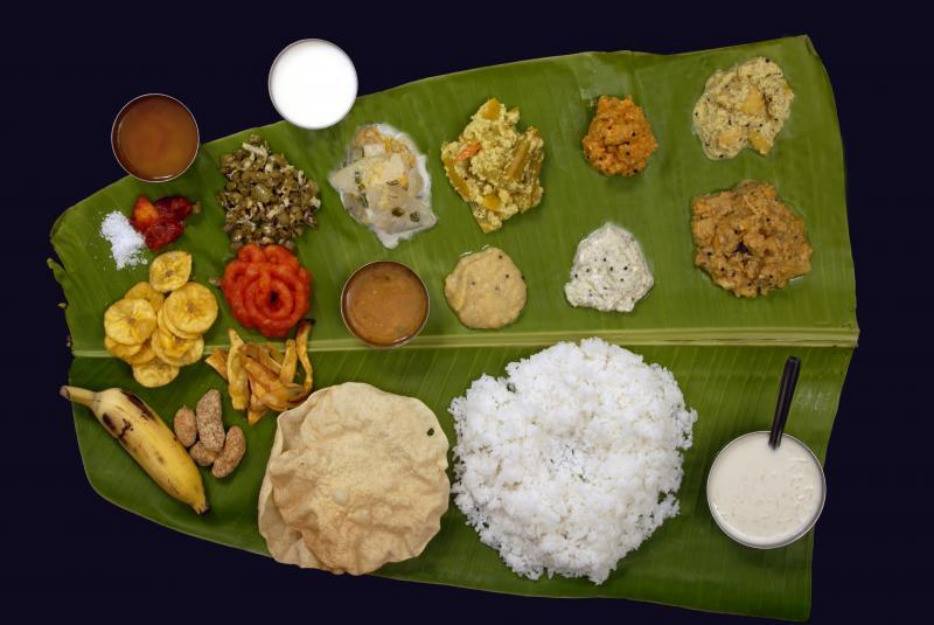
[[File:South Indian food cuisine.jpg|thumb|200px|A traditional meal served on a banana leaf]] | |||
[[Rice]] is the diet staple and is served with ''[[Sambar (dish)|sambar]]'', ''[[Rasam (dish)|rasam]]'', and ''[[poriyal]]'' as a part of a Tamil meal.<ref>{{cite web|url=https://faostat.fao.org/site/616/DesktopDefault.aspx?PageID=616#ancor|title=Food Balance Sheets and Crops Primary Equivalent|publisher=[[FAO]]|access-date=17 August 2012|archive-date=3 October 2012|archive-url=https://web.archive.org/web/20121003034113/http://faostat.fao.org/site/616/DesktopDefault.aspx?PageID=616#ancor|url-status=dead}}</ref> [[Coconut]] and spices are used extensively in South Indian cuisine. The region has a rich cuisine involving both traditional non-vegetarian and vegetarian dishes comprising rice, [[legume]]s, and [[lentil]]s. Its distinct aroma and flavour is achieved by the blending of [[flavouring]]s and spices.<ref>{{cite book|last=Czarra|first=Fred|year=2009|title=Spices: A Global History|url=https://archive.org/details/spicesglobalhist0000czar|url-access=registration|publisher= Reaktion Books|page=[https://archive.org/details/spicesglobalhist0000czar/page/128 128]|isbn=978-1-8618-9426-7}}</ref><ref>{{cite book|last=Dalby|first=Andrew|title=Dangerous Tastes: The Story of Spices|publisher=Berkeley: University of California Press|year=2002|isbn=978-0-5202-3674-5}}</ref> The traditional way of eating a meal involves being seated on the floor, having the food served on a [[banana leaf]],<ref>{{cite book|title=Advancing banana and plantain R & D in Asia and the Pacific|page=84|last1=Molina|first1=A.B.|last2=Roa|first2=V.N.|last3=Van den Bergh|first3=I.|last4=Maghuyop|first4=M.A.|publisher=Biodiversity International|year=2000|isbn=978-9-7191-7513-1}}</ref> and using clean fingers of the right hand to take the food into the mouth.<ref>{{cite book|title=India: The Culture|first=Bobbie|last=Kalman|publisher=Crabtree Publishing Company|year=2009|page=29|isbn=978-0-7787-9287-1}}</ref> ''[[Idli]]'', ''[[Dosa (food)|dosa]]'', ''[[uthappam]]'', ''[[Pesarattu]]'', ''[[appam]]'', ''[[Pongal (dish)|pongal]]'', and ''[[paniyaram]]'' are popular breakfast dishes in Tamil Nadu.<ref>{{cite book|first=K.T.|last=Achaya|title=The Story of Our Food|date=1 November 2003|publisher=Universities Press|isbn=978-8-1737-1293-7|page=80}}</ref> | |||
[[ | ===Music and dance=== | ||
Tamil Nadu is home to [[Bharata Natyam|Bharatanatyam]], a distinct dance form.<ref>{{cite book|title=India's Dances Their History, Technique, and Repertoire|last=Massey|first=Reginald|year=2004|isbn=978-8-1701-7434-9|publisher=Abhinav|location=New Delhi}}</ref><ref>{{cite book|last=Samson|first=Leela|title=Rhythm in Joy: Classical Indian Dance Traditions|year=1987|publisher=Lustre Press|location=New Delhi|page=29|isbn=978-9-9919-4155-4}}</ref> Other regional folk dances include [[Karakattam]], [[Kavadi]], [[Kerala Natanam]], [[Koodiyattam]], [[Oyilattam]] and [[Poikkaal Kuthirai Aattam|Puravaiattam]].<ref>{{cite book|title=The Handbook of Tamil Culture and Heritage|year=2000|publisher=International Tamil Language Foundation|location=Chicago|page=1201}}</ref><ref>{{cite book|last=Banerjee|first=Projesh|title=Indian Ballet Dancing|date=1 February 1989|publisher=Abhinav Publications|location=New Jersey|page=43|isbn=978-8-1701-7175-1}}</ref><ref>{{cite book|last= Bowers|first=Faubion|title=The Dance in India|date=June 1953|publisher=AMS Press|location=New York|pages=13–15|isbn=978-0-4040-0963-2}}</ref><ref>{{cite book|title=Fairs and Festivals of India|volume=2|first1=Madan Prasad|last1=Bezbaruah|first2=Krishna|last2=Gopal|year=2003|isbn=978-8-1212-0809-3|page=286|publisher=Gyan Publishing House}}</ref> The dance, clothing, and sculptures of Tamil Nadu exemplify the beauty of the body and motherhood.<ref>{{cite journal|last=Beck|first=Brenda|year=1976|title=The Symbolic Merger of Body, Space, and Cosmos in Hindu Tamil Nadu|journal=Contributions to Indian Sociology|volume=10|issue=2|pages=213–243|doi=10.1177/006996677601000202|s2cid=143220583}}</ref> The traditional music of Tamil Nadu is known as [[Carnatic music]], which includes rhythmic and structured music by composers such as [[Purandara Dasa]], [[Kanaka Dasa]] and [[Muthuswami Dikshitar]].<ref>{{cite news|url=https://www.hindu.com/seta/2005/01/13/stories/2005011300111500.htm|archive-url=https://web.archive.org/web/20050331184754/https://www.hindu.com/seta/2005/01/13/stories/2005011300111500.htm|url-status=dead|archive-date=31 March 2005|title=The music of we primates:Nada Brahmam|newspaper=[[The Hindu]]|date=13 January 2013|access-date=19 March 2016}}</ref> [[Nadaswaram]], a [[reed instrument]] that is often accompanied by the [[thavil]], a type of [[drum instrument]] are the major musical instruments used in temples and weddings.<ref>{{Cite book|title=Sound of Indian Music|first=Ganavya|last=Doraisamy|author-link=Ganavya Doraiswamy|date=5 August 2014|isbn=978-1-3045-0409-8|publisher=Lulu|page=35}}</ref> [[Melam]] is a group of [[Madhalam|Maddalam]]s and other similar percussion instruments from the ancient Tamilakam which are played during events.<ref name="AA"/> [[Tamil cinema]] has a chequered history with the first cinema of South India being established in [[Coimbatore]] and the production of first silent film in South India in 1916.<ref name=RANDOR>{{cite news|url=https://www.thehindu.com/news/cities/chennai/from-silent-films-to-the-digital-era-madras-tryst-with-cinema/article32476615.ece|title=From silent films to the digital era – Madras' tryst with cinema|newspaper=[[The Hindu]]|date=30 August 2020|access-date=29 June 2021|archive-date=8 November 2020|archive-url=https://web.archive.org/web/20201108035615/https://www.thehindu.com/news/cities/chennai/from-silent-films-to-the-digital-era-madras-tryst-with-cinema/article32476615.ece|url-status=live}}</ref> | |||
== | ===Literature=== | ||
Tamil Nadu has an independent literary tradition dating back over 2500 years from the [[Sangam literature|sangam era]]. [[Tamil literature]] was composed in three successive poetic assemblies known as [[Tamil Sangams]], the earliest of which, according to ancient tradition, were held on a now vanished [[Kumari Kandam|continent]] far to the south of India.<ref>{{cite book|author=Zvelebil, Kamil|year= 1973|title=The smile of Murugan on Tamil literature of South India|publisher= Leiden|quote=Zvelebil dates the ''Ur-Tolkappiyam'' to the 1st or 2nd century BCE}}</ref> This Tamil literature includes the oldest grammatical treatise, ''[[Tholkappiyam]]'', and the epics ''Silappatikaram'' and ''[[Manimekalai]]''.<ref>{{cite journal|title=Women and Farm Work in Tamil Folk Songs|year=1993|first=Vijaya|last=Ramaswamy|volume=21|issue=9/11|pages=113–129|doi= 10.2307/3520429|quote=As early as the Tolkappiyam (which has sections ranging from the 3rd century BCE to the 5th century CE) the eco-types in South India have been classified into|journal=Social Scientist|jstor=3520429}}</ref> | |||
=== | ===Architecture=== | ||
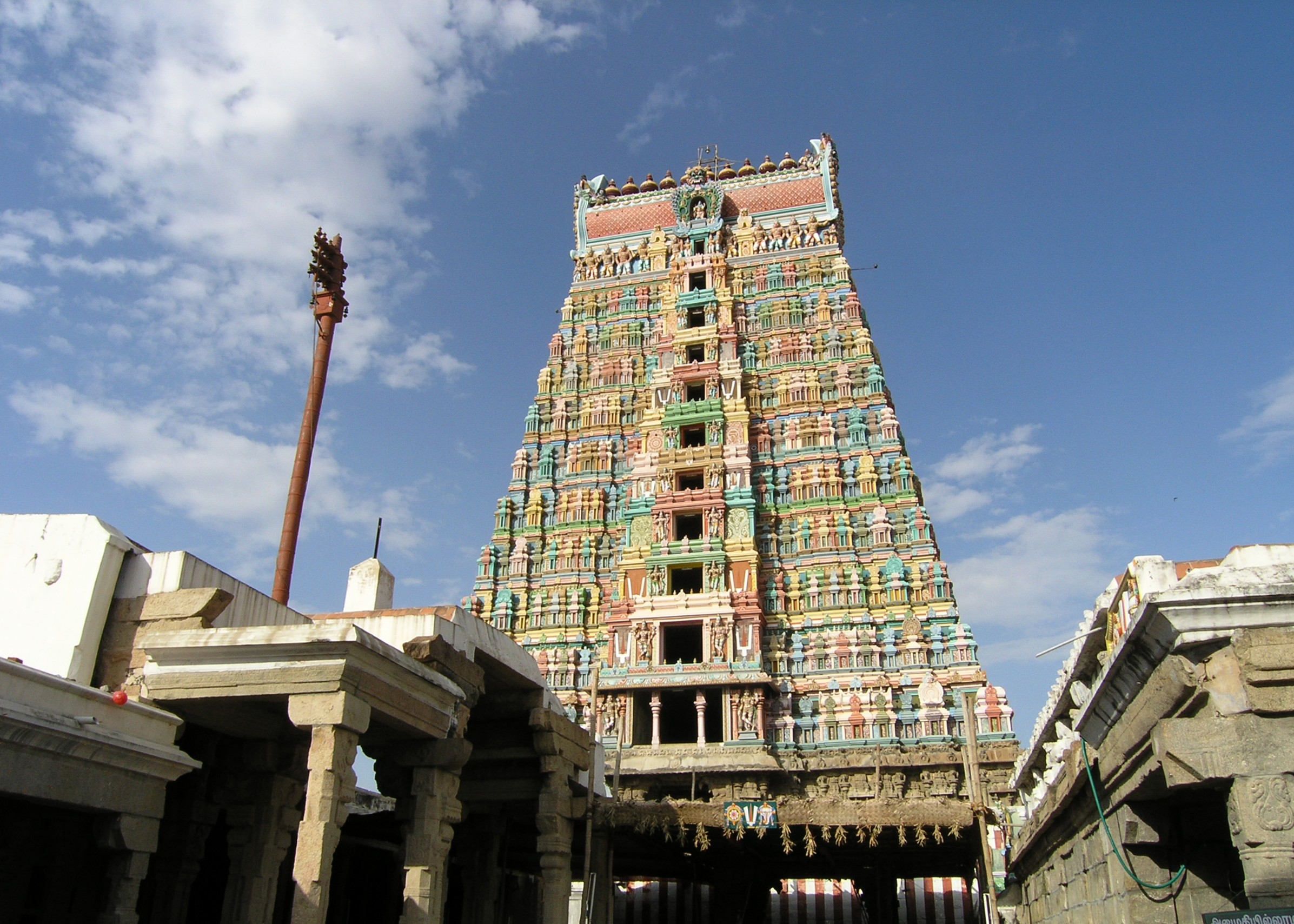
[[File:Andal Temple.jpg|thumb|200px|The large ''[[gopuram]]'' is a hallmark of [[Dravidian architecture]]]] | |||
[[Dravidian architecture]] is the distinct style of rock architecture in Tamil Nadu.<ref name="Hindu">{{cite book|last=Harman|first=William P.|title=The sacred marriage of a Hindu goddess|date=9 October 1992|publisher=Motilal Banarsidass|page=6|isbn=978-8-1208-0810-2}}</ref> In Dravidian architecture, the temples considered of porches or ''Mantapas'' preceding the door leading to the sanctum, Gate-pyramids or ''[[Gopuram]]s'' in quadrangular enclosures that surround the temple and ''Pillared halls'' used for many purposes and are the invariable accompaniments of these temples. Besides these, a South Indian temple usually has a tank called the ''Kalyani'' or ''Pushkarni''.<ref>{{cite book|last= Fergusson|first= James|title= History of Indian and Eastern Architecture|orig-date= 1910|edition= 3rd|year= 1997|publisher=Low Price Publications|location= New Delhi|page= 309}}</ref> The [[Gopuram]] is a monumental tower, usually ornate at the entrance of the temple forms a prominent feature of [[Koil]]s and [[Hindu temple architecture|Hindu temples]] of the Dravidian style.<ref name="Gopuram">{{cite book|first=Francis D.K.|last= Ching|year= 2007|title= A Global History of Architecture|publisher=John Wiley and Sons|location=New York|isbn=978-0-4712-6892-5|page= 762|display-authors=etal}}</ref> They are topped by the ''kalasam'', a bulbous stone [[finial]] and function as gateways through the walls that surround the temple complex.<ref>{{cite book|first=Francis D.K.|last= Ching|year= 1995|title= A Visual Dictionary of Architecture|publisher=John Wiley and Sons|location=New York|isbn=978-0-4712-8451-2|page= 253}}</ref> The gopuram's origins can be traced back to the [[Pallava art and architecture|Pallavas]] who built the group of monuments in [[Mahabalipuram]] and [[Kanchipuram]].<ref name="UNC">{{cite web|url=https://whc.unesco.org/en/list/249|title=Group of Monuments at Mahabalipuram|publisher=UNESCO World Heritage Centre|access-date=3 April 2022|archive-date=2 December 2019|archive-url=https://web.archive.org/web/20191202145914/http://whc.unesco.org/en/list/249|url-status=live}}</ref> The [[Chola art and architecture|Cholas]] later expanded the same and by the [[Pandyan art and architecture|Pandya]] rule in twelfth century, these gateways became a dominant feature of a temple's outer appearance.<ref>{{cite book|last=Mitchell|first=George|title=The Hindu Temple|publisher=University of Chicago Press|year=1988|location=Chicago|pages= 151–153|isbn=978-0-2265-3230-1}}</ref><ref name="Brit">{{cite encyclopedia|url=http://www.britannica.com/eb/article-9037402/gopura|title=Gopuram|encyclopedia=Encyclopædia Britannica|access-date=20 January 2008|archive-date=19 August 2020|archive-url=https://web.archive.org/web/20200819003114/https://www.britannica.com/technology/gopura|url-status=live}}</ref> ''[[Vimana (architectural feature)|Vimanam]]'' are similar structures built over the ''[[garbhagriha]]'' or inner sanctum of the temple but are usually smaller than the gopurams in the Dravidian architecture with a few exceptions including the [[Brihadisvara Temple]] in [[Thanjavur]].<ref>{{citation|author=S.R. Balasubrahmanyam|title = Middle Chola Temples|publisher=Thomson Press|year=1975|isbn = 978-9-0602-3607-9|pages=16–29}}</ref><ref>{{cite journal|last1=Neela|first1=N.|last2=Ambrosia|first2=G.|title=Vimana architecture under the Cholas|journal=Shanlax International Journal of Arts, Science & Humanities|date=April 2016|volume=3|issue=4|page=57|url=https://www.shanlax.com/wp-content/uploads/SIJ_ASH_V3_N4_008.pdf|access-date=5 July 2019|issn=2321-788X|archive-date=5 July 2019|archive-url=https://web.archive.org/web/20190705140824/https://www.shanlax.com/wp-content/uploads/SIJ_ASH_V3_N4_008.pdf|url-status=live}}</ref> | |||
[[ | With the [[Mugal Empire|Mugal]] influence in medieval times and the [[British Empire|British]] later, a rise in the blend of [[Hindu]], [[Islam]]ic and [[Gothic revival]] styles, resulting in the distinct [[Indo-Saracenic]] architecture with several institutions during the British era following the style.<ref>{{Cite journal|last=Metcalfe|first=Thomas R.|title=A Tradition Created: Indo-Saracenic Architecture under the Raj|journal=History Today|volume=32|issue=9|url=http://www.historytoday.com/thomas-r-metcalfe/tradition-created-indo-saracenic-architecture-under-raj|access-date=28 December 2012|archive-date=18 June 2018|archive-url=https://web.archive.org/web/20180618230153/https://www.historytoday.com/thomas-r-metcalfe/tradition-created-indo-saracenic-architecture-under-raj|url-status=live}}</ref><ref>{{Cite web|title=Indo-saracenic Architecture|work=Henry Irwin, Architect in India, 1841–1922|publisher=higman.de|url=http://www.higman.de/Henry%20Irwin/indo-saracenic.htm|access-date=28 December 2012|url-status=live|archive-url=https://web.archive.org/web/20200730131008/http://www.higman.de/Henry%20Irwin/indo-saracenic.htm|archive-date=30 July 2020}}</ref> By the early 20th century, the [[art deco]] made its entry upon in the urban landscape.<ref>{{Cite news|title=Art Deco Style Remains, But Elements Missing|date=2 September 2014|url=https://www.newindianexpress.com/cities/chennai/2014/sep/02/art-deco-style-remains-but-elements-missing-655242.html|newspaper=The New Indian Express|access-date=28 December 2022|archive-date=8 December 2023|archive-url=https://web.archive.org/web/20231208132502/https://www.newindianexpress.com/cities/chennai/2014/sep/02/Art-Deco-Style-Remains-But-Elements-Missing-655242.html|url-status=live}}</ref> After [[Partition of India|Independence]], the architecture witnessed a rise in the [[Modernism]] with the transition from lime-and-brick construction to [[concrete]] columns.<ref>{{cite news|title=Chennai looks to the skies|location=Chennai|date=31 October 2014|url=https://www.thehindu.com/features/homes-and-gardens/Five-years-after-the-CMDA-allowed-buildings-to-go-above-60-metres-Chennai%E2%80%99s-skyline-finally-begins-to-look-up-finds-Vishal-Menon/article60348870.ece|newspaper=[[The Hindu]]|access-date=28 December 2022|archive-date=8 December 2023|archive-url=https://web.archive.org/web/20231208132503/https://www.thehindu.com/features/homes-and-gardens/Five-years-after-the-CMDA-allowed-buildings-to-go-above-60-metres-Chennai%E2%80%99s-skyline-finally-begins-to-look-up-finds-Vishal-Menon/article60348870.ece|url-status=live}}</ref> | ||
The | ==Festivals== | ||
[[File:Madurai-alanganallur-jallikattu.jpg|thumb|200px|[[Jallikattu]], a traditional bull taming event held during [[Pongal (festival)|Pongal]] festivities, attracts huge crowds]] | |||
[[Pongal (festival)|Pongal]] is a major and multi-day [[harvest festival]] celebrated by [[Tamils]].<ref name="CushRobinson2008p610">{{cite book|author1=Denise Cush|author2=Catherine A. Robinson|author3=Michael York|title=Encyclopedia of Hinduism|url=https://books.google.com/books?id=i_T0HeWE-EAC|year=2008|publisher=Psychology Press|isbn=978-0-7007-1267-0|pages=610–611|access-date=30 October 2019|archive-date=21 April 2023|archive-url=https://web.archive.org/web/20230421115354/https://books.google.com/books?id=i_T0HeWE-EAC|url-status=live}}</ref> It is observed in the month of Thai according to the [[Tamil calendar|Tamil solar calendar]] and usually falls on 14 or 15 January.<ref name=Beteille73>{{cite journal|last=Beteille|first=Andre|title=89. A Note on the Pongal Festival in a Tanjore Village|journal=Man|publisher=Royal Anthropological Institute of Great Britain and Ireland|volume=64|year=1964|issue=2 |issn=0025-1496|doi=10.2307/2797924|pages=73–75|jstor=2797924 }}</ref> It is dedicated to the [[Surya]], the Sun God and the festival is named after the ceremonial "Pongal", which means "to boil, overflow" and refers to the traditional dish prepared from the new harvest of rice boiled in milk with [[jaggery]] offered to Surya.<ref>{{cite book|author=R Abbas|editor=S Ganeshram and C Bhavani|title=History of People and Their Environs|url=https://books.google.com/books?id=crxUQR_qBXYC|year=2011|publisher=Bharathi Puthakalayam|isbn=978-93-80325-91-0|pages=751–752|access-date=30 October 2019|archive-date=21 April 2023|archive-url=https://web.archive.org/web/20230421115350/https://books.google.com/books?id=crxUQR_qBXYC|url-status=live}}</ref><ref>{{cite book|author=J. Gordon Melton|title=Religious Celebrations: An Encyclopedia of Holidays, Festivals, Solemn Observances, and Spiritual Commemorations|url=https://books.google.com/books?id=lD_2J7W_2hQC|year=2011|publisher=ABC-CLIO|isbn=978-1-59884-206-7|pages=547–548}}</ref><ref>{{cite book|author1=Roy W. Hamilton|author2=Aurora Ammayao|title=The art of rice: spirit and sustenance in Asia|url=https://books.google.com/books?id=yyQoAQAAMAAJ|year=2003|publisher=University of California Press|isbn=978-0-930741-98-3|pages=156–157|access-date=30 October 2019|archive-date=21 April 2023|archive-url=https://web.archive.org/web/20230421115348/https://books.google.com/books?id=yyQoAQAAMAAJ|url-status=live}}</ref> Mattu Pongal is meant for celebration of [[cattle]] when the cattle are bathed, their horns polished and painted in bright colors, garlands of flowers placed around their necks and processions.<ref>{{cite journal|title= Food for the Gods in South India: An Exposition of Data|author= G. Eichinger Ferro-Luzzi|journal= Zeitschrift für Ethnologie|volume = Bd. 103, H. 1|year= 1978|issue= 1|pages= 86–108|publisher= Dietrich Reimer Verlag GmbH|jstor=25841633}}</ref> [[Jallikattu]] is a traditional event held during the period attracting huge crowds in which a bull is released into a crowd of people, and multiple human participants attempt to grab the large hump on the bull's back with both arms and hang on to it while the bull attempts to escape.<ref>{{cite news|url=http://www.thehindu.com/news/national/tamil-nadu/Governor-clears-ordinance-on-%E2%80%98jallikattu%E2%80%99/article17074093.ece|title=Governor clears ordinance on 'jallikattu'|last=Ramakrishnan|first=T.|newspaper=[[The Hindu]]|access-date=1 December 2023|date=26 February 2017|archive-date=20 May 2023|archive-url=https://web.archive.org/web/20230520145353/http://www.thehindu.com/news/national/tamil-nadu/Governor-clears-ordinance-on-%E2%80%98jallikattu%E2%80%99/article17074093.ece|url-status=live}}</ref> | |||
[[File:2019 kolam decoration for Pongal festival, South India.jpg|thumb|200px|Tamils decorate their homes with colorful geometric designs called [[Kolam]] made from rice powder<ref name=mercer22>{{cite book|author=Abbie Mercer|title=Happy New Year|url=https://books.google.com/books?id=z3AnvD5jeDMC|year=2007|publisher=The Rosen Publishing Group|isbn=978-1-4042-3808-4|page=22}}</ref>]] | |||
[[Puthandu]] is known as Tamil New Year which marks the first day of year on the [[Tamil calendar]]. The festival date is set with the solar cycle of the solar [[Hindu calendar]], as the first day of the Tamil month ''Chithirai'' and falls on or about 14 April every year on the [[Gregorian calendar]].<ref>{{cite book|author=Roshen Dalal|title=Hinduism: An Alphabetical Guide|url=https://books.google.com/books?id=DH0vmD8ghdMC|year=2010|publisher=Penguin Books|isbn=978-0-14-341421-6|page=406}}</ref> [[Karthika Deepam|Karthikai Deepam]] is a festival of lights that is observed on the [[Amavasya|full moon day]] of the [[Kārtika (month)|Kartika]] month, called the [[Kartik Purnima|Kartika Pournami]], falling on the [[Gregorian calendar|Gregorian]] months of November or December.<ref>{{Cite book|last1=Spagnoli|first1=Cathy|url=https://books.google.com/books?id=6_Aci8KA7JEC&dq=karthigai+deepam+november+december&pg=PA133|title=Jasmine and Coconuts: South Indian Tales|last2=Samanna|first2=Paramasivam|date=1999|publisher=Libraries Unlimited|isbn=978-1-56308-576-5|pages=133|access-date=22 December 2023|archive-date=30 September 2023|archive-url=https://web.archive.org/web/20230930150136/https://books.google.com/books?id=6_Aci8KA7JEC&dq=karthigai+deepam+november+december&pg=PA133|url-status=live}}</ref><ref>{{Cite book|last=Gajrani|first=S.|url=https://books.google.com/books?id=zh6z0nuIjAgC&dq=karthigai+deepam&pg=PA207|title=History, Religion and Culture of India|date=2004|publisher=Gyan Publishing House|isbn=978-81-8205-061-7|pages=207|access-date=22 December 2023|archive-date=30 September 2023|archive-url=https://web.archive.org/web/20230930145221/https://books.google.com/books?id=zh6z0nuIjAgC&dq=karthigai+deepam&pg=PA207|url-status=live}}</ref> [[Thaipusam]] is a Tamil festival celebrated on the first full moon day of the Tamil month of Thai coinciding with [[Pushya|Pusam]] star and dedicated to lord [[Murugan]]. [[Kavadi Aattam]] is a ceremonial act of sacrifice and offering practiced by devotees which is a central part of Thaipusam and emphasizes debt bondage.<ref>{{cite book|author=Kent, Alexandra|title=Divinity and Diversity: A Hindu Revitalization Movement in Malaysia|publisher=[[University of Hawaii Press]]|year=2005|isbn=978-8-7911-1489-2}}</ref><ref>{{cite book|title=Portals: Opening Doorways to Other Realities Through the Senses|first=Lynne|last=Hume|year=2020|isbn=978-1-0001-8987-2|publisher=Taylor & Francis}}</ref> [[Aadi Perukku]] is a Tamil cultural festival celebrated on the 18th day of the Tamil month of [[Tamil calendar|Adi]] which pays tribute to [[water]]'s life-sustaining properties. The worship of [[Mariamman|Amman]] and [[Ayyanar]] deities are organized during the month in temples across Tamil Nadu with much fanfare.<ref name="AA">{{cite news|url=https://www.newindianexpress.com/cities/chennai/2022/jul/26/an-ode-to-aadi-and-ayyanar-2480584.html|title=An ode to Aadi and Ayyanar|newspaper=[[The Indian Express]]|date=26 July 2022|access-date=1 December 2023|archive-date=22 December 2023|archive-url=https://web.archive.org/web/20231222132958/https://www.newindianexpress.com/cities/chennai/2022/jul/26/an-ode-to-aadi-and-ayyanar-2480584.html|url-status=live}}</ref> [[Panguni Uthiram]] is marked on the [[purnima]] (full moon) of the month of [[Phalguna|Panguni]] and celebrates the wedding of various Hindu gods.<ref>{{cite book|first=Vijaya|last=Ramaswamy|url=https://books.google.com/books?id=ALUvDwAAQBAJ&pg=PA131|title=Historical Dictionary of the Tamils|date=2017-08-25|publisher=Rowman & Littlefield|isbn=978-1-5381-0686-0|pages=131|access-date=22 December 2023|archive-date=3 June 2024|archive-url=https://web.archive.org/web/20240603104214/https://books.google.com/books?id=ALUvDwAAQBAJ&pg=PA131|url-status=live}}</ref> | |||
=== | [[Tyagaraja Aradhana]] is an annual music festival devoted to composer [[Tyagaraja]]. In [[Tiruvaiyaru]] in [[Thanjavur district]], thousands of music artists congregate every year.<ref>{{cite book|title=Tourism in Tamil Nadu: Growth and Development|url=https://books.google.com/books?id=jTmbDwAAQBAJ&dq=piranmalai&pg=PA106|page=14|last=Pillai|first=S. Subramania|publisher=MJP Publisher|year=2019|isbn=978-81-8094-432-1}}</ref> [[Chennaiyil Thiruvaiyaru]] is a music festival which has been conducted from 18 to 25 December every year in Chennai.<ref>{{cite news|url=https://www.newindianexpress.com/cities/chennai/2018/dec/05/music-season-begins-with-chennaiyil-thiruvaiyaru-fest-1907231.html|title=Chennai music season begins with 'Chennaiyil Thiruvaiyaru' festival|date=5 December 2018|newspaper=[[The Indian Express]]|access-date=1 December 2023|archive-date=22 December 2023|archive-url=https://web.archive.org/web/20231222132957/https://www.newindianexpress.com/cities/chennai/2018/dec/05/music-season-begins-with-chennaiyil-thiruvaiyaru-fest-1907231.html|url-status=live}}</ref> [[Chennai Sangamam]] is a large annual open [[Tamil people|Tamil]] cultural festival held in Chennai with the intention of rejuvenating the old village festivals, art and artists.<ref>{{cite news|url=https://timesofindia.indiatimes.com/city/chennai/chennai-sangamam-to-return-after-a-decade/articleshow/96609404.cms|title=Chennai Sangamam to return after a decade|date=30 December 2022|access-date=1 December 2023|newspaper=[[The Times of India]]|archive-date=22 December 2023|archive-url=https://web.archive.org/web/20231222132958/https://timesofindia.indiatimes.com/city/chennai/chennai-sangamam-to-return-after-a-decade/articleshow/96609404.cms|url-status=live}}</ref> [[Madras Music Season]], initiated by [[Madras Music Academy]] in 1927, is celebrated every year during the month of December and features performances of traditional [[Carnatic music]] by artists from the city.<ref>{{Cite book|last=Knight|first=Douglas M. Jr.|title=Balasaraswati: Her Art and Life|year=2010|publisher=Wesleyan University Press|isbn=978-0-8195-6906-6|page=78|url=https://books.google.com/books?id=Q3EsA2NooW4C}}</ref> | ||
[[ | |||
=== | ==Transportation== | ||
{{Main|Transport in Tamil Nadu}} | |||
Tamil Nadu has a developed, dense, and modern transportation infrastructure, encompassing both public and private transport. Chennai is well-connected by land, sea, and air and serves as a major hub for entry into South India.<ref>{{Cite news|last=Sharma|first=Reetu|title=Chennai turns 375: Things you should know about 'Gateway to South India'|newspaper=One India|location=Chennai|date=23 August 2014|url=https://www.oneindia.com/feature/chennai-turns-375-years-old-things-you-should-know-1507481.html|access-date=20 March 2021|archive-date=26 March 2023|archive-url=https://web.archive.org/web/20230326032944/https://www.oneindia.com/feature/chennai-turns-375-years-old-things-you-should-know-1507481.html|url-status=live}}</ref> Tamil Nadu has an extensive road network covering about 2.71 lakh km connecting all cities, towns and major villages.<ref name="Policy">{{Cite report|title=Highway policy|url=https://www.tnhighways.tn.gov.in/pdf/hw_e_pn_2023_24.pdf|publisher=[[Department of Highways and Minor Ports (Tamil Nadu)|Highways Department]], [[Government of Tamil Nadu]]|access-date=15 July 2023|archive-date=16 June 2023|archive-url=https://web.archive.org/web/20230616204832/https://www.tnhighways.tn.gov.in/pdf/hw_e_pn_2023_24.pdf|url-status=live}}</ref> [[Tamil Nadu State Transport Corporation]] (TNSTC) run by Government of Tamil Nadu is the primary [[public transport]] bus operator in the state.<ref name="TNSTC">{{Cite report|url=https://www.tnstc.in/innerHtmls/pdf/Tamil%20Nadu%20STUs-pages.pdf|title=Tamil Nadu STUs|publisher=TNSTC|access-date=1 November 2023|archive-date=31 March 2023|archive-url=https://web.archive.org/web/20230331121802/https://www.tnstc.in/innerHtmls/pdf/Tamil%20Nadu%20STUs-pages.pdf|url-status=live}}</ref> Tamil Nadu has a rail network of {{convert|5601|km|0|abbr=on}} and forms a part of [[Southern Railway zone|Southern Railway]] of [[Indian Railways]], headquartered in [[Chennai]].<ref>{{Cite web|url=https://sr.indianrailways.gov.in/view_section.jsp?lang=0&id=0,1|title=Southern Railways, about us|publisher=Southern Railway|access-date=12 August 2023|archive-date=16 September 2023|archive-url=https://web.archive.org/web/20230916104302/https://sr.indianrailways.gov.in/view_section.jsp?lang=0&id=0,1|url-status=live}}</ref><ref name="SR">{{Cite report|url=https://sr.indianrailways.gov.in/cris//uploads/files/1686894847523-System%20Map%202023%20signed.pdf|title=System map, Southern Railway|publisher=[[Southern Railway (India)|Southern Railway]]|access-date=1 November 2023|archive-date=4 December 2023|archive-url=https://web.archive.org/web/20231204063842/https://sr.indianrailways.gov.in/cris/uploads/files/1686894847523-System%20Map%202023%20signed.pdf|url-status=live}}</ref> There are 532 railway stations in the state connecting all major cities and towns with [[Chennai Central]], [[Chennai Egmore railway station|Chennai Egmore]], [[Coimbatore Junction railway station|Coimbatore Junction]] and [[Madurai Junction railway station|Madurai Junction]] amongst the major stations.<ref>{{Cite web|url=https://www.tamilnadutourism.tn.gov.in/plan-your-trip/railways|title=Railways, plan your trip|publisher=Tamil Nadu tourism|access-date=1 November 2023|archive-date=7 November 2023|archive-url=https://web.archive.org/web/20231107192152/https://www.tamilnadutourism.tn.gov.in/plan-your-trip/railways|url-status=live}}</ref> [[Chennai Suburban Railway|Chennai suburban]], [[Chennai Mass Rapid Transit System|MRTS]] and [[Chennai Metro|Metro]] form a well-established suburban railway network in Chennai.<ref name="CSR">{{cite report|title=Brief History of the Division|work=Chennai Division|publisher=Indian Railways—Southern Railways|url=http://www.sr.indianrailways.gov.in/uploads/files/1325745996774-about.pdf|access-date=26 October 2012|lang=en|archive-date=30 May 2012|archive-url=https://web.archive.org/web/20120530085500/http://www.sr.indianrailways.gov.in/uploads/files/1325745996774-about.pdf|url-status=live}}</ref> There are three [[international airport|international]], one [[customs airport|limited international]] and six domestic or private airports in Tamil Nadu.<ref>{{cite web|url=https://nocas2.aai.aero/nocas/AAI_Links/Airports-IFR-VFR-200815.pdf|title=List of Indian Airports (NOCAS)|publisher=[[Airports Authority of India]]|access-date=22 October 2023|archive-date=2 November 2023|archive-url=https://web.archive.org/web/20231102073533/https://nocas2.aai.aero/nocas/AAI_Links/Airports-IFR-VFR-200815.pdf|url-status=live}}</ref><ref>{{cite web|url=https://www.aai.aero/sites/default/files/basic_page_files/list%20of%20airport%20bilingual.pdf|title=List of Indian Airports|publisher=[[Airports Authority of India]]|access-date=11 July 2022|archive-date=12 February 2021|archive-url=https://web.archive.org/web/20210212185132/https://www.aai.aero/sites/default/files/basic_page_files/list%20of%20airport%20bilingual.pdf|url-status=live}}</ref> [[Chennai International Airport|Chennai airport]], which is the fourth busiest airport by passenger traffic in India is a major international airport and the main gateway to the state.<ref name="AAI">{{Cite report|url=https://www.aai.aero/sites/default/files/traffic-news/Sep2k23Annex2.pdf|type=pdf|title=Traffic Statistics, September 2023|publisher=Airport Authority of India|access-date=20 October 2023|archive-date=2 November 2023|archive-url=https://web.archive.org/web/20231102072028/https://www.aai.aero/sites/default/files/traffic-news/Sep2k23Annex2.pdf|url-status=live}}</ref> Tamil Nadu has three major ports [[Chennai Port|Chennai]], [[Kamarajar Port Limited|Ennore]] and [[V.O. Chidambaranar Port Authority|Thoothukudi]], intermediate port at [[Nagapattinam Port|Nagapattinam]] and sixteen other minor ports.<ref name=Info>{{Cite web|url=http://iomenvis.nic.in/index3.aspx?sslid=882&subsublinkid=111&langid=1&mid=1|title=Centre for Coastal Zone Management and Coastal Shelter Belt|publisher=Institute for Ocean Management, Anna University|access-date=22 March 2015|archive-date=2 April 2015|archive-url=https://web.archive.org/web/20150402110439/http://iomenvis.nic.in/index3.aspx?sslid=882&subsublinkid=111&langid=1&mid=1|url-status=live}}</ref><ref>{{Cite report|url=https://dwiep.ncscm.res.in/images/port.pdf|title=Ports of India|access-date=1 November 2023|publisher=[[Ministry of Ports, Shipping and Waterways (India)|Ministry of Ports, Shipping and Waterways]], [[Government of India]]|archive-date=20 March 2023|archive-url=https://web.archive.org/web/20230320115121/https://dwiep.ncscm.res.in/images/port.pdf|url-status=live}}</ref> | |||
[[ | ==Major attractions== | ||
===Beaches=== | |||
[[File:Chennai - bird's-eye view.ogv|thumb|200px|[[Marina Beach]], one of the longest urban beaches]] | |||
Tamil Nadu has a {{convert|1076|km}} long coastline, with many beaches dotting the coast.<ref name=Info/><ref>{{cite web|url=https://www.tamilnadutourism.tn.gov.in/destinations/beaches|title=Tamil Nadu beaches|publisher=[[Government of Tamil Nadu]]|access-date=1 December 2023|archive-date=22 December 2023|archive-url=https://web.archive.org/web/20231222142050/https://www.tamilnadutourism.tn.gov.in/destinations/beaches|url-status=live}}</ref> [[Marina Beach]], spanning {{cvt|13|km|abbr=on}}, is the second-longest urban beach in the world and [[Elliot's Beach]] south of the [[Adyar river]] delta, are the major beaches in Chennai.<ref>{{Cite book|url=https://books.google.com/books?id=ZJfu5vbPbA0C&pg=PA81|title=Observing our environment from space: new solutions for a new millennium|author=EARSeL|year=2002|isbn=90-5809-254-2|publisher=A. A. Balakema|access-date=22 December 2023|archive-date=3 June 2024|archive-url=https://web.archive.org/web/20240603090223/https://books.google.com/books?id=ZJfu5vbPbA0C&pg=PA81|url-status=live}}</ref><ref>{{Cite web|url=http://www.chennai.org.uk/beaches/elliot-beach.html|title=Elliot's Beach|access-date=12 October 2015|publisher=chennai.org|url-status=live|archive-url=https://web.archive.org/web/20191227012841/http://www.chennai.org.uk/beaches/elliot-beach.html|archive-date=27 December 2019}}</ref> [[Covelong|Kovalam beach]], located {{convert|40|km|abbr=on}} away from Chennai, offers adventure sports such as [[windsurfing]].<ref>{{cite web|url=https://www.tamilnadutourism.tn.gov.in/destinations/covelong-beach|title=Covelong beach|publisher=[[Government of Tamil Nadu]]|access-date=1 December 2023|archive-date=22 December 2023|archive-url=https://web.archive.org/web/20231222142104/https://www.tamilnadutourism.tn.gov.in/destinations/covelong-beach|url-status=live}}</ref> [[Mamallapuram]], known for its Pallava architecture, has a beach spanning a distance of over {{convert|20|km|abbr=on}}.<ref>{{cite news|url=https://www.outlooktraveller.com/experiences/heritage/all-about-the-shore-temple-indias-first-green-heritage-site|title=All About Shore Temple, India's First Green Heritage Site|newspaper=Outlook|date=24 November 2003|access-date=1 December 2023|archive-date=25 November 2023|archive-url=https://web.archive.org/web/20231125015814/https://www.outlooktraveller.com/experiences/heritage/all-about-the-shore-temple-indias-first-green-heritage-site|url-status=live}}</ref> [[Dhanushkodi]] is an abandoned town at the south-eastern tip of [[Pamban Island]], in [[Gulf of Mannar]], with large beaches.<ref>{{cite web|url=https://www.tamilnadutourism.tn.gov.in/destinations/dhanuskodi-beach|title=Dhanushkodi beach|publisher=[[Government of Tamil Nadu]]|access-date=1 December 2023}}</ref> [[Kanniyakumari|Kanyakumari beach]] forms the southernmost tip of mainland India, where the [[Arabian Sea]], the [[Indian Ocean]], and the [[Bay of Bengal]] meet.<ref>{{cite web|url=https://www.tamilnadutourism.tn.gov.in/destinations/kanyakumari-beach|title=Kanyakumari beach|publisher=[[Government of Tamil Nadu]]|access-date=1 December 2023}}</ref> Ariyaman Beach is located about {{convert|21|km|abbr=on}} from [[Rameswaram]], featuring large [[casuarina]] trees and is a center for [[water sports]].<ref>{{cite web|url=https://www.tamilnadutourism.tn.gov.in/destinations/ariyaman-beach|title=Ariyaman beach|publisher=[[Government of Tamil Nadu]]|access-date=1 December 2023|archive-date=22 December 2023|archive-url=https://web.archive.org/web/20231222142101/https://www.tamilnadutourism.tn.gov.in/destinations/ariyaman-beach|url-status=live}}</ref> [[Poompuhar]] was once the capital of Chola empire and a bustling port city that witnessed many historic events and the ancient beach is dotted with ruins and boulders.<ref>{{cite web|url=https://www.tamilnadutourism.tn.gov.in/destinations/poompuhar-beach|title=Poompuhar beach|publisher=[[Government of Tamil Nadu]]|access-date=1 December 2023|archive-date=22 December 2023|archive-url=https://web.archive.org/web/20231222142055/https://www.tamilnadutourism.tn.gov.in/destinations/poompuhar-beach|url-status=live}}</ref> | |||
===Forts=== | |||
Tamil Nadu has a large number of historical [[fort]]s built across various eras.<ref>{{cite web|url=https://www.tamilnadutourism.tn.gov.in/destinations/forts|title=Forts|publisher=[[Government of Tamil Nadu]]|access-date=1 December 2023|archive-date=8 November 2023|archive-url=https://web.archive.org/web/20231108171234/https://www.tamilnadutourism.tn.gov.in/destinations/forts|url-status=live}}</ref> | |||
[[Fort St. George, India|Fort St. George]], founded in 1639, was the first [[English overseas possessions|English]] fortress in India around which the modern city of Chennai evolved. The fort currently houses the [[Tamil Nadu legislative assembly]] and other official buildings.<ref>{{cite book|author=James Talboys Wheeler|title=The History of India from the Earliest Ages|url=https://books.google.com/books?id=Vk1HAQAAMAAJ&pg=PA489|year=1881|publisher=N. Trübner|pages=489–}}</ref> | |||
<ref>{{cite web|url=https://www.tamilnadutourism.com/blog/popular-forts-in-tamilnadu-you-must-visit-on-your-tamilnadu-trip/|title=Popular forts you must visit on your Tamil Nadu trip|publisher=[[Government of Tamil Nadu]]|access-date=1 December 2023}}</ref> [[Gingee Fort]], originally built in 1190 CE is a large fort and citadel in [[Villupuram District|Villupuram district]].<ref>{{cite book|url= https://books.google.com/books?id=VncomfRVVhoC&q=Krishna+Kon&pg=PA90 |title= The cult of Draupadī: Mythologies : from Gingee to Kurukserta, Volume 1|last= Hiltebeitel |first=Alf|publisher= University of Chicago|year=1991|isbn= 81-208-1000-7|page=450}}</ref> [[Vellore Fort]] is a large 16th-century fort built by the [[Vijayanagara Empire]].<ref>{{cite web|url=https://vellore.nic.in/tourist-place/vellore-fort/|title=Vellore Fort|publisher=[[Government of Tamil Nadu]]|access-date=1 December 2023|archive-date=26 October 2023|archive-url=https://web.archive.org/web/20231026215606/https://vellore.nic.in/tourist-place/vellore-fort/|url-status=live}}</ref> Other forts include [[Alamparai Fort]], [[Dindigul Fort]], [[Tiruchirapalli Rock Fort|Rock Fort]], [[Sadras|Sadras Fort]], [[Sangagiri Fort]], [[Udayagiri Fort]] and [[Vattakottai Fort]].<ref>{{cite web|url=https://www.tamilnadutourism.com/blog/popular-forts-in-tamilnadu-you-must-visit-on-your-tamilnadu-trip/|title=Popular forts in Tamilnadu|publisher=[[Government of Tamil Nadu]]|access-date=1 December 2023|archive-date=23 December 2023|archive-url=https://web.archive.org/web/20231223084853/https://www.tamilnadutourism.com/blog/popular-forts-in-tamilnadu-you-must-visit-on-your-tamilnadu-trip/|url-status=live}}</ref> | |||
[[ | ===Hill stations=== | ||
[[File:'Kodaikanal'_Upper_Lake_View_Rural_Tamil_Nadu_India_November_2013.jpg|thumb|200px|[[Kodaikanal]], one of the major hill stations]] | |||
Tamil Nadu is straddled by the [[Western Ghats|Western]] and [[Eastern Ghats]] and is home to many hill stations.<ref name="hill">{{cite web|url=https://www.tamilnadutourism.tn.gov.in/destinations/hills|title=Tamil Nadu hill stations|publisher=[[Government of Tamil Nadu]]|access-date=1 December 2023|archive-date=22 December 2023|archive-url=https://web.archive.org/web/20231222143609/https://www.tamilnadutourism.tn.gov.in/destinations/hills|url-status=live}}</ref> [[Ooty|Udagamandalam]] (Ooty) situated in the [[Nilgiri Hills]], known as "Queen of Hill Stations", is amongst the most popular hill stations in South India and is connected by the [[Nilgiri Mountain Railway]].{{cn|date=May 2025}} [[Doddabetta]], the highest peak in Tamil Nadu is located close to Ooty and host a [[Ooty lake|lake]] and the [[Government Botanical Garden]].<ref>{{cite web|url=https://www.tamilnadutourism.tn.gov.in/destinations/ooty|title=Ooty|publisher=[[Government of Tamil Nadu]]|access-date=1 December 2023|archive-date=22 December 2023|archive-url=https://web.archive.org/web/20231222143745/https://www.tamilnadutourism.tn.gov.in/destinations/ooty|url-status=live}}</ref> Located in the forests of Palani hills, [[Kodaikanal]] is known as the "Princess of Hill stations" and hosts multiple lakes including [[Kodaikanal lake]] and [[Berijam Lake|Berijam lake]], [[waterfalls]] and [[valleys]].<ref>{{cite web|url=https://www.tamilnadutourism.tn.gov.in/destinations/kodaikanal|title=Kodaikanal|publisher=[[Government of Tamil Nadu]]|access-date=1 December 2023|archive-date=16 December 2023|archive-url=https://web.archive.org/web/20231216221734/https://www.tamilnadutourism.tn.gov.in/destinations/kodaikanal|url-status=live}}</ref> [[Yercaud]], situated at an altitude of {{convert|1515|m|abbr=on}} is a hill station in the Eastern Ghats known for its rich flora and scenic views of the hills.<ref>{{cite web|url=https://www.tamilnadutourism.tn.gov.in/destinations/yercaud|title=Yercaud|publisher=[[Government of Tamil Nadu]]|access-date=1 December 2023|archive-date=22 December 2023|archive-url=https://web.archive.org/web/20231222161721/https://www.tamilnadutourism.tn.gov.in/destinations/yercaud|url-status=live}}</ref> [[Valparai]] is a hill station in the [[Anaimalai Hills]], located {{convert|3500|ft|abbr=on}} above sea level is noted for its rich fauna.<ref>{{cite web|url=https://www.tamilnadutourism.tn.gov.in/destinations/valparai|title=Valparai|publisher=[[Government of Tamil Nadu]]|access-date=1 December 2023}}</ref> Other popular hill stations include [[Yelagiri]], [[Sirumalai]], [[Kotagiri]], [[Kolli Hills|Kollimalai]], [[Meghamalai]], [[Pachaimalai Hills|Pachaimalai]], [[Javadi Hills|Jawaddhu hills]] and [[Kalrayan Hills|Kalvarayan hills]].<ref name="hill"/> | |||
===Museums and art centers=== | |||
[[File:Chennai National Art Gallery.jpg|thumb|200px|[[National Art Gallery, Chennai|National Art Gallery]], one of the oldest art galleries in India]] | |||
Chennai is called the Cultural Capital of South India.<ref>{{Cite book|first=Rina|last=Kamath|title=Chennai|year=2000|publisher=Orient Blackswan|isbn=978-81-250-1378-5|page=66|url=https://books.google.com/books?id=bw2vDg2fTrMC&pg=PA66|access-date=23 December 2023|archive-date=3 June 2024|archive-url=https://web.archive.org/web/20240603082657/https://books.google.com/books?id=bw2vDg2fTrMC&pg=PA66#v=onepage&q&f=false|url-status=live}}</ref> Cultural centers include [[Kalakshetra]] and [[DakshinaChitra]] in Chennai.<ref>{{Cite web|url=https://www.incredibleindia.org/content/incredible-india-v2/en/destinations/chennai/kalakshetra.html|title=Kalakshetra|access-date=28 December 2022|publisher=Incredible India|archive-date=7 October 2022|archive-url=https://web.archive.org/web/20221007021514/https://www.incredibleindia.org/content/incredible-india-v2/en/destinations/chennai/kalakshetra.html|url-status=live}}</ref> Established in the early 18th century, [[Government Museum, Chennai|Government Museum]] and [[National Art Gallery, Chennai|National Art Gallery]] in Chennai are amongst the oldest in the country.<ref>{{Cite news|url=https://www.thehindu.com/features/education/college-and-university/for-a-solid-grounding-in-arts/article2042038.ece|title=For a solid grounding in arts|newspaper=[[The Hindu]]|date=3 April 2009|access-date=29 December 2022}}</ref> The museum inside the premises of [[Fort St. George, India|Fort St George]] in Chennai maintains a collection of objects of the British era and has in its possession, the first [[Flag of India]] hoisted at after the declaration of India's Independence on [[Independence Day (India)|15 August 1947]].<ref>{{cite web|url=https://asi.nic.in/museum-fort-st-geroge-chennai/|title=Fort St. George museum|publisher=[[Archaeological Survey of India]]|access-date=12 October 2023|archive-date=1 December 2023|archive-url=https://web.archive.org/web/20231201063923/https://asi.nic.in/museum-fort-st-geroge-chennai/|url-status=live}}</ref><ref>{{Cite news|title=Indian tri-colour hoisted at Chennai in 1947 to be on display|url=https://www.thehindubusinessline.com/news/variety/Indian-tricolour-hoisted-at-Chennai-in-1947-to-be-on-display/article20567638.ece|newspaper=[[The Hindu]]|access-date=4 July 2015|url-status=live|archive-url=https://web.archive.org/web/20210407182137/https://www.thehindubusinessline.com/news/variety/Indian-tricolour-hoisted-at-Chennai-in-1947-to-be-on-display/article20567638.ece|archive-date=7 April 2021}}</ref> [[Saraswathi Mahal Library]], established during 16th century, is one of the oldest libraries and museum in India with a rare collection of [[Palm leaf manuscripts]] and old paper books.<ref>{{cite book|title=The Top Ten Temple Towns of India|publisher=Mark Age Publication|first=S.C.|last=Karkar|location=Kolkota|isbn=978-81-87952-12-1|year=2009|page=80}}</ref> | |||
=== Religious sites === | |||
;Rock-cut cave-temples | |||
[[File:Mahabalipuram_pano2.jpg|thumb|200px|Descent of the Ganges, one of the largest [[rock relief]]s in the world from [[Mahabalipuram]]]] | |||
There are a number of [[Indian rock-cut architecture|rock-cut]] cave-temples established by the ancient Tamil kings and later by Pandyas and Pallavas.<ref>{{cite book|title=Cave-temples in the Regions of the Pāṇdya, Muttaraiya, Atiyamān̤ and Āy Dynasties in Tamil Nadu and Kerala|first=D.|last=Dayalan|year=2014|publisher=Archaeological Survey of India}}</ref> The [[Group of Monuments at Mahabalipuram]], built by the Pallavas in the 7th and 8th centuries has more than forty rock-cut temples and monoliths including one of the largest open-air [[rock relief]]s in the world.<ref>{{cite book|author=James G. Lochtefeld|title=The Illustrated Encyclopedia of Hinduism: A-M|url=https://archive.org/details/illustratedencyc0000loch|url-access=registration|year=2002|publisher=The Rosen Publishing Group|isbn=978-0-8239-3179-8|page=399}}</ref><ref>{{cite book|author=National Geographic|title=Sacred Places of a Lifetime: 500 of the World's Most Peaceful and Powerful Destinations|url=https://books.google.com/books?id=jNqDFSxR8-MC&pg=PA154|year=2008|publisher=National Geographic Society|isbn=978-1-4262-0336-7|page=154}}</ref> [[Sittanavasal Cave|Sittanavasal]] is a rock-cut [[monastery]] and temple attributed to Pandyas and Pallavas which consist of [[fresco]]es and murals from the 7th century, painted with vegetable and mineral dyes in over a thin wet surface of lime plaster.<ref>{{cite book|url=http://www.indian-heritage.org/swaminathan/sittannavasal/Sittannavasal%20-%20a%20booklet.pdf|author=Sudharsanam|title=A centre for Arts and Culture|access-date=26 October 2012|publisher=Indian Heritage Organization|archive-date=25 August 2013|archive-url=https://web.archive.org/web/20130825144451/http://www.indian-heritage.org/swaminathan/sittannavasal/Sittannavasal%20-%20a%20booklet.pdf|url-status=live}}</ref><ref>{{cite web|url=http://puratattva.in/2011/05/02/sittanavasal-the-legacy-of-chitrasutra-13.html|title=Sittanavasal – A passage to the Indian History and Monuments|access-date=26 October 2012|publisher=Puratattva|date=2 May 2011|archive-date=14 August 2012|archive-url=https://web.archive.org/web/20120814174527/http://puratattva.in/2011/05/02/sittanavasal-the-legacy-of-chitrasutra-13.html|url-status=dead}}</ref><ref>{{cite news|title=The Ajanta of TamilNadu|url=http://www.tribuneindia.com/2005/20051127/spectrum/main3.htm|newspaper=The Tribune|date=27 November 2005|access-date=1 December 2023|archive-date=5 April 2024|archive-url=https://web.archive.org/web/20240405133236/https://www.tribuneindia.com/2005/20051127/spectrum/main3.htm|url-status=live}}</ref> [[Kalugumalai]] consist of three rock-cut temples{{ndash}}[[Kalugumalai Jain Beds]], [[Vettuvan Koil]] and [[Kalugasalamoorthy Temple]], with [[rock relief]] sculptures dating back to Pandya period of 8th to 9th century.<ref>{{cite book|first= K.V. Soundara|last= Rajan|year= 1998|title= Rock-cut Temple Styles'|publisher=Somaily Publications|location=Mumbai, India|isbn= 81-7039-218-7|page= 7}}</ref> [[Chitharal Jain Monuments|Chitharal monuments]] situated on the [[Chitharal|Thiruchanattu malai]] consist of monuments from two distinct periods: rock-cut structure of beads with inscriptions and drip-ledges from first century BC to sixth century AD and temple monuments likely built by [[Digambara]] Jains in the ninth century.<ref>{{cite news|last=Nagarajan|first=Saraswathy|title=On the southern tip of India, a village steeped in the past|newspaper=[[The Hindu]]|date=17 November 2011|url=http://www.thehindu.com/features/metroplus/travel/on-the-southern-tip-of-india-a-village-steeped-in-the-past/article2636325.ece|access-date=23 March 2017|archive-date=10 December 2017|archive-url=https://web.archive.org/web/20171210102314/http://www.thehindu.com/features/metroplus/travel/on-the-southern-tip-of-india-a-village-steeped-in-the-past/article2636325.ece|url-status=live}}</ref> [[Samanar Hills|Samanar hills]] is a hill rock complex located in Keelakuyilkudi, {{convert|15|km}} from [[Madurai]] consisting of several [[Tamil-Brahmi]] inscriptions, stone beds and sculptures from more than 2,200 years ago.<ref>{{cite news|url=http://www.thehindu.com/features/friday-review/history-and-culture/2200yearold-tamilbrahmi-inscription-found-on-samanamalai/article3220674.ece|title=2,200-year-old Tamil-Brahmi inscription found on Samanamalai|newspaper=[[The Hindu]]|date=24 March 2012|access-date=19 January 2014|first=T. S.|last=Subramanian|archive-date=1 January 2014|archive-url=https://web.archive.org/web/20140101051105/http://www.thehindu.com/features/friday-review/history-and-culture/2200yearold-tamilbrahmi-inscription-found-on-samanamalai/article3220674.ece|url-status=live}}</ref> | |||
[[ | ;Hindu temples | ||
{{multiple image | |||
| total_width=250 | |||
| align=right | |||
| image1=India Meenakshi Temple.jpg | |||
| image2=Srirangam1.jpg | |||
| footer=[[Gopuram]] of [[Meenakshi Temple]] at [[Madurai]] (left) and [[Ranganathaswamy Temple, Srirangam]] hosts the highest [[Gopuram]] in Tamil Nadu | |||
}} | |||
There are more than 34,000 temples in Tamil Nadu built across various periods some of which are several centuries old.<ref>{{cite news|url=http://timesofindia.indiatimes.com/city/chennai/Tamil-Nadu-Andhra-Pradesh-build-temple-ties-to-boost-tourism/articleshow/6284409.cms|title=Tamil Nadu, Andhra Pradesh build temple ties to boost tourism|newspaper=[[The Times of India]]|date=10 August 2010|access-date=1 December 2023|archive-date=18 April 2023|archive-url=https://web.archive.org/web/20230418203859/https://timesofindia.indiatimes.com/city/chennai/Tamil-Nadu-Andhra-Pradesh-build-temple-ties-to-boost-tourism/articleshow/6284409.cms|url-status=live}}</ref> Most temples follow the Dravidian architecture, a distinct style of rock architecture.<ref name="Hindu"/> In Dravidian architecture, the temples considered of large porches or ''Mantapas'' with monumental gate-pyramids or ''Gopurams'' and the Gopurams are well-recognized hall marks of the temples in the region with the gopuram being adopted as the symbol of [[Emblem of Tamil Nadu]].<ref name="Gopuram"/> The origins of large temples with ornate Gopurams can be traced to the Pallavas which were later expanded by the Cholas and Pandyas.<ref name="Brit"/> 84 of the 108 [[Divya Desam]]s, which are [[Vishnu]] and [[Lakshmi]] temples that is mentioned in the [[Nalayira Divya Prabandham|works]] of the [[Alvars]], the poet-saints of the [[Sri Vaishnavism|Sri Vaishnava]] tradition are located in Tamil Nadu.<ref>{{cite journal|title=Sri Divya Desams|publisher=Sarva Sastra Maha Vidyalaya|location=[[Coimbatore]]|last=P.M.|first=Neelakrishnan|journal=Ancient Science of Life|pages=193–7|volume=11|issue=3|date=April 1992|pmc=3336602|pmid=22556587}}</ref> [[Paadal Petra Sthalam]] are 276 [[Shaivism|Shaivite]] temples that are revered in the verses of [[Nayanars]] in the 6th-9th century CE.<ref>{{cite web|url=http://www.templenet.com/Tamilnadu/shivlist.html|title=A comprehensive description of the 276 Shivastalams glorified by the Tevaram hymns|work=Templenet|access-date=11 January 2011|archive-date=25 May 2011|archive-url=https://web.archive.org/web/20110525070846/http://www.templenet.com/Tamilnadu/shivlist.html|url-status=live}}</ref> Four of the ive [[Pancha Bhuta Sthalam]] refers to temples dedicated to [[Shiva]], each representing a manifestation of the five prime elements of nature which include [[Ekambareswarar Temple (Kanchipuram)|Ekambareswarar temple of Kanchi]], [[Jambukeswarar Temple, Thiruvanaikaval|Jambukeshwarar temple of Thiruvanaikaval]], [[Arunachaleswara Temple|Arunachaleswara temple of Thiruvannamalai]] and [[Thillai Nataraja Temple, Chidambaram|Natarajar temple of Chidambaram]].<ref>{{cite book|last=Ramaswamy|first=Vijaya|title=Historical dictionary of the Tamils|year=2007|publisher=Scarecrow Press, INC.|location=United States|isbn=978-0-470-82958-5}}</ref> [[Six Abodes of Murugan|Arupadaiveedu]] are six temples at [[Thiruparankundram Murugan temple|Thiruparankundram]], [[Tiruchendur Murugan Temple|Tiruchendur]], [[Palani Murugan Temple|Palani]], [[Swaminathaswamy Temple, Swamimalai|Swamimalai]], [[Subramaniya Swamy Temple, Tiruttani|Tiruttani]], and [[Pazhamudircholai]] which are dedicated to Tamil God [[Murugan]] and mentioned in Sangam literature.<ref>{{cite book|last=Aiyar|first=P.V.Jagadisa|title=South Indian Shrines: Illustrated|url=https://books.google.com/books?id=NLSGFW1uZboC&q=tiruvannamalai&pg=PA190|year=1982|publisher=Asian Educational Services|location=New Delhi|isbn=978-0-4708-2958-5|pages=191–203|access-date=4 December 2016|archive-date=3 June 2024|archive-url=https://web.archive.org/web/20240603104208/https://books.google.com/books?id=NLSGFW1uZboC&q=tiruvannamalai&pg=PA190#v=snippet&q=tiruvannamalai&f=false|url-status=live}}</ref> | |||
[[File:Palani_Hill.JPG|thumb|200px|[[Palani Murugan Temple]], one of the [[Six Abodes of Murugan]]]] | |||
[[File: | [[Madurai]] also called as "Temple city" consists of many temples including the massive [[Meenakshi Amman Temple]] said to originally date back to the 4th century CE.<ref>{{cite encyclopedia|url=https://www.britannica.com/topic/Meenaskshi-Amman-Temple|title=Meenakshi Amman Temple|access-date=1 December 2023|encyclopedia=[[Encyclopædia Britannica]]|archive-date=23 December 2023|archive-url=https://web.archive.org/web/20231223062718/https://www.britannica.com/topic/Meenaskshi-Amman-Temple|url-status=live}}</ref> [[List of temples in Kanchipuram|Kanchipuram]], considered as one of the [[Sapta Puri|seven great holy cities]], is a major temple town with many temples including the [[Kanchi Kailasanathar Temple|Kailashnathar temple]], [[Kamakshi Amman Temple|Kamakshi temple]] and [[Varadharaja Perumal Temple, Kanchipuram|Varadharaja Perumal temple]], dating back to the Pallava period.<ref>{{cite encyclopedia|url=https://www.britannica.com/place/Kanchipuram|title=Kanchipuram|access-date=1 December 2023|encyclopedia=[[Encyclopædia Britannica]]|archive-date=23 December 2023|archive-url=https://web.archive.org/web/20231223062718/https://www.britannica.com/place/Kanchipuram|url-status=live}}</ref> [[Kumbakonam]] is another major temple town located {{convert|40|km|abbr=on}} from the erstwhile Chola capital of [[Thanjavur]] and hosts many temples including the [[Adi Kumbeswarar Temple|Adi Kumbeswarar temple]], [[Ramaswamy Temple|Ramaswamy temple]], [[Kasi viswanathar temple, kumbakonam|Kashi Vishwanath temple]], [[Someswar Temple]] and [[Sarangapani Temple|Sarangapani temple]].<ref>{{cite encyclopedia|url=https://www.britannica.com/place/Kumbakonam|title=Kumbakonam|access-date=1 December 2023|encyclopedia=[[Encyclopædia Britannica]]|archive-date=4 December 2023|archive-url=https://web.archive.org/web/20231204141022/https://www.britannica.com/place/Kumbakonam|url-status=live}}</ref> [[Srirangam]] [[Sri Ranganathaswamy Temple, Srirangam|Ranganathaswamy Temple]] is the largest temple complex in India and the biggest functioning Hindu temple in the world with a {{convert|236|ft|m}} tall [[Rajagopuram]], one of the tallest in the world.<ref>{{cite web|url=https://whc.unesco.org/en/tentativelists/5894/|title=Sri Ranganathaswamy Temple, Srirangam|publisher=UNESCO|access-date=1 December 2023|archive-date=16 May 2022|archive-url=https://web.archive.org/web/20220516231635/http://whc.unesco.org/en/tentativelists/5894/|url-status=live}}</ref> [[Ramanathaswamy Temple]] located at [[Rameswaram]] island forms a part of [[Adam's Bridge|Ram setu]] and is said to be sanctified by the lord [[Rama]] when he crossed the island on his journey to rescue his wife, [[Sita]] from the [[Ravana]].<ref>{{cite encyclopedia|url=https://www.britannica.com/place/Rameswaram|title=Rameswaram|access-date=1 December 2023|encyclopedia=[[Encyclopædia Britannica]]|archive-date=23 December 2023|archive-url=https://web.archive.org/web/20231223062719/https://www.britannica.com/place/Rameswaram|url-status=live}}</ref> [[Namakkal Anjaneyar Temple]] hosts a {{convert|18|ft|m|abbr=on}} tall [[Hanuman]] statue, one of the tallest in India.<ref>{{cite web|url=https://namakkal.nic.in/tourist-place/namakkalanjaneyartemple/|title=Namakkal Anjaneyar Temple|access-date=1 December 2023|publisher=[[Government of Tamil Nadu]]|archive-date=25 September 2023|archive-url=https://web.archive.org/web/20230925223828/https://namakkal.nic.in/tourist-place/namakkalanjaneyartemple/|url-status=live}}</ref> | ||
[[ | [[Srivilliputhur Andal Temple]] is a temple dedicated to lord [[Vishnu]], believed to be the birthplace of two of the Alvars, namely [[Periyalvar]] and his foster-daughter, [[Andal]].<ref>{{cite web|url=https://www.tamilnadutourism.tn.gov.in/destinations/srivilliputhur-andal-temple|title=Srivilliputhur Andal Temple|access-date=1 December 2023|publisher=[[Government of Tamil Nadu]]|archive-date=23 January 2024|archive-url=https://web.archive.org/web/20240123181836/https://www.tamilnadutourism.tn.gov.in/destinations/srivilliputhur-andal-temple|url-status=live}}</ref> There are a lot of temples devoted to lord [[Ganesha]], major of which are the [[Ucchi Pillayar Temple, Rockfort|Uchippillaiyar temple in Tiruchirappalli]], [[Eachanari Vinayagar Temple|Eachanari Vinayagar temple in Coimbatore]] hosting a {{convert|6.3|ft|abbr=on}} tall idol and [[Karpaka Vinayakar Temple|Karpaka Vinayakar temple in Pillayarapatti]].<ref>{{cite web|url=https://www.tamilnadutourism.tn.gov.in/destinations/eachanari-vinayagar-temple-coimbatore|title=Eachanari Vinayagar temple|access-date=1 December 2023|publisher=[[Government of Tamil Nadu]]|archive-date=23 December 2023|archive-url=https://web.archive.org/web/20231223062721/https://www.tamilnadutourism.tn.gov.in/destinations/eachanari-vinayagar-temple-coimbatore|url-status=live}}</ref><ref>{{cite web|url=https://www.tamilnadutourism.tn.gov.in/destinations/tiruchirappalli-rockfort-temple|title=Ucchi Pillayar Temple, Rockfort|access-date=1 December 2023|publisher=[[Government of Tamil Nadu]]|archive-date=23 December 2023|archive-url=https://web.archive.org/web/20231223074239/https://www.tamilnadutourism.tn.gov.in/destinations/tiruchirappalli-rockfort-temple|url-status=live}}</ref> There are a number of hill temples dedicated to lord Murugan and [[Mariamman|Amman]] temples dedicated to goddess [[Parvati]] are found across the state.<ref name="KK"/><ref>{{cite web|url=https://www.tamilnadutourism.com/temples/amman-temples.php|title=Amman temples|access-date=1 December 2023|publisher=[[Government of Tamil Nadu]]|archive-date=23 December 2023|archive-url=https://web.archive.org/web/20231223062719/https://www.tamilnadutourism.com/temples/amman-temples.php|url-status=live}}</ref> Dhyanalinga is a yogic temple located at the [[Velliangiri Mountains|Velliangiri]], {{convert|30|km|abbr=on}} from [[Coimbatore]] with a {{convert|13.75|ft|abbr=on}} tall [[Lingam]] and Adiyogi statue, the tallest bust of Shiva in the world.<ref>{{cite book|url=https://books.google.com/books?id=vJanDQAAQBAJ&pg=PT470|title=Mystic's Musings|last=Sadhguru|publisher=Jaico Publishing House|isbn=9788184959840|access-date=16 August 2019|archive-date=10 February 2020|archive-url=https://web.archive.org/web/20200210054323/https://books.google.com/books?id=vJanDQAAQBAJ&pg=PT470|url-status=live}}</ref><ref>{{cite news|url=https://www.deccanchronicle.com/nation/in-other-news/240217/coimbatore-narendra-modi-unveils-112-feet-shiva-statue-on-mahashivaratri.html|title=Coimbatore: Narendra Modi unveils 112-feet Shiva statue on Mahashivaratri|date=24 February 2017|newspaper=[[Deccan Chronicle]]|access-date=11 April 2017|archive-date=14 May 2017|archive-url=https://web.archive.org/web/20170514214157/http://www.deccanchronicle.com/nation/in-other-news/240217/coimbatore-narendra-modi-unveils-112-feet-shiva-statue-on-mahashivaratri.html|url-status=live}}</ref> | ||
[[ | |||
==== | ;Mosques | ||
{{multiple image | |||
| total_width=380 | |||
| perrow= | |||
| align=right | |||
| image1=Ervadidargah.jpg | |||
| image2=Vailankanni Church, front view.jpg | |||
| footer=[[Erwadi|Erwadi Dargah]] (left) and 16th-century [[Basilica of Our Lady of Good Health]] at [[Velankanni]] | |||
}} | |||
==== | [[Erwadi]] in [[Ramanathapuram district]] houses an 840-year-old [[mosque]] and the annual [[Erwadi santhanakoodu festival|santhanakoodu festival]] held during the Islamic month of [[Dhul Qidah]] attracts people of all faiths from different regions.<ref>{{cite web|url=https://utsav.gov.in/view-event/ervadi-santhanakoodu-festival-1|title=Erwadi santhanakoodu festival|access-date=1 December 2023|publisher=[[Government of India]]|archive-date=14 July 2024|archive-url=https://web.archive.org/web/20240714133236/https://utsav.gov.in/view-event/ervadi-santhanakoodu-festival-1|url-status=live}}</ref> Madurai hosts two big mosques, [[Kazimar Big Mosque]] and [[Madurai Maqbara]]. [[Nagore]], a town north of Nagapattinam, is the home to [[Nagore Dargah]] where the urs festival is celebrated every year and attracts pilgrims from both [[Sufism|Sufi Islam]] and Hinduism.<ref>{{cite book|last1=Landis|first1=Dan|last2=Albert|first2=Rosita D.|title=Handbook of Ethnic Conflict: International Perspectives|page=150|year=2012|publisher=Springer Science+Business Media, LLC|location=London|isbn=978-1-4614-0447-7}}</ref> | ||
;Churches | |||
The Christian apostle, [[Thomas (apostle)|St. Thomas]], is believed to have preached in the area around Chennai between 52 and 70 CE and the [[Santhome Church]], which was originally built by the Portuguese in 1523, is believed to house the remains of St. Thomas, was rebuilt in 1893 in [[neo-Gothic]] style.<ref>{{cite web|title=Santhome Cathedral|url=https://www.tamilnadutourism.tn.gov.in/destinations/santhome-cathedral-and-basilica|access-date=28 December 2022|publisher=[[Government of Tamil Nadu]]|archive-date=30 January 2023|archive-url=https://web.archive.org/web/20230130204928/https://www.tamilnadutourism.tn.gov.in/destinations/santhome-cathedral-and-basilica|url-status=live}}</ref> The 16th-century [[Basilica of Our Lady of Good Health]] is located at [[Velankanni]], about {{convert|12|km|abbr=on}} south of Nagapattinam on the Eastern coast. The town declared as a holy city by the [[pope]] is known as the '[[Lourdes]] of the East'.<ref>{{cite web|url=https://www.tamilnadutourism.tn.gov.in/destinations/velankanni|title=Velankanni|access-date=1 December 2023|publisher=[[Government of Tamil Nadu]]|archive-date=5 December 2023|archive-url=https://web.archive.org/web/20231205182654/https://www.tamilnadutourism.tn.gov.in/destinations/velankanni|url-status=live}}</ref> | |||
==== | [[File:Tirumalai jaintemple 4.jpg|thumb|200px|[[Mahavira]] temple at [[Tirumalai (Jain complex)|Tirumalai]]]] | ||
;Jain temples | |||
[[ | The [[Kalabhra dynasty]], who were patrons of Jainism, ruled over the [[ancient Tamil country]] in the 3rd–7th century CE with the Pallavas and Pandyas also supporting Jainism.<ref>{{cite book|last1=Kulke|first1=Hermann|author-link1=Hermann Kulke|last2=Rothermund|first2=Dietmar|author-link2=Dietmar Rothermund|title=A History of India|date=2007|publisher=Routledge|location=London|isbn=978-0-4153-2920-0|page=105|edition=4th|url=https://books.google.com/books?id=RoW9GuFJ9GIC|access-date=7 September 2016|archive-date=23 December 2023|archive-url=https://web.archive.org/web/20231223185128/https://books.google.com/books?id=RoW9GuFJ9GIC|url-status=live}}</ref><ref>{{cite book|url=https://books.google.com/books?id=te1sqTzTxD8C&pg=PA72|title=The First Spring: The Golden Age of India|isbn=978-0-6700-8478-4|last1=Eraly|first1=Abraham|year=2011|publisher=Penguin Books India|access-date=23 December 2023|archive-date=5 April 2023|archive-url=https://web.archive.org/web/20230405183047/https://books.google.com/books?id=te1sqTzTxD8C&pg=PA72|url-status=live}}</ref> Major Jain temples include [[Trilokyanatha Temple|Kanchi Trilokyanatha temple]], [[Chitharal Jain Temple]], [[Mannargudi Mallinatha Swamy Temple]], [[Vijayamangalam Jain temple]], [[Alagramam Jain Temple]], [[Poondi Arugar Temple]], [[Adisvaraswamy Jain Temple, Thanjavur|Thanjavur Adisvaraswamy Jain Temple]] and [[Chandraprabha Jain Temple, Kumbakonam|Kumbakonam Chandraprabha Jain Temple]].<ref>{{cite news|url=http://www.thehindu.com/thread/arts-culture-society/article8179948.ece|title=Looking for Jina Kanchi|newspaper=[[The Hindu]]|date=February 2016|last1=Jain|first1=Mahima A.|access-date=23 December 2023|archive-date=23 December 2023|archive-url=https://web.archive.org/web/20231223062719/https://www.thehindu.com/thread/arts-culture-society/article8179948.ece|url-status=live}}</ref><ref>{{cite web|title=Chitharal|website=Tamil Nadu Tourism|url=http://www.tamilnadutourism.org/places/citiestowns/Kanniyakumari2.aspx?catid=c1&subcat1id=c1s1&subcat2id=c1s1s7|access-date=23 March 2017|archive-date=27 August 2019|archive-url=https://web.archive.org/web/20190827113800/http://www.tamilnadutourism.org/places/citiestowns/Kanniyakumari2.aspx?catid=c1&subcat1id=c1s1&subcat2id=c1s1s7|url-status=live}}</ref> [[Tirumalai (Jain complex)|Tirumalai]] is an ancient Jain temple complex in the outskirts of Tirvannamalai that houses caves and [[Jain temples]] and a {{convert|16|ft|m}} high sculpture of [[Neminatha]] dated from the 12th century and the tallest Jain image in Tamil Nadu.<ref>{{cite web|url=http://www.jainheritagecentres.com/jainism-in-india/tamil-nadu/tirumalai-arihantagiri/|title=Arihantagiri – Tirumalai|publisher=Jain Heritage centres|access-date=29 December 2022|archive-date=31 January 2023|archive-url=https://web.archive.org/web/20230131155905/https://www.jainheritagecentres.com/jainism-in-india/tamil-nadu/tirumalai-arihantagiri/|url-status=live}}</ref> | ||
;Maths and memorials | |||
[[ | [[Vivekananda Rock Memorial]], located off the coast of Kanniyakumari was built in 1970 in honour of [[Swami Vivekananda]], who is said to have attained [[moksha|enlightenment]] on the rock.<ref name="KK">{{cite encyclopedia|url=https://www.britannica.com/place/Kanniyakumari|title=Kanniyakumari|access-date=1 December 2023|encyclopedia=[[Encyclopædia Britannica]]|archive-date=23 December 2023|archive-url=https://web.archive.org/web/20231223062719/https://www.britannica.com/place/Kanniyakumari|url-status=live}}</ref> [[Sri Ramakrishna Math, Chennai]] was established in 1897 by [[Swami Ramakrishnananda]] in memory of [[Ramakrishna|Ramakrishna Paramahamsa]].<ref>{{cite web|url=https://www.tamilnadutourism.tn.gov.in/destinations/ramakrishna-temple|title=Ramakrishna temple|access-date=1 December 2023|publisher=[[Government of Tamil Nadu]]|archive-date=23 December 2023|archive-url=https://web.archive.org/web/20231223025510/https://www.tamilnadutourism.tn.gov.in/destinations/ramakrishna-temple|url-status=live}}</ref> | ||
[[ | |||
[[ | |||
=== | ===World Heritage sites=== | ||
[[ | [[File:02Thanjavur_PeruvudaiyarKovil.jpg|thumb|200px|[[Brihadisvara Temple]] at [[Thanjavur]], built in 11th century CE]] | ||
There are four [[World Heritage Site]]s declared by [[UNESCO]] in the state. | |||
*[[Group of Monuments at Mahabalipuram]], declared in 1984, include rock-cut temples and monuments built during the Pallava period (7th-8th centuries CE).<ref>{{cite web|url=https://whc.unesco.org/en/list/249/|title=Group of Monuments at Mahabalipuram|publisher=[[UNESCO]]|access-date=1 December 2023|archive-date=4 November 2005|archive-url=https://web.archive.org/web/20051104085753/https://whc.unesco.org/en/list/249/|url-status=live}}</ref> | |||
*[[Great Living Chola Temples]], declared in 1987, include three temples belonging to Chola period (11th-12th centuries CE{{nbsp}}[[Brihadisvara Temple|Brihadisvara temple]] at Thanjavur, [[Gangaikonda Cholapuram|Brihadisvara temple at Gangaikonda Cholapuram]] and [[Airavatesvara Temple]] at [[Darasuram]]).<ref>{{cite web|url=https://whc.unesco.org/en/list/250/|title=Great Living Chola Temples|publisher=[[UNESCO]]|access-date=1 December 2023|archive-date=12 September 2015|archive-url=https://web.archive.org/web/20150912082313/https://whc.unesco.org/en/list/250/|url-status=live}}</ref> | |||
*[[Nilgiri Mountain Railway]], declared in 2008, a {{track gauge|1000mm|allk=on}} railway in [[Nilgiris district|Nilgiris]] operated by the [[Southern Railway zone|Southern Railway]] which is the only [[rack railway]] in India.<ref>{{cite web |title=Nilgiri Mountain Railway |url=https://sr.indianrailways.gov.in/view_section.jsp?fontColor=black&backgroundColor=LIGHTSTEELBLUE&lang=0&id=0,1,304,374,492,552 |publisher=Indian Railway |access-date=21 August 2019 |archive-date=6 December 2019 |archive-url=https://web.archive.org/web/20191206122930/https://sr.indianrailways.gov.in/view_section.jsp?fontColor=black&backgroundColor=LIGHTSTEELBLUE&lang=0&id=0,1,304,374,492,552 |url-status=live }}</ref><ref>{{cite web|url=https://whc.unesco.org/en/list/944/|title=Mountain Railways of India|publisher=[[UNESCO]]|access-date=1 March 2023|archive-date=19 December 2008|archive-url=https://web.archive.org/web/20081219024051/https://whc.unesco.org/en/list/944/|url-status=live}}</ref> | |||
*[[Nilgiri Biosphere Reserve]], declared in 1986, a [[biosphere reserve]] and bio-diversity hotspot in the [[Nilgiri Mountains]] of the Western Ghats and the largest protected forest area in India.<ref>{{Cite news|date=27 January 2021|title=Conservationist joins SC panel on elephant corridor case|newspaper=[[The Hindu]]|url=https://www.thehindu.com/news/national/conservationist-joins-sc-panel-on-elephant-corridor-case/article33678554.ece|access-date=28 January 2021|issn=0971-751X|archive-date=28 January 2021|archive-url=https://web.archive.org/web/20210128055024/https://www.thehindu.com/news/national/conservationist-joins-sc-panel-on-elephant-corridor-case/article33678554.ece|url-status=live}}</ref><ref>{{cite web|url=https://en.unesco.org/biosphere/aspac/nilgiri|title=Nilgiri biosphere|publisher=[[UNESCO]]|access-date=1 March 2023|archive-date=2 February 2023|archive-url=https://web.archive.org/web/20230202001705/https://en.unesco.org/biosphere/aspac/nilgiri|url-status=live}}</ref> | |||
=== | ===Waterfalls=== | ||
[[File: | [[File:Hogenakkal Falls Close.jpg|200 px|thumb|[[Hogenakkal Falls]], one of the popular waterfalls]] | ||
[[ | With many rivers and streams, there are a number of waterfalls in the state. [[Courtallam]] is a popular waterfall in [[Tenkasi district]] consisting of nine falls of varying volume and height.<ref>{{cite web|url=https://www.tamilnadutourism.tn.gov.in/destinations/coutrallam-waterfalls|title=Coutrallam|access-date=1 December 2023|publisher=[[Government of Tamil Nadu]]|archive-date=23 December 2023|archive-url=https://web.archive.org/web/20231223074246/https://www.tamilnadutourism.tn.gov.in/destinations/coutrallam-waterfalls|url-status=live}}</ref> [[Hogenakkal Falls|Hogenakkal]] is a set of waterfalls and rapids where [[Kaveri river]] enters the state from [[Karnataka]].<ref>{{cite web|url=https://www.tamilnadutourism.tn.gov.in/destinations/hogenakkal-waterfalls|title=Hogenakkal falls|access-date=1 December 2023|publisher=[[Government of Tamil Nadu]]|archive-date=23 December 2023|archive-url=https://web.archive.org/web/20231223074243/https://www.tamilnadutourism.tn.gov.in/destinations/hogenakkal-waterfalls|url-status=live}}</ref> Other waterfalls include [[Agaya Gangai]], [[Ayyanar Falls|Ayyanar falls]], [[Catherine Falls|Catherine falls]], [[Kalhatti Falls, Ooty|Kalhatti falls]], [[Katary Falls|Katary falls]], [[Kiliyur Falls|Kiliyur falls]], [[Kumbakkarai Falls|Kumbakkarai falls]], [[Kutladampatti Falls|Kutladampatti falls]], Law's falls, [[Monkey Falls|Monkey falls]], Sengupathi falls, [[Siruvani Waterfalls|Siruvani falls]], [[Suruli Falls|Suruli falls]], [[Thalaiyar Falls|Thalaiyar falls]], [[Tirparappu Waterfalls|Tirparappu falls]], [[Ulakkai Aruvi Waterfalls|Ulakkai falls]], [[Vaideki Falls|Vaideki falls]] and [[Vattaparai Falls|Vattaparai falls]].<ref>{{cite web|url=https://www.tamilnadutourism.tn.gov.in/destinations/waterfalls|title=Waterfalls|access-date=1 December 2023|publisher=[[Government of Tamil Nadu]]|archive-date=23 December 2023|archive-url=https://web.archive.org/web/20231223074249/https://www.tamilnadutourism.tn.gov.in/destinations/waterfalls|url-status=live}}</ref> | ||
[[ | |||
===Wildlife sanctuaries and reserve forests=== | |||
{{Main|Protected areas of Tamil Nadu}} | |||
;Protected areas | |||
Protected areas cover an area of {{convert|3305|km2|sqmi|abbr=on}}, constituting 2.54% of the geographic area and 15% of the {{convert|22643|km2|sqmi|abbr=on}} recorded forest area of the state.<ref>{{cite web|publisher=Tamil Nadu Forest Dept.|url=http://www.forests.tn.nic.in/WildBiodiversity/wildbiodiversity_home.html|title=Wild Biodiversity|url-status=dead |archive-url=https://web.archive.org/web/20120206055559/http://www.forests.tn.nic.in/WildBiodiversity/wildbiodiversity_home.html|archive-date=6 February 2012}}</ref> [[Mudumalai National Park]] was established in 1940 and was the first modern [[wildlife sanctuary]] in South India. The protected areas are administered by the [[Ministry of Environment and Forests (India)|Ministry of Environment and Forests]] of Government of India and the [[Tamil Nadu Forest Department]]. | |||
[[File:Tiger_Drinking_Pond_Mudumalai_Mar21_DSC01310.jpg|thumb|200px|A [[Bengal tiger]] at [[Mudumalai National Park]], the first modern [[wildlife sanctuary]] in South India]] | |||
There are three biosphere reserves in Tamil Nadu{{ndash}}[[Gulf of Mannar Biosphere Reserve|Gulf of Mannar]], [[Nilgiri Biosphere Reserve|Nilgiris]] and [[Agasthyamalai Biosphere Reserve|Agasthyamalai]].<ref name="ENVIS">{{cite web |title=Bio-Diversity and Wild Life in Tamil Nadu |url=http://tnenvis.nic.in/Database/SoilResources_1171.aspx |publisher=ENVIS |access-date=15 March 2018 |archive-date=10 April 2018 |archive-url=https://web.archive.org/web/20180410055618/http://tnenvis.nic.in/Database/SoilResources_1171.aspx |url-status=live }}</ref> [[Pichavaram]] consists of a number of islands interspersing the [[Vellar River|Vellar]] estuary in the north and [[Coleroon]] estuary in the south with [[mangrove]] forests. The Pichavaram mangrove forests is one of the largest mangrove forests in India covering {{convert|45|km2|abbr=on}} and supports the existence of rare varieties of economically important shells, fishes and migrant birds.<ref>{{cite web|url=https://whc.unesco.org/en/tentativelists/5446/|title=Pichavaram|publisher=[[UNESCO]]|access-date=1 December 2023|archive-date=3 October 2023|archive-url=https://web.archive.org/web/20231003014529/https://whc.unesco.org/en/tentativelists/5446/|url-status=live}}</ref><ref>{{Cite web|url=http://www.walkthroughindia.com/walkthroughs/top-5-largest-mangrove-and-swamp-forest-in-india|title=Top 5 Largest Mangrove and Swamp Forest in India|publisher=Walk through India|access-date=1 December 2023|archive-date=16 August 2022|archive-url=https://web.archive.org/web/20220816063146/http://www.walkthroughindia.com/walkthroughs/top-5-largest-mangrove-and-swamp-forest-in-india/|url-status=live}}</ref> The state has five [[National parks of India|National Parks]] covering {{convert|307.84|km2|sqmi|abbr=on}}{{ndash}}[[Indira Gandhi National Park|Anamalai]], Mudumalai, [[Mukurthi National Park|Mukurthi]], [[Gulf of Mannar Marine National Park|Gulf of Mannar]], a marine national park and [[Guindy National Park|Guindy]], an urban national park within Chennai.<ref name="ENVIS"/> Tamil Nadu has 18 [[Protected areas of India#Wildlife sanctuaries|wildlife sanctuaries]].<ref name="ENVIS"/><ref>{{cite news|url=https://www.newindianexpress.com/states/tamil-nadu/2023/mar/21/tamil-nadus-18th-wildlife-sanctuary-to-come-up-in-erode-2558036.html|title=Tamil Nadu's 18th wildlife sanctuary to come up in Erode|date=21 March 2023|access-date=24 August 2023|publisher=[[The New Indian Express]]|archive-date=24 August 2023|archive-url=https://web.archive.org/web/20230824135751/https://www.newindianexpress.com/states/tamil-nadu/2023/mar/21/tamil-nadus-18th-wildlife-sanctuary-to-come-up-in-erode-2558036.html|url-status=live}}</ref> | |||
There are five declared elephant sanctuaries in Tamil Nadu as per [[Project Elephant]]{{ndash}}Agasthyamalai, [[Anamalai Tiger Reserve|Anamalai]], [[Coimbatore Elephant Reserve|Coimbatore]], Nilgiris and [[Srivilliputhur-Megamalai Tiger Reserve|Srivilliputtur]].<ref name="ENVIS"/> Tamil Nadu participates in [[Project Tiger]] and has five declared [[tiger reserves of India|tiger reserves]]{{ndash}}Anamalai, [[Kalakkad Mundanthurai Tiger Reserve|Kalakkad-Mundanthurai]], [[Mudumalai Tiger Reserve|Mudumalai]], [[Sathyamangalam Wildlife Sanctuary|Sathyamangalam]] and Megamalai.<ref name="ENVIS"/><ref name="Thousands">{{cite news|url=https://www.planetark.org/enviro-news/item/51067|title=Thousands Protest Against Indian Tiger Reserve|last=Murari|first=S.|date=31 December 2008|work=Planet Ark|agency=Reuters|access-date=2009-10-30|url-status=dead|archive-url=https://web.archive.org/web/20110716234126/https://www.planetark.org/enviro-news/item/51067|archive-date=16 July 2011}}</ref><ref name="MOEF">{{cite web|url=http://pib.nic.in/release/release.asp?relid=44799|title=Eight New Tiger Reserves|date=13 November 2008|work=Press Release|publisher=Ministry of Environment and Forests, Press Information Bureau, Govt. of India|access-date=2009-10-31|archive-date=3 March 2016|archive-url=https://web.archive.org/web/20160303193258/http://pib.nic.in/release/release.asp?relid=44799|url-status=live}}</ref><ref>{{Cite news|last=Kumar|first=B. Aravind|date=6 February 2021|title=Srivilliputhur–Megamalai Tiger Reserve in TN approved|newspaper=[[The Hindu]]|url=https://www.thehindu.com/news/national/tamil-nadu/srivilliputhurmegamalai-tiger-reserve-in-tn-approved/article33766578.ece|access-date=28 May 2021|issn=0971-751X|archive-date=19 April 2021|archive-url=https://web.archive.org/web/20210419202157/https://www.thehindu.com/news/national/tamil-nadu/srivilliputhurmegamalai-tiger-reserve-in-tn-approved/article33766578.ece|url-status=live}}</ref> There are seventeen declared bird sanctuaries in Tamil Nadu.<ref name="ENVIS"/><ref>{{cite news|title=Migratory birds flock to Vettangudi Sanctuary|newspaper=[[The Hindu]]|date=9 November 2004|url=https://www.thehindu.com/todays-paper/tp-national/tp-tamilnadu/migratory-birds-flock-to-vettangudi-sanctuary/article27715325.ece|access-date=25 August 2023|archive-date=25 August 2023|archive-url=https://web.archive.org/web/20230825122713/https://www.thehindu.com/todays-paper/tp-national/tp-tamilnadu/migratory-birds-flock-to-vettangudi-sanctuary/article27715325.ece|url-status=live}}</ref><ref>{{cite news|title=Kazhuveli wetland in Tamil Nadu declared bird sanctuary|newspaper=[[The Indian Express]]|date=7 December 2021|url=https://indianexpress.com/article/cities/chennai/tamil-nadu-kazhuveli-wetland-bird-sanctuary-7660209/|access-date=25 August 2023|archive-date=25 August 2023|archive-url=https://web.archive.org/web/20230825130556/https://indianexpress.com/article/cities/chennai/tamil-nadu-kazhuveli-wetland-bird-sanctuary-7660209/|url-status=live}}</ref> | |||
[[ | There is one conservation reserve at [[Tiruvidaimarudur Conservation Reserve|Tiruvidaimarudur]] in [[Thanjavur district]]. There are two [[List of protected areas in India#Zoos|zoos]] recognised by the [[Central Zoo Authority of India]] namely [[Arignar Anna Zoological Park]] and [[Madras Crocodile Bank Trust]], both located in [[Chennai]].<ref>{{cite web|title=Guindy Children's Park upgraded to medium zoo|url=https://www.newindianexpress.com/cities/chennai/2022/jul/28/guindy-childrens-park-upgraded-to-medium-zoo-2481397.html|date=28 July 2022|access-date=31 October 2022|newspaper=[[The New Indian Express]]|archive-date=31 August 2022|archive-url=https://web.archive.org/web/20220831082004/https://www.newindianexpress.com/cities/chennai/2022/jul/28/guindy-childrens-park-upgraded-to-medium-zoo-2481397.html|url-status=live}}</ref> The state has other smaller zoos run by local administrative bodies such as [[VOC park and zoo|Coimbatore Zoo]] in [[Coimbatore]], [[Amirthi Zoological Park]] in [[Vellore]], Kurumpampatti Wildlife Park in [[Salem district|Salem]], Yercaud Deer Park in [[Yercaud]], Mukkombu Deer Park in [[Tiruchirapalli district|Tiruchirapalli]] and Ooty Deer Park in [[Nilgiris district|Nilgiris]].<ref name="ENVIS"/> There are five crocodile farms located at [[Amaravathi Dam#Crocodiles|Amaravati]] in [[Coimbatore district]], [[Hogenakkal (village)|Hogenakkal]] in [[Dharmapuri district]], Kurumbapatti in [[Salem district]], [[Madras Crocodile Bank Trust]] in [[Chennai]] and [[Sathanur Reservoir|Sathanur]] in [[Tiruvannamalai district]].<ref name="ENVIS"/> | ||
==Medical tourism== | |||
Tamil Nadu is a major center for medical tourism and Chennai is termed as "India's health capital".<ref>{{cite news|url=https://www.thehindu.com/news/cities/chennai/the-medical-capitals-place-in-history/article3796305.ece|title=The medical capital's place in history|date=20 August 2012|newspaper=[[The Hindu]]|access-date=1 December 2023|archive-date=12 November 2020|archive-url=https://web.archive.org/web/20201112031054/https://www.thehindu.com/news/cities/chennai/the-medical-capitals-place-in-history/article3796305.ece|url-status=live}}</ref> [[Medical tourism]] forms an important part of the economy with more than 40% of total medical tourists visiting India making it to Tamil Nadu.<ref>{{cite book|title=Medical Tourism|url=https://books.google.com/books?id=Q1Un-gGsozMC&pg=PA71|page=71|last=Connell|first=John|isbn=978-1-84593-660-0|year=2011|access-date=22 December 2023|archive-date=28 March 2024|archive-url=https://web.archive.org/web/20240328173511/https://books.google.com/books?id=Q1Un-gGsozMC&pg=PA71#v=onepage&q&f=false|url-status=live}}</ref> | |||
=== | |||
</ | |||
==See also== | ==See also== | ||
*[[Economy of Tamil Nadu]] | *[[Economy of Tamil Nadu]] | ||
*[[Outline of tourism in India]] | |||
* [[ | |||
==References== | ==References== | ||
| Line 593: | Line 142: | ||
{{Tamil Nadu}} | {{Tamil Nadu}} | ||
{{Tourism in India}} | {{Tourism in India}} | ||
{{Tourism in Tamil Nadu}} | |||
[[Category:Tourism in Tamil Nadu| ]] | [[Category:Tourism in Tamil Nadu|Tourism in Tamil Nadu]] | ||
[[Category:Economy of Tamil Nadu]] | [[Category:Economy of Tamil Nadu]] | ||
Latest revision as of 17:21, 18 November 2025
Tamil Nadu is the southernmost state of India located on south-eastern coast of the Indian peninsula. The state is straddled by Western Ghats and Eastern Ghats to the west and north and the waters of Bay of Bengal and Andaman Sea on the other two sides. It is the home of the Tamil people, who speak Tamil language, one of the oldest surviving languages. The capital and largest city is Chennai which is known as the "Gateway to South India". As of 2021[update], the state is the most visited and has received the most number of tourists amongst all states of India.
Archaeological evidence points to Tamil Nadu being inhabited for more than 400 millennia and has more than 5,500 years of continuous cultural history. The Tamilakam region has been ruled over by many kingdoms, major of which are the Sangam era (300 BC–300 CE) rulers of the Cheras, Cholas, and Pandyas, the Pallava dynasty (3rd–9th century CE), and the later Vijayanagara Empire (14th–17th century CE) followed by European colonization from the 17th century till the Indian Independence in 1947. Hence, culture, cuisine and architecture have seen multiple influences over the years and have developed diversely. With its diverse culture and architecture, long coastline with beaches, dense forests and mountains of Western and Eastern ghats, Tamil Nadu has a robust tourism industry which contributes significantly to the GDP of the state.
Tamil Nadu Tourism Development Corporation was established by the Government of Tamil Nadu in 1971 and is the nodal agency responsible for the promotion of tourism and development of tourist related infrastructure in the state. The tag line "Enchanting Tamil Nadu" is used in the tourism promotions by Government of Tamil Nadu.
Background and history[edit | edit source]
Historically, Tamil Nadu had been inhabited by hominids more than 400 millennia ago and has more than 5,500 years of continuous cultural history.[1][2] Tamil Nadu is the home of the Tamil people, who speak Tamil language, one of the oldest surviving languages.[3] The Tamilakam region has been ruled over by many kingdoms, major of which are the Sangam era (300 BC–AD 300) rulers of the Chera, Chola, and Pandya clans, the Pallava dynasty (3rd–9th century), and the later Vijayanagara Empire (14th–17th century).[4] European colonization began with establishing trade ports in the 17th century, with the British controlling much of the territory for two centuries before the Indian Independence in 1947.[5][6] When India became independent in 1947, erstwhile Madras presidency became Madras State, comprising present-day Tamil Nadu and parts of other states which was subsequently split up along linguistic lines. In 1969, Madras State was renamed Tamil Nadu, meaning "Tamil country".[7]
After independence, the economy of Tamil Nadu conformed to a socialist framework, with strict governmental control over private sector participation, foreign trade, and foreign direct investment. In the 1970s while the economy of Tamil Nadu consistently exceeded national average growth rates, due to reform-oriented economic policies and the tourism industry started to develop subsequently.[8] In 1971, Government of Tamil Nadu established the Tamil Nadu Tourism Development Corporation, which is the nodal agency responsible for the promotion of tourism and development of tourist related infrastructure in the state.[9] It is managed by the Tourism,Culture and Religious Endowments Department.[10] The tag line "Enchanting Tamil Nadu" was adopted in the tourism promotions.[11][12] In the 21st century, the state has been amongst the top destinations for domestic and international tourists.[12][13] As of 2021[update], Tamil Nadu recorded the most tourist foot-falls.[14]
Culture and heritage[edit | edit source]
Clothing[edit | edit source]
Tamil women traditionally wear a sari, a garment that consists of a drape varying from 5 yards (4.6 m) to 9 yards (8.2 m) in length and 2 feet (0.61 m) to 4 feet (1.2 m) in breadth that is typically wrapped around the waist, with one end draped over the shoulder, baring the midriff, as according to Indian philosophy, the navel is considered as the source of life and creativity.[15][16] Ancient Tamil poetry such as the Silappadhikaram, describes women in exquisite drapery or sari.[17] Women wear colourful silk sarees on special occasions such as marriages.[18] The men wear a dhoti, a 4.5 metres (15 ft) long, white rectangular piece of non-stitched cloth often bordered in brightly coloured stripes. It is usually wrapped around the waist and the legs and knotted at the waist.[19] A colourful lungi with typical batik patterns is the most common form of male attire in the countryside.[20] People in urban areas generally wear tailored clothing, and western dress is popular. Western-style school uniforms are worn by both boys and girls in schools, even in rural areas.[20]
Cuisine[edit | edit source]

Rice is the diet staple and is served with sambar, rasam, and poriyal as a part of a Tamil meal.[21] Coconut and spices are used extensively in South Indian cuisine. The region has a rich cuisine involving both traditional non-vegetarian and vegetarian dishes comprising rice, legumes, and lentils. Its distinct aroma and flavour is achieved by the blending of flavourings and spices.[22][23] The traditional way of eating a meal involves being seated on the floor, having the food served on a banana leaf,[24] and using clean fingers of the right hand to take the food into the mouth.[25] Idli, dosa, uthappam, Pesarattu, appam, pongal, and paniyaram are popular breakfast dishes in Tamil Nadu.[26]
Music and dance[edit | edit source]
Tamil Nadu is home to Bharatanatyam, a distinct dance form.[27][28] Other regional folk dances include Karakattam, Kavadi, Kerala Natanam, Koodiyattam, Oyilattam and Puravaiattam.[29][30][31][32] The dance, clothing, and sculptures of Tamil Nadu exemplify the beauty of the body and motherhood.[33] The traditional music of Tamil Nadu is known as Carnatic music, which includes rhythmic and structured music by composers such as Purandara Dasa, Kanaka Dasa and Muthuswami Dikshitar.[34] Nadaswaram, a reed instrument that is often accompanied by the thavil, a type of drum instrument are the major musical instruments used in temples and weddings.[35] Melam is a group of Maddalams and other similar percussion instruments from the ancient Tamilakam which are played during events.[36] Tamil cinema has a chequered history with the first cinema of South India being established in Coimbatore and the production of first silent film in South India in 1916.[37]
Literature[edit | edit source]
Tamil Nadu has an independent literary tradition dating back over 2500 years from the sangam era. Tamil literature was composed in three successive poetic assemblies known as Tamil Sangams, the earliest of which, according to ancient tradition, were held on a now vanished continent far to the south of India.[38] This Tamil literature includes the oldest grammatical treatise, Tholkappiyam, and the epics Silappatikaram and Manimekalai.[39]
Architecture[edit | edit source]

Dravidian architecture is the distinct style of rock architecture in Tamil Nadu.[40] In Dravidian architecture, the temples considered of porches or Mantapas preceding the door leading to the sanctum, Gate-pyramids or Gopurams in quadrangular enclosures that surround the temple and Pillared halls used for many purposes and are the invariable accompaniments of these temples. Besides these, a South Indian temple usually has a tank called the Kalyani or Pushkarni.[41] The Gopuram is a monumental tower, usually ornate at the entrance of the temple forms a prominent feature of Koils and Hindu temples of the Dravidian style.[42] They are topped by the kalasam, a bulbous stone finial and function as gateways through the walls that surround the temple complex.[43] The gopuram's origins can be traced back to the Pallavas who built the group of monuments in Mahabalipuram and Kanchipuram.[44] The Cholas later expanded the same and by the Pandya rule in twelfth century, these gateways became a dominant feature of a temple's outer appearance.[45][46] Vimanam are similar structures built over the garbhagriha or inner sanctum of the temple but are usually smaller than the gopurams in the Dravidian architecture with a few exceptions including the Brihadisvara Temple in Thanjavur.[47][48]
With the Mugal influence in medieval times and the British later, a rise in the blend of Hindu, Islamic and Gothic revival styles, resulting in the distinct Indo-Saracenic architecture with several institutions during the British era following the style.[49][50] By the early 20th century, the art deco made its entry upon in the urban landscape.[51] After Independence, the architecture witnessed a rise in the Modernism with the transition from lime-and-brick construction to concrete columns.[52]
Festivals[edit | edit source]

Pongal is a major and multi-day harvest festival celebrated by Tamils.[53] It is observed in the month of Thai according to the Tamil solar calendar and usually falls on 14 or 15 January.[54] It is dedicated to the Surya, the Sun God and the festival is named after the ceremonial "Pongal", which means "to boil, overflow" and refers to the traditional dish prepared from the new harvest of rice boiled in milk with jaggery offered to Surya.[55][56][57] Mattu Pongal is meant for celebration of cattle when the cattle are bathed, their horns polished and painted in bright colors, garlands of flowers placed around their necks and processions.[58] Jallikattu is a traditional event held during the period attracting huge crowds in which a bull is released into a crowd of people, and multiple human participants attempt to grab the large hump on the bull's back with both arms and hang on to it while the bull attempts to escape.[59]

Puthandu is known as Tamil New Year which marks the first day of year on the Tamil calendar. The festival date is set with the solar cycle of the solar Hindu calendar, as the first day of the Tamil month Chithirai and falls on or about 14 April every year on the Gregorian calendar.[61] Karthikai Deepam is a festival of lights that is observed on the full moon day of the Kartika month, called the Kartika Pournami, falling on the Gregorian months of November or December.[62][63] Thaipusam is a Tamil festival celebrated on the first full moon day of the Tamil month of Thai coinciding with Pusam star and dedicated to lord Murugan. Kavadi Aattam is a ceremonial act of sacrifice and offering practiced by devotees which is a central part of Thaipusam and emphasizes debt bondage.[64][65] Aadi Perukku is a Tamil cultural festival celebrated on the 18th day of the Tamil month of Adi which pays tribute to water's life-sustaining properties. The worship of Amman and Ayyanar deities are organized during the month in temples across Tamil Nadu with much fanfare.[36] Panguni Uthiram is marked on the purnima (full moon) of the month of Panguni and celebrates the wedding of various Hindu gods.[66]
Tyagaraja Aradhana is an annual music festival devoted to composer Tyagaraja. In Tiruvaiyaru in Thanjavur district, thousands of music artists congregate every year.[67] Chennaiyil Thiruvaiyaru is a music festival which has been conducted from 18 to 25 December every year in Chennai.[68] Chennai Sangamam is a large annual open Tamil cultural festival held in Chennai with the intention of rejuvenating the old village festivals, art and artists.[69] Madras Music Season, initiated by Madras Music Academy in 1927, is celebrated every year during the month of December and features performances of traditional Carnatic music by artists from the city.[70]
Transportation[edit | edit source]
Tamil Nadu has a developed, dense, and modern transportation infrastructure, encompassing both public and private transport. Chennai is well-connected by land, sea, and air and serves as a major hub for entry into South India.[71] Tamil Nadu has an extensive road network covering about 2.71 lakh km connecting all cities, towns and major villages.[72] Tamil Nadu State Transport Corporation (TNSTC) run by Government of Tamil Nadu is the primary public transport bus operator in the state.[73] Tamil Nadu has a rail network of 5,601 km (3,480 mi) and forms a part of Southern Railway of Indian Railways, headquartered in Chennai.[74][75] There are 532 railway stations in the state connecting all major cities and towns with Chennai Central, Chennai Egmore, Coimbatore Junction and Madurai Junction amongst the major stations.[76] Chennai suburban, MRTS and Metro form a well-established suburban railway network in Chennai.[77] There are three international, one limited international and six domestic or private airports in Tamil Nadu.[78][79] Chennai airport, which is the fourth busiest airport by passenger traffic in India is a major international airport and the main gateway to the state.[80] Tamil Nadu has three major ports Chennai, Ennore and Thoothukudi, intermediate port at Nagapattinam and sixteen other minor ports.[81][82]
Major attractions[edit | edit source]
Beaches[edit | edit source]
Tamil Nadu has a 1,076 kilometres (669 mi) long coastline, with many beaches dotting the coast.[81][83] Marina Beach, spanning 13 km (8.1 mi), is the second-longest urban beach in the world and Elliot's Beach south of the Adyar river delta, are the major beaches in Chennai.[84][85] Kovalam beach, located 40 km (25 mi) away from Chennai, offers adventure sports such as windsurfing.[86] Mamallapuram, known for its Pallava architecture, has a beach spanning a distance of over 20 km (12 mi).[87] Dhanushkodi is an abandoned town at the south-eastern tip of Pamban Island, in Gulf of Mannar, with large beaches.[88] Kanyakumari beach forms the southernmost tip of mainland India, where the Arabian Sea, the Indian Ocean, and the Bay of Bengal meet.[89] Ariyaman Beach is located about 21 km (13 mi) from Rameswaram, featuring large casuarina trees and is a center for water sports.[90] Poompuhar was once the capital of Chola empire and a bustling port city that witnessed many historic events and the ancient beach is dotted with ruins and boulders.[91]
Forts[edit | edit source]
Tamil Nadu has a large number of historical forts built across various eras.[92] Fort St. George, founded in 1639, was the first English fortress in India around which the modern city of Chennai evolved. The fort currently houses the Tamil Nadu legislative assembly and other official buildings.[93] [94] Gingee Fort, originally built in 1190 CE is a large fort and citadel in Villupuram district.[95] Vellore Fort is a large 16th-century fort built by the Vijayanagara Empire.[96] Other forts include Alamparai Fort, Dindigul Fort, Rock Fort, Sadras Fort, Sangagiri Fort, Udayagiri Fort and Vattakottai Fort.[97]
Hill stations[edit | edit source]

Tamil Nadu is straddled by the Western and Eastern Ghats and is home to many hill stations.[98] Udagamandalam (Ooty) situated in the Nilgiri Hills, known as "Queen of Hill Stations", is amongst the most popular hill stations in South India and is connected by the Nilgiri Mountain Railway.[citation needed] Doddabetta, the highest peak in Tamil Nadu is located close to Ooty and host a lake and the Government Botanical Garden.[99] Located in the forests of Palani hills, Kodaikanal is known as the "Princess of Hill stations" and hosts multiple lakes including Kodaikanal lake and Berijam lake, waterfalls and valleys.[100] Yercaud, situated at an altitude of 1,515 m (4,970 ft) is a hill station in the Eastern Ghats known for its rich flora and scenic views of the hills.[101] Valparai is a hill station in the Anaimalai Hills, located 3,500 ft (1,100 m) above sea level is noted for its rich fauna.[102] Other popular hill stations include Yelagiri, Sirumalai, Kotagiri, Kollimalai, Meghamalai, Pachaimalai, Jawaddhu hills and Kalvarayan hills.[98]
Museums and art centers[edit | edit source]

Chennai is called the Cultural Capital of South India.[103] Cultural centers include Kalakshetra and DakshinaChitra in Chennai.[104] Established in the early 18th century, Government Museum and National Art Gallery in Chennai are amongst the oldest in the country.[105] The museum inside the premises of Fort St George in Chennai maintains a collection of objects of the British era and has in its possession, the first Flag of India hoisted at after the declaration of India's Independence on 15 August 1947.[106][107] Saraswathi Mahal Library, established during 16th century, is one of the oldest libraries and museum in India with a rare collection of Palm leaf manuscripts and old paper books.[108]
Religious sites[edit | edit source]
- Rock-cut cave-temples

There are a number of rock-cut cave-temples established by the ancient Tamil kings and later by Pandyas and Pallavas.[109] The Group of Monuments at Mahabalipuram, built by the Pallavas in the 7th and 8th centuries has more than forty rock-cut temples and monoliths including one of the largest open-air rock reliefs in the world.[110][111] Sittanavasal is a rock-cut monastery and temple attributed to Pandyas and Pallavas which consist of frescoes and murals from the 7th century, painted with vegetable and mineral dyes in over a thin wet surface of lime plaster.[112][113][114] Kalugumalai consist of three rock-cut temples–Kalugumalai Jain Beds, Vettuvan Koil and Kalugasalamoorthy Temple, with rock relief sculptures dating back to Pandya period of 8th to 9th century.[115] Chitharal monuments situated on the Thiruchanattu malai consist of monuments from two distinct periods: rock-cut structure of beads with inscriptions and drip-ledges from first century BC to sixth century AD and temple monuments likely built by Digambara Jains in the ninth century.[116] Samanar hills is a hill rock complex located in Keelakuyilkudi, 15 kilometres (9.3 mi) from Madurai consisting of several Tamil-Brahmi inscriptions, stone beds and sculptures from more than 2,200 years ago.[117]
- Hindu temples


There are more than 34,000 temples in Tamil Nadu built across various periods some of which are several centuries old.[118] Most temples follow the Dravidian architecture, a distinct style of rock architecture.[40] In Dravidian architecture, the temples considered of large porches or Mantapas with monumental gate-pyramids or Gopurams and the Gopurams are well-recognized hall marks of the temples in the region with the gopuram being adopted as the symbol of Emblem of Tamil Nadu.[42] The origins of large temples with ornate Gopurams can be traced to the Pallavas which were later expanded by the Cholas and Pandyas.[46] 84 of the 108 Divya Desams, which are Vishnu and Lakshmi temples that is mentioned in the works of the Alvars, the poet-saints of the Sri Vaishnava tradition are located in Tamil Nadu.[119] Paadal Petra Sthalam are 276 Shaivite temples that are revered in the verses of Nayanars in the 6th-9th century CE.[120] Four of the ive Pancha Bhuta Sthalam refers to temples dedicated to Shiva, each representing a manifestation of the five prime elements of nature which include Ekambareswarar temple of Kanchi, Jambukeshwarar temple of Thiruvanaikaval, Arunachaleswara temple of Thiruvannamalai and Natarajar temple of Chidambaram.[121] Arupadaiveedu are six temples at Thiruparankundram, Tiruchendur, Palani, Swamimalai, Tiruttani, and Pazhamudircholai which are dedicated to Tamil God Murugan and mentioned in Sangam literature.[122]

Madurai also called as "Temple city" consists of many temples including the massive Meenakshi Amman Temple said to originally date back to the 4th century CE.[123] Kanchipuram, considered as one of the seven great holy cities, is a major temple town with many temples including the Kailashnathar temple, Kamakshi temple and Varadharaja Perumal temple, dating back to the Pallava period.[124] Kumbakonam is another major temple town located 40 km (25 mi) from the erstwhile Chola capital of Thanjavur and hosts many temples including the Adi Kumbeswarar temple, Ramaswamy temple, Kashi Vishwanath temple, Someswar Temple and Sarangapani temple.[125] Srirangam Ranganathaswamy Temple is the largest temple complex in India and the biggest functioning Hindu temple in the world with a 236 feet (72 m) tall Rajagopuram, one of the tallest in the world.[126] Ramanathaswamy Temple located at Rameswaram island forms a part of Ram setu and is said to be sanctified by the lord Rama when he crossed the island on his journey to rescue his wife, Sita from the Ravana.[127] Namakkal Anjaneyar Temple hosts a 18 ft (5.5 m) tall Hanuman statue, one of the tallest in India.[128] Srivilliputhur Andal Temple is a temple dedicated to lord Vishnu, believed to be the birthplace of two of the Alvars, namely Periyalvar and his foster-daughter, Andal.[129] There are a lot of temples devoted to lord Ganesha, major of which are the Uchippillaiyar temple in Tiruchirappalli, Eachanari Vinayagar temple in Coimbatore hosting a 6.3 ft (1.9 m) tall idol and Karpaka Vinayakar temple in Pillayarapatti.[130][131] There are a number of hill temples dedicated to lord Murugan and Amman temples dedicated to goddess Parvati are found across the state.[132][133] Dhyanalinga is a yogic temple located at the Velliangiri, 30 km (19 mi) from Coimbatore with a 13.75 ft (4.19 m) tall Lingam and Adiyogi statue, the tallest bust of Shiva in the world.[134][135]
- Mosques


Erwadi in Ramanathapuram district houses an 840-year-old mosque and the annual santhanakoodu festival held during the Islamic month of Dhul Qidah attracts people of all faiths from different regions.[136] Madurai hosts two big mosques, Kazimar Big Mosque and Madurai Maqbara. Nagore, a town north of Nagapattinam, is the home to Nagore Dargah where the urs festival is celebrated every year and attracts pilgrims from both Sufi Islam and Hinduism.[137]
- Churches
The Christian apostle, St. Thomas, is believed to have preached in the area around Chennai between 52 and 70 CE and the Santhome Church, which was originally built by the Portuguese in 1523, is believed to house the remains of St. Thomas, was rebuilt in 1893 in neo-Gothic style.[138] The 16th-century Basilica of Our Lady of Good Health is located at Velankanni, about 12 km (7.5 mi) south of Nagapattinam on the Eastern coast. The town declared as a holy city by the pope is known as the 'Lourdes of the East'.[139]

- Jain temples
The Kalabhra dynasty, who were patrons of Jainism, ruled over the ancient Tamil country in the 3rd–7th century CE with the Pallavas and Pandyas also supporting Jainism.[140][141] Major Jain temples include Kanchi Trilokyanatha temple, Chitharal Jain Temple, Mannargudi Mallinatha Swamy Temple, Vijayamangalam Jain temple, Alagramam Jain Temple, Poondi Arugar Temple, Thanjavur Adisvaraswamy Jain Temple and Kumbakonam Chandraprabha Jain Temple.[142][143] Tirumalai is an ancient Jain temple complex in the outskirts of Tirvannamalai that houses caves and Jain temples and a 16 feet (4.9 m) high sculpture of Neminatha dated from the 12th century and the tallest Jain image in Tamil Nadu.[144]
- Maths and memorials
Vivekananda Rock Memorial, located off the coast of Kanniyakumari was built in 1970 in honour of Swami Vivekananda, who is said to have attained enlightenment on the rock.[132] Sri Ramakrishna Math, Chennai was established in 1897 by Swami Ramakrishnananda in memory of Ramakrishna Paramahamsa.[145]
World Heritage sites[edit | edit source]

There are four World Heritage Sites declared by UNESCO in the state.
- Group of Monuments at Mahabalipuram, declared in 1984, include rock-cut temples and monuments built during the Pallava period (7th-8th centuries CE).[146]
- Great Living Chola Temples, declared in 1987, include three temples belonging to Chola period (11th-12th centuries CE Brihadisvara temple at Thanjavur, Brihadisvara temple at Gangaikonda Cholapuram and Airavatesvara Temple at Darasuram).[147]
- Nilgiri Mountain Railway, declared in 2008, a 1,000 mm (3 ft 3+3⁄8 in) metre gauge railway in Nilgiris operated by the Southern Railway which is the only rack railway in India.[148][149]
- Nilgiri Biosphere Reserve, declared in 1986, a biosphere reserve and bio-diversity hotspot in the Nilgiri Mountains of the Western Ghats and the largest protected forest area in India.[150][151]
Waterfalls[edit | edit source]

With many rivers and streams, there are a number of waterfalls in the state. Courtallam is a popular waterfall in Tenkasi district consisting of nine falls of varying volume and height.[152] Hogenakkal is a set of waterfalls and rapids where Kaveri river enters the state from Karnataka.[153] Other waterfalls include Agaya Gangai, Ayyanar falls, Catherine falls, Kalhatti falls, Katary falls, Kiliyur falls, Kumbakkarai falls, Kutladampatti falls, Law's falls, Monkey falls, Sengupathi falls, Siruvani falls, Suruli falls, Thalaiyar falls, Tirparappu falls, Ulakkai falls, Vaideki falls and Vattaparai falls.[154]
Wildlife sanctuaries and reserve forests[edit | edit source]
- Protected areas
Protected areas cover an area of 3,305 km2 (1,276 sq mi), constituting 2.54% of the geographic area and 15% of the 22,643 km2 (8,743 sq mi) recorded forest area of the state.[155] Mudumalai National Park was established in 1940 and was the first modern wildlife sanctuary in South India. The protected areas are administered by the Ministry of Environment and Forests of Government of India and the Tamil Nadu Forest Department.

There are three biosphere reserves in Tamil Nadu–Gulf of Mannar, Nilgiris and Agasthyamalai.[156] Pichavaram consists of a number of islands interspersing the Vellar estuary in the north and Coleroon estuary in the south with mangrove forests. The Pichavaram mangrove forests is one of the largest mangrove forests in India covering 45 km2 (17 sq mi) and supports the existence of rare varieties of economically important shells, fishes and migrant birds.[157][158] The state has five National Parks covering 307.84 km2 (118.86 sq mi)–Anamalai, Mudumalai, Mukurthi, Gulf of Mannar, a marine national park and Guindy, an urban national park within Chennai.[156] Tamil Nadu has 18 wildlife sanctuaries.[156][159]
There are five declared elephant sanctuaries in Tamil Nadu as per Project Elephant–Agasthyamalai, Anamalai, Coimbatore, Nilgiris and Srivilliputtur.[156] Tamil Nadu participates in Project Tiger and has five declared tiger reserves–Anamalai, Kalakkad-Mundanthurai, Mudumalai, Sathyamangalam and Megamalai.[156][160][161][162] There are seventeen declared bird sanctuaries in Tamil Nadu.[156][163][164]
There is one conservation reserve at Tiruvidaimarudur in Thanjavur district. There are two zoos recognised by the Central Zoo Authority of India namely Arignar Anna Zoological Park and Madras Crocodile Bank Trust, both located in Chennai.[165] The state has other smaller zoos run by local administrative bodies such as Coimbatore Zoo in Coimbatore, Amirthi Zoological Park in Vellore, Kurumpampatti Wildlife Park in Salem, Yercaud Deer Park in Yercaud, Mukkombu Deer Park in Tiruchirapalli and Ooty Deer Park in Nilgiris.[156] There are five crocodile farms located at Amaravati in Coimbatore district, Hogenakkal in Dharmapuri district, Kurumbapatti in Salem district, Madras Crocodile Bank Trust in Chennai and Sathanur in Tiruvannamalai district.[156]
Medical tourism[edit | edit source]
Tamil Nadu is a major center for medical tourism and Chennai is termed as "India's health capital".[166] Medical tourism forms an important part of the economy with more than 40% of total medical tourists visiting India making it to Tamil Nadu.[167]
See also[edit | edit source]
References[edit | edit source]
- ↑ "The Washington Post : Very old, very sophisticated tools found in India. The question is: Who made them?". The Washington Post. Archived from the original on 10 February 2018. Retrieved 9 February 2018.
- ↑ "Skeletons dating back 3,800 years throw light on evolution". The Times of India. 1 January 2006. Archived from the original on 24 November 2018. Retrieved 11 June 2008.
- ↑ "A rare inscription". The Hindu. 1 July 2005. Archived from the original on 22 September 2023. Retrieved 11 June 2008.
- ↑ "Three Crowned Kings of Tamilakam". National Geographic Society. Archived from the original on 24 December 2023. Retrieved 1 December 2023.
- ↑ "Danish flavour". The Hindu. 6 November 2009. Archived from the original on 21 September 2013. Retrieved 5 August 2013.
- ↑ Wagret, Paul (1977). Nagel's encyclopedia-guide. India, Nepal. Geneva: Nagel Publishers. p. 556. ISBN 978-2-8263-0023-6. OCLC 4202160.
- ↑ Sundari, S. (2007). Migrant women and urban labour market: concepts and case studies. Deep & Deep Publications. p. 105. ISBN 978-8-1762-9966-4. Archived from the original on 22 August 2023. Retrieved 20 October 2020.
- ↑ Krishna, K.L. (September 2004). "Economic Growth in Indian States" (PDF). ICRIER. Archived (PDF) from the original on 24 September 2015. Retrieved 22 July 2015.
- ↑ "Tourism,Culture and Religious Endowments Department". Government of Tamil Nadu. Archived from the original on 2 October 2023. Retrieved 1 October 2023.
- ↑ "Tamil Nadu Tourism Development Corporation Limited" (PDF). Government of Tamil Nadu. Archived (PDF) from the original on 30 November 2023. Retrieved 1 October 2023.
- ↑ "Enchanting Tamil Nadu". Government of India. Archived from the original on 3 June 2024. Retrieved 1 October 2023.
- ↑ 12.0 12.1 "Tamil Nadu ranks first for domestic tourism: Official". The Economic Times. 10 November 2014. Archived from the original on 3 June 2024. Retrieved 1 December 2023.
- ↑ India Tourism Statistics 2020 (PDF) (Report). Archived (PDF) from the original on 8 June 2021. Retrieved 10 August 2023.
- ↑ India Tourism statistics-2021 (PDF) (Report). Government of India. Archived (PDF) from the original on 22 September 2023. Retrieved 1 December 2023.
- ↑ Boulanger, Chantal (1997). Saris: An Illustrated Guide to the Indian Art of Draping. New York: Shakti Press International. ISBN 0-9661496-1-0.
- ↑ Lynton, Linda (1995). The Sari. New York: Harry N. Abrams, Incorporated. ISBN 978-0-8109-4461-9.
- ↑ Parthasarathy, R. (1993). The Tale of an Anklet: An Epic of South India – The Cilappatikaram of Ilanko Atikal, Translations from the Asian Classics. New York: Columbia University Press. ISBN 978-0-2310-7849-8.
- ↑ C. Monahan, Susanne; Andrew Mirola, William; O. Emerson, Michael (2001). Sociology of Religion. Prentice Hall. p. 83. ISBN 978-0-1302-5380-4.
- ↑ "About Dhoti". Encyclopædia Britannica. Archived from the original on 13 March 2016. Retrieved 12 January 2016.
- ↑ 20.0 20.1 "Clothing in India". Encyclopædia Britannica. Archived from the original on 17 March 2016. Retrieved 12 January 2016.
- ↑ "Food Balance Sheets and Crops Primary Equivalent". FAO. Archived from the original on 3 October 2012. Retrieved 17 August 2012.
- ↑ Czarra, Fred (2009). Spices: A Global History. Reaktion Books. p. 128. ISBN 978-1-8618-9426-7.
- ↑ Dalby, Andrew (2002). Dangerous Tastes: The Story of Spices. Berkeley: University of California Press. ISBN 978-0-5202-3674-5.
{{cite book}}: CS1 maint: publisher location (link) - ↑ Molina, A.B.; Roa, V.N.; Van den Bergh, I.; Maghuyop, M.A. (2000). Advancing banana and plantain R & D in Asia and the Pacific. Biodiversity International. p. 84. ISBN 978-9-7191-7513-1.
- ↑ Kalman, Bobbie (2009). India: The Culture. Crabtree Publishing Company. p. 29. ISBN 978-0-7787-9287-1.
- ↑ Achaya, K.T. (1 November 2003). The Story of Our Food. Universities Press. p. 80. ISBN 978-8-1737-1293-7.
- ↑ Massey, Reginald (2004). India's Dances Their History, Technique, and Repertoire. New Delhi: Abhinav. ISBN 978-8-1701-7434-9.
- ↑ Samson, Leela (1987). Rhythm in Joy: Classical Indian Dance Traditions. New Delhi: Lustre Press. p. 29. ISBN 978-9-9919-4155-4.
- ↑ The Handbook of Tamil Culture and Heritage. Chicago: International Tamil Language Foundation. 2000. p. 1201.
- ↑ Banerjee, Projesh (1 February 1989). Indian Ballet Dancing. New Jersey: Abhinav Publications. p. 43. ISBN 978-8-1701-7175-1.
- ↑ Bowers, Faubion (June 1953). The Dance in India. New York: AMS Press. pp. 13–15. ISBN 978-0-4040-0963-2.
- ↑ Bezbaruah, Madan Prasad; Gopal, Krishna (2003). Fairs and Festivals of India. Vol. 2. Gyan Publishing House. p. 286. ISBN 978-8-1212-0809-3.
- ↑ Beck, Brenda (1976). "The Symbolic Merger of Body, Space, and Cosmos in Hindu Tamil Nadu". Contributions to Indian Sociology. 10 (2): 213–243. doi:10.1177/006996677601000202. S2CID 143220583.
- ↑ "The music of we primates:Nada Brahmam". The Hindu. 13 January 2013. Archived from the original on 31 March 2005. Retrieved 19 March 2016.
- ↑ Doraisamy, Ganavya (5 August 2014). Sound of Indian Music. Lulu. p. 35. ISBN 978-1-3045-0409-8.
- ↑ 36.0 36.1 "An ode to Aadi and Ayyanar". The Indian Express. 26 July 2022. Archived from the original on 22 December 2023. Retrieved 1 December 2023.
- ↑ "From silent films to the digital era – Madras' tryst with cinema". The Hindu. 30 August 2020. Archived from the original on 8 November 2020. Retrieved 29 June 2021.
- ↑ Zvelebil, Kamil (1973). The smile of Murugan on Tamil literature of South India. Leiden.
Zvelebil dates the Ur-Tolkappiyam to the 1st or 2nd century BCE
- ↑ Ramaswamy, Vijaya (1993). "Women and Farm Work in Tamil Folk Songs". Social Scientist. 21 (9/11): 113–129. doi:10.2307/3520429. JSTOR 3520429.
As early as the Tolkappiyam (which has sections ranging from the 3rd century BCE to the 5th century CE) the eco-types in South India have been classified into
- ↑ 40.0 40.1 Harman, William P. (9 October 1992). The sacred marriage of a Hindu goddess. Motilal Banarsidass. p. 6. ISBN 978-8-1208-0810-2.
- ↑ Fergusson, James (1997) [1910]. History of Indian and Eastern Architecture (3rd ed.). New Delhi: Low Price Publications. p. 309.
- ↑ 42.0 42.1 Ching, Francis D.K.; et al. (2007). A Global History of Architecture. New York: John Wiley and Sons. p. 762. ISBN 978-0-4712-6892-5.
- ↑ Ching, Francis D.K. (1995). A Visual Dictionary of Architecture. New York: John Wiley and Sons. p. 253. ISBN 978-0-4712-8451-2.
- ↑ "Group of Monuments at Mahabalipuram". UNESCO World Heritage Centre. Archived from the original on 2 December 2019. Retrieved 3 April 2022.
- ↑ Mitchell, George (1988). The Hindu Temple. Chicago: University of Chicago Press. pp. 151–153. ISBN 978-0-2265-3230-1.
- ↑ 46.0 46.1 "Gopuram". Encyclopædia Britannica. Archived from the original on 19 August 2020. Retrieved 20 January 2008.
- ↑ S.R. Balasubrahmanyam (1975), Middle Chola Temples, Thomson Press, pp. 16–29, ISBN 978-9-0602-3607-9
- ↑ Neela, N.; Ambrosia, G. (April 2016). "Vimana architecture under the Cholas" (PDF). Shanlax International Journal of Arts, Science & Humanities. 3 (4): 57. ISSN 2321-788X. Archived (PDF) from the original on 5 July 2019. Retrieved 5 July 2019.
- ↑ Metcalfe, Thomas R. "A Tradition Created: Indo-Saracenic Architecture under the Raj". History Today. 32 (9). Archived from the original on 18 June 2018. Retrieved 28 December 2012.
- ↑ "Indo-saracenic Architecture". Henry Irwin, Architect in India, 1841–1922. higman.de. Archived from the original on 30 July 2020. Retrieved 28 December 2012.
- ↑ "Art Deco Style Remains, But Elements Missing". The New Indian Express. 2 September 2014. Archived from the original on 8 December 2023. Retrieved 28 December 2022.
- ↑ "Chennai looks to the skies". The Hindu. Chennai. 31 October 2014. Archived from the original on 8 December 2023. Retrieved 28 December 2022.
- ↑ Denise Cush; Catherine A. Robinson; Michael York (2008). Encyclopedia of Hinduism. Psychology Press. pp. 610–611. ISBN 978-0-7007-1267-0. Archived from the original on 21 April 2023. Retrieved 30 October 2019.
- ↑ Beteille, Andre (1964). "89. A Note on the Pongal Festival in a Tanjore Village". Man. 64 (2). Royal Anthropological Institute of Great Britain and Ireland: 73–75. doi:10.2307/2797924. ISSN 0025-1496. JSTOR 2797924.
- ↑ R Abbas (2011). S Ganeshram and C Bhavani (ed.). History of People and Their Environs. Bharathi Puthakalayam. pp. 751–752. ISBN 978-93-80325-91-0. Archived from the original on 21 April 2023. Retrieved 30 October 2019.
- ↑ J. Gordon Melton (2011). Religious Celebrations: An Encyclopedia of Holidays, Festivals, Solemn Observances, and Spiritual Commemorations. ABC-CLIO. pp. 547–548. ISBN 978-1-59884-206-7.
- ↑ Roy W. Hamilton; Aurora Ammayao (2003). The art of rice: spirit and sustenance in Asia. University of California Press. pp. 156–157. ISBN 978-0-930741-98-3. Archived from the original on 21 April 2023. Retrieved 30 October 2019.
- ↑ G. Eichinger Ferro-Luzzi (1978). "Food for the Gods in South India: An Exposition of Data". Zeitschrift für Ethnologie. Bd. 103, H. 1 (1). Dietrich Reimer Verlag GmbH: 86–108. JSTOR 25841633.
- ↑ Ramakrishnan, T. (26 February 2017). "Governor clears ordinance on 'jallikattu'". The Hindu. Archived from the original on 20 May 2023. Retrieved 1 December 2023.
- ↑ Abbie Mercer (2007). Happy New Year. The Rosen Publishing Group. p. 22. ISBN 978-1-4042-3808-4.
- ↑ Roshen Dalal (2010). Hinduism: An Alphabetical Guide. Penguin Books. p. 406. ISBN 978-0-14-341421-6.
- ↑ Spagnoli, Cathy; Samanna, Paramasivam (1999). Jasmine and Coconuts: South Indian Tales. Libraries Unlimited. p. 133. ISBN 978-1-56308-576-5. Archived from the original on 30 September 2023. Retrieved 22 December 2023.
- ↑ Gajrani, S. (2004). History, Religion and Culture of India. Gyan Publishing House. p. 207. ISBN 978-81-8205-061-7. Archived from the original on 30 September 2023. Retrieved 22 December 2023.
- ↑ Kent, Alexandra (2005). Divinity and Diversity: A Hindu Revitalization Movement in Malaysia. University of Hawaii Press. ISBN 978-8-7911-1489-2.
- ↑ Hume, Lynne (2020). Portals: Opening Doorways to Other Realities Through the Senses. Taylor & Francis. ISBN 978-1-0001-8987-2.
- ↑ Ramaswamy, Vijaya (25 August 2017). Historical Dictionary of the Tamils. Rowman & Littlefield. p. 131. ISBN 978-1-5381-0686-0. Archived from the original on 3 June 2024. Retrieved 22 December 2023.
- ↑ Pillai, S. Subramania (2019). Tourism in Tamil Nadu: Growth and Development. MJP Publisher. p. 14. ISBN 978-81-8094-432-1.
- ↑ "Chennai music season begins with 'Chennaiyil Thiruvaiyaru' festival". The Indian Express. 5 December 2018. Archived from the original on 22 December 2023. Retrieved 1 December 2023.
- ↑ "Chennai Sangamam to return after a decade". The Times of India. 30 December 2022. Archived from the original on 22 December 2023. Retrieved 1 December 2023.
- ↑ Knight, Douglas M. Jr. (2010). Balasaraswati: Her Art and Life. Wesleyan University Press. p. 78. ISBN 978-0-8195-6906-6.
- ↑ Sharma, Reetu (23 August 2014). "Chennai turns 375: Things you should know about 'Gateway to South India'". One India. Chennai. Archived from the original on 26 March 2023. Retrieved 20 March 2021.
- ↑ Highway policy (PDF) (Report). Highways Department, Government of Tamil Nadu. Archived (PDF) from the original on 16 June 2023. Retrieved 15 July 2023.
- ↑ Tamil Nadu STUs (PDF) (Report). TNSTC. Archived (PDF) from the original on 31 March 2023. Retrieved 1 November 2023.
- ↑ "Southern Railways, about us". Southern Railway. Archived from the original on 16 September 2023. Retrieved 12 August 2023.
- ↑ System map, Southern Railway (PDF) (Report). Southern Railway. Archived (PDF) from the original on 4 December 2023. Retrieved 1 November 2023.
- ↑ "Railways, plan your trip". Tamil Nadu tourism. Archived from the original on 7 November 2023. Retrieved 1 November 2023.
- ↑ Brief History of the Division (PDF). Chennai Division (Report). Indian Railways—Southern Railways. Archived (PDF) from the original on 30 May 2012. Retrieved 26 October 2012.
- ↑ "List of Indian Airports (NOCAS)" (PDF). Airports Authority of India. Archived (PDF) from the original on 2 November 2023. Retrieved 22 October 2023.
- ↑ "List of Indian Airports" (PDF). Airports Authority of India. Archived (PDF) from the original on 12 February 2021. Retrieved 11 July 2022.
- ↑ Traffic Statistics, September 2023 (PDF) (pdf). Airport Authority of India. Archived (PDF) from the original on 2 November 2023. Retrieved 20 October 2023.
- ↑ 81.0 81.1 "Centre for Coastal Zone Management and Coastal Shelter Belt". Institute for Ocean Management, Anna University. Archived from the original on 2 April 2015. Retrieved 22 March 2015.
- ↑ Ports of India (PDF) (Report). Ministry of Ports, Shipping and Waterways, Government of India. Archived (PDF) from the original on 20 March 2023. Retrieved 1 November 2023.
- ↑ "Tamil Nadu beaches". Government of Tamil Nadu. Archived from the original on 22 December 2023. Retrieved 1 December 2023.
- ↑ EARSeL (2002). Observing our environment from space: new solutions for a new millennium. A. A. Balakema. ISBN 90-5809-254-2. Archived from the original on 3 June 2024. Retrieved 22 December 2023.
- ↑ "Elliot's Beach". chennai.org. Archived from the original on 27 December 2019. Retrieved 12 October 2015.
- ↑ "Covelong beach". Government of Tamil Nadu. Archived from the original on 22 December 2023. Retrieved 1 December 2023.
- ↑ "All About Shore Temple, India's First Green Heritage Site". Outlook. 24 November 2003. Archived from the original on 25 November 2023. Retrieved 1 December 2023.
- ↑ "Dhanushkodi beach". Government of Tamil Nadu. Retrieved 1 December 2023.
- ↑ "Kanyakumari beach". Government of Tamil Nadu. Retrieved 1 December 2023.
- ↑ "Ariyaman beach". Government of Tamil Nadu. Archived from the original on 22 December 2023. Retrieved 1 December 2023.
- ↑ "Poompuhar beach". Government of Tamil Nadu. Archived from the original on 22 December 2023. Retrieved 1 December 2023.
- ↑ "Forts". Government of Tamil Nadu. Archived from the original on 8 November 2023. Retrieved 1 December 2023.
- ↑ James Talboys Wheeler (1881). The History of India from the Earliest Ages. N. Trübner. pp. 489–.
- ↑ "Popular forts you must visit on your Tamil Nadu trip". Government of Tamil Nadu. Retrieved 1 December 2023.
- ↑ Hiltebeitel, Alf (1991). The cult of Draupadī: Mythologies : from Gingee to Kurukserta, Volume 1. University of Chicago. p. 450. ISBN 81-208-1000-7.
- ↑ "Vellore Fort". Government of Tamil Nadu. Archived from the original on 26 October 2023. Retrieved 1 December 2023.
- ↑ "Popular forts in Tamilnadu". Government of Tamil Nadu. Archived from the original on 23 December 2023. Retrieved 1 December 2023.
- ↑ 98.0 98.1 "Tamil Nadu hill stations". Government of Tamil Nadu. Archived from the original on 22 December 2023. Retrieved 1 December 2023.
- ↑ "Ooty". Government of Tamil Nadu. Archived from the original on 22 December 2023. Retrieved 1 December 2023.
- ↑ "Kodaikanal". Government of Tamil Nadu. Archived from the original on 16 December 2023. Retrieved 1 December 2023.
- ↑ "Yercaud". Government of Tamil Nadu. Archived from the original on 22 December 2023. Retrieved 1 December 2023.
- ↑ "Valparai". Government of Tamil Nadu. Retrieved 1 December 2023.
- ↑ Kamath, Rina (2000). Chennai. Orient Blackswan. p. 66. ISBN 978-81-250-1378-5. Archived from the original on 3 June 2024. Retrieved 23 December 2023.
- ↑ "Kalakshetra". Incredible India. Archived from the original on 7 October 2022. Retrieved 28 December 2022.
- ↑ "For a solid grounding in arts". The Hindu. 3 April 2009. Retrieved 29 December 2022.
- ↑ "Fort St. George museum". Archaeological Survey of India. Archived from the original on 1 December 2023. Retrieved 12 October 2023.
- ↑ "Indian tri-colour hoisted at Chennai in 1947 to be on display". The Hindu. Archived from the original on 7 April 2021. Retrieved 4 July 2015.
- ↑ Karkar, S.C. (2009). The Top Ten Temple Towns of India. Kolkota: Mark Age Publication. p. 80. ISBN 978-81-87952-12-1.
- ↑ Dayalan, D. (2014). Cave-temples in the Regions of the Pāṇdya, Muttaraiya, Atiyamān̤ and Āy Dynasties in Tamil Nadu and Kerala. Archaeological Survey of India.
- ↑ James G. Lochtefeld (2002). The Illustrated Encyclopedia of Hinduism: A-M. The Rosen Publishing Group. p. 399. ISBN 978-0-8239-3179-8.
- ↑ National Geographic (2008). Sacred Places of a Lifetime: 500 of the World's Most Peaceful and Powerful Destinations. National Geographic Society. p. 154. ISBN 978-1-4262-0336-7.
- ↑ Sudharsanam. A centre for Arts and Culture (PDF). Indian Heritage Organization. Archived (PDF) from the original on 25 August 2013. Retrieved 26 October 2012.
- ↑ "Sittanavasal – A passage to the Indian History and Monuments". Puratattva. 2 May 2011. Archived from the original on 14 August 2012. Retrieved 26 October 2012.
- ↑ "The Ajanta of TamilNadu". The Tribune. 27 November 2005. Archived from the original on 5 April 2024. Retrieved 1 December 2023.
- ↑ Rajan, K.V. Soundara (1998). Rock-cut Temple Styles'. Mumbai, India: Somaily Publications. p. 7. ISBN 81-7039-218-7.
- ↑ Nagarajan, Saraswathy (17 November 2011). "On the southern tip of India, a village steeped in the past". The Hindu. Archived from the original on 10 December 2017. Retrieved 23 March 2017.
- ↑ Subramanian, T. S. (24 March 2012). "2,200-year-old Tamil-Brahmi inscription found on Samanamalai". The Hindu. Archived from the original on 1 January 2014. Retrieved 19 January 2014.
- ↑ "Tamil Nadu, Andhra Pradesh build temple ties to boost tourism". The Times of India. 10 August 2010. Archived from the original on 18 April 2023. Retrieved 1 December 2023.
- ↑ P.M., Neelakrishnan (April 1992). "Sri Divya Desams". Ancient Science of Life. 11 (3). Coimbatore: Sarva Sastra Maha Vidyalaya: 193–7. PMC 3336602. PMID 22556587.
- ↑ "A comprehensive description of the 276 Shivastalams glorified by the Tevaram hymns". Templenet. Archived from the original on 25 May 2011. Retrieved 11 January 2011.
- ↑ Ramaswamy, Vijaya (2007). Historical dictionary of the Tamils. United States: Scarecrow Press, INC. ISBN 978-0-470-82958-5.
- ↑ Aiyar, P.V.Jagadisa (1982). South Indian Shrines: Illustrated. New Delhi: Asian Educational Services. pp. 191–203. ISBN 978-0-4708-2958-5. Archived from the original on 3 June 2024. Retrieved 4 December 2016.
- ↑ "Meenakshi Amman Temple". Encyclopædia Britannica. Archived from the original on 23 December 2023. Retrieved 1 December 2023.
- ↑ "Kanchipuram". Encyclopædia Britannica. Archived from the original on 23 December 2023. Retrieved 1 December 2023.
- ↑ "Kumbakonam". Encyclopædia Britannica. Archived from the original on 4 December 2023. Retrieved 1 December 2023.
- ↑ "Sri Ranganathaswamy Temple, Srirangam". UNESCO. Archived from the original on 16 May 2022. Retrieved 1 December 2023.
- ↑ "Rameswaram". Encyclopædia Britannica. Archived from the original on 23 December 2023. Retrieved 1 December 2023.
- ↑ "Namakkal Anjaneyar Temple". Government of Tamil Nadu. Archived from the original on 25 September 2023. Retrieved 1 December 2023.
- ↑ "Srivilliputhur Andal Temple". Government of Tamil Nadu. Archived from the original on 23 January 2024. Retrieved 1 December 2023.
- ↑ "Eachanari Vinayagar temple". Government of Tamil Nadu. Archived from the original on 23 December 2023. Retrieved 1 December 2023.
- ↑ "Ucchi Pillayar Temple, Rockfort". Government of Tamil Nadu. Archived from the original on 23 December 2023. Retrieved 1 December 2023.
- ↑ 132.0 132.1 "Kanniyakumari". Encyclopædia Britannica. Archived from the original on 23 December 2023. Retrieved 1 December 2023.
- ↑ "Amman temples". Government of Tamil Nadu. Archived from the original on 23 December 2023. Retrieved 1 December 2023.
- ↑ Sadhguru. Mystic's Musings. Jaico Publishing House. ISBN 9788184959840. Archived from the original on 10 February 2020. Retrieved 16 August 2019.
- ↑ "Coimbatore: Narendra Modi unveils 112-feet Shiva statue on Mahashivaratri". Deccan Chronicle. 24 February 2017. Archived from the original on 14 May 2017. Retrieved 11 April 2017.
- ↑ "Erwadi santhanakoodu festival". Government of India. Archived from the original on 14 July 2024. Retrieved 1 December 2023.
- ↑ Landis, Dan; Albert, Rosita D. (2012). Handbook of Ethnic Conflict: International Perspectives. London: Springer Science+Business Media, LLC. p. 150. ISBN 978-1-4614-0447-7.
- ↑ "Santhome Cathedral". Government of Tamil Nadu. Archived from the original on 30 January 2023. Retrieved 28 December 2022.
- ↑ "Velankanni". Government of Tamil Nadu. Archived from the original on 5 December 2023. Retrieved 1 December 2023.
- ↑ Kulke, Hermann; Rothermund, Dietmar (2007). A History of India (4th ed.). London: Routledge. p. 105. ISBN 978-0-4153-2920-0. Archived from the original on 23 December 2023. Retrieved 7 September 2016.
- ↑ Eraly, Abraham (2011). The First Spring: The Golden Age of India. Penguin Books India. ISBN 978-0-6700-8478-4. Archived from the original on 5 April 2023. Retrieved 23 December 2023.
- ↑ Jain, Mahima A. (February 2016). "Looking for Jina Kanchi". The Hindu. Archived from the original on 23 December 2023. Retrieved 23 December 2023.
- ↑ "Chitharal". Tamil Nadu Tourism. Archived from the original on 27 August 2019. Retrieved 23 March 2017.
- ↑ "Arihantagiri – Tirumalai". Jain Heritage centres. Archived from the original on 31 January 2023. Retrieved 29 December 2022.
- ↑ "Ramakrishna temple". Government of Tamil Nadu. Archived from the original on 23 December 2023. Retrieved 1 December 2023.
- ↑ "Group of Monuments at Mahabalipuram". UNESCO. Archived from the original on 4 November 2005. Retrieved 1 December 2023.
- ↑ "Great Living Chola Temples". UNESCO. Archived from the original on 12 September 2015. Retrieved 1 December 2023.
- ↑ "Nilgiri Mountain Railway". Indian Railway. Archived from the original on 6 December 2019. Retrieved 21 August 2019.
- ↑ "Mountain Railways of India". UNESCO. Archived from the original on 19 December 2008. Retrieved 1 March 2023.
- ↑ "Conservationist joins SC panel on elephant corridor case". The Hindu. 27 January 2021. ISSN 0971-751X. Archived from the original on 28 January 2021. Retrieved 28 January 2021.
- ↑ "Nilgiri biosphere". UNESCO. Archived from the original on 2 February 2023. Retrieved 1 March 2023.
- ↑ "Coutrallam". Government of Tamil Nadu. Archived from the original on 23 December 2023. Retrieved 1 December 2023.
- ↑ "Hogenakkal falls". Government of Tamil Nadu. Archived from the original on 23 December 2023. Retrieved 1 December 2023.
- ↑ "Waterfalls". Government of Tamil Nadu. Archived from the original on 23 December 2023. Retrieved 1 December 2023.
- ↑ "Wild Biodiversity". Tamil Nadu Forest Dept. Archived from the original on 6 February 2012.
- ↑ 156.0 156.1 156.2 156.3 156.4 156.5 156.6 156.7 "Bio-Diversity and Wild Life in Tamil Nadu". ENVIS. Archived from the original on 10 April 2018. Retrieved 15 March 2018.
- ↑ "Pichavaram". UNESCO. Archived from the original on 3 October 2023. Retrieved 1 December 2023.
- ↑ "Top 5 Largest Mangrove and Swamp Forest in India". Walk through India. Archived from the original on 16 August 2022. Retrieved 1 December 2023.
- ↑ "Tamil Nadu's 18th wildlife sanctuary to come up in Erode". The New Indian Express. 21 March 2023. Archived from the original on 24 August 2023. Retrieved 24 August 2023.
- ↑ Murari, S. (31 December 2008). "Thousands Protest Against Indian Tiger Reserve". Planet Ark. Reuters. Archived from the original on 16 July 2011. Retrieved 30 October 2009.
- ↑ "Eight New Tiger Reserves". Press Release. Ministry of Environment and Forests, Press Information Bureau, Govt. of India. 13 November 2008. Archived from the original on 3 March 2016. Retrieved 31 October 2009.
- ↑ Kumar, B. Aravind (6 February 2021). "Srivilliputhur–Megamalai Tiger Reserve in TN approved". The Hindu. ISSN 0971-751X. Archived from the original on 19 April 2021. Retrieved 28 May 2021.
- ↑ "Migratory birds flock to Vettangudi Sanctuary". The Hindu. 9 November 2004. Archived from the original on 25 August 2023. Retrieved 25 August 2023.
- ↑ "Kazhuveli wetland in Tamil Nadu declared bird sanctuary". The Indian Express. 7 December 2021. Archived from the original on 25 August 2023. Retrieved 25 August 2023.
- ↑ "Guindy Children's Park upgraded to medium zoo". The New Indian Express. 28 July 2022. Archived from the original on 31 August 2022. Retrieved 31 October 2022.
- ↑ "The medical capital's place in history". The Hindu. 20 August 2012. Archived from the original on 12 November 2020. Retrieved 1 December 2023.
- ↑ Connell, John (2011). Medical Tourism. p. 71. ISBN 978-1-84593-660-0. Archived from the original on 28 March 2024. Retrieved 22 December 2023.