


Salah |
reworked content further and added references |
||
| Line 1: | Line 1: | ||
{{ | {{Short description|Form of daily obligatory prayer in Islam}} | ||
{{ | {{About|the Islamic prayers||Salah (disambiguation)|other uses}} | ||
{{Redirect|Salat}} | {{Redirect|Salat}} | ||
{{Italic title}} | |||
{{Use dmy dates|date=April 2021}} | {{Use dmy dates|date=April 2021}} | ||
[[File:Different postures of a Muslim service.jpg|thumb|Various prescribed movements in {{transliteration|ar|Salah}}, which collectively constitute a {{transliteration|ar|[[Rakat|rak'ah]]}}. | |||
From left to right: {{transliteration|ar|rukū'}}, {{transliteration|ar|[[Qiyam|qiyām]]/i'tidal}}, {{transliteration|ar|[[Sujud|sujūd]]}}, {{transliteration|ar|[[Takbir|takbīr]]}}, and {{transliteration|ar|[[Sitting in salah|qu'ūd/julūs]]}}.]] | |||
| | |||
| | |||
| | |||
| | |||
{{Islam|practices}} | {{Islam|practices}} | ||
{{Aqidah| | {{Aqidah|expanded=shi'a, sunni}} | ||
'''{{ | '''''Salah''''' ({{Langx|ar|ٱلصَّلَاةُ|translit=aṣ-Ṣalāh}}, also spelled '''''Salat'''''), also known as '''''Namaz''''' ({{langx|fa|{{unq|نماز}}|translit=namāz}}), is the practice of formal [[ibadah|worship]] in [[Islam]], consisting of a series of ritual prayers performed at prescribed times daily. These prayers, which consist of units known as [[rak'a|''rak'ah'']], include a specific set of physical postures, recitation from the [[Quran]], and prayers from the [[Sunnah]], and are performed while facing the direction towards the [[Kaaba]] in [[Mecca]] (''[[qibla]]''). The number of ''rak'ah'' varies depending on the specific prayer. Variations in practice are observed among adherents of different ''[[Madhhab|madhahib]]'' (schools of [[Islamic jurisprudence]]). The term ''salah'' may denote worship in general or specifically refer to the obligatory prayers performed by [[Muslims]] five times daily.<ref>{{cite book |last1=Na |first1=Abdullahi Ahmed An-Na'im |url=https://books.google.com/books?id=aKenKtONX2MC&dq=muslims+pray+three+times+a+day&pg=PA238 |title=Islam and the Secular State |last2=Naʻīm |first2=ʻabd Allāh Aḥmad |date=30 June 2009 |publisher=Harvard University Press |isbn=9780674033764}}</ref><ref>{{Cite book |author=Edward E. Curtis IV |url=https://books.google.com/books?id=ZIzC9N8-7Z0C&dq=some+muslims+pray+three+times+a+day&pg=PT23 |title=Muslims in America: A Short History |date=2009-10-01 |publisher=Oxford University Press |isbn=978-0-19-974567-8 |language=en}}</ref><ref name="Jafarli, Durdana 2017">Jafarli, Durdana. "The historical conditions for the emergence of the Quranist movement in Egypt in the 19th-20th centuries." МОВА І КУЛЬТУРА (2017): 91.</ref> | ||
The obligatory prayers play an integral role in the Islamic faith, and are regarded as the second and most important, after [[shahada]]h, of the [[Five Pillars of Islam]] for [[Sunni Islam|Sunnis]], and one of the [[Ancillaries of the Faith]] for [[Shia Islam|Shiites]]. In addition, [[supererogatory]] ''salah'', such as [[Sunnah prayer]] and [[Nafl prayer]], may be performed at any time, subject to certain restrictions. ''[[Wudu]]'', an act of ritual purification, is required prior to performing ''salah''. Prayers may be conducted individually or in congregation, with certain prayers, such as the [[Friday prayer|Friday]] and [[Eid prayers]], requiring a collective setting and a ''[[khutbah]]'' (sermon). Some concessions are made for Muslims who are physically unable to perform the ''salah'' in its original form, or are travelling. | |||
In [[Historiography of early Islam|early Islam]], the direction of prayer (''[[qibla]]'') was toward [[Bet ha-Mikdash|Bayt al-Maqdis]] in [[Jerusalem]] before being changed to face the Kaaba, believed by Muslims to be a result of a [[Quran]]ic verse revelation to [[Muhammad]].<ref>{{Cite book |last=Mubarakpuri |first=Safiur Rahman |author-link=Safiur Rahman Mubarakpuri |url=https://www.muslim-library.com/dl/books/English_ArRaheeq_AlMakhtum_THE_SEALED_NECTAR.pdf |title=Ar-Raheeq Al-Makhtum <!-- |title-link=Ar-Raheeq Al-Makhtum --> |date=1976 |translator-last=Diab |translator-first=Issam |trans-title=The Sealed Nectar |archive-url=https://web.archive.org/web/20180324152212/https://www.muslim-library.com/dl/books/English_ArRaheeq_AlMakhtum_THE_SEALED_NECTAR.pdf |archive-date=March 24, 2018 |language=ar}}</ref> | |||
==Etymology== | ==Etymology and other names== | ||
{{ | The Arabic word ''salah'' ({{Langx|ar|صلاة|translit=Ṣalāh}}, {{IPA|ar|sˤa.laːh|pron}} or {{Ipa|ar|sˤə.ɫaːt}}) means 'prayer'.<ref name="Chittick">{{cite book |last1=Chittick |first1=William C. |last2=Murata |first2=Sachiko |title=The vision of Islam |publisher=Paragon House |isbn=9781557785169 |url=https://books.google.com/books?id=LG3BugEACAAJ&q=THE+VISION+OF+ISLAM+by+Sachiko+Murata+and+William+C.+Chittick|year=1994 }}</ref> The word is used primarily by English speakers to refer to the five daily obligatory prayers. Similar terms are used to refer to the prayer in [[Malaysia]], [[Brunei]], [[Indonesia]], [[Somalia]], [[Tanzania]], and by some [[Swahili language|Swahili]] speakers. | ||
The origin of the word | The origin of the word is debated. Some have suggested that {{transliteration|ar|salah}} derives from the [[triliteral root]] {{lang|ar|و-ص-ل}} (''w-ṣ-l'') which means 'linking things together',{{Citation needed|date=April 2025}} relating it to the obligatory prayers in the sense that one connects to Allah through prayer. In some translations, namely that of [[Quranism|Quranist]] [[Rashad Khalifa]], {{transliteration|ar|salah}} is translated as the 'contact prayer',<ref>{{Cite web |title=Quran The Final Testament, translated by Rashad Khalifa, Ph.D. |url=https://www.masjidtucson.org/quran/frames/ |access-date=2022-05-12 |website=www.masjidtucson.org}}</ref> either because of the physical contact the head makes with the ground during the [[Sujud|prostration]], or again because the prayer connects the one who performs it to Allah. Another theory suggests the word derives from the triliteral root {{lang|ar|ص-ل-و}} (''ṣ-l-w''), the meaning of which is not agreed upon.<ref>{{Cite journal |date=2020 |title=Title |url=https://doi.org/10.21303/978-617-7319-30-5 |journal=Scientific Route |doi=10.21303/978-617-7319-30-5 |url-access=registration |last1=Last Name |first1=First Name }}</ref>{{Full citation needed|date=January 2024}} | ||
In [[Islam in Iran|Iran]] and regions [[Persianate society|influenced by Persian culture]] – particularly the [[Indo-Persian]] and [[Turco-Persian]] traditions – such as [[Islam in South Asia|South Asia]], [[Islam in Central Asia|Central Asia]], [[Islam in China|China]], [[Islam in Russia|Russia]], [[Islam in Turkey|Turkey]], [[Caucasus|the Caucasus]] or [[Islam in Europe#Balkans|the Balkans]], the [[Persian language|Persian]] word ''{{linktext | namaz}}'' ({{langx|fa|{{unq|نماز}}|translit=namāz}}) is used to refer to ''salah''. This word originates from the [[Middle Persian]] word for 'reverence'.<ref>{{cite web | url=https://www.bl.uk/sacred-texts/articles/prayer-in-islam | title=British Library }}</ref> | |||
==Religious significance== | |||
[[File:Prayer in Cairo 1865.jpg|thumb|Muslims praying (''salah'') in 1865 [[Cairo]] by [[Jean-Léon Gérôme]]]] | |||
The word ''salah'' is mentioned 83 times in the [[Quran]] as a noun.<ref name="CQ">{{Cite web |date=2009–2017 |editor-last=Dukes |editor-first=Kais |title=Quran Dictionary |url=http://corpus.quran.com/qurandictionary.jsp?q=Slw |access-date=2019-10-26 |website=Quranic Arabic Corpus}}</ref><ref>Gerrans, S., "The Quran: A Complete Revelation", 2016</ref> | |||
'' | |||
[[Fiqh|Islamic jurisprudence]] (''fiqh'') divides human actions into five categories, known as "the five [[Ahkam|rulings]]" ({{Transliteration|ar|al-aḥkām al-khamsa}}). Acts of worship are classified accordingly: [[Fard|mandatory]] (''farḍ'' or ''wājib''), [[Mustahabb|recommended]] (''mandūb'' or ''mustaḥabb''), [[Mubah|neutral]] (''mubāḥ''), [[Makruh|reprehensible]] (''makrūh''), and [[Haram|forbidden]] (''ḥarām'').{{sfn|Vikør|2014}}{{sfn|Schneider|2014}} ''Salah'' is generally classified into obligatory or mandatory (''fard'') prayers and supererogatory prayers, the latter being further divided into [[Sunnah prayer]]s and [[Nafl prayer]]s. | |||
[[Hanafi]] ''fiqh'' does not consider both terms as synonymous and makes a distinction between "[[fard]]" and "[[wajib]]"; In Hanafi fiqh, two conditions are required to impose the fard rule. 1. [[Nass (Islam)|Nass]], (only verses of the Qur'an can be accepted as evidence here, not [[hadith]]s) 2.The expression of the text referring to the subject must be clear and precise enough not to allow other interpretations. The term wajib is used for situations that do not meet the second of these conditions.<ref>"According to the Bishair the fardh, is like the wajib but the wajib expresses [that something should] occur and the fard, expresses [that something has] a definitive assessment. https://brill.com/display/book/edcoll/9789047400851/B9789047400851_s012.xml?language=en {{Webarchive|url=https://web.archive.org/web/20240406013755/https://brill.com/display/book/edcoll/9789047400851/B9789047400851_s012.xml?language=en |date=6 April 2024 }}</ref> However, this understanding may not be sufficient to explain every situation. For example, Hanafis accept 5 daily prayers as fard. However, some religious groups such as [[Quranists]] and [[Shiites]], who do not doubt that the Quran existing today is a religious source, infer from the same verses that it is clearly ordered to pray two or three times,<ref>Zum Beispiel Sayyid Ahmad Khan. Vgl. Ahmad: ''Islamic Modernism in India and Pakistan 1857–1964''. 1967, S. 49.</ref><ref>{{cite web|title=Ek 15 – Dini Görevler: Tanrı'dan Bir Armağan|url=http://www.teslimolanlar.org/ekler.php?ekid=15|access-date=2021-05-30|website=Teslimolanlar|archive-date=5 November 2021|archive-url=https://web.archive.org/web/20211105182152/http://www.teslimolanlar.org/ekler.php?ekid=15|url-status=dead}}</ref><ref>Vgl. Birışık: "Kurʾâniyyûn" in ''Türkiye Diyanet Vakfı İslâm Ansiklopedisi''. 2002, Bd. 26, S. 429.; Yüksel; al-Shaiban; Schulte-Nafeh: ''Quran: A Reformist Translation''. 2007, S. 507.</ref><ref>{{Cite web |title=10. How Can we Observe the Sala Prayers by Following the Quran Alone? - Edip-Layth - quranix.org |url=http://quranix.org/appendix/qrt/10 |access-date=2023-08-14 |website=quranix.org |archive-date=2 March 2024 |archive-url=https://web.archive.org/web/20240302203849/https://www.quranix.org/appendix/qrt/10 |url-status=live }}</ref><ref>{{Cite web |title=Sahih al-Bukhari 1399, 1400 - Obligatory Charity Tax (Zakat) - كتاب الزكاة - Sunnah.com - Sayings and Teachings of Prophet Muhammad (صلى الله عليه و سلم) |url=https://sunnah.com/bukhari:1399 |access-date=2024-12-23 |website=sunnah.com}}</ref> not five times. In addition, in religious literature, wajib is widely used for all kinds of religious requirements, without expressing any fiqh definition. | |||
According to riwāya, prayer is held to be extremely important in Islam, and according to all four of the [[madhabs]], those who have a disdain towards prayer are no longer seen as [[Muslims]].<ref>{{Cite web |date=2011-11-04 |title=Do all the Imams Agree Neglecting the prayer Continuously Entails Disbelief? (Important Clarification) |url=https://daruliftaa.com/salat-prayer/do-all-the-imams-agree-neglecting-the-prayer-continuously-entails-disbelief-important-clarification/ |access-date=2024-12-25 |website=Darul Iftaa |language=en-GB}}</ref><ref>{{cite journal | doi=10.52637/kiid.982657 | title=İslam Hukukunda Namaz Kılmayanın Hükmü | date=2021 | last1=Eki̇Nci̇ | first1=Ahmet | journal=Kocatepe İslami İlimler Dergisi | volume=4 | issue=2 | pages=388–409 | doi-access=free }}</ref> | |||
{{ | While some sects claimed that those killed in this way remained Muslims, others claimed that they had [[takfir|apostatized from the religion]]. In this case, Islamic duties could not be made for their funerals, they would not be buried in Muslim cemeteries, and their heirs could not claim inheritance rights from the property they left behind, and would be public property.<ref name=jstor-1570336-7-9>{{cite journal|last1=Peters |first1=Rudolph |last2=Vries |first2=Gert J. J. De |title=Apostasy in Islam |journal=Die Welt des Islams |year=1976 |volume=17 |issue=1/4 |pages=7–9 |doi= 10.2307/1570336 |jstor=1570336 }}</ref> However, even if today's dominant understanding defines the abandonment of worship as [[fasiq|sinfulness]], does not approve of giving worldly punishment for them. However, in sharia governments, their testimony against a devout Muslim may not be accepted, they may be humiliated and barred from certain positions because of this tag. In practice, since early on in Islamic history, criminal cases were usually handled by ruler-administered courts or local police using procedures which were only loosely related to Sharia.{{sfn|Calder|2009}}{{sfn|Ziadeh|2009}} | ||
{{transliteration|ar|[[Tafsir]]}} ([[exegesis]]) of the Quran can give four reasons for the observation of {{transliteration|ar|salah}}. First, in order to commend [[Allah|God]], | In sermon language, the main purpose of the {{transliteration|ar|salah}} is given as acting as a means of communication with [[God in Islam|Allah]].<ref name="Mufliheen">{{cite book |last1=Sheihul Mufliheen |title=Holy Quran's Judgement |publisher=XLIBRIS |isbn=978-1479724550 |page=57 |url=https://books.google.com/books?id=pB1vZ4rCafEC&q=the+aim+of+salat&pg=PA57|date=October 2012 }}</ref> Other emphases include cleansing the heart, getting closer to God, and strengthening faith. It is believed that the soul requires prayer and closeness to Allah to stay sustained and healthy, and that prayer spiritually sustains the human soul, just as food provides nourishment to the physical body.<ref>{{Cite web |last=Elias |first=Abu Amina |date=2015-06-25 |title=The purpose of prayer in Islam {{!}} Faith in Allah الإيمان بالله |url=https://abuaminaelias.com/the-purpose-of-prayer-in-islam/ |access-date=2019-11-17}}</ref> {{transliteration|ar|[[Tafsir]]}} ([[exegesis]]) of the Quran can give four reasons for the observation of {{transliteration|ar|salah}}. First, in order to commend [[Allah|God]], Allah's servants, together with the angels, do {{transliteration|ar|salah}} ("blessing, salutations").<ref>{{cite book|last1=BIN SAAD|first1=ADEL|url=https://books.google.com/books?id=DR9LDwAAQBAJ&q=It+is+He+who+confers+blessing+upon+you%2C+and+His+angels+%5Bask+Him+to+do+so%5D+that+He+may+bring+you+out+from+darknesses+into+the+light.+And+ever+is+He%2C+to+the+believers%2C+Merciful.+explain+in+salah&pg=PA26|title=A COMPREHENSIVE DESCRIPTION OF THE PROPHET'S WAY OF PRAYER: صفة صلاة النبي|date=January 2016|publisher=Dar Al Kotob Al Ilmiyah دار الكتب العلمية |isbn=978-2745167804}}</ref>{{efn|[http://tanzil.net/#33:43 Quran, 33:43]}} Second, {{transliteration|ar|salah}} is done involuntarily by all beings in creation, in the sense that they are always in contact with Allah by virtue of him creating and sustaining them.<ref>{{cite web |title=An Enlightening Commentary into the Light of the Holy Qur'an vol. 11|date=24 January 2014|url=https://www.al-islam.org/enlightening-commentary-light-holy-quran-vol-11/section-6-everything-heavens-and-earth-glorifies|publisher=Imam Ali Foundation}}</ref>{{efn|[http://tanzil.net/#24:41 Quran, 24:41]}} Third, Muslims voluntarily offer {{transliteration|ar|salah}} to reveal that it is the particular form of worship that belongs to the prophets.{{efn|[http://tanzil.net/#21:71 Quran, 21:71–73]}} Fourth, {{transliteration|ar|salah}} is described as the second pillar of Islam.<ref name="Chittick" /> | ||
== | ==Performing ''salah''== | ||
[[File: | {{Main|Rak'a}} | ||
[[File:Xonaqoh masjidi namozxona.jpg|thumb|The prayer room in [[Khonakhan Mosque]], Uzbekistan]] | |||
There is consensus on the vast majority of the major details of the ''salah'', but there are different views on some of the more intricate details. A Muslim is required to perform [[Wudu]] (ablution) before performing ''salah'',<ref>{{cite web |last1=The Oxford Dictionary of Islam |title=Salat |url=http://www.oxfordislamicstudies.com/article/opr/t125/e2075 |url-status=dead |archive-url=https://web.archive.org/web/20090901032514/http://www.oxfordislamicstudies.com/article/opr/t125/e2075 |archive-date=1 September 2009 |website=oxfordislamicstudies}}</ref><ref>{{Cite web |title=salat {{!}} Definition & Facts |url=https://www.britannica.com/topic/salat |access-date=2016-01-04 |website=Encyclopedia Britannica |language=en}}</ref><ref>{{Cite web |title=Sahih Muslim 428 - The Book of Prayers - كتاب الصلاة - Sunnah.com - Sayings and Teachings of Prophet Muhammad (صلى الله عليه و سلم) |url=https://sunnah.com/muslim:428 |access-date=2024-12-23 |website=sunnah.com}}</ref> and making the [[niyyah]] (intention) is a prerequisite for all deeds in Islam, including ''salah''. Some [[Madhhab|schools of Islamic jurisprudence]] hold that intending to pray suffices in the heart, and some require that the intention be spoken, usually under the breath.<ref name="Haddad">{{Cite book |last1=Haddad |first1=Yvonne Yazbeck |url=https://books.google.com/books?id=XDLcBAAAQBAJ&q=standing+in+salat&pg=PA162 |title=The Oxford Handbook of American Islam |last2=Smith |first2=Jane I. |date=2014-01-01 |publisher=Oxford University Press |isbn=9780199862634 |page=162 |language=en}}</ref> The purpose of making the niyyah is to differentiate salah from ordinary routine actions, marking it as an act of worship ('ibāda) rather than a mechanical action ('āda).<ref>{{Cite book |last=Katz |first=Marion Holmes |url=https://www.google.co.uk/books/edition/_/allSNvtTpZwC?hl=en&gbpv=0 |title=Prayer in Islamic Thought and Practice |date=2013-05-06 |publisher=Cambridge University Press |isbn=978-0-521-88788-5 |pages=45 |language=en}}</ref> | |||
The person praying begins in a standing position known as [[Qiyam]], although people who find it difficult to do so may begin while sitting or lying on the ground.<ref name="Chittick" /> This is followed by raising the hands to the head and recitation of the takbir, an action known as the Takbirat al-Ihram ({{Langx|ar|تكبيرة الإحرام|links=no|translit=Takbīrat al-Iḥrām}}). The hands are then lowered, and may be clasped on the abdomen (qabd), or hang by one's sides (sadl). A Muslim may not converse, eat, or do things that are otherwise [[halal]] after the Takbirat al-Ihram. A Muslim must keep their vision low during prayer, looking at the place where their face will contact the ground during prostration.<ref name="Haddad" /><ref name="Ciaravino">{{cite book|last1=Ciaravino|first1=Helene|url=https://books.google.com/books?id=y3fLj-hzngcC&q=rakat+salah&pg=PA140|title=How to Pray: Tapping into the Power of Divine Communication|publisher=Square One Publishers (2001)|year=2001|isbn=9780757000126|page=137}}</ref><ref>{{cite book|last1=Al-Tusi|first1=Muhammad Ibn Hasan|url=https://books.google.com/books?id=FO6CBMZU5xgC&q=how+do+takbirat+al-ihram%3F&pg=PA58|title=Concise Description of Islamic Law and Legal Opinions|publisher=Islamic College for Advanced Studie; UK ed. edition (1 October 2008)|year=2008|isbn=978-1904063292|pages=57–59}}</ref> | |||
A prayer may be said before the recitation of the Quran commences. Next, [[Al-Fatiha]], the first chapter of the Quran, is recited. In the first and second rak'a of all prayers, a surah other than Al-Fatiha or part thereof is recited after Al-Fatiha. This is followed by another takbir after which the person praying bows down their waist in a position known as [[ruku]] with their hands on their knees (depending on the {{transliteration|ar|[[madhhab]]}}, rules may differ for women). While bowing, specific versions of [[tasbih]] are uttered once or more. As the worshipper straightens their back, they say the Arabic phrase "{{lang|ar|سمع الله لمن حمده}}" ({{lit|Allah hears the one who praises him.}}), followed by the phrase "{{lang|ar|ربنا لك الحمد}}" ({{lit|Our Lord, all praise is for you.}})<ref name="Haddad" /> | |||
Following the recitation of these words of praise, the takbir is recited once again before the worshipper kneels and prostrates with the forehead, nose, knees, palms and toes touching the floor, a position known as [[sujud]]. Similar to ruku, specific versions of tasbih are uttered once or more in sujud. The worshipper recites the takbir and rises up to sit briefly, then recites takbir and returns to sujud once again. Lifting the head from the second prostration completes a {{transliteration|ar|rak'ah}}. If this is the second or last rak'a, the worshipper rises up to sit once again and recites the [[Tashahhud]], [[Salawat]], and other prayers.<ref name="Haddad" /> Many Sunni scholars, including [[Muhammad ibn Abd al-Wahhab]]<ref name="Manners ethics of Praying; Muhammad ibn Abdul Wahhab">{{harvtxt|Abd al-Wahhab|2019|p=197}}</ref> and [[Al-Albani]]<ref name="Nasuruddin Albani">{{harvtxt|al-Albani|2004|p=108}}</ref> hold that the right index finger should be raised when reciting the prayers in this sitting position,<ref name="Haddad" /> Once the worshipper is done praying in the sitting position in their last rak'a, they perform the taslim, reciting lengthened versions of the Islamic greeting [[As-salamu alaykum]], once while facing the right and another time while facing the left. Taslim represents the end of prayer.<ref>[http://islam.stackexchange.com/questions/7786/dua-before-taslim-sunni-view Du'a before Taslim (Sunni View)]</ref><ref>[http://www.lamppostproductions.com/about-the-taslim/ About the Taslim]</ref><ref>{{Cite web |title=Sahih Muslim 672a - The Book of Mosques and Places of Prayer - كتاب الْمَسَاجِدِ وَمَوَاضِعِ الصَّلاَةِ - Sunnah.com - Sayings and Teachings of Prophet Muhammad (صلى الله عليه و سلم) |url=https://sunnah.com/muslim:672 |access-date=2024-12-23 |website=sunnah.com}}</ref> | |||
Mistakes and doubts in {{transliteration|ar|salah}} are compensated for by prostrating twice at the end of the prayer, either before or after the taslim depending on the [[Madhab]]. These prostrations are known as {{transliteration|ar|[[Sujud Sahwi|sujud sahwi]]}} ({{Langx|ar|سجود السهو|links=no|translit=Sujud as-Sahw}}).<ref>{{cite web |title=The Prostration of Forgetfulness : Shaikh 'Abdullaah bin Saalih Al-'Ubaylaan |url=https://muslimlifepro.com/namaz-ka-tarika-in-hindi-nama-pana-ka-taraka |url-status=live |archive-url=https://web.archive.org/web/20140626011821/http://abdurrahman.org/salah/sajdasahialmanhaj.html |archive-date=26 June 2014 |access-date=28 June 2014 |website=muslimlifepro.com |translator=}}</ref> | |||
=== ''Salah'' in congregation === | |||
{{main|Congregational prayer (Islam)}} | |||
In Islamic belief, performing ''salah'' in congregation is considered to have more social and spiritual benefits than praying alone.<ref name="Qara ati">{{cite book |last1=Qara ati |first1=Muhsin |url=https://books.google.com/books?id=CHgttAEACAAJ&q=The+Radiance+of+the+Secrets+of+Prayer+Mohsin+Qaraati |title=The Radiance of the Secrets of Prayer |date=18 February 2018 |publisher=CreateSpace Independent Publishing Platform |isbn=978-1496053961}}</ref> The majority of Sunni scholars [[Mustahabb|recommend]] performing the obligatory ''salah'' in [[Congregational prayer (Islam)|congregation]] without viewing the congregational prayer as an obligation. A minority view exists viewing performing the obligatory ''salah'' in congregation as an obligation.<ref>{{cite web |title=Rules of Salat (Part III of III) |url=http://www.al-islam.org/laws/jamaatprayers.html |url-status=live |archive-url=https://web.archive.org/web/20120510022158/http://www.al-islam.org/laws/jamaatprayers.html |archive-date=10 May 2012 |access-date=12 May 2012 |publisher=Al-Islam.org}}</ref>[[File:Islamic Society of Akron & Kent - women jummah prayer.jpg|thumb|Women performing the Friday prayer at a mosque, [[Ohio]], US]] | |||
When praying in congregation, the people stand in straight parallel rows behind one person who leads the prayer service, called the [[imam]]. The imam must be above the rest in knowledge of the Quran, action, piety, and justness, and should be known to possess faith and commitment the people trust.<ref name="qaraati">{{cite web |last1=Qara'ati |first1=Muhsin |date=5 January 2017 |title=The Radiance of the Secrets of Prayer |url=https://www.al-islam.org/radiance-secrets-prayer-muhsin-qaraati/congregational-prayer-salat-al-jamaah-etc#compensatory-qadha-prayer |publisher=Ahlul Bayt World Assembly}}</ref> The prayer is offered just as it is when one prays alone, with the congregation following the imam as they offer their ''salah''.<ref>{{cite book |last1=Hussain |first1=Musharraf |url=https://books.google.com/books?id=BT49BAAAQBAJ&q=in+jamaah+salat+congregation+following+the+actions+and+movements+of+the+imam&pg=PA77 |title=The Five Pillars of Islam: Laying the Foundations of Divine Love and Service to Humanity |date=10 October 2012 |publisher=Kube Publishing Ltd (10 October 2012) |isbn=978-1847740540 |pages=77–78}}</ref> Two people of the same gender praying in congregation would stand beside each other, with the imam on the left and the other person to his right.{{citation needed|date=July 2020}} | |||
When the worshippers consist of men and women combined, a man leads the prayer. In this situation, women are typically forbidden from [[Women as imams|assuming this role]] with unanimous agreement within the major schools of Islam. This is disputed by some, partly based on a [[hadith]] with controversial interpretations. When the congregation consists entirely of women and/or pre-pubescent children, a woman may lead the prayer.<ref>{{cite news |date=2000-08-01 |title=Iranian women to lead prayers |url=https://news.bbc.co.uk/2/hi/middle_east/861819.stm |access-date=2008-02-11 |publisher=BBC}}</ref> Some configurations allow for rows of men and women to stand side by side separated by a curtain or other barrier,<ref>{{cite book |last1=Cornell |first1=Vincent J. |url=https://books.google.com/books?id=ixO4b6jlbLYC&q=in+islam+Who+is+not+obliged+to+pray%3F&pg=PA25 |title=Voices of Islam: Voices of life : family, home, and society |publisher=Praeger Publishers; 1st edition (1 January 2007) |year=2007 |isbn=978-0275987350 |pages=25–28}}</ref> with the primary intention being for there to be no direct line of sight between male and female worshippers.<ref>{{cite web |last1=Maghniyyah |first1=Muhammad Jawad |date=21 November 2016 |title=Prayer (Salat), According to the Five Islamic Schools of Law |url=https://www.al-islam.org/prayer-salat-according-five-islamic-schools-law-sheikh-muhammad-jawad-mughniyya/salat-al-jamaah |publisher=Islamic Culture and Relations Organisation}}</ref> | |||
| | |||
| | |||
| | |||
| | |||
| | |||
| | |||
| | |||
|} | |||
</ | |||
== | === Places and times at which salah is prohibited === | ||
Salah is not performed in graveyards and bathrooms. It is prohibited from being performed after Fajr prayer until sunrise, during a small period of time around noon, and after Asr prayer until sunset. The prohibition of salah at these times is to prevent the practice of [[sun worship]].<ref>{{cite book |last1=Ringwald |first1=Christopher D |url=https://books.google.com/books?id=6IE8DwAAQBAJ&q=the+performing+of+salat+is+forbidden+because+of+sun+worship&pg=PA118 |title=A Day Apart: How Jews, Christians, and Muslims Find Faith, Freedom, and Joy on the Sabbath |date=20 November 2008 |publisher=Oxford University Press (8 January 2007) |isbn=978-0195165364 |pages=117–119}}</ref> | |||
== | ==Obligatory ''salah''== | ||
=== | === The daily prayers === | ||
[[File:Salattimesturkish.jpg|thumb|Display showing ''salah'' times in a Turkish mosque]] | |||
[[File:Digitalsalahclockwithshahada.jpg|thumb|A digital ''salah'' clock in an American mosque]] | |||
The word salah, when used to refer to the Sunni second pillar of Islam or the Shia ancillary of faith, refers to the five obligatory daily prayers.<ref name="islamic-relief">{{Cite news |title=Salah (Prayer) – The Second Pillar of Islam |url=https://www.islamic-relief.org.uk/resources/knowledge-base/five-pillars-of-islam/salah/ |access-date=14 April 2024 |website=Islamic Relief UK}}</ref> Each of the five prayers has a [[salah times|prescribed time]] which depends on the position of the Sun in the sky. Given the Islamic day begins at sunset, the first prayer of the day would be [[Maghrib prayer|Maghrib]], performed directly after sunset. It is followed by the [[Isha prayer|Isha ''salah'']] that is performed during the night, the [[Fajr prayer|Fajr ''salah'']] performed before sunrise, and the [[Dhuhr (prayer)|Dhuhr]] and [[Asr prayer|Asr]] prayers performed in the afternoon. | |||
The five daily prayers must be performed in their prescribed times. However, if extenuating circumstances prevent a Muslim from performing them on time, they must be performed as soon as possible. Several [[hadith]] narrations quote the Islamic prophet [[Muhammad]] saying that a person who slept past the prescribed time or forgot to perform the obligatory ''salah'' must pray it as soon as they remember.<ref name="qaraati" /> | |||
==== | These prayers are considered obligatory upon every adult Muslim,<ref name="islamic-relief" /> with the exception of those with some physical or mental disabilities,<ref>{{cite book |last1=Elshabrawy |first1=Elsayed |last2=Hassanein |first2=Ahmad |url=https://books.google.com/books?id=ymt-BgAAQBAJ&q=Prayer+is+not+obligated+in+Islam+when+illness+or+physically+unable&pg=PA3 |title=Inclusion, Disability and Culture (Studies in Inclusive Education) |date=3 February 2015 |publisher=Sense Publishers (28 November 2014) |isbn=978-9462099227 |pages=3–6}}</ref> [[Menstruation in Islam|menstruating women]], and women experiencing postnatal bleeding.<ref>{{cite book |last1=GhaneaBassiri |first1=Kambiz |url=https://books.google.com/books?id=9w8yBohfbgMC&q=salah+forbidden+for+someone+be+menstruating&pg=PA4 |title=Competing Visions of Islam in the United States: A Study of Los Angeles |publisher=Praeger (30 July 1997) |year=1997 |isbn=9780313299513}}</ref> Those who are sick or otherwise physically unable to perform their ''salah'' standing may perform them sitting or lying down according to their ability.<ref>{{cite book |last1=Turner |first1=Colin |url=https://books.google.com/books?id=utxkAgAAQBAJ&q=who+someone+to+offer+their+prayers+in+the+traditional+form+are+permitted+to+offer+their+prayers+while+sitting+or+lying%2C+as+they+are+able&pg=PA107 |title=Islam: The Basics |date=19 December 2013 |publisher=Routledge; 2nd edition (24 May 2011) |isbn=978-0415584920 |pages=106–108}}</ref> | ||
Some Muslims pray three times a day, believing the [[Qur'an]] mentions three prayers instead of five.<ref name="Islam and the Secular State">{{cite book | url=https://books.google.com/books?id=aKenKtONX2MC&dq=muslims+pray+three+times+a+day&pg=PA238 | title=Islam and the Secular State | isbn=9780674033764 | last1=Na | first1=Abdullahi Ahmed An-Na'im | last2=Naʻīm | first2=ʻabd Allāh Aḥmad | date=30 June 2009 | publisher=Harvard University Press }}</ref><ref name="Muslims in America">{{cite book | url=https://books.google.com/books?id=ZIzC9N8-7Z0C&dq=some+muslims+pray+three+times+a+day&pg=PT23 | title=Muslims in America: A Short History | isbn=978-0-19-974567-8 | last1=Curtis Iv | first1=Edward E. | date=October 2009 | publisher=Oxford University Press }}</ref><ref name="Jafarli, Durdana 2017"/> | |||
=== Friday and Eid prayers === | |||
{{Main|Friday prayer|Eid prayers}}[[File:Saying Juma Namaz (Friday prayer for Muslims), Dhaka, Bangladesh NK.JPG|thumb|Friday prayer for [[Muslims]] in the streets of [[Dhaka]], Bangladesh]] | |||
In general, Sunnis view the five daily prayers, in addition to the [[Friday prayer|Friday ''salah'']], as obligatory. There is a difference of opinion within the Sunni schools of jurisprudence regarding whether the [[Eid prayer|Eid]] and [[Witr]] prayers are obligatory on all Muslims,<ref>{{cite web |last1=The Oxford Dictionary of Islam |title=Fard al-Ayn |url=http://www.oxfordislamicstudies.com/article/opr/t125/e624 |url-status=dead |archive-url=https://web.archive.org/web/20100818074942/http://www.oxfordislamicstudies.com/article/opr/t125/e624 |archive-date=18 August 2010 |website=oxfordislamicstudies}}</ref> obligatory only such that a sufficient number of Muslims perform it,<ref>{{cite web |last1=The Oxford Dictionary of Islam |title=Fard al-Kifayah |url=http://www.oxfordislamicstudies.com/article/opr/t125/e625 |url-status=dead |archive-url=https://web.archive.org/web/20100614093420/http://www.oxfordislamicstudies.com/article/opr/t125/e625 |archive-date=14 June 2010 |website=oxfordislamicstudies}}</ref> or [[Sunnah prayer|sunnah]].<ref>{{cite book |last1=Schade |first1=Johannes |url=https://books.google.com/books?id=XRkfKdho-5cC&q=Fard+%28obligatory%29+Salah&pg=PP714 |title=Encyclopedia of World Religions |publisher=Mars Media/Foreign Media (9 January 2007) |year=2006 |isbn=978-1601360007}}</ref> | |||
All Sunni schools of jurisprudence view the Friday ''salah'' as an obligatory prayer replacing Zuhr on Fridays exclusively. It is obligatory upon men and is to be prayed in congregation, while women have the choice to offer it in congregation or pray Zuhr at home.<ref>{{cite book |author=Fahd Salem Bahammam |url=https://books.google.com/books?id=rNujP218FuQC&pg=PA20 |title=The Muslim's Prayer |publisher=Modern Guide |isbn=9781909322950 |access-date=29 January 2018}}</ref> Preceding the Friday ''salah'', a [[khutbah]] (sermon) is delivered by a [[khatib]], after which the 2 rak'a Friday prayer is performed.<ref name="Akhtar Rizvi 1989">{{cite book |last=Akhtar Rizvi |first=Sayyid Saeed |title=Elements of Islamic Studies |publisher=Bilal Muslim Mission of Tanzania |year=1989}}</ref> A minority view within the Sunni schools holds that listening to the khutbah compensates for the [[Thawab|spiritual reward]] of the 2 rak'a that are discounted from the prayer.<ref>{{cite book |author=Margoliouth, G. |title=Encyclopedia of Religion and Ethics |publisher=Kessinger Publishing |others=Selbie, John A., contrib |year=2003 |isbn=978-0-7661-3698-4 |editor=Hastings, James |volume=20 |pages=893–894 |chapter=Sabbath (Muhammadan)}}</ref> | |||
The Eid ''salah'' is offered on the mornings of Muslim holidays [[Eid al-Fitr]] and [[Eid al-Adha]]. It consists of 2 rak'a, with extra [[takbir]]s pronounced before the beginning of the recitation of the [[Quran]] in each. The exact number of extra takbirs is differed upon within the Sunni schools, with the majority opining that seven takbirs are pronounced in the first rak'a and five in the second. The Hanafi school holds that 3 takbirs are to be pronounced in each rak'a. After the prayer, a khutbah is delivered. However, unlike the Friday prayer, the khutbah is not an integral part of the Eid prayer.<ref>{{cite web |title=Islam Today |url=http://www.islamtoday.net/english/show_detail_section.cfm?q_id=871&main_cat_id=25 |url-status=dead |archive-url=https://web.archive.org/web/20071017002519/http://islamtoday.net/english/show_detail_section.cfm?q_id=871&main_cat_id=25 |archive-date=17 October 2007}}</ref> The prescribed time of the Eid prayer is after that of Fajr and before that of Zuhr.<ref name="Buyukcelebi" /> | |||
[[ | |||
The | |||
=== Jam' and Qasr === | |||
Muslims may pray two obligatory prayers together at the prescribed time of one, a practice known as jam'. This is restricted to two pairs of salah: the afternoon prayers of Zuhr and Asr, and the night-time prayers of Maghrib and Isha. Within the [[madhhab|schools of jurisprudence]] in [[Sunni Islam]], there is a difference of opinion regarding the range of reasons that permit one to perform jam'. With the exception of the [[Hanafi school]], the other schools of jurisprudence allow one to perform jam' when travelling or when incapable of performing the prayers separately. [[Hanbali school|Hanbalis]] and members of the [[Salafi movement]] allow jam' for a wider range of reasons.<ref>{{Cite web|date=16 January 2018|title=Combining two prayers|url=https://www.islamweb.net/en/article/85574/combining-two-prayers|url-status=live|archive-url=https://web.archive.org/web/20201112030733/https://www.islamweb.net/en/article/85574/combining-two-prayers|archive-date=12 November 2020|website=Islamweb.net}}</ref><ref>{{Cite web|last=Nasir al-Din al-Albani|first=Muhammad|date=10 September 2014|title=A resident may combine prayers to avoid difficulties – Shaykh al Albaani|url=https://abdurrahman.org/2014/10/09/a-resident-may-combine-prayers-to-avoid-difficulties/|url-status=live|archive-url=https://web.archive.org/web/20170203014441/https://abdurrahman.org/2014/10/09/a-resident-may-combine-prayers-to-avoid-difficulties/amp/|archive-date=3 February 2017|website=Abdurrahman.org}}</ref> Some Salafis ascribing to the [[Ahl-i Hadith]] movement also permit jam' without reason while preferring that the prayers be performed separately.<ref>{{Cite web|last=Silmi|first=Shaykh Yahya|title=THE WEAKNESS ABOUT THE NARRATION "COMBINING THE PRAYER WITHOUT REASON IS A MAJOR SIN" AND AN ADVICE TO BROTHER ABU KHADEEJA ABDUL WAHID|url=https://ahlulhadith.in/en/posts/-L4cjrjjzuU3DWnRgDud/joining-prayer-without-reason-abu-khadeeja|url-status=live|archive-url=https://web.archive.org/web/20210409050214/https://ahlulhadith.in/en/posts/-L4cjrjjzuU3DWnRgDud/joining-prayer-without-reason-abu-khadeeja|archive-date=9 April 2021|website=Uthman Ibn Affan Library}}</ref><ref>{{Cite web|last1=Abu Hibban|last2=Abu Khuzaimah Ansari|title=When To Combine And Shorten Prayers|url=https://www.salafiri.com/when-to-combine-and-shorten-prayers/|url-status=live|archive-url=https://web.archive.org/web/20201124031125/http://www.salafiri.com/when-to-combine-and-shorten-prayers/|archive-date=24 November 2020|website=Salafi Research Institute|date=15 July 2015}}</ref> The [[Shia Islam|Shia]] [[Ja'fari school]] allows one to perform jam' without reason.<ref>{{cite web |last1=Sharaf al-Din al-Musawi |first1=Sayyid Abd al-Husayn |date=18 October 2012 |title=Combining The Two Prayers |url=https://www.al-islam.org/questions-jurisprudence-abd-al-husayn-sharaf-al-din-al-musawi/chapter-one-combining-two-prayers |publisher=Hydery Canada Ltd}}</ref> Exclusively when traveling, a Muslim may shorten the Zuhr, Asr, and Isha prayers, which normally consist of 4 [[rak'a]], to two. This is known as qasr.<ref name="Buyukcelebi">{{cite book |last1=Buyukcelebi |first1=Ismail |url=https://books.google.com/books?id=53EPNr8qeLgC&q=Conditions+of+Congregational+Prayer&pg=PA206 |title=Living in the Shade of Islam |publisher=Tughra (1 March 2005) |year=2005 |isbn=978-1932099867}}</ref> | |||
== Supererogatory ''salah'' == | |||
{{ | Muslims may perform supererogatory salah as an act of worship at any time except the times of prohibition. Such salah is called nafil.<ref>{{cite web |title=prayers |url=http://www.islamicsupremecouncil.com/prayers.htm |url-status=live |archive-url=https://web.archive.org/web/20120213191026/http://www.islamicsupremecouncil.com/prayers.htm |archive-date=13 February 2012 |access-date=14 May 2012 |work=islamicsupremecouncil.com}}</ref> Prayers performed by [[Muhammad]] consistently, or those that he recommended be performed but are not considered obligatory, are called sunnah prayers. | ||
=== | === Sunan ar-Rawatib === | ||
'''Sunan ar-Rawatib''' (Arabic: السنن الرواتب, romanized: ''as-Sunan ar-Rawātib'') are regular voluntary prayers performed in association with the five daily obligatory prayers ([[Salah]]) in Sunni Islam. They are considered recommended (''[[Sunnah]]'') prayers and are traditionally attributed to the prayer practice of the Islamic prophet [[Muhammad]]. These prayers are performed within the prescribed time of the associated obligatory prayer, either before or after it, and are regarded as supplementary to the obligatory acts of worship.<ref>{{cite encyclopedia |title=Ṣalāt |encyclopedia=Encyclopaedia Britannica |url=https://www.britannica.com/topic/salat |access-date=22 December 2025}}</ref> | |||
==== Classification ==== | |||
In Sunni jurisprudence, Sunan ar-Rawatib are commonly classified into two categories: | |||
* '''Sunnah Muʾakkadah''' (emphasized Sunnah): prayers that Muhammad is reported to have regularly performed and consistently observed. | |||
* '''Sunnah Ghair Muʾakkadah''' (non-emphasized Sunnah): prayers that Muhammad is reported to have performed occasionally but not consistently.<ref>{{cite book |last=Kamali |first=Mohammad Hashim |title=Principles of Islamic Jurisprudence |publisher=Islamic Texts Society |year=2003 |isbn=9780946621815}}</ref> | |||
| | |||
| | |||
| | |||
==== Number and timing ==== | |||
According to widely cited Sunni traditions, there are generally twelve units (''rakʿahs'') of Sunnah Muʾakkadah associated with the five daily prayers: | |||
2 | * '''2 rakʿahs before [[Fajr]]''' | ||
* '''4 rakʿahs before [[Dhuhr]]''' | |||
| | * '''2 rakʿahs after [[Asr]]''' | ||
* '''2 rakʿahs after [[Maghrib prayer|Maghrib]]''' | |||
* '''2 rakʿahs after [[Isha prayer|Isha]]''' | |||
< | This enumeration is derived from hadith reports describing the Prophet’s regular voluntary prayers in conjunction with the obligatory prayers.<ref>{{cite book |title=Sahih Muslim |publisher=Dar al-Taʿaruf |year=2007 |isbn=9789953850437}}</ref> | ||
Additional voluntary prayers, such as those performed before [[Asr]] or before Maghrib and Isha, are sometimes included under Sunnah Ghair Muʾakkadah by certain scholars, but they are not universally counted among the regular Rawatib prayers.<ref>{{cite book |last=Hallaq |first=Wael B. |title=An Introduction to Islamic Law |publisher=Cambridge University Press |year=2009 |isbn=9780521678735}}</ref> | |||
| | |||
==== | ==== Basis in hadith literature ==== | ||
Several hadiths describe the practice and merit of Sunan ar-Rawatib. One well-known narration reports that Muhammad stated that a dwelling in Paradise is promised for those who consistently perform twelve voluntary units of prayer in addition to the obligatory prayers.<ref>{{cite book |title=Sahih Muslim |publisher=Dar al-Taʿaruf |year=2007 |isbn=9789953850437}}</ref> | |||
==== | ==== Practice ==== | ||
Sunan ar-Rawatib are voluntary and not legally obligatory; omission does not invalidate the obligatory prayer. Their regular performance, however, is regarded in Sunni tradition as part of normative devotional practice and as a means of emulating the Prophet’s prayer routine.<ref>{{cite encyclopedia |title=Ṣalāt |encyclopedia=Encyclopaedia Britannica |url=https://www.britannica.com/topic/salat |access-date=22 December 2025}}</ref> | |||
== | === Salah before noon === | ||
[[Duha]] salah is a prayer that can be performed after sunrise until noon. (which the time for the ''[[Dhuhr (prayer)|Dhuhr Prayer]]'' begins) It consists of an even number of rak'a, starting from two and going up to twelve. This prayer is one of 4 sunnah prayers which can be done in congregation. | |||
=== ''Salah'' during the night === | |||
[[Witr]] salah (Arabic: {{Lang|ar|صلاة الوتر}}) is a short prayer generally performed as the last prayer of the night. It consists of an odd number of rak'a, starting from one and going up to eleven, with slight differences between the different schools of jurisprudence.<ref name="IIP1997" /> Witr salah often includes the [[qunut]].<ref name="Majlisi">{{cite web |last1=Majlisi |first1=Muhammad Baqir |author1-link=Mohammad-Baqer Majlesi |date=18 November 2021 |title=Salat al-Layl |url=https://www.al-islam.org/salat-al-layl-muhammad-baqir-majlisi |publisher=Al-Fath Al-Mubin Publications}}</ref> Within Sunni schools of jurisprudence, the [[Hanafi school|Hanafis]] view that the Witr ''salah'' is obligatory, while the other schools consider it a sunnah ''salah''. | |||
Within Sunni schools of jurisprudence, [[Tahajjud]] (Arabic: {{Lang|ar|تَهَجُّد}}) refers to night-time prayers generally performed after midnight. The prayer includes any number of even rak'a, performed as individual prayers of two rak'a or four. Tahajjud is generally concluded with Witr salah.<ref name="IIP1997">{{cite book|last1=Islam International Publications|url=https://books.google.com/books?id=N7u9DwAAQBAJ|title=Salat: The Muslim prayer book|date=January 2016|publisher=Islam International Publishers (1997)|isbn=978-1853725463}}</ref> Shia Muslims offer similar prayers, called Salawat al-Layl (Arabic: {{Lang|ar|صَلَوَات اللَّيل}}). These are considered highly meritorious, consist of 11 rak'a: 8 nafl (performed as 4 prayers of 2 rak'a each) followed by 3 witr,<ref name="Kassamali">{{cite web |last1=Kassamali |first1=Tahera |last2=Kassamali |first2=Hasnain |date=9 January 2013 |title=Salatul Layl |url=https://www.al-islam.org/salatul-layl-tahera-kassamali-hasnain-kassamali |publisher=Tayyiba Publishers & Distributors}}</ref> and can be offered in the same time as Tahajjud.<ref name="Majlisi" /> | |||
[[Tarawih]] salah (Arabic: {{Lang|ar|صلاة التراويح}}) is a sunnah prayer performed exclusively during Ramadan by Sunnis. It is performed immediately after the Isha prayer, and consists of 8 to 36 rak'a. Shi'ites hold that Tarawih is a [[bid'ah]] initiated by the second Rashidun caliph, [[Umar]]. Tarawih is also generally concluded with Witr salah. | |||
[[ | === Eclipse prayers === | ||
Following the sunnah of Muhammad during the [[Solar eclipse of January 27, 632|solar eclipse]] that followed his son Ibrahim's death, Sunni Muslims perform the solar eclipse prayer ({{Langx|ar|صلاة الكسوف|translit=Ṣalāt al-Kusuf}}), and the lunar eclipse prayer ({{Langx|ar|صلاة الخسوف|translit=Ṣalāt al-Khusuf|links=no}}) during solar and lunar eclipses, respectively. These consist of 2 rak'a with 2 [[ruku]] in each rak'a instead of one. It is recommended to lengthen the recitation of the Quran, the [[Ruku|bowing]], and [[Sujud|prostration]] in these prayers.{{citation needed|date=October 2024}} | |||
=== Istikhara salah === | |||
The word ''istikharah'' is derived from the root ḵ-y-r (خير) "well-being, goodness, choice, selection".<ref name="Performing Piety">{{cite book|last1=Nieuwkerk|first1=Karin van|url=https://books.google.com/books?id=2eGQAAAAQBAJ&q=istikhara+prayer&pg=PA34|title=Performing Piety: Singers and Actors in Egypt's Islamic Revival|date=October 2013|publisher=University of Texas Press; Reprint edition (1 October 2013)|isbn=9780292745865}}</ref> Salat al-Istikhaarah is a prayer offered when a Muslim needs guidance on a particular matter. To say this salah one should pray two rakats of non-obligatory salah to completion. After completion one should request Allah that which on is better.<ref name="Buyukcelebi" /> The intention for the salah should be in one's heart to pray two rakats of salah followed by [[Salaat-ul-Istikhaarah|Istikhaarah]]. The salah can be offered at any of the times where salah is not forbidden.<ref>{{cite web|last1=Iṣlāhī|first1=Muḥammad Yūsuf|year=1989|title=Etiquettes of Life in Islam|url=https://books.google.com/books?id=6K6IAAAAMAAJ&q=istikhara+prayer}}</ref> Other prayers include the ''tahiyyat al-masjid'', which Muslims are encouraged to offer these two rakat.<ref>{{cite book|last1=Firdaus Mediapro|first1=Jannah|url=https://books.google.com/books?id=-xi3DwAAQBAJ&q=mosque+greeting+prayer&pg=PA21|title=The Path to Islamic Prayer English Edition Standard Version|date=17 October 2019|publisher=Blurb (18 October 2019)|isbn=978-1714100736}}</ref> | |||
== Differences in practice == | |||
[[File:Tehran Friday prayer - 16 March 2018 (13961225000386636568071894544919 84859).jpg|left|thumb|A Sunni Muslim (left) and Shia Muslim (right) performing the [[Friday prayer]] in [[Tehran]]. Some Sunnis perform ''salah'' with the hands clasped ("qabd"), while Shia offer ''salah'' with their hands at their sides ("sadl").]] | |||
While most Muslims pray five times a day, some Muslims pray three times a day, believing the [[Qur'an]] only mentions three prayers.<ref name="Islam and the Secular State"/><ref name="Muslims in America"/> [[Quranism|Qur'anists]] are among those who pray three times a day.<ref>Jafarli, Durdana. "The historical conditions for the emergence of the Quranist movement in Egypt in the 19th–20th centuries." МОВА І КУЛЬТУРА (2017): 91.</ref> | |||
Most Muslims believe that Muhammad practiced, taught, and disseminated the ''salah'' in the whole community of Muslims and made it part of their life. The practice has, therefore, been concurrently and perpetually practiced by the community in each of the generations. The authority for the basic forms of the salah is neither the hadiths nor the Quran, but rather the consensus of Muslims.<ref>{{Cite web |title=Al-Mawrid |url=http://al-mawrid.org/pages/articles_english_detail.php?rid=156&cid=312 |url-status=dead |archiveurl=https://web.archive.org/web/20110724232305/http://al-mawrid.org/pages/articles_english_detail.php?rid=156&cid=312 |archivedate=24 July 2011 |website=al-mawrid.org}}</ref><ref>{{Cite web |title=Mishkat al-Masabih 981 – Prayer – كتاب الصلاة – Sunnah.com – Sayings and Teachings of Prophet Muhammad (صلى الله عليه و سلم) |url=https://sunnah.com/mishkat:981 |access-date=2021-04-19 |website=sunnah.com}}</ref> | |||
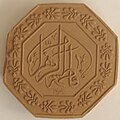
= | [[File:MohrQum1.jpeg|thumb|upright=0.6|A [[turbah]] or mohr is a small piece of soil or clay, often a clay tablet, used during ''salah'' to symbolize earth.]] | ||
This is not inconsistent with another fact that Muslims have shown diversity in their practice since the earliest days of practice, so the ''salah'' practiced by one Muslim may differ from another's in minor details. In some cases the [[hadith]] suggest some of this diversity of practice was known of and approved by Muhammad himself.<ref>{{cite web |author=Muhammad al-Bukhari |author-link=Muhammad al-Bukhari |title=Sahih al-Bukhari, Book of military expeditions |url=https://sunnah.com/bukhari/64/163 |access-date=17 October 2019}}</ref> | |||
Most differences arise because of different interpretations of the [[Principles of Islamic jurisprudence|Islamic legal sources]] by the different schools of law (''[[madhhab]]s'') in [[Sunni Islam]], and by different legal traditions within [[Shia Islam]]. In the case of ritual worship these differences are generally minor, and should rarely cause dispute.<ref>{{cite web |author=Abdal Hakim Murad |author-link=Timothy Winter |title=Understanding the Four Madhhabs |url=http://www.masud.co.uk/ISLAM/ahm/newmadhh.htm |url-status=live |archive-url=https://web.archive.org/web/20100329111030/http://www.masud.co.uk/ISLAM/ahm/newmadhh.htm |archive-date=29 March 2010 |access-date=25 May 2010}}</ref> | |||
Common differences, which may vary between schools and gender, include the position of legs, feet, hands and fingers, where the eyes should focus, the minimum amount of recitation, the volume of recitation, and which of the principal elements of the prayer are indispensable, versus recommended or optional.{{citation needed|date=April 2022}} | |||
==See also== | ==See also== | ||
*[[Dua]] | * [[Dua]] | ||
*[[Sabr (Islamic term)]] | * [[Sabr (Islamic term)]] | ||
*[[Tasbih]] | * [[Salawat al-Sha'baniyya]] | ||
* [[Tasbih]] | |||
==References== | ==References== | ||
===Footnotes=== | ===Footnotes=== | ||
{{ | {{Notelist}} | ||
}} | |||
===Citations=== | ===Citations=== | ||
| Line 285: | Line 163: | ||
===Bibliography=== | ===Bibliography=== | ||
{{ | {{Refbegin}} | ||
* {{cite book |last1=Abd al-Wahhab |first1=Muhammad ibn |author-link1=Muhammad ibn Abd al-Wahhab |title=Syarah Adab Berjalan Menuju Shalat |trans-title=Manners of Walking to the Prayer |date=2019 |publisher=Darul Falah |isbn=9789793036892 |page=197 |url=https://books.google.com/books?id=4uW3DwAAQBAJ |access-date=22 November 2021 }} | * {{cite book |last1=Abd al-Wahhab |first1=Muhammad ibn |author-link1=Muhammad ibn Abd al-Wahhab |title=Syarah Adab Berjalan Menuju Shalat |trans-title=Manners of Walking to the Prayer |date=2019 |publisher=Darul Falah |isbn=9789793036892 |page=197 |url=https://books.google.com/books?id=4uW3DwAAQBAJ |access-date=22 November 2021 }} | ||
* {{cite book |last1=al-Albani |first1=Muhammad Nasiruddin |author-link1=Muhammad Nasiruddin al-Albani |title=Fikih Syekh Albani |language=id |translator=Mahmud bin Ahmad Rasyid · |date=2004 |publisher=Pustaka Azzam |url=https://books.google.com/books?id=way8DwAAQBAJ |access-date=21 November 2021 }} | * {{cite book |last1=al-Albani |first1=Muhammad Nasiruddin |author-link1=Muhammad Nasiruddin al-Albani |title=Fikih Syekh Albani |language=id |translator=Mahmud bin Ahmad Rasyid · |date=2004 |publisher=Pustaka Azzam |url=https://books.google.com/books?id=way8DwAAQBAJ |access-date=21 November 2021 }} | ||
* {{cite encyclopedia |first=Norman |last=Calder |title=Law. Legal Thought and Jurisprudence |encyclopedia=The Oxford Encyclopedia of the Islamic World |editor=John L. Esposito |publisher=Oxford University Press |location=Oxford |year=2009 |url=http://www.oxfordislamicstudies.com/article/opr/t236/e0473|archive-url=https://web.archive.org/web/20081121033722/http://www.oxfordislamicstudies.com/article/opr/t236/e0473|url-status=dead|archive-date=November 21, 2008}} | |||
* {{cite book |last1=Nur Baits |first1=Ammi |title=Tafsir Shalat |date=2021 |publisher=Muamalah Publishing |page=248 Hadith Riwayat Muslim 1336 |url=https://books.google.com/books?id=5SH3DwAAQBAJ |access-date=20 November 2021 }} | * {{cite book |last1=Nur Baits |first1=Ammi |title=Tafsir Shalat |date=2021 |publisher=Muamalah Publishing |page=248 Hadith Riwayat Muslim 1336 |url=https://books.google.com/books?id=5SH3DwAAQBAJ |access-date=20 November 2021 }} | ||
{{ | * {{cite encyclopedia |first=Irene |last=Schneider |title=Fiqh |encyclopedia=The Oxford Encyclopedia of Islam and Politics |publisher=Oxford University Press |editor=Emad El-Din Shahin |year=2014 |doi=10.1093/acref:oiso/9780199739356.001.0001|isbn=9780199739356 }} | ||
* {{cite encyclopedia |first=Knut S. |last=Vikør |title=Sharīʿah |encyclopedia=The Oxford Encyclopedia of Islam and Politics |publisher=Oxford University Press |editor=Emad El-Din Shahin |year=2014 |url=http://bridgingcultures.neh.gov/muslimjourneys/items/show/226 |access-date=3 September 2014 |archive-url=https://web.archive.org/web/20170202054116/http://bridgingcultures.neh.gov/muslimjourneys/items/show/226 |archive-date=2 February 2017 |url-status=dead }} | |||
* {{cite encyclopedia |first=Farhat J. |last=Ziadeh |title=Criminal Law |encyclopedia=The Oxford Encyclopedia of the Islamic World |editor=John L. Esposito |publisher=Oxford University Press |location=Oxford |year=2009 |url=http://www.oxfordislamicstudies.com/article/opr/t236/e0170|archive-url=https://web.archive.org/web/20081101103325/http://www.oxfordislamicstudies.com/article/opr/t236/e0170|url-status=dead|archive-date=1 November 2008}} | |||
{{Refend}} | |||
==Further reading== | ==Further reading== | ||
| Line 297: | Line 179: | ||
==External links== | ==External links== | ||
{{Commons category|Salat}} | |||
{{Islamic prayer}} | |||
{{Islam topics|state=collapsed}} | {{Islam topics|state=collapsed}} | ||
{{Characters and names in the Quran}} | {{Characters and names in the Quran}} | ||
{{Authority control}} | |||
[[Category:Salah| ]] | |||
[[Category:Islamic terminology]] | [[Category:Islamic terminology]] | ||
[[Category:Prayer]] | [[Category:Prayer]] | ||
Latest revision as of 18:52, 21 March 2026

| Part of a series on |
| Islam |
|---|
 |
|
|
Salah (Arabic: ٱلصَّلَاةُ, romanized: aṣ-Ṣalāh, also spelled Salat), also known as Namaz (Persian: نماز, romanized: namāz), is the practice of formal worship in Islam, consisting of a series of ritual prayers performed at prescribed times daily. These prayers, which consist of units known as rak'ah, include a specific set of physical postures, recitation from the Quran, and prayers from the Sunnah, and are performed while facing the direction towards the Kaaba in Mecca (qibla). The number of rak'ah varies depending on the specific prayer. Variations in practice are observed among adherents of different madhahib (schools of Islamic jurisprudence). The term salah may denote worship in general or specifically refer to the obligatory prayers performed by Muslims five times daily.[1][2][3]
The obligatory prayers play an integral role in the Islamic faith, and are regarded as the second and most important, after shahadah, of the Five Pillars of Islam for Sunnis, and one of the Ancillaries of the Faith for Shiites. In addition, supererogatory salah, such as Sunnah prayer and Nafl prayer, may be performed at any time, subject to certain restrictions. Wudu, an act of ritual purification, is required prior to performing salah. Prayers may be conducted individually or in congregation, with certain prayers, such as the Friday and Eid prayers, requiring a collective setting and a khutbah (sermon). Some concessions are made for Muslims who are physically unable to perform the salah in its original form, or are travelling.
In early Islam, the direction of prayer (qibla) was toward Bayt al-Maqdis in Jerusalem before being changed to face the Kaaba, believed by Muslims to be a result of a Quranic verse revelation to Muhammad.[4]
Etymology and other names[edit | edit source]
The Arabic word salah (Arabic: صلاة, romanized: Ṣalāh, pronounced [sˤa.laːh] or Arabic pronunciation: [sˤə.ɫaːt]) means 'prayer'.[5] The word is used primarily by English speakers to refer to the five daily obligatory prayers. Similar terms are used to refer to the prayer in Malaysia, Brunei, Indonesia, Somalia, Tanzania, and by some Swahili speakers.
The origin of the word is debated. Some have suggested that salah derives from the triliteral root و-ص-ل (w-ṣ-l) which means 'linking things together',[citation needed] relating it to the obligatory prayers in the sense that one connects to Allah through prayer. In some translations, namely that of Quranist Rashad Khalifa, salah is translated as the 'contact prayer',[6] either because of the physical contact the head makes with the ground during the prostration, or again because the prayer connects the one who performs it to Allah. Another theory suggests the word derives from the triliteral root ص-ل-و (ṣ-l-w), the meaning of which is not agreed upon.[7][full citation needed]
In Iran and regions influenced by Persian culture – particularly the Indo-Persian and Turco-Persian traditions – such as South Asia, Central Asia, China, Russia, Turkey, the Caucasus or the Balkans, the Persian word namaz (Persian: نماز, romanized: namāz) is used to refer to salah. This word originates from the Middle Persian word for 'reverence'.[8]
Religious significance[edit | edit source]

The word salah is mentioned 83 times in the Quran as a noun.[9][10]
Islamic jurisprudence (fiqh) divides human actions into five categories, known as "the five rulings" (al-aḥkām al-khamsa). Acts of worship are classified accordingly: mandatory (farḍ or wājib), recommended (mandūb or mustaḥabb), neutral (mubāḥ), reprehensible (makrūh), and forbidden (ḥarām).[11][12] Salah is generally classified into obligatory or mandatory (fard) prayers and supererogatory prayers, the latter being further divided into Sunnah prayers and Nafl prayers.
Hanafi fiqh does not consider both terms as synonymous and makes a distinction between "fard" and "wajib"; In Hanafi fiqh, two conditions are required to impose the fard rule. 1. Nass, (only verses of the Qur'an can be accepted as evidence here, not hadiths) 2.The expression of the text referring to the subject must be clear and precise enough not to allow other interpretations. The term wajib is used for situations that do not meet the second of these conditions.[13] However, this understanding may not be sufficient to explain every situation. For example, Hanafis accept 5 daily prayers as fard. However, some religious groups such as Quranists and Shiites, who do not doubt that the Quran existing today is a religious source, infer from the same verses that it is clearly ordered to pray two or three times,[14][15][16][17][18] not five times. In addition, in religious literature, wajib is widely used for all kinds of religious requirements, without expressing any fiqh definition.
According to riwāya, prayer is held to be extremely important in Islam, and according to all four of the madhabs, those who have a disdain towards prayer are no longer seen as Muslims.[19][20]
While some sects claimed that those killed in this way remained Muslims, others claimed that they had apostatized from the religion. In this case, Islamic duties could not be made for their funerals, they would not be buried in Muslim cemeteries, and their heirs could not claim inheritance rights from the property they left behind, and would be public property.[21] However, even if today's dominant understanding defines the abandonment of worship as sinfulness, does not approve of giving worldly punishment for them. However, in sharia governments, their testimony against a devout Muslim may not be accepted, they may be humiliated and barred from certain positions because of this tag. In practice, since early on in Islamic history, criminal cases were usually handled by ruler-administered courts or local police using procedures which were only loosely related to Sharia.[22][23]
In sermon language, the main purpose of the salah is given as acting as a means of communication with Allah.[24] Other emphases include cleansing the heart, getting closer to God, and strengthening faith. It is believed that the soul requires prayer and closeness to Allah to stay sustained and healthy, and that prayer spiritually sustains the human soul, just as food provides nourishment to the physical body.[25] Tafsir (exegesis) of the Quran can give four reasons for the observation of salah. First, in order to commend God, Allah's servants, together with the angels, do salah ("blessing, salutations").[26][lower-alpha 1] Second, salah is done involuntarily by all beings in creation, in the sense that they are always in contact with Allah by virtue of him creating and sustaining them.[27][lower-alpha 2] Third, Muslims voluntarily offer salah to reveal that it is the particular form of worship that belongs to the prophets.[lower-alpha 3] Fourth, salah is described as the second pillar of Islam.[5]
Performing salah[edit | edit source]

There is consensus on the vast majority of the major details of the salah, but there are different views on some of the more intricate details. A Muslim is required to perform Wudu (ablution) before performing salah,[28][29][30] and making the niyyah (intention) is a prerequisite for all deeds in Islam, including salah. Some schools of Islamic jurisprudence hold that intending to pray suffices in the heart, and some require that the intention be spoken, usually under the breath.[31] The purpose of making the niyyah is to differentiate salah from ordinary routine actions, marking it as an act of worship ('ibāda) rather than a mechanical action ('āda).[32]
The person praying begins in a standing position known as Qiyam, although people who find it difficult to do so may begin while sitting or lying on the ground.[5] This is followed by raising the hands to the head and recitation of the takbir, an action known as the Takbirat al-Ihram (Arabic: تكبيرة الإحرام, romanized: Takbīrat al-Iḥrām). The hands are then lowered, and may be clasped on the abdomen (qabd), or hang by one's sides (sadl). A Muslim may not converse, eat, or do things that are otherwise halal after the Takbirat al-Ihram. A Muslim must keep their vision low during prayer, looking at the place where their face will contact the ground during prostration.[31][33][34]
A prayer may be said before the recitation of the Quran commences. Next, Al-Fatiha, the first chapter of the Quran, is recited. In the first and second rak'a of all prayers, a surah other than Al-Fatiha or part thereof is recited after Al-Fatiha. This is followed by another takbir after which the person praying bows down their waist in a position known as ruku with their hands on their knees (depending on the madhhab, rules may differ for women). While bowing, specific versions of tasbih are uttered once or more. As the worshipper straightens their back, they say the Arabic phrase "سمع الله لمن حمده" (lit. 'Allah hears the one who praises him.'), followed by the phrase "ربنا لك الحمد" (lit. 'Our Lord, all praise is for you.')[31]
Following the recitation of these words of praise, the takbir is recited once again before the worshipper kneels and prostrates with the forehead, nose, knees, palms and toes touching the floor, a position known as sujud. Similar to ruku, specific versions of tasbih are uttered once or more in sujud. The worshipper recites the takbir and rises up to sit briefly, then recites takbir and returns to sujud once again. Lifting the head from the second prostration completes a rak'ah. If this is the second or last rak'a, the worshipper rises up to sit once again and recites the Tashahhud, Salawat, and other prayers.[31] Many Sunni scholars, including Muhammad ibn Abd al-Wahhab[35] and Al-Albani[36] hold that the right index finger should be raised when reciting the prayers in this sitting position,[31] Once the worshipper is done praying in the sitting position in their last rak'a, they perform the taslim, reciting lengthened versions of the Islamic greeting As-salamu alaykum, once while facing the right and another time while facing the left. Taslim represents the end of prayer.[37][38][39]
Mistakes and doubts in salah are compensated for by prostrating twice at the end of the prayer, either before or after the taslim depending on the Madhab. These prostrations are known as sujud sahwi (Arabic: سجود السهو, romanized: Sujud as-Sahw).[40]
Salah in congregation[edit | edit source]
In Islamic belief, performing salah in congregation is considered to have more social and spiritual benefits than praying alone.[41] The majority of Sunni scholars recommend performing the obligatory salah in congregation without viewing the congregational prayer as an obligation. A minority view exists viewing performing the obligatory salah in congregation as an obligation.[42]

When praying in congregation, the people stand in straight parallel rows behind one person who leads the prayer service, called the imam. The imam must be above the rest in knowledge of the Quran, action, piety, and justness, and should be known to possess faith and commitment the people trust.[43] The prayer is offered just as it is when one prays alone, with the congregation following the imam as they offer their salah.[44] Two people of the same gender praying in congregation would stand beside each other, with the imam on the left and the other person to his right.[citation needed]
When the worshippers consist of men and women combined, a man leads the prayer. In this situation, women are typically forbidden from assuming this role with unanimous agreement within the major schools of Islam. This is disputed by some, partly based on a hadith with controversial interpretations. When the congregation consists entirely of women and/or pre-pubescent children, a woman may lead the prayer.[45] Some configurations allow for rows of men and women to stand side by side separated by a curtain or other barrier,[46] with the primary intention being for there to be no direct line of sight between male and female worshippers.[47]
Places and times at which salah is prohibited[edit | edit source]
Salah is not performed in graveyards and bathrooms. It is prohibited from being performed after Fajr prayer until sunrise, during a small period of time around noon, and after Asr prayer until sunset. The prohibition of salah at these times is to prevent the practice of sun worship.[48]
Obligatory salah[edit | edit source]
The daily prayers[edit | edit source]


The word salah, when used to refer to the Sunni second pillar of Islam or the Shia ancillary of faith, refers to the five obligatory daily prayers.[49] Each of the five prayers has a prescribed time which depends on the position of the Sun in the sky. Given the Islamic day begins at sunset, the first prayer of the day would be Maghrib, performed directly after sunset. It is followed by the Isha salah that is performed during the night, the Fajr salah performed before sunrise, and the Dhuhr and Asr prayers performed in the afternoon.
The five daily prayers must be performed in their prescribed times. However, if extenuating circumstances prevent a Muslim from performing them on time, they must be performed as soon as possible. Several hadith narrations quote the Islamic prophet Muhammad saying that a person who slept past the prescribed time or forgot to perform the obligatory salah must pray it as soon as they remember.[43]
These prayers are considered obligatory upon every adult Muslim,[49] with the exception of those with some physical or mental disabilities,[50] menstruating women, and women experiencing postnatal bleeding.[51] Those who are sick or otherwise physically unable to perform their salah standing may perform them sitting or lying down according to their ability.[52]
Some Muslims pray three times a day, believing the Qur'an mentions three prayers instead of five.[53][54][3]
Friday and Eid prayers[edit | edit source]
,_Dhaka,_Bangladesh_NK.JPG)
In general, Sunnis view the five daily prayers, in addition to the Friday salah, as obligatory. There is a difference of opinion within the Sunni schools of jurisprudence regarding whether the Eid and Witr prayers are obligatory on all Muslims,[55] obligatory only such that a sufficient number of Muslims perform it,[56] or sunnah.[57]
All Sunni schools of jurisprudence view the Friday salah as an obligatory prayer replacing Zuhr on Fridays exclusively. It is obligatory upon men and is to be prayed in congregation, while women have the choice to offer it in congregation or pray Zuhr at home.[58] Preceding the Friday salah, a khutbah (sermon) is delivered by a khatib, after which the 2 rak'a Friday prayer is performed.[59] A minority view within the Sunni schools holds that listening to the khutbah compensates for the spiritual reward of the 2 rak'a that are discounted from the prayer.[60]
The Eid salah is offered on the mornings of Muslim holidays Eid al-Fitr and Eid al-Adha. It consists of 2 rak'a, with extra takbirs pronounced before the beginning of the recitation of the Quran in each. The exact number of extra takbirs is differed upon within the Sunni schools, with the majority opining that seven takbirs are pronounced in the first rak'a and five in the second. The Hanafi school holds that 3 takbirs are to be pronounced in each rak'a. After the prayer, a khutbah is delivered. However, unlike the Friday prayer, the khutbah is not an integral part of the Eid prayer.[61] The prescribed time of the Eid prayer is after that of Fajr and before that of Zuhr.[62]
Jam' and Qasr[edit | edit source]
Muslims may pray two obligatory prayers together at the prescribed time of one, a practice known as jam'. This is restricted to two pairs of salah: the afternoon prayers of Zuhr and Asr, and the night-time prayers of Maghrib and Isha. Within the schools of jurisprudence in Sunni Islam, there is a difference of opinion regarding the range of reasons that permit one to perform jam'. With the exception of the Hanafi school, the other schools of jurisprudence allow one to perform jam' when travelling or when incapable of performing the prayers separately. Hanbalis and members of the Salafi movement allow jam' for a wider range of reasons.[63][64] Some Salafis ascribing to the Ahl-i Hadith movement also permit jam' without reason while preferring that the prayers be performed separately.[65][66] The Shia Ja'fari school allows one to perform jam' without reason.[67] Exclusively when traveling, a Muslim may shorten the Zuhr, Asr, and Isha prayers, which normally consist of 4 rak'a, to two. This is known as qasr.[62]
Supererogatory salah[edit | edit source]
Muslims may perform supererogatory salah as an act of worship at any time except the times of prohibition. Such salah is called nafil.[68] Prayers performed by Muhammad consistently, or those that he recommended be performed but are not considered obligatory, are called sunnah prayers.
Sunan ar-Rawatib[edit | edit source]
Sunan ar-Rawatib (Arabic: السنن الرواتب, romanized: as-Sunan ar-Rawātib) are regular voluntary prayers performed in association with the five daily obligatory prayers (Salah) in Sunni Islam. They are considered recommended (Sunnah) prayers and are traditionally attributed to the prayer practice of the Islamic prophet Muhammad. These prayers are performed within the prescribed time of the associated obligatory prayer, either before or after it, and are regarded as supplementary to the obligatory acts of worship.[69]
Classification[edit | edit source]
In Sunni jurisprudence, Sunan ar-Rawatib are commonly classified into two categories:
- Sunnah Muʾakkadah (emphasized Sunnah): prayers that Muhammad is reported to have regularly performed and consistently observed.
- Sunnah Ghair Muʾakkadah (non-emphasized Sunnah): prayers that Muhammad is reported to have performed occasionally but not consistently.[70]
Number and timing[edit | edit source]
According to widely cited Sunni traditions, there are generally twelve units (rakʿahs) of Sunnah Muʾakkadah associated with the five daily prayers:
- 2 rakʿahs before Fajr
- 4 rakʿahs before Dhuhr
- 2 rakʿahs after Asr
- 2 rakʿahs after Maghrib
- 2 rakʿahs after Isha
This enumeration is derived from hadith reports describing the Prophet’s regular voluntary prayers in conjunction with the obligatory prayers.[71]
Additional voluntary prayers, such as those performed before Asr or before Maghrib and Isha, are sometimes included under Sunnah Ghair Muʾakkadah by certain scholars, but they are not universally counted among the regular Rawatib prayers.[72]
Basis in hadith literature[edit | edit source]
Several hadiths describe the practice and merit of Sunan ar-Rawatib. One well-known narration reports that Muhammad stated that a dwelling in Paradise is promised for those who consistently perform twelve voluntary units of prayer in addition to the obligatory prayers.[73]
Practice[edit | edit source]
Sunan ar-Rawatib are voluntary and not legally obligatory; omission does not invalidate the obligatory prayer. Their regular performance, however, is regarded in Sunni tradition as part of normative devotional practice and as a means of emulating the Prophet’s prayer routine.[74]
Salah before noon[edit | edit source]
Duha salah is a prayer that can be performed after sunrise until noon. (which the time for the Dhuhr Prayer begins) It consists of an even number of rak'a, starting from two and going up to twelve. This prayer is one of 4 sunnah prayers which can be done in congregation.
Salah during the night[edit | edit source]
Witr salah (Arabic: صلاة الوتر) is a short prayer generally performed as the last prayer of the night. It consists of an odd number of rak'a, starting from one and going up to eleven, with slight differences between the different schools of jurisprudence.[75] Witr salah often includes the qunut.[76] Within Sunni schools of jurisprudence, the Hanafis view that the Witr salah is obligatory, while the other schools consider it a sunnah salah.
Within Sunni schools of jurisprudence, Tahajjud (Arabic: تَهَجُّد) refers to night-time prayers generally performed after midnight. The prayer includes any number of even rak'a, performed as individual prayers of two rak'a or four. Tahajjud is generally concluded with Witr salah.[75] Shia Muslims offer similar prayers, called Salawat al-Layl (Arabic: صَلَوَات اللَّيل). These are considered highly meritorious, consist of 11 rak'a: 8 nafl (performed as 4 prayers of 2 rak'a each) followed by 3 witr,[77] and can be offered in the same time as Tahajjud.[76]
Tarawih salah (Arabic: صلاة التراويح) is a sunnah prayer performed exclusively during Ramadan by Sunnis. It is performed immediately after the Isha prayer, and consists of 8 to 36 rak'a. Shi'ites hold that Tarawih is a bid'ah initiated by the second Rashidun caliph, Umar. Tarawih is also generally concluded with Witr salah.
Eclipse prayers[edit | edit source]
Following the sunnah of Muhammad during the solar eclipse that followed his son Ibrahim's death, Sunni Muslims perform the solar eclipse prayer (Arabic: صلاة الكسوف, romanized: Ṣalāt al-Kusuf), and the lunar eclipse prayer (Arabic: صلاة الخسوف, romanized: Ṣalāt al-Khusuf) during solar and lunar eclipses, respectively. These consist of 2 rak'a with 2 ruku in each rak'a instead of one. It is recommended to lengthen the recitation of the Quran, the bowing, and prostration in these prayers.[citation needed]
Istikhara salah[edit | edit source]
The word istikharah is derived from the root ḵ-y-r (خير) "well-being, goodness, choice, selection".[78] Salat al-Istikhaarah is a prayer offered when a Muslim needs guidance on a particular matter. To say this salah one should pray two rakats of non-obligatory salah to completion. After completion one should request Allah that which on is better.[62] The intention for the salah should be in one's heart to pray two rakats of salah followed by Istikhaarah. The salah can be offered at any of the times where salah is not forbidden.[79] Other prayers include the tahiyyat al-masjid, which Muslims are encouraged to offer these two rakat.[80]
Differences in practice[edit | edit source]
.jpg)
While most Muslims pray five times a day, some Muslims pray three times a day, believing the Qur'an only mentions three prayers.[53][54] Qur'anists are among those who pray three times a day.[81]
Most Muslims believe that Muhammad practiced, taught, and disseminated the salah in the whole community of Muslims and made it part of their life. The practice has, therefore, been concurrently and perpetually practiced by the community in each of the generations. The authority for the basic forms of the salah is neither the hadiths nor the Quran, but rather the consensus of Muslims.[82][83]

This is not inconsistent with another fact that Muslims have shown diversity in their practice since the earliest days of practice, so the salah practiced by one Muslim may differ from another's in minor details. In some cases the hadith suggest some of this diversity of practice was known of and approved by Muhammad himself.[84]
Most differences arise because of different interpretations of the Islamic legal sources by the different schools of law (madhhabs) in Sunni Islam, and by different legal traditions within Shia Islam. In the case of ritual worship these differences are generally minor, and should rarely cause dispute.[85]
Common differences, which may vary between schools and gender, include the position of legs, feet, hands and fingers, where the eyes should focus, the minimum amount of recitation, the volume of recitation, and which of the principal elements of the prayer are indispensable, versus recommended or optional.[citation needed]
See also[edit | edit source]
References[edit | edit source]
Footnotes[edit | edit source]
Citations[edit | edit source]
- ↑ Na, Abdullahi Ahmed An-Na'im; Naʻīm, ʻabd Allāh Aḥmad (30 June 2009). Islam and the Secular State. Harvard University Press. ISBN 9780674033764.
- ↑ Edward E. Curtis IV (1 October 2009). Muslims in America: A Short History. Oxford University Press. ISBN 978-0-19-974567-8.
- ↑ 3.0 3.1 Jafarli, Durdana. "The historical conditions for the emergence of the Quranist movement in Egypt in the 19th-20th centuries." МОВА І КУЛЬТУРА (2017): 91.
- ↑ Mubarakpuri, Safiur Rahman (1976). Ar-Raheeq Al-Makhtum [The Sealed Nectar] (PDF) (in العربية). Translated by Diab, Issam. Archived from the original (PDF) on 24 March 2018.
- ↑ 5.0 5.1 5.2 Chittick, William C.; Murata, Sachiko (1994). The vision of Islam. Paragon House. ISBN 9781557785169.
- ↑ "Quran The Final Testament, translated by Rashad Khalifa, Ph.D." www.masjidtucson.org. Retrieved 12 May 2022.
- ↑ Last Name, First Name (2020). "Title". Scientific Route. doi:10.21303/978-617-7319-30-5.
- ↑ "British Library".
- ↑ Dukes, Kais, ed. (2009–2017). "Quran Dictionary". Quranic Arabic Corpus. Retrieved 26 October 2019.
- ↑ Gerrans, S., "The Quran: A Complete Revelation", 2016
- ↑ Vikør 2014.
- ↑ Schneider 2014.
- ↑ "According to the Bishair the fardh, is like the wajib but the wajib expresses [that something should] occur and the fard, expresses [that something has] a definitive assessment. https://brill.com/display/book/edcoll/9789047400851/B9789047400851_s012.xml?language=en Archived 6 April 2024 at the Wayback Machine
- ↑ Zum Beispiel Sayyid Ahmad Khan. Vgl. Ahmad: Islamic Modernism in India and Pakistan 1857–1964. 1967, S. 49.
- ↑ "Ek 15 – Dini Görevler: Tanrı'dan Bir Armağan". Teslimolanlar. Archived from the original on 5 November 2021. Retrieved 30 May 2021.
- ↑ Vgl. Birışık: "Kurʾâniyyûn" in Türkiye Diyanet Vakfı İslâm Ansiklopedisi. 2002, Bd. 26, S. 429.; Yüksel; al-Shaiban; Schulte-Nafeh: Quran: A Reformist Translation. 2007, S. 507.
- ↑ "10. How Can we Observe the Sala Prayers by Following the Quran Alone? - Edip-Layth - quranix.org". quranix.org. Archived from the original on 2 March 2024. Retrieved 14 August 2023.
- ↑ "Sahih al-Bukhari 1399, 1400 - Obligatory Charity Tax (Zakat) - كتاب الزكاة - Sunnah.com - Sayings and Teachings of Prophet Muhammad (صلى الله عليه و سلم)". sunnah.com. Retrieved 23 December 2024.
- ↑ "Do all the Imams Agree Neglecting the prayer Continuously Entails Disbelief? (Important Clarification)". Darul Iftaa. 4 November 2011. Retrieved 25 December 2024.
- ↑ Eki̇Nci̇, Ahmet (2021). "İslam Hukukunda Namaz Kılmayanın Hükmü". Kocatepe İslami İlimler Dergisi. 4 (2): 388–409. doi:10.52637/kiid.982657.
- ↑ Peters, Rudolph; Vries, Gert J. J. De (1976). "Apostasy in Islam". Die Welt des Islams. 17 (1/4): 7–9. doi:10.2307/1570336. JSTOR 1570336.
- ↑ Calder 2009.
- ↑ Ziadeh 2009.
- ↑ Sheihul Mufliheen (October 2012). Holy Quran's Judgement. XLIBRIS. p. 57. ISBN 978-1479724550.
- ↑ Elias, Abu Amina (25 June 2015). "The purpose of prayer in Islam | Faith in Allah الإيمان بالله". Retrieved 17 November 2019.
- ↑ BIN SAAD, ADEL (January 2016). A COMPREHENSIVE DESCRIPTION OF THE PROPHET'S WAY OF PRAYER: صفة صلاة النبي. Dar Al Kotob Al Ilmiyah دار الكتب العلمية. ISBN 978-2745167804.
- ↑ "An Enlightening Commentary into the Light of the Holy Qur'an vol. 11". Imam Ali Foundation. 24 January 2014.
- ↑ The Oxford Dictionary of Islam. "Salat". oxfordislamicstudies. Archived from the original on 1 September 2009.
- ↑ "salat | Definition & Facts". Encyclopedia Britannica. Retrieved 4 January 2016.
- ↑ "Sahih Muslim 428 - The Book of Prayers - كتاب الصلاة - Sunnah.com - Sayings and Teachings of Prophet Muhammad (صلى الله عليه و سلم)". sunnah.com. Retrieved 23 December 2024.
- ↑ 31.0 31.1 31.2 31.3 31.4 Haddad, Yvonne Yazbeck; Smith, Jane I. (1 January 2014). The Oxford Handbook of American Islam. Oxford University Press. p. 162. ISBN 9780199862634.
- ↑ Katz, Marion Holmes (6 May 2013). Prayer in Islamic Thought and Practice. Cambridge University Press. p. 45. ISBN 978-0-521-88788-5.
- ↑ Ciaravino, Helene (2001). How to Pray: Tapping into the Power of Divine Communication. Square One Publishers (2001). p. 137. ISBN 9780757000126.
- ↑ Al-Tusi, Muhammad Ibn Hasan (2008). Concise Description of Islamic Law and Legal Opinions. Islamic College for Advanced Studie; UK ed. edition (1 October 2008). pp. 57–59. ISBN 978-1904063292.
- ↑ Abd al-Wahhab (2019, p. 197)
- ↑ al-Albani (2004, p. 108)
- ↑ Du'a before Taslim (Sunni View)
- ↑ About the Taslim
- ↑ "Sahih Muslim 672a - The Book of Mosques and Places of Prayer - كتاب الْمَسَاجِدِ وَمَوَاضِعِ الصَّلاَةِ - Sunnah.com - Sayings and Teachings of Prophet Muhammad (صلى الله عليه و سلم)". sunnah.com. Retrieved 23 December 2024.
- ↑ "The Prostration of Forgetfulness : Shaikh 'Abdullaah bin Saalih Al-'Ubaylaan". muslimlifepro.com. Archived from the original on 26 June 2014. Retrieved 28 June 2014.
- ↑ Qara ati, Muhsin (18 February 2018). The Radiance of the Secrets of Prayer. CreateSpace Independent Publishing Platform. ISBN 978-1496053961.
- ↑ "Rules of Salat (Part III of III)". Al-Islam.org. Archived from the original on 10 May 2012. Retrieved 12 May 2012.
- ↑ 43.0 43.1 Qara'ati, Muhsin (5 January 2017). "The Radiance of the Secrets of Prayer". Ahlul Bayt World Assembly.
- ↑ Hussain, Musharraf (10 October 2012). The Five Pillars of Islam: Laying the Foundations of Divine Love and Service to Humanity. Kube Publishing Ltd (10 October 2012). pp. 77–78. ISBN 978-1847740540.
- ↑ "Iranian women to lead prayers". BBC. 1 August 2000. Retrieved 11 February 2008.
- ↑ Cornell, Vincent J. (2007). Voices of Islam: Voices of life : family, home, and society. Praeger Publishers; 1st edition (1 January 2007). pp. 25–28. ISBN 978-0275987350.
- ↑ Maghniyyah, Muhammad Jawad (21 November 2016). "Prayer (Salat), According to the Five Islamic Schools of Law". Islamic Culture and Relations Organisation.
- ↑ Ringwald, Christopher D (20 November 2008). A Day Apart: How Jews, Christians, and Muslims Find Faith, Freedom, and Joy on the Sabbath. Oxford University Press (8 January 2007). pp. 117–119. ISBN 978-0195165364.
- ↑ 49.0 49.1 "Salah (Prayer) – The Second Pillar of Islam". Islamic Relief UK. Retrieved 14 April 2024.
- ↑ Elshabrawy, Elsayed; Hassanein, Ahmad (3 February 2015). Inclusion, Disability and Culture (Studies in Inclusive Education). Sense Publishers (28 November 2014). pp. 3–6. ISBN 978-9462099227.
- ↑ GhaneaBassiri, Kambiz (1997). Competing Visions of Islam in the United States: A Study of Los Angeles. Praeger (30 July 1997). ISBN 9780313299513.
- ↑ Turner, Colin (19 December 2013). Islam: The Basics. Routledge; 2nd edition (24 May 2011). pp. 106–108. ISBN 978-0415584920.
- ↑ 53.0 53.1 Na, Abdullahi Ahmed An-Na'im; Naʻīm, ʻabd Allāh Aḥmad (30 June 2009). Islam and the Secular State. Harvard University Press. ISBN 9780674033764.
- ↑ 54.0 54.1 Curtis Iv, Edward E. (October 2009). Muslims in America: A Short History. Oxford University Press. ISBN 978-0-19-974567-8.
- ↑ The Oxford Dictionary of Islam. "Fard al-Ayn". oxfordislamicstudies. Archived from the original on 18 August 2010.
- ↑ The Oxford Dictionary of Islam. "Fard al-Kifayah". oxfordislamicstudies. Archived from the original on 14 June 2010.
- ↑ Schade, Johannes (2006). Encyclopedia of World Religions. Mars Media/Foreign Media (9 January 2007). ISBN 978-1601360007.
- ↑ Fahd Salem Bahammam. The Muslim's Prayer. Modern Guide. ISBN 9781909322950. Retrieved 29 January 2018.
- ↑ Akhtar Rizvi, Sayyid Saeed (1989). Elements of Islamic Studies. Bilal Muslim Mission of Tanzania.
- ↑ Margoliouth, G. (2003). "Sabbath (Muhammadan)". In Hastings, James (ed.). Encyclopedia of Religion and Ethics. Vol. 20. Selbie, John A., contrib. Kessinger Publishing. pp. 893–894. ISBN 978-0-7661-3698-4.
- ↑ "Islam Today". Archived from the original on 17 October 2007.
- ↑ 62.0 62.1 62.2 Buyukcelebi, Ismail (2005). Living in the Shade of Islam. Tughra (1 March 2005). ISBN 978-1932099867.
- ↑ "Combining two prayers". Islamweb.net. 16 January 2018. Archived from the original on 12 November 2020.
- ↑ Nasir al-Din al-Albani, Muhammad (10 September 2014). "A resident may combine prayers to avoid difficulties – Shaykh al Albaani". Abdurrahman.org. Archived from the original on 3 February 2017.
- ↑ Silmi, Shaykh Yahya. "THE WEAKNESS ABOUT THE NARRATION "COMBINING THE PRAYER WITHOUT REASON IS A MAJOR SIN" AND AN ADVICE TO BROTHER ABU KHADEEJA ABDUL WAHID". Uthman Ibn Affan Library. Archived from the original on 9 April 2021.
- ↑ Abu Hibban; Abu Khuzaimah Ansari (15 July 2015). "When To Combine And Shorten Prayers". Salafi Research Institute. Archived from the original on 24 November 2020.
- ↑ Sharaf al-Din al-Musawi, Sayyid Abd al-Husayn (18 October 2012). "Combining The Two Prayers". Hydery Canada Ltd.
- ↑ "prayers". islamicsupremecouncil.com. Archived from the original on 13 February 2012. Retrieved 14 May 2012.
- ↑ "Ṣalāt". Encyclopaedia Britannica. Retrieved 22 December 2025.
- ↑ Kamali, Mohammad Hashim (2003). Principles of Islamic Jurisprudence. Islamic Texts Society. ISBN 9780946621815.
{{cite book}}: Check|isbn=value: checksum (help) - ↑ Sahih Muslim. Dar al-Taʿaruf. 2007. ISBN 9789953850437.
{{cite book}}: Check|isbn=value: checksum (help) - ↑ Hallaq, Wael B. (2009). An Introduction to Islamic Law. Cambridge University Press. ISBN 9780521678735.
- ↑ Sahih Muslim. Dar al-Taʿaruf. 2007. ISBN 9789953850437.
{{cite book}}: Check|isbn=value: checksum (help) - ↑ "Ṣalāt". Encyclopaedia Britannica. Retrieved 22 December 2025.
- ↑ 75.0 75.1 Islam International Publications (January 2016). Salat: The Muslim prayer book. Islam International Publishers (1997). ISBN 978-1853725463.
- ↑ 76.0 76.1 Majlisi, Muhammad Baqir (18 November 2021). "Salat al-Layl". Al-Fath Al-Mubin Publications.
- ↑ Kassamali, Tahera; Kassamali, Hasnain (9 January 2013). "Salatul Layl". Tayyiba Publishers & Distributors.
- ↑ Nieuwkerk, Karin van (October 2013). Performing Piety: Singers and Actors in Egypt's Islamic Revival. University of Texas Press; Reprint edition (1 October 2013). ISBN 9780292745865.
- ↑ Iṣlāhī, Muḥammad Yūsuf (1989). "Etiquettes of Life in Islam".
- ↑ Firdaus Mediapro, Jannah (17 October 2019). The Path to Islamic Prayer English Edition Standard Version. Blurb (18 October 2019). ISBN 978-1714100736.
- ↑ Jafarli, Durdana. "The historical conditions for the emergence of the Quranist movement in Egypt in the 19th–20th centuries." МОВА І КУЛЬТУРА (2017): 91.
- ↑ "Al-Mawrid". al-mawrid.org. Archived from the original on 24 July 2011.
- ↑ "Mishkat al-Masabih 981 – Prayer – كتاب الصلاة – Sunnah.com – Sayings and Teachings of Prophet Muhammad (صلى الله عليه و سلم)". sunnah.com. Retrieved 19 April 2021.
- ↑ Muhammad al-Bukhari. "Sahih al-Bukhari, Book of military expeditions". Retrieved 17 October 2019.
- ↑ Abdal Hakim Murad. "Understanding the Four Madhhabs". Archived from the original on 29 March 2010. Retrieved 25 May 2010.
Bibliography[edit | edit source]
- Abd al-Wahhab, Muhammad ibn (2019). Syarah Adab Berjalan Menuju Shalat [Manners of Walking to the Prayer]. Darul Falah. p. 197. ISBN 9789793036892. Retrieved 22 November 2021.
- al-Albani, Muhammad Nasiruddin (2004). Fikih Syekh Albani (in Bahasa Indonesia). Translated by Mahmud bin Ahmad Rasyid ·. Pustaka Azzam. Retrieved 21 November 2021.
- Calder, Norman (2009). "Law. Legal Thought and Jurisprudence". In John L. Esposito (ed.). The Oxford Encyclopedia of the Islamic World. Oxford: Oxford University Press. Archived from the original on 21 November 2008.
- Nur Baits, Ammi (2021). Tafsir Shalat. Muamalah Publishing. p. 248 Hadith Riwayat Muslim 1336. Retrieved 20 November 2021.
- Schneider, Irene (2014). "Fiqh". In Emad El-Din Shahin (ed.). The Oxford Encyclopedia of Islam and Politics. Oxford University Press. doi:10.1093/acref:oiso/9780199739356.001.0001. ISBN 9780199739356.
- Vikør, Knut S. (2014). "Sharīʿah". In Emad El-Din Shahin (ed.). The Oxford Encyclopedia of Islam and Politics. Oxford University Press. Archived from the original on 2 February 2017. Retrieved 3 September 2014.
- Ziadeh, Farhat J. (2009). "Criminal Law". In John L. Esposito (ed.). The Oxford Encyclopedia of the Islamic World. Oxford: Oxford University Press. Archived from the original on 1 November 2008.
Further reading[edit | edit source]
- Smith, Jane I.; Haddad, Yvonne Yazbeck (1993). The Oxford Handbook of American Islam (1st ed.). Oxford: Oxford University Press. pp. 162–163.
External links[edit | edit source]
Islam topics | |||||||||||||
|---|---|---|---|---|---|---|---|---|---|---|---|---|---|
| |||||||||||||
| |||||||||||||
| |||||||||||||
| |||||||||||||
