

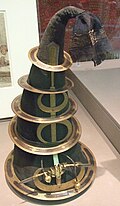
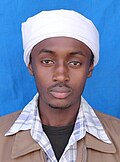
imported>ZI Jony clean up |
cleaned up intro as per guidelines per standard format |
||
| Line 1: | Line 1: | ||
{{Short description| | {{Short description|Type of headwear}} | ||
{{About||millinery fashion|Draped turban|other uses}} | {{About||the millinery fashion|Draped turban|other uses}} | ||
{{Redirect-distinguish|Double Patti|Double Patty}} | |||
{{Use dmy dates|date=April 2023}} | |||
A '''turban''' (from {{langx|fa|دولبند}}, {{lang|fa-Latn|dolband}}; via {{langx|frm|turbant}}) is a type of [[headwear]] based on cloth winding. Featuring many variations, it is worn as customary headwear by people of various cultures.<ref>{{Cite web|url=http://www.encyclopedia.com/topic/Turbans.aspx|title=Turbans Facts, information, pictures {{!}} Encyclopedia.com articles about Turbans|website=encyclopedia.com|access-date=19 April 2016|archive-date=3 April 2016|archive-url=https://web.archive.org/web/20160403054847/http://www.encyclopedia.com/topic/Turbans.aspx|url-status=live}}</ref> Communities with prominent turban-wearing traditions can be found in the [[Punjabis]], the [[Indian subcontinent]],<ref>{{Cite journal |last=Kanti Ghosh |first=Sumit |date=2023-05-18 |title=Body, Dress, and Symbolic Capital: Multifaceted Presentation of PUGREE in Colonial Governance of British India |url=https://www.tandfonline.com/doi/full/10.1080/14759756.2023.2208502 |journal=Textile |volume=22 |issue=2 |pages=334–365 |doi=10.1080/14759756.2023.2208502 |s2cid=258804155 |archive-date=21 May 2023 |access-date=21 May 2023 |archive-url=https://web.archive.org/web/20230521193415/https://www.tandfonline.com/doi/full/10.1080/14759756.2023.2208502 |url-status=live }}</ref> [[Southeast Asia]], the [[Middle East]], the [[Balkans]], the [[Caucasus]], [[Central Asia]], [[North Africa]], [[West Africa]], [[East Africa]], and amongst some [[Turkic peoples]] in [[Russia]]. | |||
{{Multiple image | |||
| image1 = Traditional turban of Rajasthan.jpg | |||
| caption1 = [[Rajasthan]]i style | |||
| image2 = Bakarwal man in traditional attire.png | |||
| caption2 = [[Gurjar|Gujjar]] style | |||
| image3 = Sikh singh picture.jpg | |||
| caption3 = [[Sikh]] style | |||
| image4 = Mohammad Daud Miraki.jpg | |||
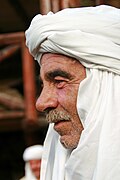
| caption4 = [[Pashtun]] style | |||
| direction = | |||
| total_width = 300 | |||
| align = right | |||
| perrow = 2 | |||
}} | |||
A '''keski''' is a type of turban mainly worn by female Sikhs, with a long piece of cloth roughly half the length of a traditional "single turban", but not cut and sewn to make a double-width "Double Turban" (or '''Double Patti''').<ref>{{cite web |url=https://turbanandbeard.com/products/beige-turban |website=turbanandbeard.com |access-date=25 August 2019 |title=Oxford Beige Turban |archive-date=25 August 2019 |archive-url=https://web.archive.org/web/20190825043027/https://turbanandbeard.com/products/beige-turban |url-status=dead }}</ref> | |||
Wearing turbans is common among [[Sikh]] men ([[Dastar]]), and infrequently women.<ref>{{Cite web|url=http://www.sikhanswers.com/sikh-articles-of-faith-identity/sikh-women-turban-dastaar/|title=Do Sikh women have to wear a Turban (Dastaar) as well as men?|website=Sikh Answers|access-date=19 April 2016|archive-date=25 December 2018|archive-url=https://web.archive.org/web/20181225222552/http://www.sikhanswers.com/sikh-articles-of-faith-identity/sikh-women-turban-dastaar/|url-status=dead}}</ref> They are also worn by [[Hinduism|Hindu]] monks. The headgear also serves as a religious observance, including among [[Shia Islam|Shia Muslims]], who regard turban-wearing as {{lang|ar-Latn|Sunnah mu'akkadah}} ('confirmed tradition').<ref name="Haddad">{{cite web|last=Haddad|first=Sh. G. F.|title=The turban tradition in Islam|url=http://www.livingislam.org/k/tti_e.html|website=Living Islam|access-date=5 August 2013|archive-date=25 December 2018|archive-url=https://web.archive.org/web/20181225222558/http://www.livingislam.org/k/tti_e.html|url-status=live}}</ref> The turban is also the traditional headdress of [[Sufism|Sufi]] scholars. Muslim men might wear the turban ([[Ammama|Imama]]) during prayer. Additionally, turbans have often been worn by nobility, regardless of religious background. | |||
Turbans come in a variety of styles, and the method of wrapping can vary. Some turbans are simple and functional, while others are elaborate and serve ceremonial or formal purposes. The way a turban is tied can indicate the wearer's social or marital status, religious affiliation, or regional identity. Aside from cultural and religious significance, turbans are also practical headwear. They provide protection from the sun, dust, and wind. In some regions with hot climates, turbans can help keep the head cool. | |||
==History== | ==History== | ||
The earliest depiction of a turban can be found on a Mesopotamian sculpture dating back to 2350 BCE.<ref>''Ethnic Dress in the United States: A Cultural Encyclopedia'', page [https://books.google.com/books?id=tiEvBQAAQBAJ&pg=PA293&dq= 293], Annette Lynch, Mitchell D. Strauss, Rowman & Littlefield</ref><ref>''India: The Ancient Past: A History of the Indian Subcontinent from C. 7000 BCE to CE 1200'', page [https://books.google.com/books?id=WTaTDAAAQBAJ&pg=PA58&dq= 58], Burjor Avari, Routledge</ref><ref name="Perseus-Tufts">{{cite web|title=P. Ovidius Naso, Metamorphoses, Book 11, line 146|url=https://www.perseus.tufts.edu/hopper/text?doc=Perseus%3Atext%3A1999.02.0028%3Abook%3D11%3Acard%3D146 |publisher=[[Perseus Digital Library]] |access-date=21 January 2017}}</ref><ref name="GBooks-Norma">{{cite book|last1=Goldman|first1=Norma|author1-link=Norma Goldman |last2=Nyenhuis|first2=Jacob E.|title=Latin Via Ovid: A First Course|url=https://books.google.com/books?id=fORWW12AoTAC&q=ovid+turban+midas&pg=PA158|publisher=Wayne State University Press|access-date=21 January 2017|language=en|date=1 January 1982|isbn=0814317324}}</ref> A style of turban called a ''phakeolis'' continued to be worn in that region by soldiers of the [[Byzantine Empire|Byzantine]] army in the period 400–600,<ref name="GBooks-D'Amato">{{cite book|last1=D'Amato|first1=Raffaele|title=Roman Military Clothing (3): AD 400–640 |url=https://books.google.com/books?id=q0J78geiNrYC&q=phakeolis+turban&pg=PA4|publisher=Bloomsbury USA|access-date=21 January 2017|language=en|date=10 August 2005|isbn=9781841768434}}{{Dead link|date=May 2023 |bot=InternetArchiveBot |fix-attempted=yes }}</ref> as well as by Byzantine civilians as depicted in Greek frescoes from the 10th century in the province of [[Cappadocia]] in modern Turkey,<ref name="GBooks-Condra">{{cite book|last1=Condra|first1=Jill|title=The Greenwood Encyclopedia of Clothing Through World History: 1801 to the present |url=https://books.google.com/books?id=q6FI2czFz6MC&q=phakeolis+turban&pg=PA269 |publisher=Greenwood Publishing Group|access-date=21 January 2017|language=en|date=1 January 2008|isbn=9780313336652}}</ref> where it was still worn by their [[Cappadocian Greeks|Greek-speaking descendants]] in the early 20th century. The [[Prophets and messengers in Islam|Islamic prophet]], [[Muhammad]], who lived 570–632, wore an [[Ammama|Imama]] turban. The style of turban he introduced was a cap with a cloth tied around it; this headwear is known as ''[[Ammama|Imama]]'' and was emulated by [[Muslim]] kings and scholars throughout history. Shia clerics today wear white turbans unless they are descendants of Muhammad or [[sayyid]], in which case they wear a black turban. Many Muslim men choose to wear green, because it represents paradise, especially among followers of [[Sufism]]. In parts of [[North Africa]], where blue is common, the shade of a turban can signify the tribe of the wearer.<ref>Hughes, Thomas Patrick. ''A Dictionary of Islam: Being a Cyclopedia of the Doctrines, Rites, Ceremonies and Customs Together with the Technical and Theological Terms of the Muhammadan Religion''. WH Allen & Company, 1895.</ref> | |||
The | |||
<gallery> | <gallery class="center" widths="200" heights="200"> | ||
File:Marble Portrait Bust of a Woman with a Scroll MET DP345057.jpg|Late | File:Marble Portrait Bust of a Woman with a Scroll MET DP345057.jpg|Late fourth century [[Byzantine dress|Byzantine woman]], wearing a phakeolis. | ||
File:Chora Church interior March 2008.JPG|14th century Byzantine, [[Theodore Metochites]], presenting a model of the renovated [[Chora Church]], while wearing a striped turban. | File:Chora Church interior March 2008.JPG|14th century Byzantine, [[Theodore Metochites]], presenting a model of the renovated [[Chora Church]], while wearing a striped turban. | ||
File:EmperorSuleiman.jpg|16th century, [[Suleiman the Magnificent|Suleiman I]], wearing a | File:EmperorSuleiman.jpg|16th century, [[Suleiman the Magnificent|Suleiman I]], wearing the Ottoman imperial turban, known as ''kavuk''.([[:tr:kavuk|tr]]) | ||
File:II Selim.jpg|16th century | File:Sultan Abdillahi Sultan Deria.jpg|Sultan [[Abdillahi Deria]], fourth Grand Sultan of the [[Somalis|Somali]] [[Isaaq Sultanate]], wearing a turban. | ||
File:Babur | File:II Selim.jpg|16th century [[sultan of the Ottoman Empire]] [[Selim II]] wearing the Ottoman imperial turban, known as ''kavuk'' | ||
File: | File:Humayun (left) with his father Babur (right), painted circa 1640 (Late Shah Jahan Album).jpg|16th century [[Mughal Emperor]] [[Babur]] and his heir [[Humayun]] wearing turbans (ca 1640). | ||
File: | File:Maharaj Ranjit Singh.jpg|[[Ranjit Singh|Maharaja Ranjit Singh]], founder of the [[Sikh Empire]], wearing a decorated turban (1830). | ||
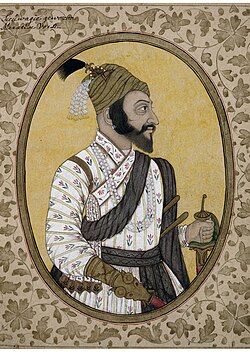
File:Sultan Mohamoud Ali Shire 2.jpg| | File:Shivaji British Museum.jpg|Late 17th century [[Maratha Confederacy|Maratha]] [[Chhatrapati|emperor]] [[Shivaji]] wearing a turban and its ornaments. | ||
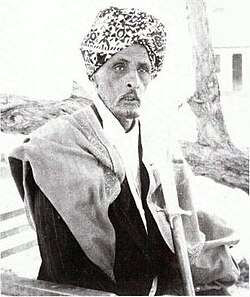
File:Sultan Mohamoud Ali Shire 2.jpg|[[Sultan]] [[Mohamoud Ali Shire]] of the [[Somalis|Somali]] [[Warsangali]] clan wearing a turban (1905). | |||
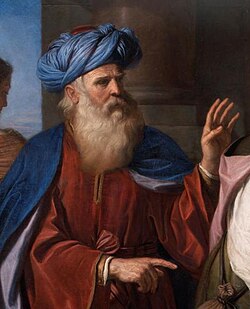
File:Guercino Abramo ripudia Agar (cropped).jpg|[[Baroque]] depiction of [[Abraham]] wearing a turban, by [[Guercino]], oil on canvas (1657). | |||
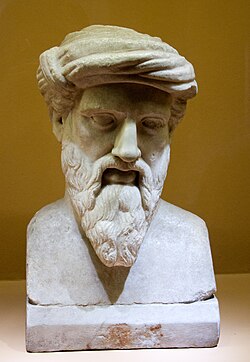
File:Pythagoras in the Roman Forum, Colosseum.jpg|[[Roman Republic|Roman]] copy of a [[Ancient Greece|Greek]] bust featuring [[Pythagoras of Samos]] wearing a turban (2nd–1st century BCE). | |||
</gallery> | </gallery> | ||
==National styles== | ==National styles== | ||
=== Asia === | |||
==== Afghanistan ==== | |||
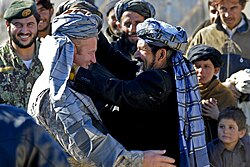
[[File:Flickr - The U.S. Army - Turban presentation.jpg|thumb|[[Afghan people|Afghan]] Lungee presentation]] | |||
Turbans are part of the national dress in [[Afghanistan]]. In the Uruzgan Province, male government employees are required to wear the [[Ammama|Imama]].<ref>{{Cite news |last=Azadi |first=RFE/RL's Radio |title=Regional Taliban Officials Ban Beard Trimming, Impose Turbans For Male Employees |url=https://www.rferl.org/a/taliban-beard-trimming-turbans/31658539.html |access-date=2024-03-29 |work=RadioFreeEurope/RadioLiberty |language=en |archive-date=29 March 2024 |archive-url=https://web.archive.org/web/20240329065533/https://www.rferl.org/a/taliban-beard-trimming-turbans/31658539.html |url-status=live }}</ref> They are used more widely than elsewhere in the Muslim world, and are worn in a wide range of styles and colours. In the country's south-east, turbans are wrapped loosely and largely, whereas in [[Kabul]] the garment tends to be smaller and tighter. In traditional Afghan society, a related piece of extra cloth called a ''patu'' serves practical purposes, such as for wrapping oneself against the cold, to sit on, to tie up an animal or to carry water in the cap. Different ethnic groups in Afghanistan wear different lungees with different patterns, way of styling it, fabric, stripes, lengths and colouration. Males of all ethnic backgrounds generally avoid wearing bright-coloured turbans that draw attention to oneself and prefer wearing simple colors that are white, off white, gray, dark blue and black.{{Citation needed|date=November 2023}} | |||
=== | ==== China ==== | ||
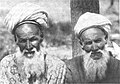
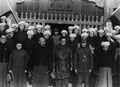
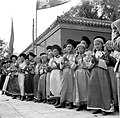
In [[China]] and its frontiers, turbans were worn, primarily by ethnic minorities with Turkic or Islamic cultural influence. Turbans were worn by the [[Han Chinese]] rebels in the [[Red Turban rebellion]]. | |||
<gallery> | |||
File:The Subjects two uighur mullahs.jpg|[[Uyghurs]] in [[Xinjiang]] wearing turbans | |||
File:T.V. Soong at Mosque in Xining Qinghai May 1934.png|[[T. V. Soong]] and [[Ma Bufang]] at the [[Xining]] [[Qinghai]] mosque | |||
File:Inner Mongolia Art Troupe celebrating the National Day in Tian'anmen.jpg|[[Mongols]] wearing turbans in 1950 | |||
</gallery> | |||
=== | ==== Indian subcontinent ==== | ||
{{Main|Pagri (turban)|l1 = Pagri}} | |||
In India, the turban is referred to as a ''pagri'', meaning the [[headdress]] that is worn by men and is manually tied.<ref>{{Cite web |title=Sikhs Must Wear Turbans to Maintain and Honor Their Hair |url=https://www.learnreligions.com/why-do-sikhs-wear-turbans-2993352 |access-date=2024-02-23 |website=Learn Religions |language=en |archive-date=23 February 2024 |archive-url=https://web.archive.org/web/20240223151727/https://www.learnreligions.com/why-do-sikhs-wear-turbans-2993352 |url-status=live }}</ref> There are several styles, which are specific to the wearer's region or religion, and they vary in shape, size and colour. For example, the [[Mysore Peta]], the [[Pheta (turban)|Marathi pheta]], and the [[Puneri Pagadi]]. The pagri is a symbol of honour and respect everywhere it is worn. It is a common practice to honour important guests by offering them one to wear.{{fact|date=April 2025}} | |||
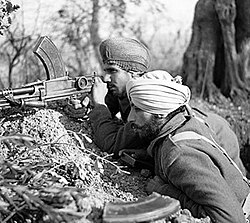
Colours are often chosen to suit the occasion or circumstance: for example saffron, associated with [[Courage|valour]] or sacrifice (martyrdom), is worn during rallies; white, associated with [[peace]], is worn by elders; and pink, associated with spring, is worn during that season or for marriage ceremonies.{{fact|date=April 2025}}{{stack|[[File:Indian sikh soldiers in Italian campaign.jpg|thumb|Indian [[Sikh]] soldiers in [[Italian campaign (World War II)|Italian campaign]] with a [[Bren gun]].]]}}In World War II, some soldiers in the [[British Indian Army|Indian Army]] were required to wear a turban.<ref>{{cite web |title=From Mesopotamia to West London, a 4,000-year history of the turban |url=https://www.cnn.com/style/article/turbans-tales-history/index.html |publisher=[[CNN]] |date=15 February 2019 |access-date=27 September 2020 |archive-date=6 October 2023 |archive-url=https://web.archive.org/web/20231006161952/https://www.cnn.com/style/article/turbans-tales-history/index.html |url-status=live }}</ref> The [[Free India Legion]] also wore turbans. | |||
In the Indian state of [[Rajasthan]] a turban, known as ''pagri'' or ''safa'', is a traditional headwear that is an integral part of the state's cultural identity. It is typically made from cotton, silk, or a blend of fabrics and can vary in length. The safa (Parna) is usually around {{convert|1|to|4.5|m|sp=us}} long, while the pagri can be about {{convert|10|m|sp=us}}. Some of the most popular turbans in Rajasthan include Jodhpuri safa.<ref>{{Cite web |last=Studio |first=Rajasthan |date=2021-01-15 |title=Facts about Rajasthani Pagri - The Unique Headgear of the State - |url=https://rajasthanstudio.com/facts-about-rajasthani-pagri-the-unique-headgear-of-the-state/ |access-date=2024-03-22 |website=Rajasthan Studio |language=en-US}}</ref><ref>{{Cite web |title=PM's Choice of Turban: The Jodhpuri Safa |url=https://www.ndtv.com/india-news/pms-choice-of-turban-the-jodhpuri-safa-649349 |access-date=2024-03-22 |website=NDTV.com}}</ref> | |||
In [[ | |||
In [[Bangladesh]], the turban is known as ''pagri'', or ''fagri'' in [[Chittagong Division|Chittagong]] and [[Sylhet Division|Sylhet]]. The most common colour worn is white, and generally it is the [[Sufi]]s that wear green turbans. It is also worn by elders in rural areas as a symbol of honour and respect.<ref>{{Cite journal |last=Ghosh |first=Sumit Kanti |date=2021 |title='পাগড়ি হঠাও': শরীর, পোশাক ও ব্রিটিশ ভারতের ঔপনিবেশিক পরিচালন |url=https://journals.juniv.edu/index.php/an/article/view/320 |journal=Nirvijnana Patrika, Jahangirnagar University |number=26 |pages=1–14 |via=Jahangirnagar University}}</ref> | |||
In | |||
The turban in Nepal is commonly worn in rural areas by males. The rural turban is called either a [[Pagri (turban)|Pagdi]] or [[Pheta]]. It is common among farmers. All types of coloured clothes were used for Pheta. Historically, Gorkhali nobleman used to wear white turban called '''Shirpau''' awarded by the [[King of Nepal]]. For example; ''[[Sardar]]'' [[Ram Krishna Kunwar]] was awarded with 22 pairs of headgear called '''Shirpau''' by the Gorkhali monarch ''[[Maharajadhiraj]]'' [[Prithvi Narayan Shah]].<ref>{{cite book |last=Hamal |first=Lakshman B. |year=1995 |title=Military history of Nepal |publisher=Sharda Pustak Mandir |page=125 |oclc=32779233}}</ref> It was common among aristocrats in other contemporary kingdoms. Rulers and vassal lords also adapted a crest to the white turban.{{fact|date=April 2025}} | |||
<gallery class="center" widths="200" heights="200"> | |||
File:Paag-mithila6.jpg|Paag of Mithilalok | |||
File:Rajput (Jodhpur) (8411728143).jpg|A man from India, wearing a [[Rajasthan]]i ''paggar'' style of turban | |||
File:Tribe of Madhya Pradesh wearing Turban 01.jpg|A man from Madhya Pradesh wearing a turban | |||
File:Prince Malik Ata.jpg|[[Malik Ata Muhammad Khan]], [[Nawab]] of [[Kot Fateh Khan]] in Pakistan, wearing a turban made from {{convert|6.4|m|yd|abbr=off}} of cloth | |||
File:Bhakti Thapa.jpg|Nepalese ''[[Sardar]]'' [[Bhakti Thapa]], a Gorkhali nobleman wearing aristocratic white ''Shirpau'' turban | |||
File:Bundesarchiv Bild 101I-823-2704-10A, Soldaten der Legion "Freies Indien".jpg|Free India Legion soldiers wearing turbans. | |||
</gallery> | |||
=== Europe === | |||
==== United Kingdom ==== | |||
In the United Kingdom, turbans have been worn by men and women since the sixth century without ever becoming very common. Poet [[Alexander Pope]] is sometimes depicted wearing a turban, as were other notable men seen in contemporary paintings and illustrations. The common use of turbans on less formal occasions, among gentlemen at the time, reflects that their heads were closely cropped, or shaved, to allow the wearing of the elaborate wigs that were the fashion in Europe in the century from about 1650 to 1750, and when wigs were off, some kind of head cover was useful. Hence, the turban.{{fact|date=April 2025}} | |||
Now that hats are infrequently worn, turbans too are relatively uncommon. They are worn primarily by women of West Indian descent, Karinas. Some women wear them to make a statement of individuality, such as the British [[social entrepreneur]] [[Camila Batmanghelidjh]], who usually wore a colourful matching turban and robe.{{fact|date=April 2025}} | |||
<gallery class="center" widths="200" heights="200"> | |||
File:Turban MET 85.68 CP3.jpg|alt=A British turban from ca. 1820|The "à la turque" style of this British headdress from c. 1820, influenced and inspired by the popular interest in Eastern cultures, was popular in the 1820s.<ref>{{Cite web |title=Turban {{!}} British {{!}} The Met |url=https://www.metmuseum.org/art/collection/search/157012 |website=The Met|date=1820 }}</ref> | |||
File:2016 photo - IMG 4988 (37891924662).jpg|Camila Batmanghelidjh, charity founder. | |||
File:Elizabeth Bibesco.jpg|Elizabeth Bibesco, actress. | |||
File:Mrs. Richard Paul Jodrell by Sir Joshua Reynolds.jpeg|Vertue Jodrell. | |||
File:Mary Wortley Montague.jpg|Mary Wortley Montagu, medical pioneer, writer, and poet. | |||
File:How a British Woman Dresses in Wartime- Utility Clothing in Britain, 1943 D14780.jpg|World War 2 style. | |||
</gallery> | |||
=== | ==== Albania ==== | ||
{{ | {{stack|[[File:Rugova Man.jpg|thumb|225x225px|Albanian [[Rugova (region)|Rugova]] man in ''shall'' turban.]]}} | ||
[[File: | In Northern Albania and some regions of Kosovo, particularly among [[Albanian tribes|highlanders]], men traditionally wear a long, white turban-like cloth known as a ''shall'' or ''shalla''.<ref>{{Cite web |date=2020-09-16 |title=The ensemble and traditional games of Rugova under the protection of the state |url=https://www.koha.net/en/kulture/ansambli-dhe-lojerat-tradicionale-te-rugoves-nen-mbrojtje-te-shtetit |access-date=2025-03-18 |website=KOHA.net |language=en}}</ref> It is over three meters long and is worn from age 7 onwards, then used as a burial shroud after death.<ref>{{Cite web |date=2023-12-11 |title=Veshjet tradicionale të Rugovës, detaje që s'i keni ditur... - POPULLI.MK |url=https://populli.mk/veshjet-tradicionale-te-rugoves-detaje-qe-si-keni-ditur/ |access-date=2025-03-18 |language=sq}}</ref> It is often worn over the ''[[qeleshe]]'' (plis), the traditional Albanian felt cap, to protect from the elements. The ''shall'' is most commonly worn in the [[Malësia]] regions and the [[Rugova (region)|Rugova]] highlands of Kosovo, though it is only seen in traditional folk attire and cultural ceremonies.<ref>{{Cite web |last=Vatovci |first=Isa |date=2020-09-15 |title=Tradita folklorike e Rugovës shpallet trashëgimi e mbrojtur nga shtetit |url=https://kallxo.com/lajm/tradita-folklorike-e-rugoves-shpallet-trashegimi-e-mbrojtur-nga-shtetit/ |access-date=2025-03-18 |website=Raporto Korrupsionin! KALLXO.com |language=en}}</ref> | ||
=== | ==== Greece ==== | ||
In Greece, specifically the island of [[Crete]], the men traditionally wear a lightly knitted turban known as a ''sariki''.<ref>{{Cite web |date=2016-04-16 |title=Sariki - headgear of the Cretan men with dense fringes like tears |url=https://www.meetcrete.com/sariki-cretan-headscarf/ |access-date=2023-09-27 |website=Meet Crete |language=en-GB |archive-date=6 October 2023 |archive-url=https://web.archive.org/web/20231006171911/https://www.meetcrete.com/sariki-cretan-headscarf/ |url-status=live }}</ref><ref>{{Cite web |title=Moustakia Sarikia and Stivania; three very Cretan traditions |url=https://www.we-love-crete.com/moustakia-sarikia-and-stivania.html |access-date=2023-09-27 |website=www.we-love-crete.com |archive-date=1 December 2023 |archive-url=https://web.archive.org/web/20231201165517/https://www.we-love-crete.com/moustakia-sarikia-and-stivania.html |url-status=live }}</ref> The headwrap's name is borrowed from ''sarık'', the [[Turkish language|Turkish]] word for turban. Today, it may be more commonly known as a ''kritiko mandili'' (Cretan kerchief). It is only found in the folklore Cretan dress and not amongst the population, with the exception of older men in remoter, mountainous villages.{{fact|date=April 2025}} | |||
===Fiji=== | |||
{{ | {{main|I-sala}} | ||
[[Fijians|iTaukei]] indigenous chiefs and priests were known to have worn [[Masi (Fiji)|''masi'']] (barkcloth) coverings around their head similar to a turban, called an ''i-sala''. However, most of the bulk and shape of the ''i-sala'' came from the bushy hair under the cloth.<ref name="Me2004">{{cite book|last=Me|first=Rondo B. B.|title=Fiji Masi: An Ancient Art in the New Millennium|url=https://books.google.com/books?id=itGBAAAAMAAJ|year=2004|publisher=Catherine Spicer and Rondo B.B. Me|location=Burleigh Heads|isbn=978-0-646-43762-0|page=40}}</ref><ref name="CochraneQuanchi2014">{{cite book|editor-last1=Cochrane|editor-first1=Susan|editor-last2=Quanchi|editor-first2=Max|title=Hunting the Collectors: Pacific Collections in Australian Museums, Art Galleries and Archives|url=https://books.google.com/books?id=lOqmBgAAQBAJ|year=2014|publisher=Cambridge Scholars Publishing|location=Cambridge|isbn=978-1-4438-7100-6|page=58}}</ref> | |||
[[ | |||
[[ | |||
===Armenia=== | |||
{{ | [[File:Gagik I Bagratuni.jpg|thumb|upright|Statue of [[Gagik I of Armenia]] wearing a turban.]] | ||
Though not common in daily apparel, turbans are sometimes worn by men ceremonially (often with beards), as a symbol of national identity during celebrations and festivals. However, before [[Armenia]] became a [[Armenian Apostolic Church|Christian]] nation, turbans were a common part of the daily apparel, just as in other Middle Eastern countries.{{fact|date=April 2025}} | |||
=== | ===Other=== | ||
On the [[Swahili Coast]], turbans were frequently worn by the ruling [[Oman]]i [[List of Sultans of Zanzibar|Sultans of Zanzibar]] and their retinue.{{fact|date=April 2025}} | |||
[[Tuareg people|Tuareg Berbers]], and some northern [[Berber people|Berbers]], [[Sahrawi people|Sahrawi]], [[Songhai people|Songhai]], [[Wodaabe]], [[Fula people|Fulani]], and [[Hausa people|Hausa]] peoples of [[North Africa|North]] and [[West Africa]] wear varieties of turbans. Tuareg Berbers often veil the face to block dust. This Tuareg-Berber turban is known as a [[tagelmust]], and is often blue. The Bedouin tribes in [[North Africa]] sometimes wear brown-beige, white or orange turbans. [[Colombia]]n politician [[Piedad Cordoba]] was known to wear turbans (or a similar headgear). Her use of turbans had made her so distinguishable to the point of having earned the nickname "the lady with the turban" in Colombian popular culture.{{fact|date=April 2025}} | |||
[[ | |||
[[Kurdish people]] wear a turban, which they call a ''jamadani''. It is worn in many different ways across [[Iraqi Kurdistan]] depending on the style of the locality; e.g. the [[Barzani Kurds]] are a tribe which wears the turban in a colour (red and white) and style which is typical of their clan. In most parts of [[Iraqi Kurdistan|South Kurdistan]] a black-white pattern is used for Jamadani. Mostly, Kurdish turbans consist of a length of striped cloth known as ''kolāḡī'' which is wound around a conical hat; the tassels that border the kolāḡī are allowed to hang down over the face. In modern times, many Kurds use black and white [[Ghutra]] and roll them into turbans.{{fact|date=April 2025}} | |||
Turbans have also been a type of headwear worn by women in Western countries. The wearing of such turbans by women in Western societies is less common than it was earlier in the 20th century. They are usually sewn to a foundation, so that they can be donned or removed easily. Turbans are also sometimes donned to protect hair or as a headwrap for women following [[Chemotherapy|cancer treatments]] that cause hair loss.<ref>{{Cite web |title=Alternative Wig Idea: Cover Hair Loss With a Cute Cap Instead |url=http://breastcancer.about.com/od/Free-Stuff-Cancer/p/Free-Caps-During-Cancer-Treatment.htm |access-date=19 April 2016 |website=About.com Health |archive-date=6 September 2015 |archive-url=https://web.archive.org/web/20150906102209/http://breastcancer.about.com/od/Free-Stuff-Cancer/p/Free-Caps-During-Cancer-Treatment.htm |url-status=dead }}</ref> They can also be tied together to form a rope in emergency rescue situations.<ref>{{cite news |date=14 October 2021 |title=Turbans used to rescue hiker above waterfall in Golden Ears park |work=Maple Ridge News |url=https://www.mapleridgenews.com/news/turbans-used-to-rescue-hiker-above-waterfall-in-golden-ears-park |access-date=14 October 2021 |archive-date=14 October 2021 |archive-url=https://web.archive.org/web/20211014171245/https://www.mapleridgenews.com/news/turbans-used-to-rescue-hiker-above-waterfall-in-golden-ears-park/ |url-status=live }}</ref> In popular culture, turbans are also sometimes worn as a fashion statement. For example, American rapper [[Yeat]] wears turbans often while being photographed and filmed in public. He also has a song titled "Turban".{{fact|date=April 2025}} | |||
==In religion== | |||
===Sikhism=== | |||
{{Main|Dastar|}} | |||
[[File:Akali Turban with quoits.JPG|thumb|upright=0.7|[[Khalsa|Akali]] turban cotton over a wicker frame, steel overlaid with gold. Lahore Mid-19th century, "A tall conical turban provided convenient transportation for a number of sharp steel [[chakram]]s – edged weapons hurled to lethal effect by the practised hand of the Akalis."]] | |||
The [[Sikh]] turban, known mainly as the ''[[dastar]]'' but also the ''[[dumalla]]'', is used to show others that they represent the embodiment of Sikh teachings, the love of the Guru and dogma to do good deeds.<ref>{{cite book|last=Sidhu|first=Dawinder|title=Civil Rights in Wartime: The Post-9/11 Sikh Experience|year=2009|publisher=Ashgate Publishing, Ltd.|isbn=9781409496915|page=48}}</ref> The Gurus ensured that both men and women are able to wear a turban, which shows another action of equality. Other Purposes of the turban include protecting Sikhs' long unshorn hair and keeping it clean.<ref>{{Cite web |date=2024-03-06 |title=Underneath the Turban: Uncovering Sikh Identity and Resilience |url=https://www.sikhnet.com/news/underneath-turban-uncovering-sikh-identity-and-resilience |access-date=2024-04-03 |website=SikhNet |language=en}}</ref> | |||
The | Sikhs do not cut their hair, as a religious observance. The turban protects the hair and keeps it clean. As Sikhs form 1.7% of India's population and 1.5% of Canada's population, their turbans help identify them. When he institutionalized the turban as a part of the Sikh identity, Guru Gobind Singh said, "My Sikh will be recognized among millions". | ||
Turbans were formerly associated with the upper class, and many men in the cultural elite still wear turbans. This distinction between the turban-wearing upper class ([[Sardar]]s) and commoners promoted segregation and elitism. In order to eliminate the class system associated with turbans, Guru Gobind Singh declared each and every Sikh a Sardar. | |||
Modern Sikh men mainly wear four kinds of turban: Vattan Wali Turban, Amritsar Shahi Turban, Barnala Shahi and Taksali Dumala. The more traditional Turban styles are the Darbara Singh Dummala, [[Dastar bunga|Dastar Bunga]] (the original turban of the Khalsa) and the Puratan Nok Pagg. | |||
The most common turban colors worn by Sikhs are blue, white and black, although other colors are popular as well. Blue and yellow are particularly prestigious and tend to be worn on religious events such as [[Vaisakhi]]. Meanings of the turbans are that the white turban means a saintly person leading an exemplary life, and an off-shade color of white means someone is learning in the Sikh religion. The blue turban signifies a mind as broad as the sky with no place for prejudice. The black turban serves as a reminder of the [[Jallianwala Bagh massacre]] in 1919, and represents humility. The Basanti or yellow turbans are associated with the revolutionary movement, Sardar Bhagat Singh also wore a yellow turban for this reason. Royal blue is usually worn by those who are learned in the Sikh religion and are patriotic about their traditions and culture. The colour green signifies farmers. The orange turban means courage and wisdom.{{citation needed|date=November 2016}} The colour Gold symbolizes a sense of calm and healing that helps with anxiety and clearing the mind which significance derives from the Golden temple. | |||
Akali Nihang Sikhs decorate their blue turbans or [[Dumalla]] by wearing small weapons known as shastars in them. The turban's color may reflect association with a particular group of Sikhs, although none of the popular turban colors are exclusive to any particular group. The preferred color of the Sikh wedding is pink. All shades of this color from magenta to baby pink is used by families for the joyful occasion. Some prefer red, maroon or orange turbans for the weddings, but pink is so far the most popular. Turban colors are generally a matter of personal choice in Sikhism, with many Sikh men choosing colors based on fashion or taste, sometimes to match clothes. There are traditions associated with some colours, for instance orange and black are often worn at political protest rallies whilst red and pink turbans are worn at weddings and other celebratory events.<ref>{{Cite web|url=http://testa0.blogspot.ca/2013/06/the-orange-turban-and-their-importance.html|title=design: The Orange Turban And Their Importance|website=testa0.blogspot.ca|date=12 June 2013|access-date=4 March 2016|archive-date=7 March 2016|archive-url=https://web.archive.org/web/20160307080518/http://testa0.blogspot.ca/2013/06/the-orange-turban-and-their-importance.html|url-status=live}}</ref><ref>{{Cite web|url=http://sikhism.about.com/od/religioustolerance/a/Sikh_Turban.htm|title=Why Do Sikhs Wear Turbans?|website=About.com Religion & Spirituality|access-date=4 March 2016|archive-date=3 March 2016|archive-url=https://web.archive.org/web/20160303181152/http://sikhism.about.com/od/religioustolerance/a/Sikh_Turban.htm|url-status=dead}}</ref><ref>{{Cite web|url=http://www.sikhwomen.com/turban/Color.htm|title=Significance of color/colour of turban/pug/pag/dastaar/pagri/pagree in Sikhism|website=www.sikhwomen.com|access-date=4 March 2016|archive-date=11 March 2016|archive-url=https://web.archive.org/web/20160311164554/http://www.sikhwomen.com/turban/Color.htm|url-status=live}}</ref> | |||
=== | <gallery class="center" widths="200" heights="200"> | ||
File:Rajvir Jawanda (Cropped).jpg|[[Rajvir Jawanda]], a singer and actor | |||
File:Gen Bikram Singh.jpg|[[Bikram Singh (general, born 1952)|Bikram Singh]], former [[Chairman of the Chiefs of Staff Committee]] of India | |||
File:Fauja Singh.jpg|[[Fauja Singh]], a [[centenarian]] [[marathon]] runner | |||
File:Diljit Dosanjh at Colors Golden Petal Awards.jpg|[[Diljit Dosanjh]], an actor, singer, television presenter and social media celebrity | |||
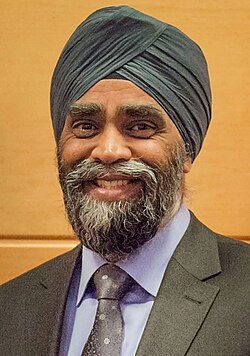
File:Harjit Sajjan February 2016.jpg|[[Harjit Singh Sajjan]], [[Member of Parliament (Canada)|Member of Parliament]] and [[Minister of Emergency Preparedness]] of Canada | |||
File:A Sikh Hooper Western 1860s.jpg|An Orthodox Sikh Nihang with a Dastar Bunga | |||
File:OCdt. Sarabjot Anand, OCdt. Sarbjeet Nijher and OCdt. Saajandeep Sarai represent Royal Military College of Canada at Sikh Remembrance Day 2013.jpg|Cdt. Sarabjot Anand, OCdt. Sarbjeet Nijher and OCdt. Saajandeep Sarai represent Royal Military College of Canada at Sikh Remembrance Day 2013 | |||
File:Sikh woman.jpg|A Sikh Woman with a turban | |||
File:Portrait Painting of Mewa Singh.jpg|Mewa Singh, the man who spearheaded the [[Ghadar Movement]] | |||
File:Biggest Turban Ever.jpg|A Sikh with a darbara Singh dumala | |||
File:Its relatives from sikh community weddings.png|A Sikh man and woman both with turbans | |||
</gallery> | |||
=== | ===Christianity=== | ||
[[File:USAFIS.JPG|thumb|right|upright|A Christian ''mukurinu'' (singular form of ''[[akurinu]]'') on the [[Swahili Coast]] wearing a turban]] | |||
[[ | In [[Kenya]], the [[Akurinu]], a Christian denomination, wear turbans as religious headgear. The official name of the denomination is The Kenya Foundation of the Prophets Church, or else Holy Ghost Church. Both men and women wear white turbans; children wear tunics. Some Oriental Orthodox churches such as the [[Coptic Orthodox Church of Alexandria|Coptic Orthodox Church]] and the [[Syriac Orthodox Church]] include turbans in the [[vestment]]s for the priest. | ||
[[ | |||
The origin of the word ''akurinu'' is not clear. It is said by some to come from the Kikuyu question '''Mukuri-ni''' which translates to 'who is the redeemer?'. Others say that it comes from the growling sounds made by early adherents to the sect when possessed by the spirit, an act described as ''gukurina''. In his book ''Facing Mt. Kenya'', [[Jomo Kenyatta]] states that the ''akurinu'' referred to themselves as Arooti(dreamers), people of God. | |||
The ''akurinu'' identify Joseph Ng'ang'a as the founder of the sect. It was Ng'ang'a who ascended [[Mount Kenya]] (then known as Mount Kirinyaga) with the first four akurinu prophets - Joseph Kanini, Henry Maina, Philip Mukubwa, and Lilian Njeru. It was on this ascension that the ''akurinu'' say Njeru was instructed to remove all adornments she had worn, throw them into River Nyamindi, and cover her hair. They also claim to have been instructed by God to lift their hands in the air as they pray. These two practices form an integral part of ''akurinu'' religious beliefs today. | |||
===Islam=== | ===Islam=== | ||
In [[Islamic]] cultures, some men wear a turban-style headdress in emulation of [[Muhammad]] who is believed to have worn a black or white turban.<ref name="NYT Rubin 15 October 2011">{{cite news|last=Rubin|first=Alyssa J.|title=Afghan Symbol of Identity Is Subject to Search|url=https://www.nytimes.com/2011/10/16/world/asia/afghans-are-rattled-by-rule-on-searching-turbans.html|access-date=16 October 2011|newspaper=[[New York Times]]|date=15 October 2011}}</ref><ref name="Haddad"/><ref name="inter-islam">{{cite web|url=http://www.inter-islam.org/Actions/kurta.html|title=The turban, topee and kurta – in the light of Ahadith and the practice of our pious predecessors|author=Inter Islam|publisher=inter-islam.org|access-date=2014- | In [[Islamic]] cultures, some men wear a turban-style headdress in emulation of [[Muhammad|Prophet Muhammad]] who is believed to have worn a black or white turban.<ref name="NYT Rubin 15 October 2011">{{cite news|last=Rubin|first=Alyssa J.|title=Afghan Symbol of Identity Is Subject to Search|url=https://www.nytimes.com/2011/10/16/world/asia/afghans-are-rattled-by-rule-on-searching-turbans.html|access-date=16 October 2011|newspaper=[[The New York Times]]|date=15 October 2011|archive-date=15 October 2011|archive-url=https://web.archive.org/web/20111015222908/http://www.nytimes.com/2011/10/16/world/asia/afghans-are-rattled-by-rule-on-searching-turbans.html|url-status=live}}</ref><ref name="Haddad"/><ref name="inter-islam">{{cite web|url=http://www.inter-islam.org/Actions/kurta.html|title=The turban, topee and kurta – in the light of Ahadith and the practice of our pious predecessors|author=Inter Islam|publisher=inter-islam.org|access-date=10 February 2014|archive-date=25 December 2018|archive-url=https://web.archive.org/web/20181225222554/http://www.inter-islam.org/Actions/kurta.html|url-status=live}}</ref><ref name="sunnah">{{cite web|url=http://sunnah.org/fiqh/islamic_dress.htm|title=Islamic Dress and Head-dress for men|publisher=sunnah.org|access-date=10 February 2014|archive-date=25 December 2018|archive-url=https://web.archive.org/web/20181225222557/http://sunnah.org/fiqh/islamic_dress.htm|url-status=dead}}</ref><ref name="seekersguidance">{{cite web|url=http://seekersguidance.org/ans-blog/2009/11/19/can-anyone-wear-a-turban-are-there-styles-specific-for-scholars/|title=SeekersGuidance – Can Anyone Wear a Turban? Are There Styles Specific for Scholars? – Answers|date=19 November 2009|publisher=seekersguidance.org|access-date=10 February 2014|archive-date=25 December 2018|archive-url=https://web.archive.org/web/20181225222601/http://seekershub.org/ans-blog/2009/11/19/can-anyone-wear-a-turban-are-there-styles-specific-for-scholars/|url-status=live}}</ref> It is sometimes called an [[Ammama|Imama]]. The head wraps are worn in different ways and called by different names depending on the region and culture. Examples include ({{langx|ar|عمامة}} ''`emãmah'') in Arabic, and the Dastar ({{langx|fa|دستار}}) in Persian. The most preferred style is the elliptic cylindrical headwrap, with the tail hanging behind. | ||
In [[Shi'a Islam]], a black head wrap around a small white cap is worn by descendants of Muhammad called [[Sayyid]]s, and white turbans by other well-educated persons and scholars. Sufi Muslims often wear a green head wrap around a small cap or the green head wrap alone. | In [[Shi'a Islam]], a black head wrap around a small white cap is worn by descendants of Muhammad called [[Sayyid]]s, and white turbans by other well-educated persons and scholars. Sufi Muslims often wear a green head wrap around a small cap or the green head wrap alone. Members of the [[Dawat-e-Islami]] movement wear green turbans,<ref name=Gugler/> whereas members of [[Sunni Dawate Islami]] (which broke away from Dawat-e-Islami in 1992) wear white turbans.<ref name=Gugler>{{Cite journal|url=http://crossasia-repository.ub.uni-heidelberg.de/142/|title=Parrots of Paradise - Symbols of the Super-Muslim: Sunnah, Sunnaization and Self-Fashioning in the Islamic Missionary Movements Tablighi Jama'at, Da'wat-e Islami and Sunni Da'wat-e Islami|first=Thomas K.|last=Gugler|date=22 April 2008|website=crossasia-repository.ub.uni-heidelberg.de|doi=10.11588/xarep.00000142|access-date=9 May 2020|archive-date=1 February 2016|archive-url=https://web.archive.org/web/20160201154221/http://crossasia-repository.ub.uni-heidelberg.de/142/|url-status=dead}}</ref> | ||
In [[Sudan]], large white headdresses connote high social status.{{Citation needed|date=October 2011}} | In [[Sudan]], large white headdresses connote high social status.{{Citation needed|date=October 2011}} In India and Pakistan the cap is called a [[Taqiyah (cap)|topi]]. Women of Islam typically do not wear turbans, as it is typically considered part of a man's dress, while women do typically cover their hair as part of [[hijab]]. | ||
However, just as some Muslim women wear no headcovering, some modern Muslim women wear a turban style covering. Although it is still not as widely accepted by the more conservative Islamic communities. | However, just as some Muslim women wear no headcovering, some modern Muslim women wear a turban style covering. Although it is still not as widely accepted by the more conservative Islamic communities. | ||
<gallery> | <gallery class="center" widths="200" heights="200"> | ||
File:Statue of Averroes (Córdoba) - BAE09705.jpg|[[Averroes|Ibn Rushd (Averroes)]] [[Muslim]] [[polymath]] from | File:Statue of Averroes (Córdoba) - BAE09705.jpg|[[Averroes|Ibn Rushd (Averroes)]] [[Muslim]] [[polymath]] from Spain | ||
File:Ralamb-40.jpg|In the [[Ottoman Empire]], [[Muhammad]]'s numerous descendants formed a kind of nobility with the privilege of wearing green turbans | File:Ralamb-40.jpg|In the [[Ottoman Empire]], [[Muhammad]]'s numerous descendants formed a kind of nobility with the privilege of wearing green turbans | ||
File:Habib umar with imam zaid shakir.jpg|[[Habib Umar bin Hafiz]] (left) of [[Yemen]] wearing a white turban | File:Habib umar with imam zaid shakir.jpg|[[Habib Umar bin Hafiz]] (left) of [[Yemen]] wearing a white turban | ||
</gallery> | </gallery> | ||
===Judaism=== | ===Judaism=== | ||
When the Jewish High Priest served in the Tabernacle and the Temple in Jerusalem, he wore a head covering called ''mitznefet'' מִצְנֶפֶת. This word has been translated as ''mitre'' (KJV) or ''headdress''. It was most likely a turban, as the word comes from a root meaning 'to wrap'. | {{main|Priestly turban}} | ||
The traditional Jewish turban is known as a [[Sudra (headdress)|sudra]]. When the Jewish High Priest served in the Tabernacle and the Temple in Jerusalem, he wore a head covering called ''mitznefet'' מִצְנֶפֶת. This word has been translated as ''mitre'' (KJV) or ''headdress''. It was most likely a turban, as the word comes from a root meaning 'to wrap'. | |||
In the [[Hebrew Bible]], the turban worn by the High Priest was much larger than the head coverings of the priests and wound to make a broad, flat-topped shape resembling the blossom of a flower. The head covering of the priests was different, being wound to form a cone, called a ''migbahat''. | In the [[Hebrew Bible]], the turban worn by the High Priest was much larger than the head coverings of the priests and wound to make a broad, flat-topped shape resembling the blossom of a flower. The head covering of the priests was different, being wound to form a cone, called a ''migbahat''. | ||
| Line 160: | Line 188: | ||
The Jews who lived under Arab rule during the Middle Ages, notably in Islamic Spain, wore turbans and headwear not too different from their Muslim counterparts. | The Jews who lived under Arab rule during the Middle Ages, notably in Islamic Spain, wore turbans and headwear not too different from their Muslim counterparts. | ||
Some married Jewish women wear | The [[Sephardic Jews|Sephardi]] [[Chief Rabbinate of Israel|Chief Rabbi of Israel]], also known as [[Rishon LeZion (title)|Rishon LeZion]] customarily wears a [[Priestly turban|turban]] (mitznefet).<ref>{{Cite web |title=Ottoman Chief Rabbi's official dress |url=https://www.imj.org.il/en/collections/516306-0 |archive-date=7 October 2024 |archive-url=https://web.archive.org/web/20241007091332/https://www.imj.org.il/en/collections/516306-0 |url-status=live |publisher=[[Israel Museum]], Jerusalem |access-date=20 January 2025}}</ref><ref>{{Cite web |title=Rabbi Ya'akov Meir |url=https://www.imj.org.il/en/collections/667142-0 |publisher=[[Israel Museum]], Jerusalem |access-date=20 January 2025}}</ref> | ||
Some married Jewish women wear [[Head covering for Jewish women#Mitpaḥat|mitpaḥats]] as an act of modesty. | |||
=== Mandaeism === | |||
{{main|Burzinqa}} | |||
[[Mandaean priest]]s wear white turbans called ''[[burzinqa]]''.<ref>{{cite news | url=https://timesofindia.indiatimes.com/india/sikh-leader-forced-to-remove-turban-in-dubai/articleshow/47152934.cms?from=mdr | title=Sikh leader 'forced to remove turban' in Dubai | newspaper=The Times of India | date=4 May 2015 | archive-date=8 January 2024 | access-date=8 January 2024 | archive-url=https://web.archive.org/web/20240108130247/https://timesofindia.indiatimes.com/india/sikh-leader-forced-to-remove-turban-in-dubai/articleshow/47152934.cms?from=mdr | url-status=live }}</ref><ref name="Buckley 2002">{{cite book|last=Buckley|first=Jorunn Jacobsen|title=The Mandaeans: ancient texts and modern people|url=http://mandaeannetwork.com/Mandaean/books/english/2The_Mandaeans_Ancient_Texts_and_Modern_People_American_Academy_of_Religion_Books_Jorunn_Jacobsen_Buckley.pdf?bcsi_scan_955b0cd764557e80=0&bcsi_scan_filename=2The_Mandaeans_Ancient_Texts_and_Modern_People_American_Academy_of_Religion_Books_Jorunn_Jacobsen_Buckley.pdf|publisher=Oxford University Press|publication-place=New York|year=2002|isbn=0-19-515385-5|oclc=65198443|archive-date=11 October 2017|access-date=3 January 2022|archive-url=https://web.archive.org/web/20171011181602/http://mandaeannetwork.com/Mandaean/books/english/2The_Mandaeans_Ancient_Texts_and_Modern_People_American_Academy_of_Religion_Books_Jorunn_Jacobsen_Buckley.pdf?bcsi_scan_955b0cd764557e80=0&bcsi_scan_filename=2The_Mandaeans_Ancient_Texts_and_Modern_People_American_Academy_of_Religion_Books_Jorunn_Jacobsen_Buckley.pdf|url-status=live}}</ref> | |||
=== Hinduism === | === Hinduism === | ||
In Hinduism, many | In Hinduism, many peoples wear it due to culture. It is called a [[Pheta]]. It is a cultural practice driven by the harsh summer months in India especially in the state of [[Rajasthan]]. Apart from turban; there are several other headgears and also different types of turbans used in different parts of India and people wear them when going out especially in villages. | ||
===Rastafari=== | ===Rastafari=== | ||
Members of the [[Bobo Ashanti]] mansion of the [[Rastafari movement]] keep their hair and beards, mainly with their hair in [[dreadlocks]], and they have been wearing turbans over their dreadlocks, which are not to be removed publicly or even not at all, so as to protect and keep their dreadlocks clean. Along with the turban, they have also been wearing robes since their founding in the 1950s,<ref>{{Cite web |url=http://www.jamaica-gleaner.com/gleaner/20040711/ent/ent1.html |title=ROOTS RASTA RUNWAY |access-date=2010 | Members of the [[Bobo Ashanti]] mansion of the [[Rastafari movement]] keep their hair and beards, mainly with their hair in [[dreadlocks]], and they have been wearing turbans over their dreadlocks, which are not to be removed publicly or even not at all, so as to protect and keep their dreadlocks clean. This is called a [[Rasta headwrap]]. Along with the turban, they have also been wearing robes since their founding in the 1950s,<ref>{{Cite web |url=http://www.jamaica-gleaner.com/gleaner/20040711/ent/ent1.html |title=ROOTS RASTA RUNWAY |access-date=3 March 2010 |archive-url=https://web.archive.org/web/20081211102956/http://www.jamaica-gleaner.com/gleaner/20040711/ent/ent1.html |archive-date=11 December 2008 |url-status=dead }}</ref> Since they are a relatively small population, it makes them more distinctive in appearance in [[Jamaica]] and elsewhere.<ref>{{cite web|url=http://www.bbc.co.uk/religion/religions/rastafari/subdivisions/boboshanti.shtml|title=Rastafari: Bobo Shanti|access-date=15 January 2010|archive-date=5 February 2024|archive-url=https://web.archive.org/web/20240205095014/https://www.bbc.co.uk/religion/religions/rastafari/subdivisions/boboshanti.shtml|url-status=live |publisher=BBC Religions}}</ref> | ||
==See also== | ==See also== | ||
*[[Turban training centre]] | * [[Pagri (turban)]] | ||
* [[Pheta]] | |||
* [[Mysore peta]] | |||
* [[Puneri Pagadi]] | |||
* [[Turban knocking]] | |||
* [[Turban training centre]] | |||
==References== | ==References== | ||
| Line 209: | Line 220: | ||
*[http://www.sikhnet.com/s/WhyTurbans Information on why Sikhs wear Turbans] | *[http://www.sikhnet.com/s/WhyTurbans Information on why Sikhs wear Turbans] | ||
*[https://web.archive.org/web/20050619082341/http://seattletimes.nwsource.com/news/lifestyles/links/turbans_27.html Understanding Turbans] | *[https://web.archive.org/web/20050619082341/http://seattletimes.nwsource.com/news/lifestyles/links/turbans_27.html Understanding Turbans] | ||
*[ | *[https://nitnemsahib.com/significance-of-turban-in-sikhism-turban-infographic/ Significance of Turban Infographic] | ||
*[https://www.tandfonline.com/eprint/AHU8XHCDERZ3EQVF4QXT/full?target=10.1080/14759756.2023.2208502 Body, Dress, and Symbolic Capital: Multifaceted Presentation of PUGREE in Colonial Governance of British India] | |||
{{Headgear}} | {{Headgear}} | ||
{{Folk costume}} | {{Folk costume}} | ||
{{Sufism terminology}} | {{Sufism terminology}} | ||
{{Authority control}} | |||
[[Category:Turbans| ]] | |||
[[Category:Arabic clothing]] | [[Category:Arabic clothing]] | ||
[[Category:Bangladeshi clothing]] | [[Category:Bangladeshi clothing]] | ||
[[Category:Clothing of the Ottoman Empire]] | |||
[[Category:Headgear]] | [[Category:Headgear]] | ||
[[Category:History of Asian clothing]] | [[Category:History of Asian clothing]] | ||
| Line 222: | Line 238: | ||
[[Category:Islamic male clothing]] | [[Category:Islamic male clothing]] | ||
[[Category:Middle Eastern clothing]] | [[Category:Middle Eastern clothing]] | ||
[[Category:Religious headgear]] | [[Category:Religious headgear]] | ||
[[Category:Sikh religious clothing]] | [[Category:Sikh religious clothing]] | ||
[[Category:Turkish clothing]] | [[Category:Turkish clothing]] | ||
[[Category:Uzbek clothing]] | |||
[[Category:Yemeni clothing]] | |||
Latest revision as of 21:53, 28 March 2026
A turban (from Persian: دولبند, dolband; via Middle French: turbant) is a type of headwear based on cloth winding. Featuring many variations, it is worn as customary headwear by people of various cultures.[1] Communities with prominent turban-wearing traditions can be found in the Punjabis, the Indian subcontinent,[2] Southeast Asia, the Middle East, the Balkans, the Caucasus, Central Asia, North Africa, West Africa, East Africa, and amongst some Turkic peoples in Russia.


A keski is a type of turban mainly worn by female Sikhs, with a long piece of cloth roughly half the length of a traditional "single turban", but not cut and sewn to make a double-width "Double Turban" (or Double Patti).[3]
Wearing turbans is common among Sikh men (Dastar), and infrequently women.[4] They are also worn by Hindu monks. The headgear also serves as a religious observance, including among Shia Muslims, who regard turban-wearing as Sunnah mu'akkadah ('confirmed tradition').[5] The turban is also the traditional headdress of Sufi scholars. Muslim men might wear the turban (Imama) during prayer. Additionally, turbans have often been worn by nobility, regardless of religious background.
Turbans come in a variety of styles, and the method of wrapping can vary. Some turbans are simple and functional, while others are elaborate and serve ceremonial or formal purposes. The way a turban is tied can indicate the wearer's social or marital status, religious affiliation, or regional identity. Aside from cultural and religious significance, turbans are also practical headwear. They provide protection from the sun, dust, and wind. In some regions with hot climates, turbans can help keep the head cool.
History[edit | edit source]
The earliest depiction of a turban can be found on a Mesopotamian sculpture dating back to 2350 BCE.[6][7][8][9] A style of turban called a phakeolis continued to be worn in that region by soldiers of the Byzantine army in the period 400–600,[10] as well as by Byzantine civilians as depicted in Greek frescoes from the 10th century in the province of Cappadocia in modern Turkey,[11] where it was still worn by their Greek-speaking descendants in the early 20th century. The Islamic prophet, Muhammad, who lived 570–632, wore an Imama turban. The style of turban he introduced was a cap with a cloth tied around it; this headwear is known as Imama and was emulated by Muslim kings and scholars throughout history. Shia clerics today wear white turbans unless they are descendants of Muhammad or sayyid, in which case they wear a black turban. Many Muslim men choose to wear green, because it represents paradise, especially among followers of Sufism. In parts of North Africa, where blue is common, the shade of a turban can signify the tribe of the wearer.[12]
-
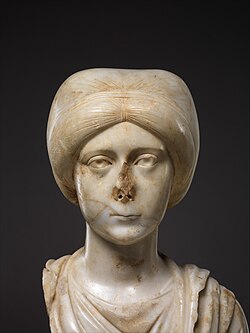 Late fourth century Byzantine woman, wearing a phakeolis.
 -
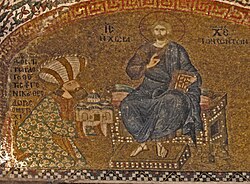 14th century Byzantine, Theodore Metochites, presenting a model of the renovated Chora Church, while wearing a striped turban.
 -
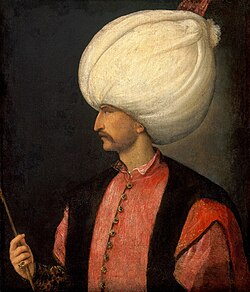 16th century, Suleiman I, wearing the Ottoman imperial turban, known as kavuk.(tr)
 -
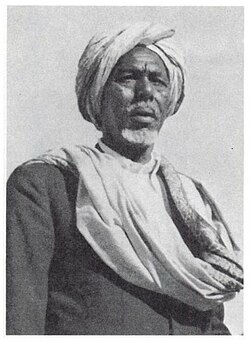
-
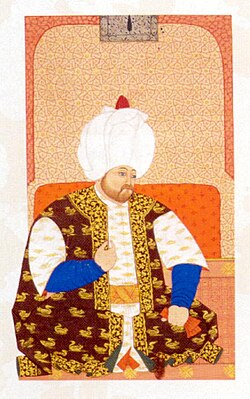 16th century sultan of the Ottoman Empire Selim II wearing the Ottoman imperial turban, known as kavuk
 -
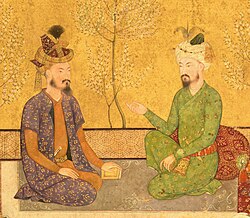
-
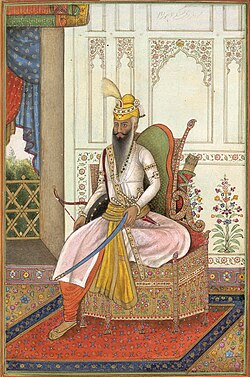 Maharaja Ranjit Singh, founder of the Sikh Empire, wearing a decorated turban (1830).
 -
-
-
-


_with_his_father_Babur_(right),_painted_circa_1640_(Late_Shah_Jahan_Album).jpg)


.jpg)

National styles[edit | edit source]
Asia[edit | edit source]
Afghanistan[edit | edit source]

Turbans are part of the national dress in Afghanistan. In the Uruzgan Province, male government employees are required to wear the Imama.[13] They are used more widely than elsewhere in the Muslim world, and are worn in a wide range of styles and colours. In the country's south-east, turbans are wrapped loosely and largely, whereas in Kabul the garment tends to be smaller and tighter. In traditional Afghan society, a related piece of extra cloth called a patu serves practical purposes, such as for wrapping oneself against the cold, to sit on, to tie up an animal or to carry water in the cap. Different ethnic groups in Afghanistan wear different lungees with different patterns, way of styling it, fabric, stripes, lengths and colouration. Males of all ethnic backgrounds generally avoid wearing bright-coloured turbans that draw attention to oneself and prefer wearing simple colors that are white, off white, gray, dark blue and black.[citation needed]
China[edit | edit source]
In China and its frontiers, turbans were worn, primarily by ethnic minorities with Turkic or Islamic cultural influence. Turbans were worn by the Han Chinese rebels in the Red Turban rebellion.
-
-
-
 Mongols wearing turbans in 1950


Indian subcontinent[edit | edit source]
In India, the turban is referred to as a pagri, meaning the headdress that is worn by men and is manually tied.[14] There are several styles, which are specific to the wearer's region or religion, and they vary in shape, size and colour. For example, the Mysore Peta, the Marathi pheta, and the Puneri Pagadi. The pagri is a symbol of honour and respect everywhere it is worn. It is a common practice to honour important guests by offering them one to wear.[citation needed]
Colours are often chosen to suit the occasion or circumstance: for example saffron, associated with valour or sacrifice (martyrdom), is worn during rallies; white, associated with peace, is worn by elders; and pink, associated with spring, is worn during that season or for marriage ceremonies.[citation needed]

In World War II, some soldiers in the Indian Army were required to wear a turban.[15] The Free India Legion also wore turbans.
In the Indian state of Rajasthan a turban, known as pagri or safa, is a traditional headwear that is an integral part of the state's cultural identity. It is typically made from cotton, silk, or a blend of fabrics and can vary in length. The safa (Parna) is usually around 1 to 4.5 meters (3 ft 3 in to 14 ft 9 in) long, while the pagri can be about 10 meters (33 ft). Some of the most popular turbans in Rajasthan include Jodhpuri safa.[16][17]
In Bangladesh, the turban is known as pagri, or fagri in Chittagong and Sylhet. The most common colour worn is white, and generally it is the Sufis that wear green turbans. It is also worn by elders in rural areas as a symbol of honour and respect.[18]
The turban in Nepal is commonly worn in rural areas by males. The rural turban is called either a Pagdi or Pheta. It is common among farmers. All types of coloured clothes were used for Pheta. Historically, Gorkhali nobleman used to wear white turban called Shirpau awarded by the King of Nepal. For example; Sardar Ram Krishna Kunwar was awarded with 22 pairs of headgear called Shirpau by the Gorkhali monarch Maharajadhiraj Prithvi Narayan Shah.[19] It was common among aristocrats in other contemporary kingdoms. Rulers and vassal lords also adapted a crest to the white turban.[citation needed]
-
 Paag of Mithilalok
 -
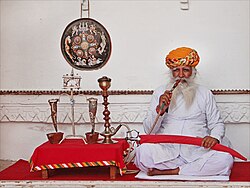 A man from India, wearing a Rajasthani paggar style of turban
 -
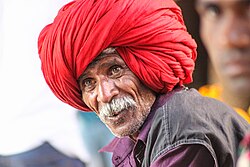 A man from Madhya Pradesh wearing a turban
 -
Malik Ata Muhammad Khan, Nawab of Kot Fateh Khan in Pakistan, wearing a turban made from 6.4 metres (7.0 yards) of cloth
-
 Nepalese Sardar Bhakti Thapa, a Gorkhali nobleman wearing aristocratic white Shirpau turban
 -
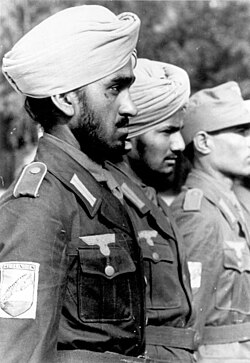 Free India Legion soldiers wearing turbans.

_(8411728143).jpg)


Europe[edit | edit source]
United Kingdom[edit | edit source]
In the United Kingdom, turbans have been worn by men and women since the sixth century without ever becoming very common. Poet Alexander Pope is sometimes depicted wearing a turban, as were other notable men seen in contemporary paintings and illustrations. The common use of turbans on less formal occasions, among gentlemen at the time, reflects that their heads were closely cropped, or shaved, to allow the wearing of the elaborate wigs that were the fashion in Europe in the century from about 1650 to 1750, and when wigs were off, some kind of head cover was useful. Hence, the turban.[citation needed]
Now that hats are infrequently worn, turbans too are relatively uncommon. They are worn primarily by women of West Indian descent, Karinas. Some women wear them to make a statement of individuality, such as the British social entrepreneur Camila Batmanghelidjh, who usually wore a colourful matching turban and robe.[citation needed]
-
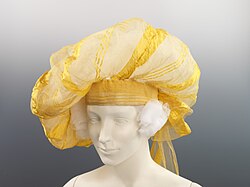 The "à la turque" style of this British headdress from c. 1820, influenced and inspired by the popular interest in Eastern cultures, was popular in the 1820s.[20]
 -
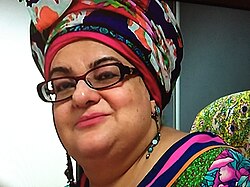 Camila Batmanghelidjh, charity founder.
 -
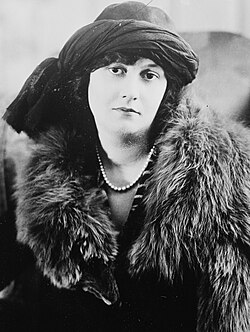 Elizabeth Bibesco, actress.
 -
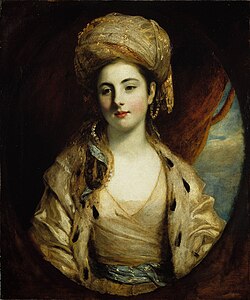 Vertue Jodrell.
 -
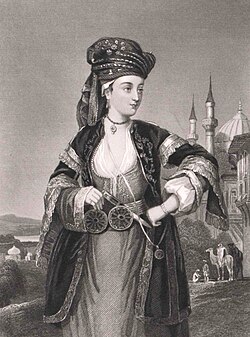 Mary Wortley Montagu, medical pioneer, writer, and poet.
 -
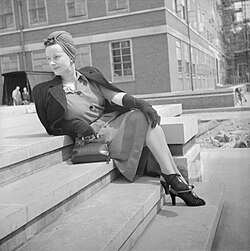 World War 2 style.

.jpg)


Albania[edit | edit source]

In Northern Albania and some regions of Kosovo, particularly among highlanders, men traditionally wear a long, white turban-like cloth known as a shall or shalla.[21] It is over three meters long and is worn from age 7 onwards, then used as a burial shroud after death.[22] It is often worn over the qeleshe (plis), the traditional Albanian felt cap, to protect from the elements. The shall is most commonly worn in the Malësia regions and the Rugova highlands of Kosovo, though it is only seen in traditional folk attire and cultural ceremonies.[23]
Greece[edit | edit source]
In Greece, specifically the island of Crete, the men traditionally wear a lightly knitted turban known as a sariki.[24][25] The headwrap's name is borrowed from sarık, the Turkish word for turban. Today, it may be more commonly known as a kritiko mandili (Cretan kerchief). It is only found in the folklore Cretan dress and not amongst the population, with the exception of older men in remoter, mountainous villages.[citation needed]
Fiji[edit | edit source]
iTaukei indigenous chiefs and priests were known to have worn masi (barkcloth) coverings around their head similar to a turban, called an i-sala. However, most of the bulk and shape of the i-sala came from the bushy hair under the cloth.[26][27]
Armenia[edit | edit source]

Though not common in daily apparel, turbans are sometimes worn by men ceremonially (often with beards), as a symbol of national identity during celebrations and festivals. However, before Armenia became a Christian nation, turbans were a common part of the daily apparel, just as in other Middle Eastern countries.[citation needed]
Other[edit | edit source]
On the Swahili Coast, turbans were frequently worn by the ruling Omani Sultans of Zanzibar and their retinue.[citation needed]
Tuareg Berbers, and some northern Berbers, Sahrawi, Songhai, Wodaabe, Fulani, and Hausa peoples of North and West Africa wear varieties of turbans. Tuareg Berbers often veil the face to block dust. This Tuareg-Berber turban is known as a tagelmust, and is often blue. The Bedouin tribes in North Africa sometimes wear brown-beige, white or orange turbans. Colombian politician Piedad Cordoba was known to wear turbans (or a similar headgear). Her use of turbans had made her so distinguishable to the point of having earned the nickname "the lady with the turban" in Colombian popular culture.[citation needed]
Kurdish people wear a turban, which they call a jamadani. It is worn in many different ways across Iraqi Kurdistan depending on the style of the locality; e.g. the Barzani Kurds are a tribe which wears the turban in a colour (red and white) and style which is typical of their clan. In most parts of South Kurdistan a black-white pattern is used for Jamadani. Mostly, Kurdish turbans consist of a length of striped cloth known as kolāḡī which is wound around a conical hat; the tassels that border the kolāḡī are allowed to hang down over the face. In modern times, many Kurds use black and white Ghutra and roll them into turbans.[citation needed]
Turbans have also been a type of headwear worn by women in Western countries. The wearing of such turbans by women in Western societies is less common than it was earlier in the 20th century. They are usually sewn to a foundation, so that they can be donned or removed easily. Turbans are also sometimes donned to protect hair or as a headwrap for women following cancer treatments that cause hair loss.[28] They can also be tied together to form a rope in emergency rescue situations.[29] In popular culture, turbans are also sometimes worn as a fashion statement. For example, American rapper Yeat wears turbans often while being photographed and filmed in public. He also has a song titled "Turban".[citation needed]
In religion[edit | edit source]
Sikhism[edit | edit source]

The Sikh turban, known mainly as the dastar but also the dumalla, is used to show others that they represent the embodiment of Sikh teachings, the love of the Guru and dogma to do good deeds.[30] The Gurus ensured that both men and women are able to wear a turban, which shows another action of equality. Other Purposes of the turban include protecting Sikhs' long unshorn hair and keeping it clean.[31]
Sikhs do not cut their hair, as a religious observance. The turban protects the hair and keeps it clean. As Sikhs form 1.7% of India's population and 1.5% of Canada's population, their turbans help identify them. When he institutionalized the turban as a part of the Sikh identity, Guru Gobind Singh said, "My Sikh will be recognized among millions".
Turbans were formerly associated with the upper class, and many men in the cultural elite still wear turbans. This distinction between the turban-wearing upper class (Sardars) and commoners promoted segregation and elitism. In order to eliminate the class system associated with turbans, Guru Gobind Singh declared each and every Sikh a Sardar.
Modern Sikh men mainly wear four kinds of turban: Vattan Wali Turban, Amritsar Shahi Turban, Barnala Shahi and Taksali Dumala. The more traditional Turban styles are the Darbara Singh Dummala, Dastar Bunga (the original turban of the Khalsa) and the Puratan Nok Pagg.
The most common turban colors worn by Sikhs are blue, white and black, although other colors are popular as well. Blue and yellow are particularly prestigious and tend to be worn on religious events such as Vaisakhi. Meanings of the turbans are that the white turban means a saintly person leading an exemplary life, and an off-shade color of white means someone is learning in the Sikh religion. The blue turban signifies a mind as broad as the sky with no place for prejudice. The black turban serves as a reminder of the Jallianwala Bagh massacre in 1919, and represents humility. The Basanti or yellow turbans are associated with the revolutionary movement, Sardar Bhagat Singh also wore a yellow turban for this reason. Royal blue is usually worn by those who are learned in the Sikh religion and are patriotic about their traditions and culture. The colour green signifies farmers. The orange turban means courage and wisdom.[citation needed] The colour Gold symbolizes a sense of calm and healing that helps with anxiety and clearing the mind which significance derives from the Golden temple. Akali Nihang Sikhs decorate their blue turbans or Dumalla by wearing small weapons known as shastars in them. The turban's color may reflect association with a particular group of Sikhs, although none of the popular turban colors are exclusive to any particular group. The preferred color of the Sikh wedding is pink. All shades of this color from magenta to baby pink is used by families for the joyful occasion. Some prefer red, maroon or orange turbans for the weddings, but pink is so far the most popular. Turban colors are generally a matter of personal choice in Sikhism, with many Sikh men choosing colors based on fashion or taste, sometimes to match clothes. There are traditions associated with some colours, for instance orange and black are often worn at political protest rallies whilst red and pink turbans are worn at weddings and other celebratory events.[32][33][34]
-
 Rajvir Jawanda, a singer and actor
 -
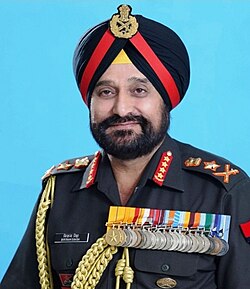 Bikram Singh, former Chairman of the Chiefs of Staff Committee of India
 -
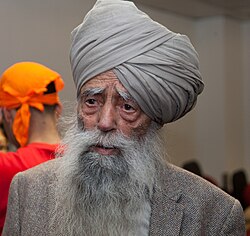
-
 Diljit Dosanjh, an actor, singer, television presenter and social media celebrity
 -
-
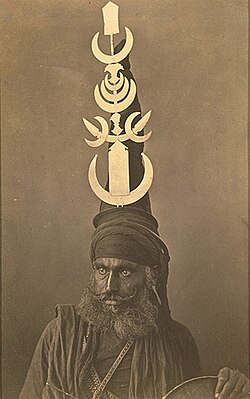 An Orthodox Sikh Nihang with a Dastar Bunga
 -
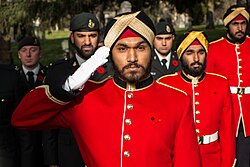 Cdt. Sarabjot Anand, OCdt. Sarbjeet Nijher and OCdt. Saajandeep Sarai represent Royal Military College of Canada at Sikh Remembrance Day 2013
 -
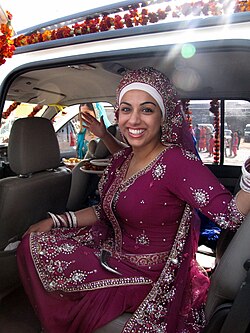 A Sikh Woman with a turban
 -
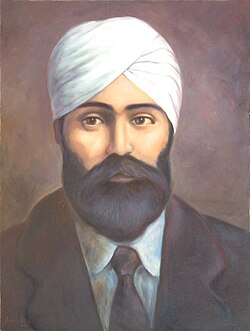 Mewa Singh, the man who spearheaded the Ghadar Movement
 -
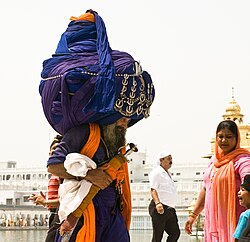 A Sikh with a darbara Singh dumala
 -
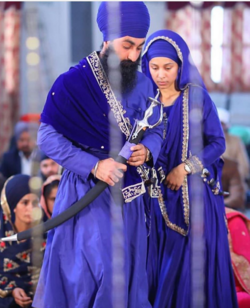 A Sikh man and woman both with turbans
.jpg)


Christianity[edit | edit source]

In Kenya, the Akurinu, a Christian denomination, wear turbans as religious headgear. The official name of the denomination is The Kenya Foundation of the Prophets Church, or else Holy Ghost Church. Both men and women wear white turbans; children wear tunics. Some Oriental Orthodox churches such as the Coptic Orthodox Church and the Syriac Orthodox Church include turbans in the vestments for the priest.
The origin of the word akurinu is not clear. It is said by some to come from the Kikuyu question Mukuri-ni which translates to 'who is the redeemer?'. Others say that it comes from the growling sounds made by early adherents to the sect when possessed by the spirit, an act described as gukurina. In his book Facing Mt. Kenya, Jomo Kenyatta states that the akurinu referred to themselves as Arooti(dreamers), people of God.
The akurinu identify Joseph Ng'ang'a as the founder of the sect. It was Ng'ang'a who ascended Mount Kenya (then known as Mount Kirinyaga) with the first four akurinu prophets - Joseph Kanini, Henry Maina, Philip Mukubwa, and Lilian Njeru. It was on this ascension that the akurinu say Njeru was instructed to remove all adornments she had worn, throw them into River Nyamindi, and cover her hair. They also claim to have been instructed by God to lift their hands in the air as they pray. These two practices form an integral part of akurinu religious beliefs today.
Islam[edit | edit source]
In Islamic cultures, some men wear a turban-style headdress in emulation of Prophet Muhammad who is believed to have worn a black or white turban.[35][5][36][37][38] It is sometimes called an Imama. The head wraps are worn in different ways and called by different names depending on the region and culture. Examples include (Arabic: عمامة `emãmah) in Arabic, and the Dastar (Persian: دستار) in Persian. The most preferred style is the elliptic cylindrical headwrap, with the tail hanging behind.
In Shi'a Islam, a black head wrap around a small white cap is worn by descendants of Muhammad called Sayyids, and white turbans by other well-educated persons and scholars. Sufi Muslims often wear a green head wrap around a small cap or the green head wrap alone. Members of the Dawat-e-Islami movement wear green turbans,[39] whereas members of Sunni Dawate Islami (which broke away from Dawat-e-Islami in 1992) wear white turbans.[39]
In Sudan, large white headdresses connote high social status.[citation needed] In India and Pakistan the cap is called a topi. Women of Islam typically do not wear turbans, as it is typically considered part of a man's dress, while women do typically cover their hair as part of hijab.
However, just as some Muslim women wear no headcovering, some modern Muslim women wear a turban style covering. Although it is still not as widely accepted by the more conservative Islamic communities.
-
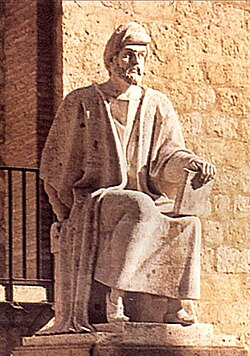
-
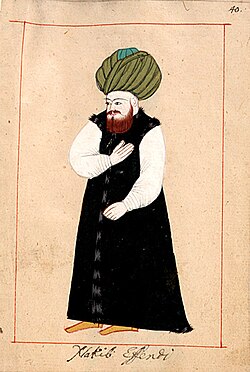 In the Ottoman Empire, Muhammad's numerous descendants formed a kind of nobility with the privilege of wearing green turbans
 -
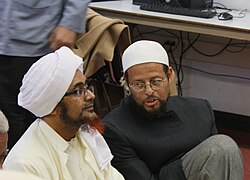 Habib Umar bin Hafiz (left) of Yemen wearing a white turban
_-_BAE09705.jpg)


Judaism[edit | edit source]
The traditional Jewish turban is known as a sudra. When the Jewish High Priest served in the Tabernacle and the Temple in Jerusalem, he wore a head covering called mitznefet מִצְנֶפֶת. This word has been translated as mitre (KJV) or headdress. It was most likely a turban, as the word comes from a root meaning 'to wrap'.
In the Hebrew Bible, the turban worn by the High Priest was much larger than the head coverings of the priests and wound to make a broad, flat-topped shape resembling the blossom of a flower. The head covering of the priests was different, being wound to form a cone, called a migbahat.
The priestly crown (Hebrew tzitz צִיץ "blossom", "flower") was attached to the turban by means of two sets of blue cords: one going over the top of the head and the other around the sides of the head at the level of the ears (Exodus 39:31).
According to the Talmud, the wearing of the turban atoned for the sin of haughtiness on the part of the Children of Israel (B. Zevachim 88b).
The Jews who lived under Arab rule during the Middle Ages, notably in Islamic Spain, wore turbans and headwear not too different from their Muslim counterparts.
The Sephardi Chief Rabbi of Israel, also known as Rishon LeZion customarily wears a turban (mitznefet).[40][41]
Some married Jewish women wear mitpaḥats as an act of modesty.
Mandaeism[edit | edit source]
Mandaean priests wear white turbans called burzinqa.[42][43]
Hinduism[edit | edit source]
In Hinduism, many peoples wear it due to culture. It is called a Pheta. It is a cultural practice driven by the harsh summer months in India especially in the state of Rajasthan. Apart from turban; there are several other headgears and also different types of turbans used in different parts of India and people wear them when going out especially in villages.
Rastafari[edit | edit source]
Members of the Bobo Ashanti mansion of the Rastafari movement keep their hair and beards, mainly with their hair in dreadlocks, and they have been wearing turbans over their dreadlocks, which are not to be removed publicly or even not at all, so as to protect and keep their dreadlocks clean. This is called a Rasta headwrap. Along with the turban, they have also been wearing robes since their founding in the 1950s,[44] Since they are a relatively small population, it makes them more distinctive in appearance in Jamaica and elsewhere.[45]
See also[edit | edit source]
References[edit | edit source]
- ↑ "Turbans Facts, information, pictures | Encyclopedia.com articles about Turbans". encyclopedia.com. Archived from the original on 3 April 2016. Retrieved 19 April 2016.
- ↑ Kanti Ghosh, Sumit (18 May 2023). "Body, Dress, and Symbolic Capital: Multifaceted Presentation of PUGREE in Colonial Governance of British India". Textile. 22 (2): 334–365. doi:10.1080/14759756.2023.2208502. S2CID 258804155. Archived from the original on 21 May 2023. Retrieved 21 May 2023.
- ↑ "Oxford Beige Turban". turbanandbeard.com. Archived from the original on 25 August 2019. Retrieved 25 August 2019.
- ↑ "Do Sikh women have to wear a Turban (Dastaar) as well as men?". Sikh Answers. Archived from the original on 25 December 2018. Retrieved 19 April 2016.
- ↑ 5.0 5.1 Haddad, Sh. G. F. "The turban tradition in Islam". Living Islam. Archived from the original on 25 December 2018. Retrieved 5 August 2013.
- ↑ Ethnic Dress in the United States: A Cultural Encyclopedia, page 293, Annette Lynch, Mitchell D. Strauss, Rowman & Littlefield
- ↑ India: The Ancient Past: A History of the Indian Subcontinent from C. 7000 BCE to CE 1200, page 58, Burjor Avari, Routledge
- ↑ "P. Ovidius Naso, Metamorphoses, Book 11, line 146". Perseus Digital Library. Retrieved 21 January 2017.
- ↑ Goldman, Norma; Nyenhuis, Jacob E. (1 January 1982). Latin Via Ovid: A First Course. Wayne State University Press. ISBN 0814317324. Retrieved 21 January 2017.
- ↑ D'Amato, Raffaele (10 August 2005). Roman Military Clothing (3): AD 400–640. Bloomsbury USA. ISBN 9781841768434. Retrieved 21 January 2017.[permanent dead link]
- ↑ Condra, Jill (1 January 2008). The Greenwood Encyclopedia of Clothing Through World History: 1801 to the present. Greenwood Publishing Group. ISBN 9780313336652. Retrieved 21 January 2017.
- ↑ Hughes, Thomas Patrick. A Dictionary of Islam: Being a Cyclopedia of the Doctrines, Rites, Ceremonies and Customs Together with the Technical and Theological Terms of the Muhammadan Religion. WH Allen & Company, 1895.
- ↑ Azadi, RFE/RL's Radio. "Regional Taliban Officials Ban Beard Trimming, Impose Turbans For Male Employees". RadioFreeEurope/RadioLiberty. Archived from the original on 29 March 2024. Retrieved 29 March 2024.
- ↑ "Sikhs Must Wear Turbans to Maintain and Honor Their Hair". Learn Religions. Archived from the original on 23 February 2024. Retrieved 23 February 2024.
- ↑ "From Mesopotamia to West London, a 4,000-year history of the turban". CNN. 15 February 2019. Archived from the original on 6 October 2023. Retrieved 27 September 2020.
- ↑ Studio, Rajasthan (15 January 2021). "Facts about Rajasthani Pagri - The Unique Headgear of the State -". Rajasthan Studio. Retrieved 22 March 2024.
- ↑ "PM's Choice of Turban: The Jodhpuri Safa". NDTV.com. Retrieved 22 March 2024.
- ↑ Ghosh, Sumit Kanti (2021). "'পাগড়ি হঠাও': শরীর, পোশাক ও ব্রিটিশ ভারতের ঔপনিবেশিক পরিচালন". Nirvijnana Patrika, Jahangirnagar University (26): 1–14 – via Jahangirnagar University.
- ↑ Hamal, Lakshman B. (1995). Military history of Nepal. Sharda Pustak Mandir. p. 125. OCLC 32779233.
- ↑ "Turban | British | The Met". The Met. 1820.
- ↑ "The ensemble and traditional games of Rugova under the protection of the state". KOHA.net. 16 September 2020. Retrieved 18 March 2025.
- ↑ "Veshjet tradicionale të Rugovës, detaje që s'i keni ditur... - POPULLI.MK" (in shqip). 11 December 2023. Retrieved 18 March 2025.
- ↑ Vatovci, Isa (15 September 2020). "Tradita folklorike e Rugovës shpallet trashëgimi e mbrojtur nga shtetit". Raporto Korrupsionin! KALLXO.com. Retrieved 18 March 2025.
- ↑ "Sariki - headgear of the Cretan men with dense fringes like tears". Meet Crete. 16 April 2016. Archived from the original on 6 October 2023. Retrieved 27 September 2023.
- ↑ "Moustakia Sarikia and Stivania; three very Cretan traditions". www.we-love-crete.com. Archived from the original on 1 December 2023. Retrieved 27 September 2023.
- ↑ Me, Rondo B. B. (2004). Fiji Masi: An Ancient Art in the New Millennium. Burleigh Heads: Catherine Spicer and Rondo B.B. Me. p. 40. ISBN 978-0-646-43762-0.
- ↑ Cochrane, Susan; Quanchi, Max, eds. (2014). Hunting the Collectors: Pacific Collections in Australian Museums, Art Galleries and Archives. Cambridge: Cambridge Scholars Publishing. p. 58. ISBN 978-1-4438-7100-6.
- ↑ "Alternative Wig Idea: Cover Hair Loss With a Cute Cap Instead". About.com Health. Archived from the original on 6 September 2015. Retrieved 19 April 2016.
- ↑ "Turbans used to rescue hiker above waterfall in Golden Ears park". Maple Ridge News. 14 October 2021. Archived from the original on 14 October 2021. Retrieved 14 October 2021.
- ↑ Sidhu, Dawinder (2009). Civil Rights in Wartime: The Post-9/11 Sikh Experience. Ashgate Publishing, Ltd. p. 48. ISBN 9781409496915.
- ↑ "Underneath the Turban: Uncovering Sikh Identity and Resilience". SikhNet. 6 March 2024. Retrieved 3 April 2024.
- ↑ "design: The Orange Turban And Their Importance". testa0.blogspot.ca. 12 June 2013. Archived from the original on 7 March 2016. Retrieved 4 March 2016.
- ↑ "Why Do Sikhs Wear Turbans?". About.com Religion & Spirituality. Archived from the original on 3 March 2016. Retrieved 4 March 2016.
- ↑ "Significance of color/colour of turban/pug/pag/dastaar/pagri/pagree in Sikhism". www.sikhwomen.com. Archived from the original on 11 March 2016. Retrieved 4 March 2016.
- ↑ Rubin, Alyssa J. (15 October 2011). "Afghan Symbol of Identity Is Subject to Search". The New York Times. Archived from the original on 15 October 2011. Retrieved 16 October 2011.
- ↑ Inter Islam. "The turban, topee and kurta – in the light of Ahadith and the practice of our pious predecessors". inter-islam.org. Archived from the original on 25 December 2018. Retrieved 10 February 2014.
- ↑ "Islamic Dress and Head-dress for men". sunnah.org. Archived from the original on 25 December 2018. Retrieved 10 February 2014.
- ↑ "SeekersGuidance – Can Anyone Wear a Turban? Are There Styles Specific for Scholars? – Answers". seekersguidance.org. 19 November 2009. Archived from the original on 25 December 2018. Retrieved 10 February 2014.
- ↑ 39.0 39.1 Gugler, Thomas K. (22 April 2008). "Parrots of Paradise - Symbols of the Super-Muslim: Sunnah, Sunnaization and Self-Fashioning in the Islamic Missionary Movements Tablighi Jama'at, Da'wat-e Islami and Sunni Da'wat-e Islami". crossasia-repository.ub.uni-heidelberg.de. doi:10.11588/xarep.00000142. Archived from the original on 1 February 2016. Retrieved 9 May 2020.
- ↑ "Ottoman Chief Rabbi's official dress". Israel Museum, Jerusalem. Archived from the original on 7 October 2024. Retrieved 20 January 2025.
- ↑ "Rabbi Ya'akov Meir". Israel Museum, Jerusalem. Retrieved 20 January 2025.
- ↑ "Sikh leader 'forced to remove turban' in Dubai". The Times of India. 4 May 2015. Archived from the original on 8 January 2024. Retrieved 8 January 2024.
- ↑ Buckley, Jorunn Jacobsen (2002). The Mandaeans: ancient texts and modern people (PDF). New York: Oxford University Press. ISBN 0-19-515385-5. OCLC 65198443. Archived (PDF) from the original on 11 October 2017. Retrieved 3 January 2022.
- ↑ "ROOTS RASTA RUNWAY". Archived from the original on 11 December 2008. Retrieved 3 March 2010.
- ↑ "Rastafari: Bobo Shanti". BBC Religions. Archived from the original on 5 February 2024. Retrieved 15 January 2010.
External links[edit | edit source]
- Why Sikhs wear a turban
- Sikh Fortress Turban
- Tutorial on how to make a Turban (Pagri)
- Information on why Sikhs wear Turbans
- Understanding Turbans
- Significance of Turban Infographic
- Body, Dress, and Symbolic Capital: Multifaceted Presentation of PUGREE in Colonial Governance of British India


- Pages using the JsonConfig extension
- Turbans
- Arabic clothing
- Bangladeshi clothing
- Clothing of the Ottoman Empire
- Headgear
- History of Asian clothing
- Indian headgear
- Iranian clothing
- Islamic male clothing
- Middle Eastern clothing
- Religious headgear
- Sikh religious clothing
- Turkish clothing
- Uzbek clothing
- Yemeni clothing