


imported>Place Clichy m Removing from Category:muhajir communities This is for Muhajir communities in Pakistan, not Muslim communities in India using Cat-a-lot |
expand article for clarity and fixed typos per standard format |
||
| Line 1: | Line 1: | ||
{{short description|Community of Sayyids}} | {{short description|Community of Sayyids}} | ||
{{Use dmy dates|date=April 2019}} | {{Use dmy dates|date=April 2019}} | ||
{{Use Indian English|date=April 2019}} | {{Use Indian English|date=April 2019}} | ||
{{Infobox ethnic group | {{Infobox ethnic group | ||
|group= Sadaat-e-Bara or Sadaat Bahera | | group = Sadaat-e-Bara or Sadaat Bahera | ||
| image = Nawab-Mohsin-ul-Mulk.jpg | |||
| image_caption = Mohsin-ul-Mulk, a member of the Sadaat-e-Bara | |||
| popplace = • India • Pakistan | |||
| langs = • [[Urdu language|Urdu]] • [[Hindi language|Hindi]] • [[Awadhi language|Awadhi]] | |||
| rels = [[Shia Islam]] | |||
| related = • [[Sayyid]] • [[Urdu-speaking people]] • [[Arab]] • [[Sayyid of Uttar Pradesh]]• [[Sadaat Amroha]]• [[Gardezi Sadaat]] • Sadaat-e-Sirsi * [[Sadaat-e-Bilgram]] • Sadaat-e-Saithal • Hyderabadi Saadatiyon (Asaf Jahi, Salarjung, Paigah intermixing * ) | |||
}} | |||
'''Sadat e-Bara''' sometimes pronounced Sadaat-e-Bahara, are a tribe of [[Islam in Uttar Pradesh|Indian Muslim]] [[Sayyid]]s, originally elite or noble Sayyid families situated in the present-day [[Muzaffarnagar]] district of [[Uttar Pradesh]] in India.<ref>{{cite book |url= https://books.google.com/books?id=uzOmy2y0Zh4C&dq=sayyids+barha+indian+muslim&pg=PA175 |title=A History of Modern India, 1480-1950 |page=175 |date=2002 |isbn=9781843310044 |last1=Markovits |first1=Claude |publisher=Anthem Press }}</ref> | |||
This community had considerable influence during the early 18th century [[Mughal Empire]]. Its members were also found in [[Hyderabad]], [[Karnal District]] and [[Haryana]], [[Gujarat]] & [[Karnataka]], [[Maharashtra]] state in India. Some of the members of this community have migrated to Pakistan after independence and have settled in [[Karachi]], [[Khairpur State]] in Sind and [[Lahore]].{{cn|date=October 2023}} | |||
==History | ==History== | ||
[[File:Sayyid from Saadat-e Barah.jpg|thumb|A cavalryman of the Saadat-e Barah.]] | |||
According to one version, the ancestor of the Sadaat-e-Bara, Sayyid Abu Farah al-Husayni al-Wasiti, left his original home in [[Wasit]], Iraq, with his twelve sons at the end of the 10th or beginning of the 11th century CE and migrated to India, where he acquired four estates in the Punjab.<ref name=SayyidAbuFarrah /> These estates were located in [[Sirhind-Fategarh]]. By the 16th century Abu Farah's descendants had taken over Bārha villages in [[Muzaffarnagar district|Muzaffarnagar]].<ref name=SayyidAbuFarrah>{{Cite book|url=https://books.google.com/books?id=95Q3AAAAIAAJ&pg=PA126&dq=Sayyids+of+North+India&hl=en&sa=X&ei=E2zAUIGBHYKImQWguoCwAg&ved=0CC4Q6AEwADgo#v=onepage&q=Sayyids&f=false|first1=Clifford Edmund |last1=Bosworth|date=1980|publisher=Brill|language=en|title=The Encyclopaedia of Islam: Supplement: Parts 1-2|page=126|isbn=9004061673 }} {{webarchive|url=https://web.archive.org/web/20160506195910/https://books.google.com/books?id=95Q3AAAAIAAJ&pg=PA126&dq=Sayyids+of+North+India&hl=en&sa=X&ei=E2zAUIGBHYKImQWguoCwAg&ved=0CC4Q6AEwADgo|date=6 May 2016}}</ref> | |||
Another version says the family are an Indian [[Muslim]] clan, whose claim to be [[Sayyid]]s (descendants of the Prophet [[Muhammad]]) has been disputed by some modern historians.{{sfn|Kolff, Dirk H. A.|2002|p=18}}{{sfn|Reichmuth, Stefan|2009|p=4}} American historian [[Richard M. Eaton]] considered that their clan was "as native to India as were [[Jats]], [[Rajputs]] or [[Marathas]]."<ref>{{Cite book |authorlink=Richard M. Eaton |author=Eaton, Richard M. |url=https://books.google.com/books?id=WpCMEAAAQBAJ |title=India in the Persianate Age: 1000-1765 |date=2020 |publisher=National Geographic Books |isbn=978-0-14-198539-8 |language=en|page=342|quote=On one side were the Saiyid brothers, whose Baraha clan of Indian Muslims was as native to India as were Jats, Rajputs or Marathas.}}</ref> Also, Dutch historian and indologist [[Dirk H. A. Kolff]] argues that the ancestors of the Barhas moved at an uncertain date from their homeland in [[Punjab]] to a barren region in the [[Muzaffarnagar district]] of [[Uttar Pradesh]].{{sfn|Kolff, Dirk H. A.|2002|loc=p.18: As another example of such soldiers of marginal peasant origin, the Barha Sayyids, a celebrated troop of soldiers under the Mughals deserve attention. They were said to be the descendants of the families who had, at an uncertain date, moved from their homes in [[Punjab|Panjab]] to a sandy and infertile tract of what is now the eastern part of the Muzaffarnagar district}} | |||
===Role in the Mughal empire=== | |||
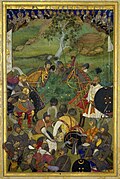
[[File:The Decapitation of Khan Jahan Lodi.jpg|thumb|The Decapitation of [[Khan Jahan Lodi]] (3 February 1631), with Syed Mian Barha on the right and Khan-i Jahan Muzaffar Khan Barha on the left|left]] | |||
The Barha Sayyid tribe was famous throughout the country for its obstinate valour and love of fight, as well as religious fervour.<ref>{{cite book |url=https://books.google.com/books?id=Rz16lub2uRgC&q=sayyids+barha+tribe |title=A Social History of Islamic India, 1605-1748 |author=Mohammad Yasin ·|date=1958 }}</ref>{{pn|date=October 2023}} The tribe traditionally composed the vanguard of the imperial army, which they alone held the hereditary right to lead in every battle.<ref>{{cite book |url= https://books.google.com/books?id=3RVDAAAAYAAJ&q=barha+sayyids+every+battle |title= Journal of the Rajasthan Institute of Historical Research: Volume 12 |date= 1975 |publisher= Rajasthan Institute of Historical Research |author= Rajasthan Institute of Historical Research}}</ref>{{full|date=October 2023}} | |||
==== Conquest of Gujarat (1572–1573) ==== | |||
Akbar’s conquest of Gujarat targeted the weakened [[Gujarat Sultanate]] under [[Muzaffar Shah III]] to secure its ports and agricultural wealth. The Akbarnama highlights Sayyid Mahmud Khan Barha, a Barha Sayyid, who served as a commander during the siege of Surat in 1573. He led Mughal forces against the rebellious Mirzas ([[Muhammad Husain Mirza]] and Shah Mirza), securing a decisive victory.<ref name=Akbarnama-III>{{cite book |last=Abu’l-Fazl |title=Akbarnama |volume=III |translator=Beveridge, Henry |year=1907–1921 |publisher=Asiatic Society of Bengal |location=Calcutta}}</ref> Sayyid Ahmad Barha also played a key role in the siege of Patan (January 1573), supporting Khan A‘zam against the Mirzas and Sher Khan Fuladi, repelling the besiegers and consolidating Mughal control.<ref name=Akbarnama-III/><ref>{{cite book |last=Richards |first=John F. |title=The Mughal Empire |year=1995 |publisher=Cambridge University Press |isbn=978-0-521-56603-2 |pages=45–47}}</ref> | |||
==== Conquest of Malwa (1561–1562) ==== | |||
The conquest of [[Malwa]] aimed to defeat the Afghan ruler [[Baz Bahadur]]. The Akbarnama records Sayyid Mahmud Khan Barha’s participation under Adham Khan in the Battle of Sarangpur (1561), where Baz Bahadur was routed.<ref name=Akbarnama-II>{{cite book |last=Abu’l-Fazl |title=Akbarnama |volume=II |translator=Beveridge, Henry |year=1907–1921 |publisher=Asiatic Society of Bengal |location=Calcutta}}</ref> The campaign was marred by Adham Khan’s slaughter of Muslim theologians and Sayyids, highlighting their dual role as commanders and victims.<ref name=Akbarnama-II/><ref>{{cite book |last=Majumdar |first=R. C. |editor=Majumdar, R. C. |title=The Cambridge History of India, Volume IV: The Mughul Period |year=1960 |publisher=S. Chand & Co. |location=New Delhi |pages=112–114}}</ref> | |||
==== Conquest of Rajasthan: Chittor (1567–1568) and Ranthambore (1569) ==== | |||
Akbar’s campaigns against [[Rajput]] rulers, notably in [[Chittor]] and [[Ranthambore National Park|Ranthambore]], were central to his Rajput policy. Sayyid Muhammad Khan aided in breaching Chittor’s defenses against [[Jaimal Rathore]] and [[Patta Singh Sisodia]].<ref name=Akbarnama-II/> Sayyid Qasim Barha supported the Ranthambore siege, facilitating Rao Surjan Hada’s surrender.<ref name=Akbarnama-II/><ref>{{cite book |last=Majumdar |first=R. C. |editor=Majumdar, R. C. |title=The Cambridge History of India, Volume IV: The Mughul Period |year=1960 |publisher=S. Chand & Co. |location=New Delhi |pages=118–120}}</ref> The Akbarnama notes Sayyid Muhammad Khan’s role in the siege of Chittor (1567–1568), where he served as a commander under Akbar, contributing to the defeat of Jaimal Rathore.<ref name=Akbarnama-II/> Sayyid Qasim Barha participated in the Ranthambore campaign (1569), aiding the siege against Rao Surjan Hada, which led to the fort’s surrender.<ref name=Akbarnama-II/><ref>{{cite book |last=Richards |first=John F. |title=The Mughal Empire |year=1995 |publisher=Cambridge University Press |isbn=978-0-521-56603-2 |pages=50–52}}</ref> | |||
==== Campaigns against Afghan rebels ==== | |||
Afghan rebellions in eastern India challenged Akbar’s authority. The Akbarnama records Sayyid Ahmad Khan’s efforts in [[Jaunpur Sultanate|Jaunpur]] and [[Bihar]] during the 1560s, suppressing rebels like Khan Zaman (Ali Quli Khan).<ref name=Akbarnama-II/> Sayyid Abdullah Khan fought against [[Daud Khan Karrani]] in [[Bengal]], contributing to his defeat in 1576.<ref name=Akbarnama-III/><ref>{{cite book |last=Richards |first=John F. |title=The Mughal Empire |year=1995 |publisher=Cambridge University Press |isbn=978-0-521-56603-2 |pages=55–57}}</ref> | |||
=== Aurangzeb era onward === | |||
By the time of Emperor [[Aurangzeb]] in the 17th century, the dynasty was firmly regarded as "Old Nobility" and held prestigious Subahs (provinces) such as [[Ajmer]] and the [[Deccan Plateau|Deccan (Dakhin)]].<ref>{{cite book |last1=Irvine |first1=William |title=The Later Mughals |date=August 2012 |isbn=978-1290917766 |page=203|publisher=HardPress }}</ref> They formed a ''[[Hindustan|Hindustani]]'' faction of Mughal nobility as opposed to the Turko-Persian ''[[Turan|Turani]]'' in the late Mughal period.<ref>{{Cite book |author=[[Richard M. Eaton|Eaton, Richard M.]] |url=https://books.google.com/books?id=WpCMEAAAQBAJ |title=India in the Persianate Age: 1000-1765 |date=2020 |publisher=National Geographic Books |isbn=978-0-14-198539-8 |language=en|pages=342–344}}</ref> | |||
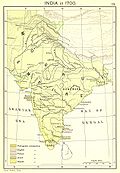
[[File:India in 1700 Joppen.jpg|thumb|The [[Sayyid Brothers]] were de-facto rulers of the Mughal Empire in the 1710s<ref>{{cite book |url= https://books.google.com/books?id=iRFDAAAAYAAJ&q=sayyid+brothers+de-facto+rulers |page=21 |publisher=Department of Modern Indian History |title= Journal of Indian HistoryVolume 39 |date=1960}}</ref>]] | |||
Aurangzeb's warning to his sons to be cautious in dealing with the Sayyids of Barha, "''...because a strong partner in government soon wants to seize the kingship for himself''", would eventually become true.<ref>{{cite book |url=https://books.google.com/books?id=7QhuAAAAMAAJ&q=aurangzeb+demand+the+kingdom+for+themselves |page=22 |author= Muhammad Umar |title= Muslim Society in Northern India During the Eighteenth Century |date=1998 |publisher=Available with the author |isbn=9788121508308 }}</ref><ref>{{cite book |url=https://books.google.com/books?id=aRDeSSAbWdUC&q=barha+they+demand+the+kingdom+for+themselves |page= 48 |author= Jadunath Sarkar |title=Anecdotes of Aurangzeb |year= 1963 }}</ref><ref>{{cite book |url=https://books.google.com/books?id=ciBuAAAAMAAJ&q=warning+syeds+of+barha+prophetic |page= 331 |author= Sheikh Muhammad |title= History of Muslim Civilization in India and PakistanA Political and Cultural History |date=1998 |publisher= Institute of Islamic Culture |isbn= 9789694690018 }}</ref> | |||
Six years after the death of Aurangzeb, the Barhas became kingmakers in the Mughal empire under [[Sayyid Hassan Ali Khan Barha|Qutub-ul-Mulk]] and [[Sayyid Hussain Ali Khan Barha|Ihtisham-ul-Mulk]], creating and deposing Mughal emperors at will.<ref name="sen2">{{Cite book |last=Sen |first=Sailendra |title=A Textbook of Medieval Indian History |publisher=Primus Books |year=2013 |isbn=978-9-38060-734-4 |pages=193}}</ref> | |||
===After the Mughal empire=== | |||
The Barha Sayyids regained many of their estates from the Marathas and regained their status in the parganah by the time of British arrival.<ref>{{cite book |url= https://books.google.com/books?id=GAfgAAAAMAAJ&q=jansath+maratha |title= Fairs and Festivals of India-Volume 3 |date= 2003 |author= Madan Prasad Bezbaruah, Dr. Krishna Gopal |publisher= Indiana University |page= 470 |isbn= 9788121208109 }}</ref> | |||
== See also == | == See also == | ||
* [[Sayyid|Sadaat]] | * [[Sayyid|Sadaat]] | ||
* [[ | * [[Barha dynasty]] | ||
* [[Ashrafization]] | |||
==References== | ==References== | ||
{{Reflist}} | {{Reflist}} | ||
== | ===Sources=== | ||
* | * {{Cite book |author=Kolff, Dirk H. A. |url=https://books.google.com/books?id=SrdiVPsFRYIC&dq=barha+sayyids&pg=PA18 |title=Naukar, Rajput, and Sepoy: The Ethnohistory of the Military Labour Market of Hindustan, 1450-1850 |date=2002 |publisher=Cambridge University Press |isbn=978-0-521-52305-9 |language=en}} | ||
* {{Cite book |author=Reichmuth, Stefan |url=https://books.google.com/books?id=GoCCBAAAQBAJ&dq=barha+sayyids&pg=PA4 |title=The World of Murtada Al-Zabidi: 1732-91 Life, Networks and Writings |date=2009 |publisher=Gibb Memorial Trust |isbn=978-0-906094-60-0 |language=en}} | |||
{{Indian Muslim}} | {{Indian Muslim}} | ||
[[Category:Social groups of Punjab, Pakistan]] | |||
[[Category:Social groups of Sindh]] | |||
[[Category:Social groups of Pakistan | |||
[[Category:Social groups of | |||
[[Category:Muslim communities of Uttar Pradesh]] | [[Category:Muslim communities of Uttar Pradesh]] | ||
[[Category:Muslim communities of Haryana]] | |||
[[Category:Muslim communities of Gujarat]] | |||
[[Category:Muslim communities of Karnataka]] | |||
[[Category:Muslim communities of Maharashtra]] | |||
[[Category:Muzaffarnagar district]] | [[Category:Muzaffarnagar district]] | ||
Latest revision as of 18:56, 28 January 2026
 Mohsin-ul-Mulk, a member of the Sadaat-e-Bara | |
| Regions with significant populations | |
|---|---|
| • India • Pakistan | |
| Languages | |
| • Urdu • Hindi • Awadhi | |
| Religion | |
| Shia Islam | |
| Related ethnic groups | |
| • Sayyid • Urdu-speaking people • Arab • Sayyid of Uttar Pradesh• Sadaat Amroha• Gardezi Sadaat • Sadaat-e-Sirsi * Sadaat-e-Bilgram • Sadaat-e-Saithal • Hyderabadi Saadatiyon (Asaf Jahi, Salarjung, Paigah intermixing * ) |
Sadat e-Bara sometimes pronounced Sadaat-e-Bahara, are a tribe of Indian Muslim Sayyids, originally elite or noble Sayyid families situated in the present-day Muzaffarnagar district of Uttar Pradesh in India.[1]
This community had considerable influence during the early 18th century Mughal Empire. Its members were also found in Hyderabad, Karnal District and Haryana, Gujarat & Karnataka, Maharashtra state in India. Some of the members of this community have migrated to Pakistan after independence and have settled in Karachi, Khairpur State in Sind and Lahore.[citation needed]
History[edit | edit source]

According to one version, the ancestor of the Sadaat-e-Bara, Sayyid Abu Farah al-Husayni al-Wasiti, left his original home in Wasit, Iraq, with his twelve sons at the end of the 10th or beginning of the 11th century CE and migrated to India, where he acquired four estates in the Punjab.[2] These estates were located in Sirhind-Fategarh. By the 16th century Abu Farah's descendants had taken over Bārha villages in Muzaffarnagar.[2]
Another version says the family are an Indian Muslim clan, whose claim to be Sayyids (descendants of the Prophet Muhammad) has been disputed by some modern historians.[3][4] American historian Richard M. Eaton considered that their clan was "as native to India as were Jats, Rajputs or Marathas."[5] Also, Dutch historian and indologist Dirk H. A. Kolff argues that the ancestors of the Barhas moved at an uncertain date from their homeland in Punjab to a barren region in the Muzaffarnagar district of Uttar Pradesh.[6]
Role in the Mughal empire[edit | edit source]

The Barha Sayyid tribe was famous throughout the country for its obstinate valour and love of fight, as well as religious fervour.[7][page needed] The tribe traditionally composed the vanguard of the imperial army, which they alone held the hereditary right to lead in every battle.[8][full citation needed]
Conquest of Gujarat (1572–1573)[edit | edit source]
Akbar’s conquest of Gujarat targeted the weakened Gujarat Sultanate under Muzaffar Shah III to secure its ports and agricultural wealth. The Akbarnama highlights Sayyid Mahmud Khan Barha, a Barha Sayyid, who served as a commander during the siege of Surat in 1573. He led Mughal forces against the rebellious Mirzas (Muhammad Husain Mirza and Shah Mirza), securing a decisive victory.[9] Sayyid Ahmad Barha also played a key role in the siege of Patan (January 1573), supporting Khan A‘zam against the Mirzas and Sher Khan Fuladi, repelling the besiegers and consolidating Mughal control.[9][10]
Conquest of Malwa (1561–1562)[edit | edit source]
The conquest of Malwa aimed to defeat the Afghan ruler Baz Bahadur. The Akbarnama records Sayyid Mahmud Khan Barha’s participation under Adham Khan in the Battle of Sarangpur (1561), where Baz Bahadur was routed.[11] The campaign was marred by Adham Khan’s slaughter of Muslim theologians and Sayyids, highlighting their dual role as commanders and victims.[11][12]
Conquest of Rajasthan: Chittor (1567–1568) and Ranthambore (1569)[edit | edit source]
Akbar’s campaigns against Rajput rulers, notably in Chittor and Ranthambore, were central to his Rajput policy. Sayyid Muhammad Khan aided in breaching Chittor’s defenses against Jaimal Rathore and Patta Singh Sisodia.[11] Sayyid Qasim Barha supported the Ranthambore siege, facilitating Rao Surjan Hada’s surrender.[11][13] The Akbarnama notes Sayyid Muhammad Khan’s role in the siege of Chittor (1567–1568), where he served as a commander under Akbar, contributing to the defeat of Jaimal Rathore.[11] Sayyid Qasim Barha participated in the Ranthambore campaign (1569), aiding the siege against Rao Surjan Hada, which led to the fort’s surrender.[11][14]
Campaigns against Afghan rebels[edit | edit source]
Afghan rebellions in eastern India challenged Akbar’s authority. The Akbarnama records Sayyid Ahmad Khan’s efforts in Jaunpur and Bihar during the 1560s, suppressing rebels like Khan Zaman (Ali Quli Khan).[11] Sayyid Abdullah Khan fought against Daud Khan Karrani in Bengal, contributing to his defeat in 1576.[9][15]
Aurangzeb era onward[edit | edit source]
By the time of Emperor Aurangzeb in the 17th century, the dynasty was firmly regarded as "Old Nobility" and held prestigious Subahs (provinces) such as Ajmer and the Deccan (Dakhin).[16] They formed a Hindustani faction of Mughal nobility as opposed to the Turko-Persian Turani in the late Mughal period.[17]

Aurangzeb's warning to his sons to be cautious in dealing with the Sayyids of Barha, "...because a strong partner in government soon wants to seize the kingship for himself", would eventually become true.[19][20][21]
Six years after the death of Aurangzeb, the Barhas became kingmakers in the Mughal empire under Qutub-ul-Mulk and Ihtisham-ul-Mulk, creating and deposing Mughal emperors at will.[22]
After the Mughal empire[edit | edit source]
The Barha Sayyids regained many of their estates from the Marathas and regained their status in the parganah by the time of British arrival.[23]
See also[edit | edit source]
References[edit | edit source]
- ↑ Markovits, Claude (2002). A History of Modern India, 1480-1950. Anthem Press. p. 175. ISBN 9781843310044.
- ↑ 2.0 2.1 Bosworth, Clifford Edmund (1980). The Encyclopaedia of Islam: Supplement: Parts 1-2. Brill. p. 126. ISBN 9004061673. Archived 6 May 2016 at the Wayback Machine
- ↑ Kolff, Dirk H. A. 2002, p. 18.
- ↑ Reichmuth, Stefan 2009, p. 4.
- ↑ Eaton, Richard M. (2020). India in the Persianate Age: 1000-1765. National Geographic Books. p. 342. ISBN 978-0-14-198539-8.
On one side were the Saiyid brothers, whose Baraha clan of Indian Muslims was as native to India as were Jats, Rajputs or Marathas.
- ↑ Kolff, Dirk H. A. 2002, p.18: As another example of such soldiers of marginal peasant origin, the Barha Sayyids, a celebrated troop of soldiers under the Mughals deserve attention. They were said to be the descendants of the families who had, at an uncertain date, moved from their homes in Panjab to a sandy and infertile tract of what is now the eastern part of the Muzaffarnagar district.
- ↑ Mohammad Yasin · (1958). A Social History of Islamic India, 1605-1748.
- ↑ Rajasthan Institute of Historical Research (1975). Journal of the Rajasthan Institute of Historical Research: Volume 12. Rajasthan Institute of Historical Research.
- ↑ 9.0 9.1 9.2 Abu’l-Fazl (1907–1921). Akbarnama. Vol. III. Translated by Beveridge, Henry. Calcutta: Asiatic Society of Bengal.
- ↑ Richards, John F. (1995). The Mughal Empire. Cambridge University Press. pp. 45–47. ISBN 978-0-521-56603-2.
- ↑ 11.0 11.1 11.2 11.3 11.4 11.5 11.6 Abu’l-Fazl (1907–1921). Akbarnama. Vol. II. Translated by Beveridge, Henry. Calcutta: Asiatic Society of Bengal.
- ↑ Majumdar, R. C. (1960). Majumdar, R. C. (ed.). The Cambridge History of India, Volume IV: The Mughul Period. New Delhi: S. Chand & Co. pp. 112–114.
- ↑ Majumdar, R. C. (1960). Majumdar, R. C. (ed.). The Cambridge History of India, Volume IV: The Mughul Period. New Delhi: S. Chand & Co. pp. 118–120.
- ↑ Richards, John F. (1995). The Mughal Empire. Cambridge University Press. pp. 50–52. ISBN 978-0-521-56603-2.
- ↑ Richards, John F. (1995). The Mughal Empire. Cambridge University Press. pp. 55–57. ISBN 978-0-521-56603-2.
- ↑ Irvine, William (August 2012). The Later Mughals. HardPress. p. 203. ISBN 978-1290917766.
- ↑ Eaton, Richard M. (2020). India in the Persianate Age: 1000-1765. National Geographic Books. pp. 342–344. ISBN 978-0-14-198539-8.
- ↑ Journal of Indian HistoryVolume 39. Department of Modern Indian History. 1960. p. 21.
- ↑ Muhammad Umar (1998). Muslim Society in Northern India During the Eighteenth Century. Available with the author. p. 22. ISBN 9788121508308.
- ↑ Jadunath Sarkar (1963). Anecdotes of Aurangzeb. p. 48.
- ↑ Sheikh Muhammad (1998). History of Muslim Civilization in India and PakistanA Political and Cultural History. Institute of Islamic Culture. p. 331. ISBN 9789694690018.
- ↑ Sen, Sailendra (2013). A Textbook of Medieval Indian History. Primus Books. p. 193. ISBN 978-9-38060-734-4.
- ↑ Madan Prasad Bezbaruah, Dr. Krishna Gopal (2003). Fairs and Festivals of India-Volume 3. Indiana University. p. 470. ISBN 9788121208109.
Sources[edit | edit source]
- Kolff, Dirk H. A. (2002). Naukar, Rajput, and Sepoy: The Ethnohistory of the Military Labour Market of Hindustan, 1450-1850. Cambridge University Press. ISBN 978-0-521-52305-9.
- Reichmuth, Stefan (2009). The World of Murtada Al-Zabidi: 1732-91 Life, Networks and Writings. Gibb Memorial Trust. ISBN 978-0-906094-60-0.