




mNo edit summary Tags: Visual edit Mobile edit Mobile web edit |
No edit summary |
||
| Line 1: | Line 1: | ||
{{short description|Indian Muslim community}} | {{short description|Indian Muslim community}} | ||
{{For|the Indian film|Marakkar: | {{For|the Indian film|Marakkar: Lion of the Arabian Sea}} | ||
{{Infobox religious group | |||
|religions=[[File:Allah-green.svg|15px]] [[Islam]]|scriptures=[[Quran]] & [[Hadith]] | |||
|languages=[[Malayalam language|Malayalam]] • [[Tamil language|Tamil]] • [[Sinhala language|Sinhala]] • [[Malay language|Malay]] • [[Arwi language|Arwi]] • [[Hindustani language|Hindustani]] | |||
|population=~5 million | |||
|image=Sri Lankan Marakkars of Pettah.jpg | |||
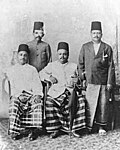
|caption=Sri Lankan Marakkars in the business district of Colombo (Pettah), 1891 | |||
}} | |||
{{Use dmy dates|date=September 2019}} | {{Use dmy dates|date=September 2019}} | ||
{{Use Indian English|date=September 2019}} | {{Use Indian English|date=September 2019}} | ||
''' | The '''Marakkars''' or '''Chonaka Mappila''' or '''Chonakar'''{{efn|Marakkar is the [[Malayalam]] spelling. Other spellings include Maricar, Marecar, Marikkar, Markiyar, Marican, Marecan, [[Tamil language|Tamil]] ''Marrakayar'' and [[Sinhala language|Sinhalese]] ''Marakkala''.<ref>{{Cite journal|last=Tschacher |first=Torsten |date=2006|title=The Impact of Being Tamil on Religious Life Among Tamil Muslins in Singapore |url=https://core.ac.uk/download/pdf/48631039.pdf|journal=Degree of Doctor of Philosophy PhD|page=79|via=National University of Singapore }}</ref><ref name=":2" />}} ({{langx|ta|சோனகர்|translit=Cōṉakar}}; [[Arwi]]: {{script/Arabic|چٗونَكَرْ}}) are a mercantile, [[Panethnicity|panethnic]] group inhabiting the southwestern coast of [[India]], [[Sri Lanka]], and [[Southeast Asia]].<ref name=":4">{{Cite journal |last=V. |first=Kunhali |date=1986 |title=Muslim Communities in Kerala to 1798 |url=https://www.scribd.com/document/607699527/MUSLIM-COMMUNITIES-IN-KERALA-TO-1798 |journal=Aligarh Muslim University Journal}}</ref><ref name=":5">{{Cite book |last1=Eusoff |first1=Datin |url=https://books.google.com/books?id=cJtuAAAAMAAJ |title=The Merican Clan: A Story of Courage and Destiny |publisher=Times Books International |year=1997 |isbn=978-981-204-805-9}}</ref><ref name=":6">{{Cite journal |last=McGilvray |first=Dennis |date=1998 |title=Arabs, Moors and Muslims: Sri Lankan Muslim ethnicity in regional perspective |url=http://cis.sagepub.com/cgi/content/abstract/32/2/433 |journal=Contributions to Indian Sociology |volume=199 |pages=439 to 449}}</ref> | ||
Today, Marakkars are found across South Asia (Kerala, Tamil Nadu, Maldives, Sri Lanka) and Southeast Asia (Malaysia, Indonesia, Singapore).<ref name=":5" /><ref name=":6" /> They are a multilingual [[Sunni Islam|Sunni Muslim]] community, speaking [[Tamil language|Tamil]], [[Malayalam]], [[Sinhala language|Sinhala]], [[Dhivehi language|Dhivehi]], or [[Malay language|Malay]] depending on their country of origin.<ref name=":6" /> | |||
The | The Marakkars were prominent medieval traders who controlled significant Indian Ocean commerce.<ref>{{Cite journal |last=Malekandathil |first=Pius |date=2013 |title=Sectional President's Address: INDIAN OCEAN IN THE SHAPING OF LATE MEDIEVAL INDIA |url=https://www.jstor.org/stable/44158814?seq=2 |journal=Proceedings of the Indian History Congress |volume=74 |pages=178–195|jstor=44158814 }}</ref> They are historically notable for mounting the first sustained Indian resistance against European colonialism, fighting the [[Portuguese India Armadas|Portuguese Armada]] for a hundred-years from [[Battle of Cochin|1520 to 1619]] under leaders including Admiral Kunjali Marakkar IV.<ref>{{Cite journal |last=STEPHEN |first=DALE |date= 1977|title=The Islamic Frontier in Southwest India: The Shahid as a Cultural Ideal among the Mappillas of Malabar |url=https://www.jstor.org/stable/311885?seq=1 |journal=Modern Asian Studies Journal |volume=II |issue=1 |pages=41–55|jstor=311885 }}</ref> Earlier waves of Marakkar migration to Southeast Asia contributed to the [[Spread of Islam in Indonesia|spread of Islam]] throughout the Indonesian Archipelago.<ref name=":7">{{Cite journal |last=Hall |first=Kenneth |title=Economic Exchange and Social Interaction in Southeast Asia: Perspectives from Prehistory, History, and Ethnography; The Coming of Islam to the Archipelago: A Reassessment. |url=https://muse.jhu.edu/pub/166/oa_edited_volume/chapter/2701204 |journal=University of Michigan Press |pages=213–231}}</ref> In the early modern period, they became the first Indian community to settle in British Malaya, later forming the [[Jawi Peranakan]] ethnic group.<ref>{{Cite book |last=Pillai |first=Patrick |title=Yearning to Belong. Ch. 1: "Mamak" and Malaysian: The Indian Muslim Quest for Identity |date=October 14, 2015 |publisher=ISEAS Publishing |isbn=9789814519687}}</ref> | ||
== | |||
== Kilai / Branches == | |||
There are at least four known branches of Marakkars: (i) Pandyamandala Marakkars of coastal Tamil Nadu, (ii) Eezhamandala Marakkars of Sri Lanka, (iii) Cholamandala Marakkars of southeast asia, and (iv) Malabar Marakkars of Kerala.<ref>{{Cite book |last=Mohammed |first=SV |title=Charithratile Marakkar Sannidhyam |date=2008 |publisher=Vachanam Books |location=Calicut}}</ref> | |||
=== Marakkars of Sri Lanka === | |||
[[File:Lanka moors.jpg|thumb|Sri Lankan Marakkars (Sapphire Merchants) ]] | |||
In present day, the Marakkars of Sri Lanka are called [[Sri Lankan Moors]], compromising 10.5% of the Sri Lankan population with an aggregate population of 2,283,246.<ref name=":8">{{Cite web |title=Department of Census and Statistics |url=https://www.statistics.gov.lk/Population/StaticalInformation/CPH2024 |access-date=2026-01-23 |website=www.statistics.gov.lk |language=en}}</ref> They were historically called ''Chonakar'' or Eezhamandala Marakkar.<ref name=":9">{{Cite journal |last=Mahroof |first=M. M. M. |date=1995 |title=Spoken Tamil Dialects of the Muslims of Sri Lanka: Language as Identity-Classifier |url=https://www.jstor.org/stable/20836916 |journal=Islamic Studies |volume=34 |issue=4 |pages=407–426 |jstor=20836916 |issn=0578-8072}}</ref> They have over a thousand-year history in the [[Geography of Sri Lanka|western coast]] of Sri Lanka, tracing their origin to the Sabaen and Dilmun traders pre-dating Islam. They are disproportionately urban, constituting 42.9% of the capital city of [[Colombo]], and are known on the island for being a "[[market-dominant minority]]" inhabiting urban centers.<ref name=":8" /> They are native [[Tamil language|Tamil]] speakers with high degrees of [[Sinhala language|Sinhalese]] bilingualism.<ref name=":8" /> | |||
Today, Chonaka Moors remain politically and economically influential on the island. Politically, they are represented in every national party and have held all major ministerial portfolios, including [[Ali Sabry (Sri Lankan politician)|finance]], [[Rauff Hakeem|justice]], [[Badi-ud-din Mahmud|education]], and [[Rishad Bathiudeen|trade]].<ref name=":10">{{Cite book |last=Mohan |first=Vasundhara |url=https://books.google.com/books?id=C322g0fCcMkC |title=Identity Crisis of Sri Lankan Muslims |date=1987 |publisher=Mittal Publications |language=en}}</ref> They have also produced [[List of justices of the Supreme Court of Sri Lanka|five]] Supreme Court Justices since independence. | |||
Economically, though their sectoral monopolies diminished following [[Sirimavo Bandaranaike|Sirimavo]] Bandaranaike's [[Nationalisation in Sri Lanka|nationalization]] policies and socialist reforms, they remain influential in textiles, precious metals, pharmaceuticals, commercial real estate, import-export trade, and retail.<ref name=":10" /> Eastern Moor landlords, or Sonaha Poddiyar, also hold substantial tracts of the most arable paddy land in the eastern provinces.<ref>{{Cite journal |last=Rameez |first=A. |date=2018 |title=Sociology of Sri Lankan Muslims: dealing with different dimensions of Muslim society |url=http://ir.lib.seu.ac.lk/handle/123456789/3073 |language=en-US |issn=1816-949X|journal=Journal of Engineering and Applied Sciences|volume=13|issue=7 |pages=1782–1793}}</ref> | |||
=== Marakkars of Southeast Asia (Chulias) === | |||
[[File:Chulia of Penang (1910).png|thumb|350x350px|Chulia Marakkars of Penang (Early 20th Century)]] | |||
The '''Chulia Marakkars''' of Southeast Asia, known historically as '''Chulias''' or '''Klings''', are Tamil-speaking Muslim Marakkar merchants from the Tamil Nadu, Sri Lanka, and Kerala, who established permanent communities across the Malay Peninsula, Singapore, and the Indonesian archipelago.<ref name=":11">{{Cite book |last=Arasaratnam |first=Sinnappah |url=http://archive.org/details/indiansinmalaysi0000aras |title=Indians in Malaysia and Singapore. -- |date=1970 |publisher=Bombay : Published for the Institute of Race Relations, London, by Oxford University Press |others=Internet Archive |isbn=978-0-19-218184-8}}</ref> | |||
==== Before 1786 ==== | |||
Chulia Marakkars were present in Southeast Asian ports from at least the 14th century, forming one of the principal trading communities at Malacca by the time of Portuguese conquest in 1511.<ref name=":12">{{Cite journal |last=Sundara Sreenivasa Rao. |first=Valarmudi |date=2016 |title=Merchants in Transition: Maritime Trade and Society of Tamil Muslims in the Indian Ocean World, c. 1780–1840 |journal=University of Texas at Austin}}</ref> They maintained their own settlement called ''Kampong Palli'' and were noted by Italian traveller Nicolas Conti as being "very rich, so much so that some will carry on their business in forty of their own ships."<ref name=":12" /> | |||
In the Malacca Sultanate, Tamil Muslims attained the highest offices of state.<ref name=":12" /> '''Bendahara Tun Ali''' served as the fourth prime minister, while his son '''Tun Mutahir''' became the seventh Bendahara, whose efficient administration attracted foreign traders and brought Malacca to its commercial zenith around 1500.<ref name=":12" /> Sultan Muhammad Syah married Tun Ali's sister, Tun Wati, producing the future Sultan Muzaffar Syah.<ref name=":12" /> | |||
Following Malacca's fall, Chulia merchants dispersed to friendlier ports in Aceh, Kedah, Perak, and the Tenasserim coast.<ref name=":12" /> By the 17th century, they dominated trade between India and the Malay Peninsula, with Malay rulers of Kedah, Perak, Terengganu, and Johor appointing them as ''saudagar raja'' (king's merchants) to manage royal trading activities. Prominent ''saudagar raja'' included Sidi Lebbe and Tambi Kecil (titled Raja Mutabar Khan) in Perak, and Syed Nina, Piro Mohamed, and Raja Jamal in Kedah.<ref name=":12" /> Their appointment reflected Chulia strengths: connection to complex commercial networks, negotiating competence, accounting skills, shared Islamic faith with Malay rulers, and multilingual fluency.<ref>{{Cite journal |last=Bhattacharya |first=B. |title=Merchants, Companies and Commerce on the Coromandel Coast, 1650–1740. Arasaratnam Sinnappah. xii, 407 pp. Rupees 190/-. |url=https://www.cambridge.org/core/journals/itinerario/article/abs/merchants-companies-and-commerce-on-the-coromandel-coast-16501740-arasaratnam-sinnappah-delhi-oxford-university-press-1986-xii-407-pp-rupees-190/75795EA1CA1F99267F0F7C624E7E586F |journal=Itinerario |language=en |volume=13 |issue=2 |pages=123–128 |doi=10.1017/S0165115300004368 |issn=2041-2827|location=Delhi|publisher=Oxford University Press|year=1986|url-access=subscription }}</ref> | |||
==== After 1786 ==== | |||
The British establishment of Penang (1786) and Singapore (1819) drew large-scale Chulia migration from the Coromandel Coast.<ref name=":11" /> Captain Francis Light estimated 1,000 Chulias in early Penang, with annual arrivals of 1,500–2,000 more.<ref name=":11" /> By the 1833 census, there were 7,886 Chulias in Penang and 510 in Province Wellesley. '''Cauder Mohideen Merican''' was appointed the first Kapitan Kling in 1801 and founded the Kapitan Keling Mosque, which holds one of Malaysia's largest ''waqf'' endowments.<ref name=":11" /> | |||
Economically, Chulia Marakkars virtually monopolised Penang's shipping and stewarding industry, providing lighters (''tongkangs'') for loading and unloading cargo, earning them the nickname "Mamak Tongkang." <ref name=":11" /> They dominated the textile trade with Southeast Asia, exporting blue cloths, chintz, ginghams, and long cloths from Coromandel ports.<ref name=":11" /> When British cotton manufactures began competing from the 1820s, Chulia merchants adapted by diversifying into provision stores, jewellery, money-changing, and publishing.<ref name=":11" /> | |||
Today, Chulia Marakkars remain influential in the restaurant trade (approximately 12,000 ''mamak'' establishments nationwide), jewellery, textiles, pharmaceuticals, and retail.<ref name=":11" /> The ''nasi kandar'' trade, originating with Chulia rice sellers in colonial Penang, has evolved into a multi-million ringgit franchise industry.<ref name=":11" /> Replicas of the Nagore Dargah in Penang and Singapore commemorate the community's enduring transoceanic Sufi networks.<ref name=":11" /> | |||
=== Jawi Peranakan === | |||
[[File:A.O. Merican and his family.png|thumb|350x350px|Merican Clan of the Jawi Peranakan]] | |||
The '''[[Jawi Peranakan]]''' (also called ''Jawi Pekan'', meaning "town Muslim") emerged from intermarriage between Chulia merchants and local Malay women, forming a distinct Indo-Malay community concentrated in Penang and Singapore.<ref name=":13">{{Cite book |last=Fujimoto |first=Helen |url=https://books.google.com/books?id=9uPctgAACAAJ |title=The South Indian Muslim Community and the Evolution of the Jawi Peranakan in Penang Up to 1948 |date=1988 |publisher=ILCAA, Tokyo Gaikokugo Daigaku |language=en}}</ref> By the late 19th century, they had accumulated considerable wealth and status, ranking "next to the Arabs in leadership and authority within the Malay-Muslim community."<ref name=":13" /> Their English education facilitated employment in the colonial government as clerks, translators, and teachers.<ref name=":13" /> | |||
The Jawi Peranakan population in Penang grew from 3,491 in 1871 to 5,462 in 1881. Prominent families such as the Angullias and Maricans left lasting marks on the urban landscape, Angullia Park near Singapore's Orchard Road still bears the family name.<ref name=":13" /> Through intermarriage with Malay and Arab families, many descendants inherited titles such as Syed, Tengku, or Wan, while others adopted Malay patronymic naming conventions.<ref name=":13" /> | |||
The Jawi Peranakan pioneered Malay-language journalism and publishing.<ref name=":13" /> According to historian William Roff, "Malay journalism, like book publication in Malay, owes its origins very largely" to this community.<ref name=":13" /> The ''Jawi Peranakkan'' ("The Local Born Muslim"), launched in Singapore in 1876, was the first Malay newspaper in the region and the longest-running before World War I.<ref name=":13" /> Its founding editor, '''Munsyi Mohd Said Dada Mohiddin''', a Penang-born Tamil Muslim, served for twelve years until his death in 1888. The newspaper identified entirely with Malay interests, speaking always of "we Malays" and reporting Malay affairs.<ref name=":13" /> | |||
Over the following three decades, Jawi Peranakan established at least twelve Malay-language newspapers: five in Singapore (''Jawi Peranakkan'', ''Sekola Melayu'', ''Nujumul-Fajar'', ''Shamsul-Kamar'', ''Taman Pengetahuan''), five in Penang (''Tanjung Penegeri'', ''Pemimpin Warta'', ''Lengkongan Bulan'', ''Bintang Timor'', ''Chahaya Pulau Pinang''), and two in Perak (''Sri Perak'', ''Jajahan Melayu'').<ref name=":13" /><blockquote>'''[[Abdullah Abdul Kadir|Munshi Abdullah]]''' (1796–1854), of Tamil and Yemeni descent, is widely regarded as the "father of modern Malay literature." Born in Malacca and fluent in Arabic, Tamil, Hindi, and Malay, he served as scribe to Sir Stamford Raffles and translator for the London Missionary Society. His autobiography ''Hikayat Abdullah'' (1849) marked a radical departure from court literature, offering vivid, colloquial descriptions of everyday life. He is also considered the first Malayan journalist, taking Malay literature beyond folk-stories into historical description.<ref name=":13" /></blockquote>By the early 20th century, as Malay nationalism emerged, the Jawi Peranakan increasingly identified as Malays. They established the '''Penang Malay Association''' (1927) to promote Malay interests vis-à-vis the British government. In 1946, they played a major role in founding UMNO's Penang branch, with '''S.M. Aidid''' as founder president.<ref name=":13" /> Second and third generation Jawi Peranakan received scholarships as Malays, entered the civil service, and served with distinction.<ref name=":13" /> Today, most register simply as Malays, their distinct identity having merged into the broader Malay community through social amalgamation and shared Islamic practice.<ref name=":13" /> | |||
=== Marakkars of Kerala === | |||
In Kerala, Marakkar, known as '''Marikkars''', are primarily concentrated in and around Malabar. | |||
According to tradition, Marakkars were originally marine merchants of Kochi who left for Ponnani in the Samoothiri Raja's dominion when the Portuguese came to Kochi. They offered their men, ships and wealth in defence of their motherland to the Samoothiri of Kozhikode – The Raja, who took them into his service and eventually became the Admirals of his fleet. They served as the naval chiefs in the Zamorin's army. Kunjali Marakkar, one of the first Keralites to rebel against the Portuguese, hailed from the Marikkar community.<ref>{{Cite news|last=The Hindu|title=The Hindu|work=thehindu.com |url=https://www.thehindu.com/archive/print/2005/03/01/}}</ref> | |||
== Religion == | == Religion == | ||
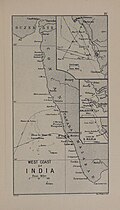
[[File:Vasco da Gama's voyage on the West coast of India.jpg|thumb|West Coast of India]] | |||
== | In contrast to the [[Hanafi school|Hanafis]] of Northern India, Bangladesh, and Pakistan, the Marakkars are part of a distinct South Indian Muslim community that follows the Shafi'i school of Islamic jurisprudence.<ref name=":2">{{Cite journal |last=Hoogervorst |first=Tom G. |date=2015 |title=Tracing the linguistic crossroads between Malay and Tamil |journal=Wacana |volume=16 |issue=2 |pages=249–283 |doi=10.17510/wacana.v16i2.378 |via=Brill |doi-access=free}}</ref><ref name=":0">{{Cite journal |last=Prashant More |first=Jean-Baptiste |date=1991 |title=The Marakkayar Muslims of Karikal, South India |journal=Journal of Islamic Studies |volume=2 |pages=25–44 |doi=10.1093/jis/2.1.25 |pmc=355923 |pmid=15455059 |via=Oxford Academic Journals}}</ref><ref name=":1">Cf. Bayly 1989: 73–103; Bjerrum 1920: 172–173; Fanselow 1989: 274–281; Kamāl 1990: 37–55; More 2004: 3–27</ref> They are one of several interconnected cultural groups along India's southwestern coast, including the [[Nawayath|Nawayaths]] of Konkan, [[Kodava Maaple]] of Coorg, [[Beary|Bearys]] of Tulu Nadu, and the [[Malabar Muslims|Mappillas]] of Malabar. These communities share common religious practices and cultural traditions shaped by their coastal heritage and historical trade connections. | ||
== Role in regional history == | == Role in regional history == | ||
[[File:Bust of Kunhali Marakkar III at Visakha Museum.jpg|thumb|Admiral Kunjali Marakkar]] | |||
Some time in the 11th century, Marakkars become a prominent community in the city of Kochi. In Tamil Nadu, Marakkars are found in Kayalpattinam, Kilakarai, Adirampattinam, Thoothukudi, Nagore and Karaikal. Whether Marakkars are a community that moved from Tamil Nadu to Kerala, or from Kerala to Tamil Nadu remains an unsettled question. Some time later, they migrate to [[Ponnani]] in the [[Samoothiri|Zamorin]]'s dominion, where they worked as the admirals of the Zamorin's fleet. There is some evidence that Marakkars cooperated and conducted business with the Portuguese Armada. Soon after, the Marakkar fleet and the Portuguese Armada made war for a hundred years under the leadership of Admiral Kunjali [[Kunjali Marakkar|Marakkar]].<ref name="KunhaliV2">Kunhali, V. "Muslim Communities in Kerala to 1798" Ph.D. Dissertation Aligarh Muslim University (1986) [http://ir.amu.ac.in/2736/1/T%205242.pdf]</ref> | |||
== Language == | == Language == | ||
The [[Arabic language]] brought by the early merchants is no longer spoken, though many Arabic words and phrases are still commonly used. Until the | The [[Arabic language]] brought by the early merchants is no longer spoken, though many Arabic words and phrases are still commonly used. Until recently, the [[Mappila Muslims|Mappila]] Muslims employed [[Arabi Malayalam]], and the Tamil Muslims employed [[Arwi language|Arwi]] as their native language, though this is also extinct as a spoken language. Today, they use Malayalam and Tamil as their primary language, with influence from Arabic. Many Arabic and Arabized words exist in Malayalam and Tamil, spoken by Marakkars. Among many examples, greetings and blessings are exchanged in Arabic instead of Malayalam/Tamil, such as ''Assalamu Alaikum'' instead of ''Shaanthiyum Samadanavum'', ''Jazakallah'' instead of Nanni/Nandri and ''Pinjhan/Finjan/Pinjaanam'' for Bowl/Cup. | ||
There are also words which are unique to Marakkars and [[Sri Lankan Moors]] such as ''Laatha'' for elder-sister, ''Kaka'' for elder-brother, ''Umma'' for mother and ''Vappa'' for father, suggesting a close relationship between Marakkars of India and Marrakkar and Moors of Sri Lanka.<ref name=":3">{{Cite journal|last= | There are also words which are unique to Marakkars and [[Sri Lankan Moors]], such as ''Laatha'' for elder-sister, ''Kaka'' for elder-brother, ''Umma'' for mother and ''Vappa'' for father, suggesting a close relationship between Marakkars of India and Marrakkar and Moors of Sri Lanka.<ref name=":3">{{Cite journal|last=Mahroof |first=M. M. M.|title=Spoken Tamil Dialects of the Muslims of Sri Lanka: Language as Identity-Classifier |date=1995|url=https://www.jstor.org/stable/20836916|journal=Islamic Studies|volume=34|issue=4|pages=407–426|jstor=20836916 |issn=0578-8072}}</ref> The Marakkars of Sri Lanka falls under the '[[Sri Lankan Moors]] group, defined by the Sri Lankan government as a separate ethnic group.<ref name=":3" /> There are also words derived from [[Sinhala language|Sinhala]], such as ''Mattapa'' for the terrace. There are also words from [[Purananuru|the Purananuru]] era, such as ''Aanam'' for Kulambu and ''Puliaanam'' for rasam or soup. | ||
{| class="wikitable" | {| class="wikitable" | ||
|'''English''' | |'''English''' | ||
|'''Tamil''' | |'''Malayalam/Tamil''' | ||
|''' | |'''Marakkar Malayalam/Tamil''' | ||
|- | |- | ||
|Father | |Father | ||
| | |Appan/Appa | ||
| | |Uppa/Vaapa | ||
|- | |- | ||
|Mother | |Mother | ||
| | |Amma | ||
| | |Umma | ||
|- | |- | ||
|Brother | |Brother | ||
| | |Chetan/Annan | ||
| | |Kaaka/Naana | ||
|- | |- | ||
|Sister | |Sister | ||
| | |Chechi/Akka | ||
| | |Thaatha/Laatha | ||
|- | |- | ||
|Son | |Son | ||
|makan | |makan | ||
|mavan | |mon/mavan | ||
|- | |- | ||
|Daughter | |Daughter | ||
|makal | |makal | ||
|maval | |mol/maval | ||
|} | |} | ||
==See also== | ==See also== | ||
* [[A. P. J. Abdul Kalam]] | * [[A. P. J. Abdul Kalam]] | ||
* [[Tamil Muslim]]s | * [[Tamil Muslim]]s | ||
* [[Mappila Muslims]] | |||
* [[Sri Lankan Moors]] | * [[Sri Lankan Moors]] | ||
==Notes== | |||
{{notelist}} | |||
== References == | == References == | ||
{{reflist}} | {{reflist}} | ||
==Further reading== | ==Further reading== | ||
* ''Medieval Seafarers of India'' – Lakshmi Subramaniam | * ''Medieval Seafarers of India'' – Lakshmi Subramaniam | ||
* ''The Career and Legend of Vasco da Gama'' – Sanjay Subrahmanyam | * ''The Career and Legend of Vasco da Gama'' – Sanjay Subrahmanyam | ||
* ''The Portuguese Empire in Asia, 1500–1700: A Political and Economic History'' – Sanjay Subrahmanyam | * ''The Portuguese Empire in Asia, 1500–1700: A Political and Economic History'' – Sanjay Subrahmanyam | ||
* ''Portuguese Cochin and the Maritime Trade of India'' – Pius Malekandathil | * ''Portuguese Cochin and the Maritime Trade of India'' – [[Pius Malekandathil]] | ||
* ''India and the Indian Ocean World'' – Ashin Das Gupta | * ''India and the Indian Ocean World'' – Ashin Das Gupta | ||
* ''Kerala Muslim History'' – P. A. Syed Mohammed | * ''Kerala Muslim History'' – P. A. Syed Mohammed | ||
* ''Muslim Identity, Print Culture, and the Dravidian Factor in Tamil Nadu | * ''Muslim Identity, Print Culture, and the Dravidian Factor in Tamil Nadu – '' J. B. Prashant More | ||
* ''Saints Goddesses and Kings'' – Susan Bayly | * ''Saints Goddesses and Kings'' – Susan Bayly | ||
* ''Political Evolution of Muslims in Tamil Nadu and Madras'' | * ''Political Evolution of Muslims in Tamil Nadu and Madras'' – J. B. Prashant More | ||
* ''Charithrathile Marakkar Sannidhyam'' – S. V. Mohammed | |||
* ''Kunjali Marakkar – Kerala Calling Malabar & the Portuguese'' – K. M. Panikkar | * ''Kunjali Marakkar – Kerala Calling Malabar & the Portuguese'' – K. M. Panikkar | ||
{{Indian Muslim}} | {{Indian Muslim}} | ||
{{Islam in Kerala}} | {{Islam in Kerala}} | ||
{{DEFAULTSORT:Maricar}} | {{DEFAULTSORT:Maricar}} | ||
[[Category:Muslim communities of India]] | [[Category:Muslim communities of India]] | ||
[[Category:Social groups of Tamil Nadu]] | [[Category:Social groups of Tamil Nadu]] | ||
| Line 120: | Line 135: | ||
[[Category:Social groups of Kerala]] | [[Category:Social groups of Kerala]] | ||
[[Category:Muslim communities of Kerala]] | [[Category:Muslim communities of Kerala]] | ||
[[Category:Social groups of Sri Lanka]] | |||
[[Category:South Indian communities]] | |||
[[Category:Indian people of Arab descent]] | |||
[[Category:Arabs in Sri Lanka]] | |||
Latest revision as of 21:58, 20 March 2026
 Sri Lankan Marakkars in the business district of Colombo (Pettah), 1891 | |
| Total population | |
|---|---|
| ~5 million | |
| Religions | |
 Islam Islam | |
| Scriptures | |
| Quran & Hadith | |
| Languages | |
| Malayalam • Tamil • Sinhala • Malay • Arwi • Hindustani |
The Marakkars or Chonaka Mappila or Chonakar[lower-alpha 1] (Tamil: சோனகர், romanized: Cōṉakar; Arwi: {{safesubst:ifsubst|1=|2= }چٗونَكَرْ</ span> ) are a mercantile, panethnic group inhabiting the southwestern coast of India, Sri Lanka, and Southeast Asia.[3][4][5]
Today, Marakkars are found across South Asia (Kerala, Tamil Nadu, Maldives, Sri Lanka) and Southeast Asia (Malaysia, Indonesia, Singapore).[4][5] They are a multilingual Sunni Muslim community, speaking Tamil, Malayalam, Sinhala, Dhivehi, or Malay depending on their country of origin.[5]
The Marakkars were prominent medieval traders who controlled significant Indian Ocean commerce.[6] They are historically notable for mounting the first sustained Indian resistance against European colonialism, fighting the Portuguese Armada for a hundred-years from 1520 to 1619 under leaders including Admiral Kunjali Marakkar IV.[7] Earlier waves of Marakkar migration to Southeast Asia contributed to the spread of Islam throughout the Indonesian Archipelago.[8] In the early modern period, they became the first Indian community to settle in British Malaya, later forming the Jawi Peranakan ethnic group.[9]
Kilai / Branches[edit | edit source]
There are at least four known branches of Marakkars: (i) Pandyamandala Marakkars of coastal Tamil Nadu, (ii) Eezhamandala Marakkars of Sri Lanka, (iii) Cholamandala Marakkars of southeast asia, and (iv) Malabar Marakkars of Kerala.[10]
Marakkars of Sri Lanka[edit | edit source]

In present day, the Marakkars of Sri Lanka are called Sri Lankan Moors, compromising 10.5% of the Sri Lankan population with an aggregate population of 2,283,246.[11] They were historically called Chonakar or Eezhamandala Marakkar.[12] They have over a thousand-year history in the western coast of Sri Lanka, tracing their origin to the Sabaen and Dilmun traders pre-dating Islam. They are disproportionately urban, constituting 42.9% of the capital city of Colombo, and are known on the island for being a "market-dominant minority" inhabiting urban centers.[11] They are native Tamil speakers with high degrees of Sinhalese bilingualism.[11]
Today, Chonaka Moors remain politically and economically influential on the island. Politically, they are represented in every national party and have held all major ministerial portfolios, including finance, justice, education, and trade.[13] They have also produced five Supreme Court Justices since independence.
Economically, though their sectoral monopolies diminished following Sirimavo Bandaranaike's nationalization policies and socialist reforms, they remain influential in textiles, precious metals, pharmaceuticals, commercial real estate, import-export trade, and retail.[13] Eastern Moor landlords, or Sonaha Poddiyar, also hold substantial tracts of the most arable paddy land in the eastern provinces.[14]
Marakkars of Southeast Asia (Chulias)[edit | edit source]
.png)
The Chulia Marakkars of Southeast Asia, known historically as Chulias or Klings, are Tamil-speaking Muslim Marakkar merchants from the Tamil Nadu, Sri Lanka, and Kerala, who established permanent communities across the Malay Peninsula, Singapore, and the Indonesian archipelago.[15]
Before 1786[edit | edit source]
Chulia Marakkars were present in Southeast Asian ports from at least the 14th century, forming one of the principal trading communities at Malacca by the time of Portuguese conquest in 1511.[16] They maintained their own settlement called Kampong Palli and were noted by Italian traveller Nicolas Conti as being "very rich, so much so that some will carry on their business in forty of their own ships."[16]
In the Malacca Sultanate, Tamil Muslims attained the highest offices of state.[16] Bendahara Tun Ali served as the fourth prime minister, while his son Tun Mutahir became the seventh Bendahara, whose efficient administration attracted foreign traders and brought Malacca to its commercial zenith around 1500.[16] Sultan Muhammad Syah married Tun Ali's sister, Tun Wati, producing the future Sultan Muzaffar Syah.[16]
Following Malacca's fall, Chulia merchants dispersed to friendlier ports in Aceh, Kedah, Perak, and the Tenasserim coast.[16] By the 17th century, they dominated trade between India and the Malay Peninsula, with Malay rulers of Kedah, Perak, Terengganu, and Johor appointing them as saudagar raja (king's merchants) to manage royal trading activities. Prominent saudagar raja included Sidi Lebbe and Tambi Kecil (titled Raja Mutabar Khan) in Perak, and Syed Nina, Piro Mohamed, and Raja Jamal in Kedah.[16] Their appointment reflected Chulia strengths: connection to complex commercial networks, negotiating competence, accounting skills, shared Islamic faith with Malay rulers, and multilingual fluency.[17]
After 1786[edit | edit source]
The British establishment of Penang (1786) and Singapore (1819) drew large-scale Chulia migration from the Coromandel Coast.[15] Captain Francis Light estimated 1,000 Chulias in early Penang, with annual arrivals of 1,500–2,000 more.[15] By the 1833 census, there were 7,886 Chulias in Penang and 510 in Province Wellesley. Cauder Mohideen Merican was appointed the first Kapitan Kling in 1801 and founded the Kapitan Keling Mosque, which holds one of Malaysia's largest waqf endowments.[15]
Economically, Chulia Marakkars virtually monopolised Penang's shipping and stewarding industry, providing lighters (tongkangs) for loading and unloading cargo, earning them the nickname "Mamak Tongkang." [15] They dominated the textile trade with Southeast Asia, exporting blue cloths, chintz, ginghams, and long cloths from Coromandel ports.[15] When British cotton manufactures began competing from the 1820s, Chulia merchants adapted by diversifying into provision stores, jewellery, money-changing, and publishing.[15]
Today, Chulia Marakkars remain influential in the restaurant trade (approximately 12,000 mamak establishments nationwide), jewellery, textiles, pharmaceuticals, and retail.[15] The nasi kandar trade, originating with Chulia rice sellers in colonial Penang, has evolved into a multi-million ringgit franchise industry.[15] Replicas of the Nagore Dargah in Penang and Singapore commemorate the community's enduring transoceanic Sufi networks.[15]
Jawi Peranakan[edit | edit source]

The Jawi Peranakan (also called Jawi Pekan, meaning "town Muslim") emerged from intermarriage between Chulia merchants and local Malay women, forming a distinct Indo-Malay community concentrated in Penang and Singapore.[18] By the late 19th century, they had accumulated considerable wealth and status, ranking "next to the Arabs in leadership and authority within the Malay-Muslim community."[18] Their English education facilitated employment in the colonial government as clerks, translators, and teachers.[18]
The Jawi Peranakan population in Penang grew from 3,491 in 1871 to 5,462 in 1881. Prominent families such as the Angullias and Maricans left lasting marks on the urban landscape, Angullia Park near Singapore's Orchard Road still bears the family name.[18] Through intermarriage with Malay and Arab families, many descendants inherited titles such as Syed, Tengku, or Wan, while others adopted Malay patronymic naming conventions.[18]
The Jawi Peranakan pioneered Malay-language journalism and publishing.[18] According to historian William Roff, "Malay journalism, like book publication in Malay, owes its origins very largely" to this community.[18] The Jawi Peranakkan ("The Local Born Muslim"), launched in Singapore in 1876, was the first Malay newspaper in the region and the longest-running before World War I.[18] Its founding editor, Munsyi Mohd Said Dada Mohiddin, a Penang-born Tamil Muslim, served for twelve years until his death in 1888. The newspaper identified entirely with Malay interests, speaking always of "we Malays" and reporting Malay affairs.[18]
Over the following three decades, Jawi Peranakan established at least twelve Malay-language newspapers: five in Singapore (Jawi Peranakkan, Sekola Melayu, Nujumul-Fajar, Shamsul-Kamar, Taman Pengetahuan), five in Penang (Tanjung Penegeri, Pemimpin Warta, Lengkongan Bulan, Bintang Timor, Chahaya Pulau Pinang), and two in Perak (Sri Perak, Jajahan Melayu).[18]
Munshi Abdullah (1796–1854), of Tamil and Yemeni descent, is widely regarded as the "father of modern Malay literature." Born in Malacca and fluent in Arabic, Tamil, Hindi, and Malay, he served as scribe to Sir Stamford Raffles and translator for the London Missionary Society. His autobiography Hikayat Abdullah (1849) marked a radical departure from court literature, offering vivid, colloquial descriptions of everyday life. He is also considered the first Malayan journalist, taking Malay literature beyond folk-stories into historical description.[18]
By the early 20th century, as Malay nationalism emerged, the Jawi Peranakan increasingly identified as Malays. They established the Penang Malay Association (1927) to promote Malay interests vis-à-vis the British government. In 1946, they played a major role in founding UMNO's Penang branch, with S.M. Aidid as founder president.[18] Second and third generation Jawi Peranakan received scholarships as Malays, entered the civil service, and served with distinction.[18] Today, most register simply as Malays, their distinct identity having merged into the broader Malay community through social amalgamation and shared Islamic practice.[18]
Marakkars of Kerala[edit | edit source]
In Kerala, Marakkar, known as Marikkars, are primarily concentrated in and around Malabar.
According to tradition, Marakkars were originally marine merchants of Kochi who left for Ponnani in the Samoothiri Raja's dominion when the Portuguese came to Kochi. They offered their men, ships and wealth in defence of their motherland to the Samoothiri of Kozhikode – The Raja, who took them into his service and eventually became the Admirals of his fleet. They served as the naval chiefs in the Zamorin's army. Kunjali Marakkar, one of the first Keralites to rebel against the Portuguese, hailed from the Marikkar community.[19]
Religion[edit | edit source]

In contrast to the Hanafis of Northern India, Bangladesh, and Pakistan, the Marakkars are part of a distinct South Indian Muslim community that follows the Shafi'i school of Islamic jurisprudence.[2][20][21] They are one of several interconnected cultural groups along India's southwestern coast, including the Nawayaths of Konkan, Kodava Maaple of Coorg, Bearys of Tulu Nadu, and the Mappillas of Malabar. These communities share common religious practices and cultural traditions shaped by their coastal heritage and historical trade connections.
Role in regional history[edit | edit source]

Some time in the 11th century, Marakkars become a prominent community in the city of Kochi. In Tamil Nadu, Marakkars are found in Kayalpattinam, Kilakarai, Adirampattinam, Thoothukudi, Nagore and Karaikal. Whether Marakkars are a community that moved from Tamil Nadu to Kerala, or from Kerala to Tamil Nadu remains an unsettled question. Some time later, they migrate to Ponnani in the Zamorin's dominion, where they worked as the admirals of the Zamorin's fleet. There is some evidence that Marakkars cooperated and conducted business with the Portuguese Armada. Soon after, the Marakkar fleet and the Portuguese Armada made war for a hundred years under the leadership of Admiral Kunjali Marakkar.[22]
Language[edit | edit source]
The Arabic language brought by the early merchants is no longer spoken, though many Arabic words and phrases are still commonly used. Until recently, the Mappila Muslims employed Arabi Malayalam, and the Tamil Muslims employed Arwi as their native language, though this is also extinct as a spoken language. Today, they use Malayalam and Tamil as their primary language, with influence from Arabic. Many Arabic and Arabized words exist in Malayalam and Tamil, spoken by Marakkars. Among many examples, greetings and blessings are exchanged in Arabic instead of Malayalam/Tamil, such as Assalamu Alaikum instead of Shaanthiyum Samadanavum, Jazakallah instead of Nanni/Nandri and Pinjhan/Finjan/Pinjaanam for Bowl/Cup.
There are also words which are unique to Marakkars and Sri Lankan Moors, such as Laatha for elder-sister, Kaka for elder-brother, Umma for mother and Vappa for father, suggesting a close relationship between Marakkars of India and Marrakkar and Moors of Sri Lanka.[23] The Marakkars of Sri Lanka falls under the 'Sri Lankan Moors group, defined by the Sri Lankan government as a separate ethnic group.[23] There are also words derived from Sinhala, such as Mattapa for the terrace. There are also words from the Purananuru era, such as Aanam for Kulambu and Puliaanam for rasam or soup.
| English | Malayalam/Tamil | Marakkar Malayalam/Tamil |
| Father | Appan/Appa | Uppa/Vaapa |
| Mother | Amma | Umma |
| Brother | Chetan/Annan | Kaaka/Naana |
| Sister | Chechi/Akka | Thaatha/Laatha |
| Son | makan | mon/mavan |
| Daughter | makal | mol/maval |
See also[edit | edit source]
Notes[edit | edit source]
References[edit | edit source]
- ↑ Tschacher, Torsten (2006). "The Impact of Being Tamil on Religious Life Among Tamil Muslins in Singapore" (PDF). Degree of Doctor of Philosophy PhD: 79 – via National University of Singapore.
- ↑ 2.0 2.1 Hoogervorst, Tom G. (2015). "Tracing the linguistic crossroads between Malay and Tamil". Wacana. 16 (2): 249–283. doi:10.17510/wacana.v16i2.378 – via Brill.
- ↑ V., Kunhali (1986). "Muslim Communities in Kerala to 1798". Aligarh Muslim University Journal.
- ↑ 4.0 4.1 Eusoff, Datin (1997). The Merican Clan: A Story of Courage and Destiny. Times Books International. ISBN 978-981-204-805-9.
- ↑ 5.0 5.1 5.2 McGilvray, Dennis (1998). "Arabs, Moors and Muslims: Sri Lankan Muslim ethnicity in regional perspective". Contributions to Indian Sociology. 199: 439 to 449.
- ↑ Malekandathil, Pius (2013). "Sectional President's Address: INDIAN OCEAN IN THE SHAPING OF LATE MEDIEVAL INDIA". Proceedings of the Indian History Congress. 74: 178–195. JSTOR 44158814.
- ↑ STEPHEN, DALE (1977). "The Islamic Frontier in Southwest India: The Shahid as a Cultural Ideal among the Mappillas of Malabar". Modern Asian Studies Journal. II (1): 41–55. JSTOR 311885.
- ↑ Hall, Kenneth. "Economic Exchange and Social Interaction in Southeast Asia: Perspectives from Prehistory, History, and Ethnography; The Coming of Islam to the Archipelago: A Reassessment". University of Michigan Press: 213–231.
- ↑ Pillai, Patrick (14 October 2015). Yearning to Belong. Ch. 1: "Mamak" and Malaysian: The Indian Muslim Quest for Identity. ISEAS Publishing. ISBN 9789814519687.
- ↑ Mohammed, SV (2008). Charithratile Marakkar Sannidhyam. Calicut: Vachanam Books.
- ↑ 11.0 11.1 11.2 "Department of Census and Statistics". www.statistics.gov.lk. Retrieved 23 January 2026.
- ↑ Mahroof, M. M. M. (1995). "Spoken Tamil Dialects of the Muslims of Sri Lanka: Language as Identity-Classifier". Islamic Studies. 34 (4): 407–426. ISSN 0578-8072. JSTOR 20836916.
- ↑ 13.0 13.1 Mohan, Vasundhara (1987). Identity Crisis of Sri Lankan Muslims. Mittal Publications.
- ↑ Rameez, A. (2018). "Sociology of Sri Lankan Muslims: dealing with different dimensions of Muslim society". Journal of Engineering and Applied Sciences. 13 (7): 1782–1793. ISSN 1816-949X.
- ↑ 15.00 15.01 15.02 15.03 15.04 15.05 15.06 15.07 15.08 15.09 Arasaratnam, Sinnappah (1970). Indians in Malaysia and Singapore. --. Internet Archive. Bombay : Published for the Institute of Race Relations, London, by Oxford University Press. ISBN 978-0-19-218184-8.
- ↑ 16.0 16.1 16.2 16.3 16.4 16.5 16.6 Sundara Sreenivasa Rao., Valarmudi (2016). "Merchants in Transition: Maritime Trade and Society of Tamil Muslims in the Indian Ocean World, c. 1780–1840". University of Texas at Austin.
- ↑ Bhattacharya, B. (1986). "Merchants, Companies and Commerce on the Coromandel Coast, 1650–1740. Arasaratnam Sinnappah. xii, 407 pp. Rupees 190/-". Itinerario. 13 (2). Delhi: Oxford University Press: 123–128. doi:10.1017/S0165115300004368. ISSN 2041-2827.
- ↑ 18.00 18.01 18.02 18.03 18.04 18.05 18.06 18.07 18.08 18.09 18.10 18.11 18.12 18.13 Fujimoto, Helen (1988). The South Indian Muslim Community and the Evolution of the Jawi Peranakan in Penang Up to 1948. ILCAA, Tokyo Gaikokugo Daigaku.
- ↑ The Hindu. "The Hindu". thehindu.com.
- ↑ Prashant More, Jean-Baptiste (1991). "The Marakkayar Muslims of Karikal, South India". Journal of Islamic Studies. 2: 25–44. doi:10.1093/jis/2.1.25. PMC 355923. PMID 15455059 – via Oxford Academic Journals.
- ↑ Cf. Bayly 1989: 73–103; Bjerrum 1920: 172–173; Fanselow 1989: 274–281; Kamāl 1990: 37–55; More 2004: 3–27
- ↑ Kunhali, V. "Muslim Communities in Kerala to 1798" Ph.D. Dissertation Aligarh Muslim University (1986) [1]
- ↑ 23.0 23.1 Mahroof, M. M. M. (1995). "Spoken Tamil Dialects of the Muslims of Sri Lanka: Language as Identity-Classifier". Islamic Studies. 34 (4): 407–426. ISSN 0578-8072. JSTOR 20836916.
Further reading[edit | edit source]
- Medieval Seafarers of India – Lakshmi Subramaniam
- The Career and Legend of Vasco da Gama – Sanjay Subrahmanyam
- The Portuguese Empire in Asia, 1500–1700: A Political and Economic History – Sanjay Subrahmanyam
- Portuguese Cochin and the Maritime Trade of India – Pius Malekandathil
- India and the Indian Ocean World – Ashin Das Gupta
- Kerala Muslim History – P. A. Syed Mohammed
- Muslim Identity, Print Culture, and the Dravidian Factor in Tamil Nadu – J. B. Prashant More
- Saints Goddesses and Kings – Susan Bayly
- Political Evolution of Muslims in Tamil Nadu and Madras – J. B. Prashant More
- Charithrathile Marakkar Sannidhyam – S. V. Mohammed
- Kunjali Marakkar – Kerala Calling Malabar & the Portuguese – K. M. Panikkar
| Language and script | |||||
|---|---|---|---|---|---|
| Literature |
| ||||
| Folk Arts |
| ||||
| Communities | |||||
| Major denominations |
| ||||


