




imported>Panchalidraupadi →Impression on Draupadi: This is not mentioned in Vyasa's Mahabharata but a popular myth/interpretation of modern writers like Devdutt Pattanaik. Kindly provide citation if this needs to be reverted. |
m minor cleanup |
||
| Line 1: | Line 1: | ||
{{short description|Hindu goddess and the sister of Krishna}} | {{short description|Hindu goddess and the sister of Krishna in epic Mahabharata}} | ||
{{Other uses}} | {{Other uses}} | ||
{{Use dmy dates|date= | {{Use dmy dates|date=March 2026}} | ||
{{Use Indian English|date= | {{Use Indian English|date=March 2026}} | ||
{{Infobox deity <!--Wikipedia:WikiProject Hindu mythology--> | {{Infobox deity <!--Wikipedia:WikiProject Hindu mythology--> | ||
| affiliation = | | affiliation = [[Devi]] | ||
| Devanagari = सुभद्रा | | Devanagari = सुभद्रा | ||
| texts = [[Mahabharata]], [[Bhagavata Purana]] | | texts = [[Mahabharata]], [[Bhagavata Purana]] | ||
| type = Hindu | | type = Hindu | ||
| name = Subhadra | | name = Subhadra | ||
| image = File: | | image = File:Subhadra, the half sister of Krishna, drives a chariot away from Dwarka with Arjuna and Krishna inside (cropped).jpg | ||
| caption = | | caption = A 20th century lithograph depicting Subhadra | ||
| consort = [[Arjuna]] | | consort = [[Arjuna]] | ||
| father = [[Vasudeva | | father = [[Vasudeva]] | ||
| mother = [[Rohini | | mother = [[Rohini (wife of Vasudeva)|Rohini]] | ||
| siblings = {{ | | siblings = {{bulleted list|[[Balarama]] (half brother)|[[Krishna]] (half brother)|[[Vasudeva#Wives and children|other children of Vasudeva]]}} | ||
| children = [[Abhimanyu]] | | children = [[Abhimanyu]] (son) | ||
| dynasty = [[Yadava]] – [[ | | dynasty = [[Yadava|Yaduvamsha]] – [[Chandravamsha]] (by birth) <br/> [[Kuru Dynasty]] (by marriage) | ||
| other_names = Bhadra, Chitra | | other_names = Bhadra, Chitra | ||
}} | }} | ||
Subhadra is | '''Subhadra''' ({{langx|sa|सुभद्रा|Subhadrā|auspicious}}) is a figure in [[Hinduism|Hindu tradition]], particularly revered in [[Vaishnavism]] as the sister of the deities [[Krishna]] and [[Balarama]]. She is mentioned in ancient Hindu scriptures, including the epic ''[[Mahabharata]]'' and the ''[[Bhagavata Purana]]''. A princess of the [[Vrishni]] clan and the daughter of [[Vasudeva]], Subhadra married the [[Pandava]] prince [[Arjuna]] and became the mother of [[Abhimanyu]]. | ||
Subhadra is part of the triad of deities worshipped at the [[Jagannath Temple]] at [[Puri]], along with Krishna (as [[Jagannatha]]) and Balarama (or Balabhadra). One of the chariots in the annual [[Ratha Yatra]] is dedicated to her. | |||
In [[Buddhism]], Subhadra or Subhadda (Pāli) was the last disciple of [[the Buddha]] who went for refuge. ([[Dīgha Nikāya]] 16, Mahāparinibbānasutta) | |||
== | ==Etymology and other names== | ||
=== | The [[Sanskrit]] name ''Subhadrā'' is made up of two words: ''su'' and ''bhadrā''. The prefix ''su'' denotes goodness,<ref>{{Cite book |last1=Baldi |first1=Philip |url=https://books.google.com/books?id=UK2-Y9K4znkC&dq=su.+Sanskrit+good&pg=PA103 |title=Studies in Baltic and Indo-European Linguistics: In Honor of William R. Schmalstieg |last2=Dini |first2=Pietro U. |date=1 January 2004 |publisher=John Benjamins Publishing |isbn=978-90-272-4768-1 |pages=103 |language=en}}</ref> while ''bhadrā'' is translated as fortune or excellence.<ref>{{Cite book |last=Bopp |first=Franz |url=https://books.google.com/books?id=KhoEAAAAQAAJ&dq=bhadra+fortune&pg=PA398 |title=A Comparative Grammar of the Sanscrit, Zend, Greek, Latin, Lithuanian, Gothic, German, and Sclavonic Languages |date=1845 |publisher=Madden and Malcolm |pages=398 |language=en}}</ref> The name means 'glorious', 'fortunate', 'splendid', or 'auspicious'.{{sfn|Monier-Williams|Leumann| Cappeller|1899|p=1229}} | ||
{{ | |||
| | Subhadra is referred to as ''Bhadrā'' (भद्रा), literally 'fortunate', when she is introduced to Arjuna in the ''[[Mahabharata]]''.{{sfn|Ganguli|1883}} According to the appendix of the ''Mahabharata'', the ''[[Harivamsa]]'', her birth name was ''Citrā'' (चित्रा) which means 'bright, clear, excellent, or colourful'.{{sfn|Monier-Williams|Leumann| Cappeller|1899|p=396}} | ||
| | |||
==Legends== | |||
===Birth=== | |||
According to the epic ''Mahabharata'', Subhadra was born to [[Yadava]] chief [[Vasudeva]] and his wife [[Rohini (wife of Vasudeva)|Rohini]], making her the sister of [[Balarama]] and half sister of [[Krishna]]. She was the favourite daughter of Vasudeva. In a later alternate account found in the ''[[Bhagavata Purana]]'', Subhadra's mother is mentioned to be [[Devaki]]—another wife Vasudeva and the mother of Krishna, making her direct sibling of Krishna.{{sfn|Mani|1975}} | |||
| | |||
| | ===Marriage to Arjuna=== | ||
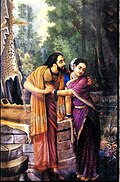
[[File:Ravi Varma-Arjuna and Subhadra.jpg|thumb|A painting by [[Raja Ravi Varma]] depicting [[Arjuna]], dressed as an ascetic, courting Subhadra]] | |||
Subhadra's marriage with Arjuna is first narrated in the section ''Subhadraharana Parva'' of ''[[Adi Parva]]'', the first book of the ''[[Mahabharata]]''. Different recension of the epic contain varying accounts of the story, with later derivative texts adding more details to it.<ref name = "Lav" /> | |||
According to | |||
According to the ''[[Neelakantha Chaturdhara|Chaturdhara]]'' Recension of the ''Mahabharata'', [[Arjuna]] was in the midst of self-imposed [[pilgrimage]], for breaking terms of the agreement he had with [[Pandavas|his brothers]] regarding private time with their common wife [[Draupadi]]. After he reached the city of [[Dvārakā|Dvaraka]] and met his maternal cousin [[Krishna]], he attended a festival held at Raivata mountain. There Arjuna saw Subhadra and was smitten by her beauty and wished to marry her. Krishna revealed that she was [[Vasudeva]]'s and [[Rohini Devi|Rohini]]'s child, and his half-sister. Krishna stated that he could not predict Subhadra's decision at her [[swayamvara|svayamvara]] (groom selection ceremony) and advised Arjuna to elope with Subhadra. After receiving agreement to a letter sent to Yudhishthira for permission, Arjuna drove a chariot to the hills and took Subhadra with him. After Subhadra's guards unsuccessfully attempted to stop them, the Yadavas, the Vrishnis, and the Andhakas held a meeting to discuss the matter. After Krishna comforted them, they agreed, and thus, Arjuna married Subhadra with Vedic rituals.{{sfn|Ganguli|1883}} A similar story is included in the [[Mahabharata#Critical Edition|''Critical Edition of the Mahabharata'']], compiled by [[Bhandarkar Oriental Research Institute]].<ref>{{Cite book |last=Debroy |first=Bibek |url=http://archive.org/details/TheMahabharata_201707 |title=The Mahabharata (Version 2) }}</ref> | |||
The ''Kumbhakonam Edition'' (Southern Recension) of the ''Mahabharata'' presents a distinct account of Subhadra's abduction, deviating from the ''Chaturdhara'' version. This rendition transforms the narrative into a mutual love story, providing additional details about the events. According to this version, during his pilgrimage, Arjuna reached Prabhasa, where he encountered Gada, a Yadava chief. Gada told Arjuna about Subhadra, kindling Arjuna's desire to marry her. In pursuit of this goal, Arjuna adopted the guise of an ascetic, contemplating under a tree with the hope that Krishna would facilitate his marriage. Simultaneously, in Dvaraka, Krishna, using his divine abilities, became aware of Arjuna's aspiration and visited him at Prabhasa. Krishna guided Arjuna to the Raivataka mountain, the site of an impending festival for the prominent Yadavas. During the festivities, Arjuna, accompanied by Krishna, chanced upon Subhadra and was captivated by her allure. Krishna suggested the abduction of Subhadra, to which Arjuna agreed and decided to wait for a suitable moment. Post-festival, Balarama encountered the disguised Arjuna and extended him an invitation to reside in the Dvaraka palace, as a sign of hospitality. Subhadra assumed the caretaker role for the ascetic, while Arjuna, deeply enamored, openly admired her. Subhadra, upon observing him, recognised his resemblance to Arjuna, from him having been previously described by Gada and Krishna. Acknowledging Subhadra's reciprocation of affection, Arjuna disclosed his true identity. A grand ritual dedicated to the god Shiva was scheduled on an island near Dvaraka, prompting the Yadavas, led by Balarama, to depart for worship. Seizing the opportune moment, Arjuna eloped with Subhadra.{{sfn|Mani|1975|p=746}}<ref>Southern Recension Kumbhakonam Edition Adi Parva.</ref><ref>{{Cite book |last1=Adluri |first1=Vishwa |url=https://books.google.com/books?id=sR5mDwAAQBAJ&dq=subhadr%C4%81+devak%C4%AB&pg=PA36-IA20 |title=Philology and Criticism: A Guide to Mahbhrata Textual Criticism |last2=Bagchee |first2=Joydeep |date=29 June 2018 |publisher=Anthem Press |isbn=978-1-78308-578-1 |language=en}}</ref> | |||
''The [[Bhagavata Purana]]'' describes Subhadra's role in choosing Arjuna. It also adds a detail about Balarama having picked [[Duryodhana]]—one of the [[Kaurava]]s—as Subhadra's groom, without her consent. Knowing that after getting the news of Subhadra's having eloped, Balarama would wage a war against Arjuna, Krishna decided to be the charioteer for Arjuna. Arjuna proceeded to take Subhadra and with Krishna in tow, they left. After getting the news that Subhadra had eloped with Arjuna, Balarama consents and conducts the marriage of Subhadra with Arjuna in Dvaraka.{{sfn|Mani|1975}}<ref name = "Lav" /> | |||
===Marital life=== | |||
[[File:Krishna meets with King Yudisthira.jpg|thumb|Krishna meets with King Yudisthira; and His Companions, Kunti and Subhadra, folio from ''[[Razmnama]]'' (Persian translation of the ''Mahabharata''), dated 1616-1617.]] | |||
Subhadra's marital life, as depicted in the ''Mahabharata'', reveals her significant role within the Pandava family. According to the ''Adi Parva'', upon Arjuna's return from exile to [[Indraprastha]]—the capital of the Pandavas—with Subhadra, he received a warm welcome. Inquiring about his first wife [[Draupadi]], his brothers revealed her reluctance to meet anyone due to anger. Arjuna, in an attempt to reconcile, presented Subhadra to Draupadi disguised as a simple cowherd. Subhadra, portraying herself as a cowherder and Krishna's younger sister, entrusted Draupadi with her belongings, expressing herself as her maid. This gesture cultivated trust and affection, prompting Subhadra to humbly declare her reluctance to replace Draupadi. Touched by this display of love, Draupadi embraced Subhadra, embracing her as a younger sister and acknowledging her as Arjuna's wife.{{sfn|Srivastava|2017}} | |||
Subhadra stayed with Arjuna in Indraprastha where she gave birth to [[Abhimanyu]]. During the Pandavas' [[Vanavasa|exile]] for thirteen years, Subhadra and her son resided with Krishna in [[Dvārakā|Dvaraka]], as documented in the ''[[Vana Parva]]''. She later attended Abhimanyu's wedding in [[Upaplavya]], as described in the ''[[Virata Parva]]''. The death of Abhimanyu in the [[Kurukshetra War]] caused her significant grief, evidenced by her lamentation to Krishna in the ''[[Drona Parva]]''. Following the end of Kurukshetra War, Subhadra returned to Dvaraka with Krishna, according to the ''Ashvamedha Parva''. The same text also records her emotional distress, including instances of syncope, due to her son's death. Subhadra's role became crucial during the birth of [[Parikshit]], Abhimanyu's posthumous son, when the Kuru lineage faced potential extinction due to the risk of a stillborn child. As [[Uttarā (Mahabharata)|Uttara]] underwent labour, and the royal women of the Kuru dynasty gathered, Subhadra, Parikshit's grandmother, reminded Krishna of his prior vow to restore the child. She invoked his virtues of dharma, satya, and satyavikrama, urging him to uphold his promise in accordance with ṛta, the cosmic order. This appeal prompted Krishna to perform a miraculous act, thereby ensuring the survival of the Kuru lineage.<ref name="Lav" /><ref>{{Cite book |last=Hiltebeitel |first=Alf |url=https://books.google.com/books?id=9BvsDwAAQBAJ&q=krishna+in+the+mahabharata |title=The Ritual of Battle: Krsna in the Mahabharata |date=1 January 2017 |publisher=Motilal Banarsidass |isbn=978-81-208-4034-8 |language=en}}</ref> | |||
''[[ | Subhadra subsequently travelled to [[Hastinapur|Hastinapura]] to attend Yudhisthira's [[Ashvamedha|Ashvamedha Yajna]], as stated in the ''[[Ashvamedhika Parva|Ashvamedha Parva]]'', where she met her co-wives [[Ulupi]] and [[Chitrāngadā|Chitrangada]]. The ''[[Mahaprasthanika Parva|Mahaprasthana Parva]]'' describes her later life as marked by sorrowful silence.{{sfn|Mani|1975}} After [[Pariksit]] was seated on the throne, while leaving for heaven, [[Yudhishthira]] gave the responsibility of keeping both the kingdoms [[Hastinapura]] ruled by her grandson and [[Indraprastha]] being ruled by Vajranabha, great-grandson of her brother [[Krishna]] in harmony. There is no specific mention in the epic about how and when she died but it is believed that after the [[Pandavas]] along with [[Draupadi]] reached heaven, Subhadra and her daughter-in-law ([[Uttarā]]) went to the forest to dwell the rest of their lives as hermits.<ref>Mahaprasthanika Parva https://www.sacred-texts.com/hin/m17/m17001.htm </ref> | ||
=== | == As a goddess == | ||
[[File: | ===Association with Ekanamsha or Yogamaya=== | ||
[[File:Vrishni triad shown in a rock painting at Tikla, M.P. 3rd-2nd century BCE.jpg|thumb|[[Balarama]], [[Vāsudeva]] and the goddess Ekanamsha shown in a rock painting at [[Tikla]], 3rd-2nd century BCE.<ref name="VKG71">{{cite journal |last1=Gupta |first1=Vinay K. |title=Vrishnis in Ancient Literature and Art |journal=Indology's Pulse Arts in Context, Doris Meth Srinivasan Festschrift Volume, Eds. Corinna Wessels Mevissen and Gerd Mevissen with Assistance of Vinay Kumar Gupta |date=January 2019 |pages=70–72 |url=https://www.academia.edu/40656540 |language=en}}</ref>]] | |||
Subhadra is associated with goddess [[Ekanamsha]] or [[Yogmaya]], both forms of primordial goddess [[Mahadevi|Shakti]]. [[Kushan Empire|Kushana]] images from 2nd-century CE [[Mathura]] depict a triad of deities: two gods flanking a goddess. Comparable 9th-century representations in [[Etah]] and [[Ellora Caves|Ellora]] mirror this composition. This is identified as the [[Vrishni heroes|Vrishni triad]], featuring [[Saṃkarṣaṇa|Samkarshana]] (Balarama), [[Ekanamsha]], and [[Vāsudeva]] (Krishna). Here, Ekanamsha is an ancient goddess worshipped by the [[Vrishni]] people and is identified with Subhadra; later this triad becomes popular in [[Jagannath]] sect.{{sfn|Hawley|Wulff|1982}}{{sfn|Ph.D|2016|p=257-258}} | |||
=== | In Krishna's life, Yogamaya plays the role of the facilitator of his earthly birth and his guardian. She takes birth as the daughter of cowherd [[Nanda (Hinduism)|Nanda]] and [[Yashoda]], after which her place is swapped with Krishna to protect the latter from the tyrant ruler [[Kamsa]]. After warning Kamsa about his impending death, Yogamaya vanishes. According to [[Devdutt Pattanaik]], the scriptures don't clarify if Yogmaya becomes Subhadra after fulfilling her role, but the name 'Yogamaya' is synonymous with Subhadra in [[Puri]], Odisha, where she is worshipped prominently.<ref name = "Shyam">{{Cite book |last=Pattanaik |first=Devdutt |url= |title=Shyam: An Illustrated Retelling of the Bhagavata |date=1 July 2018 |publisher=Penguin Random House India Private Limited |isbn=978-93-5305-100-6 |language=en}}</ref> Professor Lavanya Vemsani believes that the only way to understand Subhadra's connection with the goddesses is by considering her as reincarnation of Ekanamsha, who in turn is the Earthly manifestation of Yogmaya. According to her, Yogamaya descends on Earth as Ekanamsha— the daughter of Nanda and Yashoda—and later reincarnates as Subhadra.<ref name = "Lav">{{Cite book |last=Vemsani |first=Lavanya |url=https://books.google.com/books?id=56QvEAAAQBAJ&dq=subhadra+lakshmi&pg=PA165 |title=Feminine Journeys of the Mahabharata: Hindu Women in History, Text, and Practice |date=21 May 2021 |publisher=Springer Nature |isbn=978-3-030-73165-6 |language=en}}</ref> | ||
== Worship == | ===Worship=== | ||
[[File:Balabhadra Subhadra Jagannath.jpg | [[File:Balabhadra Subhadra Jagannath.jpg|thumb|Subhadra in the middle with her brothers Balabhadra (Balarama) and Jagannath (Krishna)]] | ||
[[File:Maa Subhadra.jpg|thumb|Subhadra (in [[Jagannath Temple, Puri]])]] | [[File:Maa Subhadra.jpg|thumb|Subhadra (in [[Jagannath Temple, Puri]])]] | ||
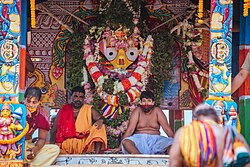
Subhadra is one of the three deities worshipped at the Jagannath temple at [[Puri]], along with [[Krishna]] (as [[Jagannatha]]) and [[Balarama]] (or Balabhadra). The idol of Subhadra is a carved and decorated wooden stump with large round eyes and a symmetric yellow coloured face, contrasting Jagannath's black complexion and Balabhadra's white complexion. She is decorated with red and black garments and has iconographical elements similar to that of goddess [[Bhubaneswari]] which includes a lasso (pasha) and an elephant goad (ankusha). One of the chariots in the annual Ratha Yatra is dedicated to her and is called ''Dwarpadalana'', symbolising destruction of evil.<ref name = "Shyam" /> Apart from it she is also believed to be worshipped by certain communities in [[Odisha]], [[West Bengal]], [[Gujarat]] and [[Bangladesh]].<ref>{{cite web|title=Why Subhadra Is Worshipped With Krishna In Jagannath Yatra|url=http://www.indiatimes.com/lifestyle/self/why-subhadra-is-worshipped-with-krishna-in-jagannath-yatra-281354.html|website=indiatimes.com|date=July 2011|access-date=15 June 2017}}</ref> | |||
Subhadra is one of the three deities worshipped at the Jagannath temple at [[Puri]], along with [[Krishna]] (as [[Jagannatha]]) and [[Balarama]] (or Balabhadra). One of the chariots in the annual Ratha Yatra is dedicated to her. Apart from it she is also believed to be worshipped by certain communities in [[Odisha]], [[West Bengal]], [[Gujarat]] and [[Bangladesh]]. | |||
There is a village called [[Bhadrajun]] in the western part of [[Rajasthan]] where Subhadra is worshipped as Dhumda mata since the time of [[Mahabharata]]. It is believed that, after eloping with her lover [[Arjuna]] and a gruelling journey of three days, the couple got married here.<ref> {{cite web|title=the history of the village of Bhadrajun|url=https://en.m.wikipedia.org/wiki/Bhadrajun|website=wikipedia.org|date=September 2009}} </ref> | |||
[[File:11th century Balarama, Lakshmi (Shubadra), Vasudeva (Krishna, Jagannath).jpg|thumb|Balarama, Lakshmi (Subhadra), Vasudev (Krishna, Jagannath) idols in early 11th century]] | |||
In some texts like the [[Brahma Purana]] and the [[Garga (sage)|Garga Samhita]], Subhadra is mentioned as [[Shatarupa|Devi Shatarupa]] with [[Arjuna]] being [[Svayambhuva Manu]].<ref>{{Cite web |title=Brahma Vaivarta Purana Chapter 6:181-190 |url=https://en.krishnakosh.org/krishna/Brahma_Vaivarta_Purana_Chapter_6:181-190 |access-date=26 January 2024 |website=en.krishnakosh.org |language=en}}</ref> She is also worshipped as [[Bhuvaneshvari|Mata Bhuvaneshvari]] in some sects. Apart from it, Subhadra is sometimes linked with [[Goddess Lakshmi]] by some Vaishnavas.<ref>{{Cite book |last=Mahanti (Retd) |first=Col J. C. |url=https://books.google.com/books?id=QweqCQAAQBAJ&pg=PA21&dq=Subhadra+form+of+Lakshmi&hl=en&newbks=1&newbks_redir=0&source=gb_mobile_search&authuser=5&sa=X&ved=2ahUKEwii7o7iu4WSAxWvB7wBHX8nAkkQ6AF6BAgKEAM#v=onepage&q=Subhadra%20form%20of%20Lakshmi&f=false |title=The Saga of Jagannatha and Badadeula at Puri (Story of Lord Jagannatha and his Temple) |date=1 May 2014 |publisher=Vij Books India Pvt Ltd |isbn=978-93-82652-45-8 |language=en}}</ref> | |||
==See also== | ==See also== | ||
* [[ | *[[Rukmini]] | ||
==Notes== | ==Notes== | ||
== | {{notelist}} | ||
==References== | |||
{{reflist}} | {{reflist}} | ||
== | |||
==Further reading== | |||
*{{Cite book|last1=Monier-Williams|first1=Sir Monier|url=https://books.google.com/books?id=zUezTfym7CAC&q=Subhadr%C4%81|title=A Sanskrit-English Dictionary: Etymologically and Philologically Arranged with Special Reference to Cognate Indo-European Languages|last2=Leumann|first2=Ernst|last3=Cappeller|first3=Carl|date=1899|publisher=Motilal Banarsidass Publishing House|isbn=978-81-208-3105-6|language=en}} | *{{Cite book|last1=Monier-Williams|first1=Sir Monier|url=https://books.google.com/books?id=zUezTfym7CAC&q=Subhadr%C4%81|title=A Sanskrit-English Dictionary: Etymologically and Philologically Arranged with Special Reference to Cognate Indo-European Languages|last2=Leumann|first2=Ernst|last3=Cappeller|first3=Carl|date=1899|publisher=Motilal Banarsidass Publishing House|isbn=978-81-208-3105-6|language=en}} | ||
*{{Cite book|last=Mani|first=Vettam|url=https://archive.org/stream/puranicencyclopa00maniuoft#page/0/mode/2up|title=Puranic Encyclopedia: A Comprehensive Work with Special Reference to the Epic and Puranic Literature|publisher=Motilal Banarsidass|year=1975|isbn=978-81-208-0597-2|location=|pages=|language=en}} | *{{Cite book|last=Mani|first=Vettam|url=https://archive.org/stream/puranicencyclopa00maniuoft#page/0/mode/2up|title=Puranic Encyclopedia: A Comprehensive Work with Special Reference to the Epic and Puranic Literature|publisher=Motilal Banarsidass|year=1975|isbn=978-81-208-0597-2|location=|pages=|language=en}} | ||
* {{Cite book|last=Ph.D|first=Lavanya Vemsani|url=https://books.google.com/books?id=4fw2DAAAQBAJ&q=Subhadra+reincarnation|title=Krishna in History, Thought, and Culture: An Encyclopedia of the Hindu Lord of Many Names: An Encyclopedia of the Hindu Lord of Many Names|date=13 June 2016|publisher=ABC-CLIO|isbn=978-1-61069-211-3|language=en}} | * {{Cite book|last=Ph.D|first=Lavanya Vemsani|url=https://books.google.com/books?id=4fw2DAAAQBAJ&q=Subhadra+reincarnation|title=Krishna in History, Thought, and Culture: An Encyclopedia of the Hindu Lord of Many Names: An Encyclopedia of the Hindu Lord of Many Names|date=13 June 2016|publisher=ABC-CLIO|isbn=978-1-61069-211-3|language=en}} | ||
* {{Cite web|last=Ganguli|first=Kisari Mohan|author-link=Kisari Mohan Ganguli|year=1883|title=The Mahabharata, Book 1: Adi Parva: Subhadra-harana Parva: Section CCXXI|url=https://www.sacred-texts.com/hin/m01/m01222.htm|url-status= | * {{Cite web|last=Ganguli|first=Kisari Mohan|author-link=Kisari Mohan Ganguli|year=1883|title=The Mahabharata, Book 1: Adi Parva: Subhadra-harana Parva: Section CCXXI|url=https://www.sacred-texts.com/hin/m01/m01222.htm|url-status=|archive-url=|archive-date=|access-date=9 June 2020|website=www.sacred-texts.com}} | ||
*{{Cite book|last1=Hawley|first1=John Stratton|url=https://books.google.com/books?id=j3R1z0sE340C&q=Subhadr%C4%81+arjuna|title=The Divine Consort: Rādhā and the Goddesses of India|last2=Wulff|first2=Donna Marie|date=1982|publisher=Motilal Banarsidass | *{{Cite book|last1=Hawley|first1=John Stratton|url=https://books.google.com/books?id=j3R1z0sE340C&q=Subhadr%C4%81+arjuna|title=The Divine Consort: Rādhā and the Goddesses of India|last2=Wulff|first2=Donna Marie|date=1982|publisher=Motilal Banarsidass Publishers|isbn=978-0-89581-102-8|language=en}} | ||
*{{Cite book|last=Srivastava|first=Diwaker Ikshit|url=https://books.google.com/books?id=ZmxCDwAAQBAJ&q=draupadi+and+subhadra|title=Decoding the Metaphor Mahabharata|date=11 December 2017|publisher=One Point Six Technology Pvt Ltd|isbn=978-93-5201-000-4|language=en}} | *{{Cite book|last=Srivastava|first=Diwaker Ikshit|url=https://books.google.com/books?id=ZmxCDwAAQBAJ&q=draupadi+and+subhadra|title=Decoding the Metaphor Mahabharata|date=11 December 2017|publisher=One Point Six Technology Pvt Ltd|isbn=978-93-5201-000-4|language=en}} | ||
| Line 83: | Line 92: | ||
{{Jagannath}} | {{Jagannath}} | ||
{{Mahābhārata}} | {{Mahābhārata}} | ||
[[Category: People related to Krishna]] | [[Category:People related to Krishna]] | ||
[[Category: Characters in the Mahabharata]] | [[Category:Characters in the Mahabharata]] | ||
[[Category: Deities of Jagannath]] | [[Category:Deities of Jagannath]] | ||
[[Category: Characters in the Bhagavata Purana]] | [[Category:Characters in the Bhagavata Purana]] | ||
[[Category:Hindu goddesses]] | |||
Latest revision as of 18:25, 14 March 2026
| Subhadra | |
|---|---|
.jpg) A 20th century lithograph depicting Subhadra | |
| Other names | Bhadra, Chitra |
| Devanagari | सुभद्रा |
| Affiliation | Devi |
| Texts | Mahabharata, Bhagavata Purana |
| Personal information | |
| Parents | |
| Siblings |
|
| Consort | Arjuna |
| Children | Abhimanyu (son) |
| Dynasty | Yaduvamsha – Chandravamsha (by birth) Kuru Dynasty (by marriage) |
Subhadra (Sanskrit: सुभद्रा, romanized: Subhadrā, lit. 'auspicious') is a figure in Hindu tradition, particularly revered in Vaishnavism as the sister of the deities Krishna and Balarama. She is mentioned in ancient Hindu scriptures, including the epic Mahabharata and the Bhagavata Purana. A princess of the Vrishni clan and the daughter of Vasudeva, Subhadra married the Pandava prince Arjuna and became the mother of Abhimanyu.
Subhadra is part of the triad of deities worshipped at the Jagannath Temple at Puri, along with Krishna (as Jagannatha) and Balarama (or Balabhadra). One of the chariots in the annual Ratha Yatra is dedicated to her.
In Buddhism, Subhadra or Subhadda (Pāli) was the last disciple of the Buddha who went for refuge. (Dīgha Nikāya 16, Mahāparinibbānasutta)
Etymology and other names[edit | edit source]
The Sanskrit name Subhadrā is made up of two words: su and bhadrā. The prefix su denotes goodness,[1] while bhadrā is translated as fortune or excellence.[2] The name means 'glorious', 'fortunate', 'splendid', or 'auspicious'.[3]
Subhadra is referred to as Bhadrā (भद्रा), literally 'fortunate', when she is introduced to Arjuna in the Mahabharata.[4] According to the appendix of the Mahabharata, the Harivamsa, her birth name was Citrā (चित्रा) which means 'bright, clear, excellent, or colourful'.[5]
Legends[edit | edit source]
Birth[edit | edit source]
According to the epic Mahabharata, Subhadra was born to Yadava chief Vasudeva and his wife Rohini, making her the sister of Balarama and half sister of Krishna. She was the favourite daughter of Vasudeva. In a later alternate account found in the Bhagavata Purana, Subhadra's mother is mentioned to be Devaki—another wife Vasudeva and the mother of Krishna, making her direct sibling of Krishna.[6]
Marriage to Arjuna[edit | edit source]

Subhadra's marriage with Arjuna is first narrated in the section Subhadraharana Parva of Adi Parva, the first book of the Mahabharata. Different recension of the epic contain varying accounts of the story, with later derivative texts adding more details to it.[7]
According to the Chaturdhara Recension of the Mahabharata, Arjuna was in the midst of self-imposed pilgrimage, for breaking terms of the agreement he had with his brothers regarding private time with their common wife Draupadi. After he reached the city of Dvaraka and met his maternal cousin Krishna, he attended a festival held at Raivata mountain. There Arjuna saw Subhadra and was smitten by her beauty and wished to marry her. Krishna revealed that she was Vasudeva's and Rohini's child, and his half-sister. Krishna stated that he could not predict Subhadra's decision at her svayamvara (groom selection ceremony) and advised Arjuna to elope with Subhadra. After receiving agreement to a letter sent to Yudhishthira for permission, Arjuna drove a chariot to the hills and took Subhadra with him. After Subhadra's guards unsuccessfully attempted to stop them, the Yadavas, the Vrishnis, and the Andhakas held a meeting to discuss the matter. After Krishna comforted them, they agreed, and thus, Arjuna married Subhadra with Vedic rituals.[4] A similar story is included in the Critical Edition of the Mahabharata, compiled by Bhandarkar Oriental Research Institute.[8]
The Kumbhakonam Edition (Southern Recension) of the Mahabharata presents a distinct account of Subhadra's abduction, deviating from the Chaturdhara version. This rendition transforms the narrative into a mutual love story, providing additional details about the events. According to this version, during his pilgrimage, Arjuna reached Prabhasa, where he encountered Gada, a Yadava chief. Gada told Arjuna about Subhadra, kindling Arjuna's desire to marry her. In pursuit of this goal, Arjuna adopted the guise of an ascetic, contemplating under a tree with the hope that Krishna would facilitate his marriage. Simultaneously, in Dvaraka, Krishna, using his divine abilities, became aware of Arjuna's aspiration and visited him at Prabhasa. Krishna guided Arjuna to the Raivataka mountain, the site of an impending festival for the prominent Yadavas. During the festivities, Arjuna, accompanied by Krishna, chanced upon Subhadra and was captivated by her allure. Krishna suggested the abduction of Subhadra, to which Arjuna agreed and decided to wait for a suitable moment. Post-festival, Balarama encountered the disguised Arjuna and extended him an invitation to reside in the Dvaraka palace, as a sign of hospitality. Subhadra assumed the caretaker role for the ascetic, while Arjuna, deeply enamored, openly admired her. Subhadra, upon observing him, recognised his resemblance to Arjuna, from him having been previously described by Gada and Krishna. Acknowledging Subhadra's reciprocation of affection, Arjuna disclosed his true identity. A grand ritual dedicated to the god Shiva was scheduled on an island near Dvaraka, prompting the Yadavas, led by Balarama, to depart for worship. Seizing the opportune moment, Arjuna eloped with Subhadra.[9][10][11]
The Bhagavata Purana describes Subhadra's role in choosing Arjuna. It also adds a detail about Balarama having picked Duryodhana—one of the Kauravas—as Subhadra's groom, without her consent. Knowing that after getting the news of Subhadra's having eloped, Balarama would wage a war against Arjuna, Krishna decided to be the charioteer for Arjuna. Arjuna proceeded to take Subhadra and with Krishna in tow, they left. After getting the news that Subhadra had eloped with Arjuna, Balarama consents and conducts the marriage of Subhadra with Arjuna in Dvaraka.[6][7]
Marital life[edit | edit source]

Subhadra's marital life, as depicted in the Mahabharata, reveals her significant role within the Pandava family. According to the Adi Parva, upon Arjuna's return from exile to Indraprastha—the capital of the Pandavas—with Subhadra, he received a warm welcome. Inquiring about his first wife Draupadi, his brothers revealed her reluctance to meet anyone due to anger. Arjuna, in an attempt to reconcile, presented Subhadra to Draupadi disguised as a simple cowherd. Subhadra, portraying herself as a cowherder and Krishna's younger sister, entrusted Draupadi with her belongings, expressing herself as her maid. This gesture cultivated trust and affection, prompting Subhadra to humbly declare her reluctance to replace Draupadi. Touched by this display of love, Draupadi embraced Subhadra, embracing her as a younger sister and acknowledging her as Arjuna's wife.[12]
Subhadra stayed with Arjuna in Indraprastha where she gave birth to Abhimanyu. During the Pandavas' exile for thirteen years, Subhadra and her son resided with Krishna in Dvaraka, as documented in the Vana Parva. She later attended Abhimanyu's wedding in Upaplavya, as described in the Virata Parva. The death of Abhimanyu in the Kurukshetra War caused her significant grief, evidenced by her lamentation to Krishna in the Drona Parva. Following the end of Kurukshetra War, Subhadra returned to Dvaraka with Krishna, according to the Ashvamedha Parva. The same text also records her emotional distress, including instances of syncope, due to her son's death. Subhadra's role became crucial during the birth of Parikshit, Abhimanyu's posthumous son, when the Kuru lineage faced potential extinction due to the risk of a stillborn child. As Uttara underwent labour, and the royal women of the Kuru dynasty gathered, Subhadra, Parikshit's grandmother, reminded Krishna of his prior vow to restore the child. She invoked his virtues of dharma, satya, and satyavikrama, urging him to uphold his promise in accordance with ṛta, the cosmic order. This appeal prompted Krishna to perform a miraculous act, thereby ensuring the survival of the Kuru lineage.[7][13]
Subhadra subsequently travelled to Hastinapura to attend Yudhisthira's Ashvamedha Yajna, as stated in the Ashvamedha Parva, where she met her co-wives Ulupi and Chitrangada. The Mahaprasthana Parva describes her later life as marked by sorrowful silence.[6] After Pariksit was seated on the throne, while leaving for heaven, Yudhishthira gave the responsibility of keeping both the kingdoms Hastinapura ruled by her grandson and Indraprastha being ruled by Vajranabha, great-grandson of her brother Krishna in harmony. There is no specific mention in the epic about how and when she died but it is believed that after the Pandavas along with Draupadi reached heaven, Subhadra and her daughter-in-law (Uttarā) went to the forest to dwell the rest of their lives as hermits.[14]
As a goddess[edit | edit source]
Association with Ekanamsha or Yogamaya[edit | edit source]

Subhadra is associated with goddess Ekanamsha or Yogmaya, both forms of primordial goddess Shakti. Kushana images from 2nd-century CE Mathura depict a triad of deities: two gods flanking a goddess. Comparable 9th-century representations in Etah and Ellora mirror this composition. This is identified as the Vrishni triad, featuring Samkarshana (Balarama), Ekanamsha, and Vāsudeva (Krishna). Here, Ekanamsha is an ancient goddess worshipped by the Vrishni people and is identified with Subhadra; later this triad becomes popular in Jagannath sect.[16][17]
In Krishna's life, Yogamaya plays the role of the facilitator of his earthly birth and his guardian. She takes birth as the daughter of cowherd Nanda and Yashoda, after which her place is swapped with Krishna to protect the latter from the tyrant ruler Kamsa. After warning Kamsa about his impending death, Yogamaya vanishes. According to Devdutt Pattanaik, the scriptures don't clarify if Yogmaya becomes Subhadra after fulfilling her role, but the name 'Yogamaya' is synonymous with Subhadra in Puri, Odisha, where she is worshipped prominently.[18] Professor Lavanya Vemsani believes that the only way to understand Subhadra's connection with the goddesses is by considering her as reincarnation of Ekanamsha, who in turn is the Earthly manifestation of Yogmaya. According to her, Yogamaya descends on Earth as Ekanamsha— the daughter of Nanda and Yashoda—and later reincarnates as Subhadra.[7]
Worship[edit | edit source]


Subhadra is one of the three deities worshipped at the Jagannath temple at Puri, along with Krishna (as Jagannatha) and Balarama (or Balabhadra). The idol of Subhadra is a carved and decorated wooden stump with large round eyes and a symmetric yellow coloured face, contrasting Jagannath's black complexion and Balabhadra's white complexion. She is decorated with red and black garments and has iconographical elements similar to that of goddess Bhubaneswari which includes a lasso (pasha) and an elephant goad (ankusha). One of the chariots in the annual Ratha Yatra is dedicated to her and is called Dwarpadalana, symbolising destruction of evil.[18] Apart from it she is also believed to be worshipped by certain communities in Odisha, West Bengal, Gujarat and Bangladesh.[19]
There is a village called Bhadrajun in the western part of Rajasthan where Subhadra is worshipped as Dhumda mata since the time of Mahabharata. It is believed that, after eloping with her lover Arjuna and a gruelling journey of three days, the couple got married here.[20]
,_Vasudeva_(Krishna,_Jagannath).jpg)
In some texts like the Brahma Purana and the Garga Samhita, Subhadra is mentioned as Devi Shatarupa with Arjuna being Svayambhuva Manu.[21] She is also worshipped as Mata Bhuvaneshvari in some sects. Apart from it, Subhadra is sometimes linked with Goddess Lakshmi by some Vaishnavas.[22]
See also[edit | edit source]
Notes[edit | edit source]
References[edit | edit source]
- ↑ Baldi, Philip; Dini, Pietro U. (1 January 2004). Studies in Baltic and Indo-European Linguistics: In Honor of William R. Schmalstieg. John Benjamins Publishing. p. 103. ISBN 978-90-272-4768-1.
- ↑ Bopp, Franz (1845). A Comparative Grammar of the Sanscrit, Zend, Greek, Latin, Lithuanian, Gothic, German, and Sclavonic Languages. Madden and Malcolm. p. 398.
- ↑ Monier-Williams, Leumann & Cappeller 1899, p. 1229.
- ↑ 4.0 4.1 Ganguli 1883.
- ↑ Monier-Williams, Leumann & Cappeller 1899, p. 396.
- ↑ 6.0 6.1 6.2 Mani 1975.
- ↑ 7.0 7.1 7.2 7.3 Vemsani, Lavanya (21 May 2021). Feminine Journeys of the Mahabharata: Hindu Women in History, Text, and Practice. Springer Nature. ISBN 978-3-030-73165-6.
- ↑ Debroy, Bibek. The Mahabharata (Version 2).
- ↑ Mani 1975, p. 746.
- ↑ Southern Recension Kumbhakonam Edition Adi Parva.
- ↑ Adluri, Vishwa; Bagchee, Joydeep (29 June 2018). Philology and Criticism: A Guide to Mahbhrata Textual Criticism. Anthem Press. ISBN 978-1-78308-578-1.
- ↑ Srivastava 2017.
- ↑ Hiltebeitel, Alf (1 January 2017). The Ritual of Battle: Krsna in the Mahabharata. Motilal Banarsidass. ISBN 978-81-208-4034-8.
- ↑ Mahaprasthanika Parva https://www.sacred-texts.com/hin/m17/m17001.htm
- ↑ Gupta, Vinay K. (January 2019). "Vrishnis in Ancient Literature and Art". Indology's Pulse Arts in Context, Doris Meth Srinivasan Festschrift Volume, Eds. Corinna Wessels Mevissen and Gerd Mevissen with Assistance of Vinay Kumar Gupta: 70–72.
- ↑ Hawley & Wulff 1982.
- ↑ Ph.D 2016, p. 257-258.
- ↑ 18.0 18.1 Pattanaik, Devdutt (1 July 2018). Shyam: An Illustrated Retelling of the Bhagavata. Penguin Random House India Private Limited. ISBN 978-93-5305-100-6.
- ↑ "Why Subhadra Is Worshipped With Krishna In Jagannath Yatra". indiatimes.com. July 2011. Retrieved 15 June 2017.
- ↑ "the history of the village of Bhadrajun". wikipedia.org. September 2009.
- ↑ "Brahma Vaivarta Purana Chapter 6:181-190". en.krishnakosh.org. Retrieved 26 January 2024.
- ↑ Mahanti (Retd), Col J. C. (1 May 2014). The Saga of Jagannatha and Badadeula at Puri (Story of Lord Jagannatha and his Temple). Vij Books India Pvt Ltd. ISBN 978-93-82652-45-8.
Further reading[edit | edit source]
- Monier-Williams, Sir Monier; Leumann, Ernst; Cappeller, Carl (1899). A Sanskrit-English Dictionary: Etymologically and Philologically Arranged with Special Reference to Cognate Indo-European Languages. Motilal Banarsidass Publishing House. ISBN 978-81-208-3105-6.
- Mani, Vettam (1975). Puranic Encyclopedia: A Comprehensive Work with Special Reference to the Epic and Puranic Literature. Motilal Banarsidass. ISBN 978-81-208-0597-2.
- Ph.D, Lavanya Vemsani (13 June 2016). Krishna in History, Thought, and Culture: An Encyclopedia of the Hindu Lord of Many Names: An Encyclopedia of the Hindu Lord of Many Names. ABC-CLIO. ISBN 978-1-61069-211-3.
- Ganguli, Kisari Mohan (1883). "The Mahabharata, Book 1: Adi Parva: Subhadra-harana Parva: Section CCXXI". www.sacred-texts.com. Retrieved 9 June 2020.
- Hawley, John Stratton; Wulff, Donna Marie (1982). The Divine Consort: Rādhā and the Goddesses of India. Motilal Banarsidass Publishers. ISBN 978-0-89581-102-8.
- Srivastava, Diwaker Ikshit (11 December 2017). Decoding the Metaphor Mahabharata. One Point Six Technology Pvt Ltd. ISBN 978-93-5201-000-4.
External links[edit | edit source]
Jagannath worship | |||||||
|---|---|---|---|---|---|---|---|
| Deities | | ||||||
| Temples |
| ||||||
| Festivals | |||||||
| Texts | |||||||
| Devotees | |||||||
| See also | |||||||
