


CleanupBot (talk | contribs) m →top: robot: remove incorrect protection templates |
refine formatting additionally and improved wording |
||
| Line 1: | Line 1: | ||
{{Short description|Type of monarch}} | |||
{{ | |||
{{About|the honorific title|the nawab butterfly|Polyura}} | {{About|the honorific title|the nawab butterfly|Polyura}} | ||
{{redirect|Naib}} | {{redirect|Naib}} | ||
| Line 8: | Line 7: | ||
{{Indo-Persian royal and noble ranks}} | {{Indo-Persian royal and noble ranks}} | ||
'''Nawab''' | '''Nawab'''{{efn|[[Balochi language|Balochi]], [[Pashto language|Pashto]], [[Urdu]], [[Persian language|Persian]], [[Punjabi language|Punjabi]] {{small|([[Shahmukhi]])}}, [[Sindhi language|Sindhi]]: {{nq|نواب}}<br> {{langx|ar|نواب}}<br> {{langx|bn|নবাব/নওয়াব}}<br> {{langx|hi|नवाब}}<br> [[Punjabi language|Punjabi]] {{small|([[Gurmukhi]])}}: ਨਵਾਬ}}{{efn|Also spelled Nawaab, Navaab, Navab, Nowab, Nabob, Nawaabshah, Nawabshah or Nobab.}} is a [[royal title]] indicating a ruler, often of a South Asian state, in many ways comparable to the Western title of [[Emperor]]. In earlier times the title was ratified and bestowed by the reigning [[List of emperors of the Mughal Empire|Mughal emperor]] to semi-autonomous [[Muslim]] rulers of subdivisions or [[princely states]] in the [[Indian subcontinent]] loyal to the [[Mughal Empire]], and then it was became a Royal title like [[Sultan]] or [[Emperor]] for example the [[Nawabs of Bengal]]. Various Nawabs were permitted to maintain this title under the [[suzerainty]] of the [[Maratha Empire]].<ref>{{cite book |title=Students' Britannica India: A to C (Abd Allah ibn al-Abbas to Cypress) |date=2000 |publisher=Encyclopaedia Britannica |page=199 |language=en}}</ref> | ||
[[ | |||
[[Persian language|Persian]], | |||
[[Punjabi language|Punjabi]] {{small|([[Shahmukhi]])}}, | |||
[[Sindhi language|Sindhi]] | |||
[[ | |||
"Nawab" usually refers to males and literally means '' | "Nawab" usually refers to males and literally means ''Independent ruler''; the female equivalent is "[[Begum]]" or "''Nawab Begum''". The primary duty of a Nawab was to uphold the sovereignty. | ||
The title of "nawabi" was also awarded as a personal distinction by the paramount power, similar to a [[British peerage]], to persons and families who ruled a princely state for various services to the | The title of "nawabi" was also awarded as a personal distinction by the paramount power, similar to a [[British peerage]], to persons and families who ruled a princely or independent state for various services to the Government of [[British Raj|British India]]. In some cases, the titles were also accompanied by [[jagir]] grants, either in cash revenues and allowances or land-holdings. During the [[British Raj]], some of the chiefs, or [[sardar]]s, of large or important tribes were also given the title, in addition to traditional titles already held by virtue of chieftainship. | ||
The term ''"[[Zamindar | The term ''"[[Zamindar]]i"'' was originally used for the ''[[subahdar]]'' (provincial governor) or viceroy of a ''[[Subah (province)|subah]]'' (province) or regions of the Mughal Empire. | ||
==History== | ==History== | ||
[[Image:Clive.jpg|right|thumb|upright=0.90|[[Robert Clive]], meeting with | [[Image:Lord Clive meeting with Mir Jafar after the Battle of Plassey.jpg|right|thumb|upright=0.90|[[Robert Clive]], meeting with [[Mir Jafar]] after the [[Battle of Plassey]], by [[Francis Hayman]]]] | ||
[[File:Sadeq Mohammad Khan.jpg|left|thumb|upright|[[General]] [[Sadeq Mohammad Khan V|Nawab Sir Sadeq Mohammad Khan V]], the last ruling Nawab of [[Bahawalpur]]]] | [[File:Sadeq Mohammad Khan.jpg|left|thumb|upright|[[General]] [[Sadeq Mohammad Khan V|Nawab Sir Sadeq Mohammad Khan V]], the last ruling Nawab of [[Bahawalpur]]]] | ||
Nawab | Nawab was a [[Hindustani language|Hindustani]] term, used in [[Urdu language|Urdu]], [[Hindi]], [[Bengali language|Bengali]], [[Pashto language|Pashto]] and many other North-Indian languages, borrowed via [[Persian language|Persian]] from the [[Arabic language|Arabic]] honorific plural of ''naib'', or "deputy". In some areas, especially [[Bengal]], the term is pronounced ''nobab''. This later variation has also entered English and other foreign languages as [[:wikt:nabob|nabob]]. | ||
[[File:Asif musicians 1812.jpg|250px|thumb|The winter [[Divan|diwan]] of a [[Mughal Empire|Mughal]] nawab]] | [[File:Asif musicians 1812.jpg|250px|thumb|The winter [[Divan|diwan]] of a [[Mughal Empire|Mughal]] nawab]] | ||
The | The [[Subahdar]] was the head of the Mughal provincial administration. He was assisted by the provincial ''Diwan'', ''[[Bakhshi (Mughal Empire)|Bakhshi]]'', ''[[Faujdar]]'', ''[[Kotwal]]'', ''[[Qadi|Qazi]]'', ''Sadr'', ''Waqa-i-Navis'', ''Qanungo'' and ''[[Patwari]]''. As the [[Mughal empire]] began to dissolve in the early 18th century, many ''subahs'' became independent.<ref name="Whitworth1885">{{cite book |last=Whitworth |first=George Clifford |title=An Anglo-Indian Dictionary: A Glossary of Indian Terms Used in English, and of Such English Or Other Non-Indian Terms as Have Obtained Special Meanings in India |publisher=K. Paul, Trench |year=1885 |pages=301– |chapter=Subah |access-date=13 July 2020 |chapter-url=https://books.google.com/books?id=7tAOAAAAQAAJ&pg=PA301 |archive-url=https://web.archive.org/web/20240209112831/https://books.google.com/books?id=7tAOAAAAQAAJ&pg=PA301#v=onepage&q&f=false |archive-date=9 February 2024 |url-status=live}}</ref> The term ''nawaab'' is often used to refer to any Muslim ruler in north or [[south India]] while the term ''[[nizam]]'' is preferred for a senior official; it literally means "governor of region". The [[Nizam of Hyderabad]] had several nawabs under him: Nawabs of Cuddapah, Sira, Rajahmundry, Kurnool, Chicacole, et al. ''Nizam'' was his personal title, awarded by the Mughal Government and based on the term ''nazim'' as meaning "senior officer". ''Nazim'' is still used for a district collector in many parts of India. The term ''nawab'' is still technically imprecise, as the title was also awarded to Hindus and [[Sikh]]s, as well, and large [[zamindar]]s and not necessarily to all Muslim rulers. With the decline of that empire, the title, and the powers that went with it, became hereditary in the ruling families in the various provinces. | ||
Under later British rule, nawabs continued to rule various [[princely states]] of | Under later British rule, nawabs continued to rule various [[princely states]] of [[Amb (princely state)|Amb]], [[Bahawalpur]], [[Balasinor]], [[Baoni]], [[Banganapalle]], [[Bhopal]], [[Cambay]], [[Jaora]], [[Junagadh]], [[Kurnool]] (the main city of Deccan), [[Kurwai]], Mamdot, [[Multan]], [[Palanpur]], [[Pataudi]], [[Radhanpur]], [[Rampur, Uttar Pradesh|Rampur]], [[Malerkotla]], [[Sachin, Gujarat|Sachin]], and [[Tonk (princely state)|Tonk]]. Other former rulers bearing the title, such as the nawabs of Bengal and [[Oudh State|Awadh]], had been deprived by the British or others by the time the Mughal dynasty finally ended in 1857. | ||
[[File:Nawab Alivardi Khan with his grandson Siraj ud-Daulah.jpg|thumb|Nawab '[[Alivardi Khan]] with his grandson [[Siraj-Ud-Daulah]] sit opposite his nephew Sayyid Ahmad Khan (Saulat Jang) and his Wazir another one is high rank amartya of durbar, Murshidabad.]] | |||
Some princes became | Some princes became nawab by promotion. For example, the ruler of [[Palanpur]] was "diwan" until 1910, then "nawab sahib". Other nawabs were promoted are restyled to another princely style, or to and back, such as in [[Rajgarh State|Rajgarh]] a single rawat (rajah) went by nawab. | ||
The style for a nawab's | The style for a nawab's wife is ''[[begum]]''. Most of the nawab dynasties were male [[primogeniture]]s, although several ruling [[Begum of Bhopal|Begums of Bhopal]] were a notable exception. | ||
Before the incorporation of the [[Indian subcontinent#The Subcontinent|Subcontinent]] into the [[British Empire]], nawabs ruled the kingdoms of Awadh (or Oudh, encouraged by the British to shed the Mughal suzerainty and assume the imperial style of Badshah), Bengal, [[Arcot]] and Bhopal. | Before the incorporation of the [[Indian subcontinent#The Subcontinent|Subcontinent]] into the [[British Empire]], nawabs ruled the kingdoms of Awadh (or Oudh, encouraged by the British to shed the Mughal suzerainty and assume the imperial style of Badshah), Bengal, [[Arcot]] and Bhopal. | ||
| Line 44: | Line 36: | ||
[[File:The procession of Yusef Ali Khan.jpg|right|thumb|''The Procession of [[Yusef Ali Khan]]'', a painting depicting Yusef Khan on his way to an encampment for the [[durbar (court)|durbar]] held at [[Fatehgarh]] in 1859]] | [[File:The procession of Yusef Ali Khan.jpg|right|thumb|''The Procession of [[Yusef Ali Khan]]'', a painting depicting Yusef Khan on his way to an encampment for the [[durbar (court)|durbar]] held at [[Fatehgarh]] in 1859]] | ||
=== | ===Nawabi dynasties acceding to India=== | ||
{{div col}} | {{div col}} | ||
* Nawab of Akbarpur - Asmatara Farida Begum | * Nawab of Akbarpur - Asmatara Farida Begum | ||
* Nawab [[Mir Osman Ali Khan|Mir Osman Ali Khan Bahadur]], the 7th [[Nizam of Hyderabad]] | * Nawab [[Mir Osman Ali Khan|Mir Osman Ali Khan Bahadur]], the 7th [[Nizam of Hyderabad]] | ||
* Nawab of Ashwath | * Nawab of Ashwath | ||
* Nawab Babi of [[Balasinor]] | * Nawab Babi of [[Balasinor State|Balasinor]] | ||
* [[Nawab of Banganapalle]], previously [[Nawab of Masulipatam|Masulipatam]] | * [[Nawab of Banganapalle]], previously [[Nawab of Masulipatam|Masulipatam]] | ||
* Nawab of [[Baoni]] | * Nawab of [[Baoni State|Baoni]] | ||
* Nawab of Basai, Nawab Khwaja Muhammad Khan | * Nawab of Basai, Nawab Khwaja Muhammad Khan | ||
* Nawab of [[Berar Province|Berar]] styled Mirza of Berar ( | * Nawab of [[Berar Province|Berar]] styled Mirza of Berar (title held by the heir to the [[Nizam of Hyderabad]]) | ||
* Nawab of [[Bhikampur and Datawali (Aligarh) State|Bhikampur and Datawali | * Nawab of [[Bhikampur and Datawali (Aligarh) State|Bhikampur and Datawali]] | ||
* [[Nawab of Bhopal]] (female rulers were known as Nawab Begum | * [[Nawab of Bhopal]] (female rulers were known as Nawab Begum) | ||
* [[Nawabs of Cambay]] | * [[Cambay State|Nawabs of Cambay]] | ||
* the former [[Nawab of the Carnatic|Nawabs of the Carnatic]], restyled Princes of Arcot | * the former [[Nawab of the Carnatic|Nawabs of the Carnatic]], restyled Princes of Arcot | ||
* Nawab of Dujana | * Nawab of Dujana | ||
* [[Nawab of Farrukhabad]] | * [[Nawab of Farrukhabad]] | ||
* Nawab of [[Jaora State|Jaora]] | * Nawab of [[Jaora State|Jaora]] | ||
* Nawab Sahib of [[Junagadh]] | * Nawab Sahib of [[Junagadh State|Junagadh]] | ||
* Nawab of [[ | * Nawab of [[Malerkotla State|Malerkotla]] | ||
* Nawab of [[Mohammadgarh State| | * Nawab of [[Mohammadgarh State|Muhammadgarh]] | ||
* Nawab Sahib of [[Palanpur]] ( | * Nawab Sahib of [[Palanpur State|Palanpur]] (''Diwan'' until 1910) | ||
*Nawab of Awadh | *Nawab of Awadh | ||
* Nawab of [[Pathari]] | * Nawab of [[Pathari State|Pathari]] | ||
* [[Nawab of Radhanpur]] | * [[Nawab of Radhanpur]] | ||
* [[Nawab of Rampur]] | * [[Nawab of Rampur]] | ||
| Line 76: | Line 67: | ||
{{div col end}} | {{div col end}} | ||
=== | ===Nawabi dynasties in India abolished before independence=== | ||
* [[Nawab of Kurwai]] | * [[Nawab of Kurwai]] | ||
* [[Nawab of Pataudi]] | * [[Nawab of Pataudi]] | ||
| Line 82: | Line 73: | ||
* [[Nawab of Mamdot]] | * [[Nawab of Mamdot]] | ||
* Nawab of [[Tarakote State]] | * Nawab of [[Tarakote State]] | ||
* | * Nawab of Banda (Bundelkhand) | ||
* | * Nawab of Farukhnagar | ||
* Nawab of Jhajjar | |||
* [[Nawab of Surat]] | * [[Nawab of Surat]] | ||
* Nawab of Mohna | |||
=== | ===Nawabi dynasties acceding to Pakistan=== | ||
{{div col}} | {{div col}} | ||
* [[Nawab of Kalabagh]] | * [[Nawab of Kalabagh]] | ||
* [[Nawab of Amb]] | * [[Nawab of Amb]] | ||
* [[Nawab of Bahawalpur]] | * [[Nawab of Bahawalpur]] | ||
* Nawab of [[Dir (princely state)|Dir]] | * Nawab of [[Dir (princely state)|Dir]] | ||
* Nawab of [[Swat (princely state)|Swat]] | |||
* Nawab Sahib of [[Junagadh]] | * Nawab Sahib of [[Junagadh]] | ||
* Nawab of [[Kharan (princely state)|Kharan]] | * Nawab of [[Kharan (princely state)|Kharan]] | ||
* Nawab of [[Maler Kotla]] | * Nawab of [[Maler Kotla]] | ||
* Nawab of [[Jogezai]] | |||
* Nawab of [[Bugti]] | |||
* Nawab of [[Marri (tribe)]] | |||
* [[Nawab of Sanghar]]{{div col end}} | |||
===Nawabi dynasties acceding to Bangladesh === | |||
{{div col}} | |||
* [[Nawab of Bengal]] | |||
* [[Nawab of Dhaka]] | |||
* [[Nawab of Longla]] (Sylhet) | |||
{{div col end}} | {{div col end}} | ||
| Line 101: | Line 104: | ||
* [[Padshah-i-Oudh]], formerly [[Nawab of Awadh|Nawab Wazir]] of Awadh, | * [[Padshah-i-Oudh]], formerly [[Nawab of Awadh|Nawab Wazir]] of Awadh, | ||
:: also imperial [[Vizier|Wazir]] of all Mughal India, both hereditary | :: also imperial [[Vizier|Wazir]] of all Mughal India, both hereditary | ||
* [[Nawabs of Bengal]], as Nawabs of | * [[Nawabs of Bengal]], as [[Nawabs of Murshidabad]] | ||
* Nawab of Marauli | * Nawab of Marauli | ||
* Nawab of Patna | * Nawab of Patna | ||
| Line 107: | Line 110: | ||
* [[Nawab of Longla]] (Sylhet) | * [[Nawab of Longla]] (Sylhet) | ||
=== Rohilla Confederation | === Rohilla Confederation=== | ||
All of these states were at some point under the authority of the Nawab of Rohilkhand, later made the Nawab of Rampur. Most of these states were annexed at the close of the [[First Rohilla War]]. | All of these states were at some point under the authority of the Nawab of Rohilkhand, later made the Nawab of Rampur. Most of these states were annexed at the close of the [[First Rohilla War]].<ref>{{cite book |last1=Hamilton |first1=Charles |title=An Historical Relation of the origin, progress and final dissolution of the Rohilla Afghans in the northern provinces of Hindostan |pages=90–92|language=en}}</ref> | ||
* [[Kingdom of Rohilkhand|Nawab of Badaun]] | * [[Kingdom of Rohilkhand|Nawab of Badaun]] | ||
* [[Kingdom of Rohilkhand|Nawab of Moradabad]] | * [[Kingdom of Rohilkhand|Nawab of Moradabad]] | ||
| Line 122: | Line 125: | ||
=== Personal nawabs === | === Personal nawabs === | ||
<!-- Deleted image removed: [[Image:1920, field marshall lord william birdwood and nawab khan zaman khan, commander in chief india.jpg|right|thumb|upright|[[Field Marshal (United Kingdom)|Field Marshal]] [[William Birdwood, 1st Baron Birdwood|Sir William Birdwood]], Commander-in-Chief of the [[British Indian Army]], ''left'', and Nawab Sir Muhammad Khan Zaman Khan of [[Amb (princely state)|Amb]], ''right'', at [[Darband, Afghanistan|Darband]], Amb, 1925]] --> | <!-- Deleted image removed: [[Image:1920, field marshall lord william birdwood and nawab khan zaman khan, commander in chief india.jpg|right|thumb|upright|[[Field Marshal (United Kingdom)|Field Marshal]] [[William Birdwood, 1st Baron Birdwood|Sir William Birdwood]], Commander-in-Chief of the [[British Indian Army]], ''left'', and Nawab Sir Muhammad Khan Zaman Khan of [[Amb (princely state)|Amb]], ''right'', at [[Darband, Afghanistan|Darband]], Amb, 1925]] --> | ||
The title ''nawab'' was also awarded as a personal distinction by the paramount power, similarly to a [[British peerage]], to persons and families who never ruled a princely state. For the Muslim elite various Mughal-type titles were introduced, including nawab. Among the noted British creations of this type were Nawab [[Hashim Ali Khan]] (1858–1940), Nawab [[Khwaja Abdul Ghani]] (1813–1896), [[Nawab Abdul Latif]] (1828–1893), Nawab [[Faizunnesa Choudhurani]] (1834–1904), Nawab [[Syed Nawab Ali Chowdhury|Ali Chowdhury]] (1863–1929), [[Nawaab Syed Shamsul Huda]] (1862–1922), Nawab Sirajul Islam (1848–1923), [[Nawab Alam yar jung Bahadur]], M.A, Madras, B.A., B.C.L., Barr-At-Law (1890–1974). There also were the Nawabs of Dhanbari, Nawabs of Ratanpur, Nawabs of [[Baroda]] and such others. | The title ''nawab'' was also awarded as a personal distinction by the paramount power, similarly to a [[British peerage]], to persons and families who never ruled a princely state. For the Muslim elite various Mughal-type titles were introduced, including nawab. Among the noted British creations of this type were Nawab [[Hashim Ali Khan]] (1858–1940), Nawab [[Khwaja Abdul Ghani]] (1813–1896), [[Nawab Abdul Latif]] (1828–1893), Nawab [[Faizunnesa Choudhurani]] (1834–1904), Nawab [[Syed Nawab Ali Chowdhury|Ali Chowdhury]] (1863–1929), [[Nawaab Syed Shamsul Huda]] (1862–1922), [[Nawab Sirajul Islam]] (1848–1923), [[Nawab Alam yar jung Bahadur]], M.A, Madras, B.A., B.C.L., Barr-At-Law (1890–1974). There also were the Nawabs of Dhanbari, Nawabs of Ratanpur, Nawabs of [[Baroda]] and such others. | ||
===Nawab as a court rank=== | ===Nawab as a court rank=== | ||
| Line 129: | Line 132: | ||
''Nawab'' was also the rank title—again not an office—of a much lower class of [[Muslim]] nobles—in fact retainers—at the court of the [[Nizam of Hyderabad]] and [[Berar Province|Berar]] State, ranking only above [[Khan (title)|Khan Bahadur]] and Khan, but under (in ascending order) [[Khan (title)|Jang]], [[Al-Dawla|Daula]], [[Malik|Mulk]], [[Umara]] and [[Jah]]; the equivalent for Hindu courtiers was [[Raja Bahadur]]. | ''Nawab'' was also the rank title—again not an office—of a much lower class of [[Muslim]] nobles—in fact retainers—at the court of the [[Nizam of Hyderabad]] and [[Berar Province|Berar]] State, ranking only above [[Khan (title)|Khan Bahadur]] and Khan, but under (in ascending order) [[Khan (title)|Jang]], [[Al-Dawla|Daula]], [[Malik|Mulk]], [[Umara]] and [[Jah]]; the equivalent for Hindu courtiers was [[Raja Bahadur]]. | ||
== | ==Related titles== | ||
===Nawabzada=== | ===Nawabzada=== | ||
[[File:The Navab's arrival before Clive's position.jpg|left|thumb|The [[Nawab of Bengal]], [[Mir Qasim]] | [[File:The Navab's arrival before Clive's position.jpg|left|thumb|The [[Nawab of Bengal]], [[Mir Qasim]] 1764]] | ||
This style, adding the Persian suffix ''-zada'' which means son (or other male descendants; see other cases | This style, adding the Persian suffix ''-zada'' which means son (or other male descendants; see in other cases prince), etymologically fits a nawab's sons, but in actual practice various dynasties established other customs. | ||
For example, in [[Bahawalpur (princely state)|Bahawalpur]] only the | For example, in [[Bahawalpur (princely state)|Bahawalpur]] only the nawab's [[heir apparent]] used ''nawabzada'' before his personal name, then ''Khan Abassi'', finally ''Wali Ahad Bahadur'' (an enhancement of Wali Ehed), while the other sons of the ruling nawab used the style [[sahibzada]] before the personal name and only Khan Abassi behind. "Nawabzadi" implies daughters of the reigning nawbab. | ||
Elsewhere, there were rulers who were not styled nawbab yet awarded a title nawabzada to others. | Elsewhere, there were rulers who were not styled nawbab yet awarded a title nawabzada to others. | ||
===Naib (Ottoman, Iranian, Arabic title)=== | ===Naib (Ottoman, Iranian, Arabic title)=== | ||
{{See also|Dar Niaba}} | |||
The word ''naib'' ({{langx|ar|نائب}}) has been historically used to refer to any [[suzerain]] leader, [[feudatory]], or [[regent]] in some parts of the [[Ottoman Empire]], successive early modern [[Persianate]] kingdoms ([[Safavids]], etc.), and in the eastern [[Caucasus]] (e.g. during [[Caucasian Imamate]]). In the [[Sultanate of Morocco]], the Naib was the Sultan's [[Ambassador|emissary]] to the foreign legations in [[Tangier]] between 1848 and 1923, when the creation of the [[Tangier International Zone]] led to its replacement by the office of the [[Mendoub]]. | |||
"Naib" has also been used in the [[Malay language]] (especially of the [[Malaysian language|Malaysian variant]]) to translate the component of "deputy" or "vice" in certain titles (e.g "Vice President" - ''Naib Presiden'')<ref>{{Cite web|title=vice - Kamus Bahasa Inggeris|url=http://prpm.dbp.gov.my/Cari1?keyword=vice&d=139128&#LIHATSINI|website=Pusat Rujukan Persuratan Melayu|publisher=[[Dewan Bahasa dan Pustaka]]|access-date=25 May 2020}}</ref> aside from ''timbalan'' and ''wakil'' (latter predominant in the [[Indonesian language|Indonesian variant]]). | Today, the word is used to refer to directly elected legislators in lower houses of parliament in many Arabic-speaking areas to contrast them against officers of upper houses (or [[Shura]]). The term [[Majlis al-Nuwwab (disambiguation)|Majlis al-Nuwwab]]<!--intentional link to DAB page--> ({{langx|ar|مجلس النواب}}, literally ''council of deputies'') has been adopted as the name of several legislative lower houses and unicameral legislatures. | ||
"Naib" has also been used in the [[Malay language]] (especially of the [[Malaysian language|Malaysian variant]]) to translate the component of "deputy" or "vice" in certain titles (e.g "Vice President" - ''Naib Presiden'')<ref>{{Cite web|title=vice - Kamus Bahasa Inggeris|url=http://prpm.dbp.gov.my/Cari1?keyword=vice&d=139128&#LIHATSINI|website=Pusat Rujukan Persuratan Melayu|publisher=[[Dewan Bahasa dan Pustaka]]|access-date=25 May 2020|archive-date=25 October 2021|archive-url=https://web.archive.org/web/20211025163245/https://prpm.dbp.gov.my/Cari1?keyword=vice&d=139128&#LIHATSINI|url-status=live}}</ref> aside from ''timbalan'' and ''wakil'' (latter predominant in the [[Indonesian language|Indonesian variant]]). | |||
=="Nabob", derived colloquial term== | =="Nabob", derived colloquial term== | ||
<!-- This section is linked from [[Nattering nabobs of negativism]] --> | <!-- This section is linked from [[Nattering nabobs of negativism]] --> | ||
{{Other uses|Nabob (disambiguation)}} | {{Other uses|Nabob (disambiguation)}} | ||
In colloquial usage in English (since 1612),<ref>[http://www.merriam-webster.com/dictionary/nabob?show=0&t=1284641928 Origin of NABOB], Merriam-Webster.com. Retrieved 16 September 2010.</ref> adopted in other Western languages, the [[transliteration]] "nabob" refers to commoners: a merchant-leader of high social status and wealth. "Nabob" derives from the [[Bengali language|Bengali]] pronunciation of "nawab": {{ | In colloquial usage in English (since 1612),<ref>[http://www.merriam-webster.com/dictionary/nabob?show=0&t=1284641928 Origin of NABOB] {{Webarchive|url=https://web.archive.org/web/20161203060951/https://www.merriam-webster.com/dictionary/nabob?show=0&t=1284641928 |date=3 December 2016 }}, Merriam-Webster.com. Retrieved 16 September 2010.</ref> adopted in other Western languages, the [[transliteration]] "nabob" refers to commoners: a merchant-leader of high social status and wealth. "Nabob" derives from the [[Bengali language|Bengali]] pronunciation of "nawab": {{langx|bn|নবাব}} ''nôbab''. | ||
During the 18th century in particular, it was widely used as a disparaging term for British merchants or administrators who, having made a fortune in India, returned to Britain and aspired to be recognised as having the higher social status that their new wealth would enable them to maintain. [[Vanity Fair (novel)#Joseph Sedley|Jos Sedley]] in [[Vanity Fair (novel)|Thackeray's ''Vanity Fair'']] is probably the best known example in fiction. | During the 18th century in particular, it was widely used as a disparaging term for British merchants or administrators who, having made a fortune in India, returned to Britain and aspired to be recognised as having the higher social status that their new wealth would enable them to maintain. [[Vanity Fair (novel)#Joseph Sedley|Jos Sedley]] in [[Vanity Fair (novel)|Thackeray's ''Vanity Fair'']] is probably the best known example in fiction. | ||
| Line 155: | Line 160: | ||
From this specific usage it came to be sometimes used for ostentatiously rich businesspeople in general. | From this specific usage it came to be sometimes used for ostentatiously rich businesspeople in general. | ||
"Nabob" can also be used metaphorically for people who have a grandiose sense of their own importance, as in the famous alliterative dismissal of the news media as "''nattering nabobs of negativism''" in a speech that was delivered by [[Richard Nixon|Nixon]]'s vice president [[Spiro Agnew]] and written by [[William Safire]].<ref>[http://politicaldictionary.com/words/nattering-nabobs-of-negativism/ "nattering nabobs of negativism"], PoliticalDictionary.com. Retrieved 7 April 2015.</ref> | "Nabob" can also be used metaphorically for people who have a grandiose sense of their own importance, as in the famous alliterative dismissal of the news media as "''nattering nabobs of negativism''" in a speech that was delivered by [[Richard Nixon|Nixon]]'s vice president [[Spiro Agnew]] and written by [[William Safire]].<ref>[http://politicaldictionary.com/words/nattering-nabobs-of-negativism/ "nattering nabobs of negativism"] {{Webarchive|url=https://web.archive.org/web/20170210050026/http://politicaldictionary.com/words/nattering-nabobs-of-negativism/ |date=10 February 2017 }}, PoliticalDictionary.com. Retrieved 7 April 2015.</ref> | ||
==Gallery== | ==Gallery== | ||
| Line 162: | Line 167: | ||
File:Oziashumphrey.jpg|Hyder Beg Khan of [[Awadh]] | File:Oziashumphrey.jpg|Hyder Beg Khan of [[Awadh]] | ||
File:CheetahHunt.jpg|Nawabs hunting a [[blackbuck]] with their [[Asiatic cheetah]] | File:CheetahHunt.jpg|Nawabs hunting a [[blackbuck]] with their [[Asiatic cheetah]] | ||
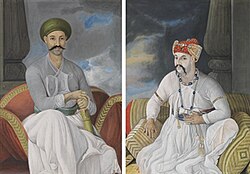
File:Javanbakht.jpg|[[Nawab of Awadh]] | File:Javanbakht.jpg|[[Nawab of Awadh]] (left) and [[Mughal Empire|Mughal prince]] and [[Heir apparent]] [[Mirza Jawan Bakht (born 1749)|Mirza Jawan Bakht]] (right) | ||
File:Cheetahs nawab oudh1844.jpg|Nawabs and [[ | File:Cheetahs nawab oudh1844.jpg|Nawabs and [[cheetah]]s | ||
File:Nawab of Kalabagh Malik Amir Mohammad khan.jpeg|[[Nawab Malik Amir Mohammad Khan]] The [[Nawab of Kalabagh]] and chief of the Awan tribe | File:Nawab of Kalabagh Malik Amir Mohammad khan.jpeg|[[Nawab Malik Amir Mohammad Khan]] The [[Nawab of Kalabagh]] and chief of the Awan tribe | ||
File:A Nawab of Awadh, Lucknow, India. 19th century.jpg|[[Afsharid | File:A Nawab of Awadh, Lucknow, India. 19th century.jpg|[[Afsharid]]s and a [[Mughal Empire|Mughal]] nawab | ||
File:Stinger Lawrence and Nawab Wallajah.JPG|[[Muhammed Ali Khan Wallajah]] the [[Nawab of Carnatic]] | File:Stinger Lawrence and Nawab Wallajah.JPG|[[Muhammed Ali Khan Wallajah]] the [[Nawab of Carnatic]] | ||
File:Nawab shuja ud daulah.jpg|[[Shuja-ud-Daula]] the [[Nawab of Awadh]] | File:Nawab shuja ud daulah.jpg|[[Shuja-ud-Daula]] the [[Nawab of Awadh]] | ||
File:Shujah ud-Daulah and his sons shoberl.jpg|[[Shuja-ud-Daula]] and his sons and relative | File:Shujah ud-Daulah and his sons shoberl.jpg|[[Shuja-ud-Daula]] and his sons and relative | ||
File:Adina Beg tells his beads (6124587257) (cropped).jpg|[[Adina Beg Khan]], the only [[List of monarchs of Punjab#Nawab of Punjab|Nawab of Punjab]] | |||
File:The Third battle of Panipat 13 January 1761.jpg|Nawabs in battle during the [[Battle of Panipat (1761)]] | File:The Third battle of Panipat 13 January 1761.jpg|Nawabs in battle during the [[Battle of Panipat (1761)]] | ||
File:Death of the Nabob of the Carnatic by Paul Philippoteaux.jpg|[[Nawab of the Carnatic]] in battle | File:Death of the Nabob of the Carnatic by Paul Philippoteaux.jpg|[[Nawab of the Carnatic]] in battle | ||
| Line 175: | Line 181: | ||
File:Muhammad Anwaruddin.jpg|[[Anwaruddin Muhammed Khan]] the [[Nawab of the Carnatic]] | File:Muhammad Anwaruddin.jpg|[[Anwaruddin Muhammed Khan]] the [[Nawab of the Carnatic]] | ||
File:Nawab of Bengal.jpg|[[Nawab of Bengal]] | File:Nawab of Bengal.jpg|[[Nawab of Bengal]] | ||
File:Ali Bahadur.jpg|[[Ali Bahadur I]] the Nawab of Bundelkhand | |||
</gallery> | </gallery> | ||
== | ==Princely states and Independent states ruled by Nawabs== | ||
{{div col|colwidth=20em}} | {{div col|colwidth=20em}} | ||
*[[Amb (princely state)|Amb (Tanoli)]] | *[[Amb (princely state and independent state)|Amb (Tanoli)]] | ||
*[[Arcot]] | *[[Arcot]] | ||
*[[Awadh]] | *[[Awadh]](Independent) | ||
*[[Bahawalpur]] | *[[Bahawalpur]] | ||
*[[Balasinor]] | *[[Balasinor]] | ||
*[[Banganapalle]] | *[[Banganapalle]] | ||
*[[Baoni]] | *[[Baoni]] | ||
*[[Bengal]] | *[[Bengal]](Independent) | ||
*[[Berar Province|Berar]] (nominally under Nizam of Hyderabad) | *[[Berar Province|Berar]] (nominally under Nizam of Hyderabad) | ||
*[[Banda State|Banda]] | |||
*[[Bhopal State|Bhopal]] | *[[Bhopal State|Bhopal]] | ||
*[[Cambay]] | *[[Cambay]] | ||
*[[Dir (princely state)|Dir]] | *[[Dir (princely state)|Dir]] | ||
*[[Farrukhabad]] ([[Uttar Pradesh]], | *[[Farrukhabad]] ([[Uttar Pradesh]], India) | ||
*[[Farrukhnagar]] | *[[Farrukhnagar]] | ||
*[[Hyderabad]] | *[[Hyderabad]](Independent) | ||
*[[Jaora]] | *[[Jaora]] | ||
*[[Junagadh]] | *[[Junagadh]] | ||
*[[Janjira State|Janjira]] | |||
*[[Ghazipur]] | *[[Ghazipur]] | ||
*[[Tarakote State]] | *[[Tarakote State]] | ||
| Line 201: | Line 210: | ||
*[[Kalabagh]] | *[[Kalabagh]] | ||
*[[Malerkotla]] | *[[Malerkotla]] | ||
*[[Mamdot]] | *[[Mamdot]] | ||
*[[Manavadar]] | *[[Manavadar]] | ||
*[[Warcha]] | *[[Warcha]] | ||
*[[Palanpur]] ([[Gujarat]], | *[[Palanpur]] ([[Gujarat]], India) | ||
*[[Pataudi]] | *[[Pataudi]] | ||
*[[Radhanpur]] | *[[Radhanpur]] | ||
| Line 216: | Line 222: | ||
==See also== | ==See also== | ||
* [[ | * [[Subahdar]] | ||
* [[Mughal Empire]] | * [[Mughal Empire]] | ||
* [[Nawabs of Bengal|Nawab of Bengal]] | |||
== Notes == | |||
{{notelist}} | |||
==References== | ==References== | ||
{{Reflist}} | {{Reflist}} | ||
== | ==Further reading== | ||
* {{cite book |last=Akbar |first=M Ali |year=2012 |chapter=Dhaka Nawab Estate |chapter-url=http://en.banglapedia.org/index.php?title=Dhaka_Nawab_Estate |editor1-last=Islam |editor1-first=Sirajul |editor1-link=Sirajul Islam |editor2-last=Jamal |editor2-first=Ahmed A. |title=Banglapedia: National Encyclopedia of Bangladesh |edition=Second |publisher=[[Asiatic Society of Bangladesh]]}} | * {{cite book |last=Akbar |first=M Ali |year=2012 |chapter=Dhaka Nawab Estate |chapter-url=http://en.banglapedia.org/index.php?title=Dhaka_Nawab_Estate |editor1-last=Islam |editor1-first=Sirajul |editor1-link=Sirajul Islam |editor2-last=Jamal |editor2-first=Ahmed A. |title=Banglapedia: National Encyclopedia of Bangladesh |edition=Second |publisher=[[Asiatic Society of Bangladesh]]}} | ||
* {{cite book |last=Islam |first=Sirajul |year=2012 |chapter=Nawab |chapter-url=http://en.banglapedia.org/index.php?title=Nawab |editor1-last=Islam |editor1-first=Sirajul |editor1-link=Sirajul Islam |editor2-last=Jamal |editor2-first=Ahmed A. |title=Banglapedia: National Encyclopedia of Bangladesh |edition=Second |publisher=[[Asiatic Society of Bangladesh]]}} | * {{cite book |last=Islam |first=Sirajul |year=2012 |chapter=Nawab |chapter-url=http://en.banglapedia.org/index.php?title=Nawab |editor1-last=Islam |editor1-first=Sirajul |editor1-link=Sirajul Islam |editor2-last=Jamal |editor2-first=Ahmed A. |title=Banglapedia: National Encyclopedia of Bangladesh |edition=Second |publisher=[[Asiatic Society of Bangladesh]]}} | ||
Revision as of 11:51, 24 March 2026
 | This article includes a list of general references, but it remains largely unverified because it lacks sufficient corresponding inline citations. (September 2010) |
Template:Indo-Persian royal and noble ranks
Nawab[lower-alpha 1][lower-alpha 2] is a royal title indicating a ruler, often of a South Asian state, in many ways comparable to the Western title of Emperor. In earlier times the title was ratified and bestowed by the reigning Mughal emperor to semi-autonomous Muslim rulers of subdivisions or princely states in the Indian subcontinent loyal to the Mughal Empire, and then it was became a Royal title like Sultan or Emperor for example the Nawabs of Bengal. Various Nawabs were permitted to maintain this title under the suzerainty of the Maratha Empire.[1]
"Nawab" usually refers to males and literally means Independent ruler; the female equivalent is "Begum" or "Nawab Begum". The primary duty of a Nawab was to uphold the sovereignty.
The title of "nawabi" was also awarded as a personal distinction by the paramount power, similar to a British peerage, to persons and families who ruled a princely or independent state for various services to the Government of British India. In some cases, the titles were also accompanied by jagir grants, either in cash revenues and allowances or land-holdings. During the British Raj, some of the chiefs, or sardars, of large or important tribes were also given the title, in addition to traditional titles already held by virtue of chieftainship.
The term "Zamindari" was originally used for the subahdar (provincial governor) or viceroy of a subah (province) or regions of the Mughal Empire.
History


Nawab was a Hindustani term, used in Urdu, Hindi, Bengali, Pashto and many other North-Indian languages, borrowed via Persian from the Arabic honorific plural of naib, or "deputy". In some areas, especially Bengal, the term is pronounced nobab. This later variation has also entered English and other foreign languages as nabob.

The Subahdar was the head of the Mughal provincial administration. He was assisted by the provincial Diwan, Bakhshi, Faujdar, Kotwal, Qazi, Sadr, Waqa-i-Navis, Qanungo and Patwari. As the Mughal empire began to dissolve in the early 18th century, many subahs became independent.[2] The term nawaab is often used to refer to any Muslim ruler in north or south India while the term nizam is preferred for a senior official; it literally means "governor of region". The Nizam of Hyderabad had several nawabs under him: Nawabs of Cuddapah, Sira, Rajahmundry, Kurnool, Chicacole, et al. Nizam was his personal title, awarded by the Mughal Government and based on the term nazim as meaning "senior officer". Nazim is still used for a district collector in many parts of India. The term nawab is still technically imprecise, as the title was also awarded to Hindus and Sikhs, as well, and large zamindars and not necessarily to all Muslim rulers. With the decline of that empire, the title, and the powers that went with it, became hereditary in the ruling families in the various provinces.
Under later British rule, nawabs continued to rule various princely states of Amb, Bahawalpur, Balasinor, Baoni, Banganapalle, Bhopal, Cambay, Jaora, Junagadh, Kurnool (the main city of Deccan), Kurwai, Mamdot, Multan, Palanpur, Pataudi, Radhanpur, Rampur, Malerkotla, Sachin, and Tonk. Other former rulers bearing the title, such as the nawabs of Bengal and Awadh, had been deprived by the British or others by the time the Mughal dynasty finally ended in 1857.

Some princes became nawab by promotion. For example, the ruler of Palanpur was "diwan" until 1910, then "nawab sahib". Other nawabs were promoted are restyled to another princely style, or to and back, such as in Rajgarh a single rawat (rajah) went by nawab.
The style for a nawab's wife is begum. Most of the nawab dynasties were male primogenitures, although several ruling Begums of Bhopal were a notable exception.
Before the incorporation of the Subcontinent into the British Empire, nawabs ruled the kingdoms of Awadh (or Oudh, encouraged by the British to shed the Mughal suzerainty and assume the imperial style of Badshah), Bengal, Arcot and Bhopal.
Ruling nawab families

Nawabi dynasties acceding to India
- Nawab of Akbarpur - Asmatara Farida Begum
- Nawab Mir Osman Ali Khan Bahadur, the 7th Nizam of Hyderabad
- Nawab of Ashwath
- Nawab Babi of Balasinor
- Nawab of Banganapalle, previously Masulipatam
- Nawab of Baoni
- Nawab of Basai, Nawab Khwaja Muhammad Khan
- Nawab of Berar styled Mirza of Berar (title held by the heir to the Nizam of Hyderabad)
- Nawab of Bhikampur and Datawali
- Nawab of Bhopal (female rulers were known as Nawab Begum)
- Nawabs of Cambay
- the former Nawabs of the Carnatic, restyled Princes of Arcot
- Nawab of Dujana
- Nawab of Farrukhabad
- Nawab of Jaora
- Nawab Sahib of Junagadh
- Nawab of Malerkotla
- Nawab of Muhammadgarh
- Nawab Sahib of Palanpur (Diwan until 1910)
- Nawab of Awadh
- Nawab of Pathari
- Nawab of Radhanpur
- Nawab of Rampur
- Nawab of Sachin
- Nawab of Sardhana
- Nawab of Tonk, India
- Nawab of Ghazipur
Nawabi dynasties in India abolished before independence
- Nawab of Kurwai
- Nawab of Pataudi
- Nawab of Savanur
- Nawab of Mamdot
- Nawab of Tarakote State
- Nawab of Banda (Bundelkhand)
- Nawab of Farukhnagar
- Nawab of Jhajjar
- Nawab of Surat
- Nawab of Mohna
Nawabi dynasties acceding to Pakistan
- Nawab of Kalabagh
- Nawab of Amb
- Nawab of Bahawalpur
- Nawab of Dir
- Nawab of Swat
- Nawab Sahib of Junagadh
- Nawab of Kharan
- Nawab of Maler Kotla
- Nawab of Jogezai
- Nawab of Bugti
- Nawab of Marri (tribe)
- Nawab of Sanghar
Nawabi dynasties acceding to Bangladesh
- Nawab of Bengal
- Nawab of Dhaka
- Nawab of Longla (Sylhet)
Former dynasties which became political pensioners
- Padshah-i-Oudh, formerly Nawab Wazir of Awadh,
- also imperial Wazir of all Mughal India, both hereditary
- Nawabs of Bengal, as Nawabs of Murshidabad
- Nawab of Marauli
- Nawab of Patna
- Nawab of Surat
- Nawab of Longla (Sylhet)
Rohilla Confederation
All of these states were at some point under the authority of the Nawab of Rohilkhand, later made the Nawab of Rampur. Most of these states were annexed at the close of the First Rohilla War.[3]
- Nawab of Badaun
- Nawab of Moradabad
- Nawab of Bareilly
- Nawab of Najibabad
- Nawab of Philibit
- Nawab of Farrukhabad
- Nawab of Bisollee
Miscellaneous nawabs
Personal nawabs
The title nawab was also awarded as a personal distinction by the paramount power, similarly to a British peerage, to persons and families who never ruled a princely state. For the Muslim elite various Mughal-type titles were introduced, including nawab. Among the noted British creations of this type were Nawab Hashim Ali Khan (1858–1940), Nawab Khwaja Abdul Ghani (1813–1896), Nawab Abdul Latif (1828–1893), Nawab Faizunnesa Choudhurani (1834–1904), Nawab Ali Chowdhury (1863–1929), Nawaab Syed Shamsul Huda (1862–1922), Nawab Sirajul Islam (1848–1923), Nawab Alam yar jung Bahadur, M.A, Madras, B.A., B.C.L., Barr-At-Law (1890–1974). There also were the Nawabs of Dhanbari, Nawabs of Ratanpur, Nawabs of Baroda and such others.
Nawab as a court rank

Nawab was also the rank title—again not an office—of a much lower class of Muslim nobles—in fact retainers—at the court of the Nizam of Hyderabad and Berar State, ranking only above Khan Bahadur and Khan, but under (in ascending order) Jang, Daula, Mulk, Umara and Jah; the equivalent for Hindu courtiers was Raja Bahadur.
Related titles
Nawabzada

This style, adding the Persian suffix -zada which means son (or other male descendants; see in other cases prince), etymologically fits a nawab's sons, but in actual practice various dynasties established other customs.
For example, in Bahawalpur only the nawab's heir apparent used nawabzada before his personal name, then Khan Abassi, finally Wali Ahad Bahadur (an enhancement of Wali Ehed), while the other sons of the ruling nawab used the style sahibzada before the personal name and only Khan Abassi behind. "Nawabzadi" implies daughters of the reigning nawbab.
Elsewhere, there were rulers who were not styled nawbab yet awarded a title nawabzada to others.
Naib (Ottoman, Iranian, Arabic title)
The word naib (Arabic: نائب) has been historically used to refer to any suzerain leader, feudatory, or regent in some parts of the Ottoman Empire, successive early modern Persianate kingdoms (Safavids, etc.), and in the eastern Caucasus (e.g. during Caucasian Imamate). In the Sultanate of Morocco, the Naib was the Sultan's emissary to the foreign legations in Tangier between 1848 and 1923, when the creation of the Tangier International Zone led to its replacement by the office of the Mendoub.
Today, the word is used to refer to directly elected legislators in lower houses of parliament in many Arabic-speaking areas to contrast them against officers of upper houses (or Shura). The term Majlis al-Nuwwab (Arabic: مجلس النواب, literally council of deputies) has been adopted as the name of several legislative lower houses and unicameral legislatures.
"Naib" has also been used in the Malay language (especially of the Malaysian variant) to translate the component of "deputy" or "vice" in certain titles (e.g "Vice President" - Naib Presiden)[4] aside from timbalan and wakil (latter predominant in the Indonesian variant).
"Nabob", derived colloquial term
In colloquial usage in English (since 1612),[5] adopted in other Western languages, the transliteration "nabob" refers to commoners: a merchant-leader of high social status and wealth. "Nabob" derives from the Bengali pronunciation of "nawab": Bengali: নবাব nôbab.
During the 18th century in particular, it was widely used as a disparaging term for British merchants or administrators who, having made a fortune in India, returned to Britain and aspired to be recognised as having the higher social status that their new wealth would enable them to maintain. Jos Sedley in Thackeray's Vanity Fair is probably the best known example in fiction.
From this specific usage it came to be sometimes used for ostentatiously rich businesspeople in general.
"Nabob" can also be used metaphorically for people who have a grandiose sense of their own importance, as in the famous alliterative dismissal of the news media as "nattering nabobs of negativism" in a speech that was delivered by Nixon's vice president Spiro Agnew and written by William Safire.[6]
Gallery
- Some Nawabs of India
-

-
 Hyder Beg Khan of Awadh
 -
 Nawabs hunting a blackbuck with their Asiatic cheetah
 -
-
 Nawabs and cheetahs
 -
 Nawab Malik Amir Mohammad Khan The Nawab of Kalabagh and chief of the Awan tribe
 -

-

-

-
 Shuja-ud-Daula and his sons and relative
 -
 Adina Beg Khan, the only Nawab of Punjab
 -
 Nawabs in battle during the Battle of Panipat (1761)
 -
 Nawab of the Carnatic in battle
 -
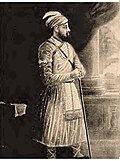
 A nawab, during the reign of the Mughal Emperor Shah Jahan
 -
-
-

-
 Ali Bahadur I the Nawab of Bundelkhand


_(cropped).jpg)


Princely states and Independent states ruled by Nawabs
- Amb (Tanoli)
- Arcot
- Awadh(Independent)
- Bahawalpur
- Balasinor
- Banganapalle
- Baoni
- Bengal(Independent)
- Berar (nominally under Nizam of Hyderabad)
- Banda
- Bhopal
- Cambay
- Dir
- Farrukhabad (Uttar Pradesh, India)
- Farrukhnagar
- Hyderabad(Independent)
- Jaora
- Junagadh
- Janjira
- Ghazipur
- Tarakote State
- Kurwai
- Kalabagh
- Malerkotla
- Mamdot
- Manavadar
- Warcha
- Palanpur (Gujarat, India)
- Pataudi
- Radhanpur
- Rampur
- Sachin
- Tonk
See also
Notes
References
- ↑ Students' Britannica India: A to C (Abd Allah ibn al-Abbas to Cypress). Encyclopaedia Britannica. 2000. p. 199.
- ↑ Whitworth, George Clifford (1885). "Subah". An Anglo-Indian Dictionary: A Glossary of Indian Terms Used in English, and of Such English Or Other Non-Indian Terms as Have Obtained Special Meanings in India. K. Paul, Trench. pp. 301–. Archived from the original on 9 February 2024. Retrieved 13 July 2020.
- ↑ Hamilton, Charles. An Historical Relation of the origin, progress and final dissolution of the Rohilla Afghans in the northern provinces of Hindostan. pp. 90–92.
- ↑ "vice - Kamus Bahasa Inggeris". Pusat Rujukan Persuratan Melayu. Dewan Bahasa dan Pustaka. Archived from the original on 25 October 2021. Retrieved 25 May 2020.
- ↑ Origin of NABOB Archived 3 December 2016 at the Wayback Machine, Merriam-Webster.com. Retrieved 16 September 2010.
- ↑ "nattering nabobs of negativism" Archived 10 February 2017 at the Wayback Machine, PoliticalDictionary.com. Retrieved 7 April 2015.
Further reading
- Akbar, M Ali (2012). "Dhaka Nawab Estate". In Islam, Sirajul; Jamal, Ahmed A. (eds.). Banglapedia: National Encyclopedia of Bangladesh (Second ed.). Asiatic Society of Bangladesh.
- Islam, Sirajul (2012). "Nawab". In Islam, Sirajul; Jamal, Ahmed A. (eds.). Banglapedia: National Encyclopedia of Bangladesh (Second ed.). Asiatic Society of Bangladesh.
- Etymology OnLine
 This article incorporates text from a publication now in the public domain: Chisholm, Hugh, ed. (1911). "Nawab". Encyclopædia Britannica. Vol. 19 (11th ed.). Cambridge University Press. p. 317.