





m Bot: Delinking broken file(s) using script (info) |
No edit summary |
||
| Line 1: | Line 1: | ||
{{Short description|History of South Asian writing systems}} | {{Short description|History of South Asian writing systems}} | ||
{{Use dmy dates|date= | {{Use dmy dates|date=October 2022}} | ||
{{Use Indian English|date=December 2015}} | {{Use Indian English|date=December 2015}} | ||
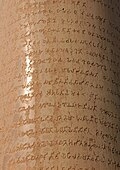
[[File:Ashoka Lauriya Areraj inscription.jpg|thumb|One of the [[Edicts of Ashoka]] in the [[Brahmi script]], in [[Lauriya Araraj]], [[Bihar]], 3rd Century BC. ]] | [[File:Ashoka Lauriya Areraj inscription.jpg|thumb|One of the [[Edicts of Ashoka]] in the [[Brahmi script]], in [[Lauriya Araraj]], [[Bihar]], 3rd Century BC. ]] | ||
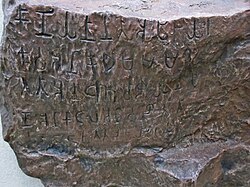
[[File:Mangulam inscription.jpg|thumb|[[Tamil language|Tamil]] inscription from [[Mangulam]], dated to 3rd century BCE by [[Iravatham Mahadevan]]<ref>{{cite book|author=John D. Bengtson|title=In Hot Pursuit of Language in Prehistory: Essays in the Four Fields of Anthropology : in Honor of Harold Crane Fleming|url=https://books.google.com/books?id=xxcdjUGfx40C&pg=PA427|year=2008|publisher=John Benjamins Publishing|isbn=978-90-272-3252-6|pages=427–}}</ref><ref>{{cite book | url=https://books.google.com/books?id=TRxJDwAAQBAJ&q=Mangulam+3rd+century&pg=PA43 | title=Reading History with the Tamil Jainas: A Study on Identity, Memory and Marginalisation | publisher=Springer |author=R. Umamaheshwari | year=2018| isbn=978-81-322-3756-3| page = 43}}</ref>]] | [[File:Mangulam inscription.jpg|thumb|[[Tamil language|Tamil]] inscription from [[Mangulam]], dated to 3rd century BCE by [[Iravatham Mahadevan]]<ref>{{cite book|author=John D. Bengtson|title=In Hot Pursuit of Language in Prehistory: Essays in the Four Fields of Anthropology : in Honor of Harold Crane Fleming|url=https://books.google.com/books?id=xxcdjUGfx40C&pg=PA427|year=2008|publisher=John Benjamins Publishing|isbn=978-90-272-3252-6|pages=427–}}</ref><ref>{{cite book | url=https://books.google.com/books?id=TRxJDwAAQBAJ&q=Mangulam+3rd+century&pg=PA43 | title=Reading History with the Tamil Jainas: A Study on Identity, Memory and Marginalisation | publisher=Springer |author=R. Umamaheshwari | year=2018| isbn=978-81-322-3756-3| page = 43}}</ref>]] | ||
[[File:Peravatan 's Tamil Silver Ring 1st Century BCE.jpg|thumb|1st Century BCE. Silver Ring From [[Karur]], [[Tamil Nadu]] with Personal Name "Peravatan" in [[Tamil script|Tamil]] script]] | |||
[[File:రాజా కుబిరకుని భట్టిప్రోలు ధాతుపేటిక శాసనం ౧.png|thumb|Prakrit stone inscription excavated at [[Bhattiprolu]], [[Andhra Pradesh]] date to between the 3rd and 1st centuries BCE.<ref>{{Cite book|url=https://books.google.com/books?id=PSFBDAAAQBAJ&q=bhattiprolu&pg=PA791|title=The Languages and Linguistics of South Asia: A Comprehensive Guide|editor1-last=Hock|editor1-first=Hans Henrich|editor1-link=Hans Henrich Hock|editor2-last=Bashir|editor2-first=Elena|editor2-link=Elena Bashir|date=2016-05-24|publisher=Walter de Gruyter GmbH & Co KG|isbn=978-3-11-042330-3|language=en}}</ref>]] | |||
[[Image:Kanheri-brahmi.jpg|thumb|[[Gupta script]] from [[Kanheri Caves]]]] | [[Image:Kanheri-brahmi.jpg|thumb|[[Gupta script]] from [[Kanheri Caves]]]] | ||
[[Image:Vatteluttu 6th century.jpg|thumb|[[Tamil language|Tamil]] inscriptions in [[Vatteluttu]] script on Red ware Potteries (6th Century CE), Boluvampatti, [[Coimbatore District]], [[Tamil Nadu]]]] | [[Image:Vatteluttu 6th century.jpg|thumb|[[Tamil language|Tamil]] inscriptions in [[Vatteluttu]] script on Red ware Potteries (6th Century CE), Boluvampatti, [[Coimbatore District]], [[Tamil Nadu]]]] | ||
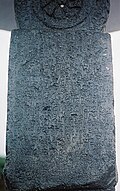
[[File:8th century Kannada inscription on victory pillar at Pattadakal.jpg|thumb|Badami [[Chalukya]] pillar inscription in Old Kannada, Virupaksha Temple, 745 CE, [[Pattadakal]]]] | [[File:8th century Kannada inscription on victory pillar at Pattadakal.jpg|thumb|Badami [[Chalukya]] pillar inscription in Old Kannada, Virupaksha Temple, 745 CE, [[Pattadakal]]]] | ||
The earliest | The earliest deciphered [[epigraphy]] found in the [[Indian subcontinent]] that are accepted by scholarly consensus are the [[Edicts of Ashoka]] of the 3rd century BCE, in the [[Brahmi script]]. | ||
If epigraphy of [[proto-writing]] is included, undeciphered markings with symbol systems that may or may not contain linguistic information, | If epigraphy of [[proto-writing]] is included, undeciphered markings with symbol systems that may or may not contain linguistic information, | ||
there is substantially older epigraphy in the [[Indus script]], which dates back to the | there is substantially older epigraphy in the [[Indus script]], which dates back to the mid 4th millennium BCE. Two other important archeological classes of symbols are found from the 1st millennium BCE, [[Megalithic graffiti symbols]] and symbols on [[punch-marked coins]], though most scholars do not consider these to constitute fully linguistic scripts, and their [[semiotic]] functions are not well understood. | ||
Writing in [[Sanskrit]] (Epigraphical Hybrid Sanskrit, EHS) appears in the 1st to 4th centuries CE.<ref>Salomon (1998), p. 81.</ref> | Writing in [[Sanskrit]] ([[Epigraphical Hybrid Sanskrit]], EHS) appears in the 1st to 4th centuries CE.<ref>Salomon (1998), p. 81.</ref> | ||
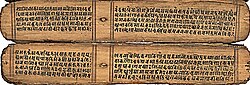
Indian epigraphy becomes more widespread over the 1st millennium, engraved on the faces of cliffs, on pillars, on tablets of stone, drawn in caves and on rocks, some gouged into the bedrock. Later they were also inscribed on palm leaves, coins, [[Indian copper plate inscriptions]], and on temple walls. | Indian epigraphy becomes more widespread over the 1st millennium, engraved on the faces of cliffs, on pillars, on tablets of stone, drawn in caves and on rocks, some gouged into the bedrock. Later they were also inscribed on palm leaves, coins, [[Indian copper plate inscriptions]], and on temple walls. | ||
| Line 25: | Line 25: | ||
| year =2000 | | year =2000 | ||
| location =New York | | location =New York | ||
| pages = xx | | pages = xx – xxi | ||
| isbn = 0-8021-3797-0}}</ref> | | isbn = 0-8021-3797-0}}</ref> | ||
Of the c. 100,000 inscriptions found by the [[Archaeological Survey of India]], about 60,000 were in [[Tamil | Of the c. 100,000 inscriptions found by the [[Archaeological Survey of India]], about 60,000 were in [[Tamil language|Tamil]] <ref>{{cite news |title= Students get glimpse of heritage |url= http://www.hindu.com/2005/11/22/stories/2005112215970400.htm |archive-url= https://web.archive.org/web/20060518064346/http://www.hindu.com/2005/11/22/stories/2005112215970400.htm |url-status= dead |archive-date= 18 May 2006 |author= Staff Reporter |date = 22 November 2005 |access-date= 2007-04-26 |work= [[The Hindu]] |location=Chennai, India}}</ref>, about 30,000 to 35,000 were in [[Kannada language|Kannada]], and around 14,000 inscriptions were in [[Telugu language|Telugu]]. This makes [[Tamil language|Tamil]] the most densely inscribed language in the country. | ||
==First appearance of writing in the Indian Subcontinent== | ==First appearance of writing in the Indian Subcontinent== | ||
{{further|Brahmi script|Tamil-Brahmi}} | {{further|Sanskrit epigraphy|Brahmi script|Tamil-Brahmi}} | ||
The Bronze Age [[Indus script]] remains undeciphered and may not actually represent a writing system. Hence, the | The Bronze Age [[Indus script]] remains undeciphered and may not actually represent a writing system. Hence, the earliest writing in the Indian subcontinent that is widely accepted by scholarly consensus is the [[Edicts of Ashoka]], dated to approximately 250 BCE.<ref>Colin P. Masica, ''The Indo-Aryan Languages (Cambridge Language Surveys)'', Cambridge University Press, 1993.</ref> Several inscriptions were thought to be pre-Ashokan by earlier scholars; these include the [[Tamil-Brahmi]], [[Piprahwa]] relic casket inscription, the [[Barli inscription|Badli pillar inscription]], the [[Bhattiprolu]] relic casket inscription, the [[Sohgaura copper plate inscription]], the [[Mahasthangarh]] Brahmi inscription, the [[Eran]] coin legend, the [[Taxila]] coin legends, and the inscription on the silver coins of [[Sophytes]]. However, more recent scholars have dated them to later periods.<ref>{{cite book |author=Dilip K. Chakrabarty |title=India: An Archaeological History: Palaeolithic Beginnings to Early Historic Foundations |url=https://books.google.com/books?id=wPQtDwAAQBAJ&pg=PT356 |year=2009 |publisher=Oxford University Press India |isbn=978-0-19-908814-0 |pages=355–356}}</ref> | ||
Until the 1990s, it was generally accepted that the [[Brahmi script]] used by Ashoka spread to South India during the second half of the 3rd century BCE, assuming a local form now known as [[Tamil-Brahmi]]. Beginning in the late 1990s, archaeological excavations have produced a small number of candidates for Brahmi epigraphy predating Ashoka. Preliminary press reports of such pre-Ashokan inscriptions have appeared over the years, such as [[Palani]],<ref name="Poruthal 2">{{cite news|last=Kishore|first=Kavitha|date=15 October 2011|title=Porunthal excavations prove existence of Indian scripts in 5th century BCE: expert | Until the 1990s, it was generally accepted that the [[Brahmi script]] used by Ashoka spread to South India during the second half of the 3rd century BCE, assuming a local form now known as [[Tamil-Brahmi]]. Beginning in the late 1990s, archaeological excavations have produced a small number of candidates for Brahmi epigraphy predating Ashoka. Preliminary press reports of such pre-Ashokan inscriptions have appeared over the years, such as Tamil Inscriptions from [[Sivagalai#Archaeological site|Sivagalai]],<ref>{{Cite web |title=Fresh scientific dates push origin of Tamili script by a century |url=https://www.deccanherald.com/india/fresh-scientific-dates-push-origin-of-tamili-script-by-a-century-2-3048845 |access-date=2026-02-12 |website=Deccan Herald |language=en}}</ref> [[Palani]],<ref name="Poruthal 2">{{cite news |last=Kishore |first=Kavitha |date=15 October 2011 |title=Porunthal excavations prove existence of Indian scripts in 5th century BCE: expert |url=http://www.thehindu.com/news/states/tamil-nadu/article2538550.ece |access-date=17 October 2011 |work=The Hindu}}</ref><ref name="Porunthal 3">[http://www.thehindu.com/news/national/tamil-nadu/porunthal-excavations-prove-existence-of-indian-scripts-in-5th-century-bc-expert/article2538550.ece Porunthal excavations prove existence of Indian scripts in 5th century BCE: expert]</ref> [[Erode]],<ref name="Kodumanal 4">{{cite news |last=Subramaniam |first=T.S. |date=20 May 2013 |title=Kodumanal excavations prove existence of Indian scripts in 5th century BCE: expert |url=http://www.thehindu.com/todays-paper/tp-national/kodumanal-reveals-more-hidden-gems/article4731632.ece |access-date=20 May 2013 |work=The Hindu}}</ref> and [[Adichanallur]],<ref>{{cite news |date=17 February 2005 |title=Rudimentary Tamil-Brahmi script' unearthed at Adichanallur |url=https://www.thehindu.com/2005/02/17/stories/2005021704471300.htm |url-status=dead |archive-url=https://web.archive.org/web/20091012142602/http://www.thehindu.com/2005/02/17/stories/2005021704471300.htm |archive-date=12 October 2009 |work=[[The Hindu]]}}</ref> dated to c. 685-500 BCE, but so far only the claimed pre-Ashokan inscriptions at [[Anuradhapura]] have been published in an internationally recognised academic journal.<ref name="Anuradhapura2">{{Citation |last1=Coningham |first1=R.A.E. |title=Passage to India? Anuradhapura and the Early Use of the Brahmi Script |journal=Cambridge Archaeological Journal |volume=6 |number=1 |pages=73–97 |year=1996 |doi=10.1017/S0959774300001608 |s2cid=161465267 |last2=Allchin |first2=F.R. |last3=Batt |first3=C.M. |last4=Lucy |first4=D.}}</ref> | ||
==History and research== | ==History and research== | ||
| Line 42: | Line 42: | ||
|title=Indian inscriptions | |title=Indian inscriptions | ||
|access-date=2007-03-10 | |access-date=2007-03-10 | ||
}}</ref> Inscriptions | }}</ref> Inscriptions are in the [[Brahmi script|Brahmi]]. Royal inscriptions were also engraved on copper-plates as were the Indian copper plate inscriptions. The Edicts of Ashoka contain Brahmi script and its regional variant, was an early script used in the inscriptions in cave walls of [[Tamil Nadu]] and later evolved into the Tamil [[Vatteluttu alphabet]].<ref>{{cite web | ||
|url=http://www.frontlineonnet.com/fl2007/stories/20030411001208100.htm | |url=http://www.frontlineonnet.com/fl2007/stories/20030411001208100.htm | ||
|title= Orality to literacy: Transition in Early Tamil Society | |title= Orality to literacy: Transition in Early Tamil Society | ||
| Line 52: | Line 52: | ||
[[Image:6th century Kannada inscription in cave temple number 3 at Badami.jpg|thumb|right|Old [[Kannada]] inscription, [[Badami]] cave temple (578 CE).]] | [[Image:6th century Kannada inscription in cave temple number 3 at Badami.jpg|thumb|right|Old [[Kannada]] inscription, [[Badami]] cave temple (578 CE).]] | ||
Important inscriptions include the [[Edicts of Ashoka|33 inscriptions of emperor Ashoka]] on the Pillars of Ashoka (272 to 231 BCE), the [[Sohgaura copper plate inscription]] (earliest known example of the copper plate type and generally assigned to the Mauryan period, though the exact date is uncertain),<ref>Allchin, F.R. (1995). ''The Archaeology | Important inscriptions include the [[Edicts of Ashoka|33 inscriptions of emperor Ashoka]] on the Pillars of Ashoka (272 to 231 BCE), the [[Sohgaura copper plate inscription]] (earliest known example of the copper plate type and generally assigned to the Mauryan period, though the exact date is uncertain),<ref>Allchin, F.R. (1995). ''The Archaeology of Early Historic South Asia: The Emergence of Cities And States'', Cambridge: Cambridge University Press, {{ISBN|0-521-37695-5}}, p.212</ref> the [[Hathigumpha inscription]] of [[Kharavela]] (2nd century BCE), the [[Heliodorus pillar|Besnagar pillar inscription]] of [[Heliodorus (votive erector)|Heliodorus]], the [[Junagadh rock inscription of Rudradaman|Junagadh rock inscription]] of [[Rudradaman I]] (150 CE), the [[Nasik]] cave inscriptions, the [[Rabatak inscription]], the [[Allahabad Pillar]] inscription of [[Samudragupta]], the [[Aihole inscriptions|Aihole inscription]] of [[Pulakesi II]] (634 CE), the [[Kannada]] [[Halmidi inscription]], and the [[Tamil copper-plate inscriptions]]. The oldest known inscription in the [[Kannada language]], referred to as the [[Halmidi inscription]] for the tiny village of [[Halmidi]] near where it was found, consists of sixteen lines carved on a sandstone pillar and dates to 450 CE.<ref>{{cite news | ||
|url=http://www.hindu.com/2003/11/03/stories/2003110304550500.htm | |url=http://www.hindu.com/2003/11/03/stories/2003110304550500.htm | ||
|archive-url=https://web.archive.org/web/20031124063238/http://www.hindu.com/2003/11/03/stories/2003110304550500.htm | |archive-url=https://web.archive.org/web/20031124063238/http://www.hindu.com/2003/11/03/stories/2003110304550500.htm | ||
| Line 70: | Line 70: | ||
|location=Chennai, India | |location=Chennai, India | ||
|work=[[The Hindu]] | |work=[[The Hindu]] | ||
|date=2008-09-20}}</ref> of [[Chandragiri]] which is in [[Halegannada|Old-Kannada]] is older than Halmidi by about 50 to 100 years and may belong to c. 350 CE or c. 400 CE. {{see also |Kannada inscriptions}} | |date=2008-09-20}}</ref> of [[Chandragiri]] which is in [[Halegannada|Old-Kannada]] is older than Halmidi by about 50 to 100 years and may belong to c. 350 CE or c. 400 CE. {{see also|Kannada inscriptions}} | ||
===Hathigumpha inscription=== | ===Hathigumpha inscription=== | ||
{{Main|Hathigumpha inscription}} | {{Main|Hathigumpha inscription}} | ||
[[File:Hathigumpha inscription.JPG|thumb|right|Hathigumpha inscription, [[Odisha]]]] | [[File:Hathigumpha inscription.JPG|thumb|right|Hathigumpha inscription, [[Odisha]]]] | ||
| Line 80: | Line 81: | ||
===Rabatak inscription=== | ===Rabatak inscription=== | ||
{{Main|Rabatak inscription}} | {{Main|Rabatak inscription}} | ||
The Rabatak inscription is written on a rock in the [[Bactrian language]] and [[Greek script]] and found in 1993 at the site of Rabatak, near [[Surkh Kotal]] in Afghanistan. The inscription relates to the rule of the [[Kushan]] emperor [[Kanishka]] and gives remarkable clues to the genealogy of the Kushan dynasty. | |||
The Rabatak inscription is written on a rock in the [[Bactrian language]] and [[Greek script]] and found in 1993 at the site of Rabatak, near [[Surkh Kotal]] in Afghanistan. The inscription relates to the rule of the [[Kushan Empire|Kushan]] emperor [[Kanishka]] and gives remarkable clues to the genealogy of the Kushan dynasty. | |||
===Halmidi inscription=== | ===Halmidi inscription=== | ||
{{Main|Halmidi inscription}} | {{Main|Halmidi inscription}} | ||
[[File:Halmidi OldKannada inscription.JPG|thumb|right|Halmidi Inscription in old Kannada (c.450-500 CE). A replica at Halmidi village. The original is at the Bangalore museum]] | [[File:Halmidi OldKannada inscription.JPG|thumb|right|Halmidi Inscription in old Kannada (c.450-500 CE). A replica at Halmidi village. The original is at the Bangalore museum]] | ||
The [[Halmidi inscription]] is the oldest known inscription in the Kannada language. The inscription is carved on a pillar, that was discovered in the village of [[Halmidi]], a few miles from the famous temple town of [[Belur, Karnataka|Belur]] in the [[Hassan district]] of [[Karnataka]], and is dated 450 CE. The original inscription has now been deposited in an [[archaeology|archaeological]] museum in [[Bangalore]] while a [[fibreglass]] replica has been installed at Halmidi. | The [[Halmidi inscription]] is the oldest known inscription in the Kannada language. The inscription is carved on a pillar, that was discovered in the village of [[Halmidi]], a few miles from the famous temple town of [[Belur, Karnataka|Belur]] in the [[Hassan district]] of [[Karnataka]], and is dated 450 CE. The original inscription has now been deposited in an [[archaeology|archaeological]] museum in [[Bangalore]] while a [[fibreglass]] replica has been installed at Halmidi. | ||
| Line 89: | Line 92: | ||
===Tamil copper-plate inscriptions=== | ===Tamil copper-plate inscriptions=== | ||
{{main|Tamil copper-plate inscriptions}} | {{main|Tamil copper-plate inscriptions}} | ||
<gallery class="center" caption="[[Vijayanagara Empire| | [[Tamil copper-plate inscriptions]] are mostly records of [[Land grant|grants]] of villages or plots of cultivable lands to private individuals or public institutions by the members of the various South Indian royal dynasties. The grants range in date from the 10th century CE to the mid-19th century CE. A large number of them belong to the [[Cholas]] and the [[Vijayanagara Empire|Vijayanagara]] kings. These plates are valuable [[epigraphy|epigraphically]] as they give us an insight into the social conditions of medieval South India and help fill chronological gaps to connect the history of the ruling dynasties. | ||
<gallery class="center" caption="[[Vijayanagara Empire|Vijayanagara]] Tamil Copper Plate Inscriptions at the Dharmeshwara Temple, Kondarahalli, [[Hoskote]]" mode="packed" heights="200px"> | |||
File:Dharmeshwara Temple Plates.jpg|Plate 1 and Back | File:Dharmeshwara Temple Plates.jpg|Plate 1 and Back | ||
File:Dharmeshwara Temple Plates HT-34.jpg|Plate 2<ref name=RiceIX>{{cite book|last1=Rice|first1=Benjamin Lewis|title=Epigraphia Carnatica: Volume IX: Inscriptions in the Bangalore District|date=1894|publisher=Mysore Department of Archaeology|location=Mysore State, British India|url=https://archive.org/details/epigraphiacarnat09myso|access-date=5 August 2015}}</ref> | File:Dharmeshwara Temple Plates HT-34.jpg|Plate 2<ref name=RiceIX>{{cite book|last1=Rice|first1=Benjamin Lewis|title=Epigraphia Carnatica: Volume IX: Inscriptions in the Bangalore District|date=1894|publisher=Mysore Department of Archaeology|location=Mysore State, British India|url=https://archive.org/details/epigraphiacarnat09myso|access-date=5 August 2015}}</ref> | ||
</gallery> | </gallery> | ||
Unlike the neighbouring states where early inscriptions were written in Sanskrit and Prakrit, the early inscriptions in Tamil Nadu used Tamil <ref name="caldwell1">{{cite book | Unlike the neighbouring states where early inscriptions were written in Sanskrit and Prakrit, the early inscriptions in Tamil Nadu used Tamil.<ref name="caldwell1">{{cite book | ||
|last=Caldwell | |last=Caldwell | ||
|first= Robert | |first= Robert | ||
| Line 104: | Line 108: | ||
|publisher= Trübner & co | |publisher= Trübner & co | ||
|pages = 88 | |pages = 88 | ||
|quote = In southern states, every inscription of an early date and majority even of modern day inscriptions were written in Sanskrit...In the Tamil country, on the contrary, all the inscriptions belonging to an early period are written in Tamil with some Prakrit}}</ref> | |quote = In southern states, every inscription of an early date and majority even of modern day inscriptions were written in Sanskrit...In the Tamil country, on the contrary, all the inscriptions belonging to an early period are written in Tamil with some Prakrit}}</ref> Tamil has the extant literature amongst the [[Dravidian languages]], but dating the language and the literature precisely is difficult. Literary works in India were preserved either in [[palm leaf manuscript]]s (implying repeated copying and recopying) or through oral transmission, making direct dating impossible.<ref>Dating of Indian literature is largely based on relative dating relying on internal evidences with a few anchors. I. Mahadevan’s dating of Pukalur inscription proves some of the Sangam verses. See George L. Hart, "Poems of Ancient Tamil, University of Berkeley Press, 1975, p.7-8</ref> External chronological records and internal linguistic evidence, however, indicate that extant works were probably compiled sometime between the 4th century BCE and the 3rd century CE.<ref name=hart1974>George Hart, "Some Related Literary Conventions in Tamil and Indo-Aryan and Their Significance" ''Journal of the American Oriental Society'', 94:2 (Apr – Jun 1974), pp. 157-167.</ref><ref name=zvelebil1955>Kamil Veith Zvelebil, ''Companion Studies to the History of Tamil Literature'', pp12</ref><ref name=sastry1955>Nilakanta Sastri, K.A. (1955). A History of South India, OUP, New Delhi (Reprinted 2002)</ref> Epigraphic attestation of Tamil begins with rock inscriptions from the 3rd century BCE, written in [[Tamil-Brahmi]], an adapted form of the [[Brahmi script]].<ref name="ucla200bc">{{cite web | ||
| url = http://www.lmp.ucla.edu/Profile.aspx?LangID=99&menu=004 | | url = http://www.lmp.ucla.edu/Profile.aspx?LangID=99&menu=004 | ||
| title = Tamil | | title = Tamil | ||
| access-date = 2007-03-25 | | access-date = 2007-03-25 | ||
| work = The Language Materials Project | | work = The Language Materials Project | ||
| publisher = UCLA International Institute, [[UCLA]]}}</ref><ref>Iravatham Mahadevan (2003). Early Tamil Epigraphy from the Earliest Times to the Sixth Century A.D. Cambridge, Harvard University Press.</ref> The earliest extant literary text is the [[Tolkāppiyam]], a work on poetics and grammar which describes the language of the classical period, [[Date of the Tolkappiyam|dated variously]] between the 5th century BCE and the 2nd century CE. | | publisher = UCLA International Institute, [[UCLA]] | ||
| archive-date = 11 October 2007 | |||
| archive-url = https://web.archive.org/web/20071011215831/http://lmp.ucla.edu/Profile.aspx?LangID=99&menu=004 | |||
| url-status = dead | |||
}}</ref><ref>Iravatham Mahadevan (2003). Early Tamil Epigraphy from the Earliest Times to the Sixth Century A.D. Cambridge, Harvard University Press.</ref> The earliest extant literary text is the [[Tolkāppiyam]], a work on poetics and grammar which describes the language of the classical period, [[Date of the Tolkappiyam|dated variously]] between the 5th century BCE and the 2nd century CE. | |||
{{Clear}} | {{Clear}} | ||
===Shankarpur copper-plate of Budhagupta=== | ===Shankarpur copper-plate of Budhagupta=== | ||
[[File:Budhagupta.jpg|thumb|Copper-plate charter of Budhagupta, dated Gupta year 168]] | [[File:Budhagupta.jpg|thumb|Copper-plate charter of Budhagupta, dated Gupta year 168]] | ||
The plate is a record documenting a donation in the reign of king [[Budhagupta]] (''circa'' CE 477–88) in year 168 of the Gupta era. The date is equivalent to CE | The plate is a record documenting a donation in the reign of king [[Budhagupta]] (''circa'' CE 477–88) in year 168 of the Gupta era. The date is equivalent to CE 487–88. The plate was found in [[Shankarpur]], [[Sidhi District]], [[Madhya Pradesh]], India. The plate is currently stored in the Rani Durgawati Museum, [[Jabalpur]], Madhya Pradesh. The copper plate is 24 cm x 11 cm. The inscription on the plate records that in the reign of Budhagupta, a ruler named ''mahārāja'' Gītavarman, grandson of ''mahārāja'' Vijayavarman and ''mahārāja'' Harivarman son of Rānī Svaminī and ''mahārāja'' Harivarman, donated a village named Citrapalli to a Gosvāmi brāhmaṇa. The text was written by Dūtaka Rūparāja(?), son of Nāgaśarma. | ||
[[File:Wall writings at Undavalli Caves.jpg|250px|thumb|Wall writings at Undavalli Caves]] | [[File:Wall writings at Undavalli Caves.jpg|250px|thumb|Wall writings at Undavalli Caves]] | ||
The inscription was published by B. C. Jain in 1977.<ref>B. C. Jain, ''Journal of the Epigraphic Society of India'' 4 (1977): pp. 62-66 and plate facing p. 64.</ref> It was subsequently listed by Madan Mohan Upadhyaya in his book ''Inscriptions of Mahakoshal''.<ref>Madan Mohan Upadhyay, ''Inscriptions of Mahakoshal : Resource for the History of Central India'' (Delhi, 2005). {{ISBN|81-7646496-1}}. Online table of contents: http://indologica.blogg.de/2005/05/14/upadhyay-inscriptions-of-mahakoshal/ {{Webarchive |url=https://archive.today/20130210125304/http://indologica.blogg.de/2005/05/14/upadhyay-inscriptions-of-mahakoshal/ |date=10 February 2013}}</ref> | The inscription was published by B. C. Jain in 1977.<ref>B. C. Jain, ''Journal of the Epigraphic Society of India'' 4 (1977): pp. 62-66 and plate facing p. 64.</ref> It was subsequently listed by Madan Mohan Upadhyaya in his book ''Inscriptions of Mahakoshal''.<ref>Madan Mohan Upadhyay, ''Inscriptions of Mahakoshal : Resource for the History of Central India'' (Delhi, 2005). {{ISBN|81-7646496-1}}. Online table of contents: http://indologica.blogg.de/2005/05/14/upadhyay-inscriptions-of-mahakoshal/ {{Webarchive |url=https://archive.today/20130210125304/http://indologica.blogg.de/2005/05/14/upadhyay-inscriptions-of-mahakoshal/ |date=10 February 2013}}</ref> | ||
| Line 148: | Line 156: | ||
** [[Tosham rock inscription]] | ** [[Tosham rock inscription]] | ||
** [[Tamil inscriptions]] | ** [[Tamil inscriptions]] | ||
* Other similar topics | * Other similar topics | ||
** [[Early Indians]] | ** [[Early Indians]] | ||
| Line 170: | Line 177: | ||
==References== | ==References== | ||
* Salomon, Richard, ''Indian Epigraphy: A Guide to the Study of Inscriptions in Sanskrit, Prakrit, and the Other Indo-Aryan Languages'', Oxford University Press, 1998,{{ISBN|978-0-19-509984-3}} | * Salomon, Richard, ''Indian Epigraphy: A Guide to the Study of Inscriptions in Sanskrit, Prakrit, and the Other Indo-Aryan Languages'', Oxford University Press, 1998,{{ISBN|978-0-19-509984-3}} | ||
* Murugaiyan, Appasamy & Parlier-Renault, Édith (2021) (Eds) [https://indica-et-buddhica. | * Murugaiyan, Appasamy & Parlier-Renault, Édith (2021) (Eds) [https://indica-et-buddhica.com/publications/murugaiyan-appasamy-parlier-renault-edith/whispering-of-inscriptions-south-indian-epigraphy-and-art-history Whispering of Inscriptions: South Indian Epigraphy and Art History: Papers from an International Symposium in memory of Professor Noboru Karashima (Paris, 12–13 October 2017)]. Oxford: Indica et Buddhica. (2 vols) v. 1, ISBN 978-0-473-56774-3. v. 2, ISBN 978-0-473-56777-4. (Open access PDFs) | ||
*{{cite book |last= Various|editor=Amaresh Datta|title= Encyclopaedia of Indian literature – vol 2|orig-year=1988|year=1988|publisher= Sahitya Akademi|isbn=81-260-1194-7}} | *{{cite book |last= Various|editor=Amaresh Datta|title= Encyclopaedia of Indian literature – vol 2|orig-year=1988|year=1988|publisher= Sahitya Akademi|isbn=81-260-1194-7}} | ||
| Line 180: | Line 187: | ||
*[https://web.archive.org/web/20070316133942/http://www.med.unc.edu/~nupam/welcome.html Webpage for Indian Coins] | *[https://web.archive.org/web/20070316133942/http://www.med.unc.edu/~nupam/welcome.html Webpage for Indian Coins] | ||
*[http://www.ciil-ebooks.net/html/iie/five.htm The Language of Inscriptions] | *[http://www.ciil-ebooks.net/html/iie/five.htm The Language of Inscriptions] | ||
*[http://www.chennaimuseum.org/draft/gallery/01/04/inscrip.htm Inscribed lid of stone reliquary | *[http://www.chennaimuseum.org/draft/gallery/01/04/inscrip.htm Inscribed lid of stone reliquary – Brahmi Script] | ||
{{DEFAULTSORT:Early Indian Epigraphy}} | {{DEFAULTSORT:Early Indian Epigraphy}} | ||
Latest revision as of 13:40, 12 February 2026


The earliest deciphered epigraphy found in the Indian subcontinent that are accepted by scholarly consensus are the Edicts of Ashoka of the 3rd century BCE, in the Brahmi script.
If epigraphy of proto-writing is included, undeciphered markings with symbol systems that may or may not contain linguistic information, there is substantially older epigraphy in the Indus script, which dates back to the mid 4th millennium BCE. Two other important archeological classes of symbols are found from the 1st millennium BCE, Megalithic graffiti symbols and symbols on punch-marked coins, though most scholars do not consider these to constitute fully linguistic scripts, and their semiotic functions are not well understood.
Writing in Sanskrit (Epigraphical Hybrid Sanskrit, EHS) appears in the 1st to 4th centuries CE.[4] Indian epigraphy becomes more widespread over the 1st millennium, engraved on the faces of cliffs, on pillars, on tablets of stone, drawn in caves and on rocks, some gouged into the bedrock. Later they were also inscribed on palm leaves, coins, Indian copper plate inscriptions, and on temple walls.
Many of the inscriptions are couched in extravagant language, but when the information gained from inscriptions can be corroborated with information from other sources such as still existing monuments or ruins, inscriptions provide insight into India's dynastic history that otherwise lacks contemporary historical records.[5]
Of the c. 100,000 inscriptions found by the Archaeological Survey of India, about 60,000 were in Tamil [6], about 30,000 to 35,000 were in Kannada, and around 14,000 inscriptions were in Telugu. This makes Tamil the most densely inscribed language in the country.
First appearance of writing in the Indian Subcontinent[edit | edit source]
The Bronze Age Indus script remains undeciphered and may not actually represent a writing system. Hence, the earliest writing in the Indian subcontinent that is widely accepted by scholarly consensus is the Edicts of Ashoka, dated to approximately 250 BCE.[7] Several inscriptions were thought to be pre-Ashokan by earlier scholars; these include the Tamil-Brahmi, Piprahwa relic casket inscription, the Badli pillar inscription, the Bhattiprolu relic casket inscription, the Sohgaura copper plate inscription, the Mahasthangarh Brahmi inscription, the Eran coin legend, the Taxila coin legends, and the inscription on the silver coins of Sophytes. However, more recent scholars have dated them to later periods.[8]
Until the 1990s, it was generally accepted that the Brahmi script used by Ashoka spread to South India during the second half of the 3rd century BCE, assuming a local form now known as Tamil-Brahmi. Beginning in the late 1990s, archaeological excavations have produced a small number of candidates for Brahmi epigraphy predating Ashoka. Preliminary press reports of such pre-Ashokan inscriptions have appeared over the years, such as Tamil Inscriptions from Sivagalai,[9] Palani,[10][11] Erode,[12] and Adichanallur,[13] dated to c. 685-500 BCE, but so far only the claimed pre-Ashokan inscriptions at Anuradhapura have been published in an internationally recognised academic journal.[14]
History and research[edit | edit source]
Since 1886 there have been systematic attempts to collect and catalogue these inscriptions, along with the translation and publication of documents.[15] Inscriptions are in the Brahmi. Royal inscriptions were also engraved on copper-plates as were the Indian copper plate inscriptions. The Edicts of Ashoka contain Brahmi script and its regional variant, was an early script used in the inscriptions in cave walls of Tamil Nadu and later evolved into the Tamil Vatteluttu alphabet.[16] The Bhattiprolu alphabet, as well as a variant of Brahmi, the Kadamba alphabet, of the early centuries BCE gave rise to the Telugu-Kannada alphabet, which developed into the Kannada and Telugu scripts.
Notable inscriptions[edit | edit source]

Important inscriptions include the 33 inscriptions of emperor Ashoka on the Pillars of Ashoka (272 to 231 BCE), the Sohgaura copper plate inscription (earliest known example of the copper plate type and generally assigned to the Mauryan period, though the exact date is uncertain),[17] the Hathigumpha inscription of Kharavela (2nd century BCE), the Besnagar pillar inscription of Heliodorus, the Junagadh rock inscription of Rudradaman I (150 CE), the Nasik cave inscriptions, the Rabatak inscription, the Allahabad Pillar inscription of Samudragupta, the Aihole inscription of Pulakesi II (634 CE), the Kannada Halmidi inscription, and the Tamil copper-plate inscriptions. The oldest known inscription in the Kannada language, referred to as the Halmidi inscription for the tiny village of Halmidi near where it was found, consists of sixteen lines carved on a sandstone pillar and dates to 450 CE.[18] Reports indicate that the Nishadi Inscription.[19] of Chandragiri which is in Old-Kannada is older than Halmidi by about 50 to 100 years and may belong to c. 350 CE or c. 400 CE.
Hathigumpha inscription[edit | edit source]

The Hathigumpha inscription ("Elephant Cave" inscription) from Udayagiri near Bhubaneshwar in Orissa was written by Kharavela, the king of Kalinga in India during the 2nd century BCE. The Hathigumpha inscription consists of seventeen lines incised in deep cut Brahmi letters on the overhanging brow of a natural cavern called Hathigumpha on the southern side of the Udayagiri hill near Bhubaneswar in Orissa. It faces straight toward the rock Edicts of Asoka at Dhauli located about six miles away.
Rabatak inscription[edit | edit source]
The Rabatak inscription is written on a rock in the Bactrian language and Greek script and found in 1993 at the site of Rabatak, near Surkh Kotal in Afghanistan. The inscription relates to the rule of the Kushan emperor Kanishka and gives remarkable clues to the genealogy of the Kushan dynasty.
Halmidi inscription[edit | edit source]

The Halmidi inscription is the oldest known inscription in the Kannada language. The inscription is carved on a pillar, that was discovered in the village of Halmidi, a few miles from the famous temple town of Belur in the Hassan district of Karnataka, and is dated 450 CE. The original inscription has now been deposited in an archaeological museum in Bangalore while a fibreglass replica has been installed at Halmidi.
Tamil copper-plate inscriptions[edit | edit source]
Tamil copper-plate inscriptions are mostly records of grants of villages or plots of cultivable lands to private individuals or public institutions by the members of the various South Indian royal dynasties. The grants range in date from the 10th century CE to the mid-19th century CE. A large number of them belong to the Cholas and the Vijayanagara kings. These plates are valuable epigraphically as they give us an insight into the social conditions of medieval South India and help fill chronological gaps to connect the history of the ruling dynasties.
- Vijayanagara Tamil Copper Plate Inscriptions at the Dharmeshwara Temple, Kondarahalli, Hoskote
-
 Plate 1 and Back
 -
![Plate 2[20]](https://upload.wikimedia.org/wikipedia/commons/3/37/Dharmeshwara_Temple_Plates_HT-34.jpg?utm_source=commons.wikimedia.org&utm_campaign=imageinfo&utm_content=original) Plate 2[20]
Plate 2[20]

![Plate 2[20]](/wiki/File:Dharmeshwara_Temple_Plates_HT-34.jpg)
Unlike the neighbouring states where early inscriptions were written in Sanskrit and Prakrit, the early inscriptions in Tamil Nadu used Tamil.[21] Tamil has the extant literature amongst the Dravidian languages, but dating the language and the literature precisely is difficult. Literary works in India were preserved either in palm leaf manuscripts (implying repeated copying and recopying) or through oral transmission, making direct dating impossible.[22] External chronological records and internal linguistic evidence, however, indicate that extant works were probably compiled sometime between the 4th century BCE and the 3rd century CE.[23][24][25] Epigraphic attestation of Tamil begins with rock inscriptions from the 3rd century BCE, written in Tamil-Brahmi, an adapted form of the Brahmi script.[26][27] The earliest extant literary text is the Tolkāppiyam, a work on poetics and grammar which describes the language of the classical period, dated variously between the 5th century BCE and the 2nd century CE.
Shankarpur copper-plate of Budhagupta[edit | edit source]

The plate is a record documenting a donation in the reign of king Budhagupta (circa CE 477–88) in year 168 of the Gupta era. The date is equivalent to CE 487–88. The plate was found in Shankarpur, Sidhi District, Madhya Pradesh, India. The plate is currently stored in the Rani Durgawati Museum, Jabalpur, Madhya Pradesh. The copper plate is 24 cm x 11 cm. The inscription on the plate records that in the reign of Budhagupta, a ruler named mahārāja Gītavarman, grandson of mahārāja Vijayavarman and mahārāja Harivarman son of Rānī Svaminī and mahārāja Harivarman, donated a village named Citrapalli to a Gosvāmi brāhmaṇa. The text was written by Dūtaka Rūparāja(?), son of Nāgaśarma.

The inscription was published by B. C. Jain in 1977.[28] It was subsequently listed by Madan Mohan Upadhyaya in his book Inscriptions of Mahakoshal.[29]
The inscription is of considerable importance for the history of the Gupta Empire, because it is the last known record of the later Gupta king Budhagupta.[30] Moreover, it provides a secure date for Harivarman, the first recorded king of the Maukhari dynasty according to the Asīrgarh seal.[31]
siddham [||] samvatsara-ṣa(śa)te=ṣṭsa=ṣaṣṭyuta (yutta)re mahāmāgha-samvatsara(re) Śrāvaṇa ...
myāṃ paramadeva-Budhagupte rājani asyāṃ divasa-pūrvāyāṃ śrī-mahārāja-Sāṭana Sāla (or rya) na kul-odbhūtena śrī-mahārāja [Gī]tavarman-pautreṇa śrīmahārāja-Vijayavarmma-sute[na] mahādevyā[ṃ] Śarv asvāminyām utpanneana śri mahārāja Harivarmmaṇā asya brāhmaṇa-Kautsa- sagotra-gosvāmina [e]tac=Citrapalya tāmu(mra)paṭṭen=āgrahāro-tisṛṣṭaḥ akaraḥ acaṭa-bhaṭṭa-pra- veśyaḥ [|*] candra-tār-ārkka-samakālīyaḥ uktañca bhagavatā vyāsena [|*] svadattām= paradattāṃ=vā yo hareta vasundharā(rāṃ) [|*] s(ś)va vis(ṣ)ṭhāyā(yāṃ) kṛmir=bhūtvā pitṛbhis=saha majyate [||*] bahubhirv=vasudhā bhuktā rājabhiḥ=sagar-ādibhi (bhiḥ) [|*] yasya yasya yadā bhūmis=tasya tasya tadā phalaṃ [||*] kumārāmatya-bhagavad-rudrachadi-bhogika-mahāpratīhāra-lavaṇaḥ bapidra-bhogika (ke) [na]
dūtaka(ke)na likhitaṃ Śrī Yaṣṭarājena Nāga(sa)śarma-su[tena] [||*][32]
See also[edit | edit source]

- Related topics
- Ancient inscriptions Of Raju Rulers
- Ancient iron production
- Ashokan Edicts in Delhi
- Ashoka's Major Rock Edicts
- Dhar iron pillar
- History of metallurgy in South Asia
- Iron pillar of Delhi
- Junagadh rock inscription of Rudradaman
- List of Edicts of Ashoka
- Pillars of Ashoka
- Stambha
- Tosham rock inscription
- Tamil inscriptions
- Other similar topics
Notes[edit | edit source]
- ↑ John D. Bengtson (2008). In Hot Pursuit of Language in Prehistory: Essays in the Four Fields of Anthropology : in Honor of Harold Crane Fleming. John Benjamins Publishing. pp. 427–. ISBN 978-90-272-3252-6.
- ↑ R. Umamaheshwari (2018). Reading History with the Tamil Jainas: A Study on Identity, Memory and Marginalisation. Springer. p. 43. ISBN 978-81-322-3756-3.
- ↑ Hock, Hans Henrich; Bashir, Elena, eds. (24 May 2016). The Languages and Linguistics of South Asia: A Comprehensive Guide. Walter de Gruyter GmbH & Co KG. ISBN 978-3-11-042330-3.
- ↑ Salomon (1998), p. 81.
- ↑ Keay, John (2000). India: A History. New York: Grove Press. pp. xx–xxi. ISBN 0-8021-3797-0.
- ↑ Staff Reporter (22 November 2005). "Students get glimpse of heritage". The Hindu. Chennai, India. Archived from the original on 18 May 2006. Retrieved 26 April 2007.
- ↑ Colin P. Masica, The Indo-Aryan Languages (Cambridge Language Surveys), Cambridge University Press, 1993.
- ↑ Dilip K. Chakrabarty (2009). India: An Archaeological History: Palaeolithic Beginnings to Early Historic Foundations. Oxford University Press India. pp. 355–356. ISBN 978-0-19-908814-0.
- ↑ "Fresh scientific dates push origin of Tamili script by a century". Deccan Herald. Retrieved 12 February 2026.
- ↑ Kishore, Kavitha (15 October 2011). "Porunthal excavations prove existence of Indian scripts in 5th century BCE: expert". The Hindu. Retrieved 17 October 2011.
- ↑ Porunthal excavations prove existence of Indian scripts in 5th century BCE: expert
- ↑ Subramaniam, T.S. (20 May 2013). "Kodumanal excavations prove existence of Indian scripts in 5th century BCE: expert". The Hindu. Retrieved 20 May 2013.
- ↑ "Rudimentary Tamil-Brahmi script' unearthed at Adichanallur". The Hindu. 17 February 2005. Archived from the original on 12 October 2009.
- ↑ Coningham, R.A.E.; Allchin, F.R.; Batt, C.M.; Lucy, D. (1996), "Passage to India? Anuradhapura and the Early Use of the Brahmi Script", Cambridge Archaeological Journal, 6 (1): 73–97, doi:10.1017/S0959774300001608, S2CID 161465267
- ↑ "Indian inscriptions". Retrieved 10 March 2007.
- ↑ "Orality to literacy: Transition in Early Tamil Society". Frontline. Retrieved 10 March 2007.
- ↑ Allchin, F.R. (1995). The Archaeology of Early Historic South Asia: The Emergence of Cities And States, Cambridge: Cambridge University Press, ISBN 0-521-37695-5, p.212
- ↑ "Halmidi village finally on the road to recognition". The Hindu. Chennai, India. 3 November 2003. Archived from the original on 24 November 2003. Retrieved 10 March 2007.
- ↑ "Mysore scholar deciphers Chandragiri inscription". The Hindu. Chennai, India. 20 September 2008. Archived from the original on 22 September 2008. Retrieved 20 September 2008.
- ↑ Rice, Benjamin Lewis (1894). Epigraphia Carnatica: Volume IX: Inscriptions in the Bangalore District. Mysore State, British India: Mysore Department of Archaeology. Retrieved 5 August 2015.
- ↑ Caldwell, Robert (1875). A comparative grammar of the Dravidian or South-Indian family of languages. Trübner & co. p. 88.
In southern states, every inscription of an early date and majority even of modern day inscriptions were written in Sanskrit...In the Tamil country, on the contrary, all the inscriptions belonging to an early period are written in Tamil with some Prakrit
- ↑ Dating of Indian literature is largely based on relative dating relying on internal evidences with a few anchors. I. Mahadevan’s dating of Pukalur inscription proves some of the Sangam verses. See George L. Hart, "Poems of Ancient Tamil, University of Berkeley Press, 1975, p.7-8
- ↑ George Hart, "Some Related Literary Conventions in Tamil and Indo-Aryan and Their Significance" Journal of the American Oriental Society, 94:2 (Apr – Jun 1974), pp. 157-167.
- ↑ Kamil Veith Zvelebil, Companion Studies to the History of Tamil Literature, pp12
- ↑ Nilakanta Sastri, K.A. (1955). A History of South India, OUP, New Delhi (Reprinted 2002)
- ↑ "Tamil". The Language Materials Project. UCLA International Institute, UCLA. Archived from the original on 11 October 2007. Retrieved 25 March 2007.
- ↑ Iravatham Mahadevan (2003). Early Tamil Epigraphy from the Earliest Times to the Sixth Century A.D. Cambridge, Harvard University Press.
- ↑ B. C. Jain, Journal of the Epigraphic Society of India 4 (1977): pp. 62-66 and plate facing p. 64.
- ↑ Madan Mohan Upadhyay, Inscriptions of Mahakoshal : Resource for the History of Central India (Delhi, 2005). ISBN 81-7646496-1. Online table of contents: http://indologica.blogg.de/2005/05/14/upadhyay-inscriptions-of-mahakoshal/ Archived 10 February 2013 at Archive.today
- ↑ Michael D. Willis, "Later Gupta History: Inscriptions, Coins and Historical Ideology," Journal of the Royal Asiatic Society of Great Britain & Ireland 15.2 (2005), p. 142. Available online: https://www.academia.edu/2057745/Later_Gupta_History_Inscriptions_Coins_and_Historical_Ideology.
- ↑ Michael D. Willis, "Later Gupta History: Inscriptions, Coins and Historical Ideology," Journal of the Royal Asiatic Society of Great Britain & Ireland 15.2 (2005), p. 148. Available online: https://www.academia.edu/2057745/Later_Gupta_History_Inscriptions_Coins_and_Historical_Ideology.
- ↑ Shankarpur copper-plate of the time of Buddhagupta GE 168
References[edit | edit source]
- Salomon, Richard, Indian Epigraphy: A Guide to the Study of Inscriptions in Sanskrit, Prakrit, and the Other Indo-Aryan Languages, Oxford University Press, 1998,ISBN 978-0-19-509984-3
- Murugaiyan, Appasamy & Parlier-Renault, Édith (2021) (Eds) Whispering of Inscriptions: South Indian Epigraphy and Art History: Papers from an International Symposium in memory of Professor Noboru Karashima (Paris, 12–13 October 2017). Oxford: Indica et Buddhica. (2 vols) v. 1, ISBN 978-0-473-56774-3. v. 2, ISBN 978-0-473-56777-4. (Open access PDFs)
- Various (1988) [1988]. Amaresh Datta (ed.). Encyclopaedia of Indian literature – vol 2. Sahitya Akademi. ISBN 81-260-1194-7.