

>MB fix convert error |
Antonioctj (talk | contribs) small improve lead per sources and added references for accuracy |
||
| Line 4: | Line 4: | ||
| status = LC | | status = LC | ||
| status_system = IUCN3.1 | | status_system = IUCN3.1 | ||
| status_ref =<ref name=iucn>{{cite iucn | | status_ref =<ref name="iucn status 19 November 2021">{{cite iucn |author=Amori, G. |author2=Hutterer, R. |author3=Kryštufek, B. |author4=Yigit, N. |author5=Mitsainas, G. |author6=Palomo, L. |date=2021 |title=''Hystrix indica'' |volume=2021 |article-number=e.T10751A197516522 |doi=10.2305/IUCN.UK.2021-1.RLTS.T10751A197516522.en |access-date=19 November 2021}}</ref> | ||
| image = Hystrix indica ( | | image = Weissschwanzstachelschwein Hystrix indica Tierpark Hellabrunn-12 (cropped).jpg | ||
| genus = Hystrix | | genus = Hystrix | ||
| species = indica | | species = indica | ||
| Line 11: | Line 11: | ||
| authority = [[Robert Kerr (writer)|Kerr]], 1792 | | authority = [[Robert Kerr (writer)|Kerr]], 1792 | ||
}} | }} | ||
The '''Indian crested porcupine''' (''Hystrix indica'') is a [[Hystricomorpha|hystricomorph]] [[rodent]] species native to southern [[Asia]] and the [[Middle East]]. It is listed as [[Least Concern]] on the [[IUCN Red List]]. It belongs to the [[Old World porcupine]] family, Hystricidae.<ref name=iucn /> | The '''Indian crested porcupine''' ('''''Hystrix indica''''') is a [[Hystricomorpha|hystricomorph]] [[rodent]] species native to southern [[Asia]] and the [[Middle East]]. It is listed as [[Least Concern]] on the [[IUCN Red List]]. It belongs to the [[Old World porcupine]] family, Hystricidae.<ref name="iucn status 19 November 2021" /> | ||
== Description == | == Description == | ||
The Indian crested porcupine is a large rodent, weighing {{cvt|11–18|kg}}.<ref name=":0">{{Cite web|title = Indian Crested Porcupine (Hystrix indica) - Information on Indian Crested Porcupine - Encyclopedia of Life|url = http://eol.org/pages/326522/overview|website = Encyclopedia of Life|access-date = 2015-11-19}}</ref> | The Indian crested porcupine is a large rodent, weighing {{cvt|11–18|kg}}.<ref name=":0">{{Cite web|title = Indian Crested Porcupine (Hystrix indica) - Information on Indian Crested Porcupine - Encyclopedia of Life|url = http://eol.org/pages/326522/overview|website = Encyclopedia of Life|access-date = 2015-11-19}}</ref> The body (from nose to base of the tail) measures between {{cvt|70|and|90|cm}} with the tail adding an additional {{cvt|8-10|cm}}.<ref name=":2">{{Cite book|title = The Book of Indian Animals|last = Prater|first = Stanley Henry|publisher = Diocesan Press|year = 1965|location = Bombay}}</ref> The lifespan of Indian crested porcupines in the wild is unknown, however, the oldest known Indian crested porcupine in captivity was female; it lived up to be 27.1 years old.<ref name=":0" /> | ||
It is covered in multiple layers of modified hair called quills, with longer, thinner quills covering a layer of shorter, thicker ones.<ref name=":0" /> The quills are brown or black with alternating white and black bands. | It is covered in multiple layers of modified hair called quills, with longer, thinner quills covering a layer of shorter, thicker ones.<ref name=":0" /> The quills are brown or black with alternating white and black bands. They are made of keratin and are relatively flexible. Each quill is connected to a muscle at its base, allowing the porcupine to raise its quills when it feels threatened. The longest quills are located on the neck and shoulder, where the quills form a "skirt" around the animal. These quills can grow up to 51 cm (20 in) long,<ref name=":1">{{Cite web|title = Indian Crested Porcupine|url = http://zoo.sandiegozoo.org/animals/indian-crested-porcupine|website = San Diego Zoo|access-date = 2015-11-19|archive-date = 15 March 2018|archive-url = https://web.archive.org/web/20180315051653/http://zoo.sandiegozoo.org/animals/indian-crested-porcupine}}</ref> with most measuring between {{cvt|15|and|30|cm}}.<ref name=":3">{{Cite book|title = Field Guide to the Mammals of the Indian Subcontinent|last1 = Gurung|first1 = K.K.|publisher = Academic Press|year = 1996|location = San Diego|last2=Singh|first2=R.}}</ref> Smaller (20 cm) and more rigid quills are packed densely on the back and rump. These smaller quills are used to stab at potential threats.<ref name=":1" /> The base of the tail contains shorter quills that appear white in color, with longer, hollow quills that the porcupine can rattle to produce a warning sound when threatened.<ref>{{Cite book|title = The Fauna of India|last = Ellerman|first = J.R.|publisher = Manager of Publications|year = 1961|location = New Delhi}}</ref> Contrary to popular belief, Indian crested porcupines (like all porcupines) cannot shoot their quills.<ref name=":1" /> | ||
The Indian crested porcupine has a stocky build with a low surface area to volume ratio, which aids in heat conservation.<ref name=":4">{{Cite journal|title=Seasonal Energy Requirements and Water Intakes of Indian Crested Porcupines (''Hystrix indica'') in Captivity |jstor=1380887|journal = Journal of Mammalogy |date=1986 |pages = 333–342|volume = 67 |issue =2 |doi=10.2307/1380887|first1 = Philip U.|last1 = Alkon|first2 = A. Allan|last2 = Degen|first3 = Anat|last3 = Cohen|first4 = Haya|last4 = Pollak}}</ref> It has broad feet with long claws used for burrowing.<ref name=":0" /> Like all porcupines, the Indian crested porcupine has a good sense of smell and sharp, chisel-like incisors.<ref name=":1" /> | The Indian crested porcupine has a stocky build with a low surface area to volume ratio, which aids in heat conservation.<ref name=":4">{{Cite journal|title=Seasonal Energy Requirements and Water Intakes of Indian Crested Porcupines (''Hystrix indica'') in Captivity |jstor=1380887|journal = Journal of Mammalogy |date=1986 |pages = 333–342|volume = 67 |issue =2 |doi=10.2307/1380887|first1 = Philip U.|last1 = Alkon|first2 = A. Allan|last2 = Degen|first3 = Anat|last3 = Cohen|first4 = Haya|last4 = Pollak}}</ref> It has broad feet with long claws used for burrowing.<ref name=":0" /> Like all porcupines, the Indian crested porcupine has a good sense of smell and sharp, chisel-like incisors.<ref name=":1" /> | ||
== Distribution and habitat== | == Distribution and habitat== | ||
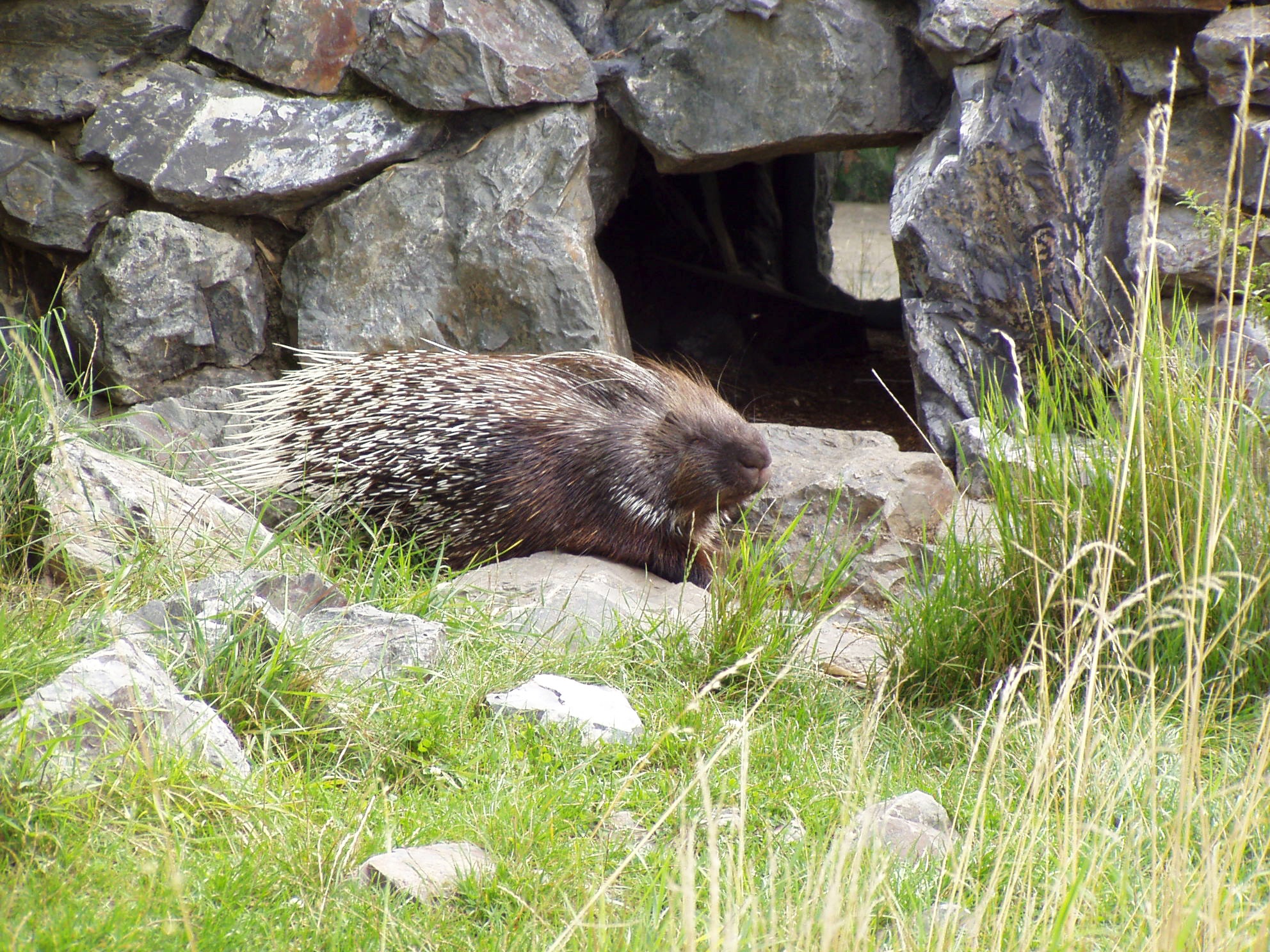
[[File:Hystrix indica.jpg|thumb|left|Indian crested porcupine on a rocky hillside]]Indian crested porcupines are found throughout southwest and central Asia,<ref name=":0" /> including [[Afghanistan]], [[Armenia]], [[Azerbaijan]], [[China]], [[Georgia (country)|Georgia]], [[India]], [[Iran]], [[Iraq]], [[Israel]], [[Jordan]], [[Kazakhstan]], [[Kyrgyzstan]], [[Lebanon]], [[Nepal]], [[Pakistan]], [[Saudi Arabia]], [[Sri Lanka]], [[Turkey]], [[Turkmenistan]], and [[Yemen]]. | [[File:Hystrix indica.jpg|thumb|left|Indian crested porcupine on a rocky hillside]]Indian crested porcupines are found throughout southwest and central Asia,<ref name=":0" /> including [[Afghanistan]], [[Armenia]], [[Azerbaijan]], [[China]], [[Georgia (country)|Georgia]], [[India]], [[Iran]], [[Iraq]], [[Israel]], [[Palestine (region)|Palestine]], [[Jordan]], [[Kazakhstan]], [[Kyrgyzstan]], [[Lebanon]], [[Nepal]], [[Pakistan]], [[Saudi Arabia]], [[Sri Lanka]], [[Turkey]], [[Turkmenistan]], and [[Yemen]]. Due to their flexible environmental tolerances, Indian crested porcupines occupy a broad range of habitats.<ref name="iucn status 19 November 2021" /> They prefer rocky hillsides,<ref name=":0" /> but are also common in tropical and temperate shrublands, grasslands, forests, plantations, and gardens.<ref name="iucn status 19 November 2021" /> Their range seems to be limited by seasonal densities of forage and the availability of suitable substrates for digging burrows.<ref>{{Cite journal|title = Features of the ecology of porcupines in the deserts of eastern Prikaspia|last = Gorbunov|first = A.V.|date = 1985|journal = Soviet Journal of Ecology|volume = 16|pages = 248–253}}</ref> More specifically, the northern range of the Indian crested porcupine is limited by minimum summer night duration: they do not occur above latitudes where minimum night duration is less than 7 hours, presumably because of the amount of foraging time required to meet their dietary needs.<ref name=":6">{{Cite journal|title = Foraging Time and the Northern Range Limits of Indian Crested Porcupines (Hystrix indica Kerr)|jstor = 2845271|journal = Journal of Biogeography|date = 1988-05-01|pages = 403–408|volume = 15|issue = 3|doi = 10.2307/2845271|first1 = Philip U.|last1 = Alkon|first2 = David|last2 = Saltz| bibcode=1988JBiog..15..403A }}</ref> | ||
In 2018, | In 2018, the first documented sighting of an Indian crested porcupine took place at [[Wadi Wurayah]] in the [[United Arab Emirates]].<ref name="TheNational 09-2018">{{cite news |last=Haza |first=Ruba |title=Species of porcupine seen for first time in the Fujairah |publisher=[[The National (Abu Dhabi)|The National]] |url=https://www.thenationalnews.com/uae/species-of-porcupine-seen-for-first-time-in-the-fujairah-1.769548 |date=2018-09-12 |access-date=2018-09-13}}</ref><ref name="GulfNews 09-2018">{{cite news |last=De Leon |first=Janice Ponce |title=First confirmed sighting of Indian crested porcupine in UAE |publisher=[[Gulf News]] |location=[[Fujairah]] |url=https://gulfnews.com/news/uae/environment/first-confirmed-sighting-of-indian-crested-porcupine-in-uae-1.2277687 |date=2018-09-13 |access-date=2018-09-13}}</ref> In 2019, another individual was spotted in the [[Russia]]n republic of [[Dagestan]].<ref>{{cite web | url=https://dag.aif.ru/society/indiyskogo_dikobraza_obnaruzhili_v_gornyh_rayonah_dagestana | title=Индийского дикобраза обнаружили в горных районах Дагестана | date=5 December 2019 }}</ref> | ||
== Diet == | == Diet == | ||
[[File:Indian Crested Porcupine.JPG|thumb|A captive Indian crested porcupine]] | [[File:Indian Crested Porcupine.JPG|thumb|A captive Indian crested porcupine]] | ||
Indian crested porcupines have a | Indian crested porcupines have a broad and mostly herbivorous diet. They consume a variety of natural and agricultural plant material, including roots, bulbs, fruits, grains, drupe and tubers, along with insects and small vertebrates.<ref name=":0" /><ref name=":2" /><ref>{{Cite journal|title = Influences of porcupine (''Hystrix indica'') activity on the slopes on the northern Negev mountains – Germination and vegetation renewal in different geomorphological types and slope directions|journal = Oecologia|date = 1981 |pages = 332–334 |volume = 51|issue = 3|doi = 10.1007/BF00540902|pmid = 28310016|first1 = Y. |last1 = Gutterman|first2 = Nir |last2 = Herr| bibcode=1981Oecol..51..332G |s2cid = 41549116}}</ref><ref>{{Cite journal|title = Distribution and reproduction of the Indian Crested Porcupine ''Hystrix indica'' (Hystricidae: Rodentia) in Iraq |journal=Zoology in the Middle East |date = 1997 |pages = 9–12 |volume = 15 |issue = 1|doi = 10.1080/09397140.1997.10637731|first = A.-H. H.|last = Kadhim}}</ref> Because they are cecal digesters, they are able to exploit low quality forage.<ref>{{Cite journal |title = The Nutritional Basis for Food Selection by Ungulates|jstor = 3898379|journal = Journal of Range Management|date = 1982 |pages = 146–151 |volume = 35|issue = 2|doi = 10.2307/3898379|first = T. A. |last = Hanley|hdl = 10150/646267|hdl-access = free}}</ref> They have also been known to chew on bones to acquire minerals, such as calcium, that aid in quill growth.<ref name=":2" /><ref name=":3" /> Their capability to form substantial fat reserves is a useful adaptation for living in seasonally fluctuating habitats.<ref name=":4" /> | ||
These porcupines can act as substantial habitat modifiers when excavating for tubers.<ref>{{Cite journal|title = Vegetation patterns related to environmental factors in a Negev Desert watershed|journal = Vegetatio|date=1983 |pages=153–165 |volume = 54|issue = 3 |doi = 10.1007/BF00047104 |first1 = L.|last1 = Olsvig-Whittaker|first2=M. |last2 = Shachak|first3 = A.|last3 = Yair|s2cid = 2152645}}</ref><ref>{{Cite journal|title = A case study of energy, water and soil flow chains in an arid ecosystem|journal = Oecologia |date = 1982 |pages = 389–397|volume = 54|issue = 3 |doi=10.1007/BF00380008|first1 = A.|last1 = Yair|first2 = M.|last2 = Shachak|pmid = 28309963 |s2cid = 37783090 }}</ref> They are also considered serious agricultural pests in many parts of their range due to their taste for | These porcupines can act as substantial habitat modifiers when excavating for tubers.<ref>{{Cite journal|title = Vegetation patterns related to environmental factors in a Negev Desert watershed|journal = Vegetatio|date=1983 |pages=153–165 |volume = 54|issue = 3 |doi = 10.1007/BF00047104 |first1 = L.|last1 = Olsvig-Whittaker|first2=M. |last2 = Shachak|first3 = A.|last3 = Yair|s2cid = 2152645}}</ref><ref>{{Cite journal|title = A case study of energy, water and soil flow chains in an arid ecosystem|journal = Oecologia |date = 1982 |pages = 389–397|volume = 54|issue = 3 |doi=10.1007/BF00380008|first1 = A.|last1 = Yair|first2 = M.|last2 = Shachak|pmid = 28309963 |bibcode = 1982Oecol..54..389Y |s2cid = 37783090 }}</ref> They are also considered serious agricultural pests in many parts of their range due to their taste for crops.<ref name=":6" /><ref>{{Cite journal|title = Food habits of the Indian crested porcupine (''Hystrix indica'') in Faisalabad, Pakistan |first1 = S. |last1 = Hafeez |first2 = K. G. |last2 = S.|first3 = M. |last3 =Khan |first4 =A. Z.|last4 = H.|journal = Brazilian Journal of Biology = Revista Brasleira de Biologia |date = 2021 |volume = 82 |article-number = e243063 |doi = 10.1590/1519-6984.243063 |pmid = 34287526 |s2cid = 236157365 |doi-access = free }}</ref> For these reasons, they are often regarded as a nuisance.<ref name="iucn status 19 November 2021" /> | ||
== Behaviour == | == Behaviour == | ||
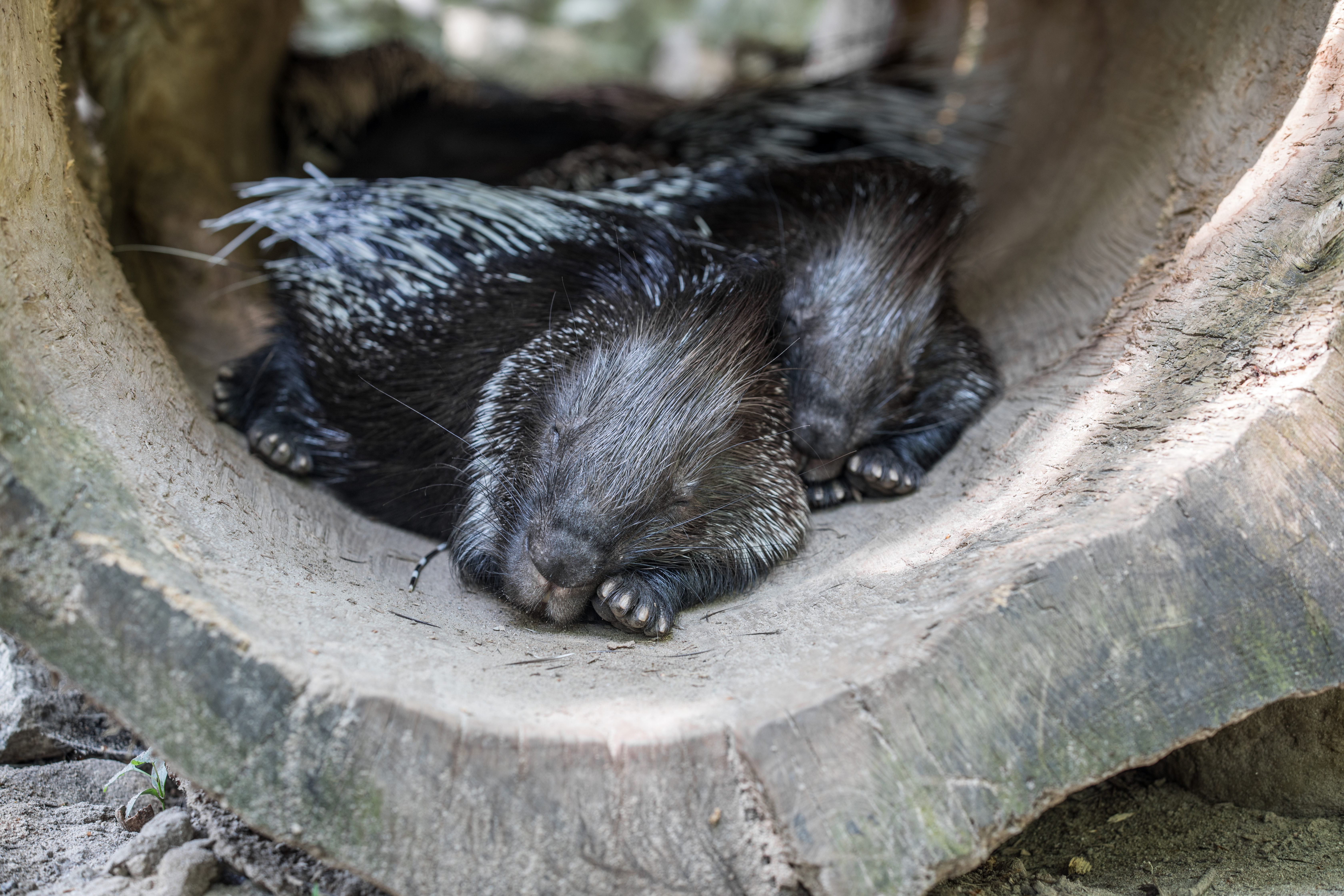
Like other Old World porcupines, the Indian crested porcupine is nocturnal.<ref name=":0" /> Both adults and weaned juveniles spend an average of 7 hours foraging every night.<ref name=":6" /><ref name=":7">{{Cite journal|title = Influence of Season and Moonlight on Temporal-Activity Patterns of Indian Crested Porcupines (''Hystrix indica'') |journal = Journal of Mammalogy|date = 1988 |pages = 71–80|volume = 69|issue = 1|doi = 10.2307/1381749|first1 = P. U.|last1 = Alkon|first2 = D. M. |last2 = Saltz |jstor = 1381749}}</ref><ref name=":8">{{Cite journal|title = Potatoes and the Nutritional Ecology of Crested Porcupines in a Desert Biome|jstor = 2403225|journal = Journal of Applied Ecology|date = 1985 |pages = 727–737|volume = 22|issue = 3|doi = 10.2307/2403225|first1 = P. U.|last1 = Alkon|first2 = D.|last2 = Saltz}}</ref> They tend to avoid moonlight in the winter months, which could be a strategy to evade predation.<ref name=":7" /> However, during summer months they do not avoid moonlight (likely because there are less dark hours during which to forage), but instead tend to stay closer to their dens.<ref name=":7" /> During the day, they remain in their dens,<ref name=":8" /><ref name=":9">{{Cite book|title = The Mammals of Arabia|last = Harrison|first = D.L.|publisher = Ernest Benn|year = 1972|location = London|volume = 3}}</ref> but throughout the winter, they occasionally emerge from their dens during daylight hours to bask in the sun.<ref name=":4" /> | [[File:Hystrix indica 2024-05-24 JM 5D412782.jpg|thumb|Sleeping Hystrix in their den at Zoo Stralsund]] | ||
Like other Old World porcupines, the Indian crested porcupine is nocturnal.<ref name=":0" /> Both adults and weaned juveniles spend an average of 7 hours foraging every night.<ref name=":6" /><ref name=":7">{{Cite journal|title = Influence of Season and Moonlight on Temporal-Activity Patterns of Indian Crested Porcupines (''Hystrix indica'') |journal = Journal of Mammalogy|date = 1988 |pages = 71–80|volume = 69|issue = 1|doi = 10.2307/1381749|first1 = P. U.|last1 = Alkon|first2 = D. M. |last2 = Saltz |jstor = 1381749}}</ref><ref name=":8">{{Cite journal|title = Potatoes and the Nutritional Ecology of Crested Porcupines in a Desert Biome|jstor = 2403225|journal = Journal of Applied Ecology|date = 1985 |pages = 727–737|volume = 22|issue = 3|doi = 10.2307/2403225|first1 = P. U.|last1 = Alkon|first2 = D.|last2 = Saltz| bibcode=1985JApEc..22..727A }}</ref> They tend to avoid moonlight in the winter months, which could be a strategy to evade predation.<ref name=":7" /> However, during summer months they do not avoid moonlight (likely because there are less dark hours during which to forage), but instead tend to stay closer to their dens.<ref name=":7" /> During the day, they remain in their dens,<ref name=":8" /><ref name=":9">{{Cite book|title = The Mammals of Arabia|last = Harrison|first = D.L.|publisher = Ernest Benn|year = 1972|location = London|volume = 3}}</ref> but throughout the winter, they occasionally emerge from their dens during daylight hours to bask in the sun.<ref name=":4" /> | |||
The Indian crested porcupine is | The Indian crested porcupine is semi[[fossorial]].<ref name=":0" /> They live in natural caves or in excavated burrows.<ref name=":8" /><ref name=":9" /> Because they do not climb or jump well, they spend most of their lives on or under the ground. However, they are good swimmers.<ref name=":1" /> | ||
Predators of the Indian crested porcupine include large cats,<ref>{{Cite book|title = East African Mammals|last = Kingdon|first = J.S.|publisher = Academic Press|year = 1974|location = London|volume = 2}}</ref><ref>{{Cite book|title = Cry of the Kalahari|url = https://archive.org/details/cryofkalahari00owen|url-access = registration|publisher = Houghton Mifflin Harcourt|date = 1984 |isbn = 978- | Predators of the Indian crested porcupine include large cats,<ref>{{Cite book|title = East African Mammals|last = Kingdon|first = J.S.|publisher = Academic Press|year = 1974|location = London|volume = 2}}</ref><ref>{{Cite book|title = Cry of the Kalahari|url = https://archive.org/details/cryofkalahari00owen|url-access = registration|publisher = Houghton Mifflin Harcourt|date = 1984 |isbn = 978-0-395-64780-6|first1 = M. |last1 = Owens|first2 = D. |last2 = Owens}}</ref> [[caracal]]s, wolves, striped [[hyenas]], Asian wild dogs, [[saltwater crocodiles]]<ref>{{Cite journal|last1=Samarasinghe |first1=D. J. S.|last2=Alwis|first2=D. |date=2017 |title=''Crocodylus porosus'' (Saltwater Crocodile) diet |url=https://www.researchgate.net/publication/320014937 |journal=Herpetological Review |volume=48|issue=3|pages=630–631}}</ref> and humans.<ref name=":7" /> When excited or scared, a porcupine stands its quills up to appear larger. It can also rattle the hollow quills at the base of its tail, stomp its feet, growl, grunt, or charge backward into the threat.<ref name=":1" /> | ||
== Reproduction == | == Reproduction == | ||
Indian crested porcupines mate in February and March.<ref name=":10">{{Cite journal|title = Reproduction in captive female Cape porcupines (Hystrix africaeaustralis)|last = van Aarde|first = R.J.|date = 1985|journal = Journal of Reproduction and Fertility|doi = 10.1530/jrf.0.0750577|volume = 75|issue = 2|pages = 577–582|pmid = 4067934|doi-access = free}}</ref> Gestation lasts an average of 240 days.<ref name=":3" /> A female gives birth to one brood of two to four offspring per year.<ref name=":2" /> Young are born with open eyes and are covered in short, soft quills that harden within a few hours after birth.<ref name=":0" /> Young are fully weaned 13–19 weeks after birth, but remain in the den with parents and siblings until sexual maturity around 2 years of age.<ref name=":10" /> It has been reported that the Indian crested porcupine is usually [[monogamous]] and mates every night throughout its life, not only for reproduction, but also to maintain and strengthen the pair bond, the relationship between the male and female partners.<ref>Z Server, [https://www.slideshare.net/zevsev/sever-new-scientist-1988 Regular sex keeps porcupines faithful], ''New Scientist'', Nov.12, 1988</ref> Previously, this had only been found in humans, [[ | Indian crested porcupines mate in February and March.<ref name=":10">{{Cite journal|title = Reproduction in captive female Cape porcupines (Hystrix africaeaustralis)|last = van Aarde|first = R.J.|date = 1985|journal = Journal of Reproduction and Fertility|doi = 10.1530/jrf.0.0750577|volume = 75|issue = 2|pages = 577–582|pmid = 4067934|doi-access = free}}</ref> Gestation lasts an average of 240 days.<ref name=":3" /> A female gives birth to one brood of two to four offspring per year.<ref name=":2" /> Young are born with open eyes and are covered in short, soft quills that harden within a few hours after birth.<ref name=":0" /> Young are fully weaned 13–19 weeks after birth, but remain in the den with parents and siblings until sexual maturity around 2 years of age.<ref name=":10" /> It has been reported that the Indian crested porcupine is usually [[monogamy in animals|monogamous]] and mates every night throughout its life, not only for reproduction, but also to maintain and strengthen the pair bond, the relationship between the male and female partners.<ref>Z Server, [https://www.slideshare.net/zevsev/sever-new-scientist-1988 Regular sex keeps porcupines faithful], ''New Scientist'', Nov.12, 1988</ref> Previously, this had only been found in humans, [[bonobo]]s, and some [[dolphin]]s. | ||
== Conservation == | == Conservation == | ||
[[File:Hystrix indica.JPG|thumb|Indian crested porcupine in a [[animal trap|trap]]]] | [[File:Hystrix indica.JPG|thumb|Indian crested porcupine in a [[animal trap|trap]]]] | ||
Due to its adaptability to a wide range of habitats and food types, the Indian crested porcupine is listed by the [[IUCN Red List]] as [[Least-concern species|Least Concern]] as of 2008.<ref name=iucn /><ref name=":0" /> Populations are stable and not severely fragmented, and while population status varies across its range, in many places it is common enough to be considered a pest.<ref name=iucn /> However, as a result of urbanization, infrastructure development, and pesticide use, suitable porcupine habitat is currently declining.<ref name=":0" /> | Due to its adaptability to a wide range of habitats and food types, the Indian crested porcupine is listed by the [[IUCN Red List]] as [[Least-concern species|Least Concern]] as of 2008.<ref name="iucn status 19 November 2021" /><ref name=":0" /> Populations are stable and not severely fragmented, and while population status varies across its range, in many places it is common enough to be considered a pest.<ref name="iucn status 19 November 2021" /> However, as a result of urbanization, infrastructure development, and pesticide use, suitable porcupine habitat is currently declining.<ref name=":0" /> | ||
The Indian crested porcupine is protected under the India Schedule IV of the Indian Wildlife Protection Act of 1972, amended up to 2002.<ref name=":0" /> Nonetheless, because it is destructive to gardens and agricultural crops, it is widely hunted.<ref name=":3" /><ref>{{Cite book|title = Mammals of the Holy Land|url = https://archive.org/details/mammalsofholylan00qums|url-access = registration|publisher = Texas Tech University Press|date = 1996-01-01|isbn = | The Indian crested porcupine is protected under the India Schedule IV of the Indian Wildlife Protection Act of 1972, amended up to 2002.<ref name=":0" /> Nonetheless, because it is destructive to gardens and agricultural crops, it is widely hunted.<ref name=":3" /><ref>{{Cite book|title = Mammals of the Holy Land|url = https://archive.org/details/mammalsofholylan00qums|url-access = registration|publisher = Texas Tech University Press|date = 1996-01-01|isbn = 978-0-89672-364-1|first = M. B. |last = Qumsiyeh}}</ref> It is traded for consumption and medicinal use.<ref name=":0" /> | ||
==References== | ==References== | ||
| Line 59: | Line 60: | ||
[[Category:Hystricidae]] | [[Category:Hystricidae]] | ||
[[Category:Mammals of South Asia | [[Category:Mammals of South Asia]] | ||
[[Category:Mammals of | [[Category:Mammals of West Asia]] | ||
[[Category:Mammals of India | [[Category:Mammals of India]] | ||
[[Category:Mammals of Azerbaijan | [[Category:Mammals of Azerbaijan]] | ||
[[Category:Mammals of the Middle East | [[Category:Mammals of the Middle East]] | ||
[[Category:Mammals described in 1792]] | [[Category:Mammals described in 1792]] | ||
[[Category:Taxa named by Robert Kerr (writer)]] | |||
Latest revision as of 06:22, 18 February 2026
| Indian crested porcupine | |
|---|---|
.jpg)
| |
Scientific classification 
| |
| : | [[Template:Taxonomy/Hystrix]] |
| Species: | Template:Taxonomy/HystrixH. indica
|
| Binomial name | |
| Template:Taxonomy/HystrixHystrix indica Kerr, 1792
| |

| |
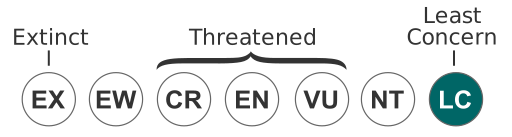
The Indian crested porcupine (Hystrix indica) is a hystricomorph rodent species native to southern Asia and the Middle East. It is listed as Least Concern on the IUCN Red List. It belongs to the Old World porcupine family, Hystricidae.[1]
Description[edit | edit source]
The Indian crested porcupine is a large rodent, weighing 11–18 kg (24–40 lb).[2] The body (from nose to base of the tail) measures between 70 and 90 cm (28 and 35 in) with the tail adding an additional 8–10 cm (3.1–3.9 in).[3] The lifespan of Indian crested porcupines in the wild is unknown, however, the oldest known Indian crested porcupine in captivity was female; it lived up to be 27.1 years old.[2]
It is covered in multiple layers of modified hair called quills, with longer, thinner quills covering a layer of shorter, thicker ones.[2] The quills are brown or black with alternating white and black bands. They are made of keratin and are relatively flexible. Each quill is connected to a muscle at its base, allowing the porcupine to raise its quills when it feels threatened. The longest quills are located on the neck and shoulder, where the quills form a "skirt" around the animal. These quills can grow up to 51 cm (20 in) long,[4] with most measuring between 15 and 30 cm (5.9 and 11.8 in).[5] Smaller (20 cm) and more rigid quills are packed densely on the back and rump. These smaller quills are used to stab at potential threats.[4] The base of the tail contains shorter quills that appear white in color, with longer, hollow quills that the porcupine can rattle to produce a warning sound when threatened.[6] Contrary to popular belief, Indian crested porcupines (like all porcupines) cannot shoot their quills.[4]
The Indian crested porcupine has a stocky build with a low surface area to volume ratio, which aids in heat conservation.[7] It has broad feet with long claws used for burrowing.[2] Like all porcupines, the Indian crested porcupine has a good sense of smell and sharp, chisel-like incisors.[4]
Distribution and habitat[edit | edit source]

Indian crested porcupines are found throughout southwest and central Asia,[2] including Afghanistan, Armenia, Azerbaijan, China, Georgia, India, Iran, Iraq, Israel, Palestine, Jordan, Kazakhstan, Kyrgyzstan, Lebanon, Nepal, Pakistan, Saudi Arabia, Sri Lanka, Turkey, Turkmenistan, and Yemen. Due to their flexible environmental tolerances, Indian crested porcupines occupy a broad range of habitats.[1] They prefer rocky hillsides,[2] but are also common in tropical and temperate shrublands, grasslands, forests, plantations, and gardens.[1] Their range seems to be limited by seasonal densities of forage and the availability of suitable substrates for digging burrows.[8] More specifically, the northern range of the Indian crested porcupine is limited by minimum summer night duration: they do not occur above latitudes where minimum night duration is less than 7 hours, presumably because of the amount of foraging time required to meet their dietary needs.[9]
In 2018, the first documented sighting of an Indian crested porcupine took place at Wadi Wurayah in the United Arab Emirates.[10][11] In 2019, another individual was spotted in the Russian republic of Dagestan.[12]
Diet[edit | edit source]

Indian crested porcupines have a broad and mostly herbivorous diet. They consume a variety of natural and agricultural plant material, including roots, bulbs, fruits, grains, drupe and tubers, along with insects and small vertebrates.[2][3][13][14] Because they are cecal digesters, they are able to exploit low quality forage.[15] They have also been known to chew on bones to acquire minerals, such as calcium, that aid in quill growth.[3][5] Their capability to form substantial fat reserves is a useful adaptation for living in seasonally fluctuating habitats.[7]
These porcupines can act as substantial habitat modifiers when excavating for tubers.[16][17] They are also considered serious agricultural pests in many parts of their range due to their taste for crops.[9][18] For these reasons, they are often regarded as a nuisance.[1]
Behaviour[edit | edit source]

Like other Old World porcupines, the Indian crested porcupine is nocturnal.[2] Both adults and weaned juveniles spend an average of 7 hours foraging every night.[9][19][20] They tend to avoid moonlight in the winter months, which could be a strategy to evade predation.[19] However, during summer months they do not avoid moonlight (likely because there are less dark hours during which to forage), but instead tend to stay closer to their dens.[19] During the day, they remain in their dens,[20][21] but throughout the winter, they occasionally emerge from their dens during daylight hours to bask in the sun.[7]
The Indian crested porcupine is semifossorial.[2] They live in natural caves or in excavated burrows.[20][21] Because they do not climb or jump well, they spend most of their lives on or under the ground. However, they are good swimmers.[4]
Predators of the Indian crested porcupine include large cats,[22][23] caracals, wolves, striped hyenas, Asian wild dogs, saltwater crocodiles[24] and humans.[19] When excited or scared, a porcupine stands its quills up to appear larger. It can also rattle the hollow quills at the base of its tail, stomp its feet, growl, grunt, or charge backward into the threat.[4]
Reproduction[edit | edit source]
Indian crested porcupines mate in February and March.[25] Gestation lasts an average of 240 days.[5] A female gives birth to one brood of two to four offspring per year.[3] Young are born with open eyes and are covered in short, soft quills that harden within a few hours after birth.[2] Young are fully weaned 13–19 weeks after birth, but remain in the den with parents and siblings until sexual maturity around 2 years of age.[25] It has been reported that the Indian crested porcupine is usually monogamous and mates every night throughout its life, not only for reproduction, but also to maintain and strengthen the pair bond, the relationship between the male and female partners.[26] Previously, this had only been found in humans, bonobos, and some dolphins.
Conservation[edit | edit source]

Due to its adaptability to a wide range of habitats and food types, the Indian crested porcupine is listed by the IUCN Red List as Least Concern as of 2008.[1][2] Populations are stable and not severely fragmented, and while population status varies across its range, in many places it is common enough to be considered a pest.[1] However, as a result of urbanization, infrastructure development, and pesticide use, suitable porcupine habitat is currently declining.[2]
The Indian crested porcupine is protected under the India Schedule IV of the Indian Wildlife Protection Act of 1972, amended up to 2002.[2] Nonetheless, because it is destructive to gardens and agricultural crops, it is widely hunted.[5][27] It is traded for consumption and medicinal use.[2]
References[edit | edit source]
- ↑ 1.0 1.1 1.2 1.3 1.4 1.5 1.6 Amori, G.; Hutterer, R.; Kryštufek, B.; Yigit, N.; Mitsainas, G.; Palomo, L. (2021). "Hystrix indica". IUCN Red List of Threatened Species. 2021 e.T10751A197516522. doi:10.2305/IUCN.UK.2021-1.RLTS.T10751A197516522.en. Retrieved 19 November 2021.
- ↑ 2.00 2.01 2.02 2.03 2.04 2.05 2.06 2.07 2.08 2.09 2.10 2.11 2.12 2.13 "Indian Crested Porcupine (Hystrix indica) - Information on Indian Crested Porcupine - Encyclopedia of Life". Encyclopedia of Life. Retrieved 19 November 2015.
- ↑ 3.0 3.1 3.2 3.3 Prater, Stanley Henry (1965). The Book of Indian Animals. Bombay: Diocesan Press.
- ↑ 4.0 4.1 4.2 4.3 4.4 4.5 "Indian Crested Porcupine". San Diego Zoo. Archived from the original on 15 March 2018. Retrieved 19 November 2015.
- ↑ 5.0 5.1 5.2 5.3 Gurung, K.K.; Singh, R. (1996). Field Guide to the Mammals of the Indian Subcontinent. San Diego: Academic Press.
- ↑ Ellerman, J.R. (1961). The Fauna of India. New Delhi: Manager of Publications.
- ↑ 7.0 7.1 7.2 Alkon, Philip U.; Degen, A. Allan; Cohen, Anat; Pollak, Haya (1986). "Seasonal Energy Requirements and Water Intakes of Indian Crested Porcupines (Hystrix indica) in Captivity". Journal of Mammalogy. 67 (2): 333–342. doi:10.2307/1380887. JSTOR 1380887.
- ↑ Gorbunov, A.V. (1985). "Features of the ecology of porcupines in the deserts of eastern Prikaspia". Soviet Journal of Ecology. 16: 248–253.
- ↑ 9.0 9.1 9.2 Alkon, Philip U.; Saltz, David (1 May 1988). "Foraging Time and the Northern Range Limits of Indian Crested Porcupines (Hystrix indica Kerr)". Journal of Biogeography. 15 (3): 403–408. Bibcode:1988JBiog..15..403A. doi:10.2307/2845271. JSTOR 2845271.
- ↑ Haza, Ruba (12 September 2018). "Species of porcupine seen for first time in the Fujairah". The National. Retrieved 13 September 2018.
- ↑ De Leon, Janice Ponce (13 September 2018). "First confirmed sighting of Indian crested porcupine in UAE". Fujairah: Gulf News. Retrieved 13 September 2018.
- ↑ "Индийского дикобраза обнаружили в горных районах Дагестана". 5 December 2019.
- ↑ Gutterman, Y.; Herr, Nir (1981). "Influences of porcupine (Hystrix indica) activity on the slopes on the northern Negev mountains – Germination and vegetation renewal in different geomorphological types and slope directions". Oecologia. 51 (3): 332–334. Bibcode:1981Oecol..51..332G. doi:10.1007/BF00540902. PMID 28310016. S2CID 41549116.
- ↑ Kadhim, A.-H. H. (1997). "Distribution and reproduction of the Indian Crested Porcupine Hystrix indica (Hystricidae: Rodentia) in Iraq". Zoology in the Middle East. 15 (1): 9–12. doi:10.1080/09397140.1997.10637731.
- ↑ Hanley, T. A. (1982). "The Nutritional Basis for Food Selection by Ungulates". Journal of Range Management. 35 (2): 146–151. doi:10.2307/3898379. hdl:10150/646267. JSTOR 3898379.
- ↑ Olsvig-Whittaker, L.; Shachak, M.; Yair, A. (1983). "Vegetation patterns related to environmental factors in a Negev Desert watershed". Vegetatio. 54 (3): 153–165. doi:10.1007/BF00047104. S2CID 2152645.
- ↑ Yair, A.; Shachak, M. (1982). "A case study of energy, water and soil flow chains in an arid ecosystem". Oecologia. 54 (3): 389–397. Bibcode:1982Oecol..54..389Y. doi:10.1007/BF00380008. PMID 28309963. S2CID 37783090.
- ↑ Hafeez, S.; S., K. G.; Khan, M.; H., A. Z. (2021). "Food habits of the Indian crested porcupine (Hystrix indica) in Faisalabad, Pakistan". Brazilian Journal of Biology = Revista Brasleira de Biologia. 82 e243063. doi:10.1590/1519-6984.243063. PMID 34287526. S2CID 236157365.
- ↑ 19.0 19.1 19.2 19.3 Alkon, P. U.; Saltz, D. M. (1988). "Influence of Season and Moonlight on Temporal-Activity Patterns of Indian Crested Porcupines (Hystrix indica)". Journal of Mammalogy. 69 (1): 71–80. doi:10.2307/1381749. JSTOR 1381749.
- ↑ 20.0 20.1 20.2 Alkon, P. U.; Saltz, D. (1985). "Potatoes and the Nutritional Ecology of Crested Porcupines in a Desert Biome". Journal of Applied Ecology. 22 (3): 727–737. Bibcode:1985JApEc..22..727A. doi:10.2307/2403225. JSTOR 2403225.
- ↑ 21.0 21.1 Harrison, D.L. (1972). The Mammals of Arabia. Vol. 3. London: Ernest Benn.
- ↑ Kingdon, J.S. (1974). East African Mammals. Vol. 2. London: Academic Press.
- ↑ Owens, M.; Owens, D. (1984). Cry of the Kalahari. Houghton Mifflin Harcourt. ISBN 978-0-395-64780-6.
- ↑ Samarasinghe, D. J. S.; Alwis, D. (2017). "Crocodylus porosus (Saltwater Crocodile) diet". Herpetological Review. 48 (3): 630–631.
- ↑ 25.0 25.1 van Aarde, R.J. (1985). "Reproduction in captive female Cape porcupines (Hystrix africaeaustralis)". Journal of Reproduction and Fertility. 75 (2): 577–582. doi:10.1530/jrf.0.0750577. PMID 4067934.
- ↑ Z Server, Regular sex keeps porcupines faithful, New Scientist, Nov.12, 1988
- ↑ Qumsiyeh, M. B. (1 January 1996). Mammals of the Holy Land. Texas Tech University Press. ISBN 978-0-89672-364-1.