





Ajay Kumar (talk | contribs) Created a new article Tag: self-published-blog |
IgnacioElem3 (talk | contribs) m cleanup |
||
| Line 1: | Line 1: | ||
{{short description|Most common rubber tree}} | {{short description|Most common rubber tree}} | ||
{{ | {{Redirect2|Rubber tree|para rubber|the ornamental plant also known as "rubber tree"|Ficus elastica{{!}}''Ficus elastica''|the New Zealand brand Para Rubber|Skellerup}} | ||
{{speciesbox | {{speciesbox | ||
|name = Rubber tree | |||
|image =Hevea_brasiliensis_-_Köhler–s_Medizinal-Pflanzen-071.jpg | |image =Hevea_brasiliensis_-_Köhler–s_Medizinal-Pflanzen-071.jpg | ||
|genus = Hevea | |genus = Hevea | ||
| Line 7: | Line 8: | ||
|status = LC | |status = LC | ||
|status_system = IUCN3.1 | |status_system = IUCN3.1 | ||
|status_ref = <ref>Fabriani | |status_ref = <ref>{{cite journal |last1=Fabriani |first1=F. |last2=Hills |first2=R. |title=''Hevea brasiliensis'' |journal=The IUCN Red List of Threatened Species |date=2020 |page=e.T62003521A62003529 |doi=10.2305/IUCN.UK.2020-2.RLTS.T62003521A62003529.en }}</ref> | ||
|authority = [[Johannes Müller Argoviensis|Müll.Arg.]] | |authority = [[Johannes Müller Argoviensis|Müll.Arg.]] | ||
|range_map = Distribution of Hevea sp.jpg | |range_map = Distribution of Hevea sp.jpg | ||
| Line 13: | Line 14: | ||
}} | }} | ||
'''''Hevea brasiliensis''''', the '''Pará rubber tree''', '''''sharinga'' tree, seringueira''', or most commonly, '''rubber tree''' or '''rubber plant''', is a [[flowering plant]] belonging to the spurge family [[Euphorbiaceae]] originally native to the [[Amazon basin]], but is now [[pantropical]] in distribution due to [[introduced species|introductions]]. It is the most economically important member of the genus ''[[Hevea]]'' because the milky [[latex]] extracted from the tree is the primary source of [[natural rubber]]. | '''''Hevea brasiliensis''''', the '''Pará rubber tree''', '''''sharinga'' tree''', '''seringueira''', or, most commonly, '''rubber tree''' or '''rubber plant''', is a [[flowering plant]] belonging to the spurge family, [[Euphorbiaceae]]. It is originally native to the [[Amazon basin]], but is now [[pantropical]] in distribution due to [[introduced species|introductions]]. It is the most economically important member of the genus ''[[Hevea]]'', because the milky [[latex]] extracted from the tree is the primary source of [[natural rubber]]. | ||
==Description== | ==Description== | ||
[[Image:Koh Chang, Thailand, Rubber tree.jpg|thumb|right|Canopy and trunk, Thailand]] | [[Image:Koh Chang, Thailand, Rubber tree.jpg|thumb|right|Canopy and trunk, Thailand]] | ||
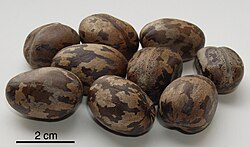
'' | ''Hevea brasiliensis'' is a tall [[deciduous]] tree growing to a height of up to {{convert|43|m|ft|0|abbr=on}} in the wild. Cultivated trees are usually much smaller because drawing off the latex restricts their growth. The trunk is cylindrical and may have a swollen, bottle-shaped base. The bark is some shade of brown, and the inner bark oozes [[latex]] when damaged. The leaves have three [[Leaflet (botany)|leaflets]] and are spirally arranged. The [[inflorescence]]s include separate male and female flowers. The flowers are pungent, creamy-yellow and have no petals. The fruit is a capsule that contains three large seeds; it opens explosively when ripe.<ref>{{cite POWO |id=349913-1 |title=''Hevea brasiliensis'' (Willd. ex A.Juss.) Müll.Arg. |access-date=31 March 2017}}</ref> | ||
==Rubber tree plantation== | ==Rubber tree plantation== | ||
[[ | [[File:Hevea semillas2.jpg|thumb|150px|right|Seeds]] | ||
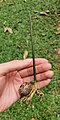
[[File:Sprouting rubber tree seed.jpg|thumb|150px|right|A sprouting seed in a house backyard in [[Malaysia]]]] | [[File:Sprouting rubber tree seed.jpg|thumb|150px|right|A sprouting seed in a house backyard in [[Malaysia]]]] | ||
In the wild | In the wild the tree can reach a height of up to {{convert|43|m|ft}}. The white or yellow latex occurs in latex vessels in the [[Bark (botany)|bark]], mostly outside the [[phloem]]. These vessels spiral up the tree in a right-handed [[helix]] which forms an [[angle]] of about 30 degrees with the horizontal, and can grow as high as {{convert|15|m}}.<ref name=FAO/> | ||
In plantations | In plantations the trees are generally smaller for two reasons: 1) trees grow more slowly when they are tapped for latex, and 2) trees are generally cut down after only 30 years, because latex production declines as trees age, and they are no longer economically productive. The tree requires a [[Tropical climate|tropical]] or [[subtropical climate]] with a minimum of about {{Convert|1,200|mm|in|abbr=on|sp=us|sigfig=1}} per year of rainfall, and no frost.<ref name=eb/> If frost does occur, the results can be disastrous for production. One frost can cause the rubber from an entire plantation to become brittle and break once it has been refined.<ref>{{cite web |url=http://www.fao.org/docrep/006/AD221E/AD221E01.htm |title=The rubber tree |publisher=UN [[FAO]]|access-date=29 May 2017}}</ref> | ||
===Latex tapping=== | ===Latex tapping=== | ||
{{Main|Rubber tapping}} | {{Main|Rubber tapping}} | ||
[[ | [[File:The face of rubber tree's trunk.jpg|thumb|right|150px|Trunk crosssection]] | ||
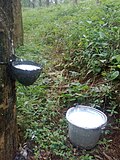
[[ | [[File:Tapped rubber tree.jpg|thumb|right|150px|Latex being collected from an incised rubber tree and a bucket of collected latex]] | ||
The | [[File:“Spiral tapping of Hevea Brasiliensis”.jpg|thumb|right|200px|"Spiral tapping of ''Hevea brasiliensis''." Photograph circa 1911, taken in Brazil.]] | ||
Harvesters make incisions across the latex vessels, just deep enough to tap the vessels without harming the tree's growth, and the latex is collected in small buckets. This process is known as [[rubber tapping]]. Latex production is highly variable from tree to tree and across clone types.<ref name=FAO>{{cite web |url=http://www.fao.org/docrep/006/AD221E/AD221E06.htm |title=Rubber tapping |publisher=UN [[FAO]]|access-date=29 May 2017}}</ref> | The rubber tree takes between seven and ten years to deliver the first harvest.<ref>{{cite web |last=Fraunhofer-Gesellschaft |date=8 June 2015 |title=Natural rubber from dandelions |url=https://phys.org/news/2015-06-natural-rubber-dandelions.html |website=Phys.org}}</ref> Harvesters make incisions across the latex vessels, just deep enough to tap the vessels without harming the tree's growth, and the latex is collected in small buckets. This process is known as [[rubber tapping]]. Latex production is highly variable from tree to tree and across clone types.<ref name=FAO>{{cite web |url=http://www.fao.org/docrep/006/AD221E/AD221E06.htm |title=Rubber tapping |publisher=UN [[FAO]]|access-date=29 May 2017}}</ref> | ||
===Wood harvesting=== | ===Wood harvesting=== | ||
{{Main|Rubberwood}} | {{Main|Rubberwood}} | ||
{{see also|Wood harvesting}} | |||
As latex production declines with age, rubber trees are generally [[Felling|felled]] when they reach the age of 25 to 30 years. The earlier practice was to burn the trees, but in recent decades, the wood has been harvested for furniture making.<ref name=FAO/> | As latex production declines with age, rubber trees are generally [[Felling|felled]] when they reach the age of 25 to 30 years. The earlier practice was to burn the trees, but in recent decades, the wood has been harvested for furniture making.<ref name=FAO/> | ||
==History== | ==History== | ||
The South American rubber tree grew only in the [[Amazon rainforest]], and increasing demand and the discovery of the [[vulcanization]] procedure in 1839 led to the rubber boom in that region, enriching the cities of [[Belém do Pará|Belém]], [[Santarém, Pará|Santarém]], and [[Manaus]] in Brazil and [[Iquitos]], Peru, from 1840 to 1913. In Brazil, before the name was changed to 'Seringueira' the initial name of the plant was 'pará rubber tree', derived from the name of the province of [[State of Grão-Pará and | The South American rubber tree grew only in the [[Amazon rainforest]], and increasing demand and the discovery of the [[vulcanization]] procedure in 1839 led to the rubber boom in that region, enriching the cities of [[Belém do Pará|Belém]], [[Santarém, Pará|Santarém]], and [[Manaus]] in Brazil and [[Iquitos]], Peru, from 1840 to 1913. In Brazil, before the name was changed to 'Seringueira' the initial name of the plant was 'pará rubber tree', derived from the name of the province of [[State of Grão-Pará and Rio Negro|Grão-Pará]]. In Peru, the tree was called 'árbol del caucho', and the latex extracted from it was called 'caucho'. The tree was used to obtain rubber by the natives who inhabited its geographical distribution. The [[Olmec]] people of [[Mesoamerica]] extracted and produced similar forms of rubber from analogous latex-producing trees such as ''[[Castilla elastica]]'' as early as 3,600 years ago. The rubber was used, among other things, to make the balls used in the [[Mesoamerican ballgame]].<ref>{{cite web |url=https://www.maya-archaeology.org/Mayan_anthropology_ethnography_archaeology_art_history_iconography_epigraphy_ethnobotany/rubber_hule_Castilla_elastica_incense_idols_ball_game_balls_Guatemala_Chiapas_Mexico_Belize_Hevea_brasiliensis.php |title=Introduction to Rubber Usage among the Maya |author=Langenheim, J.H. |date=13 January 2010 |publisher=Maya Archaeology|access-date=29 May 2017}}</ref> Early attempts were made in 1873 to grow ''H. brasiliensis'' outside [[Brazil]]. After some effort, 12 seedlings were germinated at the [[Royal Botanic Gardens, Kew]]. These were sent to [[India]] for cultivation, but died. A second attempt was then made, some 70,000 seeds being smuggled to Kew in 1875, by [[Henry Wickham (explorer)|Henry Wickham]], in the service of the British Empire.<ref name=df>"The Brazilian Armed Forces: Current changes, new challenges", ''Dreifuss, R. Armand''. International Seminar Research Committee Armed Forces and Society, Romania, 2002. Retrieved August 19, 2009 from {{cite web |url=http://www.nestbrasil.com/rest/page8/files/rested1-dreyfus.pdf |title=Archived copy |access-date=2009-08-19 |archive-url=https://web.archive.org/web/20090731102816/http://www.nestbrasil.com/rest/page8/files/rested1-dreyfus.pdf |archive-date=2009-07-31 }}</ref>{{RP|55}}<ref name=gp>"Amazon - The Animation", ''Greepeace Digital''. Artificial Environments, n/d. Retrieved August 19, 2009 from {{cite web |url=http://www.ae-pro.com/preview.php?preid=31&pro=Amazon |title=The Animation |access-date=2009-08-19 |archive-url=https://web.archive.org/web/20110707090719/http://www.ae-pro.com/preview.php?preid=31&pro=Amazon |archive-date=2011-07-07 }}</ref><ref name=mag>"Acre: História e etnologia", ''Marco António Gonçalves (Org.)''. Núcleo de Etnologia Indígena Laboratório de Pesquisa Social/IFCS - UFRJ, n/d. Retrieved August 19, 2009 from https://eduardoeginacarli.blogspot.com/2007_07_01_archive.html {{Webarchive|url=https://web.archive.org/web/20180901113528/http://eduardoeginacarli.blogspot.com/2007_07_01_archive.html |date=2018-09-01 }}</ref> About four percent of these germinated, and in 1876, about 2,000 seedlings were sent, in [[Wardian case]]s, to [[Ceylon]] (modern day Sri Lanka) and 22 were sent to the botanic gardens in [[Singapore]]. | ||
International Seminar Research Committee Armed Forces and Society, | |||
[[File:“Henry Wickham, who in 1876 directed an operation smuggling 70,000 rubber tree seeds”.jpg|thumb| | [[File:“Henry Wickham, who in 1876 directed an operation smuggling 70,000 rubber tree seeds”.jpg|thumb|"Henry Wickham, who in 1876 directed an operation smuggling 70,000 rubber tree seeds"]] | ||
Once established outside its native country, rubber was extensively propagated in the British colonies. Rubber trees were brought to the botanical gardens at [[Bogor|Buitenzorg]], Java, in 1883.<ref name="winchester">{{cite book | last = Winchester | first = Simon | author-link = Simon Winchester | title = [[Krakatoa: The Day the World Exploded, August 27, 1883]] | pages = [https://archive.org/details/krakatoadaywo00winc/page/223 223–224] | publisher =[[HarperCollins]]| year = 2003 | isbn = 0-06-621285-5 }}</ref> By 1898, a rubber plantation had been established in [[British Malaya|Malaya]], with imported Chinese field workers being the dominant work force in rubber production in the early 20th-century.<ref>Harold A. Crouch, ''Economic Change, Social Structure, and the Political System in Southeast Asia'', Institute of Southeast Asian Studies: Singapore 1985, pp. 16–17 {{ISBN|9971-988-23-2}}</ref> | |||
The cultivation of the tree in South America (Amazon) ended early in the 20th century because of indigenous [[blight]]s that targeted the rubber tree.<ref name=eb>"Elastomer-The rubber tree", ''Encyclopædia Britannica'', 2008</ref> The blight, called South American leaf blight, is caused by the [[Ascomycota|ascomycete]] ''[[Pseudocercospora]] [[Pseudocercospora ulei|ulei]]'',<ref name="Guyot-Guen-2018">{{cite journal | last1=Guyot | first1=Jean | last2=Le Guen | first2=Vincent | title=A Review of a Century of Studies on South American Leaf Blight of the Rubber Tree | journal=[[Plant Disease (journal)|Plant Disease]] | publisher=[[American Phytopathological Society]] | volume=102 | issue=6 | year=2018 | issn=0191-2917 | doi=10.1094/pdis-04-17-0592-fe | pages=1052–1065| pmid=30673445 | bibcode=2018PlDis.102.1052G | doi-access=free }}</ref><ref name="EPPO-GD">{{cite web | title=''Pseudocercospora ulei'' (MICCUL){{bracket|Overview}} | website=Global Database | publisher=EPPO ([[European and Mediterranean Plant Protection Organization]]) | date=2002-04-09 | url=http://gd.eppo.int/taxon/MICCUL | access-date=2021-08-28}}</ref><ref>{{Cite journal |last1=Júnior |first1=Braz Tavares da Hora |last2=Macedo |first2=Davi Mesquita de |last3=Barreto |first3=Robert Weingart |last4=Evans |first4=Harry C. |last5=Mattos |first5=Carlos Raimundo Reis |last6=Maffia |first6=Luiz Antonio |last7=Mizubuti |first7=Eduardo S. G. |date=2014-08-15 |title=Erasing the Past: A New Identity for the Damoclean Pathogen Causing South American Leaf Blight of Rubber |journal=PLOS ONE |language=en |volume=9 |issue=8 |article-number=e104750 |doi=10.1371/journal.pone.0104750 |doi-access=free |pmid=25126853 |pmc=4134235 |bibcode=2014PLoSO...9j4750H |issn=1932-6203}}</ref> also called ''Microcyclus ulei'',<ref>[http://www.plantwise.org/knowledgebank/datasheet.aspx?dsid=33893 South American Leaf Blight of rubber (''Microcyclus ulei'')], plantwise.org</ref> or ''Dothidella ulei'', which is endemic to the Amazon Basin. The blight was considered one of the five most aggressive diseases in commercial crops in South America.<ref name="Correa‑Pinilla2022">{{cite journal |last1=Correa‑Pinilla |first1=Diana Elisa |last2=Gutiérrez‑Vanegas |first2=Albert Julesmar |last3=Gil‑Restrepo |first3=Juan Pablo |last4=Martínez-Atencia |first4=Judith |last5=Córdoba‑Gaona |first5=Oscar de Jesús |title=Agroecological and South American leaf blight escape zones for rubber cultivation in Colombia |journal=Agronomy Journal |date=September–October 2022 |volume=114 |issue=5 |pages=2830–2844 |doi=10.1002/agj2.21068 |doi-access=free |bibcode=2022AgrJ..114.2830C }}</ref> Rubber production then moved to parts of the world where it is not indigenous, and therefore not affected by local plant diseases.<ref>{{cite book |editor1-last= Prance |editor1-first=Ghillean |editor2-last=Nesbitt |editor2-first=Mark |last1=Prance |first1=Ghillean |date=2005 |title=The Cultural History of Plants |publisher=Routledge |page=28 |isbn=0-415-92746-3}}</ref> Today, most rubber tree plantations are in [[South Asia|South]] and [[Southeast Asia]], the top rubber producing countries in 2011 being Thailand, Indonesia, Malaysia, India and Vietnam.<ref>{{cite web |url=https://top5ofanything.com/list/7738a992/Rubber-Producing-Countries |title=The Top 5 Rubber Producing Countries |publisher=Top 5 of Anything |access-date=29 May 2017 |archive-date=9 May 2021 |archive-url=https://web.archive.org/web/20210509015059/https://top5ofanything.com/list/7738a992/Rubber-Producing-Countries }}</ref> | |||
The cultivation of the tree in South America (Amazon) ended early in the 20th century because of indigenous [[blight]]s that targeted the rubber tree.<ref name=eb>"Elastomer-The rubber tree", ''Encyclopædia Britannica'', 2008</ref> The blight, called South American leaf blight, is caused by the [[Ascomycota|ascomycete]] ''[[Pseudocercospora]] [[Pseudocercospora ulei|ulei]]'',<ref name="Guyot-Guen-2018">{{cite journal | last1=Guyot | first1=Jean | last2=Le Guen | first2=Vincent | title=A Review of a Century of Studies on South American Leaf Blight of the Rubber Tree | journal=[[Plant Disease (journal)|Plant Disease]] | publisher=[[American Phytopathological Society]] | volume=102 | issue=6 | year=2018 | issn=0191-2917 | doi=10.1094/pdis-04-17-0592-fe | pages=1052–1065| pmid=30673445 | doi-access=free }}</ref><ref name="EPPO-GD">{{cite web | title=''Pseudocercospora ulei'' (MICCUL){{bracket|Overview}} | website=Global Database | publisher=EPPO ([[European and Mediterranean Plant Protection Organization]]) | date=2002-04-09 | url=http://gd.eppo.int/taxon/MICCUL | access-date=2021-08-28}}</ref><ref> | |||
==Environmental concerns== | ==Environmental concerns== | ||
The toxicity of arsenic to [[insect]]s, [[bacteria]], and [[fungi]] has led to the heavy use of [[arsenic trioxide]] on rubber plantations, especially in [[Malaysia]].<ref name=Ullmann>{{Ullmann | | The toxicity of arsenic to [[insect]]s, [[bacteria]], and [[fungi]] has led to the heavy use of [[arsenic trioxide]] on rubber plantations, especially in [[Malaysia]].<ref name=Ullmann>{{Ullmann | first1= Sabina C. |last1=Grund |first2=Kunibert |last2=Hanusch |first3=Hans Uwe |last3=Wolf | title = Arsenic and Arsenic Compounds | doi = 10.1002/14356007.a03_113.pub2}}</ref> | ||
The majority of the rubber trees in Southeast Asia are clones of varieties highly susceptible to the South American leaf blight—''Pseudocercospora ulei''. For these reasons, environmental historian Charles C. Mann, in his 2011 book, ''1493: Uncovering the New World Columbus Created'', predicted that the Southeast Asian rubber plantations will be ravaged by the blight in the not-too-distant future, thus creating a potential calamity for international industry.<ref>{{cite book|last=Mann|first=Charles C.|title=1493: Uncovering the New World Columbus Created|year=2011|publisher=Knopf|location=New York|isbn=978-0-307-26572-2|url=https://archive.org/details/1493uncoveringne00mann}}</ref> | The majority of the rubber trees in Southeast Asia are clones of varieties highly susceptible to the South American leaf blight—''Pseudocercospora ulei''. For these reasons, environmental historian Charles C. Mann, in his 2011 book, ''1493: Uncovering the New World Columbus Created'', predicted that the Southeast Asian rubber plantations will be ravaged by the blight in the not-too-distant future, thus creating a potential calamity for international industry.<ref>{{cite book|last=Mann|first=Charles C.|title=1493: Uncovering the New World Columbus Created|year=2011|publisher=Knopf|location=New York|isbn=978-0-307-26572-2|url=https://archive.org/details/1493uncoveringne00mann}}</ref> | ||
==Secondary metabolites== | ==Secondary metabolites== | ||
'' | ''Hevea brasiliensis'' produces [[cyanogenic glycosides]] (CGs) as a defense, concentrated in the seeds. (Although effective against other attackers, cyanogenic glycosides are not very effective against [[fungal plant pathogen|fungal pathogens]]. In rare cases, they are even detrimental. This is the case for the rubber tree, which actually suffers ''worse'' from ''Pseudocercospora ulei'' when it produces more cyanogenic glycosides. This may be because cyanide inhibits the production of other defensive metabolites. This results in significantly divergent subpopulations with selection for or against cyanogenic glycosides, depending on local likelihoods of fungal or non-fungal pest pressure.) The carbon and nitrogen in CGs are recycled for growth and latex production if needed, and the ease of doing so makes them an attractive nitrogen store - especially if the plant is light-deprived and storage in photosynthesis proteins would thus be unhelpful. The [[α-hydroxynitrilase|α-hydroxynitrile]]s are likely contained in the [[cytoplasm]]. [[Linamarin]] is [[hydrolysis|hydrolyzed]] by an accompanying [[linamarase]], a [[β-glycosidase]]. ''Hevea brasiliensis'' linamarase ''does'' act upon linamarin because it is a [[monoglucoside]], while it does ''not'' for [[linustatin]] because it is a diglucoside - in fact, the production of lovastatin inhibits linamarase cleavage of linamarin. This allows intra-plant, post-synthesis transport of linustatin without risking premature cleavage.<ref name="Gleadow-Moller-2014">{{cite journal | last1=Gleadow | first1=Roslyn M. | last2=Møller | first2=Birger Lindberg | title=Cyanogenic Glycosides: Synthesis, Physiology, and Phenotypic Plasticity | journal=[[Annual Review of Plant Biology]] | publisher=[[Annual Reviews (publisher)|Annual Reviews]] | volume=65 | issue=1 | date=2014-04-29 | issn=1543-5008 | doi=10.1146/annurev-arplant-050213-040027 | pages=155–185| pmid=24579992 | bibcode=2014AnRPB..65..155G | s2cid=207575721}}</ref> | ||
==See also== | ==See also== | ||
* ''[[Castilla elastica]]''—the principal source of latex rubber among the pre-Columbian [[Mesoamerica | * ''[[Castilla elastica]]''—the principal source of latex rubber among the pre-Columbian [[Mesoamerica]]n peoples | ||
* ''[[Landolphia owariensis]]''—a liana that was the primary source of Congo rubber | * ''[[Landolphia owariensis]]''—a liana that was the primary source of Congo rubber | ||
* [[List of plants of Amazon Rainforest vegetation of Brazil]] | * [[List of plants of Amazon Rainforest vegetation of Brazil]] | ||
| Line 79: | Line 75: | ||
==External links== | ==External links== | ||
{{Commons category|Hevea brasiliensis}} | |||
* {{YouTube|id=UPMJVnxZLgQ|title=Extraction of Rubber}} | * {{YouTube|id=UPMJVnxZLgQ|title=Extraction of Rubber}} | ||
{{Taxonbar|from=Q156538}} | {{Taxonbar|from=Q156538}} | ||
[[Category:Crotonoideae]] | [[Category:Crotonoideae]] | ||
[[Category:Rubber]] | [[Category:Rubber]] | ||
[[Category:Crops originating from South America]] | |||
[[Category:Trees of Bolivia]] | |||
[[Category:Trees of Brazil]] | [[Category:Trees of Brazil]] | ||
[[Category:Trees of Colombia]] | |||
[[Category:Trees of Peru]] | [[Category:Trees of Peru]] | ||
[[Category:Trees of the Amazon rainforest]] | [[Category:Trees of the Amazon rainforest]] | ||
Latest revision as of 02:18, 4 February 2026
| Rubber tree | |
|---|---|

| |
Scientific classification 
| |
| : | [[Template:Taxonomy/Hevea]] |
| Species: | Template:Taxonomy/HeveaH. brasiliensis
|
| Binomial name | |
| Template:Taxonomy/HeveaHevea brasiliensis | |

| |
| Range of the genus Hevea. | |
Hevea brasiliensis, the Pará rubber tree, sharinga tree, seringueira, or, most commonly, rubber tree or rubber plant, is a flowering plant belonging to the spurge family, Euphorbiaceae. It is originally native to the Amazon basin, but is now pantropical in distribution due to introductions. It is the most economically important member of the genus Hevea, because the milky latex extracted from the tree is the primary source of natural rubber.
Description[edit | edit source]

Hevea brasiliensis is a tall deciduous tree growing to a height of up to 43 m (141 ft) in the wild. Cultivated trees are usually much smaller because drawing off the latex restricts their growth. The trunk is cylindrical and may have a swollen, bottle-shaped base. The bark is some shade of brown, and the inner bark oozes latex when damaged. The leaves have three leaflets and are spirally arranged. The inflorescences include separate male and female flowers. The flowers are pungent, creamy-yellow and have no petals. The fruit is a capsule that contains three large seeds; it opens explosively when ripe.[2]
Rubber tree plantation[edit | edit source]


In the wild the tree can reach a height of up to 43 metres (141 ft). The white or yellow latex occurs in latex vessels in the bark, mostly outside the phloem. These vessels spiral up the tree in a right-handed helix which forms an angle of about 30 degrees with the horizontal, and can grow as high as 15 metres (49 ft).[3]
In plantations the trees are generally smaller for two reasons: 1) trees grow more slowly when they are tapped for latex, and 2) trees are generally cut down after only 30 years, because latex production declines as trees age, and they are no longer economically productive. The tree requires a tropical or subtropical climate with a minimum of about 1,200 mm (50 in) per year of rainfall, and no frost.[4] If frost does occur, the results can be disastrous for production. One frost can cause the rubber from an entire plantation to become brittle and break once it has been refined.[5]
Latex tapping[edit | edit source]


The rubber tree takes between seven and ten years to deliver the first harvest.[6] Harvesters make incisions across the latex vessels, just deep enough to tap the vessels without harming the tree's growth, and the latex is collected in small buckets. This process is known as rubber tapping. Latex production is highly variable from tree to tree and across clone types.[3]
Wood harvesting[edit | edit source]
As latex production declines with age, rubber trees are generally felled when they reach the age of 25 to 30 years. The earlier practice was to burn the trees, but in recent decades, the wood has been harvested for furniture making.[3]
History[edit | edit source]
The South American rubber tree grew only in the Amazon rainforest, and increasing demand and the discovery of the vulcanization procedure in 1839 led to the rubber boom in that region, enriching the cities of Belém, Santarém, and Manaus in Brazil and Iquitos, Peru, from 1840 to 1913. In Brazil, before the name was changed to 'Seringueira' the initial name of the plant was 'pará rubber tree', derived from the name of the province of Grão-Pará. In Peru, the tree was called 'árbol del caucho', and the latex extracted from it was called 'caucho'. The tree was used to obtain rubber by the natives who inhabited its geographical distribution. The Olmec people of Mesoamerica extracted and produced similar forms of rubber from analogous latex-producing trees such as Castilla elastica as early as 3,600 years ago. The rubber was used, among other things, to make the balls used in the Mesoamerican ballgame.[7] Early attempts were made in 1873 to grow H. brasiliensis outside Brazil. After some effort, 12 seedlings were germinated at the Royal Botanic Gardens, Kew. These were sent to India for cultivation, but died. A second attempt was then made, some 70,000 seeds being smuggled to Kew in 1875, by Henry Wickham, in the service of the British Empire.[8]:55[9][10] About four percent of these germinated, and in 1876, about 2,000 seedlings were sent, in Wardian cases, to Ceylon (modern day Sri Lanka) and 22 were sent to the botanic gardens in Singapore.

Once established outside its native country, rubber was extensively propagated in the British colonies. Rubber trees were brought to the botanical gardens at Buitenzorg, Java, in 1883.[11] By 1898, a rubber plantation had been established in Malaya, with imported Chinese field workers being the dominant work force in rubber production in the early 20th-century.[12]
The cultivation of the tree in South America (Amazon) ended early in the 20th century because of indigenous blights that targeted the rubber tree.[4] The blight, called South American leaf blight, is caused by the ascomycete Pseudocercospora ulei,[13][14][15] also called Microcyclus ulei,[16] or Dothidella ulei, which is endemic to the Amazon Basin. The blight was considered one of the five most aggressive diseases in commercial crops in South America.[17] Rubber production then moved to parts of the world where it is not indigenous, and therefore not affected by local plant diseases.[18] Today, most rubber tree plantations are in South and Southeast Asia, the top rubber producing countries in 2011 being Thailand, Indonesia, Malaysia, India and Vietnam.[19]
Environmental concerns[edit | edit source]
The toxicity of arsenic to insects, bacteria, and fungi has led to the heavy use of arsenic trioxide on rubber plantations, especially in Malaysia.[20]
The majority of the rubber trees in Southeast Asia are clones of varieties highly susceptible to the South American leaf blight—Pseudocercospora ulei. For these reasons, environmental historian Charles C. Mann, in his 2011 book, 1493: Uncovering the New World Columbus Created, predicted that the Southeast Asian rubber plantations will be ravaged by the blight in the not-too-distant future, thus creating a potential calamity for international industry.[21]
Secondary metabolites[edit | edit source]
Hevea brasiliensis produces cyanogenic glycosides (CGs) as a defense, concentrated in the seeds. (Although effective against other attackers, cyanogenic glycosides are not very effective against fungal pathogens. In rare cases, they are even detrimental. This is the case for the rubber tree, which actually suffers worse from Pseudocercospora ulei when it produces more cyanogenic glycosides. This may be because cyanide inhibits the production of other defensive metabolites. This results in significantly divergent subpopulations with selection for or against cyanogenic glycosides, depending on local likelihoods of fungal or non-fungal pest pressure.) The carbon and nitrogen in CGs are recycled for growth and latex production if needed, and the ease of doing so makes them an attractive nitrogen store - especially if the plant is light-deprived and storage in photosynthesis proteins would thus be unhelpful. The α-hydroxynitriles are likely contained in the cytoplasm. Linamarin is hydrolyzed by an accompanying linamarase, a β-glycosidase. Hevea brasiliensis linamarase does act upon linamarin because it is a monoglucoside, while it does not for linustatin because it is a diglucoside - in fact, the production of lovastatin inhibits linamarase cleavage of linamarin. This allows intra-plant, post-synthesis transport of linustatin without risking premature cleavage.[22]
See also[edit | edit source]
- Castilla elastica—the principal source of latex rubber among the pre-Columbian Mesoamerican peoples
- Landolphia owariensis—a liana that was the primary source of Congo rubber
- List of plants of Amazon Rainforest vegetation of Brazil
- Red Rubber Scandal—was one of the first humanitarian global campaigns but concerned the rubber vine species
- Rubber seed oil
- Rubberwood
Notes[edit | edit source]
- ↑ Fabriani, F.; Hills, R. (2020). "Hevea brasiliensis". The IUCN Red List of Threatened Species: e.T62003521A62003529. doi:10.2305/IUCN.UK.2020-2.RLTS.T62003521A62003529.en.
- ↑ "Hevea brasiliensis (Willd. ex A.Juss.) Müll.Arg". Plants of the World Online. Royal Botanic Gardens, Kew. Retrieved 31 March 2017.
- ↑ 3.0 3.1 3.2 "Rubber tapping". UN FAO. Retrieved 29 May 2017.
- ↑ 4.0 4.1 "Elastomer-The rubber tree", Encyclopædia Britannica, 2008
- ↑ "The rubber tree". UN FAO. Retrieved 29 May 2017.
- ↑ Fraunhofer-Gesellschaft (8 June 2015). "Natural rubber from dandelions". Phys.org.
- ↑ Langenheim, J.H. (13 January 2010). "Introduction to Rubber Usage among the Maya". Maya Archaeology. Retrieved 29 May 2017.
- ↑ "The Brazilian Armed Forces: Current changes, new challenges", Dreifuss, R. Armand. International Seminar Research Committee Armed Forces and Society, Romania, 2002. Retrieved August 19, 2009 from "Archived copy" (PDF). Archived from the original (PDF) on 2009-07-31. Retrieved 2009-08-19.
{{cite web}}: CS1 maint: archived copy as title (link) - ↑ "Amazon - The Animation", Greepeace Digital. Artificial Environments, n/d. Retrieved August 19, 2009 from "The Animation". Archived from the original on 2011-07-07. Retrieved 2009-08-19.
- ↑ "Acre: História e etnologia", Marco António Gonçalves (Org.). Núcleo de Etnologia Indígena Laboratório de Pesquisa Social/IFCS - UFRJ, n/d. Retrieved August 19, 2009 from https://eduardoeginacarli.blogspot.com/2007_07_01_archive.html Archived 2018-09-01 at the Wayback Machine
- ↑ Winchester, Simon (2003). Krakatoa: The Day the World Exploded, August 27, 1883. HarperCollins. pp. 223–224. ISBN 0-06-621285-5.
- ↑ Harold A. Crouch, Economic Change, Social Structure, and the Political System in Southeast Asia, Institute of Southeast Asian Studies: Singapore 1985, pp. 16–17 ISBN 9971-988-23-2
- ↑ Guyot, Jean; Le Guen, Vincent (2018). "A Review of a Century of Studies on South American Leaf Blight of the Rubber Tree". Plant Disease. 102 (6). American Phytopathological Society: 1052–1065. Bibcode:2018PlDis.102.1052G. doi:10.1094/pdis-04-17-0592-fe. ISSN 0191-2917. PMID 30673445.
- ↑ "Pseudocercospora ulei (MICCUL)[Overview]". Global Database. EPPO (European and Mediterranean Plant Protection Organization). 2002-04-09. Retrieved 2021-08-28.
- ↑ Júnior, Braz Tavares da Hora; Macedo, Davi Mesquita de; Barreto, Robert Weingart; Evans, Harry C.; Mattos, Carlos Raimundo Reis; Maffia, Luiz Antonio; Mizubuti, Eduardo S. G. (2014-08-15). "Erasing the Past: A New Identity for the Damoclean Pathogen Causing South American Leaf Blight of Rubber". PLOS ONE. 9 (8) e104750. Bibcode:2014PLoSO...9j4750H. doi:10.1371/journal.pone.0104750. ISSN 1932-6203. PMC 4134235. PMID 25126853.
- ↑ South American Leaf Blight of rubber (Microcyclus ulei), plantwise.org
- ↑ Correa‑Pinilla, Diana Elisa; Gutiérrez‑Vanegas, Albert Julesmar; Gil‑Restrepo, Juan Pablo; Martínez-Atencia, Judith; Córdoba‑Gaona, Oscar de Jesús (September–October 2022). "Agroecological and South American leaf blight escape zones for rubber cultivation in Colombia". Agronomy Journal. 114 (5): 2830–2844. Bibcode:2022AgrJ..114.2830C. doi:10.1002/agj2.21068.
- ↑ Prance, Ghillean (2005). Prance, Ghillean; Nesbitt, Mark (eds.). The Cultural History of Plants. Routledge. p. 28. ISBN 0-415-92746-3.
- ↑ "The Top 5 Rubber Producing Countries". Top 5 of Anything. Archived from the original on 9 May 2021. Retrieved 29 May 2017.
- ↑ Template:Ullmann
- ↑ Mann, Charles C. (2011). 1493: Uncovering the New World Columbus Created. New York: Knopf. ISBN 978-0-307-26572-2.
- ↑ Gleadow, Roslyn M.; Møller, Birger Lindberg (2014-04-29). "Cyanogenic Glycosides: Synthesis, Physiology, and Phenotypic Plasticity". Annual Review of Plant Biology. 65 (1). Annual Reviews: 155–185. Bibcode:2014AnRPB..65..155G. doi:10.1146/annurev-arplant-050213-040027. ISSN 1543-5008. PMID 24579992. S2CID 207575721.
References[edit | edit source]
- Zhang, J., Huss, V.A.R., Sun, X., Chang, K. and Pan, D. 2008. Morphology and phylogenetic position of a trebouxiophycean green algae (Chlorophyta) growing on the rubber tree, Hevea brasiliensis, with the description of a new genus and species. Eur. J. Phycol. 43(2): 185–193.
- Charles C. Mann 2011. 1493. Uncovering the New World Columbus Created. Ch.7 Black Gold.