



m Wrote an informative guide. |
JudithBehan6 (talk | contribs) m reworked citations after review for consistency |
||
| Line 1: | Line 1: | ||
{{Short description|Religious community}} | {{Short description|Religious community}} | ||
{{Use mdy dates|date=September 2025}} | |||
{{Infobox religious group | {{Infobox religious group | ||
| group = American Sikhs | | group = American Sikhs | ||
| pop ='''~280,000–500,000'''<br />'''{{Percentage|280,000|334233854|2}}''' of the total American population ([[2020 U.S. census|2020]] est.) | |||
| pop ='''~ | | langs = [[American English]] • [[Punjabi language|Punjabi]] and its [[Punjabi dialects and languages|dialects]]<br />{{smaller|[[Spanish language in the United States|American Spanish]] • [[Indian English]] • [[Hindi]] • [[Urdu]] • [[Sindhi language|Sindhi]]}} | ||
<br />'''{{Percentage| | | rels = | ||
| image = Sikh Distribution in the United States, 2020 Census.jpg | |||
| langs = [[American English]] • [[Punjabi language|Punjabi]]<br />{{smaller|[[Spanish language in the United States|American Spanish]] • [[Hindi]] • [[Urdu]]}} | | caption = Population distribution of Sikh Americans by state, 2020 census | ||
| rels = [[ | |related-c={{hlist|[[Sikhism in Australia|Australian Sikhs]]|[[Sikhism in the United Kingdom|British Sikhs]]|[[Sikhism in Canada|Canadian Sikhs]]|[[Sikhism in New Zealand|New Zealander Sikhs]]|[[Hinduism in the United States|American Hindus]]|[[Buddhism in the United States|American Buddhists]]|[[Jainism in the United States|American Jains]]}} | ||
| | |flag=Khanda (Sikh Symbol).svg|flag_size=50px}} | ||
'''American Sikhs''' form the country's [[Religion in the United States|sixth-largest]] religious group.<ref name = "Pew">{{Cite web|title=Why Pew Research Center typically can't report the views of smaller U.S. religious groups|url=https://www.pewresearch.org/fact-tank/2022/08/08/why-pew-research-center-typically-cant-report-the-views-of-smaller-u-s-religious-groups/|access-date=2022-11-23|website=www.pewresearch.org|date=August 8, 2022 |language=en-US}}</ref> While the [[U.S. Census]] does not ask about religion,<ref>{{cite web|title= | |||
'''American Sikhs''' | |||
Does the Census Bureau have data for religion? | Does the Census Bureau have data for religion? | ||
|url=https://ask.census.gov/prweb/PRServletCustom/app/ECORRAsk2_/YACFBFye-rFIz_FoGtyvDRUGg1Uzu5Mn*/!STANDARD?pzuiactionzzz=CXtpbn0rTEpMcGRYOG1vS0tqTFAwaENUZWpvM1NNWEMzZ3p5aFpnWUxzVmw0TjJndno5ZkJPc24xNWYvcCtNbVVjWk5Z*|publisher=[[United States Census | |url=https://ask.census.gov/prweb/PRServletCustom/app/ECORRAsk2_/YACFBFye-rFIz_FoGtyvDRUGg1Uzu5Mn*/!STANDARD?pzuiactionzzz=CXtpbn0rTEpMcGRYOG1vS0tqTFAwaENUZWpvM1NNWEMzZ3p5aFpnWUxzVmw0TjJndno5ZkJPc24xNWYvcCtNbVVjWk5Z*|publisher=[[United States Census Bureau]]|access-date=18 March 2023}}</ref> 70,697 Americans (or {{Percentage|70,697|331,449,281|2}} of the total population) declared Sikh as their ethnicity in the [[2020 U.S. census|2020 census]].<ref>{{cite web|title= | ||
Asian Indian Was The Largest Asian Alone Population Group in 2020|url=https://www.census.gov/library/stories/2023/09/2020-census-dhc-a-asian-population.html|publisher=[[United States Census Bureau]]|access-date=23 September 2023}}</ref> The [[U.S. Census Bureau]] cites the 2008 [[Institute for the Study of Secularism in Society and Culture#American Religious Identification Survey (ARIS)|American Religious Identification Survey]]'s estimate of the adult Sikh American population at 78,000.<ref name="auto">{{cite web|title=Statistical Abstract of the United States: 2012 - Section 1: Population - Table 75: Self-Described Religious Identification of Adult Population: 1990, 2001, and 2008 (page 61)|url=https://www2.census.gov/library/publications/2011/compendia/statab/131ed/2012-statab.pdf|publisher=[[United States Census Bureau]]|access-date=14 April 2023}}</ref> The [[Pew Research Center]] estimated the Sikh American adult population to be 140,000 and the total population at 200,000 in 2012 while the World Religion Database at Boston University estimated the American Sikh population to be at 280,000 in 2012.<ref name="auto"/><ref name="How Many U.S. Sikhs">{{cite web|title=How Many U.S. Sikhs?|date=August 6, 2012 |url=https://www.pewresearch.org/2012/08/06/ask-the-expert-how-many-us-sikhs/|publisher=[[Pew Research Center]]|access-date=18 March 2023}}</ref> Sikh organizations like the [[Sikh Coalition]] and [[American Sikh Congressional Caucus]] estimate the Sikh American population to be as high as 1,000,000, but do not provide any sources for these figures;<ref>{{cite web|title=About Sikhs|url=https://www.sikhcoalition.org/about-sikhs/|publisher=[[Sikh Coalition]]|access-date=14 April 2023}}</ref><ref>{{cite web|title=H. RES. 275 - 118th Congress (2023-2024)| date=April 10, 2023 |url=https://www.congress.gov/bill/118th-congress/house-resolution/275/text?s=1&r=1/|publisher=[[United States Congress]]|access-date=14 April 2023}}</ref><ref name="How Many U.S. Sikhs"/> 500,000 nevertheless remains the most cited Sikh American population size.<ref>{{cite web|title=Sikhism Reporter's Guide|url=https://www.sikhcoalition.org/resources/sikhism-reporters-guide/|publisher=[[Sikh Coalition]]|access-date=23 July 2023}}</ref>{{refn|<ref>{{cite web|title=The Sikh Community Today |url=https://pluralism.org/the-sikh-community-today|publisher=[[Harvard University]]|access-date=28 March 2023|quote="Today there are well over 500,000 Sikhs in the United States."}}</ref><ref>{{cite web|title=American Sikhs are targets of bigotry, often due to cultural ignorance |date=August 10, 2022 |url=https://religionnews.com/2022/08/10/american-sikhs-are-targets-of-bigotry-often-due-to-cultural-ignorance/|publisher=[[Religion News Service]]|access-date=28 March 2023|quote="Scholars and government officials estimate the Sikh American population to number around 500,000."}}</ref><ref>{{cite web|title=Sikhs in America:A History of Hate |date=August 4, 2017 |url=https://www.propublica.org/article/sikhs-in-america-hate-crime-victims-and-bias|publisher=[[ProPublica]]|access-date=28 March 2023|quote="There are an estimated 500,000 Sikhs living in the U.S., many in New York and California." | |||
}}</ref><ref>{{cite web|title=April 2022: Sikh Awareness and Appreciation Month |url=https://www.michigan.gov/whitmer/news/proclamations/2022/04/01/april-2022-sikh-awareness-and-appreciation-month|publisher=State of Michigan Office of the Governor|access-date=28 March 2023|quote="Sikhism is the fifth largest religion in the world, and, today, there are more than 30 million Sikhs worldwide and an estimated 500,000 Sikh Americans;"}}</ref><ref>{{cite web|title=Want to know about Sikhism?|date=May 23, 2022 |url=https://www.wuwm.com/2022-05-23/want-to-know-about-sikhism-head-to-new-book-collection-in-oak-creek|publisher=[[WUWM]]|access-date=28 March 2023|quote="There are more than 500,000 Sikhs in the United States."}}</ref><ref>{{cite web|title=A Brief Introduction to Sikhism|date=May 5, 2021 |url=https://interactive.wttw.com/playlist/2021/05/05/sikhism-chicago|publisher=[[WTTW]]|access-date=28 March 2023|quote="Despite its relatively recent arrival in Chicago, Sikhism is the world’s fifth-largest religion, with 25 to 30 million adherents around the globe and an estimated 500,000 in America today."}}</ref>}} With 1% of [[Asian Americans#Religion|Asian Americans]] being Sikh, and 90.7% of Sikh Americans being Asian American, the American Sikh population can be estimated at 200,000–300,000 in 2021.<ref>{{cite web|title=Asian Americans: A Mosaic of Faiths|date=July 19, 2012 |url=https://www.pewresearch.org/religion/2012/07/19/asian-americans-a-mosaic-of-faiths-overview/|publisher=[[Pew Research Center]]|access-date=14 April 2023}}</ref><ref name="Key Findings">{{cite web|title=2020 National Sikh American Survey: Key Findings|work=Issuu |url=https://issuu.com/saldefmedia/docs/2020_national_sikh_american_survey|publisher=[[Sikh American Legal Defense and Education Fund]]|access-date=8 November 2023}}</ref><ref>{{cite web|title=DP05ACS DEMOGRAPHIC AND HOUSING ESTIMATES|url=https://data.census.gov/table?tid=ACSDP1Y2021.DP05|publisher=[[United States Census Bureau]]|access-date=14 April 2023}}</ref> The largest Sikh populations in the U.S. are found in [[California]] (52%), [[New York (state)|New York]] (11%), and [[Washington (state)|Washington]] (6%).<ref name="auto1">{{Cite web|url=https://www.census.gov/library/visualizations/interactive/detailed-race-ethnicities-2020-census.html|title= | |||
Detailed Races and Ethnicities in the United States and Puerto Rico: 2020 Census|publisher=[[United States Census Bureau]]|access-date=2023-09-23}}</ref> | |||
[[Sikhism]] is a religion originating from [[medieval India]] (predominantly from the [[Punjab]] region of modern-day [[India]] and [[Pakistan]]) which was introduced into the [[United States]] during the 19th century. While most American Sikhs are [[Punjabi Americans|Punjabi]], the United States also has a number of non-Punjabi converts to Sikhism.<ref name="Bayor2011">{{cite book|author=Ronald H. Bayor|title=Multicultural America: An Encyclopedia of the Newest Americans|url=https://books.google.com/books?id=YN9jC2_7UHYC&pg=PA985|access-date=6 June 2013|publisher=ABC-CLIO|isbn=978-0-313-35787-9|pages=985–}}</ref> Sikh men are typically identifiable by their unshorn beards and [[Dastar|turban]]s (head coverings), articles of their faith. Following the 9/11 terrorist attacks, and subsequent other terrorism related activities by Islamic groups, Sikhs have often been mistaken as Muslims or Arabs, and have been subject to several [[Hate crimes in the United States|hate crimes]], including murders.<ref>{{Cite web|title=Crimes against Sikhs continue in US amidst spotlight on race relations|url=https://www.cnbctv18.com/politics/crimes-against-sikhs-continue-in-us-amidst-spotlight-on-race-relations-6199811.htm|access-date=2020-08-31|website=cnbctv18.com|language=en-US}}</ref><ref>{{Cite news|last=Gumbel|first=Andrew|title='The violence is always there': life as a Sikh in Trump's America|language=en-GB|work=The Guardian|url=https://www.theguardian.com/world/2018/sep/19/sikh-in-america-hate-crime-surge-trump-religion|access-date=2020-08-31|issn=0261-3077}}</ref> Sikh temples have also been targets of violence due to being mistaken for mosques. A [[Wisconsin Sikh temple shooting|2012 shooting]] at a Sikh temple in [[Oak Creek, Wisconsin]] garnered national and international attention, with | [[Sikhism]] is a religion, originating from [[medieval India]] (predominantly from the [[Punjab]] region of modern-day [[India]] and [[Pakistan]]) which was introduced into the [[United States]] during the 19th century. While most American Sikhs are [[Punjabi Americans|Punjabi]], the United States also has a number of non-Punjabi converts to Sikhism.<ref name="Bayor2011">{{cite book|author=Ronald H. Bayor|title=Multicultural America: An Encyclopedia of the Newest Americans|url=https://books.google.com/books?id=YN9jC2_7UHYC&pg=PA985|access-date=6 June 2013|date=31 July 2011|publisher=ABC-CLIO|isbn=978-0-313-35787-9|pages=985–}}</ref> Sikh men are typically identifiable by their unshorn beards and [[Dastar|turban]]s (head coverings), articles of their faith. Following the 9/11 terrorist attacks, and subsequent other terrorism related activities by Islamic groups, Sikhs have often been mistaken as Muslims or Arabs, and have been subject to several [[Hate crimes in the United States|hate crimes]], including murders.<ref>{{Cite web|title=Crimes against Sikhs continue in US amidst spotlight on race relations|url=https://www.cnbctv18.com/politics/crimes-against-sikhs-continue-in-us-amidst-spotlight-on-race-relations-6199811.htm|access-date=2020-08-31|website=cnbctv18.com|date=25 June 2020 |language=en-US}}</ref><ref>{{Cite news|last=Gumbel|first=Andrew|date=2018-09-19|title='The violence is always there': life as a Sikh in Trump's America|language=en-GB|work=The Guardian|url=https://www.theguardian.com/world/2018/sep/19/sikh-in-america-hate-crime-surge-trump-religion|access-date=2020-08-31|issn=0261-3077}}</ref> Sikh temples have also been targets of violence due to being mistaken for mosques. A [[Wisconsin Sikh temple shooting|2012 shooting]] at a Sikh temple in [[Oak Creek, Wisconsin]] garnered national and international attention, with [[President Obama]] ordering flags to be [[Half-mast|half-staffed]] at all [[federal building]]s.{{Sikhism sidebar}} | ||
==History== | ==History== | ||
| Line 22: | Line 25: | ||
Sikhs have lived in the United States for more than 130 years. The first Sikh immigrants to the United States started to arrive in the second half of the 19th century, when poor economic conditions in [[British Raj|British India]] drove many Indians to emigrate elsewhere. Most Sikh immigrants to the United States came from the province of [[Punjab (British India)|Punjab]] and came to the U.S. to work on [[Agriculture in California|agricultural farms in California]], travelling via [[British Hong Kong|Hong Kong]] to [[Angel Island, California|Angel Island]].<ref>Passage From India - Asian Indian Immigrants in North America", Joan M. Jensen, Yale University Press, 1988. {{ISBN|0-300-03846-1}}</ref> | Sikhs have lived in the United States for more than 130 years. The first Sikh immigrants to the United States started to arrive in the second half of the 19th century, when poor economic conditions in [[British Raj|British India]] drove many Indians to emigrate elsewhere. Most Sikh immigrants to the United States came from the province of [[Punjab (British India)|Punjab]] and came to the U.S. to work on [[Agriculture in California|agricultural farms in California]], travelling via [[British Hong Kong|Hong Kong]] to [[Angel Island, California|Angel Island]].<ref>Passage From India - Asian Indian Immigrants in North America", Joan M. Jensen, Yale University Press, 1988. {{ISBN|0-300-03846-1}}</ref> | ||
In the years just after 1900, hundreds of Sikhs had arrived to work in the lumber mills of [[Bellingham, Washington]]. In 1907, 400–500 white men, predominantly members of the [[Asiatic Exclusion League]], attacked the | In the years just after 1900, hundreds of Sikhs had arrived to work in the lumber mills of [[Bellingham, Washington]]. In 1907, 400–500 white men, predominantly members of the [[Asiatic Exclusion League]], attacked the Sikhs' homes in what is now known as the [[Bellingham riots]]. This quickly drove the East Indian immigrants out of the town.<ref name="Englesberg 2015">{{cite journal |last=Englesberg |first=Paul |title=The 1907 Bellingham Riot and Anti-Asian Hostilities in the Pacific Northwest |year=2015 |journal=The Richard W. Riley College of Education and Leadership Publications |url=https://scholarworks.waldenu.edu/cel_pubs/62 |access-date=2021-01-11}}</ref><ref name="depts.washington.edu 1907">{{cite web |title=News Coverage: 1907-2007 - Seattle Civil Rights and Labor History Project |website=depts.washington.edu |url=https://depts.washington.edu/civilr/bham_news.htm |access-date=2021-01-11}}</ref><ref>{{cite news |last=Johnson |first=Tim |title=Dark Century: Observing the Anniversary of Anti-Sikh Riots |url=https://www.cascadiaweekly.com/pdfs/issues/200735.pdf#page=8 |newspaper=Cascadia Weekly |location=Bellingham, WA |publisher=Cascadia Newspaper Company |volume=2 |issue=35 |date=2007-08-29 |pages=8, 10–11 |issn=1931-3292 |oclc=711684947 |access-date=2021-01-11 |archive-date=2021-03-01 |archive-url=https://web.archive.org/web/20210301065840/http://www.cascadiaweekly.com/pdfs/issues/200735.pdf#page=8 |url-status=dead }}</ref> | ||
<blockquote>Some Sikhs worked in lumber mills of [[Oregon]] or in railroad construction and for some Sikhs it was on a railway line, which allowed other Sikhs who were working as migrant laborers to come into the town on festival days.<ref name="kabira.freeservers.com">{{cite web |title=Sikhism in North America |website=kabira.freeservers.com |url=http://kabira.freeservers.com:80/sikhsinnorthamerica.html |archive-url=https://web.archive.org/web/20130416045004/http://kabira.freeservers.com:80/sikhsinnorthamerica.html |archive-date=2013-04-16 |url-status=dead}}</ref>{{Unreliable source?}}</blockquote> | <blockquote>Some Sikhs worked in lumber mills of [[Oregon]] or in railroad construction and for some Sikhs it was on a railway line, which allowed other Sikhs who were working as migrant laborers to come into the town on festival days.<ref name="kabira.freeservers.com">{{cite web |title=Sikhism in North America |website=kabira.freeservers.com |url=http://kabira.freeservers.com:80/sikhsinnorthamerica.html |archive-url=https://web.archive.org/web/20130416045004/http://kabira.freeservers.com:80/sikhsinnorthamerica.html |archive-date=2013-04-16 |url-status=dead}}</ref>{{Unreliable source?|date=February 2012}}</blockquote> | ||
A big effect on Sikh migration to the western states occurred during [[World War I]] and [[World War II]], where Sikhs were recruited by the [[British Indian Army]] to serve for them. Sikhs fought bravely during these wars and began to live in England after their serving period. Among the Sikhs who already lived in America prior to the wars, many Sikhs joined them, mainly during World Wars I and II. Among those who served in the US military include [[Bhagat Singh Thind]] in World War I. | A big effect on Sikh migration to the western states occurred during [[World War I]] and [[World War II]], where Sikhs were recruited by the [[British Indian Army]] to serve for them. Sikhs fought bravely during these wars and began to live in England after their serving period. Among the Sikhs who already lived in America prior to the wars, many Sikhs joined them, mainly during World Wars I and II. Among those who served in the US military include [[Bhagat Singh Thind]] in World War I. | ||
The first Sikh [[gurdwara]] established in the U.S. was the [[Gurdwara Sahib Stockton]], in [[Stockton, California]], which was established in 1912 by | The first Sikh [[gurdwara]] established in the U.S. was the [[Gurdwara Sahib Stockton]], in [[Stockton, California]], which was established in 1912 by Wasakha Singh Dadehar and Jawala Singh.<ref>[http://www.stocktongurdwarasahib.com/ Stockton Gurdwara, America, "Stockton California"] 31 October 2006</ref> | ||
=== | ===21st century=== | ||
====Rising discrimination ==== | |||
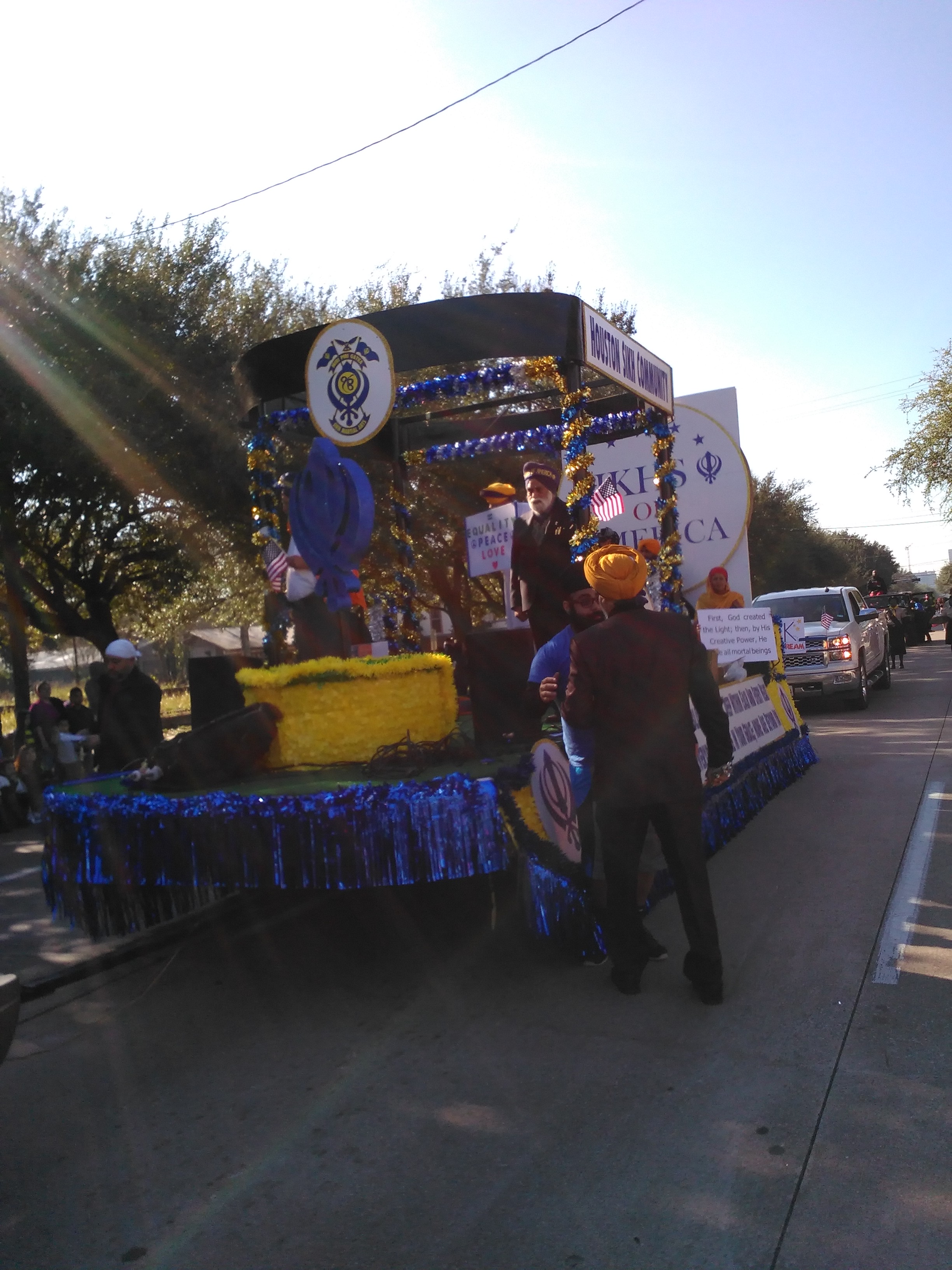
[[File:USASikhMLKDayParade2016Houston.jpg|thumb|Sikhs of America parade float at the 2016 [[Martin Luther King Day]] parade in [[Midtown Houston]]]] | [[File:USASikhMLKDayParade2016Houston.jpg|thumb|Sikhs of America parade float at the 2016 [[Martin Luther King Day]] parade in [[Midtown Houston]]]] | ||
[[File:HoustonSikhMLKDayParade2016Houston.jpg|thumb|Houston Sikh Community at the 2016 [[Martin Luther King Day]] parade in [[Midtown Houston]]|left]] | [[File:HoustonSikhMLKDayParade2016Houston.jpg|thumb|Houston Sikh Community at the 2016 [[Martin Luther King Day]] parade in [[Midtown Houston]]|left]] | ||
| Line 36: | Line 40: | ||
As a result of the [[September 11 attacks]], some Sikh Americans have become subject to discrimination, often from individuals who mistakenly believe that they are [[Arab]] or [[Muslim]]. | As a result of the [[September 11 attacks]], some Sikh Americans have become subject to discrimination, often from individuals who mistakenly believe that they are [[Arab]] or [[Muslim]]. | ||
Balbir Singh Sodhi, a gas station owner, [[Murder of Balbir Singh Sodhi|was killed]] on September 15, 2001, due to being mistaken for a Muslim. In a 2011 report to the [[United States Senate]], the [[Southern Poverty Law Center]] reported several assaults and incidents of arson at [[Gurdwara|Sikh temples]] after September 11. All were labeled as [[hate crime]]s that resulted from the perpetrators' misconceptions that their targets were Muslim.<ref>{{cite web|title=Anti-Muslim Incidents Since Sept. 11, 2001|url=http://www.splcenter.org/get-informed/news/splc-testifies-about-increase-in-anti-muslim-bias/anti-muslim-incidents-since-9-11|publisher=Southern Poverty Law Center|access-date=January 12, 2012}}</ref> In August 2012, a Sikh temple in [[Oak Creek, Wisconsin]], was the [[Wisconsin Sikh temple shooting|site of a shooting]], leading to six Sikh individuals being killed.<ref>{{cite news |title=Gunman's tattoos lead officials to deem Sikh shooting terrorism|author=Matt Pearce |author2=Brian Bennett |url=http://www.latimes.com/news/nation/nationnow/la-na-nn-sikh-temple-domestic-terrorism-20120805,0,6094643.story |newspaper=[[Los Angeles Times]] |access-date=5 August 2012}}</ref> On May 7, 2013, an elderly Sikh man was attacked with an iron bar in Fresno, California, in a possible [[hate crime]].<ref>{{cite news |title=Fresno police: Sikh beating a possible hate crime|author=SF Gate|url=http://www.sfgate.com/news/crime/article/Fresno-police-Sikh-beating-a-possible-hate-crime-4496778.php |newspaper=[[SF Gate]] |access-date=8 May 2013}}</ref> On September 21, 2013, Prabhjot Singh, a Sikh professor was attacked in [[Harlem]], New York, by a group of 20-30 men who branded him as "Osama" and Terrorist".<ref>{{cite web|title=Indian Professor attacked in Columbia after being called Osama|url=http://news.biharprabha.com/2013/09/indian-professor-attacked-in-columbia-after-being-called-osama/|access-date=23 September 2013}}</ref> | Balbir Singh Sodhi, a gas station owner, [[Murder of Balbir Singh Sodhi|was killed]] on September 15, 2001, due to being mistaken for a Muslim. In a 2011 report to the [[United States Senate]], the [[Southern Poverty Law Center]] reported several assaults and incidents of arson at [[Gurdwara|Sikh temples]] after September 11. All were labeled as [[hate crime]]s that resulted from the perpetrators' misconceptions that their targets were Muslim.<ref>{{cite web|title=Anti-Muslim Incidents Since Sept. 11, 2001|url=http://www.splcenter.org/get-informed/news/splc-testifies-about-increase-in-anti-muslim-bias/anti-muslim-incidents-since-9-11|publisher=Southern Poverty Law Center|access-date=January 12, 2012|date=March 29, 2011}}</ref> In August 2012, a Sikh temple in [[Oak Creek, Wisconsin]], was the [[Wisconsin Sikh temple shooting|site of a shooting]], leading to six Sikh individuals being killed.<ref>{{cite news |title=Gunman's tattoos lead officials to deem Sikh shooting terrorism|author=Matt Pearce |author2=Brian Bennett |url=http://www.latimes.com/news/nation/nationnow/la-na-nn-sikh-temple-domestic-terrorism-20120805,0,6094643.story |newspaper=[[Los Angeles Times]] |date=5 August 2012 |access-date=5 August 2012}}</ref> On May 7, 2013, an elderly Sikh man was attacked with an iron bar in Fresno, California, in a possible [[hate crime]].<ref>{{cite news |title=Fresno police: Sikh beating a possible hate crime|author=SF Gate|url=http://www.sfgate.com/news/crime/article/Fresno-police-Sikh-beating-a-possible-hate-crime-4496778.php |newspaper=[[SF Gate]] |date=7 May 2013 |access-date=8 May 2013}}</ref> On September 21, 2013, Prabhjot Singh, a Sikh professor was attacked in [[Harlem]], New York, by a group of 20-30 men who branded him as "[[Osama bin Laden]]" and Terrorist".<ref>{{cite web|title=Indian Professor attacked in Columbia after being called Osama|url=http://news.biharprabha.com/2013/09/indian-professor-attacked-in-columbia-after-being-called-osama/|access-date=23 September 2013}}</ref> | ||
A 2007 survey of Sikh students by the [[Sikh Coalition]] found that three out of four male students interviewed "had been teased or harassed on account of their religious identity."<ref>{{cite book |title= Civil Rights in Wartime: The Post-9/11 Sikh Experience |last=Sidhu |first= Darwinder S. |author2=Neha Singh Gohil |year=2009 |publisher=Ashgate Publishing |isbn=978-0-7546-7553-2 |page=72}}</ref> In 2014, the Sikh Coalition released a national report on the bullying of Sikh children in American schools. The report found that 55.8% of Sikh students surveyed in [[Indianapolis]] reported being bullied, while 54.5% of Sikh students surveyed in [[Fresno, California]], reported being bullied.<ref>{{cite news|title=Report: Fresno County Sikh students say they're bullied at school|url=http://www.fresnobee.com/2014/03/13/3818923/sikh-community-alarmed-by-bullying.html|newspaper=Fresno Bee|date=March 13, 2014|author=Juan Orozco|author2=Carmen George}}</ref> According to the surveys, Sikh students wearing turbans are twice as likely to be bullied as the average American child. | |||
In 2011, two Sikh American grandfathers were killed while out for a morning walk in [[Elk Grove, California]].<ref>{{cite web |title=Two Killed Sikh Grandfathers To Be Remembered with Park |url=https://www.nbcnews.com/news/asian-america/two-sikh-grandfathers-be-remembered-park-n619706 |website=NBC News |access-date=10 November 2024 |language=en |date=29 July 2016}}</ref> This led to a national public outcry by the community, raising safety concerns for the city's 3,000 Sikh community members.<ref>{{cite web |last1=Romney |first1=Lee |title=Attack on Sikh men triggers outcry in Elk Grove, Calif., and beyond |url=https://www.latimes.com/local/la-xpm-2011-apr-11-la-me-0411-sikhs-20110411-story.html |website=Los Angeles Times |access-date=10 November 2024 |date=11 April 2011}}</ref> The city completed the "Singh and Kaur Park" in 2021 to commemorate the lives of the slain men, and to raise awareness about the Sikh faith.<ref>{{cite web |last1=Cleary |first1=Luke |title=Community groups celebrate the opening of Singh and Kaur Park in Elk Grove |url=https://www.abc10.com/article/news/local/elk-grove/community-celebrate-opening-singh-and-kaur-park/103-4d9d13c8-8059-4992-8c23-4cbf2bbe7c25 |website=ABC10 |access-date=10 November 2024 |date=29 May 2021}}</ref> | |||
====Historic firsts==== | |||
In 2019, the [[United States Senate]] unanimously passed a resolution recognizing the importance of Sikh history, and contributions to American society.<ref>{{cite web |title=US Senate unanimously passes resolution on Sikh |url=https://www.hindustantimes.com/world-news/us-senate-unanimously-passes-resolution-on-sikh/story-PeWoO9eS30eWI3pt5YVICJ.html |website=Hindustan Times |date=November 16, 2019 |access-date=10 November 2024}}</ref> In the same year, [[Snatam Kaur]] became the first Sikh American nominated for a [[Grammy Award]] with her album ''Beloved''. | |||
In 2009, [[Kashmir Gill|Kash Gill]] made history as one of the first Indian mayors and the first Sikh to be elected mayor in the United States when he took office in Yuba City.<ref name= gill>Smith, Ken (October 24, 2013). "[http://www.newsreview.com/chico/sikhs-of-the-sacramento-valley/content?oid=11840883 Sikhs of the Sacramento Valley]". ''Chico News & Review'' (Chico, California).</ref> Additionally, the [[Charlottesville, Virginia#Government and politics|Charlottesville City Council]] ([[Virginia]]) appointed councilmember Satyendra Huja to the position of mayor in 2012, becoming the first turban-wearing Sikh to hold the position.<ref name= charlottesville>"Sikh Elected Mayor of Charlottesville, Virginia". ''News India-Times'' (New York, New York). January 27, 2012. p. 4.</ref> In 2020, Elk Grove elected Bobbie Allen-Singh as its new mayor, making her the first Sikh woman to hold the position of mayor in an American city.<ref>{{cite web |title=Bobbie Singh-Allen |url=https://newdealleaders.org/leader/bobbie-singh-allen/ |website=The New Deal |date=7 November 2024}}</ref> | |||
===Converts=== | ===Converts=== | ||
<!-- THIS SECTION COULD USE SOME HELP DISTINGUISHING BETWEEN CONVERTS TO 3HO SIKHISM, AND THOSE TO MAINSTREAM SIKHISM --> | <!-- THIS SECTION COULD USE SOME HELP DISTINGUISHING BETWEEN CONVERTS TO 3HO SIKHISM, AND THOSE TO MAINSTREAM SIKHISM --> | ||
In the 1960s, due to increased Indian immigration and rising interest in Indian spirituality in the American counterculture, a number of non-Punjabi Americans began to enter 3HO. Prominent in this trend was [[Yogi Bhajan]], leader of the Sikh-related movement [[3HO]] (Healthy, Happy, Holy Organization), whose Los Angeles temple was the first to introduce non-Punjabi Americans to Sikhism.<ref name="Bayor2011"/> | In the 1960s, due to increased Indian immigration and rising interest in Indian spirituality in the American counterculture, a number of non-Punjabi Americans began to enter 3HO. Prominent in this trend was [[Yogi Bhajan]], leader of the Sikh-related movement [[3HO]] (Healthy, Happy, Holy Organization), whose Los Angeles temple was the first to introduce non-Punjabi Americans to Sikhism.<ref name="Bayor2011"/> | ||
===Ethnicity of Sikhs in USA=== | |||
An organization, United Sikhs led a campaign to have U.S. Census Bureau recognize Sikhs as a separate ethnicity, which was successful on January 6, 2020. As a result, Sikhs are regarded as different from Asian Indian category.<ref>[https://www.sikhnet.com/news/us-census-20-include-sikhs-separate-ethnic-group US Census '20 to include SIKHS as separate Ethnic Group, SikhNet, January 6, 2020],</ref><ref> [https://unitedsikhs.org/historic-victory-sikhs-to-be-counted-as-separate-ethnic-group-in-u-s-census-2020/ HISTORIC VICTORY: SIKHS TO BE COUNTED AS SEPARATE ETHNIC GROUP IN U.S. CENSUS 2020, 1/21/2020]</ref><ref>[https://pluralism.org/news/sikhs-be-counted-separate-ethnic-group-us-census-first-time Sikhs to be counted as separate ethnic group in US census for first time, The Pluralism Project, Harvard University, January 15, 2020]</ref> | |||
In USA, the Sikhs term themselves Sikh Americans even though they are mostly of Indian descent.<ref>[https://senatedemocrats.wa.gov/dhingra/2025/03/14/resolution-celebrating-sikh-community-passes-washington-state-senate/ Resolution celebrating Sikh community passes Washington State Senate, March 14, 2025]</ref><ref>[https://www.rsfjournal.org/content/4/5/81 Shifting U.S. Racial and Ethnic Identities and Sikh American Activism, Prema Kurien, The Russell Sage Foundation Journal of the Social Sciences, August 2018, 4 (5) 81-98; DOI: https://doi.org/10.7758/RSF.2018.4.5.04]</ref> In USA about 20% of the truck drivers are Sikh <ref>[https://asianamericanedu.org/sikh-truckers.html On The Road: Sikh American Truck Drivers, The Asian American Education Project]</ref><ref>[https://www.theindianpanorama.news/unitedstates/after-sikh-group-lawsuit-california-delays-revocation-of-17000-truckers-licenses/ After Sikh group lawsuit, California delays revocation of 17,000 truckers’ licenses], Jan 3, 2026, The Indian Panorama]</ref> | |||
== Demography == | == Demography == | ||
===Generation status=== | |||
Most American Sikhs are immigrants. | |||
{| class="wikitable collapsible sortable" | |||
|+ Sikh American generation status (2020) | |||
|- | |||
! rowspan="2" |[[Immigrant generations|Generation status]] | |||
! colspan="2" |2020<ref>{{Cite news |title=2020 National Sikh American Survey: Key Findings|date=23 October 2020 |url=https://issuu.com/saldefmedia/docs/2020_national_sikh_american_survey|access-date=29 July 2024}}</ref> | |||
|- | |||
![[Population|{{abbr|Pop.|Population}}]] | |||
!{{Abbr|%|percentage}} | |||
|- | |||
| [[Immigration to the United States|First generation]] | |||
| 163,992 | |||
| {{Percentage | 163992| 280,329| 2 }} | |||
|- | |||
| Second generation | |||
| 100,638 | |||
| {{Percentage | 100638| 280,329| 2 }} | |||
|- | |||
| Third generation or more | |||
| 15,979 | |||
| {{Percentage | 15979| 280,329| 2 }} | |||
|- | |||
! Total | |||
! 280,329 | |||
! {{Percentage | 280,329| 331,449,281| 2 }} | |||
|} | |||
=== Occupations === | === Occupations === | ||
| Line 53: | Line 97: | ||
Sikhs have served in the United States military at least as far back as the early 20th century, when one [[Bhagat Singh Thind]], who though not a citizen joined the [[United States Army]] and served in [[World War I]]. Thind requested citizenship at the end of the war, being granted and revoked twice, before finally being naturalized in 1936.<ref>Dawinder S. Sidhu, Neha Singh Gohil. [https://books.google.com/books?id=J9zlF4muMjMC&pg=PA137 Civil rights in wartime: the post-9/11 Sikh experience]. Ashgate Publishing, Ltd., 2009. {{ISBN|0-7546-7553-X}}, 9780754675532. Pg 137</ref> Far larger numbers of Sikhs served in [[World War II]], and all American wars following. | Sikhs have served in the United States military at least as far back as the early 20th century, when one [[Bhagat Singh Thind]], who though not a citizen joined the [[United States Army]] and served in [[World War I]]. Thind requested citizenship at the end of the war, being granted and revoked twice, before finally being naturalized in 1936.<ref>Dawinder S. Sidhu, Neha Singh Gohil. [https://books.google.com/books?id=J9zlF4muMjMC&pg=PA137 Civil rights in wartime: the post-9/11 Sikh experience]. Ashgate Publishing, Ltd., 2009. {{ISBN|0-7546-7553-X}}, 9780754675532. Pg 137</ref> Far larger numbers of Sikhs served in [[World War II]], and all American wars following. | ||
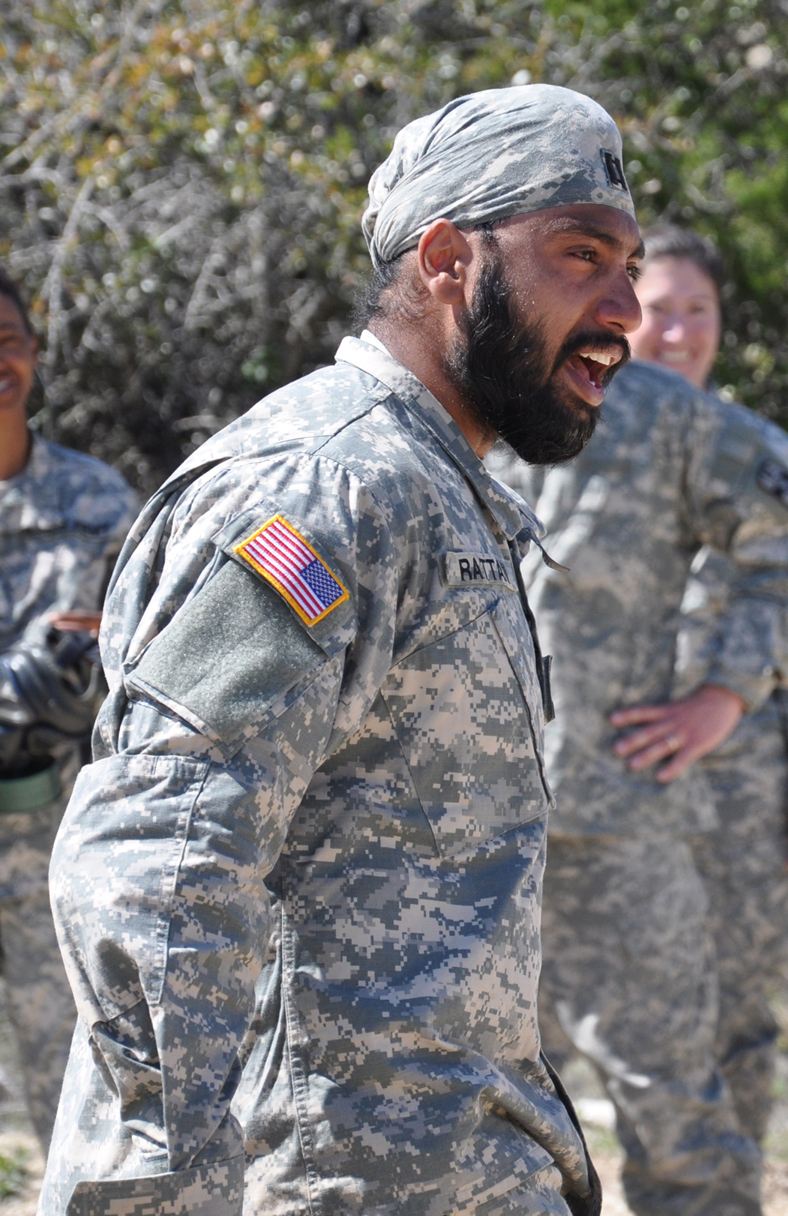
The ability of observant Sikhs to serve in the American military has, since 1985, been compromised by a discontinuation of exemptions to uniform standards which previously allowed Sikhs to maintain their religiously mandated beards and turbans while in uniform.<ref name="CH">{{Cite news |title=Beard Ban Deters Chabad Rabbis From Becoming Chaplains in Army |url=http://www.crownheights.info/index.php?itemid=479 |access-date=25 October 2009}}</ref> As of 2010, a Sikh doctor, Kamaljeet S. Kalsi, and dentist, Tejdeep Singh Rattan, are the only Sikh officers to be permitted to serve in uniform with beard and turban.<ref name="Exempt">{{cite web|url=https://abcnews.go.com/US/wireStory?id=10172836|title=1st Sikh in Decades Graduates Army Officer School, Page 1|author=Michelle Roberts|access-date=2010-03-22|work=ABC News}}</ref> In addition, Simranpreet Lamba was permitted to enlist, with exemption to wear his turban and beard, in 2010 due to his knowledge of Punjabi and Hindi.<ref>{{cite web |url= | The ability of observant Sikhs to serve in the American military has, since 1985, been compromised by a discontinuation of exemptions to uniform standards which previously allowed Sikhs to maintain their religiously mandated beards and turbans while in uniform.<ref name="CH">{{Cite news |title=Beard Ban Deters Chabad Rabbis From Becoming Chaplains in Army |date=27 August 2005 |url=http://www.crownheights.info/index.php?itemid=479 |access-date=25 October 2009}}</ref> As of 2010, a Sikh doctor, Kamaljeet S. Kalsi, and dentist, Tejdeep Singh Rattan, are the only Sikh officers to be permitted to serve in uniform with beard and turban.<ref name="Exempt">{{cite web|url=https://abcnews.go.com/US/wireStory?id=10172836|title=1st Sikh in Decades Graduates Army Officer School, Page 1|author=Michelle Roberts|access-date=2010-03-22|work=ABC News}}</ref> In addition, Simranpreet Lamba was permitted to enlist, with exemption to wear his turban and beard, in 2010 due to his knowledge of Punjabi and Hindi.<ref>{{cite web |url=https://www.army.mil/article/47924/keeping-faith-sikh-soldier-graduates-basic-training/ |title=Keeping faith: Sikh Soldier graduates basic training |author=Susanne Kappler |date=10 November 2010 |work=Fort Jackson Leader |publisher=United States Army |access-date=26 December 2011}}</ref> | ||
==== Military ==== | ==== Military ==== | ||
In the federal appeals court in Washington, a preliminary injunction allowed two Sikh men to enter the military recruit training wearing a turban as it was considered an article of religion. The military recruits Milaap Singh Chahal and Jaskirat Singh sued the Marine Corps in April due to violation of the first amendment which allows the freedom of religion. The branch that they were a part of declined full religious exemption.<ref>{{Cite news |last=Molina |first=Alejandra |title=In court ruling, Sikh recruits can attend USMC training while keeping beards and turbans |work=Religion News Service |url=https://religionnews.com/2022/12/23/in-court-ruling-sikh-recruits-can-attend-marine-corps-training-while-keeping-beards-and-turbans/ |access-date=December 26, 2022}}</ref> | In the federal appeals court in Washington, a preliminary injunction allowed two Sikh men to enter the military recruit training wearing a turban as it was considered an article of religion. The military recruits Milaap Singh Chahal and Jaskirat Singh sued the Marine Corps in April 2022 due to violation of the first amendment which allows the freedom of religion. The branch that they were a part of declined full religious exemption.<ref>{{Cite news |last=Molina |first=Alejandra |date=December 23, 2022 |title=In court ruling, Sikh recruits can attend USMC training while keeping beards and turbans |work=Religion News Service |url=https://religionnews.com/2022/12/23/in-court-ruling-sikh-recruits-can-attend-marine-corps-training-while-keeping-beards-and-turbans/ |access-date=December 26, 2022}}</ref> | ||
====Policing==== | ====Policing==== | ||
In 2016, the [[New York City Police Department]] (NYPD) began to allow turbans, subject to standards compatible with unimpeded performance of duty.<ref>{{cite web|url=http://www.cnn.com/2016/12/29/homepage2/nypd-sikh-officers-turbans-policy-change/|title=NYPD changes policy, will allow officers to wear turbans|author=David Shortell|publisher=CNN|access-date=December 31, 2016}}</ref> In 2015, Sandeep Dhaliwal became the first Deputy Sheriff in Texas to wear a turban on duty (Harris County Sherriff's Office). He was shot and killed from behind in 2019 while conducting a routine traffic stop on the Copperbrook subdivision in Houston Texas.<ref>{{Cite web|url=https://www.yahoo.com/entertainment/deputy-gained-national-attention-first-133039093.html|title=Deputy Who Gained National Attention as First Texas Cop to Wear Turban Shot & Killed on Duty|website=Yahoo|language=en-US|access-date=2019-09-28}}</ref> | In 2016, the [[New York City Police Department]] (NYPD) began to allow turbans, subject to standards compatible with unimpeded performance of duty.<ref>{{cite web|url=http://www.cnn.com/2016/12/29/homepage2/nypd-sikh-officers-turbans-policy-change/|title=NYPD changes policy, will allow officers to wear turbans|author=David Shortell|publisher=CNN|date=December 29, 2016|access-date=December 31, 2016}}</ref> In 2015, Sandeep Dhaliwal became the first Deputy Sheriff in Texas to wear a turban on duty ([[Harris County Sheriff’s Office|Harris County Sherriff's Office]]). He was shot and killed from behind in 2019 while conducting a routine traffic stop on the Copperbrook subdivision in Houston Texas.<ref>{{Cite web|url=https://www.yahoo.com/entertainment/deputy-gained-national-attention-first-133039093.html|title=Deputy Who Gained National Attention as First Texas Cop to Wear Turban Shot & Killed on Duty|website=Yahoo|date=September 28, 2019 |language=en-US|access-date=2019-09-28}}</ref> | ||
In 2019, the [[Houston Police Department]] changed their rules to allow beards and turbans, joining 25 other law enforcement agencies.<ref>{{Cite web |title=HPD changes uniform policy to honor Deputy Sandeep Dhaliwal |url=https://www.khou.com/article/news/local/honored-father-of-deputy-sandeep-dhaliwal-thanks-hpd-for-allowing-sikh-officers-to-wear-articles-of-faith/285-dd4f77d6-3e7c-44de-9cb4-b3dc1d980cdb |access-date=2022-06-22 |website=khou.com |language=en-US}}</ref> | In 2019, the [[Houston Police Department]] changed their rules to allow beards and turbans, joining 25 other law enforcement agencies.<ref>{{Cite web |date=November 18, 2019 |title=HPD changes uniform policy to honor Deputy Sandeep Dhaliwal |url=https://www.khou.com/article/news/local/honored-father-of-deputy-sandeep-dhaliwal-thanks-hpd-for-allowing-sikh-officers-to-wear-articles-of-faith/285-dd4f77d6-3e7c-44de-9cb4-b3dc1d980cdb |access-date=2022-06-22 |website=khou.com |language=en-US}}</ref> | ||
====Professionals==== | ====Professionals==== | ||
Many Sikhs started life in America working in lumber mills, mines, and as farm laborers, with many eventually becoming landowners. Many early Sikh immigrants were restaurant owners. In 1956, [[Dalip Singh Saund]] became the first Asian Indian-born person to be elected to the [[United States House of Representatives]]. | Many Sikhs started life in America working in lumber mills, mines, and as farm laborers, with many eventually becoming landowners. Many early Sikh immigrants were restaurant owners. In 1956, [[Dalip Singh Saund]] became the first Asian Indian-born person to be elected to the [[United States House of Representatives]]. | ||
Today, many Sikhs are well represented in white-collar positions such as lawyers, doctors, engineers, accountants, and businesspeople. They are considered to be a successful ethnic group in line with most of the Indian community. The community has a higher level of education, as over 53% have received a bachelor's degree compared to 40% of the general population. This is also reflected in terms of income as over 75% of the community earns over $50,000 and over two-thirds of the population have incomes over $100,000.<ref>{{cite web |title=The First Demographic Profile on Sikh Americans |url=https://www.sikhnet.com/news/first-demographic-profile-sikh-americans |website=sikhnet.com |date=February 13, 2019 |publisher=Sikh Net |access-date=2023-11-07}}</ref><ref name="Key Findings" /> | |||
====Elected officials==== | ====Elected officials==== | ||
| Line 72: | Line 118: | ||
* City planner Satyendra Huja was elected mayor of [[Charlottesville, Virginia]] in January 2012.<ref>{{cite web|url=http://www2.timesdispatch.com/news/2012/jan/22/tdobit03-sikh-city-planner-becomes-charlottesville-ar-1629743/ |title=Sikh city planner becomes Charlottesville mayor | Richmond Times-Dispatch |publisher=.timesdispatch.com |access-date=2012-08-07}}</ref> | * City planner Satyendra Huja was elected mayor of [[Charlottesville, Virginia]] in January 2012.<ref>{{cite web|url=http://www2.timesdispatch.com/news/2012/jan/22/tdobit03-sikh-city-planner-becomes-charlottesville-ar-1629743/ |title=Sikh city planner becomes Charlottesville mayor | Richmond Times-Dispatch |publisher=.timesdispatch.com |access-date=2012-08-07}}</ref> | ||
* Amarjit Singh Buttar was elected in December 2001 to the [[Vernon, Connecticut]] Board of Education and won re-election in 2011.<ref>{{cite news|url=http://vernon.patch.com/articles/board-of-education-members-become-official | title=School Board Members Make It Official | date=November 23, 2011 | access-date=August 9, 2012 | last=Tanjua | first=Damon | work=Vernon Patch}}</ref> | * Amarjit Singh Buttar was elected in December 2001 to the [[Vernon, Connecticut]] Board of Education and won re-election in 2011.<ref>{{cite news|url=http://vernon.patch.com/articles/board-of-education-members-become-official | title=School Board Members Make It Official | date=November 23, 2011 | access-date=August 9, 2012 | last=Tanjua | first=Damon | work=Vernon Patch}}</ref> | ||
* [[Ravinder Bhalla]] was elected mayor of [[Hoboken, New Jersey|Hoboken]], New Jersey in November 2017. He is also the first Sikh mayor to wear a turban. | * [[Ravinder Bhalla]] was elected mayor of [[Hoboken, New Jersey|Hoboken]], New Jersey in November 2017. He is also the first Sikh mayor to wear a turban. | ||
* Satwinder Kaur became the first Sikh elected to the City Council of [[Kent, Washington]] in November 2017. | * Satwinder Kaur became the first Sikh elected to the City Council of [[Kent, Washington]] in November 2017. | ||
| Line 82: | Line 127: | ||
{{Main|Punjabi Americans#Geographical distribution}} | {{Main|Punjabi Americans#Geographical distribution}} | ||
[[File:Sikhs in Union Square Somerville.jpg|thumb|right|Members of the Sikh community of [[Somerville, Massachusetts]]]] | [[File:Sikhs in Union Square Somerville.jpg|thumb|right|Members of the Sikh community of [[Somerville, Massachusetts]]]] | ||
[[File:San Jose Gurdwara Sahib (2448909577).jpg|thumb|right|A [[Gurdwara Sahib of San Jose|gurdwara]] in [[Evergreen, San Jose|Evergreen]], [[San Jose, California]]]] | |||
Over half of American Sikhs live in California. Most of California's Sikh population live in [[NorCal]], especially in the [[Central Valley (California)|Central Valley]] and the [[Bay Area]]. The nation's largest Sikh population is in [[California]]'s [[Central Valley (California)|Central Valley]], where Punjabi is the third most spoken language after only [[California English|English]] and [[Spanish language in the United States|Spanish]].<ref>{{Cite news |last=Sewell |first=Summer |date=2021-02-08 |title='This has to end peacefully': California's Punjabi farmers rally behind India protests |url=https://www.theguardian.com/us-news/2021/feb/08/california-indian-farmers-protest-sikh-punjab-yuba-city |access-date=2022-11-27 |work=[[The Guardian]] |quote=Community members have also raised funds to support billboards drawing attention to India’s protests throughout the Central Valley, where Punjabi is the third-most spoken language, after English and Spanish.}}</ref> Sikhs can be found across the [[Sacramento River|Sacramento]] and [[San Joaquin River|San Joaquin]] valleys, but the largest concentrations can be found in the valley's largest cities ([[Sacramento]] in the Sacramento Valley and [[Stockton, California|Stockton]], [[Fresno]], and [[Bakersfield]] in the San Joaquin Valley), and in smaller communities associated with the farming of almonds, peaches, walnuts, and plums. There are also significant concentrations of Sikh Americans in the [[Sacramento–San Joaquin River Delta]] and in the Bay Area near [[San Jose, California]] and [[Fremont, California]]. | |||
In the [[Sacramento Valley]], [[Yuba City]] and [[Live Oak, Sutter County, California|Live Oak]] have prominent Sikh populations, with the first Sikh arriving in Yuba City in 1906.<ref>{{Cite web|title= | In the [[Sacramento Valley]], [[Yuba City]] and [[Live Oak, Sutter County, California|Live Oak]] have prominent Sikh populations, with the first Sikh arriving in Yuba City in 1906.<ref>{{Cite web|title= | ||
Tuly Singh Johl- Pioneering Punjabis Digital Archive|url=https://pioneeringpunjabis.ucdavis.edu/people/pioneers/tully-singh-johl/|access-date=2023-03-22|website=ucdavis.edu|language=en-US}}</ref> In | Tuly Singh Johl- Pioneering Punjabis Digital Archive|url=https://pioneeringpunjabis.ucdavis.edu/people/pioneers/tully-singh-johl/|access-date=2023-03-22|website=ucdavis.edu|language=en-US}}</ref> In 2020, Yuba City was home to around 10,000 Sikhs (~15% of the city's population), while Live Oak was home to around 700 Sikhs (~8% of the city's population), with most of these being Sikhs.{{refn|In the [[2021 Canadian census]], 194,640 Canadians declared Sikh as their ethnicity while 771,790 Canadians declared Sikh as their religion. Using this, the number of Americans with Sikh as their religion can be approximated using the number of Americans with Sikh as their religion.<ref name="auto1"/><ref name="T01001TOTAL POPULATION">{{Cite web|url=https://data.census.gov/table?q=sikh&g=010XX00US$0400000&tid=DECENNIALDDHCA2020.T01001|title=T01001TOTAL POPULATION|publisher=[[United States Census Bureau]]|access-date=2023-09-23}}</ref><ref name="P1TOTAL POPULATION">{{Cite web|url=https://data.census.gov/table?q=population&g=010XX00US$0400000&tid=DECENNIALDHC2020.P1|title=P1TOTAL POPULATION|publisher=[[United States Census Bureau]]|access-date=2023-09-23}}</ref>|name="census2020"}} [[Sutter County, California]] as a whole is home to around 11,000 Sikhs (~11% of the county population); this makes Sutter County the most proportionally Sikh county in America.{{refn|name="census2020"}} Down south in the [[San Joaquin Valley]], [[Livingston, California|Livingston]] is home to around 2,500 Sikhs (~17% of the city's population); Livingston is the most proportionally Sikh municipality in America.{{refn|name="census2020"}} | ||
The [[New York metropolitan area]] also has a significant Sikh American presence. Around 19,000 Sikhs live in [[New York City]], with around 18,000 in [[Queens, New York|Queens]].{{refn|name="census2020"}} The [[Richmond Hill, Queens|Richmond Hill]] neighborhood of [[Queens, New York|Queens]] is often referred to as "Little Punjab" due to its large Punjabi population. In 2020, the stretch of 101st Avenue between 111th and 123rd streets in Richmond Hill was renamed [[Punjab Avenue|Punjab Avenue (ਪੰਜਾਬ ਐਵੇਨਿਊ)]] and the stretch of 97th Avenue between Lefferts Boulevard and 117th Street was renamed Gurdwara Street.<ref>{{Cite web|title= Richmond Hill Street Co-Named 'Punjab Avenue' To Honor Neighborhood's South Asian Culture|url=https://www.cbsnews.com/newyork/news/richmond-hill-street-co-named-punjab-avenue-to-honor-neighborhoods-south-asian-culture/|access-date=2022-11-23|website=[[CBS News]]|date=October 23, 2020 |language=en-US}}</ref><ref>{{Cite web|title= 'Punjab Way,' 'Gurdwara St.' coming to Queens|url=https://www.nydailynews.com/news/politics/ny-punjab-way-gurdwara-street-queens-20191219-33xa63nt5zgpdbujxfhxolezcy-story.html|access-date=2022-11-23|website=[[New York Daily News]]|date=December 18, 2019 |language=en-US}}</ref> Outside of the city, the suburbs of [[Hicksville, New York|Hicksville]] in [[Long Island]] and [[Carteret, New Jersey|Carteret]] in [[Central Jersey]] have significant Punjabi populations. In 2020, Carteret was home to around 3,000 Sikhs (~12% of the borough's population) while Hicksville was home to around 2,000 (~5% of the hamlet's population).{{refn|name="census2020"}} | |||
Outside of California and the New York metropolitan area, there are significant populations of Punjabi Sikhs in [[Washington (U.S. state)|Washington]], [[Indiana]], [[Texas]], [[Florida]], [[Georgia (U.S. state)|Georgia]], [[Virginia]], [[Maryland]], [[Massachusetts]] and [[North Carolina]]. There is also a concentration of non-Punjabi converts to Sikhism in [[Española, New Mexico|Española]], [[New Mexico]].<ref>{{Cite web|title= American Sikhs Run Billion-Dollar Security Firm|url=https://www.npr.org/transcripts/104869550|access-date=2022-11-23|website=www.npr.org|date=June 13, 2009 |language=en-US}}</ref> | |||
===States and territories=== | |||
{| class="wikitable collapsible sortable" | |||
|+ Sikh Americans by [[List of states and territories of the United States|state or territory]] ([[2020 U.S. Census|2020]])<ref name="auto1"/><ref name="T01001TOTAL POPULATION"/><ref name="P1TOTAL POPULATION"/> | |||
! rowspan="2" |[[U.S. state|State]] or [[Territories of the United States|territory]] | |||
! colspan="2" |Sikh alone | |||
! colspan="2" |Sikh alone or in<br>any combination | |||
! colspan="2" |Total Sikh population<br>('''derived estimate'''){{refn|In the [[2021 Canadian census]], 194,640 Canadians declared Sikh as their ethnicity while 771,790 Canadians declared Sikh as their religion. Using this, the number of Americans with Sikh as their religion can be approximated using the number of Americans with Sikh as their religion}} | |||
|- | |||
![[Population|{{abbr|Pop.|Population}}]] | |||
!{{Abbr|%|percentage}} | |||
![[Population|{{abbr|Pop.|Population}}]] | |||
!{{Abbr|%|percentage}} | |||
![[Population|{{abbr|Pop.|Population}}]] | |||
!{{Abbr|%|percentage}} | |||
|- | |||
|{{flagicon|Alabama}} [[Alabama]] | |||
| 29 | |||
| {{Percentage | 29| 5,024,279| 2 }} | |||
| 41 | |||
| {{Percentage | 41| 5,024,279| 2 }} | |||
| 163 | |||
| {{Percentage | 163| 5,024,279| 2 }} | |||
|- | |||
|{{flagicon|Alaska}} [[Alaska]] | |||
| 3 | |||
| {{Percentage | 3| 733,391| 2 }} | |||
| 4 | |||
| {{Percentage | 4| 733,391| 2 }} | |||
| 16 | |||
| {{Percentage | 16| 733,391| 2 }} | |||
|- | |||
|{{flagicon|Arizona}} [[Arizona]] | |||
| 403 | |||
| {{Percentage | 403| 7,151,502| 2 }} | |||
| 549 | |||
| {{Percentage | 549| 7,151,502| 2 }} | |||
| 2,177 | |||
| {{Percentage | 2,177| 7,151,502| 2 }} | |||
|- | |||
|{{flagicon|Arkansas}} [[Arkansas]] | |||
| 22 | |||
| {{Percentage | 22| 3,011,524| 2 }} | |||
| 46 | |||
| {{Percentage | 46| 3,011,524| 2 }} | |||
| 182 | |||
| {{Percentage | 182| 3,011,524| 2 }} | |||
|- | |||
|{{flagicon|California}} [[California]] | |||
| 25,037 | |||
| {{Percentage | 25,037| 39,538,223| 2 }} | |||
| 36,975 | |||
| {{Percentage | 36,975| 39,538,223| 2 }} | |||
| 146,614 | |||
| {{Percentage | 146,614| 39,538,223| 2 }} | |||
|- | |||
|{{flagicon|Colorado}} [[Colorado]] | |||
| 223 | |||
| {{Percentage | 223| 5,773,714| 2 }} | |||
| 334 | |||
| {{Percentage | 334| 5,773,714| 2 }} | |||
| 1,324 | |||
| {{Percentage | 1,324| 5,773,714| 2 }} | |||
|- | |||
|{{flagicon|Connecticut}} [[Connecticut]] | |||
| 260 | |||
| {{Percentage | 260| 3,605,944| 2 }} | |||
| 359 | |||
| {{Percentage | 359| 3,605,944| 2 }} | |||
| 1,424 | |||
| {{Percentage | 1,424| 3,605,944| 2 }} | |||
|- | |||
|{{flagicon|Delaware}} [[Delaware]] | |||
| 69 | |||
| {{Percentage | 69| 989,948| 2 }} | |||
| 88 | |||
| {{Percentage | 88| 989,948| 2 }} | |||
| 349 | |||
| {{Percentage | 349| 989,948| 2 }} | |||
|- | |||
|{{flagicon|District of Columbia}} [[District of Columbia]] | |||
| 7 | |||
| {{Percentage | 7| 689,545| 2 }} | |||
| 19 | |||
| {{Percentage | 19| 689,545| 2 }} | |||
| 75 | |||
| {{Percentage | 75| 689,545| 2 }} | |||
|- | |||
|{{flagicon|Florida}} [[Florida]] | |||
| 421 | |||
| {{Percentage | 421| 21,538,187| 2 }} | |||
| 595 | |||
| {{Percentage | 595| 21,538,187| 2 }} | |||
| 2,359 | |||
| {{Percentage | 2,359| 21,538,187| 2 }} | |||
|- | |||
|{{flagicon|Georgia (U.S. state)}} [[Georgia (U.S. state)|Georgia]] | |||
| 390 | |||
| {{Percentage | 390| 10,711,908| 2 }} | |||
| 548 | |||
| {{Percentage | 548| 10,711,908| 2 }} | |||
| 2,173 | |||
| {{Percentage | 2,173| 10,711,908| 2 }} | |||
|- | |||
|{{flagicon|Hawaii}} [[Hawaii]] | |||
| N/A | |||
| N/A | |||
| 0 | |||
| {{Percentage | 0| 1,455,271| 2 }} | |||
| 0 | |||
| {{Percentage | 0| 1,455,271| 2 }} | |||
|- | |||
|{{flagicon|Idaho}} [[Idaho]] | |||
| 8 | |||
| {{Percentage | 8| 1,839,106| 2 }} | |||
| 11 | |||
| {{Percentage | 11| 1,839,106| 2 }} | |||
| 44 | |||
| {{Percentage | 44| 1,839,106| 2 }} | |||
|- | |||
|{{flagicon|Illinois}} [[Illinois]] | |||
| 840 | |||
| {{Percentage | 840| 12,812,508| 2 }} | |||
| 1,283 | |||
| {{Percentage | 1,283| 12,812,508| 2 }} | |||
| 5,087 | |||
| {{Percentage | 5,087| 12,812,508| 2 }} | |||
|- | |||
|{{flagicon|Indiana}} [[Indiana]] | |||
| 1,283 | |||
| {{Percentage | 1,283| 6,785,528| 2 }} | |||
| 1,718 | |||
| {{Percentage | 1,718| 6,785,528| 2 }} | |||
| 6,812 | |||
| {{Percentage | 6,812| 6,785,528| 2 }} | |||
|- | |||
|{{flagicon|Iowa}} [[Iowa]] | |||
| 33 | |||
| {{Percentage | 33| 3,190,369| 2 }} | |||
| 61 | |||
| {{Percentage | 61| 3,190,369| 2 }} | |||
| 242 | |||
| {{Percentage | 242| 3,190,369| 2 }} | |||
|- | |||
|{{flagicon|Kansas}} [[Kansas]] | |||
| 99 | |||
| {{Percentage | 99| 2,937,880| 2 }} | |||
| 174 | |||
| {{Percentage | 174| 2,937,880| 2 }} | |||
| 690 | |||
| {{Percentage | 690| 2,937,880| 2 }} | |||
|- | |||
|{{flagicon|Kentucky}} [[Kentucky]] | |||
| 25 | |||
| {{Percentage | 25| 4,505,836| 2 }} | |||
| 46 | |||
| {{Percentage | 46| 4,505,836| 2 }} | |||
| 182 | |||
| {{Percentage | 182| 4,505,836| 2 }} | |||
|- | |||
|{{flagicon|Louisiana}} [[Louisiana]] | |||
| 56 | |||
| {{Percentage | 56| 4,657,757| 2 }} | |||
| 86 | |||
| {{Percentage | 86| 4,657,757| 2 }} | |||
| 341 | |||
| {{Percentage | 341| 4,657,757| 2 }} | |||
|- | |||
|{{flagicon|Maine}} [[Maine]] | |||
| N/A | |||
| N/A | |||
| 23 | |||
| {{Percentage | 23| 1,362,359| 2 }} | |||
| 91 | |||
| {{Percentage | 91| 1,362,359| 2 }} | |||
|- | |||
|{{flagicon|Maryland}} [[Maryland]] | |||
| 734 | |||
| {{Percentage | 734| 6,177,224| 2 }} | |||
| 1,012 | |||
| {{Percentage | 1,012| 6,177,224| 2 }} | |||
| 4,013 | |||
| {{Percentage | 4,013| 6,177,224| 2 }} | |||
|- | |||
|{{flagicon|Massachusetts}} [[Massachusetts]] | |||
| 452 | |||
| {{Percentage | 452| 7,029,917| 2 }} | |||
| 600 | |||
| {{Percentage | 600| 7,029,917| 2 }} | |||
| 2,379 | |||
| {{Percentage | 2,379| 7,029,917| 2 }} | |||
|- | |||
|{{flagicon|Michigan}} [[Michigan]] | |||
| 981 | |||
| {{Percentage | 981| 10,077,331| 2 }} | |||
| 1,465 | |||
| {{Percentage | 1,465| 10,077,331| 2 }} | |||
| 5,809 | |||
| {{Percentage | 5,809| 10,077,331| 2 }} | |||
|- | |||
|{{flagicon|Minnesota}} [[Minnesota]] | |||
| 74 | |||
| {{Percentage | 74| 5,706,494| 2 }} | |||
| 115 | |||
| {{Percentage | 115| 5,706,494| 2 }} | |||
| 456 | |||
| {{Percentage | 456| 5,706,494| 2 }} | |||
|- | |||
|{{flagicon|Mississippi}} [[Mississippi]] | |||
| 77 | |||
| {{Percentage | 77| 2,961,279| 2 }} | |||
| 116 | |||
| {{Percentage | 116| 2,961,279| 2 }} | |||
| 460 | |||
| {{Percentage | 460| 2,961,279| 2 }} | |||
|- | |||
|{{flagicon|Missouri}} [[Missouri]] | |||
| 75 | |||
| {{Percentage | 75| 6,154,913| 2 }} | |||
| 131 | |||
| {{Percentage | 131| 6,154,913| 2 }} | |||
| 519 | |||
| {{Percentage | 519| 6,154,913| 2 }} | |||
|- | |||
|{{flagicon|Montana}} [[Montana]] | |||
| 0 | |||
| {{Percentage | 0| 1,084,225| 2 }} | |||
| 4 | |||
| {{Percentage | 4| 1,084,225| 2 }} | |||
| 16 | |||
| {{Percentage | 16| 1,084,225| 2 }} | |||
|- | |||
|{{flagicon|Nebraska}} [[Nebraska]] | |||
| 4 | |||
| {{Percentage | 4| 1,961,504| 2 }} | |||
| 7 | |||
| {{Percentage | 7| 1,961,504| 2 }} | |||
| 28 | |||
| {{Percentage | 28| 1,961,504| 2 }} | |||
|- | |||
|{{flagicon|Nevada}} [[Nevada]] | |||
| 147 | |||
| {{Percentage | 147| 3,104,614| 2 }} | |||
| 282 | |||
| {{Percentage | 282| 3,104,614| 2 }} | |||
| 1,118 | |||
| {{Percentage | 1,118| 3,104,614| 2 }} | |||
|- | |||
|{{flagicon|New Hampshire}} [[New Hampshire]] | |||
| 14 | |||
| {{Percentage | 14| 1,377,529| 2 }} | |||
| 36 | |||
| {{Percentage | 36| 1,377,529| 2 }} | |||
| 143 | |||
| {{Percentage | 143| 1,377,529| 2 }} | |||
|- | |||
|{{flagicon|New Jersey}} [[New Jersey]] | |||
| 2,715 | |||
| {{Percentage | 2,715| 9,288,994| 2 }} | |||
| 3,888 | |||
| {{Percentage | 3,888| 9,288,994| 2 }} | |||
| 15,417 | |||
| {{Percentage | 15,417| 9,288,994| 2 }} | |||
|- | |||
|{{flagicon|New Mexico}} [[New Mexico]] | |||
| 18 | |||
| {{Percentage | 18| 2,117,522| 2 }} | |||
| 37 | |||
| {{Percentage | 37| 2,117,522| 2 }} | |||
| 147 | |||
| {{Percentage | 147| 2,117,522| 2 }} | |||
|- | |||
|{{flagicon|New York}} [[New York (state)|New York]] | |||
| 5,587 | |||
| {{Percentage | 5,587| 20,201,249| 2 }} | |||
| 7,943 | |||
| {{Percentage | 7,943| 20,201,249| 2 }} | |||
| 31,496 | |||
| {{Percentage | 31,496| 20,201,249| 2 }} | |||
|- | |||
|{{flagicon|North Carolina}} [[North Carolina]] | |||
| 206 | |||
| {{Percentage | 206| 10,439,388| 2 }} | |||
| 361 | |||
| {{Percentage | 361| 10,439,388| 2 }} | |||
| 1,431 | |||
| {{Percentage | 1,431| 10,439,388| 2 }} | |||
|- | |||
|{{flagicon|North Dakota}} [[North Dakota]] | |||
| N/A | |||
| N/A | |||
| 0 | |||
| {{Percentage | 0| 779,094| 2 }} | |||
| 0 | |||
| {{Percentage | 0| 779,094| 2 }} | |||
|- | |||
|{{flagicon|Ohio}} [[Ohio]] | |||
| 569 | |||
| {{Percentage | 569| 11,799,448| 2 }} | |||
| 887 | |||
| {{Percentage | 887| 11,799,448| 2 }} | |||
| 3,517 | |||
| {{Percentage | 3,517| 11,799,448| 2 }} | |||
|- | |||
|{{flagicon|Oklahoma}} [[Oklahoma]] | |||
| 42 | |||
| {{Percentage | 42| 3,959,353| 2 }} | |||
| 48 | |||
| {{Percentage | 48| 3,959,353| 2 }} | |||
| 190 | |||
| {{Percentage | 190| 3,959,353| 2 }} | |||
|- | |||
|{{flagicon|Oregon}} [[Oregon]] | |||
| 204 | |||
| {{Percentage | 204| 4,237,256| 2 }} | |||
| 285 | |||
| {{Percentage | 285| 4,237,256| 2 }} | |||
| 1,130 | |||
| {{Percentage | 1,130| 4,237,256| 2 }} | |||
|- | |||
|{{flagicon|Pennsylvania}} [[Pennsylvania]] | |||
| 759 | |||
| {{Percentage | 759| 13,002,700| 2 }} | |||
| 1,098 | |||
| {{Percentage | 1,098| 13,002,700| 2 }} | |||
| 4,354 | |||
| {{Percentage | 4,354| 13,002,700| 2 }} | |||
|- | |||
|{{flagicon|Puerto Rico}} [[Puerto Rico]] | |||
| N/A | |||
| N/A | |||
| 0 | |||
| {{Percentage | 0| 3,285,874| 2 }} | |||
| 0 | |||
| {{Percentage | 0| 3,285,874| 2 }} | |||
|- | |||
|{{flagicon|Rhode Island}} [[Rhode Island]] | |||
| N/A | |||
| N/A | |||
| 3 | |||
| {{Percentage | 3| 1,097,379| 2 }} | |||
| 12 | |||
| {{Percentage | 12| 1,097,379| 2 }} | |||
|- | |||
|{{flagicon|South Carolina}} [[South Carolina]] | |||
| 42 | |||
| {{Percentage | 42| 5,118,425| 2 }} | |||
| 97 | |||
| {{Percentage | 97| 5,118,425| 2 }} | |||
| 385 | |||
| {{Percentage | 385| 5,118,425| 2 }} | |||
|- | |||
|{{flagicon|South Dakota}} [[South Dakota]] | |||
| 0 | |||
| {{Percentage | 0| 886,667| 2 }} | |||
| 1 | |||
| {{Percentage | 1| 886,667| 2 }} | |||
| 4 | |||
| {{Percentage | 4| 886,667| 2 }} | |||
|- | |||
|{{flagicon|Tennessee}} [[Tennessee]] | |||
| 48 | |||
| {{Percentage | 48| 6,910,840| 2 }} | |||
| 73 | |||
| {{Percentage | 73| 6,910,840| 2 }} | |||
| 289 | |||
| {{Percentage | 289| 6,910,840| 2 }} | |||
|- | |||
|{{flagicon|Texas}} [[Texas]] | |||
| 1,918 | |||
| {{Percentage | 1,918| 29,145,505| 2 }} | |||
| 2,718 | |||
| {{Percentage | 2,718| 29,145,505| 2 }} | |||
| 10,777 | |||
| {{Percentage | 10,777| 29,145,505| 2 }} | |||
|- | |||
|{{flagicon|Utah}} [[Utah]] | |||
| 62 | |||
| {{Percentage | 62| 3,271,616| 2 }} | |||
| 92 | |||
| {{Percentage | 92| 3,271,616| 2 }} | |||
| 365 | |||
| {{Percentage | 365| 3,271,616| 2 }} | |||
|- | |||
|{{flagicon|Vermont}} [[Vermont]] | |||
| 3 | |||
| {{Percentage | 3| 643,077| 2 }} | |||
| 3 | |||
| {{Percentage | 3| 643,077| 2 }} | |||
| 12 | |||
| {{Percentage | 12| 643,077| 2 }} | |||
|- | |||
|{{flagicon|Virginia}} [[Virginia]] | |||
| 1,157 | |||
| {{Percentage | 1,157| 8,631,393| 2 }} | |||
| 1,713 | |||
| {{Percentage | 1,713| 8,631,393| 2 }} | |||
| 6,792 | |||
| {{Percentage | 6,792| 8,631,393| 2 }} | |||
|- | |||
|{{flagicon|Washington}} [[Washington (U.S. state)|Washington]] | |||
| 3,002 | |||
| {{Percentage | 3,002| 7,705,281| 2 }} | |||
| 4,367 | |||
| {{Percentage | 4,367| 7,705,281| 2 }} | |||
| 17,316 | |||
| {{Percentage | 17,316| 7,705,281| 2 }} | |||
|- | |||
|{{flagicon|West Virginia}} [[West Virginia]] | |||
| 6 | |||
| {{Percentage | 6| 1,793,716| 2 }} | |||
| 7 | |||
| {{Percentage | 7| 1,793,716| 2 }} | |||
| 28 | |||
| {{Percentage | 28| 1,793,716| 2 }} | |||
|- | |||
|{{flagicon|Wisconsin}} [[Wisconsin]] | |||
| 185 | |||
| {{Percentage | 185| 5,893,718| 2 }} | |||
| 356 | |||
| {{Percentage | 356| 5,893,718| 2 }} | |||
| 1,412 | |||
| {{Percentage | 1,412| 5,893,718| 2 }} | |||
|- | |||
|{{flagicon|Wyoming}} [[Wyoming]] | |||
| N/A | |||
| N/A | |||
| 3 | |||
| {{Percentage | 3| 576,851| 2 }} | |||
| 12 | |||
| {{Percentage | 12| 576,851| 2 }} | |||
|- | |||
|{{flagicon|US}} '''United States''' | |||
| '''48,321''' | |||
| '''{{Percentage | 48321| 331,449,281| 2 }}''' | |||
| '''70,697''' | |||
| '''{{Percentage | 70,697| 331,449,281| 2 }}''' | |||
| '''280,329''' | |||
| '''{{Percentage | 280,329| 331,449,281| 2 }}''' | |||
|} | |||
===Counties=== | |||
{| class="wikitable collapsible sortable" | |||
|+ Sikh Americans by [[County (United States)|county]] ([[2020 U.S. Census|2020]])<ref name="auto1"/><ref name="T01001TOTAL POPULATION"/><ref name="P1TOTAL POPULATION"/> | |||
|- | |||
! rowspan="2" |[[County (United States)|County]] | |||
! rowspan="2" |[[State (United States)|State]] | |||
! colspan="2" |Sikh alone | |||
! colspan="2" |Sikh alone or in<br>any combination | |||
! colspan="2" |Total Sikh population<br>(derived estimate){{refn|In the [[2021 Canadian census]], 194,640 Canadians declared Sikh as their ethnicity while 771,790 Canadians declared Sikh as their religion. Using this, the number of Americans with Sikh as their religion can be approximated using the number of Americans with Sikh as their religion}} | |||
|- | |||
![[Population|{{abbr|Pop.|Population}}]] | |||
!{{Abbr|%|percentage}} | |||
![[Population|{{abbr|Pop.|Population}}]] | |||
!{{Abbr|%|percentage}} | |||
![[Population|{{abbr|Pop.|Population}}]] | |||
!{{Abbr|%|percentage}} | |||
|- | |||
|[[Fresno County, California|Fresno]] | |||
|{{flagicon|California}} [[California]] | |||
| 3,603 | |||
| {{Percentage | 3,603| 1008654| 2 }} | |||
| 5,297 | |||
| {{Percentage | 5,297| 1008654| 2 }} | |||
| 21,004 | |||
| {{Percentage | 21,004| 1008654| 2 }} | |||
|- | |||
|[[Queens County, New York|Queens]] | |||
|{{flagicon|New York}} [[New York (state)|New York]] | |||
| 3,110 | |||
| {{Percentage | 3,110| 2405464| 2 }} | |||
| 4,456 | |||
| {{Percentage | 4,456| 2405464| 2 }} | |||
| 17,669 | |||
| {{Percentage | 17,669| 2405464| 2 }} | |||
|- | |||
|[[San Joaquin County, California|San Joaquin]] | |||
|{{flagicon|California}} [[California]] | |||
| 2,758 | |||
| {{Percentage | 2,758| 779233| 2 }} | |||
| 4,026 | |||
| {{Percentage | 4,026| 779233| 2 }} | |||
| 15,964 | |||
| {{Percentage | 15,964| 779233| 2 }} | |||
|- | |||
|[[Sacramento County, California|Sacramento]] | |||
|{{flagicon|California}} [[California]] | |||
| 2,595 | |||
| {{Percentage | 2,595| 1585055| 2 }} | |||
| 4,015 | |||
| {{Percentage | 4,015| 1585055| 2 }} | |||
| 15,920 | |||
| {{Percentage | 15,920| 1585055| 2 }} | |||
|- | |||
|[[Alameda County, California|Alameda]] | |||
|{{flagicon|California}} [[California]] | |||
| 2,582 | |||
| {{Percentage | 2,582| 1682353| 2 }} | |||
| 3,689 | |||
| {{Percentage | 3,689| 1682353| 2 }} | |||
| 14,628 | |||
| {{Percentage | 14,628| 1682353| 2 }} | |||
|- | |||
|[[Santa Clara County, California|Santa Clara]] | |||
|{{flagicon|California}} [[California]] | |||
| 2,200 | |||
| {{Percentage | 2,200| 1936259| 2 }} | |||
| 3,078 | |||
| {{Percentage | 3,078| 1936259| 2 }} | |||
| 12,205 | |||
| {{Percentage | 12,205| 1936259| 2 }} | |||
|- | |||
|[[King County, Washington|King]] | |||
|{{flagicon|Washington}} [[Washington (state)|Washington]] | |||
| 2,003 | |||
| {{Percentage | 2,003| 2269675| 2 }} | |||
| 2,900 | |||
| {{Percentage |2,900| 2269675| 2 }} | |||
| 11,499 | |||
| {{Percentage | 11,499| 2269675| 2 }} | |||
|- | |||
|[[Sutter County, California|Sutter]] | |||
|{{flagicon|California}} [[California]] | |||
| 1,990 | |||
| {{Percentage | 1,990| 99633| 2 }} | |||
| 2,812 | |||
| {{Percentage | 2,812| 99633| 2 }} | |||
| 11,150 | |||
| {{Percentage | 11,150| 99633| 2 }} | |||
|- | |||
|[[Kern County, California|Kern]] | |||
|{{flagicon|California}} [[California]] | |||
| 1,395 | |||
| {{Percentage | 1,395| 909235| 2 }} | |||
| 2,207 | |||
| {{Percentage | 2,207| 909235| 2 }} | |||
| 8,751 | |||
| {{Percentage | 8,751| 909235| 2 }} | |||
|- | |||
|[[Nassau County, New York|Nassau]] | |||
|{{flagicon|New York}} [[New York (state)|New York]] | |||
| 1,432 | |||
| {{Percentage | 1,432| 1395774| 2 }} | |||
| 2,137 | |||
| {{Percentage | 2,137| 1395774| 2 }} | |||
| 8,474 | |||
| {{Percentage | 8,474| 1395774| 2 }} | |||
|- | |||
|[[Los Angeles County, California|Los Angeles]] | |||
|{{flagicon|California}} [[California]] | |||
| 1,117 | |||
| {{Percentage | 1,117| 10014009| 2 }} | |||
| 1,710 | |||
| {{Percentage | 1,710| 10014009| 2 }} | |||
| 6,781 | |||
| {{Percentage | 6,781| 10014009| 2 }} | |||
|- | |||
|[[Stanislaus County, California|Stanislaus]] | |||
|{{flagicon|California}} [[California]] | |||
| 1,058 | |||
| {{Percentage | 1,058| 552878| 2 }} | |||
| 1,595 | |||
| {{Percentage | 1,595| 552878| 2 }} | |||
| 6,325 | |||
| {{Percentage | 6,325| 552878| 2 }} | |||
|- | |||
|[[Middlesex County, New Jersey|Middlesex]] | |||
|{{flagicon|New Jersey}} [[New Jersey]] | |||
| 1,122 | |||
| {{Percentage | 1,122| 863162| 2 }} | |||
| 1,553 | |||
| {{Percentage | 1,553| 863162| 2 }} | |||
| 6,158 | |||
| {{Percentage | 6,158| 863162| 2 }} | |||
|- | |||
|[[Contra Costa County, California|Contra Costa]] | |||
|{{flagicon|California}} [[California]] | |||
| 839 | |||
| {{Percentage | 839| 1165927| 2 }} | |||
| 1,304 | |||
| {{Percentage | 1,304| 1165927| 2 }} | |||
| 5,171 | |||
| {{Percentage | 5,171| 1165927| 2 }} | |||
|- | |||
|[[Merced County, California|Merced]] | |||
|{{flagicon|California}} [[California]] | |||
| 699 | |||
| {{Percentage | 699| 281202| 2 }} | |||
| 1,027 | |||
| {{Percentage | 1,027| 281202| 2 }} | |||
| 4,072 | |||
| {{Percentage | 4,072| 281202| 2 }} | |||
|- | |||
|[[Placer County, California|Placer]] | |||
|{{flagicon|California}} [[California]] | |||
| 536 | |||
| {{Percentage | 536| 404739| 2 }} | |||
| 859 | |||
| {{Percentage | 859| 404739| 2 }} | |||
| 3,406 | |||
| {{Percentage | 3,406| 404739| 2 }} | |||
|- | |||
|[[Harris County, Texas|Harris]] | |||
|{{flagicon|Texas}} [[Texas]] | |||
| 606 | |||
| {{Percentage | 606| 4731145| 2 }} | |||
| 836 | |||
| {{Percentage | 836| 4731145| 2 }} | |||
| 3,315 | |||
| {{Percentage | 3,315| 4731145| 2 }} | |||
|- | |||
|[[Orange County, California|Orange]] | |||
|{{flagicon|California}} [[California]] | |||
| 555 | |||
| {{Percentage | 555| 3186989| 2 }} | |||
| 781 | |||
| {{Percentage | 781| 3186989| 2 }} | |||
| 3,097 | |||
| {{Percentage | 3,097| 3186989| 2 }} | |||
|- | |||
|[[Riverside County, California|Riverside]] | |||
|{{flagicon|California}} [[California]] | |||
| 433 | |||
| {{Percentage | 433| 2418185| 2 }} | |||
| 671 | |||
| {{Percentage | 671| 2418185| 2 }} | |||
| 2,661 | |||
| {{Percentage | 2,661| 2418185| 2 }} | |||
|- | |||
|[[San Bernardino County, California|San Bernardino]] | |||
|{{flagicon|California}} [[California]] | |||
| 409 | |||
| {{Percentage | 409| 2181654| 2 }} | |||
| 630 | |||
| {{Percentage | 630| 2181654| 2 }} | |||
| 2,498 | |||
| {{Percentage | 2,498| 2181654| 2 }} | |||
|- | |||
|[[Collin County, Texas|Collin]] | |||
|{{flagicon|Texas}} [[Texas]] | |||
| 427 | |||
| {{Percentage | 427| 1064465| 2 }} | |||
| 618 | |||
| {{Percentage | 618| 1064465| 2 }} | |||
| 2,451 | |||
| {{Percentage | 2,451| 1064465| 2 }} | |||
|- | |||
|[[Solano County, California|Solano]] | |||
|{{flagicon|California}} [[California]] | |||
| 452 | |||
| {{Percentage | 452| 453491| 2 }} | |||
| 614 | |||
| {{Percentage | 614| 453491| 2 }} | |||
| 2,435 | |||
| {{Percentage | 2,435| 453491| 2 }} | |||
|- | |||
|[[Fairfax County, Virginia|Fairfax]] | |||
|{{flagicon|Virginia}} [[Virginia]] | |||
| 436 | |||
| {{Percentage | 436| 1150309| 2 }} | |||
| 571 | |||
| {{Percentage | 571| 1150309| 2 }} | |||
| 2,264 | |||
| {{Percentage | 2,264| 1150309| 2 }} | |||
|- | |||
|[[Wayne County, Michigan|Wayne]] | |||
|{{flagicon|Michigan}} [[Michigan]] | |||
| 359 | |||
| {{Percentage | 359| 1793561| 2 }} | |||
| 558 | |||
| {{Percentage | 558| 1793561| 2 }} | |||
| 2,213 | |||
| {{Percentage | 2,213| 1793561| 2 }} | |||
|- | |||
|[[Bergen County, New Jersey|Bergen]] | |||
|{{flagicon|New Jersey}} [[New Jersey]] | |||
| 417 | |||
| {{Percentage | 417| 955732| 2 }} | |||
| 553 | |||
| {{Percentage | 553| 955732| 2 }} | |||
| 2,193 | |||
| {{Percentage | 2,193| 955732| 2 }} | |||
|- | |||
|[[Maricopa County, Arizona|Maricopa]] | |||
|{{flagicon|Arizona}} [[Arizona]] | |||
| 393 | |||
| {{Percentage | 393| 4420568| 2 }} | |||
| 543 | |||
| {{Percentage | 543| 4420568| 2 }} | |||
| 2,153 | |||
| {{Percentage | 2,153| 4420568| 2 }} | |||
|- | |||
|[[Johnson County, Indiana|Johnson]] | |||
|{{flagicon|Indiana}} [[Indiana]] | |||
| 403 | |||
| {{Percentage | 403| 161765| 2 }} | |||
| 534 | |||
| {{Percentage | 534| 161765| 2 }} | |||
| 2,117 | |||
| {{Percentage | 2,117| 161765| 2 }} | |||
|- | |||
|[[Loudoun County, Virginia|Loudoun]] | |||
|{{flagicon|Virginia}} [[Virginia]] | |||
| 343 | |||
| {{Percentage | 343| 420959| 2 }} | |||
| 524 | |||
| {{Percentage | 524| 420959| 2 }} | |||
| 2,078 | |||
| {{Percentage | 2,078| 420959| 2 }} | |||
|- | |||
|[[Cook County, Illinois|Cook]] | |||
|{{flagicon|Illinois}} [[Illinois]] | |||
| 328 | |||
| {{Percentage | 328| 5275541| 2 }} | |||
| 520 | |||
| {{Percentage | 520| 5275541| 2 }} | |||
| 2,062 | |||
| {{Percentage | 2,062| 5275541| 2 }} | |||
|- | |||
|[[Snohomish County, Washington|Snohomish]] | |||
|{{flagicon|Washington}} [[Washington (state)|Washington]] | |||
| 313 | |||
| {{Percentage | 313| 827957| 2 }} | |||
| 492 | |||
| {{Percentage | 492| 827957| 2 }} | |||
| 1,951 | |||
| {{Percentage | 1,951| 827957| 2 }} | |||
|- | |||
| '''Total''' | |||
|{{flagicon|US}} '''United States''' | |||
| '''48,321''' | |||
| '''{{Percentage | 48321| 331,449,281| 2 }}''' | |||
| '''70,697''' | |||
| '''{{Percentage | 70,697| 331,449,281| 2 }}''' | |||
| '''280,329''' | |||
| '''{{Percentage | 280,329| 331,449,281| 2 }}''' | |||
|} | |||
===Places=== | |||
{| class="wikitable collapsible sortable" | |||
|+ Sikh Americans by [[census-designated place]] ([[2020 U.S. Census|2020]])<ref name="auto1"/><ref name="T01001TOTAL POPULATION"/><ref name="P1TOTAL POPULATION"/> | |||
! rowspan="2" |[[census-designated place|CDP]] | |||
! rowspan="2" |[[State (United States)|State]] | |||
! colspan="2" |Sikh alone | |||
! colspan="2" |Total Sikh population<br>(derived estimate){{refn|In the [[2021 Canadian census]], 194,640 Canadians declared Sikh as their ethnicity while 771,790 Canadians declared Sikh as their religion. Using this, the number of Americans with Sikh as their religion can be approximated using the number of Americans with Sikh as their religion}} | |||
|- | |||
![[Population|{{abbr|Pop.|Population}}]] | |||
!{{Abbr|%|percentage}} | |||
![[Population|{{abbr|Pop.|Population}}]] | |||
!{{Abbr|%|percentage}} | |||
|- | |||
|[[New York City|New York]] | |||
|{{flagicon|New York}} [[New York (state)|New York]] | |||
| 3,293 | |||
| {{Percentage | 3,293| 8804190| 2 }} | |||
| 19,104 | |||
| {{Percentage | 19,104| 8804190| 2 }} | |||
|- | |||
|[[Fresno]] | |||
|{{flagicon|California}} [[California]] | |||
| 2,369 | |||
| {{Percentage | 2,369| 542107| 2 }} | |||
| 13,743 | |||
| {{Percentage | 13,743| 542107| 2 }} | |||
|- | |||
|[[Yuba City]] | |||
|{{flagicon|California}} [[California]] | |||
| 1,757 | |||
| {{Percentage | 1,757| 70117| 2 }} | |||
| 10,193 | |||
| {{Percentage | 10,193| 70117| 2 }} | |||
|- | |||
|[[San Jose, California|San Jose]] | |||
|{{flagicon|California}} [[California]] | |||
| 1,467 | |||
| {{Percentage | 1,467| 1013240| 2 }} | |||
| 8,511 | |||
| {{Percentage | 8,511| 1013240| 2 }} | |||
|- | |||
|[[Bakersfield]] | |||
|{{flagicon|California}} [[California]] | |||
| 1,352 | |||
| {{Percentage | 1,352| 403455| 2 }} | |||
| 7,843 | |||
| {{Percentage | 7,843| 403455| 2 }} | |||
|- | |||
|[[Sacramento]] | |||
|{{flagicon|California}} [[California]] | |||
| 966 | |||
| {{Percentage | 966| 524943| 2 }} | |||
| 5,604 | |||
| {{Percentage | 5,604| 524943| 2 }} | |||
|- | |||
|[[Kent, Washington|Kent]] | |||
|{{flagicon|Washington}} [[Washington (state)|Washington]] | |||
| 952 | |||
| {{Percentage | 952| 136588| 2 }} | |||
| 5,523 | |||
| {{Percentage | 5,523| 136588| 2 }} | |||
|- | |||
|[[Union City, California|Union City]] | |||
|{{flagicon|California}} [[California]] | |||
| 803 | |||
| {{Percentage | 803| 70143| 2 }} | |||
| 4,659 | |||
| {{Percentage | 4,659| 70143| 2 }} | |||
|- | |||
|[[Fremont, California|Fremont]] | |||
|{{flagicon|California}} [[California]] | |||
| 799 | |||
| {{Percentage | 799| 230504| 2 }} | |||
| 4,635 | |||
| {{Percentage | 4,635| 230504| 2 }} | |||
|- | |||
|[[Stockton, California|Stockton]] | |||
|{{flagicon|California}} [[California]] | |||
| 794 | |||
| {{Percentage | 794| 320804| 2 }} | |||
| 4,606 | |||
| {{Percentage | 4,606| 320804| 2 }} | |||
|- | |||
|[[Manteca, California|Manteca]] | |||
|{{flagicon|California}} [[California]] | |||
| 681 | |||
| {{Percentage | 681| 83498| 2 }} | |||
| 3,951 | |||
| {{Percentage | 3,951| 83498| 2 }} | |||
|- | |||
|[[Elk Grove, California|Elk Grove]] | |||
|{{flagicon|California}} [[California]] | |||
| 602 | |||
| {{Percentage | 602| 176124| 2 }} | |||
| 3,492 | |||
| {{Percentage | 3,492|176124| 2 }} | |||
|- | |||
|[[Carteret, New Jersey|Carteret]] | |||
|{{flagicon|New Jersey}} [[New Jersey]] | |||
| 530 | |||
| {{Percentage | 530| 25326| 2 }} | |||
| 3,075 | |||
| {{Percentage | 3,075|25326| 2 }} | |||
|- | |||
|[[Tracy, California|Tracy]] | |||
|{{flagicon|California}} [[California]] | |||
| 479 | |||
| {{Percentage | 479| 93000| 2 }} | |||
| 2,779 | |||
| {{Percentage | 2,779|93000| 2 }} | |||
|- | |||
|[[Los Angeles]] | |||
|{{flagicon|California}} [[California]] | |||
| 444 | |||
| {{Percentage | 444| 3898747| 2 }} | |||
| 2,576 | |||
| {{Percentage | 2,576|3898747| 2 }} | |||
|- | |||
|[[Livingston, California|Livingston]] | |||
|{{flagicon|California}} [[California]] | |||
| 417 | |||
| {{Percentage | 417| 14172| 2 }} | |||
| 2,419 | |||
| {{Percentage | 2,419|14172| 2 }} | |||
|- | |||
|[[Turlock]] | |||
|{{flagicon|California}} [[California]] | |||
| 379 | |||
| {{Percentage | 379| 72740| 2 }} | |||
| 2,199 | |||
| {{Percentage | 2,199|72740| 2 }} | |||
|- | |||
|[[Greenwood, Indiana|Greenwood]] | |||
|{{flagicon|Indiana}} [[Indiana]] | |||
| 370 | |||
| {{Percentage | 370| 63830| 2 }} | |||
| 2,147 | |||
| {{Percentage | 2,147|63830| 2 }} | |||
|- | |||
|[[Hicksville, New York|Hicksville]] | |||
|{{flagicon|New York}} [[New York (state)|New York]] | |||
| 363 | |||
| {{Percentage | 363| 43869| 2 }} | |||
| 2,106 | |||
| {{Percentage | 2,106|43869| 2 }} | |||
|- | |||
|[[Hayward, California|Hayward]] | |||
|{{flagicon|California}} [[California]] | |||
| 343 | |||
| {{Percentage | 343| 162954| 2 }} | |||
| 1,990 | |||
| {{Percentage | 1,990|162954| 2 }} | |||
|- | |||
|[[Ceres, California|Ceres]] | |||
|{{flagicon|California}} [[California]] | |||
| 321 | |||
| {{Percentage | 321| 49302| 2 }} | |||
| 1,862 | |||
| {{Percentage | 1,862|49302| 2 }} | |||
|- | |||
|[[Clovis, California|Clovis]] | |||
|{{flagicon|California}} [[California]] | |||
| 310 | |||
| {{Percentage | 310| 120124| 2 }} | |||
| 1,798 | |||
| {{Percentage | 1,798|120124| 2 }} | |||
|- | |||
|[[Vineyard, California|Vineyard]] | |||
|{{flagicon|California}} [[California]] | |||
| 289 | |||
| {{Percentage | 289| 43935| 2 }} | |||
| 1,677 | |||
| {{Percentage | 1,677|43935| 2 }} | |||
|- | |||
|[[Antelope, California|Antelope]] | |||
|{{flagicon|California}} [[California]] | |||
| 286 | |||
| {{Percentage | 286| 48733| 2 }} | |||
| 1,659 | |||
| {{Percentage | 1,659|48733| 2 }} | |||
|- | |||
|[[Lathrop, California|Lathrop]] | |||
|{{flagicon|California}} [[California]] | |||
| 283 | |||
| {{Percentage | 283| 28701| 2 }} | |||
| 1,642 | |||
| {{Percentage | 1,642|28701| 2 }} | |||
|- | |||
|[[Indianapolis]] ([[Indianapolis (balance)|balance]]) | |||
|{{flagicon|Indiana}} [[Indiana]] | |||
| 264 | |||
| {{Percentage | 264| 887642| 2 }} | |||
| 1,532 | |||
| {{Percentage | 1,532|887642| 2 }} | |||
|- | |||
|[[Fairfield, California|Fairfield]] | |||
|{{flagicon|California}} [[California]] | |||
| 251 | |||
| {{Percentage | 251| 119881| 2 }} | |||
| 1,456 | |||
| {{Percentage | 1,456|119881| 2 }} | |||
|- | |||
|[[Roseville, California|Roseville]] | |||
|{{flagicon|California}} [[California]] | |||
| 233 | |||
| {{Percentage | 233| 147773| 2 }} | |||
| 1,352 | |||
| {{Percentage | 1,352|147773| 2 }} | |||
|- | |||
|[[Kerman, California|Kerman]] | |||
|{{flagicon|California}} [[California]] | |||
| 229 | |||
| {{Percentage | 229| 16016| 2 }} | |||
| 1,329 | |||
| {{Percentage | 1,329|16016| 2 }} | |||
|- | |||
|[[Modesto, California|Modesto]] | |||
|{{flagicon|California}} [[California]] | |||
| 206 | |||
| {{Percentage | 206| 218464| 2 }} | |||
| 1,195 | |||
| {{Percentage | 1,195|218464| 2 }} | |||
|- | |||
|[[Santa Clara, California|Santa Clara]] | |||
|{{flagicon|California}} [[California]] | |||
| 205 | |||
| {{Percentage | 205| 127647| 2 }} | |||
| 1,189 | |||
| {{Percentage | 1,189|127647| 2 }} | |||
|- | |||
|[[Auburn, Washington|Auburn]] | |||
|{{flagicon|Washington}} [[Washington (state)|Washington]] | |||
| 198 | |||
| {{Percentage | 198| 87256| 2 }} | |||
| 1,149 | |||
| {{Percentage | 1,149|87256| 2 }} | |||
|- | |||
|[[Milpitas, California|Milpitas]] | |||
|{{flagicon|California}} [[California]] | |||
| 167 | |||
| {{Percentage | 167| 80273| 2 }} | |||
| 969 | |||
| {{Percentage | 969|80273| 2 }} | |||
|- | |||
|[[Mountain House, San Joaquin County, California|Mountain House]] | |||
|{{flagicon|California}} [[California]] | |||
| 165 | |||
| {{Percentage | 165| 24499| 2 }} | |||
| 957 | |||
| {{Percentage | 957|24499| 2 }} | |||
|- | |||
|[[Newark, California|Newark]] | |||
|{{flagicon|California}} [[California]] | |||
| 155 | |||
| {{Percentage | 155| 47529| 2 }} | |||
| 899 | |||
| {{Percentage | 899|47529| 2 }} | |||
|- | |||
|[[Fowler, California|Fowler]] | |||
|{{flagicon|California}} [[California]] | |||
| 152 | |||
| {{Percentage | 152| 6700| 2 }} | |||
| 882 | |||
| {{Percentage | 882|6700| 2 }} | |||
|- | |||
|[[Phoenix, Arizona|Phoenix]] | |||
|{{flagicon|Arizona}} [[Arizona]] | |||
| 149 | |||
| {{Percentage | 149| 1608139| 2 }} | |||
| 864 | |||
| {{Percentage | 864|1608139| 2 }} | |||
|- | |||
|[[Dublin, California|Dublin]] | |||
|{{flagicon|California}} [[California]] | |||
| 148 | |||
| {{Percentage | 148| 72589| 2 }} | |||
| 859 | |||
| {{Percentage | 859|72589| 2 }} | |||
|- | |||
|[[San Diego, California|San Diego]] | |||
|{{flagicon|California}} [[California]] | |||
| 144 | |||
| {{Percentage | 144| 1386932| 2 }} | |||
| 835 | |||
| {{Percentage | 835|1386932| 2 }} | |||
|- | |||
|[[Fontana, California|Fontana]] | |||
|{{flagicon|California}} [[California]] | |||
| 143 | |||
| {{Percentage | 143| 208393| 2 }} | |||
| 830 | |||
| {{Percentage | 830|208393| 2 }} | |||
|- | |||
|[[Renton, Washington|Renton]] | |||
|{{flagicon|Washington}} [[Washington (state)|Washington]] | |||
| 142 | |||
| {{Percentage | 142| 106785| 2 }} | |||
| 824 | |||
| {{Percentage | 824|106785| 2 }} | |||
|- | |||
|[[Rocklin, California|Rocklin]] | |||
|{{flagicon|California}} [[California]] | |||
| 136 | |||
| {{Percentage | 136| 71601| 2 }} | |||
| 789 | |||
| {{Percentage | 789|71601| 2 }} | |||
|- | |||
|[[San Ramon, California|San Ramon]] | |||
|{{flagicon|California}} [[California]] | |||
| 135 | |||
| {{Percentage | 135| 84605| 2 }} | |||
| 783 | |||
| {{Percentage | 783|84605| 2 }} | |||
|- | |||
|[[Selma, California|Selma]] | |||
|{{flagicon|California}} [[California]] | |||
| 131 | |||
| {{Percentage | 131| 24674| 2 }} | |||
| 760 | |||
| {{Percentage | 760|24674| 2 }} | |||
|- | |||
|[[Folsom, California|Folsom]] | |||
|{{flagicon|California}} [[California]] | |||
| 126 | |||
| {{Percentage | 126| 80454| 2 }} | |||
| 731 | |||
| {{Percentage | 731|80454| 2 }} | |||
|- | |||
|[[Live Oak, Sutter County, California|Live Oak]] | |||
|{{flagicon|California}} [[California]] | |||
| 124 | |||
| {{Percentage | 124| 9106| 2 }} | |||
| 719 | |||
| {{Percentage | 719|9106| 2 }} | |||
|- | |||
|[[Jersey City, New Jersey|Jersey City]] | |||
|{{flagicon|New Jersey}} [[New Jersey]] | |||
| 119 | |||
| {{Percentage | 119| 292449| 2 }} | |||
| 690 | |||
| {{Percentage | 690|292449| 2 }} | |||
|- | |||
|[[Hercules, California|Hercules]] | |||
|{{flagicon|California}} [[California]] | |||
| 115 | |||
| {{Percentage | 115| 26016| 2 }} | |||
| 667 | |||
| {{Percentage | 667|26016| 2 }} | |||
|- | |||
|[[SeaTac, Washington|SeaTac]] | |||
|{{flagicon|Washington}} [[Washington (state)|Washington]] | |||
| 115 | |||
| {{Percentage | 115| 31454| 2 }} | |||
| 667 | |||
| {{Percentage | 667|31454| 2 }} | |||
|- | |||
| '''Total''' | |||
|{{flagicon|US}} '''United States''' | |||
| '''48,321''' | |||
| '''{{Percentage | 48321| 331,449,281| 2 }}''' | |||
| '''280,329''' | |||
| '''{{Percentage | 280,329| 331,449,281| 2 }}''' | |||
|} | |||
==Notable Sikh Americans== | ==Notable Sikh Americans== | ||
=== 1900s === | |||
* [[Kartar Dhillon|Kartar Kaur Dhillon]], political activist and supporter of the Ghadar Party | |||
* [[ | |||
* [[Bhagat Singh Thind]], first turbaned soldier in United States Army; plaintiff in ''United States v. Bhagat Singh Thind'', involving an important legal battle over the rights of Indians to obtain U.S. citizenship | * [[Bhagat Singh Thind]], first turbaned soldier in United States Army; plaintiff in ''United States v. Bhagat Singh Thind'', involving an important legal battle over the rights of Indians to obtain U.S. citizenship | ||
* [[ | * [[Dalip Singh Saund]], First Asian Pacific American member of Congress and politician serving in the United States House of Representatives for California's 29th district, 1957–1963 | ||
* [[Waris Ahluwalia]], actor and tastemaker | * [[Jagjit Singh (activist)|J.J. Singh]], Punjabi-American businessman and political activist | ||
* [[ | * [[Spoony Singh]], Canadian-American Founder of the [[Hollywood Wax Museum]] | ||
* [[ | * [[Narinder Singh Kapany]], Indian-American Physicist and [[Sikh art]] Collector | ||
* [[Manka Dhingra]], state senator of [[Washington (U.S. state)|Washington]] | |||
* [[ | === 2000s === | ||
* [[Thaminder Singh Anand]], | |||
==== Academics ==== | |||
* [[Naunihal Singh (academic)|Naunihal Singh]], American political scientist and professor of national security affairs. | |||
* [[Arjun Singh Sethi]], Civil rights writer, political rights writer, human rights lawyer, and adjuct professor of law | |||
==== Activism ==== | |||
* [[Jasmeet Bains]], author of California State AJR2 1984 Sikh Genocide Resolution | |||
* [[Valarie Kaur]], American activist, documentary filmmaker, lawyer, educator, and founder of the Revolutionary Love Project. | |||
* [[Simran Jeet Singh]], American educator, writer, activist and executive director for the Aspen Institute's Religion & Society Program | |||
==== Business ==== | |||
* [[Ajay Banga]], Indian-American business executive and president of the World Bank Group. (1981-present) | |||
* [[Gurbaksh Chahal]], Internet Entrepreneur (1998-present) | |||
* [[Sant Singh Chatwal]], Indian-American hotelier and businessperson (1975-present) | |||
* [[Vikram Chatwal]], American hotelier and actor (2006-present) | |||
==== Entertainment ==== | |||
* [[Hari Dhillon]], American actor (1997-present) | |||
* [[Ryan Hurst]], American actor (1997-present) | |||
* [[Arj Barker]], American comedian (1990s-present) | |||
* [[Snatam Kaur]], American singer, songwriter and author (2000-present) | |||
* [[Parvesh Cheena]], American actor (2002-present) | |||
* [[Waris Ahluwalia]], Indian-American actor and tastemaker (2004-present) | |||
* [[Guru Singh]], American actor (2010-present) | |||
* [[Karan Brar]], American actor (2010-present) | |||
* [[Dhar Mann]], American YouTuber and entrepreneur (2011-present) | |||
* [[Raaginder]], American violinist and songwriter (2011-present) | |||
* [[Raveena Aurora]], American singer and songwriter (2012-present) | |||
==== Law Enforcement ==== | |||
* [[Sandeep Dhaliwal]], First turbaned Sikh man to serve on duty as Sheriff's deputy in [[Harris County, Texas]]. | |||
==== Military ==== | |||
* [[G. B. Singh]], Indian-American author and officer in the United States Army | |||
==== Politics ==== | |||
*[[Jasmeet Bains]], American Physician who is the first Sikh American and first South Asian Woman elected to the, [[California State Assembly]] | |||
*[[Ranjeev Puri]], [[Michigan House of Representatives]] | |||
*Manpreet Kaur, [[Bakersfield City Council]] | |||
*Sukh Kaur, [[San Antonio City Council]] | |||
* [[Harpreet Sandhu (politician)|Harpreet Singh Sandhu]], American politician and community activist from Richmond, California (2007–2008) | |||
* [[Harmeet Dhillon]], American lawyer and Republican Party Official (2008-present) | |||
* [[Kashmir Gill|Kash Gill]], Mayor of [[Yuba City, California]] (2009-2010) and (2013-2014) | |||
* [[Preet Bharara]], Indian-born American lawyer and former federal prosecutor who served as the United States Attorney for the Southern District of New York (2009-2017) | |||
* [[Manka Dhingra]], American attorney, Democratic politician who is represents the Party 45th legislative district, on Seattle's Eastside in King County (2017-present) and the first Sikh state senator of [[Washington (U.S. state)|Washington]] | |||
* [[Preet Didbal]], Mayor of [[Yuba City, California]] (2017-2018) | |||
* [[Balvir Singh]], American teacher and Democratic politician from Burlington Township, New Jersey, serving on the Burlington County Board of County Commissioners (2018-present) | |||
* [[Gurbir Grewal]], American attorney and prosecutor, served the sixty-first attorney general of the State of New Jersey (2018-2021) and serving as the Director of the Division of Enforcement for the Securities and Exchange Commission (2021-present) | |||
* [[Ravinder Bhalla]], American civil rights lawyer, politician, and the 39th mayor of Hoboken, New Jersey (2018-present) | |||
* [[Daleep Singh]], American economic advisor serving as the Assistant Secretary of the Treasury for Financial Markets (2016-2017) and United States Deputy National Security Advisor for International Economics (2021-2022) | |||
* [[Uttam Dhillon]], American attorney, serving as the Acting Administrator of the Drug Enforcement Administration (2018-2020) | |||
* [[Sabrina Singh]], American political administrator serving as the Special Assistant to the President and Deputy Press Secretary for Vice President Kamala Harris in the Biden administration (2021-2022) and the Deputy Pentagon Press Secretary in the Department of Defense (2022-present) | |||
* [[Mani Grewal]], Utah, Sikh Activist, served Utah State Boards including Multicultural Commission, Workforce Services and Investment Board, helped Governor draft Sikh Proclamation, celebrated Vaisakhi at the Utah Capitol Building and design a Sikh Float in the 24th July Parade of the Pioneers. | |||
==== Religious Services ==== | |||
* [[Thaminder Singh Anand]], Indian-American translator of [[Guru Granth Sahib]]. | |||
* [[Yogi Bhajan|Harbhajan Singh]], Indian-American Sikh, founder of the 3HO Sikh tradition | |||
==See also== | ==See also== | ||
{{Portal|Sikhism|United States}} | |||
{{columns-list| | |||
* [[Indian American]] | * [[Indian American]] | ||
* [[Indians in the New York City metropolitan region]] | * [[Indians in the New York City metropolitan region]] | ||
* [[List of gurdwaras in the United States]] | * [[List of gurdwaras in the United States]] | ||
* [[Murder of Balbir Singh Sodhi]] | * [[Murder of Balbir Singh Sodhi]] | ||
* [[ | * [[Sikhism by country]] | ||
* [[Sikhism in Australia]] | * [[Sikhism in Australia]] | ||
* [[Sikhism in Canada]] | * [[Sikhism in Canada]] | ||
* [[Sikhism in New Zealand]] | |||
* [[Sikhism in the United Kingdom]] | * [[Sikhism in the United Kingdom]] | ||
* [[ | * [[Wisconsin Sikh temple shooting]] | ||
}} | |||
<!-- | |||
==Notes== | ==Notes== | ||
{{ | {{notelist}} | ||
--> | |||
==References== | ==References== | ||
| Line 161: | Line 1,354: | ||
{{DEFAULTSORT:Sikhism In The United States}} | {{DEFAULTSORT:Sikhism In The United States}} | ||
[[Category:Sikhism in the United States| ]] | [[Category:Sikhism in the United States| ]] | ||
[[Category:Ethnoreligious groups in the United States]] | |||
[[Category:Punjabi diaspora in the United States]] | |||
[[Category:Sikhism in North America|United States]] | |||
[[Category:Sikhism by country|United States ]] | |||
[[Category:Religion in the United States by religion]] | |||
Latest revision as of 01:17, 20 February 2026
.svg) | |
 Population distribution of Sikh Americans by state, 2020 census | |
| Total population | |
|---|---|
| ~280,000–500,000 0.08% of the total American population (2020 est.) | |
| Languages | |
| American English • Punjabi and its dialects American Spanish • Indian English • Hindi • Urdu • Sindhi | |
| Related ethnic groups | |
American Sikhs form the country's sixth-largest religious group.[1] While the U.S. Census does not ask about religion,[2] 70,697 Americans (or 0.02% of the total population) declared Sikh as their ethnicity in the 2020 census.[3] The U.S. Census Bureau cites the 2008 American Religious Identification Survey's estimate of the adult Sikh American population at 78,000.[4] The Pew Research Center estimated the Sikh American adult population to be 140,000 and the total population at 200,000 in 2012 while the World Religion Database at Boston University estimated the American Sikh population to be at 280,000 in 2012.[4][5] Sikh organizations like the Sikh Coalition and American Sikh Congressional Caucus estimate the Sikh American population to be as high as 1,000,000, but do not provide any sources for these figures;[6][7][5] 500,000 nevertheless remains the most cited Sikh American population size.[8][15] With 1% of Asian Americans being Sikh, and 90.7% of Sikh Americans being Asian American, the American Sikh population can be estimated at 200,000–300,000 in 2021.[16][17][18] The largest Sikh populations in the U.S. are found in California (52%), New York (11%), and Washington (6%).[19]
Sikhism is a religion, originating from medieval India (predominantly from the Punjab region of modern-day India and Pakistan) which was introduced into the United States during the 19th century. While most American Sikhs are Punjabi, the United States also has a number of non-Punjabi converts to Sikhism.[20] Sikh men are typically identifiable by their unshorn beards and turbans (head coverings), articles of their faith. Following the 9/11 terrorist attacks, and subsequent other terrorism related activities by Islamic groups, Sikhs have often been mistaken as Muslims or Arabs, and have been subject to several hate crimes, including murders.[21][22] Sikh temples have also been targets of violence due to being mistaken for mosques. A 2012 shooting at a Sikh temple in Oak Creek, Wisconsin garnered national and international attention, with President Obama ordering flags to be half-staffed at all federal buildings.
| Part of a series on |
| Sikhism |
|---|
 |
History[edit | edit source]
First immigrants[edit | edit source]

Sikhs have lived in the United States for more than 130 years. The first Sikh immigrants to the United States started to arrive in the second half of the 19th century, when poor economic conditions in British India drove many Indians to emigrate elsewhere. Most Sikh immigrants to the United States came from the province of Punjab and came to the U.S. to work on agricultural farms in California, travelling via Hong Kong to Angel Island.[24]
In the years just after 1900, hundreds of Sikhs had arrived to work in the lumber mills of Bellingham, Washington. In 1907, 400–500 white men, predominantly members of the Asiatic Exclusion League, attacked the Sikhs' homes in what is now known as the Bellingham riots. This quickly drove the East Indian immigrants out of the town.[25][26][27]
Some Sikhs worked in lumber mills of Oregon or in railroad construction and for some Sikhs it was on a railway line, which allowed other Sikhs who were working as migrant laborers to come into the town on festival days.[28][unreliable source?]
A big effect on Sikh migration to the western states occurred during World War I and World War II, where Sikhs were recruited by the British Indian Army to serve for them. Sikhs fought bravely during these wars and began to live in England after their serving period. Among the Sikhs who already lived in America prior to the wars, many Sikhs joined them, mainly during World Wars I and II. Among those who served in the US military include Bhagat Singh Thind in World War I.
The first Sikh gurdwara established in the U.S. was the Gurdwara Sahib Stockton, in Stockton, California, which was established in 1912 by Wasakha Singh Dadehar and Jawala Singh.[29]
21st century[edit | edit source]
Rising discrimination[edit | edit source]


As a result of the September 11 attacks, some Sikh Americans have become subject to discrimination, often from individuals who mistakenly believe that they are Arab or Muslim.
Balbir Singh Sodhi, a gas station owner, was killed on September 15, 2001, due to being mistaken for a Muslim. In a 2011 report to the United States Senate, the Southern Poverty Law Center reported several assaults and incidents of arson at Sikh temples after September 11. All were labeled as hate crimes that resulted from the perpetrators' misconceptions that their targets were Muslim.[30] In August 2012, a Sikh temple in Oak Creek, Wisconsin, was the site of a shooting, leading to six Sikh individuals being killed.[31] On May 7, 2013, an elderly Sikh man was attacked with an iron bar in Fresno, California, in a possible hate crime.[32] On September 21, 2013, Prabhjot Singh, a Sikh professor was attacked in Harlem, New York, by a group of 20-30 men who branded him as "Osama bin Laden" and Terrorist".[33]
A 2007 survey of Sikh students by the Sikh Coalition found that three out of four male students interviewed "had been teased or harassed on account of their religious identity."[34] In 2014, the Sikh Coalition released a national report on the bullying of Sikh children in American schools. The report found that 55.8% of Sikh students surveyed in Indianapolis reported being bullied, while 54.5% of Sikh students surveyed in Fresno, California, reported being bullied.[35] According to the surveys, Sikh students wearing turbans are twice as likely to be bullied as the average American child.
In 2011, two Sikh American grandfathers were killed while out for a morning walk in Elk Grove, California.[36] This led to a national public outcry by the community, raising safety concerns for the city's 3,000 Sikh community members.[37] The city completed the "Singh and Kaur Park" in 2021 to commemorate the lives of the slain men, and to raise awareness about the Sikh faith.[38]
Historic firsts[edit | edit source]
In 2019, the United States Senate unanimously passed a resolution recognizing the importance of Sikh history, and contributions to American society.[39] In the same year, Snatam Kaur became the first Sikh American nominated for a Grammy Award with her album Beloved.
In 2009, Kash Gill made history as one of the first Indian mayors and the first Sikh to be elected mayor in the United States when he took office in Yuba City.[40] Additionally, the Charlottesville City Council (Virginia) appointed councilmember Satyendra Huja to the position of mayor in 2012, becoming the first turban-wearing Sikh to hold the position.[41] In 2020, Elk Grove elected Bobbie Allen-Singh as its new mayor, making her the first Sikh woman to hold the position of mayor in an American city.[42]
Converts[edit | edit source]
In the 1960s, due to increased Indian immigration and rising interest in Indian spirituality in the American counterculture, a number of non-Punjabi Americans began to enter 3HO. Prominent in this trend was Yogi Bhajan, leader of the Sikh-related movement 3HO (Healthy, Happy, Holy Organization), whose Los Angeles temple was the first to introduce non-Punjabi Americans to Sikhism.[20]
Ethnicity of Sikhs in USA[edit | edit source]
An organization, United Sikhs led a campaign to have U.S. Census Bureau recognize Sikhs as a separate ethnicity, which was successful on January 6, 2020. As a result, Sikhs are regarded as different from Asian Indian category.[43][44][45]
In USA, the Sikhs term themselves Sikh Americans even though they are mostly of Indian descent.[46][47] In USA about 20% of the truck drivers are Sikh [48][49]
Demography[edit | edit source]
Generation status[edit | edit source]
Most American Sikhs are immigrants.
| Generation status | 2020[50] | |
|---|---|---|
| Pop. | % | |
| First generation | 163,992 | 58.5% |
| Second generation | 100,638 | 35.9% |
| Third generation or more | 15,979 | 5.7% |
| Total | 280,329 | 0.08% |
Occupations[edit | edit source]
Bhagat Singh Thind v. United States[edit | edit source]


Sikhs have served in the United States military at least as far back as the early 20th century, when one Bhagat Singh Thind, who though not a citizen joined the United States Army and served in World War I. Thind requested citizenship at the end of the war, being granted and revoked twice, before finally being naturalized in 1936.[51] Far larger numbers of Sikhs served in World War II, and all American wars following.
The ability of observant Sikhs to serve in the American military has, since 1985, been compromised by a discontinuation of exemptions to uniform standards which previously allowed Sikhs to maintain their religiously mandated beards and turbans while in uniform.[52] As of 2010, a Sikh doctor, Kamaljeet S. Kalsi, and dentist, Tejdeep Singh Rattan, are the only Sikh officers to be permitted to serve in uniform with beard and turban.[53] In addition, Simranpreet Lamba was permitted to enlist, with exemption to wear his turban and beard, in 2010 due to his knowledge of Punjabi and Hindi.[54]
Military[edit | edit source]
In the federal appeals court in Washington, a preliminary injunction allowed two Sikh men to enter the military recruit training wearing a turban as it was considered an article of religion. The military recruits Milaap Singh Chahal and Jaskirat Singh sued the Marine Corps in April 2022 due to violation of the first amendment which allows the freedom of religion. The branch that they were a part of declined full religious exemption.[55]
Policing[edit | edit source]
In 2016, the New York City Police Department (NYPD) began to allow turbans, subject to standards compatible with unimpeded performance of duty.[56] In 2015, Sandeep Dhaliwal became the first Deputy Sheriff in Texas to wear a turban on duty (Harris County Sherriff's Office). He was shot and killed from behind in 2019 while conducting a routine traffic stop on the Copperbrook subdivision in Houston Texas.[57]
In 2019, the Houston Police Department changed their rules to allow beards and turbans, joining 25 other law enforcement agencies.[58]
Professionals[edit | edit source]
Many Sikhs started life in America working in lumber mills, mines, and as farm laborers, with many eventually becoming landowners. Many early Sikh immigrants were restaurant owners. In 1956, Dalip Singh Saund became the first Asian Indian-born person to be elected to the United States House of Representatives.
Today, many Sikhs are well represented in white-collar positions such as lawyers, doctors, engineers, accountants, and businesspeople. They are considered to be a successful ethnic group in line with most of the Indian community. The community has a higher level of education, as over 53% have received a bachelor's degree compared to 40% of the general population. This is also reflected in terms of income as over 75% of the community earns over $50,000 and over two-thirds of the population have incomes over $100,000.[59][17]
Elected officials[edit | edit source]
- Dalip Singh Saund served three terms in the United States House of Representatives between 1957 and 1963. He was the first Asian American and the first person of a non-Abrahamic faith to serve in Congress.
- Preet Didbal was elected to the position of mayor of Yuba City, California in 2017. She is the first Sikh woman to serve as a city mayor in United States history.[60]
- Balvir Singh was elected to the Burlington County Board of Chosen Freeholders, New Jersey on November 7, 2017. He became the first Asian-American to win a countywide election in Burlington County and the first Sikh-American to win a countywide election in New Jersey.[61]
- City planner Satyendra Huja was elected mayor of Charlottesville, Virginia in January 2012.[62]
- Amarjit Singh Buttar was elected in December 2001 to the Vernon, Connecticut Board of Education and won re-election in 2011.[63]
- Ravinder Bhalla was elected mayor of Hoboken, New Jersey in November 2017. He is also the first Sikh mayor to wear a turban.
- Satwinder Kaur became the first Sikh elected to the City Council of Kent, Washington in November 2017.
- Manka Dhingra of Washington became the first Sikh woman elected to a state legislature in November 2017.[64]
- Pargat S. Sandhu was elected as mayor of Galt, California on Dec 3, 2019. He became the first Sikh to be elected for City Council and Mayor for the city of Galt.
- In November 2020, California's Sutter County and Stanislaus County became the first two America to elect turbaned Sikh supervisors (Karm Bains and Mani Grewal, respectively).[65][66]
Geographical distribution[edit | edit source]

.jpg)
Over half of American Sikhs live in California. Most of California's Sikh population live in NorCal, especially in the Central Valley and the Bay Area. The nation's largest Sikh population is in California's Central Valley, where Punjabi is the third most spoken language after only English and Spanish.[67] Sikhs can be found across the Sacramento and San Joaquin valleys, but the largest concentrations can be found in the valley's largest cities (Sacramento in the Sacramento Valley and Stockton, Fresno, and Bakersfield in the San Joaquin Valley), and in smaller communities associated with the farming of almonds, peaches, walnuts, and plums. There are also significant concentrations of Sikh Americans in the Sacramento–San Joaquin River Delta and in the Bay Area near San Jose, California and Fremont, California.
In the Sacramento Valley, Yuba City and Live Oak have prominent Sikh populations, with the first Sikh arriving in Yuba City in 1906.[68] In 2020, Yuba City was home to around 10,000 Sikhs (~15% of the city's population), while Live Oak was home to around 700 Sikhs (~8% of the city's population), with most of these being Sikhs.[71] Sutter County, California as a whole is home to around 11,000 Sikhs (~11% of the county population); this makes Sutter County the most proportionally Sikh county in America.[71] Down south in the San Joaquin Valley, Livingston is home to around 2,500 Sikhs (~17% of the city's population); Livingston is the most proportionally Sikh municipality in America.[71]
The New York metropolitan area also has a significant Sikh American presence. Around 19,000 Sikhs live in New York City, with around 18,000 in Queens.[71] The Richmond Hill neighborhood of Queens is often referred to as "Little Punjab" due to its large Punjabi population. In 2020, the stretch of 101st Avenue between 111th and 123rd streets in Richmond Hill was renamed Punjab Avenue (ਪੰਜਾਬ ਐਵੇਨਿਊ) and the stretch of 97th Avenue between Lefferts Boulevard and 117th Street was renamed Gurdwara Street.[72][73] Outside of the city, the suburbs of Hicksville in Long Island and Carteret in Central Jersey have significant Punjabi populations. In 2020, Carteret was home to around 3,000 Sikhs (~12% of the borough's population) while Hicksville was home to around 2,000 (~5% of the hamlet's population).[71]
Outside of California and the New York metropolitan area, there are significant populations of Punjabi Sikhs in Washington, Indiana, Texas, Florida, Georgia, Virginia, Maryland, Massachusetts and North Carolina. There is also a concentration of non-Punjabi converts to Sikhism in Española, New Mexico.[74]
States and territories[edit | edit source]

.svg)
Counties[edit | edit source]
Places[edit | edit source]
Notable Sikh Americans[edit | edit source]
1900s[edit | edit source]
- Kartar Kaur Dhillon, political activist and supporter of the Ghadar Party
- Bhagat Singh Thind, first turbaned soldier in United States Army; plaintiff in United States v. Bhagat Singh Thind, involving an important legal battle over the rights of Indians to obtain U.S. citizenship
- Dalip Singh Saund, First Asian Pacific American member of Congress and politician serving in the United States House of Representatives for California's 29th district, 1957–1963
- J.J. Singh, Punjabi-American businessman and political activist
- Spoony Singh, Canadian-American Founder of the Hollywood Wax Museum
- Narinder Singh Kapany, Indian-American Physicist and Sikh art Collector
2000s[edit | edit source]
Academics[edit | edit source]
- Naunihal Singh, American political scientist and professor of national security affairs.
- Arjun Singh Sethi, Civil rights writer, political rights writer, human rights lawyer, and adjuct professor of law
Activism[edit | edit source]
- Jasmeet Bains, author of California State AJR2 1984 Sikh Genocide Resolution
- Valarie Kaur, American activist, documentary filmmaker, lawyer, educator, and founder of the Revolutionary Love Project.
- Simran Jeet Singh, American educator, writer, activist and executive director for the Aspen Institute's Religion & Society Program
Business[edit | edit source]
- Ajay Banga, Indian-American business executive and president of the World Bank Group. (1981-present)
- Gurbaksh Chahal, Internet Entrepreneur (1998-present)
- Sant Singh Chatwal, Indian-American hotelier and businessperson (1975-present)
- Vikram Chatwal, American hotelier and actor (2006-present)
Entertainment[edit | edit source]
- Hari Dhillon, American actor (1997-present)
- Ryan Hurst, American actor (1997-present)
- Arj Barker, American comedian (1990s-present)
- Snatam Kaur, American singer, songwriter and author (2000-present)
- Parvesh Cheena, American actor (2002-present)
- Waris Ahluwalia, Indian-American actor and tastemaker (2004-present)
- Guru Singh, American actor (2010-present)
- Karan Brar, American actor (2010-present)
- Dhar Mann, American YouTuber and entrepreneur (2011-present)
- Raaginder, American violinist and songwriter (2011-present)
- Raveena Aurora, American singer and songwriter (2012-present)
Law Enforcement[edit | edit source]
- Sandeep Dhaliwal, First turbaned Sikh man to serve on duty as Sheriff's deputy in Harris County, Texas.
Military[edit | edit source]
- G. B. Singh, Indian-American author and officer in the United States Army
Politics[edit | edit source]
- Jasmeet Bains, American Physician who is the first Sikh American and first South Asian Woman elected to the, California State Assembly
- Ranjeev Puri, Michigan House of Representatives
- Manpreet Kaur, Bakersfield City Council
- Sukh Kaur, San Antonio City Council
- Harpreet Singh Sandhu, American politician and community activist from Richmond, California (2007–2008)
- Harmeet Dhillon, American lawyer and Republican Party Official (2008-present)
- Kash Gill, Mayor of Yuba City, California (2009-2010) and (2013-2014)
- Preet Bharara, Indian-born American lawyer and former federal prosecutor who served as the United States Attorney for the Southern District of New York (2009-2017)
- Manka Dhingra, American attorney, Democratic politician who is represents the Party 45th legislative district, on Seattle's Eastside in King County (2017-present) and the first Sikh state senator of Washington
- Preet Didbal, Mayor of Yuba City, California (2017-2018)
- Balvir Singh, American teacher and Democratic politician from Burlington Township, New Jersey, serving on the Burlington County Board of County Commissioners (2018-present)
- Gurbir Grewal, American attorney and prosecutor, served the sixty-first attorney general of the State of New Jersey (2018-2021) and serving as the Director of the Division of Enforcement for the Securities and Exchange Commission (2021-present)
- Ravinder Bhalla, American civil rights lawyer, politician, and the 39th mayor of Hoboken, New Jersey (2018-present)
- Daleep Singh, American economic advisor serving as the Assistant Secretary of the Treasury for Financial Markets (2016-2017) and United States Deputy National Security Advisor for International Economics (2021-2022)
- Uttam Dhillon, American attorney, serving as the Acting Administrator of the Drug Enforcement Administration (2018-2020)
- Sabrina Singh, American political administrator serving as the Special Assistant to the President and Deputy Press Secretary for Vice President Kamala Harris in the Biden administration (2021-2022) and the Deputy Pentagon Press Secretary in the Department of Defense (2022-present)
- Mani Grewal, Utah, Sikh Activist, served Utah State Boards including Multicultural Commission, Workforce Services and Investment Board, helped Governor draft Sikh Proclamation, celebrated Vaisakhi at the Utah Capitol Building and design a Sikh Float in the 24th July Parade of the Pioneers.
Religious Services[edit | edit source]
- Thaminder Singh Anand, Indian-American translator of Guru Granth Sahib.
- Harbhajan Singh, Indian-American Sikh, founder of the 3HO Sikh tradition
See also[edit | edit source]
References[edit | edit source]
- ↑ "Why Pew Research Center typically can't report the views of smaller U.S. religious groups". www.pewresearch.org. August 8, 2022. Retrieved November 23, 2022.
- ↑ "Does the Census Bureau have data for religion?". United States Census Bureau. Retrieved March 18, 2023.
- ↑ "Asian Indian Was The Largest Asian Alone Population Group in 2020". United States Census Bureau. Retrieved September 23, 2023.
- ↑ 4.0 4.1 "Statistical Abstract of the United States: 2012 - Section 1: Population - Table 75: Self-Described Religious Identification of Adult Population: 1990, 2001, and 2008 (page 61)" (PDF). United States Census Bureau. Retrieved April 14, 2023.
- ↑ 5.0 5.1 "How Many U.S. Sikhs?". Pew Research Center. August 6, 2012. Retrieved March 18, 2023.
- ↑ "About Sikhs". Sikh Coalition. Retrieved April 14, 2023.
- ↑ "H. RES. 275 - 118th Congress (2023-2024)". United States Congress. April 10, 2023. Retrieved April 14, 2023.
- ↑ "Sikhism Reporter's Guide". Sikh Coalition. Retrieved July 23, 2023.
- ↑ "The Sikh Community Today". Harvard University. Retrieved March 28, 2023.
Today there are well over 500,000 Sikhs in the United States.
- ↑ "American Sikhs are targets of bigotry, often due to cultural ignorance". Religion News Service. August 10, 2022. Retrieved March 28, 2023.
Scholars and government officials estimate the Sikh American population to number around 500,000.
- ↑ "Sikhs in America:A History of Hate". ProPublica. August 4, 2017. Retrieved March 28, 2023.
There are an estimated 500,000 Sikhs living in the U.S., many in New York and California.
- ↑ "April 2022: Sikh Awareness and Appreciation Month". State of Michigan Office of the Governor. Retrieved March 28, 2023.
Sikhism is the fifth largest religion in the world, and, today, there are more than 30 million Sikhs worldwide and an estimated 500,000 Sikh Americans;
- ↑ "Want to know about Sikhism?". WUWM. May 23, 2022. Retrieved March 28, 2023.
There are more than 500,000 Sikhs in the United States.
- ↑ "A Brief Introduction to Sikhism". WTTW. May 5, 2021. Retrieved March 28, 2023.
Despite its relatively recent arrival in Chicago, Sikhism is the world's fifth-largest religion, with 25 to 30 million adherents around the globe and an estimated 500,000 in America today.
- ↑ [9][10][11][12][13][14]
- ↑ "Asian Americans: A Mosaic of Faiths". Pew Research Center. July 19, 2012. Retrieved April 14, 2023.
- ↑ 17.0 17.1 "2020 National Sikh American Survey: Key Findings". Issuu. Sikh American Legal Defense and Education Fund. Retrieved November 8, 2023.
- ↑ "DP05ACS DEMOGRAPHIC AND HOUSING ESTIMATES". United States Census Bureau. Retrieved April 14, 2023.
- ↑ 19.0 19.1 19.2 19.3 19.4 "Detailed Races and Ethnicities in the United States and Puerto Rico: 2020 Census". United States Census Bureau. Retrieved September 23, 2023.
- ↑ 20.0 20.1 Ronald H. Bayor (July 31, 2011). Multicultural America: An Encyclopedia of the Newest Americans. ABC-CLIO. pp. 985–. ISBN 978-0-313-35787-9. Retrieved June 6, 2013.
- ↑ "Crimes against Sikhs continue in US amidst spotlight on race relations". cnbctv18.com. June 25, 2020. Retrieved August 31, 2020.
- ↑ Gumbel, Andrew (September 19, 2018). "'The violence is always there': life as a Sikh in Trump's America". The Guardian. ISSN 0261-3077. Retrieved August 31, 2020.
- ↑ "History of Stockton Gurwara". Archived from the original on September 27, 2013. Retrieved September 22, 2013.
- ↑ Passage From India - Asian Indian Immigrants in North America", Joan M. Jensen, Yale University Press, 1988. ISBN 0-300-03846-1
- ↑ Englesberg, Paul (2015). "The 1907 Bellingham Riot and Anti-Asian Hostilities in the Pacific Northwest". The Richard W. Riley College of Education and Leadership Publications. Retrieved January 11, 2021.
- ↑ "News Coverage: 1907-2007 - Seattle Civil Rights and Labor History Project". depts.washington.edu. Retrieved January 11, 2021.
- ↑ Johnson, Tim (August 29, 2007). "Dark Century: Observing the Anniversary of Anti-Sikh Riots" (PDF). Cascadia Weekly. Vol. 2, no. 35. Bellingham, WA: Cascadia Newspaper Company. pp. 8, 10–11. ISSN 1931-3292. OCLC 711684947. Archived from the original (PDF) on March 1, 2021. Retrieved January 11, 2021.
- ↑ "Sikhism in North America". kabira.freeservers.com. Archived from the original on April 16, 2013.
- ↑ Stockton Gurdwara, America, "Stockton California" 31 October 2006
- ↑ "Anti-Muslim Incidents Since Sept. 11, 2001". Southern Poverty Law Center. March 29, 2011. Retrieved January 12, 2012.
- ↑ Matt Pearce; Brian Bennett (August 5, 2012). "Gunman's tattoos lead officials to deem Sikh shooting terrorism". Los Angeles Times. Retrieved August 5, 2012.
- ↑ SF Gate (May 7, 2013). "Fresno police: Sikh beating a possible hate crime". SF Gate. Retrieved May 8, 2013.
- ↑ "Indian Professor attacked in Columbia after being called Osama". Retrieved September 23, 2013.
- ↑ Sidhu, Darwinder S.; Neha Singh Gohil (2009). Civil Rights in Wartime: The Post-9/11 Sikh Experience. Ashgate Publishing. p. 72. ISBN 978-0-7546-7553-2.
- ↑ Juan Orozco; Carmen George (March 13, 2014). "Report: Fresno County Sikh students say they're bullied at school". Fresno Bee.
- ↑ "Two Killed Sikh Grandfathers To Be Remembered with Park". NBC News. July 29, 2016. Retrieved November 10, 2024.
- ↑ Romney, Lee (April 11, 2011). "Attack on Sikh men triggers outcry in Elk Grove, Calif., and beyond". Los Angeles Times. Retrieved November 10, 2024.
- ↑ Cleary, Luke (May 29, 2021). "Community groups celebrate the opening of Singh and Kaur Park in Elk Grove". ABC10. Retrieved November 10, 2024.
- ↑ "US Senate unanimously passes resolution on Sikh". Hindustan Times. November 16, 2019. Retrieved November 10, 2024.
- ↑ Smith, Ken (October 24, 2013). "Sikhs of the Sacramento Valley". Chico News & Review (Chico, California).
- ↑ "Sikh Elected Mayor of Charlottesville, Virginia". News India-Times (New York, New York). January 27, 2012. p. 4.
- ↑ "Bobbie Singh-Allen". The New Deal. November 7, 2024.
- ↑ US Census '20 to include SIKHS as separate Ethnic Group, SikhNet, January 6, 2020,
- ↑ HISTORIC VICTORY: SIKHS TO BE COUNTED AS SEPARATE ETHNIC GROUP IN U.S. CENSUS 2020, 1/21/2020
- ↑ Sikhs to be counted as separate ethnic group in US census for first time, The Pluralism Project, Harvard University, January 15, 2020
- ↑ Resolution celebrating Sikh community passes Washington State Senate, March 14, 2025
- ↑ Shifting U.S. Racial and Ethnic Identities and Sikh American Activism, Prema Kurien, The Russell Sage Foundation Journal of the Social Sciences, August 2018, 4 (5) 81-98; DOI: https://doi.org/10.7758/RSF.2018.4.5.04
- ↑ On The Road: Sikh American Truck Drivers, The Asian American Education Project
- ↑ After Sikh group lawsuit, California delays revocation of 17,000 truckers’ licenses, Jan 3, 2026, The Indian Panorama]
- ↑ "2020 National Sikh American Survey: Key Findings". October 23, 2020. Retrieved July 29, 2024.
- ↑ Dawinder S. Sidhu, Neha Singh Gohil. Civil rights in wartime: the post-9/11 Sikh experience. Ashgate Publishing, Ltd., 2009. ISBN 0-7546-7553-X, 9780754675532. Pg 137
- ↑ "Beard Ban Deters Chabad Rabbis From Becoming Chaplains in Army". August 27, 2005. Retrieved October 25, 2009.
- ↑ Michelle Roberts. "1st Sikh in Decades Graduates Army Officer School, Page 1". ABC News. Retrieved March 22, 2010.
- ↑ Susanne Kappler (November 10, 2010). "Keeping faith: Sikh Soldier graduates basic training". Fort Jackson Leader. United States Army. Retrieved December 26, 2011.
- ↑ Molina, Alejandra (December 23, 2022). "In court ruling, Sikh recruits can attend USMC training while keeping beards and turbans". Religion News Service. Retrieved December 26, 2022.
- ↑ David Shortell (December 29, 2016). "NYPD changes policy, will allow officers to wear turbans". CNN. Retrieved December 31, 2016.
- ↑ "Deputy Who Gained National Attention as First Texas Cop to Wear Turban Shot & Killed on Duty". Yahoo. September 28, 2019. Retrieved September 28, 2019.
- ↑ "HPD changes uniform policy to honor Deputy Sandeep Dhaliwal". khou.com. November 18, 2019. Retrieved June 22, 2022.
- ↑ "The First Demographic Profile on Sikh Americans". sikhnet.com. Sikh Net. February 13, 2019. Retrieved November 7, 2023.
- ↑ Willon, Phil. "Meet the nation's first known Sikh woman to serve as a city mayor", Los Angeles Times, December 28, 2017. Accessed January 16, 2018.
- ↑ Hefler, Jan. "Race-baiting ads backfired, says Sikh who broke barriers in South Jersey freeholder race", The Philadelphia Inquirer, November 8, 2017. Accessed December 2, 2017.
- ↑ "Sikh city planner becomes Charlottesville mayor | Richmond Times-Dispatch". .timesdispatch.com. Retrieved August 7, 2012.
- ↑ Tanjua, Damon (November 23, 2011). "School Board Members Make It Official". Vernon Patch. Retrieved August 9, 2012.
- ↑ Haniffa, Aziz. "High-stakes showdown in Washington State". IndiaAbroad.com. Retrieved December 5, 2018.
- ↑ "Bains, Karm - Sutter County Board of Supervisors". Retrieved February 28, 2023.
- ↑ "Mani Grewal - District 4 Supervisor - Stanislaus County". Retrieved February 28, 2023.
- ↑ Sewell, Summer (February 8, 2021). "'This has to end peacefully': California's Punjabi farmers rally behind India protests". The Guardian. Retrieved November 27, 2022.
Community members have also raised funds to support billboards drawing attention to India's protests throughout the Central Valley, where Punjabi is the third-most spoken language, after English and Spanish.
- ↑ "Tuly Singh Johl- Pioneering Punjabis Digital Archive". ucdavis.edu. Retrieved March 22, 2023.
- ↑ 69.0 69.1 69.2 69.3 "T01001TOTAL POPULATION". United States Census Bureau. Retrieved September 23, 2023.
- ↑ 70.0 70.1 70.2 70.3 "P1TOTAL POPULATION". United States Census Bureau. Retrieved September 23, 2023.
- ↑ 71.0 71.1 71.2 71.3 71.4 In the 2021 Canadian census, 194,640 Canadians declared Sikh as their ethnicity while 771,790 Canadians declared Sikh as their religion. Using this, the number of Americans with Sikh as their religion can be approximated using the number of Americans with Sikh as their religion.[19][69][70]
- ↑ "Richmond Hill Street Co-Named 'Punjab Avenue' To Honor Neighborhood's South Asian Culture". CBS News. October 23, 2020. Retrieved November 23, 2022.
- ↑ "'Punjab Way,' 'Gurdwara St.' coming to Queens". New York Daily News. December 18, 2019. Retrieved November 23, 2022.
- ↑ "American Sikhs Run Billion-Dollar Security Firm". www.npr.org. June 13, 2009. Retrieved November 23, 2022.
- ↑ In the 2021 Canadian census, 194,640 Canadians declared Sikh as their ethnicity while 771,790 Canadians declared Sikh as their religion. Using this, the number of Americans with Sikh as their religion can be approximated using the number of Americans with Sikh as their religion
- ↑ In the 2021 Canadian census, 194,640 Canadians declared Sikh as their ethnicity while 771,790 Canadians declared Sikh as their religion. Using this, the number of Americans with Sikh as their religion can be approximated using the number of Americans with Sikh as their religion
- ↑ In the 2021 Canadian census, 194,640 Canadians declared Sikh as their ethnicity while 771,790 Canadians declared Sikh as their religion. Using this, the number of Americans with Sikh as their religion can be approximated using the number of Americans with Sikh as their religion
Further reading[edit | edit source]
- Atkinson, David C. The burden of white supremacy: Containing Asian migration in the British empire and the United States (U North Carolina Press, 2016).
- Hawley, John Stratton, and Gurinder Singh Mann. Studying the Sikhs: Issues for North America (State University of New York Press, 1993).
- Kurien, Prema. "Shifting US racial and ethnic identities and Sikh American activism." RSF: The Russell Sage Foundation Journal of the Social Sciences 4.5 (2018): 81–98. online
- Mahmood, Cynthia Keppley, and Stacy Brady. The Guru's Gift: An Ethnography Exploring Gender Equality with North American Sikh Women (Mayfield Publishers, 2000).
- Mann, Gurinder Singh et al. Buddhists, Hindus, and Sikhs in America (Oxford University Press, 2008).
- Sidhu, Dawinder S., and Neha Singh Gohil. Civil Rights in Wartime: The Post-9/11 Sikh Experience (Ashgate, 2009).
- Stabin, Tova. "Sikh Americans." in Gale Encyclopedia of Multicultural America, edited by Thomas Riggs, (3rd ed., vol. 4, Gale, 2014), pp. 179–192. Online