




Ajay Kumar (talk | contribs) Created a new article |
m updated page per sources also and cleaned formatting |
||
| Line 1: | Line 1: | ||
{{short description| | {{short description|Place of worship for Christians}}{{redirect2|Church building|Church house|the building in Poughkeepsie, New York|Church Building|other uses|Church House (disambiguation){{!}}Church House}} | ||
{{ | |||
{{Use dmy dates|date=September 2020}} | {{Use dmy dates|date=September 2020}} | ||
{{ | {{Multiple issues| | ||
[[ | {{Globalize|date=January 2026}} | ||
{{Refimprove|date=January 2026}} | |||
{{Expand section|History|date=January 2026}} | |||
}} | |||
{{Infobox building | |||
| name = Church | |||
| image = Basilica cattedrale di San Giusto Martire (IV) (39452708702).jpg | |||
| image_caption = [[Trieste Cathedral]], a church dedicated to [[Justus|Saint Justus]] (1320) | |||
| building_type = [[Place of worship]] | |||
| architectural_style = Various ([[Romanesque architecture|Romanesque]], [[Gothic architecture|Gothic]], [[Renaissance architecture|Renaissance]], etc.) | |||
| location = Worldwide | |||
| years_built = c. 233-256 AD (earliest identified) | |||
| structural_system = Various ([[Load-bearing wall|load-bearing walls]], [[Vault (architecture)|vaulted ceilings]], [[Dome|domes]]) | |||
| owner = Various [[Religious organization|religious organizations]] | |||
| current_tenants = [[Christian denomination|Christian congregations]] | |||
| other_dimensions = Often includes: | |||
* [[Nave]] and [[Aisle|aisles]] | |||
* [[Altar]] | |||
* [[Bell tower]] or [[steeple]] | |||
* [[Christian cross|Cross]]-shaped floor plan | |||
* [[Dome]] or [[Vault (architecture)|vaulted ceiling]] | |||
}} | |||
{{Christianity}} | |||
[[File:P1050306 semilarge.jpg|thumb|A village church in [[South Sudan]]]] | [[File:P1050306 semilarge.jpg|thumb|A village church in [[South Sudan]]]] | ||
A '''church''' is a building used for [[Christian worship]] [[church service|services]] and [[Christian religion|Christian]] activities. The earliest identified Christian church is a [[house church]] founded between [[AD]] 233 and AD 256.<ref name="Snyder 2003 128">{{cite book |last=Snyder |first=Graydon F. |title=Ante Pacem: Archaeological Evidence of Church Life Before Constantine |publisher=Mercer University Press |year=2003 |pages=128}}</ref> The word ''church'' also describes a [[Church (congregation)|body or assembly of Christian believers]], while "the Church" refers to the worldwide [[Christian Church|Christian religious community]].<ref>{{Cite web|url=https://www.britannica.com/topic/church-Christianity|title=Church | Definition, History, & Types | Britannica|date=22 June 2023|access-date=21 July 2021|archive-date=12 January 2019|archive-url=https://web.archive.org/web/20190112195517/https://www.britannica.com/topic/church-Christianity|url-status=live}}</ref> | |||
In traditional [[Christian architecture]], the [[plan view]] of a church often forms a [[Christian cross]]. The center [[aisle]] and seating create the vertical beam, while the [[Church architecture#Characteristics of the early Christian church building|bema]] and [[altar]] form the horizontal arms. [[Tower]]s or [[dome]]s rise above the [[heaven]]-facing roof line to encourage contemplation of the divine. Modern churches employ varied [[architectural style]]s, and many buildings originally designed for other purposes have been converted to churches. From the 11th to the 14th centuries, Western Europe experienced a wave of church construction. | |||
Many churches worldwide are of considerable historical, national, cultural, and architectural significance. Several are included in the list of [[List of World Heritage Sites by religion|UNESCO World Heritage Sites]].<ref name="Tsivolas 2014 3–4">{{cite book|title=Law and Religious Cultural Heritage in Europe|first=Theodosios|last=Tsivolas|year=2014|isbn=9783319079325|pages=3–4|publisher=Springer International Publishing}}</ref> | |||
==Etymology== | ==Etymology== | ||
[[File:Anglo-Saxon Chronicle - cyrican.jpg|thumb|{{lang|ang|Cyrican}} is an [[Old English]] word for churches and church property]] | [[File:Anglo-Saxon Chronicle - cyrican.jpg|thumb|{{lang|ang|Cyrican}} is an [[Old English]] word for churches and church property]] | ||
The word ''church'' is derived from [[Old English]] {{lang|ang|cirice}}, 'place of assemblage set aside for Christian worship', from the [[Proto-Germanic language|Common Germanic]] word ''kirika''. This was probably borrowed via [[Gothic language|Gothic]] from [[Ancient Greek]] {{transliteration|grc|kyriakon doma}}, 'the Lord's (house)', from {{transliteration|grc|[[kyrios]]}}, 'ruler, lord'. {{transliteration|grc|Kyrios}} in turn comes from the [[Proto-Indo-European language|Indo-European]] root {{lang|ine-x-proto|*ḱewh₁-}}, meaning 'to spread out, to swell' (euphemistically: 'to prevail, to be strong').<ref>{{cite web |title=church |url=https://www.etymonline.com/word/church#etymonline_v_11358 |access-date=2024-11-20 |website=www.etymonline.com |archive-date=25 October 2024 |archive-url=https://web.archive.org/web/20241025211411/https://www.etymonline.com/word/church#etymonline_v_11358 |url-status=live }}</ref> | |||
The word ' | The word's cognates in many languages reflect its transmission from Greek and [[Proto-Indo-European language|Proto-Indo-European]] roots. In early [[Germanic languages]] such as [[Old High German]], the term became ''kirihha'', signaling how Christianization shaped local vocabulary. Early Christian communities used the word to stress a building's dedication to [[God in Christianity|God]].<ref name="OEtymDChurch" /> | ||
The Greek {{transliteration|grc|kyriakon}}, | The Greek {{transliteration|grc|kyriakon}}, 'of the Lord', has been used of houses of Christian worship since {{c.|AD 300}}, especially in the East, although it was less common in this sense than {{transliteration|grc|[[Ecclesia (ancient Greece)|ekklesia]]}} or {{transliteration|grc|[[Basilica|basilike]]}}.<ref name="OEtymDChurch">{{cite web |title=Church |url=http://www.etymonline.com/index.php?term=church |access-date=8 August 2016 |website=Online Etymology Dictionary |archive-date=31 July 2016 |archive-url=https://web.archive.org/web/20160731005655/http://www.etymonline.com/index.php?term=church |url-status=live}}</ref> | ||
{{Update|section|reason=This section lacks coverage of post-Vatican II developments (beyond basic reforms) and contemporary trends in the Global South, such as adaptive designs in growing Christian communities.|date=January 2026}} | |||
==History== | ==History== | ||
The history of church buildings traces the transformation of Christian worship spaces from clandestine [[House church|house churches]] in the Roman Empire to monumental [[Basilica|basilicas]] after legalization in 313 with the [[Edict of Milan]], when imperial patronage and civic basilica forms were adapted to liturgical needs.<ref name="Krautheimer">{{cite book |last=Krautheimer |first=Richard |title=Early Christian and Byzantine Architecture |edition=4th |publisher=Yale University Press |year=1986}}</ref><ref name="Drake2000">{{cite book |last=Drake |first=H. A. |title=Constantine and the Bishops: The Politics of Intolerance |publisher=Johns Hopkins University Press |year=2000}}</ref> During the 10th to 12th centuries, the [[Romanesque architecture|Romanesque period]] emphasized thick masonry walls, barrel and groin vaults, and round arches, followed in the 12th to 16th centuries by [[Gothic architecture]], which developed pointed arches, rib vaults, and [[Flying buttress|flying buttresses]] to achieve greater height and light.<ref name="Fernie">{{cite book |last=Fernie |first=Eric |title=Romanesque Architecture: The First Style of the European Age |publisher=Yale University Press |year=2014}}</ref><ref name="FranklCrossley">{{cite book |last=Frankl |first=Paul |author2=Paul Crossley |title=Gothic Architecture |publisher=Yale University Press |year=2000}}</ref> From the 15th century, [[Renaissance architecture]] revived classical orders, symmetry, and proportional systems, and in the 17th to 18th centuries [[Baroque architecture]] and [[Rococo]] churches used theatrical space, integrated decoration, and urban scenography in response to varied patronage including the [[Counter-Reformation]].<ref name="TrachtenbergHyman">{{cite book |last=Trachtenberg |first=Marvin |author2=Isabelle Hyman |title=Architecture: From Prehistory to Post-Modernity |edition=2nd |publisher=Prentice Hall |year=2002}}</ref><ref name="Wittkower">{{cite book |last=Wittkower |first=Rudolf |title=Art and Architecture in Italy, 1600 to 1750 |edition=3rd |publisher=Yale University Press |year=1999}}</ref> After 1517 the [[Reformation]] fostered preaching-oriented halls and centralized plans in many Protestant regions, while the Orthodox East sustained and elaborated domed [[cross-in-square]] and other centralized schemes.<ref name="Kilde">{{cite book |last=Kilde |first=Jeanne Halgren |title=Sacred Power, Sacred Space: An Introduction to Christian Architecture and Worship |publisher=Oxford University Press |year=2008}}</ref> Global expansion carried European models and local adaptations to the Americas, Africa, and Asia, and the 19th century saw widespread historic revivals.<ref name="Krautheimer"/><ref name="Brooks">{{cite book |last=Brooks |first=Chris |title=The Gothic Revival |publisher=Phaidon |year=1999}}</ref><ref name="Bremner">{{cite book |last=Bremner |first=G. A. |title=Imperial Gothic: Religious Architecture and High Anglican Culture in the British Empire, c. 1840 to 1870 |publisher=Yale University Press |year=2013}}</ref> In the 20th century new materials, modernist minimalism, and liturgical reforms such as the [[Second Vatican Council]] of 1962 to 1965 reshaped altars, seating, and the relationship between clergy and laity.<ref name="Proctor">{{cite book |last=Proctor |first=Robert |title=Building the Modern Church: Roman Catholic Church Architecture in Britain, 1955 to 1975 |publisher=Routledge |year=2014}}</ref><ref name="Baldovin">{{cite book |last=Baldovin |first=John F. |title=Reforming the Liturgy: A Response to the Critics |publisher=Liturgical Press |year=2008}}</ref> | |||
===Antiquity=== | ===Antiquity=== | ||
[[File:Church of Saint Simeon Stylites 01.jpg|thumb|South facade of the [[Church of Saint Simeon Stylites]] in Aleppo, Syria, is considered to be one of the oldest surviving church | [[File:Church of Saint Simeon Stylites 01.jpg|thumb|South facade of the [[Church of Saint Simeon Stylites]] in Aleppo, Syria, is considered to be one of the oldest surviving ruins of a church building in the world.]] | ||
{{ | {{Further|List of oldest church buildings}} | ||
The earliest archeologically identified Christian church is a [[house church]] (''domus ecclesiae''), the [[Dura-Europos church]], founded between 233 and 256.<ref | The earliest archeologically identified Christian church is a [[house church]] (''domus ecclesiae''), the [[Dura-Europos church]], founded between 233 AD and 256 AD.<ref name="Snyder 2003 128"/> | ||
In the second half of the | In the second half of the third century AD, the first purpose-built halls for Christian worship (''aula ecclesiae'') began to be constructed. Many of these structures were destroyed during the [[Diocletianic Persecution]] in the early 4th century. Even larger and more elaborate churches began to appear during the reign of Emperor [[Constantine the Great]].<ref>{{Cite book |url=https://books.google.com/books?id=hlqUCgAAQBAJ&q=early+church+buildings&pg=PT70 |title=The Contemporary Church and the Early Church: Case Studies in Ressourcement |date=February 2010 |publisher=Pickwick Publications |isbn=978-1606088999 |editor-last=Hartog |editor-first=Paul}} (Chapter 3)</ref> | ||
===Medieval times=== | ===Medieval times=== | ||
From the 11th through the 14th centuries, a wave of cathedral building and the construction of smaller [[parish church]]es occurred across [[Western Europe]]. Besides serving as a [[place of worship]], the cathedral or parish church was frequently employed as a general gathering place by the communities in which they were located, hosting such events as [[guild]] | From the 11th through the 14th centuries, a wave of [[cathedral]] building and the construction of smaller [[parish church]]es occurred across [[Western Europe]]. Besides serving as a [[place of worship]], the cathedral or parish church was frequently employed as a general gathering place by the communities in which they were located, hosting such events as [[guild meetings]], [[banquet]]s, [[mystery plays]], and [[fair]]s. Church grounds and buildings were also used for the threshing and storage of grain.<ref>{{Cite book |last=Levy |title=Cathedrals and the Church |page=12}}</ref> | ||
==== Romanesque architecture ==== | ==== Romanesque architecture ==== | ||
Between 1000 and 1200, the [[Romanesque architecture|Romanesque]] style became popular across [[Europe]]. The Romanesque style is defined by large and bulky edifices typically composed of simple, compact, sparsely decorated geometric structures. Frequent features of the Romanesque church include [[Arch|circular arches]], round or [[octagon]]al towers, and [[Capital (architecture)|cushion capitals]] on pillars. In the early Romanesque era, [[coffer]]ing on the ceiling was fashionable, while later in the same era, [[Groin vault|groined vaults]] gained popularity. Interiors widened, and the motifs of sculptures took on more epic traits and themes.<ref>{{ | [[File:Trier Dom BW 24.JPG|thumb|[[Trier Cathedral]], Germany]] | ||
Between 1000 and 1200, the [[Romanesque architecture|Romanesque]] style became popular across [[Europe]]. The Romanesque style is defined by large and bulky edifices typically composed of simple, compact, sparsely decorated geometric structures. Frequent features of the Romanesque church include [[Arch|circular arches]], round or [[octagon]]al towers, and [[Capital (architecture)|cushion capitals]] on pillars. In the early Romanesque era, [[coffer]]ing on the ceiling was fashionable, while later in the same era, [[Groin vault|groined vaults]] gained popularity. Interiors widened, and the motifs of sculptures took on more epic traits and themes.<ref>{{cite book |last=Toman |first=Rolf |url=https://books.google.com/books?id=g3HgsgEACAAJ&q=romanesque+architecture |title=Romanesque: Architecture, Sculpture, Painting |date=2015-04-30 |publisher=h.f.ullmann |isbn=9783848008407}}</ref> Romanesque architects adopted many Roman or early Christian architectural ideas, such as a cruciform ground plan, as that of [[Angoulême Cathedral]], and the [[basilica|basilica system]] of a nave with a central vessel and side aisles.<ref name=dkp>{{cite book|title=The Ultimate Visual Family Dictionary|year=2012|publisher=[[DK (publisher)|DK Pub]]|location=New Delhi|chapter=Architecture|pages=468–469|language=en|isbn=978-0-1434-1954-9}}</ref> | |||
==== Gothic architecture ==== | ==== Gothic architecture ==== | ||
[[File:Ani-Cathedral, Ruine.jpeg|thumb|The [[Cathedral of Ani]], one of the founders of the Gothic style of architecture]] | |||
[[File:Frauenkirche München abends.jpg|thumb|The [[Munich Frauenkirche|Frauenkirche]] in Munich is a largely [[Gothic architecture|Gothic]], medieval church.]] | [[File:Frauenkirche München abends.jpg|thumb|The [[Munich Frauenkirche|Frauenkirche]] in Munich is a largely [[Gothic architecture|Gothic]], medieval church.]] | ||
The [[Gothic architecture|Gothic]] style emerged around 1140 in [[Île-de-France]] and subsequently spread throughout Europe. Gothic churches lost the compact qualities of the Romanesque era, and decorations often contained [[symbol]]ic and [[ | The [[Gothic architecture|Gothic]] style emerged around 1140 in [[Île-de-France]] and subsequently spread throughout Europe.<ref>{{cite web|title=Gothique ou Opus Francigenum : une architecture sans frontières venue de France (Le) - EHNE|url=https://ehne.fr/en/encyclopedia/themes/arts-in-europe/architectural-styles/gothic-or-opus-francigenum-architecture-france-without-borders|website=EHNE|access-date=28 March 2025}}</ref> Gothic churches lost the compact qualities of the Romanesque era, and decorations often contained [[symbol]]ic and [[allegorical]] features. The first [[pointed arch]]es, [[rib vault]]s, and [[buttress]]es began to appear, all possessing geometric properties that reduced the need for large, rigid walls to ensure structural stability. This also permitted the size of windows to increase, producing brighter and lighter interiors. [[Nave]] ceilings rose, and pillars and steeples heightened.<ref name=wd>{{cite book|last=Watkin|first=David|year=1986|title=A History of Western Architecture|publisher=[[Thames & Hudson]]|language=en|isbn=978-1529420302}}</ref><ref name=dkp/> Many architects used these developments to push the limits of structural possibility – an inclination that resulted in the collapse of several towers whose designs had unwittingly exceeded the boundaries of soundness. In Germany, the Netherlands and Spain, it became popular to build [[hall church]]es, a style in which every [[Vault (architecture)|vault]] would be built to the same height. | ||
Gothic cathedrals were lavishly designed, as in the Romanesque era, and many share Romanesque traits. | Gothic cathedrals were lavishly designed, as in the Romanesque era, and many share Romanesque traits. Bagneux Church, France (1170–1190) exhibited both styles - a Romanesque tower, and Gothic nave and choir.<ref name=dkp/> Several also exhibit unprecedented degrees of detail and complexity in decoration. [[Notre-Dame de Paris]] and [[Reims Cathedral]] in France, as well as the church of [[San Francesco d'Assisi, Palermo|San Francesco d'Assisi]] in [[Palermo]], [[Salisbury Cathedral]] and the [[wool church]]es in England, and [[Santhome Church]] in [[Chennai]], [[India]], show the elaborate stylings characteristic of Gothic cathedrals. | ||
Some of the most well-known gothic churches remained unfinished for centuries after the style fell out of popularity. One such example is the construction of | Some of the most well-known gothic churches remained unfinished for centuries after the style fell out of popularity. One such example is the construction of [[Cologne Cathedral]], which began in 1248, was halted in 1473, and did not resume until 1842.<ref>{{cite book |last1=Frankl |first1=Paul |url=https://books.google.com/books?id=LBZ6781vvOwC&q=gothic+architecture |title=Gothic Architecture |last2=Crossley |first2=Paul |date=2000 |publisher=Yale University Press |isbn=0300087993}}</ref> | ||
=== Renaissance === | === Renaissance === | ||
[[File: | [[File:Basilica di San Giorgio Maggiore (Venice).jpg|thumb|[[San Giorgio Monastery]], [[Venice]]]] | ||
In the | In the fifteenth and sixteenth centuries, the changes in ethics and society due to the [[Renaissance]] and the [[Reformation]] also influenced the building of churches. The common style was much like the Gothic style but simplified. The [[basilica]] was not the most popular type of church anymore, but instead, [[hall church]]es were built. Typical features are columns and classical [[Capital (architecture)|capitals]].<ref>{{cite book |last=Anderson |first=Christy |url=https://books.google.com/books?id=70m1KbuD5YoC&q=renaissance+architecture |title=Renaissance Architecture |date=2013-02-28 |publisher=OUP Oxford |isbn=9780192842275}}</ref> | ||
The construction of the [[Sistine Chapel]] with its uniquely important decorations and the entire rebuilding of [[St. Peter's Basilica]], one of [[Christendom]]'s most significant churches, were part of this process.<ref name= I.R.>Ilan Rachum, ''The Renaissance, an Illustrated Encyclopedia'', 1979, Octopus, {{ISBN|0-7064-0857-8}}</ref> In the wealthy [[Republic of Florence]], the impetus for church-building was more civic than spiritual. The unfinished state of the enormous [[Florence Cathedral]] dedicated to the [[Blessed Virgin Mary]] did no honour to the city under her patronage. However, as the technology and finance were found to complete it, the rising dome did credit not only to the Virgin Mary, its architect and the Church, but also to the [[Signoria of Florence|Signoria]], the Guilds and the sectors of the city from which the manpower to construct it was drawn. The dome inspired further religious works in Florence. | |||
In [[ | |||
In [[Protestant]] churches, where the proclamation of God's Word is of particular importance, the visitor's line of sight is directed towards the [[pulpit]]. | |||
=== Baroque architecture === | === Baroque architecture === | ||
[[File:St. Peter and St. Paul's Church 1, Vilnius, Lithuania - Diliff.jpg|thumb|Central [[nave]] of the [[Church of St. Peter and St. Paul, Vilnius]], Lithuania, an example of a [[Baroque architecture|Baroque]] church interior]] | [[File:St. Peter and St. Paul's Church 1, Vilnius, Lithuania - Diliff.jpg|thumb|Central [[nave]] of the [[Church of St. Peter and St. Paul, Vilnius]], Lithuania, an example of a [[Baroque architecture|Baroque]] church interior]] | ||
The [[Baroque architecture|Baroque]] style was first used in Italy around 1575. From there, it spread to the rest of Europe and the European colonies. The building industry increased heavily during the [[Baroque]] era. Buildings, even churches, were used to indicate wealth, authority, and influence. The use of forms known from the [[Renaissance]] was extremely exaggerated. [[Dome]]s and [[Capital (architecture)|capitals]] were decorated with moulding, and the former [[stucco]] sculptures were replaced by [[fresco]] paintings on the ceilings. For the first time, churches were seen as one connected work of art, and consistent artistic concepts were developed. Instead of long buildings, more central-plan buildings were created. The sprawling decoration with floral ornamentation and mythological motives lasted until about 1720 in the [[Rococo]] era.<ref>{{ | The [[Baroque architecture|Baroque]] style was first used in Italy around 1575. From there, it spread to the rest of Europe and the European colonies. The building industry increased heavily during the [[Baroque]] era. Buildings, even churches, were used to indicate wealth, authority, and influence. The use of forms known from the [[Renaissance]] was extremely exaggerated. [[Dome]]s and [[Capital (architecture)|capitals]] were decorated with moulding, and the former [[stucco]] sculptures were replaced by [[fresco]] paintings on the ceilings. For the first time, churches were seen as one connected work of art, and consistent artistic concepts were developed. Instead of long buildings, more central-plan buildings were created. The sprawling decoration with floral ornamentation and mythological motives lasted until about 1720, in the [[Rococo]] era.<ref>{{cite book |last=Merz |first=Jörg Martin |url=https://books.google.com/books?id=eaC7yKbxj8UC&q=baroque+architecture |title=Pietro Da Cortona and Roman Baroque Architecture |date=2008 |publisher=Yale University Press |isbn=978-0300111231}}</ref> | ||
The | The Protestant [[parish]]es preferred Protestant churches often prioritize proximity between worshippers, the nave (main worship space), and the altar (often called a communion table).<ref>{{Cite web |title=Parts of a church : inside : features : altar, windows, etc |url=https://www.nationalchurchestrust.org/explore/why/intriguing-insides |access-date=2025-01-08 |website=www.nationalchurchestrust.org |language=en |archive-date=9 January 2025 |archive-url=https://web.archive.org/web/20250109013718/https://www.nationalchurchestrust.org/explore/why/intriguing-insides |url-status=live }}</ref> This is achieved through various architectural designs and practices, including moving the altar loser to the congregation, decreasing the distance between the entrance and altar, and employing simpler architectural styles that focus attention on the pulpit and communion table. | ||
==Architecture== | ==Architecture== | ||
{{main | {{main|Church architecture}} | ||
[[File:Norwich Cathedral from Cloisters, Norfolk, UK - Diliff.jpg|thumb|upright|left|The view of the spire of [[Norwich Cathedral]] from the [[cloister]]s, in Norfolk, England]] | [[File:Norwich Cathedral from Cloisters, Norfolk, UK - Diliff.jpg|thumb|upright|left|The view of the spire of [[Norwich Cathedral]] from the [[cloister]]s, in Norfolk, England]] | ||
[[ | Church architecture developed from house churches and repurposed halls into purpose-built [[Basilica|basilicas]] after the [[Edict of Milan]] in 313 and the establishment of [[Nicene Christianity]] as the imperial state religion in 380, and in the Byzantine East it soon embraced domed centralized schemes culminating in the [[cross-in-square]] type by the ninth to tenth centuries.<ref name="Krautheimer1986">{{cite book|last=Krautheimer|first=Richard|title=Early Christian and Byzantine Architecture|edition=4th|editor=Slobodan Curcic|location=New Haven|publisher=Yale University Press|year=1986}}</ref><ref name="Fletcher2019">{{cite book|editor-last=Fraser|editor-first=Murray|title=Sir Banister Fletcher's Global History of Architecture|edition=21st|location=London|publisher=Bloomsbury|year=2019}}</ref><ref name="Ousterhout1999">{{cite book|last=Ousterhout|first=Robert|title=Master Builders of Byzantium|location=Princeton|publisher=Princeton University Press|year=1999}}</ref> In Western Europe the [[Romanesque architecture|Romanesque]] of about 1000 to 1150 consolidated stone vaulting, thick walls, and modular planning, and from the 1140s the [[Gothic architecture|Gothic system]] of pointed arches, rib vaults, and [[Flying buttress|flying buttresses]] enabled taller naves and luminous clerestories that transformed liturgical space.<ref name="Fernie2014">{{cite book|last=Fernie|first=Eric|title=Romanesque Architecture: The First Style of the European Age|location=New Haven|publisher=Yale University Press|year=2014}}</ref><ref name="VonSimson1962">{{cite book|last=von Simson|first=Otto|title=The Gothic Cathedral: Origins of Gothic Architecture and the Medieval Concept of Order|edition=2nd|location=Princeton|publisher=Princeton University Press|year=1962}}</ref><ref name="Bony1983">{{cite book|last=Bony|first=Jean|title=French Gothic Architecture of the 12th and 13th Centuries|location=Berkeley|publisher=University of California Press|year=1983}}</ref> From the 15th to the 18th centuries, [[Renaissance architecture|Renaissance designers]] reasserted classical orders and centralized ideals, the [[Reformation]] simplified imagery and organized Protestant interiors around the pulpit and congregational audibility, and the Catholic [[Counter-Reformation]] after the [[Council of Trent]] (1545 to 1563) promoted axial clarity and ceremonial focus across Europe and in Iberian colonial churches.<ref name="Wittkower1998">{{cite book|last=Wittkower|first=Rudolf|title=Architectural Principles in the Age of Humanism|edition=New|location=London|publisher=Academy Editions|year=1998}}</ref><ref name="Spicer2016">{{cite book|editor-last=Spicer|editor-first=Andrew|title=Parish Churches in the Early Modern World|location=Farnham|publisher=Ashgate|year=2016}}</ref><ref name="Bailey2012">{{cite book|last=Bailey|first=Gauvin Alexander|title=Baroque and Rococo|location=London|publisher=Phaidon|year=2012}}</ref> Since the 19th century, revival styles and industrial materials have broadened the available language of design, and in the 20th century the [[Liturgical Movement]] and the [[Second Vatican Council]] (1962 to 1965) reshaped Catholic layouts toward active participation, while modernist experiments reframed light, structure, and community.<ref name="Kieckhefer2004">{{cite book|last=Kieckhefer|first=Richard|title=Theology in Stone: Church Architecture from Byzantium to Berkeley|location=Oxford|publisher=Oxford University Press|year=2004}}</ref><ref name="Hammond1960">{{cite book|last=Hammond|first=Peter|title=Liturgy and Architecture|location=London|publisher=Barrie and Rockliff|year=1960}}</ref><ref name="Schloeder1998">{{cite book|last=Schloeder|first=Steven J.|title=Architecture in Communion: Implementing the Second Vatican Council through Liturgy and Architecture|location=San Francisco|publisher=Ignatius Press|year=1998}}</ref><ref name="Fletcher2019"/> | ||
The architectural design of [[Christian church|Christian churches]] commonly incorporates symbolic elements that reflect theological and [[Christian liturgy|liturgical]] meaning. The [[cruciform]] plan, with a long central [[nave]] intersected by [[transept|transepts]], represents the [[Christian cross]] and remains one of the most widespread church layouts.<ref name="petit">{{cite book |last=Petit |first=John Louis |title=Remarks on Church Architecture |year=1841 |publisher=J. Burns}}</ref> Churches frequently feature [[dome|domed]] or [[vault (architecture)|vaulted]] ceilings that draw the eye upward toward heaven. Alternative geometric plans include circular designs symbolizing eternity, or [[octagon|octagonal]] forms representing the church's role in illuminating the world. Most churches include a prominent [[spire]] or [[bell tower|tower]], typically positioned at the western end or crossing, which serves both practical and symbolic functions.<ref name="watkin_arch">{{cite book |last=Watkin |first=David |title=A History of Western Architecture |year=1986 |publisher=Thames & Hudson |isbn=978-1529420302}}</ref> | |||
The orientation of churches traditionally follows specific principles, with the main [[altar]] typically facing east toward sunrise.<ref name="sacred_arch">{{cite web |title=Sacred Places: The Significance of the Church Building |url=http://www.sacredarchitecture.org/articles/sacred_places_the_significance_of_the_church_building/ |website=Institute for Sacred Architecture |access-date=2017-08-16 |archive-date=16 August 2017 |archive-url=https://web.archive.org/web/20170816233033/http://www.sacredarchitecture.org/articles/sacred_places_the_significance_of_the_church_building/ |url-status=live }}</ref> This eastward alignment originated in fourth-century [[Byzantine Empire|Byzantium]] and became standard practice in [[Western Christianity|Western churches]] during the eighth and ninth centuries. Historical variations existed, particularly in early [[Ancient Rome|Roman]] churches where western-facing altars remained common through the eleventh century. Notable examples of western altar orientation persisted in prominent German churches including [[Bamberg Cathedral]], [[Augsburg Cathedral]], [[Regensburg Cathedral]], and [[Hildesheim Cathedral]].<ref name="otte">{{cite book |last=Otte |first=Heinrich |title=Handbuch der kirchlichen Kunst-Archäologie des deutschen Mittelalters |year=1868 |publisher=Leipzig |page=12}}</ref> | |||
==Types== | ==Types== | ||
===Basilica=== | ===Basilica=== | ||
{{main | {{main|Basilica}} | ||
{{ | |||
The [[Latin]] word ''basilica'' was initially used to describe a [[ancient Rome|Roman]] public building usually located in the [[Forum (Roman)|forum]] of a Roman town.<ref name="OXFORD1">[https://books.google.com/books?id=Te2dAAAAQBAJ&pg=PA117 ''The Oxford Dictionary of Christian Art and Architecture''] (2013 {{ISBN|978-0-19968027-6}}), p. 117</ref><ref>{{ | {{further|Minster (church)}} | ||
[[File:Basilica-stpeters.jpg|thumb|upright|right|[[St. Peter's Basilica]], completed in 1626, is the largest church building by interior volume (227,070 m<sup>3</sup>) and a principal basilica of the Catholic Church.]] | |||
[[File:De grootste kathedraal van Nederland, de Sint Janskathedraal in 's-Hertogenbosch.jpg|thumb|upright|right|The [[St. John's Cathedral ('s-Hertogenbosch)]] in the Netherlands. On June 22, 1929, St. John's was given the honorary title of basilica because of the special veneration of Our Lady of Den Bosch.]] | |||
The [[Latin]] word ''basilica'' was initially used to describe a [[ancient Rome|Roman]] public building usually located in the [[Forum (Roman)|forum]] of a Roman town.<ref name="OXFORD1">[https://books.google.com/books?id=Te2dAAAAQBAJ&pg=PA117 ''The Oxford Dictionary of Christian Art and Architecture''] (2013 {{ISBN|978-0-19968027-6}}), p. 117</ref><ref>{{cite web |title=The Institute for Sacred Architecture - Articles- The Eschatological Dimension of Church Architecture |url=http://www.sacredarchitecture.org/articles/the_eschatological_dimension_of_church_architecture |access-date=8 April 2016 |archive-date=9 February 2022 |archive-url=https://web.archive.org/web/20220209094141/https://www.sacredarchitecture.org/articles/the_eschatological_dimension_of_church_architecture/ |url-status=live}}</ref> After the [[Roman Empire]] became [[Edict of Thessalonica|officially Christian]], the term came by extension to refer to a large and influential church that has been given special ceremonial rights by the [[Pope]].<ref>{{cite web |title=basilica {{!}} Etymology, origin and meaning of basilica by etymonline |url=https://www.etymonline.com/word/basilica |access-date=2023-08-17 |website=www.etymonline.com |archive-date=17 August 2023 |archive-url=https://web.archive.org/web/20230817020716/https://www.etymonline.com/word/basilica |url-status=live}}</ref> The word thus retains two senses today, one architectural and the other ecclesiastical. | |||
===Cathedral=== | ===Cathedral=== | ||
{{main | {{main|Cathedral|Duomo|Architecture of cathedrals and great churches}} | ||
[[File: | [[File:Florence Duomo from Michelangelo hill.jpg|thumb|[[Florence Cathedral]]]] | ||
A cathedral is a church, usually [[Catholic Church|Catholic]], [[Anglican]], [[Oriental Orthodox]] or [[Eastern Orthodox]], | A cathedral is a church, usually [[Catholic Church|Catholic]], [[Anglican]], [[Oriental Orthodox]] or [[Eastern Orthodox]], that houses the seat of a bishop. The word ''cathedral'' comes from ''[[cathedra]]'', the bishop's throne in {{langx|la|ecclesia cathedralis}}. The term is sometimes applied more broadly to any church of great size, although that usage is imprecise. | ||
A church with a cathedral function is not necessarily a large building. It might be as small as [[Christ Church Cathedral, Oxford|Christ Church Cathedral]] in [[Oxford]], England, [[Porvoo Cathedral]] in [[Porvoo]], Finland, [[Sacred Heart Cathedral (Raleigh, North Carolina)|Sacred Heart Cathedral]] in [[Raleigh, North Carolina|Raleigh, United States]], or [[Chur]] Cathedral in Switzerland. However, frequently, the cathedral, along with some of the abbey churches, was the [[List of largest buildings in the world|largest building]] in any region. | A church with a cathedral function is not necessarily a large building. It might be as small as [[Christ Church Cathedral, Oxford|Christ Church Cathedral]] in [[Oxford]], England, [[Porvoo Cathedral]] in [[Porvoo]], Finland, [[Sacred Heart Cathedral (Raleigh, North Carolina)|Sacred Heart Cathedral]] in [[Raleigh, North Carolina|Raleigh, United States]], or [[Chur]] Cathedral in Switzerland. However, frequently, the cathedral, along with some of the abbey churches, was the [[List of largest buildings in the world|largest building]] in any region. | ||
Cathedrals often showcase ambitious architectural design and the work of accomplished craftsmen. They carry significant ecclesiastical and civic status that parish churches rarely attain.<ref>Batsford and Fry, 1-3</ref>{{full citation needed|date=November 2025}} Many are celebrated as notable works of architecture.<ref>Richard Utz. "The Cathedral as Time Machine: Art, Architecture, and Religion." In: ''The Idea of the Gothic Cathedral. Interdisciplinary Perspectives on the Meanings of the Medieval Edifice in the Modern Period'', ed. Stephanie Glaser (Turnhout: Brepols, 2018). pp. 239–59.</ref> | |||
{{ | |||
===Chapel=== | ===Chapel=== | ||
{{main|Chapel}} | {{main|Chapel}} | ||
{{further|Chapel of ease|Sistine Chapel}} | |||
{{ | [[File:Cappella Palatina 2014.jpg|thumb|[[Cappella Palatina]], [[Palermo]], [[Sicily]]]] | ||
A chapel may be a discrete space with an altar inside a larger cathedral, conventual, parish, or other church. It can also be a freestanding small church building or room not connected to a larger church, created to serve a particular [[hospital]], [[school]], [[university]], prison, private household, [[palace]], [[castle]], or other institution. Proprietary churches and small conventual churches are often described with this term.<ref>{{cite web|url=https://www.newadvent.org/cathen/03574b.htm|title=CATHOLIC ENCYCLOPEDIA: Chapel|website=www.newadvent.org|access-date=10 April 2005|archive-date=9 March 2021|archive-url=https://web.archive.org/web/20210309142301/https://www.newadvent.org/cathen/03574b.htm|url-status=live}}</ref> | |||
===Collegiate church=== | ===Collegiate church=== | ||
{{main|Collegiate church}} | {{main|Collegiate church}} | ||
A collegiate church is a church where the [[daily office]] of worship is maintained by a [[college (canon law)|college]] of [[canon (priest)|canons]], which may be presided over by a [[Dean (religion)|dean]] or [[Provost (religion)|provost]]. | A collegiate church is a church where the [[daily office]] of worship is maintained by a [[college (canon law)|college]] of [[canon (priest)|canons]], which may be presided over by a [[Dean (religion)|dean]] or [[Provost (religion)|provost]]. | ||
Collegiate churches were often supported by extensive lands held by the church, or by [[tithe]] income from [[impropriation|appropriated]] [[benefices]]. They commonly provide distinct spaces for congregational worship and for the choir offices of their clerical community. | Collegiate churches were often supported by extensive lands held by the church, or by [[tithe]] income from [[impropriation|appropriated]] [[benefices]]. They commonly provide distinct spaces for congregational worship and for the choir offices of their clerical community. | ||
===Conventual church=== | |||
{{further|Abbey|Priory|Katholikon}} | |||
A conventual church (in Eastern Orthodoxy ''[[katholikon]]'') is the main church in a Christian [[monastery]] or [[convent]], known variously as an [[abbey]], a [[priory]], a [[friary]], or a [[preceptor#Christian military orders|preceptory]]. | |||
===Parish church=== | |||
{{main|Parish Church}} | |||
{{further|Parish|Clergy house}} | |||
[[File:BerndorfEnsembleMargaretenplatz.jpg|thumb|St Margarete Parish Church, [[Berndorf, Lower Austria|Berndorf]], [[Austria]]]] | |||
A parish church is a church built to meet the needs of people localised in a geographical area called a [[parish]]. The vast majority of Catholic, Orthodox, Anglican, and Lutheran church buildings fall into this category. A parish church may also be a basilica, a cathedral, a conventual or collegiate church, or a place of pilgrimage. The vast majority of parish churches do not however enjoy such privileges. | |||
In addition to a parish church, each parish may maintain auxiliary organizations and their facilities such as a [[rectory]], [[church hall|parish hall]], [[parochial school]], or [[convent]], frequently located on the same campus or adjacent to the church. | |||
===Pilgrimage church=== | |||
{{main|Pilgrimage church}} | |||
A pilgrimage church is a church to which [[Christian pilgrimage|pilgrimage]]s are regularly made, or a church along a pilgrimage route, often located at the tomb of a [[saint]]s, or holding icons or [[relic]]s to which miraculous properties are ascribed, the site of [[Marian apparition]]s, etc. | |||
===Proprietary church=== | |||
{{main|Proprietary church}} | |||
During the Middle Ages, a proprietary church was a church, abbey, or cloister built on the private grounds of a feudal lord, over which he retained proprietary interests. | |||
===Evangelical church structures=== | ===Evangelical church structures=== | ||
The architecture of [[Evangelicalism|evangelical]] places of worship is mainly characterized by its sobriety.<ref>Peter W. Williams, ''Houses of God: Region, Religion, and Architecture in the United States'', University of Illinois Press, USA, 2000, p. 125</ref><ref>Murray Dempster, Byron D. Klaus, Douglas Petersen, ''The Globalization of Pentecostalism: A Religion Made to Travel'', Wipf and Stock Publishers, USA, 2011, p. 210</ref> The [[Latin cross]] is a well known [[Christian symbol]] that can usually be seen on the building of an evangelical church and that identifies the place's belonging.<ref>Mark A. Lamport, ''Encyclopedia of Christianity in the Global South, Volume 2'', Rowman & Littlefield, USA, 2018, p. 32</ref><ref>Anne C. Loveland, Otis B. Wheeler, '' From Meetinghouse to Megachurch: A Material and Cultural History'', University of Missouri Press, USA, 2003, p. 149</ref> Some services take place in theaters, schools or multipurpose rooms, rented for Sunday only.<ref name="Caillou">Annabelle Caillou, [https://www.ledevoir.com/societe/541071/vivre-grace-aux-dons-et-au-benevolat Vivre grâce aux dons et au bénévolat], ledevoir.com, Canada, 10 November 2018</ref><ref>Helmuth Berking, Silke Steets, Jochen Schwenk, ''Religious Pluralism and the City: Inquiries into Postsecular Urbanism'', Bloomsbury Publishing, UK, 2018, p. 78</ref><ref>George Thomas Kurian, Mark A. Lamport, ''Encyclopedia of Christianity in the United States, Volume 5'', Rowman & Littlefield, USA, 2016, p. 1359</ref> There is usually a [[baptistery]] at the front of the church (in what is known as the [[chancel]] in historic traditions) or in a separate room for [[Immersion baptism|baptisms by immersion]].<ref>William H. Brackney, ''Historical Dictionary of the Baptists'', Scarecrow Press, USA, 2009, p. 61</ref><ref>Wade Clark Roof, ''Contemporary American Religion, Volume 1'', Macmillan, UK, 2000, p. 49</ref> | [[File:Lakewood worship.jpg|thumb|[[Lakewood Church]]]] | ||
The architecture of [[Evangelicalism|evangelical]] places of worship is mainly characterized by its sobriety.<ref>Peter W. Williams, ''Houses of God: Region, Religion, and Architecture in the United States'', University of Illinois Press, USA, 2000, p. 125</ref><ref>Murray Dempster, Byron D. Klaus, Douglas Petersen, ''The Globalization of Pentecostalism: A Religion Made to Travel'', Wipf and Stock Publishers, USA, 2011, p. 210</ref> The [[Latin cross]] is a well known [[Christian symbol]] that can usually be seen on the building of an evangelical church and that identifies the place's belonging.<ref>Mark A. Lamport, ''Encyclopedia of Christianity in the Global South, Volume 2'', Rowman & Littlefield, USA, 2018, p. 32</ref><ref>Anne C. Loveland, Otis B. Wheeler, '' From Meetinghouse to Megachurch: A Material and Cultural History'', University of Missouri Press, USA, 2003, p. 149</ref> Some services take place in theaters, schools or multipurpose rooms, rented for Sunday only.<ref name="Caillou">Annabelle Caillou, [https://www.ledevoir.com/societe/541071/vivre-grace-aux-dons-et-au-benevolat Vivre grâce aux dons et au bénévolat] {{Webarchive|url=https://web.archive.org/web/20201106064325/https://www.ledevoir.com/societe/541071/vivre-grace-aux-dons-et-au-benevolat |date=6 November 2020 }}, ledevoir.com, Canada, 10 November 2018</ref><ref>Helmuth Berking, Silke Steets, Jochen Schwenk, ''Religious Pluralism and the City: Inquiries into Postsecular Urbanism'', Bloomsbury Publishing, UK, 2018, p. 78</ref><ref>George Thomas Kurian, Mark A. Lamport, ''Encyclopedia of Christianity in the United States, Volume 5'', Rowman & Littlefield, USA, 2016, p. 1359</ref> There is usually a [[baptistery]] at the front of the church (in what is known as the [[chancel]] in historic traditions) or in a separate room for [[Immersion baptism|baptisms by immersion]].<ref>William H. Brackney, ''Historical Dictionary of the Baptists'', Scarecrow Press, USA, 2009, p. 61</ref><ref>Wade Clark Roof, ''Contemporary American Religion, Volume 1'', Macmillan, UK, 2000, p. 49</ref> | |||
A church in which more than 2,000 people gather each Sunday is known as a [[megachurch]]. The term gigachurch is sometimes used to refer to especially large megachurches, such as [[Lakewood Church]] (United States) or [[Yoido Full Gospel Church]] (South Korea).<ref>Sam Hey, ''Megachurches: Origins, Ministry, and Prospects'', Wipf and Stock Publishers, USA, 2013, p. 265.</ref><ref>Ed Stetzer, | |||
[http://www.christianitytoday.com/edstetzer/2008/october/megachurch-research--terminology.html Megachurch Research - Terminology] {{Webarchive|url=https://web.archive.org/web/20210516030544/https://www.christianitytoday.com/edstetzer/2008/october/megachurch-research--terminology.html |date=16 May 2021 }}, christianitytoday.com, USA, October 9, 2008.</ref><ref>Alicia Budich, | |||
[http://www.christianitytoday.com/edstetzer/2008/october/megachurch-research--terminology.html Megachurch Research - Terminology], christianitytoday.com, USA, October 9, 2008</ref> | [https://www.cbsnews.com/news/from-megachurch-to-gigachurch/ From Megachurch to "Gigachurch"], cbsnews.com, USA, April 6, 2012.</ref> | ||
[ | |||
===House church=== | ===House church=== | ||
In some countries of the world which apply [[sharia]] or [[communism]], government authorizations for worship are complex for Christians.<ref>Erwin Fahlbusch, Geoffrey William Bromiley, ''The Encyclopedia of Christianity, Volume 4'', Wm. B. Eerdmans Publishing, USA, 2005, p. 163</ref><ref>Yves Mamou, [https://www.lefigaro.fr/vox/religion/2019/03/20/31004-20190320ARTFIG00076-yves-mamou-les-persecutions-de-chretiens-ont-lieu-en-majorite-dans-des-pays-musulmans.php Yves Mamou: «Les persécutions de chrétiens ont lieu en majorité dans des pays musulmans»], lefigaro.fr, France, March 20, 2019</ref><ref>Wesley Rahn, [https://www.dw.com/en/in-xi-we-trust-is-china-cracking-down-on-christianity/a-42224752 In Xi we trust - Is China cracking down on Christianity?], dw.com, Germany, January 19, 2018</ref> Because of [[persecution of Christians]], Evangelical [[house churches]] have thus developed.<ref>Allan Heaton Anderson, ''An Introduction to Pentecostalism: Global Charismatic Christianity'', Cambridge University Press, UK, 2013, p. 104</ref> For example, there is the [[House church (China)|Evangelical house churches in China]] movement.<ref>Brian Stiller, ''Evangelicals Around the World: A Global Handbook for the 21st Century'', Thomas Nelson, USA, 2015, p. 328</ref> The meetings thus take place in private houses, in secret and in "illegality".<ref>Mark A. Lamport, ''Encyclopedia of Christianity in the Global South, Volume 2'', Rowman & Littlefield, USA, 2018, p. 364</ref> | {{Main|House church}} | ||
[[File:People singing chant.JPG|thumb|A house church in Shunyi, Beijing]] | |||
In some countries of the world which apply [[sharia]] or [[communism]], government authorizations for worship are complex for Christians.<ref>Erwin Fahlbusch, Geoffrey William Bromiley, ''The Encyclopedia of Christianity, Volume 4'', Wm. B. Eerdmans Publishing, USA, 2005, p. 163.</ref><ref>Yves Mamou, [https://www.lefigaro.fr/vox/religion/2019/03/20/31004-20190320ARTFIG00076-yves-mamou-les-persecutions-de-chretiens-ont-lieu-en-majorite-dans-des-pays-musulmans.php Yves Mamou: «Les persécutions de chrétiens ont lieu en majorité dans des pays musulmans»] {{Webarchive|url=https://web.archive.org/web/20210111023318/https://www.lefigaro.fr/vox/religion/2019/03/20/31004-20190320ARTFIG00076-yves-mamou-les-persecutions-de-chretiens-ont-lieu-en-majorite-dans-des-pays-musulmans.php |date=11 January 2021 }}, lefigaro.fr, France, March 20, 2019</ref><ref>Wesley Rahn, [https://www.dw.com/en/in-xi-we-trust-is-china-cracking-down-on-christianity/a-42224752 In Xi we trust - Is China cracking down on Christianity?] {{Webarchive|url=https://web.archive.org/web/20210220161203/https://www.dw.com/en/in-xi-we-trust-is-china-cracking-down-on-christianity/a-42224752 |date=20 February 2021 }}, dw.com, Germany, January 19, 2018</ref> Because of [[persecution of Christians]], Evangelical [[house churches]] have thus developed.<ref>Allan Heaton Anderson, ''An Introduction to Pentecostalism: Global Charismatic Christianity'', Cambridge University Press, UK, 2013, p. 104.</ref> For example, there is the [[House church (China)|Evangelical house churches in China]] movement.<ref>Brian Stiller, ''Evangelicals Around the World: A Global Handbook for the 21st Century'', Thomas Nelson, USA, 2015, p. 328</ref> The meetings thus take place in private houses, in secret and in "illegality".<ref>Mark A. Lamport, ''Encyclopedia of Christianity in the Global South, Volume 2'', Rowman & Littlefield, USA, 2018, p. 364.</ref> | |||
===Alternative buildings=== | ===Alternative buildings=== | ||
{{further|Road church|Simultaneum}} | |||
{{ | |||
Old and disused church buildings can be seen as an interesting proposition for developers as the architecture and location often provide for attractive homes<ref>{{Cite news |last=Alexander |first=Lucy |date=14 December 2007 |title=Church conversions |work=The Times |location=London |url=http://property.timesonline.co.uk/tol/life_and_style/property/new_homes/article3047285.ece |access-date=30 April 2010}}</ref> or city centre entertainment venues.<ref>{{Cite web |last=Site design and technology by Lightmaker.com |title=quality food and drink |url= | Old and disused church buildings can be seen as an interesting proposition for developers as the architecture and location often provide for attractive homes<ref>{{Cite news |last=Alexander |first=Lucy |date=14 December 2007 |title=Church conversions |work=The Times |location=London |url=http://property.timesonline.co.uk/tol/life_and_style/property/new_homes/article3047285.ece |access-date=30 April 2010 |archive-date=1 May 2009 |archive-url=https://web.archive.org/web/20090501094940/http://property.timesonline.co.uk/tol/life_and_style/property/new_homes/article3047285.ece |url-status=dead }}</ref> or city centre entertainment venues.<ref>{{Cite web |last=Site design and technology by Lightmaker.com |title=quality food and drink |url=https://www.pitcherandpiano.com/locations/bar.cfm?area=Nottingham |url-status=dead |archive-url=https://web.archive.org/web/20111031113829/http://www.pitcherandpiano.com/locations/bar.cfm?area=nottingham |archive-date=31 October 2011 |access-date=18 October 2011 |publisher=Pitcher and Piano}}</ref> On the other hand, many newer churches have decided to host meetings in public buildings such as schools,<ref>{{Cite web |title=Welcome to the Family Church Christchurch Dorset |url=http://www.familychurchchristchurch.org.uk/ |access-date=18 October 2011 |publisher=The Family Church Christchurch |archive-date=20 October 2011 |archive-url=https://web.archive.org/web/20111020150925/http://www.familychurchchristchurch.org.uk/ |url-status=live }}</ref> universities,<ref>{{Cite web |title=Welcome to The Hope Church, Manchester... A Newfrontiers Church based in Salford, Greater Manchester UK |url=http://www.the-hope.org.uk |url-status=usurped |archive-url=https://web.archive.org/web/20100202171948/http://www.the-hope.org.uk/ |archive-date=2 February 2010 |access-date=18 October 2011 |publisher=The-hope.org.uk}}</ref> cinemas<ref>{{Cite web |title=Jubilee Church London |url=http://www.jubileechurchlondon.org/ |website=jubileechurchlondon.org |access-date=23 December 2010 |archive-date=27 December 2010 |archive-url=https://web.archive.org/web/20101227123034/http://jubileechurchlondon.org/ |url-status=live }}</ref> or theatres.<ref>{{Cite web |title=Welcome to Hillsong Church |url=http://hillsong.com/uk/ |access-date=25 November 2016 |website=Hillsong Church UK |archive-date=27 November 2016 |archive-url=https://web.archive.org/web/20161127002701/http://hillsong.com/uk/ |url-status=live }}</ref> | ||
There is another trend to convert old buildings for [[worship]] rather than face the construction costs and planning difficulties of a new build. Unusual venues in the UK include a former tram power station,<ref>{{Cite web |title=CITY CHURCH NEWCASTLE & GATESHEAD – enjoying God...making friends...changing lives – Welcome |url=http://www.city-church.co.uk |access-date=18 October 2011 |publisher=City-church.co.uk}}</ref> a former [[bus garage]],<ref>{{Cite web |title=Aylsham Community Church |url=http://www.aylshamcommunitychurch.org |access-date=18 October 2011 |publisher=Aylsham Community Church}}</ref> a former cinema and [[Bingo (UK)|bingo]] hall,<ref>{{Cite book |last=Hall |first=Reg |title=Things are different now: A short history of Winchester Family Church |publisher=Winchester Family Church |year=2004 |location=Winchester |page=11}}</ref> a former [[Territorial Army (United Kingdom)|Territorial Army]] drill hall,<ref>{{Cite web |title=ABOUT |url=http://www.barnabascommunitychurch.com/about.html |access-date=5 December 2016 |website=www.barnabascommunitychurch.com}}</ref> and a former [[synagogue]].<ref>{{Cite web |title=Where We Meet |url=http://www.citychurchsheffield.org.uk/where-we-meet |access-date=5 December 2016 |website=City Church Sheffield}}</ref> {{HMS|Tees|1817|6}} served as a floating church for mariners at [[Liverpool]] from 1827 until she sank in 1872.<ref name="LM100672">{{Cite news |date=10 June 1872 |title=Local and General |work=Leeds Mercury |issue=10660 |location=Leeds}}</ref> A windmill has also been converted into a church at [[Reigate Heath Windmill|Reigate Heath]]. | There is another trend to convert old buildings for [[worship]] rather than face the construction costs and planning difficulties of a new build. Unusual venues in the UK include a former tram power station,<ref>{{Cite web |title=CITY CHURCH NEWCASTLE & GATESHEAD – enjoying God...making friends...changing lives – Welcome |url=http://www.city-church.co.uk/ |access-date=18 October 2011 |publisher=City-church.co.uk |archive-date=6 October 2011 |archive-url=https://web.archive.org/web/20111006021722/http://www.city-church.co.uk/ |url-status=live }}</ref> a former [[bus garage]],<ref>{{Cite web |title=Aylsham Community Church |url=http://www.aylshamcommunitychurch.org/ |access-date=18 October 2011 |publisher=Aylsham Community Church |archive-date=13 September 2011 |archive-url=https://web.archive.org/web/20110913220620/http://www.aylshamcommunitychurch.org/ |url-status=live }}</ref> a former cinema and [[Bingo (UK)|bingo]] hall,<ref>{{Cite book |last=Hall |first=Reg |title=Things are different now: A short history of Winchester Family Church |publisher=Winchester Family Church |year=2004 |location=Winchester |page=11}}</ref> a former [[Territorial Army (United Kingdom)|Territorial Army]] drill hall,<ref>{{Cite web |title=ABOUT |url=http://www.barnabascommunitychurch.com/about.html |access-date=5 December 2016 |website=www.barnabascommunitychurch.com |archive-date=20 December 2016 |archive-url=https://web.archive.org/web/20161220052513/http://www.barnabascommunitychurch.com/about.html |url-status=live }}</ref> and a former [[synagogue]].<ref>{{Cite web |title=Where We Meet |url=http://www.citychurchsheffield.org.uk/where-we-meet |access-date=5 December 2016 |website=City Church Sheffield |archive-date=20 December 2016 |archive-url=https://web.archive.org/web/20161220052125/http://www.citychurchsheffield.org.uk/where-we-meet |url-status=live }}</ref> {{HMS|Tees|1817|6}} served as a floating church for mariners at [[Liverpool]] from 1827 until she sank in 1872.<ref name="LM100672">{{Cite news |date=10 June 1872 |title=Local and General |work=Leeds Mercury |issue=10660 |location=Leeds}}</ref> A windmill has also been converted into a church at [[Reigate Heath Windmill|Reigate Heath]]. | ||
There have been increased partnerships between church management and private real estate companies to redevelop church properties into mixed uses. While it has garnered criticism, the partnership allows congregations to increase revenue while preserving the property.<ref>{{Cite news |last=Friedman |first=Robyn A. |title=Churches Redeveloping Properties to Give Them New Life |work=The Wall Street Journal |url=https://www.wsj.com/articles/churches-redeveloping-properties-to-give-them-new-life-1443519001 |access-date=2015-10-23 |issn=0099-9660}}</ref> | There have been increased partnerships between church management and private real estate companies to redevelop church properties into mixed uses. While it has garnered criticism, the partnership allows congregations to increase revenue while preserving the property.<ref>{{Cite news |last=Friedman |first=Robyn A. |title=Churches Redeveloping Properties to Give Them New Life |work=The Wall Street Journal |url=https://www.wsj.com/articles/churches-redeveloping-properties-to-give-them-new-life-1443519001 |access-date=2015-10-23 |issn=0099-9660 |archive-date=13 July 2017 |archive-url=https://web.archive.org/web/20170713023229/https://www.wsj.com/articles/churches-redeveloping-properties-to-give-them-new-life-1443519001 |url-status=live }}</ref> | ||
=== Inter-religious conversion === | |||
{{Also|List of former mosques in Spain|List of former mosques in Portugal|Christianized sites}} | |||
[[File:Pantheon_right_side_view.jpg|thumb|220x220px|"Santa Maria Rotonda" (Pantheon)|left]] | |||
A number of Roman temples have been converted to churches including the Pantheon temple in Rome which was converted into a church dedicated to [[Mary (mother of Jesus)|St. Mary]] and the Martyrs in the 7th century, also known as "Santa Maria Rotonda".<ref name="MacDonald 1976 p=18">{{Harvnb|MacDonald|1976|p=18}}</ref> | |||
[[File:Mezquita_de_Córdoba_(28890229187).jpg|thumb|The [[Mosque–Cathedral of Córdoba]] in Spain, built in 785, was converted into a cathedral in 1236.]] | |||
Mosques have also been converted for use by other religions, notably in southern Spain, following the conquest of the Moors in 1492.<ref>{{Cite book |last=Wagner |first=William |url=https://archive.org/details/howislamplanstoc0000wagn/page/99 |title=How Islam Plans to Change the World |publisher=Kregel Publications |year=2004 |isbn=978-0-8254-3965-0 |page=[https://archive.org/details/howislamplanstoc0000wagn/page/99 99] |quote=When the Moors were driven out of Spain in 1492, most of the mosques were converted into churches}}</ref> The most prominent of them is the [[Cathedral–Mosque of Córdoba|Great Mosque of Cordoba]], itself constructed on the site of a church demolished during the period of Muslim rule. [[Palma Cathedral]] in [[Palma de Mallorca]] was converted into a church after the mosque in its site was demolished,<ref>{{Cite web |title=Sightseeing in Palma de Mallorca |url=https://www.abc-mallorca.com/sightseeing-in-palma-de-mallorca/ |access-date=2024-10-31 |website=www.abc-mallorca.com}}</ref> The Mosque of Cristo de la Luz in Toledo, Spain was converted into a church around 1187,<ref>{{Cite book |last=Esposito |first=John L. |url=https://www.google.com.sa/books/edition/The_Oxford_History_of_Islam/9HUDXkJIE3EC?hl=en&gbpv=1&dq=Mosque+of+Cristo+de+la+Luz+became+a+church&pg=PA345&printsec=frontcover |title=The Oxford History of Islam |date=2000-04-06 |publisher=Oxford University Press |isbn=978-0-19-988041-6 |pages=345 |language=en}}</ref> Outside of the [[Iberian Peninsula]], such instances also occurred in southeastern Europe once regions were no longer under Muslim rule, like the [[Seven Saints Church, Sofia|Seven Saints Church]], in Sofia, Bulgaria. | |||
The [[Arameans|Aramean]] temple in Damascus, Syria, which became a Roman temple of Jupiter was later converted into the church of [[John the Baptist|St. John]] in the 4th century, the site was then bought by [[Umayyad Caliphate|Umayyad]] [[caliph]] [[Al-Walid I]] in 705 and the church was demolished and the Umayyad Mosque was built on the site.{{Sfn|Burns|2005|pp=38–40}} | |||
== Geographical distribution == | |||
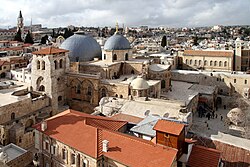
[[File:Jerusalem-Grabeskirche-14-vom Erloeserkirchturm-2010-gje.jpg|thumb|[[Church of the Holy Sepulchre]] is considered the most important church in all of [[Christendom]].<ref>{{cite book |last=Holt |first=Andrew |title=The World of the Crusades: A Daily Life Encyclopedia [2 volumes] |publisher=ABC-CLIO |year=2019 |isbn=9781440854620 |page=57 |quote=was housed in the most important church in Christendom, the Church of the Holy Sepulchre.}}</ref>]] | |||
With the exception of [[Saudi Arabia]] and the [[Maldives]], all [[sovereign states]] and [[dependent territories]] worldwide have church buildings.<ref name="Kurian 2015 187–188">{{cite book|title=A Quick Look at Christian History: A Chronological Timeline Through the Centuries|first=George|last=Kurian|year=2015|isbn=9780736953795|pages=187–188|publisher=Harvest House Publishers}}</ref> Among countries with a church, [[Afghanistan]] has the fewest churches globally, featuring only one official church: the [[Our Lady of Divine Providence Chapel, Kabul|Our Lady of Divine Providence Chapel in Kabul]].<ref>{{Cite news|url=https://www.wsj.com/articles/SB10001424127887323384604578326953607830168|title=Afghan Church Endures Amid War and Strife|last=Stancati|first=Margherita|date=2013-03-18|newspaper=Wall Street Journal|issn=0099-9660|access-date=2016-05-31|archive-date=15 March 2023|archive-url=https://web.archive.org/web/20230315133047/https://www.wsj.com/articles/SB10001424127887323384604578326953607830168|url-status=live}}</ref> [[Somalia]] follows closely, having once housed the [[Mogadishu Cathedral]],<ref>{{cite book|url=https://books.google.com/books?id=ulXZAAAAMAAJ |title=Consolata Missionaries in the World (1901-2001) |author= Giovanni Tebaldi |year=2001 |page=127 |publisher=Paulines |isbn=9789966210234 |accessdate=2014-04-06}}</ref><ref>{{Cite journal |last=Dillon |first=Claire |date=2025-09-01 |title=Transforming Cefalù in Mogadishu: The Arabo-Normanna Cathedral of Italian Somalia and the Façade of “Peaceful Conquest” |url=https://www.academia.edu/144572290/Transforming_Cefal%C3%B9_in_Mogadishu_The_Arabo_Normanna_Cathedral_of_Italian_Somalia_and_the_Fa%C3%A7ade_of_Peaceful_Conquest_ |journal=Journal of the Society of Architectural Historians |language=en |volume=84 |issue=3 |pages=368–385 |doi=10.1525/jsah.2025.84.3.368 |issn=0037-9808 |url-access=registration |archive-date=23 November 2025 |access-date=27 October 2025 |archive-url=https://web.archive.org/web/20251123100733/https://www.academia.edu/144572290/Transforming_Cefal%C3%B9_in_Mogadishu_The_Arabo_Normanna_Cathedral_of_Italian_Somalia_and_the_Fa%C3%A7ade_of_Peaceful_Conquest_ |url-status=live }}</ref> along with the Saint Anthony of Padua Church in [[Somaliland]].<ref>[https://www.thetablet.co.uk/news/7615/somaliland-s-only-catholic-church-closed-days-after-re-opening-due-to-public-pressures- Somaliland's only Catholic church closed days after re-opening due to 'public pressures ']{{Webarchive|url=https://web.archive.org/web/20200926170720/https://www.thetablet.co.uk/news/7615/somaliland-s-only-catholic-church-closed-days-after-re-opening-due-to-public-pressures-/|date=26 September 2020}}</ref> Other countries with a limited number of churches include [[Bhutan]] and [[Western Sahara]].{{refn|group=note|In Bhutan, 65,000 Christians have access to only one official church. In Western Sahara, however, there are dozens of [[Christianity in Morocco|Moroccan Christians]] and around 260 expatriate Spaniards who are served by two churches: [[St. Francis of Assisi Cathedral, Laayoune|St. Francis of Assisi Cathedral in Laayoune]] and [[Our Lady of Mount Carmel Church, Dakhla|Our Lady of Mount Carmel Church in Dakhla]].<ref name="Kurian 2015 187–188" />}} | |||
[[File:St martin in the fields exterior.jpg|thumb|left|The exterior outlines of [[St Martin-in-the-Fields]] (London, 1720), tall front steeple above pitched roof and rectangle, popularized a template for many church buildings in North America and beyond]] | |||
Estimates suggest that the [[United States]] has about 380,000 churches, the highest total worldwide,<ref>{{cite web|first=Rebecca|last=Randall|url=https://www.christianitytoday.com/2017/09/how-many-churches-in-america-us-nones-nondenominational/|title=How Many Churches Does America Have? More Than Expected|date=14 September 2017|publisher=Christianity Today|access-date=30 September 2024|archive-date=30 November 2024|archive-url=https://web.archive.org/web/20241130093438/https://www.christianitytoday.com/2017/09/how-many-churches-in-america-us-nones-nondenominational/|url-status=live}}</ref> followed by [[Brazil]] and [[Italy]].<ref>{{cite book|title=The Churches and Democracy in Brazil: Towards a Public Theology Focused on Citizenship|first=Rudolf|last=von Sinner|year=2012|isbn=9781630877279| page=59|publisher=Wipf and Stock Publishers}}</ref> Across [[Europe]], more than 500,000 churches form part of the continent's cultural heritage.<ref>{{cite web|url=https://www.theguardian.com/world/2015/oct/29/religious-buildings-are-part-of-europes-heritage-they-should-be-part-of-its-future|title=Religious buildings are part of Europe's heritage. They should be part of its future|date =29 October 2018 |work=The Guardian}}</ref> Several cities are commonly known as the "[[City of Churches]]" because of their dense concentration of church buildings. Examples include [[Adelaide]],<ref>{{cite web |url=http://www.samemory.sa.gov.au/site/page.cfm?u=1455 |title=Religion: Diversity |access-date=15 November 2013 |url-status=dead |archive-url=https://web.archive.org/web/20130810123558/http://www.samemory.sa.gov.au/site/page.cfm?u=1455 |archive-date=10 August 2013}}</ref> [[Ani]],<ref>{{cite EB1911 |mode=cs2 |wstitle=Ani |volume=2 |page=47}}</ref> [[Ayacucho]],<ref>{{cite book|title=The Church, Dictatorships, and Democracy in Latin America|last=Klaiber|first=Jeffrey|date=2009-09-01|publisher=Wipf and Stock Publishers|isbn=9781606089477}}</ref> [[Churches of Kraków|Kraków]],<ref name="diecezja">Józef Szymon Wroński (2007), [https://web.archive.org/web/20071228090310/http://diecezja.pl/index.php?page=jswronski Kościoły Krakowa (The churches of Kraków).] Archidiecezja Krakowska. Retrieved 23 December 2012. {{in lang|pl}}</ref> [[Moscow]],<ref>{{cite journal|title=onlinelibrary.wiley.com|journal=City & Society|volume=10|pages=269–314|publisher=onlinelibrary.wiley.com|date=June 28, 2008|doi=10.1525/city.1998.10.1.269|last=Khazanov|first=Anatoly M.|s2cid=145807994}}</ref> [[Montreal]],<ref>{{cite web|url=https://montrealgazette.com/news/local-news/notre-dame-de-paris-fire-how-safe-are-montreals-heritage-churches|title=Notre-Dame de Paris fire: How safe are Montreal's heritage churches?|access-date=March 13, 2021|archive-date=January 18, 2021|archive-url=https://web.archive.org/web/20210118042736/https://montrealgazette.com/news/local-news/notre-dame-de-paris-fire-how-safe-are-montreals-heritage-churches|url-status=live}}</ref> [[Naples]],<ref>{{cite news |url=http://www.red-travel.com/uk/ferrari-tour-italy/places/naples-english-guided-visit.htm |publisher=Red Travel |title=Naples |date=8 January 2008 |url-status=dead |archive-url=https://web.archive.org/web/20120303111036/http://www.red-travel.com/uk/ferrari-tour-italy/places/naples-english-guided-visit.htm |archive-date=3 March 2012}}</ref> [[Ohrid]],<ref>{{cite book|author1=Biljana Vankovska|author2=Hakan Wiberg|author3=Wiberg Hakan|title=Between Past and Future: Civil-military Relations in the Post-communist Balkans|year=2003|publisher=Bloomsbury Academic|isbn=978-1-86064-624-9|page=71}}</ref> [[Churches in Prague|Prague]], [[Puebla]], [[Querétaro (city)|Querétaro]], [[Churches of Rome|Rome]],<ref>{{cite web|first=Stuardt |last=Clarke |title=The Churches of Rome: Major and Minor |publisher=Stuardt Clarkes Rome |url=http://www.stuardtclarkesrome.com/churchlist.htm |access-date=26 January 2012 |url-status=dead |archive-url=https://web.archive.org/web/20120208035455/http://www.stuardtclarkesrome.com/churchlist.htm |archive-date=8 February 2012 }}</ref> [[Salzburg]], and [[List of churches in Vilnius|Vilnius]].<ref>{{cite book |last1=Bideleux |first1=Robert |last2=Jeffries |first2=Ian |title=A history of Eastern Europe: crisis and change |date=1998 |publisher=Routledge |isbn=978-0415161114 |page=122}}</ref> Rome and [[New York City]] are frequently cited as having the largest number of churches of any cities worldwide.<ref>{{cite book |title = The Epic of New York City: A Narrative History |author = Edward Robb Elli |publisher = Basic Books |page = 593 |isbn = 9780786714360}}</ref> | |||
[[File:Saint Peter's Basilica facade, Rome, Italy.jpg|thumb|[[St. Peter's Basilica]] in [[Vatican City]], the [[List of largest church buildings|largest church in the world]]<ref>{{cite web |url=http://www.reidsitaly.com/destinations/lazio/rome/sights/st_peters.html |title=St. Peter's Basilica (Basilica di San Pietro) in Rome, Italy |work=reidsitaly.com |url-status=dead |archive-url=https://web.archive.org/web/20150223025429/http://www.reidsitaly.com/destinations/lazio/rome/sights/st_peters.html |archive-date=23 February 2015 |access-date=2 August 2020 }}</ref>]] | |||
Saudi Arabia, which has about 1.5 million Christians, prohibits the construction of churches.<ref>{{cite web |title=Global Christianity – A Report on the Size and Distribution of the World's Christian Population |url=https://assets.pewresearch.org/wp-content/uploads/sites/11/2011/12/Christianity-fullreport-web.pdf |url-status=live |archive-url=https://web.archive.org/web/20190801204254/http://assets.pewresearch.org/wp-content/uploads/sites/11/2011/12/Christianity-fullreport-web.pdf |archive-date=2019-08-01 |publisher=Pew Research Center}}</ref> The country does preserve the remnants of the fourth-century [[Jubail Church]], affiliated with the [[Church of the East]].<ref name=":1">{{cite journal |last=Carter |first=R.A. |date=2008 |title=Christianity in the Gulf during the first centuries of Islam |url=https://onlinelibrary.wiley.com/doi/10.1111/j.1600-0471.2008.00293.x |journal=Arabian Archaeology and Epigraphy |volume=19 |issue=1 |pages=71–108 |doi=10.1111/j.1600-0471.2008.00293.x |issn=0905-7196 |url-access=subscription |archive-date=7 October 2024 |access-date=30 September 2024 |archive-url=https://web.archive.org/web/20241007220640/https://onlinelibrary.wiley.com/doi/10.1111/j.1600-0471.2008.00293.x |url-status=live }}</ref> Discovered in 1986 and excavated in 1987 by the Saudi Antiquities Department, the site remained unpublished as of 2008 because of sensitivities regarding non-Islamic artifacts.<ref name=":1" /> The Maldives, home to about 1,400 Christians,<ref>{{cite book |title=The Oxford Handbook of Christianity in Asia |first=Felix |last=Wilfred |year=2014 |isbn=9780199329069 |page=45 |publisher=Oxford University Press |quote=}}</ref> also bans church construction, though foreign Christian workers may worship privately.<ref>{{Citation |last1=Ross |first1=Kenneth R. |title=The Maldives |date=2019 |work=Christianity in South and Central Asia |pages=197–198 |url=http://dx.doi.org/10.3366/edinburgh/9781474439824.003.0018 |access-date=2024-07-10 |publisher=Edinburgh University Press |isbn=978-1-4744-3982-4 |last2=Johnson |first2=Todd M. |doi=10.3366/edinburgh/9781474439824.003.0018 |url-access=subscription }}</ref> Despite these prohibitions, both countries host secret [[home churches]].<ref name="Kurian 2015 187–188" /> | |||
[[Christianity]] is the [[Major religious groups|world's largest]] and most widespread religion,<ref>{{cite web|first=Jaroslav|last=Jan Pelikan|url=https://www.britannica.com/topic/Christianity|title=Christianity|date=13 August 2022|publisher=[[Encyclopædia Britannica]]|quote=It has become the largest of the world's religions and, geographically, the most widely diffused of all faiths.|access-date=26 November 2024|archive-date=1 November 2014|archive-url=https://web.archive.org/web/20141101193717/http://www.britannica.com/EBchecked/topic/115240/Christianity/67592/Forms-of-Christian-education|url-status=live}}</ref> with over 2.3 billion followers.<ref>{{Cite web |title=Global Christianity – A Report on the Size and Distribution of the World's Christian Population |url=https://assets.pewresearch.org/wp-content/uploads/sites/11/2011/12/Christianity-fullreport-web.pdf |url-status=live |archive-url=https://web.archive.org/web/20190801204254/http://assets.pewresearch.org/wp-content/uploads/sites/11/2011/12/Christianity-fullreport-web.pdf |archive-date=2019-08-01 |publisher=Pew Research Center}}</ref> Churches are found across all seven [[continents]], which are [[Christianity in Asia|Asia]], [[Christianity in Africa|Africa]], [[Christianity in North America|North America]], [[Christianity in South America|South America]], [[Religion in Antarctica|Antarctica]], [[Christianity in Europe|Europe]], and [[Oceania]]. Antarctica is home to [[List of Antarctic churches|eight churches]],<ref>Riedel, Dr. Katja. [https://polar-news.com/antarctic/society/174-faith-in-antarctica-religion-in-the-land-of-eternal-snow Faith in Antarctica – Religion in the land of eternal snow] {{Webarchive|url=https://web.archive.org/web/20170131185733/https://polar-news.com/antarctic/society/174-faith-in-antarctica-religion-in-the-land-of-eternal-snow |date=31 January 2017 }}. Polar News. April 27, 2016. Retrieved January 18, 2017.</ref> with two additional churches located south of the [[Antarctic Convergence]].<ref>Merchant, Brian. [https://www.vice.com/en/article/these-are-six-churches-currently-giving-services-to-scientists-on-antarctica/ Prayer on Ice: The Six Churches Giving Sermons to Scientists on Antarctica] . [[Vice (magazine)|Vice]]. March 18, 2013. Retrieves January 2, 2017.</ref> | |||
Beyond their liturgical role, many churches serve as historical, national, [[Christian culture|cultural]], and architectural landmarks, and numerous examples appear on the [[List of World Heritage Sites by religion|UNESCO World Heritage Sites]] register.<ref name="Tsivolas 2014 3–4"/> According to the ''[[Catholic Encyclopedia]]'' the [[Cenacle]] (the site of the [[Last Supper]]) in [[Jerusalem]] was the "first Christian church".<ref>{{cite web|title=To the time of Constantine (71–312)|url=https://www.newadvent.org/cathen/08355a.htm|publisher=Catholic Encyclopedia|access-date=15 November 2013|quote=Certainly no spot in Christendom can be more venerable than the place of the Last Supper, which became the first Christian church.|archive-date=24 February 2023|archive-url=https://web.archive.org/web/20230224025203/https://www.newadvent.org/cathen/08355a.htm|url-status=live}}</ref> The [[Dura-Europos church]] in Syria is the oldest surviving church building in the world.<ref>{{cite web|last=Silver|first=Carly|title=Dura-Europos: Crossroad of Cultures|url=http://archive.archaeology.org/online/features/dura_europos/|publisher=[[Archaeology (magazine)|Archaeology]]|access-date=16 November 2013|date=11 August 2010|archive-date=25 October 2013|archive-url=https://web.archive.org/web/20131025052035/http://archive.archaeology.org/online/features/dura_europos/|url-status=live}}</ref> Several authors have cited the [[Etchmiadzin Cathedral]] ([[Armenia]]'s mother church) as the oldest [[cathedral]] in the world.<ref>{{cite book|title=Encyclopedia of the Peoples of Africa and the Middle East|year=2008|publisher=[[Infobase Publishing]]|location=New York|isbn=9781438126760|page=65|editor=Stokes, Jamie|quote=Etchmiatzin is located in the west of modern Armenia, close to the border with Turkey, and its fourth-century cathedral is generally regarded as the oldest in the world.}}</ref><ref>{{cite book|last=Dhilawala|first=Sakina|title=Armenia|year=1997|publisher=[[Marshall Cavendish]]|location=New York|isbn=9780761406839|page=[https://archive.org/details/armenia00dhil/page/72 72]|quote=Echmiadzin Cathedral is the spiritual center of the Armenian Church and the seat of the Catholicos of all Armenians. It is also the oldest cathedral and Christian monastery in the world.|url-access=registration|url=https://archive.org/details/armenia00dhil/page/72}}</ref><ref>{{cite book|last=Utudjian|first=Édouard|title=Armenian Architecture: 4th to 17th Century|year=1968|publisher=Editions A. Morancé|page=7|author-link=Édouard Utudjian|quote=...he also wanted to contribute to the restoration of the oldest cathedral in Christendom, that of Etchmiadzin, founded in the 4th century.}}</ref> | |||
{{clear}} | |||
==See also== | ==See also== | ||
| Line 133: | Line 210: | ||
* [[Tabernacle (Methodist)]] | * [[Tabernacle (Methodist)]] | ||
* [[Temple]] | * [[Temple]] | ||
== Notes == | |||
{{reflist|group="note"}} | |||
==References== | ==References== | ||
| Line 138: | Line 218: | ||
==Bibliography== | ==Bibliography== | ||
* {{Citation |title=Damascus: A History |date=2005 |first1=Ross |last1=Burns |publisher=Routledge |year= |url=https://books.google.com/books?id=SVR2cjWptCAC |isbn=0-415-27105-3 |location=London}} | |||
*{{Cite book |last=Levy |first=Patricia |url=https://archive.org/details/cathedralschurch0000unse |title=Cathedrals and the Church |publisher=Smart Apple Media |year=2004 |isbn=1-58340-572-0 |series=Medieval World |location=North Mankato, MN |url-access=registration}} | *{{Cite book |last=Levy |first=Patricia |url=https://archive.org/details/cathedralschurch0000unse |title=Cathedrals and the Church |publisher=Smart Apple Media |year=2004 |isbn=1-58340-572-0 |series=Medieval World |location=North Mankato, MN |url-access=registration}} | ||
*{{Cite book |last=Krieger |first=Herman |url=https://archive.org/details/churchesadhoc00herm |title=Churches ad hoc |publisher=PhotoZone Press |year=1998 |isbn=9780966580969 |url-access=registration}} | *{{Cite book |last=Krieger |first=Herman |url=https://archive.org/details/churchesadhoc00herm |title=Churches ad hoc |publisher=PhotoZone Press |year=1998 |isbn=9780966580969 |url-access=registration}} | ||
* {{cite book|last=MacDonald|first = William L.|title=The Pantheon: Design, Meaning, and Progeny|url=https://archive.org/details/pantheondesignme0000macd|url-access=registration|publisher=Harvard University Press|location=Cambridge, MA|year=1976|isbn=0674010191}} | |||
* [[Erlande-Brandenburg, Alain]], Qu'est-ce qu'une église ?, Gallimard, Paris, 333 p., 2010. | * [[Erlande-Brandenburg, Alain]], Qu'est-ce qu'une église ?, Gallimard, Paris, 333 p., 2010. | ||
* Gendry Mickael, L'église, un héritage de Rome, Essai sur les principes et méthodes de l'architecture chrétienne, Religions et Spiritualité, collection Beaux-Arts architecture religion, édition Harmattan 2009, 267 p. | * Gendry Mickael, L'église, un héritage de Rome, Essai sur les principes et méthodes de l'architecture chrétienne, Religions et Spiritualité, collection Beaux-Arts architecture religion, édition Harmattan 2009, 267 p. | ||
==External links== | ==External links== | ||
{{commons | {{commons}} | ||
{{wikiquote|Church}} | {{wikiquote|Church}} | ||
{{wiktionary|church}} | {{wiktionary|church}} | ||
| Line 150: | Line 232: | ||
This section is only for information on churches in the widest sense. | This section is only for information on churches in the widest sense. | ||
See [[Wikipedia:External links]] for our policy on external links.--> | See [[Wikipedia:External links]] for our policy on external links.--> | ||
* [ | * [https://www.newadvent.org/cathen/03041a.htm New Advent Catholic Encyclopedia – Ecclesiastical Buildings] | ||
* [ | * [https://www.newadvent.org/cathen/03744a.htm New Advent Catholic Encyclopedia – The Church] | ||
* [https://www.youtube.com/watch?v=ZcfLSpJXo0w Prairie Churches] Documentary produced by [[Prairie Public Television]] | * [https://www.youtube.com/watch?v=ZcfLSpJXo0w Prairie Churches] Documentary produced by [[Prairie Public Television]] | ||
*[https://web.archive.org/web/20121116155347/http://www.iptv.org/iowastories/story.cfm/worship/9640/iowa_places_of_worship_2007/video Iowa Places of Worship] Documentary produced by [[Iowa Public Television]] | *[https://web.archive.org/web/20121116155347/http://www.iptv.org/iowastories/story.cfm/worship/9640/iowa_places_of_worship_2007/video Iowa Places of Worship] Documentary produced by [[Iowa Public Television]] | ||
Latest revision as of 02:21, 25 March 2026
 | This article has multiple issues. Please help improve it or discuss these issues on the talk page. (Learn how and when to remove these template messages)
|


![[icon]](/wiki/File:Wiki_letter_w_cropped.svg)
| Church | |
|---|---|
_(39452708702).jpg) Trieste Cathedral, a church dedicated to Saint Justus (1320) | |
Trieste Cathedral, a church dedicated to Saint Justus (1320) | |
| General information | |
| Type | Place of worship |
| Architectural style | Various (Romanesque, Gothic, Renaissance, etc.) |
| Location | Worldwide |
| Current tenants | Christian congregations |
| Owner | Various religious organizations |
| Dimensions | |
| Other dimensions | Often includes:
|
| Technical details | |
| Structural system | Various (load-bearing walls, vaulted ceilings, domes) |
| Part of a series on |
| Christianity |
|---|
 |
 Christianity portal Christianity portal |

A church is a building used for Christian worship services and Christian activities. The earliest identified Christian church is a house church founded between AD 233 and AD 256.[1] The word church also describes a body or assembly of Christian believers, while "the Church" refers to the worldwide Christian religious community.[2]
In traditional Christian architecture, the plan view of a church often forms a Christian cross. The center aisle and seating create the vertical beam, while the bema and altar form the horizontal arms. Towers or domes rise above the heaven-facing roof line to encourage contemplation of the divine. Modern churches employ varied architectural styles, and many buildings originally designed for other purposes have been converted to churches. From the 11th to the 14th centuries, Western Europe experienced a wave of church construction.
Many churches worldwide are of considerable historical, national, cultural, and architectural significance. Several are included in the list of UNESCO World Heritage Sites.[3]
Etymology[edit | edit source]

The word church is derived from Old English cirice, 'place of assemblage set aside for Christian worship', from the Common Germanic word kirika. This was probably borrowed via Gothic from Ancient Greek kyriakon doma, 'the Lord's (house)', from kyrios, 'ruler, lord'. Kyrios in turn comes from the Indo-European root *ḱewh₁-, meaning 'to spread out, to swell' (euphemistically: 'to prevail, to be strong').[4]
The word's cognates in many languages reflect its transmission from Greek and Proto-Indo-European roots. In early Germanic languages such as Old High German, the term became kirihha, signaling how Christianization shaped local vocabulary. Early Christian communities used the word to stress a building's dedication to God.[5]
The Greek kyriakon, 'of the Lord', has been used of houses of Christian worship since c. AD 300, especially in the East, although it was less common in this sense than ekklesia or basilike.[5]
 | This section needs to be updated. The reason given is: This section lacks coverage of post-Vatican II developments (beyond basic reforms) and contemporary trends in the Global South, such as adaptive designs in growing Christian communities.. (January 2026) |
History[edit | edit source]
The history of church buildings traces the transformation of Christian worship spaces from clandestine house churches in the Roman Empire to monumental basilicas after legalization in 313 with the Edict of Milan, when imperial patronage and civic basilica forms were adapted to liturgical needs.[6][7] During the 10th to 12th centuries, the Romanesque period emphasized thick masonry walls, barrel and groin vaults, and round arches, followed in the 12th to 16th centuries by Gothic architecture, which developed pointed arches, rib vaults, and flying buttresses to achieve greater height and light.[8][9] From the 15th century, Renaissance architecture revived classical orders, symmetry, and proportional systems, and in the 17th to 18th centuries Baroque architecture and Rococo churches used theatrical space, integrated decoration, and urban scenography in response to varied patronage including the Counter-Reformation.[10][11] After 1517 the Reformation fostered preaching-oriented halls and centralized plans in many Protestant regions, while the Orthodox East sustained and elaborated domed cross-in-square and other centralized schemes.[12] Global expansion carried European models and local adaptations to the Americas, Africa, and Asia, and the 19th century saw widespread historic revivals.[6][13][14] In the 20th century new materials, modernist minimalism, and liturgical reforms such as the Second Vatican Council of 1962 to 1965 reshaped altars, seating, and the relationship between clergy and laity.[15][16]
Antiquity[edit | edit source]

The earliest archeologically identified Christian church is a house church (domus ecclesiae), the Dura-Europos church, founded between 233 AD and 256 AD.[1]
In the second half of the third century AD, the first purpose-built halls for Christian worship (aula ecclesiae) began to be constructed. Many of these structures were destroyed during the Diocletianic Persecution in the early 4th century. Even larger and more elaborate churches began to appear during the reign of Emperor Constantine the Great.[17]
Medieval times[edit | edit source]
From the 11th through the 14th centuries, a wave of cathedral building and the construction of smaller parish churches occurred across Western Europe. Besides serving as a place of worship, the cathedral or parish church was frequently employed as a general gathering place by the communities in which they were located, hosting such events as guild meetings, banquets, mystery plays, and fairs. Church grounds and buildings were also used for the threshing and storage of grain.[18]
Romanesque architecture[edit | edit source]

Between 1000 and 1200, the Romanesque style became popular across Europe. The Romanesque style is defined by large and bulky edifices typically composed of simple, compact, sparsely decorated geometric structures. Frequent features of the Romanesque church include circular arches, round or octagonal towers, and cushion capitals on pillars. In the early Romanesque era, coffering on the ceiling was fashionable, while later in the same era, groined vaults gained popularity. Interiors widened, and the motifs of sculptures took on more epic traits and themes.[19] Romanesque architects adopted many Roman or early Christian architectural ideas, such as a cruciform ground plan, as that of Angoulême Cathedral, and the basilica system of a nave with a central vessel and side aisles.[20]
Gothic architecture[edit | edit source]


The Gothic style emerged around 1140 in Île-de-France and subsequently spread throughout Europe.[21] Gothic churches lost the compact qualities of the Romanesque era, and decorations often contained symbolic and allegorical features. The first pointed arches, rib vaults, and buttresses began to appear, all possessing geometric properties that reduced the need for large, rigid walls to ensure structural stability. This also permitted the size of windows to increase, producing brighter and lighter interiors. Nave ceilings rose, and pillars and steeples heightened.[22][20] Many architects used these developments to push the limits of structural possibility – an inclination that resulted in the collapse of several towers whose designs had unwittingly exceeded the boundaries of soundness. In Germany, the Netherlands and Spain, it became popular to build hall churches, a style in which every vault would be built to the same height.
Gothic cathedrals were lavishly designed, as in the Romanesque era, and many share Romanesque traits. Bagneux Church, France (1170–1190) exhibited both styles - a Romanesque tower, and Gothic nave and choir.[20] Several also exhibit unprecedented degrees of detail and complexity in decoration. Notre-Dame de Paris and Reims Cathedral in France, as well as the church of San Francesco d'Assisi in Palermo, Salisbury Cathedral and the wool churches in England, and Santhome Church in Chennai, India, show the elaborate stylings characteristic of Gothic cathedrals.
Some of the most well-known gothic churches remained unfinished for centuries after the style fell out of popularity. One such example is the construction of Cologne Cathedral, which began in 1248, was halted in 1473, and did not resume until 1842.[23]
Renaissance[edit | edit source]
.jpg)
In the fifteenth and sixteenth centuries, the changes in ethics and society due to the Renaissance and the Reformation also influenced the building of churches. The common style was much like the Gothic style but simplified. The basilica was not the most popular type of church anymore, but instead, hall churches were built. Typical features are columns and classical capitals.[24]
The construction of the Sistine Chapel with its uniquely important decorations and the entire rebuilding of St. Peter's Basilica, one of Christendom's most significant churches, were part of this process.[25] In the wealthy Republic of Florence, the impetus for church-building was more civic than spiritual. The unfinished state of the enormous Florence Cathedral dedicated to the Blessed Virgin Mary did no honour to the city under her patronage. However, as the technology and finance were found to complete it, the rising dome did credit not only to the Virgin Mary, its architect and the Church, but also to the Signoria, the Guilds and the sectors of the city from which the manpower to construct it was drawn. The dome inspired further religious works in Florence.
In Protestant churches, where the proclamation of God's Word is of particular importance, the visitor's line of sight is directed towards the pulpit.
Baroque architecture[edit | edit source]

The Baroque style was first used in Italy around 1575. From there, it spread to the rest of Europe and the European colonies. The building industry increased heavily during the Baroque era. Buildings, even churches, were used to indicate wealth, authority, and influence. The use of forms known from the Renaissance was extremely exaggerated. Domes and capitals were decorated with moulding, and the former stucco sculptures were replaced by fresco paintings on the ceilings. For the first time, churches were seen as one connected work of art, and consistent artistic concepts were developed. Instead of long buildings, more central-plan buildings were created. The sprawling decoration with floral ornamentation and mythological motives lasted until about 1720, in the Rococo era.[26]
The Protestant parishes preferred Protestant churches often prioritize proximity between worshippers, the nave (main worship space), and the altar (often called a communion table).[27] This is achieved through various architectural designs and practices, including moving the altar loser to the congregation, decreasing the distance between the entrance and altar, and employing simpler architectural styles that focus attention on the pulpit and communion table.
Architecture[edit | edit source]

Church architecture developed from house churches and repurposed halls into purpose-built basilicas after the Edict of Milan in 313 and the establishment of Nicene Christianity as the imperial state religion in 380, and in the Byzantine East it soon embraced domed centralized schemes culminating in the cross-in-square type by the ninth to tenth centuries.[28][29][30] In Western Europe the Romanesque of about 1000 to 1150 consolidated stone vaulting, thick walls, and modular planning, and from the 1140s the Gothic system of pointed arches, rib vaults, and flying buttresses enabled taller naves and luminous clerestories that transformed liturgical space.[31][32][33] From the 15th to the 18th centuries, Renaissance designers reasserted classical orders and centralized ideals, the Reformation simplified imagery and organized Protestant interiors around the pulpit and congregational audibility, and the Catholic Counter-Reformation after the Council of Trent (1545 to 1563) promoted axial clarity and ceremonial focus across Europe and in Iberian colonial churches.[34][35][36] Since the 19th century, revival styles and industrial materials have broadened the available language of design, and in the 20th century the Liturgical Movement and the Second Vatican Council (1962 to 1965) reshaped Catholic layouts toward active participation, while modernist experiments reframed light, structure, and community.[37][38][39][29]
The architectural design of Christian churches commonly incorporates symbolic elements that reflect theological and liturgical meaning. The cruciform plan, with a long central nave intersected by transepts, represents the Christian cross and remains one of the most widespread church layouts.[40] Churches frequently feature domed or vaulted ceilings that draw the eye upward toward heaven. Alternative geometric plans include circular designs symbolizing eternity, or octagonal forms representing the church's role in illuminating the world. Most churches include a prominent spire or tower, typically positioned at the western end or crossing, which serves both practical and symbolic functions.[41]
The orientation of churches traditionally follows specific principles, with the main altar typically facing east toward sunrise.[42] This eastward alignment originated in fourth-century Byzantium and became standard practice in Western churches during the eighth and ninth centuries. Historical variations existed, particularly in early Roman churches where western-facing altars remained common through the eleventh century. Notable examples of western altar orientation persisted in prominent German churches including Bamberg Cathedral, Augsburg Cathedral, Regensburg Cathedral, and Hildesheim Cathedral.[43]
Types[edit | edit source]
Basilica[edit | edit source]


The Latin word basilica was initially used to describe a Roman public building usually located in the forum of a Roman town.[44][45] After the Roman Empire became officially Christian, the term came by extension to refer to a large and influential church that has been given special ceremonial rights by the Pope.[46] The word thus retains two senses today, one architectural and the other ecclesiastical.
Cathedral[edit | edit source]

A cathedral is a church, usually Catholic, Anglican, Oriental Orthodox or Eastern Orthodox, that houses the seat of a bishop. The word cathedral comes from cathedra, the bishop's throne in Latin: ecclesia cathedralis. The term is sometimes applied more broadly to any church of great size, although that usage is imprecise.
A church with a cathedral function is not necessarily a large building. It might be as small as Christ Church Cathedral in Oxford, England, Porvoo Cathedral in Porvoo, Finland, Sacred Heart Cathedral in Raleigh, United States, or Chur Cathedral in Switzerland. However, frequently, the cathedral, along with some of the abbey churches, was the largest building in any region.
Cathedrals often showcase ambitious architectural design and the work of accomplished craftsmen. They carry significant ecclesiastical and civic status that parish churches rarely attain.[47][full citation needed] Many are celebrated as notable works of architecture.[48]
Chapel[edit | edit source]

A chapel may be a discrete space with an altar inside a larger cathedral, conventual, parish, or other church. It can also be a freestanding small church building or room not connected to a larger church, created to serve a particular hospital, school, university, prison, private household, palace, castle, or other institution. Proprietary churches and small conventual churches are often described with this term.[49]
Collegiate church[edit | edit source]
A collegiate church is a church where the daily office of worship is maintained by a college of canons, which may be presided over by a dean or provost. Collegiate churches were often supported by extensive lands held by the church, or by tithe income from appropriated benefices. They commonly provide distinct spaces for congregational worship and for the choir offices of their clerical community.
Conventual church[edit | edit source]
A conventual church (in Eastern Orthodoxy katholikon) is the main church in a Christian monastery or convent, known variously as an abbey, a priory, a friary, or a preceptory.
Parish church[edit | edit source]

A parish church is a church built to meet the needs of people localised in a geographical area called a parish. The vast majority of Catholic, Orthodox, Anglican, and Lutheran church buildings fall into this category. A parish church may also be a basilica, a cathedral, a conventual or collegiate church, or a place of pilgrimage. The vast majority of parish churches do not however enjoy such privileges.
In addition to a parish church, each parish may maintain auxiliary organizations and their facilities such as a rectory, parish hall, parochial school, or convent, frequently located on the same campus or adjacent to the church.
Pilgrimage church[edit | edit source]
A pilgrimage church is a church to which pilgrimages are regularly made, or a church along a pilgrimage route, often located at the tomb of a saints, or holding icons or relics to which miraculous properties are ascribed, the site of Marian apparitions, etc.
Proprietary church[edit | edit source]
During the Middle Ages, a proprietary church was a church, abbey, or cloister built on the private grounds of a feudal lord, over which he retained proprietary interests.
Evangelical church structures[edit | edit source]

The architecture of evangelical places of worship is mainly characterized by its sobriety.[50][51] The Latin cross is a well known Christian symbol that can usually be seen on the building of an evangelical church and that identifies the place's belonging.[52][53] Some services take place in theaters, schools or multipurpose rooms, rented for Sunday only.[54][55][56] There is usually a baptistery at the front of the church (in what is known as the chancel in historic traditions) or in a separate room for baptisms by immersion.[57][58]
A church in which more than 2,000 people gather each Sunday is known as a megachurch. The term gigachurch is sometimes used to refer to especially large megachurches, such as Lakewood Church (United States) or Yoido Full Gospel Church (South Korea).[59][60][61]
House church[edit | edit source]

In some countries of the world which apply sharia or communism, government authorizations for worship are complex for Christians.[62][63][64] Because of persecution of Christians, Evangelical house churches have thus developed.[65] For example, there is the Evangelical house churches in China movement.[66] The meetings thus take place in private houses, in secret and in "illegality".[67]
Alternative buildings[edit | edit source]
Old and disused church buildings can be seen as an interesting proposition for developers as the architecture and location often provide for attractive homes[68] or city centre entertainment venues.[69] On the other hand, many newer churches have decided to host meetings in public buildings such as schools,[70] universities,[71] cinemas[72] or theatres.[73]
There is another trend to convert old buildings for worship rather than face the construction costs and planning difficulties of a new build. Unusual venues in the UK include a former tram power station,[74] a former bus garage,[75] a former cinema and bingo hall,[76] a former Territorial Army drill hall,[77] and a former synagogue.[78] HMS Tees served as a floating church for mariners at Liverpool from 1827 until she sank in 1872.[79] A windmill has also been converted into a church at Reigate Heath.
There have been increased partnerships between church management and private real estate companies to redevelop church properties into mixed uses. While it has garnered criticism, the partnership allows congregations to increase revenue while preserving the property.[80]
Inter-religious conversion[edit | edit source]

A number of Roman temples have been converted to churches including the Pantheon temple in Rome which was converted into a church dedicated to St. Mary and the Martyrs in the 7th century, also known as "Santa Maria Rotonda".[81]
.jpg)
Mosques have also been converted for use by other religions, notably in southern Spain, following the conquest of the Moors in 1492.[82] The most prominent of them is the Great Mosque of Cordoba, itself constructed on the site of a church demolished during the period of Muslim rule. Palma Cathedral in Palma de Mallorca was converted into a church after the mosque in its site was demolished,[83] The Mosque of Cristo de la Luz in Toledo, Spain was converted into a church around 1187,[84] Outside of the Iberian Peninsula, such instances also occurred in southeastern Europe once regions were no longer under Muslim rule, like the Seven Saints Church, in Sofia, Bulgaria.
The Aramean temple in Damascus, Syria, which became a Roman temple of Jupiter was later converted into the church of St. John in the 4th century, the site was then bought by Umayyad caliph Al-Walid I in 705 and the church was demolished and the Umayyad Mosque was built on the site.[85]
Geographical distribution[edit | edit source]

With the exception of Saudi Arabia and the Maldives, all sovereign states and dependent territories worldwide have church buildings.[87] Among countries with a church, Afghanistan has the fewest churches globally, featuring only one official church: the Our Lady of Divine Providence Chapel in Kabul.[88] Somalia follows closely, having once housed the Mogadishu Cathedral,[89][90] along with the Saint Anthony of Padua Church in Somaliland.[91] Other countries with a limited number of churches include Bhutan and Western Sahara.[note 1]

Estimates suggest that the United States has about 380,000 churches, the highest total worldwide,[92] followed by Brazil and Italy.[93] Across Europe, more than 500,000 churches form part of the continent's cultural heritage.[94] Several cities are commonly known as the "City of Churches" because of their dense concentration of church buildings. Examples include Adelaide,[95] Ani,[96] Ayacucho,[97] Kraków,[98] Moscow,[99] Montreal,[100] Naples,[101] Ohrid,[102] Prague, Puebla, Querétaro, Rome,[103] Salzburg, and Vilnius.[104] Rome and New York City are frequently cited as having the largest number of churches of any cities worldwide.[105]

Saudi Arabia, which has about 1.5 million Christians, prohibits the construction of churches.[107] The country does preserve the remnants of the fourth-century Jubail Church, affiliated with the Church of the East.[108] Discovered in 1986 and excavated in 1987 by the Saudi Antiquities Department, the site remained unpublished as of 2008 because of sensitivities regarding non-Islamic artifacts.[108] The Maldives, home to about 1,400 Christians,[109] also bans church construction, though foreign Christian workers may worship privately.[110] Despite these prohibitions, both countries host secret home churches.[87]
Christianity is the world's largest and most widespread religion,[111] with over 2.3 billion followers.[112] Churches are found across all seven continents, which are Asia, Africa, North America, South America, Antarctica, Europe, and Oceania. Antarctica is home to eight churches,[113] with two additional churches located south of the Antarctic Convergence.[114]
Beyond their liturgical role, many churches serve as historical, national, cultural, and architectural landmarks, and numerous examples appear on the UNESCO World Heritage Sites register.[3] According to the Catholic Encyclopedia the Cenacle (the site of the Last Supper) in Jerusalem was the "first Christian church".[115] The Dura-Europos church in Syria is the oldest surviving church building in the world.[116] Several authors have cited the Etchmiadzin Cathedral (Armenia's mother church) as the oldest cathedral in the world.[117][118][119]
See also[edit | edit source]
Notes[edit | edit source]
- ↑ In Bhutan, 65,000 Christians have access to only one official church. In Western Sahara, however, there are dozens of Moroccan Christians and around 260 expatriate Spaniards who are served by two churches: St. Francis of Assisi Cathedral in Laayoune and Our Lady of Mount Carmel Church in Dakhla.[87]
References[edit | edit source]
- ↑ 1.0 1.1 Snyder, Graydon F. (2003). Ante Pacem: Archaeological Evidence of Church Life Before Constantine. Mercer University Press. p. 128.
- ↑ "Church | Definition, History, & Types | Britannica". 22 June 2023. Archived from the original on 12 January 2019. Retrieved 21 July 2021.
- ↑ 3.0 3.1 Tsivolas, Theodosios (2014). Law and Religious Cultural Heritage in Europe. Springer International Publishing. pp. 3–4. ISBN 9783319079325.
- ↑ "church". www.etymonline.com. Archived from the original on 25 October 2024. Retrieved 20 November 2024.
- ↑ 5.0 5.1 "Church". Online Etymology Dictionary. Archived from the original on 31 July 2016. Retrieved 8 August 2016.
- ↑ 6.0 6.1 Krautheimer, Richard (1986). Early Christian and Byzantine Architecture (4th ed.). Yale University Press.
- ↑ Drake, H. A. (2000). Constantine and the Bishops: The Politics of Intolerance. Johns Hopkins University Press.
- ↑ Fernie, Eric (2014). Romanesque Architecture: The First Style of the European Age. Yale University Press.
- ↑ Frankl, Paul; Paul Crossley (2000). Gothic Architecture. Yale University Press.
- ↑ Trachtenberg, Marvin; Isabelle Hyman (2002). Architecture: From Prehistory to Post-Modernity (2nd ed.). Prentice Hall.
- ↑ Wittkower, Rudolf (1999). Art and Architecture in Italy, 1600 to 1750 (3rd ed.). Yale University Press.
- ↑ Kilde, Jeanne Halgren (2008). Sacred Power, Sacred Space: An Introduction to Christian Architecture and Worship. Oxford University Press.
- ↑ Brooks, Chris (1999). The Gothic Revival. Phaidon.
- ↑ Bremner, G. A. (2013). Imperial Gothic: Religious Architecture and High Anglican Culture in the British Empire, c. 1840 to 1870. Yale University Press.
- ↑ Proctor, Robert (2014). Building the Modern Church: Roman Catholic Church Architecture in Britain, 1955 to 1975. Routledge.
- ↑ Baldovin, John F. (2008). Reforming the Liturgy: A Response to the Critics. Liturgical Press.
- ↑ Hartog, Paul, ed. (February 2010). The Contemporary Church and the Early Church: Case Studies in Ressourcement. Pickwick Publications. ISBN 978-1606088999. (Chapter 3)
- ↑ Levy. Cathedrals and the Church. p. 12.
- ↑ Toman, Rolf (30 April 2015). Romanesque: Architecture, Sculpture, Painting. h.f.ullmann. ISBN 9783848008407.
- ↑ 20.0 20.1 20.2 "Architecture". The Ultimate Visual Family Dictionary. New Delhi: DK Pub. 2012. pp. 468–469. ISBN 978-0-1434-1954-9.
- ↑ "Gothique ou Opus Francigenum : une architecture sans frontières venue de France (Le) - EHNE". EHNE. Retrieved 28 March 2025.
- ↑ Watkin, David (1986). A History of Western Architecture. Thames & Hudson. ISBN 978-1529420302.
- ↑ Frankl, Paul; Crossley, Paul (2000). Gothic Architecture. Yale University Press. ISBN 0300087993.
- ↑ Anderson, Christy (28 February 2013). Renaissance Architecture. OUP Oxford. ISBN 9780192842275.
- ↑ Ilan Rachum, The Renaissance, an Illustrated Encyclopedia, 1979, Octopus, ISBN 0-7064-0857-8
- ↑ Merz, Jörg Martin (2008). Pietro Da Cortona and Roman Baroque Architecture. Yale University Press. ISBN 978-0300111231.
- ↑ "Parts of a church : inside : features : altar, windows, etc". www.nationalchurchestrust.org. Archived from the original on 9 January 2025. Retrieved 8 January 2025.
- ↑ Krautheimer, Richard (1986). Slobodan Curcic (ed.). Early Christian and Byzantine Architecture (4th ed.). New Haven: Yale University Press.
- ↑ 29.0 29.1 Fraser, Murray, ed. (2019). Sir Banister Fletcher's Global History of Architecture (21st ed.). London: Bloomsbury.
- ↑ Ousterhout, Robert (1999). Master Builders of Byzantium. Princeton: Princeton University Press.
- ↑ Fernie, Eric (2014). Romanesque Architecture: The First Style of the European Age. New Haven: Yale University Press.
- ↑ von Simson, Otto (1962). The Gothic Cathedral: Origins of Gothic Architecture and the Medieval Concept of Order (2nd ed.). Princeton: Princeton University Press.
- ↑ Bony, Jean (1983). French Gothic Architecture of the 12th and 13th Centuries. Berkeley: University of California Press.
- ↑ Wittkower, Rudolf (1998). Architectural Principles in the Age of Humanism (New ed.). London: Academy Editions.
- ↑ Spicer, Andrew, ed. (2016). Parish Churches in the Early Modern World. Farnham: Ashgate.
- ↑ Bailey, Gauvin Alexander (2012). Baroque and Rococo. London: Phaidon.
- ↑ Kieckhefer, Richard (2004). Theology in Stone: Church Architecture from Byzantium to Berkeley. Oxford: Oxford University Press.
- ↑ Hammond, Peter (1960). Liturgy and Architecture. London: Barrie and Rockliff.
- ↑ Schloeder, Steven J. (1998). Architecture in Communion: Implementing the Second Vatican Council through Liturgy and Architecture. San Francisco: Ignatius Press.
- ↑ Petit, John Louis (1841). Remarks on Church Architecture. J. Burns.
- ↑ Watkin, David (1986). A History of Western Architecture. Thames & Hudson. ISBN 978-1529420302.
- ↑ "Sacred Places: The Significance of the Church Building". Institute for Sacred Architecture. Archived from the original on 16 August 2017. Retrieved 16 August 2017.
- ↑ Otte, Heinrich (1868). Handbuch der kirchlichen Kunst-Archäologie des deutschen Mittelalters. Leipzig. p. 12.
- ↑ The Oxford Dictionary of Christian Art and Architecture (2013 ISBN 978-0-19968027-6), p. 117
- ↑ "The Institute for Sacred Architecture - Articles- The Eschatological Dimension of Church Architecture". Archived from the original on 9 February 2022. Retrieved 8 April 2016.
- ↑ "basilica | Etymology, origin and meaning of basilica by etymonline". www.etymonline.com. Archived from the original on 17 August 2023. Retrieved 17 August 2023.
- ↑ Batsford and Fry, 1-3
- ↑ Richard Utz. "The Cathedral as Time Machine: Art, Architecture, and Religion." In: The Idea of the Gothic Cathedral. Interdisciplinary Perspectives on the Meanings of the Medieval Edifice in the Modern Period, ed. Stephanie Glaser (Turnhout: Brepols, 2018). pp. 239–59.
- ↑ "CATHOLIC ENCYCLOPEDIA: Chapel". www.newadvent.org. Archived from the original on 9 March 2021. Retrieved 10 April 2005.
- ↑ Peter W. Williams, Houses of God: Region, Religion, and Architecture in the United States, University of Illinois Press, USA, 2000, p. 125
- ↑ Murray Dempster, Byron D. Klaus, Douglas Petersen, The Globalization of Pentecostalism: A Religion Made to Travel, Wipf and Stock Publishers, USA, 2011, p. 210
- ↑ Mark A. Lamport, Encyclopedia of Christianity in the Global South, Volume 2, Rowman & Littlefield, USA, 2018, p. 32
- ↑ Anne C. Loveland, Otis B. Wheeler, From Meetinghouse to Megachurch: A Material and Cultural History, University of Missouri Press, USA, 2003, p. 149
- ↑ Annabelle Caillou, Vivre grâce aux dons et au bénévolat Archived 6 November 2020 at the Wayback Machine, ledevoir.com, Canada, 10 November 2018
- ↑ Helmuth Berking, Silke Steets, Jochen Schwenk, Religious Pluralism and the City: Inquiries into Postsecular Urbanism, Bloomsbury Publishing, UK, 2018, p. 78
- ↑ George Thomas Kurian, Mark A. Lamport, Encyclopedia of Christianity in the United States, Volume 5, Rowman & Littlefield, USA, 2016, p. 1359
- ↑ William H. Brackney, Historical Dictionary of the Baptists, Scarecrow Press, USA, 2009, p. 61
- ↑ Wade Clark Roof, Contemporary American Religion, Volume 1, Macmillan, UK, 2000, p. 49
- ↑ Sam Hey, Megachurches: Origins, Ministry, and Prospects, Wipf and Stock Publishers, USA, 2013, p. 265.
- ↑ Ed Stetzer, Megachurch Research - Terminology Archived 16 May 2021 at the Wayback Machine, christianitytoday.com, USA, October 9, 2008.
- ↑ Alicia Budich, From Megachurch to "Gigachurch", cbsnews.com, USA, April 6, 2012.
- ↑ Erwin Fahlbusch, Geoffrey William Bromiley, The Encyclopedia of Christianity, Volume 4, Wm. B. Eerdmans Publishing, USA, 2005, p. 163.
- ↑ Yves Mamou, Yves Mamou: «Les persécutions de chrétiens ont lieu en majorité dans des pays musulmans» Archived 11 January 2021 at the Wayback Machine, lefigaro.fr, France, March 20, 2019
- ↑ Wesley Rahn, In Xi we trust - Is China cracking down on Christianity? Archived 20 February 2021 at the Wayback Machine, dw.com, Germany, January 19, 2018
- ↑ Allan Heaton Anderson, An Introduction to Pentecostalism: Global Charismatic Christianity, Cambridge University Press, UK, 2013, p. 104.
- ↑ Brian Stiller, Evangelicals Around the World: A Global Handbook for the 21st Century, Thomas Nelson, USA, 2015, p. 328
- ↑ Mark A. Lamport, Encyclopedia of Christianity in the Global South, Volume 2, Rowman & Littlefield, USA, 2018, p. 364.
- ↑ Alexander, Lucy (14 December 2007). "Church conversions". The Times. London. Archived from the original on 1 May 2009. Retrieved 30 April 2010.
- ↑ Site design and technology by Lightmaker.com. "quality food and drink". Pitcher and Piano. Archived from the original on 31 October 2011. Retrieved 18 October 2011.
- ↑ "Welcome to the Family Church Christchurch Dorset". The Family Church Christchurch. Archived from the original on 20 October 2011. Retrieved 18 October 2011.
- ↑ "Welcome to The Hope Church, Manchester... A Newfrontiers Church based in Salford, Greater Manchester UK". The-hope.org.uk. Archived from the original on 2 February 2010. Retrieved 18 October 2011.
- ↑ "Jubilee Church London". jubileechurchlondon.org. Archived from the original on 27 December 2010. Retrieved 23 December 2010.
- ↑ "Welcome to Hillsong Church". Hillsong Church UK. Archived from the original on 27 November 2016. Retrieved 25 November 2016.
- ↑ "CITY CHURCH NEWCASTLE & GATESHEAD – enjoying God...making friends...changing lives – Welcome". City-church.co.uk. Archived from the original on 6 October 2011. Retrieved 18 October 2011.
- ↑ "Aylsham Community Church". Aylsham Community Church. Archived from the original on 13 September 2011. Retrieved 18 October 2011.
- ↑ Hall, Reg (2004). Things are different now: A short history of Winchester Family Church. Winchester: Winchester Family Church. p. 11.
- ↑ "ABOUT". www.barnabascommunitychurch.com. Archived from the original on 20 December 2016. Retrieved 5 December 2016.
- ↑ "Where We Meet". City Church Sheffield. Archived from the original on 20 December 2016. Retrieved 5 December 2016.
- ↑ "Local and General". Leeds Mercury. No. 10660. Leeds. 10 June 1872.
- ↑ Friedman, Robyn A. "Churches Redeveloping Properties to Give Them New Life". The Wall Street Journal. ISSN 0099-9660. Archived from the original on 13 July 2017. Retrieved 23 October 2015.
- ↑ MacDonald 1976, p. 18
- ↑ Wagner, William (2004). How Islam Plans to Change the World. Kregel Publications. p. 99. ISBN 978-0-8254-3965-0.
When the Moors were driven out of Spain in 1492, most of the mosques were converted into churches
- ↑ "Sightseeing in Palma de Mallorca". www.abc-mallorca.com. Retrieved 31 October 2024.
- ↑ Esposito, John L. (6 April 2000). The Oxford History of Islam. Oxford University Press. p. 345. ISBN 978-0-19-988041-6.
- ↑ Burns 2005, pp. 38–40.
- ↑ Holt, Andrew (2019). The World of the Crusades: A Daily Life Encyclopedia [2 volumes]. ABC-CLIO. p. 57. ISBN 9781440854620.
was housed in the most important church in Christendom, the Church of the Holy Sepulchre.
- ↑ 87.0 87.1 87.2 Kurian, George (2015). A Quick Look at Christian History: A Chronological Timeline Through the Centuries. Harvest House Publishers. pp. 187–188. ISBN 9780736953795.
- ↑ Stancati, Margherita (18 March 2013). "Afghan Church Endures Amid War and Strife". Wall Street Journal. ISSN 0099-9660. Archived from the original on 15 March 2023. Retrieved 31 May 2016.
- ↑ Giovanni Tebaldi (2001). Consolata Missionaries in the World (1901-2001). Paulines. p. 127. ISBN 9789966210234. Retrieved 6 April 2014.
- ↑ Dillon, Claire (1 September 2025). "Transforming Cefalù in Mogadishu: The Arabo-Normanna Cathedral of Italian Somalia and the Façade of "Peaceful Conquest"". Journal of the Society of Architectural Historians. 84 (3): 368–385. doi:10.1525/jsah.2025.84.3.368. ISSN 0037-9808. Archived from the original on 23 November 2025. Retrieved 27 October 2025.
- ↑ Somaliland's only Catholic church closed days after re-opening due to 'public pressures 'Archived 26 September 2020 at the Wayback Machine
- ↑ Randall, Rebecca (14 September 2017). "How Many Churches Does America Have? More Than Expected". Christianity Today. Archived from the original on 30 November 2024. Retrieved 30 September 2024.
- ↑ von Sinner, Rudolf (2012). The Churches and Democracy in Brazil: Towards a Public Theology Focused on Citizenship. Wipf and Stock Publishers. p. 59. ISBN 9781630877279.
- ↑ "Religious buildings are part of Europe's heritage. They should be part of its future". The Guardian. 29 October 2018.
- ↑ "Religion: Diversity". Archived from the original on 10 August 2013. Retrieved 15 November 2013.
- ↑ Chisholm, Hugh, ed. (1911), , Encyclopædia Britannica, vol. 2 (11th ed.), Cambridge University Press, p. 47
- ↑ Klaiber, Jeffrey (1 September 2009). The Church, Dictatorships, and Democracy in Latin America. Wipf and Stock Publishers. ISBN 9781606089477.
- ↑ Józef Szymon Wroński (2007), Kościoły Krakowa (The churches of Kraków). Archidiecezja Krakowska. Retrieved 23 December 2012. (in Polish)
- ↑ Khazanov, Anatoly M. (28 June 2008). "onlinelibrary.wiley.com". City & Society. 10. onlinelibrary.wiley.com: 269–314. doi:10.1525/city.1998.10.1.269. S2CID 145807994.
- ↑ "Notre-Dame de Paris fire: How safe are Montreal's heritage churches?". Archived from the original on 18 January 2021. Retrieved 13 March 2021.
- ↑ "Naples". Red Travel. 8 January 2008. Archived from the original on 3 March 2012.
- ↑ Biljana Vankovska; Hakan Wiberg; Wiberg Hakan (2003). Between Past and Future: Civil-military Relations in the Post-communist Balkans. Bloomsbury Academic. p. 71. ISBN 978-1-86064-624-9.
- ↑ Clarke, Stuardt. "The Churches of Rome: Major and Minor". Stuardt Clarkes Rome. Archived from the original on 8 February 2012. Retrieved 26 January 2012.
- ↑ Bideleux, Robert; Jeffries, Ian (1998). A history of Eastern Europe: crisis and change. Routledge. p. 122. ISBN 978-0415161114.
- ↑ Edward Robb Elli. The Epic of New York City: A Narrative History. Basic Books. p. 593. ISBN 9780786714360.
- ↑ "St. Peter's Basilica (Basilica di San Pietro) in Rome, Italy". reidsitaly.com. Archived from the original on 23 February 2015. Retrieved 2 August 2020.
- ↑ "Global Christianity – A Report on the Size and Distribution of the World's Christian Population" (PDF). Pew Research Center. Archived (PDF) from the original on 1 August 2019.
- ↑ 108.0 108.1 Carter, R.A. (2008). "Christianity in the Gulf during the first centuries of Islam". Arabian Archaeology and Epigraphy. 19 (1): 71–108. doi:10.1111/j.1600-0471.2008.00293.x. ISSN 0905-7196. Archived from the original on 7 October 2024. Retrieved 30 September 2024.
- ↑ Wilfred, Felix (2014). The Oxford Handbook of Christianity in Asia. Oxford University Press. p. 45. ISBN 9780199329069.
- ↑ Ross, Kenneth R.; Johnson, Todd M. (2019), "The Maldives", Christianity in South and Central Asia, Edinburgh University Press, pp. 197–198, doi:10.3366/edinburgh/9781474439824.003.0018, ISBN 978-1-4744-3982-4, retrieved 10 July 2024
{{citation}}: CS1 maint: work parameter with ISBN (link) - ↑ Jan Pelikan, Jaroslav (13 August 2022). "Christianity". Encyclopædia Britannica. Archived from the original on 1 November 2014. Retrieved 26 November 2024.
It has become the largest of the world's religions and, geographically, the most widely diffused of all faiths.
- ↑ "Global Christianity – A Report on the Size and Distribution of the World's Christian Population" (PDF). Pew Research Center. Archived (PDF) from the original on 1 August 2019.
- ↑ Riedel, Dr. Katja. Faith in Antarctica – Religion in the land of eternal snow Archived 31 January 2017 at the Wayback Machine. Polar News. April 27, 2016. Retrieved January 18, 2017.
- ↑ Merchant, Brian. Prayer on Ice: The Six Churches Giving Sermons to Scientists on Antarctica . Vice. March 18, 2013. Retrieves January 2, 2017.
- ↑ "To the time of Constantine (71–312)". Catholic Encyclopedia. Archived from the original on 24 February 2023. Retrieved 15 November 2013.
Certainly no spot in Christendom can be more venerable than the place of the Last Supper, which became the first Christian church.
- ↑ Silver, Carly (11 August 2010). "Dura-Europos: Crossroad of Cultures". Archaeology. Archived from the original on 25 October 2013. Retrieved 16 November 2013.
- ↑ Stokes, Jamie, ed. (2008). Encyclopedia of the Peoples of Africa and the Middle East. New York: Infobase Publishing. p. 65. ISBN 9781438126760.
Etchmiatzin is located in the west of modern Armenia, close to the border with Turkey, and its fourth-century cathedral is generally regarded as the oldest in the world.
- ↑ Dhilawala, Sakina (1997). Armenia. New York: Marshall Cavendish. p. 72. ISBN 9780761406839.
Echmiadzin Cathedral is the spiritual center of the Armenian Church and the seat of the Catholicos of all Armenians. It is also the oldest cathedral and Christian monastery in the world.
- ↑ Utudjian, Édouard (1968). Armenian Architecture: 4th to 17th Century. Editions A. Morancé. p. 7.
...he also wanted to contribute to the restoration of the oldest cathedral in Christendom, that of Etchmiadzin, founded in the 4th century.
Bibliography[edit | edit source]
- Burns, Ross (2005), Damascus: A History, London: Routledge, ISBN 0-415-27105-3
- Levy, Patricia (2004). Cathedrals and the Church. Medieval World. North Mankato, MN: Smart Apple Media. ISBN 1-58340-572-0.
- Krieger, Herman (1998). Churches ad hoc. PhotoZone Press. ISBN 9780966580969.
- MacDonald, William L. (1976). The Pantheon: Design, Meaning, and Progeny. Cambridge, MA: Harvard University Press. ISBN 0674010191.
- Erlande-Brandenburg, Alain, Qu'est-ce qu'une église ?, Gallimard, Paris, 333 p., 2010.
- Gendry Mickael, L'église, un héritage de Rome, Essai sur les principes et méthodes de l'architecture chrétienne, Religions et Spiritualité, collection Beaux-Arts architecture religion, édition Harmattan 2009, 267 p.
External links[edit | edit source]
- New Advent Catholic Encyclopedia – Ecclesiastical Buildings
- New Advent Catholic Encyclopedia – The Church
- Prairie Churches Documentary produced by Prairie Public Television
- Iowa Places of Worship Documentary produced by Iowa Public Television
- Herbermann, Charles, ed. (1913). . Catholic Encyclopedia. New York: Robert Appleton Company.
| Bible | |||||||||
|---|---|---|---|---|---|---|---|---|---|
| Foundations | |||||||||
| History (timeline) |
| ||||||||
| Denominations (list) |
| ||||||||
| Theology | |||||||||
| Philosophy | |||||||||
| Other Features |
| ||||||||
