












Ajay Kumar (talk | contribs) Created a new article |
improve section after review as per guidelines |
||
| Line 3: | Line 3: | ||
{{EngvarB|date=August 2020}} | {{EngvarB|date=August 2020}} | ||
{{Use dmy dates|date=March 2022}} | {{Use dmy dates|date=March 2022}} | ||
[[File:Bangladeshi style Rickshaw.jpg|thumb|upright|right|A Bangladeshi cycle rickshaw for display in Sweden]] | |||
[[File:Bicitaxi en Ciudad de México.jpg|thumb|upright|Cycle rickshaw in Mexico City, with the design established since 2016]] | [[File:Bicitaxi en Ciudad de México.jpg|thumb|upright|Cycle rickshaw in Mexico City, with the design established since 2016]] | ||
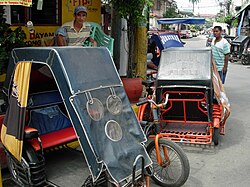
[[File:Inner Manila Pedicab.jpg|thumb|upright|Typical Manila pedicabs, or "trisikad"]] | [[File:Inner Manila Pedicab.jpg|thumb|upright|Typical Manila pedicabs, or "trisikad"]] | ||
[[File:Recumbent pedicab.jpg|thumb|right|upright|Recumbent style cycle taxi/pedicab in London]] | [[File:Recumbent pedicab.jpg|thumb|right|upright|Recumbent style cycle taxi/pedicab in London]] | ||
[[File:Cycle rickshaw in Moscow.jpg|thumb|upright|right|Cycle rickshaw in [[Moscow]], Russia]] | [[File:Cycle rickshaw in Moscow.jpg|thumb|upright|right|Cycle rickshaw in [[Moscow]], Russia]] | ||
The '''cycle rickshaw''' is a small-scale | The '''cycle rickshaw''' is a small-scale means of local transport. A type of [[tricycle]] designed to carry passengers on a [[vehicle for hire|for-hire]] basis, it may also be known as '''bike taxi''', '''velotaxi''', '''pedicab''', '''bikecab''', '''cyclo''', '''beca''', '''becak''', '''trisikad''', '''sikad''', '''tricycle taxi''', '''trishaw''', or '''hatchback bike'''. | ||
The cycle rickshaw is [[human-powered vehicle|human-powered]] by pedaling, in contrast to the classic [[Pulled rickshaw|rickshaw]], pulled by a person on foot, and distinct from the motorized [[auto rickshaw]]. | |||
==Overview== | ==Overview== | ||
[[File:Warna-warni Becak di Kota Solo.jpg|thumb|Pedicab or "Becak" (in Indonesian language) in [[Surakarta|Solo]], [[Central Java]], Indonesia ]] | [[File:Warna-warni Becak di Kota Solo.jpg|thumb|Pedicab or "Becak" (in Indonesian language) in [[Surakarta|Solo]], [[Central Java]], Indonesia ]] | ||
The first cycle rickshaws were built in the 1880s | The first cycle rickshaws were built in the 1880s and were first used widely in 1929 in Singapore. Six years later, they outnumbered pulled rickshaws there. By 1950, cycle rickshaws were found in every south and east Asian country. By the late 1980s, there were an estimated 4 million cycle rickshaws worldwide.<ref name="Edgerton p. 46">{{cite book | title=The Shock of the Old: Technology and Global History Since 1900 | publisher=Oxford University Press | first=David | last=Edgerton | year=2011 | pages=46 | isbn=978-0199832613}}</ref> | ||
The vehicle is generally pedal-driven by a driver, though some are equipped with an [[electric motor]] to assist the driver.<ref name="Wired01">{{cite magazine|url=https://www.wired.com/autopia/2010/01/solar-rickshaws-delhi/|title=Solar Rickshaws Ready for Delhi |last=Keith|first=Barry|date=11 January 2010|magazine=Wired Magazine |access-date=10 March 2010}}</ref><ref>{{cite web|url=http://hybrid.iit.edu/projects.php?project=auto_rickshaw |title=Sustainable Transportation Solution for Auto Rickshaws|year=2009 |publisher=Illinois Institute of Technology|access-date=10 March 2010}}</ref><ref>{{cite news|url=http://www.indianexpress.com/oldStory/11602/ |title=The Cycle Rickshaw's Electric Dreams|newspaper=Indian Express|access-date=14 August 2010}}</ref> | The vehicle is generally pedal-driven by a driver, though some are equipped with an [[electric motor]] to assist the driver.<ref name="Wired01">{{cite magazine|url=https://www.wired.com/autopia/2010/01/solar-rickshaws-delhi/|title=Solar Rickshaws Ready for Delhi |last=Keith|first=Barry|date=11 January 2010|magazine=Wired Magazine |access-date=10 March 2010}}</ref><ref>{{cite web|url=http://hybrid.iit.edu/projects.php?project=auto_rickshaw|title=Sustainable Transportation Solution for Auto Rickshaws|year=2009|publisher=Illinois Institute of Technology|access-date=10 March 2010|archive-date=8 July 2010|archive-url=https://web.archive.org/web/20100708204733/http://hybrid.iit.edu/projects.php?project=auto_rickshaw|url-status=dead}}</ref><ref>{{cite news|url=http://www.indianexpress.com/oldStory/11602/ |title=The Cycle Rickshaw's Electric Dreams|newspaper=Indian Express|access-date=14 August 2010}}</ref> | ||
The vehicle is usually a [[tricycle]], though some [[Quadracycle (human-powered vehicle)|quadracycle]] models exist, and some [[bicycle]]s with [[bicycle trailer|trailers]] are configured as cycle rickshaws.<ref name=Sobey>{{cite book | title=A Field Guide to Automotive Technology | publisher=Chicago Review Press | | The vehicle is usually a [[tricycle]], though some [[Quadracycle (human-powered vehicle)|quadracycle]] models exist, and some [[bicycle]]s with [[bicycle trailer|trailers]] are configured as cycle rickshaws.<ref name=Sobey>{{cite book | title=A Field Guide to Automotive Technology | publisher=Chicago Review Press | first=Ed | last=Sobey | year=2009 | pages=172 | isbn=978-1556528125}}</ref> Some cycle rickshaws have gas or electric motors.<ref name=Sobey /><ref name="investvine">{{cite web|url=http://investvine.com/electric-vehicles-become-popular-the-philippines/|title=Electric vehicles become popular in the Philippines|first=Todd|last=Watson|work=Inside Investor|date=31 July 2013|access-date=11 August 2013|archive-date=9 August 2013|archive-url=https://web.archive.org/web/20130809233513/http://investvine.com/electric-vehicles-become-popular-the-philippines/|url-status=dead}}</ref> | ||
===Passenger configuration=== | ===Passenger configuration=== | ||
The configuration of driver and passenger seats varies. Generally the driver sits in front of the passengers to pedal the rickshaw. There are some designs, though, where the cyclist driver sits behind the passengers.<ref name="Edgerton p. 46" /><ref name=Sobey /> In many [[Asia]]n countries, like [[Bangladesh]], [[India]] and [[China]], the passenger seat is located behind the driver, while in [[Indonesia]], [[Malaysia]], [[Cambodia]] and [[Vietnam]] the driver sits behind the passenger | The configuration of driver and passenger seats varies. Generally the driver sits in front of the passengers to pedal the rickshaw. There are some designs, though, where the cyclist driver sits behind the passengers.<ref name="Edgerton p. 46" /><ref name=Sobey /> In many [[Asia]]n countries, like [[Bangladesh]], [[India]], and [[China]], the passenger seat is located behind the driver, while in [[Indonesia]], [[Malaysia]], [[Cambodia]], and [[Vietnam]] the cyclist driver sits behind the passenger. In the [[Philippines]], the passenger seats are usually located beside the driver in a side car. Similar to this, passengers sit alongside the driver in both ''trishaw,'' in [[Singapore]], and the ''sai kaa,'' in [[Burma]].<ref name="Edgerton p. 46" /> | ||
==Nomenclature== | ==Nomenclature== | ||
| Line 31: | Line 31: | ||
* bikecab | * bikecab | ||
* cyclo (used in Vietnam and Cambodia) | * cyclo (used in Vietnam and Cambodia) | ||
* pedicab (used in the [[United Kingdom]], [[United States]] and [[Canada]])<ref>{{Cite web|title=What Is A Pedicab? - Pedicabs & The National Mall|url=https://sites.google.com/site/pubp715pedicabs/introduction|access-date=8 June 2021|website=sites.google.com}}</ref> | * pedicab (used in the [[United Kingdom]], [[United States]], and [[Canada]])<ref>{{Cite web|title=What Is A Pedicab? - Pedicabs & The National Mall|url=https://sites.google.com/site/pubp715pedicabs/introduction|access-date=8 June 2021|website=sites.google.com}}</ref> | ||
* bike taxi (used in [[Buffalo, New York]]){{ | * bike taxi (used in [[Buffalo, New York]]){{Citation needed|date=January 2023}} | ||
* bicitaxi (used in [[Mexico]]) | * bicitaxi (used in [[Mexico]]) | ||
* taxi ecologico (used in [[Mexico]]) | * taxi ecologico (used in [[Mexico]]) | ||
| Line 39: | Line 39: | ||
* becak (used in [[Indonesia]]) | * becak (used in [[Indonesia]]) | ||
* helicak (used in [[Indonesia]]) it is another version of becak but with engines, not manual pedals | * helicak (used in [[Indonesia]]) it is another version of becak but with engines, not manual pedals | ||
* traysikad, trisikad, sikad or padyak (used in the [[Philippines]]) | * traysikad, trisikad, sikad, or padyak (used in the [[Philippines]]) | ||
==Country overview== | ==Country overview== | ||
Not only are cycle rickshaws used in Asian countries, but they are also used in some cities in Europe and North America. They are used primarily for their novelty value, as an entertaining form of transportation for tourists and locals, but they also have environmental benefits and may be quicker than other forms of transport if traffic congestion is high. Cycle rickshaws used outside Asia often are mechanically more complex, having multiple [[gear ratio|gears]], more powerful brakes, and in some cases [[Motorized bicycle|electrical motors]] to provide additional power.{{Citation needed|date=April 2013}} | |||
===Africa=== | ===Africa=== | ||
====Madagascar==== | ====Madagascar==== | ||
In [[Madagascar]] rickshaws, including cycle rickshaws or ''cyclo-pousse'', are a common form of transportation in a number of cities. Rickshaws are known as ''pousse-pousse'', meaning ''push-push'',<ref>{{cite book | title=Madagascar, Volume 15 of Cultures of the World Cultures of the World - Group 15 | publisher=Marshall Cavendish | | In [[Madagascar]] rickshaws, including cycle rickshaws or ''cyclo-pousse'', are a common form of transportation in a number of cities. Rickshaws are known as ''pousse-pousse'', meaning ''push-push'',<ref>{{cite book | title=Madagascar, Volume 15 of Cultures of the World Cultures of the World - Group 15 | publisher=Marshall Cavendish |first1=Jay |last1=Heale |author2=Zawiah Abdul Latif | year=2008 | pages=75–76 | isbn=978-0761430360 | edition=2}}</ref> reportedly for the pulled rickshaws that required a second person to push the vehicles up hills. Cycles are more common in the hillier areas, like [[Toamasina]].<ref>{{cite book | url=https://books.google.com/books?id=yNax15GoPIkC&q=pousse-pousse&pg=PT59 | title=Madagascar Travel Guide | publisher=Lonely Planet | access-date=13 April 2013 | year=2012 | edition=7 | isbn=978-1743213018 }}</ref> | ||
===Americas=== | ===Americas=== | ||
====Canada==== | ====Canada==== | ||
In Canada there are pedicabs in operation in [[Victoria, British Columbia]],<ref>{{ cite book | title=Vancouver and Victoria. 4th ed. | author=Ulysses Travel Editorial Staff, Ulysses Travel Guides | publisher=Hunter Publishing, Inc | year=2003 | isbn=2894645171 }}</ref> and [[Vancouver, British Columbia]]. They are regulated in [[Toronto|Toronto, Ontario]], and Vancouver, British Columbia.<ref>{{ cite web | title=Pedicabs, City of Vancouver | url= | In Canada there are pedicabs in operation in [[Victoria, British Columbia]],<ref>{{ cite book | title=Vancouver and Victoria. 4th ed. | author=Ulysses Travel Editorial Staff, Ulysses Travel Guides | publisher=Hunter Publishing, Inc | year=2003 | isbn=2894645171 }}</ref> and [[Vancouver, British Columbia]]. They are regulated in [[Toronto|Toronto, Ontario]], and Vancouver, British Columbia.<ref>{{ cite web | title=Pedicabs, City of Vancouver | url=https://vancouver.ca/doing-business/pedicabs.aspx | publisher=City of Vancouver | access-date=13 April 2013 }}</ref><ref>{{ cite news | title=Rickshaw owners back in driver's seat: Toronto rickshaws can now charge unlimited fares after a judge said City Hall's price limits were chosen on a "whim." | url=http://www.canada.com/nationalpost/news/toronto/story.html?id=dad7518a-21d5-42d4-8030-d3bae4be6841 | publisher=National Post, CanWest MediaWorks Publications Inc. (posted on Canada.com) | date=9 May 2007 | access-date=13 April 2013 | archive-url=https://web.archive.org/web/20130513005700/http://www.canada.com/nationalpost/news/toronto/story.html?id=dad7518a-21d5-42d4-8030-d3bae4be6841 | archive-date=13 May 2013 | url-status=dead | df=mdy-all }}</ref> | ||
====Mexico==== | ====Mexico==== | ||
| Line 61: | Line 59: | ||
{{See also|Rickshaws in the United States}} | {{See also|Rickshaws in the United States}} | ||
[[File:JaysPedicabAspen.png|thumb|upright|Jays Valet, Luxury Transportation & Pedicab Service in the 4th of July (Independence Day) Parade in Aspen, Colorado]] | [[File:JaysPedicabAspen.png|thumb|upright|Jays Valet, Luxury Transportation & Pedicab Service in the 4th of July (Independence Day) Parade in Aspen, Colorado]] | ||
Pedicabs in the United States seem to have gotten their start at the [[Century 21 Exposition|1962 World's Fair]] in [[Seattle]].<ref>{{cite web|url= | In many major cities, pedicabs can be found rolling about city centers, nightlife districts, park lands, sports stadiums, and tourist-heavy areas. Myriad uses have been discovered in the states, including car-park-to-event transport at large events nationwide. Thousands of pedicabs today operate on streets in locales including Green Bay and Milwaukee, Wisconsin; Austin, Texas; Manhattan, New York; Chicago, Illinois; San Diego and San Francisco, California; Boston, Massachusetts; Miami, Florida; Washington, D.C.; Denver, Colorado; Portland, Oregon; Seattle, Washington; Charleston, South Carolina; New Orleans, Louisiana; Nashville, Tennessee; Phoenix, Arizona; Salt Lake City, Utah; Philadelphia, Pennsylvania; and dozens of other hot spots. Manhattan sports the largest collection of pedicabs operating within city limits, and the City of New York itself has mandated that approximately 850 pedicabs always sport operating permits issued by the city.<ref>{{cite web|url=http://www.nyc.gov/html/dca/html/licenses/131.shtml|title=New York City Department of Consumer Affairs - Pedicab Driver License|website=Nyc.gov|access-date=13 October 2017|archive-url=https://web.archive.org/web/20150709014051/http://www.nyc.gov/html/dca/html/licenses/131.shtml|archive-date=9 July 2015|url-status=dead}}</ref> | ||
Pedicabs in the United States seem to have gotten their start at the [[Century 21 Exposition|1962 World's Fair]] in [[Seattle]].<ref>{{cite web|url=https://www.myballard.com/2011/11/07/ballard-remembers-the-1962-worlds-fair/|title=Ballard remembers the 1962 World's Fair|website=Myballard.com|access-date=13 October 2017}}</ref> | |||
===Asia=== | ===Asia=== | ||
====Bangladesh==== | ====Bangladesh==== | ||
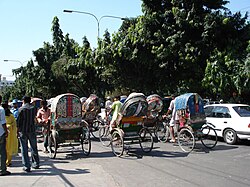
[[File:Rickshaws Dhaka.jpg|thumb|upright|Cycle rickshaws in [[Dhaka]], [[Bangladesh]]. The city is known as the Rickshaw Capital of the World.]] | [[File:Rickshaws Dhaka.jpg|thumb|upright|Cycle rickshaws in [[Dhaka]], [[Bangladesh]]. The city is known as the Rickshaw Capital of the World.]] | ||
Approximately 400,000 cycle rickshaws run each day.<ref>{{cite news|url= | Cycle rickshaws (রিকশা ''riksha'') are the most popular modes of transport in [[Bangladesh]] and are available for hire throughout the country including the capital city [[Dhaka]], known as the "Rickshaw Capital of the World".<ref name="news.bbc.co.uk">{{cite news|url=https://news.bbc.co.uk/2/hi/programmes/from_our_own_correspondent/2300179.stm | work=BBC News | first=Alastair | last=Lawson | title=Dhaka's beleaguered rickshaw wallahs | date=5 October 2002}}</ref> They are either pedal or motor-powered. They were introduced here about 1938 and by the end of the 20th century there were 300,000+ cycle rickshaws in Dhaka.<ref name="Edgerton pp. 46-47">{{cite book | title=The Shock of the Old: Technology and Global History Since 1900 | publisher=Oxford University Press | first=David | last=Edgerton | year=2011 | pages=46–47 | isbn=978-0199832613}}</ref> | ||
Approximately 400,000 cycle rickshaws run each day.<ref>{{cite news|url=https://news.bbc.co.uk/2/hi/programmes/from_our_own_correspondent/2300179.stm|title=Dhaka's beleaguered rickshaw wallahs|publisher=[[BBC]]|access-date=24 February 2009 | date=5 October 2002|first=Alastair|last=Lawson}}</ref> Cycle rickshaws in Bangladesh are also more convenient than the other public modes of transports in the country namely auto rickshaws, cabs and buses. They are mostly ''convertible'', decorated,<ref>RickshawArt.org [http://www.rickshawart.org ''Website of the social enterprise RickshawArt in Bangladesh.''] {{Webarchive|url=https://web.archive.org/web/20170422102750/http://www.rickshawart.org/ |date=22 April 2017 }} Dhaka.</ref> rickshaws with folding hoods and are the only kind of vehicles that can be driven in many neighbourhoods of the city with narrow streets and lanes. However, increasing traffic congestion and the resulting collisions have led to the banning of rickshaws on many major streets in the city. Urban employment in Bangladesh also largely depend on cycle rickshaws. Because of inflation and unemployment in the rural areas, people from villages crowd in the cities to become rickshaw drivers locally called the ''riksha-wala'' (রিকশাওয়ালা).{{Citation needed|date=April 2013}} | |||
{{See also|Rickshaw art in Bangladesh}} | {{See also|Rickshaw art in Bangladesh}} | ||
| Line 81: | Line 80: | ||
[[File:A passenger tricycle at Xiyuan (20230526121029).jpg|thumb|upright|right|A cycle rickshaw at [[Xiyuan station (Beijing Subway)|Xiyuan]], Beijing, targeting at tourists from Summer Palace]] | [[File:A passenger tricycle at Xiyuan (20230526121029).jpg|thumb|upright|right|A cycle rickshaw at [[Xiyuan station (Beijing Subway)|Xiyuan]], Beijing, targeting at tourists from Summer Palace]] | ||
[[File:Cycle rickshaw、Shenyang,自転車タクシー,中国、瀋陽 PA106988.JPG|thumb|upright|right|Cycle rickshaw in Shenyang]] | [[File:Cycle rickshaw、Shenyang,自転車タクシー,中国、瀋陽 PA106988.JPG|thumb|upright|right|Cycle rickshaw in Shenyang]] | ||
Since the 1950s, when the pulled rickshaw was phased out, mid-city and large city passengers may travel using three-wheeled pedicabs, or cycle rickshaws. The [[Chinese language|Chinese]] term for the conveyance is ''sanlunche'' (三轮车). The vehicles may be pedal- or motor-powered. In [[Shanghai]], most of the vehicles are powered by electricity.<ref name="Tiki China">{{cite book | url=https://books.google.com/books?id=2WM23qDdOGQC&pg=PT61 | title=China Travel Guide - Tiki Travel | publisher=FB Editions | pages=PT61 | isbn=9791021306523}}</ref> | Since the 1950s, when the pulled rickshaw was phased out, mid-city and large city passengers may travel using three-wheeled pedicabs, or cycle rickshaws. The [[Chinese language|Chinese]] term for the conveyance is ''sanlunche'' (三轮车). The vehicles may be pedal- or motor-powered. In [[Shanghai]], most of the vehicles are powered by electricity.<ref name="Tiki China">{{cite book | url=https://books.google.com/books?id=2WM23qDdOGQC&pg=PT61 | title=China Travel Guide - Tiki Travel | publisher=FB Editions | pages=PT61 | isbn=9791021306523}}</ref> | ||
Tourists are warned to beware of over-charging vendors, especially who wear an "old fashioned costume" or are located near tourist locations.<ref name="Tiki China" /> | Tourists are warned to beware of over-charging vendors, especially who wear an "old fashioned costume" or are located near tourist locations.<ref name="Tiki China" /> | ||
Whilst many local tourism authorities still issue licences for rickshaw drivers to carry passengers, authorities in China are tightening rules in order to alleviate cheating of tourists and to reduce traffic congestion (e.g. a typical Chinese cycle-rickshaw will travel at less than 10 {{Sfrac|km|h}} and is wide enough to fill an entire motor or bicycle lane and therefore are blamed as a major cause of traffic congestion), and have been banned in many cities already.{{ | Whilst many local tourism authorities still issue licences for rickshaw drivers to carry passengers, authorities in China are tightening rules in order to alleviate cheating of tourists and to reduce traffic congestion (e.g. a typical Chinese cycle-rickshaw will travel at less than 10 {{Sfrac|km|h}} and is wide enough to fill an entire motor or bicycle lane and therefore are blamed as a major cause of traffic congestion), and have been banned in many cities already.<ref>{{cite web |title=广州这些区域禁止人力三轮车上道路行驶,6月11日起施行 |url=https://baijiahao.baidu.com/s?id=1766212670263278435&wfr=spider&for=pc |website=Baidu |publisher=光明网 |access-date=13 May 2024}}</ref> | ||
====India==== | ====India==== | ||
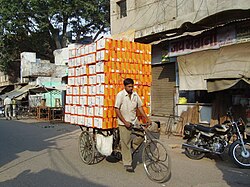
[[File:Cargorickshaw.jpg|thumb|upright|A cycle rickshaw carrying shoe boxes in [[Agra]]]] | [[File:Cargorickshaw.jpg|thumb|upright|A cycle rickshaw carrying shoe boxes in [[Agra]]]] | ||
<!---- I've not seen this anywhere yet --- commenting to hold ---In India, the term ''rickshaw'' usually refers to cycle rickshaws{{citation needed|date=September 2011}} | |||
<!---- I've not seen this anywhere yet --- commenting to hold ---In India, the term ''rickshaw'' usually refers to cycle rickshaws,{{citation needed|date=September 2011}} although their number is decreasing. In cities where both pulled [[Pulled rickshaw|rickshaws]] and [[auto rickshaw]]s are present, the term ''auto'' is often used to refer to the auto rickshaw to avoid confusion.{{Citation needed|date=April 2013}}---> | |||
The first attempt of improving the existing cycle rickshaws and then converting them to electric ones was done by the [[Nimbkar Agricultural Research Institute]] in the late 1990s.<ref>{{cite web|url=http://www.iisc.ernet.in/currsci/sep252002/703.pdf|title=Electric and improved cycle rickshaw as a sustainable transport system for India|website=Iisc.ernet.in|access-date=13 October 2017|archive-date=8 August 2017|archive-url=https://web.archive.org/web/20170808223105/http://www.iisc.ernet.in/currsci/sep252002/703.pdf|url-status=dead}}</ref> | The first attempt of improving the existing cycle rickshaws and then converting them to electric ones was done by the [[Nimbkar Agricultural Research Institute]] in the late 1990s.<ref>{{cite web|url=http://www.iisc.ernet.in/currsci/sep252002/703.pdf|title=Electric and improved cycle rickshaw as a sustainable transport system for India|website=Iisc.ernet.in|access-date=13 October 2017|archive-date=8 August 2017|archive-url=https://web.archive.org/web/20170808223105/http://www.iisc.ernet.in/currsci/sep252002/703.pdf|url-status=dead}}</ref> | ||
| Line 98: | Line 99: | ||
=====Ecocabs and similar service===== | =====Ecocabs and similar service===== | ||
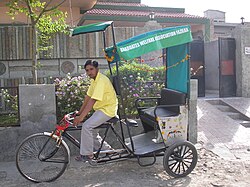
[[File:ECB1.jpg|thumb|upright|Traction Man on [[Fazilka]] Ecocab "Nano Model"]] | [[File:ECB1.jpg|thumb|upright|Traction Man on [[Fazilka]] Ecocab "Nano Model"]] | ||
[[Navdeep Asija]] started a dial-a-cycle rickshaw concept known as Ecocabs,<ref name=Ecocabs>{{cite web|url=http://www.ecocabs.org/|title=Ecocabs|website=Ecocabs.org|access-date=13 October 2017}}</ref> Environmental friendly Ecocabs{{#tag:ref|In 2010, Ecocab service was introduced by the state governments of [[Punjab, India|Punjab]] and [[Haryana]] upon the orders of the Honorable Punjab and Haryana High Court.<ref>{{cite web|url=http://www.expressindia.com/latest-news/ecocab-can-become-viable-and-ecofriendly-means-of-transport/612632/|title=Ecocab can become viable and eco-friendly means of transport|website=Expressindia.com|access-date=13 October 2017|archive-url=https://web.archive.org/web/20121015021450/http://www.expressindia.com/latest-news/ecocab-can-become-viable-and-ecofriendly-means-of-transport/612632/|archive-date=15 October 2012|url-status=dead}}</ref>|group="nb"}} operate in the Punjab towns of [[Fazilka]],<ref name="IA With Ecocab" /> [[Amritsar]].<ref name="Tribune Amritsar" />{{#tag:ref|Ecocabs were introduced in Amritsar by the Punjab Heritage and Tourism Promotion Board in association with Graduates Welfare Association Fazilka (GWAF) and District Administration in [[Amritsar]]. Here in the Ecocabs<ref name="Tribune Amritsar">{{cite web|url= | |||
[[Navdeep Asija]] started a dial-a-cycle rickshaw concept known as Ecocabs,<ref name=Ecocabs>{{cite web|url=http://www.ecocabs.org/|title=Ecocabs|website=Ecocabs.org|access-date=13 October 2017}}</ref> Environmental friendly Ecocabs{{#tag:ref|In 2010, Ecocab service was introduced by the state governments of [[Punjab, India|Punjab]] and [[Haryana]] upon the orders of the Honorable Punjab and Haryana High Court.<ref>{{cite web|url=http://www.expressindia.com/latest-news/ecocab-can-become-viable-and-ecofriendly-means-of-transport/612632/|title=Ecocab can become viable and eco-friendly means of transport|website=Expressindia.com|access-date=13 October 2017|archive-url=https://web.archive.org/web/20121015021450/http://www.expressindia.com/latest-news/ecocab-can-become-viable-and-ecofriendly-means-of-transport/612632/|archive-date=15 October 2012|url-status=dead}}</ref>|group="nb"}} operate in the Punjab towns of [[Fazilka]],<ref name="IA With Ecocab" /> [[Amritsar]].<ref name="Tribune Amritsar" />{{#tag:ref|Ecocabs were introduced in Amritsar by the Punjab Heritage and Tourism Promotion Board in association with Graduates Welfare Association Fazilka (GWAF) and District Administration in [[Amritsar]]. Here in the Ecocabs<ref name="Tribune Amritsar">{{cite web|url=https://www.tribuneindia.com/2010/20101016/aplus.htm#2|title=The Tribune, Chandigarh, India - Amritsar PLUS|website=Tribuneindia.com|access-date=13 October 2017}}</ref>|group="nb"}} [[Central Delhi]] and [[Kolkata]].<ref name=Ecocabs /> Passengers may call to request transport service, similar to dial-up taxi cab operations.<ref name="IA With Ecocab">{{cite web|url=http://www.indianexpress.com/news/with-ecocab-fazilka-shows-the-way/611194/|title=With Ecocab, Fazilka shows the way - Indian Express|website=Indianexpress.com|date=26 April 2010|access-date=13 October 2017}}</ref><ref>{{cite web|url=http://carbusters.org/2010/03/18/fazilka-come-without-your-car/|title=Fazilka: Come Without Your Car – Carbusters|website=carbusters.org|access-date=13 October 2017}}</ref> {{#tag:ref|Named "Ecocabs", it is known locally as "Pushpak Sewa". the first modified light-weight low-floor rickshaw was introduced under the name ''Nano''.<ref>{{cite web|url=https://www.tribuneindia.com/2010/20100405/bathinda.htm#9|title=The Tribune, Chandigarh, India - Bathinda Edition|website=Tribuneindia.com|access-date=13 October 2017}}</ref>|group="nb"}} | |||
In November 2010, Patiala GreenCABS, similar to Ecocabs, were introduced in the city by the local [[non governmental organisation]] (NGO) the Patiala Foundation.<ref>{{cite web|url=https://www.ndtv.com/topic/patiala-green-cabs|title=Patiala Green Cabs: Latest News, Photos, Videos on Patiala Green Cabs|website=NDTV.com|access-date=13 October 2017}}</ref> | In November 2010, Patiala GreenCABS, similar to Ecocabs, were introduced in the city by the local [[non governmental organisation]] (NGO) the Patiala Foundation.<ref>{{cite web|url=https://www.ndtv.com/topic/patiala-green-cabs|title=Patiala Green Cabs: Latest News, Photos, Videos on Patiala Green Cabs|website=NDTV.com|access-date=13 October 2017}}</ref> | ||
| Line 106: | Line 108: | ||
=====Soleckshaw===== | =====Soleckshaw===== | ||
The Soleckshaw is a battery-electric assisted cycle rickshaw. The battery is designed to be charged or exchanged at centralised solar-powered charging stations. Developed by the [[Council of Scientific & Industrial Research]], it was launched in [[Delhi]] in October 2008.<ref name="Wired01" /><ref name="TOI Solar rickshaws">{{cite news|url= | The Soleckshaw is a battery-electric assisted cycle rickshaw. The battery is designed to be charged or exchanged at centralised solar-powered charging stations. Developed by the [[Council of Scientific & Industrial Research]], it was launched in [[Delhi]] in October 2008.<ref name="Wired01" /><ref name="TOI Solar rickshaws">{{cite news|url=https://timesofindia.indiatimes.com/city/bhubaneswar/Solar-rickshaws-to-power-green-city-dreams/articleshow/17347916.cms|archive-url=https://web.archive.org/web/20121209045729/http://articles.timesofindia.indiatimes.com/2012-11-24/bhubaneswar/35333213_1_rickshaw-pullers-solar-rickshaw-soleckshaw|url-status=live|archive-date=9 December 2012|title=Solar rickshaws to power green city dreams|date=24 November 2012|newspaper=[[The Times of India]]|access-date=13 April 2013 }}</ref> However, in September 2010 it was reported that no Soleckshaws had been sold on a commercial basis, and the approximately 30 demonstration units, initially deployed in Ahmedabad, Chandigarh, Delhi, Dhanbad, Durgapur, Jaipur, and Kolkata, were "not in operation due to various local administrative and management problems", and the charging stations "are not being used at this point of time as the vehicles are not in operation at those locations".<ref>{{cite web|url=https://www.deccanherald.com/content/100289/csirs-solar-rickshaw-finds-no.html|title=Solar rickshaw finds no takers|website=Deccan Herald|date=28 September 2010|access-date=13 October 2017}}</ref> | ||
The [[2010 Union budget of India]] had a concessional excise duty of 4% on solar cycle rickshaws.<ref name=TEDDY>{{cite book|title=TERI Energy Data Directory & Yearbook (TEDDY) 2010|publisher=TERI Press|page=403|date=2012|isbn=978-8179933930}}</ref> | The [[2010 Union budget of India]] had a concessional excise duty of 4% on solar cycle rickshaws.<ref name=TEDDY>{{cite book|title=TERI Energy Data Directory & Yearbook (TEDDY) 2010|publisher=TERI Press|page=403|date=2012|isbn=978-8179933930}}</ref> | ||
====Indonesia==== | ====Indonesia==== | ||
Cycle rickshaws in Indonesia are called ''becak'' (pronounced {{IPA | Cycle rickshaws in Indonesia are called ''becak'' (pronounced {{IPA|ms|ˈbetʃaʔ|}}). They began being used in Jakarta about 1936.<ref name="Edgerton pp. 46-47" /> ''Becak'' were considered an icon of the capital city of Jakarta prior to its ban in the 1970s. Citing concerns of public order, the city government forbade them on the city's main streets. Scenes of the anti-''becak'' campaign appear in the 1971 Canadian film ''Wet Earth and Warm People'', a documentary by [[Michael Rubbo]].<ref>National Film Board of Canada, ''[https://www.nfb.ca/film/wet_earth_and_warm_people Wet Earth and Warm People]'', 1971</ref> Despite the attempts at eradication, however, many ''becak'' still operate near [[slum]]s throughout the city. Attempts at reinforcing the ban resulted in large-scale seizures of the vehicle in the late 1990s and in 2007.<ref>{{cite news | title = 'Becak' drivers challenge authorities over right to work | url = http://www.thejakartapost.com/news/2009/07/06/becak039-drivers-challenge-authorities-over-right-work.html | work = [[The Jakarta Post]] | date = 6 July 2009 | access-date = 10 July 2010}}</ref> In 2018, Governor [[Anies Baswedan]] attempted to allow ''becak'' again because of a political contract with becak drivers during his campaign.<ref>{{cite news|last1=Amindoni|first1=Ayomi|title=Becak di Jakarta dan 'kontrak politik' Gubernur Anies Baswedan|url=http://www.bbc.com/indonesia/indonesia-42813996|access-date=1 April 2018|work=BBC Indonesia|date=2018|language=id}}</ref> | ||
There are two types of "becak" in Indonesia: the first type is the driver sitting behind the passenger (similar to Dutch-style [[cargo bike]]s), the other one which mainly found in Sumatra is the driver sitting beside the passenger. "Becak" is still being used in various part of Indonesia, especially in smaller cities and town. | There are two types of "becak" in Indonesia: the first type is the driver sitting behind the passenger (similar to Dutch-style [[cargo bike]]s), the other one which mainly found in Sumatra is the driver sitting beside the passenger. "Becak" is still being used in various part of Indonesia, especially in smaller cities and town. | ||
| Line 117: | Line 119: | ||
====Malaysia==== | ====Malaysia==== | ||
[[File:National Museum KL 2008 (153).JPG|thumb|upright|''Beca'' from Parit Jawa, Muar, Johor, at the [[Muzium Negara]]]] | [[File:National Museum KL 2008 (153).JPG|thumb|upright|''Beca'' from Parit Jawa, Muar, Johor, at the [[Muzium Negara]]]] | ||
In [[Malaysia]], pedestrian-pulled [[Pulled rickshaw|rickshaws]] were gradually replaced by cycle rickshaws ({{Lang|ms|beca}} in [[Malay Language|Malay]], from [[Hokkien]] ''bé-chhia'' 馬車 "horse cart"). Cycle rickshaws were ubiquitous up to the 1970s in cities. Since then, rapid urbanisation has increased demand for more efficient public transport, resulting in dwindling cycle rickshaw numbers. Today, cycle rickshaws are operated mostly as a tourist attraction, with small numbers operating in [[Malacca]], [[Penang]], [[Kelantan]] and [[Terengganu]].{{Citation needed|date=April 2013}} | |||
In [[Malaysia]], pedestrian-pulled [[Pulled rickshaw|rickshaws]] were gradually replaced by cycle rickshaws ({{Lang|ms|beca}} in [[Malay Language|Malay]], from [[Hokkien]] ''bé-chhia'' 馬車 "horse cart"). Cycle rickshaws were ubiquitous up to the 1970s in cities. Since then, rapid urbanisation has increased demand for more efficient public transport, resulting in dwindling cycle rickshaw numbers. Today, cycle rickshaws are operated mostly as a tourist attraction, with small numbers operating in [[Malacca]], [[Penang]], [[Kelantan]], and [[Terengganu]].{{Citation needed|date=April 2013}} | |||
====Myanmar==== | ====Myanmar==== | ||
[[File:Cycle Rickshaw (29194653278).jpg|thumb|A cycle rickshaw in [[Yangon]]]] | [[File:Cycle Rickshaw (29194653278).jpg|thumb|A cycle rickshaw in [[Yangon]]]] | ||
Only two forms of transportation were then available in the city; the cab and the electric train. The latter could run only on | In Myanmar, cycle rickshaws or trishaws ({{langx|my|ဆိုက်ကား|translit=saik kar}}, directly pronounced as in the English word 'side car') came first into wide use in 1938, when the [[1300 Revolution]], which originated from the [[Chauk|Chauk oil-field]] strike, inspired the people in [[Mandalay]] to have a consciousness of nationalism and to boycott British goods and services. The auto body technician Saya Nyo built the first trishaw in Mandalay by attaching a side-car to the side of an old bicycle.<ref>{{cite book |last= Ludu Daw Amar |author-link= Ludu Daw Amar |date= Nov 1993|title=ရတနာပုံ မန္တလေး၊ မန္တလေး၊ကျွန်မတို့ မန္တလေး |trans-title=Yadanabon Mandalay, Mandalay, Kyama do Mandalay|language=my |location= Mandalay|publisher= Ludu press & bookshop}}</ref> So two passengers are on the right of the driver. | ||
Only two forms of transportation were then available in the city; the cab and the electric train. The latter could run only on {{convert|10|km|mi|0|abbr=off|spell=on|adj=on}} tracks. Trishaws could reach every nook and cranny, so the spirit of nationalism plus the advantage of trishaws reaching everywhere made them so popular among Mandalayans that even the train company had to stop its business.<ref>{{cite web |url= https://www.moi.gov.mm/npe/?q=article/16/12/2019/id-91294|title=ဓာတ်ရထားနှင့် ဆိုက်ကား |date=16 December 2019 |website= News and Periodical Enterprise |author= ဆူးငှက် |access-date=15 May 2020}}</ref><ref>{{cite web|url=https://yangonlife.com.mm/en/article/myanmar-trishaw-01|title=Myanmar Trishaw|date=21 November 2019|website=Yangonlife|first=Crystal|last=Win|access-date=15 May 2020|archive-date=18 February 2019|archive-url=https://web.archive.org/web/20190218142835/http://yangonlife.com.mm/en/article/myanmar-trishaw-01|url-status=dead}}</ref> | |||
====Nepal==== | ====Nepal==== | ||
In the [[Terai]] region of [[Nepal]], cycle rickshaws are still the most popular means of public transport for short-distance commuting. Most big cities in the Terai have hundreds of cycle rickshaws that carry local commuters and travellers, and are also used for carrying goods. Since the Terai region is bordered with [[India]], cycle rickshaws are also popular means for shoppers, businessmen and travellers to travel in and out of the country freely. The free border between India and Nepal enable the rickshaw owners from both countries to operate across the border without any restriction. | In the [[Terai]] region of [[Nepal]], cycle rickshaws are still the most popular means of public transport for short-distance commuting. Most big cities in the Terai have hundreds of cycle rickshaws that carry local commuters and travellers, and are also used for carrying goods. Since the Terai region is bordered with [[India]], cycle rickshaws are also popular means for shoppers, businessmen and travellers to travel in and out of the country freely. The free border between India and Nepal enable the rickshaw owners from both countries to operate across the border without any restriction. | ||
However, in [[Hill Region|Hilly regions]] of Nepal, cycle rickshaws are primarily used to attract tourists who can relax and travel around the popular streets and markets at reasonable fares.<ref>{{cite web |url=http://www.kwintessential.co.uk/articles/nepal/Rickshaws-in-Nepal/334 |title=Rickshaws in Nepal | globerove.com |website=www.kwintessential.co.uk |access-date=27 January 2022 |archive-url=https://archive. | However, in [[Hill Region|Hilly regions]] of Nepal, cycle rickshaws are primarily used to attract tourists who can relax and travel around the popular streets and markets at reasonable fares.<ref>{{cite web |url=http://www.kwintessential.co.uk/articles/nepal/Rickshaws-in-Nepal/334 |title=Rickshaws in Nepal | globerove.com |website=www.kwintessential.co.uk |access-date=27 January 2022 |archive-url=https://archive.today/20130616012730/http://www.kwintessential.co.uk/articles/nepal/Rickshaws-in-Nepal/334 |archive-date=16 June 2013 |url-status=dead }}</ref><ref>{{cite web|url=http://www.virtualtourist.com/travel/Asia/Nepal/Transportation-Nepal-Rickshaw-BR-1.html|title=VirtualTourist.com ceased operations|website=Virtualtourist.com|access-date=13 October 2017}}</ref> Cycle rickshaws are particularly popular among tourists to roam around the popular streets and markets of [[Thamel]], [[Kathmandu]]. | ||
====Pakistan==== | ====Pakistan==== | ||
The | The cycle and [[pulled rickshaw]] were banned in [[Pakistan]] in November 1991.<ref name="news.google.com">{{cite web|url=https://news.google.com/newspapers?nid=1346&dat=19591104&id=e1pYAAAAIBAJ&pg=2852,691451|title=Lakeland Ledger - Google News Archive Search|website=News.google.com|access-date=13 October 2017}}</ref> | ||
====Philippines==== | ====Philippines==== | ||
| Line 137: | Line 141: | ||
[[File:Pedicab at Catarman, Northern Samar.JPG|thumb|upright|Passenger pedicab in [[Catarman, Northern Samar]]]] | [[File:Pedicab at Catarman, Northern Samar.JPG|thumb|upright|Passenger pedicab in [[Catarman, Northern Samar]]]] | ||
[[File:Heavy tricycle transport.jpg|thumbnail|right|upright|''Traysikad'' used for cargo transport]] | [[File:Heavy tricycle transport.jpg|thumbnail|right|upright|''Traysikad'' used for cargo transport]] | ||
In the Philippines, it is called a '''pedicab''', '''traysikad''', '''trisikad'''—or simply '''sikad''' or '''padyak''', from the Philippine word meaning to tramp or stamp one's feet. It is made by mounting a [[sidecar]] to a regular bicycle. They are used mainly to ferry passengers short distances along smaller, more residential streets, often to or from [[jeepney]]s or other [[public utility vehicle]]s. They are also used for transporting cargo too heavy to carry by hand and over a distance too short or roads too congested for motor transport, such as a live pig. During [[rainy seasons]], they are useful as a way to avoid walking through flood waters. Along with the [[jeepney]], the [[Motorized tricycle (Philippines)|motorcycle-powered tricycle]], and the engine-powered [[kuliglig]], the open-air pedicab provides shade when needed.{{Citation needed|date=April 2013}} | In the Philippines, it is called a '''pedicab''', '''traysikad''', '''trisikad'''—or simply '''sikad''' or '''padyak''', from the Philippine word meaning to tramp or stamp one's feet. It is made by mounting a [[sidecar]] to a regular bicycle. They are used mainly to ferry passengers short distances along smaller, more residential streets, often to or from [[jeepney]]s or other [[public utility vehicle]]s. They are also used for transporting cargo too heavy to carry by hand and over a distance too short or roads too congested for motor transport, such as a live pig. During [[rainy seasons]], they are useful as a way to avoid walking through flood waters. Along with the [[jeepney]], the [[Motorized tricycle (Philippines)|motorcycle-powered tricycle]], and the engine-powered [[kuliglig]], the open-air pedicab provides shade when needed.{{Citation needed|date=April 2013}} | ||
====South Korea==== | |||
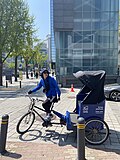
[[File:Artee Pedicab.jpg|thumb|Cycle rickhaw in Seoul, South Korea]] | |||
The Korean term for cycle rickshaw is ''illyeokgeo'' (인력거), which can be pedal- or motor-powered, though most in South Korea are electric. While not commonly used as a primary mode of transportation, cycle rickshaws can still be found in certain areas like [[Bukchon Hanok Village]] in [[Seoul]], where they operate mainly for tourism purposes.<ref>{{Cite web|url=https://www.koreatimes.co.kr/www/art/2025/01/398_150678.html|title=Startups taking steps toward creative tourism|date=28 January 2014|website=The Korea Times}}</ref> | |||
====Thailand==== | ====Thailand==== | ||
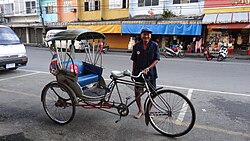
[[File:Rickshaw Thailand.JPG|thumb|upright|Rickshaw, Thailand]] | [[File:Rickshaw Thailand.JPG|thumb|upright|Rickshaw, Thailand]] | ||
In [[Thailand]], any three-wheeler is called {{Transliteration|th|samlor}} ({{ | |||
In [[Thailand]], any three-wheeler is called {{Transliteration|th|samlor}} ({{langx|th|สามล้อ|lit=three wheels}}), whether motorised or not, including pedicabs, motorcycles with attached vending carts or [[sidecar]]s, etc. The driver is also called ''{{Transliteration|th|samlor}}''.{{Citation needed|date=April 2013}} | |||
====Vietnam==== | ====Vietnam==== | ||
| Line 147: | Line 158: | ||
[[File:Xich lô 1976.jpg|thumb|upright|right|From 1976, cyclos of [[Ho Chi Minh City]] and other provinces are re-designed a higher carriage for both goods and passengers transport.]] | [[File:Xich lô 1976.jpg|thumb|upright|right|From 1976, cyclos of [[Ho Chi Minh City]] and other provinces are re-designed a higher carriage for both goods and passengers transport.]] | ||
[[File:Xe Lôi.jpg|thumb|upright|right|Xe Lôi of the [[Mekong Delta]]]] | [[File:Xe Lôi.jpg|thumb|upright|right|Xe Lôi of the [[Mekong Delta]]]] | ||
Cycle rickshaws are known as ''{{lang|vi|xích lô}}'' (pronounced sick-low, from the French ''{{lang|fr|cyclo}}'') in Vietnam. Cyclo was an invention of a | |||
Cycle rickshaws are known as ''{{lang|vi|xích lô}}'' (pronounced sick-low, from the French ''{{lang|fr|cyclo}}'') in Vietnam. Cyclo was an invention of a French named P. Coupeaid, which was introduced in [[Cambodia]] and [[Saigon]] in 1939. From 2008 to 03/2012, due to the traffic obstruction, cyclos were totally forbidden in [[Ho Chi Minh City]] and other provinces, except cyclo tours organised by tourist agencies.<ref>Xích lô Sài Thành https://thanhnien.vn>Thời sự>Phóng sự/Điều Tra</ref> Another similar vehicle, a pedicab called ''xe lôi'' of the [[Mekong Delta]], are now rarely found in some provinces such as [[Sóc Trăng]], [[Vĩnh Long]], and [[Châu Đốc]]. They are on their way to disappear.<ref>Xe lôi ở Miền Nam Việt Nam - Hình ảnh Việt Nam xưa và nay. https://hinhanhvietnam.com>xe-loi-o-mien-nam-viet-nam</ref> | |||
''[[Cyclo (film)|Cyclo]]'', a 1995 film about a cyclo driver, won the [[Golden Lion]] at the [[52nd Venice International Film Festival]].<ref name="Blum-Reid2003">{{cite book|last=Blum-Reid|first=Sylvie|title=East-West Encounters: Franco-Asian Cinema and Literature|url=https://books.google.com/books?id=aMrQFxR3jcYC&pg=PA166|year=2003|publisher=Wallflower Press|isbn=978-1-903364-67-3|page=166}}</ref> | ''[[Cyclo (film)|Cyclo]]'', a 1995 film about a cyclo driver, won the [[Golden Lion]] at the [[52nd Venice International Film Festival]].<ref name="Blum-Reid2003">{{cite book|last=Blum-Reid|first=Sylvie|title=East-West Encounters: Franco-Asian Cinema and Literature|url=https://books.google.com/books?id=aMrQFxR3jcYC&pg=PA166|year=2003|publisher=Wallflower Press|isbn=978-1-903364-67-3|page=166}}</ref> | ||
Beyond their practical utility, [https://asialuyou.com/reminiscing-about-the-iconic-cyclos-on-the-streets-of-saigon/ cyclos held cultural significance in Saigon]. They appeared in literature, art, and cinema, becoming emblematic of the city's identity. From romantic rendezvous to everyday commutes, cyclos featured prominently in the daily lives of Saigonese residents. | |||
Despite the challenges, efforts are underway to preserve the legacy of cyclo in Saigon. Some organizations are restoring vintage models, while others are promoting eco-friendly alternatives to traditional cyclos. These initiatives aim to celebrate the cultural heritage of these iconic vehicles and ensure their continued presence in the city. | |||
===Europe=== | ===Europe=== | ||
| Line 155: | Line 171: | ||
====Denmark==== | ====Denmark==== | ||
[[File:Widok z opery.jpg|thumb|upright|Rickshaw in Denmark | [[File:Widok z opery.jpg|thumb|upright|Rickshaw in Copenhagen, Denmark, in 2014]] | ||
[[Copenhagen]] and [[Odense]] have pedicab service.<ref name=MainStreet /><ref>{{cite book | url=https://books.google.com/books?id=A4QjqJqi7A8C&pg=PT56 | title=Denmark Travel Adventures | publisher=Hunter Publishing, Inc | | |||
[[Copenhagen]] and [[Odense]] have pedicab service.<ref name=MainStreet /><ref>{{cite book | url=https://books.google.com/books?id=A4QjqJqi7A8C&pg=PT56 | title=Denmark Travel Adventures | publisher=Hunter Publishing, Inc | first=Elizabet | last=Olesen | year=2011 | pages=PT56 | isbn=978-1588437075}}</ref> | |||
====Finland==== | ====Finland==== | ||
| Line 166: | Line 183: | ||
====Germany==== | ====Germany==== | ||
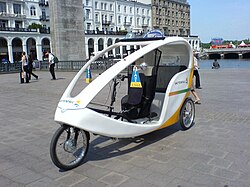
[[File:Rickshaw Hamburg.JPG|thumb|upright|A ''Velotaxi'' cycle rickshaw in [[Hamburg]], Germany]] | [[File:Rickshaw Hamburg.JPG|thumb|upright|A ''Velotaxi'' cycle rickshaw in [[Hamburg]], Germany]] | ||
[[Lake Constance]],<ref name=MainStreet /> [[Berlin]], [[Frankfurt]], [[Dresden]] and [[Hamburg]] offer cycle rickshaw, also called pedicab, service.{{citation needed|date=April 2013}} | |||
[[Lake Constance]],<ref name=MainStreet /> [[Berlin]], [[Frankfurt]], [[Dresden]], and [[Hamburg]] offer cycle rickshaw, also called pedicab, service.{{citation needed|date=April 2013}} | |||
=====Velotaxi===== | =====Velotaxi===== | ||
In the 1990s, German-made cycle rickshaws called velotaxis were created. They are about 1/3 to 1/2 the cost of regular taxis. Velotaxis are three-wheeled vehicles with a "space-age lightweight plastic cab that is open on both sides", a space for a driver, and behind the driver, space for two passengers.<ref name="De Mente p. 95-96">{{cite book | title=The Bizarre and the Wondrous from the Land of the Rising Sun! | publisher=Cultural-Insight Books | author=Boye De Mente | year=2010 | isbn=978-1456424756 | editor=Demetra De Ment | pages=95–96 }}</ref> They have been made in [[Berlin]], Germany, by Ludger Matuszewski, the founder of "Velotaxi GmbH" company. Velotaxis are often used for group functions like weddings. Under German traffic laws, transporting people on bicycles was forbidden.{{Citation needed|date=April 2013}} | In the 1990s, German-made cycle rickshaws called velotaxis were created. They are about 1/3 to 1/2 the cost of regular taxis. Velotaxis are three-wheeled vehicles with a "space-age lightweight plastic cab that is open on both sides", a space for a driver, and behind the driver, space for two passengers.<ref name="De Mente p. 95-96">{{cite book | title=The Bizarre and the Wondrous from the Land of the Rising Sun! | publisher=Cultural-Insight Books | author=Boye De Mente | year=2010 | isbn=978-1456424756 | editor=Demetra De Ment | pages=95–96 }}</ref> They have been made in [[Berlin]], Germany, by Ludger Matuszewski, the founder of "Velotaxi GmbH" company. Velotaxis are often used for group functions like weddings. Under German traffic laws, transporting people on bicycles was forbidden.{{Citation needed|date=April 2013}} | ||
=====Electric assist pedicabs===== | =====Electric-assist pedicabs===== | ||
Berlin's Senate, police, and taxi associations finally agreed that the "cult-flitzer" could be integrated into the city's traffic flow. Germany's highest court later ruled that transporting people on bikes was legal. It is a modern and newly designed pedicab (CityCruiser) with a 500-watt electric assist motor. Although these electric-assist pedicabs were engineered in Germany they are manufactured in the [[Czech Republic]] and some clones are now also produced in China. The Chinese clone can be purchased for about 3,000 [[United States dollar|US dollars]]; the German original is around 6,000 US dollars (the newest version, 9000+ [[euro|€]]). The batteries last about 4 hours with a full charge. As with a few recumbent and semi-recumbent designs, some drivers may suffer with knee and joint pain due to the weight of the vehicle (145 kg).{{Citation needed|date=April 2013}} | Berlin's Senate, police, and taxi associations finally agreed that the "cult-flitzer" could be integrated into the city's traffic flow. Germany's highest court later ruled that transporting people on bikes was legal. It is a modern and newly designed pedicab (CityCruiser) with a 500-watt electric assist motor. Although these electric-assist pedicabs were engineered in Germany they are manufactured in the [[Czech Republic]] and some clones are now also produced in China. The Chinese clone can be purchased for about 3,000 [[United States dollar|US dollars]]; the German original is around 6,000 US dollars (the newest version, 9000+ [[euro|€]]). The batteries last about 4 hours with a full charge. As with a few recumbent and semi-recumbent designs, some drivers may suffer with knee and joint pain due to the weight of the vehicle (145 kg).{{Citation needed|date=April 2013}} | ||
| Line 178: | Line 196: | ||
====Ireland==== | ====Ireland==== | ||
[[File:Cycle rickshaw on O'Connell Street, Dublin.JPG|thumb|Cycle rickshaw in Dublin]] | |||
Pedicabs operate in [[Cork (city)|Cork]] and [[Dublin]], Ireland.<ref name=MainStreet>{{cite web | url=http://www.pedicab.com/pedicab-operators.html | title=Main Street Pedicab Operators | publisher=Main Street Pedicabs | access-date=13 April 2013 | archive-url=https://web.archive.org/web/20130405040443/http://www.pedicab.com/pedicab-operators.html | archive-date=5 April 2013 | url-status=dead }}</ref>{{#tag:ref|In 1994, a wine-club owner named B. McDonald started Pedicabs Ireland with twelve imported pedicab rickshaws. Sponsored pedicabs on the streets of [[Dublin]] give free rides to passengers, as the revenue generated from the advertisements on these pedicabs gives a wage to the drivers. Yellow pedicabs are available in [[Galway]].{{Citation needed|date=April 2013}}|group="nb"}} | Pedicabs operate in [[Cork (city)|Cork]] and [[Dublin]], Ireland.<ref name=MainStreet>{{cite web | url=http://www.pedicab.com/pedicab-operators.html | title=Main Street Pedicab Operators | publisher=Main Street Pedicabs | access-date=13 April 2013 | archive-url=https://web.archive.org/web/20130405040443/http://www.pedicab.com/pedicab-operators.html | archive-date=5 April 2013 | url-status=dead }}</ref>{{#tag:ref|In 1994, a wine-club owner named B. McDonald started Pedicabs Ireland with twelve imported pedicab rickshaws. Sponsored pedicabs on the streets of [[Dublin]] give free rides to passengers, as the revenue generated from the advertisements on these pedicabs gives a wage to the drivers. Yellow pedicabs are available in [[Galway]].{{Citation needed|date=April 2013}}|group="nb"}} | ||
| Line 184: | Line 204: | ||
====The Netherlands==== | ====The Netherlands==== | ||
Pedicab service is available in [[Amsterdam]], [[The Hague]] and in the [[Caribbean]], at [[Willemstad]].<ref name=MainStreet /><ref>{{ cite web | url= | Pedicab service is available in [[Amsterdam]], [[The Hague]] and in the [[Caribbean]], at [[Willemstad]].<ref name=MainStreet /><ref>{{ cite web | url=https://www.amsterdam.info/transport/bike-taxi/ | title=Bike taxi | publisher=Amsterdam Tourism & Convention Board | access-date=13 April 2013 }}</ref> | ||
Thomas Lundy of Amsterdam adapted his battery-electric assisted cycle rickshaw to become what he terms "semi-solar powered", resulting in a video report on [[Reuters]].<ref>{{cite web|url=https://www.reuters.com/video/2011/10/17/amsterdam-rickshaw-driver-sees-the-light?videoId=223547848&videoChannel=6|title=Amsterdam rickshaw driver sees the light| | Thomas Lundy of Amsterdam adapted his battery-electric assisted cycle rickshaw to become what he terms "semi-solar powered", resulting in a video report on [[Reuters]].<ref>{{cite web|last=Gruber|first=Ben|date=17 October 2011|url=https://www.reuters.com/video/2011/10/17/amsterdam-rickshaw-driver-sees-the-light?videoId=223547848&videoChannel=6|title=Amsterdam rickshaw driver sees the light|archive-url=https://web.archive.org/web/20111018061446/https://www.reuters.com/video/2011/10/17/amsterdam-rickshaw-driver-sees-the-light?videoId=223547848&videoChannel=6|archive-date=18 October 2011|url-status=dead|type=video|access-date=9 November 2023|website=Reuters.com}} (click on transcript to read)</ref> | ||
====Norway==== | ====Norway==== | ||
[[File:Velotaxitonsberg.jpg|thumbnail|upright|A ''velotaxi'' operating in [[Tønsberg]], Norway]] | [[File:Velotaxitonsberg.jpg|thumbnail|upright|A ''velotaxi'' operating in [[Tønsberg]], Norway]] | ||
Pedicab service is available in [[Oslo]],<ref name=MainStreet /> [[Fredrikstad]], [[Bergen]], [[Porsgrunn]] and [[Tønsberg]].<ref>{{Cite web |url=http://www.velotaxi.no/ |title=Velotaxi.no - Velotaxi | Hjem |access-date=4 November 2015 |archive-url=https://web.archive.org/web/20150828032738/http://www.velotaxi.no/ |archive-date=28 August 2015 |url-status=dead }}</ref> | |||
Pedicab service is available in [[Oslo]],<ref name=MainStreet /> [[Fredrikstad]], [[Bergen]], [[Porsgrunn]], and [[Tønsberg]].<ref>{{Cite web |url=http://www.velotaxi.no/ |title=Velotaxi.no - Velotaxi | Hjem |access-date=4 November 2015 |archive-url=https://web.archive.org/web/20150828032738/http://www.velotaxi.no/ |archive-date=28 August 2015 |url-status=dead }}</ref> | |||
====Poland==== | ====Poland==== | ||
[[File:Warsaw 1944 by Bałuk - 26204.jpg|thumb|upright|Cycle rickshaws in Warsaw during [[World War II]]]] | [[File:Warsaw 1944 by Bałuk - 26204.jpg|thumb|upright|Cycle rickshaws in Warsaw during [[World War II]]]] | ||
During [[World War II]], when [[Poland]] was under [[Nazi]] German occupation, the German authorities confiscated most privately owned cars and many of the [[streetcar]]s and [[bus]]es. Because of that, [[public transport]] was partially replaced by cycle rickshaws, at first improvised and with time mass-produced by bicycle factories. Cycle rickshaws became popular in [[Warsaw]] and by the start of the [[Warsaw Uprising]] were a common sight on the city's streets.{{Citation needed|date=April 2013}} | During [[World War II]], when [[Poland]] was under [[Nazi]] German occupation, the German authorities confiscated most privately owned cars and many of the [[streetcar]]s and [[bus]]es. Because of that, [[public transport]] was partially replaced by cycle rickshaws, at first improvised and with time mass-produced by bicycle factories. Cycle rickshaws became popular in [[Warsaw]] and by the start of the [[Warsaw Uprising]] were a common sight on the city's streets.{{Citation needed|date=April 2013}} | ||
| Line 199: | Line 221: | ||
====Spain==== | ====Spain==== | ||
[[Alicante]], [[Barcelona]], [[Zaragoza]], [[Málaga]] [[San Sebastián|San Sebastian]] and [[Seville]] have pedicab service.<ref>{{Cite web |url=http://suite101.net/article/la-moda-del-bicitaxi-el-transporte-de-la-gran-ciudad-a17371 |title=La moda del bicitaxi, el transporte de la gran ciudad - Suite 101 |access-date=19 April 2014 |archive-url=https://web.archive.org/web/20141218131825/http://suite101.net/article/la-moda-del-bicitaxi-el-transporte-de-la-gran-ciudad-a17371 |archive-date=18 December 2014 |url-status=dead }}</ref> | [[Alicante]], [[Barcelona]], [[Zaragoza]], [[Málaga]], [[San Sebastián|San Sebastian]], and [[Seville]] have pedicab service.<ref>{{Cite web |url=http://suite101.net/article/la-moda-del-bicitaxi-el-transporte-de-la-gran-ciudad-a17371 |title=La moda del bicitaxi, el transporte de la gran ciudad - Suite 101 |access-date=19 April 2014 |archive-url=https://web.archive.org/web/20141218131825/http://suite101.net/article/la-moda-del-bicitaxi-el-transporte-de-la-gran-ciudad-a17371 |archive-date=18 December 2014 |url-status=dead }}</ref> | ||
====United Kingdom==== | ====United Kingdom==== | ||
Cycle rickshaws operate in central London, including [[Soho]],<ref name="Edgerton pp. 46-47" /> [[Piccadilly]], [[Leicester Square]], and [[Covent Garden]]. [[Pedal Me]] is a pedicab company using electric cargo bikes to transport passengers and cargo across Central and Inner London. | Cycle rickshaws operate in central London, including [[Soho]],<ref name="Edgerton pp. 46-47" /> [[Piccadilly]], [[Leicester Square]], and [[Covent Garden]]. [[Pedal Me]] is a pedicab company using electric cargo bikes to transport passengers and cargo across Central and Inner London. In 2024, [[Transport for London]] was given powers to regulate pedicabs, including fare control, vehicle standards and driver licensing.<ref>{{cite web |title=New rules to put the brakes on nuisance pedicabs |url=https://www.gov.uk/government/news/new-rules-to-put-the-brakes-on-nuisance-pedicabs |website=GOV.UK |access-date=29 January 2025 |language=en |date=26 March 2024}}</ref> | ||
Rickshaws and pedicabs are found in the centre of Edinburgh where vendors are hired like taxis and provide tours.<ref>{{cite book | title=Frommer's Scotland |first1=Lesley Anne |last1=Rose |first2=Michael |last2=Macaroon |first3=Vivienne |last3=Crow | edition =12 | publisher = John Wiley & Sons | year=2012 | isbn=978-1119992769 }}</ref> Pedicabs and their variants are also available in [[Oxford]].<ref name=MainStreet /> | |||
==Economic, social and political aspects== | ==Economic, social and political aspects== | ||
| Line 228: | Line 239: | ||
===Social aspects=== | ===Social aspects=== | ||
In 2012 [[Ole Kassow (social entrepreneur)|Ole Kassow]], a resident of [[Copenhagen (Denmark)|Copenhagen]], wanted to help the elderly get back on their bicycles, but he had to find a solution to their limited mobility. The answer was a cycle rickshaw, and he started offering free cycle rickshaw rides to residents of a nearby [[Nursing home care|nursing home]]. He then got in touch with a civil society consultant at the City of Copenhagen, Dorthe Pedersen, who was intrigued by the idea, and together they bought five cycle rickshaws and launched an organisation called [[Cycling Without Age]], which has now spread to all corners of Denmark, and since 2015 to another 50 countries around the world.<ref>{{cite web|url= | In 2012 [[Ole Kassow (social entrepreneur)|Ole Kassow]], a resident of [[Copenhagen (Denmark)|Copenhagen]], wanted to help the elderly get back on their bicycles, but he had to find a solution to their limited mobility. The answer was a cycle rickshaw, and he started offering free cycle rickshaw rides to residents of a nearby [[Nursing home care|nursing home]]. He then got in touch with a civil society consultant at the City of Copenhagen, Dorthe Pedersen, who was intrigued by the idea, and together they bought five cycle rickshaws and launched an organisation called [[Cycling Without Age]], which has now spread to all corners of Denmark, and since 2015 to another 50 countries around the world.<ref>{{cite web|url=https://cyclingwithoutage.org/about/|title=About - Cycling Without Age|website=Cyclingwithoutage.org|access-date=1 September 2020}}</ref> | ||
===Legislation=== | ===Legislation=== | ||
| Line 235: | Line 246: | ||
In Taiwan, the Road Traffic Security Rules require pedicabs to be registered by their owners with the police before they can be legally driven on public roads, or risk an administrative fine of 300 [[new Taiwan dollar]]s (TWD). Their drivers must carry the police registration documents or risk a fine of 180 TWD, but no driver licence is required. The administrative fines are based on Articles 69 and 71 of the Act Governing the Punishment of Violation of Road traffic Regulations. As Taiwanese road traffic is now heavily motorised, most pedicabs have been replaced by [[taxicab]]s, but they can still be found at limited places, such as Cijin District of [[Kaohsiung City]].{{Citation needed|date=April 2013}} | In Taiwan, the Road Traffic Security Rules require pedicabs to be registered by their owners with the police before they can be legally driven on public roads, or risk an administrative fine of 300 [[new Taiwan dollar]]s (TWD). Their drivers must carry the police registration documents or risk a fine of 180 TWD, but no driver licence is required. The administrative fines are based on Articles 69 and 71 of the Act Governing the Punishment of Violation of Road traffic Regulations. As Taiwanese road traffic is now heavily motorised, most pedicabs have been replaced by [[taxicab]]s, but they can still be found at limited places, such as Cijin District of [[Kaohsiung City]].{{Citation needed|date=April 2013}} | ||
Electric-assist pedicabs were banned in New York City in January 2008 | Electric-assist pedicabs were banned in New York City in January 2008; the city council decided to allow pedicabs propelled only by muscle power.{{Citation needed|date=May 2010}} The city of [[Toronto|Toronto, Ontario]], Canada, has decided not to issue permits to electric-assist pedicabs.{{Citation needed|date=May 2010}} | ||
==Arts== | ==Arts== | ||
| Line 250: | Line 261: | ||
File:A rickshaw puller in bangladesh.jpg|A Cycle rickshaw puller in [[Chittagong]], Bangladesh | File:A rickshaw puller in bangladesh.jpg|A Cycle rickshaw puller in [[Chittagong]], Bangladesh | ||
File:Indonesia bike5.JPG|A ''becak'' and its driver wait for a fare in [[Bandung]], Indonesia | File:Indonesia bike5.JPG|A ''becak'' and its driver wait for a fare in [[Bandung]], Indonesia | ||
File:Trishaws in downtown Singapore - 20060529.jpg|Trishaws are used to ferry [[tourist]]s around the city for sightseeing in [[Singapore]] | File:Trishaws in downtown Singapore - 20060529.jpg|Trishaws are used to ferry [[tourist]]s around the city for sightseeing in [[Singapore]] | ||
File:Cincinnati Rickshaw.jpg|Cycle Rickshaw in downtown Cincinnati, Ohio | File:Cincinnati Rickshaw.jpg|Cycle Rickshaw in downtown Cincinnati, Ohio | ||
File:Rickshaws Dhaka.jpg|Cycle rickshaws in [[Dhaka]], Bangladesh | File:Rickshaws Dhaka.jpg|Cycle rickshaws in [[Dhaka]], Bangladesh | ||
| Line 259: | Line 270: | ||
==See also== | ==See also== | ||
* [[Boda boda]] (bicycle taxi) | |||
* [[Party bike]] | |||
* [[Tandem bicycle]] | |||
* [[ | * [[Trailer bike]] | ||
* [[ | * [[Utility cycling]] | ||
* [[ | |||
* [[Rickshaw art]] | * [[Rickshaw art]] | ||
* [[George Bliss (pedicab designer)]] | * [[George Bliss (pedicab designer)]] | ||
==Notes== | ==Notes== | ||
Revision as of 07:02, 9 January 2026


The cycle rickshaw is a small-scale means of local transport. A type of tricycle designed to carry passengers on a for-hire basis, it may also be known as bike taxi, velotaxi, pedicab, bikecab, cyclo, beca, becak, trisikad, sikad, tricycle taxi, trishaw, or hatchback bike.
The cycle rickshaw is human-powered by pedaling, in contrast to the classic rickshaw, pulled by a person on foot, and distinct from the motorized auto rickshaw.
Overview

The first cycle rickshaws were built in the 1880s and were first used widely in 1929 in Singapore. Six years later, they outnumbered pulled rickshaws there. By 1950, cycle rickshaws were found in every south and east Asian country. By the late 1980s, there were an estimated 4 million cycle rickshaws worldwide.[1]
The vehicle is generally pedal-driven by a driver, though some are equipped with an electric motor to assist the driver.[2][3][4]
The vehicle is usually a tricycle, though some quadracycle models exist, and some bicycles with trailers are configured as cycle rickshaws.[5] Some cycle rickshaws have gas or electric motors.[5][6]
Passenger configuration
The configuration of driver and passenger seats varies. Generally the driver sits in front of the passengers to pedal the rickshaw. There are some designs, though, where the cyclist driver sits behind the passengers.[1][5] In many Asian countries, like Bangladesh, India, and China, the passenger seat is located behind the driver, while in Indonesia, Malaysia, Cambodia, and Vietnam the cyclist driver sits behind the passenger. In the Philippines, the passenger seats are usually located beside the driver in a side car. Similar to this, passengers sit alongside the driver in both trishaw, in Singapore, and the sai kaa, in Burma.[1]
Nomenclature
The cycle rickshaw is known by a variety of other names, including:
- velotaxi (used in Germany)[7]
- pussuss (used in parts of France)
- velotram (used in parts of France)
- bikecab
- cyclo (used in Vietnam and Cambodia)
- pedicab (used in the United Kingdom, United States, and Canada)[8]
- bike taxi (used in Buffalo, New York)[citation needed]
- bicitaxi (used in Mexico)
- taxi ecologico (used in Mexico)
- trishaw
- beca (used in Malaysia)
- becak (used in Indonesia)
- helicak (used in Indonesia) it is another version of becak but with engines, not manual pedals
- traysikad, trisikad, sikad, or padyak (used in the Philippines)
Country overview
Not only are cycle rickshaws used in Asian countries, but they are also used in some cities in Europe and North America. They are used primarily for their novelty value, as an entertaining form of transportation for tourists and locals, but they also have environmental benefits and may be quicker than other forms of transport if traffic congestion is high. Cycle rickshaws used outside Asia often are mechanically more complex, having multiple gears, more powerful brakes, and in some cases electrical motors to provide additional power.[citation needed]
Africa
Madagascar
In Madagascar rickshaws, including cycle rickshaws or cyclo-pousse, are a common form of transportation in a number of cities. Rickshaws are known as pousse-pousse, meaning push-push,[9] reportedly for the pulled rickshaws that required a second person to push the vehicles up hills. Cycles are more common in the hillier areas, like Toamasina.[10]
Americas
Canada
In Canada there are pedicabs in operation in Victoria, British Columbia,[11] and Vancouver, British Columbia. They are regulated in Toronto, Ontario, and Vancouver, British Columbia.[12][13]
Mexico
In Mexico, they are called bicitaxi or taxi ecologico (literally "ecological taxi").[citation needed]
United States

In many major cities, pedicabs can be found rolling about city centers, nightlife districts, park lands, sports stadiums, and tourist-heavy areas. Myriad uses have been discovered in the states, including car-park-to-event transport at large events nationwide. Thousands of pedicabs today operate on streets in locales including Green Bay and Milwaukee, Wisconsin; Austin, Texas; Manhattan, New York; Chicago, Illinois; San Diego and San Francisco, California; Boston, Massachusetts; Miami, Florida; Washington, D.C.; Denver, Colorado; Portland, Oregon; Seattle, Washington; Charleston, South Carolina; New Orleans, Louisiana; Nashville, Tennessee; Phoenix, Arizona; Salt Lake City, Utah; Philadelphia, Pennsylvania; and dozens of other hot spots. Manhattan sports the largest collection of pedicabs operating within city limits, and the City of New York itself has mandated that approximately 850 pedicabs always sport operating permits issued by the city.[14]
Pedicabs in the United States seem to have gotten their start at the 1962 World's Fair in Seattle.[15]
Asia
Bangladesh

Cycle rickshaws (রিকশা riksha) are the most popular modes of transport in Bangladesh and are available for hire throughout the country including the capital city Dhaka, known as the "Rickshaw Capital of the World".[16] They are either pedal or motor-powered. They were introduced here about 1938 and by the end of the 20th century there were 300,000+ cycle rickshaws in Dhaka.[17]
Approximately 400,000 cycle rickshaws run each day.[18] Cycle rickshaws in Bangladesh are also more convenient than the other public modes of transports in the country namely auto rickshaws, cabs and buses. They are mostly convertible, decorated,[19] rickshaws with folding hoods and are the only kind of vehicles that can be driven in many neighbourhoods of the city with narrow streets and lanes. However, increasing traffic congestion and the resulting collisions have led to the banning of rickshaws on many major streets in the city. Urban employment in Bangladesh also largely depend on cycle rickshaws. Because of inflation and unemployment in the rural areas, people from villages crowd in the cities to become rickshaw drivers locally called the riksha-wala (রিকশাওয়ালা).[citation needed]
Cambodia
Cycle rickshaws are known as cyclo (pronounced see-clo) in Cambodia, derived from the French cyclo.[citation needed]
China
.jpg)

Since the 1950s, when the pulled rickshaw was phased out, mid-city and large city passengers may travel using three-wheeled pedicabs, or cycle rickshaws. The Chinese term for the conveyance is sanlunche (三轮车). The vehicles may be pedal- or motor-powered. In Shanghai, most of the vehicles are powered by electricity.[20]
Tourists are warned to beware of over-charging vendors, especially who wear an "old fashioned costume" or are located near tourist locations.[20]
Whilst many local tourism authorities still issue licences for rickshaw drivers to carry passengers, authorities in China are tightening rules in order to alleviate cheating of tourists and to reduce traffic congestion (e.g. a typical Chinese cycle-rickshaw will travel at less than 10 km/h and is wide enough to fill an entire motor or bicycle lane and therefore are blamed as a major cause of traffic congestion), and have been banned in many cities already.[21]
India

The first attempt of improving the existing cycle rickshaws and then converting them to electric ones was done by the Nimbkar Agricultural Research Institute in the late 1990s.[22]
Service availability
Cycle rickshaws were used in Kolkata starting about 1930[17] and are now common in rural and urban areas of India.[23]
Ecocabs and similar service

Navdeep Asija started a dial-a-cycle rickshaw concept known as Ecocabs,[24] Environmental friendly Ecocabs[nb 1] operate in the Punjab towns of Fazilka,[26] Amritsar.[27][nb 2] Central Delhi and Kolkata.[24] Passengers may call to request transport service, similar to dial-up taxi cab operations.[26][28] [nb 3]
In November 2010, Patiala GreenCABS, similar to Ecocabs, were introduced in the city by the local non governmental organisation (NGO) the Patiala Foundation.[30]
Financing
In West Bengal the Rotaract Club of Serampore finances cycle rickshaw purchases so that unemployed people can begin their own rickshaw business. The loans are repaid from the workers' earnings. When paid in full, the rickshaw workers own their rickshaw and other unemployed individuals are entered into the program.[31]
Soleckshaw
The Soleckshaw is a battery-electric assisted cycle rickshaw. The battery is designed to be charged or exchanged at centralised solar-powered charging stations. Developed by the Council of Scientific & Industrial Research, it was launched in Delhi in October 2008.[2][32] However, in September 2010 it was reported that no Soleckshaws had been sold on a commercial basis, and the approximately 30 demonstration units, initially deployed in Ahmedabad, Chandigarh, Delhi, Dhanbad, Durgapur, Jaipur, and Kolkata, were "not in operation due to various local administrative and management problems", and the charging stations "are not being used at this point of time as the vehicles are not in operation at those locations".[33]
The 2010 Union budget of India had a concessional excise duty of 4% on solar cycle rickshaws.[34]
Indonesia
Cycle rickshaws in Indonesia are called becak (pronounced [ˈbetʃaʔ]). They began being used in Jakarta about 1936.[17] Becak were considered an icon of the capital city of Jakarta prior to its ban in the 1970s. Citing concerns of public order, the city government forbade them on the city's main streets. Scenes of the anti-becak campaign appear in the 1971 Canadian film Wet Earth and Warm People, a documentary by Michael Rubbo.[35] Despite the attempts at eradication, however, many becak still operate near slums throughout the city. Attempts at reinforcing the ban resulted in large-scale seizures of the vehicle in the late 1990s and in 2007.[36] In 2018, Governor Anies Baswedan attempted to allow becak again because of a political contract with becak drivers during his campaign.[37]
There are two types of "becak" in Indonesia: the first type is the driver sitting behind the passenger (similar to Dutch-style cargo bikes), the other one which mainly found in Sumatra is the driver sitting beside the passenger. "Becak" is still being used in various part of Indonesia, especially in smaller cities and town.
Malaysia
.JPG)
In Malaysia, pedestrian-pulled rickshaws were gradually replaced by cycle rickshaws (beca in Malay, from Hokkien bé-chhia 馬車 "horse cart"). Cycle rickshaws were ubiquitous up to the 1970s in cities. Since then, rapid urbanisation has increased demand for more efficient public transport, resulting in dwindling cycle rickshaw numbers. Today, cycle rickshaws are operated mostly as a tourist attraction, with small numbers operating in Malacca, Penang, Kelantan, and Terengganu.[citation needed]
Myanmar
.jpg)
In Myanmar, cycle rickshaws or trishaws (Burmese: ဆိုက်ကား, romanized: saik kar, directly pronounced as in the English word 'side car') came first into wide use in 1938, when the 1300 Revolution, which originated from the Chauk oil-field strike, inspired the people in Mandalay to have a consciousness of nationalism and to boycott British goods and services. The auto body technician Saya Nyo built the first trishaw in Mandalay by attaching a side-car to the side of an old bicycle.[38] So two passengers are on the right of the driver.
Only two forms of transportation were then available in the city; the cab and the electric train. The latter could run only on Lua error in Module:Convert at line 402: attempt to call upvalue 'speller' (a string value). tracks. Trishaws could reach every nook and cranny, so the spirit of nationalism plus the advantage of trishaws reaching everywhere made them so popular among Mandalayans that even the train company had to stop its business.[39][40]
Nepal
In the Terai region of Nepal, cycle rickshaws are still the most popular means of public transport for short-distance commuting. Most big cities in the Terai have hundreds of cycle rickshaws that carry local commuters and travellers, and are also used for carrying goods. Since the Terai region is bordered with India, cycle rickshaws are also popular means for shoppers, businessmen and travellers to travel in and out of the country freely. The free border between India and Nepal enable the rickshaw owners from both countries to operate across the border without any restriction.
However, in Hilly regions of Nepal, cycle rickshaws are primarily used to attract tourists who can relax and travel around the popular streets and markets at reasonable fares.[41][42] Cycle rickshaws are particularly popular among tourists to roam around the popular streets and markets of Thamel, Kathmandu.
Pakistan
The cycle and pulled rickshaw were banned in Pakistan in November 1991.[43]
Philippines


In the Philippines, it is called a pedicab, traysikad, trisikad—or simply sikad or padyak, from the Philippine word meaning to tramp or stamp one's feet. It is made by mounting a sidecar to a regular bicycle. They are used mainly to ferry passengers short distances along smaller, more residential streets, often to or from jeepneys or other public utility vehicles. They are also used for transporting cargo too heavy to carry by hand and over a distance too short or roads too congested for motor transport, such as a live pig. During rainy seasons, they are useful as a way to avoid walking through flood waters. Along with the jeepney, the motorcycle-powered tricycle, and the engine-powered kuliglig, the open-air pedicab provides shade when needed.[citation needed]
South Korea

The Korean term for cycle rickshaw is illyeokgeo (인력거), which can be pedal- or motor-powered, though most in South Korea are electric. While not commonly used as a primary mode of transportation, cycle rickshaws can still be found in certain areas like Bukchon Hanok Village in Seoul, where they operate mainly for tourism purposes.[44]
Thailand

In Thailand, any three-wheeler is called samlor (Thai: สามล้อ, lit. 'three wheels'), whether motorised or not, including pedicabs, motorcycles with attached vending carts or sidecars, etc. The driver is also called samlor.[citation needed]
Vietnam


Cycle rickshaws are known as xích lô (pronounced sick-low, from the French cyclo) in Vietnam. Cyclo was an invention of a French named P. Coupeaid, which was introduced in Cambodia and Saigon in 1939. From 2008 to 03/2012, due to the traffic obstruction, cyclos were totally forbidden in Ho Chi Minh City and other provinces, except cyclo tours organised by tourist agencies.[45] Another similar vehicle, a pedicab called xe lôi of the Mekong Delta, are now rarely found in some provinces such as Sóc Trăng, Vĩnh Long, and Châu Đốc. They are on their way to disappear.[46]
Cyclo, a 1995 film about a cyclo driver, won the Golden Lion at the 52nd Venice International Film Festival.[47]
Beyond their practical utility, cyclos held cultural significance in Saigon. They appeared in literature, art, and cinema, becoming emblematic of the city's identity. From romantic rendezvous to everyday commutes, cyclos featured prominently in the daily lives of Saigonese residents.
Despite the challenges, efforts are underway to preserve the legacy of cyclo in Saigon. Some organizations are restoring vintage models, while others are promoting eco-friendly alternatives to traditional cyclos. These initiatives aim to celebrate the cultural heritage of these iconic vehicles and ensure their continued presence in the city.
Europe
Cycle rickshaws, also called pedicabs, are used in most large continental European cities.[48]
Denmark

Copenhagen and Odense have pedicab service.[48][49]
Finland
Cycle rickshaws are available for rent at Kaivopuisto in Helsinki. The rental company brought the vehicles from the city of Lappeenranta in 2009.[50]
France
Most French cities have one or more pedicabs, locally known as PussPuss or VeloTaxi. Most common in Paris, Nantes, Lyon, Montpellier and Valence, these cities operate one or more units. France have pedicab vendors.[48]
Germany

Lake Constance,[48] Berlin, Frankfurt, Dresden, and Hamburg offer cycle rickshaw, also called pedicab, service.[citation needed]
Velotaxi
In the 1990s, German-made cycle rickshaws called velotaxis were created. They are about 1/3 to 1/2 the cost of regular taxis. Velotaxis are three-wheeled vehicles with a "space-age lightweight plastic cab that is open on both sides", a space for a driver, and behind the driver, space for two passengers.[51] They have been made in Berlin, Germany, by Ludger Matuszewski, the founder of "Velotaxi GmbH" company. Velotaxis are often used for group functions like weddings. Under German traffic laws, transporting people on bicycles was forbidden.[citation needed]
Electric-assist pedicabs
Berlin's Senate, police, and taxi associations finally agreed that the "cult-flitzer" could be integrated into the city's traffic flow. Germany's highest court later ruled that transporting people on bikes was legal. It is a modern and newly designed pedicab (CityCruiser) with a 500-watt electric assist motor. Although these electric-assist pedicabs were engineered in Germany they are manufactured in the Czech Republic and some clones are now also produced in China. The Chinese clone can be purchased for about 3,000 US dollars; the German original is around 6,000 US dollars (the newest version, 9000+ €). The batteries last about 4 hours with a full charge. As with a few recumbent and semi-recumbent designs, some drivers may suffer with knee and joint pain due to the weight of the vehicle (145 kg).[citation needed]
Hungary
Pedicab service is available in Budapest.[48]
Ireland

Pedicabs operate in Cork and Dublin, Ireland.[48][nb 4]
Italy
Pedicab service is available in Florence, Milan,[48] Rome,[citation needed] Bari.
The Netherlands
Pedicab service is available in Amsterdam, The Hague and in the Caribbean, at Willemstad.[48][52]
Thomas Lundy of Amsterdam adapted his battery-electric assisted cycle rickshaw to become what he terms "semi-solar powered", resulting in a video report on Reuters.[53]
Norway

Pedicab service is available in Oslo,[48] Fredrikstad, Bergen, Porsgrunn, and Tønsberg.[54]
Poland

During World War II, when Poland was under Nazi German occupation, the German authorities confiscated most privately owned cars and many of the streetcars and buses. Because of that, public transport was partially replaced by cycle rickshaws, at first improvised and with time mass-produced by bicycle factories. Cycle rickshaws became popular in Warsaw and by the start of the Warsaw Uprising were a common sight on the city's streets.[citation needed]
Pedicabs still can be found in most large cities in Poland from Łódź to Warsaw.
Spain
Alicante, Barcelona, Zaragoza, Málaga, San Sebastian, and Seville have pedicab service.[55]
United Kingdom
Cycle rickshaws operate in central London, including Soho,[17] Piccadilly, Leicester Square, and Covent Garden. Pedal Me is a pedicab company using electric cargo bikes to transport passengers and cargo across Central and Inner London. In 2024, Transport for London was given powers to regulate pedicabs, including fare control, vehicle standards and driver licensing.[56]
Rickshaws and pedicabs are found in the centre of Edinburgh where vendors are hired like taxis and provide tours.[57] Pedicabs and their variants are also available in Oxford.[48]
Economic, social and political aspects
Economics

In many Asian cities where they are widely used, cycle rickshaw driving provides essential employment for recent immigrants from rural areas, generally impoverished men. One study in Bangladesh showed that cycle rickshaw driving was connected with some increases in income for poor agricultural labourers who moved to urban areas, but that the extreme physical demands of the job meant that these benefits decreased for long-term drivers.[58] In Jakarta, most cycle rickshaw drivers in the 1980s were former landless agricultural labourers from rural areas of Java.[59]
In 2003, Dhaka cycle rickshaw drivers earned an estimated average of Tk 143 (US$2.38) per day, of which they paid about Tk 50 (US$0.80) to rent the cycle rickshaw for a day. Older, long-term drivers earned substantially less.[58] A 1988–89 survey found that Jakarta drivers earned a daily average of Rp. 2722 (US$1.57).[59] These wages, while widely considered very low for such physically demanding work, do in some situations compare favourably to jobs available to unskilled workers.[60]
In many cities, most drivers do not own their own cycle rickshaws; instead, they rent them from their owners, some of whom own many cycle rickshaws. Driver-ownership rates vary widely. In Delhi, a 1980 study found only one per cent of drivers owned their vehicles, but ownership rates in several other Indian cities were much higher, including fifteen per cent in Hyderabad and twenty-two per cent in Faridabad. A 1977 study in Chiang Mai, Thailand found that 44% of cycle rickshaw drivers were owners. In Bangladesh, driver-ownership is usually highest in rural areas and lowest in the larger cities. Most cycle rickshaws in that country are owned by individuals who have only one or two of them, but some owners in the largest cities own several hundred.[60]
Social aspects
In 2012 Ole Kassow, a resident of Copenhagen, wanted to help the elderly get back on their bicycles, but he had to find a solution to their limited mobility. The answer was a cycle rickshaw, and he started offering free cycle rickshaw rides to residents of a nearby nursing home. He then got in touch with a civil society consultant at the City of Copenhagen, Dorthe Pedersen, who was intrigued by the idea, and together they bought five cycle rickshaws and launched an organisation called Cycling Without Age, which has now spread to all corners of Denmark, and since 2015 to another 50 countries around the world.[61]
Legislation
Some countries and cities have banned or restricted cycle rickshaws. They are often prohibited in congested areas of major cities. For example, they were banned in Bangkok in the mid-1960s as not fitting the modern image of the city being promoted by the government.[citation needed] In Dhaka and Jakarta, they are no longer permitted on major roads, but are still used to provide transportation within individual urban neighbourhoods.[citation needed] They are banned entirely in Pakistan.[43] While they have been criticised for causing congestion, cycle rickshaws are also often hailed as environmentally-friendly, inexpensive modes of transportation.[citation needed]
In Taiwan, the Road Traffic Security Rules require pedicabs to be registered by their owners with the police before they can be legally driven on public roads, or risk an administrative fine of 300 new Taiwan dollars (TWD). Their drivers must carry the police registration documents or risk a fine of 180 TWD, but no driver licence is required. The administrative fines are based on Articles 69 and 71 of the Act Governing the Punishment of Violation of Road traffic Regulations. As Taiwanese road traffic is now heavily motorised, most pedicabs have been replaced by taxicabs, but they can still be found at limited places, such as Cijin District of Kaohsiung City.[citation needed]
Electric-assist pedicabs were banned in New York City in January 2008; the city council decided to allow pedicabs propelled only by muscle power.[citation needed] The city of Toronto, Ontario, Canada, has decided not to issue permits to electric-assist pedicabs.[citation needed]
Arts

As a key part of the urban landscape in many cities, cycle rickshaws have been the subject of films and other artwork, as well as being extensively decorated themselves. The cycle rickshaw in Dhaka is especially well known as a major medium for Bengali folk art, as plasticine cutouts and handpainted figures adorn many cycle rickshaws.[62]
Films featuring cycle rickshaws and their drivers include Kickboxer and Sammo Hung's 1989 martial arts film Pedicab Driver, which dealt with a group of pedicab drivers and their problems with romance and organised crime. Cyclo, a 1995 film by Vietnamese director Tran Anh Hung, is centered on a cycle rickshaw driver. Tollywood films with cycle rickshaw themes include Orey Rickshaw ("Orey" literally means "Hey", in a derogatory tone), which tells a story sympathising with the downtrodden, and Rickshavodu ("Rickshaw Guy").[citation needed]
Gallery
-
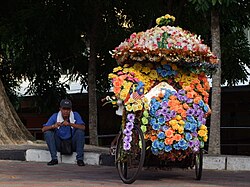 An extensively decorated trishaw in Melaka
 -
 A trishaw and rider at the Raffles Hotel in Singapore
 -
 A Cycle rickshaw puller in Chittagong, Bangladesh
 -
 A becak and its driver wait for a fare in Bandung, Indonesia
 -

-
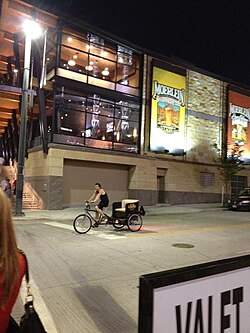 Cycle Rickshaw in downtown Cincinnati, Ohio
 -
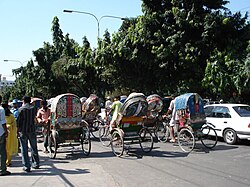 Cycle rickshaws in Dhaka, Bangladesh
 -
 Cycle rickshaw parking in Bangladesh
 -
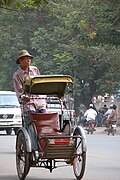 A cycle rickshaw driver in Phnom Penh, Cambodia
 -
 Taiwanese Prohibitory Sign P9: No Pedicabs
.JPG)


.jpg)


See also
- Boda boda (bicycle taxi)
- Party bike
- Tandem bicycle
- Trailer bike
- Utility cycling
- Rickshaw art
- George Bliss (pedicab designer)
Notes
- ↑ In 2010, Ecocab service was introduced by the state governments of Punjab and Haryana upon the orders of the Honorable Punjab and Haryana High Court.[25]
- ↑ Ecocabs were introduced in Amritsar by the Punjab Heritage and Tourism Promotion Board in association with Graduates Welfare Association Fazilka (GWAF) and District Administration in Amritsar. Here in the Ecocabs[27]
- ↑ Named "Ecocabs", it is known locally as "Pushpak Sewa". the first modified light-weight low-floor rickshaw was introduced under the name Nano.[29]
- ↑ In 1994, a wine-club owner named B. McDonald started Pedicabs Ireland with twelve imported pedicab rickshaws. Sponsored pedicabs on the streets of Dublin give free rides to passengers, as the revenue generated from the advertisements on these pedicabs gives a wage to the drivers. Yellow pedicabs are available in Galway.[citation needed]
References
- ↑ 1.0 1.1 1.2 Edgerton, David (2011). The Shock of the Old: Technology and Global History Since 1900. Oxford University Press. p. 46. ISBN 978-0199832613.
- ↑ 2.0 2.1 Keith, Barry (11 January 2010). "Solar Rickshaws Ready for Delhi". Wired Magazine. Retrieved 10 March 2010.
- ↑ "Sustainable Transportation Solution for Auto Rickshaws". Illinois Institute of Technology. 2009. Archived from the original on 8 July 2010. Retrieved 10 March 2010.
- ↑ "The Cycle Rickshaw's Electric Dreams". Indian Express. Retrieved 14 August 2010.
- ↑ 5.0 5.1 5.2 Sobey, Ed (2009). A Field Guide to Automotive Technology. Chicago Review Press. p. 172. ISBN 978-1556528125.
- ↑ Watson, Todd (31 July 2013). "Electric vehicles become popular in the Philippines". Inside Investor. Archived from the original on 9 August 2013. Retrieved 11 August 2013.
- ↑ "Velotaxi", The Free Dictionary, retrieved 8 June 2021
- ↑ "What Is A Pedicab? - Pedicabs & The National Mall". sites.google.com. Retrieved 8 June 2021.
- ↑ Heale, Jay; Zawiah Abdul Latif (2008). Madagascar, Volume 15 of Cultures of the World Cultures of the World - Group 15 (2 ed.). Marshall Cavendish. pp. 75–76. ISBN 978-0761430360.
- ↑ Madagascar Travel Guide (7 ed.). Lonely Planet. 2012. ISBN 978-1743213018. Retrieved 13 April 2013.
- ↑ Ulysses Travel Editorial Staff, Ulysses Travel Guides (2003). Vancouver and Victoria. 4th ed. Hunter Publishing, Inc. ISBN 2894645171.
- ↑ "Pedicabs, City of Vancouver". City of Vancouver. Retrieved 13 April 2013.
- ↑ "Rickshaw owners back in driver's seat: Toronto rickshaws can now charge unlimited fares after a judge said City Hall's price limits were chosen on a "whim."". National Post, CanWest MediaWorks Publications Inc. (posted on Canada.com). May 9, 2007. Archived from the original on May 13, 2013. Retrieved April 13, 2013.
- ↑ "New York City Department of Consumer Affairs - Pedicab Driver License". Nyc.gov. Archived from the original on 9 July 2015. Retrieved 13 October 2017.
- ↑ "Ballard remembers the 1962 World's Fair". Myballard.com. Retrieved 13 October 2017.
- ↑ Lawson, Alastair (5 October 2002). "Dhaka's beleaguered rickshaw wallahs". BBC News.
- ↑ 17.0 17.1 17.2 17.3 Edgerton, David (2011). The Shock of the Old: Technology and Global History Since 1900. Oxford University Press. pp. 46–47. ISBN 978-0199832613.
- ↑ Lawson, Alastair (5 October 2002). "Dhaka's beleaguered rickshaw wallahs". BBC. Retrieved 24 February 2009.
- ↑ RickshawArt.org Website of the social enterprise RickshawArt in Bangladesh. Archived 22 April 2017 at the Wayback Machine Dhaka.
- ↑ 20.0 20.1 China Travel Guide - Tiki Travel. FB Editions. pp. PT61. ISBN 9791021306523.
- ↑ "广州这些区域禁止人力三轮车上道路行驶,6月11日起施行". Baidu. 光明网. Retrieved 13 May 2024.
- ↑ "Electric and improved cycle rickshaw as a sustainable transport system for India" (PDF). Iisc.ernet.in. Archived from the original (PDF) on 8 August 2017. Retrieved 13 October 2017.
- ↑ Good Earth Varanasi City Guide. Eicher Goodearth Limited. 1989. p. 189. ISBN 8187780045.
- ↑ 24.0 24.1 "Ecocabs". Ecocabs.org. Retrieved 13 October 2017.
- ↑ "Ecocab can become viable and eco-friendly means of transport". Expressindia.com. Archived from the original on 15 October 2012. Retrieved 13 October 2017.
- ↑ 26.0 26.1 "With Ecocab, Fazilka shows the way - Indian Express". Indianexpress.com. 26 April 2010. Retrieved 13 October 2017.
- ↑ 27.0 27.1 "The Tribune, Chandigarh, India - Amritsar PLUS". Tribuneindia.com. Retrieved 13 October 2017.
- ↑ "Fazilka: Come Without Your Car – Carbusters". carbusters.org. Retrieved 13 October 2017.
- ↑ "The Tribune, Chandigarh, India - Bathinda Edition". Tribuneindia.com. Retrieved 13 October 2017.
- ↑ "Patiala Green Cabs: Latest News, Photos, Videos on Patiala Green Cabs". NDTV.com. Retrieved 13 October 2017.
- ↑ "Rotaract rickshaws pedal ahead". The Rotarian. Rotary International.: 48 April 1990.
- ↑ "Solar rickshaws to power green city dreams". The Times of India. 24 November 2012. Archived from the original on 9 December 2012. Retrieved 13 April 2013.
- ↑ "Solar rickshaw finds no takers". Deccan Herald. 28 September 2010. Retrieved 13 October 2017.
- ↑ TERI Energy Data Directory & Yearbook (TEDDY) 2010. TERI Press. 2012. p. 403. ISBN 978-8179933930.
- ↑ National Film Board of Canada, Wet Earth and Warm People, 1971
- ↑ "'Becak' drivers challenge authorities over right to work". The Jakarta Post. 6 July 2009. Retrieved 10 July 2010.
- ↑ Amindoni, Ayomi (2018). "Becak di Jakarta dan 'kontrak politik' Gubernur Anies Baswedan". BBC Indonesia (in Bahasa Indonesia). Retrieved 1 April 2018.
- ↑ Ludu Daw Amar (November 1993). ရတနာပုံ မန္တလေး၊ မန္တလေး၊ကျွန်မတို့ မန္တလေး [Yadanabon Mandalay, Mandalay, Kyama do Mandalay] (in မြန်မာဘာသာ). Mandalay: Ludu press & bookshop.
- ↑ ဆူးငှက် (16 December 2019). "ဓာတ်ရထားနှင့် ဆိုက်ကား". News and Periodical Enterprise. Retrieved 15 May 2020.
- ↑ Win, Crystal (21 November 2019). "Myanmar Trishaw". Yangonlife. Archived from the original on 18 February 2019. Retrieved 15 May 2020.
- ↑ "Rickshaws in Nepal | globerove.com". www.kwintessential.co.uk. Retrieved 27 January 2022.
{{cite web}}: CS1 maint: deprecated archival service (link) - ↑ "VirtualTourist.com ceased operations". Virtualtourist.com. Retrieved 13 October 2017.
- ↑ 43.0 43.1 "Lakeland Ledger - Google News Archive Search". News.google.com. Retrieved 13 October 2017.
- ↑ "Startups taking steps toward creative tourism". The Korea Times. 28 January 2014.
- ↑ Xích lô Sài Thành https://thanhnien.vn>Thời sự>Phóng sự/Điều Tra
- ↑ Xe lôi ở Miền Nam Việt Nam - Hình ảnh Việt Nam xưa và nay. https://hinhanhvietnam.com>xe-loi-o-mien-nam-viet-nam
- ↑ Blum-Reid, Sylvie (2003). East-West Encounters: Franco-Asian Cinema and Literature. Wallflower Press. p. 166. ISBN 978-1-903364-67-3.
- ↑ 48.00 48.01 48.02 48.03 48.04 48.05 48.06 48.07 48.08 48.09 "Main Street Pedicab Operators". Main Street Pedicabs. Archived from the original on 5 April 2013. Retrieved 13 April 2013.
- ↑ Olesen, Elizabet (2011). Denmark Travel Adventures. Hunter Publishing, Inc. pp. PT56. ISBN 978-1588437075.
- ↑ "Riksan vuokrausta Helsingissä". Riksavuokraus.fi. Archived from the original on 21 October 2016. Retrieved 13 October 2017.
- ↑ Boye De Mente (2010). Demetra De Ment (ed.). The Bizarre and the Wondrous from the Land of the Rising Sun!. Cultural-Insight Books. pp. 95–96. ISBN 978-1456424756.
- ↑ "Bike taxi". Amsterdam Tourism & Convention Board. Retrieved 13 April 2013.
- ↑ Gruber, Ben (17 October 2011). "Amsterdam rickshaw driver sees the light". Reuters.com (video). Archived from the original on 18 October 2011. Retrieved 9 November 2023. (click on transcript to read)
- ↑ "Velotaxi.no - Velotaxi | Hjem". Archived from the original on 28 August 2015. Retrieved 4 November 2015.
- ↑ "La moda del bicitaxi, el transporte de la gran ciudad - Suite 101". Archived from the original on 18 December 2014. Retrieved 19 April 2014.
- ↑ "New rules to put the brakes on nuisance pedicabs". GOV.UK. 26 March 2024. Retrieved 29 January 2025.
- ↑ Rose, Lesley Anne; Macaroon, Michael; Crow, Vivienne (2012). Frommer's Scotland (12 ed.). John Wiley & Sons. ISBN 978-1119992769.
- ↑ 58.0 58.1 Begum, Sharifa and Binayak Sen (2005). Pulling rickshaws in the city of Dhaka: a way out of poverty? Environment and Urbanization 17(2):11-25.
- ↑ 59.0 59.1 Azuma, Yoshifumi (2003). Urban peasants: beca drivers in Jakarta. Jakarta: Pustaka Sinar Harapan.
- ↑ 60.0 60.1 Gallagher, Rob (1992). The rickshaws of Bangladesh. Dhaka: The University Press Limited.
- ↑ "About - Cycling Without Age". Cyclingwithoutage.org. Retrieved 1 September 2020.
- ↑ Kirkpatrick, Joanna. (2003) Transports of Delight: The Ricksha Arts of Bangladesh. Indiana University Press. Multimedia CDROM.