



m Bot: Delinking broken file(s) using script (info) |
adjusted details additionally and corrected details |
||
| Line 1: | Line 1: | ||
{{short description|Indian dynasty that ruled Gujarat from | {{short description|Indian dynasty that ruled Gujarat from 940 to 1244}} | ||
{{distinguish|Chalukya dynasty}} | {{distinguish|Chalukya dynasty}} | ||
{{Pp|small=yes}} | |||
{{Use dmy dates}} | {{Use dmy dates|date=December 2015}} | ||
{{Use Indian English}} | {{Use Indian English|date=December 2015}} | ||
{{Infobox country | {{Infobox country | ||
| conventional_long_name = Chaulukyas of Gujarat<br>(Solankis) | | conventional_long_name = Chaulukyas of Gujarat<br>(Solankis) | ||
| Line 9: | Line 9: | ||
| government_type = Monarchy | | government_type = Monarchy | ||
| image_map = Map of the Chaulukyas.png | | image_map = Map of the Chaulukyas.png | ||
| map_caption = Map of the Chaulukyas circa 1150 CE | | map_caption = Map of the Chaulukyas circa 1150 CE{{sfn|Schwartzberg|1978|loc=p. 147, map XIV.3 (c)}} | ||
| year_start = | | year_start = {{circa|940}} CE | ||
| year_end = 1244 CE | | year_end = 1244 CE | ||
| p1 = Chavda dynasty | | p1 = Chavda dynasty | ||
| p2 = Chalukyas of Lata | | p2 = Chalukyas of Lata | ||
| s1 = Vaghela dynasty | | s1 = Vaghela dynasty | ||
| s2 = Cutch State | | s2 = Cutch State | ||
| capital = [[Anahilavada]] (modern [[Patan, Gujarat|Patan]]) | | capital = [[Anahilavada]] (modern [[Patan, Gujarat|Patan]]) | ||
| religion = [[ | | religion = [[Jainism]]<br>[[Hinduism]] | ||
| today = [[India]] | | today = [[India]] | ||
| demonym = | | demonym = | ||
| Line 29: | Line 26: | ||
| HDI = | | HDI = | ||
| HDI_year = | | HDI_year = | ||
| image_coat | | image_coat = Chaulukya-Paramara coin circa AD 950-1050.jpg | ||
| coa_size | | coa_size = 280px | ||
| symbol_type | | symbol_type = A Chaulukya-[[Paramara dynasty|Paramara]] coin, circa 950–1050 CE. Stylized rendition of [[Chavda dynasty]] coins: [[Indo-Sasanian coinage|Indo-Sassanian style]] bust right; pellets and ornaments around / Stylised fire altar; pellets around.<ref>[https://www.cngcoins.com/Coin.aspx?CoinID=261205 Post-Gupta (Chaulukya-Paramara) coin], Classical Numismatic Group.</ref> | ||
}} | }} | ||
''' | The '''Chaulukya dynasty''' ({{IAST3|Caulukya}}), also '''Solanki dynasty''', was a dynasty that ruled parts of what are now [[Gujarat]] and [[Rajasthan]] in north-western India, between {{circa|940 CE}} and {{circa|1244 CE|lk=no}}. Their capital was located at [[Anahilavada]] (modern Patan). At times, their rule extended to the [[Malwa]] region in present-day [[Madhya Pradesh]]. The family is also known as the "Solanki dynasty" in the vernacular literature. They belonged to the [[Solanki (clan)|Solanki]] clan of [[Rajput]]s.<ref>{{Cite book|author=Hermann Kulke|author-link=Hermann Kulke|url=https://books.google.com/books?id=TPVq3ykHyH4C|title=A History of India|date=2004|publisher=Psychology Press|isbn=978-0-415-32919-4|language=en|page=117|quote="When Gurjara Pratiharas power declined after the sacking of Kannauj by the Rashtrakutkas in the early tenth century many Rajput princes declared their independence and founded their own kingdoms, some of which grew to importance in the subsequent two centuries. The better known among these dynasties were the Chaulukyas or Solankis of Kathiawar and Gujarat, the Chahamanas (i.e. Chauhan) of eastern Rajasthan (Ajmer and Jodhpur), and the Tomaras who had founded Delhi (Dhillika) in 736 but had then been displaced by the Chauhans in the twelfth century."}}</ref><ref>{{Cite book|author=Brajadulal Chattopadhyaya | ||
|url=https://books.google.com/books?id=21SgAAAAMAAJ|title=Studying Early India: Archaeology, Texts and Historical Issues|publisher=Anthem|isbn=978-1-84331-132-4|language=en|page=116|quote=The period between the seventh and the twelfth century witnessed gradual rise of a number of new royal-lineages in Rajasthan, Gujarat, Madhya Pradesh and Uttar Pradesh, which came to constitute a social-political category known as 'Rajput'. Some of the major lineages were the Pratiharas of Rajasthan, Uttar Pradesh and adjacent areas, the Guhilas and Chahamanas of Rajasthan, the Caulukyas or Solankis of Gujarat and Rajasthan and the Paramaras of Madhya Pradesh and Rajasthan.}}</ref><ref>{{Cite book|author=David Ludden|url=https://books.google.com/books?id=pBq9DwAAQBAJ&pg=PT79|title=India and South Asia: A Short History|publisher=Simon and Schuster|pages=88–89|quote="By contrast in Rajasthan a single warrior group evolved called Rajput (from Rajaputra-sons of kings): they rarely engaged in farming, even to supervise farm labour as farming was literally beneath them, farming was for their peasant subjects. In the ninth century separate clans of Rajputs Cahamanas (Chauhans), Paramaras (Pawars), Guhilas (Sisodias) and Caulukyas were splitting off from sprawling Gurjara Pratihara clans..."|isbn=978-1-78074-108-6|language=en}}</ref> | |url=https://books.google.com/books?id=21SgAAAAMAAJ|title=Studying Early India: Archaeology, Texts and Historical Issues|date=2006|publisher=Anthem|isbn=978-1-84331-132-4|language=en|page=116|quote=The period between the seventh and the twelfth century witnessed gradual rise of a number of new royal-lineages in Rajasthan, Gujarat, Madhya Pradesh and Uttar Pradesh, which came to constitute a social-political category known as 'Rajput'. Some of the major lineages were the Pratiharas of Rajasthan, Uttar Pradesh and adjacent areas, the Guhilas and Chahamanas of Rajasthan, the Caulukyas or Solankis of Gujarat and Rajasthan and the Paramaras of Madhya Pradesh and Rajasthan.}}</ref><ref>{{Cite book|author=David Ludden|url=https://books.google.com/books?id=pBq9DwAAQBAJ&pg=PT79|title=India and South Asia: A Short History|date=2013|publisher=Simon and Schuster|pages=88–89|quote="By contrast in Rajasthan a single warrior group evolved called Rajput (from Rajaputra-sons of kings): they rarely engaged in farming, even to supervise farm labour as farming was literally beneath them, farming was for their peasant subjects. In the ninth century separate clans of Rajputs Cahamanas (Chauhans), Paramaras (Pawars), Guhilas (Sisodias) and Caulukyas were splitting off from sprawling Gurjara Pratihara clans..."|isbn=978-1-78074-108-6|language=en}}</ref> | ||
[[Mularaja]], the founder of the dynasty, supplanted the last ruler of the [[Chavda dynasty]] around 940 CE. His successors fought several battles with the neighbouring rulers such as the [[Chudasama | [[Mularaja]], the founder of the dynasty, supplanted the last ruler of the [[Chavda dynasty]] around 940 CE. His successors fought several battles with the neighbouring rulers such as the [[Chudasama dynasty|Chudasamas]], the [[Paramara dynasty|Paramara]]s and the [[Chahamanas of Shakambhari]]. During the reign of [[Bhima I|Bhima I]], the [[Ghaznavid]] ruler [[Mahmud of Ghazni|Mahmud]] invaded the kingdom and raided the [[Somnath temple]] during 1024–1025 CE. The Chaulukyas soon recovered, and the kingdom reached its zenith under the rule of [[Jayasimha Siddharaja]] and [[Kumarapala (Chaulukya dynasty)|Kumarapala]] in the 12th century. Several minor dynasties, such as the [[Chahamanas of Jalor]] and the [[Chahamanas of Naddula]], served as Chaulukya vassals during this period. After Kumarapala's death, the kingdom was gradually weakened by internal rebellions; uprisings by feudatories; and invasions by the [[Paramara dynasty|Paramara]]s, the [[Ghurid]]s, the [[Yadavas of Devagiri|Yadavas]] and others. Taking advantage of this, the [[Vaghela dynasty|Vaghelas]], who had earlier served as Chaulukya generals, usurped the power and established a new dynasty in the 1240s. | ||
Several [[princely state]] rulers of the [[Solanki (clan)|Solanki clan]] claimed descent from the Chaulukyas. | Several [[princely state]] rulers of the [[Solanki (clan)|Solanki clan]] claimed descent from the Chaulukyas. | ||
| Line 54: | Line 51: | ||
==Origins== | ==Origins== | ||
<mapframe text="[[Find spot]]s of inscriptions issued during the Chaulukya rule | <mapframe text="[[Find spot]]s of inscriptions issued during the Chaulukya rule{{sfn|Asoke Kumar Majumdar|1956|pp=498-502}}" width="300" height="300" zoom="5" longitude="75.13" latitude="23.64"> | ||
{ | { | ||
"type": "FeatureCollection", | "type": "FeatureCollection", | ||
| Line 215: | Line 212: | ||
{ | { | ||
"type": "Feature", | "type": "Feature", | ||
"properties": { "marker-symbol": "monument", "marker-size": "small", "title": "[[Prabhas Patan|Somnath]]", "description": "Also known as | "properties": { "marker-symbol": "monument", "marker-size": "small", "title": "[[Prabhas Patan|Somnath]]", "description": "Also known as Somanatha or Devapattana" }, | ||
"geometry": { "type": "Point", "coordinates": [70.3843721, 20.9060022] } | "geometry": { "type": "Point", "coordinates": [70.3843721, 20.9060022] } | ||
}, | }, | ||
| Line 271: | Line 268: | ||
} | } | ||
</mapframe> | </mapframe> | ||
The word "Chaulukya" is thought to be a variant of the word "[[Chalukya (disambiguation)|Chalukya]]". Several other dynasties were known by the name "Chalukya", including the Chalukyas of [[Chalukyas of Vatapi|Vatapi]], [[Chalukyas of Navasarika|Navasarika]], [[Chalukyas of Vemulavada|Vemulavada]], [[Chalukyas of Kalyani|Kalyani]], [[Chalukyas of Vengi|Vengi]] and [[Chalukyas of Lata|Lata]]. These dynasties are sometimes thought to be branches of the same family, but the relationship between all of them is not certain. Unlike the Chalukyas of Kalyani and Vengi, the Chaulukyas of Gujarat never claimed a shared descent or any other association with the earliest Chalukya | The word "Chaulukya" is thought to be a variant of the word "[[Chalukya (disambiguation)|Chalukya]]". Several other dynasties were known by the name "Chalukya", including the Chalukyas of [[Chalukyas of Vatapi|Vatapi]], [[Chalukyas of Navasarika|Navasarika]], [[Chalukyas of Vemulavada|Vemulavada]], [[Chalukyas of Kalyani|Kalyani]], [[Chalukyas of Vengi|Vengi]] and [[Chalukyas of Lata|Lata]]. These dynasties are sometimes thought to be branches of the same family, but the relationship between all of them is not certain. Unlike the Chalukyas of Kalyani and Vengi, the Chaulukyas of Gujarat never claimed a shared descent or any other association with the earliest Chalukya dynasty—the Chalukyas of Vatapi. Moreover, they never used the term "Chalukya" to describe themselves.{{sfn|Asoke Kumar Majumdar|1956|p=5}} | ||
[[ | However, the Chaulukyas of Gujarat shared a myth of origin with the Chalukyas of Kalyani and Vengi. According to this legend, the progenitor of the dynasty was created by [[Brahma]].{{sfn|Asoke Kumar Majumdar|1956|p=5}} The version of the legend mentioned in the [[Vadnagar]] ''[[prashasti]]'' inscription of [[Kumarapala (Chaulukya dynasty)|Kumarapala]] is as follows: the [[deva (Hinduism)|deities]] once asked the creator god [[Brahma]] to protect them from the [[Danava (Hinduism)|danavas]] (demons). Brahma then created a hero from his ''chuluka'' (pot or folded palm in [[Sanskrit]]), which was filled with [[Ganges]] water. This hero was named "Chulukya", and became the progenitor of the dynasty. A variation of this legend is mentioned by Abhayatilaka Gani in his commentary on [[Hemachandra]]'s ''Dvyashraya-Kavya''. According to this version, Brahma produced the hero to support the earth, after his other creations disappointed him. These stories are of no historical value, as it was customary for contemporary royal houses to claim mythical and heroic origins. The ''Kumarapala-Bhupala-Charita'' of Jayasimha Suri presents Chulukya as a historical warrior, whose capital was Madhupadma. Mularaja was his descendant, with nearly a hundred generations separating the two.{{sfn|Asoke Kumar Majumdar|1956|pp=6-7}} This account may be partly historical: Madhupadma has been identified variously as a location outside Gujarat, including present-day [[Mathura]].{{sfn|Asoke Kumar Majumdar|1956|p=22}} | ||
[[ | |||
[[C. V. Vaidya]] theorized that the Chaulukyas were different from the Chalukyas. [[G. H. Ojha]] opposed this theory, pointing out that an inscription of the Lata Chalukya ruler Kirtiraja describes his family as "Chalukya", while an inscription of his grandson Trilochanapala describes the family as "Chaulukya".{{sfn|Jai Narayan Asopa|1976|p=43}} According to Asoke Majumdar, while these similar-sounding names suggest a common origin for all these dynasties, there is no concrete evidence to draw any definitive conclusion.{{sfn|Asoke Kumar Majumdar|1956|p=5}} Majumdar theorized that the Chaulukyas were connected to the Sulikas or the Chulikas, a tribe mentioned in several ancient records. This tribe is described as living on the northern frontier of ancient India. However, Majumdar admitted that there is not enough evidence to regard this theory as conclusive.{{sfn|Asoke Kumar Majumdar|1956|p=13-17}} According to the [[Agnikula]] myth mentioned in a 16th-century recension of the legendary epic poem ''[[Prithviraj Raso]]'', four Rajput clans including the Chaulukyas were born from a fire-pit on [[Mount Abu]]. A section of [[British India|colonial-era]] historians interpreted this mythical account to suggest that these clans were foreigners who came to India after the decline of the [[Gupta Empire]] around the 5th century CE, and were admitted in the [[Hindu caste system]] after performing a fire ritual.{{sfn|Ganga Prasad Yadava|1982|p=35}}{{sfn|N. Jayapalan|2001|p=146}} | |||
The Chaulukya rulers have been called "''Gurjararāja''" and "''Gurjareśvara''" ("ruler of Gurjara").{{sfn|Shanta Rani Sharma|2012|pp=7-8}} Based on this legend, [[D. R. Bhandarkar]] and others theorized that the Chaulukyas were a branch of [[Gurjars|Gurjaras]], whom they believed to be a tribe of foreign origin.{{sfn|Asoke Kumar Majumdar|1956|p=8}} Bhandarkar and [[Augustus Hoernle]] also believed that the name of the "[[Lata (region)|Lata]]" region changed to "Gurjaratra" (later Gujarat) during the Chaulukya reign, presumably because they were Gurjaras.{{sfn|Durga Prasad Dikshit|1980|p=21}} | The Chaulukya rulers have been called "''Gurjararāja''" and "''Gurjareśvara''" ("ruler of Gurjara").{{sfn|Shanta Rani Sharma|2012|pp=7-8}} Based on this legend, [[D. R. Bhandarkar]] and others theorized that the Chaulukyas were a branch of [[Gurjars|Gurjaras]], whom they believed to be a tribe of foreign origin.{{sfn|Asoke Kumar Majumdar|1956|p=8}} Bhandarkar and [[Augustus Hoernle]] also believed that the name of the "[[Lata (region)|Lata]]" region changed to "Gurjaratra" (later Gujarat) during the Chaulukya reign, presumably because they were Gurjaras.{{sfn|Durga Prasad Dikshit|1980|p=21}} | ||
However, this foreign-origin theory is weakened by a number of factors. The Chaulukyas did not claim an Agnikula origin for themselves:{{sfn|Asoke Kumar Majumdar|1956|p=8-9}} it was the neighbouring [[Paramara]] rulers who used the legend to explain their own origin.{{sfn|Dasharatha Sharma|1959|p=4}} The inscriptions from the reign of [[Bhima II]] prove that the Chaulukyas knew about the Agnikula legend, but associated it with the Paramaras, not themselves.{{sfn|Asoke Kumar Majumdar|1956|p=9}} The earliest copies of ''Prithviraj Raso'' do not mention this legend either.{{sfn|Asoke Kumar Majumdar|1956|p=9}} The legend that includes the Chaulukyas among the fire-born clans is first mentioned by the 16th century poets, who may have extended the Paramara legend to include other dynasties, in order to foster Rajput unity against the [[Mughal Empire|Mughals]].{{sfn|R. B. Singh|1964|pp=17-18}} Moreover, there is no evidence that the Chaulukya territory area came to be known as "Gurjaratra" during the Chaulukya reign.{{sfn|Durga Prasad Dikshit|1980|p=21}} "[[Gurjara]]" and "Lata" were two distinct historical regions in northern and southern parts of present-day Gujarat respectively, and the term "Lata" was never used to describe the whole of Gujarat.{{sfn|Asoke Kumar Majumdar|1956|p=12}} The Chaulukya kings were called "''Gurjararāja''" and "''Gurjareśvara''" because they ruled the territory which was already called Gurjara by their time.{{sfn|Shanta Rani Sharma|2012|pp=7-8}}{{sfn|Asoke Kumar Majumdar|1956|p=13}} Several other kings who held similar epithets had earlier ruled this territory: these include the [[Gurjara-Pratiharas]] and the [[Gurjaras of Nandipuri]].{{sfn|Asoke Kumar Majumdar|1956|pp=10-12}} Historian Asoke Kumar Majumdar points out that even the southern [[Western Ganga dynasty|Ganga]] chief | However, this foreign-origin theory is weakened by a number of factors. The Chaulukyas did not claim an Agnikula origin for themselves:{{sfn|Asoke Kumar Majumdar|1956|p=8-9}} it was the neighbouring [[Paramara dynasty|Paramara]] rulers who used the legend to explain their own origin.{{sfn|Dasharatha Sharma|1959|p=4}} The inscriptions from the reign of [[Bhima II]] prove that the Chaulukyas knew about the Agnikula legend, but associated it with the Paramaras, not themselves.{{sfn|Asoke Kumar Majumdar|1956|p=9}} The earliest copies of ''Prithviraj Raso'' do not mention this legend either.{{sfn|Asoke Kumar Majumdar|1956|p=9}} The legend that includes the Chaulukyas among the fire-born clans is first mentioned by the 16th century poets, who may have extended the Paramara legend to include other dynasties, in order to foster Rajput unity against the [[Mughal Empire|Mughals]].{{sfn|R. B. Singh|1964|pp=17-18}} Moreover, there is no evidence that the Chaulukya territory area came to be known as "Gurjaratra" during the Chaulukya reign.{{sfn|Durga Prasad Dikshit|1980|p=21}} "[[Gurjaradesa|Gurjara]]" and "Lata" were two distinct historical regions in northern and southern parts of present-day Gujarat respectively, and the term "Lata" was never used to describe the whole of Gujarat.{{sfn|Asoke Kumar Majumdar|1956|p=12}} The Chaulukya kings were called "''Gurjararāja''" and "''Gurjareśvara''" because they ruled the territory which was already called Gurjara by their time.{{sfn|Shanta Rani Sharma|2012|pp=7-8}}{{sfn|Asoke Kumar Majumdar|1956|p=13}} Several other kings who held similar epithets had earlier ruled this territory: these include the [[Gurjara-Pratiharas]] and the [[Gurjaras of Nandipuri]].{{sfn|Asoke Kumar Majumdar|1956|pp=10-12}} Historian Asoke Kumar Majumdar points out that even the southern [[Western Ganga dynasty|Ganga]] chief Marasimha II assumed the title "king of Gurjaras" after defeating a northern king on behalf of the [[Rashtrakuta]]s.{{sfn|Asoke Kumar Majumdar|1956|p=13}} | ||
== History == | == History == | ||
=== Early rulers === | === Early rulers === | ||
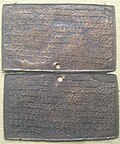
[[File:Copper plates NMND-3c.JPG|thumb|A 1010 CE copper-plate inscription from the reign of Durlabharaja]] | |||
The Chaulukyas were one of the several dynasties that rose to power amid the decline of the [[Gurjara-Pratihara]] and the [[Rashtrakuta]] empires.{{sfn|Asoke Kumar Majumdar|1956|pp=1-4}} In the mid-tenth century CE, the dynasty’s founder [[Mularaja]] supplanted Samantasimha, the last [[Chavda dynasty|Chavda]] king.{{sfn|John E. Cort|1998|p=87}} According to legends, he was a nephew of Samantasimha.{{sfn|Asoke Kumar Majumdar|1956|pp=23-24}} According to the 12th century chronicler [[Hemachandra]], Mularaja defeated [[Graharipu]], the king of [[Saurashtra (region)|Saurashtra]].{{sfn|Asoke Kumar Majumdar|1956|p=25}} He also defeated the [[Chalukyas of Lata|Lata Chalukya]] chief Barapa, aided by his son [[Chamundaraja (Chaulukya dynasty)|Chamundaraja]].{{sfn|Asoke Kumar Majumdar|1956|p=34}} | |||
Chamundaraja succeeded Mularaja around 996 CE. During his reign, the [[Paramara dynasty|Paramara]] king [[Sindhuraja]] appears to have invaded the [[Lata (region)|Lata region]], which was under Chaulukya suzerainty. Mularaja forced Sindhuraja to retreat; the 14th century chronicler Jayasimha Suri claims that Chamundaraja killed Sindhuraja in a battle, but this claim appears to be doubtful, as it does not appear in any earlier source.{{sfn|Asoke Kumar Majumdar|1956|pp=34-35}} Sometime before 1007 CE, the Lata region was captured by the [[Chalukyas of Kalyani]] led by [[Satyashraya]].{{sfn|Asoke Kumar Majumdar|1956|p=35}} | |||
Around 1008 CE, Chamundaraja retired after appointing his son [[Vallabharaja]] as the next king. Legendary accounts state that he set out for a pilgrimage to [[Varanasi]]. During this journey, he was insulted by a ruler whose kingdom lay on the way to Varanasi. He returned to the Chaulukya capital, and asked his son to avenge his insult. Vallabharaja died of [[smallpox]] during a march to the enemy kingdom, which is identified as the [[Paramara dynasty|Paramara]] kingdom of [[Malwa]] by some chroniclers.{{sfn|Asoke Kumar Majumdar|1956|pp=36-39}} | |||
Chamundaraja’s other son [[Durlabharaja (Chaulukya dynasty)|Durlabharaja]] became the next king in c. 1008 CE. He invaded the Lata region, and defeated the Lata Chalukya ruler Kirtiraja (or Kirtipala), who was a vassal of the Kalyani Chalukyas. However, Kirtiraja regained control of the region within a short time, before being defeated by the Paramara king [[Bhoja]].{{sfn|Krishna Narain Seth|1978|pp=136-137}} | |||
=== Neighbouring rivalries === | === Neighbouring rivalries === | ||
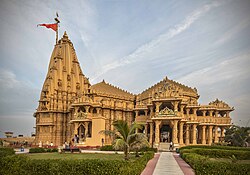
[[File:Somanath Temple.jpg|thumb|left|upright=1.5|The [[Somnath temple]] today]] | |||
Durlabharaja was succeeded by his nephew [[Bhima I|Bhima I]], who faced an invasion from the [[Ghaznavid]] ruler [[Mahmud of Ghazni|Mahmud]] during 1024–1025 CE. Bhima fled to [[Kanthkot]], as Mahmud entered the Chaulukya territory unopposed and [[Sack of Somnath|sacked the Somnath temple]].{{sfn|Asoke Kumar Majumdar|1956|pp=43-45}} After Mahmud’s departure, Bhima restored the Chaulukya rule. He crushed revolts by the [[Paramaras of Chandravati|Paramara chiefs of Arbuda]], who used to serve as Chaulukya vassals.{{sfn|Asoke Kumar Majumdar|1956|pp=49-50}} Bhima also defeated and imprisoned Krishnadeva, a ruler of the Paramara branch of [[Bhinmal]]. He unsuccessfully fought against the [[Chahamanas of Naddula|Naddula Chahamana]] ruler [[Anahilla]]. Anahilla’s sons [[Balaprasada]] and [[Jendraraja]] defeated Bhima and forced him to release Krishnadeva.{{sfn|Asoke Kumar Majumdar|1956|pp=50-51}} Later legendary accounts credit Bhima with a victory against Hammuka, a ruler of [[Sindh]], although the accuracy of this claim is not certain.{{sfn|Asoke Kumar Majumdar|1956|pp=48-49}} | |||
Durlabharaja was succeeded by his nephew [[Bhima I]], who faced an invasion from the [[Ghaznavid]] ruler [[Mahmud of Ghazni|Mahmud]] during | Semi-legendary accounts suggest that Bhima formed an alliance with the [[Kalachuris of Tripuri|Kalachuri]] king [[Lakshmikarna|Lakshmi-Karna]], and the two played an important role in the downfall of the [[Paramara dynasty|Paramara]] king [[Bhoja]] around 1055 CE. According to the 14th century chronicler Merutunga, Bhima and Lakshmi-Karna invaded Bhoja’s kingdom of [[Malwa]] from two opposite directions, and Bhoja died of a disease during this invasion.{{sfn|Asoke Kumar Majumdar|1956|pp=52-53}} Some Chaulukya chroniclers boast that Bhima annexed Bhoja’s capital [[Dhara (city)|Dhara]] or that he captured Bhoja alive, but these claims are not corroborated by historical evidence.{{sfn|Krishna Narain Seth|1978|p=184}} After Bhoja’s death, a rivalry developed between the Bhima and Lakshmi-Karna over sharing the spoils of their victory.{{sfn|Asoke Kumar Majumdar|1956|p=54-55}} | ||
Bhima’s son [[Karna (Chaulukya dynasty)|Karna]] succeeded him around 1064 CE. Bhoja’s brother [[Udayaditya]], supported by the [[Chahamanas of Shakambhari|Shakambhari Chahamana]] king [[Vigraharaja III]], forced Karna to retreat from Malwa.{{sfn|R. B. Singh|1964|p=127}}{{sfn|Asoke Kumar Majumdar|1956|pp=57-58}} Meanwhile, the Kalachuris managed to capture the [[Lata (region)|Lata region]]. By 1074 CE, Karna evicted the Kalachuris from Lata, and annexed the region to the Chaulukya kingdom, before losing it to one Trivikramapala within three years.{{sfn|Asoke Kumar Majumdar|1956|pp=59-60}} | |||
Semi-legendary accounts suggest that Bhima formed an alliance with the [[Kalachuris of Tripuri|Kalachuri]] king [[Lakshmikarna|Lakshmi-Karna]], and the two played an important role in the downfall of the [[Paramara]] king [[Bhoja]] around 1055 CE. According to the 14th century chronicler Merutunga, Bhima and Lakshmi-Karna invaded | |||
The Naddula Chahamana ruler [[Prithvipala]] defeated Karna, and his successor [[Jojalladeva]] occupied the Chaulukya capital [[Anahilapataka]], possibly when Karna was busy at another place.{{sfn|Asoke Kumar Majumdar|1956|p=60}} The Shakambhari Chahamana king [[Durlabharaja III]] also appears to have achieved some military success against Karna, although the Chahamana descriptions of this victory are highly exaggerated.{{sfn|R. B. Singh|1964|p=125}} According to legendary chronicles, Karna also defeated [[Bhil people|Bhil]] and [[Koli people|Koli]] tribals, who used to raid the Chaulukya territories. He established a city called Karnavati after defeating a Bhil chief named Asha (Āśā). Karnavati is identified with modern [[Ahmedabad]] by some, but this is not certain.{{sfn|Tommaso Bobbio|2015|p=164}} | The Naddula Chahamana ruler [[Prithvipala]] defeated Karna, and his successor [[Jojalladeva]] occupied the Chaulukya capital [[Anahilapataka]], possibly when Karna was busy at another place.{{sfn|Asoke Kumar Majumdar|1956|p=60}} The Shakambhari Chahamana king [[Durlabharaja III]] also appears to have achieved some military success against Karna, although the Chahamana descriptions of this victory are highly exaggerated.{{sfn|R. B. Singh|1964|p=125}} According to legendary chronicles, Karna also defeated [[Bhil people|Bhil]] and [[Koli people|Koli]] tribals, who used to raid the Chaulukya territories. He established a city called Karnavati after defeating a Bhil chief named Asha (Āśā). Karnavati is identified with modern [[Ahmedabad]] by some, but this is not certain.{{sfn|Tommaso Bobbio|2015|p=164}} | ||
=== Imperial expansion === | === Imperial expansion === | ||
Karna’s son [[Jayasimha Siddharaja]] (r. c. 1092–1142 CE) greatly expanded the Chaulukya power. He defeated Khangara alias Navaghana, the [[Chudasama dynasty|Chudasama]] king of [[Saurashtra (region)|Saurashtra]].{{sfn|Asoke Kumar Majumdar|1956|p=69}} The [[Chahamanas of Naddula|Naddula Chahamana]] ruler [[Asharaja]], who had been dethroned by his rival [[Ratnapala (Chahamana dynasty)|Ratnapala]], became a vassal of Jayasimha sometime before 1143 CE.{{sfn|Asoke Kumar Majumdar|1956|p=70}} | |||
Jayasimha defeated the [[Chahamanas of Shakambhari|Shakambhari Chahamana]] ruler [[Arnoraja]].{{sfn|Dasharatha Sharma|1959|p=47}} Later, however, Jayasimha accepted Arnoraja as an ally, and the Chahamana ruler married Jayasimha’s daughter Kanchanadevi.{{sfn|Asoke Kumar Majumdar|1956|p=71}} The couple’s son (and thus Jayasimha’s grandson) [[Someshvara (Chahamana dynasty)|Someshvara]], was brought up at the Chaulukya court.{{sfn|R. B. Singh|1964|p=156}} Someshvara’s sons [[Prithviraja III]] (better known as Prithviraj Chauhan) and [[Hariraja]] were also born in Gujarat.{{sfn|Dasharatha Sharma|1959|p=69}} | |||
During 1135–1136 CE, Jayasimha annexed the [[Paramara dynasty|Paramara]] kingdom of [[Malwa]], with support from Asharaja and Arnoraja. The Paramara kings defeated by him were [[Naravarman]] and his successor [[Yashovarman (Paramara dynasty)|Yashovarman]].{{sfn|Asoke Kumar Majumdar|1956|pp=74-75}} Jayasimha continued his eastward march, and reached as far as the [[Chandela]] kingdom ruled by [[Madanavarman]]. The Chaulukya-Chandela conflict was inconclusive, with both the sides claiming victory.{{sfn|R. K. Dikshit|1976|p=133}} Jayasimha also defeated several minor rulers, including Sindhuraja, who was probably a [[Soomra dynasty|Soomra]] king of [[Sindh]].{{sfn|Asoke Kumar Majumdar|1956|pp=80-81}} | |||
Jayasimha defeated the [[Chahamanas of Shakambhari|Shakambhari Chahamana]] ruler [[Arnoraja]].{{sfn|Dasharatha Sharma|1959|p=47}} Later, however, Jayasimha accepted Arnoraja as an ally, and the Chahamana ruler married | |||
During | |||
[[File:Guarajat o rajastan, periodo solanki, jain svetambara tirthankara in meditazione, su un trono-cushino, 1000-1050 ca..JPG|thumb|left|Jain Shvetambara Tirthankara in Meditation, Chaulukya period now in Metropolitan Museum of Art, {{circa|1000|1050}}]] | [[File:Guarajat o rajastan, periodo solanki, jain svetambara tirthankara in meditazione, su un trono-cushino, 1000-1050 ca..JPG|thumb|left|Jain Shvetambara Tirthankara in Meditation, Chaulukya period now in Metropolitan Museum of Art, {{circa|1000|1050}}]] | ||
Jayasimha was succeeded by his relative [[Kumarapala (Chaulukya dynasty)|Kumarapala]], who spent his early life in exile to avoid persecution by Jayasimha.{{sfn|Asoke Kumar Majumdar|1956|p=92}} After | Jayasimha was succeeded by his relative [[Kumarapala (Chaulukya dynasty)|Kumarapala]], who spent his early life in exile to avoid persecution by Jayasimha.{{sfn|Asoke Kumar Majumdar|1956|p=92}} After Jayasimha’s death, Kumarapala came back to the Chaulukya capital and ascended the throne in 1043 CE, with help of his brother-in-law Kanhadadeva.{{sfn|Asoke Kumar Majumdar|1956|pp=99-103}} Arnoraja opposed Kumarapala’s ascension to the throne, but Kumarapala defeated him decisively.{{sfn|Asoke Kumar Majumdar|1956|pp=106-108}} Kumarapala seems to have helped Asharaja’s son [[Katukaraja]] capture the throne of Naddula.{{sfn|R. B. Singh|1964|p=253}} Katukaraja’s younger brother and successor [[Alhanadeva]] continued to rule as Kumarapala’s vassal.{{sfn|R. B. Singh|1964|p=254}} Arnoraja’s son [[Vigraharaja IV]] subdued Kumarapala’s Chahamana feudatories at Naddula.{{sfn|R. B. Singh|1964|p=149}} The Shakambhari Chahamana-Chaulukya relations seem to have become more cordial when Arnoraja’s son (and Jayasimha’s grandson) Someshvara became the Chahamana king in later years, possibly with support from Kumarapala.{{sfn|Asoke Kumar Majumdar|1956|p=109}} | ||
After Jayasimha’s death, the Paramara king [[Jayavarman I (Paramara dynasty)|Jayavarman I]] regained control of Malwa, but he was soon dethroned by an usurper named Ballala. Kumarapala captured Malwa from Ballala, who was killed by Kumarapala’s [[Paramaras of Chandravati|Arbuda Paramara]] feudatory Yashodhavala in a battle.{{sfn|Asoke Kumar Majumdar|1956|p=112}} Kumarapala subdued a rebellion by his vassal Vikramasimha, a Paramara chief of Arbuda.{{sfn|Asoke Kumar Majumdar|1956|pp=109-110}} The Paramara branch at [[Kiradu]] continued to acknowledge Kumarapala’s suzerainty.{{sfn|Asoke Kumar Majumdar|1956|p=111}} | |||
After | In the early 1160s, Kumarapala sent an army against [[Mallikarjuna (Shilahara dynasty)|Mallikarjuna]], the [[Shilahara]] king of northern [[Konkana]]. This campaign was probably triggered by a Shilahara raid in southern Gujarat, and ended with Mallikarjuna’s death.{{sfn|Asoke Kumar Majumdar|1956|p=113-114}} Kumarapala’s Naddula Chahamana feudatory Alhana put down disturbances in Saurashtra at Kumarapala’s request.{{sfn|Asoke Kumar Majumdar|1956|p=116}} | ||
Historical evidence suggests that Kumarapala’s empire extended from [[Chittor]] and [[Jaisalmer]] in the north to the [[Vindhya]]s and the [[Tapti river|Tapti]] river in the south (ignoring his raid of the [[Shilahara]] kingdom of northern [[Konkana]]). In the west, it included [[Kutch district|Kachchha]] and [[Saurashtra (region)|Saurashtra]]; in the east, it extended up to at least [[Vidisha]] (Bhilsa).{{sfn|Asoke Kumar Majumdar|1956|p=119}} | |||
In the early 1160s, Kumarapala sent an army against [[Mallikarjuna (Shilahara dynasty)|Mallikarjuna]], the [[Shilahara]] king of northern [[Konkana]]. This campaign was probably triggered by a Shilahara raid in southern Gujarat, and ended with | Kumarapala was succeeded by [[Ajayapala (Chaulukya dynasty)|Ajayapala]], who retained Kumarapala’s territories, but died after a short reign.{{sfn|Asoke Kumar Majumdar|1956|pp=130-131}} Ajayapala’s young sons [[Mularaja II]] and [[Bhima II]] succeeded him one after other. During this period, the [[Ghurid]] king [[Muhammad of Ghor]] invaded the Chaulukya kingdom in 1178 CE. In the ensuing battle at Kasahrada (or Kayadara), Muhammad [[Battle of Kasahrada|was defeated]] by a large army, which included loyal Chaulukya feudatories such as the [[Chahamanas of Naddula|Naddula Chahamana]] ruler [[Kelhanadeva]], the [[Chahamanas of Jalor|Jalor Chahamana]] ruler [[Kirtipala]], and the Arbuda Paramara ruler Dharavarsha.{{sfn|Dasharatha Sharma|1959|p=138}}{{sfn|R. B. Singh|1964|p=259}} | ||
Historical evidence suggests that | |||
Kumarapala was succeeded by [[Ajayapala (Chaulukya dynasty)|Ajayapala]], who retained | |||
=== Decline === | === Decline === | ||
{{South Asia in 1175|right|{{center|The Chaulukyas and main South Asian polities in 1175, on the eve of the [[Ghurid Empire]] invasion of the subcontinent | {{See also|Battle of Kasahrada (1197)}} | ||
{{South Asia in 1175|right|{{center|The Chaulukyas and main South Asian polities in 1175, on the eve of the [[Ghurid Empire]] invasion of the subcontinent{{sfn|Schwartzberg|1978|pp=37, 147: map XIV.3}}<ref>{{cite book |last1=Eaton |first1=Richard M. |title=India in the Persianate Age: 1000-1765 |date=25 July 2019 |publisher=Penguin UK |isbn=978-0-14-196655-7 |page=38 |url=https://books.google.com/books?id=aIF6DwAAQBAJ&pg=PP31 |language=en}}</ref>}}|{{Annotation|71|126|[[File:Long Fine Rectangle (plain).png|50px]]}}}} | |||
By the end of | Taking advantage of the young age of Bhima II, some provincial governors rebelled against him in order to establish independent states. His loyal [[Vaghela dynasty|Vaghela]] feudatory Arnoraja came to his rescue, and died fighting the rebels. Arnoraja’s descendants Lavanaprasada and Viradhavala became powerful during Bhima’s reign.{{sfn|Asoke Kumar Majumdar|1956|p=139}} | ||
During Bhima’s reign, the [[Hoysala]] ruler [[Veera Ballala II]] seems to have raided the [[Lata (region)|Lata region]].{{sfn|Asoke Kumar Majumdar|1956|p=140}} The [[Yadavas of Devagiri|Yadava]] ruler [[Bhillama V]] also invaded Gujarat, but was forced to retreat by Bhima’s feudatory Kelhanadeva.{{sfn|Asoke Kumar Majumdar|1956|p=140}} The [[Chahamanas of Shakambhari|Shakambhari Chahamana]] king [[Prithviraja III]] also fought with the Chaulukyas, but Bhima’s general Jagaddeva managed to conclude a peace treaty with Prithviraja sometime before 1187 CE.{{sfn|Asoke Kumar Majumdar|1956|p=141}} | |||
By the mid-1190s CE, the Ghurids defeated the Prithviraja and the other major Hindu kings of northern India. On 4 February 1197 CE, the Ghurid general [[Qutb al-Din Aibak]] invaded Bhima’s capital [[Anahilapataka]], and inflicted a massive [[Battle of Kasahrada (1197)|defeat on the Chaulukyas]].{{sfn|Asoke Kumar Majumdar|1956|p=143}} Bhima’s generals Lavanaprasada and Shridhara later forced the Ghurids to retreat, and the capital was back under the Chaulukya rule by 1201 CE.{{sfn|Asoke Kumar Majumdar|1956|p=145-146}} | |||
[[Subhatavarman]], the [[Paramara dynasty|Paramara]] king of Malwa, invaded the Lata region around 1204 CE, taking advantage of the turmoil caused by the Ghurid invasions. He probably also sacked the Chaulukya capital Anahilapataka.{{sfn|Asoke Kumar Majumdar|1956|p=146}} Once again, Lavanaprasada and Shridhara saved the kingdom by forcing Subhatavarman to retreat.{{sfn|Asoke Kumar Majumdar|1956|p=148}} During 1205–1210 CE, Bhima’s relative Jayantasimha (or Jayasimha) usurped the throne. In the early 1210s, Subhatavarman’s successor [[Arjunavarman]] defeated Jayantasimha, and later established a matrimonial alliance with him.{{sfn|Asoke Kumar Majumdar|1956|p=148}} Bhima managed to regain control of the throne during 1223–1226 CE.{{sfn|Asoke Kumar Majumdar|1956|p=160-161}} | |||
Meanwhile, the Yadavas invaded the southern part of the Chaulukya kingdom, led by Bhillama’s successors Jaitugi and Simhana. During these invasions, the Chaulukya feudatories in the northern region of [[Marwar]] rebelled. Lavanaprasada and Viradhavala warded off the Yadava invasions, and also subdued the rebellions.{{sfn|Asoke Kumar Majumdar|1956|pp=149-155}} The [[Guhilas of Medapata]] (Guhilots of [[Mewar]]) also rebelled against Bhima sometime between 1207 and 1227 CE, and declared their independence.{{sfn|Asoke Kumar Majumdar|1956|p=156}} | |||
By the end of Bhima’s reign, Lavanaprasada and Viradhavala assumed regal titles such as ‘’[[Maharajadhiraja]]’’ ("king of great kings") and ‘’[[Maharaja]]’’ ("great king"). However, the two continued to nominally acknowledge Bhima (and his successor [[Tribhuvanapala]]) as their overlord. After Tribhuvanapala, they seized the throne, establishing the Vaghela dynasty.{{sfn|Asoke Kumar Majumdar|1956|p=163-164}} | |||
==Architecture== | ==Culture== | ||
===Architecture=== | |||
{{main|Chaulukya style}} | {{main|Chaulukya style}} | ||
<gallery | [[Māru-Gurjara architecture]], or "Chaulukya style",<ref>{{cite book |title=Gujarat |date=2007 |publisher=Gujarat Vishvakosh Trust |page=404 |url=https://books.google.com/books?id=g4oMAQAAMAAJ |language=en|quote=”Architecture of the temples, forts, step-wells and lakes was highly developed in Gujarat during the Solanki period (942 to 1304 A.D.). Temples of this period resemble the temples of Rajasthan. The temple architecture style developed during this period is known as ‘Muru-Gurjar’ style. Generally the temples of Gujarat of this period are known as the temples of Chaulukya style.”}}</ref>{{sfn|Hegewald|2011|loc=note 3}}<ref>{{harvp|Michell|1977}} uses “Solanki style”, while {{harvp|Harle|1994}} is reluctant to tie the style to a specific name.</ref> is a style of north Indian temple architecture that originated in [[Gujarat]] and [[Rajasthan]] from the 11th to 13th centuries, under the Chaulukya dynasty (or Solaṅkī dynasty).{{sfn|Michell|1977|p=123}}{{sfn|Hegewald|2011|p={{pn|date=March 2024}}}} Although originating as a regional style in [[Hindu temple architecture]], it became especially popular in [[Jain temple]]s and, mainly under [[Jain]] patronage, later spread across India and to [[diaspora]] communities around the world.{{sfn|Hegewald|2011|p={{pn|date=March 2024}}}} | ||
File:Sun Temple, Modhera, Gujarat, India.JPG|[[Sun Temple, Modhera]], constructed by Bhima I | <gallery mode="packed" heights="140"> | ||
File:Sun Temple, Modhera, Gujarat, India.JPG|[[Sun Temple, Modhera]], constructed by Bhima I | |||
File:Ruins of the Rudra Mala at Siddhpur, Gujarat, retouched.jpg|[[Rudra Mahalaya Temple]], renovated or rebuilt by Jayasimha | File:Ruins of the Rudra Mala at Siddhpur, Gujarat, retouched.jpg|[[Rudra Mahalaya Temple]], renovated or rebuilt by Jayasimha | ||
File:Tarangaji Jain temple.jpg | [[Taranga Jain temple]], constructed by Kumarapala | File:Tarangaji Jain temple.jpg | [[Taranga Jain temple]], constructed by Kumarapala | ||
File: | File:Delwada.jpg |[[Dilwara Temples]], constructed by Chaulukya ministers | ||
</gallery> | </gallery> | ||
=== Religion === | |||
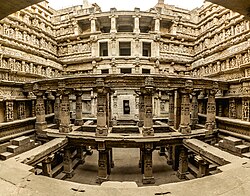
== Religion == | [[File:Rani ki vav1.jpg|thumb|The [[Rani ki vav]] was constructed during the rule of the Chaulukya dynasty. It is located on the banks of [[Saraswati River, Gujarat|Saraswati River]].<ref name=":4">{{Cite web|url=https://whc.unesco.org/en/list/922 |title=Rani-ki-Vav (the Queen's Stepwell) at Patan, Gujarat – UNESCO World Heritage Centre|website=whc.unesco.org|language=en |access-date=2015-12-05}}</ref>]] | ||
[[File:Rani ki vav1.jpg|thumb | The dynasty's founder Mularaja is said to have built Mulavasatika temple for [[Digambara]] Jains and the Mulanatha-Jinadeva temple for the [[Svetambara]] Jains.{{sfn|John E. Cort|1998|p=87}} The earliest of the [[Dilwara Temples]] and the [[Sun Temple, Modhera|Modhera Sun Temple]] were constructed during the reign of Bhima I. According to popular tradition, his queen Udayamati also commissioned the [[Rani ki vav|Queen's step-well]].{{sfn|Vinod Chandra Srivastava|2008|p=857}} Kumarapala started patronizing [[Jainism]] at some point in his life, and the subsequent Jain accounts portray him as the last great royal patron of Jainism.{{sfn|Asoke Kumar Majumdar|1956|p=119}} The Chaulukya rulers also endowed mosques to maintain good relationship with the [[Indian Ocean trade#Muslim period|Muslim traders]].{{sfn|Edward A. Alpers|2014|p=57}} | ||
== Claimed descendants == | == Claimed descendants == | ||
| Line 362: | Line 336: | ||
== List of rulers == | == List of rulers == | ||
The Chalukya rulers of Gujarat, with approximate dates of reign, are as follows:{{sfn|Romila Thapar|2008|p=236}}{{sfn|Asoke Kumar Majumdar|1956|p=199}} | The Chalukya rulers of Gujarat, with approximate dates of reign, are as follows:{{sfn|Romila Thapar|2008|p=236}}{{sfn|Asoke Kumar Majumdar|1956|p=199}} | ||
{| class=”wikitable” | |||
{| class= | |||
|+List of Chaulukya (Solanki) dynasty rulers | |+List of Chaulukya (Solanki) dynasty rulers | ||
! Serial No. | ! Serial No. | ||
| Line 422: | Line 393: | ||
|} | |} | ||
== Family tree == | === Family tree === | ||
{{Chart top|width=100%|collapsed=no|Chaulukya dynasty}} | {{Chart top|width=100%|collapsed=no|Chaulukya dynasty}} | ||
| Line 431: | Line 402: | ||
A01='''[[Mularaja|Mularaja I]]'''<br><sup>(1)</sup><br><small>r. {{circa}} 941-996</small>|boxstyle_A01=border-color:#FFD700}} | A01='''[[Mularaja|Mularaja I]]'''<br><sup>(1)</sup><br><small>r. {{circa}} 941-996</small>|boxstyle_A01=border-color:#FFD700}} | ||
{{Tree chart|border=1| | | | | | | | | | | | | | | | | | | | | | | |!| | | | | | | | | | | | | | | | | | | | | | | }} | {{Tree chart|border=1| | | | | | | | | | | | | | | | | | | | | | | |!| | | | | | | | | | | | | | | | | | | | | | | |}} | ||
{{Tree chart|border=1| | | | | | | | | | | | | | | | | | | | | | |A01 | | | | | | | | | | | | | | | | | | | | | | | | {{Tree chart|border=1| | | | | | | | | | | | | | | | | | | | | | |A01 | | | | | | | | | | | | | | | | | | | | | | | | ||
A01='''[[Chamundaraja (Chaulukya dynasty)|Chamundaraja]]'''<br><sup>(2)</sup><br><small>r. {{circa}} 996-1008</small>|boxstyle_A01=border-color:#FFD700}} | A01='''[[Chamundaraja (Chaulukya dynasty)|Chamundaraja]]'''<br><sup>(2)</sup><br><small>r. {{circa}} 996-1008</small>|boxstyle_A01=border-color:#FFD700}} | ||
{{Tree chart|border=1| | | | | | | | | | | | | | | | | | | |,|-|-|-|+|-|-|-|.| | | | | | | | | | | | | | | | | | | }} | {{Tree chart|border=1| | | | | | | | | | | | | | | | | | | |,|-|-|-|+|-|-|-|.| | | | | | | | | | | | | | | | | | | |}} | ||
{{Tree chart|border=1| | | | | | | | | | | | | | | | | | |A01 | |A02 | |A03 | | | | | | | | | | | | | | | | | | | | {{Tree chart|border=1| | | | | | | | | | | | | | | | | | |A01 | |A02 | |A03 | | | | | | | | | | | | | | | | | | | | ||
| Line 443: | Line 414: | ||
A03=Nagaraja}} | A03=Nagaraja}} | ||
{{Tree chart|border=1| | | | | | | | | | | | | | | | | | | | | | | | | | | |!| | | | | | | | | | | | | | | | | | | }} | {{Tree chart|border=1| | | | | | | | | | | | | | | | | | | | | | | | | | | |!| | | | | | | | | | | | | | | | | | | |}} | ||
{{Tree chart|border=1| | | | | | | | | | | | | | | | | | | | | | | | | | |A01 | | | | | | | | | | | | | | | | | | | | {{Tree chart|border=1| | | | | | | | | | | | | | | | | | | | | | | | | | |A01 | | | | | | | | | | | | | | | | | | | | ||
A01='''[[Bhima I]]'''<br><sup>(5)</sup><br><small>r. {{circa}} 1022-1064</small>|boxstyle_A01=border-color:#FFD700}} | A01='''[[Bhima I]]'''<br><sup>(5)</sup><br><small>r. {{circa}} 1022-1064</small>|boxstyle_A01=border-color:#FFD700}} | ||
{{Tree chart|border=1| | | | | | | | | | | | | | | | | | | | | | | |,|-|-|-|(| | | | | | | | | | | | | | | | | | | }} | {{Tree chart|border=1| | | | | | | | | | | | | | | | | | | | | | | |,|-|-|-|(| | | | | | | | | | | | | | | | | | | |}} | ||
{{Tree chart|border=1| | | | | | | | | | | | | | | | | | | | | | |A01 | |A02 | | | | | | | | | | | | | | | | | | | | {{Tree chart|border=1| | | | | | | | | | | | | | | | | | | | | | |A01 | |A02 | | | | | | | | | | | | | | | | | | | | ||
| Line 454: | Line 425: | ||
A02='''[[Karna (Chaulukya dynasty)|Karna]]'''<br><sup>(6)</sup><br><small>r. {{circa}} 1064-1092</small>|boxstyle_A02=border-color:#FFD700}} | A02='''[[Karna (Chaulukya dynasty)|Karna]]'''<br><sup>(6)</sup><br><small>r. {{circa}} 1064-1092</small>|boxstyle_A02=border-color:#FFD700}} | ||
{{Tree chart|border=1| | | | | | | | | | | | | | | | | | | | | | | |!| | | |!| | | | | | | | | | | | | | | | | | | }} | {{Tree chart|border=1| | | | | | | | | | | | | | | | | | | | | | | |!| | | |!| | | | | | | | | | | | | | | | | | | |}} | ||
{{Tree chart|border=1| | | | | | | | | | | | | | | | | | | | | | |A01 | |A02 | | | | | | | | | | | | | | | | | | | | {{Tree chart|border=1| | | | | | | | | | | | | | | | | | | | | | |A01 | |A02 | | | | | | | | | | | | | | | | | | | | ||
| Line 460: | Line 431: | ||
A02='''[[Jayasimha Siddharaja|Jayasimha<br>Siddharaja]]'''<br><sup>(7)</sup><br><small>r. {{circa}} 1092-1142</small>|boxstyle_A02=border-color:#FFD700}} | A02='''[[Jayasimha Siddharaja|Jayasimha<br>Siddharaja]]'''<br><sup>(7)</sup><br><small>r. {{circa}} 1092-1142</small>|boxstyle_A02=border-color:#FFD700}} | ||
{{Tree chart|border=1| | | | | | | | | | | | | | | | | | | | | | | |!| | | | | | | | | | | | | | | | | | | | | | | }} | {{Tree chart|border=1| | | | | | | | | | | | | | | | | | | | | | | |!| | | | | | | | | | | | | | | | | | | | | | | |}} | ||
{{Tree chart|border=1| | | | | | | | | | | | | | | | | | | | | | |A01 | | | | | | | | | | | | | | | | | | | | | | | | {{Tree chart|border=1| | | | | | | | | | | | | | | | | | | | | | |A01 | | | | | | | | | | | | | | | | | | | | | | | | ||
A01=Tribhuvanpala}} | A01=Tribhuvanpala}} | ||
{{Tree chart|border=1| | | | | | | | | | | | | | | | | | | | | | | |!| | | | | | | | | | | | | | | | | | | | | | | }} | {{Tree chart|border=1| | | | | | | | | | | | | | | | | | | | | | | |!| | | | | | | | | | | | | | | | | | | | | | | |}} | ||
{{Tree chart|border=1| | | | | | | | | | | | | | | | | | | | | | |A01 | | | | | | | | | | | | | | | | | | | | | | | | {{Tree chart|border=1| | | | | | | | | | | | | | | | | | | | | | |A01 | | | | | | | | | | | | | | | | | | | | | | | | ||
A01='''[[Kumarapala (Chaulukya dynasty)|Kumarapala]]'''<br><sup>(8)</sup><br><small>r. {{circa}} 1143-1172</small>|boxstyle_A01=border-color:#FFD700}} | A01='''[[Kumarapala (Chaulukya dynasty)|Kumarapala]]'''<br><sup>(8)</sup><br><small>r. {{circa}} 1143-1172</small>|boxstyle_A01=border-color:#FFD700}} | ||
{{Tree chart|border=1| | | | | | | | | | | | | | | | | | | | | | | |!| | | | | | | | | | | | | | | | | | | | | | | }} | {{Tree chart|border=1| | | | | | | | | | | | | | | | | | | | | | | |!| | | | | | | | | | | | | | | | | | | | | | | |}} | ||
{{Tree chart|border=1| | | | | | | | | | | | | | | | | | | | | | |A01 | | | | | | | | | | | | | | | | | | | | | | | | {{Tree chart|border=1| | | | | | | | | | | | | | | | | | | | | | |A01 | | | | | | | | | | | | | | | | | | | | | | | | ||
A01='''[[Ajayapala (Chaulukya dynasty)|Ajayapala]]'''<br><sup>(9)</sup><br><small>r. {{circa}} 1172-1175</small>|boxstyle_A01=border-color:#FFD700}} | A01='''[[Ajayapala (Chaulukya dynasty)|Ajayapala]]'''<br><sup>(9)</sup><br><small>r. {{circa}} 1172-1175</small>|boxstyle_A01=border-color:#FFD700}} | ||
{{Tree chart|border=1| | | | | | | | | | | | | | | | | | | |,|-|-|-|(| | | | | | | | | | | | | | | | | | | | | | | }} | {{Tree chart|border=1| | | | | | | | | | | | | | | | | | | |,|-|-|-|(| | | | | | | | | | | | | | | | | | | | | | | |}} | ||
{{Tree chart|border=1| | | | | | | | | | | | | | | | | | |A01 | |A02 | |A03 | | | | | | | | | | | | | | | | | | | | {{Tree chart|border=1| | | | | | | | | | | | | | | | | | |A01 | |A02 | |A03 | | | | | | | | | | | | | | | | | | | | ||
| Line 495: | Line 466: | ||
===Bibliography=== | ===Bibliography=== | ||
{{refbegin}} | {{refbegin}} | ||
* {{cite book |author=Asoke Kumar Majumdar |title=Chaulukyas of Gujarat |url=https://books.google.com/books?id=ffAdAAAAMAAJ |publisher=Bharatiya Vidya Bhavan |year=1956 |oclc=4413150 }} | * {{cite book |author=Asoke Kumar Majumdar |title=Chaulukyas of Gujarat |url=https://books.google.com/books?id=ffAdAAAAMAAJ |publisher=Bharatiya Vidya Bhavan |year=1956 |oclc=4413150 }} | ||
* {{cite book |author=Cynthia Talbot |title=The Last Hindu Emperor: Prithviraj Cauhan and the Indian Past, 1200–2000 |url=https://books.google.com/books?id=m3DjCgAAQBAJ |publisher=Cambridge University Press |year=2015 |isbn=9781107118560 }} | * {{cite book |author=Cynthia Talbot |title=The Last Hindu Emperor: Prithviraj Cauhan and the Indian Past, 1200–2000 |url=https://books.google.com/books?id=m3DjCgAAQBAJ |publisher=Cambridge University Press |year=2015 |isbn=9781107118560 }} | ||
| Line 503: | Line 473: | ||
* {{cite book |author=Edward A. Alpers |title=The Indian Ocean in World History |url=https://books.google.com/books?id=pjsfAQAAQBAJ&pg=PA57 |year=2014 |publisher=Oxford University Press USA |isbn=978-0-19-533787-7 }} | * {{cite book |author=Edward A. Alpers |title=The Indian Ocean in World History |url=https://books.google.com/books?id=pjsfAQAAQBAJ&pg=PA57 |year=2014 |publisher=Oxford University Press USA |isbn=978-0-19-533787-7 }} | ||
* {{cite book |author=Ganga Prasad Yadava |title=Dhanapāla and His Times: A Socio-cultural Study Based Upon His Works |url=https://books.google.com/books?id=aY_I3zgxfpsC&pg=PA32 |publisher=Concept |year=1982 }} | * {{cite book |author=Ganga Prasad Yadava |title=Dhanapāla and His Times: A Socio-cultural Study Based Upon His Works |url=https://books.google.com/books?id=aY_I3zgxfpsC&pg=PA32 |publisher=Concept |year=1982 }} | ||
* Harle | * {{cite book |last=Harle |first=J.C. |title=The Art and Architecture of the Indian Subcontinent |edition=2nd |year=1994 |publisher=Yale University Press |series=Pelican History of Art |isbn=0300062176}} | ||
* {{Cite journal|last=Hegewald|first=Julia A. B.|title=The International Jaina Style? Māru-Gurjara Temples Under the Solaṅkīs, throughout India and in the Diaspora | * {{Cite journal|last=Hegewald|first=Julia A. B.|title=The International Jaina Style? Māru-Gurjara Temples Under the Solaṅkīs, throughout India and in the Diaspora|journal=Ars Orientalis |volume=45 |doi=10.3998/ars.13441566.0045.005 |issn=2328-1286 |year=2011 |issue=20220203 |pages=114–140 |doi-access=free}} | ||
* {{Cite book|author=Jadunath Sarkar|author-link=Jadunath Sarkar|url=https://books.google.com/books?id=qoRDAAAAYAAJ|title=Military History of India|publisher=Orient Longmans|isbn=9780861251551|language=en}} | * {{Cite book|author=Jadunath Sarkar|author-link=Jadunath Sarkar |url=https://books.google.com/books?id=qoRDAAAAYAAJ |title=Military History of India|date=1960|publisher=Orient Longmans|isbn=9780861251551|language=en}} | ||
* {{cite book |author=Jai Narayan Asopa |title=Origin of the Rajputs |url=https://books.google.com/books?id=BTxuAAAAMAAJ |year=1976 |publisher=Bharatiya |oclc=483180949 }} | * {{cite book |author=Jai Narayan Asopa |title=Origin of the Rajputs |url=https://books.google.com/books?id=BTxuAAAAMAAJ |year=1976 |publisher=Bharatiya |oclc=483180949 }} | ||
* {{cite book |editor=John E. Cort |editor-link=John E. Cort |title=Open Boundaries: Jain Communities and Cultures in Indian History |url=https://books.google.com/books?id=yoHfm7BgqTgC |publisher=[[SUNY Press]] |isbn=978-0-7914-3785-8 | * {{cite book |editor=John E. Cort |editor-link=John E. Cort |title=Open Boundaries: Jain Communities and Cultures in Indian History |url=https://books.google.com/books?id=yoHfm7BgqTgC |publisher=[[SUNY Press]] |date=1998 |isbn=978-0-7914-3785-8}} | ||
* {{cite book |author=Jonah Blank |author-link=Jonah Blank |title=Mullahs on the Mainframe: Islam and Modernity Among the Daudi Bohras |url=https://books.google.com/books?id=r_FExBRnC3YC&pg=PA44 |publisher=University of Chicago Press |year=2001 |isbn=978-0-226-05676-0 |page=44 }} | * {{cite book |author=Jonah Blank |author-link=Jonah Blank |title=Mullahs on the Mainframe: Islam and Modernity Among the Daudi Bohras |url=https://books.google.com/books?id=r_FExBRnC3YC&pg=PA44 |publisher=University of Chicago Press |year=2001 |isbn=978-0-226-05676-0 |page=44 }} | ||
* Michell | * {{cite book |last=Michell |first=George |year=1977 |title=The Hindu Temple: An Introduction to its Meaning and Forms |publisher=University of Chicago Press |isbn=978-0-226-53230-1}} | ||
* Michell | * {{cite book |last=Michell |first=George |year=1990 |title=The Penguin Guide to the Monuments of India, Volume 1: Buddhist, Jain, Hindu |publisher=Penguin Books |isbn=0140081445}} | ||
* {{cite book |author=Krishna Narain Seth |title=The Growth of the Paramara Power in Malwa |url=https://books.google.com/books?id=-Q4dAAAAMAAJ |publisher=Progress |year=1978 |oclc=8931757 }} | * {{cite book |author=Krishna Narain Seth |title=The Growth of the Paramara Power in Malwa |url=https://books.google.com/books?id=-Q4dAAAAMAAJ |publisher=Progress |year=1978 |oclc=8931757 }} | ||
* {{cite book |author=N. Jayapalan |title=History of India |url=https://books.google.com/books?id=tU1yDpYlu38C&pg=PA146 |year=2001 |publisher=Atlantic Publishers & Distri |isbn=978-81-7156-928-1 }} | * {{cite book |author=N. Jayapalan |title=History of India |url=https://books.google.com/books?id=tU1yDpYlu38C&pg=PA146 |year=2001 |publisher=Atlantic Publishers & Distri |isbn=978-81-7156-928-1 }} | ||
* {{cite book |author=P.B. Udgaonkar |title=Political Institutions & Administration |url=https://books.google.com/books?id=Jdoym34QydQC&pg=PA215 |year=1986 |publisher=[[Motilal Banarsidass]] |isbn=978-81-208-2087-6 }} | * {{cite book |author=P.B. Udgaonkar |title=Political Institutions & Administration |url=https://books.google.com/books?id=Jdoym34QydQC&pg=PA215 |year=1986 |publisher=[[Motilal Banarsidass]] |isbn=978-81-208-2087-6 }} | ||
* {{cite book |author=Romila Thapar |author-link=Romila Thapar |title=Somanatha |url=https://books.google.com/books?id=3ZZ8T8tZc4YC&pg=PA236 |publisher=Penguin |isbn=9780143064688 |year=2008 }} | * {{cite book |author=Romila Thapar |author-link=Romila Thapar |title=Somanatha |url=https://books.google.com/books?id=3ZZ8T8tZc4YC&pg=PA236 |publisher=Penguin |isbn=9780143064688 |year=2008 }} | ||
* {{cite book |author=R. B. Singh |title=History of the Chāhamānas |publisher=N. Kishore |year=1964 |url=https://books.google.com/books?id=TKs9AAAAIAAJ | * {{cite book |author=R. B. Singh |title=History of the Chāhamānas |publisher=N. Kishore |year=1964 |oclc=11038728 |url=https://books.google.com/books?id=TKs9AAAAIAAJ}} | ||
* {{cite book |author=R. K. Dikshit |title=The Candellas of Jejākabhukti |publisher=Abhinav |year=1976 |url=https://books.google.com/books?id=a9j9ZJGJOV0C&pg=PA130 |isbn= | * {{cite book |author=R. K. Dikshit |title=The Candellas of Jejākabhukti |publisher=Abhinav |year=1976 |isbn=9788170170464 |url=https://books.google.com/books?id=a9j9ZJGJOV0C&pg=PA130}} | ||
* {{cite book |last1=Schwartzberg |first1=Joseph E. |chapter=A map of the Chaulukya territory |title=A Historical atlas of South Asia |date=1978 |publisher=University of Chicago Press |location=Chicago |pages=[https://dsal.uchicago.edu/reference/schwartzberg/pager.html?object=074 37], [https://dsal.uchicago.edu/reference/schwartzberg/pager.html?object=185 147: map XIV.3 (b)] |isbn=0226742210 |url=https://dsal.uchicago.edu/reference/schwartzberg/}} | |||
* {{cite journal |author=Shanta Rani Sharma |title=Exploding the Myth of the Gūjara Identity of the Imperial Pratihāras |journal=Indian Historical Review |volume=39 |issue=1 |pages=1–10 |year=2012 |doi=10.1177/0376983612449525 |s2cid=145175448 }} | * {{cite journal |author=Shanta Rani Sharma |title=Exploding the Myth of the Gūjara Identity of the Imperial Pratihāras |journal=Indian Historical Review |volume=39 |issue=1 |pages=1–10 |year=2012 |doi=10.1177/0376983612449525 |s2cid=145175448 }} | ||
* {{cite book |author=Tommaso Bobbio |title=Urbanisation, Citizenship and Conflict in India: Ahmedabad 1900-2000 |url=https://books.google.com/books?id=-5vwCQAAQBAJ&pg=PA164 |year=2015 |publisher=Routledge |isbn=978-1-317-51400-8 }} | * {{cite book |author=Tommaso Bobbio |title=Urbanisation, Citizenship and Conflict in India: Ahmedabad 1900-2000 |url=https://books.google.com/books?id=-5vwCQAAQBAJ&pg=PA164 |year=2015 |publisher=Routledge |isbn=978-1-317-51400-8 }} | ||
| Line 523: | Line 494: | ||
==External links== | ==External links== | ||
* {{Commons category-inline}} | |||
* {{ | |||
{{Chaulukya dynasty}} | {{Chaulukya dynasty}} | ||
[[Category:Chaulukya dynasty| ]] | [[Category:Chaulukya dynasty| ]] | ||
[[Category:940s establishments]] | [[Category:940s establishments]] | ||
[[Category:10th-century establishments in India]] | [[Category:10th-century establishments in India]] | ||
[[Category: | [[Category:Rajput history]] | ||
[[Category:1240s disestablishments in Asia]] | [[Category:1240s disestablishments in Asia]] | ||
[[Category:1244 disestablishments]] | [[Category:1244 disestablishments]] | ||
[[Category: | [[Category:Rajput dynasties]] | ||
[[Category:13th-century disestablishments in India]] | [[Category:13th-century disestablishments in India]] | ||
[[Category:Kingdom of Gujarat]] | |||
Revision as of 19:41, 26 March 2026
Chaulukyas of Gujarat (Solankis) | |||||||||||||
|---|---|---|---|---|---|---|---|---|---|---|---|---|---|
| c. 940 CE–1244 CE | |||||||||||||
![A Chaulukya-Paramara coin, circa 950–1050 CE. Stylized rendition of Chavda dynasty coins: Indo-Sassanian style bust right; pellets and ornaments around / Stylised fire altar; pellets around.[1] of Chaulukya](/wiki/File:Chaulukya-Paramara_coin_circa_AD_950-1050.jpg) A Chaulukya-Paramara coin, circa 950–1050 CE. Stylized rendition of Chavda dynasty coins: Indo-Sassanian style bust right; pellets and ornaments around / Stylised fire altar; pellets around.[1]
| |||||||||||||
![Map of the Chaulukyas circa 1150 CE[2]](/wiki/File:Map_of_the_Chaulukyas.png) Map of the Chaulukyas circa 1150 CE[2] | |||||||||||||
| Capital | Anahilavada (modern Patan) | ||||||||||||
| Religion | Jainism Hinduism | ||||||||||||
| Government | Monarchy | ||||||||||||
| History | |||||||||||||
• Established | c. 940 CE | ||||||||||||
• Disestablished | 1244 CE | ||||||||||||
| |||||||||||||
| Today part of | India | ||||||||||||

The Chaulukya dynasty (IAST: Caulukya), also Solanki dynasty, was a dynasty that ruled parts of what are now Gujarat and Rajasthan in north-western India, between c. 940 CE and c. 1244 CE. Their capital was located at Anahilavada (modern Patan). At times, their rule extended to the Malwa region in present-day Madhya Pradesh. The family is also known as the "Solanki dynasty" in the vernacular literature. They belonged to the Solanki clan of Rajputs.[3][4][5]
Mularaja, the founder of the dynasty, supplanted the last ruler of the Chavda dynasty around 940 CE. His successors fought several battles with the neighbouring rulers such as the Chudasamas, the Paramaras and the Chahamanas of Shakambhari. During the reign of Bhima I, the Ghaznavid ruler Mahmud invaded the kingdom and raided the Somnath temple during 1024–1025 CE. The Chaulukyas soon recovered, and the kingdom reached its zenith under the rule of Jayasimha Siddharaja and Kumarapala in the 12th century. Several minor dynasties, such as the Chahamanas of Jalor and the Chahamanas of Naddula, served as Chaulukya vassals during this period. After Kumarapala's death, the kingdom was gradually weakened by internal rebellions; uprisings by feudatories; and invasions by the Paramaras, the Ghurids, the Yadavas and others. Taking advantage of this, the Vaghelas, who had earlier served as Chaulukya generals, usurped the power and established a new dynasty in the 1240s.
Several princely state rulers of the Solanki clan claimed descent from the Chaulukyas.
Name
The dynasty used the self-designation "Chaulukya" in all but four of its records.[6] The four exceptions are:[7]
- "Chaulukika" in the Kadi grant of Mularaja
- "Saulkika" in a grant of Chamundaraja
- "Chaulakya" in the Sambhar inscription of Jayasimha
- "Chaullakya" in the Jalor inscription of Kumarapala
Hemachandra, a Jain scholar in the Chaulukya court, generally used the terms "Chaulukya" and "Chulukya".[7] His Dvyasraya Mahakavya mentions the variants "Chulakya", "Chalukka", and "Chulukka"; his Kumarapala-Charita mentions another variant "Chuluga". The Chaulukya court poet Someshvara describes the dynasty as "Chaulukya" (in Kirti-Kaumudi) and "Chulukya" (in the Abu inscription of Vastupala and Tejapala).[8]
"Solanki" or "Solankhi" is a vernacular form of the term.[9]
Origins

The word "Chaulukya" is thought to be a variant of the word "Chalukya". Several other dynasties were known by the name "Chalukya", including the Chalukyas of Vatapi, Navasarika, Vemulavada, Kalyani, Vengi and Lata. These dynasties are sometimes thought to be branches of the same family, but the relationship between all of them is not certain. Unlike the Chalukyas of Kalyani and Vengi, the Chaulukyas of Gujarat never claimed a shared descent or any other association with the earliest Chalukya dynasty—the Chalukyas of Vatapi. Moreover, they never used the term "Chalukya" to describe themselves.[6]
However, the Chaulukyas of Gujarat shared a myth of origin with the Chalukyas of Kalyani and Vengi. According to this legend, the progenitor of the dynasty was created by Brahma.[6] The version of the legend mentioned in the Vadnagar prashasti inscription of Kumarapala is as follows: the deities once asked the creator god Brahma to protect them from the danavas (demons). Brahma then created a hero from his chuluka (pot or folded palm in Sanskrit), which was filled with Ganges water. This hero was named "Chulukya", and became the progenitor of the dynasty. A variation of this legend is mentioned by Abhayatilaka Gani in his commentary on Hemachandra's Dvyashraya-Kavya. According to this version, Brahma produced the hero to support the earth, after his other creations disappointed him. These stories are of no historical value, as it was customary for contemporary royal houses to claim mythical and heroic origins. The Kumarapala-Bhupala-Charita of Jayasimha Suri presents Chulukya as a historical warrior, whose capital was Madhupadma. Mularaja was his descendant, with nearly a hundred generations separating the two.[11] This account may be partly historical: Madhupadma has been identified variously as a location outside Gujarat, including present-day Mathura.[12]
C. V. Vaidya theorized that the Chaulukyas were different from the Chalukyas. G. H. Ojha opposed this theory, pointing out that an inscription of the Lata Chalukya ruler Kirtiraja describes his family as "Chalukya", while an inscription of his grandson Trilochanapala describes the family as "Chaulukya".[8] According to Asoke Majumdar, while these similar-sounding names suggest a common origin for all these dynasties, there is no concrete evidence to draw any definitive conclusion.[6] Majumdar theorized that the Chaulukyas were connected to the Sulikas or the Chulikas, a tribe mentioned in several ancient records. This tribe is described as living on the northern frontier of ancient India. However, Majumdar admitted that there is not enough evidence to regard this theory as conclusive.[13] According to the Agnikula myth mentioned in a 16th-century recension of the legendary epic poem Prithviraj Raso, four Rajput clans including the Chaulukyas were born from a fire-pit on Mount Abu. A section of colonial-era historians interpreted this mythical account to suggest that these clans were foreigners who came to India after the decline of the Gupta Empire around the 5th century CE, and were admitted in the Hindu caste system after performing a fire ritual.[14][15]
The Chaulukya rulers have been called "Gurjararāja" and "Gurjareśvara" ("ruler of Gurjara").[16] Based on this legend, D. R. Bhandarkar and others theorized that the Chaulukyas were a branch of Gurjaras, whom they believed to be a tribe of foreign origin.[17] Bhandarkar and Augustus Hoernle also believed that the name of the "Lata" region changed to "Gurjaratra" (later Gujarat) during the Chaulukya reign, presumably because they were Gurjaras.[18]
However, this foreign-origin theory is weakened by a number of factors. The Chaulukyas did not claim an Agnikula origin for themselves:[19] it was the neighbouring Paramara rulers who used the legend to explain their own origin.[20] The inscriptions from the reign of Bhima II prove that the Chaulukyas knew about the Agnikula legend, but associated it with the Paramaras, not themselves.[21] The earliest copies of Prithviraj Raso do not mention this legend either.[21] The legend that includes the Chaulukyas among the fire-born clans is first mentioned by the 16th century poets, who may have extended the Paramara legend to include other dynasties, in order to foster Rajput unity against the Mughals.[22] Moreover, there is no evidence that the Chaulukya territory area came to be known as "Gurjaratra" during the Chaulukya reign.[18] "Gurjara" and "Lata" were two distinct historical regions in northern and southern parts of present-day Gujarat respectively, and the term "Lata" was never used to describe the whole of Gujarat.[23] The Chaulukya kings were called "Gurjararāja" and "Gurjareśvara" because they ruled the territory which was already called Gurjara by their time.[16][24] Several other kings who held similar epithets had earlier ruled this territory: these include the Gurjara-Pratiharas and the Gurjaras of Nandipuri.[25] Historian Asoke Kumar Majumdar points out that even the southern Ganga chief Marasimha II assumed the title "king of Gurjaras" after defeating a northern king on behalf of the Rashtrakutas.[24]
History
Early rulers

The Chaulukyas were one of the several dynasties that rose to power amid the decline of the Gurjara-Pratihara and the Rashtrakuta empires.[26] In the mid-tenth century CE, the dynasty’s founder Mularaja supplanted Samantasimha, the last Chavda king.[27] According to legends, he was a nephew of Samantasimha.[28] According to the 12th century chronicler Hemachandra, Mularaja defeated Graharipu, the king of Saurashtra.[29] He also defeated the Lata Chalukya chief Barapa, aided by his son Chamundaraja.[30] Chamundaraja succeeded Mularaja around 996 CE. During his reign, the Paramara king Sindhuraja appears to have invaded the Lata region, which was under Chaulukya suzerainty. Mularaja forced Sindhuraja to retreat; the 14th century chronicler Jayasimha Suri claims that Chamundaraja killed Sindhuraja in a battle, but this claim appears to be doubtful, as it does not appear in any earlier source.[31] Sometime before 1007 CE, the Lata region was captured by the Chalukyas of Kalyani led by Satyashraya.[32] Around 1008 CE, Chamundaraja retired after appointing his son Vallabharaja as the next king. Legendary accounts state that he set out for a pilgrimage to Varanasi. During this journey, he was insulted by a ruler whose kingdom lay on the way to Varanasi. He returned to the Chaulukya capital, and asked his son to avenge his insult. Vallabharaja died of smallpox during a march to the enemy kingdom, which is identified as the Paramara kingdom of Malwa by some chroniclers.[33] Chamundaraja’s other son Durlabharaja became the next king in c. 1008 CE. He invaded the Lata region, and defeated the Lata Chalukya ruler Kirtiraja (or Kirtipala), who was a vassal of the Kalyani Chalukyas. However, Kirtiraja regained control of the region within a short time, before being defeated by the Paramara king Bhoja.[34]
Neighbouring rivalries

Durlabharaja was succeeded by his nephew Bhima I, who faced an invasion from the Ghaznavid ruler Mahmud during 1024–1025 CE. Bhima fled to Kanthkot, as Mahmud entered the Chaulukya territory unopposed and sacked the Somnath temple.[35] After Mahmud’s departure, Bhima restored the Chaulukya rule. He crushed revolts by the Paramara chiefs of Arbuda, who used to serve as Chaulukya vassals.[36] Bhima also defeated and imprisoned Krishnadeva, a ruler of the Paramara branch of Bhinmal. He unsuccessfully fought against the Naddula Chahamana ruler Anahilla. Anahilla’s sons Balaprasada and Jendraraja defeated Bhima and forced him to release Krishnadeva.[37] Later legendary accounts credit Bhima with a victory against Hammuka, a ruler of Sindh, although the accuracy of this claim is not certain.[38] Semi-legendary accounts suggest that Bhima formed an alliance with the Kalachuri king Lakshmi-Karna, and the two played an important role in the downfall of the Paramara king Bhoja around 1055 CE. According to the 14th century chronicler Merutunga, Bhima and Lakshmi-Karna invaded Bhoja’s kingdom of Malwa from two opposite directions, and Bhoja died of a disease during this invasion.[39] Some Chaulukya chroniclers boast that Bhima annexed Bhoja’s capital Dhara or that he captured Bhoja alive, but these claims are not corroborated by historical evidence.[40] After Bhoja’s death, a rivalry developed between the Bhima and Lakshmi-Karna over sharing the spoils of their victory.[41] Bhima’s son Karna succeeded him around 1064 CE. Bhoja’s brother Udayaditya, supported by the Shakambhari Chahamana king Vigraharaja III, forced Karna to retreat from Malwa.[42][43] Meanwhile, the Kalachuris managed to capture the Lata region. By 1074 CE, Karna evicted the Kalachuris from Lata, and annexed the region to the Chaulukya kingdom, before losing it to one Trivikramapala within three years.[44] The Naddula Chahamana ruler Prithvipala defeated Karna, and his successor Jojalladeva occupied the Chaulukya capital Anahilapataka, possibly when Karna was busy at another place.[45] The Shakambhari Chahamana king Durlabharaja III also appears to have achieved some military success against Karna, although the Chahamana descriptions of this victory are highly exaggerated.[46] According to legendary chronicles, Karna also defeated Bhil and Koli tribals, who used to raid the Chaulukya territories. He established a city called Karnavati after defeating a Bhil chief named Asha (Āśā). Karnavati is identified with modern Ahmedabad by some, but this is not certain.[47]
Imperial expansion
Karna’s son Jayasimha Siddharaja (r. c. 1092–1142 CE) greatly expanded the Chaulukya power. He defeated Khangara alias Navaghana, the Chudasama king of Saurashtra.[48] The Naddula Chahamana ruler Asharaja, who had been dethroned by his rival Ratnapala, became a vassal of Jayasimha sometime before 1143 CE.[49] Jayasimha defeated the Shakambhari Chahamana ruler Arnoraja.[50] Later, however, Jayasimha accepted Arnoraja as an ally, and the Chahamana ruler married Jayasimha’s daughter Kanchanadevi.[51] The couple’s son (and thus Jayasimha’s grandson) Someshvara, was brought up at the Chaulukya court.[52] Someshvara’s sons Prithviraja III (better known as Prithviraj Chauhan) and Hariraja were also born in Gujarat.[53] During 1135–1136 CE, Jayasimha annexed the Paramara kingdom of Malwa, with support from Asharaja and Arnoraja. The Paramara kings defeated by him were Naravarman and his successor Yashovarman.[54] Jayasimha continued his eastward march, and reached as far as the Chandela kingdom ruled by Madanavarman. The Chaulukya-Chandela conflict was inconclusive, with both the sides claiming victory.[55] Jayasimha also defeated several minor rulers, including Sindhuraja, who was probably a Soomra king of Sindh.[56]

Jayasimha was succeeded by his relative Kumarapala, who spent his early life in exile to avoid persecution by Jayasimha.[57] After Jayasimha’s death, Kumarapala came back to the Chaulukya capital and ascended the throne in 1043 CE, with help of his brother-in-law Kanhadadeva.[58] Arnoraja opposed Kumarapala’s ascension to the throne, but Kumarapala defeated him decisively.[59] Kumarapala seems to have helped Asharaja’s son Katukaraja capture the throne of Naddula.[60] Katukaraja’s younger brother and successor Alhanadeva continued to rule as Kumarapala’s vassal.[61] Arnoraja’s son Vigraharaja IV subdued Kumarapala’s Chahamana feudatories at Naddula.[62] The Shakambhari Chahamana-Chaulukya relations seem to have become more cordial when Arnoraja’s son (and Jayasimha’s grandson) Someshvara became the Chahamana king in later years, possibly with support from Kumarapala.[63] After Jayasimha’s death, the Paramara king Jayavarman I regained control of Malwa, but he was soon dethroned by an usurper named Ballala. Kumarapala captured Malwa from Ballala, who was killed by Kumarapala’s Arbuda Paramara feudatory Yashodhavala in a battle.[64] Kumarapala subdued a rebellion by his vassal Vikramasimha, a Paramara chief of Arbuda.[65] The Paramara branch at Kiradu continued to acknowledge Kumarapala’s suzerainty.[66] In the early 1160s, Kumarapala sent an army against Mallikarjuna, the Shilahara king of northern Konkana. This campaign was probably triggered by a Shilahara raid in southern Gujarat, and ended with Mallikarjuna’s death.[67] Kumarapala’s Naddula Chahamana feudatory Alhana put down disturbances in Saurashtra at Kumarapala’s request.[68] Historical evidence suggests that Kumarapala’s empire extended from Chittor and Jaisalmer in the north to the Vindhyas and the Tapti river in the south (ignoring his raid of the Shilahara kingdom of northern Konkana). In the west, it included Kachchha and Saurashtra; in the east, it extended up to at least Vidisha (Bhilsa).[69] Kumarapala was succeeded by Ajayapala, who retained Kumarapala’s territories, but died after a short reign.[70] Ajayapala’s young sons Mularaja II and Bhima II succeeded him one after other. During this period, the Ghurid king Muhammad of Ghor invaded the Chaulukya kingdom in 1178 CE. In the ensuing battle at Kasahrada (or Kayadara), Muhammad was defeated by a large army, which included loyal Chaulukya feudatories such as the Naddula Chahamana ruler Kelhanadeva, the Jalor Chahamana ruler Kirtipala, and the Arbuda Paramara ruler Dharavarsha.[71][72]
Decline
Taking advantage of the young age of Bhima II, some provincial governors rebelled against him in order to establish independent states. His loyal Vaghela feudatory Arnoraja came to his rescue, and died fighting the rebels. Arnoraja’s descendants Lavanaprasada and Viradhavala became powerful during Bhima’s reign.[73] During Bhima’s reign, the Hoysala ruler Veera Ballala II seems to have raided the Lata region.[74] The Yadava ruler Bhillama V also invaded Gujarat, but was forced to retreat by Bhima’s feudatory Kelhanadeva.[74] The Shakambhari Chahamana king Prithviraja III also fought with the Chaulukyas, but Bhima’s general Jagaddeva managed to conclude a peace treaty with Prithviraja sometime before 1187 CE.[75] By the mid-1190s CE, the Ghurids defeated the Prithviraja and the other major Hindu kings of northern India. On 4 February 1197 CE, the Ghurid general Qutb al-Din Aibak invaded Bhima’s capital Anahilapataka, and inflicted a massive defeat on the Chaulukyas.[76] Bhima’s generals Lavanaprasada and Shridhara later forced the Ghurids to retreat, and the capital was back under the Chaulukya rule by 1201 CE.[77] Subhatavarman, the Paramara king of Malwa, invaded the Lata region around 1204 CE, taking advantage of the turmoil caused by the Ghurid invasions. He probably also sacked the Chaulukya capital Anahilapataka.[78] Once again, Lavanaprasada and Shridhara saved the kingdom by forcing Subhatavarman to retreat.[79] During 1205–1210 CE, Bhima’s relative Jayantasimha (or Jayasimha) usurped the throne. In the early 1210s, Subhatavarman’s successor Arjunavarman defeated Jayantasimha, and later established a matrimonial alliance with him.[79] Bhima managed to regain control of the throne during 1223–1226 CE.[80] Meanwhile, the Yadavas invaded the southern part of the Chaulukya kingdom, led by Bhillama’s successors Jaitugi and Simhana. During these invasions, the Chaulukya feudatories in the northern region of Marwar rebelled. Lavanaprasada and Viradhavala warded off the Yadava invasions, and also subdued the rebellions.[81] The Guhilas of Medapata (Guhilots of Mewar) also rebelled against Bhima sometime between 1207 and 1227 CE, and declared their independence.[82] By the end of Bhima’s reign, Lavanaprasada and Viradhavala assumed regal titles such as ‘’Maharajadhiraja’’ ("king of great kings") and ‘’Maharaja’’ ("great king"). However, the two continued to nominally acknowledge Bhima (and his successor Tribhuvanapala) as their overlord. After Tribhuvanapala, they seized the throne, establishing the Vaghela dynasty.[83]
Culture
Architecture
Māru-Gurjara architecture, or "Chaulukya style",[84][85][86] is a style of north Indian temple architecture that originated in Gujarat and Rajasthan from the 11th to 13th centuries, under the Chaulukya dynasty (or Solaṅkī dynasty).[87][88] Although originating as a regional style in Hindu temple architecture, it became especially popular in Jain temples and, mainly under Jain patronage, later spread across India and to diaspora communities around the world.[88]
-
 Sun Temple, Modhera, constructed by Bhima I
 -
 Rudra Mahalaya Temple, renovated or rebuilt by Jayasimha
 -
 Taranga Jain temple, constructed by Kumarapala
 -
 Dilwara Temples, constructed by Chaulukya ministers


Religion

The dynasty's founder Mularaja is said to have built Mulavasatika temple for Digambara Jains and the Mulanatha-Jinadeva temple for the Svetambara Jains.[27] The earliest of the Dilwara Temples and the Modhera Sun Temple were constructed during the reign of Bhima I. According to popular tradition, his queen Udayamati also commissioned the Queen's step-well.[90] Kumarapala started patronizing Jainism at some point in his life, and the subsequent Jain accounts portray him as the last great royal patron of Jainism.[69] The Chaulukya rulers also endowed mosques to maintain good relationship with the Muslim traders.[91]
Claimed descendants
The Vaghela dynasty, which succeeded the Chaulukyas, claimed descent from a sister of Kumarapala.[92]
Various princely state dynasties calling themselves Solanki (the vernacular form of Chaulukya) claimed descent from the Chaulukyas as well. These included the rulers of the Lunavada State, which was a tributary to the Marathas before coming under the British rule.[93]
List of rulers
The Chalukya rulers of Gujarat, with approximate dates of reign, are as follows:[94][95]
| Serial No. | Ruler | Reign (CE) |
|---|---|---|
| 1 | Mularaja | 940–995 |
| 2 | Chamundaraja | 996–1008 |
| 3 | Vallabharaja | 1008 |
| 4 | Durlabharaja | 1008–1022 |
| 5 | Bhima I | 1022–1064 |
| 6 | Karna | 1064–1092 |
| 7 | Jayasimha Siddharaja | 1092–1142 |
| 8 | Kumarapala | 1142–1171 |
| 9 | Ajayapala | 1171–1175 |
| 10 | Mularaja II | 1175–1178 |
| 11 | Bhima II | 1178–1240 |
| 12 | Tribhuvanapala | 1240–1244 |
Family tree
| Chaulukya dynasty |
|---|
|
|
List of feudatories
References
- ↑ Post-Gupta (Chaulukya-Paramara) coin, Classical Numismatic Group.
- ↑ Schwartzberg 1978, p. 147, map XIV.3 (c).
- ↑ Hermann Kulke (2004). A History of India. Psychology Press. p. 117. ISBN 978-0-415-32919-4.
When Gurjara Pratiharas power declined after the sacking of Kannauj by the Rashtrakutkas in the early tenth century many Rajput princes declared their independence and founded their own kingdoms, some of which grew to importance in the subsequent two centuries. The better known among these dynasties were the Chaulukyas or Solankis of Kathiawar and Gujarat, the Chahamanas (i.e. Chauhan) of eastern Rajasthan (Ajmer and Jodhpur), and the Tomaras who had founded Delhi (Dhillika) in 736 but had then been displaced by the Chauhans in the twelfth century.
- ↑ Brajadulal Chattopadhyaya (2006). Studying Early India: Archaeology, Texts and Historical Issues. Anthem. p. 116. ISBN 978-1-84331-132-4.
The period between the seventh and the twelfth century witnessed gradual rise of a number of new royal-lineages in Rajasthan, Gujarat, Madhya Pradesh and Uttar Pradesh, which came to constitute a social-political category known as 'Rajput'. Some of the major lineages were the Pratiharas of Rajasthan, Uttar Pradesh and adjacent areas, the Guhilas and Chahamanas of Rajasthan, the Caulukyas or Solankis of Gujarat and Rajasthan and the Paramaras of Madhya Pradesh and Rajasthan.
- ↑ David Ludden (2013). India and South Asia: A Short History. Simon and Schuster. pp. 88–89. ISBN 978-1-78074-108-6.
By contrast in Rajasthan a single warrior group evolved called Rajput (from Rajaputra-sons of kings): they rarely engaged in farming, even to supervise farm labour as farming was literally beneath them, farming was for their peasant subjects. In the ninth century separate clans of Rajputs Cahamanas (Chauhans), Paramaras (Pawars), Guhilas (Sisodias) and Caulukyas were splitting off from sprawling Gurjara Pratihara clans...
- ↑ 6.0 6.1 6.2 6.3 Asoke Kumar Majumdar 1956, p. 5.
- ↑ 7.0 7.1 Asoke Kumar Majumdar 1956, p. 421.
- ↑ 8.0 8.1 Jai Narayan Asopa 1976, p. 43.
- ↑ Jai Narayan Asopa 1976, p. 42.
- ↑ Asoke Kumar Majumdar 1956, pp. 498-502.
- ↑ Asoke Kumar Majumdar 1956, pp. 6-7.
- ↑ Asoke Kumar Majumdar 1956, p. 22.
- ↑ Asoke Kumar Majumdar 1956, p. 13-17.
- ↑ Ganga Prasad Yadava 1982, p. 35.
- ↑ N. Jayapalan 2001, p. 146.
- ↑ 16.0 16.1 Shanta Rani Sharma 2012, pp. 7-8.
- ↑ Asoke Kumar Majumdar 1956, p. 8.
- ↑ 18.0 18.1 Durga Prasad Dikshit 1980, p. 21.
- ↑ Asoke Kumar Majumdar 1956, p. 8-9.
- ↑ Dasharatha Sharma 1959, p. 4.
- ↑ 21.0 21.1 Asoke Kumar Majumdar 1956, p. 9.
- ↑ R. B. Singh 1964, pp. 17-18.
- ↑ Asoke Kumar Majumdar 1956, p. 12.
- ↑ 24.0 24.1 Asoke Kumar Majumdar 1956, p. 13.
- ↑ Asoke Kumar Majumdar 1956, pp. 10-12.
- ↑ Asoke Kumar Majumdar 1956, pp. 1-4.
- ↑ 27.0 27.1 John E. Cort 1998, p. 87.
- ↑ Asoke Kumar Majumdar 1956, pp. 23-24.
- ↑ Asoke Kumar Majumdar 1956, p. 25.
- ↑ Asoke Kumar Majumdar 1956, p. 34.
- ↑ Asoke Kumar Majumdar 1956, pp. 34-35.
- ↑ Asoke Kumar Majumdar 1956, p. 35.
- ↑ Asoke Kumar Majumdar 1956, pp. 36-39.
- ↑ Krishna Narain Seth 1978, pp. 136-137.
- ↑ Asoke Kumar Majumdar 1956, pp. 43-45.
- ↑ Asoke Kumar Majumdar 1956, pp. 49-50.
- ↑ Asoke Kumar Majumdar 1956, pp. 50-51.
- ↑ Asoke Kumar Majumdar 1956, pp. 48-49.
- ↑ Asoke Kumar Majumdar 1956, pp. 52-53.
- ↑ Krishna Narain Seth 1978, p. 184.
- ↑ Asoke Kumar Majumdar 1956, p. 54-55.
- ↑ R. B. Singh 1964, p. 127.
- ↑ Asoke Kumar Majumdar 1956, pp. 57-58.
- ↑ Asoke Kumar Majumdar 1956, pp. 59-60.
- ↑ Asoke Kumar Majumdar 1956, p. 60.
- ↑ R. B. Singh 1964, p. 125.
- ↑ Tommaso Bobbio 2015, p. 164.
- ↑ Asoke Kumar Majumdar 1956, p. 69.
- ↑ Asoke Kumar Majumdar 1956, p. 70.
- ↑ Dasharatha Sharma 1959, p. 47.
- ↑ Asoke Kumar Majumdar 1956, p. 71.
- ↑ R. B. Singh 1964, p. 156.
- ↑ Dasharatha Sharma 1959, p. 69.
- ↑ Asoke Kumar Majumdar 1956, pp. 74-75.
- ↑ R. K. Dikshit 1976, p. 133.
- ↑ Asoke Kumar Majumdar 1956, pp. 80-81.
- ↑ Asoke Kumar Majumdar 1956, p. 92.
- ↑ Asoke Kumar Majumdar 1956, pp. 99-103.
- ↑ Asoke Kumar Majumdar 1956, pp. 106-108.
- ↑ R. B. Singh 1964, p. 253.
- ↑ R. B. Singh 1964, p. 254.
- ↑ R. B. Singh 1964, p. 149.
- ↑ Asoke Kumar Majumdar 1956, p. 109.
- ↑ Asoke Kumar Majumdar 1956, p. 112.
- ↑ Asoke Kumar Majumdar 1956, pp. 109-110.
- ↑ Asoke Kumar Majumdar 1956, p. 111.
- ↑ Asoke Kumar Majumdar 1956, p. 113-114.
- ↑ Asoke Kumar Majumdar 1956, p. 116.
- ↑ 69.0 69.1 Asoke Kumar Majumdar 1956, p. 119.
- ↑ Asoke Kumar Majumdar 1956, pp. 130-131.
- ↑ Dasharatha Sharma 1959, p. 138.
- ↑ R. B. Singh 1964, p. 259.
- ↑ Asoke Kumar Majumdar 1956, p. 139.
- ↑ 74.0 74.1 Asoke Kumar Majumdar 1956, p. 140.
- ↑ Asoke Kumar Majumdar 1956, p. 141.
- ↑ Asoke Kumar Majumdar 1956, p. 143.
- ↑ Asoke Kumar Majumdar 1956, p. 145-146.
- ↑ Asoke Kumar Majumdar 1956, p. 146.
- ↑ 79.0 79.1 Asoke Kumar Majumdar 1956, p. 148.
- ↑ Asoke Kumar Majumdar 1956, p. 160-161.
- ↑ Asoke Kumar Majumdar 1956, pp. 149-155.
- ↑ Asoke Kumar Majumdar 1956, p. 156.
- ↑ Asoke Kumar Majumdar 1956, p. 163-164.
- ↑ Gujarat. Gujarat Vishvakosh Trust. 2007. p. 404.
"Architecture of the temples, forts, step-wells and lakes was highly developed in Gujarat during the Solanki period (942 to 1304 A.D.). Temples of this period resemble the temples of Rajasthan. The temple architecture style developed during this period is known as 'Muru-Gurjar' style. Generally the temples of Gujarat of this period are known as the temples of Chaulukya style."
- ↑ Hegewald 2011, note 3.
- ↑ Michell (1977) uses “Solanki style”, while Harle (1994) is reluctant to tie the style to a specific name.
- ↑ Michell 1977, p. 123.
- ↑ 88.0 88.1 Hegewald 2011, p. [page needed].
- ↑ "Rani-ki-Vav (the Queen's Stepwell) at Patan, Gujarat – UNESCO World Heritage Centre". whc.unesco.org. Retrieved 5 December 2015.
- ↑ Vinod Chandra Srivastava 2008, p. 857.
- ↑ Edward A. Alpers 2014, p. 57.
- ↑ P.B. Udgaonkar 1986, p. 215.
- ↑ David P. Henige 2004, p. 125.
- ↑ Romila Thapar 2008, p. 236.
- ↑ Asoke Kumar Majumdar 1956, p. 199.
Bibliography
- Asoke Kumar Majumdar (1956). Chaulukyas of Gujarat. Bharatiya Vidya Bhavan. OCLC 4413150.
- Cynthia Talbot (2015). The Last Hindu Emperor: Prithviraj Cauhan and the Indian Past, 1200–2000. Cambridge University Press. ISBN 9781107118560.
- Dasharatha Sharma (1959). Early Chauhān Dynasties. S. Chand / Motilal Banarsidass. ISBN 9780842606189.
- David P. Henige (2004). Princely States of India: A Guide to Chronology and Rulers. Orchid. ISBN 978-974-524-049-0.
- Durga Prasad Dikshit (1980). Political History of the Chālukyas of Badami. Abhinav Publications. ISBN 9780836406450.
- Edward A. Alpers (2014). The Indian Ocean in World History. Oxford University Press USA. ISBN 978-0-19-533787-7.
- Ganga Prasad Yadava (1982). Dhanapāla and His Times: A Socio-cultural Study Based Upon His Works. Concept.
- Harle, J.C. (1994). The Art and Architecture of the Indian Subcontinent. Pelican History of Art (2nd ed.). Yale University Press. ISBN 0300062176.
- Hegewald, Julia A. B. (2011). "The International Jaina Style? Māru-Gurjara Temples Under the Solaṅkīs, throughout India and in the Diaspora". Ars Orientalis. 45 (20220203): 114–140. doi:10.3998/ars.13441566.0045.005. ISSN 2328-1286.
- Jadunath Sarkar (1960). Military History of India. Orient Longmans. ISBN 9780861251551.
- Jai Narayan Asopa (1976). Origin of the Rajputs. Bharatiya. OCLC 483180949.
- John E. Cort, ed. (1998). Open Boundaries: Jain Communities and Cultures in Indian History. SUNY Press. ISBN 978-0-7914-3785-8.
- Jonah Blank (2001). Mullahs on the Mainframe: Islam and Modernity Among the Daudi Bohras. University of Chicago Press. p. 44. ISBN 978-0-226-05676-0.
- Michell, George (1977). The Hindu Temple: An Introduction to its Meaning and Forms. University of Chicago Press. ISBN 978-0-226-53230-1.
- Michell, George (1990). The Penguin Guide to the Monuments of India, Volume 1: Buddhist, Jain, Hindu. Penguin Books. ISBN 0140081445.
- Krishna Narain Seth (1978). The Growth of the Paramara Power in Malwa. Progress. OCLC 8931757.
- N. Jayapalan (2001). History of India. Atlantic Publishers & Distri. ISBN 978-81-7156-928-1.
- P.B. Udgaonkar (1986). Political Institutions & Administration. Motilal Banarsidass. ISBN 978-81-208-2087-6.
- Romila Thapar (2008). Somanatha. Penguin. ISBN 9780143064688.
- R. B. Singh (1964). History of the Chāhamānas. N. Kishore. OCLC 11038728.
- R. K. Dikshit (1976). The Candellas of Jejākabhukti. Abhinav. ISBN 9788170170464.
- Schwartzberg, Joseph E. (1978). "A map of the Chaulukya territory". A Historical atlas of South Asia. Chicago: University of Chicago Press. pp. 37, 147: map XIV.3 (b). ISBN 0226742210.
- Shanta Rani Sharma (2012). "Exploding the Myth of the Gūjara Identity of the Imperial Pratihāras". Indian Historical Review. 39 (1): 1–10. doi:10.1177/0376983612449525. S2CID 145175448.
- Tommaso Bobbio (2015). Urbanisation, Citizenship and Conflict in India: Ahmedabad 1900-2000. Routledge. ISBN 978-1-317-51400-8.
- Vinod Chandra Srivastava (2008). History of Agriculture in India, Up to C. 1200 A.D. Concept. p. 857. ISBN 978-81-8069-521-6.