



Unrelated to article |
mNo edit summary |
||
| Line 1: | Line 1: | ||
{{Short description|Vitthhal-Rukmini Temple in Pandharpur, Maharashtra, India}} | |||
{{Multiple issues| | |||
{{more citations needed|date=April 2015}} | {{more citations needed|date=April 2015}} | ||
{{NPOV language|date=August 2023}} | |||
}} | |||
{{Use dmy dates|date=June 2025}} | |||
{{Use Indian English|date=June 2025}} | |||
{{Infobox Hindu temple | {{Infobox Hindu temple | ||
| image = Pandharpur 2013 Aashad - panoramio (10) (cropped).jpg | | image = Pandharpur 2013 Aashad - panoramio (10) (cropped).jpg | ||
| alt = | | alt = | ||
| caption = | | caption = Shri Vitthal-Rukmini Mandir | ||
| map_type = India Maharashtra | | map_type = India Maharashtra | ||
| map_caption = Location in [[Maharashtra]] | | map_caption = Location in [[Maharashtra]] | ||
| coordinates = {{coord|17.67|75.33|type:landmark_region:IN|display=inline,title}} | | coordinates = {{coord|17.67|75.33|type:landmark_region:IN|display=inline,title}} | ||
| country = [[India]] | | country = [[India]] | ||
| state = [[Maharashtra]] | | state = [[Maharashtra]] | ||
| district = [[Solapur]] | | district = [[Solapur]] | ||
| location = [[Pandharpur | | location = [[Pandharpur]] | ||
| elevation_m = | | elevation_m = | ||
| deity = [[Vithoba]] | | deity = [[Vithoba]] | ||
[[Rukmini|Rakhumai]] | |||
| festivals= [[Shayani Ekadashi|Aashadhi Ekadashi]], [[Ekadashi|Kartiki Ekadashi]]. | | festivals= [[Shayani Ekadashi|Aashadhi Ekadashi]], [[Ekadashi|Kartiki Ekadashi]]. | ||
| architecture = [[ | | architecture = [[Bhumija|Bhumija architecture]] | ||
| year_completed = | | year_completed = 1108–1152 CE | ||
}} | }} | ||
{{Vaishnavism}} | {{Vaishnavism}} | ||
The '''Vithoba Temple''', officially known as '''Shri Vitthal-Rukmini Mandir''' ({{ | The '''Vithoba Temple''', officially known as '''Shri Vitthal-Rukmini Mandir''' ({{langx|mr|श्री विठ्ठल-रूक्मिणि देऊळ}}) is a [[Hindu temple]] in [[Pandharpur]], in the [[Indian state]] of [[Maharashtra]].<ref name=":0" /> It is the main centre of worship for [[Vithoba]], a form of the god [[Vishnu]] or [[Krishna]], and his consort [[Rukmini|Rakhumai]]. It is one of the 108 [[Abhimana Kshethram]] of [[Vaishnavism|Vaishnavate]] tradition.{{cn|date=October 2023}} The temple was built by King [[Vishnuvardhana]] (Bittideva) of [[Hoysala Empire|Hoysala]] Empire between 1108 and 1152 CE upon being convinced by the historical figure [[Pundalik]].{{citation needed|date=February 2025}}{{Dubious|date=February 2026}} Also, there is an inscription in the temple, of a Hoysala King [[Vira Someshwara]] dating back to 1237 CE, which grants the temple a village for its upkeep.<ref>{{cite web |title=The Great Pandharpur Pilgrimage |url=https://www.livehistoryindia.com/story/amazing-india/the-great-pandharpur-pilgrimage/ |website=Live History India|date=3 July 2017 }}</ref> It is the most visited temple in [[Maharashtra]]. The [[Warkari]]s start marching from their homes to the temple of Pandharpur in groups called [[Dindi (procession)]] to reach on [[Shayani Ekadashi|Aashadhi Ekadashi]] and [[Ekadashi|Kartiki Ekadashi]]. A dip in the [[holy river]] [[Bhima River|Chandrabhaga]], on whose banks [[Pandharpur]] resides, is believed to have power to wash all sins. All the devotees are allowed to touch the feet of the idol of Vithoba. In May 2014, the temple became the first in India to invite women and people from backward classes as priests.<ref>{{cite web|url=http://www.firstpost.com/politics/caste-no-bar-women-non-brahmins-will-be-priests-in-pandharpur-temple-1548569.html |title=Caste no bar: Women, non-Brahmins will be priests in Pandharpur temple |publisher= [[Firstpost]] |author= Vishwas Waghmode |date= 29 May 2014 |access-date= 30 August 2018}}</ref><ref>{{cite web|url=http://www.thehindu.com/news/national/other-states/pandharpur-temple-allows-women-men-of-all-castes-as-priests/article6038635.ece |title=Pandharpur temple allows women, men of all castes as priests |author= Amruta Byatnal |work= [[The Hindu]] |date= 23 May 2014 |access-date= 30 August 2018}}</ref><ref>{{cite web|author=Daily News & Analysis |url=http://www.dnaindia.com/pune/report-athawale-slams-sanatan-for-opposing-dalit-priest-in-temple-1988430 |title=Athawale slams Sanatan for opposing Dalit priest in temple |publisher=Dnaindia.com |date= 15 May 2014 |access-date= 29 July 2015}}</ref><ref>{{cite web|url=http://indianexpress.com/article/cities/pune/first-time-in-900-yrs-vitthal-rukmini-temple-may-get-non-brahmin-priests/ |title=First time in 900 yrs, Vitthal Rukmini temple may get non-Brahmin priests |publisher=The Indian Express |date= 6 May 2014 |access-date= 29 July 2015}}</ref><ref>{{cite web|title=Lord Vithoba temple makes history by having women and lower-caste priests |url= http://news.biharprabha.com/2014/05/lord-vithoba-temple-makes-history-by-having-women-and-lower-caste-priests/|work=IANS|publisher=news.biharprabha.com|access-date= 9 May 2014}}</ref> | ||
Although parts of the temple date to the 12th or 13th | Although parts of the temple date to the 12th or 13th century, the existing structure mainly dates to the 17th century or later, and reflects the later Deccan style, with dome motifs and lobed arches.<ref>Michell, George, ''The Penguin Guide to the Monuments of India, Volume 1: Buddhist, Jain, Hindu'', p. 386, 1989, Penguin Books, {{ISBN|0140081445}}</ref> Attempts were made to destroy the temple by [[Afzal Khan (general)|Afzal Khan]], however the original central figure of the shrine was protected by the Brahmin priests Badve while Afzalkhan destroyed a similar idol. | ||
==Legend of Pundalik== | ==Legend of Pundalik== | ||
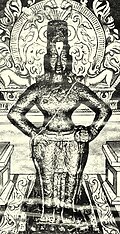
[[File:Syayambhuvithoba.jpg|thumb|left|upright|The central image of Vithoba]] | [[File:Syayambhuvithoba.jpg|thumb|left|upright|The central image of Vithoba]] | ||
[[Pundalik]] is a devoted son to his parents Janudev and Satyavati, who lived in a forest called Dandirvan. But after his wedding, Pundalik begins ill-treating his parents. Tired with their son's misbehavior and ill treatment, the elderly couple decide to leave for Kashi. Legend holds that people who die in the city of [[Varanasi|Kashi]] attain salvation and emancipation from the cycle of birth and death. Many Hindus would relocate to Kashi before they died. | |||
Upon hearing his parents' plans, Pundalik and his wife decide to join them on pilgrimage. The ill treatment continues. While the Pundalik and his wife ride on horseback, his parents walk. Pundalik even makes his old parents work to make his own journey comfortable. Every evening, when the party camps for the night, the son forces his parents to groom the horses and do other jobs. | |||
On the way to Kashi, the group reached the ashram (hermitage) of a pious and venerable sage, Kukkutswami. Exhausted, the family decides to spend a few days there. That night, when all were asleep, Pundalik by chance is awake and sees a remarkable vision. Just before dawn, a group of beautiful young women, dressed in soiled clothes, enter the ashram; they clean the floor, fetch water and wash the venerable | On the way to Kashi, the group reached the ashram (hermitage) of a pious and venerable sage, Kukkutswami. Exhausted, the family decides to spend a few days there. That night, when all were asleep, Pundalik by chance is awake and sees a remarkable vision. Just before dawn, a group of beautiful young women, dressed in soiled clothes, enter the ashram; they clean the floor, fetch water and wash the venerable sage's clothes. After finishing their chores, they go to the prayer-room. When they reappear after prayer, their clothes are spotlessly clean. Then, they vanish as inexplicably as they had appeared. | ||
Pundalik | Pundalik feels a deep sense of peace witnessing the scene. It remains on his mind the whole day and he resolves to remain awake the next night, and confirm it was not merely a dream. The next night, Pundalik approaches the beautiful women and asks who they are. They reveal themselves as the [[Ganges in Hinduism|Ganga]] (Ganges), [[Yamuna]] and other holy rivers of India. Pilgrims wish to take a dip in their holy waters to wash away their sins, which in fact are soiling their clothes. Then, the women say: "But O Pundalik, you, with your ill-treatment of your parents, are the greatest sinner of them all!"{{citation needed|date=April 2013}} Pundalik realizes his misdeeds, becomes entirely devoted to his parents and ensures their comfort, even risking his own. | ||
Impressed by Pundalik's devotion to his parents, [[Krishna]], plans to bless Pundalik immediately. So, he left (His abode) for Pundalik's ashram. Krishna knocks at Pundalik's door while he is busy serving his parents food. Pundalik realizes that God is at his door but decides to serve his parents first. So, Pundalik throws a brick outside for God to stand on and wait for him until he finishes attending to his parents. It is the first day of monsoon so it is wet and muddy outside. If Vishnu stands upon a brick his feet will remain clean and dry. | |||
Seeing this act, Krishna was extremely impressed | Seeing this act, Krishna was extremely impressed by Pundalik's love for his parents and granted a boon. Pundalik requests Krishna to stay on Earth and bless all his true devotees. Krishna agrees to stay and takes the form of Vithoba. Currently, the deity resides in the Vithoba temple and is worshipped alongside [[Rukmini]], his chief consort.<ref name=legend/><ref name=":0">{{Cite book |last=Lochtefeld |first=James G. |url=https://books.google.com/books?id=GnmPzgEACAAJ |title=The Illustrated Encyclopedia of Hinduism: N-Z |date=2002 |publisher=Rosen |isbn=978-0-8239-3180-4 |pages=765 |language=en}}</ref> | ||
==Sant Namdeva Maharaj Payari== | ==Sant Namdeva Maharaj Payari== | ||
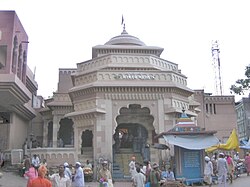
[[File:Pandharpur Vithoba temple.jpg|thumb|Chief (eastern) entrance of the temple, which houses the "Sant Namdev Maharaj | [[File:Pandharpur Vithoba temple.jpg|thumb|Chief (eastern) entrance of the temple, which houses the "Sant Namdev Maharaj Pāyari". The small blue temple in front of the gate is saint Chokhamela's memorial.]] | ||
[[File:Pandharpur 2013 Aashad - panoramio (10).jpg|thumb|The exit for pilgrims; with the shikhara of Rakhumai's cella seen]] | [[File:Pandharpur 2013 Aashad - panoramio (10).jpg|thumb|The exit for pilgrims; with the shikhara of Rakhumai's cella seen]] | ||
An interesting tale is that of the temple's first step called | An interesting tale is that of the temple's first step called "Sant Namdev Maharaj Pāyari" (step of Sant Namdev Maharaj). The child and future saint, Namdev was an ardent devotee of Vithoba. One day his mother asks him to complete the ritual of "naivedya" (any food made in the house is first offered to God, the ritual comprises placing the offering plate before the deity and sprinkling water around the plate and with a prayer to God). Namdev faithfully does "naivedya" and waits for God to appear and take the offering. But he is disheartened. He keeps praying and requests God to come in person and accept the offering. With no answer, the child starts banging his head at the feet of God. Seeing this utmost devotion and innocence of a child, God appears, eats the offering and blesses Namdev. Namdev asks for being present in the "first step" at His temple, so that he could innumerable devotees will touch him before having the "darshan" (view). So, this first step is called "Sant Namdev Maharaj Pāyari". | ||
=== Sant Tukaram=== | |||
It is also believed that [[Tukaram]] - a 17th-century devotee of [[Krishna]] in the form of ''Vithoba'' - spent his last days in the temple.<ref name=legend>{{cite book|title=Temples of India Myths and Legends|publisher=Publications Division, Ministry of Information and Broadcasting, Government of India|location=New Delhi|editor1-last=S.|editor1-first= Manjula|last=Bhoothalingam|first=Mathuram|year=2016|pages=11–14|isbn=978-81-230-1661-0}}</ref> | |||
==The Temple== | ==The Temple== | ||
[[File:Pandharpur.jpg|thumb|Chandrabaga river]] | [[File:Pandharpur.jpg|thumb|Chandrabaga river]] | ||
The main entrance of Lord Vittala's Temple is facing towards the Chandrabhaga or Bhima river. [[Samadhi#Hinduism|Samadhi]] of Namadev and Chokamela is at the entrance. Pilgrims will first pray to the Devotees and then enter the temple. A small [[Ganesha|Ganesh]] | The main entrance of Lord Vittala's Temple is facing towards the Chandrabhaga or Bhima river. [[Samadhi#Hinduism|Samadhi]] of Namadev and Chokamela is at the entrance. Pilgrims will first pray to the Devotees and then enter the temple. A small [[Ganesha|Ganesh]] shrine is present inside the temple as first Shrine. Then, a small hall where bhajans are performed. | ||
A small | A small shrine for [[Garuda]] and [[Hanuman]]. Then, after climbing a few steps, we can see the face of Lord Vittala. We can have this Mukha Darshan any time without standing in Queue. | ||
For, Padha Darshan (To touch the Lotus Feet of Lord), there is an entrance which leads to the queue complex outside the temple. It will lead to many small shrines of Bhaktas, then towards the Lord Panduranga. We can touch the feet of Lord | For, Padha Darshan (To touch the Lotus Feet of Lord), there is an entrance which leads to the queue complex outside the temple. It will lead to many small shrines of Bhaktas, then towards the Lord Panduranga. We can touch the feet of Lord. | ||
There are Shrines for [[Rukmini]] Devi, [[ | There are Shrines for [[Rukmini]] Devi, [[Satyabhama]] Devi, [[Radha|Radhika]] Devi ([[Rahi (goddess)|Rahi]]), Lord [[Narasimha]], Lord [[Venkateshwara]], Goddess [[Mahalakshmi]], [[Nagaraja|Nagaraj]], Ganesha, [[Annapoorna devi|Annapoorna Devi]]. There is another mandap where all devotees play like Krishna had played with [[Gopikas]]. | ||
It is a great experience. | It is a great experience. | ||
==See also== | ==See also== | ||
*[[Rukmini]] | *[[Rukmini]] | ||
*[[Rahi (goddess)]] | |||
*[[Avatar#Avatars of Vishnu|Avatars of Vishnu]] | *[[Avatar#Avatars of Vishnu|Avatars of Vishnu]] | ||
*[[Chokhamela]] | |||
==References== | ==References== | ||
{{Commons category|Vithoba | {{Commons category|Vithoba Temple, Pandharpur}} | ||
{{Reflist}} | {{Reflist}} | ||
==External links== | ==External links== | ||
* [http://www.amazingmaharashtra.com/2012/04/pandharpur.html Vithoba Temple's daily schedule] | * [http://www.amazingmaharashtra.com/2012/04/pandharpur.html Vithoba Temple's daily schedule] | ||
* [https://www.thedivineindia.com/vithoba-mandir/6570 Vithoba Temple Pandharpur] - ''The Divine India'' | * [https://www.thedivineindia.com/vithoba-mandir/6570 Vithoba Temple Pandharpur] {{Webarchive|url=https://web.archive.org/web/20220905122316/https://www.thedivineindia.com/vithoba-mandir/6570 |date=5 September 2022 }} – ''The Divine India'' | ||
{{Hindu temples in Maharashtra}} | {{Hindu temples in Maharashtra}} | ||
| Line 86: | Line 83: | ||
[[Category:Warkari]] | [[Category:Warkari]] | ||
[[Category:Haridasa]] | [[Category:Haridasa]] | ||
[[Category:Tourist attractions in Solapur district]] | [[Category:Tourist attractions in Solapur district]] | ||
[[Category:Krishna temples]] | [[Category:Krishna temples]] | ||
[[Category:Abhimana temples of Vishnu ]] | |||
[[Category:Hindu temples sacked in the Muslim period in the Indian subcontinent]] | |||
Latest revision as of 19:57, 14 February 2026
 | This article has multiple issues. Please help improve it or discuss these issues on the talk page. (Learn how and when to remove these template messages)
|


| Vithoba Temple | |
|---|---|
_(cropped).jpg) Shri Vitthal-Rukmini Mandir | |
| Religion | |
| District | Solapur |
| Deity | Vithoba Rakhumai |
| Location | |
| Location | Pandharpur |
| State | Maharashtra |
| Country | India |
| Coordinates | 17°40′N 75°20′E / 17.67°N 75.33°E |
| Part of a series on |
| Vaishnavism |
|---|
 |
 Hinduism portal Hinduism portal |
The Vithoba Temple, officially known as Shri Vitthal-Rukmini Mandir (Marathi: श्री विठ्ठल-रूक्मिणि देऊळ) is a Hindu temple in Pandharpur, in the Indian state of Maharashtra.[1] It is the main centre of worship for Vithoba, a form of the god Vishnu or Krishna, and his consort Rakhumai. It is one of the 108 Abhimana Kshethram of Vaishnavate tradition.[citation needed] The temple was built by King Vishnuvardhana (Bittideva) of Hoysala Empire between 1108 and 1152 CE upon being convinced by the historical figure Pundalik.[citation needed][dubious ] Also, there is an inscription in the temple, of a Hoysala King Vira Someshwara dating back to 1237 CE, which grants the temple a village for its upkeep.[2] It is the most visited temple in Maharashtra. The Warkaris start marching from their homes to the temple of Pandharpur in groups called Dindi (procession) to reach on Aashadhi Ekadashi and Kartiki Ekadashi. A dip in the holy river Chandrabhaga, on whose banks Pandharpur resides, is believed to have power to wash all sins. All the devotees are allowed to touch the feet of the idol of Vithoba. In May 2014, the temple became the first in India to invite women and people from backward classes as priests.[3][4][5][6][7]
Although parts of the temple date to the 12th or 13th century, the existing structure mainly dates to the 17th century or later, and reflects the later Deccan style, with dome motifs and lobed arches.[8] Attempts were made to destroy the temple by Afzal Khan, however the original central figure of the shrine was protected by the Brahmin priests Badve while Afzalkhan destroyed a similar idol.
Legend of Pundalik[edit | edit source]

Pundalik is a devoted son to his parents Janudev and Satyavati, who lived in a forest called Dandirvan. But after his wedding, Pundalik begins ill-treating his parents. Tired with their son's misbehavior and ill treatment, the elderly couple decide to leave for Kashi. Legend holds that people who die in the city of Kashi attain salvation and emancipation from the cycle of birth and death. Many Hindus would relocate to Kashi before they died.
Upon hearing his parents' plans, Pundalik and his wife decide to join them on pilgrimage. The ill treatment continues. While the Pundalik and his wife ride on horseback, his parents walk. Pundalik even makes his old parents work to make his own journey comfortable. Every evening, when the party camps for the night, the son forces his parents to groom the horses and do other jobs.
On the way to Kashi, the group reached the ashram (hermitage) of a pious and venerable sage, Kukkutswami. Exhausted, the family decides to spend a few days there. That night, when all were asleep, Pundalik by chance is awake and sees a remarkable vision. Just before dawn, a group of beautiful young women, dressed in soiled clothes, enter the ashram; they clean the floor, fetch water and wash the venerable sage's clothes. After finishing their chores, they go to the prayer-room. When they reappear after prayer, their clothes are spotlessly clean. Then, they vanish as inexplicably as they had appeared.
Pundalik feels a deep sense of peace witnessing the scene. It remains on his mind the whole day and he resolves to remain awake the next night, and confirm it was not merely a dream. The next night, Pundalik approaches the beautiful women and asks who they are. They reveal themselves as the Ganga (Ganges), Yamuna and other holy rivers of India. Pilgrims wish to take a dip in their holy waters to wash away their sins, which in fact are soiling their clothes. Then, the women say: "But O Pundalik, you, with your ill-treatment of your parents, are the greatest sinner of them all!"[citation needed] Pundalik realizes his misdeeds, becomes entirely devoted to his parents and ensures their comfort, even risking his own.
Impressed by Pundalik's devotion to his parents, Krishna, plans to bless Pundalik immediately. So, he left (His abode) for Pundalik's ashram. Krishna knocks at Pundalik's door while he is busy serving his parents food. Pundalik realizes that God is at his door but decides to serve his parents first. So, Pundalik throws a brick outside for God to stand on and wait for him until he finishes attending to his parents. It is the first day of monsoon so it is wet and muddy outside. If Vishnu stands upon a brick his feet will remain clean and dry.
Seeing this act, Krishna was extremely impressed by Pundalik's love for his parents and granted a boon. Pundalik requests Krishna to stay on Earth and bless all his true devotees. Krishna agrees to stay and takes the form of Vithoba. Currently, the deity resides in the Vithoba temple and is worshipped alongside Rukmini, his chief consort.[9][1]
Sant Namdeva Maharaj Payari[edit | edit source]

.jpg)
An interesting tale is that of the temple's first step called "Sant Namdev Maharaj Pāyari" (step of Sant Namdev Maharaj). The child and future saint, Namdev was an ardent devotee of Vithoba. One day his mother asks him to complete the ritual of "naivedya" (any food made in the house is first offered to God, the ritual comprises placing the offering plate before the deity and sprinkling water around the plate and with a prayer to God). Namdev faithfully does "naivedya" and waits for God to appear and take the offering. But he is disheartened. He keeps praying and requests God to come in person and accept the offering. With no answer, the child starts banging his head at the feet of God. Seeing this utmost devotion and innocence of a child, God appears, eats the offering and blesses Namdev. Namdev asks for being present in the "first step" at His temple, so that he could innumerable devotees will touch him before having the "darshan" (view). So, this first step is called "Sant Namdev Maharaj Pāyari".
Sant Tukaram[edit | edit source]
It is also believed that Tukaram - a 17th-century devotee of Krishna in the form of Vithoba - spent his last days in the temple.[9]
The Temple[edit | edit source]

The main entrance of Lord Vittala's Temple is facing towards the Chandrabhaga or Bhima river. Samadhi of Namadev and Chokamela is at the entrance. Pilgrims will first pray to the Devotees and then enter the temple. A small Ganesh shrine is present inside the temple as first Shrine. Then, a small hall where bhajans are performed.
A small shrine for Garuda and Hanuman. Then, after climbing a few steps, we can see the face of Lord Vittala. We can have this Mukha Darshan any time without standing in Queue. For, Padha Darshan (To touch the Lotus Feet of Lord), there is an entrance which leads to the queue complex outside the temple. It will lead to many small shrines of Bhaktas, then towards the Lord Panduranga. We can touch the feet of Lord. There are Shrines for Rukmini Devi, Satyabhama Devi, Radhika Devi (Rahi), Lord Narasimha, Lord Venkateshwara, Goddess Mahalakshmi, Nagaraj, Ganesha, Annapoorna Devi. There is another mandap where all devotees play like Krishna had played with Gopikas. It is a great experience.
See also[edit | edit source]
References[edit | edit source]
- ↑ 1.0 1.1 Lochtefeld, James G. (2002). The Illustrated Encyclopedia of Hinduism: N-Z. Rosen. p. 765. ISBN 978-0-8239-3180-4.
- ↑ "The Great Pandharpur Pilgrimage". Live History India. 3 July 2017.
- ↑ Vishwas Waghmode (29 May 2014). "Caste no bar: Women, non-Brahmins will be priests in Pandharpur temple". Firstpost. Retrieved 30 August 2018.
- ↑ Amruta Byatnal (23 May 2014). "Pandharpur temple allows women, men of all castes as priests". The Hindu. Retrieved 30 August 2018.
- ↑ Daily News & Analysis (15 May 2014). "Athawale slams Sanatan for opposing Dalit priest in temple". Dnaindia.com. Retrieved 29 July 2015.
- ↑ "First time in 900 yrs, Vitthal Rukmini temple may get non-Brahmin priests". The Indian Express. 6 May 2014. Retrieved 29 July 2015.
- ↑ "Lord Vithoba temple makes history by having women and lower-caste priests". IANS. news.biharprabha.com. Retrieved 9 May 2014.
- ↑ Michell, George, The Penguin Guide to the Monuments of India, Volume 1: Buddhist, Jain, Hindu, p. 386, 1989, Penguin Books, ISBN 0140081445
- ↑ 9.0 9.1 Bhoothalingam, Mathuram (2016). S., Manjula (ed.). Temples of India Myths and Legends. New Delhi: Publications Division, Ministry of Information and Broadcasting, Government of India. pp. 11–14. ISBN 978-81-230-1661-0.
External links[edit | edit source]
- Vithoba Temple's daily schedule
- Vithoba Temple Pandharpur Archived 5 September 2022 at the Wayback Machine – The Divine India
| Districts |
|  |
|---|---|---|
| Ahmednagar | ||
| Aurangabad |
| |
| Beed | ||
| Buldhana | ||
| Jalgaon | ||
| Kolhapur | ||
| Latur | ||
| Mumbai City | ||
| Mumbai Suburban | ||
| Nagpur | ||
| Nashik | ||
| Osmanabad | ||
| Palghar | ||
| Parbhani | ||
| Pune | ||
| Raigad | ||
| Ratnagiri | ||
| Sangli | ||
| Satara | ||
| Sindhudurg | ||
| Solapur | ||
| Thane | ||
| See also | ||
| Hindu temples in other states (templates) | ||
| Forms |  | |
|---|---|---|
| Consorts | ||
| Other relatives | ||
| Worship | ||
| Holy sites | ||
| Epigraphy | ||
| Texts | ||
| See also | ||
- Pages using the JsonConfig extension
- Articles needing additional references from April 2015
- Articles with minor POV problems from August 2023
- Hindu temples in Maharashtra
- Warkari
- Haridasa
- Tourist attractions in Solapur district
- Krishna temples
- Abhimana temples of Vishnu
- Hindu temples sacked in the Muslim period in the Indian subcontinent