

imported>Rasnaboy Undid revision 1037853624 by 106.214.243.34 (talk) |
fixed lead to improve readability and corrected details |
||
| Line 1: | Line 1: | ||
{{ | {{Short description|Species of flowering plant}} | ||
{{ | {{Redirect2|Tulsi|Tulsi|other uses|Tulasi (disambiguation)|and|Tulsi (disambiguation)}} | ||
{{Redirect- | {{Redirect-distinguish|Holy Basil|holy herb}} | ||
{{ | {{Speciesbox | ||
| image = Tulsi or Tulasi Holy basil.jpg | |||
| genus = Ocimum | |||
|image = | | species = tenuiflorum | ||
|genus = Ocimum | | authority = [[Carolus Linnaeus|L.]]<ref name="POWO" /> | ||
|species = tenuiflorum | | synonyms = | ||
|authority = [[Carolus Linnaeus|L.]] | {{Species list | ||
|synonyms = | | Geniosporum tenuiflorum | (L.) Merr. | ||
| Lumnitzera tenuiflora | (L.) Spreng. | |||
| Moschosma tenuiflorum | (L.) Heynh. | |||
| Ocimum hirsutum | Benth. | |||
| Ocimum inodorum | Burm.f. | |||
| Ocimum monachorum | L. | |||
| Ocimum sanctum | L. | |||
| Ocimum subserratum | B.Heyne ex Hook.f. | |||
| Ocimum tomentosum | Lam. | |||
| Plectranthus monachorum | (L.) Spreng. | |||
}} | |||
| synonyms_ref = <ref name="POWO" /> | |||
|synonyms_ref = <ref | |||
}} | }} | ||
'''''Ocimum tenuiflorum''''', commonly known as ''' | '''''Ocimum tenuiflorum''''', commonly known as '''tulasi''', '''tulsi''', or '''holy basil''', is an aromatic [[perennial]] plant in the family [[Lamiaceae]].<ref name="GRIN">{{GRIN | access-date = 7 July 2021}}</ref><ref name="CABI-ISC" /> It is widely cultivated throughout the [[Southeast Asia|Southeast Asian]] [[tropics]].<ref name="POWO">{{Cite web |date=2023 |title=''Ocimum tenuiflorum'' L. |url=https://powo.science.kew.org/taxon/urn:lsid:ipni.org:names:453130-1 |archive-url=https://web.archive.org/web/20241213124754/https://powo.science.kew.org/taxon/urn:lsid:ipni.org:names:453130-1 |url-status=live |archive-date=December 13, 2024 |access-date=26 June 2023 |publisher=Kew, Royal Botanic Gardens}}</ref><ref name="Staples19992">{{Cite book |last=Staples |first=George |title=Ethnic Culinary Herbs |last2=Michael S. Kristiansen |publisher=University of Hawaii Press |year=1999 |isbn=978-0-8248-2094-7 |page=73}}</ref><ref name="warrier2">{{Cite book |last=Warrier |first=P K |title=Indian Medicinal Plants |publisher=Orient Longman |year=1995 |isbn=978-0-86311-551-6 |page=168}}</ref> It is native to tropical and subtropical regions of Asia, Australia and the western Pacific.<ref name="POWO" /> This plant has escaped from cultivation and has [[naturalisation (biology)|naturalized]] in many tropical regions of the Americas.<ref name="CABI-ISC">{{Cite web |date=23 August 2014 |title=''Ocimum tenuiflorum'' (holy basil) |url=http://www.cabi.org/isc/datasheet/110287 |archive-url=https://web.archive.org/web/20220809110813/https://www.cabi.org/isc/datasheet/110287 |url-status=live |archive-date=9 August 2022 |access-date=26 June 2023 |publisher=CABI Invasive Species Compendium}}</ref><ref name="ITIS Standard Report Page: Ocimum tenuiflorum">{{ cite web | url=http://www.itis.gov/servlet/SingleRpt/SingleRpt?search_topic=TSN&search_value=507863 | title=''Ocimum tenuiflorum''|publisher=Integrated Taxonomic Information System|date=26 June 2023|accessdate=26 June 2023}}</ref> It is an agricultural and [[Invasive species|environmental weed]].<ref name="CABI-ISC" /> | ||
'' | ''Tulasi'' is cultivated for religious and [[traditional medicine]] purposes, and also for its [[essential oil]]. It is widely used as an [[herbal tea]], commonly used in [[Ayurveda]]. It has a place within the [[Vaishnavism|Vaishnava]] tradition of [[Hinduism]], in which devotees perform worship involving the plant or its leaves. | ||
==Morphology== | ==Morphology== | ||
Holy basil is an erect, many-branched subshrub, {{convert|30-60|cm|abbr=on}} tall with hairy stems. Leaves are green or purple; they are simple, [[petiole (botany)|petioled]], with an [[wikt:ovate|ovate]] blade up to {{convert|5|cm|in|frac=2|abbr=on}} long, which usually has a slightly toothed margin; they are strongly scented and have a [[decussation|decussate]] [[phyllotaxis|phyllotaxy]]. The purplish flowers are placed in close whorls on elongated [[raceme]]s.<ref name="warrier">{{Cite book |last=Warrier |first=P K |title=Indian Medicinal Plants |publisher=Orient Longman |year=1995 |isbn=978-0-86311-551-6 |page=168}}</ref> | |||
[[ | |||
The three main [[Polymorphism (biology)|morphotype]]s cultivated in [[India]] and [[Nepal]] are ''Ram tulsi'' (the most common type, with broad bright green leaves that are slightly sweet), the less common purplish green-leaved ([[Krishna]] or ''Shyama tulsi'') and the common wild ''vana tulsi'' (e.g., ''Ocimum gratissimum'').<ref name="bio">{{Cite journal |date=November–December 2005 |title=Volatile Constituents in Oil from Different Plant Parts of Methyl Eugenol-Rich Ocimum tenuiflorum L.f. (syn. O. sanctum L.) Grown in South India |journal=Journal of Essential Oil Research |doi=10.1080/10412905.2005.9699025 |first1=S. K. |last1=Kothari |first2=A. K. |last2=Bhattacharya |first3=S. |last3=Ramesh |first4=S. N. |last4=Garg |first5=S. P. S. |last5=Khanuja |pages=656–658 |volume=17 |issue=6 |s2cid=95551382 }}</ref> | |||
The | == Phytochemicals == | ||
The plant and its oil contain diverse [[phytochemical]]s, including [[tannin]]s, [[flavonoid]]s, [[eugenol]], [[caryophyllene]]s, [[carvacrol]], [[linalool]], [[camphor]], and [[cinnamyl acetate]], among others.<ref name="drugs">{{cite web |title=Holy basil |url=https://www.drugs.com/npp/holy-basil.html |publisher=Drugs.com |access-date=26 June 2023 |date=1 February 2022}}</ref><ref>{{cite journal|doi=10.1080/10826076.2011.606583|title=LC-MS Quantification of Rosmarinic Acid and Ursolic Acid in Theocimum Sanctumlinn. Leaf Extract (Holy Basil, Tulsi)|journal=Journal of Liquid Chromatography & Related Technologies|volume=35|issue=5|pages=634|year=2012|last1=Sundaram|first1=R. Shanmuga|last2=Ramanathan|first2=M|last3=Rajesh|first3=R|last4=Satheesh|first4=B|last5=Saravanan|first5=D|s2cid=95225535}}</ref> One study reported that the plant contains an eponymous family of 10 [[Lignan|neolignan]] compounds called ''tulsinol A-J''.<ref>{{Cite journal |last=Singh |first=Deepika |last2=Chaudhuri |first2=Prabir K. |date=2018-08-01 |title=A review on phytochemical and pharmacological properties of Holy basil (''Ocimum sanctum'' L.) |url=https://www.sciencedirect.com/science/article/pii/S0926669018302711 |journal=Industrial Crops and Products |language=en |volume=118 |pages=367–382 |doi=10.1016/j.indcrop.2018.03.048 |issn=0926-6690|url-access=subscription }}</ref> | |||
== | Specific [[aroma compound]]s in the [[essential oil]] are camphor (32%), [[eucalyptol]] (19%), [[Bisabolene|⍺-bisabolene]] (17%), eugenol (14%), germacrene (11%) and β-bisabolene (11%).<ref name=":0">{{Cite journal |last1=Yamani |first1=Hanaa A. |last2=Pang |first2=Edwin C. |last3=Mantri |first3=Nitin |last4=Deighton |first4=Margaret A. |date=2016 |title=Antimicrobial Activity of Tulsi (Ocimum tenuiflorum) Essential Oil and Their Major Constituents against Three Species of Bacteria |journal=Frontiers in Microbiology |volume=7 |page=681 |doi=10.3389/fmicb.2016.00681 |issn=1664-302X |pmc=4868837 |pmid=27242708 |doi-access=free }}</ref>{{dubious source|date=April 2023}} In addition, more than 60 different aroma compounds were found through [[gas chromatography–mass spectrometry]] analysis of holy basil.<ref name=":0" /> However, other studies have stated tulsi essential oil consists mostly of [[eugenol]] (70%) [[elemene|β-elemene]] (11%), β-caryophyllene (8%), and [[germacrene]] (2%), with the balance being made up of various trace compounds, mostly [[terpenes]].<ref>{{Cite journal |last1=Padalia |first1=Rajendra C. |last2=Verma |first2=Ram S. |year=2011 |title=Comparative volatile oil composition of four ''Ocimum'' species from northern India |journal=Natural Product Research |volume=25 |issue=6 |pages=569–575 |doi=10.1080/14786419.2010.482936 |pmid=21409717 |s2cid=205836713}}</ref> | ||
==Uses== | |||
===Culinary=== | |||
== | ====Thai cuisine==== | ||
The leaves of holy basil, known as ''kaphrao'' in the [[Thai language]] ({{lang|th|กะเพรา}}), are commonly used in [[Thai cuisine]] for certain stir-fries and curries such as ''[[phat kaphrao]]'' ({{lang|th|ผัดกะเพรา}}) — a stir-fry of Thai holy basil with meats, seafood or, as in ''[[Thai fried rice|khao phat kraphao]]'', with rice. Two different types of holy basil are used in Thailand, a "red" variant which tends to be more pungent, and a "white" version for seafood dishes.<ref>{{cite book |last1=Thompson |first1=David |title=Thai food |date=2010 |publisher=Pavilion Books |location=London |isbn=9-781862-055148 |pages=143 |edition=7 |accessdate= }}</ref><ref>{{cite book |last1=Punyaratabandhu |first1=Leela |title=Bangkok |date=2017 |publisher=Ten Speed Press |location=New York |isbn=978-0-399-57831-1 |page=338 |edition=1 |accessdate= }}</ref> ''Kaphrao'' should not be confused with ''horapha'' ({{lang|th|โหระพา}}), which is normally known as [[Thai basil]],<ref name=katzer>[http://gernot-katzers-spice-pages.com/engl/Ocim_bas.html Gernot Katzer's Spice Pages]</ref> or with [[Thai lemon basil]] (''maenglak''; {{lang|th|แมงลัก}}). | |||
'' | ====Minangkabau cuisine==== | ||
| last1 = | Holy basil (in [[Minangkabau language]] and [[Indonesian language]] are known as ''{{ill|ruku-ruku|id|ruku-ruku}}'') is also widely used for [[Padang cuisine|Minangkabau dishes]], particularly for its [[gulai]] variety, which involves fish as the primary source of protein.<ref>{{cite web |last1=Yenti |first1=Juni Fitra |title=Daun Ruku-Ruku, Bumbu Dapur yang Sering Dipakai Orang Minang |url=https://sumbarkita.id/daun-ruku-ruku-bumbu-dapur-yang-sering-dipakai-orang-minang/ |website=Sumbarkita.id |publisher=Sumbarkita.id |access-date=10 February 2025 |language=id |date=3 June 2024}}</ref> These Minangkabau fish gulais that commonly use holy basil such as ''gulai ikan mas'' (carp gulai), ''gulai ikan kakap'' (red snapper gulai), ''gulai kepala ikan kakap'' (red snapper's head gulai), ''samba ikan gadang'' or ''pangek'' (braised fish gulai),<ref>{{cite book |last1=Soepono |first1=Sri S |title=Ensiklopedi makanan tradisional Indonesia: Sumatera. |date=2004 |publisher=Proyek Pelestarian dan Pengembangan Tradisi dan Kepercayaan |location=Jakarta|pages=133-5 |url=https://storage.googleapis.com/perpus-dprd.appspot.com/books/file-5yz1-1704722611405-g7bs.pdf|access-date=February 10, 2026|url-status=live | ||
| | |archive-url= https://web.archive.org/web/20260210030233/https://storage.googleapis.com/perpus-dprd.appspot.com/books/file-5yz1-1704722611405-g7bs.pdf |archive-date= February 10, 2026 }}</ref> and ''gulai telur ikan'' (fish roe gulai). Holy basil leaves are used to enhance flavour. | ||
| | |||
| | |||
| | |||
| | |||
| | |||
| pages = | |||
| | |||
| | |||
| | |||
}}</ref> | |||
== | <gallery widths="200" heights="180" mode="packed"> | ||
File:Kraphao mu khai dao.jpg|''Phat kaphrao mu'' – Thai holy basil with pork – a common dish in Thailand. | |||
File:Gulai kapalo lauak.jpg|A plate of gulai kepala ikan (fish head's gulai) accompanied by ruku-ruku, slices of blimbi wuluh (''[[Averrhoa bilimbi]]'') and green cabai rawit (bird's eye chilies). | |||
</gallery> | |||
== | ===Insect repellent=== | ||
For centuries, the dried leaves have been mixed with stored grains to repel insects.<ref>{{Cite journal|last=Biswas|first=N. P.|author2=Biswas, A. K.|title= Evaluation of some leaf dusts as grain protectant against rice weevil ''Sitophilus oryzae'' (Linn.) |journal=Environment and Ecology|volume= 23 |issue= 3|year= 2005|pages=485–488 }}</ref> | |||
===Nematicidal=== | |||
The essential oil may have [[nematicide|nematicidal]] properties against ''[[Tylenchulus semipenetrans]]'', ''[[Meloidogyne javanica]]'', ''[[Anguina tritici]]'', and ''[[Heterodera cajani]]''.<ref name="Chitwood-2002">{{cite journal | last=Chitwood | first=David J. | title=Phytochemical Based Strategies for Nematode Control | journal=[[Annual Review of Phytopathology]] | publisher=[[Annual Reviews (publisher)|Annual Reviews]] | volume=40 | issue=1 | year=2002 | issn=0066-4286 | doi=10.1146/annurev.phyto.40.032602.130045 | pages=221–249| pmid=12147760 }}</ref> | |||
==In Hinduism== | |||
{{main|Tulasi in Hinduism}} | |||
== | ''Tulasi'' may be planted in [[courtyard]]s of Hindu houses or temples to [[Hanuman]].<ref name="Simoons"/> The ritual lighting of lamps each evening during ''[[Kartik (month)|Kartik]]'' includes the worship of the ''tulsi'' plant.<ref name="Flood2003">{{Cite book|last=Flood|first=Gavin D. |author-link=Gavin Flood |title=The Blackwell companion to Hinduism|publisher=Wiley-Blackwell|year=2001 |page=331 |isbn=978-0-631-21535-6 |url=https://books.google.com/books?id=qSfneQ0YYY8C&pg=PA331}}</ref><ref>{{cite book |title=Hindu Mythology |last=Wilkins|first=W.J. |page=471 |publisher=D.K. Printworld |location=New Delhi |isbn=978-81-246-0234-8 |year=2003}}</ref> Vaishnavites are also known as "those who bear the'' tulsi'' around the neck".<ref name="Simoons">{{Cite book |last=Simoons|first=Frederick J.|title=Plants of life, plants of death |publisher=Univ of Wisconsin Press |year=1998 |pages=7–40 |isbn=978-0-299-15904-7 |url=https://books.google.com/books?id=KEUAbrBoeBAC&pg=PA14}}</ref> | ||
{{ | |||
''Tulsi'' is a | ''[[Tulsi Vivah|Tulasi Vivaha]]'' is a ceremonial festival performed between ''[[Prabodhini Ekadashi]]'' (the 11th or 12th lunar day of the bright fortnight of the [[Hindu calendar|Hindu month]] of [[Kartika (month)|Kartika]]) and ''[[Kartik Purnima]]'' (the full moon of the month).<ref name = underhill>{{cite book |author=Underhill, M. M. |title=The Hindu Religious Year |url=https://books.google.com/books?id=Fb9Zc0yPVUUC |year=1991 |pages= 129–131 |publisher=Asian Educational Services |isbn=978-81-206-0523-7}}</ref><ref name="PawarPatil2008">{{cite book |author1=Pawar, Shubhangi |author2=Patil, D. A. |title=Ethnobotany of Jalgaon District, Maharashtra |url=https://books.google.com/books?id=xTi0iaalLXcC&pg=PA401 |date= 2008 |pages=400 |publisher=Daya Publishing House |isbn=978-81-7035-515-1}}</ref> During the [[Bihu|Kati Bihu festival]] celebrated in [[Assam]], people light earthen lamps (''[[Diya (lamp)|diya]]'') at the foot of the household tulsi plants.<ref>{{Cite web |vauthors=Kantak R |title=Kati Bihu celebrated in Assam |url=http://businessworld.in/article/Kati-Bihu-celebrated-in-Assam/18-10-2020-332770 |access-date=2022-06-09 |publisher=BW Businessworld |language=en}}</ref> | ||
'' | ''Tulasi'' has been used in [[Ayurveda|Ayurvedic]] and [[Siddha medicine|Siddha]] practices for its supposed medicinal properties.<ref>{{Cite book|last=NIIR Board, National Institute of Industrial Research (India)|title=Compendium of Medicinal Plants|publisher=National Institute of Industrial Research|series=2004|isbn=978-81-86623-80-0|page=320|year=2004}}</ref><ref name="BraunCohen2015">{{cite book|author1=Lesley Braun|author2=Marc Cohen|title=Herbs and Natural Supplements, Volume 2: An Evidence-Based Guide|url=https://books.google.com/books?id=Y951BwAAQBAJ&pg=PA996|date=30 March 2015|publisher=Elsevier Health Sciences|isbn=978-0-7295-8173-8|page=996}}</ref> | ||
==Gallery== | ==Gallery== | ||
<gallery mode=" | <gallery widths="200" heights="180" mode="packed"> | ||
File: | File:Ocimum tenuiflorum flower.jpg|Flowers | ||
File:Ocimum tenuiflorum inflorescence closeup.jpg|Inflorescence | |||
File:Tulsi 4 20170715.jpg|Leaves of Ocimum tenuiflorum L. | |||
File:Ocimum tenuiflorum inflorescence closeup.jpg| | |||
File: | |||
File:Japa mala (prayer beads) of Tulasi wood with 108 beads - 20040101-01.jpg|[[Prayer beads]] made from ''tulsi'' wood | File:Japa mala (prayer beads) of Tulasi wood with 108 beads - 20040101-01.jpg|[[Prayer beads]] made from ''tulsi'' wood | ||
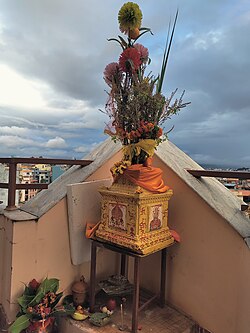
File: | File:Tulashithan at Kathmandu.jpg|Holy basil's monastery in a house in [[Kathmandu]], [[Nepal]] | ||
</gallery> | </gallery> | ||
| Line 101: | Line 81: | ||
* [[Sacred trees]] | * [[Sacred trees]] | ||
* [[Sacred groves]] | * [[Sacred groves]] | ||
* [[Phat kaphrao]] | |||
==References== | ==References== | ||
| Line 106: | Line 87: | ||
==External links== | ==External links== | ||
{{Commons category-inline|Ocimum tenuiflorum}} | *{{Commons category-inline|Ocimum tenuiflorum}} | ||
{{Herbs & spices}} | {{Herbs & spices}} | ||
| Line 114: | Line 95: | ||
[[Category:Herbs]] | [[Category:Herbs]] | ||
[[Category:Ocimum|tenuiflorum]] | [[Category:Ocimum|tenuiflorum]] | ||
[[Category:Flora of tropical Asia]] | [[Category:Flora of tropical Asia]] | ||
[[Category:Flora of China]] | |||
[[Category:Flora of Taiwan]] | |||
[[Category:Flora of the Marshall Islands]] | |||
[[Category:Flora of the Mariana Islands]] | |||
[[Category:Flora of Vanuatu]] | |||
[[Category:Flora of Queensland]] | |||
[[Category:Plants described in 1753]] | [[Category:Plants described in 1753]] | ||
[[Category:Indian spices]] | [[Category:Indian spices]] | ||
[[Category: | [[Category:Botanical taxa named by Carl Linnaeus]] | ||
Latest revision as of 23:11, 11 February 2026
| Ocimum tenuiflorum | |
|---|---|

| |
Scientific classification 
| |
| : | [[Template:Taxonomy/Ocimum]] |
| Species: | Template:Taxonomy/OcimumO. tenuiflorum
|
| Binomial name | |
| Template:Taxonomy/OcimumOcimum tenuiflorum | |
| Synonyms[1] | |
Ocimum tenuiflorum, commonly known as tulasi, tulsi, or holy basil, is an aromatic perennial plant in the family Lamiaceae.[2][3] It is widely cultivated throughout the Southeast Asian tropics.[1][4][5] It is native to tropical and subtropical regions of Asia, Australia and the western Pacific.[1] This plant has escaped from cultivation and has naturalized in many tropical regions of the Americas.[3][6] It is an agricultural and environmental weed.[3]
Tulasi is cultivated for religious and traditional medicine purposes, and also for its essential oil. It is widely used as an herbal tea, commonly used in Ayurveda. It has a place within the Vaishnava tradition of Hinduism, in which devotees perform worship involving the plant or its leaves.
Morphology[edit | edit source]
Holy basil is an erect, many-branched subshrub, 30–60 cm (12–24 in) tall with hairy stems. Leaves are green or purple; they are simple, petioled, with an ovate blade up to 5 cm (2 in) long, which usually has a slightly toothed margin; they are strongly scented and have a decussate phyllotaxy. The purplish flowers are placed in close whorls on elongated racemes.[7]
The three main morphotypes cultivated in India and Nepal are Ram tulsi (the most common type, with broad bright green leaves that are slightly sweet), the less common purplish green-leaved (Krishna or Shyama tulsi) and the common wild vana tulsi (e.g., Ocimum gratissimum).[8]
Phytochemicals[edit | edit source]
The plant and its oil contain diverse phytochemicals, including tannins, flavonoids, eugenol, caryophyllenes, carvacrol, linalool, camphor, and cinnamyl acetate, among others.[9][10] One study reported that the plant contains an eponymous family of 10 neolignan compounds called tulsinol A-J.[11]
Specific aroma compounds in the essential oil are camphor (32%), eucalyptol (19%), ⍺-bisabolene (17%), eugenol (14%), germacrene (11%) and β-bisabolene (11%).[12]Template:Dubious source In addition, more than 60 different aroma compounds were found through gas chromatography–mass spectrometry analysis of holy basil.[12] However, other studies have stated tulsi essential oil consists mostly of eugenol (70%) β-elemene (11%), β-caryophyllene (8%), and germacrene (2%), with the balance being made up of various trace compounds, mostly terpenes.[13]
Uses[edit | edit source]
Culinary[edit | edit source]
Thai cuisine[edit | edit source]
The leaves of holy basil, known as kaphrao in the Thai language (กะเพรา), are commonly used in Thai cuisine for certain stir-fries and curries such as phat kaphrao (ผัดกะเพรา) — a stir-fry of Thai holy basil with meats, seafood or, as in khao phat kraphao, with rice. Two different types of holy basil are used in Thailand, a "red" variant which tends to be more pungent, and a "white" version for seafood dishes.[14][15] Kaphrao should not be confused with horapha (โหระพา), which is normally known as Thai basil,[16] or with Thai lemon basil (maenglak; แมงลัก).
Minangkabau cuisine[edit | edit source]
Holy basil (in Minangkabau language and Indonesian language are known as ruku-ruku) is also widely used for Minangkabau dishes, particularly for its gulai variety, which involves fish as the primary source of protein.[17] These Minangkabau fish gulais that commonly use holy basil such as gulai ikan mas (carp gulai), gulai ikan kakap (red snapper gulai), gulai kepala ikan kakap (red snapper's head gulai), samba ikan gadang or pangek (braised fish gulai),[18] and gulai telur ikan (fish roe gulai). Holy basil leaves are used to enhance flavour.
-
 Phat kaphrao mu – Thai holy basil with pork – a common dish in Thailand.
 -
 A plate of gulai kepala ikan (fish head's gulai) accompanied by ruku-ruku, slices of blimbi wuluh (Averrhoa bilimbi) and green cabai rawit (bird's eye chilies).


Insect repellent[edit | edit source]
For centuries, the dried leaves have been mixed with stored grains to repel insects.[19]
Nematicidal[edit | edit source]
The essential oil may have nematicidal properties against Tylenchulus semipenetrans, Meloidogyne javanica, Anguina tritici, and Heterodera cajani.[20]
In Hinduism[edit | edit source]
Tulasi may be planted in courtyards of Hindu houses or temples to Hanuman.[21] The ritual lighting of lamps each evening during Kartik includes the worship of the tulsi plant.[22][23] Vaishnavites are also known as "those who bear the tulsi around the neck".[21]
Tulasi Vivaha is a ceremonial festival performed between Prabodhini Ekadashi (the 11th or 12th lunar day of the bright fortnight of the Hindu month of Kartika) and Kartik Purnima (the full moon of the month).[24][25] During the Kati Bihu festival celebrated in Assam, people light earthen lamps (diya) at the foot of the household tulsi plants.[26]
Tulasi has been used in Ayurvedic and Siddha practices for its supposed medicinal properties.[27][28]
Gallery[edit | edit source]
-
 Flowers
 -
 Inflorescence
 -
 Leaves of Ocimum tenuiflorum L.
 -
 Prayer beads made from tulsi wood
 -


_of_Tulasi_wood_with_108_beads_-_20040101-01.jpg)

See also[edit | edit source]
References[edit | edit source]
- ↑ 1.0 1.1 1.2 1.3 "Ocimum tenuiflorum L." Kew, Royal Botanic Gardens. 2023. Archived from the original on December 13, 2024. Retrieved 26 June 2023.
- ↑ [{{#property:P1421|}} "{{#Property:P225}}"]. Germplasm Resources Information Network (GRIN). Agricultural Research Service (ARS), United States Department of Agriculture (USDA). Retrieved 7 July 2021.
{{citation}}: Check|url=value (help) - ↑ 3.0 3.1 3.2 "Ocimum tenuiflorum (holy basil)". CABI Invasive Species Compendium. 23 August 2014. Archived from the original on 9 August 2022. Retrieved 26 June 2023.
- ↑ Staples, George; Michael S. Kristiansen (1999). Ethnic Culinary Herbs. University of Hawaii Press. p. 73. ISBN 978-0-8248-2094-7.
- ↑ Warrier, P K (1995). Indian Medicinal Plants. Orient Longman. p. 168. ISBN 978-0-86311-551-6.
- ↑ "Ocimum tenuiflorum". Integrated Taxonomic Information System. 26 June 2023. Retrieved 26 June 2023.
- ↑ Warrier, P K (1995). Indian Medicinal Plants. Orient Longman. p. 168. ISBN 978-0-86311-551-6.
- ↑ Kothari, S. K.; Bhattacharya, A. K.; Ramesh, S.; Garg, S. N.; Khanuja, S. P. S. (November–December 2005). "Volatile Constituents in Oil from Different Plant Parts of Methyl Eugenol-Rich Ocimum tenuiflorum L.f. (syn. O. sanctum L.) Grown in South India". Journal of Essential Oil Research. 17 (6): 656–658. doi:10.1080/10412905.2005.9699025. S2CID 95551382.
- ↑ "Holy basil". Drugs.com. 1 February 2022. Retrieved 26 June 2023.
- ↑ Sundaram, R. Shanmuga; Ramanathan, M; Rajesh, R; Satheesh, B; Saravanan, D (2012). "LC-MS Quantification of Rosmarinic Acid and Ursolic Acid in Theocimum Sanctumlinn. Leaf Extract (Holy Basil, Tulsi)". Journal of Liquid Chromatography & Related Technologies. 35 (5): 634. doi:10.1080/10826076.2011.606583. S2CID 95225535.
- ↑ Singh, Deepika; Chaudhuri, Prabir K. (2018-08-01). "A review on phytochemical and pharmacological properties of Holy basil (Ocimum sanctum L.)". Industrial Crops and Products. 118: 367–382. doi:10.1016/j.indcrop.2018.03.048. ISSN 0926-6690.
- ↑ 12.0 12.1 Yamani, Hanaa A.; Pang, Edwin C.; Mantri, Nitin; Deighton, Margaret A. (2016). "Antimicrobial Activity of Tulsi (Ocimum tenuiflorum) Essential Oil and Their Major Constituents against Three Species of Bacteria". Frontiers in Microbiology. 7: 681. doi:10.3389/fmicb.2016.00681. ISSN 1664-302X. PMC 4868837. PMID 27242708.
- ↑ Padalia, Rajendra C.; Verma, Ram S. (2011). "Comparative volatile oil composition of four Ocimum species from northern India". Natural Product Research. 25 (6): 569–575. doi:10.1080/14786419.2010.482936. PMID 21409717. S2CID 205836713.
- ↑ Thompson, David (2010). Thai food (7 ed.). London: Pavilion Books. p. 143. ISBN 9-781862-055148.
- ↑ Punyaratabandhu, Leela (2017). Bangkok (1 ed.). New York: Ten Speed Press. p. 338. ISBN 978-0-399-57831-1.
- ↑ Gernot Katzer's Spice Pages
- ↑ Yenti, Juni Fitra (3 June 2024). "Daun Ruku-Ruku, Bumbu Dapur yang Sering Dipakai Orang Minang". Sumbarkita.id (in Bahasa Indonesia). Sumbarkita.id. Retrieved 10 February 2025.
- ↑ Soepono, Sri S (2004). Ensiklopedi makanan tradisional Indonesia: Sumatera (PDF). Jakarta: Proyek Pelestarian dan Pengembangan Tradisi dan Kepercayaan. pp. 133–5. Archived (PDF) from the original on February 10, 2026. Retrieved February 10, 2026.
- ↑ Biswas, N. P.; Biswas, A. K. (2005). "Evaluation of some leaf dusts as grain protectant against rice weevil Sitophilus oryzae (Linn.)". Environment and Ecology. 23 (3): 485–488.
- ↑ Chitwood, David J. (2002). "Phytochemical Based Strategies for Nematode Control". Annual Review of Phytopathology. 40 (1). Annual Reviews: 221–249. doi:10.1146/annurev.phyto.40.032602.130045. ISSN 0066-4286. PMID 12147760.
- ↑ 21.0 21.1 Simoons, Frederick J. (1998). Plants of life, plants of death. Univ of Wisconsin Press. pp. 7–40. ISBN 978-0-299-15904-7.
- ↑ Flood, Gavin D. (2001). The Blackwell companion to Hinduism. Wiley-Blackwell. p. 331. ISBN 978-0-631-21535-6.
- ↑ Wilkins, W.J. (2003). Hindu Mythology. New Delhi: D.K. Printworld. p. 471. ISBN 978-81-246-0234-8.
- ↑ Underhill, M. M. (1991). The Hindu Religious Year. Asian Educational Services. pp. 129–131. ISBN 978-81-206-0523-7.
- ↑ Pawar, Shubhangi; Patil, D. A. (2008). Ethnobotany of Jalgaon District, Maharashtra. Daya Publishing House. p. 400. ISBN 978-81-7035-515-1.
- ↑ Kantak R. "Kati Bihu celebrated in Assam". BW Businessworld. Retrieved 2022-06-09.
- ↑ NIIR Board, National Institute of Industrial Research (India) (2004). Compendium of Medicinal Plants. 2004. National Institute of Industrial Research. p. 320. ISBN 978-81-86623-80-0.
- ↑ Lesley Braun; Marc Cohen (30 March 2015). Herbs and Natural Supplements, Volume 2: An Evidence-Based Guide. Elsevier Health Sciences. p. 996. ISBN 978-0-7295-8173-8.