

robot: Create/update articles. If there is a mistake please report on my talk page. |
cleanup |
||
| Line 1: | Line 1: | ||
{{Short description| | {{pp|small=yes}} | ||
{{Short description|1848–49 conflict between the British and Sikh empires}} | |||
{{multiple issues| | {{multiple issues| | ||
{{More citations needed|date=May 2010}} | {{More citations needed|date=May 2010}} | ||
{{Cleanup infobox}} | {{Cleanup infobox|date=April 2024}} | ||
}} | }} | ||
{{EngvarB|date=September 2013}} | {{EngvarB|date=September 2013}} | ||
{{Use dmy dates|date= | {{Use dmy dates|date=April 2024}} | ||
{{Infobox military conflict | {{Infobox military conflict | ||
| conflict = '''Second Anglo-Sikh War''' | | conflict = '''Second Anglo-Sikh War''' | ||
| image | |partof = [[Anglo-Sikh War (disambiguation)|Anglo-Sikh War]]s | ||
| | |||
| | {{multiple image|border=infobox|perrow=2/2/1|total_width=300 | ||
| date = 18 April 1848 – | | image1=The_Battle_of_Gujrat.jpg | ||
| alt1= | |||
| image2=Sher Singh Attariwala leading a cavalry charge in the Second Anglo-Sikh War, ca.1850.jpg | |||
| alt2= | |||
| image3='The Surrender of Moolraj' (Diwan Mulraj) during the Second Anglo-Sikh War (1848–9), ca.1891.jpg | |||
| alt3=in the | |||
| image4=Captured_Sikh_guns_parked_in_Ambala_cantonment_in_the_aftermath_of_the_Second_Anglo-Sikh_War,_by_John_McCosh,_circa_April_1849.jpg | |||
| alt4= | |||
| image5=Sketch Map to Illustrate the Second Anglo-Sikh War from 'A Short History of the Sikhs' (1915), by Charles Herbert Payne.jpg | |||
| alt5= | |||
}}From top to bottom, left to right: {{flatlist| | |||
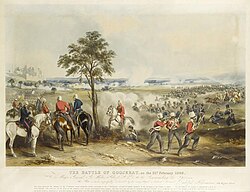
* [[Battle of Gujrat]] | |||
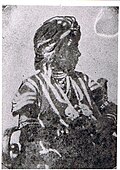
* [[Sher Singh Attariwalla]] leading a cavalry charge | |||
* Surrender of the governor of [[Multan]], [[Mulraj Chopra]], during the [[Siege of Multan (1848–1849)|siege of Multan]] | |||
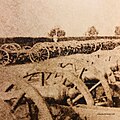
* Captured Sikh guns in [[Ambala Cantonment]] | |||
* Sketch map illustrating the war by Charles Herbert Payne | |||
}} | |||
| date = 18 April 1848 – 29 March 1849<br>({{Age in years, months, weeks and days|month1=4|day1=18|year1=1848|month2=3|day2=29|year2=1849}}) | |||
| place = [[Punjab]] | | place = [[Punjab]] | ||
| result = British victory | | result = British victory | ||
| | | combatant1 = {{tree list}} | ||
| combatant2 = [[File:Sikh Empire flag. | * {{flagicon|UKGBI}} [[British Empire]] | ||
** {{flagicon image|Flag of the British East India Company (1801).svg}} [[East India Company]] | |||
| commander2 = [[ | {{tree list/end}} | ||
| combatant2 = [[File:Sikh Empire flag.svg|24px|link=]] [[Sikh Empire]]<br>'''Supported by:'''<br>[[File:Flag of Afghanistan (1843–1879).svg|12px]] [[Emirate of Kabul]]{{cn|date=December 2025}} | |||
| commander1 = {{flagicon|UKGBI}} [[Sir Hugh Gough]]<br>{{flagicon|UKGBI}} [[Charles Cureton (British Army officer)|Charles Cureton]]{{KIA}}<br>{{flagicon|East India Company}} [[Herbert Benjamin Edwardes|Herbert Edwardes]]<br>{{flagicon|East India Company}} [[Sir Walter Gilbert, 1st Baronet|Walter Gilbert]] | |||
| commander2 = [[Jind Kaur]]{{Surrendered}}<br>[[Diwan Mulraj Chopra|Mulraj Chopra]]{{Surrendered}}<br>[[Sher Singh Attariwalla|Sher Singh]]{{Surrendered}}<br>[[Chattar Singh Attariwalla|Chattar Attariwalla]]{{Surrendered}} | |||
| strength1 = 24,000-32,000 men<br>97 field guns<br>67 siege guns{{sfn|Roy|2008|p=298}} | |||
| strength2 = 35,000-60,000 men<ref name=Patwant>{{Cite book |last1=Singh |first1=Patwant |url=https://books.google.com/books?id=Vr4VAQAAIAAJ |title=Empire of the Sikhs: The Life and Times of Maharaja Ranjit Singh |last2=Rai |first2=Jyoti M. |date=2008 |publisher=Peter Owen |isbn=978-0-7206-1323-0 |pages=256 |language=en}}</ref><br>66 guns | |||
| casualties1 = '''Total: 8,403'''<br>3,379 killed<br>4,920 wounded<br>104 missing<ref>Farwell, p.58</ref> | |||
| casualties2 = '''Total: 6,500'''<br>2,584 killed<br>2,583 wounded<br>1,333 missing | |||
| territory = Dissolution of the Sikh Empire and annexation of Punjab (including its Northwest Frontier) as a [[Punjab Province (British India)|province]] by the East India Company | |||
}} | }} | ||
{{Campaignbox Second Anglo-Sikh War}} | {{Campaignbox Second Anglo-Sikh War}} | ||
{{Campaignbox Anglo-Sikh wars}} | {{Campaignbox Anglo-Sikh wars}} | ||
The '''Second Anglo-Sikh War''' was a military conflict between the [[Sikh Empire]] and the [[ | The '''Second Anglo-Sikh War''' was a military conflict fought between the [[Sikh Empire]] and the [[East India Company]], which took place from 1848 to 1849. It resulted in the fall of the Sikh Empire, and the annexation of the [[Punjab region|Punjab]] and what subsequently became the [[North-West Frontier Province]], by the East India Company. | ||
On 19 April 1848 [[Patrick Alexander Vans Agnew|Patrick Vans Agnew]] of the civil service and Lieutenant William Anderson of the Bombay European regiment, having been sent to take charge of [[Multan]] from [[Diwan Mulraj Chopra]], were murdered there | On 19 April 1848, [[Patrick Alexander Vans Agnew|Patrick Vans Agnew]] of the civil service and Lieutenant William Anderson of the Bombay European regiment, having been sent to take charge of [[Multan]] from [[Diwan Mulraj Chopra]], were murdered there; within a short time, the [[Sikh]] troops joined in open rebellion. [[Governor-General of India]] [[James Broun-Ramsay, 1st Marquess of Dalhousie|Lord Dalhousie]] agreed with [[Hugh Gough, 1st Viscount Gough|Sir Hugh Gough]], the commander-in-chief, that the British [[East India Company]]'s military forces were neither adequately equipped with transport and supplies, nor otherwise prepared to take the field immediately. He also foresaw the spread of the rebellion, and the necessity that must arise, not merely for the capture of Multan, but also for the entire subjugation of the [[Punjab region|Punjab]]. He therefore resolutely delayed to strike, organized a strong army for operations in November, and himself proceeded to the Punjab. Despite the brilliant successes gained by [[Herbert Benjamin Edwardes|Herbert Edwardes]] against Mulraj, and Gough's indecisive victories at the [[Battle of Ramnagar]] in November and at the [[Battle of Chillianwala]] on 13 January 1849, the stubborn resistance at Multan showed that the task required the utmost resources of the government. At length, on 22 January, Multan was taken by General Whish, who was thus set at liberty to join Gough's army. On 21 February, Gough won a complete victory at the [[Battle of Gujrat]]. The Sikh army was pursued to [[Rawalpindi]], where it laid down its arms, and their Afghan allies retreated from the [[Punjab]], leaving the region to the [[British Empire|British]]. | ||
After the victory at Gujrat, Lord Dalhousie annexed the Punjab for the East India Company in 1849. For his services the Earl of Dalhousie received the thanks of the British parliament and | After the victory at Gujrat, Lord Dalhousie [[Punjab Province (British India)|annexed the Punjab]] for the East India Company in 1849. For his services the Earl of Dalhousie received the thanks of the British parliament and was advanced in the peerage to [[marquess]], the usual honor for governors general of India. | ||
==Background | ==Background== | ||
The Sikh Confederacy [[Misl]]s of the Punjab were consolidated into an Empire and expanded by Maharaja [[Ranjit Singh]] during the early years of the nineteenth century. During the same period, the British East India Company's territories had been expanded until they were adjacent to the Punjab. Ranjit Singh maintained an uneasy alliance with the East India Company, while increasing the military strength of the [[Sikh Khalsa Army]] | [[File:Punjab map (topographic) with cities.png|thumb|Topographical map of The Punjab, "Land of 5 Waters"]] | ||
The Sikh Confederacy [[Misl]]s of the Punjab were consolidated into an Empire and expanded by Maharaja [[Ranjit Singh]] during the early years of the nineteenth century. During the same period, the British East India Company's territories had been expanded until they were adjacent to the Punjab. Ranjit Singh maintained an uneasy alliance with the East India Company, while increasing the military strength of the [[Sikh Khalsa Army]] to deter British aggression against his state and to expand Sikh territory to the north and north west, capturing territory from [[Afghanistan]] and [[Kashmir]]. | |||
When Ranjit Singh died in 1839, the Sikh Empire began to fall into disorder. There was a succession of short-lived rulers at the central [[Durbar (court) | When Ranjit Singh died in 1839, the Sikh Empire began to fall into disorder. There was a succession of short-lived rulers at the central [[Durbar (court)]], and increasing tension between the Army, which also saw itself as the embodiment of the state and religion, and the Durbar. The East India Company began to build up its military strength on the borders of the Punjab. Eventually, the increasing tension goaded the Sikh Army to invade British territory, under weak and possibly treacherous leaders.<ref name=eos>{{cite web |url=http://www.learnpunjabi.org/eos/index.aspx | ||
|title= | |title=Anglo-Sikh War I (1845–46) |last1=Hasrat |first1=B. J. | ||
|website=Encyclopaedia of Sikhism | |website=Encyclopaedia of Sikhism | ||
|publisher=Punjabi University Patiala | |publisher=Punjabi University Patiala | ||
}}</ref> | }}</ref> | ||
===Aftermath of the | The hard-fought [[first Anglo-Sikh war]] ended in defeat for the Sikh Empire which had to cede parts of the [[Punjab region]] to the [[British Empire|British]]. | ||
At the end of the war, the Sikh Empire was forced to cede some valuable territory (the [[Jullundur Doab]]) to the East India Company, and [[Gulab Singh]], the ruler of [[Jammu]], was allowed to acquire entire [[Jammu]] and [[Kashmir]] from the Sikh Empire by a large cash payment to the East India Company. | |||
===Aftermath of the first Anglo-Sikh war=== | |||
At the end of the war, the Sikh Empire was forced to cede some valuable territory (the [[Jullundur Doab]]) to the East India Company, and [[Gulab Singh]], the ruler of [[Jammu]], was allowed to acquire entire [[Jammu]] and [[Kashmir]] from the Sikh Empire by a large cash payment to the East India Company.<ref>Hernon 2002, p. 575</ref> Moreover, a British garrison began stationing in Lahore due to the [[Treaty of Bhairowal]], and Sir [[Henry Montgomery Lawrence|Henry Lawrence]] was appointed as the first Resident in Lahore.<ref>{{cite book |title=Political Diaries of the Agent to the Governor General, North West Frontier and Resident at Lahore from 1 January 1847 to 4 March 1848 |publisher=Sang-e-Meel Publications |place=Lahore |year=2005 |edition=reprint |isbn=969-35-1766-0 |page=i }}</ref> The boy Maharaja [[Duleep Singh]] of the Sikh Empire was allowed to retain his throne, but the British Resident had "full authority to direct and control all matters in every Department of the State".<ref>Article 2 of the Treaty of Bhyroval.</ref> | |||
[[File:Photograph of Maharaha Duleep Singh during his reign as a child monarch of the Sikh Empire, by John McCosh, Lahore, ca.1848 (detail).jpg|thumb|Photograph of Maharaja Duleep Singh during his reign as a child monarch of the Sikh Empire, by John McCosh, Lahore, ca.1848]] | |||
The | The regency of Maharani [[Jind Kaur]], who is Duleep Singh's mother, was replaced by a Council of Regency composed of leading Chiefs and Sirdars acting under the control and guidance of the British Resident.<ref>Articles 4, 5 and 10 of the Treaty of Bhairowal</ref> She continually tried to regain some of her former influence as Regent and was eventually exiled by Lawrence. While some Sikh generals and courtiers welcomed her dismissal, others resented Lawrence's action.<ref>Hernon 2002, p. 576</ref> Furthermore, the Sikh Sardars were forced to considerably reduce their territorial and judicial control leaving only four Sardars in charge of the judiciary, with Sardar [[Chattar Singh Attariwalla]] controlling the area between the [[Jhelum]] and the [[Indus]], Sardar Kahan Singh Mann controlling [[Lahore]], Sardar Ram Singh Jallawala controlling the Chaj [[Doab]], and Sardar [[Lehna Singh Majithia]] controlling the [[Majha]] including lands south east of the [[Ravi River|Ravi]] up to the hills and down to [[Kasur]].<ref>Khushwant Singh, A History of the Sikhs (1839–1974), Vol. II, p. 62.</ref> | ||
Some of the Sikh Army had to be kept in being, since many predominantly [[Muslim]] areas of the Sikh Empire threatened to ally with [[Dost Mohammed Khan]] in Afghanistan or to lapse into disorder, and only force of arms could keep them in subjugation. The British were unwilling to incur the financial and manpower costs of using large numbers of British or [[Bengal Army]] units for this task. To the contrary, the [[Governor-General of India]], [[Henry Hardinge, 1st Viscount Hardinge|Viscount Hardinge]] sought to make economies after the war by reducing the size of the Bengal Army by 50,000 men. The [[Sardars]] (generals) of the Sikh Army naturally resented carrying out the orders of comparatively junior British | Some of the Sikh Army had to be kept in being, since many predominantly [[Muslim]] areas of the Sikh Empire threatened to ally with [[Dost Mohammed Khan]] in Afghanistan or to lapse into disorder, and only force of arms could keep them in subjugation. The British were unwilling to incur the financial and manpower costs of using large numbers of British or [[Bengal Army]] units for this task. To the contrary, the [[Governor-General of India]], [[Henry Hardinge, 1st Viscount Hardinge|Viscount Hardinge]] sought to make economies after the war by reducing the size of the Bengal Army by 50,000 men. The [[Sardars]] (generals) of the Sikh Army naturally resented carrying out the orders of comparatively [[Henry Lawrence's "Young Men"|junior British administrators]]. | ||
Early in 1848, Sir Henry Lawrence, who was ill, departed on leave to England. Although it was assumed that his younger brother [[John Lawrence, 1st Baron Lawrence|John Lawrence]] would be appointed in his place, [[James Andrew Broun-Ramsay, 1st Marquess of Dalhousie|Lord Dalhousie]], who had replaced Lord Hardinge as Governor-General, appointed Sir [[Sir Frederick Currie, 1st Baronet|Frederick Currie]] instead. Currie was a legalist, based in [[Calcutta]], who was unfamiliar with military matters and with the Punjab.<ref>Allen 2000, pp. 145–146</ref> While the Lawrences were comparatively informal and familiar with the junior officers who were Residents and Agents in the various districts of the Punjab, Currie was stiffer in manner and was inclined to treat his subordinates' reports with caution. In particular, he refused to act on reports from [[James Abbott (Indian Army officer)|James Abbott]], the Political Agent in [[Hazara | Early in 1848, Sir Henry Lawrence, who was ill, departed on leave to England. Although it was assumed that his younger brother [[John Lawrence, 1st Baron Lawrence|John Lawrence]] would be appointed in his place, [[James Andrew Broun-Ramsay, 1st Marquess of Dalhousie|Lord Dalhousie]], who had replaced Lord Hardinge as Governor-General, appointed Sir [[Sir Frederick Currie, 1st Baronet|Frederick Currie]] instead. Currie was a legalist, based in [[Calcutta]], who was unfamiliar with military matters and with the Punjab.<ref>Allen 2000, pp. 145–146</ref> While the Lawrences were comparatively informal and familiar with the junior officers who were Residents and Agents in the various districts of the Punjab, Currie was stiffer in manner and was inclined to treat his subordinates' reports with caution. In particular, he refused to act on reports from [[James Abbott (Indian Army officer)|James Abbott]], the Political Agent in [[Hazara region|Hazara]], who was convinced that Sardar Chattar Singh Attariwalla was actively plotting a rebellion with other [[Sardar|Sirdars]]. | ||
==Sikh | ==Sikh rebellions== | ||
===Multan | |||
The city of Multan was part of the Sikh kingdom, having been captured by Ranjit Singh in 1818. In 1848, it was governed by a [[ | ===Multan rebellion=== | ||
The city of Multan was part of the Sikh kingdom, having been captured by Ranjit Singh in 1818. In 1848, it was governed by a [[Punjabis|Punjabi]] viceroy, [[Dewan Mulraj]]. After the end of the First Anglo-Sikh war, Mulraj had behaved independently. When he was required by the British-controlled Durbar in [[Lahore]] to pay an increased tax assessment and revenues which were in arrears, Mulraj attempted to give up power to his son, so as to maintain his family's position as rulers. Currie instead appointed Sardar Kahan Singh Mann to succeed to the governorship and appointed a British Political Agent, Lieutenant [[Patrick Alexander Vans Agnew|Patrick Vans Agnew]], to accompany him. | |||
On 18 April 1848, Kahan Singh and Vans Agnew arrived at Multan with another officer, Lieutenant William Anderson, and a small escort. Mulraj handed over the keys of the fortress, but as Vans Agnew's party attempted to take possession, they were attacked by a party of Mulraj's irregular troops, and a mob from the city. Both officers were wounded, and were rescued by Kahan Singh. They were taken to a mosque outside the city. Their escorts defected to Mulraj, and the two officers were murdered by the mob the next day.<ref>Allen 2000, pp. 149–150</ref> | On 18 April 1848, Kahan Singh and Vans Agnew arrived at Multan with another officer, Lieutenant William Anderson, and a small escort. Mulraj handed over the keys of the fortress, but as Vans Agnew's party attempted to take possession, they were attacked by a party of Mulraj's irregular troops, and a mob from the city. Both officers were wounded, and were rescued by Kahan Singh. They were taken to a mosque outside the city. Their escorts defected to Mulraj, and the two officers were murdered by the mob the next day.<ref>Allen 2000, pp. 149–150</ref> | ||
| Line 58: | Line 89: | ||
Lieutenant [[Herbert Edwardes]], the British Political Agent in [[Bannu]], had been near Multan in April but was unable to save Vans Agnew. He hastily levied some [[Pakhtun]] irregular troops. | Lieutenant [[Herbert Edwardes]], the British Political Agent in [[Bannu]], had been near Multan in April but was unable to save Vans Agnew. He hastily levied some [[Pakhtun]] irregular troops. | ||
On 18 June 1848, 8,000 Bhawalpuris under Futteh Mohammed Khan, aided by 3,000 Sikh irregulars under Lieutenant Edwardes, fought 8,000 Sikhs under Rung Ram. The Bhawalpuris were repulsed in an attack on the Sikh positions, but the arrival of Lieutenant Edwardes' guns turned the scale, and at a second attempt the entrenchments were stormed and captured, with a loss to the victors of 300 men. The Sikhs lost 500 killed in the action, and many more during their flight to Multan. | On 18 June 1848, 8,000 Bhawalpuris under Futteh Mohammed Khan, aided by 3,000 Sikh irregulars under Lieutenant Edwardes, fought 8,000 Sikhs under Rung Ram. The Bhawalpuris were repulsed in an attack on the Sikh positions, but the arrival of Lieutenant Edwardes' guns turned the scale towards the favour of the Bhawalpuris, and at a second attempt the entrenchments were stormed and captured, with a loss to the victors of 300 men. The Sikhs lost 500 killed in the action, and many more during their flight to Multan. | ||
====Battle of Suddusain==== | ====Battle of Suddusain==== | ||
Fought 1 July 1848, when a force of Bhawalpuris and British 18,000 strong, under Lieutenant Edwardes, encountered 12,000 Sikhs under Malraj. The Sikhs attacked, but were beaten off, largely owing to the superiority of the British artillery, and defeated with heavy loss. | Fought 1 July 1848, when a force of Bhawalpuris and British 18,000 strong, under Lieutenant Edwardes, encountered 12,000 Sikhs under Malraj. The Sikhs attacked, but were beaten off, largely owing to the superiority of the British artillery, and defeated with heavy loss. The Bhawalpuris then proceeded to chase the remaining scattered Sikhs all the way to [[Multan]]. | ||
====Siege of Multan==== | ====Siege of Multan==== | ||
Multan, defended by the Sikhs, under Mulraj, was besieged by Lieutenant Edwardes with about 1,200 men in July | Multan, defended by the Sikhs, under Mulraj, was besieged by Lieutenant Edwardes with about 1,200 men in July 1848. | ||
On learning of the events at Multan, Currie wrote to Sir [[Hugh Gough, 1st Viscount Gough|Hugh Gough]], the Commander in Chief of the Bengal Army, recommending that a major British force should at once move upon Multan. However Gough, supported by Dalhousie, the Governor General, declined to order major units of the East India Company to the Punjab until the end of the hot weather and monsoon seasons, which would not be until November.<ref>Malleson, p. 40</ref> Instead, Currie ordered only a small force from the Bengal Army under General Whish, and several contingents of locally recruited irregulars and detachments of the [[Sikh Khalsa Army]] to join the siege. These forces joined Edwardes at Multan between 18 and 28 August. To the alarm of several Political Agents, the force from the Sikh Army included a large contingent commanded by Sardar [[Sher Singh Attariwalla]], Chattar Singh's son. | On learning of the events at Multan, Currie wrote to Sir [[Hugh Gough, 1st Viscount Gough|Hugh Gough]], the Commander in Chief of the Bengal Army, recommending that a major British force should at once move upon Multan. However Gough, supported by Dalhousie, the Governor General, declined to order major units of the East India Company to the Punjab until the end of the hot weather and monsoon seasons, which would not be until November.<ref>Malleson, p. 40</ref> Instead, Currie ordered only a small force from the Bengal Army under General Whish, and several contingents of locally recruited irregulars and detachments of the [[Sikh Khalsa Army]] to join the siege. These forces joined Edwardes at Multan between 18 and 28 August. To the alarm of several Political Agents, the force from the Sikh Army included a large contingent commanded by Sardar [[Sher Singh Attariwalla]], Chattar Singh's son. | ||
| Line 74: | Line 105: | ||
As the cold weather began in November, substantial contingents from the East India Company's armies at last took the field. A contingent from the [[Bombay Army]] (administered separately from the Bengal Army) had been ordered to reinforce Whish and besiege Multan. This force was delayed by a petty squabble over seniority and could arrive only when its first commander (who was senior to Whish and refused to serve under him) was replaced by a more junior officer. Whish's army was supplied and reinforced by sea and river transport up the rivers Indus and Chenab. Whish renewed the siege of Multan on 27 December, with 17,000 men and 64 guns. After a heavy bombardment the city was stormed on 2 January 1849. On 22 January, Mulraj surrendered the citadel. He was imprisoned for the remainder of his life. The ending of the siege allowed Whish, with large numbers of heavy guns, to reinforce the army under Sir Hugh Gough. | As the cold weather began in November, substantial contingents from the East India Company's armies at last took the field. A contingent from the [[Bombay Army]] (administered separately from the Bengal Army) had been ordered to reinforce Whish and besiege Multan. This force was delayed by a petty squabble over seniority and could arrive only when its first commander (who was senior to Whish and refused to serve under him) was replaced by a more junior officer. Whish's army was supplied and reinforced by sea and river transport up the rivers Indus and Chenab. Whish renewed the siege of Multan on 27 December, with 17,000 men and 64 guns. After a heavy bombardment the city was stormed on 2 January 1849. On 22 January, Mulraj surrendered the citadel. He was imprisoned for the remainder of his life. The ending of the siege allowed Whish, with large numbers of heavy guns, to reinforce the army under Sir Hugh Gough. | ||
The British loss during the siege was 210 killed and 910 wounded.<ref>{{Cite web|title=Heritage History | The British loss during the siege was 210 killed and 910 wounded.<ref>{{Cite web|title=Heritage History |url=https://www.heritage-history.com/index.php?c=resources&s=war-dir&f=wars_sikh|access-date=2021-01-15|website=heritage-history.com}}</ref> | ||
===Lahore rebellion=== | |||
====Battle of Rungur Muzl Fort==== | ====Battle of Rungur Muzl Fort==== | ||
Rungur Muzl fort was controlled by [[Sher Singh Attariwalla]] and was the first sign of revolt from the Lahore Durbar. The Sikhs from the army saw the British troops coming in and attacked them with full force. The Sikhs won the battle but soon they surrendered as there was a very small force.{{when|date=January 2021}}{{vague|date=January 2021}}{{citation needed|date=January 2021}} | |||
====Siege of Shahpur Kandi Fort==== | |||
On the night of 14 August 1848, Wazir Ram Singh Pathania with his small Rajput army attacked the fort of Shahpur Kandi which was situated on the bank of river Ravi and held it, but after the siege of fort from 3 to 18 September 1848 by a strong force of [[John Lawrence, 1st Baron Lawrence|John Lawrence]] from Hoshiarpur, he along with 400 of his band took shelter at Rasual (Gujrat) Camp of The Sikh Commander [[Sher Singh Attariwalla]] and Basakha Singh.<ref>{{Cite web|title=Pathania Genealogy|url=https://www.geni.com/surnames/pathania|access-date =1 November 2024}}</ref><ref>{{Cite web|title=Wazir Ram Singh Pathania, and the memory of Shahpurkandi|url=https://himachalarchives.blogspot.com/2022/06/wazir-ram-singh-pathania-and-memory-of.html|access-date=31 October 2024|quote=According to official documents, Wazir Ram Singh confessed during his trial that in 1848, Maharani Jindan Kaur despatched messages to different princely states of the hills, to which Nurpur, Kangra, Jaswan, Datarpur, and Paramanand (equivalent to Hoshiarpur in Punjab) replied. In his own confession, he describes how he was asked to work with Bhai Maharaj Singh. Ram Singh met Bhai Maharaj Singh in Jhang and was given large quantities of money with instructions to wait and prepare for the battle.}}</ref> | |||
====Battle of Ramnagar==== | ====Battle of Ramnagar==== | ||
| Line 85: | Line 120: | ||
====Battle of Sadulpur==== | ====Battle of Sadulpur==== | ||
On 3 December 1848, Gough despatched a cavalry force under Major General [[Joseph Thackwell]] to cross the Chenab upstream of Ramnagar and turn the Sikh left, but Thackwell then paused to await infantry reinforcements, allowing the Sikhs to withdraw without interference. Gough claimed this indecisive action as a victory. | On 3 December 1848, Gough despatched a cavalry force under Major General [[Joseph Thackwell]] to cross the Chenab upstream of Ramnagar and turn the Sikh left, but Thackwell then paused to await infantry reinforcements, allowing the Sikhs to withdraw without interference.<ref>{{Cite book |last=Butalia |first=Romesh C. |title=The Evolution of the Artillery in India: From the Battle of Plassey (1757) to the Revolt of 1857 |publisher=Allied Publishers |year=1998 |isbn=9788170238720 |pages=312 |quote=The battle of Sadulpur: After their defeat at Ramnagar, the British decided to move a large force higher up across the river and then attack Ramnagar by a flanking advance along the river. Along with two troops of horse artillery, two light field batteries, part of the cavalry brigade and about three infantry brigades, Brigadier Thackwell closed further up on 1 and 2 December, and on 3 December reached near the village of Sadulpur where he halted to receive more reinforcements. The Sikhs were holding the position with their artillery and infantry in the centre and the cavalry on the wings. As soon as the Sikh artillery opened up, the British withdrew. The Sikhs then advanced with their cavalry under cover of their artillery but the advance was checked by the British horse artillery and cavalry. Thereafter the battle was mainly between opposing guns, and lasted about two hours. The British had 24 killed and 57 wounded. The Sikhs slowly withdrew at night.}}</ref><ref>{{Cite book |last=Butani |first=D. H. |title=The Third Sikh War?: Towards Or Away from Khalistan? |publisher=Promilla |year=1986 |isbn=9788185002026 |pages=50}}</ref> Gough claimed this indecisive action as a victory.<ref>{{Cite book |last=Davies |first=Cuthbert Collin |title=Essays in Indian History, in Honour of Cuthbert Collin Davies |publisher=Asia Publishing House |year=1973 |isbn=9780210223420 |pages=52}}</ref> | ||
====Battle of Chillianwala==== | ====Battle of Chillianwala==== | ||
{{main|Battle of Chillianwala}} | {{main|Battle of Chillianwala}} | ||
At the start of 1849, Amir [[Dost Mohammed Khan]] of Afghanistan sided with the rebellious Sikhs, who agreed to cede the city of [[Peshawar]] and its surrounding area which had been conquered by Ranjit Singh early in the nineteenth century. Dost Mohammed Khan's support of the Sikhs was cautious, but when 3,500 Afghan horsemen approached the vital fort of [[Attock]] on the Indus River, its garrison of Muslim troops installed earlier by Nicholson defected. This allowed Chattar Singh to move out of Hazara and march west and then south, intending to link up with Sher Singh's army. Dalhousie had earlier ordered Gough to halt operations while waiting for Multan to fall, which would allow Whish to reinforce him. Learning of the fall of Attock, he instead ordered Gough to destroy Sher Singh's army before Chattar Singh could join him. | |||
At the start of 1849, Amir [[Dost Mohammed Khan]] of Afghanistan sided with the rebellious Sikhs, who agreed to cede the city of [[Peshawar]] and its surrounding area which had been conquered by Ranjit Singh early in the nineteenth century. Dost Mohammed Khan's support of the Sikhs was cautious, but when 3,500 Afghan horsemen approached the vital fort of [[Attock]] on the Indus River, its garrison of Muslim troops installed earlier by Nicholson defected. This allowed Chattar Singh to move out of Hazara and march west and then south, intending to link up with Sher Singh's army. Dalhousie had earlier ordered Gough to halt operations while waiting for Multan to fall, which would allow Whish to reinforce him. Learning of the fall of Attock, he instead ordered Gough to destroy Sher Singh's army before Chattar Singh could join him.{{cn|date=March 2026}} | |||
Gough unexpectedly encountered Sher Singh's position near the [[Jhelum River]] on 13 January 1849. Sher Singh had cunningly concealed his army, and Gough was faced with the choice of withdrawing, or attacking when it was late in the day. Gough unhesitatingly took the latter course. The resulting [[Battle of Chillianwala]] was desperately fought. Gough's troops, attacking into thick scrub without effective artillery support, suffered heavy losses. Some units lost their colours (which was regarded as a disgrace) and part of one British cavalry regiment fled in panic, resulting in the loss of four guns, also reckoned a humiliation. Sher Singh's army was also hard hit, losing twelve of its own guns. | Gough unexpectedly encountered Sher Singh's position near the [[Jhelum River]] on 13 January 1849. Sher Singh had cunningly concealed his army, and Gough was faced with the choice of withdrawing, or attacking when it was late in the day. Gough unhesitatingly took the latter course. The resulting [[Battle of Chillianwala]] was desperately fought. Gough's troops, attacking into thick scrub without effective artillery support, suffered heavy losses. Some units lost their colours (which was regarded as a disgrace) and part of one British cavalry regiment fled in panic, resulting in the loss of four guns, also reckoned a humiliation. Sher Singh's army was also hard hit, losing twelve of its own guns. | ||
| Line 95: | Line 131: | ||
Three days of heavy rain followed, discouraging both sides from renewing battle. After both armies had faced each other for three days without renewing the action, both withdrew. Sher Singh continued northwards to join Chattar Singh, which made the battle into a strategic British defeat. Gough nevertheless claimed a victory, which Dalhousie scornfully dubbed as "perhaps poetical." | Three days of heavy rain followed, discouraging both sides from renewing battle. After both armies had faced each other for three days without renewing the action, both withdrew. Sher Singh continued northwards to join Chattar Singh, which made the battle into a strategic British defeat. Gough nevertheless claimed a victory, which Dalhousie scornfully dubbed as "perhaps poetical." | ||
There was much alarm at the losses Gough had suffered. His tactics were severely criticised. Military experts in Britain described him as a "superannuated general who could not mount his horse without assistance" and he was replaced by General [[Charles James Napier]], who would require several weeks to arrive from England.<ref>James 1997, p. 117</ref> Some junior officers reckoned that the true cause of the setback lay lower down the ranks. Promotion in both the British and Bengal armies came slowly, and by the time officers were appointed to command regiments and brigades, they were too old, and worn out by harsh climate and disease. At Chillianwala, several senior officers had proved unable to command their units effectively.<ref>Allen 2000, p.192</ref> | There was much alarm at the losses Gough had suffered. His tactics were severely criticised. Military experts in Britain described him as a "superannuated general who could not mount his horse without assistance" and he was replaced by General [[Charles James Napier]], who would require several weeks to arrive from England.<ref>James 1997, p. 117</ref> Some junior officers reckoned that the true cause of the setback lay lower down the ranks. Promotion in both the British and Bengal armies came slowly, and by the time officers were appointed to command regiments and brigades, they were too old, and worn out by harsh climate and disease. At Chillianwala, several senior officers had proved unable to command their units effectively.<ref>Allen 2000, p. 192</ref> | ||
====Battle of Dullah==== | |||
In the aftermath of [[Battle of Chillianwala|Chillianwala]], [[Sher Singh Attariwalla]] sent a force of 100 cavalries along with 500 infantry of the Sikh Regiment and fought another battle with British on 16 January 1849 at Heights of Dullah, the Sikh chiefs supported Ram Singh Pathania and his Rajput men. In return, the British sent a huge force under the command of [[Sir Francis Wheler, 10th Baronet|Brigadier Wheeler]].<ref>{{Cite book|title=Twelve Years of a Soldier's Life in India: Being Extracts from the Letters ... | |||
|first1= William|last1= Stephen|first2= Raikes|last2= Hodson|date= 1859|pages=84–85|url=https://books.google.com/books?id=cXgOAAAAQAAJ&dq=Ravee&pg=PA84|access-date=1 November 2024}}</ref> | |||
====Battle of Gujrat==== | ====Battle of Gujrat==== | ||
{{main|Battle of Gujrat}} | {{main|Battle of Gujrat}} | ||
[[File:The Battle of Gujrat.jpg|thumb|The [[Battle of Gujrat]], the most decisive battle of the second Anglo-Sikh war]] | |||
Meanwhile, Whish's force completed their siege works around Multan, their batteries opened fire and made a breach in the defences, which the infantry stormed. Mulraj surrendered on 22 January. The ending of the siege allowed Whish to reinforce [[Hugh Gough, 1st Viscount Gough|Gough]]. In particular, Whish's division had large numbers of heavy guns, which the Sikhs lacked. | |||
As Gough's army closed in on the Sikh Army, he sent [[William Stephen Raikes Hodson|William Hodson]] to scout the Sikh Army's position.<ref>{{cite web | url=https://www.britishbattles.com/second-sikh-war/battle-of-goojerat/ | title=Battle of Goojerat }}</ref> Sher Singh attempted a last outflanking move, sending cavalry to cross the Chenab, and re-cross in Gough's rear. They were thwarted by heavy rains which made the river difficult to cross, and by British irregular cavalry led by [[Harry Burnett Lumsden]]. On 21 February, Gough attacked the Sikh Army at the [[Battle of Gujrat]]. Here, he began the battle with a three-hour bombardment from almost 100 guns, which drove the Sikhs from their hasty entrenchments. He then sent his cavalry, led by Sir Joseph Thackwell, and horse artillery after them in a pursuit which lasted for four hours. The Sikhs began gradually retreating into rougher territory filled with Muslim villagers who mainly supported the British against the Sikhs. The Sikh loss was estimated at between 3,000 and 5,000 men and 53 guns; the British casualties were 96 killed and 700 wounded. | |||
On 12 March, Chattar Singh and Sher Singh surrendered to [[Sir Walter Gilbert]] near [[Rawalpindi]]. Some 20,000 men (mainly irregular cavalry) laid down their arms. The Afghan contingent hastily withdrew through [[Attock]] and [[Peshawar]], which the British reoccupied. [[Dost Mohammad Khan]] later signed a treaty acknowledging British possession of these cities. The British had also gained control of the [[Khyber Pass]] which became the westernmost boundary of the [[British Raj]]. British rule was largely welcomed by the local Muslim population which had detested the rule of the [[Sikh Empire]]. This was also due to the fact that the British reallowed the [[Adhan|Muslim call of prayer]] to go on which had been banned under the Sikhs.{{cn|date=March 2026}} | |||
== War photography == | |||
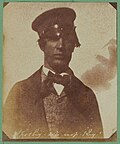
[[File:Apothecary of the 2nd Bombay European Regiment during the Second Anglo-Sikh War, by John McCosh, 1849.jpg|thumb|[[Apothecary]] of the 2nd Bombay European Regiment during the Second Anglo-Sikh War, by John McCosh, 1849.]] | |||
[[John McCosh]], a surgeon in the [[Bengal Army]], is considered by some historians to be the first [[War photography|war photographer]] known by name.<ref name="marien-2006">{{cite book |author=Mary Warner Marien |url=https://books.google.com/books?id=NsolmLbz8igC |title=Photography: A Cultural History |publisher=Laurence King Publishing |year=2006 |isbn=978-1856694933 |place=London |page=49}}</ref><ref name="papadopoulos-2011">{{cite book |author=Kari Andén-Papadopoulos |url=https://books.google.com/books?id=jp3CLLxyngUC |title=Amateur Images and Global News |publisher=Intellect Books |year=2011 |isbn=9781841506005 |page=45}}</ref> He produced a series of photographs documenting the Second Anglo-Sikh War. These consisted of portraits of fellow officers, key figures from the campaigns,<ref name="marien-2006" /> administrators and their wives and daughters, including Patrick Alexander Vans Agnew,<ref name="hannavy-2007">{{cite book |author=John Hannavy |url=https://books.google.com/books?id=PJ8DHBay4_EC |title=Encyclopedia of Nineteenth-century Photography |publisher=[[Taylor & Francis]] |year=2007 |isbn=9781135873264 |pages=1467–1471}}</ref>{{rp|911}} Generals Gough and Napier, and Dewan Mulraj of Multan.<ref name="uni-st-andrews">{{cite web |title=John McCosh |url=http://www.st-andrews.ac.uk/imu/imu.php?request=browse&irn=993 |access-date=1 October 2015 |publisher=[[University of St Andrews]] |archive-date=4 March 2016 |archive-url=https://web.archive.org/web/20160304210026/http://www.st-andrews.ac.uk/imu/imu.php?request=browse&irn=993 |url-status=dead }}</ref><ref name="taylor-2007">{{cite book |author1=Roger Taylor |url=https://books.google.com/books?id=DnfBcmW-OkYC |title=Impressed by Light: British Photographs from Paper Negatives, 1840–1860 |author2=Larry John Schaaf |publisher=[[Metropolitan Museum of Art]] |year=2007 |isbn=978-0300124057 |pages=121–124}}</ref> He also photographed local people and architecture,<ref name="taylor-2007" /> artillery emplacements and the destructive aftermath.<ref name="hannavy-2007" /> | |||
==Aftermath== | |||
[[File:Captured Sikh guns parked in Ambala cantonment in the aftermath of the Second Anglo-Sikh War, by John McCosh, circa April 1849.jpg|thumb|Photograph of captured Sikh guns parked in [[Ambala Cantonment|Ambala cantonment]] in the aftermath of the Second Anglo-Sikh War, by [[John McCosh]], circa April 1849]] | |||
Lord Dalhousie proclaimed [[Punjab Province (British India)|Britain's annexation of the Punjab]] on 2 April 1849. His foreign secretary, Henry Meirs Elliot, arrived at Lahore to obtain the signatures of the members of the Council of Regency and [[Duleep Singh]]. A [[Durbar (court)|durbar]] was held in the [[Lahore Fort]] where Singh affixed his signatures to the document which confirmed the annexation. The Sikh defeat had several causes. Their administration of the population of the Punjab had been poor, which meant that their large armies found it difficult to find enough food while the East India Company had brought overwhelming force against them.{{Citation needed|date=August 2016}} After the Second Anglo-Sikh War of 1848–49, the areas of the following districts were annexed by the Britishers: Amritsar, Gurdaspur, Rohtak, Bannu, Dera Ghazi Khan, Dera Ismail Khan, Gujranwala, Gujrat, Hazara, Jhang, Jhelum, Kohat, Lahore, Montgomerty, Multan, Muzaffargarh, Peshawar,Rawalpindi, Shahpur, and Sialkot districts.<ref name=":2">{{Cite book |last=Banerjee |first=Abhijit |url=https://eml.berkeley.edu/~webfac/bardhan/e271_sp03/2_18.pdf |title=History, Institutions and Economic Performance: The Legacy of Colonial Land Tenure Systems in India (BREAD Working Paper No. 003) |last2=Iyer |first2=Lakshmi |date=January 2003 |publisher=Bureau for Research in Economic Analysis of Development |pages=39 |chapter=Appendix Table 1: Districts of British India, With Dates and Mode of Acquisition by the British}}</ref> | |||
There was an increased recruitment of people from various communities of the Punjab in the Punjab Irregular Force under British command. These recruits fought for the East India Company during the [[Indian Rebellion of 1857]], against the mutineers and other opponents (mostly high-caste Hindus from Eastern provinces, and forces or loyalists of Shia, Maratha and Mughal rulers). These Punjabi recruits had especially little sympathy with the Hindu mutineers of the Bengal Army, ironically contributed to by the latter's role in helping the British in the Anglo-Sikh wars. A long history of enmity of the Sikhs with Mughal rule did not help the mutineers' cause either, given their choice of [[Bahadur Shah Zafar]] as a symbolic leader. | The Anglo-Sikh wars gave the two sides a mutual respect for each other's fighting prowess (although the war itself had been unchivalrously fought; the Sikhs took no prisoners at Chillianwala, and the British had taken no prisoners at [[Battle of Gujrat|Gujrat]]). There was an increased recruitment of people from various communities of the Punjab in the Punjab Irregular Force under British command. These recruits fought for the East India Company during the [[Indian Rebellion of 1857]], against the mutineers and other opponents (mostly high-caste Hindus from Eastern provinces, and forces or loyalists of Shia, Maratha and Mughal rulers). These Punjabi recruits had especially little sympathy with the Hindu mutineers of the Bengal Army, ironically contributed to by the latter's role in helping the British in the Anglo-Sikh wars. A long history of enmity of the Sikhs with Mughal rule did not help the mutineers' cause either, given their choice of [[Bahadur Shah Zafar]] as a symbolic leader.{{Citation needed|date=August 2016}} | ||
==Battle honour== | ==Battle honour== | ||
The battle honour "''[[Punjaub]]''" was distributed with a free hand to all regiments employed in the operations of the Anglo-Sikh Wars during 1848–49 vide Gazette of the Governor General 277 of 1849, and the list of regiments honoured was issued vide. GoGG 803 of 1853. The Bombay Army was awarded separately and the spelling was changed from 'Punjaub' to 'Punjab' vide ''[[Gazette of India]]'' No 1079 of 1910. Forty of the honoured units of the [[Bengal Army]] were consumed by the Mutiny. India has now raised a memorial at [[Ferozepore]] to pay homage to men of the [[Sikh Khalsa Army]] who laid down their lives in the Anglo-Sikh Wars and the battle honour is considered to be [[Repugnant battle honours of the Indian Army|repugnant]].<ref>Singh 1993, {{page needed|date=December 2014}}</ref> | The battle honour "''[[Punjaub]]''" was distributed with a free hand to all regiments employed in the operations of the Anglo-Sikh Wars during 1848–49 vide Gazette of the Governor General 277 of 1849, and the list of regiments honoured was issued vide. GoGG 803 of 1853. The Bombay Army was awarded separately and the spelling was changed from 'Punjaub' to 'Punjab' vide ''[[Gazette of India]]'' No. 1079 of 1910. Forty of the honoured units of the [[Bengal Army]] were consumed by the Mutiny. India has now raised a memorial at [[Ferozepore]] to pay homage to men of the [[Sikh Khalsa Army]] who laid down their lives in the Anglo-Sikh Wars and the battle honour is considered to be [[Repugnant battle honours of the Indian Army|repugnant]].<ref>Singh 1993, {{page needed|date=December 2014}}</ref> | ||
==Notes== | ==Notes== | ||
| Line 148: | Line 168: | ||
* {{cite book|last=James |first=Lawrence |year=1997 |title=Raj, Making and unmaking of British India |publisher=Abacus}} | * {{cite book|last=James |first=Lawrence |year=1997 |title=Raj, Making and unmaking of British India |publisher=Abacus}} | ||
* {{cite book |last=Malleson |first=George Bruce |title=Decisive Battles of India|year=1914 |url=https://archive.org/details/in.gov.ignca.9996 }}{{Full citation needed|date=December 2014}}<!-- year, location, publisher ISBN--> | * {{cite book |last=Malleson |first=George Bruce |title=Decisive Battles of India|year=1914 |url=https://archive.org/details/in.gov.ignca.9996 }}{{Full citation needed|date=December 2014}}<!-- year, location, publisher ISBN--> | ||
* {{cite encyclopedia |title=Battle of Gujrat (1849) |first=Kaushik |last=Roy |editor-last=Hodge|editor-first=Carl Cavanagh |encyclopedia=Encyclopedia of the Age of Imperialism, 1800-1914: Volume 1 (A-K)|publisher=Greenwood Publishing Group|year=2008|isbn=978-0-313-33406-1|url=https://books.google.com/books?id=NtEZ7Zq7s-gC&pg=PA298}} | |||
* {{cite book |last=Singh |first=Sarbans |year=1993 |title=Battle Honours of the Indian Army 1757–1971|publisher=Vision Books |location=New Delhi |isbn=81-7094-115-6}} | * {{cite book |last=Singh |first=Sarbans |year=1993 |title=Battle Honours of the Indian Army 1757–1971|publisher=Vision Books |location=New Delhi |isbn=81-7094-115-6}} | ||
==Further reading== | ==Further reading== | ||
* {{cite book|last=Farwell|first=Byron|author-link=Byron Farwell|title=Queen Victoria's Little Wars|publisher=Wordsworth Military Library|year=1973|isbn= | * {{cite book|last=Farwell|first=Byron|author-link=Byron Farwell|title=Queen Victoria's Little Wars|publisher=Wordsworth Military Library|year=1973|isbn=1840222166}} | ||
* {{Citation| last = Greenwood | first = Adrian | author1-link=Adrian Greenwood| year = 2015 | title = Victoria's Scottish Lion: The Life of Colin Campbell, Lord Clyde | publisher=History Press | place=UK | page=496 |isbn =978- | * {{Citation | last = Greenwood | first = Adrian | author1-link = Adrian Greenwood | year = 2015 | title = Victoria's Scottish Lion: The Life of Colin Campbell, Lord Clyde | publisher = History Press | place = UK | page = 496 | isbn = 978-0750956857 | url = http://www.thehistorypress.co.uk/index.php/victoria-s-scottish-lion-26465.html | access-date = 26 November 2015 | archive-date = 21 February 2016 | archive-url = https://web.archive.org/web/20160221172547/http://www.thehistorypress.co.uk/index.php/victoria-s-scottish-lion-26465.html/ | url-status = dead }}. | ||
* {{cite book |last=Lawrence-Archer |first=J. H. (James Henry) |title=Commentaries on the Punjab Campaign, | * {{cite book |last=Lawrence-Archer |first=J. H. (James Henry) |title=Commentaries on the Punjab Campaign, 1848–49. Including some additions to the history of the Second Sikh War, from original sources|url=https://archive.org/details/commentariesonpu00lawr|access-date=4 March 2014|year=1878|publisher=[[W. H. Allen Ltd]]}} | ||
==External links== | ==External links== | ||
| Line 174: | Line 195: | ||
[[Category:Conflicts in 1848]] | [[Category:Conflicts in 1848]] | ||
[[Category:Conflicts in 1849]] | [[Category:Conflicts in 1849]] | ||
[[Category:Military history of British India]] | [[Category:Military history of British India]] | ||
[[Category:1848 in India]] | [[Category:1848 in India]] | ||
[[Category:1849 in India]] | [[Category:1849 in India]] | ||
[[Category:History of the Bombay | [[Category:History of the Bombay Engineer Group]] | ||
[[Category:History of the Bengal | [[Category:History of the Bengal Engineer Group]] | ||
[[Category:History of the Corps of Engineers | [[Category:History of the Indian Army Corps of Engineers]] | ||
Revision as of 03:55, 22 March 2026
 | This article has multiple issues. Please help improve it or discuss these issues on the talk page. (Learn how and when to remove these template messages)
|


| Second Anglo-Sikh War | |||||||||
|---|---|---|---|---|---|---|---|---|---|
Part of Anglo-Sikh Wars
| |||||||||
| |||||||||
| Belligerents | |||||||||
 Sikh Empire Sikh EmpireSupported by: .svg) Emirate of Kabul[citation needed] Emirate of Kabul[citation needed] | |||||||||
| Commanders and leaders | |||||||||
 Sir Hugh Gough Charles Cureton † Sir Hugh Gough Charles Cureton † Herbert Edwardes Walter Gilbert Herbert Edwardes Walter Gilbert |
Jind KaurTemplate:Surrendered Mulraj ChopraTemplate:Surrendered Sher SinghTemplate:Surrendered Chattar AttariwallaTemplate:Surrendered | ||||||||
| Strength | |||||||||
|
24,000-32,000 men 97 field guns 67 siege guns[1] |
35,000-60,000 men[2] 66 guns | ||||||||
| Casualties and losses | |||||||||
|
Total: 8,403 3,379 killed 4,920 wounded 104 missing[3] |
Total: 6,500 2,584 killed 2,583 wounded 1,333 missing | ||||||||

_during_the_Second_Anglo-Sikh_War_(1848%E2%80%939),_ca.1891.jpg)
,_by_Charles_Herbert_Payne.jpg)
Template:Campaignbox Second Anglo-Sikh War Template:Campaignbox Anglo-Sikh wars
The Second Anglo-Sikh War was a military conflict fought between the Sikh Empire and the East India Company, which took place from 1848 to 1849. It resulted in the fall of the Sikh Empire, and the annexation of the Punjab and what subsequently became the North-West Frontier Province, by the East India Company.
On 19 April 1848, Patrick Vans Agnew of the civil service and Lieutenant William Anderson of the Bombay European regiment, having been sent to take charge of Multan from Diwan Mulraj Chopra, were murdered there; within a short time, the Sikh troops joined in open rebellion. Governor-General of India Lord Dalhousie agreed with Sir Hugh Gough, the commander-in-chief, that the British East India Company's military forces were neither adequately equipped with transport and supplies, nor otherwise prepared to take the field immediately. He also foresaw the spread of the rebellion, and the necessity that must arise, not merely for the capture of Multan, but also for the entire subjugation of the Punjab. He therefore resolutely delayed to strike, organized a strong army for operations in November, and himself proceeded to the Punjab. Despite the brilliant successes gained by Herbert Edwardes against Mulraj, and Gough's indecisive victories at the Battle of Ramnagar in November and at the Battle of Chillianwala on 13 January 1849, the stubborn resistance at Multan showed that the task required the utmost resources of the government. At length, on 22 January, Multan was taken by General Whish, who was thus set at liberty to join Gough's army. On 21 February, Gough won a complete victory at the Battle of Gujrat. The Sikh army was pursued to Rawalpindi, where it laid down its arms, and their Afghan allies retreated from the Punjab, leaving the region to the British.
After the victory at Gujrat, Lord Dalhousie annexed the Punjab for the East India Company in 1849. For his services the Earl of Dalhousie received the thanks of the British parliament and was advanced in the peerage to marquess, the usual honor for governors general of India.
Background
_with_cities.png)
The Sikh Confederacy Misls of the Punjab were consolidated into an Empire and expanded by Maharaja Ranjit Singh during the early years of the nineteenth century. During the same period, the British East India Company's territories had been expanded until they were adjacent to the Punjab. Ranjit Singh maintained an uneasy alliance with the East India Company, while increasing the military strength of the Sikh Khalsa Army to deter British aggression against his state and to expand Sikh territory to the north and north west, capturing territory from Afghanistan and Kashmir.
When Ranjit Singh died in 1839, the Sikh Empire began to fall into disorder. There was a succession of short-lived rulers at the central Durbar (court), and increasing tension between the Army, which also saw itself as the embodiment of the state and religion, and the Durbar. The East India Company began to build up its military strength on the borders of the Punjab. Eventually, the increasing tension goaded the Sikh Army to invade British territory, under weak and possibly treacherous leaders.[4]
The hard-fought first Anglo-Sikh war ended in defeat for the Sikh Empire which had to cede parts of the Punjab region to the British.
Aftermath of the first Anglo-Sikh war
At the end of the war, the Sikh Empire was forced to cede some valuable territory (the Jullundur Doab) to the East India Company, and Gulab Singh, the ruler of Jammu, was allowed to acquire entire Jammu and Kashmir from the Sikh Empire by a large cash payment to the East India Company.[5] Moreover, a British garrison began stationing in Lahore due to the Treaty of Bhairowal, and Sir Henry Lawrence was appointed as the first Resident in Lahore.[6] The boy Maharaja Duleep Singh of the Sikh Empire was allowed to retain his throne, but the British Resident had "full authority to direct and control all matters in every Department of the State".[7]
.jpg)
The regency of Maharani Jind Kaur, who is Duleep Singh's mother, was replaced by a Council of Regency composed of leading Chiefs and Sirdars acting under the control and guidance of the British Resident.[8] She continually tried to regain some of her former influence as Regent and was eventually exiled by Lawrence. While some Sikh generals and courtiers welcomed her dismissal, others resented Lawrence's action.[9] Furthermore, the Sikh Sardars were forced to considerably reduce their territorial and judicial control leaving only four Sardars in charge of the judiciary, with Sardar Chattar Singh Attariwalla controlling the area between the Jhelum and the Indus, Sardar Kahan Singh Mann controlling Lahore, Sardar Ram Singh Jallawala controlling the Chaj Doab, and Sardar Lehna Singh Majithia controlling the Majha including lands south east of the Ravi up to the hills and down to Kasur.[10]
Some of the Sikh Army had to be kept in being, since many predominantly Muslim areas of the Sikh Empire threatened to ally with Dost Mohammed Khan in Afghanistan or to lapse into disorder, and only force of arms could keep them in subjugation. The British were unwilling to incur the financial and manpower costs of using large numbers of British or Bengal Army units for this task. To the contrary, the Governor-General of India, Viscount Hardinge sought to make economies after the war by reducing the size of the Bengal Army by 50,000 men. The Sardars (generals) of the Sikh Army naturally resented carrying out the orders of comparatively junior British administrators.
Early in 1848, Sir Henry Lawrence, who was ill, departed on leave to England. Although it was assumed that his younger brother John Lawrence would be appointed in his place, Lord Dalhousie, who had replaced Lord Hardinge as Governor-General, appointed Sir Frederick Currie instead. Currie was a legalist, based in Calcutta, who was unfamiliar with military matters and with the Punjab.[11] While the Lawrences were comparatively informal and familiar with the junior officers who were Residents and Agents in the various districts of the Punjab, Currie was stiffer in manner and was inclined to treat his subordinates' reports with caution. In particular, he refused to act on reports from James Abbott, the Political Agent in Hazara, who was convinced that Sardar Chattar Singh Attariwalla was actively plotting a rebellion with other Sirdars.
Sikh rebellions
Multan rebellion
The city of Multan was part of the Sikh kingdom, having been captured by Ranjit Singh in 1818. In 1848, it was governed by a Punjabi viceroy, Dewan Mulraj. After the end of the First Anglo-Sikh war, Mulraj had behaved independently. When he was required by the British-controlled Durbar in Lahore to pay an increased tax assessment and revenues which were in arrears, Mulraj attempted to give up power to his son, so as to maintain his family's position as rulers. Currie instead appointed Sardar Kahan Singh Mann to succeed to the governorship and appointed a British Political Agent, Lieutenant Patrick Vans Agnew, to accompany him.
On 18 April 1848, Kahan Singh and Vans Agnew arrived at Multan with another officer, Lieutenant William Anderson, and a small escort. Mulraj handed over the keys of the fortress, but as Vans Agnew's party attempted to take possession, they were attacked by a party of Mulraj's irregular troops, and a mob from the city. Both officers were wounded, and were rescued by Kahan Singh. They were taken to a mosque outside the city. Their escorts defected to Mulraj, and the two officers were murdered by the mob the next day.[12]
Mulraj later claimed that he had not instigated these attacks, but he was committed to rebellion because of them.[13] He presented Vans Agnew's head to Kahan Singh and told him to take it back to Lahore.[14] The news of the killings spread over the Punjab, and unrest and disquiet increased. Large numbers of Sikh soldiers deserted the regiments loyal to the Durbar to join those prepared to rebel under the leadership of Mulraj and disaffected Sirdars.
Battle of Kinyeri
Lieutenant Herbert Edwardes, the British Political Agent in Bannu, had been near Multan in April but was unable to save Vans Agnew. He hastily levied some Pakhtun irregular troops.
On 18 June 1848, 8,000 Bhawalpuris under Futteh Mohammed Khan, aided by 3,000 Sikh irregulars under Lieutenant Edwardes, fought 8,000 Sikhs under Rung Ram. The Bhawalpuris were repulsed in an attack on the Sikh positions, but the arrival of Lieutenant Edwardes' guns turned the scale towards the favour of the Bhawalpuris, and at a second attempt the entrenchments were stormed and captured, with a loss to the victors of 300 men. The Sikhs lost 500 killed in the action, and many more during their flight to Multan.
Battle of Suddusain
Fought 1 July 1848, when a force of Bhawalpuris and British 18,000 strong, under Lieutenant Edwardes, encountered 12,000 Sikhs under Malraj. The Sikhs attacked, but were beaten off, largely owing to the superiority of the British artillery, and defeated with heavy loss. The Bhawalpuris then proceeded to chase the remaining scattered Sikhs all the way to Multan.
Siege of Multan
Multan, defended by the Sikhs, under Mulraj, was besieged by Lieutenant Edwardes with about 1,200 men in July 1848.
On learning of the events at Multan, Currie wrote to Sir Hugh Gough, the Commander in Chief of the Bengal Army, recommending that a major British force should at once move upon Multan. However Gough, supported by Dalhousie, the Governor General, declined to order major units of the East India Company to the Punjab until the end of the hot weather and monsoon seasons, which would not be until November.[15] Instead, Currie ordered only a small force from the Bengal Army under General Whish, and several contingents of locally recruited irregulars and detachments of the Sikh Khalsa Army to join the siege. These forces joined Edwardes at Multan between 18 and 28 August. To the alarm of several Political Agents, the force from the Sikh Army included a large contingent commanded by Sardar Sher Singh Attariwalla, Chattar Singh's son.
Some Political Agents were already taking action to forestall outbreaks of rebellion. Captain John Nicholson, leading irregular cavalry based at Peshawar, seized the vital fort of Attock on the Indus River from its Sikh garrison while they were still unprepared, or undecided on rebellion. Nicholson's force then linked up with James Abbott's local Hazara levies to capture the Margalla Hills which separated Hazara from the other parts of the Punjab. When Chattar Singh openly rebelled in August, his force was unable to leave Hazara without fighting a battle. Although Chattar Singh twice succeeded in capturing the passes through the hills, he nevertheless failed to take advantage of this (possibly because of dissension among his senior officers and continual harassment by pro-British irregulars), and retreated into Hazara.
On 14 September, Sher Singh's army openly rebelled at Multan. He did not join Mulraj however. He and Mulraj conferred at a carefully chosen neutral site, at which it was agreed that Mulraj would give some money from his treasury to Sher Singh's army, which would march north into the Central Punjab and ultimately rejoin Chattar Singh. Meanwhile, Whish was forced to raise the siege on 22 September.
As the cold weather began in November, substantial contingents from the East India Company's armies at last took the field. A contingent from the Bombay Army (administered separately from the Bengal Army) had been ordered to reinforce Whish and besiege Multan. This force was delayed by a petty squabble over seniority and could arrive only when its first commander (who was senior to Whish and refused to serve under him) was replaced by a more junior officer. Whish's army was supplied and reinforced by sea and river transport up the rivers Indus and Chenab. Whish renewed the siege of Multan on 27 December, with 17,000 men and 64 guns. After a heavy bombardment the city was stormed on 2 January 1849. On 22 January, Mulraj surrendered the citadel. He was imprisoned for the remainder of his life. The ending of the siege allowed Whish, with large numbers of heavy guns, to reinforce the army under Sir Hugh Gough.
The British loss during the siege was 210 killed and 910 wounded.[16]
Lahore rebellion
Battle of Rungur Muzl Fort
Rungur Muzl fort was controlled by Sher Singh Attariwalla and was the first sign of revolt from the Lahore Durbar. The Sikhs from the army saw the British troops coming in and attacked them with full force. The Sikhs won the battle but soon they surrendered as there was a very small force.[when?][vague][citation needed]
Siege of Shahpur Kandi Fort
On the night of 14 August 1848, Wazir Ram Singh Pathania with his small Rajput army attacked the fort of Shahpur Kandi which was situated on the bank of river Ravi and held it, but after the siege of fort from 3 to 18 September 1848 by a strong force of John Lawrence from Hoshiarpur, he along with 400 of his band took shelter at Rasual (Gujrat) Camp of The Sikh Commander Sher Singh Attariwalla and Basakha Singh.[17][18]
Battle of Ramnagar
Sir Hugh Gough led his main force against Sher Singh's army, which defended the line of the River Chenab for several weeks. On 22 November, the Sikhs repelled a British cavalry attack on a bridgehead on the eastern side of the river at the Battle of Ramnagar. Although they subsequently withdrew from their exposed bridgehead, the Sikhs captured a British gun and inflicted heavy losses. They regarded the battle as a victory and their morale was raised.
Battle of Sadulpur
On 3 December 1848, Gough despatched a cavalry force under Major General Joseph Thackwell to cross the Chenab upstream of Ramnagar and turn the Sikh left, but Thackwell then paused to await infantry reinforcements, allowing the Sikhs to withdraw without interference.[19][20] Gough claimed this indecisive action as a victory.[21]
Battle of Chillianwala
At the start of 1849, Amir Dost Mohammed Khan of Afghanistan sided with the rebellious Sikhs, who agreed to cede the city of Peshawar and its surrounding area which had been conquered by Ranjit Singh early in the nineteenth century. Dost Mohammed Khan's support of the Sikhs was cautious, but when 3,500 Afghan horsemen approached the vital fort of Attock on the Indus River, its garrison of Muslim troops installed earlier by Nicholson defected. This allowed Chattar Singh to move out of Hazara and march west and then south, intending to link up with Sher Singh's army. Dalhousie had earlier ordered Gough to halt operations while waiting for Multan to fall, which would allow Whish to reinforce him. Learning of the fall of Attock, he instead ordered Gough to destroy Sher Singh's army before Chattar Singh could join him.[citation needed]
Gough unexpectedly encountered Sher Singh's position near the Jhelum River on 13 January 1849. Sher Singh had cunningly concealed his army, and Gough was faced with the choice of withdrawing, or attacking when it was late in the day. Gough unhesitatingly took the latter course. The resulting Battle of Chillianwala was desperately fought. Gough's troops, attacking into thick scrub without effective artillery support, suffered heavy losses. Some units lost their colours (which was regarded as a disgrace) and part of one British cavalry regiment fled in panic, resulting in the loss of four guns, also reckoned a humiliation. Sher Singh's army was also hard hit, losing twelve of its own guns.
Three days of heavy rain followed, discouraging both sides from renewing battle. After both armies had faced each other for three days without renewing the action, both withdrew. Sher Singh continued northwards to join Chattar Singh, which made the battle into a strategic British defeat. Gough nevertheless claimed a victory, which Dalhousie scornfully dubbed as "perhaps poetical."
There was much alarm at the losses Gough had suffered. His tactics were severely criticised. Military experts in Britain described him as a "superannuated general who could not mount his horse without assistance" and he was replaced by General Charles James Napier, who would require several weeks to arrive from England.[22] Some junior officers reckoned that the true cause of the setback lay lower down the ranks. Promotion in both the British and Bengal armies came slowly, and by the time officers were appointed to command regiments and brigades, they were too old, and worn out by harsh climate and disease. At Chillianwala, several senior officers had proved unable to command their units effectively.[23]
Battle of Dullah
In the aftermath of Chillianwala, Sher Singh Attariwalla sent a force of 100 cavalries along with 500 infantry of the Sikh Regiment and fought another battle with British on 16 January 1849 at Heights of Dullah, the Sikh chiefs supported Ram Singh Pathania and his Rajput men. In return, the British sent a huge force under the command of Brigadier Wheeler.[24]
Battle of Gujrat

Meanwhile, Whish's force completed their siege works around Multan, their batteries opened fire and made a breach in the defences, which the infantry stormed. Mulraj surrendered on 22 January. The ending of the siege allowed Whish to reinforce Gough. In particular, Whish's division had large numbers of heavy guns, which the Sikhs lacked.
As Gough's army closed in on the Sikh Army, he sent William Hodson to scout the Sikh Army's position.[25] Sher Singh attempted a last outflanking move, sending cavalry to cross the Chenab, and re-cross in Gough's rear. They were thwarted by heavy rains which made the river difficult to cross, and by British irregular cavalry led by Harry Burnett Lumsden. On 21 February, Gough attacked the Sikh Army at the Battle of Gujrat. Here, he began the battle with a three-hour bombardment from almost 100 guns, which drove the Sikhs from their hasty entrenchments. He then sent his cavalry, led by Sir Joseph Thackwell, and horse artillery after them in a pursuit which lasted for four hours. The Sikhs began gradually retreating into rougher territory filled with Muslim villagers who mainly supported the British against the Sikhs. The Sikh loss was estimated at between 3,000 and 5,000 men and 53 guns; the British casualties were 96 killed and 700 wounded.
On 12 March, Chattar Singh and Sher Singh surrendered to Sir Walter Gilbert near Rawalpindi. Some 20,000 men (mainly irregular cavalry) laid down their arms. The Afghan contingent hastily withdrew through Attock and Peshawar, which the British reoccupied. Dost Mohammad Khan later signed a treaty acknowledging British possession of these cities. The British had also gained control of the Khyber Pass which became the westernmost boundary of the British Raj. British rule was largely welcomed by the local Muslim population which had detested the rule of the Sikh Empire. This was also due to the fact that the British reallowed the Muslim call of prayer to go on which had been banned under the Sikhs.[citation needed]
War photography

John McCosh, a surgeon in the Bengal Army, is considered by some historians to be the first war photographer known by name.[26][27] He produced a series of photographs documenting the Second Anglo-Sikh War. These consisted of portraits of fellow officers, key figures from the campaigns,[26] administrators and their wives and daughters, including Patrick Alexander Vans Agnew,[28]:911 Generals Gough and Napier, and Dewan Mulraj of Multan.[29][30] He also photographed local people and architecture,[30] artillery emplacements and the destructive aftermath.[28]
Aftermath

Lord Dalhousie proclaimed Britain's annexation of the Punjab on 2 April 1849. His foreign secretary, Henry Meirs Elliot, arrived at Lahore to obtain the signatures of the members of the Council of Regency and Duleep Singh. A durbar was held in the Lahore Fort where Singh affixed his signatures to the document which confirmed the annexation. The Sikh defeat had several causes. Their administration of the population of the Punjab had been poor, which meant that their large armies found it difficult to find enough food while the East India Company had brought overwhelming force against them.[citation needed] After the Second Anglo-Sikh War of 1848–49, the areas of the following districts were annexed by the Britishers: Amritsar, Gurdaspur, Rohtak, Bannu, Dera Ghazi Khan, Dera Ismail Khan, Gujranwala, Gujrat, Hazara, Jhang, Jhelum, Kohat, Lahore, Montgomerty, Multan, Muzaffargarh, Peshawar,Rawalpindi, Shahpur, and Sialkot districts.[31]
The Anglo-Sikh wars gave the two sides a mutual respect for each other's fighting prowess (although the war itself had been unchivalrously fought; the Sikhs took no prisoners at Chillianwala, and the British had taken no prisoners at Gujrat). There was an increased recruitment of people from various communities of the Punjab in the Punjab Irregular Force under British command. These recruits fought for the East India Company during the Indian Rebellion of 1857, against the mutineers and other opponents (mostly high-caste Hindus from Eastern provinces, and forces or loyalists of Shia, Maratha and Mughal rulers). These Punjabi recruits had especially little sympathy with the Hindu mutineers of the Bengal Army, ironically contributed to by the latter's role in helping the British in the Anglo-Sikh wars. A long history of enmity of the Sikhs with Mughal rule did not help the mutineers' cause either, given their choice of Bahadur Shah Zafar as a symbolic leader.[citation needed]
Battle honour
The battle honour "Punjaub" was distributed with a free hand to all regiments employed in the operations of the Anglo-Sikh Wars during 1848–49 vide Gazette of the Governor General 277 of 1849, and the list of regiments honoured was issued vide. GoGG 803 of 1853. The Bombay Army was awarded separately and the spelling was changed from 'Punjaub' to 'Punjab' vide Gazette of India No. 1079 of 1910. Forty of the honoured units of the Bengal Army were consumed by the Mutiny. India has now raised a memorial at Ferozepore to pay homage to men of the Sikh Khalsa Army who laid down their lives in the Anglo-Sikh Wars and the battle honour is considered to be repugnant.[32]
Notes
- ↑ Roy 2008, p. 298.
- ↑ Singh, Patwant; Rai, Jyoti M. (2008). Empire of the Sikhs: The Life and Times of Maharaja Ranjit Singh. Peter Owen. p. 256. ISBN 978-0-7206-1323-0.
- ↑ Farwell, p.58
- ↑ Hasrat, B. J. "Anglo-Sikh War I (1845–46)". Encyclopaedia of Sikhism. Punjabi University Patiala.
- ↑ Hernon 2002, p. 575
- ↑ Political Diaries of the Agent to the Governor General, North West Frontier and Resident at Lahore from 1 January 1847 to 4 March 1848 (reprint ed.). Lahore: Sang-e-Meel Publications. 2005. p. i. ISBN 969-35-1766-0.
- ↑ Article 2 of the Treaty of Bhyroval.
- ↑ Articles 4, 5 and 10 of the Treaty of Bhairowal
- ↑ Hernon 2002, p. 576
- ↑ Khushwant Singh, A History of the Sikhs (1839–1974), Vol. II, p. 62.
- ↑ Allen 2000, pp. 145–146
- ↑ Allen 2000, pp. 149–150
- ↑ Hernon 2002, p. 578
- ↑ Allen 2000, p. 150
- ↑ Malleson, p. 40
- ↑ "Heritage History". heritage-history.com. Retrieved 15 January 2021.
- ↑ "Pathania Genealogy". Retrieved 1 November 2024.
- ↑ "Wazir Ram Singh Pathania, and the memory of Shahpurkandi". Retrieved 31 October 2024.
According to official documents, Wazir Ram Singh confessed during his trial that in 1848, Maharani Jindan Kaur despatched messages to different princely states of the hills, to which Nurpur, Kangra, Jaswan, Datarpur, and Paramanand (equivalent to Hoshiarpur in Punjab) replied. In his own confession, he describes how he was asked to work with Bhai Maharaj Singh. Ram Singh met Bhai Maharaj Singh in Jhang and was given large quantities of money with instructions to wait and prepare for the battle.
- ↑ Butalia, Romesh C. (1998). The Evolution of the Artillery in India: From the Battle of Plassey (1757) to the Revolt of 1857. Allied Publishers. p. 312. ISBN 9788170238720.
The battle of Sadulpur: After their defeat at Ramnagar, the British decided to move a large force higher up across the river and then attack Ramnagar by a flanking advance along the river. Along with two troops of horse artillery, two light field batteries, part of the cavalry brigade and about three infantry brigades, Brigadier Thackwell closed further up on 1 and 2 December, and on 3 December reached near the village of Sadulpur where he halted to receive more reinforcements. The Sikhs were holding the position with their artillery and infantry in the centre and the cavalry on the wings. As soon as the Sikh artillery opened up, the British withdrew. The Sikhs then advanced with their cavalry under cover of their artillery but the advance was checked by the British horse artillery and cavalry. Thereafter the battle was mainly between opposing guns, and lasted about two hours. The British had 24 killed and 57 wounded. The Sikhs slowly withdrew at night.
- ↑ Butani, D. H. (1986). The Third Sikh War?: Towards Or Away from Khalistan?. Promilla. p. 50. ISBN 9788185002026.
- ↑ Davies, Cuthbert Collin (1973). Essays in Indian History, in Honour of Cuthbert Collin Davies. Asia Publishing House. p. 52. ISBN 9780210223420.
- ↑ James 1997, p. 117
- ↑ Allen 2000, p. 192
- ↑ Stephen, William; Hodson, Raikes (1859). Twelve Years of a Soldier's Life in India: Being Extracts from the Letters ... pp. 84–85. Retrieved 1 November 2024.
- ↑ "Battle of Goojerat".
- ↑ 26.0 26.1 Mary Warner Marien (2006). Photography: A Cultural History. London: Laurence King Publishing. p. 49. ISBN 978-1856694933.
- ↑ Kari Andén-Papadopoulos (2011). Amateur Images and Global News. Intellect Books. p. 45. ISBN 9781841506005.
- ↑ "John McCosh". University of St Andrews. Archived from the original on 4 March 2016. Retrieved 1 October 2015.
- ↑ 30.0 30.1 Roger Taylor; Larry John Schaaf (2007). Impressed by Light: British Photographs from Paper Negatives, 1840–1860. Metropolitan Museum of Art. pp. 121–124. ISBN 978-0300124057.
- ↑ Banerjee, Abhijit; Iyer, Lakshmi (January 2003). "Appendix Table 1: Districts of British India, With Dates and Mode of Acquisition by the British". History, Institutions and Economic Performance: The Legacy of Colonial Land Tenure Systems in India (BREAD Working Paper No. 003) (PDF). Bureau for Research in Economic Analysis of Development. p. 39.
- ↑ Singh 1993, [page needed]
References
- Allen, Charles (2000). Soldier Sahibs. Abacus. ISBN 0-349-11456-0.
- Hernon, Ian (2002). Britain's Forgotten Wars. Sutton Publishing. ISBN 0-7509-3162-0.
- James, Lawrence (1997). Raj, Making and unmaking of British India. Abacus.
- Malleson, George Bruce (1914). Decisive Battles of India.[full citation needed]
- Roy, Kaushik (2008). "Battle of Gujrat (1849)". In Hodge, Carl Cavanagh (ed.). Encyclopedia of the Age of Imperialism, 1800-1914: Volume 1 (A-K). Greenwood Publishing Group. ISBN 978-0-313-33406-1.
- Singh, Sarbans (1993). Battle Honours of the Indian Army 1757–1971. New Delhi: Vision Books. ISBN 81-7094-115-6.
Further reading
- Farwell, Byron (1973). Queen Victoria's Little Wars. Wordsworth Military Library. ISBN 1840222166.
- Greenwood, Adrian (2015), Victoria's Scottish Lion: The Life of Colin Campbell, Lord Clyde, UK: History Press, p. 496, ISBN 978-0750956857, archived from the original on 21 February 2016, retrieved 26 November 2015.
- Lawrence-Archer, J. H. (James Henry) (1878). Commentaries on the Punjab Campaign, 1848–49. Including some additions to the history of the Second Sikh War, from original sources. W. H. Allen Ltd. Retrieved 4 March 2014.
External links
| Preceded by First Anglo-Sikh War |
Indo–British conflicts | Succeeded by Indian Rebellion of 1857 |
Template:British colonial campaigns
- Articles needing additional references from May 2010
- Wikipedia infobox cleanup
- Anglo-Sikh wars
- Conflicts in 1848
- Conflicts in 1849
- Military history of British India
- 1848 in India
- 1849 in India
- History of the Bombay Engineer Group
- History of the Bengal Engineer Group
- History of the Indian Army Corps of Engineers