


m minor expanded intro after review further and cleaned formatting |
|||
| Line 1: | Line 1: | ||
{{short description|Species of plant}} | {{short description|Species of plant}} | ||
{{Use Indian English|date=October 2025}} | |||
{{Speciesbox | {{Speciesbox | ||
| fossil_range = {{Fossilrange|Quaternary|Recent}}<ref>{{cite journal |last1=Chauhan |first1=M. S. |title=A Catalogue of Fossil Plants from India Part 6: Cenozoic (Quaternary) Palynology and Palaeobotany. |journal=Paleobotany |date=1991}}</ref> | |||
| name = Deodar cedar | | name = Deodar cedar | ||
| image = Cedrus_deodara_Manali_2.jpg | | image = Cedrus_deodara_Manali_2.jpg | ||
| image_caption = Adult | | image_caption = Adult trees in [[Himachal Pradesh]], India | ||
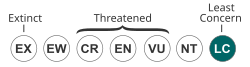
| status = LC | | status = LC | ||
| status_system = IUCN3.1 | | status_system = IUCN3.1 | ||
| status_ref = <ref name=iucn>{{cite iucn | author = | | status_ref = <ref name="iucn status 19 November 2021">{{cite iucn |author=Farjon, A. |date=2013 |title=''Cedrus deodara'' |volume=2013 |article-number=e.T42304A2970751 |doi=10.2305/IUCN.UK.2013-1.RLTS.T42304A2970751.en |access-date=19 November 2021}}</ref> | ||
| genus = Cedrus | | genus = Cedrus | ||
| species = deodara | | species = deodara | ||
| Line 12: | Line 14: | ||
}} | }} | ||
'''''Cedrus deodara''''', the '''deodar cedar''', '''Himalayan cedar''', or '''deodar''',<ref name=GRIN>{{GRIN | access-date = 24 May 2021}}</ref> is a species of [[Cedrus|cedar]] native to the | '''''Cedrus deodara''''', the '''deodar cedar''', '''Himalayan cedar''', or '''deodar''',<ref name=GRIN>{{GRIN | access-date = 24 May 2021}}</ref> is a species of [[Cedrus|cedar]] native to the [[Himalayas]]. | ||
==Description== | ==Description== | ||
It is a large [[evergreen]] [[ | It is a large [[evergreen]] [[conifer]]ous tree reaching {{convert|40|-|50|m|0|abbr=off}} tall, exceptionally {{convert|60|m|0|abbr=on}} with a trunk up to {{convert|3|m|0|abbr=on}} in diameter. It has a conic crown with level branches and drooping branchlets.<ref name=farjon>{{cite book |first=Farjon |last=Aljos |year=1990 |title=Pinaceae: drawings and descriptions of the genera Abies, Cedrus, Pseudolarix, Keteleeria, Nothotsuga, Tsuga, Cathaya, Pseudotsuga, Larix and Picea |location=Koenigstein |publisher=Koeltz Scientific Books |isbn=978-3-87429-298-6}}{{page needed|date=September 2013}}</ref> | ||
The [[ | The [[leaves]] are needle-like, mostly {{convert|2.5|–|5|cm|abbr=off|frac=4}} long, occasionally up to {{convert|7|cm|abbr=on|frac=2}} long, slender ({{convert|1|mm|abbr=out|disp=or|frac=32}} thick), borne singly on long [[Shoot (botany)|shoots]], and in dense clusters of 20–30 on short shoots; they vary from bright green to [[glaucous]] blue-green in colour. The female [[conifer cone|cones]] are barrel-shaped, {{convert|7|–|13|cm|abbr=on|frac=4}} long and {{convert|5|–|9|cm|abbr=on|frac=4}} broad, and disintegrate when mature (in 12 months) to release the winged [[seed]]s. The male cones are {{convert|4|–|6|cm|abbr=on|frac=4}} long, and shed their [[pollen]] in autumn.<ref name=farjon/> | ||
{{gallery|mode=packed | |||
|Cedrus deodara India14.jpg|Young tree in [[India]] | |||
|Cedrus deodara India17.jpg|Older tree in India | |||
|Cedrus deodara 7zz.jpg|Trunk | |||
|Cedrus deodara leaves closeup.jpg|Close-up of leaves | |||
|Cedrus deodara India01.jpg|Leaves and female cone | |||
|2018-06-24. Шишка 02.jpg|Top view of cone | |||
}} | |||
=== Chemistry === | |||
The bark of ''Cedrus deodara'' contains large amounts of [[taxifolin]].<ref name=Willfor>{{cite journal |doi=10.1515/HF.2009.095 |title=Extractives in bark of different conifer species growing in Pakistan |year=2009 |last1=Willför |first1=Stefan |last2=Ali |first2=Mumtaz |last3=Karonen |first3=Maarit |last4=Reunanen |first4=Markku |last5=Arfan |first5=Mohammad |last6=Harlamow |first6=Reija |journal=Holzforschung |volume=63 |issue=5 |pages=551–8|s2cid=97003177 }}</ref> The wood contains [[cedeodarin]], [[ampelopsin]], [[cedrin]], [[cedrinoside]],<ref>{{cite journal |doi=10.1016/0031-9422(80)85133-8 |title=Dihydroflavonols from ''Cedrus deodara'' |year=1980 |last1=Agrawal |first1=P.K. |last2=Agarwal |first2=S.K. |last3=Rastogi |first3=R.P. |journal=Phytochemistry |volume=19 |issue=5 |pages=893–6 |bibcode=1980PChem..19..893A }}</ref> and [[deodarin]] (3′,4′,5,6-tetrahydroxy-8-methyl dihydroflavonol).<ref>{{cite journal |doi=10.1016/S0040-4020(01)96989-3 |title=Chemical investigation of the stem-bark of ''Cedrus deodara'' |year=1965 |last1=Adinarayana |first1=D. |last2=Seshadri |first2=T.R. |journal=Tetrahedron |volume=21 |issue=12 |pages=3727–30}}</ref> The main components of the needle essential oil include [[α-terpineol]] (30.2%), [[linalool]] (24.47%), [[limonene]] (17.01%), [[anethole]] (14.57%), [[caryophyllene]] (3.14%), and [[eugenol]] (2.14%).<ref>{{cite journal |doi=10.1111/j.1750-3841.2012.02767.x |title=Chemical Composition, Antioxidant, and Antimicrobial Activities of Essential Oil from Pine Needle (Cedrus deodara) |year=2012 |last1=Zeng |first1=Wei-Cai |last2=Zhang |first2=Zeng |last3=Gao |first3=Hong |last4=Jia |first4=Li-Rong |last5=He |first5=Qiang |journal=Journal of Food Science |volume=77 |issue=7 |pages=C824–9 |pmid=22757704}}</ref> The deodar cedar also contains [[lignan]]s<ref>{{cite journal |doi=10.1016/0031-9422(82)80172-6 |title=Two lignans from Cedrus deodara |year=1982 |last1=Agrawal |first1=P.K. |last2=Rastogi |first2=R.P. |journal=Phytochemistry |volume=21 |issue=6 |pages=1459–1461 |bibcode=1982PChem..21.1459A }}</ref> and the phenolic sesquiterpene [[himasecolone]], together with [[isopimaric acid]].<ref>{{cite journal |doi=10.1016/0031-9422(81)80031-3 |title=Terpenoids from ''Cedrus deodara'' |year=1981 |last1=Agarwal |first1=P.K. |last2=Rastogi |first2=R.P. |journal=Phytochemistry |volume=20 |issue=6 |pages=1319–21 |bibcode=1981PChem..20.1319A }}</ref> Other compounds have been identified, including (−)-[[matairesinol]], (−)-[[nortrachelogenin]], and a dibenzylbutyrolactollignan ([[4,4',9-trihydroxy-3,3'-dimethoxy-9,9'-epoxylignan]]).<ref>{{cite journal |pmid=11600001 |year=2001 |last1=Tiwari |first1=AK |last2=Srinivas |first2=PV |last3=Kumar |first3=SP |last4=Rao |first4=JM |title=Free radical scavenging active components from Cedrus deodara |volume=49 |issue=10 |pages=4642–5 |journal=Journal of Agricultural and Food Chemistry |doi=10.1021/jf010573a |bibcode=2001JAFC...49.4642T }}</ref> | |||
==Etymology== | ==Etymology== | ||
The [[botanical name]], which is also the English [[common name]], | The [[botanical name]], which is also the English [[common name]], is derived from the [[Sanskrit]] term ''devadāru'', which means "wood of the gods", a compound of ''deva'' "god" and ''dāru'' "wood and tree".<ref>{{Cite journal |last1=Shinde |first1=U. A. |last2=Phadke |first2=A. S. |last3=Nair |first3=A. M. |last4=Mungantiwar |first4=A. A. |last5=Dikshit |first5=V. J. |last6=Saraf |first6=M. N. |date=1999-06-01 |title=Membrane stabilizing activity — a possible mechanism of action for the anti-inflammatory activity of Cedrus deodara wood oil |url=https://www.sciencedirect.com/science/article/pii/S0367326X99000301 |journal=Fitoterapia |language=en |volume=70 |issue=3 |pages=251–257 |doi=10.1016/S0367-326X(99)00030-1 |issn=0367-326X|url-access=subscription }}</ref><ref>{{Cite journal |last=Mehta |first=Devanssh |date=2012-01-01 |title=An insight into traditional system of medicine |url=https://www.researchgate.net/publication/344187319}}</ref> | ||
==Distribution== | ==Distribution and habitat== | ||
[[File:Cedrus deodara India24.jpg|thumb|upright=1.4|Trees growing in [[Kalpa, Himachal Pradesh]], India]] | |||
The species natively occurs in [[Afghanistan|East-Afghanistan]], [[Tibet|South Western Tibet]], [[Nepal|Western Nepal]], [[Pakistan|Northern Pakistan]], and [[North India|North-Central India]].<ref>{{Cite journal |last1=Kumar |first1=Avadhesh |last2=Singh |first2=Vandana |last3=Chaudhary |first3=Amrendra Kumar |date=2011-03-24 |title=Gastric antisecretory and antiulcer activities of Cedrus deodara (Roxb.) Loud. in Wistar rats |url=https://www.sciencedirect.com/science/article/pii/S0378874110008950 |journal=Journal of Ethnopharmacology |language=en |volume=134 |issue=2 |pages=294–297 |doi=10.1016/j.jep.2010.12.019 |pmid=21182918 |issn=0378-8741|url-access=subscription }}</ref><ref name="iucn status 19 November 2021" /> | |||
The | |||
It grows at elevations of {{convert|1500|-|3200|m|-3|abbr=on}}. | |||
==Reproduction== | |||
"Deodar is a wind-pollinated [[monoecious]] species".<ref>Sharma, C. M., & Khanduri, V. P. (2011). Pollen cone characteristics, pollen yield and pollen-mediated gene flow in Cedrus deodara. Current Science (Bangalore), 102(3), 394–397</ref> | |||
==Cultivation== | ==Cultivation== | ||
''C. deodara'' | It is widely grown as an [[ornamental tree]], often planted in parks and large gardens for its drooping foliage. General cultivation is limited to areas with mild winters, with trees frequently killed by temperatures below about {{convert|-25|C|F}}, limiting it to [[USDA zone]] 7 and warmer for reliable growth.<ref name=odum>{{cite book |last=Ødum |first=S. |year=1985 |title=Report on frost damage to trees in Denmark after the severe 1981/82 and 1984/85 winters |publisher=Hørsholm Arboretum |location=Denmark}}{{page needed|date=September 2013}}</ref> It can succeed in rather cool-summer climates, as in [[Ushuaia, Argentina]].<ref>{{cite web |url=http://treesneartheirlimits.blogspot.ca/ |title = Trees Near Their Limits}}</ref> | ||
The most cold-tolerant trees originate in the northwest of the species' range in [[Kashmir]] and [[Paktia Province]], Afghanistan. Selected [[cultivar]]s from this region are hardy to USDA zone 7 or even zone 6, tolerating temperatures down to about {{convert|-30|C|F}}.<ref name=odum/> Named cultivars from this region include 'Eisregen', 'Eiswinter', 'Karl Fuchs', 'Kashmir', 'Polar Winter', and 'Shalimar'.<ref name=welch>{{cite book |first1=Welch|last1=Humphrey James |editor1-last=Haddows |editor1-first=Gordon |year=1993 |title=The World Checklist of Conifers |location=Bromyard |publisher=Landsman's Bookshop |isbn=978-0-900513-09-1}}</ref><ref name=krussmann>{{cite book |first=Krüssmann |last=Gerd |year=1983 |title=Handbuch der Nadelgehölze |edition=2nd |location=Berlin |publisher=Parey |isbn=978-3-489-62622-0 |language=de}}{{page needed|date=September 2013}}</ref> Of these, 'Eisregen', 'Eiswinter', 'Karl Fuchs', and 'Polar Winter' were selected in Germany from seed collected in Paktia; 'Kashmir' was a selection of the nursery trade, whereas 'Shalimar' originated from seeds collected in 1964 from [[Shalimar Bagh (Srinagar)|Shalimar Gardens]], Kashmir and propagated at the [[Arnold Arboretum]].<ref name=welch/> | |||
''C. deodara''<ref>{{cite web | |||
| url= https://www.rhs.org.uk/Plants/3295/i-Cedrus-deodara-i/Details | | url= https://www.rhs.org.uk/Plants/3295/i-Cedrus-deodara-i/Details | ||
|title = RHS Plantfinder - ''Cedrus deodar'' | |title = RHS Plantfinder - ''Cedrus deodar'' | ||
| publisher = Royal Horticultural Society | access-date=21 January 2018}}</ref> | | publisher = Royal Horticultural Society | access-date=21 January 2018}}</ref> and the three cultivars 'Feelin' Blue',<ref>{{cite web | ||
and the three cultivars ' | |||
| url= https://www.rhs.org.uk/Plants/62081/i-Cedrus-deodara-i-Feelin-Blue/Details | | url= https://www.rhs.org.uk/Plants/62081/i-Cedrus-deodara-i-Feelin-Blue/Details | ||
|title = RHS Plantfinder - Cedrus deodara 'Feelin' Blue' | |title = RHS Plantfinder - Cedrus deodara 'Feelin' Blue' | ||
| publisher = Royal Horticultural Society | access-date=21 January 2018}}</ref> | | publisher = Royal Horticultural Society | access-date=21 January 2018}}</ref> 'Pendula'<ref>{{cite web | ||
'Pendula' | |||
| url= https://www.rhs.org.uk/Plants/91507/Cedrus-deodara-Pendula/Details | | url= https://www.rhs.org.uk/Plants/91507/Cedrus-deodara-Pendula/Details | ||
|title = RHS Plantfinder - Cedrus deodara 'Pendula' | |title = RHS Plantfinder - Cedrus deodara 'Pendula' | ||
| publisher = Royal Horticultural Society | access-date=15 June 2021}}</ref> | | publisher = Royal Horticultural Society | access-date=15 June 2021}}</ref> and 'Aurea'<ref>{{cite web | ||
and 'Aurea' | |||
| url= https://www.rhs.org.uk/Plants/93375/i-Cedrus-deodara-i-Aurea/Details | | url= https://www.rhs.org.uk/Plants/93375/i-Cedrus-deodara-i-Aurea/Details | ||
|title = RHS Plantfinder - Cedrus deodara 'Aurea' | |title = RHS Plantfinder - Cedrus deodara 'Aurea' | ||
| publisher = Royal Horticultural Society | | publisher = Royal Horticultural Society | ||
| access-date=21 January 2018}}</ref> | | access-date=21 January 2018}}</ref> have gained the [[Royal Horticultural Society]]'s [[Award of Garden Merit]] (confirmed 2021).<ref>{{cite web | url= https://www.rhs.org.uk/plants/pdfs/agm-lists/agm-ornamentals.pdf | title = AGM Plants - Ornamental | date = December 2020 | pages = 18, 19 | publisher = Royal Horticultural Society | access-date = 15 June 2021}}</ref> | ||
have gained the [[Royal Horticultural Society]] | |||
==Uses== | ==Uses== | ||
===Construction material=== | ===Construction material=== | ||
[[File:Cedrus deodara00.jpg | [[File:Cedrus deodara00.jpg|thumb|Wood|upright]] | ||
Deodar is in great demand as building material because of its durability, rot-resistant character and fine, close grain, which is capable of taking a high polish. Its historical use to construct religious temples and in landscaping around temples is well recorded. Its rot-resistant character also makes it an ideal wood for constructing the well-known [[houseboats]] of [[Srinagar]], Kashmir. In Pakistan and India, during the British colonial period, deodar wood was used extensively for construction of barracks, public buildings, bridges, canals and railway cars.<ref name="gowan"/> Despite its durability, it is not a strong timber, and its brittle nature makes it unsuitable for delicate work where strength is required, such as chair-making.{{Citation needed|date=April 2017}} | Deodar is in great demand as building material because of its durability, rot-resistant character and fine, close grain, which is capable of taking a high polish. Its historical use to construct religious temples and in landscaping around temples is well recorded. Its rot-resistant character also makes it an ideal wood for constructing the well-known [[houseboats]] of [[Srinagar]], Kashmir. In Pakistan and India, during the British colonial period, deodar wood was used extensively for construction of barracks, public buildings, bridges, canals and railway cars.<ref name="gowan"/> Despite its durability, it is not a strong timber, and its brittle nature makes it unsuitable for delicate work where strength is required, such as chair-making.{{Citation needed|date=April 2017}} | ||
| Line 64: | Line 76: | ||
''C. deodara'' is used in [[Ayurvedic]] medicine.<ref name="gowan"/> | ''C. deodara'' is used in [[Ayurvedic]] medicine.<ref name="gowan"/> | ||
The inner wood is aromatic and used to make incense. Inner wood is distilled into essential oil. As insects avoid this tree, the essential oil is used as insect repellent on the feet of horses, cattle and camels. It also has antifungal properties and has some potential for control of fungal deterioration of spices during storage.{{citation needed|date=December 2017}} The outer bark and stem are astringent.<ref name=FAO>{{cite book |chapter-url=http://www.fao.org/docrep/V5350e/V5350e12.htm |chapter=Cedarwood Oils |title=Flavours and fragances of plant origin |year=1995 |publisher=Food and Agriculture Organization of the United Nations |isbn=92-5-103648-9}}</ref> | The inner wood is aromatic and used to make incense. Inner wood is distilled into essential oil. As insects avoid this tree, the essential oil is used as insect repellent on the feet of horses, cattle and camels. It also has antifungal properties and has some potential for control of fungal deterioration of spices during storage.{{citation needed|date=December 2017}} The outer bark and stem are astringent.<ref name=FAO>{{cite book |chapter-url=http://www.fao.org/docrep/V5350e/V5350e12.htm |chapter=Cedarwood Oils |title=Flavours and fragances of plant origin |year=1995 |publisher=Food and Agriculture Organization of the United Nations |isbn=92-5-103648-9 |access-date=2008-08-26 |archive-date=2011-06-18 |archive-url=https://web.archive.org/web/20110618030456/http://www.fao.org/docrep/v5350e/v5350e12.htm }}</ref> | ||
Because of its antifungal and insect repellent properties, rooms made of deodar cedar wood are used to store meat and food grains like oats and wheat in [[Shimla district|Shimla]], [[Kullu district|Kullu]], and [[Kinnaur district|Kinnaur]] district of [[Himachal Pradesh]]. | Because of its antifungal and insect repellent properties, rooms made of deodar cedar wood are used to store meat and food grains like oats and wheat in [[Shimla district|Shimla]], [[Kullu district|Kullu]], and [[Kinnaur district|Kinnaur]] district of [[Himachal Pradesh]]. | ||
Cedar oil is often used for its aromatic properties, especially in [[aromatherapy]]. It has a characteristic woody | [[Cedar oil]] is often used for its aromatic properties, especially in [[aromatherapy]]. It has a characteristic woody odour which may change somewhat in the course of drying out. The crude oils are often yellowish or darker in colour. Its applications include soap perfumes, household sprays, floor polishes, and [[insecticide]]s, and is also used in microscope work as a clearing oil.<ref name=FAO/> | ||
== | === Incense === | ||
The | The gum of the tree is used to make [[rope incense]] in [[Nepal]] and [[Tibet]].<ref>{{Cite news |last=Andrews |first=Arden Fanning |date=2021-09-10 |title=An Incense for Every Occasion |language=en-US |work=The New York Times |url=https://www.nytimes.com/2021/09/10/t-magazine/incense-guide.html |access-date=2022-12-14 |issn=0362-4331}}</ref> | ||
==Culture== | |||
[[File:Nathiagali Pipeline Track 04.jpg|thumb|Cedrus deodara in [[Ayubia National Park]], [[Khyber Pakhtunkhwa]], Pakistan]] | |||
Among [[Hindus]], as the etymology of deodar suggests, it is worshiped as a divine tree. Deva, the first half of the Sanskrit term, means ''divine'', ''deity'', or ''deus''. Dāru, the second part, is cognate with (related to) the words ''durum'', ''druid'', ''tree'', and ''true''.<ref name="gowan">{{cite web |url=https://jcmcgowan.blogspot.com/2008/03/blog-post.html |first=Chris |last=McGowan |date=March 5, 2008 |title=The Deodar Tree: the Himalayan 'Tree of God'}}</ref>{{self-published inline|date=September 2013}} Several Hindu legends refer to this tree. For example, [[Valmiki]] [[Ramayan]] reads:<ref>{{Cite web|url=http://www.valmikiramayan.net/kishkindha/sarga43/kishkindha_43_frame.htm|title=Valmiki Ramayana - Kishkindha Kanda|website=www.valmikiramayan.net}}</ref> | |||
{{blockquote|In the stands of ''Lodhra'' trees,<ref>[[Symplocos racemosa]]</ref> ''Padmaka'' trees <ref>[[Wild Himalayan Cherry]]</ref> and in the woods of ''Devadaru'', or ''Deodar'' trees, ''[[Ravana]]'' is to be searched there and there, together with ''[[Sita]]''. [4-43-13]}} | |||
The deodar is the [[National symbols of Pakistan|national tree]] of Pakistan,<ref>{{cite web |url=http://www.pakistan.gov.pk/national_symbols.html |title=Pakistan |archive-url=https://web.archive.org/web/20161128073024/http://www.pakistan.gov.pk/national_symbols.html |archive-date=2016-11-28 }}{{primary source inline|date=March 2016}}</ref> and the [[List of Indian state symbols|state tree]] of [[Himachal Pradesh]], India. | |||
''[[Under the Deodars]]'' was an 1889 short story collection by [[Rudyard Kipling]].<ref>{{Cite book|url=https://www.gutenberg.org/ebooks/2828|title=Under the Deodars|first=Rudyard|last=Kipling|date=September 1, 2001|via=Project Gutenberg}}</ref> | |||
The 1902 musical ''[[A Country Girl]]'' featured a song called "Under the Deodar."<ref>{{Cite web|url=https://www.shazam.com/gb/track/83459379/under-the-deodar-from-the-country-girl|title=Shazam|website=Shazam}}</ref> | |||
==See also== | ==See also== | ||
* [[List of Indian timber trees]] | * [[List of Indian timber trees]] | ||
==References== | ==References== | ||
| Line 86: | Line 109: | ||
{{National symbols of Pakistan}} | {{National symbols of Pakistan}} | ||
{{Taxonbar|from=Q146935}} | {{Taxonbar|from=Q146935}} | ||
[[Category:Cedrus|deodara]] | [[Category:Cedrus|deodara]] | ||
| Line 93: | Line 114: | ||
[[Category:Flora of the Indian subcontinent]] | [[Category:Flora of the Indian subcontinent]] | ||
[[Category:Flora of Tibet]] | [[Category:Flora of Tibet]] | ||
[[Category:Medicinal plants of Asia]] | [[Category:Medicinal plants of Asia]] | ||
[[Category:Trees of temperate climates]] | [[Category:Trees of temperate climates]] | ||
[[Category:Least concern | [[Category:Least concern flora of Asia]] | ||
[[Category:National symbols of Pakistan]] | [[Category:National symbols of Pakistan]] | ||
[[Category:Garden plants of Asia]] | [[Category:Garden plants of Asia]] | ||
[[Category:Drought-tolerant trees]] | [[Category:Drought-tolerant trees]] | ||
[[Category:Ornamental trees]] | [[Category:Ornamental trees]] | ||
Latest revision as of 08:19, 23 February 2026
| Deodar cedar Temporal range:
| |
|---|---|

| |
| Adult trees in Himachal Pradesh, India | |
Scientific classification 
| |
| : | [[Template:Taxonomy/Cedrus]] |
| Species: | Template:Taxonomy/CedrusC. deodara
|
| Binomial name | |
| Template:Taxonomy/CedrusCedrus deodara | |
Cedrus deodara, the deodar cedar, Himalayan cedar, or deodar,[3] is a species of cedar native to the Himalayas.
Description[edit | edit source]
It is a large evergreen coniferous tree reaching 40–50 metres (131–164 feet) tall, exceptionally 60 m (197 ft) with a trunk up to 3 m (10 ft) in diameter. It has a conic crown with level branches and drooping branchlets.[4]
The leaves are needle-like, mostly 2.5–5 centimetres (1–2 inches) long, occasionally up to 7 cm (3 in) long, slender (1 millimetre or 1⁄32 in thick), borne singly on long shoots, and in dense clusters of 20–30 on short shoots; they vary from bright green to glaucous blue-green in colour. The female cones are barrel-shaped, 7–13 cm (2+3⁄4–5 in) long and 5–9 cm (2–3+1⁄2 in) broad, and disintegrate when mature (in 12 months) to release the winged seeds. The male cones are 4–6 cm (1+1⁄2–2+1⁄4 in) long, and shed their pollen in autumn.[4]
-
 Young tree in India
 -
 Older tree in India
 -
 Trunk
Trunk -
 Close-up of leaves
 -
 Leaves and female cone
 -
 Top view of cone


Chemistry[edit | edit source]
The bark of Cedrus deodara contains large amounts of taxifolin.[5] The wood contains cedeodarin, ampelopsin, cedrin, cedrinoside,[6] and deodarin (3′,4′,5,6-tetrahydroxy-8-methyl dihydroflavonol).[7] The main components of the needle essential oil include α-terpineol (30.2%), linalool (24.47%), limonene (17.01%), anethole (14.57%), caryophyllene (3.14%), and eugenol (2.14%).[8] The deodar cedar also contains lignans[9] and the phenolic sesquiterpene himasecolone, together with isopimaric acid.[10] Other compounds have been identified, including (−)-matairesinol, (−)-nortrachelogenin, and a dibenzylbutyrolactollignan (4,4',9-trihydroxy-3,3'-dimethoxy-9,9'-epoxylignan).[11]
Etymology[edit | edit source]
The botanical name, which is also the English common name, is derived from the Sanskrit term devadāru, which means "wood of the gods", a compound of deva "god" and dāru "wood and tree".[12][13]
Distribution and habitat[edit | edit source]

The species natively occurs in East-Afghanistan, South Western Tibet, Western Nepal, Northern Pakistan, and North-Central India.[14][2]
It grows at elevations of 1,500–3,200 m (5,000–10,000 ft).
Reproduction[edit | edit source]
"Deodar is a wind-pollinated monoecious species".[15]
Cultivation[edit | edit source]
It is widely grown as an ornamental tree, often planted in parks and large gardens for its drooping foliage. General cultivation is limited to areas with mild winters, with trees frequently killed by temperatures below about −25 °C (−13 °F), limiting it to USDA zone 7 and warmer for reliable growth.[16] It can succeed in rather cool-summer climates, as in Ushuaia, Argentina.[17]
The most cold-tolerant trees originate in the northwest of the species' range in Kashmir and Paktia Province, Afghanistan. Selected cultivars from this region are hardy to USDA zone 7 or even zone 6, tolerating temperatures down to about −30 °C (−22 °F).[16] Named cultivars from this region include 'Eisregen', 'Eiswinter', 'Karl Fuchs', 'Kashmir', 'Polar Winter', and 'Shalimar'.[18][19] Of these, 'Eisregen', 'Eiswinter', 'Karl Fuchs', and 'Polar Winter' were selected in Germany from seed collected in Paktia; 'Kashmir' was a selection of the nursery trade, whereas 'Shalimar' originated from seeds collected in 1964 from Shalimar Gardens, Kashmir and propagated at the Arnold Arboretum.[18]
C. deodara[20] and the three cultivars 'Feelin' Blue',[21] 'Pendula'[22] and 'Aurea'[23] have gained the Royal Horticultural Society's Award of Garden Merit (confirmed 2021).[24]
Uses[edit | edit source]
Construction material[edit | edit source]

Deodar is in great demand as building material because of its durability, rot-resistant character and fine, close grain, which is capable of taking a high polish. Its historical use to construct religious temples and in landscaping around temples is well recorded. Its rot-resistant character also makes it an ideal wood for constructing the well-known houseboats of Srinagar, Kashmir. In Pakistan and India, during the British colonial period, deodar wood was used extensively for construction of barracks, public buildings, bridges, canals and railway cars.[25] Despite its durability, it is not a strong timber, and its brittle nature makes it unsuitable for delicate work where strength is required, such as chair-making.[citation needed]
Herbal Ayurveda[edit | edit source]
C. deodara is used in Ayurvedic medicine.[25]
The inner wood is aromatic and used to make incense. Inner wood is distilled into essential oil. As insects avoid this tree, the essential oil is used as insect repellent on the feet of horses, cattle and camels. It also has antifungal properties and has some potential for control of fungal deterioration of spices during storage.[citation needed] The outer bark and stem are astringent.[26]
Because of its antifungal and insect repellent properties, rooms made of deodar cedar wood are used to store meat and food grains like oats and wheat in Shimla, Kullu, and Kinnaur district of Himachal Pradesh.
Cedar oil is often used for its aromatic properties, especially in aromatherapy. It has a characteristic woody odour which may change somewhat in the course of drying out. The crude oils are often yellowish or darker in colour. Its applications include soap perfumes, household sprays, floor polishes, and insecticides, and is also used in microscope work as a clearing oil.[26]
Incense[edit | edit source]
The gum of the tree is used to make rope incense in Nepal and Tibet.[27]
Culture[edit | edit source]

Among Hindus, as the etymology of deodar suggests, it is worshiped as a divine tree. Deva, the first half of the Sanskrit term, means divine, deity, or deus. Dāru, the second part, is cognate with (related to) the words durum, druid, tree, and true.[25][self-published source?] Several Hindu legends refer to this tree. For example, Valmiki Ramayan reads:[28]
In the stands of Lodhra trees,[29] Padmaka trees [30] and in the woods of Devadaru, or Deodar trees, Ravana is to be searched there and there, together with Sita. [4-43-13]
The deodar is the national tree of Pakistan,[31] and the state tree of Himachal Pradesh, India.
Under the Deodars was an 1889 short story collection by Rudyard Kipling.[32]
The 1902 musical A Country Girl featured a song called "Under the Deodar."[33]
See also[edit | edit source]
References[edit | edit source]
- ↑ Chauhan, M. S. (1991). "A Catalogue of Fossil Plants from India Part 6: Cenozoic (Quaternary) Palynology and Palaeobotany". Paleobotany.
- ↑ 2.0 2.1 Farjon, A. (2013). "Cedrus deodara". IUCN Red List of Threatened Species. 2013 e.T42304A2970751. doi:10.2305/IUCN.UK.2013-1.RLTS.T42304A2970751.en. Retrieved 19 November 2021.
- ↑ [{{#property:P1421|}} "{{#Property:P225}}"]. Germplasm Resources Information Network (GRIN). Agricultural Research Service (ARS), United States Department of Agriculture (USDA). Retrieved 24 May 2021.
{{citation}}: Check|url=value (help) - ↑ 4.0 4.1 Aljos, Farjon (1990). Pinaceae: drawings and descriptions of the genera Abies, Cedrus, Pseudolarix, Keteleeria, Nothotsuga, Tsuga, Cathaya, Pseudotsuga, Larix and Picea. Koenigstein: Koeltz Scientific Books. ISBN 978-3-87429-298-6.[page needed]
- ↑ Willför, Stefan; Ali, Mumtaz; Karonen, Maarit; Reunanen, Markku; Arfan, Mohammad; Harlamow, Reija (2009). "Extractives in bark of different conifer species growing in Pakistan". Holzforschung. 63 (5): 551–8. doi:10.1515/HF.2009.095. S2CID 97003177.
- ↑ Agrawal, P.K.; Agarwal, S.K.; Rastogi, R.P. (1980). "Dihydroflavonols from Cedrus deodara". Phytochemistry. 19 (5): 893–6. Bibcode:1980PChem..19..893A. doi:10.1016/0031-9422(80)85133-8.
- ↑ Adinarayana, D.; Seshadri, T.R. (1965). "Chemical investigation of the stem-bark of Cedrus deodara". Tetrahedron. 21 (12): 3727–30. doi:10.1016/S0040-4020(01)96989-3.
- ↑ Zeng, Wei-Cai; Zhang, Zeng; Gao, Hong; Jia, Li-Rong; He, Qiang (2012). "Chemical Composition, Antioxidant, and Antimicrobial Activities of Essential Oil from Pine Needle (Cedrus deodara)". Journal of Food Science. 77 (7): C824–9. doi:10.1111/j.1750-3841.2012.02767.x. PMID 22757704.
- ↑ Agrawal, P.K.; Rastogi, R.P. (1982). "Two lignans from Cedrus deodara". Phytochemistry. 21 (6): 1459–1461. Bibcode:1982PChem..21.1459A. doi:10.1016/0031-9422(82)80172-6.
- ↑ Agarwal, P.K.; Rastogi, R.P. (1981). "Terpenoids from Cedrus deodara". Phytochemistry. 20 (6): 1319–21. Bibcode:1981PChem..20.1319A. doi:10.1016/0031-9422(81)80031-3.
- ↑ Tiwari, AK; Srinivas, PV; Kumar, SP; Rao, JM (2001). "Free radical scavenging active components from Cedrus deodara". Journal of Agricultural and Food Chemistry. 49 (10): 4642–5. Bibcode:2001JAFC...49.4642T. doi:10.1021/jf010573a. PMID 11600001.
- ↑ Shinde, U. A.; Phadke, A. S.; Nair, A. M.; Mungantiwar, A. A.; Dikshit, V. J.; Saraf, M. N. (1999-06-01). "Membrane stabilizing activity — a possible mechanism of action for the anti-inflammatory activity of Cedrus deodara wood oil". Fitoterapia. 70 (3): 251–257. doi:10.1016/S0367-326X(99)00030-1. ISSN 0367-326X.
- ↑ Mehta, Devanssh (2012-01-01). "An insight into traditional system of medicine".
{{cite journal}}: Cite journal requires|journal=(help) - ↑ Kumar, Avadhesh; Singh, Vandana; Chaudhary, Amrendra Kumar (2011-03-24). "Gastric antisecretory and antiulcer activities of Cedrus deodara (Roxb.) Loud. in Wistar rats". Journal of Ethnopharmacology. 134 (2): 294–297. doi:10.1016/j.jep.2010.12.019. ISSN 0378-8741. PMID 21182918.
- ↑ Sharma, C. M., & Khanduri, V. P. (2011). Pollen cone characteristics, pollen yield and pollen-mediated gene flow in Cedrus deodara. Current Science (Bangalore), 102(3), 394–397
- ↑ 16.0 16.1 Ødum, S. (1985). Report on frost damage to trees in Denmark after the severe 1981/82 and 1984/85 winters. Denmark: Hørsholm Arboretum.[page needed]
- ↑ "Trees Near Their Limits".
- ↑ 18.0 18.1 Humphrey James, Welch (1993). Haddows, Gordon (ed.). The World Checklist of Conifers. Bromyard: Landsman's Bookshop. ISBN 978-0-900513-09-1.
- ↑ Gerd, Krüssmann (1983). Handbuch der Nadelgehölze (in Deutsch) (2nd ed.). Berlin: Parey. ISBN 978-3-489-62622-0.[page needed]
- ↑ "RHS Plantfinder - Cedrus deodar". Royal Horticultural Society. Retrieved 21 January 2018.
- ↑ "RHS Plantfinder - Cedrus deodara 'Feelin' Blue'". Royal Horticultural Society. Retrieved 21 January 2018.
- ↑ "RHS Plantfinder - Cedrus deodara 'Pendula'". Royal Horticultural Society. Retrieved 15 June 2021.
- ↑ "RHS Plantfinder - Cedrus deodara 'Aurea'". Royal Horticultural Society. Retrieved 21 January 2018.
- ↑ "AGM Plants - Ornamental" (PDF). Royal Horticultural Society. December 2020. pp. 18, 19. Retrieved 15 June 2021.
- ↑ 25.0 25.1 25.2 McGowan, Chris (March 5, 2008). "The Deodar Tree: the Himalayan 'Tree of God'".
- ↑ 26.0 26.1 "Cedarwood Oils". Flavours and fragances of plant origin. Food and Agriculture Organization of the United Nations. 1995. ISBN 92-5-103648-9. Archived from the original on 2011-06-18. Retrieved 2008-08-26.
- ↑ Andrews, Arden Fanning (2021-09-10). "An Incense for Every Occasion". The New York Times. ISSN 0362-4331. Retrieved 2022-12-14.
- ↑ "Valmiki Ramayana - Kishkindha Kanda". www.valmikiramayan.net.
- ↑ Symplocos racemosa
- ↑ Wild Himalayan Cherry
- ↑ "Pakistan". Archived from the original on 2016-11-28.[non-primary source needed]
- ↑ Kipling, Rudyard (September 1, 2001). Under the Deodars – via Project Gutenberg.
- ↑ "Shazam". Shazam.
External links[edit | edit source]
- Pages using the JsonConfig extension
- IUCN Red List least concern species
- Cedrus
- Trees of Afghanistan
- Flora of the Indian subcontinent
- Flora of Tibet
- Medicinal plants of Asia
- Trees of temperate climates
- Least concern flora of Asia
- National symbols of Pakistan
- Garden plants of Asia
- Drought-tolerant trees
- Ornamental trees