



>MethodologyNow! Added citation no. 28 #1Lib1Ref |
Lorrine11I (talk | contribs) minor adjust intro for consistency and improved wording |
||
| Line 1: | Line 1: | ||
{{ | {{Short description|Indian side-blown flute, generally bamboo}} | ||
{{ | {{other uses}} | ||
| | {{Redirect|Indian flute|the Native American musical instrument|Native American flute}} | ||
{{Use dmy dates|date=October 2022}} | |||
{{Use Indian English|date=October 2022}} | |||
{{Infobox instrument | |||
|names=Baanhi, Baashi, Bansi, Basari, Murali | |names=Baanhi, Baashi, Bansi, Basari, Murali | ||
|image =Bansuri bamboo flute 23inch.jpg | |image =Bansuri bamboo flute 23inch.jpg | ||
|caption =A 23 | |caption =A {{cvt|23|in|cm|order=flip}} long bansuri bamboo flute for concerts. | ||
|classification=[[ | |classification=[[Woodwind]] instrument | ||
|range= 2 | |range= {{frac|2|1|2}} octaves (sixty six holes), 3 octaves (seven-hole) | ||
|musicians= [[:Category:Indian flautists|List of Indian flautists]] | |musicians= [[:Category:Indian flautists|List of Indian flautists]] | ||
|sound sample = [[File:Sample2.ogg|thumb|center|A Bansuri recording (54 s)]] | |||
}} | }} | ||
[[File:Venugopal2.JPG|thumb|Krishna with a ''bansuri'' is sometimes referred to as ''Venugopal''.]] | [[File:Venugopal2.JPG|thumb|Krishna with a ''bansuri'' is sometimes referred to as ''Venugopal''.]] | ||
A ''bansuri'' is traditionally made from a single hollow shaft of bamboo with | A '''bansuri/flute''' is an ancient [[Transverse flute|side-blown]] [[bamboo flute]] originating from the [[South Asia|Indian Subcontinent]]. It is an [[aerophone]] produced from bamboo and metal-like material, used in many [[India]]n, [[Sri Lanka|Sri Lankan]] and [[Nepal]]i folk songs. A ''bansuri'' is traditionally made from a single hollow shaft of bamboo with seven finger holes. Some modern designs come in ivory, fiberglass and various metals. The six-hole instrument covers two and a half octaves of music. The ''bansuri'' is typically between {{convert|30|and|75|cm|in}} in length, and the thickness of a human thumb. The sound of the bansuri depends on size of the bamboo.<ref>{{cite book|author1=Bettina Bäumer|author2=Kapila Vatsyayan|title=Kalatattvakosa: A Lexicon of Fundamental Concepts of the Indian Arts|url=https://books.google.com/books?id=uPoIZaGGtiMC&pg=PA181|year=1988|publisher=Motilal Banarsidass |isbn=978-81-208-1402-8|page=181}}</ref> One end is closed, and few centimeters from the closed end is its blow hole. Longer ''bansuris'' feature deeper tones and lower pitches.{{Sfn|Ashok Damodar Ranade|2006|pp=284–286}} The traditional design features no mechanical keys, and the musician creates the notes they want by covering and uncovering the various finger holes.{{Sfn|Ashok Damodar Ranade|2006|pp=284–286}}<ref>{{cite book|author1=Dorothea E. Hast|author2=James R. Cowdery|author3=Stanley Arnold Scott|title=Exploring the World of Music: An Introduction to Music from a World Music Perspective|url=https://books.google.com/books?id=00CwGRwv6XQC&pg=PA153|year=1999|publisher=Kendall Hunt|isbn=978-0-7872-7154-1|page=153}}</ref> | ||
The ''bansuri''-like flute is depicted in ancient Buddhist,<ref>{{cite book|author=Patricia E. Karetzky|title=Early Buddhist Narrative Art: Illustrations of the Life of the Buddha from Central Asia to China, Korea and Japan|url=https://books.google.com/books?id=7YvFCwAAQBAJ |year=2000|publisher=University Press of America|isbn=978-1-4617-4027-8|pages=44, 60}}</ref> Hindu<ref>{{cite book|author=Alice Boner|title=Principles of Composition in Hindu Sculpture: Cave Temple Period|url=https://books.google.com/books?id=doQLZ21CGScC |year=1990|publisher=Motilal Banarsidass |isbn=978-81-208-0705-1|pages=157–163, 186–187}}</ref> and Jain temple paintings and reliefs, and is common in the iconography of the Hindu god [[Krishna]].<ref name="PalHuyler2016">{{cite book|author1=Pratapaditya Pal|author2=Stephen P. Huyler|author3=John E. Cort|display-authors=et al|title=Puja and Piety: Hindu, Jain, and Buddhist Art from the Indian Subcontinent|url=https://books.google.com/books?id=NXolDQAAQBAJ&pg=PA232|year=2016|publisher=Univ of California Press|isbn=978-0-520-28847-8|pages=37–38, 47–49, 59–60 }}</ref>{{Sfn|Martinez|2001|pp=xxvii-xxviii, 325, 342}} | The ''bansuri''-like flute is depicted in ancient Buddhist,<ref>{{cite book|author=Patricia E. Karetzky|title=Early Buddhist Narrative Art: Illustrations of the Life of the Buddha from Central Asia to China, Korea and Japan|url=https://books.google.com/books?id=7YvFCwAAQBAJ |year=2000|publisher=University Press of America|isbn=978-1-4617-4027-8|pages=44, 60}}</ref> Hindu<ref>{{cite book|author=Alice Boner|title=Principles of Composition in Hindu Sculpture: Cave Temple Period|url=https://books.google.com/books?id=doQLZ21CGScC |year=1990|publisher=Motilal Banarsidass |isbn=978-81-208-0705-1|pages=157–163, 186–187}}</ref> and Jain temple paintings and reliefs, and is common in the iconography of the Hindu god [[Krishna]].<ref name="PalHuyler2016">{{cite book|author1=Pratapaditya Pal|author2=Stephen P. Huyler|author3=John E. Cort|display-authors=et al|title=Puja and Piety: Hindu, Jain, and Buddhist Art from the Indian Subcontinent|url=https://books.google.com/books?id=NXolDQAAQBAJ&pg=PA232|year=2016|publisher=Univ of California Press|isbn=978-0-520-28847-8|pages=37–38, 47–49, 59–60 }}</ref>{{Sfn|Martinez|2001|pp=xxvii-xxviii, 325, 342}} It is intimately linked to the love story of [[Krishna]] and [[Radha]].{{Sfn|Sorrell| Narayan|1980|pp=35–36}} The bansuri is revered as Lord Krishna's divine instrument and is often associated with Krishna's [[Rasa Lila|Rasa lila dance]]. These legends sometimes use alternate names for this wind instrument, such as the ''murali''.{{Sfn|Lochtefeld|2002|p=370–371, 449}}<ref name="PalHuyler2016"/> However, the instrument is also common among other traditions such as [[Shaivism]].{{Sfn|Dalal|2014|p=28, see entry for Shiva-dedicated saint Anaya}} The early medieval Indian texts also refer to it as ''vaṃśi'', while in medieval [[Indonesia]]n Hindu and Buddhist arts, as well as temple carvings in Java and Bali dated to be from pre-10th century period, this transverse flute has been called ''wangsi'' or ''bangsi''.<ref name="Kunst2013p25"/> | ||
==Etymology and nomenclature== | ==Etymology and nomenclature== | ||
| Line 28: | Line 30: | ||
}} | }} | ||
The word bansuri originates in the ''bans'' (बाँस) [bamboo] + ''sur'' (सुर) [melody].{{citation needed|date=December 2016}} | The word bansuri originates in the ''bans'' (बाँस) [bamboo] + ''sur'' (सुर) [melody].{{citation needed|date=December 2016}} A phonetically similar name for the same instrument, in early medieval texts, is the Sanskrit word ''vaṃśi'' which is derived from root ''vaṃśa'' (Sanskrit: [[wikt:वंश|वंश]]<ref>[http://spokensanskrit.de/index.php?tinput=bamboo&direction=ES&script=HK&link=yes&beginning=0 vaMza] {{Webarchive|url=https://web.archive.org/web/20161222000255/http://spokensanskrit.de/index.php?tinput=bamboo&direction=ES&script=HK&link=yes&beginning=0 |date=22 December 2016 }}, Sanskrit-English Dictionary, Koeln University, Germany</ref>) meaning bamboo.<ref name="Kunst2013p25">{{cite book|author=Jaap Kunst|title=Hindu-Javanese Musical Instruments |url=https://books.google.com/books?id=ytLoCAAAQBAJ&pg=PA25 |year=2013|publisher=Springer|isbn=978-94-011-9185-2|pages=25–26}}</ref> A flute player in these medieval texts is called ''vamsika''.<ref name="Nijenhuis1992p303">{{cite book|author=Emmie Te Nijenhuis|title=Saṅgītaśiromaṇi: A Medieval Handbook of Indian Music|url=https://books.google.com/books?id=kGzESuCeK-sC&pg=PA303|year=1992|publisher=Brill Academic|isbn=90-04-09498-9|page=303}}</ref> | ||
Other regional names of {{Transliteration|hi|bansuri}}-style, six to eight play holes, bamboo flutes in India include {{Transliteration|hi|bansi}}, baashi, {{Transliteration|hi|eloo}}, {{Transliteration|hi|kolakkuzhal}}, {{Transliteration|hi|kulal}}, {{Transliteration|hi|kulalu}}, {{Transliteration|hi|kukhl}}, {{Transliteration|hi|lingbufeniam}}, {{Transliteration|hi|murali}}, {{Transliteration|hi|murli}}, {{Transliteration|hi|nadi}}, {{Transliteration|hi|nar}}, {{Transliteration|hi|odakkuzhal}}, {{Transliteration|hi|pawa}}, {{Transliteration|hi|pullankuzhal}}, {{Transliteration|hi|pillana grovi}}, {{Transliteration|hi|pulangoil}}, {{Transliteration|hi|vansi}}, {{Transliteration|hi|vasdanda}}, {{Transliteration|hi|sipung}}, and {{Transliteration|hi|venuvu}}.{{sfn|Nettl et al.|1998|pp=345, 350–354, 360, 497}}<ref name=westbrook2003>Peter Westbrook (2003), ''The bansuri and pulangoil, bamboo flutes of India'', Flutist Quarterly, Vol. 28, No. 3, pages 1–4</ref><ref>{{cite book|author=Dale A. Olsen|title=World Flutelore: Folktales, Myths, and Other Stories of Magical Flute Power|url=https://books.google.com/books?id=3bUPBAAAQBAJ |year=2013|publisher=University of Illinois Press|isbn=978-0-252-09514-6|pages=10–12}}</ref> The instrument is also used in Nepal, under the name Bām̐surī (बाँसुरी).<ref name=ministry>{{cite book |title=Haamra Lokbaajaaharu (translation with subtitle: Our Musical Instruments, 'A course book for school children.') |last= Kadel |first=Ram Prasad | publisher= The [Nepal] Ministry of Education, Curriculum Department of Nepal Government |date=2006 |language= ne |page=7 |url= http://musicmuseumnepal.org/wp-content/uploads/2019/02/RS344_HAMRA-BAJAHURU-BALBODH-21.pdf}}</ref> Nepalese also use the word murli (मुरली), but that word can mean not only flute or fife, but also a reed instrument. | |||
Ancient regional innovations, such as those in the Himalayan foothills of India, developed more complex designs, such as the {{Transliteration|hi|algoza}} which is a "twin bansuri" in different keys constructed as a single instrument, allowing the musician to play more complex music. In central and south India, a similar innovation is called {{Transliteration|hi|nagoza}} or {{Transliteration|hi|mattiyaan jodi}}, and Buddhist stupa reliefs in central India, from about the 1st century BCE, depict the single and twinned flute designs.<ref>{{cite book|author=Alka Pande|title=Folk Music & Musical Instruments of Punjab |url=https://books.google.com/books?id=CgraAAAAMAAJ |year=1999|publisher=Mapin|isbn=978-1-890206-15-4|pages=44–46}}</ref>{{sfn|Nettl et al.|1998|p=345}} | |||
Ancient regional innovations, such as those in the Himalayan foothills of India, developed more complex designs, such as the {{ | |||
==History== | ==History== | ||
According to [[Ardal Powell]], flute is a simple instrument found in numerous ancient cultures. According to legends the three birthplaces of flutes are Egypt, Greece, and India. Of these, the transverse flute (side blown) appeared only in ancient India, while the [[fipple flute]]s are found in all three. It is likely, states Powell, that the modern Indian ''bansuri'' has not changed much since the early medieval era.<ref name=westbrook2003/><ref name="Powell2002p10">{{cite book|author=Ardal Powell|title=The Flute|url=https://archive.org/details/isbn_9780300094985|url-access=registration|year=2002|publisher=Yale University Press|isbn=978-0-300-09498-5|pages=[https://archive.org/details/isbn_9780300094985/page/10 10]–13}}</ref> However, a flute of a somewhat different design is evidenced in ancient China (''dizi'') which Powell, quoting Curt Sachs' ''The History of Musical Instruments'', suggests may not have originated in China but evolved from a more ancient Central Asian flute design. It is, however, not clear whether there was any connection between the Indian and Chinese varieties.<ref name="Powell2002p10"/> | According to [[Ardal Powell]], flute is a simple instrument found in numerous ancient cultures. According to legends, the three birthplaces of flutes are Egypt, Greece, and India. Of these, the transverse flute (side blown) appeared only in ancient India, while the [[fipple flute]]s are found in all three. It is likely, states Powell, that the modern Indian ''bansuri'' has not changed much since the early medieval era.<ref name=westbrook2003/><ref name="Powell2002p10">{{cite book|author=Ardal Powell|title=The Flute|url=https://archive.org/details/isbn_9780300094985|url-access=registration|year=2002|publisher=Yale University Press|isbn=978-0-300-09498-5|pages=[https://archive.org/details/isbn_9780300094985/page/10 10]–13}}</ref> However, a flute of a somewhat different design is evidenced in ancient China (''dizi'') which Powell, quoting Curt Sachs' ''The History of Musical Instruments'', suggests may not have originated in China but evolved from a more ancient Central Asian flute design. It is, however, not clear whether there was any connection between the Indian and Chinese varieties.<ref name="Powell2002p10"/> | ||
The early medieval Indian ''bansuri'' was, however, influential. Its size, style, bindings, mounts on ends and playing style in medieval Europe artworks has led scholars, such as Liane Ehlich, a flute scholar at the music school in the University of Lucerne, to state that the ''bansuri'' (''venu'') migrated from India into the | The early medieval Indian ''bansuri'' was, however, influential. Its size, style, bindings, mounts on ends and playing style in medieval Europe artworks has led scholars, such as Liane Ehlich, a flute scholar at the music school in the University of Lucerne, to state that the ''bansuri'' (''venu'') migrated from India into the Byzantine Empire by the 10th century and from there on to medieval Europe where it became popular.<ref name="Powell2002p10"/><ref>Liane Ehlich (1984), ''[http://www.rimab.ch/content/bibliographie/SCB-Bib-1985-01-579/view?set_language=de Zur Ikonographie der Querflöte im Mittelalter]''. Basler Jahrbuch für historische Musikpraxis, Volume 8, pages 197–211 (in German)</ref> | ||
[[File:All scales of Bansuris in a set.jpg|thumb|All scales of Bansuris in a set]] | [[File:All scales of Bansuris in a set.jpg|thumb|All scales of Bansuris in a set]] | ||
The flute is discussed as an important musical instrument in the ''[[Natya Shastra]]'' (~200 BCE to 200 CE), the classic Sanskrit text on music and performance arts.{{Sfn|Rowell|2015|pp=99–103}} The flute ( | The flute is discussed as an important musical instrument in the ''[[Natya Shastra]]'' (~200 BCE to 200 CE), the classic Sanskrit text on music and performance arts.{{Sfn|Rowell|2015|pp=99–103}} The flute (''venu'' or ''vamsa'') is mentioned in many Hindu texts on music and singing, as complementary to the human voice and [[Veena]] (vaani-veena-venu).<ref>{{cite book|author=Tarla Mehta|title=Sanskrit Play Production in Ancient India|url=https://books.google.com/books?id=l7naMj1UxIkC&pg=PA149| year=1995| publisher=Motilal Banarsidass |isbn=978-81-208-1057-0|pages=149–150}}</ref>{{Sfn|Martinez|2001|p=127}} The flute is however not called ''bansuri'' in the ancient, and is referred to by other names such as ''nadi'', ''tunava'' in the ''[[Rigveda]]'' (3000–2500 BCE) and other Vedic texts of [[Hinduism]], or as ''venu'' in post-Vedic texts.<ref name=keith441>{{cite book|author=Arthur Berriedale Keith|title=Vedic Index of Names and Subjects|url= https://books.google.com/books?id=t6TVLlPvuMAC&pg=PA441| year=1995|publisher=Motilal Banarsidass|isbn=978-81-208-1332-8|page=441}}</ref><ref name=kasliwal85>{{cite book|author=Suneera Kasliwal|title=Classical musical instruments|url=https://books.google.com/books?id=GVsUAQAAIAAJ|year=2004|publisher=Rupa|isbn=978-81-291-0425-0|pages=85–86}}</ref>{{Sfn|Rowell|2015|pp=99–103}} The flute is also mentioned in various [[Upanishads]] and [[Yoga]] texts.{{sfn|Beck|1993|pp=98–110}} | ||
According to [[Bruno Nettl]], a music historian and ethnomusicologist, the ancient surviving sculptures and paintings in the temples and archaeological sites of India predominantly show transverse flutes being played horizontally (with a downward tilt).{{sfn|Nettl et al.|1998|pp=306 with Figure 1 p. 299}} However, beginning in the 15th century, vertical end blowing style are commonly represented. This change in the relevance and style of ''bansuri'' is likely, states Nettl, because of the arrival of Islamic rule era on the Indian subcontinent and the West Asian influence on North Indian music.{{sfn|Nettl et al.|1998|pages=306, with Figure 1 p. 299 and Figure 5 p. 304}} | According to [[Bruno Nettl]], a music historian and ethnomusicologist, the ancient surviving sculptures and paintings in the temples and archaeological sites of India predominantly show transverse flutes being played horizontally (with a downward tilt).{{sfn|Nettl et al.|1998|pp=306 with Figure 1 p. 299}} However, beginning in the 15th century, vertical end blowing style are commonly represented. This change in the relevance and style of ''bansuri'' is likely, states Nettl, because of the arrival of Islamic rule era on the Indian subcontinent and the West Asian influence on North Indian music.{{sfn|Nettl et al.|1998|pages=306, with Figure 1 p. 299 and Figure 5 p. 304}} | ||
==Construction== | ==Construction== | ||
[[File:Elephant bamboo - India reed bamboo - ഈറ്റ 01.JPG|thumb|''Bansuri'' is traditionally made from bamboo.]] | [[File:Elephant bamboo - India reed bamboo - ഈറ്റ 01.JPG|thumb|''Bansuri'' is traditionally made from [[bamboo]].]] | ||
A bansuri is traditionally produced from a special type of bamboo, that naturally grows to long lengths between its nodes (knots). These grow abundantly in Himalayan foothills up to about 11,000 feet with high rainfall. These are particularly found in the northeastern (near Assam, Arunachal Pradesh, Meghalaya, Manipur, Mizoram, Nagaland, Sikkim, Tripura) and Western Ghats (near Kerala) states of India where numerous bamboo species grow with internodal lengths greater than {{convert|40|cm|in}}.<ref>{{cite book|author=Sir George Watt|title=The Commercial Products of India |url=https://archive.org/details/in.ernet.dli.2015.41016|year=1908|publisher=J. Murray|pages=[https://archive.org/details/in.ernet.dli.2015.41016/page/n108 98]–106}}</ref><ref>{{cite book|author1=K. K. Seethalakshmi|author2=M. S. Muktesh Kumar|author3=K. Sankara Pillai|display-authors=et al|title=Bamboos of India: A Compendium|url=https://books.google.com/books?id=wB_kqf5NzikC|year=1998|publisher=BRILL|isbn=81-86247-25-4|pages=20, 80–83, 123, 184}}</ref> | A bansuri is traditionally produced from a special type of bamboo, that naturally grows to long lengths between its nodes (knots). These grow abundantly in Himalayan foothills up to about 11,000 feet with high rainfall. These are particularly found in the northeastern (near Assam, Arunachal Pradesh, Meghalaya, Manipur, Mizoram, Nagaland, Sikkim, Tripura) and Western Ghats (near Kerala) states of India where numerous bamboo species grow with internodal lengths greater than {{convert|40|cm|in}}.<ref>{{cite book|author=Sir George Watt|title=The Commercial Products of India |url=https://archive.org/details/in.ernet.dli.2015.41016|year=1908|publisher=J. Murray|pages=[https://archive.org/details/in.ernet.dli.2015.41016/page/n108 98]–106}}</ref><ref>{{cite book|author1=K. K. Seethalakshmi|author2=M. S. Muktesh Kumar|author3=K. Sankara Pillai|display-authors=et al|title=Bamboos of India: A Compendium|url=https://books.google.com/books?id=wB_kqf5NzikC|year=1998|publisher=BRILL|isbn=81-86247-25-4|pages=20, 80–83, 123, 184}}</ref> | ||
The harvested bamboo with a desired diameter is cut, dried and treated with natural oils and resins to strengthen it. Once ready, the artisans examine the smoothness and straightness and measure the dried hollow tube. They mark the exact positions for the holes, then use hot metal rod skewers of different diameters to burn in the holes. Drilling and other methods of hole making are avoided as it is believed they damage the fiber orientation and the splits | The harvested bamboo with a desired diameter is cut, dried and treated with natural oils and resins to strengthen it. Once ready, the artisans examine the smoothness and straightness and measure the dried hollow tube. They mark the exact positions for the holes, then use hot metal rod skewers of different diameters to burn in the holes. Drilling and other methods of hole making are avoided as it is believed they damage the fiber orientation and the splits affect the music quality. The burnt-in holes are then finished by sanding, one end plugged, the flute ringed at various positions to stabilize its form and shape over time and the unit tested for its musical performance. The distance of a finger-hole from the mouth-hole, and the diameter of the finger-hole controls the note it plays. Adjustments to the diameters of various holes is made by the artisans to achieve purity of the musical notes produced. The wall thickness of the ''bansuri'' determines the tone, range and octave tuning. Once all the holes have reached their performance range, the ''bansuri'' is steeped in natural oils, cleaned, dried and decorated or bound with silk or nylon threads.<ref>Peter Westbrook (2003), ''The bansuri and pulangoil, bamboo flutes of India'', Flutist Quarterly, Vol. 28, No. 3, pages 1–27</ref><ref>{{cite book|author=Dale A. Olsen|title=World Flutelore: Folktales, Myths, and Other Stories of Magical Flute Power|url=https://books.google.com/books?id=3bUPBAAAQBAJ |year=2013|publisher=University of Illinois Press|isbn=978-0-252-09514-6|pages=15–27}}</ref> | ||
There are two varieties of bansuri: [[transverse flute|transverse]] and [[fipple]]. The fipple flute is usually played in [[folk music]] and is held at the lips like a [[tin whistle]]. Because the transverse variety enables superior control, variations and embellishments, it is preferred in Indian classical music.{{citation needed|date=December 2016}} | There are two varieties of bansuri: [[transverse flute|transverse]] and [[fipple]]. The fipple flute is usually played in [[folk music]] and is held at the lips like a [[tin whistle]]. Because the transverse variety enables superior control, variations and embellishments, it is preferred in Indian classical music.{{citation needed|date=December 2016}} | ||
| Line 57: | Line 57: | ||
===Musical notes=== | ===Musical notes=== | ||
Six holes are sufficient to produce | Six holes are sufficient to produce seven basic ''[[swara]]s'': ''sa'', ''re'', ''ga'', ''ma'', ''pa'', ''dha'', and ''ni''. When all holes are closed, it produces the lowest note of the ''bansuri'' (''pa''). With one hole farthest from the closed end of the ''bansuri'' open, the instrument plays the ''dha''. Similarly, ''ni'' is produced with two farthest holes open, ''sa'' with three farthest open, ''re'' with four, ''ga'' with five, and ''ma'' is produced with all holes open.<ref>{{cite book|author=Lyon Leifer|title=How to Play the Bansuri: A Manual for Self-instruction Based on the Teaching of Devendra Murdeshwar |url=https://books.google.com/books?id=I5BdAQAACAAJ| year=2005| publisher=Rasa Music |isbn=978-0-9766219-0-4|pages=1–7}}</ref> | ||
Every ''bansuri'' by its design and construction has a specific key and tonal center, corresponding to ''sa'' (''shadja'', natural tonic) of the ''swara'' scale.<ref>{{cite book|author=Ellen Koskoff|title=The Concise Garland Encyclopedia of World Music: The Middle East, South Asia, East Asia, Southeast Asia|url=https://books.google.com/books?id=73MO0eiQD_EC&pg=PA980 |year=2008|publisher=Routledge|isbn=978-0-415-99404-0|page=980}}</ref> This key is achieved by variations in length, inner diameter of the instrument and the relative size and placement of the finger holes. This allows the musician to select a ''bansuri'' constructed in the key of the music | Every ''bansuri'' by its design and construction has a specific key and tonal center, corresponding to ''sa'' (''shadja'', natural tonic) of the ''swara'' scale.<ref>{{cite book|author=Ellen Koskoff|title=The Concise Garland Encyclopedia of World Music: The Middle East, South Asia, East Asia, Southeast Asia|url=https://books.google.com/books?id=73MO0eiQD_EC&pg=PA980 |year=2008|publisher=Routledge|isbn=978-0-415-99404-0|page=980}}</ref> This key is achieved by variations in length, inner diameter of the instrument and the relative size and placement of the finger holes. This allows the musician to select a ''bansuri'' constructed in the key of the music they want to create and share.<ref>{{cite book|author=Mark Shepard|title=Simple Flutes|url=https://books.google.com/books?id=Dcg0TVUcyGYC|year=2002|publisher=Simple|isbn=978-0-938497-18-9|pages=19–21, 31–35}}</ref><ref>{{cite book|author1=G Dournon|author2=M Helffer|editor=Stanley Sadie|title=The New Grove dictionary of musical instruments, Volume 1|url=https://books.google.com/books?id=Q6_WAAAAMAAJ|year=1984|publisher=Macmillan Press|isbn=978-0-943818-05-4|chapter= Bansuri}}</ref> | ||
==Playing== | ==Playing== | ||
| Line 84: | Line 84: | ||
* [[Venu]] | * [[Venu]] | ||
* [[Bamboo musical instruments]] | * [[Bamboo musical instruments]] | ||
* [[Pannalal Ghosh]] | |||
* [[Hariprasad Chaurasia]] | |||
* [[Rakesh Chaurasia]] | |||
==References== | ==References== | ||
| Line 107: | Line 110: | ||
{{Flutes}} | {{Flutes}} | ||
{{Indian musical instruments}} | {{Indian musical instruments}} | ||
{{Musical instruments of Nepal}} | {{Musical instruments of Nepal}} | ||
{{ | {{authority control}} | ||
[[Category:Side-blown flutes]] | [[Category:Side-blown flutes]] | ||
[[Category:Hindustani musical instruments]] | [[Category:Hindustani musical instruments]] | ||
[[Category:Bangladeshi musical instruments]] | [[Category:Bangladeshi musical instruments]] | ||
[[Category:Nepalese musical instruments]] | [[Category:Nepalese musical instruments]] | ||
Latest revision as of 17:23, 11 March 2026
 A 58 cm (23 in) long bansuri bamboo flute for concerts. | |
| Other names | Baanhi, Baashi, Bansi, Basari, Murali |
|---|---|
| Classification | Woodwind instrument |
| Playing range | |
| 2 1⁄2 octaves (sixty six holes), 3 octaves (seven-hole) | |
| Musicians | |
| List of Indian flautists | |
| Sound sample | |
|
| |

A bansuri/flute is an ancient side-blown bamboo flute originating from the Indian Subcontinent. It is an aerophone produced from bamboo and metal-like material, used in many Indian, Sri Lankan and Nepali folk songs. A bansuri is traditionally made from a single hollow shaft of bamboo with seven finger holes. Some modern designs come in ivory, fiberglass and various metals. The six-hole instrument covers two and a half octaves of music. The bansuri is typically between 30 and 75 centimetres (12 and 30 in) in length, and the thickness of a human thumb. The sound of the bansuri depends on size of the bamboo.[1] One end is closed, and few centimeters from the closed end is its blow hole. Longer bansuris feature deeper tones and lower pitches.[2] The traditional design features no mechanical keys, and the musician creates the notes they want by covering and uncovering the various finger holes.[2][3]
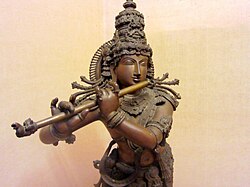
The bansuri-like flute is depicted in ancient Buddhist,[4] Hindu[5] and Jain temple paintings and reliefs, and is common in the iconography of the Hindu god Krishna.[6][7] It is intimately linked to the love story of Krishna and Radha.[8] The bansuri is revered as Lord Krishna's divine instrument and is often associated with Krishna's Rasa lila dance. These legends sometimes use alternate names for this wind instrument, such as the murali.[9][6] However, the instrument is also common among other traditions such as Shaivism.[10] The early medieval Indian texts also refer to it as vaṃśi, while in medieval Indonesian Hindu and Buddhist arts, as well as temple carvings in Java and Bali dated to be from pre-10th century period, this transverse flute has been called wangsi or bangsi.[11]
Etymology and nomenclature[edit | edit source]


The word bansuri originates in the bans (बाँस) [bamboo] + sur (सुर) [melody].[citation needed] A phonetically similar name for the same instrument, in early medieval texts, is the Sanskrit word vaṃśi which is derived from root vaṃśa (Sanskrit: वंश[12]) meaning bamboo.[11] A flute player in these medieval texts is called vamsika.[13]
Other regional names of bansuri-style, six to eight play holes, bamboo flutes in India include bansi, baashi, eloo, kolakkuzhal, kulal, kulalu, kukhl, lingbufeniam, murali, murli, nadi, nar, odakkuzhal, pawa, pullankuzhal, pillana grovi, pulangoil, vansi, vasdanda, sipung, and venuvu.[14][15][16] The instrument is also used in Nepal, under the name Bām̐surī (बाँसुरी).[17] Nepalese also use the word murli (मुरली), but that word can mean not only flute or fife, but also a reed instrument.
Ancient regional innovations, such as those in the Himalayan foothills of India, developed more complex designs, such as the algoza which is a "twin bansuri" in different keys constructed as a single instrument, allowing the musician to play more complex music. In central and south India, a similar innovation is called nagoza or mattiyaan jodi, and Buddhist stupa reliefs in central India, from about the 1st century BCE, depict the single and twinned flute designs.[18][19]
History[edit | edit source]
According to Ardal Powell, flute is a simple instrument found in numerous ancient cultures. According to legends, the three birthplaces of flutes are Egypt, Greece, and India. Of these, the transverse flute (side blown) appeared only in ancient India, while the fipple flutes are found in all three. It is likely, states Powell, that the modern Indian bansuri has not changed much since the early medieval era.[15][20] However, a flute of a somewhat different design is evidenced in ancient China (dizi) which Powell, quoting Curt Sachs' The History of Musical Instruments, suggests may not have originated in China but evolved from a more ancient Central Asian flute design. It is, however, not clear whether there was any connection between the Indian and Chinese varieties.[20]
The early medieval Indian bansuri was, however, influential. Its size, style, bindings, mounts on ends and playing style in medieval Europe artworks has led scholars, such as Liane Ehlich, a flute scholar at the music school in the University of Lucerne, to state that the bansuri (venu) migrated from India into the Byzantine Empire by the 10th century and from there on to medieval Europe where it became popular.[20][21]

The flute is discussed as an important musical instrument in the Natya Shastra (~200 BCE to 200 CE), the classic Sanskrit text on music and performance arts.[22] The flute (venu or vamsa) is mentioned in many Hindu texts on music and singing, as complementary to the human voice and Veena (vaani-veena-venu).[23][24] The flute is however not called bansuri in the ancient, and is referred to by other names such as nadi, tunava in the Rigveda (3000–2500 BCE) and other Vedic texts of Hinduism, or as venu in post-Vedic texts.[25][26][22] The flute is also mentioned in various Upanishads and Yoga texts.[27]
According to Bruno Nettl, a music historian and ethnomusicologist, the ancient surviving sculptures and paintings in the temples and archaeological sites of India predominantly show transverse flutes being played horizontally (with a downward tilt).[28] However, beginning in the 15th century, vertical end blowing style are commonly represented. This change in the relevance and style of bansuri is likely, states Nettl, because of the arrival of Islamic rule era on the Indian subcontinent and the West Asian influence on North Indian music.[29]
Construction[edit | edit source]

A bansuri is traditionally produced from a special type of bamboo, that naturally grows to long lengths between its nodes (knots). These grow abundantly in Himalayan foothills up to about 11,000 feet with high rainfall. These are particularly found in the northeastern (near Assam, Arunachal Pradesh, Meghalaya, Manipur, Mizoram, Nagaland, Sikkim, Tripura) and Western Ghats (near Kerala) states of India where numerous bamboo species grow with internodal lengths greater than 40 centimetres (16 in).[30][31]
The harvested bamboo with a desired diameter is cut, dried and treated with natural oils and resins to strengthen it. Once ready, the artisans examine the smoothness and straightness and measure the dried hollow tube. They mark the exact positions for the holes, then use hot metal rod skewers of different diameters to burn in the holes. Drilling and other methods of hole making are avoided as it is believed they damage the fiber orientation and the splits affect the music quality. The burnt-in holes are then finished by sanding, one end plugged, the flute ringed at various positions to stabilize its form and shape over time and the unit tested for its musical performance. The distance of a finger-hole from the mouth-hole, and the diameter of the finger-hole controls the note it plays. Adjustments to the diameters of various holes is made by the artisans to achieve purity of the musical notes produced. The wall thickness of the bansuri determines the tone, range and octave tuning. Once all the holes have reached their performance range, the bansuri is steeped in natural oils, cleaned, dried and decorated or bound with silk or nylon threads.[32][33]
There are two varieties of bansuri: transverse and fipple. The fipple flute is usually played in folk music and is held at the lips like a tin whistle. Because the transverse variety enables superior control, variations and embellishments, it is preferred in Indian classical music.[citation needed]

Musical notes[edit | edit source]
Six holes are sufficient to produce seven basic swaras: sa, re, ga, ma, pa, dha, and ni. When all holes are closed, it produces the lowest note of the bansuri (pa). With one hole farthest from the closed end of the bansuri open, the instrument plays the dha. Similarly, ni is produced with two farthest holes open, sa with three farthest open, re with four, ga with five, and ma is produced with all holes open.[34]
Every bansuri by its design and construction has a specific key and tonal center, corresponding to sa (shadja, natural tonic) of the swara scale.[35] This key is achieved by variations in length, inner diameter of the instrument and the relative size and placement of the finger holes. This allows the musician to select a bansuri constructed in the key of the music they want to create and share.[36][37]
Playing[edit | edit source]

A bansuri is typically held horizontally slanting downwards towards right by the bansuri player. The index, middle and ring fingers of the right hand cover the outer fingerholes, while the same fingers of the left hand cover the rest. The bansuri is supported by the thumb and little finger, while the airhole is positioned near the lips and air blown over it at various speeds to reach the desired octave. For the seven-hole bansuri, the little finger (pinky) of the right hand is usually employed.[38]

As with other air-reed wind instruments, the sound of a bansuri is generated from resonance of the air column inside it. The length of this column is varied by closing or leaving open, a varying number of holes. Half-holing is employed to play flat or minor notes. The 'sa' (on the Indian sargam scale, or equivalent 'do' on the octave) note is obtained by covering the first three holes from the blowing-hole. Octaves are varied by manipulating one's embouchure and controlling the blowing strength. Either finger tips or finger pads are used by bansuri players to partially or fully cover the tap holes.[39]
In order to play the diatonic scale on a bansuri, one needs to find where the notes lie. For example, in a bansuri where Sa or the tonic is always played by closing the first three holes, is equivalent to C, one can play sheet music by creating a finger notation that corresponds to different notes. A flutist is able to perform complex facets of Raga music such as microtonal inflections, ornamentation, and glissando by varying the breath, performing fast and dexterous fingering, and closing/opening the holes with slow, sweeping gestures.[citation needed]
See also[edit | edit source]
- Hindustani classical music
- Venu
- Bamboo musical instruments
- Pannalal Ghosh
- Hariprasad Chaurasia
- Rakesh Chaurasia
References[edit | edit source]
- ↑ Bettina Bäumer; Kapila Vatsyayan (1988). Kalatattvakosa: A Lexicon of Fundamental Concepts of the Indian Arts. Motilal Banarsidass. p. 181. ISBN 978-81-208-1402-8.
- ↑ 2.0 2.1 Ashok Damodar Ranade 2006, pp. 284–286.
- ↑ Dorothea E. Hast; James R. Cowdery; Stanley Arnold Scott (1999). Exploring the World of Music: An Introduction to Music from a World Music Perspective. Kendall Hunt. p. 153. ISBN 978-0-7872-7154-1.
- ↑ Patricia E. Karetzky (2000). Early Buddhist Narrative Art: Illustrations of the Life of the Buddha from Central Asia to China, Korea and Japan. University Press of America. pp. 44, 60. ISBN 978-1-4617-4027-8.
- ↑ Alice Boner (1990). Principles of Composition in Hindu Sculpture: Cave Temple Period. Motilal Banarsidass. pp. 157–163, 186–187. ISBN 978-81-208-0705-1.
- ↑ 6.0 6.1 Pratapaditya Pal; Stephen P. Huyler; John E. Cort; et al. (2016). Puja and Piety: Hindu, Jain, and Buddhist Art from the Indian Subcontinent. Univ of California Press. pp. 37–38, 47–49, 59–60. ISBN 978-0-520-28847-8.
- ↑ Martinez 2001, pp. xxvii-xxviii, 325, 342.
- ↑ Sorrell & Narayan 1980, pp. 35–36.
- ↑ Lochtefeld 2002, p. 370–371, 449.
- ↑ Dalal 2014, p. 28, see entry for Shiva-dedicated saint Anaya.
- ↑ 11.0 11.1 Jaap Kunst (2013). Hindu-Javanese Musical Instruments. Springer. pp. 25–26. ISBN 978-94-011-9185-2.
- ↑ vaMza Archived 22 December 2016 at the Wayback Machine, Sanskrit-English Dictionary, Koeln University, Germany
- ↑ Emmie Te Nijenhuis (1992). Saṅgītaśiromaṇi: A Medieval Handbook of Indian Music. Brill Academic. p. 303. ISBN 90-04-09498-9.
- ↑ Nettl et al. 1998, pp. 345, 350–354, 360, 497.
- ↑ 15.0 15.1 Peter Westbrook (2003), The bansuri and pulangoil, bamboo flutes of India, Flutist Quarterly, Vol. 28, No. 3, pages 1–4
- ↑ Dale A. Olsen (2013). World Flutelore: Folktales, Myths, and Other Stories of Magical Flute Power. University of Illinois Press. pp. 10–12. ISBN 978-0-252-09514-6.
- ↑ Kadel, Ram Prasad (2006). Haamra Lokbaajaaharu (translation with subtitle: Our Musical Instruments, 'A course book for school children.') (PDF) (in नेपाली). The [Nepal] Ministry of Education, Curriculum Department of Nepal Government. p. 7.
- ↑ Alka Pande (1999). Folk Music & Musical Instruments of Punjab. Mapin. pp. 44–46. ISBN 978-1-890206-15-4.
- ↑ Nettl et al. 1998, p. 345.
- ↑ 20.0 20.1 20.2 Ardal Powell (2002). The Flute. Yale University Press. pp. 10–13. ISBN 978-0-300-09498-5.
- ↑ Liane Ehlich (1984), Zur Ikonographie der Querflöte im Mittelalter. Basler Jahrbuch für historische Musikpraxis, Volume 8, pages 197–211 (in German)
- ↑ 22.0 22.1 Rowell 2015, pp. 99–103.
- ↑ Tarla Mehta (1995). Sanskrit Play Production in Ancient India. Motilal Banarsidass. pp. 149–150. ISBN 978-81-208-1057-0.
- ↑ Martinez 2001, p. 127.
- ↑ Arthur Berriedale Keith (1995). Vedic Index of Names and Subjects. Motilal Banarsidass. p. 441. ISBN 978-81-208-1332-8.
- ↑ Suneera Kasliwal (2004). Classical musical instruments. Rupa. pp. 85–86. ISBN 978-81-291-0425-0.
- ↑ Beck 1993, pp. 98–110.
- ↑ Nettl et al. 1998, pp. 306 with Figure 1 p. 299.
- ↑ Nettl et al. 1998, pp. 306, with Figure 1 p. 299 and Figure 5 p. 304.
- ↑ Sir George Watt (1908). The Commercial Products of India. J. Murray. pp. 98–106.
- ↑ K. K. Seethalakshmi; M. S. Muktesh Kumar; K. Sankara Pillai; et al. (1998). Bamboos of India: A Compendium. BRILL. pp. 20, 80–83, 123, 184. ISBN 81-86247-25-4.
- ↑ Peter Westbrook (2003), The bansuri and pulangoil, bamboo flutes of India, Flutist Quarterly, Vol. 28, No. 3, pages 1–27
- ↑ Dale A. Olsen (2013). World Flutelore: Folktales, Myths, and Other Stories of Magical Flute Power. University of Illinois Press. pp. 15–27. ISBN 978-0-252-09514-6.
- ↑ Lyon Leifer (2005). How to Play the Bansuri: A Manual for Self-instruction Based on the Teaching of Devendra Murdeshwar. Rasa Music. pp. 1–7. ISBN 978-0-9766219-0-4.
- ↑ Ellen Koskoff (2008). The Concise Garland Encyclopedia of World Music: The Middle East, South Asia, East Asia, Southeast Asia. Routledge. p. 980. ISBN 978-0-415-99404-0.
- ↑ Mark Shepard (2002). Simple Flutes. Simple. pp. 19–21, 31–35. ISBN 978-0-938497-18-9.
- ↑ G Dournon; M Helffer (1984). "Bansuri". In Stanley Sadie (ed.). The New Grove dictionary of musical instruments, Volume 1. Macmillan Press. ISBN 978-0-943818-05-4.
- ↑ Leifer, Lyon (2005). How to Play the Bansuri: A Manual for Self-Instruction Based on the Teaching of Devendra Murdeshwar. Rasa Music Co. ISBN 0-9766219-0-8.
- ↑ Bullard, B. (2007). The link between Samavedic chanting and flute playing in the Naradiya siksa: A new interpretation. Journal of the Indian Musicological Society, 38, 129-145, 252.
Bibliography[edit | edit source]
- Beck, Guy (1993). Sonic Theology: Hinduism and Sacred Sound. Columbia: University of South Carolina Press. ISBN 978-0-87249-855-6.
- Caudhurī, Vimalakānta Rôya (2000). The Dictionary of Hindustani Classical Music. Motilal Banarsidass. ISBN 978-81-208-1708-1.
- Dalal, Roshen (2014). Hinduism: An Alphabetical Guide. Penguin Books. ISBN 978-81-8475-277-9.
- Daniélou, Alain (1949). Northern Indian Music, Volume 1. Theory & technique; Volume 2. The main rāgǎs. London: C. Johnson. OCLC 851080.
- Gautam, M.R. (1993). Evolution of Raga and Tala in Indian Music. Munshiram Manoharlal. ISBN 81-215-0442-2.
- Kaufmann, Walter (1968). The Ragas of North India. Oxford & Indiana University Press. ISBN 978-0-253-34780-0. OCLC 11369.
- Lochtefeld, James G. (2002). The Illustrated Encyclopedia of Hinduism, 2 Volume Set. The Rosen Publishing Group. ISBN 978-0-8239-2287-1.
- Martinez, José Luiz (2001). Semiosis in Hindustani Music. Motilal Banarsidass. ISBN 978-81-208-1801-9.
- Nettl, Bruno; Ruth M. Stone; James Porter; Timothy Rice (1998), The Garland Encyclopedia of World Music: South Asia : the Indian subcontinent, Routledge, ISBN 978-0-8240-4946-1
- Ashok Damodar Ranade (2006). Music Contexts: A Concise Dictionary of Hindustani Music. Bibliophile South Asia. ISBN 978-81-85002-63-7.
- Randel, Don Michael (2003). The Harvard Dictionary of Music (fourth ed.). Cambridge, MA: Harvard University Press. ISBN 978-0-674-01163-2.
- Rowell, Lewis (2015). Music and Musical Thought in Early India. University of Chicago Press. ISBN 978-0-226-73034-9.
- Sorrell, Neil; Narayan, Ram (1980). Indian Music in Performance: A Practical Introduction. Manchester University Press. ISBN 978-0-7190-0756-9.
- Te Nijenhuis, Emmie (1974). Indian Music: History and Structure. BRILL Academic. ISBN 90-04-03978-3.
- Wilke, Annette; Moebus, Oliver (2011). Sound and Communication: An Aesthetic Cultural History of Sanskrit Hinduism. Walter de Gruyter. ISBN 978-3-11-024003-0.
| Wind (Sushir) |  | |
|---|---|---|
| Plucked Stringed (Tat) | ||
| Bowed Stringed (Vitat) | ||
| Membranous Percussion (Avanaddh) | ||
| Non-Membranous Percussion (Ghan) | ||
| Other | ||
| Historical/ possibly extinct | ||

