



Ajay Kumar (talk | contribs) Created a new article Tag: disambiguator-link-added |
Irshad. gori (talk | contribs) added section and fixed typos |
||
| Line 1: | Line 1: | ||
{{Short description|Criticisms of the main prophet of Islam}} | {{Short description|Criticisms of the main prophet of Islam}} | ||
{{Use dmy dates|date=March 2020}} | {{Use dmy dates|date=March 2020}} | ||
[[File:Dante and Virgil Meet Muhammad and His Son-in-law, Ali in Hell.jpg|thumb|upright= 1.2|[[Dante]]'s ''[[Inferno (Dante)|Inferno]]'' casts Muhammad in [[Christian views on Hell|Hell]],<ref>''Inferno'', [https://en.m.wikisource.org/wiki/Divine_Comedy_(Longfellow_1867)/Volume_1/Canto_28 Canto XXVIII] {{Webarchive|url=https://web.archive.org/web/20181004185944/https://en.m.wikisource.org/wiki/Divine_Comedy_(Longfellow_1867)/Volume_1/Canto_28 |date=4 October 2018 }}, lines 22-63; translation by [[Henry Wadsworth Longfellow]] (1867).</ref><ref name="Buhl1993">{{cite encyclopedia |last1=Buhl |first1=F. |last2=Ehlert |first2=Trude |last3=Noth |first3=A. |last4=Schimmel |first4=Annemarie |last5=Welch |first5=A. T. |title=Muḥammad |orig-year=1993 |year=2012 |editor1-last=Bearman |editor1-first=P. J. |editor1-link=Peri Bearman |editor2-last=Bianquis |editor2-first=Th. |editor2-link=Thierry Bianquis |editor3-last=Bosworth |editor3-first=C. E. |editor3-link=Clifford Edmund Bosworth |editor4-last=van Donzel |editor4-first=E. J. |editor4-link=Emeri Johannes van Donzel |editor5-last=Heinrichs |editor5-first=W. P. |editor5-link=Wolfhart Heinrichs |encyclopedia=[[Encyclopaedia of Islam#2nd edition, EI2|Encyclopaedia of Islam, Second Edition]] |location=[[Leiden]] and [[Boston]] |publisher=[[Brill Publishers]] |pages=360–376 |doi=10.1163/1573-3912_islam_COM_0780 |isbn=978-90-04-16121-4}}</ref><ref name="Quinn2008">{{cite book |last=Quinn |first=Frederick |date=2008 |title=The Sum of All Heresies: The Image of Islam in Western Thought |location=[[New York City|New York]] |publisher=[[Oxford University Press]] |chapter=The Prophet as Antichrist and Arab Lucifer (Early Times to 1600) |chapter-url=https://books.google.com/books?id=PAF5py-2Oi0C&pg=PA17 |pages=17–54 |isbn=978-0195325638}}</ref><ref name="Hartmann 2013">{{cite book |author-last=Hartmann |author-first=Heiko |year=2013 |chapter=Wolfram's Islam: The Beliefs of the Muslim Pagans in ''Parzival'' and ''Willehalm'' |chapter-url=https://books.google.com/books?id=snPnBQAAQBAJ&pg=PA427 |editor-last=Classen |editor-first=Albrecht |title=East Meets West in the Middle Ages and Early Modern Times: Transcultural Experiences in the Premodern World |location=[[Berlin]] and [[Boston]] |publisher=[[De Gruyter]] |series=Fundamentals of Medieval and Early Modern Culture |volume=14 |pages=427–442 |doi=10.1515/9783110321517.427 |isbn=9783110328783 |issn=1864-3396}}</ref> reflecting his negative image in the [[Western culture|Christian world]].<ref name="Goddard2000">{{cite book |last=Goddard |first=Hugh |date=2000 |title=A History of Christian-Muslim Relations |location=[[Edinburgh]] |publisher=[[Edinburgh University Press]] |chapter=The First Age of Christian-Muslim Interaction (c. 830/215) |pages=34–49 |isbn=978-1-56663-340-6}}</ref><ref name="Curtis2009">{{Cquote|Criticism by Christians [...] was voiced soon after the advent of Islam starting with [[St. John of Damascus]] in the late seventh century, who wrote of "the [[False prophet#Christianity|false prophet]]", Muhammad. Rivalry, and often enmity, continued between the [[Christendom|European Christian world]] and the [[Muslim world#History|Islamic world]] [...]. For [[Christian theologians]], the "Other" was the infidel, the Muslim. [...] Theological disputes in [[Baghdad]] and [[Damascus]], in the eighth to the tenth century, and in [[Andalusia]] up to the fourteenth century led [[Eastern Orthodox Church|Christian Orthodox]] and [[Church in the Byzantine Empire|Byzantine]] theologians and [[Byzantine emperor|rulers]] to continue seeing Islam as a threat. In the twelfth century, [[Peter the Venerable]] [...] who had the [[Quran|Koran]] translated into [[Latin language|Latin]], regarded Islam as a Christian heresy and Muhammad as a sexually self-indulgent and a murderer. [...] However, he called for the [[Conversion to Christianity|conversion]], not the extermination, of Muslims. A century later, [[St. Thomas Aquinas]] in ''[[Summa contra Gentiles]]'' accused Muhammad of seducing people by promises of carnal pleasure, uttering truths mingled with many fables and announcing utterly false decisions that had no divine inspiration. Those who followed Muhammad were regarded by Aquinas as brutal, ignorant "beast-like men" and desert wanderers. Through them Muhammad, who asserted he was "sent in the power of arms", forced others to become followers by violence and armed power.|author=Michael Curtis|source=''[https://books.google.com/books?id=liJ_KxAMIJgC&pg=PA31 Orientalism and Islam: European Thinkers on Oriental Despotism in the Middle East and India]'' (2009), p. 31, [[Cambridge University Press]], [[New York City|New York]], {{ISBN|978-0521767255}}.}}</ref> Here, [[William Blake]]'s illustration of ''Inferno'' depicts Muhammad pulling his chest open which has been sliced by a [[Demon#Christianity|demon]] to symbolize his role as a "schismatic",<ref name="Buhl1993"/> since Islam was considered a [[Heresy in Christianity|heresy]] by [[Medieval Christian views on Muhammad|Medieval Christians]].<ref name="Goddard2000"/><ref name="Curtis2009"/>]] | |||
{{Muhammad |expanded=perspectives}} | {{Muhammad |expanded=perspectives}} | ||
{{Islam |expanded=related}} | {{Islam |expanded=related}} | ||
[[ | The first to criticize the [[Islam]]ic prophet [[Muhammad]] were his [[Religion in pre-Islamic Arabia|non-Muslim Arab contemporaries]], who decried him for preaching [[monotheism]], and the [[Jewish tribes of Arabia]], for what they claimed were unwarranted appropriation of [[Hebrew Bible|Biblical narratives]] and [[Biblical Figures|figures]]<ref name="JE2">{{Cquote|The Jews [...] could not let pass unchallenged the way in which [[Biblical and Quranic narratives|the Koran appropriated Biblical accounts and personages]]; for instance, its making Abraham an Arab and the founder of the [[Ka'bah]] at [[Mecca]]. The prophet, who looked upon every evident correction of his gospel as an attack upon his own reputation, brooked no contradiction, and unhesitatingly threw down the gauntlet to the Jews. Numerous passages in the Koran show how he gradually went from slight thrusts to malicious vituperations and brutal attacks on the customs and beliefs of the Jews. When they justified themselves by referring to the Bible, Muhammad, who had taken nothing therefrom at first hand, accused them of intentionally concealing its true meaning or of entirely misunderstanding it, and taunted them with being "asses who carry books" ([[Q62:5|sura lxii. 5]]). The increasing bitterness of this vituperation, which was similarly directed against the less numerous [[Arab Christians|Christians]] of [[Medina]], indicated that in time Muhammad would not hesitate to proceed to actual hostilities. The outbreak of the latter was deferred by the fact that the hatred of the prophet was turned more forcibly in another direction, namely, against the [[Quraysh|people of Mecca]], whose earlier refusal of Islam and whose attitude toward the community appeared to him at Medina as a personal insult which constituted a sufficient cause for [[Islam and war|war]].|author=Richard Gottheil, Mary W. Montgomery, Hubert Grimme|source=[http://jewishencyclopedia.com/articles/10918-mohammed "Mohammed"] (1906), ''[[Jewish Encyclopedia]]'', [[Kopelman Foundation]].}}</ref> and [[Anti-Judaism|vituperation]] of the [[Jewish faith]].<ref name="JE2"/> For these reasons, medieval Jewish writers commonly referred to him by the derogatory nickname ''ha-Meshuggah'' ({{langx|he|מְשֻׁגָּע{{popdf}}}}, "the Madman" or "the Possessed").<ref name="Stillman">{{cite book|author=Norman A. Stillman|author-link=Norman Stillman|title=The Jews of Arab Lands: A History and Source Book|url=https://books.google.com/books?id=bFN2ismyhEYC&pg=PA236|year=1979|publisher=Jewish Publication Society|isbn=978-0827601987|page=236}}</ref><ref>[[Ibn Warraq]], ''[https://books.google.com/books?id=M8o6UZ37ppUC&pg=PA255 Defending the West: A Critique of Edward Said's Orientalism]'', p. 255.</ref><ref>Andrew G. Bostom, ''[https://books.google.com/books?id=vjFNPT52XjUC&pg=PA21 The Legacy of Islamic Antisemitism: From Sacred Texts to Solemn History]'', p. 21.</ref> | ||
During the [[Middle Ages]], various<ref name="Quinn2008"/><ref name="Goddard2000"/><ref name="John of Damascus">[[John of Damascus]], ''De Haeresibus''. See [[Migne]], ''[[Patrologia Graeca]]'', Vol. 94, 1864, cols 763–73. An English translation by the Reverend John W. Voorhis appeared in ''The Moslem World'', October 1954, pp. 392–98.</ref> [[Christianity in the Middle Ages|Western]] and [[Byzantine Empire|Byzantine]] [[Christian polemics and apologetics in the Middle Ages|Christian polemicists]] considered Muhammad to be a [[false prophet]],<ref name="Quinn2008"/><ref name="Hartmann 2013"/><ref name="Goddard2000"/><ref name="Curtis2009"/> the [[Antichrist]],<ref name="Quinn2008"/><ref name="Goddard2000"/> a [[Heresy in Christianity|heretic]]<ref name="Buhl1993"/><ref name="Quinn2008"/><ref name="Hartmann 2013"/><ref name="Goddard2000"/>, [[Satan]]<ref name="Quinn2008"/> [[Demonic possession|possessed]] by [[Demon#Christianity|demons]],<ref name="Buhl1993"/><ref name="Curtis2009"/> a [[sexual deviant]]<ref name="Quinn2008"/>, a [[polygamist]],<ref name="Quinn2008"/> and a [[charlatan]]<ref name="Quinn2008"/>. [[Thomas Aquinas]] criticized Muhammad's handling of doctrinal matters and promises of what Aquinas described as "carnal pleasure" in the [[Afterlife#Islam|afterlife]]. | |||
Modern criticism by some Western scholars has raised questions about Muhammad’s prophetic claims, personal conduct, marriages, slave ownership, and mental state.{{efn|Multiple references:<ref name="Quinn2008"/><ref name="Cimino">{{cite journal |last=Cimino |first=Richard P. |date=December 2005 |title="No God in Common": American Evangelical Discourse on Islam after 9/11 |journal=[[Review of Religious Research]] |publisher=[[Springer Verlag]] on behalf of the [[Religious Research Association]] |volume=47 |issue=2 |pages=162–174 |doi=10.2307/3512048 |jstor=3512048 |issn=2211-4866 |s2cid=143510803}}</ref><ref name="Willis2013">{{cite book |editor1-last=Willis |editor1-first=John Ralph |date=2013 |title=Slaves and Slavery in Muslim Africa: Islam and the Ideology of Enslavement |location=[[New York City|New York]] |publisher=[[Routledge Press|Routledge]] |volume=1 |pages=vii-xi, 3–26 |isbn=978-0-7146-3142-4}}; {{cite book |editor1-last=Willis |editor1-first=John Ralph |date=1985 |title=Slaves and Slavery in Muslim Africa: The Servile Estate |location=[[New York City|New York]] |publisher=[[Routledge Press|Routledge]] |volume=2 |pages=vii-xi |isbn=978-0-7146-3201-8}}</ref><ref>{{Cite book|title=Politics, Gender, and the Islamic Past: The Legacy of 'A'isha Bint Abi Bakr|last=Spellberg|first=Denise A.|publisher=Columbia University Press|year=1996|isbn=978-0-231-07999-0|pages=39–40|language=en|author-link=Denise Spellberg}}</ref><ref>{{cite journal |last=Kalin|first=Ibrahim |date=2001|title=Prophet Muhammad and His Western Critics: A Critique of W. Montgomery Watt and Others by Zafar Ali Qureshi, Idara Ma'arif Islamic, Lahore, 1992, 2 Vols, p. 1103|journal=American Journal of Islamic Social Sciences |publisher=American Journal of Islam and Society |volume=18 |issue=2 |pages=162–164 |doi=10.35632/ajis.v18i2.2026 |doi-access=free }}</ref><ref>{{cite journal |last1=Kabir |first1=Aliyu |last2=Al-Shafi'|first2=Mohammed|date=2025|title=The Misrepresented Views of William Muir on Prophet Muhammad's Polygyny|journal=International Journal of Islamic Thought|volume=27 |issue=June|pages=27–36 |doi=10.24035/ijit.27.2025.315 |doi-access=free}}</ref>|name="Multiplereference"}} Criticism has also focused on his treatment of enemy captives, particularly the case of mass killing of men of the [[Banu Qurayza]] tribe in [[Medina]]. [[Muslim]] scholars often respond by emphasizing the historical context of [[Pre-Islamic Arabia|7th-century Arabia]] and Muhammad’s role in promoting justice and social reform. Some historians say the punishment of the Banu Qurayza reflected the norms of the time and was ordered by [[Sa'd ibn Mu'adh]], though others question Muhammad’s role or the scale of the event. | |||
==Points of contention== | ==Points of contention== | ||
| Line 109: | Line 14: | ||
===Ownership of slaves=== | ===Ownership of slaves=== | ||
{{see also|Arab slave trade|History of slavery in the Muslim world|Islamic views on slavery}} | {{see also|Arab slave trade|History of slavery in the Muslim world|Islamic views on slavery}} | ||
According to sociologist Rodney Stark, "the fundamental problem facing Muslim theologians vis-à-vis the morality of slavery" is that Muhammad himself engaged in activities such as purchasing, selling, and owning slaves, and that his followers saw him as the perfect example to emulate. Stark contrasts Islam with [[Christianity]], writing that Christian theologians wouldn't have been able to "work their way around the biblical acceptance of slavery" if [[Jesus]] had owned slaves, as Muhammad did.<ref>Rodney Stark, "For the Glory of God: How Monotheism Led to Reformations, Science, Witch-Hunts, and the End of Slavery", p. 338, 2003, [[Princeton University Press]], {{ISBN|0691114366}}</ref> | According to sociologist [[Rodney Stark]], "the fundamental problem facing Muslim theologians vis-à-vis the morality of [[slavery]]" is that Muhammad himself engaged in activities such as purchasing, selling, and owning slaves, and that his followers saw him as the perfect example to emulate. Stark contrasts Islam with [[Christianity]], writing that Christian theologians wouldn't have been able to "work their way around the biblical acceptance of slavery" if [[Jesus]] had owned slaves, as Muhammad did.<ref>Rodney Stark, "For the Glory of God: How Monotheism Led to Reformations, Science, Witch-Hunts, and the End of Slavery", p. 338, 2003, [[Princeton University Press]], {{ISBN|0691114366}}</ref> | ||
Forough Jahanbaksh notes that Muhammad never preached the abolition of slavery as a doctrine, although he did moderate the age-old institution of slavery, which was also accepted and endorsed by the other monotheistic religions, [[Christian views on slavery|Christianity]] and [[Jewish views on slavery|Judaism]], and was a well-established custom of the [[Pre-Islamic Arabia|pre-Islamic world]].<ref name=BBC/><ref name="Gordon1989">{{cite book |last=Gordon |first=Murray |date=1989 |title=Slavery in the Arab World |location=[[New York City|New York]] |publisher=[[Rowman & Littlefield]] |chapter=The Attitude of Islam Toward Slavery |pages=[https://archive.org/details/slaveryinarabwor00gord/page/18 18–47] |isbn=978-0941533300 |chapter-url=https://archive.org/details/slaveryinarabwor00gord/page/18 }}</ref><ref name="Levy2000">{{cite book |last=Levy |first=Reuben |date=2000 |title=The Social Structure of Islam |location=NY |publisher=Routledge |chapter=Slavery in Islam |pages=73–90 |isbn=978-0415209106}}</ref> According to Murray Gordon, Muhammad saw it "as part of the natural order of things". While Muhammad did improve the condition of slaves, and exhorted his followers to treat them with kindness and compassion, and encouraged freeing of slaves, he still did not completely abolish the practice.<ref>{{Cite web|url=http://www.oswego.edu/~agyeman/agyeman/process.htm|title=Islam and Slavery|website=[[State University of New York at Oswego]]|url-status=dead|archive-url=https://web.archive.org/web/20180930023452/http://www.oswego.edu/~agyeman/agyeman/process.htm|archive-date=2018-09-30|access-date=2018-09-30}}</ref><ref name=BBC/> | |||
His decrees greatly limited those who could be enslaved and under what circumstances (including barring Muslims from enslaving other Muslims), allowed slaves to achieve their freedom and made freeing slaves a virtuous act. Some slaves earned respectable incomes and achieved considerable power, although elite slaves still remained in the power of their owners | His decrees greatly limited those who could be enslaved and under what circumstances (including barring Muslims from enslaving other Muslims), allowed slaves to achieve their freedom and made freeing slaves a virtuous act. Some slaves earned respectable incomes and achieved considerable power, although elite slaves still remained in the power of their owners.<ref>See [[Tahfeem ul Qur'an]] by [[Maududi|Sayyid Abul Ala Maududi]], Vol. 2, pp. 112–13, footnote 44; Also see commentary on verses {{qref|23|1-6}}: Vol. 3, notes 7-1, p. 241; 2000, Islamic Publications.</ref><ref name="BBC">{{cite web|url=https://www.bbc.co.uk/religion/religions/islam/history/slavery_1.shtml|title=Slavery in Islam|archive-url=https://web.archive.org/web/20181006015406/http://www.bbc.co.uk/religion/religions/islam/history/slavery_1.shtml |archive-date=6 October 2018|date=7 September 2009|publisher=BBC|url-status=live|access-date=7 March 2019}}</ref> Muhammad established a system to encourage [[manumission]], and several of his companions, including [[Abu Bakr]] and [[Uthman|Uthman ibn Affan]], are recorded to have freed thousands of slaves, often purchasing them for this purpose.<ref>{{cite web |title=The Manumission of Slaves |url=https://www.reviewofreligions.org/11093/the-manumission-of-slaves/ |website=Review of Religions |access-date=July 14, 2025 |date=August 17, 2014}}</ref><ref>{{cite web |last1=Stacey |first1=Aisha |title=Uthman Ibn Affan (part 1 of 2) |url=https://www.islamreligion.com/articles/2180/viewall/uthman-ibn-affan-part-1 |access-date=July 14, 2025 |date=October 4, 2009}}</ref> Many early converts to Islam were the poor and former slaves like [[Bilal ibn Rabah al-Habashi]].<ref>Ali Ünal, ''The Qur'an with Annotated Interpretation in Modern English'', [https://books.google.com/books?id=DyuqdDIjaswC&pg=PA1323 p. 1323]</ref><ref>[[Encyclopedia of the Qur'an]], Slaves and Slavery</ref><ref name="AuthorHouse">Janeh, Sabarr. Learning from the Life of Prophet Muhammad (SAW): Peace and Blessing of God Be upon Him. Milton Keynes: AuthorHouse, 2010. Print. {{ISBN|1467899666}} Pgs. 235-238</ref> | ||
===Treatment of enemies=== | ===Treatment of enemies=== | ||
| Line 119: | Line 24: | ||
{{See also|War in Islam|Islam and violence|Invasion of Banu Qurayza}} | {{See also|War in Islam|Islam and violence|Invasion of Banu Qurayza}} | ||
{{Campaignbox Campaigns of Muhammad}} | {{Campaignbox Campaigns of Muhammad}} | ||
[[Norman Geisler]] accuses Muhammad of "mercilessness" towards the Jewish tribes of Medina. | [[Norman Geisler]] accuses Muhammad of "mercilessness" towards the Jewish tribes of Medina. Geisler also argues that Muhammad "had no aversion to politically expedient assassinations", "was not indisposed to breaking promises when he found it advantageous" and "engaged in retaliation towards those who mocked him."<ref name="Geisler 1999 Character of Muhammad">[[Norman Geisler|Geisler, N.L.]] (1999). In Baker encyclopedia of Christian apologetics. Grand Rapids, MI: Baker Books. Article on ''Muhammad, Character of.''</ref> The [[oriental studies|Orientalist]] [[William Muir]], in assessing Muhammad's character, described him as cruel and faithless in dealing with his enemies.<ref name="Muir 1861 IV p307-309">[[William Muir|Muir, W.]] (1861). The Life of Mahomet, Volume IV (pp. 307–09). London: Smith, Elder and Co.</ref> | ||
[[Jean de Sismondi]] suggests that Muhammad's successive attacks on powerful Jewish colonies located near Medina in Arabia were due to religious differences between them, and he claimed that he subjected the defeated to punishments that were not typical in other wars.<ref>{{cite book| title=Histoire de la chute de Rome et du déclin de la civilisation occidentale | first=Jean | last=de Sismondi |language=fr | author-link=Jean de Sismondi|quote=Mahomet devoit aux juifs une partie de ses connoissances et de sa religion; mais il éprouvoit contre eux cette haine qui semble s'animer dans les sectes religieuses, lorsqu'il n'y a entre elles qu'une seule différence au milieu de nombreux rapports. De puissantes colonies de cette nation, riches, commerçantes et dépourvues de toutes vertus guerrières, étoient établies en Arabie, à peu de distance de Médine. Mahomet les attaqua successivement, de l'an 628 à l'an 627; il né se contenta pas de partager leurs richesses, il abandonna presque tous les vaincus à des supplices qui, dans d'autres guerres, souilloient rarement ses armes.}} (book 2, pp. 27-28)</ref> | [[Jean de Sismondi]] suggests that Muhammad's successive attacks on powerful Jewish colonies located near Medina in Arabia were due to religious differences between them, and he claimed that he subjected the defeated to punishments that were not typical in other wars.<ref>{{cite book| title=Histoire de la chute de Rome et du déclin de la civilisation occidentale | first=Jean | last=de Sismondi |language=fr | author-link=Jean de Sismondi|quote=Mahomet devoit aux juifs une partie de ses connoissances et de sa religion; mais il éprouvoit contre eux cette haine qui semble s'animer dans les sectes religieuses, lorsqu'il n'y a entre elles qu'une seule différence au milieu de nombreux rapports. De puissantes colonies de cette nation, riches, commerçantes et dépourvues de toutes vertus guerrières, étoient établies en Arabie, à peu de distance de Médine. Mahomet les attaqua successivement, de l'an 628 à l'an 627; il né se contenta pas de partager leurs richesses, il abandonna presque tous les vaincus à des supplices qui, dans d'autres guerres, souilloient rarement ses armes.}} (book 2, pp. 27-28)</ref> | ||
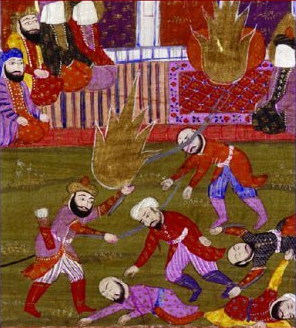
[[File:Banu Qurayza.png|thumb| | [[File:Banu Qurayza.png|thumb|right| [[Miniature (illuminated manuscript)|Miniature painting]] depicting the execution of the Banu Qurayza, from a 19th-century manuscript illustrated by Muhammad Rafi Bazil.]] | ||
Muhammad has been often criticized outside of the Islamic world for his treatment of the Jewish tribes of Medina.<ref name="Esposito18"/> An example is the mass killing of the men of the [[Banu Qurayza]], a Jewish tribe of Medina. The tribe was accused of having engaged in [[treason]]ous agreements with the enemies besieging Medina in the [[Battle of the Trench]] in 627.<ref>Bukhari {{Hadith-usc|Bukhari|usc=yes-usc|5|59|362}}</ref><ref>Daniel W. Brown, ''A New Introduction to Islam'', p. 81, 2003, Blackwell Publishers, {{ISBN|0-631-21604-9}}</ref><ref>Yusuf Ali, "The Meaning of the Holy Quran", (11th Edition), p. 1059, Amana Publications, 1989, {{ISBN|0915957760}}</ref><ref name="IbnIshaq">Ibn Ishaq, A. Guillaume (translator), ''The Life of Muhammad'', p. 464, 2002, Oxford University Press, {{ISBN|0196360331}}</ref> | |||
After the Qurayẓah were found to be complicit with the enemy during the [[Battle of the Trench]], the Muslim general [[Sa'd ibn Mu'adh]] ordered the men to be put to death and the women and children to be enslaved. Moreover, Muslims believe that the Prophet did not order the execution of the Jews of Medina, but many Western historians believe that he must have been, at the very least, informed of it.<ref name="Muhammad">{{cite book |last1=Nasr |first1=Seyyed Hossein |author1-link=Seyyed Hossein Nasr |title=Muhammad |publisher=Encyclopedia Britannica |url=https://www.britannica.com/biography/Muhammad/The-early-battles |archive-url=https://web.archive.org/web/20160402003901/https://www.britannica.com/biography/Muhammad/The-early-battles |url-status=dead |archive-date=2016-04-02 }}</ref> Regardless, "this tragic episode cast a shadow upon the relations between the two communities for many centuries, even though the Jews, a "[[People of the Book]]" [...] generally enjoyed the protection of their lives, property, and religion under Islamic rule and fared better in the Muslim world than in the West."<ref name="Muhammad"/> | |||
According to [[Norman Stillman]], the incident cannot be judged by present-day moral standards. Citing Deut. 20:13–14 as an example, Stillman states that the slaughter of adult males and the enslavement of women and children—though no doubt causing bitter suffering—was common practice throughout the ancient world.<ref>Stillman (1974), p. 16</ref> According to Rudi Paret, adverse public opinion was more a point of concern to Muhammad when he had some date palms cut down during a siege, than after this incident.<ref>Quoted in Stillman (1974), p. 16</ref> Esposito also argues that in Muhammad's time, traitors were executed and points to similar situations in the Bible.<ref>[[BBC Radio 4]], Beyond Belief, 2 Oct 2006, ''Islam and the sword''</ref> [[John Esposito]] notes that Muhammad’s motivation was primarily political rather than racial or theological, aiming to unify Arabia under Muslim leadership and establish stable governance.<ref name="Esposito18"/> | |||
Some historians, such as W.N. Arafat and [[Barakat Ahmad]], have disputed the historicity of the incident.<ref name="Meri1">Meri, p. 754.</ref> Ahmad argues that only the leading members of the tribe were killed.<ref>[[Barakat Ahmad]], ''Muhammad and the Jews: A Re-examination'', holds that only the leaders of the Qurayza were killed.</ref><ref>Nemoy, Leon. ''Barakat Ahmad's "Muhammad and the Jews"''. The Jewish Quarterly Review, New Ser., Vol. 72, No. 4. (Apr. 1982), p. 325. Nemoy is sourcing Ahmed's ''Muhammad and the Jews''.</ref> Arafat argued based on accounts by [[Malik ibn Anas]] and [[Ibn Hajar al-Asqalani|Ibn Hajar]] that [[Ibn Ishaq]] gathered information from descendants of the Qurayza Jews, who exaggerated the details of the incident.<ref name="Arafat">Walid Najib Arafat (1976). "New Light on the Story of Banū Qurayẓa and the Jews of Medina". ''Journal of the Royal Asiatic Society of Great Britain and Ireland'', pp. 100–07.</ref> He also maintained that not all adult males were killed but only those who actually fought in the battle, however, William Montgomery Watt described this argument as "not entirely convincing."<ref name="Kurayza">Watt, ''[[Encyclopaedia of Islam]]'', vol. 5, p. 436, "Kurayza, Banu".</ref> | |||
Rabbi Samuel Rosenblatt has said that Muhammad's policies were not directed exclusively against Jews (referring to his conflicts with Jewish tribes) and that Muhammad was more severe with his [[Religion in pre-Islamic Arabia|pagan Arab]] kinsmen.<ref name="Sameul">Samuel Rosenblatt, ''Essays on Antisemitism: The Jews of Islam'', p. 112</ref><ref name="Rosenblatt">Pinson; Rosenblatt (1946) pp. 112–119</ref> | |||
==={{anchor|CoMmarriages}}Muhammad's marriages=== | ==={{anchor|CoMmarriages}}Muhammad's marriages=== | ||
| Line 147: | Line 44: | ||
{{Quote box|align=right|width=30em|Muhammad's marriages have long provided another source of Western criticism of the moral character of the prophet.|salign=right|[[John Esposito]]|''[[Islam: The Straight Path]]''<ref>[[John Esposito|John L. Esposito]], ''[[Islam: The Straight Path]]'', Third Edition, [[Oxford University Press]], 1998, p. 16.</ref>}} | {{Quote box|align=right|width=30em|Muhammad's marriages have long provided another source of Western criticism of the moral character of the prophet.|salign=right|[[John Esposito]]|''[[Islam: The Straight Path]]''<ref>[[John Esposito|John L. Esposito]], ''[[Islam: The Straight Path]]'', Third Edition, [[Oxford University Press]], 1998, p. 16.</ref>}} | ||
One of the popular historical criticisms of Muhammad in the West has been his [[Polygyny in Islam|polygynous]] marriages.<ref name="Esposito18"/><ref name="Rahman">Fazlur Rahman, ''Islam'', p. 28</ref><ref>"Before leaving the subject of marriages, it may be proper to take notice of some peculiar privileges in relation thereto, which, as is asserted, were granted by God to Muhammad, to the exclusion of all other Muslims. One of them was, that he might lawfully marry as many wives and have as many concubines as he pleased, without being confined to any particular number; a privilege which, he asserted, had been granted to the prophets before him. Another was, that he might alter the turns of his wives, and favour such of them as he thought fit, without being tied to that order and equality which others are obliged to observe. A third privilege was, that no man might marry any of his wives, either such as he should divorce during his lifetime, or such as he should leave widows at his death." Wollaston, A.N. (1905). ''The Sword of Islam'' (p. 327). New York: E.P. Dutton and Company.</ref><ref group="Note">See for example William Muir, who says "Shortly after the death of Khadîja, the Prophet married again; but it was not till the mature age of fifty-four that he made the dangerous trial of polygamy, by taking Ayesha, yet a child, as the rival of Sauda. Once the natural limits of restraint were overpassed, Mahomet fell an easy prey to his strong passion for the sex. In his fifty-sixth year he married Haphsa; and the following year, in two succeeding months, Zeinab bint Khozeima, and Omm Salma. But his desires were not to be satisfied by the range of a harem already greater than was permitted to any of his followers; rather, as age advanced, they were stimulated to seek for new and varied indulgence. A few months after his nuptials with Zeinab and Omm Salma, the charms of a second Zeinab were by accident discovered too fully before the Prophet's admiring gaze. She was the wife of Zeid, his adopted son and bosom friend; but he was unable to smother the flame she had kindled in his breast; and, by divine command she was taken to his bed. In the same year he married a seventh wife, and also a concubine. And at last, when he was full threescore years of age, no fewer than three new wives, besides Mary the Coptic slave, were within the space of seven months added to his already well filled harem. The bare recital of these facts may justify the saying of Ibn Abbâs,—"Verily the chiefest among the Moslems (meaning Mahomet) was the foremost of them in his passion for women;"—a fatal example imitated too readily by his followers, who adopt the Prince of Medîna, rather than the Prophet of Mecca, for their pattern." Muir, W. (1861). The Life of Mahomet (Vol. 4, pp. 309–11). London: Smith, Elder and Co.</ref> According to American historian | One of the popular historical criticisms of Muhammad in the West has been his [[Polygyny in Islam|polygynous]] marriages.<ref name="Esposito18"/><ref name="Rahman">Fazlur Rahman, ''Islam'', p. 28</ref><ref>"Before leaving the subject of marriages, it may be proper to take notice of some peculiar privileges in relation thereto, which, as is asserted, were granted by God to Muhammad, to the exclusion of all other Muslims. One of them was, that he might lawfully marry as many wives and have as many [[Concubinage|concubines]] as he pleased, without being confined to any particular number; a privilege which, he asserted, had been granted to the prophets before him. Another was, that he might alter the turns of his wives, and favour such of them as he thought fit, without being tied to that order and equality which others are obliged to observe. A third privilege was, that no man might marry any of his wives, either such as he should [[Divorce in Islam|divorce]] during his lifetime, or such as he should leave widows at his death." Wollaston, A.N. (1905). ''The Sword of Islam'' (p. 327). New York: E.P. Dutton and Company.</ref><ref group="Note">See for example William Muir, who says "Shortly after the death of Khadîja, the Prophet married again; but it was not till the mature age of fifty-four that he made the dangerous trial of polygamy, by taking Ayesha, yet a child, as the rival of Sauda. Once the natural limits of restraint were overpassed, Mahomet fell an easy prey to his strong passion for the sex. In his fifty-sixth year he married Haphsa; and the following year, in two succeeding months, Zeinab bint Khozeima, and Omm Salma. But his desires were not to be satisfied by the range of a harem already greater than was permitted to any of his followers; rather, as age advanced, they were stimulated to seek for new and varied indulgence. A few months after his nuptials with Zeinab and Omm Salma, the charms of a second Zeinab were by accident discovered too fully before the Prophet's admiring gaze. She was the wife of Zeid, his adopted son and bosom friend; but he was unable to smother the flame she had kindled in his breast; and, by divine command she was taken to his bed. In the same year he married a seventh wife, and also a concubine. And at last, when he was full threescore years of age, no fewer than three new wives, besides Mary the Coptic slave, were within the space of seven months added to his already well filled harem. The bare recital of these facts may justify the saying of Ibn Abbâs,—"Verily the chiefest among the Moslems (meaning Mahomet) was the foremost of them in his passion for women;"—a fatal example imitated too readily by his followers, who adopt the Prince of Medîna, rather than the Prophet of Mecca, for their pattern." Muir, W. (1861). The Life of Mahomet (Vol. 4, pp. 309–11). London: Smith, Elder and Co.</ref> According to American historian John Esposito, the [[Semitic cultures]] in general permitted [[polygamy]] (for example, the practice could be found in biblical and postbiblical [[Judaism]]); it was particularly a common practice among [[Arabs]], especially among nobles and leaders.<ref name="Esposito18">[[John Esposito]], ''Islam the Straight Path'', [[Oxford University Press]], pp. 17–18</ref> | ||
Muslims have often pointed out that Muhammad married Khadija (a widow whose age is estimated to have been 40), when he was 25 years old, and remained [[Monogamy|monogamous]] to her for more than 24 years until she died.<ref name="Esposito18"/> [[Norman Geisler]] frames Muhammad's marriages as a question of moral inconsistency, since Muhammad was unwilling to abide by the revealed limit of four wives that he enjoined on other men.<ref>"Muhammad received a revelation from God that a man should have no more than four wives at once, yet he had many more. A Muslim defender of Muhammad, writing in ''The Prophet of Islam as the Ideal Husband'', admitted that he had fifteen wives. Yet he tells others they may have only four. How can someone be a perfect moral example and not live by one of the basic laws he laid down for others as from God?" [[Norman Geisler|Geisler, N.L.]] (1999). In Baker encyclopedia of Christian apologetics. Grand Rapids, MI: Baker Books. Article on ''Muhammad, Character of''.</ref> [[Quran 33:50]] states that the limit of four wives | Muslims have often pointed out that Muhammad married [[Khadija bint Khuwaylid]] (a widow whose age is estimated to have been 40), when he was 25 years old, and remained [[Monogamy|monogamous]] to her for more than 24 years until she died.<ref name="Esposito18"/> [[Norman Geisler]] frames Muhammad's marriages as a question of moral inconsistency, since Muhammad was unwilling to abide by the revealed limit of four wives that he enjoined on other men.<ref>"Muhammad received a revelation from God that a man should have no more than four wives at once, yet he had many more. A Muslim defender of Muhammad, writing in ''The Prophet of Islam as the Ideal Husband'', admitted that he had fifteen wives. Yet he tells others they may have only four. How can someone be a perfect moral example and not live by one of the basic laws he laid down for others as from God?" [[Norman Geisler|Geisler, N.L.]] (1999). In Baker encyclopedia of Christian apologetics. Grand Rapids, MI: Baker Books. Article on ''Muhammad, Character of''.</ref> [[Quran 33:50]] states that the limit of four wives did not apply to Muhammad.<ref>{{cite book |last1=Green |first1=Michael |title=But Don't All Religions Lead to God?: Navigating the Multi-Faith Maze |date=2002 |publisher=Baker Books |quote=Muhammad took eleven wives and numerous concubines ([[Quran 33:50|sura 33.50]]), although he claimed divine revelation for the maximum of four wives ([[Quran 4:3|sura 4.3]])!}}</ref> | ||
Muslims have generally responded that the marriages of Muhammad were not conducted to satisfy worldly desires or lusts, but rather they were done for a higher purpose and due to God's command.<ref>{{cite book|url= https://books.google.com/books?id=GAxh0K8-BVgC&pg=PA136|title= Critical Lives: Muhammad|author=Yahiya Emerick|year=2014|publisher=Alpha Books|page=136|isbn= 978-0028643717|access-date=2015-03-22}}</ref><ref>{{cite book|last=Afzal-ur-Rahman|title=Muhammad: Encyclopaedia of Seerah|date=1981|publisher=Muslim Schools Trust|isbn=9780907052142|edition=Volume 5|location=|page=698}}</ref> Medieval [[Sufi]], [[Ibn Arabi]], sees Muhammad's relationships with his wives as a proof of his superiority amongst men.<ref>{{cite web|url=https://bewley.virtualave.net/fusus27.html|title=The Seals of Wisdom (Fusus Al-Hikam)|author=Ibn Arabi|others=Aisha Bewley|access-date=2015-03-22|archive-url=https://web.archive.org/web/20150228113511/http://bewley.virtualave.net/fusus27.html|archive-date=28 February 2015|url-status=live}}</ref> John Esposito | Muslims have generally responded that the marriages of Muhammad were not conducted to satisfy worldly desires or lusts, but rather they were done for a higher purpose and due to God's command.<ref>{{cite book|url= https://books.google.com/books?id=GAxh0K8-BVgC&pg=PA136|title= Critical Lives: Muhammad|author=Yahiya Emerick|year=2014|publisher=Alpha Books|page=136|isbn= 978-0028643717|access-date=2015-03-22}}</ref><ref>{{cite book|last=Afzal-ur-Rahman|title=Muhammad: Encyclopaedia of Seerah|date=1981|publisher=Muslim Schools Trust|isbn=9780907052142|edition=Volume 5|location=|page=698}}</ref> Medieval [[Sufi]], [[Ibn Arabi]], sees Muhammad's relationships with his wives as a proof of his superiority amongst men.<ref>{{cite web|url=https://bewley.virtualave.net/fusus27.html|title=The Seals of Wisdom (Fusus Al-Hikam)|author=Ibn Arabi|others=Aisha Bewley|access-date=2015-03-22|archive-url=https://web.archive.org/web/20150228113511/http://bewley.virtualave.net/fusus27.html|archive-date=28 February 2015|url-status=live}}</ref> John Esposito explains that polygamy served several purposes, such as strengthening political alliances among Arab chiefs and providing protection through marriage to the widows of companions who had died in combat.<ref>{{Cite book|url=https://pages.uoregon.edu/aweiss/IslamGlobalForces/Esposito%20Week%201.pdf|title=Islam: The Straight Path|last=Esposito|first=John L.|publisher=[[Oxford University Press]]|year=2005|edition=Revised Third|pages=16–17|quote=As was customary for Arab chiefs, many were political marriages to cement alliances. Others were marriages to the widows of his companions who had fallen in combat and were in need of protection. Remarriage was difficult in a society that emphasized virgin marriages. Aisha was the only virgin that Muhammad married and the wife with whom he had the closest relationship. Fifth, as we shall see later, Muhammad's teachings and actions, as well as the Quranic message, improved the status of all women—wives, daughters, mothers, widows, and orphans.|archive-url=https://web.archive.org/web/20180127090502/http://pages.uoregon.edu/aweiss/IslamGlobalForces/Esposito%20Week%201.pdf|archive-date=2018-01-27|url-status=live}}</ref> | ||
====Aisha==== | ====Aisha==== | ||
{{further|Aisha#Age at | {{further|Aisha#Age at marriage and consummation|Islam and children#Marriage}} | ||
{{see also|Islamic sexual jurisprudence#Puberty}} | {{see also|Islamic sexual jurisprudence#Puberty}} | ||
In classical sources, [[Aisha]] was six or seven years old when betrothed to Muhammad,<ref name="Watt-encyc-online">Watt, ''Aisha'', [[Encyclopaedia of Islam]].</ref><ref name="Spellberg">[[Denise Spellberg|D. A. Spellberg]], ''Politics, Gender, and the Islamic Past: the Legacy of A'isha bint Abi Bakr'', [[Columbia University Press]], 1994, p. 40.</ref><ref name="Armstrong">[[Karen Armstrong]], ''Muhammad: A Biography of the Prophet'', Harper San Francisco, 1992, p. 145.</ref><ref>{{cite book|author1=Yusuf al-Qaradawi|author-link1=Yusuf al-Qaradawi|title=The Lawful and the Prohibited in Islam (Al-Halal Wal Haram Fil Islam)|date=1999|publisher=American Trust Publications|isbn=978-0892590162|pages=103–04|edition=reprint, revised}}</ref> with the marriage being [[consummate]]d when she reached the age of nine or ten years old. Some modern sources, however, state her age to be twelve or older.{{efn|Multiple references:<ref name="Watt-encyc-online" /><ref name="Spellberg" /><ref name="Karen_Armstrong">[[Karen Armstrong]], ''Muhammad: Prophet For Our Time'', HarperPress, 2006, p. 105.</ref><ref name="Haykal">Muhammad Husayn Haykal, ''The Life of Muhammad'', North American Trust Publications (1976), p. 139.</ref><ref>Barlas (2002), pp. 125–26.</ref><ref>{{cite book |last1=A.C. Brown |first1=Jonathan |author-link=Jonathan A.C. Brown |title=Misquoting Muhammad: The Challenge and Choices of Interpreting the Prophet's Legacy |date=2014 |publisher=[[Oneworld Publications]] |isbn=978-1-78074-420-9 |pages=[https://archive.org/details/misquotingmuhamm0000brow/page/143 143–44] |url=https://archive.org/details/misquotingmuhamm0000brow/page/143 }}</ref><ref>{{cite book |last1=A.C. Brown |first1=Jonathan |author-link=Jonathan A.C. Brown |title=Misquoting Muhammad: The Challenge and Choices of Interpreting the Prophet's Legacy |date=2014 |publisher=[[Oneworld Publications]] |isbn=978-1-78074-420-9 |page=316 |quote=Evidence that the Prophet waited for Aisha to reach physical maturity before consummation comes from al-Ṭabarī, who says she was too young for intercourse at the time of the marriage contract; |url=https://archive.org/details/misquotingmuhamm0000brow |url-access=limited }}</ref><ref>{{Hadith-usc|bukhari|5|58|234}}, {{Hadith-usc|bukhari|usc=yes|5|58|236}}, {{Hadith-usc|bukhari|usc=yes|7|62|64}}, {{Hadith-usc|bukhari|usc=yes|7|62|65}}, {{Hadith-usc|bukhari|usc=yes|7|62|88}}, {{Hadith-usc|usc=yes|muslim|8|3309}}, {{Hadith-usc|muslim|8|3310}}, {{Hadith-usc|muslim|8|3311}}, {{Hadith-usc|abudawud|41|4915}}, {{Hadith-usc|abudawud|usc=yes|41|4917}}</ref><ref>Tabari, volume 9, page 131; Tabari, volume 7, page 7.</ref>}} Christian [[Polemic|polemicists]] and [[Islamic studies|orientalists]] attacked what they deemed to be Muhammad's deviant sexuality, for having married an underage{{efn|Islamic sources of the classical era differ among themselves about her precise age at the time of marriage and consummation but converge on her [[Menarche|pre-menarcheal]] status.<ref name="spellberg40">{{harvnb|Spellberg|1996|pp=39–40}}</ref> [[Ibn Sa'd]]'s corpus of biography varies her age at the time of marriage between six and seven, and holds her age at consummation to be nine; [[al-Tabari]] notes that Aisha stayed with her parents even after the marriage, which would be consummated only at nine years of age upon her reaching sexual maturity but in another place, remarks her to have been born before the dawning of Islam (610 C.E), which translates to an age of about twelve or more at marriage; [[Ibn Hisham]]'s biography of Muhammad notes her to have been ten years old at consummation.<ref name="spellberg40" /><ref name="Brown-2014">{{cite book |last1=A.C. Brown |first1=Jonathan |url=https://archive.org/details/misquotingmuhamm0000brow |title=Misquoting Muhammad: The Challenge and Choices of Interpreting the Prophet's Legacy |publisher=[[Oneworld Publications]] |year=2014 |isbn=978-1780744209 |pages=142–148 |author-link=Jonathan A.C. Brown}}</ref><ref>{{Cite book |last=Ali |first=Kecia |url= |title=The lives of Muhammad |publisher=Harvard University Press |year=2014 |isbn=9780674050600 |location=Harvard |pages=156–171 |language=en |chapter=Mother of the Faithful}}</ref> Aisha herself recollected to have been married at seven years of age — as transmitted in ''[[Sahih al-Bukhari]] —'', and would leverage her being the only [[virginity|virgin]]-wife of Muhammad to attract support in the [[succession to Muhammad|successional disputes]] that ensued upon Muhammad's death.<ref>{{harvnb|Spellberg|1996|pp=34–40}}</ref>{{pb}}Spellberg finds attempts in proving the "real age" of Aisha at the time of marriage (or consummation) as an exercise in futility; Kecia Ali agrees.{{sfn|Ali|2014|p=157}} Scholars have noted such underage marriages to be common in the premodern world<ref name="karen">Karen Armstrong, ''Muhammad: Prophet for Our Time'', HarperPress, 2006, p. 167 {{ISBN|0007232454}}</ref> and such exclusive focus on the young age of Aisha might have been a ploy to assert that Aisha was born to a Muslim family, who deserved greater reverence.{{sfn|Ali|2014|p=158}} }} girl; early twentieth-century criticisms came from the likes of [[Harvey Newcomb]] and [[David Samuel Margoliouth]] while others were mild, choosing to explain how the "heat of tropics" made "girls of Arabia" mature at an early age.<ref name="Brown-2014"/>{{sfn|Ali|2014|pp=165, 177–178}} While most Muslims defended the traditionally accepted age of Aisha with vigor emphasizing cultural relativism, the political dimensions of the marriage, Aisha's "exceptional qualities" etc., some modern scholars{{efn|However, such revisionism was critiqued by conservative scholars.<ref name="Brown-2014"/>}} chose to re-calculate the age and fix it at late adolescence as a tool of social reform in their homelands or to appeal to different audiences.<ref name="Brown-2014"/><ref>{{harvnb|Ali|2014|pp=133, 155–199}}</ref>{{efn|One such attempt corroborates information known about her older sister Asma to suggest that Aisha was over thirteen — probably between seventeen and nineteen — at the time of her marriage.<ref>{{cite book |last=Barlas |first=Asma |title='Believing Women in Islam: Unreading Patriarchal Interpretations of the Qur'an |title-link="Believing Women" in Islam: Unreading Patriarchal Interpretations of the Qur'an |publisher=[[University of Texas Press]] |year=2012 |page=126}}</ref>}} In the late twentieth century, opponents of Islam have used Aisha's age at marriage to criticize Muhammad and to explain the great prevalence of [[child marriage]] in Muslim societies.{{sfn|Ali|2014|pp=187–191}}<ref>{{cite web |title=The Young Marriage of Aisha: Of Prepubescent Girls and Moral Implications |url=https://bismikaallahuma.org/muhammad/marriage-of-aisha/ |website=Bismika Allahuma |language=en |author=Mohd Elfie Nieshaem Juferi |date=19 September 2005 |access-date=26 January 2026 |url-status=live}}</ref> | |||
From mid-20th century, amidst growing concerns of Islamic extremism, as Muslim societies and Islam itself came under renewed scrutiny, pointed criticisms of Aisha's young age at marriage began to be abundant; this has since prompted some{{efn|Ali finds an exception in "traditional S. Asian biographers" who maintain outright frankness in noting the "practicalities" of marrying a virgin girl.{{sfn|Ali|2014|p=173}}}} Muslim scholars to attempt to contextualize the traditionally accepted age of Aisha with renewed vigor emphasizing on anachronism and the political dimensions of the marriage, often at the expense of historical accuracy.{{sfn|Ali|2014|p=173, 175-178}}{{efn|Ali notes the polarizing environment to have prompted even scholars and popular authors from the West to incorporate apologetics premised on anachronism and political implications, often at the cost of historical accuracy.{{sfn|Ali|2014|p=174, 188-189}}}} Since the late-twentieth century, polemicists have used Aisha's age to accuse Muhammad of [[pedophilia]] and to explain a reported higher prevalence of [[child marriage]] in Muslim societies.<ref name="YoungMarriageOfAisha">{{cite web |title=The Young Marriage of Aisha: Of Prepubescent Girls and Moral Implications |url=https://bismikaallahuma.org/muhammad/marriage-of-aisha/ |website=Bismika Allahuma |language=en |author=Mohd Elfie Nieshaem Juferi |date=19 September 2005 |access-date=22 January 2026 |url-status=live}}</ref>{{Sfn|Ali|2014|p=187, 190-191}} | |||
====Zaynab bint Jahsh==== | ====Zaynab bint Jahsh==== | ||
Western criticism has focused especially on the marriage of Muhammad to his first cousin [[Zaynab bint Jahsh]], the divorced wife of [[Zayd ibn Harithah]], an ex-slave whom Muhammad had adopted as his son.<ref>''A modern Arabic biography of Muḥammad''. Antonie Wessels. Publisher Brill Archive, 1972. {{ISBN|9004034153}} pp. 100–15</ref> [[Oriental studies|Orientalists]] and critics such as [[Edward Sell (priest)|Edward Sell]] have criticized the marriage, questioning its motivations and implications, while some like [[William St. Clair Tisdall]] have viewed certain aspects, such as the associated revelation, through a lens of self-interest.<ref name="Tisdall 2895 p177">Tisdall, W.S.C. (1895). The Religion of the Crescent, or Islâm: Its Strength, Its Weakness, Its Origin, Its Influence. Non-Christian Religious Systems (p. 177). London: Society for Promoting Christian Knowledge.</ref><ref>"But we learn the same lesson from all such investigations, and that is how completely Muḥammad adapted his pretended revelations to what he believed to be the need of the moment. This accords with [[Al-Aḥzāb|Sûrah Al Aḥzâb]] regarding the circumstances attending his marriage with Zainab, whom his adopted son Zaid divorced for his sake. ... a reference to what the Qur’ân itself ([[Q33:37|Sûrah XXXIII., 37]]) says about the matter, coupled with the explanations afforded by the Commentators and the Traditions, will prove that Muḥammad's own character and disposition have left their mark upon the moral law of Islâm and upon the Qur’ân itself." Tisdall, W.S.C. (1911). The Original Sources of the Qur’ân (pp. 278–79). London: Society for Promoting Christian Knowledge.</ref><ref>"Being the wife of an adopted son, she was unlawful to the Prophet, but a pretended revelation (see [[Quran 33:37|Qur’ān, Sūrah xxxiii. 37]]) settled the difficulty, and Muḥammad married her. "Hughes, T.P. (1885). A Dictionary of Islam: Being a Cyclopædia of the Doctrines, Rites, Ceremonies, and Customs, together with the Technical and Theological Terms, of the Muhammadan Religion. London: W. H. Allen & Co.</ref><ref>"However, Muhammad did this, and had to justify his action by alleging that he had for it the direct sanction of God. It was first necessary to show that God did not approve of the general objection to marriage with wives of adopted sons, and so the revelation came thus: Nor hath He made your adopted sons to be as your sons. – [[Q33:4|Súratu’l Ahzáb (33) v. 4]]. ... Having thus settled the general principle, the way was clear for Muhammad to act in this particular case, and to claim divine sanction for setting at nought the sentiment of the Arab people. So the revelation goes on to say: And remember when thou (i.e. Muhammad) said to him (i.e. Zaid), unto whom God had shown favour and to whom thou also hadst shown favour, 'Keep thy wife to thyself and fear God;’ and thou didst hide in thy mind what God would bring to light and thou didst fear man; but more right had it been to fear God. And when Zaid had settled to divorce her, we married her to thee, that it might not be a crime in the faithful to marry the wives of their adopted sons when they have settled the affairs concerning them. And the order of God is to be performed. No blame attaches to the Prophet where God hath given him a permission. – [[Q33:37-38|Súratu’l Ahzáb (33) vv. 37–38]]. This relaxation of the moral law for Muhammad's benefit, because he was a prophet, shows how easy the divorce between religion and morality becomes in Islám." Sell, E. (1905). The Historical Development of the Quran (pp. 150–52). London: Society for Promoting Christian Knowledge.</ref><ref>"But we learn the same lesson from all such investigations, and that is how completely Muḥammad adapted his pretended revelations to what he believed to be the need of the moment. The same thing is true with regard to what we read in Sûrah Al Aḥzâb regarding the circumstances attending his marriage with Zainab, whom his adopted son Zaid divorced for his sake. The subject is too unsavoury for us to deal with at any length, but a reference to what the Qur’ân itself ([[Q33:37|Sûrah XXXIII., 37]]) says about the matter, coupled with the explanations afforded by the Commentators and the Traditions, will prove that Muḥammad's own character and disposition have left their mark upon the moral law of Islâm and upon the Qur’ân itself." Tisdall, W. S. C. (1911). The Original Sources of the Qur’ân (pp. 278–79). London: Society for Promoting Christian Knowledge.</ref><ref>"The scandal of the marriage was removed by this extraordinary revelation, and Zeid was thenceforward called not "the son of Mahomet", as heretofore, but by his proper name, "Zeid, the son of Hârith". Our only matter of wonder is, that the Revelations of Mahomet continued after this to be regarded by his people as inspired communications from the Almighty, when they were so palpably formed to secure his own objects, and pander even to his evil desires. We hear of no doubts or questionings; and we can only attribute the confiding and credulous spirit of his followers to the absolute ascendancy of his powerful mind over all who came within its influence." Muir, W. (1861). The Life of Mahomet (Vol. 3, p. 231). London: Smith, Elder and Co.</ref> According to [[Tabari]], taken from [[Al-Waqidi]],<ref>Tabari VIII:3 ^ Tabari VIII:4</ref> Muhammad went in search of Zayd. A curtain covering the doorway had been moved by the wind, revealing Zaynab in her chamber. Zayd subsequently found her unattractive and divorced Zaynab.<ref name="karen"/> | |||
Western criticism has focused especially on the marriage of Muhammad to his first cousin [[Zaynab bint Jahsh]], the divorced wife of [[Zayd ibn Harithah]], an ex-slave whom Muhammad had adopted as his son.<ref>''A modern Arabic biography of Muḥammad''. Antonie Wessels. Publisher Brill Archive, 1972. {{ISBN|9004034153}} pp. 100–15</ref> [[Oriental studies|Orientalists]] and critics have criticized the marriage, questioning its motivations and implications, while some have viewed certain aspects, such as the associated revelation, through a lens of self-interest.<ref name=" | |||
In | In her 2006 biography of Muhammad, [[Karen Armstrong]] contextualizes this event by portraying Zaynab as a devout woman and a talented leather-worker who dedicated the earnings from her craft to charity. Muhammad’s reported affection for her is said to have arisen during an unplanned visit to her home when Zayd was away and Zaynab happened to be dressed more revealingly than usual.<ref name="karen" /> | ||
According to William Montgomery Watt, Zaynab herself was working for marriage with Muhammad and was not happy being married to Zayd.<ref>{{citation|title=Muhammad: Prophet and Statesman|url=https://books.google.com/books?id=zLN2hNidLw4C| author=William Montgomery Watt| author-link=William Montgomery Watt|year=1961|publisher=Oxford University Press|page=158|isbn=978-0198810780}}</ref><ref>Watt (1961), p. 157</ref> Watt also places doubt on the story outlined by | According to [[W. Montgomery Watt|William Montgomery Watt]], Zaynab herself was working for marriage with Muhammad and was not happy being married to Zayd.<ref>{{citation|title=Muhammad: Prophet and Statesman|url=https://books.google.com/books?id=zLN2hNidLw4C| author=William Montgomery Watt| author-link=William Montgomery Watt|year=1961|publisher=Oxford University Press|page=158|isbn=978-0198810780}}</ref><ref>Watt (1961), p. 157</ref> Watt also places doubt on the story outlined by Al-Waqidi and states that it should be taken with a "grain of salt."<ref name="Watt1961, p.158">Watt (1961), p. 158</ref> According to Watt, Zaynab was either thirty-five or thirty-eight years old at the time and that the story initially outlined by Al-Waqidi in which he detailed Muhammad's incident with Zaynab during the absence of Zayd may have been tampered with in the course of transmission.<ref name="Watt1961, p.158"/> | ||
According to Mazheruddin Siddiqi, Zaynab as the cousin of Muhammad was seen by him many times before her marriage to Zayd.<ref>{{citation|title=The Holy Prophet and the Orientalists|author=Mazheruddin Siddiqi|year=1980|publisher=Islamic Research Institute|page=163)}}</ref> Siddiqi states: "He [Muhammad] had seen her many times before but he was never attracted to her physical beauty, else he would have married her, instead of insisting on her that she should marry Zaid."<ref>Siddiqi (1980), p. 163</ref> | According to Mazheruddin Siddiqi, Zaynab as the cousin of Muhammad was seen by him many times before her marriage to Zayd.<ref>{{citation|title=The Holy Prophet and the Orientalists|author=Mazheruddin Siddiqi|year=1980|publisher=Islamic Research Institute|page=163)}}</ref> Siddiqi states: "He [Muhammad] had seen her many times before but he was never attracted to her physical beauty, else he would have married her, instead of insisting on her that she should marry Zaid."<ref>Siddiqi (1980), p. 163</ref> | ||
In the book "The Wives of the Messenger of Allah" by Muhammad Swaleh Awadh, it is noted that Zaynab married Muhammad during the fifth year of [[Hijrah|Hijra]] in | In the book "The Wives of the Messenger of Allah" by Muhammad Swaleh Awadh, it is noted that Zaynab married Muhammad during the fifth year of [[Hijrah|Hijra]] in [[Dhu al-Qadah]].<ref>Watt, "Aisha bint Abu Bakr", [[Encyclopaedia of Islam]] Online</ref> This marriage was unconventional and disapproved by the standards of [[pre-Islamic Arabia]], due to the prevailing belief that adopted sons were considered as true sons, making marriage to an adopted son's former wife uncommon, even after divorce.<ref>"...the marriage of a man with the wife of his adopted son, even though divorced, was looked upon by the Arabs as a very wrong thing indeed." Sell, E. (1905). The Historical Development of the Quran (pp. 149–50). London: Society for Promoting Christian Knowledge.</ref><ref>"This liberality did not prevent severe comments from those who regarded adopted sonship as real sonship—for which view Mohammed's institution of brotherhoods gave some support—and who, therefore, regarded this union as [[incest]]uous." Margoliouth, D.S. (1905). Mohammed and the Rise of Islam (Third Edition., p. 321). New York: G.P. Putnam's Sons.</ref> | ||
[[Munafiq]]s of Medina used the marriage to discredit Muhammad on two fronts, one of double standards as she was his fifth wife, while everyone else was restricted to four, and marrying his adopted son's wife. This was exactly what Muhammad feared and was initially hesitant in marrying her. The Qur'an, however, confirmed that this marriage was valid. Thus Muhammad, confident of his faith in the Qur'an, proceeded to reject the existing Arabic norms.<ref>Watt (1956), pp. 330–31</ref> When Zaynab's waiting period from her divorce was complete, Muhammad married her.<ref>Watt, p. 156.</ref> In reference to this incident, {{qref|33|37|b=y}} says: | [[Munafiq]]s of Medina used the marriage to discredit Muhammad on two fronts, one of double standards as she was his fifth wife, while everyone else was restricted to four, and marrying his adopted son's wife. This was exactly what Muhammad feared and was initially hesitant in marrying her. The Qur'an, however, confirmed that this marriage was valid. Thus Muhammad, confident of his faith in the Qur'an, proceeded to reject the existing Arabic norms.<ref>Watt (1956), pp. 330–31</ref> When Zaynab's waiting period from her divorce was complete, Muhammad married her.<ref>Watt, p. 156.</ref> In reference to this incident, {{qref|33|37|b=y}} says: | ||
| Line 178: | Line 72: | ||
{{Blockquote|Behold! Thou didst say to one who had received the grace of Allah and thy favour: "Retain thou (in wedlock) thy wife, and fear Allah." But thou didst hide in thy heart that which Allah was about to make manifest: thou didst fear the people, but it is more fitting that thou shouldst fear Allah. Then when Zaid had dissolved (his marriage) with her, with the necessary (formality), We joined her in marriage to thee: in order that (in future) there may be no difficulty to the Believers in (the matter of) marriage with the wives of their adopted sons, when the latter have dissolved with the necessary (formality) (their marriage) with them. And Allah's command must be fulfilled.}} | {{Blockquote|Behold! Thou didst say to one who had received the grace of Allah and thy favour: "Retain thou (in wedlock) thy wife, and fear Allah." But thou didst hide in thy heart that which Allah was about to make manifest: thou didst fear the people, but it is more fitting that thou shouldst fear Allah. Then when Zaid had dissolved (his marriage) with her, with the necessary (formality), We joined her in marriage to thee: in order that (in future) there may be no difficulty to the Believers in (the matter of) marriage with the wives of their adopted sons, when the latter have dissolved with the necessary (formality) (their marriage) with them. And Allah's command must be fulfilled.}} | ||
Following the revelation of this verse, Muhammad rejected the prevailing Arab customs that prohibited marrying the wives of adopted sons, which was considered [[taboo]] and culturally inappropriate.<ref name="EI2">{{Cite encyclopedia | edition = 2nd| publisher = Brill Academic Publishers| volume = 11| pages = 475| last = Lecker| first = M | title = Zayd B. Haritha| encyclopedia = [[Encyclopaedia of Islam]]| date = 2002 |isbn=978-9004127562}}</ref><ref>Watt, W.M. (1956). Muhammad at Medina, pp. 330- | Following the revelation of this verse, Muhammad rejected the prevailing Arab customs that prohibited marrying the wives of adopted sons, which was considered [[taboo]] and culturally inappropriate.<ref name="EI2">{{Cite encyclopedia | edition = 2nd| publisher = Brill Academic Publishers| volume = 11| pages = 475| last = Lecker| first = M | title = Zayd B. Haritha| encyclopedia = [[Encyclopaedia of Islam]]| date = 2002 |isbn=978-9004127562}}</ref><ref name=Watt>Watt, W.M. (1956). Muhammad at Medina, pp. 330-333. Oxford: The Clarendon Press.</ref> Thereafter the legal status of [[Islamic adoptional jurisprudence|adoption]] was not recognised under Islam. Zayd reverted to being known by his original name of "Zayd ibn Harithah" instead of "Zayd ibn Muhammad".<ref>Landau-Tasseron/Tabari, p. 9.</ref><ref name="EI2">{{Cite encyclopedia | edition = 2nd| publisher = Brill Academic Publishers| volume = 11| pages = 475| last = Lecker| first = M | title = Zayd B. Haritha| encyclopedia = [[Encyclopaedia of Islam]]| date = 2002 |isbn=978-9004127562}}</ref> Watt interprets this event as part of Muhammad’s broader role as a social reformer, aimed at ending the pre-Islamic practice of equating adopted sons with biological ones. He also notes the political significance of the marriage, rejects claims of sensual motivation, and argues that criticism arose more from cultural norms than from actual moral concerns.<ref name="Watt"/> | ||
===Religious syncretism and compromise=== | ===Religious syncretism and compromise=== | ||
[[John Mason Neale]] (1818–1866) accused Muhammad of pandering "to the passions of his followers", arguing that he constructed Islam out of a mixture of beliefs that provided something for everyone.<ref name="Neale 1847 V.II p.68">[[John Mason Neale|Neale, J.M.]] (1847). A History of the Holy Eastern Church: The Patriarchate of Alexandria. London: Joseph Masters. Volume II, Section I "Rise of Mahometanism" (p. 68)</ref>{{efn|"The Christians were conciliated by the acknowledgment of our LORD as the Greatest of Prophets; the Jews, by the respectful mention of Moses and their other Lawgivers; the idolaters, by the veneration which the Impostor professed for the Temple of Mecca, and the black stone which it contained; and the Chaldeans, by the pre-eminence which he gives to the ministrations of the Angel Gabriel, and his whole scheme of the Seven Heavens. To a people devoted to the gratification of their passions and addicted to Oriental luxury, he appealed, not unsuccessfully, by the promise of a Paradise whose sensual delights were unbounded, and the permission of a free exercise of pleasures in this world."<ref name="Neale 1847 V.II p.68"/>}} | [[John Mason Neale]] (1818–1866) accused Muhammad of pandering "to the passions of his followers", arguing that he constructed Islam out of a mixture of beliefs that provided something for everyone.<ref name="Neale 1847 V.II p.68">[[John Mason Neale|Neale, J.M.]] (1847). A History of the Holy Eastern Church: The Patriarchate of Alexandria. London: Joseph Masters. Volume II, Section I "Rise of Mahometanism" (p. 68)</ref>{{efn|"The Christians were conciliated by the acknowledgment of our LORD as the Greatest of Prophets; the Jews, by the respectful mention of Moses and their other Lawgivers; the idolaters, by the veneration which the Impostor professed for the Temple of Mecca, and the black stone which it contained; and the Chaldeans, by the pre-eminence which he gives to the ministrations of the Angel Gabriel, and his whole scheme of the Seven Heavens. To a people devoted to the gratification of their passions and addicted to Oriental luxury, he appealed, not unsuccessfully, by the promise of a Paradise whose sensual delights were unbounded, and the permission of a free exercise of pleasures in this world."<ref name="Neale 1847 V.II p.68"/>}} | ||
[[Thomas Patrick Hughes]] (b. 1838) said that the [[Hajj]] represents an expedient compromise between Muhammad's [[Tawhid|monotheistic principles]] and [[Arabian mythology|Arabian paganism]].<ref name="Hughes 1885 p. 159"/>{{efn|"The Makkan pilgrimage admits of no other explanation than this, that the Prophet of Arabia found it expedient to compromise with Arabian idolatry. And hence we find the superstition and silly customs of the Ḥajj grafted on to a religion which professes to be both monotheistic in its principle, and iconoclastic in its practices. | [[Thomas Patrick Hughes]] (b. 1838) said that the [[Hajj]] represents an expedient compromise between Muhammad's [[Tawhid|monotheistic principles]] and [[Arabian mythology|Arabian paganism]].<ref name="Hughes 1885 p. 159"/>{{efn|"The Makkan pilgrimage admits of no other explanation than this, that the Prophet of Arabia found it expedient to compromise with Arabian idolatry. And hence we find the superstition and silly customs of the Ḥajj grafted on to a religion which professes to be both monotheistic in its principle, and iconoclastic in its practices. | ||
A careful and critical study of Islām will, we think, convince any candid mind that at first Muḥammad intended to construct his religion on the lines of the Old Testament. Abraham, the true Muslim, was his prototype, Moses his law-giver, and Jerusalem his Qiblah. But circumstances were ever wont to change not only the Prophet's revelations, but also his moral standards. Makkah became the Qiblah; and the spectacle of the Muslim world bowing in the direction of a black stone, whilst they worship the one God, marks Islām, with its Makkan pilgrimage; as a religion of compromise.<ref name="Hughes 1885 p. 159">Hughes, T.P. (1885). In A Dictionary of Islam: Being a Cyclopædia of the Doctrines, Rites, Ceremonies, and Customs, together with the Technical and Theological Terms, of the Muhammadan Religion. London: W.H. Allen & Co. p. 159.</ref>"}} | A careful and critical study of Islām will, we think, convince any candid mind that at first Muḥammad intended to construct his religion on the lines of the Old Testament. Abraham, the true Muslim, was his prototype, Moses his law-giver, and Jerusalem his Qiblah. But circumstances were ever wont to change not only the Prophet's revelations, but also his moral standards. Makkah became the Qiblah; and the spectacle of the Muslim world bowing in the direction of a black stone, whilst they worship the one God, marks Islām, with its Makkan pilgrimage; as a religion of compromise.<ref name="Hughes 1885 p. 159">Hughes, T.P. (1885). In A Dictionary of Islam: Being a Cyclopædia of the Doctrines, Rites, Ceremonies, and Customs, together with the Technical and Theological Terms, of the Muhammadan Religion. London: W.H. Allen & Co. p. 159.</ref>"}} surah kafirun and the story of quraish seeking a compromise reject the assessment that he compromised with the pagans.<ref>{{Cite web |title=Tafsir Surah Al-Kafirun - 1 |url=https://quran.com/109:1/tafsirs/en-tafsir-maarif-ul-quran |access-date=2026-02-13 |website=Quran.com |language=en}}</ref> | ||
[[Ulama|Islamic scholar]] [[Yasir Qadhi]] stated that while non-Muslims believe Muhammad "adopted certain things from paganism and then added his own two cents for us", he instead states that Muhammad resurrected the original teachings of the [[Prophets and messengers in Islam|Islamic prophet]] [[Abraham in Islam|Ibrahim]], citing an Islamic narrative of a man named [[Amr | [[Ulama|Islamic scholar]] [[Yasir Qadhi]] stated that while non-Muslims believe Muhammad "adopted certain things from [[paganism]] and then added his own two cents for us", he instead states that Muhammad resurrected the original teachings of the [[Prophets and messengers in Islam|Islamic prophet]] [[Abraham in Islam|Ibrahim]], citing an Islamic narrative of a man named [[Amr ibn Luhay]] who [[Banu Khuza'a#Rule of the Banu Khuza'ah over Mecca|later introduced paganism in Arabia]].<ref>{{Citation|last=Yasir Qadhi|title=Seerah of Prophet Muhammed 4 – Religious status of the world before Islam |date=2012-07-23|url=https://www.youtube.com/watch?v=ey7UAi_Emgs&t=4m55s |archive-url=https://ghostarchive.org/varchive/youtube/20211219/ey7UAi_Emgs |archive-date=2021-12-19 |url-status=live|access-date=2018-09-30 |publisher=YouTube}}{{cbignore}}</ref><ref name="Al-Azraqī">Al-Azraqī: Akhbār Makkah. Vol. 1, p. 100.</ref> [[Al-Azraqi|Muḥammad ibn ʻAbd Allāh Azraqī]] mentions the story in his book titled ''Kitāb akhbār Makkah''.''<ref name="Al-Azraqī" />'' | ||
===Psychological and medical condition=== | ===Psychological and medical condition=== | ||
[[File:BroerJansz1640Mahomet6.jpg|thumb|Muhammad depicted as having a seizure (1640)]] | [[File:BroerJansz1640Mahomet6.jpg|thumb|Muhammad depicted as having a seizure (1640)]] | ||
[[Philip Schaff]] (1819–1893) noted that Muhammad's revelations were accompanied by intense physical symptoms.<ref name="Schaff 1910 4.III.42"/> | |||
According to | According to [[Owsei Temkin|Temkin]], the first attribution of ''[[epileptic]]'' seizures to Muhammad comes from the 8th century [[Byzantine Empire|Byzantine]] historian [[Theophanes the Confessor|Theophanes]] who wrote that Muhammad's wife "was very much grieved that she, being of noble descent, was tied to such a man, who was not only poor but [[Epilepsy|epileptic]] as well."<ref name="Freemon"/> In the [[Middle Ages]], the general perception of one who suffered epilepsy was that of an unclean and incurable wretch who might be possessed by the [[devil]]. The political hostility between Islam and Christianity contributed to the continuation of the accusation of epilepsy throughout the Middle Ages.<ref name="Freemon"/> The Christian minister Archdeacon [[Humphrey Prideaux]] gave the following description of Muhammad's visions:<ref name="Freemon"/> | ||
<blockquote> He pretended to receive all his revelations from the [[Gabriel|Angel Gabriel]], and that he | <blockquote> He pretended to receive all his revelations from the [[Gabriel|Angel Gabriel]], and that he | ||
was sent from God of purpose to deliver them unto him. And whereas he was subject to the falling-sickness, whenever the fit was upon him, he pretended it to be a Trance, and that the Angel Gabriel comes from God with some Revelations unto him.</blockquote> | was sent from God of purpose to deliver them unto him. And whereas he was subject to the falling-sickness, whenever the fit was upon him, he pretended it to be a Trance, and that the Angel Gabriel comes from God with some Revelations unto him.</blockquote> | ||
Some modern Western scholars also have a skeptical view of Muhammad's seizures. Frank R. Freemon states Muhammad had "conscious control over the course of the spells and can pretend to be in a religious trance."<ref name="Freemon">Frank R. Freemon, A [[Differential diagnosis|Differential Diagnosis]] of the Inspirational Spells of Muhammad the Prophet of Islam, Journal of Epilepsia, 17:4 23–427, 1976</ref> During the nineteenth century, as Islam was no longer a political or military threat to Western society, and perceptions of epilepsy changed, the theological and moral associations with epilepsy were removed; epilepsy was now viewed as a medical disorder.<ref name="Freemon"/> Nineteenth-century orientalist Margoliouth claimed that Muhammad suffered from epilepsy and even occasionally faked it for effect.<ref>{{Cite book| last=Margoliouth | first=David Samuel | title=Mohammed and the Rise of Islam | year=1905 | publisher=Putnam | page=46}}</ref> | Some modern Western scholars also have a skeptical view of Muhammad's seizures. Frank R. Freemon states Muhammad had "conscious control over the course of the spells and can pretend to be in a religious trance."<ref name="Freemon">Frank R. Freemon, A [[Differential diagnosis|Differential Diagnosis]] of the Inspirational Spells of Muhammad the Prophet of Islam, Journal of Epilepsia, 17:4 23–427, 1976</ref> During the nineteenth century, as Islam was no longer a political or military threat to Western society, and perceptions of epilepsy changed, the theological and moral associations with epilepsy were removed; epilepsy was now viewed as a medical disorder.<ref name="Freemon"/> Nineteenth-century orientalist [[David Samuel Margoliouth|Margoliouth]] claimed that Muhammad suffered from epilepsy and even occasionally faked it for effect.<ref>{{Cite book| last=Margoliouth | first=David Samuel | title=Mohammed and the Rise of Islam | year=1905 | publisher=Putnam | page=46}}</ref> | ||
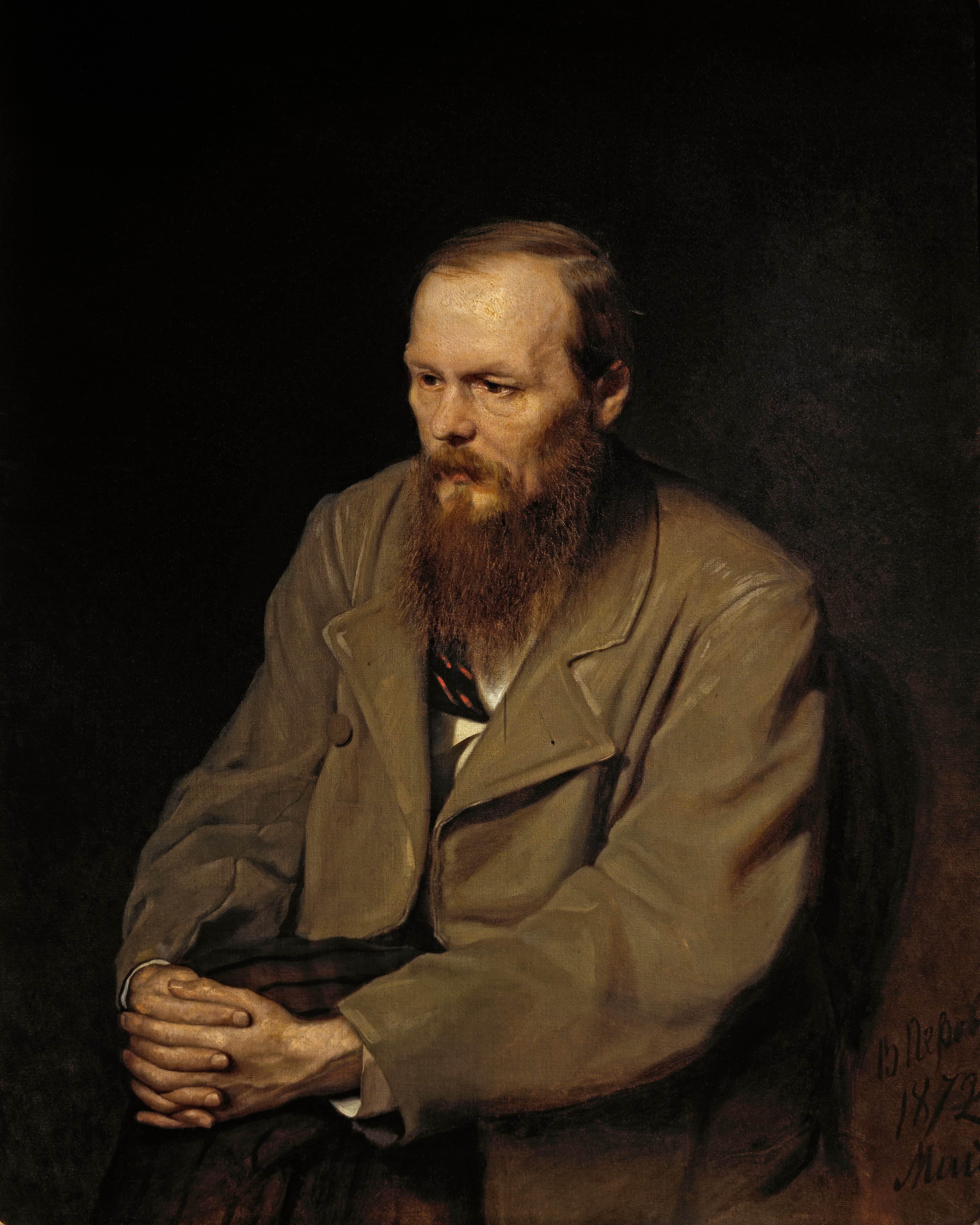
Sprenger attributes [[Muhammad's first revelation|Muhammad's revelations]] to [[epilepsy|epileptic fits]] or a "[[paroxysmal attacks|paroxysm]] of [[catalepsis|cataleptic]] [[insanity]]."<ref name="Oussani"/> In Schaff's view, Muhammad's "early and frequent epileptic fits" provided "some light on his revelations."<ref name="Schaff 1910 4.III.42"/> The most famous epileptic of the 19th century, [[Fyodor Dostoyevsky]] (1821–1881) wrote that epileptic attacks have an inspirational quality; he said they are "a supreme exaltation of emotional subjectivity" in which time stands still. Dostoyevsky claimed that his own attacks were similar to those of Muhammad: "Probably it was of such an instant, that the epileptic Mahomet was speaking when he said that he had visited all the dwelling places of Allah within a shorter time than it took for his pitcher full of water to empty itself."<ref name="Freemon"/> | [[File:Vasily Perov - Портрет Ф.М.Достоевского - Google Art Project.jpg|thumb|upright|left|A portrait of [[Fyodor Dostoyevsky]] in 1872, painted by [[Vasily Perov]]]] | ||
Sprenger attributes [[Muhammad's first revelation|Muhammad's revelations]] to [[epilepsy|epileptic fits]] or a "[[paroxysmal attacks|paroxysm]] of [[catalepsis|cataleptic]] [[insanity]]."<ref name="Oussani"/> In Schaff's view, Muhammad's "early and frequent epileptic fits" provided "some light on his revelations."<ref name="Schaff 1910 4.III.42"/> The most famous epileptic of the 19th century, [[Fyodor Dostoyevsky]] (1821–1881) wrote that epileptic attacks have an inspirational quality; he said they are "a supreme exaltation of emotional subjectivity" in which time stands still. Dostoyevsky claimed that his own attacks were similar to those of Muhammad: "Probably it was of such an instant, that the epileptic Mahomet was speaking when he said that he had visited all the dwelling places of [[Allah]] within a shorter time than it took for his pitcher full of water to empty itself."<ref name="Freemon"/> | |||
In an essay | In an essay discussing views on Muhammad's psychology, Franz Bul (1903) is said to have noted that "hysterical natures find unusual difficulty and often complete inability to distinguish the false from the true," regarding this as "the safest way to interpret the strange inconsistencies in the life of the Prophet." In the same essay, [[Duncan Black MacDonald|Duncan Black Macdonald]] (1911) is credited with stating that "fruitful investigation of the Prophet's life (should) proceed upon the assumption that he was fundamentally a [[Pathology|pathological]] case."<ref>{{Cite book | last=Jeffery | first=Arthur | title=The Quest for the Historical Muhammad | year=2000 | publisher=Prometheus Books | isbn=978-1573927871 | page=[https://archive.org/details/questforhistoric00ibnw/page/346 346] | url=https://archive.org/details/questforhistoric00ibnw/page/346 }}</ref> | ||
Modern Western scholars of Islam have rejected the diagnosis of epilepsy.<ref name="Freemon"/> [[Tor Andrae]] rejects the idea that the inspired state is pathological attributing it to a scientifically superficial and hasty theory arguing that those who consider Muhammad epileptic should consider all types of semi-conscious and trance-like states, occasional loss of consciousness, and similar conditions as epileptic attacks. Andrae writes that "[i]f epilepsy is to denote only those severe attacks which involve serious consequences for the physical and mental health, then the statement that Mohammad suffered from epilepsy must be emphatically rejected." [[Caesar Farah]] suggests that "[t]hese insinuations resulted from the 19th-century infatuation with scientifically superficial theories of medical psychology."<ref>{{cite book |author=Caesar Farah |title=Islam: Beliefs and Observances |date=2003 |series=Barron's Educational Series |isbn=0764122266}}</ref><ref>{{cite book |author=Tor Andrae |title=Mohammad: The Man and his Faith |translator=Theophil Menzel |location=New York |publisher=Harper Torch Book Series |date=1960 |page=51}}</ref> Noth, in the ''Encyclopedia of Islam'', states that such accusations were a typical feature of medieval European Christian polemic.<ref name=EI-M /> | Modern Western scholars of Islam have rejected the diagnosis of epilepsy.<ref name="Freemon"/> [[Tor Andrae]] rejects the idea that the inspired state is pathological attributing it to a scientifically superficial and hasty theory arguing that those who consider Muhammad epileptic should consider all types of semi-conscious and trance-like states, occasional loss of consciousness, and similar conditions as epileptic attacks. Andrae writes that "[i]f epilepsy is to denote only those severe attacks which involve serious consequences for the physical and [[mental health]], then the statement that Mohammad suffered from epilepsy must be emphatically rejected." [[Caesar Farah]] suggests that "[t]hese insinuations resulted from the 19th-century infatuation with scientifically superficial theories of medical [[psychology]]."<ref>{{cite book |author=Caesar Farah |title=Islam: Beliefs and Observances |date=2003 |series=Barron's Educational Series |isbn=0764122266}}</ref><ref>{{cite book |author=Tor Andrae |title=Mohammad: The Man and his Faith |translator=Theophil Menzel |location=New York |publisher=Harper Torch Book Series |date=1960 |page=51}}</ref> Noth, in the ''Encyclopedia of Islam'', states that such accusations were a typical feature of medieval European Christian polemic.<ref name=EI-M>{{cite book |title=[[Encyclopedia of Islam]] |chapter=Muhammad}}</ref> | ||
[[Maxime Rodinson]] says that it is most probable that Muhammad's | [[Maxime Rodinson]] says that it is most probable that Muhammad's condition was of the sort that was found in many [[Mysticism|mystics]] rather than epilepsy.<ref>Maxime Rodinson, Muhammad: Prophet of Islam, p. 56</ref> [[Fazlur Rahman Malik|Fazlur Rahman]] refutes epileptic fits for the following reasons: Muhammad's condition begins with his career at the age of 40; according to the tradition seizures are ''invariably'' associated with the revelation and never occur by itself. Lastly, a sophisticated society like the Meccan or Medinese would have identified epilepsy clearly and definitely.<ref>{{cite book |last=Rahman |first=Fazlur |author-link=Fazlur Rahman Malik |title=Islam |publisher=University of Chicago Press|date=2007 |page=13 |isbn=9780226702810}}</ref> | ||
William Montgomery Watt also disagrees with the epilepsy diagnosis, saying that "there are no real grounds for such a view." Elaborating, he says that "epilepsy leads to physical and mental degeneration, and there are no signs of that in Muhammad." He then goes further and states that Muhammad was psychologically sound in general: "he (Muhammad) was clearly in full possession of his faculties to the very end of his life." Watt concludes by stating "It is incredible that a person subject to epilepsy, or hysteria, or even ungovernable fits of emotion, could have been the active leader of military expeditions, or the cool far-seeing guide of a city-state and a growing religious community; but all this we know Muhammad to have been."<ref name=Watt&Bell>{{cite book |first1=W. Montgomery |last1=Watt |first2=Richard |last2=Bell |title=Bell's Introduction to the Qur'an |date=1995 |publisher=Edinburgh University Press |isbn=0748605975 |pages=17–18}}</ref> | William Montgomery Watt also disagrees with the epilepsy diagnosis, saying that "there are no real grounds for such a view." Elaborating, he says that "epilepsy leads to physical and mental degeneration, and there are no signs of that in Muhammad." He then goes further and states that Muhammad was psychologically sound in general: "he (Muhammad) was clearly in full possession of his faculties to the very end of his life." Watt concludes by stating "It is incredible that a person subject to epilepsy, or hysteria, or even ungovernable fits of emotion, could have been the active leader of military expeditions, or the cool far-seeing guide of a [[city-state]] and a growing religious community; but all this we know Muhammad to have been."<ref name=Watt&Bell>{{cite book |first1=W. Montgomery |last1=Watt |first2=Richard |last2=Bell |title=Bell's Introduction to the Qur'an |date=1995 |publisher=Edinburgh University Press |isbn=0748605975 |pages=17–18}}</ref> | ||
<ref name=Watt1961 />{{rp|19}} | <ref name=Watt1961 />{{rp|19}} | ||
According to [[Seyyed Hossein Nasr]], Muhammad's sense of fairness and justice was famous, even before his claim of prophet-hood, as people called him al-Amin, the trusted one.<ref>{{cite book |last1=Nasr |first1=Seyyed Hossein |author1-link=Seyyed Hossein Nasr |title=Muhammad |publisher=Encyclopedia Britannica |url=https://www.britannica.com:80/biography/Muhammad|archive-url=https://archive.today/20151201213108/https://www.britannica.com/biography/Muhammad |archive-date=1 December 2015 }}</ref> | According to [[Seyyed Hossein Nasr]], Muhammad's sense of fairness and justice was famous, even before his claim of prophet-hood, as people called him ''al-Amin'', the trusted one.<ref>{{cite book |last1=Nasr |first1=Seyyed Hossein |author1-link=Seyyed Hossein Nasr |title=Muhammad |publisher=Encyclopedia Britannica |url=https://www.britannica.com:80/biography/Muhammad|archive-url=https://archive.today/20151201213108/https://www.britannica.com/biography/Muhammad |archive-date=1 December 2015 }}</ref> | ||
Frank R. Freemon (1976) | Frank R. Freemon (1976) argues that the above reasons given by modern biographers of Muhammad in rejection of epilepsy come from the widespread misconceptions about the various types of epilepsy.<ref name="Freemon"/> In his differential diagnosis, Freemon rejects [[schizophrenic]] [[hallucinations]],<ref group="Note">Freemon starts his own [[differential diagnosis]] by arguing that "one must remember that Muhammad's inspired followers lived closely with him in his early and unsuccessful ministry; these same individuals demonstrated brilliant leadership of the explosively expanding Islamic state after his death". He thus rejects schizophrenic hallucinations thesis arguing that the [[blunted affect]] of the schizophrenic can hardly inspire the tenacious loyalty of the early followers. "It is also unlikely that a person with loose associations and other elements of schizophrenic [[thought disorder]] could guide the political and military fortunes of the early Islamic state."</ref> drug-induced mental changes such as might occur after eating [[Psychoactive plant|plants containing hallucinogenic chemicals]],<ref group="Note">Freemon does so for two reasons: It can not justify the rapid, almost paroxysmal onset of these spells. Furthermore, without personal conviction of the reality of his visions, Muhammad could not have convinced his astute followers.</ref> [[transient ischemic attack]]s,<ref group="Note">According to Freemon, "Too many of these spells occurred over too long a period of time to suggest transient ischemic attacks, and no neurologic deficits outside the mental sphere were observed."</ref> [[hypoglycemia]],<ref group="Note">Freemon argues that long duration, absence of worsening, and [[Paroxysmal attack|paroxysmal]] onset make [[hypoglycemia]] unlikely</ref> [[labyrinthitis]], [[Ménière's disease]], or other [[inner ear]] maladies.<ref group="Note">He argues that absence of [[vertigo]] rules out labyrinthitis, Meniere's disease, or other inner ear maladies.</ref> | ||
Freemon concludes that if one were forced to make a diagnosis, psychomotor seizures of [[temporal lobe epilepsy]] would be the most tenable one, although our lack of scientific as well as historical knowledge makes unequivocal decision impossible. Freemon cites evidence supporting and opposing this diagnosis.<ref group="Note">Supporting this diagnosis, he cites paroxysmal onset, failing to the ground with loss of conscious, [[Dysautonomia|autonomic dysfunction]] and hallucinatory imagery. On the evidences opposing the diagnosis he mentions the late [[age of onset]], lack of recognition as seizures by his contemporaries, and lastly poetic, organized statements in immediate [[postictal state]].</ref> In the end, Freemon points out that a medical diagnosis should not ignore Muhammad's moral message because it is just as likely, perhaps more likely, for God to communicate with a person in an abnormal state of mind.<ref group="Note">Freemon explains this by quoting [[William James]]: "Just as our primary wide-awake consciousness throws open our senses to the touch of things material, so it is logically conceivable that if there be higher spiritual agencies that can directly touch us, the psychological condition of their doing so might be our possession of a subconscious region which alone should yield access to them. The hubbub of the waking life might close a door which in the dreamy subliminal might remain ajar or open."</ref> | |||
From a Muslim point of view, Freemon says, Muhammed's mental state at the time of revelation was unique and is not therefore amenable to medical or scientific discourse.<ref name="Freemon"/> | From a Muslim point of view, Freemon says, Muhammed's mental state at the time of revelation was unique and is not therefore amenable to medical or scientific discourse.<ref name="Freemon"/> Muslim [[Neurology|neurologist]] GM. S. Megahed, criticized Freemon's article, arguing that there are no scientific explanations for many [[Phenomenology of religion|religious phenomena]] and that, if Muhammad's message is a result of [[Temporal lobe epilepsy|psychomotor seizures]] then by the same basis [[Moses]]'s and [[Jesus]]'s messages must also result from psychomotor seizures. In response, Freemon attributed such negative reactions to his article to the general misconceptions about epilepsy as a demeaning condition. Freemon said that he did plan to write an article on the inspirational spells of [[Saint Paul (apostle)|St. Paul]], but the existence of such misconceptions caused him to cancel it.<ref>Letters to the Editor, Journal of Epilepsia. 18(2), 1977.</ref> | ||
=== | ===Legacy=== | ||
{{Main article|Succession to Muhammad}} | |||
Some scholars claim that following Muhammad's death, the Muslim community who were joined together by the unity of the faith became "leaderless" and a "haphazard" group.<ref>{{cite book|author1=Maurice Gaudefroy-Demombynes|author-link1=Maurice Gaudefroy-Demombynes|title=Muslim Institutions|date=2013|publisher=Routledge|isbn=978-1135030261|pages=18–19|edition=reprint}}</ref> In the absence of established dynastic traditions and political customs, divisions emerged among Muslims.<ref>{{cite book|author1=Maurice Gaudefroy-Demombynes|author-link1=Maurice Gaudefroy-Demombynes|title=Muslim Institutions|date=2013|publisher=Routledge|isbn=978-1135030261|pages=18–19|edition=reprint}}</ref><ref>{{cite book|author1=William Hare|title=The Struggle for the Holy Land: Arabs, Jews, and the Emergence of Israel|date=1995|publisher=Madison Books|isbn=978-1568330402|page=73}}</ref><ref>{{cite book|title=Spectrum: Journal of the Association of Adventist Forums, Volume 30|date=2002|publisher=The Association|page=19}}</ref><ref>{{cite book|author1=Joseph Morrison Skelly|author-link1=Joseph Morrison Skelly|title=Political Islam from Muhammad to Ahmadinejad: Defenders, Detractors, and Definitions|date=2009|publisher=ABC-CLIO|isbn=978-0313372247|page=38}}</ref> Muhammad did not [[History of the Quran|compile the Quran]] into a single text during or his [[Sunnah|prophetic tradition]] during his lifetime; the Quran was compiled during [[Caliphate of Uthman|Uthman's Caliphate]], and the [[hadith]] were collected and codified by scholars and companions in the 8th–9th centuries.<ref>Gaudefroy-Demombynes 2013, p. 19.</ref><ref>Gaudefroy-Demombynes 2013, p. 21.</ref> | |||
According to both [[Sunni Islam|Sunni]] and [[Shia Islam|Shia Muslims]], on his way back from his last pilgrimage to Mecca, Muhammad stopped in a place called [[Event of Ghadir Khumm|Ghadir Khumm]], and appointed his cousin [[Ali]] as his executor of his [[Will and testament|last will]] and his [[Wali]]. The word Wali was interpreted differently by Sunni and Shia Muslims. Shia believes Muhammad explicitly appointed Ali as his [[Khalifa|successor]] at the location. Shia also believe Muhammad's [[Ahl al-Bayt]], are the trusted collectors and transmitters of Muhammad's [[Hadith|ahadith]] and trusted interpreters of Quran.<ref name="Muhammad"/> | |||
== | Muhammad reportedly stated that leadership was to remain within his own tribe, the [[Quraysh]], a directive often seen as a pragmatic effort to preserve tribal unity but interpreted by some modern scholars as introducing a hierarchical structure into Islam.<ref>{{cite book |author1=Taha Hussein |author1-link=Taha Hussein |title=The Great Division |date=1966 |page=35}}</ref> [[Christophe Jaffrelot]] argues that this contributed to the formation of a hereditary elite led by Muhammad's family and descendants (the [[Ahlul Bayt]] and [[sayyids]]), followed by his clan ([[Banu Hashim]]) then his tribe, the Quraysh.<ref>A History of Pakistan and Its Origins, Christophe Jaffrelot, p.195</ref> | ||
==Muhammad's personal motivations== | |||
=== 19th century and early 20th century === | === 19th century and early 20th century === | ||
| Line 235: | Line 127: | ||
William Muir, like many other 19th-century scholars divides Muhammad's life into two periods—[[Muhammad in Mecca|Meccan]] and [[Muhammad in Medina|Medinan]]. He asserts that "in the Meccan period of [Muhammad's] life there certainly can be traced no personal ends or unworthy motives," painting him as a man of good faith and a genuine reformer. However, that all changed after the ''[[Hijra (Islam)|Hijra]]'', according to Muir. "There [in Medina] temporal power, aggrandisement, and self-gratification mingled rapidly with the grand object of the Prophet's life, and they were sought and attained by just the same instrumentality." From that point on, he accuses Muhammad of manufacturing "messages from heaven" in order to justify a lust for women and reprisals against enemies, among other sins.<ref>{{Cite book| last=Muir | first=William | title=Life of Mahomet | year=1878 | publisher=Kessinger Publishing|isbn=978-0766177413 | page=583}}</ref> | William Muir, like many other 19th-century scholars divides Muhammad's life into two periods—[[Muhammad in Mecca|Meccan]] and [[Muhammad in Medina|Medinan]]. He asserts that "in the Meccan period of [Muhammad's] life there certainly can be traced no personal ends or unworthy motives," painting him as a man of good faith and a genuine reformer. However, that all changed after the ''[[Hijra (Islam)|Hijra]]'', according to Muir. "There [in Medina] temporal power, aggrandisement, and self-gratification mingled rapidly with the grand object of the Prophet's life, and they were sought and attained by just the same instrumentality." From that point on, he accuses Muhammad of manufacturing "messages from heaven" in order to justify a lust for women and reprisals against enemies, among other sins.<ref>{{Cite book| last=Muir | first=William | title=Life of Mahomet | year=1878 | publisher=Kessinger Publishing|isbn=978-0766177413 | page=583}}</ref> | ||
Philip Schaff says that "in the earlier part of his life he [Muhammad] was a sincere reformer and enthusiast, but after the establishment of his kingdom a slave of ambition for conquest" and describes him as "a slave of sensual passion."<ref name="Schaff 1910 4.III.42">Schaff, P., & Schaff, D.S. (1910). History of the Christian church. Third edition. New York: Charles Scribner's Sons. Volume 4, Chapter III, section 42 "Life and Character of Mohammed"</ref> | |||
[[David Samuel Margoliouth|D.S. Margoliouth]], another 19th-century scholar, sees Muhammad as a charlatan who beguiled his followers with techniques like those used by fraudulent [[medium (spirituality)|mediums]] today. He has expressed a view that Muhammad faked his religious sincerity, playing the part of a messenger from [[God]] like a man in a play, adjusting his performances to create an illusion of [[spirituality]].<ref>{{Cite book| last=Margoliouth | first=David Samuel | title=Mohammed and the Rise of Islam | pages=88–89, 104–06 | year=1905|publisher=Putnam}}</ref> He viewed Muhammad's behavior as opportunistic, prioritizing political ends over consistent doctrine.<ref>{{Cite book| last=Margoliouth | first=David Samuel | title=Encyclopedia of Religion and Ethics (Volume 8) | year=1926 | publisher=[[T&T Clark]] | isbn=978-0567094896 | page=878| title-link=Encyclopedia of Religion and Ethics }}</ref> | |||
[[David Samuel Margoliouth|D.S. Margoliouth]], another 19th-century scholar, sees Muhammad as a charlatan who beguiled his followers with techniques like those used by fraudulent [[medium (spirituality)|mediums]] today. He has expressed a view that Muhammad faked his religious sincerity, playing the part of a messenger from [[God]] like a man in a play, adjusting his performances to create an illusion of [[spirituality]].<ref>{{Cite book| last=Margoliouth | first=David Samuel | title=Mohammed and the Rise of Islam | pages=88–89, 104–06 | year=1905|publisher=Putnam}}</ref> | |||
=== Late 20th century === | === Late 20th century === | ||
| Line 259: | Line 146: | ||
{{blockquote|The modern historian will not readily believe that so great and significant a movement was started by a self-seeking impostor. Nor will he be satisfied with a purely supernatural explanation, whether it postulates aid of divine or diabolical origin; rather, like Gibbon, will he seek 'with becoming submission, to ask not indeed what were the first, but what were the secondary causes of the rapid growth' of the new faith.}} | {{blockquote|The modern historian will not readily believe that so great and significant a movement was started by a self-seeking impostor. Nor will he be satisfied with a purely supernatural explanation, whether it postulates aid of divine or diabolical origin; rather, like Gibbon, will he seek 'with becoming submission, to ask not indeed what were the first, but what were the secondary causes of the rapid growth' of the new faith.}} | ||
Watt rejects the idea that Muhammad's moral behavior deteriorated after he migrated to Medina. He argues that "it is based on too facile a use of the principle that all power corrupts and absolute power corrupts absolutely". Watt interprets incidents in the Medinan period in such a way that they mark "no failure in Muhammad to live to his ideals and no lapse from his moral principles."<ref name=Watt1961>{{cite book | last=Watt | first=W. Montgomery | url=https://archive.org/details/muhammadprophets00watt/page/229 | title=Muhammad: Prophet and Statesman | year=1961 | publisher=[[Oxford University Press]] | isbn=978-0198810780 | access-date=22 October 2006 }}</ref>{{rp|229}} | Watt rejects the idea that Muhammad's moral behavior deteriorated after he migrated to Medina. He argues that "it is based on too facile a use of the principle that all [[power corrupts]] and absolute power corrupts absolutely". Watt interprets incidents in the Medinan period in such a way that they mark "no failure in Muhammad to live to his ideals and no lapse from his moral principles."<ref name=Watt1961>{{cite book | last=Watt | first=W. Montgomery | url=https://archive.org/details/muhammadprophets00watt/page/229 | title=Muhammad: Prophet and Statesman | year=1961 | publisher=[[Oxford University Press]] | isbn=978-0198810780 | access-date=22 October 2006 }}</ref>{{rp|229}} | ||
==History of criticism== | |||
{{Criticism of Islam}} | |||
{{Main page|List of critics of Islam|Christianity and Islam|Muhammad's views on Christians|Hindu–Islamic relations}} | |||
===During Middle Ages=== | |||
{{See also|Medieval Christian views on Muhammad|Atheism and Islam}} | |||
The earliest documented Christian knowledge of Muhammad stems from [[Byzantine]] sources, written shortly after Muhammad's death in 632. In the ''[[Doctrina Jacobi nuper baptizati]]'', a dialogue between a recent [[Christians|Christian]] convert and several Jews, one participant writes that his brother "wrote to [him] saying that a deceiving prophet has appeared amidst the [[Saracens]]".<ref>{{cite journal | first=Walter Emil Jr. |last=Kaegi |title=Initial Byzantine Reactions to the Arab Conquest |journal=Church History |volume=38 |issue=2 |year=1969 |pages=139–42 |postscript=, |doi=10.2307/3162702 |jstor=3162702 |s2cid=162340890 }} quoting from ''Doctrina Jacobi nuper baptizati'' 86–87</ref> Another participant in the ''Doctrina'' replies about Muhammad: "He is deceiving. For do prophets come with sword and [[chariot]]?, …[Y]ou will discover nothing true from the said prophet except human bloodshed".<ref>Walter Emil Kaegi, Jr., "Initial Byzantine Reactions to the Arab Conquest", ''Church History'', Vol. 38, No. 2 (Jun., 1969), pp. 139–49 [139–42], quoting from ''Doctrina Jacobi nuper baptizati'' 86–87</ref> Another Greek source for Muhammad is [[Theophanes the Confessor]], a 9th-century writer. The earliest Syriac source is the 7th-century writer [[John bar Penkaye]].<ref>Philip K. Hitti, ''History of the Arabs'', 10th edition (1970), p. 112.</ref> | |||
[[File:Mohammed2.jpg|thumb|upright|''Muhammed and the [[Bahira|Monk Sergius]]'' (Bahira), 1508, by Dutch artist [[Lucas van Leyden]]. In early Christian criticism, it was claimed that Bahira was a heretical monk whose errant views inspired the Qur'an.<ref>From ''Writings'', by St John of Damascus, ''The Fathers of the Church'', vol. 37 (Washington, DC: Catholic University of America Press, 1958), pp. 153–60. Posted 26 March 2006 to [http://orthodoxinfo.com/general/stjohn_islam.aspx The Orthodox Christian Information Center – St. John of Damascus's Critique of Islam] {{Webarchive|url=https://web.archive.org/web/20170630132307/http://orthodoxinfo.com/general/stjohn_islam.aspx |date=30 June 2017 }}</ref>]] | |||
One Christian who came under the early dominion of the Islamic [[Caliphate]] was [[John of Damascus]] (c. 676–749 AD), who was familiar with Islam and [[Arabic language|Arabic]]. The second chapter of his book, ''The Fount of Wisdom'', titled "Concerning Heresies", presents a series of discussions between Christians and Muslims. John claimed that an [[Arianism|Arian]] [[Christian monasticism|monk]] (whom he did not know was [[Bahira]]) influenced Muhammad and the writer viewed the Islamic doctrines as nothing more than a hodgepodge culled from the [[Bible]].<ref>[http://www.orthodoxinfo.com/general/stjohn_islam.aspx Critique of Islam] {{Webarchive|url=https://web.archive.org/web/20170630132307/http://orthodoxinfo.com/general/stjohn_islam.aspx |date=30 June 2017 }} St. John of Damascus, From Writings, by St John of Damascus, The Fathers of the Church, vol. 37 (Washington, DC: Catholic University of America Press, 1958), pp. 153–60. Posted 26 March 2006 on the [http://orthodoxinfo.com/ Orthodox Information Center website] {{Webarchive|url=https://web.archive.org/web/20110202093946/http://orthodoxinfo.com/ |date=2 February 2011 }}.</ref> | |||
Among the first sources representing Muhammad is the polemical work "Concerning Heresy" (Perì hairéseōn) of John of Damascus, translated from [[Greek language|Greek]] into [[Latin]]. In this manuscript, the Syrian priest represents Muhammad as a "false prophet," and an "[[Antichrist]]". Some demonstrate that Muhammad was pointed out in this manuscript as "Mamed",<ref>Cited by Powers, David Stephan. 2009. Muḥammad is not the Father of any of your Men: the Making of the Last Prophet. USA: University of Pennsylvania Press, p. 29.</ref> but this study was corrected by Ahlam Sbaihat who affirmed that it is the form ΜΩΑΜΕΘ (Moameth) which is mentioned in this manuscript. The phoneme h and the gemination of m do not exist in Greek so it has disappeared from John's uses.<ref>Sbaihat, Ahlam (2015), "Stereotypes associated with real prototypes of the prophet of Islam's name till the 19th century". Jordan Journal of Modern Languages and Literature Vol. 7, No. 1, 2015, p. 25. http://journals.yu.edu.jo/jjmll/Issues/vol7no12015/Nom2.pdf {{Webarchive|url=https://web.archive.org/web/20151222081350/http://journals.yu.edu.jo/jjmll/Issues/vol7no12015/Nom2.pdf |date=22 December 2015 }}</ref> | |||
From the 9th century onwards, highly negative biographies of Muhammad were written in Latin,<ref name="Britannica">"Muhammad." Encyclopædia Britannica. 2007. Encyclopædia Britannica Online. 10 Jan. 2007, [http://search.eb.com/eb/article-251806].</ref> such as the one by [[Álvaro of Córdoba (Mozarab)|Álvaro of Córdoba]] proclaiming him the Antichrist.<ref name="meyer2">Kenneth Meyer Setton (1 July 1992). "[https://books.google.com/books?id=hk4LAAAAIAAJ Western Hostility to Islam and Prophecies of Turkish Doom]". Diane Publishing. {{ISBN|0871692015}}. pp. 4–15</ref> Since the 7th century, Muhammad and his name have been connected to several [[stereotype]]s. Many sources mentioned exaggerated and sometimes wrong stereotypes. These stereotypes are born in the East but adopted by or developed in Western cultures. These references played a principal role in introducing Muhammad and his religion to the West as the false prophet, Saracen prince or deity, the Biblical beast, a schismatic from Christianity and a satanic creature, and the Antichrist.<ref>See Sbaihat, Ahlam (2015), "Stereotypes associated with real prototypes of the prophet of Islam's name till the 19th century". Jordan Journal of Modern Languages and Literature Vol. 7, No. 1, 2015, pp. 21–38. http://journals.yu.edu.jo/jjmll/Issues/vol7no12015/Nom2.pdf {{Webarchive|url=https://web.archive.org/web/20151222081350/http://journals.yu.edu.jo/jjmll/Issues/vol7no12015/Nom2.pdf |date=22 December 2015 }}</ref> | |||
Many early [[Ex-Muslim|former Muslims]] such as [[Ibn al-Rawandi]], [[Al-Ma'arri]], and [[Abu Isa al-Warraq]] were [[Religious skepticism|religious skeptics]], and [[philosopher]]s who criticized Islam,<ref name="John of Damascus"/> the authority and reliability of the Qu'ran,<ref name="John of Damascus"/> Muhammad's morality,<ref name="John of Damascus"/> and his claims to be a prophet.<ref name="John of Damascus"/><ref>Tariq Ali (2003), ''The Clash of Fundamentalisms: Crusades, Jihads and Modernity'', Verso, pp. 55-56.</ref> | |||
The Quran also mentions critics of [[Muhammad]]; for example {{qref|25|4-6|b=y}} says the critics complained that Muhammad was passing off what others were telling him as revelations: | |||
<blockquote>The disbelievers say, “This ˹Quran˺ is nothing but a fabrication which he made up with the help of others.” Their claim is totally unjustified and untrue! And they say, “˹These revelations are only˺ ancient fables which he has had written down, and they are rehearsed to him morning and evening.”<ref>{{qref|25|c=y}}</ref></blockquote> | |||
During the 12th century [[Peter the Venerable]], who saw Muhammad as the precursor to the Anti-Christ and the successor of [[Arius]],<ref name="meyer2"/> ordered the translation of the [[Qur'an]] into [[Latin]] ([[Lex Mahumet pseudoprophete]]) and the collection of information on Muhammad so that Islamic teachings could be refuted by Christian scholars.<ref name="Britannica"/> During the 13th century a series of works by European scholars such as [[Peter Pascual|Pedro Pascual]], [[Ricoldo de Monte Croce]], and [[Ramon Llull]]<ref name="Britannica"/> depicted Muhammad as an Antichrist and argued that [[Islam]] was a [[Christian heresy]].<ref name="Britannica"/> | |||
According to [[Hossein Nasr]], the earliest European literature often refers to Muhammad unfavorably. A few learned circles of [[Middle Ages]] Europe{{spaced ndash}}primarily Latin-literate scholars{{spaced ndash}}had access to fairly extensive biographical material about Muhammad. They interpreted the biography through a Christian religious filter, one that viewed Muhammad as a person who seduced the [[Saracens]] into his submission under religious guise.<ref name="EoI-Muhammad">{{cite encyclopedia|title=Muhammad|author=Hossein Nasr|publisher=Encycloedia of Islam}}</ref> Popular European literature of the time portrayed Muhammad as though he were worshipped by Muslims, similar to an idol or a heathen god.<ref name="EoI-Muhammad" /> | |||
In later ages, Muhammad came to be seen as a schismatic: [[Brunetto Latini]]'s 13th century ''Li livres dou tresor'' represents him as a former monk and cardinal,<ref name="EoI-Muhammad" /> and [[Dante Alighieri|Dante's]] ''[[Divine Comedy]]'' ([[Inferno (Dante)|Inferno]], Canto 28), written in the early 1300s, puts Muhammad and his son-in-law, Ali, in Hell "among the sowers of discord and the schismatics, being lacerated by devils again and again."<ref name="EoI-Muhammad" /> | |||
Some medieval ecclesiastical writers portrayed Muhammad as possessed by [[Satan]], a "precursor of the Antichrist" or the Antichrist himself.<ref name="Oussani">{{cite web |url=http://www.newadvent.org/cathen/10424a.htm |title=Catholic Encyclopedia: Mohammed and Mohammedanism (Islam) |publisher=Newadvent.org |access-date=2015-09-29 |archive-url=https://web.archive.org/web/20170525144522/http://www.newadvent.org/cathen/10424a.htm |archive-date=25 May 2017 |url-status=live}}</ref> | |||
[[File:Peter the Venerable.jpg|thumb|[[Peter the Venerable]], with other monks, 13th-century [[illuminated manuscript]]]] | |||
A more positive interpretation appears in the 13th-century ''Estoire del Saint Grail'', the first book in the vast [[King Arthur|Arthurian]] cycle, the [[Lancelot-Grail]]. In describing the travels of [[Joseph of Arimathea]], keeper of the [[Holy Grail]], the author says that most residents of the Middle East were [[pagan]]s until the coming of Muhammad, who is shown as a true [[prophet]] sent by God to bring Christianity to the region. This mission however failed when Muhammad's pride caused him to alter God's wishes, thereby deceiving his followers. Nevertheless, Muhammad's religion is portrayed as being greatly superior to paganism.<ref>Lacy, Norris J. (Ed.) (1 December 1992). ''Lancelot-Grail: The Old French Arthurian Vulgate and Post-Vulgate in Translation,'' Volume 1 of 5. New York: Garland. {{ISBN|0824077334}}.</ref> | |||
The ''[[Tultusceptru de libro domni Metobii]]'', an [[Andalusia]]n [[manuscript]] with unknown dating, recounts how Muhammad (called Ozim, from [[Hashim]]) was tricked by [[Satan]] into adulterating an originally pure divine revelation. The story argues God was concerned about the spiritual fate of the Arabs and wanted to correct their deviation from the faith. He then sends an angel to the monk Osius who orders him to preach to the Arabs.<ref name="J. Tolan, 1996 pp. 100">J. Tolan, ''Medieval Christian Perceptions of Islam'' (1996) pp. 100–01</ref> | |||
Osius however is in ill-health and orders a young monk, Ozim, to carry out the angel's orders instead. Ozim sets out to follow his orders, but gets stopped by an evil angel on the way. The ignorant Ozim believes him to be the same angel that spoke to Osius before. The evil angel modifies and corrupts the original message given to Ozim by Osius, and renames Ozim Muhammad. From this followed the erroneous teachings of Islam, according to the ''Tultusceptru''.<ref name="J. Tolan, 1996 pp. 100"/> | |||
In [[Summa Contra Gentiles]] Thomas Aquinas wrote a critical view of Muhammad, suggesting that his teachings aligned closely with worldly desires and lacked strong support from earlier religious texts. Aquinas claimed that Muhammad's followers might have been discouraged from studying the Old and New Testaments, which he saw as incompatible with Muhammad's teachings.<ref>Summa Contra Gentiles Book 1, Chapter 16, Art.4</ref> | |||
====Jewish Views==== | |||
{{Main|Judaism's views on Muhammad}} | |||
{{See also|Islam and antisemitism|Islamic–Jewish relations}} | |||
In the Middle Ages, it was common for [[Jews|Jewish]] writers to describe Muhammad as ''ha-Meshuggah'' ("The Madman"), a term of contempt frequently used in the Bible for those who believe themselves to be prophets.<ref name="Stillman" /> However, not all Jewish views of Muhammad were negative. The 12th-century Yemenite rabbi [[Natan'el al-Fayyumi|Natan’el al-Fayyumi]] taught that God sends different prophets to other nations and regarded Muhammad as a true prophet for the Arabs, though not for Jews.<ref>''The Bustan al-Ukul, by Nathanael ibn al-Fayyumi,'' edited and translated by David Levine, Columbia University Oriental Studies Vol. VI, p. 105</ref><ref>''Gan ha-Sekhalim'', ed. Kafih (Jerusalem, 1984), ch. 6.</ref> Likewise, the apocalyptic [[Midrash]] [[The Secrets of Rabbi Simon ben Yohai]] portrays Muhammad as playing a positive role in redeeming [[Antisemitism in Christianity|Jews from Christian oppression]] and contributing a positive role to the messianic process.<ref>''Abraham's children: Jews, Christians, and Muslims in conversation,'' by Norman Solomon, Richard Harries, Tim Winter, T&T Clark Int'l, 2006, {{ISBN|0-567-08161-3}}, p. 133 ''"Nistarot" places the Muslim conquests in an eschatological context, and implies that Muhammad had a positive role to play in the messianic process.''</ref> | |||
===Early modern period=== | |||
[[Martin Luther]] referred to Muhammad as "a devil and first-born child of Satan."<ref>[[s:Catholic Encyclopedia (1913)/Mohammed and Mohammedanism|"Mohammed and Mohammedanism"]], [[Catholic Encyclopedia]], 1913</ref> Luther's primary target of criticism at the time was the Pope, and Luther's characterization of Muhammad was intended to draw a comparison to show that the Pope was worse.<ref>{{cite book|author=Moncure Daniel Conway |title=Demonology and Devil-lore, Volume 2 |publisher=H. Holt |year=1879 |url=https://books.google.com/books?id=vB41AAAAMAAJ&pg=PA249 |page=249}}</ref> | |||
[[File:Mahomet (Voltaire) A43.jpg|thumb|right|The [[Book frontispiece|frontispiece]] of the 1743 edition of [[Voltaire]]'s play [[Mahomet (play)|Mahomet]]]] | |||
''[[Mahomet (play)|Mahomet]]'' ([[French language|French]]: ''Le fanatisme, ou Mahomet le Prophète'', literally "Fanaticism, or Mahomet the Prophet") is a five-act [[tragedy]] written in 1736 by [[French people|French]] playwright and philosopher [[Voltaire]]. It made its debut performance in [[Lille]] on 25 April 1741. The play is a study of [[religious fanaticism]], drawing from an episode in traditional biographies of Muhammad. Voltaire described the play as "written in opposition to the founder of a false and barbarous sect to whom could I with more propriety inscribe a [[satire]] on the cruelty and errors of a false prophet".<ref>''The Works of Voltaire: The Dramatic Works of Voltaire.'' Voltaire, Tobias George Smollett, John Morley, William F. Fleming, Oliver Herbrand Gordon Leigh. Publisher Werner, 1905. Original from Princeton University. p. 12</ref> However, some scholars posit that the play targeted "the intolerance of the Catholic Church and its crimes done on behalf of the Christ."<ref>[[Pierre Milza]], ''Voltaire'' p.638, Librairie Académique Perrin, 2007</ref><ref>Voltaire, ''Lettres inédites de Voltaire'', Didier, 1856, t.1, Lettre à M. [[César de Missy|César De Missy]], 1 septembre 1742, p.450</ref> | |||
In a 1740 letter to [[Frederick II of Prussia]], Voltaire criticized Muhammad's actions, attributing his influence to superstition and a lack of Enlightenment values,<ref>"But that a camel-merchant should stir up insurrection in his village; that in league with some miserable followers he persuades them that he talks with the angel Gabriel; that he boasts of having been carried to heaven, where he received in part this unintelligible book, each page of which makes common sense shudder; that, to pay homage to this book, he delivers his country to iron and flame; that he cuts the throats of fathers and kidnaps daughters; that he gives to the defeated the choice of his religion or death: this is assuredly nothing any man can excuse, at least if he was not born a Turk, or if superstition has not extinguished all natural light in him." – Referring to Muhammad, in a letter to [[Frederick II of Prussia]] (December 1740), published in ''Oeuvres complètes de Voltaire'', Vol. 7 (1869), edited by Georges Avenel, p. 105</ref> and described him as "a Tartuffe with a sword in his hand."<ref>{{cite book|title = The Atheist's Bible: The Most Dangerous Book That Never Existed|author = Georges Minois|publisher = University of Chicago Press|page = 198|isbn = 978-0226530307|date = 2012-10-12}}</ref><ref>"Je sais que Mahomet n’a pas tramé précisément l’espèce de trahison qui fait le sujet de cette tragédie... Je n’ai pas prétendu mettre seulement une action vraie sur la scène, mais des moeurs vraies; faire penser les hommes comme ils pensent dans les circonstances où ils se trouvent, et représenter enfin ce que la fourberie peut inventer de plus atroce, et ce que le fanatisme peut exécuter de plus horrible. Mahomet n’est ici autre chose que Tartuffe les armes à la main." – Letter D2386, to [[Frederick II of Prussia]] (January 1740), published in ''The Complete Works of Voltaire'', Institus et Musée Voltaire, 1971, XCI, p. 383</ref> | |||
However, Voltaire later conceded that while Muhammad's means were shocking, his [[Civil law (legal system)|civil laws]] were good, and he effectively removed much of Asia from [[idolatry]].<ref>{{Cite book |last1=Smollett|first1= Tobias |url=https://archive.org/details/worksofvoltairec11volt |title=The Works of Voltaire: A philosophical dictionary |last2=Morley|first2= John |year=1901 |pages=[https://archive.org/details/worksofvoltairec11volt/page/102 102]–04}}</ref> Voltaire also referred to Muhammad as a "poet" and recognized him as a literate figure and drew parallels between Arabs and ancient [[Hebrews]], noting their shared fervor for battle in the name of God.<ref>''Avez-vous oublié que ce poète était astronome, et qu'il réforma le calendrier des Arabes ?'', [http://www.voltaire-integral.com/Html/24/26_Lettre_civile.html Lettre civile et honnête à l'auteur malhonnête de la "Critique de l'histoire universelle de M. de Voltaire"] (1760), dans Œuvres complètes de Voltaire, Voltaire. Moland, 1875, Vol. 24, p. 164.</ref><ref>{{Cite book |last=Gunny |first=Ahmad |title=Images of Islam in 18th Century Writings |year=1996 |page=142}}</ref> | |||
According to [[Malise Ruthven]], Voltaire's view became more positive as he learned more about Islam.<ref>{{cite web|title=Voltaire's Fanaticism, or Mahomet the Prophet: A New Translation|author=Malise Ruthven|date=26 November 2018 |author-link=Malise Ruthven|url=https://litwinbooks.com/voltaires-fanaticism-or-mahomet-the-prophet-preface/|quote=As Voltaire's knowledge of Islam deepened, he clearly became better disposed towards the faith.}}</ref> | |||
As a result, his book ''Fanaticism (Mohammad the Prophet)'', inspired [[Johann Wolfgang von Goethe|Goethe]], who was attracted to Islam, to write a drama on this theme, though completed only the poem Mahomets-Gesang ("Mahomet's Singing").{{efn|[[August Wilhelm Schlegel]] considered Goethe "a heathen who converted to Islam."<ref name="Krimmer">{{cite book |last1=Krimmer |first1=Elisabeth |last2=Simpson |first2=Patricia Anne |title=Religion, Reason, and Culture in the Age of Goethe |date=2013 |publisher=Boydell & Brewer |page=99}}</ref>}} | |||
<ref>{{cite book |last1=Nasr |first1=Seyyed Hossein |author1-link=Seyyed Hossein Nasr |title=Muhammad |publisher=Encyclopedia Britannica |url=https://www.britannica.com/biography/Muhammad/The-image-of-Muhammad-in-the-West |archive-url=https://web.archive.org/web/20160320052438/https://www.britannica.com/biography/Muhammad/The-image-of-Muhammad-in-the-West |url-status=dead |archive-date=2016-03-20 }}</ref> | |||
===Late modern period=== | |||
In the early 20th century Western scholarly views of Muhammad changed, including critical views. In the 1911 ''[[Catholic Encyclopedia]]'' Gabriel Oussani states that Muhammad was inspired by an "imperfect understanding" of [[Judaism]] and Christianity, but that the views of Luther and those who call Muhammad a "wicked impostor", a "dastardly liar" and a "willful deceiver" are an "indiscriminate abuse" and "unsupported by facts." Instead, 19th-century [[Western world|Western]] scholars such as [[Aloys Sprenger]], [[Theodor Noldeke]], [[Gustav Weil]], [[William Muir]], [[Sigismund Koelle]], {{ill|Hubert Grimme|de|lt=Grimme}} and D.S. Margoliouth "give us a more correct and unbiased estimate of Muhammad's life and character, and substantially agree as to his motives, prophetic call, personal qualifications, and sincerity."<ref name="Oussani"/> | |||
Muir, [[Marcus Dods (theologian)|Marcus Dods]] and others have suggested that Muhammad was at first sincere, but later became deceptive. Koelle finds "the key to the first period of Muhammad's life in [[Khadija bint Khuwaylid|Khadija]], his first wife," after whose death he became prey to his "evil passions."<ref name="Oussani"/> [[Samuel Marinus Zwemer]], a [[Mission (Christian)|Christian missionary]], criticised the life of Muhammad by the standards of the [[Hebrew Bible|Old]] and [[New Testament]]s, by the pagan [[morality]] of his Arab compatriots, and last, by the new law which he brought.<ref>Zwemer suggests Muhammad defied Arab ethical traditions, and that he personally violated the strict [[sexual morality]] of his own moral system.</ref> Quoting Johnstone, Zwemer concludes by claiming that his harsh judgment rests on evidence which "comes all from the lips and the pens of his [i.e. Muhammad's] own devoted adherents."<ref name="Oussani"/><ref>Zwemer, "Islam, a Challenge to Faith" (New York, 1907)</ref> | |||
The [[Rangila Rasul#Unrest|''Sair-e-Dozakh'']] (1927), ("A walk through the Hell", an article critical of Islam published in a magazine called ''Risala-i-Vartman'')<ref name="Ambedkar">{{cite book |last1= Ambedkar|first1= Bhimrao Ramji |author-link1= B. R. Ambedkar |page=165 |year= 1941 |title= Thoughts On Pakistan |oclc=730034469}}</ref> was a take on the [[Isra and Mi'raj]], Muhammad's journey to heaven and hell according to Islamic traditions. Described as a "brutal satire" by Gene Thursby, it described a dream purportedly experienced by the author in which he mounts a mysterious animal and sees various [[Hindu deities]] and [[Sikh guru]]s in the realm of salvation.<ref name="grt1975">{{cite book | |||
| last=Thursby | |||
| first=Gene R. | |||
| year=1975 | |||
| isbn=978-9004043800 | |||
| publisher=Brill Publishers | |||
| location=Leiden, The Netherlands | |||
| pages=40–61 | |||
| title=Hindu-Muslim Relations in British India: A Study of Controversy, Conflict, and Communal Movements in Northern India, 1923–1928: Volume 35 of Studies in the History of Religions | |||
| url=https://books.google.com/books?id=abcfAAAAIAAJ&pg=PA40 | |||
| access-date = 2012-05-06 | |||
}}</ref> | |||
===Contemporary history=== | |||
[[Somali people|Somali]]-[[Dutch people|Dutch]] [[feminist]] writer [[Ayaan Hirsi Ali]] has called him a "tyrant"<ref name="Hirsi">{{cite web |url=https://www.cbsnews.com/news/slaughter-and-submission-11-03-2005/ |title=Slaughter And 'Submission' |work=CBS News |date=11 March 2005 |access-date=2015-09-29 |archive-url=https://web.archive.org/web/20070514080001/http://www.cbsnews.com/stories/2005/03/11/60minutes/main679609.shtml |archive-date=14 May 2007 |url-status=live}}</ref> and a "pervert".<ref>{{cite news |url=http://www.spiegel.de/international/spiegel/0,1518,399263,00.html |title=SPIEGEL Interview with Ayaan Hirsi Ali: 'Everyone Is Afraid to Criticize Islam' |publisher=Spiegel.de |date=2006-02-06 |access-date=2015-09-29 |newspaper=Spiegel Online |archive-url=https://web.archive.org/web/20071221195850/http://www.spiegel.de/international/spiegel/0,1518,399263,00.html |archive-date=21 December 2007 |url-status=live}}</ref> Neuroscientist and prominent ideological critic Sam Harris, contrasts Muhammad with Jesus Christ. While he regards Christ as something of a "hippie" figure, he describes Muhammad as a "conquering warlord" whose teachings promote spreading faith through subjugation.<ref>{{cite web |url=https://www.youtube.com/watch?v=prWFkt9-HT0 |title=Debate Chris Hedges vs Sam Harris Religion |publisher=YouTube |date=2011-11-25 |access-date=2015-09-29 |archive-url=https://web.archive.org/web/20150426102826/https://www.youtube.com/watch?v=prWFkt9-HT0 |archive-date=26 April 2015 |url-status=live}}</ref><ref>{{cite web|url=https://www.youtube.com/watch?v=xnoxnzVvb5c |archive-url=https://ghostarchive.org/varchive/youtube/20211219/xnoxnzVvb5c |archive-date=2021-12-19 |url-status=live|title=Sam Harris. Islam, Quran, Perfect Man Muhammad's Hair Hazrat Bal Shrine in Kashmir. All Truth |publisher=YouTube |date=2014-06-12 |access-date=2015-09-29}}{{cbignore}}</ref> | |||
American historian [[Daniel Pipes]] sees Muhammad as a politician, stating that "because Muhammad created a new community, the religion that was its [[wikt:raison d'être|raison d'être]] had to meet the political needs of its adherents."<ref>{{Cite book| last=Pipes | first=Daniel | title=In the Path of God : Islam and Political Power | year=2002 | publisher=Transaction Publishers | isbn=978-0765809810 | page=43}}</ref> | |||
In 2012, [[Nakoula Basseley Nakoula]] released a film titled ''[[Innocence of Muslims]]''. A ''[[Vanity Fair (magazine)|Vanity Fair]]'' article described the film as poorly made with disjointed dialogue, erratic editing, and melodramatic performances. The film was intended to provoke, depicting Muhammad in a highly negative light, portraying him as a violent and immoral figure.<ref>{{cite news|url=http://www.vanityfair.com/culture/2012/12/making-of-innocence-of-muslims|title=The Making of The Innocence of Muslims: Cast Members Discuss the Film That Set Fire to the Arab World|last=Gross|first=Michael Joseph|date=27 December 2012|magazine=Vanity Fair|access-date=22 May 2013|archive-url=https://web.archive.org/web/20130614071149/http://www.vanityfair.com/culture/2012/12/making-of-innocence-of-muslims|archive-date=14 June 2013|url-status=live}}</ref><ref>{{Cite web|url=https://archive.nytimes.com/www.nytimes.com/interactive/2012/09/13/world/middleeast/spread-of-protests-sparked-by-anti-muslim-video.html|title=Spread of Protests Sparked by Anti-Muslim Video|first1=Lisa|last1=Waananen|first2=Derek|last2=Watkins|website=archive.nytimes.com}}</ref> [[Reactions to Innocence of Muslims|Reactions to the film's release]] led to intense demonstrations and targeted actions against Western institutions across various countries in the Muslim world.<ref>{{Cite web|url=https://archive.nytimes.com/www.nytimes.com/interactive/2012/09/13/world/middleeast/spread-of-protests-sparked-by-anti-muslim-video.html|title=Spread of Protests Sparked by Anti-Muslim Video|first1=Lisa|last1=Waananen|first2=Derek|last2=Watkins|website=archive.nytimes.com}}</ref><ref>{{Cite web|url=https://www.aljazeera.com/news/middleeast/2012/09/201291720158465768.html|title=Timeline: Protests over anti-Islam video|website=www.aljazeera.com}}</ref><ref>{{cite web |last1=George |first1=Daniel P |title=US consulate targeted in Chennai over anti-Prophet Muhammad film |url=https://timesofindia.indiatimes.com/city/chennai/US-consulate-targeted-in-Chennai-over-anti-Prophet-Muhammad-film/articleshow/16397437.cms |archive-url=https://web.archive.org/web/20121021091938/http://articles.timesofindia.indiatimes.com/2012-09-14/chennai/33843064_1_consulate-anti-islam-film-ban-film |url-status=live |archive-date=2012-10-21 |website=Internet Archive |publisher=Wayback Machine |access-date=August 16, 2024 |date=September 14, 2012}}</ref> | |||
==See also== | ==See also== | ||
| Line 269: | Line 238: | ||
* [[Historicity of Muhammad]] | * [[Historicity of Muhammad]] | ||
* [[Islam and other religions]] | * [[Islam and other religions]] | ||
* [[Hindu–Islamic relations]] | |||
* [[Islam and Mormonism|Muhammad and Joseph Smith]] | * [[Islam and Mormonism|Muhammad and Joseph Smith]] | ||
* [[Islam and war]] | |||
* [[Islam and war]] | |||
* [[Islam and gender segregation|Sex segregation in Islam]] | * [[Islam and gender segregation|Sex segregation in Islam]] | ||
}} | }} | ||
Latest revision as of 07:48, 21 March 2026

| Part of a series on |
| Muhammad |
|---|
| Muhammad circular symbol |
|
|
| Part of a series on |
| Islam |
|---|
 |
|
|
The first to criticize the Islamic prophet Muhammad were his non-Muslim Arab contemporaries, who decried him for preaching monotheism, and the Jewish tribes of Arabia, for what they claimed were unwarranted appropriation of Biblical narratives and figures[7] and vituperation of the Jewish faith.[7] For these reasons, medieval Jewish writers commonly referred to him by the derogatory nickname ha-Meshuggah (Script error: The function "langx" does not exist., "the Madman" or "the Possessed").[8][9][10]
During the Middle Ages, various[3][5][11] Western and Byzantine Christian polemicists considered Muhammad to be a false prophet,[3][4][5][6] the Antichrist,[3][5] a heretic[2][3][4][5], Satan[3] possessed by demons,[2][6] a sexual deviant[3], a polygamist,[3] and a charlatan[3]. Thomas Aquinas criticized Muhammad's handling of doctrinal matters and promises of what Aquinas described as "carnal pleasure" in the afterlife.
Modern criticism by some Western scholars has raised questions about Muhammad’s prophetic claims, personal conduct, marriages, slave ownership, and mental state.[lower-alpha 1] Criticism has also focused on his treatment of enemy captives, particularly the case of mass killing of men of the Banu Qurayza tribe in Medina. Muslim scholars often respond by emphasizing the historical context of 7th-century Arabia and Muhammad’s role in promoting justice and social reform. Some historians say the punishment of the Banu Qurayza reflected the norms of the time and was ordered by Sa'd ibn Mu'adh, though others question Muhammad’s role or the scale of the event.
Points of contention[edit | edit source]
Ownership of slaves[edit | edit source]
According to sociologist Rodney Stark, "the fundamental problem facing Muslim theologians vis-à-vis the morality of slavery" is that Muhammad himself engaged in activities such as purchasing, selling, and owning slaves, and that his followers saw him as the perfect example to emulate. Stark contrasts Islam with Christianity, writing that Christian theologians wouldn't have been able to "work their way around the biblical acceptance of slavery" if Jesus had owned slaves, as Muhammad did.[17]
Forough Jahanbaksh notes that Muhammad never preached the abolition of slavery as a doctrine, although he did moderate the age-old institution of slavery, which was also accepted and endorsed by the other monotheistic religions, Christianity and Judaism, and was a well-established custom of the pre-Islamic world.[18][19][20] According to Murray Gordon, Muhammad saw it "as part of the natural order of things". While Muhammad did improve the condition of slaves, and exhorted his followers to treat them with kindness and compassion, and encouraged freeing of slaves, he still did not completely abolish the practice.[21][18]
His decrees greatly limited those who could be enslaved and under what circumstances (including barring Muslims from enslaving other Muslims), allowed slaves to achieve their freedom and made freeing slaves a virtuous act. Some slaves earned respectable incomes and achieved considerable power, although elite slaves still remained in the power of their owners.[22][18] Muhammad established a system to encourage manumission, and several of his companions, including Abu Bakr and Uthman ibn Affan, are recorded to have freed thousands of slaves, often purchasing them for this purpose.[23][24] Many early converts to Islam were the poor and former slaves like Bilal ibn Rabah al-Habashi.[25][26][27]
Treatment of enemies[edit | edit source]
Template:Campaignbox Campaigns of Muhammad Norman Geisler accuses Muhammad of "mercilessness" towards the Jewish tribes of Medina. Geisler also argues that Muhammad "had no aversion to politically expedient assassinations", "was not indisposed to breaking promises when he found it advantageous" and "engaged in retaliation towards those who mocked him."[28] The Orientalist William Muir, in assessing Muhammad's character, described him as cruel and faithless in dealing with his enemies.[29]
Jean de Sismondi suggests that Muhammad's successive attacks on powerful Jewish colonies located near Medina in Arabia were due to religious differences between them, and he claimed that he subjected the defeated to punishments that were not typical in other wars.[30]

Muhammad has been often criticized outside of the Islamic world for his treatment of the Jewish tribes of Medina.[31] An example is the mass killing of the men of the Banu Qurayza, a Jewish tribe of Medina. The tribe was accused of having engaged in treasonous agreements with the enemies besieging Medina in the Battle of the Trench in 627.[32][33][34][35]
After the Qurayẓah were found to be complicit with the enemy during the Battle of the Trench, the Muslim general Sa'd ibn Mu'adh ordered the men to be put to death and the women and children to be enslaved. Moreover, Muslims believe that the Prophet did not order the execution of the Jews of Medina, but many Western historians believe that he must have been, at the very least, informed of it.[36] Regardless, "this tragic episode cast a shadow upon the relations between the two communities for many centuries, even though the Jews, a "People of the Book" [...] generally enjoyed the protection of their lives, property, and religion under Islamic rule and fared better in the Muslim world than in the West."[36]
According to Norman Stillman, the incident cannot be judged by present-day moral standards. Citing Deut. 20:13–14 as an example, Stillman states that the slaughter of adult males and the enslavement of women and children—though no doubt causing bitter suffering—was common practice throughout the ancient world.[37] According to Rudi Paret, adverse public opinion was more a point of concern to Muhammad when he had some date palms cut down during a siege, than after this incident.[38] Esposito also argues that in Muhammad's time, traitors were executed and points to similar situations in the Bible.[39] John Esposito notes that Muhammad’s motivation was primarily political rather than racial or theological, aiming to unify Arabia under Muslim leadership and establish stable governance.[31]
Some historians, such as W.N. Arafat and Barakat Ahmad, have disputed the historicity of the incident.[40] Ahmad argues that only the leading members of the tribe were killed.[41][42] Arafat argued based on accounts by Malik ibn Anas and Ibn Hajar that Ibn Ishaq gathered information from descendants of the Qurayza Jews, who exaggerated the details of the incident.[43] He also maintained that not all adult males were killed but only those who actually fought in the battle, however, William Montgomery Watt described this argument as "not entirely convincing."[44]
Rabbi Samuel Rosenblatt has said that Muhammad's policies were not directed exclusively against Jews (referring to his conflicts with Jewish tribes) and that Muhammad was more severe with his pagan Arab kinsmen.[45][46]
Muhammad's marriages[edit | edit source]
One of the popular historical criticisms of Muhammad in the West has been his polygynous marriages.[31][48][49][Note 1] According to American historian John Esposito, the Semitic cultures in general permitted polygamy (for example, the practice could be found in biblical and postbiblical Judaism); it was particularly a common practice among Arabs, especially among nobles and leaders.[31]
Muslims have often pointed out that Muhammad married Khadija bint Khuwaylid (a widow whose age is estimated to have been 40), when he was 25 years old, and remained monogamous to her for more than 24 years until she died.[31] Norman Geisler frames Muhammad's marriages as a question of moral inconsistency, since Muhammad was unwilling to abide by the revealed limit of four wives that he enjoined on other men.[50] Quran 33:50 states that the limit of four wives did not apply to Muhammad.[51]
Muslims have generally responded that the marriages of Muhammad were not conducted to satisfy worldly desires or lusts, but rather they were done for a higher purpose and due to God's command.[52][53] Medieval Sufi, Ibn Arabi, sees Muhammad's relationships with his wives as a proof of his superiority amongst men.[54] John Esposito explains that polygamy served several purposes, such as strengthening political alliances among Arab chiefs and providing protection through marriage to the widows of companions who had died in combat.[55]
Aisha[edit | edit source]
In classical sources, Aisha was six or seven years old when betrothed to Muhammad,[56][57][58][59] with the marriage being consummated when she reached the age of nine or ten years old. Some modern sources, however, state her age to be twelve or older.[lower-alpha 2] Christian polemicists and orientalists attacked what they deemed to be Muhammad's deviant sexuality, for having married an underage[lower-alpha 3] girl; early twentieth-century criticisms came from the likes of Harvey Newcomb and David Samuel Margoliouth while others were mild, choosing to explain how the "heat of tropics" made "girls of Arabia" mature at an early age.[68][74] While most Muslims defended the traditionally accepted age of Aisha with vigor emphasizing cultural relativism, the political dimensions of the marriage, Aisha's "exceptional qualities" etc., some modern scholars[lower-alpha 4] chose to re-calculate the age and fix it at late adolescence as a tool of social reform in their homelands or to appeal to different audiences.[68][75][lower-alpha 5] In the late twentieth century, opponents of Islam have used Aisha's age at marriage to criticize Muhammad and to explain the great prevalence of child marriage in Muslim societies.[77][78]
From mid-20th century, amidst growing concerns of Islamic extremism, as Muslim societies and Islam itself came under renewed scrutiny, pointed criticisms of Aisha's young age at marriage began to be abundant; this has since prompted some[lower-alpha 6] Muslim scholars to attempt to contextualize the traditionally accepted age of Aisha with renewed vigor emphasizing on anachronism and the political dimensions of the marriage, often at the expense of historical accuracy.[80][lower-alpha 7] Since the late-twentieth century, polemicists have used Aisha's age to accuse Muhammad of pedophilia and to explain a reported higher prevalence of child marriage in Muslim societies.[82][83]
Zaynab bint Jahsh[edit | edit source]
Western criticism has focused especially on the marriage of Muhammad to his first cousin Zaynab bint Jahsh, the divorced wife of Zayd ibn Harithah, an ex-slave whom Muhammad had adopted as his son.[84] Orientalists and critics such as Edward Sell have criticized the marriage, questioning its motivations and implications, while some like William St. Clair Tisdall have viewed certain aspects, such as the associated revelation, through a lens of self-interest.[85][86][87][88][89][90] According to Tabari, taken from Al-Waqidi,[91] Muhammad went in search of Zayd. A curtain covering the doorway had been moved by the wind, revealing Zaynab in her chamber. Zayd subsequently found her unattractive and divorced Zaynab.[72]
In her 2006 biography of Muhammad, Karen Armstrong contextualizes this event by portraying Zaynab as a devout woman and a talented leather-worker who dedicated the earnings from her craft to charity. Muhammad’s reported affection for her is said to have arisen during an unplanned visit to her home when Zayd was away and Zaynab happened to be dressed more revealingly than usual.[72]
According to William Montgomery Watt, Zaynab herself was working for marriage with Muhammad and was not happy being married to Zayd.[92][93] Watt also places doubt on the story outlined by Al-Waqidi and states that it should be taken with a "grain of salt."[94] According to Watt, Zaynab was either thirty-five or thirty-eight years old at the time and that the story initially outlined by Al-Waqidi in which he detailed Muhammad's incident with Zaynab during the absence of Zayd may have been tampered with in the course of transmission.[94]
According to Mazheruddin Siddiqi, Zaynab as the cousin of Muhammad was seen by him many times before her marriage to Zayd.[95] Siddiqi states: "He [Muhammad] had seen her many times before but he was never attracted to her physical beauty, else he would have married her, instead of insisting on her that she should marry Zaid."[96]
In the book "The Wives of the Messenger of Allah" by Muhammad Swaleh Awadh, it is noted that Zaynab married Muhammad during the fifth year of Hijra in Dhu al-Qadah.[97] This marriage was unconventional and disapproved by the standards of pre-Islamic Arabia, due to the prevailing belief that adopted sons were considered as true sons, making marriage to an adopted son's former wife uncommon, even after divorce.[98][99]
Munafiqs of Medina used the marriage to discredit Muhammad on two fronts, one of double standards as she was his fifth wife, while everyone else was restricted to four, and marrying his adopted son's wife. This was exactly what Muhammad feared and was initially hesitant in marrying her. The Qur'an, however, confirmed that this marriage was valid. Thus Muhammad, confident of his faith in the Qur'an, proceeded to reject the existing Arabic norms.[100] When Zaynab's waiting period from her divorce was complete, Muhammad married her.[101] In reference to this incident, Template:Qref says:
Behold! Thou didst say to one who had received the grace of Allah and thy favour: "Retain thou (in wedlock) thy wife, and fear Allah." But thou didst hide in thy heart that which Allah was about to make manifest: thou didst fear the people, but it is more fitting that thou shouldst fear Allah. Then when Zaid had dissolved (his marriage) with her, with the necessary (formality), We joined her in marriage to thee: in order that (in future) there may be no difficulty to the Believers in (the matter of) marriage with the wives of their adopted sons, when the latter have dissolved with the necessary (formality) (their marriage) with them. And Allah's command must be fulfilled.
Following the revelation of this verse, Muhammad rejected the prevailing Arab customs that prohibited marrying the wives of adopted sons, which was considered taboo and culturally inappropriate.[102][103] Thereafter the legal status of adoption was not recognised under Islam. Zayd reverted to being known by his original name of "Zayd ibn Harithah" instead of "Zayd ibn Muhammad".[104][102] Watt interprets this event as part of Muhammad’s broader role as a social reformer, aimed at ending the pre-Islamic practice of equating adopted sons with biological ones. He also notes the political significance of the marriage, rejects claims of sensual motivation, and argues that criticism arose more from cultural norms than from actual moral concerns.[103]
Religious syncretism and compromise[edit | edit source]
John Mason Neale (1818–1866) accused Muhammad of pandering "to the passions of his followers", arguing that he constructed Islam out of a mixture of beliefs that provided something for everyone.[105][lower-alpha 8]
Thomas Patrick Hughes (b. 1838) said that the Hajj represents an expedient compromise between Muhammad's monotheistic principles and Arabian paganism.[106][lower-alpha 9] surah kafirun and the story of quraish seeking a compromise reject the assessment that he compromised with the pagans.[107]
Islamic scholar Yasir Qadhi stated that while non-Muslims believe Muhammad "adopted certain things from paganism and then added his own two cents for us", he instead states that Muhammad resurrected the original teachings of the Islamic prophet Ibrahim, citing an Islamic narrative of a man named Amr ibn Luhay who later introduced paganism in Arabia.[108][109] Muḥammad ibn ʻAbd Allāh Azraqī mentions the story in his book titled Kitāb akhbār Makkah.[109]
Psychological and medical condition[edit | edit source]

Philip Schaff (1819–1893) noted that Muhammad's revelations were accompanied by intense physical symptoms.[110]
According to Temkin, the first attribution of epileptic seizures to Muhammad comes from the 8th century Byzantine historian Theophanes who wrote that Muhammad's wife "was very much grieved that she, being of noble descent, was tied to such a man, who was not only poor but epileptic as well."[111] In the Middle Ages, the general perception of one who suffered epilepsy was that of an unclean and incurable wretch who might be possessed by the devil. The political hostility between Islam and Christianity contributed to the continuation of the accusation of epilepsy throughout the Middle Ages.[111] The Christian minister Archdeacon Humphrey Prideaux gave the following description of Muhammad's visions:[111]
He pretended to receive all his revelations from the Angel Gabriel, and that he was sent from God of purpose to deliver them unto him. And whereas he was subject to the falling-sickness, whenever the fit was upon him, he pretended it to be a Trance, and that the Angel Gabriel comes from God with some Revelations unto him.
Some modern Western scholars also have a skeptical view of Muhammad's seizures. Frank R. Freemon states Muhammad had "conscious control over the course of the spells and can pretend to be in a religious trance."[111] During the nineteenth century, as Islam was no longer a political or military threat to Western society, and perceptions of epilepsy changed, the theological and moral associations with epilepsy were removed; epilepsy was now viewed as a medical disorder.[111] Nineteenth-century orientalist Margoliouth claimed that Muhammad suffered from epilepsy and even occasionally faked it for effect.[112]

Sprenger attributes Muhammad's revelations to epileptic fits or a "paroxysm of cataleptic insanity."[113] In Schaff's view, Muhammad's "early and frequent epileptic fits" provided "some light on his revelations."[110] The most famous epileptic of the 19th century, Fyodor Dostoyevsky (1821–1881) wrote that epileptic attacks have an inspirational quality; he said they are "a supreme exaltation of emotional subjectivity" in which time stands still. Dostoyevsky claimed that his own attacks were similar to those of Muhammad: "Probably it was of such an instant, that the epileptic Mahomet was speaking when he said that he had visited all the dwelling places of Allah within a shorter time than it took for his pitcher full of water to empty itself."[111]
In an essay discussing views on Muhammad's psychology, Franz Bul (1903) is said to have noted that "hysterical natures find unusual difficulty and often complete inability to distinguish the false from the true," regarding this as "the safest way to interpret the strange inconsistencies in the life of the Prophet." In the same essay, Duncan Black Macdonald (1911) is credited with stating that "fruitful investigation of the Prophet's life (should) proceed upon the assumption that he was fundamentally a pathological case."[114]
Modern Western scholars of Islam have rejected the diagnosis of epilepsy.[111] Tor Andrae rejects the idea that the inspired state is pathological attributing it to a scientifically superficial and hasty theory arguing that those who consider Muhammad epileptic should consider all types of semi-conscious and trance-like states, occasional loss of consciousness, and similar conditions as epileptic attacks. Andrae writes that "[i]f epilepsy is to denote only those severe attacks which involve serious consequences for the physical and mental health, then the statement that Mohammad suffered from epilepsy must be emphatically rejected." Caesar Farah suggests that "[t]hese insinuations resulted from the 19th-century infatuation with scientifically superficial theories of medical psychology."[115][116] Noth, in the Encyclopedia of Islam, states that such accusations were a typical feature of medieval European Christian polemic.[117]
Maxime Rodinson says that it is most probable that Muhammad's condition was of the sort that was found in many mystics rather than epilepsy.[118] Fazlur Rahman refutes epileptic fits for the following reasons: Muhammad's condition begins with his career at the age of 40; according to the tradition seizures are invariably associated with the revelation and never occur by itself. Lastly, a sophisticated society like the Meccan or Medinese would have identified epilepsy clearly and definitely.[119]
William Montgomery Watt also disagrees with the epilepsy diagnosis, saying that "there are no real grounds for such a view." Elaborating, he says that "epilepsy leads to physical and mental degeneration, and there are no signs of that in Muhammad." He then goes further and states that Muhammad was psychologically sound in general: "he (Muhammad) was clearly in full possession of his faculties to the very end of his life." Watt concludes by stating "It is incredible that a person subject to epilepsy, or hysteria, or even ungovernable fits of emotion, could have been the active leader of military expeditions, or the cool far-seeing guide of a city-state and a growing religious community; but all this we know Muhammad to have been."[120] [121]:19
According to Seyyed Hossein Nasr, Muhammad's sense of fairness and justice was famous, even before his claim of prophet-hood, as people called him al-Amin, the trusted one.[122]
Frank R. Freemon (1976) argues that the above reasons given by modern biographers of Muhammad in rejection of epilepsy come from the widespread misconceptions about the various types of epilepsy.[111] In his differential diagnosis, Freemon rejects schizophrenic hallucinations,[Note 2] drug-induced mental changes such as might occur after eating plants containing hallucinogenic chemicals,[Note 3] transient ischemic attacks,[Note 4] hypoglycemia,[Note 5] labyrinthitis, Ménière's disease, or other inner ear maladies.[Note 6]
Freemon concludes that if one were forced to make a diagnosis, psychomotor seizures of temporal lobe epilepsy would be the most tenable one, although our lack of scientific as well as historical knowledge makes unequivocal decision impossible. Freemon cites evidence supporting and opposing this diagnosis.[Note 7] In the end, Freemon points out that a medical diagnosis should not ignore Muhammad's moral message because it is just as likely, perhaps more likely, for God to communicate with a person in an abnormal state of mind.[Note 8]
From a Muslim point of view, Freemon says, Muhammed's mental state at the time of revelation was unique and is not therefore amenable to medical or scientific discourse.[111] Muslim neurologist GM. S. Megahed, criticized Freemon's article, arguing that there are no scientific explanations for many religious phenomena and that, if Muhammad's message is a result of psychomotor seizures then by the same basis Moses's and Jesus's messages must also result from psychomotor seizures. In response, Freemon attributed such negative reactions to his article to the general misconceptions about epilepsy as a demeaning condition. Freemon said that he did plan to write an article on the inspirational spells of St. Paul, but the existence of such misconceptions caused him to cancel it.[123]
Legacy[edit | edit source]
Some scholars claim that following Muhammad's death, the Muslim community who were joined together by the unity of the faith became "leaderless" and a "haphazard" group.[124] In the absence of established dynastic traditions and political customs, divisions emerged among Muslims.[125][126][127][128] Muhammad did not compile the Quran into a single text during or his prophetic tradition during his lifetime; the Quran was compiled during Uthman's Caliphate, and the hadith were collected and codified by scholars and companions in the 8th–9th centuries.[129][130]
According to both Sunni and Shia Muslims, on his way back from his last pilgrimage to Mecca, Muhammad stopped in a place called Ghadir Khumm, and appointed his cousin Ali as his executor of his last will and his Wali. The word Wali was interpreted differently by Sunni and Shia Muslims. Shia believes Muhammad explicitly appointed Ali as his successor at the location. Shia also believe Muhammad's Ahl al-Bayt, are the trusted collectors and transmitters of Muhammad's ahadith and trusted interpreters of Quran.[36]
Muhammad reportedly stated that leadership was to remain within his own tribe, the Quraysh, a directive often seen as a pragmatic effort to preserve tribal unity but interpreted by some modern scholars as introducing a hierarchical structure into Islam.[131] Christophe Jaffrelot argues that this contributed to the formation of a hereditary elite led by Muhammad's family and descendants (the Ahlul Bayt and sayyids), followed by his clan (Banu Hashim) then his tribe, the Quraysh.[132]
Muhammad's personal motivations[edit | edit source]
19th century and early 20th century[edit | edit source]
William Muir, like many other 19th-century scholars divides Muhammad's life into two periods—Meccan and Medinan. He asserts that "in the Meccan period of [Muhammad's] life there certainly can be traced no personal ends or unworthy motives," painting him as a man of good faith and a genuine reformer. However, that all changed after the Hijra, according to Muir. "There [in Medina] temporal power, aggrandisement, and self-gratification mingled rapidly with the grand object of the Prophet's life, and they were sought and attained by just the same instrumentality." From that point on, he accuses Muhammad of manufacturing "messages from heaven" in order to justify a lust for women and reprisals against enemies, among other sins.[133]
Philip Schaff says that "in the earlier part of his life he [Muhammad] was a sincere reformer and enthusiast, but after the establishment of his kingdom a slave of ambition for conquest" and describes him as "a slave of sensual passion."[110]
D.S. Margoliouth, another 19th-century scholar, sees Muhammad as a charlatan who beguiled his followers with techniques like those used by fraudulent mediums today. He has expressed a view that Muhammad faked his religious sincerity, playing the part of a messenger from God like a man in a play, adjusting his performances to create an illusion of spirituality.[134] He viewed Muhammad's behavior as opportunistic, prioritizing political ends over consistent doctrine.[135]
Late 20th century[edit | edit source]
According to William Montgomery Watt and Richard Bell, recent writers have generally dismissed the idea that Muhammad deliberately deceived his followers, arguing that Muhammad "was absolutely sincere and acted in complete good faith".[120]:18 According to Nasr,
Like Jesus Christ, Muhammad loved spiritual poverty and was also close to the economically poor, living very simply even after he had become "the ruler of a whole world." He was also always severe with himself and emphasized that, if exertion in the path of God (al-jihād; commonly translated as "holy war") can sometimes mean fighting to preserve one's life and religion, the greater jihad is to fight against the dispersing tendencies of the concupiscent soul.[136]
Modern secular historians generally decline to address the question of whether the messages Muhammad reported being revealed to him were from "his unconscious, the collective unconscious functioning in him, or from some divine source", but they acknowledge that the material came from "beyond his conscious mind."[137][full citation needed] Watt says that sincerity does not directly imply correctness: In contemporary terms, Muhammad might have mistaken for divine revelation his own unconscious.[121]:17 William Montgomery Watt states:
Only a profound belief in himself and his mission explains Muhammad's readiness to endure hardship and persecution during the Meccan period when from a secular point of view there was no prospect of success. Without sincerity how could he have won the allegiance and even devotion of men of strong and upright character like Abu-Bakr and 'Umar ? ... There is thus a strong case for holding that Muhammad was sincere. If in some respects he was mistaken, his mistakes were not due to deliberate lying or imposture.[121]:232 ...the important point is that the message was not the product of Muhammad's conscious mind. He believed that he could easily distinguish between his own thinking and these revelations. His sincerity in this belief must be accepted by the modern historian, for this alone makes credible the development of a great religion. The further question, however, whether the messages came from Muhammad's unconscious, or the collective unconscious functioning in him, or from some divine source, is beyond the competence of the historian.[137]
Rudi Paret agrees, writing that "Muhammad was not a deceiver,"[138] and Welch also holds that "the really powerful factor in Muhammad's life and the essential clue to his extraordinary success was his unshakable belief from beginning to end that he had been called by God. A conviction such as this, which, once firmly established, does not admit of the slightest doubt, exercises an incalculable influence on others. The certainty with which he came forward as the executor of God's will gave his words and ordinances an authority that proved finally compelling."[117]
Bernard Lewis, another modern historian, commenting on the common Western Medieval view of Muhammad as a self-seeking impostor, states that[139]
The modern historian will not readily believe that so great and significant a movement was started by a self-seeking impostor. Nor will he be satisfied with a purely supernatural explanation, whether it postulates aid of divine or diabolical origin; rather, like Gibbon, will he seek 'with becoming submission, to ask not indeed what were the first, but what were the secondary causes of the rapid growth' of the new faith.
Watt rejects the idea that Muhammad's moral behavior deteriorated after he migrated to Medina. He argues that "it is based on too facile a use of the principle that all power corrupts and absolute power corrupts absolutely". Watt interprets incidents in the Medinan period in such a way that they mark "no failure in Muhammad to live to his ideals and no lapse from his moral principles."[121]:229
History of criticism[edit | edit source]
During Middle Ages[edit | edit source]
The earliest documented Christian knowledge of Muhammad stems from Byzantine sources, written shortly after Muhammad's death in 632. In the Doctrina Jacobi nuper baptizati, a dialogue between a recent Christian convert and several Jews, one participant writes that his brother "wrote to [him] saying that a deceiving prophet has appeared amidst the Saracens".[140] Another participant in the Doctrina replies about Muhammad: "He is deceiving. For do prophets come with sword and chariot?, …[Y]ou will discover nothing true from the said prophet except human bloodshed".[141] Another Greek source for Muhammad is Theophanes the Confessor, a 9th-century writer. The earliest Syriac source is the 7th-century writer John bar Penkaye.[142]

One Christian who came under the early dominion of the Islamic Caliphate was John of Damascus (c. 676–749 AD), who was familiar with Islam and Arabic. The second chapter of his book, The Fount of Wisdom, titled "Concerning Heresies", presents a series of discussions between Christians and Muslims. John claimed that an Arian monk (whom he did not know was Bahira) influenced Muhammad and the writer viewed the Islamic doctrines as nothing more than a hodgepodge culled from the Bible.[144]
Among the first sources representing Muhammad is the polemical work "Concerning Heresy" (Perì hairéseōn) of John of Damascus, translated from Greek into Latin. In this manuscript, the Syrian priest represents Muhammad as a "false prophet," and an "Antichrist". Some demonstrate that Muhammad was pointed out in this manuscript as "Mamed",[145] but this study was corrected by Ahlam Sbaihat who affirmed that it is the form ΜΩΑΜΕΘ (Moameth) which is mentioned in this manuscript. The phoneme h and the gemination of m do not exist in Greek so it has disappeared from John's uses.[146]
From the 9th century onwards, highly negative biographies of Muhammad were written in Latin,[147] such as the one by Álvaro of Córdoba proclaiming him the Antichrist.[148] Since the 7th century, Muhammad and his name have been connected to several stereotypes. Many sources mentioned exaggerated and sometimes wrong stereotypes. These stereotypes are born in the East but adopted by or developed in Western cultures. These references played a principal role in introducing Muhammad and his religion to the West as the false prophet, Saracen prince or deity, the Biblical beast, a schismatic from Christianity and a satanic creature, and the Antichrist.[149]
Many early former Muslims such as Ibn al-Rawandi, Al-Ma'arri, and Abu Isa al-Warraq were religious skeptics, and philosophers who criticized Islam,[11] the authority and reliability of the Qu'ran,[11] Muhammad's morality,[11] and his claims to be a prophet.[11][150]
The Quran also mentions critics of Muhammad; for example Template:Qref says the critics complained that Muhammad was passing off what others were telling him as revelations:
The disbelievers say, “This ˹Quran˺ is nothing but a fabrication which he made up with the help of others.” Their claim is totally unjustified and untrue! And they say, “˹These revelations are only˺ ancient fables which he has had written down, and they are rehearsed to him morning and evening.”[151]
During the 12th century Peter the Venerable, who saw Muhammad as the precursor to the Anti-Christ and the successor of Arius,[148] ordered the translation of the Qur'an into Latin (Lex Mahumet pseudoprophete) and the collection of information on Muhammad so that Islamic teachings could be refuted by Christian scholars.[147] During the 13th century a series of works by European scholars such as Pedro Pascual, Ricoldo de Monte Croce, and Ramon Llull[147] depicted Muhammad as an Antichrist and argued that Islam was a Christian heresy.[147]
According to Hossein Nasr, the earliest European literature often refers to Muhammad unfavorably. A few learned circles of Middle Ages Europe – primarily Latin-literate scholars – had access to fairly extensive biographical material about Muhammad. They interpreted the biography through a Christian religious filter, one that viewed Muhammad as a person who seduced the Saracens into his submission under religious guise.[152] Popular European literature of the time portrayed Muhammad as though he were worshipped by Muslims, similar to an idol or a heathen god.[152]
In later ages, Muhammad came to be seen as a schismatic: Brunetto Latini's 13th century Li livres dou tresor represents him as a former monk and cardinal,[152] and Dante's Divine Comedy (Inferno, Canto 28), written in the early 1300s, puts Muhammad and his son-in-law, Ali, in Hell "among the sowers of discord and the schismatics, being lacerated by devils again and again."[152]
Some medieval ecclesiastical writers portrayed Muhammad as possessed by Satan, a "precursor of the Antichrist" or the Antichrist himself.[113]

A more positive interpretation appears in the 13th-century Estoire del Saint Grail, the first book in the vast Arthurian cycle, the Lancelot-Grail. In describing the travels of Joseph of Arimathea, keeper of the Holy Grail, the author says that most residents of the Middle East were pagans until the coming of Muhammad, who is shown as a true prophet sent by God to bring Christianity to the region. This mission however failed when Muhammad's pride caused him to alter God's wishes, thereby deceiving his followers. Nevertheless, Muhammad's religion is portrayed as being greatly superior to paganism.[153]
The Tultusceptru de libro domni Metobii, an Andalusian manuscript with unknown dating, recounts how Muhammad (called Ozim, from Hashim) was tricked by Satan into adulterating an originally pure divine revelation. The story argues God was concerned about the spiritual fate of the Arabs and wanted to correct their deviation from the faith. He then sends an angel to the monk Osius who orders him to preach to the Arabs.[154]
Osius however is in ill-health and orders a young monk, Ozim, to carry out the angel's orders instead. Ozim sets out to follow his orders, but gets stopped by an evil angel on the way. The ignorant Ozim believes him to be the same angel that spoke to Osius before. The evil angel modifies and corrupts the original message given to Ozim by Osius, and renames Ozim Muhammad. From this followed the erroneous teachings of Islam, according to the Tultusceptru.[154]
In Summa Contra Gentiles Thomas Aquinas wrote a critical view of Muhammad, suggesting that his teachings aligned closely with worldly desires and lacked strong support from earlier religious texts. Aquinas claimed that Muhammad's followers might have been discouraged from studying the Old and New Testaments, which he saw as incompatible with Muhammad's teachings.[155]
Jewish Views[edit | edit source]
In the Middle Ages, it was common for Jewish writers to describe Muhammad as ha-Meshuggah ("The Madman"), a term of contempt frequently used in the Bible for those who believe themselves to be prophets.[8] However, not all Jewish views of Muhammad were negative. The 12th-century Yemenite rabbi Natan’el al-Fayyumi taught that God sends different prophets to other nations and regarded Muhammad as a true prophet for the Arabs, though not for Jews.[156][157] Likewise, the apocalyptic Midrash The Secrets of Rabbi Simon ben Yohai portrays Muhammad as playing a positive role in redeeming Jews from Christian oppression and contributing a positive role to the messianic process.[158]
Early modern period[edit | edit source]
Martin Luther referred to Muhammad as "a devil and first-born child of Satan."[159] Luther's primary target of criticism at the time was the Pope, and Luther's characterization of Muhammad was intended to draw a comparison to show that the Pope was worse.[160]
_A43.jpg)
Mahomet (French: Le fanatisme, ou Mahomet le Prophète, literally "Fanaticism, or Mahomet the Prophet") is a five-act tragedy written in 1736 by French playwright and philosopher Voltaire. It made its debut performance in Lille on 25 April 1741. The play is a study of religious fanaticism, drawing from an episode in traditional biographies of Muhammad. Voltaire described the play as "written in opposition to the founder of a false and barbarous sect to whom could I with more propriety inscribe a satire on the cruelty and errors of a false prophet".[161] However, some scholars posit that the play targeted "the intolerance of the Catholic Church and its crimes done on behalf of the Christ."[162][163]
In a 1740 letter to Frederick II of Prussia, Voltaire criticized Muhammad's actions, attributing his influence to superstition and a lack of Enlightenment values,[164] and described him as "a Tartuffe with a sword in his hand."[165][166]
However, Voltaire later conceded that while Muhammad's means were shocking, his civil laws were good, and he effectively removed much of Asia from idolatry.[167] Voltaire also referred to Muhammad as a "poet" and recognized him as a literate figure and drew parallels between Arabs and ancient Hebrews, noting their shared fervor for battle in the name of God.[168][169]
According to Malise Ruthven, Voltaire's view became more positive as he learned more about Islam.[170] As a result, his book Fanaticism (Mohammad the Prophet), inspired Goethe, who was attracted to Islam, to write a drama on this theme, though completed only the poem Mahomets-Gesang ("Mahomet's Singing").[lower-alpha 10] [172]
Late modern period[edit | edit source]
In the early 20th century Western scholarly views of Muhammad changed, including critical views. In the 1911 Catholic Encyclopedia Gabriel Oussani states that Muhammad was inspired by an "imperfect understanding" of Judaism and Christianity, but that the views of Luther and those who call Muhammad a "wicked impostor", a "dastardly liar" and a "willful deceiver" are an "indiscriminate abuse" and "unsupported by facts." Instead, 19th-century Western scholars such as Aloys Sprenger, Theodor Noldeke, Gustav Weil, William Muir, Sigismund Koelle, Grimme and D.S. Margoliouth "give us a more correct and unbiased estimate of Muhammad's life and character, and substantially agree as to his motives, prophetic call, personal qualifications, and sincerity."[113]
Muir, Marcus Dods and others have suggested that Muhammad was at first sincere, but later became deceptive. Koelle finds "the key to the first period of Muhammad's life in Khadija, his first wife," after whose death he became prey to his "evil passions."[113] Samuel Marinus Zwemer, a Christian missionary, criticised the life of Muhammad by the standards of the Old and New Testaments, by the pagan morality of his Arab compatriots, and last, by the new law which he brought.[173] Quoting Johnstone, Zwemer concludes by claiming that his harsh judgment rests on evidence which "comes all from the lips and the pens of his [i.e. Muhammad's] own devoted adherents."[113][174]
The Sair-e-Dozakh (1927), ("A walk through the Hell", an article critical of Islam published in a magazine called Risala-i-Vartman)[175] was a take on the Isra and Mi'raj, Muhammad's journey to heaven and hell according to Islamic traditions. Described as a "brutal satire" by Gene Thursby, it described a dream purportedly experienced by the author in which he mounts a mysterious animal and sees various Hindu deities and Sikh gurus in the realm of salvation.[176]
Contemporary history[edit | edit source]
Somali-Dutch feminist writer Ayaan Hirsi Ali has called him a "tyrant"[177] and a "pervert".[178] Neuroscientist and prominent ideological critic Sam Harris, contrasts Muhammad with Jesus Christ. While he regards Christ as something of a "hippie" figure, he describes Muhammad as a "conquering warlord" whose teachings promote spreading faith through subjugation.[179][180]
American historian Daniel Pipes sees Muhammad as a politician, stating that "because Muhammad created a new community, the religion that was its raison d'être had to meet the political needs of its adherents."[181]
In 2012, Nakoula Basseley Nakoula released a film titled Innocence of Muslims. A Vanity Fair article described the film as poorly made with disjointed dialogue, erratic editing, and melodramatic performances. The film was intended to provoke, depicting Muhammad in a highly negative light, portraying him as a violent and immoral figure.[182][183] Reactions to the film's release led to intense demonstrations and targeted actions against Western institutions across various countries in the Muslim world.[184][185][186]
See also[edit | edit source]
References[edit | edit source]
Footnotes[edit | edit source]
- ↑ Multiple references:[3][12][13][14][15][16]
- ↑ Multiple references:[56][57][60][61][62][63][64][65][66]
- ↑ Islamic sources of the classical era differ among themselves about her precise age at the time of marriage and consummation but converge on her pre-menarcheal status.[67] Ibn Sa'd's corpus of biography varies her age at the time of marriage between six and seven, and holds her age at consummation to be nine; al-Tabari notes that Aisha stayed with her parents even after the marriage, which would be consummated only at nine years of age upon her reaching sexual maturity but in another place, remarks her to have been born before the dawning of Islam (610 C.E), which translates to an age of about twelve or more at marriage; Ibn Hisham's biography of Muhammad notes her to have been ten years old at consummation.[67][68][69] Aisha herself recollected to have been married at seven years of age — as transmitted in Sahih al-Bukhari —, and would leverage her being the only virgin-wife of Muhammad to attract support in the successional disputes that ensued upon Muhammad's death.[70]Spellberg finds attempts in proving the "real age" of Aisha at the time of marriage (or consummation) as an exercise in futility; Kecia Ali agrees.[71] Scholars have noted such underage marriages to be common in the premodern world[72] and such exclusive focus on the young age of Aisha might have been a ploy to assert that Aisha was born to a Muslim family, who deserved greater reverence.[73]
- ↑ However, such revisionism was critiqued by conservative scholars.[68]
- ↑ One such attempt corroborates information known about her older sister Asma to suggest that Aisha was over thirteen — probably between seventeen and nineteen — at the time of her marriage.[76]
- ↑ Ali finds an exception in "traditional S. Asian biographers" who maintain outright frankness in noting the "practicalities" of marrying a virgin girl.[79]
- ↑ Ali notes the polarizing environment to have prompted even scholars and popular authors from the West to incorporate apologetics premised on anachronism and political implications, often at the cost of historical accuracy.[81]
- ↑ "The Christians were conciliated by the acknowledgment of our LORD as the Greatest of Prophets; the Jews, by the respectful mention of Moses and their other Lawgivers; the idolaters, by the veneration which the Impostor professed for the Temple of Mecca, and the black stone which it contained; and the Chaldeans, by the pre-eminence which he gives to the ministrations of the Angel Gabriel, and his whole scheme of the Seven Heavens. To a people devoted to the gratification of their passions and addicted to Oriental luxury, he appealed, not unsuccessfully, by the promise of a Paradise whose sensual delights were unbounded, and the permission of a free exercise of pleasures in this world."[105]
- ↑ "The Makkan pilgrimage admits of no other explanation than this, that the Prophet of Arabia found it expedient to compromise with Arabian idolatry. And hence we find the superstition and silly customs of the Ḥajj grafted on to a religion which professes to be both monotheistic in its principle, and iconoclastic in its practices. A careful and critical study of Islām will, we think, convince any candid mind that at first Muḥammad intended to construct his religion on the lines of the Old Testament. Abraham, the true Muslim, was his prototype, Moses his law-giver, and Jerusalem his Qiblah. But circumstances were ever wont to change not only the Prophet's revelations, but also his moral standards. Makkah became the Qiblah; and the spectacle of the Muslim world bowing in the direction of a black stone, whilst they worship the one God, marks Islām, with its Makkan pilgrimage; as a religion of compromise.[106]"
- ↑ August Wilhelm Schlegel considered Goethe "a heathen who converted to Islam."[171]
Notes[edit | edit source]
- ↑ See for example William Muir, who says "Shortly after the death of Khadîja, the Prophet married again; but it was not till the mature age of fifty-four that he made the dangerous trial of polygamy, by taking Ayesha, yet a child, as the rival of Sauda. Once the natural limits of restraint were overpassed, Mahomet fell an easy prey to his strong passion for the sex. In his fifty-sixth year he married Haphsa; and the following year, in two succeeding months, Zeinab bint Khozeima, and Omm Salma. But his desires were not to be satisfied by the range of a harem already greater than was permitted to any of his followers; rather, as age advanced, they were stimulated to seek for new and varied indulgence. A few months after his nuptials with Zeinab and Omm Salma, the charms of a second Zeinab were by accident discovered too fully before the Prophet's admiring gaze. She was the wife of Zeid, his adopted son and bosom friend; but he was unable to smother the flame she had kindled in his breast; and, by divine command she was taken to his bed. In the same year he married a seventh wife, and also a concubine. And at last, when he was full threescore years of age, no fewer than three new wives, besides Mary the Coptic slave, were within the space of seven months added to his already well filled harem. The bare recital of these facts may justify the saying of Ibn Abbâs,—"Verily the chiefest among the Moslems (meaning Mahomet) was the foremost of them in his passion for women;"—a fatal example imitated too readily by his followers, who adopt the Prince of Medîna, rather than the Prophet of Mecca, for their pattern." Muir, W. (1861). The Life of Mahomet (Vol. 4, pp. 309–11). London: Smith, Elder and Co.
- ↑ Freemon starts his own differential diagnosis by arguing that "one must remember that Muhammad's inspired followers lived closely with him in his early and unsuccessful ministry; these same individuals demonstrated brilliant leadership of the explosively expanding Islamic state after his death". He thus rejects schizophrenic hallucinations thesis arguing that the blunted affect of the schizophrenic can hardly inspire the tenacious loyalty of the early followers. "It is also unlikely that a person with loose associations and other elements of schizophrenic thought disorder could guide the political and military fortunes of the early Islamic state."
- ↑ Freemon does so for two reasons: It can not justify the rapid, almost paroxysmal onset of these spells. Furthermore, without personal conviction of the reality of his visions, Muhammad could not have convinced his astute followers.
- ↑ According to Freemon, "Too many of these spells occurred over too long a period of time to suggest transient ischemic attacks, and no neurologic deficits outside the mental sphere were observed."
- ↑ Freemon argues that long duration, absence of worsening, and paroxysmal onset make hypoglycemia unlikely
- ↑ He argues that absence of vertigo rules out labyrinthitis, Meniere's disease, or other inner ear maladies.
- ↑ Supporting this diagnosis, he cites paroxysmal onset, failing to the ground with loss of conscious, autonomic dysfunction and hallucinatory imagery. On the evidences opposing the diagnosis he mentions the late age of onset, lack of recognition as seizures by his contemporaries, and lastly poetic, organized statements in immediate postictal state.
- ↑ Freemon explains this by quoting William James: "Just as our primary wide-awake consciousness throws open our senses to the touch of things material, so it is logically conceivable that if there be higher spiritual agencies that can directly touch us, the psychological condition of their doing so might be our possession of a subconscious region which alone should yield access to them. The hubbub of the waking life might close a door which in the dreamy subliminal might remain ajar or open."
Citations[edit | edit source]
- ↑ Inferno, Canto XXVIII Archived 4 October 2018 at the Wayback Machine, lines 22-63; translation by Henry Wadsworth Longfellow (1867).
- ↑ 2.0 2.1 2.2 2.3 Buhl, F.; Ehlert, Trude; Noth, A.; Schimmel, Annemarie; Welch, A. T. (2012) [1993]. "Muḥammad". In Bearman, P. J.; Bianquis, Th.; Bosworth, C. E.; van Donzel, E. J.; Heinrichs, W. P. (eds.). Encyclopaedia of Islam, Second Edition. Leiden and Boston: Brill Publishers. pp. 360–376. doi:10.1163/1573-3912_islam_COM_0780. ISBN 978-90-04-16121-4.
- ↑ 3.00 3.01 3.02 3.03 3.04 3.05 3.06 3.07 3.08 3.09 Quinn, Frederick (2008). "The Prophet as Antichrist and Arab Lucifer (Early Times to 1600)". The Sum of All Heresies: The Image of Islam in Western Thought. New York: Oxford University Press. pp. 17–54. ISBN 978-0195325638.
- ↑ 4.0 4.1 4.2 Hartmann, Heiko (2013). "Wolfram's Islam: The Beliefs of the Muslim Pagans in Parzival and Willehalm". In Classen, Albrecht (ed.). East Meets West in the Middle Ages and Early Modern Times: Transcultural Experiences in the Premodern World. Fundamentals of Medieval and Early Modern Culture. Vol. 14. Berlin and Boston: De Gruyter. pp. 427–442. doi:10.1515/9783110321517.427. ISBN 9783110328783. ISSN 1864-3396.
- ↑ 5.0 5.1 5.2 5.3 5.4 5.5 Goddard, Hugh (2000). "The First Age of Christian-Muslim Interaction (c. 830/215)". A History of Christian-Muslim Relations. Edinburgh: Edinburgh University Press. pp. 34–49. ISBN 978-1-56663-340-6.
- ↑ 6.0 6.1 6.2 6.3
Criticism by Christians [...] was voiced soon after the advent of Islam starting with St. John of Damascus in the late seventh century, who wrote of "the false prophet", Muhammad. Rivalry, and often enmity, continued between the European Christian world and the Islamic world [...]. For Christian theologians, the "Other" was the infidel, the Muslim. [...] Theological disputes in Baghdad and Damascus, in the eighth to the tenth century, and in Andalusia up to the fourteenth century led Christian Orthodox and Byzantine theologians and rulers to continue seeing Islam as a threat. In the twelfth century, Peter the Venerable [...] who had the Koran translated into Latin, regarded Islam as a Christian heresy and Muhammad as a sexually self-indulgent and a murderer. [...] However, he called for the conversion, not the extermination, of Muslims. A century later, St. Thomas Aquinas in Summa contra Gentiles accused Muhammad of seducing people by promises of carnal pleasure, uttering truths mingled with many fables and announcing utterly false decisions that had no divine inspiration. Those who followed Muhammad were regarded by Aquinas as brutal, ignorant "beast-like men" and desert wanderers. Through them Muhammad, who asserted he was "sent in the power of arms", forced others to become followers by violence and armed power.
— Michael Curtis, Orientalism and Islam: European Thinkers on Oriental Despotism in the Middle East and India (2009), p. 31, Cambridge University Press, New York, ISBN 978-0521767255. - ↑ 7.0 7.1
The Jews [...] could not let pass unchallenged the way in which the Koran appropriated Biblical accounts and personages; for instance, its making Abraham an Arab and the founder of the Ka'bah at Mecca. The prophet, who looked upon every evident correction of his gospel as an attack upon his own reputation, brooked no contradiction, and unhesitatingly threw down the gauntlet to the Jews. Numerous passages in the Koran show how he gradually went from slight thrusts to malicious vituperations and brutal attacks on the customs and beliefs of the Jews. When they justified themselves by referring to the Bible, Muhammad, who had taken nothing therefrom at first hand, accused them of intentionally concealing its true meaning or of entirely misunderstanding it, and taunted them with being "asses who carry books" (sura lxii. 5). The increasing bitterness of this vituperation, which was similarly directed against the less numerous Christians of Medina, indicated that in time Muhammad would not hesitate to proceed to actual hostilities. The outbreak of the latter was deferred by the fact that the hatred of the prophet was turned more forcibly in another direction, namely, against the people of Mecca, whose earlier refusal of Islam and whose attitude toward the community appeared to him at Medina as a personal insult which constituted a sufficient cause for war.
— Richard Gottheil, Mary W. Montgomery, Hubert Grimme, "Mohammed" (1906), Jewish Encyclopedia, Kopelman Foundation. - ↑ 8.0 8.1 Norman A. Stillman (1979). The Jews of Arab Lands: A History and Source Book. Jewish Publication Society. p. 236. ISBN 978-0827601987.
- ↑ Ibn Warraq, Defending the West: A Critique of Edward Said's Orientalism, p. 255.
- ↑ Andrew G. Bostom, The Legacy of Islamic Antisemitism: From Sacred Texts to Solemn History, p. 21.
- ↑ 11.0 11.1 11.2 11.3 11.4 John of Damascus, De Haeresibus. See Migne, Patrologia Graeca, Vol. 94, 1864, cols 763–73. An English translation by the Reverend John W. Voorhis appeared in The Moslem World, October 1954, pp. 392–98.
- ↑ Cimino, Richard P. (December 2005). ""No God in Common": American Evangelical Discourse on Islam after 9/11". Review of Religious Research. 47 (2). Springer Verlag on behalf of the Religious Research Association: 162–174. doi:10.2307/3512048. ISSN 2211-4866. JSTOR 3512048. S2CID 143510803.
- ↑ Willis, John Ralph, ed. (2013). Slaves and Slavery in Muslim Africa: Islam and the Ideology of Enslavement. Vol. 1. New York: Routledge. pp. vii–xi, 3–26. ISBN 978-0-7146-3142-4.; Willis, John Ralph, ed. (1985). Slaves and Slavery in Muslim Africa: The Servile Estate. Vol. 2. New York: Routledge. pp. vii–xi. ISBN 978-0-7146-3201-8.
- ↑ Spellberg, Denise A. (1996). Politics, Gender, and the Islamic Past: The Legacy of 'A'isha Bint Abi Bakr. Columbia University Press. pp. 39–40. ISBN 978-0-231-07999-0.
- ↑ Kalin, Ibrahim (2001). "Prophet Muhammad and His Western Critics: A Critique of W. Montgomery Watt and Others by Zafar Ali Qureshi, Idara Ma'arif Islamic, Lahore, 1992, 2 Vols, p. 1103". American Journal of Islamic Social Sciences. 18 (2). American Journal of Islam and Society: 162–164. doi:10.35632/ajis.v18i2.2026.
- ↑ Kabir, Aliyu; Al-Shafi', Mohammed (2025). "The Misrepresented Views of William Muir on Prophet Muhammad's Polygyny". International Journal of Islamic Thought. 27 (June): 27–36. doi:10.24035/ijit.27.2025.315.
- ↑ Rodney Stark, "For the Glory of God: How Monotheism Led to Reformations, Science, Witch-Hunts, and the End of Slavery", p. 338, 2003, Princeton University Press, ISBN 0691114366
- ↑ 18.0 18.1 18.2 "Slavery in Islam". BBC. 7 September 2009. Archived from the original on 6 October 2018. Retrieved 7 March 2019.
- ↑ Gordon, Murray (1989). "The Attitude of Islam Toward Slavery". Slavery in the Arab World. New York: Rowman & Littlefield. pp. 18–47. ISBN 978-0941533300.
- ↑ Levy, Reuben (2000). "Slavery in Islam". The Social Structure of Islam. NY: Routledge. pp. 73–90. ISBN 978-0415209106.
- ↑ "Islam and Slavery". State University of New York at Oswego. Archived from the original on 30 September 2018. Retrieved 30 September 2018.
- ↑ See Tahfeem ul Qur'an by Sayyid Abul Ala Maududi, Vol. 2, pp. 112–13, footnote 44; Also see commentary on verses Template:Qref: Vol. 3, notes 7-1, p. 241; 2000, Islamic Publications.
- ↑ "The Manumission of Slaves". Review of Religions. 17 August 2014. Retrieved 14 July 2025.
- ↑ Stacey, Aisha (4 October 2009). "Uthman Ibn Affan (part 1 of 2)". Retrieved 14 July 2025.
- ↑ Ali Ünal, The Qur'an with Annotated Interpretation in Modern English, p. 1323
- ↑ Encyclopedia of the Qur'an, Slaves and Slavery
- ↑ Janeh, Sabarr. Learning from the Life of Prophet Muhammad (SAW): Peace and Blessing of God Be upon Him. Milton Keynes: AuthorHouse, 2010. Print. ISBN 1467899666 Pgs. 235-238
- ↑ Geisler, N.L. (1999). In Baker encyclopedia of Christian apologetics. Grand Rapids, MI: Baker Books. Article on Muhammad, Character of.
- ↑ Muir, W. (1861). The Life of Mahomet, Volume IV (pp. 307–09). London: Smith, Elder and Co.
- ↑ de Sismondi, Jean. Histoire de la chute de Rome et du déclin de la civilisation occidentale (in français).
Mahomet devoit aux juifs une partie de ses connoissances et de sa religion; mais il éprouvoit contre eux cette haine qui semble s'animer dans les sectes religieuses, lorsqu'il n'y a entre elles qu'une seule différence au milieu de nombreux rapports. De puissantes colonies de cette nation, riches, commerçantes et dépourvues de toutes vertus guerrières, étoient établies en Arabie, à peu de distance de Médine. Mahomet les attaqua successivement, de l'an 628 à l'an 627; il né se contenta pas de partager leurs richesses, il abandonna presque tous les vaincus à des supplices qui, dans d'autres guerres, souilloient rarement ses armes.
(book 2, pp. 27-28) - ↑ 31.0 31.1 31.2 31.3 31.4 John Esposito, Islam the Straight Path, Oxford University Press, pp. 17–18
- ↑ Bukhari 5:59:362
- ↑ Daniel W. Brown, A New Introduction to Islam, p. 81, 2003, Blackwell Publishers, ISBN 0-631-21604-9
- ↑ Yusuf Ali, "The Meaning of the Holy Quran", (11th Edition), p. 1059, Amana Publications, 1989, ISBN 0915957760
- ↑ Ibn Ishaq, A. Guillaume (translator), The Life of Muhammad, p. 464, 2002, Oxford University Press, ISBN 0196360331
- ↑ 36.0 36.1 36.2 Nasr, Seyyed Hossein. Muhammad. Encyclopedia Britannica. Archived from the original on 2 April 2016.
- ↑ Stillman (1974), p. 16
- ↑ Quoted in Stillman (1974), p. 16
- ↑ BBC Radio 4, Beyond Belief, 2 Oct 2006, Islam and the sword
- ↑ Meri, p. 754.
- ↑ Barakat Ahmad, Muhammad and the Jews: A Re-examination, holds that only the leaders of the Qurayza were killed.
- ↑ Nemoy, Leon. Barakat Ahmad's "Muhammad and the Jews". The Jewish Quarterly Review, New Ser., Vol. 72, No. 4. (Apr. 1982), p. 325. Nemoy is sourcing Ahmed's Muhammad and the Jews.
- ↑ Walid Najib Arafat (1976). "New Light on the Story of Banū Qurayẓa and the Jews of Medina". Journal of the Royal Asiatic Society of Great Britain and Ireland, pp. 100–07.
- ↑ Watt, Encyclopaedia of Islam, vol. 5, p. 436, "Kurayza, Banu".
- ↑ Samuel Rosenblatt, Essays on Antisemitism: The Jews of Islam, p. 112
- ↑ Pinson; Rosenblatt (1946) pp. 112–119
- ↑ John L. Esposito, Islam: The Straight Path, Third Edition, Oxford University Press, 1998, p. 16.
- ↑ Fazlur Rahman, Islam, p. 28
- ↑ "Before leaving the subject of marriages, it may be proper to take notice of some peculiar privileges in relation thereto, which, as is asserted, were granted by God to Muhammad, to the exclusion of all other Muslims. One of them was, that he might lawfully marry as many wives and have as many concubines as he pleased, without being confined to any particular number; a privilege which, he asserted, had been granted to the prophets before him. Another was, that he might alter the turns of his wives, and favour such of them as he thought fit, without being tied to that order and equality which others are obliged to observe. A third privilege was, that no man might marry any of his wives, either such as he should divorce during his lifetime, or such as he should leave widows at his death." Wollaston, A.N. (1905). The Sword of Islam (p. 327). New York: E.P. Dutton and Company.
- ↑ "Muhammad received a revelation from God that a man should have no more than four wives at once, yet he had many more. A Muslim defender of Muhammad, writing in The Prophet of Islam as the Ideal Husband, admitted that he had fifteen wives. Yet he tells others they may have only four. How can someone be a perfect moral example and not live by one of the basic laws he laid down for others as from God?" Geisler, N.L. (1999). In Baker encyclopedia of Christian apologetics. Grand Rapids, MI: Baker Books. Article on Muhammad, Character of.
- ↑ Green, Michael (2002). But Don't All Religions Lead to God?: Navigating the Multi-Faith Maze. Baker Books.
Muhammad took eleven wives and numerous concubines (sura 33.50), although he claimed divine revelation for the maximum of four wives (sura 4.3)!
- ↑ Yahiya Emerick (2014). Critical Lives: Muhammad. Alpha Books. p. 136. ISBN 978-0028643717. Retrieved 22 March 2015.
- ↑ Afzal-ur-Rahman (1981). Muhammad: Encyclopaedia of Seerah (Volume 5 ed.). Muslim Schools Trust. p. 698. ISBN 9780907052142.
- ↑ Ibn Arabi. "The Seals of Wisdom (Fusus Al-Hikam)". Aisha Bewley. Archived from the original on 28 February 2015. Retrieved 22 March 2015.
- ↑ Esposito, John L. (2005). Islam: The Straight Path (PDF) (Revised Third ed.). Oxford University Press. pp. 16–17. Archived (PDF) from the original on 27 January 2018.
As was customary for Arab chiefs, many were political marriages to cement alliances. Others were marriages to the widows of his companions who had fallen in combat and were in need of protection. Remarriage was difficult in a society that emphasized virgin marriages. Aisha was the only virgin that Muhammad married and the wife with whom he had the closest relationship. Fifth, as we shall see later, Muhammad's teachings and actions, as well as the Quranic message, improved the status of all women—wives, daughters, mothers, widows, and orphans.
- ↑ 56.0 56.1 Watt, Aisha, Encyclopaedia of Islam.
- ↑ 57.0 57.1 D. A. Spellberg, Politics, Gender, and the Islamic Past: the Legacy of A'isha bint Abi Bakr, Columbia University Press, 1994, p. 40.
- ↑ Karen Armstrong, Muhammad: A Biography of the Prophet, Harper San Francisco, 1992, p. 145.
- ↑ Yusuf al-Qaradawi (1999). The Lawful and the Prohibited in Islam (Al-Halal Wal Haram Fil Islam) (reprint, revised ed.). American Trust Publications. pp. 103–04. ISBN 978-0892590162.
- ↑ Karen Armstrong, Muhammad: Prophet For Our Time, HarperPress, 2006, p. 105.
- ↑ Muhammad Husayn Haykal, The Life of Muhammad, North American Trust Publications (1976), p. 139.
- ↑ Barlas (2002), pp. 125–26.
- ↑ A.C. Brown, Jonathan (2014). Misquoting Muhammad: The Challenge and Choices of Interpreting the Prophet's Legacy. Oneworld Publications. pp. 143–44. ISBN 978-1-78074-420-9.
- ↑ A.C. Brown, Jonathan (2014). Misquoting Muhammad: The Challenge and Choices of Interpreting the Prophet's Legacy. Oneworld Publications. p. 316. ISBN 978-1-78074-420-9.
Evidence that the Prophet waited for Aisha to reach physical maturity before consummation comes from al-Ṭabarī, who says she was too young for intercourse at the time of the marriage contract;
- ↑ Sahih al-Bukhari, 5:58:234, Sahih al-Bukhari, 5:58:236, Sahih al-Bukhari, 7:62:64, Sahih al-Bukhari, 7:62:65, Sahih al-Bukhari, 7:62:88, Sahih Muslim, 8:3309, 8:3310, 8:3311, 41:4915, Sunan Abu Dawood, 41:4917
- ↑ Tabari, volume 9, page 131; Tabari, volume 7, page 7.
- ↑ 67.0 67.1 Spellberg 1996, pp. 39–40
- ↑ 68.0 68.1 68.2 68.3 A.C. Brown, Jonathan (2014). Misquoting Muhammad: The Challenge and Choices of Interpreting the Prophet's Legacy. Oneworld Publications. pp. 142–148. ISBN 978-1780744209.
- ↑ Ali, Kecia (2014). "Mother of the Faithful". The lives of Muhammad. Harvard: Harvard University Press. pp. 156–171. ISBN 9780674050600.
- ↑ Spellberg 1996, pp. 34–40
- ↑ Ali 2014, p. 157.
- ↑ 72.0 72.1 72.2 Karen Armstrong, Muhammad: Prophet for Our Time, HarperPress, 2006, p. 167 ISBN 0007232454
- ↑ Ali 2014, p. 158.
- ↑ Ali 2014, pp. 165, 177–178.
- ↑ Ali 2014, pp. 133, 155–199
- ↑ Barlas, Asma (2012). 'Believing Women in Islam: Unreading Patriarchal Interpretations of the Qur'an. University of Texas Press. p. 126.
- ↑ Ali 2014, pp. 187–191.
- ↑ Mohd Elfie Nieshaem Juferi (19 September 2005). "The Young Marriage of Aisha: Of Prepubescent Girls and Moral Implications". Bismika Allahuma. Retrieved 26 January 2026.
{{cite web}}: CS1 maint: url-status (link) - ↑ Ali 2014, p. 173.
- ↑ Ali 2014, p. 173, 175-178.
- ↑ Ali 2014, p. 174, 188-189.
- ↑ Mohd Elfie Nieshaem Juferi (19 September 2005). "The Young Marriage of Aisha: Of Prepubescent Girls and Moral Implications". Bismika Allahuma. Retrieved 22 January 2026.
{{cite web}}: CS1 maint: url-status (link) - ↑ Ali 2014, p. 187, 190-191.
- ↑ A modern Arabic biography of Muḥammad. Antonie Wessels. Publisher Brill Archive, 1972. ISBN 9004034153 pp. 100–15
- ↑ Tisdall, W.S.C. (1895). The Religion of the Crescent, or Islâm: Its Strength, Its Weakness, Its Origin, Its Influence. Non-Christian Religious Systems (p. 177). London: Society for Promoting Christian Knowledge.
- ↑ "But we learn the same lesson from all such investigations, and that is how completely Muḥammad adapted his pretended revelations to what he believed to be the need of the moment. This accords with Sûrah Al Aḥzâb regarding the circumstances attending his marriage with Zainab, whom his adopted son Zaid divorced for his sake. ... a reference to what the Qur’ân itself (Sûrah XXXIII., 37) says about the matter, coupled with the explanations afforded by the Commentators and the Traditions, will prove that Muḥammad's own character and disposition have left their mark upon the moral law of Islâm and upon the Qur’ân itself." Tisdall, W.S.C. (1911). The Original Sources of the Qur’ân (pp. 278–79). London: Society for Promoting Christian Knowledge.
- ↑ "Being the wife of an adopted son, she was unlawful to the Prophet, but a pretended revelation (see Qur’ān, Sūrah xxxiii. 37) settled the difficulty, and Muḥammad married her. "Hughes, T.P. (1885). A Dictionary of Islam: Being a Cyclopædia of the Doctrines, Rites, Ceremonies, and Customs, together with the Technical and Theological Terms, of the Muhammadan Religion. London: W. H. Allen & Co.
- ↑ "However, Muhammad did this, and had to justify his action by alleging that he had for it the direct sanction of God. It was first necessary to show that God did not approve of the general objection to marriage with wives of adopted sons, and so the revelation came thus: Nor hath He made your adopted sons to be as your sons. – Súratu’l Ahzáb (33) v. 4. ... Having thus settled the general principle, the way was clear for Muhammad to act in this particular case, and to claim divine sanction for setting at nought the sentiment of the Arab people. So the revelation goes on to say: And remember when thou (i.e. Muhammad) said to him (i.e. Zaid), unto whom God had shown favour and to whom thou also hadst shown favour, 'Keep thy wife to thyself and fear God;’ and thou didst hide in thy mind what God would bring to light and thou didst fear man; but more right had it been to fear God. And when Zaid had settled to divorce her, we married her to thee, that it might not be a crime in the faithful to marry the wives of their adopted sons when they have settled the affairs concerning them. And the order of God is to be performed. No blame attaches to the Prophet where God hath given him a permission. – Súratu’l Ahzáb (33) vv. 37–38. This relaxation of the moral law for Muhammad's benefit, because he was a prophet, shows how easy the divorce between religion and morality becomes in Islám." Sell, E. (1905). The Historical Development of the Quran (pp. 150–52). London: Society for Promoting Christian Knowledge.
- ↑ "But we learn the same lesson from all such investigations, and that is how completely Muḥammad adapted his pretended revelations to what he believed to be the need of the moment. The same thing is true with regard to what we read in Sûrah Al Aḥzâb regarding the circumstances attending his marriage with Zainab, whom his adopted son Zaid divorced for his sake. The subject is too unsavoury for us to deal with at any length, but a reference to what the Qur’ân itself (Sûrah XXXIII., 37) says about the matter, coupled with the explanations afforded by the Commentators and the Traditions, will prove that Muḥammad's own character and disposition have left their mark upon the moral law of Islâm and upon the Qur’ân itself." Tisdall, W. S. C. (1911). The Original Sources of the Qur’ân (pp. 278–79). London: Society for Promoting Christian Knowledge.
- ↑ "The scandal of the marriage was removed by this extraordinary revelation, and Zeid was thenceforward called not "the son of Mahomet", as heretofore, but by his proper name, "Zeid, the son of Hârith". Our only matter of wonder is, that the Revelations of Mahomet continued after this to be regarded by his people as inspired communications from the Almighty, when they were so palpably formed to secure his own objects, and pander even to his evil desires. We hear of no doubts or questionings; and we can only attribute the confiding and credulous spirit of his followers to the absolute ascendancy of his powerful mind over all who came within its influence." Muir, W. (1861). The Life of Mahomet (Vol. 3, p. 231). London: Smith, Elder and Co.
- ↑ Tabari VIII:3 ^ Tabari VIII:4
- ↑ William Montgomery Watt (1961), Muhammad: Prophet and Statesman, Oxford University Press, p. 158, ISBN 978-0198810780
- ↑ Watt (1961), p. 157
- ↑ 94.0 94.1 Watt (1961), p. 158
- ↑ Mazheruddin Siddiqi (1980), The Holy Prophet and the Orientalists, Islamic Research Institute, p. 163)
- ↑ Siddiqi (1980), p. 163
- ↑ Watt, "Aisha bint Abu Bakr", Encyclopaedia of Islam Online
- ↑ "...the marriage of a man with the wife of his adopted son, even though divorced, was looked upon by the Arabs as a very wrong thing indeed." Sell, E. (1905). The Historical Development of the Quran (pp. 149–50). London: Society for Promoting Christian Knowledge.
- ↑ "This liberality did not prevent severe comments from those who regarded adopted sonship as real sonship—for which view Mohammed's institution of brotherhoods gave some support—and who, therefore, regarded this union as incestuous." Margoliouth, D.S. (1905). Mohammed and the Rise of Islam (Third Edition., p. 321). New York: G.P. Putnam's Sons.
- ↑ Watt (1956), pp. 330–31
- ↑ Watt, p. 156.
- ↑ 102.0 102.1 Lecker, M (2002). "Zayd B. Haritha". Encyclopaedia of Islam. Vol. 11 (2nd ed.). Brill Academic Publishers. p. 475. ISBN 978-9004127562.
- ↑ 103.0 103.1 Watt, W.M. (1956). Muhammad at Medina, pp. 330-333. Oxford: The Clarendon Press.
- ↑ Landau-Tasseron/Tabari, p. 9.
- ↑ 105.0 105.1 Neale, J.M. (1847). A History of the Holy Eastern Church: The Patriarchate of Alexandria. London: Joseph Masters. Volume II, Section I "Rise of Mahometanism" (p. 68)
- ↑ 106.0 106.1 Hughes, T.P. (1885). In A Dictionary of Islam: Being a Cyclopædia of the Doctrines, Rites, Ceremonies, and Customs, together with the Technical and Theological Terms, of the Muhammadan Religion. London: W.H. Allen & Co. p. 159.
- ↑ "Tafsir Surah Al-Kafirun - 1". Quran.com. Retrieved 13 February 2026.
- ↑ Yasir Qadhi (23 July 2012), Seerah of Prophet Muhammed 4 – Religious status of the world before Islam, YouTube, archived from the original on 19 December 2021, retrieved 30 September 2018
- ↑ 109.0 109.1 Al-Azraqī: Akhbār Makkah. Vol. 1, p. 100.
- ↑ 110.0 110.1 110.2 Schaff, P., & Schaff, D.S. (1910). History of the Christian church. Third edition. New York: Charles Scribner's Sons. Volume 4, Chapter III, section 42 "Life and Character of Mohammed"
- ↑ 111.0 111.1 111.2 111.3 111.4 111.5 111.6 111.7 111.8 Frank R. Freemon, A Differential Diagnosis of the Inspirational Spells of Muhammad the Prophet of Islam, Journal of Epilepsia, 17:4 23–427, 1976
- ↑ Margoliouth, David Samuel (1905). Mohammed and the Rise of Islam. Putnam. p. 46.
- ↑ 113.0 113.1 113.2 113.3 113.4 "Catholic Encyclopedia: Mohammed and Mohammedanism (Islam)". Newadvent.org. Archived from the original on 25 May 2017. Retrieved 29 September 2015.
- ↑ Jeffery, Arthur (2000). The Quest for the Historical Muhammad. Prometheus Books. p. 346. ISBN 978-1573927871.
- ↑ Caesar Farah (2003). Islam: Beliefs and Observances. Barron's Educational Series. ISBN 0764122266.
- ↑ Tor Andrae (1960). Mohammad: The Man and his Faith. Translated by Theophil Menzel. New York: Harper Torch Book Series. p. 51.
- ↑ 117.0 117.1 "Muhammad". Encyclopedia of Islam.
- ↑ Maxime Rodinson, Muhammad: Prophet of Islam, p. 56
- ↑ Rahman, Fazlur (2007). Islam. University of Chicago Press. p. 13. ISBN 9780226702810.
- ↑ 120.0 120.1 Watt, W. Montgomery; Bell, Richard (1995). Bell's Introduction to the Qur'an. Edinburgh University Press. pp. 17–18. ISBN 0748605975.
- ↑ 121.0 121.1 121.2 121.3 Watt, W. Montgomery (1961). Muhammad: Prophet and Statesman. Oxford University Press. ISBN 978-0198810780. Retrieved 22 October 2006.
- ↑ Nasr, Seyyed Hossein. Muhammad. Encyclopedia Britannica.
{{cite book}}: CS1 maint: deprecated archival service (link) - ↑ Letters to the Editor, Journal of Epilepsia. 18(2), 1977.
- ↑ Maurice Gaudefroy-Demombynes (2013). Muslim Institutions (reprint ed.). Routledge. pp. 18–19. ISBN 978-1135030261.
- ↑ Maurice Gaudefroy-Demombynes (2013). Muslim Institutions (reprint ed.). Routledge. pp. 18–19. ISBN 978-1135030261.
- ↑ William Hare (1995). The Struggle for the Holy Land: Arabs, Jews, and the Emergence of Israel. Madison Books. p. 73. ISBN 978-1568330402.
- ↑ Spectrum: Journal of the Association of Adventist Forums, Volume 30. The Association. 2002. p. 19.
- ↑ Joseph Morrison Skelly (2009). Political Islam from Muhammad to Ahmadinejad: Defenders, Detractors, and Definitions. ABC-CLIO. p. 38. ISBN 978-0313372247.
- ↑ Gaudefroy-Demombynes 2013, p. 19.
- ↑ Gaudefroy-Demombynes 2013, p. 21.
- ↑ Taha Hussein (1966). The Great Division. p. 35.
- ↑ A History of Pakistan and Its Origins, Christophe Jaffrelot, p.195
- ↑ Muir, William (1878). Life of Mahomet. Kessinger Publishing. p. 583. ISBN 978-0766177413.
- ↑ Margoliouth, David Samuel (1905). Mohammed and the Rise of Islam. Putnam. pp. 88–89, 104–06.
- ↑ Margoliouth, David Samuel (1926). Encyclopedia of Religion and Ethics (Volume 8). T&T Clark. p. 878. ISBN 978-0567094896.
- ↑ Nasr, Seyyed Hossein. Muhammad. Encyclopedia Britannica. Archived from the original on 25 March 2016.
- ↑ 137.0 137.1 P.M. Holt; Ann Lambton; Bernard Lewis, eds. (1970). The Cambridge History of Islam. Cambridge University Press. p. 30. ISBN 9780521291354.
- ↑ Reeves, Minou; Stewart, P J (2000). Muhammad in Europe. New York University Press. p. 6. ISBN 9780814775332.
- ↑ Lewis, Bernard (2002). The Arabs in History. Oxford University Press. pp. 45–46. ISBN 9780191587665.
- ↑ Kaegi, Walter Emil Jr. (1969). "Initial Byzantine Reactions to the Arab Conquest". Church History. 38 (2): 139–42. doi:10.2307/3162702. JSTOR 3162702. S2CID 162340890, quoting from Doctrina Jacobi nuper baptizati 86–87
- ↑ Walter Emil Kaegi, Jr., "Initial Byzantine Reactions to the Arab Conquest", Church History, Vol. 38, No. 2 (Jun., 1969), pp. 139–49 [139–42], quoting from Doctrina Jacobi nuper baptizati 86–87
- ↑ Philip K. Hitti, History of the Arabs, 10th edition (1970), p. 112.
- ↑ From Writings, by St John of Damascus, The Fathers of the Church, vol. 37 (Washington, DC: Catholic University of America Press, 1958), pp. 153–60. Posted 26 March 2006 to The Orthodox Christian Information Center – St. John of Damascus's Critique of Islam Archived 30 June 2017 at the Wayback Machine
- ↑ Critique of Islam Archived 30 June 2017 at the Wayback Machine St. John of Damascus, From Writings, by St John of Damascus, The Fathers of the Church, vol. 37 (Washington, DC: Catholic University of America Press, 1958), pp. 153–60. Posted 26 March 2006 on the Orthodox Information Center website Archived 2 February 2011 at the Wayback Machine.
- ↑ Cited by Powers, David Stephan. 2009. Muḥammad is not the Father of any of your Men: the Making of the Last Prophet. USA: University of Pennsylvania Press, p. 29.
- ↑ Sbaihat, Ahlam (2015), "Stereotypes associated with real prototypes of the prophet of Islam's name till the 19th century". Jordan Journal of Modern Languages and Literature Vol. 7, No. 1, 2015, p. 25. http://journals.yu.edu.jo/jjmll/Issues/vol7no12015/Nom2.pdf Archived 22 December 2015 at the Wayback Machine
- ↑ 147.0 147.1 147.2 147.3 "Muhammad." Encyclopædia Britannica. 2007. Encyclopædia Britannica Online. 10 Jan. 2007, [1].
- ↑ 148.0 148.1 Kenneth Meyer Setton (1 July 1992). "Western Hostility to Islam and Prophecies of Turkish Doom". Diane Publishing. ISBN 0871692015. pp. 4–15
- ↑ See Sbaihat, Ahlam (2015), "Stereotypes associated with real prototypes of the prophet of Islam's name till the 19th century". Jordan Journal of Modern Languages and Literature Vol. 7, No. 1, 2015, pp. 21–38. http://journals.yu.edu.jo/jjmll/Issues/vol7no12015/Nom2.pdf Archived 22 December 2015 at the Wayback Machine
- ↑ Tariq Ali (2003), The Clash of Fundamentalisms: Crusades, Jihads and Modernity, Verso, pp. 55-56.
- ↑ Template:Qref
- ↑ 152.0 152.1 152.2 152.3 Hossein Nasr. Muhammad. Encycloedia of Islam.
- ↑ Lacy, Norris J. (Ed.) (1 December 1992). Lancelot-Grail: The Old French Arthurian Vulgate and Post-Vulgate in Translation, Volume 1 of 5. New York: Garland. ISBN 0824077334.
- ↑ 154.0 154.1 J. Tolan, Medieval Christian Perceptions of Islam (1996) pp. 100–01
- ↑ Summa Contra Gentiles Book 1, Chapter 16, Art.4
- ↑ The Bustan al-Ukul, by Nathanael ibn al-Fayyumi, edited and translated by David Levine, Columbia University Oriental Studies Vol. VI, p. 105
- ↑ Gan ha-Sekhalim, ed. Kafih (Jerusalem, 1984), ch. 6.
- ↑ Abraham's children: Jews, Christians, and Muslims in conversation, by Norman Solomon, Richard Harries, Tim Winter, T&T Clark Int'l, 2006, ISBN 0-567-08161-3, p. 133 "Nistarot" places the Muslim conquests in an eschatological context, and implies that Muhammad had a positive role to play in the messianic process.
- ↑ "Mohammed and Mohammedanism", Catholic Encyclopedia, 1913
- ↑ Moncure Daniel Conway (1879). Demonology and Devil-lore, Volume 2. H. Holt. p. 249.
- ↑ The Works of Voltaire: The Dramatic Works of Voltaire. Voltaire, Tobias George Smollett, John Morley, William F. Fleming, Oliver Herbrand Gordon Leigh. Publisher Werner, 1905. Original from Princeton University. p. 12
- ↑ Pierre Milza, Voltaire p.638, Librairie Académique Perrin, 2007
- ↑ Voltaire, Lettres inédites de Voltaire, Didier, 1856, t.1, Lettre à M. César De Missy, 1 septembre 1742, p.450
- ↑ "But that a camel-merchant should stir up insurrection in his village; that in league with some miserable followers he persuades them that he talks with the angel Gabriel; that he boasts of having been carried to heaven, where he received in part this unintelligible book, each page of which makes common sense shudder; that, to pay homage to this book, he delivers his country to iron and flame; that he cuts the throats of fathers and kidnaps daughters; that he gives to the defeated the choice of his religion or death: this is assuredly nothing any man can excuse, at least if he was not born a Turk, or if superstition has not extinguished all natural light in him." – Referring to Muhammad, in a letter to Frederick II of Prussia (December 1740), published in Oeuvres complètes de Voltaire, Vol. 7 (1869), edited by Georges Avenel, p. 105
- ↑ Georges Minois (12 October 2012). The Atheist's Bible: The Most Dangerous Book That Never Existed. University of Chicago Press. p. 198. ISBN 978-0226530307.
- ↑ "Je sais que Mahomet n’a pas tramé précisément l’espèce de trahison qui fait le sujet de cette tragédie... Je n’ai pas prétendu mettre seulement une action vraie sur la scène, mais des moeurs vraies; faire penser les hommes comme ils pensent dans les circonstances où ils se trouvent, et représenter enfin ce que la fourberie peut inventer de plus atroce, et ce que le fanatisme peut exécuter de plus horrible. Mahomet n’est ici autre chose que Tartuffe les armes à la main." – Letter D2386, to Frederick II of Prussia (January 1740), published in The Complete Works of Voltaire, Institus et Musée Voltaire, 1971, XCI, p. 383
- ↑ Smollett, Tobias; Morley, John (1901). The Works of Voltaire: A philosophical dictionary. pp. 102–04.
- ↑ Avez-vous oublié que ce poète était astronome, et qu'il réforma le calendrier des Arabes ?, Lettre civile et honnête à l'auteur malhonnête de la "Critique de l'histoire universelle de M. de Voltaire" (1760), dans Œuvres complètes de Voltaire, Voltaire. Moland, 1875, Vol. 24, p. 164.
- ↑ Gunny, Ahmad (1996). Images of Islam in 18th Century Writings. p. 142.
- ↑ Malise Ruthven (26 November 2018). "Voltaire's Fanaticism, or Mahomet the Prophet: A New Translation".
As Voltaire's knowledge of Islam deepened, he clearly became better disposed towards the faith.
- ↑ Krimmer, Elisabeth; Simpson, Patricia Anne (2013). Religion, Reason, and Culture in the Age of Goethe. Boydell & Brewer. p. 99.
- ↑ Nasr, Seyyed Hossein. Muhammad. Encyclopedia Britannica. Archived from the original on 20 March 2016.
- ↑ Zwemer suggests Muhammad defied Arab ethical traditions, and that he personally violated the strict sexual morality of his own moral system.
- ↑ Zwemer, "Islam, a Challenge to Faith" (New York, 1907)
- ↑ Ambedkar, Bhimrao Ramji (1941). Thoughts On Pakistan. p. 165. OCLC 730034469.
- ↑ Thursby, Gene R. (1975). Hindu-Muslim Relations in British India: A Study of Controversy, Conflict, and Communal Movements in Northern India, 1923–1928: Volume 35 of Studies in the History of Religions. Leiden, The Netherlands: Brill Publishers. pp. 40–61. ISBN 978-9004043800. Retrieved 6 May 2012.
- ↑ "Slaughter And 'Submission'". CBS News. 11 March 2005. Archived from the original on 14 May 2007. Retrieved 29 September 2015.
- ↑ "SPIEGEL Interview with Ayaan Hirsi Ali: 'Everyone Is Afraid to Criticize Islam'". Spiegel Online. Spiegel.de. 6 February 2006. Archived from the original on 21 December 2007. Retrieved 29 September 2015.
- ↑ "Debate Chris Hedges vs Sam Harris Religion". YouTube. 25 November 2011. Archived from the original on 26 April 2015. Retrieved 29 September 2015.
- ↑ "Sam Harris. Islam, Quran, Perfect Man Muhammad's Hair Hazrat Bal Shrine in Kashmir. All Truth". YouTube. 12 June 2014. Archived from the original on 19 December 2021. Retrieved 29 September 2015.
- ↑ Pipes, Daniel (2002). In the Path of God : Islam and Political Power. Transaction Publishers. p. 43. ISBN 978-0765809810.
- ↑ Gross, Michael Joseph (27 December 2012). "The Making of The Innocence of Muslims: Cast Members Discuss the Film That Set Fire to the Arab World". Vanity Fair. Archived from the original on 14 June 2013. Retrieved 22 May 2013.
- ↑ Waananen, Lisa; Watkins, Derek. "Spread of Protests Sparked by Anti-Muslim Video". archive.nytimes.com.
- ↑ Waananen, Lisa; Watkins, Derek. "Spread of Protests Sparked by Anti-Muslim Video". archive.nytimes.com.
- ↑ "Timeline: Protests over anti-Islam video". www.aljazeera.com.
- ↑ George, Daniel P (14 September 2012). "US consulate targeted in Chennai over anti-Prophet Muhammad film". Internet Archive. Wayback Machine. Archived from the original on 21 October 2012. Retrieved 16 August 2024.
Islam topics | |||||||||||||
|---|---|---|---|---|---|---|---|---|---|---|---|---|---|
| |||||||||||||
| |||||||||||||
| |||||||||||||
| |||||||||||||

