

Ajay Kumar (talk | contribs) Created a new article Tag: self-published-blog |
Ravidassia (talk | contribs) m update content for consistency and added references |
||
| Line 4: | Line 4: | ||
<!--See Infobox settlement for all fields and descriptions of usage--> | <!--See Infobox settlement for all fields and descriptions of usage--> | ||
| name = Madhesh Province | | name = Madhesh Province | ||
| native_name = | | native_name = मधेश प्रदेश | ||
| type = [[Provinces of Nepal|Province]] | | type = [[Provinces of Nepal|Province]] | ||
| image_skyline = {{Photomontage | | image_skyline = {{Photomontage |photo2a=Janki Mandir alt version.jpg |photo3a=Kankalini Temple 5983.jpg |photo3b=Shankharacharya Gate, Birgunj.jpg |photo4a=Chinnamasta Temple Rajbiraj Saptari NPSAP01 (13).jpg|photo4b=Gadhimai temple.jpg |photo5a=|photo5b=Jaleshwar Mahadev Temple front view.jpg|spacing=2 |position=center |color_border=white |color=black |size=290 |foot_montage=<div style="background:#fee9bc;"> Clockwise from top: [[Janaki Mandir]], [[Kankalini Temple]], Gateway of Nepal [[Birgunj]], [[Chinnamasta Bhagawati Temple]], [[Gadhimai Temple]] and [[Jaleshwar Mahadev Temple]]</div>}} | ||
| photo2a = Janki Mandir alt version.jpg | | image_seal = Province No 2 emblem.png | ||
| photo3a = Kankalini Temple 5983.jpg | |||
| photo3b = Shankharacharya Gate, Birgunj.jpg | |||
| photo4a = Chinnamasta Temple Rajbiraj Saptari NPSAP01 (13).jpg | |||
| photo4b = Gadhimai temple.jpg | |||
| spacing = 2 | |||
| position = center | |||
| color_border = white | |||
| color =black | |||
| size = 290 | |||
| foot_montage = <div style="background:#fee9bc;"> Clockwise from top: [[Janaki Mandir]], Gateway of Nepal [[Birgunj]], [[ | |||
| image_seal | |||
| image_map = Nepal Madhesh Province.svg | | image_map = Nepal Madhesh Province.svg | ||
| image_map1 = <div class="center">{{Madhedh Province districts labelled map}}</div> | | image_map1 = <div class="center">{{Madhedh Province districts labelled map}}</div> | ||
| Line 24: | Line 13: | ||
| map_caption1 = Map of Madhesh Province, Nepal | | map_caption1 = Map of Madhesh Province, Nepal | ||
| map_caption = Location of Madhesh Province | | map_caption = Location of Madhesh Province | ||
| subdivision_type= Province of | | mapframe = yes | ||
| subdivision_name = {{flag|Nepal}} | | mapframe-zoom = 6 | ||
| mapframe-point = none | |||
| subdivision_type = Province of | |||
| subdivision_name = {{flag|Nepal}} | |||
| seat_type = [[Capital city]] | | seat_type = [[Capital city]] | ||
| seat = [[Janakpur]]<ref>{{Cite web|url=https://enewsbureau.com/news-details/12529/2022-01-17 |title= | | seat = [[Janakpur]]<ref>{{Cite web |url=https://enewsbureau.com/news-details/12529/2022-01-17 |title=प्रदेश २ को स्थायी राजधानी 'जनकपुरधाम' बहुमतले पारित ! |language=ne}}</ref> | ||
| seat1_type = Largest city | | seat1_type = Largest city | ||
| seat1 = [[Birgunj]] | | seat1 = [[Birgunj]] | ||
| parts_type = [[Districts of Nepal|Districts]]<!-- defaults to: Boroughs --> | |||
| parts_style = coll <!-- list, coll (collapsed list), para (paragraph format) --> | |||
| parts = <!-- parts text, or header for parts list --> | |||
| p1 = [[Saptari District]] | |||
| p2 = [[Siraha District]] | |||
| p3 = [[Dhanusha District]] | |||
| p4 = [[Mahottari District]] | |||
| p5 = [[Sarlahi District]] | |||
| p6 = [[Rautahat District]] | |||
| p7 = [[Bara District]] | |||
| p8 = [[Parsa District]] | |||
| governing_body = [[Government of Madhesh Province]] | | governing_body = [[Government of Madhesh Province]] | ||
| leader_title = [[Governor of Madhesh Province]] | | leader_title = [[Governor of Madhesh Province|Governor]] | ||
| leader_name = [[ | | leader_name = [[Surendra Labh Karn]] | ||
| | | leader_title1 = [[Chief Minister of Madhesh Province|Chief Minister]]<ref>{{Cite web |title=Govt decides to recommend new chiefs in Madhesh, Gandaki and Sudurpaschim Provinces (With video) |url=https://english.nepalpress.com/2024/03/11/govt-decides-to-recommend-new-chiefs-in-madhesh-gandaki-and-sudurpaschim-provinces-with-video/ |access-date=2024-12-04 |website=Nepal Press}}</ref> | ||
| leader_name1 = [[Krishna Prasad Yadav (Nepali politician)|Krishna Prasad Yadav]] ([[Nepali Congress|Congress]]) | |||
| leader_title2 = High Court | | leader_title2 = High Court | ||
| leader_name2 = Janakpur High Court | | leader_name2 = Janakpur High Court | ||
| leader_title3 = [[Provincial Assembly of Madhesh Province]] | | leader_title3 = [[Provincial Assembly of Madhesh Province|Provincial Assembly]] | ||
| leader_name3 = [[Unicameralism|Unicameral]] (107 seats) | | leader_name3 = [[Unicameralism|Unicameral]] (107 seats) | ||
| leader_title4 = [[House of Representatives (Nepal)|House of Representatives]] | | leader_title4 = [[House of Representatives (Nepal)|House of Representatives]] | ||
| Line 43: | Line 46: | ||
| established_title = Formation | | established_title = Formation | ||
| established_date = 20 September 2015 | | established_date = 20 September 2015 | ||
| area_footnotes = | | area_footnotes = | ||
| area_total_km2 = 9661 | | area_total_km2 = 9661 | ||
| population_as_of = 2021<ref name="2021 Nepal census">{{cite web | url=https://censusnepal.cbs.gov.np/results/population?province=2 | | population_as_of = 2021<ref name="2021 Nepal census">{{cite web |title=2021 Nepal census |publisher=Central Bureau of Statistics |place=Kathmandu, Nepal |url=https://censusnepal.cbs.gov.np/results/population?province=2}}</ref> | ||
| population_total = 6114600 | | population_total = 6114600 | ||
| population_density_km2 = auto | | population_density_km2 = auto | ||
| blank1_name_sec1= Languages | | population_rank = [[List of Nepalese provinces by Population|2nd]] | ||
| blank1_info_sec1 = [[Nepali language|Nepali]] | | blank1_name_sec1 = Languages | ||
| blank1_info_sec1 = [[Nepali language|Nepali]] ({{small|official}}) [[Maithili language|Maithili]] {{small|(official)}} [[Bhojpuri language|Bhojpuri]] {{small|(official)}}<br>[[Bajjika]] {{small|(official)}} [[Tharu language|Tharu]] {{small|(additional-official)}}<br>[[Tamang language|Tamang]] {{small|(additional-official)}}<ref name=langcomreport>{{cite report |author=Language Commission |year=2021 |title=सरकारी कामकाजको भाषाका आधारहरूको निर्धारण तथा भाषासम्बन्धी सिफारिसहरू (पञ्चवर्षीय प्रतिवेदन- साराांश) २०७८ |trans-title=Determination of language bases of government work and language recommendations (Summary of five-year report) 2078 |url=https://languagecommission.gov.np/files/%E0%A4%B8%E0%A4%BE%E0%A4%B0%E0%A4%BE%E0%A4%82%E0%A4%B8%20%E0%A4%B8%E0%A4%82%E0%A4%AA%E0%A5%8D%E0%A4%B0%E0%A5%87%E0%A4%B7%E0%A4%A3%20%E0%A4%B8%E0%A4%B0%E0%A4%95%E0%A4%BE%E0%A4%B0%E0%A5%80%20%E0%A4%95%E0%A4%BE%E0%A4%AE%E0%A4%95%E0%A4%BE%E0%A4%9C%E0%A4%95%E0%A5%8B%20%E0%A4%AD%E0%A4%BE%E0%A4%B7%E0%A4%BE.pdf |publisher=Government of Nepal |place=Kathmandu, Nepal |access-date=28 October 2021 |archive-date=6 September 2021 |archive-url=https://web.archive.org/web/20210906171816/https://languagecommission.gov.np/files/%E0%A4%B8%E0%A4%BE%E0%A4%B0%E0%A4%BE%E0%A4%82%E0%A4%B8%20%E0%A4%B8%E0%A4%82%E0%A4%AA%E0%A5%8D%E0%A4%B0%E0%A5%87%E0%A4%B7%E0%A4%A3%20%E0%A4%B8%E0%A4%B0%E0%A4%95%E0%A4%BE%E0%A4%B0%E0%A5%80%20%E0%A4%95%E0%A4%BE%E0%A4%AE%E0%A4%95%E0%A4%BE%E0%A4%9C%E0%A4%95%E0%A5%8B%20%E0%A4%AD%E0%A4%BE%E0%A4%B7%E0%A4%BE.pdf |url-status=dead}}</ref> [[Urdu language|Urdu]] [[#Languages|Others]]<ref name=nationaldata>{{Cite web |title=National Data Portal Nepal |url=http://nationaldata.gov.np/Province/Index/2 |access-date=2020-12-26 |work=Government of Nepal National Data |archive-date=17 July 2020 |archive-url=https://web.archive.org/web/20200717095748/http://nationaldata.gov.np/Province/Index/2 |url-status=dead}}</ref> | |||
| blank_name_sec2 = [[Human Development Index|HDI]] | | blank_name_sec2 = [[Human Development Index|HDI]] | ||
| blank_info_sec2 = 0.519 ({{color|#900|low}}) | | blank_info_sec2 = 0.519 ({{color|#900|low}}) | ||
| blank1_name_sec2 = HDI rank | | blank1_name_sec2 = HDI rank | ||
| blank2_name_sec2 = [[Literacy]] | | blank2_name_sec2 = [[Literacy]] | ||
| blank2_info_sec2 = 63.5% ( | | blank2_info_sec2 = 63.5% {{increase}} (2024) | ||
| blank3_name_sec2 = [[Human sex ratio|Sex ratio]] | | blank3_name_sec2 = [[Human sex ratio|Sex ratio]] | ||
| blank3_info_sec2 = 100.55 ♂ / 100 ♀ (2021) | | blank3_info_sec2 = 100.55 ♂ / 100 ♀ (2021) | ||
| | | subdivision_type5 = [[Human Poverty Index|HPI]] | ||
| | | subdivision_name5 = {{decrease}}<span style="color:#006400;">Low</span> | ||
| | | population_density_rank = [[List of Nepalese provinces by Population|1st]] | ||
| | |||
| timezone = [[Nepal Time]] | | timezone = [[Nepal Time]] | ||
| utc_offset = +5:45 | | utc_offset = +5:45 | ||
| elevation_footnotes = | | elevation_footnotes = | ||
| elevation_m = | | area_rank = [[List of provinces of Nepal|7th]] | ||
| postal_code_type = | | elevation_m = 102 | ||
| elevation_max_m = 920 | |||
| elevation_min_m = 58 | |||
| elevation_min_point = [[Mukhiyapatti Musharniya Rural Municipality|Musharniya]] | |||
| elevation_max_point = | |||
| postal_code_type = | |||
| postal_code = | | postal_code = | ||
| | | area_codes = 041, 031, 033, 046, 053, 051, 044, 055 | ||
| website = {{URL|Madhesh.gov.np}} | | iso_code = NP-P2 | ||
| website = {{URL|Madhesh.gov.np}} | |||
| government_type = [[Autonomy]] | | government_type = [[Autonomy]] | ||
}} | }} | ||
'''Madhesh Province''' ( | '''Madhesh Province''' ({{langx|ne|मधेश प्रदेश|Madhēś pradēś}}) is a [[Provinces of Nepal|province of Nepal]] in the [[Terai]] region with an area of {{cvt|9661|km2}} covering about 6.5% of the country's total area. It has a population of 6,114,600 as per the [[2021 Nepal census]], making it Nepal's most densely populated province and the smallest province by area.<ref name="Nepal Census Report">{{cite web |title=National Population and Housing Census 2011 |publisher=Central Bureau of Statistics |url=http://cbs.gov.np/wp-content/uploads/2014/04/15%20Saptari_VDCLevelReport.pdf |access-date=1 March 2014|archive-url=https://web.archive.org/web/20140801192402/http://cbs.gov.np/wp-content/uploads/2014/04/15%20Saptari_VDCLevelReport.pdf |archive-date=1 August 2014|url-status=dead}}</ref><ref>{{Cite web |title=सबैभन्दा बढी जनसंख्या हुने प्रदेश मधेश |url=https://ekantipur.com/news/2022/01/26/164317494488899765.html|access-date=2022-01-26 |website=ekantipur.com |language=ne}}</ref> | ||
It borders [[Koshi Pradesh]] to the east and the north, [[Bagmati Province]] to the north, and [[India]]’s [[Bihar]] state to the south and the west. | |||
The border between [[Chitwan National Park]] and [[Parsa National Park]] acts as provincial | The border between [[Chitwan National Park]] and [[Parsa National Park]] acts as the provincial boundary in the west, and the [[Kosi River]] forms the provincial border in the east. The province includes eight districts, from [[Parsa District|Parsa]] in the west to [[Saptari District|Saptari]] in the east. | ||
It is a centre for religious and cultural tourism.<ref name=Samiti>Rastriya Samachar Samiti (2004). [http://thehimalayantimes.com/business/more-indian-tourists-visit-janakpurdham/ "More Indian tourists visit Janakpurdham"]. Himalayan Times, 17 January 2004.</ref> | It is a centre for religious and cultural tourism.<ref name=Samiti>Rastriya Samachar Samiti (2004). [http://thehimalayantimes.com/business/more-indian-tourists-visit-janakpurdham/ "More Indian tourists visit Janakpurdham"]. Himalayan Times, 17 January 2004.</ref> | ||
==Etymology== | ==Etymology== | ||
The word ''madhesh'' is thought to be derived from the [[Sanskrit]] ''madhya desh'' (मध्य देश), literally the middle country, which refers to "the central region, the country lying between the Himalaya and the [[Vindhya Range|Vindhya mountains]]".{{sfn|Kabir|2013|p=11}}<ref>{{cite book |author=Apte, V. S. |year=1957–1959 |title=Revised and enlarged edition of Prin. V. S. Apte's The practical Sanskrit-English dictionary |location=Poona |publisher=Prasad Prakashan |chapter=मध्य madhya |chapter-url=http://dsalsrv02.uchicago.edu/cgi-bin/philologic/getobject.pl?c.4:1:3347.apte}}</ref> However, in the context of Nepal, ''Madhesh'' refers to the region in the Nepal Terai located south of the [[Siwalik Hills]].<ref name=Mishra2007>{{cite journal |title=Sectional President's Address: Ethnicity and National Unification: The Madheshis of Nepal |first=R. |last=Mishra |journal=Proceedings of the Indian History Congress |volume=67 |year=2007 |pages=802–833 |jstor=44148000}}</ref><ref>{{cite web |title=Nepal Conflict Alert |url=https://www.crisisgroup.org/asia/south-asia/nepal/nepal-conflict-alert |website=www.crisisgroup.org |language=en |date=2 September 2015}}</ref> | The word ''madhesh'' is thought to be derived from the [[Sanskrit]] ''madhya desh'' (मध्य देश), literally the middle country, which refers to "the central region, the country lying between the Himalaya and the [[Vindhya Range|Vindhya mountains]]".{{sfn|Kabir|2013|p=11}}<ref>{{cite book |author=Apte, V. S. |year=1957–1959 |title=Revised and enlarged edition of Prin. V. S. Apte's The practical Sanskrit-English dictionary |location=Poona |publisher=Prasad Prakashan |chapter=मध्य madhya |chapter-url=http://dsalsrv02.uchicago.edu/cgi-bin/philologic/getobject.pl?c.4:1:3347.apte }}{{Dead link|date=November 2023 |bot=InternetArchiveBot |fix-attempted=yes }}</ref> However, in the context of Nepal, ''Madhesh'' refers to the region in the Nepal Terai located south of the [[Siwalik Hills]].<ref name=Mishra2007>{{cite journal |title=Sectional President's Address: Ethnicity and National Unification: The Madheshis of Nepal |first=R. |last=Mishra |journal=Proceedings of the Indian History Congress |volume=67 |year=2007 |pages=802–833 |jstor=44148000}}</ref><ref>{{cite web |title=Nepal Conflict Alert |url=https://www.crisisgroup.org/asia/south-asia/nepal/nepal-conflict-alert |website=www.crisisgroup.org |language=en |date=2 September 2015}}</ref> | ||
Madhesh has also been defined as the cultural and linguistic space existing as a basis for identity among the people of the Terai.<ref>{{cite journal |last1=Singh |first1=C. P. |year=2011 |title=Origin and Development of Madheshi Movement in Nepal |journal=Proceedings of the Indian History Congress |volume=72 |issue=Part II |pages=1047–1053 |jstor=44145716}}</ref> | Madhesh has also been defined as the cultural and linguistic space existing as a basis for identity among the people of the Terai.<ref>{{cite journal |last1=Singh |first1=C. P. |year=2011 |title=Origin and Development of Madheshi Movement in Nepal |journal=Proceedings of the Indian History Congress |volume=72 |issue=Part II |pages=1047–1053 |jstor=44145716}}</ref> | ||
==History== | ==History== | ||
Madhesh Province was founded with the provisional name Province No. 2 in September 2015 in accordance with Schedule 4 of the Constitution of Nepal.<ref>{{cite web |url=https://ag.gov.np/files/Constitution-of-Nepal_2072_Eng_www.moljpa.gov_.npDate-72_11_16.pdf |title=Formation of provinces in Nepal |publisher=Office of Attorney General (Nepal)}}</ref> It received its current name on 17 January 2022, when the provincial assembly declared [[Janakpur]] as its capital.<ref>{{Cite web |date=2022 |title=Janakpurdham declared Province 2 capital (With video) |url=https://english.nepalpress.com/2022/01/17/janakpurdham-declared-as-capital-of-province-2/|access-date=2022-01-17 |website=Nepal Press}}</ref | Madhesh Province was founded with the provisional name Province No. 2 in September 2015 in accordance with Schedule 4 of the [[Constitution of Nepal]].<ref>{{cite web |url=https://ag.gov.np/files/Constitution-of-Nepal_2072_Eng_www.moljpa.gov_.npDate-72_11_16.pdf |title=Formation of provinces in Nepal |publisher=Office of Attorney General (Nepal)}}</ref> It received its current name on 17 January 2022, when the provincial assembly declared [[Janakpur]] as its capital.<ref>{{Cite web |date=2022 |title=Janakpurdham declared Province 2 capital (With video) |url=https://english.nepalpress.com/2022/01/17/janakpurdham-declared-as-capital-of-province-2/|access-date=2022-01-17 |website=Nepal Press}}</ref> | ||
== Geography == | == Geography == | ||
As per Central Bureau of Statistics, Madhesh Province covers about {{cvt|9,661|km2}} of Nepal's total area of {{cvt|147516|km2}}. With 6,114,600 inhabitants as of 2021, it is Nepal's second most populous province.<ref name="2021 Nepal census" /><ref name=statoids>{{cite web |author=Law, G. |year=2015 |title=Provinces of Nepal |url=http://www.statoids.com/unp.html |access-date=23 February 2018 |publisher=statoids.com}}</ref> | As per Central Bureau of Statistics, Madhesh Province covers about {{cvt|9,661|km2}} of Nepal's total area of {{cvt|147516|km2}}. With 6,114,600 inhabitants as of 2021, it is Nepal's second most populous province.<ref name="2021 Nepal census" /><ref name=statoids>{{cite web |author=Law, G. |year=2015 |title=Provinces of Nepal |url=http://www.statoids.com/unp.html |access-date=23 February 2018 |publisher=statoids.com}}</ref> | ||
Madhesh Province is surrounded by the [[Chitwan District]] to the west, [[Makwanpur District]] and [[Sindhuli District]] and [[Udayapur District]] to the north, [[Sunsari District]] to the east, and [[India]] to the south.<ref>{{cite web |url=http://www.myrepublica.com/politics/story/26808/big-3-draw-new-7-province-map.html|website=Republica | title=Big 3 draw new 7-province map |date=22 Aug 2015|access-date=26 June 2017}}</ref> | Madhesh Province is surrounded by the [[Chitwan District]] to the west, [[Makwanpur District]] and [[Sindhuli District]] and [[Udayapur District]] to the north, [[Sunsari District]] to the east, and [[India]] to the south.<ref>{{cite web |url=http://www.myrepublica.com/politics/story/26808/big-3-draw-new-7-province-map.html|website=Republica | title=Big 3 draw new 7-province map |date=22 Aug 2015|access-date=26 June 2017}}</ref> | ||
The province has {{cvt|574360|ha}} of [[arable land]], making it the country's most agriculture-dominated province. The west of the province contains part of [[Parsa National Park]], while part of [[Koshi Tappu Wildlife Reserve]] lies within the east. The province is biodiverse, and is crossed by migrating elephants.<ref>{{cite news |url=https://news.mongabay.com/2023/11/nepals-madhesh-province-lacks-in-biodiversity-research-conservation/ |title=Nepal's Madhesh province lacks in biodiversity research and conservation |author=Joshi, A. R. |work=Mongabay |date=2023 |access-date=25 November 2023}}</ref> | |||
{{Largest cities | {{Largest cities | ||
|country=Madhesh Province | |||
|stat_ref = Central Bureau of Statistics [http://cbs.gov.np/image/data/2017/Population_Ward_Level_753_Local_Unit.pdf] | |stat_ref = Central Bureau of Statistics [http://cbs.gov.np/image/data/2017/Population_Ward_Level_753_Local_Unit.pdf] | ||
|list_by_pop = | |list_by_pop = | ||
| Line 190: | Line 107: | ||
|div_1 = Parsa District{{!}}Parsa | |div_1 = Parsa District{{!}}Parsa | ||
|pop_1 = 240,922 | |pop_1 = 240,922 | ||
|city_2 = Janakpur | |city_2 = Janakpur | ||
|div_2 = Dhanusha District{{!}}Dhanusha | |div_2 = Dhanusha District{{!}}Dhanusha | ||
|pop_2 = 159,468 | |pop_2 = 159,468 | ||
|city_3 = Kalaiya | |city_3 = Kalaiya | ||
|div_3 = Bara District{{!}}Bara | |div_3 = Bara District{{!}}Bara | ||
|pop_3 = 123,659 | |pop_3 = 123,659 | ||
|city_4 = Jeetpur Simara | |city_4 = Jeetpur Simara | ||
|div_4 = Bara District{{!}}Bara | |div_4 = Bara District{{!}}Bara | ||
|pop_4 = 117,496 | |pop_4 = 117,496 | ||
|city_5 = Lahan | |city_5 = Lahan | ||
|div_5 = Siraha District{{!}}Siraha | |div_5 = Siraha District{{!}}Siraha | ||
|pop_5 = 91,766 | |pop_5 = 91,766 | ||
|city_6 = Siraha | |city_6 = Siraha | ||
|div_6 = Siraha District{{!}}Siraha | |div_6 = Siraha District{{!}}Siraha | ||
|pop_6 = 82,531 | |pop_6 = 82,531 | ||
|city_7 = Chandrapur Municipality{{!}}Chandrapur | |city_7 = Chandrapur Municipality{{!}}Chandrapur | ||
|div_7 = Rautahat District{{!}}Rautahat | |div_7 = Rautahat District{{!}}Rautahat | ||
|pop_7 = 72,059 | |pop_7 = 72,059 | ||
|city_8 = Barahathwa Municipality{{!}}Barahathwa | |city_8 = Barahathwa Municipality{{!}}Barahathwa | ||
|div_8 = Sarlahi District{{!}}Sarlahi | |div_8 = Sarlahi District{{!}}Sarlahi | ||
|pop_8 = 69,822 | |pop_8 = 69,822 | ||
|city_9 = Rajbiraj | |city_9 = Rajbiraj | ||
|div_9 = Saptari District{{!}}Saptari | |div_9 = Saptari District{{!}}Saptari | ||
|pop_9 = 69,086 | |pop_9 = 69,086 | ||
|city_10 = Gaushala, Nepal{{!}}Gaushala | |city_10 = Gaushala, Nepal{{!}}Gaushala | ||
|div_10 = Mahottari District{{!}}Mahottari | |div_10 = Mahottari District{{!}}Mahottari | ||
|pop_10 = 66,673 | |pop_10 = 66,673 | ||
|city_11 = Bardibas | |city_11 = Bardibas | ||
|div_11 = Mahottari District{{!}}Mahottari | |div_11 = Mahottari District{{!}}Mahottari | ||
|pop_11 = 66,354 | |pop_11 = 66,354 | ||
|city_12 = Ishwarpur | |city_12 = Ishwarpur | ||
|div_12 = Sarlahi District{{!}}Sarlahi | |div_12 = Sarlahi District{{!}}Sarlahi | ||
|pop_12 = 59,986 | |pop_12 = 59,986 | ||
|city_13 = Lalbandi | |city_13 = Lalbandi | ||
|div_13 = Sarlahi District{{!}}Sarlahi | |div_13 = Sarlahi District{{!}}Sarlahi | ||
|pop_13 = 59,395 | |pop_13 = 59,395 | ||
|city_14 = Jaleshwor | |city_14 = Jaleshwor | ||
|div_14 = Mahottari District{{!}}Mahottari | |div_14 = Mahottari District{{!}}Mahottari | ||
|pop_14 = 58,549 | |pop_14 = 58,549 | ||
|city_15 = Mahagadhimai Municipality{{!}}Mahagadhimai | |city_15 = Mahagadhimai Municipality{{!}}Mahagadhimai | ||
|div_15 = Bara District{{!}}Bara | |div_15 = Bara District{{!}}Bara | ||
|pop_15 = 54,474 | |pop_15 = 54,474 | ||
|city_16 = Golbazar Municipality, Nepal{{!}}Golbazar | |city_16 = Golbazar Municipality, Nepal{{!}}Golbazar | ||
|div_16 = Siraha District{{!}}Siraha | |div_16 = Siraha District{{!}}Siraha | ||
|pop_16 = 51,137 | |pop_16 = 51,137 | ||
|city_17 = Garuda Municipality{{!}}Garuda | |city_17 = Garuda Municipality{{!}}Garuda | ||
|div_17 = Rautahat District{{!}}Rautahat | |div_17 = Rautahat District{{!}}Rautahat | ||
|pop_17 = 50,481 | |pop_17 = 50,481 | ||
|city_18 = Mirchaiya | |city_18 = Mirchaiya | ||
|div_18 = Siraha District{{!}}Siraha | |div_18 = Siraha District{{!}}Siraha | ||
|pop_18 = 50,079 | |pop_18 = 50,079 | ||
|city_19 = Simraungadh | |city_19 = Simraungadh | ||
|div_19 = Bara District{{!}}Bara | |div_19 = Bara District{{!}}Bara | ||
|pop_19 = 49,939 | |pop_19 = 49,939 | ||
|city_20 = Manara Shiswa | |city_20 = Manara Shiswa | ||
|div_20 = Mahottari District{{!}}Mahottari | |div_20 = Mahottari District{{!}}Mahottari | ||
|pop_20 = 49,692 | |pop_20 = 49,692 | ||
}} | }} | ||
| Line 281: | Line 198: | ||
!January | !January | ||
(°C) | (°C) | ||
! | !Annual | ||
Precipitation (mm/in) | Precipitation (mm/in) | ||
|- | |- | ||
| Line 340: | Line 257: | ||
|1231.4/48.5 | |1231.4/48.5 | ||
|} | |} | ||
==Demographics == | |||
According to the 2021 Nepal census, the province has a population of 6,114,600: 3,065,751 males and 3,048,849 females. The province with 20.97% of the country's population has the second-highest population after [[Bagmati Province]] in the country, and is the densest province in the country with a density of 633 people per square kilometre.<ref name="2021 Nepal census" /> | |||
{{Pie chart |thumb=right | |||
|caption=Ethnic groups in Madhesh Province | |||
|label1 = [[Yadavs of Nepal|Yadav]] |value1 = 15.15 |color1 = wheat | |||
|label2 = [[Muslim]] |value2 = 12.97 |color2 = green | |||
|label3 = [[Teli]] |value3 = 5.31 |color3 = palegoldenrod | |||
|label4 = [[Tharu people|Tharu]] |value4 = 4.92 |color4 = olive | |||
|label5 = [[Kushwaha]] |value5 = 4.51 |color5 = red | |||
|label6 = [[Chamar]] |value6 = 4.41 |color6 = saddlebrown | |||
|label7 = [[Dhanuk]] |value7 = 3.55 |color7 = goldenrod | |||
|label8 = [[Kurmi]] |value8 = 2.95 |color8 = bisque | |||
|label9 = [[Musahar]] |value9 = 2.93 |color9 = peru | |||
|label10 = [[Paswan]] |value10 = 2.88 |color10 = darkgoldenrod | |||
|label11 = [[Mallaah]] |value11 = 2.32 |color11 = burlywood | |||
|label12 = [[Kandu|Kanu]] |value12 = 2.27 |color12 = peachpuff | |||
|label13 = Other [[Madheshi people|Madheshi]] non-Dalit |value13 = 20.1 |color13 = khaki | |||
|label14 = Other Madheshi Dalit |value14 = 5.51 |color14 = sienna | |||
|label15 = Hill Janajati |value15 = 4.61 |color15 = teal | |||
|label16 = [[Khas people|Khas]] |value16 = 3.39 |color16 = indianred | |||
|label17 = Others |value17 = 2.22 |color17 = grey | |||
}} | |||
=== Ethnic groups === | |||
[[Maithils]] are the largest [[ethnolinguistic group]]. [[Yadav]] is the largest group among the Madhesi people in the province making up around 15.2% of the population. [[Islam in Nepal|Muslims]] are the second largest group making up 13% of the population. [[Teli]] (5.3%), [[Kushwaha|Kushwaha(koeri)]] (4.5%), [[Chamar]] (4.4%), [[Kurmi]] (3.0%), [[Musahar]] (2.9%), [[Dusadh]] (2.79%), [[Mallaah]] (2.26%), [[Maithil Brahmin]] (2.2%), and [[Karan Kayastha]] (1.5%) are other Madhesi pandit (8.0) groups in the province. [[Bahun]] and [[Chhetri]] are the largest [[Khas Arya]] groups in the province making up 2.34% and 1.99% of the population, respectively. [[Tharu people|Tharu]] (5.27%) and [[Dhanuk]] (3.49%) is the largest non-Madhesi, non-Khas Arya group followed by [[Tamang people|Tamang]] (2.17%).<ref name=nationaldata/> | |||
=== Languages === | |||
The [[Maithili language]] is spoken by 45.36% of the total population of the province. [[Bhojpuri language|Bhojpuri]] is spoken by 18.81% and [[Bajjika]] is spoken by 18.44% of the population. [[Nepali language|Nepali]] is the province's official language, but is spoken as mother tongue by only 5.76% of the population. [[Tharu languages|Tharu]] (4.17%), [[Urdu language|Urdu]] (4.08%), and [[Tamang language|Tamang]] (1.65%) are other languages spoken by a minority of the population.<ref name="mothertongue">{{Cite web |title=Table 5: Mother tongue and sex |url=https://censusnepal.cbs.gov.np/results/downloads/caste-ethnicity |access-date= |website=Census Nepal 2021 |publisher=[[Central Bureau of Statistics (Nepal)|Central Bureau of Statistics]]}}</ref> | |||
The [[Language Commission (Nepal)|Language Commission of Nepal]] has recommended Maithili, Bhojpuri and Bajjika as official languages of the province, and Urdu, Tharu and Tamang as additional official languages for specific regions and purposes in the province.<ref name=langcomreport/> | |||
{{Pie chart |thumb=left | |||
|caption = Languages of Madhesh Province (2021)<ref name="mothertongue"/> | |||
|label1 = [[Maithili language|Maithili]] |value1 = 41.73 |color1 = pink | |||
|label2 = [[Bhojpuri language|Bhojpuri]] |value2 = 18.81 |color2 = gold | |||
|label3 = [[Bajjika]] |value3 = 18.44 |color3 = palevioletred | |||
|label4 = [[Nepali language|Nepali]] |value4 = 5.76 |color4 = orange | |||
|label5 = [[Tharu languages|Tharu]] |value5 = 4.17 |color5 = maroon | |||
|label6 = [[Urdu]] |value6 = 4.08 |color6 = green | |||
|label7 = [[Magahi]] |value7 = 3.52 |color7 = hotpink | |||
|label8 = [[Tamang language|Tamang]] |value8 = 1.65 |color8 = darkturquoise | |||
|label9 = Others |value9 = 1.84 |color9 = grey | |||
}} | |||
{{clear}} | |||
=== Religion === | |||
{{Pie chart | |||
|thumb = right | |||
|caption = Religion in Madhesh Province (2021)<ref name="religion">{{Cite web |title=Table 5: Religion and sex |url=https://censusnepal.cbs.gov.np/results/downloads/caste-ethnicity |access-date=2024-03-16 |website=Census Nepal 2021 |publisher=[[Central Bureau of Statistics (Nepal)|Central Bureau of Statistics]]}}</ref> | |||
|label1 = [[Hinduism in Nepal|Hinduism]] |value1 = 84.24 |color1 = darkorange | |||
|label2 = [[Islam in Nepal|Islam]] |value2 = 13.28 |color2 = Green | |||
|label3 = [[Buddhism in Nepal|Buddhism]] |value3 = 2.21 |color3 = Yellow | |||
|label4 = Other or not stated |value4 = 0.34 |color4 = black | |||
}} | |||
[[Hinduism]] is the most followed religion in the province, being followed by 84.24% of the population. [[Islam]] is the second largest religion with 13.28% of the population being Muslims, and [[Buddhism]] is followed by 2.21% of the population.<ref name="religion">{{Cite web |title=Table 5: Religion and sex |url=https://censusnepal.cbs.gov.np/results/downloads/caste-ethnicity |access-date=2024-03-16 |website=Census Nepal 2021 |publisher=[[Central Bureau of Statistics (Nepal)|Central Bureau of Statistics]]}}</ref> | |||
== Government and administration == | == Government and administration == | ||
{{Main|Government | {{Main|Government of Madhesh Province}} | ||
=== Executive === | === Executive === | ||
{{Main|Saroj Kumar Yadav cabinet}} | {{Main|Saroj Kumar Yadav cabinet}} | ||
The Governor acts as the head of the province while the Chief Minister is the head of the provincial government. The present Governor and Chief Minister are [[ | The Governor acts as the head of the province while the Chief Minister is the head of the provincial government. The present Governor and Chief Minister are [[Surendra Labh Karn]] and [[Krishna Prasad Yadav (Nepali politician)|Krishna Prasad Yadav]] respectively. | ||
=== Legislative === | === Legislative === | ||
{{Main|Provincial Assembly | {{Main|Madhesh Provincial Assembly|2nd Madhesh Provincial Assembly}} | ||
The province has 107 [[Pradesh Sabha|provincial assembly constituencies]] and 32 constituencies.<ref>{{Cite news|url=https://thehimalayantimes.com/nepal/constituency-delimitation-commission-creates-495-constituencies/|title=CDC creates 495 constituencies|date=2017-08-31|work=The Himalayan Times|access-date=2018-04-27|language=en-US}}</ref> | The province has 107 [[Pradesh Sabha|provincial assembly constituencies]] and 32 constituencies.<ref>{{Cite news|url=https://thehimalayantimes.com/nepal/constituency-delimitation-commission-creates-495-constituencies/|title=CDC creates 495 constituencies|date=2017-08-31|work=The Himalayan Times|access-date=2018-04-27|language=en-US}}</ref> | ||
Madhesh Province has a [[Unicameralism|unicameral]] legislature, like all of the other provinces in Nepal. The term length of provincial assembly is five years. The [[Provincial Assembly of Madhesh Province]] is temporarily housed at the District Education Office in [[Janakpur, Nepal|Janakpur]].<ref>{{Cite news|title=First Provincial Assembly meeting begins in 4 provinces|language=en|work=[[The Kathmandu Post]] |url=http://kathmandupost.ekantipur.com/news/2018-02-04/first-provincial-assembly-meeting-begins-in-4-provinces.html|access-date=2018-04-27}}</ref> | Madhesh Province has a [[Unicameralism|unicameral]] legislature, like all of the other provinces in Nepal. The term length of provincial assembly is five years. The [[Provincial Assembly of Madhesh Province]] is temporarily housed at the District Education Office in [[Janakpur, Nepal|Janakpur]].<ref>{{Cite news|title=First Provincial Assembly meeting begins in 4 provinces|language=en|work=[[The Kathmandu Post]] |url=http://kathmandupost.ekantipur.com/news/2018-02-04/first-provincial-assembly-meeting-begins-in-4-provinces.html|access-date=2018-04-27}}</ref> | ||
[[File: | [[File:Nepal Madhesh ProvincialAssembly 2022.svg|350px]] | ||
{| class="wikitable" | {| class="wikitable" | ||
! colspan="2" |Party | ! colspan="2" |Party | ||
!Parliamentary party leader | !Parliamentary party leader | ||
!Seats | !Seats | ||
|- | |- | ||
| bgcolor=" | | bgcolor="{{party color|Communist Party of Nepal (Unified Marxist–Leninist)}}" | | ||
|[[ | |[[CPN (UML)]] | ||
| | |Saroj Kumar Yadav | ||
| | |25 | ||
|- | |- | ||
| bgcolor="{{party color|Nepali Congress}}" | | | bgcolor="{{party color|Nepali Congress}}" | | ||
|[[Nepali Congress]] | |[[Nepali Congress]] | ||
| | |Krishna Prasad Yadav | ||
|22 | |22 | ||
|- | |- | ||
| bgcolor=" | | bgcolor="{{party color|People's Socialist Party, Nepal}}" | | ||
|[[ | |[[People's Socialist Party, Nepal (2020)|People's Socialist Party, Nepal]] | ||
|[[ | |[[Saroj Kumar Yadav]] | ||
| | |19 | ||
|- | |- | ||
| bgcolor="{{party color| | | bgcolor="{{party color|Janamat Party}}" | | ||
|[[ | |[[Janamat Party]] | ||
| | |Mahesh Prasad Yadav | ||
|13 | |13 | ||
|- | |- | ||
| bgcolor="{{party color|Nepal | | bgcolor="{{party color|Loktantrik Samajwadi Party, Nepal}}" | | ||
|[[ | |[[Loktantrik Samajwadi Party, Nepal|Loktantrik Samajwadi Party]] | ||
|[[ | |[[Abhiram Sharma]] | ||
| | |9 | ||
|- | |- | ||
| bgcolor="{{party color|Communist Party of Nepal (Maoist Centre)}}" | | | bgcolor="{{party color|Communist Party of Nepal (Maoist Centre)}}" | | ||
|[[ | |[[CPN (Maoist Centre)]] | ||
|Bharat Sah | |[[Bharat Prasad Sah]] | ||
| | |9 | ||
|- | |- | ||
| bgcolor=" | | bgcolor="{{party color|Communist Party of Nepal (Unified Socialist)}}" | | ||
|[[CPN (Unified Socialist)]] | |||
|[[Govinda Bahadur Neupane]] | |||
|7 | |||
|- | |||
| bgcolor="{{party color|Rastriya Prajatantra Party}}" | | |||
|[[Rastriya Prajatantra Party]] | |||
| | |||
|1 | |||
|- | |||
| bgcolor="{{party color|Nepal Federal Socialist Party}}" | | |||
|[[Nepal Federal Socialist Party]] | |[[Nepal Federal Socialist Party]] | ||
| | | | ||
|1 | |||
|- | |||
| bgcolor="{{party color|Nagrik Unmukti Party}}" | | |||
|[[Nagrik Unmukti Party]] | |||
| | |||
|1 | |1 | ||
|- | |- | ||
| Line 411: | Line 400: | ||
!Headquarters | !Headquarters | ||
!Population (2011) | !Population (2011) | ||
|- | |||
|[[Dhanusha District]] | |||
|[[Janakpur, Nepal|Janakpur]] | |||
|754,777 | |||
|- | |- | ||
|[[Sarlahi District]] | |[[Sarlahi District]] | ||
|[[Malangawa]] | |[[Malangawa]] | ||
|769,729 | |769,729 | ||
|- | |- | ||
|[[Bara District]] | |[[Bara District]] | ||
| Line 445: | Line 434: | ||
|} | |} | ||
==Infrastructure== | ==Infrastructure== | ||
{{More citations needed section|date=January 2023}} | {{More citations needed section|date=January 2023}} | ||
=== | === Roadways === | ||
[[ | [[Mahendra Highway]] is the major highway in the province running longitudinally across the province.<ref name="Reed">{{Cite book |url=https://books.google.com/books?id=lcbUIOTcE18C&pg=PA361 |title=The Rough Guide to Nepal |last=Reed |first=D. |date=2002 |publisher=Rough Guides |isbn=9781858288994 |language=en}}</ref> The [[Tribhuvan Highway]] also crosses a part of the province and connects it to the [[Kathmandu Valley]] and India.{{citation needed|date=September 2024}} | ||
=== Railways === | |||
{{Main|Nepal Railways}} | {{Main|Nepal Railways}} | ||
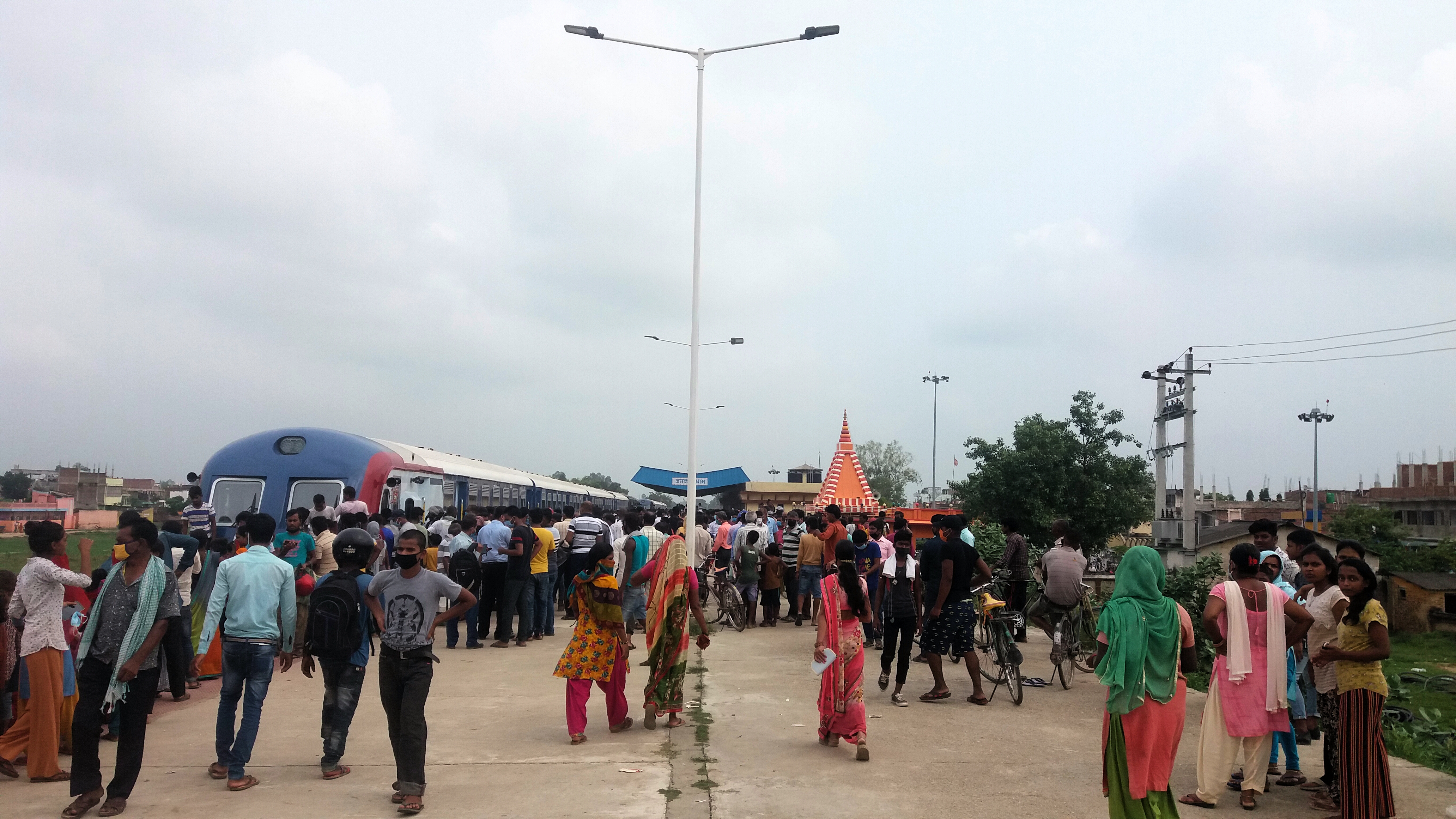
[[File:Janakpur Railway Station, Nepal Railway 20200918 02.jpg|thumb | [[File:Janakpur Railway Station, Nepal Railway 20200918 02.jpg|thumb|Janakpur Train Station is the largest Railway Station in Nepal]] | ||
Railway projects are managed by [[Nepal Railways]]. Janakpur has been proposed as the main station for the {{cvt|1024|km}} long east–west metro railway project that is planned to be extended to India and China for connecting Nepal Railways with [[Indian Railways]] and [[China Railway]].<ref>{{Cite web |url=http://www.ekantipur.com/2012/04/21/capital/nepal-india-agree-on-five-rail-projects/352700.html |title=Nepal, India agree on five rail projects |access-date=25 June 2017 |archive-url=https://web.archive.org/web/20150402174951/http://www.ekantipur.com/2012/04/21/capital/nepal-india-agree-on-five-rail-projects/352700.html |archive-date=2 April 2015 |url-status=dead}}</ref> | |||
=== Airports === | |||
Madhesh | Madhesh Province has three domestic airports: | ||
* [[Rajbiraj Airport]] in [[Rajbiraj]] | * [[Rajbiraj Airport]] in [[Rajbiraj]] | ||
* [[Janakpur Airport]] in | * [[Janakpur Airport]] in Janakpur | ||
* [[Simara Airport]] in [[Pipara Simara]] | * [[Simara Airport]] in [[Pipara Simara]] close to Birgunj and Kalaiya | ||
Under construction Airport: | |||
*[[Nijgadh International Airport]] {{citation needed|date=September 2024}} | |||
* [[Nijgadh International Airport]] | |||
==Culture== | ==Culture== | ||
| Line 673: | Line 465: | ||
===Paintings=== | ===Paintings=== | ||
[[File:Madhubani Mahavidyas.jpg|thumbnail|right|283x283px|Mithila painting featuring '' God [[Shiva]]-[[Parvati]] and the [[Mahavidyas]]'']] | [[File:Madhubani Mahavidyas.jpg|thumbnail|right|283x283px|Mithila painting featuring '' God [[Shiva]]-[[Parvati]] and the [[Mahavidyas]]'']] | ||
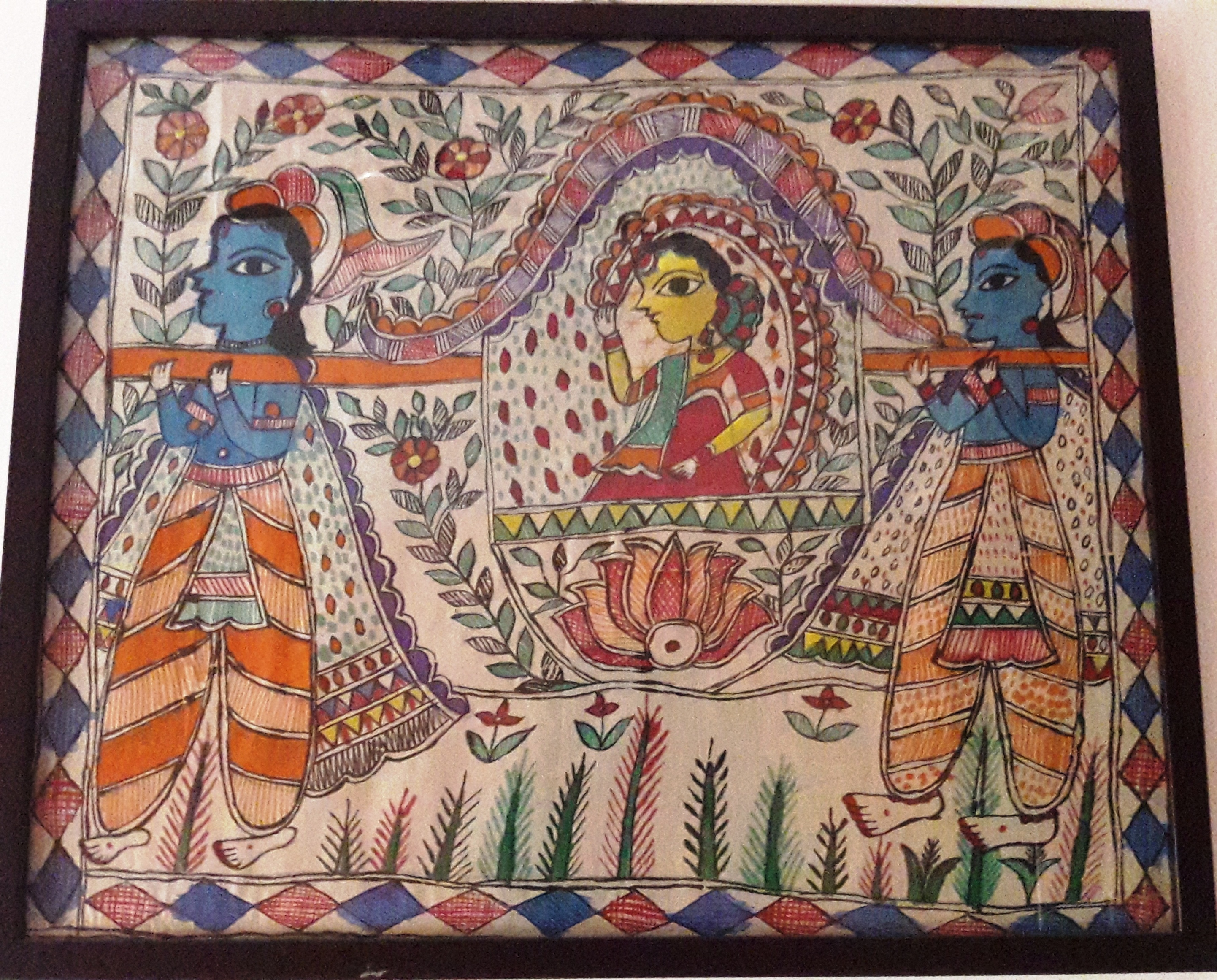
[[Madhubani art]] is practiced in the [[Mithila (region)|Mithila]] region. It was traditionally created by the women of different communities of the Mithila region.<ref>{{cite book | url=https://books.google.com/books?id=UvuJyvtsCjwC&pg=PA96 | title=Madhubani Painting | year=2003 | | [[Madhubani art]] is practiced in the [[Mithila (region)|Mithila]] region. It was traditionally created by the women of different communities of the Mithila region.<ref>{{cite book | url=https://books.google.com/books?id=UvuJyvtsCjwC&pg=PA96 | title=Madhubani Painting | year=2003 |access-date=20 February 2017 | pages=96 | publisher=Abhinav Publications | isbn=9788170171560 | url-status=live |archive-url=https://web.archive.org/web/20171028144752/https://books.google.co.uk/books?id=UvuJyvtsCjwC&pg=PA96 |archive-date=28 October 2017 | df=dmy-all }}</ref> This painting as a form of wall art was practiced widely throughout the region; the more recent development of painting on paper and canvas originated among the villages around Madhubani, and it is these latter developments that may correctly be referred to as ''Madhubani art.''<ref>Carolyn Brown Heinz, 2006, "Documenting the Image in Mithila Art," Visual Anthropology Review, Vol. 22, Issue 2, pp. 5-33</ref> | ||
[[File:Madhubani art.jpg|thumb|Madhubani_art]] | [[File:Madhubani art.jpg|thumb|Madhubani_art]] | ||
Artists create these | Artists create these paintings using a variety of mediums, including their own fingers, or twigs, brushes, nib-pens, and matchsticks. The paint is created using natural dyes and pigments. The paintings are characterised by their eye-catching geometrical patterns. | ||
===Cuisine=== | ===Cuisine=== | ||
| Line 687: | Line 479: | ||
}} | }} | ||
Maithil cuisine | Maithil cuisine and [[Bhojpuri cuisine]] are part of [[Nepalese cuisine]]. Maithil is a culinary style which originated in Mithila while Bhojpuri cuisine originated in the Bhojpuri region.<ref>{{Cite web |title=The Story Behind Nepalese Cuisine And Dishes That Are Worth Trying |url=https://www.slurrp.com/article/the-story-behind-nepalese-cuisine-and-dishes-that-are-worth-trying-1650197479906 |access-date=2023-12-04 |website=Slurrp |language=en}}</ref> Some traditional dishes of Madhesh are: | ||
* [[Curd]]-[[flattened rice]] | * [[Curd]]-[[flattened rice]] | ||
* [[Litti (cuisine)|Litti Chokha]]<ref>{{Cite book |last=Bhadani |first=Gangadhar |url=https://books.google.com/books?id=zEKIDgAAQBAJ&dq=Litti+Chokha+madhesh&pg=PT222 |title=Choice in Chaos: A Bharatpedian'S Autobiography |date=2017-03-16 |publisher=Partridge Publishing |isbn=978-1-4828-8891-1 |language=en}}</ref> | |||
* Vegetable of [[Taro]] | * Vegetable of [[Taro]] | ||
* [[Ghugni]] | * [[Ghugni]] | ||
| Line 697: | Line 490: | ||
* [[Yogurt]] | * [[Yogurt]] | ||
* Irhar | * Irhar | ||
* Pidukia | * Pidukia (also known as [[Gujia]]) which is basically dumplings. | ||
* [[Foxnut]] payas | * [[Foxnut]] payas | ||
* [[Anarsa]] | * [[Anarsa]] | ||
| Line 706: | Line 499: | ||
{{Main|Jhijhiya}} | {{Main|Jhijhiya}} | ||
Jhijhiya is a cultural dance from the [[Mithila (region)|Mithila region]].<ref>{{Cite book |author=Nishi Sinha |url=https://books.google.com/books?id=puVMrtgd7kAC&pg=PA39 |title=Tourism Perspective in Bihar |publisher=APH |year=1999 |isbn=9788170249757 |page=39}}</ref> | Jhijhiya is a cultural dance from the [[Mithila (region)|Mithila region]].<ref>{{Cite book |author=Nishi Sinha |url=https://books.google.com/books?id=puVMrtgd7kAC&pg=PA39 |title=Tourism Perspective in Bihar |publisher=APH |year=1999 |isbn=9788170249757 |page=39}}</ref> | ||
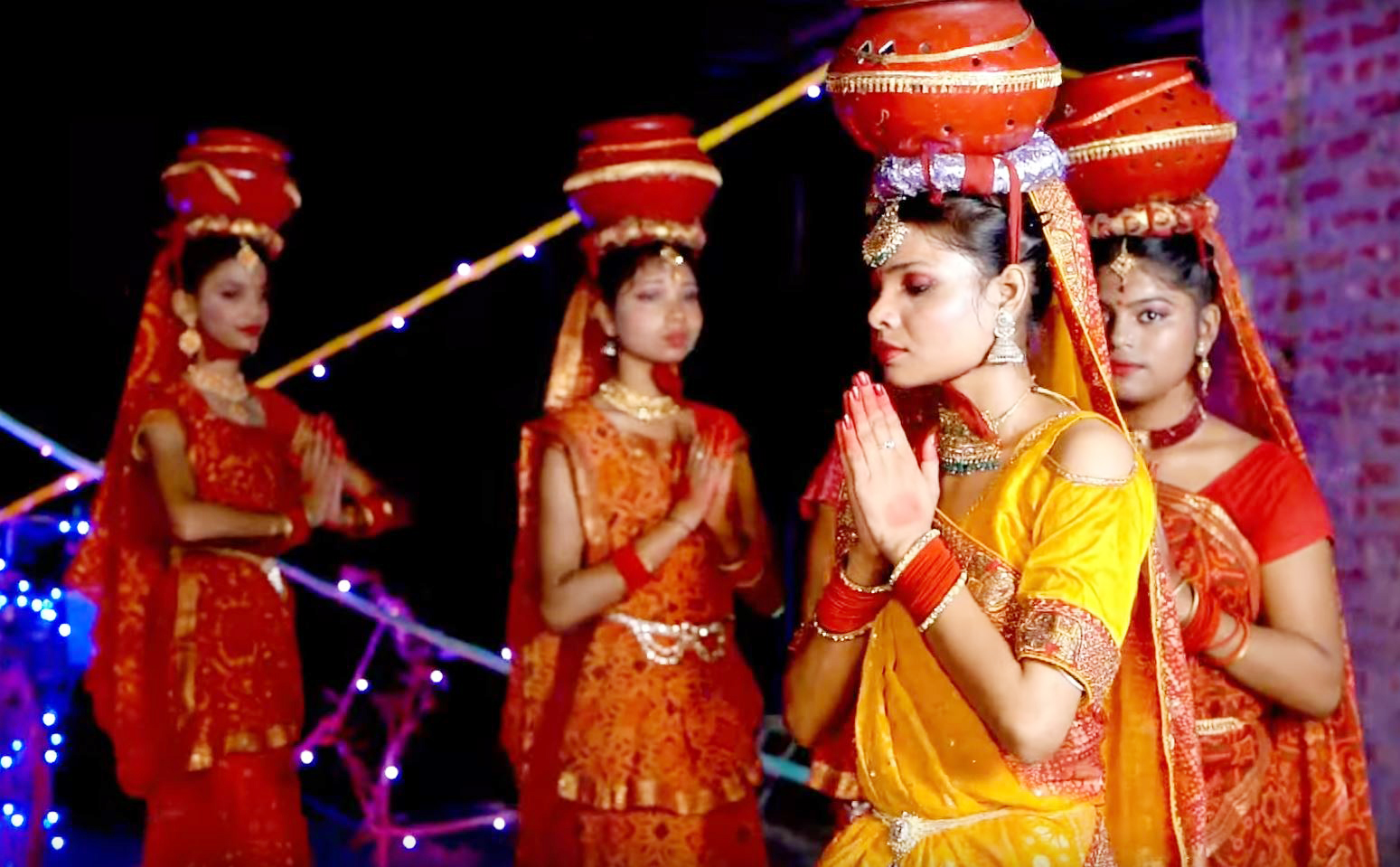
[[File:Women performing Jhijhiya dance.jpg|thumb| | [[File:Women performing Jhijhiya dance.jpg|thumb|Women performing Jhijhiya dance]]Jhijhiya is mostly performed at time of [[Vijayadashami|Dusshera]], in dedication to Durga [[Bhairavi]], the goddess of victory.<ref name="Kumari1999">{{cite book|author=Punam Kumari|title=Social and cultural life of the Nepalese|url=https://books.google.com/books?id=em4wAQAAIAAJ|access-date=16 August 2013|year=1999|publisher=Mohit Publications|isbn=978-81-7445-092-0}}</ref> While performing jhijhiya, women put lanterns made of clay on their head and they balance it while they dance.<ref>{{Cite book |url=https://books.google.com/books?id=puVMrtgd7kAC&q=Jhijhiya+dance&pg=PA40 |title=Tourism Perspective in Bihar |page=40 |publisher=APH |author=Nishi Sinha|year=1999 |isbn=9788170249757 }}</ref> | ||
====Domkach==== | ====Domkach==== | ||
{{Main|Domkach}} | {{Main|Domkach}} | ||
Domkach is a folk dance performed in [[Mithila (region)|Mithila]] and [[Bhojpuri region|Bhojpur]] regions of Madhesh Province.<ref>{{cite web |title=Domkach |url=http://folklibrary.com/index.php/folkform/?catid=210&child=Domkach&color=&id=211-domkach&parent= |access-date=18 December 2018 |website=Folklibrary.com}}</ref> | Domkach is a folk dance performed in [[Mithila (region)|Mithila]] and [[Bhojpuri region|Bhojpur]] regions of Madhesh Province.<ref>{{cite web |title=Domkach |url=http://folklibrary.com/index.php/folkform/?catid=210&child=Domkach&color=&id=211-domkach&parent= |access-date=18 December 2018 |website=Folklibrary.com |archive-date=21 February 2019 |archive-url=https://web.archive.org/web/20190221224111/http://folklibrary.com/index.php/folkform/?catid=210&child=Domkach&color=&id=211-domkach&parent= |url-status=dead }}</ref> | ||
'''Jat Jatin''' | '''Jat Jatin''' | ||
| Line 725: | Line 518: | ||
== Notable people == | == Notable people == | ||
{{Unreferenced section|date=January 2023}} | {{Unreferenced section|date=January 2023}} | ||
* [[Ruby Rana]], First | * [[Ruby Rana]], First Miss Nepal, crowned in 1994 | ||
* [[Ram Baran Yadav]], First | * [[Dr. Ram Baran Yadav]], First President of Nepal | ||
* [[Bimalendra Nidhi]], MP and Former deputy prime minister | * [[Bimalendra Nidhi]], MP and Former deputy prime minister | ||
* [[ | *[[Pradeep Yadav (Nepalese politician)]], Former Minister for Health and Population of Nepal, currently serving as the Minister of Water Supply of Nepal. | ||
* [[Madhav Kumar Nepal]], Former Prime minister | * [[Madhav Kumar Nepal]], Former Prime minister | ||
* [[Mahindra Ray Yadav]], continues winning Nepalese politician, former minister, present member of parliament | |||
* [[Upendra Yadav]], Former Deputy Prime Minister and Foreign Affairs Minister | * [[Upendra Yadav]], Former Deputy Prime Minister and Foreign Affairs Minister | ||
* [[VTEN]], Rapper | * [[VTEN]], Rapper from Rautahat | ||
* [[Pradeep Yadav ( | * [[Pradeep Giri]], Former socialist politician and respected socialist thinker | ||
*[[Chitra Lekha Yadav]], Former education minister, currently ambassador of Nepal in Australia. | |||
* [[Bina Jaiswal]], Nepalese Politician, Rastriya Prajatantra party | |||
* [[Aashiq Ali Mikrani]], martyr of the Terai/Madhesh movement | |||
* [[Nanyadeva]], (1097-1147CE) Founder of Karnat dynasty, Simraungadh-Bara | |||
* [[Gangadeva]], king of simraungadh | |||
* [[Harisimhadeva]], (until 1324CE), Last ruler of karnat Dynasty who fled to Kathmandu valley | |||
* [[Mahantha Thakur]], Veteran Madheshi politician and leader of the Loktantrik Samajwadi Party | |||
* [[Lalbabu Raut]], First Chief Minister of Madhesh Province, representing the People's Socialist Party, Nepal | |||
* [[Bibek Yadav]], Nepalese cricketer who has represented the national team in international matches | |||
* [[Anil Kumar Shah]], A right-handed batsman from Janakpur, Sah has represented Nepal in international cricket and is a key player for the Madhesh Province cricket team | |||
* [[Deepak Rauniyar]], film director Fromm Saptari; he is best known for his movie Rajagunj | |||
* [[Rabindra Jha]], a prominent Nepalese actor, comedian, and scriptwriter, widely recognized for his versatile performances in the Nepali entertainment industry. | |||
* [[Najir Husen]], Actor | |||
* [[Santosh Shah]], a distinguished Nepalese chef renowned for his significant contributions to promoting Nepalese cuisine on the international stage | |||
* [[Dhirendra Premarshi]], Maithili poet and writer | |||
==See also== | ==See also== | ||
*[[Mahendra Narayan Nidhi Awas Yojana]] | *[[Mahendra Narayan Nidhi Awas Yojana]] | ||
*[[Nepali Congress, Madhesh Province]] | *[[Nepali Congress, Madhesh Province]] | ||
*[[Madhesh Province cricket team]] | |||
==References== | ==References== | ||
| Line 759: | Line 567: | ||
|Northwest =[[Bagmati Province]], {{flag|Nepal}} | |Northwest =[[Bagmati Province]], {{flag|Nepal}} | ||
}} | }} | ||
{{Provinces of Nepal}} | {{Provinces of Nepal}} | ||
{{Districts of Nepal}} | {{Districts of Nepal}} | ||
{{Clear}} | {{Clear}} | ||
| Line 769: | Line 577: | ||
[[Category:Madhesh Province| ]] | [[Category:Madhesh Province| ]] | ||
[[Category:Provinces of Nepal|2]] | [[Category:Provinces of Nepal|2]] | ||
[[Category:Mithila]] | [[Category:Mithila (region)]] | ||
[[Category:2015 establishments in Nepal]] | [[Category:2015 establishments in Nepal]] | ||
[[Category:States and territories established in 2015]] | [[Category:States and territories established in 2015]] | ||
Latest revision as of 04:33, 14 March 2026
Madhesh Province
मधेश प्रदेश | |
|---|---|
   .jpg)   Clockwise from top: Janaki Mandir, Kankalini Temple, Gateway of Nepal Birgunj, Chinnamasta Bhagawati Temple, Gadhimai Temple and Jaleshwar Mahadev Temple | |
 Seal | |
 Location of Madhesh Province | |
Map of Madhesh Province, Nepal | |
| Province of |  Nepal Nepal |
| HPI |  Low Low |
| Formation | 20 September 2015 |
| Capital city | Janakpur[1] |
| Largest city | Birgunj |
| Districts | |
| Government | |
| • Type | Autonomy |
| • Body | Government of Madhesh Province |
| • Governor | Surendra Labh Karn |
| • Chief Minister[2] | Krishna Prasad Yadav (Congress) |
| • High Court | Janakpur High Court |
| • Provincial Assembly | Unicameral (107 seats) |
| • House of Representatives | 32 constituencies |
| Area | |
| • Total | 9,661 km2 (3,730 sq mi) |
| • Rank | 7th |
| Elevation | 102 m (335 ft) |
| Highest elevation | 920 m (3,020 ft) |
| Lowest elevation | 58 m (190 ft) |
| Population (2021[3]) | |
| • Total | 6,114,600 |
| • Rank | 2nd |
| • Density | 630/km2 (1,600/sq mi) |
| • Rank | 1st |
| Time zone | UTC+5:45 (Nepal Time) |
| Area codes | 041, 031, 033, 046, 053, 051, 044, 055 |
| ISO 3166 code | NP-P2 |
| Languages | Nepali (official) Maithili (official) Bhojpuri (official) Bajjika (official) Tharu (additional-official) Tamang (additional-official)[4] Urdu Others[5] |
| HDI | 0.519 (low) |
| Literacy | 63.5%  (2024) (2024) |
| Sex ratio | 100.55 ♂ / 100 ♀ (2021) |
| Website | madhesh |
Madhesh Province (Script error: The function "langx" does not exist.) is a province of Nepal in the Terai region with an area of 9,661 km2 (3,730 sq mi) covering about 6.5% of the country's total area. It has a population of 6,114,600 as per the 2021 Nepal census, making it Nepal's most densely populated province and the smallest province by area.[6][7] It borders Koshi Pradesh to the east and the north, Bagmati Province to the north, and India’s Bihar state to the south and the west. The border between Chitwan National Park and Parsa National Park acts as the provincial boundary in the west, and the Kosi River forms the provincial border in the east. The province includes eight districts, from Parsa in the west to Saptari in the east. It is a centre for religious and cultural tourism.[8]
Etymology[edit | edit source]
The word madhesh is thought to be derived from the Sanskrit madhya desh (मध्य देश), literally the middle country, which refers to "the central region, the country lying between the Himalaya and the Vindhya mountains".[9][10] However, in the context of Nepal, Madhesh refers to the region in the Nepal Terai located south of the Siwalik Hills.[11][12] Madhesh has also been defined as the cultural and linguistic space existing as a basis for identity among the people of the Terai.[13]
History[edit | edit source]
Madhesh Province was founded with the provisional name Province No. 2 in September 2015 in accordance with Schedule 4 of the Constitution of Nepal.[14] It received its current name on 17 January 2022, when the provincial assembly declared Janakpur as its capital.[15]
Geography[edit | edit source]
As per Central Bureau of Statistics, Madhesh Province covers about 9,661 km2 (3,730 sq mi) of Nepal's total area of 147,516 km2 (56,956 sq mi). With 6,114,600 inhabitants as of 2021, it is Nepal's second most populous province.[3][16] Madhesh Province is surrounded by the Chitwan District to the west, Makwanpur District and Sindhuli District and Udayapur District to the north, Sunsari District to the east, and India to the south.[17] The province has 574,360 ha (1,419,300 acres) of arable land, making it the country's most agriculture-dominated province. The west of the province contains part of Parsa National Park, while part of Koshi Tappu Wildlife Reserve lies within the east. The province is biodiverse, and is crossed by migrating elephants.[18]
| Rank | District | Pop. | Rank | District | Pop. | ||||
|---|---|---|---|---|---|---|---|---|---|
| 1 | Birgunj | Parsa | 240,922 | 11 | Bardibas | Mahottari | 66,354 | ||
| 2 | Janakpur | Dhanusha | 159,468 | 12 | Ishwarpur | Sarlahi | 59,986 | ||
| 3 | Kalaiya | Bara | 123,659 | 13 | Lalbandi | Sarlahi | 59,395 | ||
| 4 | Jeetpur Simara | Bara | 117,496 | 14 | Jaleshwor | Mahottari | 58,549 | ||
| 5 | Lahan | Siraha | 91,766 | 15 | Mahagadhimai | Bara | 54,474 | ||
| 6 | Siraha | Siraha | 82,531 | 16 | Golbazar | Siraha | 51,137 | ||
| 7 | Chandrapur | Rautahat | 72,059 | 17 | Garuda | Rautahat | 50,481 | ||
| 8 | Barahathwa | Sarlahi | 69,822 | 18 | Mirchaiya | Siraha | 50,079 | ||
| 9 | Rajbiraj | Saptari | 69,086 | 19 | Simraungadh | Bara | 49,939 | ||
| 10 | Gaushala | Mahottari | 66,673 | 20 | Manara Shiswa | Mahottari | 49,692 | ||
Climate[edit | edit source]
| Location | August
(°F) |
August
(°C) |
January
(°F) |
January
(°C) |
Annual
Precipitation (mm/in) |
|---|---|---|---|---|---|
| Gaur | 91/77.9 | 23/9.1 | 73.4/48.4 | 32.8/25.5 | 1590.2/62.6 |
| Siraha | 89.6/76.3 | 32/24.6 | 72.1/47.3 | 22.3/8.5 | 1293.1/50.9 |
| Birgunj | 84.7 | 29.3 | 60.8 | 16 | 1862.2/73.3 |
| Jaleshwar | 84.4 | 29.1 | 61.2 | 16.2 | 1492.9/58.8 |
| Malangawa | 84.4 | 29.1 | 60.8 | 16 | 1817.7/71.6 |
| Janakpur | 84.2 | 29 | 60.8 | 16 | 1516.5/59.7 |
| Rajbiraj | 83.3 | 28.5 | 60.4 | 15.8 | 1223.3/48.2 |
| Lahan | 83.3 | 28.5 | 60.3 | 15.7 | 1231.4/48.5 |
Demographics[edit | edit source]
According to the 2021 Nepal census, the province has a population of 6,114,600: 3,065,751 males and 3,048,849 females. The province with 20.97% of the country's population has the second-highest population after Bagmati Province in the country, and is the densest province in the country with a density of 633 people per square kilometre.[3]
Ethnic groups in Madhesh Province
Ethnic groups[edit | edit source]
Maithils are the largest ethnolinguistic group. Yadav is the largest group among the Madhesi people in the province making up around 15.2% of the population. Muslims are the second largest group making up 13% of the population. Teli (5.3%), Kushwaha(koeri) (4.5%), Chamar (4.4%), Kurmi (3.0%), Musahar (2.9%), Dusadh (2.79%), Mallaah (2.26%), Maithil Brahmin (2.2%), and Karan Kayastha (1.5%) are other Madhesi pandit (8.0) groups in the province. Bahun and Chhetri are the largest Khas Arya groups in the province making up 2.34% and 1.99% of the population, respectively. Tharu (5.27%) and Dhanuk (3.49%) is the largest non-Madhesi, non-Khas Arya group followed by Tamang (2.17%).[5]
Languages[edit | edit source]
The Maithili language is spoken by 45.36% of the total population of the province. Bhojpuri is spoken by 18.81% and Bajjika is spoken by 18.44% of the population. Nepali is the province's official language, but is spoken as mother tongue by only 5.76% of the population. Tharu (4.17%), Urdu (4.08%), and Tamang (1.65%) are other languages spoken by a minority of the population.[20]
The Language Commission of Nepal has recommended Maithili, Bhojpuri and Bajjika as official languages of the province, and Urdu, Tharu and Tamang as additional official languages for specific regions and purposes in the province.[4]
Religion[edit | edit source]
Hinduism is the most followed religion in the province, being followed by 84.24% of the population. Islam is the second largest religion with 13.28% of the population being Muslims, and Buddhism is followed by 2.21% of the population.[21]
Government and administration[edit | edit source]
Executive[edit | edit source]
The Governor acts as the head of the province while the Chief Minister is the head of the provincial government. The present Governor and Chief Minister are Surendra Labh Karn and Krishna Prasad Yadav respectively.
Legislative[edit | edit source]
The province has 107 provincial assembly constituencies and 32 constituencies.[22]
Madhesh Province has a unicameral legislature, like all of the other provinces in Nepal. The term length of provincial assembly is five years. The Provincial Assembly of Madhesh Province is temporarily housed at the District Education Office in Janakpur.[23]

| Party | Parliamentary party leader | Seats | |
|---|---|---|---|
| CPN (UML) | Saroj Kumar Yadav | 25 | |
| Nepali Congress | Krishna Prasad Yadav | 22 | |
| People's Socialist Party, Nepal | Saroj Kumar Yadav | 19 | |
| Janamat Party | Mahesh Prasad Yadav | 13 | |
| Loktantrik Samajwadi Party | Abhiram Sharma | 9 | |
| CPN (Maoist Centre) | Bharat Prasad Sah | 9 | |
| CPN (Unified Socialist) | Govinda Bahadur Neupane | 7 | |
| Rastriya Prajatantra Party | 1 | ||
| Nepal Federal Socialist Party | 1 | ||
| Nagrik Unmukti Party | 1 | ||
| Total | 107 | ||
Judiciary[edit | edit source]
The Chief Judge of the Janakpur High Court is the head of the judiciary.[24] The acting chief justice is Binod Sharma.[25]
Administrative subdivisions[edit | edit source]
Madhesh Province is divided into eight districts, which are listed below. A district is administrated by the head of the District Coordination Committee and the District Administration Officer. The districts are further divided into municipalities or rural municipalities. The municipalities include one metropolitan city, three sub-metropolitan cities, and 73 municipalities. There are 59 rural municipalities in the province.[26]
| Name | Headquarters | Population (2011) |
|---|---|---|
| Dhanusha District | Janakpur | 754,777 |
| Sarlahi District | Malangawa | 769,729 |
| Bara District | Kalaiya | 687,708 |
| Rautahat District | Gaur | 686,722 |
| Saptari District | Rajbiraj | 639,284 |
| Siraha District | Siraha | 637,328 |
| Mahottari District | Jaleshwar | 627,580 |
| Parsa District | Birgunj | 601,017 |
Infrastructure[edit | edit source]
 | This section needs additional citations for verification. (January 2023) |
Roadways[edit | edit source]
Mahendra Highway is the major highway in the province running longitudinally across the province.[27] The Tribhuvan Highway also crosses a part of the province and connects it to the Kathmandu Valley and India.[citation needed]
Railways[edit | edit source]

Railway projects are managed by Nepal Railways. Janakpur has been proposed as the main station for the 1,024 km (636 mi) long east–west metro railway project that is planned to be extended to India and China for connecting Nepal Railways with Indian Railways and China Railway.[28]
Airports[edit | edit source]
Madhesh Province has three domestic airports:
- Rajbiraj Airport in Rajbiraj
- Janakpur Airport in Janakpur
- Simara Airport in Pipara Simara close to Birgunj and Kalaiya
Under construction Airport:
Culture[edit | edit source]
| This section needs additional citations for verification. (January 2023) |
Mithila Paag[edit | edit source]

The Paag is a headdress in the Mithila region of Nepal and India worn by Maithil people. It is a symbol of honour and respect and a significant part of Maithil culture. The Paag dates back to pre-historic times when it was made of plant leaves. It exists today in a modified form. The Paag is wore by the whole Maithil community. The colour of the Paag also carries a lot of significance. The red Paag is worn by the bridegroom and by those who are undergoing the sacred thread rituals. Paag of mustard colour is donned by those attending wedding ceremonies and the elders wear a white Paag.
Paintings[edit | edit source]

Madhubani art is practiced in the Mithila region. It was traditionally created by the women of different communities of the Mithila region.[29] This painting as a form of wall art was practiced widely throughout the region; the more recent development of painting on paper and canvas originated among the villages around Madhubani, and it is these latter developments that may correctly be referred to as Madhubani art.[30]

Artists create these paintings using a variety of mediums, including their own fingers, or twigs, brushes, nib-pens, and matchsticks. The paint is created using natural dyes and pigments. The paintings are characterised by their eye-catching geometrical patterns.
Cuisine[edit | edit source]


Maithil cuisine and Bhojpuri cuisine are part of Nepalese cuisine. Maithil is a culinary style which originated in Mithila while Bhojpuri cuisine originated in the Bhojpuri region.[31] Some traditional dishes of Madhesh are:
- Curd-flattened rice
- Litti Chokha[32]
- Vegetable of Taro
- Ghugni
- pickles made of fruits and vegetables which are generally mixed with ingredients like salt, spices, and vegetable oils and are set to mature in a moistureless medium.
- Tarua of Coccinia grandis
- Bada
- Badee
- Yogurt
- Irhar
- Pidukia (also known as Gujia) which is basically dumplings.
- Foxnut payas
- Anarsa
- Bagiya
Dances[edit | edit source]
Jhijhiya[edit | edit source]
Jhijhiya is a cultural dance from the Mithila region.[33]

Jhijhiya is mostly performed at time of Dusshera, in dedication to Durga Bhairavi, the goddess of victory.[34] While performing jhijhiya, women put lanterns made of clay on their head and they balance it while they dance.[35]
Domkach[edit | edit source]
Domkach is a folk dance performed in Mithila and Bhojpur regions of Madhesh Province.[36]
Jat Jatin
Jat Jatin is based on folk songs of Mithila and Tharu community which they perform from Shrawan Purnima to Bhadra Purnima. It is based on the love story of hero jat and heroine Jatin and their lives.[37]
Gauna dance
The Dance is based in Mithila Tradition and popular in Janakpur region of Nepal. This dance is performed in the religious occasions.
Politics[edit | edit source]
As a political center of the country, Madhesh Province is home to prominent leaders like Ram Baran Yadav, Bimalendra Nidhi and Pradeep Giri from the Nepali Congress, Mahantha Thakur from Loktantrik Samajwadi Party, Nepal, Matrika Yadav from CPN (Maoist Centre) and Dharmanath Prasad Sah, Bansidhar Mishra, Ram Chandra Jha from the CPN (Unified Socialist) who have been ministers at various point of time and are still active at National level.[38] In local level, Nepali congress remains the single largest party.[39]
Notable people[edit | edit source]
| This section does not cite any sources. (January 2023) |
- Ruby Rana, First Miss Nepal, crowned in 1994
- Dr. Ram Baran Yadav, First President of Nepal
- Bimalendra Nidhi, MP and Former deputy prime minister
- Pradeep Yadav (Nepalese politician), Former Minister for Health and Population of Nepal, currently serving as the Minister of Water Supply of Nepal.
- Madhav Kumar Nepal, Former Prime minister
- Mahindra Ray Yadav, continues winning Nepalese politician, former minister, present member of parliament
- Upendra Yadav, Former Deputy Prime Minister and Foreign Affairs Minister
- VTEN, Rapper from Rautahat
- Pradeep Giri, Former socialist politician and respected socialist thinker
- Chitra Lekha Yadav, Former education minister, currently ambassador of Nepal in Australia.
- Bina Jaiswal, Nepalese Politician, Rastriya Prajatantra party
- Aashiq Ali Mikrani, martyr of the Terai/Madhesh movement
- Nanyadeva, (1097-1147CE) Founder of Karnat dynasty, Simraungadh-Bara
- Gangadeva, king of simraungadh
- Harisimhadeva, (until 1324CE), Last ruler of karnat Dynasty who fled to Kathmandu valley
- Mahantha Thakur, Veteran Madheshi politician and leader of the Loktantrik Samajwadi Party
- Lalbabu Raut, First Chief Minister of Madhesh Province, representing the People's Socialist Party, Nepal
- Bibek Yadav, Nepalese cricketer who has represented the national team in international matches
- Anil Kumar Shah, A right-handed batsman from Janakpur, Sah has represented Nepal in international cricket and is a key player for the Madhesh Province cricket team
- Deepak Rauniyar, film director Fromm Saptari; he is best known for his movie Rajagunj
- Rabindra Jha, a prominent Nepalese actor, comedian, and scriptwriter, widely recognized for his versatile performances in the Nepali entertainment industry.
- Najir Husen, Actor
- Santosh Shah, a distinguished Nepalese chef renowned for his significant contributions to promoting Nepalese cuisine on the international stage
- Dhirendra Premarshi, Maithili poet and writer
See also[edit | edit source]
References[edit | edit source]
- ↑ "प्रदेश २ को स्थायी राजधानी 'जनकपुरधाम' बहुमतले पारित !" (in नेपाली).
- ↑ "Govt decides to recommend new chiefs in Madhesh, Gandaki and Sudurpaschim Provinces (With video)". Nepal Press. Retrieved 4 December 2024.
- ↑ 3.0 3.1 3.2 "2021 Nepal census". Kathmandu, Nepal: Central Bureau of Statistics.
- ↑ 4.0 4.1 Language Commission (2021). सरकारी कामकाजको भाषाका आधारहरूको निर्धारण तथा भाषासम्बन्धी सिफारिसहरू (पञ्चवर्षीय प्रतिवेदन- साराांश) २०७८ [Determination of language bases of government work and language recommendations (Summary of five-year report) 2078] (PDF) (Report). Kathmandu, Nepal: Government of Nepal. Archived from the original (PDF) on 6 September 2021. Retrieved 28 October 2021.
- ↑ 5.0 5.1 "National Data Portal Nepal". Government of Nepal National Data. Archived from the original on 17 July 2020. Retrieved 26 December 2020.
- ↑ "National Population and Housing Census 2011" (PDF). Central Bureau of Statistics. Archived from the original (PDF) on 1 August 2014. Retrieved 1 March 2014.
- ↑ "सबैभन्दा बढी जनसंख्या हुने प्रदेश मधेश". ekantipur.com (in नेपाली). Retrieved 26 January 2022.
- ↑ Rastriya Samachar Samiti (2004). "More Indian tourists visit Janakpurdham". Himalayan Times, 17 January 2004.
- ↑ Kabir 2013, p. 11.
- ↑ Apte, V. S. (1957–1959). "मध्य madhya". Revised and enlarged edition of Prin. V. S. Apte's The practical Sanskrit-English dictionary. Poona: Prasad Prakashan.[permanent dead link]
- ↑ Mishra, R. (2007). "Sectional President's Address: Ethnicity and National Unification: The Madheshis of Nepal". Proceedings of the Indian History Congress. 67: 802–833. JSTOR 44148000.
- ↑ "Nepal Conflict Alert". www.crisisgroup.org. 2 September 2015.
- ↑ Singh, C. P. (2011). "Origin and Development of Madheshi Movement in Nepal". Proceedings of the Indian History Congress. 72 (Part II): 1047–1053. JSTOR 44145716.
- ↑ "Formation of provinces in Nepal" (PDF). Office of Attorney General (Nepal).
- ↑ "Janakpurdham declared Province 2 capital (With video)". Nepal Press. 2022. Retrieved 17 January 2022.
- ↑ Law, G. (2015). "Provinces of Nepal". statoids.com. Retrieved 23 February 2018.
- ↑ "Big 3 draw new 7-province map". Republica. 22 August 2015. Retrieved 26 June 2017.
- ↑ Joshi, A. R. (2023). "Nepal's Madhesh province lacks in biodiversity research and conservation". Mongabay. Retrieved 25 November 2023.
- ↑ "Nepal Travel Weather Averages". Weatherbase. Retrieved 28 April 2018.
- ↑ 20.0 20.1 "Table 5: Mother tongue and sex". Census Nepal 2021. Central Bureau of Statistics.
- ↑ 21.0 21.1 "Table 5: Religion and sex". Census Nepal 2021. Central Bureau of Statistics. Retrieved 16 March 2024.
- ↑ "CDC creates 495 constituencies". The Himalayan Times. 31 August 2017. Retrieved 27 April 2018.
- ↑ "First Provincial Assembly meeting begins in 4 provinces". The Kathmandu Post. Retrieved 27 April 2018.
- ↑ "High Courts get their chief judges". The Kathmandu Post. Retrieved 27 April 2018.
- ↑ "उच्च अदालत जनकपुर". Supreme Court Nepal. Retrieved 17 January 2022.
- ↑ "स्थानिय तह". 103.69.124.141. Archived from the original on 31 August 2018. Retrieved 27 April 2018.
- ↑ Reed, D. (2002). The Rough Guide to Nepal. Rough Guides. ISBN 9781858288994.
- ↑ "Nepal, India agree on five rail projects". Archived from the original on 2 April 2015. Retrieved 25 June 2017.
- ↑ Madhubani Painting. Abhinav Publications. 2003. p. 96. ISBN 9788170171560. Archived from the original on 28 October 2017. Retrieved 20 February 2017.
- ↑ Carolyn Brown Heinz, 2006, "Documenting the Image in Mithila Art," Visual Anthropology Review, Vol. 22, Issue 2, pp. 5-33
- ↑ "The Story Behind Nepalese Cuisine And Dishes That Are Worth Trying". Slurrp. Retrieved 4 December 2023.
- ↑ Bhadani, Gangadhar (16 March 2017). Choice in Chaos: A Bharatpedian'S Autobiography. Partridge Publishing. ISBN 978-1-4828-8891-1.
- ↑ Nishi Sinha (1999). Tourism Perspective in Bihar. APH. p. 39. ISBN 9788170249757.
- ↑ Punam Kumari (1999). Social and cultural life of the Nepalese. Mohit Publications. ISBN 978-81-7445-092-0. Retrieved 16 August 2013.
- ↑ Nishi Sinha (1999). Tourism Perspective in Bihar. APH. p. 40. ISBN 9788170249757.
- ↑ "Domkach". Folklibrary.com. Archived from the original on 21 February 2019. Retrieved 18 December 2018.
- ↑ "Jat Jatin dance".
- ↑ Kumar, Mukesh Pokhrel and Ramesh (10 April 2021). "The Politics of Province 2". Retrieved 28 July 2021.
- ↑ Republica. "NC poised to be the largest party in Province 2". My Republica. Retrieved 28 July 2021.
Works cited[edit | edit source]
- Gaige, F. H. (1975). "Migration into the Tarai". Regionalism and National Unity in Nepal (Second ed.). Delhi: Vikas Publishing House. pp. 58–86.
- Kabir, H. (2013). Education, Nationalism, and Conflict in Plural Society in Nepal: Terai Region in the Post-Maoist Context. Discussion Paper Series. Vol. 19. Hiroshima: Hiroshima University Partnership Project for Peace Building and Capacity Development.
- Pradhan, Kumar L. (2012), Thapa Politics in Nepal: With Special Reference to Bhim Sen Thapa, 1806–1839, New Delhi: Concept Publishing Company, p. 278, ISBN 9788180698132
Places adjacent to Madhesh Province | |
|---|---|