


robot: Update article (please report if you notice any mistake or error in this edit) |
Raymondbig (talk | contribs) m cleaned up content for clarity and corrected details |
||
| Line 1: | Line 1: | ||
{{short description| | {{short description|none}} | ||
{{Use dmy dates|date=December 2019}} | {{Use dmy dates|date=December 2019}} | ||
{{Use Indian English|date=February 2020}} | {{Use Indian English|date=February 2020}} | ||
[[File:Poulluted killer fog in Delhi.jpg|thumb|A dense toxic smog in New Delhi blocks out the sun. | {{Update|reason=The many major events related to Delhi's air pollution in late 2025 are not covered, aside from the protest|date=December 2025}} | ||
[[File:PIA21100 Severe Air Pollution in New Delhi View by NASA's MISR.jpg|thumb|[[MISR]] measurement, Nov. 5, 2016: The optical depth of the thick haze was too much for calculation, "because the haze is so thick that the algorithm has classified the area as cloud. | [[File:Poulluted killer fog in Delhi.jpg|thumb|A dense toxic smog in New Delhi blocks out the sun, Nov. 8, 2017.<ref>{{cite news |url=https://www.nytimes.com/2017/11/07/world/asia/delhi-pollution-gas-chamber.html |title=Delhi, Blanketed in Toxic Haze, "Has Become a Gas Chamber" |work=The New York Times |date=7 November 2017 |access-date=7 November 2017 |archive-url=https://web.archive.org/web/20171108013324/https://www.nytimes.com/2017/11/07/world/asia/delhi-pollution-gas-chamber.html |archive-date=8 November 2017 |url-status=live |last1=Kumar |first1=Hari |last2=Schultz |first2=Kai }}</ref>]] | ||
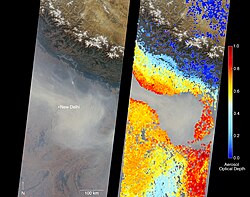
[[File:PIA21100 Severe Air Pollution in New Delhi View by NASA's MISR.jpg|thumb|[[MISR]] measurement, Nov. 5, 2016: The optical depth of the thick haze was too much for calculation, "because the haze is so thick that the algorithm has classified the area as cloud". (Less than 37% of sunlight, [[Air quality index|AQI]] = 751).]]'''Air pollution in Delhi''', the capital of India, was found to be one of the most lethal of any city in the world in an August 2022 study of 7,000 world cities by the US-based [[Health Effects Institute]].<ref>{{cite news |last=Koshy |first=Jacob |date=2022-08-17 |title=Delhi's PM2.5 levels worst in the world|url=https://www.thehindu.com/sci-tech/energy-and-environment/delhis-pm25-levels-worst-in-the-world/article65780144.ece?homepage=true |work=The Hindu |access-date=2022-08-18}}</ref> [[Air pollution in India]] is estimated to kill about 2 million people every year. India has the world's highest death rate from [[Respiratory disease#Chronic respiratory disease|chronic respiratory diseases]] and [[asthma]] according to the [[World Health Organization]].<ref name=":3" /> In Delhi, poor air quality has irreversibly damaged the lungs of 2.2 million children. | |||
On 25 November 2019, the [[Supreme Court of India]] | On 25 November 2019, the [[Supreme Court of India]] expressed their sentiments on the pollution in Delhi, saying "Delhi has become worse than ''[[Naraka (Hinduism)|narak]]'' (hell)".<ref>{{Cite web|url=https://www.hindustantimes.com/india-news/get-15-explosives-kill-people-at-one-go-sc-rebukes-centre-states-on-pollution/story-zv7hFJDndV2rlrfwvXz3rK.html|title='Delhi worse than hell': Supreme Court rebukes Centre, states on air pollution|date=25 November 2019|website=Hindustan Times|language=en|access-date=26 November 2019}}</ref> Supreme Court Justice [[Arun Kumar Mishra|Arun Mishra]] remarked that it is "better to get explosives, (and) kill everyone."<ref>{{Cite web|url=https://www.ndtv.com/india-news/top-court-slams-centre-states-over-pollution-delhi-worse-than-nark-2138346|title="Better To Get Explosives, Kill Everyone": Supreme Court On Delhi Pollution|website=NDTV.com|access-date=26 November 2019}}</ref> | ||
During the [[COVID-19 pandemic lockdown in India]], | During the [[COVID-19 pandemic lockdown in India]], the air quality in Delhi significantly improved.<ref>{{cite news|url=https://www.indiatoday.in/india-today-insight/story/the-silver-lining-air-pollution-dips-amid-the-lockdown-1671422-2020-04-26|title=The silver lining: air pollution dips amid the lockdown|access-date=2 May 2020}}</ref><ref>{{cite web |date=22 April 2020 |title=India's coronavirus lockdown reveals fresh air, cleaner rivers |url=https://www.indiatoday.in/india/story/coronavirus-lockdown-india-fresh-air-clean-rivers-1669726-2020-04-22 |access-date=22 April 2020 |publisher=Living Media India Ltd.}}</ref> | ||
India's [[Ministry of Earth Sciences]] published a research paper in October 2018 attributing almost 41% to vehicular emissions, 21.5% to dust and 18% to | India's [[Ministry of Earth Sciences]] published a research paper in October 2018 attributing almost 41% of air pollution to vehicular emissions, 21.5% to dust and 18% to industrial emissions.<ref name="MoES5">{{cite news|title=Usual suspects: Vehicles, industrial emissions behind foul play|url=https://timesofindia.indiatimes.com/city/delhi/usual-suspects-vehicles-industrial-emissions-behind-foul-play-all-year/articleshow/66228517.cms|access-date=18 December 2018|work=Times of India}}</ref> The director of the [[Centre for Science and Environment]] alleged that the [[Automotive industry in India|Society of Indian Automobile Manufacturers]] was lobbying "against the report" because it was "inconvenient" to the [[Automotive industry in India|automobile industry]].<ref name="CSE">{{cite news|title=UA vicious nexus|url=https://www.downtoearth.org.in/blog/air/a-vicious-nexus-62475|access-date=18 December 2018|work=Down to Earth}}</ref> | ||
[[ | The [[air quality index]] (AQI) in Delhi generally falls within the Satisfactory (51–100) and Moderate (101–200) ranges between March and September, and then drastically deteriorates to Poor (201–300), Severe (301–400), or Hazardous (401–500+) levels between October and February due to various factors including the burning of effigies during [[Vijayadashami]], the bursting of firecrackers during [[Diwali]], thermal power plants in the [[National Capital Region (India)|National Capital Region]],<ref name="thermal plant">{{cite web|url=https://navbharattimes.indiatimes.com/metro/delhi/other-news/delhi-ncr-pollution-main-causes-thermal-power-plants-polluting-more-than-stubble-burning/articleshow/115391931.cms|website=NavbharatTimes.com|title=Delhi Pollution: This is the reason behind the maximum pollution in Delhi-NCR, not due to stubble burning, shocking revelation in the study|quote=Thermal power plants in NCR cause 16 times more air pollution than stubble burning|date=17 Nov 2024}}</ref> [[stubble burning]],<ref>{{cite news|url=https://timesofindia.indiatimes.com/city/delhi/out-of-here-in-november-in-del-ncr-smog-break-is-becoming-the-new-annual-vacation/articleshow/104979257.cms|title=Out of here in November: In Delhi-NCR, smog break is becoming the new annual vacation|newspaper=The Times of India |date=5 November 2023 }}</ref><ref>{{cite news|url=https://timesofindia.indiatimes.com/city/delhi/delhi-aqi-cp-smog-tower-down-due-to-dpcc-says-minister-gopal-rai-official-says-running-cost-high/articleshow/104978284.cms|title=Delhi AQI: CP Smog tower down due to DPCC, says minister Gopal Rai; official says running cost high|newspaper=The Times of India |date=5 November 2023 }}</ref> road dust, vehicle pollution and cold weather.<ref>{{cite news|url=https://economictimes.indiatimes.com/news/politics-and-nation/iit-kanpur-study-says-trucks-and-road-dust-are-bigger-pollutants-than-cars-in-delhi/articleshow/50115310.cms |title=IIT-Kanpur study says trucks and road dust are bigger pollutants than cars in Delhi|newspaper=The Economic Times|date=10 December 2015|last1=Vishnoi|first1=Anubhuti}}</ref><ref>{{cite news|url=https://timesofindia.indiatimes.com/city/delhi/delhi-breathed-easier-from-january-to-april/articleshow/59011204.cms|title=Delhi breathed easier from January to April|website=[[The Times of India]]|date=6 June 2017 }}</ref><ref>{{cite web|url=https://www.hindustantimes.com/delhi-news/air-pollution-delhi-enjoys-cleanest-february-in-three-years/story-SANlmslHev8ifFgZbh3WXI.html|title=Air pollution: Delhi enjoys cleanest February in three years|work=Hindustan Times |date=27 February 2018}}</ref> | ||
In November 2016, in an event known as the "Great [[Smog]] of Delhi", the air pollution spiked far beyond acceptable levels. The levels of PM2.5 and PM 10 particulate matter hit 999 micrograms per cubic meter, well above their respective 24-hour peak limits of 15 and 60 micrograms per cubic metre.<ref name="PTI_PWPMSD">{{cite web |url=http://indianexpress.com/article/india/india-news-india/post-diwali-pm-shoots-up-10-times-more-than-the-safe-limit-3730200/ |title=Diwali effect: Pollution worsens, particulate matter soars in Delhi |work=[[Indian Express]] |date=1 November 2016}}</ref> | |||
According to [[Bloomberg News|Bloomberg]], 16.7 lakh (1,670,000) people died due to polluted air in India in 2019. According to data released by the [[Ministry of Environment, Forest and Climate Change]] in 2022, the Air Quality Index in [[Delhi NCR|Delhi]] stood at over 200 for at least half the year.<ref>{{cite news |last1=Rampal |first1=Nikhil |title=You thought only winter meant bad air in Delhi? Govt data tells a different, worrying story |url=https://theprint.in/india/you-thought-only-winter-meant-bad-air-in-delhi-govt-data-tells-a-different-worrying-story/1048553/ |access-date=2022-08-21 |work=The Print |date=2022-07-22}}</ref> | |||
[[ | [[Animal husbandry|Animal agriculture]] also contributes to Delhi's pollution problem, as smog and other harmful particles have been produced by farmers [[stubble burning|burning their crops]] in other states since the 1980s. | ||
An initiative that is being considered to address air pollution is a 1,600 km long and 5 km wide green ecological corridor along the [[Aravalli Range]] from Gujarat to Delhi connecting to the [[Sivalik Hills]] range. This would involve the planting of 1.35 billion (135 crore) new native trees over 10 years to combat pollution.<ref name="wall1">[https://indianexpress.com/article/cities/ahmedabad/want-govt-to-build-1600-km-green-wall-along-aravalli-says-activist-vijaypal-baghel-6182069/ Want govt to build 1600 km green wall along Aravalli], Indian Express, 24 December 2019.</ref> In December 2019, [[Indian Institute of Technology Bombay|IIT Bombay]], in partnership with the [[McKelvey School of Engineering]] of [[Washington University in St. Louis]], launched the [[Aerosol]] and Air Quality Research Facility to study air pollution in India.<ref>{{Cite web|url=https://source.wustl.edu/2019/12/new-partnership-brings-together-mckelvey-iit-bombay-to-study-air-pollution/|title=McKelvey Engineering, IIT Bombay partner to study air pollution|date=2019-12-04|website=The Source|language=en-US|access-date=2020-02-14}}</ref> | |||
The | The [[Government of Delhi|Delhi government]] announced in November 2021 that it would be shutting all schools and government offices<ref>{{Cite web|date=November 13, 2021|first=Amit|last=Bhardwaj|title=Delhi shuts schools, govt offices for a week due to air pollution, CM Kejriwal says no lockdown for now|url=https://www.indiatoday.in/cities/delhi/story/delhi-govt-schools-offices-closed-construction-air-pollution-cm-kejriwal-1876393-2021-11-13|access-date=2021-11-15|website=India Today|language=en}}</ref> for a week due to the severe air pollution. The government told the Supreme Court that it was confident and prepared for a complete lockdown.<ref>{{Cite web|date=November 15, 2021|title=Consider work from home, call emergency meet with states in NCR: What SC said on Delhi pollution|url=https://www.indiatoday.in/india/story/delhi-air-pollution-lockdown-supreme-court-1876840-2021-11-15|access-date=2021-11-15|website=India Today|language=en}}</ref> [[The Supreme Court of India|The Supreme Court]] asked authorities in the NCR region to consider [[remote work]] policies for employees. When the air quality in Delhi on 18 November 2021 slipped into the "severe" category with an AQI of 362, the [[Supreme Court of India]] reprimanded the central and state governments and asked them to take strict measures to reduce pollution in Delhi and the NCR region.<ref>{{Cite web |title=Delhi NCR Pollution: जानें कहां क्या बंद हुआ, किन चीजों पर लगीं पाबंदियां, 20 बड़े Updates |url=https://www.aajtak.in/india/news/story/delhi-ncr-pollution-several-restrictions-20-big-updates-ntc-1358874-2021-11-18 | date=2021-11-18 |website=Aaj Tak |language=hi}}</ref> | ||
In | In November 2023, New Delhi was suffering from particularly high levels of air pollution. 38% of this 2023's pollution has been caused by stubble burning.<ref>{{cite web |last1=Dayal |first1=Sakshi |date=13 November 2023 |title=Explainer: Why is South Asia the global hotspot of pollution? |url=https://www.reuters.com/world/asia-pacific/why-is-south-asia-global-hotspot-pollution-2023-11-13/ |access-date=16 November 2023 |website=Reuters |language=en}}</ref> | ||
On November 18, 2024, Delhi recorded its worst air quality of the season, with a 24-hour AQI reading of 491, classified as "severe plus." This level, as reported by India's pollution control authority, indicates hazardous conditions with significant health impacts, particularly for vulnerable populations. The reading marks the highest AQI level for Delhi in 2024.<ref>{{Cite web |date=2024-11-18 |title=India's capital chokes as air pollution levels hit 50 times the safe limit |url=https://apnews.com/article/new-delhi-air-pollution-india-ae1ec1e6292009db198f18b113047cd5 |access-date=2024-11-18 |website=AP News |language=en}}</ref> The [[Bharatiya Janata Party|Bharatiya Janta Party]]-led [[Government of Delhi|Delhi Government]] was accused of deliberately distorting AQI data after [[Municipal Corporation of Delhi]] tankers (controlled by the BJP) were witnessed spraying water around air-quality monitoring stations in a bid to suppress actual readings that suggested catastrophic air quality.<ref>{{Cite web|title=Video shows MCD water tankers spraying mist at Anand Vihar AQI station in Delhi; causes uproar|url=https://www.hindustantimes.com/cities/delhi-news/video-shows-mcd-water-tankers-spraying-mist-at-anand-vihar-aqi-station-in-delhi-causes-uproar-101761416645763.html|website=Hindustan Times|date=2025-10-26|access-date=2025-12-01|language=en}}</ref> | |||
== | == Particulate matter levels in Delhi== | ||
Air quality or ambient/outdoor air pollution is represented by the annual mean concentration of [[particulate matter]] PM<sub>10</sub> (particles smaller than 10 [[microns]]) and PM<sub>2.5</sub> (particles smaller than 2.5 microns, about 25 to 100 times thinner than a human hair).<ref name="Ambient (outdoor) air pollution database">{{cite web |title=Ambient (outdoor) air pollution database, by country and city |url=https://www.who.int/phe/health_topics/outdoorair/databases/cities/en/|archive-url=https://web.archive.org/web/20140328100014/http://www.who.int/phe/health_topics/outdoorair/databases/cities/en/ |url-status=dead|archive-date=28 March 2014 |publisher=WHO|access-date=31 May 2015}}</ref> | |||
== | PM<sub>10</sub> levels, for the period 2008 and 2013, based on data of 1600 cities in 91 countries, range from 26 to 208 micrograms per cubic meter of air (μg/m<sup>3</sup>), with the world average being 71 μg/m<sup>3</sup>.<ref name="pollution in cities database 2014">{{cite web|title=Ambient (outdoor) air pollution in cities database 2014|url=https://www.who.int/phe/health_topics/outdoorair/databases/cities/en/ |archive-url=https://web.archive.org/web/20140328100014/http://www.who.int/phe/health_topics/outdoorair/databases/cities/en/ |url-status=dead |archive-date=28 March 2014 |website=who.int |publisher=[[WHO]] |access-date=31 May 2015|date=2014}}</ref> 13 of the 25 cities worldwide with the highest levels of PM are in India.<ref name=Gizmodo>{{cite web |first=Alissa|last=Walker|title=India's Air Pollution Is So Bad It's Causing Lung Damage in Kids|url=https://gizmodo.com/indias-air-pollution-is-so-bad-its-causing-lung-damage-1707775668|publisher=[[gizmodo]]|access-date=30 May 2015|date=29 May 2015}}</ref> | ||
The 2022 version of the WHO ambient air quality database status report includes annual means for PM<sub>10</sub>, PM<sub>2.5</sub>, and NO<sub>2</sub> for the years between 2010 and 2019, and it covers 6,743 human settlements in 117 countries worldwide. It documents the following annual mean concentration on particulate matter from 2010 to 2020 in Delhi:<ref>{{Cite web |title=Ambient Air Quality Database Application |url=https://worldhealthorg.shinyapps.io/AmbientAirQualityDatabaseV6_1/ |access-date=2025-07-20 |website=worldhealthorg.shinyapps.io}}</ref> | |||
{| class="wikitable sortable" | |||
|+ | |||
!Year | |||
!PM<sub>2.5</sub> (μg/m3) | |||
!PM<sub>10</sub> (μg/m3) | |||
!NO<sub>2</sub> (μg/m3) | |||
|- | |||
|2010 | |||
|153 | |||
|274 | |||
| | |||
|- | |||
|2011 | |||
|237 | |||
|270 | |||
| | |||
|- | |||
|2012 | |||
|119 | |||
|238 | |||
| | |||
|- | |||
|2013 | |||
|120 | |||
|226 | |||
|69 | |||
|- | |||
|2014 | |||
|198 | |||
|216 | |||
|66 | |||
|- | |||
|2015 | |||
|113 | |||
|214 | |||
| | |||
|- | |||
|2016 | |||
|149 | |||
|292 | |||
|69 | |||
|- | |||
|2017 | |||
|129 | |||
|213 | |||
| | |||
|- | |||
|2018 | |||
|106 | |||
| | |||
| | |||
|- | |||
|2019 | |||
|105 | |||
|192 | |||
| | |||
|- | |||
|2020 | |||
|114 | |||
|194 | |||
|61 | |||
|} | |||
In 2010, the year of the WHO survey, the average PM<sub>10</sub> level in Delhi was 286 μg/m<sup>3</sup>. In 2013, the PM<sub>2.5</sub> level was 153 μg/m<sup>3</sup>. These levels are considered very unhealthy. In Gwalior, the city with the worst air quality in India, the PM<sub>10</sub> and PM<sub>2.5</sub> levels were 329 μg/m<sup>3</sup> and 144 μg/m<sup>3</sup> respectively. For comparison, the PM<sub>10</sub> and PM<sub>2.5</sub> levels in London were 22 μg/m<sup>3</sup> and 16 μg/m<sup>3</sup> respectively. | |||
In December–January 2015, in Delhi, an average PM<sub>2.5</sub> level of 226 μg/m<sup>3</sup> was noted by US embassy monitors in Delhi. The average in Beijing for the same period was 95.<ref>Air Pollution in India: Real-time Air Quality Index Visual Map, http://aqicn.org/map/india/</ref> Delhi's air is twice as bad as Beijing's air.<ref name="Gizmodo" /> As of November 2017, experts in several monitoring stations have reportedly measured an air quality index of 999. This is said to be the equivalent of smoking 45 to 50 cigarettes a day. This has led to chief minister of Delhi comparing the nation's capital to a "gas chamber".<ref name="D+C">{{cite news |title=10% of the disease burden|url=https://www.dandc.eu/en/article/india-needs-determined-action-fight-air-pollution|first=Roli|last=Mahajan|work=D+C, development and cooperation |date=15 March 2018 |access-date=7 May 2018}}</ref> | |||
= | According to the WHO ambient air quality database, 2022 status report update, recommended levels as of 2021 are 15 μg/m<sup>3</sup> (annual mean) for PM<sub>10</sub>, 5 μg/m<sup>3</sup> (annual mean) for PM<sub>2.5</sub>, and 25 μg/m<sup>3</sup> (annual mean) for NO<sub>2</sub>. These guidelines have changed from those of 2005 which were 20 μg/m<sup>3</sup> (annual mean) for PM<sub>10</sub>, 10 μg/m<sup>3</sup> (annual mean) for PM<sub>2.5</sub>, and 40 μg/m<sup>3</sup> (annual mean) for NO<sub>2</sub>.<ref name=":3">{{Cite book |url=https://www.who.int/publications/i/item/9789240047693 |title=WHO Ambient Air Quality Database, 2022 Update: Status Report |date=2023 |publisher=World Health Organization |isbn=978-92-4-004769-3 |edition=1st |location=Geneva |pages=1}}</ref> | ||
{{ | |||
| | |||
| | |||
| | |||
| | |||
| | |||
| | |||
| | |||
}} | |||
==Causes of poor air quality== | |||
* [[Motor vehicle emissions]] are one of the causes of poor air quality.<ref>{{Cite journal|last1=Stewart|first1=Gareth J.|last2=Nelson|first2=Beth S.|last3=Drysdale|first3=Will S.|last4=Acton|first4=W. Joe F.|last5=Vaughan|first5=Adam R.|last6=Hopkins|first6=James R.|last7=Dunmore|first7=Rachel E.|last8=Hewitt|first8=C. Nicholas|last9=Nemitz|first9=Eiko|last10=Mullinger|first10=Neil|last11=Langford|first11=Ben|date=2020-08-13|title=Sources of non-methane hydrocarbons in surface air in Delhi, India|journal=Faraday Discussions|volume=226|pages=409–431|language=en|doi=10.1039/D0FD00087F|pmid=33336656|issn=1364-5498|doi-access=free}}</ref> Other causes include wood-burning fires,<ref>{{Cite journal|last1=Stewart|first1=Gareth J.|last2=Acton|first2=W. Joe F.|last3=Nelson|first3=Beth S.|last4=Vaughan|first4=Adam R.|last5=Hopkins|first5=James R.|last6=Arya|first6=Rahul|last7=Mondal|first7=Arnab|last8=Jangirh|first8=Ritu|last9=Ahlawat|first9=Sakshi|last10=Yadav|first10=Lokesh|last11=Sharma|first11=Sudhir K.|date=2021-02-18|title=Emissions of non-methane volatile organic compounds from combustion of domestic fuels in Delhi, India|url=https://acp.copernicus.org/articles/21/2383/2021/|journal=Atmospheric Chemistry and Physics|language=English|volume=21|issue=4|pages=2383–2406|doi=10.5194/acp-21-2383-2021|bibcode=2021ACP....21.2383S|issn=1680-7316|doi-access=free}}</ref><ref>{{Cite journal|last1=Stewart|first1=Gareth J.|last2=Nelson|first2=Beth S.|last3=Acton|first3=W. Joe F.|last4=Vaughan|first4=Adam R.|last5=Farren|first5=Naomi J.|last6=Hopkins|first6=James R.|last7=Ward|first7=Martyn W.|last8=Swift|first8=Stefan J.|last9=Arya|first9=Rahul|last10=Mondal|first10=Arnab|last11=Jangirh|first11=Ritu|date=2021-02-18|title=Emissions of intermediate-volatility and semi-volatile organic compounds from domestic fuels used in Delhi, India|url=https://acp.copernicus.org/articles/21/2407/2021/|journal=Atmospheric Chemistry and Physics|language=English|volume=21|issue=4|pages=2407–2426|doi=10.5194/acp-21-2407-2021|bibcode=2021ACP....21.2407S|issn=1680-7316|doi-access=free}}</ref> cow dung cake combustion,<ref>{{Cite journal|last1=Stewart|first1=Gareth J.|last2=Nelson|first2=Beth S.|last3=Acton|first3=W. Joe F.|last4=Vaughan|first4=Adam R.|last5=Hopkins|first5=James R.|last6=Yunus|first6=Siti S. M.|last7=Hewitt|first7=C. Nicholas|last8=Nemitz|first8=Eiko|last9=Mandal|first9=Tuhin K.|last10=Gadi|first10=Ranu|last11=Sahu|first11=Lokesh K.|date=2021-02-25|title=Comprehensive organic emission profiles, secondary organic aerosol production potential, and OH reactivity of domestic fuel combustion in Delhi, India|journal=Environmental Science: Atmospheres|language=en|volume=1|issue=2|pages=104–117|doi=10.1039/D0EA00009D|issn=2634-3606|doi-access=free|bibcode=2021ESAt....1..104S }}</ref> fires on agricultural land, exhaust from diesel generators, dust from construction sites, burning garbage<ref>{{cite web | url=https://www.latimes.com/world/asia/la-fg-india-pollution-new-delhi-cars-20160104-story.html | title=To fight the world's worst air pollution, New Delhi forces cars off the roads | work=[[Los Angeles Times]] | access-date=7 December 2017 | author=Bengali, Shashank | date=4 January 2016 | pages=4 January 2016}}</ref><ref>{{cite web | url=http://www.hindustantimes.com/cities/a-history-of-delhi-s-air-pollution-can-road-rationing-even-the-odds/story-XNnrXjRY2I4bwzgSuYlJZK.html | title=A history of Delhi's air pollution: Can road rationing even the odds? | work=Hindustan Times | date=4 January 2016 | access-date=7 December 2017}}</ref> and illegal industrial activities in Delhi. Although pollution is at its worst from November to February, Delhi's air misses clean-air standards by a wide margin for much of the year. On the worst days, the air quality index, a benchmark ranging from zero (good) to 500 (hazardous), exceeds 400.<ref>{{Cite web|url=https://www.voanews.com/a/south-central-asia_doctors-warn-pollutions-impact-health-new-delhi/6178945.html|title=Doctors Warn of Pollution's Impact on Health in New Delhi|website=Voice of America|date=6 November 2019 |language=en|access-date=7 November 2019}}</ref> | |||
*Thermal power plants in NCR.<ref name="thermal plant" /> | |||
*Agricultural [[stubble burning]] in Haryana and Punjab, coupled with north-westerly winds also affects Delhi's air quality since the 1980s when crops are being harvested. This is the biggest cause {{Citation needed|date=January 2023}} of air pollution in Delhi and as can be seen from air pollution index data, the air quality drastically deteriorated in October, the season of crop burning in Punjab and Haryana.<ref>{{cite web |date=9 October 2017 |title=Stubble burning begins: Hold your breath Delhiites, that deadly smog is coming |work=Hindustan Times |url=https://www.hindustantimes.com/delhi-news/stubble-burning-begins-hold-your-breath-delhiites-that-deadly-smog-is-coming/story-ahzIniEIeYF12iBDHtGHpO.html}}</ref> During the crop-burning season, the practice can account for up to 45% of Delhi's pollution, according to government meteorologists.<ref>{{Cite web |last=Kamali Dehghan |first=Saeed |date=2021-12-10 |title=Burning issue: how enzymes could end India's problem with stubble |url=https://www.theguardian.com/global-development/2021/dec/10/burning-issue-how-enzymes-could-end-indias-problem-with-stubble |access-date=2021-12-11 |website=The Guardian |language=en}}</ref> | |||
*The drift/mist emissions from the wet [[cooling tower]]s are also a source of particulate matter as they are widely used in industry and other sectors for dissipating heat in cooling systems.<ref>{{cite news |title=Wet cooling towers: guide to reporting |url= https://www.canada.ca/en/environment-climate-change/services/national-pollutant-release-inventory/report/sector-specific-tools-calculate-emissions/wet-cooling-tower-particulate-guide.html |access-date=19 October 2018}}</ref> | |||
* Although Delhi is kerosene free and 90% of the households use [[Liquefied petroleum gas|LPG]] for cooking, the remaining 10% uses wood, crop residue, [[cow dung]], and coal for cooking. (Census-India, 2011) | |||
* Fire in [[Bhalswa Jahangir Pur|Bhalswa]] landfill is also a major reason for airborne particles in [[Delhi]].<ref>{{Cite news|url=http://www.business-standard.com/article/pti-stories/bhalswa-landfill-site-major-factor-of-air-pollution-jain-116110501132_1.html|title=Bhalswa landfill site major factor of air pollution: Jain|agency=[[Press Trust of India]]|date=5 November 2016|work=[[Business Standard India]]|access-date=7 December 2017}}</ref> | |||
A study in 2016 measured the sources and average levels of various types of air pollution in Delhi. Of PM<sub>2.5</sub> pollution, 38% came from road dust, 20% from vehicles, 12% from domestic fuel burning, and 11% from industrial point sources. Of PM<sub>10</sub> pollution, 56% came from road dust, 10% from concrete batching, 10% from industrial point sources, and 9% from vehicles. Of NO<sub>x</sub> emissions, 52% came from industrial point sources (mostly from power plants and 36% from vehicles (but the 36% was potentially more damaging due to being emitted close to people){{Citation needed|date=January 2025|reason=The brackets, who said it was more damaging?}}. Of SO<sub>2</sub> emissions, 90% came from industrial point sources. Of CO emissions, 83% came from vehicles.<ref>[https://cerca.iitd.ac.in/uploads/Reports/1576211826iitk.pdf Comprehensive Study on Air Pollution and Green House], Mukesh Sharma and Onkar Dikshit (Indian Institute of Technology Kanpur), 2016</ref> The large contributions of vehicles and road dust to air pollution have been made worse by court-ordered restrictions on bus service in Delhi, which had the effect of accelerating the purchase of private cars and the construction of roads to accommodate them.<ref>[https://srajagopalan.substack.com/p/altruism-and-development-its-complicated Altruism and Development - It's complicated.......]</ref> | |||
A collaborative study between [[IIT Delhi]] and [[IIT Kanpur]] concluded that biomass burning drive is the primary cause air pollution in Delhi following the days after Vijayadashami and Diwali. It also said that stubble burning and increased heating requirements of the region in winters increase the biomass burning activity.<ref>{{Cite web |last=DELHI |first=IIT |title=Biomass Burning Drives Poor Air Quality in Delhi Post Diwali, Not Fireworks: IIT Delhi Study |url=https://home.iitd.ac.in/show.php?id=23&in_sections=Research |access-date=2024-11-19 |website=home.iitd.ac.in |language=en}}</ref> | |||
| | |||
=== | === Past causes === | ||
* The [[Badarpur Thermal Power Station]], a coal-fired power plant built in 1973, was another major source of air pollution in Delhi. Despite producing less than 8% of the city's electric power, it produced 80 to 90% of the [[particulate matter]] pollution from the electric power sector in Delhi.<ref>{{cite news |date=12 August 2016 |title=The Badarpur Plant's effect on Air Pollution and why it needs to be shut down |url=http://economictimes.indiatimes.com/the-badarpur-plants-effect-on-air-pollution-and-why-it-needs-to-be-shut-down/articleshow/53669369.cms |access-date=25 November 2016 |work=[[The Economic Times]]}}</ref> During the Great Smog of Delhi in November 2016, the Badarpur Power Plant was temporarily shut down to alleviate the acute air pollution but was allowed to restart on 1 February 2017.<ref>{{cite news |date=17 November 2016 |title=Badarpur thermal power plant to remain shut till Jan 31 2017 |url=http://indianexpress.com/article/cities/delhi/badarpur-thermal-power-plant-to-remain-shut-till-jan-31-2017-4380987/ |access-date=25 November 2016 |work=[[Indian Express]]}}</ref> In view of the detrimental effect to the environment, the power plant has been permanently shut down since 15 October 2018.<ref>{{cite news |title=Badarpur thermal plant, Delhi's biggest power generator, to shut down from October 15 |url=https://www.hindustantimes.com/Delhi-news/badarpur-thermal-plant-delhi-s-biggest-power-generator-to-shut-down-from-october-15/story-6r1DhoDjb7G0yr48iv8IqI.html |url-status=dead |archive-url=https://web.archive.org/web/20190421060942/https://www.hindustantimes.com/delhi-news/badarpur-thermal-plant-delhi-s-biggest-power-generator-to-shut-down-from-october-15/story-6r1DhoDjb7G0yr48iv8IqI.html |archive-date=21 April 2019 |access-date=16 January 2020}}</ref> | |||
== Air quality index data of Delhi by month == | |||
{{More citations needed|section|date=January 2025}} | |||
{| class="wikitable" | |||
!Month | |||
!January | |||
!February | |||
!March | |||
!April | |||
!May | |||
!June | |||
!July | |||
!August | |||
!September | |||
!October | |||
!November | |||
!December | |||
|- | |||
|Average [[air quality index]] | |||
| style="background:red; colour: black" |301–400 | |||
(Severe) | |||
| style="background: #f90; colour: black" |201–300 | |||
(Poor) | |||
| style="background: #ff0; colour: black" |101–200 | |||
(Moderate) | |||
| style="background: #ff0; colour: black" |101–200 | |||
(Moderate) | |||
| style="background: #ff0; colour: black" |101–200 | |||
(Moderate) | |||
| style="background: #ff0; colour: black" |101–200 | |||
(Moderate) | |||
| style="background: #6c0; colour: black" |51-100 | |||
(Satisfactory) | |||
| style="background: #6c0; colour: black" |51–100 | |||
(Satisfactory) | |||
| style="background: #6c0; colour: black" |51-100 | |||
(Satisfactory) | |||
| style="background: #f90; colour: black" |201-300 | |||
(Poor) | |||
| style="background:brown; colour: black" |401-500 | |||
(Hazardous) | |||
| style="background:brown; colour: black" |401–500 | |||
(Hazardous) | |||
|} | |||
== Effects of poor air quality== | |||
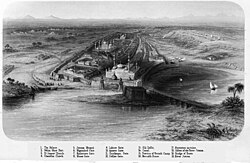
[[File:Delhi panorama 1857.jpg|thumb|A view from Old Delhi (year 1857) to mountains of the [[Himalaya range]]]] | |||
=== Effects on children === | |||
22 lakh (2,200,000) children in Delhi have irreversible lung damage due to poor air quality. In addition, research shows that pollution can lower children's [[immune system]] and increase the risks of [[cancer]], [[epilepsy]], [[diabetes]] and even adult-onset diseases like [[multiple sclerosis]]. Children are more vulnerable to the negative effects of air pollution as they are growing and developing due to breathing a higher rate of air per kilogram of their body weight. They also spend more time outside and are thus more exposed to it.<ref name="Harris, MAY 29, 2015">{{Cite news|last1=Harris|first1=Gardiner|title=Holding Your Breath in India|url=https://www.nytimes.com/2015/05/31/opinion/sunday/holding-your-breath-in-india.html?_r=0|work=SundayReview, New York Times|access-date=30 May 2015|date=29 May 2015}}</ref> | |||
===Effects on adults=== | |||
Poor air quality is a cause of reduced lung capacity, headaches, sore throats, coughs, fatigue, lung cancer, and early death.<ref name="Summary of risk assessment">{{cite web |date=2005 |title=WHO Air quality guidelines for particulate matter, ozone, nitrogen dioxide and sulfur dioxide Global update 2005 Summary of risk assessment |url=http://whqlibdoc.who.int/hq/2006/WHO_SDE_PHE_OEH_06.02_eng.pdf |access-date=31 May 2015 |publisher=WHO}}</ref><ref name="Harris, MAY 29, 2015"/> | |||
===Control measures=== | |||
{{Update|part=section|date=November 2024|reason=}} | |||
=== | |||
In 2016, the Chief Minister of Delhi proposed these measures to reduce air pollution but didn't get any success due to the lack of implementation in reality. The efficacy of any individual step has been a matter of public debate.<ref name="TNN_DSSBCW">{{cite web |date=6 November 2016 |title=Air pollution: Delhi shuts schools, bans construction work |url=http://timesofindia.indiatimes.com/city/delhi/Air-pollution-Delhi-shuts-schools-bans-construction-work/articleshow/55273297.cms |work=Times of India}}</ref> | |||
In 2016, the Chief Minister of Delhi | |||
* All Delhi schools will remain shut for the next few days. | * All Delhi schools will remain shut for the next few days. | ||
| Line 114: | Line 187: | ||
* People should stay at home as much as they can and they should try working from home. | * People should stay at home as much as they can and they should try working from home. | ||
* As per Faster Adoption and Manufacturing of Electric Vehicles in India scheme it is expected by 2030 all vehicles will be [[Battery electric vehicle|Battery electric]] and [[Hybrid electric vehicle|Hybrid]] | * As per Faster Adoption and Manufacturing of Electric Vehicles in India scheme it is expected by 2030 all vehicles will be [[Battery electric vehicle|Battery electric]] and [[Hybrid electric vehicle|Hybrid]] | ||
* All combustion engined vehicles will be upgraded to BS6 emission standards | * All combustion engined vehicles will be upgraded to [[Bharat stage emission standards|BS6 emission standards]] | ||
* Any vehicle older than 10–15 years or below BS6 emissions will be banned | * Any vehicle older than 10–15 years or below BS6 emissions will be banned | ||
* [[Smog tower]]s will be installed in the city to purify and clean the air | * [[Smog tower]]s will be installed in the city to purify and clean the air | ||
* The Pusa Bio-decomposer will help farmers harvest crops to prevent [[stubble burning]]. | * The Pusa Bio-decomposer will help farmers harvest crops to prevent [[stubble burning]]. | ||
* By 2021, the entire [[Delhi Metro]] is expected to be 100% powered by solar energy | * By 2021, the entire [[Delhi Metro]] is expected to be 100% powered by solar energy | ||
* In 2022, the Punjab Government announced they will purchase [[maize]], [[sorghum]], [[pearl millet]], [[sunflower]] and [[mung bean]] crops at MSP, encouraging farmers to adopt less water consuming options as a sustainable alternative to paddy and wheat in the wake of fast-depleting groundwater. | |||
In October 2020, Delhi authorities established a 10-member air pollution control team working in a dedicated conference room. They examine complaints received through the "Green Delhi" mobile app. As of 2020, they also regulate construction dust and ban diesel generators. Air pollution is an issue of special concern during the [[COVID-19 pandemic in India|COVID-19 pandemic]] because the virus can damage people's lungs and make them less able to cope with pollution.<ref>{{Cite web|date=8 October 2020|title=Delhi Gets "Green War Room" To Bring Down Pollution Levels This Winter|url=https://www.ndtv.com/delhi-news/delhi-gets-green-war-room-to-bring-down-pollution-levels-this-winter-2307162|access-date=2020-10-21|website=NDTV.com}}</ref><ref>{{Cite web|last1=Yeung|first1=Jessie|last2=Mitra|first2=Esha|last3=Sud|first3=Vedika|date=21 October 2020|title=India's pollution season could serve a double blow during Covid-19|url=https://www.cnn.com/2020/10/21/asia/india-pollution-covid-intl-hnk-scn-wellness/index.html|access-date=2020-10-21|website=CNN}}</ref> | In October 2020, Delhi authorities established a 10-member air pollution control team working in a dedicated conference room. They examine complaints received through the "Green Delhi" mobile app. As of 2020, they also regulate construction dust and ban diesel generators. Air pollution is an issue of special concern during the [[COVID-19 pandemic in India|COVID-19 pandemic]] because the virus can damage people's lungs and make them less able to cope with pollution.<ref>{{Cite web |date=8 October 2020 |title=Delhi Gets "Green War Room" To Bring Down Pollution Levels This Winter |url=https://www.ndtv.com/delhi-news/delhi-gets-green-war-room-to-bring-down-pollution-levels-this-winter-2307162 |access-date=2020-10-21 |website=NDTV.com}}</ref><ref>{{Cite web |last1=Yeung |first1=Jessie |last2=Mitra |first2=Esha |last3=Sud |first3=Vedika |date=21 October 2020 |title=India's pollution season could serve a double blow during Covid-19 |url=https://www.cnn.com/2020/10/21/asia/india-pollution-covid-intl-hnk-scn-wellness/index.html |access-date=2020-10-21 |website=CNN}}</ref> | ||
===Longer term measures=== | ===Longer term measures=== | ||
On 25 November 2017, the [[Supreme Court of India]] banned the sale of [[firecracker]]s in Delhi to alleviate pollution.<ref>{{cite news|title=Supreme Court bans sale of firecrackers in Delhi, NCR |url=http://timesofindia.indiatimes.com/home/environment/pollution/SC-bans-sale-of-fire-crackers-in-Delhi-NCR/articleshow/55617850.cms? |access-date=25 November 2016|work=[[Times of India]]}}</ref> | On 25 November 2017, the [[Supreme Court of India]] banned the sale of [[firecracker]]s in Delhi to alleviate pollution.<ref>{{cite news |title=Supreme Court bans sale of firecrackers in Delhi, NCR |url=http://timesofindia.indiatimes.com/home/environment/pollution/SC-bans-sale-of-fire-crackers-in-Delhi-NCR/articleshow/55617850.cms? |access-date=25 November 2016 |work=[[Times of India]]}}</ref> | ||
In another measure, the extremely polluting [[Badarpur power plant]] was permanently shut down on 15 October 2018.<ref name=":0">{{Cite web |last=Goswami |first=Sweta |date=5 October 2018 |title=Badarpur thermal plant, Delhi's biggest power generator, to shut down from October 15 |url=https://www.hindustantimes.com/delhi-news/badarpur-thermal-plant-delhi-s-biggest-power-generator-to-shut-down-from-october-15/story-6r1DhoDjb7G0yr48iv8IqI.html |url-status=dead |archive-url=https://web.archive.org/web/20190421060942/https://www.hindustantimes.com/delhi-news/badarpur-thermal-plant-delhi-s-biggest-power-generator-to-shut-down-from-october-15/story-6r1DhoDjb7G0yr48iv8IqI.html |archive-date=21 April 2019 |access-date=10 November 2018 |website=Hindustan Times}}</ref><ref name=":1">{{Cite news |last=Shrangi |first=Vatsala |date=16 October 2018 |title=Badarpur power plant shut, action plan to tackle air pollution in Delhi-NCR comes into force |url=https://www.hindustantimes.com/delhi-news/badarpur-power-plant-shut-action-plan-to-tackle-air-pollution-in-delhi-ncr-comes-into-force/story-Exu4ZryrjCEYZN2Wzpgs9H.html |access-date=10 November 2018 |work=Hindustan Times}}</ref> In October, 2020 the union environment ministry formed a commission for Air Quality Management in the National capital region and Adjoining Area Ordinance.<ref>{{Cite web |last=Nihar |date=27 October 2020 |title=Air pollution: Centre issues ordinance to form new commission to replace EPCA |url=https://www.hindustantimes.com/india-news/centre-issues-ordinance-to-form-new-commission-to-replace-sc-mandated-epca/story-nWagkwXA33KzD42FbWsTFN.html |access-date=2020-10-29 |website=hindustantimes.com |language=en}}</ref> | |||
In 2023, the Supreme Court advised the [[Government of Punjab, India|Punjab Government]] to reconsider the Punjab Preservation of Subsoil Water Act, 2009, a state law aimed at conserving groundwater. The law prohibits sowing of paddy seeds before 10 May every year and transplantation before 10 June. It allows the crop to be sown only during the monsoon months and as a result encourages stubble burning due to restricted cultivation period.<ref>{{Cite web |last=Jain |first=Akshat |date=2023-11-09 |title=What is the Punjab groundwater conservation law & why it's being blamed for Delhi's air pollution |url=https://theprint.in/theprint-essential/what-is-the-punjab-groundwater-conservation-law-why-its-being-blamed-for-delhis-air-pollution/1838049/ |access-date=2024-11-19 |website=ThePrint |language=en-US}}</ref> | |||
== Great Smog of 2016–2017 == | |||
{{Infobox event | |||
| title = Great Smog of 2016–2017 | |||
| image = Low visibility due to Smog at New Delhi Railway station 31st Dec 2017 after 9AM DSCN8829 1.jpg | |||
| caption = Low visibility due to [[Smog]] at [[New Delhi railway station]] 31 December 2017. Railway building is not visible. | |||
| time = | |||
| place = [[Delhi]], India | |||
| coordinates = | |||
| cause = | |||
| casualties1 = | |||
| casualties2 = | |||
}} | |||
The Great Smog of Delhi was a severe air-pollution event in [[New Delhi]] and adjoining areas in the [[National Capital Territory]] of [[India]].<ref name="HT_DWSYWUG">{{cite web |last=Goswami |first=Sweta |date=7 November 2016 |title=Delhi's worst smog yet wakes up govt, emergency measures announced |url=http://www.hindustantimes.com/delhi/delhi-sees-season-s-worst-air-quality-kejriwal-announces-emergency-steps/story-J11rGcyCdk2wn6T4jqxG2O.html |work=Hindustan Times}}</ref> [[Air pollution in India|Air pollution]] in 2016 peaked on both PM<sub>2.5</sub> and PM<sub>10</sub> levels.<ref name="PTI_DWUTHPL">{{cite web |date=2 November 2016 |title=Delhi wakes up to hazardous pollution levels, reduced visibility due to smog |url=http://indianexpress.com/article/cities/delhi/delhi-wakes-up-to-hazardous-pollution-levels-low-visibility-due-to-smog-3733302/ |work=Indian Express}}</ref> It was reported as one of the worst levels of air quality in Delhi since 1980.<ref name="PT_DPGIHAASCC">{{cite web |date=8 November 2016 |title=Delhi pollution: Government issues health advisory as smog chokes city |url=http://www.hindustantimes.com/delhi/delhi-pollution-government-issues-health-advisory-as-smog-chokes-city/story-byUVNCraAWGH5CQ3usVsaN.html |work=Hindustan Times}}</ref> | |||
Low visibility resulted in accidents across the city, notably a 24-vehicle pile-up on the [[Yamuna Expressway]].<ref>{{Cite news |title=Blinding Smog Causes 24-Vehicle Pile-Up on Expressway Near Delhi |url=https://www.ndtv.com/delhi-news/delhis-toxic-smog-leads-to-24-car-accident-on-yamuna-expressway-1772758 |access-date=9 November 2017 |work=NDTV.com}}</ref> | |||
"The Great Smog" also led to cancellation and delay of public transport, primarily trains and flights.<ref>{{Cite news |date=6 November 2016 |title=Delhi wakes up to dense smog; train services suspended due to low visibility |url=http://www.timesnownews.com/india/video/delhi-smog-delhi-pollution-latest-updates-delhi-weather-updates-new-delhi-ncr-chandigarh-air/120194 |access-date=9 November 2017 |work=timesnownews.com |agency=Times Now Bureau}}</ref> | |||
; Source of pollution | |||
Majority of analysis sources are hinted towards colder weather, stagnant winds trapping the various sources of smoke. The primary sources of smoke are power plants, [[stubble burning]], lit garbage, road dust, factories, and vehicles.{{Citation needed|date=January 2025}} | |||
On 7 November 2016 the PM<sub>2.5</sub> levels in Delhi shot up to a high of 999, much above the recommended 60 micrograms. At the same time, PM<sub>10</sub> also shot up to 999 (the maximum level for the monitors), instead of the recommended limit of 100.<ref name="PTI_PWPMSD" /> | |||
Again, on 8 November 2016 the PM<sub>2.5</sub> levels shot up to 449. At the same time PM<sub>10</sub> levels shot up to 663.<ref>{{cite web |date=8 November 2016 |title=Delhi Smog and band aid efforts to patch it |url=http://theindependent.in/delhi-and-band-aid-efforts-to-patch-it/ |publisher=theindependent.in}}</ref> | |||
The temperature in New Delhi during this period was from {{convert|15|to|29|°C}}. | |||
According to a real-time source apportionment study conducted by the Delhi Pollution Control Committee (DPCC) in 2023, the burning of local organic waste—which includes wood, cow dung cakes, and agricultural or other waste burned for heating needs—contributes '''24%''' to '''PM2.5 concentrations''' in Delhi during the winter season, when the demand for household heating rises. During this period, the impact of local sources such as the '''transport sector''' also increases, contributing approximately '''23%''' to PM2.5<ref>{{Cite web |title=दिल्ली में बढ़ता वायु प्रदूषण संकट: बदलते स्रोतों, AQI रुझानों और स्थानीय-क्षेत्रीय योगदान का गहन विश्लेषण |url=https://www.teriin.org/article/delhi-vayu-pradhushan-stotra-aqi-sthaniya-vishleshan |access-date=2025-05-01 |website=www.teriin.org |language=en}}</ref> levels (TERI, 2019). | |||
=== Incidents === | |||
During the second day of the third test of [[Sri Lankan cricket team in India in 2017-18]] at [[Delhi]], the smog forced Sri Lanka cricketers to stop playing and wear anti-pollution masks. Cricketer [[Lahiru Gamage]] reported to have [[shortness of breath]].<ref>{{Cite news |title=Pollution stops play at Delhi test match as bowlers struggle to breathe |url=https://www.theguardian.com/world/2017/dec/03/pollution-stops-play-at-delhi-test-match-as-bowlers-struggle-to-breathe}}</ref> [[Nic Pothas]], coach of Sri Lankan cricket team, reported that cricketer [[Suranga Lakmal]] had vomited regularly due to severe pollution effect on the Delhi ground. There was a halt of play from 12:32 pm to 12:49 pm which caused Indian coach [[Ravi Shastri]] to come out aggressively and have a talk with the field umpire [[David Boon]].<ref>{{Cite web |title=India vs Sri Lanka, 3rd Test: "Angry" Ravi Shastri Marched on to the Field. Twitter Trolled Him {{pipe}} Cricket News |url=https://sports.ndtv.com/india-vs-sri-lanka-2017-18/india-vs-sri-lanka-3rd-test-angry-ravi-shastri-marched-on-to-the-field-twitter-trolled-him-1783278 |url-status=dead |archive-url=https://web.archive.org/web/20181031175252/https://amp.sports.ndtv.com/india-vs-sri-lanka-2017-18/india-vs-sri-lanka-3rd-test-angry-ravi-shastri-marched-on-to-the-field-twitter-trolled-him-1783278?akamai-rum=off |archive-date=31 October 2018 |access-date=31 October 2018}}</ref> | |||
=== State reaction === | |||
A Health Emergency was declared in the capital by the Central Government of India to cope with the extrusive amount of polluted air. The day was declared as a holiday for schools, offices and other government centres.{{Citation needed|date=January 2025}} | |||
; Health effects | |||
The government of Delhi has declared a health advisory for the following.<ref name="PT_DPGIHAASCC" /> | |||
* Breathlessness | |||
* Chest constriction | |||
* Irritation in eyes | |||
* Asthma | |||
* Allergy | |||
==Air quality monitoring stations== | ==Air quality monitoring stations== | ||
[[File:2018 Air Pollution in NewDelhi (PM2.5 AQI).svg|thumb|Days with healthy (= green) or unhealthy conditions with air pollution in year 2018.<br />[[PM 2.5]], [[Air quality index#India|air quality index]].]] | [[File:2018 Air Pollution in NewDelhi (PM2.5 AQI).svg|thumb|Days with healthy (= green) or unhealthy conditions with air pollution in year 2018.<br />[[PM 2.5]], [[Air quality index#India|air quality index]].]] | ||
The [[Indian Meteorological Department]] has [[air quality monitoring]] stations in [[Mathura Road]], Delhi (Jor Bagh area), [[IGI Airport]], IITM Delhi,{{clarify|What is IITM?|date=November 2021}} Guru Teg Bahadur Hospital ([[Ghaziabad, Uttar Pradesh|Ghaziabad]] area), Dhirpur, [[Delhi Technological University]], [[Pitampura]], Shaheed Sukhdev College of Business Studies (Rohini), Aya Nagar ([[Gurgaon]]), and [[Noida]].<ref name="Monitoring Stations">{{cite web|title=Monitoring Stations|url=http://safar.tropmet.res.in/|website=System of Air Quality Weather Forecasting and Research, [[Indian Institute of Tropical Meteorology]], Pune|publisher=[[Ministry of Earth Sciences]], Govt.of India|access-date=2 June 2015|date=2015}}</ref> The air pollution monitor of the [[U.S. Embassy in New Delhi]] covers the area of [[Chanakyapuri]].<ref name="Air Quality Data, US">{{cite web|title=Air Quality Data|url=http://newdelhi.usembassy.gov/airqualitydata.html|publisher=usembassy|access-date=30 May 2015|location=New Delhi, India|date=30 May 2015|archive-url=https://web.archive.org/web/20150611125821/http://newdelhi.usembassy.gov/airqualitydata.html|archive-date=11 June 2015|url-status=dead}}</ref> | The [[Indian Meteorological Department]] has [[air quality monitoring]] stations in [[Mathura Road]], Delhi (Jor Bagh area), [[IGI Airport]], IITM Delhi,{{clarify|What is IITM?|date=November 2021}} Guru Teg Bahadur Hospital ([[Ghaziabad, Uttar Pradesh|Ghaziabad]] area), Dhirpur, [[Delhi Technological University]], [[Pitampura]], Shaheed Sukhdev College of Business Studies (Rohini), Aya Nagar ([[Gurgaon]]), and [[Noida]].<ref name="Monitoring Stations">{{cite web|title=Monitoring Stations|url=http://safar.tropmet.res.in/|website=System of Air Quality Weather Forecasting and Research, [[Indian Institute of Tropical Meteorology]], Pune|publisher=[[Ministry of Earth Sciences]], Govt. of India|access-date=2 June 2015|date=2015}}</ref> The air pollution monitor of the [[U.S. Embassy in New Delhi]] covers the area of [[Chanakyapuri]].<ref name="Air Quality Data, US">{{cite web|title=Air Quality Data|url=http://newdelhi.usembassy.gov/airqualitydata.html|publisher=usembassy|access-date=30 May 2015|location=New Delhi, India|date=30 May 2015|archive-url=https://web.archive.org/web/20150611125821/http://newdelhi.usembassy.gov/airqualitydata.html|archive-date=11 June 2015|url-status=dead}}</ref> | ||
==Response of expatriates and government== | ==Response of expatriates and government== | ||
To contend with the poor air quality, embassies and international businesses in Delhi are considering reducing staff tenures, advising staff to reconsider bringing their children to Delhi, providing high-end [[air purifiers]], and installing expensive air purifiers in their offices.<ref name="GARDINER HARRIS, 14/2"/><ref>{{cite news |url=https://air8.tech/air-purifier-for-offices/ |title=Air Cleaning Technology: Air Purifier for Offices |work=Air Eight |access-date=18 March 2019 }}</ref><ref name=ab>{{Cite web|date=November 17, 2021|first1=Amit|last1=Bhardwaj|first2=Milan|last2=Sharma|title=Delhi-NCR schools, colleges shut till further notice; offices asked to do 50% WFH as air quality dips|url=https://www.indiatoday.in/cities/delhi/story/schools-colleges-delhi-ncr-remain-shut-till-further-notice-poor-air-quality-1877521-2021-11-17|access-date=2021-11-17|website=India Today|language=en}}</ref> | To contend with the poor air quality, embassies and international businesses in Delhi are considering reducing staff tenures, advising staff to reconsider bringing their children to Delhi, providing high-end [[air purifiers]], and installing expensive air purifiers in their offices.<ref name="GARDINER HARRIS, 14/2">{{Cite news |last1=Harris |first1=Gardiner|title=Delhi Wakes Up to an Air Pollution Problem It Cannot Ignore|url=https://www.nytimes.com/2015/02/15/world/asia/delhi-wakes-up-to-an-air-pollution-problem-it-cannot-ignore.html|work=[[The New York Times]]|access-date=30 May 2015|date=14 February 2015}}</ref><ref>{{cite news |url=https://air8.tech/air-purifier-for-offices/ |title=Air Cleaning Technology: Air Purifier for Offices |work=Air Eight |access-date=18 March 2019 }}</ref><ref name=ab>{{Cite web|date=November 17, 2021|first1=Amit|last1=Bhardwaj|first2=Milan|last2=Sharma|title=Delhi-NCR schools, colleges shut till further notice; offices asked to do 50% WFH as air quality dips|url=https://www.indiatoday.in/cities/delhi/story/schools-colleges-delhi-ncr-remain-shut-till-further-notice-poor-air-quality-1877521-2021-11-17|access-date=2021-11-17|website=India Today|language=en}}</ref> | ||
On 14 November 2021 the air quality index of [[Delhi]] reached 465 and in response to the severe air quality index, the [[Government of Delhi|Delhi government]] announced the closure of all educational institutions for a week from November 15 after the [[Supreme court|Supreme Court]] raised concerns over the deteriorating air quality index.<ref>{{Cite web|title=School Closed: प्रदूषण के कारण दिल्ली के बाद हरियाणा के इन चार जिलों में भी बंद हुए स्कूल|url=https://www.aajtak.in/education/news/story/school-closed-in-haryana-4-districts-schools-shuts-till-november-17-due-to-air-pollution-lbse-1357209-2021-11-15|access-date=2021-11-17|website= | On 14 November 2021, the air quality index of [[Delhi]] reached 465 and in response to the severe air quality index, the [[Government of Delhi|Delhi government]] announced the closure of all educational institutions for a week from November 15 after the [[Supreme court|Supreme Court]] raised concerns over the deteriorating air quality index.<ref>{{Cite web|title=School Closed: प्रदूषण के कारण दिल्ली के बाद हरियाणा के इन चार जिलों में भी बंद हुए स्कूल|url=https://www.aajtak.in/education/news/story/school-closed-in-haryana-4-districts-schools-shuts-till-november-17-due-to-air-pollution-lbse-1357209-2021-11-15|access-date=2021-11-17|website=Aaj Tak|date=15 November 2021 |language=hi}}</ref><ref>{{Cite web|title=दिल्ली: 'एयर इमरजेंसी' पर हड़कंप, प्रदूषण को लेकर सुप्रीम कोर्ट ने की तीखी टिप्पणी|url=https://www.aajtak.in/programmes/aaj-subah/video/air-emergency-crisis-in-delhi-ncr-supreme-court-hearing-on-pollution-firecrackers-stubble-burning-1358397-2021-11-17|access-date=2021-11-17|website=Aaj Tak|date=17 November 2021 |language=hi}}</ref> On 17 November, as there was no improvement of the condition of the air quality index in Delhi. The Commission for Air Quality Monitoring (CAQM) directed that all schools, colleges and educational institutions will be closed until further notice, in Delhi and in NCR. Other than this the entry of trucks has been banned in Delhi; all construction activities have been halted until 21 November 2021 and 6 out of 11 thermal power plants in Delhi in a radius of 300 km have been shut down until 30 November, in an effort to reduce pollution and improve the air quality index.<ref>{{Cite web|title=Pollution: दिल्ली-NCR के स्कूल-कॉलेज अगले आदेश तक बंद, दफ्तरों और कंस्ट्रक्शन पर भी पाबंदियां|url=https://www.aajtak.in/india/delhi/story/delhi-ncr-schools-colleges-shut-till-further-notice-office-work-from-home-construction-ntc-1358241-2021-11-17|access-date=2021-11-17|website=Aaj Tak|date=17 November 2021 |language=hi}}</ref><ref name=ab/><ref>{{Cite web|title=Watch: Delhi schools to reopen from Nov 29|url=https://www.indiatoday.in/india/video/watch-delhi-schools-to-reopen-from-nov-29-1881712-2021-11-28|access-date=2021-11-29|website=India Today|date=28 November 2021 |language=en}}</ref><ref>{{Cite web|title=Delhi: वायु गुणवत्ता बेहद खराब श्रेणी में, चिंताजनक हालात के बीच खोले गए स्कूल-कॉलेज|url=https://www.aajtak.in/india/delhi/video/delhi-school-reopen-amid-poor-air-quality-very-poor-category-pollution-1364750-2021-11-29|access-date=2021-11-29|website=Aaj Tak|date=29 November 2021 |language=hi}}</ref> | ||
The Delhi government said that to control the pollution in Delhi they will also be adding 1000 extra CNG buses | The Delhi government said that to control the pollution in Delhi they will also be adding 1000 extra [[Compressed natural gas|CNG]] buses to the fleet. The Civil Defense Unit will also be checking the registrations and pollution certificates of the cars randomly to curb the pollution. Diesel cars above 10 years and Petrol cars above 15 years of age are banned in Delhi due to the pollution they cause.<ref>{{Cite web|title=Delhi Pollution पर एक्शन... 1000 एक्स्ट्रा CNG बसें उतरेंगी, गैस आधारित इंडस्ट्री को छोड़ बाकी पर बैन|url=https://www.aajtak.in/india/delhi/story/delhi-pollution-ban-on-construction-work-from-home-delhi-gov-action-ntc-1358449-2021-11-17|access-date=2021-11-17|website=Aaj Tak|date=17 November 2021 |language=hi}}</ref> | ||
The [[Supreme Court of India]] also suggested that government officers living in government colonies should either commute by [[Carpool|car pooling]] together or by [[public transport]].<ref>{{Cite twitter |title=Supreme Court suggests that Central government officers living in government colonies travel in public transport |user=ani |number=1460867576242704384|access-date=2021-11-17|website=Twitter|language=en}}</ref> | The [[Supreme Court of India]] also suggested that government officers living in government colonies should either commute by [[Carpool|car pooling]] together or by [[public transport]].<ref>{{Cite twitter |title=Supreme Court suggests that Central government officers living in government colonies travel in public transport |user=ani |number=1460867576242704384|access-date=2021-11-17|website=Twitter|language=en}}</ref> | ||
On 18 November Uttar Pradesh Pollution Control Board announced that schools will no longer be closed due to air pollution in Noida and Ghaziabad.<ref>{{Cite web|title=Air Pollution: नोएडा-गाजियाबाद में नहीं बंद होंगे | On 18 November, the Uttar Pradesh Pollution Control Board announced that schools will no longer be closed due to air pollution in Noida and Ghaziabad.<ref>{{Cite web|title=Air Pollution: नोएडा-गाजियाबाद में नहीं बंद होंगे स्कूल-कॉलेज, DM का फैसला हुआ वापस|url=https://www.aajtak.in/education/news/story/air-pollution-in-delhi-updates-school-colleges-to-remain-open-in-noida-ghaziabad-says-up-pollution-control-board-lbse-1358912-2021-11-18|access-date=2021-11-18|website=Aaj Tak|date=18 November 2021 |language=hi}}</ref> | ||
In view of pollution, the demand for air purifiers has increased significantly in Delhi-NCR. According to the available data, out of the total sales in the country, 70% of the demand is coming from Delhi-NCR. However, companies say that the demand for air purifiers has increased from other parts of the country as well.<ref>{{Cite web|title=दमघोंटू हवा ने बढ़ा दी Air purifiers की बिक्री, खरीदने वाले 70% लोग दिल्ली-NCR से|url=https://www.aajtak.in/india/news/story/pollution-leads-to-rise-in-sales-of-air-purifiers-70-percent-sale-comes-from-delhi-ncr-ntc-1359002-2021-11-18|access-date=2021-11-18|website= | In view of pollution, the demand for air purifiers has increased significantly in Delhi-NCR. According to the available data, out of the total sales in the country, 70% of the demand is coming from Delhi-NCR. However, companies say that the demand for air purifiers has increased from other parts of the country as well.<ref>{{Cite web|title=दमघोंटू हवा ने बढ़ा दी Air purifiers की बिक्री, खरीदने वाले 70% लोग दिल्ली-NCR से|url=https://www.aajtak.in/india/news/story/pollution-leads-to-rise-in-sales-of-air-purifiers-70-percent-sale-comes-from-delhi-ncr-ntc-1359002-2021-11-18|access-date=2021-11-18|website=Aaj Tak|date=18 November 2021 |language=hi}}</ref> | ||
The Delhi Government on 27 November 2021, banned the entry of commercial petrol and diesel vehicles in Delhi in view of the increasing pollution in Delhi.<ref>{{Cite web|title=Pollution Update: दिल्ली पर प्रदूषण की मार, राजधानी की हवा आज भी बेहद खराब, 3 दिसंबर तक इन गाड़ियों पर रोक|url=https://www.aajtak.in/india/delhi/story/air-quality-index-today-27-nov-delhi-pollution-government-bans-entry-on-commercial-petrol-diesel-vehicles-due-to-poor-aqi-lbs-1363811-2021-11-27|access-date=2021-11-29|website= | The Delhi Government on 27 November 2021, banned the entry of commercial petrol and diesel vehicles in Delhi in view of the increasing pollution in Delhi.<ref>{{Cite web|title=Pollution Update: दिल्ली पर प्रदूषण की मार, राजधानी की हवा आज भी बेहद खराब, 3 दिसंबर तक इन गाड़ियों पर रोक|url=https://www.aajtak.in/india/delhi/story/air-quality-index-today-27-nov-delhi-pollution-government-bans-entry-on-commercial-petrol-diesel-vehicles-due-to-poor-aqi-lbs-1363811-2021-11-27|access-date=2021-11-29|website=Aaj Tak|date=27 November 2021 |language=hi}}</ref><ref>{{Cite web|date=November 2, 2021|title=AQI crisis: Delhi bans entry of commercial petrol and diesel vehicles till Dec 3; CNG, EVs exempted|url=https://www.indiatoday.in/cities/delhi/story/pollution-spike-delhi-bans-entry-of-petrol-and-diesel-vehicles-till-dec-3-cng-evs-exempted-1880762-2021-11-25|access-date=2021-11-29|website=India Today|language=en}}</ref> On 1 March 2025, the Delhi Government decided that fuel stations will stop providing fuel to vehicles older than 15 years starting 1 April 2025, in an effort to reduce vehicular air pollution.<ref>{{Cite news |date=2025-03-01 |title=From April, no fuel for vehicles older than 15 years in Delhi as government tightens rules to tackle pollution |url=https://timesofindia.indiatimes.com/india/from-april-no-fuel-for-vehicles-older-than-15-years-in-delhi-as-government-tightens-rules-to-tackle-pollution/articleshow/118648283.cms |access-date=2025-03-01 |work=The Times of India |issn=0971-8257}}</ref> | ||
In October 2025, Delhi Government was criticized for suppressing<ref>{{Cite news |date=2025-10-22 |title=Delhi air pollution: At peak hours, data goes blank at many stations; experts raise alarm |url=https://timesofindia.indiatimes.com/city/delhi/as-pollution-peaks-many-stns-go-blank/articleshow/124727657.cms |access-date=2025-10-29 |work=The Times of India |issn=0971-8257}}</ref> and tampering<ref>{{Cite web |date=2025-10-27 |title=Sprinklers continue rounds at monitoring stations amid row over air pollution in Delhi |url=https://indianexpress.com/article/cities/delhi/sprinklers-continue-rounds-at-monitoring-stations-amid-row-over-air-pollution-in-delhi-10328796/ |access-date=2025-10-29 |website=The Indian Express |language=en}}</ref><ref>{{Cite web |last=Grover |first=Samarth |date=2025-10-27 |title=Ground still wet, air stays toxic: A reality check at Anand Vihar air monitor after water sprinkler video |url=https://www.newslaundry.com/2025/10/27/ground-still-wet-air-stays-toxic-a-reality-check-at-anand-vihar-air-monitor-after-water-sprinkler-video |access-date=2025-10-29 |website=Newslaundry |language=en}}</ref> with data from [[Environmental monitoring#Air quality monitoring|air-quality monitoring stations]] during worst periods of air-pollution resulting from [[Diwali#Hazards|Diwali celebrations]].<ref>{{Cite web |last=Sharma |first=Milan |date=2025-10-27 |title=Delhi AQI data gap exposed: Only 11 of 39 stations recorded air quality on Diwali night |url=https://www.indiatoday.in/cities/delhi/story/delhi-cpcb-aqi-data-gap-exposed-only-11-stations-recorded-air-quality-diwali-night-2809139-2025-10-27 |access-date=2025-10-29 |website=India Today |language=en}}</ref> Following this, cloud seeding was conducted over Delhi so that rains can settle pollutants and improve the air quality but the experiment yielded no significant results.<ref>{{Cite news |date=2025-10-29 |title=No artificial rain after cloud seeding: Experts decode why Delhi’s Rs 3.2 crore experiment fell flat |url=https://timesofindia.indiatimes.com/city/delhi/artificial-rain-costly-and-unsustainable-measure-say-experts/articleshow/124880965.cms |access-date=2025-10-29 |work=The Times of India |issn=0971-8257}}</ref><ref>{{Cite web |date=2025-10-29 |title=Silver flares fired into clouds: Delhi takes two shots at summoning rain |url=https://indianexpress.com/article/cities/delhi/delhis-cloud-seeding-op-kicks-off-aircraft-takes-off-from-kanpur-where-will-it-rain-10331824/ |access-date=2025-10-29 |website=The Indian Express |language=en}}</ref><ref>{{Cite journal |last=Srivastava |first=Vanita |date=2025-10-24 |title=Delhi turns to cloud seeding as air quality crisis deepens |url=https://www.nature.com/articles/d44151-025-00191-2 |journal=Nature India |language=en |doi=10.1038/d44151-025-00191-2 |issn=1755-3180|url-access=subscription }}</ref><ref>{{cite web |title=Delhi pollution: Citizens protest against toxic air in Capital; demand action |url=https://timesofindia.indiatimes.com/india/delhi-pollution-citizens-protest-against-toxic-air-in-capital-demand-action/articleshow/125201887.cms |website=The Times of India |access-date=9 November 2025 |language=en-in |date=9 November 2025}}</ref><ref>{{cite web |last1=Singh |first1=Ratna |title=Organisers of Delhi protest against air pollution allege police pressured them to call off stir |url=https://scroll.in/latest/1088408/delhi-organisers-of-protest-against-air-pollution-allege-police-pressured-them-to-call-off-stir |website=Scroll.in |access-date=9 November 2025 |language=en-in |date=9 November 2025}}</ref> | |||
== Major incidents == | == Major incidents == | ||
In December 2017 during [[Sri Lankan cricket team in India in 2017–18#3rd Test|a test match]] between [[Sri Lanka cricket team|Sri Lankan]] and [[Indian cricket team|Indian]] cricket teams in New Delhi, Sri Lanka players began to feel breathing problems and several players vomited both in the restrooms and in the field and had to use face masks until the match was stopped.<ref name="Safi">{{Cite news|url=https://www.theguardian.com/world/2017/dec/03/pollution-stops-play-at-delhi-test-match-as-bowlers-struggle-to-breathe|title=Pollution stops play at Delhi Test match as bowlers struggle to breathe|last=Safi|first=Michael|date=3 December 2017|work=The Guardian|access-date=5 December 2017|language=en-GB|issn=0261-3077}}</ref> | In December 2017 during [[Sri Lankan cricket team in India in 2017–18#3rd Test|a test match]] between [[Sri Lanka cricket team|Sri Lankan]] and [[Indian cricket team|Indian]] cricket teams in New Delhi, Sri Lanka players began to feel breathing problems and several players vomited both in the restrooms and in the field and had to use face masks until the match was stopped.<ref name="Safi">{{Cite news|url=https://www.theguardian.com/world/2017/dec/03/pollution-stops-play-at-delhi-test-match-as-bowlers-struggle-to-breathe|title=Pollution stops play at Delhi Test match as bowlers struggle to breathe|last=Safi|first=Michael|date=3 December 2017|work=The Guardian|access-date=5 December 2017|language=en-GB|issn=0261-3077}}</ref> | ||
In the opinion of the [[Indian Medical Association]] president, the match should never have taken place and the [[International Cricket Council|ICC]] should have a policy on pollution.<ref>{{Cite journal|last1=Hartman|first1=F. C.|last2=LaMuraglia|first2=G. M.|last3=Tomozawa|first3=Y.|last4=Wolfenden|first4=R.|date=1975-12-02|title=The influence of pH on the interaction of inhibitors with triosephosphate isomerase and determination of the pKa of the active-site carboxyl group|journal=Biochemistry|volume=14|issue=24|pages=5274–5279|doi=10.1021/bi00695a007|issn=0006-2960|pmid=47}}</ref> | |||
In [[2024 Indo-Pakistani smog|November 2024]], pollution levels in [[Delhi]] reached drastic measures following increased fire activity in India and Pakistan's Punjab region as farmers burn off excess straw, caused a significant smog on the morning of 8 November, causing it to momentarily become the most polluted city in the world<ref>{{Cite news|url=https://www.reuters.com/article/business/environment/new-delhi-is-worlds-most-polluted-capital-for-third-straight-year-iqair-study-idUSKBN2B817E/|title=New Delhi is world's most polluted capital for third straight year|last=Arora|first=Neha|date=March 16, 2021|publisher=Reuters}}</ref>. Delhi again became the most polluted city in the world on 12 November, reaching an AQI reading of 1,200.<ref name=":2">{{Cite web |last=Shafiq |first=Saman |title=India, Pakistan blanketed in smog so thick, it's visible from space: See pictures |url=https://www.usatoday.com/story/news/world/2024/11/12/india-pakistan-toxic-smog-smoke/76222117007/ |access-date=2024-11-12 |website=USA TODAY |language=en-US}}</ref> | |||
== Public reaction == | |||
On November 9, 2025, hundreds of people, including children and activists, protested at India Gate in New Delhi, against the dangerous levels of air pollution. The air quality index (AQI) was often above 300-400, making it a health emergency. Protesters called for immediate government action, criticizing years of neglecting the issue and manipulating pollution data. They blamed vehicle emissions, crop burning, and industrial waste for worsening pollution. Despite the peaceful nature of the protest, police detained about 80 people, though they were later released.<ref>{{Cite web |date=2025-11-10 |title=Air pollution: Hundreds protest in Delhi against toxic air |url=https://www.bbc.com/news/articles/c1k02lregw0o |access-date=2025-11-10 |website=www.bbc.com |language=en-GB}}</ref> | |||
==See also== | ==See also== | ||
{{portal | {{portal|Environment}} | ||
{{Div col|colwidth=25em}} | {{Div col|colwidth=25em}} | ||
* [[Air pollution measurement]] | |||
* [[Criteria air pollutants]] | * [[Criteria air pollutants]] | ||
* [[Environmental issues in Delhi]] | * [[Environmental issues in Delhi]] | ||
*[[List of most polluted cities by particulate matter concentration | * [[List of most polluted cities by particulate matter concentration]] | ||
{{div col end}} | {{div col end}} | ||
| Line 167: | Line 293: | ||
==Further reading== | ==Further reading== | ||
* Cherni, Judith A. ''Economic Growth versus the Environment: The Politics of Wealth, Health and Air Pollution'' (2002) [https://www.questia.com/library/102251606/economic-growth-versus-the-environment-the-politics online] | * Cherni, Judith A. ''Economic Growth versus the Environment: The Politics of Wealth, Health and Air Pollution'' (2002) [https://www.questia.com/library/102251606/economic-growth-versus-the-environment-the-politics online] | ||
* Currie, Donya. "WHO: Air Pollution a Continuing Health Threat in World's Cities," ''The Nation's Health'' (February 2012) 42#1 [https://www.questia.com/article/1G1-280406027/who-air-pollution-a-continuing-health-threat-in-world-s online] | * Currie, Donya. "WHO: Air Pollution a Continuing Health Threat in World's Cities," ''The Nation's Health'' (February 2012) 42#1 [https://www.questia.com/article/1G1-280406027/who-air-pollution-a-continuing-health-threat-in-world-s online] {{Webarchive|url=https://web.archive.org/web/20150402122918/https://www.questia.com/article/1G1-280406027/who-air-pollution-a-continuing-health-threat-in-world-s |date=2 April 2015 }} | ||
* Amann, M., Purohit, P., Bertok, I., Bhandarkar, A.D., | * Dholakia, H.H., Purohit, P., Rao, S., Garg, A. 2013. Impact of current policies on future air quality and health outcomes in Delhi, India. Atmospheric Environment, 75, 241-248, [https://doi.org/10.1016/j.atmosenv.2013.04.052] | ||
* | * Amann, M., Purohit, P., Bertok, I., Bhandarkar, A.D., Borken-Kleefeld, J., Cofala, J., Harshvardhan, B., Heyes, C., Kiesewetter, G., Klimont, Z., Jun, L., Majumdar, D., Ngyuen, B., Rafaj, P., Rao., P.S., Sander, R., Schöpp, W., Shrivastava, A. 2017. Managing future air quality in megacities: A case study for Delhi. Atmospheric Environment, 161: 99–111. [http://www.sciencedirect.com/science/article/pii/S1352231017302856] | ||
* Bhalla, N., O'Boyle, J., & Haun, D. (2019). Who is responsible for Delhi air pollution? Indian | * Bhanarkar, A.D., Purohit, P., Rafaj, P., Amann, M., Bertok, I., Cofala, J., Rao, P.S., HarshaVardhan, B., Kiesewetter, G., Sander, R., Schöpp, W., Majumdar, D., Srivastava, A., Deshmukh, S., Kawarti, A., Kumar, R. 2018. Managing future air quality in megacities: Co-benefit assessment for Delhi. Atmospheric Environment, Vol. 186, pp. 158–177 [https://doi.org/10.1016/j.atmosenv.2018.05.026] | ||
* Bhalla, N., O'Boyle, J., & Haun, D. (2019). Who is responsible for Delhi air pollution? Indian newspapers' framing of causes and solutions. International Journal of Communication, 13, 24. [https://ijoc.org/index.php/ijoc/article/view/8312/2521] | |||
==External links== | ==External links== | ||
* [https://airquality.cpcb.gov.in/AQI_India/ India real-time air quality index map] from the [[Central Pollution Control Board]] | |||
* [ | |||
* [http://www.urbanairquality.org/ International Conference on Urban Air Quality] {{Webarchive|url=https://web.archive.org/web/20081216144156/http://www.urbanairquality.org/ |date=16 December 2008 }}. | * [http://www.urbanairquality.org/ International Conference on Urban Air Quality] {{Webarchive|url=https://web.archive.org/web/20081216144156/http://www.urbanairquality.org/ |date=16 December 2008 }}. | ||
* [https://web.archive.org/web/20110927100158/http://www.who.int/phe/health_topics/outdoorair/databases/en/index.html Database: outdoor air pollution in cities] from the [[World Health Organization]] | * [https://web.archive.org/web/20110927100158/http://www.who.int/phe/health_topics/outdoorair/databases/en/index.html Database: outdoor air pollution in cities] from the [[World Health Organization]] | ||
*[https://web.archive.org/web/20150924035825/http://www.iom-world.org/pubs/IOM_TM0301.pdf Impact assessment of the mortality effects of longer-term exposure to air pollution: exploring cause-specific mortality and susceptibility] by BG Miller. [[Institute of Occupational Medicine]] Research Report TM/03/01<br /> | |||
*[https://web.archive.org/web/20150924035825/http://www.iom-world.org/pubs/IOM_TM0301.pdf Impact assessment of the mortality effects of longer-term exposure to air pollution: exploring cause-specific mortality and susceptibility] by BG Miller. [[Institute of Occupational Medicine]] Research Report TM/03/01 | {{DEFAULTSORT:Air pollution in Delhi}} | ||
{{DEFAULTSORT: | |||
[[Category:Social issues in India]] | [[Category:Social issues in India]] | ||
[[Category:Air pollution in India]] | [[Category:Air pollution in India]] | ||
[[Category:New Delhi | [[Category:New Delhi]] | ||
[[Category:Environment of Delhi | [[Category:Environment of Delhi]] | ||
[[Category:Smog events]] | |||
Latest revision as of 11:40, 28 March 2026
 | This article needs to be updated. The reason given is: The many major events related to Delhi's air pollution in late 2025 are not covered, aside from the protest. (December 2025) |


Air pollution in Delhi, the capital of India, was found to be one of the most lethal of any city in the world in an August 2022 study of 7,000 world cities by the US-based Health Effects Institute.[2] Air pollution in India is estimated to kill about 2 million people every year. India has the world's highest death rate from chronic respiratory diseases and asthma according to the World Health Organization.[3] In Delhi, poor air quality has irreversibly damaged the lungs of 2.2 million children.
On 25 November 2019, the Supreme Court of India expressed their sentiments on the pollution in Delhi, saying "Delhi has become worse than narak (hell)".[4] Supreme Court Justice Arun Mishra remarked that it is "better to get explosives, (and) kill everyone."[5]
During the COVID-19 pandemic lockdown in India, the air quality in Delhi significantly improved.[6][7]
India's Ministry of Earth Sciences published a research paper in October 2018 attributing almost 41% of air pollution to vehicular emissions, 21.5% to dust and 18% to industrial emissions.[8] The director of the Centre for Science and Environment alleged that the Society of Indian Automobile Manufacturers was lobbying "against the report" because it was "inconvenient" to the automobile industry.[9]
The air quality index (AQI) in Delhi generally falls within the Satisfactory (51–100) and Moderate (101–200) ranges between March and September, and then drastically deteriorates to Poor (201–300), Severe (301–400), or Hazardous (401–500+) levels between October and February due to various factors including the burning of effigies during Vijayadashami, the bursting of firecrackers during Diwali, thermal power plants in the National Capital Region,[10] stubble burning,[11][12] road dust, vehicle pollution and cold weather.[13][14][15]
In November 2016, in an event known as the "Great Smog of Delhi", the air pollution spiked far beyond acceptable levels. The levels of PM2.5 and PM 10 particulate matter hit 999 micrograms per cubic meter, well above their respective 24-hour peak limits of 15 and 60 micrograms per cubic metre.[16]
According to Bloomberg, 16.7 lakh (1,670,000) people died due to polluted air in India in 2019. According to data released by the Ministry of Environment, Forest and Climate Change in 2022, the Air Quality Index in Delhi stood at over 200 for at least half the year.[17]
Animal agriculture also contributes to Delhi's pollution problem, as smog and other harmful particles have been produced by farmers burning their crops in other states since the 1980s.
An initiative that is being considered to address air pollution is a 1,600 km long and 5 km wide green ecological corridor along the Aravalli Range from Gujarat to Delhi connecting to the Sivalik Hills range. This would involve the planting of 1.35 billion (135 crore) new native trees over 10 years to combat pollution.[18] In December 2019, IIT Bombay, in partnership with the McKelvey School of Engineering of Washington University in St. Louis, launched the Aerosol and Air Quality Research Facility to study air pollution in India.[19]
The Delhi government announced in November 2021 that it would be shutting all schools and government offices[20] for a week due to the severe air pollution. The government told the Supreme Court that it was confident and prepared for a complete lockdown.[21] The Supreme Court asked authorities in the NCR region to consider remote work policies for employees. When the air quality in Delhi on 18 November 2021 slipped into the "severe" category with an AQI of 362, the Supreme Court of India reprimanded the central and state governments and asked them to take strict measures to reduce pollution in Delhi and the NCR region.[22]
In November 2023, New Delhi was suffering from particularly high levels of air pollution. 38% of this 2023's pollution has been caused by stubble burning.[23]
On November 18, 2024, Delhi recorded its worst air quality of the season, with a 24-hour AQI reading of 491, classified as "severe plus." This level, as reported by India's pollution control authority, indicates hazardous conditions with significant health impacts, particularly for vulnerable populations. The reading marks the highest AQI level for Delhi in 2024.[24] The Bharatiya Janta Party-led Delhi Government was accused of deliberately distorting AQI data after Municipal Corporation of Delhi tankers (controlled by the BJP) were witnessed spraying water around air-quality monitoring stations in a bid to suppress actual readings that suggested catastrophic air quality.[25]
Particulate matter levels in Delhi[edit | edit source]
Air quality or ambient/outdoor air pollution is represented by the annual mean concentration of particulate matter PM10 (particles smaller than 10 microns) and PM2.5 (particles smaller than 2.5 microns, about 25 to 100 times thinner than a human hair).[26]
PM10 levels, for the period 2008 and 2013, based on data of 1600 cities in 91 countries, range from 26 to 208 micrograms per cubic meter of air (μg/m3), with the world average being 71 μg/m3.[27] 13 of the 25 cities worldwide with the highest levels of PM are in India.[28]
The 2022 version of the WHO ambient air quality database status report includes annual means for PM10, PM2.5, and NO2 for the years between 2010 and 2019, and it covers 6,743 human settlements in 117 countries worldwide. It documents the following annual mean concentration on particulate matter from 2010 to 2020 in Delhi:[29]
| Year | PM2.5 (μg/m3) | PM10 (μg/m3) | NO2 (μg/m3) |
|---|---|---|---|
| 2010 | 153 | 274 | |
| 2011 | 237 | 270 | |
| 2012 | 119 | 238 | |
| 2013 | 120 | 226 | 69 |
| 2014 | 198 | 216 | 66 |
| 2015 | 113 | 214 | |
| 2016 | 149 | 292 | 69 |
| 2017 | 129 | 213 | |
| 2018 | 106 | ||
| 2019 | 105 | 192 | |
| 2020 | 114 | 194 | 61 |
In 2010, the year of the WHO survey, the average PM10 level in Delhi was 286 μg/m3. In 2013, the PM2.5 level was 153 μg/m3. These levels are considered very unhealthy. In Gwalior, the city with the worst air quality in India, the PM10 and PM2.5 levels were 329 μg/m3 and 144 μg/m3 respectively. For comparison, the PM10 and PM2.5 levels in London were 22 μg/m3 and 16 μg/m3 respectively.
In December–January 2015, in Delhi, an average PM2.5 level of 226 μg/m3 was noted by US embassy monitors in Delhi. The average in Beijing for the same period was 95.[30] Delhi's air is twice as bad as Beijing's air.[28] As of November 2017, experts in several monitoring stations have reportedly measured an air quality index of 999. This is said to be the equivalent of smoking 45 to 50 cigarettes a day. This has led to chief minister of Delhi comparing the nation's capital to a "gas chamber".[31]
According to the WHO ambient air quality database, 2022 status report update, recommended levels as of 2021 are 15 μg/m3 (annual mean) for PM10, 5 μg/m3 (annual mean) for PM2.5, and 25 μg/m3 (annual mean) for NO2. These guidelines have changed from those of 2005 which were 20 μg/m3 (annual mean) for PM10, 10 μg/m3 (annual mean) for PM2.5, and 40 μg/m3 (annual mean) for NO2.[3]
Causes of poor air quality[edit | edit source]
- Motor vehicle emissions are one of the causes of poor air quality.[32] Other causes include wood-burning fires,[33][34] cow dung cake combustion,[35] fires on agricultural land, exhaust from diesel generators, dust from construction sites, burning garbage[36][37] and illegal industrial activities in Delhi. Although pollution is at its worst from November to February, Delhi's air misses clean-air standards by a wide margin for much of the year. On the worst days, the air quality index, a benchmark ranging from zero (good) to 500 (hazardous), exceeds 400.[38]
- Thermal power plants in NCR.[10]
- Agricultural stubble burning in Haryana and Punjab, coupled with north-westerly winds also affects Delhi's air quality since the 1980s when crops are being harvested. This is the biggest cause [citation needed] of air pollution in Delhi and as can be seen from air pollution index data, the air quality drastically deteriorated in October, the season of crop burning in Punjab and Haryana.[39] During the crop-burning season, the practice can account for up to 45% of Delhi's pollution, according to government meteorologists.[40]
- The drift/mist emissions from the wet cooling towers are also a source of particulate matter as they are widely used in industry and other sectors for dissipating heat in cooling systems.[41]
- Although Delhi is kerosene free and 90% of the households use LPG for cooking, the remaining 10% uses wood, crop residue, cow dung, and coal for cooking. (Census-India, 2011)
- Fire in Bhalswa landfill is also a major reason for airborne particles in Delhi.[42]
A study in 2016 measured the sources and average levels of various types of air pollution in Delhi. Of PM2.5 pollution, 38% came from road dust, 20% from vehicles, 12% from domestic fuel burning, and 11% from industrial point sources. Of PM10 pollution, 56% came from road dust, 10% from concrete batching, 10% from industrial point sources, and 9% from vehicles. Of NOx emissions, 52% came from industrial point sources (mostly from power plants and 36% from vehicles (but the 36% was potentially more damaging due to being emitted close to people)[citation needed]. Of SO2 emissions, 90% came from industrial point sources. Of CO emissions, 83% came from vehicles.[43] The large contributions of vehicles and road dust to air pollution have been made worse by court-ordered restrictions on bus service in Delhi, which had the effect of accelerating the purchase of private cars and the construction of roads to accommodate them.[44]
A collaborative study between IIT Delhi and IIT Kanpur concluded that biomass burning drive is the primary cause air pollution in Delhi following the days after Vijayadashami and Diwali. It also said that stubble burning and increased heating requirements of the region in winters increase the biomass burning activity.[45]
Past causes[edit | edit source]
- The Badarpur Thermal Power Station, a coal-fired power plant built in 1973, was another major source of air pollution in Delhi. Despite producing less than 8% of the city's electric power, it produced 80 to 90% of the particulate matter pollution from the electric power sector in Delhi.[46] During the Great Smog of Delhi in November 2016, the Badarpur Power Plant was temporarily shut down to alleviate the acute air pollution but was allowed to restart on 1 February 2017.[47] In view of the detrimental effect to the environment, the power plant has been permanently shut down since 15 October 2018.[48]
Air quality index data of Delhi by month[edit | edit source]
 | This section needs more citations. (January 2025) |
| Month | January | February | March | April | May | June | July | August | September | October | November | December |
|---|---|---|---|---|---|---|---|---|---|---|---|---|
| Average air quality index | 301–400
(Severe) |
201–300
(Poor) |
101–200
(Moderate) |
101–200
(Moderate) |
101–200
(Moderate) |
101–200
(Moderate) |
51-100
(Satisfactory) |
51–100
(Satisfactory) |
51-100
(Satisfactory) |
201-300
(Poor) |
401-500
(Hazardous) |
401–500
(Hazardous) |
Effects of poor air quality[edit | edit source]

Effects on children[edit | edit source]
22 lakh (2,200,000) children in Delhi have irreversible lung damage due to poor air quality. In addition, research shows that pollution can lower children's immune system and increase the risks of cancer, epilepsy, diabetes and even adult-onset diseases like multiple sclerosis. Children are more vulnerable to the negative effects of air pollution as they are growing and developing due to breathing a higher rate of air per kilogram of their body weight. They also spend more time outside and are thus more exposed to it.[49]
Effects on adults[edit | edit source]
Poor air quality is a cause of reduced lung capacity, headaches, sore throats, coughs, fatigue, lung cancer, and early death.[50][49]
Control measures[edit | edit source]
| This section needs to be updated. (November 2024) |
In 2016, the Chief Minister of Delhi proposed these measures to reduce air pollution but didn't get any success due to the lack of implementation in reality. The efficacy of any individual step has been a matter of public debate.[51]
- All Delhi schools will remain shut for the next few days.
- For the next five days, no construction and demolition work will take place in Delhi.
- All diesel generator sets have been banned for the next ten days, except at hospitals and in emergencies.
- The Delhi government will supply power to unauthorized colonies which use diesel generators.
- The coal-based Badarpur power plant will be shut down for ten days. There will be no-fly ash transportation from the power plant.
- The Environment Department will launch an app to monitor the burning of leaves.
- Vacuum cleaning of roads will start on 10 November.
- Water sprinkling will start on all roads from the next following days.
- People should stay at home as much as they can and they should try working from home.
- As per Faster Adoption and Manufacturing of Electric Vehicles in India scheme it is expected by 2030 all vehicles will be Battery electric and Hybrid
- All combustion engined vehicles will be upgraded to BS6 emission standards
- Any vehicle older than 10–15 years or below BS6 emissions will be banned
- Smog towers will be installed in the city to purify and clean the air
- The Pusa Bio-decomposer will help farmers harvest crops to prevent stubble burning.
- By 2021, the entire Delhi Metro is expected to be 100% powered by solar energy
- In 2022, the Punjab Government announced they will purchase maize, sorghum, pearl millet, sunflower and mung bean crops at MSP, encouraging farmers to adopt less water consuming options as a sustainable alternative to paddy and wheat in the wake of fast-depleting groundwater.
In October 2020, Delhi authorities established a 10-member air pollution control team working in a dedicated conference room. They examine complaints received through the "Green Delhi" mobile app. As of 2020, they also regulate construction dust and ban diesel generators. Air pollution is an issue of special concern during the COVID-19 pandemic because the virus can damage people's lungs and make them less able to cope with pollution.[52][53]
Longer term measures[edit | edit source]
On 25 November 2017, the Supreme Court of India banned the sale of firecrackers in Delhi to alleviate pollution.[54]
In another measure, the extremely polluting Badarpur power plant was permanently shut down on 15 October 2018.[55][56] In October, 2020 the union environment ministry formed a commission for Air Quality Management in the National capital region and Adjoining Area Ordinance.[57]
In 2023, the Supreme Court advised the Punjab Government to reconsider the Punjab Preservation of Subsoil Water Act, 2009, a state law aimed at conserving groundwater. The law prohibits sowing of paddy seeds before 10 May every year and transplantation before 10 June. It allows the crop to be sown only during the monsoon months and as a result encourages stubble burning due to restricted cultivation period.[58]
Great Smog of 2016–2017[edit | edit source]
 Low visibility due to Smog at New Delhi railway station 31 December 2017. Railway building is not visible. | |
| Location | Delhi, India |
|---|---|
The Great Smog of Delhi was a severe air-pollution event in New Delhi and adjoining areas in the National Capital Territory of India.[59] Air pollution in 2016 peaked on both PM2.5 and PM10 levels.[60] It was reported as one of the worst levels of air quality in Delhi since 1980.[61]
Low visibility resulted in accidents across the city, notably a 24-vehicle pile-up on the Yamuna Expressway.[62]
"The Great Smog" also led to cancellation and delay of public transport, primarily trains and flights.[63]
- Source of pollution
Majority of analysis sources are hinted towards colder weather, stagnant winds trapping the various sources of smoke. The primary sources of smoke are power plants, stubble burning, lit garbage, road dust, factories, and vehicles.[citation needed]
On 7 November 2016 the PM2.5 levels in Delhi shot up to a high of 999, much above the recommended 60 micrograms. At the same time, PM10 also shot up to 999 (the maximum level for the monitors), instead of the recommended limit of 100.[16]
Again, on 8 November 2016 the PM2.5 levels shot up to 449. At the same time PM10 levels shot up to 663.[64]
The temperature in New Delhi during this period was from 15 to 29 °C (59 to 84 °F).
According to a real-time source apportionment study conducted by the Delhi Pollution Control Committee (DPCC) in 2023, the burning of local organic waste—which includes wood, cow dung cakes, and agricultural or other waste burned for heating needs—contributes 24% to PM2.5 concentrations in Delhi during the winter season, when the demand for household heating rises. During this period, the impact of local sources such as the transport sector also increases, contributing approximately 23% to PM2.5[65] levels (TERI, 2019).
Incidents[edit | edit source]
During the second day of the third test of Sri Lankan cricket team in India in 2017-18 at Delhi, the smog forced Sri Lanka cricketers to stop playing and wear anti-pollution masks. Cricketer Lahiru Gamage reported to have shortness of breath.[66] Nic Pothas, coach of Sri Lankan cricket team, reported that cricketer Suranga Lakmal had vomited regularly due to severe pollution effect on the Delhi ground. There was a halt of play from 12:32 pm to 12:49 pm which caused Indian coach Ravi Shastri to come out aggressively and have a talk with the field umpire David Boon.[67]
State reaction[edit | edit source]
A Health Emergency was declared in the capital by the Central Government of India to cope with the extrusive amount of polluted air. The day was declared as a holiday for schools, offices and other government centres.[citation needed]
- Health effects
The government of Delhi has declared a health advisory for the following.[61]
- Breathlessness
- Chest constriction
- Irritation in eyes
- Asthma
- Allergy
Air quality monitoring stations[edit | edit source]
.svg)
PM 2.5, air quality index.
The Indian Meteorological Department has air quality monitoring stations in Mathura Road, Delhi (Jor Bagh area), IGI Airport, IITM Delhi,[clarification needed] Guru Teg Bahadur Hospital (Ghaziabad area), Dhirpur, Delhi Technological University, Pitampura, Shaheed Sukhdev College of Business Studies (Rohini), Aya Nagar (Gurgaon), and Noida.[68] The air pollution monitor of the U.S. Embassy in New Delhi covers the area of Chanakyapuri.[69]
Response of expatriates and government[edit | edit source]
To contend with the poor air quality, embassies and international businesses in Delhi are considering reducing staff tenures, advising staff to reconsider bringing their children to Delhi, providing high-end air purifiers, and installing expensive air purifiers in their offices.[70][71][72]
On 14 November 2021, the air quality index of Delhi reached 465 and in response to the severe air quality index, the Delhi government announced the closure of all educational institutions for a week from November 15 after the Supreme Court raised concerns over the deteriorating air quality index.[73][74] On 17 November, as there was no improvement of the condition of the air quality index in Delhi. The Commission for Air Quality Monitoring (CAQM) directed that all schools, colleges and educational institutions will be closed until further notice, in Delhi and in NCR. Other than this the entry of trucks has been banned in Delhi; all construction activities have been halted until 21 November 2021 and 6 out of 11 thermal power plants in Delhi in a radius of 300 km have been shut down until 30 November, in an effort to reduce pollution and improve the air quality index.[75][72][76][77]
The Delhi government said that to control the pollution in Delhi they will also be adding 1000 extra CNG buses to the fleet. The Civil Defense Unit will also be checking the registrations and pollution certificates of the cars randomly to curb the pollution. Diesel cars above 10 years and Petrol cars above 15 years of age are banned in Delhi due to the pollution they cause.[78]
The Supreme Court of India also suggested that government officers living in government colonies should either commute by car pooling together or by public transport.[79]
On 18 November, the Uttar Pradesh Pollution Control Board announced that schools will no longer be closed due to air pollution in Noida and Ghaziabad.[80]
In view of pollution, the demand for air purifiers has increased significantly in Delhi-NCR. According to the available data, out of the total sales in the country, 70% of the demand is coming from Delhi-NCR. However, companies say that the demand for air purifiers has increased from other parts of the country as well.[81]
The Delhi Government on 27 November 2021, banned the entry of commercial petrol and diesel vehicles in Delhi in view of the increasing pollution in Delhi.[82][83] On 1 March 2025, the Delhi Government decided that fuel stations will stop providing fuel to vehicles older than 15 years starting 1 April 2025, in an effort to reduce vehicular air pollution.[84]
In October 2025, Delhi Government was criticized for suppressing[85] and tampering[86][87] with data from air-quality monitoring stations during worst periods of air-pollution resulting from Diwali celebrations.[88] Following this, cloud seeding was conducted over Delhi so that rains can settle pollutants and improve the air quality but the experiment yielded no significant results.[89][90][91][92][93]
Major incidents[edit | edit source]
In December 2017 during a test match between Sri Lankan and Indian cricket teams in New Delhi, Sri Lanka players began to feel breathing problems and several players vomited both in the restrooms and in the field and had to use face masks until the match was stopped.[94] In the opinion of the Indian Medical Association president, the match should never have taken place and the ICC should have a policy on pollution.[95]
In November 2024, pollution levels in Delhi reached drastic measures following increased fire activity in India and Pakistan's Punjab region as farmers burn off excess straw, caused a significant smog on the morning of 8 November, causing it to momentarily become the most polluted city in the world[96]. Delhi again became the most polluted city in the world on 12 November, reaching an AQI reading of 1,200.[97]
Public reaction[edit | edit source]
On November 9, 2025, hundreds of people, including children and activists, protested at India Gate in New Delhi, against the dangerous levels of air pollution. The air quality index (AQI) was often above 300-400, making it a health emergency. Protesters called for immediate government action, criticizing years of neglecting the issue and manipulating pollution data. They blamed vehicle emissions, crop burning, and industrial waste for worsening pollution. Despite the peaceful nature of the protest, police detained about 80 people, though they were later released.[98]
See also[edit | edit source]
References[edit | edit source]
- ↑ Kumar, Hari; Schultz, Kai (7 November 2017). "Delhi, Blanketed in Toxic Haze, "Has Become a Gas Chamber"". The New York Times. Archived from the original on 8 November 2017. Retrieved 7 November 2017.
- ↑ Koshy, Jacob (17 August 2022). "Delhi's PM2.5 levels worst in the world". The Hindu. Retrieved 18 August 2022.
- ↑ 3.0 3.1 WHO Ambient Air Quality Database, 2022 Update: Status Report (1st ed.). Geneva: World Health Organization. 2023. p. 1. ISBN 978-92-4-004769-3.
- ↑ "'Delhi worse than hell': Supreme Court rebukes Centre, states on air pollution". Hindustan Times. 25 November 2019. Retrieved 26 November 2019.
- ↑ ""Better To Get Explosives, Kill Everyone": Supreme Court On Delhi Pollution". NDTV.com. Retrieved 26 November 2019.
- ↑ "The silver lining: air pollution dips amid the lockdown". Retrieved 2 May 2020.
- ↑ "India's coronavirus lockdown reveals fresh air, cleaner rivers". Living Media India Ltd. 22 April 2020. Retrieved 22 April 2020.
- ↑ "Usual suspects: Vehicles, industrial emissions behind foul play". Times of India. Retrieved 18 December 2018.
- ↑ "UA vicious nexus". Down to Earth. Retrieved 18 December 2018.
- ↑ 10.0 10.1 "Delhi Pollution: This is the reason behind the maximum pollution in Delhi-NCR, not due to stubble burning, shocking revelation in the study". NavbharatTimes.com. 17 November 2024.
Thermal power plants in NCR cause 16 times more air pollution than stubble burning
- ↑ "Out of here in November: In Delhi-NCR, smog break is becoming the new annual vacation". The Times of India. 5 November 2023.
- ↑ "Delhi AQI: CP Smog tower down due to DPCC, says minister Gopal Rai; official says running cost high". The Times of India. 5 November 2023.
- ↑ Vishnoi, Anubhuti (10 December 2015). "IIT-Kanpur study says trucks and road dust are bigger pollutants than cars in Delhi". The Economic Times.
- ↑ "Delhi breathed easier from January to April". The Times of India. 6 June 2017.
- ↑ "Air pollution: Delhi enjoys cleanest February in three years". Hindustan Times. 27 February 2018.
- ↑ 16.0 16.1 "Diwali effect: Pollution worsens, particulate matter soars in Delhi". Indian Express. 1 November 2016.
- ↑ Rampal, Nikhil (22 July 2022). "You thought only winter meant bad air in Delhi? Govt data tells a different, worrying story". The Print. Retrieved 21 August 2022.
- ↑ Want govt to build 1600 km green wall along Aravalli, Indian Express, 24 December 2019.
- ↑ "McKelvey Engineering, IIT Bombay partner to study air pollution". The Source. 4 December 2019. Retrieved 14 February 2020.
- ↑ Bhardwaj, Amit (13 November 2021). "Delhi shuts schools, govt offices for a week due to air pollution, CM Kejriwal says no lockdown for now". India Today. Retrieved 15 November 2021.
- ↑ "Consider work from home, call emergency meet with states in NCR: What SC said on Delhi pollution". India Today. 15 November 2021. Retrieved 15 November 2021.
- ↑ "Delhi NCR Pollution: जानें कहां क्या बंद हुआ, किन चीजों पर लगीं पाबंदियां, 20 बड़े Updates". Aaj Tak (in हिन्दी). 18 November 2021.
- ↑ Dayal, Sakshi (13 November 2023). "Explainer: Why is South Asia the global hotspot of pollution?". Reuters. Retrieved 16 November 2023.
- ↑ "India's capital chokes as air pollution levels hit 50 times the safe limit". AP News. 18 November 2024. Retrieved 18 November 2024.
- ↑ "Video shows MCD water tankers spraying mist at Anand Vihar AQI station in Delhi; causes uproar". Hindustan Times. 26 October 2025. Retrieved 1 December 2025.
- ↑ "Ambient (outdoor) air pollution database, by country and city". WHO. Archived from the original on 28 March 2014. Retrieved 31 May 2015.
- ↑ "Ambient (outdoor) air pollution in cities database 2014". who.int. WHO. 2014. Archived from the original on 28 March 2014. Retrieved 31 May 2015.
- ↑ 28.0 28.1 Walker, Alissa (29 May 2015). "India's Air Pollution Is So Bad It's Causing Lung Damage in Kids". gizmodo. Retrieved 30 May 2015.
- ↑ "Ambient Air Quality Database Application". worldhealthorg.shinyapps.io. Retrieved 20 July 2025.
- ↑ Air Pollution in India: Real-time Air Quality Index Visual Map, http://aqicn.org/map/india/
- ↑ Mahajan, Roli (15 March 2018). "10% of the disease burden". D+C, development and cooperation. Retrieved 7 May 2018.
- ↑ Stewart, Gareth J.; Nelson, Beth S.; Drysdale, Will S.; Acton, W. Joe F.; Vaughan, Adam R.; Hopkins, James R.; Dunmore, Rachel E.; Hewitt, C. Nicholas; Nemitz, Eiko; Mullinger, Neil; Langford, Ben (13 August 2020). "Sources of non-methane hydrocarbons in surface air in Delhi, India". Faraday Discussions. 226: 409–431. doi:10.1039/D0FD00087F. ISSN 1364-5498. PMID 33336656.
- ↑ Stewart, Gareth J.; Acton, W. Joe F.; Nelson, Beth S.; Vaughan, Adam R.; Hopkins, James R.; Arya, Rahul; Mondal, Arnab; Jangirh, Ritu; Ahlawat, Sakshi; Yadav, Lokesh; Sharma, Sudhir K. (18 February 2021). "Emissions of non-methane volatile organic compounds from combustion of domestic fuels in Delhi, India". Atmospheric Chemistry and Physics. 21 (4): 2383–2406. Bibcode:2021ACP....21.2383S. doi:10.5194/acp-21-2383-2021. ISSN 1680-7316.
- ↑ Stewart, Gareth J.; Nelson, Beth S.; Acton, W. Joe F.; Vaughan, Adam R.; Farren, Naomi J.; Hopkins, James R.; Ward, Martyn W.; Swift, Stefan J.; Arya, Rahul; Mondal, Arnab; Jangirh, Ritu (18 February 2021). "Emissions of intermediate-volatility and semi-volatile organic compounds from domestic fuels used in Delhi, India". Atmospheric Chemistry and Physics. 21 (4): 2407–2426. Bibcode:2021ACP....21.2407S. doi:10.5194/acp-21-2407-2021. ISSN 1680-7316.
- ↑ Stewart, Gareth J.; Nelson, Beth S.; Acton, W. Joe F.; Vaughan, Adam R.; Hopkins, James R.; Yunus, Siti S. M.; Hewitt, C. Nicholas; Nemitz, Eiko; Mandal, Tuhin K.; Gadi, Ranu; Sahu, Lokesh K. (25 February 2021). "Comprehensive organic emission profiles, secondary organic aerosol production potential, and OH reactivity of domestic fuel combustion in Delhi, India". Environmental Science: Atmospheres. 1 (2): 104–117. Bibcode:2021ESAt....1..104S. doi:10.1039/D0EA00009D. ISSN 2634-3606.
- ↑ Bengali, Shashank (4 January 2016). "To fight the world's worst air pollution, New Delhi forces cars off the roads". Los Angeles Times. pp. 4 January 2016. Retrieved 7 December 2017.
- ↑ "A history of Delhi's air pollution: Can road rationing even the odds?". Hindustan Times. 4 January 2016. Retrieved 7 December 2017.
- ↑ "Doctors Warn of Pollution's Impact on Health in New Delhi". Voice of America. 6 November 2019. Retrieved 7 November 2019.
- ↑ "Stubble burning begins: Hold your breath Delhiites, that deadly smog is coming". Hindustan Times. 9 October 2017.
- ↑ Kamali Dehghan, Saeed (10 December 2021). "Burning issue: how enzymes could end India's problem with stubble". The Guardian. Retrieved 11 December 2021.
- ↑ "Wet cooling towers: guide to reporting". Retrieved 19 October 2018.
- ↑ "Bhalswa landfill site major factor of air pollution: Jain". Business Standard India. Press Trust of India. 5 November 2016. Retrieved 7 December 2017.
- ↑ Comprehensive Study on Air Pollution and Green House, Mukesh Sharma and Onkar Dikshit (Indian Institute of Technology Kanpur), 2016
- ↑ Altruism and Development - It's complicated.......
- ↑ DELHI, IIT. "Biomass Burning Drives Poor Air Quality in Delhi Post Diwali, Not Fireworks: IIT Delhi Study". home.iitd.ac.in. Retrieved 19 November 2024.
- ↑ "The Badarpur Plant's effect on Air Pollution and why it needs to be shut down". The Economic Times. 12 August 2016. Retrieved 25 November 2016.
- ↑ "Badarpur thermal power plant to remain shut till Jan 31 2017". Indian Express. 17 November 2016. Retrieved 25 November 2016.
- ↑ "Badarpur thermal plant, Delhi's biggest power generator, to shut down from October 15". Archived from the original on 21 April 2019. Retrieved 16 January 2020.
- ↑ 49.0 49.1 Harris, Gardiner (29 May 2015). "Holding Your Breath in India". SundayReview, New York Times. Retrieved 30 May 2015.
- ↑ "WHO Air quality guidelines for particulate matter, ozone, nitrogen dioxide and sulfur dioxide Global update 2005 Summary of risk assessment" (PDF). WHO. 2005. Retrieved 31 May 2015.
- ↑ "Air pollution: Delhi shuts schools, bans construction work". Times of India. 6 November 2016.
- ↑ "Delhi Gets "Green War Room" To Bring Down Pollution Levels This Winter". NDTV.com. 8 October 2020. Retrieved 21 October 2020.
- ↑ Yeung, Jessie; Mitra, Esha; Sud, Vedika (21 October 2020). "India's pollution season could serve a double blow during Covid-19". CNN. Retrieved 21 October 2020.
- ↑ "Supreme Court bans sale of firecrackers in Delhi, NCR". Times of India. Retrieved 25 November 2016.
- ↑ Goswami, Sweta (5 October 2018). "Badarpur thermal plant, Delhi's biggest power generator, to shut down from October 15". Hindustan Times. Archived from the original on 21 April 2019. Retrieved 10 November 2018.
- ↑ Shrangi, Vatsala (16 October 2018). "Badarpur power plant shut, action plan to tackle air pollution in Delhi-NCR comes into force". Hindustan Times. Retrieved 10 November 2018.
- ↑ Nihar (27 October 2020). "Air pollution: Centre issues ordinance to form new commission to replace EPCA". hindustantimes.com. Retrieved 29 October 2020.
- ↑ Jain, Akshat (9 November 2023). "What is the Punjab groundwater conservation law & why it's being blamed for Delhi's air pollution". ThePrint. Retrieved 19 November 2024.
- ↑ Goswami, Sweta (7 November 2016). "Delhi's worst smog yet wakes up govt, emergency measures announced". Hindustan Times.
- ↑ "Delhi wakes up to hazardous pollution levels, reduced visibility due to smog". Indian Express. 2 November 2016.
- ↑ 61.0 61.1 "Delhi pollution: Government issues health advisory as smog chokes city". Hindustan Times. 8 November 2016.
- ↑ "Blinding Smog Causes 24-Vehicle Pile-Up on Expressway Near Delhi". NDTV.com. Retrieved 9 November 2017.
- ↑ "Delhi wakes up to dense smog; train services suspended due to low visibility". timesnownews.com. Times Now Bureau. 6 November 2016. Retrieved 9 November 2017.
- ↑ "Delhi Smog and band aid efforts to patch it". theindependent.in. 8 November 2016.
- ↑ "दिल्ली में बढ़ता वायु प्रदूषण संकट: बदलते स्रोतों, AQI रुझानों और स्थानीय-क्षेत्रीय योगदान का गहन विश्लेषण". www.teriin.org. Retrieved 1 May 2025.
- ↑ "Pollution stops play at Delhi test match as bowlers struggle to breathe".
- ↑ "India vs Sri Lanka, 3rd Test: "Angry" Ravi Shastri Marched on to the Field. Twitter Trolled Him | Cricket News". Archived from the original on 31 October 2018. Retrieved 31 October 2018.
- ↑ "Monitoring Stations". System of Air Quality Weather Forecasting and Research, Indian Institute of Tropical Meteorology, Pune. Ministry of Earth Sciences, Govt. of India. 2015. Retrieved 2 June 2015.
- ↑ "Air Quality Data". New Delhi, India: usembassy. 30 May 2015. Archived from the original on 11 June 2015. Retrieved 30 May 2015.
- ↑ Harris, Gardiner (14 February 2015). "Delhi Wakes Up to an Air Pollution Problem It Cannot Ignore". The New York Times. Retrieved 30 May 2015.
- ↑ "Air Cleaning Technology: Air Purifier for Offices". Air Eight. Retrieved 18 March 2019.
- ↑ 72.0 72.1 Bhardwaj, Amit; Sharma, Milan (17 November 2021). "Delhi-NCR schools, colleges shut till further notice; offices asked to do 50% WFH as air quality dips". India Today. Retrieved 17 November 2021.
- ↑ "School Closed: प्रदूषण के कारण दिल्ली के बाद हरियाणा के इन चार जिलों में भी बंद हुए स्कूल". Aaj Tak (in हिन्दी). 15 November 2021. Retrieved 17 November 2021.
- ↑ "दिल्ली: 'एयर इमरजेंसी' पर हड़कंप, प्रदूषण को लेकर सुप्रीम कोर्ट ने की तीखी टिप्पणी". Aaj Tak (in हिन्दी). 17 November 2021. Retrieved 17 November 2021.
- ↑ "Pollution: दिल्ली-NCR के स्कूल-कॉलेज अगले आदेश तक बंद, दफ्तरों और कंस्ट्रक्शन पर भी पाबंदियां". Aaj Tak (in हिन्दी). 17 November 2021. Retrieved 17 November 2021.
- ↑ "Watch: Delhi schools to reopen from Nov 29". India Today. 28 November 2021. Retrieved 29 November 2021.
- ↑ "Delhi: वायु गुणवत्ता बेहद खराब श्रेणी में, चिंताजनक हालात के बीच खोले गए स्कूल-कॉलेज". Aaj Tak (in हिन्दी). 29 November 2021. Retrieved 29 November 2021.
- ↑ "Delhi Pollution पर एक्शन... 1000 एक्स्ट्रा CNG बसें उतरेंगी, गैस आधारित इंडस्ट्री को छोड़ बाकी पर बैन". Aaj Tak (in हिन्दी). 17 November 2021. Retrieved 17 November 2021.
- ↑ @ani (17 November 2021). "Supreme Court suggests that Central government officers living in government colonies travel in public transport" (Tweet). Retrieved 17 November 2021 – via Twitter.
- ↑ "Air Pollution: नोएडा-गाजियाबाद में नहीं बंद होंगे स्कूल-कॉलेज, DM का फैसला हुआ वापस". Aaj Tak (in हिन्दी). 18 November 2021. Retrieved 18 November 2021.
- ↑ "दमघोंटू हवा ने बढ़ा दी Air purifiers की बिक्री, खरीदने वाले 70% लोग दिल्ली-NCR से". Aaj Tak (in हिन्दी). 18 November 2021. Retrieved 18 November 2021.
- ↑ "Pollution Update: दिल्ली पर प्रदूषण की मार, राजधानी की हवा आज भी बेहद खराब, 3 दिसंबर तक इन गाड़ियों पर रोक". Aaj Tak (in हिन्दी). 27 November 2021. Retrieved 29 November 2021.
- ↑ "AQI crisis: Delhi bans entry of commercial petrol and diesel vehicles till Dec 3; CNG, EVs exempted". India Today. 2 November 2021. Retrieved 29 November 2021.
- ↑ "From April, no fuel for vehicles older than 15 years in Delhi as government tightens rules to tackle pollution". The Times of India. 1 March 2025. ISSN 0971-8257. Retrieved 1 March 2025.
- ↑ "Delhi air pollution: At peak hours, data goes blank at many stations; experts raise alarm". The Times of India. 22 October 2025. ISSN 0971-8257. Retrieved 29 October 2025.
- ↑ "Sprinklers continue rounds at monitoring stations amid row over air pollution in Delhi". The Indian Express. 27 October 2025. Retrieved 29 October 2025.
- ↑ Grover, Samarth (27 October 2025). "Ground still wet, air stays toxic: A reality check at Anand Vihar air monitor after water sprinkler video". Newslaundry. Retrieved 29 October 2025.
- ↑ Sharma, Milan (27 October 2025). "Delhi AQI data gap exposed: Only 11 of 39 stations recorded air quality on Diwali night". India Today. Retrieved 29 October 2025.
- ↑ "No artificial rain after cloud seeding: Experts decode why Delhi's Rs 3.2 crore experiment fell flat". The Times of India. 29 October 2025. ISSN 0971-8257. Retrieved 29 October 2025.
- ↑ "Silver flares fired into clouds: Delhi takes two shots at summoning rain". The Indian Express. 29 October 2025. Retrieved 29 October 2025.
- ↑ Srivastava, Vanita (24 October 2025). "Delhi turns to cloud seeding as air quality crisis deepens". Nature India. doi:10.1038/d44151-025-00191-2. ISSN 1755-3180.
- ↑ "Delhi pollution: Citizens protest against toxic air in Capital; demand action". The Times of India. 9 November 2025. Retrieved 9 November 2025.
- ↑ Singh, Ratna (9 November 2025). "Organisers of Delhi protest against air pollution allege police pressured them to call off stir". Scroll.in. Retrieved 9 November 2025.
- ↑ Safi, Michael (3 December 2017). "Pollution stops play at Delhi Test match as bowlers struggle to breathe". The Guardian. ISSN 0261-3077. Retrieved 5 December 2017.
- ↑ Hartman, F. C.; LaMuraglia, G. M.; Tomozawa, Y.; Wolfenden, R. (2 December 1975). "The influence of pH on the interaction of inhibitors with triosephosphate isomerase and determination of the pKa of the active-site carboxyl group". Biochemistry. 14 (24): 5274–5279. doi:10.1021/bi00695a007. ISSN 0006-2960. PMID 47.
- ↑ Arora, Neha (16 March 2021). "New Delhi is world's most polluted capital for third straight year". Reuters.
- ↑ Shafiq, Saman. "India, Pakistan blanketed in smog so thick, it's visible from space: See pictures". USA TODAY. Retrieved 12 November 2024.
- ↑ "Air pollution: Hundreds protest in Delhi against toxic air". www.bbc.com. 10 November 2025. Retrieved 10 November 2025.
Further reading[edit | edit source]
- Cherni, Judith A. Economic Growth versus the Environment: The Politics of Wealth, Health and Air Pollution (2002) online
- Currie, Donya. "WHO: Air Pollution a Continuing Health Threat in World's Cities," The Nation's Health (February 2012) 42#1 online Archived 2 April 2015 at the Wayback Machine
- Dholakia, H.H., Purohit, P., Rao, S., Garg, A. 2013. Impact of current policies on future air quality and health outcomes in Delhi, India. Atmospheric Environment, 75, 241-248, [1]
- Amann, M., Purohit, P., Bertok, I., Bhandarkar, A.D., Borken-Kleefeld, J., Cofala, J., Harshvardhan, B., Heyes, C., Kiesewetter, G., Klimont, Z., Jun, L., Majumdar, D., Ngyuen, B., Rafaj, P., Rao., P.S., Sander, R., Schöpp, W., Shrivastava, A. 2017. Managing future air quality in megacities: A case study for Delhi. Atmospheric Environment, 161: 99–111. [2]
- Bhanarkar, A.D., Purohit, P., Rafaj, P., Amann, M., Bertok, I., Cofala, J., Rao, P.S., HarshaVardhan, B., Kiesewetter, G., Sander, R., Schöpp, W., Majumdar, D., Srivastava, A., Deshmukh, S., Kawarti, A., Kumar, R. 2018. Managing future air quality in megacities: Co-benefit assessment for Delhi. Atmospheric Environment, Vol. 186, pp. 158–177 [3]
- Bhalla, N., O'Boyle, J., & Haun, D. (2019). Who is responsible for Delhi air pollution? Indian newspapers' framing of causes and solutions. International Journal of Communication, 13, 24. [4]
External links[edit | edit source]
- India real-time air quality index map from the Central Pollution Control Board
- International Conference on Urban Air Quality Archived 16 December 2008 at the Wayback Machine.
- Database: outdoor air pollution in cities from the World Health Organization
- Impact assessment of the mortality effects of longer-term exposure to air pollution: exploring cause-specific mortality and susceptibility by BG Miller. Institute of Occupational Medicine Research Report TM/03/01