


robot: Create/update articles. If there is a mistake please report on my talk page. |
m cleanup |
||
| Line 1: | Line 1: | ||
{{short description|Indian independence leader}} | {{short description|Indian independence leader (1886–1945)}} | ||
{{Distinguish|Rash Behari Ghosh}} | |||
{{Use dmy dates|date=December 2018}} | {{Use dmy dates|date=December 2018}} | ||
{{Use Indian English|date=June 2016}} | {{Use Indian English|date=June 2016}} | ||
{{Infobox person | {{Infobox person | ||
| name = | | name = Rashbehari Bose | ||
| birth_date = {{birth date|1886|5|25|df=y}}<ref name="Bose"/><ref name="samsad486"/> | | birth_date = {{birth date|1886|5|25|df=y}}<ref name="Bose"/><ref name="samsad486"/> | ||
| birth_place = Subaldaha, | | birth_place = Village-Subaldaha, | ||
[[Burdwan]], [[Bengal Presidency]], [[British Raj|British India]]<ref name="Bose">{{Cite book |last=Bose|first=Bejon Behari|title=Karmabir Rash Behari|language=bn|date=1959|publisher=Ila Bose|page=48}}</ref><ref name="samsad486">{{Cite book |last1=Sengupta|first1=Subodhchandra|last2=Bose|first2=Anjali|title=Samsad Bangali Charitabhidhan|date=1976|location=Calcutta|publisher=Sishu Sahitya Samsad|page=486}}</ref><br />{{small|(present-day [[West Bengal]], India)}} | [[Burdwan]], [[Bengal Presidency]], [[British Raj|British India]]<ref name="Bose">{{Cite book |last=Bose|first=Bejon Behari|title=Karmabir Rash Behari|language=bn|date=1959|publisher=Ila Bose|page=48}}</ref><ref name="samsad486">{{Cite book |last1=Sengupta|first1=Subodhchandra|last2=Bose|first2=Anjali|title=Samsad Bangali Charitabhidhan|date=1976|location=Calcutta|publisher=Sishu Sahitya Samsad|page=486}}</ref><br />{{small|(present-day Village Subaldaha, Block-Raina 2, District-Purba Bardhaman [[West Bengal]], India)}} | ||
| death_date = {{death date and age|1945|1|21|1886|5|25|df=y}} | | death_date = {{death date and age|1945|1|21|1886|5|25|df=y}} | ||
| death_place = [[Tokyo]], [[ | | death_place = [[Tokyo]], [[Empire of Japan|Japan]] | ||
| image = Rash Behari Bose 02.jpg | | image = Rash Behari Bose 02.jpg | ||
| caption = Bose before 1945 | | caption = Bose before 1945 | ||
| Line 14: | Line 15: | ||
| spouse = Toshiko Bose <small>(1916–1924; her death)</small><ref name=r1/> | | spouse = Toshiko Bose <small>(1916–1924; her death)</small><ref name=r1/> | ||
| children = 2<ref name=r1/> | | children = 2<ref name=r1/> | ||
| citizenship = [[British Raj|British Indian]] (1886–1915)<br /> [[Statelessness|Stateless]] (1915–1923)<br /> [[Empire of Japan|Japan]] (1923–1945; his death) | |||
| citizenship = [[British Raj]] (1886–1915)<br /> [[Statelessness|Stateless]] (1915–1923)<br /> [[ | | organisation = {{unbulletedlist|[[Jugantar]]|[[Indian Independence League]]| [[Indian National Army]]}} | ||
| organisation = [[Jugantar]] | |||
| relatives = [[Aizō Sōma]] (father-in-law)<br />[[Kokkō Sōma]] (mother-in-law) | | relatives = [[Aizō Sōma]] (father-in-law)<br />[[Kokkō Sōma]] (mother-in-law) | ||
}} | }} | ||
{{Anushilan Samiti}} | {{Anushilan Samiti}} | ||
''' | '''Rashbehari Bose''' ({{IPAc-en|r|ɑː|ʃ|_|b|i|h|ɑː|r|i|_|ˈ|b|oʊ|s|audio=Rasbihar Bose.ogg}}; 25 May 1886 – 21 January 1945) was an Indian revolutionary leader and freedom fighter who fought against the [[British Empire]]. He was one of the key organisers of the [[Ghadar Mutiny]] and founded the [[Indian Independence League]]. Bose helped organise the Indian National Army (INA), which was formed in 1942 under [[Mohan Singh (general)|Mohan Singh]].<ref>{{Cite web|author=Emiko Jozuka |title=The Indian revolutionary who fought to overthrow British rule from 3,700 miles away |url=https://www.cnn.com/2020/05/09/asia/japan-indian-freedom-fighter-hnk-intl/index.html |access-date=2022-03-15|website=CNN|date=10 May 2020 }}</ref><ref>{{Cite news |last=Sengupta |first=Arghya |last2=Dasgupta |first2=Sneharshi |date= |title=Look East: Two Bengalis and their Asianist World views |url=https://www.telegraphindia.com/opinion/look-east-two-bengalis-and-their-asianist-world-views-prnt/cid/2143641 |work=[[The Telegraph (India)|The Telegraph]]}}</ref> | ||
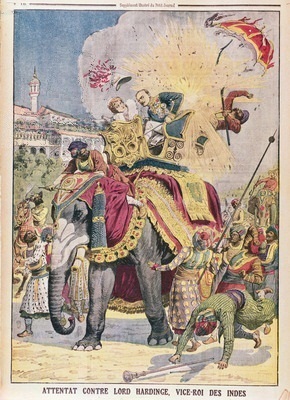
He was behind the [[Delhi conspiracy case|Delhi-Lahore Conspiracy]] to assassinate the [[Governor-General of India|Viceroy of India]], [[Charles Hardinge, 1st Baron Hardinge of Penshurst|Lord Hardinge]], in 1912.<ref name=":0">{{Cite book |last=McQuade |first=Joseph |url=https://books.google.com/books?id=xp3fEAAAQBAJ |title=Fugitive of Empire: Rashbehari Bose, Japan and the Indian Independence Struggle |date=2024 |publisher=Oxford University Press |isbn=978-0-19-776828-0 |language=en}}</ref> After the failed assassination attempt, Bose fled to [[Empire of Japan|Imperial Japan]].<ref name=":0" /> He sided with [[Azad Hind]] against Britain in World War II.<ref name=":0" /> | |||
==Birth and ancestry== | ==Birth and ancestry== | ||
Rash Behari Bose was born in | Rash Behari Bose was born in Subaldaha village of [[Purba Bardhaman district]], now in West Bengal, India, on 25 May 1886.<ref>{{Cite book |last=Mukherjee |first=Uma |url=http://archive.org/details/in.ernet.dli.2015.100166 |title=Two Great Indian Revolutionaries |date=1966 |pages=97}}</ref> Bose grew up during the [[British Raj#Famines, epidemics, public health|severe pandemics and famines of the British Raj]]. It fuelled his dislike for British rule.<ref name="Bose"/><ref name="samsad486"/> His father's name was Binod Behari Bose and mother was Bhubaneswari Devi. Tinkori Dasi was Rashbehari Bose's foster mother.{{citation needed|date=July 2023}} | ||
== Early life == | == Early life == | ||
Bose and his sister, Sushila, spent their childhood in Subaldaha. They lived with their father and also in the house of Bidhu Mukhi, the widowed sister-in-law of their grandfather, Kalicharan Bose. His early education was completed under the supervision of Kalicharan in the village 'pathsala' (traditional Hindu village school) which is presently Subaldaha Rashbehari Bose F.P School.{{citation needed|date=October 2023}} | |||
Bose was drawn towards the revolutionary movement on hearing stories from his grandfather and teacher (Bakkeswar) at Subaldaha. He was the cynosure of all villagers and was known for his stubborn attitude. His nickname was Rasu. It is heard from villagers that he was at Subaldaha till he was 12 or 14 years old.{{citation needed|date=July 2023}} | |||
His father, Binod Behari Bose, was stationed in Hooghly district for few years. During this time, Bose had to move to his maternal house in Chandernagar.{{citation needed|date=July 2023}} There Bose studied at Dupleix College with his cousin and friend [[Shrish Chandra Ghosh]]. The principal, Charu Chandra Roy, inspired them into revolutionary politics. Later, he joined Morton School in Calcutta. He subsequently earned degrees in medical sciences and engineering.{{citation needed|date=July 2023}} | |||
==Revolutionary activities== | ==Revolutionary activities== | ||
{{Main|Delhi conspiracy case|Gadar Conspiracy}} | {{Main|Delhi conspiracy case|Gadar Conspiracy}} | ||
Bose left Bengal to avoid the [[Alipore bomb case]] trials of 1908.{{citation needed|date=October 2023}} At [[Dehradun]], he worked as a head clerk at the [[Forest Research Institute (India)|Forest Research Institute]]. There, through [[Amarendra Chatterjee]] of the [[Jugantar]], he secretly got involved with the revolutionaries of Bengal and he came across revolutionaries of the [[Arya Samaj]] in the United Provinces (currently [[Uttar Pradesh]]) and the [[Punjab region|Punjab]].<ref>{{cite book|author=Uma Mukherjee|title=Two great Indian revolutionaries: Rash Behari Bose & Jyotindra Nath Mukherjee|url=https://archive.org/details/in.ernet.dli.2015.100166|year=1966|publisher=Firma K. L. Mukhopadhyay|page=[https://archive.org/details/in.ernet.dli.2015.100166/page/n115 101]}}</ref> | |||
[[File: An assassination attempt on Lord Charles Hardinge.jpg|thumb|left|1912 assassination attempt on Lord Hardinge]] | [[File: An assassination attempt on Lord Charles Hardinge.jpg|thumb|left|1912 assassination attempt on Lord Hardinge]] | ||
In 1912, he, along with [[Basanta Kumar Biswas]] from [[Anushilan Samiti]] threw a self made bomb, in the convoy of [[Charles Hardinge, 1st Baron Hardinge of Penshurst|Lord Hardinge]], which led to the viceroy being severely injured. Although they failed in their attempt but this sent shockwaves throughout the [[British Raj]].<ref>{{Cite book |last=Heehs |first=Peter |url=https://books.google.com/books?id=G4JuAAAAMAAJ |title=The Bomb in Bengal: The Rise of Revolutionary Terrorism in India, 1900-1910 |date=1993 |publisher=Oxford University Press |isbn=978-0-19-563350-4 |language=en}}</ref> Following the [[Delhi-Lahore Conspiracy]], which attempted the assassination of [[Charles Hardinge, 1st Baron Hardinge of Penshurst|Lord Hardinge]] on 23 December 1912, Bose was forced to go into hiding. He was hunted by the colonial police due to his participation in the failed assassination attempt, Hardinge being at that time the [[Governor General]] and [[Viceroy]].{{citation needed|date=October 2023}} He returned to Dehradun by the night train and joined the office the next day as though nothing had happened. He organised a meeting of loyal citizens of Dehradun to condemn the dastardly attack on the Viceroy.{{citation needed|date=October 2023}}{{clarify|reason=if he was forced into hiding & hunted, as we say, why was he travelling by train, going to the office & organising a protest within 24 hours?|date=October 2023}} | |||
[[File:Rash Behari Bose in Dehradun.tif|thumb|Rash Behari Bose in Dehradun]] | |||
During the flood relief work in Bengal in 1913, Bose came in contact with [[Jatin Mukherjee]] in whom he "discovered a real leader of men," who "added a new impulse" to Bose's failing zeal.<ref>{{cite book|author=Uma Mukherjee|title=Two great Indian revolutionaries: Rash Behari Bose & Jyotindra Nath Mukherjee|url=https://archive.org/details/in.ernet.dli.2015.100166|year=1966|publisher=Firma K. L. Mukhopadhyay|page=[https://archive.org/details/in.ernet.dli.2015.100166/page/n133 119]}}</ref> Thus, during World War (WW1) he became one of the leading figures of the [[Ghadar Mutiny]], an attempt to trigger a mutiny in India in February 1915. Trusted and tried Ghadrites were sent to several cantonments to infiltrate into the army. The idea of the Gadar leaders was that with the war raging in Europe most of the soldiers had gone out of India and the rest could be easily won over. The revolution failed and most of the revolutionaries were arrested. But Bose managed to escape British intelligence and reached Japan in 1915.{{citation needed|date=October 2023}} | |||
==Indian National Army== | ==Indian National Army== | ||
Bose | Bose had reached Japan under the alias of Priyanath Thakur, a relative of [[Rabindranath Tagore]], an Indian poet.<ref name=r1>{{Cite news|url=https://www.anandabazar.com/supplementary/rabibashoriyo/remembering-rash-behari-bose-and-his-wife-toshiko-bose-in-their-marriage-anniversary-1.828592|title=বাংলা থেকে রান্না-শাড়ি পরা, জাপানি বউকে শিখিয়েছিলেন রাসবিহারী বসু|last=বন্দ্যোপাধ্যায়|first=পারিজাত|work=Anandabazar Patrika|language=bn|access-date=27 July 2018}}</ref> There, Bose found shelter with various [[Pan-Asianism|Pan-Asian]] groups. From 1915 to 1918, he changed residences and identities numerous times, as the British kept pressing the Japanese government for his extradition. He married the daughter of [[Aizō Sōma]] and [[Kokkō Sōma]], the owners of Nakamuraya bakery in Tokyo and noted Pan-Asian supporters in 1918, and became a Japanese citizen in 1923, living as a journalist and writer. It is also significant that he was instrumental in introducing Indian-style curry in Japan. Though more expensive than the usual "British-style" curry, it became quite popular, with Rash Bihari becoming known as "Bose of Nakamuraya".{{citation needed|date=October 2023}} | ||
Bose along with [[A M Nair]] was instrumental in persuading the Japanese authorities to stand by the Indian | Bose, along with [[A. M. Nair]], was instrumental in persuading the Japanese authorities to stand by the Indian revolutionaries, whom Japan ultimately to officially supported. He convened a conference in [[Tokyo Conference|Tokyo]] on 28–30 March 1942, which decided to establish the [[Indian Independence League]]. There he also moved a motion to raise an army for Indian independence. He convened the [[Bangkok Conference|second conference]] of the League at [[Bangkok]] on 22 June 1942, at which a resolution was adopted to invite [[Subhas Chandra Bose]] to join the League and take command as its president.{{citation needed|date=October 2023}} | ||
The Indian prisoners of war captured by the Japanese in the [[Japanese occupation of Malaya, North Borneo, and Sarawak|Malaya]] and [[Burma]] fronts were encouraged to join the Indian Independence League and become the soldiers of the [[Indian National Army]] (INA), formed on 1 September 1942 as the military wing of Rash Behari Bose's Indian National League. He selected the flag for the [[Azad Hind]] movement and handed over the flag to | The Indian prisoners of war captured by the Japanese in the [[Japanese occupation of Malaya, North Borneo, and Sarawak|Malaya]] and [[Burma]] fronts were encouraged to join the Indian Independence League and become the soldiers of the [[Indian National Army]] (INA), formed on 1 September 1942 as the military wing of Rash Behari Bose's Indian National League. He selected the flag for the [[Azad Hind]] movement and handed over the flag and the power to Subhas Chandra Bose but his organizational structure remained which was built on the organizational spadework of Rash Behari Bose. Rash Behari Bose built the Indian National Army (also called 'Azad Hind Fauj'). Prior to his death caused by tuberculosis, the Japanese Government honoured him with the [[Order of the Rising Sun]] (2nd grade).{{citation needed|date=October 2023}} | ||
== Personal life == | == Personal life == | ||
Bose met Toshiko Soma when he was hiding at her house in [[Shinjuku|Shinjuku City]]. She was the daughter of [[Aizō Sōma]] and [[Kokkō Sōma]], the owners of Nakamuraya bakery ([[:ja:中村屋]]) in Tokyo and noted Pan-Asian supporters in 1918. At that time, Bose was a fugitive with the British searching for him. Their initial contact was during those intense moments of hiding though without any interactions. In 1916, when Bose was a fugitive no more, he invited the Soma family to his house as a gesture of gratitude. That was the first instance of their interaction in a social context.<ref name=r1/> | Bose met Toshiko Soma when he was hiding at her house in [[Shinjuku|Shinjuku City]]. She was the daughter of [[Aizō Sōma]] and [[Kokkō Sōma]], the owners of Nakamuraya bakery ([[:ja:中村屋]]) in Tokyo and noted Pan-Asian supporters in 1918. At that time, Bose was a fugitive with the British searching for him. Their initial contact was during those intense moments of hiding though without any interactions. In 1916, when Bose was a fugitive no more, he invited the Soma family to his house as a gesture of gratitude. That was the first instance of their interaction in a social context.<ref name=r1/> | ||
However, Bose stuck out like a sore thumb in Japan. People would consider them with suspicion. [[Tōyama Mitsuru|Mitsuru Toyama]], as a solution proposed to the Soma's a marriage between Toshiko and | However, Bose stuck out like a sore thumb in Japan. People would consider them with suspicion. [[Tōyama Mitsuru|Mitsuru Toyama]], as a solution proposed to the Soma's a marriage between Toshiko and Rash Behari. He thought that marriage with a Japanese citizen would make it easy for Bose to apply for citizenship. Despite their initial reservations, the Somas agreed to the match. When asked, Toshiko took three weeks to give her consent.<ref name=r1/> | ||
They had a happy marriage lasting eight years. Bose taught Toshiko Bengali and how to wear a sari. Bose got Japanese citizenship in 1923. Toshiko's health declined soon after and it claimed her life in 1924. After her death, he never remarried. They were buried together after Bose's death.<ref>{{Cite web|last=Nathan|first=Richard|date=12 March 2021|title=Changing Nations: The Japanese Girl With a Book|url=https://www.redcircleauthors.com/news-and-views/changing-nations-the-japanese-girl-with-a-book/ | They had a happy marriage lasting eight years. Bose taught Toshiko Bengali and how to wear a sari. Bose got Japanese citizenship in 1923. Toshiko's health declined soon after and it claimed her life in 1924. After her death, he never remarried. They were buried together after Bose's death.<ref>{{Cite web|last=Nathan|first=Richard|date=12 March 2021|title=Changing Nations: The Japanese Girl With a Book|url=https://www.redcircleauthors.com/news-and-views/changing-nations-the-japanese-girl-with-a-book/|website=Red Circle Authors}}</ref> | ||
They had two children together. Masahide Bose (Bharatchandra) was born in 1920. He died in World War II aged 24. Their daughter Tetsuko was born in 1922.<ref name=r1/> | They had two children together. Masahide Bose (Bharatchandra) was born in 1920. He died in World War II aged 24. Their daughter Tetsuko was born in 1922.<ref name=r1/> | ||
<gallery mode="packed" widths="240px" heights="240px"> | <gallery mode="packed" widths="240px" heights="240px"> | ||
Toyama Mitsuru honors Rash Behari Bose.jpg|A dinner party given to Bose in his honour by his close Japanese friends, including [[Mitsuru Tōyama]], a right-wing nationalist and [[Pan-Asianism]] leader (centre, behind the table), and [[Tsuyoshi Inukai]], future Japanese prime minister (to the right of Tōyama). Behind Tōyama is Bose. 1915. | Toyama Mitsuru honors Rash Behari Bose.jpg|A dinner party given to Bose in his honour by his close Japanese friends, including [[Mitsuru Tōyama]], a right-wing nationalist and [[Pan-Asianism]] leader (centre, behind the table), and [[Tsuyoshi Inukai]], future Japanese prime minister (to the right of Tōyama). Behind Tōyama is Bose. 1915. | ||
Rash Behari Bose and his supporters.jpg|Bose and his Japanese supporters in 1916 | Rash Behari Bose and his supporters.jpg|Bose and his Japanese supporters in 1916 | ||
| Line 64: | Line 66: | ||
== Legacy == | == Legacy == | ||
In | In 1943, the Japanese government honoured Bose with the highest title available to a foreigner, the [[Order of the Rising Sun]], 2nd class.<ref name=r5>{{Cite news|url=https://www.indiatvnews.com/news/india/remembering-heroes-of-indian-freedom-struggle-rash-behari-bose-26001.html/page/8|title=Remembering heroes of Indian freedom struggle: Rash Behari Bose|access-date=13 October 2020|archive-date=23 January 2021|archive-url=https://web.archive.org/web/20210123113559/https://www.indiatvnews.com/news/india/remembering-heroes-of-indian-freedom-struggle-rash-behari-bose-26001.html/page/8|url-status=dead}}</ref> | ||
[[File: Rash Behari Bose 1967 stamp of India.jpg|thumb|left|Rash Behari Bose on a 1967 stamp of India]] | [[File: Rash Behari Bose 1967 stamp of India.jpg|thumb|left|Rash Behari Bose on a 1967 stamp of India]] | ||
On 26 December 1967, the Posts and Telegraphs Department of India issued a special postage stamp in honour of Rash Behari Bose.<ref name=r4>{{cite web|url=https://www.istampgallery.com/rashbehari-basu/|title=A commemorative postage stamp on Rash Behari Bose|date=23 January 2015|publisher=istampgallery|access-date=13 October 2020}}</ref><ref name="Rashbehari Basu commemorative stamp">{{cite web|url=http://indianpost.com/viewstamp.php/Alpha/R/RASHBEHARI%20BASU%20(1886-1945)|title=Rashbehari Basu commemorative stamp|publisher=Indian Post|access-date=13 October 2020}}</ref> | On 26 December 1967, the Posts and Telegraphs Department of India issued a special postage stamp in honour of Rash Behari Bose.<ref name=r4>{{cite web|url=https://www.istampgallery.com/rashbehari-basu/|title=A commemorative postage stamp on Rash Behari Bose|date=23 January 2015|publisher=istampgallery|access-date=13 October 2020}}</ref><ref name="Rashbehari Basu commemorative stamp">{{cite web|url=http://indianpost.com/viewstamp.php/Alpha/R/RASHBEHARI%20BASU%20(1886-1945)|title=Rashbehari Basu commemorative stamp|publisher=Indian Post|access-date=13 October 2020}}</ref> | ||
=== In popular culture === | === In popular culture === | ||
| Line 74: | Line 76: | ||
==See also== | ==See also== | ||
*[[Anushilan Samiti]] | *[[Anushilan Samiti]] | ||
*[[Hindu–German Conspiracy]] | *[[Hindu–German Conspiracy]] | ||
*[[ | *[[Subhas Chandra Bose]] | ||
==References== | ==References== | ||
| Line 85: | Line 84: | ||
==Further reading== | ==Further reading== | ||
{{Refbegin|30em}} | {{Refbegin|30em}} | ||
* {{cite book|last= | * {{cite book|last=Kawabe|first=Lexi|year=2019|title=Rash Behari Bose: The Father of the Indian National Army|url=https://www.amazon.com/dp/B0B3JPY2P2|publisher=Tenraidou|isbn=9798814669414 }} | ||
{{Refend}} | {{Refend}} | ||
==External links== | ==External links== | ||
{{commons category-inline}} | *{{commons category-inline}} | ||
*[http://www.saadigitalarchive.org/entity/rash-behari-bose Rash Behari Bose materials in the South Asian American Digital Archive (SAADA)] | *[http://www.saadigitalarchive.org/entity/rash-behari-bose Rash Behari Bose materials in the South Asian American Digital Archive (SAADA)] | ||
* [https://edition.cnn.com/2020/05/09/asia/japan-indian-freedom-fighter-hnk-intl The Indian revolutionary who fought to overthrow British rule while living in Japan] ''[[CNN]]'' | * [https://edition.cnn.com/2020/05/09/asia/japan-indian-freedom-fighter-hnk-intl The Indian revolutionary who fought to overthrow British rule while living in Japan] ''[[CNN]]'' | ||
*[http://www.nakamuraya.co.jp/index.html Shinjuku Nakamuraya 新宿中村屋] | *[http://www.nakamuraya.co.jp/index.html Shinjuku Nakamuraya 新宿中村屋] | ||
{{Azad Hind Fauj}} | {{Azad Hind Fauj}} | ||
| Line 103: | Line 102: | ||
[[Category:1886 births]] | [[Category:1886 births]] | ||
[[Category:1945 deaths]] | [[Category:1945 deaths]] | ||
[[Category:Indian Independence League]] | [[Category:Indian Independence League]] | ||
[[Category:People from Bardhaman]] | [[Category:People from Bardhaman]] | ||
[[Category:Bengali military personnel|Bose, Rashbehari]] | |||
[[Category:Bengali | [[Category:Revolutionaries of Bengal during British Rule|Bose, Rashbehari]] | ||
[[Category: | |||
[[Category:Indian National Army personnel]] | [[Category:Indian National Army personnel]] | ||
[[Category:Japanese people of Indian descent]] | [[Category:Japanese people of Indian descent]] | ||
[[Category:Japanese people of Bengali descent]] | |||
[[Category:Subhas Chandra Bose]] | [[Category:Subhas Chandra Bose]] | ||
[[Category:Indian exiles]] | [[Category:Indian exiles]] | ||
| Line 120: | Line 117: | ||
[[Category:Military personnel from West Bengal]] | [[Category:Military personnel from West Bengal]] | ||
[[Category:20th-century Indian politicians]] | [[Category:20th-century Indian politicians]] | ||
[[Category: | [[Category:Politicians from West Bengal]] | ||
[[Category:20th-century deaths from tuberculosis]] | [[Category:20th-century deaths from tuberculosis]] | ||
[[Category:Tuberculosis deaths in Japan]] | [[Category:Tuberculosis deaths in Japan]] | ||
[[Category:Burials at Tama Cemetery]] | |||
[[Category:Hindu–German Conspiracy]] | |||
Latest revision as of 22:51, 15 February 2026
Rashbehari Bose | |
|---|---|
 Bose before 1945 | |
| Born | 25 May 1886[1][2] Village-Subaldaha,
Burdwan, Bengal Presidency, British India[1][2] (present-day Village Subaldaha, Block-Raina 2, District-Purba Bardhaman West Bengal, India) |
| Died | 21 January 1945 (aged 58) |
| Citizenship | British Indian (1886–1915) Stateless (1915–1923) Japan (1923–1945; his death) |
| Organisation | |
| Movement | Indian Independence movement, Ghadar Revolution, Indian National Army |
| Spouse(s) | Toshiko Bose (1916–1924; her death)[3] |
| Children | 2[3] |
| Relatives | Aizō Sōma (father-in-law) Kokkō Sōma (mother-in-law) |
| Anushilan Samiti |
|---|
 |
| Influence |
| Anushilan Samiti |
| Notable events |
| Related topics |
Rashbehari Bose (/rɑːʃ bihɑːri ˈboʊs/ ( listen); 25 May 1886 – 21 January 1945) was an Indian revolutionary leader and freedom fighter who fought against the British Empire. He was one of the key organisers of the Ghadar Mutiny and founded the Indian Independence League. Bose helped organise the Indian National Army (INA), which was formed in 1942 under Mohan Singh.[4][5]
He was behind the Delhi-Lahore Conspiracy to assassinate the Viceroy of India, Lord Hardinge, in 1912.[6] After the failed assassination attempt, Bose fled to Imperial Japan.[6] He sided with Azad Hind against Britain in World War II.[6]
Birth and ancestry[edit | edit source]
Rash Behari Bose was born in Subaldaha village of Purba Bardhaman district, now in West Bengal, India, on 25 May 1886.[7] Bose grew up during the severe pandemics and famines of the British Raj. It fuelled his dislike for British rule.[1][2] His father's name was Binod Behari Bose and mother was Bhubaneswari Devi. Tinkori Dasi was Rashbehari Bose's foster mother.[citation needed]
Early life[edit | edit source]
Bose and his sister, Sushila, spent their childhood in Subaldaha. They lived with their father and also in the house of Bidhu Mukhi, the widowed sister-in-law of their grandfather, Kalicharan Bose. His early education was completed under the supervision of Kalicharan in the village 'pathsala' (traditional Hindu village school) which is presently Subaldaha Rashbehari Bose F.P School.[citation needed]
Bose was drawn towards the revolutionary movement on hearing stories from his grandfather and teacher (Bakkeswar) at Subaldaha. He was the cynosure of all villagers and was known for his stubborn attitude. His nickname was Rasu. It is heard from villagers that he was at Subaldaha till he was 12 or 14 years old.[citation needed]
His father, Binod Behari Bose, was stationed in Hooghly district for few years. During this time, Bose had to move to his maternal house in Chandernagar.[citation needed] There Bose studied at Dupleix College with his cousin and friend Shrish Chandra Ghosh. The principal, Charu Chandra Roy, inspired them into revolutionary politics. Later, he joined Morton School in Calcutta. He subsequently earned degrees in medical sciences and engineering.[citation needed]
Revolutionary activities[edit | edit source]
Bose left Bengal to avoid the Alipore bomb case trials of 1908.[citation needed] At Dehradun, he worked as a head clerk at the Forest Research Institute. There, through Amarendra Chatterjee of the Jugantar, he secretly got involved with the revolutionaries of Bengal and he came across revolutionaries of the Arya Samaj in the United Provinces (currently Uttar Pradesh) and the Punjab.[8]

In 1912, he, along with Basanta Kumar Biswas from Anushilan Samiti threw a self made bomb, in the convoy of Lord Hardinge, which led to the viceroy being severely injured. Although they failed in their attempt but this sent shockwaves throughout the British Raj.[9] Following the Delhi-Lahore Conspiracy, which attempted the assassination of Lord Hardinge on 23 December 1912, Bose was forced to go into hiding. He was hunted by the colonial police due to his participation in the failed assassination attempt, Hardinge being at that time the Governor General and Viceroy.[citation needed] He returned to Dehradun by the night train and joined the office the next day as though nothing had happened. He organised a meeting of loyal citizens of Dehradun to condemn the dastardly attack on the Viceroy.[citation needed][clarification needed] File:Rash Behari Bose in Dehradun.tif During the flood relief work in Bengal in 1913, Bose came in contact with Jatin Mukherjee in whom he "discovered a real leader of men," who "added a new impulse" to Bose's failing zeal.[10] Thus, during World War (WW1) he became one of the leading figures of the Ghadar Mutiny, an attempt to trigger a mutiny in India in February 1915. Trusted and tried Ghadrites were sent to several cantonments to infiltrate into the army. The idea of the Gadar leaders was that with the war raging in Europe most of the soldiers had gone out of India and the rest could be easily won over. The revolution failed and most of the revolutionaries were arrested. But Bose managed to escape British intelligence and reached Japan in 1915.[citation needed]
Indian National Army[edit | edit source]
Bose had reached Japan under the alias of Priyanath Thakur, a relative of Rabindranath Tagore, an Indian poet.[3] There, Bose found shelter with various Pan-Asian groups. From 1915 to 1918, he changed residences and identities numerous times, as the British kept pressing the Japanese government for his extradition. He married the daughter of Aizō Sōma and Kokkō Sōma, the owners of Nakamuraya bakery in Tokyo and noted Pan-Asian supporters in 1918, and became a Japanese citizen in 1923, living as a journalist and writer. It is also significant that he was instrumental in introducing Indian-style curry in Japan. Though more expensive than the usual "British-style" curry, it became quite popular, with Rash Bihari becoming known as "Bose of Nakamuraya".[citation needed]
Bose, along with A. M. Nair, was instrumental in persuading the Japanese authorities to stand by the Indian revolutionaries, whom Japan ultimately to officially supported. He convened a conference in Tokyo on 28–30 March 1942, which decided to establish the Indian Independence League. There he also moved a motion to raise an army for Indian independence. He convened the second conference of the League at Bangkok on 22 June 1942, at which a resolution was adopted to invite Subhas Chandra Bose to join the League and take command as its president.[citation needed]
The Indian prisoners of war captured by the Japanese in the Malaya and Burma fronts were encouraged to join the Indian Independence League and become the soldiers of the Indian National Army (INA), formed on 1 September 1942 as the military wing of Rash Behari Bose's Indian National League. He selected the flag for the Azad Hind movement and handed over the flag and the power to Subhas Chandra Bose but his organizational structure remained which was built on the organizational spadework of Rash Behari Bose. Rash Behari Bose built the Indian National Army (also called 'Azad Hind Fauj'). Prior to his death caused by tuberculosis, the Japanese Government honoured him with the Order of the Rising Sun (2nd grade).[citation needed]
Personal life[edit | edit source]
Bose met Toshiko Soma when he was hiding at her house in Shinjuku City. She was the daughter of Aizō Sōma and Kokkō Sōma, the owners of Nakamuraya bakery (ja:中村屋) in Tokyo and noted Pan-Asian supporters in 1918. At that time, Bose was a fugitive with the British searching for him. Their initial contact was during those intense moments of hiding though without any interactions. In 1916, when Bose was a fugitive no more, he invited the Soma family to his house as a gesture of gratitude. That was the first instance of their interaction in a social context.[3]
However, Bose stuck out like a sore thumb in Japan. People would consider them with suspicion. Mitsuru Toyama, as a solution proposed to the Soma's a marriage between Toshiko and Rash Behari. He thought that marriage with a Japanese citizen would make it easy for Bose to apply for citizenship. Despite their initial reservations, the Somas agreed to the match. When asked, Toshiko took three weeks to give her consent.[3]
They had a happy marriage lasting eight years. Bose taught Toshiko Bengali and how to wear a sari. Bose got Japanese citizenship in 1923. Toshiko's health declined soon after and it claimed her life in 1924. After her death, he never remarried. They were buried together after Bose's death.[11]
They had two children together. Masahide Bose (Bharatchandra) was born in 1920. He died in World War II aged 24. Their daughter Tetsuko was born in 1922.[3]
-
 A dinner party given to Bose in his honour by his close Japanese friends, including Mitsuru Tōyama, a right-wing nationalist and Pan-Asianism leader (centre, behind the table), and Tsuyoshi Inukai, future Japanese prime minister (to the right of Tōyama). Behind Tōyama is Bose. 1915.
 -
 Bose and his Japanese supporters in 1916
 -
 Bose with wife c. 1918


Legacy[edit | edit source]
In 1943, the Japanese government honoured Bose with the highest title available to a foreigner, the Order of the Rising Sun, 2nd class.[12]

On 26 December 1967, the Posts and Telegraphs Department of India issued a special postage stamp in honour of Rash Behari Bose.[13][14]
In popular culture[edit | edit source]
In the 2019 Indian Bengali-language television series titled Netaji which depicts the life of Netaji Subhash Chandra Bose, Fahim Mirza played the role of Rash Behari Bose.
See also[edit | edit source]
References[edit | edit source]
- ↑ 1.0 1.1 1.2 Bose, Bejon Behari (1959). Karmabir Rash Behari (in Bengali). Ila Bose. p. 48.
- ↑ 2.0 2.1 2.2 Sengupta, Subodhchandra; Bose, Anjali (1976). Samsad Bangali Charitabhidhan. Calcutta: Sishu Sahitya Samsad. p. 486.
- ↑ 3.0 3.1 3.2 3.3 3.4 3.5 বন্দ্যোপাধ্যায়, পারিজাত. "বাংলা থেকে রান্না-শাড়ি পরা, জাপানি বউকে শিখিয়েছিলেন রাসবিহারী বসু". Anandabazar Patrika (in Bengali). Retrieved 27 July 2018.
- ↑ Emiko Jozuka (10 May 2020). "The Indian revolutionary who fought to overthrow British rule from 3,700 miles away". CNN. Retrieved 15 March 2022.
- ↑ Sengupta, Arghya; Dasgupta, Sneharshi. "Look East: Two Bengalis and their Asianist World views". The Telegraph.
- ↑ 6.0 6.1 6.2 McQuade, Joseph (2024). Fugitive of Empire: Rashbehari Bose, Japan and the Indian Independence Struggle. Oxford University Press. ISBN 978-0-19-776828-0.
- ↑ Mukherjee, Uma (1966). Two Great Indian Revolutionaries. p. 97.
- ↑ Uma Mukherjee (1966). Two great Indian revolutionaries: Rash Behari Bose & Jyotindra Nath Mukherjee. Firma K. L. Mukhopadhyay. p. 101.
- ↑ Heehs, Peter (1993). The Bomb in Bengal: The Rise of Revolutionary Terrorism in India, 1900-1910. Oxford University Press. ISBN 978-0-19-563350-4.
- ↑ Uma Mukherjee (1966). Two great Indian revolutionaries: Rash Behari Bose & Jyotindra Nath Mukherjee. Firma K. L. Mukhopadhyay. p. 119.
- ↑ Nathan, Richard (12 March 2021). "Changing Nations: The Japanese Girl With a Book". Red Circle Authors.
- ↑ "Remembering heroes of Indian freedom struggle: Rash Behari Bose". Archived from the original on 23 January 2021. Retrieved 13 October 2020.
- ↑ "A commemorative postage stamp on Rash Behari Bose". istampgallery. 23 January 2015. Retrieved 13 October 2020.
- ↑ "Rashbehari Basu commemorative stamp". Indian Post. Retrieved 13 October 2020.
Further reading[edit | edit source]
- Kawabe, Lexi (2019). Rash Behari Bose: The Father of the Indian National Army. Tenraidou. ISBN 9798814669414.
External links[edit | edit source]
- Rash Behari Bose materials in the South Asian American Digital Archive (SAADA)
- The Indian revolutionary who fought to overthrow British rule while living in Japan CNN
- Shinjuku Nakamuraya 新宿中村屋

| Background |  | |
|---|---|---|
| Ghadar | ||
| Berlin Committee | ||
| Indian figures | ||
| German figures | ||
| Conspiracy | ||
| Counter-intelligence | ||
| Related topics | ||