




No edit summary |
mNo edit summary |
||
| Line 1: | Line 1: | ||
{{Short description| | {{Short description|Indian princely title}} | ||
{{Redirect2|Maharaj|Maharani|the surname|Maraj|other uses|Maharani (disambiguation)}} | {{Redirect2|Maharaj|Maharani|the surname|Maraj|other uses|Maharani (disambiguation)|and|Maharaja (disambiguation)}} | ||
{{More citations needed|date=November 2017}} | {{More citations needed|date=November 2017}} | ||
{{Use dmy dates|date=February 2021}} | {{Use dmy dates|date=February 2021}} | ||
{{Use Indian English|date=October 2016}} | {{Use Indian English|date=October 2016}} | ||
<!--🔴 Editor note: Only one or two historical images, dating prior to the 18th century, are preferred in the lead section, with descriptive captions and relevant time frames. AVOID using portrait images --> | |||
'''Maharaja'''{{efn|{{IPAc-en|ˌ|m|ɑː|(|h|)|ə|ˈ|r|ɑː|dʒ|ə}}<ref>{{OED|Maharaja}}</ref> {{respell|MAH|(h)ə|RAH|jə}}}} (also spelled '''Maharajah''' or '''Maharaj'''; {{lit|great ruler}}; feminine: '''Maharani''' or '''Maharajin''')<ref name="sharma2239">{{Cite book |last=Tej Ram Sharma |url=https://books.google.com/books?id=fWVZWjNAcAgC |title=A |publisher=Concept Publishing Company |year=1989 |isbn=81-7022-251-6 |quote=... Literally Maharaja means 'a great king' ...}}</ref> is a royal title in the [[Indian subcontinent]] of [[Sanskrit]] origin. In [[modern India]] and [[Medieval India|medieval northern India]], the title was equivalent to a [[prince]]. However, in late [[ancient India]] and [[History of South India|medieval south India]], the title denoted a [[king]].<ref name="Brittanica">{{Cite encyclopedia |title=Maharaja | Hindu title |encyclopedia=[[Encyclopædia Britannica]] |url=https://britannica.com/topic/maharaja |access-date=2021-04-17}}</ref> | |||
The form "Maharaj" (without "-a") indicates a separation of noble and religious offices, although since in Marathi the suffix ''-a'' is silent, the two titles are near homophones. Historically, the title "Maharaja" has been used by kings since [[Vedic period|Vedic times]] and also in the second century by the [[Indo-Greek Kingdom|Indo-Greek]] rulers (such as the kings [[Apollodotus I]] and [[Menander I]])<ref>Chakravarti, N. P (1937). ''[[iarchive:in.ernet.dli.2015.56526/page/n23/mode/2up|Epigraphia Indica Vol.24]]''. pp. 1–10.</ref> and then later by the [[Indo-Scythians]] (such as the king [[Maues]]),<ref>{{Cite web |title=Gandhari.org – Catalog of Gāndhārī Texts |url=https://gandhari.org/catalog/cki0046 |access-date=2025-03-07 |website=gandhari.org}}</ref> and also the [[Kushans]] as a higher ranking variant of "[[Raja]]".<ref name=Brittanica/> Eventually, during the medieval era, the title "Maharaja" came to be used by [[sovereignty|sovereign]] princes and [[vassal state|vassal]] princes, and the title "[[Maharajadhiraja]]" was used by sovereign [[king]]s. Eventually, during the [[Mughal Empire|Mughal]] and [[British Raj|British era]]s,Maharaja too came to be used by princes, though it was used by sovereign kings as well, such as the King of Maratha. | |||
== Etymology == | == Etymology == | ||
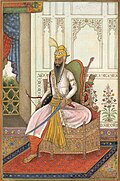
The word ''Maharaja'' originates in [[Sanskrit]] and is a compound [[Sanskrit compound#Karmadhāraya (descriptive)|karmadhāraya]] term from ''mahānt-'' "great" and ''[[raja|rājan]]'' "ruler, king"). It has the Latin [[cognate]]s '' | [[File:Maharaj Ranjit Singh.jpg|thumb|[[Maharaja Ranjit Singh|Ranjit Singh]], first Maharaja of the [[Sikh Empire]]]] | ||
The word ''Maharaja'' originates in [[Sanskrit]] and is a compound [[Sanskrit compound#Karmadhāraya (descriptive)|karmadhāraya]] term from ''mahānt-'' "great" and ''[[raja|rājan]]'' "ruler, king"). It has the Latin [[cognate]]s ''magnus'' "great" and ''rex'' "king".<ref name="samuelian2000">{{Citation |last=Thomas J. Samuelian |title=Armenian origins: an overview of ancient and modern sources and theories |year=2000 |url=https://books.google.com/books?id=E6otAQAAIAAJ |publisher=Iravunq Publishing House |quote=''... Cognate Chart Sanskrit: Maha Greek: Mega English: Much ...''}}</ref><ref name="danner1990">{{Citation |last=Horace G. Danner, Roger Noël |title=An introduction to an academic vocabulary: word clusters from Latin, Greek and German |quote=''... Mag-, great; maj-, greater; max-, greatest; IE base: meg-, yields Sanskrit maha; English much; Greek mega ...''}}</ref> Due to Sanskrit's major influence on the vocabulary of most languages in [[Greater India]] and [[Southeast Asia]], the term Maharaja is common to many modern [[Indo-Aryan languages|Indo-Aryan]] and [[Dravidian languages]]. The Sanskrit title Maharaja was originally used only for rulers who ruled a considerably large region with minor tributary rulers under them. Since medieval times, the title was used by (Hindu) monarchs of lesser states claiming descent from [[Ancient history|ancient]] maharajas. | |||
== Indian subcontinent == | == Indian subcontinent == | ||
===[[Raja]] as a ruler's title=== | |||
On the eve of [[Indian independence movement|independence]] in 1947, the [[British Indian Empire|Indian Empire]] contained more than 600 [[princely state]]s, each with its own native ruler, often styled [[Raja]] or [[Rana (title)|Rana]] or [[Thakur (title)|Thakur]] (if the ruler were [[Hinduism|Hindu]]) or [[Nawab]] (if he were [[Muslim]]), with a host of less current titles as well. | |||
The [[British Empire|British]] directly ruled two-thirds of the [[Indian subcontinent]]; the rest was under [[indirect rule]] by the above-mentioned princes under the considerable influence of British representatives, such as [[Resident (title)|Resident]]s, at their courts. | |||
The word Maharaja may be understood simply to mean "ruler" or "king", in spite of its literal translation as "great king". This was because only a handful of the states were truly powerful and wealthy enough for their rulers to be considered 'great' monarchs; the remaining were minor [[princely state]]s, sometimes little more than towns or groups of villages. The word, however, can also mean emperor in contemporary Indian usage. | |||
The title of Maharaja was not as common before the gradual British colonisation of India, upon and after which many [[raja]]s and otherwise styled Hindu rulers were elevated to Maharajas, regardless of the fact that scores of these new Maharajas ruled small states, sometimes for some reason unrelated to the eminence of the state, for example, support to the British in Afghanistan, [[World War I]] or [[World War II]]. The Maharaja of Punjab in the 19th century was Maharaja Ranjit Singh. He earned this title by keeping the Britishers beyond the Sutlej and even crushed the Afghan Empire. Maharajas in the twentieth century were the Maharaja of [[Kingdom of Cochin|Cochin]] and [[Maharaja Jagatjit Singh]] of [[Kapurthala]]. Apart from princely states, rulers of some large and extended zamindaris were also awarded the title of Maharaja. The rulers of [[Jeypore]], [[Darbhanga]], [[Vizianagaram]], [[Parlakhemundi]] [[Gidhaur]] were a few zamindars who were titled Maharaja for their cordiality and contribution to the British Raj. | |||
* Variations of this title include the following, each combining ''Maha-'' "great" with an alternative form of [[Raja]] 'king', so all meaning 'Great King': ''[[Maharana]]'' (as in [[Udaipur]]), ''[[Maharaj Rana]]'' (as in [[Jhalawar]]), ''[[Rawal (title)|Maharawal]]'' (as in [[Dungarpur]]/[[Jaisalmer]]), ''[[Maharawat]]'' ([[Pratapgarh, Uttar Pradesh|Pratapgarh]]), ''[[Maharao]]'' (as in [[Kotah]], [[Bundi]]) and ''[[Rawal (title)|Maharaol]]'' (as in [[Baria State|Baria]]). | |||
* ''Maharajah'' has taken on new spellings due to the time change and migration. It has even been shortened to ''Mahraj'' and ''Maraj'' but the most common is ''Maharajah'' and ''Maharaj''. | |||
* Despite its literal meaning, unlike many other titles meaning [[Great King]], neither Maharaja nor ''Rajadhiraja'' ('[[King of Kings]]'), nor its equivalent amongst Maharajas, 'Maharajadhiraja', ever reached the standing required for imperial rank, as each was soon the object of title inflation.{{citation needed|date=May 2024}} Instead, the Indian title which is commonly rendered as Emperor is [[Emperor#Samrajya system|Samrat]] or Samraj(a), a personal distinction achieved only by the [[List of Maurya emperors|Mauryans]] and the [[Vakataka dynasty|Vakataka]] ruler [[Pravarasena I]].<ref>{{Cite book |last=Singh |first=Upinder |url=https://books.google.com/books?id=GW5Gx0HSXKUC&pg=PA482 |title=A History of Ancient and Early Medieval India: From the Stone Age to the 12th Century |date=2008 |publisher=Pearson Education India |isbn=978-81-317-1677-9}}</ref> Muslim equivalent of emperor would be [[Padshah]] (of Persian origin), notably applied to the [[List of emperors of the Mughal Empire|Mughal dynasty]], the paramount power until the British established their raj. | |||
{| | {| class="toccolours" style="float:right; margin:0 0 1em 1em;" | ||
| style="background:#f8eaba; text-align:center;"| | | style="background:#f8eaba; text-align:center;"| | ||
<div class="center"> | <div class="center"> | ||
| Line 29: | Line 39: | ||
| | | | ||
<gallery> | <gallery> | ||
File:H.H. Maharaja Thakore Shri Sir Bhagwant Singhji Sagramji Sahib Bahadur, Maharaja of Gondal, GCSI, GCIE, 1911.jpg|Maharaja Bhagvat-Singh of [[Gondal, India|Gondal]]. | File:H.H. Maharaja Thakore Shri Sir Bhagwant Singhji Sagramji Sahib Bahadur, Maharaja of Gondal, GCSI, GCIE, 1911.jpg|Maharaja [[Bhagvatsinhji|Bhagvat-Singh]] of [[Gondal, India|Gondal]]. | ||
File:Maharajah of Kolhapur 1912.jpg|The [[Maratha]] [[Shahu of Kolhapur| | File:Maharajah of Kolhapur 1912.jpg|The [[Marathi people|Maratha]] [[Shahu of Kolhapur|Shahu]] of [[Kolhapur]]. | ||
</gallery> | |||
|- | |||
| | |||
|- | |||
| | |||
<gallery> | |||
File:Sayajirao Gaekwad III, Maharaja of Baroda, 1919.jpg|The [[Maratha]] [[Maharaja Sayajirao Gaekwad III]] of [[Baroda]]. | File:Sayajirao Gaekwad III, Maharaja of Baroda, 1919.jpg|The [[Maratha]] [[Maharaja Sayajirao Gaekwad III]] of [[Baroda]]. | ||
File:Chithira Thirunal Balarama Varma.jpg|[[Chithira Thirunal Balarama Varma]], the Maharaja of [[Travancore]] | File:Chithira Thirunal Balarama Varma.jpg|[[Chithira Thirunal Balarama Varma]], the Maharaja of [[Travancore]] | ||
File:Shri Sir Nripendra Narayan, Maharaja of Cooch Behar.jpg|Maharaja [[Nripendra Narayan]] of [[Cooch Behar State|Cooch Behar]]. | |||
</gallery> | </gallery> | ||
|- | |- | ||
| Line 39: | Line 56: | ||
| | | | ||
<gallery> | <gallery> | ||
File:Maharajah Duleep Singh dressed for a State function, c. 1875.jpg|Maharaja [[Duleep Singh]], the last Maharaja of the [[Sikh Empire]]. | File:Maharajah Duleep Singh dressed for a State function, c. 1875.jpg|Maharaja [[Duleep Singh]], the last Maharaja of the [[Sikh Empire]]. | ||
File:HH MAHARAJAH SIR SRI SRI VIKRAM DEV III K.C.I.E.jpg|Maharaja [[Vikram Dev III]] of [[Kingdom of Jeypore|Jeypore Samasthanam]] [[Zamindar|Estate]], [[Kalinga (historical region)|Kalinga]]. | File:HH MAHARAJAH SIR SRI SRI VIKRAM DEV III K.C.I.E.jpg|Maharaja [[Vikram Dev III]] of [[Kingdom of Jeypore|Jeypore Samasthanam]] [[Zamindar|Estate]], [[Kalinga (historical region)|Kalinga]]. | ||
File:Nalvadi Krishnaraja Wodeyar c1903.jpg | File:Nalvadi Krishnaraja Wodeyar c1903.jpg|[[Krishna Raja Wadiyar IV|Krishnaraja Wadiyar IV]], the [[Maharaja of Mysore]] | ||
</gallery> | </gallery> | ||
|- | |- | ||
|} | |} | ||
===Compound and dynastic ruler titles=== | ===Compound and dynastic ruler titles=== | ||
*''Dharma-maharaja'' was the devout title (compare Rajadharma) of the rulers of the [[Eastern Ganga dynasty|Ganga dynasty]]. | * ''Dharma-maharaja'' was the devout title (compare Rajadharma) of the rulers of the [[Eastern Ganga dynasty|Ganga dynasty]]. | ||
In the [[Mughal Empire]] it was quite common to award to various princes (hereditary or not) a series of lofty titles as a matter of protocolary rank. The British would, as paramount power do the same. | In the [[Mughal Empire]] it was quite common to award to various princes (hereditary or not) a series of lofty titles as a matter of protocolary rank. The British would, as paramount power do the same. | ||
Many of these (see also above) elaborate explicitly on the title Maharaja, in the following descending order: | Many of these (see also above) elaborate explicitly on the title Maharaja, in the following descending order: | ||
*''Maharajadhiraja Bahadur'' (or ''Maharajadhiraj Bahadur''): | * ''Maharajadhiraja Bahadur'' (or ''Maharajadhiraj Bahadur''): a title of honour, one degree higher than Maharajadhiraja. | ||
*''Maharajadhiraja'' (or ''Maharajadhiraj''): | * ''Maharajadhiraja'' (or ''Maharajadhiraj''): one degree higher than Sawai Maharaja Bahadur. | ||
*''Sawai Maharaja Bahadur'': a title of honour, one degree higher than Sawai Maharaja. (the term ''bahadur'', originally 'brave' in Persian, was often used for 'one-degree' higher', and 'sawai' is 'one and a quarter higher', i.e. just a step above bahadur) | * ''Sawai Maharaja Bahadur'': a title of honour, one degree higher than Sawai Maharaja. (the term ''bahadur'', originally 'brave' in Persian, was often used for 'one-degree' higher', and 'sawai' is 'one and a quarter higher', i.e. just a step above bahadur) | ||
*''Sawai Maharaja'': a title of honour one degree higher than Maharaja Bahadur; as granted (directly) to the Rajas of Ajaygarh. | * ''Sawai Maharaja'': a title of honour one degree higher than Maharaja Bahadur; as granted (directly) to the Rajas of Ajaygarh. | ||
*''Maharaja Bahadur'': a title of honour, one degree higher than Maharaja. | * ''Maharaja Bahadur'': a title of honour, one degree higher than Maharaja. | ||
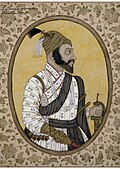
[[File:Shivaji British Museum.jpg|thumb| [[Shivaji|Chhatrapati Shivaji Bhosale]]. The [[Maratha]] ruler preferred the title of [[Chhatrapati]] as against Maharaja and was the founder and sovereign of the [[Maratha Kingdom]] in India]] | |||
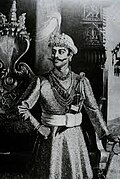
[[File:Shivaji British Museum.jpg|thumb| [[Shivaji|Chhatrapati Shivaji | [[File:Prithvi Narayan Shah 1960 (restoration).png|thumb|[[Shree Panch|Sri Panch]] Bada Mahārājādhirāja [[Prithvi Narayan Shah|Prithvi Narayan Shah Dev]] of Nepal.]] | ||
[[File: | |||
[[File:Khengarji III.jpg|thumb| His Highness Maharajadhiraj Mirza Maharao Shri Sir [[Khengarji III of Kutch|Khengarji III]] Sawai Bahadur, Rao of Kutch, GCIE, KIH]] | [[File:Khengarji III.jpg|thumb| His Highness Maharajadhiraj Mirza Maharao Shri Sir [[Khengarji III of Kutch|Khengarji III]] Sawai Bahadur, Rao of Kutch, GCIE, KIH]] | ||
[[File:Maharaja_Partab_Singh_(1848_-_1925).jpg|thumb|Maharaja Sir [[Pratap Singh of Jammu and Kashmir]]]] | [[File:Maharaja_Partab_Singh_(1848_-_1925).jpg|thumb|Maharaja Sir [[Pratap Singh of Jammu and Kashmir]]]] | ||
[[File:Palden Thondup Namgyal.jpg|thumb|Maharaja [[Chogyal]] [[Palden Thondup Namgyal]] of [[Kingdom of Sikkim|Sikkim]]]] | |||
Furthermore, there were various compound titles simply including other princely styles, such as : | Furthermore, there were various compound titles simply including other princely styles, such as: | ||
*''Maharaja [[Chatrapati]]'' in [[Satara State|Satara]], the paramount state of the [[Maratha | * ''Maharaja [[Chatrapati]]'' in [[Satara State|Satara]], the paramount state of the [[Maratha Confederacy]] | ||
*H.H. the ''Maharaj Rana'' of [[Jhalawar]] | * H.H. the ''Maharaj Rana'' of [[Jhalawar]] | ||
*''Maharaja-i-Rajgan'': great prince amongst princes | * ''Maharaja-i-Rajgan'': great prince amongst princes | ||
*''Maharaja [[Sena dynasty|Sena]] Sahib Subah'' of [[Nagpur]], another [[Maratha| | * ''Maharaja [[Sena dynasty|Sena]] Sahib Subah'' of [[Nagpur]], another [[Maratha Empire|Maratha]] state | ||
*''Maharaj [[Babu (title)|Babu]]'': A [[Rajput]] title similar to Maharaja.Used by the ruling Chiefs of Hazari Estate, Dohazari of South [[Chittagong]]. | * ''Maharaj [[Babu (title)|Babu]]'': A [[Rajput]] title similar to Maharaja. Used by the ruling Chiefs of Hazari Estate, Dohazari of South [[Chittagong]]. | ||
*For details concerning various titles containing [[sahib]], see there | * For details concerning various titles containing [[sahib]], see there | ||
Certain Hindu dynasties even came to use a unique style, including a term which as such is not of princely rank, e.g. [[Maharaja Gaikwar]] of [[Baroda State|Baroda]], [[Maharaja Scindia]] of [[Gwalior State|Gwalior]], [[Maharaja Holkar]] of Indore, three of the very highest ranking ruling [[Maratha]] houses. | Certain Hindu dynasties even came to use a unique style, including a term which as such is not of princely rank, e.g. [[Maharaja Gaikwar]] of [[Baroda State|Baroda]], [[Maharaja Scindia|Maharaja Shinde (or later anglicised: Scindia)]] of [[Gwalior State|Gwalior]], [[Maharaja Holkar]] of Indore, three of the very highest ranking ruling [[Maratha Confederacy|Maratha]] houses. | ||
===Chakravarti=== | ===Chakravarti=== | ||
Chakravarti is | [[Chakravarti (Sanskrit term)|Chakravarti]] is a [[Sanskrit]] term for "emperor". The meaning of chakravarti is "he, whose wheels (of [[Ratha|chariot]]) are moving" which symbolises that the leader who is a war hero, who commands over vast land and sea, the one who rules the people with dedication. In the Mahabharata, the [[Bharata (Mahabharata)|Chakravarti Bharat]] is known to have ruled the entire sub-continent of India brought golden age to his empire. He is called as chakravarti. The wife of a Chakravartin or a female Chakravartin is called a Chakaravartini. | ||
===Yuvaraja=== | ===Yuvaraja=== | ||
Yuvaraja means the crown prince of the kingdom. He is granted with certain powers and responsibilities so that he can be prepared to take over as the Maharaja. | [[Yuvaraja]] means the [[crown prince]] of the kingdom or empire. He is granted with certain powers and responsibilities so that he can be prepared to take over as the Maharaja. His wife is called Yuvarani. | ||
=== | ===Rajakumara=== | ||
Rajakumara is the son of a king who is not the heir apparent. He is conferred with certain duties or powers per the king's wishes. The daughter of a king who is not the heir apparent is called Rajakumari. | |||
=== | === Maharani === | ||
Maharani usually denotes the wife of a Maharaja (or [[Maharana]], [[Maharao]], Maharawal) or in rare cases, in some states where it was customary, a [[Queen regnant|woman ruling without a husband]].'''<ref>Hansdev Patel (1998). ''Royal Families and Palaces of Gujarat''. Scorpion Cavendish. {{ISBN|1-900269-20-1}}.</ref>''' | |||
=== | ===Rajamata=== | ||
In cases where a child king is crowned, the mother of the king takes charge of the kingdom and acts as a regent. Until the young king is of the age, the [[Rajmata]] ([[Queen mother]]) administers the kingdom. Famous examples include Rajamata Shetu Lakshmi Bai of Travancore dynasty, Gowri Lakshmi Bai, Maharaji (later Rajamata) Rudrama Devi of Kakatiya dynasty.<ref>{{Cite web |date=27 October 2016 |title=Sethu Lakshmi Bayi, The Feminist Queen of the House of Travancore |url=https://www.thebetterindia.com/73169/sethu-lakshmi-bayi-the-ivory-throne-manu-s-pallai/ |access-date=17 April 2021 |website=Thebetterindia.com}}</ref><ref>{{Cite web |last=Srinivas |first=Pendem |date=14 March 2016 |title=Rudramadevi History, Achievements and Administration |url=https://indiathedestiny.com/indian-kings/rudramadevi/ |access-date=17 April 2021 |website=Indiathedestiny.com}}</ref> When the king is present, the Rajamata being the mother of the king, might be given ceremonial roles. A famous Rajamata who functioned with the king is Rajamata [[Jijabai]] of the [[Maratha Kingdom]], accompanying the [[Chhatrapati]] (king).<ref>{{Cite web |title=Rajmata Jijau Birthplace, Sindkhed Raja | District Buldhana, Government of Maharashtra | India |url=https://buldhana.nic.in/en/tourist-place/rajmata-jijau-birthplace-sindkhed-raja/ |access-date=17 April 2021 |website=Buldhana.nic.in}}</ref> | |||
=== | ===Noble and honorary use=== | ||
Like ''Raja'' and various other titles, ''Maharaja'' was repeatedly awarded to notables without a princely state, such as [[zamindar]]s. | Like ''Raja'' and various other titles, ''Maharaja'' was repeatedly awarded to notables without a princely state, such as [[zamindar]]s. | ||
*One Raja of [[Lambagraon]], a [[Jagir]] (in [[Himachal Pradesh]]) who served in the colonial army was granted personally the non-hereditary title of Maharaja of Kangra-Lambagraon and a personal 11-guns salute, so neither honour passed on to his son and heir. | * One Raja of [[Lambagraon]], a [[Jagir]] (in [[Himachal Pradesh]]) who served in the colonial army was granted personally the non-hereditary title of Maharaja of Kangra-Lambagraon and a personal 11-guns salute, so neither honour passed on to his son and heir. | ||
*In the major, Muslim realm of [[Hyderabad and Berar]], there was a system of ennobling titles for the Nizam's courtiers, conferring a specific rank without any (e)state of their own, not unlike peerage titles without an actual fief in the UK, the highest titles for Hindu nobles being ''Maharaja Bahadur'' and ''Maharaja'', above ''Vant, Raja Rai-i-Rayan Bahadur, Raja Rai Bahadur, Raja Bahadur, Raja'' and ''[[Rai (Indian)|Rai]]''; for their Muslim counterparts there were alternative titles, the highest being [[Jah]] and [[Umara]]; e.g. the [[Diwan (title)|Diwan]] (Prime Minister) [[Maharaja Sir Kishen Pershad]], held such a Maharaja-title. | * In the major, Muslim realm of [[Hyderabad and Berar]], there was a system of ennobling titles for the Nizam's courtiers, conferring a specific rank without any (e)state of their own, not unlike peerage titles without an actual fief in the UK, the highest titles for Hindu nobles being ''Maharaja Bahadur'' and ''Maharaja'', above ''Vant, Raja Rai-i-Rayan Bahadur, Raja Rai Bahadur, Raja Bahadur, Raja'' and ''[[Rai (Indian)|Rai]]''; for their Muslim counterparts there were alternative titles, the highest being [[Jah]] and [[Umara]]; e.g. the [[Diwan (title)|Diwan]] (Prime Minister) [[Maharaja Sir Kishen Pershad]], held such a Maharaja-title. | ||
===Derived style for princes of the blood=== | ===Derived style for princes of the blood=== | ||
| Line 119: | Line 114: | ||
=== Nepal === | === Nepal === | ||
[[File:Rana Bdr Shah.jpg|thumb|[[ | [[File:Rana Bdr Shah.jpg|thumb|[[Shree Panch]] Mahārājādhirāja [[Rana Bahadur Shah]] Bahadur Shamsher Jang Devanam Sada Samaravijayinam, Sovereign King of Nepal]] | ||
The | The Gorkha [[Kings of Nepal]] (now a republic) used the title of '''Mahārājādhirāja''' which was "King of Great Kings", a title of honour, a degree higher than Mahārājā. | ||
[[Rana dynasty|Rana Prime ministers of Nepal]] used the title of [[Sri|Shree Teen]] | [[Rana dynasty|Rana Prime ministers of Nepal]] used the title of [[Sri|Shree Teen]] Maharaja while the Gorkha Kings used Shree Panch Maharajadhiraja. | ||
== Southeast Asia == | == Southeast Asia == | ||
=== Dali === | |||
Duan Xingzhi, the last monarch of the [[Kingdom of Dali]], submitted to the [[Mongol Empire]], and in return was enfeoffed as Maharaja (摩诃罗嵯) of Dali, continuing to rule the area (but subordinated to [[Yuan dynasty|Yuan]] princes and Muslim governors of Yunnan), until the [[Ming conquest of Yunnan]].<ref>{{Citation |last=Yang |first=Bin |title=Between Winds and Clouds: The Making of Yunnan (Second Century BCE to Twentieth Century CE) |date=2008a |chapter=Chapter 3: Military Campaigns against Yunnan: A Cross-Regional Analysis |chapter-url=http://www.gutenberg-e.org/yang/chapter3.html |publisher=Columbia University Press}}</ref> | |||
===Indonesia=== | ===Indonesia=== | ||
{{see also|History of Indonesia #Hindu-Buddhist civilisations}} | {{see also|History of Indonesia #Hindu-Buddhist civilisations}} | ||
When the [[ | When the [[Indonesian Archipelago]] was still predominantly Hindu-Buddhist (circa 3rd century CE until the 15th century CE), all of the [[Greater India|Indianised kingdoms]] which ruled different areas of the [[Malay Archipelago|archipelago]] was ruled by a "Maharaja" or simply referred by the locals as "Raja", such as the first and oldest Hindu kingdom of Indonesia the [[Kutai|Kutai Martadipura]] in eastern [[Borneo]], the [[Tarumanegara]], the [[Srivijaya]], the [[Majapahit]] and numerous other kingdoms. Traditional titles remain in use for other members of royalty, such as [[Pangeran Ratu]] for the heir and other local-Malay titles such as "Paduka Sri". The title "Maharaja" has been used to refer to kings of ancient Indianised kingdoms, such as Maharaja [[Mulavarman]] king of [[Kutai#History|Kutai Martadipura]] and Maharaja [[Purnawarman]] king of [[Tarumanegara]]. | ||
Maharaja was also part of the titles of the nobility in the Sumatran sultanate of [[Aceh]]. In the past, the title of Maharaja is given to a leader of the unreigning noble family and the Prime Minister Maharaja Mangkubumi. The last Prime Minister of Aceh who was installed to be the Maharaja Mangkubumi, Habib Abdurrahman el Zahir, who also acted as the foreign affairs minister of Aceh but was deposed and exiled to [[Jeddah]] by the colonial [[Dutch East Indies]] authorities in October 1878. | Maharaja was also part of the titles of the nobility in the Sumatran sultanate of [[Aceh]]. In the past, the title of Maharaja is given to a leader of the unreigning noble family and the Prime Minister Maharaja Mangkubumi. The last Prime Minister of Aceh who was installed to be the Maharaja Mangkubumi, Habib Abdurrahman el Zahir, who also acted as the foreign affairs minister of Aceh but was deposed and exiled to [[Jeddah]] by the colonial [[Dutch East Indies]] authorities in October 1878. | ||
| Line 143: | Line 140: | ||
=== Brunei === | === Brunei === | ||
In Seri Malayas of the [[Srivijaya]], under the Srivijaya satellite empire of the [[Majapahit]] Empire dominated over the whole Malayas far-reaching the present Philippine Archipelago, Malaysia, Brunei, Indonesia under the Srivijaya Empire of the Majapahit King Maharaja Pamariwasa. The latter's daughter Es-kander was married to an Arab (Zein Ul-Abidin), the third Makdum who promulgated Koranic studies (Madrassahs) and was a Srivijaya ruler in Seri who were a Srivijaya Monarchy. In the 12th century with the fall of the empire, the Seri King being a Muslim established the [[Sultanate of Brunei]] in 1363 with the throne name Sultan Mohamad Shah. In 1426, he established the sultanate of sulu as his death was recorded in 1431 Mt. Makatangis Sulu grave and 1432 Brunei grave. Both Sulu and Brunei claim the honor of his grave, while his brother, a Johore (Singapore) Prince Makdum Karim (Sharif Kabungsuwan of Malabang Lanao) the second Makdum after the first one Makdum Tuan Masha'ik. Karim ul-makdum re=enforced Islam, a Srivijaya Johore ruler, later established the Sultanate of Maguindanao-Ranao (Mindanao) after taking the political authority of his father-in-law Tomaoi Aliwya of the Maguiindanao family dynasty. He adapted the title as sultan Aliwya (Sharif Kabungsuwan), the first Maguindanao Sultan. The second and third Makdum's father was Sultan Betatar of Taif Arabia who was the 9th progeny of Hasan, the grandson of prophet Sayyidina Muhammad. | In Seri Malayas of the [[Srivijaya]], under the Srivijaya satellite empire of the [[Majapahit]] Empire dominated over the whole Malayas far-reaching the present [[Philippine Archipelago]], Malaysia, Brunei, Indonesia under the Srivijaya Empire of the Majapahit King Maharaja Pamariwasa. The latter's daughter Es-kander was married to an Arab (Zein Ul-Abidin), the third Makdum who promulgated Koranic studies (Madrassahs) and was a Srivijaya ruler in Seri who were a Srivijaya Monarchy. In the 12th century with the fall of the empire, the Seri King being a Muslim established the [[Sultanate of Brunei]] in 1363 with the throne name Sultan Mohamad Shah. In 1426, he established the sultanate of sulu as his death was recorded in 1431 Mt. Makatangis Sulu grave and 1432 Brunei grave. Both Sulu and Brunei claim the honor of his grave, while his brother, a Johore (Singapore) Prince Makdum Karim (Sharif Kabungsuwan of Malabang Lanao) the second Makdum after the first one Makdum Tuan Masha'ik. Karim ul-makdum re=enforced Islam, a Srivijaya Johore ruler, later established the Sultanate of Maguindanao-Ranao (Mindanao) after taking the political authority of his father-in-law Tomaoi Aliwya of the Maguiindanao family dynasty. He adapted the title as sultan Aliwya (Sharif Kabungsuwan), the first Maguindanao Sultan. The second and third Makdum's father was Sultan Betatar of Taif Arabia who was the 9th progeny of Hasan, the grandson of prophet Sayyidina Muhammad. | ||
=== Compound Malay titles === | === Compound Malay titles === | ||
The word can also be part of titles used by [[Malays (ethnic group)|Malay]] nobility: | The word can also be part of titles used by [[Malays (ethnic group)|Malay]] nobility: | ||
*''Maharaja Lela'' was the title of the ruler of the State of [[Naning]] (founded 1641), until it was annexed by the United Kingdom to [[Malacca]] in 1832. | * ''Maharaja Lela'' was the title of the ruler of the State of [[Naning]] (founded 1641), until it was annexed by the United Kingdom to [[Malacca]] in 1832. | ||
Most famous was [[Bendahara]] Seri Maharaja [[Tun Mutahir of Malacca]] (executed 1509) and Datuk [[Maharaja Lela]] Pandak Lam of [[Perak]] (executed 1876). | Most famous was [[Bendahara]] Seri Maharaja [[Tun Mutahir of Malacca]] (executed 1509) and Datuk [[Maharaja Lela]] Pandak Lam of [[Perak]] (executed 1876). | ||
| Line 156: | Line 153: | ||
=== Thailand === | === Thailand === | ||
[[File:King Rama X official (crop).png|thumb|Maha [[Vajiralongkorn]] Bodindradebayavarangkun, King of Thailand (2016–)]] | [[File:King Rama X official (crop).png|thumb|Maha [[Vajiralongkorn]] Bodindradebayavarangkun, King of Thailand (2016–)]] | ||
The [[King of Thailand]] has been called a "Maharaj" ({{ | The [[King of Thailand]] has been called a "Maharaj" ({{langx|th|มหาราชา}}). | ||
== See also == | == See also == | ||
*[[Maha Raja Rajya Shri | * [[Maha Raja Rajya Shri]] | ||
* [[Maharajah and the Sepoys]] | * [[Maharajah and the Sepoys]] | ||
* [[ | * [[Uparaja]] | ||
== Explanatory notes == | |||
{{Notelist}} | |||
== | == References == | ||
{{Reflist}} | {{Reflist}} | ||
{{Authority control}} | {{Authority control}} | ||
[[Category:Maharajas| ]] | |||
[[Category:Monarchy]] | [[Category:Monarchy]] | ||
[[Category:Heads of state]] | [[Category:Heads of state]] | ||
| Line 176: | Line 175: | ||
[[Category:Titles in India]] | [[Category:Titles in India]] | ||
[[Category:Titles of national or ethnic leadership]] | [[Category:Titles of national or ethnic leadership]] | ||
[[Category:Indian | [[Category:Surnames of Indian origin]] | ||
[[Category:Thai names]] | [[Category:Thai names]] | ||
[[Category: | [[Category:Rajas]] | ||
[[Category:Titles in Sri Lanka]] | |||
Latest revision as of 19:00, 22 February 2026
 | This article needs more citations. (November 2017) |
Maharaja[lower-alpha 1] (also spelled Maharajah or Maharaj; lit. 'great ruler'; feminine: Maharani or Maharajin)[2] is a royal title in the Indian subcontinent of Sanskrit origin. In modern India and medieval northern India, the title was equivalent to a prince. However, in late ancient India and medieval south India, the title denoted a king.[3]
The form "Maharaj" (without "-a") indicates a separation of noble and religious offices, although since in Marathi the suffix -a is silent, the two titles are near homophones. Historically, the title "Maharaja" has been used by kings since Vedic times and also in the second century by the Indo-Greek rulers (such as the kings Apollodotus I and Menander I)[4] and then later by the Indo-Scythians (such as the king Maues),[5] and also the Kushans as a higher ranking variant of "Raja".[3] Eventually, during the medieval era, the title "Maharaja" came to be used by sovereign princes and vassal princes, and the title "Maharajadhiraja" was used by sovereign kings. Eventually, during the Mughal and British eras,Maharaja too came to be used by princes, though it was used by sovereign kings as well, such as the King of Maratha.
Etymology[edit | edit source]

The word Maharaja originates in Sanskrit and is a compound karmadhāraya term from mahānt- "great" and rājan "ruler, king"). It has the Latin cognates magnus "great" and rex "king".[6][7] Due to Sanskrit's major influence on the vocabulary of most languages in Greater India and Southeast Asia, the term Maharaja is common to many modern Indo-Aryan and Dravidian languages. The Sanskrit title Maharaja was originally used only for rulers who ruled a considerably large region with minor tributary rulers under them. Since medieval times, the title was used by (Hindu) monarchs of lesser states claiming descent from ancient maharajas.
Indian subcontinent[edit | edit source]
Raja as a ruler's title[edit | edit source]
On the eve of independence in 1947, the Indian Empire contained more than 600 princely states, each with its own native ruler, often styled Raja or Rana or Thakur (if the ruler were Hindu) or Nawab (if he were Muslim), with a host of less current titles as well.
The British directly ruled two-thirds of the Indian subcontinent; the rest was under indirect rule by the above-mentioned princes under the considerable influence of British representatives, such as Residents, at their courts.
The word Maharaja may be understood simply to mean "ruler" or "king", in spite of its literal translation as "great king". This was because only a handful of the states were truly powerful and wealthy enough for their rulers to be considered 'great' monarchs; the remaining were minor princely states, sometimes little more than towns or groups of villages. The word, however, can also mean emperor in contemporary Indian usage.
The title of Maharaja was not as common before the gradual British colonisation of India, upon and after which many rajas and otherwise styled Hindu rulers were elevated to Maharajas, regardless of the fact that scores of these new Maharajas ruled small states, sometimes for some reason unrelated to the eminence of the state, for example, support to the British in Afghanistan, World War I or World War II. The Maharaja of Punjab in the 19th century was Maharaja Ranjit Singh. He earned this title by keeping the Britishers beyond the Sutlej and even crushed the Afghan Empire. Maharajas in the twentieth century were the Maharaja of Cochin and Maharaja Jagatjit Singh of Kapurthala. Apart from princely states, rulers of some large and extended zamindaris were also awarded the title of Maharaja. The rulers of Jeypore, Darbhanga, Vizianagaram, Parlakhemundi Gidhaur were a few zamindars who were titled Maharaja for their cordiality and contribution to the British Raj.
- Variations of this title include the following, each combining Maha- "great" with an alternative form of Raja 'king', so all meaning 'Great King': Maharana (as in Udaipur), Maharaj Rana (as in Jhalawar), Maharawal (as in Dungarpur/Jaisalmer), Maharawat (Pratapgarh), Maharao (as in Kotah, Bundi) and Maharaol (as in Baria).
- Maharajah has taken on new spellings due to the time change and migration. It has even been shortened to Mahraj and Maraj but the most common is Maharajah and Maharaj.
- Despite its literal meaning, unlike many other titles meaning Great King, neither Maharaja nor Rajadhiraja ('King of Kings'), nor its equivalent amongst Maharajas, 'Maharajadhiraja', ever reached the standing required for imperial rank, as each was soon the object of title inflation.[citation needed] Instead, the Indian title which is commonly rendered as Emperor is Samrat or Samraj(a), a personal distinction achieved only by the Mauryans and the Vakataka ruler Pravarasena I.[8] Muslim equivalent of emperor would be Padshah (of Persian origin), notably applied to the Mughal dynasty, the paramount power until the British established their raj.
|
|
|
|


Compound and dynastic ruler titles[edit | edit source]
- Dharma-maharaja was the devout title (compare Rajadharma) of the rulers of the Ganga dynasty.
In the Mughal Empire it was quite common to award to various princes (hereditary or not) a series of lofty titles as a matter of protocolary rank. The British would, as paramount power do the same. Many of these (see also above) elaborate explicitly on the title Maharaja, in the following descending order:
- Maharajadhiraja Bahadur (or Maharajadhiraj Bahadur): a title of honour, one degree higher than Maharajadhiraja.
- Maharajadhiraja (or Maharajadhiraj): one degree higher than Sawai Maharaja Bahadur.
- Sawai Maharaja Bahadur: a title of honour, one degree higher than Sawai Maharaja. (the term bahadur, originally 'brave' in Persian, was often used for 'one-degree' higher', and 'sawai' is 'one and a quarter higher', i.e. just a step above bahadur)
- Sawai Maharaja: a title of honour one degree higher than Maharaja Bahadur; as granted (directly) to the Rajas of Ajaygarh.
- Maharaja Bahadur: a title of honour, one degree higher than Maharaja.

.png)

.jpg)

Furthermore, there were various compound titles simply including other princely styles, such as:
- Maharaja Chatrapati in Satara, the paramount state of the Maratha Confederacy
- H.H. the Maharaj Rana of Jhalawar
- Maharaja-i-Rajgan: great prince amongst princes
- Maharaja Sena Sahib Subah of Nagpur, another Maratha state
- Maharaj Babu: A Rajput title similar to Maharaja. Used by the ruling Chiefs of Hazari Estate, Dohazari of South Chittagong.
- For details concerning various titles containing sahib, see there
Certain Hindu dynasties even came to use a unique style, including a term which as such is not of princely rank, e.g. Maharaja Gaikwar of Baroda, Maharaja Shinde (or later anglicised: Scindia) of Gwalior, Maharaja Holkar of Indore, three of the very highest ranking ruling Maratha houses.
Chakravarti[edit | edit source]
Chakravarti is a Sanskrit term for "emperor". The meaning of chakravarti is "he, whose wheels (of chariot) are moving" which symbolises that the leader who is a war hero, who commands over vast land and sea, the one who rules the people with dedication. In the Mahabharata, the Chakravarti Bharat is known to have ruled the entire sub-continent of India brought golden age to his empire. He is called as chakravarti. The wife of a Chakravartin or a female Chakravartin is called a Chakaravartini.
Yuvaraja[edit | edit source]
Yuvaraja means the crown prince of the kingdom or empire. He is granted with certain powers and responsibilities so that he can be prepared to take over as the Maharaja. His wife is called Yuvarani.
Rajakumara[edit | edit source]
Rajakumara is the son of a king who is not the heir apparent. He is conferred with certain duties or powers per the king's wishes. The daughter of a king who is not the heir apparent is called Rajakumari.
Maharani[edit | edit source]
Maharani usually denotes the wife of a Maharaja (or Maharana, Maharao, Maharawal) or in rare cases, in some states where it was customary, a woman ruling without a husband.[9]
Rajamata[edit | edit source]
In cases where a child king is crowned, the mother of the king takes charge of the kingdom and acts as a regent. Until the young king is of the age, the Rajmata (Queen mother) administers the kingdom. Famous examples include Rajamata Shetu Lakshmi Bai of Travancore dynasty, Gowri Lakshmi Bai, Maharaji (later Rajamata) Rudrama Devi of Kakatiya dynasty.[10][11] When the king is present, the Rajamata being the mother of the king, might be given ceremonial roles. A famous Rajamata who functioned with the king is Rajamata Jijabai of the Maratha Kingdom, accompanying the Chhatrapati (king).[12]
Noble and honorary use[edit | edit source]
Like Raja and various other titles, Maharaja was repeatedly awarded to notables without a princely state, such as zamindars.
- One Raja of Lambagraon, a Jagir (in Himachal Pradesh) who served in the colonial army was granted personally the non-hereditary title of Maharaja of Kangra-Lambagraon and a personal 11-guns salute, so neither honour passed on to his son and heir.
- In the major, Muslim realm of Hyderabad and Berar, there was a system of ennobling titles for the Nizam's courtiers, conferring a specific rank without any (e)state of their own, not unlike peerage titles without an actual fief in the UK, the highest titles for Hindu nobles being Maharaja Bahadur and Maharaja, above Vant, Raja Rai-i-Rayan Bahadur, Raja Rai Bahadur, Raja Bahadur, Raja and Rai; for their Muslim counterparts there were alternative titles, the highest being Jah and Umara; e.g. the Diwan (Prime Minister) Maharaja Sir Kishen Pershad, held such a Maharaja-title.
Derived style for princes of the blood[edit | edit source]
Maharaj Kumar (or Maharajkumar) means son of a Maharaja or Heir-Apparent; the female equivalent is Maharaj Kumari (Maharajkumari): daughter of a Maharaja.
Nepal[edit | edit source]

The Gorkha Kings of Nepal (now a republic) used the title of Mahārājādhirāja which was "King of Great Kings", a title of honour, a degree higher than Mahārājā. Rana Prime ministers of Nepal used the title of Shree Teen Maharaja while the Gorkha Kings used Shree Panch Maharajadhiraja.
Southeast Asia[edit | edit source]
Dali[edit | edit source]
Duan Xingzhi, the last monarch of the Kingdom of Dali, submitted to the Mongol Empire, and in return was enfeoffed as Maharaja (摩诃罗嵯) of Dali, continuing to rule the area (but subordinated to Yuan princes and Muslim governors of Yunnan), until the Ming conquest of Yunnan.[13]
Indonesia[edit | edit source]
When the Indonesian Archipelago was still predominantly Hindu-Buddhist (circa 3rd century CE until the 15th century CE), all of the Indianised kingdoms which ruled different areas of the archipelago was ruled by a "Maharaja" or simply referred by the locals as "Raja", such as the first and oldest Hindu kingdom of Indonesia the Kutai Martadipura in eastern Borneo, the Tarumanegara, the Srivijaya, the Majapahit and numerous other kingdoms. Traditional titles remain in use for other members of royalty, such as Pangeran Ratu for the heir and other local-Malay titles such as "Paduka Sri". The title "Maharaja" has been used to refer to kings of ancient Indianised kingdoms, such as Maharaja Mulavarman king of Kutai Martadipura and Maharaja Purnawarman king of Tarumanegara.
Maharaja was also part of the titles of the nobility in the Sumatran sultanate of Aceh. In the past, the title of Maharaja is given to a leader of the unreigning noble family and the Prime Minister Maharaja Mangkubumi. The last Prime Minister of Aceh who was installed to be the Maharaja Mangkubumi, Habib Abdurrahman el Zahir, who also acted as the foreign affairs minister of Aceh but was deposed and exiled to Jeddah by the colonial Dutch East Indies authorities in October 1878.
Malaysia[edit | edit source]
In peninsular Malaysia:
- Maharaja was the title of the monarch of the peninsular Malay state of Johor(e) from 1873 to 1885. The Arabic, Muslim title Sultan, often considered of higher rank, was re-adopted later and remains in current usage.
- The title Bendahara Seri Maharaja was used by the ruler of Pahang (1623–1853 in personal union with Johor, eventually becoming a fief of the Bendahara family), till on 6 August 1882 Tuanku Ahmad al-Muadzam Shah ibni al-Marhum Tun Ali adopted the title, Sultan.
In northern Borneo, the title Maharajah of Sabah and Rajah of Gaya and Sandakan was used from 29 December 1877 to 26 August 1881 by Baron von Overbeck (compare White Rajah).[14]
The Englishman Capt. James Brooke was declared as Rajah Brooke by the Sultan of Brunei for his role in pacifying the Sarawak revolt against the Sultan during the Raffles' stint. The word Rajah derived from the word Maharaja. In 1842, the Sultan of Brunei ceded Sarawak to Rajah Brooke who founded the Kingdom of Sarawak and a line of dynastic monarchs known as the White Rajahs.
In contemporary Malay usage, the title Maharaja refers to an emperor, e.g. "Maharaja Jepun" ("Emperor of Japan").
Brunei[edit | edit source]
In Seri Malayas of the Srivijaya, under the Srivijaya satellite empire of the Majapahit Empire dominated over the whole Malayas far-reaching the present Philippine Archipelago, Malaysia, Brunei, Indonesia under the Srivijaya Empire of the Majapahit King Maharaja Pamariwasa. The latter's daughter Es-kander was married to an Arab (Zein Ul-Abidin), the third Makdum who promulgated Koranic studies (Madrassahs) and was a Srivijaya ruler in Seri who were a Srivijaya Monarchy. In the 12th century with the fall of the empire, the Seri King being a Muslim established the Sultanate of Brunei in 1363 with the throne name Sultan Mohamad Shah. In 1426, he established the sultanate of sulu as his death was recorded in 1431 Mt. Makatangis Sulu grave and 1432 Brunei grave. Both Sulu and Brunei claim the honor of his grave, while his brother, a Johore (Singapore) Prince Makdum Karim (Sharif Kabungsuwan of Malabang Lanao) the second Makdum after the first one Makdum Tuan Masha'ik. Karim ul-makdum re=enforced Islam, a Srivijaya Johore ruler, later established the Sultanate of Maguindanao-Ranao (Mindanao) after taking the political authority of his father-in-law Tomaoi Aliwya of the Maguiindanao family dynasty. He adapted the title as sultan Aliwya (Sharif Kabungsuwan), the first Maguindanao Sultan. The second and third Makdum's father was Sultan Betatar of Taif Arabia who was the 9th progeny of Hasan, the grandson of prophet Sayyidina Muhammad.
Compound Malay titles[edit | edit source]
The word can also be part of titles used by Malay nobility:
- Maharaja Lela was the title of the ruler of the State of Naning (founded 1641), until it was annexed by the United Kingdom to Malacca in 1832.
Most famous was Bendahara Seri Maharaja Tun Mutahir of Malacca (executed 1509) and Datuk Maharaja Lela Pandak Lam of Perak (executed 1876).
The palace marshal of the Yang di-Pertuan Agong (head of state) of modern Malaysia is called Datuk Maharaja Lela Penghulu Istana Negara.
Eventually, Maharajah Adinda was also used to refer to a particular lineage within the royal families.
Thailand[edit | edit source]
.png)
The King of Thailand has been called a "Maharaj" (Thai: มหาราชา).
See also[edit | edit source]
Explanatory notes[edit | edit source]
References[edit | edit source]
- ↑ "Maharaja". Oxford English Dictionary (Online ed.). Oxford University Press. Template:OEDsub
- ↑ Tej Ram Sharma (1989). A. Concept Publishing Company. ISBN 81-7022-251-6.
... Literally Maharaja means 'a great king' ...
- ↑ 3.0 3.1 "Maharaja | Hindu title". Encyclopædia Britannica. Retrieved 17 April 2021.
- ↑ Chakravarti, N. P (1937). Epigraphia Indica Vol.24. pp. 1–10.
- ↑ "Gandhari.org – Catalog of Gāndhārī Texts". gandhari.org. Retrieved 7 March 2025.
- ↑ Thomas J. Samuelian (2000), Armenian origins: an overview of ancient and modern sources and theories, Iravunq Publishing House,
... Cognate Chart Sanskrit: Maha Greek: Mega English: Much ...
- ↑ Horace G. Danner, Roger Noël, An introduction to an academic vocabulary: word clusters from Latin, Greek and German,
... Mag-, great; maj-, greater; max-, greatest; IE base: meg-, yields Sanskrit maha; English much; Greek mega ...
- ↑ Singh, Upinder (2008). A History of Ancient and Early Medieval India: From the Stone Age to the 12th Century. Pearson Education India. ISBN 978-81-317-1677-9.
- ↑ Hansdev Patel (1998). Royal Families and Palaces of Gujarat. Scorpion Cavendish. ISBN 1-900269-20-1.
- ↑ "Sethu Lakshmi Bayi, The Feminist Queen of the House of Travancore". Thebetterindia.com. 27 October 2016. Retrieved 17 April 2021.
- ↑ Srinivas, Pendem (14 March 2016). "Rudramadevi History, Achievements and Administration". Indiathedestiny.com. Retrieved 17 April 2021.
- ↑ "Rajmata Jijau Birthplace, Sindkhed Raja | District Buldhana, Government of Maharashtra | India". Buldhana.nic.in. Retrieved 17 April 2021.
- ↑ Yang, Bin (2008a), "Chapter 3: Military Campaigns against Yunnan: A Cross-Regional Analysis", Between Winds and Clouds: The Making of Yunnan (Second Century BCE to Twentieth Century CE), Columbia University Press
- ↑ P. J. Rivers, "The Origin of 'Sabah' and a Reappraisal of Overbeck as Maharajah", Journal of the Malaysian Branch of the Royal Asiatic Society 77(1), 2004; pp. 79–80