



m Removed empty portal template using script |
formatting fix |
||
| Line 1: | Line 1: | ||
{{Short description| | {{Short description|11th-century citadel in Telangana, India}} | ||
{{ | {{Other uses}} | ||
{{Use dmy dates|date=July 2015}} | {{Use dmy dates|date=July 2015}} | ||
{{Use Indian English|date=August 2021}} | {{Use Indian English|date=August 2021}} | ||
{{Infobox military installation | {{Infobox military installation | ||
| name | | name = Golconda | ||
| type | | type = Fort | ||
| location | | location = Hyderabad, India | ||
| image | | image = Golconda Fort 005.jpg | ||
| caption | | caption = | ||
| coordinates | | coordinates = {{Coord|17|22|59|N|78|24|04|E|region:IN-TS_type:landmark|display=inline,title}} | ||
| map_type | | map_type = India Hyderabad | ||
| map_size | | map_size = 250 | ||
| code | | code = | ||
| built | | built = 11th century | ||
| builder | | builder = [[Kakatiya dynasty]] ruler King [[Prataparudra]] in the 11th century, 1143 CE <br />[[Sultan Quli Qutb-ul-Mulk]] (1518 fortification) | ||
| materials | | materials = | ||
| height | | height = | ||
| used | | used = | ||
| condition | | condition = | ||
| ownership | | ownership = [[Archaeological Survey of India]] | ||
| open_to_public = Yes | | open_to_public = Yes | ||
| controlledby | | controlledby = Archaeological Survey of India | ||
| garrison | | garrison = | ||
| current_commander = | | current_commander = | ||
| commanders | | commanders = | ||
| occupants | | occupants = [[Bahmani Sultanate]], [[Golconda Sultanate]], [[Mughal Empire]], [[Hyderabad State]] | ||
| battles | | battles = | ||
| events | | events = | ||
}} | }} | ||
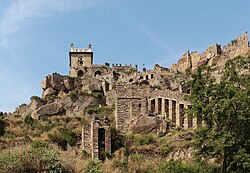
'''Golconda''' | '''Golconda''' is a fortified citadel and ruined city located on the western outskirts of [[Hyderabad]], [[Telangana]], India.<ref name=":0" /><ref>{{cite web|url=https://www.cntraveller.in/story/golconda-hyderabad-telangana-deccan-sultanate-fort-history/|title=How an impregnable fort city was finally breached by treachery|date=29 December 2022 }}</ref> The fort was originally built by [[Kakatiya dynasty|Kakatiya]] ruler [[Kakatiya dynasty#Prataparudra I|Pratāparudra]] in the 11th century out of mud walls.<ref name=":1">{{Cite book |last=Bilgrami |first=Syed Ali Asgar |year=1927 |title=The Landmarks of the Deccan |url=https://archive.org/details/in.ernet.dli.2015.63136 |location=Hyderabad-Deccan, India |publisher=Government Central Press |pages=108–110 |language=English}} Reprint: {{ISBN|9789353245733}}.</ref> It was ceded to the [[Bahmani Kingdom|Bahmani Kings]] from [[Musunuri Nayakas]] during the reign of Bahmani Sultan [[Mohammed Shah I]], during the first [[Bahmani–Vijayanagar War (1362–1367)|Bahmani-Vijayanagar War]]. Following the death of Sultan Mahmood Shah, the Sultanate disintegrated and Sultan Quli, who had been appointed as the Governor of Hyderabad by the Bahmani Kings, fortified the city and made it the capital of the [[Golconda Sultanate]]. Because of the vicinity of diamond mines, especially [[Kollur Mine]], Golconda flourished as a trade centre of large diamonds known as [[Golconda Diamonds]]. Golconda fort is currently abandoned and in ruins. The complex was put by [[UNESCO]] on its "tentative list" to become a [[World Heritage Site]] in 2014, with other forts in the region, under the name [[Monuments and Forts of the Deccan Sultanate]] (despite there being a number of different sultanates).<ref name=":0">[https://whc.unesco.org/en/tentativelists/5887/ UNESCO "tentative list"]</ref> | ||
The complex was put by [[UNESCO]] on its "tentative list" to become a [[World Heritage Site]] in 2014, with | |||
== History == | == History == | ||
[[File:Ruins of the Fort.jpg|thumb| | [[File:Golconda fort 15032012.jpg|thumb|Ruins of the fort]] | ||
[[File:Golconda Fort 013.jpg|thumb|View of the Baradari at the Golconda Fort]] | |||
The origins of the Golconda fort can be traced back to the 11th century. It was originally a small mud fort built by [[Prataparudra|Pratāparudra]] of the [[Kakatiyas|Kakatiya Empire]].<ref name=":1" /> The name ''Golconda'' is thought to originate from [[Telugu language|Telugu]] for " | The origins of the Golconda fort can be traced back to the 11th century. It was originally a small mud fort built by [[Kakatiya dynasty#Prataparudra I|Pratāparudra]] of the [[Kakatiyas|Kakatiya Empire]].<ref name=":1" /> The name ''Golconda'' is thought to originate from the [[Telugu language|Telugu]] {{lang|te|గొల్లకొండ}} {{Transliteration|te|ISO|Gollakoṇḍa}} for "Shepherd's hill".<ref>{{cite news|url=https://www.thehindu.com/features/kids/enjoy-a-slice-of-history/article3412035.ece|title=Enjoy a slice of history|author=Harin Chandra|work=[[The Hindu]]|date=2012-05-14}}</ref><ref name=":2">{{Cite web |last=Lasania |first=Yunus |date=2022-02-19 |title=Hyderabad: How rumours of a secret tunnel are ruining the Charminar |url=https://www.siasat.com/hyderabad-how-rumours-of-a-secret-tunnel-are-ruining-the-charminar-2278080/ |access-date=2022-11-16 |website=The Siasat Daily |language=en-US}}</ref> It is also thought that Kakatiya ruler [[Ganapatideva]] 1199–1262 built a stone [[Hilltop castle|hilltop]] [[Outpost (military)|outpost]]—later known as Golconda fort—to defend their western region.<ref>{{cite book |title=An African Indian community in Hyderabad |url=https://books.google.com/books?id=DigPvwHTqJ4C|last=Yimene |first=Ababu Minda |year=2004|publisher=Cuvillier Verlag |page=2|isbn=978-3-86537-206-2|access-date=19 September 2021}}</ref> The fort was later developed into a fortified citadel in 1518 by [[Quli Qutb Shah|Sultan Quli]] of the [[Qutb Shahi dynasty|Qutb Shahi Empire]] and the city was declared the capital of the [[Golconda Sultanate]].<ref name=":2" /> | ||
The [[Bahmani Sultanate|Bahmani kings]] took possession of the fort after it was made over to them by means of a ''sanad'' by the Rajah of [[Warangal]].<ref name=":1" /> Under the [[Bahmani Sultanate]], Golconda slowly rose to prominence. [[Sultan Quli Qutb-ul-Mulk]] (r. 1487–1543), sent by the Bahmanids as a governor at Golconda, established the city as the seat of his governance around 1501. Bahmani rule gradually weakened during this period, and Sultan Quli (Quli Qutub Shah period) formally became independent in 1518, establishing the [[Qutb Shahi dynasty]] based in Golconda.<ref>{{Cite book |last=Sherwani |first=H.K. |title=The History of the Qutb Shahi Dynasty |publisher=Munshiram Manoharlal Publishers Pvt. Ltd. |year=1974 |isbn=9788121503396 |location=India |language=English}}</ref><ref>{{cite thesis |last=Sardar |first=Marika |year=2007 |title=Golconda Through Time: A Mirror of the Evolving Deccan |type=PhD thesis |publisher=New York University |url=https://books.google.com/books?id=q8zERtJWtSUC |isbn=978-0-549-10119-2|pages=66–67}}</ref><ref>{{Cite book |last=Sen |first=Sailendra |title=A Textbook of Medieval Indian History |publisher=Primus Books |year=2013 |isbn=978-9-38060-734-4|page=118}}</ref> Over a period of 62 years, the mud fort was expanded by the first three Qutb Shahi sultans into the present structure: a massive [[fortification]] of granite extending around {{convert|5|km|abbr=on}} in [[circumference]]. It remained the capital of the Qutb Shahi dynasty until 1590 when the capital was shifted to [[Hyderabad]]. The Qutb Shahis expanded the fort, whose {{convert|7|km|abbr=on}} outer wall enclosed the city. | The [[Bahmani Sultanate|Bahmani kings]] took possession of the fort after it was made over to them by means of a ''sanad'' by the Rajah of [[Warangal]].<ref name=":1" /> Under the [[Bahmani Sultanate]], Golconda slowly rose to prominence. [[Sultan Quli Qutb-ul-Mulk]] (r. 1487–1543), sent by the Bahmanids as a governor at Golconda, established the city as the seat of his governance around 1501. Bahmani rule gradually weakened during this period, and Sultan Quli (Quli Qutub Shah period) formally became independent in 1518, establishing the [[Qutb Shahi dynasty]] based in Golconda.<ref>{{Cite book |last=Sherwani |first=H.K. |title=The History of the Qutb Shahi Dynasty |publisher=Munshiram Manoharlal Publishers Pvt. Ltd. |year=1974 |isbn=9788121503396 |location=India |language=English}}</ref><ref>{{cite thesis |last=Sardar |first=Marika |year=2007 |title=Golconda Through Time: A Mirror of the Evolving Deccan |type=PhD thesis |publisher=New York University |url=https://books.google.com/books?id=q8zERtJWtSUC |isbn=978-0-549-10119-2|pages=66–67}}</ref><ref>{{Cite book |last=Sen |first=Sailendra |title=A Textbook of Medieval Indian History |publisher=Primus Books |year=2013 |isbn=978-9-38060-734-4|page=118}}</ref> Over a period of 62 years, the mud fort was expanded by the first three Qutb Shahi sultans into the present structure: a massive [[fortification]] of granite extending around {{convert|5|km|abbr=on}} in [[circumference]]. It remained the capital of the Qutb Shahi dynasty until 1590 when the capital was shifted to [[Hyderabad]]. The Qutb Shahis expanded the fort, whose {{convert|7|km|abbr=on}} outer wall enclosed the city. | ||
During the early seventeenth century a strong cotton-weaving industry existed in Golconda. Large quantities of cotton were produced for domestic and exports consumption. High quality plain or patterned cloth made of muslin and calico was produced. Plain cloth was available as white or brown colour, in bleached or dyed variety. Exports of this cloth was to Persia and European countries. Patterned cloth was made of prints which were made indigenously with indigo for blue, chay-root for red coloured prints and vegetable yellow. Patterned cloth exports were mainly to Java, Sumatra and other eastern countries.<ref>{{Cite book|last=Moreland|first=W.H|title=Relation of Golconda in the Early Seventeenth Century|publisher=Halyukt Society|year=1931}}</ref> | During the early seventeenth century a strong cotton-weaving industry existed in Golconda. Large quantities of cotton were produced for domestic and exports consumption. High quality plain or patterned cloth made of muslin and calico was produced. Plain cloth was available as white or brown colour, in bleached or dyed variety. Exports of this cloth was to Persia and European countries. Patterned cloth was made of prints which were made indigenously with indigo for blue, chay-root for red coloured prints and vegetable yellow. Patterned cloth exports were mainly to Java, Sumatra and other eastern countries.<ref>{{Cite book|last=Moreland|first=W.H|title=Relation of Golconda in the Early Seventeenth Century|publisher=Halyukt Society|year=1931}}</ref> | ||
The fort finally fell into ruin in 1687 after an [[Siege of Golconda|eight-month-long siege]] led to its fall at the hands of the [[Mughal Empire|Mughal]] emperor [[Aurangzeb]], who ended the Qutb Shahi reign and took the last Golconda king, [[Abul Hasan Qutb Shah|Abul Hassan Tana Shah]], captive.<ref>{{cite book|title=India through the ages|last=Gopal|first=Madan|year= 1990| page= 178|editor=K.S. Gautam|publisher=Publication Division, Ministry of Information and Broadcasting, Government of India}}</ref><ref name=":2" /> | The fort finally fell into ruin in 1687 after an [[Siege of Golconda|eight-month-long siege]] led to its fall at the hands of the [[Mughal Empire|Mughal]] emperor [[Aurangzeb]], who ended the Qutb Shahi reign and took the last Golconda king, [[Abul Hasan Qutb Shah|Abul Hassan Tana Shah]], captive.<ref>{{cite book|title=India through the ages|last=Gopal|first=Madan|year= 1990| page= 178|editor=K.S. Gautam|publisher=Publication Division, Ministry of Information and Broadcasting, Government of India}}</ref><ref name=":2" /> | ||
==Diamonds== | ==Diamonds== | ||
The Golconda fort used to have a vault where the famous [[Koh-i-Noor]] and [[Hope Diamond|Hope diamonds]] were once stored along with other diamonds.<ref>{{cite book |title=Footprint India |first=Roma |last=Bradnock |year=2007 |isbn=978-1-906098-05-6 |page=[https://archive.org/details/footprintindia0000dare/page/1035 1035] |url=https://archive.org/details/footprintindia0000dare/page/1035 }}</ref> | The Golconda fort used to have a vault where the famous [[Koh-i-Noor]] and [[Hope Diamond|Hope diamonds]] were once stored along with other diamonds.<ref>{{cite book |title=Footprint India |first=Roma |last=Bradnock |year=2007 |isbn=978-1-906098-05-6 |page=[https://archive.org/details/footprintindia0000dare/page/1035 1035] |publisher=Footprint |url=https://archive.org/details/footprintindia0000dare/page/1035 }}</ref> | ||
Golconda is renowned for the diamonds found on the south-east at [[Kollur Mine]] near [[Kollur, Guntur district]], [[Paritala]] and Atkur in [[Krishna district]] and cut in the city during the [[Kakatiya dynasty|Kakatiya reign]]. At that [[Diamond#Etymology, earliest use and composition discovery|time]], India had the only known diamond mines in the world. Golconda was the market city of the diamond trade, and gems sold there came from a number of mines. The fortress-city within the walls was famous for diamond trade.{{citation needed|date=November 2020}} | Golconda is renowned for the diamonds found on the south-east at [[Kollur Mine]] near [[Kollur, Guntur district]], [[Paritala]] and Atkur in [[Krishna district]] and cut in the city during the [[Kakatiya dynasty|Kakatiya reign]]. At that [[Diamond#Etymology, earliest use and composition discovery|time]], India had the only known diamond mines in the world. Golconda was the market city of the diamond trade, and gems sold there came from a number of mines. The fortress-city within the walls was famous for diamond trade.{{citation needed|date=November 2020}} | ||
Its name has taken a generic meaning and has come to be associated with great wealth. | Its name has taken a generic meaning and has come to be associated with great wealth. Some gemologists use this classification to denote the extremely rare Type IIa diamond, a crystal that essentially lacks nitrogen impurities and is therefore colorless; Many Type IIa diamonds, as identified by the Gemological Institute of America (GIA), have come from the mines in and around the Golconda region. | ||
Many famed diamonds are believed to have been excavated from the mines of Golconda, such as: | Many famed diamonds are believed to have been excavated from the mines of Golconda, such as: | ||
| Line 72: | Line 69: | ||
During [[the Renaissance]] and the early modern eras, the name "Golconda" acquired a legendary aura and became synonymous for vast wealth. The mines brought riches to the [[Qutb Shahis]] of [[Hyderabad State]], who ruled Golconda up to 1687, then to the [[Nizam of Hyderabad]], who ruled after the independence from the [[Mughal Empire]] in 1724 until 1948, when the [[Indian integration of Hyderabad]] occurred. The [[siege of Golconda]] occurred in January 1687, when Mughal Emperor Aurangzeb led his forces to besiege the Qutb Shahi dynasty at Golconda fort (also known as the Diamond Capitol of its time) and was home to the Kollur Mine. The ruler of Golconda was the well entrenched [[Abul Hasan Qutb Shah]].<ref>{{cite news|url=https://www.thehindu.com/features/magazine/Delving-into-the-rich-and-often-bloody-history-of-Golconda-Fort/article16437577.ece|title=Delving into the rich and often bloody history of Golconda Fort|website=[[The Hindu]] |date=5 November 2016 }}</ref> | During [[the Renaissance]] and the early modern eras, the name "Golconda" acquired a legendary aura and became synonymous for vast wealth. The mines brought riches to the [[Qutb Shahis]] of [[Hyderabad State]], who ruled Golconda up to 1687, then to the [[Nizam of Hyderabad]], who ruled after the independence from the [[Mughal Empire]] in 1724 until 1948, when the [[Indian integration of Hyderabad]] occurred. The [[siege of Golconda]] occurred in January 1687, when Mughal Emperor Aurangzeb led his forces to besiege the Qutb Shahi dynasty at Golconda fort (also known as the Diamond Capitol of its time) and was home to the Kollur Mine. The ruler of Golconda was the well entrenched [[Abul Hasan Qutb Shah]].<ref>{{cite news|url=https://www.thehindu.com/features/magazine/Delving-into-the-rich-and-often-bloody-history-of-Golconda-Fort/article16437577.ece|title=Delving into the rich and often bloody history of Golconda Fort|website=[[The Hindu]] |date=5 November 2016 }}</ref> | ||
== | == Architecture == | ||
[[File:Guide map of Golkonda fort.jpg|thumb|Guide map of Golconda fort]] | [[File:Guide map of Golkonda fort.jpg|thumb|Guide map of Golconda fort]] | ||
Golconda fort is listed as an archaeological treasure on the official "List of Monuments" prepared by the [[Archaeological Survey of India]] under The Ancient Monuments and Archaeological Sites and Remains Act.<ref>{{Cite web |title=Alphabetical List of | Golconda fort is listed as an archaeological treasure on the official "List of Monuments" prepared by the [[Archaeological Survey of India]] under The Ancient Monuments and Archaeological Sites and Remains Act.<ref>{{Cite web |title=Alphabetical List of Monuments—Andhra Pradesh |publisher=[[Archaeological Survey of India]] |url=http://asi.nic.in/asi_monu_alphalist_andhra.asp |archive-url=https://web.archive.org/web/20140625052615/http://asi.nic.in/asi_monu_alphalist_andhra.asp |archive-date=25 June 2014 |url-status=dead |access-date=27 August 2015 }}</ref> Golconda consists of four distinct [[fort]]s with a {{convert|10|km|abbr=on}} long outer wall with 87 semicircular bastions (some still mounted with [[cannon]]s), eight gateways, and four [[drawbridge]]s, with a number of royal apartments and halls, temples, mosques, magazines, stables, etc. inside. The lowest of these is the outermost [[Building|enclosure]] entered by the "Fateh Darwaza" (Victory gate, so called after [[Aurangzeb]]’s triumphant army marched in through this gate) studded with giant iron spikes (to prevent elephants from battering them down) near the south-eastern corner. An [[Acoustics|acoustic effec]]t can be experienced at Fateh Darwazaan, a hand clap at a certain point below the [[dome]] at the entrance reverberates and can be heard clearly at the "Bala Hisar" [[pavilion]], the highest point almost a kilometer away. This worked as a warning in case of an attack. | ||
The "Bala Hisar" gate is the main entrance to the fort located on the eastern side. It has a pointed arch bordered by rows of scroll work. The spandrels have [[Yali (mythology)|yalis]] and decorated roundels. The area above the door has peacocks with ornate tails flanking an ornamental arched niche. The granite block lintel below has sculpted yalis flanking a disc. The design of peacocks and lions is typical of [[Hindu architecture]] and underlies this fort's Hindu origins. | |||
[[ | The [[Jagadamba]] [[Hindu temple|temple]], located next to the [[mosque]] of [[Abraham in Islam|Ibrahim]] and the king's palace, is visited by hundreds of thousands of Hindu devotees during [[Bonalu]] festival every year.<ref>{{cite news|url=https://timesofindia.indiatimes.com/city/hyderabad/historic-jagadamba-temple-sees-many-devotees-but-few-facilities/articleshow/61332780.cms|title=Historic Jagadamba temple sees many devotees, but few facilities|website=[[The Times of India]] |date=30 October 2017 }}</ref><ref>{{cite news|url=https://www.thehindu.com/news/national/telangana/golconda-bonalu-begins-with-religous-fervour/article65586272.ece|title=Golconda Bonalu begins with {{as written|reli|gous [sic]}} fervour|website=[[The Hindu]] |date=30 June 2022 }}</ref> Jagadamba temple is about 900 to 1,000 years old, dating back to early [[Kakatiya dynasty|Kakatiya period]].<ref>{{cite web|url=https://www.deccanchronicle.com/nation/in-other-news/130622/with-pandemic-on-ebb-state-gears-up-for-grand-bonalu.html|title=With pandemic on ebb, state gears up for grand Bonalu|date=13 June 2022 }}</ref> A [[Mahankali]] [[Hindu temple|temple]] is located in the vicinity, within Golconda fort.<ref>{{cite web|url=https://www.deccanchronicle.com/nation/current-affairs/150622/golconda-mahankali-temple-set-for-grand-bonalu-fete.html|title=Golconda Mahankali temple set for grand Bonalu fete|date=15 June 2022 }}</ref> | ||
The fort also contains the [[Qutb Shahi tombs|tombs of the Qutub Shahi kings]]. These tombs | The fort also contains the [[Qutb Shahi tombs|tombs of the Qutub Shahi kings]]. These tombs display features of [[Indo-Islamic architecture]] and are located about {{convert|1|km|abbr=on}} north of the outer wall of Golconda. They are encircled by gardens and numerous carved stones. | ||
The two individual pavilions on the outer side of Golconda are built on a point which is quite rocky. The "Kala Mandir" is also located in the fort. It can be seen from the king's durbar (king's court) which was on top of the Golconda fort. | The two individual pavilions on the outer side of Golconda are built on a point which is quite rocky. The "Kala Mandir" is also located in the fort. It can be seen from the king's durbar (king's court) which was on top of the Golconda fort. | ||
| Line 90: | Line 85: | ||
<gallery mode="packed"> | <gallery mode="packed"> | ||
Golconda Fort - Rani Mahal 04.jpg|Rani Mahal | |||
File:Golconda 091.JPG|Fort overlooking the city of [[Hyderabad]] | File:Golconda 091.JPG|Fort overlooking the city of [[Hyderabad]] | ||
File:Golkonda 05.jpg|Mosque of Ibrahim | File:Golkonda 05.jpg|[[Mosque]] of [[Abraham in Islam|Ibrahim]] at Golconda, Hyderabad | ||
File:Golconda Fort 002 - Baradari.jpg|Baradari located at the top of the citadel | File:Golconda Fort 002 - Baradari.jpg|Baradari located at the top of the citadel | ||
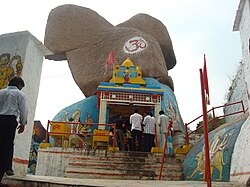
File:Jagdamba Temple, Golkonda Fort.jpg|Jagadamba temple at the top of the Golconda fortifications | File:Jagdamba Temple, Golkonda Fort.jpg|[[Jagadamba]] [[Hindu temple|temple]] at the top of the Golconda fortifications | ||
File: | File:Bala Hissar Darwaza in Golconda Fort.jpg|Bala Hissar Darwaza | ||
File:Golcondamahankaali.JPG| | File:Golcondamahankaali.JPG|[[Mahankali]] [[Hindu temple|temple]] at Golconda, Hyderabad | ||
File:Golconda Fort 017.jpg|View from the Baradari | File:Golconda Fort 017.jpg|View from the Baradari | ||
File:Architect in golconda fort.jpg|Design inside the Golconda fort | File:Architect in golconda fort.jpg|Design inside the Golconda fort | ||
File:Aerial view of Golconda fort.jpg|Aerial view of Golconda fort | File:Aerial view of Golconda fort.jpg|Aerial view of Golconda fort | ||
File:Golconda . | File:Canon at Golconda.jpg|Cannon of the Golconda fort | ||
File:Streets in golconda.jpg|Pathway in Golconda fort | File:Streets in golconda.jpg|Pathway in Golconda fort | ||
File:The Baradari.jpg|Baradari fort | File:The Baradari.jpg|Baradari fort | ||
File:Ceiling of Echo Dome, Golconda Fort (Oct 2025).jpg|Echo Dome interior | |||
</gallery> | </gallery> | ||
== Golconda ruling dynasties == | == Golconda ruling dynasties == | ||
* [[Asaf Jahi dynasty]] | |||
* [[Bahmani Sultans]] | |||
* [[Kakatiya dynasty]] | * [[Kakatiya dynasty]] | ||
* [[Mughal Empire]] | |||
* [[Musunuri Nayakas]] | * [[Musunuri Nayakas]] | ||
* [[Qutb Shahi dynasty]] | * [[Qutb Shahi dynasty]] | ||
== Naya Qila (New Fort) == | == Naya Qila (New Fort) == | ||
| Line 120: | Line 116: | ||
== Qutub Shahi tombs == | == Qutub Shahi tombs == | ||
{{Main|Qutb Shahi tombs}} | {{Main|Qutb Shahi tombs}} | ||
[[File: | [[File:Tomb of Sultan Quli Qutb Shah 03.jpg|thumb|Tombs of Sultan Quli Qutb Shah and Subhan Quli Qutb Shah]] | ||
The tombs of the Qutub Shahi sultans lie about one kilometre north of Golconda's outer wall. These structures are made of beautifully carved stonework, and surrounded by landscaped | The tombs of the Qutub Shahi sultans lie about one kilometre north of Golconda's outer wall. These structures are made of beautifully carved stonework, and surrounded by landscaped gardens. They are open to the public and receive many visitors. It is one of the famous sight-seeing places in Hyderabad. | ||
== <span class="anchor" id="Ropeway"></span> Golconda ropeway== | |||
Golconda Fort Ropeway, a {{Convert|1.5|km|mi|adj=mid|-long}} ropeway project between hilltop Golconda Fort and 7 Qutb Shahi tombs was approved in September 2025 under [[Parvatmala]], tenders were invited for feasibility study were invited, following which DPR will be prepared for the construction.<ref>[https://www.thehansindia.com/news/cities/hyderabad/govt-approves-overhead-sky-cable-car-project-1011386 Govt approves overhead sky cable car project], Hans India, 2 Oct 2025.</ref> | |||
==Golconda Artillery Centre, Indian Army== | ==Golconda Artillery Centre, Indian Army== | ||
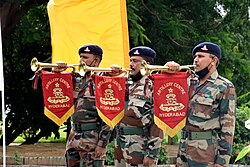
[[File:Arty Centre Hyderabad.jpg|thumb|195th Gunners' Day celebration at Golconda Artillery Centre, Hyderabad, 28 September 2021]] | [[File:Arty Centre Hyderabad.jpg|thumb|195th Gunners' Day celebration at Golconda Artillery Centre, Hyderabad, 28 September 2021]] | ||
Golconda Artillery Centre, Hyderabad was raised on 15 August 1962 as the Second Recruit Training Centre for the [[Regiment of Artillery (India)|Regiment of Artillery]].<ref>{{cite | |||
Golconda Artillery Centre, Hyderabad, was raised on 15 August 1962 as the Second Recruit Training Centre for the [[Regiment of Artillery (India)|Regiment of Artillery]].<ref>{{cite news|url=https://timesofindia.indiatimes.com/city/hyderabad/830-new-recruits-pass-out-from-artillery-centre/articleshow/81728200.cms|title=830 new recruits pass out from Artillery Centre|website=[[The Times of India]] |date=28 March 2021 }}</ref><ref>{{cite news|url=https://timesofindia.indiatimes.com/city/hyderabad/first-batch-of-agniveers-start-training-at-golconda-artillery-in-hyderabad/articleshow/96865925.cms|title=First batch of Agniveers start training at Golconda Artillery in Hyderabad|website=[[The Times of India]] |date=10 January 2023 }}</ref> Golconda Artillery Centre is located in and around the Golconda fort. The Golconda centre has three training regiments and presently trains 2900 recruits at a time.<ref>{{cite web|url= https://indianarmy.nic.in/Site/FormTemplete/frmTempSimple.aspx?MnId=vtW/oKql9jXObOz1gaW/Bg==&ParentID=yJE4wJBdSlVFFGzvOtJPIA==&flag=8CKP966uzg96kLov0aWdfQ==|title= Arty Centre, Hyderabad|date=|access-date=2021-05-25}}</ref> | |||
==UNESCO World Heritage== | ==UNESCO World Heritage== | ||
The Golconda fort | The Golconda fort and other Qutb Shahi dynasty Monuments of Hyderabad (the [[Charminar]], and the Qutb Shahi Tombs) were submitted by the Permanent Delegation of India to [[UNESCO]] in 2010 for consideration as [[World Heritage Sites]]. They are currently included on India's "[[List of World Heritage Sites in India#Tentative list of Heritage sites|tentative list]]".<ref>{{cite web|url=https://whc.unesco.org/en/tentativelists/5573/|title=The Qutb Shahi Monuments of Hyderabad Golconda Fort, Qutb Shahi Tombs, Charminar – UNESCO World Heritage Centre|first=UNESCO World Heritage|last=Centre|website=whc.unesco.org}}</ref><ref>{{Cite web|url=http://epaper.timesofindia.com/Default/Layout/Includes/EDU/ArtWin.asp?From=Archive&Source=Page&Skin=EDU&BaseHref=TOIM%2F2012%2F06%2F24&ViewMode=HTML&PageLabel=22&EntityId=Ar02201&AppName=1|title=Prestige or Preservation?|author=Archana Khare Ghose|work=[[The Times of India]]|access-date=3 December 2017|archive-url=https://web.archive.org/web/20180622005212/http://epaper.timesofindia.com/Default/Layout/Includes/EDU/ArtWin.asp?From=Archive&Source=Page&Skin=EDU&BaseHref=TOIM%2F2012%2F06%2F24&ViewMode=HTML&PageLabel=22&EntityId=Ar02201&AppName=1|archive-date=22 June 2018|url-status=dead }}</ref> | ||
==Influences== | ==Influences== | ||
=== In popular culture === | === In popular culture === | ||
* | * "Aline, reine de Golconde" (1760), story by [[Stanislas de Boufflers]] | ||
* ''[[Aline, reine de Golconde]]'' (1766), opera by [[Pierre-Alexandre Monsigny]] | * ''[[Aline, reine de Golconde]]'' (1766), opera by [[Pierre-Alexandre Monsigny]] | ||
* ''Aline, reine de Golconde'' (1803), opera by [[Henri-Montan Berton]] | * ''Aline, reine de Golconde'' (1803), opera by [[Henri-Montan Berton]] | ||
* ''Aline, reine de Golconde'' (1804), opera by [[François-Adrien Boieldieu]] | * ''Aline, reine de Golconde'' (1804), opera by [[François-Adrien Boieldieu]] | ||
* ''[[Alina, regina di Golconda]]'' (1828), opera by [[Gaetano Donizetti]] | * ''[[Alina, regina di Golconda]]'' (1828), opera by [[Gaetano Donizetti]] | ||
* The poem "{{ws|[[s:Letitia Elizabeth Landon (L. E. L.) in Fisher's Drawing Room Scrap Book, 1838/The Kings of Golconda|The Tombs of the Kings of Golconda]]}}" by [[Letitia Elizabeth Landon]] was published in ''Fisher's Drawing Room Scrap Book'', 1838.<ref>{{cite book|last =Landon|first=Letitia Elizabeth|title=Fisher's Drawing Room Scrap Book, 1834|url=https://play.google.com/books/reader?id=49BbAAAAQAAJ&pg=GBS.PA6-IA20|section=poetical illustration|pages=12–14|year=1837|publisher=Fisher, Son & Co.}}{{cite book|last =Landon|first=Letitia Elizabeth|title=Fisher's Drawing Room Scrap Book, 1838|url=https://play.google.com/books/reader?id=49BbAAAAQAAJ&pg=GBS.PA6-IA22|section=picture|year=1837|publisher=Fisher, Son & Co.}}</ref> | |||
* ''[[Drottningen av Golconda]]'' (''The Queen of Golconda'', 1863), Swedish-language opera by Franz Berwald | * ''[[Drottningen av Golconda]]'' (''The Queen of Golconda'', 1863), Swedish-language opera by Franz Berwald | ||
* [[Russell Conwell]]'s book ''Acres of Diamonds'' tells a story of the discovery of the Golconda mines. | * [[Russell Conwell]]'s book ''Acres of Diamonds'' tells a story of the discovery of the Golconda mines. | ||
* [[René Magritte]]'s painting [[Golconda (painting)|Golconda]] was named after the city. | * [[René Magritte]]'s painting ''[[Golconda (painting)|Golconda]]'' was named after the city. | ||
* [[John Keats]]' early poem "On receiving a curious Shell" opens with the lines: "Hast thou from the caves of Golconda, a gem / pure as the ice-drop that froze on the mountain?"<ref>{{cite web|url=http://www.bartleby.com/126/6.html |title=6. On receiving a curious Shell. Keats, John. 1884. The Poetical Works of John Keats |publisher=Bartleby.com |access-date=2013-05-01}}</ref> | * [[John Keats]]' early poem "On receiving a curious Shell" opens with the lines: "Hast thou from the caves of Golconda, a gem / pure as the ice-drop that froze on the mountain?"<ref>{{cite web|url=http://www.bartleby.com/126/6.html |title=6. On receiving a curious Shell. Keats, John. 1884. The Poetical Works of John Keats |publisher=Bartleby.com |access-date=2013-05-01}}</ref> | ||
* Golconda is referenced in the classical Russian ballet | * Golconda is referenced in the classical Russian ballet ''[[La Bayadère]]'' (1877). | ||
* [[Anthony Doerr]]'s Pulitzer Prize–winning novel ''[[All the Light We Cannot See]]'' references the Golconda mines as the discovery place of the "Sea of Flames" diamond | * [[Anthony Doerr]]'s Pulitzer Prize–winning novel ''[[All the Light We Cannot See]]'' references the Golconda mines as the discovery place of the "Sea of Flames" diamond. | ||
* In [[Patrick O'Brian]]'s novel ''[[The Surgeon's Mate]]'', a character describes a particularly valuable diamond as being worth "half Golconda". | * In [[Patrick O'Brian]]'s novel ''[[The Surgeon's Mate]]'', a character describes a particularly valuable diamond as being worth "half Golconda". | ||
* The term 'Golconda' is used in [[White Wolf Publishing|White Wolf]]'s ''[[Vampire: the Masquerade]]'' table-top role-playing game to refer to a mystical state of enlightenment. Pursuit of Golconda is usually the ultimate aim of a campaign, although what this might entail is largely left to the storyteller's discretion. | |||
===Places named after Golconda=== | ===Places named after Golconda=== | ||
| Line 150: | Line 152: | ||
* A [[Golconda, Nevada|city]] in [[Nevada]], United States is named after Golconda. | * A [[Golconda, Nevada|city]] in [[Nevada]], United States is named after Golconda. | ||
* A village located in the southern part of [[Trinidad]] had given the name in the 19th century to a rich tract of land which was once a sugar-cane estate. Currently, mostly descendants of [[Indo-Trinidadian|East Indian]] indentured servants occupy the village of Golconda. | * A village located in the southern part of [[Trinidad]] had given the name in the 19th century to a rich tract of land which was once a sugar-cane estate. Currently, mostly descendants of [[Indo-Trinidadian|East Indian]] indentured servants occupy the village of Golconda. | ||
* A [[skatepark]] in [[New York City]] ([[Golconda Skate Park]]). | |||
== Gallery == | == Gallery == | ||
| Line 156: | Line 159: | ||
Golconda Fort no 1.jpg|Golconda Fort seen from a road | Golconda Fort no 1.jpg|Golconda Fort seen from a road | ||
Golconda 102.JPG|Stone Arch Ruins | Golconda 102.JPG|Stone Arch Ruins | ||
File:Golkonda during light show at night.jpg|Golkonda during light show at night | |||
Golconda 057.JPG|Fort overlooking the city | Golconda 057.JPG|Fort overlooking the city | ||
Golconda 033.JPG|Staircase leading to the top of the Fort | Golconda 033.JPG|Staircase leading to the top of the Fort | ||
| Line 169: | Line 173: | ||
== See also == | == See also == | ||
{{Portal|Hyderabad|India}} | |||
* [[Afanasiy Nikitin]] | * [[Afanasiy Nikitin]]—the first European to visit Golconda | ||
* [[History of Hyderabad, India|History of Hyderabad]] | * [[History of Hyderabad, India|History of Hyderabad]] | ||
* [[Naya Qila]] | * [[Naya Qila]] | ||
| Line 179: | Line 183: | ||
== Further reading == | == Further reading == | ||
* {{Cite book |last=Nanisetti |first=Serish |date=2019 |title=Golconda Bagnagar Hyderabad, Rise and Fall of a Global Metropolis in Medieval India |url=https://www.amazon.in/dp/B08291BCP9/ |publisher=Generic |edition=1st |isbn=9789353518813|ref=none}} | |||
* {{cite book |last=Prasad |first=G. Durga |title=History of the Andhras up to 1565 A. D. |publisher=P. G. Publishers |location=Guntur |year=1988 |url=http://www.katragadda.com/articles/HistoryOfTheAndhras.pdf|ref=none}} | * {{cite book |last=Prasad |first=G. Durga |title=History of the Andhras up to 1565 A. D. |publisher=P. G. Publishers |location=Guntur |year=1988 |url=http://www.katragadda.com/articles/HistoryOfTheAndhras.pdf|ref=none}} | ||
== External links == | == External links == | ||
{{Commons category|Golconda}} | |||
* [https://web.archive.org/web/20150518084754/http://www.kaladarshana.com/sites/golconda/ Qutb Shahi Architecture at Golconda] | * {{Usurped|1=[https://web.archive.org/web/20150518084754/http://www.kaladarshana.com/sites/golconda/ Qutb Shahi Architecture at Golconda]}} (archived 18 May 2015) | ||
* {{Cite EB1911|wstitle=Golconda|short=x}} | * {{Cite EB1911|wstitle=Golconda|short=x}} | ||
| Line 193: | Line 197: | ||
{{Authority control}} | {{Authority control}} | ||
[[Category: | [[Category:11th-century establishments in India]] | ||
[[Category: | [[Category:Archaeological sites in Telangana]] | ||
[[Category:Buildings and structures in Hyderabad, India]] | [[Category:Buildings and structures in Hyderabad, India]] | ||
[[Category: | [[Category:Buildings on the Indian Archaeological Register]] | ||
[[Category:Cultural heritage of India]] | [[Category:Cultural heritage of India]] | ||
[[Category: | [[Category:Former capitals in India]] | ||
[[Category:Former populated places in India]] | [[Category:Former populated places in India]] | ||
[[Category: | [[Category:Forts in Telangana]] | ||
[[Category: | [[Category:Hyderabad State]] | ||
[[Category:Medieval Indian cities]] | |||
[[Category:Monuments of National Importance in Telangana]] | |||
[[Category:Populated places established in the 10th century]] | [[Category:Populated places established in the 10th century]] | ||
[[Category: | [[Category:Qutb Shahi architecture]] | ||
[[Category:Tourist attractions in Hyderabad, India]] | |||
[[Category:Tourist attractions in Telangana]] | |||
[[Category:Water Heritage Sites in India]] | |||
[[Category:World Heritage Tentative List for India]] | [[Category:World Heritage Tentative List for India]] | ||
[[hi:गोलकोण्डा]] | [[hi:गोलकोण्डा]] | ||
[[sa:गोल्कोण्डदुर्गम्]] | [[sa:गोल्कोण्डदुर्गम्]] | ||
Latest revision as of 13:17, 16 March 2026
| Golconda | |
|---|---|
| Hyderabad, India | |
 | |
| Lua error in Module:Location_map at line 851: Unable to find the specified location map definition: "Module:Location map/data/India Hyderabad" does not exist. | |
| Coordinates | 17°22′59″N 78°24′04″E / 17.38306°N 78.40111°E |
| Type | Fort |
| Site information | |
| Owner | Archaeological Survey of India |
| Controlled by | Archaeological Survey of India |
| Open to the public | Yes |
| Site history | |
| Built | 11th century |
| Built by | Kakatiya dynasty ruler King Prataparudra in the 11th century, 1143 CE Sultan Quli Qutb-ul-Mulk (1518 fortification) |
| Garrison information | |
| Occupants | Bahmani Sultanate, Golconda Sultanate, Mughal Empire, Hyderabad State |
Golconda is a fortified citadel and ruined city located on the western outskirts of Hyderabad, Telangana, India.[1][2] The fort was originally built by Kakatiya ruler Pratāparudra in the 11th century out of mud walls.[3] It was ceded to the Bahmani Kings from Musunuri Nayakas during the reign of Bahmani Sultan Mohammed Shah I, during the first Bahmani-Vijayanagar War. Following the death of Sultan Mahmood Shah, the Sultanate disintegrated and Sultan Quli, who had been appointed as the Governor of Hyderabad by the Bahmani Kings, fortified the city and made it the capital of the Golconda Sultanate. Because of the vicinity of diamond mines, especially Kollur Mine, Golconda flourished as a trade centre of large diamonds known as Golconda Diamonds. Golconda fort is currently abandoned and in ruins. The complex was put by UNESCO on its "tentative list" to become a World Heritage Site in 2014, with other forts in the region, under the name Monuments and Forts of the Deccan Sultanate (despite there being a number of different sultanates).[1]
History[edit | edit source]


The origins of the Golconda fort can be traced back to the 11th century. It was originally a small mud fort built by Pratāparudra of the Kakatiya Empire.[3] The name Golconda is thought to originate from the Telugu గొల్లకొండ Gollakoṇḍa for "Shepherd's hill".[4][5] It is also thought that Kakatiya ruler Ganapatideva 1199–1262 built a stone hilltop outpost—later known as Golconda fort—to defend their western region.[6] The fort was later developed into a fortified citadel in 1518 by Sultan Quli of the Qutb Shahi Empire and the city was declared the capital of the Golconda Sultanate.[5]
The Bahmani kings took possession of the fort after it was made over to them by means of a sanad by the Rajah of Warangal.[3] Under the Bahmani Sultanate, Golconda slowly rose to prominence. Sultan Quli Qutb-ul-Mulk (r. 1487–1543), sent by the Bahmanids as a governor at Golconda, established the city as the seat of his governance around 1501. Bahmani rule gradually weakened during this period, and Sultan Quli (Quli Qutub Shah period) formally became independent in 1518, establishing the Qutb Shahi dynasty based in Golconda.[7][8][9] Over a period of 62 years, the mud fort was expanded by the first three Qutb Shahi sultans into the present structure: a massive fortification of granite extending around 5 km (3.1 mi) in circumference. It remained the capital of the Qutb Shahi dynasty until 1590 when the capital was shifted to Hyderabad. The Qutb Shahis expanded the fort, whose 7 km (4.3 mi) outer wall enclosed the city.
During the early seventeenth century a strong cotton-weaving industry existed in Golconda. Large quantities of cotton were produced for domestic and exports consumption. High quality plain or patterned cloth made of muslin and calico was produced. Plain cloth was available as white or brown colour, in bleached or dyed variety. Exports of this cloth was to Persia and European countries. Patterned cloth was made of prints which were made indigenously with indigo for blue, chay-root for red coloured prints and vegetable yellow. Patterned cloth exports were mainly to Java, Sumatra and other eastern countries.[10] The fort finally fell into ruin in 1687 after an eight-month-long siege led to its fall at the hands of the Mughal emperor Aurangzeb, who ended the Qutb Shahi reign and took the last Golconda king, Abul Hassan Tana Shah, captive.[11][5]
Diamonds[edit | edit source]
The Golconda fort used to have a vault where the famous Koh-i-Noor and Hope diamonds were once stored along with other diamonds.[12]
Golconda is renowned for the diamonds found on the south-east at Kollur Mine near Kollur, Guntur district, Paritala and Atkur in Krishna district and cut in the city during the Kakatiya reign. At that time, India had the only known diamond mines in the world. Golconda was the market city of the diamond trade, and gems sold there came from a number of mines. The fortress-city within the walls was famous for diamond trade.[citation needed]
Its name has taken a generic meaning and has come to be associated with great wealth. Some gemologists use this classification to denote the extremely rare Type IIa diamond, a crystal that essentially lacks nitrogen impurities and is therefore colorless; Many Type IIa diamonds, as identified by the Gemological Institute of America (GIA), have come from the mines in and around the Golconda region.
Many famed diamonds are believed to have been excavated from the mines of Golconda, such as:
-
 Daria-i-Noor
 -
 Hope Diamond
 -
 Koh-i-Noor
 -
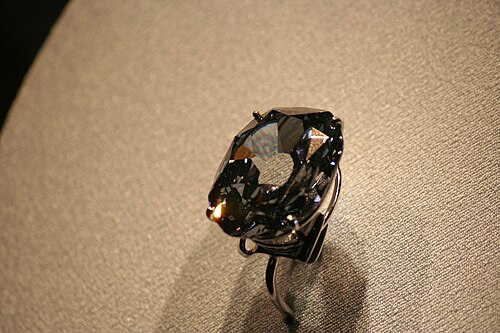 Wittelsbach-Graff Diamond


- Daria-i-Noor
- Noor-ul-Ain
- Koh-i-Noor
- Hope Diamond
- Princie Diamond
- Regent Diamond
- Wittelsbach-Graff Diamond
By the 1880s, "Golconda" was being used generically by English speakers to refer to any particularly rich mine, and later to any source of great wealth.
During the Renaissance and the early modern eras, the name "Golconda" acquired a legendary aura and became synonymous for vast wealth. The mines brought riches to the Qutb Shahis of Hyderabad State, who ruled Golconda up to 1687, then to the Nizam of Hyderabad, who ruled after the independence from the Mughal Empire in 1724 until 1948, when the Indian integration of Hyderabad occurred. The siege of Golconda occurred in January 1687, when Mughal Emperor Aurangzeb led his forces to besiege the Qutb Shahi dynasty at Golconda fort (also known as the Diamond Capitol of its time) and was home to the Kollur Mine. The ruler of Golconda was the well entrenched Abul Hasan Qutb Shah.[13]
Architecture[edit | edit source]

Golconda fort is listed as an archaeological treasure on the official "List of Monuments" prepared by the Archaeological Survey of India under The Ancient Monuments and Archaeological Sites and Remains Act.[14] Golconda consists of four distinct forts with a 10 km (6.2 mi) long outer wall with 87 semicircular bastions (some still mounted with cannons), eight gateways, and four drawbridges, with a number of royal apartments and halls, temples, mosques, magazines, stables, etc. inside. The lowest of these is the outermost enclosure entered by the "Fateh Darwaza" (Victory gate, so called after Aurangzeb’s triumphant army marched in through this gate) studded with giant iron spikes (to prevent elephants from battering them down) near the south-eastern corner. An acoustic effect can be experienced at Fateh Darwazaan, a hand clap at a certain point below the dome at the entrance reverberates and can be heard clearly at the "Bala Hisar" pavilion, the highest point almost a kilometer away. This worked as a warning in case of an attack.
The "Bala Hisar" gate is the main entrance to the fort located on the eastern side. It has a pointed arch bordered by rows of scroll work. The spandrels have yalis and decorated roundels. The area above the door has peacocks with ornate tails flanking an ornamental arched niche. The granite block lintel below has sculpted yalis flanking a disc. The design of peacocks and lions is typical of Hindu architecture and underlies this fort's Hindu origins.
The Jagadamba temple, located next to the mosque of Ibrahim and the king's palace, is visited by hundreds of thousands of Hindu devotees during Bonalu festival every year.[15][16] Jagadamba temple is about 900 to 1,000 years old, dating back to early Kakatiya period.[17] A Mahankali temple is located in the vicinity, within Golconda fort.[18]
The fort also contains the tombs of the Qutub Shahi kings. These tombs display features of Indo-Islamic architecture and are located about 1 km (0.62 mi) north of the outer wall of Golconda. They are encircled by gardens and numerous carved stones.
The two individual pavilions on the outer side of Golconda are built on a point which is quite rocky. The "Kala Mandir" is also located in the fort. It can be seen from the king's durbar (king's court) which was on top of the Golconda fort.
The other buildings found inside the fort are: Habshi Kamans (Abyssian arches), Ashlah Khana, Taramati mosque, Ramadas Bandikhana, Camel stable, private chambers (kilwat), Mortuary bath, Nagina bagh, Ramasasa's kotha, Durbar hall, Ambar khana etc.
-
 Rani Mahal
 -
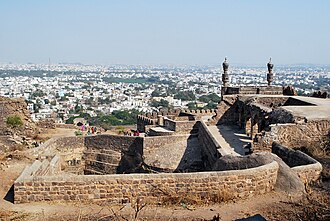 Fort overlooking the city of Hyderabad
 -

-
 Baradari located at the top of the citadel
 -

-
 Bala Hissar Darwaza
 -
-
 View from the Baradari
 -
 Design inside the Golconda fort
 -
 Aerial view of Golconda fort
 -
 Cannon of the Golconda fort
 -
 Pathway in Golconda fort
 -
 Baradari fort
 -
 Echo Dome interior


.jpg)
Golconda ruling dynasties[edit | edit source]
- Asaf Jahi dynasty
- Bahmani Sultans
- Kakatiya dynasty
- Mughal Empire
- Musunuri Nayakas
- Qutb Shahi dynasty
Naya Qila (New Fort)[edit | edit source]
Naya Qila is an extension of Golconda fort which was turned into the Hyderabad Golf Club despite resistance from farmers who owned the land and various NGOs within the city. The ramparts of the new fort start after the residential area with many towers and the Hatiyan ka Jhad ("Elephant-sized tree")—an ancient baobab tree with an enormous girth. It also includes a war mosque. These sites are under restrictive access to the public because of the Golf Course.
Qutub Shahi tombs[edit | edit source]

The tombs of the Qutub Shahi sultans lie about one kilometre north of Golconda's outer wall. These structures are made of beautifully carved stonework, and surrounded by landscaped gardens. They are open to the public and receive many visitors. It is one of the famous sight-seeing places in Hyderabad.
Golconda ropeway[edit | edit source]
Golconda Fort Ropeway, a 1.5-kilometre-long (0.93 mi) ropeway project between hilltop Golconda Fort and 7 Qutb Shahi tombs was approved in September 2025 under Parvatmala, tenders were invited for feasibility study were invited, following which DPR will be prepared for the construction.[19]
Golconda Artillery Centre, Indian Army[edit | edit source]

Golconda Artillery Centre, Hyderabad, was raised on 15 August 1962 as the Second Recruit Training Centre for the Regiment of Artillery.[20][21] Golconda Artillery Centre is located in and around the Golconda fort. The Golconda centre has three training regiments and presently trains 2900 recruits at a time.[22]
UNESCO World Heritage[edit | edit source]
The Golconda fort and other Qutb Shahi dynasty Monuments of Hyderabad (the Charminar, and the Qutb Shahi Tombs) were submitted by the Permanent Delegation of India to UNESCO in 2010 for consideration as World Heritage Sites. They are currently included on India's "tentative list".[23][24]
Influences[edit | edit source]
In popular culture[edit | edit source]
- "Aline, reine de Golconde" (1760), story by Stanislas de Boufflers
- Aline, reine de Golconde (1766), opera by Pierre-Alexandre Monsigny
- Aline, reine de Golconde (1803), opera by Henri-Montan Berton
- Aline, reine de Golconde (1804), opera by François-Adrien Boieldieu
- Alina, regina di Golconda (1828), opera by Gaetano Donizetti
- The poem "Template:Ws" by Letitia Elizabeth Landon was published in Fisher's Drawing Room Scrap Book, 1838.[25]
- Drottningen av Golconda (The Queen of Golconda, 1863), Swedish-language opera by Franz Berwald
- Russell Conwell's book Acres of Diamonds tells a story of the discovery of the Golconda mines.
- René Magritte's painting Golconda was named after the city.
- John Keats' early poem "On receiving a curious Shell" opens with the lines: "Hast thou from the caves of Golconda, a gem / pure as the ice-drop that froze on the mountain?"[26]
- Golconda is referenced in the classical Russian ballet La Bayadère (1877).
- Anthony Doerr's Pulitzer Prize–winning novel All the Light We Cannot See references the Golconda mines as the discovery place of the "Sea of Flames" diamond.
- In Patrick O'Brian's novel The Surgeon's Mate, a character describes a particularly valuable diamond as being worth "half Golconda".
- The term 'Golconda' is used in White Wolf's Vampire: the Masquerade table-top role-playing game to refer to a mystical state of enlightenment. Pursuit of Golconda is usually the ultimate aim of a campaign, although what this might entail is largely left to the storyteller's discretion.
Places named after Golconda[edit | edit source]
- A city in Illinois, United States is named after Golconda.
- A city in Nevada, United States is named after Golconda.
- A village located in the southern part of Trinidad had given the name in the 19th century to a rich tract of land which was once a sugar-cane estate. Currently, mostly descendants of East Indian indentured servants occupy the village of Golconda.
- A skatepark in New York City (Golconda Skate Park).
Gallery[edit | edit source]
-
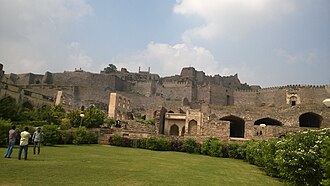 Golconda Fort—Large View
 -
 Golconda Fort seen from a road
 -
 Stone Arch Ruins
 -
 Golkonda during light show at night
 -
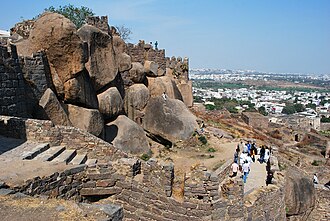 Fort overlooking the city
 -
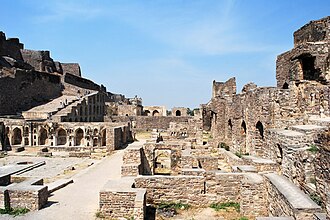 Staircase leading to the top of the Fort
 -
 Ambar Khana
 -
 Rani Mahal
 -
 Taramati Mosque
 -
 Golconda fort inside view
 -
 Architecture inside Golconda fort
 -
 Golconda fort from inside
 -
 View of the Golconda fort
 -
 Golconda fort from outside


.jpg)
See also[edit | edit source]

- Afanasiy Nikitin—the first European to visit Golconda
- History of Hyderabad
- Naya Qila
- Taramati Baradari
Citations[edit | edit source]
- ↑ 1.0 1.1 UNESCO "tentative list"
- ↑ "How an impregnable fort city was finally breached by treachery". 29 December 2022.
- ↑ 3.0 3.1 3.2 Bilgrami, Syed Ali Asgar (1927). The Landmarks of the Deccan. Hyderabad-Deccan, India: Government Central Press. pp. 108–110. Reprint: ISBN 9789353245733.
- ↑ Harin Chandra (14 May 2012). "Enjoy a slice of history". The Hindu.
- ↑ 5.0 5.1 5.2 Lasania, Yunus (19 February 2022). "Hyderabad: How rumours of a secret tunnel are ruining the Charminar". The Siasat Daily. Retrieved 16 November 2022.
- ↑ Yimene, Ababu Minda (2004). An African Indian community in Hyderabad. Cuvillier Verlag. p. 2. ISBN 978-3-86537-206-2. Retrieved 19 September 2021.
- ↑ Sherwani, H.K. (1974). The History of the Qutb Shahi Dynasty. India: Munshiram Manoharlal Publishers Pvt. Ltd. ISBN 9788121503396.
- ↑ Sardar, Marika (2007). Golconda Through Time: A Mirror of the Evolving Deccan (PhD thesis). New York University. pp. 66–67. ISBN 978-0-549-10119-2.
- ↑ Sen, Sailendra (2013). A Textbook of Medieval Indian History. Primus Books. p. 118. ISBN 978-9-38060-734-4.
- ↑ Moreland, W.H (1931). Relation of Golconda in the Early Seventeenth Century. Halyukt Society.
- ↑ Gopal, Madan (1990). K.S. Gautam (ed.). India through the ages. Publication Division, Ministry of Information and Broadcasting, Government of India. p. 178.
- ↑ Bradnock, Roma (2007). Footprint India. Footprint. p. 1035. ISBN 978-1-906098-05-6.
- ↑ "Delving into the rich and often bloody history of Golconda Fort". The Hindu. 5 November 2016.
- ↑ "Alphabetical List of Monuments—Andhra Pradesh". Archaeological Survey of India. Archived from the original on 25 June 2014. Retrieved 27 August 2015.
- ↑ "Historic Jagadamba temple sees many devotees, but few facilities". The Times of India. 30 October 2017.
- ↑ "Golconda Bonalu begins with [[:Template:As written]] fervour". The Hindu. 30 June 2022.
{{cite news}}: URL–wikilink conflict (help) - ↑ "With pandemic on ebb, state gears up for grand Bonalu". 13 June 2022.
- ↑ "Golconda Mahankali temple set for grand Bonalu fete". 15 June 2022.
- ↑ Govt approves overhead sky cable car project, Hans India, 2 Oct 2025.
- ↑ "830 new recruits pass out from Artillery Centre". The Times of India. 28 March 2021.
- ↑ "First batch of Agniveers start training at Golconda Artillery in Hyderabad". The Times of India. 10 January 2023.
- ↑ "Arty Centre, Hyderabad". Retrieved 25 May 2021.
- ↑ Centre, UNESCO World Heritage. "The Qutb Shahi Monuments of Hyderabad Golconda Fort, Qutb Shahi Tombs, Charminar – UNESCO World Heritage Centre". whc.unesco.org.
- ↑ Archana Khare Ghose. "Prestige or Preservation?". The Times of India. Archived from the original on 22 June 2018. Retrieved 3 December 2017.
- ↑ Landon, Letitia Elizabeth (1837). "poetical illustration". Fisher's Drawing Room Scrap Book, 1834. Fisher, Son & Co. pp. 12–14.Landon, Letitia Elizabeth (1837). "picture". Fisher's Drawing Room Scrap Book, 1838. Fisher, Son & Co.
- ↑ "6. On receiving a curious Shell. Keats, John. 1884. The Poetical Works of John Keats". Bartleby.com. Retrieved 1 May 2013.
Further reading[edit | edit source]
- Nanisetti, Serish (2019). Golconda Bagnagar Hyderabad, Rise and Fall of a Global Metropolis in Medieval India (1st ed.). Generic. ISBN 9789353518813.
- Prasad, G. Durga (1988). History of the Andhras up to 1565 A. D. (PDF). Guntur: P. G. Publishers.
External links[edit | edit source]
- Qutb Shahi Architecture at Golconda[usurped] (archived 18 May 2015)
- . Encyclopædia Britannica (11th ed.). 1911.

- Pages using the JsonConfig extension
- Articles containing Telugu-language text
- 11th-century establishments in India
- Archaeological sites in Telangana
- Buildings and structures in Hyderabad, India
- Buildings on the Indian Archaeological Register
- Cultural heritage of India
- Former capitals in India
- Former populated places in India
- Forts in Telangana
- Hyderabad State
- Medieval Indian cities
- Monuments of National Importance in Telangana
- Populated places established in the 10th century
- Qutb Shahi architecture
- Tourist attractions in Hyderabad, India
- Tourist attractions in Telangana
- Water Heritage Sites in India
- World Heritage Tentative List for India