

m Removing protection template from an unprotected page |
brief expanded details as per guidelines and fixed typos |
||
| Line 1: | Line 1: | ||
{{Short description|Country in Oceania}} | {{Short description|Country in Oceania}} | ||
{{About|the country in Oceania|the island | {{About|the country in Oceania|the whole island|New Guinea|the Indonesian half of the island|Western New Guinea|the single by the Future Sound of London|Papua New Guinea (record)|other uses|Papua (disambiguation)|and|Guinea (disambiguation)|and|PNG (disambiguation)}} | ||
{{Distinguish|Guinea|Equatorial Guinea}} | |||
{{Use dmy dates|date= | {{good article}} | ||
{{pp-move-vandalism|small=yes}} | |||
{{Use dmy dates|date=December 2025}} | |||
{{Use Australian English|date=October 2021}} | {{Use Australian English|date=October 2021}} | ||
{{Infobox country | {{Infobox country | ||
| conventional_long_name = Independent State of Papua New Guinea | | conventional_long_name = Independent State of Papua New Guinea | ||
| native_name = {{ubl|{{native name|tpi|Independen Stet bilong Papua Niugini}}|{{native name|ho| | | native_name = {{ubl|{{native name|tpi|Independen Stet bilong Papua Niugini}}|{{native name|ho|Gau Hedinarai ai Papua–Matamata Guinea}}}} | ||
| common_name = Papua New Guinea | | common_name = Papua New Guinea | ||
| image_flag = Flag of Papua New Guinea.svg | | image_flag = Flag of Papua New Guinea.svg | ||
| alt_flag = A black triangle with the Southern Cross marked with five white stars next to a red triangle with a golden bird-of-paradise | |||
| image_symbol = National emblem of Papua New Guinea.svg | | image_symbol = National emblem of Papua New Guinea.svg | ||
| symbol_type = [[Emblem of Papua New Guinea| | | symbol_type = [[Emblem of Papua New Guinea|Emblem]] | ||
| symbol_width = 130 | | symbol_width = 130 | ||
| national_motto = '[[Unity in diversity]]'<ref>{{ | | alt_symbol = A stylised bird-of-paradise standing on a spear and kundu drum | ||
| national_anthem = "[[O Arise, All You Sons]]"<ref>{{cite web |title=Never more to rise | | national_motto = {{'}}[[Unity in diversity]]'<ref name="Reilly2004"/>{{rp|52}} | ||
| national_anthem = "[[O Arise, All You Sons]]"<ref>{{cite web |date=6 February 2006 |title=Never more to rise |url=http://www.thenational.com.pg/020606/w5.htm |url-status=dead |archive-url=https://web.archive.org/web/20070713212154/http://www.thenational.com.pg/020606/w5.htm |archive-date=13 July 2007 |access-date=19 January 2005 |work=The National}}</ref><ref name="cia" />{{parabr}}{{center|[[File:O Arise, All You Sons (instrumental).ogg]]}} | |||
| image_map = PNG orthographic.svg | |||
| image_map = | |||
| map_caption = {{map caption |location_color= green}} | | map_caption = {{map caption |location_color= green}} | ||
| | | alt_map = Papua New Guinea in green with Southeast Asia and other areas of Asia to its west and northwest, Australia to the south, and the large Pacific ocean to the east | ||
| languages_type = Official languages<ref name="cia" /><ref name="sign">{{cite news|url=http://www.radionz.co.nz/international/pacific-news/274199/sign-language-becomes-an-official-language-in-png| | | languages_type = Official languages | ||
| | | languages = {{hlist |[[Papua New Guinean English|English]]|[[Hiri Motu]] |[[Papua New Guinean Sign Language|PNG Sign Language]]|[[Tok Pisin]]<ref name="cia" /><ref name="sign">{{cite news |date=21 May 2015 |title=Sign language becomes an official language in PNG |url=http://www.radionz.co.nz/international/pacific-news/274199/sign-language-becomes-an-official-language-in-png |url-status=live |archive-url=https://web.archive.org/web/20150528060527/http://www.radionz.co.nz/international/pacific-news/274199/sign-language-becomes-an-official-language-in-png |archive-date=28 May 2015 |access-date=28 May 2015 |publisher=[[Radio New Zealand]]}}</ref>}} | ||
| languages2_type = '''Indigenous languages''' | | languages2_type = '''Indigenous languages''' | ||
| languages2_sub = yes | | languages2_sub = yes | ||
| languages2 = [[Languages of Papua New Guinea| | | languages2 = [[Languages of Papua New Guinea|839 languages]]<ref name="ethnologue"/> | ||
| ethnic_groups = {{ | | ethnic_groups = | ||
| religion = {{ublist |item_style=white-space:nowrap; | |||
|{{Tree list}} | |||
*95.5% [[Christianity]] ([[State Religion|official]])<ref name="official">{{cite news |last=Waide |first=Scott |date=13 March 2025 |title=Papua New Guinea declares Christian identity in constitutional amendment |url=https://www.rnz.co.nz/news/pacific/544665/papua-new-guinea-declares-christian-identity-in-constitutional-amendment |website=[[Radio New Zealand]]}}</ref> | |||
**64.3% [[Protestantism]] | |||
**26.0% [[Catholic Church|Catholicism]] | |||
**5.2% other [[List of Christian denominations|Christian]] | |||
{{Tree list/end}} | |||
|3.1% unspecified | |||
|1.4% [[Religion in Papua New Guinea|other]]s or [[Irreligion|none]] | |||
}} | }} | ||
| religion_year = 2011 | |||
| religion_ref = <ref name="2011 stat report">{{cite web |last1=Koloma |first1=Roko |last2=Kele |first2=Hajily |title=Papua New Guinea 2011 National Report-National Statistical Office |url=http://sdd.spc.int/en/resources/document-library?view=preview&format=raw&fileId=218 |url-status=live |archive-url=https://web.archive.org/web/20170812174041/http://sdd.spc.int/en/resources/document-library?view=preview&format=raw&fileId=218 |archive-date=12 August 2017 |access-date=2 September 2016 |website=sdd.spc.int}}</ref> | |||
| religion_year = 2011 | |||
| religion_ref = <ref name="2011 stat report">{{cite web |last1=Koloma | |||
| demonym = [[Demographics of Papua New Guinea|Papua New Guinean]] | | demonym = [[Demographics of Papua New Guinea|Papua New Guinean]] | ||
| capital = [[Port Moresby]] | | capital = [[Port Moresby]] | ||
| coordinates = {{Coord|09|28|44|S|147|08|58|E|type:city}} | | coordinates = {{Coord|09|28|44|S|147|08|58|E|type:city}} | ||
| largest_city = [[Port Moresby]] | | largest_city = [[Port Moresby]] | ||
| government_type = | | government_type = Unitary parliamentary [[constitutional monarchy]] | ||
| leader_title1 = [[Monarchy of Papua New Guinea|Monarch]] | | leader_title1 = [[Monarchy of Papua New Guinea|Monarch]] | ||
| leader_name1 = [[Charles III]] | | leader_name1 = [[Charles III]] | ||
| Line 52: | Line 53: | ||
| sovereignty_type = Independence | | sovereignty_type = Independence | ||
| sovereignty_note = from [[Australia]] | | sovereignty_note = from [[Australia]] | ||
| established_event1 = [[Papua and New Guinea Act 1949]] | | established_event1 = [[Papua and New Guinea Act 1949|Administrative union]] | ||
| established_date1 = 1 July 1949 | | established_date1 = 1 July 1949 | ||
| established_event2 = [[Papua New Guinea Independence Act 1975| | | established_event2 = [[Papua New Guinea Independence Act 1975|Independence]] | ||
| established_date2 = 16 September 1975 | | established_date2 = 16 September 1975 | ||
| area_rank = 54th<!-- Should match [[List of countries and dependencies by area]] --> | | area_rank = 54th<!-- Should match [[List of countries and dependencies by area]] --> | ||
| area_km2 = 462,840 | | area_km2 = 462,840 | ||
| area_sq_mi = 178,703 | | area_sq_mi = 178,703 | ||
| percent_water = 2 | | percent_water = 2.2 | ||
| population_estimate = {{IncreaseNeutral}} 11,781,559<ref>{{cite web | url=https://www.nso.gov.pg/statistics/population/#118-118-top-p2 | | | population_estimate = {{IncreaseNeutral}} 11,781,559<ref>{{cite web |title=Population | National Statistical Office | Papua New Guinea |url=https://www.nso.gov.pg/statistics/population/#118-118-top-p2 |url-status=live |archive-url=https://web.archive.org/web/20230720004458/https://www.nso.gov.pg/statistics/population/#118-118-top-p2 |archive-date=20 July 2023 |access-date=20 July 2023}}</ref> | ||
| population_estimate_year = 2021 | | population_estimate_year = 2021 | ||
| population_estimate_rank = | | population_estimate_rank = 93rd | ||
| population_census = | | population_census = 10,185,363 <ref>{{Cite report |url=https://png.unfpa.org/en/publications/2024-national-population-census-final-figures |title=2024 National Population Census Final Figures |publisher=Government of Papua New Guinea |via=[[United Nations Population Fund|UNFPA]] in Papua New Guinea}}</ref> | ||
| population_census_year = | | population_census_year = 2024 | ||
| population_density_km2 = | | population_density_km2 = 25.5 | ||
| population_density_sq_mi = 34.62 | | population_density_sq_mi = 34.62 | ||
| population_density_rank = | | population_density_rank = | ||
| GDP_PPP = {{increase}} $41.810 billion<ref name="IMF202504">{{cite web |date=April 2025 |title=World Economic Outlook Database, April 2025 |url=https://www.imf.org/en/Publications/WEO/weo-database/2025/april |access-date=24 June 2025 |publisher=International Monetary Fund}}</ref> | |||
| GDP_PPP = $ | | GDP_PPP_rank = 135th | ||
| GDP_PPP_rank = | | GDP_PPP_year = 2025 | ||
| GDP_PPP_per_capita = $3, | | GDP_PPP_per_capita = {{increase}} $3,760<ref name="IMF202504"/> | ||
| GDP_PPP_per_capita_rank = | | GDP_PPP_per_capita_rank = 162nd | ||
| GDP_nominal = $ | | GDP_nominal = {{increase}} $32.840 billion<ref name="IMF202504"/> | ||
| GDP_nominal_rank = | | GDP_nominal_rank = 108th | ||
| GDP_nominal_year = | | GDP_nominal_year = 2025 | ||
| GDP_nominal_per_capita = $2, | | GDP_nominal_per_capita = {{increase}} $2,560<ref name="IMF202504"/> | ||
| GDP_nominal_per_capita_rank = | | GDP_nominal_per_capita_rank = 142nd | ||
| Gini_year = 2009 | | Gini_year = 2009 | ||
| Gini_change = <!--increase/ | | Gini_change = <!--increase/decrease/steady--> | ||
| Gini = 41.9 <!--number only--> | | Gini = 41.9 <!--number only--> | ||
| Gini_ref = <ref name="gini">{{cite web |url=https://data.worldbank.org/indicator/SI.POV.GINI?locations=PG | | | Gini_ref = <ref name="gini">{{cite web |title=GINI index (World Bank estimate) |url=https://data.worldbank.org/indicator/SI.POV.GINI?locations=PG |url-status=live |archive-url=https://web.archive.org/web/20190407160303/https://data.worldbank.org/indicator/SI.POV.GINI%3Flocations%3DPG |archive-date=7 April 2019 |access-date=23 February 2019 |website=data.worldbank.org |publisher=[[World Bank]]}}</ref> | ||
| Gini_rank = | | Gini_rank = | ||
| HDI = 0. | | HDI = 0.576 <!--number only--> | ||
| HDI_year = | | HDI_year = 2023<!-- Please use the year to which the data refers, not the publication year--> | ||
| HDI_change = increase <!--increase/decrease/steady--> | | HDI_change = increase <!--increase/decrease/steady--> | ||
| HDI_ref = <ref name=" | | HDI_ref = <ref name="Conceição2025">{{cite book |last=Conceição |first=Pedro |title=Human Development Report 2025 |date=2025 |publisher=United Nations Development Programme |isbn=9789211542639 |page=276 |issn=2412-3129}}</ref> | ||
| HDI_rank = | | HDI_rank = 160th | ||
| currency = [[Papua New Guinean kina|Kina]] | | currency = [[Papua New Guinean kina|Kina]] | ||
| currency_code = PGK | | currency_code = PGK | ||
| Line 98: | Line 99: | ||
| calling_code = [[+675]] | | calling_code = [[+675]] | ||
}} | }} | ||
'''Papua New Guinea'''{{efn|{{IPAc-en|ˈ|p|æ|p|(|j|)|u|ə|...|ˈ|ɡ|ɪ|n|i|,_|ˈ|p|ɑː|-|audio=En-us-Papua New Guinea.ogg}}, {{Small|also}} {{IPAc-en|US|ˈ|p|ɑː|p|w|ə|-|,_|ˈ|p|ɑː|p|(|j|)|ə|-}}<ref>{{citation |last=Jones |first=Daniel |title=English Pronouncing Dictionary |year=2003 |editor1=Peter Roach |publisher=Cambridge University Press |isbn=978-3-12-539683-8 |author-link=Daniel Jones (phonetician) |editor-first2=James |editor-last2=Hartmann |editor-first3=Jane |editor-last3=Setter |orig-year=1917}}</ref>}} (PNG), officially the '''Independent State of Papua New Guinea''',<ref>{{cite web |title=Constitution of the Independent State of Papua New Guinea |url=https://www.constituteproject.org/constitution/Papua_New_Guinea_2016.pdf?lang=en |url-status=live |archive-url=https://web.archive.org/web/20220225145945/https://www.constituteproject.org/constitution/Papua_New_Guinea_2016.pdf?lang=en |archive-date=25 February 2022 |access-date=25 February 2022}}</ref> is an [[island country]] in [[Oceania]] that comprises the eastern half of the island of [[New Guinea]] and offshore islands in [[Melanesia]], a region of the southwestern [[Pacific Ocean]] north of [[Australia]]. It has [[Indonesia–Papua New Guinea border|a land border with Indonesia]] to the west and [[maritime border]]s with Australia to the south and the [[Solomon Islands]] to the east. Its capital is [[Port Moresby]]. The country's {{convert|462840|km2|mi2|abbr=on}} includes a large mainland and hundreds of islands. | |||
The territory of Papua New Guinea was split in the 1880s between [[German New Guinea]] in the north and the British [[Territory of Papua]] in the south, the latter of which was ceded to Australia in 1902. All of present-day Papua New Guinea came under Australian control following [[World War I]], although it remained two distinct territories. The nation was the site of fierce fighting during the [[New Guinea campaign]] of [[World War II]], following which [[Papua and New Guinea Act 1949|the two territories were united]] in 1949. Papua New Guinea became an independent [[Commonwealth realm]] in 1975. Representing the [[Monarchy of Papua New Guinea|King]] is a [[Governor-General of Papua New Guinea|Governor-General]]. Politics take place within a [[Westminster system]], with the government led by a [[Prime Minister of Papua New Guinea|prime minister]]. Members of the National Parliament, the unicameral legislative body of Papua New Guinea, also serve as [[Provinces of Papua New Guinea|provincial]] leaders. | |||
The population is highly rural, with only 14% living in urban centres in 2023. The persistence of traditional communities and lifestyles are explicitly protected by the [[Law of Papua New Guinea#Constitution|Papua New Guinea Constitution]]. While official population estimates suggest the population is around 11.8 million, estimates using satellite data put the number closer to 17 million. The population is extremely diverse. There are [[languages of Papua New Guinea|840 known spoken languages]], making it the most linguistically diverse country in the world. Cultural practices are similarly diverse. Many cultural and linguistic groups are small, although English and [[Tok Pisin]] serve as common languages. This diversity has led to friction, especially in politics, and the government has struggled to combat [[violence against women]]. | |||
The country has a large Christian majority population, of several different denominations, and in March 2025 its constitution was amended to adopt Christianity as the official state religion.<ref name=official/> | |||
The | The rural and diverse population is a result of highly mountainous [[geography]]. The land supports around 5% of all known species, and the export-driven economy is also dependent on natural resources. Papua New Guinea is a [[developing economy]] where nearly 40% of the population are [[Subsistence agriculture|subsistence farmers]] living relatively independently of the [[Monetary economics|cash economy]]. The country retains [[Australia–Papua New Guinea relations|close ties to Australia]], and has enhanced ties with both Asia and the Pacific. | ||
==Etymology== | |||
''Papua'' is derived from a local term of uncertain origin, that may have referred to at least part of the island now called [[New Guinea]]. In 1526 [[Portuguese Empire|Portuguese]] explorer [[Jorge de Menezes]] named the island {{lang|pt|Ilhas dos Papuas}}.<ref name="tides">{{cite book |last1=Pickell |first1=David |last2=Müller |first2=Kal |name-list-style=amp |title=Between the Tides: A Fascinating Journey among the Kamoro of New Guinea |publisher=Tuttle Publishing |year=2002 |page=153 |url=https://books.google.com/books?id=WUtz2hjvPvMC&pg=PA153 |isbn=978-0-7946-0072-3 |access-date=18 October 2015 |archive-date=7 April 2023 |archive-url=https://web.archive.org/web/20230407104414/https://books.google.com/books?id=WUtz2hjvPvMC&pg=PA153 |url-status=live }}</ref><ref name="Madden2022">{{cite book |author=Duncan Madden |year=2022 |title=Found in Translation: The Unexpected Origins of Place Names |publisher=Hachette UK |isbn=9781529369939 |chapter=Papua New Guinea |chapter-url=https://books.google.com/books?id=2rx-EAAAQBAJ&pg=PT228}}</ref> The word "Papua" has applied to various areas of New Guinea since then, with its inclusion in "Papua New Guinea" coming from its use for the Territory of Papua.<ref name="Rottman2001">{{cite book |author=Gordon L. Rottman |date=2001 |title=World War II Pacific Island Guide: A Geo-Military Study |publisher=Bloomsbury Publishing USA |isbn=9780313075582 |url=https://books.google.com/books?id=g7bOEAAAQBAJ}}</ref>{{rp|147}}<ref name="Bourke2009"/>{{rp|11}} | |||
"New Guinea" ({{lang|es|Nueva Guinea}}) was the name coined by the [[Spanish Empire|Spanish]] explorer [[Yñigo Ortiz de Retez]]. In 1545, he noted the resemblance of the people to those he had earlier seen along the [[Guinea (region)|Guinea]] coast of Africa. Guinea, in its turn, is etymologically derived from the [[Portuguese language|Portuguese]] word ''[[wikt:Guiné|Guiné]]''. The name is one of several [[Toponymy|toponyms]] sharing similar [[Place name origins|etymologies]], which likely mean "of the burnt face" or similar, in reference to the [[dark skin]] of the inhabitants.<ref name="Madden2022"/> Its use in the country name comes from German New Guinea, later the [[Territory of New Guinea]], which was united with the territory of Papua.<ref name="Rottman2001"/>{{rp|147}} | |||
== History == | == History == | ||
{{main|History of Papua New Guinea}} | {{main|History of Papua New Guinea}} | ||
Archaeological evidence indicates that humans first arrived in | ===First settlement=== | ||
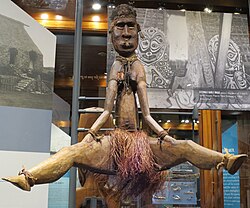
[[File:Female gable image, Sawos people, Papua New Guinea, Bishop Museum, 1989.400.358.JPG|thumb|alt=Wooden status of a woman sitting with her legs open|Female gable image, Sawos people, Oceanic art in the [[Bishop Museum]]]] | |||
Archaeological evidence indicates that modern humans first arrived in what became [[Sahul|New Guinea and Australia]], as well as the [[Bismarck Archipelago]], around 42,000 to 45,000 years ago. [[Bougainville Island|Bougainville]] was settled by around 28,000 years ago, and the more distant [[Manus Island]] by around 20,000 years ago. These were part of the [[Early human migrations|earliest migrations of humans]] from Africa, and the resulting populations remained relatively isolated from the rest of the world throughout prehistory.<ref name="Bourke2009">{{cite book |author=R. Michael Bourke |editor1=R. Michael Bourke |editor2=Tracy Harwood |date=August 2009 |chapter=History of Agriculture in Papua New Guinea |title=Food and Agriculture in Papua New Guinea |publisher=ANU Press |doi=10.22459/FAPNG.08.2009 |doi-access=free |isbn=9781921536618 |url=https://press.anu.edu.au/publications/food-and-agriculture-papua-new-guinea}}</ref>{{rp|11}}<ref>{{cite book |last1=O'Connell |first1=James F. |last2=Allen |first2=Jim |chapter=Pre-LGM Sahul (Australia-New Guinea) and the archaeology of early modern humans |title=Rethinking the Human Revolution: New Behavioural and Biological Perspectives on the Origin and Dispersal of Modern Humans |year=2007 |pages=395–410 |chapter-url=http://ereserve.library.utah.edu/Annual/ANTHR/3331/OConnell/pre.pdf |archive-date=3 December 2024 |access-date=14 May 2024 |archive-url=https://web.archive.org/web/20241203092438/http://ereserve.library.utah.edu/Annual/ANTHR/3331/OConnell/pre.pdf |url-status=dead }}</ref> [[Past sea level|Rising sea levels]] isolated New Guinea from Australia about 10,000 years ago, although [[Aboriginal Australians]] and [[Indigenous people of New Guinea|New Guineans]] had already diverged from each other from about 37,000 years ago.<ref>{{cite web | last=Klein | first=Christopher | title=DNA Study Finds Aboriginal Australians World's Oldest Civilization | website=History | date=23 September 2016 | url=https://www.history.com/news/dna-study-finds-aboriginal-australians-worlds-oldest-civilization | quote=Updated Aug 22, 2018 | access-date=16 July 2022 | archive-date=26 June 2022 | archive-url=https://web.archive.org/web/20220626025610/https://www.history.com/news/dna-study-finds-aboriginal-australians-worlds-oldest-civilization | url-status=live }}</ref> | |||
Agriculture was independently developed in the New Guinea highlands around 7000 BC, making it one of the few areas in the world [[Vavilov center|where people independently domesticated plants]].<ref>Diamond, J. (March 1997). ''Guns, Germs, and Steel: The Fates of Human Societies''. W.W. Norton & Company. {{ISBN|0-393-03891-2}}.</ref> Before the onset of full-scale agriculture, some plants had already been domesticated, including [[sago]], ''[[Canarium indicum]]'', and [[karuka]].<ref name="Bourke2009"/>{{rp|13}} Archaeological evidence shows that [[Austronesian languages|Austronesian-speaking]] peoples of the [[Lapita culture]] reached the Bismarck Archipelago by 3,300 years ago.<ref name="Summerhayes2019">{{cite journal |author=Glenn R. Summerhayes |year=2019 |title=Austronesian Expansions and the Role of Mainland New Guinea: A New Perspective |journal=Asian Perspectives |volume=58 |issue=2 |url=https://www.jstor.org/stable/26792734 |pages=250–260|doi=10.1353/asi.2019.0015 |jstor=26792734 |hdl=10125/76784 |hdl-access=free }}</ref>{{rp|252}} It is unknown whether they also settled on the mainland at this time, but there is strong evidence of their presence in coastal areas from around 500 BC.<ref name="Summerhayes2019"/>{{rp|256}} These communities interacted with larger trade networks.<ref name="Gaffney2020">{{cite journal |author1=Dylan Gaffney |author2=Karen Greig |author3=Debbie Stoddart |author4=Monica Tromp |author5=Judith H. Field |author6=Sindy Luu |author7=Adelle C. F. Coster |author8=Tristan Russell |author9=Herman Mandui |author10=Glenn R. Summerhayes |year=2020 |title=Tropical Foodways and Exchange along the Coastal Margin of Northeastern New Guinea |journal=Journal of Field Archaeology |volume=45 |issue=6 |pages=498–511 |doi=10.1080/00934690.2020.1786285 }}</ref> It is likely through these trading networks that [[banana]] and [[sugarcane]] moved from New Guinea to other areas of the world.<ref name="Swadling2019">{{cite book |ref=Swadling |last=Swadling |first=Pamela |title=Plumes from Paradise |year=1996 |edition=2019 |publisher=Sydney University Press |isbn=978-1743-32-545-2 |url=https://open.sydneyuniversitypress.com.au/files/9781743325452.pdf}}</ref>{{rp|<!--15-->52–53}} | |||
Trade became rarer around 300 AD, as demand for goods shifted to the [[Maluku Islands]] and [[Timor]]. After European interest in the region grew in the 16th century, Dutch influence grew over the [[Sultanate of Tidore]]. As Dutch authorities become more interested in New Guinea, they confirmed and extended the sultanate's claims over western New Guinea.<ref name="Swadling2019"/>{{rp|16–17<!--more from 109–120-->}} Renewed trade began to spread to the eastern parts of New Guinea in the late 17th century, driven by demand for goods such as [[dammar gum]], [[sea cucumber]]s, [[pearl]]s, [[copra]], shells, and [[bird-of-paradise]] feathers.<ref name="Swadling2019"/>{{rp|18}} | |||
On New Guinea, communities were economically linked through trading networks. Despite this, aside from some political alliances, each community functioned largely independently, relying on [[subsistence agriculture]].<ref name="May2004chapter4">{{cite book |author=R.J. May |date=May 2004 |title=State and Society in Papua New Guinea: The First Twenty-Five Years |publisher=ANU Press |isbn=9781920942052 |doi=10.22459/SSPNG.05.2004 |doi-access=free |url=https://press.anu.edu.au/publications/state-and-society-papua-new-guinea |chapter=4. Micronationalism in Papua New Guinea}}</ref>{{rp|51}} Goods were often traded along established chains, and some villagers would be familiar with and sometimes know the languages of the immediately neighbouring villages (although language by itself was not a marker of political allegiance). Some wider trading networks existed in maritime areas.<ref name="May2022chapter8">{{cite book |author=R.J. May |date=August 2022 |title=State and Society in Papua New Guinea, 2001–2021 |publisher=ANU Press |isbn=9781760465216 |doi=10.22459/SSPNG.2022 |doi-access=free |url=https://press.anu.edu.au/publications/series/pacific/state-society-papua-new-guinea-2001%E2%80%932021 |chapter=8. Harmonising linguistic diversity in Papua New Guinea}}</ref>{{rp|132–133}} While people did not move far along these routes, goods moved long distances through local exchanges, and cultural practices likely diffused along them.<ref name="Allen1983"/>{{rp|19–20}} Despite these links, the creation of larger political entities under European rule had no precedent, and in many cases brought together communities that historically had antagonistic relationships, or no relationship at all.<ref name="May2022chapter2">{{cite book |author=R.J. May |date=August 2022 |title=State and Society in Papua New Guinea, 2001–2021 |publisher=ANU Press |isbn=9781760465216 |doi=10.22459/SSPNG.2022 |doi-access=free |url=https://press.anu.edu.au/publications/series/pacific/state-society-papua-new-guinea-2001%E2%80%932021 |chapter=2. Political change in Papua New Guinea: Is it needed? Will it work?}}</ref>{{rp|11}} | |||
===European influence=== | |||
It is likely that some ships from China and Southeast Asia visited the island at times, and that there was some contact with New Guinean communities.<ref name="Cornock2020">{{cite book |author=Oliver Cornock |date=2020 |title=The Report: Papua New Guinea 2020 |publisher=Oxford Business Group |isbn=9781912518562 |url=https://books.google.com/books?id=ZLFbEQAAQBAJ}}</ref>{{rp|10}} The Portuguese explorer [[António de Abreu]] was the first European to discover the island of New Guinea.<ref name="Rottman2001"/>{{rp|152}} [[Portuguese discoveries|Portuguese traders]] introduced the South American [[sweet potato]] to the [[Maluku Islands|Moluccas]]. From there, it likely spread into what is today Papua New Guinea sometime in the 17th or 18th century, initially from the southern coast. It soon spread inland to the highlands, and became a [[staple food]].<ref name="Swadling2019"/>{{rp|165, 282–283}} The introduction of the sweet potato, possibly alongside other agricultural changes, transformed traditional agriculture and societies. This likely led to the spread of the [[Big man (anthropology)|Big man]] social structure. Sweet potato largely supplanted the previous staple, [[taro]],<ref name="Denham2013">{{cite journal |author1=Tim Denham |year=2013 |title=Ancient and historic dispersals of sweet potato in Oceania |journal=Proceedings of the National Academy of Sciences |volume=110 |issue=6 |pages=1982–1983 |doi=10.1073/pnas.1221569110 |doi-access=free |pmid=23355678 |pmc=3568348 |bibcode=2013PNAS..110.1982D }}</ref> and led to significant population growth in the highlands.<ref name="Roullier2013">{{cite journal |author1=C. Roullier |author2=R. Kambouo |author3=J. Paofa |author4=D. McKey |author5=V. Lebot |year=2013 |title=On the origin of sweet potato (Ipomoea batatas (L.) Lam.) genetic diversity in New Guinea, a secondary centre of diversity |journal=Heredity |volume=110 |issue=6 |pages=594–604 |doi=10.1038/hdy.2013.14 |pmid=23531982 |pmc=3656641 |bibcode=2013Hered.110..594R }}</ref> | |||
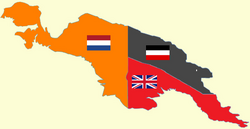
[[File:New Guinea (1884-1919).png|thumb|left|alt=Flag map showing New Guinea divided between the Netherlands (west), Germany (northeast), and the United Kingdom (southeast)|New Guinea from 1884 to 1919. [[German colonial empire|Germany]] and [[British Empire|Britain]] controlled the eastern half of New Guinea.]] | |||
By the 1800s, there was some trade with the [[Dutch East Indies]]. Beginning in the 1860s, people from New Guinea were effectively taken as slaves to [[Queensland]] and [[Fiji]] as part of the [[blackbirding]] trade. This was stopped in 1884.<ref name="RNZbriefhistory">{{cite web |url=https://www.rnz.co.nz/collections/nff-png/about-png |title=Papua New Guinea – a brief history |publisher=Radio New Zealand |access-date=21 May 2025}}</ref> Most of those taken were from coastal Papua. Those who returned to New Guinea brought their experiences with Western culture with them, but the largest impact was the development of a [[Melanesian Pidgin]] that would eventually become the [[Tok Pisin]] language.<ref name="Lea2023">{{cite book |author=David Lea |date=24 April 2023 |title=Papua New Guinea in the Twenty-First Century: The Struggle for Development and Independence |publisher=Rowman & Littlefield |isbn=9781666917390 |url=https://books.google.com/books?id=cvu6EAAAQBAJ}}</ref>{{rp|9–10}} | |||
Christianity was introduced to New Guinea on 15 September 1847 when a group of [[Society of Mary (Marists)|Marist missionaries]] went to [[Woodlark Island]].<ref>{{cite news |url=https://www.thenational.com.pg/lutheran-church-prepares-for-celebration/ |title=Lutheran church prepares for celebration |work=The National |date=12 April 2011 |access-date=28 April 2025}}</ref><ref>{{cite news |url=https://www.licas.news/2021/03/10/history-of-evangelization-in-papua-new-guinea/ |title=History of evangelization in Papua New Guinea |work=LiCAS.news |date=10 March 2021 |access-date=28 April 2025}}</ref> Missions were the primary source of Western culture as well as religion.<ref name="Lea2023"/>{{rp|9}} The western half of the island was [[Dutch New Guinea|annexed by the Netherlands]] in 1848.<ref name="Swadling2019"/>{{rp|278}} The nearby [[Torres Strait Islands]] were annexed by Queensland in 1878,<ref name="Swadling2019"/>{{rp|280}} and Queensland attempted to annex some of New Guinea in 1883.<ref name="Rottman2001"/>{{rp|152}}<ref name="Gardner2024">{{cite journal |author1=Helen Gardner |author2=Jonathan Ritchie |author3=Brad Underhill |author4=Keimelo Gima |date=24 May 2024 |title=Wan Solwara: New Histories of Australia and Papua New Guinea |journal=Australian Historical Studies |volume=55 |issue=2 |pages=223–232 |doi=10.1080/1031461X.2024.2335179 }}</ref>{{rp|227}} The eastern half of the island was divided between Germany in the north and the United Kingdom in the south in 1884.<ref name="May2004chapter15">{{cite book |author=R.J. May |date=May 2004 |title=State and Society in Papua New Guinea: The First Twenty-Five Years |publisher=ANU Press |isbn=9781920942052 |doi=10.22459/SSPNG.05.2004 |doi-access=free |url=https://press.anu.edu.au/publications/state-and-society-papua-new-guinea |chapter=15. From Promise to Crisis: A Political Economy of Papua New Guinea}}</ref>{{rp|302}} The [[German New Guinea Company]] had initially tried to develop plantations, but when this was not successful began to engage in barter trade.<ref name="Swadling2019"/>{{rp|219–221}} In the British area, gold was found near the [[Mambare River]] in 1895.<ref name="BBCTimeline">{{cite news |url=https://www.bbc.com/news/world-asia-15593238 |title=Papua New Guinea profile – Timeline |work=BBC News |date=14 February 2018 |access-date=27 May 2025}}</ref> | |||
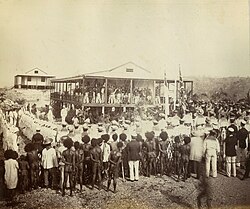
[[File:Reading the proclamation of annexation, Mr Lawe's house, Port Moresby, New Guinea, November 1884 - photographer John Paine or Augustine E. Dyer (5708761723).jpg|thumb|alt=Sepia photo of a large crowd around a two-story building, with two raised flags in front of the building|[[British Empire|British]] [[annexation]] of southeast New Guinea in 1884]] | |||
In 1888, the British protectorate was annexed by [[United Kingdom|Britain]]. In 1902, Papua was effectively transferred to the authority of the [[Federation of Australia|newly federated]] British [[dominion]] of [[Australia]]. With the passage of the [[Papua Act 1905]], the area was officially renamed the [[Territory of Papua]],<ref name="Gardner2024"/>{{rp|227}} and the Australian administration became formal in 1906,<ref name="BBCTimeline"/> with Papua becoming fully annexed as an Australian territory.<ref name="Gardner2024"/>{{rp|225}} | |||
Under European rule, social relations amongst the New Guinean population changed. Tribal fighting decreased, while in new urban areas there was greater mixing as people moved to partake in the [[cash crop]] economy. The large inequality between colonial administrators and locals led to the emergence of what colonial governments called [[cargo cult]]s.<ref name="May2004chapter4"/>{{rp|52–53}} One of the most significant impacts was to changes in local travel. Colonial authorities outlawed tribal warfare, and it became normal to move for work, while roads increased the connectivity between inland areas.<ref name="Allen1983"/>{{rp|20–22}} | |||
Colonial authorities generally worked with individual village representatives, although neither German nor British authorities developed an effective system of indirect rule.<ref name="May2004chapter9">{{cite book |author=R.J. May |date=May 2004 |title=State and Society in Papua New Guinea: The First Twenty-Five Years |publisher=ANU Press |isbn=9781920942052 |doi=10.22459/SSPNG.05.2004 |doi-access=free |url=https://press.anu.edu.au/publications/state-and-society-papua-new-guinea |chapter=9. (Re?)Discovering Chiefs: Traditional Authority and the Restructuring of Local Level Government in Papua New Guinea}}</ref>{{rp|209–210}} In German New Guinea [[Tok Pisin]] began to spread through local adoption, and was reluctantly used by German authorities.<ref name="May2022chapter8"/>{{rp|135–137}} In areas under British and then Australian governance, [[Hiri Motu]], a pidgin version of the [[Motu language]], became established as a ''de facto'' official language.<ref name="May2022chapter8"/>{{rp|137–139}} | |||
Following the outbreak of [[World War I|World War I]] in 1914, Australian forces [[Australian occupation of German New Guinea|captured German New Guinea]] and occupied it throughout the war.<ref name="ABCTimeline"/> After the end of the war, the [[League of Nations]] authorised Australia to administer this area as a Class "C" [[League of Nations mandate]] territory from 9 May 1921, which became the [[Territory of New Guinea]].<ref name="Rottman2001"/>{{rp|152}}<ref name="Gardner2024"/>{{rp|228}}<ref name="BBCTimeline"/> The Territory of Papua and the new Mandate of New Guinea were administered separately.<ref name="Gardner2024"/>{{rp|228}} Gold was discovered in [[Bulolo]] in the 1920s, and prospectors searched other areas of the island. The [[New Guinea Highlands|highland valleys]] were explored by prospectors in the 1930s and were found to be inhabited by over a million people.<ref name="BBCTimeline"/> | |||
===World War II and Australian rule=== | |||
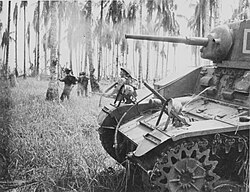
[[File:Buna (AWM 014008).jpg|thumb|left|alt=A tank and some infantry walking through knee-high grass dotted with palm trees|Australian forces attack Japanese positions during the [[Battle of Buna–Gona]], 7 January 1943.]] | |||
During [[World War II]], Japanese forces sought to capture Port Moresby, invading overland in mid-1942 and moving south in the [[Kokoda Track campaign]]. Australian forces carried out a number of [[rearguard]] actions as they withdrew almost to Port Moresby. In September an Australian counter-offensive began, and Japanese forces fought rearguard actions as they retreated north.<ref>{{cite web |url=https://www.awm.gov.au/collection/E84663 |title=Kokoda Trail Campaign |publisher=Australian War Memorial |access-date=13 July 2025}}</ref> Australian forces were supported during this campaign through significant contributions from local soldiers and helpers.<ref name="RNZbriefhistory"/> While this campaign was ongoing, the Japanese launched the [[Battle of Milne Bay]], where their attack was repulsed by Australian and American forces. These events, along with the nearby [[Guadalcanal campaign]], marked a turning point in the [[Pacific War]].<ref>{{cite web |url=https://www.nma.gov.au/defining-moments/resources/kokoda-trail |title=Kokoda Trail |publisher=National Museum Australia |access-date=13 July 2025}}</ref> A [[Attrition warfare|war of attrition]] continued until 1944, when allied forces fully recaptured Papua and New Guinea.<ref>{{cite web |url=https://history.army.mil/Portals/143/Images/Publications/Publication%20By%20Title%20Images/C%20Img/campaigns-wwii/pdf/24.pdf |title=New Guinea 24 January 1943–31 December 1944 |author=Edward J. Drea |publisher=Center of Military History |date=2019 |access-date=13 July 2025 |page=37}}</ref> In total, the [[New Guinea campaign]] resulted in the deaths of approximately 216,000 Japanese, Australian, and U.S. servicemen on both the mainland and offshore islands.<ref>Fenton, Damien. {{cite web |url=http://ajrp.awm.gov.au/ajrp/remember.nsf/pages/NT000027A2 |title=How many died? (QnA) |access-date=9 August 2012 |url-status=dead |archive-url=https://web.archive.org/web/20090705115116/http://ajrp.awm.gov.au/ajrp/remember.nsf/pages/NT000027A2 |archive-date=5 July 2009 }}. Australian War Memorial.</ref> | |||
During the war, the civil government of both territories was suspended and replaced by a joint military government.<ref name="Gardner2024"/>{{rp|228}} The Second World War punctured the myth of differences between locals and foreigners, and increased the exposure of the population to the wider world and modern social and economic ideas. It also led to significant population movements, beginning the establishment of a common identity shared by those in the two Australian-ruled territories.<ref name="May2004chapter4"/>{{rp|53}} Both Tok Pisin and Hiri Motu became more common to facilitate communication, and were used for radio broadcasts.<ref name="May2022chapter8"/>{{rp|139}} The war was the first time Tok Pisin became widely spread in Papua.<ref name="Rottman2001"/>{{rp|149, 152}} The joint governance of both territories that was established during the war was continued after the war ended.<ref name="May2022chapter8"/>{{rp|134}}<ref name="May2004chapter15"/>{{rp|302}} | |||
In 1946, New Guinea was declared a [[United Nations trust territories|United Nations trust territory]] under Australian governance.<ref name="RNZbriefhistory"/> In 1949 Papuans became Australian citizens,<ref name="Gardner2024"/>{{rp|223}} and Australia [[Papua and New Guinea Act 1949|formally combined]] Papua and New Guinea into the [[Territory of Papua and New Guinea]].<ref name="RNZbriefhistory"/> The [[Legislative Council of Papua and New Guinea]] was created in November 1951.<ref name="BBCTimeline"/> Village councils were first created in both Papua and in New Guinea starting 1949, with the number steadily increasing over the years.<ref name="May2004chapter8">{{cite book |author=R.J. May |date=May 2004 |title=State and Society in Papua New Guinea: The First Twenty-Five Years |publisher=ANU Press |isbn=9781920942052 |doi=10.22459/SSPNG.05.2004 |doi-access=free |url=https://press.anu.edu.au/publications/state-and-society-papua-new-guinea |chapter=8. Decentralisation: Two Steps Forward, One Step Back}}</ref>{{rp|174–175}} These created alternative power structures, which while sometimes filled by traditional leaders, saw the beginning of a shift towards leaders with administrative or business experience.<ref name="May2004chapter9"/>{{rp|211}} | |||
The political aims of Australian rule were uncertain, with independence and becoming an [[States and territories of Australia|Australian state]] both seen as possible futures.<ref name="May2004chapter15"/>{{rp|303–305}} The 1960s and 1970s saw significant social changes as more of the population began to participate in the formal economy, leading to the development of a more local bureaucracy. Alongside this, Australian administrators promoted a shared national identity.<ref name="May2004chapter4"/>{{rp|57}} English was introduced by Australian authorities as a potential unifying language, and many Papua New Guineans viewed it as a [[Prestige (sociolinguistics)|prestige language]].<ref name="May2022chapter8"/>{{rp|150}} | |||
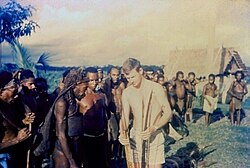
[[File:Biami people, near Nomad patrol post, 1964.jpg|thumb|alt=Australian officer casually dressed in only shorts holding a bow and other weapons while others look on|Australian [[Kiap|patrol officer]] in 1964]] | |||
Aerial surveys in the 1950s found further inhabited valleys in the highlands.<ref name="BBCTimeline"/> The re-establishment of Australian administration following the war was followed by an expansion of that control, including over the previously mostly uncontrolled highland areas.<ref name="May2022chapter8"/>{{rp|134}}<ref name="May2004chapter15"/>{{rp|303}}<ref name="Dorney2016"/> Some tribes remained [[Uncontacted peoples|uncontacted]] by Westerners until the 1960s and 1970s.<ref name="Rottman2001"/>{{rp|149}} The administration of the highlands led to a large expansion of coffee cultivation in the region.<ref name="May2004chapter15"/>{{rp|303}} The [[1964 Papua New Guinean general election|1964 election]], and the subsequent [[1968 Papua New Guinean general election|1968 election]], took place alongside campaigns to introduce the political system.<ref name="May2004chapter5">{{cite book |author=R.J. May |date=May 2004 |title=State and Society in Papua New Guinea: The First Twenty-Five Years |publisher=ANU Press |isbn=9781920942052 |doi=10.22459/SSPNG.05.2004 |doi-access=free |url=https://press.anu.edu.au/publications/state-and-society-papua-new-guinea |chapter=5. The Political Education Programme}}</ref>{{rp|107}} The leadup to the 1968 election saw the formation of [[Pangu Pati]], the first political party.<ref name="May2004chapter15"/>{{rp|306}} | |||
Mining exploration by [[Rio Tinto (corporation)|Rio Tinto]] in Bougainville began in 1964. In spite of resistance from some local landowners, the [[Bougainville Copper]] corporation was established and began to [[Panguna mine|operate a large mine]]. Resistance became interlinked with a desire for greater autonomy.<ref name="May2004chapter13">{{cite book |last1=May |first1=Ronald |title=State and society in Papua New Guinea: the first twenty-five years |date=2004 |publisher=ANU Press |isbn=9781863332040 |url=https://press-files.anu.edu.au/downloads/press/p66801/html/frames.php |access-date=30 April 2024 |chapter=13. The Bougainville Crisis |archive-date=30 April 2024 |archive-url=https://web.archive.org/web/20240430075621/https://press-files.anu.edu.au/downloads/press/p66801/html/frames.php |url-status=live }}</ref> Bougainville was geographically close to the [[British Solomon Islands]], and its people are more culturally linked to those of the Solomon Islands than to others in the territory.<ref name="Phillips2015">{{cite news |url=https://www.abc.net.au/listen/programs/rearvision/bougainville-at-a-crossroads/6514544 |title=Bougainville at a crossroads: independence and the mine |author=Keri Phillips |work=ABC News |date=2 June 2015 |access-date=29 April 2024}}</ref> However, the mine was seen as crucial for diversifying the economic base of Papua New Guinea from agriculture alone.<ref name="May2004chapter15"/>{{rp|306}} | |||
Australian Opposition Leader [[Gough Whitlam]] visited Papua New Guinea in 1969. Whitlam made self-rule in the territory an election issue, and called for self-governance as early as 1972.<ref name="Dorney2016">{{cite news | url=https://www.theguardian.com/world/2016/feb/20/australias-ignorance-about-papua-new-guinea-is-a-loss-for-both-nations | title=Australia's ignorance about Papua New Guinea is a loss for both nations | newspaper=[[The Guardian]] | date=19 February 2016 | last1=Dorney | first1=Sean |access-date=28 April 2025}}</ref> In March 1971 [[House of Assembly of Papua and New Guinea|the House of Assembly]] recommended that the territory seek self-governance in the next parliament, which was agreed to by Australia.<ref name="May2004chapter5"/>{{rp|110–111}} In June 1971, the flag and emblem were adopted.<ref name="Gardner2024"/>{{rp|229}} In July, the "and" was removed and the territory was renamed to simply "Papua New Guinea".<ref name="BBCTimeline"/> | |||
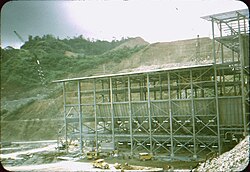
[[File:Copper ore concentrator undergoing construction. Mill building. 2 c. 1971.jpg|thumb|left|alt=Large metal building in front of a mountain with large portions cut out|The [[Panguna mine]] on Bougainville Island in 1971]] | |||
Following the time of Whitlam's first visit, political debate significantly intensified alongside significant social changes.<ref name="May2004chapter15"/>{{rp|306}} At the [[1972 Papua New Guinean general election]] in July, [[Michael Somare]] was elected as [[Chief Minister of Papua and New Guinea|Chief Minister]].<ref name="ABCTimeline"/><ref name="May2004chapter2">{{cite book |author=R.J. May |date=May 2004 |title=State and Society in Papua New Guinea: The First Twenty-Five Years |publisher=ANU Press |isbn=9781920942052 |doi=10.22459/SSPNG.05.2004 |doi-access=free |url=https://press.anu.edu.au/publications/state-and-society-papua-new-guinea |chapter=2. Port Moresby and the Bush: Papua New Guinea's First Post-Independence Decade}}</ref>{{rp|17}} Somare sought a better relationship with regional movements, which increased the number of local groups, but also decreased their salience and encouraged them to join the national political system.<ref name="May2004chapter4"/>{{rp|75–77}} In December, Whitlam was elected as Prime Minister at the [[1972 Australian federal election]]. The [[Whitlam government]] then instituted self-governance in late 1973.<ref name="Dorney2016"/> The [[Papua New Guinean kina|kina]] was introduced as a separate currency in April 1975.<ref name="May2004chapter17">{{cite book |author=R.J. May |date=May 2004 |title=State and Society in Papua New Guinea: The First Twenty-Five Years |publisher=ANU Press |isbn=9781920942052 |doi=10.22459/SSPNG.05.2004 |doi-access=free |url=https://press.anu.edu.au/publications/state-and-society-papua-new-guinea |chapter=17. Negget, Pike, Et Al.: The Role of the Reserve Bank of Australia in Papua New Guinea's Decolonisation}}</ref>{{rp|377}} | |||
The push for independence was driven by internal policies of the Whitlam government, rather than responding to particular calls from Papua New Guinea.<ref name="Gardner2024"/>{{rp|224}} The concept of a "country" remained foreign to many in the territory, and there was no strong shared national identity.<ref name="Gardner2024"/>{{rp|229}} In the early 1970s there were fears that independence would allow for large tribes to dominate others, and create more risk of foreign land acquisition. The subsequent creation of a local consensus for independence was due to the actions of local political leaders.<ref name="RNZbriefhistory"/> On 1 September 1975, shortly before the scheduled date of Papua New Guinean independence, the government of Bougainville itself [[Republic of the North Solomons|declared independence]].<ref name="May2004chapter4"/>{{rp|72}}<ref name="Lea2023"/>{{rp|45}}<ref name="ABCTimeline"/> Payments to the province were suspended in response.<ref name="BBCTimeline"/> Other regional movements emerged prior to independence. The [[Papua Besena]] party sought to separate the territory of Papua from New Guinea, while the [[Highlands Liberation Front]] sought to prevent dominance of highland areas by the coast. Smaller groups advocated for the creation of new provinces.<ref name="May2004chapter4"/>{{rp|72–74}} Nonetheless, the [[Papua New Guinea Independence Act 1975]] passed in September 1975, setting 16 September 1975 as the date of independence.<ref name="Lea2023"/>{{rp|45}}<ref>{{cite web |url=https://www.legislation.gov.au/C2004A01408/asmade/text |title=Papua New Guinea Independence Act 1975 |date=9 September 1975 |publisher=Federal Register of Legislation |access-date=19 July 2025}}</ref> Somare continued as the country's first Prime Minister.<ref name="ABCTimeline">{{cite news | url=https://www.abc.net.au/news/2015-09-16/timeline-of-papua-new-guinea-road-to-independence/6748374 | title=Timeline of key events: Papua New Guinea's road to independence | newspaper=ABC News | date=15 September 2015 | access-date=28 April 2025| archive-date=2 March 2024 | archive-url=https://web.archive.org/web/20240302043429/https://www.abc.net.au/news/2015-09-16/timeline-of-papua-new-guinea-road-to-independence/6748374 | url-status=live }}</ref> | |||
=== | ===Independence=== | ||
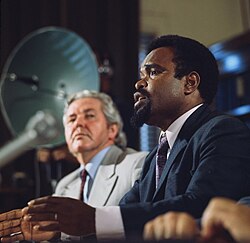
[[File:Michael Somare 1973.jpg|thumb|alt=Michael Somare sitting at a desk speaking with an out of focus microphone in front of the shot|[[Michael Somare]] in 1973 alongside [[Bill Morrison (politician)|Bill Morrison]], Minister for External Territories of the [[Whitlam government]]]] | |||
Upon independence, most Australian officials, including agricultural, economic, educational, and medicinal staff, left the territory. Very little training had been provided to their successors.<ref name="Dorney2016"/> This led to a restructuring and a loss of efficiency, particularly in serving rural areas.<ref name="May2004chapter2"/>{{rp|18}} By the 1980s, the civil service, including the military, had become politicised, decreasing effectiveness and accountability.<ref name="May2022chapter2"/>{{rp|13}} | |||
=== | The voting system was changed to [[first past the post]], as an unsuccessful attempt to encourage the development of a [[two-party system]] with clearly defined political parties.<ref name="May2004chapter1">{{cite book |author=R.J. May |date=May 2004 |title=State and Society in Papua New Guinea: The First Twenty-Five Years |publisher=ANU Press |isbn=9781920942052 |doi=10.22459/SSPNG.05.2004 |doi-access=free |url=https://press.anu.edu.au/publications/state-and-society-papua-new-guinea |chapter=1. Introduction: Papua New Guinea at Twenty-Five}}</ref>{{rp|3}} National governments changed through constitutional means. Somare retained the prime ministership following the [[1977 Papua New Guinean general election|1977 election]], and was ousted through a vote of no confidence in 1980 and was replaced by [[Julius Chan]]. Somare became prime minister again following the [[1982 Papua New Guinean general election|1982 election]], but lost another vote of no confidence in 1985.<ref name="May2004chapter2"/>{{rp|18, 20}} | ||
= | Although an August 1976 agreement with the national government resolved the initial declaration of independence,<ref name="Lea2023"/>{{rp|45}} the issue of Bougainville persisted past independence.<ref name="Phillips2015"/> A secessionist movement in 1975–76 on [[Bougainville Island]] resulted in a modification of the [[Constitution of Papua New Guinea]], with the [[Organic Law on Provincial Government]] legally devolving power to the 19 provinces.<ref name="May2004chapter8"/>{{rp|179}}<ref name="May2004chapter2"/>{{rp|26}} Following instances of provincial government mismanagement, Somare's proposal to reduce provincial government power brought further threats of secession from some of the country's [[Islands Region|island provinces]].<ref name="May2004chapter8"/>{{rp|189}}<ref name="May2004chapter2"/>{{rp|27}}<ref name="May2004chapter12">{{cite book |author=R.J. May |date=May 2004 |title=State and Society in Papua New Guinea: The First Twenty-Five Years |publisher=ANU Press |isbn=9781920942052 |doi=10.22459/SSPNG.05.2004 |doi-access=free |url=https://press.anu.edu.au/publications/state-and-society-papua-new-guinea |chapter=12. Challenging the State}}</ref>{{rp|257}} | ||
While warfare significantly decreased under Australian governance, tribal fighting in the highland areas increased in the 1970s. These areas had been under outside control for less time, meaning former tribal conflict was still remembered and restarted upon independence. The first state of emergency there was declared in 1979, although it and similar interventions did not quell the violence. Unemployment and imbalanced gender ratios in cities meant tribal fighting morphed into the [[Raskol gangs|emergence of gangs]]. Gang violence led to a state of emergency in Port Moresby in 1984, which led to the intervention of the [[Papua New Guinea Defence Force]] (PNGDF). The effectiveness of this deployment led to further [[Royal Papua New Guinea Constabulary|police]] and military interventions elsewhere. Both the police and military became more politicised, and less disciplined. Demand for private security increased as a response, and foreign investment was deterred.<ref name="May2004chapter2"/>{{rp|29, 32}}<ref name="May2004chapter1"/>{{rp|8–9}}<ref name="May2004chapter12"/>{{rp|260–261, 264, 270}}<ref name="May2004chapter10">{{cite book |author=R.J. May |date=May 2004 |title=State and Society in Papua New Guinea: The First Twenty-Five Years |publisher=ANU Press |isbn=9781920942052 |doi=10.22459/SSPNG.05.2004 |doi-access=free |url=https://press.anu.edu.au/publications/state-and-society-papua-new-guinea |chapter=10. The PNGDF in Troubled Times}}</ref>{{rp|239–241}} In 1995, provincial governments were reformed, becoming made up of relevant national MPs and a number of appointed members. Some of their responsibilities were devolved towards local governments, a factor that caused significant controversy due to an expected lack of capacity at this level. This lack of capacity has meant that national MPs gained significant powers at the local level.<ref name="May2004chapter8"/>{{rp|174}}<ref name="May2004chapter1"/>{{rp|11}} | |||
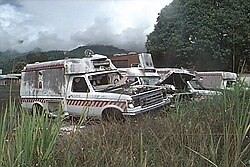
[[File:AMBULA~1.jpg|thumb|alt=A burned ambulances and other damaged and destroyed vehicles|The town of [[Arawa, Bougainville|Arawa]] was destroyed during the [[Bougainville conflict]].]] | |||
[[File: | The employment needs of the Bougainville mine decreased after construction was completed, meaning younger individuals received little benefit from the presence of the mine. A renewed [[Bougainville conflict|uprising on Bougainville]] started in 1988, fighting against both the Bougainville government and the national government. After the mine closed in May 1989, the [[Bougainville Revolutionary Army]] (BRA) declared independence, and the national government pulled out in 1990 and blockaded the province, the conflict shifted into a complex internal civil war. National security forces re-entered the island at the end of 1990, and together with local allies slowly gained more control.<ref name="RNZbriefhistory"/><ref name="Phillips2015"/><ref name="May2004chapter12"/>{{rp|266–267}} An agreement between the government and some rebels was reached in October 1994, and in 1995 a transitional Bougainville government was established, although fighting continued with the BRA.<ref name="BBCTimeline"/> In 1997, the [[Sandline affair]] over the hiring of mercenaries to intervene in Bougainville brought down the national government. Following New Zealand-mediated peace talks, a ceasefire was reached in January 1998.<ref name="ABCTimeline"/><ref name="May2004chapter1"/>{{rp|12}} | ||
The first decade of independence saw slow but steady economic growth. The [[Ok Tedi Mine]] opened in 1982. While Australian contribution to the budget dropped from 40% of government revenue in 1975 to 17% in 1988, improved taxation allowed for government expenditure to be maintained.<ref name="May2004chapter15"/>{{rp|312–313}} The closure of the Bougainville mine led to issues with government finances, however an expansion of exports of oil, minerals, and forestry products led to economic recovery in the early 1990s. This growth did not decrease inequality however, and government services declined.<ref name="May2004chapter12"/>{{rp|263–264}} Increasing government expense and resulting rising debt led to [[1994 Papua New Guinea financial crisis|significant economic trouble]]. The [[Papua New Guinean kina]] was devalued and put on a [[floating exchange rate]] in 1994, and the country obtained an emergency loan from the [[World Bank]] in 1995.<ref name="May2004chapter15"/>{{rp|313–314}} | |||
The | |||
In the [[1997 Papua New Guinean general election|1997 election]], only 4 candidates won overall majorities, with 95 (87%) of winners receiving less than 30% of the vote. After government changed mid-parliament in 1999, a Constitutional Development Commission was established to bring about political reform. The resulting [[Organic Law on the Integrity of Political Parties and Candidates]] created public funding for registered parties, incentivised the selection of female candidates, and instituted punishments for [[Party switching|party hopping]]. It also barred independent MPs from voting for the prime minister, or from joining coalitions before a prime minister is elected.<ref name="May2004chapter1"/>{{rp|3–7}} Another measure was to begin a shift from first past the post to a Limited Preferential Vote system (LPV), a version of the [[instant-runoff voting|alternative vote]].<ref name="May2022chapter2"/>{{rp|17}}<ref name="May2022chapter1">{{cite book |author=R.J. May |date=August 2022 |title=State and Society in Papua New Guinea, 2001–2021 |publisher=ANU Press |isbn=9781760465216 |doi=10.22459/SSPNG.2022 |doi-access=free |url=https://press.anu.edu.au/publications/series/pacific/state-society-papua-new-guinea-2001%E2%80%932021 |chapter=1. Introduction}}</ref>{{rp|2}} | |||
[[ | |||
The [[Bougainville Peace Agreement]] was signed in 2001, under which Bougainville would gain higher autonomy than other provinces, and an independence referendum would be held in the future.<ref name="BBCTimeline"/><ref name="ABCTimeline"/><ref name="Phillips2015"/> The [[2002 Papua New Guinean general election|2002 election]] saw an uptick in violence.<ref name="BBCTimeline"/> Australian police were brought to PNG to help train PNG police in 2004. While most left the next year after a Supreme Court ruling, this began a long-term Australian police presence in the country.<ref name="ABCTimeline"/> In 2009, Parliament approved the creation of two additional provinces: [[Hela Province]], consisting of part of the existing [[Southern Highlands Province]], and [[Jiwaka Province]], formed by dividing [[Western Highlands Province]].<ref>{{cite web |author=Kolo, Pearson |url=http://www.postcourier.com.pg/20090715/news05.htm |title=Jiwaka, Hela set to go! |publisher=Postcourier.com.pg |date=15 July 2009 |url-status=dead |archive-url=https://web.archive.org/web/20110616211904/http://www.postcourier.com.pg/20090715/news05.htm |archive-date=16 June 2011 |access-date=29 August 2009 }}</ref> | |||
In 2011, there was a [[2011–2012 Papua New Guinean constitutional crisis|constitutional crisis]] between the parliament-elect Prime Minister, [[Peter O'Neill]] (voted into office by a large majority of MPs), and Somare, who was deemed by the supreme court to retain office. The parliament voted to delay the upcoming elections, however they did not have the constitutional authority to do this, and the [[Papua New Guinea Electoral Commission]] continued to prepare.<ref name="May2022chapter14">{{cite book |author=R.J. May |date=August 2022 |title=State and Society in Papua New Guinea, 2001–2021 |publisher=ANU Press |isbn=9781760465216 |doi=10.22459/SSPNG.2022 |doi-access=free |url=https://press.anu.edu.au/publications/series/pacific/state-society-papua-new-guinea-2001%E2%80%932021 |chapter=14. Papua New Guinea under the O’Neill government: Has there been a shift in political style?}}</ref>{{rp|207–211}} The [[2012 Papua New Guinean general election|2012 national elections]] went ahead as scheduled, and O'Neill was once again elected as prime minister by a majority of parliament. Somare joined O'Neill's government, charges against the court judges and others who supported Somare were dropped, and legislation asserting control of the judiciary and that affecting the office of the prime minister was repealed.<ref name="ABCTimeline"/><ref name="May2022chapter14"/>{{rp|207–211}} | |||
[[Liquefied natural gas]] exports [[Natural gas in Papua New Guinea|began in 2014]], however falling prices as well as lower oil prices meant that government revenue was lower than expected. The debt-to-GDP ratio rose, and as of 2019, Papua New Guinea's HDI rating was the lowest in the Pacific.<ref name="May2022chapter1"/>{{rp|4}} In March 2015 the [[Bougainville Mining Act]] shifted control over mining from the national government to the Bougainville government. It also stated that minerals belonged to [[customary land]]owners rather than the state, giving landowners veto power over future extraction.<ref name="Phillips2015"/><ref>{{cite news |url=https://www.abc.net.au/news/2013-03-07/bougainville-mining-law-a-world-first/4559170 |title=PNG's Bougainville to pass world first mining law |author=Jemima Garrett |work=ABC News |date=7 March 2013 |access-date=29 April 2025}}</ref> | |||
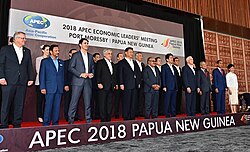
= | The 2012–2017 O'Neill government was dogged by corruption scandals.<ref name="BBCTimeline"/> The [[2017 Papua New Guinean general election|2017 general election]] saw O'Neill return as prime minister, although initially with a smaller coalition. This election saw widespread voter intimidation in some regions, and delays in the reporting of seat results.<ref name="May2022chapter15">{{cite book |author=R.J. May |date=August 2022 |title=State and Society in Papua New Guinea, 2001–2021 |publisher=ANU Press |isbn=9781760465216 |doi=10.22459/SSPNG.2022 |doi-access=free |url=https://press.anu.edu.au/publications/series/pacific/state-society-papua-new-guinea-2001%E2%80%932021 |chapter=15. Politics in Papua New Guinea: From O’Neill to Marape}}</ref>{{rp|253–255}} Financial scandals, as well as criticism of the purchase of expensive cars for [[APEC Papua New Guinea 2018]] meeting, created pressure on O'Neill and led to defections from government.<ref name="May2022chapter15"/>{{rp|255–258}} In May 2019, O'Neill resigned as prime minister and was replaced by [[James Marape]].<ref>{{cite web |last=Lyons |first=Kate |date=30 May 2019 |title=Papua New Guinea MPs elect James Marape to be next prime minister |url=https://www.theguardian.com/world/2019/may/30/papua-new-guinea-james-marape-next-prime-minister |url-status=live |archive-url=https://web.archive.org/web/20190530020035/https://www.theguardian.com/world/2019/may/30/papua-new-guinea-james-marape-next-prime-minister |archive-date=30 May 2019 |access-date=13 July 2021 |work=[[The Guardian]]}}</ref> | ||
In | |||
The government set 23 November 2019<ref>{{cite web |last=Gorethy |first=Kenneth |title=B'ville Referendum Dates Changed |url=https://postcourier.com.pg/bville-referendum-dates-changed/ |website=Papua New Guinea Post-Courier |date=5 August 2019 |access-date=23 September 2019 |archive-date=4 August 2019 |archive-url=https://web.archive.org/web/20190804204815/https://postcourier.com.pg/bville-referendum-dates-changed/ |url-status=live }}</ref> as the voting date for [[2019 Bougainvillean independence referendum|a non-binding independence referendum]]<ref>{{cite web |title=Bougainville referendum not binding – PM |url=https://www.rnz.co.nz/international/pacific-news/384471/bougainville-referendum-not-binding-pm |publisher=[[Radio New Zealand]] |date=11 March 2019 |access-date=23 September 2019 |archive-date=14 March 2021 |archive-url=https://web.archive.org/web/20210314175341/https://www.rnz.co.nz/international/pacific-news/384471/bougainville-referendum-not-binding-pm |url-status=live }}</ref> in the [[Autonomous Region of Bougainville|Bougainville autonomous region]].<ref>{{cite news |last=Westbrook |first=Tom |title=Bougainville independence vote delayed to October |url=https://www.reuters.com/article/us-papua-bougainville-idUSKCN1QI3XI |publisher=[[Reuters]] |date=1 March 2019 |access-date=2 March 2019 |archive-date=2 March 2019 |archive-url=https://web.archive.org/web/20190302010212/https://www.reuters.com/article/us-papua-bougainville-idUSKCN1QI3XI |url-status=live }}</ref> Voters overwhelmingly voted for independence (98.31%).<ref>{{cite news |last=Lyons |first=Kate |title=Bougainville referendum: region votes overwhelmingly for independence from Papua New Guinea |url=https://www.theguardian.com/world/2019/dec/11/bougainville-referendum-region-votes-overwhelmingly-for-independence-from-papua-new-guinea |work=[[The Guardian]] |date=11 December 2019 |access-date=12 December 2019 |language=en-GB |issn=0261-3077 |archive-date=11 December 2019 |archive-url=https://web.archive.org/web/20191211163246/https://www.theguardian.com/world/2019/dec/11/bougainville-referendum-region-votes-overwhelmingly-for-independence-from-papua-new-guinea |url-status=live }}</ref><ref>{{cite web |title=Bougainville referendum: PNG region votes overwhelmingly for independence |url=https://www.bbc.com/news/world-asia-50739203 |publisher=[[BBC News]] |date=11 December 2019 |access-date=1 July 2022 |archive-date=12 December 2019 |archive-url=https://web.archive.org/web/20191212161357/https://www.bbc.com/news/world-asia-50739203 |url-status=live }}</ref> Prime Minister James Marape's [[Pangu Pati|PANGU]] Party secured the most seats of any party in the [[2022 Papua New Guinean general election|2022 election]], enabling him to continue as PNG's Prime Minister.<ref>{{cite news |title=James Marape returned as PNG's prime minister after tense election |url=https://www.abc.net.au/news/2022-08-09/papua-new-guinea-election-results-james-marape-to-govern/101311978 |work=ABC News |date=9 August 2022 |language=en-AU |access-date=23 September 2022 |archive-date=23 September 2022 |archive-url=https://web.archive.org/web/20220923204604/https://www.abc.net.au/news/2022-08-09/papua-new-guinea-election-results-james-marape-to-govern/101311978 |url-status=live }}</ref> | |||
On 11 June 2025, during an [[2025 United Nations Ocean Conference|UN conference]] in [[Nice]], [[France]], Papua New Guinea signed the [[High Seas Treaty]], signalling its commitment to protect marine life beyond its borders through territorial waters. | |||
==Government and politics== | ==Government and politics== | ||
| Line 174: | Line 202: | ||
| perrow = | | perrow = | ||
| direction = | | direction = | ||
| total_width = | | total_width = 350 | ||
| header = | | header = | ||
| footer = | | footer = | ||
| caption_align = | | caption_align = right | ||
| image1 = King Charles III (July 2023).jpg | |||
| width1 = | |||
| alt1 = King Charles III in a suit | |||
| caption1 = The Head of State and [[Monarchy of Papua New Guinea|King of Papua New Guinea]]:<br>'''[[Charles III]]'''<br>since<br>{{wrap|9 September 2022}} | |||
| image2 = Sir Bob Dadae (cropped).jpg | |||
| width2 = | |||
| alt2 = Bob Dadae in a suit wearing a chain of office | |||
| caption2 = The [[Governor-General of Papua New Guinea]]:<br>'''[[Bob Dadae]]'''<br>since<br>{{wrap|28 February 2017}} | |||
| image3 = James Marape, February 2020 (GPO035) (cropped).jpg | |||
| width3 = | |||
| alt3 = James Marape in a suit in front of a Solomon Islands flag, Tongan flag, and Tuvaluan flag | |||
| caption3 = The [[Prime Minister of Papua New Guinea]]:<br>'''[[James Marape]]'''<br>since<br>{{nowrap|30 May 2019}} | |||
}} | }} | ||
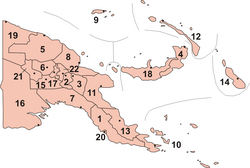
Papua New Guinea is a [[Commonwealth realm]] with [[Charles III]] as [[Monarchy of Papua New Guinea|king]]. The monarch's representative is the [[governor-general of Papua New Guinea]], who is elected by the unicameral [[National Parliament of Papua New Guinea]].<ref name="Ivarature2016">{{cite web |url=https://www.idea.int/sites/default/files/publications/unravelling-parliamentary-instability.pdf |title=Unravelling Parliamentary Instability: Ministerial Durations in Papua New Guinea, 1972–2012 |author=Henry Ivarature |publisher=International IDEA |date=13 December 2016 |access-date=14 May 2025}}</ref>{{rp|9}} The National Parliament elects the [[prime minister of Papua New Guinea]], who is then appointed by the governor-general. The other ministers are appointed by the governor-general on the prime minister's advice and form the [[National Executive Council of Papua New Guinea]], which acts as the country's cabinet. The National Parliament sits for a maximum of five years.<ref name="Ivarature2016"/>{{rp|9}}<ref>{{cite web |url=https://www.parliament.gov.pg/about/parliament |title=About Our Parliament |publisher=National Parliament of Papua New Guinea |access-date=14 May 2025}}</ref> It has 118 seats, with 96 representing [[Districts of Papua New Guinea|districts]], and 22 representing province-level electorates (20 [[Provinces of Papua New Guinea|provinces]], the [[National Capital District (Papua New Guinea)|National Capital District]], and the [[Autonomous Region of Bougainville]]) who serve as governors of those provinces.<ref name="Kabuni2022">{{cite web |url=https://www.lowyinstitute.org/the-interpreter/elections-looming-png-rushed-create-seven-new-districts |title=With elections looming, PNG rushed to create seven new districts |author=Michael Kabuni |publisher=The Interpreter |date=19 April 2022 |access-date=23 August 2025}}</ref> | |||
Papua New Guinea | Papua New Guinea has maintained continuous democratic elections and changes in government since independence.<ref name="May2022chapter2"/>{{rp|10}}<ref name="May2022chapter1"/>{{rp|1}} While seat results are often contested, the overall results of elections are accepted.<ref name="May2022chapter1"/>{{rp|7}} Elections in PNG attract numerous candidates.<ref name="May2022chapter2"/>{{rp|17}} Voting takes place through the Limited Preferential Vote system (LPV), a version of the [[instant-runoff voting|alternative vote]].<ref name="May2022chapter2"/>{{rp|17}}<ref name="May2022chapter1"/>{{rp|2}} Under this system, voters must give preference votes for at least three candidates.<ref name="May2022chapter7">{{cite book |author=R.J. May |date=August 2022 |title=State and Society in Papua New Guinea, 2001–2021 |publisher=ANU Press |isbn=9781760465216 |doi=10.22459/SSPNG.2022 |doi-access=free |url=https://press.anu.edu.au/publications/series/pacific/state-society-papua-new-guinea-2001%E2%80%932021 |chapter=7. Assessing the shift to limited preferential voting in the 2007 national election |page=118}}</ref> | ||
While political parties exist, they are not ideologically differentiated. Instead they generally reflect the alliances made between their members, and have little relevance outside of elections. All governments since 1972 have been [[Coalition government|coalitions]]. When formed, such coalitions are unstable due to the potential for [[party switching|party hopping]],<ref name="May2004chapter1"/>{{rp|3}}<ref name="May2022chapter1"/>{{rp|7}} referred to as "yo-yo" politics. Almost all parties have formed coalitions with the others,<ref name="May2022chapter2"/>{{rp|13}} and some coalitions have consisted of up to 10 separate parties. Ministerial positions are valuable,<ref name="Ivarature2016"/>{{rp|9}} and constituents may often have little issue with their elected representatives switching parties to join the government, as it gives their district more representation.<ref name="May2022chapter5"/>{{rp|94}} Ministerial tenures are often short, averaging half the length of a parliament from 1972 to 2016.<ref name="Ivarature2016"/>{{rp|17}} The average time a minister spends at a particular portfolio is even shorter, at just 16 months.<ref name="Ivarature2016"/>{{rp|18}} Political parties can have MPs in government while others remain in opposition.<ref name="May2022chapter15"/>{{rp|255, 269}} Opposition MPs have been appointed to government.<ref name="May2022chapter15"/>{{rp|262}} For the first couple of decades of independence, there was at least one change of government within each parliamentary period.<ref name="May2004chapter1"/>{{rp|4}} In total, only two prime ministers have finished a full term from election to election.<ref name="May2022chapter1"/>{{rp|7}}<ref name="Kabuni2023"/> [[Motion of no confidence|Votes of no confidence]] are common, and while few are successful,<ref name="Ivarature2016"/>{{rp|12}}<ref>{{cite news |url=https://www.abc.net.au/pacific/vote-of-no-confidence-png-politok/104338572 |title=Why does the Pacific have so many votes of no confidence? |author=Scott Waide |work=ABC News |date=11 September 2024 |access-date=14 May 2025}}</ref> multiple prime ministers have pre-emptively resigned to try and engineer reselection or adjourned parliament in order to avoid them.<ref name="May2004chapter1"/>{{rp|5}}<ref name="Ivarature2016"/>{{rp|20}} | |||
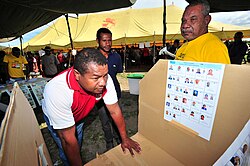
[[File:PNG 2012 Election, Australian Civilian Corps (10713916263).jpg|thumb|alt=Man at a cardboard booth with pictures of political candidates attached to one wall|[[Elections in Papua New Guinea]] attract large numbers of candidates.]] | |||
Changes in government mostly affected patronage and individual positions, rather than changing government priorities and programmes.<ref name="Ivarature2016"/>{{rp|6}} Due to this, despite the fractiousness of politics, policy is relatively stable.<ref name="May2022chapter4">{{cite book |author=R.J. May |date=August 2022 |title=State and Society in Papua New Guinea, 2001–2021 |publisher=ANU Press |isbn=9781760465216 |doi=10.22459/SSPNG.2022 |doi-access=free |url=https://press.anu.edu.au/publications/series/pacific/state-society-papua-new-guinea-2001%E2%80%932021 |chapter=4. Political parties in Papua New Guinea (to 2002)}}</ref>{{rp|62}} Many parties might run on similar platforms, weakening policy debate, as candidates campaign on local representation rather than political differences.<ref name="May2022chapter5"/>{{rp|95}} The support bases of political parties are usually personal or geographical. Even when nominally national parties emerge, they are often strong in specific regions.<ref name="May2022chapter2"/>{{rp|15}}<ref name="May2004chapter3"/>{{rp|45}} Most parties exist only for a short time, and are highly dependent on their leaders.<ref name="May2022chapter4"/>{{rp|64}} The lack of strong parties lasting between elections contributes to poor finances, meaning parties cannot really support candidates outside of personal funds from party leaders.<ref name="May2022chapter4"/>{{rp|60}} A weak parliament has also strengthened the executive, a process exacerbated by governments using procedural methods to control parliament.<ref name="May2022chapter14"/>{{rp|247}} An increasing reliance on judicial methods to combat the government has increased the risk of the judiciary being seen as politicised.<ref name="May2022chapter14"/>{{rp|247–248}} | |||
The political culture is influenced by existing kinship and village ties, with communalism an important cultural factor given the many small and fragmented communities.<ref name="May2004chapter3">{{cite book |author=R.J. May |date=May 2004 |title=State and Society in Papua New Guinea: The First Twenty-Five Years |publisher=ANU Press |isbn=9781920942052 |doi=10.22459/SSPNG.05.2004 |doi-access=free |url=https://press.anu.edu.au/publications/state-and-society-papua-new-guinea |chapter=3. Political Style in Modern Melanesia}}</ref>{{rp|38–40}} Regional and local identities are strong, and traditional politics has integrated with the modern political system.<ref name="May2004chapter3"/>{{rp|46}} There is a broad [[Southern Region, Papua New Guinea|Papuan regional]] identity, and to some extent a highlands one, which can affect politics.<ref name="May2022chapter5">{{cite book |author=R.J. May |date=August 2022 |title=State and Society in Papua New Guinea, 2001–2021 |publisher=ANU Press |isbn=9781760465216 |doi=10.22459/SSPNG.2022 |doi-access=free |url=https://press.anu.edu.au/publications/series/pacific/state-society-papua-new-guinea-2001%E2%80%932021 |chapter=5. Political parties since 2002}}</ref>{{rp|93}} However, outside of Bougainville, regional politics are autonomist rather than separatist, with separatism often used as rhetoric rather than as an ultimate goal.<ref name="May2004chapter4"/>{{rp|71}} The importance of community ties to their land are reflected in the legal system, with 97% of the country designated as [[customary land]], held by communities. Many such effective titles remain unregistered and effectively informal.<ref name="Lea2023"/>{{rp|53–54}} | |||
Voting often occurs along tribal lines,<ref name="Whiting2023">{{Cite web|title=Tribal fighting over PNG election leaves dozens dead and villages deserted|url=https://www.abc.net.au/news/2023-05-03/tribal-fighting-png-election-massacre-tole-730/102210514|author=Natalie Whiting|access-date=1 March 2023|website=ABC|language=en|archive-date=27 February 2024|archive-url=https://web.archive.org/web/20240227233731/https://www.abc.net.au/news/2023-05-03/tribal-fighting-png-election-massacre-tole-730/102210514|url-status=live}}</ref> an issue exacerbated by politicians who might be able to win off the small vote share provided by a unified tribe. Political intimidation and violence are common. Politicians have been prevented from campaigning where tribes support a rival candidate, and candidates are sometimes put up by opponents to split a different tribe's vote.<ref name="May2022chapter2"/>{{rp|14, 18}}<ref name="May2004chapter1"/>{{rp|5}} [[Block voting|Bloc voting]] is practiced by some communities, especially in the highlands.<ref name="May2022chapter5"/>{{rp|96}} Large numbers of independent candidates means that winners are often elected on very small pluralities, including winning less than 10% of votes. Such results raise concerns about the mandates provided by elections.<ref name="May2004chapter1"/>{{rp|4–5}} | |||
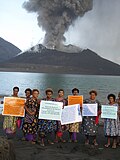
[[File:A regional campaign before an election to encourage women into politics, Tuvuvur, PNG (10663041796).jpg|thumb|upright|alt=A group of women holding signs supporting gender equality with an erupting volcano in the background across a bay|Very few women are elected to the Papua New Guinean parliament.]] | |||
In every election prior to at least 2004, the majority of incumbents lost their seats. This has created an incentive for newly elected politicians to seek as much personal advantage as possible within their term.<ref name="May2004chapter1"/>{{rp|4}} Each MP controls Rural Development Funds for their constituency, providing easy opportunities for corruption.<ref name="May2004chapter1"/>{{rp|10}} It also means many prioritise new expenditure, rather than delivering existing services.<ref name="Allen2009ch6">{{cite book |author=Bryant Allen |editor1=R. Michael Bourke |editor2=Tracy Harwood |date=August 2009 |title=Food and Agriculture in Papua New Guinea |publisher=ANU Press |doi=10.22459/FAPNG.08.2009 |doi-access=free |isbn=9781921536618 |url=https://press.anu.edu.au/publications/food-and-agriculture-papua-new-guinea |chapter=Agricultural Development, Policies and Governance}}</ref>{{rp|445}} The total amount of funding under the discretionary control of each MP is amongst the highest in the world.<ref name="Kabuni2023">{{cite news |url=https://www.lowyinstitute.org/the-interpreter/papua-new-guinea-reining-mp-slush-funds |title=Papua New Guinea: Reining in MP slush funds |author=Michael Kabuni |work=The Interpreter |date=20 February 2023 |access-date=13 May 2025}}</ref> This has generated significant cynicism, and reduced the perceived legitimacy of the national government.<ref name="May2004chapter15"/>{{rp|318}} The control of such funds may also contribute to commonality and severity of electoral violence.<ref name="Kabuni2023"/> Other challenges to elections include issues with administration, issues with [[electoral roll]]s, and [[vote buying]].<ref name="May2022chapter1"/>{{rp|7}}<ref name="NRI2010"/>{{rp|5}} The provision of constituency funds to MPs has been delayed by prime ministers to influence coalition-building.<ref name="Ivarature2016"/>{{rp|9}} | |||
=== | Corruption is [[Corruption in Papua New Guinea|a widespread issue]]. While notable instances have been identified amongst high-profile individuals, spreading [[petty corruption]] has likely had a greater effect of degrading government services. While some corruption is for personal gain, other corruption emerges from the social obligations of the [[wantok system]], with constituents expecting reciprocal benefits and loyalty from their elected officials and from others in their communities and kin networks.<ref name="May2022chapter9">{{cite book |author=R.J. May |date=August 2022 |title=State and Society in Papua New Guinea, 2001–2021 |publisher=ANU Press |isbn=9781760465216 |doi=10.22459/SSPNG.2022 |doi-access=free |url=https://press.anu.edu.au/publications/series/pacific/state-society-papua-new-guinea-2001%E2%80%932021 |chapter=9. Formulating a strategy for research on corruption in Papua New Guinea}}</ref>{{rp|155–156}} Politicians jailed for corruption have been re-elected, as their corrupt activities were seen as an expected part of benefiting their communities. This clash of individual community expectations and local acceptance of what might be called corruption with widespread disillusionment over national corruption is likely one reason that anti-corruption actions rarely match political rhetoric.<ref name="May2022chapter9"/>{{rp|157–158}} These cultural expectations also sometimes clash with the formal legal and political system which inherited Australian norms.<ref name="Lea2023"/>{{rp|41–42}} Resentment of elites and clear inequality also drive expectations of patronage.<ref name="Howes2022"/>{{rp|209}} | ||
The control of constituency funds has also resulted in MPs being seen as individually responsible for the delivery of government services, especially as few other pathways for government services exist, compounding the cultural importance of expectations of rewards for voting for a winning candidate. This responsibility for services is thought to contribute to high levels of absenteeism in parliament, and thus means MPs are not able to effectively act as lawmakers within the [[Westminster system]] of government. Instability in parliament further hampers lawmaking, leaving laws out of date.<ref>{{cite web |url=https://openresearch-repository.anu.edu.au/server/api/core/bitstreams/bb7ace1c-9bf4-4f36-bf84-bb6b9dd9d4cf/content |title=The Need for Law Reform in Papua New Guinea: Part 1 |author1=Glen Mola Pumuye |author2=Jennivive Kuman |publisher=Australian National University |date=31 January 2022 |access-date=14 May 2025 |doi=10.25911/12M4-RD97}}</ref> Constituency boundaries are the same as administrative boundaries, strengthening the conceptual link between elections and service provisions. This also distorts politics, by making electoral boundaries unresponsive to changes in population.<ref name="NRI2010">{{cite web |url=https://pngnri.org/images/Publications/PNG_District__Provincial_profiles.pdf |title=Papua New Guinea District and Provincial Profiles |publisher=The National Research Institute |date=March 2010 |access-date=28 May 2025}}</ref>{{rp|3}} Rural communities have a much more difficult time accessing government services, with facilities such as banking sometimes being days of travel away.<ref name="Howes2022"/>{{rp|208}} In some rural areas, villages have little interaction with the state.<ref name="May2022chapter2"/>{{rp|21}} | |||
Litigation has become common, increasing the cost of the judicial system.<ref name="May2022chapter14"/>{{rp|211–212}} Government infrastructure, including schools and airstrips, often lead to demands for compensation from local communities, impeding development and creating local tensions.<ref name="May2022chapter2"/>{{rp|14}}<ref name="May2004chapter15"/>{{rp|320–321}}<ref name="May2004chapter1"/>{{rp|10}} Media is generally free, but weak.<ref name="Howes2022"/>{{rp|<!--223-->231–237}} | |||
=== Foreign relations === | === Foreign relations === | ||
{{main|Foreign relations of Papua New Guinea}} | {{main|Foreign relations of Papua New Guinea}} | ||
Papua New Guinea | [[File:APEC Leaders Photo - Papua New Guinea 2018.jpg|thumb|alt=Leaders of APEC countries standing in two rows on a stage|APEC 2018 in Papua New Guinea|left]] | ||
Papua New Guinea has sought to maintain good relations with its neighbours [[Australia]], [[Indonesia]], and the [[Solomon Islands]], while also building links to Asian countries to the north. Tensions sometimes emerge with Australia due to changes in aid, while regional conflicts have complicated relations with the Solomon Islands and Indonesia, due to the Bougainville conflict and the [[Papua conflict]] respectively. In 1986, Papua New Guinea became a founding member of the [[Melanesian Spearhead Group]] alongside the Solomon Islands and [[Vanuatu]], and the three signed a formal cooperation agreement in 1988. Cooperation treaties were signed with Indonesia in 1986 and Australia in 1987.<ref name="May2004chapter1"/>{{rp|14–15}}<ref name="May2004chapter12"/>{{rp|258–259}} | |||
Papua New Guinea supported Indonesia's control of Western New Guinea,<ref>{{ | Papua New Guinea has recognised and supported Indonesia's control of neighbouring [[Western New Guinea]],<ref name="May2004chapter2"/>{{rp|33}} the focus of the [[Papua conflict]] where numerous human rights violations have reportedly been committed by the Indonesian security forces.<ref>{{cite web |last1=Doherty |first1=Ben |last2=Lamb |first2=Kate |title=West Papua independence petition is rebuffed at UN |url=https://www.theguardian.com/world/2017/sep/30/west-papua-independence-petition-is-rebuffed-at-un |website=[[The Guardian]] |date=30 September 2017 |access-date=19 June 2018 |archive-date=30 September 2017 |archive-url=https://web.archive.org/web/20170930131404/https://www.theguardian.com/world/2017/sep/30/west-papua-independence-petition-is-rebuffed-at-un |url-status=live }}</ref><ref>{{cite web |last=Gawler |first=Virginia |title=Report claims secret genocide in Indonesia |url=http://sydney.edu.au/news/84.html?newsstoryid=651 |publisher=University of Sydney |date=19 August 2005 |access-date=30 July 2019 |archive-date=2 June 2019 |archive-url=https://web.archive.org/web/20190602194143/http://sydney.edu.au/news/84.html?newsstoryid=651 |url-status=live }}</ref><ref>{{cite news |date=31 January 2013 |title=Goodbye Indonesia |work=[[Al Jazeera Arabic|Al-Jazeera]] |url=https://www.aljazeera.com/programmes/peopleandpower/2013/01/201313018313632585.html |url-status=live |access-date=30 July 2019 |archive-url=https://web.archive.org/web/20190730063457/https://www.aljazeera.com/programmes/peopleandpower/2013/01/201313018313632585.html |archive-date=30 July 2019}}</ref> Residents of border communities may cross it for customary purposes.<ref name="May2004chapter2"/>{{rp|33}} Australia remains linked to Papua New Guinea through institutional and cultural ties, and has remained the most consistent provider of foreign aid, as well as providing peacekeeping and security assistance. There are growing ties to [[China]], mostly as a source of infrastructure investments.<ref name="Lea2023"/>{{rp|12–13}} The strategic position of the country, linking Southeast Asia to the Pacific, has increased geopolitical interest in the 21st century.<ref>{{cite web |url=https://www.aspistrategist.org.au/the-rising-value-of-papua-new-guineas-strategic-geography/ |title=The rising value of Papua New Guinea's strategic geography |author=Euan Graham |publisher=Australian Strategic Policy Institute |date=1 August 2023 |access-date=28 May 2025}}</ref> | ||
Papua New Guinea has been an observer state in the Association of Southeast Asian Nations ([[ASEAN]]) since 1976,<ref name="Lea2023"/>{{rp|18}}<ref name="Weatherbee2019">{{cite book |author=Donald E. Weatherbee |date=2019 |title=ASEAN's Half Century: A Political History of the Association of Southeast Asian Nations |publisher=Rowman & Littlefield |isbn=9781442272538 |url=https://books.google.com/books?id=xnOPDwAAQBAJ&pg=PA115 |pages=115–116}}</ref> followed later by special observer status in 1981.<ref name="Breslin2002">{{cite book |author=Shaun Breslin |date=2002 |title=New Regionalisms in the Global Political Economy |publisher=Psychology Press |isbn=9780415277679 |url=https://books.google.com/books?id=AD5nln0nFXYC&pg=PA218 |page=218}}</ref> It has filed its application for full membership status.<ref>{{cite web|url=http://www.bt.com.bn/news-asia/2015/08/05/papua-new-guinea-keen-join-asean|archive-url=https://web.archive.org/web/20160307210721/http://www.bt.com.bn/news-asia/2015/08/05/papua-new-guinea-keen-join-asean|url-status=dead|archive-date=7 March 2016|title=Papua New Guinea keen to join ASEAN |website=The Brunei Times|date=7 March 2016}}</ref> Papua New Guinea is a member of the [[Non-Aligned Movement]],<ref name="May2004chapter12"/>{{rp|258–259}} the [[Commonwealth of Nations]],<ref name="Lea2023"/>{{rp|14}}<ref>{{cite news|url=http://news.bbc.co.uk/2/hi/europe/country_profiles/1554175.stm|title=Profile: The Commonwealth|date=1 February 2012|via=news.bbc.co.uk|access-date=14 November 2018|archive-date=9 March 2021|archive-url=https://web.archive.org/web/20210309175345/http://news.bbc.co.uk/2/hi/europe/country_profiles/1554175.stm|url-status=live}}</ref> the [[Pacific Islands Forum]],<ref name="Lea2023"/>{{rp|15}}<ref>{{Cite web |title=About Us – Forum Sec |url=https://www.forumsec.org/about-us/ |url-status=live |archive-url=https://web.archive.org/web/20181229134224/https://www.forumsec.org/about-us/ |archive-date=29 December 2018 |access-date=14 November 2018}}</ref> [[Asia-Pacific Economic Cooperation|APEC]], and the [[United Nations]].<ref name="Lea2023"/>{{rp|5}} | |||
=== Crime and human rights === | === Crime and human rights === | ||
{{Main|Human rights in Papua New Guinea}} | {{Main|Human rights in Papua New Guinea}} | ||
{{See also|Sexual violence in Papua New Guinea|Ethnic violence in Papua New Guinea}} | |||
[[File:Papua New Guinean children, men and women show their support for putting an end to violence against women during a White Ribbon Day march (21614943268).jpg|thumb|alt=Child holding the edges of a flag with a white ribbon symbol and text regarding the White Ribbon Day march within a larger parade|Papua New Guinean children, men and women show their support for putting an end to violence against women during a [[White Ribbon Campaign|White Ribbon Day]] march.]] | |||
Papua New Guinea is considered to have one of the highest rates of [[violence against women]] in the world, with widespread [[domestic violence|domestic]] and [[sexual violence]] affecting women and children.<ref>{{cite web|url=https://www.theguardian.com/world/2013/jul/05/papua-new-guinea-abuse-clinic|author=Davidson, Helen|date=5 July 2013|title=Médecins Sans Frontières opens Papua New Guinea clinic for abuse victims|publisher=Guardian News and Media Limited|access-date=12 February 2013|archive-date=14 June 2018|archive-url=https://web.archive.org/web/20180614071833/https://www.theguardian.com/world/2013/jul/05/papua-new-guinea-abuse-clinic|url-status=live}}</ref><ref>{{cite web|url=https://www.theguardian.com/world/2013/jul/19/papua-new-guinea-spiralling-violence|author=Davidson, Helen|date=19 July 2013|title=Papua New Guinea: a country suffering spiralling violence|publisher=Guardian News and Media Limited|access-date=17 January 2014|archive-date=14 April 2019|archive-url=https://web.archive.org/web/20190414010811/https://www.theguardian.com/world/2013/jul/19/papua-new-guinea-spiralling-violence|url-status=live}}</ref> Nearly 60% of women and girls (aged 15–49) in Papua New Guinea have experienced some form of physical sexual violence in their lifetime.<ref>{{cite news |title=On a mission to cut Papua New Guinea's high levels of sexual violence |url=https://news.un.org/en/story/2022/05/1117642 |work=UN News |date=7 May 2022}}</ref> Such violence imposes both personal and communal costs, and is likely a reason why female participation in politics is the lowest in the region, and deters parents from sending their daughters to school.<ref name="May2022chapter10">{{cite book |author=R.J. May |date=August 2022 |title=State and Society in Papua New Guinea, 2001–2021 |publisher=ANU Press |isbn=9781760465216 |doi=10.22459/SSPNG.2022 |doi-access=free |url=https://press.anu.edu.au/publications/series/pacific/state-society-papua-new-guinea-2001%E2%80%932021 |chapter=10. Papua New Guinea: Issues of external and internal security}}</ref>{{rp|167}} The 1971 Sorcery Act allowed for accusations of sorcery to act as a defence for murder until the act was repealed in 2013.<ref>{{cite web |url=https://www.bbc.com/news/world-asia-22698668 |title=PNG repeals sorcery law and expands death penalty |publisher=[[BBC News]] |date=29 May 2013 |access-date=30 April 2025 |archive-date=12 May 2021 |archive-url=https://web.archive.org/web/20210512145056/https://www.bbc.com/news/world-asia-22698668 |url-status=live }}</ref> An estimated 50–150 alleged [[Witchcraft|witches]] are [[Witch-hunt|killed]] each year in Papua New Guinea.<ref>{{cite web |url=https://www.vice.com/en/article/papua-new-guineas-sorcery-refugees-women-accused-of-witchcraft-flee-homes-to-escape-violence/ |title=Papua New Guinea's 'Sorcery Refugees': Women Accused of Witchcraft Flee Homes to Escape Violence |work=[[Vice News]] |last=Oakford |first=Samuel |date=6 January 2015 |access-date=13 July 2021 |archive-date=20 March 2017 |archive-url=https://web.archive.org/web/20170320052432/https://news.vice.com/article/papua-new-guineas-sorcery-refugees-women-accused-of-witchcraft-flee-homes-to-escape-violence |url-status=live }}</ref> [[LGBT rights in Papua New Guinea|Homosexual acts]] are prohibited by law in Papua New Guinea.<ref>"{{cite news |url=https://www.washingtonpost.com/graphics/world/gay-rights/ |title=The state of gay rights around the world |newspaper=[[The Washington Post]] |date=14 June 2016 |access-date=13 July 2021 |archive-date=28 November 2016 |archive-url=https://web.archive.org/web/20161128055714/https://www.washingtonpost.com/graphics/world/gay-rights/ |url-status=live }}</ref> | |||
While [[Endemic warfare|tribal violence]] has long been a way of life in the highlands regions, an increase in firearms has led to greater loss of life. In the past, rival groups had been known to utilise axes, bush knives and traditional weapons, while respecting rules of engagement that prevented violence while hunting or at markets. These norms have been changing with a greater uptake of firearms.<ref name="Swanston2024">{{Cite web|title=Heavily armed highlands|url=https://www.abc.net.au/news/2024-03-01/png-weapons-aid-australia-united-states-used-in-tribal-fight/103505728|access-date=1 March 2023|website=ABC|language=en|archive-date=2 March 2024|archive-url=https://web.archive.org/web/20240302045824/https://www.abc.net.au/news/2024-03-01/png-weapons-aid-australia-united-states-used-in-tribal-fight/103505728|url-status=live}}</ref> The smuggling and theft of ammunition have also increased violence in these regions. The police forces and military find it difficult to maintain control.<ref>{{Cite web |url=https://www.abc.net.au/news/2024-02-19/at-least-49-killed-in-massacre-in-png-highlands/103482982 |title=At least 49 killed in massacre in PNG highlands |author=Tim Swanston |work=ABC News |date=19 February 2024 |access-date=30 April 2025}}</ref> Violence between [[raskol gangs]] occurs in both urban and rural areas, and some gangs have become linked to politicians. Raskol violence has depressed economic activity in rural areas.<ref name="May2022chapter10"/>{{rp|167}} | |||
The [[Royal Papua New Guinea Constabulary]] is responsible for maintaining law and order. It has been challenged in this as more advanced weaponry exacerbates tribal conflicts, as well as being unable to prevent [[violence against women]].<ref name="May2022chapter1"/>{{rp|6}} These challenges are compounded by underfunding, which has contributed to low morale. Issues have been raised regarding human rights abuses and destruction of property as a result of police actions.<ref name="May2022chapter10"/>{{rp|168}} The constabulary has been troubled by infighting, political interference, and corruption.<ref name="May2022chapter1"/>{{rp|6}}<ref name="May2022chapter10"/>{{rp|168}}<ref name="Peake2014">{{cite journal |author1=Gordon Peake |author2=Sinclair Dinnen |date=2014 |title=Police Development in Papua New Guinea: The Need for Innovation |journal=Security Challenges |volume=10 |issue=2 |url=https://www.jstor.org/stable/26467880 |page=43 |jstor=26467880 }}</ref><ref>{{cite book|last1=Clifford|first1=William|url=https://catalogue.nla.gov.au/Record/1496540|title=Law and Order in Papua New Guinea|last2=Morauta|first2=Louise|last3=Stuart|first3=Barry|date=September 1984|publisher=Institute of National Affairs|isbn=9980770023|location=Port Moresby, Papua New Guinea|author-link2=Louise Morauta|access-date=10 February 2021|archive-date=15 April 2021|archive-url=https://web.archive.org/web/20210415210731/https://catalogue.nla.gov.au/Record/1496540|url-status=live}}</ref> | |||
The [[Royal Papua New Guinea Constabulary]] has been troubled | |||
=== Administrative divisions === | === Administrative divisions === | ||
While Papua New Guinea is a [[unitary state]], it is highly decentralised.<ref name="May2022chapter2"/>{{rp|11}} The country is divided between four [[Regions of Papua New Guinea|regions]], although these are not used as administrative divisions.<ref>{{cite web |url=https://www.pnghighcomm.org.uk/about/about-papua-new-guinea/index.html |title=About Papua New Guinea |publisher=Papua New Guinea High Commission London |access-date=28 May 2025}}</ref> The nation has 22 [[Provinces of Papua New Guinea|province]]-level divisions: twenty provinces, the [[Autonomous Region of Bougainville]] and the [[National Capital District (Papua New Guinea)|National Capital District]]. Each province is divided into [[Districts of Papua New Guinea|districts]] (89 in total), which in turn are divided into one or more [[Local-level governments of Papua New Guinea|Local-Level Government areas]] (LLGs). There are over 300 LLGs, which are divided between a small number of urban LLGs and rural LLGs, which have slightly different governance structures.<ref>{{cite web |url=https://pppmonitor.adb.org/country/papua-new-guinea/local-government-ppp-landscape |title=Overview |publisher=Asian Development Bank |access-date=28 May 2025}}</ref><ref>{{cite web |url=https://www.commonwealthgovernance.org/countries/pacific/papua_new_guinea/local-government/ |title=Local Government of Papua New Guinea |publisher=Commonwealth Governance |access-date=28 May 2025}}</ref> The smallest province by size and population, [[Manus Province|Manus]], has just one coterminous district.<ref name="Dalsgaard2013">{{cite book |author=Steffen Dalsgaard |editor1=R.J. May |editor2=Ray Anere |editor3=Nicole Haley |editor4=Katherine Wheen |date=September 2013 |title=Election 2007: The Shift to Limited Preferential Voting in Papua New Guinea |publisher=ANU Press |series=State, Society and Governance in Melanesia |isbn=9781922144300 |doi=10.22459/E2007.09.2013 |doi-access=free |url=https://press.anu.edu.au/publications/election-2007 |chapter=27. Between Eagles and Flying Foxes: Elections for the Manus Provincial and Open Seats |chapter-url=https://press-files.anu.edu.au/downloads/press/p241561/pdf/ch27.pdf |page=478}}</ref> Provinces are the primary administrative divisions of the country, with provincial governments consisting of the national MPs elected from that province. Local governments function parallel to traditional tribal leadership.<ref>{{cite web |url=https://www.clgf.org.uk/default/assets/File/Country_profiles/Papua_New_Guinea.pdf |title=Papua New Guinea |publisher=Commonwealth Local Government Forum |date=2019 |access-date=28 May 2025}}</ref> They are very dissimilar in population: the most populous six make up half of the national population, while the smallest six make up 14%.<ref name="Allen2009ch1">{{cite book |author1=Bryant Allen |author2=R. Michael Bourke |date=August 2009 |chapter=People, Land and Environment |editor1=R. Michael Bourke |editor2=Tracy Harwood |title=Food and Agriculture in Papua New Guinea |publisher=ANU Press |isbn=9781921536618 |doi=10.22459/FAPNG.08.2009 |doi-access=free |url=https://press.anu.edu.au/publications/food-and-agriculture-papua-new-guinea}}</ref>{{rp|31}} Provinces can levy their own taxes, and have some control over education, health, and development.<ref name="Cornock2020"/>{{rp|15}} The province-level divisions are as follows:<ref>{{cite web |url=https://www.iso.org/obp/ui/#iso:code:3166:PG |title=PG |publisher=International Organization for Standardization |access-date=13 July 2025}}</ref><ref>{{cite web |url=https://www.paclii.org/pg/legis/consol_act/olopb327/ |title=Organic Law on Provincial Boundaries |publisher=Pacific Islands Legal Information Institute |access-date=13 July 2025}}</ref><ref>{{cite web |url=https://openresearch-repository.anu.edu.au/server/api/core/bitstreams/681eefdc-9b67-4c7c-9048-388e87f579a2/content |title=The Creation of Two New Provinces in Papua New Guinea — A Story of False Starts and Near Fatal Collisions |author1=Manasupe Zurenuoc |author2=Felicity Herbert |publisher=Australian National University|access-date=13 July 2025}}</ref> | |||
{| | {| | ||
| Line 278: | Line 292: | ||
<li>[[Jiwaka Province|Jiwaka]]</li> | <li>[[Jiwaka Province|Jiwaka]]</li> | ||
</ol> | </ol> | ||
| | | style="width:315px; vertical-align:middle;"| | ||
[[File:Papua new guinea provinces (numbers) 2012.png|thumb|upright=1.8|Provinces of Papua New Guinea]] | [[File:Papua new guinea provinces (numbers) 2012.png|thumb|upright=1.8|alt=Map with provinces numbered|Provinces of Papua New Guinea]] | ||
|} | |} | ||
== Geography == | == Geography == | ||
{{main|Geography of Papua New Guinea}} | {{main|Geography of Papua New Guinea}} | ||
[[File:Papua New Guinea map.png|thumb|alt=Map showing the location of some cities and towns|Map of Papua New Guinea]] | |||
Papua New Guinea extends over {{convert|462840|km2|sqmi|0|abbr=on}}, including a large mainland and a number of islands. The country lies just south of the [[equator]],<ref name="SPREP2011">{{cite web |url=https://pacific-data.sprep.org/system/files/c17663c9-5495-4273-9227-106ce6c9cfab/PNG-CP_eng.pdf |title=Papua New Guinea |publisher=Secretariat of the [[Pacific Regional Environment Programme]] |date=2011 |access-date=28 May 2025}}</ref>{{rp|1}} and shares a land border with Indonesia, and maritime borders with Australia, the Solomon Islands, and the [[Federated States of Micronesia]].<ref name="May2004chapter12"/>{{rp|254}} The island of [[New Guinea]] lies at the east of the [[Malay Archipelago]].<ref name="Rottman2001"/>{{rp|147}} The country is separated from Australia's [[Cape York Peninsula]] by the shallow {{convert|152|km|mi|adj=on}} [[Torres Strait]]. To the west of this strait is the shallow [[Arafura Sea]], while to its east is the much deeper [[Coral Sea]].<ref name="Rottman2001"/>{{rp|147}}<ref name="Oshea2023"/>{{rp|26, 28}} The [[Gulf of Papua]] covers much of the southern coast,<ref name="Rottman2001"/>{{rp|148}} while the [[Solomon Sea]] lies east of the mainland.<ref name="Cornock2020"/>{{rp|11}} | |||
The total coastline is longer than {{convert|10000|km|mi}},<ref name="Turak2021"/>{{rp|1}} and the country has an [[exclusive economic zone]] of {{convert|2396575|km2|mi2|abbr=on}}.<ref>{{cite web |url=https://www.seaaroundus.org/data/#/mpa/598 |title=Papua New Guinea |publisher=[[University of British Columbia]] |access-date=31 May 2025}}</ref><ref>{{cite web |url=https://www.marineregions.org/eezdetails.php?mrgid=8324 |title=Papua New Guinea · MRGID 8324 |publisher=[[Flanders Marine Institute]] |access-date=31 May 2025}}</ref> The country covers [[Time in Papua New Guinea|two time zones]], with the [[Autonomous Region of Bougainville]] an hour ahead of the rest of the country.<ref name="Cornock2020"/>{{rp|11}} | |||
The geological history of New Guinea is complex.<ref name="Oshea2023">{{cite book |author1=Mark O'Shea |author2=Simon Maddock |date=2023 |title=Islands and Snakes: Diversity and Conservation, Volume 2 |publisher=Oxford University Press |isbn=9780197641521 |url=https://books.google.com/books?id=cVDcEAAAQBAJ |chapter=Serpents of Paradise |chapter-url=https://books.google.com/books?id=cVDcEAAAQBAJ&pg=PA22}}</ref>{{rp|23}} It lies where the north-moving [[Indo-Australian plate]] meets the west-moving [[Pacific plate]]. This has caused its highly variable geography both on the mainland and on its islands. Tectonic movement is also the cause of the country's active volcanos and frequent earthquakes.<ref name="Allen1983">{{cite journal |author=Bryant Allen |date=1983 |title=Human geography of Papua New Guinea |journal=Journal of Human Evolution |volume=12 |issue=1 |pages=3–23 |doi=10.1016/s0047-2484(83)80010-4 |bibcode=1983JHumE..12....3A }}</ref>{{rp|3}} The country is situated on the Pacific [[Ring of Fire]], with altogether 14 known active volcanos and 22 dormant ones.<ref name="Cornock2020"/>{{rp|12}} The area south of the mountainous spine is part of the Australian craton, with much of the land to the north being [[Accretion (geology)|accreted terrain]].<ref name="Allen1983"/>{{rp|3}}<ref name="Heads2002"/>{{rp|286}} Both the mainland and the main island groups of the [[Bismarck Archipelago]] and the [[Autonomous Region of Bougainville|Bougainville]] are dominated by large mountains.<ref name="SPREP2011"/>{{rp|1}} Altogether, mountains cover at least 72% of the country. Of the rest, 15% are plains and 11% [[swamp]]s.<ref name="Allen1983"/>{{rp|9}} There are four larger islands ([[Bougainville Island|Bougainville]], [[Manus Island|Manus]], [[New Britain]], and [[New Ireland (island)|New Ireland]]) and over 600 smaller ones; the smaller islands also often have steep slopes and small coastal areas.<ref name="CCDA2018">{{cite book |author=Climate Change and Development Authority |date=December 2018 |title=Papua New Guinea First Biennial Update Report to the United Nations Framework on Climate Change |publisher=Government of Papua New Guinea |isbn=978-9980-905-08-6 |url=https://unfccc.int/sites/default/files/resource/PNG_BUR1_re_submission_20190830.pdf}}</ref>{{rp|1}}<ref name="WBG2021">{{cite web |url=https://climateknowledgeportal.worldbank.org/sites/default/files/country-profiles/15871-WB_Papua%20New%20Guinea%20Country%20Profile-WEB.pdf |title=Climate Risk Country Profile Papua New Guinea |author1=Alex Chapman |author2=William Davies |author3=Ciaran Downey |author4=MacKenzie Dove |publisher=World Bank Group |date=2021 |access-date=15 July 2025 |page=2}}</ref> | |||
[[File:Papua New Guinea (5986599443).jpg|thumb|alt=Low density trees emerging from grassland with mountains in the background with patchy forest cover|Papua New Guinea's highlands]] | |||
The [[New Guinea Highlands]] lie within a spine of mountain ranges which run along the centre of the island from [[Milne Bay]] in the very southeast of Papua New Guinea through to the western end of Indonesian New Guinea. One of these mountains is [[Mount Wilhelm]], which at {{convert|4509|m|ft}} is the highest point in the country. Between these mountains are steep valleys, which have a variety of geological histories. The populous region referred to as the Highlands has shorter mountains than those to its northwest and southeast and includes some relatively flat areas between the mountains.<ref name="Allen1983"/>{{rp|4}} | |||
North of the central mountain belt, a large depression is drained by [[Sepik]] River in the west, and the [[Ramu]] and [[Markham River]]s flow through a [[graben]] in the east. The depression continues into the waters east of the mainland, forming the [[New Britain Trench]]. The northwest coast hosts the [[Bewani Mountains]], [[Torricelli Range]], and [[Prince Alexander Mountains]], which the Sepik River separates from the [[Adelbert Range]] further east. East of this, the [[Huon Peninsula]] contains the [[Finisterre Range]] and the [[Saruwaged Range]]. Much of this northern coastline is made up of former seabed that has been raised, and the area remains tectonically active, prone to earthquakes and landslides.<ref name="Allen1983"/>{{rp|8}} West of the Sepik river the northern coastline is highly exposed to the ocean, with no outlying islands, a lack of fringing reefs, and [[Sissano Lagoon]] the only sheltered bay.<ref name="Summerhayes2019"/>{{rp|253}} The Sepik river however is [[Navigability|navigable]] for about half of its length.<ref name="Rottman2001"/>{{rp|148}} | |||
The | The [[Sepik]]-[[Ramu]] river system extends across the north of the mainland, while the [[Fly River]] flows out the south. Both are surrounded by lowland plain and swamp areas.<ref name="SPREP2011"/>{{rp|1}} These form two of the nine [[drainage basin]]s of the mainland. The other two major basins surround the [[Purari River|Purari]] and [[Markham River]]s. Within this land lies over 5,000 lakes. Of these, only 22 exceed {{convert|1000|ha}}, the largest being [[Lake Murray (Papua New Guinea)|Lake Murray]] at {{convert|64700|ha}}.<ref name="SPREP2011"/>{{rp|4}} | ||
== | [[File:Fly River.PNG|thumb|upright|alt=Cargo ship moving along a wide river with relatively flat forest stretching towards the horizon|The [[Fly River]] flows through the country's largest contiguous lowland area.]] | ||
{{ | The only geologically stable part of the country is its southwestern lowlands, which form the largest contiguous lowland area<ref name="Allen1983"/>{{rp|3}} and has a number of [[floodplain]]s and swamps.<ref name="CCDA2018"/>{{rp|1}} The volcanic [[Mount Bosavi]] lies in the north of these plains, and the coastal areas can be slightly hilly, especially towards the mouth of the [[Fly River]]. Forming a barrier between this area and the highland interior are the tall Southern Fold Mountains. [[Lake Kutubu]] lies within this mountain range.<ref name="Allen1983"/>{{rp|4}} The Fly River, which originates in the central mountains, is navigable for the majority of its length.<ref name="Rottman2001"/>{{rp|148}} | ||
[[ | |||
[[ | |||
The [[Papuan Peninsula]] (considered the island's "tail", and thus also known as the "Bird's Tail Peninsula")<ref name="Allen1983"/>{{rp|4}}<ref name="Oshea2023"/>{{rp|25}} in the east contains [[Mount Lamington]] volcano and the [[Hydrographers Range]] on its northern side. Further east, the area around [[Cape Nelson (Papua New Guinea)|Cape Nelson]] has more volcanoes, including [[Mount Victory (Papua New Guinea)|Mount Victory]] and [[Mount Trafalgar]].<ref name="Allen1983"/>{{rp|8}} In its centre runs the [[Owen Stanley Range]],<ref name="Rottman2001"/>{{rp|148}} It has a number of sheltered bays, including [[Milne Bay]], [[Goodenough Bay]], [[Collingwood Bay]], and the [[Huon Gulf]].<ref name="Rottman2001"/>{{rp|148}} The small islands off the southeast, including the [[D'Entrecasteaux Islands]], the [[Trobriand Islands]], [[Woodlark Island]], and the [[Louisiade Archipelago]] total just over {{convert|7000|km2|sqmi}}.<ref name="Rottman2001"/>{{rp|152–153}} | |||
The major islands off the northeast of the mainland form along two arcs. One includes small islands near the mainland and the large island of [[New Britain]]. While New Britain is mostly not volcanic, volcanic activity along its north and especially in the [[Gazelle Peninsula]] around [[Rabaul]] has created fertile soil. The other island arc links [[Manus Island]], [[New Hanover Island|New Hanover]], [[New Ireland (island)|New Ireland]], and [[Bougainville Island|Bougainville]]. Bougainville hosts three large volcanoes.<ref name="Allen1983"/>{{rp|6, 8–9}} The area of these islands combined is around {{convert|68000|km2|sqmi}}.<ref name="Rottman2001"/>{{rp|153}} | |||
[[ | The capital of [[Port Moresby]] lies on the southern coast. The city of [[Lae]] lies towards the east on the northern coast.<ref name="Rottman2001"/>{{rp|152}} Only around 2% of the country is regularly cultivated.<ref name="SPREP2011"/>{{rp|2}} The country is at risk of earthquakes, [[tsunami]]s, volcanic eruptions, floods, landslides, and droughts.<ref name="Cornock2020"/>{{rp|12}}<ref name="May2022chapter10"/>{{rp|169}} [[Climate change in Papua New Guinea|Climate change]] is leading to rising sea levels. It is expected that populations will soon be forced to move from some areas of Bougainville, such as the [[Carteret Islands]].<ref name="May2022chapter10"/>{{rp|169}} | ||
[[File:Sun, Sea, Sand And Volcano.jpg|thumb|[[Tavurvur]] stratovolcano on [[New Britain]] in the [[Bismarck Archipelago]]]] | |||
The country lies within the [[tropics]],<ref name="Allen1983"/>{{rp|9}} and more specifically within the [[Tropical Warm Pool]],<ref name="CCDA2018"/>{{rp|2}} an area of ocean where sea surface temperatures and temperatures down to {{convert|200|m|ft}} remain mostly above {{convert|28|C|F}} all year round.<ref name="DeDeckker2016">{{cite journal |author=Patrick De Deckker |date=29 June 2016 |title=The Indo-Pacific Warm Pool: critical to world oceanography and world climate |journal=Geoscience Letters |volume=3 |issue=1 |doi=10.1186/s40562-016-0054-3 |doi-access=free |pages=1–2 |article-number=20 |bibcode=2016GSL.....3...20D }}</ref> The overall climate is generally tropical, although it varies locally due to the highly variable geography.<ref name="SPREP2011"/>{{rp|1}} The average maximum temperature in coastal areas is around {{convert|32|C|F}}, while inland highlands average {{convert|26|C|F}} and very mountainous areas {{convert|18|C|F}}.<ref name="CCDA2018"/>{{rp|2}} The average minimum temperature in coastal areas is {{convert|23|C|F}}. In the highlands above {{convert|2100|m|ft}}, night frosts are common, while the daytime temperature rarely exceeds {{convert|22|C|F}}, regardless of the season.<ref name="Encyclopedia Britannica Climate">{{cite web|title=Papua New Guinea – Climate|url=https://www.britannica.com/place/Papua-New-Guinea|access-date=12 August 2020|website=Encyclopedia Britannica|archive-date=15 August 2020|archive-url=https://web.archive.org/web/20200815081541/https://www.britannica.com/place/Papua-New-Guinea|url-status=live}}</ref> Temperature roughly correlates with altitude.<ref name="Shearman2011"/>{{rp|13}} | |||
The prevailing winds generally blow southeast from May to October, and northwest from December to March. This drives overall rain patterns, however the large mountains and rugged terrain create local weather conditions and wide variations in annual rainfall. The area around Port Moresby lies in a [[rain shadow]] and receives less than {{convert|1000|mm}} per year, while some highland areas receive over {{convert|8000|mm}}. Lowland humidity averages around 80%,<ref name="SPREP2011"/>{{rp|1}}<ref name="CCDA2018"/>{{rp|3}} and cloud cover is very common. In some areas rain is highly seasonal, with a dry spell from May to November, while in other areas it is more regular. The period when the highest rainfall occurs differs by location.<ref name="Allen1983"/>{{rp|10}} Various areas are affected by the [[Intertropical Convergence Zone]], [[South Pacific convergence zone]], the [[El Niño–Southern Oscillation]], and [[monsoon]] seasons.<ref name="Cornock2020"/>{{rp|12}}<ref name="CCDA2018"/>{{rp|2}} [[Cyclone]]s occasionally affect the country during the December to March wet season.<ref name="CCDA2018"/>{{rp|2}} The climate in the Papuan Peninsula is relatively mild compared to coastal areas more to the west.<ref name="Rottman2001"/>{{rp|149}} | |||
=== Biodiversity === | |||
{{See also|Fauna of New Guinea}} | |||
[[File:Baby tree kangaroo on the chiefs wifes shoulder -Papua New Guinea-17Oct2008.jpg|thumb|alt=A tree-kangaroo about the size of a woman's head standing on her shoulder|A [[tree-kangaroo]] in Papua New Guinea]] | |||
Papua New Guinea is a [[Megadiverse countries|megadiverse country]], containing approximately 5% of known living species,<ref name="Turak2021">{{cite journal |author1=Emre Turak |author2=Lyndon DeVantier |author3=Robert Szava-Kovats |author4=Jon Brodie |date=July 2021 |title=Impacts of coastal land use change in the wet tropics on nearshore coral reefs: Case studies from Papua New Guinea |journal=Marine Pollution Bulletin |volume=168 |article-number=112445 |doi=10.1016/j.marpolbul.2021.112445 |pmid=33991988 |bibcode=2021MarPB.16812445T }}</ref>{{rp|1}} of which perhaps one third are [[Endemism|found nowhere else]].<ref name="CCDA2018"/>{{rp|2}} It hosts 4.5% of known mammal diversity, and perhaps 30,000 [[vascular plant]] species.<ref name="Cornock2020"/>{{rp|11}} The forests of New Guinea form the third-largest contiguous rainforest area in the world. This large extent of forest contains rich biodiversity and contributes to the stability of the global climate.<ref name="Shearman2011">{{cite journal |author1=Phil Shearman |author2=Jane Bryan |date=25 January 2011 |title=A bioregional analysis of the distribution of rainforest cover, deforestation and degradation in Papua New Guinea |journal=Austral Ecology |volume=36 |issue=1 |doi=10.1111/j.1442-9993.2010.02111.x |pages=9–24 |bibcode=2011AusEc..36....9S }}</ref>{{rp|9}} Vegetation can be broadly divided by altitude, into lowland, lower montane, upper montane, and alpine plant communities.<ref name="CCDA2018"/>{{rp|2}}<ref name="Shearman2011"/>{{rp|10}} These forests continue to provide food, natural resources, and other [[Ecosystem service|benefits derived from the environment]] to many communities.<ref name="Shearman2011"/>{{rp|9}} The complex geology and significant local variations in temperature, rainfall, and altitude mean the country has widely varying microclimates and numerous isolated habitats which host unique plant and animal communities.<ref name="Shearman2011"/>{{rp|10–11}} This local biodiversity can be sorted into broader classifications, such as those in coastal regions, mountainous areas, and different groups of islands.<ref name="Shearman2011"/>{{rp|12}} | |||
A diverse variety of flora is found in the country, influenced by vegetation from Asia and Australia, and further varied by the country's rugged topography and distinct local climates. In areas heavily affected by human presence, ''[[Imperata]]'' and ''[[Themeda]]'' grasslands have formed.<ref name="Allen1983"/>{{rp|10}} [[Cane (grass)|Cane grasses]] also grow in cleared areas, ''[[Miscanthus]]'' species in the highlands and ''[[Saccharum]]'' species in the lowlands. Such grasses often grow where land is left to [[fallow]] for 10 to 15 years.<ref name="Allen1983"/>{{rp|10–14}} Around {{convert|4800|km2|sqmi}} of [[mangrove]]s stretch along the coast.<ref name="Turak2021"/>{{rp|1}} The country is part of the [[Malesia]] biogeographical area, with its plant species more similar to those of East Asia than Australasia, although there are exceptions, especially at higher altitudes.<ref name="Shearman2011"/>{{rp|10}} The Bougainville archipelago is biogeographically most closely related to the rest of the [[Solomon Islands (archipelago)|Solomon Islands archipelago]], distinct from the rest of the country.<ref name="Oshea2023"/>{{rp|23}} | |||
[[File:Dendrobium atroviolaceum Rolfe, Gard. Chron., ser. 3, 7 512 (1890) (32818496397).jpg|thumb|alt=Yellow-green orchid with compact purple zigzag patterns leading toward the central column|The ''[[Dendrobium atroviolaceum]]'' orchid is [[Endemism|found only]] on some island groups within [[Milne Bay Province]].]] | |||
Within the rainforest, there are over 2,000 known species of [[orchid]]s and around 2,000 species of ferns.<ref name="Shearman2011"/>{{rp|10}} The country is thought to have 150,000 species of insects, 813 birds, 314 [[freshwater fish]], 352 amphibians, 335 reptiles, and 298 terrestrial mammals.<ref name="CCDA2018"/>{{rp|2}} It is believed that there are many undocumented species of plants and animals,<ref>{{cite news |last=Gelineau |first=Kristen |url=https://www.independent.co.uk/news/science/spiders-and-frogs-identified-among-50-new-species-1654296.html |archive-url=https://ghostarchive.org/archive/20220524/https://www.independent.co.uk/news/science/spiders-and-frogs-identified-among-50-new-species-1654296.html |archive-date=24 May 2022 |url-access=subscription |url-status=live |title=Spiders and frogs identified among 50 new species |work=[[The Independent]] |date=26 March 2009 |access-date=26 March 2009}}</ref> with new species being regularly described.<ref name="Cornock2020"/>{{rp|11}} The western interior of the country is particularly poorly researched, although some groups such as birds-of-paradise and [[bowerbird]]s are likely well-known.<ref name="Heads2002">{{cite journal |author1=Michael Heads |date=11 March 2002 |title=Regional patterns of biodiversity in New Guinea animals |journal=Journal of Biogeography |volume=29 |issue=2 |doi=10.1046/j.1365-2699.2002.00666.x |pages=285–294 |bibcode=2002JBiog..29..285H }}</ref>{{rp|286}} Some areas have particularly large numbers of species of certain types of animals. Insect and lizard diversity is high north of the central mountain spine. [[Marsupial]], snake, and freshwater fish diversity is highest in areas south of the mountain spine such as the Fly lowlands. Frog diversity is generally highest in mountainous areas on the mainland and Bougainville (an exception being the highly diverse Huon Peninsula).<ref name="Heads2002"/>{{rp|287–290}} | |||
[[File: | |||
Many animals are part of the same [[taxon]]omic groups as species on Australia.<ref name="Strahan2007">{{cite book |author1=Ronald Strahan |author2=Pamela Conder |date=2007 |title=Dictionary of Australian and New Guinean Mammals |publisher=CSIRO Publishing |isbn=9780643100060 |url=https://books.google.com/books?id=LmJsAzEXRyEC}}</ref><ref name="Shea1987">{{cite book |author1=Glenn Shea |author2=Richard Shine |author3=Jeanette C. Covacevich |date=1987 |title=Fauna of Australia, Volume 2 |publisher=Australian Government Publishing Service |isbn=9780644324298 |chapter=35. Family Elapidate |chapter-url=https://redtox.org/sites/default/files/toxiblog/descargables/fauna-de-australia-serpientes-a_1.pdf |pages=34–35}}</ref> The large islands to the northeast have never been linked to New Guinea or another large landmass. As a consequence, they have their own flora and fauna;<ref name="Oshea2023"/>{{rp|26}} groups with many species on the mainland may have few or none on the islands, and well-known mainland groups such as birds-of-paradise, bowerbirds, and [[monotreme]]s are completely absent from these islands. The islands have their own significant endemic animals, such as fruit bats and some frog groups. The reason different animal groups are present or absent on different groups of islands is not well understood.<ref name="Heads2002"/>{{rp|290–291}} It is likely a product of geological history as well as dispersal.<ref>{{cite journal |author1=Michael Heads |date=11 March 2002 |title=Birds of paradise, vicariance biogeography and terrane tectonics in New Guinea |journal=Journal of Biogeography |volume=29 |issue=2 |doi=10.1046/j.1365-2699.2002.00667.x |pages=261–283 |bibcode=2002JBiog..29..261H }}</ref> Islands lying between the mainland Huon Peninsula and New Britain provide an avenue for some migration. The small islands to the southeast were possibly linked to the mainland in the past and have similar wildlife.<ref name="Oshea2023"/>{{rp|26}} Papua New Guinea is surrounded by at least {{convert|13840|km2|sqmi}} of [[coral reef]]s, although more may be unmapped. These reefs form part of the biodiverse [[Coral Triangle]].<ref name="Turak2021"/>{{rp|1}} | |||
Nearly one-quarter of Papua New Guinea's rainforests were damaged or destroyed between 1972 and 2002, with around 15% being completely cleared.<ref name="Shearman2011"/>{{rp|9}}<ref>"[http://www.abc.net.au/news/stories/2008/06/02/2262808.htm Satellite images uncover rapid PNG deforestation] {{Webarchive|url=https://web.archive.org/web/20110629000402/http://www.abc.net.au/news/stories/2008/06/02/2262808.htm |date=29 June 2011 }}." ABC News. 2 June 2008.</ref> Up to a quarter of the forests are likely [[secondary forest]], covering areas cultivated in the past. In these areas, cultivation cycles may include a fallow period of as long as 50 years. Clearing has turned a very small amount of forest area into [[savanna]].<ref name="Allen1983"/>{{rp|14}} | |||
== Economy == | |||
{{main|Economy of Papua New Guinea}} | |||
[[File:Pacific Place Port Moresby November 2013.jpg|thumb|alt=Tall buildings and a construction crane|Port Moresby's central business district]] | |||
Papua New Guinea is classified as a [[Developing country|developing economy]] by the [[International Monetary Fund]].<ref>[http://www.imf.org/external/pubs/ft/weo/2015/02/weodata/weorept.aspx?sy=2014&ey=2014&ssd=1&sort=country&ds=.&br=1&pr1.x=16&pr1.y=7&c=512%2C668%2C914%2C672%2C612%2C946%2C614%2C137%2C311%2C962%2C213%2C674%2C911%2C676%2C193%2C548%2C122%2C556%2C912%2C678%2C313%2C181%2C419%2C867%2C513%2C682%2C316%2C684%2C913%2C273%2C124%2C868%2C339%2C921%2C638%2C948%2C514%2C943%2C218%2C686%2C963%2C688%2C616%2C518%2C223%2C728%2C516%2C558%2C918%2C138%2C748%2C196%2C618%2C278%2C522%2C692%2C622%2C694%2C156%2C142%2C624%2C449%2C626%2C564%2C628%2C565%2C228%2C283%2C924%2C853%2C233%2C288%2C632%2C293%2C636%2C566%2C634%2C964%2C238%2C182%2C662%2C453%2C960%2C968%2C423%2C922%2C935%2C714%2C128%2C862%2C611%2C135%2C321%2C716%2C243%2C456%2C248%2C722%2C469%2C942%2C253%2C718%2C642%2C724%2C643%2C576%2C939%2C936%2C644%2C961%2C819%2C813%2C172%2C199%2C132%2C733%2C646%2C184%2C648%2C524%2C915%2C361%2C134%2C362%2C652%2C364%2C174%2C732%2C328%2C366%2C258%2C734%2C656%2C144%2C654%2C146%2C336%2C463%2C263%2C528%2C268%2C923%2C532%2C738%2C944%2C578%2C176%2C537%2C534%2C742%2C536%2C866%2C429%2C369%2C433%2C744%2C178%2C186%2C436%2C925%2C136%2C869%2C343%2C746%2C158%2C926%2C439%2C466%2C916%2C112%2C664%2C111%2C826%2C298%2C542%2C927%2C967%2C846%2C443%2C299%2C917%2C582%2C544%2C474%2C941%2C754%2C446%2C698%2C666&s=PPPPC&grp=0&a= World Economic Outlook Database, October 2015] {{Webarchive|url=https://web.archive.org/web/20160101095349/http://www.imf.org/external/pubs/ft/weo/2015/02/weodata/weorept.aspx?sy=2014&ey=2014&ssd=1&sort=country&ds=.&br=1&pr1.x=16&pr1.y=7&c=512%2C668%2C914%2C672%2C612%2C946%2C614%2C137%2C311%2C962%2C213%2C674%2C911%2C676%2C193%2C548%2C122%2C556%2C912%2C678%2C313%2C181%2C419%2C867%2C513%2C682%2C316%2C684%2C913%2C273%2C124%2C868%2C339%2C921%2C638%2C948%2C514%2C943%2C218%2C686%2C963%2C688%2C616%2C518%2C223%2C728%2C516%2C558%2C918%2C138%2C748%2C196%2C618%2C278%2C522%2C692%2C622%2C694%2C156%2C142%2C624%2C449%2C626%2C564%2C628%2C565%2C228%2C283%2C924%2C853%2C233%2C288%2C632%2C293%2C636%2C566%2C634%2C964%2C238%2C182%2C662%2C453%2C960%2C968%2C423%2C922%2C935%2C714%2C128%2C862%2C611%2C135%2C321%2C716%2C243%2C456%2C248%2C722%2C469%2C942%2C253%2C718%2C642%2C724%2C643%2C576%2C939%2C936%2C644%2C961%2C819%2C813%2C172%2C199%2C132%2C733%2C646%2C184%2C648%2C524%2C915%2C361%2C134%2C362%2C652%2C364%2C174%2C732%2C328%2C366%2C258%2C734%2C656%2C144%2C654%2C146%2C336%2C463%2C263%2C528%2C268%2C923%2C532%2C738%2C944%2C578%2C176%2C537%2C534%2C742%2C536%2C866%2C429%2C369%2C433%2C744%2C178%2C186%2C436%2C925%2C136%2C869%2C343%2C746%2C158%2C926%2C439%2C466%2C916%2C112%2C664%2C111%2C826%2C298%2C542%2C927%2C967%2C846%2C443%2C299%2C917%2C582%2C544%2C474%2C941%2C754%2C446%2C698%2C666&s=PPPPC&grp=0&a= |date=1 January 2016 }}, [http://www.imf.org/external/ns/cs.aspx?id=28 International Monetary Fund] {{Webarchive|url=https://wayback.archive-it.org/all/20060214005019/http://www.imf.org/external/ns/cs.aspx?id=28 |date=14 February 2006 }}. Database updated on 6 October 2015. Accessed on 6 October 2015.</ref> The economy is largely dependent on [[natural resource]]s,<ref name="Howes2022">{{cite book |editor1=Stephen Howes |editor2=Lekshmi N. Pillai |date=2022 |title=Papua New Guinea: Government, Economy and Society |publisher=ANU Press |isbn=9781760465032 |url=https://books.google.com/books?id=biFkEAAAQBAJ}}</ref>{{rp|127}} with capital investment concentrated in mining and oil, while most labour is employed in agriculture.<ref name="CCDA2018"/>{{rp|iv}} As of 2018, natural resource extraction made up 28% of overall GDP, with substantial contributors including [[Mining in Papua New Guinea|minerals]], oil, and [[natural gas in Papua New Guinea|natural gas]].<ref name="Howes2022"/>{{rp|128}} Measuring economic growth is difficult due to the resource-dependent economy distorting GDP. Other metrics such as [[Gross national income]] are hard to measure.<ref name="Howes2022"/>{{rp|127}} Even historical GDP estimates have changed dramatically.<ref name="Howes2022"/>{{rp|128}} As of 2019, PNG's real GDP growth rate was 3.8%, with an inflation rate of 4.3%.<ref>{{cite web|url=https://www.imf.org/external/datamapper/profile/PNG/WEO|title=Data|website=International Monetary Fund |access-date=26 December 2020|archive-date=13 October 2020|archive-url=https://web.archive.org/web/20201013212137/https://www.imf.org/external/datamapper/profile/PNG/WEO|url-status=live}}</ref> The national currency, the [[Papua New Guinean kina|Kina]], is regulated by the [[Bank of Papua New Guinea]], which has varied its approach to managing the [[exchange rate]].<ref>{{cite web |title=The Path to Kina Convertibility: An Analysis of Papua New Guinea's Foreign Exchange Market |author1=Martin H. Davies |author2=Marcel Schröder |publisher=Asian Development Bank |date=June 2022 |url=https://www.adb.org/publications/analysis-png-foreign-exchange-market |doi=10.22617/WPS220228-2 |page=1}}</ref><ref name="Wangi2023">{{cite journal |author=Thomas Wangi |date=2023 |title=What Has Happened to the Kina Since the Recent Exchange Rate Reform? |journal=Spotlight |volume=18 |issue=5 |url=https://pngnri.org/images/Publications/Spotlight_Vol18_Iss5_What_has_happened_to_the_Kina_since_the_recent_exchange_rate_reform.pdf}}</ref> Formal employment is low. There is a minimum wage, but it has declined in real terms since independence.<ref name="Howes2022"/>{{rp|139–141}} In the late 2010s, around 40% of those employed in urban areas worked outside of agriculture, but only around 20% in rural areas.<ref name="Howes2022"/>{{rp|167}} | |||
Timber and marine resources are also exported,<ref name="Howes2022"/>{{rp|133}} with the country being one of the few suppliers of [[tropical timber]],<ref name="Howes2022"/>{{rp|138}} Forestry is an important economic resource for Papua New Guinea, but the industry uses low and semi-intensive technological inputs. As a result, product ranges are limited to sawed timber, veneer, plywood, block board, moulding, poles and posts and wood chips. Only a few finished products are exported. Lack of automated machinery, coupled with inadequately trained local technical personnel, are some of the obstacles to introducing automated machinery and design.<ref name="UNESCO Science Report 2015">{{Cite book|url=http://unesdoc.unesco.org/images/0023/002354/235406e.pdf|title=UNESCO Science Report: towards 2030|publisher=UNESCO|year=2015|isbn=978-92-3-100129-1|location=Paris|pages=693–731|access-date=17 March 2017|archive-date=30 June 2017|archive-url=https://web.archive.org/web/20170630025557/http://unesdoc.unesco.org/images/0023/002354/235406e.pdf|url-status=live}}</ref>{{rp|728}} Forestry is an avenue for corruption and many projects face legal uncertainty. Up to 70% of logging may be illegal.<ref name="Howes2022"/>{{rp|205}} Marine fisheries provide around 10% of global catch.<ref name="Cornock2020"/>{{rp|12–13}} | |||
Agriculture in the country includes crops grown for domestic sale and international export, as well as for [[subsistence agriculture]].<ref name="Howes2022"/>{{rp|128}} Agricultural exports of commodities such as [[copra]], copra oil, [[Natural rubber|rubber]], [[tea]], [[cocoa bean|cocoa]], and [[coffee]] have not grown.<ref name="Howes2022"/>{{rp|135}} However, the conversion of forests to oil palm plantations to produce [[palm oil]] has become a significant and growing source of employment and income.<ref name="Turak2021"/>{{rp|2}}<ref name="Howes2022"/>{{rp|135}} Overall the country produces 1.6% of global palm oil, and 1% of global coffee. While not the largest sector of the economy, agriculture provides the most employment, at around 85% of all jobs.<ref name="Cornock2020"/>{{rp|12}} | |||
== | Assessments of [[Poverty in Papua New Guinea|poverty]] have found that it is most common in rural areas.<ref name="Allen2009ch6"/>{{rp|487}} Nearly 40% of the population are subsistence farmers, living relatively independently of the cash economy.<ref>World Bank. 2010. World Development Indicators. Washington DC.</ref> As a result, farming is the most widespread economic activity. Most is carried out through simple rainfed [[surface irrigation]], with specific techniques varying by location.<ref name="SPREP2011"/>{{rp|5}} [[Taro]] is a historical crop, although the introduction of the now-staple [[sweet potato]] allowed for cultivation as high as {{convert|2700|m|ft}}. ''[[Metroxylon sagu]]'', from which [[sago]] is extracted, is also commonly cultivated.<ref name="Allen1983"/>{{rp|17–18}} | ||
[[ | |||
The | [[File:OkTediMine.jpg|thumb|alt=Large stepped mine cut into a mountainside|The [[Ok Tedi Mine]] in southwestern Papua New Guinea]] | ||
Significant exported minerals include [[gold]], [[copper]], [[cobalt]], and [[nickel]]. [[Oil]] and [[liquefied natural gas]] (LNG) are also major export commodities.<ref name="Howes2022"/>{{rp|136}} Extractive resources make up 86% of all exports,<ref name="Cornock2020"/>{{rp|23}} and their high value has enabled the country to generally run current account surpluses.<ref name="Howes2022"/>{{rp|141}} The biggest mine is a private gold mine on [[Lihir Island]], which is followed by the state-run [[Ok Tedi Mine]], and then the [[Porgera Gold Mine]].<ref name="Cornock2020"/>{{rp|12}} LNG exports began in 2014, although the opening of new projects has been delayed due to disputes regarding revenue sharing.<ref name="Cornock2020"/>{{rp|10, 12}} | |||
The country's terrain has made it difficult for the country to develop [[Transport in Papua New Guinea|transportation infrastructure]], resulting in air travel being the most efficient and reliable means of transportation. There are five highways, although only two go into the interior. Domestic shipping is limited.<ref>{{cite news |last1=Harriman |first1=Bethanie |title=Airlines grounded across Papua New Guinea due to fuel shortage |url=https://www.theguardian.com/world/2023/jan/05/airlines-grounded-across-papua-new-guinea-due-to-fuel-shortage |newspaper=[[The Guardian]] |date=5 January 2023 |access-date=15 February 2023 |archive-date=15 February 2023 |archive-url=https://web.archive.org/web/20230215065753/https://www.theguardian.com/world/2023/jan/05/airlines-grounded-across-papua-new-guinea-due-to-fuel-shortage |url-status=live }}</ref> There are 22 international ports, although not all are operational. The biggest is [[Lae Port]], which handles about half of all international cargo.<ref name="Allen2009ch6"/>{{rp|481}} Papua New Guinea has over 500 airstrips, most of which are unpaved.<ref name="cia">{{cite web |year=2012 |title=Papua New Guinea |url=https://www.cia.gov/the-world-factbook/countries/papua-new-guinea/ |url-status=dead |archive-url=https://web.archive.org/web/20210412232302/https://www.cia.gov/the-world-factbook/countries/papua-new-guinea |archive-date=12 April 2021 |access-date=5 October 2012 |work=[[The World Factbook]] |publisher=[[Central Intelligence Agency]] |location=Langley, Virginia}}</ref> Many roads are poorly maintained, and some cannot be used during the wet season. Nonetheless, the majority of the population lives within {{convert|5|km|mi}} of a national road, and even more live near district or rural roads.<ref name="Allen2009ch6"/>{{rp|478}} | |||
The [[Sirinumu Dam]] and [[Yonki Dam]] provide some hydropower.<ref name="SPREP2011"/>{{rp|4–5}} There is limited sewage treatment, even in the capital. Some is discharged directly into the ocean, leading to issues with pollution.<ref name="SPREP2011"/>{{rp|9}} [[Renewable energy]] sources represent two-thirds of the total electricity supply.<ref name="UNESCO Science Report 2015" />{{rp|726}} | |||
Overall housing quality is low, with 15% of houses having a finished floor in the late 2010s.<ref name="Howes2022"/>{{rp|168}} In urban areas, 55% of houses were connected to electricity in 2016. Rural areas saw only 10% connection, although this is a significant increase from 3% in 1996. Over half of urban houses had access to piped water, while only 15% of rural houses did, although rural houses had more access to wells. The average number of people per room was 2.5.<ref name="Howes2022"/>{{rp|169–70}} | |||
Over 97% of the country is designated as [[customary land]], held [[Aboriginal title|by communities]]. Many such effective titles remain unregistered and effectively informal.<ref name="Lea2023"/>{{rp|53–54}} Land registration efforts have had very limited success.<ref name="Lea2023"/>{{rp|54, 66}} The PNG legislature has enacted laws in which a type of tenure called "[[Aboriginal title|customary land title]]" is recognised, meaning that the traditional lands of the [[indigenous peoples]] have some legal basis for inalienable tenure. This customary land notionally covers most of the usable land in the country (some 97% of total land area);<ref>{{cite web |title=Customary Land Tenure in Papua New Guinea: Status and Prospects |author=Armitage, Lynne |publisher=Queensland University of Technology |url=https://dlc.dlib.indiana.edu/dlcrest/api/core/bitstreams/afe3fa43-ba5b-4a1a-b48a-9503adab21e5/content |access-date=15 July 2005 }}</ref> [[alienated land]] is either held privately under state lease or is government land. Freehold title (also known as [[fee simple]]) can only be held by Papua New Guinean citizens.<ref>{{cite web |url=http://www.mj.gov.tl/dntp/rel/DATA/LLP%20I/ARD%20Reports%20and%20studies/Compartive%20Study/Comparative%20study%20by%20HBW%20Inc.pdf |title=Facilitating Foreign Investment through Property Lease Options |author=HBW International Inc. |access-date=28 August 2007 |page=9 |date=10 September 2003 |url-status=dead |archive-url=https://web.archive.org/web/20070925201815/http://www.mj.gov.tl/dntp/rel/DATA/LLP%20I/ARD%20Reports%20and%20studies/Compartive%20Study/Comparative%20study%20by%20HBW%20Inc.pdf |archive-date=25 September 2007 }}</ref>{{rp|9–13}}<ref>{{cite web |url=https://pngnri.org/images/Publications/IP07_Chand_et_al_2014_Land_leases_9.pdf |title=Use of Land Leases as Collateral for Accessing Formal Sector Finance in Papua New Guinea |author1=Satish Chand |author2=Justin Ondopa |author3=Logea Nao |publisher=The National Research Institute |date=March 2014 |access-date=10 July 2025 |pages=4, 10}}</ref> | |||
== Demographics == | == Demographics == | ||
{{Main|Demographics of Papua New Guinea}} | {{Main|Demographics of Papua New Guinea}} | ||
Papua New Guinea is one of the most [[Homogeneity and heterogeneity|heterogeneous]] nations in the world<ref name=fearon>{{cite journal|title=Ethnic and Cultural Diversity by Country|author=James Fearon|journal=Journal of Economic Growth|volume=8|issue=2|pages=195–222|year=2003|doi=10.1023/A:1024419522867|s2cid=152680631|url=http://telematica.politicas.unam.mx/biblioteca/archivos/040107017.pdf|access-date=15 March 2017|archive-url=https://web.archive.org/web/20130512112705/http://telematica.politicas.unam.mx/biblioteca/archivos/040107017.pdf|archive-date=12 May 2013|url-status=dead}}</ref> | [[File:Huli wigman.jpg|thumb|upright|alt=Man with yellow face paint and a wig adorned with feathers and leaves|[[Huli people|Huli]] wigman from the [[Southern Highlands Province]]]] | ||
Papua New Guinea is one of the most [[Homogeneity and heterogeneity|heterogeneous]] nations in the world.<ref name=fearon>{{cite journal|title=Ethnic and Cultural Diversity by Country|author=James Fearon|journal=Journal of Economic Growth|volume=8|issue=2|pages=195–222|year=2003|doi=10.1023/A:1024419522867|bibcode=2003JEcGr...8..195F |s2cid=152680631|url=http://telematica.politicas.unam.mx/biblioteca/archivos/040107017.pdf|access-date=15 March 2017|archive-url=https://web.archive.org/web/20130512112705/http://telematica.politicas.unam.mx/biblioteca/archivos/040107017.pdf|archive-date=12 May 2013|url-status=dead}}</ref>{{rp|205}} In addition to having perhaps a quarter of the world's languages, ethnic identity within the country is further divided by factors such as geography, kinship ties, and external pressures.<ref name="Reilly2004">{{cite journal |author=Benjamin Reilly |year=2004 |title=Ethnicity, democracy and development in Papua New Guinea |journal=Pacific Economic Bulletin |volume=19 |issue=1 |pages=46–54 |url=https://openresearch-repository.anu.edu.au/server/api/core/bitstreams/307eaa9d-07f9-4cff-bd45-5ec40f5e1dea/content}}</ref>{{rp|47–48}} The [[United Nations Department of Economic and Social Affairs]] population estimate as of 2020 was 8.95 million inhabitants.<ref>{{Cite web|last=|first=|date=|title=Total Population-Both Sexes (XLSX, 2.4 MB)|url=https://population.un.org/wpp/Download/Standard/Population/|access-date=|website=[[United Nations Department of Economic and Social Affairs]]|archive-date=4 June 2020|archive-url=https://web.archive.org/web/20200604174948/https://population.un.org/wpp/Download/Standard/Population/|url-status=live}}</ref> Government estimates put the population at 11.8 million in 2021.<ref>{{Cite web|url=https://www.nso.gov.pg/statistics/population/ |title=Population |publisher=National Statistical Office |access-date=10 July 2025}}</ref> With the National Census deferred during 2020/2021, ostensibly on the grounds of the COVID-19 pandemic, an interim assessment was conducted using satellite imagery. In December 2022, a report by the UN, based upon a survey conducted with the [[University of Southampton]] using satellite imagery and ground-truthing, suggested a new population estimate of 17 million, nearly double the country's official estimate.<ref name=Lagan202212>{{Cite news |last=Lagan |first=Bernard |date=5 December 2022 |title=Papua New Guinea finds real population is almost double official estimates |newspaper=[[The Times]] |language=en |url=https://www.thetimes.com/uk/politics/article/papua-new-guinea-finds-real-population-is-almost-double-official-estimates-n86g6sdpm |access-date=6 December 2022 |issn=0140-0460 |archive-date=6 December 2022 |archive-url=https://web.archive.org/web/20221206142910/https://www.thetimes.co.uk/article/papua-new-guinea-finds-real-population-is-almost-double-official-estimates-n86g6sdpm |url-status=live }}</ref><ref>{{cite news |last1=Fildes |first1=Nic |title=Papua New Guinea's population size puzzles prime minister and experts |url=https://www.ft.com/content/5a1a8d10-d2cd-4467-b877-06146cdb48e1 |access-date=5 December 2022 |newspaper=Financial Times |date=5 December 2022 |archive-date=5 December 2022 |archive-url=https://web.archive.org/web/20221205095257/https://www.ft.com/content/5a1a8d10-d2cd-4467-b877-06146cdb48e1 |url-status=live }}</ref> In July 2023 the UN officially revised its estimate to 11.8 million.<ref>{{cite web |url=https://www.lowyinstitute.org/the-interpreter/fix-we-still-really-don-t-know-png |title=The Fix: We still really don't know PNG |author=Maholopa Laveil |publisher=The Interpreter |date=16 August 2023 |access-date=23 August 2025}}</ref> While decadal censuses have been carried out since 1961, the reliability of past censuses is unsure.<ref name="Howes2022"/>{{rp|126}} Nonetheless, the population is thought to have grown greatly since independence. Despite this growth, urbanisation has remained largely unchanged or only slightly increased.<ref name="Howes2022"/>{{rp|127}} As of 2015, about 0.3% of the population was international migrants.<ref>{{cite web |title=International migrant stock (% of population) – Papua New Guinea |url=https://data.worldbank.org/indicator/SM.POP.TOTL.ZS?locations=PG |website=worldbank.org |access-date=14 February 2023 |archive-date=10 February 2023 |archive-url=https://web.archive.org/web/20230210193018/https://data.worldbank.org/indicator/SM.POP.TOTL.ZS?locations=PG |url-status=live }}</ref> | |||
Papua New Guinea is one of the most rural countries, with only 14% of its population living in urban centres as of 2023.<ref>{{cite web|title=Urban population (% of total population) – Papua New Guinea|url=https://data.worldbank.org/indicator/SP.URB.TOTL.IN.ZS?locations=PG|access-date=3 June 2025|website=data.worldbank.org|archive-date=20 July 2020|archive-url=https://web.archive.org/web/20200720063720/https://data.worldbank.org/indicator/SP.URB.TOTL.IN.ZS?locations=PG|url-status=dead}}</ref> The biggest city is the capital [[Port Moresby]], with other larger settlements including [[Lae]], [[Mount Hagen]], [[Madang]], and [[Wewak]]. As of 2000, there were 40 urban areas with a population over 1,000.<ref name="Cornock2020"/>{{rp|11}}<ref name="Allen2009ch1"/>{{rp|31}} Most of its people live in [[Customary land|customary communities]].<ref name="University of Hawaii Press">{{cite book | last1= James | first1= Paul | author-link= Paul James (academic) | last2= Nadarajah | first2= Yaso | last3= Haive | first3= Karen | last4= Stead | first4= Victoria | title= Sustainable Communities, Sustainable Development: Other Paths for Papua New Guinea | url= https://www.academia.edu/3230875 | year= 2012 | publisher= University of Hawaii Press | location= Honolulu, HI | access-date= 15 December 2017 | archive-date= 9 August 2021 | archive-url= https://web.archive.org/web/20210809030423/https://www.academia.edu/3230875 | url-status= live }}</ref> The most populated region is the Highlands, with 43% of the population. The [[Momase Region|northern mainland]] has 25%, the [[Southern Region, Papua New Guinea|southern region]] 18%, and the [[Islands Region]] 14%.<ref name="Cornock2020"/>{{rp|13}} Traditional small communities, usually under 300 people, often consist of a very small main village, surrounded by farms and gardens in which other dwellings are dispersed. These are lived in for some of the year, and villagers may have multiple homes. In communities which need to hunt or farm across wide areas, the main village may be as small as one or two buildings.<ref name="Allen1983"/>{{rp|18}} Up to two-thirds of the country might be classed as unoccupied.<ref name="Allen2009ch1"/>{{rp|47}} Outside of urban areas, the highest population densities are on small islands.<ref name="Allen2009ch1"/>{{rp|48}} An increase in urban populations has led to an average decrease in urban quality of life, even as the quality of life in rural areas has generally improved.<ref name="Howes2022"/>{{rp|177–181}} Despite the widespread population, over four-fifths live within eight hours of a government service centre.<ref name="Allen2009ch1"/>{{rp|117}} | |||
The gender ratio in 2016 was 51% male and 49% female. The number of households headed by a male was 82.5%, or 17.5% were headed by females.<ref name="Howes2022"/>{{rp|177–178}} The median age of marriage is 20, while 18% of women are in [[Polygyny|polygynous]] relationships.<ref name="Howes2022"/>{{rp|179}} The population is young, with a median age under 22 in 2011, when 36% of the population was younger than 15.<ref name="Cornock2020"/>{{rp|13}} The [[dependency ratio]] in urban areas was 64% in the late 2010s, while it was 83% in rural areas.<ref name="Howes2022"/>{{rp|178}} As of 2016, the [[total fertility rate]] was 4.4.<ref name="Howes2022"/>{{rp|177}} | |||
== | [[Health in Papua New Guinea|Health]] infrastructure overall is poorly developed. There is a [[HIV/AIDS in Papua New Guinea|high incidence of HIV/AIDS]], and there have been outbreaks of diseases such as [[cholera]] and [[tuberculosis]].<ref name="May2022chapter10"/>{{rp|169}} Vaccine coverage in 2016 was 35%, with 24% of children having no vaccines.<ref name="Howes2022"/>{{rp|175}} As of 2019, life expectancy in Papua New Guinea at birth was 63 years for men and 67 for women.<ref name="who.int">{{cite news |title=Papua New Guinea |url=https://www.who.int/countries/png/en/ |access-date=23 November 2018 |publisher=WHO |archive-date=18 October 2018 |archive-url=https://web.archive.org/web/20181018032158/http://www.who.int/countries/png/en/ |url-status=live }}</ref> Government health expenditure in 2014 accounted for 9.5% of total government spending, with total health expenditure equating to 4.3% of GDP.<ref name="who.int"/> There were 0.61 doctors per 10,000 people in 2023.<ref>{{cite web |url=https://www.who.int/data/gho/data/indicators/indicator-details/GHO/medical-doctors-(per-10-000-population) |title=Medical doctors (per 10 000 population) |publisher=[[World Health Organization]] |access-date=10 July 2025}}</ref> The 2008 maternal mortality rate per 100,000 births for Papua New Guinea was 250. This is compared with 270 in 2005 and 340 in 1990. The under-5 mortality rate, per 1,000 births is 69 and the neonatal mortality as a percentage of under-5s' mortality is 37. The number of midwives per 1,000 live births is 1, and the lifetime risk of death for pregnant women is 1 in 94.<ref name="SOWMY">{{cite web |url=http://www.unfpa.org/sowmy/resources/docs/country_info/profile/en_PapuaNewGuinea_SoWMy_Profile.pdf |title=The State of the World's Midwifery – Papua New Guinea |publisher=United Nations Population Fund |access-date=2 August 2011 |archive-date=5 October 2012 |archive-url=https://web.archive.org/web/20121005172548/http://www.unfpa.org/sowmy/resources/docs/country_info/profile/en_PapuaNewGuinea_SoWMy_Profile.pdf |url-status=dead }}</ref> These national improvements in child mortality mostly reflect improvement in rural areas, with little change or slight worsening in some urban areas.<ref name="Howes2022"/>{{rp|174}} | ||
{{ | |||
| | |||
| | |||
| | |||
In the late 2010s, the proportion of men without [[Education in Papua New Guinea|education]] was around 32%, while for the female population it was 40%.<ref name="Howes2022"/>{{rp|171}} The [[literacy]] rate was 63.4% in 2015.<ref name="DevetteChee2021">{{cite journal |author=Kilala Devette-Chee |date=June 2021 |title=Illiteracy: A Growing Concern in Papua New Guinea |journal=Spotlight |volume=14 |issue=7 |url=https://pngnri.org/images/Publications/Spotlight_Vol_14_Issue_7.pdf}}</ref> Much of the education in PNG is provided by church institutions.<ref>{{cite web |url=http://www.kirche-in-not.de/aktuelle-meldungen/2009/03-06-papua-neuguinea-weltgebetstag-frauen-2009 |title=Kichte-in-not.de |publisher=Kirche-in-not.de |date=6 March 2009 |access-date=27 June 2010 |archive-date=20 November 2010 |archive-url=https://web.archive.org/web/20101120102657/http://www.kirche-in-not.de/aktuelle-meldungen/2009/03-06-papua-neuguinea-weltgebetstag-frauen-2009 |url-status=live |language=de}}</ref> Tuition fees were abolished in 2012, leading to an increase in educational attendance, but results were mixed and the fees were partially reintroduced in 2019.<ref name="Howes2022"/>{{rp|170, 208}} Papua New Guinea has four public universities and two private ones, as well as seven other tertiary institutions.<ref>{{cite web |url=https://www.commonwealthofnations.org/sectors-papua_new_guinea/education/universities_and_colleges/ |title=Universities and Colleges in Papua New Guinea |publisher=Commonwealth Network |access-date=31 May 2025}}</ref> | |||
| | |||
| | |||
| | |||
| | |||
| | |||
| | |||
| | |||
}} | |||
=== Languages === | === Languages === | ||
{{main|Languages of Papua New Guinea}} | {{main|Languages of Papua New Guinea}} | ||
[[File:Languages Papua New Guinea.png|thumb|upright=1.35|alt=Map showing the patchwork of language families spread throughout the country|The language families of Papua New Guinea, according to Timothy Usher]] | |||
[[File:TNG map.svg|thumb|upright=1.35|alt=Map showing language groups throughout both Papua New Guinea and Western New Guinea|The language families in Ross's conception of the [[Trans-New Guinea]] language family. The affiliation of some Eastern branches is not universally accepted.]] | |||
There are around 840 known [[languages of Papua New Guinea]] (including English), making it the most linguistically diverse country in the world.<ref name="ethnologue">[http://www.ethnologue.com/country/PG Papua New Guinea] {{Webarchive|url=https://web.archive.org/web/20130703201638/http://www.ethnologue.com/country/PG |date=3 July 2013 }}, Ethnologue</ref> Papua New Guinea has more languages than any other country,<ref name="Kik2021">{{cite journal |author1=Alfred Kik |author2=Martin Adamec |author3=Alexandra Y. Aikhenvald |author4=Vojtech Novotny |date=26 May 2021 |title=Language and ethnobiological skills decline precipitously in Papua New Guinea, the world's most linguistically diverse nation |journal=Proceedings of the National Academy of Sciences |volume=118 |issue=22 |article-number=e2100096118 |doi=10.1073/pnas.2100096118 |pmid=34039709 |doi-access=free |pmc=8179190 |bibcode=2021PNAS..11800096K }}</ref> with over 820 indigenous languages, representing 12% of the world's total, but the majority are spoken by fewer than a thousand people, and an average of only 7,000 speakers per language. Papua New Guinea has the second highest density of languages among all nations on Earth, after [[Vanuatu]].<ref>{{cite news|url=https://www.pangeanic.com/knowledge_center/country-with-the-highest-level-of-language-diversity-papua-new-guinea/|title=The country with the highest level of language diversity: Papua New Guinea – Pangeanic Translations|last=Translations|first=Pangeanic|work=Pangeanic.com|access-date=15 March 2018|language=en-US|archive-date=8 November 2020|archive-url=https://web.archive.org/web/20201108142347/https://www.pangeanic.com/knowledge_center/country-with-the-highest-level-of-language-diversity-papua-new-guinea/|url-status=live}}</ref><ref>{{cite book |author1=Fèlix Marti |url=http://data.rero.ch/01-R006502166/html |title=Words and worlds: world languages review |author2=Paul Ortega |author3=Itziar Idiazabal |author4=Andoni Barrenha |author5=Patxi Juaristi |author6=Carme Junyent |author7=Belen Uranga |author8=Estibaliz Amorrortu |date=2005 |publisher=Multilingual Matters |isbn=1853598275 |pages=76 |author-link6=Carme Junyent |access-date=18 March 2020 }}{{Dead link|date=December 2023 |bot=InternetArchiveBot |fix-attempted=yes }}</ref> The most widely spoken indigenous language is [[Enga language|Enga]], with about 200,000 speakers, followed by [[Melpa language|Melpa]] and [[Huli language|Huli]].<ref>{{cite web |url=https://www.dawn.com/news/645716/languages-on-papua-vanish-without-a-whisper |title=Languages on Papua vanish without a whisper |date=21 July 2011 |access-date=22 July 2011 |url-status=live |archive-url=https://web.archive.org/web/20120111150003/http://www.dawn.com/2011/07/21/languages-on-papua-vanish-without-a-whisper.html |archive-date=11 January 2012}}. AFP via dawn.com (21 July 2011)</ref> However, even Enga is divided into different dialects.<ref name="May2022chapter8"/>{{rp|134}} Indigenous languages are classified into two large groups, [[Austronesian languages]] and [[Papuan languages|Papuan]], although "Papuan" is a group of convenience for local non-Austronesian languages, rather than defining any linguistic relationships.<ref name="Reesink2018">{{cite book |author1=Ger Reesink |author2=Michael Dunn |editor=Bill Palmer |date=2018 |title=The Languages and Linguistics of the New Guinea Area: A Comprehensive Guide |publisher=De Gruyter Mouton |isbn=9783110295252 |url=https://www.degruyterbrill.com/document/doi/10.1515/9783110295252/html |chapter=Contact Phenomena in Austronesian and Papuan Languages |chapter-url=https://www.degruyterbrill.com/document/doi/10.1515/9783110295252-009/pdf?licenseType=restricted |doi=10.1515/9783110295252-009 |page=939}}</ref> | |||
There are four languages in Papua New Guinea with popular cultural recognition as national languages: English, [[Tok Pisin]], [[Hiri Motu]], and, since 2015, sign language (in practice [[Papua New Guinean Sign Language]]).<ref name="May2022chapter8"/>{{rp|151}}<ref>{{cite news |url=https://www.postcourier.com.pg/sign-language-is-the-fourth-national-language-in-png/ |title=Sign language is the fourth national language in PNG |work=Post-Courier |date=12 September 2019 |access-date=31 May 2025}}</ref> However, there is no specific legislation proclaiming official languages.<ref name="May2022chapter2"/>{{rp|21}} Language is only briefly mentioned in the constitution, which calls for "universal literacy in Pisin, Hiri Motu or English" as well as "tok ples" and "ita eda tano gado" (the terms for local languages in Tok Pisin and Hiri Motu respectively). It also mentions the ability to speak a local language as a requirement for citizenship by nationalisation, and that those arrested are required to be informed in a language they understand.<ref name="May2022chapter8"/>{{rp|143}} | |||
English is the language of commerce and the education system, while the primary [[lingua franca]] of the country is Tok Pisin.<ref name="May2022chapter2"/>{{rp|21}} Parliamentary debates are usually conducted in a mixture of English and Tok Pisin.<ref name="May2022chapter8"/>{{rp|143}} The national judiciary uses English, while provincial and district courts usually use Tok Pisin or Hiri Motu. Village courts may use a local language. Most national newspapers use English, although one national weekly newspaper, ''[[Wantok Niuspepa|Wantok]]'', uses Tok Pisin. National radio and television use English and Tok Pisin, with a small amount of Hiri Motu. Provincial radio uses a mixture of these languages, in addition to local ones.<ref name="May2022chapter8"/>{{rp|147}} Over time, Tok Pisin has continued to spread as the most common language, displacing Hiri Motu,<ref name="May2022chapter8"/>{{rp|146}} including in the former Hiri Motu-dominated capital, Port Moresby.<ref>{{cite news |url=https://www.thenational.com.pg/dont-many-people-speak-hiri-motu-days/ |title=Why don't so many people speak Hiri Motu these days? |author=Craig Alan Volker |work=[[The National (Papua New Guinea)|The National]] |date=6 October 2017 |access-date=31 May 2025}}</ref> | |||
Most provinces do not have a dominant local language, although exceptions exist. [[Enga Province]] is dominated by Enga language speakers, but it adopted Tok Pisin as its official language in 1976. [[East New Britain Province]] is dominated by [[Tolai language|Tolai]] speakers, which has caused issues with minority speakers of the [[Baining languages]] or [[Sulka language|Sulka]].<ref name="May2022chapter8"/>{{rp|147–148}} However, language has generally not been a cause for conflict, with conflicts occurring between communities speaking the same language, and regional identities incorporating many linguistic communities.<ref name="May2022chapter8"/>{{rp|153}} English and Tok Pisin are generally seen as neutral languages, while local languages are considered culturally valuable and multilingualism is officially encouraged.<ref name="May2022chapter8"/>{{rp|154}} | |||
The | The use of almost all local languages, as well as Hiri Motu, is declining,<ref name="May2022chapter8"/>{{rp|148}} with some local languages having under 100 speakers remaining.<ref name="May2022chapter8"/>{{rp|135}} The use of local languages has been encouraged by government, which after independence created a policy of teaching early literacy and numeracy in local languages. As of April 2000, 837 languages had educational support, with few problems reported from schools covering two local language communities. However, in 2013, education was shifted back towards English in an attempt to improve low English literacy rates.<ref name="May2022chapter8"/>{{rp|151–152}} | ||
=== Religion === | === Religion === | ||
{{main|Religion in Papua New Guinea}} | {{main|Religion in Papua New Guinea}} | ||
[[File:Cathedral at Dogura, PNG (9605677926).jpg|thumb|alt=Two men with feather headdresses standing in front of an under-construction stone church|[[Ss Peter and Paul Cathedral, Dogura|Ss Peter and Paul Cathedral]] in [[Dogura, Papua New Guinea|Dogura]] was once the largest building in the country.]] | |||
The 2011 census found that 95.6% of citizens identified themselves as [[Christianity|Christian]], 1.4% reported other beliefs, and 3.1% gave no answer. Virtually no respondent identified as being non-religious.<ref name="2011CensusReport">{{cite web |url=https://png-data.sprep.org/system/files/2011%20Census%20National%20Report.pdf <!--Hosted at https://png-data.sprep.org/resource/papua-new-guinea-2011-national-report--> |title=Papua New Guinea 2011 National Report |publisher=[[National Statistical Office of Papua New Guinea|National Statistical Office]] |access-date=31 May 2025 |page=33}}</ref> [[Religious syncretism]] is common, with many citizens combining their Christian faith with some traditional indigenous religious practices. Many Christian denominations have a large presence in the country.<ref name="Cornock2020"/>{{rp|13}} The largest denomination is the [[Catholic Church]], followed by 26.0% of the population. The next largest is the [[Evangelical Lutheran Church of Papua New Guinea]] (18.4%), followed by the [[Seventh-day Adventist Church]] (12.9%), [[Pentecostalism|Pentecostal]] denominations (10.4%), the [[United Church in Papua New Guinea and Solomon Islands]] (10.3%), "Other Christian" (9.7%), [[Evangelical Alliance]] (5.9%), the [[Anglican Church of Papua New Guinea]] (3.2%), the [[Baptist Union of Papua New Guinea]] (2.8%) and smaller groups.<ref name="2011CensusReport"/> | |||
The | The government and judiciary have upheld the constitutional right to freedom of speech, thought, and belief.<ref>{{cite web |url=https://2001-2009.state.gov/g/drl/rls/irf/2003/24317.htm |title=Papua New Guinea |work=International Religious Freedom Report 2003 |publisher=[[United States Department of State]] |access-date=22 May 2019 |archive-date=1 September 2019 |archive-url=https://web.archive.org/web/20190901124132/https://2001-2009.state.gov/g/drl/rls/irf/2003/24317.htm |url-status=live }}</ref> However, [[Christian fundamentalism]] and [[Christian Zionism]] have become more common, driven by the spread of American [[prosperity theology]] through visitors and [[televangelism]]. This has challenged the dominance of mainstream churches and reduced the expression of some aspects of pre-Christian culture.<ref name="May2022chapter11">{{cite book |author=R.J. May |date=August 2022 |title=State and Society in Papua New Guinea, 2001–2021 |publisher=ANU Press |isbn=9781760465216 |doi=10.22459/SSPNG.2022 |doi-access=free |url=https://press.anu.edu.au/publications/series/pacific/state-society-papua-new-guinea-2001%E2%80%932021 |chapter=11. The Zurenuoc affair: The politics of religious fundamentalism |pages=182–183}}</ref> A constitutional amendment in March 2025 recognised Papua New Guinea as a Christian country, with specific mention of "God, the Father; Jesus Christ, the Son; and Holy Spirit", and the [[Bible]] as a national symbol.<ref>{{cite news|url=https://www.rnz.co.nz/news/pacific/544665/papua-new-guinea-declares-christian-identity-in-constitutional-amendment|title=Papua New Guinea declares Christian identity in constitutional amendment|publisher=RNZ|date=13 March 2025|first=Scott|last=Waide}}</ref> | ||
== Culture == | == Culture == | ||
{{main|Culture of Papua New Guinea | {{main|Culture of Papua New Guinea}} | ||
[[File:Papua New Guinean.JPG|thumb|alt=Man with a large feather headdress holding an animal jawbone in his mouth|A resident of Boga-Boga, a village on the southeast coast of mainland Papua New Guinea|left]] | |||
[[Melanesians|Melanesian]] culture developed without significant external influence due to the isolation of New Guinea. This culture places significant importance on relationships, both between people and between a person and aspects of the natural environment.<ref name="Lea2023"/>{{rp|21–22}} The importance of relationships is seen in the [[Kula ring]] trade, where items are traded to maintain relationships rather than for direct economic benefit.<ref name="Lea2023"/>{{rp|23}} Connections to and ownership of land are important, although these are generally at the community level rather than an individual one. Local in-group relations are a strong component of the [[wantok system]], and so treatment by individuals of those in their communities will often differ from the way they treat those of other communities.<ref name="Lea2023"/>{{rp|26}} The value of actions is often evaluated predominantly or exclusively by impact on one's local community.<ref name="Lea2023"/>{{rp|41}} | |||
[[ | The culture of traditional Melanesian societies sees small communities led under a [[Big man (anthropology)|"big man"]]. These are often considered to be positions earned through merit and societies are thought to be relatively egalitarian, although at times hereditary influence does play a role, and there are varying social stratifications in addition to differences relating to age and gender. Broadly, highland societies were likely more individualistic than lowland societies.<ref name="May2004chapter9"/>{{rp|207–209}} As in the traditional big man system the position is expected to be demonstrated in part through the generous dispersion of excess wealth, cultural expectations lead to the use of modern political and economic positions for patronage. The dominance of this system constrains modern gender roles, with the vast majority of politicians and leaders continuing to be men.<ref name="Lea2023"/>{{rp|27–28}} The difference between men and women is the largest source of inequality in traditional communities.<ref name="Allen1983"/>{{rp|18–19}} Those who become "big men" may maintain some respect throughout life, although status can be lost if others can outperform them.<ref name="Allen1983"/>{{rp|19}}<ref name="Lea2023"/>{{rp|27–28}} Kinship may come from expressed ties as well as biological ones.<ref name="Allen1983"/>{{rp|19}} The importance of traditional communities can also clash with the concept of higher levels of authority.<ref name="Allen1983"/>{{rp|22}} | ||
[[File:Thiafamous 4318b.JPG|thumb|left|alt=A group of people covered in white body paint with large white masks covering their entire head|[[Asaro Mudmen]]]] | |||
The country remains greatly fragmented, with strong local identities and allegiances that often contrast with a weak [[national identity]].<ref name="May2022chapter2"/>{{rp|21–22}} One joint symbol of national identity is the [[bird-of-paradise]], which is present on the national flag and emblem. Feathers from these birds remain important in traditional ceremonies, and during [[Sing-sing (New Guinea)|sing-sing]] gatherings.<ref name="Swadling2019"/>{{rp|104}} The country possesses one [[UNESCO]] [[World Heritage Site]], the [[Kuk Swamp|Kuk Early Agricultural Site]], which was inscribed in 2008.<ref>{{cite web|url=https://whc.unesco.org/en/list/887|title=Kuk Early Agricultural Site|first=UNESCO World Heritage|last=Centre|website=whc.unesco.org|access-date=23 May 2018|archive-date=24 May 2018|archive-url=https://web.archive.org/web/20180524003650/https://whc.unesco.org/en/list/887|url-status=live}}</ref> [[Seashell]]s were historically valuable. In highland areas far from the coast, they were considered of greater worth than steel at the time of the first European contact.<ref name="Allen1983"/>{{rp|20}} Shells retain ceremonial value, and in parts of [[East New Britain Province]] shells still retain some function as [[Shell money|a form of currency]].<ref>{{cite news |url=https://www.vice.com/en/article/papua-new-guinea-tolai-tribe-shell-money/ |title=In Papua New Guinea, a Tribe Still Uses Shells as Money |author=Claudio Sieber |work=Vice |date=24 January 2025 |access-date=10 July 2025}}</ref><ref>{{cite web |url=https://www.rct.uk/collection/69305/shell-money |title=Shell money 1953–98 |publisher=Royal Collection Trust |access-date=10 July 2025}}</ref><ref>{{cite news |url=https://www.theguardian.com/world/2020/aug/22/the-return-of-shell-money-png-revives-old-ways-after-covids-blow-to-economy |title=The return of shell money: PNG revives old ways after Covid's blow to economy |author=Kalolaine Fainu |work=The Guardian |date=21 August 2020 |access-date=10 July 2025}}</ref> The name for [[Papua New Guinean kina|the national currency]], "''kina''", comes from a kind of [[Pinctada maxima|gold-lipped pearl shell]].<ref name="Gascoigne2009">{{cite book |author=Ingrid Gascoigne |date=2009 |title=Papua New Guinea |edition=revised |publisher=Marshall Cavendish |isbn=9780761434160 |page=69 |url=https://books.google.com/books?id=ZIlsyGca9DoC&pg=PA69}}</ref><ref>{{cite web |url=https://www.bankpng.gov.pg/currency |title=Currency |publisher=Bank of Papua New Guinea |access-date=10 July 2025}}</ref> | |||
Music varies between linguistic communities, although there are regional similarities. Music is a common method of passing on cultural knowledge, and plays an important role in rituals and customs. Widespread traditional musical instruments include the [[garamut]] (a kind of [[slit drum]]), the [[Kundu (drum)|kundu]] (a [[single-headed drum]]), bamboo flutes, and the [[susap]] (a mouth-operated [[lamellophone]]). Other local instruments have more restricted usage,<ref name="Coulter2019n548">{{cite book |author=Neil R. Coulter |editor=Janet Sturman |date=2019 |title=The SAGE International Encyclopedia of Music and Culture |publisher=SAGE Publications |isbn=9781506353371 |url=https://books.google.com/books?id=L0OKDwAAQBAJ |chapter=Papua New Guinea: History, Culture, and Geography of Music |chapter-url=https://sk.sagepub.com/ency/edvol/the-sage-international-encyclopedia-of-music-and-culture/chpt/papua-new-guinea-history-culture-geography-music |doi=10.4135/9781483317731.n548 |pages=1656–1658}}</ref> while introduced instruments such as guitars and ukuleles became widespread after the Second World War. Modern music has been heavily influenced by [[Christian music]], which has developed within multiple languages. The regional [[Bamboo band (ensemble)|bamboo band]] style spread in the 1970s, and local musical recording has been undertaken since before independence. The first music video was shown on television in 1990. One early band, [[Sanguma]], formed in 1977 at the [[National Arts School (Papua New Guinea)|National Arts School]] and toured internationally. Traditional musical performances are also known internationally, with well known examples including those of the [[Asaro Mudmen]] and the [[Huli people]].<ref name="Coulter2019n549">{{cite book |author=Neil R. Coulter |editor=Janet Sturman |date=2019 |title=The SAGE International Encyclopedia of Music and Culture |publisher=SAGE Publications |isbn=9781506353371 |url=https://books.google.com/books?id=L0OKDwAAQBAJ |chapter=Papua New Guinea: Modern and Contemporary Performance Practice |chapter-url=https://sk.sagepub.com/ency/edvol/the-sage-international-encyclopedia-of-music-and-culture/chpt/papua-new-guinea-modern-contemporary-performance |doi=10.4135/9781483317731.n549 |pages=1658–1660}}</ref> | |||
=== Sport === | Sport is an [[Sport in Papua New Guinea|important part of Papua New Guinean culture]], providing an outlet for intergroup conflict while also able to provide a source of national unity.<ref name="Kanemasu2024">{{cite book |editor=Yoko Kanemasu |date=2024 |title=Towards a Pacific Island Sociology of Sport: Seeking New Horizons |series=Research in the Sociology of Sport |publisher=Emerald Group Publishing |isbn=9781837530861 |page=149 |url=https://books.google.com/books?id=vUwlEQAAQBAJ&pg=PA149}}</ref><ref>{{cite news |url=https://apnews.com/article/papua-new-guinea-australia-rugby-league-418d86011bf5473e40bd636c562a4a8c |title=Papua New Guinea is granted a National Rugby League team starting in 2028 |work=Associated Press |date=12 December 2024 |access-date=10 July 2025}}</ref> [[Rugby league in Papua New Guinea|Rugby league]] is extremely popular, serving as a unifying national sport.<ref>{{cite news |last=Hadfield |first=Dave |title=Island gods high in a dream world |work=[[The Independent]] |date=8 October 1995 |url=https://www.independent.co.uk/sport/island-gods-high-in-a-dream-world-1576603.html |archive-url=https://ghostarchive.org/archive/20220524/https://www.independent.co.uk/sport/island-gods-high-in-a-dream-world-1576603.html |archive-date=24 May 2022 |url-access=subscription |url-status=live |access-date=6 October 2009}}</ref><ref>{{cite news |url=https://www.abc.net.au/news/2024-12-12/png-australia-deal-for-rugby-team/104712094 |title=In a contest of influence in Papua New Guinea, Australia triumphed over China through our shared love of footy |author=Marian Faa |work=ABC News |date=12 December 2024 |access-date=10 July 2025}}</ref> Support is passionate enough that people have died in violent clashes while supporting their team.<ref>{{cite news |url=http://www.brisbanetimes.com.au/world/three-dead-in-png-after-state-of-origin-violence-20090626-cywd.html |title=Three dead in PNG after State of Origin violence |work=Brisbane Times |date=26 June 2009 |access-date=27 June 2010 |archive-date=13 May 2011 |archive-url=https://web.archive.org/web/20110513143005/http://www.brisbanetimes.com.au/world/three-dead-in-png-after-state-of-origin-violence-20090626-cywd.html |url-status=live}}</ref> | ||
{{ | |||
A distinct body of [[Papua New Guinean literature]] emerged in the leadup to independence, with the first major publication being ''[[Ten Thousand Years in a Lifetime]]'', an autobiography by [[Albert Maori Kiki]] published in 1968.<ref name="May2004chapter18">{{cite book |author=R.J. May |date=May 2004 |title=State and Society in Papua New Guinea: The First Twenty-Five Years |publisher=ANU Press |isbn=9781920942052 |doi=10.22459/SSPNG.05.2004 |doi-access=free |url=https://press.anu.edu.au/publications/state-and-society-papua-new-guinea |chapter=18. Nationalism and Papua New Guinea Writing}}</ref>{{rp|379}} The government began to actively support literature in 1970, publishing works in multiple languages. Much of this early work was nationalistic and anti-colonial.<ref name="May2004chapter18"/>{{rp|381–384}} 1970 saw the beginning of some local newspapers, as well as the publication of the first Papua New Guinean novel: ''Crocodile'' by [[Vincent Eri]].<ref name="May2004chapter18"/>{{rp|84}} | |||
Of [[List of newspapers in Papua New Guinea|national newspapers]], there are two national English language dailies, two English language weeklies, and one weekly Tok Pisin newspaper. There are some local television services, as well as both government-run and private radio stations.<ref name="Howes2022"/>{{rp|227–228}} There are three mobile carriers, although [[Digicel]] has a 92% market share due to its more extensive coverage of rural areas.<ref name="Howes2022"/>{{rp|240}} Around two-thirds of the population is thought to have some mobile access, if intermittent.<ref name="Howes2022"/>{{rp|241}} | |||
== | == See also == | ||
{{ | {{stack|{{Portal|New Guinea|Countries}}}} | ||
* [[Outline of Papua New Guinea]] | |||
{{Clear}} | |||
== | ==Notes== | ||
{{ | {{Notelist}} | ||
== References == | == References == | ||
{{ | {{Reflist}} | ||
==Further reading== | ==Further reading== | ||
| Line 584: | Line 447: | ||
* Mckinnon, Rowan, et al. ''Papua New Guinea & Solomon Islands'' (Country Travel Guide) (2008) [https://www.amazon.com/Guinea-Solomon-Islands-Country-Travel/dp/1741045800/ excerpt and text search] {{Webarchive|url=https://web.archive.org/web/20200426043630/https://www.amazon.com/Guinea-Solomon-Islands-Country-Travel/dp/1741045800 |date=26 April 2020 }} | * Mckinnon, Rowan, et al. ''Papua New Guinea & Solomon Islands'' (Country Travel Guide) (2008) [https://www.amazon.com/Guinea-Solomon-Islands-Country-Travel/dp/1741045800/ excerpt and text search] {{Webarchive|url=https://web.archive.org/web/20200426043630/https://www.amazon.com/Guinea-Solomon-Islands-Country-Travel/dp/1741045800 |date=26 April 2020 }} | ||
* Rynkiewich, Michael and Roland Seib eds. ''Politics in Papua New Guinea. Continuities, Changes and Challenges'' (2000) | * Rynkiewich, Michael and Roland Seib eds. ''Politics in Papua New Guinea. Continuities, Changes and Challenges'' (2000) | ||
* Waiko. John. ''Short History of Papua New Guinea'' (1993) | * Waiko. John. ''Short History of Papua New Guinea'' (1993) | ||
* Waiko, John Dademo. ''Papua New Guinea: A History of Our Times'' (2003) | * Waiko, John Dademo. ''Papua New Guinea: A History of Our Times'' (2003) | ||
| Line 594: | Line 456: | ||
* Jinks, Brian, ed. ''Readings in New Guinea history'' (1973) | * Jinks, Brian, ed. ''Readings in New Guinea history'' (1973) | ||
* [[Tim Flannery]] ''[[Throwim Way Leg|Throwim' Way Leg: Tree-Kangaroos, Possums, and Penis Gourds]]'' (2000) memoir [https://www.amazon.com/Throwim-Way-Leg-Tree-Kangaroos-Possums/dp/0802136656 excerpt and text search] {{Webarchive|url=https://web.archive.org/web/20160313045817/http://www.amazon.com/Throwim-Way-Leg-Tree-Kangaroos-Possums/dp/0802136656 |date=13 March 2016 }} | * [[Tim Flannery]] ''[[Throwim Way Leg|Throwim' Way Leg: Tree-Kangaroos, Possums, and Penis Gourds]]'' (2000) memoir [https://www.amazon.com/Throwim-Way-Leg-Tree-Kangaroos-Possums/dp/0802136656 excerpt and text search] {{Webarchive|url=https://web.archive.org/web/20160313045817/http://www.amazon.com/Throwim-Way-Leg-Tree-Kangaroos-Possums/dp/0802136656 |date=13 March 2016 }} | ||
* [[Bronislaw Malinowski|Malinowski, Bronislaw.]] ''Argonauts of the Western Pacific: An Account of Native Enterprise and Adventure in the Archipelagoes of Melanesian New Guinea'' (2002) famous anthropological account of the Trobriand Islanders; based on | * [[Bronislaw Malinowski|Malinowski, Bronislaw.]] ''Argonauts of the Western Pacific: An Account of Native Enterprise and Adventure in the Archipelagoes of Melanesian New Guinea'' (2002) famous anthropological account of the Trobriand Islanders; based on fieldwork in the 1910s [https://www.questia.com/read/109062182/argonauts-of-the-western-pacific-an-account-of-native online] {{Webarchive|url=https://web.archive.org/web/20170708181249/https://www.questia.com/read/109062182/argonauts-of-the-western-pacific-an-account-of-native |date=8 July 2017 }} | ||
* Visser, Leontine, ed. ''Governing New Guinea: An Oral History of Papuan Administrators, 1950–1990'' (2012) | * Visser, Leontine, ed. ''Governing New Guinea: An Oral History of Papuan Administrators, 1950–1990'' (2012) | ||
* Whitaker, J.L. et al. eds. ''Documents and readings in New Guinea history: Pre-history to 1889'' (1975) | * Whitaker, J.L. et al. eds. ''Documents and readings in New Guinea history: Pre-history to 1889'' (1975) | ||
| Line 600: | Line 462: | ||
==External links== | ==External links== | ||
{{ | {{Sister project links|d=Q691|voy=Papua New Guinea|collapsible=collapsed}} | ||
===Government=== | ===Government=== | ||
*[http://www.pm.gov.pg/ Prime Minister of Papua New Guinea] | * [http://www.pm.gov.pg/ Prime Minister of Papua New Guinea] {{Webarchive|url=https://web.archive.org/web/20081011090909/http://www.pm.gov.pg/ |date=11 October 2008 }} | ||
*[http://www.parliament.gov.pg/ National Parliament of Papua New Guinea] | * [http://www.parliament.gov.pg/ National Parliament of Papua New Guinea] | ||
*[https://www.nefc.gov.pg/links/png-government.html National Economic & Fiscal Commission] | * [https://www.nefc.gov.pg/links/png-government.html National Economic & Fiscal Commission] {{Webarchive|url=https://web.archive.org/web/20220125051428/http://www.nefc.gov.pg/links/png-government.html |date=25 January 2022 }} | ||
===General information=== | ===General information=== | ||
* [https://www.cia.gov/the-world-factbook/countries/papua-new-guinea/ Papua New Guinea]. ''[[The World Factbook]]''. [[Central Intelligence Agency]]. | * [https://web.archive.org/web/20260118034600/https://www.cia.gov/the-world-factbook/countries/papua-new-guinea/ Papua New Guinea]. ''[[The World Factbook]]''. [[Central Intelligence Agency]]. | ||
* [https://web.archive.org/web/20080407224336/http://ucblibraries.colorado.edu/govpubs/for/png.htm Papua New Guinea] at ''UCB Libraries GovPubs'' | * [https://web.archive.org/web/20080407224336/http://ucblibraries.colorado.edu/govpubs/for/png.htm Papua New Guinea] at ''UCB Libraries GovPubs'' (archived 7 April 2008) | ||
* {{Wikiatlas}} | * {{Wikiatlas}} | ||
* {{ | * {{OSM relation|307866}} | ||
{{Papua New Guinea topics}} | {{Papua New Guinea topics}} | ||
{{Islands of Papua New Guinea}} | {{Islands of Papua New Guinea}} | ||
{{Navboxes | {{Navboxes | ||
|title = Related articles | |title = Related articles | ||
|list | |list = | ||
{{Asia-Pacific Economic Cooperation (APEC)}} | {{Asia-Pacific Economic Cooperation (APEC)}} | ||
{{Association of Southeast Asian Nations (ASEAN)}} | {{Association of Southeast Asian Nations (ASEAN)}} | ||
| Line 645: | Line 506: | ||
[[Category:Countries and territories where English is an official language]] | [[Category:Countries and territories where English is an official language]] | ||
[[Category:Island countries]] | [[Category:Island countries]] | ||
[[Category:Member states of the Commonwealth of Nations]] | [[Category:Member states of the Commonwealth of Nations]] | ||
[[Category:Member states of the United Nations]] | [[Category:Member states of the United Nations]] | ||
[[Category:New Guinea|*]] | [[Category:New Guinea|*]] | ||
[[Category:Small Island Developing States]] | [[Category:Small Island Developing States]] | ||
Latest revision as of 10:22, 29 March 2026
Independent State of Papua New Guinea | |
|---|---|
 Flag
| |
| Motto: 'Unity in diversity'[1]:52 | |
| Anthem: "O Arise, All You Sons"[2][3] | |
 Location of Papua New Guinea (green) | |
| Capital and largest city | Port Moresby 09°28′44″S 147°08′58″E / 9.47889°S 147.14944°E |
| Official languages | |
Indigenous languages | 839 languages[5] |
| Religion (2011)[6] |
|
| Demonym | Papua New Guinean |
| Government | Unitary parliamentary constitutional monarchy |
• Monarch | Charles III |
| Bob Dadae | |
| James Marape | |
| Legislature | National Parliament |
| Independence from Australia | |
| 1 July 1949 | |
| 16 September 1975 | |
| Area | |
• Total | 462,840 km2 (178,700 sq mi) (54th) |
• Water (%) | 2.2 |
| Population | |
• 2021 estimate |  11,781,559[8] (93rd) 11,781,559[8] (93rd) |
• 2024 census | 10,185,363 [9] |
• Density | 25.5/km2 (66.0/sq mi) |
| GDP (PPP) | 2025 estimate |
• Total |  $41.810 billion[10] (135th) $41.810 billion[10] (135th) |
• Per capita | $3,760[10] (162nd) |
| GDP (nominal) | 2025 estimate |
• Total | $32.840 billion[10] (108th) |
• Per capita | $2,560[10] (142nd) |
| Gini (2009) | 41.9[11] medium inequality |
| HDI (2023) | 0.576[12] medium (160th) |
| Currency | Kina (PGK) |
| Time zone | UTC+10, +11 (PNGST) |
| Calling code | +675 |
| ISO 3166 code | PG |
| Internet TLD | .pg |

Papua New Guinea[lower-alpha 1] (PNG), officially the Independent State of Papua New Guinea,[14] is an island country in Oceania that comprises the eastern half of the island of New Guinea and offshore islands in Melanesia, a region of the southwestern Pacific Ocean north of Australia. It has a land border with Indonesia to the west and maritime borders with Australia to the south and the Solomon Islands to the east. Its capital is Port Moresby. The country's 462,840 km2 (178,700 sq mi) includes a large mainland and hundreds of islands.
The territory of Papua New Guinea was split in the 1880s between German New Guinea in the north and the British Territory of Papua in the south, the latter of which was ceded to Australia in 1902. All of present-day Papua New Guinea came under Australian control following World War I, although it remained two distinct territories. The nation was the site of fierce fighting during the New Guinea campaign of World War II, following which the two territories were united in 1949. Papua New Guinea became an independent Commonwealth realm in 1975. Representing the King is a Governor-General. Politics take place within a Westminster system, with the government led by a prime minister. Members of the National Parliament, the unicameral legislative body of Papua New Guinea, also serve as provincial leaders.
The population is highly rural, with only 14% living in urban centres in 2023. The persistence of traditional communities and lifestyles are explicitly protected by the Papua New Guinea Constitution. While official population estimates suggest the population is around 11.8 million, estimates using satellite data put the number closer to 17 million. The population is extremely diverse. There are 840 known spoken languages, making it the most linguistically diverse country in the world. Cultural practices are similarly diverse. Many cultural and linguistic groups are small, although English and Tok Pisin serve as common languages. This diversity has led to friction, especially in politics, and the government has struggled to combat violence against women.
The country has a large Christian majority population, of several different denominations, and in March 2025 its constitution was amended to adopt Christianity as the official state religion.[7]
The rural and diverse population is a result of highly mountainous geography. The land supports around 5% of all known species, and the export-driven economy is also dependent on natural resources. Papua New Guinea is a developing economy where nearly 40% of the population are subsistence farmers living relatively independently of the cash economy. The country retains close ties to Australia, and has enhanced ties with both Asia and the Pacific.
Etymology[edit | edit source]
Papua is derived from a local term of uncertain origin, that may have referred to at least part of the island now called New Guinea. In 1526 Portuguese explorer Jorge de Menezes named the island Ilhas dos Papuas.[15][16] The word "Papua" has applied to various areas of New Guinea since then, with its inclusion in "Papua New Guinea" coming from its use for the Territory of Papua.[17]:147[18]:11
"New Guinea" (Nueva Guinea) was the name coined by the Spanish explorer Yñigo Ortiz de Retez. In 1545, he noted the resemblance of the people to those he had earlier seen along the Guinea coast of Africa. Guinea, in its turn, is etymologically derived from the Portuguese word Guiné. The name is one of several toponyms sharing similar etymologies, which likely mean "of the burnt face" or similar, in reference to the dark skin of the inhabitants.[16] Its use in the country name comes from German New Guinea, later the Territory of New Guinea, which was united with the territory of Papua.[17]:147
History[edit | edit source]
First settlement[edit | edit source]

Archaeological evidence indicates that modern humans first arrived in what became New Guinea and Australia, as well as the Bismarck Archipelago, around 42,000 to 45,000 years ago. Bougainville was settled by around 28,000 years ago, and the more distant Manus Island by around 20,000 years ago. These were part of the earliest migrations of humans from Africa, and the resulting populations remained relatively isolated from the rest of the world throughout prehistory.[18]:11[19] Rising sea levels isolated New Guinea from Australia about 10,000 years ago, although Aboriginal Australians and New Guineans had already diverged from each other from about 37,000 years ago.[20]
Agriculture was independently developed in the New Guinea highlands around 7000 BC, making it one of the few areas in the world where people independently domesticated plants.[21] Before the onset of full-scale agriculture, some plants had already been domesticated, including sago, Canarium indicum, and karuka.[18]:13 Archaeological evidence shows that Austronesian-speaking peoples of the Lapita culture reached the Bismarck Archipelago by 3,300 years ago.[22]:252 It is unknown whether they also settled on the mainland at this time, but there is strong evidence of their presence in coastal areas from around 500 BC.[22]:256 These communities interacted with larger trade networks.[23] It is likely through these trading networks that banana and sugarcane moved from New Guinea to other areas of the world.[24]:52–53
Trade became rarer around 300 AD, as demand for goods shifted to the Maluku Islands and Timor. After European interest in the region grew in the 16th century, Dutch influence grew over the Sultanate of Tidore. As Dutch authorities become more interested in New Guinea, they confirmed and extended the sultanate's claims over western New Guinea.[24]:16–17 Renewed trade began to spread to the eastern parts of New Guinea in the late 17th century, driven by demand for goods such as dammar gum, sea cucumbers, pearls, copra, shells, and bird-of-paradise feathers.[24]:18
On New Guinea, communities were economically linked through trading networks. Despite this, aside from some political alliances, each community functioned largely independently, relying on subsistence agriculture.[25]:51 Goods were often traded along established chains, and some villagers would be familiar with and sometimes know the languages of the immediately neighbouring villages (although language by itself was not a marker of political allegiance). Some wider trading networks existed in maritime areas.[26]:132–133 While people did not move far along these routes, goods moved long distances through local exchanges, and cultural practices likely diffused along them.[27]:19–20 Despite these links, the creation of larger political entities under European rule had no precedent, and in many cases brought together communities that historically had antagonistic relationships, or no relationship at all.[28]:11
European influence[edit | edit source]
It is likely that some ships from China and Southeast Asia visited the island at times, and that there was some contact with New Guinean communities.[29]:10 The Portuguese explorer António de Abreu was the first European to discover the island of New Guinea.[17]:152 Portuguese traders introduced the South American sweet potato to the Moluccas. From there, it likely spread into what is today Papua New Guinea sometime in the 17th or 18th century, initially from the southern coast. It soon spread inland to the highlands, and became a staple food.[24]:165, 282–283 The introduction of the sweet potato, possibly alongside other agricultural changes, transformed traditional agriculture and societies. This likely led to the spread of the Big man social structure. Sweet potato largely supplanted the previous staple, taro,[30] and led to significant population growth in the highlands.[31]
.png)
By the 1800s, there was some trade with the Dutch East Indies. Beginning in the 1860s, people from New Guinea were effectively taken as slaves to Queensland and Fiji as part of the blackbirding trade. This was stopped in 1884.[32] Most of those taken were from coastal Papua. Those who returned to New Guinea brought their experiences with Western culture with them, but the largest impact was the development of a Melanesian Pidgin that would eventually become the Tok Pisin language.[33]:9–10
Christianity was introduced to New Guinea on 15 September 1847 when a group of Marist missionaries went to Woodlark Island.[34][35] Missions were the primary source of Western culture as well as religion.[33]:9 The western half of the island was annexed by the Netherlands in 1848.[24]:278 The nearby Torres Strait Islands were annexed by Queensland in 1878,[24]:280 and Queensland attempted to annex some of New Guinea in 1883.[17]:152[36]:227 The eastern half of the island was divided between Germany in the north and the United Kingdom in the south in 1884.[37]:302 The German New Guinea Company had initially tried to develop plantations, but when this was not successful began to engage in barter trade.[24]:219–221 In the British area, gold was found near the Mambare River in 1895.[38]
.jpg)
In 1888, the British protectorate was annexed by Britain. In 1902, Papua was effectively transferred to the authority of the newly federated British dominion of Australia. With the passage of the Papua Act 1905, the area was officially renamed the Territory of Papua,[36]:227 and the Australian administration became formal in 1906,[38] with Papua becoming fully annexed as an Australian territory.[36]:225
Under European rule, social relations amongst the New Guinean population changed. Tribal fighting decreased, while in new urban areas there was greater mixing as people moved to partake in the cash crop economy. The large inequality between colonial administrators and locals led to the emergence of what colonial governments called cargo cults.[25]:52–53 One of the most significant impacts was to changes in local travel. Colonial authorities outlawed tribal warfare, and it became normal to move for work, while roads increased the connectivity between inland areas.[27]:20–22
Colonial authorities generally worked with individual village representatives, although neither German nor British authorities developed an effective system of indirect rule.[39]:209–210 In German New Guinea Tok Pisin began to spread through local adoption, and was reluctantly used by German authorities.[26]:135–137 In areas under British and then Australian governance, Hiri Motu, a pidgin version of the Motu language, became established as a de facto official language.[26]:137–139
Following the outbreak of World War I in 1914, Australian forces captured German New Guinea and occupied it throughout the war.[40] After the end of the war, the League of Nations authorised Australia to administer this area as a Class "C" League of Nations mandate territory from 9 May 1921, which became the Territory of New Guinea.[17]:152[36]:228[38] The Territory of Papua and the new Mandate of New Guinea were administered separately.[36]:228 Gold was discovered in Bulolo in the 1920s, and prospectors searched other areas of the island. The highland valleys were explored by prospectors in the 1930s and were found to be inhabited by over a million people.[38]
World War II and Australian rule[edit | edit source]
.jpg)
During World War II, Japanese forces sought to capture Port Moresby, invading overland in mid-1942 and moving south in the Kokoda Track campaign. Australian forces carried out a number of rearguard actions as they withdrew almost to Port Moresby. In September an Australian counter-offensive began, and Japanese forces fought rearguard actions as they retreated north.[41] Australian forces were supported during this campaign through significant contributions from local soldiers and helpers.[32] While this campaign was ongoing, the Japanese launched the Battle of Milne Bay, where their attack was repulsed by Australian and American forces. These events, along with the nearby Guadalcanal campaign, marked a turning point in the Pacific War.[42] A war of attrition continued until 1944, when allied forces fully recaptured Papua and New Guinea.[43] In total, the New Guinea campaign resulted in the deaths of approximately 216,000 Japanese, Australian, and U.S. servicemen on both the mainland and offshore islands.[44]
During the war, the civil government of both territories was suspended and replaced by a joint military government.[36]:228 The Second World War punctured the myth of differences between locals and foreigners, and increased the exposure of the population to the wider world and modern social and economic ideas. It also led to significant population movements, beginning the establishment of a common identity shared by those in the two Australian-ruled territories.[25]:53 Both Tok Pisin and Hiri Motu became more common to facilitate communication, and were used for radio broadcasts.[26]:139 The war was the first time Tok Pisin became widely spread in Papua.[17]:149, 152 The joint governance of both territories that was established during the war was continued after the war ended.[26]:134[37]:302
In 1946, New Guinea was declared a United Nations trust territory under Australian governance.[32] In 1949 Papuans became Australian citizens,[36]:223 and Australia formally combined Papua and New Guinea into the Territory of Papua and New Guinea.[32] The Legislative Council of Papua and New Guinea was created in November 1951.[38] Village councils were first created in both Papua and in New Guinea starting 1949, with the number steadily increasing over the years.[45]:174–175 These created alternative power structures, which while sometimes filled by traditional leaders, saw the beginning of a shift towards leaders with administrative or business experience.[39]:211
The political aims of Australian rule were uncertain, with independence and becoming an Australian state both seen as possible futures.[37]:303–305 The 1960s and 1970s saw significant social changes as more of the population began to participate in the formal economy, leading to the development of a more local bureaucracy. Alongside this, Australian administrators promoted a shared national identity.[25]:57 English was introduced by Australian authorities as a potential unifying language, and many Papua New Guineans viewed it as a prestige language.[26]:150

Aerial surveys in the 1950s found further inhabited valleys in the highlands.[38] The re-establishment of Australian administration following the war was followed by an expansion of that control, including over the previously mostly uncontrolled highland areas.[26]:134[37]:303[46] Some tribes remained uncontacted by Westerners until the 1960s and 1970s.[17]:149 The administration of the highlands led to a large expansion of coffee cultivation in the region.[37]:303 The 1964 election, and the subsequent 1968 election, took place alongside campaigns to introduce the political system.[47]:107 The leadup to the 1968 election saw the formation of Pangu Pati, the first political party.[37]:306
Mining exploration by Rio Tinto in Bougainville began in 1964. In spite of resistance from some local landowners, the Bougainville Copper corporation was established and began to operate a large mine. Resistance became interlinked with a desire for greater autonomy.[48] Bougainville was geographically close to the British Solomon Islands, and its people are more culturally linked to those of the Solomon Islands than to others in the territory.[49] However, the mine was seen as crucial for diversifying the economic base of Papua New Guinea from agriculture alone.[37]:306
Australian Opposition Leader Gough Whitlam visited Papua New Guinea in 1969. Whitlam made self-rule in the territory an election issue, and called for self-governance as early as 1972.[46] In March 1971 the House of Assembly recommended that the territory seek self-governance in the next parliament, which was agreed to by Australia.[47]:110–111 In June 1971, the flag and emblem were adopted.[36]:229 In July, the "and" was removed and the territory was renamed to simply "Papua New Guinea".[38]

Following the time of Whitlam's first visit, political debate significantly intensified alongside significant social changes.[37]:306 At the 1972 Papua New Guinean general election in July, Michael Somare was elected as Chief Minister.[40][50]:17 Somare sought a better relationship with regional movements, which increased the number of local groups, but also decreased their salience and encouraged them to join the national political system.[25]:75–77 In December, Whitlam was elected as Prime Minister at the 1972 Australian federal election. The Whitlam government then instituted self-governance in late 1973.[46] The kina was introduced as a separate currency in April 1975.[51]:377
The push for independence was driven by internal policies of the Whitlam government, rather than responding to particular calls from Papua New Guinea.[36]:224 The concept of a "country" remained foreign to many in the territory, and there was no strong shared national identity.[36]:229 In the early 1970s there were fears that independence would allow for large tribes to dominate others, and create more risk of foreign land acquisition. The subsequent creation of a local consensus for independence was due to the actions of local political leaders.[32] On 1 September 1975, shortly before the scheduled date of Papua New Guinean independence, the government of Bougainville itself declared independence.[25]:72[33]:45[40] Payments to the province were suspended in response.[38] Other regional movements emerged prior to independence. The Papua Besena party sought to separate the territory of Papua from New Guinea, while the Highlands Liberation Front sought to prevent dominance of highland areas by the coast. Smaller groups advocated for the creation of new provinces.[25]:72–74 Nonetheless, the Papua New Guinea Independence Act 1975 passed in September 1975, setting 16 September 1975 as the date of independence.[33]:45[52] Somare continued as the country's first Prime Minister.[40]
Independence[edit | edit source]

Upon independence, most Australian officials, including agricultural, economic, educational, and medicinal staff, left the territory. Very little training had been provided to their successors.[46] This led to a restructuring and a loss of efficiency, particularly in serving rural areas.[50]:18 By the 1980s, the civil service, including the military, had become politicised, decreasing effectiveness and accountability.[28]:13
The voting system was changed to first past the post, as an unsuccessful attempt to encourage the development of a two-party system with clearly defined political parties.[53]:3 National governments changed through constitutional means. Somare retained the prime ministership following the 1977 election, and was ousted through a vote of no confidence in 1980 and was replaced by Julius Chan. Somare became prime minister again following the 1982 election, but lost another vote of no confidence in 1985.[50]:18, 20
Although an August 1976 agreement with the national government resolved the initial declaration of independence,[33]:45 the issue of Bougainville persisted past independence.[49] A secessionist movement in 1975–76 on Bougainville Island resulted in a modification of the Constitution of Papua New Guinea, with the Organic Law on Provincial Government legally devolving power to the 19 provinces.[45]:179[50]:26 Following instances of provincial government mismanagement, Somare's proposal to reduce provincial government power brought further threats of secession from some of the country's island provinces.[45]:189[50]:27[54]:257
While warfare significantly decreased under Australian governance, tribal fighting in the highland areas increased in the 1970s. These areas had been under outside control for less time, meaning former tribal conflict was still remembered and restarted upon independence. The first state of emergency there was declared in 1979, although it and similar interventions did not quell the violence. Unemployment and imbalanced gender ratios in cities meant tribal fighting morphed into the emergence of gangs. Gang violence led to a state of emergency in Port Moresby in 1984, which led to the intervention of the Papua New Guinea Defence Force (PNGDF). The effectiveness of this deployment led to further police and military interventions elsewhere. Both the police and military became more politicised, and less disciplined. Demand for private security increased as a response, and foreign investment was deterred.[50]:29, 32[53]:8–9[54]:260–261, 264, 270[55]:239–241 In 1995, provincial governments were reformed, becoming made up of relevant national MPs and a number of appointed members. Some of their responsibilities were devolved towards local governments, a factor that caused significant controversy due to an expected lack of capacity at this level. This lack of capacity has meant that national MPs gained significant powers at the local level.[45]:174[53]:11

The employment needs of the Bougainville mine decreased after construction was completed, meaning younger individuals received little benefit from the presence of the mine. A renewed uprising on Bougainville started in 1988, fighting against both the Bougainville government and the national government. After the mine closed in May 1989, the Bougainville Revolutionary Army (BRA) declared independence, and the national government pulled out in 1990 and blockaded the province, the conflict shifted into a complex internal civil war. National security forces re-entered the island at the end of 1990, and together with local allies slowly gained more control.[32][49][54]:266–267 An agreement between the government and some rebels was reached in October 1994, and in 1995 a transitional Bougainville government was established, although fighting continued with the BRA.[38] In 1997, the Sandline affair over the hiring of mercenaries to intervene in Bougainville brought down the national government. Following New Zealand-mediated peace talks, a ceasefire was reached in January 1998.[40][53]:12
The first decade of independence saw slow but steady economic growth. The Ok Tedi Mine opened in 1982. While Australian contribution to the budget dropped from 40% of government revenue in 1975 to 17% in 1988, improved taxation allowed for government expenditure to be maintained.[37]:312–313 The closure of the Bougainville mine led to issues with government finances, however an expansion of exports of oil, minerals, and forestry products led to economic recovery in the early 1990s. This growth did not decrease inequality however, and government services declined.[54]:263–264 Increasing government expense and resulting rising debt led to significant economic trouble. The Papua New Guinean kina was devalued and put on a floating exchange rate in 1994, and the country obtained an emergency loan from the World Bank in 1995.[37]:313–314
In the 1997 election, only 4 candidates won overall majorities, with 95 (87%) of winners receiving less than 30% of the vote. After government changed mid-parliament in 1999, a Constitutional Development Commission was established to bring about political reform. The resulting Organic Law on the Integrity of Political Parties and Candidates created public funding for registered parties, incentivised the selection of female candidates, and instituted punishments for party hopping. It also barred independent MPs from voting for the prime minister, or from joining coalitions before a prime minister is elected.[53]:3–7 Another measure was to begin a shift from first past the post to a Limited Preferential Vote system (LPV), a version of the alternative vote.[28]:17[56]:2
The Bougainville Peace Agreement was signed in 2001, under which Bougainville would gain higher autonomy than other provinces, and an independence referendum would be held in the future.[38][40][49] The 2002 election saw an uptick in violence.[38] Australian police were brought to PNG to help train PNG police in 2004. While most left the next year after a Supreme Court ruling, this began a long-term Australian police presence in the country.[40] In 2009, Parliament approved the creation of two additional provinces: Hela Province, consisting of part of the existing Southern Highlands Province, and Jiwaka Province, formed by dividing Western Highlands Province.[57]
In 2011, there was a constitutional crisis between the parliament-elect Prime Minister, Peter O'Neill (voted into office by a large majority of MPs), and Somare, who was deemed by the supreme court to retain office. The parliament voted to delay the upcoming elections, however they did not have the constitutional authority to do this, and the Papua New Guinea Electoral Commission continued to prepare.[58]:207–211 The 2012 national elections went ahead as scheduled, and O'Neill was once again elected as prime minister by a majority of parliament. Somare joined O'Neill's government, charges against the court judges and others who supported Somare were dropped, and legislation asserting control of the judiciary and that affecting the office of the prime minister was repealed.[40][58]:207–211
Liquefied natural gas exports began in 2014, however falling prices as well as lower oil prices meant that government revenue was lower than expected. The debt-to-GDP ratio rose, and as of 2019, Papua New Guinea's HDI rating was the lowest in the Pacific.[56]:4 In March 2015 the Bougainville Mining Act shifted control over mining from the national government to the Bougainville government. It also stated that minerals belonged to customary landowners rather than the state, giving landowners veto power over future extraction.[49][59]
The 2012–2017 O'Neill government was dogged by corruption scandals.[38] The 2017 general election saw O'Neill return as prime minister, although initially with a smaller coalition. This election saw widespread voter intimidation in some regions, and delays in the reporting of seat results.[60]:253–255 Financial scandals, as well as criticism of the purchase of expensive cars for APEC Papua New Guinea 2018 meeting, created pressure on O'Neill and led to defections from government.[60]:255–258 In May 2019, O'Neill resigned as prime minister and was replaced by James Marape.[61]
The government set 23 November 2019[62] as the voting date for a non-binding independence referendum[63] in the Bougainville autonomous region.[64] Voters overwhelmingly voted for independence (98.31%).[65][66] Prime Minister James Marape's PANGU Party secured the most seats of any party in the 2022 election, enabling him to continue as PNG's Prime Minister.[67]
On 11 June 2025, during an UN conference in Nice, France, Papua New Guinea signed the High Seas Treaty, signalling its commitment to protect marine life beyond its borders through territorial waters.
Government and politics[edit | edit source]
.jpg)
.jpg)
_(cropped).jpg)
Papua New Guinea is a Commonwealth realm with Charles III as king. The monarch's representative is the governor-general of Papua New Guinea, who is elected by the unicameral National Parliament of Papua New Guinea.[68]:9 The National Parliament elects the prime minister of Papua New Guinea, who is then appointed by the governor-general. The other ministers are appointed by the governor-general on the prime minister's advice and form the National Executive Council of Papua New Guinea, which acts as the country's cabinet. The National Parliament sits for a maximum of five years.[68]:9[69] It has 118 seats, with 96 representing districts, and 22 representing province-level electorates (20 provinces, the National Capital District, and the Autonomous Region of Bougainville) who serve as governors of those provinces.[70]
Papua New Guinea has maintained continuous democratic elections and changes in government since independence.[28]:10[56]:1 While seat results are often contested, the overall results of elections are accepted.[56]:7 Elections in PNG attract numerous candidates.[28]:17 Voting takes place through the Limited Preferential Vote system (LPV), a version of the alternative vote.[28]:17[56]:2 Under this system, voters must give preference votes for at least three candidates.[71]
While political parties exist, they are not ideologically differentiated. Instead they generally reflect the alliances made between their members, and have little relevance outside of elections. All governments since 1972 have been coalitions. When formed, such coalitions are unstable due to the potential for party hopping,[53]:3[56]:7 referred to as "yo-yo" politics. Almost all parties have formed coalitions with the others,[28]:13 and some coalitions have consisted of up to 10 separate parties. Ministerial positions are valuable,[68]:9 and constituents may often have little issue with their elected representatives switching parties to join the government, as it gives their district more representation.[72]:94 Ministerial tenures are often short, averaging half the length of a parliament from 1972 to 2016.[68]:17 The average time a minister spends at a particular portfolio is even shorter, at just 16 months.[68]:18 Political parties can have MPs in government while others remain in opposition.[60]:255, 269 Opposition MPs have been appointed to government.[60]:262 For the first couple of decades of independence, there was at least one change of government within each parliamentary period.[53]:4 In total, only two prime ministers have finished a full term from election to election.[56]:7[73] Votes of no confidence are common, and while few are successful,[68]:12[74] multiple prime ministers have pre-emptively resigned to try and engineer reselection or adjourned parliament in order to avoid them.[53]:5[68]:20
.jpg)
Changes in government mostly affected patronage and individual positions, rather than changing government priorities and programmes.[68]:6 Due to this, despite the fractiousness of politics, policy is relatively stable.[75]:62 Many parties might run on similar platforms, weakening policy debate, as candidates campaign on local representation rather than political differences.[72]:95 The support bases of political parties are usually personal or geographical. Even when nominally national parties emerge, they are often strong in specific regions.[28]:15[76]:45 Most parties exist only for a short time, and are highly dependent on their leaders.[75]:64 The lack of strong parties lasting between elections contributes to poor finances, meaning parties cannot really support candidates outside of personal funds from party leaders.[75]:60 A weak parliament has also strengthened the executive, a process exacerbated by governments using procedural methods to control parliament.[58]:247 An increasing reliance on judicial methods to combat the government has increased the risk of the judiciary being seen as politicised.[58]:247–248
The political culture is influenced by existing kinship and village ties, with communalism an important cultural factor given the many small and fragmented communities.[76]:38–40 Regional and local identities are strong, and traditional politics has integrated with the modern political system.[76]:46 There is a broad Papuan regional identity, and to some extent a highlands one, which can affect politics.[72]:93 However, outside of Bougainville, regional politics are autonomist rather than separatist, with separatism often used as rhetoric rather than as an ultimate goal.[25]:71 The importance of community ties to their land are reflected in the legal system, with 97% of the country designated as customary land, held by communities. Many such effective titles remain unregistered and effectively informal.[33]:53–54
Voting often occurs along tribal lines,[77] an issue exacerbated by politicians who might be able to win off the small vote share provided by a unified tribe. Political intimidation and violence are common. Politicians have been prevented from campaigning where tribes support a rival candidate, and candidates are sometimes put up by opponents to split a different tribe's vote.[28]:14, 18[53]:5 Bloc voting is practiced by some communities, especially in the highlands.[72]:96 Large numbers of independent candidates means that winners are often elected on very small pluralities, including winning less than 10% of votes. Such results raise concerns about the mandates provided by elections.[53]:4–5
.jpg)
In every election prior to at least 2004, the majority of incumbents lost their seats. This has created an incentive for newly elected politicians to seek as much personal advantage as possible within their term.[53]:4 Each MP controls Rural Development Funds for their constituency, providing easy opportunities for corruption.[53]:10 It also means many prioritise new expenditure, rather than delivering existing services.[78]:445 The total amount of funding under the discretionary control of each MP is amongst the highest in the world.[73] This has generated significant cynicism, and reduced the perceived legitimacy of the national government.[37]:318 The control of such funds may also contribute to commonality and severity of electoral violence.[73] Other challenges to elections include issues with administration, issues with electoral rolls, and vote buying.[56]:7[79]:5 The provision of constituency funds to MPs has been delayed by prime ministers to influence coalition-building.[68]:9
Corruption is a widespread issue. While notable instances have been identified amongst high-profile individuals, spreading petty corruption has likely had a greater effect of degrading government services. While some corruption is for personal gain, other corruption emerges from the social obligations of the wantok system, with constituents expecting reciprocal benefits and loyalty from their elected officials and from others in their communities and kin networks.[80]:155–156 Politicians jailed for corruption have been re-elected, as their corrupt activities were seen as an expected part of benefiting their communities. This clash of individual community expectations and local acceptance of what might be called corruption with widespread disillusionment over national corruption is likely one reason that anti-corruption actions rarely match political rhetoric.[80]:157–158 These cultural expectations also sometimes clash with the formal legal and political system which inherited Australian norms.[33]:41–42 Resentment of elites and clear inequality also drive expectations of patronage.[81]:209
The control of constituency funds has also resulted in MPs being seen as individually responsible for the delivery of government services, especially as few other pathways for government services exist, compounding the cultural importance of expectations of rewards for voting for a winning candidate. This responsibility for services is thought to contribute to high levels of absenteeism in parliament, and thus means MPs are not able to effectively act as lawmakers within the Westminster system of government. Instability in parliament further hampers lawmaking, leaving laws out of date.[82] Constituency boundaries are the same as administrative boundaries, strengthening the conceptual link between elections and service provisions. This also distorts politics, by making electoral boundaries unresponsive to changes in population.[79]:3 Rural communities have a much more difficult time accessing government services, with facilities such as banking sometimes being days of travel away.[81]:208 In some rural areas, villages have little interaction with the state.[28]:21
Litigation has become common, increasing the cost of the judicial system.[58]:211–212 Government infrastructure, including schools and airstrips, often lead to demands for compensation from local communities, impeding development and creating local tensions.[28]:14[37]:320–321[53]:10 Media is generally free, but weak.[81]:231–237
Foreign relations[edit | edit source]

Papua New Guinea has sought to maintain good relations with its neighbours Australia, Indonesia, and the Solomon Islands, while also building links to Asian countries to the north. Tensions sometimes emerge with Australia due to changes in aid, while regional conflicts have complicated relations with the Solomon Islands and Indonesia, due to the Bougainville conflict and the Papua conflict respectively. In 1986, Papua New Guinea became a founding member of the Melanesian Spearhead Group alongside the Solomon Islands and Vanuatu, and the three signed a formal cooperation agreement in 1988. Cooperation treaties were signed with Indonesia in 1986 and Australia in 1987.[53]:14–15[54]:258–259
Papua New Guinea has recognised and supported Indonesia's control of neighbouring Western New Guinea,[50]:33 the focus of the Papua conflict where numerous human rights violations have reportedly been committed by the Indonesian security forces.[83][84][85] Residents of border communities may cross it for customary purposes.[50]:33 Australia remains linked to Papua New Guinea through institutional and cultural ties, and has remained the most consistent provider of foreign aid, as well as providing peacekeeping and security assistance. There are growing ties to China, mostly as a source of infrastructure investments.[33]:12–13 The strategic position of the country, linking Southeast Asia to the Pacific, has increased geopolitical interest in the 21st century.[86]
Papua New Guinea has been an observer state in the Association of Southeast Asian Nations (ASEAN) since 1976,[33]:18[87] followed later by special observer status in 1981.[88] It has filed its application for full membership status.[89] Papua New Guinea is a member of the Non-Aligned Movement,[54]:258–259 the Commonwealth of Nations,[33]:14[90] the Pacific Islands Forum,[33]:15[91] APEC, and the United Nations.[33]:5
Crime and human rights[edit | edit source]
.jpg)
Papua New Guinea is considered to have one of the highest rates of violence against women in the world, with widespread domestic and sexual violence affecting women and children.[92][93] Nearly 60% of women and girls (aged 15–49) in Papua New Guinea have experienced some form of physical sexual violence in their lifetime.[94] Such violence imposes both personal and communal costs, and is likely a reason why female participation in politics is the lowest in the region, and deters parents from sending their daughters to school.[95]:167 The 1971 Sorcery Act allowed for accusations of sorcery to act as a defence for murder until the act was repealed in 2013.[96] An estimated 50–150 alleged witches are killed each year in Papua New Guinea.[97] Homosexual acts are prohibited by law in Papua New Guinea.[98]
While tribal violence has long been a way of life in the highlands regions, an increase in firearms has led to greater loss of life. In the past, rival groups had been known to utilise axes, bush knives and traditional weapons, while respecting rules of engagement that prevented violence while hunting or at markets. These norms have been changing with a greater uptake of firearms.[99] The smuggling and theft of ammunition have also increased violence in these regions. The police forces and military find it difficult to maintain control.[100] Violence between raskol gangs occurs in both urban and rural areas, and some gangs have become linked to politicians. Raskol violence has depressed economic activity in rural areas.[95]:167
The Royal Papua New Guinea Constabulary is responsible for maintaining law and order. It has been challenged in this as more advanced weaponry exacerbates tribal conflicts, as well as being unable to prevent violence against women.[56]:6 These challenges are compounded by underfunding, which has contributed to low morale. Issues have been raised regarding human rights abuses and destruction of property as a result of police actions.[95]:168 The constabulary has been troubled by infighting, political interference, and corruption.[56]:6[95]:168[101][102]
Administrative divisions[edit | edit source]
While Papua New Guinea is a unitary state, it is highly decentralised.[28]:11 The country is divided between four regions, although these are not used as administrative divisions.[103] The nation has 22 province-level divisions: twenty provinces, the Autonomous Region of Bougainville and the National Capital District. Each province is divided into districts (89 in total), which in turn are divided into one or more Local-Level Government areas (LLGs). There are over 300 LLGs, which are divided between a small number of urban LLGs and rural LLGs, which have slightly different governance structures.[104][105] The smallest province by size and population, Manus, has just one coterminous district.[106] Provinces are the primary administrative divisions of the country, with provincial governments consisting of the national MPs elected from that province. Local governments function parallel to traditional tribal leadership.[107] They are very dissimilar in population: the most populous six make up half of the national population, while the smallest six make up 14%.[108]:31 Provinces can levy their own taxes, and have some control over education, health, and development.[29]:15 The province-level divisions are as follows:[109][110][111]
_2012.png) |
Geography[edit | edit source]

Papua New Guinea extends over 462,840 km2 (178,704 sq mi), including a large mainland and a number of islands. The country lies just south of the equator,[112]:1 and shares a land border with Indonesia, and maritime borders with Australia, the Solomon Islands, and the Federated States of Micronesia.[54]:254 The island of New Guinea lies at the east of the Malay Archipelago.[17]:147 The country is separated from Australia's Cape York Peninsula by the shallow 152-kilometre (94 mi) Torres Strait. To the west of this strait is the shallow Arafura Sea, while to its east is the much deeper Coral Sea.[17]:147[113]:26, 28 The Gulf of Papua covers much of the southern coast,[17]:148 while the Solomon Sea lies east of the mainland.[29]:11
The total coastline is longer than 10,000 kilometres (6,200 mi),[114]:1 and the country has an exclusive economic zone of 2,396,575 km2 (925,323 sq mi).[115][116] The country covers two time zones, with the Autonomous Region of Bougainville an hour ahead of the rest of the country.[29]:11
The geological history of New Guinea is complex.[113]:23 It lies where the north-moving Indo-Australian plate meets the west-moving Pacific plate. This has caused its highly variable geography both on the mainland and on its islands. Tectonic movement is also the cause of the country's active volcanos and frequent earthquakes.[27]:3 The country is situated on the Pacific Ring of Fire, with altogether 14 known active volcanos and 22 dormant ones.[29]:12 The area south of the mountainous spine is part of the Australian craton, with much of the land to the north being accreted terrain.[27]:3[117]:286 Both the mainland and the main island groups of the Bismarck Archipelago and the Bougainville are dominated by large mountains.[112]:1 Altogether, mountains cover at least 72% of the country. Of the rest, 15% are plains and 11% swamps.[27]:9 There are four larger islands (Bougainville, Manus, New Britain, and New Ireland) and over 600 smaller ones; the smaller islands also often have steep slopes and small coastal areas.[118]:1[119]
.jpg)
The New Guinea Highlands lie within a spine of mountain ranges which run along the centre of the island from Milne Bay in the very southeast of Papua New Guinea through to the western end of Indonesian New Guinea. One of these mountains is Mount Wilhelm, which at 4,509 metres (14,793 ft) is the highest point in the country. Between these mountains are steep valleys, which have a variety of geological histories. The populous region referred to as the Highlands has shorter mountains than those to its northwest and southeast and includes some relatively flat areas between the mountains.[27]:4
North of the central mountain belt, a large depression is drained by Sepik River in the west, and the Ramu and Markham Rivers flow through a graben in the east. The depression continues into the waters east of the mainland, forming the New Britain Trench. The northwest coast hosts the Bewani Mountains, Torricelli Range, and Prince Alexander Mountains, which the Sepik River separates from the Adelbert Range further east. East of this, the Huon Peninsula contains the Finisterre Range and the Saruwaged Range. Much of this northern coastline is made up of former seabed that has been raised, and the area remains tectonically active, prone to earthquakes and landslides.[27]:8 West of the Sepik river the northern coastline is highly exposed to the ocean, with no outlying islands, a lack of fringing reefs, and Sissano Lagoon the only sheltered bay.[22]:253 The Sepik river however is navigable for about half of its length.[17]:148
The Sepik-Ramu river system extends across the north of the mainland, while the Fly River flows out the south. Both are surrounded by lowland plain and swamp areas.[112]:1 These form two of the nine drainage basins of the mainland. The other two major basins surround the Purari and Markham Rivers. Within this land lies over 5,000 lakes. Of these, only 22 exceed 1,000 hectares (2,500 acres), the largest being Lake Murray at 64,700 hectares (160,000 acres).[112]:4

The only geologically stable part of the country is its southwestern lowlands, which form the largest contiguous lowland area[27]:3 and has a number of floodplains and swamps.[118]:1 The volcanic Mount Bosavi lies in the north of these plains, and the coastal areas can be slightly hilly, especially towards the mouth of the Fly River. Forming a barrier between this area and the highland interior are the tall Southern Fold Mountains. Lake Kutubu lies within this mountain range.[27]:4 The Fly River, which originates in the central mountains, is navigable for the majority of its length.[17]:148
The Papuan Peninsula (considered the island's "tail", and thus also known as the "Bird's Tail Peninsula")[27]:4[113]:25 in the east contains Mount Lamington volcano and the Hydrographers Range on its northern side. Further east, the area around Cape Nelson has more volcanoes, including Mount Victory and Mount Trafalgar.[27]:8 In its centre runs the Owen Stanley Range,[17]:148 It has a number of sheltered bays, including Milne Bay, Goodenough Bay, Collingwood Bay, and the Huon Gulf.[17]:148 The small islands off the southeast, including the D'Entrecasteaux Islands, the Trobriand Islands, Woodlark Island, and the Louisiade Archipelago total just over 7,000 square kilometres (2,700 sq mi).[17]:152–153
The major islands off the northeast of the mainland form along two arcs. One includes small islands near the mainland and the large island of New Britain. While New Britain is mostly not volcanic, volcanic activity along its north and especially in the Gazelle Peninsula around Rabaul has created fertile soil. The other island arc links Manus Island, New Hanover, New Ireland, and Bougainville. Bougainville hosts three large volcanoes.[27]:6, 8–9 The area of these islands combined is around 68,000 square kilometres (26,000 sq mi).[17]:153
The capital of Port Moresby lies on the southern coast. The city of Lae lies towards the east on the northern coast.[17]:152 Only around 2% of the country is regularly cultivated.[112]:2 The country is at risk of earthquakes, tsunamis, volcanic eruptions, floods, landslides, and droughts.[29]:12[95]:169 Climate change is leading to rising sea levels. It is expected that populations will soon be forced to move from some areas of Bougainville, such as the Carteret Islands.[95]:169

The country lies within the tropics,[27]:9 and more specifically within the Tropical Warm Pool,[118]:2 an area of ocean where sea surface temperatures and temperatures down to 200 metres (660 ft) remain mostly above 28 °C (82 °F) all year round.[120] The overall climate is generally tropical, although it varies locally due to the highly variable geography.[112]:1 The average maximum temperature in coastal areas is around 32 °C (90 °F), while inland highlands average 26 °C (79 °F) and very mountainous areas 18 °C (64 °F).[118]:2 The average minimum temperature in coastal areas is 23 °C (73 °F). In the highlands above 2,100 metres (6,900 ft), night frosts are common, while the daytime temperature rarely exceeds 22 °C (72 °F), regardless of the season.[121] Temperature roughly correlates with altitude.[122]:13
The prevailing winds generally blow southeast from May to October, and northwest from December to March. This drives overall rain patterns, however the large mountains and rugged terrain create local weather conditions and wide variations in annual rainfall. The area around Port Moresby lies in a rain shadow and receives less than 1,000 millimetres (39 in) per year, while some highland areas receive over 8,000 millimetres (310 in). Lowland humidity averages around 80%,[112]:1[118]:3 and cloud cover is very common. In some areas rain is highly seasonal, with a dry spell from May to November, while in other areas it is more regular. The period when the highest rainfall occurs differs by location.[27]:10 Various areas are affected by the Intertropical Convergence Zone, South Pacific convergence zone, the El Niño–Southern Oscillation, and monsoon seasons.[29]:12[118]:2 Cyclones occasionally affect the country during the December to March wet season.[118]:2 The climate in the Papuan Peninsula is relatively mild compared to coastal areas more to the west.[17]:149
Biodiversity[edit | edit source]

Papua New Guinea is a megadiverse country, containing approximately 5% of known living species,[114]:1 of which perhaps one third are found nowhere else.[118]:2 It hosts 4.5% of known mammal diversity, and perhaps 30,000 vascular plant species.[29]:11 The forests of New Guinea form the third-largest contiguous rainforest area in the world. This large extent of forest contains rich biodiversity and contributes to the stability of the global climate.[122]:9 Vegetation can be broadly divided by altitude, into lowland, lower montane, upper montane, and alpine plant communities.[118]:2[122]:10 These forests continue to provide food, natural resources, and other benefits derived from the environment to many communities.[122]:9 The complex geology and significant local variations in temperature, rainfall, and altitude mean the country has widely varying microclimates and numerous isolated habitats which host unique plant and animal communities.[122]:10–11 This local biodiversity can be sorted into broader classifications, such as those in coastal regions, mountainous areas, and different groups of islands.[122]:12
A diverse variety of flora is found in the country, influenced by vegetation from Asia and Australia, and further varied by the country's rugged topography and distinct local climates. In areas heavily affected by human presence, Imperata and Themeda grasslands have formed.[27]:10 Cane grasses also grow in cleared areas, Miscanthus species in the highlands and Saccharum species in the lowlands. Such grasses often grow where land is left to fallow for 10 to 15 years.[27]:10–14 Around 4,800 square kilometres (1,900 sq mi) of mangroves stretch along the coast.[114]:1 The country is part of the Malesia biogeographical area, with its plant species more similar to those of East Asia than Australasia, although there are exceptions, especially at higher altitudes.[122]:10 The Bougainville archipelago is biogeographically most closely related to the rest of the Solomon Islands archipelago, distinct from the rest of the country.[113]:23
_(32818496397).jpg)
Within the rainforest, there are over 2,000 known species of orchids and around 2,000 species of ferns.[122]:10 The country is thought to have 150,000 species of insects, 813 birds, 314 freshwater fish, 352 amphibians, 335 reptiles, and 298 terrestrial mammals.[118]:2 It is believed that there are many undocumented species of plants and animals,[123] with new species being regularly described.[29]:11 The western interior of the country is particularly poorly researched, although some groups such as birds-of-paradise and bowerbirds are likely well-known.[117]:286 Some areas have particularly large numbers of species of certain types of animals. Insect and lizard diversity is high north of the central mountain spine. Marsupial, snake, and freshwater fish diversity is highest in areas south of the mountain spine such as the Fly lowlands. Frog diversity is generally highest in mountainous areas on the mainland and Bougainville (an exception being the highly diverse Huon Peninsula).[117]:287–290
Many animals are part of the same taxonomic groups as species on Australia.[124][125] The large islands to the northeast have never been linked to New Guinea or another large landmass. As a consequence, they have their own flora and fauna;[113]:26 groups with many species on the mainland may have few or none on the islands, and well-known mainland groups such as birds-of-paradise, bowerbirds, and monotremes are completely absent from these islands. The islands have their own significant endemic animals, such as fruit bats and some frog groups. The reason different animal groups are present or absent on different groups of islands is not well understood.[117]:290–291 It is likely a product of geological history as well as dispersal.[126] Islands lying between the mainland Huon Peninsula and New Britain provide an avenue for some migration. The small islands to the southeast were possibly linked to the mainland in the past and have similar wildlife.[113]:26 Papua New Guinea is surrounded by at least 13,840 square kilometres (5,340 sq mi) of coral reefs, although more may be unmapped. These reefs form part of the biodiverse Coral Triangle.[114]:1
Nearly one-quarter of Papua New Guinea's rainforests were damaged or destroyed between 1972 and 2002, with around 15% being completely cleared.[122]:9[127] Up to a quarter of the forests are likely secondary forest, covering areas cultivated in the past. In these areas, cultivation cycles may include a fallow period of as long as 50 years. Clearing has turned a very small amount of forest area into savanna.[27]:14
Economy[edit | edit source]

Papua New Guinea is classified as a developing economy by the International Monetary Fund.[128] The economy is largely dependent on natural resources,[81]:127 with capital investment concentrated in mining and oil, while most labour is employed in agriculture.[118]:iv As of 2018, natural resource extraction made up 28% of overall GDP, with substantial contributors including minerals, oil, and natural gas.[81]:128 Measuring economic growth is difficult due to the resource-dependent economy distorting GDP. Other metrics such as Gross national income are hard to measure.[81]:127 Even historical GDP estimates have changed dramatically.[81]:128 As of 2019, PNG's real GDP growth rate was 3.8%, with an inflation rate of 4.3%.[129] The national currency, the Kina, is regulated by the Bank of Papua New Guinea, which has varied its approach to managing the exchange rate.[130][131] Formal employment is low. There is a minimum wage, but it has declined in real terms since independence.[81]:139–141 In the late 2010s, around 40% of those employed in urban areas worked outside of agriculture, but only around 20% in rural areas.[81]:167
Timber and marine resources are also exported,[81]:133 with the country being one of the few suppliers of tropical timber,[81]:138 Forestry is an important economic resource for Papua New Guinea, but the industry uses low and semi-intensive technological inputs. As a result, product ranges are limited to sawed timber, veneer, plywood, block board, moulding, poles and posts and wood chips. Only a few finished products are exported. Lack of automated machinery, coupled with inadequately trained local technical personnel, are some of the obstacles to introducing automated machinery and design.[132]:728 Forestry is an avenue for corruption and many projects face legal uncertainty. Up to 70% of logging may be illegal.[81]:205 Marine fisheries provide around 10% of global catch.[29]:12–13
Agriculture in the country includes crops grown for domestic sale and international export, as well as for subsistence agriculture.[81]:128 Agricultural exports of commodities such as copra, copra oil, rubber, tea, cocoa, and coffee have not grown.[81]:135 However, the conversion of forests to oil palm plantations to produce palm oil has become a significant and growing source of employment and income.[114]:2[81]:135 Overall the country produces 1.6% of global palm oil, and 1% of global coffee. While not the largest sector of the economy, agriculture provides the most employment, at around 85% of all jobs.[29]:12
Assessments of poverty have found that it is most common in rural areas.[78]:487 Nearly 40% of the population are subsistence farmers, living relatively independently of the cash economy.[133] As a result, farming is the most widespread economic activity. Most is carried out through simple rainfed surface irrigation, with specific techniques varying by location.[112]:5 Taro is a historical crop, although the introduction of the now-staple sweet potato allowed for cultivation as high as 2,700 metres (8,900 ft). Metroxylon sagu, from which sago is extracted, is also commonly cultivated.[27]:17–18

Significant exported minerals include gold, copper, cobalt, and nickel. Oil and liquefied natural gas (LNG) are also major export commodities.[81]:136 Extractive resources make up 86% of all exports,[29]:23 and their high value has enabled the country to generally run current account surpluses.[81]:141 The biggest mine is a private gold mine on Lihir Island, which is followed by the state-run Ok Tedi Mine, and then the Porgera Gold Mine.[29]:12 LNG exports began in 2014, although the opening of new projects has been delayed due to disputes regarding revenue sharing.[29]:10, 12
The country's terrain has made it difficult for the country to develop transportation infrastructure, resulting in air travel being the most efficient and reliable means of transportation. There are five highways, although only two go into the interior. Domestic shipping is limited.[134] There are 22 international ports, although not all are operational. The biggest is Lae Port, which handles about half of all international cargo.[78]:481 Papua New Guinea has over 500 airstrips, most of which are unpaved.[3] Many roads are poorly maintained, and some cannot be used during the wet season. Nonetheless, the majority of the population lives within 5 kilometres (3.1 mi) of a national road, and even more live near district or rural roads.[78]:478
The Sirinumu Dam and Yonki Dam provide some hydropower.[112]:4–5 There is limited sewage treatment, even in the capital. Some is discharged directly into the ocean, leading to issues with pollution.[112]:9 Renewable energy sources represent two-thirds of the total electricity supply.[132]:726
Overall housing quality is low, with 15% of houses having a finished floor in the late 2010s.[81]:168 In urban areas, 55% of houses were connected to electricity in 2016. Rural areas saw only 10% connection, although this is a significant increase from 3% in 1996. Over half of urban houses had access to piped water, while only 15% of rural houses did, although rural houses had more access to wells. The average number of people per room was 2.5.[81]:169–70
Over 97% of the country is designated as customary land, held by communities. Many such effective titles remain unregistered and effectively informal.[33]:53–54 Land registration efforts have had very limited success.[33]:54, 66 The PNG legislature has enacted laws in which a type of tenure called "customary land title" is recognised, meaning that the traditional lands of the indigenous peoples have some legal basis for inalienable tenure. This customary land notionally covers most of the usable land in the country (some 97% of total land area);[135] alienated land is either held privately under state lease or is government land. Freehold title (also known as fee simple) can only be held by Papua New Guinean citizens.[136]:9–13[137]
Demographics[edit | edit source]

Papua New Guinea is one of the most heterogeneous nations in the world.[138]:205 In addition to having perhaps a quarter of the world's languages, ethnic identity within the country is further divided by factors such as geography, kinship ties, and external pressures.[1]:47–48 The United Nations Department of Economic and Social Affairs population estimate as of 2020 was 8.95 million inhabitants.[139] Government estimates put the population at 11.8 million in 2021.[140] With the National Census deferred during 2020/2021, ostensibly on the grounds of the COVID-19 pandemic, an interim assessment was conducted using satellite imagery. In December 2022, a report by the UN, based upon a survey conducted with the University of Southampton using satellite imagery and ground-truthing, suggested a new population estimate of 17 million, nearly double the country's official estimate.[141][142] In July 2023 the UN officially revised its estimate to 11.8 million.[143] While decadal censuses have been carried out since 1961, the reliability of past censuses is unsure.[81]:126 Nonetheless, the population is thought to have grown greatly since independence. Despite this growth, urbanisation has remained largely unchanged or only slightly increased.[81]:127 As of 2015, about 0.3% of the population was international migrants.[144]
Papua New Guinea is one of the most rural countries, with only 14% of its population living in urban centres as of 2023.[145] The biggest city is the capital Port Moresby, with other larger settlements including Lae, Mount Hagen, Madang, and Wewak. As of 2000, there were 40 urban areas with a population over 1,000.[29]:11[108]:31 Most of its people live in customary communities.[146] The most populated region is the Highlands, with 43% of the population. The northern mainland has 25%, the southern region 18%, and the Islands Region 14%.[29]:13 Traditional small communities, usually under 300 people, often consist of a very small main village, surrounded by farms and gardens in which other dwellings are dispersed. These are lived in for some of the year, and villagers may have multiple homes. In communities which need to hunt or farm across wide areas, the main village may be as small as one or two buildings.[27]:18 Up to two-thirds of the country might be classed as unoccupied.[108]:47 Outside of urban areas, the highest population densities are on small islands.[108]:48 An increase in urban populations has led to an average decrease in urban quality of life, even as the quality of life in rural areas has generally improved.[81]:177–181 Despite the widespread population, over four-fifths live within eight hours of a government service centre.[108]:117
The gender ratio in 2016 was 51% male and 49% female. The number of households headed by a male was 82.5%, or 17.5% were headed by females.[81]:177–178 The median age of marriage is 20, while 18% of women are in polygynous relationships.[81]:179 The population is young, with a median age under 22 in 2011, when 36% of the population was younger than 15.[29]:13 The dependency ratio in urban areas was 64% in the late 2010s, while it was 83% in rural areas.[81]:178 As of 2016, the total fertility rate was 4.4.[81]:177
Health infrastructure overall is poorly developed. There is a high incidence of HIV/AIDS, and there have been outbreaks of diseases such as cholera and tuberculosis.[95]:169 Vaccine coverage in 2016 was 35%, with 24% of children having no vaccines.[81]:175 As of 2019, life expectancy in Papua New Guinea at birth was 63 years for men and 67 for women.[147] Government health expenditure in 2014 accounted for 9.5% of total government spending, with total health expenditure equating to 4.3% of GDP.[147] There were 0.61 doctors per 10,000 people in 2023.[148] The 2008 maternal mortality rate per 100,000 births for Papua New Guinea was 250. This is compared with 270 in 2005 and 340 in 1990. The under-5 mortality rate, per 1,000 births is 69 and the neonatal mortality as a percentage of under-5s' mortality is 37. The number of midwives per 1,000 live births is 1, and the lifetime risk of death for pregnant women is 1 in 94.[149] These national improvements in child mortality mostly reflect improvement in rural areas, with little change or slight worsening in some urban areas.[81]:174
In the late 2010s, the proportion of men without education was around 32%, while for the female population it was 40%.[81]:171 The literacy rate was 63.4% in 2015.[150] Much of the education in PNG is provided by church institutions.[151] Tuition fees were abolished in 2012, leading to an increase in educational attendance, but results were mixed and the fees were partially reintroduced in 2019.[81]:170, 208 Papua New Guinea has four public universities and two private ones, as well as seven other tertiary institutions.[152]
Languages[edit | edit source]


There are around 840 known languages of Papua New Guinea (including English), making it the most linguistically diverse country in the world.[5] Papua New Guinea has more languages than any other country,[153] with over 820 indigenous languages, representing 12% of the world's total, but the majority are spoken by fewer than a thousand people, and an average of only 7,000 speakers per language. Papua New Guinea has the second highest density of languages among all nations on Earth, after Vanuatu.[154][155] The most widely spoken indigenous language is Enga, with about 200,000 speakers, followed by Melpa and Huli.[156] However, even Enga is divided into different dialects.[26]:134 Indigenous languages are classified into two large groups, Austronesian languages and Papuan, although "Papuan" is a group of convenience for local non-Austronesian languages, rather than defining any linguistic relationships.[157]
There are four languages in Papua New Guinea with popular cultural recognition as national languages: English, Tok Pisin, Hiri Motu, and, since 2015, sign language (in practice Papua New Guinean Sign Language).[26]:151[158] However, there is no specific legislation proclaiming official languages.[28]:21 Language is only briefly mentioned in the constitution, which calls for "universal literacy in Pisin, Hiri Motu or English" as well as "tok ples" and "ita eda tano gado" (the terms for local languages in Tok Pisin and Hiri Motu respectively). It also mentions the ability to speak a local language as a requirement for citizenship by nationalisation, and that those arrested are required to be informed in a language they understand.[26]:143
English is the language of commerce and the education system, while the primary lingua franca of the country is Tok Pisin.[28]:21 Parliamentary debates are usually conducted in a mixture of English and Tok Pisin.[26]:143 The national judiciary uses English, while provincial and district courts usually use Tok Pisin or Hiri Motu. Village courts may use a local language. Most national newspapers use English, although one national weekly newspaper, Wantok, uses Tok Pisin. National radio and television use English and Tok Pisin, with a small amount of Hiri Motu. Provincial radio uses a mixture of these languages, in addition to local ones.[26]:147 Over time, Tok Pisin has continued to spread as the most common language, displacing Hiri Motu,[26]:146 including in the former Hiri Motu-dominated capital, Port Moresby.[159]
Most provinces do not have a dominant local language, although exceptions exist. Enga Province is dominated by Enga language speakers, but it adopted Tok Pisin as its official language in 1976. East New Britain Province is dominated by Tolai speakers, which has caused issues with minority speakers of the Baining languages or Sulka.[26]:147–148 However, language has generally not been a cause for conflict, with conflicts occurring between communities speaking the same language, and regional identities incorporating many linguistic communities.[26]:153 English and Tok Pisin are generally seen as neutral languages, while local languages are considered culturally valuable and multilingualism is officially encouraged.[26]:154
The use of almost all local languages, as well as Hiri Motu, is declining,[26]:148 with some local languages having under 100 speakers remaining.[26]:135 The use of local languages has been encouraged by government, which after independence created a policy of teaching early literacy and numeracy in local languages. As of April 2000, 837 languages had educational support, with few problems reported from schools covering two local language communities. However, in 2013, education was shifted back towards English in an attempt to improve low English literacy rates.[26]:151–152
Religion[edit | edit source]
.jpg)
The 2011 census found that 95.6% of citizens identified themselves as Christian, 1.4% reported other beliefs, and 3.1% gave no answer. Virtually no respondent identified as being non-religious.[160] Religious syncretism is common, with many citizens combining their Christian faith with some traditional indigenous religious practices. Many Christian denominations have a large presence in the country.[29]:13 The largest denomination is the Catholic Church, followed by 26.0% of the population. The next largest is the Evangelical Lutheran Church of Papua New Guinea (18.4%), followed by the Seventh-day Adventist Church (12.9%), Pentecostal denominations (10.4%), the United Church in Papua New Guinea and Solomon Islands (10.3%), "Other Christian" (9.7%), Evangelical Alliance (5.9%), the Anglican Church of Papua New Guinea (3.2%), the Baptist Union of Papua New Guinea (2.8%) and smaller groups.[160]
The government and judiciary have upheld the constitutional right to freedom of speech, thought, and belief.[161] However, Christian fundamentalism and Christian Zionism have become more common, driven by the spread of American prosperity theology through visitors and televangelism. This has challenged the dominance of mainstream churches and reduced the expression of some aspects of pre-Christian culture.[162] A constitutional amendment in March 2025 recognised Papua New Guinea as a Christian country, with specific mention of "God, the Father; Jesus Christ, the Son; and Holy Spirit", and the Bible as a national symbol.[163]
Culture[edit | edit source]

Melanesian culture developed without significant external influence due to the isolation of New Guinea. This culture places significant importance on relationships, both between people and between a person and aspects of the natural environment.[33]:21–22 The importance of relationships is seen in the Kula ring trade, where items are traded to maintain relationships rather than for direct economic benefit.[33]:23 Connections to and ownership of land are important, although these are generally at the community level rather than an individual one. Local in-group relations are a strong component of the wantok system, and so treatment by individuals of those in their communities will often differ from the way they treat those of other communities.[33]:26 The value of actions is often evaluated predominantly or exclusively by impact on one's local community.[33]:41
The culture of traditional Melanesian societies sees small communities led under a "big man". These are often considered to be positions earned through merit and societies are thought to be relatively egalitarian, although at times hereditary influence does play a role, and there are varying social stratifications in addition to differences relating to age and gender. Broadly, highland societies were likely more individualistic than lowland societies.[39]:207–209 As in the traditional big man system the position is expected to be demonstrated in part through the generous dispersion of excess wealth, cultural expectations lead to the use of modern political and economic positions for patronage. The dominance of this system constrains modern gender roles, with the vast majority of politicians and leaders continuing to be men.[33]:27–28 The difference between men and women is the largest source of inequality in traditional communities.[27]:18–19 Those who become "big men" may maintain some respect throughout life, although status can be lost if others can outperform them.[27]:19[33]:27–28 Kinship may come from expressed ties as well as biological ones.[27]:19 The importance of traditional communities can also clash with the concept of higher levels of authority.[27]:22

The country remains greatly fragmented, with strong local identities and allegiances that often contrast with a weak national identity.[28]:21–22 One joint symbol of national identity is the bird-of-paradise, which is present on the national flag and emblem. Feathers from these birds remain important in traditional ceremonies, and during sing-sing gatherings.[24]:104 The country possesses one UNESCO World Heritage Site, the Kuk Early Agricultural Site, which was inscribed in 2008.[164] Seashells were historically valuable. In highland areas far from the coast, they were considered of greater worth than steel at the time of the first European contact.[27]:20 Shells retain ceremonial value, and in parts of East New Britain Province shells still retain some function as a form of currency.[165][166][167] The name for the national currency, "kina", comes from a kind of gold-lipped pearl shell.[168][169]
Music varies between linguistic communities, although there are regional similarities. Music is a common method of passing on cultural knowledge, and plays an important role in rituals and customs. Widespread traditional musical instruments include the garamut (a kind of slit drum), the kundu (a single-headed drum), bamboo flutes, and the susap (a mouth-operated lamellophone). Other local instruments have more restricted usage,[170] while introduced instruments such as guitars and ukuleles became widespread after the Second World War. Modern music has been heavily influenced by Christian music, which has developed within multiple languages. The regional bamboo band style spread in the 1970s, and local musical recording has been undertaken since before independence. The first music video was shown on television in 1990. One early band, Sanguma, formed in 1977 at the National Arts School and toured internationally. Traditional musical performances are also known internationally, with well known examples including those of the Asaro Mudmen and the Huli people.[171]
Sport is an important part of Papua New Guinean culture, providing an outlet for intergroup conflict while also able to provide a source of national unity.[172][173] Rugby league is extremely popular, serving as a unifying national sport.[174][175] Support is passionate enough that people have died in violent clashes while supporting their team.[176]
A distinct body of Papua New Guinean literature emerged in the leadup to independence, with the first major publication being Ten Thousand Years in a Lifetime, an autobiography by Albert Maori Kiki published in 1968.[177]:379 The government began to actively support literature in 1970, publishing works in multiple languages. Much of this early work was nationalistic and anti-colonial.[177]:381–384 1970 saw the beginning of some local newspapers, as well as the publication of the first Papua New Guinean novel: Crocodile by Vincent Eri.[177]:84
Of national newspapers, there are two national English language dailies, two English language weeklies, and one weekly Tok Pisin newspaper. There are some local television services, as well as both government-run and private radio stations.[81]:227–228 There are three mobile carriers, although Digicel has a 92% market share due to its more extensive coverage of rural areas.[81]:240 Around two-thirds of the population is thought to have some mobile access, if intermittent.[81]:241
See also[edit | edit source]
Notes[edit | edit source]

References[edit | edit source]
- ↑ 1.0 1.1 Benjamin Reilly (2004). "Ethnicity, democracy and development in Papua New Guinea". Pacific Economic Bulletin. 19 (1): 46–54.
- ↑ "Never more to rise". The National. 6 February 2006. Archived from the original on 13 July 2007. Retrieved 19 January 2005.
- ↑ 3.0 3.1 3.2 "Papua New Guinea". The World Factbook. Langley, Virginia: Central Intelligence Agency. 2012. Archived from the original on 12 April 2021. Retrieved 5 October 2012.
- ↑ "Sign language becomes an official language in PNG". Radio New Zealand. 21 May 2015. Archived from the original on 28 May 2015. Retrieved 28 May 2015.
- ↑ 5.0 5.1 Papua New Guinea Archived 3 July 2013 at the Wayback Machine, Ethnologue
- ↑ Koloma, Roko; Kele, Hajily. "Papua New Guinea 2011 National Report-National Statistical Office". sdd.spc.int. Archived from the original on 12 August 2017. Retrieved 2 September 2016.
- ↑ 7.0 7.1 Waide, Scott (13 March 2025). "Papua New Guinea declares Christian identity in constitutional amendment". Radio New Zealand.
- ↑ "Population | National Statistical Office | Papua New Guinea". Archived from the original on 20 July 2023. Retrieved 20 July 2023.
- ↑ 2024 National Population Census Final Figures (Report). Government of Papua New Guinea – via UNFPA in Papua New Guinea.
- ↑ 10.0 10.1 10.2 10.3 "World Economic Outlook Database, April 2025". International Monetary Fund. April 2025. Retrieved 24 June 2025.
- ↑ "GINI index (World Bank estimate)". data.worldbank.org. World Bank. Archived from the original on 7 April 2019. Retrieved 23 February 2019.
- ↑ Conceição, Pedro (2025). Human Development Report 2025. United Nations Development Programme. p. 276. ISBN 9789211542639. ISSN 2412-3129.
- ↑ Jones, Daniel (2003) [1917], Peter Roach; Hartmann, James; Setter, Jane (eds.), English Pronouncing Dictionary, Cambridge University Press, ISBN 978-3-12-539683-8
- ↑ "Constitution of the Independent State of Papua New Guinea" (PDF). Archived (PDF) from the original on 25 February 2022. Retrieved 25 February 2022.
- ↑ Pickell, David & Müller, Kal (2002). Between the Tides: A Fascinating Journey among the Kamoro of New Guinea. Tuttle Publishing. p. 153. ISBN 978-0-7946-0072-3. Archived from the original on 7 April 2023. Retrieved 18 October 2015.
- ↑ 16.0 16.1 Duncan Madden (2022). "Papua New Guinea". Found in Translation: The Unexpected Origins of Place Names. Hachette UK. ISBN 9781529369939.
- ↑ 17.00 17.01 17.02 17.03 17.04 17.05 17.06 17.07 17.08 17.09 17.10 17.11 17.12 17.13 17.14 17.15 17.16 17.17 Gordon L. Rottman (2001). World War II Pacific Island Guide: A Geo-Military Study. Bloomsbury Publishing USA. ISBN 9780313075582.
- ↑ 18.0 18.1 18.2 R. Michael Bourke (August 2009). "History of Agriculture in Papua New Guinea". In R. Michael Bourke; Tracy Harwood (eds.). Food and Agriculture in Papua New Guinea. ANU Press. doi:10.22459/FAPNG.08.2009. ISBN 9781921536618.
- ↑ O'Connell, James F.; Allen, Jim (2007). "Pre-LGM Sahul (Australia-New Guinea) and the archaeology of early modern humans" (PDF). Rethinking the Human Revolution: New Behavioural and Biological Perspectives on the Origin and Dispersal of Modern Humans. pp. 395–410. Archived from the original (PDF) on 3 December 2024. Retrieved 14 May 2024.
- ↑ Klein, Christopher (23 September 2016). "DNA Study Finds Aboriginal Australians World's Oldest Civilization". History. Archived from the original on 26 June 2022. Retrieved 16 July 2022.
Updated Aug 22, 2018
- ↑ Diamond, J. (March 1997). Guns, Germs, and Steel: The Fates of Human Societies. W.W. Norton & Company. ISBN 0-393-03891-2.
- ↑ 22.0 22.1 22.2 Glenn R. Summerhayes (2019). "Austronesian Expansions and the Role of Mainland New Guinea: A New Perspective". Asian Perspectives. 58 (2): 250–260. doi:10.1353/asi.2019.0015. hdl:10125/76784. JSTOR 26792734.
- ↑ Dylan Gaffney; Karen Greig; Debbie Stoddart; Monica Tromp; Judith H. Field; Sindy Luu; Adelle C. F. Coster; Tristan Russell; Herman Mandui; Glenn R. Summerhayes (2020). "Tropical Foodways and Exchange along the Coastal Margin of Northeastern New Guinea". Journal of Field Archaeology. 45 (6): 498–511. doi:10.1080/00934690.2020.1786285.
- ↑ 24.0 24.1 24.2 24.3 24.4 24.5 24.6 24.7 Swadling, Pamela (1996). Plumes from Paradise (PDF) (2019 ed.). Sydney University Press. ISBN 978-1743-32-545-2.
- ↑ 25.0 25.1 25.2 25.3 25.4 25.5 25.6 25.7 R.J. May (May 2004). "4. Micronationalism in Papua New Guinea". State and Society in Papua New Guinea: The First Twenty-Five Years. ANU Press. doi:10.22459/SSPNG.05.2004. ISBN 9781920942052.
- ↑ 26.00 26.01 26.02 26.03 26.04 26.05 26.06 26.07 26.08 26.09 26.10 26.11 26.12 26.13 26.14 26.15 26.16 26.17 26.18 R.J. May (August 2022). "8. Harmonising linguistic diversity in Papua New Guinea". State and Society in Papua New Guinea, 2001–2021. ANU Press. doi:10.22459/SSPNG.2022. ISBN 9781760465216.
- ↑ 27.00 27.01 27.02 27.03 27.04 27.05 27.06 27.07 27.08 27.09 27.10 27.11 27.12 27.13 27.14 27.15 27.16 27.17 27.18 27.19 27.20 27.21 27.22 27.23 Bryant Allen (1983). "Human geography of Papua New Guinea". Journal of Human Evolution. 12 (1): 3–23. Bibcode:1983JHumE..12....3A. doi:10.1016/s0047-2484(83)80010-4.
- ↑ 28.00 28.01 28.02 28.03 28.04 28.05 28.06 28.07 28.08 28.09 28.10 28.11 28.12 28.13 28.14 R.J. May (August 2022). "2. Political change in Papua New Guinea: Is it needed? Will it work?". State and Society in Papua New Guinea, 2001–2021. ANU Press. doi:10.22459/SSPNG.2022. ISBN 9781760465216.
- ↑ 29.00 29.01 29.02 29.03 29.04 29.05 29.06 29.07 29.08 29.09 29.10 29.11 29.12 29.13 29.14 29.15 29.16 29.17 Oliver Cornock (2020). The Report: Papua New Guinea 2020. Oxford Business Group. ISBN 9781912518562.
- ↑ Tim Denham (2013). "Ancient and historic dispersals of sweet potato in Oceania". Proceedings of the National Academy of Sciences. 110 (6): 1982–1983. Bibcode:2013PNAS..110.1982D. doi:10.1073/pnas.1221569110. PMC 3568348. PMID 23355678.
- ↑ C. Roullier; R. Kambouo; J. Paofa; D. McKey; V. Lebot (2013). "On the origin of sweet potato (Ipomoea batatas (L.) Lam.) genetic diversity in New Guinea, a secondary centre of diversity". Heredity. 110 (6): 594–604. Bibcode:2013Hered.110..594R. doi:10.1038/hdy.2013.14. PMC 3656641. PMID 23531982.
- ↑ 32.0 32.1 32.2 32.3 32.4 32.5 "Papua New Guinea – a brief history". Radio New Zealand. Retrieved 21 May 2025.
- ↑ 33.00 33.01 33.02 33.03 33.04 33.05 33.06 33.07 33.08 33.09 33.10 33.11 33.12 33.13 33.14 33.15 33.16 33.17 33.18 33.19 David Lea (24 April 2023). Papua New Guinea in the Twenty-First Century: The Struggle for Development and Independence. Rowman & Littlefield. ISBN 9781666917390.
- ↑ "Lutheran church prepares for celebration". The National. 12 April 2011. Retrieved 28 April 2025.
- ↑ "History of evangelization in Papua New Guinea". LiCAS.news. 10 March 2021. Retrieved 28 April 2025.
- ↑ 36.00 36.01 36.02 36.03 36.04 36.05 36.06 36.07 36.08 36.09 Helen Gardner; Jonathan Ritchie; Brad Underhill; Keimelo Gima (24 May 2024). "Wan Solwara: New Histories of Australia and Papua New Guinea". Australian Historical Studies. 55 (2): 223–232. doi:10.1080/1031461X.2024.2335179.
- ↑ 37.00 37.01 37.02 37.03 37.04 37.05 37.06 37.07 37.08 37.09 37.10 37.11 R.J. May (May 2004). "15. From Promise to Crisis: A Political Economy of Papua New Guinea". State and Society in Papua New Guinea: The First Twenty-Five Years. ANU Press. doi:10.22459/SSPNG.05.2004. ISBN 9781920942052.
- ↑ 38.00 38.01 38.02 38.03 38.04 38.05 38.06 38.07 38.08 38.09 38.10 38.11 "Papua New Guinea profile – Timeline". BBC News. 14 February 2018. Retrieved 27 May 2025.
- ↑ 39.0 39.1 39.2 R.J. May (May 2004). "9. (Re?)Discovering Chiefs: Traditional Authority and the Restructuring of Local Level Government in Papua New Guinea". State and Society in Papua New Guinea: The First Twenty-Five Years. ANU Press. doi:10.22459/SSPNG.05.2004. ISBN 9781920942052.
- ↑ 40.0 40.1 40.2 40.3 40.4 40.5 40.6 40.7 "Timeline of key events: Papua New Guinea's road to independence". ABC News. 15 September 2015. Archived from the original on 2 March 2024. Retrieved 28 April 2025.
- ↑ "Kokoda Trail Campaign". Australian War Memorial. Retrieved 13 July 2025.
- ↑ "Kokoda Trail". National Museum Australia. Retrieved 13 July 2025.
- ↑ Edward J. Drea (2019). "New Guinea 24 January 1943–31 December 1944" (PDF). Center of Military History. p. 37. Retrieved 13 July 2025.
- ↑ Fenton, Damien. "How many died? (QnA)". Archived from the original on 5 July 2009. Retrieved 9 August 2012.. Australian War Memorial.
- ↑ 45.0 45.1 45.2 45.3 R.J. May (May 2004). "8. Decentralisation: Two Steps Forward, One Step Back". State and Society in Papua New Guinea: The First Twenty-Five Years. ANU Press. doi:10.22459/SSPNG.05.2004. ISBN 9781920942052.
- ↑ 46.0 46.1 46.2 46.3 Dorney, Sean (19 February 2016). "Australia's ignorance about Papua New Guinea is a loss for both nations". The Guardian. Retrieved 28 April 2025.
- ↑ 47.0 47.1 R.J. May (May 2004). "5. The Political Education Programme". State and Society in Papua New Guinea: The First Twenty-Five Years. ANU Press. doi:10.22459/SSPNG.05.2004. ISBN 9781920942052.
- ↑ May, Ronald (2004). "13. The Bougainville Crisis". State and society in Papua New Guinea: the first twenty-five years. ANU Press. ISBN 9781863332040. Archived from the original on 30 April 2024. Retrieved 30 April 2024.
- ↑ 49.0 49.1 49.2 49.3 49.4 Keri Phillips (2 June 2015). "Bougainville at a crossroads: independence and the mine". ABC News. Retrieved 29 April 2024.
- ↑ 50.0 50.1 50.2 50.3 50.4 50.5 50.6 50.7 R.J. May (May 2004). "2. Port Moresby and the Bush: Papua New Guinea's First Post-Independence Decade". State and Society in Papua New Guinea: The First Twenty-Five Years. ANU Press. doi:10.22459/SSPNG.05.2004. ISBN 9781920942052.
- ↑ R.J. May (May 2004). "17. Negget, Pike, Et Al.: The Role of the Reserve Bank of Australia in Papua New Guinea's Decolonisation". State and Society in Papua New Guinea: The First Twenty-Five Years. ANU Press. doi:10.22459/SSPNG.05.2004. ISBN 9781920942052.
- ↑ "Papua New Guinea Independence Act 1975". Federal Register of Legislation. 9 September 1975. Retrieved 19 July 2025.
- ↑ 53.00 53.01 53.02 53.03 53.04 53.05 53.06 53.07 53.08 53.09 53.10 53.11 53.12 53.13 R.J. May (May 2004). "1. Introduction: Papua New Guinea at Twenty-Five". State and Society in Papua New Guinea: The First Twenty-Five Years. ANU Press. doi:10.22459/SSPNG.05.2004. ISBN 9781920942052.
- ↑ 54.0 54.1 54.2 54.3 54.4 54.5 54.6 R.J. May (May 2004). "12. Challenging the State". State and Society in Papua New Guinea: The First Twenty-Five Years. ANU Press. doi:10.22459/SSPNG.05.2004. ISBN 9781920942052.
- ↑ R.J. May (May 2004). "10. The PNGDF in Troubled Times". State and Society in Papua New Guinea: The First Twenty-Five Years. ANU Press. doi:10.22459/SSPNG.05.2004. ISBN 9781920942052.
- ↑ 56.00 56.01 56.02 56.03 56.04 56.05 56.06 56.07 56.08 56.09 R.J. May (August 2022). "1. Introduction". State and Society in Papua New Guinea, 2001–2021. ANU Press. doi:10.22459/SSPNG.2022. ISBN 9781760465216.
- ↑ Kolo, Pearson (15 July 2009). "Jiwaka, Hela set to go!". Postcourier.com.pg. Archived from the original on 16 June 2011. Retrieved 29 August 2009.
- ↑ 58.0 58.1 58.2 58.3 58.4 R.J. May (August 2022). "14. Papua New Guinea under the O'Neill government: Has there been a shift in political style?". State and Society in Papua New Guinea, 2001–2021. ANU Press. doi:10.22459/SSPNG.2022. ISBN 9781760465216.
- ↑ Jemima Garrett (7 March 2013). "PNG's Bougainville to pass world first mining law". ABC News. Retrieved 29 April 2025.
- ↑ 60.0 60.1 60.2 60.3 R.J. May (August 2022). "15. Politics in Papua New Guinea: From O'Neill to Marape". State and Society in Papua New Guinea, 2001–2021. ANU Press. doi:10.22459/SSPNG.2022. ISBN 9781760465216.
- ↑ Lyons, Kate (30 May 2019). "Papua New Guinea MPs elect James Marape to be next prime minister". The Guardian. Archived from the original on 30 May 2019. Retrieved 13 July 2021.
- ↑ Gorethy, Kenneth (5 August 2019). "B'ville Referendum Dates Changed". Papua New Guinea Post-Courier. Archived from the original on 4 August 2019. Retrieved 23 September 2019.
- ↑ "Bougainville referendum not binding – PM". Radio New Zealand. 11 March 2019. Archived from the original on 14 March 2021. Retrieved 23 September 2019.
- ↑ Westbrook, Tom (1 March 2019). "Bougainville independence vote delayed to October". Reuters. Archived from the original on 2 March 2019. Retrieved 2 March 2019.
- ↑ Lyons, Kate (11 December 2019). "Bougainville referendum: region votes overwhelmingly for independence from Papua New Guinea". The Guardian. ISSN 0261-3077. Archived from the original on 11 December 2019. Retrieved 12 December 2019.
- ↑ "Bougainville referendum: PNG region votes overwhelmingly for independence". BBC News. 11 December 2019. Archived from the original on 12 December 2019. Retrieved 1 July 2022.
- ↑ "James Marape returned as PNG's prime minister after tense election". ABC News. 9 August 2022. Archived from the original on 23 September 2022. Retrieved 23 September 2022.
- ↑ 68.0 68.1 68.2 68.3 68.4 68.5 68.6 68.7 68.8 Henry Ivarature (13 December 2016). "Unravelling Parliamentary Instability: Ministerial Durations in Papua New Guinea, 1972–2012" (PDF). International IDEA. Retrieved 14 May 2025.
- ↑ "About Our Parliament". National Parliament of Papua New Guinea. Retrieved 14 May 2025.
- ↑ Michael Kabuni (19 April 2022). "With elections looming, PNG rushed to create seven new districts". The Interpreter. Retrieved 23 August 2025.
- ↑ R.J. May (August 2022). "7. Assessing the shift to limited preferential voting in the 2007 national election". State and Society in Papua New Guinea, 2001–2021. ANU Press. p. 118. doi:10.22459/SSPNG.2022. ISBN 9781760465216.
- ↑ 72.0 72.1 72.2 72.3 R.J. May (August 2022). "5. Political parties since 2002". State and Society in Papua New Guinea, 2001–2021. ANU Press. doi:10.22459/SSPNG.2022. ISBN 9781760465216.
- ↑ 73.0 73.1 73.2 Michael Kabuni (20 February 2023). "Papua New Guinea: Reining in MP slush funds". The Interpreter. Retrieved 13 May 2025.
- ↑ Scott Waide (11 September 2024). "Why does the Pacific have so many votes of no confidence?". ABC News. Retrieved 14 May 2025.
- ↑ 75.0 75.1 75.2 R.J. May (August 2022). "4. Political parties in Papua New Guinea (to 2002)". State and Society in Papua New Guinea, 2001–2021. ANU Press. doi:10.22459/SSPNG.2022. ISBN 9781760465216.
- ↑ 76.0 76.1 76.2 R.J. May (May 2004). "3. Political Style in Modern Melanesia". State and Society in Papua New Guinea: The First Twenty-Five Years. ANU Press. doi:10.22459/SSPNG.05.2004. ISBN 9781920942052.
- ↑ Natalie Whiting. "Tribal fighting over PNG election leaves dozens dead and villages deserted". ABC. Archived from the original on 27 February 2024. Retrieved 1 March 2023.
- ↑ 78.0 78.1 78.2 78.3 Bryant Allen (August 2009). "Agricultural Development, Policies and Governance". In R. Michael Bourke; Tracy Harwood (eds.). Food and Agriculture in Papua New Guinea. ANU Press. doi:10.22459/FAPNG.08.2009. ISBN 9781921536618.
- ↑ 79.0 79.1 "Papua New Guinea District and Provincial Profiles" (PDF). The National Research Institute. March 2010. Retrieved 28 May 2025.
- ↑ 80.0 80.1 R.J. May (August 2022). "9. Formulating a strategy for research on corruption in Papua New Guinea". State and Society in Papua New Guinea, 2001–2021. ANU Press. doi:10.22459/SSPNG.2022. ISBN 9781760465216.
- ↑ 81.00 81.01 81.02 81.03 81.04 81.05 81.06 81.07 81.08 81.09 81.10 81.11 81.12 81.13 81.14 81.15 81.16 81.17 81.18 81.19 81.20 81.21 81.22 81.23 81.24 81.25 81.26 81.27 81.28 81.29 81.30 81.31 81.32 Stephen Howes; Lekshmi N. Pillai, eds. (2022). Papua New Guinea: Government, Economy and Society. ANU Press. ISBN 9781760465032.
- ↑ Glen Mola Pumuye; Jennivive Kuman (31 January 2022). "The Need for Law Reform in Papua New Guinea: Part 1". Australian National University. doi:10.25911/12M4-RD97. Retrieved 14 May 2025.
- ↑ Doherty, Ben; Lamb, Kate (30 September 2017). "West Papua independence petition is rebuffed at UN". The Guardian. Archived from the original on 30 September 2017. Retrieved 19 June 2018.
- ↑ Gawler, Virginia (19 August 2005). "Report claims secret genocide in Indonesia". University of Sydney. Archived from the original on 2 June 2019. Retrieved 30 July 2019.
- ↑ "Goodbye Indonesia". Al-Jazeera. 31 January 2013. Archived from the original on 30 July 2019. Retrieved 30 July 2019.
- ↑ Euan Graham (1 August 2023). "The rising value of Papua New Guinea's strategic geography". Australian Strategic Policy Institute. Retrieved 28 May 2025.
- ↑ Donald E. Weatherbee (2019). ASEAN's Half Century: A Political History of the Association of Southeast Asian Nations. Rowman & Littlefield. pp. 115–116. ISBN 9781442272538.
- ↑ Shaun Breslin (2002). New Regionalisms in the Global Political Economy. Psychology Press. p. 218. ISBN 9780415277679.
- ↑ "Papua New Guinea keen to join ASEAN". The Brunei Times. 7 March 2016. Archived from the original on 7 March 2016.
- ↑ "Profile: The Commonwealth". 1 February 2012. Archived from the original on 9 March 2021. Retrieved 14 November 2018 – via news.bbc.co.uk.
- ↑ "About Us – Forum Sec". Archived from the original on 29 December 2018. Retrieved 14 November 2018.
- ↑ Davidson, Helen (5 July 2013). "Médecins Sans Frontières opens Papua New Guinea clinic for abuse victims". Guardian News and Media Limited. Archived from the original on 14 June 2018. Retrieved 12 February 2013.
- ↑ Davidson, Helen (19 July 2013). "Papua New Guinea: a country suffering spiralling violence". Guardian News and Media Limited. Archived from the original on 14 April 2019. Retrieved 17 January 2014.
- ↑ "On a mission to cut Papua New Guinea's high levels of sexual violence". UN News. 7 May 2022.
- ↑ 95.0 95.1 95.2 95.3 95.4 95.5 95.6 R.J. May (August 2022). "10. Papua New Guinea: Issues of external and internal security". State and Society in Papua New Guinea, 2001–2021. ANU Press. doi:10.22459/SSPNG.2022. ISBN 9781760465216.
- ↑ "PNG repeals sorcery law and expands death penalty". BBC News. 29 May 2013. Archived from the original on 12 May 2021. Retrieved 30 April 2025.
- ↑ Oakford, Samuel (6 January 2015). "Papua New Guinea's 'Sorcery Refugees': Women Accused of Witchcraft Flee Homes to Escape Violence". Vice News. Archived from the original on 20 March 2017. Retrieved 13 July 2021.
- ↑ ""The state of gay rights around the world". The Washington Post. 14 June 2016. Archived from the original on 28 November 2016. Retrieved 13 July 2021.
- ↑ "Heavily armed highlands". ABC. Archived from the original on 2 March 2024. Retrieved 1 March 2023.
- ↑ Tim Swanston (19 February 2024). "At least 49 killed in massacre in PNG highlands". ABC News. Retrieved 30 April 2025.
- ↑ Gordon Peake; Sinclair Dinnen (2014). "Police Development in Papua New Guinea: The Need for Innovation". Security Challenges. 10 (2): 43. JSTOR 26467880.
- ↑ Clifford, William; Morauta, Louise; Stuart, Barry (September 1984). Law and Order in Papua New Guinea. Port Moresby, Papua New Guinea: Institute of National Affairs. ISBN 9980770023. Archived from the original on 15 April 2021. Retrieved 10 February 2021.
- ↑ "About Papua New Guinea". Papua New Guinea High Commission London. Retrieved 28 May 2025.
- ↑ "Overview". Asian Development Bank. Retrieved 28 May 2025.
- ↑ "Local Government of Papua New Guinea". Commonwealth Governance. Retrieved 28 May 2025.
- ↑ Steffen Dalsgaard (September 2013). "27. Between Eagles and Flying Foxes: Elections for the Manus Provincial and Open Seats" (PDF). In R.J. May; Ray Anere; Nicole Haley; Katherine Wheen (eds.). Election 2007: The Shift to Limited Preferential Voting in Papua New Guinea. State, Society and Governance in Melanesia. ANU Press. p. 478. doi:10.22459/E2007.09.2013. ISBN 9781922144300.
- ↑ "Papua New Guinea" (PDF). Commonwealth Local Government Forum. 2019. Retrieved 28 May 2025.
- ↑ 108.0 108.1 108.2 108.3 108.4 Bryant Allen; R. Michael Bourke (August 2009). "People, Land and Environment". In R. Michael Bourke; Tracy Harwood (eds.). Food and Agriculture in Papua New Guinea. ANU Press. doi:10.22459/FAPNG.08.2009. ISBN 9781921536618.
- ↑ "PG". International Organization for Standardization. Retrieved 13 July 2025.
- ↑ "Organic Law on Provincial Boundaries". Pacific Islands Legal Information Institute. Retrieved 13 July 2025.
- ↑ Manasupe Zurenuoc; Felicity Herbert. "The Creation of Two New Provinces in Papua New Guinea — A Story of False Starts and Near Fatal Collisions". Australian National University. Retrieved 13 July 2025.
- ↑ 112.00 112.01 112.02 112.03 112.04 112.05 112.06 112.07 112.08 112.09 "Papua New Guinea" (PDF). Secretariat of the Pacific Regional Environment Programme. 2011. Retrieved 28 May 2025.
- ↑ 113.0 113.1 113.2 113.3 113.4 113.5 Mark O'Shea; Simon Maddock (2023). "Serpents of Paradise". Islands and Snakes: Diversity and Conservation, Volume 2. Oxford University Press. ISBN 9780197641521.
- ↑ 114.0 114.1 114.2 114.3 114.4 Emre Turak; Lyndon DeVantier; Robert Szava-Kovats; Jon Brodie (July 2021). "Impacts of coastal land use change in the wet tropics on nearshore coral reefs: Case studies from Papua New Guinea". Marine Pollution Bulletin. 168 112445. Bibcode:2021MarPB.16812445T. doi:10.1016/j.marpolbul.2021.112445. PMID 33991988.
- ↑ "Papua New Guinea". University of British Columbia. Retrieved 31 May 2025.
- ↑ "Papua New Guinea · MRGID 8324". Flanders Marine Institute. Retrieved 31 May 2025.
- ↑ 117.0 117.1 117.2 117.3 Michael Heads (11 March 2002). "Regional patterns of biodiversity in New Guinea animals". Journal of Biogeography. 29 (2): 285–294. Bibcode:2002JBiog..29..285H. doi:10.1046/j.1365-2699.2002.00666.x.
- ↑ 118.00 118.01 118.02 118.03 118.04 118.05 118.06 118.07 118.08 118.09 118.10 Climate Change and Development Authority (December 2018). Papua New Guinea First Biennial Update Report to the United Nations Framework on Climate Change (PDF). Government of Papua New Guinea. ISBN 978-9980-905-08-6.
- ↑ Alex Chapman; William Davies; Ciaran Downey; MacKenzie Dove (2021). "Climate Risk Country Profile Papua New Guinea" (PDF). World Bank Group. p. 2. Retrieved 15 July 2025.
- ↑ Patrick De Deckker (29 June 2016). "The Indo-Pacific Warm Pool: critical to world oceanography and world climate". Geoscience Letters. 3 (1) 20: 1–2. Bibcode:2016GSL.....3...20D. doi:10.1186/s40562-016-0054-3.
- ↑ "Papua New Guinea – Climate". Encyclopedia Britannica. Archived from the original on 15 August 2020. Retrieved 12 August 2020.
- ↑ 122.0 122.1 122.2 122.3 122.4 122.5 122.6 122.7 122.8 Phil Shearman; Jane Bryan (25 January 2011). "A bioregional analysis of the distribution of rainforest cover, deforestation and degradation in Papua New Guinea". Austral Ecology. 36 (1): 9–24. Bibcode:2011AusEc..36....9S. doi:10.1111/j.1442-9993.2010.02111.x.
- ↑ Gelineau, Kristen (26 March 2009). "Spiders and frogs identified among 50 new species". The Independent. Archived from the original on 24 May 2022. Retrieved 26 March 2009.
- ↑ Ronald Strahan; Pamela Conder (2007). Dictionary of Australian and New Guinean Mammals. CSIRO Publishing. ISBN 9780643100060.
- ↑ Glenn Shea; Richard Shine; Jeanette C. Covacevich (1987). "35. Family Elapidate" (PDF). Fauna of Australia, Volume 2. Australian Government Publishing Service. pp. 34–35. ISBN 9780644324298.
- ↑ Michael Heads (11 March 2002). "Birds of paradise, vicariance biogeography and terrane tectonics in New Guinea". Journal of Biogeography. 29 (2): 261–283. Bibcode:2002JBiog..29..261H. doi:10.1046/j.1365-2699.2002.00667.x.
- ↑ "Satellite images uncover rapid PNG deforestation Archived 29 June 2011 at the Wayback Machine." ABC News. 2 June 2008.
- ↑ World Economic Outlook Database, October 2015 Archived 1 January 2016 at the Wayback Machine, International Monetary Fund Archived 14 February 2006 at Archive-It. Database updated on 6 October 2015. Accessed on 6 October 2015.
- ↑ "Data". International Monetary Fund. Archived from the original on 13 October 2020. Retrieved 26 December 2020.
- ↑ Martin H. Davies; Marcel Schröder (June 2022). "The Path to Kina Convertibility: An Analysis of Papua New Guinea's Foreign Exchange Market". Asian Development Bank. p. 1. doi:10.22617/WPS220228-2.
- ↑ Thomas Wangi (2023). "What Has Happened to the Kina Since the Recent Exchange Rate Reform?" (PDF). Spotlight. 18 (5).
- ↑ 132.0 132.1 UNESCO Science Report: towards 2030 (PDF). Paris: UNESCO. 2015. pp. 693–731. ISBN 978-92-3-100129-1. Archived (PDF) from the original on 30 June 2017. Retrieved 17 March 2017.
- ↑ World Bank. 2010. World Development Indicators. Washington DC.
- ↑ Harriman, Bethanie (5 January 2023). "Airlines grounded across Papua New Guinea due to fuel shortage". The Guardian. Archived from the original on 15 February 2023. Retrieved 15 February 2023.
- ↑ Armitage, Lynne. "Customary Land Tenure in Papua New Guinea: Status and Prospects". Queensland University of Technology. Retrieved 15 July 2005.
- ↑ HBW International Inc. (10 September 2003). "Facilitating Foreign Investment through Property Lease Options" (PDF). p. 9. Archived from the original (PDF) on 25 September 2007. Retrieved 28 August 2007.
- ↑ Satish Chand; Justin Ondopa; Logea Nao (March 2014). "Use of Land Leases as Collateral for Accessing Formal Sector Finance in Papua New Guinea" (PDF). The National Research Institute. pp. 4, 10. Retrieved 10 July 2025.
- ↑ James Fearon (2003). "Ethnic and Cultural Diversity by Country" (PDF). Journal of Economic Growth. 8 (2): 195–222. Bibcode:2003JEcGr...8..195F. doi:10.1023/A:1024419522867. S2CID 152680631. Archived from the original (PDF) on 12 May 2013. Retrieved 15 March 2017.
- ↑ "Total Population-Both Sexes (XLSX, 2.4 MB)". United Nations Department of Economic and Social Affairs. Archived from the original on 4 June 2020.
- ↑ "Population". National Statistical Office. Retrieved 10 July 2025.
- ↑ Lagan, Bernard (5 December 2022). "Papua New Guinea finds real population is almost double official estimates". The Times. ISSN 0140-0460. Archived from the original on 6 December 2022. Retrieved 6 December 2022.
- ↑ Fildes, Nic (5 December 2022). "Papua New Guinea's population size puzzles prime minister and experts". Financial Times. Archived from the original on 5 December 2022. Retrieved 5 December 2022.
- ↑ Maholopa Laveil (16 August 2023). "The Fix: We still really don't know PNG". The Interpreter. Retrieved 23 August 2025.
- ↑ "International migrant stock (% of population) – Papua New Guinea". worldbank.org. Archived from the original on 10 February 2023. Retrieved 14 February 2023.
- ↑ "Urban population (% of total population) – Papua New Guinea". data.worldbank.org. Archived from the original on 20 July 2020. Retrieved 3 June 2025.
- ↑ James, Paul; Nadarajah, Yaso; Haive, Karen; Stead, Victoria (2012). Sustainable Communities, Sustainable Development: Other Paths for Papua New Guinea. Honolulu, HI: University of Hawaii Press. Archived from the original on 9 August 2021. Retrieved 15 December 2017.
- ↑ 147.0 147.1 "Papua New Guinea". WHO. Archived from the original on 18 October 2018. Retrieved 23 November 2018.
- ↑ "Medical doctors (per 10 000 population)". World Health Organization. Retrieved 10 July 2025.
- ↑ "The State of the World's Midwifery – Papua New Guinea" (PDF). United Nations Population Fund. Archived from the original (PDF) on 5 October 2012. Retrieved 2 August 2011.
- ↑ Kilala Devette-Chee (June 2021). "Illiteracy: A Growing Concern in Papua New Guinea" (PDF). Spotlight. 14 (7).
- ↑ "Kichte-in-not.de" (in Deutsch). Kirche-in-not.de. 6 March 2009. Archived from the original on 20 November 2010. Retrieved 27 June 2010.
- ↑ "Universities and Colleges in Papua New Guinea". Commonwealth Network. Retrieved 31 May 2025.
- ↑ Alfred Kik; Martin Adamec; Alexandra Y. Aikhenvald; Vojtech Novotny (26 May 2021). "Language and ethnobiological skills decline precipitously in Papua New Guinea, the world's most linguistically diverse nation". Proceedings of the National Academy of Sciences. 118 (22) e2100096118. Bibcode:2021PNAS..11800096K. doi:10.1073/pnas.2100096118. PMC 8179190. PMID 34039709.
- ↑ Translations, Pangeanic. "The country with the highest level of language diversity: Papua New Guinea – Pangeanic Translations". Pangeanic.com. Archived from the original on 8 November 2020. Retrieved 15 March 2018.
- ↑ Fèlix Marti; Paul Ortega; Itziar Idiazabal; Andoni Barrenha; Patxi Juaristi; Carme Junyent; Belen Uranga; Estibaliz Amorrortu (2005). Words and worlds: world languages review. Multilingual Matters. p. 76. ISBN 1853598275. Retrieved 18 March 2020.[permanent dead link]
- ↑ "Languages on Papua vanish without a whisper". 21 July 2011. Archived from the original on 11 January 2012. Retrieved 22 July 2011.. AFP via dawn.com (21 July 2011)
- ↑ Ger Reesink; Michael Dunn (2018). "Contact Phenomena in Austronesian and Papuan Languages". In Bill Palmer (ed.). The Languages and Linguistics of the New Guinea Area: A Comprehensive Guide. De Gruyter Mouton. p. 939. doi:10.1515/9783110295252-009. ISBN 9783110295252.
- ↑ "Sign language is the fourth national language in PNG". Post-Courier. 12 September 2019. Retrieved 31 May 2025.
- ↑ Craig Alan Volker (6 October 2017). "Why don't so many people speak Hiri Motu these days?". The National. Retrieved 31 May 2025.
- ↑ 160.0 160.1 "Papua New Guinea 2011 National Report" (PDF). National Statistical Office. p. 33. Retrieved 31 May 2025.
- ↑ "Papua New Guinea". International Religious Freedom Report 2003. United States Department of State. Archived from the original on 1 September 2019. Retrieved 22 May 2019.
- ↑ R.J. May (August 2022). "11. The Zurenuoc affair: The politics of religious fundamentalism". State and Society in Papua New Guinea, 2001–2021. ANU Press. pp. 182–183. doi:10.22459/SSPNG.2022. ISBN 9781760465216.
- ↑ Waide, Scott (13 March 2025). "Papua New Guinea declares Christian identity in constitutional amendment". RNZ.
- ↑ Centre, UNESCO World Heritage. "Kuk Early Agricultural Site". whc.unesco.org. Archived from the original on 24 May 2018. Retrieved 23 May 2018.
- ↑ Claudio Sieber (24 January 2025). "In Papua New Guinea, a Tribe Still Uses Shells as Money". Vice. Retrieved 10 July 2025.
- ↑ "Shell money 1953–98". Royal Collection Trust. Retrieved 10 July 2025.
- ↑ Kalolaine Fainu (21 August 2020). "The return of shell money: PNG revives old ways after Covid's blow to economy". The Guardian. Retrieved 10 July 2025.
- ↑ Ingrid Gascoigne (2009). Papua New Guinea (revised ed.). Marshall Cavendish. p. 69. ISBN 9780761434160.
- ↑ "Currency". Bank of Papua New Guinea. Retrieved 10 July 2025.
- ↑ Neil R. Coulter (2019). "Papua New Guinea: History, Culture, and Geography of Music". In Janet Sturman (ed.). The SAGE International Encyclopedia of Music and Culture. SAGE Publications. pp. 1656–1658. doi:10.4135/9781483317731.n548. ISBN 9781506353371.
- ↑ Neil R. Coulter (2019). "Papua New Guinea: Modern and Contemporary Performance Practice". In Janet Sturman (ed.). The SAGE International Encyclopedia of Music and Culture. SAGE Publications. pp. 1658–1660. doi:10.4135/9781483317731.n549. ISBN 9781506353371.
- ↑ Yoko Kanemasu, ed. (2024). Towards a Pacific Island Sociology of Sport: Seeking New Horizons. Research in the Sociology of Sport. Emerald Group Publishing. p. 149. ISBN 9781837530861.
- ↑ "Papua New Guinea is granted a National Rugby League team starting in 2028". Associated Press. 12 December 2024. Retrieved 10 July 2025.
- ↑ Hadfield, Dave (8 October 1995). "Island gods high in a dream world". The Independent. Archived from the original on 24 May 2022. Retrieved 6 October 2009.
- ↑ Marian Faa (12 December 2024). "In a contest of influence in Papua New Guinea, Australia triumphed over China through our shared love of footy". ABC News. Retrieved 10 July 2025.
- ↑ "Three dead in PNG after State of Origin violence". Brisbane Times. 26 June 2009. Archived from the original on 13 May 2011. Retrieved 27 June 2010.
- ↑ 177.0 177.1 177.2 R.J. May (May 2004). "18. Nationalism and Papua New Guinea Writing". State and Society in Papua New Guinea: The First Twenty-Five Years. ANU Press. doi:10.22459/SSPNG.05.2004. ISBN 9781920942052.
Further reading[edit | edit source]
- Biskup, Peter, B. Jinks and H. Nelson. A Short History of New Guinea (1970)
- Connell, John. Papua New Guinea: The Struggle for Development (1997) online Archived 8 July 2017 at the Wayback Machine
- Dorney, Sean. Papua New Guinea: People, Politics and History since 1975 (1990)
- Dorney, Sean. The Sandline Affair: Politics and Mercenaries and the Bougainville Crisis (1998)
- Dorney, Sean. The Embarrassed Colonialist (2016)
- Gash, Noel. A Pictorial History of New Guinea (1975)
- Golson, Jack. 50,000 years of New Guinea history (1966)
- Griffin, James. Papua New Guinea: A political history (1979)
- James, Paul; Nadarajah, Yaso; Haive, Karen; Stead, Victoria (2012). Sustainable Communities, Sustainable Development: Other Paths for Papua New Guinea. Honolulu: University of Hawaii Press. Archived from the original on 9 August 2021. Retrieved 15 December 2017.
- Institute of National Affairs. PNG at 40 Symposium: Learning from the Past and Engaging with the Future (2015)
- Knauft, Bruce M. South Coast New Guinea Cultures: History, Comparison, Dialectic (1993) excerpt and text search Archived 30 October 2021 at the Wayback Machine
- McCosker, Anne. Masked Eden: A History of the Australians in New Guinea (1998)
- Mckinnon, Rowan, et al. Papua New Guinea & Solomon Islands (Country Travel Guide) (2008) excerpt and text search Archived 26 April 2020 at the Wayback Machine
- Rynkiewich, Michael and Roland Seib eds. Politics in Papua New Guinea. Continuities, Changes and Challenges (2000)
- Waiko. John. Short History of Papua New Guinea (1993)
- Waiko, John Dademo. Papua New Guinea: A History of Our Times (2003)
- Zimmer-Tamakoshi, Laura. Modern Papua New Guinea (1998) online Archived 8 July 2017 at the Wayback Machine
Primary sources[edit | edit source]
- Jinks, Brian, ed. Readings in New Guinea history (1973)
- Tim Flannery Throwim' Way Leg: Tree-Kangaroos, Possums, and Penis Gourds (2000) memoir excerpt and text search Archived 13 March 2016 at the Wayback Machine
- Malinowski, Bronislaw. Argonauts of the Western Pacific: An Account of Native Enterprise and Adventure in the Archipelagoes of Melanesian New Guinea (2002) famous anthropological account of the Trobriand Islanders; based on fieldwork in the 1910s online Archived 8 July 2017 at the Wayback Machine
- Visser, Leontine, ed. Governing New Guinea: An Oral History of Papuan Administrators, 1950–1990 (2012)
- Whitaker, J.L. et al. eds. Documents and readings in New Guinea history: Pre-history to 1889 (1975)
External links[edit | edit source]
Government[edit | edit source]
- Prime Minister of Papua New Guinea Archived 11 October 2008 at the Wayback Machine
- National Parliament of Papua New Guinea
- National Economic & Fiscal Commission Archived 25 January 2022 at the Wayback Machine
General information[edit | edit source]
- Papua New Guinea. The World Factbook. Central Intelligence Agency.
- Papua New Guinea at UCB Libraries GovPubs (archived 7 April 2008)
 Wikimedia Atlas of Papua New Guinea
 Geographic data related to Papua New Guinea at OpenStreetMap
Template:Papua New Guinea topics Template:Islands of Papua New Guinea


- Pages using the JsonConfig extension
- Webarchive template other archives
- Good articles
- Articles containing Spanish-language text
- Papua New Guinea
- States and territories established in 1975
- 1975 establishments in Oceania
- 1975 establishments in Papua New Guinea
- Commonwealth realms
- Countries in Australasia
- Countries in Melanesia
- Countries in Oceania
- Countries and territories where English is an official language
- Island countries
- Member states of the Commonwealth of Nations
- Member states of the United Nations
- New Guinea
- Small Island Developing States