



imported>Rani nurmai m →Grand Vizier of the Mughal Empire: Corrected obvious mis-spelling |
No edit summary |
||
| Line 1: | Line 1: | ||
{{ | {{Short description|Nawab of Awadh from 1754 to 1775}} | ||
{{ | {{hatnote|Not to be confused with Shuja-ud-Daula, son of an Afghan nawab and assassin of [[Shah Shujah Durrani]], or the Bangladeshi politician [[Md. Suzauddaulah|Mohammad Shujauddaulah]].}} | ||
{{Use Indian English|date=May 2017}} | {{Use Indian English|date=May 2017}} | ||
{{Use dmy dates|date=May 2017}} | {{Use dmy dates|date=May 2017}} | ||
{{Infobox | {{Infobox royalty | ||
|name=Shuja-ud- | | name = Shuja-ud-Daula | ||
| title = [[Nawab]] of [[Oudh State|Oudh]]<br />Khan Bahadur<br />Asad Jang<br />Arsh Manzil | |||
|title=[[Nawab | | image = Shuja-ud-daula, Nawab of Oudh.tif | ||
|succession=3rd [[Nawab of Awadh | | succession = 3rd [[Nawab of Awadh]] | ||
|reign=1754 – 26 January 1775 | | reign = 5 October 1754 – 26 January 1775 | ||
|birth_date=19 January 1732 | | birth_date = 19 January 1732 | ||
|predecessor=[[Safdar Jang]] | | birth_place = Mansion of Dara Shikoh, [[Delhi]], [[Delhi Subah]], [[Mughal Empire]] | ||
|successor=[[Asaf-ud-Daulah]] | | death_date = {{Death date and age|1775|01|26|1732|01|19|df=y}} | ||
|full name=Jalal-ud-din Haider Abul Mansur Khan Shuja-ud- | | death_place = [[Faizabad]], [[Kingdom of Awadh]] (present-day [[Uttar Pradesh]], [[India]]) | ||
|burial_place=[[Gulab Bari]], [[Faizabad]] | | predecessor = [[Safdar Jang]] | ||
|spouse=Begum | | successor = [[Asaf-ud-Daulah]] | ||
| full name = Jalal-ud-din Haider Abul Mansur Khan Shuja-ud-Daula | |||
|mother= | | burial_place = [[Gulab Bari]], [[Faizabad]], [[Awadh]] | ||
|father=[[Safdar Jang]] | | spouse = Nawab Begum Ummat-uz-Zahra Bano "Bahu Begum" Saheba | ||
| mother = Nawab Begum Sadar Jahan Ara Begum Saheba | |||
| father = [[Safdar Jang]] | |||
| issue = [[Asaf-ud-Daulah]] | |||
|issue=[[Asaf-ud-Daulah]] | |||
[[Saadat Ali Khan II]] | [[Saadat Ali Khan II]] | ||
| royal house = Nishapuri Branch of the [[Kara Koyunlu]] | |||
}} | }} | ||
'''Shuja-ud-Daula''' (19 January 1732 – 26 January 1775) was the third [[Nawab of Awadh|Nawab of Oudh]]<ref>{{cite book |last1=Bhatia |first1=O. P. Singh |title=History of India, from 1707 to 1856 |date=1968 |publisher=Surjeet Book Depot |url=https://books.google.com/books?id=smdXAAAAMAAJ&q=%22Shuja-ud-Daula%22+-Bharatpedia |language=en}}</ref> and the Vizier of Delhi from 5 October 1754 until his death 26 January 1775.<ref>[http://www.worldstatesmen.org/India_princes_A-J.html#Awadh Princely States of India]</ref> | |||
He was a key 18th-century [[Mughal Empire|Mughal]] ally who despised the [[Maratha Confederacy|Maratha]]-backed grand vizier of the [[Mughal Empire]] [[Imad-ul-Mulk]]. He supported [[Shah Alam II|Prince Ali Gauhar]] (later Shah Alam II) against Mughal usurpers and became [[Mughal Grand Vizier|Grand Vizier]]. His army, backed by influential clans and Shi'a migrants from [[Kashmir]], was a major force in North India. Shuja joined [[Ahmad Shah Durrani]] in the [[Third Battle of Panipat]], helping defeat the Marathas by cutting their supply lines. Later, he allied with Shah Alam II and [[Mir Qasim]] to fight the British in the [[Battle of Buxar]] but was defeated. In 1765, he signed the [[Treaty of Allahabad]], ceding territory and financial control to the [[East India Company]]. Though strategic, this marked the start of increasing British dominance in India. | |||
==Early life== | ==Early life== | ||
Shuja-ud- | Shuja-ud-Daula was the son of the [[Mughal Empire|Mughal]] [[Grand Vizier]] [[Safdarjung]], who was chosen by Emperor [[Ahmad Shah Bahadur]]. Unlike his father Shuja-ud-Daula was known from an early age for his abilities to synthesize his subordinates;{{Clarification needed|date=September 2024}} this skill would eventually cause him to emerge as the chosen Grand Vizier of [[Shah Alam II]].[[File:Tilly Kettle painting a portrait of Shuja ud-Daula and his ten sons.jpg|Painting a portrait of Shuja ud-Daula and his ten sons|thumb|left]]Shuja-ud-Daula is also known to have assisted [[Alivardi Khan]], [[Nawab of Bengal]], on various occasions when the territories of the latter were being ravaged by [[Raghoji I Bhonsle]] and his [[Maratha Empire|Marathas]]. Thus, Shuja-ud-Daula is known to have been a very respected figure among the servicemen of Alivardi Khan. | ||
Shuja | |||
Shuja-ud- | |||
==Nawab of Awadh== | ==Nawab of Awadh== | ||
After the death of his father in the year 1753, Shuja-ud-Daula was recognized as the next [[Nawab]] by Ahmad Shah Bahadur. | |||
After the death of his father | |||
Shuja-ud-Daula despised [[Imad-ul-Mulk]], an ally of the | Shuja-ud-Daula despised [[Imad-ul-Mulk]], an ally of the Marathas whose regime emerged after the Battle of Sikandarabad with the support of the [[Sadashivrao Bhau]]. Imad-ul-Mulk blinded Ahmad Shah Bahadur and placed [[Alamgir II]] on the Mughal throne. Alamgir II and his son Prince Ali Gauhar were often persecuted by Imad-ul-Mulk because they refused to abandon their peaceful terms with [[Ahmad Shah Durrani]]; they also demanded the resignation of Imad-ul-Mulk, mainly due to his relations with the Marathas.<ref>{{cite book |last1=Srivastava |first1=Ashirbadi Lal |title=Shuja-ud-daulah |date=1945 |publisher=S.N. Sarkar |url=https://books.google.com/books?id=aT8NAQAAIAAJ&q=%22Shuja-ud-Daula%22+-Bharatpedia |access-date=2 August 2020 |language=en}}</ref> | ||
=== | Shuja-ud-Daulah's household cavalry was composed of the Sheikhzadi,<ref>{{cite book |author=Barua |first=Pradeep P. |url=https://books.google.com/books?id=FIIQhuAOGaIC&dq=sheikzadi&pg=PA73 |title=The State at War in South Asia |date=2005 |publisher=University of Nebraska Press |isbn=0803213441 |location=Lincoln |page=73}}</ref> much of whom belonged to the [[Kidwai|Qidwai]] clan, who claimed descent from the [[Israelites|Bani Israil]].<ref>{{cite book |author=Misra |first=Amaresh |url=https://books.google.com/books?id=CG0wAQAAIAAJ&q=They+belonged+to+the+Qidwai+clan+whose+1700+warriors+preferred+to+lay+down+their+lives+at+Buxur+rather+than+retreat+and |title=Lucknow, Fire of Grace: The Story of Its Revolution, Renaissance and the Aftermath |date=1998 |publisher=HarperCollins Publishers India |isbn=9788172232887}}</ref> Clan-groups such as the Sayyids of [[Bilgram]], [[Kara-Manikpur]], Sheikhs of [[Kakori]], and the [[Sadaat-e-Bara|Sayyids of Barha]] served as court officers and soldiers.<ref>{{cite book |author=Bayly |first=C. A. |author-link=Christopher Bayly |url=https://books.google.com/books?id=PIAyDwAAQBAJ&dq=sayyids+jansath+kakori&pg=PT257 |title=Rulers, Townsmen and Bazaars: North Indian Society in the Age of British Expansion: 1770–1870 |date=2012 |publisher=OUP India |edition=3rd |location=Delhi|isbn=978-0-19-908873-7 }}</ref> The troops of Naval Rai, the most vigilant of Shuja-ud-Daulah's commanders, were a contingent of his Barah Sayyids, while the Bilgramis were of the same stock.<ref>{{cite book |url=https://archive.org/details/journalofasiat4811879asia/page/62/mode/2up?q=barah |title=Journal of the Asiatic Society of Bengal |publisher=Asiatic Society (Calcutta, India); Asiatic Society (Calcutta, India)|date= 1832 }}</ref><ref>{{cite book |url= https://books.google.com/books?id=wXbiAAAAMAAJ&q=attacked+Bilgram+,+but+the+determined+attitude+of+the+Sayyids+of+that+town+,+of+the+same+stock+as+the+Sayyids+of+Barha |title=The Cambridge History of IndiaVolume 4 |author=Henry Dodwell, Sir Richard Burn, Sir Wolseley Haig|publisher=Pennsylvania State University|date=1957 }}</ref> These clans had not taken any profession other than soldiery.<ref>{{cite book |url= https://books.google.com/books?id=R8As_JziO2kC&dq=sheikhs+kakori+awadh&pg=PA9 |title= Surya Narain Singh |date=2003 |publisher=Mittal Publications|page=9 |isbn= 978-81-7099-908-9 }}</ref> Shuja-ud-Daulah's father had maintained a contingent of 20,000 "Mughal" cavalry, who were mainly Hindustanis, many of whom were chiefly from the Jadibal district in [[Kashmir]] and who imitated the [[Qizilbash]] in dress and spoke the Persian language.<ref>{{cite book |author=Sarkar |first=Jadunath |url= |title=Fall of the Mughal Empire |date=1964 |publisher=Orient Longman |edition=3rd |volume=1 |location=Bombay |page=254 |orig-date=1st ed. 1932}}</ref><ref>{{cite book |url=https://archive.org/details/in.ernet.dli.2015.49871/page/n267/mode/2up |title= textsThe First Two Nawabs Of Oudh (a Critical Study Based On Original Sources) Approved For The Degree Of Ph. D. In The University Fo Lucknow In 1932 |author= Srivastava, Ashirbadi Lal |date= 1933 }}</ref> The state also saw a large migration of Kashmiri Shi'as to the Shi'a kingdom of Awadh, both to escape persecution and to secure courtly patronage.<ref>{{cite book |author=Hamdani |first=Hakim Sameer |url=https://books.google.com/books?id=4OGXEAAAQBAJ&dq=kashmiri+shiis+awadh&pg=PT52 |title=Shi'ism in Kashmir:A History of Sunni-Shia Rivalry and Reconciliation |date=2022|publisher=Bloomsbury |isbn=978-0-7556-4396-7 }}</ref> This was especially the case with men from the district of Jadibal in Kashmir, who were all Shias, who looked to the state as the sword-arm of the Shi'as in India. | ||
Prince Ali Gauhar fled from [[Delhi]] when he realized a conspiracy that would eventually lead to the murder of the | ==Grand Vizier of the Mughal Empire== | ||
[[File:The royal procession of Shah Alam II proceeding to Delhi along the banks of the channels of the river Jumna and crossing a bridge of boats.jpg|thumb|Escort of [[Shah Alam II]] returning from the Treaty of Allahabad|left]]Prince Ali Gauhar fled from [[Delhi]] when he realized a conspiracy that would eventually lead to the murder of the Mughal emperor [[Alamgir II]]. Shuja-ud-Daula welcomed and protected Prince Ali Gauhar, who then declared himself [[Shah Alam II]] and officially recognized Shuja-ud-Daula as the [[Grand Vizier]] of the [[Mughal Empire]]. Together they challenged the usurper [[Shah Jahan III]], who was placed on the Mughal imperial throne by [[Sadashivrao Bhau]] and his forces, which plundered much of the [[Mughal Empire]]. | |||
[[Shah Alam II]] was then advised to lead an expedition that would attempt to retake the eastern regions of the [[Mughal Empire]] from [[Mir Jafar]] who was supported by the [[British East India Company]]. While Shuja-ud-Daula, [[Najib- | [[Shah Alam II]] was then advised to lead an expedition that would attempt to retake the eastern regions of the [[Mughal Empire]] from [[Mir Jafar]] who was supported by the [[British East India Company]]. While Shuja-ud-Daula, [[Najib ad-Dawlah|Najib-ud-Daula]] and [[Mirza Jawan Bakht (born 1749)|Mirza Jawan Bakht]] allied themselves with [[Ahmad Shah Durrani]] and assisted his forces during the [[Second Battle of Sikandarabad]] in the year 1760 and later led a [[Mughal Army]] of 43,000 during the [[Third Battle of Panipat]].<ref>{{cite book |last1=Mohan |first1=Surendra |title=Awadh Under the Nawabs: Politics, Culture, and Communal Relations, 1722-1856 |date=1997 |publisher=Manohar Publishers & Distributors |isbn=978-81-7304-203-4 |url=https://books.google.com/books?id=B29uAAAAMAAJ&q=%22Shuja-ud-Daula%22+-Bharatpedia |language=en}}</ref> | ||
===Third Battle of Panipat=== | ===Third Battle of Panipat=== | ||
[[ | After escaping from Delhi due to the murder of his father the Mughal Emperor [[Alamgir II]], the young Prince Ali Gauhar was well received by Shuja-ud-Daula. The [[Nawab of Awadh]] and the newly appointed [[Mughal Empire|Mughal]] [[Grand Vizier]] Shuja-ud-Daula assured Prince Ali Gauhar that he and [[Najib ad-Dawlah|Najib-ud-Daula]] would initiate a struggle that would overthrow the [[Maratha Empire]] if Prince Ali Gauhar would lead what remained of the [[Mughal Army]] against the expanding [[British East India Company]] in [[Bengal]].<ref>{{cite book | url=https://archive.org/details/imperialgazettee24grea | quote=Shah Alam ii an shuja-ud-daula. |title = Imperial Gazetteer of India: Provincial Series| publisher=Superintendent of Government Printing |last1 = Cotton|first1 = James Sutherland|last2 = Burn|first2 = Sir Richard|last3 = Meyer|first3 = Sir William Stevenson|year = 1908}}</ref> | ||
Shuja's decision about whom to join as an ally in the [[Third Battle of Panipat]] was one of the decisive factors that determined the outcome of the war as lack of food due to the [[Pashtun people|Afghans]] cutting the supply lines of Marathas was one of the reasons that the Marathas could not sustain the day-long battle. Their forces were weak due to starvation and were also fighting facing the sun.{{citation needed|date=August 2020}}[[File:Shuja army.png|Shuja-ud-Daulah's camp, meeting with Colonel [[John Carnac]] who would go on to defeat the former in 1761<ref name="odnb">{{cite ODNB|id=4711|first=D. L.|last=Prior|title=Carnac, John|date=23 September 2004}}</ref>|thumb]]Shuja was not very sure about whose side should he take before the Third Battle of Panipat. The Marathas were still further south then and it would have taken them considerable time to reach Shuja's province. In spite of this, his mother was of the opinion that he should join the Marathas as they had helped his father previously on numerous occasions. However, in the end, Shuja decided to join [[Ahmad Shah Durrani]]. | |||
As the chosen [[Grand Vizier]] of the [[Mughal Empire]], Shuja-ud-Daula commanded a sizeable army of Mughal [[Sepoy]], who cut off the supplies of the [[Maratha]]s and even defeated them in pitched confrontations during the [[Third Battle of Panipat]] and dispatched the Maratha leader [[Sadashivrao Bhau]].{{citation needed|date=August 2020}} | |||
Shuja | Abdali wrote to Shuja-ud-Daulah: | ||
<blockquote> | |||
"It is now incontestably known that the addressee is a native of those parts, but that forsaking the conversation and manners of his native land, he has incorporated himself with the inhabitants of Hindustan. Whatever has come to pass, is altogether right. Whatever has been has been; the future will, by the favour of God, be fortunate.<ref>{{cite book |url= https://books.google.com/books?id=PeslAQAAIAAJ&dq=northern+race+incorporated+inhabitants+hindustan&pg=PA73 |title=Calendar of Persian Correspondence: Being Letters, Referring Mainly to Affairs in Bengal, which Passed Between Some of the Company's Servants and Indian Rulers and Notables |publisher=By India. Imperial Record Department|date=1914 }}</ref> | |||
</blockquote> | |||
===Battle of Buxar=== | ===Battle of Buxar=== | ||
| Line 71: | Line 60: | ||
=== Allahabad Treaty === | === Allahabad Treaty === | ||
He again fought the British with the help of Marathas at Kara Jahanabad and was defeated. On 16 August 1765 AD he signed the Treaty of Allahabad, which said that Kora and Allahabad district would go to Company and the Company would get 5 million rupees from Awadh.<ref>[[s:Treaty of Allahabad|Wikisource: Text of Allahabad Treaty]]</ref> The British would be allowed free trade in Awadh and would help each other in case of war with other powers, which was a very shrewd political move by the Company.<ref name="HoA">[https://web.archive.org/web/20010901224326/http://www.indiancoins.8m.com/awadh/AwadhHist.html#Shujauddaula HISTORY OF AWADH (Oudh) a princely State of India by Hameed Akhtar Siddiqui]</ref> | |||
He again fought British with the help of Marathas at Kara Jahanabad and was defeated. On 16 August 1765 AD he signed the Treaty of Allahabad, which said that Kora and Allahabad district | |||
To pay for the protection of British forces and assistance in war, Awadh gave up first the fort of [[Chunar]], then districts of [[Benaras]], [[Ghazipur]] and finally [[Allahabad]].<ref name="nic">[http:// | To pay for the protection of British forces and assistance in war, Awadh gave up first the fort of [[Chunar]], then districts of [[Benaras]], [[Ghazipur]] and finally [[Allahabad]].<ref name="nic">[https://web.archive.org/web/20020323000341/http://lucknow.nic.in/Shuja.htm Shuja-ud-daula (1754–1775)]</ref> | ||
==Death and burial== | ==Death and burial== | ||
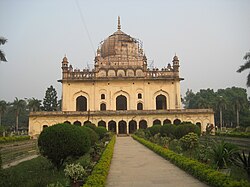
[[File:Gulab Bari.jpg|thumb|right|[[Gulab Bari]], the tomb of | [[File:Gulab Bari.jpg|thumb|right|[[Gulab Bari]], the tomb of Shuja-ud-Daula, in [[Faizabad]]]] | ||
Shuja-ud-Daula died on 26 January 1775 in [[Faizabad]], the then capital of [[Awadh]], and was buried in the same city. His burial place is a tomb and known as [[Gulab Bari]] (Rose Garden). | Shuja-ud-Daula died on 26 January 1775 in [[Faizabad]], the then capital of [[Awadh]], and was buried in the same city. His burial place is a tomb and known as [[Gulab Bari]] (Rose Garden). | ||
==Personal life== | ==Personal life== | ||
Shuja | [[File:Shuja ud-Daulah.jpg|thumb|A portrait of Shuja ud-Daulah]]According to historians, Shuja-ud-Daulah was nearly seven feet tall, with oiled moustaches that projected from his face like a pair of outstretched eagle’s wings, he was a man of immense physical strength. By 1763, he was past his prime, but still reputedly strong enough to cut off the head of a buffalo with a single swing of his sword, or lift up two of his officers, one in each hand. This was something that immediately struck the 18th-century, historian [[Ghulam Hussain Khan]] who regarded him as a slight liability, every bit as foolish as he was bold. Shuja, he wrote, ‘was equally proud and ignorant’.<ref>{{Cite book |last=Dalrymple |first=William |title=The Anarchy |date=10 September 2019 |publisher=Bloomsbury Publishing |isbn=978-1526618504 |publication-date=10 September 2019 |pages=16}}</ref> | ||
==In popular culture== | ==In popular culture== | ||
* In the 1994 [[Hindi]] TV series ''[[The Great Maratha]]'', Shuja's character was portrayed by [[Benjamin Gilani]]. | * In the 1994 [[Hindi]] TV series ''[[The Great Maratha]]'', Shuja's character was portrayed by [[Benjamin Gilani]]. | ||
* In the 2019 Bollywood film ''[[Panipat (film)|Panipat]]'', Shuja-ud-Daula is portrayed by [[Kunal Kapoor (actor, born 1959)|Kunal Kapoor]]. | * In the 2019 Bollywood film ''[[Panipat (film)|Panipat]]'', Shuja-ud-Daula is portrayed by [[Kunal Kapoor (actor, born 1959)|Kunal Kapoor]]. | ||
== Gallery == | |||
<gallery> | |||
File:Mahout Shuja-ud-Daulah.png|Mahout of Shuja-ud-Daulah, 1772 | |||
File:Muharram Procession, Faizabad, 1772.png|Muharram Procession, Faizabad, 1722 | |||
File:Palace of Nawaub Suja Dowla at Lucnow - British Library X432 3 16 951 (complete).jpg|Palace of [[Nawab of Awadh|Nawab]] Shuja-ud-Daula at [[Lucknow]] | |||
</gallery> | |||
==References== | ==References== | ||
| Line 109: | Line 87: | ||
==Further reading== | ==Further reading== | ||
*Shuja-ud-Daulah – Vol. I, II (1754–1765) by Ashirbadi Lal Srivastava | *''Shuja-ud-Daulah'' – Vol. I, II (1754–1765) by Ashirbadi Lal Srivastava | ||
{{s-start}} | {{s-start}} | ||
{{succession box| | {{succession box | ||
|before= [[Safdarjung|Abu´l Mansur Mohammad Moqim Khan]] | |||
|title=[[Nawab of Oudh|Subadar Nawab of Oudh]] | |||
|years=1754–1762 | |||
|after= post abolished | |||
}} | }} | ||
{{succession box| | {{succession box | ||
|before=new creation | |||
|title=[[Nawab of Oudh|Nawab Wazir al-Mamalik of Oudh]] | |||
|years=1762–1775 | |||
|after=[[Asaf-Ud-Dowlah|Asaf ad-Dowla Amani]] | |||
}} | }} | ||
{{s-end}} | {{s-end}} | ||
| Line 134: | Line 110: | ||
[[Category:1732 births]] | [[Category:1732 births]] | ||
[[Category:People from Lucknow]] | [[Category:People from Lucknow]] | ||
[[Category:Nawabs of | [[Category:Nawabs of Oudh State]] | ||
[[Category:1775 deaths]] | [[Category:1775 deaths]] | ||
[[Category:Indian Shia Muslims]] | [[Category:Indian Shia Muslims]] | ||
[[Category:Indian people of Iranian descent]] | [[Category:Indian people of Iranian descent]] | ||
[[Category:18th-century Iranian people]] | [[Category:18th-century Iranian people]] | ||
[[Category:18th-century Indian royalty]] | |||
Latest revision as of 06:24, 8 February 2026
| Shuja-ud-Daula | |||||
|---|---|---|---|---|---|
| Nawab of Oudh Khan Bahadur Asad Jang Arsh Manzil | |||||
| 3rd Nawab of Awadh | |||||
| Reign | 5 October 1754 – 26 January 1775 | ||||
| Predecessor | Safdar Jang | ||||
| Successor | Asaf-ud-Daulah | ||||
| Born | 19 January 1732 Mansion of Dara Shikoh, Delhi, Delhi Subah, Mughal Empire | ||||
| Died | 26 January 1775 (aged 43) Faizabad, Kingdom of Awadh (present-day Uttar Pradesh, India) | ||||
| Burial | |||||
| Spouse | Nawab Begum Ummat-uz-Zahra Bano "Bahu Begum" Saheba | ||||
| Issue | Asaf-ud-Daulah Saadat Ali Khan II | ||||
| |||||
| House | Nishapuri Branch of the Kara Koyunlu | ||||
| Father | Safdar Jang | ||||
| Mother | Nawab Begum Sadar Jahan Ara Begum Saheba | ||||
Shuja-ud-Daula (19 January 1732 – 26 January 1775) was the third Nawab of Oudh[1] and the Vizier of Delhi from 5 October 1754 until his death 26 January 1775.[2]
He was a key 18th-century Mughal ally who despised the Maratha-backed grand vizier of the Mughal Empire Imad-ul-Mulk. He supported Prince Ali Gauhar (later Shah Alam II) against Mughal usurpers and became Grand Vizier. His army, backed by influential clans and Shi'a migrants from Kashmir, was a major force in North India. Shuja joined Ahmad Shah Durrani in the Third Battle of Panipat, helping defeat the Marathas by cutting their supply lines. Later, he allied with Shah Alam II and Mir Qasim to fight the British in the Battle of Buxar but was defeated. In 1765, he signed the Treaty of Allahabad, ceding territory and financial control to the East India Company. Though strategic, this marked the start of increasing British dominance in India.
Early life[edit | edit source]
Shuja-ud-Daula was the son of the Mughal Grand Vizier Safdarjung, who was chosen by Emperor Ahmad Shah Bahadur. Unlike his father Shuja-ud-Daula was known from an early age for his abilities to synthesize his subordinates;[clarification needed] this skill would eventually cause him to emerge as the chosen Grand Vizier of Shah Alam II.

Shuja-ud-Daula is also known to have assisted Alivardi Khan, Nawab of Bengal, on various occasions when the territories of the latter were being ravaged by Raghoji I Bhonsle and his Marathas. Thus, Shuja-ud-Daula is known to have been a very respected figure among the servicemen of Alivardi Khan.
Nawab of Awadh[edit | edit source]
After the death of his father in the year 1753, Shuja-ud-Daula was recognized as the next Nawab by Ahmad Shah Bahadur.
Shuja-ud-Daula despised Imad-ul-Mulk, an ally of the Marathas whose regime emerged after the Battle of Sikandarabad with the support of the Sadashivrao Bhau. Imad-ul-Mulk blinded Ahmad Shah Bahadur and placed Alamgir II on the Mughal throne. Alamgir II and his son Prince Ali Gauhar were often persecuted by Imad-ul-Mulk because they refused to abandon their peaceful terms with Ahmad Shah Durrani; they also demanded the resignation of Imad-ul-Mulk, mainly due to his relations with the Marathas.[3]
Shuja-ud-Daulah's household cavalry was composed of the Sheikhzadi,[4] much of whom belonged to the Qidwai clan, who claimed descent from the Bani Israil.[5] Clan-groups such as the Sayyids of Bilgram, Kara-Manikpur, Sheikhs of Kakori, and the Sayyids of Barha served as court officers and soldiers.[6] The troops of Naval Rai, the most vigilant of Shuja-ud-Daulah's commanders, were a contingent of his Barah Sayyids, while the Bilgramis were of the same stock.[7][8] These clans had not taken any profession other than soldiery.[9] Shuja-ud-Daulah's father had maintained a contingent of 20,000 "Mughal" cavalry, who were mainly Hindustanis, many of whom were chiefly from the Jadibal district in Kashmir and who imitated the Qizilbash in dress and spoke the Persian language.[10][11] The state also saw a large migration of Kashmiri Shi'as to the Shi'a kingdom of Awadh, both to escape persecution and to secure courtly patronage.[12] This was especially the case with men from the district of Jadibal in Kashmir, who were all Shias, who looked to the state as the sword-arm of the Shi'as in India.
Grand Vizier of the Mughal Empire[edit | edit source]

Prince Ali Gauhar fled from Delhi when he realized a conspiracy that would eventually lead to the murder of the Mughal emperor Alamgir II. Shuja-ud-Daula welcomed and protected Prince Ali Gauhar, who then declared himself Shah Alam II and officially recognized Shuja-ud-Daula as the Grand Vizier of the Mughal Empire. Together they challenged the usurper Shah Jahan III, who was placed on the Mughal imperial throne by Sadashivrao Bhau and his forces, which plundered much of the Mughal Empire.
Shah Alam II was then advised to lead an expedition that would attempt to retake the eastern regions of the Mughal Empire from Mir Jafar who was supported by the British East India Company. While Shuja-ud-Daula, Najib-ud-Daula and Mirza Jawan Bakht allied themselves with Ahmad Shah Durrani and assisted his forces during the Second Battle of Sikandarabad in the year 1760 and later led a Mughal Army of 43,000 during the Third Battle of Panipat.[13]
Third Battle of Panipat[edit | edit source]
After escaping from Delhi due to the murder of his father the Mughal Emperor Alamgir II, the young Prince Ali Gauhar was well received by Shuja-ud-Daula. The Nawab of Awadh and the newly appointed Mughal Grand Vizier Shuja-ud-Daula assured Prince Ali Gauhar that he and Najib-ud-Daula would initiate a struggle that would overthrow the Maratha Empire if Prince Ali Gauhar would lead what remained of the Mughal Army against the expanding British East India Company in Bengal.[14]
Shuja's decision about whom to join as an ally in the Third Battle of Panipat was one of the decisive factors that determined the outcome of the war as lack of food due to the Afghans cutting the supply lines of Marathas was one of the reasons that the Marathas could not sustain the day-long battle. Their forces were weak due to starvation and were also fighting facing the sun.[citation needed]

Shuja was not very sure about whose side should he take before the Third Battle of Panipat. The Marathas were still further south then and it would have taken them considerable time to reach Shuja's province. In spite of this, his mother was of the opinion that he should join the Marathas as they had helped his father previously on numerous occasions. However, in the end, Shuja decided to join Ahmad Shah Durrani.
As the chosen Grand Vizier of the Mughal Empire, Shuja-ud-Daula commanded a sizeable army of Mughal Sepoy, who cut off the supplies of the Marathas and even defeated them in pitched confrontations during the Third Battle of Panipat and dispatched the Maratha leader Sadashivrao Bhau.[citation needed]
Abdali wrote to Shuja-ud-Daulah:
"It is now incontestably known that the addressee is a native of those parts, but that forsaking the conversation and manners of his native land, he has incorporated himself with the inhabitants of Hindustan. Whatever has come to pass, is altogether right. Whatever has been has been; the future will, by the favour of God, be fortunate.[16]
Battle of Buxar[edit | edit source]
Shuja is also known for his role in the Battle of Buxar, a battle that was no less definite in Indian history. He along with the forces of Mughal emperor Shah Alam II & Mir Qasim ruler of Bengal were defeated by the British forces in one of the key battles in the history of British East India company.
Allahabad Treaty[edit | edit source]
He again fought the British with the help of Marathas at Kara Jahanabad and was defeated. On 16 August 1765 AD he signed the Treaty of Allahabad, which said that Kora and Allahabad district would go to Company and the Company would get 5 million rupees from Awadh.[17] The British would be allowed free trade in Awadh and would help each other in case of war with other powers, which was a very shrewd political move by the Company.[18]
To pay for the protection of British forces and assistance in war, Awadh gave up first the fort of Chunar, then districts of Benaras, Ghazipur and finally Allahabad.[19]
Death and burial[edit | edit source]

Shuja-ud-Daula died on 26 January 1775 in Faizabad, the then capital of Awadh, and was buried in the same city. His burial place is a tomb and known as Gulab Bari (Rose Garden).
Personal life[edit | edit source]

According to historians, Shuja-ud-Daulah was nearly seven feet tall, with oiled moustaches that projected from his face like a pair of outstretched eagle’s wings, he was a man of immense physical strength. By 1763, he was past his prime, but still reputedly strong enough to cut off the head of a buffalo with a single swing of his sword, or lift up two of his officers, one in each hand. This was something that immediately struck the 18th-century, historian Ghulam Hussain Khan who regarded him as a slight liability, every bit as foolish as he was bold. Shuja, he wrote, ‘was equally proud and ignorant’.[20]
In popular culture[edit | edit source]
- In the 1994 Hindi TV series The Great Maratha, Shuja's character was portrayed by Benjamin Gilani.
- In the 2019 Bollywood film Panipat, Shuja-ud-Daula is portrayed by Kunal Kapoor.
Gallery[edit | edit source]
-
 Mahout of Shuja-ud-Daulah, 1772
 -
 Muharram Procession, Faizabad, 1722
 -


.jpg)
References[edit | edit source]
- ↑ Bhatia, O. P. Singh (1968). History of India, from 1707 to 1856. Surjeet Book Depot.
- ↑ Princely States of India
- ↑ Srivastava, Ashirbadi Lal (1945). Shuja-ud-daulah. S.N. Sarkar. Retrieved 2 August 2020.
- ↑ Barua, Pradeep P. (2005). The State at War in South Asia. Lincoln: University of Nebraska Press. p. 73. ISBN 0803213441.
- ↑ Misra, Amaresh (1998). Lucknow, Fire of Grace: The Story of Its Revolution, Renaissance and the Aftermath. HarperCollins Publishers India. ISBN 9788172232887.
- ↑ Bayly, C. A. (2012). Rulers, Townsmen and Bazaars: North Indian Society in the Age of British Expansion: 1770–1870 (3rd ed.). Delhi: OUP India. ISBN 978-0-19-908873-7.
- ↑ Journal of the Asiatic Society of Bengal. Asiatic Society (Calcutta, India); Asiatic Society (Calcutta, India). 1832.
- ↑ Henry Dodwell, Sir Richard Burn, Sir Wolseley Haig (1957). The Cambridge History of IndiaVolume 4. Pennsylvania State University.
{{cite book}}: CS1 maint: multiple names: authors list (link) - ↑ Surya Narain Singh. Mittal Publications. 2003. p. 9. ISBN 978-81-7099-908-9.
- ↑ Sarkar, Jadunath (1964) [1st ed. 1932]. Fall of the Mughal Empire. Vol. 1 (3rd ed.). Bombay: Orient Longman. p. 254.
- ↑ Srivastava, Ashirbadi Lal (1933). textsThe First Two Nawabs Of Oudh (a Critical Study Based On Original Sources) Approved For The Degree Of Ph. D. In The University Fo Lucknow In 1932.
- ↑ Hamdani, Hakim Sameer (2022). Shi'ism in Kashmir:A History of Sunni-Shia Rivalry and Reconciliation. Bloomsbury. ISBN 978-0-7556-4396-7.
- ↑ Mohan, Surendra (1997). Awadh Under the Nawabs: Politics, Culture, and Communal Relations, 1722-1856. Manohar Publishers & Distributors. ISBN 978-81-7304-203-4.
- ↑ Cotton, James Sutherland; Burn, Sir Richard; Meyer, Sir William Stevenson (1908). Imperial Gazetteer of India: Provincial Series. Superintendent of Government Printing.
Shah Alam ii an shuja-ud-daula.
- ↑ Prior, D. L. (23 September 2004). "Carnac, John". Oxford Dictionary of National Biography (online ed.). Oxford University Press. doi:10.1093/ref:odnb/4711. Template:ODNBsub
- ↑ Calendar of Persian Correspondence: Being Letters, Referring Mainly to Affairs in Bengal, which Passed Between Some of the Company's Servants and Indian Rulers and Notables. By India. Imperial Record Department. 1914.
- ↑ Wikisource: Text of Allahabad Treaty
- ↑ HISTORY OF AWADH (Oudh) a princely State of India by Hameed Akhtar Siddiqui
- ↑ Shuja-ud-daula (1754–1775)
- ↑ Dalrymple, William (10 September 2019). The Anarchy. Bloomsbury Publishing. p. 16. ISBN 978-1526618504.
Further reading[edit | edit source]
- Shuja-ud-Daulah – Vol. I, II (1754–1765) by Ashirbadi Lal Srivastava
| Preceded by Abu´l Mansur Mohammad Moqim Khan |
Subadar Nawab of Oudh 1754–1762 |
Succeeded by post abolished |
| Preceded by new creation |
Nawab Wazir al-Mamalik of Oudh 1762–1775 |
Succeeded by Asaf ad-Dowla Amani |