




Kamal Guha (talk | contribs) Uttar Pradesh Buddhist sites added |
adjusted structure to improve readability for clarity |
||
| Line 1: | Line 1: | ||
{{distinguish|Piprahawa}} | |||
{{Use dmy dates|date=August 2018}} | {{Use dmy dates|date=August 2018}} | ||
{{Use Indian English|date=August 2018}} | {{Use Indian English|date=August 2018}} | ||
{{Infobox settlement | {{Infobox settlement | ||
| name | | name = Piprahwa | ||
| native_name | | native_name = | ||
| native_name_lang | | native_name_lang = | ||
| other_name | | other_name = Piprahava | ||
| nickname | | nickname = | ||
| settlement_type | | settlement_type = village | ||
| image_skyline | | image_skyline = Stupa at Kapilavastu, India.jpg | ||
| image_alt | | image_alt = | ||
| image_caption | | image_caption = Stupa at Piprahwa | ||
| pushpin_map | | pushpin_map = India#India Uttar Pradesh | ||
| pushpin_relief | | pushpin_relief = yes | ||
| pushpin_mapsize | | pushpin_mapsize = 260 | ||
| pushpin_label_position | | pushpin_label_position = bottom | ||
| pushpin_map_alt | | pushpin_map_alt = | ||
| pushpin_map_caption | | pushpin_map_caption = Location in Uttar Pradesh, India | ||
| coordinates | | coordinates = {{coord|27.4430|N|83.1278|E|display=inline,title}} | ||
| subdivision_type | | subdivision_type = [[List of sovereign states|Country]] | ||
| subdivision_name | | subdivision_name = {{IND}} | ||
| subdivision_type1 | | subdivision_type1 = [[States and territories of India|State]] | ||
| subdivision_name1 | | subdivision_name1 = [[Uttar Pradesh]] | ||
| subdivision_type2 | | subdivision_type2 = District | ||
| subdivision_name2 | | subdivision_name2 = [[Siddharthnagar district|Siddharthnagar]] | ||
| established_title | | established_title = <!-- Established --> | ||
| established_date | | established_date = | ||
| founder | | founder = | ||
| named_for | | named_for = | ||
| government_type | | government_type = | ||
| governing_body | | governing_body = | ||
| unit_pref | | unit_pref = Metric | ||
| area_footnotes | | area_footnotes = | ||
| area_rank | | area_rank = | ||
| area_total_km2 | | area_total_km2 = | ||
| elevation_footnotes | | elevation_footnotes = | ||
| elevation_m | | elevation_m = | ||
| population_total | | population_total = | ||
| population_as_of | | population_as_of = | ||
| population_rank | | population_rank = | ||
| population_density_km2 | | population_density_km2 = auto | ||
| population_demonym | | population_demonym = | ||
| population_footnotes | | population_footnotes = | ||
| demographics_type1 | | demographics_type1 = Languages | ||
| demographics1_title1 | | demographics1_title1 = Official | ||
| demographics1_info1 | | demographics1_info1 = [[Hindi]] | ||
| timezone1 | | timezone1 = [[Indian Standard Time|IST]] | ||
| utc_offset1 | | utc_offset1 = +05:30 | ||
| postal_code_type | | postal_code_type = <!-- [[Postal Index Number|PIN]] --> | ||
| postal_code | | postal_code = | ||
| registration_plate | | registration_plate = | ||
| website | | website = | ||
| footnotes | | footnotes = | ||
| mapframe = yes | |||
| mapframe-zoom = 12 | |||
| mapframe-wikidata = yes | |||
}} | }} | ||
{{BuddhasHolySites}} | {{BuddhasHolySites}} | ||
'''Piprahwa''' | '''Piprahwa''' is a village near [[Siddharthnagar|Siddharthnagar city]] in [[Siddharthnagar district]] of the [[States and union territories of India|Indian state]] of [[Uttar Pradesh]]. [[Kalanamak rice]], a scented and spicy variety, is grown in this area.{{sfn |Mishra|2005|p=}} It lies in the heart of the historical Buddha's homeland and is 9 miles from the world heritage site of [[Lumbini]] that is believed to be the place of [[Gautama Buddha|Gautama Buddha's]] birth. | ||
Piprahwa is best known for its archaeological site and excavations that suggest that it | Piprahwa is best known for its archaeological site and excavations that suggest that it was the burial place of the portion of the Buddha's ashes that were given to his own [[Shakya]] clan. A large [[stupa]] and the ruins of several monasteries as well as a museum are located within the site. Ancient residential complexes and shrines were uncovered at the adjacent mound of [[Ganwaria]]. | ||
== | ==Passing of the Buddha== | ||
The history of the Piprahwa stupa begins with the death of the Buddha. The [[Mahāparinibbāna Sutta]] says that an argument arose following his cremation around 480 BCE. 'The Sakyas of Kapilavatthu came to know that at Kusinara the Blessed One had died. And they sent a message to the Mallas of Kusinara, saying: "The Lord was the chief of our clan. We are worthy to receive a share of the Lord's remains, and we will make a great stupa for them."<ref name="Walshe1987">{{cite book |last1=Walshe |first1=Maurice, trans. |title=Mahaparinibbana Sutta: The Great Passing.” In Thus Have I Heard: The Long Discourses of the Buddha |date=1987 |publisher=Wisdom Publications |location=London |page=276}}</ref> The Mallas replied "The Lord passed away in our parish. We will not give away any share of the Lord's remains." The Brahman, Dona, then intervened to remind them about the Buddha's teachings and suggested that they avoid 'strife, war and bloodshed' and split the relics between the eight kingdoms demanding a portion so that "far and wide Stupas may rise". | |||
The Buddha's own Sakya clan received a share as did seven other kingdoms. They deposited them in eight stupas with two further stupas being built over the ashes of the cremation pyre and over the vessel in which the bones and ashes had been gathered.<ref>{{cite book |last1=Chamberlain-Nyudo |first1=Sylvain |title=Mahaparinirvana Sutra |date=2007 |publisher=Threefold Lotus Kwoon |location=Shannon, MS}}</ref> | |||
In the centuries after the Sakyas built their stupa, all signs of Buddhism disappeared from the Buddha's homeland. A Brahmin Hindu revival saw the decline of Buddhism which migrated to [[Thailand]], Sri Lanka, China, Cambodia etc. Statues were destroyed or decapitated during a succession of invasions by Persians, Arabs, Mongols, Mughals and assorted Hunas or Huns. | |||
==Excavation by William Claxton Peppé== | |||
For over 2,000 years the stupa built by the Sakyas remained intact and covered with vegetation outside the village of Piprahwa on the Indian side of the border with Nepal. It even survived 50 years of stupa archaeology by the many Indophiles to be found in the British civil service. For all their efforts, they failed to find any reliquaries that claimed to hold the Buddha's relics.<ref>{{cite journal |last1=Guy |first1=John |title=Buddha and the jewel filled casket |journal=Orientations |date=2023 |volume=54 |issue=4 |pages=35–45}}</ref> In 1897 a particularly large kot or earthen mound caught the attention of [[William Claxton Peppé]], a [[British Raj|British colonial]] engineer and landowner who had been inspired by the recent discovery of the Lumbini pillar that marked the birthplace of the Buddha.<ref>{{cite journal |last1=Peppé |first1=W. C. |title=The Piprāhwā Stūpa, containing relics of Buddha |journal=Journal of the Royal Asiatic Society |date=July 1898 |volume=30 |issue=3 |pages=573–588}}</ref> The [[Indian famine of 1896–97]] had decimated the region leaving the tenant farmers on his estate in need of work. Peppé led a team excavating what Indologist Vincent Smith advised him was an unusually early example of an ancient Buddhist stupa 'probably dating from the era of Asoka the Great.'<ref>{{cite book |last1=Allen |first1=Charles |title=The Buddha and Dr. Fuhrer: An archaeological scandal |date=2008 |publisher=Haus Publishing |location=London |isbn=978-1-905791-93-4}}</ref> Having cleared away scrub and jungle, they set to work building a deep trench through the mound. After digging through 18 feet of solid brickwork, they came to a large stone [[coffer]] which contained five small vases containing bone fragments, gold ornaments and intricately fashioned jewellery.{{sfn |Peppe|1898|pp=573–588}} These reliquaries together held the largest group of precious offerings ever recorded in a single deposit: around 1,800 gemstones and semi-precious stones (many shaped and drilled), rock crystal, pearls, shell, coral, embossed sheet gold and silver, granulated gold, as well as bone and ash assumed to be of great sanctity.<ref>{{cite book |last1=Guy |first1=John |title=Tree and Serpent: Early Buddhist Art in Ancient India |date=2023 |publisher=Metropolitan Museum of Art |location=New York |isbn=978-1-58839-693-8 |page=104}}</ref> | |||
[[File:Piprawa five reliquaries.jpg|thumb|upright=2.5|centre|The five reliquaries discovered in Piprahwa]] | |||
==The inscription== | |||
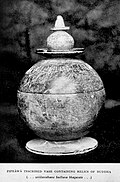
[[File:Piprawa vase with relics of the Buddha.jpg|thumb|upright=0.9|Piprahwa vase with relics of the Buddha. The inscription reads ''...salilanidhane Budhasa Bhagavate...'' "Relics of the Buddha Lord"]] | |||
[[File:Piprawa note by W.C. Peppe 1898.jpg|thumb|upright=1.5|Handwritten note by discoverer W. C. Péppe to [[Vincent Arthur Smith]] about the inscription, 1898]] | |||
On one of the vases was a [[Brahmi script]] which was translated by [[Georg Bühler]], a leading European [[Epigraphy|epigraphist]] of the time, to mean: | |||
This interpretation was firmly rejected by his contemporaries. Following such criticism Fleet wrote: "I now abandon my opinion".{{ | <blockquote>"This relic-shrine of divine Buddha (is the donation) of the Sakya-Sukiti brothers, associated with their sisters, sons, and wives."{{sfn |Bühler|1898|p=388}}</blockquote> | ||
This translation implied that the bone fragments were part of the remains of Gautama Buddha, the founder of [[Buddhism]].{{sfn |Peppe|1898|pp=584–85}} The challenge in interpreting a language that was new to all lay in finding uses of less familiar words in other contexts to reach a definition. To make it harder, the hand copies of the inscription were not always accurate. Peppé's original copy had one minor omission but, when he passed it over to his assistant for more copies, other errors were made. Ambitious Pali scholars approached their translations with a passion that led to competition and grandstanding, often when they were working from different texts.<ref>{{cite journal |last1=Falk |first1=Harry |title=The Ashes of the Buddha |journal=Bulletin of the Asia Institute |date=2013 |volume=27 |pages=43–76}}</ref> Throughout the following decade or so, epigraphists debated the precise meaning of the inscription. [[Vincent Arthur Smith|Vincent Smith]], William Hoey, [[Thomas Rhys Davids]], and Emile Senart all translated the inscription to confirm that these were [[relic]]s of the Buddha.<ref>{{cite journal |last1=Senart |first1=Emile |title=Note sur l'inscription de Piprahwa |journal=Journal Asiatique |date=1906 |issue=Jan-Feb |pages=132–136}}</ref><ref>{{cite journal |last1=Hoey |first1=William |title=Piprahwa inscription |journal=The Pioneer |date=24 February 1898}}</ref> | |||
In 1905, [[John Faithfull Fleet|John Fleet]], a former epigraphist of the Government of India, published a translation that agreed with this interpretation.<ref>{{cite journal |last1=Fleet |first1=John |title=Notes on three Buddhist Inscriptions |journal=Journal of the Royal Asiatic Society |date=October 1905|volume=37 |issue=4 |pages=679–691 |doi=10.1017/S0035869X00033748 |s2cid=162620321 |url=https://zenodo.org/record/1603205 }}</ref> However, on assuming the role of Secretary of the [[Royal Asiatic Society of Great Britain and Ireland|Royal Asiatic Society]] from Thomas Rhys Davids, Fleet proposed a different reading:<ref>{{cite book |last1=Fleet |first1=John |title=The inscription on the Piprahwa vase |date=1906 |publisher=Journal Of The Royal Asiatic Society Of Great Britain And Ireland For-1906 |pages=[https://archive.org/details/in.ernet.dli.2015.70555/page/n163 149]- |url=https://archive.org/details/in.ernet.dli.2015.70555}}</ref><ref>{{cite web |title=Inscribed Relic Casket from Piprahwa |website=Museums of India |publisher=National Portal and Digital Repository |url=http://museumsofindia.gov.in/repository/record/im_kol-19737A-B-10420|archive-url=https://web.archive.org/web/20150622115928/http://museumsofindia.gov.in/repository/record/im_kol-19737A-B-10420 |archive-date=22 June 2015 }}</ref> | |||
<blockquote>"This is a deposit of relics of the brethren of Sukiti, kinsmen of Buddha the Blessed One, with their sisters, their children and wives."{{sfn |Fleet|1907|pp=129-130}}</blockquote> | |||
This interpretation was firmly rejected by his contemporaries. Following such criticism Fleet wrote: "I now abandon my opinion".<ref name="Allen 2008 212">{{cite book|title=The Buddha and Dr Führer: an archaeological scandal|last=Allen|first=Charles|publisher=Haus Publishing|year=2008|isbn=978-1-905791-93-4|edition=1st|location=London|author-link=Charles Allen (writer)|page=212}}</ref> It took almost a decade to reach a consensus on the exact meaning of the inscription which resulted in it being subsequently labelled as 'controversial'. Ultimately epigraphists of the time subscribed to the translation by [[Auguste Barth]]: | |||
<blockquote>"This receptacle of relics of the blessed Buddha of the Śākyas (is the pious gift) of the brothers of Sukīrti, jointly with their sisters, with their sons and their wives."<ref>{{cite journal |last1=Barth |first1=Auguste |title=The inscription on the Piprahwa vase |journal=Journal des Savants |date=October 1906 |volume=36 |page=124}}</ref></blockquote> | <blockquote>"This receptacle of relics of the blessed Buddha of the Śākyas (is the pious gift) of the brothers of Sukīrti, jointly with their sisters, with their sons and their wives."<ref>{{cite journal |last1=Barth |first1=Auguste |title=The inscription on the Piprahwa vase |journal=Journal des Savants |date=October 1906 |volume=36 |page=124}}</ref></blockquote> | ||
Over a hundred years later, in the 2013 documentary, ''[[Bones of the Buddha]]'', epigraphist Harry Falk of [[Freie Universität Berlin]] confirmed the | Over a hundred years later, in the 2013 documentary, ''[[Bones of the Buddha]]'', epigraphist Harry Falk of [[Freie Universität Berlin]] confirmed the same interpretation that these were the remains of the Buddha. Having spent time with the reliquary in the Indian Museum in Kolkata, Falk translated the inscription to mean: | ||
<blockquote>'This enshrinement (nidhāna) of the corporal remnants (śarīra) of the Buddha [1: of the Śākyas], the lord, (is to the credit) of the [2: Śākya] brothers of the 'highly famous', together with their sisters, with their sons and wives.'</blockquote> | |||
Where earlier translations had debated the word Sukirti as being either a proper name or a reference to the Buddha as 'possessed of good fame' or 'the well famed one', Falk focuses on the word ''nidhane''. Rather than it simply meaning container or reliquary box, Falk finds evidence to read it as meaning the whole stupa construction installed by the Sakyas for the relics of the Buddha. He concludes that the reliquary found at Piprahwa contained a portion of the ashes of the Buddha and that the inscription is authentic.<ref>{{Citation|title=Secrets of the Dead: Bones of the Buddha - Transcript|url=https://www.pbs.org/wnet/secrets/ajax/printable/?id=1073|archive-url=https://archive.today/20150416165847/http://www.pbs.org/wnet/secrets/ajax/printable/?id=1073|url-status=dead|archive-date=16 April 2015|publisher=[[PBS]]|access-date=16 April 2015}}</ref> In the catalogue for the Metropolitan Museum of Art's ''Tree and Serpent'' exhibition, Curator John Guy writes that 'it is reasonable to surmise that the Piprahwa bone relics represent the Shakya clan's share of the original division by the Brahmin Drona, as implicit in the reliquary inscription, and that the seven surviving reliquary containers and their precious-material contents represent deposits at the time of the stupa's rebuilding in brick during or shortly after the reign of Ashoka.'<ref>{{cite book |last1=Guy |first1=John |title=Tree and Serpent: Early Buddhist Art in Ancient India |date=2023 |publisher=Metropolitan Museum of Art |location=New York |isbn=978-1-58839-693-8 |pages=105–106}}</ref> | |||
==Dating the reliquary urn and the stupa== | |||
In 1997, [[Epigraphy|epigraphist]] and archaeologist [[Ahmad Hasan Dani]] noted the challenges that isolated finds present to paleographical study and to dating materials. He concluded that "the inscription may be confidently dated to the earlier half of the second century B.C." but noted that "the Piprahwa vase, found in the Basti District, U.P. (Uttar Pradesh), has an inscription scratched on the steatite stone in a careless manner. As the inscription refers to the remains of the Buddha, it was originally dated to the pre-[[Maurya Empire|Mauryan]] period, but it has been brought down to the third century B.C. on a comparison with [[Brahmi script|Asokan Brahmi]]". {{sfn |Dani|1997|loc=Chapter 3}} Dani's dating of the inscription puts it around 250 years after the generally agreed 480 BCE death of the historical Buddha which suggests that the '[[stupa]]' itself was built after the Buddha's lifetime. The time difference is most likely explained by the [[Asoka|Emperor Asoka]]'s conversion to Buddhism. Asoka the Great was a ruthless and bloody Emperor who ruled from around 268-232 BCE. He supposedly killed his brothers to ascend to the throne but, after the brutality of the Kalinga War where he slaughtered '100,000 men and animals', he renounced all violence and embraced Buddhism. He then issued a decree to build 'stupas' and redistribute the Buddha's remains across his kingdom.<ref>{{cite book |last1=Strong |first1=John |title=The Legend of King Aśoka: A Study and Translation of the Aśokāvadāna |date=1989 |publisher=Motilal Banarsidass Publ}}</ref> | |||
It was not until the 1970s that the evolution of the Piprahwa stupa was established. K. M. Srivastava knew that 'instances are not wanting when relics of the same individual have been enshrined at two different levels'.<ref>{{cite book |last1=Srivastava |first1=K. M. |title=Kapilavastu in Basti District of U.P. |date=1978 |publisher=Nagpur Buddhist Centre |location=Nagpur |page=7}}</ref> He led an Archaeological Society of India expedition that dug deeper than Peppé. They discovered two soapstone casket containing fragments of small bone in two burnt brick chambers measuring 32 inches square and 14 inches deep. Some broken dishes that may have covered the caskets proved to be Northern Black Polished Ware which dated this find to 400-500BCE, which is consistent with the 480 BCE date given for the Buddha's passing. {{sfn |Srivastava|1980|pp=103–10}} | |||
Srivastava concluded that the stupa was built in three phases. The first would have been undertaken by the Sakyas shortly after the Buddha's death. It most likely adhered to the Buddha's instruction to be buried under earth that was 'heaped up as rice is heaped in an alms bowl' and that the stupa be sited beside a crossroads so that passersby might pause to pay their respects and by their veneration gain in understanding and merit.<ref>{{cite book|title=The Buddha and Dr Führer: an archaeological scandal|last=Allen|first=Charles|publisher=Haus Publishing|year=2008|isbn=978-1-905791-93-4|edition=1st|location=London|author-link=Charles Allen (writer)|page=9}}</ref> The resulting circular mud adobe structure was 62 ft in diameter and 12 ft in height. | |||
Peppé unearthed the second Asokan phase which was characterized by well fired mud bricks made with rice and straw and laid in clay mortar in concentric circles. The stupa and the coffer it held show all the trademarks of high quality Asokan craftsmanship but the enlargement likely extended for years after the Emperor's death. The base measured 116 ft in diameter and 22 ft in height. | |||
During the third stage of construction the height of the stupa was raised and the base was squared off. Monastic buildings were also constructed around the stupa. This all happened at an unknown date, although most likely during the Kushan era, approximately two hundred and fifty years after the reign of Ashoka. | |||
==Authenticity== | |||
Although there was initial uncertainty about the translation, there is no record of any challenge to the authenticity of the find itself at the time.<ref>{{cite journal |last1=Falk |first1=Harry |title=The ashes of the Buddha |journal=Bulletin of the Asia Institute |date=2018 |pages=45}}</ref> However, in introducing the discovery to the members of the Royal Asiatic Society in April 1900, its secretary, [[Thomas Rhys Davids]], stressed that 'the hypothesis of forgery in this case is simply unthinkable'.<ref>{{cite journal |last1=Rhys Davids |first1=Thomas |title=Asoka and the Buddha relics |journal=Journal of the Royal Asiatic Society |date=1901 |volume=XIV |page=398|url=http://ccbs.ntu.edu.tw/FULLTEXT/JR-ENG/rhy1.htm}}</ref> Over a century later there have been assumptions that such doubts must therefore have existed most likely because government archaeologist, [[Alois Anton Führer]], had been working some eighteen miles away from Peppé on his own dig and was subsequently exposed as a plagiarist and forger. The possibility of forgery was explored by writer and historian Charles Allen in his book ''The Buddha and Dr. Fuhrer'' and in his documentary ''[[Bones of the Buddha]]''. He researches the unfolding of events at Piprahwa based on the 2008 release of letters between W. C. Peppé, Vincent Smith, and A. A. Führer, and concludes that Führer was unable to interfere with the discovery made by Peppé.<ref>{{cite book|title=The Buddha and Dr Führer: an archaeological scandal|last=Allen|first=Charles|publisher=Haus Publishing|year=2008|isbn=978-1-905791-93-4|edition=1st|location=London|author-link=Charles Allen (writer)|page=45}}</ref> | |||
==Distribution of the relics== | ==Distribution of the relics== | ||
[[File:Piprawa vase with relics of the Buddha inscription.jpg|thumb|upright=1.5|Portion of the Piprahwa vase inscription. The inscription reads ''Sukiti-bhatinaṃ sabhaginikanam sa-puta-dalanam iyaṃ salila-nidhane | |||
[[File:Piprawa vase with relics of the Buddha inscription.jpg|thumb|upright=1.5|Portion of the Piprahwa vase inscription. The inscription reads '' | Budhasa bhagavate sakiyanam'' "Relics of the Buddha Lord" ([[Brahmi script]]).]] | ||
[[Prisdang|Prince Prisdang]] (aka Jinavaravansa), a former ambassador to Siam and cousin to the [[ | [[Prisdang|Prince Prisdang]] (aka Jinavaravansa), a former ambassador to Siam and cousin to the King [[Rama V]], had been ordained as a Buddhist monk in Sri Lanka and arrived at Piprahwa shortly after the discovery. He soon learned that W. C. Peppé had placed his finds at the disposal of the government.<ref>{{cite journal |last1=Smith |first1=Vincent |title=Government Correspondence 1898/741 |journal=Government Correspondence |date=1898 |volume=741 |issue=741}}</ref><ref name="Reuters1898">{{cite news |title=The relics of Buddha |url=https://newspaperarchive.com/london-standard-dec-19-1898-p-5/ |access-date=February 14, 2019 |agency=Reuters |newspaper=The Standard |date=December 19, 1898}}</ref> His eloquent arguments to persuade British government officials to donate the bone relics to the King of Siam to share with Buddhist communities in other countries received support from lower level British officials and worked their way up to the Viceroy. It was an obvious solution that might appease Buddhists who were upset that the recently discovered [[Bodh Gaya]], believed to be the place of the Buddha's enlightenment, had remained under [[Hinduism|Hindu]] control. It was also a gesture of goodwill to a country that was being courted by the French, Russian, and Dutch superpowers of the time.<ref>{{cite book |last1=Rey |first1=Himanshu Prabha |title=The Return of the Buddha |date=2014 |publisher=Routledge |pages=106–110}}</ref> In 1899, a ceremony was held and the bone relics were handed to an emissary of King Rama V and taken to [[Bangkok]]. Prisdang's request to be involved was not granted.<ref>{{cite book |last1=Loos |first1=Tamara |title=Bones around my neck |date=2016 |publisher=Cornell University |page=120}}</ref>{{sfn |Jinavaravansa|Jumsai|2003|p=214}} | ||
The bone relics were | The bone relics were distributed across several locations, including [[Wat Saket|Golden Mount Temple]] in [[Bangkok|Bangkok, Thailand]],{{sfn |Jinavaravansa|Jumsai|2003|p=214}} [[Shwedagon Pagoda]] in [[Yangon|Rangoon, Myanmar]], [[Mahamuni Buddha Temple|Arakan pagoda]] in [[Mandalay|Mandalay, Myanmar]], Dipaduttamarama Temple in [[Colombo|Colombo, Sri Lanka]], Waskaduwe Vihara in [[Kalutara|Kalutara, Sri Lanka]]<ref name=Nanayakkara/> and the Marichiwatta ''stupa'' in [[Anuradhapura|Anuradhapura, Sri Lanka]].<ref name="Allen 2008 212"/> | ||
The majority of the gold and | The majority of the gold and jewellery relic offerings were placed by the Indian government in the Indian Museum, Kolkata. Today, a replica urn is all that is on display.<ref>{{cite journal |last1=Falk |first1=Harry |title=The Ashes of the Buddha |journal=Bulletin of the Asia Institute |date=2017|volume=27|page=53}}</ref> Photographs of the relic offerings can be seen at the Kapilavastu Museum at Piprahwa that is visited by Buddhist pilgrims. | ||
W. C. | W. C. Peppé was allowed to keep a number of 'duplicate items'<ref>{{cite journal |last1=Smith |first1=Vincent |title=Government Correspondence |journal=British Library |date=1898 |issue=740 /III-2790-2}}</ref> which have been exhibited at the Rietberg Museum in Zurich, the Rubin Museum in New York, the Asian Civilizations Museum in Singapore, the Metropolitan Museum of Art in New York and the National Museum of Korea in Seoul.<ref>{{cite journal |title=Next stop Nirvana |journal=Rietberg Museum Newsletter |date=November 2018}}</ref> Peppe also gave some pieces to Prince Prisdang and Prisdang's Buddhist master, Sri Subuthi.<ref name=Nanayakkara>{{cite news |last1=Nanayakkara |first1=Rasika |title=Exposition of Sacred relics |publisher=The Island |date=January 25, 2013 |url=http://www.island.lk/index.php?page_cat=article-details&page=article-details&code_title=71148}}</ref> | ||
On 16 December | On 16 December 2011, a portion of the relics was offered to the Sangha of Ratanawan Monastery. In January, 2012, some of the relics were enshrined in the Buddha Homage Reliquary Hall, Ratanawan Monastery, Thailand. Many senior monks participated in the ceremony including [[Ajahn Sumedho]] and [[Ajahn Viradhammo]].{{cn|date=May 2025}} | ||
In 2025, [[Sotheby's]] auction house in London announced the planned auction of gem relics still remaining in the Peppé family. In May, India took legal measures to prevent their sale;<ref>{{cite news |last1=Regan |first1=Helen |title=India slams auction of jewels linked to the Buddha, calls for their return |url=https://www.cnn.com/2025/05/06/style/piprahwa-gems-auction-buddha-india-sothebys-intl-hnk |access-date=6 May 2025 |work=CNN |date=6 May 2025}}</ref> the auction was postponed.<ref>{{cite news |last1=Sullivan |first1=Helen |title=Sotheby's halts Buddha jewels auction after India threat |url=https://www.bbc.co.uk/news/articles/ce9299nln2ko |access-date=13 May 2025 |work=BBC News |date=8 May 2025}}</ref> In July, the Indian [[Ministry of Culture (India)|Ministry of Culture]] said it had recovered the relics in question and would put them in public display.<ref>{{Cite web |title=India secures return of ancient Buddhist gems |url=https://www.france24.com/en/live-news/20250730-india-secures-return-of-ancient-buddhist-gems |date=2025-07-30 |access-date=2025-07-30 |website=[[France 24]]}}</ref> | |||
== | ==Further excavations by the Archaeological Survey of India and the location of ancient Kapilavastu== | ||
[[File:Stupas-Original-00021.jpg|thumbnail|Southern monastery]] | [[File:Stupas-Original-00021.jpg|thumbnail|Southern monastery]] | ||
[[File:Nepal - Walls and Building, Kapilavastu (9239983376).jpg|thumb|Walls of Building, Kapilavastu]] | |||
Srivastava continued his excavation of the surrounding area and discovered what is known today as the Piprahwa-Ganwaria monastic complex. The largest structure after the ''stupa'' is the Eastern Monastery that measures 45.1 m x 41.1 m with a courtyard and more than thirty cells around it. The complex includes an additional Southern Monastery, Western Monastery, and Northern Monastery.<ref name=Stupa>{{cite web |title=The Stupa |website=Kapilavastu Museum |publisher=Archaeological Survey of India |url=http://kapilavastumuseum.in/Kapilavastums/monastaries_structures|archive-url=https://web.archive.org/web/20160315212256/http://kapilavastumuseum.in/Kapilavastums/monastaries_structures |archive-date=15 March 2016 }}</ref> He also found terracotta sealings and a pot which all bore the same legend in Kushan script: 'Of the community of the monks of great Kapilavastu'. This led some scholars to believe that modern-day Piprahwa was the site of the ancient city of [[Kapilavastu (ancient city)|Kapilavastu]], the capital of the [[Shakya]] kingdom, where [[Gautama Buddha|Siddhartha Gautama]] spent the first 29 years of his life.{{sfn |Peppe|1898|pp=573–88}}{{sfn |Bühler|1898|p=388}}{{sfn |Srivastava|1980|pp=103–10}}{{sfn |Srivastava|1979|pp=61-74}} Others suggest that the original site of Kapilavastu is located {{Convert|16|km|mi}} to the northwest, at [[Tilaurakot]], in what is currently [[Kapilvastu District]] in [[Nepal]].<ref>{{cite book|title=The Buddha and Dr Führer: an archaeological scandal|last=Allen|first=Charles|publisher=Haus Publishing|year=2008|isbn=978-1-905791-93-4|edition=1st|location=London|author-link=Charles Allen (writer)|page=262}}</ref>{{sfn |Tuladhar|2002 |pp=1-7}}{{sfn |Sharda|2015|pp=}} | |||
This question is especially important to scholars of Buddhist history, as Kapilavastu was the capital of the [[Shakya]] kingdom. King [[Śuddhodana]] and Queen [[Maya (mother of Buddha)|Māyādevī]] lived at Kapilavastu, as did their son Prince [[Gautama Buddha|Siddhartha Gautama]] until he [[Great Renunciation|left the palace]] at 29 years of age.<ref name=EoB2010>{{cite book|last=Trainor|first=K|editor-last=Keown|editor-first=D|editor2-last=Prebish|editor2-first=CS|title=Encyclopedia of Buddhism|chapter=Kapilavastu|pages=436–7|publisher=Routledge|location=Milton Park, UK|year=2010|isbn=978-0-415-55624-8|url=https://books.google.com/books?id=NFpcAgAAQBAJ&q=kapilavatthu}}</ref> | |||
The bone fragments recovered by Srivastava's team are currently located at the [[National Museum, New Delhi]].{{sfn |Srivathsan|2012|pp=}} In 1978, the Indian government allowed their share of the discovery to be exhibited in Sri Lanka and more than 10 million people paid homage. They were also exhibited in Mongolia in 1993, Singapore in 1994, South Korea in 1995, Thailand in 1996, and again in Sri Lanka in 2012.<ref>{{cite news |title=Kapilavastu relics arrive in Sri Lanka |newspaper=Daily Mirror |date=2012-08-19}}</ref> | The bone fragments recovered by Srivastava's team are currently located at the [[National Museum, New Delhi]].{{sfn |Srivathsan|2012|pp=}} In 1978, the Indian government allowed their share of the discovery to be exhibited in Sri Lanka and more than 10 million people paid homage. They were also exhibited in Mongolia in 1993, Singapore in 1994, South Korea in 1995, Thailand in 1996, and again in Sri Lanka in 2012.<ref>{{cite news |title=Kapilavastu relics arrive in Sri Lanka |newspaper=Daily Mirror |date=2012-08-19}}</ref> In February 2024, the bone relics were taken to Bangkok for the first time with the relics of two of the Buddha's disciples, Sariputta and Maha Moggallana from Sanchi in Madhya Pradesh. More than a million people paid their respects between 24 February and 3 March, according to the Ministry of Culture.<ref>{{cite news |last1=Bangprapa |first1=Mongkol |title=Over 1m saw Buddha relics |url=https://www.bangkokpost.com/thailand/general/2752754/over-1m-saw-buddha-relics?view_comment=1 |access-date=5 March 2024 |work=Bangkok Post |issue=5 March 2024 |publisher=Bangkok Post Group |date=5 March 2024}}</ref> | ||
==See also== | ==See also== | ||
{{Commons category|Piprahwa}} | {{Commons category|Piprahwa}} | ||
*[[Bhattiprolu]] | * [[Bhattiprolu]] | ||
*[[Bimaran casket]] | * [[Bimaran casket]] | ||
*[[Relics associated with Buddha]] | * [[Relics associated with Buddha]] | ||
*[[Sanchi]] | * [[Sanchi]] | ||
==References== | ==References== | ||
| Line 125: | Line 146: | ||
==Sources== | ==Sources== | ||
{{Refbegin}} | {{Refbegin}} | ||
*{{cite book|title=The Buddha and Dr Führer: an archaeological scandal|last=Allen|first=Charles|publisher=Haus Publishing|year=2008|isbn=978-1-905791-93-4|edition=1st|location=London|author-link=Charles Allen (writer)}} | * {{cite book|title=The Buddha and Dr Führer: an archaeological scandal|last=Allen|first=Charles|publisher=Haus Publishing|year=2008|isbn=978-1-905791-93-4|edition=1st|location=London|author-link=Charles Allen (writer)}} | ||
* {{Citation|last=Allen|first=Charles|title=What happened at Piprahwa: A chronology of events relating to the excavation in January 1898 of the Piprahwa Stupa in Basti District, North-Western Provinces and Oude (Uttar Pradesh), India, and the associated 'Piprahwa Inscription', based on newly available correspondence|year=2012|journal=Zeitschrift für Indologie und Südasienstudien|volume=29|pages=1–19 |oclc=64218646}} | * {{Citation|last=Allen|first=Charles|title=What happened at Piprahwa: A chronology of events relating to the excavation in January 1898 of the Piprahwa Stupa in Basti District, North-Western Provinces and Oude (Uttar Pradesh), India, and the associated 'Piprahwa Inscription', based on newly available correspondence|year=2012|journal=Zeitschrift für Indologie und Südasienstudien|volume=29|pages=1–19 |oclc=64218646}} | ||
* {{cite journal|last=Bühler|first=Georg|title=Preliminary note on a recently discovered Sakya inscription|jstor=25207982|date=April 1898|journal=Journal of the Royal Asiatic Society of Great Britain and Ireland |issue=Correspondence: Note 14|pages=387–389}} | * {{cite journal|last=Bühler|first=Georg|title=Preliminary note on a recently discovered Sakya inscription|jstor=25207982|date=April 1898|journal=Journal of the Royal Asiatic Society of Great Britain and Ireland |issue=Correspondence: Note 14|pages=387–389}} | ||
* {{Citation|last=Dani|first=AH|title=Indian Palaeography|year=1997|author-link=Ahmad Hasan Dani|pages=56|edition=3rd|location=New Delhi|publisher=Munshiram Manoharlal Publishers|isbn=978-8121500289}} | * {{Citation|last=Dani|first=AH|title=Indian Palaeography|year=1997|author-link=Ahmad Hasan Dani|pages=56|edition=3rd|location=New Delhi|publisher=Munshiram Manoharlal Publishers|isbn=978-8121500289}} | ||
* {{cite journal |title=The Inscription on the Piprahwa Vase |date=1907 |jstor=25210369 |last1=Fleet |first1=J. F. |journal=Journal of the Royal Asiatic Society of Great Britain and Ireland |volume=39 |pages=105–130|doi=10.1017/S0035869X00035541 |url=https://zenodo.org/record/2085195 }} | * {{cite journal |title=The Inscription on the Piprahwa Vase |date=1907 |jstor=25210369 |last1=Fleet |first1=J. F. |journal=Journal of the Royal Asiatic Society of Great Britain and Ireland |volume=39 |pages=105–130 |doi=10.1017/S0035869X00035541 |s2cid=250345482 |url=https://zenodo.org/record/2085195 }} | ||
* {{cite journal |last1=Jinavaravansa |first1=P. C. |last2=Jumsai |first2=Sumet |year=2003 |jstor=23731479 |title=The Ratna Chetiya Dipaduttamarama, Colombo |journal=Journal of the Royal Asiatic Society of Sri Lanka |series=New |volume=48 |pages=213–236}} | * {{cite journal |last1=Jinavaravansa |first1=P. C. |last2=Jumsai |first2=Sumet |year=2003 |jstor=23731479 |title=The Ratna Chetiya Dipaduttamarama, Colombo |journal=Journal of the Royal Asiatic Society of Sri Lanka |series=New |volume=48 |pages=213–236}} | ||
* {{Citation|last=Mishra|first=S|title=Kalanamak: the future of Indian scented rice?|date=2005-09-15|url=http://www.downtoearth.org.in/node/10106|work=Down To Earth magazine|location=New Delhi|publisher=Society for Environmental Communications |access-date=2014-11-29}} | * {{Citation|last=Mishra|first=S|title=Kalanamak: the future of Indian scented rice?|date=2005-09-15|url=http://www.downtoearth.org.in/node/10106|work=Down To Earth magazine|location=New Delhi|publisher=Society for Environmental Communications|access-date=2014-11-29}} | ||
* {{Citation|last=Peppe|first=WC|title=The Piprahwa Stupa, containing relics of Buddha|jstor=25208010|date=July 1898|journal=With a Note by V.A. Smith. Journal of the Royal Asiatic Society of Great Britain and Ireland|issue=Article XXIII |pages=573–88 | * {{Citation|last=Peppe|first=WC|title=The Piprahwa Stupa, containing relics of Buddha|jstor=25208010|date=July 1898|journal=With a Note by V.A. Smith. Journal of the Royal Asiatic Society of Great Britain and Ireland|issue=Article XXIII|pages=573–88|url=https://babel.hathitrust.org/cgi/pt?id=ia.ark:/13960/t4bp4sz8b&seq=601}} | ||
* {{Citation|title=UP's Piprahwa is Buddha's Kapilvastu?|date=4 May 2015|url=http://timesofindia.indiatimes.com/india/UPs-Piprahwa-is-Buddhas-Kapilvastu/articleshow/47143085.cms?|last=Sharda |first=Shailvee|journal=Times of India}} | * {{Citation|title=UP's Piprahwa is Buddha's Kapilvastu?|date=4 May 2015|url=http://timesofindia.indiatimes.com/india/UPs-Piprahwa-is-Buddhas-Kapilvastu/articleshow/47143085.cms?|last=Sharda|first=Shailvee|journal=Times of India}} | ||
* Smith, V. A. (Oct., 1898), [https://www.jstor.org/stable/25208045 The Piprāhwā Stūpa], Journal of the Royal Asiatic Society of Great Britain and Ireland, p. 868 | * Smith, V. A. (Oct., 1898), [https://www.jstor.org/stable/25208045 The Piprāhwā Stūpa], Journal of the Royal Asiatic Society of Great Britain and Ireland, p. 868 | ||
* {{Citation|last=Srivastava|first=KM|title=Kapilavastu and Its Precise Location|jstor=29756506|year=1979|journal=East and West|volume=29|issue=1/4|pages=61–74 | * {{Citation|last=Srivastava|first=KM|title=Kapilavastu and Its Precise Location|jstor=29756506|year=1979|journal=East and West|volume=29|issue=1/4|pages=61–74}} | ||
* {{ | * {{Cite journal|last=Srivastava|first=KM|title=Archaeological Excavations at Piprāhwā and Ganwaria and the Identification of Kapilavastu|url=http://journals.ub.uni-heidelberg.de/index.php/jiabs/article/download/8511/2418|year=1980|journal=The Journal of the International Association of Buddhist Studies|volume=13|issue=1|pages=103–110}} | ||
*{{cite book |last1=Srivastava, KM |title=Excavations at Piprahwa and Ganwaria (Memoirs of the Archaeological Survey of India No 94) |date=1996 |publisher=Archaeological Survey of India |location=New Delhi |url=http://ignca.gov.in/Asi_data/82482.pdf}} | * {{cite book |last1=Srivastava, KM |title=Excavations at Piprahwa and Ganwaria (Memoirs of the Archaeological Survey of India No 94) |date=1996 |publisher=Archaeological Survey of India |location=New Delhi |url=http://ignca.gov.in/Asi_data/82482.pdf }} | ||
* {{Citation|last=Srivathsan|first=A|title=Gautama Buddha, four bones and three countries|date=2012-08-20|url=http://www.colombotelegraph.com/index.php/gautama-buddha-four-bones-and-three-countries/ |newspaper=Colombo Telegraph |location=Colombo, Sri Lanka|access-date=2014-11-29}} | * {{Citation|last=Srivathsan|first=A|title=Gautama Buddha, four bones and three countries|date=2012-08-20|url=http://www.colombotelegraph.com/index.php/gautama-buddha-four-bones-and-three-countries/|newspaper=Colombo Telegraph|location=Colombo, Sri Lanka|access-date=2014-11-29}} | ||
* {{Citation|last =Tuladhar|first =Swoyambhu D.|title =The Ancient City of Kapilvastu - Revisited|date = November 2002|journal = Ancient Nepal|issue = 151|pages = 1–7 |url=http://himalaya.socanth.cam.ac.uk/collections/journals/ancientnepal/pdf/ancient_nepal_151_01.pdf}} | * {{Citation|last =Tuladhar|first =Swoyambhu D.|title =The Ancient City of Kapilvastu - Revisited|date =November 2002|journal =Ancient Nepal|issue =151|pages =1–7|url =http://himalaya.socanth.cam.ac.uk/collections/journals/ancientnepal/pdf/ancient_nepal_151_01.pdf|access-date =16 April 2015|archive-date =9 January 2016|archive-url =https://web.archive.org/web/20160109111946/http://himalaya.socanth.cam.ac.uk/collections/journals/ancientnepal/pdf/ancient_nepal_151_01.pdf|url-status =dead}} | ||
{{Refend}} | {{Refend}} | ||
{{Authority control}} | {{Authority control}} | ||
{{Siddharthnagar district}} | {{Siddharthnagar district}} | ||
[[Category:Villages in Siddharthnagar district]] | [[Category:Villages in Siddharthnagar district]] | ||
| Line 154: | Line 170: | ||
[[Category:Buddhist archaeological sites]] | [[Category:Buddhist archaeological sites]] | ||
[[Category:Buddhist pilgrimage sites in India]] | [[Category:Buddhist pilgrimage sites in India]] | ||
[[Category:Shakyas]] | |||
[[Category:Ancient Indian cities]] | |||
[[Category:History of Buddhism in India]] | |||
Latest revision as of 21:16, 25 March 2026
Piprahwa
Piprahava | |
|---|---|
village | |
 Stupa at Piprahwa | |
  Piprahwa Location in Uttar Pradesh, India Piprahwa (Uttar Pradesh) | |
| Coordinates: 27°26′35″N 83°07′40″E / 27.4430°N 83.1278°E | |
| Country |  India India |
| State | Uttar Pradesh |
| District | Siddharthnagar |
| Languages | |
| • Official | Hindi |
| Time zone | UTC+05:30 (IST) |

| Pilgrimage to |
| Buddha's Holy Sites |
|---|
 |
| The Four Main Sites |
| Four Additional Sites |
| Other Sites |
| Later Sites |
Piprahwa is a village near Siddharthnagar city in Siddharthnagar district of the Indian state of Uttar Pradesh. Kalanamak rice, a scented and spicy variety, is grown in this area.[1] It lies in the heart of the historical Buddha's homeland and is 9 miles from the world heritage site of Lumbini that is believed to be the place of Gautama Buddha's birth.
Piprahwa is best known for its archaeological site and excavations that suggest that it was the burial place of the portion of the Buddha's ashes that were given to his own Shakya clan. A large stupa and the ruins of several monasteries as well as a museum are located within the site. Ancient residential complexes and shrines were uncovered at the adjacent mound of Ganwaria.
Passing of the Buddha[edit | edit source]
The history of the Piprahwa stupa begins with the death of the Buddha. The Mahāparinibbāna Sutta says that an argument arose following his cremation around 480 BCE. 'The Sakyas of Kapilavatthu came to know that at Kusinara the Blessed One had died. And they sent a message to the Mallas of Kusinara, saying: "The Lord was the chief of our clan. We are worthy to receive a share of the Lord's remains, and we will make a great stupa for them."[2] The Mallas replied "The Lord passed away in our parish. We will not give away any share of the Lord's remains." The Brahman, Dona, then intervened to remind them about the Buddha's teachings and suggested that they avoid 'strife, war and bloodshed' and split the relics between the eight kingdoms demanding a portion so that "far and wide Stupas may rise".
The Buddha's own Sakya clan received a share as did seven other kingdoms. They deposited them in eight stupas with two further stupas being built over the ashes of the cremation pyre and over the vessel in which the bones and ashes had been gathered.[3]
In the centuries after the Sakyas built their stupa, all signs of Buddhism disappeared from the Buddha's homeland. A Brahmin Hindu revival saw the decline of Buddhism which migrated to Thailand, Sri Lanka, China, Cambodia etc. Statues were destroyed or decapitated during a succession of invasions by Persians, Arabs, Mongols, Mughals and assorted Hunas or Huns.
Excavation by William Claxton Peppé[edit | edit source]
For over 2,000 years the stupa built by the Sakyas remained intact and covered with vegetation outside the village of Piprahwa on the Indian side of the border with Nepal. It even survived 50 years of stupa archaeology by the many Indophiles to be found in the British civil service. For all their efforts, they failed to find any reliquaries that claimed to hold the Buddha's relics.[4] In 1897 a particularly large kot or earthen mound caught the attention of William Claxton Peppé, a British colonial engineer and landowner who had been inspired by the recent discovery of the Lumbini pillar that marked the birthplace of the Buddha.[5] The Indian famine of 1896–97 had decimated the region leaving the tenant farmers on his estate in need of work. Peppé led a team excavating what Indologist Vincent Smith advised him was an unusually early example of an ancient Buddhist stupa 'probably dating from the era of Asoka the Great.'[6] Having cleared away scrub and jungle, they set to work building a deep trench through the mound. After digging through 18 feet of solid brickwork, they came to a large stone coffer which contained five small vases containing bone fragments, gold ornaments and intricately fashioned jewellery.[7] These reliquaries together held the largest group of precious offerings ever recorded in a single deposit: around 1,800 gemstones and semi-precious stones (many shaped and drilled), rock crystal, pearls, shell, coral, embossed sheet gold and silver, granulated gold, as well as bone and ash assumed to be of great sanctity.[8]

The inscription[edit | edit source]


On one of the vases was a Brahmi script which was translated by Georg Bühler, a leading European epigraphist of the time, to mean:
"This relic-shrine of divine Buddha (is the donation) of the Sakya-Sukiti brothers, associated with their sisters, sons, and wives."[9]
This translation implied that the bone fragments were part of the remains of Gautama Buddha, the founder of Buddhism.[10] The challenge in interpreting a language that was new to all lay in finding uses of less familiar words in other contexts to reach a definition. To make it harder, the hand copies of the inscription were not always accurate. Peppé's original copy had one minor omission but, when he passed it over to his assistant for more copies, other errors were made. Ambitious Pali scholars approached their translations with a passion that led to competition and grandstanding, often when they were working from different texts.[11] Throughout the following decade or so, epigraphists debated the precise meaning of the inscription. Vincent Smith, William Hoey, Thomas Rhys Davids, and Emile Senart all translated the inscription to confirm that these were relics of the Buddha.[12][13]
In 1905, John Fleet, a former epigraphist of the Government of India, published a translation that agreed with this interpretation.[14] However, on assuming the role of Secretary of the Royal Asiatic Society from Thomas Rhys Davids, Fleet proposed a different reading:[15][16]
"This is a deposit of relics of the brethren of Sukiti, kinsmen of Buddha the Blessed One, with their sisters, their children and wives."[17]
This interpretation was firmly rejected by his contemporaries. Following such criticism Fleet wrote: "I now abandon my opinion".[18] It took almost a decade to reach a consensus on the exact meaning of the inscription which resulted in it being subsequently labelled as 'controversial'. Ultimately epigraphists of the time subscribed to the translation by Auguste Barth:
"This receptacle of relics of the blessed Buddha of the Śākyas (is the pious gift) of the brothers of Sukīrti, jointly with their sisters, with their sons and their wives."[19]
Over a hundred years later, in the 2013 documentary, Bones of the Buddha, epigraphist Harry Falk of Freie Universität Berlin confirmed the same interpretation that these were the remains of the Buddha. Having spent time with the reliquary in the Indian Museum in Kolkata, Falk translated the inscription to mean:
'This enshrinement (nidhāna) of the corporal remnants (śarīra) of the Buddha [1: of the Śākyas], the lord, (is to the credit) of the [2: Śākya] brothers of the 'highly famous', together with their sisters, with their sons and wives.'
Where earlier translations had debated the word Sukirti as being either a proper name or a reference to the Buddha as 'possessed of good fame' or 'the well famed one', Falk focuses on the word nidhane. Rather than it simply meaning container or reliquary box, Falk finds evidence to read it as meaning the whole stupa construction installed by the Sakyas for the relics of the Buddha. He concludes that the reliquary found at Piprahwa contained a portion of the ashes of the Buddha and that the inscription is authentic.[20] In the catalogue for the Metropolitan Museum of Art's Tree and Serpent exhibition, Curator John Guy writes that 'it is reasonable to surmise that the Piprahwa bone relics represent the Shakya clan's share of the original division by the Brahmin Drona, as implicit in the reliquary inscription, and that the seven surviving reliquary containers and their precious-material contents represent deposits at the time of the stupa's rebuilding in brick during or shortly after the reign of Ashoka.'[21]
Dating the reliquary urn and the stupa[edit | edit source]
In 1997, epigraphist and archaeologist Ahmad Hasan Dani noted the challenges that isolated finds present to paleographical study and to dating materials. He concluded that "the inscription may be confidently dated to the earlier half of the second century B.C." but noted that "the Piprahwa vase, found in the Basti District, U.P. (Uttar Pradesh), has an inscription scratched on the steatite stone in a careless manner. As the inscription refers to the remains of the Buddha, it was originally dated to the pre-Mauryan period, but it has been brought down to the third century B.C. on a comparison with Asokan Brahmi". [22] Dani's dating of the inscription puts it around 250 years after the generally agreed 480 BCE death of the historical Buddha which suggests that the 'stupa' itself was built after the Buddha's lifetime. The time difference is most likely explained by the Emperor Asoka's conversion to Buddhism. Asoka the Great was a ruthless and bloody Emperor who ruled from around 268-232 BCE. He supposedly killed his brothers to ascend to the throne but, after the brutality of the Kalinga War where he slaughtered '100,000 men and animals', he renounced all violence and embraced Buddhism. He then issued a decree to build 'stupas' and redistribute the Buddha's remains across his kingdom.[23]
It was not until the 1970s that the evolution of the Piprahwa stupa was established. K. M. Srivastava knew that 'instances are not wanting when relics of the same individual have been enshrined at two different levels'.[24] He led an Archaeological Society of India expedition that dug deeper than Peppé. They discovered two soapstone casket containing fragments of small bone in two burnt brick chambers measuring 32 inches square and 14 inches deep. Some broken dishes that may have covered the caskets proved to be Northern Black Polished Ware which dated this find to 400-500BCE, which is consistent with the 480 BCE date given for the Buddha's passing. [25]
Srivastava concluded that the stupa was built in three phases. The first would have been undertaken by the Sakyas shortly after the Buddha's death. It most likely adhered to the Buddha's instruction to be buried under earth that was 'heaped up as rice is heaped in an alms bowl' and that the stupa be sited beside a crossroads so that passersby might pause to pay their respects and by their veneration gain in understanding and merit.[26] The resulting circular mud adobe structure was 62 ft in diameter and 12 ft in height.
Peppé unearthed the second Asokan phase which was characterized by well fired mud bricks made with rice and straw and laid in clay mortar in concentric circles. The stupa and the coffer it held show all the trademarks of high quality Asokan craftsmanship but the enlargement likely extended for years after the Emperor's death. The base measured 116 ft in diameter and 22 ft in height.
During the third stage of construction the height of the stupa was raised and the base was squared off. Monastic buildings were also constructed around the stupa. This all happened at an unknown date, although most likely during the Kushan era, approximately two hundred and fifty years after the reign of Ashoka.
Authenticity[edit | edit source]
Although there was initial uncertainty about the translation, there is no record of any challenge to the authenticity of the find itself at the time.[27] However, in introducing the discovery to the members of the Royal Asiatic Society in April 1900, its secretary, Thomas Rhys Davids, stressed that 'the hypothesis of forgery in this case is simply unthinkable'.[28] Over a century later there have been assumptions that such doubts must therefore have existed most likely because government archaeologist, Alois Anton Führer, had been working some eighteen miles away from Peppé on his own dig and was subsequently exposed as a plagiarist and forger. The possibility of forgery was explored by writer and historian Charles Allen in his book The Buddha and Dr. Fuhrer and in his documentary Bones of the Buddha. He researches the unfolding of events at Piprahwa based on the 2008 release of letters between W. C. Peppé, Vincent Smith, and A. A. Führer, and concludes that Führer was unable to interfere with the discovery made by Peppé.[29]
Distribution of the relics[edit | edit source]

Prince Prisdang (aka Jinavaravansa), a former ambassador to Siam and cousin to the King Rama V, had been ordained as a Buddhist monk in Sri Lanka and arrived at Piprahwa shortly after the discovery. He soon learned that W. C. Peppé had placed his finds at the disposal of the government.[30][31] His eloquent arguments to persuade British government officials to donate the bone relics to the King of Siam to share with Buddhist communities in other countries received support from lower level British officials and worked their way up to the Viceroy. It was an obvious solution that might appease Buddhists who were upset that the recently discovered Bodh Gaya, believed to be the place of the Buddha's enlightenment, had remained under Hindu control. It was also a gesture of goodwill to a country that was being courted by the French, Russian, and Dutch superpowers of the time.[32] In 1899, a ceremony was held and the bone relics were handed to an emissary of King Rama V and taken to Bangkok. Prisdang's request to be involved was not granted.[33][34]
The bone relics were distributed across several locations, including Golden Mount Temple in Bangkok, Thailand,[34] Shwedagon Pagoda in Rangoon, Myanmar, Arakan pagoda in Mandalay, Myanmar, Dipaduttamarama Temple in Colombo, Sri Lanka, Waskaduwe Vihara in Kalutara, Sri Lanka[35] and the Marichiwatta stupa in Anuradhapura, Sri Lanka.[18]
The majority of the gold and jewellery relic offerings were placed by the Indian government in the Indian Museum, Kolkata. Today, a replica urn is all that is on display.[36] Photographs of the relic offerings can be seen at the Kapilavastu Museum at Piprahwa that is visited by Buddhist pilgrims.
W. C. Peppé was allowed to keep a number of 'duplicate items'[37] which have been exhibited at the Rietberg Museum in Zurich, the Rubin Museum in New York, the Asian Civilizations Museum in Singapore, the Metropolitan Museum of Art in New York and the National Museum of Korea in Seoul.[38] Peppe also gave some pieces to Prince Prisdang and Prisdang's Buddhist master, Sri Subuthi.[35]
On 16 December 2011, a portion of the relics was offered to the Sangha of Ratanawan Monastery. In January, 2012, some of the relics were enshrined in the Buddha Homage Reliquary Hall, Ratanawan Monastery, Thailand. Many senior monks participated in the ceremony including Ajahn Sumedho and Ajahn Viradhammo.[citation needed]
In 2025, Sotheby's auction house in London announced the planned auction of gem relics still remaining in the Peppé family. In May, India took legal measures to prevent their sale;[39] the auction was postponed.[40] In July, the Indian Ministry of Culture said it had recovered the relics in question and would put them in public display.[41]
Further excavations by the Archaeological Survey of India and the location of ancient Kapilavastu[edit | edit source]

.jpg)
Srivastava continued his excavation of the surrounding area and discovered what is known today as the Piprahwa-Ganwaria monastic complex. The largest structure after the stupa is the Eastern Monastery that measures 45.1 m x 41.1 m with a courtyard and more than thirty cells around it. The complex includes an additional Southern Monastery, Western Monastery, and Northern Monastery.[42] He also found terracotta sealings and a pot which all bore the same legend in Kushan script: 'Of the community of the monks of great Kapilavastu'. This led some scholars to believe that modern-day Piprahwa was the site of the ancient city of Kapilavastu, the capital of the Shakya kingdom, where Siddhartha Gautama spent the first 29 years of his life.[43][9][25][44] Others suggest that the original site of Kapilavastu is located 16 kilometres (9.9 mi) to the northwest, at Tilaurakot, in what is currently Kapilvastu District in Nepal.[45][46][47] This question is especially important to scholars of Buddhist history, as Kapilavastu was the capital of the Shakya kingdom. King Śuddhodana and Queen Māyādevī lived at Kapilavastu, as did their son Prince Siddhartha Gautama until he left the palace at 29 years of age.[48]
The bone fragments recovered by Srivastava's team are currently located at the National Museum, New Delhi.[49] In 1978, the Indian government allowed their share of the discovery to be exhibited in Sri Lanka and more than 10 million people paid homage. They were also exhibited in Mongolia in 1993, Singapore in 1994, South Korea in 1995, Thailand in 1996, and again in Sri Lanka in 2012.[50] In February 2024, the bone relics were taken to Bangkok for the first time with the relics of two of the Buddha's disciples, Sariputta and Maha Moggallana from Sanchi in Madhya Pradesh. More than a million people paid their respects between 24 February and 3 March, according to the Ministry of Culture.[51]
See also[edit | edit source]
References[edit | edit source]
- ↑ Mishra 2005.
- ↑ Walshe, Maurice, trans. (1987). Mahaparinibbana Sutta: The Great Passing.” In Thus Have I Heard: The Long Discourses of the Buddha. London: Wisdom Publications. p. 276.
{{cite book}}: CS1 maint: multiple names: authors list (link) - ↑ Chamberlain-Nyudo, Sylvain (2007). Mahaparinirvana Sutra. Shannon, MS: Threefold Lotus Kwoon.
- ↑ Guy, John (2023). "Buddha and the jewel filled casket". Orientations. 54 (4): 35–45.
- ↑ Peppé, W. C. (July 1898). "The Piprāhwā Stūpa, containing relics of Buddha". Journal of the Royal Asiatic Society. 30 (3): 573–588.
- ↑ Allen, Charles (2008). The Buddha and Dr. Fuhrer: An archaeological scandal. London: Haus Publishing. ISBN 978-1-905791-93-4.
- ↑ Peppe 1898, pp. 573–588.
- ↑ Guy, John (2023). Tree and Serpent: Early Buddhist Art in Ancient India. New York: Metropolitan Museum of Art. p. 104. ISBN 978-1-58839-693-8.
- ↑ 9.0 9.1 Bühler 1898, p. 388.
- ↑ Peppe 1898, pp. 584–85.
- ↑ Falk, Harry (2013). "The Ashes of the Buddha". Bulletin of the Asia Institute. 27: 43–76.
- ↑ Senart, Emile (1906). "Note sur l'inscription de Piprahwa". Journal Asiatique (Jan–Feb): 132–136.
- ↑ Hoey, William (24 February 1898). "Piprahwa inscription". The Pioneer.
- ↑ Fleet, John (October 1905). "Notes on three Buddhist Inscriptions". Journal of the Royal Asiatic Society. 37 (4): 679–691. doi:10.1017/S0035869X00033748. S2CID 162620321.
- ↑ Fleet, John (1906). The inscription on the Piprahwa vase. Journal Of The Royal Asiatic Society Of Great Britain And Ireland For-1906. pp. 149-.
- ↑ "Inscribed Relic Casket from Piprahwa". Museums of India. National Portal and Digital Repository. Archived from the original on 22 June 2015.
- ↑ Fleet 1907, pp. 129-130.
- ↑ 18.0 18.1 Allen, Charles (2008). The Buddha and Dr Führer: an archaeological scandal (1st ed.). London: Haus Publishing. p. 212. ISBN 978-1-905791-93-4.
- ↑ Barth, Auguste (October 1906). "The inscription on the Piprahwa vase". Journal des Savants. 36: 124.
- ↑ Secrets of the Dead: Bones of the Buddha - Transcript, PBS, retrieved 16 April 2015
{{citation}}: CS1 maint: deprecated archival service (link) - ↑ Guy, John (2023). Tree and Serpent: Early Buddhist Art in Ancient India. New York: Metropolitan Museum of Art. pp. 105–106. ISBN 978-1-58839-693-8.
- ↑ Dani 1997, Chapter 3.
- ↑ Strong, John (1989). The Legend of King Aśoka: A Study and Translation of the Aśokāvadāna. Motilal Banarsidass Publ.
- ↑ Srivastava, K. M. (1978). Kapilavastu in Basti District of U.P. Nagpur: Nagpur Buddhist Centre. p. 7.
- ↑ 25.0 25.1 Srivastava 1980, pp. 103–10.
- ↑ Allen, Charles (2008). The Buddha and Dr Führer: an archaeological scandal (1st ed.). London: Haus Publishing. p. 9. ISBN 978-1-905791-93-4.
- ↑ Falk, Harry (2018). "The ashes of the Buddha". Bulletin of the Asia Institute: 45.
- ↑ Rhys Davids, Thomas (1901). "Asoka and the Buddha relics". Journal of the Royal Asiatic Society. XIV: 398.
- ↑ Allen, Charles (2008). The Buddha and Dr Führer: an archaeological scandal (1st ed.). London: Haus Publishing. p. 45. ISBN 978-1-905791-93-4.
- ↑ Smith, Vincent (1898). "Government Correspondence 1898/741". Government Correspondence. 741 (741).
- ↑ "The relics of Buddha". The Standard. Reuters. 19 December 1898. Retrieved 14 February 2019.
- ↑ Rey, Himanshu Prabha (2014). The Return of the Buddha. Routledge. pp. 106–110.
- ↑ Loos, Tamara (2016). Bones around my neck. Cornell University. p. 120.
- ↑ 35.0 35.1 Nanayakkara, Rasika (25 January 2013). "Exposition of Sacred relics". The Island.
- ↑ Falk, Harry (2017). "The Ashes of the Buddha". Bulletin of the Asia Institute. 27: 53.
- ↑ Smith, Vincent (1898). "Government Correspondence". British Library (740 /III-2790-2).
- ↑ "Next stop Nirvana". Rietberg Museum Newsletter. November 2018.
- ↑ Regan, Helen (6 May 2025). "India slams auction of jewels linked to the Buddha, calls for their return". CNN. Retrieved 6 May 2025.
- ↑ Sullivan, Helen (8 May 2025). "Sotheby's halts Buddha jewels auction after India threat". BBC News. Retrieved 13 May 2025.
- ↑ "India secures return of ancient Buddhist gems". France 24. 30 July 2025. Retrieved 30 July 2025.
- ↑ "The Stupa". Kapilavastu Museum. Archaeological Survey of India. Archived from the original on 15 March 2016.
- ↑ Peppe 1898, pp. 573–88.
- ↑ Srivastava 1979, pp. 61-74.
- ↑ Allen, Charles (2008). The Buddha and Dr Führer: an archaeological scandal (1st ed.). London: Haus Publishing. p. 262. ISBN 978-1-905791-93-4.
- ↑ Tuladhar 2002, pp. 1-7.
- ↑ Sharda 2015.
- ↑ Trainor, K (2010). "Kapilavastu". In Keown, D; Prebish, CS (eds.). Encyclopedia of Buddhism. Milton Park, UK: Routledge. pp. 436–7. ISBN 978-0-415-55624-8.
- ↑ Srivathsan 2012.
- ↑ "Kapilavastu relics arrive in Sri Lanka". Daily Mirror. 19 August 2012.
- ↑ Bangprapa, Mongkol (5 March 2024). "Over 1m saw Buddha relics". Bangkok Post. No. 5 March 2024. Bangkok Post Group. Retrieved 5 March 2024.
Sources[edit | edit source]
- Allen, Charles (2008). The Buddha and Dr Führer: an archaeological scandal (1st ed.). London: Haus Publishing. ISBN 978-1-905791-93-4.
- Allen, Charles (2012), "What happened at Piprahwa: A chronology of events relating to the excavation in January 1898 of the Piprahwa Stupa in Basti District, North-Western Provinces and Oude (Uttar Pradesh), India, and the associated 'Piprahwa Inscription', based on newly available correspondence", Zeitschrift für Indologie und Südasienstudien, 29: 1–19, OCLC 64218646
- Bühler, Georg (April 1898). "Preliminary note on a recently discovered Sakya inscription". Journal of the Royal Asiatic Society of Great Britain and Ireland (Correspondence: Note 14): 387–389. JSTOR 25207982.
- Dani, AH (1997), Indian Palaeography (3rd ed.), New Delhi: Munshiram Manoharlal Publishers, p. 56, ISBN 978-8121500289
- Fleet, J. F. (1907). "The Inscription on the Piprahwa Vase". Journal of the Royal Asiatic Society of Great Britain and Ireland. 39: 105–130. doi:10.1017/S0035869X00035541. JSTOR 25210369. S2CID 250345482.
- Jinavaravansa, P. C.; Jumsai, Sumet (2003). "The Ratna Chetiya Dipaduttamarama, Colombo". Journal of the Royal Asiatic Society of Sri Lanka. New. 48: 213–236. JSTOR 23731479.
- Mishra, S (15 September 2005), "Kalanamak: the future of Indian scented rice?", Down To Earth magazine, New Delhi: Society for Environmental Communications, retrieved 29 November 2014
- Peppe, WC (July 1898), "The Piprahwa Stupa, containing relics of Buddha", With a Note by V.A. Smith. Journal of the Royal Asiatic Society of Great Britain and Ireland (Article XXIII): 573–88, JSTOR 25208010
- Sharda, Shailvee (4 May 2015), "UP's Piprahwa is Buddha's Kapilvastu?", Times of India
- Smith, V. A. (Oct., 1898), The Piprāhwā Stūpa, Journal of the Royal Asiatic Society of Great Britain and Ireland, p. 868
- Srivastava, KM (1979), "Kapilavastu and Its Precise Location", East and West, 29 (1/4): 61–74, JSTOR 29756506
- Srivastava, KM (1980). "Archaeological Excavations at Piprāhwā and Ganwaria and the Identification of Kapilavastu". The Journal of the International Association of Buddhist Studies. 13 (1): 103–110.
- Srivastava, KM (1996). Excavations at Piprahwa and Ganwaria (Memoirs of the Archaeological Survey of India No 94) (PDF). New Delhi: Archaeological Survey of India.
- Srivathsan, A (20 August 2012), "Gautama Buddha, four bones and three countries", Colombo Telegraph, Colombo, Sri Lanka, retrieved 29 November 2014
- Tuladhar, Swoyambhu D. (November 2002), "The Ancient City of Kapilvastu - Revisited" (PDF), Ancient Nepal (151): 1–7, archived from the original (PDF) on 9 January 2016, retrieved 16 April 2015