



Ajay Kumar (talk | contribs) Created a new article |
Realhimachal (talk | contribs) No edit summary |
||
| Line 1: | Line 1: | ||
{{Short description| | {{Short description|Phenomena not subject to the laws of nature}} | ||
{{About|unexplained or non-natural forces and phenomena|other uses}} | {{About|unexplained or non-natural forces and phenomena|the American television series|Supernatural (American TV series){{!}}''Supernatural'' (American TV series)|other uses}} | ||
{{redirect|Supernatural power|the popular | {{redirect|Supernatural power|the popular cultural concept of imaginary superhuman abilities|Superpower (ability)}} | ||
{{Anthropology of religion}} | {{Anthropology of religion}} | ||
{{Paranormal}} | {{Paranormal}} | ||
'''Supernatural''' | '''Supernatural''' phenomena or entities are those beyond the [[Scientific law|laws of the nature]].<ref name="merriam" /> The term is derived from Medieval Latin {{lang|la|supernaturalis}}, from Latin {{lang|la|super-}} 'above, beyond, outside of' + {{lang|la|natura}} 'nature'.<ref name=merriam>{{cite dictionary|url=https://www.merriam-webster.com/dictionary/supernatural|dictionary=Merriam-Webster|entry=supernatural|access-date=2019-12-11|archive-date=2020-02-07|archive-url=https://web.archive.org/web/20200207083444/https://www.merriam-webster.com/dictionary/supernatural|url-status=live}}</ref> Although the corollary term "nature" has had multiple meanings since the ancient world, the term "supernatural" emerged in the [[Middle Ages]]<ref name="Bartlett" /> and did not exist in the ancient world.<ref name="Oxford" /> | ||
The supernatural is featured in [[ | The supernatural is featured in [[religious]] and [[folklore|folkloric]] contexts,<ref>{{cite web |last1=Pasulka |first1=Diana |last2=Kripal |first2=Jeffrey |title=Religion and the Paranormal |url=https://blog.oup.com/2014/11/religion-supernatural-paranormal/ |website=Oxford University Press blog |publisher=Oxford University Press |date=23 November 2014 |access-date=24 October 2018 |archive-date=15 February 2015 |archive-url=https://web.archive.org/web/20150215030427/https://blog.oup.com/2014/11/religion-supernatural-paranormal/ |url-status=live }}</ref> but can also feature as an explanation in more secular contexts, as in the cases of [[superstition]]s or belief in the [[paranormal]].<ref name="Halman 2010">{{cite book|last=Halman|first=Loek|title=Atheism and Secularity Vol.2: Gloabal Expressions|publisher=Praeger|year=2010|isbn=9780313351839|editor=Phil Zuckerman|chapter=8. Atheism And Secularity In The Netherlands|quote="Thus, despite the fact that they claim to be convinced atheists and the majority deny the existence of a personal god, a rather large minority of the Dutch convinced atheists to believe in a supernatural power!" (e.g. telepathy, reincarnation, life after death, and heaven)}}</ref> The term is attributed to [[non-physical entity|non-physical entities]], such as [[ghost|spirits]], [[angel]]s, [[demon]]s, [[gods]], and [[goddesses]]. It also includes claimed abilities embodied in or provided by such beings, including [[Magic (supernatural)|magic]], [[telekinesis]], [[levitation (paranormal)|levitation]], [[precognition]] and [[extrasensory perception]]. | ||
The supernatural is [[hypernym]]ic to religion. Religions are standardized supernaturalist worldviews, or at least more complete than single supernaturalist views. Supernaturalism is the adherence to the supernatural (beliefs, and not violations of causality and physical laws). | |||
==Etymology and history of the concept== | ==Etymology and history of the concept== | ||
Occurring as both an [[adjective]] and a [[noun]], antecedents of the modern English [[compound word|compound]] ''supernatural'' enter the language from two sources: via [[Middle French]] ( | Occurring as both an [[adjective]] and a [[noun]], antecedents of the modern English [[compound word|compound]] ''supernatural'' enter the language from two sources: via [[Middle French]] ({{lang|frm|supernaturel}}) and directly from the Middle French's term's ancestor, post-[[Classical Latin]] ({{lang|la|supernaturalis}}). Post-classical Latin {{lang|la|supernaturalis}} first occurs in the 6th century, composed of the [[Latin]] [[prefix]] {{lang|la|super-}} and {{lang|la|nātūrālis}} (see [[nature]]). The earliest known appearance of the word in the English language occurs in a Middle English translation of [[Catherine of Siena]]'s ''[[Dialogue]]'' (''orcherd of Syon'', around 1425; {{lang|enm|Þei haue not þanne þe supernaturel lyȝt ne þe liȝt of kunnynge, bycause þei vndirstoden it not}}).<ref name="OED-SUPERNATURAL">{{Cite OED |supernatural |id=194422 |access-date=24 October 2018}}</ref> | ||
The semantic value of the term has shifted over the history of its use. Originally the term referred exclusively to Christian understandings of the world. For example, as an adjective, the term can mean "belonging to a realm or system that transcends nature, as that of divine, magical, or ghostly beings; attributed to or thought to reveal some force beyond scientific understanding or the laws of nature; occult, paranormal" or "more than what is natural or ordinary; unnaturally or extraordinarily great; abnormal, extraordinary". Obsolete uses include "of, relating to, or dealing with metaphysics". As a noun, the term can mean "a supernatural being", with a particularly strong history of employment in relation to entities from the [[mythologies of the indigenous peoples of the Americas]].<ref name="OED-SUPERNATURAL"/> | The semantic value of the term has shifted over the history of its use. Originally the term referred exclusively to Christian understandings of the world. For example, as an adjective, the term can mean "belonging to a realm or system that transcends nature, as that of divine, magical, or ghostly beings; attributed to or thought to reveal some force beyond scientific understanding or the laws of nature; occult, paranormal" or "more than what is natural or ordinary; unnaturally or extraordinarily great; abnormal, extraordinary". Obsolete uses include "of, relating to, or dealing with [[metaphysics]]". As a noun, the term can mean "a supernatural being", with a particularly strong history of employment in relation to entities from the [[mythologies of the indigenous peoples of the Americas]].<ref name="OED-SUPERNATURAL"/> | ||
===History of the concept=== | ===History of the concept=== | ||
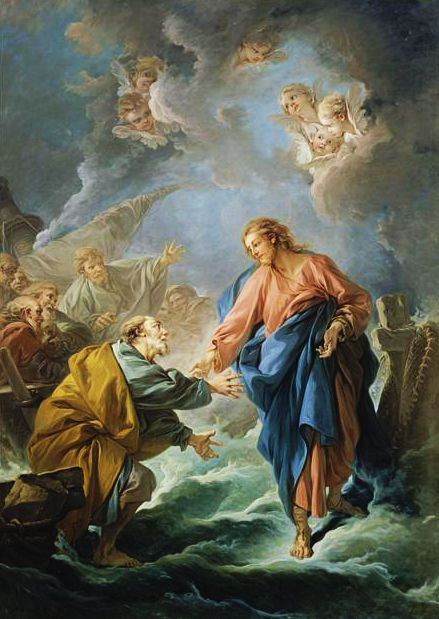
The ancient world had no word that resembled "supernatural".<ref name="Oxford">{{cite web |title=Supernatural |url=https://www.oxfordreference.com/view/10.1093/oi/authority.20110803100543199?rskey=wA4CHW&result=20|website=A Concise Companion to the Jewish Religion|publisher=Oxford Reference Online – Oxford University Press |format=Online |quote=The ancients had no word for the supernatural any more than they had for nature.}}</ref> Dialogues from [[Neoplatonism|Neoplatonic philosophy]] in the third century AD | [[File:Saint Pierre tentant de marcher sur les eaux by François Boucher.jpg|thumb|''[[Saint Peter]] Attempting to [[Jesus walking on water|Walk on Water]]'' (1766), painting by [[François Boucher]]]] | ||
The ancient world had no word that resembled "supernatural".<ref name="Oxford">{{cite web |title=Supernatural |url=https://www.oxfordreference.com/view/10.1093/oi/authority.20110803100543199?rskey=wA4CHW&result=20|website=A Concise Companion to the Jewish Religion|publisher=Oxford Reference Online – Oxford University Press |format=Online |quote=The ancients had no word for the supernatural any more than they had for nature.}}</ref> Dialogues from [[Neoplatonism|Neoplatonic philosophy]] in the third century AD influenced the development of the concept of the supernatural, which later evolved through [[Christian theology]].<ref name="Supernatural as a Western Category">{{Cite journal | doi=10.1525/eth.1977.5.1.02a00040|title = Supernatural as a Western Category| journal=Ethos| volume=5| pages=31–53|year = 1977|last1 = Saler|first1 = Benson|doi-access=free}}</ref> The term ''nature'' had existed since antiquity, with Latin authors like [[Augustine of Hippo|Augustine]] using the word and its cognates at least 600 times in ''[[The City of God|City of God]]''. In the medieval period, "nature" had ten different meanings and "natural" had eleven different meanings.<ref name="Bartlett">{{cite book |last1=Bartlett |first1=Robert |title=The Natural and the Supernatural in the Middle Ages |date=14 March 2008 |chapter-url=https://books.google.com/books?id=d9O3PtKMPNsC&pg=PA1 |publisher=Cambridge University Press |isbn=978-0521702553 |chapter=1. The Boundaries of the Supernatural |pages=1–34}}</ref> [[Peter Lombard]], a medieval scholastic of the 12th century, explored causes beyond nature, questioning how certain phenomena could be attributed solely to God. In his writings, he used the term ''praeter naturam'' to describe these occurrences.<ref name="Bartlett" /> In the scholastic period, [[Thomas Aquinas]] classified miracles into three categories: "above nature", "beyond nature" and "against nature". In doing so, he sharpened the distinction between nature and miracles more than the early [[Church Fathers]] had done.<ref name="Bartlett" /> As a result, he had created a dichotomy of sorts of the natural and supernatural.<ref name="Supernatural as a Western Category"/> Though the phrase ''"supra naturam"'' was used since the 4th century AD, it was in the 1200s that Thomas Aquinas used the term ''"supernaturalis".'' Despite this, the term had to wait until the end of the medieval period before it became more popularly used.<ref name="Bartlett" /> The discussions on "nature" from the scholastic period were diverse and unsettled with some postulating that even miracles are natural and that [[natural magic]] was a natural part of the world.<ref name="Bartlett" /> | |||
==Epistemology and metaphysics== | ==Epistemology and metaphysics== | ||
{{see also|Anthropology of religion}} | {{see also|Anthropology of religion}} | ||
The [[metaphysics|metaphysical]] considerations of the existence of the supernatural can be difficult to approach as an exercise in philosophy or theology because any dependencies on its antithesis, the [[Naturalism (philosophy)|natural]], will ultimately have to be inverted or rejected. One complicating factor is that there is disagreement about the definition of "natural" and the limits of [[metaphysical naturalism|naturalism]]. Concepts in the supernatural domain are closely related to concepts in [[religion|religious]] [[spirituality]] and [[occultism]] or [[spiritualism]]. | The [[metaphysics|metaphysical]] considerations of the existence of the supernatural can be difficult to approach as an exercise in philosophy or theology because any dependencies on its antithesis, the [[Naturalism (philosophy)|natural]], will ultimately have to be inverted or rejected. One complicating factor is that there is disagreement about the definition of "natural" and the limits of [[metaphysical naturalism|naturalism]]. Concepts in the supernatural domain are closely related to concepts in [[religion|religious]] [[spirituality]] and [[occultism]] or [[Spiritualism (beliefs)|spiritualism]]. | ||
{{quote|For sometimes we use the word ''[[nature]]'' for that ''Author of nature'' whom the [[scholasticism|schoolmen]], harshly enough, call ''[[natura naturans]]'', as when it is said that ''nature'' hath made man partly corporeal and [[Mind-body dualism|partly immaterial]]. Sometimes we mean by the ''nature'' of a thing the ''[[essence]]'', or that which the schoolmen scruple not to call the ''[[quiddity]]'' of a thing, namely, the ''[[property (philosophy)|attribute]]'' or ''attributes'' on whose score it is what it is, whether the thing be [[matter|corporeal]] or not, as when we attempt to define the ''nature'' of an ''[[angle]]'', or of a ''[[triangle]]'', or of a ''[[fluid]]'' body, as such. Sometimes we take ''nature'' for an internal principle of [[motion (physics)|motion]], as when we say that a stone let fall in the [[air (classical element)|air]] is by ''nature'' carried towards the centre of the [[earth (classical element)|earth]], and, on the contrary, that [[fire (classical element)|fire]] or flame does ''naturally'' move upwards toward [[firmament]]. Sometimes we understand by ''nature'' the established course of things, as when we say that ''nature'' makes the [[night]] succeed the [[day]], ''nature'' hath made [[respiration (physiology)|respiration]] necessary to the [[life]] of men. Sometimes we take ''nature'' for an [[physiology|aggregate of powers]] belonging to a body, especially a living one, as when [[physician]]s say that ''nature'' is strong or weak or spent, or that in such or such [[disease]]s ''nature'' left to herself [[immune system|will do the cure]]. Sometimes we take nature for the [[universe]], or system of the corporeal works of [[God]], as when it is said of a [[phoenix (mythology)|phoenix]], or a [[chimera (mythology)|chimera]], that there is no such thing in ''nature'', i.e. in the world. And sometimes too, and that most commonly, we would express by ''nature'' a [[mother nature|semi-deity]] or other strange kind of being, such as this discourse examines the notion of.<br><br>And besides these more absolute acceptions, if I may so call them, of the word ''nature'', it has divers others (more relative), as ''nature'' is wont to be set or in [[opposite (semantics)|opposition]] or contradistinction to other things, as when we say of a stone when it falls downwards that it does it by a ''[[classical elements|natural motion]]'', but that if it be thrown upwards its motion that way is ''violent''. So chemists distinguish [[vitriol]] into ''natural'' and ''fictitious'', or made by art, i.e. by the intervention of human power or skill; so it is said that [[water (classical element)|water]], kept suspended in a sucking pump, is not in its ''natural'' place, as that is which is stagnant in the well. We say also that wicked men are still in the [[state of nature|state of ''nature'']], but the regenerate in a state of ''[[divine grace|grace]]''; that cures wrought by [[medicine]]s are natural operations; but the [[miraculous]] ones wrought by [[Christ]] and his [[Apostles in the New Testament|apostle]]s were ''supernatural''.<ref> | {{quote|For sometimes we use the word ''[[nature]]'' for that ''Author of nature'' whom the [[scholasticism|schoolmen]], harshly enough, call ''[[natura naturans]]'', as when it is said that ''nature'' hath made man partly corporeal and [[Mind-body dualism|partly immaterial]]. Sometimes we mean by the ''nature'' of a thing the ''[[essence]]'', or that which the schoolmen scruple not to call the ''[[quiddity]]'' of a thing, namely, the ''[[property (philosophy)|attribute]]'' or ''attributes'' on whose score it is what it is, whether the thing be [[matter|corporeal]] or not, as when we attempt to define the ''nature'' of an ''[[angle]]'', or of a ''[[triangle]]'', or of a ''[[fluid]]'' body, as such. Sometimes we take ''nature'' for an internal principle of [[motion (physics)|motion]], as when we say that a stone let fall in the [[air (classical element)|air]] is by ''nature'' carried towards the centre of the [[earth (classical element)|earth]], and, on the contrary, that [[fire (classical element)|fire]] or flame does ''naturally'' move upwards toward [[firmament]]. Sometimes we understand by ''nature'' the established course of things, as when we say that ''nature'' makes the [[night]] succeed the [[day]], ''nature'' hath made [[respiration (physiology)|respiration]] necessary to the [[life]] of men. Sometimes we take ''nature'' for an [[physiology|aggregate of powers]] belonging to a body, especially a living one, as when [[physician]]s say that ''nature'' is strong or weak or spent, or that in such or such [[disease]]s ''nature'' left to herself [[immune system|will do the cure]]. Sometimes we take nature for the [[universe]], or system of the corporeal works of [[God]], as when it is said of a [[phoenix (mythology)|phoenix]], or a [[chimera (mythology)|chimera]], that there is no such thing in ''nature'', i.e. in the world. And sometimes too, and that most commonly, we would express by ''nature'' a [[mother nature|semi-deity]] or other strange kind of being, such as this discourse examines the notion of.<br><br>And besides these more absolute acceptions, if I may so call them, of the word ''nature'', it has divers others (more relative), as ''nature'' is wont to be set or in [[opposite (semantics)|opposition]] or contradistinction to other things, as when we say of a stone when it falls downwards that it does it by a ''[[classical elements|natural motion]]'', but that if it be thrown upwards its motion that way is ''violent''. So chemists distinguish [[vitriol]] into ''natural'' and ''fictitious'', or made by art, i.e. by the intervention of human power or skill; so it is said that [[water (classical element)|water]], kept suspended in a sucking pump, is not in its ''natural'' place, as that is which is stagnant in the well. We say also that wicked men are still in the [[state of nature|state of ''nature'']], but the regenerate in a state of ''[[divine grace|grace]]''; that cures wrought by [[medicine]]s are natural operations; but the [[miraculous]] ones wrought by [[Christ]] and his [[Apostles in the New Testament|apostle]]s were ''supernatural''.<ref> | ||
| Line 26: | Line 28: | ||
}} | }} | ||
[[Subjunctive possibility|Nomological possibility]] is possibility under the actual [[scientific laws|laws of nature]]. Most philosophers since [[David Hume]] have held that the laws of nature are metaphysically contingent—that there could have been different natural laws than the ones that actually obtain. If so, then it would not be logically or metaphysically impossible, for example, for you to travel to [[Alpha Centauri]] in one day; it would just have to be the case that you could travel faster than the speed of light. But of course there is an important sense in which this is not [[nomological]]ly possible; given that the laws of nature are what they are. In the philosophy of [[natural science]], impossibility assertions come to be widely accepted as overwhelmingly probable rather than considered proved to the point of being unchallengeable. The basis for this strong acceptance is a combination of extensive evidence of something not [[phenomenon|occurring]], combined with an underlying [[scientific theory]], very successful in making predictions, whose assumptions lead logically to the conclusion that something is impossible. While an impossibility assertion in natural science can never be absolutely proved, it could be refuted by the [[observation]] of a single [[counterexample]]. Such a counterexample would require that the assumptions underlying the theory that implied the impossibility be re-examined. | [[Subjunctive possibility|Nomological possibility]] is possibility under the actual [[scientific laws|laws of nature]]. Most philosophers since [[David Hume]] have held that the laws of nature are metaphysically contingent—that there could have been different natural laws than the ones that actually obtain. If so, then it would not be logically or metaphysically impossible, for example, for you to travel to [[Alpha Centauri]] in one day; it would just have to be the case that you could travel faster than the speed of light. But of course there is an important sense in which this is not [[nomological]]ly possible; given that the laws of nature are what they are. In the philosophy of [[natural science]], impossibility assertions come to be widely accepted as overwhelmingly probable rather than considered proved to the point of being unchallengeable. The basis for this strong acceptance is a combination of extensive evidence of something not [[phenomenon|occurring]], combined with an underlying [[scientific theory]], very successful in making predictions, whose assumptions lead logically to the conclusion that something is impossible. While an impossibility assertion in natural science can never be absolutely proved, it could be refuted by the [[observation]] of a single [[counterexample]]. Such a counterexample would require that the assumptions underlying the theory that implied the impossibility be re-examined. Some philosophers, such as [[Sydney Shoemaker]], have argued that the laws of nature are in fact necessary, not contingent; if so, then nomological possibility is equivalent to metaphysical possibility.<ref>{{Cite journal|url = https://www.tandfonline.com/doi/abs/10.1080/00048400903159016|doi = 10.1080/00048400903159016|title = Some Laws of Nature are Metaphysically Contingent|year = 2010|last1 = Roberts|first1 = John T.|journal = Australasian Journal of Philosophy|volume = 88|issue = 3|pages = 445–457|s2cid = 170608423|access-date = 2021-09-07|archive-date = 2021-09-07|archive-url = https://web.archive.org/web/20210907071107/https://www.tandfonline.com/doi/abs/10.1080/00048400903159016|url-status = live|url-access = subscription}}</ref><ref>{{Cite book|chapter-url=https://philpapers.org/rec/SIDOTM|title=Conceivability and Possibility|chapter=On the Metaphysical Contingency of Laws of Nature|year=2002|pages=309–336|publisher=Oxford University Press|access-date=2021-09-07|archive-date=2021-09-07|archive-url=https://web.archive.org/web/20210907071107/https://philpapers.org/rec/SIDOTM|url-status=live}}</ref><ref>{{cite web |url=https://www.researchgate.net/publication/339957498 |title=The Contingency of Physical Laws |date= |accessdate=2022-02-11}}</ref> | ||
The term ''supernatural'' is often used interchangeably with [[paranormal]] or [[preternatural]]—the latter typically limited to an adjective for describing abilities which appear to exceed what is possible within the boundaries of the laws of physics.<ref>{{Cite book|url=https://books.google.com/books?id=znMqAQAAIAAJ&q=%22supernatural+beliefs%22+%22paranormal%22 |title=The paranormal |access-date=July 26, 2010|isbn=9780824210922 |year=2009 |last1=Partridge |first1=Kenneth |publisher=H.W. Wilson Company }}</ref> [[Epistemology|Epistemologically]], the relationship between the supernatural and the natural is indistinct in terms of natural phenomena that, ''ex hypothesi,'' violate the laws of nature, in so far as such laws are [[Philosophical realism|realistically accountable]]. | The term ''supernatural'' is often used interchangeably with [[paranormal]] or [[preternatural]]—the latter typically limited to an adjective for describing abilities which appear to exceed what is possible within the boundaries of the laws of physics.<ref>{{Cite book|url=https://books.google.com/books?id=znMqAQAAIAAJ&q=%22supernatural+beliefs%22+%22paranormal%22 |title=The paranormal |access-date=July 26, 2010|isbn=9780824210922 |year=2009 |last1=Partridge |first1=Kenneth |publisher=H.W. Wilson Company }}</ref> [[Epistemology|Epistemologically]], the relationship between the supernatural and the natural is indistinct in terms of natural phenomena that, ''ex hypothesi,'' violate the laws of nature, in so far as such laws are [[Philosophical realism|realistically accountable]]. | ||
| Line 32: | Line 34: | ||
Views on the "supernatural" vary, for example it may be seen as: | Views on the "supernatural" vary, for example it may be seen as: | ||
* '''indistinct from nature'''. From this perspective, some events occur according to the [[Natural law|laws of nature]], and others occur according to a separate set of principles external to known nature. For example, in Scholasticism, it was believed that God was capable of performing any miracle so long as it | * '''indistinct from nature'''. From this perspective, some events occur according to the [[Natural law|laws of nature]], and others occur according to a separate set of principles external to known nature. For example, in [[Scholasticism]], it was believed that God was capable of performing any miracle so long as it did not lead to a logical [[contradiction]]. Some religions posit immanent deities, however, and do not have a tradition analogous to the supernatural; some believe that everything anyone experiences occurs by the will ([[occasionalism]]), in the mind ([[neoplatonism]]), or as a part ([[Nonduality (spirituality)|nondualism]]) of a more fundamental divine reality ([[platonism]]). | ||
* '''incorrect human attribution'''. In this view all events have natural and only natural causes. They believe that human beings ascribe supernatural attributes to purely natural events, such as [[lightning]], [[rainbow]]s, [[flood]]s | * '''incorrect human attribution'''. In this view all events have natural and only natural causes. They believe that human beings ascribe supernatural attributes to purely natural events, such as [[lightning]], [[rainbow]]s, [[flood]]s and the [[origin of life]].<ref name="Zhong1976">{{cite book |author=Zhong Yang Yan Jiu Yuan |author2=Min Tsu Hsüeh Yen Chiu So |year=1976 |title=Bulletin of the Institute of Ethnology, Academia Sinica, Issues 42–44 |url=https://books.google.com/books?id=yyQZAAAAIAAJ}}</ref><ref name="Ellis2004">{{cite book |first1=B.J. |last1=Ellis |first2=D.F. |last2=Bjorklund |year=2004 |title=Origins of the Social Mind: Evolutionary Psychology and Child Development |publisher=Guilford Publications |isbn=9781593851033 |lccn=2004022693 |url=https://books.google.com/books?id=-UjiZwYGdFoC&pg=PA413 |page=413}}</ref> | ||
== | ==Cross cultural studies== | ||
Anthropological studies across cultures indicate that people do not hold or use natural and supernatural explanations in a mutually exclusive or dichotomous fashion. Instead, the reconciliation of natural and supernatural explanations is normal and pervasive across cultures.<ref>{{cite journal |last1=Legare |first1=Cristine H. |last2=Visala |first2=Aku |title=Between Religion and Science: Integrating Psychological and Philosophical Accounts of Explanatory Coexistence |journal=Human Development |date=2011 |volume=54 |issue=3 |pages=169–184 |doi=10.1159/000329135|s2cid=53668380 }}</ref> Cross cultural studies indicate that there is coexistence of natural and supernatural explanations in both adults and children for explaining numerous things about the world such as illness, death, and origins.<ref>{{cite journal |last1=Legare |first1=Cristine H. |last2=Evans |first2=E. Margaret |last3=Rosengren |first3=Karl S. |last4=Harris |first4=Paul L. |title=The Coexistence of Natural and Supernatural Explanations Across Cultures and Development: Coexistence of Natural and Supernatural Explanations |journal=Child Development |date=May 2012 |volume=83 |issue=3 |pages=779–793 |doi=10.1111/j.1467-8624.2012.01743.x|pmid=22417318 |hdl=2027.42/91141 |hdl-access=free }}</ref><ref>{{cite journal |last1=Aizenkot |first1=Dana |title=Meaning-Making to Child Loss: The Coexistence of Natural and Supernatural Explanations of Death |journal=Journal of Constructivist Psychology |date=11 September 2020 |volume=35 |pages=318–343 |doi=10.1080/10720537.2020.1819491|s2cid=225231409 }}</ref> Context and cultural input play a large role in determining when and how individuals incorporate natural and supernatural explanations.<ref>{{cite journal |last1=Busch |first1=Justin T. A. |last2=Watson-Jones |first2=Rachel E. |last3=Legare |first3=Cristine H. |title=The coexistence of natural and supernatural explanations within and across domains and development |journal=British Journal of Developmental Psychology |date=March 2017 |volume=35 |issue=1 |pages=4–20 |doi=10.1111/bjdp.12164|pmid=27785818 |s2cid=24196030 }}</ref> The coexistence of natural and supernatural explanations in individuals may be the outcomes two distinct cognitive domains: one concerned with the physical-mechanical relations and another with social relations.<ref>{{cite journal |last1=Whitehouse |first1=Harvey |title=The Coexistence Problem in Psychology, Anthropology, and Evolutionary Theory |journal=Human Development |date=2011 |volume=54 |issue=3 |pages=191–199 |doi=10.1159/000329149|s2cid=145622566 }}</ref> Studies on indigenous groups have allowed for insights on how such coexistence of explanations may function.<ref>{{cite journal |last1=Watson-Jones |first1=Rachel E. |last2=Busch |first2=Justin T. A. |last3=Legare |first3=Cristine H. |title=Interdisciplinary and Cross-Cultural Perspectives on Explanatory Coexistence |journal=Topics in Cognitive Science |date=October 2015 |volume=7 |issue=4 |pages=611–623 |doi=10.1111/tops.12162|pmid=26350158 |doi-access=free }}</ref> | Anthropological studies across cultures indicate that people do not hold or use natural and supernatural explanations in a mutually exclusive or dichotomous fashion. Instead, the reconciliation of natural and supernatural explanations is normal and pervasive across cultures.<ref>{{cite journal |last1=Legare |first1=Cristine H. |last2=Visala |first2=Aku |title=Between Religion and Science: Integrating Psychological and Philosophical Accounts of Explanatory Coexistence |journal=Human Development |date=2011 |volume=54 |issue=3 |pages=169–184 |doi=10.1159/000329135|s2cid=53668380 }}</ref> Cross cultural studies indicate that there is coexistence of natural and supernatural explanations in both adults and children for explaining numerous things about the world, such as illness, death, and origins.<ref>{{cite journal |last1=Legare |first1=Cristine H. |last2=Evans |first2=E. Margaret |last3=Rosengren |first3=Karl S. |last4=Harris |first4=Paul L. |title=The Coexistence of Natural and Supernatural Explanations Across Cultures and Development: Coexistence of Natural and Supernatural Explanations |journal=Child Development |date=May 2012 |volume=83 |issue=3 |pages=779–793 |doi=10.1111/j.1467-8624.2012.01743.x|pmid=22417318 |hdl=2027.42/91141 |hdl-access=free }}</ref><ref>{{cite journal |last1=Aizenkot |first1=Dana |title=Meaning-Making to Child Loss: The Coexistence of Natural and Supernatural Explanations of Death |journal=Journal of Constructivist Psychology |date=11 September 2020 |volume=35 |pages=318–343 |doi=10.1080/10720537.2020.1819491|s2cid=225231409 }}</ref> Context and cultural input play a large role in determining when and how individuals incorporate natural and supernatural explanations.<ref>{{cite journal |last1=Busch |first1=Justin T. A. |last2=Watson-Jones |first2=Rachel E. |last3=Legare |first3=Cristine H. |title=The coexistence of natural and supernatural explanations within and across domains and development |journal=British Journal of Developmental Psychology |date=March 2017 |volume=35 |issue=1 |pages=4–20 |doi=10.1111/bjdp.12164|pmid=27785818 |s2cid=24196030 |pmc=10676005 }}</ref> The coexistence of natural and supernatural explanations in individuals may be the outcomes two distinct cognitive domains: one concerned with the physical-mechanical relations and another with social relations.<ref>{{cite journal |last1=Whitehouse |first1=Harvey |title=The Coexistence Problem in Psychology, Anthropology, and Evolutionary Theory |journal=Human Development |date=2011 |volume=54 |issue=3 |pages=191–199 |doi=10.1159/000329149|s2cid=145622566 }}</ref> Studies on indigenous groups have allowed for insights on how such coexistence of explanations may function.<ref>{{cite journal |last1=Watson-Jones |first1=Rachel E. |last2=Busch |first2=Justin T. A. |last3=Legare |first3=Cristine H. |title=Interdisciplinary and Cross-Cultural Perspectives on Explanatory Coexistence |journal=Topics in Cognitive Science |date=October 2015 |volume=7 |issue=4 |pages=611–623 |doi=10.1111/tops.12162|pmid=26350158 |doi-access=free }}</ref> | ||
==Supernatural concepts== | ==Supernatural concepts== | ||
| Line 43: | Line 45: | ||
===Deity=== | ===Deity=== | ||
{{main|Deity}} | {{main|Deity}} | ||
A ''deity'' ({{IPAc-en|audio=en-uk-deity1.ogg|ˈ|d|iː|ə|t|i}} or {{IPAc-en|audio=en-uk-deity2.ogg|ˈ|d|eɪ|.|ə|t|i}})<ref>{{cite book|title=The American Heritage Book of English Usage: A Practical and Authoritative Guide to Contemporary English|date=1996|publisher=Houghton Mifflin|location=Boston|isbn=978-0395767856|page=[https://archive.org/details/americanheritage00edi_4cp/page/219 219]|url=https://archive.org/details/americanheritage00edi_4cp/page/219}}</ref> is a supernatural being considered [[divinity|divine]] or [[sacred]].<ref name="OBrien">{{cite book|last1=O'Brien|first1=Jodi|title=Encyclopedia of Gender and Society|date=2009|publisher=SAGE|location=Los Angeles|isbn=9781412909167|page=191|url=https://books.google.com/books?id=_nyHS4WyUKEC|access-date=June 28, 2017|language=en}}</ref> The ''Oxford Dictionary of English'' defines deity as "a god or goddess (in a polytheistic religion)", or anything revered as divine.<ref name="Stevenson">{{cite book|last1=Stevenson|first1=Angus|title=Oxford Dictionary of English|date=2010|publisher=Oxford University Press|location=New York|isbn=9780199571123|page=461|edition=3rd|url=https://books.google.com/books?id=anecAQAAQBAJ|access-date=June 28, 2017|language=en}}</ref> [[C. Scott Littleton]] defines a deity as "a being with powers greater than those of ordinary humans, but who interacts with humans, positively or negatively, in ways that carry humans to new [[Higher consciousness|levels of consciousness]], beyond the grounded preoccupations of ordinary life."<ref>{{cite book|last1=Littleton]|first1=C. Scott|title=Gods, Goddesses, and Mythology|date=2005|publisher=Marshall Cavendish|location=New York|isbn=9780761475590|page=378|url=https://books.google.com/books?id=3ufSStXPECkC&pg=PA378|access-date=June 28, 2017|language=en}}</ref> A male deity is a [[God (word)|god]], while a female deity is a [[goddess]]. | A ''deity'' ({{IPAc-en|audio=en-uk-deity1.ogg|ˈ|d|iː|ə|t|i}} or {{IPAc-en|audio=en-uk-deity2.ogg|ˈ|d|eɪ|.|ə|t|i}})<ref>{{cite book|title=The American Heritage Book of English Usage: A Practical and Authoritative Guide to Contemporary English|date=1996|publisher=Houghton Mifflin|location=Boston|isbn=978-0395767856|page=[https://archive.org/details/americanheritage00edi_4cp/page/219 219]|url=https://archive.org/details/americanheritage00edi_4cp/page/219}}</ref> is a supernatural being considered [[divinity|divine]] or [[sacred]].<ref name="OBrien">{{cite book|last1=O'Brien|first1=Jodi|title=Encyclopedia of Gender and Society|date=2009|publisher=SAGE|location=Los Angeles|isbn=9781412909167|page=191|url=https://books.google.com/books?id=_nyHS4WyUKEC|access-date=June 28, 2017|language=en|archive-date=January 13, 2023|archive-url=https://web.archive.org/web/20230113144056/https://books.google.com/books?id=_nyHS4WyUKEC|url-status=live}}</ref> The ''Oxford Dictionary of English'' defines deity as "a god or goddess (in a [[Polytheism|polytheistic]] religion)", or anything revered as divine.<ref name="Stevenson">{{cite book|last1=Stevenson|first1=Angus|title=Oxford Dictionary of English|date=2010|publisher=Oxford University Press|location=New York|isbn=9780199571123|page=461|edition=3rd|url=https://books.google.com/books?id=anecAQAAQBAJ|access-date=June 28, 2017|language=en|archive-date=March 11, 2023|archive-url=https://web.archive.org/web/20230311102542/https://books.google.com/books?id=anecAQAAQBAJ|url-status=live}}</ref> [[C. Scott Littleton]] defines a deity as "a being with powers greater than those of ordinary humans, but who interacts with humans, positively or negatively, in ways that carry humans to new [[Higher consciousness|levels of consciousness]], beyond the grounded preoccupations of ordinary life."<ref>{{cite book|last1=Littleton]|first1=C. Scott|title=Gods, Goddesses, and Mythology|date=2005|publisher=Marshall Cavendish|location=New York|isbn=9780761475590|page=378|url=https://books.google.com/books?id=3ufSStXPECkC&pg=PA378|access-date=June 28, 2017|language=en}}</ref> A male deity is a [[God (word)|god]], while a female deity is a [[goddess]]. | ||
Religions can be categorized by how many deities they worship. [[Monotheism|Monotheistic]] [[religion]]s accept only one deity (predominantly referred to as God),<ref>{{cite book|last1=Becking|first1=Bob|last2=Dijkstra|first2=Meindert|last3=Korpel| first3=Marjo|last4=Vriezen |first4=Karel|title=Only One God?: Monotheism in Ancient Israel and the Veneration of the Goddess Asherah|date=2001|publisher=New York|location=London|isbn=9780567232120|page=189|url=https://books.google.com/books?id=eMneBAAAQBAJ&pg=PA189|access-date=June 28, 2017|language=en|quote=The Christian tradition is, in imitation of Judaism, a monotheistic religion. This implies that believers accept the existence of only one God. Other deities either do not exist, are seen as the product of human imagination or are dismissed as remanents of a persistent paganism}}</ref><ref>{{cite book|last1=Korte|first1=Anne-Marie|last2=Haardt|first2=Maaike De|title=The Boundaries of Monotheism: Interdisciplinary Explorations Into the Foundations of Western Monotheism|date=2009|publisher=BRILL |isbn=978-9004173163|page=9|url=https://books.google.com/books?id=-53d1iRsqDEC|access-date=June 28, 2017|language=en}}</ref> [[Polytheism|polytheistic]] religions accept multiple deities.<ref>{{cite book|last1=Brown|first1=Jeannine K.|title=Scripture as Communication: Introducing Biblical Hermeneutics|date=2007|publisher=Baker Academic|isbn=9780801027888|page=72|url=https://books.google.com/books?id=tqNzBQAAQBAJ|access-date=June 28, 2017|language=en}}</ref> [[Henotheism|Henotheistic]] religions accept one supreme deity without denying other deities, considering them as equivalent aspects of the same divine principle;<ref>{{cite book|last1=Taliaferro|first1=Charles|last2=Harrison|first2=Victoria S.|last3=Goetz|first3=Stewart|title=The Routledge Companion to Theism|date=2012|publisher=Routledge|isbn=9781136338236|pages=78–79|url=https://books.google.com/books?id=ct7fCgAAQBAJ|access-date=June 28, 2017|language=en}}</ref><ref>{{cite book|last1=Reat|first1=N. Ross|last2=Perry|first2=Edmund F.|title=A World Theology: The Central Spiritual Reality of Humankind|date=1991|publisher=Cambridge University Press|isbn=9780521331593|pages=[https://archive.org/details/worldtheologycen0000reat/page/73 73]–75|url=https://archive.org/details/worldtheologycen0000reat|url-access=registration|access-date=June 28, 2017|language=en}}</ref> and [[nontheistic religion]]s deny any supreme eternal [[creator deity]] but accept a [[pantheon (religion)|pantheon]] of deities which live, die | Religions can be categorized by how many deities they worship. [[Monotheism|Monotheistic]] [[religion]]s accept only one deity (predominantly referred to as [[God]]),<ref>{{cite book|last1=Becking|first1=Bob|last2=Dijkstra|first2=Meindert|last3=Korpel| first3=Marjo|last4=Vriezen |first4=Karel|title=Only One God?: Monotheism in Ancient Israel and the Veneration of the Goddess Asherah|date=2001|publisher=New York|location=London|isbn=9780567232120|page=189|url=https://books.google.com/books?id=eMneBAAAQBAJ&pg=PA189|access-date=June 28, 2017|language=en|quote=The Christian tradition is, in imitation of Judaism, a monotheistic religion. This implies that believers accept the existence of only one God. Other deities either do not exist, are seen as the product of human imagination or are dismissed as remanents of a persistent paganism}}</ref><ref>{{cite book|last1=Korte|first1=Anne-Marie|last2=Haardt|first2=Maaike De|title=The Boundaries of Monotheism: Interdisciplinary Explorations Into the Foundations of Western Monotheism|date=2009|publisher=BRILL |isbn=978-9004173163|page=9|url=https://books.google.com/books?id=-53d1iRsqDEC|access-date=June 28, 2017|language=en}}</ref> [[Polytheism|polytheistic]] religions accept multiple deities.<ref>{{cite book|last1=Brown|first1=Jeannine K.|title=Scripture as Communication: Introducing Biblical Hermeneutics|date=2007|publisher=Baker Academic|isbn=9780801027888|page=72|url=https://books.google.com/books?id=tqNzBQAAQBAJ|access-date=June 28, 2017|language=en}}</ref> [[Henotheism|Henotheistic]] religions accept one supreme deity without denying other deities, considering them as equivalent aspects of the same divine principle;<ref>{{cite book|last1=Taliaferro|first1=Charles|last2=Harrison|first2=Victoria S.|last3=Goetz|first3=Stewart|title=The Routledge Companion to Theism|date=2012|publisher=Routledge|isbn=9781136338236|pages=78–79|url=https://books.google.com/books?id=ct7fCgAAQBAJ|access-date=June 28, 2017|language=en|archive-date=January 15, 2023|archive-url=https://web.archive.org/web/20230115140609/https://books.google.com/books?id=ct7fCgAAQBAJ|url-status=live}}</ref><ref>{{cite book|last1=Reat|first1=N. Ross|last2=Perry|first2=Edmund F.|title=A World Theology: The Central Spiritual Reality of Humankind|date=1991|publisher=Cambridge University Press|isbn=9780521331593|pages=[https://archive.org/details/worldtheologycen0000reat/page/73 73]–75|url=https://archive.org/details/worldtheologycen0000reat|url-access=registration|access-date=June 28, 2017|language=en}}</ref> and [[nontheistic religion]]s deny any supreme eternal [[creator deity]] but accept a [[pantheon (religion)|pantheon]] of deities which live, die and are reborn just like any other being.<ref name="Keown">{{cite book|last1=Keown|first1=Damien|title=Buddhism: A Very Short Introduction|date=2013|publisher=Oxford University Press|location=Oxford|isbn=9780199663835|edition=New|url=https://books.google.com/books?id=_QXX0Uq29aoC|access-date=June 22, 2017|language=en}}</ref>{{rp|35–37}}<ref name="Bullivant">{{cite book|last1=Bullivant|first1=Stephen|last2=Ruse|first2=Michael|title=The Oxford Handbook of Atheism|date=2013|publisher=Oxford University Publishing|isbn=9780199644650|url=https://books.google.com/books?id=jbIVAgAAQBAJ|access-date=June 22, 2017|language=en|archive-date=October 3, 2023|archive-url=https://web.archive.org/web/20231003172045/https://books.google.com/books?id=jbIVAgAAQBAJ|url-status=live}}</ref>{{rp|357–358}} | ||
Various cultures have conceptualized a deity differently than a [[God|monotheistic God]].<ref name=Hood/><ref name=Trigger/> A deity need not be [[Omnipotence|omnipotent]], [[Omnipresence|omnipresent]], [[Omniscience|omniscient]], [[Omnibenevolence|omnibenevolent]] or [[Immortality|eternal]],<ref name=Hood>{{cite book|last1=Hood|first1=Robert E.|title=Must God Remain Greek?: Afro Cultures and God-talk|date=1990|publisher=Fortress Press|location=Minneapolis|isbn=9780800624491|pages=[https://archive.org/details/mustgodremaingre0000hood/page/128 128–129]|quote=African people may describe their deities as strong, but not omnipotent; wise but not omniscient; old but not eternal; great but not omnipresent (...)|url=https://archive.org/details/mustgodremaingre0000hood/page/128}}</ref><ref name="Trigger">{{cite book|last1=Trigger|first1=Bruce G.|title=Understanding Early Civilizations: A Comparative Study|url=https://archive.org/details/understandingear0000trig|url-access=registration|date=2003|publisher=Cambridge University Press|location=Cambridge|isbn=9780521822459|pages=[https://archive.org/details/understandingear0000trig/page/441 441–442]|edition=1st|quote=[Historically...] people perceived far fewer differences between themselves and the gods than the adherents of modern monotheistic religions. Deities were not thought to be omniscient or omnipotent and were rarely believed to be changeless or eternal}}</ref><ref name="Murdoch">John Murdoch, {{Google books|IHQAAAAAMAAJ|English Translations of Select Tracts, Published in India – Religious Texts}}, pages 141–142; '''Quote:''' "We [monotheists] find by reason and revelation that God is omniscient, omnipotent, most holy, etc, but the Hindu deities possess none of those attributes. It is mentioned in their [[Shastra]]s that their deities were all vanquished by the Asurs, while they fought in the heavens, and for fear of whom they left their abodes. This plainly shows that they are not omnipotent."</ref> The monotheistic God, however, does have these [[God#Specific_characteristics|attributes]].<ref name="Taliaferro">{{cite book|last1=Taliaferro|first1=Charles|last2=Marty|first2=Elsa J.|title=A Dictionary of Philosophy of Religion|date=2010|publisher=Continuum|location=New York|isbn=9781441111975|pages=98–99}}</ref><ref name="Wilkerson">{{cite book|last1=Wilkerson|first1=W.D.|title=Walking With The Gods|date=2014|publisher=Sankofa|isbn=978-0991530014|pages=6–7}}</ref><ref>{{cite book|last1=Trigger|first1=Bruce G.|title=Understanding Early Civilizations: A Comparative Study|url=https://archive.org/details/understandingear0000trig|url-access=registration|date=2003|publisher=Cambridge University Press|location=Cambridge|isbn=9780521822459|pages=[https://archive.org/details/understandingear0000trig/page/473 473–474]|edition=1st}}</ref> Monotheistic religions typically refer to God in masculine terms,<ref>{{cite book|last1=Kramarae|first1=Cheris|last2=Spender|first2=Dale|title=Routledge International Encyclopedia of Women: Global Women's Issues and Knowledge|date=2004|publisher=Routledge|isbn=9781135963156|page=655|url=https://books.google.com/books?id=QAOUAgAAQBAJ|access-date=June 28, 2017|language=en}}</ref><ref name="OBrien2">{{cite book|last1=O'Brien|first1=Julia M.|title=Oxford Encyclopedia of the Bible and Gender Studies|date=2014|publisher=Oxford University Press, Incorporated|isbn=9780199836994|url=https://books.google.com/books?id=ZU-nBAAAQBAJ|access-date=June 22, 2017|language=en}}</ref>{{rp|96}} while other religions refer to their deities in a variety of ways – masculine, feminine, androgynous and gender neutral.<ref>{{cite book|last1=Bonnefoy|first1=Yves|title=Roman and European Mythologies|date=1992|publisher=University of Chicago Press|location=Chicago|isbn=9780226064550|url=https://archive.org/details/romaneuropeanmyt00yves|url-access=registration|access-date=June 28, 2017|language=en|pages=[https://archive.org/details/romaneuropeanmyt00yves/page/274 274]–275}}</ref><ref>{{cite book|last1=Pintchman|first1=Tracy|title=Seeking Mahadevi: Constructing the Identities of the Hindu Great Goddess|date=2014|publisher=SUNY Press|isbn=9780791490495|url=https://books.google.com/books?id=JfXdGInecRIC|access-date=June 28, 2017|language=en|pages=1–2, 19–20}}</ref><ref>{{cite book|last1=Roberts|first1=Nathaniel|title=To Be Cared For: The Power of Conversion and Foreignness of Belonging in an Indian Slum|date=2016|publisher=University of California Press|isbn=9780520963634|url=https://books.google.com/books?id=UVPQCwAAQBAJ|access-date=June 28, 2017|language=en|page=xv}}</ref> | Various cultures have conceptualized a deity differently than a [[God|monotheistic God]].<ref name=Hood/><ref name=Trigger/> A deity need not be [[Omnipotence|omnipotent]], [[Omnipresence|omnipresent]], [[Omniscience|omniscient]], [[Omnibenevolence|omnibenevolent]] or [[Immortality|eternal]],<ref name=Hood>{{cite book|last1=Hood|first1=Robert E.|title=Must God Remain Greek?: Afro Cultures and God-talk|date=1990|publisher=Fortress Press|location=Minneapolis|isbn=9780800624491|pages=[https://archive.org/details/mustgodremaingre0000hood/page/128 128–129]|quote=African people may describe their deities as strong, but not omnipotent; wise but not omniscient; old but not eternal; great but not omnipresent (...)|url=https://archive.org/details/mustgodremaingre0000hood/page/128}}</ref><ref name="Trigger">{{cite book|last1=Trigger|first1=Bruce G.|title=Understanding Early Civilizations: A Comparative Study|url=https://archive.org/details/understandingear0000trig|url-access=registration|date=2003|publisher=Cambridge University Press|location=Cambridge|isbn=9780521822459|pages=[https://archive.org/details/understandingear0000trig/page/441 441–442]|edition=1st|quote=[Historically...] people perceived far fewer differences between themselves and the gods than the adherents of modern monotheistic religions. Deities were not thought to be omniscient or omnipotent and were rarely believed to be changeless or eternal}}</ref><ref name="Murdoch">John Murdoch, {{Google books|IHQAAAAAMAAJ|English Translations of Select Tracts, Published in India – Religious Texts}}, pages 141–142; '''Quote:''' "We [monotheists] find by reason and revelation that God is omniscient, omnipotent, most holy, etc, but the Hindu deities possess none of those attributes. It is mentioned in their [[Shastra]]s that their deities were all vanquished by the Asurs, while they fought in the heavens, and for fear of whom they left their abodes. This plainly shows that they are not omnipotent."</ref> The monotheistic God, however, does have these [[God#Specific_characteristics|attributes]].<ref name="Taliaferro">{{cite book|last1=Taliaferro|first1=Charles|last2=Marty|first2=Elsa J.|title=A Dictionary of Philosophy of Religion|date=2010|publisher=Continuum|location=New York|isbn=9781441111975|pages=98–99}}</ref><ref name="Wilkerson">{{cite book|last1=Wilkerson|first1=W.D.|title=Walking With The Gods|date=2014|publisher=Sankofa|isbn=978-0991530014|pages=6–7}}</ref><ref>{{cite book|last1=Trigger|first1=Bruce G.|title=Understanding Early Civilizations: A Comparative Study|url=https://archive.org/details/understandingear0000trig|url-access=registration|date=2003|publisher=Cambridge University Press|location=Cambridge|isbn=9780521822459|pages=[https://archive.org/details/understandingear0000trig/page/473 473–474]|edition=1st}}</ref> Monotheistic religions typically refer to God in masculine terms,<ref>{{cite book|last1=Kramarae|first1=Cheris|last2=Spender|first2=Dale|title=Routledge International Encyclopedia of Women: Global Women's Issues and Knowledge|date=2004|publisher=Routledge|isbn=9781135963156|page=655|url=https://books.google.com/books?id=QAOUAgAAQBAJ|access-date=June 28, 2017|language=en}}</ref><ref name="OBrien2">{{cite book|last1=O'Brien|first1=Julia M.|title=Oxford Encyclopedia of the Bible and Gender Studies|date=2014|publisher=Oxford University Press, Incorporated|isbn=9780199836994|url=https://books.google.com/books?id=ZU-nBAAAQBAJ|access-date=June 22, 2017|language=en}}</ref>{{rp|96}} while other religions refer to their deities in a variety of ways – masculine, feminine, androgynous and gender neutral.<ref>{{cite book|last1=Bonnefoy|first1=Yves|title=Roman and European Mythologies|date=1992|publisher=University of Chicago Press|location=Chicago|isbn=9780226064550|url=https://archive.org/details/romaneuropeanmyt00yves|url-access=registration|access-date=June 28, 2017|language=en|pages=[https://archive.org/details/romaneuropeanmyt00yves/page/274 274]–275}}</ref><ref>{{cite book|last1=Pintchman|first1=Tracy|title=Seeking Mahadevi: Constructing the Identities of the Hindu Great Goddess|date=2014|publisher=SUNY Press|isbn=9780791490495|url=https://books.google.com/books?id=JfXdGInecRIC|access-date=June 28, 2017|language=en|pages=1–2, 19–20}}</ref><ref>{{cite book|last1=Roberts|first1=Nathaniel|title=To Be Cared For: The Power of Conversion and Foreignness of Belonging in an Indian Slum|date=2016|publisher=University of California Press|isbn=9780520963634|url=https://books.google.com/books?id=UVPQCwAAQBAJ|access-date=June 28, 2017|language=en|page=xv}}</ref> | ||
Historically, many ancient cultures – such as [[Ancient India]], [[Ancient Egyptian]], [[Ancient Greece|Ancient Greek]], [[Ancient Rome|Ancient Roman]], [[Norsemen|Nordic]] and [[Culture of Asia|Asian culture]] – personified [[List of natural phenomena|natural phenomena]], variously as either their conscious causes or simply their effects, respectively.<ref name="Malandra">{{cite book|last1=Malandra|first1=William W.|title=An Introduction to Ancient Iranian Religion: Readings from the Avesta and the Achaemenid Inscriptions|date=1983|publisher=University of Minnesota Press|location=Minneapolis, Minnesota|isbn=978-0816611157|pages=9–10|url=https://books.google.com/books?id=nZQMrjukmboC|access-date=June 28, 2017|language=en}}</ref><ref name="Fløistad">{{cite book|last1=Fløistad|first1=Guttorm|title=Volume 10: Philosophy of Religion|date=2010|publisher=Springer Science & Business Media B.V.|location=Dordrecht|isbn=9789048135271|pages=19–20|edition=1st|url=https://books.google.com/books?id=BclABayC1QQC|access-date=June 28, 2017|language=en}}</ref><ref>{{cite book|author=Daniel T. Potts |title=Mesopotamian Civilization: The Material Foundations |url=https://books.google.com/books?id=OdZS9gBu4KwC |year=1997|publisher=Cornell University Press |isbn=978-0-8014-3339-9|pages=186–187 }}</ref> Some [[Avesta]]n and [[Vedas|Vedic]] deities were viewed as ethical concepts.<ref name="Malandra"/><ref name="Fløistad"/> In [[Indian religions]], deities have been envisioned as manifesting within the temple of every living being's body, as sensory organs and mind.<ref>{{cite book|last1=Potter|first1=Karl H.|title=The Encyclopedia of Indian Philosophies, Volume 3: Advaita Vedanta up to Samkara and His Pupils|date=2014|publisher=Princeton University Press|isbn=9781400856510|pages=272–274|url=https://books.google.com/books?id=Ydf_AwAAQBAJ|access-date=June 28, 2017|language=en}}</ref><ref>{{cite book|last1=Olivelle|first1=Patrick|title=The Samnyasa Upanisads: Hindu Scriptures on Asceticism and Renunciation.|date=2006|publisher=Oxford University Press|location=New York|isbn=9780195361377|page=47|url=https://books.google.com/books?id=fB8uneM7q1cC|access-date=June 28, 2017|language=en}}</ref><ref>{{cite book|last1=Cush|first1=Denise|last2=Robinson|first2=Catherine|last3=York|first3=Michael|title=Encyclopedia of Hinduism|date=2008|publisher=Routledge|location=London|isbn=9781135189792|pages=899–900|url=https://books.google.com/books?id=kzPgCgAAQBAJ|access-date=June 28, 2017|language=en}}</ref> Deities have also been envisioned as a form of existence ([[Saṃsāra]]) after [[reincarnation|rebirth]], for human beings who gain merit through an ethical life, where they become [[Tutelary deity|guardian deities]] and live blissfully in [[heaven]], but are also subject to death when their merit runs out.<ref name="Keown"/>{{rp|35–38}}<ref name="Bullivant"/>{{rp|356–359}} | Historically, many ancient cultures – such as [[Ancient India]], [[Ancient Iraq]], [[Ancient Egyptian]], [[Ancient Greece|Ancient Greek]], [[Ancient Rome|Ancient Roman]], [[Norsemen|Nordic]] and [[Culture of Asia|Asian culture]] – personified [[List of natural phenomena|natural phenomena]], variously as either their conscious causes or simply their effects, respectively.<ref name="Malandra">{{cite book|last1=Malandra|first1=William W.|title=An Introduction to Ancient Iranian Religion: Readings from the Avesta and the Achaemenid Inscriptions|date=1983|publisher=University of Minnesota Press|location=Minneapolis, Minnesota|isbn=978-0816611157|pages=9–10|url=https://books.google.com/books?id=nZQMrjukmboC|access-date=June 28, 2017|language=en}}</ref><ref name="Fløistad">{{cite book|last1=Fløistad|first1=Guttorm|title=Volume 10: Philosophy of Religion|date=2010|publisher=Springer Science & Business Media B.V.|location=Dordrecht|isbn=9789048135271|pages=19–20|edition=1st|url=https://books.google.com/books?id=BclABayC1QQC|access-date=June 28, 2017|language=en}}</ref><ref>{{cite book|author=Daniel T. Potts |title=Mesopotamian Civilization: The Material Foundations |url=https://books.google.com/books?id=OdZS9gBu4KwC |year=1997|publisher=Cornell University Press |isbn=978-0-8014-3339-9|pages=186–187 }}</ref> Some [[Avesta]]n and [[Vedas|Vedic]] deities were viewed as ethical concepts.<ref name="Malandra"/><ref name="Fløistad"/> In [[Indian religions]], deities have been envisioned as manifesting within the temple of every living being's body, as sensory organs and mind.<ref>{{cite book|last1=Potter|first1=Karl H.|title=The Encyclopedia of Indian Philosophies, Volume 3: Advaita Vedanta up to Samkara and His Pupils|date=2014|publisher=Princeton University Press|isbn=9781400856510|pages=272–274|url=https://books.google.com/books?id=Ydf_AwAAQBAJ|access-date=June 28, 2017|language=en}}</ref><ref>{{cite book|last1=Olivelle|first1=Patrick|title=The Samnyasa Upanisads: Hindu Scriptures on Asceticism and Renunciation.|date=2006|publisher=Oxford University Press|location=New York|isbn=9780195361377|page=47|url=https://books.google.com/books?id=fB8uneM7q1cC|access-date=June 28, 2017|language=en}}</ref><ref>{{cite book|last1=Cush|first1=Denise|last2=Robinson|first2=Catherine|last3=York|first3=Michael|title=Encyclopedia of Hinduism|date=2008|publisher=Routledge|location=London|isbn=9781135189792|pages=899–900|url=https://books.google.com/books?id=kzPgCgAAQBAJ|access-date=June 28, 2017|language=en|archive-date=January 17, 2023|archive-url=https://web.archive.org/web/20230117102108/https://books.google.com/books?id=kzPgCgAAQBAJ|url-status=live}}</ref> Deities have also been envisioned as a form of existence ([[Saṃsāra]]) after [[reincarnation|rebirth]], for human beings who gain merit through an ethical life, where they become [[Tutelary deity|guardian deities]] and live blissfully in [[heaven]], but are also subject to death when their merit runs out.<ref name="Keown"/>{{rp|35–38}}<ref name="Bullivant"/>{{rp|356–359}} | ||
===Angel=== | ===Angel=== | ||
| Line 55: | Line 57: | ||
[[File:GuidoReni MichaelDefeatsSatan.jpg|thumb|upright|The [[Michael (archangel)|Archangel Michael]] wears a late Roman military cloak and cuirass in this 17th-century depiction by [[Guido Reni]].]] | [[File:GuidoReni MichaelDefeatsSatan.jpg|thumb|upright|The [[Michael (archangel)|Archangel Michael]] wears a late Roman military cloak and cuirass in this 17th-century depiction by [[Guido Reni]].]] | ||
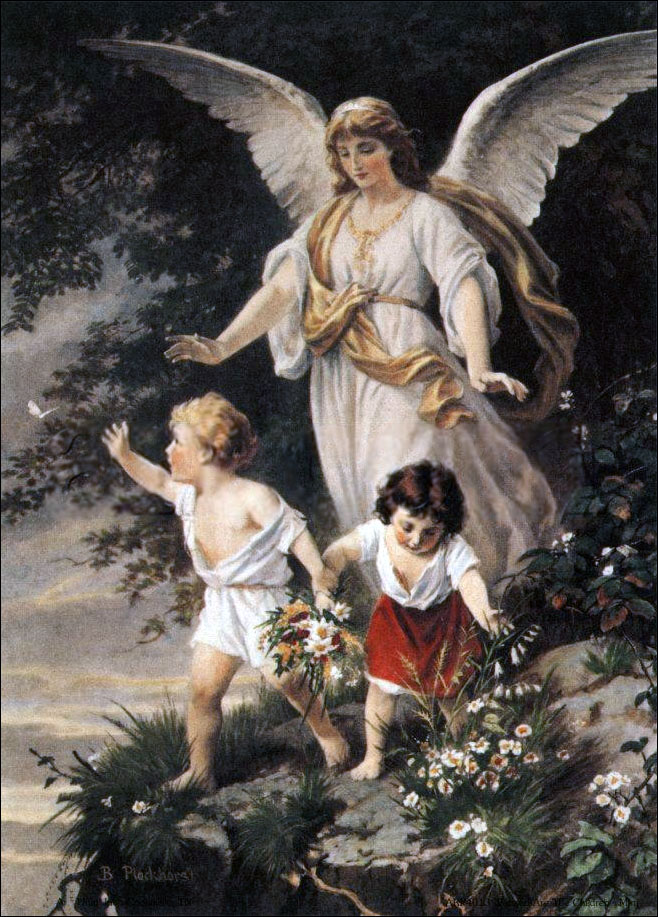
[[File:Bernhard Plockhorst - Schutzengel.jpg|thumb|upright|''Schutzengel'' (English: "Guardian Angel") by [[Bernhard Plockhorst]] depicts a [[guardian angel]] watching over two children.]] | [[File:Bernhard Plockhorst - Schutzengel.jpg|thumb|upright|''Schutzengel'' (English: "Guardian Angel") by [[Bernhard Plockhorst]] depicts a [[guardian angel]] watching over two children.]] | ||
An angel is generally a supernatural being found in various [[religion]]s and [[Mythology|mythologies]]. In [[Abrahamic religions]] and [[Zoroastrianism]], angels are often depicted as benevolent celestial beings who act as intermediaries between [[God]] or [[Heaven]] and [[Earth]].<ref>The Free Dictionary [http://www.thefreedictionary.com/angel] retrieved 1 September 2012</ref><ref name="ReligFacts"> | An angel is generally a supernatural being found in various [[religion]]s and [[Mythology|mythologies]]. In [[Abrahamic religions]] and [[Zoroastrianism]], angels are often depicted as benevolent celestial beings who act as intermediaries between [[God]] or [[Heaven]] and [[Earth]].<ref>The Free Dictionary [http://www.thefreedictionary.com/angel] {{Webarchive|url=https://web.archive.org/web/20121108092531/http://www.thefreedictionary.com/angel|date=2012-11-08}} retrieved 1 September 2012</ref><ref name="ReligFacts">{{Cite web |url=http://www.religionfacts.com/christianity/beliefs/angels.htm |title="Angels in Christianity." Religion Facts. N.p., n.d. Web. 15 Dec. 2014 |access-date=2018-01-05 |archive-date=2015-04-06 |archive-url=https://web.archive.org/web/20150406134902/http://www.religionfacts.com/christianity/beliefs/angels.htm |url-status=live }}</ref> Other roles of angels include protecting and guiding human beings and carrying out God's tasks.<ref>[http://www.augustinus.it/latino/esposizioni_salmi/index2.htm] {{Webarchive|url=https://web.archive.org/web/20111009114455/http://www.augustinus.it/latino/esposizioni_salmi/index2.htm|date=2011-10-09}}[[Augustine of Hippo]]'s ''Enarrationes in Psalmos'', 103, I, 15'', augustinus.it'' {{in lang|la}}</ref> Within Abrahamic religions, angels are often organized into [[Hierarchy|hierarchies]], although such rankings may vary between sects in each religion, and are given specific names or titles, such as [[Gabriel]] or "[[Destroying angel (Bible)|Destroying angel]]". The term "angel" has also been expanded to various notions of spirits or figures found in other religious traditions. The theological study of angels is known as "[[angelology]]". | ||
[[Angels in art|In fine art]], angels are usually depicted as having the shape of human beings of extraordinary beauty;<ref name=":0">{{cite web|url=http://www.merriam-webster.com/dictionary/angel|title=Definition of ANGEL|website=www.merriam-webster.com|access-date=2016-05-02}}</ref><ref name=":2">{{cite web|url=http://jewishencyclopedia.com/articles/1521-angelology|title=ANGELOLOGY - JewishEncyclopedia.com|website=jewishencyclopedia.com|access-date=2016-05-02}}</ref> they are often identified using the [[symbol]]s of [[Bird flight|bird wings]],<ref>Proverbio (2007), pp. 90–95; cf. review in ''[[La Civiltà Cattolica]]'', 3795–3796 (2–16 August 2008), pp. 327–328.</ref> [[Halo (religious iconography)|halos]] | [[Angels in art|In fine art]], angels are usually depicted as having the shape of human beings of extraordinary beauty;<ref name=":0">{{cite web|url=http://www.merriam-webster.com/dictionary/angel|title=Definition of ANGEL|website=www.merriam-webster.com|access-date=2016-05-02|archive-date=2023-06-28|archive-url=https://web.archive.org/web/20230628235313/https://www.merriam-webster.com/dictionary/angel|url-status=live}}</ref><ref name=":2">{{cite web|url=http://jewishencyclopedia.com/articles/1521-angelology|title=ANGELOLOGY - JewishEncyclopedia.com|website=jewishencyclopedia.com|access-date=2016-05-02|archive-date=2016-05-20|archive-url=https://web.archive.org/web/20160520024437/https://jewishencyclopedia.com/articles/1521-angelology|url-status=live}}</ref> they are often identified using the [[symbol]]s of [[Bird flight|bird wings]],<ref>Proverbio (2007), pp. 90–95; cf. review in ''[[La Civiltà Cattolica]]'', 3795–3796 (2–16 August 2008), pp. 327–328.</ref> [[Halo (religious iconography)|halos]]<ref>Didron, Vol 2, pp.68–71</ref> and [[light]]. | ||
===Prophecy=== | ===Prophecy=== | ||
| Line 67: | Line 69: | ||
In [[religion]] and [[theology]], revelation is the revealing or disclosing of some form of [[Religious views on truth|truth]] or [[Knowledge#Religion|knowledge]] through communication with a [[deity]] or other supernatural entity or entities. | In [[religion]] and [[theology]], revelation is the revealing or disclosing of some form of [[Religious views on truth|truth]] or [[Knowledge#Religion|knowledge]] through communication with a [[deity]] or other supernatural entity or entities. | ||
Some religions have [[religious texts]] which they view as divinely or supernaturally revealed or inspired. For instance, [[Orthodox Jews]], [[Christians]] and [[Muslims]] believe that the ''[[Torah]]'' was received from [[Yahweh]] on [[biblical Mount Sinai]].<ref>Beale G.K., The Book of Revelation, NIGTC, Grand Rapids – Cambridge 1999. = {{ISBN|0-8028-2174-X}}</ref><ref>Esposito, John L. ''What Everyone Needs to Know about Islam'' (New York: Oxford University Press, 2002), pp. 7–8.</ref> Most Christians believe that both the [[Old Testament]] and the [[New Testament]] were [[Biblical inspiration|inspired]] by God. Muslims believe the [[Quran]] was revealed by God to [[Muhammad]] word by word through the angel [[Gabriel]] (''Jibril'').<ref name=Lambert>{{cite book|last1=Lambert|first1=Gray|title=The Leaders Are Coming!|date=2013|publisher=WestBow Press|isbn=9781449760137|page=287|url=https://books.google.com/books?id=sV0mAgAAQBAJ&q=%22Muslims+believe+that+the+Quran+was+verbally+revealed%22&pg=PA287}}</ref><ref name="Williams & Drew">{{cite book|author1=Roy H. Williams|author2=Michael R. Drew|title=Pendulum: How Past Generations Shape Our Present and Predict Our Future|date=2012|publisher=Vanguard Press|isbn=9781593157067|page=143|url=https://books.google.com/books?id=mygRHh6p40kC&q=%22Muslims+believe+that+the+Quran+was+verbally+revealed%22&pg=PA143}}</ref> In [[Hinduism]], some [[Vedas]] are considered ''[[apaurusheyatva|{{IAST|apauruṣeya}}]]'', "not human compositions", and are supposed to have been directly revealed, and thus are called ''[[śruti]]'', "what is heard". [[Aleister Crowley]] stated that ''[[The Book of the Law]]'' had been revealed to him through a higher being that called itself ''[[Aiwass]]''. | Some religions have [[religious texts]] which they view as divinely or supernaturally revealed or inspired. For instance, [[Orthodox Jews]], [[Christians]] and [[Muslims]] believe that the ''[[Torah]]'' was received from [[Yahweh]] on [[biblical Mount Sinai]].<ref>Beale G.K., The Book of Revelation, NIGTC, Grand Rapids – Cambridge 1999. = {{ISBN|0-8028-2174-X}}</ref><ref>Esposito, John L. ''What Everyone Needs to Know about Islam'' (New York: Oxford University Press, 2002), pp. 7–8.</ref> Most Christians believe that both the [[Old Testament]] and the [[New Testament]] were [[Biblical inspiration|inspired]] by God. Muslims believe the [[Quran]] was revealed by God to [[Muhammad]] word by word through the angel [[Gabriel]] (''Jibril'').<ref name=Lambert>{{cite book|last1=Lambert|first1=Gray|title=The Leaders Are Coming!|date=2013|publisher=WestBow Press|isbn=9781449760137|page=287|url=https://books.google.com/books?id=sV0mAgAAQBAJ&q=%22Muslims+believe+that+the+Quran+was+verbally+revealed%22&pg=PA287}}</ref><ref name="Williams & Drew">{{cite book|author1=Roy H. Williams|author2=Michael R. Drew|title=Pendulum: How Past Generations Shape Our Present and Predict Our Future|date=2012|publisher=Vanguard Press|isbn=9781593157067|page=143|url=https://books.google.com/books?id=mygRHh6p40kC&q=%22Muslims+believe+that+the+Quran+was+verbally+revealed%22&pg=PA143}}{{Dead link|date=February 2024 |bot=InternetArchiveBot |fix-attempted=yes }}</ref> In [[Hinduism]], some [[Vedas]] are considered ''[[apaurusheyatva|{{IAST|apauruṣeya}}]]'', "not human compositions", and are supposed to have been directly revealed, and thus are called ''[[śruti]]'', "what is heard". [[Aleister Crowley]] stated that ''[[The Book of the Law]]'' had been revealed to him through a higher being that called itself ''[[Aiwass]]''. | ||
A revelation communicated by a supernatural entity reported as being present during the event is called a [[Vision (spirituality)|vision]]. Direct conversations between the recipient and the supernatural entity,<ref>Michael Freze, 1993, ''Voices, Visions, and Apparitions'', OSV Publishing {{ISBN|0-87973-454-X}} p. 252</ref> or physical marks such as [[stigmata]], have been reported. In rare cases, such as that of Saint [[Juan Diego]], physical artifacts accompany the revelation.<ref>Michael Freze, 1989 ''They Bore the Wounds of Christ'' {{ISBN|0-87973-422-1}}</ref> The [[Roman Catholic]] concept of [[interior locution]] includes just an inner voice heard by the recipient. | A revelation communicated by a supernatural entity reported as being present during the event is called a [[Vision (spirituality)|vision]]. Direct conversations between the recipient and the supernatural entity,<ref>Michael Freze, 1993, ''Voices, Visions, and Apparitions'', OSV Publishing {{ISBN|0-87973-454-X}} p. 252</ref> or physical marks such as [[stigmata]], have been reported. In rare cases, such as that of Saint [[Juan Diego]], physical artifacts accompany the revelation.<ref>Michael Freze, 1989 ''They Bore the Wounds of Christ'' {{ISBN|0-87973-422-1}}</ref> The [[Roman Catholic]] concept of [[interior locution]] includes just an inner voice heard by the recipient. | ||
In the [[Abrahamic religions]], the term is used to refer to the process by which [[God]] reveals knowledge of himself, his [[Will of God|will]] | In the [[Abrahamic religions]], the term is used to refer to the process by which [[God]] reveals knowledge of himself, his [[Will of God|will]] and his [[divine providence]] to the world of human beings.<ref>{{cite web |url=http://dictionary.reference.com/browse/revelation |title=Revelation | Define Revelation at Dictionary.com |publisher=Dictionary.reference.com |access-date=2013-07-14 |archive-date=2016-03-04 |archive-url=https://web.archive.org/web/20160304074441/http://dictionary.reference.com/browse/revelation |url-status=live }}</ref> In secondary usage, revelation refers to the resulting human knowledge about God, [[prophecy]] and other [[divinity|divine]] things. Revelation from a supernatural source plays a less important role in some other religious traditions such as [[Buddhism]], [[Confucianism]] and [[Taoism]]. | ||
===Reincarnation=== | ===Reincarnation=== | ||
{{main|Reincarnation}} | {{main|Reincarnation}} | ||
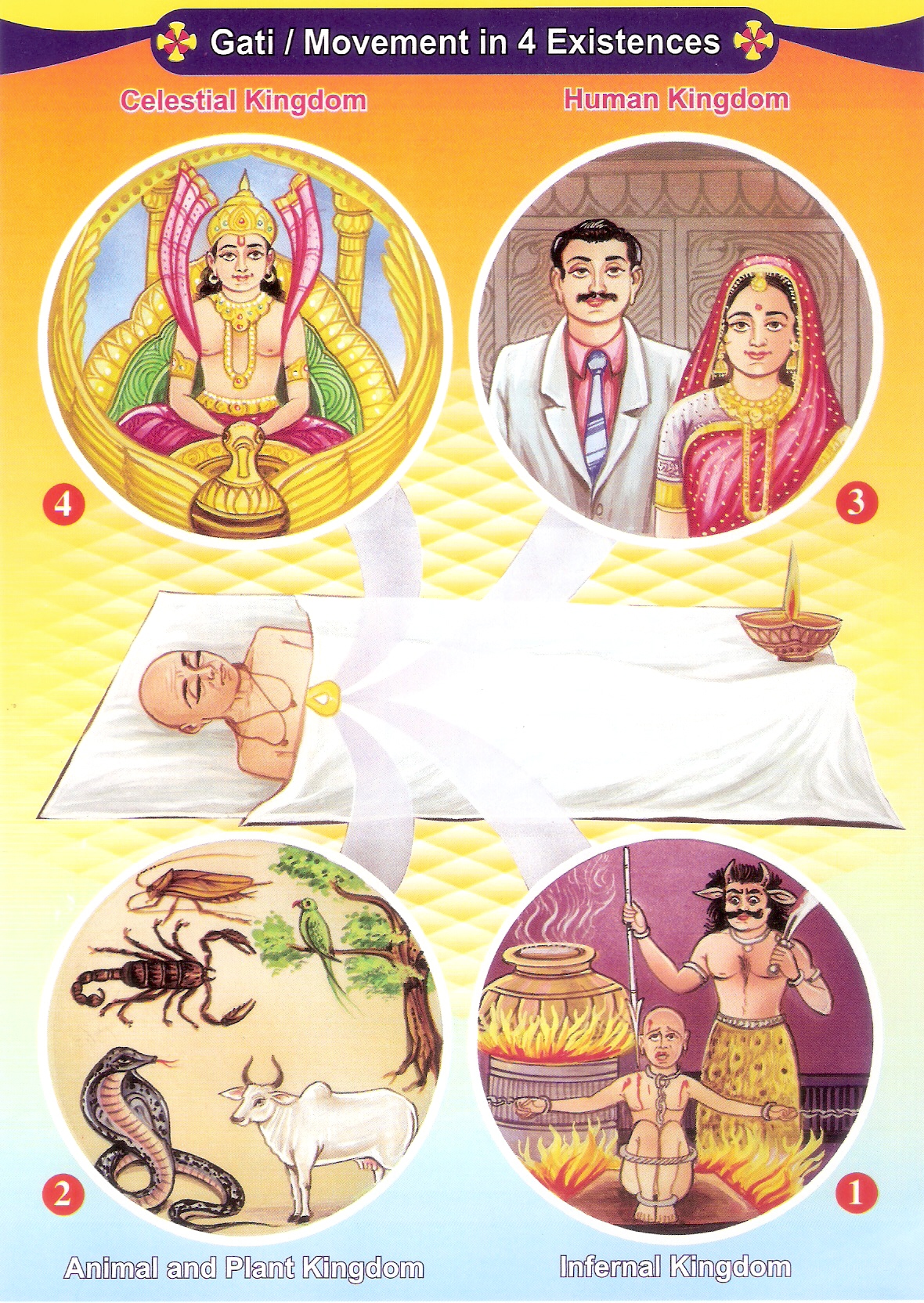
[[File:Gati or existences.jpg|upright|thumb|In [[Jainism]], a [[soul]] travels to any one of the four states of existence after death depending on its [[karma]]s.]] | [[File:Gati or existences.jpg|upright|thumb|In [[Jainism]], a [[soul]] travels to any one of the four states of existence after death depending on its [[karma]]s.]] | ||
Reincarnation is the [[Philosophy|philosophical]] or [[Religion|religious]] concept that an aspect of a living [[being]] starts a new [[life]] in a different [[physical body]] or form after each biological [[death]]. It is also called rebirth or transmigration, and is a part of the [[Saṃsāra]] doctrine of cyclic existence.{{Sfn|Norman C. McClelland|2010|pp=24–29, 171}}{{Sfn|Mark Juergensmeyer|Wade Clark Roof|2011|pp=271–272}} It is a central tenet of all major [[Indian religions]], namely [[Jainism]], [[Hinduism]], [[Buddhism]] | Reincarnation is the [[Philosophy|philosophical]] or [[Religion|religious]] concept that an aspect of a living [[being]] starts a new [[life]] in a different [[physical body]] or form after each biological [[death]]. It is also called rebirth or [[Transmigration of a soul|transmigration]], and is a part of the [[Saṃsāra]] doctrine of cyclic existence.{{Sfn|Norman C. McClelland|2010|pp=24–29, 171}}{{Sfn|Mark Juergensmeyer|Wade Clark Roof|2011|pp=271–272}} It is a central tenet of all major [[Indian religions]], namely [[Jainism]], [[Hinduism]], [[Buddhism]] and [[Sikhism]].{{Sfn|Mark Juergensmeyer|Wade Clark Roof|2011|pp=271–272}}{{sfn|Stephen J. Laumakis|2008|pp=90–99}}<ref name="Gross1993p148">{{cite book|author=Rita M. Gross |title=Buddhism After Patriarchy: A Feminist History, Analysis, and Reconstruction of Buddhism |url=https://archive.org/details/buddhismafterpat00gros |url-access=registration |year=1993|publisher=State University of New York Press|isbn=978-1-4384-0513-1 |pages=[https://archive.org/details/buddhismafterpat00gros/page/148 148]}}</ref> The idea of reincarnation is found in many ancient cultures,{{Sfn|Norman C. McClelland|2010|pp=102–103}} and a belief in rebirth/[[metempsychosis]] was held by Greek historic figures, such as [[Pythagoras]], [[Socrates]] and [[Plato]].<ref>see Charles Taliaferro, Paul Draper, Philip L. Quinn, ''A Companion to Philosophy of Religion''. John Wiley and Sons, 2010, page 640, [https://books.google.com/books?id=SSCx-67Tk6cC&dq=reincarnation+and+rebirth&pg=PA640 Google Books] {{Webarchive|url=https://web.archive.org/web/20221212163105/https://books.google.com/books?id=SSCx-67Tk6cC&pg=PA640&dq=reincarnation+and+rebirth&cd=8 |date=2022-12-12 }}</ref> It is also a common belief of various ancient and modern religions such as [[Kardecist spiritism|Spiritism]], [[Theosophy (Blavatskian)|Theosophy]] and [[Eckankar]] and as an esoteric belief in many streams of [[Orthodox Judaism]]. It is found as well in many tribal societies around the world, in places such as [[Australia]], [[East Asia]], [[Siberia]] and [[South America]].<ref>Gananath Obeyesekere, ''Imagining Karma: Ethical Transformation in Amerindian, Buddhist, and Greek Rebirth''. University of California Press, 2002, page 15.</ref> | ||
Although the majority of denominations within [[Christianity]] and [[Islam]] do not believe that individuals reincarnate, particular groups within these religions do refer to reincarnation; these groups include the mainstream historical and contemporary followers of [[Catharism|Cathars]], [[Alawites]], the [[Druze]] | Although the majority of denominations within [[Christianity]] and [[Islam]] do not believe that individuals reincarnate, particular groups within these religions do refer to reincarnation; these groups include the mainstream historical and contemporary followers of [[Catharism|Cathars]], [[Alawites]], the [[Druze]]<ref>Hitti, Philip K (2007) [1924]. ''Origins of the Druze People and Religion, with Extracts from their Sacred Writings (New Edition)''. Columbia University Oriental Studies. '''28'''. London: Saqi. pp. 13–14. {{ISBN|0-86356-690-1}}</ref> and the [[Rosicrucians]].<ref>[[Max Heindel|Heindel, Max]] (1985) [1939, 1908] ''The Rosicrucian Christianity Lectures (Collected Works)'': [http://www.rosicrucian.com/rcl/rcleng01.htm#lecture1 The Riddle of Life and Death] {{Webarchive|url=https://web.archive.org/web/20100629063357/http://www.rosicrucian.com/rcl/rcleng01.htm#lecture1 |date=2010-06-29 }}. Oceanside, California. 4th edition. {{ISBN|0-911274-84-7}}</ref> The historical relations between these sects and the beliefs about reincarnation that were characteristic of [[Neoplatonism]], [[Orphism (religion)|Orphism]], [[Hermeticism]], [[Manicheanism]] and [[Gnosticism]] of the [[Roman era]] as well as the Indian religions, have been the subject of recent scholarly research.<ref>An important recent work discussing the mutual influence of ancient Greek and Indian philosophy regarding these matters is ''The Shape of Ancient Thought'' by [[Thomas McEvilley]]</ref> [[Unity Church]] and its founder [[Charles Fillmore (Unity Church)|Charles Fillmore]] teaches reincarnation. | ||
In recent decades, many [[Europeans]] and [[North Americans]] have developed an interest in reincarnation,<ref name="hi.is">{{cite web|url= http://www.hi.is/~erlendur/english/Nordic_Psychology_erlhar06.pdf |title=Popular psychology, belief in life after death and reincarnation in the Nordic countries, Western and Eastern Europe }} {{small|(54.8 KB)}}</ref> and [[Reincarnation in popular culture|many contemporary works]] mention it. | In recent decades, many [[Europeans]] and [[North Americans]] have developed an interest in reincarnation,<ref name="hi.is">{{cite web |url= http://www.hi.is/~erlendur/english/Nordic_Psychology_erlhar06.pdf |title= Popular psychology, belief in life after death and reincarnation in the Nordic countries, Western and Eastern Europe |access-date= 2018-10-23 |archive-date= 2009-09-30 |archive-url= https://web.archive.org/web/20090930145456/http://www3.hi.is/~erlendur/english/Nordic_Psychology_erlhar06.pdf |url-status= live }} {{small|(54.8 KB)}}</ref> and [[Reincarnation in popular culture|many contemporary works]] mention it. | ||
===Karma=== | ===Karma=== | ||
{{main|Karma}} | {{main|Karma}} | ||
Karma ({{IPAc-en|ˈ|k|ɑr|m|ə}}; {{ | Karma ({{IPAc-en|ˈ|k|ɑr|m|ə}}; {{langx|sa|कर्म|karma}}, {{IPA|sa|ˈkɐɽmɐ|IPA|Karma.ogg}}; {{langx|pi|kamma|italic=yes}}) means action, work or deed;<ref>See: | ||
* Encyclopædia Britannica, 11th Edition, Volume 15, New York, pp 679–680, Article on Karma; Quote – "Karma meaning deed or action; in addition, it also has philosophical and technical meaning, denoting a person's deeds as determining his future lot." | * Encyclopædia Britannica, 11th Edition, Volume 15, New York, pp 679–680, Article on Karma; Quote – "Karma meaning deed or action; in addition, it also has philosophical and technical meaning, denoting a person's deeds as determining his future lot." | ||
* The Encyclopedia of World Religions, Robert Ellwood & Gregory Alles, {{ISBN|978-0-8160-6141-9}}, pp 253; Quote – "Karma: Sanskrit word meaning action and the consequences of action." | * The Encyclopedia of World Religions, Robert Ellwood & Gregory Alles, {{ISBN|978-0-8160-6141-9}}, pp 253; Quote – "Karma: Sanskrit word meaning action and the consequences of action." | ||
* Hans Torwesten (1994), Vedanta: Heart of Hinduism, {{ISBN|978-0802132628}}, Grove Press New York, pp 97; Quote – "In the Vedas the word karma (work, deed or action, and its resulting effect) referred mainly to..."</ref> it also refers to the spiritual principle of cause and effect where intent and actions of an individual (cause) influence the future of that individual (effect).<ref>[http://www.britannica.com/EBchecked/topic/312474/karma Karma] Encyclopædia Britannica (2012)</ref> Good intent and good deeds contribute to good karma and future happiness, while bad intent and bad deeds contribute to bad karma and future suffering.<ref name=halbfass2000>Halbfass, Wilhelm (2000), Karma und Wiedergeburt im indischen Denken, Diederichs, München, Germany</ref><ref>Lawrence C. Becker & Charlotte B. Becker, Encyclopedia of Ethics, 2nd Edition, {{ISBN|0-415-93672-1}}, Hindu Ethics, pp 678</ref> | * Hans Torwesten (1994), Vedanta: Heart of Hinduism, {{ISBN|978-0802132628}}, Grove Press New York, pp 97; Quote – "In the Vedas the word karma (work, deed or action, and its resulting effect) referred mainly to..."</ref> it also refers to the spiritual principle of cause and effect where intent and actions of an individual (cause) influence the future of that individual (effect).<ref>[http://www.britannica.com/EBchecked/topic/312474/karma Karma] {{Webarchive|url=https://web.archive.org/web/20150503134927/http://www.britannica.com/EBchecked/topic/312474/karma |date=2015-05-03 }} Encyclopædia Britannica (2012)</ref> Good intent and good deeds contribute to good karma and future happiness, while bad intent and bad deeds contribute to bad karma and future suffering.<ref name=halbfass2000>Halbfass, Wilhelm (2000), Karma und Wiedergeburt im indischen Denken, Diederichs, München, Germany</ref><ref>Lawrence C. Becker & Charlotte B. Becker, Encyclopedia of Ethics, 2nd Edition, {{ISBN|0-415-93672-1}}, Hindu Ethics, pp 678</ref> | ||
With origins in [[History of India|ancient India]]'s [[Vedic civilization]], the philosophy of karma is closely associated with the idea of [[Reincarnation|rebirth]] in many schools of [[Indian religions]] (particularly [[Karma in Hinduism|Hinduism]], [[Karma in Buddhism|Buddhism]], [[Karma in Jainism|Jainism]] and [[Sikhism]]<ref name=KarmaParveshSingla>{{cite book|author=Parvesh Singla |title=The Manual of Life – Karma |url=https://archive.org/details/bub_gb_1mXR35jX-TsC |access-date=4 June 2011 |publisher=Parvesh singla |pages=5–7 |id=GGKEY:0XFSARN29ZZ}}</ref>) as well as [[Taoism]].<ref name=evawong>Eva Wong, Taoism, Shambhala Publications, {{ISBN|978-1590308820}}, pp. 193</ref> In these schools, karma in the present affects one's future in the current life, as well as the nature and quality of future lives – one's ''[[saṃsāra]]''.<ref name=jbowker>"Karma" in: John Bowker (1997), The Concise Oxford Dictionary of World Religions, Oxford University Press.</ref><ref name=jamesloch>James Lochtefeld (2002), The Illustrated Encyclopedia of Hinduism, Rosen Publishing, New York, {{ISBN|0-8239-2287-1}}, pp 351–352</ref> | With origins in [[History of India|ancient India]]'s [[Vedic civilization]], the philosophy of karma is closely associated with the idea of [[Reincarnation|rebirth]] in many schools of [[Indian religions]] (particularly [[Karma in Hinduism|Hinduism]], [[Karma in Buddhism|Buddhism]], [[Karma in Jainism|Jainism]] and [[Sikhism]]<ref name=KarmaParveshSingla>{{cite book|author=Parvesh Singla |title=The Manual of Life – Karma |url=https://archive.org/details/bub_gb_1mXR35jX-TsC |access-date=4 June 2011 |publisher=Parvesh singla |pages=5–7 |id=GGKEY:0XFSARN29ZZ}}</ref>) as well as [[Taoism]].<ref name=evawong>Eva Wong, Taoism, Shambhala Publications, {{ISBN|978-1590308820}}, pp. 193</ref> In these schools, karma in the present affects one's future in the current life, as well as the nature and quality of future lives – one's ''[[saṃsāra]]''.<ref name=jbowker>"Karma" in: John Bowker (1997), The Concise Oxford Dictionary of World Religions, Oxford University Press.</ref><ref name=jamesloch>James Lochtefeld (2002), The Illustrated Encyclopedia of Hinduism, Rosen Publishing, New York, {{ISBN|0-8239-2287-1}}, pp 351–352</ref> | ||
===Christian theology=== | ===Christian theology=== | ||
[[File:San Giuseppe di Copertino 18th century engraving.jpg|thumb|upright|The [[patron saint]] of air travelers, aviators, astronauts, people with a mental handicap, test takers | [[File:San Giuseppe di Copertino 18th century engraving.jpg|thumb|upright|The [[patron saint]] of air travelers, aviators, astronauts, people with a mental handicap, test takers and poor students is [[Saint Joseph of Cupertino]], who is said to have been gifted with [[Saints and levitation|supernatural flight]].<ref>{{cite book |last=Pastrovicchi |first=Angelo |title=St. Joseph of Copertino |editor=Rev. Francis S. Laing |publisher=B.Herder |location=St. Louis |year=1918 |page=iv |url=http://babel.hathitrust.org/cgi/pt?id=nnc1.cr60937475;seq=18;view=1up;num=iv |isbn=978-0-89555-135-1 |access-date=2013-02-26 |archive-date=2021-05-02 |archive-url=https://web.archive.org/web/20210502053937/https://babel.hathitrust.org/cgi/pt?id=nnc1.cr60937475;seq=18;view=1up;num=iv |url-status=live }}</ref>]] | ||
{{Main|Supernatural order}} | {{Main|Supernatural order}} | ||
In [[Catholic theology]], the supernatural order is, according to [[New Advent]], defined as "the ensemble of effects exceeding the powers of the created universe and gratuitously produced by God for the purpose of raising the rational creature above its native sphere to a God-like life and destiny."<ref name=NA>{{cite web|url=http://www.newadvent.org/cathen/14336b.htm|title=Supernatural Order|last=Sollier|first=J.|publisher=Robert Appleton Company|access-date=2008-09-11}}</ref> The ''Modern Catholic Dictionary'' defines it as "the sum total of heavenly destiny and all the divinely established means of reaching that destiny, which surpass the mere powers and capacities of human nature."<ref>{{cite web|url=http://www.catholicculture.org/culture/library/dictionary/index.cfm?id=36719|title=Supernatural Order|last=Hardon|first=Fr. John|publisher=Eternal Life|access-date=2008-09-15}}</ref> | In [[Catholic theology]], the supernatural order is, according to [[New Advent]], defined as "the ensemble of effects exceeding the powers of the created universe and gratuitously produced by God for the purpose of raising the rational creature above its native sphere to a God-like life and destiny."<ref name=NA>{{cite web|url=http://www.newadvent.org/cathen/14336b.htm|title=Supernatural Order|last=Sollier|first=J.|publisher=Robert Appleton Company|access-date=2008-09-11|archive-date=2008-09-14|archive-url=https://web.archive.org/web/20080914133738/http://www.newadvent.org/cathen/14336b.htm|url-status=live}}</ref> The ''Modern Catholic Dictionary'' defines it as "the sum total of heavenly destiny and all the divinely established means of reaching that destiny, which surpass the mere powers and capacities of human nature."<ref>{{cite web|url=http://www.catholicculture.org/culture/library/dictionary/index.cfm?id=36719|title=Supernatural Order|last=Hardon|first=Fr. John|publisher=Eternal Life|access-date=2008-09-15|archive-date=2011-06-10|archive-url=https://web.archive.org/web/20110610122131/http://www.catholicculture.org/culture/library/dictionary/index.cfm?id=36719|url-status=live}}</ref> | ||
===Process theology=== | ===Process theology=== | ||
{{main|Process theology}} | {{main|Process theology}} | ||
Process theology is a school of thought influenced by the metaphysical [[process philosophy]] of [[Alfred North Whitehead]] (1861–1947) and further developed by [[Charles Hartshorne]] (1897–2000). | Process theology is a school of thought influenced by the metaphysical [[process philosophy]] of [[Alfred North Whitehead]] (1861–1947) and further developed by [[Charles Hartshorne]] (1897–2000). | ||
{{quote|It is not possible, in process metaphysics, to conceive divine activity as a "supernatural" intervention into the "natural" order of events. Process theists usually regard the distinction between the supernatural and the natural as a by-product of the doctrine of creation ''ex nihilo''. In process thought, there is no such thing as a realm of the natural in contrast to that which is supernatural. On the other hand, if "the natural" is defined more neutrally as "what is in the nature of things, | {{quote|It is not possible, in process metaphysics, to conceive divine activity as a "supernatural" intervention into the "natural" order of events. Process theists usually regard the distinction between the supernatural and the natural as a by-product of the doctrine of creation ''ex nihilo''. In process thought, there is no such thing as a realm of the natural in contrast to that which is supernatural. On the other hand, if "the natural" is defined more neutrally as "what is in the nature of things", then process metaphysics characterizes the natural as the creative activity of actual entities. In Whitehead's words, "It lies in the nature of things that the many enter into complex unity" (Whitehead 1978, 21). It is tempting to emphasize process theism's denial of the supernatural and thereby highlight that the processed God cannot do in comparison what the traditional God could do (that is, to bring something from nothing). In fairness, however, equal stress should be placed on process theism's denial of the natural (as traditionally conceived) so that one may highlight what the creatures cannot do, in traditional theism, in comparison to what they can do in process metaphysics (that is, to be part creators of the world with God).<ref name="sep-process-theism">{{cite encyclopedia |first=Donald |last=Viney |editor=Edward N. Zalta |year=2008 |title=Process Theism |encyclopedia=The Stanford Encyclopedia of Philosophy |edition=Winter 2008 |url=http://plato.stanford.edu/archives/win2008/entries/process-theism/ |access-date=2012-08-06 |archive-date=2013-12-02 |archive-url=https://web.archive.org/web/20131202071650/http://plato.stanford.edu/archives/win2008/entries/process-theism/ |url-status=live }}</ref>|Donald Viney|"Process Theism" in ''The Stanford Encyclopedia of Philosophy''}} | ||
=== Heaven === | === Heaven === | ||
| Line 105: | Line 107: | ||
''Heaven'', or ''the heavens'', is a common [[Religious cosmology|religious, cosmological]], or [[transcendence (philosophy)|transcendent]] place where beings such as [[Deity|gods]], [[angel]]s, spirits, [[saint]]s, or [[Veneration of the dead|venerated ancestors]] are said to originate, be [[throne|enthroned]], or live. According to the beliefs of some religions, heavenly beings can descend to Earth or [[Incarnation|incarnate]], and earthly beings can ascend to heaven in the [[afterlife]], or in exceptional cases [[Entering heaven alive|enter heaven alive]]. | ''Heaven'', or ''the heavens'', is a common [[Religious cosmology|religious, cosmological]], or [[transcendence (philosophy)|transcendent]] place where beings such as [[Deity|gods]], [[angel]]s, spirits, [[saint]]s, or [[Veneration of the dead|venerated ancestors]] are said to originate, be [[throne|enthroned]], or live. According to the beliefs of some religions, heavenly beings can descend to Earth or [[Incarnation|incarnate]], and earthly beings can ascend to heaven in the [[afterlife]], or in exceptional cases [[Entering heaven alive|enter heaven alive]]. | ||
Heaven is often described as a "higher place", the [[Sacred|holiest]] place, a [[Paradise]], in contrast to [[hell]] or the [[Underworld]] or the "low places" | Heaven is often described as a "higher place", the [[Sacred|holiest]] place, a [[Paradise]], in contrast to [[hell]] or the [[Underworld]] or the "low places" and [[Universal reconciliation|universally]] or conditionally accessible by earthly beings according to various standards of [[divinity]], [[good and evil|goodness]], [[piety]], [[faith]], or other [[virtue]]s or [[orthodoxy|right beliefs]] or simply the [[will of God]]. Some believe in the possibility of a heaven on Earth in a ''[[world to come]]''. | ||
Another belief is in an [[axis mundi]] or [[world tree]] which connects the heavens, the terrestrial world | Another belief is in an [[axis mundi]] or [[world tree]] which connects the heavens, the terrestrial world and the [[underworld]]. In [[Indian religions]], heaven is considered as ''[[Svarga|Svarga loka]]'',<ref>{{Cite news|url=https://www.spiritualresearchfoundation.org/spiritual-research/afterlife/life-after-death/|title=Life After Death Revealed – What Really Happens in the Afterlife|work=SSRF English|access-date=2018-03-22|language=en-GB|archive-date=2019-01-30|archive-url=https://web.archive.org/web/20190130001314/https://www.spiritualresearchfoundation.org/spiritual-research/afterlife/life-after-death/|url-status=live}}</ref> and the soul is again subjected to [[Reincarnation|rebirth]] in different living forms according to its ''[[karma]]''. This cycle can be broken after a soul achieves ''[[Moksha]]'' or ''[[Nirvana]]''. Any place of existence, either of humans, souls or deities, outside the tangible world (Heaven, Hell, or other) is referred to as ''[[otherworld]].'' | ||
=== Underworld === | === Underworld === | ||
{{main|Underworld}} | {{main|Underworld}} | ||
The ''underworld'' is the supernatural world of the dead in various [[religious]] traditions, located below the world of the living.<ref>{{cite web |url = http://www.thefreedictionary.com/underworld |title=Underworld |work=The free dictionary |access-date=1 July 2010 }}</ref> [[Chthonic]] is the technical adjective for things of the underworld. | The ''underworld'' is the supernatural world of the dead in various [[religious]] traditions, located below the world of the living.<ref>{{cite web |url=http://www.thefreedictionary.com/underworld |title=Underworld |work=The free dictionary |access-date=1 July 2010 |archive-date=6 November 2012 |archive-url=https://web.archive.org/web/20121106064933/http://www.thefreedictionary.com/underworld |url-status=live }}</ref> [[Chthonic]] is the technical adjective for things of the underworld. | ||
The concept of an underworld is found in almost every civilization and "may be as old as humanity itself".<ref>Isabelle Loring Wallace, Jennie Hirsh, ''Contemporary Art and Classical Myth'' (2011), p. 295.</ref> Common features of underworld [[myth]]s are accounts of [[Descent to the underworld|living people making journeys to the underworld]], often for some [[hero]]ic purpose. Other myths reinforce traditions that entrance of souls to the underworld requires a proper observation of ceremony, such as the ancient Greek story of the recently dead [[Patroclus]] haunting [[Achilles]] until his body could be properly buried for this purpose.<ref>Radcliffe G. Edmonds, III, ''Myths of the Underworld Journey: Plato, Aristophanes, and the 'Orphic' Gold Tablets'' (2004), p. 9.</ref> Persons having social status were dressed and equipped in order to better navigate the underworld.<ref>Jon Mills, ''Underworlds: Philosophies of the Unconscious from Psychoanalysis to Metaphysics'' (2014), p. 1.</ref> | The concept of an underworld is found in almost every civilization and "may be as old as humanity itself".<ref>Isabelle Loring Wallace, Jennie Hirsh, ''Contemporary Art and Classical Myth'' (2011), p. 295.</ref> Common features of underworld [[myth]]s are accounts of [[Descent to the underworld|living people making journeys to the underworld]], often for some [[hero]]ic purpose. Other myths reinforce traditions that entrance of souls to the underworld requires a proper observation of ceremony, such as the ancient Greek story of the recently dead [[Patroclus]] haunting [[Achilles]] until his body could be properly buried for this purpose.<ref>Radcliffe G. Edmonds, III, ''Myths of the Underworld Journey: Plato, Aristophanes, and the 'Orphic' Gold Tablets'' (2004), p. 9.</ref> Persons having social status were dressed and equipped in order to better navigate the underworld.<ref>Jon Mills, ''Underworlds: Philosophies of the Unconscious from Psychoanalysis to Metaphysics'' (2014), p. 1.</ref> | ||
| Line 118: | Line 120: | ||
===Spirit=== | ===Spirit=== | ||
{{main|Spirit ( | {{main|Spirit (supernatural entity)|Spirit (animating force)}} | ||
[[File:Theodor von Holst Bertalda Assailed Spirits.png | [[File:Theodor von Holst Bertalda Assailed Spirits.png|thumb|[[Theodor von Holst]], ''Bertalda, Assailed by Spirits'', {{circa|1830}}]] | ||
A ''spirit'' is a supernatural being, often but not exclusively a [[non-physical entity]]; such as a [[ghost]], [[fairy]], [[jinn]] | A ''spirit'' is a supernatural being, often but not exclusively a [[non-physical entity]]; such as a [[demon]], [[ghost]], [[fairy]], [[jinn]] or [[angel]].<ref name="polysemy">[[#polysemy|François 2008]], p.187-197.</ref> The concepts of a person's spirit and [[soul]], often also overlap, as both are either [[Mind-body dualism|contrasted with]] or [[Idealism|given ontological priority over]] the [[Human body|body]] and both are believed to survive bodily death in some religions,<ref>OED "spirit 2.a.: The soul of a person, as commended to God, or passing out of the body, in the moment of death."</ref> and "spirit" can also have the sense of "[[ghost]]", i.e. a manifestation of the spirit of a deceased person. In English [[Bible]]s, "the Spirit" (with a capital "S"), specifically denotes the [[Holy Spirit in Christianity|Holy Spirit]]. | ||
Spirit is often used [[metaphysically]] to refer to the [[consciousness]] or [[personality]]. | Spirit is often used [[metaphysically]] to refer to the [[consciousness]] or [[personality]]. | ||
| Line 128: | Line 130: | ||
===Demon=== | ===Demon=== | ||
{{main|Demon}} | {{main|Demon}} | ||
[[ | [[File:Mephistopheles2.jpg|thumb|[[Mephistopheles]] (a [[Middle Ages|medieval]] demon from [[German folklore]]) flying over [[Wittenberg]], in a [[lithograph]] by [[Eugène Delacroix]].]] | ||
A ''demon'' (from [[Koine Greek]] {{lang|grc|δαιμόνιον}} ''daimónion'') is a supernatural and often malevolent being prevalent in [[religion]], [[occultism]], [[literature]], [[fiction]], [[mythology]] and [[folklore]]. | A ''demon'' (from [[Koine Greek]] {{lang|grc|δαιμόνιον}} ''daimónion'') is a supernatural and often malevolent being prevalent in [[religion]], [[occultism]], [[literature]], [[fiction]], [[mythology]] and [[folklore]]. | ||
| Line 135: | Line 137: | ||
===Magic=== | ===Magic=== | ||
{{main|Magic (supernatural)}} | {{main|Magic (supernatural)}} | ||
''Magic'' or ''sorcery'' is the use of [[ritual]]s, [[symbol]]s, actions, [[gesture]]s, or [[language]] with the aim of utilizing supernatural forces.<ref>{{cite book|last1=Hutton|first1=Ronald|author-link=Ronald Hutton|title=The Pagan Religions of the Ancient British Isles: Their Nature and Legacy|date=1995|publisher=Blackwell|location=Oxford; Cambridge|isbn=978-0631189466|pages=289–291, 335|edition=Reprint}}</ref><ref name="Tambiah">{{cite book|last1=Tambiah|first1=Stanley Jeyaraja|title=Magic, Science, Religion, and the Scope of Rationality|date=1991|publisher=Cambridge University Press|location=Cambridge|isbn=978-0521376310|edition=Reprint}}</ref>{{rp|6–7}}<ref name="Hanegraaff">{{cite book|last1=Hanegraaff|first1=Wouter J.|title=Dictionary of Gnosis & Western Esotericism|date=2006|publisher=Brill|location=Leiden|isbn=978-9004152311|edition=Unabridged|page=718}}</ref><ref name="Mauss">{{cite book|last1=Mauss|first1=Marcel|last2=Bain|first2=Robert|last3=Pocock|first3=D. F.|title=A General Theory of Magic|date=2007|publisher=Routledge|location=London|isbn=978-0415253963|edition=Reprint}}</ref>{{rp|24}} Belief in and practice of magic has been present since the earliest human cultures and continues to have an important spiritual, religious | ''Magic'' or ''sorcery'' is the use of [[ritual]]s, [[symbol]]s, actions, [[gesture]]s, or [[language]] with the aim of utilizing supernatural forces.<ref>{{cite book|last1=Hutton|first1=Ronald|author-link=Ronald Hutton|title=The Pagan Religions of the Ancient British Isles: Their Nature and Legacy|date=1995|publisher=Blackwell|location=Oxford; Cambridge|isbn=978-0631189466|pages=289–291, 335|edition=Reprint}}</ref><ref name="Tambiah">{{cite book|last1=Tambiah|first1=Stanley Jeyaraja|title=Magic, Science, Religion, and the Scope of Rationality|date=1991|publisher=Cambridge University Press|location=Cambridge|isbn=978-0521376310|edition=Reprint}}</ref>{{rp|6–7}}<ref name="Hanegraaff">{{cite book|last1=Hanegraaff|first1=Wouter J.|title=Dictionary of Gnosis & Western Esotericism|date=2006|publisher=Brill|location=Leiden|isbn=978-9004152311|edition=Unabridged|page=718}}</ref><ref name="Mauss">{{cite book|last1=Mauss|first1=Marcel|last2=Bain|first2=Robert|last3=Pocock|first3=D. F.|title=A General Theory of Magic|date=2007|publisher=Routledge|location=London|isbn=978-0415253963|edition=Reprint}}</ref>{{rp|24}} Belief in and practice of magic has been present since the earliest human cultures and continues to have an important spiritual, religious and medicinal role in many cultures today. The term ''magic'' has a variety of meanings, and there is no widely agreed upon definition of what it is. | ||
Scholars of religion have defined magic in different ways. One approach, associated with the [[anthropology|anthropologists]] [[Edward Tylor]] and [[James G. Frazer]], suggests that magic and [[science]] are opposites. An alternative approach, associated with the [[sociology|sociologists]] [[Marcel Mauss]] and [[Emile Durkheim]], argues that magic takes place in private, while [[religion]] is a communal and organised activity. Many scholars of religion have rejected the utility of the term ''magic'' and it has become increasingly unpopular within scholarship since the 1990s. | Scholars of religion have defined magic in different ways. One approach, associated with the [[anthropology|anthropologists]] [[Edward Tylor]] and [[James G. Frazer]], suggests that magic and [[science]] are opposites. An alternative approach, associated with the [[sociology|sociologists]] [[Marcel Mauss]] and [[Emile Durkheim]], argues that magic takes place in private, while [[religion]] is a communal and organised activity. Many scholars of religion have rejected the utility of the term ''magic'' and it has become increasingly unpopular within scholarship since the 1990s.{{cn|date=October 2024}} | ||
The term ''magic'' comes from the [[Old Persian]] ''magu'', a word that applied to a form of religious functionary about which little is known. During the late sixth and early fifth centuries BC, this term was adopted into [[Ancient Greek]], where it was used with negative connotations, to apply to religious rites that were regarded as fraudulent, unconventional | The term ''magic'' comes from the [[Old Persian]] ''magu'', a word that applied to a form of religious functionary about which little is known. During the late sixth and early fifth centuries BC, this term was adopted into [[Ancient Greek]], where it was used with negative connotations, to apply to religious rites that were regarded as fraudulent, unconventional and dangerous. This meaning of the term was then adopted by [[Latin]] in the first century BC. The concept was then incorporated into [[Christian theology]] during the first century AD, where magic was associated with [[demons]] and thus defined against religion. This concept was pervasive throughout the Middle Ages, although in the early modern period Italian [[Humanism|humanists]] reinterpreted the term in a positive sense to establish the idea of [[natural magic]]. Both negative and positive understandings of the term were retained in Western culture over the following centuries, with the former largely influencing early academic usages of the word. | ||
Throughout history, there have been examples of individuals who practiced magic and referred to themselves as magicians. This trend has proliferated in the modern period, with a growing number of magicians appearing within the [[Western esotericism|esoteric]] milieu.{{Citation needed lead|date=November 2017}} British esotericist [[Aleister Crowley]] described magic as the art of effecting change in accordance with will. | Throughout history, there have been examples of individuals who practiced magic and referred to themselves as magicians. This trend has proliferated in the modern period, with a growing number of magicians appearing within the [[Western esotericism|esoteric]] milieu.{{Citation needed lead|date=November 2017}} British esotericist [[Aleister Crowley]] described magic as the art of effecting change in accordance with will. | ||
| Line 149: | Line 151: | ||
Divination can be seen as a systematic method with which to organize what appear to be disjointed, random facets of existence such that they provide insight into a problem at hand. If a distinction is to be made between divination and [[fortune-telling]], divination has a more formal or ritualistic element and often contains a more social character, usually in a [[religion|religious]] context, as seen in [[traditional African medicine]]. Fortune-telling, on the other hand, is a more everyday practice for personal purposes. Particular divination methods vary by culture and religion. | Divination can be seen as a systematic method with which to organize what appear to be disjointed, random facets of existence such that they provide insight into a problem at hand. If a distinction is to be made between divination and [[fortune-telling]], divination has a more formal or ritualistic element and often contains a more social character, usually in a [[religion|religious]] context, as seen in [[traditional African medicine]]. Fortune-telling, on the other hand, is a more everyday practice for personal purposes. Particular divination methods vary by culture and religion. | ||
Divination is dismissed by the [[scientific community]] and skeptics as being [[superstition]].<ref>Yau, Julianna. (2002). ''Witchcraft and Magic''. In [[Michael Shermer]]. ''The Skeptic Encyclopedia of Pseudoscience''. ABC-CLIO. pp. 278–282. {{ISBN|1-57607-654-7}}</ref><ref>Regal, Brian. (2009). ''Pseudoscience: A Critical Encyclopedia''. Greenwood. p. 55. {{ISBN|978-0-313-35507-3}}</ref> In the 2nd century, [[Lucian]] devoted a witty essay to the career of a [[charlatan]], "[[Alexander of Abonoteichus|Alexander the false prophet]]", trained by "one of those who advertise enchantments, miraculous incantations, charms for your love-affairs, visitations for your enemies, disclosures of buried treasure | Divination is dismissed by the [[scientific community]] and [[Skepticism|skeptics]] as being [[superstition]].<ref>Yau, Julianna. (2002). ''Witchcraft and Magic''. In [[Michael Shermer]]. ''The Skeptic Encyclopedia of Pseudoscience''. ABC-CLIO. pp. 278–282. {{ISBN|1-57607-654-7}}</ref><ref>Regal, Brian. (2009). ''Pseudoscience: A Critical Encyclopedia''. Greenwood. p. 55. {{ISBN|978-0-313-35507-3}}</ref> In the 2nd century, [[Lucian]] devoted a witty essay to the career of a [[charlatan]], "[[Alexander of Abonoteichus|Alexander the false prophet]]", trained by "one of those who advertise enchantments, miraculous incantations, charms for your love-affairs, visitations for your enemies, disclosures of buried treasure and successions to estates".<ref>{{cite web|url=http://www.tertullian.org/rpearse/lucian/lucian_alexander.htm|title=Lucian of Samosata : Alexander the False Prophet|work=tertullian.org|access-date=2019-01-19|archive-date=2017-11-09|archive-url=https://web.archive.org/web/20171109160831/http://www.tertullian.org/rpearse/lucian/lucian_alexander.htm|url-status=live}}</ref> | ||
===Witchcraft=== | ===Witchcraft=== | ||
{{main|Witchcraft}} | {{main|Witchcraft}} | ||
Witchcraft or witchery broadly means the practice of and belief in [[magic (paranormal)|magical]] skills and abilities exercised by [[solitary practitioner]]s and groups. ''Witchcraft'' is a broad term that varies culturally and societally | [[File:John_William_Waterhouse_-_Magic_Circle.JPG|thumb|Depiction of witchcraft in [[John William Waterhouse]]'s painting ''The Magic Circle'' (1886)]] | ||
Witchcraft or witchery broadly means the practice of and belief in [[magic (paranormal)|magical]] skills and abilities exercised by [[solitary practitioner]]s and groups. ''Witchcraft'' is a broad term that varies culturally and societally and thus can be difficult to define with precision,<ref name="Russell">[https://books.google.com/books?id=LsjagvvkveEC&dq=witchcraft+definition&pg=PA2 Witchcraft in the Middle Ages] {{Webarchive|url=https://web.archive.org/web/20230731064328/https://books.google.com/books?id=LsjagvvkveEC&dq=witchcraft+definition&pg=PA2 |date=2023-07-31 }}, Jeffrey Russell, p.4-10.</ref> and [[cross-cultural]] assumptions about the meaning or significance of the term should be applied with caution. Witchcraft often occupies a religious [[divination|divinatory]] or medicinal role<ref name="ReferenceA">Bengt Ankarloo & Stuart Clark, Witchcraft and Magic in Europe: Biblical and Pagan Societies", University of Philadelphia Press, 2001</ref> and is often present within societies and groups whose [[cultural framework]] includes a magical [[world view]].<ref name="Russell" /> | |||
===Miracle=== | ===Miracle=== | ||
| Line 168: | Line 170: | ||
| isbn =978-1-55850-646-6 }}</ref> | | isbn =978-1-55850-646-6 }}</ref> | ||
A true miracle would, by definition, be a non-natural phenomenon, leading many rational and scientific thinkers to dismiss them as physically impossible (that is, requiring violation of established laws of physics within their domain of validity) or impossible to confirm by their nature (because all possible physical mechanisms can never be ruled out). The former position is expressed for instance by [[Thomas Jefferson]] and the latter by [[David Hume]]. [[Theologian]]s typically say that, with [[divine providence]], God regularly works through nature yet, as a creator, is free to work without, above, or against it as well. The possibility and probability of miracles are then equal to the possibility and probability of the [[existence of God]].<ref name="Miracles">[http://plato.stanford.edu/entries/miracles/ Miracles] on the Stanford Encyclopedia of Philosophy</ref> | A true miracle would, by definition, be a non-natural phenomenon, leading many rational and scientific thinkers to dismiss them as physically impossible (that is, requiring violation of established laws of physics within their domain of validity) or impossible to confirm by their nature (because all possible physical mechanisms can never be ruled out). The former position is expressed for instance by [[Thomas Jefferson]] and the latter by [[David Hume]]. [[Theologian]]s typically say that, with [[divine providence]], God regularly works through nature yet, as a creator, is free to work without, above, or against it as well. The possibility and probability of miracles are then equal to the possibility and probability of the [[existence of God]].<ref name="Miracles">[http://plato.stanford.edu/entries/miracles/ Miracles] {{Webarchive|url=https://web.archive.org/web/20191122025733/https://plato.stanford.edu/entries/miracles/ |date=2019-11-22 }} on the Stanford Encyclopedia of Philosophy</ref> | ||
==Skepticism== | ==Skepticism== | ||
{{main|Skepticism}} | {{main|Skepticism}} | ||
Skepticism ([[American English]]) or scepticism ([[British English]]; [[American and British English spelling differences#Hard and soft "c"|see spelling differences]]) is generally any questioning attitude or [[doubt]] towards one or more items of putative knowledge or belief.<ref>{{cite encyclopedia |first=R. H. |last=Popkin |title=The History of Skepticism from Erasmus to Descartes (rev. ed. 1968); C. L. Stough, Greek Skepticism (1969); M. Burnyeat, ed., The Skeptical Tradition (1983); B. Stroud, The Significance of Philosophical Skepticism (1984) |url=http://encyclopedia2.thefreedictionary.com/Skeptikoi |encyclopedia=Encyclopedia2.thefreedictionary.com}}</ref><ref>"Philosophical views are typically classed as skeptical when they involve advancing some degree of doubt regarding claims that are elsewhere taken for granted." [http://www.utm.edu/research/iep/s/skepcont.htm utm.edu]</ref> It is often directed at domains such as the supernatural, morality ([[moral skepticism]]), religion (skepticism about the existence of God), or knowledge (skepticism about the possibility of knowledge, or of certainty).<ref>{{Cite book|title = The Oxford Handbook of Skepticism|url = https://books.google.com/books?id=Ozv0lftrUeEC|publisher = Oxford University Press, US|year = 2008|isbn = 9780195183214|language = en|first = John|last = Greco|author-link=John Greco (philosopher)}}</ref> | Skepticism ([[American English]]) or scepticism ([[British English]]; [[American and British English spelling differences#Hard and soft "c"|see spelling differences]]) is generally any questioning attitude or [[doubt]] towards one or more items of putative knowledge or belief.<ref>{{cite encyclopedia |first=R. H. |last=Popkin |title=The History of Skepticism from Erasmus to Descartes (rev. ed. 1968); C. L. Stough, Greek Skepticism (1969); M. Burnyeat, ed., The Skeptical Tradition (1983); B. Stroud, The Significance of Philosophical Skepticism (1984) |url=http://encyclopedia2.thefreedictionary.com/Skeptikoi |encyclopedia=Encyclopedia2.thefreedictionary.com |access-date=2018-01-13 |archive-date=2012-07-13 |archive-url=https://archive.today/20120713170158/http://encyclopedia2.thefreedictionary.com/Skeptikoi |url-status=live }}</ref><ref>"Philosophical views are typically classed as skeptical when they involve advancing some degree of doubt regarding claims that are elsewhere taken for granted." [http://www.utm.edu/research/iep/s/skepcont.htm utm.edu] {{Webarchive|url=https://web.archive.org/web/20090113210019/http://www.utm.edu/research/iep/s/skepcont.htm |date=2009-01-13 }}</ref> It is often directed at domains such as the supernatural, morality ([[moral skepticism]]), religion (skepticism about the existence of God), or knowledge (skepticism about the possibility of knowledge, or of certainty).<ref>{{Cite book|title = The Oxford Handbook of Skepticism|url = https://books.google.com/books?id=Ozv0lftrUeEC|publisher = Oxford University Press, US|year = 2008|isbn = 9780195183214|language = en|first = John|last = Greco|author-link=John Greco (philosopher)}}</ref> | ||
==In fiction and popular culture== | ==In fiction and popular culture== | ||
| Line 181: | Line 183: | ||
{{Wiktionary|supernatural}} | {{Wiktionary|supernatural}} | ||
{{Wikiquote}} | {{Wikiquote}} | ||
* [[Divine retribution]] | |||
* [[Journal of Parapsychology]] | * [[Journal of Parapsychology]] | ||
* [[Liberal naturalism]] | * [[Liberal naturalism]] | ||
| Line 189: | Line 192: | ||
* [[Romanticism]] | * [[Romanticism]] | ||
* [[Spirit photography]] | * [[Spirit photography]] | ||
* [[Spirit world (Spiritualism)]] | |||
* [[Transcendence (religion)]] | * [[Transcendence (religion)]] | ||
== References == | == References == | ||
| Line 197: | Line 200: | ||
==Further reading== | ==Further reading== | ||
* [https://www.researchgate.net/profile/Daniel-Araujo-30/publication/357672555%20Economic%20Production%20and%20the%20Spread%20of%20Supernatural%20Beliefs/links/61d94f49b6b5667157d3d55e/Economic-Production-and-the-Spread-of-Supernatural-Beliefs.pdf Economic Production and the Spread of Supernatural Beliefs ~ Daniel Araújo] (PDF). January 7, 2022. | * [https://www.researchgate.net/profile/Daniel-Araujo-30/publication/357672555%20Economic%20Production%20and%20the%20Spread%20of%20Supernatural%20Beliefs/links/61d94f49b6b5667157d3d55e/Economic-Production-and-the-Spread-of-Supernatural-Beliefs.pdf Economic Production and the Spread of Supernatural Beliefs ~ Daniel Araújo] (PDF). January 7, 2022. | ||
* {{cite journal | author = Bouvet R, Bonnefon J. F. | year = 2015 | title = Non-Reflective Thinkers Are Predisposed to Attribute Supernatural Causation to Uncanny Experiences | journal = Personality and Social Psychology Bulletin | volume = | * {{cite journal | author = Bouvet R, Bonnefon J. F. | year = 2015 | title = Non-Reflective Thinkers Are Predisposed to Attribute Supernatural Causation to Uncanny Experiences | journal = Personality and Social Psychology Bulletin | volume = 41| issue = 7| pages = 955–61| pmid = 25948700 | doi=10.1177/0146167215585728| s2cid = 33570482 }} | ||
* {{cite journal | author = McNamara P, Bulkeley K | year = 2015 | title = Dreams as a Source of Supernatural Agent Concepts | journal = Frontiers in Psychology | volume = | * {{cite journal | author = McNamara P, Bulkeley K | year = 2015 | title = Dreams as a Source of Supernatural Agent Concepts | journal = Frontiers in Psychology | volume = 6| page = 283| pmc=4365543 | pmid=25852602 | doi=10.3389/fpsyg.2015.00283| doi-access = free }} | ||
* {{cite journal | author = Riekki T, Lindeman M, Raij T. T. | year = 2014 | title = Supernatural Believers Attribute More Intentions to Random Movement than Skeptics: An fMRI Study | journal = Social Neuroscience | volume = 9 | issue = 4| pages = 400–411 | doi=10.1080/17470919.2014.906366| pmid = 24720663 | s2cid = 33940568 }} | * {{cite journal | author = Riekki T, Lindeman M, Raij T. T. | year = 2014 | title = Supernatural Believers Attribute More Intentions to Random Movement than Skeptics: An fMRI Study | journal = Social Neuroscience | volume = 9 | issue = 4| pages = 400–411 | doi=10.1080/17470919.2014.906366| pmid = 24720663 | s2cid = 33940568 }} | ||
* {{cite journal | author = Purzycki Benjamin G | year = 2013 | title = The Minds of Gods: A Comparative Study of Supernatural Agency | journal = Cognition | volume = 129 | issue = 1| pages = 163–179 | doi=10.1016/j.cognition.2013.06.010| pmid = 23891826 | s2cid = 23554738 }} | * {{cite journal | author = Purzycki Benjamin G | year = 2013 | title = The Minds of Gods: A Comparative Study of Supernatural Agency | journal = Cognition | volume = 129 | issue = 1| pages = 163–179 | doi=10.1016/j.cognition.2013.06.010| pmid = 23891826 | s2cid = 23554738 }} | ||
Latest revision as of 23:45, 18 March 2026
Template:Anthropology of religion Template:Paranormal Supernatural phenomena or entities are those beyond the laws of the nature.[1] The term is derived from Medieval Latin supernaturalis, from Latin super- 'above, beyond, outside of' + natura 'nature'.[1] Although the corollary term "nature" has had multiple meanings since the ancient world, the term "supernatural" emerged in the Middle Ages[2] and did not exist in the ancient world.[3]
The supernatural is featured in religious and folkloric contexts,[4] but can also feature as an explanation in more secular contexts, as in the cases of superstitions or belief in the paranormal.[5] The term is attributed to non-physical entities, such as spirits, angels, demons, gods, and goddesses. It also includes claimed abilities embodied in or provided by such beings, including magic, telekinesis, levitation, precognition and extrasensory perception.
The supernatural is hypernymic to religion. Religions are standardized supernaturalist worldviews, or at least more complete than single supernaturalist views. Supernaturalism is the adherence to the supernatural (beliefs, and not violations of causality and physical laws).
Etymology and history of the concept[edit | edit source]
Occurring as both an adjective and a noun, antecedents of the modern English compound supernatural enter the language from two sources: via Middle French (supernaturel) and directly from the Middle French's term's ancestor, post-Classical Latin (supernaturalis). Post-classical Latin supernaturalis first occurs in the 6th century, composed of the Latin prefix super- and nātūrālis (see nature). The earliest known appearance of the word in the English language occurs in a Middle English translation of Catherine of Siena's Dialogue (orcherd of Syon, around 1425; Þei haue not þanne þe supernaturel lyȝt ne þe liȝt of kunnynge, bycause þei vndirstoden it not).[6]
The semantic value of the term has shifted over the history of its use. Originally the term referred exclusively to Christian understandings of the world. For example, as an adjective, the term can mean "belonging to a realm or system that transcends nature, as that of divine, magical, or ghostly beings; attributed to or thought to reveal some force beyond scientific understanding or the laws of nature; occult, paranormal" or "more than what is natural or ordinary; unnaturally or extraordinarily great; abnormal, extraordinary". Obsolete uses include "of, relating to, or dealing with metaphysics". As a noun, the term can mean "a supernatural being", with a particularly strong history of employment in relation to entities from the mythologies of the indigenous peoples of the Americas.[6]
History of the concept[edit | edit source]

The ancient world had no word that resembled "supernatural".[3] Dialogues from Neoplatonic philosophy in the third century AD influenced the development of the concept of the supernatural, which later evolved through Christian theology.[7] The term nature had existed since antiquity, with Latin authors like Augustine using the word and its cognates at least 600 times in City of God. In the medieval period, "nature" had ten different meanings and "natural" had eleven different meanings.[2] Peter Lombard, a medieval scholastic of the 12th century, explored causes beyond nature, questioning how certain phenomena could be attributed solely to God. In his writings, he used the term praeter naturam to describe these occurrences.[2] In the scholastic period, Thomas Aquinas classified miracles into three categories: "above nature", "beyond nature" and "against nature". In doing so, he sharpened the distinction between nature and miracles more than the early Church Fathers had done.[2] As a result, he had created a dichotomy of sorts of the natural and supernatural.[7] Though the phrase "supra naturam" was used since the 4th century AD, it was in the 1200s that Thomas Aquinas used the term "supernaturalis". Despite this, the term had to wait until the end of the medieval period before it became more popularly used.[2] The discussions on "nature" from the scholastic period were diverse and unsettled with some postulating that even miracles are natural and that natural magic was a natural part of the world.[2]
Epistemology and metaphysics[edit | edit source]
The metaphysical considerations of the existence of the supernatural can be difficult to approach as an exercise in philosophy or theology because any dependencies on its antithesis, the natural, will ultimately have to be inverted or rejected. One complicating factor is that there is disagreement about the definition of "natural" and the limits of naturalism. Concepts in the supernatural domain are closely related to concepts in religious spirituality and occultism or spiritualism.
For sometimes we use the word nature for that Author of nature whom the schoolmen, harshly enough, call natura naturans, as when it is said that nature hath made man partly corporeal and partly immaterial. Sometimes we mean by the nature of a thing the essence, or that which the schoolmen scruple not to call the quiddity of a thing, namely, the attribute or attributes on whose score it is what it is, whether the thing be corporeal or not, as when we attempt to define the nature of an angle, or of a triangle, or of a fluid body, as such. Sometimes we take nature for an internal principle of motion, as when we say that a stone let fall in the air is by nature carried towards the centre of the earth, and, on the contrary, that fire or flame does naturally move upwards toward firmament. Sometimes we understand by nature the established course of things, as when we say that nature makes the night succeed the day, nature hath made respiration necessary to the life of men. Sometimes we take nature for an aggregate of powers belonging to a body, especially a living one, as when physicians say that nature is strong or weak or spent, or that in such or such diseases nature left to herself will do the cure. Sometimes we take nature for the universe, or system of the corporeal works of God, as when it is said of a phoenix, or a chimera, that there is no such thing in nature, i.e. in the world. And sometimes too, and that most commonly, we would express by nature a semi-deity or other strange kind of being, such as this discourse examines the notion of.
And besides these more absolute acceptions, if I may so call them, of the word nature, it has divers others (more relative), as nature is wont to be set or in opposition or contradistinction to other things, as when we say of a stone when it falls downwards that it does it by a natural motion, but that if it be thrown upwards its motion that way is violent. So chemists distinguish vitriol into natural and fictitious, or made by art, i.e. by the intervention of human power or skill; so it is said that water, kept suspended in a sucking pump, is not in its natural place, as that is which is stagnant in the well. We say also that wicked men are still in the state of nature, but the regenerate in a state of grace; that cures wrought by medicines are natural operations; but the miraculous ones wrought by Christ and his apostles were supernatural.[8]— Robert Boyle, A Free Enquiry into the Vulgarly Received Notion of Nature
Nomological possibility is possibility under the actual laws of nature. Most philosophers since David Hume have held that the laws of nature are metaphysically contingent—that there could have been different natural laws than the ones that actually obtain. If so, then it would not be logically or metaphysically impossible, for example, for you to travel to Alpha Centauri in one day; it would just have to be the case that you could travel faster than the speed of light. But of course there is an important sense in which this is not nomologically possible; given that the laws of nature are what they are. In the philosophy of natural science, impossibility assertions come to be widely accepted as overwhelmingly probable rather than considered proved to the point of being unchallengeable. The basis for this strong acceptance is a combination of extensive evidence of something not occurring, combined with an underlying scientific theory, very successful in making predictions, whose assumptions lead logically to the conclusion that something is impossible. While an impossibility assertion in natural science can never be absolutely proved, it could be refuted by the observation of a single counterexample. Such a counterexample would require that the assumptions underlying the theory that implied the impossibility be re-examined. Some philosophers, such as Sydney Shoemaker, have argued that the laws of nature are in fact necessary, not contingent; if so, then nomological possibility is equivalent to metaphysical possibility.[9][10][11]
The term supernatural is often used interchangeably with paranormal or preternatural—the latter typically limited to an adjective for describing abilities which appear to exceed what is possible within the boundaries of the laws of physics.[12] Epistemologically, the relationship between the supernatural and the natural is indistinct in terms of natural phenomena that, ex hypothesi, violate the laws of nature, in so far as such laws are realistically accountable.
Parapsychologists use the term psi to refer to an assumed unitary force underlying the phenomena they study. Psi is defined in the Journal of Parapsychology as "personal factors or processes in nature which transcend accepted laws" (1948: 311) and "which are non-physical in nature" (1962:310), and it is used to cover both extrasensory perception (ESP), an "awareness of or response to an external event or influence not apprehended by sensory means" (1962:309) or inferred from sensory knowledge, and psychokinesis (PK), "the direct influence exerted on a physical system by a subject without any known intermediate energy or instrumentation" (1945:305).[13]
— Michael Winkelman, Current Anthropology
Views on the "supernatural" vary, for example it may be seen as:
- indistinct from nature. From this perspective, some events occur according to the laws of nature, and others occur according to a separate set of principles external to known nature. For example, in Scholasticism, it was believed that God was capable of performing any miracle so long as it did not lead to a logical contradiction. Some religions posit immanent deities, however, and do not have a tradition analogous to the supernatural; some believe that everything anyone experiences occurs by the will (occasionalism), in the mind (neoplatonism), or as a part (nondualism) of a more fundamental divine reality (platonism).
- incorrect human attribution. In this view all events have natural and only natural causes. They believe that human beings ascribe supernatural attributes to purely natural events, such as lightning, rainbows, floods and the origin of life.[14][15]
Cross cultural studies[edit | edit source]
Anthropological studies across cultures indicate that people do not hold or use natural and supernatural explanations in a mutually exclusive or dichotomous fashion. Instead, the reconciliation of natural and supernatural explanations is normal and pervasive across cultures.[16] Cross cultural studies indicate that there is coexistence of natural and supernatural explanations in both adults and children for explaining numerous things about the world, such as illness, death, and origins.[17][18] Context and cultural input play a large role in determining when and how individuals incorporate natural and supernatural explanations.[19] The coexistence of natural and supernatural explanations in individuals may be the outcomes two distinct cognitive domains: one concerned with the physical-mechanical relations and another with social relations.[20] Studies on indigenous groups have allowed for insights on how such coexistence of explanations may function.[21]
Supernatural concepts[edit | edit source]
Deity[edit | edit source]
A deity (/ˈdiːəti/ ( listen) or /ˈdeɪ.əti/ (listen))[22] is a supernatural being considered divine or sacred.[23] The Oxford Dictionary of English defines deity as "a god or goddess (in a polytheistic religion)", or anything revered as divine.[24] C. Scott Littleton defines a deity as "a being with powers greater than those of ordinary humans, but who interacts with humans, positively or negatively, in ways that carry humans to new levels of consciousness, beyond the grounded preoccupations of ordinary life."[25] A male deity is a god, while a female deity is a goddess.
Religions can be categorized by how many deities they worship. Monotheistic religions accept only one deity (predominantly referred to as God),[26][27] polytheistic religions accept multiple deities.[28] Henotheistic religions accept one supreme deity without denying other deities, considering them as equivalent aspects of the same divine principle;[29][30] and nontheistic religions deny any supreme eternal creator deity but accept a pantheon of deities which live, die and are reborn just like any other being.[31]:35–37[32]:357–358
Various cultures have conceptualized a deity differently than a monotheistic God.[33][34] A deity need not be omnipotent, omnipresent, omniscient, omnibenevolent or eternal,[33][34][35] The monotheistic God, however, does have these attributes.[36][37][38] Monotheistic religions typically refer to God in masculine terms,[39][40]:96 while other religions refer to their deities in a variety of ways – masculine, feminine, androgynous and gender neutral.[41][42][43]
Historically, many ancient cultures – such as Ancient India, Ancient Iraq, Ancient Egyptian, Ancient Greek, Ancient Roman, Nordic and Asian culture – personified natural phenomena, variously as either their conscious causes or simply their effects, respectively.[44][45][46] Some Avestan and Vedic deities were viewed as ethical concepts.[44][45] In Indian religions, deities have been envisioned as manifesting within the temple of every living being's body, as sensory organs and mind.[47][48][49] Deities have also been envisioned as a form of existence (Saṃsāra) after rebirth, for human beings who gain merit through an ethical life, where they become guardian deities and live blissfully in heaven, but are also subject to death when their merit runs out.[31]:35–38[32]:356–359
Angel[edit | edit source]


An angel is generally a supernatural being found in various religions and mythologies. In Abrahamic religions and Zoroastrianism, angels are often depicted as benevolent celestial beings who act as intermediaries between God or Heaven and Earth.[50][51] Other roles of angels include protecting and guiding human beings and carrying out God's tasks.[52] Within Abrahamic religions, angels are often organized into hierarchies, although such rankings may vary between sects in each religion, and are given specific names or titles, such as Gabriel or "Destroying angel". The term "angel" has also been expanded to various notions of spirits or figures found in other religious traditions. The theological study of angels is known as "angelology".
In fine art, angels are usually depicted as having the shape of human beings of extraordinary beauty;[53][54] they are often identified using the symbols of bird wings,[55] halos[56] and light.
Prophecy[edit | edit source]
Prophecy involves a process in which messages are communicated by a god to a prophet. Such messages typically involve inspiration, interpretation, or revelation of divine will concerning the prophet's social world and events to come (compare divine knowledge). Prophecy is not limited to any one culture. It is a common property to all known ancient societies around the world, some more than others. Many systems and rules about prophecy have been proposed over several millennia.
Revelation[edit | edit source]
In religion and theology, revelation is the revealing or disclosing of some form of truth or knowledge through communication with a deity or other supernatural entity or entities.
Some religions have religious texts which they view as divinely or supernaturally revealed or inspired. For instance, Orthodox Jews, Christians and Muslims believe that the Torah was received from Yahweh on biblical Mount Sinai.[57][58] Most Christians believe that both the Old Testament and the New Testament were inspired by God. Muslims believe the Quran was revealed by God to Muhammad word by word through the angel Gabriel (Jibril).[59][60] In Hinduism, some Vedas are considered apauruṣeya, "not human compositions", and are supposed to have been directly revealed, and thus are called śruti, "what is heard". Aleister Crowley stated that The Book of the Law had been revealed to him through a higher being that called itself Aiwass.
A revelation communicated by a supernatural entity reported as being present during the event is called a vision. Direct conversations between the recipient and the supernatural entity,[61] or physical marks such as stigmata, have been reported. In rare cases, such as that of Saint Juan Diego, physical artifacts accompany the revelation.[62] The Roman Catholic concept of interior locution includes just an inner voice heard by the recipient.
In the Abrahamic religions, the term is used to refer to the process by which God reveals knowledge of himself, his will and his divine providence to the world of human beings.[63] In secondary usage, revelation refers to the resulting human knowledge about God, prophecy and other divine things. Revelation from a supernatural source plays a less important role in some other religious traditions such as Buddhism, Confucianism and Taoism.
Reincarnation[edit | edit source]

Reincarnation is the philosophical or religious concept that an aspect of a living being starts a new life in a different physical body or form after each biological death. It is also called rebirth or transmigration, and is a part of the Saṃsāra doctrine of cyclic existence.[64][65] It is a central tenet of all major Indian religions, namely Jainism, Hinduism, Buddhism and Sikhism.[65][66][67] The idea of reincarnation is found in many ancient cultures,[68] and a belief in rebirth/metempsychosis was held by Greek historic figures, such as Pythagoras, Socrates and Plato.[69] It is also a common belief of various ancient and modern religions such as Spiritism, Theosophy and Eckankar and as an esoteric belief in many streams of Orthodox Judaism. It is found as well in many tribal societies around the world, in places such as Australia, East Asia, Siberia and South America.[70]
Although the majority of denominations within Christianity and Islam do not believe that individuals reincarnate, particular groups within these religions do refer to reincarnation; these groups include the mainstream historical and contemporary followers of Cathars, Alawites, the Druze[71] and the Rosicrucians.[72] The historical relations between these sects and the beliefs about reincarnation that were characteristic of Neoplatonism, Orphism, Hermeticism, Manicheanism and Gnosticism of the Roman era as well as the Indian religions, have been the subject of recent scholarly research.[73] Unity Church and its founder Charles Fillmore teaches reincarnation.
In recent decades, many Europeans and North Americans have developed an interest in reincarnation,[74] and many contemporary works mention it.
Karma[edit | edit source]
Karma (/ˈkɑːrmə/; Script error: The function "langx" does not exist., sa; Script error: The function "langx" does not exist.) means action, work or deed;[75] it also refers to the spiritual principle of cause and effect where intent and actions of an individual (cause) influence the future of that individual (effect).[76] Good intent and good deeds contribute to good karma and future happiness, while bad intent and bad deeds contribute to bad karma and future suffering.[77][78]
With origins in ancient India's Vedic civilization, the philosophy of karma is closely associated with the idea of rebirth in many schools of Indian religions (particularly Hinduism, Buddhism, Jainism and Sikhism[79]) as well as Taoism.[80] In these schools, karma in the present affects one's future in the current life, as well as the nature and quality of future lives – one's saṃsāra.[81][82]
Christian theology[edit | edit source]

In Catholic theology, the supernatural order is, according to New Advent, defined as "the ensemble of effects exceeding the powers of the created universe and gratuitously produced by God for the purpose of raising the rational creature above its native sphere to a God-like life and destiny."[84] The Modern Catholic Dictionary defines it as "the sum total of heavenly destiny and all the divinely established means of reaching that destiny, which surpass the mere powers and capacities of human nature."[85]
Process theology[edit | edit source]
Process theology is a school of thought influenced by the metaphysical process philosophy of Alfred North Whitehead (1861–1947) and further developed by Charles Hartshorne (1897–2000).
It is not possible, in process metaphysics, to conceive divine activity as a "supernatural" intervention into the "natural" order of events. Process theists usually regard the distinction between the supernatural and the natural as a by-product of the doctrine of creation ex nihilo. In process thought, there is no such thing as a realm of the natural in contrast to that which is supernatural. On the other hand, if "the natural" is defined more neutrally as "what is in the nature of things", then process metaphysics characterizes the natural as the creative activity of actual entities. In Whitehead's words, "It lies in the nature of things that the many enter into complex unity" (Whitehead 1978, 21). It is tempting to emphasize process theism's denial of the supernatural and thereby highlight that the processed God cannot do in comparison what the traditional God could do (that is, to bring something from nothing). In fairness, however, equal stress should be placed on process theism's denial of the natural (as traditionally conceived) so that one may highlight what the creatures cannot do, in traditional theism, in comparison to what they can do in process metaphysics (that is, to be part creators of the world with God).[86]
— Donald Viney, "Process Theism" in The Stanford Encyclopedia of Philosophy
Heaven[edit | edit source]
Heaven, or the heavens, is a common religious, cosmological, or transcendent place where beings such as gods, angels, spirits, saints, or venerated ancestors are said to originate, be enthroned, or live. According to the beliefs of some religions, heavenly beings can descend to Earth or incarnate, and earthly beings can ascend to heaven in the afterlife, or in exceptional cases enter heaven alive.
Heaven is often described as a "higher place", the holiest place, a Paradise, in contrast to hell or the Underworld or the "low places" and universally or conditionally accessible by earthly beings according to various standards of divinity, goodness, piety, faith, or other virtues or right beliefs or simply the will of God. Some believe in the possibility of a heaven on Earth in a world to come.
Another belief is in an axis mundi or world tree which connects the heavens, the terrestrial world and the underworld. In Indian religions, heaven is considered as Svarga loka,[87] and the soul is again subjected to rebirth in different living forms according to its karma. This cycle can be broken after a soul achieves Moksha or Nirvana. Any place of existence, either of humans, souls or deities, outside the tangible world (Heaven, Hell, or other) is referred to as otherworld.
Underworld[edit | edit source]
The underworld is the supernatural world of the dead in various religious traditions, located below the world of the living.[88] Chthonic is the technical adjective for things of the underworld.
The concept of an underworld is found in almost every civilization and "may be as old as humanity itself".[89] Common features of underworld myths are accounts of living people making journeys to the underworld, often for some heroic purpose. Other myths reinforce traditions that entrance of souls to the underworld requires a proper observation of ceremony, such as the ancient Greek story of the recently dead Patroclus haunting Achilles until his body could be properly buried for this purpose.[90] Persons having social status were dressed and equipped in order to better navigate the underworld.[91]
A number of mythologies incorporate the concept of the soul of the deceased making its own journey to the underworld, with the dead needing to be taken across a defining obstacle such as a lake or a river to reach this destination.[92] Imagery of such journeys can be found in both ancient and modern art. The descent to the underworld has been described as "the single most important myth for Modernist authors".[93]
Spirit[edit | edit source]

A spirit is a supernatural being, often but not exclusively a non-physical entity; such as a demon, ghost, fairy, jinn or angel.[94] The concepts of a person's spirit and soul, often also overlap, as both are either contrasted with or given ontological priority over the body and both are believed to survive bodily death in some religions,[95] and "spirit" can also have the sense of "ghost", i.e. a manifestation of the spirit of a deceased person. In English Bibles, "the Spirit" (with a capital "S"), specifically denotes the Holy Spirit.
Spirit is often used metaphysically to refer to the consciousness or personality.
Historically, it was also used to refer to a "subtle" as opposed to "gross" material substance, as in the famous last paragraph of Sir Isaac Newton's Principia Mathematica.[96]
Demon[edit | edit source]

A demon (from Koine Greek δαιμόνιον daimónion) is a supernatural and often malevolent being prevalent in religion, occultism, literature, fiction, mythology and folklore.
In Ancient Near Eastern religions as well as in the Abrahamic traditions, including ancient and medieval Christian demonology, a demon is considered a harmful spiritual entity, below the heavenly planes[97] which may cause demonic possession, calling for an exorcism. In Western occultism and Renaissance magic, which grew out of an amalgamation of Greco-Roman magic, Jewish Aggadah and Christian demonology,[98] a demon is believed to be a spiritual entity that may be conjured and controlled.
Magic[edit | edit source]
Magic or sorcery is the use of rituals, symbols, actions, gestures, or language with the aim of utilizing supernatural forces.[99][100]:6–7[101][102]:24 Belief in and practice of magic has been present since the earliest human cultures and continues to have an important spiritual, religious and medicinal role in many cultures today. The term magic has a variety of meanings, and there is no widely agreed upon definition of what it is.
Scholars of religion have defined magic in different ways. One approach, associated with the anthropologists Edward Tylor and James G. Frazer, suggests that magic and science are opposites. An alternative approach, associated with the sociologists Marcel Mauss and Emile Durkheim, argues that magic takes place in private, while religion is a communal and organised activity. Many scholars of religion have rejected the utility of the term magic and it has become increasingly unpopular within scholarship since the 1990s.[citation needed]
The term magic comes from the Old Persian magu, a word that applied to a form of religious functionary about which little is known. During the late sixth and early fifth centuries BC, this term was adopted into Ancient Greek, where it was used with negative connotations, to apply to religious rites that were regarded as fraudulent, unconventional and dangerous. This meaning of the term was then adopted by Latin in the first century BC. The concept was then incorporated into Christian theology during the first century AD, where magic was associated with demons and thus defined against religion. This concept was pervasive throughout the Middle Ages, although in the early modern period Italian humanists reinterpreted the term in a positive sense to establish the idea of natural magic. Both negative and positive understandings of the term were retained in Western culture over the following centuries, with the former largely influencing early academic usages of the word.
Throughout history, there have been examples of individuals who practiced magic and referred to themselves as magicians. This trend has proliferated in the modern period, with a growing number of magicians appearing within the esoteric milieu.Template:Citation needed lead British esotericist Aleister Crowley described magic as the art of effecting change in accordance with will.
Divination[edit | edit source]
Divination (from Latin divinare "to foresee, to be inspired by a god",[103] related to divinus, divine) is the attempt to gain insight into a question or situation by way of an occultic, standardized process or ritual.[104] Used in various forms throughout history, diviners ascertain their interpretations of how a querent should proceed by reading signs, events, or omens, or through alleged contact with a supernatural agency.[105]
Divination can be seen as a systematic method with which to organize what appear to be disjointed, random facets of existence such that they provide insight into a problem at hand. If a distinction is to be made between divination and fortune-telling, divination has a more formal or ritualistic element and often contains a more social character, usually in a religious context, as seen in traditional African medicine. Fortune-telling, on the other hand, is a more everyday practice for personal purposes. Particular divination methods vary by culture and religion.
Divination is dismissed by the scientific community and skeptics as being superstition.[106][107] In the 2nd century, Lucian devoted a witty essay to the career of a charlatan, "Alexander the false prophet", trained by "one of those who advertise enchantments, miraculous incantations, charms for your love-affairs, visitations for your enemies, disclosures of buried treasure and successions to estates".[108]
Witchcraft[edit | edit source]

Witchcraft or witchery broadly means the practice of and belief in magical skills and abilities exercised by solitary practitioners and groups. Witchcraft is a broad term that varies culturally and societally and thus can be difficult to define with precision,[109] and cross-cultural assumptions about the meaning or significance of the term should be applied with caution. Witchcraft often occupies a religious divinatory or medicinal role[110] and is often present within societies and groups whose cultural framework includes a magical world view.[109]
Miracle[edit | edit source]
A miracle is an event not explicable by natural or scientific laws.[111] Such an event may be attributed to a supernatural being (a deity), a miracle worker, a saint or a religious leader.
Informally, the word "miracle" is often used to characterise any beneficial event that is statistically unlikely but not contrary to the laws of nature, such as surviving a natural disaster, or simply a "wonderful" occurrence, regardless of likelihood, such as a birth. Other such miracles might be: survival of an illness diagnosed as terminal, escaping a life-threatening situation or 'beating the odds'. Some coincidences may be seen as miracles.[112]
A true miracle would, by definition, be a non-natural phenomenon, leading many rational and scientific thinkers to dismiss them as physically impossible (that is, requiring violation of established laws of physics within their domain of validity) or impossible to confirm by their nature (because all possible physical mechanisms can never be ruled out). The former position is expressed for instance by Thomas Jefferson and the latter by David Hume. Theologians typically say that, with divine providence, God regularly works through nature yet, as a creator, is free to work without, above, or against it as well. The possibility and probability of miracles are then equal to the possibility and probability of the existence of God.[113]
Skepticism[edit | edit source]
Skepticism (American English) or scepticism (British English; see spelling differences) is generally any questioning attitude or doubt towards one or more items of putative knowledge or belief.[114][115] It is often directed at domains such as the supernatural, morality (moral skepticism), religion (skepticism about the existence of God), or knowledge (skepticism about the possibility of knowledge, or of certainty).[116]
In fiction and popular culture[edit | edit source]
Supernatural entities and powers are common in various works of fantasy. Examples include the television shows Supernatural and The X-Files, the magic of the Harry Potter series, The Lord of the Rings series, The Wheel of Time series and A Song of Ice and Fire series.
See also[edit | edit source]
- Divine retribution
- Journal of Parapsychology
- Liberal naturalism
- Magical thinking
- Paranormal
- Parapsychology
- Religious naturalism
- Romanticism
- Spirit photography
- Spirit world (Spiritualism)
- Transcendence (religion)
References[edit | edit source]
- ↑ 1.0 1.1 "supernatural". Merriam-Webster. Archived from the original on 2020-02-07. Retrieved 2019-12-11.
- ↑ 2.0 2.1 2.2 2.3 2.4 2.5 Bartlett, Robert (14 March 2008). "1. The Boundaries of the Supernatural". The Natural and the Supernatural in the Middle Ages. Cambridge University Press. pp. 1–34. ISBN 978-0521702553.
- ↑ 3.0 3.1 "Supernatural" (Online). A Concise Companion to the Jewish Religion. Oxford Reference Online – Oxford University Press.
The ancients had no word for the supernatural any more than they had for nature.
- ↑ Pasulka, Diana; Kripal, Jeffrey (23 November 2014). "Religion and the Paranormal". Oxford University Press blog. Oxford University Press. Archived from the original on 15 February 2015. Retrieved 24 October 2018.
- ↑ Halman, Loek (2010). "8. Atheism And Secularity In The Netherlands". In Phil Zuckerman (ed.). Atheism and Secularity Vol.2: Gloabal Expressions. Praeger. ISBN 9780313351839.
"Thus, despite the fact that they claim to be convinced atheists and the majority deny the existence of a personal god, a rather large minority of the Dutch convinced atheists to believe in a supernatural power!" (e.g. telepathy, reincarnation, life after death, and heaven)
- ↑ 6.0 6.1 "supernatural". Oxford English Dictionary (Online ed.). Oxford University Press. Retrieved 24 October 2018. Template:OEDsub
- ↑ 7.0 7.1 Saler, Benson (1977). "Supernatural as a Western Category". Ethos. 5: 31–53. doi:10.1525/eth.1977.5.1.02a00040.
- ↑ Boyle, Robert; Stewart, M.A. (1991). Selected Philosophical Papers of Robert Boyle. HPC Classics Series. Hackett. pp. 176–177. ISBN 978-0-87220-122-4. LCCN 91025480.
- ↑ Roberts, John T. (2010). "Some Laws of Nature are Metaphysically Contingent". Australasian Journal of Philosophy. 88 (3): 445–457. doi:10.1080/00048400903159016. S2CID 170608423. Archived from the original on 2021-09-07. Retrieved 2021-09-07.
- ↑ "On the Metaphysical Contingency of Laws of Nature". Conceivability and Possibility. Oxford University Press. 2002. pp. 309–336. Archived from the original on 2021-09-07. Retrieved 2021-09-07.
- ↑ "The Contingency of Physical Laws". Retrieved 2022-02-11.
- ↑ Partridge, Kenneth (2009). The paranormal. H.W. Wilson Company. ISBN 9780824210922. Retrieved July 26, 2010.
- ↑ Winkelman, M.; et al. (February 1982). "Magic: A Theoretical Reassessment [and Comments and Replies]". Current Anthropology. 23 (1): 37–66. doi:10.1086/202778. JSTOR 274255. S2CID 147447041.
- ↑ Zhong Yang Yan Jiu Yuan; Min Tsu Hsüeh Yen Chiu So (1976). Bulletin of the Institute of Ethnology, Academia Sinica, Issues 42–44.
- ↑ Ellis, B.J.; Bjorklund, D.F. (2004). Origins of the Social Mind: Evolutionary Psychology and Child Development. Guilford Publications. p. 413. ISBN 9781593851033. LCCN 2004022693.
- ↑ Legare, Cristine H.; Visala, Aku (2011). "Between Religion and Science: Integrating Psychological and Philosophical Accounts of Explanatory Coexistence". Human Development. 54 (3): 169–184. doi:10.1159/000329135. S2CID 53668380.
- ↑ Legare, Cristine H.; Evans, E. Margaret; Rosengren, Karl S.; Harris, Paul L. (May 2012). "The Coexistence of Natural and Supernatural Explanations Across Cultures and Development: Coexistence of Natural and Supernatural Explanations". Child Development. 83 (3): 779–793. doi:10.1111/j.1467-8624.2012.01743.x. hdl:2027.42/91141. PMID 22417318.
- ↑ Aizenkot, Dana (11 September 2020). "Meaning-Making to Child Loss: The Coexistence of Natural and Supernatural Explanations of Death". Journal of Constructivist Psychology. 35: 318–343. doi:10.1080/10720537.2020.1819491. S2CID 225231409.
- ↑ Busch, Justin T. A.; Watson-Jones, Rachel E.; Legare, Cristine H. (March 2017). "The coexistence of natural and supernatural explanations within and across domains and development". British Journal of Developmental Psychology. 35 (1): 4–20. doi:10.1111/bjdp.12164. PMC 10676005. PMID 27785818. S2CID 24196030.
- ↑ Whitehouse, Harvey (2011). "The Coexistence Problem in Psychology, Anthropology, and Evolutionary Theory". Human Development. 54 (3): 191–199. doi:10.1159/000329149. S2CID 145622566.
- ↑ Watson-Jones, Rachel E.; Busch, Justin T. A.; Legare, Cristine H. (October 2015). "Interdisciplinary and Cross-Cultural Perspectives on Explanatory Coexistence". Topics in Cognitive Science. 7 (4): 611–623. doi:10.1111/tops.12162. PMID 26350158.
- ↑ The American Heritage Book of English Usage: A Practical and Authoritative Guide to Contemporary English. Boston: Houghton Mifflin. 1996. p. 219. ISBN 978-0395767856.
- ↑ O'Brien, Jodi (2009). Encyclopedia of Gender and Society. Los Angeles: SAGE. p. 191. ISBN 9781412909167. Archived from the original on January 13, 2023. Retrieved June 28, 2017.
- ↑ Stevenson, Angus (2010). Oxford Dictionary of English (3rd ed.). New York: Oxford University Press. p. 461. ISBN 9780199571123. Archived from the original on March 11, 2023. Retrieved June 28, 2017.
- ↑ Littleton], C. Scott (2005). Gods, Goddesses, and Mythology. New York: Marshall Cavendish. p. 378. ISBN 9780761475590. Retrieved June 28, 2017.
- ↑ Becking, Bob; Dijkstra, Meindert; Korpel, Marjo; Vriezen, Karel (2001). Only One God?: Monotheism in Ancient Israel and the Veneration of the Goddess Asherah. London: New York. p. 189. ISBN 9780567232120. Retrieved June 28, 2017.
The Christian tradition is, in imitation of Judaism, a monotheistic religion. This implies that believers accept the existence of only one God. Other deities either do not exist, are seen as the product of human imagination or are dismissed as remanents of a persistent paganism
- ↑ Korte, Anne-Marie; Haardt, Maaike De (2009). The Boundaries of Monotheism: Interdisciplinary Explorations Into the Foundations of Western Monotheism. BRILL. p. 9. ISBN 978-9004173163. Retrieved June 28, 2017.
- ↑ Brown, Jeannine K. (2007). Scripture as Communication: Introducing Biblical Hermeneutics. Baker Academic. p. 72. ISBN 9780801027888. Retrieved June 28, 2017.
- ↑ Taliaferro, Charles; Harrison, Victoria S.; Goetz, Stewart (2012). The Routledge Companion to Theism. Routledge. pp. 78–79. ISBN 9781136338236. Archived from the original on January 15, 2023. Retrieved June 28, 2017.
- ↑ Reat, N. Ross; Perry, Edmund F. (1991). A World Theology: The Central Spiritual Reality of Humankind. Cambridge University Press. pp. 73–75. ISBN 9780521331593. Retrieved June 28, 2017.
- ↑ 31.0 31.1 Keown, Damien (2013). Buddhism: A Very Short Introduction (New ed.). Oxford: Oxford University Press. ISBN 9780199663835. Retrieved June 22, 2017.
- ↑ 32.0 32.1 Bullivant, Stephen; Ruse, Michael (2013). The Oxford Handbook of Atheism. Oxford University Publishing. ISBN 9780199644650. Archived from the original on October 3, 2023. Retrieved June 22, 2017.
- ↑ 33.0 33.1 Hood, Robert E. (1990). Must God Remain Greek?: Afro Cultures and God-talk. Minneapolis: Fortress Press. pp. 128–129. ISBN 9780800624491.
African people may describe their deities as strong, but not omnipotent; wise but not omniscient; old but not eternal; great but not omnipresent (...)
- ↑ 34.0 34.1 Trigger, Bruce G. (2003). Understanding Early Civilizations: A Comparative Study (1st ed.). Cambridge: Cambridge University Press. pp. 441–442. ISBN 9780521822459.
[Historically...] people perceived far fewer differences between themselves and the gods than the adherents of modern monotheistic religions. Deities were not thought to be omniscient or omnipotent and were rarely believed to be changeless or eternal
- ↑ John Murdoch, English Translations of Select Tracts, Published in India – Religious Texts at Google Books, pages 141–142; Quote: "We [monotheists] find by reason and revelation that God is omniscient, omnipotent, most holy, etc, but the Hindu deities possess none of those attributes. It is mentioned in their Shastras that their deities were all vanquished by the Asurs, while they fought in the heavens, and for fear of whom they left their abodes. This plainly shows that they are not omnipotent."
- ↑ Taliaferro, Charles; Marty, Elsa J. (2010). A Dictionary of Philosophy of Religion. New York: Continuum. pp. 98–99. ISBN 9781441111975.
- ↑ Wilkerson, W.D. (2014). Walking With The Gods. Sankofa. pp. 6–7. ISBN 978-0991530014.
- ↑ Trigger, Bruce G. (2003). Understanding Early Civilizations: A Comparative Study (1st ed.). Cambridge: Cambridge University Press. pp. 473–474. ISBN 9780521822459.
- ↑ Kramarae, Cheris; Spender, Dale (2004). Routledge International Encyclopedia of Women: Global Women's Issues and Knowledge. Routledge. p. 655. ISBN 9781135963156. Retrieved June 28, 2017.
- ↑ O'Brien, Julia M. (2014). Oxford Encyclopedia of the Bible and Gender Studies. Oxford University Press, Incorporated. ISBN 9780199836994. Retrieved June 22, 2017.
- ↑ Bonnefoy, Yves (1992). Roman and European Mythologies. Chicago: University of Chicago Press. pp. 274–275. ISBN 9780226064550. Retrieved June 28, 2017.
- ↑ Pintchman, Tracy (2014). Seeking Mahadevi: Constructing the Identities of the Hindu Great Goddess. SUNY Press. pp. 1–2, 19–20. ISBN 9780791490495. Retrieved June 28, 2017.
- ↑ Roberts, Nathaniel (2016). To Be Cared For: The Power of Conversion and Foreignness of Belonging in an Indian Slum. University of California Press. p. xv. ISBN 9780520963634. Retrieved June 28, 2017.
- ↑ 44.0 44.1 Malandra, William W. (1983). An Introduction to Ancient Iranian Religion: Readings from the Avesta and the Achaemenid Inscriptions. Minneapolis, Minnesota: University of Minnesota Press. pp. 9–10. ISBN 978-0816611157. Retrieved June 28, 2017.
- ↑ 45.0 45.1 Fløistad, Guttorm (2010). Volume 10: Philosophy of Religion (1st ed.). Dordrecht: Springer Science & Business Media B.V. pp. 19–20. ISBN 9789048135271. Retrieved June 28, 2017.
- ↑ Daniel T. Potts (1997). Mesopotamian Civilization: The Material Foundations. Cornell University Press. pp. 186–187. ISBN 978-0-8014-3339-9.
- ↑ Potter, Karl H. (2014). The Encyclopedia of Indian Philosophies, Volume 3: Advaita Vedanta up to Samkara and His Pupils. Princeton University Press. pp. 272–274. ISBN 9781400856510. Retrieved June 28, 2017.
- ↑ Olivelle, Patrick (2006). The Samnyasa Upanisads: Hindu Scriptures on Asceticism and Renunciation. New York: Oxford University Press. p. 47. ISBN 9780195361377. Retrieved June 28, 2017.
- ↑ Cush, Denise; Robinson, Catherine; York, Michael (2008). Encyclopedia of Hinduism. London: Routledge. pp. 899–900. ISBN 9781135189792. Archived from the original on January 17, 2023. Retrieved June 28, 2017.
- ↑ The Free Dictionary [1] Archived 2012-11-08 at the Wayback Machine retrieved 1 September 2012
- ↑ ""Angels in Christianity." Religion Facts. N.p., n.d. Web. 15 Dec. 2014". Archived from the original on 2015-04-06. Retrieved 2018-01-05.
- ↑ [2] Archived 2011-10-09 at the Wayback MachineAugustine of Hippo's Enarrationes in Psalmos, 103, I, 15, augustinus.it (in Latin)
- ↑ "Definition of ANGEL". www.merriam-webster.com. Archived from the original on 2023-06-28. Retrieved 2016-05-02.
- ↑ "ANGELOLOGY - JewishEncyclopedia.com". jewishencyclopedia.com. Archived from the original on 2016-05-20. Retrieved 2016-05-02.
- ↑ Proverbio (2007), pp. 90–95; cf. review in La Civiltà Cattolica, 3795–3796 (2–16 August 2008), pp. 327–328.
- ↑ Didron, Vol 2, pp.68–71
- ↑ Beale G.K., The Book of Revelation, NIGTC, Grand Rapids – Cambridge 1999. = ISBN 0-8028-2174-X
- ↑ Esposito, John L. What Everyone Needs to Know about Islam (New York: Oxford University Press, 2002), pp. 7–8.
- ↑ Lambert, Gray (2013). The Leaders Are Coming!. WestBow Press. p. 287. ISBN 9781449760137.
- ↑ Roy H. Williams; Michael R. Drew (2012). Pendulum: How Past Generations Shape Our Present and Predict Our Future. Vanguard Press. p. 143. ISBN 9781593157067.[permanent dead link]
- ↑ Michael Freze, 1993, Voices, Visions, and Apparitions, OSV Publishing ISBN 0-87973-454-X p. 252
- ↑ Michael Freze, 1989 They Bore the Wounds of Christ ISBN 0-87973-422-1
- ↑ "Revelation | Define Revelation at Dictionary.com". Dictionary.reference.com. Archived from the original on 2016-03-04. Retrieved 2013-07-14.
- ↑ Norman C. McClelland 2010, pp. 24–29, 171.
- ↑ 65.0 65.1 Mark Juergensmeyer & Wade Clark Roof 2011, pp. 271–272.
- ↑ Stephen J. Laumakis 2008, pp. 90–99.
- ↑ Rita M. Gross (1993). Buddhism After Patriarchy: A Feminist History, Analysis, and Reconstruction of Buddhism. State University of New York Press. pp. 148. ISBN 978-1-4384-0513-1.
- ↑ Norman C. McClelland 2010, pp. 102–103.
- ↑ see Charles Taliaferro, Paul Draper, Philip L. Quinn, A Companion to Philosophy of Religion. John Wiley and Sons, 2010, page 640, Google Books Archived 2022-12-12 at the Wayback Machine
- ↑ Gananath Obeyesekere, Imagining Karma: Ethical Transformation in Amerindian, Buddhist, and Greek Rebirth. University of California Press, 2002, page 15.
- ↑ Hitti, Philip K (2007) [1924]. Origins of the Druze People and Religion, with Extracts from their Sacred Writings (New Edition). Columbia University Oriental Studies. 28. London: Saqi. pp. 13–14. ISBN 0-86356-690-1
- ↑ Heindel, Max (1985) [1939, 1908] The Rosicrucian Christianity Lectures (Collected Works): The Riddle of Life and Death Archived 2010-06-29 at the Wayback Machine. Oceanside, California. 4th edition. ISBN 0-911274-84-7
- ↑ An important recent work discussing the mutual influence of ancient Greek and Indian philosophy regarding these matters is The Shape of Ancient Thought by Thomas McEvilley
- ↑ "Popular psychology, belief in life after death and reincarnation in the Nordic countries, Western and Eastern Europe" (PDF). Archived (PDF) from the original on 2009-09-30. Retrieved 2018-10-23. (54.8 KB)
- ↑ See:
- Encyclopædia Britannica, 11th Edition, Volume 15, New York, pp 679–680, Article on Karma; Quote – "Karma meaning deed or action; in addition, it also has philosophical and technical meaning, denoting a person's deeds as determining his future lot."
- The Encyclopedia of World Religions, Robert Ellwood & Gregory Alles, ISBN 978-0-8160-6141-9, pp 253; Quote – "Karma: Sanskrit word meaning action and the consequences of action."
- Hans Torwesten (1994), Vedanta: Heart of Hinduism, ISBN 978-0802132628, Grove Press New York, pp 97; Quote – "In the Vedas the word karma (work, deed or action, and its resulting effect) referred mainly to..."
- ↑ Karma Archived 2015-05-03 at the Wayback Machine Encyclopædia Britannica (2012)
- ↑ Halbfass, Wilhelm (2000), Karma und Wiedergeburt im indischen Denken, Diederichs, München, Germany
- ↑ Lawrence C. Becker & Charlotte B. Becker, Encyclopedia of Ethics, 2nd Edition, ISBN 0-415-93672-1, Hindu Ethics, pp 678
- ↑ Parvesh Singla. The Manual of Life – Karma. Parvesh singla. pp. 5–7. GGKEY:0XFSARN29ZZ. Retrieved 4 June 2011.
- ↑ Eva Wong, Taoism, Shambhala Publications, ISBN 978-1590308820, pp. 193
- ↑ "Karma" in: John Bowker (1997), The Concise Oxford Dictionary of World Religions, Oxford University Press.
- ↑ James Lochtefeld (2002), The Illustrated Encyclopedia of Hinduism, Rosen Publishing, New York, ISBN 0-8239-2287-1, pp 351–352
- ↑ Pastrovicchi, Angelo (1918). Rev. Francis S. Laing (ed.). St. Joseph of Copertino. St. Louis: B.Herder. p. iv. ISBN 978-0-89555-135-1. Archived from the original on 2021-05-02. Retrieved 2013-02-26.
- ↑ Sollier, J. "Supernatural Order". Robert Appleton Company. Archived from the original on 2008-09-14. Retrieved 2008-09-11.
- ↑ Hardon, Fr. John. "Supernatural Order". Eternal Life. Archived from the original on 2011-06-10. Retrieved 2008-09-15.
- ↑ Viney, Donald (2008). "Process Theism". In Edward N. Zalta (ed.). The Stanford Encyclopedia of Philosophy (Winter 2008 ed.). Archived from the original on 2013-12-02. Retrieved 2012-08-06.
- ↑ "Life After Death Revealed – What Really Happens in the Afterlife". SSRF English. Archived from the original on 2019-01-30. Retrieved 2018-03-22.
- ↑ "Underworld". The free dictionary. Archived from the original on 6 November 2012. Retrieved 1 July 2010.
- ↑ Isabelle Loring Wallace, Jennie Hirsh, Contemporary Art and Classical Myth (2011), p. 295.
- ↑ Radcliffe G. Edmonds, III, Myths of the Underworld Journey: Plato, Aristophanes, and the 'Orphic' Gold Tablets (2004), p. 9.
- ↑ Jon Mills, Underworlds: Philosophies of the Unconscious from Psychoanalysis to Metaphysics (2014), p. 1.
- ↑ Evans Lansing Smith, The Descent to the Underworld in Literature, Painting, and Film, 1895–1950 (2001), p. 257.
- ↑ Evans Lansing Smith, The Descent to the Underworld in Literature, Painting, and Film, 1895–1950 (2001), p. 7.
- ↑ François 2008, p.187-197.
- ↑ OED "spirit 2.a.: The soul of a person, as commended to God, or passing out of the body, in the moment of death."
- ↑ Burtt, Edwin A. (2003). Metaphysical Foundations of Modern Physical Science. Mineola, New York: Dover Publications, Inc. p. 275.
- ↑ S. T. Joshi Icons of Horror and the Supernatural: An Encyclopedia of Our Worst Nightmares, Band Greenwood Publishing Group 2007 ISBN 978-0-313-33781-9 page 34
- ↑ See, for example, the course synopsis and bibliography for "Magic, Science, Religion: The Development of the Western Esoteric Traditions" Archived November 29, 2014, at the Wayback Machine, at Central European University, Budapest
- ↑ Hutton, Ronald (1995). The Pagan Religions of the Ancient British Isles: Their Nature and Legacy (Reprint ed.). Oxford; Cambridge: Blackwell. pp. 289–291, 335. ISBN 978-0631189466.
- ↑ Tambiah, Stanley Jeyaraja (1991). Magic, Science, Religion, and the Scope of Rationality (Reprint ed.). Cambridge: Cambridge University Press. ISBN 978-0521376310.
- ↑ Hanegraaff, Wouter J. (2006). Dictionary of Gnosis & Western Esotericism (Unabridged ed.). Leiden: Brill. p. 718. ISBN 978-9004152311.
- ↑ Mauss, Marcel; Bain, Robert; Pocock, D. F. (2007). A General Theory of Magic (Reprint ed.). London: Routledge. ISBN 978-0415253963.
- ↑ "LacusCurtius • Greek and Roman Divination (Smith's Dictionary, 1875)". uchicago.edu.
- ↑ Peek, P.M. African Divination Systems: Ways of Knowing. page 2. Indiana University Press. 1991.
- ↑ Silva, Sónia (2016). "Object and Objectivity in Divination". Material Religion. 12 (4): 507–509. doi:10.1080/17432200.2016.1227638. ISSN 1743-2200. S2CID 73665747.
- ↑ Yau, Julianna. (2002). Witchcraft and Magic. In Michael Shermer. The Skeptic Encyclopedia of Pseudoscience. ABC-CLIO. pp. 278–282. ISBN 1-57607-654-7
- ↑ Regal, Brian. (2009). Pseudoscience: A Critical Encyclopedia. Greenwood. p. 55. ISBN 978-0-313-35507-3
- ↑ "Lucian of Samosata : Alexander the False Prophet". tertullian.org. Archived from the original on 2017-11-09. Retrieved 2019-01-19.
- ↑ 109.0 109.1 Witchcraft in the Middle Ages Archived 2023-07-31 at the Wayback Machine, Jeffrey Russell, p.4-10.
- ↑ Bengt Ankarloo & Stuart Clark, Witchcraft and Magic in Europe: Biblical and Pagan Societies", University of Philadelphia Press, 2001
- ↑ Miracle
- ↑ Halbersam, Yitta (1890). Small Miracles. Adams Media Corp. ISBN 978-1-55850-646-6.
- ↑ Miracles Archived 2019-11-22 at the Wayback Machine on the Stanford Encyclopedia of Philosophy
- ↑ Popkin, R. H. "The History of Skepticism from Erasmus to Descartes (rev. ed. 1968); C. L. Stough, Greek Skepticism (1969); M. Burnyeat, ed., The Skeptical Tradition (1983); B. Stroud, The Significance of Philosophical Skepticism (1984)". Encyclopedia2.thefreedictionary.com. Retrieved 2018-01-13.
{{cite encyclopedia}}: CS1 maint: deprecated archival service (link) - ↑ "Philosophical views are typically classed as skeptical when they involve advancing some degree of doubt regarding claims that are elsewhere taken for granted." utm.edu Archived 2009-01-13 at the Wayback Machine
- ↑ Greco, John (2008). The Oxford Handbook of Skepticism. Oxford University Press, US. ISBN 9780195183214.
Further reading[edit | edit source]
- Economic Production and the Spread of Supernatural Beliefs ~ Daniel Araújo (PDF). January 7, 2022.
- Bouvet R, Bonnefon J. F. (2015). "Non-Reflective Thinkers Are Predisposed to Attribute Supernatural Causation to Uncanny Experiences". Personality and Social Psychology Bulletin. 41 (7): 955–61. doi:10.1177/0146167215585728. PMID 25948700. S2CID 33570482.
- McNamara P, Bulkeley K (2015). "Dreams as a Source of Supernatural Agent Concepts". Frontiers in Psychology. 6: 283. doi:10.3389/fpsyg.2015.00283. PMC 4365543. PMID 25852602.
- Riekki T, Lindeman M, Raij T. T. (2014). "Supernatural Believers Attribute More Intentions to Random Movement than Skeptics: An fMRI Study". Social Neuroscience. 9 (4): 400–411. doi:10.1080/17470919.2014.906366. PMID 24720663. S2CID 33940568.
{{cite journal}}: CS1 maint: multiple names: authors list (link) - Purzycki Benjamin G (2013). "The Minds of Gods: A Comparative Study of Supernatural Agency". Cognition. 129 (1): 163–179. doi:10.1016/j.cognition.2013.06.010. PMID 23891826. S2CID 23554738.
- Thomson P, Jaque S. V. (2014). "Unresolved Mourning, Supernatural Beliefs and Dissociation: A Mediation Analysis". Attachment and Human Development. 16 (5): 499–514. doi:10.1080/14616734.2014.926945. PMID 24913392. S2CID 10290610.
- Vail K. E, Arndt J, Addollahi A. (2012). "Exploring the Existential Function of Religion and Supernatural Agent Beliefs Among Christians, Muslims, Atheists, and Agnostics". Personality and Social Psychology Bulletin. 38 (10): 1288–1300. doi:10.1177/0146167212449361. PMID 22700240. S2CID 2019266.
{{cite journal}}: CS1 maint: multiple names: authors list (link)