


>Citation bot Alter: url. URLs might have been anonymized. Removed parameters. | Use this bot. Report bugs. | Suggested by Jonesey95 | via #UCB_webform 896/1800 |
No edit summary |
||
| Line 1: | Line 1: | ||
{{Short description|none}} <!-- This short description is INTENTIONALLY "none" - please see WP:SDNONE before you consider changing it! --> | |||
{{Women in society sidebar}} | {{Women in society sidebar}} | ||
The study of [[women's history]] in the [[Indian subcontinent]] has been a major scholarly and popular field, with many scholarly books and articles, museum exhibits, and courses in schools and universities. | The study of [[women's history]] in the [[Indian subcontinent]] has been a major scholarly and popular field, with many scholarly books and articles, museum exhibits, and courses in schools and universities. | ||
== Ancient and Early Medieval periods == | == Ancient and Early Medieval periods == | ||
[[File:Pastimes15.jpg|thumb|right|250px|[[Krishna]] at [[Radha|Goddess Radharani's]] feet | [[File:Pastimes15.jpg|thumb|right|250px|[[Krishna]] at [[Radha|Goddess Radharani's]] feet]] | ||
Women during the [[Vedic period]] | Women during the [[Vedic period]] enjoyed high status with men in all aspects of life. Works by ancient Indian grammarians such as [[Patanjali]] and [[Katyayana]] suggest that women were educated in the early Vedic period.<ref>''Varttika'' by [[Katyayana]], 125, 2477</ref><ref>Comments to Ashtadhyayi 3.3.21 and 4.1.14 by [[Patanjali]]</ref><ref name="Srivastava2000">{{cite book|author=Gouri Srivastava|title=Women's Higher Education in the 19th Century|url=https://books.google.com/books?id=AgHEF9QhJo8C&pg=PA37|year=2000|publisher=Concept Publishing Company|isbn=978-81-7022-823-3|pages=37–}}</ref> [[Rig Veda|Rig Vedic]] verses suggest that women married at a mature age and were probably free to select their own husbands in a practice called [[swayamvar]] or through [[Gandharva marriage]].<ref>{{cite book|title=The history and culture of the Indian people, volume I, the Vedic age|title-link=The History and Culture of the Indian People|last1=Majumdar|first1=R.C.|last2=Pusalker|first2=A.D.|publisher=Bharatiya Vidya Bhavan|year=1951|editor-last1=Majumdar|editor-first1=R.C.|editor-link1=R. C. Majumdar|location=Bombay|page=394|contribution=Chapter XX: Language and literature|oclc=500545168|author-link1=R. C. Majumdar|editor-last2=Pusalker|editor-first2=A.D.}}</ref> The [[Rig Veda]] and [[Upanishad]]s mention several women sages and seers, notably [[Gargi Vachaknavi]] and [[Maitreyi]] (c. 7th century BCE).<ref>[[H. C. Raychaudhuri]] (1972), ''Political History of Ancient India'', Calcutta: University of Calcutta, p.67–68.</ref> | ||
Originally, women were allowed to undergo initiation and study the Vedas. In the [[Dharmasutra]] of [[ | Originally, women were allowed to undergo initiation and study the Vedas. In the [[Dharmasutra]] of [[Hathras]], it is mentioned that: | ||
{{Quote|In Mahabharata, the story of Draupadi's marriage to 5 men is a case in point. This pointed to the fact that polygamy was matched with polyandry during the Vedic era. Women could select their husbands in an assembly called ''swayamwar''. In this practice, the father of the woman would invite all the men and the woman would select one, and marry him while the court watched | {{Quote|In Mahabharata, the story of Draupadi's marriage to 5 men is a case in point. This pointed to the fact that polygamy was matched with polyandry during the Vedic era. Women could select their husbands in an assembly called ''swayamwar''. In this practice, the father of the woman would invite all the men and the woman would select one, and marry him while the court watched. |}} | ||
Also, in the [[Purana]]s, every God was shown in consort of their wives | Also, in the [[Purana]]s, every God was shown in consort of their wives, [[Vishnu]] with [[Lakshmi]] and [[Shiva]] with [[Parvati]]). Idols of god and goddesses were depicted with importance to both genders. Separate temples were set up for goddesses, and within each temple, goddesses were treated and worshipped with as much care and devotion as the gods were. There are also specific practices that endure to this day, in terms of preference of worship. | ||
The book | The book ''Hindu Female Deities as a resource for contemporary rediscovery of the Goddess'' by Gross Rita.M, 1989, says: | ||
{{Quote||text= | |||
{{Quote||text="According to some scholars the positive constructions of femininity found in goddess imagery and in the related imagery of the ''virangana'' or heroic woman have created a cognitive framework, for Hindus to accept and accommodate powerful female figures like "Indira Gandhi and Phoolan Devi, The same would not have been possible in Western religious traditions"}} | |||
[[File:Amrapali_greets_Buddha_Roundel_36_buddha_ivory_tusk.jpg|left|thumb|250px|"[[Amrapali]] greets Buddha", ivory carving, [[National Museum, New Delhi]]. Amrapali was a celebrated ''[[nagarvadhu]]'' (royal [[courtesan]]) of the republic of [[Vaishali (ancient city)|Vaishali]] in ancient India.]] | [[File:Amrapali_greets_Buddha_Roundel_36_buddha_ivory_tusk.jpg|left|thumb|250px|"[[Amrapali]] greets Buddha", ivory carving, [[National Museum, New Delhi]]. Amrapali was a celebrated ''[[nagarvadhu]]'' (royal [[courtesan]]) of the republic of [[Vaishali (ancient city)|Vaishali]] in ancient India.]] | ||
In the 6th or 5th century BCE, [[Vatsa#Mrigavati|Queen Mṛgāvatī]] (in [[Sanskrit]]), or Migāvatī (in [[Prakrit]]) of the [[Vatsa]] [[mahajanapada]] ruled as regent while her son [[Udayana (king)|Udayana]] was either a minor or held captive by a rival king, and she earned "the admiration of even experienced ministers."<ref name="Jain 1984 p. 470">{{cite book|url=https://books.google.com/books?id=2ObUAAAAMAAJ&q=migavati|title=Life in Ancient India: As Depicted in the Jain Canon and Commentaries, 6th Century BC to 17th Century AD|last=Jain|first=J.C.|publisher=Munshiram Manoharlal|year=1984|page=470|access-date=2018-07-16}}</ref><ref name="Altekar 1956 p. 187">{{cite book|url=https://books.google.com/books?id=VYG4K0yYHQgC&pg=PA187|title=The Position of Women in Hindu Civilization, from Prehistoric Times to the Present Day|last=Altekar|first=A.S.|publisher=Motilal Banarsidass|year=1956|isbn=978-81-208-0324-4|page=187|access-date=2018-07-16}}</ref> | In the 6th or 5th century BCE, [[Vatsa#Mrigavati|Queen Mṛgāvatī]] (in [[Sanskrit]]), or Migāvatī (in [[Prakrit]]) of the [[Vatsa]] [[mahajanapada]] ruled as regent while her son [[Udayana (king)|Udayana]] was either a minor or held captive by a rival king, and she earned "the admiration of even experienced ministers."<ref name="Jain 1984 p. 470">{{cite book|url=https://books.google.com/books?id=2ObUAAAAMAAJ&q=migavati|title=Life in Ancient India: As Depicted in the Jain Canon and Commentaries, 6th Century BC to 17th Century AD|last=Jain|first=J.C.|publisher=Munshiram Manoharlal|year=1984|page=470|access-date=2018-07-16}}</ref><ref name="Altekar 1956 p. 187">{{cite book|url=https://books.google.com/books?id=VYG4K0yYHQgC&pg=PA187|title=The Position of Women in Hindu Civilization, from Prehistoric Times to the Present Day|last=Altekar|first=A.S.|publisher=Motilal Banarsidass|year=1956|isbn=978-81-208-0324-4|page=187|access-date=2018-07-16}}</ref> | ||
[[Apastamba]] sutra (c. 4th century BCE)<ref>{{cite book|title=Stridharmapaddhati|last=Tryambakayajvan|publisher=Penguin Books|others=Julia Leslie (translator)|year=1995|isbn=9780140435986|location=New Delhi New York|trans-title=The perfect wife (guide to the duties of women)}}</ref><ref name="Srivastava2000"/> captures some prevalent ideas of the role of women during the post Vedic ages. The Apastamba Sutra shows the elevated position of women that existed during the 4th century BCE:{{Quote| | [[Apastamba]] sutra (c. 4th century BCE)<ref>{{cite book|title=Stridharmapaddhati|last=Tryambakayajvan|publisher=Penguin Books|others=Julia Leslie (translator)|year=1995|isbn=9780140435986|location=New Delhi New York|trans-title=The perfect wife (guide to the duties of women)}}</ref><ref name="Srivastava2000"/> captures some prevalent ideas of the role of women during the post Vedic ages. The Apastamba Sutra shows the elevated position of women that existed during the 4th century BCE: | ||
{{Quote|A man is not allowed to abandon his wife (A 1.28.19). | |||
He permits daughters to inherit (A 2.14.4). | |||
There can be no division of property between a husband and a wife, because they are linked inextricably together and have joint custody of the property (A 2.29.3). | |||
Thus, a wife may make gifts and use the family wealth on her own when her husband is away (A 2.12.16–20). | |||
Women are upholders of traditional lore, and Āpastamba tells his audience that they should learn some customs from women (A 2.15.9; 2.29.11).|}} | |||
[[File:MET_DP-1062-003.jpg|thumb|right|250px|Statue of Dancing Celestial deity (''Devada'') in [[Uttar Pradesh, India]] | [[File:MET_DP-1062-003.jpg|thumb|right|250px|Statue of Dancing Celestial deity (''Devada'') in [[Uttar Pradesh, India]]]] | ||
In the Gupta period instances are not rare of women participating in an administrative job. [[Chandragupta I]], founder of the [[Gupta Empire]], ruled the kingdom jointly with his queen | In the Gupta period instances are not rare of women participating in an administrative job. [[Chandragupta I]], founder of the [[Gupta Empire]], ruled the kingdom jointly with his queen [[Kumaradevi]].<ref>Altekar 1957 p.186</ref> [[Prabhavatigupta]] was the daughter of [[Chandra Gupta II]] of the [[Gupta Empire]] and the wife of [[Rudrasena II]] of the [[Vakataka dynasty]], and performed administrative duties in her kingdom.<ref name="Altekar 1956 p. 187" /> Instances of women of the upper classes extending their phase of activities beyond the domestic circle are provided by the queen and queens regent in Kashmir, Rajasthan, Orissa and Andhra. Institutions were established for co-education. In the work called Amarkosh written in the Gupta era names of the teachers and professors are there and they belonged to the female sex. | ||
In the 2nd century BCE, Queen Nayanika (or Naganika) was the ruler and military commander of the [[Satavahana Empire]] of the Deccan region (south-central India).<ref name="Altekar 1956 p. 187" /> Another early female ruler in South Asia was Queen [[Anula of Anuradhapura]] ([[Sri Lanka]], 1st century BCE). | In the 2nd century BCE, Queen [[Nayanika]] (or Naganika) was the ruler and military commander of the [[Satavahana Empire]] of the Deccan region (south-central India).<ref name="Altekar 1956 p. 187" /> Another early female ruler in South Asia was Queen [[Anula of Anuradhapura]] ([[Sri Lanka]], 1st century BCE). | ||
Queen Orrisa assumed regency when her son died in the late ninth century and immediately involved herself in military adventuring. Queen Kurmadevi of Mevad commanded her armies on the battlefield in the late twelfth century. Queen | Queen Orrisa assumed regency when her son died in the late ninth century and immediately involved herself in military adventuring. Queen Kurmadevi of Mevad commanded her armies on the battlefield in the late twelfth century. Queen [[Didda]] of Kashmir ruled as full sovereign for twenty-two years, and Queen Jawahirabi fought and died at the head of her army. | ||
In [[Sri Lanka]], Queen Sugula led her armies against the southern king, her nephew. When pressed by the royal forces, she guided her forces into the mountains, where she built a number of forts. Sugula held out against the king's army for ten years and is remembered in Sri Lankan history as "Sugula, the rebel queen fearless". | In [[Sri Lanka]], Queen [[Sugala Devi|Sugula]] led her armies against the southern king, her nephew. When pressed by the royal forces, she guided her forces into the mountains, where she built a number of forts. Sugula held out against the king's army for ten years and is remembered in Sri Lankan history as "Sugula, the rebel queen fearless". Princess [[Zainab Tari]], a member of the [[Soomra dynasty]], ruled over [[Sindh]] in the late 11th century as a regent to his brother Shahabuddin Sanghar. | ||
== Late Medieval and Early Modern period == | == Late Medieval and Early Modern period == | ||
<gallery widths="180" heights="180" class="center"> | <gallery widths="180" heights="180" class="center"> | ||
File:Rudramadevi.jpg|Statue of [[Rudrama Devi]], the warrior-queen of the [[Kakatiya Empire]] | File:Rudramadevi.jpg|Statue of [[Rudrama Devi]], the warrior-queen of the [[Kakatiya Empire]] | ||
File:Rani Durgavati.jpg|[[Rani Durgavati]] | File:Rani Durgavati.jpg|[[Rani Durgavati]] was the queen of [[Garha Kingdom|Gondwana]] from 1550 until 1564 CE. She resisted the forces of Mughal emperor [[Akbar]]. | ||
File:Ullal Queen Abbakka Devi.jpg|Statue of warrior-queen [[Abbakka Chowta]] in [[Ullal]] | File:Ullal Queen Abbakka Devi.jpg|Statue of warrior-queen [[Abbakka Chowta]] in [[Ullal]] | ||
</gallery> | </gallery> | ||
[[Rudrama Devi]] was a monarch of the [[Kakatiya dynasty]] in the [[Deccan Plateau]] with capital at [[Warangal]] of present-day [[Telangana]] from 1263 until her death. She was one of the few women to rule as monarch in the [[Indian subcontinent]] and promoted a male image in order to do so.<ref>{{cite book|url=https://books.google.com/books?id=CNi9Jc22OHsC&pg=PA37|title=Women in Asia: Restoring Women to History|last1=Ramusack|first1=Barbara N.|last2=Sievers|first2=Sharon L.|publisher=Indiana University Press|year=1999|isbn=978-0-25321-267-2|page=37}}</ref> [[Akka Mahadevi]] was a prominent figure of the Veerashaiva Bhakti movement of the 12th century Karnataka. Her Vachanas in [[Kannada]], a form of didactic poetry, are considered her most notable contribution to Kannada Bhakti literature. While, a few centuries later, [[Meera]] in northern India, became a leading [[Hindu]] [[Mysticism|mystic]] poet of the [[Bhakti movement]].<ref>Neeti Sadarangani (2004), Bhakti Poetry in Medieval India: Its Inception, Cultural Encounter and Impact, Sarup & Sons, {{ISBN|978-8176254366}}, pages 76–80</ref> | [[Rudrama Devi]] was a monarch of the [[Kakatiya dynasty]] in the [[Deccan Plateau]] with capital at [[Warangal]] of present-day [[Telangana]] from 1263 until her death. She was one of the few women to rule as monarch in the [[Indian subcontinent]] and promoted a male image in order to do so.<ref>{{cite book|url=https://books.google.com/books?id=CNi9Jc22OHsC&pg=PA37|title=Women in Asia: Restoring Women to History|last1=Ramusack|first1=Barbara N.|last2=Sievers|first2=Sharon L.|publisher=Indiana University Press|year=1999|isbn=978-0-25321-267-2|page=37}}</ref> [[Akka Mahadevi]] was a prominent figure of the Veerashaiva Bhakti movement of the 12th century Karnataka. Her Vachanas in [[Kannada]], a form of didactic poetry, are considered her most notable contribution to Kannada Bhakti literature. While, a few centuries later, [[Meera]] in northern India, became a leading [[Hindu]] [[Mysticism|mystic]] poet of the [[Bhakti movement]].<ref>Neeti Sadarangani (2004), Bhakti Poetry in Medieval India: Its Inception, Cultural Encounter and Impact, Sarup & Sons, {{ISBN|978-8176254366}}, pages 76–80</ref> | ||
The position of Indian women in society deteriorated during this period.<ref name="nrcw_history">{{cite web|url=http://nrcw.nic.in/index2.asp?sublinkid=450|title=Women in history|website=nrcw.nic.in|publisher=National Resource Center for Women|archive-url=https://web.archive.org/web/20090619085059/http://nrcw.nic.in/index2.asp?sublinkid=450|archive-date=19 June 2009|access-date=24 December 2006}}</ref><ref name="vedam_towards_gender">{{cite book|last=Mishra|first=R. C.|title=Women in India: towards gender equality|publisher=Authorspress|year=2006|isbn=9788172733063|location=New Delhi}} [https://web.archive.org/web/20101029125524/https://www.vedamsbooks.com/no43902.htm Details.]</ref> [[Jauhar]] which became a custom among Rajputs was performed when they were faced with invaders like Turco-Afghans from the 11th century to avoid being enslaved and lose their honor.<ref>{{cite book|url= https://books.google.com/books?id=WTaTDAAAQBAJ&q=jauhar+muslim+invasions&pg=PA232|title=India: The Ancient Past: A History of the Indian Subcontinent from c. 7000 BCE to CE 1200|publisher=Routledge|page=232|year=2016|isbn=9781317236733}}</ref><ref>{{cite book|url= https://books.google.com/books?id=w_VbHItKQjYC&q=jauhar+muslim+invasions&pg=PA189|title=Sati, the Blessing and the Curse: The Burning of Wives in India|publisher=Oxford University Press|pages=189, 165|year=1994|isbn=9780195360226}}</ref> During the conquest of [[Sindh]] by [[Muhammad bin Qasim]], Rani Bai and other Rajput women had performed the jauhar.<ref>{{cite book|url= https://books.google.com/books?id=sxhAtCflwOMC&q=ranibai+jauhar&pg=PA44|title=A Comprehensive History of Medieval India: From Twelfth to the Mid-Eighteenth Century|publisher=Pearson Education India|page=44|year=2011|author=Farooqui Salma Ahmad|isbn=9788131732021}}</ref><ref>{{cite book|url= https://books.google.com/books?id=iUk5k5AN54sC&q=sindh+qasim+jauhar&pg=PA38|title=Advanced Study in the History of Medieval India|author=Jaswant Lal Mehta|publisher=Sterling Publishers|page=189|year=1994|isbn=9788120706170}}</ref> It was committed thrice, in [[Chittor Fort]] alone, by many of the wives and children of the Rajput soldiers who died in battles at Chittorgarh Fort. The first time was led by [[Rani Padmini]], wife of [[Ratnasimha]], who was killed in the battle in 1303, and later, by [[Rani Karnavati]] in 1537.<ref name="saigan">{{cite web|url=http://www.saigan.com/heritage/states/rajasthan/chittor.html|title=Indian States and Union Territories|work=Places of Interest in Rajasthan: Chittorgarh |access-date=24 June 2009}}</ref> | |||
The [[zenana]] was a Persian tradition brought in by the invading Muslims. Although originally only a feature of the courts of Muslim dynasties, it was also adopted by Hindu royal families. While separate spaces for women sometimes did exist in the ancient period, they didn't become a norm until the Muslim period. Under [[Akbar]], there was a marked focus on secluding women and the creation of [[harem]]s. This policy of Mughals was also emulated later by others like [[Chakma Circle|Chakma Raj]] and the [[Misl|Sikh kingdoms]] in Punjab.<ref>{{cite book|url=https://books.google.com/books?id=EeUvCgAAQBAJ&q=india+medieval+age+zenanah&pg=PA7|title=Courtly Indian Women in Late Imperial India|author=Angma Dey Jhalala |publisher=Routledge |year= 2015 |pages= 7–8|isbn=9781317314448}}</ref><ref name="Khan">{{cite book|url=https://books.google.com/books?id=wm1FUxqngwAC |title=Purdah and Polygamy: a study in the social pathology of the Muslim society|author=Khan, Mazhar-ul-Haq |publisher=Nashiran-e-Ilm-o-Taraqiyet |year= 1972 |page= 68|quote=The zenana or female portion of a Muslim house}}</ref> | The [[zenana]] was a Persian tradition brought in by the invading Muslims. Although originally only a feature of the courts of Muslim dynasties, it was also adopted by Hindu royal families. While separate spaces for women sometimes did exist in the ancient period, they didn't become a norm until the Muslim period. Under [[Akbar]], there was a marked focus on secluding women and the creation of [[harem]]s. This policy of Mughals was also emulated later by others like [[Chakma Circle|Chakma Raj]] and the [[Misl|Sikh kingdoms]] in Punjab.<ref>{{cite book|url=https://books.google.com/books?id=EeUvCgAAQBAJ&q=india+medieval+age+zenanah&pg=PA7|title=Courtly Indian Women in Late Imperial India|author=Angma Dey Jhalala |publisher=Routledge |year= 2015 |pages= 7–8|isbn=9781317314448}}</ref><ref name="Khan">{{cite book|url=https://books.google.com/books?id=wm1FUxqngwAC |title=Purdah and Polygamy: a study in the social pathology of the Muslim society|author=Khan, Mazhar-ul-Haq |publisher=Nashiran-e-Ilm-o-Taraqiyet |year= 1972 |page= 68|quote=The zenana or female portion of a Muslim house}}</ref> | ||
The rights of a Muslim woman were impacted by the custom of [[hijab]] or [[purdah]] in Persian. Despite | The rights of a Muslim woman were impacted by the custom of [[hijab]] or [[purdah]] in Persian. Despite this, women took part in arts, writing, rites and rode horses while their habits sometimes swayed from the opinion of the ''[[ulama]]''. The hijab and [[burqah]] was a practice in [[West Asia]] and became a part of regal practice under the [[Delhi Sultanate]] and [[Mughal Empire]]. The practice of purdah was later emulated by Hindus in [[North India]].<ref>{{cite book|title=Women in India: A Social and Cultural History - Volume 2|author=Sita Anantha Ramana|publisher=ABC-CLIO |year= 2009 |pages= 2, 5, 9–10}}</ref> The queens often played a part in imperial politics behind the scene. In [[South India]], some communities who adopted Islam have continued their ancestral matrilinear traditions like the [[Malabar Muslims|Mappila]]. [[Ibn Battuta]] in the Muslim principality of [[Honavar|Hannaur]], witnessed 13 schools teaching Muslim women. Both genders were taught by [[mullah]]s, however, lower-classes were more uneducated.<ref>{{cite book|title=Women in India: A Social and Cultural History - Volume 2|author=Sita Anantha Ramana|publisher=ABC-CLIO |year= 2009 |pages= 12–14, 22}}</ref> | ||
<gallery widths="180" heights="180" class="center"> | <gallery widths="180" heights="180" class="center"> | ||
File:Maharani Tarabai of Karvir.jpg|[[Tarabai]], the regent of the [[Maratha Empire]] | File:Maharani Tarabai of Karvir.jpg|[[Tarabai]], the regent of the [[Maratha Empire]] | ||
File:Velu Nachchiyar 2008 stamp of India.jpg|[[Velu Nachiyar]] | File:Velu Nachchiyar 2008 stamp of India.jpg|[[Velu Nachiyar]] was one of the earliest Indian queens to fight against the British colonial power in India. | ||
File:Rani of jhansi.jpg|[[Rani of Jhansi|Lakshmibai, the Rani of Maratha-ruled Jhansi]], one of the principal leaders of the [[Indian rebellion of 1857]] | File:Rani of jhansi.jpg|[[Rani of Jhansi|Lakshmibai, the Rani of Maratha-ruled Jhansi]], one of the principal leaders of the [[Indian rebellion of 1857]] | ||
</gallery> | </gallery> | ||
The observance of purdah was not strict among the Turks. Among the reasons considered for its use are that it represented an elite status during the Muslim period and was also used to guard women and men from looking at each other with lust, and as during this period the rulers and nobility sometimes engaged in debauchery and excesses.<ref>{{cite book|url=https://books.google.com/books?id=peT3CwAAQBAJ&q=women+hunting+medieval+india&pg=PA159|title=The Status of Muslim Women in Medieval India|author=Sudha Sharma|publisher=SAGE Publications |year= 2016 |pages= 159–160|isbn=9789351505679}}</ref><ref>{{cite book|url=https://books.google.com/books?id=ZU2vCwAAQBAJ&q=purdah+lust&pg=PA79|title=Muslim Women of the British Punjab: From Seclusion to Politics|author=Dushka Sayid|publisher=Springer |year= 1998 |page= 79|isbn=9781349268856}}</ref> Muslim nobility often engaged in lustful debauchery, concubines were not regarded as a shameful act, but a status of wealth.<ref>{{cite book|title=Early Medieval India|author=Awadh Buhari Pandey |publisher=Central Book Depot |year= 1970 |page= 324}}</ref> However, purdah was imposed by sultan [[Firuz Tughlaq]]. Akbar made it a rule that those women roaming without a veil be made a prostitute. He also directed that they should live within their house and travel under the supervision of a male | The observance of purdah was not strict among the Turks. Among the reasons considered for its use are that it represented an elite status during the Muslim period and was also used to guard women and men from looking at each other with lust, and as during this period the rulers and nobility sometimes engaged in debauchery and excesses.<ref>{{cite book|url=https://books.google.com/books?id=peT3CwAAQBAJ&q=women+hunting+medieval+india&pg=PA159|title=The Status of Muslim Women in Medieval India|author=Sudha Sharma|publisher=SAGE Publications |year= 2016 |pages= 159–160|isbn=9789351505679}}</ref><ref>{{cite book|url=https://books.google.com/books?id=ZU2vCwAAQBAJ&q=purdah+lust&pg=PA79|title=Muslim Women of the British Punjab: From Seclusion to Politics|author=Dushka Sayid|publisher=Springer |year= 1998 |page= 79|isbn=9781349268856}}</ref> Muslim nobility often engaged in lustful debauchery, concubines were not regarded as a shameful act, but a status of wealth.<ref>{{cite book|title=Early Medieval India|author=Awadh Buhari Pandey |publisher=Central Book Depot |year= 1970 |page= 324}}</ref> However, purdah was imposed by sultan [[Firuz Tughlaq]]. Akbar made it a rule that those women roaming without a veil be made a prostitute. He also directed that they should live within their house and travel under the supervision of a male. The upper-class women were better-off due to private education and entertainment. The purdah system became weaker as the Mughal empire declined.<ref>{{cite book|url=https://books.google.com/books?id=peT3CwAAQBAJ&q=women+hunting+medieval+india&pg=PA165|title=The Status of Muslim Women in Medieval India|author=Sudha Sharma|publisher=SAGE Publications |year= 2016 |pages= 163–165|isbn=9789351505679}}</ref> | ||
However, there were cases of women often becoming prominent in the fields of politics, literature, education, and religion also during this period.<ref name="nrcw_history" /> [[Razia Sultana]] (1205–1240) became the only woman monarch to have ever ruled [[Delhi]]. | However, there were cases of women often becoming prominent in the fields of politics, literature, education, and religion also during this period.<ref name="nrcw_history" /> [[Razia Sultana]] (1205–1240) became the only woman monarch to have ever ruled [[Delhi]]. | ||
The [[Gondi people|Gond]] [[Rani Durgavati]] (1524–1564) ruled for fifteen years before losing her life in a battle with Mughal emperor [[Akbar]]'s general Asaf Khan in 1564. [[Chand Bibi]] defended [[Ahmednagar Sultanate|Ahmednagar]] against the powerful [[Mughal Empire|Mughal]] forces of Akbar in the 1590s. [[Jehangir]]'s wife [[Nur Jehan]] effectively wielded imperial power, and was recognised as the real power behind the Mughal throne. The Mughal princesses Jahanara and Zebunnissa were well-known poets, and also influenced the ruling powers. [[Abbakka Chowta]] was the first [[Tulu people|Tuluva Queen]] of [[Ullal]] who fought the [[Portugal|Portuguese]] in the latter half of the 16th century. [[Shivaji]]'s mother, [[Jijabai]], was queen regent because of her ability as a warrior and an administrator. [[Tarabai]] was another female [[Maratha]] ruler. [[Keladi Chennamma]] fought against [[Bijapur Sultanate]] and defying Mughal emperor [[Aurangzeb]]. [[Onake Obavva]] was a woman who fought the forces of [[Hyder Ali]] single-handedly with a [[pestle]] (''Onake'')<ref name="jasmine">{{cite book|url=https://books.google.com/books?id=6_Aci8KA7JEC&q=obavva&pg=PA112|title=Jasmine and Coconuts: South Indian Tales|last1=Cathy Spagnoli|first1=Paramasivam Samanna|year=1999|publisher=Greenwood Publishing Group|isbn=9781563085765|edition=1999|location=Englewood, USA|access-date=10 September 2012}}</ref> in the kingdom of [[Chitradurga]]. [[Mai Sukhan]], with her small [[Sikh]] forces, strongly defended the town of [[Amritsar]] against external forces. While, [[Velu Nachiyar]], was one of the earliest Indian queens to fight against the British colonial power in India. [[Kittur Chennamma]] was the [[Rani]] of [[Kittur]], who led an armed force against the [[British East India Company]] in 1824 in defiance of the [[doctrine of lapse]] in an attempt to maintain Indian control over the region, but was defeated in the third war and died imprisoned. In South India, many women administered villages, towns, and divisions, and ushered in new social and religious institutions.<ref name="kamat_medieval_karnataka">{{cite web|url=http://www.kamat.com/jyotsna/women.htm|title=Status of women in medieval Karnataka (blog)|last=Kamat|first=Jyotsana|date=January 2006|website=kamat.com|publisher=Kamat's Potpourri|access-date=24 December 2006}}</ref> [[Rani of Jhansi|Lakshmibai, the Rani of Maratha-ruled Jhansi]], one of the principal leaders of the rebellion who earlier had lost her kingdom as a result of the [[Doctrine of Lapse]]. | The [[Gondi people|Gond]] [[Rani Durgavati]] (1524–1564) ruled for fifteen years before losing her life in a battle with Mughal emperor [[Akbar]]'s general Asaf Khan in 1564. [[Chand Bibi]] defended [[Ahmednagar Sultanate|Ahmednagar]] against the powerful [[Mughal Empire|Mughal]] forces of Akbar in the 1590s. [[Jehangir]]'s wife [[Nur Jehan]] effectively wielded imperial power, and was recognised as the real power behind the Mughal throne. The Mughal princesses Jahanara and Zebunnissa were well-known poets, and also influenced the ruling powers. [[Abbakka Chowta]] was the first [[Tulu people|Tuluva Queen]] of [[Ullal]] who fought the [[Portugal|Portuguese]] in the latter half of the 16th century. [[Shivaji]]'s mother, [[Jijabai]], was queen regent because of her ability as a warrior and an administrator. [[Tarabai]] was another female [[Maratha]] ruler. [[Keladi Chennamma]] fought against [[Bijapur Sultanate]] and defying Mughal emperor [[Aurangzeb]]. [[Onake Obavva]] was a woman who fought the forces of [[Hyder Ali]] single-handedly with a [[pestle]] (''Onake'')<ref name="jasmine">{{cite book|url=https://books.google.com/books?id=6_Aci8KA7JEC&q=obavva&pg=PA112|title=Jasmine and Coconuts: South Indian Tales|last1=Cathy Spagnoli|first1=Paramasivam Samanna|year=1999|publisher=Greenwood Publishing Group|isbn=9781563085765|edition=1999|location=Englewood, USA|access-date=10 September 2012}}</ref> in the kingdom of [[Chitradurga]]. [[Mai Sukhan]], with her small [[Sikh]] forces, strongly defended the town of [[Amritsar]] against external forces. While, [[Velu Nachiyar]], was one of the earliest Indian queens to fight against the British colonial power in India. [[Kittur Chennamma]] was the [[Rani]] of [[Kittur]], who led an armed force against the [[British East India Company]] in 1824 in defiance of the [[doctrine of lapse]] in an attempt to maintain Indian control over the region, but was defeated in the third war and died imprisoned. In South India, many women administered villages, towns, and divisions, and ushered in new social and religious institutions.<ref name="kamat_medieval_karnataka">{{cite web|url=http://www.kamat.com/jyotsna/women.htm|title=Status of women in medieval Karnataka (blog)|last=Kamat|first=Jyotsana|date=January 2006|website=kamat.com|publisher=Kamat's Potpourri|access-date=24 December 2006}}</ref> [[Rani of Jhansi|Lakshmibai, the Rani of Maratha-ruled Jhansi]], one of the principal leaders of the rebellion who earlier had lost her kingdom as a result of the [[Doctrine of Lapse]]. | ||
== British rule == | == British rule == | ||
<gallery widths="180" heights="180" class="center"> | {{See also|Sarojini Naidu#Women's_movement}}<gallery widths="180" heights="180" class="center"> | ||
File:Anandibai gopalrao joshi.jpg|[[Anandibai Joshi]] | File:Anandibai gopalrao joshi.jpg|alt=Anandibai Joshi, was the first Indian female physician.|[[Anandibai Joshi]] was the first Indian female [[physician]].<ref>{{cite news|last1=McNeill|first1=Leila|title=This 19th Century "Lady Doctor" Helped Usher Indian Women into Medicine|url=https://www.smithsonianmag.com/science-nature/19th-century-lady-doctor-ushered-indian-women-medicine-180964613/|publisher=[[Smithsonian (magazine)|Smithsonian]]|date=24 August 2017}}</ref> | ||
File:Pandita Ramabai Sarasvati 1858-1922 front-page-portrait.jpg|[[Pandita Ramabai]] was a [[reform movement|social reformer]], and a pioneer in the education and emancipation of women in India. | File:Pandita Ramabai Sarasvati 1858-1922 front-page-portrait.jpg|[[Pandita Ramabai]] was a [[reform movement|social reformer]], and a pioneer in the education and emancipation of women in India. | ||
</gallery> | </gallery> | ||
| Line 69: | Line 72: | ||
<gallery widths="180" heights="180" class="center"> | <gallery widths="180" heights="180" class="center"> | ||
File:The Rajpootnee Bride.jpg|An image of a [[Rajput]] bride | File:The Rajpootnee Bride.jpg|An image of a [[Rajput]] bride | ||
File:Raja Ravi Varma, Lady Playing the Swarabat.jpg|A [[Nair]] lady playing [[swarabat]] | File:Raja Ravi Varma, Lady Playing the Swarabat.jpg|A [[Nair]] lady playing [[swarabat]] | ||
File:Bengali Girls' School, Calcutta (LMS, 1869, p.12).jpg|London Mission Bengali Girls' School, Calcutta ([[London Missionary Society|LMS]], 1869, p. 12) | File:Bengali Girls' School, Calcutta (LMS, 1869, p.12).jpg|alt=London Mission Bengali Girls' School, Calcutta (LMS, 1869, p. 12).|London Mission Bengali Girls' School, Calcutta ([[London Missionary Society|LMS]], 1869, p. 12)<ref name="Fruits-LMS">{{cite book|editor1-last=London Missionary Society |title=Fruits of Toil in the London Missionary Society |date=1869 |publisher=John Snow & Co. |location=London |page=12 |url=https://archive.org/details/fruitsoftoilinth17115gut |oclc=746963117 |access-date=12 September 2016}}</ref> | ||
</gallery> | </gallery> | ||
[[Kittur Chennamma]], queen of the princely state Kittur in Karnataka,<ref>{{cite book|title=Saraswati English Plus|publisher=New Saraswati House|page=47}}</ref> led an armed rebellion against the British in response to the [[Doctrine of lapse]]. [[Rani Lakshmi Bai]], the Queen of [[Jhansi]], led the [[Indian Rebellion of 1857]] against the British. She is now widely considered as a national hero. [[Begum Hazrat Mahal]], the co-ruler of [[Awadh]], was another ruler who led the revolt of 1857. She refused deals with the British and later retreated to Nepal. The [[Begum of Bhopal|Begums of Bhopal]] were also considered notable female rulers during this period. They were trained in [[martial art]]s. [[Chandramukhi Basu]], [[Kadambini Ganguly]] and [[Anandi Gopal Joshi]] were some of the earliest Indian women to obtain a degree. | [[Kittur Chennamma]], queen of the princely state Kittur in Karnataka,<ref>{{cite book|title=Saraswati English Plus|publisher=New Saraswati House|page=47}}</ref> led an armed rebellion against the British in response to the [[Doctrine of lapse]]. [[Rani Lakshmi Bai]], the Queen of [[Jhansi]], led the [[Indian Rebellion of 1857]] against the British. She is now widely considered as a national hero. [[Begum Hazrat Mahal]], the co-ruler of [[Awadh]], was another ruler who led the revolt of 1857. She refused deals with the British and later retreated to Nepal. The [[Begum of Bhopal|Begums of Bhopal]] were also considered notable female rulers during this period. They were trained in [[martial art]]s. [[Chandramukhi Basu]], [[Kadambini Ganguly]] and [[Anandi Gopal Joshi]] were some of the earliest Indian women to obtain a degree. | ||
In 1917, the first women's delegation met the Secretary of State to demand women's political rights, supported by the Indian National Congress. The All India Women's Education Conference was held in Pune in 1927, it became a major organisation in the movement for social change.<ref name="infochange_women" /><ref>{{cite book|title=Status of women in India|last=Nelasco|first=Shobana|publisher=Deep & Deep Publications|year=2010|isbn=9788184502466|location=New Delhi|page=11}}</ref> In 1929, the Child Marriage Restraint Act was passed, stipulating fourteen as the minimum age of marriage for a girl.<ref name="infochange_women" /><ref>Ambassador of Hindu Muslim Unity, Ian Bryant Wells</ref>{{full citation needed|date=March 2014}} [[Mahatma Gandhi]], himself a victim of [[child marriage]] at the age of thirteen, he later urged people to boycott child marriages and called upon young men to marry child widows.<ref name="kamat_gandhi_status">{{cite web|url=http://www.kamat.com/mmgandhi/gwomen.htm|title=Gandhi and status of women (blog)|last=Kamat|first=Jyotsana|date=19 December 2006|website=kamat.com|publisher=Kamat's Potpourri|access-date=24 December 2006}}</ref> | In 1917, the first women's delegation met the Secretary of State to demand women's political rights, supported by the Indian National Congress. The All India Women's Education Conference was held in Pune in 1927, it became a major organisation in the movement for social change.<ref name="infochange_women">{{cite news|last=Madhok|first=Sujata|title=Women: Background & Perspective|work=InfoChange India|url=http://www.infochangeindia.org/WomenIbp.jsp|access-date=24 December 2006|url-status=usurped|archive-url=https://web.archive.org/web/20080724121920/http://www.infochangeindia.org/WomenIbp.jsp|archive-date=24 July 2008}}</ref><ref>{{cite book|title=Status of women in India|last=Nelasco|first=Shobana|publisher=Deep & Deep Publications|year=2010|isbn=9788184502466|location=New Delhi|page=11}}</ref> In 1929, the Child Marriage Restraint Act was passed, stipulating fourteen as the minimum age of marriage for a girl.<ref name="infochange_women" /><ref>Ambassador of Hindu Muslim Unity, Ian Bryant Wells</ref>{{full citation needed|date=March 2014}} [[Mahatma Gandhi]], himself a victim of [[child marriage]] at the age of thirteen, he later urged people to boycott child marriages and called upon young men to marry child widows.<ref name="kamat_gandhi_status">{{cite web|url=http://www.kamat.com/mmgandhi/gwomen.htm|title=Gandhi and status of women (blog)|last=Kamat|first=Jyotsana|date=19 December 2006|website=kamat.com|publisher=Kamat's Potpourri|access-date=24 December 2006}}</ref> | ||
== Post-Independence (1947 CE | == Post-Independence (1947 CE – present) == | ||
{{Multiple image | {{Multiple image | ||
| align = | | align = | ||
| direction = | | direction = | ||
| total_width = 200 | | total_width = 200 | ||
| image1 = | | image1 = Sirimavo Bandaranaike, Prime Minister of Ceylon 1960 (cropped).PNG | ||
| caption1 = [[Indira Gandhi]], former [[Prime Minister of India]] | | caption1 = [[Sirimavo Bandaranaike]], former [[Prime Minister of Sri Lanka]] and [[List of elected and appointed female heads of state and government|first female head of government]] in the world | ||
| | | image2 = Indira Gandhi (on stamp).jpg | ||
| | | caption2 = [[Indira Gandhi]], former [[Prime Minister of India]] | ||
| image3 = Benazir Bhutto.jpg | |||
| caption3 = [[Benazir Bhutto]], former [[Prime Minister of Pakistan]] | |||
| perrow = 2 | | perrow = 2 | ||
| caption_align = center | | caption_align = center | ||
| footer_align = center | | footer_align = center | ||
| footer = Women have served as the head of state or government in India, Pakistan, Sri Lanka and Bangladesh. | | footer = Women have served as the head of state or government in India, Pakistan, Sri Lanka and Bangladesh. | ||
| | | image4 = Sheikh Hasina in New York - 2018 (44057292035) (cropped).jpg | ||
| | | caption4 = [[Sheikh Hasina]], former [[Prime Minister of Bangladesh]] | ||
}} | }} | ||
Women have served as heads of state and government in India, Sri Lanka, Pakistan and Bangladesh. This includes: | |||
*[[Sirimavo Bandaranaike]], former [[Prime Minister of Sri Lanka]] | |||
*[[Indira Gandhi]], former [[Prime Minister of India]] | *[[Indira Gandhi]], former [[Prime Minister of India]] | ||
*[[Benazir Bhutto]], former [[Prime Minister of Pakistan]] | |||
*[[Khaleda Zia]], former [[Prime Minister of Bangladesh]] | |||
*[[Chandrika Kumaratunga]], former [[President of Sri Lanka]] | *[[Chandrika Kumaratunga]], former [[President of Sri Lanka]] | ||
*[[Pratibha Patil]], former [[President of India]] | *[[Pratibha Patil]], former [[President of India]] | ||
*[[ | *[[Sheikh Hasina]], former [[Prime Minister of Bangladesh]] | ||
*[[ | *[[Droupadi Murmu]], current [[President of India]] | ||
== References == | == References == | ||
{{Reflist}} | {{Reflist}} | ||
[[Category:Women in India]] | [[Category:Women in India]] | ||
[[Category:Women in Pakistan]] | [[Category:Women in Pakistan]] | ||
[[Category:History of women in India|*]] | |||
[[Category:History of women in Pakistan]] | |||
Latest revision as of 04:11, 19 December 2025
Template:Women in society sidebar
The study of women's history in the Indian subcontinent has been a major scholarly and popular field, with many scholarly books and articles, museum exhibits, and courses in schools and universities.
Ancient and Early Medieval periods[edit | edit source]

Women during the Vedic period enjoyed high status with men in all aspects of life. Works by ancient Indian grammarians such as Patanjali and Katyayana suggest that women were educated in the early Vedic period.[1][2][3] Rig Vedic verses suggest that women married at a mature age and were probably free to select their own husbands in a practice called swayamvar or through Gandharva marriage.[4] The Rig Veda and Upanishads mention several women sages and seers, notably Gargi Vachaknavi and Maitreyi (c. 7th century BCE).[5]
Originally, women were allowed to undergo initiation and study the Vedas. In the Dharmasutra of Hathras, it is mentioned that:
In Mahabharata, the story of Draupadi's marriage to 5 men is a case in point. This pointed to the fact that polygamy was matched with polyandry during the Vedic era. Women could select their husbands in an assembly called swayamwar. In this practice, the father of the woman would invite all the men and the woman would select one, and marry him while the court watched.
Also, in the Puranas, every God was shown in consort of their wives, Vishnu with Lakshmi and Shiva with Parvati). Idols of god and goddesses were depicted with importance to both genders. Separate temples were set up for goddesses, and within each temple, goddesses were treated and worshipped with as much care and devotion as the gods were. There are also specific practices that endure to this day, in terms of preference of worship.
The book Hindu Female Deities as a resource for contemporary rediscovery of the Goddess by Gross Rita.M, 1989, says:
"According to some scholars the positive constructions of femininity found in goddess imagery and in the related imagery of the virangana or heroic woman have created a cognitive framework, for Hindus to accept and accommodate powerful female figures like "Indira Gandhi and Phoolan Devi, The same would not have been possible in Western religious traditions"

In the 6th or 5th century BCE, Queen Mṛgāvatī (in Sanskrit), or Migāvatī (in Prakrit) of the Vatsa mahajanapada ruled as regent while her son Udayana was either a minor or held captive by a rival king, and she earned "the admiration of even experienced ministers."[6][7]
Apastamba sutra (c. 4th century BCE)[8][3] captures some prevalent ideas of the role of women during the post Vedic ages. The Apastamba Sutra shows the elevated position of women that existed during the 4th century BCE:
A man is not allowed to abandon his wife (A 1.28.19).
He permits daughters to inherit (A 2.14.4). There can be no division of property between a husband and a wife, because they are linked inextricably together and have joint custody of the property (A 2.29.3). Thus, a wife may make gifts and use the family wealth on her own when her husband is away (A 2.12.16–20).
Women are upholders of traditional lore, and Āpastamba tells his audience that they should learn some customs from women (A 2.15.9; 2.29.11).

In the Gupta period instances are not rare of women participating in an administrative job. Chandragupta I, founder of the Gupta Empire, ruled the kingdom jointly with his queen Kumaradevi.[9] Prabhavatigupta was the daughter of Chandra Gupta II of the Gupta Empire and the wife of Rudrasena II of the Vakataka dynasty, and performed administrative duties in her kingdom.[7] Instances of women of the upper classes extending their phase of activities beyond the domestic circle are provided by the queen and queens regent in Kashmir, Rajasthan, Orissa and Andhra. Institutions were established for co-education. In the work called Amarkosh written in the Gupta era names of the teachers and professors are there and they belonged to the female sex.
In the 2nd century BCE, Queen Nayanika (or Naganika) was the ruler and military commander of the Satavahana Empire of the Deccan region (south-central India).[7] Another early female ruler in South Asia was Queen Anula of Anuradhapura (Sri Lanka, 1st century BCE).
Queen Orrisa assumed regency when her son died in the late ninth century and immediately involved herself in military adventuring. Queen Kurmadevi of Mevad commanded her armies on the battlefield in the late twelfth century. Queen Didda of Kashmir ruled as full sovereign for twenty-two years, and Queen Jawahirabi fought and died at the head of her army.
In Sri Lanka, Queen Sugula led her armies against the southern king, her nephew. When pressed by the royal forces, she guided her forces into the mountains, where she built a number of forts. Sugula held out against the king's army for ten years and is remembered in Sri Lankan history as "Sugula, the rebel queen fearless". Princess Zainab Tari, a member of the Soomra dynasty, ruled over Sindh in the late 11th century as a regent to his brother Shahabuddin Sanghar.
Late Medieval and Early Modern period[edit | edit source]
-
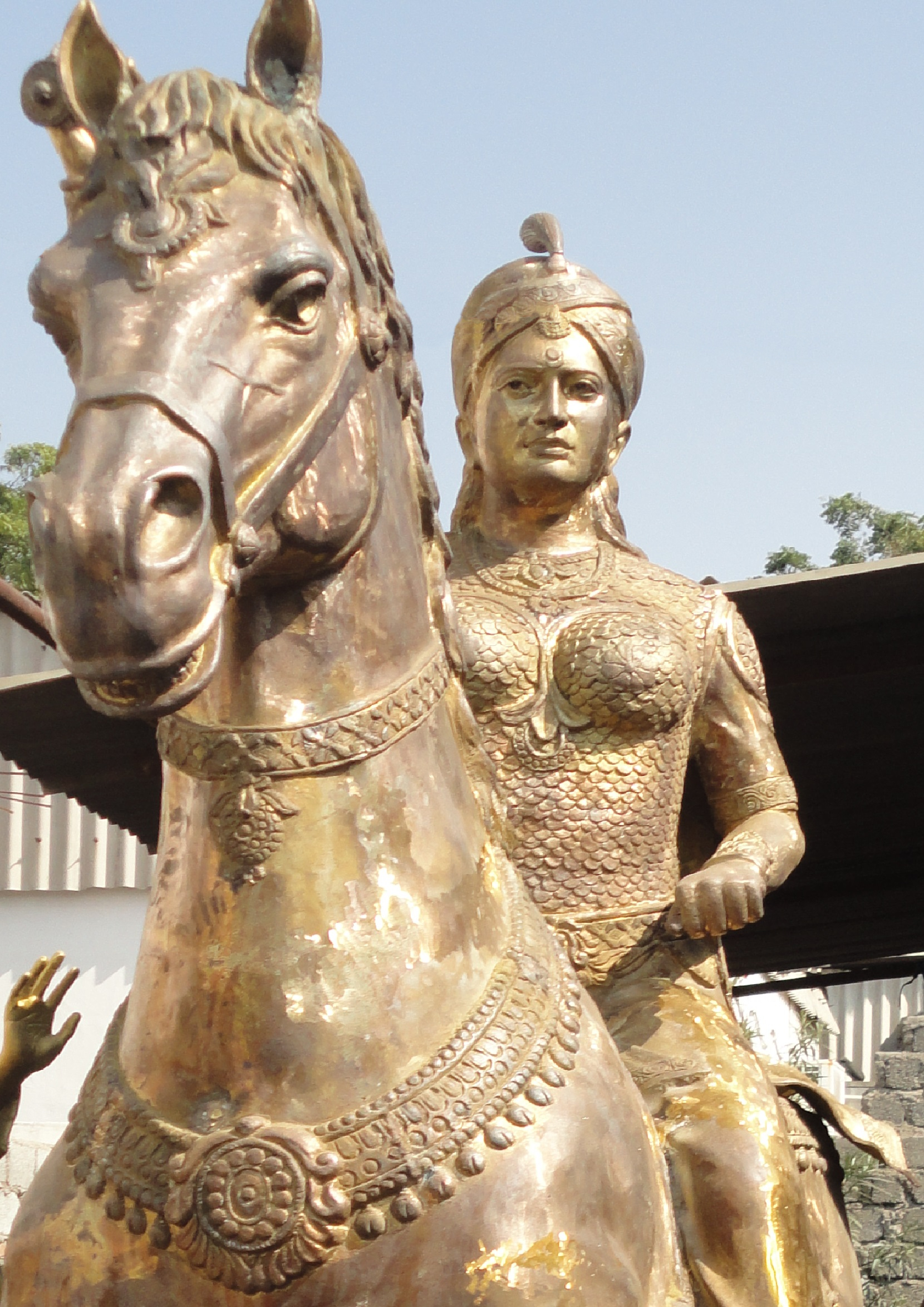 Statue of Rudrama Devi, the warrior-queen of the Kakatiya Empire
 -
 Rani Durgavati was the queen of Gondwana from 1550 until 1564 CE. She resisted the forces of Mughal emperor Akbar.
 -
 Statue of warrior-queen Abbakka Chowta in Ullal


Rudrama Devi was a monarch of the Kakatiya dynasty in the Deccan Plateau with capital at Warangal of present-day Telangana from 1263 until her death. She was one of the few women to rule as monarch in the Indian subcontinent and promoted a male image in order to do so.[10] Akka Mahadevi was a prominent figure of the Veerashaiva Bhakti movement of the 12th century Karnataka. Her Vachanas in Kannada, a form of didactic poetry, are considered her most notable contribution to Kannada Bhakti literature. While, a few centuries later, Meera in northern India, became a leading Hindu mystic poet of the Bhakti movement.[11]
The position of Indian women in society deteriorated during this period.[12][13] Jauhar which became a custom among Rajputs was performed when they were faced with invaders like Turco-Afghans from the 11th century to avoid being enslaved and lose their honor.[14][15] During the conquest of Sindh by Muhammad bin Qasim, Rani Bai and other Rajput women had performed the jauhar.[16][17] It was committed thrice, in Chittor Fort alone, by many of the wives and children of the Rajput soldiers who died in battles at Chittorgarh Fort. The first time was led by Rani Padmini, wife of Ratnasimha, who was killed in the battle in 1303, and later, by Rani Karnavati in 1537.[18]
The zenana was a Persian tradition brought in by the invading Muslims. Although originally only a feature of the courts of Muslim dynasties, it was also adopted by Hindu royal families. While separate spaces for women sometimes did exist in the ancient period, they didn't become a norm until the Muslim period. Under Akbar, there was a marked focus on secluding women and the creation of harems. This policy of Mughals was also emulated later by others like Chakma Raj and the Sikh kingdoms in Punjab.[19][20]
The rights of a Muslim woman were impacted by the custom of hijab or purdah in Persian. Despite this, women took part in arts, writing, rites and rode horses while their habits sometimes swayed from the opinion of the ulama. The hijab and burqah was a practice in West Asia and became a part of regal practice under the Delhi Sultanate and Mughal Empire. The practice of purdah was later emulated by Hindus in North India.[21] The queens often played a part in imperial politics behind the scene. In South India, some communities who adopted Islam have continued their ancestral matrilinear traditions like the Mappila. Ibn Battuta in the Muslim principality of Hannaur, witnessed 13 schools teaching Muslim women. Both genders were taught by mullahs, however, lower-classes were more uneducated.[22]
-
 Tarabai, the regent of the Maratha Empire
 -
 Velu Nachiyar was one of the earliest Indian queens to fight against the British colonial power in India.
 -
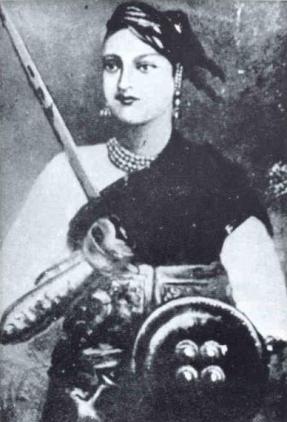 Lakshmibai, the Rani of Maratha-ruled Jhansi, one of the principal leaders of the Indian rebellion of 1857


The observance of purdah was not strict among the Turks. Among the reasons considered for its use are that it represented an elite status during the Muslim period and was also used to guard women and men from looking at each other with lust, and as during this period the rulers and nobility sometimes engaged in debauchery and excesses.[23][24] Muslim nobility often engaged in lustful debauchery, concubines were not regarded as a shameful act, but a status of wealth.[25] However, purdah was imposed by sultan Firuz Tughlaq. Akbar made it a rule that those women roaming without a veil be made a prostitute. He also directed that they should live within their house and travel under the supervision of a male. The upper-class women were better-off due to private education and entertainment. The purdah system became weaker as the Mughal empire declined.[26] However, there were cases of women often becoming prominent in the fields of politics, literature, education, and religion also during this period.[12] Razia Sultana (1205–1240) became the only woman monarch to have ever ruled Delhi.
The Gond Rani Durgavati (1524–1564) ruled for fifteen years before losing her life in a battle with Mughal emperor Akbar's general Asaf Khan in 1564. Chand Bibi defended Ahmednagar against the powerful Mughal forces of Akbar in the 1590s. Jehangir's wife Nur Jehan effectively wielded imperial power, and was recognised as the real power behind the Mughal throne. The Mughal princesses Jahanara and Zebunnissa were well-known poets, and also influenced the ruling powers. Abbakka Chowta was the first Tuluva Queen of Ullal who fought the Portuguese in the latter half of the 16th century. Shivaji's mother, Jijabai, was queen regent because of her ability as a warrior and an administrator. Tarabai was another female Maratha ruler. Keladi Chennamma fought against Bijapur Sultanate and defying Mughal emperor Aurangzeb. Onake Obavva was a woman who fought the forces of Hyder Ali single-handedly with a pestle (Onake)[27] in the kingdom of Chitradurga. Mai Sukhan, with her small Sikh forces, strongly defended the town of Amritsar against external forces. While, Velu Nachiyar, was one of the earliest Indian queens to fight against the British colonial power in India. Kittur Chennamma was the Rani of Kittur, who led an armed force against the British East India Company in 1824 in defiance of the doctrine of lapse in an attempt to maintain Indian control over the region, but was defeated in the third war and died imprisoned. In South India, many women administered villages, towns, and divisions, and ushered in new social and religious institutions.[28] Lakshmibai, the Rani of Maratha-ruled Jhansi, one of the principal leaders of the rebellion who earlier had lost her kingdom as a result of the Doctrine of Lapse.
British rule[edit | edit source]
-

-
 Pandita Ramabai was a social reformer, and a pioneer in the education and emancipation of women in India.


During the British Raj, many reformers such as Ram Mohan Roy, Dayanand Saraswati, Ishwar Chandra Vidyasagar and Jyotirao Phule fought for the betterment of women. Peary Charan Sarkar, a former student of Hindu College, Calcutta and a member of "Young Bengal", set up the first free school for girls in India in 1847 in Barasat, a suburb of Calcutta (later the school was named Kalikrishna Girls' High School).
While this might suggest that there was no positive British contribution during the Raj era, that is not entirely the case. Missionaries' wives such as Martha Mault née Mead and her daughter Eliza Caldwell née Mault are rightly remembered for pioneering the education and training of girls in south India. This practice was initially met with local resistance, as it flew in the face of tradition. Raja Rammohan Roy's efforts led to the abolition of Sati under Governor-General William Cavendish-Bentinck in 1829. Ishwar Chandra Vidyasagar's crusade for improvement in the situation of widows led to the Widow Remarriage Act of 1856. Many women reformers such as Pandita Ramabai also helped the cause of women.
-
 An image of a Rajput bride
 -

-


.jpg)
Kittur Chennamma, queen of the princely state Kittur in Karnataka,[31] led an armed rebellion against the British in response to the Doctrine of lapse. Rani Lakshmi Bai, the Queen of Jhansi, led the Indian Rebellion of 1857 against the British. She is now widely considered as a national hero. Begum Hazrat Mahal, the co-ruler of Awadh, was another ruler who led the revolt of 1857. She refused deals with the British and later retreated to Nepal. The Begums of Bhopal were also considered notable female rulers during this period. They were trained in martial arts. Chandramukhi Basu, Kadambini Ganguly and Anandi Gopal Joshi were some of the earliest Indian women to obtain a degree.
In 1917, the first women's delegation met the Secretary of State to demand women's political rights, supported by the Indian National Congress. The All India Women's Education Conference was held in Pune in 1927, it became a major organisation in the movement for social change.[32][33] In 1929, the Child Marriage Restraint Act was passed, stipulating fourteen as the minimum age of marriage for a girl.[32][34][full citation needed] Mahatma Gandhi, himself a victim of child marriage at the age of thirteen, he later urged people to boycott child marriages and called upon young men to marry child widows.[35]
Post-Independence (1947 CE – present)[edit | edit source]
.PNG)
.jpg)

_(cropped).jpg)
Women have served as heads of state and government in India, Sri Lanka, Pakistan and Bangladesh. This includes:
- Sirimavo Bandaranaike, former Prime Minister of Sri Lanka
- Indira Gandhi, former Prime Minister of India
- Benazir Bhutto, former Prime Minister of Pakistan
- Khaleda Zia, former Prime Minister of Bangladesh
- Chandrika Kumaratunga, former President of Sri Lanka
- Pratibha Patil, former President of India
- Sheikh Hasina, former Prime Minister of Bangladesh
- Droupadi Murmu, current President of India
References[edit | edit source]
- ↑ Varttika by Katyayana, 125, 2477
- ↑ Comments to Ashtadhyayi 3.3.21 and 4.1.14 by Patanjali
- ↑ 3.0 3.1 Gouri Srivastava (2000). Women's Higher Education in the 19th Century. Concept Publishing Company. pp. 37–. ISBN 978-81-7022-823-3.
- ↑ Majumdar, R.C.; Pusalker, A.D. (1951). "Chapter XX: Language and literature". In Majumdar, R.C.; Pusalker, A.D. (eds.). The history and culture of the Indian people, volume I, the Vedic age. Bombay: Bharatiya Vidya Bhavan. p. 394. OCLC 500545168.
- ↑ H. C. Raychaudhuri (1972), Political History of Ancient India, Calcutta: University of Calcutta, p.67–68.
- ↑ Jain, J.C. (1984). Life in Ancient India: As Depicted in the Jain Canon and Commentaries, 6th Century BC to 17th Century AD. Munshiram Manoharlal. p. 470. Retrieved 2018-07-16.
- ↑ 7.0 7.1 7.2 Altekar, A.S. (1956). The Position of Women in Hindu Civilization, from Prehistoric Times to the Present Day. Motilal Banarsidass. p. 187. ISBN 978-81-208-0324-4. Retrieved 2018-07-16.
- ↑ Tryambakayajvan (1995). Stridharmapaddhati [The perfect wife (guide to the duties of women)]. Julia Leslie (translator). New Delhi New York: Penguin Books. ISBN 9780140435986.
- ↑ Altekar 1957 p.186
- ↑ Ramusack, Barbara N.; Sievers, Sharon L. (1999). Women in Asia: Restoring Women to History. Indiana University Press. p. 37. ISBN 978-0-25321-267-2.
- ↑ Neeti Sadarangani (2004), Bhakti Poetry in Medieval India: Its Inception, Cultural Encounter and Impact, Sarup & Sons, ISBN 978-8176254366, pages 76–80
- ↑ 12.0 12.1 "Women in history". nrcw.nic.in. National Resource Center for Women. Archived from the original on 19 June 2009. Retrieved 24 December 2006.
- ↑ Mishra, R. C. (2006). Women in India: towards gender equality. New Delhi: Authorspress. ISBN 9788172733063. Details.
- ↑ India: The Ancient Past: A History of the Indian Subcontinent from c. 7000 BCE to CE 1200. Routledge. 2016. p. 232. ISBN 9781317236733.
- ↑ Sati, the Blessing and the Curse: The Burning of Wives in India. Oxford University Press. 1994. pp. 189, 165. ISBN 9780195360226.
- ↑ Farooqui Salma Ahmad (2011). A Comprehensive History of Medieval India: From Twelfth to the Mid-Eighteenth Century. Pearson Education India. p. 44. ISBN 9788131732021.
- ↑ Jaswant Lal Mehta (1994). Advanced Study in the History of Medieval India. Sterling Publishers. p. 189. ISBN 9788120706170.
- ↑ "Indian States and Union Territories". Places of Interest in Rajasthan: Chittorgarh. Retrieved 24 June 2009.
- ↑ Angma Dey Jhalala (2015). Courtly Indian Women in Late Imperial India. Routledge. pp. 7–8. ISBN 9781317314448.
- ↑ Khan, Mazhar-ul-Haq (1972). Purdah and Polygamy: a study in the social pathology of the Muslim society. Nashiran-e-Ilm-o-Taraqiyet. p. 68.
The zenana or female portion of a Muslim house
- ↑ Sita Anantha Ramana (2009). Women in India: A Social and Cultural History - Volume 2. ABC-CLIO. pp. 2, 5, 9–10.
- ↑ Sita Anantha Ramana (2009). Women in India: A Social and Cultural History - Volume 2. ABC-CLIO. pp. 12–14, 22.
- ↑ Sudha Sharma (2016). The Status of Muslim Women in Medieval India. SAGE Publications. pp. 159–160. ISBN 9789351505679.
- ↑ Dushka Sayid (1998). Muslim Women of the British Punjab: From Seclusion to Politics. Springer. p. 79. ISBN 9781349268856.
- ↑ Awadh Buhari Pandey (1970). Early Medieval India. Central Book Depot. p. 324.
- ↑ Sudha Sharma (2016). The Status of Muslim Women in Medieval India. SAGE Publications. pp. 163–165. ISBN 9789351505679.
- ↑ Cathy Spagnoli, Paramasivam Samanna (1999). Jasmine and Coconuts: South Indian Tales (1999 ed.). Englewood, USA: Greenwood Publishing Group. ISBN 9781563085765. Retrieved 10 September 2012.
- ↑ Kamat, Jyotsana (January 2006). "Status of women in medieval Karnataka (blog)". kamat.com. Kamat's Potpourri. Retrieved 24 December 2006.
- ↑ McNeill, Leila (24 August 2017). "This 19th Century "Lady Doctor" Helped Usher Indian Women into Medicine". Smithsonian.
- ↑ London Missionary Society, ed. (1869). Fruits of Toil in the London Missionary Society. London: John Snow & Co. p. 12. OCLC 746963117. Retrieved 12 September 2016.
- ↑ Saraswati English Plus. New Saraswati House. p. 47.
- ↑ 32.0 32.1 Madhok, Sujata. "Women: Background & Perspective". InfoChange India. Archived from the original on 24 July 2008. Retrieved 24 December 2006.
- ↑ Nelasco, Shobana (2010). Status of women in India. New Delhi: Deep & Deep Publications. p. 11. ISBN 9788184502466.
- ↑ Ambassador of Hindu Muslim Unity, Ian Bryant Wells
- ↑ Kamat, Jyotsana (19 December 2006). "Gandhi and status of women (blog)". kamat.com. Kamat's Potpourri. Retrieved 24 December 2006.