







Ajay Kumar (talk | contribs) Created a new article |
corrected details additionally and improved wording for accuracy |
||
| Line 1: | Line 1: | ||
{{short description|Cultural syncretism in Central and South Asia in antiquity}} | {{short description|Cultural syncretism in Central and South Asia in antiquity}} | ||
{{Distinguish|Buddhism in Greece}} | |||
{{Use dmy dates|date=June 2025}} | |||
[[File:Gandhara Buddha (tnm).jpeg|thumb|[[Gautama Buddha]] in [[Greco-Buddhist art|Greco-Buddhist style]], 1st–2nd century AD, [[Gandhara]] (Peshawar basin, modern day Pakistan).]] | [[File:Gandhara Buddha (tnm).jpeg|thumb|[[Gautama Buddha]] in [[Greco-Buddhist art|Greco-Buddhist style]], 1st–2nd century AD, [[Gandhara]] (Peshawar basin, modern day Pakistan).]] | ||
{{Buddhism}} | {{Buddhism}} | ||
[[File:Buddhist Expansion.svg|thumb|upright=1.5|[[Silk Road transmission of Buddhism|Buddhist expansion in Asia]]: [[Mahayana Buddhism]] [[Chinese Buddhism#History|first entered]] the [[Chinese Empire]] ([[Han dynasty#Religion, cosmology, and metaphysics|Han dynasty]]) through [[Silk Road]] during the [[Kushan Empire|Kushan Era]]. The overland and [[Maritime Southeast Asia|maritime]] "Silk Roads" were interlinked and complementary, forming what scholars have called the "great circle of Buddhism".<ref>{{cite encyclopedia |author-last=Acri |author-first=Andrea |date=20 December 2018 |title=Maritime Buddhism |url=https://oxfordre.com/religion/view/10.1093/acrefore/9780199340378.001.0001/acrefore-9780199340378-e-638 |encyclopedia=Oxford Research Encyclopedia of Religion |location=[[Oxford]] |publisher=[[Oxford University Press]] |doi=10.1093/acrefore/9780199340378.013.638 |isbn=9780199340378 |doi-access= |archive-url=https://web.archive.org/web/20190219153342/https://oxfordre.com/religion/view/10.1093/acrefore/9780199340378.001.0001/acrefore-9780199340378-e-638 |archive-date=19 February 2019 |url-status=live |access-date=30 May 2021|url-access=subscription }}</ref>]] | |||
'''Greco-Buddhism''' or '''Graeco-Buddhism''' was [[Buddhism]] within the [[Hellenistic period]] of [[South Asia|South]] and [[Central Asia]], resulting in Greek cultural [[syncretism]] developing between the 4th century BC and the 5th century AD in [[Gandhara]], which is located in present-day [[Pakistan]] and parts of north-east [[Afghanistan]].<ref name=":0">{{Cite book |last=Kubica |first=Olga |title=Greco-Buddhist Relations in the Hellenistic Far East. Sources and Contexts |publisher=Taylor & Francis Ltd |year=2023 |isbn=978-1-032-19302-1 |pages=4}}</ref><ref name=":3">{{Cite book |last=Halkias |first=Georgios T. |title=Religions and trade: religious formation, transformation and cross-cultural exchange between East and West |date=2014 |publisher=Brill |isbn=978-90-04-25528-9 |editor-last=Wick |editor-first=Peter |series=Dynamics in the history of religions |location=Leiden Boston (Mass.) |page=106 |chapter=When the Greeks Converted the Buddha: Asymmetrical Transfers of Knowledge in Indo-Greek Cultures |editor-last2=Rabens |editor-first2=Volker}}</ref><ref>{{Cite book |last=Bhaskar |first=V. S. |url=https://books.google.com/books?id=C19Pn4HKq-MC&pg=PA197 |title=Faith & Philosophy of Buddhism |date=2009 |publisher=Gyan Publishing House |isbn=978-81-7835-722-5 |language=en |access-date=18 May 2022 |archive-date=15 January 2023 |archive-url=https://web.archive.org/web/20230115070730/https://books.google.com/books?id=C19Pn4HKq-MC&pg=PA197 |url-status=live }}</ref> While the [[Greco-Buddhist art]] shows clear Hellenistic influences, the majority of scholars do not assume a noticeable Greek influence on [[Gandharan Buddhism]] beyond the artistic realm.<ref name=":4" /><ref name=":5" /><ref name=":6">{{Cite book |last=Salomon |first=Richard |title=Ancient Buddhist Scrolls from Ghandāra: The British Library Kharosthī Fragments |date=1999 |publisher=University of Washington Press |isbn=978-0-295-97769-0 |location=Washington (Wash.) |pages=5}}</ref><ref name=":7" /><ref name=":8" /><ref name=":9" /> | |||
Following the collapse of the Mauryan Empire, | Cultural interactions between ancient Greece and Buddhism date back to Greek forays into the [[Indian subcontinent]] from the time of [[Alexander the Great]]. A few years after Alexander's death, the Easternmost parts of the [[Seleucid Empire|empire of his general Seleucus]] were lost in a war to the [[Mauryan Empire]], under [[Chandragupta Maurya]]. The Mauryan [[Emperor Ashoka]] converted to Buddhism and helped spread the religion throughout his domain, as recorded in the [[Edicts of Ashoka]]. Thus, Buddhism reached the [[Greco-Bactrian Kingdom|Greco-Bactrian kingdom]], a successor of the Seleucid Empire. | ||
Following the collapse of the Mauryan Empire, Buddhism continued to flourish under the [[Greco-Bactrian Kingdom]], [[Indo-Greek Kingdoms]], and [[Kushan Empire]]. [[Mahayana Buddhism]] was spread from the [[Gangetic plains]] in India into [[Gandhara]], and then into [[Central Asia]] during the Mauryan Era, where it became the most prevalent branch of Buddhism in Central Asia. Mahayana Buddhism was later [[Silk Road transmission of Buddhism|transmitted through the Silk Road]] into the [[Han dynasty]] during the Kushan period, in the reign of Emperor [[Kanishka]]. Buddhist tradition details the monk, [[Majjhantika]] of [[Varanasi]], was made responsible for spreading Buddhism in the region by Emperor Ashoka. Later on, the [[Greco-Bactrian Kingdom|Greco-Bactrian]] and [[Indo-Greek Kingdom|Indo-Greek]] king [[Menander I]], who may have converted to Buddhism, supported the spread of the religion as well. | |||
==Historical outline== | ==Historical outline== | ||
{{Main|History of Buddhism}} | {{Main|History of Buddhism}} | ||
{{More citations needed section|date=February 2021}} | {{More citations needed section|date=February 2021}} | ||
[[File:Map of the Indo-Greeks.png|thumb|upright=1.4|The Indo-Greek Kingdoms in 100–150 BC.<ref>{{cite book |last1=Schwartzberg |first1=Joseph E. |title=A Historical atlas of South Asia |date=1978 |publisher=University of Chicago Press |location=Chicago |page=145, map XIV.1 (d) |isbn=0226742210 |url=https://dsal.uchicago.edu/reference/schwartzberg/pager.html?object=182 |access-date=2022 | [[File:Map of the Indo-Greeks.png|thumb|upright=1.4|The Indo-Greek Kingdoms in 100–150 BC.<ref>{{cite book |last1=Schwartzberg |first1=Joseph E. |title=A Historical atlas of South Asia |date=1978 |publisher=University of Chicago Press |location=Chicago |page=145, map XIV.1 (d) |isbn=0226742210 |url=https://dsal.uchicago.edu/reference/schwartzberg/pager.html?object=182 |access-date=11 May 2022 |archive-date=5 October 2022 |archive-url=https://web.archive.org/web/20221005120122/https://dsal.uchicago.edu/reference/schwartzberg/pager.html?object=182 |url-status=live }}</ref><ref>{{cite book|last=Davies|first=Cuthbert Collin|title=An Historical Atlas of the Indian Peninsula|publisher=Oxford University Press|year=1959}}</ref><ref>{{cite book|last=Narain|first=A.K.|title=The Coin Types of the Indo-Greek Kings, 256-54 B.C.|publisher=Ares|year=1976|isbn=0-89005-109-7}}</ref><ref>{{cite book |first1=Hans Erich |last1=Stier |first2=Ernst |last2=Kirsten |first3=Ekkehard |last3=Aner |title=Grosser Atlas zur Weltgeschichte: Vorzeit, Altertum, Mittelalter, Neuzeit |publisher=Georg Westermann Verlag |year=1978 |isbn=3-14-100919-8 }}</ref>]] | ||
The introduction of [[Hellenistic Greece]] to central Asia started after the conquest of that region by [[Darius the Great]] and his Persian [[Achaemenid Empire]]. He and his successors also conquered the [[Anatolian peninsula]], which at the time was inhabited by many Greek cultures. When they rebelled, those Greeks were often ethnically cleansed by being relocated to the far end of the Persian Empire, those central Asian provinces. When [[Alexander the Great]] conquered Achaemenid Empire and further regions of [[Central Asia]] in 334 BC, he thus encountered many Greeks already established in the easternmost stretches of its empire. He then ventured into [[Punjab]] (land of five rivers). Alexander crossed the [[Indus River|Indus]] and [[Jhelum River]] when defeating Porus and appointing him as a satrap following the [[Battle of the Hydaspes]]. Alexander's army would mutiny and retreat along the [[Beas River]] when confronted by the [[Nanda Empire]], thus | The introduction of [[Hellenistic Greece]] to central Asia started after the conquest of that region by [[Darius the Great]] and his Persian [[Achaemenid Empire]]. He and his successors also conquered the [[Anatolian peninsula]], which at the time was inhabited by many Greek cultures. When they rebelled, those Greeks were often ethnically cleansed by being relocated to the far end of the Persian Empire, those central Asian provinces. When [[Alexander the Great]] conquered Achaemenid Empire and further regions of [[Central Asia]] in 334 BC, he thus encountered many Greeks already established in the easternmost stretches of its empire. He then ventured into [[Punjab]] (land of five rivers). Alexander crossed the [[Indus River|Indus]] and [[Jhelum River]] when defeating Porus and appointing him as a satrap following the [[Battle of the Hydaspes]]. Alexander's army would mutiny and retreat along the [[Beas River]] when confronted by the [[Nanda Empire]], thus would not conquer Punjab entirely. | ||
Thanks to relocation by the Persian Empire, there was established Greek culture in the far east of Alexander's empire. He founded several cities in his new territories in the areas of the [[Amu Darya]] and [[Bactria]], and Greek settlements further extended to the [[Khyber Pass]], [[Gandhara]] (see [[Taxila (modern)|Taxila]]), and the [[Punjab]]. Following Alexander's death on June | Thanks to relocation by the Persian Empire, there was established Greek culture in the far east of Alexander's empire. He founded several cities in his new territories in the areas of the [[Amu Darya]] and [[Bactria]], and Greek settlements further extended to the [[Khyber Pass]], [[Gandhara]] (see [[Taxila (modern)|Taxila]]), and the [[Punjab]]. Following Alexander's death on 10 June 323 BC, the [[Diadochi]] or "successors" founded their own kingdoms. General [[Seleucus I Nicator|Seleucus]] set up the [[Seleucid Empire]] in [[Anatolia]] and [[Central Asia]] and extended as far as India. | ||
The [[Mauryan Empire]], founded by [[Chandragupta Maurya]], would first [[Conquest of the Nanda Empire|conquer the Nanda Empire]]. Chandragupta would then defeat the Seleucid Empire during the [[Seleucid-Mauryan War]]. This resulted in the transfer of the Macedonian satraps in the [[Indus Valley]] and [[Gandhara]] to the Mauryan Empire. Furthermore, a marriage alliance was enacted which granted Seleucus's daughter as Chandragupta's wife for diplomatic relations. The conflict additionally led to the transfer of 500 war elephants to the Seleucid Empire from the Mauryan Empire, presumably as reparations for lives lost and damages sustained. | The [[Mauryan Empire]], founded by [[Chandragupta Maurya]], would first [[Conquest of the Nanda Empire|conquer the Nanda Empire]]. Chandragupta would then defeat the Seleucid Empire during the [[Seleucid-Mauryan War]]. This resulted in the transfer of the Macedonian satraps in the [[Indus Valley]] and [[Gandhara]] to the Mauryan Empire. Furthermore, a marriage alliance was enacted which granted Seleucus's daughter as Chandragupta's wife for diplomatic relations. The conflict additionally led to the transfer of 500 war elephants to the Seleucid Empire from the Mauryan Empire, presumably as reparations for lives lost and damages sustained. | ||
| Line 25: | Line 28: | ||
{{quote|Here in the king's domain among the Greeks, the [[Kambojas]], the Nabhakas, the Nabhapamkits, the Bhojas, the Pitinikas, the Andhras, and the Palidas, everywhere people are following Beloved-of-the-Gods' instructions in [[Dharma]].<ref name=" auto">''[[Edicts of Ashoka|Rock Edict Nb13]]'' (S. Dhammika)</ref>}} | {{quote|Here in the king's domain among the Greeks, the [[Kambojas]], the Nabhakas, the Nabhapamkits, the Bhojas, the Pitinikas, the Andhras, and the Palidas, everywhere people are following Beloved-of-the-Gods' instructions in [[Dharma]].<ref name=" auto">''[[Edicts of Ashoka|Rock Edict Nb13]]'' (S. Dhammika)</ref>}} | ||
The decline and overthrow of the Mauryans by the [[Shunga Empire]], and of the revolt of [[Bactria]] in the Seleucid Empire led to the formation of the [[Greco-Bactrian]] Kingdom (250–125 | The decline and overthrow of the Mauryans by the [[Shunga Empire]], and of the revolt of [[Bactria]] in the Seleucid Empire led to the formation of the [[Greco-Bactrian]] Kingdom (250–125 BC). To their north, the Greco-Bactrians were followed by the secession of the [[Indo-Greek Kingdom]] (180 BC – 10 AD). Even when, centuries later, these [[Hellenized]] regions were conquered first by the [[Yuezhi]], then by the [[Indo-Scythians]] and the [[Kushan Empire]] (1st–3rd centuries AD), Buddhism continued to thrive there. | ||
[[Buddhism in India]] was a major religion for centuries until a major Hindu revival from around the 5th century, with remaining strongholds such as [[Bengal]] largely ended during the [[Islamic invasions of India]]. | [[Buddhism in India]] was a major religion for centuries until a major Hindu revival from around the 5th century, with remaining strongholds such as [[Bengal]] largely ended during the [[Islamic invasions of India]]. | ||
| Line 35: | Line 38: | ||
The length of the Greek presence in Central Asia and northern India provided opportunities for interaction, not only on the artistic but also on the religious plane. | The length of the Greek presence in Central Asia and northern India provided opportunities for interaction, not only on the artistic but also on the religious plane. | ||
===Alexander the Great in Bactria and India (331–325 | ===Alexander the Great in Bactria and India (331–325 BC)=== | ||
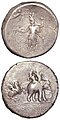
[[File:Alexander victory coin Babylon silver c 322 BCE.jpg|thumb|upright|"Victory coin" of [[Alexander the Great]], minted in [[Babylon]] 322 BC, following his campaigns in [[India]].<br/>'''Obverse''': Alexander being crowned by [[Nike (mythology)|Nike]].<br/>'''Reverse''': Alexander attacking [[King Porus]] on his elephant.<br/>Silver. [[British Museum]].]] | [[File:Alexander victory coin Babylon silver c 322 BCE.jpg|thumb|upright|"Victory coin" of [[Alexander the Great]], minted in [[Babylon]] 322 BC, following his campaigns in [[ancient India]].<br/>'''Obverse''': Alexander being crowned by [[Nike (mythology)|Nike]].<br/>'''Reverse''': Alexander attacking [[King Porus]] on his elephant.<br/>Silver. [[British Museum]].]] | ||
When Alexander invaded [[Bactria]] and Gandhara, these areas may already have been under [[Śramaṇa|Sramanic]] influence, likely Buddhist and [[Jainism|Jain]]. According to a legend preserved in the [[Pali Canon]], two [[merchant]] brothers from [[Kamsabhoga]] in Bactria, Tapassu and Bhallika, visited Gautama Buddha and became his disciples. The legend states that they then returned home and spread the Buddha's teaching.<ref>Foltz, ''Religions of the Silk Road'', p. 43</ref> In 326 BC, Alexander conquered the Northern region of India. King Ambhi of Taxila, known as [[Taxiles]], surrendered his city, a notable Buddhist center, to Alexander. Alexander fought | When Alexander invaded [[Bactria]] and Gandhara, these areas may already have been under [[Śramaṇa|Sramanic]] influence, likely Buddhist and [[Jainism|Jain]]. According to a legend preserved in the [[Pali Canon]], two [[merchant]] brothers from [[Kamsabhoga]] in Bactria, Tapassu and Bhallika, visited Gautama Buddha and became his disciples. The legend states that they then returned home and spread the Buddha's teaching.<ref>Foltz, ''Religions of the Silk Road'', p. 43</ref> In 326 BC, Alexander conquered the Northern region of India. King Ambhi of Taxila, known as [[Taxiles]], surrendered his city, a notable Buddhist center, to Alexander. Alexander fought a battle against [[King Porus]] of [[Pauravas]] in Punjab, the [[Battle of the Hydaspes]] in 326 BC. | ||
===Mauryan | ===Mauryan Empire (322–183 BC)=== | ||
{{See also|Greco-Buddhist monasticism}} | {{See also|Greco-Buddhist monasticism}} | ||
The [[Mauryan Empire]] would later defeat the successor Seleucid Empire, during the [[Seleucid-Mauryan War]]. Resulting in the transfer of the [[satrap|satraps]] in the [[Indus Valley]] and [[Gandhara]], that had been part of the [[Achaemenid Empire|Achaemenid]], [[Macedonia (ancient kingdom)|Macedonian]] and [[Seleucid Empire|Seleucidian]], to the Mauryan Empire. However, contacts were kept with his Greco-Iranian neighbors in the [[Seleucid Empire]]. Emperor [[Seleucus I Nicator]] came to a marital agreement as part of a peace treaty,<ref>"The whole region from Phrygia to the Indus was subject to Seleucus. He crossed the Indus and waged war with Sandrocottus [Chandragupta], king of the Indians, who dwelt on the banks of that stream until they came to an understanding with each other and contracted a marriage relationship. Some of these exploits were performed before the death of Antigonus and some afterward." [[Appian]] ''History of Rome'', The Syrian Wars [https://www.livius.org/ap-ark/appian/appian_syriaca_11.html 55] {{Webarchive|url=https://web.archive.org/web/20151020015612/http://www.livius.org/ap-ark/appian/appian_syriaca_11.html |date=2015 | The [[Mauryan Empire]] would later defeat the successor Seleucid Empire, during the [[Seleucid-Mauryan War]]. Resulting in the transfer of the [[satrap|satraps]] in the [[Indus Valley]] and [[Gandhara]], that had been part of the [[Achaemenid Empire|Achaemenid]], [[Macedonia (ancient kingdom)|Macedonian]] and [[Seleucid Empire|Seleucidian]], to the Mauryan Empire. However, contacts were kept with his Greco-Iranian neighbors in the [[Seleucid Empire]]. Emperor [[Seleucus I Nicator]] came to a marital agreement as part of a peace treaty,<ref>"The whole region from Phrygia to the Indus was subject to Seleucus. He crossed the Indus and waged war with Sandrocottus [Chandragupta], king of the Indians, who dwelt on the banks of that stream until they came to an understanding with each other and contracted a marriage relationship. Some of these exploits were performed before the death of Antigonus and some afterward." [[Appian]] ''History of Rome'', The Syrian Wars [https://www.livius.org/ap-ark/appian/appian_syriaca_11.html 55] {{Webarchive|url=https://web.archive.org/web/20151020015612/http://www.livius.org/ap-ark/appian/appian_syriaca_11.html |date=20 October 2015 }}</ref> and several Greeks, such as the historian [[Megasthenes]], resided at the Mauryan court. | ||
[[File:Pataliputra Palace capital by L A Waddell 1895.jpg|thumb|upright|The [[Hellenistic]] [[Pataliputra capital]], discovered in [[Pataliputra]], capital of the [[Maurya Empire]], dated to the 3rd century BC.]] | [[File:Pataliputra Palace capital by L A Waddell 1895.jpg|thumb|upright|The [[Hellenistic]] [[Pataliputra capital]], discovered in [[Pataliputra]], capital of the [[Maurya Empire]], dated to the 3rd century BC.]] | ||
| Line 53: | Line 56: | ||
Ashoka also claims he converted to Buddhism Greek populations within his realm: | Ashoka also claims he converted to Buddhism Greek populations within his realm: | ||
{{quote|Here in the king's domain among the Greeks, the [[Kambojas]], the Nabhakas, the Nabhapamkits, the Bhojas, the Pitinikas, the Andhras and the Palidas, everywhere people are following Beloved-of-the-Gods' instructions in [[Dharma]].<ref name="auto"/>}} | {{quote|Here in the king's domain among the Greeks, the [[Kambojas]], the Nabhakas, the Nabhapamkits, the Bhojas, the Pitinikas, the Andhras and the Palidas, everywhere people are following Beloved-of-the-Gods' instructions in [[Dharma]].<ref name="auto"/>}} | ||
Finally, some of the emissaries of Ashoka, such as the famous [[Dharmaraksita]], are described in [[Pali]] sources as leading Greek ("[[Yona]]") Buddhist monks active in Buddhist proselytism (the [[Mahavamsa]], XII<ref>{{cite web|url=http://lakdiva.org/mahavamsa/chap012.html|title=Chapter XII|date=20 October 2014|archive-url=https://web.archive.org/web/20141020052522/http://lakdiva.org/mahavamsa/chap012.html|archive-date=2014 | Finally, some of the emissaries of Ashoka, such as the famous [[Dharmaraksita]], are described in [[Pali]] sources as leading Greek ("[[Yona]]") Buddhist monks active in Buddhist proselytism (the [[Mahavamsa]], XII<ref>{{cite web|url=http://lakdiva.org/mahavamsa/chap012.html|title=Chapter XII|date=20 October 2014|archive-url=https://web.archive.org/web/20141020052522/http://lakdiva.org/mahavamsa/chap012.html|archive-date=20 October 2014}}</ref>), founding the eponymous [[Dharmaguptaka]] school of Buddhism.<ref>{{cite web|url=http://www.congress-on-buddhist-women.org/index.php?id=62|title=Abstract Sujato: Sects & Sectarianism|website=www.congress-on-buddhist-women.org|access-date=25 December 2015|archive-date=18 December 2019|archive-url=https://web.archive.org/web/20191218065734/http://www.congress-on-buddhist-women.org/index.php?id=62|url-status=dead}}</ref> | ||
===Greek presence in Bactria (325–125 | ===Greek presence in Bactria (325–125 BC)=== | ||
{{Main|Greco-Bactrian Kingdom}} | {{Main|Greco-Bactrian Kingdom}} | ||
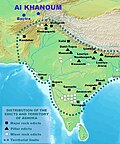
[[File:AiKhanoumAndIndia.jpg|thumb | [[File:AiKhanoumAndIndia.jpg|thumb|The [[Greco-Bactrian Kingdom|Greco-Bactrian]] city of [[Ai-Khanoum]] ({{circa|300}}–145 BC) was located at the doorstep of [[ancient India]].]] | ||
Alexander had established in Bactria several cities (such as [[Ai-Khanoum]] and [[Bagram]]) and an administration that were to last more than two centuries under the [[Seleucid Empire]] and the [[Greco-Bactrian Kingdom]], all the time in direct contact with Indian territory. The Greeks sent ambassadors to the court of the [[Maurya Empire]], such as the historian [[Megasthenes]] under [[Chandragupta Maurya]], and later [[Deimachus]] under his son [[Bindusara]], who reported extensively on the civilization of the Indians. Megasthenes sent detailed reports on Indian religions, which were circulated and quoted throughout the Classical world for centuries:<ref>Surviving fragments of Megasthenes: [https://web.archive.org/web/20081210080315/http://www.mssu.edu/projectsouthasia/history/primarydocs/Foreign_Views/GreekRoman/Megasthenes-Indika.htm Full text]</ref> | |||
{{quote|Megasthenes makes a different division of the philosophers, saying that they are of two kinds, one of which he calls the [[Brahmin|Brachmanes]], and the other the [[Sramana|Sarmanes]]...|source=[[Strabo]] XV. 1. 58-60<ref name="Strabo XV.1"/>}} | |||
The Greco-Bactrians maintained a strong Hellenistic culture at the door of India during the rule of the Maurya Empire in India, as exemplified by the archaeological site of [[Ai-Khanoum]]. When the Maurya Empire was toppled by the [[Shunga Empire]] around 180 BC, the Greco-Bactrians expanded into India, where they established the [[Indo-Greek Kingdom]], under which Buddhism was able to flourish. | The Greco-Bactrians maintained a strong Hellenistic culture at the door of India during the rule of the Maurya Empire in India, as exemplified by the archaeological site of [[Ai-Khanoum]]. When the Maurya Empire was toppled by the [[Shunga Empire]] around 180 BC, the Greco-Bactrians expanded into India, where they established the [[Indo-Greek Kingdom]], under which Buddhism was able to flourish. | ||
===Indo-Greek Kingdom and Buddhism (180 | ===Indo-Greek Kingdom and Buddhism (180 BC – 10 AD)=== | ||
{{Main|Indo-Greek Kingdom}} | {{Main|Indo-Greek Kingdom}} | ||
[[File:Greek Gods and Dharmachakra.jpg|thumb| | [[File:Greek Gods and Dharmachakra.jpg|thumb|upright=1.5|Greek Gods and the "Wheel of the Law" or [[Dharmachakra]]: '''Left:''' [[Zeus]] holding [[Nike (mythology)|Nike]], who hands a victory [[wreath]] over a Dharmachakra (coin of [[Menander II]]). '''Right:''' Divinity wearing [[chlamys]] and [[petasus]] pushing a Dharmachakra, with legend "He who sets in motion the Wheel of the Law" ([[Tillya Tepe Buddhist coin]]).]] | ||
[[Northern India]] was the Indo-Greek Kingdom, centered approximately around [[Alexandria Eschate]]. They controlled various areas of the northern Indian territory until 10 AD. Buddhism prospered under the Indo-Greek kings, and it has been suggested that their invasion of India was intended to protect the Buddhist faith from the religious persecutions of the [[Shunga Empire|Shungas]] (185–73 BC), who had overthrown the Mauryans. [[Zarmanochegas]] was a śramana (possibly, but not necessarily a Buddhist) who, according to ancient historians such as [[Strabo]], [[Cassius Dio]], and [[Nicolaus of Damascus]] traveled to [[Antioch]] and [[Athens]] while [[Augustus]] (died 14 AD) was ruling the [[Roman Empire]].<ref name="perseus.tufts.edu">Strabo, xv, 1, [https://www.perseus.tufts.edu/cgi-bin/ptext?doc=Perseus%3Atext%3A1999.01.0239&layout=&loc=15.1.73 on the immolation of the Sramana in Athens (Paragraph 73)] {{Webarchive|url=https://web.archive.org/web/20081004061428/http://www.perseus.tufts.edu/cgi-bin/ptext?doc=Perseus%3Atext%3A1999.01.0239&layout=&loc=15.1.73 |date=4 October 2008 }}.</ref><ref name="liv, 9">[[Dio Cassius]], [https://penelope.uchicago.edu/Thayer/E/Roman/Texts/Cassius_Dio/54*.html#9 liv, 9] {{Webarchive|url=https://web.archive.org/web/20220925090709/https://penelope.uchicago.edu/Thayer/E/Roman/Texts/Cassius_Dio/54%2A.html#9 |date=25 September 2022 }}.</ref> | |||
Buddhism prospered under the Indo-Greek kings, and it has been suggested that their invasion of India was intended to protect the Buddhist faith from the religious persecutions of the [[Shunga Empire|Shungas]] (185–73 | |||
====Coinage==== | ====Coinage==== | ||
The coins of the Indo-Greek king [[Menander I]] ( | The coins of the Indo-Greek king [[Menander I]] (r. 160–135 BC), found from [[Afghanistan]] to central India, bear the inscription "Saviour King Menander" in Greek on the front. Several Indo-Greek kings after Menander, such as [[Zoilos I]], [[Strato I]], [[Heliokles II]], [[Theophilos (king)|Theophilos]], [[Peukolaos]], [[Menander II]], and [[Archebius]] display on their coins the title "Maharajasa Dharmika" (lit. "King of the Dharma") in [[Prakrit]] written in [[Kharoshthi]]. | ||
Some of the coins of Menander I and [[Menander II]] incorporate the Buddhist symbol of the eight-spoked wheel, associated with the Greek symbols of victory, either the palm of victory, or the victory wreath handed over by the goddess [[Nike (mythology)|Nike]]. According to the [[Milinda Panha|Milinda Pañha]], at the end of his reign Menander I became a Buddhist [[arhat]],<ref>Extract of the [[Milinda Panha]]: "And afterwards, taking delight in the wisdom of the Elder, he handed over his kingdom to his son, and abandoning the household life for the houseless state, grew great in insight, and himself attained to [[Arhat|Arahatship]]!" ([[Milinda Panha|The Questions of King Milinda]], Translation by [[Thomas William Rhys Davids|T. W. Rhys Davids]], 1890)</ref> a fact also echoed by [[Plutarch]], who explains that his relics were shared and enshrined.<ref>Plutarch on Menander: "But when one Menander, who had reigned graciously over the Bactrians, died afterwards in the camp, the cities indeed by common consent celebrated his funerals; but coming to a contest about his relics, they were difficultly at last brought to this agreement, that his ashes being distributed, everyone should carry away an equal share, and they should all erect monuments to him." (Plutarch, "Political Precepts" Praec. reip. ger. 28, 6) p147–148 [https://web.archive.org/web/20060220090138/http://oll.libertyfund.org/Texts/Plutarch0206/Morals/0062-05_Bk.pdf Full text]</ref> | Some of the coins of Menander I and [[Menander II]] incorporate the Buddhist symbol of the eight-spoked wheel, associated with the Greek symbols of victory, either the palm of victory, or the victory wreath handed over by the goddess [[Nike (mythology)|Nike]]. According to the [[Milinda Panha|Milinda Pañha]], at the end of his reign Menander I became a Buddhist [[arhat]],<ref>Extract of the [[Milinda Panha]]: "And afterwards, taking delight in the wisdom of the Elder, he handed over his kingdom to his son, and abandoning the household life for the houseless state, grew great in insight, and himself attained to [[Arhat|Arahatship]]!" ([[Milinda Panha|The Questions of King Milinda]], Translation by [[Thomas William Rhys Davids|T. W. Rhys Davids]], 1890)</ref> a fact also echoed by [[Plutarch]], who explains that his relics were shared and enshrined.<ref>Plutarch on Menander: "But when one Menander, who had reigned graciously over the Bactrians, died afterwards in the camp, the cities indeed by common consent celebrated his funerals; but coming to a contest about his relics, they were difficultly at last brought to this agreement, that his ashes being distributed, everyone should carry away an equal share, and they should all erect monuments to him." (Plutarch, "Political Precepts" Praec. reip. ger. 28, 6) p147–148 [https://web.archive.org/web/20060220090138/http://oll.libertyfund.org/Texts/Plutarch0206/Morals/0062-05_Bk.pdf Full text]</ref> | ||
[[File:MenanderChakra.jpg|thumb | [[File:MenanderChakra.jpg|thumb|left|A coin of [[Menander I]] (r. 160–135 BC) with a [[dharmacakra]] and a palm.]] | ||
The ubiquitous symbol of the elephant in Indo-Greek coinage may also have been associated with Buddhism, as suggested by the parallel between coins of [[Antialcidas]] and [[Menander II]], where the elephant in the coins of Antialcidas holds the same relationship to Zeus and Nike as the Buddhist wheel on the coins of Menander II. When the [[Zoroastrianism|Zoroastrian]] [[Indo-Parthian Kingdom]] invaded North India in the 1st century AD, they adopted a large part of the symbolism of Indo-Greek coinage, but refrained from ever using the elephant, suggesting that its meaning was not merely geographical. | The ubiquitous symbol of the elephant in Indo-Greek coinage may also have been associated with Buddhism, as suggested by the parallel between coins of [[Antialcidas]] and [[Menander II]], where the elephant in the coins of Antialcidas holds the same relationship to Zeus and Nike as the Buddhist wheel on the coins of Menander II. When the [[Zoroastrianism|Zoroastrian]] [[Indo-Parthian Kingdom]] invaded North India in the 1st century AD, they adopted a large part of the symbolism of Indo-Greek coinage, but refrained from ever using the elephant, suggesting that its meaning was not merely geographical. | ||
[[File:IGMudras.jpg|thumb| | [[File:IGMudras.jpg|thumb|upright|''[[Mudra#Vitarka Mudr.C4.81|Vitarka Mudra]]'' [[gesture]]s on Indo-Greek coinage. Top: Divinities [[Tyche]] and [[Zeus]]. Bottom: Depiction of the Indo-Greek kings [[Nicias]] and [[Menander II]].]] | ||
Finally, after the reign of Menander I, several Indo-Greek rulers, such as [[Amyntas Nikator]], [[Nicias (Indo-Greek king)|Nicias]], [[Peukolaos]], [[Hermaeus]], [[Hippostratos]] and [[Menander II]], depicted themselves or their Greek deities forming with the right hand a benediction gesture identical to the Buddhist vitarka [[mudra]] (thumb and index joined together, with other fingers extended), which in Buddhism signifies the transmission of Buddha's teaching. | Finally, after the reign of Menander I, several Indo-Greek rulers, such as [[Amyntas Nikator]], [[Nicias (Indo-Greek king)|Nicias]], [[Peukolaos]], [[Hermaeus]], [[Hippostratos]] and [[Menander II]], depicted themselves or their Greek deities forming with the right hand a benediction gesture identical to the Buddhist vitarka [[mudra]] (thumb and index joined together, with other fingers extended), which in Buddhism signifies the transmission of Buddha's teaching. | ||
====Cities==== | ====Cities==== | ||
According to [[Ptolemy]], Greek cities were founded by the Greco-Bactrians in | According to [[Ptolemy]], Greek cities were founded by the Greco-Bactrians in [[northern India]]. Menander established his capital in [[Sagala]] (modern [[Sialkot]], [[Punjab, Pakistan]]) one of the centers of the blossoming [[Buddhist culture]].<ref>[[Milinda Panha]], Chap. I</ref> A large Greek city built by [[Demetrius I of Bactria|Demetrius]] and rebuilt by Menander has been excavated at the archaeological site of [[Sirkap]] near [[Taxila (modern)|Taxila]], where Buddhist [[stupa]]s were standing side-by-side with [[Hindu]] and [[Ancient Greek temple|Greek temples]], indicating religious tolerance and syncretism. | ||
====Scriptures==== | ====Scriptures==== | ||
{{Main|History of Buddhism in India}} | |||
{{Further|Early Buddhist texts|Silk Road transmission of Buddhism}} | |||
Evidence of direct religious interaction between Greek and Buddhist thought during the period include the ''[[Milinda Pañha]]'' or "Questions of Menander", a Pali-language discourse in the [[Platonism|Platonic style]] held between Menander I and the Buddhist monk [[Nagasena]]. | Evidence of direct religious interaction between Greek and Buddhist thought during the period include the ''[[Milinda Pañha]]'' or "Questions of Menander", a Pali-language discourse in the [[Platonism|Platonic style]] held between Menander I and the Buddhist monk [[Nagasena]]. | ||
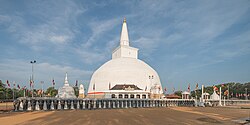
[[File:SL Anuradhapura asv2020-01 img11 Ruwanwelisaya Stupa.jpg|thumb|According to the ''[[Mahavamsa]]'', the [[Ruwanwelisaya]] in [[Anuradhapura]], [[Sri Lanka]], was dedicated by a 30,000-strong [[Yona]] delegation from [[Alexandria on the Caucasus]] | [[File:SL Anuradhapura asv2020-01 img11 Ruwanwelisaya Stupa.jpg|thumb|According to the ''[[Mahavamsa]]'', the [[Ruwanwelisaya]] in [[Anuradhapura]], [[Sri Lanka]], was dedicated by a 30,000-strong [[Yona]] delegation from [[Alexandria on the Caucasus]] ({{circa|130 BC}}).]] | ||
The ''[[Mahavamsa]]'', chapter 29, records that during Menander's reign, a Greek ''thera'' (elder monk) named ''[[Mahadharmaraksita]]'' led 30,000 Buddhist monks from "the Greek city of Alexandria" (possibly [[Alexandria on the Caucasus]], around {{convert|150|km}} north of today's [[Kabul]] in Afghanistan), to [[Sri Lanka]] for the dedication of a stupa, indicating that Buddhism flourished in Menander's territory and that Greeks took a very active part in it.<ref name="McEvilley2012">{{cite book|author=Thomas McEvilley|title=The Shape of Ancient Thought: Comparative Studies in Greek and Indian Philosophies|url=https://books.google.com/books?id=gbjelOMYyN8C&pg=PT558|date=7 February 2012|publisher=Constable & Robinson|isbn=978-1-58115-933-2|pages=558–}}</ref> | The ''[[Mahavamsa]]'', chapter 29, records that during Menander's reign, a Greek ''thera'' (elder monk) named ''[[Mahadharmaraksita]]'' led 30,000 Buddhist monks from "the Greek city of Alexandria" (possibly [[Alexandria on the Caucasus]], around {{convert|150|km}} north of today's [[Kabul]] in Afghanistan), to [[Sri Lanka]] for the dedication of a stupa, indicating that Buddhism flourished in Menander's territory and that Greeks took a very active part in it.<ref name="McEvilley2012">{{cite book|author=Thomas McEvilley|title=The Shape of Ancient Thought: Comparative Studies in Greek and Indian Philosophies|url=https://books.google.com/books?id=gbjelOMYyN8C&pg=PT558|date=7 February 2012|publisher=Constable & Robinson|isbn=978-1-58115-933-2|pages=558–}}</ref> | ||
Several Buddhist dedications by Greeks in India are recorded, such as that of the Greek [[meridarch]] (civil governor of a province) named [[Theodorus (meridarch)|Theodorus]], describing in Kharosthi how he enshrined [[śarīra|relics of the Buddha]]. The inscriptions were found on a vase inside a stupa, dated to the reign of Menander or one of his successors in the 1st century BC.<ref name="Tarn2010">{{cite book|last=Tarn|first=William Woodthorpe|title=The Greeks in Bactria and India|url=https://books.google.com/books?id=-HeJS3nE9cAC|date=24 June 2010|publisher=Cambridge University Press|isbn=978-1-108-00941-6|page=391|access-date=15 November 2015|archive-date=15 January 2023|archive-url=https://web.archive.org/web/20230115070732/https://books.google.com/books?id=-HeJS3nE9cAC|url-status=live}}</ref> Finally, Buddhist tradition recognizes Menander as one of the great benefactors of the faith, together with Ashoka and [[Kanishka the Great]]. | Several Buddhist dedications by Greeks in India are recorded, such as that of the Greek [[meridarch]] (civil governor of a province) named [[Theodorus (meridarch)|Theodorus]], describing in Kharosthi how he enshrined [[śarīra|relics of the Buddha]]. The inscriptions were found on a vase inside a stupa, dated to the reign of Menander or one of his successors in the 1st century BC.<ref name="Tarn2010">{{cite book|last=Tarn|first=William Woodthorpe|title=The Greeks in Bactria and India|url=https://books.google.com/books?id=-HeJS3nE9cAC|date=24 June 2010|publisher=Cambridge University Press|isbn=978-1-108-00941-6|page=391|access-date=15 November 2015|archive-date=15 January 2023|archive-url=https://web.archive.org/web/20230115070732/https://books.google.com/books?id=-HeJS3nE9cAC|url-status=live}}</ref> Finally, Buddhist tradition recognizes Menander as one of the great benefactors of the faith, together with Ashoka and [[Kanishka the Great]]. | ||
Buddhist manuscripts in cursive Greek have been found in Afghanistan, praising various Buddhas and including mentions of the [[Mahayana]] figure of "[[Avalokiteśvara|Lokesvara]]raja Buddha" ({{lang|grc|λωγοασφαροραζοβοδδο}}). These manuscripts have been dated later than the 2nd century | Buddhist manuscripts in cursive Greek have been found in Afghanistan, praising various Buddhas and including mentions of the [[Mahayana]] figure of "[[Avalokiteśvara|Lokesvara]]raja Buddha" ({{lang|grc|λωγοασφαροραζοβοδδο}}). These manuscripts have been dated later than the 2nd century CE.<ref>Nicholas Sims-Williams, "A Bactrian Buddhist Manuscript"</ref> | ||
===Kushan empire (1st–3rd century AD)=== | ===Kushan empire (1st–3rd century AD)=== | ||
{{Main|Kushan Empire}} | {{Main|Kushan Empire}} | ||
The [[Kushan Empire]], one of the five tribes of the [[Yuezhi]], settled in [[Bactria]] around 125 BC, displacing the Greco-Bactrians and invading the northern parts of Pakistan and India from around 1 AD. By that time they had already been in contact with Greek culture and the Indo-Greek kingdoms for more than a century. They used the Greek script to write their language, as exemplified by their [[coin]]s and their adoption of the [[Greek alphabet]]. | |||
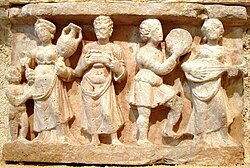
The [[Kanishka casket]], dated to the first year of Kanishka's reign in 127, was signed by a Greek artist named ''Agesilas'', who oversaw work at Kanishka's stupas ([[cetiya]]), confirming the direct involvement of Greeks with Buddhist realizations at such a late date. | [[File:Indo-GreekBanquet.JPG|thumb|left|Hellenistic culture in the Indian subcontinent: Greek clothes, [[amphora]]s, wine and music. Detail from [[Chakhil-i-Ghoundi Stupa]], [[Hadda, Afghanistan|Hadda]], [[Gandhara]], 1st century AD.]] | ||
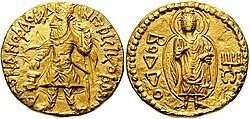
The Kushan King Kanishka, who honored Zoroastrian, Greek and Brahmanic deities as well as the Buddha and was famous for his religious syncretism, convened the [[Fourth Buddhist council]] around 100 in [[Kashmir]] in order to redact the [[Sarvastivada#Canon|Sarvastivadin canon]]. Some of Kanishka's coins bear the earliest representations of the Buddha on a coin (around 120), in Hellenistic style and with the word "Boddo" in Greek script. Kanishka also had the original Gandhari Prakrit [[Mahāyāna sūtras]] translated into [[Sanskrit]], "a turning point in the evolution of the Buddhist literary canon"<ref>Foltz, ''Religions of the Silk Road'', p. 45</ref> The [[Kanishka casket]], dated to the first year of Kanishka's reign in 127, was signed by a Greek artist named ''Agesilas'', who oversaw work at Kanishka's stupas ([[cetiya]]), confirming the direct involvement of Greeks with Buddhist realizations at such a late date. | |||
==Philosophical influences== | ==Philosophical influences== | ||
{{Western Buddhism}} | {{Western Buddhism}} | ||
Several [[Ancient Greek philosophy|Greek philosophers]], including [[Pyrrho]], [[Anaxarchus]], and [[Onesicritus]] accompanied Alexander in his eastern campaigns. During the 18 months they were in India, they were able to interact with [[Indian philosophy|Indian philosophers]] who pursued [[asceticism]], generally described as [[gymnosophists]] ("naked philosophers").<ref>{{cite book |last=Stoneman |first=Richard |year=2019 |chapter=The Indian Philosophers and the Greeks |title=The Greek Experience of India: From Alexander to the Indo-Greeks |chapter-url=https://books.google.com/books?id=rNp5DwAAQBAJ&pg=PA289 |location=[[Oxford]] and [[Princeton, New Jersey|Princeton]] |publisher=[[Princeton University Press]] |pages=289–331 |doi=10.1515/9780691185385-015 |isbn=978-0-691-15403-9 |jstor=j.ctv3znwg5 |lccn=2018958249 |s2cid=166488882 |access-date=2021 | |||
Several [[Ancient Greek philosophy|Greek philosophers]], including [[Pyrrho]], [[Anaxarchus]], and [[Onesicritus]] accompanied Alexander in his eastern campaigns. During the 18 months they were in India, they were able to interact with [[Indian philosophy|Indian philosophers]] who pursued [[asceticism]], generally described as [[gymnosophists]] ("naked philosophers").<ref>{{cite book |last=Stoneman |first=Richard |year=2019 |chapter=The Indian Philosophers and the Greeks |title=The Greek Experience of India: From Alexander to the Indo-Greeks |chapter-url=https://books.google.com/books?id=rNp5DwAAQBAJ&pg=PA289 |location=[[Oxford]] and [[Princeton, New Jersey|Princeton]] |publisher=[[Princeton University Press]] |pages=289–331 |doi=10.1515/9780691185385-015 |isbn=978-0-691-15403-9 |jstor=j.ctv3znwg5 |lccn=2018958249 |s2cid=166488882 |access-date=14 February 2021 |archive-date=15 January 2023 |archive-url=https://web.archive.org/web/20230115070732/https://books.google.com/books?id=rNp5DwAAQBAJ&pg=PA289 |url-status=live }}</ref> | |||
===Pyrrhonism=== | ===Pyrrhonism=== | ||
{{ | {{Main|Similarities between Pyrrhonism and Buddhism}} | ||
Pyrrho was directly influenced by Buddhism in developing his philosophy, which is based on Pyrrho's interpretation of the Buddhist [[three marks of existence]].<ref name="Stoneman 2019"/><ref>{{cite book |last=Beckwith |first=Christopher I. |title=Greek Buddha: Pyrrho's Encounter with Early Buddhism in Central Asia |publisher=[[Princeton University Press]] |year=2015 |page=28 |url=http://press.princeton.edu/chapters/s10500.pdf |isbn=9781400866328 |access-date=2017 | Pyrrho returned to Greece and founded [[Pyrrhonism]], considered by modern scholars as the first Western school of [[Philosophical skepticism|skepticism]].<ref name="Stoneman 2019">{{cite book |last=Stoneman |first=Richard |year=2019 |chapter=Two Hundred Years of Debate: Greek and Indian Thought |title=The Greek Experience of India: From Alexander to the Indo-Greeks |chapter-url=https://books.google.com/books?id=rNp5DwAAQBAJ&pg=PA346 |location=[[Oxford]] and [[Princeton, New Jersey|Princeton]] |publisher=[[Princeton University Press]] |pages=346–355 |doi=10.1515/9780691185385-016 |isbn=978-0-691-15403-9 |jstor=j.ctv3znwg5 |lccn=2018958249 |s2cid=166488882 |access-date=13 February 2021 |archive-date=15 January 2023 |archive-url=https://web.archive.org/web/20230115070732/https://books.google.com/books?id=rNp5DwAAQBAJ&pg=PA346 |url-status=live }}</ref> The Greek biographer [[Diogenes Laërtius]] explained that Pyrrho's equanimity and detachment from the world were acquired in India.<ref name="Stoneman 2019"/><ref>"He would withdraw from the world and live in solitude, rarely showing himself to his relatives; this is because he had heard an Indian reproach [[Anaxarchus]], telling him that he would never be able to teach others what is good while he himself danced attendance on kings in their court. He would maintain the same composure at all times." (Diogenes Laertius, IX.63 on Pyrrhon)</ref> | ||
Pyrrho was directly influenced by Buddhism in developing his philosophy, which is based on Pyrrho's interpretation of the Buddhist [[three marks of existence]].<ref name="Stoneman 2019"/><ref>{{cite book |last=Beckwith |first=Christopher I. |title=Greek Buddha: Pyrrho's Encounter with Early Buddhism in Central Asia |publisher=[[Princeton University Press]] |year=2015 |page=28 |url=http://press.princeton.edu/chapters/s10500.pdf |isbn=9781400866328 |access-date=10 May 2017 |archive-date=30 November 2016 |archive-url=https://web.archive.org/web/20161130150905/http://press.princeton.edu/chapters/s10500.pdf |url-status=live }}</ref> | |||
===Cynicism=== | ===Cynicism=== | ||
Another of these philosophers, Onesicritus, a [[Cynicism (philosophy)|Cynic]], is said by [[Strabo]] to have learnt in India the following precepts: "That nothing that happens to a man is bad or good, opinions being merely dreams. ... That the best philosophy [is] that which liberates the mind from [both] pleasure and grief".<ref name="Strabo XV.1">Strabo, XV.I.65: {{cite web |url=https://www.perseus.tufts.edu/cgi-bin/ptext?doc=Perseus%3Atext%3A1999.01.0239&query=head%3D%23119 |title=Strabo XV.1 |publisher=Perseus.tufts.edu |access-date=2010 | Another of these philosophers, [[Onesicritus]], a [[Cynicism (philosophy)|Cynic]], is said by [[Strabo]] to have learnt in India the following precepts: "That nothing that happens to a man is bad or good, opinions being merely dreams. ... That the best philosophy [is] that which liberates the mind from [both] pleasure and grief".<ref name="Strabo XV.1">Strabo, XV.I.65: {{cite web |url=https://www.perseus.tufts.edu/cgi-bin/ptext?doc=Perseus%3Atext%3A1999.01.0239&query=head%3D%23119 |title=Strabo XV.1 |publisher=Perseus.tufts.edu |access-date=1 September 2010 |archive-date=27 December 2007 |archive-url=https://web.archive.org/web/20071227232800/http://www.perseus.tufts.edu/cgi-bin/ptext?doc=Perseus%3Atext%3A1999.01.0239&query=head%3D%23119 |url-status=live }}</ref> Cynicism, particularly the Cynic [[Peregrinus Proteus]] was further influenced by the tales of the [[gymnosophists]], particularly the examples set by [[Kalanos]], [[Dandamis]], and [[Zarmanochegas]].{{Cn|date=March 2021}} | ||
===Cyrenaicism=== | ===Cyrenaicism=== | ||
The [[Cyrenaics|Cyrenaic]] philosopher [[Hegesias of Cyrene]], from the city of [[Cyrene, Libya|Cyrene]] where [[Magas of Cyrene]] ruled, is thought by some to have been influenced by the teachings of Ashoka's Buddhist missionaries.<ref>{{cite journal |first=Jean-Marie |last=Lafont |year=2000 |title=La découverte du bouddhisme par le monde européen |journal=Les Dossiers d'Archéologie |volume=254 |pages=78–85 [p. 78] |language=fr |issn=1141-7137 |url=https://www.dossiers-archeologie.com/numero-254/berceau-bouddhisme/decouverte-bouddhisme-monde-europeen.3211.php#article_3211 |quote=The philosopher Hegesias of Cyrene (nicknamed ''Peisithanatos'', "The advocate of death") was a contemporary of Magas and was probably influenced by the teachings of the Buddhist missionaries to Cyrene and Alexandria. His influence was such that he was ultimately prohibited from teaching. |access-date=2020 | The [[Cyrenaics|Cyrenaic]] philosopher [[Hegesias of Cyrene]], from the city of [[Cyrene, Libya|Cyrene]] where [[Magas of Cyrene]] ruled, is thought by some to have been influenced by the teachings of Ashoka's Buddhist missionaries.<ref>{{cite journal |first=Jean-Marie |last=Lafont |year=2000 |title=La découverte du bouddhisme par le monde européen |journal=Les Dossiers d'Archéologie |volume=254 |pages=78–85 [p. 78] |language=fr |issn=1141-7137 |url=https://www.dossiers-archeologie.com/numero-254/berceau-bouddhisme/decouverte-bouddhisme-monde-europeen.3211.php#article_3211 |quote=The philosopher Hegesias of Cyrene (nicknamed ''Peisithanatos'', "The advocate of death") was a contemporary of Magas and was probably influenced by the teachings of the Buddhist missionaries to Cyrene and Alexandria. His influence was such that he was ultimately prohibited from teaching. |access-date=14 April 2020 |archive-date=8 March 2021 |archive-url=https://web.archive.org/web/20210308083642/https://www.dossiers-archeologie.com/numero-254/berceau-bouddhisme/decouverte-bouddhisme-monde-europeen.3211.php#article_3211 |url-status=live }}</ref> | ||
==Artistic influences== | ==Artistic influences== | ||
{{Main|Greco-Buddhist art}} | {{Main|Greco-Buddhist art}} | ||
{{More citations needed section|date=February 2021}} | {{More citations needed section|date=February 2021}} | ||
Numerous works of [[Greco-Buddhist art]] display the intermixing of Greek and Buddhist influences in such creation centers as [[Gandhara]]. The subject matter of Gandharan art was definitely Buddhist, while most motifs were of [[Western Asia]]tic or Hellenistic origin. | Numerous works of [[Greco-Buddhist art]] display the intermixing of Greek and Buddhist influences in such creation centers as [[Gandhara]]. The subject matter of Gandharan art was definitely Buddhist, while most motifs were of [[Western Asia]]tic or Hellenistic origin. | ||
===Anthropomorphic representation of the Buddha=== | ===Anthropomorphic representation of the Buddha=== | ||
[[File:MaraAssault.jpg|thumb|upright|An aniconic representation of [[Mara (demon)|Mara]]'s assault on the Buddha, 2nd century AD, [[Amaravathi village, Guntur district]], [[India]].]] | [[File:MaraAssault.jpg|thumb|upright|An aniconic representation of [[Mara (demon)|Mara]]'s assault on the Buddha, 2nd century AD, [[Amaravathi village, Guntur district]], [[India]].]] | ||
Although there is still some debate, the first [[Anthropomorphism|anthropomorphic]] representations of the Buddha himself are often considered a result of the Greco-Buddhist interaction. Before this innovation, Buddhist art was "[[aniconism|aniconic]]": the Buddha was only represented through his symbols (an empty throne, the [[Bodhi Tree]], [[Buddha footprint]]s, the [[Dharmachakra]]). | Although there is still some debate, the first [[Anthropomorphism|anthropomorphic]] representations of the Buddha himself are often considered a result of the Greco-Buddhist interaction. Before this innovation, Buddhist art was "[[aniconism|aniconic]]": the Buddha was only represented through his symbols (an empty throne, the [[Bodhi Tree]], [[Buddha footprint]]s, the [[Dharmachakra]]). | ||
This reluctance towards anthropomorphic representations of the Buddha, and the sophisticated development of aniconic symbols to avoid it (even in narrative scenes where other human figures would appear), seem to be connected to one of the Buddha's sayings reported in the ''[[Digha Nikaya]]'' that discouraged representations of himself after the extinction of his body.<ref>"Due to the statement of the Master in the ''Dighanikaya'' disfavouring his representation in human form after the extinction of body, reluctance prevailed for some time". Also "''Hinayanis'' opposed image worship of the Master due to canonical restrictions". | This reluctance towards anthropomorphic representations of the Buddha, and the sophisticated development of aniconic symbols to avoid it (even in narrative scenes where other human figures would appear), seem to be connected to one of the Buddha's sayings reported in the ''[[Digha Nikaya]]'' that discouraged representations of himself after the extinction of his body.<ref>"Due to the statement of the Master in the ''Dighanikaya'' disfavouring his representation in human form after the extinction of body, reluctance prevailed for some time". Also "''Hinayanis'' opposed image worship of the Master due to canonical restrictions". R.C. Sharma, in "The Art of Mathura, India", Tokyo National Museum 2002, p.11</ref> | ||
Probably not feeling bound by these restrictions, and because of "their cult of form, the Greeks were the first to attempt a sculptural representation of the Buddha".<ref name="Linssen">{{cite book |last1=Linssen |last2=Robert |title=Living Zen |location=London |publisher=Allen & Unwin |publication-date=1958 |page=206}}</ref> In many parts of the Ancient World, the Greeks did develop [[syncretic]] divinities, that could become a common religious focus for populations with different traditions: a well-known example is [[Serapis]], introduced by [[Ptolemy I Soter]] in [[Egypt]], who combined aspects of Greek and Egyptian Gods. In India as well, it was only natural for the Greeks to create a single common divinity by combining the image of a Greek [[god-king]] ([[Apollo]], or possibly the deified founder of the [[Indo-Greek Kingdom]], [[Demetrius I of Bactria]]), with the traditional [[physical characteristics of the Buddha]]. | Probably not feeling bound by these restrictions, and because of "their cult of form, the Greeks were the first to attempt a sculptural representation of the Buddha".<ref name="Linssen">{{cite book |last1=Linssen |last2=Robert |title=Living Zen |location=London |publisher=Allen & Unwin |publication-date=1958 |page=206}}</ref> In many parts of the Ancient World, the Greeks did develop [[syncretic]] divinities, that could become a common religious focus for populations with different traditions: a well-known example is [[Serapis]], introduced by [[Ptolemy I Soter]] in [[Hellenistic Egypt]], who combined aspects of Greek and Egyptian Gods. In India as well, it was only natural for the Greeks to create a single common divinity by combining the image of a Greek [[god-king]] ([[Apollo]], or possibly the deified founder of the [[Indo-Greek Kingdom]], [[Demetrius I of Bactria]]), with the traditional [[physical characteristics of the Buddha]]. | ||
{{multiple image | {{multiple image | ||
| align = left | | align = left | ||
| image1 = StandingBuddha.jpg | | image1 = StandingBuddha.jpg | ||
| width1 = 125 | | width1 = 125 | ||
| caption1 = Standing Buddha, Gandhara, 1st century AD. | | caption1 = Standing Buddha, Gandhara, 1st century AD. | ||
| image2 = Buddha-Vajrapani-Herakles.JPG | | image2 = Buddha-Vajrapani-Herakles.JPG | ||
| width2 = 200 | | width2 = 200 | ||
| caption2 = [[Heracles|Herculean]] depiction of [[Vajrapani]] (right), as the protector of the Buddha, 2nd century AD [[Gandhara]], [[British Museum]].<ref>"The Buddha accompanied by Vajrapani, who has the characteristics of the Greek Heracles" Description of the same image on the cover page in {{cite book |last1=Stoneman |first1=Richard |title=The Greek Experience of India: From Alexander to the Indo-Greeks |date=8 June 2021 |publisher=Princeton University Press |isbn=978-0-691-21747-5 |page=4 |url=https://books.google.com/books?id=Mx4OEAAAQBAJ&pg=PR4 |language=en |access-date=12 December 2021 |archive-date=15 January 2023 |archive-url=https://web.archive.org/web/20230115071305/https://books.google.com/books?id=Mx4OEAAAQBAJ&pg=PR4 |url-status=live }} Also "Herakles found an independent life in India in the guise of Vajrapani, the bearded, club-wielding companion of the Buddha" in {{cite book |last1=Stoneman |first1=Richard |title=The Greek Experience of India: From Alexander to the Indo-Greeks |date=8 June 2021 |publisher=Princeton University Press |isbn=978-0-691-21747-5 |pages=88–89 |url=https://books.google.com/books?id=Mx4OEAAAQBAJ&pg=PA88 |language=en |access-date=12 December 2021 |archive-date=15 January 2023 |archive-url=https://web.archive.org/web/20230115071309/https://books.google.com/books?id=Mx4OEAAAQBAJ&pg=PA88 |url-status=live }}</ref> | | caption2 = [[Heracles|Herculean]] depiction of [[Vajrapani]] (right), as the protector of the Buddha, 2nd-century AD [[Gandhara]], [[British Museum]].<ref>"The Buddha accompanied by Vajrapani, who has the characteristics of the Greek Heracles" Description of the same image on the cover page in {{cite book |last1=Stoneman |first1=Richard |title=The Greek Experience of India: From Alexander to the Indo-Greeks |date=8 June 2021 |publisher=Princeton University Press |isbn=978-0-691-21747-5 |page=4 |url=https://books.google.com/books?id=Mx4OEAAAQBAJ&pg=PR4 |language=en |access-date=12 December 2021 |archive-date=15 January 2023 |archive-url=https://web.archive.org/web/20230115071305/https://books.google.com/books?id=Mx4OEAAAQBAJ&pg=PR4 |url-status=live }} Also "Herakles found an independent life in India in the guise of Vajrapani, the bearded, club-wielding companion of the Buddha" in {{cite book |last1=Stoneman |first1=Richard |title=The Greek Experience of India: From Alexander to the Indo-Greeks |date=8 June 2021 |publisher=Princeton University Press |isbn=978-0-691-21747-5 |pages=88–89 |url=https://books.google.com/books?id=Mx4OEAAAQBAJ&pg=PA88 |language=en |access-date=12 December 2021 |archive-date=15 January 2023 |archive-url=https://web.archive.org/web/20230115071309/https://books.google.com/books?id=Mx4OEAAAQBAJ&pg=PA88 |url-status=live }}</ref> | ||
}} | }} | ||
Many of the stylistic elements in the representations of the Buddha point to Greek influence: [[himation]], the [[contrapposto]] stance of the upright figures, such as the 1st–2nd century Gandhara standing Buddhas, the stylized curly hair and [[ushnisha]] apparently derived from the style of the [[Apollo Belvedere]] (330 | Many of the stylistic elements in the representations of the Buddha point to Greek influence: [[himation]], the [[contrapposto]] stance of the upright figures, such as the 1st–2nd century Gandhara standing Buddhas, the stylized curly hair and [[ushnisha]] apparently derived from the style of the [[Apollo Belvedere]] (330 BC) and the measured quality of the faces, all rendered with strong artistic [[Realism (arts)|realism]].<ref name=":1">{{Cite book |last=Halkias |first=Georgios T. |title=Religions and trade: religious formation, transformation and cross-cultural exchange between East and West |date=2014 |publisher=Brill |isbn=978-90-04-25528-9 |editor-last=Wick |editor-first=Peter |series=Dynamics in the history of religions |location=Leiden Boston (Mass.) |page=106 |chapter=When the Greeks Converted the Buddha: Asymmetrical Transfers of Knowledge in Indo-Greek Cultures |author-link=Georgios Halkias |editor-last2=Rabens |editor-first2=Volker}}</ref> A large quantity of [[sculpture]]s combining Buddhist and purely Hellenistic styles and [[iconography]] were excavated at the modern site of [[Hadda, Afghanistan]]. The curly hair of Buddha is described in the famous list of the [[physical characteristics of the Buddha]] in the Buddhist sutras. The hair with curls turning to the right is first described in the [[Pāli canon]]; we find the same description in the ''[[Prajnaparamita|Dāsāṣṭasāhasrikā prajñāpāramitā]]''.{{citation needed|date=June 2015}} Additionally, the nudity of [[Jainism|Jainist]] sculptures might have been inspired by [[Apollo|Apollonian]] archetypes.<ref name=":1" /> | ||
Greek artists were most probably the authors of these early representations of the Buddha, in particular the standing statues, which display "a realistic treatment of the folds and on some even a hint of modelled volume that characterizes the best Greek work. This is Classical or Hellenistic Greek, not archaizing Greek transmitted by Persia or Bactria, nor distinctively [[Ancient Rome|Roman]]."<ref>Boardman p. 126</ref> | Greek artists were most probably the authors of these early representations of the Buddha, in particular the standing statues, which display "a realistic treatment of the folds and on some even a hint of modelled volume that characterizes the best Greek work. This is Classical or Hellenistic Greek, not archaizing Greek transmitted by Persia or Bactria, nor distinctively [[Ancient Rome|Roman]]."<ref>Boardman p. 126</ref> | ||
| Line 157: | Line 164: | ||
{{see also|Buddhist art|Greco-Buddhist art}} | {{see also|Buddhist art|Greco-Buddhist art}} | ||
[[File:Coin of Kanishka I.jpg|thumb|left|A Buddhist coin of [[Kanishka I]], with legend ΒΟΔΔΟ "Boddo" (=the [[Buddha]]) in Greek script on the reverse.]] | [[File:Coin of Kanishka I.jpg|thumb|left|A Buddhist coin of [[Kanishka I]], with legend ΒΟΔΔΟ "Boddo" (=the [[Buddha]]) in Greek script on the reverse.]] | ||
According to Katsumi Tanabe, professor at Chūō University, Japan, besides Vajrapani, Greek influence also appears in several other gods of the Mahayana pantheon such as the Japanese [[Fūjin]], inspired from the Greek divinity [[Boreas (god)|Boreas]] through the Greco-Buddhist | Several other Buddhist deities may have been influenced by Greek gods. For example, [[Heracles]] with a lion-skin, the protector deity of [[Demetrius I of Bactria]], "served as an artistic model for [[Vajrapani]], a protector of the Buddha".<ref>{{cite book |last=Foltz |title=Religions of the Silk Road |url=https://archive.org/details/religionssilkroa00folt |url-access=limited |page=[https://archive.org/details/religionssilkroa00folt/page/n50 44] |year=2010 |isbn=9780230621251 }}</ref><ref>See Images of the Herakles-influenced Vajrapani: {{cite web |archive-url=https://web.archive.org/web/20131216205740/http://www.exoticindiaart.com/artimages/BuddhaImage/greece_sm.jpg |archive-date=16 December 2013 |url=http://www.exoticindiaart.com/artimages/BuddhaImage/greece_sm.jpg |title=Image 1 |postscript=, }} {{cite web |url=http://faculty.maxwell.syr.edu/gaddis/HST210/Oct21/Heracles-Vajrapani.jpg |title=Image 2 |archive-url=https://web.archive.org/web/20040313155937/http://faculty.maxwell.syr.edu/gaddis/HST210/Oct21/Heracles-Vajrapani.jpg |archive-date=13 March 2004 }}</ref> In [[Japan]], this expression further translated into the wrath-filled and muscular [[Nio (Buddhism)|Niō]] guardian gods of the Buddha, standing today at the entrance of many Buddhist temples. | ||
According to Katsumi Tanabe, professor at Chūō University, Japan, besides Vajrapani, Greek influence also appears in several other gods of the Mahayana pantheon such as the Japanese [[Fūjin]], inspired from the Greek divinity [[Boreas (god)|Boreas]] through the Greco-Buddhist Wardo, or the mother deity [[Hariti]] inspired by [[Tyche]].<ref>{{cite book |first=Katsumi |last=Tanabe |title=Alexander the Great: East-West Cultural Contact from Greece to Japan |location=Tokyo |publisher=NHK Puromōshon and Tokyo National Museum |year=2003 |oclc=937316326 }}</ref> | |||
In addition, forms such as [[garland]]-bearing [[cherub]]s, [[vine]] [[scroll]]s, and such semihuman creatures as the [[centaur]] and [[Triton (mythology)|triton]], are part of the repertory of Hellenistic art introduced by Greco-Roman artists in the service of the Kushan court. | In addition, forms such as [[garland]]-bearing [[cherub]]s, [[vine]] [[scroll]]s, and such semihuman creatures as the [[centaur]] and [[Triton (mythology)|triton]], are part of the repertory of Hellenistic art introduced by Greco-Roman artists in the service of the Kushan court. | ||
| Line 167: | Line 175: | ||
===Proselytism in the East=== | ===Proselytism in the East=== | ||
{{See also|Silk Road transmission of Buddhism|Greco-Buddhist monasticism|Dayuan}} | {{See also|Silk Road transmission of Buddhism|Greco-Buddhist monasticism|Dayuan}} | ||
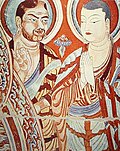
[[File:Central Asian Buddhist Monks.jpeg|thumb|upright|left|[[Buddhism in Central Asia|Central Asia]]n monk teaching East-Asian monk. A fresco from the | [[File:Central Asian Buddhist Monks.jpeg|thumb|upright|left|[[Buddhism in Central Asia|Central Asia]]n monk teaching East-Asian monk. A fresco from the [[Bezeklik Thousand Buddha Caves]], dated to the 9th-10th century CE ([[Kara-Khoja Kingdom]]).]] | ||
Greek monks played a direct role in the upper hierarchy of Buddhism, and in its early dissemination. During the rule (165–135 | Greek monks played a direct role in the upper hierarchy of Buddhism, and in its early dissemination. During the rule (165–135 BC) of the [[Greco-Bactrian Kingdom|Greco-Bactrian]] King [[Menander I]] ([[Pāli|Pali]]: "Milinda"), [[Mahadharmaraksita]] (literally translated as 'Great Teacher/Preserver of the Dharma') was "a Greek ([[Pāli|Pali]]: [[Yona]], lit. [[Ionia]]n) Buddhist head monk," according to the [[Mahavamsa]] (Chap. XXIX), who led 30,000 Buddhist monks from "the Greek city of Alasandra" ([[Alexandria of the Caucasus]], around 150 km north of today's [[Kabul]] in [[Afghanistan]]), to Sri Lanka for the dedication of the [[Ruwanwelisaya|Great Stupa]] in [[Anuradhapura]]. [[Dharmaraksita]] ([[Sanskrit]]), or Dhammarakkhita ([[Pāli|Pali]]) ([[translation]]: ''Protected by the [[Dharma]]''), was one of the [[missionary|missionaries]] sent by the [[Mauryan]] emperor [[Ashoka]] to proselytize the [[Buddhist]] faith. He is described as being a Greek ([[Pāli|Pali]]: "[[Yona]]", lit. "[[Ionia]]n") in the [[Mahavamsa]], and his activities are indicative of the strength of the Hellenistic [[Hellenistic Greece|Greek]] involvement during the formative centuries of Buddhism. Indeed, [[Menander I]] was famously converted to Buddhism by [[Nagasena]], who was a student of the Greek Buddhist monk [[Dharmaraksita]]. Menander is said to have reached enlightenment as an [[arhat]] under Nagasena's guidance and is recorded as a great patron of Buddhism. The dialogue of the Greek King Menander I ([[Pāli|Pali]] "Milinda") with the monk [[Nagasena]] comprises the Pali Buddhist work known as the [[Milinda Panha]]. | ||
Buddhist monks from the region of [[Gandhara]], where Greco-Buddhism was most influential, later played a key role in the development and the transmission of Buddhist ideas in the direction of northern Asia. Greco-Buddhist [[Kushan]] monks such as [[Lokaksema (Buddhist monk)|Lokaksema]] ({{circa| | Buddhist monks from the region of [[Gandhara]], where Greco-Buddhism was most influential, later played a key role in the development and the transmission of Buddhist ideas in the direction of northern Asia. Greco-Buddhist [[Kushan Empire|Kushan]] monks such as [[Lokaksema (Buddhist monk)|Lokaksema]] ({{circa|178 CE}}) travelled to the Chinese capital of [[Loyang]], where they became the first translators of Buddhist scriptures into Chinese.<ref>{{cite book |author-link=Richard Foltz |last=Foltz |first=Richard |title=Religions of the Silk Road |url=https://archive.org/details/religionssilkroa00folt |url-access=limited |publisher=Palgrave Macmillan |edition=2nd |year=2010 |page=[https://archive.org/details/religionssilkroa00folt/page/n52 46] |isbn=978-0-230-62125-1 }}</ref> Central Asian and East Asian Buddhist monks appear to have maintained strong exchanges until around the 10th century, as indicated by the [[Bezeklik Thousand Buddha Caves]] frescos from the [[Tarim Basin]]. In legend too [[Bodhidharma]], the founder of [[Chán]]-Buddhism, which later became [[Zen]], and the legendary originator of the physical training of the [[Shaolin Monastery|Shaolin]] monks that led to the creation of [[Shaolin Kung Fu]], is described as a Buddhist monk from [[Buddhism in Central Asia|Central Asia]] in the first Chinese references to him (Yan Xuan-Zhi in 547).<ref>{{cite book |last=Broughton |first=Jeffrey L. |year=1999 |title=The Bodhidharma Anthology: The Earliest Records of Zen |url=https://archive.org/details/bodhidharmaantho00brou |url-access=limited |location=Berkeley |publisher=University of California Press |isbn=0-520-21972-4 |pages=[https://archive.org/details/bodhidharmaantho00brou/page/n24 54]–55 }}</ref> Throughout [[Buddhist art]], Bodhidharma is depicted as a rather ill-tempered, profusely bearded and wide-eyed barbarian, and he is referred as "The Blue-Eyed [[Barbarian]]" ({{zh|c=碧眼胡|p=Bìyǎn hú|labels=no}}) in Chinese Chan texts.<ref>{{cite book |last1=Soothill |first1=William Edward |last2=Hodous |first2=Lewis |year=1995 |title=A Dictionary of Chinese Buddhist Terms |location=London |publisher=RoutledgeCurzon |archive-url=https://web.archive.org/web/20140303182232/http://buddhistinformatics.ddbc.edu.tw/glossaries/files/soothill-hodous.ddbc.pdf |archive-date=3 March 2014 |url=http://buddhistinformatics.ddbc.edu.tw/glossaries/files/soothill-hodous.ddbc.pdf }}</ref> In 485 CE, according to the 7th-century Chinese historical treatise [[Liang Shu]], five monks from Gandhara travelled to the country of [[Fusang]] ("The country of the extreme East" beyond the sea, probably eastern [[Japan]]), where they introduced Buddhism: | ||
{{quote|"[[Fusang]] is located to the east of China, 20,000 ''[[Li (Chinese unit)|li]]'' [1,500 km] east of the state of ''Da Han'' (itself east of the state of ''Wa'' in modern [[Kyūshū]], [[Japan]]). (...) In former times, the people of Fusang knew nothing of the Buddhist religion, but in the second year of Da Ming of the [[Song dynasty]] [AD 485], five monks from Kipin ([[Kabul]] region of Gandhara) travelled by ship to Fusang. They propagated Buddhist doctrine, circulated scriptures and drawings, and advised the people to relinquish worldly attachments. As a result the customs of Fusang changed." (Chinese: "{{lang|zh|扶桑在大漢國東二萬餘里,地在中國之東(...)其俗舊無佛法,宋大明二年,罽賓國嘗有比丘五人游行至其國,流通佛法,經像,教令出家,風 俗遂改.}}")}} | {{quote|"[[Fusang]] is located to the east of China, 20,000 ''[[Li (Chinese unit)|li]]'' [1,500 km] east of the state of ''Da Han'' (itself east of the state of ''Wa'' in modern [[Kyūshū]], [[Japan]]). (...) In former times, the people of Fusang knew nothing of the Buddhist religion, but in the second year of Da Ming of the [[Song dynasty]] [AD 485], five monks from Kipin ([[Kabul]] region of Gandhara) travelled by ship to Fusang. They propagated Buddhist doctrine, circulated scriptures and drawings, and advised the people to relinquish worldly attachments. As a result the customs of Fusang changed." (Chinese: "{{lang|zh|扶桑在大漢國東二萬餘里,地在中國之東(...)其俗舊無佛法,宋大明二年,罽賓國嘗有比丘五人游行至其國,流通佛法,經像,教令出家,風 俗遂改.}}")}} | ||
| Line 179: | Line 187: | ||
===Greco-Buddhism in the West=== | ===Greco-Buddhism in the West=== | ||
[[File:AsokaKandahar.jpg|thumb|upright|[[Kandahar Bilingual Rock Inscription]] ([[Greek language|Greek]] and [[Aramaic]]) 3rd century BC by Indian Buddhist King Ashoka. This edict advocates the adoption of "godliness" using the Greek term [[Eusebeia]] for [[Dharma]]. [[Kabul]] Museum.]] | [[File:AsokaKandahar.jpg|thumb|upright|[[Kandahar Bilingual Rock Inscription]] ([[Greek language|Greek]] and [[Aramaic]]) 3rd century BC by Indian Buddhist King Ashoka. This edict advocates the adoption of "godliness" using the Greek term [[Eusebeia]] for [[Dharma]]. [[Kabul]] Museum.]] | ||
[[Zarmanochegas]] (Zarmarus) (Ζαρμανοχηγὰς) was a monk of the [[Sramana]] tradition (possibly, but not necessarily a Buddhist) who, according to ancient historians such as [[Strabo]] and [[Dio Cassius]], met [[Nicholas of Damascus]] in [[Antioch]] while Augustus ( | Intense westward physical exchange at that time along the [[Silk Road]] is confirmed by the Roman craze for [[silk]] from the 1st century BC to the point that the [[Roman Senate|Senate]] issued, in vain, several edicts to prohibit the wearing of silk, on economic and moral grounds. This is attested by at least three authors: [[Strabo]] (64/63 BC – {{circa|24 AD}}), [[Seneca the Younger]] ({{circa|3 BC}} – 65 AD), and [[Pliny the Elder]] (23–79 AD). The aforementioned Strabo and [[Plutarch]] ({{circa|45}}–125 AD) also wrote about Indo-Greek Buddhist king [[Milinda|Menander]], confirming that information about the Indo-Greek Buddhists was circulating throughout the Hellenistic world. | ||
[[Zarmanochegas]] (Zarmarus) (Ζαρμανοχηγὰς) was a monk of the [[Sramana]] tradition (possibly, but not necessarily a Buddhist) who, according to ancient historians such as [[Strabo]] and [[Dio Cassius]], met [[Nicholas of Damascus]] in [[Antioch]] while Augustus (d. 14 AD) was ruling the Roman Empire, and shortly thereafter proceeded to Athens where he burnt himself to death.<ref name="perseus.tufts.edu"/><ref name="liv, 9"/> His story and tomb in Athens were well-known over a century later. [[Plutarch]] (d. 120 AD) in his Life of Alexander, after discussing the self-immolation of [[Calanus of India]] ([[Kalanos]]) witnessed by Alexander writes: "The same thing was done long after by another Indian who came with Caesar to Athens, where they still show you 'the Indian's Monument,'"<ref>{{cite book |author=Plutarch |chapter=Life of Alexander |title=The Lives of the Noble Grecians and Romans |translator-first=John |translator-last=Dryden |translator2-first=Arthur Hugh |translator2-last=Clough |series=The Modern Library |publisher=Random House |location=New York |page=850 }}</ref> referring to Zarmanochegas' tomb in [[Roman Athens]]. | |||
Another century later the Christian [[Church Fathers|church father]] [[Clement of Alexandria]] ( | Another century later, the Christian [[Church Fathers|church father]] [[Clement of Alexandria]] (d. 215 AD) mentioned the Buddha by his title in his Stromata (Bk I, Ch XV): "The Indian [[gymnosophists]] are also in the number, and the other barbarian philosophers. And of these there are two classes, some of them called Sarmanæ and others Brahmins. And those of the Sarmanæ who are called "Hylobii" neither inhabit cities, nor have roofs over them, but are clothed in the bark of trees, feed on nuts, and drink water in their hands. Like those called Encratites in the present day, they know not marriage nor begetting of children. Some, too, of the Indians obey the precepts of [[Buddha]] (Βούττα) whom, on account of his extraordinary sanctity, they have raised to divine honours."<ref name="ccel.org">{{cite web |title=Clement of Alexandria Stromata. BkI, Ch XV |url=https://www.ccel.org/ccel/schaff/anf02.vi.iv.i.xv.html |access-date=19 December 2012 |archive-date=22 October 2012 |archive-url=https://web.archive.org/web/20121022194044/http://www.ccel.org/ccel/schaff/anf02.vi.iv.i.xv.html |url-status=live }}</ref> | ||
Indian gravestones from the [[Ptolemaic period]] have been found in Alexandria in Egypt.<ref>{{cite book |last=Tarn |title=The Greeks in Bactria and India |page=370 }}</ref> The presence of Buddhists in Alexandria at this time is important, since "It was later in this very place that some of the most active centers of Christianity were established".<ref name="Linssen_A">{{cite book |last1=Linssen |last2=Robert |title=Living Zen |location=London |publisher=Allen & Unwin |publication-date=1958 |page=208}}</ref> | Indian gravestones from the [[Ptolemaic period]] have been found in Alexandria in Egypt.<ref>{{cite book |last=Tarn |title=The Greeks in Bactria and India |page=370 }}</ref> The presence of Buddhists in Alexandria at this time is important, since "It was later in this very place that some of the most active centers of Christianity were established".<ref name="Linssen_A">{{cite book |last1=Linssen |last2=Robert |title=Living Zen |location=London |publisher=Allen & Unwin |publication-date=1958 |page=208}}</ref> | ||
The pre-Christian monastic order of the [[Therapeutae]] is possibly a deformation of the Pāli word "''[[Theravada|Theravāda]]''",<ref>According to the linguist Zacharias P. Thundy{{full|date=April 2020}}</ref> a form of Buddhism | The pre-Christian monastic order of the [[Therapeutae]] is possibly a deformation of the Pāli word "''[[Theravada|Theravāda]]''",<ref>According to the linguist Zacharias P. Thundy{{full|date=April 2020}}</ref> a form of Buddhism; the movement may have also "almost entirely drawn (its) inspiration from the teaching and practices of Buddhist asceticism".<ref name="Linssen_A"/> They may even have been descendants of [[Asoka]]'s emissaries to the West.<ref>{{cite book |title=The Original Jesus |publisher=Element Books |location=Shaftesbury |year=1995 |first1=Elmar R. |last1=Gruber |first2=Holger |last2=Kersten |isbn=1-85230-835-4 }}</ref> While [[Philo of Alexandria]]'s description of the doctrines and practices of the Therapeutae leaves great ambiguity about what religion they are associated with, analysis by religious scholar Ullrich R. Kleinhempel indicates that the most likely religion the Therapeutae practiced was Buddhism.<ref>Ullrich R . Kleinhempel, "Traces of Buddhist Presence in Alexandria: Philo and the "Therapeutae"", ''Научно-теоретический журнал'' 2019 https://www.academia.edu/39841429/Traces_of_Buddhist_Presence_in_Alexandria_Philo_and_the_Therapeutae_ {{Webarchive|url=https://web.archive.org/web/20210121200301/https://www.academia.edu/39841429/Traces_of_Buddhist_Presence_in_Alexandria_Philo_and_the_Therapeutae_ |date=21 January 2021 }}</ref> | ||
In 2022, American-Polish archeologists unearthed an Egyptian temple dedicated to the goddess [[Isis (goddess)|Isis]] and god [[Serapis]], containing a [[Gotama Buddha|Buddha]] [[Berenike Buddha|sculpture]] and [[Hinduism|Hindu gods]]; this find indicates Greco-Buddhist influence extending to the early Roman period.<ref>"Hidden History, Hidden Treasure" ''University of Delaware'' 8 August 2024. https://research.udel.edu/2024/08/08/steve-sidebotham-egypt-berenike-buddha-archeology/</ref> | |||
===Buddhism and Christianity=== | ===Buddhism and Christianity=== | ||
| Line 193: | Line 204: | ||
[[File:MayaDream.jpg|thumb|Queen Māyā's white elephant dream, and the conception of the Buddha. [[Gandhara]], 2nd–3rd century AD.]] | [[File:MayaDream.jpg|thumb|Queen Māyā's white elephant dream, and the conception of the Buddha. [[Gandhara]], 2nd–3rd century AD.]] | ||
Although the | Although the religions of Buddhism and Christianity have evolved in rather different ways, the moral precepts advocated by Buddhism from the time of Ashoka through his edicts do have some similarities with the Christian moral precepts developed more than two centuries later. Similarities of the two religions include respect for life, respect for the weak, rejection of violence, pardon to sinners, and tolerance. | ||
One theory is that these similarities may indicate the propagation of Buddhist ideals into the Western World, with the Greeks acting as intermediaries and religious syncretists.<ref>{{cite book |quote=Certain Indian notions may have made their way westward into the budding Christianity of the Mediterranean world through the channels of the Greek diaspora |last=Foltz |title=Religions of the Silk Road |page=44 }}</ref> | One theory is that these similarities may indicate the propagation of Buddhist ideals into the Western World, with the Greeks acting as intermediaries and religious syncretists.<ref>{{cite book |quote=Certain Indian notions may have made their way westward into the budding Christianity of the Mediterranean world through the channels of the Greek diaspora |last=Foltz |title=Religions of the Silk Road |page=44 }}</ref> | ||
| Line 199: | Line 210: | ||
{{quote|Scholars have often considered the possibility that Buddhism influenced the early development of Christianity. They have drawn attention to many parallels concerning the births, lives, doctrines, and deaths of the Buddha and Jesus.{{cn|date=August 2023}}|Bentley, ''Old World Encounters''}} | {{quote|Scholars have often considered the possibility that Buddhism influenced the early development of Christianity. They have drawn attention to many parallels concerning the births, lives, doctrines, and deaths of the Buddha and Jesus.{{cn|date=August 2023}}|Bentley, ''Old World Encounters''}} | ||
[[Jerome|Saint Jerome]] (4th century) mentions the birth of the Buddha, who he says "was born from the side of a virgin,"<ref name="McEvilley, p391">McEvilley, p391</ref> and the influential early Christian church father [[Clement of Alexandria]] ( | [[Jerome|Saint Jerome]] (4th century AD) mentions the birth of the Buddha, who he says "was born from the side of a virgin,"<ref name="McEvilley, p391">McEvilley, p391</ref> and the influential early Christian church father [[Clement of Alexandria]] (d. 215) mentioned Buddha (Βούττα) in his Stromata (Bk I, Ch XV).<ref name="ccel.org"/> The legend of Christian saints [[Barlaam and Josaphat]] draws on the life of the Buddha.<ref>{{cite book |first=John |last=Walbridge |title=The Wisdom of the Mystic East: Suhrawardī and Platonic Orientalism |page=129 |year=2001 |quote=The form Būdhīsaf is the original, as shown by Sogdian form Pwtysfi and the early New Persian form Bwdysf }} On the Christian versions see A. S. Geden, Encyclopaedia of Religion and Ethics, s.v. "Josaphat, Barlaam and," and M. P. Alfaric, ..."</ref> | ||
== Reception == | |||
The idea of a Greek influence on the development of Buddhism has been particularly advocated by [[Étienne Lamotte]]<ref>{{Cite book |last=Lamotte |first=Étienne |title=History of Indian Buddhism: from the origins to the Śaka era |date=1988 |publisher=Institut orientaliste |isbn=978-90-6831-100-6 |series=Publications de l'Institut orientaliste de Louvain |location=Louvain-la-Neuve, Belgique |pages=426–442}}</ref> and [[Thomas McEvilley]], who has speculated that “like the Gandharan art style, the Gandharan Buddhist style must have had a prominent Hellenic factor”,<ref>{{Cite book |last=McEvilley |first=Thomas |title=The shape of ancient thought: comparative studies in Greek and Indian philosophies |date=2002 |publisher=Allworth Press [u.a.] |isbn=978-1-58115-203-6 |location=New York, NY}}</ref> although he does not employ the term "Greco-Buddhism" for this. McEvilley's theory has been met by skepticism by other scholars.<ref>{{Cite journal |last=Kearns |first=Emily |date=2004 |title=Indian Connections |url=https://www.cambridge.org/core/product/identifier/S0009840X04002318/type/journal_article |journal=The Classical Review |language=en |volume=54 |issue=2 |pages=420–423 |doi=10.1093/cr/54.2.420 |issn=0009-840X|url-access=subscription }}</ref><ref>{{Cite journal |last=Allen |first=Nicholas J. |date=2005 |title=Thomas McEvilley: The Missing Dimension |url=https://www.jstor.org/stable/20106911 |journal=International Journal of Hindu Studies |volume=9 |issue=1/3 |pages=59–75 |doi=10.1007/s11407-005-0004-8 |jstor=20106911 |issn=1022-4556|url-access=subscription }}</ref><ref>{{Cite journal |last=Rasmussen |first=Will S. |date=2006 |title=The Shape of Ancient Thought (review) |url=https://muse.jhu.edu/content/crossref/journals/philosophy_east_and_west/v056/56.1rasmussen.pdf |journal=Philosophy East and West |language=en |volume=56 |issue=1 |pages=182–191 |doi=10.1353/pew.2006.0003 |issn=1529-1898}}</ref> | |||
While the Hellenistic influences in Gandharan Buddhist art have been widely accepted<ref name=":1" /><ref>{{Cite book |last=McEvilley |first=Thomas |title=The shape of ancient thought: comparative studies in Greek and Indian philosophies |date=2002 |publisher=Allworth Press [u.a.] |isbn=978-1-58115-203-6 |location=New York, NY}}</ref><ref>{{Cite book |last=Bernard |first=Paul |title=History of civilizations of Central Asia. 2: The development of sedentary and nomadic civilizations: 700 B.C. to A.D. 250 / ed.: János Harmatta |date=1996 |publisher=UNESCO Publ |isbn=978-92-3-102846-5 |editor-last=Harmatta |editor-first=János |edition=2. impr |location=Paris |chapter=The Greek Kingdoms of Central Asia |author-link=Paul Bernard (archaeologist)}}</ref> it remains a matter of controversy among art historians whether the non-Indian characteristics of Gandhāran sculpture reflect a continuous Greek tradition rooted in Alexander’s conquests in Bactria, subsequent contacts with later traditions of the Hellenistic east, direct communication with contemporary artists from the Roman empire, or some complex conjunction of such sources.<ref name=":2">{{Cite book |last=Salomon |first=Richard |title=The Buddhist literature of ancient Gandhāra: an introduction with selected translations |date=2018 |publisher=Wisdom Publications |isbn=978-1-61429-168-8 |series=Classics of Indian Buddhism |location=Somerville, MA |pages=56}}</ref> Examples include statues of [[Bodhisattva|bodhisattvas]] adorned with royal jewellery (bracelets and torques) and amulet boxes, the [[contrapposto]] stance, an emphasis on draperies, and a plethora of [[Cult of Dionysus|Dionysian themes]].<ref name=":1" /> | |||
Beyond the artistic realm, however, most scholars do not assume a noticeable Greek influence on [[Gandharan Buddhism]].<ref name=":4">{{Cite book |last=Dietz |first=Sieglinde |title=The spread of Buddhism |date=2007 |publisher=Brill |isbn=978-90-04-15830-6 |editor-last=Heirman |editor-first=Ann |series=Handbook of Oriental studies |location=Leiden |pages=56–58 |chapter=Buddhism in Gandhara |editor-last2=Bumbacher |editor-first2=Stephan Peter}}</ref><ref name=":5">{{Cite book |last=Salomon |first=Richard |title=The Buddhist literature of ancient Gandhāra: an introduction with selected translations |date=2018 |publisher=Wisdom Publications |isbn=978-1-61429-168-8 |series=Classics of Indian Buddhism |location=Somerville, MA}}</ref><ref name=":6" /><ref name=":7">{{Cite book |last=Fussman |first=Gerard |title=Bouddhisme et cultures locales: quelques cas de réciproques adaptations: actes du colloque franco-japonais de septembre 1991 |date=1994 |publisher=École française d'Extrême-Orient |isbn=978-2-85539-601-9 |editor-last=Fukui |editor-first=Fumimasa |series=Etudes thématiques / Ecole Française d'Extrême-Orient |location=Paris |pages=26 |chapter=Upaya-kausalya: l’implantation du bouddhisme au Gandhara |editor-last2=Fussman |editor-first2=Gérard}}</ref><ref name=":8">{{Cite book |last=Hartmann |first=Jens |title=Buddhism and Jainism: with 187 figures and 1 table |date=2017 |publisher=Springer |isbn=978-94-024-0851-5 |editor-last=Sarao |editor-first=Karam Tej Singh |series=Encyclopedia of indian religions |location=Dordrecht |pages=500–502 |chapter=Gandhara |editor-last2=Long |editor-first2=Jeffery D.}}</ref><ref name=":9">{{Cite book |last=Karttunen |first=Klaus|title=Buddhism and Jainism: with 187 figures and 1 table |date=2017 |publisher=Springer |isbn=978-94-024-0851-5 |editor-last=Sarao |editor-first=Karam Tej Singh |series=Encyclopedia of indian religions |location=Dordrecht |pages=526–530 |chapter=Greeks|editor-last2=Long |editor-first2=Jeffery D.}}</ref><ref>{{Cite book |last=Bronkhorst |first=Johannes |title=Why is there philosophy in India? |date=1999 |publisher=Royal Netherlands Academy of Arts and Sciences |isbn=978-90-6984-256-1 |series=Gonda lecture |location=Amsterdam |pages=24}}</ref> Some have identified a need for further research in this regard.<ref name=":3" /><ref>{{Cite journal |last=Vassiliades |first=Demetrios Th. |date=2004 |title=Greeks and Buddhism: Historical Contacts in the Development of a Universal Religion |url=https://www.jstor.org/stable/44362383 |journal=The Eastern Buddhist |volume=36 |issue=1/2 |pages=156 |jstor=44362383 |issn=0012-8708}}</ref> Olga Kubica has criticised the term "Greco-Buddhism" as "inadequate" since a "reconciliation or union of differing systems of belief" did not occur here. She states that she does "not exclude the possibility that some phenomena within Buddhism may be interpreted as a manifestation of syncretism between Greek and Buddhist elements, but the term Greco-Buddhism applies only to certain aspects and not to the entirety of Greco-Buddhist relations".<ref name=":0" /> | |||
== | The term "Greco-Buddhist art" has also been criticised among art historians.<ref>{{Cite journal |last=Filigenzi |first=Anna |date=1 January 2012 |title=Orientalised Hellenism versus Hellenised Orient:Reversing the Perspective on Gandharan Art |url=https://brill.com/view/journals/acss/18/1/article-p111_4.xml |journal=Ancient Civilizations from Scythia to Siberia |language=en |volume=18 |issue=1 |pages=111–141 |doi=10.1163/157005712X638663 |issn=0929-077X|url-access=subscription }}</ref><ref>{{Cite book |last=Olivieri |first=Luca M. |title=Stoneyards and Artists in Gandhara. The Buddhist Stupa of Saidu Sharif I, Swat (c. 50 CE) |date=2022 |publisher=Edizioni Ca’ Foscari |isbn=978-88-6969-577-3 |pages=53–54}}</ref> According to Peter Stewart, it is "deeply deceptive in several ways and should be avoided".<ref>{{Cite book |last=Stewart |first=Peter |title=Gandharan Art and the Classical World - A Short Introduction |date=2024 |publisher=Archaeopress |isbn=978-1-80327-694-6 |pages=37}}</ref> [[Johanna Hanink]] has attributed the concept of "Greco-Buddhist art" to a European scholarly inability to accept that natives could have developed "the pleasing proportions and elegant poses of sculptures from ancient Gandhara", citing Michael Falser and arguing that the entire notion of "Buddhist art with a Greek 'essence'" is a colonial imposition that originated during British rule in India.<ref>{{Cite web |title=Stop crediting the West for "inspiring" classical Chinese art |author= |work=Quartz |date= 15 December 2016|access-date=18 February 2023 |url= https://qz.com/842102/stop-crediting-the-west-for-inspiring-classical-chinese-art}}</ref><ref>Falser, M. (2015). The Graeco-Buddhist style of Gandhara-a 'Storia ideologica', or: how a discourse makes a global history of art. ''Journal of Art Historiography'', (13), 1.</ref> | ||
[[Johanna Hanink]] has attributed the concept of Greco- | |||
==See also== | == See also == | ||
{{Div col|colwidth=20em}} | {{Div col|colwidth=20em}} | ||
*[[Gandharan Buddhism]] | *[[Gandharan Buddhism]] | ||
| Line 212: | Line 229: | ||
*[[Greco-Buddhist monasticism]] | *[[Greco-Buddhist monasticism]] | ||
*[[Indo-Greek Kingdom]] | *[[Indo-Greek Kingdom]] | ||
*[[Manicheanism]] | |||
*''[[Milinda Pañha]]'' | *''[[Milinda Pañha]]'' | ||
*[[Nāgasena]] | *[[Nāgasena]] | ||
| Line 218: | Line 236: | ||
*[[Buddhism in Central Asia]] | *[[Buddhism in Central Asia]] | ||
*[[Buddhas of Bamyan]] | *[[Buddhas of Bamyan]] | ||
*[[ | *[[Western Buddhism]] | ||
*[[Berenike Buddha]] | |||
*[[Kushan Empire]] | |||
*[[Ancient Greece–Ancient India relations]] | *[[Ancient Greece–Ancient India relations]] | ||
*[[Index of Buddhism-related articles]] | *[[Index of Buddhism-related articles]] | ||
| Line 230: | Line 250: | ||
* ''Alexander the Great: East-West Cultural Contacts from Greece to Japan''. Tokyo: NHK Puromōshon and Tokyo National Museum, 2003. | * ''Alexander the Great: East-West Cultural Contacts from Greece to Japan''. Tokyo: NHK Puromōshon and Tokyo National Museum, 2003. | ||
*Baums, Stefan. 2012. “Catalog and Revised Texts and Translations of Gandharan Reliquary Inscriptions.” In: David Jongeward, Elizabeth Errington, Richard Salomon and Stefan Baums, ''Gandharan Buddhist Reliquaries'', p. 204, Seattle: Early Buddhist Manuscripts Project (Gandharan Studies, Volume 1). | *Baums, Stefan. 2012. “Catalog and Revised Texts and Translations of Gandharan Reliquary Inscriptions.” In: David Jongeward, Elizabeth Errington, Richard Salomon and Stefan Baums, ''Gandharan Buddhist Reliquaries'', p. 204, Seattle: Early Buddhist Manuscripts Project (Gandharan Studies, Volume 1). | ||
*Baums, Stefan, and Andrew Glass. 2002– . [https://gandhari.org/catalog ''Catalog of Gāndhārī Texts''], no. [https://gandhari.org/a_inscription.php?catid=CKI0032 CKI 32] {{Webarchive|url=https://web.archive.org/web/20180821160402/https://gandhari.org/a_inscription.php?catid=CKI0032 |date=2018 | *Baums, Stefan, and Andrew Glass. 2002– . [https://gandhari.org/catalog ''Catalog of Gāndhārī Texts''], no. [https://gandhari.org/a_inscription.php?catid=CKI0032 CKI 32] {{Webarchive|url=https://web.archive.org/web/20180821160402/https://gandhari.org/a_inscription.php?catid=CKI0032 |date=21 August 2018 }} | ||
* Jerry H. Bentley. ''Old World Encounters: Cross-cultural Contacts and Exchanges in Pre-modern Times''. Oxford–NY: Oxford University Press, 1993. {{ISBN|0-19-507639-7}} | * Jerry H. Bentley. ''Old World Encounters: Cross-cultural Contacts and Exchanges in Pre-modern Times''. Oxford–NY: Oxford University Press, 1993. {{ISBN|0-19-507639-7}} | ||
* John Boardman. ''The Diffusion of Classical Art in Antiquity''. Princeton, NJ: Princeton University Press, 1994. {{ISBN|0-691-03680-2}} | * John Boardman. ''The Diffusion of Classical Art in Antiquity''. Princeton, NJ: Princeton University Press, 1994. {{ISBN|0-691-03680-2}} | ||
| Line 236: | Line 256: | ||
* [[Richard Foltz]]. ''Religions of the Silk Road'', 2nd edition, New York: Palgrave Macmillan, 2010 {{ISBN|978-0-230-62125-1}} | * [[Richard Foltz]]. ''Religions of the Silk Road'', 2nd edition, New York: Palgrave Macmillan, 2010 {{ISBN|978-0-230-62125-1}} | ||
* Georgios T. Halkias, “[https://www.academia.edu/5974580/When_the_Greeks_Converted_the_Buddha_Asymmetrical_Transfers_of_Knowledge_in_Indo-Greek_Cultures When the Greeks Converted the Buddha: Asymmetrical Transfers of Knowledge in Indo-Greek Cultures]”, in ''Trade and Religions: Religious Formation, Transformation and Cross-Cultural Exchange between East and West'', ed. Volker Rabens. Leiden: Brill, 2013, p. 65–115. | * Georgios T. Halkias, “[https://www.academia.edu/5974580/When_the_Greeks_Converted_the_Buddha_Asymmetrical_Transfers_of_Knowledge_in_Indo-Greek_Cultures When the Greeks Converted the Buddha: Asymmetrical Transfers of Knowledge in Indo-Greek Cultures]”, in ''Trade and Religions: Religious Formation, Transformation and Cross-Cultural Exchange between East and West'', ed. Volker Rabens. Leiden: Brill, 2013, p. 65–115. | ||
*{{cite book |last1=Kubica |first1=Olga |title=Greco-Buddhist relations in the Hellenistic Far East : sources and contexts |date=2023 |publisher= | *{{cite book |last1=Kubica |first1=Olga |title=Greco-Buddhist relations in the Hellenistic Far East : sources and contexts |date=2023 |publisher=Routledge |location=New York |isbn=9781003258575}} | ||
* Robert Linssen. ''Living Zen''. NY: Grove Press, 1958. {{ISBN|0-8021-3136-0}} | * Robert Linssen. ''Living Zen''. NY: Grove Press, 1958. {{ISBN|0-8021-3136-0}} | ||
*{{cite book | author=Lowenstein, Tom | title=The vision of the Buddha | publisher=Duncan Baird Publishers | year=1996 | isbn=1-903296-91-9}} | *{{cite book | author=Lowenstein, Tom | title=The vision of the Buddha | publisher=Duncan Baird Publishers | year=1996 | isbn=1-903296-91-9}} | ||
| Line 258: | Line 278: | ||
[[Category:Greco-Buddhism| ]] | [[Category:Greco-Buddhism| ]] | ||
[[Category:Ancient history of Afghanistan]] | [[Category:Ancient history of Afghanistan]] | ||
[[Category: | [[Category:Gandhara]] | ||
[[Category:Buddhist art]] | [[Category:Buddhist art]] | ||
[[Category:Buddhism in Afghanistan]] | [[Category:Buddhism in Afghanistan]] | ||
Latest revision as of 12:59, 22 March 2026
.jpeg)
| Part of a series on |
| Buddhism |
|---|
 |

Greco-Buddhism or Graeco-Buddhism was Buddhism within the Hellenistic period of South and Central Asia, resulting in Greek cultural syncretism developing between the 4th century BC and the 5th century AD in Gandhara, which is located in present-day Pakistan and parts of north-east Afghanistan.[2][3][4] While the Greco-Buddhist art shows clear Hellenistic influences, the majority of scholars do not assume a noticeable Greek influence on Gandharan Buddhism beyond the artistic realm.[5][6][7][8][9][10]
Cultural interactions between ancient Greece and Buddhism date back to Greek forays into the Indian subcontinent from the time of Alexander the Great. A few years after Alexander's death, the Easternmost parts of the empire of his general Seleucus were lost in a war to the Mauryan Empire, under Chandragupta Maurya. The Mauryan Emperor Ashoka converted to Buddhism and helped spread the religion throughout his domain, as recorded in the Edicts of Ashoka. Thus, Buddhism reached the Greco-Bactrian kingdom, a successor of the Seleucid Empire.
Following the collapse of the Mauryan Empire, Buddhism continued to flourish under the Greco-Bactrian Kingdom, Indo-Greek Kingdoms, and Kushan Empire. Mahayana Buddhism was spread from the Gangetic plains in India into Gandhara, and then into Central Asia during the Mauryan Era, where it became the most prevalent branch of Buddhism in Central Asia. Mahayana Buddhism was later transmitted through the Silk Road into the Han dynasty during the Kushan period, in the reign of Emperor Kanishka. Buddhist tradition details the monk, Majjhantika of Varanasi, was made responsible for spreading Buddhism in the region by Emperor Ashoka. Later on, the Greco-Bactrian and Indo-Greek king Menander I, who may have converted to Buddhism, supported the spread of the religion as well.
Historical outline[edit | edit source]
 | This section needs more citations. (February 2021) |

The introduction of Hellenistic Greece to central Asia started after the conquest of that region by Darius the Great and his Persian Achaemenid Empire. He and his successors also conquered the Anatolian peninsula, which at the time was inhabited by many Greek cultures. When they rebelled, those Greeks were often ethnically cleansed by being relocated to the far end of the Persian Empire, those central Asian provinces. When Alexander the Great conquered Achaemenid Empire and further regions of Central Asia in 334 BC, he thus encountered many Greeks already established in the easternmost stretches of its empire. He then ventured into Punjab (land of five rivers). Alexander crossed the Indus and Jhelum River when defeating Porus and appointing him as a satrap following the Battle of the Hydaspes. Alexander's army would mutiny and retreat along the Beas River when confronted by the Nanda Empire, thus would not conquer Punjab entirely.
Thanks to relocation by the Persian Empire, there was established Greek culture in the far east of Alexander's empire. He founded several cities in his new territories in the areas of the Amu Darya and Bactria, and Greek settlements further extended to the Khyber Pass, Gandhara (see Taxila), and the Punjab. Following Alexander's death on 10 June 323 BC, the Diadochi or "successors" founded their own kingdoms. General Seleucus set up the Seleucid Empire in Anatolia and Central Asia and extended as far as India.
The Mauryan Empire, founded by Chandragupta Maurya, would first conquer the Nanda Empire. Chandragupta would then defeat the Seleucid Empire during the Seleucid-Mauryan War. This resulted in the transfer of the Macedonian satraps in the Indus Valley and Gandhara to the Mauryan Empire. Furthermore, a marriage alliance was enacted which granted Seleucus's daughter as Chandragupta's wife for diplomatic relations. The conflict additionally led to the transfer of 500 war elephants to the Seleucid Empire from the Mauryan Empire, presumably as reparations for lives lost and damages sustained.
The Mauryan Emperor Ashoka established the largest Indian empire. Following the destructive Kalinga War, Ashoka converted to Buddhism. Abandoning an expansionist agenda, Ashoka would adopt humanitarian reformation in place.[15] As ascribed in the Edicts of Ashoka, the Emperor spread Dharma as Buddhism throughout his empire. Ashoka claims to have converted many, including the Greek populations within his realm to Buddhism:
Here in the king's domain among the Greeks, the Kambojas, the Nabhakas, the Nabhapamkits, the Bhojas, the Pitinikas, the Andhras, and the Palidas, everywhere people are following Beloved-of-the-Gods' instructions in Dharma.[16]
The decline and overthrow of the Mauryans by the Shunga Empire, and of the revolt of Bactria in the Seleucid Empire led to the formation of the Greco-Bactrian Kingdom (250–125 BC). To their north, the Greco-Bactrians were followed by the secession of the Indo-Greek Kingdom (180 BC – 10 AD). Even when, centuries later, these Hellenized regions were conquered first by the Yuezhi, then by the Indo-Scythians and the Kushan Empire (1st–3rd centuries AD), Buddhism continued to thrive there.
Buddhism in India was a major religion for centuries until a major Hindu revival from around the 5th century, with remaining strongholds such as Bengal largely ended during the Islamic invasions of India.
Cultural interaction[edit | edit source]
| This section needs more citations. (February 2021) |
The length of the Greek presence in Central Asia and northern India provided opportunities for interaction, not only on the artistic but also on the religious plane.
Alexander the Great in Bactria and India (331–325 BC)[edit | edit source]

Obverse: Alexander being crowned by Nike.
Reverse: Alexander attacking King Porus on his elephant.
Silver. British Museum.
When Alexander invaded Bactria and Gandhara, these areas may already have been under Sramanic influence, likely Buddhist and Jain. According to a legend preserved in the Pali Canon, two merchant brothers from Kamsabhoga in Bactria, Tapassu and Bhallika, visited Gautama Buddha and became his disciples. The legend states that they then returned home and spread the Buddha's teaching.[17] In 326 BC, Alexander conquered the Northern region of India. King Ambhi of Taxila, known as Taxiles, surrendered his city, a notable Buddhist center, to Alexander. Alexander fought a battle against King Porus of Pauravas in Punjab, the Battle of the Hydaspes in 326 BC.
Mauryan Empire (322–183 BC)[edit | edit source]
The Mauryan Empire would later defeat the successor Seleucid Empire, during the Seleucid-Mauryan War. Resulting in the transfer of the satraps in the Indus Valley and Gandhara, that had been part of the Achaemenid, Macedonian and Seleucidian, to the Mauryan Empire. However, contacts were kept with his Greco-Iranian neighbors in the Seleucid Empire. Emperor Seleucus I Nicator came to a marital agreement as part of a peace treaty,[18] and several Greeks, such as the historian Megasthenes, resided at the Mauryan court.

Chandragupta's grandson Ashoka embraced the Buddhist faith and became a great proselytizer in the line of the traditional Pali canon of Theravada Buddhism, insisting on non-violence to humans and animals (ahimsa), and general precepts regulating the life of laypeople.
According to the Edicts of Ashoka, set in stone, some of them written in Greek[19] and some in Aramaic, the official language of the Achaemenids, he sent Buddhist emissaries to the Greek lands in Asia and as far as the Mediterranean. The edicts name each of the rulers of the Hellenistic period:
The conquest by Dharma has been won here, on the borders, and even six hundred yojanas [4,000 miles] away, where the Greek king Antiochos (Antiyoga) rules, and beyond there where the four kings named Ptolemy (Turamaya), Antigonos (Antikini), Magas (Maka) and Alexander (Alikasu[n]dara) rule, likewise in the south among the Cholas, the Pandyas, and as far as Tamraparni.[20]
Ashoka also claims he converted to Buddhism Greek populations within his realm:
Here in the king's domain among the Greeks, the Kambojas, the Nabhakas, the Nabhapamkits, the Bhojas, the Pitinikas, the Andhras and the Palidas, everywhere people are following Beloved-of-the-Gods' instructions in Dharma.[16]
Finally, some of the emissaries of Ashoka, such as the famous Dharmaraksita, are described in Pali sources as leading Greek ("Yona") Buddhist monks active in Buddhist proselytism (the Mahavamsa, XII[21]), founding the eponymous Dharmaguptaka school of Buddhism.[22]
Greek presence in Bactria (325–125 BC)[edit | edit source]

Alexander had established in Bactria several cities (such as Ai-Khanoum and Bagram) and an administration that were to last more than two centuries under the Seleucid Empire and the Greco-Bactrian Kingdom, all the time in direct contact with Indian territory. The Greeks sent ambassadors to the court of the Maurya Empire, such as the historian Megasthenes under Chandragupta Maurya, and later Deimachus under his son Bindusara, who reported extensively on the civilization of the Indians. Megasthenes sent detailed reports on Indian religions, which were circulated and quoted throughout the Classical world for centuries:[23]
Megasthenes makes a different division of the philosophers, saying that they are of two kinds, one of which he calls the Brachmanes, and the other the Sarmanes...
The Greco-Bactrians maintained a strong Hellenistic culture at the door of India during the rule of the Maurya Empire in India, as exemplified by the archaeological site of Ai-Khanoum. When the Maurya Empire was toppled by the Shunga Empire around 180 BC, the Greco-Bactrians expanded into India, where they established the Indo-Greek Kingdom, under which Buddhism was able to flourish.
Indo-Greek Kingdom and Buddhism (180 BC – 10 AD)[edit | edit source]

Northern India was the Indo-Greek Kingdom, centered approximately around Alexandria Eschate. They controlled various areas of the northern Indian territory until 10 AD. Buddhism prospered under the Indo-Greek kings, and it has been suggested that their invasion of India was intended to protect the Buddhist faith from the religious persecutions of the Shungas (185–73 BC), who had overthrown the Mauryans. Zarmanochegas was a śramana (possibly, but not necessarily a Buddhist) who, according to ancient historians such as Strabo, Cassius Dio, and Nicolaus of Damascus traveled to Antioch and Athens while Augustus (died 14 AD) was ruling the Roman Empire.[25][26]
Coinage[edit | edit source]
The coins of the Indo-Greek king Menander I (r. 160–135 BC), found from Afghanistan to central India, bear the inscription "Saviour King Menander" in Greek on the front. Several Indo-Greek kings after Menander, such as Zoilos I, Strato I, Heliokles II, Theophilos, Peukolaos, Menander II, and Archebius display on their coins the title "Maharajasa Dharmika" (lit. "King of the Dharma") in Prakrit written in Kharoshthi.
Some of the coins of Menander I and Menander II incorporate the Buddhist symbol of the eight-spoked wheel, associated with the Greek symbols of victory, either the palm of victory, or the victory wreath handed over by the goddess Nike. According to the Milinda Pañha, at the end of his reign Menander I became a Buddhist arhat,[27] a fact also echoed by Plutarch, who explains that his relics were shared and enshrined.[28]

The ubiquitous symbol of the elephant in Indo-Greek coinage may also have been associated with Buddhism, as suggested by the parallel between coins of Antialcidas and Menander II, where the elephant in the coins of Antialcidas holds the same relationship to Zeus and Nike as the Buddhist wheel on the coins of Menander II. When the Zoroastrian Indo-Parthian Kingdom invaded North India in the 1st century AD, they adopted a large part of the symbolism of Indo-Greek coinage, but refrained from ever using the elephant, suggesting that its meaning was not merely geographical.

Finally, after the reign of Menander I, several Indo-Greek rulers, such as Amyntas Nikator, Nicias, Peukolaos, Hermaeus, Hippostratos and Menander II, depicted themselves or their Greek deities forming with the right hand a benediction gesture identical to the Buddhist vitarka mudra (thumb and index joined together, with other fingers extended), which in Buddhism signifies the transmission of Buddha's teaching.
Cities[edit | edit source]
According to Ptolemy, Greek cities were founded by the Greco-Bactrians in northern India. Menander established his capital in Sagala (modern Sialkot, Punjab, Pakistan) one of the centers of the blossoming Buddhist culture.[29] A large Greek city built by Demetrius and rebuilt by Menander has been excavated at the archaeological site of Sirkap near Taxila, where Buddhist stupas were standing side-by-side with Hindu and Greek temples, indicating religious tolerance and syncretism.
Scriptures[edit | edit source]
Evidence of direct religious interaction between Greek and Buddhist thought during the period include the Milinda Pañha or "Questions of Menander", a Pali-language discourse in the Platonic style held between Menander I and the Buddhist monk Nagasena.

The Mahavamsa, chapter 29, records that during Menander's reign, a Greek thera (elder monk) named Mahadharmaraksita led 30,000 Buddhist monks from "the Greek city of Alexandria" (possibly Alexandria on the Caucasus, around 150 kilometres (93 mi) north of today's Kabul in Afghanistan), to Sri Lanka for the dedication of a stupa, indicating that Buddhism flourished in Menander's territory and that Greeks took a very active part in it.[30]
Several Buddhist dedications by Greeks in India are recorded, such as that of the Greek meridarch (civil governor of a province) named Theodorus, describing in Kharosthi how he enshrined relics of the Buddha. The inscriptions were found on a vase inside a stupa, dated to the reign of Menander or one of his successors in the 1st century BC.[31] Finally, Buddhist tradition recognizes Menander as one of the great benefactors of the faith, together with Ashoka and Kanishka the Great.
Buddhist manuscripts in cursive Greek have been found in Afghanistan, praising various Buddhas and including mentions of the Mahayana figure of "Lokesvararaja Buddha" (λωγοασφαροραζοβοδδο). These manuscripts have been dated later than the 2nd century CE.[32]
Kushan empire (1st–3rd century AD)[edit | edit source]
The Kushan Empire, one of the five tribes of the Yuezhi, settled in Bactria around 125 BC, displacing the Greco-Bactrians and invading the northern parts of Pakistan and India from around 1 AD. By that time they had already been in contact with Greek culture and the Indo-Greek kingdoms for more than a century. They used the Greek script to write their language, as exemplified by their coins and their adoption of the Greek alphabet.

The Kushan King Kanishka, who honored Zoroastrian, Greek and Brahmanic deities as well as the Buddha and was famous for his religious syncretism, convened the Fourth Buddhist council around 100 in Kashmir in order to redact the Sarvastivadin canon. Some of Kanishka's coins bear the earliest representations of the Buddha on a coin (around 120), in Hellenistic style and with the word "Boddo" in Greek script. Kanishka also had the original Gandhari Prakrit Mahāyāna sūtras translated into Sanskrit, "a turning point in the evolution of the Buddhist literary canon"[33] The Kanishka casket, dated to the first year of Kanishka's reign in 127, was signed by a Greek artist named Agesilas, who oversaw work at Kanishka's stupas (cetiya), confirming the direct involvement of Greeks with Buddhist realizations at such a late date.
Philosophical influences[edit | edit source]
Several Greek philosophers, including Pyrrho, Anaxarchus, and Onesicritus accompanied Alexander in his eastern campaigns. During the 18 months they were in India, they were able to interact with Indian philosophers who pursued asceticism, generally described as gymnosophists ("naked philosophers").[34]
Pyrrhonism[edit | edit source]
Pyrrho returned to Greece and founded Pyrrhonism, considered by modern scholars as the first Western school of skepticism.[35] The Greek biographer Diogenes Laërtius explained that Pyrrho's equanimity and detachment from the world were acquired in India.[35][36]
Pyrrho was directly influenced by Buddhism in developing his philosophy, which is based on Pyrrho's interpretation of the Buddhist three marks of existence.[35][37]
Cynicism[edit | edit source]
Another of these philosophers, Onesicritus, a Cynic, is said by Strabo to have learnt in India the following precepts: "That nothing that happens to a man is bad or good, opinions being merely dreams. ... That the best philosophy [is] that which liberates the mind from [both] pleasure and grief".[24] Cynicism, particularly the Cynic Peregrinus Proteus was further influenced by the tales of the gymnosophists, particularly the examples set by Kalanos, Dandamis, and Zarmanochegas.[citation needed]
Cyrenaicism[edit | edit source]
The Cyrenaic philosopher Hegesias of Cyrene, from the city of Cyrene where Magas of Cyrene ruled, is thought by some to have been influenced by the teachings of Ashoka's Buddhist missionaries.[38]
Artistic influences[edit | edit source]
| This section needs more citations. (February 2021) |
Numerous works of Greco-Buddhist art display the intermixing of Greek and Buddhist influences in such creation centers as Gandhara. The subject matter of Gandharan art was definitely Buddhist, while most motifs were of Western Asiatic or Hellenistic origin.
Anthropomorphic representation of the Buddha[edit | edit source]

Although there is still some debate, the first anthropomorphic representations of the Buddha himself are often considered a result of the Greco-Buddhist interaction. Before this innovation, Buddhist art was "aniconic": the Buddha was only represented through his symbols (an empty throne, the Bodhi Tree, Buddha footprints, the Dharmachakra).
This reluctance towards anthropomorphic representations of the Buddha, and the sophisticated development of aniconic symbols to avoid it (even in narrative scenes where other human figures would appear), seem to be connected to one of the Buddha's sayings reported in the Digha Nikaya that discouraged representations of himself after the extinction of his body.[39]
Probably not feeling bound by these restrictions, and because of "their cult of form, the Greeks were the first to attempt a sculptural representation of the Buddha".[40] In many parts of the Ancient World, the Greeks did develop syncretic divinities, that could become a common religious focus for populations with different traditions: a well-known example is Serapis, introduced by Ptolemy I Soter in Hellenistic Egypt, who combined aspects of Greek and Egyptian Gods. In India as well, it was only natural for the Greeks to create a single common divinity by combining the image of a Greek god-king (Apollo, or possibly the deified founder of the Indo-Greek Kingdom, Demetrius I of Bactria), with the traditional physical characteristics of the Buddha.


Many of the stylistic elements in the representations of the Buddha point to Greek influence: himation, the contrapposto stance of the upright figures, such as the 1st–2nd century Gandhara standing Buddhas, the stylized curly hair and ushnisha apparently derived from the style of the Apollo Belvedere (330 BC) and the measured quality of the faces, all rendered with strong artistic realism.[42] A large quantity of sculptures combining Buddhist and purely Hellenistic styles and iconography were excavated at the modern site of Hadda, Afghanistan. The curly hair of Buddha is described in the famous list of the physical characteristics of the Buddha in the Buddhist sutras. The hair with curls turning to the right is first described in the Pāli canon; we find the same description in the Dāsāṣṭasāhasrikā prajñāpāramitā.[citation needed] Additionally, the nudity of Jainist sculptures might have been inspired by Apollonian archetypes.[42]
Greek artists were most probably the authors of these early representations of the Buddha, in particular the standing statues, which display "a realistic treatment of the folds and on some even a hint of modelled volume that characterizes the best Greek work. This is Classical or Hellenistic Greek, not archaizing Greek transmitted by Persia or Bactria, nor distinctively Roman."[43]
The Greek stylistic influence on the representation of the Buddha, through its idealistic realism, also permitted a very accessible, understandable and attractive visualization of the ultimate state of enlightenment described by Buddhism, allowing it to reach a wider audience:
One of the distinguishing features of the Gandharan school of art that emerged in north-west India is that it has been clearly influenced by the naturalism of the Classical Greek style. Thus, while these images still convey the inner peace that results from putting the Buddha's doctrine into practice, they also give us an impression of people who walked and talked, etc. and slept much as we do. I feel this is very important. These figures are inspiring because they do not only depict the goal, but also the sense that people like us can achieve it if we try.
During the following centuries, this anthropomorphic representation of the Buddha defined the canon of Buddhist art, but progressively evolved to incorporate more Indian and Asian elements.
Hellenized Buddhist pantheon[edit | edit source]

Several other Buddhist deities may have been influenced by Greek gods. For example, Heracles with a lion-skin, the protector deity of Demetrius I of Bactria, "served as an artistic model for Vajrapani, a protector of the Buddha".[45][46] In Japan, this expression further translated into the wrath-filled and muscular Niō guardian gods of the Buddha, standing today at the entrance of many Buddhist temples.
According to Katsumi Tanabe, professor at Chūō University, Japan, besides Vajrapani, Greek influence also appears in several other gods of the Mahayana pantheon such as the Japanese Fūjin, inspired from the Greek divinity Boreas through the Greco-Buddhist Wardo, or the mother deity Hariti inspired by Tyche.[47]
In addition, forms such as garland-bearing cherubs, vine scrolls, and such semihuman creatures as the centaur and triton, are part of the repertory of Hellenistic art introduced by Greco-Roman artists in the service of the Kushan court.
Exchanges[edit | edit source]
| This section needs more citations. (February 2021) |
Proselytism in the East[edit | edit source]

Greek monks played a direct role in the upper hierarchy of Buddhism, and in its early dissemination. During the rule (165–135 BC) of the Greco-Bactrian King Menander I (Pali: "Milinda"), Mahadharmaraksita (literally translated as 'Great Teacher/Preserver of the Dharma') was "a Greek (Pali: Yona, lit. Ionian) Buddhist head monk," according to the Mahavamsa (Chap. XXIX), who led 30,000 Buddhist monks from "the Greek city of Alasandra" (Alexandria of the Caucasus, around 150 km north of today's Kabul in Afghanistan), to Sri Lanka for the dedication of the Great Stupa in Anuradhapura. Dharmaraksita (Sanskrit), or Dhammarakkhita (Pali) (translation: Protected by the Dharma), was one of the missionaries sent by the Mauryan emperor Ashoka to proselytize the Buddhist faith. He is described as being a Greek (Pali: "Yona", lit. "Ionian") in the Mahavamsa, and his activities are indicative of the strength of the Hellenistic Greek involvement during the formative centuries of Buddhism. Indeed, Menander I was famously converted to Buddhism by Nagasena, who was a student of the Greek Buddhist monk Dharmaraksita. Menander is said to have reached enlightenment as an arhat under Nagasena's guidance and is recorded as a great patron of Buddhism. The dialogue of the Greek King Menander I (Pali "Milinda") with the monk Nagasena comprises the Pali Buddhist work known as the Milinda Panha.
Buddhist monks from the region of Gandhara, where Greco-Buddhism was most influential, later played a key role in the development and the transmission of Buddhist ideas in the direction of northern Asia. Greco-Buddhist Kushan monks such as Lokaksema (c. 178 CE) travelled to the Chinese capital of Loyang, where they became the first translators of Buddhist scriptures into Chinese.[48] Central Asian and East Asian Buddhist monks appear to have maintained strong exchanges until around the 10th century, as indicated by the Bezeklik Thousand Buddha Caves frescos from the Tarim Basin. In legend too Bodhidharma, the founder of Chán-Buddhism, which later became Zen, and the legendary originator of the physical training of the Shaolin monks that led to the creation of Shaolin Kung Fu, is described as a Buddhist monk from Central Asia in the first Chinese references to him (Yan Xuan-Zhi in 547).[49] Throughout Buddhist art, Bodhidharma is depicted as a rather ill-tempered, profusely bearded and wide-eyed barbarian, and he is referred as "The Blue-Eyed Barbarian" (碧眼胡; Bìyǎn hú) in Chinese Chan texts.[50] In 485 CE, according to the 7th-century Chinese historical treatise Liang Shu, five monks from Gandhara travelled to the country of Fusang ("The country of the extreme East" beyond the sea, probably eastern Japan), where they introduced Buddhism:
"Fusang is located to the east of China, 20,000 li [1,500 km] east of the state of Da Han (itself east of the state of Wa in modern Kyūshū, Japan). (...) In former times, the people of Fusang knew nothing of the Buddhist religion, but in the second year of Da Ming of the Song dynasty [AD 485], five monks from Kipin (Kabul region of Gandhara) travelled by ship to Fusang. They propagated Buddhist doctrine, circulated scriptures and drawings, and advised the people to relinquish worldly attachments. As a result the customs of Fusang changed." (Chinese: "扶桑在大漢國東二萬餘里,地在中國之東(...)其俗舊無佛法,宋大明二年,罽賓國嘗有比丘五人游行至其國,流通佛法,經像,教令出家,風 俗遂改.")
Two half-brothers from Gandhara, Asanga and Vasubandhu (4th century), created the Yogacara or "Mind-only" school of Mahayana Buddhism, which through one of its major texts, the Lankavatara Sutra, became a founding block of Mahayana, and particularly Zen, philosophy.
Greco-Buddhism in the West[edit | edit source]

Intense westward physical exchange at that time along the Silk Road is confirmed by the Roman craze for silk from the 1st century BC to the point that the Senate issued, in vain, several edicts to prohibit the wearing of silk, on economic and moral grounds. This is attested by at least three authors: Strabo (64/63 BC – c. 24 AD), Seneca the Younger (c. 3 BC – 65 AD), and Pliny the Elder (23–79 AD). The aforementioned Strabo and Plutarch (c. 45–125 AD) also wrote about Indo-Greek Buddhist king Menander, confirming that information about the Indo-Greek Buddhists was circulating throughout the Hellenistic world.
Zarmanochegas (Zarmarus) (Ζαρμανοχηγὰς) was a monk of the Sramana tradition (possibly, but not necessarily a Buddhist) who, according to ancient historians such as Strabo and Dio Cassius, met Nicholas of Damascus in Antioch while Augustus (d. 14 AD) was ruling the Roman Empire, and shortly thereafter proceeded to Athens where he burnt himself to death.[25][26] His story and tomb in Athens were well-known over a century later. Plutarch (d. 120 AD) in his Life of Alexander, after discussing the self-immolation of Calanus of India (Kalanos) witnessed by Alexander writes: "The same thing was done long after by another Indian who came with Caesar to Athens, where they still show you 'the Indian's Monument,'"[51] referring to Zarmanochegas' tomb in Roman Athens.
Another century later, the Christian church father Clement of Alexandria (d. 215 AD) mentioned the Buddha by his title in his Stromata (Bk I, Ch XV): "The Indian gymnosophists are also in the number, and the other barbarian philosophers. And of these there are two classes, some of them called Sarmanæ and others Brahmins. And those of the Sarmanæ who are called "Hylobii" neither inhabit cities, nor have roofs over them, but are clothed in the bark of trees, feed on nuts, and drink water in their hands. Like those called Encratites in the present day, they know not marriage nor begetting of children. Some, too, of the Indians obey the precepts of Buddha (Βούττα) whom, on account of his extraordinary sanctity, they have raised to divine honours."[52]
Indian gravestones from the Ptolemaic period have been found in Alexandria in Egypt.[53] The presence of Buddhists in Alexandria at this time is important, since "It was later in this very place that some of the most active centers of Christianity were established".[54]
The pre-Christian monastic order of the Therapeutae is possibly a deformation of the Pāli word "Theravāda",[55] a form of Buddhism; the movement may have also "almost entirely drawn (its) inspiration from the teaching and practices of Buddhist asceticism".[54] They may even have been descendants of Asoka's emissaries to the West.[56] While Philo of Alexandria's description of the doctrines and practices of the Therapeutae leaves great ambiguity about what religion they are associated with, analysis by religious scholar Ullrich R. Kleinhempel indicates that the most likely religion the Therapeutae practiced was Buddhism.[57]
In 2022, American-Polish archeologists unearthed an Egyptian temple dedicated to the goddess Isis and god Serapis, containing a Buddha sculpture and Hindu gods; this find indicates Greco-Buddhist influence extending to the early Roman period.[58]
Buddhism and Christianity[edit | edit source]

Although the religions of Buddhism and Christianity have evolved in rather different ways, the moral precepts advocated by Buddhism from the time of Ashoka through his edicts do have some similarities with the Christian moral precepts developed more than two centuries later. Similarities of the two religions include respect for life, respect for the weak, rejection of violence, pardon to sinners, and tolerance.
One theory is that these similarities may indicate the propagation of Buddhist ideals into the Western World, with the Greeks acting as intermediaries and religious syncretists.[59]
Scholars have often considered the possibility that Buddhism influenced the early development of Christianity. They have drawn attention to many parallels concerning the births, lives, doctrines, and deaths of the Buddha and Jesus.[citation needed]
— Bentley, Old World Encounters
Saint Jerome (4th century AD) mentions the birth of the Buddha, who he says "was born from the side of a virgin,"[60] and the influential early Christian church father Clement of Alexandria (d. 215) mentioned Buddha (Βούττα) in his Stromata (Bk I, Ch XV).[52] The legend of Christian saints Barlaam and Josaphat draws on the life of the Buddha.[61]
Reception[edit | edit source]
The idea of a Greek influence on the development of Buddhism has been particularly advocated by Étienne Lamotte[62] and Thomas McEvilley, who has speculated that “like the Gandharan art style, the Gandharan Buddhist style must have had a prominent Hellenic factor”,[63] although he does not employ the term "Greco-Buddhism" for this. McEvilley's theory has been met by skepticism by other scholars.[64][65][66]
While the Hellenistic influences in Gandharan Buddhist art have been widely accepted[42][67][68] it remains a matter of controversy among art historians whether the non-Indian characteristics of Gandhāran sculpture reflect a continuous Greek tradition rooted in Alexander’s conquests in Bactria, subsequent contacts with later traditions of the Hellenistic east, direct communication with contemporary artists from the Roman empire, or some complex conjunction of such sources.[69] Examples include statues of bodhisattvas adorned with royal jewellery (bracelets and torques) and amulet boxes, the contrapposto stance, an emphasis on draperies, and a plethora of Dionysian themes.[42]
Beyond the artistic realm, however, most scholars do not assume a noticeable Greek influence on Gandharan Buddhism.[5][6][7][8][9][10][70] Some have identified a need for further research in this regard.[3][71] Olga Kubica has criticised the term "Greco-Buddhism" as "inadequate" since a "reconciliation or union of differing systems of belief" did not occur here. She states that she does "not exclude the possibility that some phenomena within Buddhism may be interpreted as a manifestation of syncretism between Greek and Buddhist elements, but the term Greco-Buddhism applies only to certain aspects and not to the entirety of Greco-Buddhist relations".[2]
The term "Greco-Buddhist art" has also been criticised among art historians.[72][73] According to Peter Stewart, it is "deeply deceptive in several ways and should be avoided".[74] Johanna Hanink has attributed the concept of "Greco-Buddhist art" to a European scholarly inability to accept that natives could have developed "the pleasing proportions and elegant poses of sculptures from ancient Gandhara", citing Michael Falser and arguing that the entire notion of "Buddhist art with a Greek 'essence'" is a colonial imposition that originated during British rule in India.[75][76]
See also[edit | edit source]
- Gandharan Buddhism
- Gandhāran Buddhist texts
- Greco-Bactrian Kingdom
- Greco-Buddhist Art
- Greco-Buddhist monasticism
- Indo-Greek Kingdom
- Manicheanism
- Milinda Pañha
- Nāgasena
- Religions of the Indo-Greeks
- Silk road transmission of Buddhism
- Buddhism in Central Asia
- Buddhas of Bamyan
- Western Buddhism
- Berenike Buddha
- Kushan Empire
- Ancient Greece–Ancient India relations
- Index of Buddhism-related articles
Notes[edit | edit source]
- ↑ Acri, Andrea (20 December 2018). "Maritime Buddhism". Oxford Research Encyclopedia of Religion. Oxford: Oxford University Press. doi:10.1093/acrefore/9780199340378.013.638. ISBN 9780199340378. Archived from the original on 19 February 2019. Retrieved 30 May 2021.
- ↑ 2.0 2.1 Kubica, Olga (2023). Greco-Buddhist Relations in the Hellenistic Far East. Sources and Contexts. Taylor & Francis Ltd. p. 4. ISBN 978-1-032-19302-1.
- ↑ 3.0 3.1 Halkias, Georgios T. (2014). "When the Greeks Converted the Buddha: Asymmetrical Transfers of Knowledge in Indo-Greek Cultures". In Wick, Peter; Rabens, Volker (eds.). Religions and trade: religious formation, transformation and cross-cultural exchange between East and West. Dynamics in the history of religions. Leiden Boston (Mass.): Brill. p. 106. ISBN 978-90-04-25528-9.
- ↑ Bhaskar, V. S. (2009). Faith & Philosophy of Buddhism. Gyan Publishing House. ISBN 978-81-7835-722-5. Archived from the original on 15 January 2023. Retrieved 18 May 2022.
- ↑ 5.0 5.1 Dietz, Sieglinde (2007). "Buddhism in Gandhara". In Heirman, Ann; Bumbacher, Stephan Peter (eds.). The spread of Buddhism. Handbook of Oriental studies. Leiden: Brill. pp. 56–58. ISBN 978-90-04-15830-6.
- ↑ 6.0 6.1 Salomon, Richard (2018). The Buddhist literature of ancient Gandhāra: an introduction with selected translations. Classics of Indian Buddhism. Somerville, MA: Wisdom Publications. ISBN 978-1-61429-168-8.
- ↑ 7.0 7.1 Salomon, Richard (1999). Ancient Buddhist Scrolls from Ghandāra: The British Library Kharosthī Fragments. Washington (Wash.): University of Washington Press. p. 5. ISBN 978-0-295-97769-0.
- ↑ 8.0 8.1 Fussman, Gerard (1994). "Upaya-kausalya: l'implantation du bouddhisme au Gandhara". In Fukui, Fumimasa; Fussman, Gérard (eds.). Bouddhisme et cultures locales: quelques cas de réciproques adaptations: actes du colloque franco-japonais de septembre 1991. Etudes thématiques / Ecole Française d'Extrême-Orient. Paris: École française d'Extrême-Orient. p. 26. ISBN 978-2-85539-601-9.
- ↑ 9.0 9.1 Hartmann, Jens (2017). "Gandhara". In Sarao, Karam Tej Singh; Long, Jeffery D. (eds.). Buddhism and Jainism: with 187 figures and 1 table. Encyclopedia of indian religions. Dordrecht: Springer. pp. 500–502. ISBN 978-94-024-0851-5.
- ↑ 10.0 10.1 Karttunen, Klaus (2017). "Greeks". In Sarao, Karam Tej Singh; Long, Jeffery D. (eds.). Buddhism and Jainism: with 187 figures and 1 table. Encyclopedia of indian religions. Dordrecht: Springer. pp. 526–530. ISBN 978-94-024-0851-5.
- ↑ Schwartzberg, Joseph E. (1978). A Historical atlas of South Asia. Chicago: University of Chicago Press. p. 145, map XIV.1 (d). ISBN 0226742210. Archived from the original on 5 October 2022. Retrieved 11 May 2022.
- ↑ Davies, Cuthbert Collin (1959). An Historical Atlas of the Indian Peninsula. Oxford University Press.
- ↑ Narain, A.K. (1976). The Coin Types of the Indo-Greek Kings, 256-54 B.C. Ares. ISBN 0-89005-109-7.
- ↑ Stier, Hans Erich; Kirsten, Ernst; Aner, Ekkehard (1978). Grosser Atlas zur Weltgeschichte: Vorzeit, Altertum, Mittelalter, Neuzeit. Georg Westermann Verlag. ISBN 3-14-100919-8.
- ↑ Draper, Gerald (1995). "The Contribution of the Emperor Asoka Maurya to the Development of the Humanitarian Ideal in Warfare". International Review of the Red Cross. 35 (305): 192–206. doi:10.1017/S0020860400090604.
- ↑ 16.0 16.1 Rock Edict Nb13 (S. Dhammika)
- ↑ Foltz, Religions of the Silk Road, p. 43
- ↑ "The whole region from Phrygia to the Indus was subject to Seleucus. He crossed the Indus and waged war with Sandrocottus [Chandragupta], king of the Indians, who dwelt on the banks of that stream until they came to an understanding with each other and contracted a marriage relationship. Some of these exploits were performed before the death of Antigonus and some afterward." Appian History of Rome, The Syrian Wars 55 Archived 20 October 2015 at the Wayback Machine
- ↑ For an English translation of the Greek edicts: Religions and Trade: Religious Formation, Transformation and Cross-Cultural Exchange between East and West. BRILL. 2 December 2013. pp. 65–. ISBN 978-90-04-25530-2.
- ↑ Rock Edict Nb.13, Full text of the Edicts of Ashoka. See Rock Edict 13 Archived 2013-10-28 at the Wayback Machine
- ↑ "Chapter XII". 20 October 2014. Archived from the original on 20 October 2014.
- ↑ "Abstract Sujato: Sects & Sectarianism". www.congress-on-buddhist-women.org. Archived from the original on 18 December 2019. Retrieved 25 December 2015.
- ↑ Surviving fragments of Megasthenes: Full text
- ↑ 24.0 24.1 Strabo, XV.I.65: "Strabo XV.1". Perseus.tufts.edu. Archived from the original on 27 December 2007. Retrieved 1 September 2010.
- ↑ 25.0 25.1 Strabo, xv, 1, on the immolation of the Sramana in Athens (Paragraph 73) Archived 4 October 2008 at the Wayback Machine.
- ↑ 26.0 26.1 Dio Cassius, liv, 9 Archived 25 September 2022 at the Wayback Machine.
- ↑ Extract of the Milinda Panha: "And afterwards, taking delight in the wisdom of the Elder, he handed over his kingdom to his son, and abandoning the household life for the houseless state, grew great in insight, and himself attained to Arahatship!" (The Questions of King Milinda, Translation by T. W. Rhys Davids, 1890)
- ↑ Plutarch on Menander: "But when one Menander, who had reigned graciously over the Bactrians, died afterwards in the camp, the cities indeed by common consent celebrated his funerals; but coming to a contest about his relics, they were difficultly at last brought to this agreement, that his ashes being distributed, everyone should carry away an equal share, and they should all erect monuments to him." (Plutarch, "Political Precepts" Praec. reip. ger. 28, 6) p147–148 Full text
- ↑ Milinda Panha, Chap. I
- ↑ Thomas McEvilley (7 February 2012). The Shape of Ancient Thought: Comparative Studies in Greek and Indian Philosophies. Constable & Robinson. pp. 558–. ISBN 978-1-58115-933-2.
- ↑ Tarn, William Woodthorpe (24 June 2010). The Greeks in Bactria and India. Cambridge University Press. p. 391. ISBN 978-1-108-00941-6. Archived from the original on 15 January 2023. Retrieved 15 November 2015.
- ↑ Nicholas Sims-Williams, "A Bactrian Buddhist Manuscript"
- ↑ Foltz, Religions of the Silk Road, p. 45
- ↑ Stoneman, Richard (2019). "The Indian Philosophers and the Greeks". The Greek Experience of India: From Alexander to the Indo-Greeks. Oxford and Princeton: Princeton University Press. pp. 289–331. doi:10.1515/9780691185385-015. ISBN 978-0-691-15403-9. JSTOR j.ctv3znwg5. LCCN 2018958249. S2CID 166488882. Archived from the original on 15 January 2023. Retrieved 14 February 2021.
- ↑ 35.0 35.1 35.2 Stoneman, Richard (2019). "Two Hundred Years of Debate: Greek and Indian Thought". The Greek Experience of India: From Alexander to the Indo-Greeks. Oxford and Princeton: Princeton University Press. pp. 346–355. doi:10.1515/9780691185385-016. ISBN 978-0-691-15403-9. JSTOR j.ctv3znwg5. LCCN 2018958249. S2CID 166488882. Archived from the original on 15 January 2023. Retrieved 13 February 2021.
- ↑ "He would withdraw from the world and live in solitude, rarely showing himself to his relatives; this is because he had heard an Indian reproach Anaxarchus, telling him that he would never be able to teach others what is good while he himself danced attendance on kings in their court. He would maintain the same composure at all times." (Diogenes Laertius, IX.63 on Pyrrhon)
- ↑ Beckwith, Christopher I. (2015). Greek Buddha: Pyrrho's Encounter with Early Buddhism in Central Asia (PDF). Princeton University Press. p. 28. ISBN 9781400866328. Archived (PDF) from the original on 30 November 2016. Retrieved 10 May 2017.
- ↑ Lafont, Jean-Marie (2000). "La découverte du bouddhisme par le monde européen". Les Dossiers d'Archéologie (in français). 254: 78–85 [p. 78]. ISSN 1141-7137. Archived from the original on 8 March 2021. Retrieved 14 April 2020.
The philosopher Hegesias of Cyrene (nicknamed Peisithanatos, "The advocate of death") was a contemporary of Magas and was probably influenced by the teachings of the Buddhist missionaries to Cyrene and Alexandria. His influence was such that he was ultimately prohibited from teaching.
- ↑ "Due to the statement of the Master in the Dighanikaya disfavouring his representation in human form after the extinction of body, reluctance prevailed for some time". Also "Hinayanis opposed image worship of the Master due to canonical restrictions". R.C. Sharma, in "The Art of Mathura, India", Tokyo National Museum 2002, p.11
- ↑ Linssen; Robert (1958). Living Zen. London: Allen & Unwin. p. 206.
- ↑ "The Buddha accompanied by Vajrapani, who has the characteristics of the Greek Heracles" Description of the same image on the cover page in Stoneman, Richard (8 June 2021). The Greek Experience of India: From Alexander to the Indo-Greeks. Princeton University Press. p. 4. ISBN 978-0-691-21747-5. Archived from the original on 15 January 2023. Retrieved 12 December 2021. Also "Herakles found an independent life in India in the guise of Vajrapani, the bearded, club-wielding companion of the Buddha" in Stoneman, Richard (8 June 2021). The Greek Experience of India: From Alexander to the Indo-Greeks. Princeton University Press. pp. 88–89. ISBN 978-0-691-21747-5. Archived from the original on 15 January 2023. Retrieved 12 December 2021.
- ↑ 42.0 42.1 42.2 42.3 Halkias, Georgios T. (2014). "When the Greeks Converted the Buddha: Asymmetrical Transfers of Knowledge in Indo-Greek Cultures". In Wick, Peter; Rabens, Volker (eds.). Religions and trade: religious formation, transformation and cross-cultural exchange between East and West. Dynamics in the history of religions. Leiden Boston (Mass.): Brill. p. 106. ISBN 978-90-04-25528-9.
- ↑ Boardman p. 126
- ↑ 14th Dalai Lama, foreword to "Echoes of Alexander the Great", 2000.
- ↑ Foltz (2010). Religions of the Silk Road. p. 44. ISBN 9780230621251.
- ↑ See Images of the Herakles-influenced Vajrapani: "Image 1". Archived from the original on 16 December 2013, "Image 2". Archived from the original on 13 March 2004.
- ↑ Tanabe, Katsumi (2003). Alexander the Great: East-West Cultural Contact from Greece to Japan. Tokyo: NHK Puromōshon and Tokyo National Museum. OCLC 937316326.
- ↑ Foltz, Richard (2010). Religions of the Silk Road (2nd ed.). Palgrave Macmillan. p. 46. ISBN 978-0-230-62125-1.
- ↑ Broughton, Jeffrey L. (1999). The Bodhidharma Anthology: The Earliest Records of Zen. Berkeley: University of California Press. pp. 54–55. ISBN 0-520-21972-4.
- ↑ Soothill, William Edward; Hodous, Lewis (1995). A Dictionary of Chinese Buddhist Terms (PDF). London: RoutledgeCurzon. Archived from the original (PDF) on 3 March 2014.
- ↑ Plutarch. "Life of Alexander". The Lives of the Noble Grecians and Romans. The Modern Library. Translated by Dryden, John; Clough, Arthur Hugh. New York: Random House. p. 850.
- ↑ 52.0 52.1 "Clement of Alexandria Stromata. BkI, Ch XV". Archived from the original on 22 October 2012. Retrieved 19 December 2012.
- ↑ Tarn. The Greeks in Bactria and India. p. 370.
- ↑ 54.0 54.1 Linssen; Robert (1958). Living Zen. London: Allen & Unwin. p. 208.
- ↑ According to the linguist Zacharias P. Thundy[full citation needed]
- ↑ Gruber, Elmar R.; Kersten, Holger (1995). The Original Jesus. Shaftesbury: Element Books. ISBN 1-85230-835-4.
- ↑ Ullrich R . Kleinhempel, "Traces of Buddhist Presence in Alexandria: Philo and the "Therapeutae"", Научно-теоретический журнал 2019 https://www.academia.edu/39841429/Traces_of_Buddhist_Presence_in_Alexandria_Philo_and_the_Therapeutae_ Archived 21 January 2021 at the Wayback Machine
- ↑ "Hidden History, Hidden Treasure" University of Delaware 8 August 2024. https://research.udel.edu/2024/08/08/steve-sidebotham-egypt-berenike-buddha-archeology/
- ↑ Foltz. Religions of the Silk Road. p. 44.
Certain Indian notions may have made their way westward into the budding Christianity of the Mediterranean world through the channels of the Greek diaspora
- ↑ McEvilley, p391
- ↑ Walbridge, John (2001). The Wisdom of the Mystic East: Suhrawardī and Platonic Orientalism. p. 129.
The form Būdhīsaf is the original, as shown by Sogdian form Pwtysfi and the early New Persian form Bwdysf
On the Christian versions see A. S. Geden, Encyclopaedia of Religion and Ethics, s.v. "Josaphat, Barlaam and," and M. P. Alfaric, ..." - ↑ Lamotte, Étienne (1988). History of Indian Buddhism: from the origins to the Śaka era. Publications de l'Institut orientaliste de Louvain. Louvain-la-Neuve, Belgique: Institut orientaliste. pp. 426–442. ISBN 978-90-6831-100-6.
- ↑ McEvilley, Thomas (2002). The shape of ancient thought: comparative studies in Greek and Indian philosophies. New York, NY: Allworth Press [u.a.] ISBN 978-1-58115-203-6.
- ↑ Kearns, Emily (2004). "Indian Connections". The Classical Review. 54 (2): 420–423. doi:10.1093/cr/54.2.420. ISSN 0009-840X.
- ↑ Allen, Nicholas J. (2005). "Thomas McEvilley: The Missing Dimension". International Journal of Hindu Studies. 9 (1/3): 59–75. doi:10.1007/s11407-005-0004-8. ISSN 1022-4556. JSTOR 20106911.
- ↑ Rasmussen, Will S. (2006). "The Shape of Ancient Thought (review)" (PDF). Philosophy East and West. 56 (1): 182–191. doi:10.1353/pew.2006.0003. ISSN 1529-1898.
- ↑ McEvilley, Thomas (2002). The shape of ancient thought: comparative studies in Greek and Indian philosophies. New York, NY: Allworth Press [u.a.] ISBN 978-1-58115-203-6.
- ↑ Bernard, Paul (1996). "The Greek Kingdoms of Central Asia". In Harmatta, János (ed.). History of civilizations of Central Asia. 2: The development of sedentary and nomadic civilizations: 700 B.C. to A.D. 250 / ed.: János Harmatta (2. impr ed.). Paris: UNESCO Publ. ISBN 978-92-3-102846-5.
- ↑ Salomon, Richard (2018). The Buddhist literature of ancient Gandhāra: an introduction with selected translations. Classics of Indian Buddhism. Somerville, MA: Wisdom Publications. p. 56. ISBN 978-1-61429-168-8.
- ↑ Bronkhorst, Johannes (1999). Why is there philosophy in India?. Gonda lecture. Amsterdam: Royal Netherlands Academy of Arts and Sciences. p. 24. ISBN 978-90-6984-256-1.
- ↑ Vassiliades, Demetrios Th. (2004). "Greeks and Buddhism: Historical Contacts in the Development of a Universal Religion". The Eastern Buddhist. 36 (1/2): 156. ISSN 0012-8708. JSTOR 44362383.
- ↑ Filigenzi, Anna (1 January 2012). "Orientalised Hellenism versus Hellenised Orient:Reversing the Perspective on Gandharan Art". Ancient Civilizations from Scythia to Siberia. 18 (1): 111–141. doi:10.1163/157005712X638663. ISSN 0929-077X.
- ↑ Olivieri, Luca M. (2022). Stoneyards and Artists in Gandhara. The Buddhist Stupa of Saidu Sharif I, Swat (c. 50 CE). Edizioni Ca’ Foscari. pp. 53–54. ISBN 978-88-6969-577-3.
- ↑ Stewart, Peter (2024). Gandharan Art and the Classical World - A Short Introduction. Archaeopress. p. 37. ISBN 978-1-80327-694-6.
- ↑ "Stop crediting the West for "inspiring" classical Chinese art". Quartz. 15 December 2016. Retrieved 18 February 2023.
- ↑ Falser, M. (2015). The Graeco-Buddhist style of Gandhara-a 'Storia ideologica', or: how a discourse makes a global history of art. Journal of Art Historiography, (13), 1.
Bibliography[edit | edit source]
- Vassiliades, Demetrios Th. 2016. Greeks and Buddhism. Athens, Indo-Hellenic Society for Culture & Development ELINEPA.
- Alexander the Great: East-West Cultural Contacts from Greece to Japan. Tokyo: NHK Puromōshon and Tokyo National Museum, 2003.
- Baums, Stefan. 2012. “Catalog and Revised Texts and Translations of Gandharan Reliquary Inscriptions.” In: David Jongeward, Elizabeth Errington, Richard Salomon and Stefan Baums, Gandharan Buddhist Reliquaries, p. 204, Seattle: Early Buddhist Manuscripts Project (Gandharan Studies, Volume 1).
- Baums, Stefan, and Andrew Glass. 2002– . Catalog of Gāndhārī Texts, no. CKI 32 Archived 21 August 2018 at the Wayback Machine
- Jerry H. Bentley. Old World Encounters: Cross-cultural Contacts and Exchanges in Pre-modern Times. Oxford–NY: Oxford University Press, 1993. ISBN 0-19-507639-7
- John Boardman. The Diffusion of Classical Art in Antiquity. Princeton, NJ: Princeton University Press, 1994. ISBN 0-691-03680-2
- Shravasti Dhammika, trans. The Edicts of King Asoka: An English Rendering. Kandy, Sri Lanka: Buddhist Publication Society, 1993. ISBN 955-24-0104-6
- Richard Foltz. Religions of the Silk Road, 2nd edition, New York: Palgrave Macmillan, 2010 ISBN 978-0-230-62125-1
- Georgios T. Halkias, “When the Greeks Converted the Buddha: Asymmetrical Transfers of Knowledge in Indo-Greek Cultures”, in Trade and Religions: Religious Formation, Transformation and Cross-Cultural Exchange between East and West, ed. Volker Rabens. Leiden: Brill, 2013, p. 65–115.
- Kubica, Olga (2023). Greco-Buddhist relations in the Hellenistic Far East : sources and contexts. New York: Routledge. ISBN 9781003258575.
- Robert Linssen. Living Zen. NY: Grove Press, 1958. ISBN 0-8021-3136-0
- Lowenstein, Tom (1996). The vision of the Buddha. Duncan Baird Publishers. ISBN 1-903296-91-9.
- Thomas McEvilley. The Shape of Ancient Thought: Comparative Studies in Greek and Indian Philosophies. NY: Allworth Press and the School of Visual Arts, 2002. ISBN 1-58115-203-5
- William Woodthorpe Tarn. The Greeks in Bactria and India. Cambridge: Cambridge University Press, 1951, ISBN 81-215-0220-9
- Marian Wenzel. Echoes of Alexander the Great: Silk Route Portraits from Gandhara, foreword by the Dalai Lama. Eklisa Anstalt, 2000. ISBN 1-58886-014-0
- Paul Williams. Mahāyāna Buddhism: the Doctrinal Foundations. London–NY: Routledge, 1989. ISBN 0-415-02537-0
External links[edit | edit source]
- UNESCO: Threatened Greco-Buddhist art (archived 29 March 2002)
- Alexander the Great: East-West Cultural contacts from Greece to Japan (in Japanese) (archived 6 March 2012)
- The Hellenistic age (archived 4 February 2014)
- The Kanishka Buddhist coins (archived 17 August 2009)
- Interim period: Mathura as the Vaishnava-Buddhist seat of culture and learning (archived 10 September 2006)


- Pages using the JsonConfig extension
- Articles needing additional references from February 2021
- Articles containing Ancient Greek (to 1453)-language text
- Greco-Buddhism
- Ancient history of Afghanistan
- Gandhara
- Buddhist art
- Buddhism in Afghanistan
- Buddhism in India
- Buddhism in Pakistan
- Buddhism in the ancient Mediterranean
- Buddhist culture
- Foreign relations of ancient India
- Indo-Greek religions and philosophy
- Mahayana
- Religious syncretism in Asia