


Ajay Kumar (talk | contribs) Created a new article |
m enhance intro after review and updated info per standard format |
||
| Line 1: | Line 1: | ||
{{short description|Solving | {{short description|Solving physical puzzles with speed}} | ||
[[File: | {{Multiple issues|{{More citations needed|date=September 2022}} | ||
{{Original research|date=September 2022}}}} | |||
[[File:Championnat de France de Speedcubing 2024 • Saverne - 21.jpg|alt=|thumb|A speedcubing competition]] | |||
'''Speedcubing''' or '''Speedsolving''' is a competitive [[mind sport]] centered around the rapid solving of various [[combination puzzle]]s. The most prominent puzzle in this category is the [[N-dimensional sequential move puzzle|3x3x3 puzzle]], commonly known as the [[Rubik's Cube]]. Participants in this sport are called "speedcubers" (or simply "cubers"), who focus specifically on solving these puzzles at [[Optimal solutions for the Rubik's Cube|high speeds]] to get low clock times and/or fewest moves. The essential aspect of [[permutation|solving]] these puzzles typically involves executing a series of predefined [[algorithm]]s in a particular sequence with [[pattern recognition]] and finger tricks. | |||
Competitive speedcubing is predominantly overseen by the [[World Cube Association]] (WCA), which officially recognizes 17 distinct speedcubing events. These events encompass a range of puzzles, including [[Cube (algebra)|NxNxN]] puzzles of sizes varying from [[Pocket Cube|2x2x2]] to [[V-Cube 7|7x7x7]], and other puzzle forms such as the [[Pyraminx]], [[Megaminx]], [[Skewb]], [[Square-1 (puzzle)|Square-1]], and [[Rubik's Clock]]. Additionally, specialized formats such as 3x3, 4x4, and 5x5 blindfolded, 3x3 one-handed (OH), 3x3 Fewest Moves, and 3x3 multi-blind are also regulated and hosted in competitions.<ref name="regulations">{{Cite web |title=WCA Regulations {{!}} World Cube Association |url=https://www.worldcubeassociation.org/regulations |access-date=2023-04-11 |website=www.worldcubeassociation.org}}</ref> | |||
As of February 2026, the [[list of world records in speedcubing|world record]] for the fastest single solve of a Rubik's Cube in a competitive setting stands at 2.76 seconds. This record was achieved by Teodor Zajder at the GLS Big Cubes Gdańsk WCA competition event on February 8, 2026.<ref>{{Cite web |title=Teodor Zajder | World Cube Association |url=https://www.worldcubeassociation.org/persons/2021ZAJD03 |website=www.worldcubeassociation.org}}</ref><ref>{{Cite web |title=GLS Big Cubes Gdańsk 2026 |url=https://www.worldcubeassociation.org/competitions/GLSBigCubesGdansk2026 |access-date=February 17, 2024}}</ref> Xuanyi Geng set the record for the average time of five solves in the 3x3x3 category at 3.84 seconds at Beijing Winter 2026 on January 10-11, 2025.<ref>{{cite web |title=Records –|url=https://www.worldcubeassociation.org/results/records?event_id=333 |publisher=World Cube Association}}</ref><ref>{{Cite web |title=Beijing Winter 2026 - Live - Cubing China |url=https://cubing.com/live/Beijing-Winter-2026#!/event/333/2/all |access-date=2026-01-11 |website=cubing.com}}</ref> Speedcubing is organized by numerous countries that hold international competitions throughout the year.<ref>{{Cite web |last=association |first=WorldCube |title=Competitions |url=https://www.worldcubeassociation.org/competitions |access-date=25 May 2025 |website=World cube association}}</ref> The widespread popularity of the Rubik's Cube has led to an abundance of online resources, including guides and techniques, aimed at assisting individuals in solving the puzzle. | |||
==History== | |||
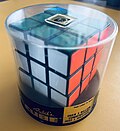
[[File:Original Rubik's cube from 1980.jpg|thumb|An original Rubik's Cube from 1980 in Hungary]] | |||
The [[Rubik's Cube]] was invented on May 19, 1974, by [[Hungarian people|Hungarian]] [[professor]] of [[architecture]] [[Ernő Rubik]]. In 1979, Rubik partnered with [[Ideal Toy Company]] to garner widespread international interest in the cube. On June 5, 1982, the first world championship of speedcubing was held in [[Budapest]], [[Hungary]]. Nineteen people competed in the event, and the American [[Minh Thai]] won with a single solve time of 22.95 seconds, which was, at the time, the fastest Rubik's Cube solve ever recorded. Other attendees include [[Jessica Fridrich]] and [[Lars Petrus]], both of whom later contributed to the development of new solving methods and the speedcubing community.<ref>{{Cite web |title=World Rubik's Cube Championship 1982 {{!}} World Cube Association |url=https://www.worldcubeassociation.org/competitions/WC1982/results/all?event=333 |access-date=2023-05-17 |website=www.worldcubeassociation.org}}</ref> The Rubik's Cube waned in popularity after 1983, as there were no official competitions held,<ref>{{Cite web|url=https://www.nytimes.com/1982/10/30/business/rubik-s-cube-a-craze-ends.html|title=Rubik's Cube: A Craze Ends|date=30 October 1982|website=[[The New York Times]]|access-date=19 September 2019}}</ref> but with the advent of the [[Internet]], online [[website]]s began to surface to discuss the cube. With these websites facilitating the renewed popularity of the cube, a new generation of speedcubers arose. | |||
Those prominent in the online speedsolving community, such as [[Ron van Bruchem]], [[Tyson Mao]], [[Chris Hardwick (speedcuber)|Chris Hardwick]], and Ton Dennenbroek, eventually wanted to create an organization where cubers from around the world could meet and compete against each other. In 2003, they organized a [[2003 World Rubik's Cube Championship|championship]] in [[Toronto|Toronto, Ontario]], followed by another competition in the [[Netherlands]] later that same year. This revival of competition sparked a new wave of organized speedcubing events, which included regular national and international competitions.<ref>{{cite web|url=https://www.worldcubeassociation.org/competitions|title=Competitions|publisher=World Cube Association|access-date=2 August 2016}}</ref> There were twelve competitions in 2004, 58 more from 2005 to 2006, over 100 in 2008, and over 1150 in 2018. Since [[Budapest]]'s 1982 competition, there have been nine further World Championships traditionally held every other year. This new wave of speedcubing competitions has been and still is organized by the [[World Cube Association]] (WCA). | |||
Since the rise of speedcubing's popularity, numerous entrepreneurial ventures have been founded specializing in making or selling speedcubes, creating competition between these brands and Rubik's. Dozens of cube [[Manufacturing|manufacturers]], such as [[Gancube|GANCUBE]], MoYu (魔域文化), YJ (永骏), QiYi (奇艺魔方格), DaYan (大雁), DianSheng (点盛), ShengShou (圣手), YuXin (裕鑫), and Vin Cube have begun improving the cube's technology by creating many different speedcubes to allow for smoother turning and faster solving.<ref>{{cite web |url=https://ruwix.com/the-rubiks-cube/the-best-speedcube-competition-cubes-moyu-dayan-shengshou-yuxin/ |title = The Best SpeedCube SpeedCube Brands – For speedcubers}}</ref> This has helped to facilitate the eventual rise of the Rubik's Cube as not just a toy, but also a lucrative business.<ref>{{Cite news |last=Kemp |first=Emma |date=2021-12-10 |title='The popularity has just completely exploded': Rubik's Cube's second coming |language=en-GB |work=The Guardian |url=https://www.theguardian.com/sport/2021/dec/10/the-popularity-has-just-completely-exploded-rubiks-cubes-second-coming |access-date=2023-10-20 |issn=0261-3077}}</ref> | |||
== | == World Cube Association == | ||
{{Main|World Cube Association}} | |||
{{See also|List of world records in speedcubing}}The [[World Cube Association]] (WCA) is a non-profit organization which organizes speedcubing competitions and ratifies results. The WCA consists of the WCA Board, WCA Committee, and the WCA Council. The WCA Board is the head or leader of the entire WCA, and is responsible for fulfilling tasks not completed or done by the WCA Committee and WCA Council. The WCA Appeals Committee (WAC) is responsible for ensuring right and fair decisions in accordance with the WCA Regulations. The WCA Committee is also responsible for reviewing and resolving appeals regarding the decisions of other WCA Staff members. The WCA Council is a special type of team that serves as an advisory role to the WCA, and consists of community members, and not WCA Staff Members. These WCA Staff Members are part of a cubing community, which consist of organizers, who organize and manage cubing competitions, and delegates, who help in managing competitions and help competitors who are unfamiliar with the competition environment, and to decide whether a competitor's solve should be penalized or not. WCA Regulations are required to be followed by competitors and can be found on the official WCA website. | |||
== Methods == | |||
=== 3x3x3 === | |||
The standard [[Rubik's Cube|3x3x3]] can be solved using several methods. The most commonly used methods for speedcubing are [[CFOP method|CFOP]], Roux, and ZZ, which are generally considered to achieve the fastest times. The CFOP method is used by the majority of cubers and employs a layer-by-layer system with numerous [[algorithm]]s for solving the final layer. The method starts by creating a cross on any side of the cube, followed by F2L where 4 corner edge pairs are inserted into the cross, followed by OLL (Orientation of the Last Layer) where the top side is solved in 1 of 57 algorithms, and finally PLL (Permutation of the Last Layer) where you do 1 of 21 algorithms to solve the rest of the cube. Roux, the second most popular method, which starts by forming a 1x2x3 block on one side of the cube, repeating it on the other side, and solves the middle and top layer last, uses fewer algorithms. ZZ uses a unique step called Edge Orientation to improve the ergonomics of turning by removing the amount of rotations during a solve. Another notable method is Petrus, which has been popular at times in the past; however, it is now considered sub-optimal to CFOP and Roux and was abandoned due to its unfavorable finger tricks. | |||
Solving larger cubes, such as [[Rubik's Revenge|4x4x4]] and [[Professor's Cube|5x5x5]], is most often done by reducing them to 3x3x3 and solving them like so, while [[Pocket Cube|2x2x2]] can be solved with the same or similar methods as 3x3x3. However, specialized 2x2x2 methods are quicker, and are regarded as superior to 3x3x3 methods. These methods include Ortega, CLL, and the EG method (which can allow users to plan the entire solution during inspection). | |||
===CFOP | ==== CFOP ==== | ||
{{main|CFOP method}} | {{main|CFOP method}} | ||
[[File:Erik Akkersdijk is solving a 3×3×3 Rubik's Cube in 10.50s.ogv|thumb|CFOP | [[File:Erik Akkersdijk is solving a 3×3×3 Rubik's Cube in 10.50s.ogv|thumb|CFOP speedsolver in a speedcubing competition]] | ||
The CFOP ( | The [[CFOP method|CFOP]] (abbreviation for Cross - F2L - OLL - PLL) method, also known as the [[Fridrich method]] after one of its inventors, [[Jessica Fridrich]], who finished second in the 2003 Rubik's Cube World Championships, is the most commonly used method in speedcubing today. Its origins are credited to [[David Singmaster]], who was one of the first to publish a layer-by-layer method of solving in 1980,<ref>{{Cite web|title = David Singmaster Solution|url = http://van-ness.com/Kurt/Hobbies/RubiksCube/3x3x3/DavidSingmasterSolution.htm|website = Van Ness Web|access-date = 2 August 2016}}</ref> and Guus Razoux Schultz, who built upon this and developed a more efficient system for the first two layers (F2L).<ref>{{Cite web|title = Guus Razoux Schultz|url = https://www.speedsolving.com/wiki/index.php/Guus_Razoux_Schultz|website = Speedsolving.com Wiki|access-date = 2 August 2016}}</ref> Jessica Fridrich then finished developing the method and published it online in 1997,<ref>{{Cite web|title = Speed Cubing|url = http://www.rubiks.com/speed-cubing|website = Rubik's Official Website|access-date = 2 August 2016}}</ref> an event that was very influential in the revival of competitive speedcubing. The first step of the method is to solve a cross of edge pieces on the first layer. The remainder of the first layer and all of the second layer are then solved together in what is referred to as "corner-edge pairs," or slots. Finally, the last layer is solved in two steps – first, all of the pieces in the layer are oriented to form a solid color (but without the individual pieces always being in their correct places on the cube). This step is referred to as orientation and is usually performed with a single set of algorithms known as OLL (Orientation of the Last Layer). Then, all of those pieces are permuted to their correct spots. This is also usually performed as a single set of PLL (Permutation of the Last Layer) algorithms. OLL and PLL use 57 and 21 algorithms, respectively. Cross, First 2 Layers, Orientation, Permutation (CFOP) is the most popular method for speedsolving the Rubik's Cube. It is the method used by all 3x3 world record holders in the last decade. | ||
The CFOP method can be used as a less advanced method by dividing the steps into more steps, reducing the number of algorithms that need to be learned but sacrificing time | The CFOP method can be used as a less advanced method by dividing the steps into more steps, reducing the number of algorithms that need to be learned but sacrificing time. It is usually known as the [[Layer by Layer|beginner method or layer by layer (LBL)]]. Most people start learning CFOP with 4LLL (Four-Look Last Layer), which is the less advanced, slower, and algorithm-reducing (from 78 algorithms to 16) way to learn CFOP. The 4 steps are divided into edge orientation, corner orientation, corner permutation, and edge permutation (which can be called EO, CO, CP, and EP). Later on, full OLL, which has 57 algorithms, and full PLL, which has 21 algorithms, can be learned. An average CFOP user that solves with full OLL and PLL, along with an efficient cross (which takes 8 moves at maximum) and efficient F2L (which takes almost 30 moves), consists of 55–60 moves, which means that it has a higher move count than Roux and ZZ. However, finger tricks and algorithms are more researched with CFOP than any other method, which explains why the majority of the fastest speedcubers use CFOP as their main speedcubing method.<ref>{{Cite web |title=Cubers Megasurvey – Learning from ourselves |url=https://basilio.dev/cubing/megasurvey6|access-date=2023-04-11 |website=basilio.dev}}</ref> | ||
The CFOP method is the most widely used speed-solving method. It is a more efficient version of the Layer-By-Layer method (also known as the beginner's method). It is very popular due to the vast amount of resources that teach and improve upon the CFOP method. Many | The CFOP method is the most widely used speed-solving method. It is a more efficient version of the Layer-By-Layer method (also known as the beginner's method). It is very popular due to the vast amount of resources that teach and improve upon the CFOP method. Many top speedcubers, including two-time World Champions [[Feliks Zemdegs]] and [[Max Park]], learn additional sets of algorithms for the last slot and layer, such as Corners of Last Layer (COLL), which orients and permutes the corners when the edges are oriented, or Winter Variation (or the larger Valk Last Slot algorithm set, or VLS), which finishes OLL while inserting the last pair, and ZBLL, which combines the solving processes of OLL corner orientation and PLL in only one algorithm, provided the last-layer edges are oriented. | ||
===Roux | Pseudoslotting is a technique that allows advanced CFOP solvers to be more creative with efficient solutions. It is an alternative method to F2L, where instead of creating and inserting pairs with matching colors, the bottom layer is intentionally misaligned to allow different pieces to be paired together.<ref>{{Citation |title=Rubik's Cube: The Art of Pseudoslotting (F2L) | date=13 September 2022 |url=https://www.youtube.com/watch?v=49Izh9ZnBog |access-date=2024-03-17 |language=en}}</ref> This provides more freedom while pairing pieces during F2L. Pseudoslotting is similar to another technique called keyhole in which the bottom layer is misaligned to allow a piece to be inserted independently of its solved counterpart.<ref>{{Cite web |title=Keyhole F2L – Speedsolving.com Wiki |url=https://www.speedsolving.com/wiki/index.php?title=Keyhole_F2L |access-date=2024-03-17 |website=www.speedsolving.com}}</ref> It is widely believed that Tymon Kolasiński (who holds the European record for a 3x3x3 single with 3.66 seconds)<ref>{{Cite web |title=Rankings {{!}} World Cube Association |url=https://www.worldcubeassociation.org/results/rankings/333/single |access-date=2024-03-17 |website=www.worldcubeassociation.org}}</ref><ref>{{Citation |title=Rubik's Cube 3.66 European Record Single! | date=24 February 2024 |url=https://www.youtube.com/watch?v=pbwNwj6Djfc |access-date=2024-03-17 |language=en}}</ref> is the best speedcuber who uses pseudoslotting. With practice, recognition becomes easier and the execution is done by [[muscle memory]].<ref>{{Cite web |date=2020-06-03 |title=Interview with Tymon Kolasiński |url=https://www.thecubicle.com/blogs/thecubicle-blogs/interview-with-tymon-kolasinski |access-date=2024-03-17 |website=TheCubicle}}</ref> | ||
The Roux method was invented by [[French people|French]] speedcuber [[Gilles Roux]]. The first step of the Roux method is to form a | |||
The ZB method, a variation of CFOP, has become more popular among top solvers. The ZB method combines the ZBLS and ZBLL algorithm sets, which together allow the solver to complete the last F2L pair and all of the last layer in just 2 algorithms. Solvers like [[Xuanyi Geng]], Qixian Cao, and [[Tymon Kolasiński]] are among the first to adopt this method.<ref>{{Citation |title=CFOP VS ZB: Which Is The Future Of Speed Cubing? | date=11 April 2025 |url=https://www.youtube.com/watch?v=UX7KpiFLcXw |access-date=2025-09-02 |language=en}}</ref> The ZB method requires the solver to memorize 795 unique algorithms, which makes this a major barrier to entry, especially for older solvers. However, there is debate as to whether the ZB method is actually faster overall, since by cutting down on the steps required to solve the cube, solvers decrease the possibility for luck in their solves. | |||
==== Roux ==== | |||
The Roux method was invented by [[French people|French]] speedcuber [[Gilles Roux]]. The first step of the Roux method is to form a 3x2x1 block, usually placed in the lower portion of the left layer. The second step is creating another 3x2x1 on the opposite side, so each block shares a bottom color. The creation of these blocks is commonly known as "block-building".<ref>{{cite web | url=https://book.rouxers.com/blockbuilding.html | title=Blockbuilding – the Roux Reader }}</ref> The remaining four corners are then solved using a set of algorithms known as CMLL (Corners of the Last Layer, without regard to the M-slice), which leaves six edges and four centers that are solved in the last step, L6E or LSE (Last Six Edges). | |||
This method is not as dependent on algorithm memorization as the [[Fridrich method|CFOP method]] since all but the third step is done with intuition as opposed to predefined sets of algorithms. Because of the frequent use of M moves, the Roux method can be performed without any rotations (unlike the CFOP method), which means it is easier to '''look ahead''' (solving pieces while at the same time looking for the solution to the next step) while solving. It is also considered one of the most efficient speedsolving methods, with its average move count being between 45 and 50 moves for experienced solvers. However, the Roux method of speedcubing has been criticized over the years because, unlike CFOP, ZZ, or Petrus, Roux requires M (middle layer) slices to solve LSE. Using M slice moves makes it harder to achieve higher TPS (turns per second) because the finger tricks are almost always flicks, but high TPS is achievable through training. | This method is not as dependent on algorithm memorization as the [[Fridrich method|CFOP method]] since all but the third step is done with intuition as opposed to predefined sets of algorithms. Because of the frequent use of M moves, the Roux method can be performed without any rotations (unlike the CFOP method), which means it is easier to '''look ahead''' (solving pieces while at the same time looking for the solution to the next step) while solving. It is also considered one of the most efficient speedsolving methods, with its average move count being between 45 and 50 moves for experienced solvers. However, the Roux method of speedcubing has been criticized over the years because, unlike CFOP, ZZ, or Petrus, Roux requires M (middle layer) slices to solve LSE. Using M slice moves makes it harder to achieve higher TPS (turns per second) because the finger tricks are almost always flicks, but high TPS is achievable through training. | ||
One of the users of this method, Kian Mansour, broke the one-handed (OH) world record average with a time of 9.54 seconds.<ref>{{cite web |url= https://www.youtube.com/watch?v=pCfLsh5vDt0&t=56s |title= The video of Kian Mansour breaking the 3x3 OH world Record |publisher= Kian Monsour |access-date= 27 May 2018}}</ref> [[Sean Patrick Villanueva]] is the first Roux user to achieve a | One of the users of this method, Kian Mansour, broke the one-handed (OH) world record average with a time of 9.54 seconds.<ref>{{cite web |url= https://www.youtube.com/watch?v=pCfLsh5vDt0&t=56s |title= The video of Kian Mansour breaking the 3x3 OH world Record |date= 21 May 2018 |publisher= Kian Monsour |access-date= 27 May 2018}}</ref> [[Sean Patrick Villanueva]] is the first Roux user to achieve a sub-6 average of five in competition and is currently ranked twenty-sixth in the world by 3x3 average. He also podiumed in 3x3 at the WCA World Championship 2019 (2nd Place). On May 25, 2024, he broke the OH WR average with the largest margin in nearly 10 years, bringing it down from 8.62 to 8.09 seconds. He also broke the WR single with a 6.05 a few weeks later, though he lost this to Dhruva Sai Meruva, a CFOP one-hand solver on October 6, 2024.<ref>{{cite web |url= https://www.worldcubeassociation.org/results/records?event_id=333oh&show=history |title= Records 3x3x3 One-Handed |access-date= 5 August 2024}}</ref> | ||
===ZZ | ==== ZZ ==== | ||
The ZZ method (short for "Zbigniew Zborowski") is a modern speedcubing method originally proposed by Zbigniew Zborowski in 2006. The method was designed specifically to achieve high turning speeds by focusing on movement ergonomics and is a combination of a block-building method and a layer-by-layer method. The initial pre-planned step is called | The ZZ method (short for "Zbigniew Zborowski") is a modern speedcubing method originally proposed by Zbigniew Zborowski in 2006, and built upon since. The method was designed specifically to achieve high turning speeds by focusing on movement ergonomics and is a combination of a block-building method and a layer-by-layer method. The initial pre-planned step is called EOCross and is the most distinctive hallmark of the ZZ method. It involves orienting all edges while placing the cross pieces. It is also common to build an EOLine, mainly used for one-handed solving, where all edges are oriented and only the front and back cross edges are placed. The next step solves the remaining first two layers using only left, right, top, and bottom face turns, one of the advantages of ZZ. On completion of the first two layers, the last layer's edges are all correctly oriented because of edge pre-orientation during EO. The last layer may be completed using a number of techniques, including those used in the [[Fridrich method|CFOP method]]. An expert variant of this method, ZBLL (Zborowski-Bruchem Last Layer), allows the last layer to be completed in a single step with an average of just over 12 moves but requires a total of 493 algorithms to be learned.<ref name="Bernard Helmstetter's Move Count Statistics">{{cite web|url=http://www.ai.univ-paris8.fr/~bh/cube/|title=Rubik's Cube: Algorithms for the last layer|publisher=Université Paris 8|access-date=2 August 2016}}</ref> Due to the ergonomics of ZZ, rotating when solving will never be needed, unlike in the [[CFOP method]]. The ZZ method has fewer moves than CFOP, with ZZ averaging 53.5 compared to CFOP's 55–60 moves. Because ZZ uses EO, it is very move-efficient, and these techniques are sometimes used in FMC (Fewest Moves Challenge).<ref>{{Cite web|title=ZZ method – Speedsolving.com Wiki|url=https://www.speedsolving.com/wiki/index.php/ZZ_method|access-date=2020-05-22|website=www.speedsolving.com}}</ref> | ||
===Corners-first methods=== | ==== Corners-first methods ==== | ||
Corners-first methods involve solving the corners and then finishing the edges with slice turns. Corner-first solutions were common in the 1980s | Corners-first methods involve solving the corners and then finishing the edges with slice turns. Corner-first solutions were common in the 1980s. It was used by the 1982 world champion [[Minh Thai]].<ref>{{Cite magazine |last=Singmaster |first=David |date=1983 |title=Championship Techniques |magazine=Cubic Circular |page=6 |issue=3 & 4}}</ref> Currently,{{when|date=September 2024}} corner-first solutions are rarely used among speedsolvers. [[Dutch people|Dutch]] cuber Marc Waterman created a corners-first method in the cube craze and averaged 18 seconds in the mid-late 1980s.{{Citation needed|date=July 2024}} | ||
===Fewest Moves Challenge | ===Fewest Moves Challenge=== | ||
At the highest level, there typically | At the highest level, there is typically not a standard method used for Fewest Moves solving. Rather, competitors attempt to solve the cube intuitively using solving techniques such as blockbuilding, Normal-Inverse-Scramble-Switch (NISS), commutator insertions, and Domino Reduction after its rise to popularity in 2019. Most solves use multiple of these techniques in order to generate a solution. | ||
===Blindfolded | ===Blindfolded=== | ||
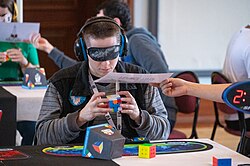
[[File:Championnat de France de Speedcubing 2024 • Saverne - 35.jpg|thumb|Blindfolded competitor in the solving stage of a competition attempt]] | |||
In 2003, when the first blindfolded competitions were organized, world record solvers would use the 3OP (3-Cycle Orientation Permutation) Method, which orients and then permutes pieces using 3 cycles. As of today, methods such as 3-Style and M2 are among the fastest and most popular blind-solving methods. The Old Pochmann Method, which is a method that solves one piece at a time, is a method typically used by beginner blindsolvers. Blindfolded solvers use letter patterns to help memorize sequences of moves in order to solve the cube. | In 2003, when the first blindfolded competitions were organized, world record solvers would use the 3OP (3-Cycle Orientation Permutation) Method, which orients and then permutes pieces using 3 cycles. As of today, methods such as 3-Style and M2 are among the fastest and most popular blind-solving methods. The Old Pochmann Method, which is a method that solves one piece at a time, is a method typically used by beginner blindsolvers. Blindfolded solvers use letter patterns to help memorize sequences of moves in order to solve the cube. | ||
The lettering scheme that blindfolded solvers use is called the Speffz lettering scheme, and each sticker or individual color is given a letter. The | The lettering scheme that blindfolded solvers use is called the Speffz lettering scheme, and each sticker or individual color is given a letter. The letters are assigned starting with the top edge of the top face, going clockwise, and beginning with A. The top edge of the top face is A, the right edge is B, the bottom edge is C, and the left edge is D. The same process is done on the other sides in the order top, left, front, right, back, and bottom to get every edge lettered from A to X. The same process is applied to all of the corners, starting with the top left corner and going clockwise in the same face order. A cycle of piece swaps is then used with the letter E being used as a buffer location for corners and D commonly being used for edges in the Old Pochmann method. The current 3x3 average and single blindfolded world record holder is [[Tommy Cherry]], from the United States.<ref>{{Cite web |title=Rankings {{!}} World Cube Association |url=https://www.worldcubeassociation.org/results/rankings/333bf/single |access-date=2024-04-14 |website=www.worldcubeassociation.org}}</ref> | ||
==Competitions== | ==Competitions== | ||
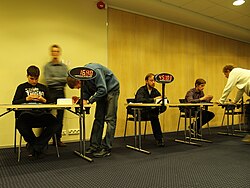
[[ | Speedcubing competitions have been held every year since 2003. The WCA was formed in 2004 to govern all official competitions. For a competition to be official, it must be approved by the WCA and follow the WCA regulations. Included in the regulations is the necessity of having one or more [[World Cube Association#WCA Delegates|WCA delegate]] in attendance. A delegate's main role is to ensure all regulations are followed during the competition. Once the competition is finished, results are uploaded to the WCA website. Judges oversee the round, delegates help the judge, runners give the scrambled or solved cube to the competitor/scrambler, and a scrambler scrambles the cube using moves generated by a computer. | ||
=== | ===Format=== | ||
The majority of puzzle competitions are held using a [[Truncated mean|trimmed mean]] of five. This involves the competitor executing five solves in the round in question, after which the fastest and slowest solves are disregarded and the [[mean]] of the remaining three is used. The 6x6x6 and 7x7x7 events are ranked by a straight mean of three—only three solves, none of which are disregarded. In 3x3x3 blindfolded and 3x3x3 fewest moves challenges, either a straight mean of 3 or the best of 3 is used, while 4x4x4 blindfolded, 5x5x5 blindfolded, and multiple blindfolded challenges are ranked using the best of 1, 2 or 3, depending on the competition. | |||
When a round begins, competitors turn in the puzzle they will use. Puzzles are scrambled using a computer-generated scramble. In each round, five, three, or one (depending on the format mentioned above) scrambles are used. Every competitor in the round will receive each scramble once. Before starting a solution, a competitor has up to 15 seconds to inspect the puzzle (inspection is removed for blindfolded events). This is monitored by a judge with a stopwatch. Once the solution is complete, the judge records the time on the competitor's scorecard, which is signed by both. If the puzzle is unsolved and the timer is stopped, the time is recorded as "DNF" (Did Not Finish). There are also numerous reasons why the solver can receive a two-second addition to the solve time, such as a face being more than 45 degrees off or the competitor going over the allowed inspection time. A competitor can also receive an extra solution to replace the one just completed, for example in the case of a timer malfunction or a duplicate scramble. | |||
The official timer used in competitions is the StackMat Gen 4 or Gen 5 timer, which was originally designed for [[sport stacking]]. This device has touch-sensitive pads that are triggered by the user lifting one or both of their hands to start the time and placing both their hands back on the pads after releasing the puzzle to stop the timer. | |||
Only two WCA recognised events are not "speedsolving" events (i.e. are scored by means other than time taken for solves), these being: Fewest Moves Competition, or FMC, which is scored using the number of moves for a competitor's solution, with a lower number of moves being better, and multiple blindfold solving, or "multi-blind", where a competitor's score is calculated by subtracting the number of unsolved cubes from the number of solved cubes. | |||
Official competitions are currently being held in several categories. | Official competitions are currently being held in several categories. | ||
| Line 71: | Line 79: | ||
! Category || Cube type | ! Category || Cube type | ||
|- | |- | ||
| Speedsolving || [[Pocket Cube| | | Speedsolving || [[Pocket Cube|2x2x2]], [[Rubik's Cube|3x3x3]], [[Rubik's Revenge|4x4x4]], [[Professor's Cube|5x5x5]], [[V-Cube 6|6x6x6]], [[V-Cube 7|7x7x7]], [[Rubik's Clock|Clock]], [[Megaminx]], [[Pyraminx]], [[Skewb]], [[Square-1 (puzzle)|Square-1]] | ||
|- | |- | ||
| Blindfolded solving || 3x3x3, 4x4x4, 5x5x5 | | Blindfolded solving || 3x3x3, 4x4x4, 5x5x5 | ||
|- | |- | ||
| Multiple blindfolded solving || 3x3x3 | | Multiple cubes blindfolded solving || rowspan="3" | 3x3x3 | ||
|- | |- | ||
| One-handed solving | | One-handed solving | ||
|- | |- | ||
| Solving in fewest moves | | Solving in fewest moves | ||
|} | |} | ||
[[File:Megaminx, Estonian Open 2011.jpg|thumb|Speedsolvers solving [[Megaminx]]es at the 2011 Estonian Open]] | |||
[[File:Megaminx, Estonian Open 2011.jpg|thumb|Speedsolvers solving [[Megaminx]]es at the 2011 Estonian Open | |||
Competitions will often include events for speedsolving other puzzles as well, such as: | Competitions will often include events for speedsolving other puzzles as well, such as: | ||
* [[Pyraminx]], a pyramid-shaped puzzle. | * [[Pyraminx]], a pyramid-shaped puzzle. | ||
* [[Megaminx]], | * [[Megaminx]], a twelve-sided dodecahedral puzzle solved similarly to a [[Rubik's Cube|3x3x3]]. | ||
* [[Skewb]], a cube shaped puzzle added in 2014 as an official WCA event due to its growing popularity and the ease of its regulations.<ref>{{Cite web |title=World Cube Association |url=https://www.worldcubeassociation.org/archive/forum_topics/1163 |access-date=2023-05-03 |website=www.worldcubeassociation.org}}</ref> | * [[Skewb]], a cube-shaped puzzle added in 2014 as an official WCA event due to its growing popularity and the ease of its regulations.<ref>{{Cite web |title=World Cube Association |url=https://www.worldcubeassociation.org/archive/forum_topics/1163 |access-date=2023-05-03 |website=www.worldcubeassociation.org}}</ref> | ||
* [[Square-1 (puzzle)|Square-1]], a cubed puzzle that changes shape as it is solved | * [[Square-1 (puzzle)|Square-1]], a cubed puzzle that changes shape as it is solved | ||
* [[Rubik's Clock]] | * [[Rubik's Clock]] is a double-sided, round puzzle with nine clock faces. It is considered solved when all the clock hands point to 12 o’clock. | ||
* | |||
* Rubik's Magic | The following are no longer official events: | ||
* 3x3x3 with Feet was removed from the list of official WCA events in 2020.<ref>{{Cite web |title=Removing official status for 3×3×3 With Feet {{!}} World Cube Association |url=https://www.worldcubeassociation.org/posts/removing-official-status-for-3x3x3-with-feet |access-date=2023-05-03 |website=www.worldcubeassociation.org}}</ref> | |||
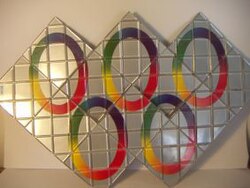
* The Rubik's Magic, a folding puzzle with 8 connected tiles, was removed from the list of official WCA events in 2012.<ref name=":0">{{Cite web |title=World Cube Association |url=https://www.worldcubeassociation.org/archive/forum_topics/1013 |access-date=2026-02-19 |website=www.worldcubeassociation.org}}</ref>[[File:Master Magic 2.jpg|thumb|The [[Rubik's Master Magic]], removed from the list of official WCA events in 2012]] | |||
* The Rubik's Master Magic, a folding puzzle with 12 connected tiles, was removed from the list of official WCA events in 2012.<ref name=":0" /> | |||
* The Rainbow Cube, a [[cuboctahedron]]-shaped puzzle, was removed from the list of official WCA events in 2007.<ref name="worldcubeassociation">{{Cite web |title=World Cube Association Competition regulations, history of changes {{!}} World Cube Association |url=https://regulations.worldcubeassociation.org/history/files/regulations_history.html |access-date=12 September 2024 | website=www.worldcubeassociation.org}}</ref> | |||
* The Siamese Cube, two connected 3x3s, was removed from the list of official WCA events in 2007.<ref name="worldcubeassociation" /> | |||
* 3x3 with No Inspection was removed from the list of official WCA events in 2006.<ref name="worldcubeassociation" /> | |||
* 3x3 Multiple Blindfolded Old Style was removed from the list of official WCA events in 2009.<ref name="worldcubeassociation" /> | |||
===World Rubik's Cube Championships=== | ===World Rubik's Cube Championships=== | ||
The [[World Cube Association|WCA]] | The [[World Cube Association|WCA]] sanctions the Rubik's Cube World Championship as the main international competition once every two years. The latest championship was held in [[Seattle]], [[United States]] from 3 to 6 July 2025.<ref name="auto">https://www.worldcubeassociation.org/competitions/WC2025</ref> | ||
<div align="center"> | <div align="center"> | ||
{| class="wikitable" style="text-align:center;" | {| class="wikitable" style="text-align:center;" | ||
| Line 104: | Line 117: | ||
!Nations | !Nations | ||
!Competitors | !Competitors | ||
!Events | !Events | ||
!Winner (3x3) | !Winner (3x3) | ||
| Line 116: | Line 128: | ||
| 19 | | 19 | ||
|19 | |19 | ||
| 1 | | 1 | ||
| {{flagicon|USA}} [[Minh Thai]] | | {{flagicon|USA}} [[Minh Thai]] | ||
| Line 122: | Line 133: | ||
|<ref name=budapest1982>{{cite web|title=World Rubik's Cube Championship 1982|publisher=World Cube Association|url=http://www.worldcubeassociation.org/results/c.php?i=WC1982|access-date=2 August 2016}}</ref> | |<ref name=budapest1982>{{cite web|title=World Rubik's Cube Championship 1982|publisher=World Cube Association|url=http://www.worldcubeassociation.org/results/c.php?i=WC1982|access-date=2 August 2016}}</ref> | ||
|- | |- | ||
| II | | [[2003 Rubik's Cube World Championship|II]] | ||
| 2003 | | 2003 | ||
| {{flagicon|Canada}} [[Toronto]] | | {{flagicon|Canada}} [[Toronto]] | ||
| Line 128: | Line 139: | ||
| 15 | | 15 | ||
|88 | |88 | ||
| 13 | | 13 | ||
| {{flagicon|USA}} Dan Knights | | {{flagicon|USA}} Dan Knights | ||
| Line 134: | Line 144: | ||
|<ref name=toronto2003>{{cite web|title=World Rubik's Games Championship 2003|publisher=World Cube Association|url=http://www.worldcubeassociation.org/results/c.php?i=WC2003|access-date=2 August 2016}}</ref> | |<ref name=toronto2003>{{cite web|title=World Rubik's Games Championship 2003|publisher=World Cube Association|url=http://www.worldcubeassociation.org/results/c.php?i=WC2003|access-date=2 August 2016}}</ref> | ||
|- | |- | ||
| III | | [[2005 Rubik's Cube World Championship|III]] | ||
| 2005 | | 2005 | ||
| {{flagicon|USA}} [[Lake Buena Vista, Florida|Lake Buena Vista]] | | {{flagicon|USA}} [[Lake Buena Vista, Florida|Lake Buena Vista]] | ||
| Line 140: | Line 150: | ||
| 16 | | 16 | ||
|149 | |149 | ||
| 15 | | 15 | ||
| {{flagicon|FRA}} Jean Pons | | {{flagicon|FRA}} Jean Pons | ||
| Line 152: | Line 161: | ||
| 28 | | 28 | ||
|214 | |214 | ||
| 17 | | 17 | ||
| {{flagicon|JPN}} [[Yu Nakajima]] | | {{flagicon|JPN}} [[Yu Nakajima]] | ||
| Line 164: | Line 172: | ||
| 32 | | 32 | ||
|327 | |327 | ||
| 19 | | 19 | ||
| {{flagicon|UK}} Breandan Vallance | | {{flagicon|UK}} Breandan Vallance | ||
| Line 176: | Line 183: | ||
| 35 | | 35 | ||
|292 | |292 | ||
| 19 | | 19 | ||
| {{flagicon|POL}} Michał Pleskowicz | | {{flagicon|POL}} Michał Pleskowicz | ||
| Line 188: | Line 194: | ||
| 35 | | 35 | ||
|580 | |580 | ||
| 17 | | 17 | ||
| {{flagicon|AUS}} [[Feliks Zemdegs]] | | {{flagicon|AUS}} [[Feliks Zemdegs]] | ||
| Line 200: | Line 205: | ||
| 37 | | 37 | ||
|428 | |428 | ||
| 18 | | 18 | ||
| {{flagicon|AUS}} [[Feliks Zemdegs]] | | {{flagicon|AUS}} [[Feliks Zemdegs]] | ||
| Line 212: | Line 216: | ||
| 64 | | 64 | ||
|938 | |938 | ||
| 18 | | 18 | ||
| {{flagicon|USA}} [[Max Park]] | | {{flagicon|USA}} [[Max Park]] | ||
| Line 224: | Line 227: | ||
| 52 | | 52 | ||
|833 | |833 | ||
| 18 | | 18 | ||
| {{flagicon|Germany}} Philipp Weyer | | {{flagicon|Germany}} Philipp Weyer | ||
| Line 236: | Line 238: | ||
| — | | — | ||
|— | |— | ||
| 17 | | 17 | ||
| — | | — | ||
| Line 247: | Line 248: | ||
| 12–15 August | | 12–15 August | ||
| 63 | | 63 | ||
| | |1187 | ||
| 17 | | 17 | ||
| {{flagicon|USA}} [[Max Park]] | | {{flagicon|USA}} [[Max Park]] | ||
| 5.31 (Average) | | 5.31 (Average) | ||
| <ref name=seoul2023>{{cite web|title = WCA Championship 2022 and 2023 Hosts Announcement (June 2021)|publisher=World Cube Association|url=https://www.worldcubeassociation.org/posts/wca-championship-2022-and-2023-hosts-announcement-june-2021|access-date=2 February 2022}}</ref> | | <ref name=seoul2023>{{cite web|title = WCA Championship 2022 and 2023 Hosts Announcement (June 2021)|publisher=World Cube Association|url=https://www.worldcubeassociation.org/posts/wca-championship-2022-and-2023-hosts-announcement-june-2021|access-date=2 February 2022}}</ref> | ||
|} | |- | ||
|XIII | |||
|2025 | |||
|{{Flagicon|United States}} [[Seattle]] | |||
|3–6 July | |||
|74 | |||
|1864 | |||
|17 | |||
| {{flagicon|China}} [[Yiheng Wang]] | |||
| 4.23 (Average) | |||
|<ref name="auto"/> | |||
|- | |||
|XIV | |||
|2027 | |||
|{{Flagicon|Sweden}} [[Uppsala]] | |||
|22–25 July | |||
|TBA | |||
|2500 | |||
|17 | |||
| | |||
| | |||
|<ref>https://www.worldcubeassociation.org/posts/wca-world-championship-2027-host-city-announcement-july-2027</ref> | |||
|}</div> | |||
==World Records== | |||
The following are the official speedcubing world records approved by the WCA as of 21 March 2026.<ref>{{Cite web |title=Records {{!}} World Cube Association |url=https://www.worldcubeassociation.org/results/records |access-date=2026-03-21|website=www.worldcubeassociation.org}}</ref> | |||
==World | |||
The following are the official speedcubing world records approved by the | |||
Note: For averages of 5 solves, the best time and the worst time are dropped, and the mean of the remaining 3 solves is taken. For events where only 3 solves are done, the mean of all 3 is taken. | Note: For averages of 5 solves, the best time and the worst time are dropped, and the mean of the remaining 3 solves is taken. For events where only 3 solves are done, the mean of all 3 is taken. | ||
{| class="wikitable sortable" style="text-align:center" | {| class="wikitable sortable" style="text-align:center" | ||
! Event !! Type !! Result !! Person !! Competition (Date(s)) !! | ! Event !! Type !! Result !! Person !! Competition (Date(s)) !! Round Results | ||
|- | |- | ||
| rowspan="2" |[[Rubik's Cube| | | rowspan="2" | [[Rubik's Cube|3x3x3 Cube]] | ||
| Single || 2.76 || {{flagicon|POL}} Teodor Zajder || GLS Big Cubes Gdańsk 2026 (7-8 February) || 4.99 / 5.36 / (5.76) / (2.76) / 5.34 | |||
|- | |- | ||
| Average | | Average || 3.84 || {{flagicon|CHN}} Xuanyi Geng (耿暄一) || Beijing Winter 2026 (10-11 January) || (5.09) / 3.96 / 3.71 / 3.84 / (3.37) | ||
| | |||
|{{ | |||
| | |||
| | |||
|- | |- | ||
|rowspan="2"| [[Pocket Cube| | | rowspan="2" | [[Pocket Cube|2x2x2 Cube]] | ||
| Single || 0. | | Single || 0.39 || {{flagicon|CHN}} Ziyu Ye (叶梓渝) || Hefei Open 2025 (25 October) || (1.94) / 1.31 / 1.38 / 1.46 / (0.39) | ||
|- | |- | ||
| Average || | | Average || 0.86 || {{flagicon|USA}} Sujan Feist || Kids America Christmas Clash OH 2025 (13 December) || 0.86 / 1.02 / (0.56) / (1.42) / 0.70 | ||
|- | |- | ||
|rowspan="2"| [[Rubik's Revenge| | |rowspan="2"| [[Rubik's Revenge|4x4x4 Cube]] | ||
| Single || | | Single || 15.18 || rowspan="4"|{{flagicon|POL}} [[Tymon Kolasiński]] || Spanish Championship 2025 (6-8 December) || 20.27 / (22.54) / 19.57 / (15.18) / 20.34 | ||
|- | |- | ||
| Average || | | Average || 18.56 || Seoul Winter 2026 (17-18 January) || 19.16 / 18.01 / 18.51 / (21.64) / (16.09) | ||
|- | |- | ||
|rowspan="2"| [[Professor's Cube| | |rowspan="2"| [[Professor's Cube|5x5x5 Cube]] | ||
| Single || | | Single || 30.45 || Rubik's WCA Asian Championship 2024 (1-4 November) || 35.94 / (42.62) / 36.67 / 40.82 / (30.45) | ||
|- | |- | ||
| Average || | | Average || 34.31 || Rubik's WCA World Championship 2025 (3-6 July) || 36.46 / (36.67) / (31.67) / 33.11 / 33.36 | ||
|- | |- | ||
|rowspan="2"| [[V-Cube 6| | |rowspan="2"| [[V-Cube 6|6x6x6 Cube]] | ||
| Single || | | Single || 57.69 || rowspan="4" | {{flagicon|USA}} [[Max Park]] || Burbank Big Cubes 2025 (26 April) || 57.69 / 1:11.14 / 1:09.39 | ||
|- | |- | ||
| | | Mean || 1:05.04 || Nub Open Trabuco Hills Fall 2025 (4 October) || 1:04.60 / 1:04.80 / 1:05.73 | ||
|- | |- | ||
|rowspan="2"| [[V-Cube 7| | |rowspan="2"| [[V-Cube 7|7x7x7 Cube]] | ||
| Single || 1: | | Single || 1:33.48 || Nub Open Trabuco Hills Fall 2025 (4 October) || 1:33.48 / 1:41.36 / 1:35.75 | ||
|- | |- | ||
| | | Mean || 1:36.86 || Nub Open Trabuco Hills Fall 2025 (4 October) || 1:33.48 / 1:41.36 / 1:35.75 | ||
|- | |- | ||
|rowspan=" | |rowspan="3"| [[Rubik's Cube#Competitions and records|3x3x3 Blindfolded]] | ||
| Single || | | Single || 11.67 || {{flagicon|AUS}} Charlie Eggins || Cubing at The Cube 2026 (9-11 January) || 14.34 / (DNF) / 13.95 / 13.85 / (11.67) | ||
|- | |- | ||
| | | rowspan="2"|Mean || rowspan="2"|14.05 || {{flagicon|USA}} [[Tommy Cherry]] || Rubik's WCA European Championship 2024 (25-28 July) || 13.48 / 14.42 / 14.24 | ||
|- | |- | ||
| {{flagicon|AUS}} Charlie Eggins || Cubing at The Cube 2026 (9-11 January) || 14.34 / (DNF) / 13.95 / 13.85 / (11.67) | |||
|- | |- | ||
| rowspan=" | | rowspan="5" | [[Rubik's Cube#Competitions and records|3x3x3 Fewest Moves]] | ||
| rowspan="4" | | | rowspan="4" | Single || rowspan="4" | 16 || {{flagicon|ITA}} Sebastiano Tronto || FMC 2019 (15–16 June) || 16 / 26 / 24 | ||
| rowspan=" | |||
| | |||
|- | |- | ||
| | |{{flagicon|USA}} Aedan Bryant || rowspan="2" |Ashfield Summer Challenge 2024 (23 June) || 26 / 16 / 26 | ||
|- | |- | ||
|{{flagicon|USA}} Levi Gibson || 26 / 16 / 24 | |||
|- | |- | ||
| | |{{flagicon|GBR}} Jacob Sherwen Brown || Rubik's UK Championship FMC 2024 (26 October) || 33 / 31 / 16 | ||
|- | |- | ||
| | | Mean || 19.33 || {{flagicon|SGP}} Wong Chong Wen (黄崇文) || FMCanton Nansha 2026 (21 March) || 18 / 19 / 21 | ||
| | |||
|- | |- | ||
| rowspan="2" | | |rowspan="2"| [[Rubik's Cube#Competitions and records|3x3x3 One-Handed]] | ||
| | | Single || 5.66 || {{flagicon|CHE}} Dhruva Sai Meruva || Swiss Nationals 2024 (4-6 October) || (12.25) / 9.77 / 10.02 / (5.66) / 8.93 | ||
| | |||
| | |||
|- | |- | ||
| | | Average || 7.72 || {{flagicon|USA}} Luke Garrett || Chicagoland Newcomers 2025 (9 March) || 8.57 / 7.13 / (6.82) / 7.45 / (12.80) | ||
|- | |- | ||
|rowspan="2"| [[Rubik's Clock]] | |rowspan="2"| [[Rubik's Clock|Clock]] | ||
| Single || | | Single || 1.53 || {{flagicon|NZL}} Lachlan Gibson || Hasty Hastings 2025 (27 September) || 3.52 / 2.33 / (7.02) / (1.53) / 3.08 | ||
|- | |- | ||
| Average || | |Average || 2.24 || {{flagicon|USA}} Brendyn Dunagan || Temecula Valley Winter 2025 (13 December) || 2.02 / 3.27 / 1.93 / 2.27 / 2.43 | ||
|- | |- | ||
|rowspan="2"| [[Megaminx]] | |rowspan="2"| [[Megaminx]] | ||
| Single || | | Single || 21.99 || rowspan="2"|{{flagicon|RUS}} Timofei Tarasenko || rowspan="2"|Tashkent Open 2025 (6-7 December) || rowspan="2"|(21.99) / (27.44) / 23.81 / 23.67 / 25.65 | ||
|- | |- | ||
| Average || | | Average || 24.38 | ||
|- | |- | ||
|rowspan="2"| [[Pyraminx]] | | rowspan="2" | [[Pyraminx]] | ||
| Single || 0. | | Single || 0.73 || {{flagicon|USA}} Simon Kellum || Middleton Meetup Thursday 2023 (21 December) || 4.94 / 2.36 / 1.76 / (0.73) / (DNF) | ||
|- | |- | ||
| Average || 1. | | Average || 1.14 || {{flagicon|CHN}} Lingkun Jiang (姜凌坤) || Zhengzhou Zest 2025 (27 December) || 1.04 / (3.22) / (0.97) / 1.21 / 1.16 | ||
|- | |- | ||
|rowspan="2"| [[Skewb]] | |rowspan="2"| [[Skewb]] | ||
| Single || 0. | | Single || 0.73 || {{flagicon|CZE}} Vojtěch Grohmann || Głuszyca Open 2026 (7-8 March) || (3.25) / 1.57 / 1.70 / (0.73) / 1.56 | ||
|- | |- | ||
| Average || 1. | | Average || 1.37 || {{flagicon|POL}} Ignacy Samselski || Cube Factory League Justynów 2025 (14-15 June) || 1.22 / 1.43 / (1.16) / 1.46 / (2.93) | ||
|- | |- | ||
|rowspan="2"| [[Square-1 (puzzle)|Square-1]] | |rowspan="2"| [[Square-1 (puzzle)|Square-1]] | ||
| Single || 3. | | Single || 3.40 || {{flagicon|USA}} Hassan Khanani || Steel City Sprint PA 2026 (24 January) || 7.11 / 5.98 / (3.40) / (8.61) / 7.70 | ||
|- | |- | ||
| Average || 4. | | Average || 4.63 || {{flagicon|USA}} Sameer Aggarwal || Cubing in Southern Oregon 2025 (1 February) || (8.08) / 6.20 / (3.42) / 3.81 / 3.88 | ||
|- | |- | ||
| rowspan="2" | | | rowspan="2" | [[Rubik's Revenge#World records|4x4x4 Blindfolded]] | ||
| Single || 51.96 || {{flagicon|USA}} Stanley Chapel || 4BLD in a Madison Hall 2023 (28-29 January) || | | Single || 51.96 || rowspan="4" | {{flagicon|USA}} Stanley Chapel || 4BLD in a Madison Hall 2023 (28-29 January) || 1:17.62 / DNF / 51.96 | ||
|- | |- | ||
| | | Mean || 59.39 || New York Multimate PBQ II 2025 (13-15 June) || 57.83 / 1:04.79 / 55.54 | ||
|- | |- | ||
| rowspan="2" | | | rowspan="2" | [[Professor's Cube#World records|5x5x5 Blindfolded]] | ||
| Single || | | Single || 1:58.59 || Multi Mayhem VA 2026 (2-4 January) || DNF / DNF / 2:02.28 | ||
|- | |- | ||
| | | Mean || 2:27.63 || Michigan Cubing Club Epsilon 2019 (14 December) || 2:32.48 / 2:28.80 / 2:21.62 | ||
|- | |- | ||
| | | [[Rubik's Cube#Competitions and records|3x3x3 Multi-Blind]] | ||
| Single || | | Single || 63/65 58:23 || {{flagicon|USA}} Graham Siggins || Please Be Quiet Reno 2025 (18 October) || 63/65 58:23 / 58/68 1:00:00 | ||
|} | |} | ||
[[File:Progression of Rubik's Cube world records.png|thumb|center| | [[File:Progression of Rubik's Cube world records.png|thumb|center| | ||
1000px|A scatter plot of Rubik's Cube world records (single and average) against time. This depicts the improvement made over the years, as well as highlights records that stayed unbroken for an unusual amount of time. | 1000px|A scatter plot of Rubik's Cube world records (single and average) against time. This depicts the improvement made over the years, as well as highlights records that stayed unbroken for an unusual amount of time. This graph stops after Max Parks 3.13 second 3x3 single set on 11 June 2023 which stayed unbroken for 616 days.]] | ||
==See also== | ==See also== | ||
*[[Rubik's Revenge]] | * [[Rubik's Revenge]] | ||
*[[Professor's Cube]] | * [[Professor's Cube]] | ||
* [[Magic Cube]] | |||
==Notes== | ==Notes== | ||
| Line 386: | Line 390: | ||
==External links== | ==External links== | ||
*[http://www.speedsolving.com/ Speedsolving.com] | * [http://www.speedsolving.com/ Speedsolving.com] | ||
*[http://www.speedsolving.com/wiki/index.php/Main_Page Speedsolving.com Wiki] | * [http://www.speedsolving.com/wiki/index.php/Main_Page Speedsolving.com Wiki] | ||
*[http://ws2.binghamton.edu/fridrich/system.html Fridrich Method] | * [http://ws2.binghamton.edu/fridrich/system.html Fridrich Method] | ||
*[http://grrroux.free.fr/method/Intro.html Roux Method] | * [http://grrroux.free.fr/method/Intro.html Roux Method] | ||
*[http://cube.crider.co.uk/ ZZ Method | * [http://cube.crider.co.uk/ ZZ Method] | ||
{{Rubik's Cube}} | {{Rubik's Cube}} | ||
Latest revision as of 12:08, 25 March 2026
 | This article has multiple issues. Please help improve it or discuss these issues on the talk page. (Learn how and when to remove these template messages)
|


Speedcubing or Speedsolving is a competitive mind sport centered around the rapid solving of various combination puzzles. The most prominent puzzle in this category is the 3x3x3 puzzle, commonly known as the Rubik's Cube. Participants in this sport are called "speedcubers" (or simply "cubers"), who focus specifically on solving these puzzles at high speeds to get low clock times and/or fewest moves. The essential aspect of solving these puzzles typically involves executing a series of predefined algorithms in a particular sequence with pattern recognition and finger tricks.
Competitive speedcubing is predominantly overseen by the World Cube Association (WCA), which officially recognizes 17 distinct speedcubing events. These events encompass a range of puzzles, including NxNxN puzzles of sizes varying from 2x2x2 to 7x7x7, and other puzzle forms such as the Pyraminx, Megaminx, Skewb, Square-1, and Rubik's Clock. Additionally, specialized formats such as 3x3, 4x4, and 5x5 blindfolded, 3x3 one-handed (OH), 3x3 Fewest Moves, and 3x3 multi-blind are also regulated and hosted in competitions.[1]
As of February 2026, the world record for the fastest single solve of a Rubik's Cube in a competitive setting stands at 2.76 seconds. This record was achieved by Teodor Zajder at the GLS Big Cubes Gdańsk WCA competition event on February 8, 2026.[2][3] Xuanyi Geng set the record for the average time of five solves in the 3x3x3 category at 3.84 seconds at Beijing Winter 2026 on January 10-11, 2025.[4][5] Speedcubing is organized by numerous countries that hold international competitions throughout the year.[6] The widespread popularity of the Rubik's Cube has led to an abundance of online resources, including guides and techniques, aimed at assisting individuals in solving the puzzle.
History[edit | edit source]

The Rubik's Cube was invented on May 19, 1974, by Hungarian professor of architecture Ernő Rubik. In 1979, Rubik partnered with Ideal Toy Company to garner widespread international interest in the cube. On June 5, 1982, the first world championship of speedcubing was held in Budapest, Hungary. Nineteen people competed in the event, and the American Minh Thai won with a single solve time of 22.95 seconds, which was, at the time, the fastest Rubik's Cube solve ever recorded. Other attendees include Jessica Fridrich and Lars Petrus, both of whom later contributed to the development of new solving methods and the speedcubing community.[7] The Rubik's Cube waned in popularity after 1983, as there were no official competitions held,[8] but with the advent of the Internet, online websites began to surface to discuss the cube. With these websites facilitating the renewed popularity of the cube, a new generation of speedcubers arose.
Those prominent in the online speedsolving community, such as Ron van Bruchem, Tyson Mao, Chris Hardwick, and Ton Dennenbroek, eventually wanted to create an organization where cubers from around the world could meet and compete against each other. In 2003, they organized a championship in Toronto, Ontario, followed by another competition in the Netherlands later that same year. This revival of competition sparked a new wave of organized speedcubing events, which included regular national and international competitions.[9] There were twelve competitions in 2004, 58 more from 2005 to 2006, over 100 in 2008, and over 1150 in 2018. Since Budapest's 1982 competition, there have been nine further World Championships traditionally held every other year. This new wave of speedcubing competitions has been and still is organized by the World Cube Association (WCA).
Since the rise of speedcubing's popularity, numerous entrepreneurial ventures have been founded specializing in making or selling speedcubes, creating competition between these brands and Rubik's. Dozens of cube manufacturers, such as GANCUBE, MoYu (魔域文化), YJ (永骏), QiYi (奇艺魔方格), DaYan (大雁), DianSheng (点盛), ShengShou (圣手), YuXin (裕鑫), and Vin Cube have begun improving the cube's technology by creating many different speedcubes to allow for smoother turning and faster solving.[10] This has helped to facilitate the eventual rise of the Rubik's Cube as not just a toy, but also a lucrative business.[11]
World Cube Association[edit | edit source]
The World Cube Association (WCA) is a non-profit organization which organizes speedcubing competitions and ratifies results. The WCA consists of the WCA Board, WCA Committee, and the WCA Council. The WCA Board is the head or leader of the entire WCA, and is responsible for fulfilling tasks not completed or done by the WCA Committee and WCA Council. The WCA Appeals Committee (WAC) is responsible for ensuring right and fair decisions in accordance with the WCA Regulations. The WCA Committee is also responsible for reviewing and resolving appeals regarding the decisions of other WCA Staff members. The WCA Council is a special type of team that serves as an advisory role to the WCA, and consists of community members, and not WCA Staff Members. These WCA Staff Members are part of a cubing community, which consist of organizers, who organize and manage cubing competitions, and delegates, who help in managing competitions and help competitors who are unfamiliar with the competition environment, and to decide whether a competitor's solve should be penalized or not. WCA Regulations are required to be followed by competitors and can be found on the official WCA website.
Methods[edit | edit source]
3x3x3[edit | edit source]
The standard 3x3x3 can be solved using several methods. The most commonly used methods for speedcubing are CFOP, Roux, and ZZ, which are generally considered to achieve the fastest times. The CFOP method is used by the majority of cubers and employs a layer-by-layer system with numerous algorithms for solving the final layer. The method starts by creating a cross on any side of the cube, followed by F2L where 4 corner edge pairs are inserted into the cross, followed by OLL (Orientation of the Last Layer) where the top side is solved in 1 of 57 algorithms, and finally PLL (Permutation of the Last Layer) where you do 1 of 21 algorithms to solve the rest of the cube. Roux, the second most popular method, which starts by forming a 1x2x3 block on one side of the cube, repeating it on the other side, and solves the middle and top layer last, uses fewer algorithms. ZZ uses a unique step called Edge Orientation to improve the ergonomics of turning by removing the amount of rotations during a solve. Another notable method is Petrus, which has been popular at times in the past; however, it is now considered sub-optimal to CFOP and Roux and was abandoned due to its unfavorable finger tricks.
Solving larger cubes, such as 4x4x4 and 5x5x5, is most often done by reducing them to 3x3x3 and solving them like so, while 2x2x2 can be solved with the same or similar methods as 3x3x3. However, specialized 2x2x2 methods are quicker, and are regarded as superior to 3x3x3 methods. These methods include Ortega, CLL, and the EG method (which can allow users to plan the entire solution during inspection).
CFOP[edit | edit source]
The CFOP (abbreviation for Cross - F2L - OLL - PLL) method, also known as the Fridrich method after one of its inventors, Jessica Fridrich, who finished second in the 2003 Rubik's Cube World Championships, is the most commonly used method in speedcubing today. Its origins are credited to David Singmaster, who was one of the first to publish a layer-by-layer method of solving in 1980,[12] and Guus Razoux Schultz, who built upon this and developed a more efficient system for the first two layers (F2L).[13] Jessica Fridrich then finished developing the method and published it online in 1997,[14] an event that was very influential in the revival of competitive speedcubing. The first step of the method is to solve a cross of edge pieces on the first layer. The remainder of the first layer and all of the second layer are then solved together in what is referred to as "corner-edge pairs," or slots. Finally, the last layer is solved in two steps – first, all of the pieces in the layer are oriented to form a solid color (but without the individual pieces always being in their correct places on the cube). This step is referred to as orientation and is usually performed with a single set of algorithms known as OLL (Orientation of the Last Layer). Then, all of those pieces are permuted to their correct spots. This is also usually performed as a single set of PLL (Permutation of the Last Layer) algorithms. OLL and PLL use 57 and 21 algorithms, respectively. Cross, First 2 Layers, Orientation, Permutation (CFOP) is the most popular method for speedsolving the Rubik's Cube. It is the method used by all 3x3 world record holders in the last decade.
The CFOP method can be used as a less advanced method by dividing the steps into more steps, reducing the number of algorithms that need to be learned but sacrificing time. It is usually known as the beginner method or layer by layer (LBL). Most people start learning CFOP with 4LLL (Four-Look Last Layer), which is the less advanced, slower, and algorithm-reducing (from 78 algorithms to 16) way to learn CFOP. The 4 steps are divided into edge orientation, corner orientation, corner permutation, and edge permutation (which can be called EO, CO, CP, and EP). Later on, full OLL, which has 57 algorithms, and full PLL, which has 21 algorithms, can be learned. An average CFOP user that solves with full OLL and PLL, along with an efficient cross (which takes 8 moves at maximum) and efficient F2L (which takes almost 30 moves), consists of 55–60 moves, which means that it has a higher move count than Roux and ZZ. However, finger tricks and algorithms are more researched with CFOP than any other method, which explains why the majority of the fastest speedcubers use CFOP as their main speedcubing method.[15]
The CFOP method is the most widely used speed-solving method. It is a more efficient version of the Layer-By-Layer method (also known as the beginner's method). It is very popular due to the vast amount of resources that teach and improve upon the CFOP method. Many top speedcubers, including two-time World Champions Feliks Zemdegs and Max Park, learn additional sets of algorithms for the last slot and layer, such as Corners of Last Layer (COLL), which orients and permutes the corners when the edges are oriented, or Winter Variation (or the larger Valk Last Slot algorithm set, or VLS), which finishes OLL while inserting the last pair, and ZBLL, which combines the solving processes of OLL corner orientation and PLL in only one algorithm, provided the last-layer edges are oriented.
Pseudoslotting is a technique that allows advanced CFOP solvers to be more creative with efficient solutions. It is an alternative method to F2L, where instead of creating and inserting pairs with matching colors, the bottom layer is intentionally misaligned to allow different pieces to be paired together.[16] This provides more freedom while pairing pieces during F2L. Pseudoslotting is similar to another technique called keyhole in which the bottom layer is misaligned to allow a piece to be inserted independently of its solved counterpart.[17] It is widely believed that Tymon Kolasiński (who holds the European record for a 3x3x3 single with 3.66 seconds)[18][19] is the best speedcuber who uses pseudoslotting. With practice, recognition becomes easier and the execution is done by muscle memory.[20]
The ZB method, a variation of CFOP, has become more popular among top solvers. The ZB method combines the ZBLS and ZBLL algorithm sets, which together allow the solver to complete the last F2L pair and all of the last layer in just 2 algorithms. Solvers like Xuanyi Geng, Qixian Cao, and Tymon Kolasiński are among the first to adopt this method.[21] The ZB method requires the solver to memorize 795 unique algorithms, which makes this a major barrier to entry, especially for older solvers. However, there is debate as to whether the ZB method is actually faster overall, since by cutting down on the steps required to solve the cube, solvers decrease the possibility for luck in their solves.
Roux[edit | edit source]
The Roux method was invented by French speedcuber Gilles Roux. The first step of the Roux method is to form a 3x2x1 block, usually placed in the lower portion of the left layer. The second step is creating another 3x2x1 on the opposite side, so each block shares a bottom color. The creation of these blocks is commonly known as "block-building".[22] The remaining four corners are then solved using a set of algorithms known as CMLL (Corners of the Last Layer, without regard to the M-slice), which leaves six edges and four centers that are solved in the last step, L6E or LSE (Last Six Edges).
This method is not as dependent on algorithm memorization as the CFOP method since all but the third step is done with intuition as opposed to predefined sets of algorithms. Because of the frequent use of M moves, the Roux method can be performed without any rotations (unlike the CFOP method), which means it is easier to look ahead (solving pieces while at the same time looking for the solution to the next step) while solving. It is also considered one of the most efficient speedsolving methods, with its average move count being between 45 and 50 moves for experienced solvers. However, the Roux method of speedcubing has been criticized over the years because, unlike CFOP, ZZ, or Petrus, Roux requires M (middle layer) slices to solve LSE. Using M slice moves makes it harder to achieve higher TPS (turns per second) because the finger tricks are almost always flicks, but high TPS is achievable through training.
One of the users of this method, Kian Mansour, broke the one-handed (OH) world record average with a time of 9.54 seconds.[23] Sean Patrick Villanueva is the first Roux user to achieve a sub-6 average of five in competition and is currently ranked twenty-sixth in the world by 3x3 average. He also podiumed in 3x3 at the WCA World Championship 2019 (2nd Place). On May 25, 2024, he broke the OH WR average with the largest margin in nearly 10 years, bringing it down from 8.62 to 8.09 seconds. He also broke the WR single with a 6.05 a few weeks later, though he lost this to Dhruva Sai Meruva, a CFOP one-hand solver on October 6, 2024.[24]
ZZ[edit | edit source]
The ZZ method (short for "Zbigniew Zborowski") is a modern speedcubing method originally proposed by Zbigniew Zborowski in 2006, and built upon since. The method was designed specifically to achieve high turning speeds by focusing on movement ergonomics and is a combination of a block-building method and a layer-by-layer method. The initial pre-planned step is called EOCross and is the most distinctive hallmark of the ZZ method. It involves orienting all edges while placing the cross pieces. It is also common to build an EOLine, mainly used for one-handed solving, where all edges are oriented and only the front and back cross edges are placed. The next step solves the remaining first two layers using only left, right, top, and bottom face turns, one of the advantages of ZZ. On completion of the first two layers, the last layer's edges are all correctly oriented because of edge pre-orientation during EO. The last layer may be completed using a number of techniques, including those used in the CFOP method. An expert variant of this method, ZBLL (Zborowski-Bruchem Last Layer), allows the last layer to be completed in a single step with an average of just over 12 moves but requires a total of 493 algorithms to be learned.[25] Due to the ergonomics of ZZ, rotating when solving will never be needed, unlike in the CFOP method. The ZZ method has fewer moves than CFOP, with ZZ averaging 53.5 compared to CFOP's 55–60 moves. Because ZZ uses EO, it is very move-efficient, and these techniques are sometimes used in FMC (Fewest Moves Challenge).[26]
Corners-first methods[edit | edit source]
Corners-first methods involve solving the corners and then finishing the edges with slice turns. Corner-first solutions were common in the 1980s. It was used by the 1982 world champion Minh Thai.[27] Currently,[when?] corner-first solutions are rarely used among speedsolvers. Dutch cuber Marc Waterman created a corners-first method in the cube craze and averaged 18 seconds in the mid-late 1980s.[citation needed]
Fewest Moves Challenge[edit | edit source]
At the highest level, there is typically not a standard method used for Fewest Moves solving. Rather, competitors attempt to solve the cube intuitively using solving techniques such as blockbuilding, Normal-Inverse-Scramble-Switch (NISS), commutator insertions, and Domino Reduction after its rise to popularity in 2019. Most solves use multiple of these techniques in order to generate a solution.
Blindfolded[edit | edit source]

In 2003, when the first blindfolded competitions were organized, world record solvers would use the 3OP (3-Cycle Orientation Permutation) Method, which orients and then permutes pieces using 3 cycles. As of today, methods such as 3-Style and M2 are among the fastest and most popular blind-solving methods. The Old Pochmann Method, which is a method that solves one piece at a time, is a method typically used by beginner blindsolvers. Blindfolded solvers use letter patterns to help memorize sequences of moves in order to solve the cube.
The lettering scheme that blindfolded solvers use is called the Speffz lettering scheme, and each sticker or individual color is given a letter. The letters are assigned starting with the top edge of the top face, going clockwise, and beginning with A. The top edge of the top face is A, the right edge is B, the bottom edge is C, and the left edge is D. The same process is done on the other sides in the order top, left, front, right, back, and bottom to get every edge lettered from A to X. The same process is applied to all of the corners, starting with the top left corner and going clockwise in the same face order. A cycle of piece swaps is then used with the letter E being used as a buffer location for corners and D commonly being used for edges in the Old Pochmann method. The current 3x3 average and single blindfolded world record holder is Tommy Cherry, from the United States.[28]
Competitions[edit | edit source]
Speedcubing competitions have been held every year since 2003. The WCA was formed in 2004 to govern all official competitions. For a competition to be official, it must be approved by the WCA and follow the WCA regulations. Included in the regulations is the necessity of having one or more WCA delegate in attendance. A delegate's main role is to ensure all regulations are followed during the competition. Once the competition is finished, results are uploaded to the WCA website. Judges oversee the round, delegates help the judge, runners give the scrambled or solved cube to the competitor/scrambler, and a scrambler scrambles the cube using moves generated by a computer.
Format[edit | edit source]
The majority of puzzle competitions are held using a trimmed mean of five. This involves the competitor executing five solves in the round in question, after which the fastest and slowest solves are disregarded and the mean of the remaining three is used. The 6x6x6 and 7x7x7 events are ranked by a straight mean of three—only three solves, none of which are disregarded. In 3x3x3 blindfolded and 3x3x3 fewest moves challenges, either a straight mean of 3 or the best of 3 is used, while 4x4x4 blindfolded, 5x5x5 blindfolded, and multiple blindfolded challenges are ranked using the best of 1, 2 or 3, depending on the competition.
When a round begins, competitors turn in the puzzle they will use. Puzzles are scrambled using a computer-generated scramble. In each round, five, three, or one (depending on the format mentioned above) scrambles are used. Every competitor in the round will receive each scramble once. Before starting a solution, a competitor has up to 15 seconds to inspect the puzzle (inspection is removed for blindfolded events). This is monitored by a judge with a stopwatch. Once the solution is complete, the judge records the time on the competitor's scorecard, which is signed by both. If the puzzle is unsolved and the timer is stopped, the time is recorded as "DNF" (Did Not Finish). There are also numerous reasons why the solver can receive a two-second addition to the solve time, such as a face being more than 45 degrees off or the competitor going over the allowed inspection time. A competitor can also receive an extra solution to replace the one just completed, for example in the case of a timer malfunction or a duplicate scramble.
The official timer used in competitions is the StackMat Gen 4 or Gen 5 timer, which was originally designed for sport stacking. This device has touch-sensitive pads that are triggered by the user lifting one or both of their hands to start the time and placing both their hands back on the pads after releasing the puzzle to stop the timer.
Only two WCA recognised events are not "speedsolving" events (i.e. are scored by means other than time taken for solves), these being: Fewest Moves Competition, or FMC, which is scored using the number of moves for a competitor's solution, with a lower number of moves being better, and multiple blindfold solving, or "multi-blind", where a competitor's score is calculated by subtracting the number of unsolved cubes from the number of solved cubes.
Official competitions are currently being held in several categories.
| Category | Cube type |
|---|---|
| Speedsolving | 2x2x2, 3x3x3, 4x4x4, 5x5x5, 6x6x6, 7x7x7, Clock, Megaminx, Pyraminx, Skewb, Square-1 |
| Blindfolded solving | 3x3x3, 4x4x4, 5x5x5 |
| Multiple cubes blindfolded solving | 3x3x3 |
| One-handed solving | |
| Solving in fewest moves |

Competitions will often include events for speedsolving other puzzles as well, such as:
- Pyraminx, a pyramid-shaped puzzle.
- Megaminx, a twelve-sided dodecahedral puzzle solved similarly to a 3x3x3.
- Skewb, a cube-shaped puzzle added in 2014 as an official WCA event due to its growing popularity and the ease of its regulations.[29]
- Square-1, a cubed puzzle that changes shape as it is solved
- Rubik's Clock is a double-sided, round puzzle with nine clock faces. It is considered solved when all the clock hands point to 12 o’clock.
The following are no longer official events:
- 3x3x3 with Feet was removed from the list of official WCA events in 2020.[30]
- The Rubik's Magic, a folding puzzle with 8 connected tiles, was removed from the list of official WCA events in 2012.[31]

The Rubik's Master Magic, removed from the list of official WCA events in 2012 - The Rubik's Master Magic, a folding puzzle with 12 connected tiles, was removed from the list of official WCA events in 2012.[31]
- The Rainbow Cube, a cuboctahedron-shaped puzzle, was removed from the list of official WCA events in 2007.[32]
- The Siamese Cube, two connected 3x3s, was removed from the list of official WCA events in 2007.[32]
- 3x3 with No Inspection was removed from the list of official WCA events in 2006.[32]
- 3x3 Multiple Blindfolded Old Style was removed from the list of official WCA events in 2009.[32]

World Rubik's Cube Championships[edit | edit source]
The WCA sanctions the Rubik's Cube World Championship as the main international competition once every two years. The latest championship was held in Seattle, United States from 3 to 6 July 2025.[33]
| Championship | Year | Host | Date(s) | Nations | Competitors | Events | Winner (3x3) | Winning time(s) | Ref |
|---|---|---|---|---|---|---|---|---|---|
| I | 1982 |  Budapest Budapest
|
5 June | 19 | 19 | 1 |  Minh Thai Minh Thai
|
22.95 (Single) | [34] |
| II | 2003 |  Toronto Toronto
|
23–24 August | 15 | 88 | 13 | Dan Knights
|
20.00 (Average) | [35] |
| III | 2005 | Lake Buena Vista
|
5–6 November | 16 | 149 | 15 |  Jean Pons Jean Pons
|
15.10 (Average) | [36] |
| IV | 2007 | Budapest
|
5–7 October | 28 | 214 | 17 |  Yu Nakajima Yu Nakajima
|
12.46 (Average) | [37] |
| V | 2009 |  Düsseldorf Düsseldorf
|
9–11 October | 32 | 327 | 19 |  Breandan Vallance Breandan Vallance
|
10.74 (Average) | [38] |
| VI | 2011 |  Bangkok Bangkok
|
14–16 October | 35 | 292 | 19 |  Michał Pleskowicz Michał Pleskowicz
|
8.65 (Average) | [39] |
| VII | 2013 | Las Vegas
|
26–28 July | 35 | 580 | 17 |  Feliks Zemdegs Feliks Zemdegs
|
8.18 (Average) | [40] |
| VIII | 2015 |  São Paulo São Paulo
|
17–19 July | 37 | 428 | 18 | Feliks Zemdegs
|
7.56 (Average) | [41] |
| IX | 2017 | Paris
|
13–16 July | 64 | 938 | 18 | Max Park
|
6.85 (Average) | [42] |
| X | 2019 | Melbourne
|
11–14 July | 52 | 833 | 18 | Philipp Weyer
|
6.74 (Average) | [43] |
| XI | 2021 |  Almere Almere
|
Cancelled[lower-alpha 1] | — | — | 17 | — | — | [45] |
| XII | 2023 |  Incheon Incheon
|
12–15 August | 63 | 1187 | 17 | Max Park
|
5.31 (Average) | [46] |
| XIII | 2025 | Seattle
|
3–6 July | 74 | 1864 | 17 |  Yiheng Wang Yiheng Wang
|
4.23 (Average) | [33] |
| XIV | 2027 |  Uppsala Uppsala
|
22–25 July | TBA | 2500 | 17 | [47] |
World Records[edit | edit source]
The following are the official speedcubing world records approved by the WCA as of 21 March 2026.[48]
Note: For averages of 5 solves, the best time and the worst time are dropped, and the mean of the remaining 3 solves is taken. For events where only 3 solves are done, the mean of all 3 is taken.
| Event | Type | Result | Person | Competition (Date(s)) | Round Results |
|---|---|---|---|---|---|
| 3x3x3 Cube | Single | 2.76 | Teodor Zajder |
GLS Big Cubes Gdańsk 2026 (7-8 February) | 4.99 / 5.36 / (5.76) / (2.76) / 5.34 |
| Average | 3.84 | Xuanyi Geng (耿暄一) |
Beijing Winter 2026 (10-11 January) | (5.09) / 3.96 / 3.71 / 3.84 / (3.37) | |
| 2x2x2 Cube | Single | 0.39 | Ziyu Ye (叶梓渝) |
Hefei Open 2025 (25 October) | (1.94) / 1.31 / 1.38 / 1.46 / (0.39) |
| Average | 0.86 | Sujan Feist |
Kids America Christmas Clash OH 2025 (13 December) | 0.86 / 1.02 / (0.56) / (1.42) / 0.70 | |
| 4x4x4 Cube | Single | 15.18 | Tymon Kolasiński |
Spanish Championship 2025 (6-8 December) | 20.27 / (22.54) / 19.57 / (15.18) / 20.34 |
| Average | 18.56 | Seoul Winter 2026 (17-18 January) | 19.16 / 18.01 / 18.51 / (21.64) / (16.09) | ||
| 5x5x5 Cube | Single | 30.45 | Rubik's WCA Asian Championship 2024 (1-4 November) | 35.94 / (42.62) / 36.67 / 40.82 / (30.45) | |
| Average | 34.31 | Rubik's WCA World Championship 2025 (3-6 July) | 36.46 / (36.67) / (31.67) / 33.11 / 33.36 | ||
| 6x6x6 Cube | Single | 57.69 | Max Park |
Burbank Big Cubes 2025 (26 April) | 57.69 / 1:11.14 / 1:09.39 |
| Mean | 1:05.04 | Nub Open Trabuco Hills Fall 2025 (4 October) | 1:04.60 / 1:04.80 / 1:05.73 | ||
| 7x7x7 Cube | Single | 1:33.48 | Nub Open Trabuco Hills Fall 2025 (4 October) | 1:33.48 / 1:41.36 / 1:35.75 | |
| Mean | 1:36.86 | Nub Open Trabuco Hills Fall 2025 (4 October) | 1:33.48 / 1:41.36 / 1:35.75 | ||
| 3x3x3 Blindfolded | Single | 11.67 | Charlie Eggins |
Cubing at The Cube 2026 (9-11 January) | 14.34 / (DNF) / 13.95 / 13.85 / (11.67) |
| Mean | 14.05 | Tommy Cherry |
Rubik's WCA European Championship 2024 (25-28 July) | 13.48 / 14.42 / 14.24 | |
| Charlie Eggins |
Cubing at The Cube 2026 (9-11 January) | 14.34 / (DNF) / 13.95 / 13.85 / (11.67) | |||
| 3x3x3 Fewest Moves | Single | 16 |  Sebastiano Tronto Sebastiano Tronto |
FMC 2019 (15–16 June) | 16 / 26 / 24 |
| Aedan Bryant |
Ashfield Summer Challenge 2024 (23 June) | 26 / 16 / 26 | |||
| Levi Gibson |
26 / 16 / 24 | ||||
| Jacob Sherwen Brown |
Rubik's UK Championship FMC 2024 (26 October) | 33 / 31 / 16 | |||
| Mean | 19.33 |  Wong Chong Wen (黄崇文) Wong Chong Wen (黄崇文) |
FMCanton Nansha 2026 (21 March) | 18 / 19 / 21 | |
| 3x3x3 One-Handed | Single | 5.66 |  Dhruva Sai Meruva Dhruva Sai Meruva |
Swiss Nationals 2024 (4-6 October) | (12.25) / 9.77 / 10.02 / (5.66) / 8.93 |
| Average | 7.72 | Luke Garrett |
Chicagoland Newcomers 2025 (9 March) | 8.57 / 7.13 / (6.82) / 7.45 / (12.80) | |
| Clock | Single | 1.53 |  Lachlan Gibson Lachlan Gibson |
Hasty Hastings 2025 (27 September) | 3.52 / 2.33 / (7.02) / (1.53) / 3.08 |
| Average | 2.24 | Brendyn Dunagan |
Temecula Valley Winter 2025 (13 December) | 2.02 / 3.27 / 1.93 / 2.27 / 2.43 | |
| Megaminx | Single | 21.99 |  Timofei Tarasenko Timofei Tarasenko |
Tashkent Open 2025 (6-7 December) | (21.99) / (27.44) / 23.81 / 23.67 / 25.65 |
| Average | 24.38 | ||||
| Pyraminx | Single | 0.73 | Simon Kellum |
Middleton Meetup Thursday 2023 (21 December) | 4.94 / 2.36 / 1.76 / (0.73) / (DNF) |
| Average | 1.14 | Lingkun Jiang (姜凌坤) |
Zhengzhou Zest 2025 (27 December) | 1.04 / (3.22) / (0.97) / 1.21 / 1.16 | |
| Skewb | Single | 0.73 |  Vojtěch Grohmann Vojtěch Grohmann |
Głuszyca Open 2026 (7-8 March) | (3.25) / 1.57 / 1.70 / (0.73) / 1.56 |
| Average | 1.37 | Ignacy Samselski |
Cube Factory League Justynów 2025 (14-15 June) | 1.22 / 1.43 / (1.16) / 1.46 / (2.93) | |
| Square-1 | Single | 3.40 | Hassan Khanani |
Steel City Sprint PA 2026 (24 January) | 7.11 / 5.98 / (3.40) / (8.61) / 7.70 |
| Average | 4.63 | Sameer Aggarwal |
Cubing in Southern Oregon 2025 (1 February) | (8.08) / 6.20 / (3.42) / 3.81 / 3.88 | |
| 4x4x4 Blindfolded | Single | 51.96 | Stanley Chapel |
4BLD in a Madison Hall 2023 (28-29 January) | 1:17.62 / DNF / 51.96 |
| Mean | 59.39 | New York Multimate PBQ II 2025 (13-15 June) | 57.83 / 1:04.79 / 55.54 | ||
| 5x5x5 Blindfolded | Single | 1:58.59 | Multi Mayhem VA 2026 (2-4 January) | DNF / DNF / 2:02.28 | |
| Mean | 2:27.63 | Michigan Cubing Club Epsilon 2019 (14 December) | 2:32.48 / 2:28.80 / 2:21.62 | ||
| 3x3x3 Multi-Blind | Single | 63/65 58:23 | Graham Siggins |
Please Be Quiet Reno 2025 (18 October) | 63/65 58:23 / 58/68 1:00:00 |

See also[edit | edit source]
Notes[edit | edit source]
- ↑ Postponed to 28–31 December 2020 and later canceled due to the COVID-19 pandemic.[44]
References[edit | edit source]
- ↑ "WCA Regulations | World Cube Association". www.worldcubeassociation.org. Retrieved 2023-04-11.
- ↑ "Teodor Zajder | World Cube Association". www.worldcubeassociation.org.
- ↑ "GLS Big Cubes Gdańsk 2026". Retrieved February 17, 2024.
- ↑ "Records –". World Cube Association.
- ↑ "Beijing Winter 2026 - Live - Cubing China". cubing.com. Retrieved 2026-01-11.
- ↑ association, WorldCube. "Competitions". World cube association. Retrieved 25 May 2025.
- ↑ "World Rubik's Cube Championship 1982 | World Cube Association". www.worldcubeassociation.org. Retrieved 2023-05-17.
- ↑ "Rubik's Cube: A Craze Ends". The New York Times. 30 October 1982. Retrieved 19 September 2019.
- ↑ "Competitions". World Cube Association. Retrieved 2 August 2016.
- ↑ "The Best SpeedCube SpeedCube Brands – For speedcubers".
- ↑ Kemp, Emma (2021-12-10). "'The popularity has just completely exploded': Rubik's Cube's second coming". The Guardian. ISSN 0261-3077. Retrieved 2023-10-20.
- ↑ "David Singmaster Solution". Van Ness Web. Retrieved 2 August 2016.
- ↑ "Guus Razoux Schultz". Speedsolving.com Wiki. Retrieved 2 August 2016.
- ↑ "Speed Cubing". Rubik's Official Website. Retrieved 2 August 2016.
- ↑ "Cubers Megasurvey – Learning from ourselves". basilio.dev. Retrieved 2023-04-11.
- ↑ Rubik's Cube: The Art of Pseudoslotting (F2L), 13 September 2022, retrieved 2024-03-17
- ↑ "Keyhole F2L – Speedsolving.com Wiki". www.speedsolving.com. Retrieved 2024-03-17.
- ↑ "Rankings | World Cube Association". www.worldcubeassociation.org. Retrieved 2024-03-17.
- ↑ Rubik's Cube 3.66 European Record Single!, 24 February 2024, retrieved 2024-03-17
- ↑ "Interview with Tymon Kolasiński". TheCubicle. 2020-06-03. Retrieved 2024-03-17.
- ↑ CFOP VS ZB: Which Is The Future Of Speed Cubing?, 11 April 2025, retrieved 2025-09-02
- ↑ "Blockbuilding – the Roux Reader".
- ↑ "The video of Kian Mansour breaking the 3x3 OH world Record". Kian Monsour. 21 May 2018. Retrieved 27 May 2018.
- ↑ "Records 3x3x3 One-Handed". Retrieved 5 August 2024.
- ↑ "Rubik's Cube: Algorithms for the last layer". Université Paris 8. Retrieved 2 August 2016.
- ↑ "ZZ method – Speedsolving.com Wiki". www.speedsolving.com. Retrieved 2020-05-22.
- ↑ Singmaster, David (1983). "Championship Techniques". Cubic Circular. No. 3 & 4. p. 6.
- ↑ "Rankings | World Cube Association". www.worldcubeassociation.org. Retrieved 2024-04-14.
- ↑ "World Cube Association". www.worldcubeassociation.org. Retrieved 2023-05-03.
- ↑ "Removing official status for 3×3×3 With Feet | World Cube Association". www.worldcubeassociation.org. Retrieved 2023-05-03.
- ↑ 31.0 31.1 "World Cube Association". www.worldcubeassociation.org. Retrieved 2026-02-19.
- ↑ 32.0 32.1 32.2 32.3 "World Cube Association Competition regulations, history of changes | World Cube Association". www.worldcubeassociation.org. Retrieved 12 September 2024.
- ↑ 33.0 33.1 https://www.worldcubeassociation.org/competitions/WC2025
- ↑ "World Rubik's Cube Championship 1982". World Cube Association. Retrieved 2 August 2016.
- ↑ "World Rubik's Games Championship 2003". World Cube Association. Retrieved 2 August 2016.
- ↑ "World Rubik's Cube Championship 2007". World Cube Association. Retrieved 2 August 2016.
- ↑ "World Rubik's Cube Championship 2009". World Cube Association. Retrieved 2 August 2016.
- ↑ "World Rubik's Cube Championship 2011". World Cube Association. Retrieved 2 August 2016.
- ↑ "World Rubik's Cube Championship 2013". World Cube Association. Retrieved 2 August 2016.
- ↑ "World Rubik's Cube Championship 2015". World Cube Association. Retrieved 2 August 2016.
- ↑ "World Rubik's Cube Championship 2017". World Cube Association. Retrieved 6 July 2017.
- ↑ "WCA World Championship 2019". World Cube Association. Retrieved 16 July 2019.
- ↑ "Postponement of WCA World Championship 2021 (December 2020)". World Cube Association. Retrieved 29 December 2020.
- ↑ "WCA World Championship 2021 Cancellation". World Cube Association. Retrieved 30 September 2021.
- ↑ "WCA Championship 2022 and 2023 Hosts Announcement (June 2021)". World Cube Association. Retrieved 2 February 2022.
- ↑ https://www.worldcubeassociation.org/posts/wca-world-championship-2027-host-city-announcement-july-2027
- ↑ "Records | World Cube Association". www.worldcubeassociation.org. Retrieved 2026-03-21.