


Ajay Kumar (talk | contribs) Created a new article |
m corrected lead |
||
| Line 1: | Line 1: | ||
{{Use dmy dates|date=August 2019}} | {{Use dmy dates|date=August 2019}} | ||
{{Use Indian English|date=August 2019}} | {{Use Indian English|date=August 2019}} | ||
{{Short description|Western Chalukya Emperor from 1042 to 1068}} | |||
[[File:Amritesvara temple at Annigeri, Dharwad district, Karnataka.jpg|thumb| | {{Infobox royalty | ||
| image = File:Western Chalukyas of Kalyana King Somesvara I Trailokyamalla 1043-1068.jpg | |||
|caption = [[Western Chalukyas]] of [[Kalyana]], coin of King Somesvara I Trailokyamalla (1043-1068). Temple façade / Ornate floral ornament.<ref>[https://www.cngcoins.com/Coin.aspx?CoinID=302739 CNG Coins]</ref> | |||
| succession = King of the [[Western Chalukyas]] | |||
| reign = 1042 – 29 March 1068<ref name="k955">{{cite web | title=From Prehistoric Times To The Fall Of Vijayanagar : K. A. Nilakanta Sastri : Free Download, Borrow, and Streaming : Internet Archive | website=Internet Archive | date=22 September 2015 | url=https://archive.org/details/in.ernet.dli.2015.461121/page/n181/ | access-date=26 November 2024}}</ref> | |||
| predecessor = [[Jayasimha II (Western Chalukya dynasty)|Jayasimha II]] | |||
| successor = [[Someshvara II]] | |||
| issue = | |||
| house = [[Chalukya dynasty|Chalukya]] | |||
| death_date = 29 March 1068 | |||
| death_place = Kuruvatti, [[Western Chalukya Empire]] | |||
}} | |||
[[File:Amritesvara temple at Annigeri, Dharwad district, Karnataka.jpg|thumb|[[Annigeri|Amrtesvara Temple]] in Annigeri was built in the [[Dharwad district]] by Someshvara I in 1050 CE with ''dravida'' articulation. This was the first temple made entirely of [[soapstone]]]] | |||
[[File:Kalleshvara temple (1057 AD) at Hire Hadagali.JPG|thumb|210px|[[Kalleshwara Temple, Hire Hadagali]] built in 1057 CE by the Prime Minister to Someshvara I ]] | [[File:Kalleshvara temple (1057 AD) at Hire Hadagali.JPG|thumb|210px|[[Kalleshwara Temple, Hire Hadagali]] built in 1057 CE by the Prime Minister to Someshvara I ]] | ||
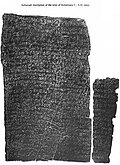
[[File:Old Kannada inscription (1053 AD) from Kelawadi of Western Chalukya king Somesvara I.jpg|thumb|right|upright|Old Kannada inscription (1053 CE) from Kelawadi of Western Chalukya king Someshvara I]] | [[File:Old Kannada inscription (1053 AD) from Kelawadi of Western Chalukya king Somesvara I.jpg|thumb|right|upright|Old Kannada inscription (1053 CE) from Kelawadi of Western Chalukya king Someshvara I]] | ||
'''Someshvara I''' ({{IAST3|Someśvara}}; | '''Someshvara I''' ({{IAST3|Someśvara}}; died 29 March 1068<ref name="sen2">{{Cite book |last=Sen |first=Sailendra |title=A Textbook of Medieval Indian History |publisher=Primus Books |year=2013 |isbn=978-9-38060-734-4 |pages=52–53}}</ref>) was a king of the [[Western Chalukya]]s. Also known as "Ahavamalla" or "Trilokamalla", Someshvara succeeded his father [[Jayasimha II (Western Chalukya dynasty)|Jayasimha II]] to the throne. | ||
His several military successes in [[Central India]] made him a formidable ruler of a vast empire. During his rule, the Chalukyan empire extended to [[Gujarat]] and Central India in the north. The [[Hoysalas]] of the [[Malenadu]] (hill) regions of [[Mysore]] were his vassals in the South. [[Vinayaditya (Hoysala dynasty)|Vinayaditya]]'s daughter or sister called Hoysala Devi was one of his queens. In the west, Someshvara I retained control over the [[Konkan]]. In the east he was able to extend his influence up to [[Anantapur, Andhra Pradesh|Ananthapur]] and [[Kurnool]]. Despite many defeats during his wars with the [[Chola dynasty|Cholas of Tanjore]], he managed to play king-maker at [[Vengi]] on several occasions.<ref name="rule">Kamath (1980), p.104, p.124</ref> | His several military successes in [[Central India]] made him a formidable ruler of a vast empire. During his rule, the Chalukyan empire extended to [[Gujarat]] and Central India in the north. The [[Hoysalas]] of the [[Malenadu]] (hill) regions of [[Mysore]] were his vassals in the South. [[Vinayaditya (Hoysala dynasty)|Vinayaditya]]'s daughter or sister called Hoysala Devi was one of his queens. In the west, Someshvara I retained control over the [[Konkan]]. In the east he was able to extend his influence up to [[Anantapur, Andhra Pradesh|Ananthapur]] and [[Kurnool]]. Despite many defeats during his wars with the [[Chola dynasty|Cholas of Tanjore]], he managed to play king-maker at [[Vengi]] on several occasions.<ref name="rule">Kamath (1980), p.104, p.124</ref> | ||
| Line 12: | Line 25: | ||
==Wars with the Cholas== | ==Wars with the Cholas== | ||
According to the historian Kamath, soon after his coronation, Someshvara I interfered in the affairs of Vengi and invaded the region but faced defeat against the Chola monarch [[Rajadhiraja Chola]] (crowned in c.1044) at Amaravathi. The Cholas followed this by invading Chalukya territory. According to the historian Sastri, Rajadhiraja defeated Someshvara I in the battle of Dannada ("Dhanyakataka") on the banks of the [[Krishna | According to the historian Kamath, soon after his coronation, Someshvara I interfered in the affairs of Vengi and invaded the region but faced defeat against the Chola monarch [[Rajadhiraja Chola]] (crowned in c.1044) at Amaravathi. The Cholas followed this by invading Chalukya territory. According to the historian Sastri, Rajadhiraja defeated Someshvara I in the battle of Dannada ("Dhanyakataka") on the banks of the [[Krishna River]] compelling the Western Chalukya armies to retreat, and the fort at Kollipakki (Kulpak) was razed to the ground. This was followed by victories at [[Kampili]] and Pundur. According to the historians Chopra et al., the details of the sack of Kampili is recorded in the Manimangalam inscription. A victory pillar with the Chola emblem was installed at Yetagiri (modern [[Yadgir]] in the [[Yadgir district]]). Finally, the Cholas plundered Kalyani, the Chalukya capital in c.1045. Rajadhiraja performed the ''Virabhisheka'' ("victory celebration") in the destroyed enemy capital and assumed the title ''Vijayarajendra'' ("victorious Rajendra"). However, according to Sastri and Sen, in a dramatic recovery, Someshvara I drove the Cholas out of Vengi by c.1050 and re-established his influence, not only in Vengi but also in [[Kalinga (historical region)|Kalinga]] (modern day [[Orissa, India|Orissa]]). Sen further claims Someshvara I took the battle right to the heart of the Chola empire. According to Kamath there was a Chalukya counterattack and a raid on [[Kanchipuram]].<ref name="zenith"/><ref name="capital"/><ref name="bank"/><ref name="mani">Chopra, Ravindran and Subrahmanian (2003), p.138</ref> | ||
For a while the Cholas did not press their cause either in Vengi or Kalinga. However, in c.1054, the Cholas responded by invading [[Koppal]] (Koppam) where King [[Rajadhiraja Chola]] was killed and Someshvara I had to mourn the death of his brother Jayasimha. However, according to Sastri, the Cholas were able to convert defeat into victory when their crown prince Rajendra II (brother of Rajadhiraja) mounted a surprise counterattack and pushed the Chalukya armies back. Rajendra II crowned himself on the battlefield, mounted a victory pillar at Kollapura (modern [[Kohlapur]]) and returned to his capital [[Gangaikondacholapuram]] with much booty which including the Chalukya queens Sattiyavvai and Sangappai. Hostilities continued and in c.1059 [[Rajendra Chola II]] invaded the Chalukya kingdom but was defeated on the banks of the Tungabhadra | For a while the Cholas did not press their cause either in Vengi or Kalinga. However, in c.1054, the Cholas responded by invading [[Koppal]] (Koppam) where King [[Rajadhiraja Chola]] was killed and Someshvara I had to mourn the death of his brother Jayasimha. However, according to Sastri, the Cholas were able to convert defeat into victory when their crown prince Rajendra II (brother of Rajadhiraja) mounted a surprise counterattack and pushed the Chalukya armies back. Rajendra II crowned himself on the battlefield, mounted a victory pillar at Kollapura (modern [[Kohlapur]]) and returned to his capital [[Gangaikondacholapuram]] with much booty which including the Chalukya queens Sattiyavvai and Sangappai. Hostilities continued and in c.1059 [[Rajendra Chola II]] invaded the Chalukya kingdom but was defeated on the banks of the Tungabhadra River. Someshvara I constructed a temple at [[Annigeri]] in the modern [[Dharwad district]] to celebrate this success. However, according to Sen, in the battle of Mudakkarru on the banks of the Tungabhadra in c.1059, Someshvara I suffered another defeat.<ref name="zenith"/><ref name="capital"/><ref name="bank">Sastri (1955), pp.168-169</ref><ref name="mani"/> | ||
Politics of succession erupted again over the Vengi throne in c.1061 after the death of the [[Eastern Chalukyas|Eastern Chalukya]] King [[Rajaraja Narendra]]. Someshvara I installed Saktivarman II, son of Vijayaditya II, on the throne. This went against the wishes of the Cholas who wanted their own blood line from the Vengi family at the helm. The Cholas desired to crown Rajendra, son of the deceased king Rajaraja Narendra. There was a brief respite for Someshvara I over Vengi affairs but the new Chola monarch Rajendra II appears to have defeated Someshvara I in several encounters, including in a major battle at Kudalasangama (modern [[Koodli]] in the [[Shimoga district]]) in c.1062. The historians Chopra et al., claim this Kudalasangama was actually at the confluence of Krishna and Tungabhadra rivers. On this occasion, Someshvara I had sent two armies, one under his general Chamundaraya and another into Gangavadi (southern Mysore territory) under his sons prince Vikramaditya VI and Jayasimha. However, Rajendra II defeated both armies and thus Someshvara I's effort to erase the defeat at Koppal failed. In c.1063, Rajendra II and his son Rajamahendra died leading to the coronation of Virarajendra as the new Chola king.<ref name="zenith"/><ref name="capital"/><ref name="bank"/><ref name="mani"/> | Politics of succession erupted again over the Vengi throne in c.1061 after the death of the [[Eastern Chalukyas|Eastern Chalukya]] King [[Rajaraja Narendra]]. Someshvara I installed Saktivarman II, son of Vijayaditya II, on the throne. This went against the wishes of the Cholas who wanted their own blood line from the Vengi family at the helm. The Cholas desired to crown Rajendra, son of the deceased king Rajaraja Narendra. There was a brief respite for Someshvara I over Vengi affairs but the new Chola monarch Rajendra II appears to have defeated Someshvara I in several encounters, including in a major battle at Kudalasangama (modern [[Koodli]] in the [[Shimoga district]]) in c.1062. The historians Chopra et al., claim this Kudalasangama was actually at the confluence of Krishna and Tungabhadra rivers. On this occasion, Someshvara I had sent two armies, one under his general Chamundaraya and another into Gangavadi (southern Mysore territory) under his sons prince Vikramaditya VI and Jayasimha. However, Rajendra II defeated both armies and thus Someshvara I's effort to erase the defeat at Koppal failed. In c.1063, Rajendra II and his son Rajamahendra died leading to the coronation of Virarajendra as the new Chola king.<ref name="zenith"/><ref name="capital"/><ref name="bank"/><ref name="mani"/> | ||
| Line 22: | Line 35: | ||
==Success in the central and eastern India== | ==Success in the central and eastern India== | ||
During this time of constant conflict with the Cholas, according to Kamath and Sastri, Someshvara I dealt successfully with the [[Shilahara]]s of the North [[Konkan]], the [[Seuna (Yadava) dynasty]] King Bhillama III, the [[Paramara dynasty]] King [[Bhoja]] of Dhara, the Chaulukyas of Gujarat and the [[Pratiharas]] of central India. Someshvara I plundered [[Dhar]], [[Ujjain]] and [[Mandu, Madhya Pradesh|Mandapa]] in central India and subjugated King Bhoja. The Chindaka Nagas of [[Bastar district|Bastar]] (the Nagavamsi dynasty of Chitrakuta) in central India were defeated by the Chalukya vassal [[Kakatiya dynasty]] King Prolla. According to Chopra et al., Someshvara I got the better of King [[Lakshmikarna]] of the [[Kalachuris of Tripuri|Kalachuri dynasty of Tripuri]] (near[[Jabalpur]]) as well.<ref name="mani"/> Thus Someshvara I's control extended as far north as [[Vidharba]] and parts of modern [[Madhya Pradesh]].<ref name="illness">Kamath (1980), p.104</ref><ref name="dhara">Sastri (1955), pp.167-168</ref> According to the historian Tripathi, toward the end of his reign, under the leadership of his brilliant son [[Vikramaditya VI]], Someshvara I's armies marched east with an eye on the Gangetic plains. Unchecked by the [[Chandelas of Jejakabhukti|Chandela rulers]] and the [[Kachchhapaghata dynasty|Kacchapaghata rulers]] of central India, according to the Yewur inscription, Someshvara I's armies raided [[Kanyakubja]] whose king appears to have fled based on this line in the inscription: "quickly experiences an abode among the caves". The Chalukya armies marched further east, overwhelming the [[Lakshmikarna|Kalachuri King Lakshmikarna of Madhyadesha]] and getting the better of the kingdoms of [[Mithila, India|Mithila]], [[Magadha]], Anga, Vanga and Gouda. The [[Pala empire|Palas]] appear to have posed no resistance either. Eventually, Someshvara's I armies were stopped by | During this time of constant conflict with the Cholas, according to Kamath and Sastri, Someshvara I dealt successfully with the [[Shilahara]]s of the North [[Konkan]], the [[Seuna (Yadava) dynasty]] King Bhillama III, the [[Paramara dynasty]] King [[Bhoja]] of Dhara, the Chaulukyas of Gujarat and the [[Gurjara-Pratihara dynasty|Pratiharas]] of central India. Someshvara I plundered [[Dhar]], [[Ujjain]] and [[Mandu, Madhya Pradesh|Mandapa]] in central India and subjugated King Bhoja. The Chindaka Nagas of [[Bastar district|Bastar]] (the Nagavamsi dynasty of Chitrakuta) in central India were defeated by the Chalukya vassal [[Kakatiya dynasty]] King Prolla. According to Chopra et al., Someshvara I got the better of King [[Lakshmikarna]] of the [[Kalachuris of Tripuri|Kalachuri dynasty of Tripuri]] (near[[Jabalpur]]) as well.<ref name="mani"/> Thus Someshvara I's control extended as far north as [[Vidharba]] and parts of modern [[Madhya Pradesh]].<ref name="illness">Kamath (1980), p.104</ref><ref name="dhara">Sastri (1955), pp.167-168</ref> According to the historian Tripathi, toward the end of his reign, under the leadership of his brilliant son [[Vikramaditya VI]], Someshvara I's armies marched east with an eye on the Gangetic plains. Unchecked by the [[Chandelas of Jejakabhukti|Chandela rulers]] and the [[Kachchhapaghata dynasty|Kacchapaghata rulers]] of central India, according to the Yewur inscription, Someshvara I's armies raided [[Kanyakubja]] whose king appears to have fled based on this line in the inscription: "quickly experiences an abode among the caves". The Chalukya armies marched further east, overwhelming the [[Lakshmikarna|Kalachuri King Lakshmikarna of Madhyadesha]] and getting the better of the kingdoms of [[Mithila, India|Mithila]], [[Magadha (Mahajanapada)|Magadha]], Anga, Vanga and Gouda. The [[Pala empire|Palas]] appear to have posed no resistance either. Eventually, Someshvara's I armies were stopped by the king of [[Pala dynasty (Kamarupa)|Kamarupa]] (in modern [[Assam]]). The Chalukya armies returned home through Southern [[Western Odisha|Kosala]], raiding the [[Chindaka Naga]] capital of Chakrakota.<ref name="sankar">Tripathi (1942), pp.421-422</ref> | ||
{{Chalukyas|Kalyani}} | {{Chalukyas|Kalyani}} | ||
| Line 36: | Line 49: | ||
*{{cite book |last= Tripathi|first= Rama Shankar |title=History of Ancient India|orig-year=1942|year=1992|publisher= Motilal Banarsidass|location=New Delhi|isbn=81-208-0018-4}} | *{{cite book |last= Tripathi|first= Rama Shankar |title=History of Ancient India|orig-year=1942|year=1992|publisher= Motilal Banarsidass|location=New Delhi|isbn=81-208-0018-4}} | ||
{{DEFAULTSORT:Someshvara 01}} | {{DEFAULTSORT:Someshvara 01}} | ||
[[Category:1068 deaths]] | [[Category:1068 deaths]] | ||
[[Category:Western Chalukya | [[Category:Western Chalukya kings]] | ||
[[Category:Medieval suicides]] | [[Category:Medieval suicides]] | ||
[[Category:Suicides by drowning]] | [[Category:Suicides by drowning]] | ||
[[Category:Suicides in India]] | [[Category:Suicides in India]] | ||
[[Category:Heads of state who | [[Category:Heads of state who died by suicide]] | ||
[[Category:Royalty who died by suicide]] | |||
Latest revision as of 00:29, 23 November 2025
| Someshvara I | |
|---|---|
 Western Chalukyas of Kalyana, coin of King Somesvara I Trailokyamalla (1043-1068). Temple façade / Ornate floral ornament.[1] | |
| King of the Western Chalukyas | |
| Reign | 1042 – 29 March 1068[2] |
| Predecessor | Jayasimha II |
| Successor | Someshvara II |
| Died | 29 March 1068 Kuruvatti, Western Chalukya Empire |
| House | Chalukya |

_at_Hire_Hadagali.JPG)
_from_Kelawadi_of_Western_Chalukya_king_Somesvara_I.jpg)
Someshvara I (IAST: Someśvara; died 29 March 1068[3]) was a king of the Western Chalukyas. Also known as "Ahavamalla" or "Trilokamalla", Someshvara succeeded his father Jayasimha II to the throne.
His several military successes in Central India made him a formidable ruler of a vast empire. During his rule, the Chalukyan empire extended to Gujarat and Central India in the north. The Hoysalas of the Malenadu (hill) regions of Mysore were his vassals in the South. Vinayaditya's daughter or sister called Hoysala Devi was one of his queens. In the west, Someshvara I retained control over the Konkan. In the east he was able to extend his influence up to Ananthapur and Kurnool. Despite many defeats during his wars with the Cholas of Tanjore, he managed to play king-maker at Vengi on several occasions.[4]
According to the historian Ganguli, the Cholas "could not wrest from him any part of his kingdom". According to the historian Sen, Someshvara I's rule was a "brilliant period" in the history of the Western Chalukyas that would reach its zenith under Vikramaditya VI.[5] Historian Tripathi claims the Chalukya influence was felt in far-off Eastern India as well. He shifted his capital from Manyakheta to Kalyani (present day Basavakalyana in modern Bidar district).[6][7] He patronized the Kannada language scholar Shridharacharya who wrote Jatakatilaka (c.1049), the earliest available work on astrology in the language, and the now extinct Chandraprabhacharite on Belles-lettres (kavya kavite).[8]
Wars with the Cholas[edit | edit source]
According to the historian Kamath, soon after his coronation, Someshvara I interfered in the affairs of Vengi and invaded the region but faced defeat against the Chola monarch Rajadhiraja Chola (crowned in c.1044) at Amaravathi. The Cholas followed this by invading Chalukya territory. According to the historian Sastri, Rajadhiraja defeated Someshvara I in the battle of Dannada ("Dhanyakataka") on the banks of the Krishna River compelling the Western Chalukya armies to retreat, and the fort at Kollipakki (Kulpak) was razed to the ground. This was followed by victories at Kampili and Pundur. According to the historians Chopra et al., the details of the sack of Kampili is recorded in the Manimangalam inscription. A victory pillar with the Chola emblem was installed at Yetagiri (modern Yadgir in the Yadgir district). Finally, the Cholas plundered Kalyani, the Chalukya capital in c.1045. Rajadhiraja performed the Virabhisheka ("victory celebration") in the destroyed enemy capital and assumed the title Vijayarajendra ("victorious Rajendra"). However, according to Sastri and Sen, in a dramatic recovery, Someshvara I drove the Cholas out of Vengi by c.1050 and re-established his influence, not only in Vengi but also in Kalinga (modern day Orissa). Sen further claims Someshvara I took the battle right to the heart of the Chola empire. According to Kamath there was a Chalukya counterattack and a raid on Kanchipuram.[5][6][9][10]
For a while the Cholas did not press their cause either in Vengi or Kalinga. However, in c.1054, the Cholas responded by invading Koppal (Koppam) where King Rajadhiraja Chola was killed and Someshvara I had to mourn the death of his brother Jayasimha. However, according to Sastri, the Cholas were able to convert defeat into victory when their crown prince Rajendra II (brother of Rajadhiraja) mounted a surprise counterattack and pushed the Chalukya armies back. Rajendra II crowned himself on the battlefield, mounted a victory pillar at Kollapura (modern Kohlapur) and returned to his capital Gangaikondacholapuram with much booty which including the Chalukya queens Sattiyavvai and Sangappai. Hostilities continued and in c.1059 Rajendra Chola II invaded the Chalukya kingdom but was defeated on the banks of the Tungabhadra River. Someshvara I constructed a temple at Annigeri in the modern Dharwad district to celebrate this success. However, according to Sen, in the battle of Mudakkarru on the banks of the Tungabhadra in c.1059, Someshvara I suffered another defeat.[5][6][9][10]
Politics of succession erupted again over the Vengi throne in c.1061 after the death of the Eastern Chalukya King Rajaraja Narendra. Someshvara I installed Saktivarman II, son of Vijayaditya II, on the throne. This went against the wishes of the Cholas who wanted their own blood line from the Vengi family at the helm. The Cholas desired to crown Rajendra, son of the deceased king Rajaraja Narendra. There was a brief respite for Someshvara I over Vengi affairs but the new Chola monarch Rajendra II appears to have defeated Someshvara I in several encounters, including in a major battle at Kudalasangama (modern Koodli in the Shimoga district) in c.1062. The historians Chopra et al., claim this Kudalasangama was actually at the confluence of Krishna and Tungabhadra rivers. On this occasion, Someshvara I had sent two armies, one under his general Chamundaraya and another into Gangavadi (southern Mysore territory) under his sons prince Vikramaditya VI and Jayasimha. However, Rajendra II defeated both armies and thus Someshvara I's effort to erase the defeat at Koppal failed. In c.1063, Rajendra II and his son Rajamahendra died leading to the coronation of Virarajendra as the new Chola king.[5][6][9][10]
Final battle of Kudalasangama[edit | edit source]
During a brief lull in hostilities, Someshvara I was busy reinforcing himself, militarily and diplomatically. In the east he counted on the Nagavamsi ruler Dharavarsha and the Eastern Ganga dynasty King Vajrahasta II of Kalinga as his allies. In Bezwada, he relied on the support of the Paramara dynasty prince Janannatha. In the west he stationed a large army under Vijayaditya. After a few brief encounters with the Cholas including a successful Chalukya raid of the Chola capital by prince Vikarmaditya VI, Someshvara I invited Virarajendra Chola to a battle at Kudalasangama. However, because of an incurable illness that afflicted him, Someshvara I's and his army did not show up at the venue. After a month-long wait Virarajendra invaded and was victorious at all fronts: Vengi, Bezwada, Kalinga and Chitrakuta (in the Nagavamsi domains), and a victory pillar was erected on the banks of the Tungabhadra. Unable to recover from his illness, Someshvara I committed ritual suicide (paramayoga) by drowning himself in the Tungabhadra river at Kuruvatti (modern Bellary district) on 29 March 1068.[5][10][11][12]
Success in the central and eastern India[edit | edit source]
During this time of constant conflict with the Cholas, according to Kamath and Sastri, Someshvara I dealt successfully with the Shilaharas of the North Konkan, the Seuna (Yadava) dynasty King Bhillama III, the Paramara dynasty King Bhoja of Dhara, the Chaulukyas of Gujarat and the Pratiharas of central India. Someshvara I plundered Dhar, Ujjain and Mandapa in central India and subjugated King Bhoja. The Chindaka Nagas of Bastar (the Nagavamsi dynasty of Chitrakuta) in central India were defeated by the Chalukya vassal Kakatiya dynasty King Prolla. According to Chopra et al., Someshvara I got the better of King Lakshmikarna of the Kalachuri dynasty of Tripuri (nearJabalpur) as well.[10] Thus Someshvara I's control extended as far north as Vidharba and parts of modern Madhya Pradesh.[11][13] According to the historian Tripathi, toward the end of his reign, under the leadership of his brilliant son Vikramaditya VI, Someshvara I's armies marched east with an eye on the Gangetic plains. Unchecked by the Chandela rulers and the Kacchapaghata rulers of central India, according to the Yewur inscription, Someshvara I's armies raided Kanyakubja whose king appears to have fled based on this line in the inscription: "quickly experiences an abode among the caves". The Chalukya armies marched further east, overwhelming the Kalachuri King Lakshmikarna of Madhyadesha and getting the better of the kingdoms of Mithila, Magadha, Anga, Vanga and Gouda. The Palas appear to have posed no resistance either. Eventually, Someshvara's I armies were stopped by the king of Kamarupa (in modern Assam). The Chalukya armies returned home through Southern Kosala, raiding the Chindaka Naga capital of Chakrakota.[7]
| Chalukya dynasties |
|---|
Notes[edit | edit source]
- ↑ CNG Coins
- ↑ "From Prehistoric Times To The Fall Of Vijayanagar : K. A. Nilakanta Sastri : Free Download, Borrow, and Streaming : Internet Archive". Internet Archive. 22 September 2015. Retrieved 26 November 2024.
- ↑ Sen, Sailendra (2013). A Textbook of Medieval Indian History. Primus Books. pp. 52–53. ISBN 978-9-38060-734-4.
- ↑ Kamath (1980), p.104, p.124
- ↑ 5.0 5.1 5.2 5.3 5.4 Sen (1999), p.384
- ↑ 6.0 6.1 6.2 6.3 Kamath (1980), p.103
- ↑ 7.0 7.1 Tripathi (1942), pp.421-422
- ↑ Narasimhacharya (1988), p.19
- ↑ 9.0 9.1 9.2 Sastri (1955), pp.168-169
- ↑ 10.0 10.1 10.2 10.3 10.4 Chopra, Ravindran and Subrahmanian (2003), p.138
- ↑ 11.0 11.1 Kamath (1980), p.104
- ↑ Sastri (1955), p.170
- ↑ Sastri (1955), pp.167-168
References[edit | edit source]
- Chopra, P.N.; Ravindran, T.K.; Subrahmanian, N (2003) [2003]. History of South India (Ancient, Medieval and Modern) Part 1. New Delhi: Chand Publications. ISBN 81-219-0153-7.
- Kamath, Suryanath U. (2001) [1980]. A concise history of Karnataka : from pre-historic times to the present. Bangalore: Jupiter books. LCCN 80905179. OCLC 7796041.
- Narasimhacharya, R (1988) [1988]. History of Kannada Literature. New Delhi: Penguin Books. ISBN 81-206-0303-6.
- Sastri, Nilakanta K.A. (2002) [1955]. A history of South India from prehistoric times to the fall of Vijayanagar. New Delhi: Indian Branch, Oxford University Press. ISBN 0-19-560686-8.
- Sen, Sailendra Nath (1999) [1999]. Ancient Indian History and Civilization. New Age Publishers. ISBN 81-224-1198-3.
- Tripathi, Rama Shankar (1992) [1942]. History of Ancient India. New Delhi: Motilal Banarsidass. ISBN 81-208-0018-4.