


m Removed empty portal template using script |
Kartikeyar (talk | contribs) No edit summary |
||
| Line 1: | Line 1: | ||
{{ | {{Short description|British colony in Asia from 1841 to 1997}} | ||
{{ | {{Use Hong Kong English|date=August 2014}} | ||
{{Use dmy dates|date=August 2014}} | {{Use dmy dates|date=August 2014}} | ||
{{Infobox former country | {{Infobox former country | ||
|conventional_long_name = Hong Kong | | conventional_long_name = Hong Kong | ||
|life_span = 1841–1941<br>1945–1997 | | life_span = 1841–1941<br>(1941–1945: [[Japanese occupation of Hong Kong|Japanese occupation]])<br />1945–1997 | ||
|common_name = Hong Kong ( | | status_text = [[British Crown Colony]] | ||
|native_name = {{lang|zh-hk|香港}} | | common_name = Hong Kong (1841–1997) | ||
|image_flag = Flag of Hong Kong | | native_name = {{lang|zh-hk|香港}} | ||
|flag_alt = Flag of Hong Kong from 1959 to 1997 | | image_flag = Flag of Hong Kong (1959–1997).svg | ||
|flag_type = Flag | | flag_alt = Flag of Hong Kong from 1959 to 1997 | ||
|flag_type_article = Flag of Hong Kong ( | | flag_type = Flag<br />(1959–1997) | ||
|image_coat = Coat of arms of Hong Kong ( | | flag_type_article = Flag of Hong Kong (1871–1997) | ||
|symbol_type = Coat of arms | | image_coat = Coat of arms of Hong Kong (1959–1997).svg | ||
|symbol_type_article = Emblem of Hong Kong#Colonial arms | | symbol_type = Coat of arms<br />(1959–1997) | ||
|coat_alt = Coat of arms of Hong Kong from 1959 to 1997 | | symbol_type_article = Emblem of Hong Kong#Colonial arms | ||
|national_anthem = | | coat_alt = Coat of arms of Hong Kong from 1959 to 1997 | ||
|image_map = | | national_anthem = [[God Save the King|God Save the Queen]]<br />(1841–1901; 1952–1997)<br/>[[God Save the King]]<br />(1901–1941; 1945–1952)<br>{{center|[[File:God_Save_The_Queen_(Band_of_the_Grenadier_Guards,_1952_instrumental).oga]]}} | ||
| | | image_map = Hong_Kong_on_the_globe_(Southeast_Asia_centered).svg | ||
| | | status = {{ublist|[[Crown colony]]<br />(1843–1941; 1945–1981)|[[British Overseas Territories|British Dependent Territory]]<br />(1981–1997)}} | ||
| | | capital = [[Victoria, Hong Kong|Victoria]] (''[[de facto]]'') | ||
| official_languages = {{hlist|[[Hong Kong English|English]]|[[Chinese language|Chinese]] ([[Cantonese language|Cantonese]]){{NoteTag|name=language-status|No specific variety of [[Chinese language|Chinese]] was listed in legislation, but [[Cantonese]] was the ''de facto'' standard as it was the native variety of the colony; Chinese was made official in 1974.}}}} | |||
|capital = [[ | | religion = {{hlist | ||
|official_languages = {{hlist|[[Hong Kong English|English]]|[[Cantonese language|Cantonese]]{{ | | [[Christianity in Hong Kong|Christianity]] | ||
|religion = {{ | | [[Chinese folk religion|Folk]] | ||
| | | [[Buddhism]] | ||
| [[Taoism]] | |||
| | | [[Hinduism in Hong Kong|Hinduism]] | ||
| | | [[Islam in Hong Kong|Islam]] | ||
| | | [[Jews in Hong Kong|Judaism]] | ||
| | }} | ||
| demonym = [[Hongkongers|Hongkonger]]{{NoteTag|name=demonym|''Hongkonger'' and ''Hong Konger'' were both used by the British administrators of Hong Kong.}} | |||
| | | government_type = [[Unitary state|Unitary]]<ref>{{cite web |title=Colonial models and the evolution of education systems |url= https://web.edu.hku.hk/f/staff/376/Tang%26Bray2000.pdf |date=2000 |format=PDF |author1=Kwok-Chun Tang |author2=Mark Bray |website=web.edu.hku.hk |quote=During the twentieth century the Hong Kong authorities constructed a highly centralized system, which at the end of the century moved towards decentralization. In Macau, by contrast, government neglect led to an uncoordinated collection of imported systems. At the end of the century the Macau government endeavored to unify the sector, but faced major challenges and limitations. }}</ref> parliamentary [[constitutional monarchy]] | ||
| | | leader1 = [[Queen Victoria|Victoria]] | ||
| | | leader2 = [[Edward VII]] | ||
| | | leader3 = [[George V]] | ||
| | | leader4 = [[Edward VIII]] | ||
| | | leader5 = [[George VI]] | ||
| leader6 = [[Elizabeth II]] | |||
| year_leader1 = 1841–1901 | |||
| | | year_leader2 = 1901–1910 | ||
| | | year_leader3 = 1910–1936 | ||
| | | year_leader4 = 1936 | ||
| | | year_leader5 = 1936–1941, 1945–1952 | ||
| | | year_leader6 = 1952–1997 | ||
| | | title_leader = [[List of British monarchs|Monarch]] | ||
| representative1 = {{nowrap|[[Henry Pottinger|Sir Henry Pottinger]] (''first'')}} | |||
| | | representative2 = [[Chris Patten]] (''last'') | ||
| | | year_representative1 = 1843–1844 | ||
| | | year_representative2 = 1992–1997 | ||
| | | title_representative = [[Governor of Hong Kong|Governor]] | ||
| | | deputy1 = [[George Alexander Malcolm|George Malcolm]] (''first'') | ||
| | | deputy2 = [[Anson Chan]] (''last'') | ||
| year_deputy1 = 1843 | |||
| | | year_deputy2 = 1993–1997 | ||
| | | title_deputy = [[Chief Secretary for Administration|Chief Secretary]]{{NoteTag|The office of Colonial Secretary was renamed to [[Chief Secretary for Administration|Chief Secretary]] in 1976.}} | ||
| | | legislature = [[Legislative Council of Hong Kong|Legislative Council]] | ||
| | | era = [[Victorian era]] to 20th century | ||
| | | event_pre = [[Convention of Chuenpi|British occupation]], signed by [[Charles Elliot]] and [[Qishan (official)|Qishan]] | ||
| date_pre = 26 January 1841 | |||
| | | event_start = [[Treaty of Nanking]] | ||
| | | date_start = 29 August 1842 | ||
| | | event1 = [[Convention of Peking]] | ||
| | | date_event1 = 18 October 1860 | ||
| | | event2 = [[Convention for the Extension of Hong Kong Territory]] | ||
| | | date_event2 = 9 June 1898 | ||
| | | event3 = [[Japanese occupation of Hong Kong]] | ||
| | | date_event3 = 25 December 1941 –<br />30 August 1945 | ||
|population_estimate = 6,217,556<ref>{{cite report |title=Main Results |work=1996 Population By-Census |publisher=[[Census and Statistics Department (Hong Kong)|Census and Statistics Department]] |date=December 1996 |url=https://www.statistics.gov.hk/pub/hist/1991_2000/B11200831996XXXXE0100.pdf |access-date=7 September 2018 |archive-url=https://web.archive.org/web/20181013094501/https://www.statistics.gov.hk/pub/hist/1991_2000/B11200831996XXXXE0100.pdf | | event_end = [[Handover of Hong Kong]] | ||
|population_estimate_year = 1996 | | date_end = 1 July 1997 | ||
|population_density_km2 = 5,796 | | currency = {{unbulleted list | ||
|GDP_PPP = $154 billion | | [[Hong Kong dollar]] (from 1937) | ||
|GDP_PPP_year = 1996<ref name="imf2">{{cite web|url=http://www.imf.org/external/pubs/ft/weo/2018/01/weodata/weorept.aspx?sy=1996&ey=1996&scsm=1&ssd=1&sort=country&ds=.&br=1&pr1.x=63&pr1.y=12&c=532&s=NGDPD%2CPPPGDP%2CNGDPDPC%2CPPPPC&grp=0&a= |title=Hong Kong |publisher=[[International Monetary Fund]] |access-date=6 September 2018 | | [[Trade dollar]] (1895–1937) | ||
| | | [[Spanish dollar]] (until 1895) | ||
| | | [[Chinese cash (currency unit)|Chinese cash]] (until 1895) | ||
}} | |||
| population_estimate = 6,217,556<ref>{{cite report |title = Main Results |work=1996 Population By-Census |publisher=[[Census and Statistics Department (Hong Kong)|Census and Statistics Department]] |date=December 1996 |url = https://www.statistics.gov.hk/pub/hist/1991_2000/B11200831996XXXXE0100.pdf |access-date = 7 September 2018 |archive-url = https://web.archive.org/web/20181013094501/https://www.statistics.gov.hk/pub/hist/1991_2000/B11200831996XXXXE0100.pdf |archive-date=13 October 2018 |url-status=live |df=dmy-all }}</ref> | |||
| population_estimate_year = 1996 | |||
| population_density_km2 = 5,796 | |||
| GDP_PPP = $154 billion | |||
| GDP_PPP_year = 1996<ref name="imf2">{{cite web |url = http://www.imf.org/external/pubs/ft/weo/2018/01/weodata/weorept.aspx?sy=1996&ey=1996&scsm=1&ssd=1&sort=country&ds=.&br=1&pr1.x=63&pr1.y=12&c=532&s=NGDPD%2CPPPGDP%2CNGDPDPC%2CPPPPC&grp=0&a= |title = Hong Kong |publisher = [[International Monetary Fund]] |access-date = 6 September 2018 |archive-date = 19 November 2018 |archive-url = https://web.archive.org/web/20181119201906/https://www.imf.org/external/pubs/ft/weo/2018/01/weodata/weorept.aspx?sy=1996&ey=1996&scsm=1&ssd=1&sort=country&ds=.&br=1&pr1.x=63&pr1.y=12&c=532&s=NGDPD%2CPPPGDP%2CNGDPDPC%2CPPPPC&grp=0&a= |url-status = live }}</ref> | |||
| | | GDP_PPP_per_capita = $23,843 | ||
| | | GDP_nominal = $160 billion | ||
| GDP_nominal_year = 1996<ref name="imf2" /> | |||
| | | GDP_nominal_per_capita = $24,698 | ||
| Gini = 51.8 | |||
| Gini_year = 1996 | |||
| | | Gini_change = increase <!-- increase/decrease/steady --> | ||
| | | Gini_ref = <ref>{{cite report |title=Gini Coefficient Fact Sheet |publisher=[[Legislative Council of Hong Kong|Legislative Council]] |date=December 2004 |url = http://www.legco.gov.hk/yr04-05/english/sec/library/0405fs07e.pdf |access-date=7 September 2018 |archive-url = https://web.archive.org/web/20160303173916/http://www.legco.gov.hk/yr04-05/english/sec/library/0405fs07e.pdf |archive-date = 3 March 2016 |url-status=live |df=dmy-all }}</ref> | ||
| | | HDI = 0.808 <!-- number only --> | ||
| | | HDI_year = 1995<!-- Please use the year to which the data refers, not the publication year--> | ||
| | | HDI_change = increase<!-- increase/decrease/steady --> | ||
| | | HDI_ref = <ref>{{cite report |title=Hong Kong |work=Human Development Report 2016 |publisher=[[United Nations Development Programme]] |date=2016 |url = http://hdr.undp.org/sites/all/themes/hdr_theme/country-notes/HKG.pdf |access-date=7 September 2018 |archive-url=https://web.archive.org/web/20170713113505/http://hdr.undp.org/sites/all/themes/hdr_theme/country-notes/HKG.pdf |archive-date=13 July 2017 |url-status=live |df=dmy-all }}</ref> | ||
| | | p1 = Bao'an County{{!}}'''1841''':<br />Xin'an County | ||
| border_p1 = no | |||
| flag_p1 = Flag of China (1889–1912).svg | |||
| p2 = Japanese occupation of Hong Kong{{!}}'''1945''':<br />Japanese Hong Kong | |||
| flag_p2 = Flag of Japan (1870–1999).svg | |||
| s1 = Japanese occupation of Hong Kong{{!}}'''1941''':<br />Japanese Hong Kong | |||
| flag_s1 = Flag of Japan (1870–1999).svg | |||
| s2 = Hong Kong{{!}}'''1997''':<br />Hong Kong SAR | |||
| flag_s2 = Flag of Hong Kong.svg | |||
| module = {{Infobox Chinese | |||
| child = yes | |||
| t = 英屬香港 | | t = 英屬香港 | ||
| s = 英属香港 | | s = 英属香港 | ||
| j = | | j = jing1 suk6 hoeng1 gong2 | ||
| y = Yīng suhk hēung góng | | y = Yīng suhk hēung góng | ||
| ci = {{IPAc-yue|j|ing|1|-|s|uk|6|-|h|oeng|1|-|g|ong|2}} | |||
| p = Yīngshǔ Xiānggǎng | | p = Yīngshǔ Xiānggǎng | ||
| tp = Ying-shǔ Sianggǎng | |||
| w = {{tone superscript|Ying1-shu3 Hsiang1-kang3}} | |||
| mi = {{IPAc-cmn|ying|1|.|sh|u|3|-|x|iang|1|.|g|ang|3}} | |||
| bpmf = ㄧㄥ ㄕㄨˇ ㄒㄧㄤ ㄍㄤˇ | |||
| hide = yes | | hide = yes | ||
}} | }} | ||
}} | |||
[[Hong Kong]] was under [[British Empire|British rule]] from 1841 to 1997, except for a [[Japanese occupation of Hong Kong|brief period of Japanese occupation]] during the [[Second World War]] from 1941 to 1945. It was a [[Crown colony]] of the [[United Kingdom]] from 1841 to 1981, and a [[British Dependent Territory|dependent territory]] from 1981 to 1997. The colonial period began with the British occupation of [[Hong Kong Island]] under the [[Convention of Chuenpi]] in 1841 of the [[Victorian era]], and ended with the [[handover of Hong Kong]] in July 1997. | |||
Although | In accordance with Article III of the [[Treaty of Nanking]] of 1842, signed in the aftermath of the [[First Opium War]], the island of Hong Kong was ceded in perpetuity to Great Britain. It was established as a [[Crown colony]] in 1843.<ref>{{cite journal|volume=5|journal=Journal of the Hong Kong Branch of the Royal Asiatic Society|title=Government and People in Hong Kong 1841–1962: A Constitutional History|first1=Colina|last1=Lupton|url=https://www.jstor.org/stable/23881414|year=1965|pages=95–100 |jstor=23881414 |quote=Given the fact that Hong Kong received a Crown Colony form of constitution in 1843 and still retains it in 1965, there must be something which explains its tranquillity in the midst of a continent of upheaval.}}</ref> In 1860, the British expanded the colony with the addition of the [[Kowloon Peninsula]] and was further extended in 1898 when the British obtained [[Convention for the Extension of Hong Kong Territory|a 99-year lease]] of the [[New Territories]]. Although the Qing had to cede Hong Kong Island and Kowloon in perpetuity as per the treaty, the leased New Territories comprised 86.2% of the colony and more than half of the entire colony's population. With the lease nearing its end during the late 20th century, Britain did not see any viable way to administer the colony by dividing it, whilst the [[China|People's Republic of China]] would not consider extending the lease or allowing continued British administration thereafter. | ||
With the signing of the [[Sino-British Joint Declaration]] in 1984, which stated that the economic and social systems in Hong Kong would remain relatively unchanged for 50 years, the British government agreed to [[Handover of Hong Kong|transfer the entire territory]] to China upon the expiration of the New Territories lease in 1997 – with Hong Kong becoming a [[Special administrative regions of China|special administrative region]] (SAR) until at least 2047.<ref>''[https://archive.org/details/draftagreementbe00hong/page/n5 A Draft Agreement Between the Government of the United Kingdom of Great Britain and Northern Ireland and the Government of the People's Republic of China on the Future of Hong Kong]'' (1984). pp. 1, 8.</ref><ref name="JointDec">{{cite web |url=https://www.cmab.gov.hk/en/issues/joint3.htm |title=The Joint Declaration |author=<!--Not stated--> |date=1 July 2007 |website=Constitutional and Mainland Affairs Bureau – The Government of the Hong Kong Special Administrative Region of the People's Republic of China |access-date=8 April 2021 |archive-date=16 July 2023 |archive-url=https://web.archive.org/web/20230716061613/https://www.cmab.gov.hk/en/issues/joint3.htm |url-status=live }}</ref> | |||
== History == | == History == | ||
=== Colonial establishment === | === Colonial establishment === | ||
| Line 121: | Line 129: | ||
{{further|History of Hong Kong (1800s–1930s)|Bao'an County}} | {{further|History of Hong Kong (1800s–1930s)|Bao'an County}} | ||
In 1836, the | In 1836, the imperial government of the [[Qing dynasty]] undertook a major policy review of the opium trade, which had been first introduced to the Chinese by [[Persian people|Persian]] then [[Islamic]] traders over many centuries.<ref name=cowell97>{{cite book|author-link=Adrian Cowell|first1=Adrian|last1=Cowell|publisher=PBS Frontline|title=The Opium Kings|url=https://www.pbs.org/wgbh/pages/frontline/shows/heroin/etc/history.html|year=1997|access-date=May 16, 2007|archive-date=23 September 2006|archive-url=https://web.archive.org/web/20060923053042/http://www.pbs.org/wgbh/pages/frontline/shows/heroin/etc/history.html|url-status=live}}</ref><ref name=robson>{{cite book|author=Philip Robson|title=Forbidden Drugs|url=https://archive.org/details/forbiddendrugs0000robs|url-access=registration|year=1999|publisher=Oxford University Press|isbn=978-0-19-262955-5}}</ref><ref name="Schiff">{{cite news|url=http://findarticles.com/p/articles/mi_qa3833/is_200207/ai_n9107282/print |archive-url=https://web.archive.org/web/20071021021327/http://findarticles.com/p/articles/mi_qa3833/is_200207/ai_n9107282/print |url-status=dead |archive-date=October 21, 2007 |title=Opium and its alkaloids | author=Paul L. Schiff Jr. |year=2002 |access-date=May 8, 2007 |work=American Journal of Pharmaceutical Education }}</ref><ref name=trocki99>{{cite book |title=Opium, empire and the global political economy: a study of the Asian opium trade, 1750–1950 |first=Carl A. |last=Trocki |author-link=Carl A. Trocki|publisher=Routledge |year=1999 |isbn=978-0-415-19918-6 |url=https://books.google.com/books?id=DDNvkSC26bcC }}</ref><ref name=trocki02>{{cite web|url=http://www.humanities.qut.edu.au/research/socialchange/docs/conf_papers2002/TrockiCarl.pdf|archive-url=https://web.archive.org/web/20080720075013/http://www.humanities.qut.edu.au/research/socialchange/docs/conf_papers2002/TrockiCarl.pdf|url-status=dead|archive-date=July 20, 2008|author=Carl A. Trocki|title=Opium as a commodity and the Chinese drug plague|year=2002|access-date=September 13, 2009|author-link=Carl A. Trocki}}</ref> Viceroy [[Lin Zexu]] took on the task of suppressing the opium trade. In March 1839, he became Special Imperial Commissioner in [[Guangzhou|Canton]], where he ordered foreign traders to surrender their opium stock. He confined the British to the [[Canton Factories]] and cut off their supplies. Chief Superintendent of Trade, [[Charles Elliot]], complied with Lin's demands to secure a safe exit for the British, with the costs involved to be resolved between the two governments. When Elliot promised that the British government would pay for their opium stock, the merchants surrendered their 20,283 chests of opium, which were [[Destruction of opium at Humen|destroyed in public]].{{sfn|Tsang|2004|pp=9–10}} | ||
[[ | In September 1839, the [[Cabinet of the United Kingdom|British Cabinet]] decided that the Chinese should be made to pay for the destruction of British property, either by the threat or use of force. An expeditionary force was placed under Elliot and his cousin, Rear-Admiral [[George Elliot (Royal Navy officer, born 1784)|George Elliot]], as joint [[plenipotentiaries]] in 1840. Foreign Secretary [[Lord Palmerston]] stressed to the Chinese government that the British government did not question China's right to prohibit opium, but it objected to the way this was handled.{{sfn|Tsang|2004|pp=9–10}} He viewed the sudden strict enforcement as laying a trap for the foreign traders, and the confinement of the British with supplies cut off was tantamount to starving them into submission or death. He instructed the Elliot cousins to occupy one of the [[Zhoushan|Chusan Islands]] in the [[Hangzhou Bay]] delta across from [[Shanghai]], then to present a letter from himself to a Chinese official for the [[Daoguang Emperor|Emperor of China]], then to proceed to the [[Gulf of Bohai]] for a treaty, and if the Chinese resisted, then to blockade the key ports of the [[Yangtze River|Yangtze]] and [[Yellow River|Yellow]] rivers.{{sfn|Tsang|2004|p=11}} Palmerston demanded a territorial base in the Chusan Islands for trade so that British merchants "may not be subject to the arbitrary caprice either of the Government of Peking, or its local Authorities at the Sea-Ports of the Empire".{{sfn|Tsang|2004|p=21}} | ||
In | In 1841, Elliot negotiated with Lin's successor, [[Qishan (official)|Qishan]], in the [[Convention of Chuenpi]] during the [[First Opium War]]. On 20 January, Elliot announced "the conclusion of preliminary arrangements", which included the cession of the barren [[Hong Kong Island]] and its harbour to the [[British Crown]].{{sfn|Welsh|1997}}{{page needed|date=September 2020}}<ref name="repository">''[https://books.google.com/books?id=eJYZAAAAYAAJ&pg=PA63 The Chinese Repository]''. Volume 10. pp. 63–64.</ref> Elliot chose Hong Kong Island instead of Chusan because he believed a settlement nearer to [[Shanghai]] would cause an "indefinite protraction of hostilities", whereas Hong Kong Island's harbour was a valuable base for the British trading community in Canton.{{sfn|Tsang|2004|pp=11, 21}} British rule began with the occupation of the island on 26 January.{{sfn|Tsang|2004|p=11}} Commodore [[Gordon Bremer]], commander-in-chief of British forces in China, took formal possession of the island at [[Possession Point]], where the [[Union Jack]] was raised under a ''[[feu de joie|fire of joy]]'' from the marines and a [[21-gun salute|royal salute]] from the warships.<ref>[[Edward Belcher|Belcher, Edward]] (1843). ''[https://archive.org/stream/narrativeofvoyag02belc#page/148 Narrative of a Voyage Round the World]''. Volume 2. London: Henry Colburn. p. 148.</ref> Hong Kong Island was ceded in the [[Treaty of Nanking]] on 29 August 1842 and established as a [[Crown colony]] after the ratification exchanged between the [[Daoguang Emperor]] and [[Queen Victoria]] was completed on 26 June 1843.{{sfn|Tsang|2004|p=12}} | ||
By 1842, Hong Kong had become the major arms supply port in the Asia-Pacific region.<ref name=":6">{{Cite book |last=Driscoll |first=Mark W. |title=The Whites are Enemies of Heaven: Climate Caucasianism and Asian Ecological Protection |date=2020 |publisher=[[Duke University Press]] |isbn=978-1-4780-1121-7 |location=Durham}}</ref>{{Rp|page=5}} | |||
=== Growth and expansion === | === Growth and expansion === | ||
The Treaty of Nanking failed to satisfy British expectations of a major expansion of trade and profit, which led to increasing pressure for a revision of the terms.{{sfn|Tsang|2004|p=29}} In October 1856, Chinese authorities in Canton detained the ''Arrow'', a Chinese-owned ship registered in Hong Kong to enjoy the protection of the British flag. The Consul in Canton, [[Harry Smith Parkes|Harry Parkes]], claimed the hauling down of the flag and arrest of the crew were "an insult of very grave character". Parkes and [[John Bowring|Sir John Bowring]], the fourth [[Governor of Hong Kong]], seized on the incident to pursue a forward policy. In March 1857, Palmerston appointed [[James Bruce, 8th Earl of Elgin|Lord Elgin]] as Plenipotentiary, with the aim of securing a new and satisfactory treaty. A French expeditionary force joined the British to avenge the execution of [[Auguste Chapdelaine|a French missionary]] in 1856.{{sfn|Tsang|2004|pp=32–33}} In 1860, the [[Battle of Taku Forts (1860)|capture of the Taku Forts]] and occupation of Beijing led to the [[Treaty of Tientsin]] and [[Convention of Peking]]. In the Treaty of Tientsin, the Chinese accepted British demands to open more ports, navigate the Yangtze River, legalise the opium trade and have diplomatic representation in Beijing. During the conflict, the British occupied the [[Kowloon Peninsula]], where the flat land was valuable training and resting ground. The area in what is now south of [[Boundary Street]] and [[Stonecutters Island]] was ceded in the Convention of Peking.{{sfn|Tsang|2004|pp=33, 35}} | |||
The Treaty of Nanking failed to satisfy British expectations of a major expansion of trade and profit, which led to increasing pressure for a revision of the terms.{{sfn|Tsang|2004|p=29}} In October 1856, Chinese authorities in Canton detained the ''Arrow'', a Chinese-owned ship registered in Hong Kong to enjoy the protection of the British flag. The Consul in Canton, [[Harry Smith Parkes|Harry Parkes]], claimed the hauling down of the flag and arrest of the crew were "an insult of very grave character". Parkes and [[John Bowring|Sir John Bowring]], the fourth [[Governor of Hong Kong]], seized the incident to pursue a forward policy. In March 1857, Palmerston appointed [[James Bruce, 8th Earl of Elgin|Lord Elgin]] as Plenipotentiary, with the aim of securing a new and satisfactory treaty. A French expeditionary force joined the British to avenge the execution of [[Auguste Chapdelaine|a French missionary]] in 1856.{{sfn|Tsang|2004|pp= | |||
In 1898, the British sought to extend Hong Kong for defence. After negotiations began in April 1898, with the British Minister in Beijing, [[Claude MacDonald|Sir Claude MacDonald]], representing Britain, and diplomat [[Li Hongzhang]] leading the Chinese, the [[Second Convention of Peking]] was signed on 9 June. Since the foreign powers had agreed by the late 19th century that it was no longer permissible to acquire outright sovereignty over any parcel of Chinese territory, and in keeping with the other territorial cessions China made to [[Kwantung Leased Territory|Russia]], [[Kiautschou Bay concession|Germany]] and [[Guangzhouwan|France]] that same year, the extension of Hong Kong took the form of a 99-year lease. The lease consisted of the rest of Kowloon south of the [[Sham Chun River]] and 230 islands, which became known as the [[New Territories]]. The British formally took possession on 16 April 1899.{{sfn|Tsang|2004|pp=38–41}} | |||
<gallery class="center"> | |||
File:Early painting of Hong Kong Island.jpg|Possibly the earliest painting of Hong Kong Island, showing the waterfront settlement which became [[Victoria, Hong Kong|Victoria City]] | |||
File:Spring Gardens 1846.jpg|[[Spring Garden Lane]], 1846 | |||
File:View of Hong Kong, and the 'River Bird' steamer.jpg|View of Hong Kong, 1855 | |||
File:In the track of the terrible typhoon which swept over Hong Kong recently LOC 3909879672.jpg|''[[New York Tribune]]'' front page, giving details on [[1906 Hong Kong typhoon]] | |||
</gallery> | |||
=== Japanese occupation === | === Japanese occupation === | ||
[[File: | [[File:1937 Hong Kong VP8.webm|thumb|Hong Kong, 1937]] | ||
{{Main|Japanese occupation of Hong Kong}} | {{Main|Battle of Hong Kong|Japanese occupation of Hong Kong}} | ||
In 1941, during the Second World War, the British reached an agreement with the Chinese government under Generalissimo [[Chiang Kai-shek]] that if [[Empire of Japan|Japan]] attacked Hong Kong, the [[National Revolutionary Army|Chinese National Army]] would attack the Japanese from the rear to relieve pressure on the British garrison. On 8 December, the [[Battle of Hong Kong]] began when Japanese air bombers effectively destroyed British air power in one attack.{{sfn|Tsang|2004|p=121}} Two days later, the Japanese breached the [[Gin Drinkers Line]] in the New Territories. The British commander, Major-General [[Christopher Maltby]], concluded that the island could not be defended for long unless he withdrew his brigade from the mainland. On 18 December, the Japanese crossed [[Victoria Harbour]].{{sfn|Tsang|2004|p=122}} By 25 December, organised defence was reduced into pockets of resistance. Maltby recommended a surrender to Governor [[Mark Aitchison Young|Sir Mark Young]], who accepted his advice to reduce further losses. A day after the invasion, Chiang ordered three corps under General [[Yu Hanmou]] to march towards Hong Kong. The plan was to launch a New Year's Day attack on the Japanese in the Canton region, but before the Chinese infantry could attack, the Japanese had broken Hong Kong's defences. The British casualties were 2,232 killed or missing and 2,300 wounded. The Japanese reported 1,996 killed and 6,000 wounded.{{sfn|Tsang|2004|pp= | In 1941, during the Second World War, the British reached an agreement with the Chinese government under Generalissimo [[Chiang Kai-shek]] that if [[Empire of Japan|Japan]] attacked Hong Kong, the [[National Revolutionary Army|Chinese National Army]] would attack the Japanese from the rear to relieve pressure on the British garrison. On 8 December, the [[Battle of Hong Kong]] began when Japanese air bombers effectively destroyed British air power in one attack.{{sfn|Tsang|2004|p=121}} Two days later, the Japanese breached the [[Gin Drinkers Line]] in the New Territories. The British commander, Major-General [[Christopher Maltby]], concluded that the island could not be defended for long unless he withdrew his brigade from the mainland. On 18 December, the Japanese crossed [[Victoria Harbour]].{{sfn|Tsang|2004|p=122}} By 25 December, organised defence was reduced into pockets of resistance. Maltby recommended a surrender to Governor [[Mark Aitchison Young|Sir Mark Young]], who accepted his advice to reduce further losses. A day after the invasion, Chiang ordered three corps under General [[Yu Hanmou]] to march towards Hong Kong. The plan was to launch a New Year's Day attack on the Japanese in the Canton region, but before the Chinese infantry could attack, the Japanese had broken Hong Kong's defences. The British casualties were 2,232 killed or missing and 2,300 wounded. The Japanese reported 1,996 killed and 6,000 wounded.{{sfn|Tsang|2004|pp=123–124}} | ||
The Japanese soldiers committed atrocities, including rape, on many locals.{{sfn|Snow|2004|p=81}} The population fell in half, from 1.6 million in 1941 to 750,000 at war's end because of fleeing refugees; they returned in 1945.<ref>Tsai, Jung-Fang (2005). "Wartime Experience, Collective Memories, and Hong Kong Identity". ''China Review International'' '''12''' (1): 229.</ref> | The Japanese soldiers committed atrocities, including rape, on many locals.{{sfn|Snow|2004|p=81}} The population fell in half, from 1.6 million in 1941 to 750,000 at war's end because of fleeing refugees; they returned in 1945.<ref>Tsai, Jung-Fang (2005). "Wartime Experience, Collective Memories, and Hong Kong Identity". ''China Review International'' '''12''' (1): 229.</ref> | ||
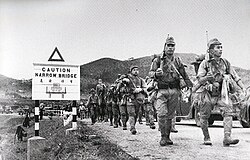
[[File:Battle of HK 01.jpg|thumb|Japanese troops crossing the border from the mainland, 1941]] | |||
The Japanese imprisoned the ruling British colonial elite and sought to win over the local merchant gentry by appointments to advisory councils and neighbourhood watch groups. The policy worked well for Japan and produced extensive collaboration from both the elite and the middle class, with far less terror than in other Chinese cities. Hong Kong was transformed into a Japanese colony, with Japanese businesses replacing the British. However, the Japanese Empire had severe logistical difficulties and by 1943 the food supply for Hong Kong was problematic. The overlords became more brutal and corrupt, and the Chinese gentry became disenchanted. With the surrender of Japan, the transition back to British rule was smooth, for on the mainland the [[Kuomintang|Nationalist]] and [[Communist Party of China|Communist]] forces were preparing for a civil war and ignored Hong Kong. In the long run the occupation strengthened the pre-war social and economic order among the Chinese business community by eliminating some conflicts of interests and reducing the prestige and power of the British.<ref>Zhang, Wei-Bin (2006). ''Hong Kong: The Pearl Made of British Mastery and Chinese Docile-Diligence''. Nova Publishers. p. 109.</ref> | The Japanese imprisoned the ruling British colonial elite and sought to win over the local merchant gentry by appointments to advisory councils and neighbourhood watch groups. The policy worked well for Japan and produced extensive collaboration from both the elite and the middle class, with far less terror than in other Chinese cities. Hong Kong was transformed into a Japanese colony, with Japanese businesses replacing the British. However, the Japanese Empire had severe logistical difficulties and by 1943 the food supply for Hong Kong was problematic. The overlords became more brutal and corrupt, and the Chinese gentry became disenchanted. With the surrender of Japan, the transition back to British rule was smooth, for on the mainland the [[Kuomintang|Nationalist]] and [[Communist Party of China|Communist]] forces were preparing for a civil war and ignored Hong Kong. In the long run the occupation strengthened the pre-war social and economic order among the Chinese business community by eliminating some conflicts of interests and reducing the prestige and power of the British.<ref>Zhang, Wei-Bin (2006). ''Hong Kong: The Pearl Made of British Mastery and Chinese Docile-Diligence''. Nova Publishers. p. 109.</ref> | ||
| Line 153: | Line 166: | ||
=== Restoration of British rule === | === Restoration of British rule === | ||
{{Further|1950s in Hong Kong|1960s in Hong Kong|1970s in Hong Kong|1980s in Hong Kong|1990s in Hong Kong|}} | {{Further|Liberation of Hong Kong|1950s in Hong Kong|1960s in Hong Kong|1970s in Hong Kong|1980s in Hong Kong|1990s in Hong Kong|}} | ||
[[File:Hong Kong Re-occupied. 30 August 1945, Hong Kong, Before, during and After the Re-occupation of the Crown Colony. A30509.jpg|thumb|British forces reoccupy Hong Kong under Rear-Admiral [[Cecil Harcourt]], 30 August 1945]] | [[File:Hong Kong Re-occupied. 30 August 1945, Hong Kong, Before, during and After the Re-occupation of the Crown Colony. A30509.jpg|thumb|British forces reoccupy Hong Kong under Rear-Admiral [[Cecil Harcourt]], 30 August 1945]] | ||
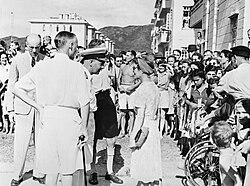
On 14 August 1945, when Japan announced its unconditional surrender, the British formed a naval task group to sail towards Hong Kong.{{sfn|Tsang|2004|p=133}} On 1 September, Rear-Admiral [[Cecil Harcourt]] proclaimed a military administration with himself as its head. He formally accepted the Japanese surrender on 16 September in [[Government House, Hong Kong|Government House]].{{sfn|Tsang|2004|p=138}} Young, upon his return as governor in May 1946, pursued political reform known as the "[[Young Plan (Hong Kong)|Young Plan]]", believing that, to counter the Chinese government's determination to recover Hong Kong, it was necessary to give local inhabitants a greater stake in the territory by widening the political franchise to include them.{{sfn|Tsang|2004|pp= | On 14 August 1945, when Japan announced its unconditional surrender, the British formed a naval task group to sail towards Hong Kong.{{sfn|Tsang|2004|p=133}} On 1 September, Rear-Admiral [[Cecil Harcourt]] proclaimed a military administration with himself as its head. He formally accepted the Japanese surrender on 16 September in [[Government House, Hong Kong|Government House]].{{sfn|Tsang|2004|p=138}} Young, upon his return as governor in May 1946, pursued political reform known as the "[[Young Plan (Hong Kong)|Young Plan]]", believing that, to counter the Chinese government's determination to recover Hong Kong, it was necessary to give local inhabitants a greater stake in the territory by widening the political franchise to include them.{{sfn|Tsang|2004|pp=143–144}} Hong Kong remained a part of the UK and overseas colonies from 1949 until it transitioned its colony to a British dependent territory in 1983. | ||
The economy was the main concern after the [[Chinese Civil War]]. Hong Kong welcomed business from both the PRC and [[Taiwan]]. Investments from Taiwan were particularly lucrative, and Taiwanese interests were given preferential treatment in state compensation and justice. The [[Triad (organized crime)|Triads]] were strongly embedded in Taiwanese economic connections.{{sfn|Price|2019|loc=Preface}} Political activity, covert activity and low intensity violence – including assassinations – by Chinese and Taiwanese agents was tolerated so long as it did not disrupt public order or threaten British sovereignty.{{sfn|Price|2019|loc=Chapter 1: ''Communist anatomy (1950–1955)''; section ''Ignoring Assassins''}} Hong Kong was a base for American-sponsored Taiwanese and anti-communist insurgents and terrorists operating in southern China in the 1950s and early 1960s.{{sfn|Price|2019|loc=Chapter 1: ''Communist anatomy (1950–1955)''; section ''Long faced communists''}}{{sfn|Price|2019|loc=Chapter 3: ''1963''; section ''History of KMT enemy status''}}{{sfn|Price|2019|loc=Chapter 2: ''The colonial anatomy: The 1956 riot''; section ''Pointing the finger''}} The British claimed that increasing policing to control movement from Hong Kong to China was impractical, and that the mutual [[open border]] policy was responsible.{{sfn|Price|2019|loc=Chapter 2: ''The colonial anatomy: The 1956 riot''; section ''Pointing the finger''}} Hong Kong's value as a conduit for [[international trade]] shielded it from most PRC pressure during the 1950s.{{sfn|Price|2019|loc=Chapter 1: ''Communist anatomy (1950–1955)''; section ''Conclusion''}} | |||
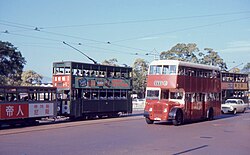
[[File:Hong Kong - Bus and Trams.jpg|thumb|A double-decker bus and two double-decker trams in [[Queen's Road Central]], 1967]] | |||
Hong Kong received Chinese [[refugee]]s – "Rightists" – fleeing the Chinese Civil War and communist persecution. They became cheap labour.{{sfn|Price|2019|loc=Chapter 1: ''Communist anatomy (1950–1955)''; section ''The slaughter''}} Some were recruited in Hong Kong as anti-communist militants.{{sfn|Price|2019|loc=Chapter 1: ''Communist anatomy (1950–1955)''; section ''Long faced communists''}} A major cause of the [[1956 Hong Kong riots]] started by "Rightists" was poverty.{{sfn|Price|2019|loc=Chapter 2: ''The colonial anatomy: The 1956 riot''; section ''Pointing the finger''}} The response to the riots favoured the Rightists; Rightist instigators were lightly prosecuted, compensation was denied to communists and bystanders, and the communists were officially blamed as coinstigators.{{sfn|Price|2019|loc=Chapter 3: ''1963''; section ''Introduction''}} The lax persecution of the riots Rightists instigators was used by the PRC to criticize the "airy use of the rule of law as a pragmatic stand-in for [[human rights]]" that characterized British colonialism.{{sfn|Price|2019|loc=Chapter 1: ''Communist anatomy (1950–1955)''; section ''Long faced communists''}} | |||
== | In 1963, Hong Kong suppressed cells of Taiwanese militants in response to demands from the PRC; the PRC provided a list of Taiwanese agents.{{sfn|Price|2019|loc=Chapter 3: ''1963''; section ''British admissions''}} By this time, Britain no longer considered a Taiwanese conquest of China to be realistic;{{sfn|Price|2019|loc=Chapter 3: ''1963''; section ''The KMT liability in regional politics''}} the evolving discourse on human rights also made it difficult to legitimize being a sponsor of [[state terrorism]].{{sfn|Price|2019|loc=Chapter 3: ''1963''; section ''Conclusion''}} | ||
=== Transfer of sovereignty === | |||
{{Main|Handover of Hong Kong}} | {{Main|Handover of Hong Kong}} | ||
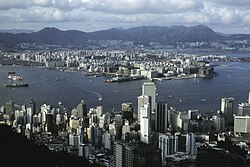
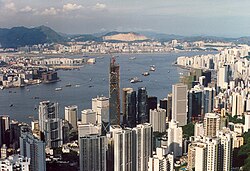
[[File:Hongkong 1980 (View from Peak).jpg|thumb|Urban Hong Kong in 1980]] | |||
{{ | The Sino-British Joint Declaration was signed by both the Prime Minister of the United Kingdom and the Premier of the People's Republic of China on 19 December 1984 in Beijing. The Declaration entered into force with the exchange of instruments of ratification on 27 May 1985 and was registered by the People's Republic of China and United Kingdom governments at the United Nations on 12 June 1985. In the Joint Declaration, the People's Republic of China Government stated that it had decided to resume the exercise of sovereignty over Hong Kong (including [[Hong Kong Island]], Kowloon, and the New Territories) with effect from 1 July 1997 and the United Kingdom Government declared that it would relinquish Hong Kong to the PRC with effect from 1 July 1997. In the document, the People's Republic of China Government also declared its basic policies regarding Hong Kong.<ref>{{cite news|last=|first=|date=2000-11-15|title=How did the Chinese Government settle the question of Hong Kong through negotiations?|publisher=[[Office of the Commissioner of the Ministry of Foreign Affairs of the People's Republic of China in the Hong Kong Special Administrative Region]]|url=http://www.fmcoprc.gov.hk/eng/zcjs/yglz/t17767.htm|quote=[[Deng Xiaoping]] met with [[Margaret Thatcher|Mrs. Thatcher]] on September 24, 1982. The Chinese Premier had held talks with her before this meeting. And Chinese leaders formally informed the British side that the '''Chinese Government had decided to recover all of the Hong Kong region''' in 1997. Also, China offered assurances that it would initiate special policies after '''recovering Hong Kong'''.|archive-url=https://web.archive.org/web/20070313183627/http://www.fmcoprc.gov.hk/eng/zcjs/yglz/t17767.htm|archive-date=2007-03-13|access-date=2020-11-19|url-status=live }}</ref> | ||
{{Multiple image | |||
| align = left | |||
| direction = horizontal | |||
| width1 = 140 | |||
| image1 = Hong Kong British Passport.jpg | |||
| caption1 = British Hong Kong passport | |||
| width2 = 135 | |||
| image2 = Hong Kong SAR of P.R.China Passport.jpg | |||
| caption2 = [[Hong Kong Special Administrative Region passport|Hong Kong SAR passport]] | |||
}} | |||
In accordance with the [[One country, two systems|One Country, Two Systems]] principle agreed between the United Kingdom and the People's Republic of China, the socialist system of People's Republic of China would not be practised in the Hong Kong Special Administrative Region (HKSAR), and Hong Kong's previous capitalist system and its way of life would remain unchanged for a period of 50 years. The Joint Declaration provides that these basic policies shall be stipulated in the [[Hong Kong Basic Law]]. The ceremony of the signing of the Sino-British Joint Declaration took place at 18:00, 19 December 1984 at the Western Main Chamber of the [[Great Hall of the People]]. The [[Hong Kong and Macau Affairs Office]] at first proposed a list of 60–80 Hong Kong people to attend the ceremony. The number was finally extended to 101. The list included Hong Kong government officials, members of the Legislative and Executive Councils, chairmen of [[The Hongkong and Shanghai Banking Corporation]] and [[Standard Chartered Bank]], Hong Kong celebrities such as [[Li Ka-shing]], [[Pao Yue-kong]] and [[Fok Ying-tung]], and also [[Martin Lee|Martin Lee Chu-ming]] and [[Szeto Wah]]. | In accordance with the [[One country, two systems|One Country, Two Systems]] principle agreed between the United Kingdom and the People's Republic of China, the socialist system of People's Republic of China would not be practised in the Hong Kong Special Administrative Region (HKSAR), and Hong Kong's previous capitalist system and its way of life would remain unchanged for a period of 50 years. The Joint Declaration provides that these basic policies shall be stipulated in the [[Hong Kong Basic Law]]. The ceremony of the signing of the Sino-British Joint Declaration took place at 18:00, 19 December 1984 at the Western Main Chamber of the [[Great Hall of the People]]. The [[Hong Kong and Macau Affairs Office]] at first proposed a list of 60–80 Hong Kong people to attend the ceremony. The number was finally extended to 101. The list included Hong Kong government officials, members of the Legislative and Executive Councils, chairmen of [[The Hongkong and Shanghai Banking Corporation]] and [[Standard Chartered Bank]], Hong Kong celebrities such as [[Li Ka-shing]], [[Pao Yue-kong]] and [[Fok Ying-tung]], and also [[Martin Lee|Martin Lee Chu-ming]] and [[Szeto Wah]]. | ||
The handover ceremony was held at the new wing of the [[Hong Kong Convention and Exhibition Centre]] in [[Wan Chai]] on the night of 30 June 1997. The principal British guest was [[Charles, Prince of Wales]] who read a farewell speech on behalf of | [[File:PRC and Hong Kong flags.jpg|thumb|The flag of Hong Kong SAR next to the flag of People's Republic of China]] | ||
The [[Hong Kong handover ceremony|handover ceremony]] was held at the new wing of the [[Hong Kong Convention and Exhibition Centre]] in [[Wan Chai]] on the night of 30 June 1997. The principal British guest was [[Charles III|Charles, Prince of Wales]] (now Charles III, King of the United Kingdom) who read a farewell speech on behalf of his mother, [[Elizabeth II|the Queen]]. The newly elected [[Prime Minister of the United Kingdom]], [[Tony Blair]]; the [[Foreign Secretary (United Kingdom)|Foreign Secretary]], [[Robin Cook]]; the departing [[Hong Kong Governor|Governor of Hong Kong]], [[Chris Patten]]; the [[Chief of the Defence Staff (United Kingdom)|Chief of the Defence Staff]] of the United Kingdom, Field Marshal [[Charles Guthrie, Baron Guthrie of Craigiebank|Sir Charles Guthrie]], also attended. | |||
Representing China were the [[President of the People's Republic of China]], [[Jiang Zemin]] | Representing China were the [[General Secretary of the Chinese Communist Party|CCP General Secretary]] and [[President of the People's Republic of China|President of China]], [[Jiang Zemin]]; [[Premier of the People's Republic of China|Premier of China]], [[Li Peng]]; and [[Tung Chee-hwa]], the first [[Chief Executive of Hong Kong]]. This event was broadcast on television and radio stations across the world. | ||
== Government == | == Government == | ||
{{Multiple image | {{Multiple image | ||
|direction=horizontal |align=right |caption_align=center |total_width=340 | | direction = horizontal | ||
|image1= | | align = right | ||
|image2=Chris Patten -2008-10-31- (cropped).jpg |height2=1440 |width2=1080 | | caption_align = center | ||
|image3=Anson Chan 20051219.jpg |height3=1240 |width3=930 | | total_width = 340 | ||
|caption1=[[Elizabeth II]]<br/><small>[[Monarchy of the United Kingdom|Monarch]]<br />(1952–1997)</small> | | image1 = Elizabeth II greets NASA GSFC employees, May 8, 2007 edit.jpg | ||
|caption2=[[Chris Patten]]<br/><small>[[Governor of Hong Kong|Governor]]<br />(1992–1997)</small> | | height1 = 1290 | ||
|caption3=[[Anson Chan]]<br/><small>[[Chief Secretary of Hong Kong|Chief Secretary]]<br />(1993–1997)</small> | | width1 = 950 | ||
| image2 = Chris Patten -2008-10-31- (cropped).jpg | |||
| height2 = 1440 | |||
| width2 = 1080 | |||
| image3 = Anson Chan 20051219.jpg | |||
| height3 = 1240 | |||
| width3 = 930 | |||
| caption1 = [[Elizabeth II]]<br /><small>[[Monarchy of the United Kingdom|Monarch]]<br />(1952–1997)</small> | |||
| caption2 = [[Chris Patten]]<br /><small>[[Governor of Hong Kong|Governor]]<br />(1992–1997)</small> | |||
| caption3 = [[Anson Chan]]<br /><small>[[Chief Secretary of Hong Kong|Chief Secretary]]<br />(1993–1997)</small> | |||
}} | }} | ||
| Line 191: | Line 232: | ||
The Executive Council determined administrative policy changes and considered primary legislation before passing it to the Legislative Council for approval. This advisory body also itself issued secondary legislation under a limited set of colonial ordinances. The Legislative Council debated proposed legislation and was responsible for the appropriation of public funds. This chamber was reformed in the last years of colonial rule to introduce more democratic representation.<ref name="GreenPaper"/> Indirectly elected [[1985 Hong Kong legislative election|functional constituency seats were introduced in 1985]] and popularly elected [[1991 Hong Kong legislative election|geographical constituency seats in 1991]]. [[1994 Hong Kong electoral reform|Further electoral reform in 1994]] effectively made the legislature broadly representative. The administrative Civil Service was led by the [[Chief Secretary for Administration|Colonial Secretary]] (later Chief Secretary), who was deputy to the Governor.<ref name="GreenPaper"/> | The Executive Council determined administrative policy changes and considered primary legislation before passing it to the Legislative Council for approval. This advisory body also itself issued secondary legislation under a limited set of colonial ordinances. The Legislative Council debated proposed legislation and was responsible for the appropriation of public funds. This chamber was reformed in the last years of colonial rule to introduce more democratic representation.<ref name="GreenPaper"/> Indirectly elected [[1985 Hong Kong legislative election|functional constituency seats were introduced in 1985]] and popularly elected [[1991 Hong Kong legislative election|geographical constituency seats in 1991]]. [[1994 Hong Kong electoral reform|Further electoral reform in 1994]] effectively made the legislature broadly representative. The administrative Civil Service was led by the [[Chief Secretary for Administration|Colonial Secretary]] (later Chief Secretary), who was deputy to the Governor.<ref name="GreenPaper"/> | ||
[[File:Hong Kong; the Government House and grounds. Photograph. Wellcome V0037343.jpg|thumb|[[Government House, Hong Kong|Government House]], | [[File:Hong Kong; the Government House and grounds. Photograph. Wellcome V0037343.jpg|thumb|[[Government House, Hong Kong|Government House]], {{Circa|1873}}]] | ||
The judicial system was based on [[English law]], with [[Traditional Chinese law|Chinese customary law]] taking a secondary role in civil cases involving Chinese residents.<ref>Lewis, D. J. (April 1983). "A Requiem for Chinese Customary Law in Hong Kong". ''The International and Comparative Law Quarterly'' '''32''' (2): 347–379. Cambridge University Press. {{JSTOR|759499}}.</ref> The [[Supreme Court (Hong Kong)|Supreme Court of Hong Kong]] was the highest court and ruled on all civil and criminal cases in the colony. During the early colonial period, extraterritorial appellate cases from other regions of China involving British subjects were also tried in this court. Further appeals from the Supreme Court were heard by the [[Judicial Committee of the Privy Council]], which exercised final adjudication over the entire British Empire.<ref>Jones, Oliver (2014). "A Worthy Predecessor? The Privy Council on Appeal from Hong Kong, 1853 to 1997". In Ghai, Y.; Young, S. ''Hong Kong's Court of Final Appeal: The Development of the Law in China's Hong Kong''. Cambridge: Cambridge University Press. {{SSRN| | The judicial system was based on [[English law]], with [[Traditional Chinese law|Chinese customary law]] taking a secondary role in civil cases involving Chinese residents.<ref>Lewis, D. J. (April 1983). "A Requiem for Chinese Customary Law in Hong Kong". ''The International and Comparative Law Quarterly'' '''32''' (2): 347–379. Cambridge University Press. {{JSTOR|759499}}.</ref> The [[Supreme Court (Hong Kong)|Supreme Court of Hong Kong]] was the highest court and ruled on all civil and criminal cases in the colony. During the early colonial period, extraterritorial appellate cases from other regions of China involving British subjects were also tried in this court. Further appeals from the Supreme Court were heard by the [[Judicial Committee of the Privy Council]], which exercised final adjudication over the entire British Empire.<ref>Jones, Oliver (2014). "A Worthy Predecessor? The Privy Council on Appeal from Hong Kong, 1853 to 1997". In Ghai, Y.; Young, S. ''Hong Kong's Court of Final Appeal: The Development of the Law in China's Hong Kong''. Cambridge: Cambridge University Press. {{SSRN|2533284}}.</ref> | ||
In March 1975 the Hong Kong government introduced a programme to measure public opinion of government efforts, known as Movement of Opinion Direction (MOOD).<ref>{{cite journal|last=Mok|first=Florence|title=Public opinion polls and covert colonialism in British Hong Kong|date=2018-07-09|journal=[[China Information]]| volume=33 | pages=66–87 |doi=10.1177/0920203X18787431| s2cid=150104890 |doi-access=free}}</ref> | |||
=== Cadets === | === Cadets === | ||
{{Main|Administrative Officer (Hong Kong)}} | |||
In 1861, Governor [[Hercules Robinson, 1st Baron Rosmead|Sir Hercules Robinson]] introduced the Hong Kong Cadetship, which recruited young graduates from Britain to learn [[Cantonese]] and written Chinese for two years, before deploying them on a fast track to the [[Hong Kong Civil Service|Civil Service]]. Cadet officers gradually formed the backbone of the civil administration. After the Second World War, ethnic Chinese were allowed into the service, followed by women. Cadets were renamed Administrative Officers in the 1950s, and they remained the elite of the Civil Service during British rule.{{sfn|Tsang|2004|pp=25–26}} | |||
=== Military === | |||
{{Main|British Forces Overseas Hong Kong}} | |||
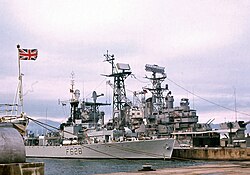
[[File:HMS Loch Killisport (F628) at Hong Kong 01 1964.JPG|thumb|The Royal Navy frigate ''[[HMS Loch Killisport (K628)|HMS Loch Killisport]]'' at Hong Kong, 1964]] | |||
Prior to and during the [[Second World War]], the garrison was composed of [[British Army]] battalions and locally enlisted personnel (LEPs) who served as regular members in the Hong Kong Squadron of the Royal Navy or the [[Hong Kong Military Service Corps]] and their associate land units. The [[Hong Kong Brigade]] served as the main garrison formation. After the outbreak of the Second World War, the garrison was reinforced with [[British Indian Army]] and [[Canadian Army]] units. A second brigade, the Kowloon Infantry Brigade, was formed to assist in commanding the expanded force. The garrison was defeated during the [[Battle of Hong Kong]], by the [[Empire of Japan]]. | |||
After the Second World War and the end of the [[Japanese occupation of Hong Kong]], the British military reestablished a presence. As a result of the [[Chinese Civil War]], the British Army raised the [[40th Division (United Kingdom)|40th Infantry Division]] and dispatched it to garrison Hong Kong. It later left for combat in the [[Korean War]], and the defense of the territory was taken up by additional British forces who were rotated from Europe. The garrison was further supplemented by LEPs, and [[Gurkha]]s. The latter came from [[Nepal]], but formed part of the British Army. The size of the garrison during the [[Cold War]] fluctuated and ended up being based around one brigade. | |||
The [[Royal Hong Kong Regiment]], a military unit which was part of the Hong Kong Government, was trained and organised along the lines of a British [[Army Reserve (United Kingdom)|Territorial Army]] unit. As such, it was supported by British Army regular personnel holding key positions. These British Army personnel, for their duration of service to the Royal Hong Kong Regiment, were seconded to the Hong Kong Government. In the post-WWII era, the majority of the regiment's members were local citizens of [[Chinese people|Chinese]] descent. | |||
== Economy == | == Economy == | ||
[[File:HK-architecture-BOCHK-Bank-of-China-Building-under-construction-1988-00.jpg|thumb|[[Victoria Harbour]] in 1988, showing the [[Bank of China Tower, Hong Kong|Bank of China Tower]] being built]] | [[File:HK-architecture-BOCHK-Bank-of-China-Building-under-construction-1988-00.jpg|thumb|[[Victoria Harbour]] in 1988, showing the [[Bank of China Tower, Hong Kong|Bank of China Tower]] being built]] | ||
The stability, security, and predictability of [[Law of the United Kingdom|British law]] and government enabled Hong Kong to flourish as a centre for international trade.{{sfn|Tsang|2004|p=57}} In the colony's first decade, | The [[economy of Hong Kong]] under British rule was based on free trade and [[positive non-interventionism]], with the minimal red tape allowing the colony to flourish primarily as a [[free-trade zone]] and later as an [[offshore financial centre]]. The stability, security, and predictability of [[Law of the United Kingdom|British law]] and government enabled Hong Kong to flourish as a centre for international trade.{{sfn|Tsang|2004|p=57}} In the colony's first decade, revenue from the opium trade was a key source of government funds. The importance of opium reduced over time, but the colonial government was dependent on its revenues until the Japanese occupation in 1941.{{sfn|Tsang|2004|p=57}} Although the largest businesses in the early colony were operated by British, American, and other expatriates, Chinese workers provided the bulk of the manpower needed to build a new port city.{{sfn|Tsang|2004|p=58}} | ||
By the late 1980s, many ethnic Chinese people had become major business figures in Hong Kong. Amongst these billionaires was Sir [[Li Ka-shing]], who had become one of the colony's wealthiest people by this time. | By the late 1980s, many ethnic Chinese people had become major business figures in Hong Kong. Amongst these billionaires was Sir [[Li Ka-shing]], who had become one of the colony's wealthiest people by this time. | ||
== Culture == | |||
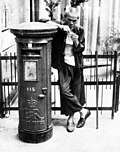
[[File:Royal Mail post box with man in Hong Kong 1962.jpg|thumb|A man leaning on a Royal Mail post box in Hong Kong, 1962]] | |||
British Hong Kong was characterised as a hybrid of [[Eastern world|East]] and [[Western culture|West]]. Traditional Chinese values emphasising family and education blended with Western ideals, including economic liberty and the rule of law.<ref>{{harvnb|Carroll|2007|p=169}}.</ref> Although the vast majority of the population was ethnically Chinese, Hong Kong developed a distinct identity from the mainland through its long period of colonial administration and a different pace of economic, social, and cultural development, with mainstream culture was derived from immigrants originating from various parts of China. This was influenced by British-style education, a separate political system, and the territory's rapid development during the late 20th century.<ref>{{harvnb|Carroll|2007|pp=167–172}}.</ref><ref>{{harvnb|He|2013}}.</ref> Most migrants of that era fled poverty and war, reflected in the prevailing attitude toward wealth; Hongkongers tended to link self-image and decision-making to material benefits.<ref>{{harvnb|Tam|2017}}.</ref><ref>{{harvnb|Lam|2015}}.</ref> Residents' sense of local identity remained post-handover, with the majority of the population (52%) identifying as "Hongkongers", while 11% described themselves as "Chinese". The remaining population held mixed identities, 23% as "Hongkonger in China" and 12% as "Chinese in Hong Kong".<ref>{{cite web |url=https://www.hkupop.hku.hk/english/release/release1563.html |title=HKU POP releases survey on Hong Kong people's ethnic identity and the 2018 review and 2019 forecast survey |publisher=Public Opinion Programme, University of Hong Kong |date=27 December 2018 |access-date=26 January 2019 |archive-url=https://web.archive.org/web/20190327090214/https://www.hkupop.hku.hk/english/release/release1563.html |archive-date=27 March 2019 |url-status=live }}</ref> | |||
Traditional Chinese family values, including [[family honor|family honour]], [[filial piety]], and a [[Sex selection|preference for sons]], remained prevalent.<ref>{{harvnb|Family Survey|2013|pp=12–13}}.</ref> [[Nuclear family|Nuclear families]] were the most common households, although multi-generational and extended families were not unusual.<ref>{{harvnb|Population By-Census|2016|p=77}}.</ref> In British-ruled Hong Kong, polygamy was legal until 1971 pursuant to the colonial practice of not interfering in local customs that British authorities viewed as relatively harmless to the public order.<ref>{{Cite book |last=Lary |first=Diana |url= |title=China's grandmothers : gender, family, and aging from late Qing to twenty-first century |date=2022 |publisher=[[Cambridge University Press]] |isbn=978-1-009-06478-1 |edition= |location=Cambridge, United Kingdom |pages=126 |oclc=1292532755}}</ref> | |||
Spiritual concepts such as ''[[feng shui]]'' were observed; large-scale construction projects often hired consultants to ensure proper building positioning and layout. The degree of its adherence to ''feng shui'' was believed to determine the success of a business. ''[[Bagua]]'' mirrors were regularly used to deflect evil spirits,<ref>{{harvnb|Fowler|Fowler|2008|p=263}}.</ref> and buildings often lack [[Chinese numerology|floor numbers with a 4]];<ref>{{harvnb|Xi|Ingham|2003|p=181}}.</ref> the number has a similar sound to the word for "die" in Cantonese.<ref>{{harvnb|Chan|Chow|2006|p=3}}.</ref> | |||
=== Language === | |||
{{Main|Languages of Hong Kong}} | |||
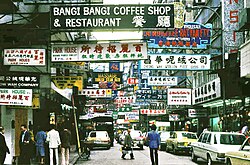
[[File:Hong Kong 1978 05.jpg|thumb|Shopping street at [[Kowloon]] with signs in English and Traditional Chinese, 1978]] | |||
A prominent example of cultural integration in everyday life in British Hong Kong, was the use of [[British English]] as a common [[second language]], and also the sole [[official language]] of the colony until 1974, when Chinese was accorded co-official status.<ref>[https://www.nytimes.com/1974/03/24/archives/hong-kong-adopts-a-language-law-complications-for-officials.html Hong Kong Adopts A Language-Law], ''[[New York Times]]'', March 24, 1974</ref> In addition to British English being taught in [[Primary school|primary]] and [[secondary school]]s, there were also English-medium schools operated by the [[English Schools Foundation]], established in 1967.<ref>[https://www.elegislation.gov.hk/hk/cap1117 The English Schools Foundation Ordinance]</ref> For the metro system, the metro lines were named after places instead of numbered, unlike [[Mainland China]], where metro lines were numbered. Roads were named after British royals, governors, famous people, cities and towns across the UK and the [[Commonwealth of Nations|Commonwealth]], as well as [[List of cities in China|Chinese cities]] and places. Aside from [[Chinese New Year]], [[Christmas]] was celebrated as the second-most important festival. In [[literature]], some [[idiom]]s in [[Cantonese]] were directly translated from those in English. A [[Mandarin Chinese]] speaker might recognise the words but not understand the meaning. | |||
=== Cuisine === | |||
{{Main|Hong Kong cuisine}} | |||
{{Multiple image | |||
| direction = horizontal | |||
| align = right | |||
| caption_align = center | |||
| total_width = 350 | |||
| image1 = Dim Sum Breakfast.jpg | |||
| height1 = 600 | |||
| width1 = 800 | |||
| alt1 = An assortment of items in a Dim Sum breakfast meal | |||
| image2 = Cha Chaan Teng.jpg | |||
| height2 = 1200 | |||
| width2 = 1600 | |||
| alt2 = French Toast on left, Milk Tea on right | |||
| footer = ''(left)'' Typical fare at a dim sum restaurant; ''(right)'' ''[[cha chaan teng]]'' breakfast food with [[Hong Kong-style milk tea]] | |||
}} | |||
Food in Hong Kong under British rule was primarily based on [[Cantonese cuisine]], despite the territory's exposure to foreign influences and its residents' varied origins. Rice was the staple food, and was usually served plain with other dishes.<ref name="LongHKFood">{{harvnb|Long|2015|p=271}}.</ref> Freshness of ingredients was emphasised. Poultry and seafood were commonly sold live at [[wet market]]s, and ingredients were used as quickly as possible.<ref>{{harvnb|Curry|Hanstedt|2014|pp=9–12}}.</ref> There were five daily meals: breakfast, lunch, afternoon tea, dinner, and ''[[siu yeh]]''.<ref>{{harvnb|Long|2015|p=272}}.</ref> [[Dim sum]], as part of ''[[yum cha]]'' (brunch), was a dining-out tradition with family and friends. Dishes include [[congee]], ''[[cha siu bao]]'', ''[[siu yuk]]'', [[egg tart]]s, and [[mango pudding]]. Local versions of Western food were served at ''[[cha chaan teng]]'' (Hong Kong-style cafes). Common ''cha chaan teng'' menu items include macaroni in soup, deep-fried French toast, and [[Hong Kong-style milk tea]].<ref name="LongHKFood" /> | |||
=== Cinema === | |||
{{Main|Cinema of Hong Kong}} | |||
[[File:Bruce Lee performs nunchaku.jpg|thumb|[[Bruce Lee]] became an iconic figure of the Hong Kong film industry, profoundly shaping its global recognition and influence.]] | |||
Film making in Hong Kong began as early as 1909, but Hong Kong was not a film making hub until the late 1940s, when a wave of Shanghai filmmakers migrated to the territory; these movie veterans helped build the colony's entertainment industry over the next decade.<ref>{{harvnb|Fu|2008|pp=381, 388–389}}.</ref> By the 1960s, the city was well known to overseas audiences through films such as ''[[The World of Suzie Wong (film)|The World of Suzie Wong]]''.<ref>{{harvnb|Carroll|2007|p=148}}.</ref> When [[Bruce Lee]]'s ''[[The Way of the Dragon]]'' was released in 1972, local productions became popular outside Hong Kong. During the 1980s, films such as ''[[A Better Tomorrow]]'', ''[[As Tears Go By (film)|As Tears Go By]]'', and ''[[Zu Warriors from the Magic Mountain]]'' expanded global interest beyond [[martial arts film]]s; locally made gangster films, romantic dramas, and supernatural fantasies became popular.<ref>{{harvnb|Carroll|2007|p=168}}.</ref> Hong Kong cinema continued to be internationally successful over the following decade with critically acclaimed dramas such as ''[[Farewell My Concubine (film)|Farewell My Concubine]]'', ''[[To Live (1994 film)|To Live]]'' and [[Wong Kar Wai]] movies. The city's martial arts film roots were evident in the roles of the most prolific Hong Kong actors. [[Jackie Chan]], [[Donnie Yen]], [[Jet Li]], [[Chow Yun-fat]], and [[Michelle Yeoh]] frequently play action-oriented roles in foreign films. At the height of the local movie industry in the early 1990s, over 400 films were produced each year; since then, industry momentum has shifted to mainland China. The number of films produced annually declined to about 60 in 2017.<ref>{{harvnb|Ge|2017}}.</ref> | |||
{{clear left}} | |||
=== Music === | |||
{{Main|Music of Hong Kong}} | |||
{{Multiple image | |||
|direction=horizontal |align=right |caption_align=center |total_width=300 | |||
|image1=Leslie Cheung.jpg |height1=241 |width1=316|alt1=Leslie Cheung with a microphone | |||
|image2=Andy Lau (cropped).jpg |height2=500 |width2=483|alt2=A serious-looking Andy Lau, seated and wearing a suit | |||
|footer=[[Leslie Cheung]] ''(left)'' was considered a pioneering Cantopop artist, and [[Andy Lau]] was an icon of Hong Kong music and film for several decades as a member of the Four Heavenly Kings. | |||
}} | |||
[[Cantopop]] was a genre of Cantonese popular music which emerged in Hong Kong during the 1970s. Evolving from Shanghai-style ''[[shidaiqu]]'', it was also influenced by [[Cantonese opera]] and Western pop.<ref>{{harvnb|Chu|2017|pp=1–9, 24–25}}.</ref> Local media featured songs by artists such as [[Sam Hui]], [[Anita Mui]], [[Leslie Cheung]], and [[Alan Tam]]; during the 1980s, exported films and shows exposed Cantopop to a global audience.<ref>{{harvnb|Chu|2017|pp=77–85}}.</ref> The genre's popularity peaked in the 1990s, when the [[Four Heavenly Kings (Hong Kong)|Four Heavenly Kings]] dominated Asian record charts.<ref>{{harvnb|Chu|2017|pp=107–116}}.</ref> Despite a general decline since late in the decade,<ref>{{harvnb|Chu|2017|pp=9–10}}.</ref> | |||
Western classical music historically had a strong presence in Hong Kong and remained a large part of local musical education.<ref>{{harvnb|Smith|Moir|Brennan|Rambarran|2017|p=101}}</ref> The publicly funded [[Hong Kong Philharmonic Orchestra]], the territory's oldest professional symphony orchestra, frequently hosts musicians and conductors from overseas. The [[Hong Kong Chinese Orchestra]], composed of [[Chinese orchestra|classical Chinese instruments]], was the leading Chinese ensemble and played a significant role in promoting traditional music in the community.<ref>{{harvnb|Ho|2011|p=147}}.</ref> | |||
=== Sport and recreation === | |||
{{Main|Sport in Hong Kong}} | |||
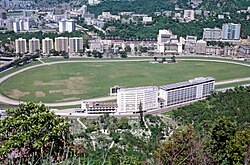
[[File:Happy Valley Racecourse Hong Kong June 1963.jpg|thumb|right|[[Happy Valley Racecourse]], 1963]] | |||
Despite its small area, the territory regularly hosted the [[Hong Kong Sevens]], [[Hong Kong Marathon]], [[Hong Kong Tennis Classic]] and [[Lunar New Year Cup]], and hosted the inaugural [[AFC Asian Cup]] and the [[1995 Dynasty Cup]].<ref>{{harvnb|Ghoshal|2011}}.</ref><ref>{{harvnb|Horne|Manzenreiter|2002|p=128}}.</ref> | |||
Hong Kong was separately represented from [[China|mainland China]], with its own sports teams in international competitions. The territory participated in almost every Summer Olympics since 1952 and earned a gold medal. [[Lee Lai-shan]] won the territory's first Olympic gold medal at the [[1996 Summer Olympics|1996 Atlanta Olympics]],<ref>{{harvnb|Lam|Chang|2005|p=141}}.</ref> Between 1972 and 1996, Hong Kong athletes won [[Hong Kong at the Paralympics|60 medals at the Paralympic Games]]. As part of the [[Commonwealth of Nations|Commonwealth]], British Hong Kong participated in the [[Commonwealth Games]], in which it won [[Hong Kong at the Commonwealth Games|17 medals]], the city's last appearance in the Games being in [[1994 Commonwealth Games|1994]].<ref>{{harvnb|Lam|Chang|2005|p=99}}.</ref> | |||
[[Dragon boat]] races originated as a religious ceremony conducted during the annual [[Dragon Boat Festival|Tuen Ng Festival]]. The race was revived as a modern sport as part of the [[Hong Kong Tourism Board|Tourism Board]]'s efforts to promote Hong Kong's image abroad. The first modern competition was organised in 1976, and overseas teams began competing in the first international race in 1993.<ref>{{harvnb|Sofield|Sivan|2003}}.</ref> | |||
The [[Hong Kong Jockey Club]], known between 1960 and 1996 as the Royal Hong Kong Jockey Club, became the territory's largest taxpayer.<ref>[https://books.google.co.uk/books?id=oSrjAAAAMAAJ&q=%227+per+cent+on+bets+and+25+per+cent+on+cash%22&dq=%227+per+cent+on+bets+and+25+per+cent+on+cash%22&hl=en&newbks=1&newbks_redir=0&sa=X&ved=2ahUKEwifvsaPsOKIAxUCUkEAHYZbJPQQ6AF6BAgJEAI ''Annual Report on Hong Kong''], H.M. Stationery Office, 1975, page 29</ref> Three forms of gambling were legal in Hong Kong: lotteries, horse racing, and football.<ref name="JockeyClub">{{harvnb|Littlewood|2010|pp=16–17}}.</ref> | |||
== Dissent == | == Dissent == | ||
{{POV section|date=April 2023}} | |||
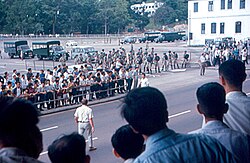
[[File:1967 Hong Kong riots-Communists and Police.jpg|thumb|Police confrontation during the 1967 leftist riots]] | [[File:1967 Hong Kong riots-Communists and Police.jpg|thumb|Police confrontation during the 1967 leftist riots]] | ||
During China's turbulent 20th century, Hong Kong served as a safe haven for dissidents, political refugees, and officials who lost power. British policy allowed dissidents to live in Hong Kong as long as they did not break local laws or harm British interests. The implementation of this policy varied according to what the senior officials thought constituted British interests and the state of relations with China.{{sfn|Tsang|2004|pp= | During China's turbulent 20th century, Hong Kong served as a safe haven for dissidents, political refugees, and officials who had lost power. British policy allowed dissidents to live in Hong Kong as long as they did not break local laws or harm British interests. The implementation of this policy varied according to what the senior officials thought constituted British interests and the state of relations with China.{{sfn|Tsang|2004|pp=80–81}} The [[Canton–Hong Kong strike]] (1925–1926) was anti-imperialist in nature. The [[Hong Kong 1966 riots|1966 riots]] and [[Maoist]]-led [[1967 Hong Kong riots|1967 riots]], essentially spillovers from the [[Cultural Revolution]], were large scale demonstrations fuelled by tensions surrounding labour disputes and dissatisfaction towards the government.<ref>Cheung, Gary Ka-wai (2009). ''Hong Kong's Watershed: The 1967 Riots''. Hong Kong: Hong Kong University Press.</ref> Although the 1967 riots started as a labour dispute, the incident escalated quickly after the leftist camp and mainland officials stationed in Hong Kong seized the opportunity to mobilise their followers to protest against the colonial government.<ref>Cheung, Gary (10 June 2016). "[https://www.scmp.com/news/china/policies-politics/article/1971502/when-cultural-revolution-spilled-over-riots-hong-kong When the Cultural Revolution spilled over into riots in Hong Kong – and changed lives forever] {{Webarchive|url=https://web.archive.org/web/20170512084353/http://www.scmp.com/news/china/policies-politics/article/1971502/when-cultural-revolution-spilled-over-riots-hong-kong# |date=12 May 2017 }}". ''South China Morning Post''. Retrieved 10 July 2018.</ref> [[Chinese Communist Party]] supporters organised the [[Anti-British Struggle Committee]] during the riots. | ||
[[Steve Tsang]], director of the China Institute of the [[SOAS University of London|School of Oriental and African Studies]] at the [[University of London]], wrote that it was "ironic" that despite Hong Kong being a symbol of China's humiliation by Britain, there was not one major movement started by the Chinese residents of the colony for its retrocession to China, even though there had been several upsurges of [[Chinese nationalism]].{{sfn|Tsang|1995|p=1}} He explained: | [[Steve Tsang]], director of the China Institute of the [[SOAS University of London|School of Oriental and African Studies]] at the [[University of London]], wrote that it was "ironic" that despite Hong Kong being a symbol of China's humiliation by Britain, there was not one major movement started by the Chinese residents of the colony for its retrocession to China, even though there had been several upsurges of [[Chinese nationalism]].{{sfn|Tsang|1995|p=1}} He explained: | ||
| Line 217: | Line 337: | ||
== See also == | == See also == | ||
* [[British Military Hospital, Hong Kong|British Military Hospital]] | |||
* [[British | * [[English Schools Foundation|British Education]] | ||
* [[ | * [[Royal Hong Kong Regiment]] | ||
* [[ | * [[Special Branch (Hong Kong)|Political Department]] | ||
* [[ | * [[Flags of Elizabeth II]] | ||
* [[ | * [[British Forces Overseas Hong Kong]] | ||
* [[ | * [[Commander British Forces in Hong Kong]] | ||
*[[ | |||
== Notes == | == Notes == | ||
{{NoteFoot}} | |||
{{ | |||
== References == | == References == | ||
=== Citations === | |||
===Citations=== | |||
{{Reflist}} | {{Reflist}} | ||
=== | === Sources === | ||
{{refbegin|30em}} | |||
{{ | * {{cite book |last1=Carroll |first1=John M. |title=A concise history of Hong Kong |date=2007 |publisher=Rowman & Littlefield |location=Lanham |isbn=978-0-7425-3422-3}} | ||
* {{citation |last=Snow |first=Philip | | * {{cite book |last1=Chan |first1=Cecilia |last2=Chow |first2=Amy |title=Death, Dying and Bereavement: a Hong Kong Chinese Experience |publisher=[[Hong Kong University Press]] |year=2006 |url=https://books.google.com/books?id=tzUvGEw7Z0AC |isbn=978-962-209-787-2 |access-date=4 September 2022 |archive-date=16 July 2023 |archive-url=https://web.archive.org/web/20230716061612/https://books.google.com/books?id=tzUvGEw7Z0AC |url-status=live }} | ||
* {{citation |author-link=Steve Tsang |last=Tsang |first=Steve | | * {{cite book |last=Chu |first=Yiu-wai |date=2017 |title=Hong Kong Cantopop: A Concise History |url=https://books.google.com/books?id=62I2DwAAQBAJ |publisher=[[Hong Kong University Press]] |isbn=978-988-8390-58-8 |access-date=4 September 2022 |archive-date=16 July 2023 |archive-url=https://web.archive.org/web/20230716061634/https://books.google.com/books?id=62I2DwAAQBAJ |url-status=live }} | ||
* {{citation |author-link=Steve Tsang |last=Tsang |first=Steve | | * {{cite book |last1=Curry |first1=Janel |last2=Hanstedt |first2=Paul |title=Reading Hong Kong, Reading Ourselves |year=2014 |publisher=City University of Hong Kong Press |url=https://books.google.com/books?id=eRH4AwAAQBAJ |isbn=978-962-937-235-4 |access-date=4 September 2022 |archive-date=16 July 2023 |archive-url=https://web.archive.org/web/20230716061612/https://books.google.com/books?id=eRH4AwAAQBAJ |url-status=live }} | ||
* {{citation |author-link=Frank Welsh (writer) |last=Welsh |first=Frank | | * {{cite book |last1=Fowler |first1=Jeaneane D. |last2=Fowler |first2=Merv |title=Chinese Religions: Beliefs and Practices |year=2008 |publisher=Sussex Academic Press |url=https://books.google.com/books?id=rpJNfIAZltoC |isbn=978-1-84519-172-6 |access-date=4 September 2022 |archive-date=16 July 2023 |archive-url=https://web.archive.org/web/20230716061612/https://books.google.com/books?id=rpJNfIAZltoC |url-status=live }} | ||
* {{cite journal |last=Fu |first=Poshek |title=Japanese Occupation, Shanghai Exiles, and Postwar Hong Kong Cinema |journal=The China Quarterly |year=2008 |volume=194 |issue=194 |pages=380–394 |doi=10.1017/S030574100800043X |jstor=20192203|s2cid=154730809 }} | |||
* {{cite news |last=Ge |first=Celine |date=28 July 2017 |title=It's fade out for Hong Kong's film industry as China moves into the spotlight |url=https://www.scmp.com/business/article/2104540/its-fade-out-hong-kongs-film-industry-china-moves-spotlight |newspaper=[[South China Morning Post]] |access-date=28 May 2018 |archive-date=29 May 2018 |archive-url=https://web.archive.org/web/20180529204204/http://www.scmp.com/business/article/2104540/its-fade-out-hong-kongs-film-industry-china-moves-spotlight |url-status=live }} | |||
* {{cite web |last=Ghoshal |first=Amoy |date=1 July 2011 |title=Asian Cup: Know Your History – Part One (1956–1988) |url=http://www.goal.com/en/news/8/main/2011/01/07/2293901/asian-cup-know-your-history-part-one-1956-1988 |website=[[Goal (website)|Goal]] |access-date=5 March 2018 |archive-date=31 May 2019 |archive-url=https://web.archive.org/web/20190531055150/https://www.goal.com/en/news/8/main/2011/01/07/2293901/asian-cup-know-your-history-part-one-1956-1988 |url-status=dead }} | |||
* {{cite news |last=He |first=Huifeng |date=13 January 2013 |title=Forgotten stories of the great escape to Hong Kong |url=https://www.scmp.com/news/china/article/1126786/forgotten-stories-huge-escape-hong-kong |newspaper=[[South China Morning Post]] |access-date=27 December 2017 |archive-date=28 December 2017 |archive-url=https://web.archive.org/web/20171228062604/http://www.scmp.com/news/china/article/1126786/forgotten-stories-huge-escape-hong-kong |url-status=live }} | |||
* {{cite book |last1=Ho |first1=Wai-chung |year=2011 |title=School Music Education and Social Change in Mainland China, Hong Kong and Taiwan |publisher=[[Brill Publishers]] |url=https://books.google.com/books?id=7VieYfjWRV0C |isbn=978-90-04-18917-1 |access-date=4 September 2022 |archive-date=16 July 2023 |archive-url=https://web.archive.org/web/20230716061634/https://books.google.com/books?id=7VieYfjWRV0C |url-status=live }} | |||
* {{cite book |last1=Horne |first1=John |last2=Manzenreiter |first2=Wolfram |title=Japan, Korea and the 2002 World Cup |publisher=[[Routledge]] |url=https://books.google.com/books?id=7YD7PWVCABAC |year=2002 |isbn=978-0-415-27563-7 }} | |||
* {{cite book |last=Lam |first=Wai-man |title=Understanding the Political Culture of Hong Kong: The Paradox of Activism and Depoliticization: The Paradox of Activism and Depoliticization |year=2015 |publisher=Routledge |url=https://books.google.com/books?id=YhXICQAAQBAJ |isbn=978-1-317-45301-7 |access-date=4 September 2022 |archive-date=16 July 2023 |archive-url=https://web.archive.org/web/20230716062113/https://books.google.com/books?id=YhXICQAAQBAJ |url-status=live }} | |||
* {{cite book |last1=Lam |first1=S.F. |last2=Chang |first2=Julian W. |date=2005 |title=The Quest for Gold: Fifty Years of Amateur Sports in Hong Kong, 1947–1997 |url=https://books.google.com/books?id=Y45FBAAAQBAJ |publisher=[[Hong Kong University Press]] |isbn=978-962-209-765-0 }} | |||
* {{cite book |last=Littlewood |first=Michael |title=Taxation Without Representation: The History of Hong Kong's Troublingly Successful Tax System |year=2010 |publisher=[[Hong Kong University Press]] |url=https://books.google.com/books?id=_7eiOi2lbOkC |isbn=978-962-209-099-6 |access-date=4 September 2022 |archive-date=16 July 2023 |archive-url=https://web.archive.org/web/20230716062114/https://books.google.com/books?id=_7eiOi2lbOkC |url-status=live }} | |||
* {{cite book |last=Long |first=Lucy M. |title=Ethnic American Food Today: A Cultural Encyclopedia |year=2015 |publisher=[[Rowman & Littlefield]] |url=https://books.google.com/books?id=DBzYCQAAQBAJ |isbn=978-1-4422-2730-9 |access-date=4 September 2022 |archive-date=16 July 2023 |archive-url=https://web.archive.org/web/20230716062116/https://books.google.com/books?id=DBzYCQAAQBAJ |url-status=live }} | |||
* {{cite book |last1=Smith |first1=Gareth Dylan |last2=Moir |first2=Zack |last3=Brennan |first3=Matt |last4=Rambarran |first4=Shara |last5=Kirkman |first5=Phil |date=2017 |title=The Routledge Research Companion to Popular Music Education |publisher=[[Routledge]] |url=https://books.google.com/books?id=JColDwAAQBAJ |isbn=978-1-4724-6498-9 |access-date=4 September 2022 |archive-date=16 July 2023 |archive-url=https://web.archive.org/web/20230716062114/https://books.google.com/books?id=JColDwAAQBAJ |url-status=live }} | |||
* {{citation |last=Snow |first=Philip |year=2004 |title=The Fall of Hong Kong: Britain, China and the Japanese Occupation |location=[[New Haven, CT]] |publisher=Yale University Press |isbn=0300103735 }}. | |||
* {{cite book |last1=Price |first1=Rohan B.E. |title=Resistance in Colonial and Communist China, 1950-1963: Anatomy of a Riot |publisher=Routledge |location=New York |year=2019 |isbn=9780429424335}} | |||
* {{cite journal |last1=Sofield |first1=Trevor H.B. |last2=Sivan |first2=Atara |title=From Cultural Festival to International Sport – The Hong Kong Dragon Boat Races |journal=Journal of Sport & Tourism |volume=8 |issue=1 |pages=9–20 |year=2003 |doi=10.1080/14775080306242 |s2cid=144106613 }} | |||
* {{cite news |last=Tam |first=Luisa |date=11 September 2017 |title=Self-centred, demanding, materialistic and arrogant: how to steer clear of the Kong Girls |url=https://www.scmp.com/news/hong-kong/article/2110645/self-centred-demanding-materialistic-and-arrogant-how-steer-clear |newspaper=[[South China Morning Post]] |location=Hong Kong |access-date=27 December 2017 |archive-date=28 December 2017 |archive-url=https://web.archive.org/web/20171228174616/http://www.scmp.com/news/hong-kong/article/2110645/self-centred-demanding-materialistic-and-arrogant-how-steer-clear |url-status=live }} | |||
* {{citation |author-link=Steve Tsang |last=Tsang |first=Steve |year=1995 |title=A Documentary History of Hong Kong: Government and Politics |location=Hong Kong |publisher=Hong Kong University Press |isbn=962-209-392-2 }}. | |||
* {{citation |author-link=Steve Tsang |last=Tsang |first=Steve |year=2004 |title=A Modern History of Hong Kong |location=London, England |publisher=I.B. Tauris |isbn=978-1-84511-419-0 }}. | |||
* {{citation |author-link=Frank Welsh (writer) |last=Welsh |first=Frank |year=1997 |isbn=9780006388715 |title=A History of Hong Kong |location=London, England |publisher=HarperCollins }} | |||
* {{cite book |last1=Xi |first1=Xu |last2=Ingham |first2=Mike |title=City Voices: Hong Kong writing in English, 1945–present |publisher=[[Hong Kong University Press]] |year=2003 |url=https://books.google.com/books?id=2f3IAQAAQBAJ |isbn=978-962-209-605-9 |access-date=4 September 2022 |archive-date=16 July 2023 |archive-url=https://web.archive.org/web/20230716062114/https://books.google.com/books?id=2f3IAQAAQBAJ |url-status=live }} | |||
* {{cite report |title=Annual Report 2016–17 |publisher=[[Inland Revenue Department (Hong Kong)|Inland Revenue Department]] |year=2017 |url=https://www.ird.gov.hk/dar/2016-17/table/en/ar_1617.pdf |ref={{harvid|Inland Revenue Annual Report|2017}} }} | |||
* {{cite report |title=Family Survey 2013 |publisher=[[Legislative Council of Hong Kong|Legislative Council]] |date=July 2014 |url=https://www.legco.gov.hk/yr13-14/english/panels/ws/papers/ws0609cb2-2288-2-e.pdf |ref={{harvid|Family Survey|2013}} }} | |||
* {{cite report |title=Main Results |work=2016 Population By-Census |publisher=[[Census and Statistics Department (Hong Kong)|Census and Statistics Department]] |year=2016 |url=https://www.bycensus2016.gov.hk/data/16bc-main-results.pdf |ref={{harvid|Population By-Census|2016}} }} | |||
{{refend}} | {{refend}} | ||
== Further reading == | == Further reading == | ||
* {{Cite book |last=Clayton |first=David |title=Hong Kong since 1945: Economic and Social History |date=2003 |publisher=[[Routledge]] |isbn=978-0-415-20265-7 |location=London}} | |||
* | * {{Cite book |last1=Endacott |first1=G. B. |author-link1=George Beer Endacott |url=https://archive.org/details/eastern-entrepot-endacott |title=An Eastern Entrepôt: A Collection of Documents Illustrating the History of Hong Kong |last2=[Great Britain] Department of Technical Co-operation |date=1964 |publisher=[[Her Majesty's Stationery Office]] |location=London |page=293}} | ||
* | * {{Cite book |last=Lui |first=Adam Yuen-chung |title=Forts and Pirates: A History of Hong Kong |date=1990 |publisher=Hong Kong History Society |isbn=978-9-627-48901-6 |location=Hong Kong |page=114}} | ||
* {{Cite book |last=Liu |first=Shuyong |title=An Outline History of Hong Kong |date=1997 |publisher=[[Foreign Languages Press]] |isbn=978-7-119-01946-8 |location=Beijing |page=291 |translator-last=Wang |translator-first=Wenjiong |translator-last2=Chang |translator-first2=Mingyu}} | |||
* {{Cite book |url=https://books.google.com/books?id=yft74UC_QlMC |title=Hong Kong's History: State and Society Under Colonial Rule |date=1999 |publisher=[[Routledge]] |isbn=978-0-415-20868-0 |editor-last=Ngo |editor-first=Tak-Wing |series=Routledge studies in Asia's transformations |location=London; New York |page=205}} | |||
*Liu | * {{Cite book |last=Welsh |first=Frank |author-link=Frank Welsh (writer) |url=https://archive.org/details/borrowedplacehis0000wels_o7q8 |title=A Borrowed Place: The History of Hong Kong |date=1996 |publisher=[[Kodansha]] |isbn=978-1-56836-134-5 |location=New York |page=624}} | ||
* | * {{Cite journal |last=Chan |first=Ming K. |date=September 1997 |title=The Legacy of the British Administration of Hong Kong: A View from Hong Kong |journal=[[The China Quarterly]] |publisher=[[Cambridge University Press]] |volume=151 |issue=151 |pages=567–582 |doi=10.1017/S0305741000046828 |issn=0305-7410 |jstor=655254 |doi-access=free}} | ||
* | |||
*{{ | |||
== External links == | == External links == | ||
| Line 264: | Line 399: | ||
{{Hong Kong topics}} | {{Hong Kong topics}} | ||
{{British overseas territories}} | {{British overseas territories}} | ||
{{Portal bar|British Empire|Hong Kong}} | |||
{{Authority control}} | |||
{{coord|22.28|N|114.16|E|type:country|display=title}} | |||
[[Category:British Hong Kong| ]] | [[Category:British Hong Kong| ]] | ||
[[Category:Hong Kong and the Commonwealth of Nations]] | [[Category:Hong Kong and the Commonwealth of Nations]] | ||
| Line 277: | Line 413: | ||
[[Category:China–United Kingdom relations]] | [[Category:China–United Kingdom relations]] | ||
[[Category:Former British colonies and protectorates in Asia|Hong Kong]] | [[Category:Former British colonies and protectorates in Asia|Hong Kong]] | ||
[[Category:History of Hong Kong]] | [[Category:History of Hong Kong]] | ||
[[Category:Hong Kong–United Kingdom relations]] | [[Category:Hong Kong–United Kingdom relations]] | ||
| Line 284: | Line 419: | ||
[[Category:States and territories established in 1945]] | [[Category:States and territories established in 1945]] | ||
[[Category:States and territories disestablished in 1997]] | [[Category:States and territories disestablished in 1997]] | ||
[[Category:Former | [[Category:Former colonies in Asia]] | ||
Latest revision as of 03:16, 25 March 2026
Template:Use Hong Kong English
Hong Kong 香港 | |||||||||||||
|---|---|---|---|---|---|---|---|---|---|---|---|---|---|
| 1841–1941 (1941–1945: Japanese occupation) 1945–1997 | |||||||||||||
.svg) Flag
(1959–1997) | |||||||||||||
| Anthem: God Save the Queen (1841–1901; 1952–1997) God Save the King (1901–1941; 1945–1952) | |||||||||||||
.svg) | |||||||||||||
| Status | British Crown Colony | ||||||||||||
| Capital | Victoria (de facto) | ||||||||||||
| Official languages | |||||||||||||
| Religion | |||||||||||||
| Demonym | Hongkonger[note 2] | ||||||||||||
| Government | Unitary[1] parliamentary constitutional monarchy | ||||||||||||
| Monarch | |||||||||||||
• 1841–1901 | Victoria | ||||||||||||
• 1901–1910 | Edward VII | ||||||||||||
• 1910–1936 | George V | ||||||||||||
• 1936 | Edward VIII | ||||||||||||
• 1936–1941, 1945–1952 | George VI | ||||||||||||
• 1952–1997 | Elizabeth II | ||||||||||||
| Governor | |||||||||||||
• 1843–1844 | Sir Henry Pottinger (first) | ||||||||||||
• 1992–1997 | Chris Patten (last) | ||||||||||||
| Chief Secretary[note 3] | |||||||||||||
• 1843 | George Malcolm (first) | ||||||||||||
• 1993–1997 | Anson Chan (last) | ||||||||||||
| Legislature | Legislative Council | ||||||||||||
| Historical era | Victorian era to 20th century | ||||||||||||
| 26 January 1841 | |||||||||||||
| 29 August 1842 | |||||||||||||
| 18 October 1860 | |||||||||||||
| 9 June 1898 | |||||||||||||
| 25 December 1941 – 30 August 1945 | |||||||||||||
| 1 July 1997 | |||||||||||||
| Population | |||||||||||||
• 1996 estimate | 6,217,556[2] | ||||||||||||
• Density | 5,796/km2 (15,011.6/sq mi) | ||||||||||||
| GDP (PPP) | 1996[3] estimate | ||||||||||||
• Total | $154 billion | ||||||||||||
• Per capita | $23,843 | ||||||||||||
| GDP (nominal) | 1996[3] estimate | ||||||||||||
• Total | $160 billion | ||||||||||||
• Per capita | $24,698 | ||||||||||||
| Gini (1996) |  51.8[4] 51.8[4]high inequality | ||||||||||||
| HDI (1995) |  0.808[5] 0.808[5]very high | ||||||||||||
| Currency |
| ||||||||||||
| ISO 3166 code | HK | ||||||||||||
| |||||||||||||
.svg)


Hong Kong was under British rule from 1841 to 1997, except for a brief period of Japanese occupation during the Second World War from 1941 to 1945. It was a Crown colony of the United Kingdom from 1841 to 1981, and a dependent territory from 1981 to 1997. The colonial period began with the British occupation of Hong Kong Island under the Convention of Chuenpi in 1841 of the Victorian era, and ended with the handover of Hong Kong in July 1997.
In accordance with Article III of the Treaty of Nanking of 1842, signed in the aftermath of the First Opium War, the island of Hong Kong was ceded in perpetuity to Great Britain. It was established as a Crown colony in 1843.[6] In 1860, the British expanded the colony with the addition of the Kowloon Peninsula and was further extended in 1898 when the British obtained a 99-year lease of the New Territories. Although the Qing had to cede Hong Kong Island and Kowloon in perpetuity as per the treaty, the leased New Territories comprised 86.2% of the colony and more than half of the entire colony's population. With the lease nearing its end during the late 20th century, Britain did not see any viable way to administer the colony by dividing it, whilst the People's Republic of China would not consider extending the lease or allowing continued British administration thereafter.
With the signing of the Sino-British Joint Declaration in 1984, which stated that the economic and social systems in Hong Kong would remain relatively unchanged for 50 years, the British government agreed to transfer the entire territory to China upon the expiration of the New Territories lease in 1997 – with Hong Kong becoming a special administrative region (SAR) until at least 2047.[7][8]
History[edit | edit source]
Colonial establishment[edit | edit source]
In 1836, the imperial government of the Qing dynasty undertook a major policy review of the opium trade, which had been first introduced to the Chinese by Persian then Islamic traders over many centuries.[9][10][11][12][13] Viceroy Lin Zexu took on the task of suppressing the opium trade. In March 1839, he became Special Imperial Commissioner in Canton, where he ordered foreign traders to surrender their opium stock. He confined the British to the Canton Factories and cut off their supplies. Chief Superintendent of Trade, Charles Elliot, complied with Lin's demands to secure a safe exit for the British, with the costs involved to be resolved between the two governments. When Elliot promised that the British government would pay for their opium stock, the merchants surrendered their 20,283 chests of opium, which were destroyed in public.[14]
In September 1839, the British Cabinet decided that the Chinese should be made to pay for the destruction of British property, either by the threat or use of force. An expeditionary force was placed under Elliot and his cousin, Rear-Admiral George Elliot, as joint plenipotentiaries in 1840. Foreign Secretary Lord Palmerston stressed to the Chinese government that the British government did not question China's right to prohibit opium, but it objected to the way this was handled.[14] He viewed the sudden strict enforcement as laying a trap for the foreign traders, and the confinement of the British with supplies cut off was tantamount to starving them into submission or death. He instructed the Elliot cousins to occupy one of the Chusan Islands in the Hangzhou Bay delta across from Shanghai, then to present a letter from himself to a Chinese official for the Emperor of China, then to proceed to the Gulf of Bohai for a treaty, and if the Chinese resisted, then to blockade the key ports of the Yangtze and Yellow rivers.[15] Palmerston demanded a territorial base in the Chusan Islands for trade so that British merchants "may not be subject to the arbitrary caprice either of the Government of Peking, or its local Authorities at the Sea-Ports of the Empire".[16]
In 1841, Elliot negotiated with Lin's successor, Qishan, in the Convention of Chuenpi during the First Opium War. On 20 January, Elliot announced "the conclusion of preliminary arrangements", which included the cession of the barren Hong Kong Island and its harbour to the British Crown.[17][page needed][18] Elliot chose Hong Kong Island instead of Chusan because he believed a settlement nearer to Shanghai would cause an "indefinite protraction of hostilities", whereas Hong Kong Island's harbour was a valuable base for the British trading community in Canton.[19] British rule began with the occupation of the island on 26 January.[15] Commodore Gordon Bremer, commander-in-chief of British forces in China, took formal possession of the island at Possession Point, where the Union Jack was raised under a fire of joy from the marines and a royal salute from the warships.[20] Hong Kong Island was ceded in the Treaty of Nanking on 29 August 1842 and established as a Crown colony after the ratification exchanged between the Daoguang Emperor and Queen Victoria was completed on 26 June 1843.[21]
By 1842, Hong Kong had become the major arms supply port in the Asia-Pacific region.[22](p5)
Growth and expansion[edit | edit source]
The Treaty of Nanking failed to satisfy British expectations of a major expansion of trade and profit, which led to increasing pressure for a revision of the terms.[23] In October 1856, Chinese authorities in Canton detained the Arrow, a Chinese-owned ship registered in Hong Kong to enjoy the protection of the British flag. The Consul in Canton, Harry Parkes, claimed the hauling down of the flag and arrest of the crew were "an insult of very grave character". Parkes and Sir John Bowring, the fourth Governor of Hong Kong, seized on the incident to pursue a forward policy. In March 1857, Palmerston appointed Lord Elgin as Plenipotentiary, with the aim of securing a new and satisfactory treaty. A French expeditionary force joined the British to avenge the execution of a French missionary in 1856.[24] In 1860, the capture of the Taku Forts and occupation of Beijing led to the Treaty of Tientsin and Convention of Peking. In the Treaty of Tientsin, the Chinese accepted British demands to open more ports, navigate the Yangtze River, legalise the opium trade and have diplomatic representation in Beijing. During the conflict, the British occupied the Kowloon Peninsula, where the flat land was valuable training and resting ground. The area in what is now south of Boundary Street and Stonecutters Island was ceded in the Convention of Peking.[25]
In 1898, the British sought to extend Hong Kong for defence. After negotiations began in April 1898, with the British Minister in Beijing, Sir Claude MacDonald, representing Britain, and diplomat Li Hongzhang leading the Chinese, the Second Convention of Peking was signed on 9 June. Since the foreign powers had agreed by the late 19th century that it was no longer permissible to acquire outright sovereignty over any parcel of Chinese territory, and in keeping with the other territorial cessions China made to Russia, Germany and France that same year, the extension of Hong Kong took the form of a 99-year lease. The lease consisted of the rest of Kowloon south of the Sham Chun River and 230 islands, which became known as the New Territories. The British formally took possession on 16 April 1899.[26]
-
 Possibly the earliest painting of Hong Kong Island, showing the waterfront settlement which became Victoria City
 -
 Spring Garden Lane, 1846
 -
 View of Hong Kong, 1855
 -
 New York Tribune front page, giving details on 1906 Hong Kong typhoon


Japanese occupation[edit | edit source]
In 1941, during the Second World War, the British reached an agreement with the Chinese government under Generalissimo Chiang Kai-shek that if Japan attacked Hong Kong, the Chinese National Army would attack the Japanese from the rear to relieve pressure on the British garrison. On 8 December, the Battle of Hong Kong began when Japanese air bombers effectively destroyed British air power in one attack.[27] Two days later, the Japanese breached the Gin Drinkers Line in the New Territories. The British commander, Major-General Christopher Maltby, concluded that the island could not be defended for long unless he withdrew his brigade from the mainland. On 18 December, the Japanese crossed Victoria Harbour.[28] By 25 December, organised defence was reduced into pockets of resistance. Maltby recommended a surrender to Governor Sir Mark Young, who accepted his advice to reduce further losses. A day after the invasion, Chiang ordered three corps under General Yu Hanmou to march towards Hong Kong. The plan was to launch a New Year's Day attack on the Japanese in the Canton region, but before the Chinese infantry could attack, the Japanese had broken Hong Kong's defences. The British casualties were 2,232 killed or missing and 2,300 wounded. The Japanese reported 1,996 killed and 6,000 wounded.[29]
The Japanese soldiers committed atrocities, including rape, on many locals.[30] The population fell in half, from 1.6 million in 1941 to 750,000 at war's end because of fleeing refugees; they returned in 1945.[31]

The Japanese imprisoned the ruling British colonial elite and sought to win over the local merchant gentry by appointments to advisory councils and neighbourhood watch groups. The policy worked well for Japan and produced extensive collaboration from both the elite and the middle class, with far less terror than in other Chinese cities. Hong Kong was transformed into a Japanese colony, with Japanese businesses replacing the British. However, the Japanese Empire had severe logistical difficulties and by 1943 the food supply for Hong Kong was problematic. The overlords became more brutal and corrupt, and the Chinese gentry became disenchanted. With the surrender of Japan, the transition back to British rule was smooth, for on the mainland the Nationalist and Communist forces were preparing for a civil war and ignored Hong Kong. In the long run the occupation strengthened the pre-war social and economic order among the Chinese business community by eliminating some conflicts of interests and reducing the prestige and power of the British.[32]
Restoration of British rule[edit | edit source]

On 14 August 1945, when Japan announced its unconditional surrender, the British formed a naval task group to sail towards Hong Kong.[33] On 1 September, Rear-Admiral Cecil Harcourt proclaimed a military administration with himself as its head. He formally accepted the Japanese surrender on 16 September in Government House.[34] Young, upon his return as governor in May 1946, pursued political reform known as the "Young Plan", believing that, to counter the Chinese government's determination to recover Hong Kong, it was necessary to give local inhabitants a greater stake in the territory by widening the political franchise to include them.[35] Hong Kong remained a part of the UK and overseas colonies from 1949 until it transitioned its colony to a British dependent territory in 1983.
The economy was the main concern after the Chinese Civil War. Hong Kong welcomed business from both the PRC and Taiwan. Investments from Taiwan were particularly lucrative, and Taiwanese interests were given preferential treatment in state compensation and justice. The Triads were strongly embedded in Taiwanese economic connections.[36] Political activity, covert activity and low intensity violence – including assassinations – by Chinese and Taiwanese agents was tolerated so long as it did not disrupt public order or threaten British sovereignty.[37] Hong Kong was a base for American-sponsored Taiwanese and anti-communist insurgents and terrorists operating in southern China in the 1950s and early 1960s.[38][39][40] The British claimed that increasing policing to control movement from Hong Kong to China was impractical, and that the mutual open border policy was responsible.[40] Hong Kong's value as a conduit for international trade shielded it from most PRC pressure during the 1950s.[41]

Hong Kong received Chinese refugees – "Rightists" – fleeing the Chinese Civil War and communist persecution. They became cheap labour.[42] Some were recruited in Hong Kong as anti-communist militants.[38] A major cause of the 1956 Hong Kong riots started by "Rightists" was poverty.[40] The response to the riots favoured the Rightists; Rightist instigators were lightly prosecuted, compensation was denied to communists and bystanders, and the communists were officially blamed as coinstigators.[43] The lax persecution of the riots Rightists instigators was used by the PRC to criticize the "airy use of the rule of law as a pragmatic stand-in for human rights" that characterized British colonialism.[38]
In 1963, Hong Kong suppressed cells of Taiwanese militants in response to demands from the PRC; the PRC provided a list of Taiwanese agents.[44] By this time, Britain no longer considered a Taiwanese conquest of China to be realistic;[45] the evolving discourse on human rights also made it difficult to legitimize being a sponsor of state terrorism.[46]
Transfer of sovereignty[edit | edit source]
.jpg)
The Sino-British Joint Declaration was signed by both the Prime Minister of the United Kingdom and the Premier of the People's Republic of China on 19 December 1984 in Beijing. The Declaration entered into force with the exchange of instruments of ratification on 27 May 1985 and was registered by the People's Republic of China and United Kingdom governments at the United Nations on 12 June 1985. In the Joint Declaration, the People's Republic of China Government stated that it had decided to resume the exercise of sovereignty over Hong Kong (including Hong Kong Island, Kowloon, and the New Territories) with effect from 1 July 1997 and the United Kingdom Government declared that it would relinquish Hong Kong to the PRC with effect from 1 July 1997. In the document, the People's Republic of China Government also declared its basic policies regarding Hong Kong.[47]


In accordance with the One Country, Two Systems principle agreed between the United Kingdom and the People's Republic of China, the socialist system of People's Republic of China would not be practised in the Hong Kong Special Administrative Region (HKSAR), and Hong Kong's previous capitalist system and its way of life would remain unchanged for a period of 50 years. The Joint Declaration provides that these basic policies shall be stipulated in the Hong Kong Basic Law. The ceremony of the signing of the Sino-British Joint Declaration took place at 18:00, 19 December 1984 at the Western Main Chamber of the Great Hall of the People. The Hong Kong and Macau Affairs Office at first proposed a list of 60–80 Hong Kong people to attend the ceremony. The number was finally extended to 101. The list included Hong Kong government officials, members of the Legislative and Executive Councils, chairmen of The Hongkong and Shanghai Banking Corporation and Standard Chartered Bank, Hong Kong celebrities such as Li Ka-shing, Pao Yue-kong and Fok Ying-tung, and also Martin Lee Chu-ming and Szeto Wah.

The handover ceremony was held at the new wing of the Hong Kong Convention and Exhibition Centre in Wan Chai on the night of 30 June 1997. The principal British guest was Charles, Prince of Wales (now Charles III, King of the United Kingdom) who read a farewell speech on behalf of his mother, the Queen. The newly elected Prime Minister of the United Kingdom, Tony Blair; the Foreign Secretary, Robin Cook; the departing Governor of Hong Kong, Chris Patten; the Chief of the Defence Staff of the United Kingdom, Field Marshal Sir Charles Guthrie, also attended.
Representing China were the CCP General Secretary and President of China, Jiang Zemin; Premier of China, Li Peng; and Tung Chee-hwa, the first Chief Executive of Hong Kong. This event was broadcast on television and radio stations across the world.
Government[edit | edit source]

.jpg)

Hong Kong was a Crown colony of the United Kingdom and maintained an administration roughly modelled after the Westminster system. The Letters Patent formed the constitutional basis of the colonial government and the Royal Instructions detailed how the territory should be governed and organised.
The Governor was the head of government and appointed by the British monarch to serve as the representative of the Crown in the colony. Executive power was highly concentrated with the Governor, who himself appointed almost all members of the Legislative Council and Executive Council and also served as President of both chambers.[48] The British government provided oversight for the colonial government; the Foreign Secretary formally approved any additions to the Legislative and Executive Councils[48] and the Sovereign held sole authority to amend the Letters Patent and Royal Instructions.
The Executive Council determined administrative policy changes and considered primary legislation before passing it to the Legislative Council for approval. This advisory body also itself issued secondary legislation under a limited set of colonial ordinances. The Legislative Council debated proposed legislation and was responsible for the appropriation of public funds. This chamber was reformed in the last years of colonial rule to introduce more democratic representation.[48] Indirectly elected functional constituency seats were introduced in 1985 and popularly elected geographical constituency seats in 1991. Further electoral reform in 1994 effectively made the legislature broadly representative. The administrative Civil Service was led by the Colonial Secretary (later Chief Secretary), who was deputy to the Governor.[48]

The judicial system was based on English law, with Chinese customary law taking a secondary role in civil cases involving Chinese residents.[49] The Supreme Court of Hong Kong was the highest court and ruled on all civil and criminal cases in the colony. During the early colonial period, extraterritorial appellate cases from other regions of China involving British subjects were also tried in this court. Further appeals from the Supreme Court were heard by the Judicial Committee of the Privy Council, which exercised final adjudication over the entire British Empire.[50]
In March 1975 the Hong Kong government introduced a programme to measure public opinion of government efforts, known as Movement of Opinion Direction (MOOD).[51]
Cadets[edit | edit source]
In 1861, Governor Sir Hercules Robinson introduced the Hong Kong Cadetship, which recruited young graduates from Britain to learn Cantonese and written Chinese for two years, before deploying them on a fast track to the Civil Service. Cadet officers gradually formed the backbone of the civil administration. After the Second World War, ethnic Chinese were allowed into the service, followed by women. Cadets were renamed Administrative Officers in the 1950s, and they remained the elite of the Civil Service during British rule.[52]
Military[edit | edit source]
_at_Hong_Kong_01_1964.JPG)
Prior to and during the Second World War, the garrison was composed of British Army battalions and locally enlisted personnel (LEPs) who served as regular members in the Hong Kong Squadron of the Royal Navy or the Hong Kong Military Service Corps and their associate land units. The Hong Kong Brigade served as the main garrison formation. After the outbreak of the Second World War, the garrison was reinforced with British Indian Army and Canadian Army units. A second brigade, the Kowloon Infantry Brigade, was formed to assist in commanding the expanded force. The garrison was defeated during the Battle of Hong Kong, by the Empire of Japan.
After the Second World War and the end of the Japanese occupation of Hong Kong, the British military reestablished a presence. As a result of the Chinese Civil War, the British Army raised the 40th Infantry Division and dispatched it to garrison Hong Kong. It later left for combat in the Korean War, and the defense of the territory was taken up by additional British forces who were rotated from Europe. The garrison was further supplemented by LEPs, and Gurkhas. The latter came from Nepal, but formed part of the British Army. The size of the garrison during the Cold War fluctuated and ended up being based around one brigade.
The Royal Hong Kong Regiment, a military unit which was part of the Hong Kong Government, was trained and organised along the lines of a British Territorial Army unit. As such, it was supported by British Army regular personnel holding key positions. These British Army personnel, for their duration of service to the Royal Hong Kong Regiment, were seconded to the Hong Kong Government. In the post-WWII era, the majority of the regiment's members were local citizens of Chinese descent.
Economy[edit | edit source]

The economy of Hong Kong under British rule was based on free trade and positive non-interventionism, with the minimal red tape allowing the colony to flourish primarily as a free-trade zone and later as an offshore financial centre. The stability, security, and predictability of British law and government enabled Hong Kong to flourish as a centre for international trade.[53] In the colony's first decade, revenue from the opium trade was a key source of government funds. The importance of opium reduced over time, but the colonial government was dependent on its revenues until the Japanese occupation in 1941.[53] Although the largest businesses in the early colony were operated by British, American, and other expatriates, Chinese workers provided the bulk of the manpower needed to build a new port city.[54]
By the late 1980s, many ethnic Chinese people had become major business figures in Hong Kong. Amongst these billionaires was Sir Li Ka-shing, who had become one of the colony's wealthiest people by this time.
Culture[edit | edit source]

British Hong Kong was characterised as a hybrid of East and West. Traditional Chinese values emphasising family and education blended with Western ideals, including economic liberty and the rule of law.[55] Although the vast majority of the population was ethnically Chinese, Hong Kong developed a distinct identity from the mainland through its long period of colonial administration and a different pace of economic, social, and cultural development, with mainstream culture was derived from immigrants originating from various parts of China. This was influenced by British-style education, a separate political system, and the territory's rapid development during the late 20th century.[56][57] Most migrants of that era fled poverty and war, reflected in the prevailing attitude toward wealth; Hongkongers tended to link self-image and decision-making to material benefits.[58][59] Residents' sense of local identity remained post-handover, with the majority of the population (52%) identifying as "Hongkongers", while 11% described themselves as "Chinese". The remaining population held mixed identities, 23% as "Hongkonger in China" and 12% as "Chinese in Hong Kong".[60]
Traditional Chinese family values, including family honour, filial piety, and a preference for sons, remained prevalent.[61] Nuclear families were the most common households, although multi-generational and extended families were not unusual.[62] In British-ruled Hong Kong, polygamy was legal until 1971 pursuant to the colonial practice of not interfering in local customs that British authorities viewed as relatively harmless to the public order.[63]
Spiritual concepts such as feng shui were observed; large-scale construction projects often hired consultants to ensure proper building positioning and layout. The degree of its adherence to feng shui was believed to determine the success of a business. Bagua mirrors were regularly used to deflect evil spirits,[64] and buildings often lack floor numbers with a 4;[65] the number has a similar sound to the word for "die" in Cantonese.[66]
Language[edit | edit source]

A prominent example of cultural integration in everyday life in British Hong Kong, was the use of British English as a common second language, and also the sole official language of the colony until 1974, when Chinese was accorded co-official status.[67] In addition to British English being taught in primary and secondary schools, there were also English-medium schools operated by the English Schools Foundation, established in 1967.[68] For the metro system, the metro lines were named after places instead of numbered, unlike Mainland China, where metro lines were numbered. Roads were named after British royals, governors, famous people, cities and towns across the UK and the Commonwealth, as well as Chinese cities and places. Aside from Chinese New Year, Christmas was celebrated as the second-most important festival. In literature, some idioms in Cantonese were directly translated from those in English. A Mandarin Chinese speaker might recognise the words but not understand the meaning.
Cuisine[edit | edit source]


Food in Hong Kong under British rule was primarily based on Cantonese cuisine, despite the territory's exposure to foreign influences and its residents' varied origins. Rice was the staple food, and was usually served plain with other dishes.[69] Freshness of ingredients was emphasised. Poultry and seafood were commonly sold live at wet markets, and ingredients were used as quickly as possible.[70] There were five daily meals: breakfast, lunch, afternoon tea, dinner, and siu yeh.[71] Dim sum, as part of yum cha (brunch), was a dining-out tradition with family and friends. Dishes include congee, cha siu bao, siu yuk, egg tarts, and mango pudding. Local versions of Western food were served at cha chaan teng (Hong Kong-style cafes). Common cha chaan teng menu items include macaroni in soup, deep-fried French toast, and Hong Kong-style milk tea.[69]
Cinema[edit | edit source]
Film making in Hong Kong began as early as 1909, but Hong Kong was not a film making hub until the late 1940s, when a wave of Shanghai filmmakers migrated to the territory; these movie veterans helped build the colony's entertainment industry over the next decade.[72] By the 1960s, the city was well known to overseas audiences through films such as The World of Suzie Wong.[73] When Bruce Lee's The Way of the Dragon was released in 1972, local productions became popular outside Hong Kong. During the 1980s, films such as A Better Tomorrow, As Tears Go By, and Zu Warriors from the Magic Mountain expanded global interest beyond martial arts films; locally made gangster films, romantic dramas, and supernatural fantasies became popular.[74] Hong Kong cinema continued to be internationally successful over the following decade with critically acclaimed dramas such as Farewell My Concubine, To Live and Wong Kar Wai movies. The city's martial arts film roots were evident in the roles of the most prolific Hong Kong actors. Jackie Chan, Donnie Yen, Jet Li, Chow Yun-fat, and Michelle Yeoh frequently play action-oriented roles in foreign films. At the height of the local movie industry in the early 1990s, over 400 films were produced each year; since then, industry momentum has shifted to mainland China. The number of films produced annually declined to about 60 in 2017.[75]
Music[edit | edit source]

.jpg)

Cantopop was a genre of Cantonese popular music which emerged in Hong Kong during the 1970s. Evolving from Shanghai-style shidaiqu, it was also influenced by Cantonese opera and Western pop.[76] Local media featured songs by artists such as Sam Hui, Anita Mui, Leslie Cheung, and Alan Tam; during the 1980s, exported films and shows exposed Cantopop to a global audience.[77] The genre's popularity peaked in the 1990s, when the Four Heavenly Kings dominated Asian record charts.[78] Despite a general decline since late in the decade,[79]
Western classical music historically had a strong presence in Hong Kong and remained a large part of local musical education.[80] The publicly funded Hong Kong Philharmonic Orchestra, the territory's oldest professional symphony orchestra, frequently hosts musicians and conductors from overseas. The Hong Kong Chinese Orchestra, composed of classical Chinese instruments, was the leading Chinese ensemble and played a significant role in promoting traditional music in the community.[81]
Sport and recreation[edit | edit source]

Despite its small area, the territory regularly hosted the Hong Kong Sevens, Hong Kong Marathon, Hong Kong Tennis Classic and Lunar New Year Cup, and hosted the inaugural AFC Asian Cup and the 1995 Dynasty Cup.[82][83]
Hong Kong was separately represented from mainland China, with its own sports teams in international competitions. The territory participated in almost every Summer Olympics since 1952 and earned a gold medal. Lee Lai-shan won the territory's first Olympic gold medal at the 1996 Atlanta Olympics,[84] Between 1972 and 1996, Hong Kong athletes won 60 medals at the Paralympic Games. As part of the Commonwealth, British Hong Kong participated in the Commonwealth Games, in which it won 17 medals, the city's last appearance in the Games being in 1994.[85]
Dragon boat races originated as a religious ceremony conducted during the annual Tuen Ng Festival. The race was revived as a modern sport as part of the Tourism Board's efforts to promote Hong Kong's image abroad. The first modern competition was organised in 1976, and overseas teams began competing in the first international race in 1993.[86]
The Hong Kong Jockey Club, known between 1960 and 1996 as the Royal Hong Kong Jockey Club, became the territory's largest taxpayer.[87] Three forms of gambling were legal in Hong Kong: lotteries, horse racing, and football.[88]
Dissent[edit | edit source]
 |

During China's turbulent 20th century, Hong Kong served as a safe haven for dissidents, political refugees, and officials who had lost power. British policy allowed dissidents to live in Hong Kong as long as they did not break local laws or harm British interests. The implementation of this policy varied according to what the senior officials thought constituted British interests and the state of relations with China.[89] The Canton–Hong Kong strike (1925–1926) was anti-imperialist in nature. The 1966 riots and Maoist-led 1967 riots, essentially spillovers from the Cultural Revolution, were large scale demonstrations fuelled by tensions surrounding labour disputes and dissatisfaction towards the government.[90] Although the 1967 riots started as a labour dispute, the incident escalated quickly after the leftist camp and mainland officials stationed in Hong Kong seized the opportunity to mobilise their followers to protest against the colonial government.[91] Chinese Communist Party supporters organised the Anti-British Struggle Committee during the riots.
Steve Tsang, director of the China Institute of the School of Oriental and African Studies at the University of London, wrote that it was "ironic" that despite Hong Kong being a symbol of China's humiliation by Britain, there was not one major movement started by the Chinese residents of the colony for its retrocession to China, even though there had been several upsurges of Chinese nationalism.[92] He explained:
In the 1920s, the working class Chinese of Hong Kong did not have a good reason to rally around the Hong Kong government, and they were more susceptible to appeals based on Chinese nationalism. Consequently, the call of the Communists was basically heeded by the working men, and their actions practically paralysed the colony for a year. By the [end of the] 1960s, however, the attempts by the Hong Kong government to maintain stability and good order which helped improve everyone's living conditions, and ... the beginning of the emergence of a Hong Kong identity, changed the attitude of the local Chinese. They overwhelmingly rallied around the colonial British regime.[93]
See also[edit | edit source]
- British Military Hospital
- British Education
- Royal Hong Kong Regiment
- Political Department
- Flags of Elizabeth II
- British Forces Overseas Hong Kong
- Commander British Forces in Hong Kong
Notes[edit | edit source]
- ↑ No specific variety of Chinese was listed in legislation, but Cantonese was the de facto standard as it was the native variety of the colony; Chinese was made official in 1974.
- ↑ Hongkonger and Hong Konger were both used by the British administrators of Hong Kong.
- ↑ The office of Colonial Secretary was renamed to Chief Secretary in 1976.
References[edit | edit source]
Citations[edit | edit source]
- ↑ Kwok-Chun Tang; Mark Bray (2000). "Colonial models and the evolution of education systems" (PDF). web.edu.hku.hk.
During the twentieth century the Hong Kong authorities constructed a highly centralized system, which at the end of the century moved towards decentralization. In Macau, by contrast, government neglect led to an uncoordinated collection of imported systems. At the end of the century the Macau government endeavored to unify the sector, but faced major challenges and limitations.
- ↑ Main Results (PDF). 1996 Population By-Census (Report). Census and Statistics Department. December 1996. Archived (PDF) from the original on 13 October 2018. Retrieved 7 September 2018.
- ↑ 3.0 3.1 "Hong Kong". International Monetary Fund. Archived from the original on 19 November 2018. Retrieved 6 September 2018.
- ↑ Gini Coefficient Fact Sheet (PDF) (Report). Legislative Council. December 2004. Archived (PDF) from the original on 3 March 2016. Retrieved 7 September 2018.
- ↑ Hong Kong (PDF). Human Development Report 2016 (Report). United Nations Development Programme. 2016. Archived (PDF) from the original on 13 July 2017. Retrieved 7 September 2018.
- ↑ Lupton, Colina (1965). "Government and People in Hong Kong 1841–1962: A Constitutional History". Journal of the Hong Kong Branch of the Royal Asiatic Society. 5: 95–100. JSTOR 23881414.
Given the fact that Hong Kong received a Crown Colony form of constitution in 1843 and still retains it in 1965, there must be something which explains its tranquillity in the midst of a continent of upheaval.
- ↑ A Draft Agreement Between the Government of the United Kingdom of Great Britain and Northern Ireland and the Government of the People's Republic of China on the Future of Hong Kong (1984). pp. 1, 8.
- ↑ "The Joint Declaration". Constitutional and Mainland Affairs Bureau – The Government of the Hong Kong Special Administrative Region of the People's Republic of China. 1 July 2007. Archived from the original on 16 July 2023. Retrieved 8 April 2021.
- ↑ Cowell, Adrian (1997). The Opium Kings. PBS Frontline. Archived from the original on 23 September 2006. Retrieved 16 May 2007.
- ↑ Philip Robson (1999). Forbidden Drugs. Oxford University Press. ISBN 978-0-19-262955-5.
- ↑ Paul L. Schiff Jr. (2002). "Opium and its alkaloids". American Journal of Pharmaceutical Education. Archived from the original on 21 October 2007. Retrieved 8 May 2007.
- ↑ Trocki, Carl A. (1999). Opium, empire and the global political economy: a study of the Asian opium trade, 1750–1950. Routledge. ISBN 978-0-415-19918-6.
- ↑ Carl A. Trocki (2002). "Opium as a commodity and the Chinese drug plague" (PDF). Archived from the original (PDF) on 20 July 2008. Retrieved 13 September 2009.
- ↑ 14.0 14.1 Tsang 2004, pp. 9–10.
- ↑ 15.0 15.1 Tsang 2004, p. 11.
- ↑ Tsang 2004, p. 21.
- ↑ Welsh 1997.
- ↑ The Chinese Repository. Volume 10. pp. 63–64.
- ↑ Tsang 2004, pp. 11, 21.
- ↑ Belcher, Edward (1843). Narrative of a Voyage Round the World. Volume 2. London: Henry Colburn. p. 148.
- ↑ Tsang 2004, p. 12.
- ↑ Driscoll, Mark W. (2020). The Whites are Enemies of Heaven: Climate Caucasianism and Asian Ecological Protection. Durham: Duke University Press. ISBN 978-1-4780-1121-7.
- ↑ Tsang 2004, p. 29.
- ↑ Tsang 2004, pp. 32–33.
- ↑ Tsang 2004, pp. 33, 35.
- ↑ Tsang 2004, pp. 38–41.
- ↑ Tsang 2004, p. 121.
- ↑ Tsang 2004, p. 122.
- ↑ Tsang 2004, pp. 123–124.
- ↑ Snow 2004, p. 81.
- ↑ Tsai, Jung-Fang (2005). "Wartime Experience, Collective Memories, and Hong Kong Identity". China Review International 12 (1): 229.
- ↑ Zhang, Wei-Bin (2006). Hong Kong: The Pearl Made of British Mastery and Chinese Docile-Diligence. Nova Publishers. p. 109.
- ↑ Tsang 2004, p. 133.
- ↑ Tsang 2004, p. 138.
- ↑ Tsang 2004, pp. 143–144.
- ↑ Price 2019, Preface.
- ↑ Price 2019, Chapter 1: Communist anatomy (1950–1955); section Ignoring Assassins.
- ↑ 38.0 38.1 38.2 Price 2019, Chapter 1: Communist anatomy (1950–1955); section Long faced communists.
- ↑ Price 2019, Chapter 3: 1963; section History of KMT enemy status.
- ↑ 40.0 40.1 40.2 Price 2019, Chapter 2: The colonial anatomy: The 1956 riot; section Pointing the finger.
- ↑ Price 2019, Chapter 1: Communist anatomy (1950–1955); section Conclusion.
- ↑ Price 2019, Chapter 1: Communist anatomy (1950–1955); section The slaughter.
- ↑ Price 2019, Chapter 3: 1963; section Introduction.
- ↑ Price 2019, Chapter 3: 1963; section British admissions.
- ↑ Price 2019, Chapter 3: 1963; section The KMT liability in regional politics.
- ↑ Price 2019, Chapter 3: 1963; section Conclusion.
- ↑ "How did the Chinese Government settle the question of Hong Kong through negotiations?". Office of the Commissioner of the Ministry of Foreign Affairs of the People's Republic of China in the Hong Kong Special Administrative Region. 15 November 2000. Archived from the original on 13 March 2007. Retrieved 19 November 2020.
Deng Xiaoping met with Mrs. Thatcher on September 24, 1982. The Chinese Premier had held talks with her before this meeting. And Chinese leaders formally informed the British side that the Chinese Government had decided to recover all of the Hong Kong region in 1997. Also, China offered assurances that it would initiate special policies after recovering Hong Kong.
- ↑ 48.0 48.1 48.2 48.3 Hong Kong Government (July 1984). Green Paper: The Further Development of Representative Government in Hong Kong. Hong Kong: Government Printer.
- ↑ Lewis, D. J. (April 1983). "A Requiem for Chinese Customary Law in Hong Kong". The International and Comparative Law Quarterly 32 (2): 347–379. Cambridge University Press. JSTOR 759499.
- ↑ Jones, Oliver (2014). "A Worthy Predecessor? The Privy Council on Appeal from Hong Kong, 1853 to 1997". In Ghai, Y.; Young, S. Hong Kong's Court of Final Appeal: The Development of the Law in China's Hong Kong. Cambridge: Cambridge University Press. Template:SSRN.
- ↑ Mok, Florence (9 July 2018). "Public opinion polls and covert colonialism in British Hong Kong". China Information. 33: 66–87. doi:10.1177/0920203X18787431. S2CID 150104890.
- ↑ Tsang 2004, pp. 25–26.
- ↑ 53.0 53.1 Tsang 2004, p. 57.
- ↑ Tsang 2004, p. 58.
- ↑ Carroll 2007, p. 169.
- ↑ Carroll 2007, pp. 167–172.
- ↑ He 2013.
- ↑ Tam 2017.
- ↑ Lam 2015.
- ↑ "HKU POP releases survey on Hong Kong people's ethnic identity and the 2018 review and 2019 forecast survey". Public Opinion Programme, University of Hong Kong. 27 December 2018. Archived from the original on 27 March 2019. Retrieved 26 January 2019.
- ↑ Family Survey 2013, pp. 12–13.
- ↑ Population By-Census 2016, p. 77.
- ↑ Lary, Diana (2022). China's grandmothers : gender, family, and aging from late Qing to twenty-first century. Cambridge, United Kingdom: Cambridge University Press. p. 126. ISBN 978-1-009-06478-1. OCLC 1292532755.
- ↑ Fowler & Fowler 2008, p. 263.
- ↑ Xi & Ingham 2003, p. 181.
- ↑ Chan & Chow 2006, p. 3.
- ↑ Hong Kong Adopts A Language-Law, New York Times, March 24, 1974
- ↑ The English Schools Foundation Ordinance
- ↑ 69.0 69.1 Long 2015, p. 271.
- ↑ Curry & Hanstedt 2014, pp. 9–12.
- ↑ Long 2015, p. 272.
- ↑ Fu 2008, pp. 381, 388–389.
- ↑ Carroll 2007, p. 148.
- ↑ Carroll 2007, p. 168.
- ↑ Ge 2017.
- ↑ Chu 2017, pp. 1–9, 24–25.
- ↑ Chu 2017, pp. 77–85.
- ↑ Chu 2017, pp. 107–116.
- ↑ Chu 2017, pp. 9–10.
- ↑ Smith et al. 2017, p. 101
- ↑ Ho 2011, p. 147.
- ↑ Ghoshal 2011.
- ↑ Horne & Manzenreiter 2002, p. 128.
- ↑ Lam & Chang 2005, p. 141.
- ↑ Lam & Chang 2005, p. 99.
- ↑ Sofield & Sivan 2003.
- ↑ Annual Report on Hong Kong, H.M. Stationery Office, 1975, page 29
- ↑ Littlewood 2010, pp. 16–17.
- ↑ Tsang 2004, pp. 80–81.
- ↑ Cheung, Gary Ka-wai (2009). Hong Kong's Watershed: The 1967 Riots. Hong Kong: Hong Kong University Press.
- ↑ Cheung, Gary (10 June 2016). "When the Cultural Revolution spilled over into riots in Hong Kong – and changed lives forever Archived 12 May 2017 at the Wayback Machine". South China Morning Post. Retrieved 10 July 2018.
- ↑ Tsang 1995, p. 1.
- ↑ Tsang 1995, p. 246.
Sources[edit | edit source]
- Carroll, John M. (2007). A concise history of Hong Kong. Lanham: Rowman & Littlefield. ISBN 978-0-7425-3422-3.
- Chan, Cecilia; Chow, Amy (2006). Death, Dying and Bereavement: a Hong Kong Chinese Experience. Hong Kong University Press. ISBN 978-962-209-787-2. Archived from the original on 16 July 2023. Retrieved 4 September 2022.
- Chu, Yiu-wai (2017). Hong Kong Cantopop: A Concise History. Hong Kong University Press. ISBN 978-988-8390-58-8. Archived from the original on 16 July 2023. Retrieved 4 September 2022.
- Curry, Janel; Hanstedt, Paul (2014). Reading Hong Kong, Reading Ourselves. City University of Hong Kong Press. ISBN 978-962-937-235-4. Archived from the original on 16 July 2023. Retrieved 4 September 2022.
- Fowler, Jeaneane D.; Fowler, Merv (2008). Chinese Religions: Beliefs and Practices. Sussex Academic Press. ISBN 978-1-84519-172-6. Archived from the original on 16 July 2023. Retrieved 4 September 2022.
- Fu, Poshek (2008). "Japanese Occupation, Shanghai Exiles, and Postwar Hong Kong Cinema". The China Quarterly. 194 (194): 380–394. doi:10.1017/S030574100800043X. JSTOR 20192203. S2CID 154730809.
- Ge, Celine (28 July 2017). "It's fade out for Hong Kong's film industry as China moves into the spotlight". South China Morning Post. Archived from the original on 29 May 2018. Retrieved 28 May 2018.
- Ghoshal, Amoy (1 July 2011). "Asian Cup: Know Your History – Part One (1956–1988)". Goal. Archived from the original on 31 May 2019. Retrieved 5 March 2018.
- He, Huifeng (13 January 2013). "Forgotten stories of the great escape to Hong Kong". South China Morning Post. Archived from the original on 28 December 2017. Retrieved 27 December 2017.
- Ho, Wai-chung (2011). School Music Education and Social Change in Mainland China, Hong Kong and Taiwan. Brill Publishers. ISBN 978-90-04-18917-1. Archived from the original on 16 July 2023. Retrieved 4 September 2022.
- Horne, John; Manzenreiter, Wolfram (2002). Japan, Korea and the 2002 World Cup. Routledge. ISBN 978-0-415-27563-7.
- Lam, Wai-man (2015). Understanding the Political Culture of Hong Kong: The Paradox of Activism and Depoliticization: The Paradox of Activism and Depoliticization. Routledge. ISBN 978-1-317-45301-7. Archived from the original on 16 July 2023. Retrieved 4 September 2022.
- Lam, S.F.; Chang, Julian W. (2005). The Quest for Gold: Fifty Years of Amateur Sports in Hong Kong, 1947–1997. Hong Kong University Press. ISBN 978-962-209-765-0.
- Littlewood, Michael (2010). Taxation Without Representation: The History of Hong Kong's Troublingly Successful Tax System. Hong Kong University Press. ISBN 978-962-209-099-6. Archived from the original on 16 July 2023. Retrieved 4 September 2022.
- Long, Lucy M. (2015). Ethnic American Food Today: A Cultural Encyclopedia. Rowman & Littlefield. ISBN 978-1-4422-2730-9. Archived from the original on 16 July 2023. Retrieved 4 September 2022.
- Smith, Gareth Dylan; Moir, Zack; Brennan, Matt; Rambarran, Shara; Kirkman, Phil (2017). The Routledge Research Companion to Popular Music Education. Routledge. ISBN 978-1-4724-6498-9. Archived from the original on 16 July 2023. Retrieved 4 September 2022.
- Snow, Philip (2004), The Fall of Hong Kong: Britain, China and the Japanese Occupation, New Haven, CT: Yale University Press, ISBN 0300103735.
- Price, Rohan B.E. (2019). Resistance in Colonial and Communist China, 1950-1963: Anatomy of a Riot. New York: Routledge. ISBN 9780429424335.
- Sofield, Trevor H.B.; Sivan, Atara (2003). "From Cultural Festival to International Sport – The Hong Kong Dragon Boat Races". Journal of Sport & Tourism. 8 (1): 9–20. doi:10.1080/14775080306242. S2CID 144106613.
- Tam, Luisa (11 September 2017). "Self-centred, demanding, materialistic and arrogant: how to steer clear of the Kong Girls". South China Morning Post. Hong Kong. Archived from the original on 28 December 2017. Retrieved 27 December 2017.
- Tsang, Steve (1995), A Documentary History of Hong Kong: Government and Politics, Hong Kong: Hong Kong University Press, ISBN 962-209-392-2.
- Tsang, Steve (2004), A Modern History of Hong Kong, London, England: I.B. Tauris, ISBN 978-1-84511-419-0.
- Welsh, Frank (1997), A History of Hong Kong, London, England: HarperCollins, ISBN 9780006388715
- Xi, Xu; Ingham, Mike (2003). City Voices: Hong Kong writing in English, 1945–present. Hong Kong University Press. ISBN 978-962-209-605-9. Archived from the original on 16 July 2023. Retrieved 4 September 2022.
- Annual Report 2016–17 (PDF) (Report). Inland Revenue Department. 2017.
- Family Survey 2013 (PDF) (Report). Legislative Council. July 2014.
- Main Results (PDF). 2016 Population By-Census (Report). Census and Statistics Department. 2016.
Further reading[edit | edit source]
- Clayton, David (2003). Hong Kong since 1945: Economic and Social History. London: Routledge. ISBN 978-0-415-20265-7.
- Endacott, G. B.; [Great Britain] Department of Technical Co-operation (1964). An Eastern Entrepôt: A Collection of Documents Illustrating the History of Hong Kong. London: Her Majesty's Stationery Office. p. 293.
- Lui, Adam Yuen-chung (1990). Forts and Pirates: A History of Hong Kong. Hong Kong: Hong Kong History Society. p. 114. ISBN 978-9-627-48901-6.
- Liu, Shuyong (1997). An Outline History of Hong Kong. Translated by Wang, Wenjiong; Chang, Mingyu. Beijing: Foreign Languages Press. p. 291. ISBN 978-7-119-01946-8.
- Ngo, Tak-Wing, ed. (1999). Hong Kong's History: State and Society Under Colonial Rule. Routledge studies in Asia's transformations. London; New York: Routledge. p. 205. ISBN 978-0-415-20868-0.
- Welsh, Frank (1996). A Borrowed Place: The History of Hong Kong. New York: Kodansha. p. 624. ISBN 978-1-56836-134-5.
- Chan, Ming K. (September 1997). "The Legacy of the British Administration of Hong Kong: A View from Hong Kong". The China Quarterly. 151 (151). Cambridge University Press: 567–582. doi:10.1017/S0305741000046828. ISSN 0305-7410. JSTOR 655254.
External links[edit | edit source]
- "Official website of the British Hong Kong Government". Archived from the original on 24 December 1996. Retrieved 2013-03-26.
Template:Hong Kong topics Template:British overseas territories
- Pages using the JsonConfig extension
- British Hong Kong
- Hong Kong and the Commonwealth of Nations
- 19th century in Hong Kong
- 20th century in Hong Kong
- 1841 establishments in Hong Kong
- 1841 establishments in the British Empire
- 1997 disestablishments in Hong Kong
- Concessions in China
- China–United Kingdom relations
- Former British colonies and protectorates in Asia
- History of Hong Kong
- Hong Kong–United Kingdom relations
- States and territories established in 1841
- States and territories disestablished in 1941
- States and territories established in 1945
- States and territories disestablished in 1997
- Former colonies in Asia