






Yajant.kumar (talk | contribs) m Published a valuable reference. |
AlexPopp6687 (talk | contribs) added structure for clarity and added references for accuracy |
||
| Line 1: | Line 1: | ||
{{Short description|Second Islamic caliphate (661–750)}} | |||
{{Short description|Second Islamic caliphate (661–750 | {{Redirect|Umayyad|the corresponding ruling dynasty|Umayyad dynasty|the state in the Iberian Peninsula|Umayyad state of Córdoba}} | ||
{{ | {{Use dmy dates|date=October 2025}} | ||
{{ | |||
{{Infobox former country | {{Infobox former country | ||
| native_name = {{ | | native_name = {{native name|ar|ٱلْخِلَافَة ٱلْأُمَوِيَّة}}<br>{{nowrap|{{transliteration|ar|Al-Khilāfa al-Umawiyya}}}} | ||
| conventional_long_name = Umayyad Caliphate | | conventional_long_name = Umayyad Caliphate | ||
| status = [[Empire]] | | status = [[Empire]] | ||
| government_type = [[Hereditary monarchy | | government_type = [[Hereditary monarchy]] | ||
| year_start = 661 | | year_start = 661 | ||
| life_span = 661–750 | | life_span = 661–750 | ||
| year_end = 750 | | year_end = 750 | ||
| year_exile_start = | | year_exile_start = | ||
| year_exile_end = | | year_exile_end = | ||
| image_flag = <!-- | | image_flag = <!-- No flag is included here in accordance with a consensus on the talk page. Do not add a flag without further discussion. --> | ||
| p1 = Rashidun Caliphate | | p1 = Rashidun Caliphate | ||
| p2 = | | p2 = Exarchate of Africa | ||
| p3 = Visigothic Kingdom | | p3 = Visigothic Kingdom | ||
| p4 | | p4 = Kingdom of the Aurès | ||
| p5 = Kingdom of Altava | |||
| | | p6 = Chacha dynasty | ||
| | |||
| s1 = Abbasid Caliphate | | s1 = Abbasid Caliphate | ||
| s2 = Emirate of Córdoba | | s2 = Emirate of Córdoba | ||
| Line 27: | Line 24: | ||
| s4 = Emirate of Nekor | | s4 = Emirate of Nekor | ||
| s5 = Emirate of Tlemcen | | s5 = Emirate of Tlemcen | ||
| image_map = Umayyad Caliphate 750 AD (orthographic projection).svg | | image_map = Umayyad Caliphate 750 AD (orthographic projection).svg | ||
| image_map_caption = The Umayyad Caliphate | | image_map_caption = The Umayyad Caliphate at its greatest extent, under Caliph [[Umar II]], {{circa|720}} | ||
| capital = {{plainlist| | | capital = {{plainlist| | ||
* [[Damascus]] (661–744) | * [[Damascus]] (661–744) | ||
* [[Harran]] (744–750)}} | * [[Harran]] (744–750)}} | ||
| | | official_languages = [[Arabic]] | ||
| | | religion = [[Islam]] ([[state religion|state]]) | ||
| common_languages = {{Hlist|[[Aramaic]]|[[Middle Persian]]|[[Coptic language|Coptic]]|[[Medieval Greek]] (official in certain regions until 700)|various regional languages}} | |||
| GDP_PPP = | |||
| currency = *[[Gold dinar|Dinar]] (gold coin) | | currency = *[[Gold dinar|Dinar]] (gold coin) | ||
* [[Dirham]] (silver coin) | * [[Dirham]] (silver coin) | ||
* [[Fals]] (copper coin) | * [[Fals]] (copper coin) | ||
| | | title_leader = [[List of Caliphs#Umayyad Caliphate (661–750)|Caliph]] | ||
| | | leader1 = [[Mu'awiya I]] {{small|(first)}} | ||
| year_leader1 = 661–680 | | year_leader1 = 661–680 | ||
| leader2 = [[Marwan II]] {{small|(last)}} | |||
| year_leader2 = 744–750 | | year_leader2 = 744–750 | ||
| event_start = [[ | | event_start = [[Hasan–Mu'awiya treaty]] | ||
| event_end = [[Abbasid | | event_end = [[Abbasid revolution]] | ||
| stat_year1 = 720 | | stat_year1 = 720 | ||
| stat_area1 = 11100000 | | stat_area1 = 11100000 | ||
| ref_area1 = <ref name="Taagepera496"/> | | ref_area1 = <ref name="Taagepera496"/> | ||
}} | }} | ||
{{Caliphate}} | {{Caliphate}} | ||
{{History of the Arab States}} | {{History of the Arab States}} | ||
The '''Umayyad Caliphate''' | The '''Umayyad Caliphate''' or the '''Umayyad Empire'''<ref>{{cite web |title=Umayyad |url=https://www.collinsdictionary.com/dictionary/english/umayyad |url-status=live |archive-url=https://web.archive.org/web/20190512212049/https://www.collinsdictionary.com/dictionary/english/umayyad |archive-date=12 May 2019 |access-date=12 May 2019 |work=[[Collins English Dictionary]] |publisher=[[HarperCollins]]}}</ref> ({{IPAc-en|US|uː|ˈ|m|aɪ|æ|d}};<ref>{{Cite American Heritage Dictionary|Umayyad|access-date=12 May 2019}}{{*}}{{cite web |title=Umayyad |url=https://en.oxforddictionaries.com/definition/us/Umayyad |url-status=dead |archive-url=https://web.archive.org/web/20190512212049/https://en.oxforddictionaries.com/definition/us/Umayyad |archive-date=12 May 2019 |access-date=12 May 2019 |work=Oxford Dictionaries US Dictionary |publisher=[[Oxford University Press]]}} | ||
{{*}}{{Cite encyclopedia |title=Umayyad |dictionary=[[Lexico|Oxford Dictionaries]] UK English Dictionary |publisher=[[Oxford University Press]] |url=http://www.lexico.com/definition/Umayyad |archive-url=https://web.archive.org/web/20190512000000/http://www.lexico.com/definition/Umayyad |archive-date=12 May 2019 |url-status=dead}} | |||
The Umayyad Caliphate ruled over a vast multiethnic and multicultural population. Christians, who still constituted a majority of the caliphate's population, and Jews were allowed to practice their own religion | {{*}}{{Cite Merriam-Webster|Umayyad|access-date=12 May 2019}}</ref> {{langx|ar|ٱلْخِلَافَة ٱلْأُمَوِيَّة|al-Khilāfa al-Umawiyya}})<ref>{{cite web |title=Umayyad dynasty |url=https://www.britannica.com/topic/Umayyad-dynasty-Islamic-history |url-status=live |archive-url=https://web.archive.org/web/20150619012215/https://www.britannica.com/topic/Umayyad-dynasty-Islamic-history |archive-date=19 June 2015 |access-date=19 May 2016 |website=Encyclopædia Britannica}}</ref> was the second [[caliphate]] established after the death of the Islamic prophet [[Muhammad]] and was ruled by the [[Umayyad dynasty]]{{#tag:ref|({{langx|ar|ٱلْأُمَوِيُّون|al-Umawiyyūn}}, or {{langx|ar|بَنُو أُمَيَّة|Banū Umayya|sons of [[Umayya ibn Abd Shams|Umayya]]|label=none}}).|group=pron}} from 661 to 750. It succeeded the [[Rashidun Caliphate]], of which the third caliph, [[Uthman|Uthman ibn Affan]], was also a member of the Umayyad clan. The Umayyad family established hereditary rule under [[Mu'awiya I|Mu'awiya ibn Abi Sufyan]], the long-time governor of [[Bilad al-Sham|Greater Syria]], who became caliph after emerging victorious in the [[First Fitna]] following the [[assassination of Ali]] in 661. Syria remained the Umayyads' core power base thereafter, with [[Damascus]] as their capital. After Mu'awiya's death in 680, Umayyad authority was challenged in the [[Second Fitna]], during which the Sufyanid line was replaced in 684 by [[Marwan I|Marwan ibn al-Hakam]], who founded the Marwanid line that restored Umayyad rule over the Caliphate. | ||
The Umayyads continued the [[early Muslim conquests]], conquering the [[Maghreb]], [[Transoxiana]], [[Sind (caliphal province)|Sindh]] and [[Hispania]]. At its greatest extent, the Umayyad Caliphate covered an area of {{convert|11100000|km2|sqmi|-5|abbr=on}},<ref name="Taagepera496">{{cite journal|first=Rein |last=Taagepera|author-link=Rein Taagepera|date=September 1997|title=Expansion and Contraction Patterns of Large Polities: Context for Russia|journal=[[International Studies Quarterly]]|volume=41|issue=3|page=496|doi=10.1111/0020-8833.00053|jstor=2600793|url=http://www.escholarship.org/uc/item/3cn68807|access-date=22 August 2018|archive-date=19 November 2018|archive-url=https://web.archive.org/web/20181119114740/https://escholarship.org/uc/item/3cn68807|url-status=live|url-access=subscription}}</ref> making it one of the [[largest empires in history]] in terms of geographical size. The dynasty was [[Abbasid revolution|overthrown]] by the [[Abbasid dynasty|Abbasids]] in 750. Survivors of the Umayyad dynasty established an [[Umayyad state of Córdoba|emirate and then a caliphate]] in [[al-Andalus]] with its capital at [[Córdoba, Spain|Córdoba]], which became a major centre of science, medicine, philosophy and invention during the [[Islamic Golden Age]].<ref name="Barton2009">{{cite book|first=Simon |last=Barton|title=A History of Spain|url=https://books.google.com/books?id=AeAcBQAAQBAJ&pg=PA44|date=30 June 2009|publisher=Macmillan International Higher Education|isbn=978-1-137-01347-7|pages=44–5}}{{Dead link|date=March 2023 |bot=InternetArchiveBot |fix-attempted=yes }}</ref><ref name="Venable1894">{{cite book|first=Francis Preston |last=Venable|title=A Short History of Chemistry|url=https://archive.org/details/ashorthistorych01venagoog|year=1894|publisher=Heath|page=[https://archive.org/details/ashorthistorych01venagoog/page/n34 21]}}</ref> | |||
The Umayyad Caliphate ruled over a vast multiethnic and multicultural population. Christians, who still constituted a majority of the caliphate's population, and Jews were allowed to practice their own religion in exchange for the payment of ''[[jizya]]'' ([[poll tax]]), from which Muslims were exempt.{{sfn|Rahman|1999|p=128}} Muslims were required to pay the [[zakat]], which was explicitly collected for the purposes of [[Islamic socialism#Welfare state|charity]]{{sfn|Rahman|1999|p=128}}<ref>{{cite web |url=http://www.hetwebsite.net/het/schools/islamic.htm |title=Islamic Economics |website=www.hetwebsite.net |access-date=10 October 2018 |archive-date=5 November 2019 |archive-url=https://web.archive.org/web/20191105085422/http://www.hetwebsite.net/het/schools/islamic.htm |url-status=live }}</ref> and for the benefit of Muslims or Muslim converts.<ref>{{cite journal |author-last1=Benthal|author-first1= Jonathan |url=https://openaccess.leidenuniv.nl/bitstream/handle/1887/16762/ISIM_1_The_Qur-an-s_Call_to_Alms_Zakat_the_Muslim_Tradition_of_Alms-giving.pdf?sequence=1 |title=The Qur'an's Call to Alms Zakat, the Muslim Tradition of Alms-giving |journal=ISIM Newsletter |year=1998 |volume=98 |issue=1 |pages=13–12 |access-date=18 May 2021 |archive-date=24 November 2020 |archive-url=https://web.archive.org/web/20201124234127/https://openaccess.leidenuniv.nl/bitstream/handle/1887/16762/ISIM_1_The_Qur-an-s_Call_to_Alms_Zakat_the_Muslim_Tradition_of_Alms-giving.pdf?sequence=1 |url-status=live }}</ref> Under the early Umayyad caliphs, prominent positions were held by Christians, some of whom belonged to families that had served under the [[Byzantine Empire|Byzantine]]s. The employment of Christians was part of a broader policy of religious toleration that was necessitated by the presence of large Christian populations in the conquered provinces, such as in their metropolitan province of Syria. This policy also helped to increase Mu'awiya's popularity and solidified Syria as his power base.<ref>{{Cite book|page=[https://books.google.com/books?id=j894miuOqc4C&pg=PA185 185]|url=https://books.google.com/books?id=j894miuOqc4C|title=World and Its Peoples|first=Marshall|last=Cavendish|date=2006|publisher=Marshall Cavendish|isbn=978-0-7614-7571-2|access-date=25 August 2020|archive-date=24 March 2023|archive-url=https://web.archive.org/web/20230324231228/https://books.google.com/books?id=j894miuOqc4C|url-status=live}}</ref><ref>{{Cite book|url=https://books.google.com/books?id=hTPC09XoKs0C|title=The Tragedy of the Templars: The Rise and Fall of the Crusader States|first=Michael|last=Haag|date=2012|publisher=Profile Books|isbn=978-1-84765-854-8|access-date=25 August 2020|archive-date=24 March 2023|archive-url=https://web.archive.org/web/20230324231228/https://books.google.com/books?id=hTPC09XoKs0C|url-status=live}}</ref> The Umayyad era is often considered the formative period of [[Islamic art]].<ref>{{cite web |last=Yalman |first=Suzan |date=October 2001 |url=https://www.metmuseum.org/toah/hd/umay/hd_umay.htm |title=The Art of the Umayyad Period (661–750) |others=Based on original work by Linda Komaroff |work=Heilbrunn Timeline of Art History |place=New York |publisher=The Metropolitan Museum of Art |access-date=23 September 2020 |archive-date=20 September 2020 |archive-url=https://web.archive.org/web/20200920005127/https://www.metmuseum.org/toah/hd/umay/hd_umay.htm |url-status=live }}</ref> | |||
==History== | ==History== | ||
===Origins=== | ===Origins=== | ||
{{main|Umayyad dynasty}} | {{main|Umayyad dynasty}} | ||
====Early influence==== | ====Early influence==== | ||
During the [[pre-Islamic Arabia|pre-Islamic period]], the [[Umayyad dynasty|Umayyads]] or | During the [[pre-Islamic Arabia|pre-Islamic period]], the [[Umayyad dynasty|Umayyads]] or Banu Umayya were a leading clan of the [[Quraysh]] tribe of [[Mecca]].{{sfn|Levi Della Vida|Bosworth|2000|p=838}} By the end of the 6th century, the Umayyads dominated the Quraysh's increasingly prosperous trade networks with [[Syria (region)|Syria]] and developed economic and military alliances with the [[Bedouin|nomadic Arab]] tribes that controlled the northern and central Arabian desert expanses, affording the clan a degree of political power in the region.{{sfn|Donner|1981|p=51}} The Umayyads under the leadership of [[Abu Sufyan ibn Harb]] were the principal leaders of Meccan opposition to the Islamic prophet [[Muhammad]], but after the latter captured Mecca in 630, Abu Sufyan and the Quraysh embraced Islam.{{sfn|Hawting|2000|pp=22–23}}{{sfn|Wellhausen|1927|pp=40–41}} To reconcile his influential Qurayshite tribesmen, Muhammad gave his former opponents, including Abu Sufyan, a stake in the new order.{{sfn|Hawting|2000|p=23}}{{sfn|Donner|1981|p=77}}{{sfn|Wellhausen|1927|p=20}} Abu Sufyan and the Umayyads relocated to [[Medina]], Islam's political centre, to maintain their new-found political influence in the nascent Muslim community.{{sfn|Wellhausen|1927|pp=20–21}} | ||
Muhammad's death in 632 left open the succession of leadership of the Muslim community.{{sfn|Kennedy|2004|p=50}} Leaders of the [[Ansar (Islam)|Ansar]], the natives of Medina who had provided Muhammad safe haven after his [[Hegira|emigration from Mecca]] in 622, discussed forwarding their own candidate out of concern that the [[Muhajirun]], Muhammad's early followers and fellow emigrants from Mecca, would ally with their fellow tribesmen from the former Qurayshite elite and take control of the Muslim state.{{sfn|Kennedy|2004|p=51}} The Muhajirun gave allegiance to one of their own, the early, elderly [[companions of Muhammad|companion of Muhammad]], [[Abu Bakr]] ({{reign|632|634}}), and put an end to Ansarite deliberations.{{sfn|Kennedy|2004|pp=51–52}} Abu Bakr was viewed as acceptable by the Ansar and the Qurayshite elite and was acknowledged as [[caliph]] (leader of the Muslim community).{{sfn|Kennedy|2004|pp=51–53}} He showed favor to the Umayyads by awarding them command roles in the [[Muslim conquest of Syria]]. One of the appointees was [[Yazid ibn Abi Sufyan|Yazid]], the son of Abu Sufyan, who owned property and maintained trade networks in Syria.{{sfn|Madelung|1997|p=45}}{{sfn|Donner|1981|p=114}} | Muhammad's death in 632 left open the succession of leadership of the Muslim community.{{sfn|Kennedy|2004|p=50}} Leaders of the [[Ansar (Islam)|Ansar]], the natives of Medina who had provided Muhammad safe haven after his [[Hegira|emigration from Mecca]] in 622, discussed forwarding their own candidate out of concern that the [[Muhajirun]], Muhammad's early followers and fellow emigrants from Mecca, would ally with their fellow tribesmen from the former Qurayshite elite and take control of the Muslim state.{{sfn|Kennedy|2004|p=51}} The Muhajirun gave allegiance to one of their own, the early, elderly [[companions of Muhammad|companion of Muhammad]], [[Abu Bakr]] ({{reign|632|634}}), and put an end to Ansarite deliberations.{{sfn|Kennedy|2004|pp=51–52}} Abu Bakr was viewed as acceptable by the Ansar and the Qurayshite elite and was acknowledged as [[caliph]] (leader of the Muslim community).{{sfn|Kennedy|2004|pp=51–53}} He showed favor to the Umayyads by awarding them command roles in the [[Muslim conquest of Syria]]. One of the appointees was [[Yazid ibn Abi Sufyan|Yazid]], the son of Abu Sufyan, who owned property and maintained trade networks in Syria.{{sfn|Madelung|1997|p=45}}{{sfn|Donner|1981|p=114}} | ||
Abu Bakr's successor [[Umar]] ({{reign|634|644}}) curtailed the influence of the Qurayshite elite in favor of Muhammad's earlier supporters in the administration and military, but nonetheless allowed the growing foothold of Abu Sufyan's sons in Syria, which was all but conquered by 638.{{sfn|Madelung|1997|pp=60–61}} When Umar's overall commander of the province [[Abu Ubayda ibn al-Jarrah]] died in 639, he appointed Yazid governor of Syria's [[Jund Dimashq|Damascus]], [[Jund Filastin|Palestine]] and [[Jund al-Urdunn|Jordan]] districts.{{sfn|Madelung|1997|pp=60–61}} Yazid died shortly after and Umar appointed | Abu Bakr's successor [[Umar]] ({{reign|634|644}}) curtailed the influence of the Qurayshite elite in favor of Muhammad's earlier supporters in the administration and military, but nonetheless allowed the growing foothold of Abu Sufyan's sons in Syria, which was all but conquered by 638.{{sfn|Madelung|1997|pp=60–61}} When Umar's overall commander of the province [[Abu Ubayda ibn al-Jarrah]] died in 639, he appointed Yazid governor of Syria's [[Jund Dimashq|Damascus]], [[Jund Filastin|Palestine]] and [[Jund al-Urdunn|Jordan]] districts.{{sfn|Madelung|1997|pp=60–61}} Yazid died shortly after and Umar appointed Yazid's brother [[Mu'awiya I|Mu'awiya]] in his place.{{sfn|Madelung|1997|p=61}} Umar's exceptional treatment of Abu Sufyan's sons may have stemmed from his respect for the family, their burgeoning alliance with the powerful [[Banu Kalb]] tribe as a counterbalance to the influential [[Himyar]]ite settlers in [[Homs]] who viewed themselves as equals to the Quraysh in nobility, or the lack of a suitable candidate at the time, particularly amid the [[plague of Amwas]] which had already killed Abu Ubayda and Yazid.{{sfn|Madelung|1997|p=61}} Under Mu'awiya's stewardship, Syria remained domestically peaceful, organized and well-defended from its former [[Byzantine Empire|Byzantine]] rulers.{{sfn|Kennedy|2004|pp=62–64}} | ||
====Caliphate of Uthman==== | ====Caliphate of Uthman==== | ||
[[File:Syria in the 9th century.svg|thumb|upright=1.2|Map of [[Bilad al-Sham|Islamic Syria]] (''Bilad al-Sham''), the metropolis of the Umayyad Caliphate. The founder of the Umayyad Caliphate, [[Mu'awiya I]], had originally been governor of the ''[[junds]]'' (military districts) of [[Jund Dimashq|Damascus]] (''Dimashq'') and [[Jund al-Urdunn|Jordan]] (''al-Urdunn'') in 639 before gaining authority over the rest of Syria's ''junds'' during the caliphate of [[Uthman]] (644–656), a member of the [[Umayyad dynasty|Umayyad family]]]] | [[File:Syria in the 9th century.svg|thumb|upright=1.2|Map of [[Bilad al-Sham|Islamic Syria]] (''Bilad al-Sham''), the metropolis of the Umayyad Caliphate. The founder of the Umayyad Caliphate, [[Mu'awiya I]], had originally been governor of the ''[[junds]]'' (military districts) of [[Jund Dimashq|Damascus]] (''Dimashq'') and [[Jund al-Urdunn|Jordan]] (''al-Urdunn'') in 639 before gaining authority over the rest of Syria's ''junds'' during the caliphate of [[Uthman]] (644–656), a member of the [[Umayyad dynasty|Umayyad family]]]] | ||
Umar's successor, [[Uthman ibn Affan]], was a wealthy Umayyad and early Muslim convert with marital ties to Muhammad.{{sfn|Madelung|1997|p=80}} He was elected by the ''[[shura]]'' council, composed of Muhammad's cousin [[Ali]], [[al-Zubayr ibn al-Awwam]], [[Talha ibn Ubayd Allah]], [[Sa'd ibn Abi Waqqas]] and [[Abd al-Rahman ibn Awf]], all of whom were close, early companions of Muhammad and belonged to the Quraysh.{{sfn|Madelung|1997|p=80}}{{sfn|Wellhausen|1927|p=45}} He was chosen over Ali because he would ensure the concentration of state power into the hands of the Quraysh, as opposed to Ali's determination to diffuse power among all of the Muslim factions.{{sfn|Kennedy|2004|p=70}} From early in his reign, Uthman displayed explicit | Umar's successor, [[Uthman ibn Affan]], was a wealthy Umayyad and early Muslim convert with marital ties to Muhammad.{{sfn|Madelung|1997|p=80}} He was elected by the ''[[shura]]'' council, composed of Muhammad's cousin [[Ali]], [[al-Zubayr ibn al-Awwam]], [[Talha ibn Ubayd Allah]], [[Sa'd ibn Abi Waqqas]] and [[Abd al-Rahman ibn Awf]], all of whom were close, early companions of Muhammad and belonged to the Quraysh.{{sfn|Madelung|1997|p=80}}{{sfn|Wellhausen|1927|p=45}} He was chosen over Ali because he would ensure the concentration of state power into the hands of the Quraysh, as opposed to Ali's determination to diffuse power among all of the Muslim factions.{{sfn|Kennedy|2004|p=70}} From early in his reign, Uthman displayed explicit favoritism to his kinsmen, in stark contrast to his predecessors.{{sfn|Madelung|1997|p=80}}{{sfn|Wellhausen|1927|p=45}} He appointed his family members as governors over the regions successively conquered under Umar and himself, namely much of the [[Sasanian Empire]], i.e. Iraq and Iran, and the former Byzantine territories of Syria and Egypt.{{sfn|Wellhausen|1927|p=45}} In Medina, he relied extensively on the counsel of his Umayyad cousins, the brothers [[Al-Harith ibn al-Hakam|al-Harith]] and [[Marwan ibn al-Hakam]].{{sfn|Kennedy|2004|p=75}} According to the historian [[Wilferd Madelung]], this policy stemmed from Uthman's "conviction that the house of Umayya, as the core clan of Quraysh, was uniquely qualified to rule in the name of Islam".{{sfn|Madelung|1997|p=80}} | ||
Uthman's nepotism provoked the ire of the Ansar and the members of the ''shura''.{{sfn|Madelung|1997|p=80}}{{sfn|Wellhausen|1927|p=45}} In 645/46, he added the [[Al-Jazira (caliphal province)|Jazira]] (Upper Mesopotamia) to Mu'awiya's Syrian governorship and granted the latter's request to take possession of all Byzantine crown lands in Syria to help pay his troops.{{sfn|Kennedy|2004|p=63}} He had the surplus taxes from the wealthy provinces of [[Kufa]] and Egypt forwarded to the treasury in Medina, which he used at his personal disposal, frequently disbursing its funds and war booty to his Umayyad relatives.{{sfn|Madelung|1997|pp=80–81}} Moreover, the lucrative Sasanian crown lands of Iraq, which Umar had designated as communal property for the benefit of the [[amsar|Arab garrison towns]] of Kufa and [[Basra]], were turned into caliphal crown lands to be used at Uthman's discretion.{{sfn|Madelung|1997|p=81}} Mounting resentment against Uthman's rule in Iraq and Egypt and among the Ansar and Quraysh of Medina culminated in the [[ | Uthman's nepotism provoked the ire of the Ansar and the members of the ''shura''.{{sfn|Madelung|1997|p=80}}{{sfn|Wellhausen|1927|p=45}} In 645/46, he added the [[Al-Jazira (caliphal province)|Jazira]] (Upper Mesopotamia) to Mu'awiya's Syrian governorship and granted the latter's request to take possession of all Byzantine crown lands in Syria to help pay his troops.{{sfn|Kennedy|2004|p=63}} He had the surplus taxes from the wealthy provinces of [[Kufa]] and Egypt forwarded to the treasury in Medina, which he used at his personal disposal, frequently disbursing its funds and war booty to his Umayyad relatives.{{sfn|Madelung|1997|pp=80–81}} Moreover, the lucrative Sasanian crown lands of Iraq, which Umar had designated as communal property for the benefit of the [[amsar|Arab garrison towns]] of Kufa and [[Basra]], were turned into caliphal crown lands to be used at Uthman's discretion.{{sfn|Madelung|1997|p=81}} Mounting resentment against Uthman's rule in Iraq and Egypt and among the Ansar and Quraysh of Medina culminated in the [[Assassination of Uthman|killing of the caliph]] in 656. In the assessment of the historian [[Hugh N. Kennedy]], Uthman was killed because of his determination to centralize control over the [[Rashidun Caliphate|caliphate]]'s government by the traditional elite of the Quraysh, particularly his Umayyad clan, which he believed possessed the "experience and ability" to govern, at the expense of the interests, rights and privileges of many early Muslims.{{sfn|Kennedy|2004|p=75}} | ||
====First Fitna==== | ==== First Fitna ==== | ||
After Uthman's assassination, Ali was recognized as caliph in Medina, though his support stemmed from the Ansar and the Iraqis, while the bulk of the Quraysh was wary of his rule.{{sfn|Kennedy|2004|p=75}}{{sfn|Madelung|1997|p=141}} The first challenge to his authority came from the Qurayshite leaders al-Zubayr and Talha, who had opposed Uthman's empowerment of the Umayyad clan but feared that their own influence and the power of the Quraysh, in general, would dissipate under Ali.{{sfn|Kennedy|2004|pp=75–76}}{{sfn|Hawting|2000|p=27}} Backed by one of Muhammad's wives, [[ | After Uthman's assassination, Ali was recognized as the next Rashidun caliph in Medina, though his support stemmed from the Ansar and the Iraqis, while the bulk of the Quraysh was wary of his rule.{{sfn|Kennedy|2004|p=75}}{{sfn|Madelung|1997|p=141}} The first challenge to his authority came from the Qurayshite leaders al-Zubayr and Talha, who had opposed Uthman's empowerment of the Umayyad clan but feared that their own influence and the power of the Quraysh, in general, would dissipate under Ali.{{sfn|Kennedy|2004|pp=75–76}}{{sfn|Hawting|2000|p=27}} Backed by one of Muhammad's wives, [[Aisha]], they attempted to rally support against Ali among the troops of Basra, prompting the caliph to leave for Iraq's other garrison town, Kufa, where he could better confront his challengers.{{sfn|Kennedy|2004|p=76}} Ali defeated them at the [[Battle of the Camel]], in which al-Zubayr and Talha were slain, and Aisha consequently entered self-imposed seclusion.{{sfn|Kennedy|2004|p=76}}{{sfn|Wellhausen|1927|p=53}} Ali's sovereignty was thereafter recognized in Basra and Egypt, and he established Kufa as the caliphate's new capital.{{sfn|Wellhausen|1927|p=53}} | ||
Although Ali was able to replace Uthman's governors in Egypt and Iraq with relative ease, Mu'awiya had developed a | Although Ali was able to replace Uthman's governors in Egypt and Iraq with relative ease, Mu'awiya had developed a strong power base and an effective military against the Byzantines from the Arab tribes of Syria.{{sfn|Kennedy|2004|p=76}} Mu'awiya did not yet explicitly claim the caliphate but was determined to retain control of Syria and opposed Ali in the name of avenging his kinsman Uthman, accusing the caliph of complicity in his death.{{sfn|Kennedy|2004|pp=76, 78}}{{sfn|Wellhausen|1927|pp=55–56}}{{sfn|Madelung|1997|p=190}} Ali's Iraqi army and Mu'awiya's Syrian forces fought to a stalemate at the [[Battle of Siffin]] in early 657. Ali agreed to settle the matter with Mu'awiya by arbitration, though the talks failed to achieve a resolution.{{sfn|Hinds|1993|p=265}} The decision to arbitrate fundamentally weakened Ali's political position as he was forced to negotiate with Mu'awiya on equal terms, while it drove a faction of Ali's forces, who later became known as the [[Kharijites]], to revolt.{{sfn|Kennedy|2004|p=79}} Ali's coalition steadily disintegrated and many Iraqi tribal nobles secretly defected to Mu'awiya, while Mu'awiya's ally [[Amr ibn al-As]] ousted Ali's governor from Egypt in July 658.{{sfn|Hinds|1993|p=265}}{{sfn|Kennedy|2004|p=80}} In July 660 Mu'awiya was formally recognized as caliph in [[Jerusalem]] by his Syrian tribal allies.{{sfn|Hinds|1993|p=265}} Ali was assassinated by a Kharijite dissident in January 661.{{sfn|Hinds|1993|p=59}} His son [[Hasan ibn Ali|Hasan]] succeeded him but abdicated in return for compensation upon Mu'awiya's invasion of Iraq with his Syrian army in the summer.{{sfn|Hinds|1993|p=265}} Mu'awiya then entered Kufa and received the allegiance of the Iraqis.{{sfn|Wellhausen|1927|p=59}} | ||
===Sufyanid period=== | ===Sufyanid period=== | ||
====Caliphate of Mu'awiya==== | ====Caliphate of Mu'awiya==== | ||
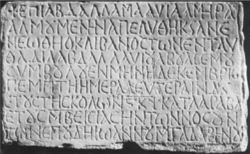
[[File:Greek Muawiya inscription of Hammat Gader, 663 AD.png|thumb|upright=1|A [[Greek language|Greek]] inscription crediting Mu'awiya for restoring [[Roman Empire|Roman]] bathhouses near [[Tiberias]] in 663, the only known epigraphic attestation to Mu'awiya's rule in Syria]] | [[File:Greek Muawiya inscription of Hammat Gader, 663 AD.png|thumb|upright=1|A [[Greek language|Greek]] inscription crediting Mu'awiya for restoring [[Roman Empire|Roman]] bathhouses at [[Hammat Gader]] near [[Tiberias]] in 663, the only known epigraphic attestation to Mu'awiya's rule in Syria]] | ||
The recognition of Mu'awiya in Kufa, referred to as the "year of unification of the community" in the Muslim traditional sources, is generally considered the start of his caliphate.{{sfn|Hinds|1993|p=265}} With his accession, the political capital and the caliphal treasury were transferred to [[Damascus]], the seat of Mu'awiya's power.{{sfn|Wellhausen|1927|pp=59–60}} Syria's emergence as the metropolis of the Umayyad Caliphate was the result of Mu'awiya's twenty-year entrenchment in the province, the geographic distribution of its relatively large Arab population throughout the province in contrast to their seclusion in garrison cities in other provinces, and the domination of a single tribal confederation, the | The recognition of Mu'awiya in Kufa, referred to as the "year of unification of the community" in the Muslim traditional sources, is generally considered the start of his caliphate.{{sfn|Hinds|1993|p=265}} With his accession, the political capital and the caliphal treasury were transferred to [[Damascus]], the seat of Mu'awiya's power.{{sfn|Wellhausen|1927|pp=59–60}} Syria's emergence as the metropolis of the Umayyad Caliphate was the result of Mu'awiya's twenty-year entrenchment in the province, the geographic distribution of its relatively large Arab population throughout the province in contrast to their seclusion in garrison cities in other provinces, and the domination of a single tribal confederation, the [[Quda'a]] who were led by the [[Banu Kalb]] with whom Mu'awiya had a marriage alliance, as opposed to the wide array of competing tribal groups in Iraq.{{sfn|Hawting|2000a|p=842}} The long-established, formerly Christian Arab tribes in Syria, having been integrated into the military of the Byzantine Empire and their [[Ghassanid]] client kings, were "more accustomed to order and obedience" than their Iraqi counterparts, according to historian [[Julius Wellhausen]].{{sfn|Wellhausen|1927|p=55}} Mu'awiya relied on the powerful Kalbite chief [[Ibn Bahdal]] and the [[Kinda (tribe)|Kindite]] nobleman [[Shurahbil ibn Simt]] alongside the Qurayshite commanders [[al-Dahhak ibn Qays al-Fihri]] and [[Abd al-Rahman ibn Khalid|Abd al-Rahman]], the son of the prominent general [[Khalid ibn al-Walid]], to guarantee the loyalty of the key military components of Syria.{{sfn|Kennedy|2004|pp=86–87}} Mu'awiya preoccupied his core Syrian troops in nearly annual or bi-annual land and sea raids against Byzantium, which provided them with battlefield experience and war spoils, but secured no permanent territorial gains.{{sfn|Kaegi|1992|p=247}} Toward the end of his reign the caliph entered a thirty-year truce with Byzantine emperor [[Constantine IV]] ({{reign|668|685}}),{{sfn|Kennedy|2004|pp=87–88}} obliging the Umayyads to pay the Empire an annual tribute of gold, horses and slaves.{{sfn|Lilie|1976|pp=81–82}} | ||
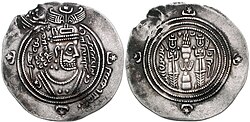
[[File:Umayyad Caliphate. temp. Mu'awiya I ibn Abi Sufyan. AH 41-60 AD 661-680.jpg|thumb|left|upright=1|[[ | [[File:Umayyad Caliphate. temp. Mu'awiya I ibn Abi Sufyan. AH 41-60 AD 661-680.jpg|thumb|left|upright=1|[[Arab–Sasanian coinage|Arab-Sasanian]]-style Umayyad coin minted under [[Mu'awiya I]] rule in [[Basra]] in 675/76 in the name of the Umayyad governor [[Ubayd Allah ibn Ziyad]]. The latter's governorship later spanned all of the eastern caliphate. His father [[Ziyad ibn Abihi]] was adopted as a half-brother by Mu'awiya I, who made him his practical viceroy over the eastern caliphate.]] | ||
Mu'awiya's main challenge was reestablishing the unity of the Muslim community and asserting his authority and that of the caliphate in the provinces amid the political and social disintegration of the First Fitna.{{sfn|Kennedy|2004|p=82}} There remained significant opposition to his assumption of the caliphate and to a strong central government.{{sfn|Kennedy|2004|pp=82–83}} The garrison towns of Kufa and Basra, populated by the Arab immigrants and troops who arrived during the [[Muslim conquest of Persia|conquest of Iraq in the 630s–640s]], resented the transition of power to Syria.{{sfn|Kennedy|2004|p=83}} They remained divided, nonetheless, as both cities competed for power and influence in Iraq and its eastern dependencies and remained divided between the Arab tribal nobility and the early Muslim converts, the latter of whom were divided between the pro-[[Alids]] (loyalists of Ali) and the Kharijites, who followed their own strict interpretation of Islam.{{sfn|Kennedy|2004|p=83}} The caliph applied a decentralized approach to governing Iraq by forging alliances with its tribal nobility, such as the Kufan leader [[al-Ash'ath ibn Qays]], and entrusting the administration of Kufa and Basra to highly experienced members of the [[Thaqif]] tribe, [[al-Mughira ibn Shu'ba]] and the latter's protege [[Ziyad ibn Abihi]] (whom Mu'awiya adopted as his half-brother), respectively.{{sfn|Kennedy|2004|pp=83–85}} In return for recognizing his suzerainty, maintaining order, and forwarding a token portion of the provincial tax revenues to Damascus, the caliph let his governors rule with practical independence.{{sfn|Kennedy|2004|p=83}} After al-Mughira's death in 670, Mu'awiya attached Kufa and its dependencies to the governorship of Basra, making Ziyad the practical viceroy over the eastern half of the caliphate.{{sfn|Kennedy|2004|p=85}} Afterward, Ziyad launched a concerted campaign to firmly establish Arab rule in the vast [[Greater Khorasan|Khurasan]] region east of Iran and restart the Muslim conquests in the surrounding areas.{{sfn|Kennedy|2004|p=86}} Not long after Ziyad's death, he was succeeded by his son [[Ubayd Allah ibn Ziyad]].{{sfn|Kennedy|2004|p=86}} Meanwhile, Amr ibn al-As ruled Egypt from the provincial capital of [[Fustat]] as a virtual partner of Mu'awiya until his death in 663, after which loyalist governors were appointed and the province became a practical appendage of Syria.{{sfn|Kennedy|2004|p=87}} Under Mu'awiya's direction, the Muslim conquest of [[Ifriqiya]] (central North Africa) was launched by the commander [[Uqba ibn Nafi]] in 670, which extended Umayyad control as far as [[Byzacena]] (modern southern Tunisia), where Uqba founded the permanent Arab garrison city of [[Kairouan]].{{sfn|Kennedy|2007|p=209}}{{sfn|Christides|2000|p=790}} | Mu'awiya's main challenge was reestablishing the unity of the Muslim community and asserting his authority and that of the caliphate in the provinces amid the political and social disintegration of the First Fitna.{{sfn|Kennedy|2004|p=82}} There remained significant opposition to his assumption of the caliphate and to a strong central government.{{sfn|Kennedy|2004|pp=82–83}} The garrison towns of Kufa and Basra, populated by the Arab immigrants and troops who arrived during the [[Muslim conquest of Persia|conquest of Iraq in the 630s–640s]], resented the transition of power to Syria.{{sfn|Kennedy|2004|p=83}} They remained divided, nonetheless, as both cities competed for power and influence in Iraq and its eastern dependencies and remained divided between the Arab tribal nobility and the early Muslim converts, the latter of whom were divided between the pro-[[Alids]] (loyalists of Ali) and the Kharijites, who followed their own strict interpretation of Islam.{{sfn|Kennedy|2004|p=83}} The caliph applied a decentralized approach to governing Iraq by forging alliances with its tribal nobility, such as the Kufan leader [[al-Ash'ath ibn Qays]], and entrusting the administration of Kufa and Basra to highly experienced members of the [[Thaqif]] tribe, [[al-Mughira ibn Shu'ba]] and the latter's protege [[Ziyad ibn Abihi]] (whom Mu'awiya adopted as his half-brother), respectively.{{sfn|Kennedy|2004|pp=83–85}} In return for recognizing his suzerainty, maintaining order, and forwarding a token portion of the provincial tax revenues to Damascus, the caliph let his governors rule with practical independence.{{sfn|Kennedy|2004|p=83}} After al-Mughira's death in 670, Mu'awiya attached Kufa and its dependencies to the governorship of Basra, making Ziyad the practical viceroy over the eastern half of the caliphate.{{sfn|Kennedy|2004|p=85}} Afterward, Ziyad launched a concerted campaign to firmly establish Arab rule in the vast [[Greater Khorasan|Khurasan]] region east of Iran and restart the Muslim conquests in the surrounding areas.{{sfn|Kennedy|2004|p=86}} Not long after Ziyad's death, he was succeeded by his son [[Ubayd Allah ibn Ziyad]].{{sfn|Kennedy|2004|p=86}} Meanwhile, Amr ibn al-As ruled Egypt from the provincial capital of [[Fustat]] as a virtual partner of Mu'awiya until his death in 663, after which loyalist governors were appointed and the province became a practical appendage of Syria.{{sfn|Kennedy|2004|p=87}} Under Mu'awiya's direction, the Muslim conquest of [[Ifriqiya]] (central North Africa) was launched by the commander [[Uqba ibn Nafi]] in 670, which extended Umayyad control as far as [[Byzacena]] (modern southern Tunisia), where Uqba founded the permanent Arab garrison city of [[Kairouan]].{{sfn|Kennedy|2007|p=209}}{{sfn|Christides|2000|p=790}} | ||
| Line 94: | Line 97: | ||
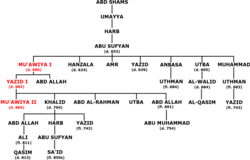
[[File:Sufyanid dynasty genealogy.png|thumb|upright=1.15|Genealogical tree of the Sufyanids. The names in red indicate caliphs.]] | [[File:Sufyanid dynasty genealogy.png|thumb|upright=1.15|Genealogical tree of the Sufyanids. The names in red indicate caliphs.]] | ||
In contrast to Uthman, Mu'awiya restricted the influence of his Umayyad kinsmen to the governorship of Medina, where the dispossessed Islamic elite, including the Umayyads, was suspicious or hostile toward his rule.{{sfn|Kennedy|2004|p=83}}{{sfn|Wellhausen|1927|p=135}} However, in an unprecedented move in Islamic politics, Mu'awiya nominated his own son, [[Yazid I]], as his successor in 676, introducing hereditary rule to caliphal succession and, in practice, turning the office of the caliph into a kingship.{{sfn|Duri|2011|pp=22–23}} The act was met with disapproval or opposition by the Iraqis and the Hejaz-based Quraysh, including the Umayyads, but most were bribed or coerced into acceptance.{{sfn|Kennedy|2004|p=88}} Yazid acceded after Mu'awiya's death in 680 and almost immediately faced a challenge to his rule by the Kufan partisans of Ali who had invited Ali's son and Muhammad's grandson [[Husayn ibn Ali|Husayn]] to stage a revolt against Umayyad rule from Iraq.{{sfn|Kennedy|2004|pp=88–89}} An army mobilized by Iraq's governor Ibn Ziyad intercepted and killed Husayn outside Kufa at the [[Battle of Karbala]]. Although it stymied active opposition to | In contrast to Uthman, Mu'awiya restricted the influence of his Umayyad kinsmen to the governorship of Medina, where the dispossessed Islamic elite, including the Umayyads, was suspicious or hostile toward his rule.{{sfn|Kennedy|2004|p=83}}{{sfn|Wellhausen|1927|p=135}} However, in an unprecedented move in Islamic politics, Mu'awiya nominated his own son, [[Yazid I]], as his successor in 676, introducing hereditary rule to caliphal succession and, in practice, turning the office of the caliph into a kingship.{{sfn|Duri|2011|pp=22–23}} The act was met with disapproval or opposition by the Iraqis and the Hejaz-based Quraysh, including the Umayyads, but most were bribed or coerced into acceptance.{{sfn|Kennedy|2004|p=88}} Yazid acceded after Mu'awiya's death in 680 and almost immediately faced a challenge to his rule by the Kufan partisans of Ali who had invited Ali's son and Muhammad's grandson [[Husayn ibn Ali|Husayn]] to stage a revolt against Umayyad rule from Iraq.{{sfn|Kennedy|2004|pp=88–89}} An army mobilized by Iraq's governor Ibn Ziyad intercepted and killed Husayn outside Kufa at the [[Battle of Karbala]]. Although it stymied active opposition to Umayyad authority in Iraq for the time being, the killing of Muhammad's grandson left many Muslims outraged and significantly increased Kufan hostility toward the Umayyads and sympathy for the family of Ali.{{sfn|Kennedy|2004|p=89}} | ||
The next major challenge to Yazid's rule emanated from the Hejaz where [[Abd Allah ibn al-Zubayr]], the son of al-Zubayr ibn al-Awwam and grandson of Abu Bakr, advocated for a ''shura'' among the Quraysh to elect the caliph and rallied opposition to the Umayyads from his headquarters in Islam's holiest sanctuary, the [[Ka'aba]] in Mecca.{{sfn|Kennedy|2004|p=89}} The Ansar and Quraysh of Medina also took up the anti-Umayyad cause and in 683 expelled the Umayyads from the city.{{sfn|Kennedy|2004|pp=89–90}} Yazid's Syrian troops routed the Medinans at the [[Battle of al-Harra]] and subsequently plundered Medina before [[Siege of Mecca (683)|besieging Ibn al-Zubayr in Mecca]].{{sfn|Kennedy|2004|p=90}} The Syrians withdrew upon news of Yazid's death in 683, after which Ibn al-Zubayr declared himself caliph and soon after gained recognition in most provinces of the caliphate, including Iraq and Egypt.{{sfn|Gibb|1960a|p=55}} In Syria Ibn Bahdal secured the succession of Yazid's son and appointed successor [[Mu'awiya II]], whose authority was likely restricted to Damascus and Syria's southern districts.{{sfn|Kennedy|2004|p=90}}{{sfn|Bosworth|1993|p=268}} Mu'awiya II had been ill from the beginning of his accession, with al-Dahhak assuming the practical duties of his office, and he died in early 684 without naming a successor.{{sfn|Duri|2011|pp=23–24}} His death marked the end of the Umayyads' Sufyanid ruling house, called after Mu'awiya I's father Abu Sufyan.{{sfn|Levi Della Vida|Bosworth|2000|pp=838–839}}{{efn|The eldest surviving Sufyanid, [[al-Walid ibn Utba]], the son of Mu'awiya I's full brother, died shortly after Mu'awiya II's death, while another paternal uncle of the deceased caliph, [[Uthman ibn Anbasa ibn Abi Sufyan]], who had support from the Kalb of the Jordan district, recognized the caliphate of his maternal uncle Ibn al-Zubayr.{{sfn|Bosworth|1993|p=268}} Ibn Bahdal favored Mu'awiya II's brothers, [[Khalid ibn Yazid|Khalid]] and [[Abd Allah ibn Yazid|Abd Allah]], for the succession, but they were viewed as too young and inexperienced by most of the pro-Umayyad tribal nobility in Syria.{{sfn|Kennedy|2004|p=91}}{{sfn|Duri|2011|pp=24–25}}}} | The next major challenge to Yazid's rule emanated from the Hejaz where [[Abd Allah ibn al-Zubayr]], the son of al-Zubayr ibn al-Awwam and grandson of Abu Bakr, advocated for a ''shura'' among the Quraysh to elect the caliph and rallied opposition to the Umayyads from his headquarters in Islam's holiest sanctuary, the [[Ka'aba]] in Mecca.{{sfn|Kennedy|2004|p=89}} The Ansar and Quraysh of Medina also took up the anti-Umayyad cause and in 683 expelled the Umayyads from the city.{{sfn|Kennedy|2004|pp=89–90}} Yazid's Syrian troops routed the Medinans at the [[Battle of al-Harra]] and subsequently plundered Medina before [[Siege of Mecca (683)|besieging Ibn al-Zubayr in Mecca]].{{sfn|Kennedy|2004|p=90}} The Syrians withdrew upon news of Yazid's death in 683, after which Ibn al-Zubayr declared himself caliph and soon after gained recognition in most provinces of the caliphate, including Iraq and Egypt.{{sfn|Gibb|1960a|p=55}} In Syria Ibn Bahdal secured the succession of Yazid's son and appointed successor [[Mu'awiya II]], whose authority was likely restricted to Damascus and Syria's southern districts.{{sfn|Kennedy|2004|p=90}}{{sfn|Bosworth|1993|p=268}} Mu'awiya II had been ill from the beginning of his accession, with al-Dahhak assuming the practical duties of his office, and he died in early 684 without naming a successor.{{sfn|Duri|2011|pp=23–24}} His death marked the end of the Umayyads' Sufyanid ruling house, called after Mu'awiya I's father Abu Sufyan.{{sfn|Levi Della Vida|Bosworth|2000|pp=838–839}}{{efn|The eldest surviving Sufyanid, [[al-Walid ibn Utba]], the son of Mu'awiya I's full brother, died shortly after Mu'awiya II's death, while another paternal uncle of the deceased caliph, [[Uthman ibn Anbasa ibn Abi Sufyan]], who had support from the Kalb of the Jordan district, recognized the caliphate of his maternal uncle Ibn al-Zubayr.{{sfn|Bosworth|1993|p=268}} Ibn Bahdal favored Mu'awiya II's brothers, [[Khalid ibn Yazid|Khalid]] and [[Abd Allah ibn Yazid|Abd Allah]], for the succession, but they were viewed as too young and inexperienced by most of the pro-Umayyad tribal nobility in Syria.{{sfn|Kennedy|2004|p=91}}{{sfn|Duri|2011|pp=24–25}}}} | ||
| Line 111: | Line 114: | ||
Iraq remained politically unstable and the garrisons of Kufa and Basra had become exhausted by warfare with Kharijite rebels.{{sfn|Gibb|1960b|p=76}}{{sfn|Kennedy|2001|p=33}} In 694 Abd al-Malik combined both cities as a single province under the governorship of al-Hajjaj, who oversaw the suppression of the Kharijite revolts in Iraq and Iran by 698 and was subsequently given authority over the rest of the eastern caliphate.{{sfn|Kennedy|2016|p=87}}{{sfn|Wellhausen|1927|p=231}} Resentment among the Iraqi troops towards al-Hajjaj's methods of governance, particularly his death threats to force participation in the war efforts and his reductions to their stipends, culminated with a mass Iraqi rebellion against the Umayyads in {{circa|700}}. The leader of the rebels was the Kufan nobleman [[Ibn al-Ash'ath]], grandson of al-Ash'ath ibn Qays.{{sfn|Kennedy|2016|pp=87–88}} Al-Hajjaj defeated Ibn al-Ash'ath's rebels at the [[Battle of Dayr al-Jamajim]] in April.{{sfn|Kennedy|2016|p=88}}{{sfn|Kennedy|2001|p=34}} The suppression of the revolt marked the end of the Iraqi ''muqātila'' as a military force and the beginning of Syrian military domination of Iraq.{{sfn|Gibb|1960b|p=77}}{{sfn|Kennedy|2001|p=34}} Iraqi internal divisions, and the utilization of more disciplined Syrian forces by Abd al-Malik and al-Hajjaj, voided the Iraqis' attempt to reassert power in the province.{{sfn|Kennedy|2016|p=88}} | Iraq remained politically unstable and the garrisons of Kufa and Basra had become exhausted by warfare with Kharijite rebels.{{sfn|Gibb|1960b|p=76}}{{sfn|Kennedy|2001|p=33}} In 694 Abd al-Malik combined both cities as a single province under the governorship of al-Hajjaj, who oversaw the suppression of the Kharijite revolts in Iraq and Iran by 698 and was subsequently given authority over the rest of the eastern caliphate.{{sfn|Kennedy|2016|p=87}}{{sfn|Wellhausen|1927|p=231}} Resentment among the Iraqi troops towards al-Hajjaj's methods of governance, particularly his death threats to force participation in the war efforts and his reductions to their stipends, culminated with a mass Iraqi rebellion against the Umayyads in {{circa|700}}. The leader of the rebels was the Kufan nobleman [[Ibn al-Ash'ath]], grandson of al-Ash'ath ibn Qays.{{sfn|Kennedy|2016|pp=87–88}} Al-Hajjaj defeated Ibn al-Ash'ath's rebels at the [[Battle of Dayr al-Jamajim]] in April.{{sfn|Kennedy|2016|p=88}}{{sfn|Kennedy|2001|p=34}} The suppression of the revolt marked the end of the Iraqi ''muqātila'' as a military force and the beginning of Syrian military domination of Iraq.{{sfn|Gibb|1960b|p=77}}{{sfn|Kennedy|2001|p=34}} Iraqi internal divisions, and the utilization of more disciplined Syrian forces by Abd al-Malik and al-Hajjaj, voided the Iraqis' attempt to reassert power in the province.{{sfn|Kennedy|2016|p=88}} | ||
To consolidate Umayyad rule after the Second Fitna, the Marwanids launched a series of centralization, [[Islamization]] and [[Arabization]] measures.{{sfn|Kennedy|2016|p=85}}{{sfn|Hawting|2000|p=62}} To prevent further rebellions in Iraq, al-Hajjaj founded a permanent Syrian garrison in [[Wasit]], situated between Kufa and Basra, and instituted a more rigorous administration in the province.{{sfn|Kennedy|2016|p=88}}{{sfn|Kennedy|2001|p=34}} Power thereafter derived from the Syrian troops, who became Iraq's ruling class, while Iraq's Arab nobility, religious scholars and ''mawālī'' became their virtual subjects.{{sfn|Kennedy|2016|p=88}} The surplus from the agriculturally rich [[Sawad]] lands was redirected from the ''muqātila'' to the caliphal treasury in Damascus to pay the Syrian troops in Iraq.{{sfn|Kennedy|2001|p=34}}{{sfn|Kennedy|2016|p=85}} The system of military pay established by Umar, which paid stipends to veterans of the earlier Muslim conquests and their descendants, was ended, salaries being restricted to those in active service.{{sfn|Kennedy|2016|p=89}} The old system was considered a handicap on Abd al-Malik's executive authority and financial ability to reward loyalists in the army.{{sfn|Kennedy|2016|p=89}} Thus, a professional army was established during Abd al-Malik's reign whose salaries derived from tax proceeds.{{sfn|Kennedy|2016|p=89}} | To consolidate Umayyad rule after the Second Fitna, the Marwanids launched a series of centralization, [[Islamization]] and [[Arabization]] measures.{{sfn|Kennedy|2016|p=85}}{{sfn|Hawting|2000|p=62}} These measures included the creation of multiple classes of Arabic-inscribed administrative media as a way to proliferate their particular political, cultural, and religious disposition to both Arab and non-Arab audiences.<ref>{{Cite journal |last=Ramadan |first=Tareq A. |date=2017 |title=Inscribed Administrative Material Culture And The Development Of The Umayyad State In Syria-Palestine 661-750 CE (Dissertation) |journal=Wayne State University Dissertations |url=https://digitalcommons.wayne.edu/oa_dissertations/1860/}}</ref> To prevent further rebellions in Iraq, al-Hajjaj founded a permanent Syrian garrison in [[Wasit]], situated between Kufa and Basra, and instituted a more rigorous administration in the province.{{sfn|Kennedy|2016|p=88}}{{sfn|Kennedy|2001|p=34}} Power thereafter derived from the Syrian troops, who became Iraq's ruling class, while Iraq's Arab nobility, religious scholars and ''mawālī'' became their virtual subjects.{{sfn|Kennedy|2016|p=88}} The surplus from the agriculturally rich [[Sawad]] lands was redirected from the ''muqātila'' to the caliphal treasury in Damascus to pay the Syrian troops in Iraq.{{sfn|Kennedy|2001|p=34}}{{sfn|Kennedy|2016|p=85}} The system of military pay established by Umar, which paid stipends to veterans of the earlier Muslim conquests and their descendants, was ended, salaries being restricted to those in active service.{{sfn|Kennedy|2016|p=89}} The old system was considered a handicap on Abd al-Malik's executive authority and financial ability to reward loyalists in the army.{{sfn|Kennedy|2016|p=89}} Thus, a professional army was established during Abd al-Malik's reign whose salaries derived from tax proceeds.{{sfn|Kennedy|2016|p=89}} | ||
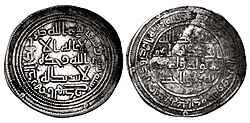
In 693, the Byzantine gold ''[[solidus (coin)|solidus]]'' was replaced in Syria and Egypt with the [[gold dinar|dinar]].{{sfn|Gibb|1960b|p=77}}{{sfn|Blankinship|1994|pp=28, 94}} Initially, the new coinage contained depictions of the caliph as the spiritual leader of the Muslim community and its supreme military commander.{{sfn|Blankinship|1994|p=28}} This image proved no less acceptable to Muslim officialdom and was replaced in 696 or 697 with image-less coinage inscribed with Qur'anic quotes and other Muslim religious formulas.{{sfn|Blankinship|1994|pp=28, 94}} In 698/ | In 693, the Byzantine gold ''[[solidus (coin)|solidus]]'' was replaced in Syria and Egypt with the [[gold dinar|dinar]].{{sfn|Gibb|1960b|p=77}}{{sfn|Blankinship|1994|pp=28, 94}} Initially, the new coinage contained depictions of the caliph as the spiritual leader of the Muslim community and its supreme military commander.{{sfn|Blankinship|1994|p=28}} This image proved no less acceptable to Muslim officialdom and was replaced in 696 or 697 with image-less coinage inscribed with Qur'anic quotes and other Muslim religious formulas.{{sfn|Blankinship|1994|pp=28, 94}} In 698/699, similar changes were made to the silver [[dirham]]s issued by the Muslims in the former Sasanian Persian lands of the eastern caliphate.{{sfn|Blankinship|1994|p=94}} Arabic replaced [[Middle Persian|Persian]] as the language of the ''dīwān'' in Iraq in 697, [[Greek language|Greek]] in the Syrian ''dīwān'' in 700, and Greek and [[Coptic language|Coptic]] in the Egyptian ''dīwān'' in 705/706.{{sfn|Blankinship|1994|pp=28, 94}}{{sfn|Hawting|2000|p=63}}{{sfn|Duri|1965|p=324}} Arabic ultimately became the sole official language of the Umayyad state,{{sfn|Blankinship|1994|p=94}} but the transition in faraway provinces, such as Khurasan, did not occur until the 740s.{{sfn|Hawting|2000|pp=63–64}} Although the official language was changed, Greek and Persian-speaking bureaucrats who were versed in Arabic kept their posts.{{sfn|Wellhausen|1927|pp=219–220}} According to Gibb, the decrees were the "first step towards the reorganization and unification of the diverse tax-systems in the provinces, and also a step towards a more definitely Muslim administration".{{sfn|Gibb|1960b|p=77}} Indeed, it formed an important part of the Islamization measures that lent the Umayyad Caliphate "a more ideological and programmatic coloring it had previously lacked", according to Blankinship.{{sfn|Blankinship|1994|p=95}} | ||
In 691/ | In 691/692, Abd al-Malik completed the [[Dome of the Rock]] in Jerusalem.{{sfn|Johns|2003|pp=424–426}}{{sfn|Elad|1999|p=45}} It was possibly intended as a monument of victory over the Christians that would distinguish Islam's uniqueness within the common [[Abrahamic]] setting of Jerusalem, home of the two older Abrahamic faiths, Judaism and Christianity.{{sfn|Grabar|1986|p=299}}{{sfn|Hawting|2000|p=60}} An alternative motive may have been to divert the religious focus of Muslims in the Umayyad realm from the Ka'aba in Zubayrid Mecca (683–692), where the Umayyads were routinely condemned during the Hajj.{{sfn|Grabar|1986|p=299}}{{sfn|Johns|2003|pp=425–426}}{{sfn|Hawting|2000|p=60}} In Damascus, Abd al-Malik's son and successor [[al-Walid I]] ({{reign|705|715}}) confiscated the cathedral of [[John the Baptist|St. John the Baptist]] and founded the [[Umayyad Mosque|Great Mosque]] in its place as a "symbol of the political supremacy and moral prestige of Islam", according to historian Nikita Elisséeff.{{sfn|Elisséeff|1965|p=801}} Noting al-Walid's awareness of architecture's propaganda value, historian Robert Hillenbrand calls the Damascus mosque a "victory monument" intended as a "visible statement of Muslim supremacy and permanence".{{sfn|Hillenbrand|1994|pp=71–72}} | ||
====Renewal of conquests==== | ====Renewal of conquests==== | ||
{{See also| Muslim conquest of Armenia|Muslim conquest of the Maghreb|Muslim conquest of Hispania|Muslim conquest of Transoxiana|Umayyad campaigns in India}} | {{See also|Muslim conquest of Armenia|Muslim conquest of the Maghreb|Muslim conquest of Hispania|Muslim conquest of Transoxiana|Umayyad campaigns in India}} | ||
[[File:Caliphate 750.jpg|thumb|upright=1.35|alt=Old map of western Eurasia and northern Africa showing the expansion of the Caliphate from Arabia to cover most of the Middle East, with the Byzantine Empire outlined in green|The expansion of the Muslim Caliphate until 750, from [[William R. Shepherd]]'s ''Historical Atlas''.<br>{{legend2|#df9860|Muslim state at the death of [[Muhammad]]}} {{legend2|#c29d44|Expansion under the [[Rashidun Caliphate]]}} {{legend2|#e4af90|Expansion under the Umayyad Caliphate}} {{legend-line|#99a53a solid 5px|[[Byzantine Empire]]}}]] | [[File:Caliphate 750.jpg|thumb|upright=1.35|alt=Old map of western Eurasia and northern Africa showing the expansion of the Caliphate from Arabia to cover most of the Middle East, with the Byzantine Empire outlined in green|The expansion of the Muslim Caliphate until 750, from [[William R. Shepherd]]'s ''Historical Atlas''.<br>{{legend2|#df9860|Muslim state at the death of [[Muhammad]]}} {{legend2|#c29d44|Expansion under the [[Rashidun Caliphate]]}} {{legend2|#e4af90|Expansion under the Umayyad Caliphate}} {{legend-line|#99a53a solid 5px|[[Byzantine Empire]]}}]] | ||
Under al-Walid I the Umayyad Caliphate reached its greatest territorial extent.{{sfn|Kennedy|2016|p=90}} The war with the Byzantines had resumed under his father after the civil war,{{sfn|Gibb|1960b|p=77}} with the Umayyads defeating the Byzantines at the [[Battle of Sebastopolis]] in 692.{{sfn|Gibb|1960b|p=77}}{{sfn|Lilie|1976|pp=110–112}} The Umayyads frequently raided Byzantine Anatolia and Armenia in the following years.{{sfn|Gibb|1960b|p=77}}{{sfn|Lilie|1976|pp=112–116}} By 705, Armenia was annexed by the caliphate along with the principalities of [[Caucasian Albania]] and [[Principality of Iberia|Iberia]], which collectively became the province of [[Arminiya]].{{sfn|Blankinship|1994|p=107}}{{sfn|Ter-Ghewondyan|1976|pp=20–21}}{{sfn|Lilie|1976|pp=113–115}} In 695–698 the commander [[Hassan ibn al-Nu'man al-Ghassani]] restored Umayyad control over Ifriqiya after defeating the Byzantines and Berbers there.{{sfn|Kaegi|2010|p=14}}{{sfn|Talbi|1971|p=271}} [[Battle of Carthage (698)|Carthage was captured]] and destroyed in 698,{{sfn|Gibb|1960b|p=77}}{{sfn|Talbi|1971|p=271}} signaling "the final, irretrievable end of [[Exarchate of Africa|Roman power in Africa]]", according to Kennedy.{{sfn|Kennedy|2007|p=217}} Kairouan was firmly secured as a launchpad for later conquests, while the port town of [[medina of Tunis|Tunis]] was founded and equipped with an arsenal on Abd al-Malik's orders to establish a strong Arab fleet.{{sfn|Gibb|1960b|p=77}}{{sfn|Talbi|1971|p=271}} Hassan ibn al-Nu'man continued the campaign against the Berbers, defeating them and killing their leader, the warrior queen [[al-Kahina]], between 698 and 703.{{sfn|Kaegi|2010|p=14}} His successor in Ifriqiya, [[Musa ibn Nusayr]], subjugated the Berbers of the [[Hawwara]], [[Zenata]] and [[Kutama]] confederations and advanced into the [[Maghreb]] (western North Africa), conquering [[Tangier]] and [[Sous|Sus]] in 708/ | Under al-Walid I the Umayyad Caliphate reached its greatest territorial extent.{{sfn|Kennedy|2016|p=90}} The war with the Byzantines had resumed under his father after the civil war,{{sfn|Gibb|1960b|p=77}} with the Umayyads defeating the Byzantines at the [[Battle of Sebastopolis]] in 692.{{sfn|Gibb|1960b|p=77}}{{sfn|Lilie|1976|pp=110–112}} The Umayyads frequently raided Byzantine Anatolia and Armenia in the following years.{{sfn|Gibb|1960b|p=77}}{{sfn|Lilie|1976|pp=112–116}} By 705, Armenia was annexed by the caliphate along with the principalities of [[Caucasian Albania]] and [[Principality of Iberia|Iberia]], which collectively became the province of [[Arminiya]].{{sfn|Blankinship|1994|p=107}}{{sfn|Ter-Ghewondyan|1976|pp=20–21}}{{sfn|Lilie|1976|pp=113–115}} In 695–698 the commander [[Hassan ibn al-Nu'man al-Ghassani]] restored Umayyad control over Ifriqiya after defeating the Byzantines and Berbers there.{{sfn|Kaegi|2010|p=14}}{{sfn|Talbi|1971|p=271}} [[Battle of Carthage (698)|Carthage was captured]] and destroyed in 698,{{sfn|Gibb|1960b|p=77}}{{sfn|Talbi|1971|p=271}} signaling "the final, irretrievable end of [[Exarchate of Africa|Roman power in Africa]]", according to Kennedy.{{sfn|Kennedy|2007|p=217}} Kairouan was firmly secured as a launchpad for later conquests, while the port town of [[medina of Tunis|Tunis]] was founded and equipped with an arsenal on Abd al-Malik's orders to establish a strong Arab fleet.{{sfn|Gibb|1960b|p=77}}{{sfn|Talbi|1971|p=271}} Hassan ibn al-Nu'man continued the campaign against the Berbers, defeating them and killing their leader, the warrior queen [[al-Kahina]], between 698 and 703.{{sfn|Kaegi|2010|p=14}} His successor in Ifriqiya, [[Musa ibn Nusayr]], subjugated the Berbers of the [[Hawwara]], [[Zenata]] and [[Kutama]] confederations and advanced into the [[Maghreb]] (western North Africa), conquering [[Tangier]] and [[Sous|Sus]] in 708/709. Musa's Berber ''[[mawla]]'', [[Tariq ibn Ziyad]], invaded the [[Visigothic Kingdom]] of [[Al-Andalus|Hispania]] (the Iberian Peninsula) in 711 and within five years most of [[Umayyad conquest of Hispania|Hispania was conquered]].{{sfn|Kennedy|2016|p=90}}{{sfn|Lévi-Provençal|1993|p=643}}{{sfn|Kaegi|2010|p=15}} | ||
[[File:Umayyad Caliphate coinage temp Suleiman ibn Abd al-Malik al-Hind (possibly Multan) mint. Dated AH 97 (AD 715-6).jpg|thumb|300px|Umayyad coinage in India, from the time of the first [[Caliphal province of Sind|Governor of Sind]] [[Muhammad ibn Qasim]]. Minted in | [[File:Umayyad Caliphate coinage temp Suleiman ibn Abd al-Malik al-Hind (possibly Multan) mint. Dated AH 97 (AD 715-6).jpg|thumb|300px|Umayyad coinage in India, from the time of the first [[Caliphal province of Sind|Governor of Sind]] [[Muhammad ibn Qasim]]. Minted in India "[[al-Hind]]" (possibly in the city of [[Multan]]), dated AH 97 (715–716 CE): obverse circular legend ''"in the name of Allah, struck this dirham in [[al-Hind]] ([[File:India in Abd al-Malik al-Hind coin 715 CE (detail).jpg|20px]] ''{{lang|ar|[[:ary:لهند|لهند]]}}'' l'Hind) in the year seven and ninety"''.]] | ||
Al-Hajjaj managed the eastern expansion from Iraq.{{sfn|Kennedy|2002|p=127}} His lieutenant governor of [[Greater Khorasan|Khurasan]], [[Qutayba ibn Muslim]], launched numerous campaigns against [[Transoxiana]] (Central Asia), which had been a largely impenetrable region for earlier Muslim armies, between 705 and 715.{{sfn|Kennedy|2002|p=127}} Despite the distance from the Arab garrison towns of Khurasan, the unfavorable terrain and climate and his enemies' numerical superiority,{{sfn|Wellhausen|1927|p=438}} Qutayba, through his persistent raids, gained the surrender of [[Bukhara]] in 706–709, [[Khwarazm]] and [[Samarkand]] in 711–712 and [[Farghana]] in 713.{{sfn|Kennedy|2002|p=127}} He established Arab garrisons and tax administrations in Samarkand and | Al-Hajjaj managed the eastern expansion from Iraq.{{sfn|Kennedy|2002|p=127}} His lieutenant governor of [[Greater Khorasan|Khurasan]], [[Qutayba ibn Muslim]], launched numerous campaigns against [[Transoxiana]] (Central Asia), which had been a largely impenetrable region for earlier Muslim armies, between 705 and 715.{{sfn|Kennedy|2002|p=127}} Despite the distance from the Arab garrison towns of Khurasan, the unfavorable terrain and climate and his enemies' numerical superiority,{{sfn|Wellhausen|1927|p=438}} Qutayba, through his persistent raids, gained the surrender of [[Bukhara]] in 706–709, [[Khwarazm]] and [[Samarkand]] in 711–712 and [[Farghana]] in 713.{{sfn|Kennedy|2002|p=127}} During Qutayba's campaigns in conquering the Bukharan territories of Numushkat and Ramithna in 707 CE (88 AH), he faced a coalition force of Turks and the [[Tang dynasty|Tang Empire]]. their army roughly numbered 200,000 soldiers of Ferghana and Sogdiana, led by [[Kur Maghayun]], who the sources identify as the Chinese emperor's nephew. a heavy battle occurred. Qutayba managed to defeat the coalition army in combat, driving its commander to retreat, and then led his army back to his base at Merv.{{sfn|al-Sallabi|2008|p=[https://archive.org/details/2_20190819_20190819/page/42/mode/1up 42]}}{{sfn|Muir|1891|p=[https://archive.org/details/in.ernet.dli.2015.276998/page/n374/mode/1up 359]}} He established Arab garrisons and tax administrations in Samarkand and Bukhara and demolished their [[Zoroastrian]] [[fire temple]]s.{{sfn|Wellhausen|1927|pp=437–438}} Both cities developed as future centres of Islamic and Arabic learning.{{sfn|Wellhausen|1927|p=438}} Umayyad suzerainty was secured over the rest of conquered Transoxiana through tributary alliances with local rulers, whose power remained intact.{{sfn|Kennedy|2016|pp=90–91}} From 708/709, al-Hajjaj's kinsman [[Muhammad ibn al-Qasim al-Thaqafi|Muhammad ibn al-Qasim]] conquered northwestern South Asia and established out of this new territory the [[Sind (caliphal province)|province of Sind]].{{sfn|Dietrich|1971|p=41}}{{sfn|Kennedy|2016|p=91}} The massive war spoils netted by the conquests of Transoxiana, Sind and Hispania were comparable to the amounts accrued in the [[early Muslim conquests]] during the reign of Caliph Umar.{{sfn|Blankinship|1994|p=82}} | ||
From 708/ | |||
Al-Walid I's successor, his brother [[Sulayman ibn Abd al-Malik|Sulayman]] ({{reign|715|717}}), continued his predecessors' [[militarism|militarist]] policies, but expansion mostly ground to a halt during his reign.{{sfn|Eisener|1997|p=821}} The deaths of al-Hajjaj in 714 and Qutayba in 715 left the Arab armies in Transoxiana in disarray. For the next | Al-Walid I's successor, his brother [[Sulayman ibn Abd al-Malik|Sulayman]] ({{reign|715|717}}), continued his predecessors' [[militarism|militarist]] policies, but expansion mostly ground to a halt during his reign.{{sfn|Eisener|1997|p=821}} The deaths of al-Hajjaj in 714 and Qutayba in 715 left the Arab armies in Transoxiana in disarray. For the next 25 years, no further eastward conquests were undertaken and the Arabs lost territory.{{sfn|Gibb|1923|p=54}} The Tang Chinese defeated the Arabs at the [[Battle of Aksu (717)|Battle of Aksu]] in 717, forcing their withdrawal to [[Tashkent]].{{sfn|Beckwith|1993|pp=88–89}} Meanwhile, in 716, the governor of Khurasan, [[Yazid ibn al-Muhallab]], attempted to conquer the principalities of [[Jurjan]] and [[Tabaristan]] along the southern [[Caspian Sea|Caspian]] coast.{{sfn|Madelung|1975|pp=198–199}} His Khurasani and Iraqi troops were reinforced by Syrians, marking their first deployment to Khurasan, but the Arabs' initial successes were reversed by the local Iranian coalition of [[Farrukhan the Great]]. Afterward, the Arabs withdrew in return for a tributary agreement.{{Sfn|Madelung|1993}} | ||
[[File:47-cropped-manasses-chronicle.jpg|thumb|upright=1|left|alt=Medieval illustration showing cavalry sallying from a city and routing an enemy army|A 14th-century illustration of the [[Siege of Constantinople (717–718)|siege of Constantinople]]]] | [[File:47-cropped-manasses-chronicle.jpg|thumb|upright=1|left|alt=Medieval illustration showing cavalry sallying from a city and routing an enemy army|A 14th-century illustration of the [[Siege of Constantinople (717–718)|siege of Constantinople]]]] | ||
| Line 134: | Line 136: | ||
On the Byzantine front, Sulayman took up his predecessor's project to capture Constantinople with increased vigor.{{sfn|Treadgold|1997|p=344}} His brother [[Maslama ibn Abd al-Malik|Maslama]] [[Siege of Constantinople (717–718)|besieged the Byzantine capital]] from the land,{{sfn|Powers|1989|pp=39–40}} while [[Umar ibn Hubayra al-Fazari]] launched a naval campaign against the city.{{sfn|Eisener|1997|p=821}} The Byzantines destroyed the Umayyad fleets and defeated Maslama's army, prompting his withdrawal to Syria in 718.{{sfn|Treadgold|1997|pp=347–348}} The massive losses incurred during the campaign led to a partial retrenchment of Umayyad forces from the captured Byzantine frontier districts,{{sfn|Blankinship|1994|pp=33–34}}{{sfn|Lilie|1976|pp=132–133}} but already in 720, Umayyad raids against Byzantium recommenced. Nevertheless, the goal of conquering Constantinople was effectively abandoned, and the frontier between the two empires stabilized along the line of the [[Taurus Mountains|Taurus]] and [[Anti-Taurus Mountains]], over which both sides continued to launch regular raids and counter-raids during the next centuries.{{sfn|Blankinship|1994|pp=117–121}}{{sfn|Lilie|1976|pp=143–144, 158–162}} | On the Byzantine front, Sulayman took up his predecessor's project to capture Constantinople with increased vigor.{{sfn|Treadgold|1997|p=344}} His brother [[Maslama ibn Abd al-Malik|Maslama]] [[Siege of Constantinople (717–718)|besieged the Byzantine capital]] from the land,{{sfn|Powers|1989|pp=39–40}} while [[Umar ibn Hubayra al-Fazari]] launched a naval campaign against the city.{{sfn|Eisener|1997|p=821}} The Byzantines destroyed the Umayyad fleets and defeated Maslama's army, prompting his withdrawal to Syria in 718.{{sfn|Treadgold|1997|pp=347–348}} The massive losses incurred during the campaign led to a partial retrenchment of Umayyad forces from the captured Byzantine frontier districts,{{sfn|Blankinship|1994|pp=33–34}}{{sfn|Lilie|1976|pp=132–133}} but already in 720, Umayyad raids against Byzantium recommenced. Nevertheless, the goal of conquering Constantinople was effectively abandoned, and the frontier between the two empires stabilized along the line of the [[Taurus Mountains|Taurus]] and [[Anti-Taurus Mountains]], over which both sides continued to launch regular raids and counter-raids during the next centuries.{{sfn|Blankinship|1994|pp=117–121}}{{sfn|Lilie|1976|pp=143–144, 158–162}} | ||
====Caliphate of Umar | ====Caliphate of Umar ibn Abd al-Aziz==== | ||
Contrary to expectations of a son or brother succeeding him, Sulayman had nominated his cousin, [[Umar ibn Abd al-Aziz]] | Contrary to expectations of a son or brother succeeding him, Sulayman had nominated his cousin, [[Umar ibn Abd al-Aziz]], as his successor and he took office in 717. After the Arabs' severe losses in the offensive against Constantinople, Umar drew down Arab forces on the caliphate's war fronts, though [[Narbonne]] in modern France was conquered during his reign.{{sfn|Cobb|2000|p=821}}{{sfn|Blankinship|1994|pp=33–34}}{{sfn|Wellhausen|1927|p=268–269}} To maintain stronger oversight in the provinces, Umar dismissed all his predecessors' governors, his new appointees being generally competent men he could control. To that end, the massive viceroyalty of Iraq and the east was broken up.{{sfn|Cobb|2000|p=821}}{{sfn|Kennedy|2004|p=106}} | ||
Umar's most significant policy entailed fiscal reforms to equalize the status of the Arabs and ''mawali'',{{sfn|Blankinship|1994|p=31}} thus remedying a long-standing issue which threatened the Muslim community.{{sfn|Kennedy|2004|p=107}} The [[jizya]] (poll tax) on the ''mawali'' was eliminated.{{sfn|Hawting|2000|p=77}} Hitherto, the jizya, which was traditionally reserved for the non-Muslim majorities of the caliphate, continued to be imposed on non-Arab converts to Islam, while all Muslims who cultivated conquered lands were liable to pay the {{ | Umar's most significant policy entailed fiscal reforms to equalize the status of the Arabs and ''mawali'',{{sfn|Blankinship|1994|p=31}} thus remedying a long-standing issue which threatened the Muslim community.{{sfn|Kennedy|2004|p=107}} The [[jizya]] (poll tax) on the ''mawali'' was eliminated.{{sfn|Hawting|2000|p=77}} Hitherto, the jizya, which was traditionally reserved for the non-Muslim majorities of the caliphate, continued to be imposed on non-Arab converts to Islam, while all Muslims who cultivated conquered lands were liable to pay the {{Transliteration|ar|kharaj}} (land tax). Since avoidance of taxation incentivized both mass conversions to Islam and abandonment of land for migration to the garrison cities, it put a strain on tax revenues, especially in Egypt, Iraq and Khurasan.{{sfn|Hawting|2000|pp=77–79}} Thus, "the Umayyad rulers had a vested interest in preventing the conquered peoples from accepting Islam or forcing them to continue paying those taxes from which they claimed exemption as Muslims", according to Hawting.{{sfn|Hawting|2000|p=78}} To prevent a collapse in revenue, the converts' lands would become the property of their villages and remain liable for the full rate of the {{Transliteration|ar|kharaj}}.{{sfn|Kennedy|2004|p=107}} | ||
In tandem, Umar intensified the Islamization drive of his Marwanid predecessors, enacting measures to distinguish Muslims from non-Muslims and inaugurating Islamic [[iconoclasm]].{{sfn|Blankinship|1994|p=32}} His position among the Umayyad caliphs is unusual, in that he became the only one to have been recognized in subsequent Islamic tradition as a | In tandem, Umar intensified the Islamization drive of his Marwanid predecessors, enacting measures to distinguish Muslims from non-Muslims and inaugurating Islamic [[iconoclasm]].{{sfn|Blankinship|1994|p=32}} His position among the Umayyad caliphs is unusual, in that he became the only one to have been recognized in subsequent Islamic tradition as a righteous and legitimate caliph (''khalifa'') and not merely someone who was a worldly king (''malik'').{{sfn|Kennedy|2002|p=107}} | ||
===Late Marwanid period=== | ===Late Marwanid period=== | ||
After the death of Umar II, another son of Abd al-Malik, [[Yazid II]] ({{reign|720|724}}) became caliph. Not long after his accession, another mass revolt against Umayyad rule was staged in Iraq, this time by the prominent statesman [[Yazid ibn al-Muhallab]]. The latter declared a holy war against the Umayyads, took control of Basra and Wasit and gained the support of the Kufan elite. The caliph's Syrian army defeated the rebels and pursued and nearly eliminated the influential [[Muhallabid]]s, marking the suppression of the last major Iraqi revolt against the Umayyads.{{sfn|Wellhausen|1927|pp=313–318}} | After the death of Umar II, another son of Abd al-Malik, [[Yazid II]] ({{reign|720|724}}) became caliph. Not long after his accession, another mass revolt against Umayyad rule was staged in Iraq, this time by the prominent statesman [[Yazid ibn al-Muhallab]]. The latter declared a holy war against the Umayyads, took control of Basra and Wasit and gained the support of the Kufan elite. The caliph's Syrian army defeated the rebels and pursued and nearly eliminated the influential [[Muhallabid]]s, marking the suppression of the last major Iraqi revolt against the Umayyads.{{sfn|Wellhausen|1927|pp=313–318}} | ||
Yazid II reversed Umar II's equalization reforms, reimposing the jizya on the {{ | Yazid II reversed Umar II's equalization reforms, reimposing the jizya on the {{Transliteration|ar|mawali}}, which sparked revolts in Khurasan in 721 or 722 that persisted for some twenty years and met strong resistance among the Berbers of Ifriqiya, where the Umayyad governor was assassinated by his discontented Berber guards.{{sfn|Lammens|Blankinship|2002|p=311}} Warfare on the frontiers was also resumed, with renewed annual raids against the Byzantines and the [[Khazars]] in [[Transcaucasia]].{{sfn|Blankinship|1994|p=87}} | ||
====Caliphate of Hisham and end of expansion==== | ====Caliphate of Hisham and end of expansion==== | ||
[[File:Resafa, Sergiopolis 3, Syria.jpg|thumb | [[File:Resafa, Sergiopolis 3, Syria.jpg|thumb|The city of [[Resafa]], site of Hisham's palace and court]] | ||
[[File:Arabischer Maler um 730 002.jpg|thumb|Musicians and hunting cavalier, circa 730 CE. Floor fresco from Hisham's [[Qasr al-Hayr al-Gharbi]], Syria. National Museum, Damascus.<ref>{{cite book |last1=Ettinghausen |first1=Richard |title=Arab painting |date=1977 |publisher=New York : Rizzoli |isbn=978-0-8478-0081-0 |pages=34–37 |url=https://archive.org/details/arabpainting0000etti/page/34/mode/2up}}</ref>]] | |||
The final son of Abd al-Malik to become caliph was [[Hisham ibn Abd al-Malik|Hisham]] ({{reign|724|743}}), whose long and eventful reign was above all marked by the curtailment of military expansion. Hisham established his court at [[Resafa]] in northern Syria, which was closer to the Byzantine border than Damascus, and resumed hostilities against the Byzantines, which had lapsed following the failure of the last siege of Constantinople. The new campaigns resulted in a number of successful raids into [[Anatolia]], but also in a major defeat (the [[Battle of Akroinon]]), and did not lead to any significant territorial expansion. | The final son of Abd al-Malik to become caliph was [[Hisham ibn Abd al-Malik|Hisham]] ({{reign|724|743}}), whose long and eventful reign was above all marked by the curtailment of military expansion. Hisham established his court at [[Resafa]] in northern Syria, which was closer to the Byzantine border than Damascus, and resumed hostilities against the Byzantines, which had lapsed following the failure of the last siege of Constantinople. The new campaigns resulted in a number of successful raids into [[Anatolia]], but also in a major defeat (the [[Battle of Akroinon]]), and did not lead to any significant territorial expansion. | ||
From the caliphate's north-western African bases, a series of raids on coastal areas of the [[Visigothic Kingdom]] paved the way to the [[Umayyad conquest of Hispania|permanent occupation of most of Iberia]] by the Umayyads (starting in 711), and [[Islamic invasion of Gaul|on into south-eastern Gaul]] (last stronghold at Narbonne in 759). Hisham's reign witnessed the end of expansion in the west, following the defeat of the Arab army by the [[Franks]] at the [[Battle of Tours]] in 732. In 739 a major [[Berber Revolt]] broke out in North Africa, which was probably the largest military setback in the reign of Caliph Hisham. From it emerged some of the first Muslim states outside the caliphate. It is also regarded as the beginning of Moroccan independence, as [[Morocco]] would never again come under the rule of an eastern caliph or any other foreign power until the 20th century. It was followed by the collapse of Umayyad authority in al-Andalus. In [[ | From the caliphate's north-western African bases, a series of raids on coastal areas of the [[Visigothic Kingdom]] paved the way to the [[Umayyad conquest of Hispania|permanent occupation of most of Iberia]] by the Umayyads (starting in 711), and [[Islamic invasion of Gaul|on into south-eastern Gaul]] (last stronghold at Narbonne in 759). Hisham's reign witnessed the end of expansion in the west, following the defeat of the Arab army by the [[Franks]] at the [[Battle of Tours]] in 732. Arab expansion had already been limited following the [[Battle of Toulouse (721)|Battle of Toulouse]] in 721. In 739 a major [[Berber Revolt]] broke out in North Africa, which was probably the largest military setback in the reign of Caliph Hisham. From it emerged some of the first Muslim states outside the caliphate. It is also regarded as the beginning of Moroccan independence, as [[Morocco]] would never again come under the rule of an eastern caliph or any other foreign power until the 20th century. It was followed by the collapse of Umayyad authority in al-Andalus. In [[India]], the Umayyad armies were defeated by the south Indian [[Chalukya dynasty]] and by the north Indian [[Gurjara-Pratihara dynasty|Pratiharas]], stagnating further eastwards Arab expansion.<ref>{{cite book |last1=Allan |first1=J. |last2=Haig |first2=T. Wolseley |author-link2=Wolseley Haig |last3=Dodwell |first3=H. H. |author-link3=H. H. Dodwell |editor-last=Dodwell |editor-first=H. H. |chapter=Northern India in Medieval Times |year=1934 |title=The Cambridge Shorter History of India |location=Cambridge |publisher=Cambridge University Press |pages=131–132 |url=https://archive.org/details/in.ernet.dli.2015.283073}}</ref><ref>{{cite book |last=Thapar |first=Romila |isbn=978-0520242258 |title=Early India: From the Origins to A.D. 1300 |date=February 2004 |author-link=Romila Thapar |page=333|publisher=University of California Press }}</ref><ref>{{cite book |title=An Atlas and Survey of South Asian History |first=Karl J. |last=Schmidt |date=1995 |page=34 |publisher=M.E. Sharpe |isbn=9781563243349}}</ref> | ||
[[File:Caliphate 740-en.svg|thumb|upright=1.35|The Umayyad Caliphate in | [[File:Caliphate 740-en.svg|thumb|upright=1.35|The Umayyad Caliphate in 740 CE]] | ||
In the [[Caucasus]], the [[Arab–Khazar Wars|confrontation]] with the [[Khazars]] peaked under Hisham: the Arabs established [[Derbent]] as a major military base and launched several invasions of the northern Caucasus, but failed to subdue the nomadic Khazars. The conflict was arduous and bloody, and the Arab army even suffered a major defeat at the [[Battle of Marj Ardabil]] in 730. Marwan ibn Muhammad, the future Marwan II, finally ended the war in 737 with a massive invasion that is reported to have reached as far as the [[Volga]], but the Khazars remained unsubdued. | In the [[Caucasus]], the [[Arab–Khazar Wars|confrontation]] with the [[Khazars]] peaked under Hisham: the Arabs established [[Derbent]] as a major military base and launched several invasions of the northern Caucasus, but failed to subdue the nomadic Khazars. The conflict was arduous and bloody, and the Arab army even suffered a major defeat at the [[Battle of Marj Ardabil]] in 730. Marwan ibn Muhammad, the future Marwan II, finally ended the war in 737 with a massive invasion that is reported to have reached as far as the [[Volga]], but the Khazars remained unsubdued. | ||
Hisham suffered still worse defeats in the east, where his armies attempted to subdue both [[Tokharistan]], with its centre at [[Balkh]], and [[Transoxiana]], with its centre at [[Samarkand]]. Both areas had already been partially conquered but remained difficult to govern. Once again, a particular difficulty concerned the question of the conversion of non-Arabs, especially the [[Sogdiana|Sogdians]] of Transoxiana. Following the Umayyad defeat in the "[[Day of Thirst]]" in 724, Ashras ibn 'Abd Allah al-Sulami, governor of [[Greater Khorasan|Khurasan]], promised tax relief to those Sogdians who converted to Islam but went back on his offer when it proved too popular and threatened to reduce tax revenues. | Hisham suffered still worse defeats in the east, where his armies attempted to subdue both [[Tokharistan]], with its centre at [[Balkh]], and [[Transoxiana]], with its centre at [[Samarkand]]. Both areas had already been partially conquered but remained difficult to govern. Once again, a particular difficulty concerned the question of the conversion of non-Arabs, especially the [[Sogdiana|Sogdians]] of Transoxiana. Following the Umayyad defeat in the "[[Day of Thirst]]" in 724, Ashras ibn 'Abd Allah al-Sulami, governor of [[Greater Khorasan|Khurasan]], promised tax relief to those Sogdians who converted to Islam but went back on his offer when it proved too popular and threatened to reduce tax revenues from the province. | ||
Discontent among the Khorasani Arabs rose sharply after the losses suffered in the [[Battle of the Defile]] in 731. In 734, [[al-Harith ibn Surayj]] led a revolt that received broad backing from | Discontent among the Khorasani Arabs rose sharply after the losses suffered in the [[Battle of the Defile]] in 731. In 734, [[al-Harith ibn Surayj]] led a revolt that received broad backing from Arab settlers and native inhabitants alike, capturing Balkh but failing to take [[Merv]]. After this defeat, al-Harith's movement seems to have been dissolved. The problem of the rights of non-Arab Muslims would continue to plague the Umayyads to their end. | ||
====Third Fitna==== | ====Third Fitna==== | ||
{{main|Third Fitna}} | {{main|Third Fitna}} | ||
Hisham was succeeded by [[Al-Walid II]] (743–744), the son of Yazid II. Al-Walid is reported to have been more interested in earthly pleasures than in religion, a reputation that may be confirmed by the decoration of the so-called "desert palaces" (including [[Qasr Amra|Qusayr Amra]] and [[Khirbat al-Mafjar]]) that have been attributed to him. He quickly attracted the enmity of many, both by executing a number of those who had opposed his accession and by persecuting the [[Al-Qadariyya|Qadariyya]]. | |||
Yazid had appointed his brother, [[Ibrahim of Umayyad|Ibrahim]], as his successor, but [[Marwan II]] ( | In 744, [[Yazid III]], a son of al-Walid I, was proclaimed caliph in Damascus, while his army killed al-Walid II. Yazid III has received a certain reputation for piety and may have been sympathetic to the Qadariyya. He died a mere six months into his reign. | ||
Yazid had appointed his brother, [[Ibrahim of Umayyad|Ibrahim]], as his successor, but [[Marwan II]] (744–750), the grandson of Marwan I, led an army from the northern frontier and entered Damascus in December 744, where he was proclaimed caliph. Marwan immediately moved the capital north to [[Harran]], in present-day [[Turkey]]. A rebellion soon broke out in Syria, perhaps due to resentment over the relocation of the capital, and in 746 Marwan razed the walls of [[Homs]] and Damascus in retaliation. | |||
Marwan also faced significant opposition from Kharijites in Iraq and Iran, who put forth first [[Al-Dahhak ibn Qays al-Shaybani|Dahhak ibn Qays]] and then Abu Dulaf as rival caliphs. In 747, Marwan managed to reestablish control of Iraq, but by this time a more serious threat had arisen in [[greater Khorasan|Khorasan]]. | Marwan also faced significant opposition from Kharijites in Iraq and Iran, who put forth first [[Al-Dahhak ibn Qays al-Shaybani|Dahhak ibn Qays]] and then Abu Dulaf as rival caliphs. In 747, Marwan managed to reestablish control of Iraq, but by this time a more serious threat had arisen in [[greater Khorasan|Khorasan]]. | ||
| Line 171: | Line 174: | ||
====Abbasid Revolution and fall==== | ====Abbasid Revolution and fall==== | ||
{{main|Abbasid Revolution}} | {{main|Abbasid Revolution}} | ||
[[File:revolt.png|thumb|upright=1.35|The caliphate at the beginning of the [[Abbasid]] revolt, before the [[Battle of the Zab]]]] | [[File:revolt.png|thumb|upright=1.35|The caliphate at the beginning of the [[Abbasid]] revolt, before the [[Battle of the Zab]]]] | ||
| Line 177: | Line 181: | ||
Beginning around 719, Hashimiyya missions began to seek adherents in Khurasan. Their campaign was framed as one of proselytism ([[dawah]]). They sought support for a "member of the family" of Muhammad, without making explicit mention of the Abbasids. These missions met with success both among Arabs and non-Arabs ([[mawali]]), although the latter may have played a particularly important role in the growth of the movement. | Beginning around 719, Hashimiyya missions began to seek adherents in Khurasan. Their campaign was framed as one of proselytism ([[dawah]]). They sought support for a "member of the family" of Muhammad, without making explicit mention of the Abbasids. These missions met with success both among Arabs and non-Arabs ([[mawali]]), although the latter may have played a particularly important role in the growth of the movement. | ||
Around 746, [[Abu Muslim]] assumed leadership of the Hashimiyya in Khurasan. In 747, he successfully initiated an open revolt against Umayyad rule, which was carried out under the sign of the [[Black Standard|black flag]]. He soon established control of Khurasan, expelling its Umayyad governor, [[Nasr ibn Sayyar]], and dispatched an army westwards. Kufa fell to the Hashimiyya in 749, the last Umayyad stronghold in Iraq, [[Wasit]], was [[Siege of Wasit|placed under siege]], and in November of the same year [[As-Saffah|Abul Abbas as-Saffah]] was recognized as the new caliph in the mosque at Kufa.{{Citation needed}} At this point Marwan mobilized his troops from Harran and advanced toward Iraq. In January 750 the two forces met in the [[Battle of the Zab]], and the Umayyads were defeated. Damascus fell to the Abbasids in April, and in August, Marwan was killed in Egypt.{{ | Around 746, [[Abu Muslim]] assumed leadership of the Hashimiyya in Khurasan. In 747, he successfully initiated an open revolt against Umayyad rule, which was carried out under the sign of the [[Black Standard|black flag]]. He soon established control of Khurasan, expelling its Umayyad governor, [[Nasr ibn Sayyar]], and dispatched an army westwards. Kufa fell to the Hashimiyya in 749, the last Umayyad stronghold in Iraq, [[Wasit]], was [[Siege of Wasit|placed under siege]], and in November of the same year [[As-Saffah|Abul Abbas as-Saffah]] was recognized as the new caliph in the mosque at Kufa.{{Citation needed|date=July 2009}} At this point Marwan mobilized his troops from Harran and advanced toward Iraq. In January 750 the two forces met in the [[Battle of the Zab]], and the Umayyads were defeated. Damascus fell to the Abbasids in April, and in August, Marwan was killed in Egypt.{{citation needed|date=May 2022}} Some Umayyads in Syria continued to resist the takeover. The Umayyad princes [[Abu Muhammad al-Sufyani]], al-Abbas ibn Muhammad, and Hashim ibn Yazid launched revolts in Syria and the Islamic–Byzantine frontier around late 750, but they were defeated.{{sfn|Cobb|2001|pp=47–50}} | ||
The victors desecrated the tombs of the Umayyads in Syria, sparing only that of [[Umar II]], and most of the remaining members of the Umayyad family were tracked down and killed. When Abbasids declared amnesty for members of the Umayyad family, eighty gathered to receive pardons, and all were massacred. One grandson of Hisham, [[Abd al-Rahman I]], survived, escaped across North Africa, and established an emirate in [[Moors|Moorish]] [[Iberian Peninsula|Iberia]] ([[Al-Andalus]]). In a claim unrecognized outside of al-Andalus, he maintained that the Umayyad Caliphate, the true, authentic caliphate, more legitimate than the Abbasids, was continued through him in [[Emirate of Córdoba|Córdoba]]. It was to survive for centuries. | The victors desecrated the tombs of the Umayyads in Syria, sparing only that of [[Umar II]], and most of the remaining members of the Umayyad family were tracked down and killed. When Abbasids declared amnesty for members of the Umayyad family, eighty gathered to receive pardons, and all were massacred. One grandson of Hisham, [[Abd al-Rahman I]], survived, escaped across North Africa, and established an emirate in [[Moors|Moorish]] [[Iberian Peninsula|Iberia]] ([[Al-Andalus]]). In a claim unrecognized outside of al-Andalus, he maintained that the Umayyad Caliphate, the true, authentic caliphate, more legitimate than the Abbasids, was continued through him in [[Emirate of Córdoba|Córdoba]]. It was to survive for centuries. | ||
| Line 186: | Line 190: | ||
==Administration== | ==Administration== | ||
The | The early Umayyad caliphs created a stable administration for the empire, following the administrative practices and political institutions of the Byzantine Empire which had ruled the same region previously.<ref>{{cite book |first=Neal |last=Robinson |title=Islam: A Concise Introduction |publisher=RoutledgeCurzon |year=1999 |page=22}}</ref> These consisted of four main governmental branches: political affairs, military affairs, tax collection, and religious administration. Each of these was further subdivided into more branches, offices, and departments. | ||
===Provinces=== | ===Provinces=== | ||
| Line 192: | Line 196: | ||
===Government workers=== | ===Government workers=== | ||
As the empire grew, the number of qualified Arab workers was too small to keep up with the rapid expansion of the empire. Therefore, | As the empire grew, the number of qualified Arab workers was too small to keep up with the rapid expansion of the empire. Therefore, Mu'awiya allowed many of the local government workers in conquered provinces to keep their jobs under the new Umayyad government. Thus, much of the local government's work was recorded in [[Greek language|Greek]], [[Coptic language|Coptic]], and [[Persian language|Persian]]. It was only during the reign of [[Abd al-Malik ibn Marwan|Abd al-Malik]] that government work began to be regularly recorded in Arabic.{{sfn|Ochsenwald|2004|p=57}} | ||
===Military=== | ===Military=== | ||
The Umayyad army was mainly Arab, with its core consisting of those who had settled in urban Syria and the Arab tribes who originally served in the army of the Eastern Roman Empire in Syria. These were supported by tribes in the Syrian desert and in the frontier with the Byzantines, as well as Christian Syrian tribes. Soldiers were registered with the Army Ministry, the Diwan Al-Jaysh, and were salaried. The army was divided into junds based on regional fortified cities.<ref>{{cite book | | The Umayyad army was mainly Arab, with its core consisting of those who had settled in urban Syria and the Arab tribes who originally served in the army of the Eastern Roman Empire in Syria. These were supported by tribes in the Syrian desert and in the frontier with the Byzantines, as well as Christian Syrian tribes. Soldiers were registered with the Army Ministry, the Diwan Al-Jaysh, and were salaried. The army was divided into junds based on regional fortified cities.<ref>{{cite book |first=David |last=Nicolle |title=The Great Islamic Conquests AD 632–750 |date=2012 |publisher=Bloomsbury Publishing |isbn=978-1-84603-890-7 |page=30}}</ref> | ||
= | There were likely around 300,000 troops enrolled in the registers in 700,{{sfn|Kennedy|2001|p=20}} though [[Khalid Yahya Blankinship|Blankinship]] gives the larger figure of 400,000 for the reign of [[Hisham ibn Abd al-Malik|Hisham]]. Syria - 175,000 (with [[Jund Dimashq|Jund Damascus]] alone providing 45,000 troops under al-Walid); [[Al-Jazira (caliphal province)|Jazira]] - 75,000; Khurasan - 54,000; Egypt - 40,000; North Africa, Spain and Sind at least 30,000 each, the remaining provinces also garrisoned some troops, though lesser.{{sfn|Blankinship|1994|page=50,303}} Before Iraq was demilitarised in wake of the 701 revolt of [[Ibn al-Ash'ath]], it had over 100,000 troops on its Diwan (Basra - 80,000; Kufa - 60,000).{{sfn|Kennedy|2001|p=20}} Adjusting for the potential unreliability of these reports, a total force of 250,000-300,000 is a reasonable estimate, consistent with the army sizes of the Late Roman and Sasanian empires.{{sfn|Kennedy|2001|p=21}} Around 40% of this army was based upon the troops of Syria, the Umayyad [[metropole]], which explains how they were able to dominate and maintain control over the other regions, and later establish garrisons of Syrian troops all over the Caliphate.{{sfn|Blankinship|1994|page=50,303}} | ||
==== | The Umayyad Syrian forces specialized in close order infantry warfare and favored using a kneeling spear wall formation in battle, probably as a result of their encounters with Roman armies. This was radically different from the original Bedouin style of mobile and individualistic fighting.<ref>{{cite book |first=Peter |last=Crawford |title=The War of the Three Gods: Romans, Persians and the Rise of Islam |date=2013 |publisher=Pen and Sword |isbn=978-1-84884-612-8 |page=226}}</ref>{{sfn|Kennedy |2007a}} | ||
{{ | ===Coinage=== | ||
The Byzantine and Sassanid Empires relied on money economies before the Muslim conquest and that system remained in effect during the Umayyad period. [[Byzantine coinage]] was used until 658; Byzantine gold coins were still in use until the monetary reforms {{Circa|700}}.{{sfn|Sanchez|2015|p=324}} In addition to this, the Umayyad government began to mint its own coins in Damascus, which were initially similar to pre-existing coins but evolved in an independent direction. These were the first coins minted by a Muslim government in history.{{sfn|Ochsenwald|2004|p=57}} | |||
Early Islamic coins re-used Byzantine and Sasanian iconography directly but added new Islamic elements.<ref name=":0" /> So-called "Arab-Byzantine" coins replicated Byzantine coins and were minted in Levantine cities before and after the Umayyads rose to power.<ref name=":1">{{Cite book |last=Richard |first=Suzanne |url=https://books.google.com/books?id=uNYNEAAAQBAJ&pg=PA216 |title=Near Eastern Archaeology: A Reader |publisher=Penn State Press |year=2003 |isbn=978-1-57506-547-2 |pages=216–217 |language=en}}</ref> Some examples of these coins, likely minted in Damascus, copied the coins of Byzantine emperor [[Heraclius]], including a depiction of the emperor and his son [[Heraclius Constantine]]. On the reverse side, the traditional Byzantine cross-on-steps image was modified to avoid any explicitly non-Islamic connotation.<ref name=":0">{{Cite book |last=Fine |first=Steven |url=https://www.metmuseum.org/art/metpublications/Age_of_Transition_Byzantine_Culture_in_the_Islamic_World |title=Age of Transition: Byzantine Culture in the Islamic World |publisher=Metropolitan Museum of Art |year=2015 |isbn=978-0-300-21111-5 |editor-last=Evans |editor-first=Helen C. |editor-link1=Helen C. Evans|pages=48–50 |language=en |chapter=When Is a Menorah "Jewish"?: On the Complexities of a Symbol during the Age of Transition}}</ref> | |||
==== | In the 690s, under Abd al-Malik's reign, a new period of experimentations began.<ref name=":0" /><ref name=":2">{{Cite book |last=Milwright |first=Milwright Marcus |url=https://books.google.com/books?id=1ngxEAAAQBAJ&pg=PT272 |title=Dome of the Rock and its Umayyad Mosaic Inscriptions |publisher=Edinburgh University Press |year=2019 |isbn=978-1-4744-6045-3 |pages=231 |language=en}}</ref> Some [[Arab–Sasanian coinage|"Arab-Sasanian" coins]] dated between 692 and 696, associated with the mints in Iraq under governor [[Bishr ibn Marwan]], stopped using the Sasanian image of the [[fire altar]] and replaced it with three male figures standing in Arab dress. This was possibly an attempt to depict the act of Muslim prayer or the delivery of the ''[[Khutbah|khutba]]'' (Friday sermon).<ref name=":2" /> Another coin minted probably between 695 and 698 features the image of a spear under an arch. This has been variously interpreted as representing a ''[[mihrab]]'' or a "sacral arch", the latter being a late antique motif. The spear is believed to be the spear (''<nowiki/>'anaza'') that Muhammad carried before him when entering the mosque.<ref name=":2" /> | ||
Between 696 and 699, the caliph introduced a new system of coinage of gold, silver, and bronze.<ref name=":0" /><ref name=":1" /> The coins generally featured Arabic inscriptions without any images, ending the earlier iconographic traditions.<ref name=":1" /> The main gold unit was the [[Gold dinar|''dinar'']] (from Roman ''[[denarius]]''), which was worth 20 silver coins. It was most likely modeled on the Byzantine ''[[Solidus (coin)|solidus]]''.<ref name=":1" /> The silver coin was called a ''[[dirham]]'' (from Greek ''[[Ancient drachma|drachma]]''). Its size and shape was based on [[Sasanian coins]] and they were minted in much larger quantities than in the earlier Byzantine era.<ref name=":1" /> The bronze coin was called a [[Fals|''fals'' or ''fulus'']] (from Byzantine ''[[follis]]'').<ref name=":1" /> | |||
One group of bronze coins from Palestine,{{Sfn|Flood|2001|p=89 (see footnote 146)}} dated after the coinage reform of the late 690s, features the image of a seven-branched [[Menorahs|menorah]] and then later of a five-branched menorah, topped by an Arabic inscription of the ''[[shahada]]''.<ref name=":0" /> These images may have been based on Christian representations of the menorah<ref name=":0" /> or on earlier [[Hasmonean dynasty|Hasmonean]] models.{{Sfn|Flood|2001|p=89 (see footnote 146)}} The switch to a five-branched version may have been intended to further differentiate this depiction from Jewish and Christian versions.<ref name=":0" /><!-- Another source to cite here would be Dan Barag (1988-89), "The Islamic Candlestick Coins of Jerusalem", Israel Numismatic Journal 10: 40-48. But the article is not easy to access online. --> | |||
==Social organization== | ==Social organization== | ||
[[File:Humeima ivory.jpg|thumb|Ivory (circa 8th century) discovered in the Abbasid homestead in Humeima, [[Jordan]]. The style indicates an origin in northeastern [[Iran]], the base of Hashimiyya military power.<ref> | [[File:Humeima ivory.jpg|thumb|Ivory (circa 8th century) discovered in the Abbasid homestead in Humeima, [[Jordan]]. The style indicates an origin in northeastern [[Iran]], the base of Hashimiyya military power.<ref>{{cite journal |first1=Virginia |last1=Egan |first2=Patricia M. |last2=Bikai |title=Archaeology in Jordan |journal=American Journal of Archaeology |volume=103 |issue=3 |date=July 1999 |pages=513–514 |doi=10.2307/506971 |jstor=506971 |jstor-access=free}}</ref>]] | ||
The Umayyad Caliphate had four main social classes: | The Umayyad Caliphate had four main social classes: | ||
# Muslim Arabs | # [[Arab Muslims|Muslim Arabs]] | ||
# Muslim non-Arabs (clients of the Muslim Arabs) | # Muslim non-Arabs (clients of the Muslim Arabs) | ||
# [[Dhimmi]]s (non-Muslim free persons such as Christians, Jews and Zoroastrians) | # [[Dhimmi]]s (non-Muslim free persons such as Christians, Jews and Zoroastrians) | ||
# Slaves | # [[slavery in the Umayyad Caliphate|Slaves]] | ||
The Muslim Arabs were at the top of the society and saw it as their duty to rule over the conquered areas. The Arab Muslims held themselves in higher esteem than Muslim non-Arabs and generally did not mix with other Muslims. | The Muslim Arabs were at the top of the society and saw it as their duty to rule over the conquered areas. The Arab Muslims held themselves in higher esteem than Muslim non-Arabs and generally did not mix with other Muslims. | ||
As Islam spread, more and more of the Muslim population consisted of non-Arabs. This caused social unrest, as the new converts were not given the same rights as Muslim Arabs. | As Islam spread, more and more of the Muslim population consisted of non-Arabs. This caused social unrest, as the new converts were not given the same rights as Muslim Arabs. As conversions increased, tax revenues from non-Muslims also decreased to dangerous lows. These issues continued to worsen until they helped cause the [[Abbasid Revolt]] in the 740s.{{sfn|Ochsenwald|2004|p=55–56}} | ||
===Non-Muslims=== | ===Non-Muslims=== | ||
Non-Muslim groups in the Umayyad Caliphate, which included Christians, Jews, Zoroastrians, and [[Paganism#Islam in Arabia|pagans]], were called [[dhimmis]]. They were given a legally protected status as second-class citizens as long as they accepted and acknowledged the political supremacy of the ruling Muslims, | Non-Muslim groups in the Umayyad Caliphate, which included Christians, Jews, Zoroastrians, and [[Paganism#Islam in Arabia|pagans]], were called [[dhimmis]]. They were given a legally protected status as second-class citizens as long as they accepted and acknowledged the political supremacy of the ruling Muslims. More specifically, non-Muslims had to pay a tax, known as [[jizya]], which the Muslims did not have to pay; Muslims would instead pay the [[zakat]] tax. If non-Muslims converted to Islam, they would cease paying jizya and would instead pay zakat. | ||
Although the Umayyads were harsh when it came to defeating their Zoroastrian adversaries,<ref name=ibid1>Marietta Stepaniants | Although the Umayyads were harsh when it came to defeating their Zoroastrian adversaries,<ref name=ibid1>{{cite journal |first=Marietta |last=Stepaniants |title=The Encounter of Zoroastrianism with Islam |journal=Philosophy East and West |volume=52 |issue=2 |date=April 2002 |page=163 |doi=10.1353/pew.2002.0030 |jstor=1399963|s2cid=201748179 }}</ref> they did offer protection and relative religious tolerance to the Zoroastrians who accepted their authority.<ref name=ibid1/> As a matter of fact, [[Umar II]] was reported to have said in one of his letters commanding not to "destroy a synagogue or a church or temple of fire worshippers (meaning the [[Zoroastrians]]) as long as they have reconciled with and agreed upon with the Muslims".<ref>Recorded by Ibn Abu Shayba in Al-Musanaf and Abu 'Ubaid Ibn Sallam in his book Al-Amwal, pp.123</ref> [[Fred Donner]] says that Zoroastrians in the northern parts of Iran were hardly penetrated by the "believers", winning virtually complete autonomy in-return for tribute-tax or jizya.<ref name=ibid2>{{cite book |first=Fred M. |last=Donner |title=Muhammad and the Believers: At the Origins of Islam |date=May 2010 |pages=110–111}}</ref> Donner adds "Zoroastrians continued to exist in large numbers in northern and western Iran and elsewhere for centuries after the rise of Islam, and indeed, much of the canon of Zoroastrian religious texts was elaborated and written down during the Islamic period."<ref name=ibid2/> | ||
[[Christians]] and Jews still continued to produce great theological thinkers within their communities, but as time wore on, many of the intellectuals converted to Islam, leading to a lack of great thinkers in the non-Muslim communities.{{sfn|Ochsenwald|2004|p=56}} Important Christian writers from the Umayyad period include the theologian [[John of Damascus]], bishop [[Cosmas of Maiuma]], [[Pope Benjamin I of Alexandria]] and [[Isaac of Nineveh]].<ref name="PMBZ">{{cite web |url=https://www.degruyter.com/view/PMBZ/PMBZ17715 |title=Sarğūn ibn Manṣūr ar-Rūmī |work=Prosopographie der mittelbyzantinischen Zeit Online |publisher=De Gruyter |year=2013 |language=de |access-date=3 August 2019 |archive-date=25 December 2019 |archive-url=https://web.archive.org/web/20191225140317/https://www.degruyter.com/view/PMBZ/PMBZ17715 |url-status=live }}</ref> | [[Christians]] and Jews still continued to produce great theological thinkers within their communities, but as time wore on, many of the intellectuals converted to Islam, leading to a lack of great thinkers in the non-Muslim communities.{{sfn|Ochsenwald|2004|p=56}} Important Christian writers from the Umayyad period include the theologian [[John of Damascus]], bishop [[Cosmas of Maiuma]], [[Pope Benjamin I of Alexandria]] and [[Isaac of Nineveh]].<ref name="PMBZ">{{cite web |url=https://www.degruyter.com/view/PMBZ/PMBZ17715 |title=Sarğūn ibn Manṣūr ar-Rūmī |work=Prosopographie der mittelbyzantinischen Zeit Online |publisher=De Gruyter |year=2013 |language=de |access-date=3 August 2019 |archive-date=25 December 2019 |archive-url=https://web.archive.org/web/20191225140317/https://www.degruyter.com/view/PMBZ/PMBZ17715 |url-status=live }}</ref> | ||
Although non-Muslims could not hold the highest public offices in the empire, they held many bureaucratic positions within the government. An important example of Christian employment in the Umayyad government is that of [[Sarjun ibn Mansur]]. He was a [[Melkite]] [[Christians|Christian]] official of the early Umayyad Caliphate. The son of a prominent [[Byzantine]] official of [[Damascus]], he was a favourite of the early Umayyad caliphs [[Mu'awiya I]] and [[Yazid I]], and served as the head of the fiscal administration for [[Bilad al-Sham|Syria]] from the mid-7th century until the year 700, when Caliph [[Abd al-Malik ibn Marwan]] dismissed him as part of his efforts to Arabicize the administration of the caliphate. According to the Muslim historians [[al-Baladhuri]] and [[al-Tabari]], Sarjun was a ''[[mawla]]'' of the first [[Umayyad]] caliph, | Although non-Muslims could not hold the highest public offices in the empire, they held many bureaucratic positions within the government. An important example of Christian employment in the Umayyad government is that of [[Sarjun ibn Mansur]]. He was a [[Melkite]] [[Christians|Christian]] official of the early Umayyad Caliphate. The son of a prominent [[Byzantine]] official of [[Damascus]], he was a favourite of the early Umayyad caliphs [[Mu'awiya I]] and [[Yazid I]], and served as the head of the fiscal administration for [[Bilad al-Sham|Syria]] from the mid-7th century until the year 700, when Caliph [[Abd al-Malik ibn Marwan]] dismissed him as part of his efforts to Arabicize the administration of the caliphate. According to the Muslim historians [[al-Baladhuri]] and [[al-Tabari]], Sarjun was a ''[[mawla]]'' of the first [[Umayyad]] caliph, Mu'awiya I ({{reign|661|680}}),{{efn|Mu'awiya I was generally favourably disposed towards Christians and, according to [[al-Ya'qubi]], the first Muslim caliph to employ Christians in administrative positions.{{sfn|Griffith|2016|p=31}}}} serving as his "secretary and the person in charge of his business".<ref name="PMBZ"/>{{sfn|Morony|1987|p=216}} The hagiographies, although less reliable, also assign to him a role in the administration, even as "ruler" (''[[archon]]'' or even ''[[amir]]''), of Damascus and its environs, where he was responsible for collecting the revenue.<ref name="PMBZ"/> In this capacity, he is attested in later collections of source material such as that of [[al-Mas'udi]].{{sfn|Griffith|2016|p=31}} Sarjun ibn Mansur was replaced by [[Sulayman ibn Sa'd al-Khushani]], another Christian.{{sfn|Sprengling|1939|p=213}} | ||
Mu'awiya's marriage to [[Maysun bint Bahdal]] (Yazid's mother) was politically motivated, as she was the daughter of the chief of the [[Kalb]] tribe, which was a large [[Syriac Orthodox Christian]] Arab tribe in Syria.{{sfn|Rahman|1999|p=72}} The Kalb tribe had remained largely neutral when the Muslims first went into Syria.{{sfn|Hinds|1993|p=265}} After the plague that killed much of the Muslim army in Syria, by marrying Maysun, Mu'awiya used the Syriac Orthodox Christians against the Byzantines. | |||
Tom Holland writes that Christians, Jews, [[Samaritans]] and [[Manichaeans]] were all treated well by | Tom Holland writes that Christians, Jews, [[Samaritans]] and [[Manichaeans]] were all treated well by Mu'awiya.{{sfn|Holland|2013|p=402}} Mu'awiya even restored Edessa's cathedral after it had been toppled by an earthquake.{{sfn|Holland|2013|p=406}} Holland also writes that, "Savagely though Mu'awiya prosecuted his wars against the Romans, yet his subjects, no longer trampled by rival armies, no longer divided by hostile watchtowers, knew only peace at last. Justice flourished in his time, and there was great peace in the regions under his control. He allowed everyone to live as they wanted."{{sfn|Holland|2013|p=402}} | ||
== | == Architecture == | ||
{{ | {{Main|Umayyad architecture}} | ||
[[File: | [[File:110409_046.jpg|thumb|[[Dome of the Rock]] at [[Al-Aqsa Mosque|The Aqsa mosque]] in Jerusalem was built on the orders of [[Abd al-Malik ibn Marwan|Abd al-Malik]] in 691–692 CE, it is the oldest surviving major Islamic building.{{sfn|Grabar|1986|p=298}}]] | ||
The | |||
[[File:Damascus, Syria, The Umayyad Mosque, The Great Mosque of Damascus 2.jpg|thumb|The [[Umayyad Mosque]] in [[Damascus]] was constructed on the orders of Al-Walid I, begun {{Circa|705}} and completed shortly after his death in 715.{{sfn|Flood|2001|p=2}}]] | |||
The Umayyads constructed grand [[congregational mosque]]s and palaces within their empire. Most of their surviving monuments are located in the [[Levant]] region, their main base of power. They also continued the existing Muslim policy of building new garrison cities (''[[amsar]]'') in their provinces that served as bases for further expansion.<ref name=":16">{{Cite book |last=Petersen |first=Andrew |url=https://www.archnet.org/collections/126 |title=Dictionary of Islamic Architecture |publisher=Routledge |year=1996 |isbn=9781134613663 |location= |pages=295–297 |language=en |chapter=Umayyads |archive-date=29 May 2025 |access-date=10 March 2024 |archive-url=https://web.archive.org/web/20250529214622/https://www.archnet.org/collections/126 |url-status=dead }}</ref> Their most famous constructions include the [[Dome of the Rock]] in [[Jerusalem]] and the [[Great Mosque of Damascus]],{{sfn|Previté-Orton|1971|p=236}} while other constructions included [[Desert castles|desert palaces]], such as [[Khirbat al-Mafjar]] and [[Qusayr 'Amra]].<ref name=":16" /> Among these projects, the construction of the Great Mosque in Damascus reflected the diversity of the empire, as Greek, Persian, Coptic, Indian and Maghrebi craftsmen were recruited to build it.{{sfn|Flood|2001|p=|pp=2–3}} | |||
Under Umayyad patronage, [[Islamic architecture]] was derived from established [[Byzantine architecture|Byzantine]] and [[Sasanian architecture|Sasanian]] architectural traditions, but it also innovated by combining elements of these styles together, experimenting with new building types, and implementing lavish decorative programs.<ref name=":16" /> [[Byzantine mosaics|Byzantine-style mosaics]] are prominently featured in both the Dome of the Rock and the Great Mosque of Damascus, but the lack of human figures in their imagery was a new trait that demonstrates an Islamic [[Aniconism in Islam|taboo on figural representation]] in religious art. Palaces were decorated with floor [[mosaic]]s, [[fresco]]es, and [[relief]] carving, and some of these included representations of human figures and animals.<ref name=":16" /> Umayyad architecture was thus an important transitional period during which early Islamic architecture and visual culture began to develop its own distinct identity.{{Sfn|Flood|2001|pp=22–24}} | |||
The later offshoot of the Umayyad dynasty in [[al-Andalus]], which ruled the [[Emirate of Córdoba|Emirate]] and subsequent [[Caliphate of Córdoba]], also undertook major architectural projects in the Iberian Peninsula such as the [[Great Mosque of Córdoba]] and [[Madinat al-Zahra]], which influenced later [[Moorish architecture|architecture in the western Islamic world]].<ref>{{Cite book|last=Dodds|first=Jerrilynn D.|url=https://www.metmuseum.org/art/metpublications/Al_Andalus_The_Art_of_Islamic_Spain|title=Al-Andalus: The Art of Islamic Spain|publisher=The Metropolitan Museum of Art|year=1992|isbn=0870996371|editor-last=Dodds|editor-first=Jerrilynn D. |location=New York|pages=505–508|chapter=The Great Mosque of Córdoba}}</ref> | |||
== | ==Legacy== | ||
{{ | {{History of the Levant}} | ||
[[File:Age-of-caliphs-xtra-space.png|thumb|upright=1.35|Map of the caliphate's expansion {{legend|#a1584e|Expansion under Muhammad, 622–632}} | |||
{{legend|#ef9070|Expansion during the Rashidun Caliphate, 632–661}} | |||
{{legend|#fad07d|Expansion during the Umayyad Caliphate, 661–750}}]] | |||
The Umayyad Caliphate was marked both by territorial expansion and by the administrative and cultural problems that such expansion created. Despite some notable exceptions, the Umayyads tended to favor the rights of the old Arab elite families, and in particular their own, over those of newly converted Muslims (mawali). Therefore, they held to a less universalist conception of Islam than did many of their rivals. As G.R. Hawting has written, "Islam was in fact regarded as the property of the conquering aristocracy."{{sfn|Hawting|2000|p=4}} | |||
During the period of the Umayyads, Arabic became the administrative language and the process of [[Arabization]] was initiated in the Levant, Mesopotamia, North Africa, and Iberia.{{Sfn|Lapidus|2014|p=50}} State documents and currency were issued in Arabic. Conversions to Islam also created a growing population of Muslims in the territory of the caliphate. | |||
According to one common view, the Umayyads transformed the caliphate from a religious institution (during the [[rashidun|Rashidun Caliphate]]) to a dynastic one.{{sfn|Previté-Orton|1971|p=236}} However, the Umayyad caliphs do seem to have understood themselves as the representatives of God on earth, and to have been responsible for the "definition and elaboration of God's ordinances, or in other words the definition or elaboration of Islamic law."{{Sfn|Crone|Hinds|1986|p=43}} | |||
The Umayyads have met with a largely negative reception from later Islamic historians, who have accused them of promoting a kingship (''mulk'', a term with connotations of tyranny) instead of a true caliphate (''khilafa''). In this respect it is notable that the Umayyad caliphs referred to themselves not as ''khalifat rasul Allah'' ("successor of the messenger of God", the title preferred by the tradition), but rather as ''khalifat Allah'' ("deputy of God"). The distinction seems to indicate that the Umayyads "regarded themselves as God's representatives at the head of the community and saw no need to share their religious power with, or delegate it to, the emergent class of religious scholars."{{sfn|Hawting|2000|p=13}} In fact, it was precisely this class of scholars, based largely in Iraq, that was responsible for collecting and recording the traditions that form the primary source material for the history of the Umayyad period. In [[Historiography of early Islam|reconstructing this history]], therefore, it is necessary to rely mainly on sources, such as the histories of [[Muhammad ibn Jarir al-Tabari|Tabari]] and [[Ahmad ibn Yahya al-Baladhuri|Baladhuri]], that were written in the Abbasid court at [[Baghdad]].{{citation needed|date=September 2022}} | |||
The | The book ''Al Muwatta'', by Imam Malik, was written in the early Abbasid period in Medina. It does not contain any anti-Umayyad content because it was more concerned with what the Quran and what Muhammad said and was not a history book on the Umayyads.{{Citation needed|date=March 2024}} Even the earliest pro-Shia accounts of al-Masudi are more balanced. Al-Masudi's ''Ibn Hisham'' is the earliest Shia account of Mu'awiya. He recounted that Mu'awiya spent a great deal of time in prayer, in spite of the burden of managing a large empire.<ref>Muawiya Restorer of the Muslim Faith By Aisha Bewley Page 41</ref> After killing off most of the Umayyads and destroying the graves of the Umayyad rulers apart from [[Mu'awiya II|Mu'awiya]] and [[Umar II|Umar ibn Abd al-Aziz]], the history books were written during the later Abbasid period are more anti-Umayyad.<ref>{{cite book |last=McAuliffe |first=Jane Dammen |url=https://books.google.com/books?id=F2oLiXT_66EC&pg=PA166 |title=The Cambridge Companion to the Qur'an |publisher=Cambridge University Press |year=2006 |isbn=978-0-521-53934-0 |page=166 |access-date=25 August 2020 |archive-url=https://web.archive.org/web/20230324231236/https://books.google.com/books?id=F2oLiXT_66EC&pg=PA166 |archive-date=24 March 2023 |url-status=live}}</ref> The books written later in the Abbasid period in Iran are more anti-Umayyad, despite Iran being Sunni at the time. There was much anti-Arab sentiment in Iran after the fall of the Persian Empire.<ref>{{cite book |last1=Badiozamani |first1=Badi |url=https://books.google.com/books?id=NK6_hIN8SOwC&pg=PA118 |title=Iran and America Re-Kind[l]ing a Love Lost |last2=Badiozamani |first2=Ghazal |publisher=East West Understanding Press. |year=2005 |isbn=978-0-9742172-0-8 |page=118 |access-date=25 August 2020 |archive-url=https://web.archive.org/web/20230324231237/https://books.google.com/books?id=NK6_hIN8SOwC&pg=PA118 |archive-date=24 March 2023 |url-status=live}}</ref> | ||
Modern [[Arab nationalism]] regards the period of the Umayyads as part of the Arab Golden Age which it sought to emulate. This is particularly true of Syrian nationalists and the present-day state of Syria, centred like that of the Umayyads on Damascus.{{sfn|Gilbert|2013|pp=21–24, 39–40}} The Umayyad banners were white, after the banner of Mu'awiya ibn Abi Sufyan;{{sfn|Hathaway|2012|p=97}} it is now one of the four [[Pan-Arab colors]] which appear in various combinations on the flags of most Arab countries. | |||
===Religious perspectives=== | |||
====Sunni==== | |||
Some Muslims criticized the Umayyads for having too many non-Muslim, former Roman administrators in their government.<ref>{{Cite book|url=https://books.google.com/books?id=1ioTXW3316AC&q=saint%20john%20umayyad%20administrators&pg=PA48|title=A Companion to the History of the Middle East|first=Youssef M.|last=Choueiri|date=15 April 2008|publisher=John Wiley & Sons|via=Google Books|isbn=978-1-4051-5204-4|access-date=22 November 2020|archive-date=24 March 2023|archive-url=https://web.archive.org/web/20230324231229/https://books.google.com/books?id=1ioTXW3316AC&q=saint%20john%20umayyad%20administrators&pg=PA48|url-status=live}}</ref> As the Muslims took over cities, they left the people's political representatives, the Roman tax collectors, and the administrators in the office. The taxes to the central government were calculated and negotiated by the people's political representatives. Both the central and local governments were compensated for the services each provided. Many Christian cities used some of the taxes to maintain their churches and run their own organizations. Later, the Umayyads were criticized by many Muslims for not reducing the taxes of the people who converted to Islam.<ref>{{cite web|url=http://occawlonline.pearsoned.com/bookbind/pubbooks/stearns_awl/chapter12/objectives/deluxe-content.html|title=Student Resources, Chapter 12: The First Global Civilization: The Rise and Spread of Islam, IV. The Arab Empire of the Umayyads, G. Converts and 'People of the Book'|publisher=occawlonline.pearsoned.com|url-status=dead|archive-url=https://web.archive.org/web/20020521215309/http://occawlonline.pearsoned.com/bookbind/pubbooks/stearns_awl/chapter12/objectives/deluxe-content.html|archive-date=21 May 2002}}</ref> | |||
Later, when [[Umar ibn Abd al-Aziz]] came to power, he reduced these taxes. He is therefore praised as one of the greatest Muslim rulers after the four [[Rashidun|Rashidun caliphs]]. Imam Abu Muhammad Abdullah ibn Abdul Hakam (who lived in 829 and wrote a biography on Umar Ibn Abd al-Aziz)<ref>Umar Ibn Abdul Aziz By Imam Abu Muhammad Abdullah ibn Abdul Hakam died 214 AH 829 C.E. Publisher Zam Zam Publishers Karachi</ref> stated that the reduction in these taxes stimulated the economy and created wealth but it also reduced the government's budget, including eventually the defense budget. | |||
The only Umayyad ruler who is unanimously praised by Sunni sources for his devout piety and justice is Umar ibn Abd al-Aziz.{{citation needed|date=March 2024}} In his efforts to spread [[Islam]], he established liberties for the ''[[Mawali]]'' by abolishing the [[jizya]] tax for converts to Islam. Imam Abu Muhammad Abdullah ibn Abdul Hakam stated that Umar ibn Abd al-Aziz also stopped the personal allowance offered to his relatives, stating that he could only give them an allowance if he gave an allowance to everyone else in the empire. After Umar ibn Abd al-Aziz was poisoned in 720, successive governments tried to reverse Umar ibn Abd al-Aziz's tax policies, but rebellion resulted.{{citation needed|date=March 2024}} | |||
====Shias==== | |||
The negative view of the Umayyads held by [[Shias]] is briefly expressed in the Shi'a book "Sulh al-Hasan".<ref name="Aal-yasin2014">{{cite book|author=Shaykh Radi Aal-yasin|title=Sulh Al-Hasan|chapter-url=http://www.balagh.net/english/ahl_bayt/sulh_al-hasan/24.htm|year=2000|publisher=Ansariyan Publishers|isbn=978-1-4960-4085-5|pages=297–344|chapter=Mu'awiya and the Shi'a Of 'Ali, Peace Be On Him|url-status=dead|archive-url=https://web.archive.org/web/20040120234455/http://www.balagh.net/english/ahl_bayt/sulh_al-hasan/24.htm|archive-date=20 January 2004}}</ref> According to Shia hadiths, which are not considered authentic by Sunnis, [[Ali]] described them as the worst [[Fitna (word)|Fitna]].<ref>{{cite web|url=http://www.nahjulbalagha.org/SermonDetail.php?Sermon=92|title=Sermon 92: About the annihilation of the Kharijites, the mischief mongering of Umayyads and the vastness of his own knowledge|publisher=nahjulbalagha.org|url-status=dead|archive-url=https://web.archive.org/web/20070819194029/http://www.nahjulbalagha.org/SermonDetail.php?Sermon=92|archive-date=19 August 2007}}</ref> In Shia sources, the Umayyad Caliphate is widely described as "tyrannical, anti-Islamic and godless".<ref>{{Cite book|url=https://books.google.com/books?id=NPvZoG6NtLkC&q=godless+umayyads&pg=PA227|title=Black Banners from the East: The Establishment of the ʻAbbāsid State : Incubation of a Revolt|last=Sharon|first=Moshe|date=1983|publisher=JSAI|isbn=978-965-223-501-5|language=en|access-date=22 November 2020|archive-date=24 March 2023|archive-url=https://web.archive.org/web/20230324231233/https://books.google.com/books?id=NPvZoG6NtLkC&q=godless+umayyads&pg=PA227|url-status=live}}</ref> Shias say that the founder of the dynasty, Mu'awiya, declared himself a caliph in 657 and went to war against Muhammad's son-in-law and cousin, the ruling caliph Ali, clashing at the [[Battle of Siffin]]. Mu'awiya also declared his son, Yazid, as his successor in [[Hasan–Mu'awiya treaty|breach of a treaty with Hassan]], Muhammad's grandson. Another of Muhammad's grandsons, [[Husayn ibn Ali]], would be killed in the [[Battle of Karbala]]. Further Shia Imams, [[Ali ibn Husayn Zayn al-Abidin]] would be killed by the governments of Umayyad caliphs. | |||
====Bahais==== | |||
Asked for an explanation of the prophecies in the [[Book of Revelation]] (12:3), [[`Abdu'l-Bahá]] suggests in [[Some Answered Questions]] that the "great red dragon, having seven heads and ten horns, and seven crowns upon his heads",<ref>{{cite web|title=Bible|url=https://www.biblegateway.com/passage/?search=Revelation+12:3&version=NKJV|website=biblegateway.com|access-date=20 April 2017|archive-date=21 April 2017|archive-url=https://web.archive.org/web/20170421092633/https://www.biblegateway.com/passage/?search=Revelation+12:3&version=NKJV|url-status=live}}</ref> refers to the Umayyad caliphs who "rose against the religion of Prophet Muhammad and against the reality of Ali".<ref>{{cite book|author=`Abdu'l-Bahá|author-link=`Abdu'l-Bahá|orig-year=1908|year=1990|title=Some Answered Questions|page=69|publisher=Bahá'í Publishing Trust|location=Wilmette, Illinois|isbn=978-0-87743-190-9|url=http://reference.bahai.org/en/t/ab/SAQ/saq-13.html#pg69|access-date=19 May 2008|archive-date=8 December 2010|archive-url=https://web.archive.org/web/20101208051450/http://reference.bahai.org/en/t/ab/SAQ/saq-13.html#pg69|url-status=live}}</ref><ref>{{cite book|author=`Abdu'l-Bahá|author-link=`Abdu'l-Bahá|orig-year=1908|year=1990|title=Some Answered Questions|page=51|publisher=Bahá'í Publishing Trust|location=Wilmette, Illinois|isbn=978-0-87743-190-9|url=http://reference.bahai.org/en/t/ab/SAQ/saq-11.html#pg51|access-date=16 September 2012|archive-date=24 September 2012|archive-url=https://web.archive.org/web/20120924055253/http://reference.bahai.org/en/t/ab/SAQ/saq-11.html#pg51|url-status=live}}</ref> | |||
The | The seven heads of the dragon are symbolic of the seven provinces of the lands dominated by the Umayyads: Damascus, Persia, Arabia, Egypt, Africa, Andalusia, and Transoxiana. The ten horns represent the ten names of the leaders of the Umayyad dynasty: Abu Sufyan, Mu'awiya, Yazid, Marwan, Abd al-Malik, Walid, Sulayman, Umar, Hisham, and Ibrahim. Some names were re-used, as in the case of Yazid II and Yazid III, which were not accounted for in this interpretation. | ||
==List of caliphs== | ==List of caliphs== | ||
{{Main|Umayyad dynasty|Umayyad dynasty#Genealogical chart of Umayyad rulers|l2 = Umayyad dynasty family tree}} | |||
[[File:Umayads.svg|thumb|upright=1.15|Genealogical tree of the [[Umayyad family tree|Umayyad family]]. In blue: Caliph [[Uthman ibn Affan|Uthman]], one of the four [[Rashidun]] caliphs. In green, the Umayyad caliphs of Damascus. In yellow, the Umayyad emirs of Córdoba. In orange, the Umayyad caliphs of Córdoba. Abd Al-Rahman III was an emir until 929 when he proclaimed himself caliph. Muhammad is included (in caps) to show the kinship of the Umayyads with him. See [[Umayyad dynasty#Genealogical chart of Umayyad rulers|interactive version of chart]]]] | [[File:Umayads.svg|thumb|upright=1.15|Genealogical tree of the [[Umayyad family tree|Umayyad family]]. In blue: Caliph [[Uthman ibn Affan|Uthman]], one of the four [[Rashidun]] caliphs. In green, the Umayyad caliphs of Damascus. In yellow, the Umayyad emirs of Córdoba. In orange, the Umayyad caliphs of Córdoba. Abd Al-Rahman III was an emir until 929 when he proclaimed himself caliph. Muhammad is included (in caps) to show the kinship of the Umayyads with him. See [[Umayyad dynasty#Genealogical chart of Umayyad rulers|interactive version of chart]]]] | ||
{| class="wikitable" | {| class="wikitable" | ||
|- | |- | ||
|+Caliphs of Damascus | |||
! Caliph || Reign | ! Caliph || Reign | ||
|- | |- | ||
| [[ | | [[Mu'awiya I|Mu'awiya I ibn Abu Sufyan]] || 28 July 661 – 27 April 680 | ||
|- | |- | ||
| [[Yazid I|Yazid I ibn | | [[Yazid I|Yazid I ibn Mu'awiya]] || 27 April 680 – 11 November 683 | ||
|- | |- | ||
| [[ | | [[Mu'awiya II|Mu'awiya II ibn Yazid]] || 11 November 683 – June 684 | ||
|- | |- | ||
| [[Marwan I|Marwan I ibn al-Hakam]] || June 684 – 12 April 685 | | [[Marwan I|Marwan I ibn al-Hakam]] || June 684 – 12 April 685 | ||
| Line 351: | Line 337: | ||
==References== | ==References== | ||
{{reflist | {{reflist}} | ||
==Bibliography== | ==Bibliography== | ||
{{refbegin|30em}} | |||
* {{The End of the Jihad State}} | * {{The End of the Jihad State}} | ||
* {{cite book|last=Beckwith|first=Christopher I.|year=1993 |title=The Tibetan Empire in Central Asia: A History of the Struggle for Great Power Among Tibetans, Turks, Arabs, and Chinese During the Early Middle Ages |publisher=[[Princeton University Press]] |isbn=978-0-691-02469-1 |url=https://books.google.com/books?id=oeI9DwAAQBAJ}} | * {{cite book|last=Beckwith|first=Christopher I.|year=1993 |title=The Tibetan Empire in Central Asia: A History of the Struggle for Great Power Among Tibetans, Turks, Arabs, and Chinese During the Early Middle Ages |publisher=[[Princeton University Press]] |isbn=978-0-691-02469-1 |url=https://books.google.com/books?id=oeI9DwAAQBAJ}} | ||
* {{EI2 |article=Muʿāwiya II |last=Bosworth |first=C.E. |authorlink=Clifford Edmund Bosworth |volume=7 |pages=268–269}} | * {{EI2 |article=Muʿāwiya II |last=Bosworth |first=C.E. |authorlink=Clifford Edmund Bosworth |volume=7 |pages=268–269}} | ||
* {{EI2 |article=ʿUkba b. Nāfiʿ |last=Christides |first=Vassilios |volume=10 |pages=789–790}} | * {{EI2 |article=ʿUkba b. Nāfiʿ |last=Christides |first=Vassilios |volume=10 |pages=789–790}} | ||
* {{cite journal |last1=Crone |first1=Patricia |title=Were the Qays and Yemen of the Umayyad Period Political Parties? |journal=Der Islam |volume=71 |issue=1 |publisher=Walter de Gruyter and Co. |pages=1–57 |issn=0021-1818 |doi=10.1515/islm.1994.71.1.1 |s2cid=154370527 }} | * {{cite book |last1=Crone |first1=Patricia |url=https://books.google.com/books?id=Ow-mV50c2TUC&pg=PA7 |title=God's Caliph: Religious Authority in the First Centuries of Islam |last2=Hinds |first2=Martin |date=1986 |publisher=Cambridge University Press |isbn=0-521-32185-9 |location=Cambridge}} | ||
* {{cite journal |last1=Crone |first1=Patricia |title=Were the Qays and Yemen of the Umayyad Period Political Parties? |date=1994 |journal=Der Islam |volume=71 |issue=1 |publisher=Walter de Gruyter and Co. |pages=1–57 |issn=0021-1818 |doi=10.1515/islm.1994.71.1.1 |s2cid=154370527 }} | |||
* {{EI2 |last=Cobb |first=P. M. |author-link=Paul M. Cobb |title=ʿUmar (II) b. ʿAbd al-ʿAzīz |volume = 10 |pages=821–822 |url=https://dx.doi.org/10.1163/1573-3912_islam_COM_1282}} | * {{EI2 |last=Cobb |first=P. M. |author-link=Paul M. Cobb |title=ʿUmar (II) b. ʿAbd al-ʿAzīz |volume = 10 |pages=821–822 |url=https://dx.doi.org/10.1163/1573-3912_islam_COM_1282}} | ||
* {{cite book |last1=Cobb |first1=Paul M. |title=White Banners: Contention in 'Abbasid Syria, 750–880 |publisher=SUNY Press |isbn=978-0791448809 |url=https://books.google.com/books?id=2C6KIBw4F9YC}} | * {{cite book |last1=Cobb |first1=Paul M. |title=White Banners: Contention in 'Abbasid Syria, 750–880 |date=2001 |publisher=SUNY Press |isbn=978-0791448809 |url=https://books.google.com/books?id=2C6KIBw4F9YC}} | ||
* {{EI2 |article=Al-Ḥadjdjādj b. Yūsuf |last=Dietrich |first=Albert |volume=3 |pages=39–43}} | * {{EI2 |article=Al-Ḥadjdjādj b. Yūsuf |last=Dietrich |first=Albert |volume=3 |pages=39–43}} | ||
* {{cite book|last1=Donner|first1=Fred M.|author-link=Fred M. Donner|title=The Early Islamic Conquests|publisher=Princeton University Press|location=Princeton|url=https://books.google.com/books?id=l5__AwAAQBAJ |isbn=978-1-4008-4787-7}} | * {{cite book|last1=Donner|first1=Fred M.|author-link=Fred M. Donner|title=The Early Islamic Conquests|date=1981|publisher=Princeton University Press|location=Princeton|url=https://books.google.com/books?id=l5__AwAAQBAJ |isbn=978-1-4008-4787-7}} | ||
* {{EI2 |article=Dīwān |last=Duri |first=Abd al-Aziz |volume=2 |pages=323–327}} | * {{EI2 |article=Dīwān |last=Duri |first=Abd al-Aziz |volume=2 |pages=323–327}} | ||
* {{cite book |last1=Duri |first1=Abd al-Aziz |translator=Razia Ali |title=Early Islamic Institutions: Administration and Taxation from the Caliphate to the Umayyads and ʿAbbāsids |publisher=I. B. Tauris and Centre for Arab Unity Studies |location=London and Beirut |isbn=978-1-84885-060-6 |url=https://books.google.com/books?id=ImIBAwAAQBAJ }} | * {{cite book |last1=Duri |first1=Abd al-Aziz |translator=Razia Ali |title=Early Islamic Institutions: Administration and Taxation from the Caliphate to the Umayyads and ʿAbbāsids |date=2011 |publisher=I. B. Tauris and Centre for Arab Unity Studies |location=London and Beirut |isbn=978-1-84885-060-6 |url=https://books.google.com/books?id=ImIBAwAAQBAJ }} | ||
* {{cite thesis |last=Dixon |first='Abd al-Ameer |title=The Umayyad Caliphate, 65–86/684–705: (A Political Study) |publisher=University of London, SOAS |location=London }} | * {{cite thesis |last=Dixon |first='Abd al-Ameer |title=The Umayyad Caliphate, 65–86/684–705: (A Political Study) |date=August 1969 |publisher=University of London, SOAS |location=London }} | ||
* {{EI2 |article=Sulaymān b. ʿAbd al-Malik |last=Eisener |first=R. |authorlink= |volume=9 |pages=821–822}} | * {{EI2 |article=Sulaymān b. ʿAbd al-Malik |last=Eisener |first=R. |authorlink= |volume=9 |pages=821–822}} | ||
* {{cite book |last1=Elad |first1=Amikam |title=Medieval Jerusalem and Islamic Worship: Holy Places, Ceremonies, Pilgrimage |publisher=Brill |location=Leiden |isbn=90-04-10010-5 |edition=2nd |url=https://books.google.com/books?id=CDz_yctbQVgC }} | * {{cite book |last1=Elad |first1=Amikam |title=Medieval Jerusalem and Islamic Worship: Holy Places, Ceremonies, Pilgrimage |date=1999 |publisher=Brill |location=Leiden |isbn=90-04-10010-5 |edition=2nd |url=https://books.google.com/books?id=CDz_yctbQVgC }} | ||
* {{EI2 |article=Dimashk |last=Elisséeff |first=Nikita |volume=2 |pages=277–291}} | * {{EI2 |article=Dimashk |last=Elisséeff |first=Nikita |volume=2 |pages=277–291}} | ||
* {{cite book |last=Flood |first=Finbarr Barry |url=https://books.google.com/books?id=r5f8kxIyykQC |title=The Great Mosque of Damascus: Studies on the Makings of an Umayyad Visual Culture |publisher=Brill |year=2001 |isbn=90-04-11638-9 |location=Boston}} | |||
* {{The Arab Conquests in Central Asia}} | * {{The Arab Conquests in Central Asia}} | ||
* {{EI2 |article=ʿAbd Allāh ibn al-Zubayr |last=Gibb |first=H. A. R. |authorlink=H. A. R. Gibb |volume=1 |pages=54–55 |ref={{sfnref|Gibb|1960a}}}} | * {{EI2 |article=ʿAbd Allāh ibn al-Zubayr |last=Gibb |first=H. A. R. |authorlink=H. A. R. Gibb |volume=1 |pages=54–55 |ref={{sfnref|Gibb|1960a}}}} | ||
* {{EI2 |article=ʿAbd al-Malik b. Marwān |last=Gibb |first=H. A. R. |authorlink=H. A. R. Gibb |volume=1 |pages=76–77 |ref={{sfnref|Gibb|1960b}}}} | * {{EI2 |article=ʿAbd al-Malik b. Marwān |last=Gibb |first=H. A. R. |authorlink=H. A. R. Gibb |volume=1 |pages=76–77 |ref={{sfnref|Gibb|1960b}}}} | ||
* {{cite thesis |last=Gilbert |first=Victoria J. |title=Syria for the Syrians: the rise of Syrian nationalism, | * {{cite thesis |last=Gilbert |first=Victoria J. |date=May 2013 |title=Syria for the Syrians: the rise of Syrian nationalism, 1970–2013. |type=MA |publisher=Northeastern University |doi=10.17760/d20004883 |url=https://repository.library.northeastern.edu/files/neu:1848/fulltext.pdf |access-date=7 May 2022}} | ||
* {{EI2 |article=Kubbat al-Ṣakhra |last=Grabar |first=O. |authorlink=Oleg Grabar |volume=5 |pages=298–299}} | * {{EI2 |article=Kubbat al-Ṣakhra |last=Grabar |first=O. |authorlink=Oleg Grabar |volume=5 |pages=298–299}} | ||
* {{cite book | last = Griffith | first = Sidney H. | year = 2016 | chapter = The Manṣūr Family and Saint John of Damascus: Christians and Muslims in Umayyad Times | pages = 29–51 |editor1= Antoine Borrut |editor2=Fred M. Donner | title = Christians and Others in the Umayyad State | location = Chicago | publisher = The Oriental Institute of the University of Chicago | isbn = 978-1-614910-31-2 }} | * {{cite book | last = Griffith | first = Sidney H. | year = 2016 | chapter = The Manṣūr Family and Saint John of Damascus: Christians and Muslims in Umayyad Times | pages = 29–51 |editor1= Antoine Borrut |editor2=Fred M. Donner | title = Christians and Others in the Umayyad State | location = Chicago | publisher = The Oriental Institute of the University of Chicago | isbn = 978-1-614910-31-2 }} | ||
| Line 379: | Line 368: | ||
* {{EI2 |article=Umayyads|last=Hawting|first=G. R.|volume=10|pages=840–847|ref={{sfnref|Hawting|2000a}}}} | * {{EI2 |article=Umayyads|last=Hawting|first=G. R.|volume=10|pages=840–847|ref={{sfnref|Hawting|2000a}}}} | ||
* {{The History of al-Tabari|volume=26|url={{Google Books|MxTWmfKEloAC|plainurl=y}}}} | * {{The History of al-Tabari|volume=26|url={{Google Books|MxTWmfKEloAC|plainurl=y}}}} | ||
* {{cite book |last1=Hillenbrand |first1=Robert |title=Islamic Architecture: Form, Function and Meaning |publisher=[[Columbia University Press]] |location=New York |isbn=0-231-10132-5 |url=https://books.google.com/books?id=81uo8Vc04gQC }} | * {{cite book |last1=Hillenbrand |first1=Robert |title=Islamic Architecture: Form, Function and Meaning |date=1994 |publisher=[[Columbia University Press]] |location=New York |isbn=0-231-10132-5 |url=https://books.google.com/books?id=81uo8Vc04gQC }} | ||
* {{EI2 |article=Muʿāwiya I b. Abī Sufyān |last=Hinds |first=M. |authorlink=Martin Hinds |volume=7 |pages=263–268}} | * {{EI2 |article=Muʿāwiya I b. Abī Sufyān |last=Hinds |first=M. |authorlink=Martin Hinds |volume=7 |pages=263–268}} | ||
* {{cite book| last=Holland| first=Tom| year=2013| title=In the Shadow of the Sword The Battle for Global Empire and the End of the Ancient World| publisher=Abacus| isbn=978-0-349-12235-9}} | * {{cite book| last=Holland| first=Tom| year=2013| title=In the Shadow of the Sword The Battle for Global Empire and the End of the Ancient World| publisher=Abacus| isbn=978-0-349-12235-9}} | ||
* {{cite journal |last1=Johns |first1=Jeremy |s2cid=163096950 |title= Archaeology and the History of Early Islam: The First Seventy Years|journal= Journal of the Economic and Social History of the Orient|volume=46 |issue=4 |pages=411–436 |doi=10.1163/156852003772914848 }} | * {{cite journal |last1=Johns |first1=Jeremy |s2cid=163096950 |title= Archaeology and the History of Early Islam: The First Seventy Years|journal= Journal of the Economic and Social History of the Orient|date=January 2003 |volume=46 |issue=4 |pages=411–436 |doi=10.1163/156852003772914848 }} | ||
* {{cite book |title=Byzantium and the Early Islamic Conquests |last=Kaegi |first=Walter E. |author-link=Walter Kaegi |publisher=[[Cambridge University Press]] |location=Cambridge |isbn=0-521-41172-6 |url=https://books.google.com/books?id=IvPVEb17uzkC }} | * {{cite book |title=Byzantium and the Early Islamic Conquests |last=Kaegi |first=Walter E. |author-link=Walter Kaegi |date=1992 |publisher=[[Cambridge University Press]] |location=Cambridge |isbn=0-521-41172-6 |url=https://books.google.com/books?id=IvPVEb17uzkC }} | ||
* {{cite book |last1=Kaegi |first1=Walter E. |author-link=Walter Kaegi |title=Muslim Expansion and Byzantine Collapse in North Africa |publisher=Cambridge University Press |location=Cambridge |isbn=978-0-521-19677-2 |url=https://books.google.com/books?id=zexq5Hl42mQC }} | * {{cite book |last1=Kaegi |first1=Walter E. |author-link=Walter Kaegi |title=Muslim Expansion and Byzantine Collapse in North Africa |date=2010 |publisher=Cambridge University Press |location=Cambridge |isbn=978-0-521-19677-2 |url=https://books.google.com/books?id=zexq5Hl42mQC }} | ||
* {{Kennedy-The Armies of the Caliphs}} | * {{Kennedy-The Armies of the Caliphs}} | ||
* {{EI2 |article=Al-Walīd (I) |last=Kennedy |first=Hugh N. |volume=11 |pages=127–128}} | * {{EI2 |article=Al-Walīd (I) |last=Kennedy |first=Hugh N. |volume=11 |pages=127–128}} | ||
* {{cite book | last=Kennedy| first=Hugh N. | author-link=Hugh N. Kennedy | year=2004 | title=The Prophet and the Age of the Caliphates: The Islamic Near East from the 6th to the 11th Century | edition = | * {{cite book | last=Kennedy| first=Hugh N. | author-link=Hugh N. Kennedy | year=2004 | title=The Prophet and the Age of the Caliphates: The Islamic Near East from the 6th to the 11th Century | edition = 2nd | publisher=Longman | location=Harlow |isbn=978-0-582-40525-7 | url = https://books.google.com/books?id=Wux0lWbxs1kC}} | ||
* {{Kennedy-The Great Arab Conquests }} | * {{Kennedy-The Great Arab Conquests }} | ||
** {{cite book |last1=Kennedy | | ** {{cite book |last1=Kennedy |first1=Hugh |year=2007a |title=The Great Arab Conquests: How the Spread of Islam Changed the World We Live In |publisher=Hachette, UK |isbn=978-0-306-81728-1 |chapter=1. The Foundations of Conquest}} | ||
*{{EI2 |article=Yazīd (II) b. ʿAbd al-Malik |last1=Lammens |first1=H. |authorlink=Henri Lammens |last2=Blankinship |first2=Kh. Y. |authorlink2=Khalid Yahya Blankinship |volume=11 |page=311}} | *{{EI2 |article=Yazīd (II) b. ʿAbd al-Malik |last1=Lammens |first1=H. |authorlink=Henri Lammens |last2=Blankinship |first2=Kh. Y. |authorlink2=Khalid Yahya Blankinship |volume=11 |page=311}} | ||
* {{The Prophet and the Age of the Caliphates |edition= | * {{Cite book|last=Lapidus|first=Ira M.|author-link=Ira M. Lapidus|title=A History of Islamic Societies|publisher=Cambridge University Press|url=https://books.google.com/books?id=kFJNBAAAQBAJ|year=2014|isbn=978-0-521-51430-9}} | ||
* {{The Prophet and the Age of the Caliphates |edition=3rd}} | |||
* {{EI2 |article=Umayya b. Abd Shams |last1=Levi Della Vida |first1=Giorgio |authorlink1=Giorgio Levi Della Vida |last2=Bosworth |first2=C. E. |volume=10 |pages=837–839}} | * {{EI2 |article=Umayya b. Abd Shams |last1=Levi Della Vida |first1=Giorgio |authorlink1=Giorgio Levi Della Vida |last2=Bosworth |first2=C. E. |volume=10 |pages=837–839}} | ||
* {{EI2 |article=Mūsā b. Nuṣayr |last=Lévi-Provençal |first=E. |authorlink=Évariste Lévi-Provençal |volume=7 |pages=643–644}} | * {{EI2 |article=Mūsā b. Nuṣayr |last=Lévi-Provençal |first=E. |authorlink=Évariste Lévi-Provençal |volume=7 |pages=643–644}} | ||
* {{cite book |last=Lilie |first=Ralph-Johannes | authorlink = Ralph-Johannes Lilie |title=Die byzantinische Reaktion auf die Ausbreitung der Araber. Studien zur Strukturwandlung des byzantinischen Staates im 7. und 8. Jhd. |language=de |publisher=Institut für Byzantinistik und Neugriechische Philologie der Universität München |location=Munich |year=1976 |oclc=797598069 }} | * {{cite book |last=Lilie |first=Ralph-Johannes | authorlink = Ralph-Johannes Lilie |title=Die byzantinische Reaktion auf die Ausbreitung der Araber. Studien zur Strukturwandlung des byzantinischen Staates im 7. und 8. Jhd. |language=de |publisher=Institut für Byzantinistik und Neugriechische Philologie der Universität München |location=Munich |year=1976 |oclc=797598069 }} | ||
* {{Cambridge History of Iran | volume = 4 | last = Madelung | first = W. | authorlink = Wilferd Madelung | chapter = The Minor Dynasties of Northern Iran | pages = 198–249 | chapter-url= | * {{Cambridge History of Iran | volume = 4 | last = Madelung | first = W. | authorlink = Wilferd Madelung | chapter = The Minor Dynasties of Northern Iran | pages = 198–249 |chapter-page=198}} | ||
* {{cite book |last1=Madelung |first1=Wilferd |author-link=Wilferd Madelung |title=The Succession to Muhammad: A Study of the Early Caliphate |publisher=Cambridge University Press |location=Cambridge |isbn=0-521-56181-7 |url=https://books.google.com/books?id=2QKBUwBUWWkC }} | * {{Encyclopaedia Iranica|volume=6|fascicle=5|title=DABUYIDS|last=Madelung|first=Wilferd|author-link=Wilferd Madelung|url=http://www.iranicaonline.org/articles/dabuyids-the-dynasty-of-espahbads-ruling-tabarestan-until-its-conquest-by-the-muslims-in-144-761|pages=541–544}} | ||
* {{cite book |last1=Madelung |first1=Wilferd |author-link=Wilferd Madelung |title=The Succession to Muhammad: A Study of the Early Caliphate |date=1997 |publisher=Cambridge University Press |location=Cambridge |isbn=0-521-56181-7 |url=https://books.google.com/books?id=2QKBUwBUWWkC }} | |||
* {{The History of al-Tabari|volume=18}} | * {{The History of al-Tabari|volume=18}} | ||
* {{EI2 |article=Ḥassān b. al-Nuʿmān al-Ghassānī|last=Talbi |first=M. |authorlink=Mohamed Talbi |volume=3 |page=271}} | * {{EI2 |article=Ḥassān b. al-Nuʿmān al-Ghassānī|last=Talbi |first=M. |authorlink=Mohamed Talbi |volume=3 |page=271}} | ||
| Line 404: | Line 395: | ||
* {{cite book |last=Rahman |first=H.U. |year=1999 |title=A Chronology Of Islamic History 570–1000 CE}} | * {{cite book |last=Rahman |first=H.U. |year=1999 |title=A Chronology Of Islamic History 570–1000 CE}} | ||
* {{cite book |last=Sanchez |first=Fernando Lopez |year=2015 |chapter=The Mining, Minting, and Acquisition of Gold in the Roman and Post-Roman World |title=Ownership and Exploitation of Land and Natural Resources in the Roman World |editor1=Paul Erdkamp |editor2=Koenraad Verboven |editor3=Arjan Zuiderhoek |publisher=Oxford University Press |isbn=9780191795831}} | * {{cite book |last=Sanchez |first=Fernando Lopez |year=2015 |chapter=The Mining, Minting, and Acquisition of Gold in the Roman and Post-Roman World |title=Ownership and Exploitation of Land and Natural Resources in the Roman World |editor1=Paul Erdkamp |editor2=Koenraad Verboven |editor3=Arjan Zuiderhoek |publisher=Oxford University Press |isbn=9780191795831}} | ||
* {{cite journal |last1=Sprengling |first1=Martin |title=From Persian to Arabic |journal=The American Journal of Semitic Languages and Literatures |volume=56 |issue=2 |pages=175–224 |publisher=The University of Chicago Press |jstor=528934 |doi=10.1086/370538|s2cid=170486943 }} | * {{cite journal |last1=Sprengling |first1=Martin |title=From Persian to Arabic |journal=The American Journal of Semitic Languages and Literatures |date=April 1939 |volume=56 |issue=2 |pages=175–224 |publisher=The University of Chicago Press |jstor=528934 |doi=10.1086/370538|s2cid=170486943 }} | ||
* {{The Arab Emirates in Bagratid Armenia}} | * {{The Arab Emirates in Bagratid Armenia}} | ||
* {{A History of the Byzantine State and Society}} | * {{A History of the Byzantine State and Society}} | ||
* {{The Arab Kingdom and its Fall}} | * {{The Arab Kingdom and its Fall}} | ||
* {{cite book |last1=Muir |first1=William |author-link=William Muir|title=The Caliphate: Its Rise, Decline, and Fall |date=1891 |publisher=Religious Tract Society |url=https://books.google.com/books?id=s_syAQAAMAAJ}} | |||
* {{cite book |last=al-Sallabi |first=Ali |author-link=Ali al-Sallabi |year=2008 |title=الدولة الأموية عوامل الإزدهار وتداعيات الإنهيار |trans-title=The Umayyad State: Factors of Prosperity and Consequences of Collapse |publisher=Dar Al-Marefah |url=https://archive.org/details/2_20190819_20190819/mode/1up |isbn=978-9953850030 |language=ar}} | |||
{{refend}} | |||
==Further reading== | ==Further reading== | ||
* Al-Ajmi | * {{cite encyclopedia |last=Al-Ajmi |first=Abdulhadi| title=The Umayyads |encyclopedia=Muhammad in History, Thought, and Culture: An Encyclopedia of the Prophet of God |editor-first1=C. |editor-last1=Fitzpatrick |editor-first2=A. |editor-last2=Walker |location=Santa Barbara |publisher=ABC-CLIO |year=2014 |isbn=978-1-61069-177-2}} | ||
* | * {{cite book |isbn=9781870582568 |title=Muʻawiya: Restorer of the Muslim Faith |last1=Bewley |first1=Aisha Abdurrahman |date=2002 |publisher=Dar Al Taqwa }} | ||
* Boekhoff-van der Voort | * {{cite encyclopedia|last=Boekhoff-van der Voort |first=Nicolet |title=Umayyad Court |encyclopedia=Muhammad in History, Thought, and Culture: An Encyclopedia of the Prophet of God |editor-first1=C. |editor-last1=Fitzpatrick |editor-first2=A. |editor-last2=Walker |location=Santa Barbara |publisher=ABC-CLIO |year=2014 |isbn=978-1-61069-177-2}} | ||
* | * {{cite book |isbn=9780521229616 |title=Slaves on Horses: The Evolution of the Islamic Polity |last1=Crone |first1=Patricia |year= 1980 |publisher=Cambridge University Press }} | ||
* | * {{cite book |isbn=9780521211338 |title=Hagarism: The Making of the Islamic World |last1=Crone |first1=Patricia |last2=Cook |first2=M. A. |last3=Cook |first3=Michael |date=1977 |publisher=CUP Archive }} | ||
*{{cite book |editor1-last=Marsham |editor1-first=Andrew |title=The Umayyad World |date=2020 |publisher=Routledge |location=London and New York |isbn=9781317430056 |url=https://books.google.com/books?id=tBUHEAAAQBAJ}} | |||
*{{cite book |last1=Marsham |first1=Andrew |title=The Umayyad Empire |date=2024 |publisher=Edinburgh University Press |location=Edinburgh |isbn=978-0-7486-4301-1 |url=https://books.google.com/books?id=HvGgEQAAQBAJ}} | |||
== External links == | == External links == | ||
* {{Commons category-inline}} | |||
{{Clear}} | |||
{{ | |||
{{Umayyad Caliphate topics}} | {{Umayyad Caliphate topics}} | ||
{{Navboxes | {{Navboxes | ||
| Line 427: | Line 423: | ||
{{Muslim dynasties in Mashriq region}} | {{Muslim dynasties in Mashriq region}} | ||
}} | }} | ||
{{Authority control}} | |||
[[Category:Umayyad Caliphate| ]] | [[Category:Umayyad Caliphate| ]] | ||
| Line 435: | Line 433: | ||
[[Category:8th century in al-Andalus]] | [[Category:8th century in al-Andalus]] | ||
[[Category:Caliphates]] | [[Category:Caliphates]] | ||
[[Category: | [[Category:Former countries in West Asia]] | ||
[[Category:History of the Mediterranean]] | [[Category:History of the Mediterranean]] | ||
[[Category:History of North Africa]] | [[Category:History of North Africa]] | ||
[[Category:History of | [[Category:History of the Arabian Peninsula]] | ||
[[Category:Medieval Spain]] | [[Category:Medieval history of Spain]] | ||
[[Category:Medieval Syria]] | [[Category:Medieval history of Syria]] | ||
[[Category:Medieval Iran]] | [[Category:Medieval history of Iran]] | ||
[[Category:States in medieval Anatolia]] | [[Category:States in medieval Anatolia]] | ||
[[Category:States and territories established in the 660s]] | [[Category:States and territories established in the 660s]] | ||
[[Category:States and territories disestablished in the 8th century]] | [[Category:States and territories disestablished in the 8th century]] | ||
[[Category:Umayyad dynasty]] | [[Category:Umayyad dynasty]] | ||
[[Category: | [[Category:Former transcontinental empires]] | ||
Latest revision as of 02:23, 21 March 2026
Umayyad Caliphate | |
|---|---|
| 661–750 | |
.svg) The Umayyad Caliphate at its greatest extent, under Caliph Umar II, c. 720 | |
| Status | Empire |
| Capital | |
| Official languages | Arabic |
| Common languages |
|
| Religion | Islam (state) |
| Government | Hereditary monarchy |
| Caliph | |
• 661–680 | Mu'awiya I (first) |
• 744–750 | Marwan II (last) |
| History | |
| 661 | |
| 750 | |
| Area | |
| 720[1] | 11,100,000 km2 (4,300,000 sq mi) |
| Currency | |

| Caliphate خِلافة |
|---|
 |
Template:History of the Arab States
The Umayyad Caliphate or the Umayyad Empire[2] (US: /uːˈmaɪæd/;[3] Arabic: ٱلْخِلَافَة ٱلْأُمَوِيَّة, romanized: al-Khilāfa al-Umawiyya)[4] was the second caliphate established after the death of the Islamic prophet Muhammad and was ruled by the Umayyad dynasty[pron 1] from 661 to 750. It succeeded the Rashidun Caliphate, of which the third caliph, Uthman ibn Affan, was also a member of the Umayyad clan. The Umayyad family established hereditary rule under Mu'awiya ibn Abi Sufyan, the long-time governor of Greater Syria, who became caliph after emerging victorious in the First Fitna following the assassination of Ali in 661. Syria remained the Umayyads' core power base thereafter, with Damascus as their capital. After Mu'awiya's death in 680, Umayyad authority was challenged in the Second Fitna, during which the Sufyanid line was replaced in 684 by Marwan ibn al-Hakam, who founded the Marwanid line that restored Umayyad rule over the Caliphate.
The Umayyads continued the early Muslim conquests, conquering the Maghreb, Transoxiana, Sindh and Hispania. At its greatest extent, the Umayyad Caliphate covered an area of 11,100,000 km2 (4,300,000 sq mi),[1] making it one of the largest empires in history in terms of geographical size. The dynasty was overthrown by the Abbasids in 750. Survivors of the Umayyad dynasty established an emirate and then a caliphate in al-Andalus with its capital at Córdoba, which became a major centre of science, medicine, philosophy and invention during the Islamic Golden Age.[5][6]
The Umayyad Caliphate ruled over a vast multiethnic and multicultural population. Christians, who still constituted a majority of the caliphate's population, and Jews were allowed to practice their own religion in exchange for the payment of jizya (poll tax), from which Muslims were exempt.[7] Muslims were required to pay the zakat, which was explicitly collected for the purposes of charity[7][8] and for the benefit of Muslims or Muslim converts.[9] Under the early Umayyad caliphs, prominent positions were held by Christians, some of whom belonged to families that had served under the Byzantines. The employment of Christians was part of a broader policy of religious toleration that was necessitated by the presence of large Christian populations in the conquered provinces, such as in their metropolitan province of Syria. This policy also helped to increase Mu'awiya's popularity and solidified Syria as his power base.[10][11] The Umayyad era is often considered the formative period of Islamic art.[12]
History[edit | edit source]
Origins[edit | edit source]
Early influence[edit | edit source]
During the pre-Islamic period, the Umayyads or Banu Umayya were a leading clan of the Quraysh tribe of Mecca.[13] By the end of the 6th century, the Umayyads dominated the Quraysh's increasingly prosperous trade networks with Syria and developed economic and military alliances with the nomadic Arab tribes that controlled the northern and central Arabian desert expanses, affording the clan a degree of political power in the region.[14] The Umayyads under the leadership of Abu Sufyan ibn Harb were the principal leaders of Meccan opposition to the Islamic prophet Muhammad, but after the latter captured Mecca in 630, Abu Sufyan and the Quraysh embraced Islam.[15][16] To reconcile his influential Qurayshite tribesmen, Muhammad gave his former opponents, including Abu Sufyan, a stake in the new order.[17][18][19] Abu Sufyan and the Umayyads relocated to Medina, Islam's political centre, to maintain their new-found political influence in the nascent Muslim community.[20]
Muhammad's death in 632 left open the succession of leadership of the Muslim community.[21] Leaders of the Ansar, the natives of Medina who had provided Muhammad safe haven after his emigration from Mecca in 622, discussed forwarding their own candidate out of concern that the Muhajirun, Muhammad's early followers and fellow emigrants from Mecca, would ally with their fellow tribesmen from the former Qurayshite elite and take control of the Muslim state.[22] The Muhajirun gave allegiance to one of their own, the early, elderly companion of Muhammad, Abu Bakr (r. 632–634), and put an end to Ansarite deliberations.[23] Abu Bakr was viewed as acceptable by the Ansar and the Qurayshite elite and was acknowledged as caliph (leader of the Muslim community).[24] He showed favor to the Umayyads by awarding them command roles in the Muslim conquest of Syria. One of the appointees was Yazid, the son of Abu Sufyan, who owned property and maintained trade networks in Syria.[25][26]
Abu Bakr's successor Umar (r. 634–644) curtailed the influence of the Qurayshite elite in favor of Muhammad's earlier supporters in the administration and military, but nonetheless allowed the growing foothold of Abu Sufyan's sons in Syria, which was all but conquered by 638.[27] When Umar's overall commander of the province Abu Ubayda ibn al-Jarrah died in 639, he appointed Yazid governor of Syria's Damascus, Palestine and Jordan districts.[27] Yazid died shortly after and Umar appointed Yazid's brother Mu'awiya in his place.[28] Umar's exceptional treatment of Abu Sufyan's sons may have stemmed from his respect for the family, their burgeoning alliance with the powerful Banu Kalb tribe as a counterbalance to the influential Himyarite settlers in Homs who viewed themselves as equals to the Quraysh in nobility, or the lack of a suitable candidate at the time, particularly amid the plague of Amwas which had already killed Abu Ubayda and Yazid.[28] Under Mu'awiya's stewardship, Syria remained domestically peaceful, organized and well-defended from its former Byzantine rulers.[29]
Caliphate of Uthman[edit | edit source]

Umar's successor, Uthman ibn Affan, was a wealthy Umayyad and early Muslim convert with marital ties to Muhammad.[30] He was elected by the shura council, composed of Muhammad's cousin Ali, al-Zubayr ibn al-Awwam, Talha ibn Ubayd Allah, Sa'd ibn Abi Waqqas and Abd al-Rahman ibn Awf, all of whom were close, early companions of Muhammad and belonged to the Quraysh.[30][31] He was chosen over Ali because he would ensure the concentration of state power into the hands of the Quraysh, as opposed to Ali's determination to diffuse power among all of the Muslim factions.[32] From early in his reign, Uthman displayed explicit favoritism to his kinsmen, in stark contrast to his predecessors.[30][31] He appointed his family members as governors over the regions successively conquered under Umar and himself, namely much of the Sasanian Empire, i.e. Iraq and Iran, and the former Byzantine territories of Syria and Egypt.[31] In Medina, he relied extensively on the counsel of his Umayyad cousins, the brothers al-Harith and Marwan ibn al-Hakam.[33] According to the historian Wilferd Madelung, this policy stemmed from Uthman's "conviction that the house of Umayya, as the core clan of Quraysh, was uniquely qualified to rule in the name of Islam".[30]
Uthman's nepotism provoked the ire of the Ansar and the members of the shura.[30][31] In 645/46, he added the Jazira (Upper Mesopotamia) to Mu'awiya's Syrian governorship and granted the latter's request to take possession of all Byzantine crown lands in Syria to help pay his troops.[34] He had the surplus taxes from the wealthy provinces of Kufa and Egypt forwarded to the treasury in Medina, which he used at his personal disposal, frequently disbursing its funds and war booty to his Umayyad relatives.[35] Moreover, the lucrative Sasanian crown lands of Iraq, which Umar had designated as communal property for the benefit of the Arab garrison towns of Kufa and Basra, were turned into caliphal crown lands to be used at Uthman's discretion.[36] Mounting resentment against Uthman's rule in Iraq and Egypt and among the Ansar and Quraysh of Medina culminated in the killing of the caliph in 656. In the assessment of the historian Hugh N. Kennedy, Uthman was killed because of his determination to centralize control over the caliphate's government by the traditional elite of the Quraysh, particularly his Umayyad clan, which he believed possessed the "experience and ability" to govern, at the expense of the interests, rights and privileges of many early Muslims.[33]
First Fitna[edit | edit source]
After Uthman's assassination, Ali was recognized as the next Rashidun caliph in Medina, though his support stemmed from the Ansar and the Iraqis, while the bulk of the Quraysh was wary of his rule.[33][37] The first challenge to his authority came from the Qurayshite leaders al-Zubayr and Talha, who had opposed Uthman's empowerment of the Umayyad clan but feared that their own influence and the power of the Quraysh, in general, would dissipate under Ali.[38][39] Backed by one of Muhammad's wives, Aisha, they attempted to rally support against Ali among the troops of Basra, prompting the caliph to leave for Iraq's other garrison town, Kufa, where he could better confront his challengers.[40] Ali defeated them at the Battle of the Camel, in which al-Zubayr and Talha were slain, and Aisha consequently entered self-imposed seclusion.[40][41] Ali's sovereignty was thereafter recognized in Basra and Egypt, and he established Kufa as the caliphate's new capital.[41]
Although Ali was able to replace Uthman's governors in Egypt and Iraq with relative ease, Mu'awiya had developed a strong power base and an effective military against the Byzantines from the Arab tribes of Syria.[40] Mu'awiya did not yet explicitly claim the caliphate but was determined to retain control of Syria and opposed Ali in the name of avenging his kinsman Uthman, accusing the caliph of complicity in his death.[42][43][44] Ali's Iraqi army and Mu'awiya's Syrian forces fought to a stalemate at the Battle of Siffin in early 657. Ali agreed to settle the matter with Mu'awiya by arbitration, though the talks failed to achieve a resolution.[45] The decision to arbitrate fundamentally weakened Ali's political position as he was forced to negotiate with Mu'awiya on equal terms, while it drove a faction of Ali's forces, who later became known as the Kharijites, to revolt.[46] Ali's coalition steadily disintegrated and many Iraqi tribal nobles secretly defected to Mu'awiya, while Mu'awiya's ally Amr ibn al-As ousted Ali's governor from Egypt in July 658.[45][47] In July 660 Mu'awiya was formally recognized as caliph in Jerusalem by his Syrian tribal allies.[45] Ali was assassinated by a Kharijite dissident in January 661.[48] His son Hasan succeeded him but abdicated in return for compensation upon Mu'awiya's invasion of Iraq with his Syrian army in the summer.[45] Mu'awiya then entered Kufa and received the allegiance of the Iraqis.[49]
Sufyanid period[edit | edit source]
Caliphate of Mu'awiya[edit | edit source]

The recognition of Mu'awiya in Kufa, referred to as the "year of unification of the community" in the Muslim traditional sources, is generally considered the start of his caliphate.[45] With his accession, the political capital and the caliphal treasury were transferred to Damascus, the seat of Mu'awiya's power.[50] Syria's emergence as the metropolis of the Umayyad Caliphate was the result of Mu'awiya's twenty-year entrenchment in the province, the geographic distribution of its relatively large Arab population throughout the province in contrast to their seclusion in garrison cities in other provinces, and the domination of a single tribal confederation, the Quda'a who were led by the Banu Kalb with whom Mu'awiya had a marriage alliance, as opposed to the wide array of competing tribal groups in Iraq.[51] The long-established, formerly Christian Arab tribes in Syria, having been integrated into the military of the Byzantine Empire and their Ghassanid client kings, were "more accustomed to order and obedience" than their Iraqi counterparts, according to historian Julius Wellhausen.[52] Mu'awiya relied on the powerful Kalbite chief Ibn Bahdal and the Kindite nobleman Shurahbil ibn Simt alongside the Qurayshite commanders al-Dahhak ibn Qays al-Fihri and Abd al-Rahman, the son of the prominent general Khalid ibn al-Walid, to guarantee the loyalty of the key military components of Syria.[53] Mu'awiya preoccupied his core Syrian troops in nearly annual or bi-annual land and sea raids against Byzantium, which provided them with battlefield experience and war spoils, but secured no permanent territorial gains.[54] Toward the end of his reign the caliph entered a thirty-year truce with Byzantine emperor Constantine IV (r. 668–685),[55] obliging the Umayyads to pay the Empire an annual tribute of gold, horses and slaves.[56]

Mu'awiya's main challenge was reestablishing the unity of the Muslim community and asserting his authority and that of the caliphate in the provinces amid the political and social disintegration of the First Fitna.[57] There remained significant opposition to his assumption of the caliphate and to a strong central government.[58] The garrison towns of Kufa and Basra, populated by the Arab immigrants and troops who arrived during the conquest of Iraq in the 630s–640s, resented the transition of power to Syria.[59] They remained divided, nonetheless, as both cities competed for power and influence in Iraq and its eastern dependencies and remained divided between the Arab tribal nobility and the early Muslim converts, the latter of whom were divided between the pro-Alids (loyalists of Ali) and the Kharijites, who followed their own strict interpretation of Islam.[59] The caliph applied a decentralized approach to governing Iraq by forging alliances with its tribal nobility, such as the Kufan leader al-Ash'ath ibn Qays, and entrusting the administration of Kufa and Basra to highly experienced members of the Thaqif tribe, al-Mughira ibn Shu'ba and the latter's protege Ziyad ibn Abihi (whom Mu'awiya adopted as his half-brother), respectively.[60] In return for recognizing his suzerainty, maintaining order, and forwarding a token portion of the provincial tax revenues to Damascus, the caliph let his governors rule with practical independence.[59] After al-Mughira's death in 670, Mu'awiya attached Kufa and its dependencies to the governorship of Basra, making Ziyad the practical viceroy over the eastern half of the caliphate.[61] Afterward, Ziyad launched a concerted campaign to firmly establish Arab rule in the vast Khurasan region east of Iran and restart the Muslim conquests in the surrounding areas.[62] Not long after Ziyad's death, he was succeeded by his son Ubayd Allah ibn Ziyad.[62] Meanwhile, Amr ibn al-As ruled Egypt from the provincial capital of Fustat as a virtual partner of Mu'awiya until his death in 663, after which loyalist governors were appointed and the province became a practical appendage of Syria.[63] Under Mu'awiya's direction, the Muslim conquest of Ifriqiya (central North Africa) was launched by the commander Uqba ibn Nafi in 670, which extended Umayyad control as far as Byzacena (modern southern Tunisia), where Uqba founded the permanent Arab garrison city of Kairouan.[64][65]
Succession of Yazid I and collapse of Sufyanid rule[edit | edit source]

In contrast to Uthman, Mu'awiya restricted the influence of his Umayyad kinsmen to the governorship of Medina, where the dispossessed Islamic elite, including the Umayyads, was suspicious or hostile toward his rule.[59][66] However, in an unprecedented move in Islamic politics, Mu'awiya nominated his own son, Yazid I, as his successor in 676, introducing hereditary rule to caliphal succession and, in practice, turning the office of the caliph into a kingship.[67] The act was met with disapproval or opposition by the Iraqis and the Hejaz-based Quraysh, including the Umayyads, but most were bribed or coerced into acceptance.[68] Yazid acceded after Mu'awiya's death in 680 and almost immediately faced a challenge to his rule by the Kufan partisans of Ali who had invited Ali's son and Muhammad's grandson Husayn to stage a revolt against Umayyad rule from Iraq.[69] An army mobilized by Iraq's governor Ibn Ziyad intercepted and killed Husayn outside Kufa at the Battle of Karbala. Although it stymied active opposition to Umayyad authority in Iraq for the time being, the killing of Muhammad's grandson left many Muslims outraged and significantly increased Kufan hostility toward the Umayyads and sympathy for the family of Ali.[70]
The next major challenge to Yazid's rule emanated from the Hejaz where Abd Allah ibn al-Zubayr, the son of al-Zubayr ibn al-Awwam and grandson of Abu Bakr, advocated for a shura among the Quraysh to elect the caliph and rallied opposition to the Umayyads from his headquarters in Islam's holiest sanctuary, the Ka'aba in Mecca.[70] The Ansar and Quraysh of Medina also took up the anti-Umayyad cause and in 683 expelled the Umayyads from the city.[71] Yazid's Syrian troops routed the Medinans at the Battle of al-Harra and subsequently plundered Medina before besieging Ibn al-Zubayr in Mecca.[72] The Syrians withdrew upon news of Yazid's death in 683, after which Ibn al-Zubayr declared himself caliph and soon after gained recognition in most provinces of the caliphate, including Iraq and Egypt.[73] In Syria Ibn Bahdal secured the succession of Yazid's son and appointed successor Mu'awiya II, whose authority was likely restricted to Damascus and Syria's southern districts.[72][74] Mu'awiya II had been ill from the beginning of his accession, with al-Dahhak assuming the practical duties of his office, and he died in early 684 without naming a successor.[75] His death marked the end of the Umayyads' Sufyanid ruling house, called after Mu'awiya I's father Abu Sufyan.[76][lower-alpha 1]
Early Marwanid period[edit | edit source]
Marwanid transition and end of Second Fitna[edit | edit source]

Umayyad authority nearly collapsed in their Syrian stronghold after the death of Mu'awiya II.[79] Al-Dahhak in Damascus, the Qays tribes in Qinnasrin (northern Syria) and the Jazira, the Judham in Palestine, and the Ansar and South Arabians of Homs all opted to recognize Ibn al-Zubayr.[80] Marwan ibn al-Hakam, the leader of the Umayyads expelled to Syria from Medina, was prepared to submit to Ibn al-Zubayr as well but was persuaded to forward his candidacy for the caliphate by Ibn Ziyad. The latter had been driven out of Iraq and strove to uphold Umayyad rule.[79] During a summit of pro-Umayyad Syrian tribes, namely the Quda'a and their Kindite allies, organized by Ibn Bahdal in the old Ghassanid capital of Jabiya, Marwan was elected caliph in exchange for economic privileges to the loyalist tribes.[77][81] At the subsequent Battle of Marj Rahit in August 684, Marwan led his tribal allies to a decisive victory against a much larger Qaysite army led by al-Dahhak, who was slain.[77] Not long after, the South Arabians of Homs and the Judham joined the Quda'a to form the tribal confederation of Yaman.[81] Marj Rahit led to the long-running conflict between the Qays and Yaman coalitions. The Qays regrouped in the Euphrates river fortress of Circesium under Zufar ibn al-Harith al-Kilabi and moved to avenge their losses.[82][83] Although Marwan regained full control of Syria in the months following the battle, the inter-tribal strife undermined the foundation of Umayyad power: the Syrian army.[84]
In 685, Marwan and Ibn Bahdal expelled the Zubayrid governor of Egypt and replaced him with Marwan's son Abd al-Aziz, who would rule the province until his death in 704/05.[85] Another son, Muhammad, was appointed to suppress Zufar's rebellion in the Jazira.[86] Marwan died in April 685 and was succeeded by his eldest son Abd al-Malik.[87] Although Ibn Ziyad attempted to restore the Syrian army of the Sufyanid caliphs, persistent divisions along Qays–Yaman lines contributed to the army's massive rout and Ibn Ziyad's death at the hands of the pro-Alid forces of Mukhtar al-Thaqafi of Kufa at the Battle of Khazir in August 686.[88] The setback delayed Abd al-Malik's attempts to reestablish Umayyad authority in Iraq,[83] while pressures from the Byzantine Empire and raids into Syria by the Byzantines' Mardaite allies compelled him to sign a peace treaty with Byzantium in 689 which substantially increased the Umayyads' annual tribute to the Empire.[89] During his siege of Circesium in 691, Abd al-Malik reconciled with Zufar and the Qays by offering them privileged positions in the Umayyad court and army, signaling a new policy by the caliph and his successors to balance the interests of the Qays and Yaman in the Umayyad state.[90][91] With his unified army, Abd al-Malik marched against the Zubayrids of Iraq, having already secretly secured the defection of the province's leading tribal chiefs, and defeated Iraq's ruler, Ibn al-Zubayr's brother Mus'ab, at the Battle of Maskin in 691.[83][92] Afterward, the Umayyad commander al-Hajjaj ibn Yusuf besieged Mecca and killed Ibn al-Zubayr in 692, marking the end of the Second Fitna and the reunification of the caliphate under Abd al-Malik's rule.[93]
Domestic consolidation and centralization[edit | edit source]

Iraq remained politically unstable and the garrisons of Kufa and Basra had become exhausted by warfare with Kharijite rebels.[94][83] In 694 Abd al-Malik combined both cities as a single province under the governorship of al-Hajjaj, who oversaw the suppression of the Kharijite revolts in Iraq and Iran by 698 and was subsequently given authority over the rest of the eastern caliphate.[95][96] Resentment among the Iraqi troops towards al-Hajjaj's methods of governance, particularly his death threats to force participation in the war efforts and his reductions to their stipends, culminated with a mass Iraqi rebellion against the Umayyads in c. 700. The leader of the rebels was the Kufan nobleman Ibn al-Ash'ath, grandson of al-Ash'ath ibn Qays.[97] Al-Hajjaj defeated Ibn al-Ash'ath's rebels at the Battle of Dayr al-Jamajim in April.[98][99] The suppression of the revolt marked the end of the Iraqi muqātila as a military force and the beginning of Syrian military domination of Iraq.[100][99] Iraqi internal divisions, and the utilization of more disciplined Syrian forces by Abd al-Malik and al-Hajjaj, voided the Iraqis' attempt to reassert power in the province.[98]
To consolidate Umayyad rule after the Second Fitna, the Marwanids launched a series of centralization, Islamization and Arabization measures.[101][102] These measures included the creation of multiple classes of Arabic-inscribed administrative media as a way to proliferate their particular political, cultural, and religious disposition to both Arab and non-Arab audiences.[103] To prevent further rebellions in Iraq, al-Hajjaj founded a permanent Syrian garrison in Wasit, situated between Kufa and Basra, and instituted a more rigorous administration in the province.[98][99] Power thereafter derived from the Syrian troops, who became Iraq's ruling class, while Iraq's Arab nobility, religious scholars and mawālī became their virtual subjects.[98] The surplus from the agriculturally rich Sawad lands was redirected from the muqātila to the caliphal treasury in Damascus to pay the Syrian troops in Iraq.[99][101] The system of military pay established by Umar, which paid stipends to veterans of the earlier Muslim conquests and their descendants, was ended, salaries being restricted to those in active service.[104] The old system was considered a handicap on Abd al-Malik's executive authority and financial ability to reward loyalists in the army.[104] Thus, a professional army was established during Abd al-Malik's reign whose salaries derived from tax proceeds.[104]
In 693, the Byzantine gold solidus was replaced in Syria and Egypt with the dinar.[100][105] Initially, the new coinage contained depictions of the caliph as the spiritual leader of the Muslim community and its supreme military commander.[106] This image proved no less acceptable to Muslim officialdom and was replaced in 696 or 697 with image-less coinage inscribed with Qur'anic quotes and other Muslim religious formulas.[105] In 698/699, similar changes were made to the silver dirhams issued by the Muslims in the former Sasanian Persian lands of the eastern caliphate.[107] Arabic replaced Persian as the language of the dīwān in Iraq in 697, Greek in the Syrian dīwān in 700, and Greek and Coptic in the Egyptian dīwān in 705/706.[105][108][109] Arabic ultimately became the sole official language of the Umayyad state,[107] but the transition in faraway provinces, such as Khurasan, did not occur until the 740s.[110] Although the official language was changed, Greek and Persian-speaking bureaucrats who were versed in Arabic kept their posts.[111] According to Gibb, the decrees were the "first step towards the reorganization and unification of the diverse tax-systems in the provinces, and also a step towards a more definitely Muslim administration".[100] Indeed, it formed an important part of the Islamization measures that lent the Umayyad Caliphate "a more ideological and programmatic coloring it had previously lacked", according to Blankinship.[112]
In 691/692, Abd al-Malik completed the Dome of the Rock in Jerusalem.[113][114] It was possibly intended as a monument of victory over the Christians that would distinguish Islam's uniqueness within the common Abrahamic setting of Jerusalem, home of the two older Abrahamic faiths, Judaism and Christianity.[115][116] An alternative motive may have been to divert the religious focus of Muslims in the Umayyad realm from the Ka'aba in Zubayrid Mecca (683–692), where the Umayyads were routinely condemned during the Hajj.[115][117][116] In Damascus, Abd al-Malik's son and successor al-Walid I (r. 705–715) confiscated the cathedral of St. John the Baptist and founded the Great Mosque in its place as a "symbol of the political supremacy and moral prestige of Islam", according to historian Nikita Elisséeff.[118] Noting al-Walid's awareness of architecture's propaganda value, historian Robert Hillenbrand calls the Damascus mosque a "victory monument" intended as a "visible statement of Muslim supremacy and permanence".[119]
Renewal of conquests[edit | edit source]

Muslim state at the death of Muhammad Expansion under the Rashidun Caliphate Expansion under the Umayyad Caliphate
Under al-Walid I the Umayyad Caliphate reached its greatest territorial extent.[120] The war with the Byzantines had resumed under his father after the civil war,[100] with the Umayyads defeating the Byzantines at the Battle of Sebastopolis in 692.[100][121] The Umayyads frequently raided Byzantine Anatolia and Armenia in the following years.[100][122] By 705, Armenia was annexed by the caliphate along with the principalities of Caucasian Albania and Iberia, which collectively became the province of Arminiya.[123][124][125] In 695–698 the commander Hassan ibn al-Nu'man al-Ghassani restored Umayyad control over Ifriqiya after defeating the Byzantines and Berbers there.[126][127] Carthage was captured and destroyed in 698,[100][127] signaling "the final, irretrievable end of Roman power in Africa", according to Kennedy.[128] Kairouan was firmly secured as a launchpad for later conquests, while the port town of Tunis was founded and equipped with an arsenal on Abd al-Malik's orders to establish a strong Arab fleet.[100][127] Hassan ibn al-Nu'man continued the campaign against the Berbers, defeating them and killing their leader, the warrior queen al-Kahina, between 698 and 703.[126] His successor in Ifriqiya, Musa ibn Nusayr, subjugated the Berbers of the Hawwara, Zenata and Kutama confederations and advanced into the Maghreb (western North Africa), conquering Tangier and Sus in 708/709. Musa's Berber mawla, Tariq ibn Ziyad, invaded the Visigothic Kingdom of Hispania (the Iberian Peninsula) in 711 and within five years most of Hispania was conquered.[120][129][130]
_mint._Dated_AH_97_(AD_715-6).jpg)
.jpg) لهند l'Hind) in the year seven and ninety".
لهند l'Hind) in the year seven and ninety".Al-Hajjaj managed the eastern expansion from Iraq.[131] His lieutenant governor of Khurasan, Qutayba ibn Muslim, launched numerous campaigns against Transoxiana (Central Asia), which had been a largely impenetrable region for earlier Muslim armies, between 705 and 715.[131] Despite the distance from the Arab garrison towns of Khurasan, the unfavorable terrain and climate and his enemies' numerical superiority,[132] Qutayba, through his persistent raids, gained the surrender of Bukhara in 706–709, Khwarazm and Samarkand in 711–712 and Farghana in 713.[131] During Qutayba's campaigns in conquering the Bukharan territories of Numushkat and Ramithna in 707 CE (88 AH), he faced a coalition force of Turks and the Tang Empire. their army roughly numbered 200,000 soldiers of Ferghana and Sogdiana, led by Kur Maghayun, who the sources identify as the Chinese emperor's nephew. a heavy battle occurred. Qutayba managed to defeat the coalition army in combat, driving its commander to retreat, and then led his army back to his base at Merv.[133][134] He established Arab garrisons and tax administrations in Samarkand and Bukhara and demolished their Zoroastrian fire temples.[135] Both cities developed as future centres of Islamic and Arabic learning.[132] Umayyad suzerainty was secured over the rest of conquered Transoxiana through tributary alliances with local rulers, whose power remained intact.[136] From 708/709, al-Hajjaj's kinsman Muhammad ibn al-Qasim conquered northwestern South Asia and established out of this new territory the province of Sind.[137][138] The massive war spoils netted by the conquests of Transoxiana, Sind and Hispania were comparable to the amounts accrued in the early Muslim conquests during the reign of Caliph Umar.[139]
Al-Walid I's successor, his brother Sulayman (r. 715–717), continued his predecessors' militarist policies, but expansion mostly ground to a halt during his reign.[140] The deaths of al-Hajjaj in 714 and Qutayba in 715 left the Arab armies in Transoxiana in disarray. For the next 25 years, no further eastward conquests were undertaken and the Arabs lost territory.[141] The Tang Chinese defeated the Arabs at the Battle of Aksu in 717, forcing their withdrawal to Tashkent.[142] Meanwhile, in 716, the governor of Khurasan, Yazid ibn al-Muhallab, attempted to conquer the principalities of Jurjan and Tabaristan along the southern Caspian coast.[143] His Khurasani and Iraqi troops were reinforced by Syrians, marking their first deployment to Khurasan, but the Arabs' initial successes were reversed by the local Iranian coalition of Farrukhan the Great. Afterward, the Arabs withdrew in return for a tributary agreement.[144]

On the Byzantine front, Sulayman took up his predecessor's project to capture Constantinople with increased vigor.[145] His brother Maslama besieged the Byzantine capital from the land,[146] while Umar ibn Hubayra al-Fazari launched a naval campaign against the city.[140] The Byzantines destroyed the Umayyad fleets and defeated Maslama's army, prompting his withdrawal to Syria in 718.[147] The massive losses incurred during the campaign led to a partial retrenchment of Umayyad forces from the captured Byzantine frontier districts,[148][149] but already in 720, Umayyad raids against Byzantium recommenced. Nevertheless, the goal of conquering Constantinople was effectively abandoned, and the frontier between the two empires stabilized along the line of the Taurus and Anti-Taurus Mountains, over which both sides continued to launch regular raids and counter-raids during the next centuries.[150][151]
Caliphate of Umar ibn Abd al-Aziz[edit | edit source]
Contrary to expectations of a son or brother succeeding him, Sulayman had nominated his cousin, Umar ibn Abd al-Aziz, as his successor and he took office in 717. After the Arabs' severe losses in the offensive against Constantinople, Umar drew down Arab forces on the caliphate's war fronts, though Narbonne in modern France was conquered during his reign.[152][148][153] To maintain stronger oversight in the provinces, Umar dismissed all his predecessors' governors, his new appointees being generally competent men he could control. To that end, the massive viceroyalty of Iraq and the east was broken up.[152][154]
Umar's most significant policy entailed fiscal reforms to equalize the status of the Arabs and mawali,[155] thus remedying a long-standing issue which threatened the Muslim community.[156] The jizya (poll tax) on the mawali was eliminated.[157] Hitherto, the jizya, which was traditionally reserved for the non-Muslim majorities of the caliphate, continued to be imposed on non-Arab converts to Islam, while all Muslims who cultivated conquered lands were liable to pay the kharaj (land tax). Since avoidance of taxation incentivized both mass conversions to Islam and abandonment of land for migration to the garrison cities, it put a strain on tax revenues, especially in Egypt, Iraq and Khurasan.[158] Thus, "the Umayyad rulers had a vested interest in preventing the conquered peoples from accepting Islam or forcing them to continue paying those taxes from which they claimed exemption as Muslims", according to Hawting.[159] To prevent a collapse in revenue, the converts' lands would become the property of their villages and remain liable for the full rate of the kharaj.[156]
In tandem, Umar intensified the Islamization drive of his Marwanid predecessors, enacting measures to distinguish Muslims from non-Muslims and inaugurating Islamic iconoclasm.[160] His position among the Umayyad caliphs is unusual, in that he became the only one to have been recognized in subsequent Islamic tradition as a righteous and legitimate caliph (khalifa) and not merely someone who was a worldly king (malik).[161]
Late Marwanid period[edit | edit source]
After the death of Umar II, another son of Abd al-Malik, Yazid II (r. 720–724) became caliph. Not long after his accession, another mass revolt against Umayyad rule was staged in Iraq, this time by the prominent statesman Yazid ibn al-Muhallab. The latter declared a holy war against the Umayyads, took control of Basra and Wasit and gained the support of the Kufan elite. The caliph's Syrian army defeated the rebels and pursued and nearly eliminated the influential Muhallabids, marking the suppression of the last major Iraqi revolt against the Umayyads.[162]
Yazid II reversed Umar II's equalization reforms, reimposing the jizya on the mawali, which sparked revolts in Khurasan in 721 or 722 that persisted for some twenty years and met strong resistance among the Berbers of Ifriqiya, where the Umayyad governor was assassinated by his discontented Berber guards.[163] Warfare on the frontiers was also resumed, with renewed annual raids against the Byzantines and the Khazars in Transcaucasia.[164]
Caliphate of Hisham and end of expansion[edit | edit source]


The final son of Abd al-Malik to become caliph was Hisham (r. 724–743), whose long and eventful reign was above all marked by the curtailment of military expansion. Hisham established his court at Resafa in northern Syria, which was closer to the Byzantine border than Damascus, and resumed hostilities against the Byzantines, which had lapsed following the failure of the last siege of Constantinople. The new campaigns resulted in a number of successful raids into Anatolia, but also in a major defeat (the Battle of Akroinon), and did not lead to any significant territorial expansion.
From the caliphate's north-western African bases, a series of raids on coastal areas of the Visigothic Kingdom paved the way to the permanent occupation of most of Iberia by the Umayyads (starting in 711), and on into south-eastern Gaul (last stronghold at Narbonne in 759). Hisham's reign witnessed the end of expansion in the west, following the defeat of the Arab army by the Franks at the Battle of Tours in 732. Arab expansion had already been limited following the Battle of Toulouse in 721. In 739 a major Berber Revolt broke out in North Africa, which was probably the largest military setback in the reign of Caliph Hisham. From it emerged some of the first Muslim states outside the caliphate. It is also regarded as the beginning of Moroccan independence, as Morocco would never again come under the rule of an eastern caliph or any other foreign power until the 20th century. It was followed by the collapse of Umayyad authority in al-Andalus. In India, the Umayyad armies were defeated by the south Indian Chalukya dynasty and by the north Indian Pratiharas, stagnating further eastwards Arab expansion.[166][167][168]

In the Caucasus, the confrontation with the Khazars peaked under Hisham: the Arabs established Derbent as a major military base and launched several invasions of the northern Caucasus, but failed to subdue the nomadic Khazars. The conflict was arduous and bloody, and the Arab army even suffered a major defeat at the Battle of Marj Ardabil in 730. Marwan ibn Muhammad, the future Marwan II, finally ended the war in 737 with a massive invasion that is reported to have reached as far as the Volga, but the Khazars remained unsubdued.
Hisham suffered still worse defeats in the east, where his armies attempted to subdue both Tokharistan, with its centre at Balkh, and Transoxiana, with its centre at Samarkand. Both areas had already been partially conquered but remained difficult to govern. Once again, a particular difficulty concerned the question of the conversion of non-Arabs, especially the Sogdians of Transoxiana. Following the Umayyad defeat in the "Day of Thirst" in 724, Ashras ibn 'Abd Allah al-Sulami, governor of Khurasan, promised tax relief to those Sogdians who converted to Islam but went back on his offer when it proved too popular and threatened to reduce tax revenues from the province.
Discontent among the Khorasani Arabs rose sharply after the losses suffered in the Battle of the Defile in 731. In 734, al-Harith ibn Surayj led a revolt that received broad backing from Arab settlers and native inhabitants alike, capturing Balkh but failing to take Merv. After this defeat, al-Harith's movement seems to have been dissolved. The problem of the rights of non-Arab Muslims would continue to plague the Umayyads to their end.
Third Fitna[edit | edit source]
Hisham was succeeded by Al-Walid II (743–744), the son of Yazid II. Al-Walid is reported to have been more interested in earthly pleasures than in religion, a reputation that may be confirmed by the decoration of the so-called "desert palaces" (including Qusayr Amra and Khirbat al-Mafjar) that have been attributed to him. He quickly attracted the enmity of many, both by executing a number of those who had opposed his accession and by persecuting the Qadariyya.
In 744, Yazid III, a son of al-Walid I, was proclaimed caliph in Damascus, while his army killed al-Walid II. Yazid III has received a certain reputation for piety and may have been sympathetic to the Qadariyya. He died a mere six months into his reign.
Yazid had appointed his brother, Ibrahim, as his successor, but Marwan II (744–750), the grandson of Marwan I, led an army from the northern frontier and entered Damascus in December 744, where he was proclaimed caliph. Marwan immediately moved the capital north to Harran, in present-day Turkey. A rebellion soon broke out in Syria, perhaps due to resentment over the relocation of the capital, and in 746 Marwan razed the walls of Homs and Damascus in retaliation.
Marwan also faced significant opposition from Kharijites in Iraq and Iran, who put forth first Dahhak ibn Qays and then Abu Dulaf as rival caliphs. In 747, Marwan managed to reestablish control of Iraq, but by this time a more serious threat had arisen in Khorasan.
Abbasid Revolution and fall[edit | edit source]

The Hashimiyya movement (a sub-sect of the Kaysanites Shia), led by the Abbasid family, overthrew the Umayyad caliphate. The Abbasids were members of the Hashim clan, rivals of the Umayyads, but the word "Hashimiyya" seems to refer specifically to Abu Hashim, a grandson of Ali and son of Muhammad ibn al-Hanafiyya. According to certain traditions, Abu Hashim died in 717 in Humeima in the house of Muhammad ibn Ali, the head of the Abbasid family, and before dying named Muhammad ibn Ali as his successor. This tradition allowed the Abbasids to rally the supporters of the failed revolt of Mukhtar, who had represented themselves as the supporters of Muhammad ibn al-Hanafiyya.
Beginning around 719, Hashimiyya missions began to seek adherents in Khurasan. Their campaign was framed as one of proselytism (dawah). They sought support for a "member of the family" of Muhammad, without making explicit mention of the Abbasids. These missions met with success both among Arabs and non-Arabs (mawali), although the latter may have played a particularly important role in the growth of the movement.
Around 746, Abu Muslim assumed leadership of the Hashimiyya in Khurasan. In 747, he successfully initiated an open revolt against Umayyad rule, which was carried out under the sign of the black flag. He soon established control of Khurasan, expelling its Umayyad governor, Nasr ibn Sayyar, and dispatched an army westwards. Kufa fell to the Hashimiyya in 749, the last Umayyad stronghold in Iraq, Wasit, was placed under siege, and in November of the same year Abul Abbas as-Saffah was recognized as the new caliph in the mosque at Kufa.[citation needed] At this point Marwan mobilized his troops from Harran and advanced toward Iraq. In January 750 the two forces met in the Battle of the Zab, and the Umayyads were defeated. Damascus fell to the Abbasids in April, and in August, Marwan was killed in Egypt.[citation needed] Some Umayyads in Syria continued to resist the takeover. The Umayyad princes Abu Muhammad al-Sufyani, al-Abbas ibn Muhammad, and Hashim ibn Yazid launched revolts in Syria and the Islamic–Byzantine frontier around late 750, but they were defeated.[169]
The victors desecrated the tombs of the Umayyads in Syria, sparing only that of Umar II, and most of the remaining members of the Umayyad family were tracked down and killed. When Abbasids declared amnesty for members of the Umayyad family, eighty gathered to receive pardons, and all were massacred. One grandson of Hisham, Abd al-Rahman I, survived, escaped across North Africa, and established an emirate in Moorish Iberia (Al-Andalus). In a claim unrecognized outside of al-Andalus, he maintained that the Umayyad Caliphate, the true, authentic caliphate, more legitimate than the Abbasids, was continued through him in Córdoba. It was to survive for centuries.
Some Umayyads also survived in Syria,[170] and their descendants would once more attempt to restore their old regime during the Fourth Fitna. Two Umayyads, Abu al-Umaytir al-Sufyani and Maslama ibn Ya'qub, successively seized control of Damascus from 811 to 813, and declared themselves caliphs. However, their rebellions were suppressed.[171]
Previté-Orton argues that the reason for the decline of the Umayyads was the rapid expansion of Islam. During the Umayyad period, mass conversions brought Persians, Berbers, Copts, and Aramaic to Islam. These mawalis (clients) were often better educated and more civilised than their Arab overlords. The new converts, on the basis of equality of all Muslims, transformed the political landscape. Previté-Orton also argues that the feud between Syria and Iraq further weakened the empire.[172]
Administration[edit | edit source]
The early Umayyad caliphs created a stable administration for the empire, following the administrative practices and political institutions of the Byzantine Empire which had ruled the same region previously.[173] These consisted of four main governmental branches: political affairs, military affairs, tax collection, and religious administration. Each of these was further subdivided into more branches, offices, and departments.
Provinces[edit | edit source]
Geographically, the empire was divided into several provinces, the borders of which changed numerous times during the Umayyad reign. Each province had a governor appointed by the caliph. The governor was in charge of the religious officials, army leaders, police, and civil administrators in his province. Local expenses were paid for by taxes coming from that province, with the remainder each year being sent to the central government in Damascus. As the central power of the Umayyad rulers waned in the later years of the dynasty, some governors neglected to send the extra tax revenue to Damascus and created great personal fortunes.[174]
Government workers[edit | edit source]
As the empire grew, the number of qualified Arab workers was too small to keep up with the rapid expansion of the empire. Therefore, Mu'awiya allowed many of the local government workers in conquered provinces to keep their jobs under the new Umayyad government. Thus, much of the local government's work was recorded in Greek, Coptic, and Persian. It was only during the reign of Abd al-Malik that government work began to be regularly recorded in Arabic.[174]
Military[edit | edit source]
The Umayyad army was mainly Arab, with its core consisting of those who had settled in urban Syria and the Arab tribes who originally served in the army of the Eastern Roman Empire in Syria. These were supported by tribes in the Syrian desert and in the frontier with the Byzantines, as well as Christian Syrian tribes. Soldiers were registered with the Army Ministry, the Diwan Al-Jaysh, and were salaried. The army was divided into junds based on regional fortified cities.[175]
There were likely around 300,000 troops enrolled in the registers in 700,[176] though Blankinship gives the larger figure of 400,000 for the reign of Hisham. Syria - 175,000 (with Jund Damascus alone providing 45,000 troops under al-Walid); Jazira - 75,000; Khurasan - 54,000; Egypt - 40,000; North Africa, Spain and Sind at least 30,000 each, the remaining provinces also garrisoned some troops, though lesser.[177] Before Iraq was demilitarised in wake of the 701 revolt of Ibn al-Ash'ath, it had over 100,000 troops on its Diwan (Basra - 80,000; Kufa - 60,000).[176] Adjusting for the potential unreliability of these reports, a total force of 250,000-300,000 is a reasonable estimate, consistent with the army sizes of the Late Roman and Sasanian empires.[178] Around 40% of this army was based upon the troops of Syria, the Umayyad metropole, which explains how they were able to dominate and maintain control over the other regions, and later establish garrisons of Syrian troops all over the Caliphate.[177]
The Umayyad Syrian forces specialized in close order infantry warfare and favored using a kneeling spear wall formation in battle, probably as a result of their encounters with Roman armies. This was radically different from the original Bedouin style of mobile and individualistic fighting.[179][180]
Coinage[edit | edit source]
The Byzantine and Sassanid Empires relied on money economies before the Muslim conquest and that system remained in effect during the Umayyad period. Byzantine coinage was used until 658; Byzantine gold coins were still in use until the monetary reforms c. 700.[181] In addition to this, the Umayyad government began to mint its own coins in Damascus, which were initially similar to pre-existing coins but evolved in an independent direction. These were the first coins minted by a Muslim government in history.[174]
Early Islamic coins re-used Byzantine and Sasanian iconography directly but added new Islamic elements.[182] So-called "Arab-Byzantine" coins replicated Byzantine coins and were minted in Levantine cities before and after the Umayyads rose to power.[183] Some examples of these coins, likely minted in Damascus, copied the coins of Byzantine emperor Heraclius, including a depiction of the emperor and his son Heraclius Constantine. On the reverse side, the traditional Byzantine cross-on-steps image was modified to avoid any explicitly non-Islamic connotation.[182]
In the 690s, under Abd al-Malik's reign, a new period of experimentations began.[182][184] Some "Arab-Sasanian" coins dated between 692 and 696, associated with the mints in Iraq under governor Bishr ibn Marwan, stopped using the Sasanian image of the fire altar and replaced it with three male figures standing in Arab dress. This was possibly an attempt to depict the act of Muslim prayer or the delivery of the khutba (Friday sermon).[184] Another coin minted probably between 695 and 698 features the image of a spear under an arch. This has been variously interpreted as representing a mihrab or a "sacral arch", the latter being a late antique motif. The spear is believed to be the spear ('anaza) that Muhammad carried before him when entering the mosque.[184]
Between 696 and 699, the caliph introduced a new system of coinage of gold, silver, and bronze.[182][183] The coins generally featured Arabic inscriptions without any images, ending the earlier iconographic traditions.[183] The main gold unit was the dinar (from Roman denarius), which was worth 20 silver coins. It was most likely modeled on the Byzantine solidus.[183] The silver coin was called a dirham (from Greek drachma). Its size and shape was based on Sasanian coins and they were minted in much larger quantities than in the earlier Byzantine era.[183] The bronze coin was called a fals or fulus (from Byzantine follis).[183]
One group of bronze coins from Palestine,[185] dated after the coinage reform of the late 690s, features the image of a seven-branched menorah and then later of a five-branched menorah, topped by an Arabic inscription of the shahada.[182] These images may have been based on Christian representations of the menorah[182] or on earlier Hasmonean models.[185] The switch to a five-branched version may have been intended to further differentiate this depiction from Jewish and Christian versions.[182]
Social organization[edit | edit source]

The Umayyad Caliphate had four main social classes:
- Muslim Arabs
- Muslim non-Arabs (clients of the Muslim Arabs)
- Dhimmis (non-Muslim free persons such as Christians, Jews and Zoroastrians)
- Slaves
The Muslim Arabs were at the top of the society and saw it as their duty to rule over the conquered areas. The Arab Muslims held themselves in higher esteem than Muslim non-Arabs and generally did not mix with other Muslims.
As Islam spread, more and more of the Muslim population consisted of non-Arabs. This caused social unrest, as the new converts were not given the same rights as Muslim Arabs. As conversions increased, tax revenues from non-Muslims also decreased to dangerous lows. These issues continued to worsen until they helped cause the Abbasid Revolt in the 740s.[187]
Non-Muslims[edit | edit source]
Non-Muslim groups in the Umayyad Caliphate, which included Christians, Jews, Zoroastrians, and pagans, were called dhimmis. They were given a legally protected status as second-class citizens as long as they accepted and acknowledged the political supremacy of the ruling Muslims. More specifically, non-Muslims had to pay a tax, known as jizya, which the Muslims did not have to pay; Muslims would instead pay the zakat tax. If non-Muslims converted to Islam, they would cease paying jizya and would instead pay zakat.
Although the Umayyads were harsh when it came to defeating their Zoroastrian adversaries,[188] they did offer protection and relative religious tolerance to the Zoroastrians who accepted their authority.[188] As a matter of fact, Umar II was reported to have said in one of his letters commanding not to "destroy a synagogue or a church or temple of fire worshippers (meaning the Zoroastrians) as long as they have reconciled with and agreed upon with the Muslims".[189] Fred Donner says that Zoroastrians in the northern parts of Iran were hardly penetrated by the "believers", winning virtually complete autonomy in-return for tribute-tax or jizya.[190] Donner adds "Zoroastrians continued to exist in large numbers in northern and western Iran and elsewhere for centuries after the rise of Islam, and indeed, much of the canon of Zoroastrian religious texts was elaborated and written down during the Islamic period."[190]
Christians and Jews still continued to produce great theological thinkers within their communities, but as time wore on, many of the intellectuals converted to Islam, leading to a lack of great thinkers in the non-Muslim communities.[191] Important Christian writers from the Umayyad period include the theologian John of Damascus, bishop Cosmas of Maiuma, Pope Benjamin I of Alexandria and Isaac of Nineveh.[192]
Although non-Muslims could not hold the highest public offices in the empire, they held many bureaucratic positions within the government. An important example of Christian employment in the Umayyad government is that of Sarjun ibn Mansur. He was a Melkite Christian official of the early Umayyad Caliphate. The son of a prominent Byzantine official of Damascus, he was a favourite of the early Umayyad caliphs Mu'awiya I and Yazid I, and served as the head of the fiscal administration for Syria from the mid-7th century until the year 700, when Caliph Abd al-Malik ibn Marwan dismissed him as part of his efforts to Arabicize the administration of the caliphate. According to the Muslim historians al-Baladhuri and al-Tabari, Sarjun was a mawla of the first Umayyad caliph, Mu'awiya I (r. 661–680),[lower-alpha 2] serving as his "secretary and the person in charge of his business".[192][194] The hagiographies, although less reliable, also assign to him a role in the administration, even as "ruler" (archon or even amir), of Damascus and its environs, where he was responsible for collecting the revenue.[192] In this capacity, he is attested in later collections of source material such as that of al-Mas'udi.[193] Sarjun ibn Mansur was replaced by Sulayman ibn Sa'd al-Khushani, another Christian.[195]
Mu'awiya's marriage to Maysun bint Bahdal (Yazid's mother) was politically motivated, as she was the daughter of the chief of the Kalb tribe, which was a large Syriac Orthodox Christian Arab tribe in Syria.[196] The Kalb tribe had remained largely neutral when the Muslims first went into Syria.[45] After the plague that killed much of the Muslim army in Syria, by marrying Maysun, Mu'awiya used the Syriac Orthodox Christians against the Byzantines.
Tom Holland writes that Christians, Jews, Samaritans and Manichaeans were all treated well by Mu'awiya.[197] Mu'awiya even restored Edessa's cathedral after it had been toppled by an earthquake.[198] Holland also writes that, "Savagely though Mu'awiya prosecuted his wars against the Romans, yet his subjects, no longer trampled by rival armies, no longer divided by hostile watchtowers, knew only peace at last. Justice flourished in his time, and there was great peace in the regions under his control. He allowed everyone to live as they wanted."[197]
Architecture[edit | edit source]


The Umayyads constructed grand congregational mosques and palaces within their empire. Most of their surviving monuments are located in the Levant region, their main base of power. They also continued the existing Muslim policy of building new garrison cities (amsar) in their provinces that served as bases for further expansion.[201] Their most famous constructions include the Dome of the Rock in Jerusalem and the Great Mosque of Damascus,[202] while other constructions included desert palaces, such as Khirbat al-Mafjar and Qusayr 'Amra.[201] Among these projects, the construction of the Great Mosque in Damascus reflected the diversity of the empire, as Greek, Persian, Coptic, Indian and Maghrebi craftsmen were recruited to build it.[203]
Under Umayyad patronage, Islamic architecture was derived from established Byzantine and Sasanian architectural traditions, but it also innovated by combining elements of these styles together, experimenting with new building types, and implementing lavish decorative programs.[201] Byzantine-style mosaics are prominently featured in both the Dome of the Rock and the Great Mosque of Damascus, but the lack of human figures in their imagery was a new trait that demonstrates an Islamic taboo on figural representation in religious art. Palaces were decorated with floor mosaics, frescoes, and relief carving, and some of these included representations of human figures and animals.[201] Umayyad architecture was thus an important transitional period during which early Islamic architecture and visual culture began to develop its own distinct identity.[204]
The later offshoot of the Umayyad dynasty in al-Andalus, which ruled the Emirate and subsequent Caliphate of Córdoba, also undertook major architectural projects in the Iberian Peninsula such as the Great Mosque of Córdoba and Madinat al-Zahra, which influenced later architecture in the western Islamic world.[205]
Legacy[edit | edit source]
Template:History of the Levant

The Umayyad Caliphate was marked both by territorial expansion and by the administrative and cultural problems that such expansion created. Despite some notable exceptions, the Umayyads tended to favor the rights of the old Arab elite families, and in particular their own, over those of newly converted Muslims (mawali). Therefore, they held to a less universalist conception of Islam than did many of their rivals. As G.R. Hawting has written, "Islam was in fact regarded as the property of the conquering aristocracy."[206]
During the period of the Umayyads, Arabic became the administrative language and the process of Arabization was initiated in the Levant, Mesopotamia, North Africa, and Iberia.[207] State documents and currency were issued in Arabic. Conversions to Islam also created a growing population of Muslims in the territory of the caliphate.
According to one common view, the Umayyads transformed the caliphate from a religious institution (during the Rashidun Caliphate) to a dynastic one.[202] However, the Umayyad caliphs do seem to have understood themselves as the representatives of God on earth, and to have been responsible for the "definition and elaboration of God's ordinances, or in other words the definition or elaboration of Islamic law."[208]
The Umayyads have met with a largely negative reception from later Islamic historians, who have accused them of promoting a kingship (mulk, a term with connotations of tyranny) instead of a true caliphate (khilafa). In this respect it is notable that the Umayyad caliphs referred to themselves not as khalifat rasul Allah ("successor of the messenger of God", the title preferred by the tradition), but rather as khalifat Allah ("deputy of God"). The distinction seems to indicate that the Umayyads "regarded themselves as God's representatives at the head of the community and saw no need to share their religious power with, or delegate it to, the emergent class of religious scholars."[209] In fact, it was precisely this class of scholars, based largely in Iraq, that was responsible for collecting and recording the traditions that form the primary source material for the history of the Umayyad period. In reconstructing this history, therefore, it is necessary to rely mainly on sources, such as the histories of Tabari and Baladhuri, that were written in the Abbasid court at Baghdad.[citation needed]
The book Al Muwatta, by Imam Malik, was written in the early Abbasid period in Medina. It does not contain any anti-Umayyad content because it was more concerned with what the Quran and what Muhammad said and was not a history book on the Umayyads.[citation needed] Even the earliest pro-Shia accounts of al-Masudi are more balanced. Al-Masudi's Ibn Hisham is the earliest Shia account of Mu'awiya. He recounted that Mu'awiya spent a great deal of time in prayer, in spite of the burden of managing a large empire.[210] After killing off most of the Umayyads and destroying the graves of the Umayyad rulers apart from Mu'awiya and Umar ibn Abd al-Aziz, the history books were written during the later Abbasid period are more anti-Umayyad.[211] The books written later in the Abbasid period in Iran are more anti-Umayyad, despite Iran being Sunni at the time. There was much anti-Arab sentiment in Iran after the fall of the Persian Empire.[212]
Modern Arab nationalism regards the period of the Umayyads as part of the Arab Golden Age which it sought to emulate. This is particularly true of Syrian nationalists and the present-day state of Syria, centred like that of the Umayyads on Damascus.[213] The Umayyad banners were white, after the banner of Mu'awiya ibn Abi Sufyan;[214] it is now one of the four Pan-Arab colors which appear in various combinations on the flags of most Arab countries.
Religious perspectives[edit | edit source]
Sunni[edit | edit source]
Some Muslims criticized the Umayyads for having too many non-Muslim, former Roman administrators in their government.[215] As the Muslims took over cities, they left the people's political representatives, the Roman tax collectors, and the administrators in the office. The taxes to the central government were calculated and negotiated by the people's political representatives. Both the central and local governments were compensated for the services each provided. Many Christian cities used some of the taxes to maintain their churches and run their own organizations. Later, the Umayyads were criticized by many Muslims for not reducing the taxes of the people who converted to Islam.[216]
Later, when Umar ibn Abd al-Aziz came to power, he reduced these taxes. He is therefore praised as one of the greatest Muslim rulers after the four Rashidun caliphs. Imam Abu Muhammad Abdullah ibn Abdul Hakam (who lived in 829 and wrote a biography on Umar Ibn Abd al-Aziz)[217] stated that the reduction in these taxes stimulated the economy and created wealth but it also reduced the government's budget, including eventually the defense budget.
The only Umayyad ruler who is unanimously praised by Sunni sources for his devout piety and justice is Umar ibn Abd al-Aziz.[citation needed] In his efforts to spread Islam, he established liberties for the Mawali by abolishing the jizya tax for converts to Islam. Imam Abu Muhammad Abdullah ibn Abdul Hakam stated that Umar ibn Abd al-Aziz also stopped the personal allowance offered to his relatives, stating that he could only give them an allowance if he gave an allowance to everyone else in the empire. After Umar ibn Abd al-Aziz was poisoned in 720, successive governments tried to reverse Umar ibn Abd al-Aziz's tax policies, but rebellion resulted.[citation needed]
Shias[edit | edit source]
The negative view of the Umayyads held by Shias is briefly expressed in the Shi'a book "Sulh al-Hasan".[218] According to Shia hadiths, which are not considered authentic by Sunnis, Ali described them as the worst Fitna.[219] In Shia sources, the Umayyad Caliphate is widely described as "tyrannical, anti-Islamic and godless".[220] Shias say that the founder of the dynasty, Mu'awiya, declared himself a caliph in 657 and went to war against Muhammad's son-in-law and cousin, the ruling caliph Ali, clashing at the Battle of Siffin. Mu'awiya also declared his son, Yazid, as his successor in breach of a treaty with Hassan, Muhammad's grandson. Another of Muhammad's grandsons, Husayn ibn Ali, would be killed in the Battle of Karbala. Further Shia Imams, Ali ibn Husayn Zayn al-Abidin would be killed by the governments of Umayyad caliphs.
Bahais[edit | edit source]
Asked for an explanation of the prophecies in the Book of Revelation (12:3), `Abdu'l-Bahá suggests in Some Answered Questions that the "great red dragon, having seven heads and ten horns, and seven crowns upon his heads",[221] refers to the Umayyad caliphs who "rose against the religion of Prophet Muhammad and against the reality of Ali".[222][223]
The seven heads of the dragon are symbolic of the seven provinces of the lands dominated by the Umayyads: Damascus, Persia, Arabia, Egypt, Africa, Andalusia, and Transoxiana. The ten horns represent the ten names of the leaders of the Umayyad dynasty: Abu Sufyan, Mu'awiya, Yazid, Marwan, Abd al-Malik, Walid, Sulayman, Umar, Hisham, and Ibrahim. Some names were re-used, as in the case of Yazid II and Yazid III, which were not accounted for in this interpretation.
List of caliphs[edit | edit source]

| Caliph | Reign |
|---|---|
| Mu'awiya I ibn Abu Sufyan | 28 July 661 – 27 April 680 |
| Yazid I ibn Mu'awiya | 27 April 680 – 11 November 683 |
| Mu'awiya II ibn Yazid | 11 November 683 – June 684 |
| Marwan I ibn al-Hakam | June 684 – 12 April 685 |
| Abd al-Malik ibn Marwan | 12 April 685 – 8 October 705 |
| al-Walid I ibn Abd al-Malik | 8 October 705 – 23 February 715 |
| Sulayman ibn Abd al-Malik | 23 February 715 – 22 September 717 |
| Umar ibn Abd al-Aziz | 22 September 717 – 4 February 720 |
| Yazid II ibn Abd al-Malik | 4 February 720 – 26 January 724 |
| Hisham ibn Abd al-Malik | 26 January 724 – 6 February 743 |
| al-Walid II ibn Yazid | 6 February 743 – 17 April 744 |
| Yazid III ibn al-Walid | 17 April 744 – 4 October 744 |
| Ibrahim ibn al-Walid | 4 October 744 – 4 December 744 |
| Marwan II ibn Muhammad (ruled from Harran in the Jazira) | 4 December 744 – 25 January 750 |
See also[edit | edit source]
Notes[edit | edit source]
- ↑ The eldest surviving Sufyanid, al-Walid ibn Utba, the son of Mu'awiya I's full brother, died shortly after Mu'awiya II's death, while another paternal uncle of the deceased caliph, Uthman ibn Anbasa ibn Abi Sufyan, who had support from the Kalb of the Jordan district, recognized the caliphate of his maternal uncle Ibn al-Zubayr.[74] Ibn Bahdal favored Mu'awiya II's brothers, Khalid and Abd Allah, for the succession, but they were viewed as too young and inexperienced by most of the pro-Umayyad tribal nobility in Syria.[77][78]
- ↑ Mu'awiya I was generally favourably disposed towards Christians and, according to al-Ya'qubi, the first Muslim caliph to employ Christians in administrative positions.[193]
References[edit | edit source]
- ↑ 1.0 1.1 Taagepera, Rein (September 1997). "Expansion and Contraction Patterns of Large Polities: Context for Russia". International Studies Quarterly. 41 (3): 496. doi:10.1111/0020-8833.00053. JSTOR 2600793. Archived from the original on 19 November 2018. Retrieved 22 August 2018.
- ↑ "Umayyad". Collins English Dictionary. HarperCollins. Archived from the original on 12 May 2019. Retrieved 12 May 2019.
- ↑ Template:Cite American Heritage Dictionary • "Umayyad". Oxford Dictionaries US Dictionary. Oxford University Press. Archived from the original on 12 May 2019. Retrieved 12 May 2019. • "Umayyad". Oxford Dictionaries UK English Dictionary. Oxford University Press. Archived from the original on 12 May 2019. • "Umayyad". Merriam-Webster.com Dictionary. Merriam-Webster. OCLC 1032680871. Retrieved 12 May 2019.
- ↑ "Umayyad dynasty". Encyclopædia Britannica. Archived from the original on 19 June 2015. Retrieved 19 May 2016.
- ↑ Barton, Simon (30 June 2009). A History of Spain. Macmillan International Higher Education. pp. 44–5. ISBN 978-1-137-01347-7.[permanent dead link]
- ↑ Venable, Francis Preston (1894). A Short History of Chemistry. Heath. p. 21.
- ↑ 7.0 7.1 Rahman 1999, p. 128.
- ↑ "Islamic Economics". www.hetwebsite.net. Archived from the original on 5 November 2019. Retrieved 10 October 2018.
- ↑ Benthal, Jonathan (1998). "The Qur'an's Call to Alms Zakat, the Muslim Tradition of Alms-giving" (PDF). ISIM Newsletter. 98 (1): 13–12. Archived (PDF) from the original on 24 November 2020. Retrieved 18 May 2021.
- ↑ Cavendish, Marshall (2006). World and Its Peoples. Marshall Cavendish. p. 185. ISBN 978-0-7614-7571-2. Archived from the original on 24 March 2023. Retrieved 25 August 2020.
- ↑ Haag, Michael (2012). The Tragedy of the Templars: The Rise and Fall of the Crusader States. Profile Books. ISBN 978-1-84765-854-8. Archived from the original on 24 March 2023. Retrieved 25 August 2020.
- ↑ Yalman, Suzan (October 2001). "The Art of the Umayyad Period (661–750)". Heilbrunn Timeline of Art History. Based on original work by Linda Komaroff. New York: The Metropolitan Museum of Art. Archived from the original on 20 September 2020. Retrieved 23 September 2020.
- ↑ Levi Della Vida & Bosworth 2000, p. 838.
- ↑ Donner 1981, p. 51.
- ↑ Hawting 2000, pp. 22–23.
- ↑ Wellhausen 1927, pp. 40–41.
- ↑ Hawting 2000, p. 23.
- ↑ Donner 1981, p. 77.
- ↑ Wellhausen 1927, p. 20.
- ↑ Wellhausen 1927, pp. 20–21.
- ↑ Kennedy 2004, p. 50.
- ↑ Kennedy 2004, p. 51.
- ↑ Kennedy 2004, pp. 51–52.
- ↑ Kennedy 2004, pp. 51–53.
- ↑ Madelung 1997, p. 45.
- ↑ Donner 1981, p. 114.
- ↑ 27.0 27.1 Madelung 1997, pp. 60–61.
- ↑ 28.0 28.1 Madelung 1997, p. 61.
- ↑ Kennedy 2004, pp. 62–64.
- ↑ 30.0 30.1 30.2 30.3 30.4 Madelung 1997, p. 80.
- ↑ 31.0 31.1 31.2 31.3 Wellhausen 1927, p. 45.
- ↑ Kennedy 2004, p. 70.
- ↑ 33.0 33.1 33.2 Kennedy 2004, p. 75.
- ↑ Kennedy 2004, p. 63.
- ↑ Madelung 1997, pp. 80–81.
- ↑ Madelung 1997, p. 81.
- ↑ Madelung 1997, p. 141.
- ↑ Kennedy 2004, pp. 75–76.
- ↑ Hawting 2000, p. 27.
- ↑ 40.0 40.1 40.2 Kennedy 2004, p. 76.
- ↑ 41.0 41.1 Wellhausen 1927, p. 53.
- ↑ Kennedy 2004, pp. 76, 78.
- ↑ Wellhausen 1927, pp. 55–56.
- ↑ Madelung 1997, p. 190.
- ↑ 45.0 45.1 45.2 45.3 45.4 45.5 Hinds 1993, p. 265.
- ↑ Kennedy 2004, p. 79.
- ↑ Kennedy 2004, p. 80.
- ↑ Hinds 1993, p. 59.
- ↑ Wellhausen 1927, p. 59.
- ↑ Wellhausen 1927, pp. 59–60.
- ↑ Hawting 2000a, p. 842.
- ↑ Wellhausen 1927, p. 55.
- ↑ Kennedy 2004, pp. 86–87.
- ↑ Kaegi 1992, p. 247.
- ↑ Kennedy 2004, pp. 87–88.
- ↑ Lilie 1976, pp. 81–82.
- ↑ Kennedy 2004, p. 82.
- ↑ Kennedy 2004, pp. 82–83.
- ↑ 59.0 59.1 59.2 59.3 Kennedy 2004, p. 83.
- ↑ Kennedy 2004, pp. 83–85.
- ↑ Kennedy 2004, p. 85.
- ↑ 62.0 62.1 Kennedy 2004, p. 86.
- ↑ Kennedy 2004, p. 87.
- ↑ Kennedy 2007, p. 209.
- ↑ Christides 2000, p. 790.
- ↑ Wellhausen 1927, p. 135.
- ↑ Duri 2011, pp. 22–23.
- ↑ Kennedy 2004, p. 88.
- ↑ Kennedy 2004, pp. 88–89.
- ↑ 70.0 70.1 Kennedy 2004, p. 89.
- ↑ Kennedy 2004, pp. 89–90.
- ↑ 72.0 72.1 Kennedy 2004, p. 90.
- ↑ Gibb 1960a, p. 55.
- ↑ 74.0 74.1 Bosworth 1993, p. 268.
- ↑ Duri 2011, pp. 23–24.
- ↑ Levi Della Vida & Bosworth 2000, pp. 838–839.
- ↑ 77.0 77.1 77.2 Kennedy 2004, p. 91.
- ↑ Duri 2011, pp. 24–25.
- ↑ 79.0 79.1 Kennedy 2004, pp. 90–91.
- ↑ Crone 1994, p. 45.
- ↑ 81.0 81.1 Crone 1994, p. 46.
- ↑ Wellhausen 1927, pp. 201–202.
- ↑ 83.0 83.1 83.2 83.3 Kennedy 2001, p. 33.
- ↑ Wellhausen 1927, p. 182.
- ↑ Kennedy 2004, pp. 92–93.
- ↑ Kennedy 2004, p. 92.
- ↑ Kennedy 2004, p. 93.
- ↑ Kennedy 2001, pp. 32–33.
- ↑ Dixon 1969, pp. 220–222.
- ↑ Kennedy 2004, pp. 97–98.
- ↑ Dixon 1969, pp. 174–176, 206–208.
- ↑ Dixon 1969, pp. 235–239.
- ↑ Kennedy 2004, p. 98.
- ↑ Gibb 1960b, p. 76.
- ↑ Kennedy 2016, p. 87.
- ↑ Wellhausen 1927, p. 231.
- ↑ Kennedy 2016, pp. 87–88.
- ↑ 98.0 98.1 98.2 98.3 Kennedy 2016, p. 88.
- ↑ 99.0 99.1 99.2 99.3 Kennedy 2001, p. 34.
- ↑ 100.0 100.1 100.2 100.3 100.4 100.5 100.6 100.7 Gibb 1960b, p. 77.
- ↑ 101.0 101.1 Kennedy 2016, p. 85.
- ↑ Hawting 2000, p. 62.
- ↑ Ramadan, Tareq A. (2017). "Inscribed Administrative Material Culture And The Development Of The Umayyad State In Syria-Palestine 661-750 CE (Dissertation)". Wayne State University Dissertations.
- ↑ 104.0 104.1 104.2 Kennedy 2016, p. 89.
- ↑ 105.0 105.1 105.2 Blankinship 1994, pp. 28, 94.
- ↑ Blankinship 1994, p. 28.
- ↑ 107.0 107.1 Blankinship 1994, p. 94.
- ↑ Hawting 2000, p. 63.
- ↑ Duri 1965, p. 324.
- ↑ Hawting 2000, pp. 63–64.
- ↑ Wellhausen 1927, pp. 219–220.
- ↑ Blankinship 1994, p. 95.
- ↑ Johns 2003, pp. 424–426.
- ↑ Elad 1999, p. 45.
- ↑ 115.0 115.1 Grabar 1986, p. 299.
- ↑ 116.0 116.1 Hawting 2000, p. 60.
- ↑ Johns 2003, pp. 425–426.
- ↑ Elisséeff 1965, p. 801.
- ↑ Hillenbrand 1994, pp. 71–72.
- ↑ 120.0 120.1 Kennedy 2016, p. 90.
- ↑ Lilie 1976, pp. 110–112.
- ↑ Lilie 1976, pp. 112–116.
- ↑ Blankinship 1994, p. 107.
- ↑ Ter-Ghewondyan 1976, pp. 20–21.
- ↑ Lilie 1976, pp. 113–115.
- ↑ 126.0 126.1 Kaegi 2010, p. 14.
- ↑ 127.0 127.1 127.2 Talbi 1971, p. 271.
- ↑ Kennedy 2007, p. 217.
- ↑ Lévi-Provençal 1993, p. 643.
- ↑ Kaegi 2010, p. 15.
- ↑ 131.0 131.1 131.2 Kennedy 2002, p. 127.
- ↑ 132.0 132.1 Wellhausen 1927, p. 438.
- ↑ al-Sallabi 2008, p. 42.
- ↑ Muir 1891, p. 359.
- ↑ Wellhausen 1927, pp. 437–438.
- ↑ Kennedy 2016, pp. 90–91.
- ↑ Dietrich 1971, p. 41.
- ↑ Kennedy 2016, p. 91.
- ↑ Blankinship 1994, p. 82.
- ↑ 140.0 140.1 Eisener 1997, p. 821.
- ↑ Gibb 1923, p. 54.
- ↑ Beckwith 1993, pp. 88–89.
- ↑ Madelung 1975, pp. 198–199.
- ↑ Madelung 1993.
- ↑ Treadgold 1997, p. 344.
- ↑ Powers 1989, pp. 39–40.
- ↑ Treadgold 1997, pp. 347–348.
- ↑ 148.0 148.1 Blankinship 1994, pp. 33–34.
- ↑ Lilie 1976, pp. 132–133.
- ↑ Blankinship 1994, pp. 117–121.
- ↑ Lilie 1976, pp. 143–144, 158–162.
- ↑ 152.0 152.1 Cobb 2000, p. 821.
- ↑ Wellhausen 1927, p. 268–269.
- ↑ Kennedy 2004, p. 106.
- ↑ Blankinship 1994, p. 31.
- ↑ 156.0 156.1 Kennedy 2004, p. 107.
- ↑ Hawting 2000, p. 77.
- ↑ Hawting 2000, pp. 77–79.
- ↑ Hawting 2000, p. 78.
- ↑ Blankinship 1994, p. 32.
- ↑ Kennedy 2002, p. 107.
- ↑ Wellhausen 1927, pp. 313–318.
- ↑ Lammens & Blankinship 2002, p. 311.
- ↑ Blankinship 1994, p. 87.
- ↑ Ettinghausen, Richard (1977). Arab painting. New York : Rizzoli. pp. 34–37. ISBN 978-0-8478-0081-0.
{{cite book}}: CS1 maint: publisher location (link) - ↑ Allan, J.; Haig, T. Wolseley; Dodwell, H. H. (1934). "Northern India in Medieval Times". In Dodwell, H. H. (ed.). The Cambridge Shorter History of India. Cambridge: Cambridge University Press. pp. 131–132.
- ↑ Thapar, Romila (February 2004). Early India: From the Origins to A.D. 1300. University of California Press. p. 333. ISBN 978-0520242258.
- ↑ Schmidt, Karl J. (1995). An Atlas and Survey of South Asian History. M.E. Sharpe. p. 34. ISBN 9781563243349.
- ↑ Cobb 2001, pp. 47–50.
- ↑ Cobb 2001, p. 43.
- ↑ Cobb 2001, pp. 56–61.
- ↑ Previté-Orton 1971, vol. 1, p. 239.
- ↑ Robinson, Neal (1999). Islam: A Concise Introduction. RoutledgeCurzon. p. 22.
- ↑ 174.0 174.1 174.2 Ochsenwald 2004, p. 57.
- ↑ Nicolle, David (2012). The Great Islamic Conquests AD 632–750. Bloomsbury Publishing. p. 30. ISBN 978-1-84603-890-7.
- ↑ 176.0 176.1 Kennedy 2001, p. 20.
- ↑ 177.0 177.1 Blankinship 1994, p. 50,303.
- ↑ Kennedy 2001, p. 21.
- ↑ Crawford, Peter (2013). The War of the Three Gods: Romans, Persians and the Rise of Islam. Pen and Sword. p. 226. ISBN 978-1-84884-612-8.
- ↑ Kennedy 2007a.
- ↑ Sanchez 2015, p. 324.
- ↑ 182.0 182.1 182.2 182.3 182.4 182.5 182.6 Fine, Steven (2015). "When Is a Menorah "Jewish"?: On the Complexities of a Symbol during the Age of Transition". In Evans, Helen C. (ed.). Age of Transition: Byzantine Culture in the Islamic World. Metropolitan Museum of Art. pp. 48–50. ISBN 978-0-300-21111-5.
- ↑ 183.0 183.1 183.2 183.3 183.4 183.5 Richard, Suzanne (2003). Near Eastern Archaeology: A Reader. Penn State Press. pp. 216–217. ISBN 978-1-57506-547-2.
- ↑ 184.0 184.1 184.2 Milwright, Milwright Marcus (2019). Dome of the Rock and its Umayyad Mosaic Inscriptions. Edinburgh University Press. p. 231. ISBN 978-1-4744-6045-3.
- ↑ 185.0 185.1 Flood 2001, p. 89 (see footnote 146).
- ↑ Egan, Virginia; Bikai, Patricia M. (July 1999). "Archaeology in Jordan". American Journal of Archaeology. 103 (3): 513–514. doi:10.2307/506971. JSTOR 506971.
- ↑ Ochsenwald 2004, p. 55–56.
- ↑ 188.0 188.1 Stepaniants, Marietta (April 2002). "The Encounter of Zoroastrianism with Islam". Philosophy East and West. 52 (2): 163. doi:10.1353/pew.2002.0030. JSTOR 1399963. S2CID 201748179.
- ↑ Recorded by Ibn Abu Shayba in Al-Musanaf and Abu 'Ubaid Ibn Sallam in his book Al-Amwal, pp.123
- ↑ 190.0 190.1 Donner, Fred M. (May 2010). Muhammad and the Believers: At the Origins of Islam. pp. 110–111.
- ↑ Ochsenwald 2004, p. 56.
- ↑ 192.0 192.1 192.2 "Sarğūn ibn Manṣūr ar-Rūmī". Prosopographie der mittelbyzantinischen Zeit Online (in Deutsch). De Gruyter. 2013. Archived from the original on 25 December 2019. Retrieved 3 August 2019.
- ↑ 193.0 193.1 Griffith 2016, p. 31.
- ↑ Morony 1987, p. 216.
- ↑ Sprengling 1939, p. 213.
- ↑ Rahman 1999, p. 72.
- ↑ 197.0 197.1 Holland 2013, p. 402.
- ↑ Holland 2013, p. 406.
- ↑ Grabar 1986, p. 298.
- ↑ Flood 2001, p. 2.
- ↑ 201.0 201.1 201.2 201.3 Petersen, Andrew (1996). "Umayyads". Dictionary of Islamic Architecture. Routledge. pp. 295–297. ISBN 9781134613663. Archived from the original on 29 May 2025. Retrieved 10 March 2024.
- ↑ 202.0 202.1 Previté-Orton 1971, p. 236.
- ↑ Flood 2001, pp. 2–3.
- ↑ Flood 2001, pp. 22–24.
- ↑ Dodds, Jerrilynn D. (1992). "The Great Mosque of Córdoba". In Dodds, Jerrilynn D. (ed.). Al-Andalus: The Art of Islamic Spain. New York: The Metropolitan Museum of Art. pp. 505–508. ISBN 0870996371.
- ↑ Hawting 2000, p. 4.
- ↑ Lapidus 2014, p. 50.
- ↑ Crone & Hinds 1986, p. 43.
- ↑ Hawting 2000, p. 13.
- ↑ Muawiya Restorer of the Muslim Faith By Aisha Bewley Page 41
- ↑ McAuliffe, Jane Dammen (2006). The Cambridge Companion to the Qur'an. Cambridge University Press. p. 166. ISBN 978-0-521-53934-0. Archived from the original on 24 March 2023. Retrieved 25 August 2020.
- ↑ Badiozamani, Badi; Badiozamani, Ghazal (2005). Iran and America Re-Kind[l]ing a Love Lost. East West Understanding Press. p. 118. ISBN 978-0-9742172-0-8. Archived from the original on 24 March 2023. Retrieved 25 August 2020.
- ↑ Gilbert 2013, pp. 21–24, 39–40.
- ↑ Hathaway 2012, p. 97.
- ↑ Choueiri, Youssef M. (15 April 2008). A Companion to the History of the Middle East. John Wiley & Sons. ISBN 978-1-4051-5204-4. Archived from the original on 24 March 2023. Retrieved 22 November 2020 – via Google Books.
- ↑ "Student Resources, Chapter 12: The First Global Civilization: The Rise and Spread of Islam, IV. The Arab Empire of the Umayyads, G. Converts and 'People of the Book'". occawlonline.pearsoned.com. Archived from the original on 21 May 2002.
- ↑ Umar Ibn Abdul Aziz By Imam Abu Muhammad Abdullah ibn Abdul Hakam died 214 AH 829 C.E. Publisher Zam Zam Publishers Karachi
- ↑ Shaykh Radi Aal-yasin (2000). "Mu'awiya and the Shi'a Of 'Ali, Peace Be On Him". Sulh Al-Hasan. Ansariyan Publishers. pp. 297–344. ISBN 978-1-4960-4085-5. Archived from the original on 20 January 2004.
- ↑ "Sermon 92: About the annihilation of the Kharijites, the mischief mongering of Umayyads and the vastness of his own knowledge". nahjulbalagha.org. Archived from the original on 19 August 2007.
- ↑ Sharon, Moshe (1983). Black Banners from the East: The Establishment of the ʻAbbāsid State : Incubation of a Revolt. JSAI. ISBN 978-965-223-501-5. Archived from the original on 24 March 2023. Retrieved 22 November 2020.
- ↑ "Bible". biblegateway.com. Archived from the original on 21 April 2017. Retrieved 20 April 2017.
- ↑ `Abdu'l-Bahá (1990) [1908]. Some Answered Questions. Wilmette, Illinois: Bahá'í Publishing Trust. p. 69. ISBN 978-0-87743-190-9. Archived from the original on 8 December 2010. Retrieved 19 May 2008.
- ↑ `Abdu'l-Bahá (1990) [1908]. Some Answered Questions. Wilmette, Illinois: Bahá'í Publishing Trust. p. 51. ISBN 978-0-87743-190-9. Archived from the original on 24 September 2012. Retrieved 16 September 2012.
Bibliography[edit | edit source]
- Template:The End of the Jihad State
- Beckwith, Christopher I. (1993). The Tibetan Empire in Central Asia: A History of the Struggle for Great Power Among Tibetans, Turks, Arabs, and Chinese During the Early Middle Ages. Princeton University Press. ISBN 978-0-691-02469-1.
- Bosworth, C.E. (1993). "Muʿāwiya II". In Bosworth, C. E.; van Donzel, E.; Heinrichs, W. P. & Pellat, Ch. (eds.). Encyclopaedia of Islam. Volume VII: Mif–Naz (2nd ed.). Leiden: E. J. Brill. pp. 268–269. ISBN 978-90-04-09419-2.
- Christides, Vassilios (2000). "ʿUkba b. Nāfiʿ". In Bearman, P. J.; Bianquis, Th.; Bosworth, C. E.; van Donzel, E. & Heinrichs, W. P. (eds.). Encyclopaedia of Islam. Volume X: T–U (2nd ed.). Leiden: E. J. Brill. pp. 789–790. ISBN 978-90-04-11211-7.
- Crone, Patricia; Hinds, Martin (1986). God's Caliph: Religious Authority in the First Centuries of Islam. Cambridge: Cambridge University Press. ISBN 0-521-32185-9.
- Crone, Patricia (1994). "Were the Qays and Yemen of the Umayyad Period Political Parties?". Der Islam. 71 (1). Walter de Gruyter and Co.: 1–57. doi:10.1515/islm.1994.71.1.1. ISSN 0021-1818. S2CID 154370527.
- Cobb, P. M. (2000). "ʿUmar (II) b. ʿAbd al-ʿAzīz". In Bearman, P. J.; Bianquis, Th.; Bosworth, C. E.; van Donzel, E. & Heinrichs, W. P. (eds.). Encyclopaedia of Islam. Volume X: T–U (2nd ed.). Leiden: E. J. Brill. pp. 821–822. ISBN 978-90-04-11211-7.
- Cobb, Paul M. (2001). White Banners: Contention in 'Abbasid Syria, 750–880. SUNY Press. ISBN 978-0791448809.
- Dietrich, Albert (1971). "Al-Ḥadjdjādj b. Yūsuf". In Lewis, B.; Ménage, V. L.; Pellat, Ch. & Schacht, J. (eds.). Encyclopaedia of Islam. Volume III: H–Iram (2nd ed.). Leiden: E. J. Brill. pp. 39–43. OCLC 495469525.
- Donner, Fred M. (1981). The Early Islamic Conquests. Princeton: Princeton University Press. ISBN 978-1-4008-4787-7.
- Duri, Abd al-Aziz (1965). "Dīwān". In Lewis, B.; Pellat, Ch. & Schacht, J. (eds.). Encyclopaedia of Islam. Volume II: C–G (2nd ed.). Leiden: E. J. Brill. pp. 323–327. OCLC 495469475.
- Duri, Abd al-Aziz (2011). Early Islamic Institutions: Administration and Taxation from the Caliphate to the Umayyads and ʿAbbāsids. Translated by Razia Ali. London and Beirut: I. B. Tauris and Centre for Arab Unity Studies. ISBN 978-1-84885-060-6.
- Dixon, 'Abd al-Ameer (August 1969). The Umayyad Caliphate, 65–86/684–705: (A Political Study) (Thesis). London: University of London, SOAS.
- Eisener, R. (1997). "Sulaymān b. ʿAbd al-Malik". In Bosworth, C. E.; van Donzel, E.; Heinrichs, W. P. & Lecomte, G. (eds.). Encyclopaedia of Islam. Volume IX: San–Sze (2nd ed.). Leiden: E. J. Brill. pp. 821–822. ISBN 978-90-04-10422-8.
- Elad, Amikam (1999). Medieval Jerusalem and Islamic Worship: Holy Places, Ceremonies, Pilgrimage (2nd ed.). Leiden: Brill. ISBN 90-04-10010-5.
- Elisséeff, Nikita (1965). "Dimashk". In Lewis, B.; Pellat, Ch. & Schacht, J. (eds.). Encyclopaedia of Islam. Volume II: C–G (2nd ed.). Leiden: E. J. Brill. pp. 277–291. OCLC 495469475.
- Flood, Finbarr Barry (2001). The Great Mosque of Damascus: Studies on the Makings of an Umayyad Visual Culture. Boston: Brill. ISBN 90-04-11638-9.
- Template:The Arab Conquests in Central Asia
- Gibb, H. A. R. (1960). "ʿAbd Allāh ibn al-Zubayr". In Gibb, H. A. R.; Kramers, J. H.; Lévi-Provençal, E.; Schacht, J.; Lewis, B. & Pellat, Ch. (eds.). Encyclopaedia of Islam. Volume I: A–B (2nd ed.). Leiden: E. J. Brill. pp. 54–55. OCLC 495469456.
- Gibb, H. A. R. (1960). "ʿAbd al-Malik b. Marwān". In Gibb, H. A. R.; Kramers, J. H.; Lévi-Provençal, E.; Schacht, J.; Lewis, B. & Pellat, Ch. (eds.). Encyclopaedia of Islam. Volume I: A–B (2nd ed.). Leiden: E. J. Brill. pp. 76–77. OCLC 495469456.
- Gilbert, Victoria J. (May 2013). Syria for the Syrians: the rise of Syrian nationalism, 1970–2013 (PDF) (MA). Northeastern University. doi:10.17760/d20004883. Retrieved 7 May 2022.
- Grabar, O. (1986). "Kubbat al-Ṣakhra". In Bosworth, C. E.; van Donzel, E.; Lewis, B. & Pellat, Ch. (eds.). Encyclopaedia of Islam. Volume V: Khe–Mahi (2nd ed.). Leiden: E. J. Brill. pp. 298–299. ISBN 978-90-04-07819-2.
- Griffith, Sidney H. (2016). "The Manṣūr Family and Saint John of Damascus: Christians and Muslims in Umayyad Times". In Antoine Borrut; Fred M. Donner (eds.). Christians and Others in the Umayyad State. Chicago: The Oriental Institute of the University of Chicago. pp. 29–51. ISBN 978-1-614910-31-2.
- Hathaway, Jane (2012). A Tale of Two Factions: Myth, Memory, and Identity in Ottoman Egypt and Yemen. SUNY Press. ISBN 978-0-7914-8610-8.
- Template:The First Dynasty of Islam
- Hawting, G. R. (2000). "Umayyads". In Bearman, P. J.; Bianquis, Th.; Bosworth, C. E.; van Donzel, E. & Heinrichs, W. P. (eds.). Encyclopaedia of Islam. Volume X: T–U (2nd ed.). Leiden: E. J. Brill. pp. 840–847. ISBN 978-90-04-11211-7.
- Template:The History of al-Tabari
- Hillenbrand, Robert (1994). Islamic Architecture: Form, Function and Meaning. New York: Columbia University Press. ISBN 0-231-10132-5.
- Hinds, M. (1993). "Muʿāwiya I b. Abī Sufyān". In Bosworth, C. E.; van Donzel, E.; Heinrichs, W. P. & Pellat, Ch. (eds.). Encyclopaedia of Islam. Volume VII: Mif–Naz (2nd ed.). Leiden: E. J. Brill. pp. 263–268. ISBN 978-90-04-09419-2.
- Holland, Tom (2013). In the Shadow of the Sword The Battle for Global Empire and the End of the Ancient World. Abacus. ISBN 978-0-349-12235-9.
- Johns, Jeremy (January 2003). "Archaeology and the History of Early Islam: The First Seventy Years". Journal of the Economic and Social History of the Orient. 46 (4): 411–436. doi:10.1163/156852003772914848. S2CID 163096950.
- Kaegi, Walter E. (1992). Byzantium and the Early Islamic Conquests. Cambridge: Cambridge University Press. ISBN 0-521-41172-6.
- Kaegi, Walter E. (2010). Muslim Expansion and Byzantine Collapse in North Africa. Cambridge: Cambridge University Press. ISBN 978-0-521-19677-2.
- Template:Kennedy-The Armies of the Caliphs
- Kennedy, Hugh N. (2002). "Al-Walīd (I)". In Bearman, P. J.; Bianquis, Th.; Bosworth, C. E.; van Donzel, E. & Heinrichs, W. P. (eds.). Encyclopaedia of Islam. Volume XI: W–Z (2nd ed.). Leiden: E. J. Brill. pp. 127–128. ISBN 978-90-04-12756-2.
- Kennedy, Hugh N. (2004). The Prophet and the Age of the Caliphates: The Islamic Near East from the 6th to the 11th Century (2nd ed.). Harlow: Longman. ISBN 978-0-582-40525-7.
- Template:Kennedy-The Great Arab Conquests
- Kennedy, Hugh (2007a). "1. The Foundations of Conquest". The Great Arab Conquests: How the Spread of Islam Changed the World We Live In. Hachette, UK. ISBN 978-0-306-81728-1.
- Lammens, H. & Blankinship, Kh. Y. (2002). "Yazīd (II) b. ʿAbd al-Malik". In Bearman, P. J.; Bianquis, Th.; Bosworth, C. E.; van Donzel, E. & Heinrichs, W. P. (eds.). Encyclopaedia of Islam. Volume XI: W–Z (2nd ed.). Leiden: E. J. Brill. p. 311. ISBN 978-90-04-12756-2.
- Lapidus, Ira M. (2014). A History of Islamic Societies. Cambridge University Press. ISBN 978-0-521-51430-9.
- Template:The Prophet and the Age of the Caliphates
- Levi Della Vida, Giorgio & Bosworth, C. E. (2000). "Umayya b. Abd Shams". In Bearman, P. J.; Bianquis, Th.; Bosworth, C. E.; van Donzel, E. & Heinrichs, W. P. (eds.). Encyclopaedia of Islam. Volume X: T–U (2nd ed.). Leiden: E. J. Brill. pp. 837–839. ISBN 978-90-04-11211-7.
- Lévi-Provençal, E. (1993). "Mūsā b. Nuṣayr". In Bosworth, C. E.; van Donzel, E.; Heinrichs, W. P. & Pellat, Ch. (eds.). Encyclopaedia of Islam. Volume VII: Mif–Naz (2nd ed.). Leiden: E. J. Brill. pp. 643–644. ISBN 978-90-04-09419-2.
- Lilie, Ralph-Johannes (1976). Die byzantinische Reaktion auf die Ausbreitung der Araber. Studien zur Strukturwandlung des byzantinischen Staates im 7. und 8. Jhd (in Deutsch). Munich: Institut für Byzantinistik und Neugriechische Philologie der Universität München. OCLC 797598069.
- Template:Cambridge History of Iran
- Template:Encyclopaedia Iranica
- Madelung, Wilferd (1997). The Succession to Muhammad: A Study of the Early Caliphate. Cambridge: Cambridge University Press. ISBN 0-521-56181-7.
- Template:The History of al-Tabari
- Talbi, M. (1971). "Ḥassān b. al-Nuʿmān al-Ghassānī". In Lewis, B.; Ménage, V. L.; Pellat, Ch. & Schacht, J. (eds.). Encyclopaedia of Islam. Volume III: H–Iram (2nd ed.). Leiden: E. J. Brill. p. 271. OCLC 495469525.
- Ochsenwald, William (2004). The Middle East, A History. McGraw Hill. ISBN 978-0-07-244233-5.
- Template:The History of al-Tabari
- Previté-Orton, C. W. (1971). The Shorter Cambridge Medieval History. Cambridge: Cambridge University Press.
- Rahman, H.U. (1999). A Chronology Of Islamic History 570–1000 CE.
- Sanchez, Fernando Lopez (2015). "The Mining, Minting, and Acquisition of Gold in the Roman and Post-Roman World". In Paul Erdkamp; Koenraad Verboven; Arjan Zuiderhoek (eds.). Ownership and Exploitation of Land and Natural Resources in the Roman World. Oxford University Press. ISBN 9780191795831.
- Sprengling, Martin (April 1939). "From Persian to Arabic". The American Journal of Semitic Languages and Literatures. 56 (2). The University of Chicago Press: 175–224. doi:10.1086/370538. JSTOR 528934. S2CID 170486943.
- Template:The Arab Emirates in Bagratid Armenia
- Template:A History of the Byzantine State and Society
- Template:The Arab Kingdom and its Fall
- Muir, William (1891). The Caliphate: Its Rise, Decline, and Fall. Religious Tract Society.
- al-Sallabi, Ali (2008). الدولة الأموية عوامل الإزدهار وتداعيات الإنهيار [The Umayyad State: Factors of Prosperity and Consequences of Collapse] (in العربية). Dar Al-Marefah. ISBN 978-9953850030.
Further reading[edit | edit source]
- Al-Ajmi, Abdulhadi (2014). "The Umayyads". In Fitzpatrick, C.; Walker, A. (eds.). Muhammad in History, Thought, and Culture: An Encyclopedia of the Prophet of God. Santa Barbara: ABC-CLIO. ISBN 978-1-61069-177-2.
- Bewley, Aisha Abdurrahman (2002). Muʻawiya: Restorer of the Muslim Faith. Dar Al Taqwa. ISBN 9781870582568.
- Boekhoff-van der Voort, Nicolet (2014). "Umayyad Court". In Fitzpatrick, C.; Walker, A. (eds.). Muhammad in History, Thought, and Culture: An Encyclopedia of the Prophet of God. Santa Barbara: ABC-CLIO. ISBN 978-1-61069-177-2.
- Crone, Patricia (1980). Slaves on Horses: The Evolution of the Islamic Polity. Cambridge University Press. ISBN 9780521229616.
- Crone, Patricia; Cook, M. A.; Cook, Michael (1977). Hagarism: The Making of the Islamic World. CUP Archive. ISBN 9780521211338.
- Marsham, Andrew, ed. (2020). The Umayyad World. London and New York: Routledge. ISBN 9781317430056.
- Marsham, Andrew (2024). The Umayyad Empire. Edinburgh: Edinburgh University Press. ISBN 978-0-7486-4301-1.
External links[edit | edit source]
Template:Umayyad Caliphate topics
| |||||||||||||||||||||||||||||||||||||||||||||||||||||||||||

- Pages using the JsonConfig extension
- Umayyad Caliphate
- 661 establishments
- 750s disestablishments
- 7th-century establishments in Africa
- 8th-century disestablishments in Africa
- 8th century in al-Andalus
- Caliphates
- Former countries in West Asia
- History of the Mediterranean
- History of North Africa
- History of the Arabian Peninsula
- Medieval history of Spain
- Medieval history of Syria
- Medieval history of Iran
- States in medieval Anatolia
- States and territories established in the 660s
- States and territories disestablished in the 8th century
- Umayyad dynasty
- Former transcontinental empires