


Ajay Kumar (talk | contribs) Created a new article Tag: self-published-blog |
RonaldKign (talk | contribs) updated citations and fixed typos |
||
| Line 1: | Line 1: | ||
{{short description|NASA robotic spacecraft orbiting the | {{short description|NASA robotic spacecraft orbiting the moon}} | ||
{{Use mdy dates|date=July 2018}} | {{Use mdy dates|date=July 2018}} | ||
{{Infobox spaceflight | {{Infobox spaceflight | ||
| Line 10: | Line 10: | ||
| COSPAR_ID = 2009-031A | | COSPAR_ID = 2009-031A | ||
| SATCAT = 35315 | | SATCAT = 35315 | ||
| website = {{ | | website = {{URL|lunar.gsfc.nasa.gov/}} | ||
| mission_duration = {{plainlist| | | mission_duration = {{plainlist| | ||
* Primary mission: 1 year<ref name="pds-mission">{{cite web |url=http://pds-geosciences.wustl.edu/missions/lro/docs/lro_mission.txt |title=LRO Mission Description |work=PDS Geosciences Node |publisher=Washington University in St. Louis |date=September 24, 2012 |orig-year=2007 |access-date=October 9, 2015}}</ref> | * Primary mission: 1 year<ref name="pds-mission">{{cite web |url=http://pds-geosciences.wustl.edu/missions/lro/docs/lro_mission.txt |title=LRO Mission Description |work=PDS Geosciences Node |publisher=Washington University in St. Louis |date=September 24, 2012 |orig-year=2007 |access-date=October 9, 2015}}</ref> | ||
| Line 16: | Line 16: | ||
* Extension 1: 2 years<ref name="pds-mission" /> | * Extension 1: 2 years<ref name="pds-mission" /> | ||
* Extension 2: 2 years<ref name="science20140903">{{cite news |url=https://www.science.org/content/article/nasa-extends-seven-planetary-missions |title=NASA extends seven planetary missions |work=[[Science (magazine)|Science]] |first=Eric |last=Hand |date=September 3, 2014 |access-date=October 9, 2015}}</ref> | * Extension 2: 2 years<ref name="science20140903">{{cite news |url=https://www.science.org/content/article/nasa-extends-seven-planetary-missions |title=NASA extends seven planetary missions |work=[[Science (magazine)|Science]] |first=Eric |last=Hand |date=September 3, 2014 |access-date=October 9, 2015}}</ref> | ||
* Elapsed: {{time interval|18 | * Elapsed: {{time interval|June 18, 2009|show=ymd|sep=,}} | ||
}} | }} | ||
| manufacturer = [[NASA]]{{\}}[[Goddard Space Flight Center|GSFC]] | | manufacturer = [[NASA]]{{\}}[[Goddard Space Flight Center|GSFC]] | ||
| launch_mass = {{convert|1916|kg|lb|abbr=on}}<ref name="lro-presskit">{{cite web |url=http://www.nasa.gov/pdf/360020main_LRO_LCROSS_presskit2.pdf |title=Lunar Reconnaissance Orbiter (LRO): Leading NASA's Way Back to the Moon |publisher=NASA |date=June 2009 |access-date=October 9, 2015 |id=NP-2009-05-98-MSFC}}</ref> | | launch_mass = {{convert|1916|kg|lb|abbr=on}}<ref name="lro-presskit">{{cite web |url=http://www.nasa.gov/pdf/360020main_LRO_LCROSS_presskit2.pdf |title=Lunar Reconnaissance Orbiter (LRO): Leading NASA's Way Back to the Moon |publisher=NASA |date=June 2009 |access-date=October 9, 2015 |id=NP-2009-05-98-MSFC |archive-date=October 27, 2009 |archive-url=https://web.archive.org/web/20091027111849/http://www.nasa.gov/pdf/360020main_LRO_LCROSS_presskit2.pdf |url-status=dead }}</ref> | ||
| dry_mass = {{convert|1018|kg|lb|abbr=on}}<ref name="lro-presskit" /> | | dry_mass = {{convert|1018|kg|lb|abbr=on}}<ref name="lro-presskit" /> | ||
| payload_mass = {{convert|92.6|kg|lb|abbr=on}}<ref name="lro-presskit" /> | | payload_mass = {{convert|92.6|kg|lb|abbr=on}}<ref name="lro-presskit" /> | ||
| dimensions = Launch: {{convert|152|xx|108|xx|103|in|cm|order=flip|abbr=on}}<ref name="lro-presskit" /> | | dimensions = Launch: {{convert|152|xx|108|xx|103|in|cm|order=flip|abbr=on}}<ref name="lro-presskit" /> | ||
| power = 1850 W<ref name="pds-craftdesc">{{cite web |url=http://pds-geosciences.wustl.edu/missions/lro/docs/lro_insthost.txt |title=LRO Spacecraft Description |work=PDS Geosciences Node |publisher=Washington University in St. Louis |date=April 11, 2007 |access-date=October 9, 2015}}</ref> | | power = 1850 W<ref name="pds-craftdesc">{{cite web |url=http://pds-geosciences.wustl.edu/missions/lro/docs/lro_insthost.txt |title=LRO Spacecraft Description |work=PDS Geosciences Node |publisher=Washington University in St. Louis |date=April 11, 2007 |access-date=October 9, 2015}}</ref> | ||
| launch_date = {{start | | launch_date = {{start date text|June 18, 2009, 21:32:00|timezone=yes}} UTC | ||
| launch_rocket = [[Atlas V]] 401 | | launch_rocket = [[Atlas V]] 401 | ||
| launch_site = [[Cape Canaveral Air Force Station|Cape Canaveral]] [[Cape Canaveral Air Force Station Space Launch Complex 41|SLC-41]] | | launch_site = [[Cape Canaveral Air Force Station|Cape Canaveral]] [[Cape Canaveral Air Force Station Space Launch Complex 41|SLC-41]] | ||
| launch_contractor = [[United Launch Alliance]] | | launch_contractor = [[United Launch Alliance]] | ||
| entered_service = September 15, 2009 | | entered_service = {{start date and age|September 15, 2009}} | ||
| disposal_type = <!--deorbited, decommissioned, placed in a graveyard orbit, etc--> | | disposal_type = <!--deorbited, decommissioned, placed in a graveyard orbit, etc--> | ||
| deactivated = <!--when craft was decommissioned--> | | deactivated = <!--when craft was decommissioned--> | ||
| Line 59: | Line 59: | ||
}} | }} | ||
| insignia = LRO mission logo (transparent background) 01.png | | insignia = LRO mission logo (transparent background) 01.png | ||
| insignia_size = 100px | | insignia_size = 100px}} | ||
}} | |||
The '''Lunar Reconnaissance Orbiter''' ('''LRO''') is a NASA [[robotic spacecraft]] currently orbiting the [[Moon]] in an eccentric [[Polar orbit|polar mapping orbit]].<ref name="Petro2014">{{cite conference |url=http://www.hou.usra.edu/meetings/leag2014/pdf/3059.pdf |title=Five Years at the Moon With the Lunar Reconnaissance Orbiter (LRO): New Views of the Lunar Surface and Environment |conference=Annual Meeting of the Lunar Exploration Analysis Group. October 22–24, 2014. Laurel, Maryland. |publisher=[[Lunar and Planetary Institute]] |first1=N. E. |last1=Petro |first2=J. W. |last2=Keller |year=2014}}</ref><ref name="whereislro">{{cite web |url=http://lroc.sese.asu.edu/about/whereislro |title=The Current Location of the Lunar Reconnaissance Orbiter |publisher=Arizona State University |access-date=September 24, 2014}}</ref> Data collected by LRO have been described as essential for planning NASA's future human and robotic missions to the Moon.<ref name="nasa20090416">{{cite web |url=http://www.nasa.gov/mission_pages/LRO/news/lro_environment.html |title=LRO to Help Astronauts Survive in Infinity |publisher=NASA |first=Bill |last=Steigerwald |date=April 16, 2009 |access-date=July 13, 2016}}</ref> Its detailed mapping program is identifying safe landing sites, locating potential resources on the Moon, characterizing the radiation environment, and demonstrating new technologies.<ref name="overview">{{cite web |url=http://lunar.gsfc.nasa.gov/mission.html |title=LRO Mission Overview |publisher=NASA |access-date=October 3, 2009}}</ref><ref name="mission design">{{cite conference |url=http://lunar.gsfc.nasa.gov/library/IAC-07-C1_7_06.pdf |title=Mission design and operation considerations for NASA's Lunar Reconnaissance Orbiter |conference=57th International Astronautical Congress. October 2–6, 2006. Valencia, Spain. |first1=Martin B. |last1=Houghton |first2=Craig R. |last2=Tooley |first3=Richard S. |last3=Saylor |date=2006 |id=IAC-07-C1.7.06}}</ref> | The '''Lunar Reconnaissance Orbiter''' ('''LRO''') is a NASA [[robotic spacecraft]] currently orbiting the [[Moon]] in an eccentric [[Polar orbit|polar mapping orbit]].<ref name="Petro2014">{{cite conference |url=http://www.hou.usra.edu/meetings/leag2014/pdf/3059.pdf |title=Five Years at the Moon With the Lunar Reconnaissance Orbiter (LRO): New Views of the Lunar Surface and Environment |conference=Annual Meeting of the Lunar Exploration Analysis Group. October 22–24, 2014. Laurel, Maryland. |publisher=[[Lunar and Planetary Institute]] |first1=N. E. |last1=Petro |first2=J. W. |last2=Keller |year=2014}}</ref><ref name="whereislro">{{cite web |url=http://lroc.sese.asu.edu/about/whereislro |title=The Current Location of the Lunar Reconnaissance Orbiter |publisher=Arizona State University |access-date=September 24, 2014}}</ref> Data collected by LRO have been described as essential for planning NASA's future human and robotic missions to the Moon.<ref name="nasa20090416">{{cite web |url=http://www.nasa.gov/mission_pages/LRO/news/lro_environment.html |title=LRO to Help Astronauts Survive in Infinity |publisher=NASA |first=Bill |last=Steigerwald |date=April 16, 2009 |access-date=July 13, 2016 |archive-date=August 1, 2016 |archive-url=https://web.archive.org/web/20160801013415/http://www.nasa.gov/mission_pages/LRO/news/lro_environment.html |url-status=dead }}</ref> Its detailed mapping program is identifying safe landing sites, locating potential resources on the Moon, characterizing the radiation environment, and demonstrating new technologies.<ref name="overview">{{cite web |url=http://lunar.gsfc.nasa.gov/mission.html |title=LRO Mission Overview |publisher=NASA |access-date=October 3, 2009}}</ref><ref name="mission design">{{cite conference |url=http://lunar.gsfc.nasa.gov/library/IAC-07-C1_7_06.pdf |title=Mission design and operation considerations for NASA's Lunar Reconnaissance Orbiter |conference=57th International Astronautical Congress. October 2–6, 2006. Valencia, Spain. |first1=Martin B. |last1=Houghton |first2=Craig R. |last2=Tooley |first3=Richard S. |last3=Saylor |date=2006 |id=IAC-07-C1.7.06}}</ref> | ||
Launched on June 18, 2009,<ref name="launch">{{Cite web |url=http://lunar.gsfc.nasa.gov/launch.html |title=Lunar Reconnaissance Orbiter: Launch |publisher=Goddard Space Flight Center |access-date=March 22, 2008 |url-status=dead |archive-url=https://web.archive.org/web/20130214124135/http://lunar.gsfc.nasa.gov/launch.html |archive-date=February 14, 2013}}</ref> in conjunction with the [[LCROSS|Lunar Crater Observation and Sensing Satellite]] (LCROSS), as the vanguard of NASA's [[Lunar Precursor Robotic Program]],<ref>{{Cite web |url=http://moon.msfc.nasa.gov/background.html |title=Lunar Precursor Robotic Program: Overview & History |first=Brian |last=Mitchell |publisher=[[NASA]] |access-date=August 5, 2009 |url-status=dead |archive-url=https://web.archive.org/web/20090730194146/http://moon.msfc.nasa.gov/background.html |archive-date=July 30, 2009}}</ref> LRO was the first United States mission to the Moon in over ten years.<ref name="Marcia">{{Cite news |url=https://abcnews.go.com/Technology/wireStory?id=7870018 |title=NASA launches unmanned Moon shot, first in decade |work=ABC News |agency=Associated Press |first=Marcia |last=Dunn |date=June 18, 2009 |access-date=August 5, 2009 |archive-url=https://web.archive.org/web/20090820194230/http://abcnews.go.com/Technology/wireStory?id=7870018 |archive-date=August 20, 2009}}</ref> | Launched on June 18, 2009,<ref name="launch">{{Cite web |url=http://lunar.gsfc.nasa.gov/launch.html |title=Lunar Reconnaissance Orbiter: Launch |publisher=Goddard Space Flight Center |access-date=March 22, 2008 |url-status=dead |archive-url=https://web.archive.org/web/20130214124135/http://lunar.gsfc.nasa.gov/launch.html |archive-date=February 14, 2013}}</ref> in conjunction with the [[LCROSS|Lunar Crater Observation and Sensing Satellite]] (LCROSS), as the vanguard of NASA's [[Lunar Precursor Robotic Program]],<ref>{{Cite web |url=http://moon.msfc.nasa.gov/background.html |title=Lunar Precursor Robotic Program: Overview & History |first=Brian |last=Mitchell |publisher=[[NASA]] |access-date=August 5, 2009 |url-status=dead |archive-url=https://web.archive.org/web/20090730194146/http://moon.msfc.nasa.gov/background.html |archive-date=July 30, 2009}}</ref> LRO was the first United States mission to the Moon in over ten years.<ref name="Marcia">{{Cite news |url=https://abcnews.go.com/Technology/wireStory?id=7870018 |title=NASA launches unmanned Moon shot, first in decade |work=ABC News |agency=Associated Press |first=Marcia |last=Dunn |date=June 18, 2009 |access-date=August 5, 2009 |archive-url=https://web.archive.org/web/20090820194230/http://abcnews.go.com/Technology/wireStory?id=7870018 |archive-date=August 20, 2009}}</ref> | ||
LRO and LCROSS were launched as part of the United States's [[Vision for Space Exploration]] program. | LRO and LCROSS were launched as part of the United States's [[Vision for Space Exploration]] program. | ||
The probe has made a 3-D map of the Moon's surface at 100-meter resolution and 98.2% coverage (excluding polar areas in deep shadow),<ref name="space20111118">{{cite news |url=http://www.space.com/13666-moon-map-lunar-reconnaissance-orbiter.html |title=NASA Probe Beams Home Best Moon Map Ever |work=Space.com |date=November 18, 2011 |access-date=September 3, 2016}}</ref> including 0.5-meter resolution images of Apollo landing sites.<ref name="ScienceNASA">{{cite web |url=https://science.nasa.gov/headlines/y2005/11jul_lroc.htm |title=Abandoned Spaceships |publisher=NASA |first1=Tony |last1=Phillips |first2=Patrick L. |last2=Barry |date=July 11, 2005 |access-date=August 5, 2009 |url-status=dead |archive-url=https://web.archive.org/web/20090808020433/http://science.nasa.gov/headlines/y2005/11jul_lroc.htm |archive-date=August 8, 2009}}</ref><ref name="LROC Apollo">{{cite web | | The probe has made a 3-D map of the Moon's surface at 100-meter resolution and 98.2% coverage (excluding polar areas in deep shadow),<ref name="space20111118">{{cite news |url=http://www.space.com/13666-moon-map-lunar-reconnaissance-orbiter.html |title=NASA Probe Beams Home Best Moon Map Ever |work=Space.com |date=November 18, 2011 |access-date=September 3, 2016}}</ref> including 0.5-meter resolution images of Apollo landing sites.<ref name="ScienceNASA">{{cite web |url=https://science.nasa.gov/headlines/y2005/11jul_lroc.htm |title=Abandoned Spaceships |publisher=NASA |first1=Tony |last1=Phillips |first2=Patrick L. |last2=Barry |date=July 11, 2005 |access-date=August 5, 2009 |url-status=dead |archive-url=https://web.archive.org/web/20090808020433/http://science.nasa.gov/headlines/y2005/11jul_lroc.htm |archive-date=August 8, 2009}}</ref><ref name="LROC Apollo">{{cite web |last1= |first1= |last2= |first2= |date=July 17, 2009 |title=LRO Sees Apollo Landing Sites |url=http://lroc.sese.asu.edu/featured_sites/1 |access-date= |website=LROC |publisher=NASA}}</ref> The first images from LRO were published on July 2, 2009, showing a region in the lunar highlands south of [[Mare Nubium]] (''Sea of Clouds'').<ref>{{Cite web |url=http://www.nasa.gov/mission_pages/LRO/multimedia/lroimages/lroc_20090702_a.html |title=LRO's First Moon Images |publisher=NASA |editor-first=Robert |editor-last=Garner |date=July 2, 2009 |access-date=August 5, 2009 |archive-date=August 8, 2009 |archive-url=https://web.archive.org/web/20090808163647/http://www.nasa.gov/mission_pages/LRO/multimedia/lroimages/lroc_20090702_a.html |url-status=dead }}</ref> | ||
The total cost of the mission is reported as US$583 million, of which $504 million pertains to the main LRO probe and $79 million to the LCROSS satellite.<ref name="CNET">{{Cite news |url=http://news.cnet.com/8301-19514_3-10268241-239.html |title=Atlas 5 rocket launches NASA Moon mission |work=CNet.com |first=William |last=Harwood |date=June 18, 2009 |access-date=June 18, 2009 |archive-date=November 3, 2013 |archive-url=https://web.archive.org/web/20131103112957/http://news.cnet.com/8301-19514_3-10268241-239.html |url-status=dead }}</ref> | The total cost of the mission is reported as US$583 million, of which $504 million pertains to the main LRO probe and $79 million to the LCROSS satellite.<ref name="CNET">{{Cite news |url=http://news.cnet.com/8301-19514_3-10268241-239.html |title=Atlas 5 rocket launches NASA Moon mission |work=CNet.com |first=William |last=Harwood |date=June 18, 2009 |access-date=June 18, 2009 |archive-date=November 3, 2013 |archive-url=https://web.archive.org/web/20131103112957/http://news.cnet.com/8301-19514_3-10268241-239.html |url-status=dead }}</ref> LRO has enough fuel to continue operations until at least 2026.<ref>{{cite web |last=Clark |first=Stephen |url=https://spaceflightnow.com/2019/06/18/10-years-since-its-launch-nasa-lunar-orbiter-remains-crucial-for-planned-moon-landings/ |title=10 years since its launch, NASA lunar orbiter remains crucial for moon landings |work=Spaceflight Now |date=June 18, 2019 |access-date=June 20, 2019}}</ref> | ||
==Mission== | ==Mission== | ||
| Line 77: | Line 76: | ||
After completing a preliminary design review in February 2006 and a critical design review in November 2006,<ref>{{Cite web |url=http://www.nasa.gov/centers/goddard/news/topstory/2006/lro_cdr.html |title=Lunar Reconnaissance Orbiter Successfully Completes Critical Design Review |publisher=NASA |editor-first=Lynn |editor-last=Jenner |date=December 6, 2006 |access-date=February 6, 2007}}</ref> the LRO was shipped from Goddard to [[Cape Canaveral Air Force Station]] on February 11, 2009.<ref>{{Cite web |url=http://www.nasa.gov/centers/kennedy/news/releases/2009/release-20090211_prt.htm |title=NASA Lunar Spacecraft Ships South in Preparation For Launch |publisher=NASA |first1=Tracy |last1=Young |first2=Grey |last2=Hautaluoma |first3=Nancy |last3=Neal-Jones |date=February 11, 2009 |access-date=February 13, 2009}}</ref> Launch was planned for October 2008, but this slid to April as the spacecraft underwent testing in a thermal vacuum chamber.<ref>{{cite news |url=http://www.nasa.gov/mission_pages/LRO/news/lro_thermalvac.html |title=Next Moon Mission Begins Thermal Vacuum Test |publisher=NASA |editor-first=Robert |editor-last=Garner |date=October 23, 2008 |access-date=August 9, 2009}}</ref> Launch was rescheduled for June 17, 2009, because of the delay in a priority military launch,<ref>{{cite news |url=http://spaceflightnow.com/atlas/av020/090401june.html |title=NASA's robotic return to the Moon delayed to June |work=Spaceflight Now |first=Justin |last=Ray |date=April 1, 2009 |access-date=August 9, 2009}}</ref> and happened one day later, on June 18. The one-day delay was to allow the [[Space Shuttle Endeavour|Space Shuttle ''Endeavour'']] a chance to lift off for [[STS-127|mission STS-127]] following a hydrogen fuel leak that canceled an earlier planned launch.<ref>{{cite news |url=https://www.reuters.com/article/us-space-shuttle-idUSN0313466120090617 |title=Gas leak delays space shuttle launch for second time |work=Reuters |first=Irene |last=Klotz |date=June 17, 2009 |access-date=August 9, 2009}}</ref> | After completing a preliminary design review in February 2006 and a critical design review in November 2006,<ref>{{Cite web |url=http://www.nasa.gov/centers/goddard/news/topstory/2006/lro_cdr.html |title=Lunar Reconnaissance Orbiter Successfully Completes Critical Design Review |publisher=NASA |editor-first=Lynn |editor-last=Jenner |date=December 6, 2006 |access-date=February 6, 2007}}</ref> the LRO was shipped from Goddard to [[Cape Canaveral Air Force Station]] on February 11, 2009.<ref>{{Cite web |url=http://www.nasa.gov/centers/kennedy/news/releases/2009/release-20090211_prt.htm |title=NASA Lunar Spacecraft Ships South in Preparation For Launch |publisher=NASA |first1=Tracy |last1=Young |first2=Grey |last2=Hautaluoma |first3=Nancy |last3=Neal-Jones |date=February 11, 2009 |access-date=February 13, 2009}}</ref> Launch was planned for October 2008, but this slid to April as the spacecraft underwent testing in a thermal vacuum chamber.<ref>{{cite news |url=http://www.nasa.gov/mission_pages/LRO/news/lro_thermalvac.html |title=Next Moon Mission Begins Thermal Vacuum Test |publisher=NASA |editor-first=Robert |editor-last=Garner |date=October 23, 2008 |access-date=August 9, 2009}}</ref> Launch was rescheduled for June 17, 2009, because of the delay in a priority military launch,<ref>{{cite news |url=http://spaceflightnow.com/atlas/av020/090401june.html |title=NASA's robotic return to the Moon delayed to June |work=Spaceflight Now |first=Justin |last=Ray |date=April 1, 2009 |access-date=August 9, 2009}}</ref> and happened one day later, on June 18. The one-day delay was to allow the [[Space Shuttle Endeavour|Space Shuttle ''Endeavour'']] a chance to lift off for [[STS-127|mission STS-127]] following a hydrogen fuel leak that canceled an earlier planned launch.<ref>{{cite news |url=https://www.reuters.com/article/us-space-shuttle-idUSN0313466120090617 |title=Gas leak delays space shuttle launch for second time |work=Reuters |first=Irene |last=Klotz |date=June 17, 2009 |access-date=August 9, 2009}}</ref> | ||
Areas of investigation include [[wikt:selenodetic|selenodetic]] global [[topography]]; the lunar [[polar region]]s, including possible [[lunar water|water ice]] deposits and the lighting environment; characterization of deep space [[ionizing radiation|radiation]] in lunar orbit; and high-resolution mapping, at a maximum resolution of {{convert|50|cm|in|abbr=on|disp=x|/pixel (|/pixel)}}, to assist in the selection and characterization of future landing sites.<ref>{{Cite news |url=http://www.nasa.gov/home/hqnews/2004/dec/HQ_04407_lunar_orbiter.html |title=NASA Selects Investigations for Lunar Reconnaissance Orbiter |publisher=NASA |first1=Donald |last1=Savage |first2=Gretchen |last2=Cook-Anderson |date=December 22, 2004 |access-date=May 18, 2006 |id=04-407}}</ref><ref name="Klotz">{{Cite news |url=https://www.reuters.com/article/us-space-moon-idUSTRE55H6PJ20090618 |title=NASA launches probes to scout the Moon |work=Reuters |first=Irene |last=Klotz |date=June 18, 2009 |access-date=November 2, 2013}}</ref> | Areas of investigation include [[wikt:selenodetic|selenodetic]] global [[topography]]; the lunar [[polar region]]s, including possible [[lunar water|water ice]] deposits and the lighting environment; characterization of deep space [[ionizing radiation|radiation]] in lunar orbit; and high-resolution mapping, at a maximum resolution of {{convert|50|cm|in|abbr=on|disp=x|/pixel (|/pixel)}}, to assist in the selection and characterization of future landing sites.<ref>{{Cite news |url=http://www.nasa.gov/home/hqnews/2004/dec/HQ_04407_lunar_orbiter.html |title=NASA Selects Investigations for Lunar Reconnaissance Orbiter |publisher=NASA |first1=Donald |last1=Savage |first2=Gretchen |last2=Cook-Anderson |date=December 22, 2004 |access-date=May 18, 2006 |id=04-407 |archive-date=March 26, 2012 |archive-url=https://web.archive.org/web/20120326133532/http://www.nasa.gov/home/hqnews/2004/dec/HQ_04407_lunar_orbiter.html |url-status=dead }}</ref><ref name="Klotz">{{Cite news |url=https://www.reuters.com/article/us-space-moon-idUSTRE55H6PJ20090618 |title=NASA launches probes to scout the Moon |work=Reuters |first=Irene |last=Klotz |date=June 18, 2009 |access-date=November 2, 2013}}</ref> | ||
In addition, LRO has provided images and precise locations of landers and equipment from previous | In addition, LRO has provided images and precise locations of landers and equipment from previous and current lunar missions, including the Apollo sites.<ref name="ScienceNASA" /> In 2024, it confirmed the highly accurate landing site of the first successful Japanese [[Smart Lander for Investigating Moon|SLIM]] soft landing.<ref>{{cite web |url=http://lroc.sese.asu.edu/posts/1358 |title=JAXA SLIM Landing |publisher=NASA/GSFC/LROC, School of Earth and Space Exploration, Arizona State University |author=Mark Robinson |date=January 26, 2024}}</ref> | ||
==Instruments== | ==Instruments== | ||
| Line 86: | Line 85: | ||
The orbiter carries a complement of six instruments and one technology demonstration: | The orbiter carries a complement of six instruments and one technology demonstration: | ||
; Cosmic Ray Telescope for the Effects of Radiation (CRaTER) : The primary goal of the Cosmic Ray Telescope for the Effects of Radiation is to measure and characterize local energy transfer by charged particles in lunar orbit and its biological impacts.<ref>{{Cite web |url=http://crater.bu.edu/ |archive-url=https://web.archive.org/web/20060506185259/http://crater.bu.edu/ |url-status=dead |archive-date=May 6, 2006 |title=Cosmic Ray Telescope for the Effects of Radiation |publisher=[[Boston University]] |access-date=August 5, 2009}}</ref> | ; Cosmic Ray Telescope for the Effects of Radiation (CRaTER) : The primary goal of the Cosmic Ray Telescope for the Effects of Radiation is to measure and characterize local energy transfer by charged particles in lunar orbit and its biological impacts.<ref>{{Cite web |url=http://crater.bu.edu/ |archive-url=https://web.archive.org/web/20060506185259/http://crater.bu.edu/ |url-status=dead |archive-date=May 6, 2006 |title=Cosmic Ray Telescope for the Effects of Radiation |publisher=[[Boston University]] |access-date=August 5, 2009}}</ref> | ||
; [[Diviner]] : The Diviner Lunar Radiometer Experiment measures lunar surface thermal emission to provide information for future surface operations and exploration.<ref>{{Cite web |url=http://www.moon.ucla.edu |title=Diviner Lunar Radiometer Experiment/ |publisher=[[UCLA]] |access-date=August 5, 2009 |url-status=dead |archive-url=https://web.archive.org/web/20080723104916/http://www.moon.ucla.edu/ |archive-date=July 23, 2008}}</ref> | ; [[Diviner (radiometer)| Diviner]] : The Diviner Lunar Radiometer Experiment measures lunar surface thermal emission to provide information for future surface operations and exploration.<ref>{{Cite web |url=http://www.moon.ucla.edu |title=Diviner Lunar Radiometer Experiment/ |publisher=[[UCLA]] |access-date=August 5, 2009 |url-status=dead |archive-url=https://web.archive.org/web/20080723104916/http://www.moon.ucla.edu/ |archive-date=July 23, 2008}}</ref> | ||
; Lyman-Alpha Mapping Project (LAMP) : The [[Lyman-alpha line|Lyman-Alpha]] Mapping Project peers into permanently shadowed craters in search of water ice, using [[ultraviolet]] light generated by stars as well as the hydrogen atoms that are thinly spread throughout the [[Solar System]].<ref>{{Cite web |url=http://www.boulder.swri.edu/lamp/index.html |title=The Lyman-Alpha Mapping Project: Seeing in the Dark |publisher=[[Southwest Research Institute]] |first=Polly |last=Andrews |access-date=December 13, 2013}}</ref> | ; Lyman-Alpha Mapping Project (LAMP) : The [[Lyman-alpha line|Lyman-Alpha]] Mapping Project peers into permanently shadowed craters in search of water ice, using [[ultraviolet]] light generated by stars as well as the hydrogen atoms that are thinly spread throughout the [[Solar System]].<ref>{{Cite web |url=http://www.boulder.swri.edu/lamp/index.html |title=The Lyman-Alpha Mapping Project: Seeing in the Dark |publisher=[[Southwest Research Institute]] |first=Polly |last=Andrews |access-date=December 13, 2013}}</ref> | ||
; Lunar Exploration Neutron Detector (LEND) : The Lunar Exploration Neutron Detector provides measurements, creates maps, and detects possible near-surface water ice deposits.<ref>{{Cite web |url=http://l503.iki.rssi.ru/LEND-en.html |title=Russian neutron detector LEND for NASA Lunar Reconnaissance Orbiter space mission |publisher=[[Russian Space Research Institute|Space Research Institute]] of the [[Russian Academy of Sciences]] |access-date=August 5, 2009 |url-status=dead |archive-url=https://web.archive.org/web/20120406102630/http://l503.iki.rssi.ru/LEND-en.html |archive-date=April 6, 2012}}</ref> | ; Lunar Exploration Neutron Detector (LEND) : The Lunar Exploration Neutron Detector provides measurements, creates maps, and detects possible near-surface water ice deposits.<ref>{{Cite web |url=http://l503.iki.rssi.ru/LEND-en.html |title=Russian neutron detector LEND for NASA Lunar Reconnaissance Orbiter space mission |publisher=[[Russian Space Research Institute|Space Research Institute]] of the [[Russian Academy of Sciences]] |access-date=August 5, 2009 |url-status=dead |archive-url=https://web.archive.org/web/20120406102630/http://l503.iki.rssi.ru/LEND-en.html |archive-date=April 6, 2012}}</ref> | ||
; Lunar Orbiter Laser Altimeter (LOLA) : The Lunar Orbiter Laser Altimeter investigation provides a precise global [[Topography of the Moon|lunar topographic]] model and geodetic grid. | ; Lunar Orbiter Laser Altimeter (LOLA) : The Lunar Orbiter Laser Altimeter investigation provides a precise global [[Topography of the Moon|lunar topographic]] model and geodetic grid. | ||
{{anchor|LROC}} | {{anchor|LROC}} | ||
; Lunar Reconnaissance Orbiter Camera (LROC) : The Lunar Reconnaissance Orbiter Camera addresses the measurement requirements of landing site certification and polar illumination.<ref>{{Cite web |url=http://lroc.sese.asu.edu/ |title=The Lunar Reconnaissance Orbiter Camera |publisher=[[Arizona State University]] |access-date=August 5, 2009}}</ref> LROC comprises a pair of narrow-angle [[Push broom scanner|push-broom imaging | |||
; [[Mini-RF]] : The Miniature Radio Frequency radar demonstrated new lightweight [[synthetic aperture radar | ; Lunar Reconnaissance Orbiter Camera (LROC) ''Narrow Angle Camera (NAC)'': The Lunar Reconnaissance Orbiter Camera addresses the measurement requirements of landing site certification and polar illumination.<ref>{{Cite web |url=http://lroc.sese.asu.edu/ |title=The Lunar Reconnaissance Orbiter Camera |publisher=[[Arizona State University]] |access-date=August 5, 2009}}</ref> LROC comprises a pair of narrow-angle cameras (NAC) and a single wide-angle camera (WAC).<ref name= "ASU_LROC">{{Cite web |first= School of Earth and Space Exploration|last=Arizona State University |title=LROC Specs |url=https://www.lroc.asu.edu/about/specs |website=Lunar Reconnaissance Orbiter Camera}}</ref> The two Narrow Angle Cameras feature a Cassegrain ([[Ritchey-Chretien]]) primary optics at f/3.59, with primary mirror diameter of 19.5 cm,<ref name= "ASU_LROC"/> using [[Push broom scanner|push-broom imaging]].<ref>{{cite web |url=http://www.nasa.gov/content/goddard/nasas-lro-snaps-a-picture-of-nasas-ladee-spacecraft/ |title=NASA's LRO Snaps a Picture of NASA's LADEE Spacecraft |first=Nancy |last=Neal-Jones |publisher=NASA |date=January 29, 2014 |access-date=February 2, 2014}}</ref><ref>{{cite conference |url=http://www.int-arch-photogramm-remote-sens-spatial-inf-sci.net/XXXIX-B4/483/2012/isprsarchives-XXXIX-B4-483-2012.pdf |title=Digital Elevation Models and Derived Products From LROC NAC Stereo Observations |conference=22nd ISPRS Congress. August 25 – September 1, 2012. Melbourne, Australia. |first1=K. N. |last1=Burns |first2=E. J. |last2=Speyerer |first3=M. S. |last3=Robinson |first4=T. |last4=Tran |first5=M. R. |last5=Rosiek |first6=B. A. |last6=Archinal |first7=E. |last7=Howington-Kraus |last8=The LROC Science Team |display-authors=5 |date=2012}}</ref> At its original altitude of about 50 km, each NAC images pixels about 0.5-meter across, and the swath, which is 5064 pixels wide, is about 2.5 km across. The orbit was raised in 2011 to be elliptical, reducing the resolution in parts of the orbit to 2.0 m/px.<ref>{{Cite web |last=Arizona State University |title=Working with Lunar Reconnaissance Orbiter LROC Narrow Angle Camera (NAC) Data |url=https://www.lroc.asu.edu/files/DOCS/LROC_NAC_Processing_Guide.pdf |website=Lunar Reconnaissance Orbiter Camera}}</ref>: LROC has flown several times over the historic [[Apollo program|Apollo]] [[lunar landing]] [[List of Apollo missions|sites]] at {{Convert|50|km|mi|abbr=on}} altitude. The [[Lunar Roving Vehicle]]s and [[Apollo Lunar Module|Lunar Module]] descent stages and their respective shadows are clearly visible, along with other equipment previously [[List of artificial objects on the Moon|left on the Moon]]. | ||
; Lunar Reconnaissance Orbiter Camera (LROC) ''Wide Angle Camera (WAC)'': The WAC provides visible and UV images at a scale of 100 meters/pixel in seven color bands over a 60 km swath.<ref>{{Cite web |last=Arizona State University |title=About LROC |url=https://www.lroc.asu.edu/about |website=Lunar Reconnaissance Orbiter Camera}}</ref> Image format is 1024 x 1024 pixels, with a field of view of 92° (monochrome), 61° (visible light), and 59° in the UV.<ref name= "ASU_LROC"/> | |||
; [[Mini-RF]] : The Miniature Radio Frequency radar demonstrated new lightweight [[synthetic aperture radar]] (SAR) and communications technologies and located potential water-ice.<ref>{{Cite news |url=http://news.xinhuanet.com/english/2009-06/19/content_11564558.htm |archive-url=https://web.archive.org/web/20090629090644/http://news.xinhuanet.com/english/2009-06/19/content_11564558.htm |url-status=dead |archive-date=June 29, 2009 |title=Backgrounder: Introduction to LRO's instruments |work=[[Xinhua]] |editor-last=Yan |date=June 19, 2009 |access-date=August 5, 2009}}</ref> | |||
==Names to the Moon== | ==Names to the Moon== | ||
Prior to the LRO's launch, [[NASA]] gave members of the public the opportunity to have their names placed in a microchip on the LRO. The deadline for this opportunity was July 31, 2008.<ref name="Huntsville">{{Cite news |url=http://www.al.com/news/huntsvilletimes/index.ssf?/base/news/120980611528670.xml&coll=1 |title=We can't all go to Moon, but our names can |work=[[The Huntsville Times]] |first=Shelby G. |last=Spires |date=May 3, 2009 |access-date=August 5, 2009 |archive-url=https://web.archive.org/web/20100702223130/http://www.al.com/news/huntsvilletimes/index.ssf?%2Fbase%2Fnews%2F120980611528670.xml&coll=1 |archive-date=July 2, 2010 |url-status=dead }}</ref> About 1.6 million names were submitted.<ref name="Huntsville"/><ref>{{Cite web |url=http://www.nasa.gov/mission_pages/LRO/multimedia/million_names.html |title=1.6 Million Names to the Moon |publisher=NASA |editor-first=Lynn |editor-last=Jenner |date=June 9, 2009 |access-date=August 5, 2009}}</ref> | Prior to the LRO's launch, [[NASA]] gave members of the public the opportunity to have their names placed in a microchip on the LRO. The deadline for this opportunity was July 31, 2008.<ref name="Huntsville">{{Cite news |url=http://www.al.com/news/huntsvilletimes/index.ssf?/base/news/120980611528670.xml&coll=1 |title=We can't all go to Moon, but our names can |work=[[The Huntsville Times]] |first=Shelby G. |last=Spires |date=May 3, 2009 |access-date=August 5, 2009 |archive-url=https://web.archive.org/web/20100702223130/http://www.al.com/news/huntsvilletimes/index.ssf?%2Fbase%2Fnews%2F120980611528670.xml&coll=1 |archive-date=July 2, 2010 |url-status=dead }}</ref> About 1.6 million names were submitted.<ref name="Huntsville"/><ref>{{Cite web |url=http://www.nasa.gov/mission_pages/LRO/multimedia/million_names.html |title=1.6 Million Names to the Moon |publisher=NASA |editor-first=Lynn |editor-last=Jenner |date=June 9, 2009 |access-date=August 5, 2009 |archive-date=March 17, 2021 |archive-url=https://web.archive.org/web/20210317172533/https://www.nasa.gov/mission_pages/LRO/multimedia/million_names.html |url-status=dead }}</ref> | ||
==Mission progress== | ==Mission progress== | ||
[[File:Goddard Spaceflight Center Laser Ranging Facility.jpg|thumb|left|In this image, the lower of the two green beams is from the Lunar Reconnaissance Orbiter's dedicated tracker.]] | [[File:Goddard Spaceflight Center Laser Ranging Facility.jpg|thumb|left|In this image, the lower of the two green beams is from the Lunar Reconnaissance Orbiter's dedicated tracker.]] | ||
[[File:Animation of Lunar Reconnaissance Orbiter trajectory around Earth.gif|thumb|right|Animation of LRO trajectory around Earth<br/>{{legend2|magenta | [[File:Animation of Lunar Reconnaissance Orbiter trajectory around Earth.gif|thumb|right|Animation of LRO trajectory around Earth<br/>{{legend2|magenta|Lunar Reconnaissance Orbiter}}{{·}}{{legend2|RoyalBlue|Earth}}{{·}}{{legend2|DarkGoldenrod|Moon}}]] | ||
[[File:Animation of Lunar Reconnaissance Orbiter trajectory.gif|thumb|right|Animation of LRO{{'s}} trajectory from June 23, 2009, to June 30, 2009 <br /> {{legend2|magenta|LRO}}{{·}}{{legend2|DarkGoldenrod|[[Moon]]}}]] | [[File:Animation of Lunar Reconnaissance Orbiter trajectory.gif|thumb|right|Animation of LRO{{'s}} trajectory from June 23, 2009, to June 30, 2009 <br /> {{legend2|magenta|LRO}}{{·}}{{legend2|DarkGoldenrod|[[Moon]]}}]] | ||
On June 23, 2009, the Lunar Reconnaissance Orbiter entered into orbit around the Moon after a four-and-a-half-day journey from the Earth. When launched, the spacecraft was aimed at a point ahead of the Moon's position. A mid-course correction was required during the trip in order for the spacecraft to correctly enter Lunar orbit. Once the spacecraft reached the [[far side of the Moon]], its rocket motor was fired in order for it to be captured by the Moon's gravity into an elliptical lunar orbit.<ref>{{Cite web |url=http://www.nasa.gov/home/hqnews/2009/jun/HQ_09-144_LRO_moon_orbit.html |title=NASA Lunar Mission Successfully Enters Moon Orbit |publisher=NASA |first1=Grey |last1=Hautaluoma |first2=Ashley |last2=Edwards |first3=Nancy |last3=Neal-Jones |date=June 23, 2009 |access-date=July 3, 2009 |id=09-144}}</ref> | On June 23, 2009, the Lunar Reconnaissance Orbiter entered into orbit around the Moon after a four-and-a-half-day journey from the Earth. When launched, the spacecraft was aimed at a point ahead of the Moon's position. A mid-course correction was required during the trip in order for the spacecraft to correctly enter Lunar orbit. Once the spacecraft reached the [[far side of the Moon]], its rocket motor was fired in order for it to be captured by the Moon's gravity into an elliptical lunar orbit.<ref>{{Cite web |url=http://www.nasa.gov/home/hqnews/2009/jun/HQ_09-144_LRO_moon_orbit.html |title=NASA Lunar Mission Successfully Enters Moon Orbit |publisher=NASA |first1=Grey |last1=Hautaluoma |first2=Ashley |last2=Edwards |first3=Nancy |last3=Neal-Jones |date=June 23, 2009 |access-date=July 3, 2009 |id=09-144 |archive-date=November 22, 2013 |archive-url=https://web.archive.org/web/20131122175801/http://www.nasa.gov/home/hqnews/2009/jun/HQ_09-144_LRO_moon_orbit.html |url-status=dead }}</ref> | ||
A series of four rocket burns over the next four days put the satellite into its commissioning phase orbit where each [[#Onboard instruments|instrument]] was brought online and tested. On September 15, 2009, the spacecraft started its primary mission by orbiting the Moon at about {{convert|50|km|mi|abbr=on}} for one year.<ref>{{cite web |url= | A series of four rocket burns over the next four days put the satellite into its commissioning phase orbit where each [[#Onboard instruments|instrument]] was brought online and tested. On September 15, 2009, the spacecraft started its primary mission by orbiting the Moon at about {{convert|50|km|mi|abbr=on}} for one year.<ref>{{cite web |url=https://lroupdate.blogspot.com/2009/08/lro-status.html |title=LRO Status |work=Blogspot.com |first=Craig |last=Tooley |date=August 14, 2009 |access-date=August 22, 2009}}</ref> After completing its one-year exploration phase, in September 2010, LRO was handed over to NASA's [[Science Mission Directorate]] to continue the science phase of the mission.<ref>{{cite web |url=https://science.nasa.gov/missions/lunar-reconnaisance-orbiter/ |title=Lunar Reconnaissance Orbiter |publisher=NASA |access-date=October 9, 2015}}</ref> It would continue in its 50 km circular orbit, but eventually would be transitioned into a fuel-conserving "quasi-frozen"<ref>{{Cite journal |last=Beckman |first=Mark |date=2007 |title=Mission Design for the Lunar Reconnaissance Orbiter |url=https://ntrs.nasa.gov/citations/20070021535 |journal=29th ANNUAL AAS GUIDANCE AND CONTROL CONFERENCE |pages=10–11}}</ref> elliptical orbit for the remainder of the mission. | ||
NASA's LCROSS mission culminated with two lunar impacts at 11:31 and 11:36 UTC on October 9. The goal of the impact was the search for water in the [[Cabeus (crater)|Cabeus crater]] near the Moon's south pole,<ref>{{cite web |url=https://science.nasa.gov/science-news/science-at-nasa/2008/11aug_lcross/ |title=A Flash of Insight: LCROSS Mission Update |publisher=NASA |first=Tony |last=Phillips |date=August 11, 2008}}</ref> and preliminary results indicated the presence of both water and [[hydroxyl]], an ion related to water.<ref>{{cite web |url=http://www.astrobio.net/topic/exploration/moon-to-mars/astrobiology-top-10-lcross-confirms-water-on-the-moon/ |title=Astrobiology Top 10: LCROSS Confirms Water on the Moon |work=Astrobiology Magazine |date=January 2, 2010 |archive-url=https://web.archive.org/web/20200929185903/https://www.astrobio.net/retrospections/astrobiology-top-10-lcross-confirms-water-on-the-moon/ |archive-date=2020-09-29 |url-status= | NASA's LCROSS mission culminated with two lunar impacts at 11:31 and 11:36 UTC on October 9. The goal of the impact was the search for water in the [[Cabeus (crater)|Cabeus crater]] near the Moon's south pole,<ref>{{cite web |url=https://science.nasa.gov/science-news/science-at-nasa/2008/11aug_lcross/ |title=A Flash of Insight: LCROSS Mission Update |publisher=NASA |editor-first=Tony |editor-last=Phillips |date=August 11, 2008|url-status=dead|archive-url=https://web.archive.org/web/20160108093918/http://science.nasa.gov/science-news/science-at-nasa/2008/11aug_lcross/|archive-date=January 8, 2016}}</ref> and preliminary results indicated the presence of both water and [[hydroxyl]], an ion related to water.<ref>{{cite web |url=http://www.astrobio.net/topic/exploration/moon-to-mars/astrobiology-top-10-lcross-confirms-water-on-the-moon/ |title=Astrobiology Top 10: LCROSS Confirms Water on the Moon |work=Astrobiology Magazine |date=January 2, 2010 |archive-url=https://web.archive.org/web/20200929185903/https://www.astrobio.net/retrospections/astrobiology-top-10-lcross-confirms-water-on-the-moon/ |archive-date=2020-09-29 |url-status=dead}}</ref><ref>{{cite conference |url=http://www.lpi.usra.edu/meetings/lpsc2010/pdf/2335.pdf |title=Water and More: An Overview of LCROSS Impact Results |conference=41st Lunar and Planetary Science Conference. March 1–5, 2010. The Woodlands, Texas. |first1=A. |last1=Colaprete |first2=K. |last2=Ennico |first3=D. |last3=Wooden |first4=M. |last4=Shirley |first5=J. |last5=Heldmann |first6=W. |last6=Marshall |first7=L. |last7=Sollitt |first8=E. |last8=Asphaug |first9=D. |last9=Korycansky |first10=P. |last10=Schultz |first11=B. |last11=Hermalyn |first12=K. |last12=Galal |first13=G. D. |last13=Bart |first14=D. |last14=Goldstein |first15=D. |last15=Summy |display-authors=5 |at=2335 |date=March 2010 |bibcode=2010LPI....41.2335C}}</ref> | ||
On January 4, 2011, the [[Mini-RF]] instrument team for the Lunar Reconnaissance Orbiter (LRO) found that the Mini-RF radar transmitter had suffered an anomaly. Mini-RF has suspended normal operations. Despite being unable to transmit, the instrument is being used to collect [[bistatic radar]] observations using radar transmissions from the Earth. The Mini-RF instrument has already met its science mission success criteria by collecting more than 400 strips of radar data since September 2010.<ref>{{cite web |url=http://www.nasa.gov/mission_pages/LRO/main/index.html |title=LRO Instrument Status Update – 01.11.11 |publisher=NASA |date=January 11, 2011 |archive-url=https://web.archive.org/web/20110207181012/http://www.nasa.gov/mission_pages/LRO/main/index.html |archive-date=February 7, 2011}}</ref> | On January 4, 2011, the [[Mini-RF]] instrument team for the Lunar Reconnaissance Orbiter (LRO) found that the Mini-RF radar transmitter had suffered an anomaly. Mini-RF has suspended normal operations. Despite being unable to transmit, the instrument is being used to collect [[bistatic radar]] observations using radar transmissions from the Earth. The Mini-RF instrument has already met its science mission success criteria by collecting more than 400 strips of radar data since September 2010.<ref>{{cite web |url=http://www.nasa.gov/mission_pages/LRO/main/index.html |title=LRO Instrument Status Update – 01.11.11 |publisher=NASA |date=January 11, 2011 |archive-url=https://web.archive.org/web/20110207181012/http://www.nasa.gov/mission_pages/LRO/main/index.html |archive-date=February 7, 2011|url-status=dead}}</ref> | ||
In January 2013, NASA tested one-way laser communication with LRO by sending an image of the ''[[Mona Lisa]]'' to the Lunar Orbiter Laser Altimeter (LOLA) instrument on LRO from the Next Generation Satellite Laser Ranging (NGSLR) station at NASA's [[Goddard Space Flight Center]] in Greenbelt, | In January 2013, NASA tested one-way laser communication with LRO by sending an image of the ''[[Mona Lisa]]'' to the Lunar Orbiter Laser Altimeter (LOLA) instrument on LRO from the Next Generation Satellite Laser Ranging (NGSLR) station at NASA's [[Goddard Space Flight Center]] in Greenbelt, Maryland.<ref>{{cite web |url=http://www.nasa.gov/mission_pages/LRO/news/mona-lisa.html |title=NASA Beams Mona Lisa to Lunar Reconnaissance Orbiter at the Moon |publisher=NASA |date=January 17, 2013 |access-date=October 9, 2015 |archive-date=August 15, 2015 |archive-url=https://web.archive.org/web/20150815071513/http://www.nasa.gov/mission_pages/LRO/news/mona-lisa.html |url-status=dead }}</ref> | ||
In May 2015, LRO's orbit was altered to fly {{convert|20|km|mi|abbr=on}} above the Moon's south pole, allowing higher resolution data to be obtained from the Lunar Orbiter Laser Altimeter (LOLA) and Diviner instruments over the permanently shadowed craters there.<ref>{{cite web |url=http://www.nasa.gov/feature/goddard/nasas-lro-moves-closer-to-the-lunar-surface |title=NASA's LRO Moves Closer to the Lunar Surface |publisher=NASA |first=Nancy |last=Neal-Jones |date=May 5, 2015 |access-date=January 22, 2016}}</ref> | In May 2015, LRO's orbit was altered to fly {{convert|20|km|mi|abbr=on}} above the Moon's south pole, allowing higher resolution data to be obtained from the Lunar Orbiter Laser Altimeter (LOLA) and Diviner instruments over the permanently shadowed craters there.<ref>{{cite web |url=http://www.nasa.gov/feature/goddard/nasas-lro-moves-closer-to-the-lunar-surface |title=NASA's LRO Moves Closer to the Lunar Surface |publisher=NASA |first=Nancy |last=Neal-Jones |date=May 5, 2015 |access-date=January 22, 2016}}</ref> | ||
| Line 115: | Line 116: | ||
In 2019, LRO found the crash site of Indian moon lander [[Vikram (spacecraft)|Vikram]].<ref>{{cite news |url=https://www.ndtv.com/india-news/nasa-says-it-has-found-chandrayaan-2s-vikram-lander-on-moons-surface-tweets-photos-2142334 |title=Chennai Engineer Helps NASA Find Debris Of Chandrayaan-2 Moon Lander Vikram |work=NDTV |first=J. Sam Daniel |last=Stalin |date=December 3, 2019}}</ref> | In 2019, LRO found the crash site of Indian moon lander [[Vikram (spacecraft)|Vikram]].<ref>{{cite news |url=https://www.ndtv.com/india-news/nasa-says-it-has-found-chandrayaan-2s-vikram-lander-on-moons-surface-tweets-photos-2142334 |title=Chennai Engineer Helps NASA Find Debris Of Chandrayaan-2 Moon Lander Vikram |work=NDTV |first=J. Sam Daniel |last=Stalin |date=December 3, 2019}}</ref> | ||
In 2020, software was tested to use star trackers instead of the Miniature Inertial Measurement Unit that had been turned off in 2018 (as it was degrading).<ref> | In 2020, software was tested to use star trackers instead of the Miniature Inertial Measurement Unit that had been turned off in 2018 (as it was degrading).<ref name="nasa-20210211">{{Cite web |last=Steigerwald |first=Bill |date=February 11, 2021 |title=Teaching an Old Spacecraft New Tricks to Continue Exploring the Moon |url=https://www.nasa.gov/missions/teaching-an-old-spacecraft-new-tricks-to-continue-exploring-the-moon/ |url-status=live |archive-url=https://web.archive.org/web/20240904195521/https://www.nasa.gov/missions/teaching-an-old-spacecraft-new-tricks-to-continue-exploring-the-moon/ |archive-date=September 4, 2024 |publisher=[[NASA]] }}</ref> | ||
LRO and the [[Chandrayaan-2]] orbiter were expected to come dangerously close to each other on 20 October 2021 at 05:45 UTC over the Lunar North pole. Chandrayaan-2 orbiter performed a [[Collision avoidance (spacecraft)|collision avoidance]] manoeuvre at 14:52 UTC on 18 October 2021 to avert the possible conjunction event.<ref>{{Cite web|title=Chandrayaan-2 Orbiter (CH2O) performs an evasive manoeuvre to mitigate a critically close approach with LRO - ISRO|url=https://www.isro.gov.in/update/15-nov-2021/chandrayaan-2-orbiter-ch2o-performs-evasive-manoeuvre-to-mitigate-critically|access-date=2021-11-15|website=www.isro.gov.in|archive-date=November 15, 2021|archive-url=https://web.archive.org/web/20211115105649/https://www.isro.gov.in/update/15-nov-2021/chandrayaan-2-orbiter-ch2o-performs-evasive-manoeuvre-to-mitigate-critically|url-status=dead}}</ref> | LRO and the [[Chandrayaan-2]] orbiter were expected to come dangerously close to each other on 20 October 2021 at 05:45 UTC over the Lunar North pole. Chandrayaan-2 orbiter performed a [[Collision avoidance (spacecraft)|collision avoidance]] manoeuvre at 14:52 UTC on 18 October 2021 to avert the possible conjunction event.<ref>{{Cite web|title=Chandrayaan-2 Orbiter (CH2O) performs an evasive manoeuvre to mitigate a critically close approach with LRO - ISRO|url=https://www.isro.gov.in/update/15-nov-2021/chandrayaan-2-orbiter-ch2o-performs-evasive-manoeuvre-to-mitigate-critically|access-date=2021-11-15|website=www.isro.gov.in|archive-date=November 15, 2021|archive-url=https://web.archive.org/web/20211115105649/https://www.isro.gov.in/update/15-nov-2021/chandrayaan-2-orbiter-ch2o-performs-evasive-manoeuvre-to-mitigate-critically|url-status=dead}}</ref> | ||
| Line 122: | Line 123: | ||
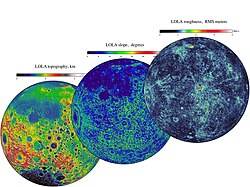
[[File:LROtopography.jpg|thumb|LOLA data provides three complementary views of the near side of the Moon: the topography (left) along with maps of the surface slope values (middle) and the roughness of the topography (right). All three views are centered on the relatively young impact crater [[Tycho (lunar crater)|Tycho]], with the [[Orientale basin]] on the left side.]] | [[File:LROtopography.jpg|thumb|LOLA data provides three complementary views of the near side of the Moon: the topography (left) along with maps of the surface slope values (middle) and the roughness of the topography (right). All three views are centered on the relatively young impact crater [[Tycho (lunar crater)|Tycho]], with the [[Orientale basin]] on the left side.]] | ||
On August 21, 2009, the spacecraft, along with the [[Chandrayaan-1]] orbiter, attempted to perform a [[bistatic radar]] experiment to detect the presence of water ice on the lunar surface,<ref>{{ | On August 21, 2009, the spacecraft, along with the [[Chandrayaan-1]] orbiter, attempted to perform a [[bistatic radar]] experiment to detect the presence of water ice on the lunar surface,<ref name="nasa-isro-release">{{Cite press release |title=NASA And ISRO Satellites Perform in Tandem To Search For Ice on the Moon |url=http://www.nasa.gov/mission_pages/Mini-RF/news/tandem_search.html |url-status=dead |archive-url=https://web.archive.org/web/20090924174215/http://www.nasa.gov/mission_pages/Mini-RF/news/tandem_search.html |archive-date=September 24, 2009 |access-date=August 22, 2009 |publisher=[[NASA]] }}</ref><ref name="isro-20090821">{{Cite press release |date=August 21, 2009 |title=ISRO-NASA Joint Experiment To Search for Water Ice on the Moon |url=http://isro.org/pressrelease/scripts/pressreleasein.aspx?Aug21_2009 |url-status=dead |archive-url=https://web.archive.org/web/20090901112837/http://www.isro.org/pressrelease/scripts/pressreleasein.aspx?Aug21_2009 |archive-date=September 1, 2009 |access-date=August 22, 2009 |publisher=[[ISRO]] }}</ref> but the test was unsuccessful.<ref name="universetoday-20090910">{{Cite news |last=Atkinson |first=Nancy |date=September 10, 2009 |title=Anticipated Joint Experiment with Chandrayaan-1 and LRO Failed |url=https://www.universetoday.com/39811/anticipated-joint-experiment-with-chandrayaan-1-and-lro-failed/ |url-status=live |archive-url=https://web.archive.org/web/20240528164557/https://www.universetoday.com/39811/anticipated-joint-experiment-with-chandrayaan-1-and-lro-failed/ |archive-date=May 28, 2024 |access-date=March 26, 2012 |work=Universe Today }}</ref> | ||
On December 17, 2010, a topographic map of the Moon based on data gathered by the LOLA instrument was released to the public.<ref name="nasa-gsfc-10-114">{{Cite press release |last1=Neal-Jones |first1=Nancy |last2=Steigerwald |first2=Bill |date=December 17, 2010 |title=NASA's LRO Creating Unprecedented Topographic Map of Moon |url=http://www.nasa.gov/mission_pages/LRO/news/lola-topo-map.html |url-status=dead |archive-url=https://web.archive.org/web/20110416032208/http://www.nasa.gov/mission_pages/LRO/news/lola-topo-map.html |archive-date=April 16, 2011 |publisher=[[NASA]] [[Goddard Space Flight Center]] |id=10-114 }}</ref> This is the most accurate topographic map of the Moon to date. It will continue to be updated as more data is acquired. | |||
On | On March 15, 2011, the final set of data from the exploration phase of the mission was released to the NASA [[Planetary Data System]]. The spacecraft's seven instruments delivered more than 192 terabytes of data. LRO has already collected as much data as all other planetary missions combined.<ref name="nasa-gsfc-11-20">{{Cite press release |last1=Neal-Jones |first1=Nancy |last2=Zubritsky |first2=Elizabeth |date=March 15, 2011 |title=NASA Lunar Reconnaissance Orbiter Delivers Treasure Trove of Data |url=http://www.nasa.gov/mission_pages/LRO/news/terabytes.html |url-status=dead |archive-url=https://web.archive.org/web/20110416011038/http://www.nasa.gov/mission_pages/LRO/news/terabytes.html |archive-date=April 16, 2011 |access-date=April 12, 2011 |publisher=[[NASA]] [[Goddard Space Flight Center]] |id=11-20 }}</ref> This volume of data is possible because the Moon is so close, LRO has its own dedicated ground station, and it doesn't have to share time on the [[Deep Space Network]]. Among the latest products is a global map with a resolution of {{convert|100|m|ft|abbr=on|disp=x|/pixel (|/pixel)}} from the Lunar Reconnaissance Orbiter Camera (LROC). | ||
In March 2015, the LROC team reported having imaged the location of an impact whose flash was observed from Earth on March 17, 2013. The team found the crater by going back to images taken in the first year or two and comparing them to images taken after the impact, called temporal pairs. The images revealed splotches, small areas whose reflectance is markedly different from that of the surrounding terrain, presumably from disruption of the surface by recent impacts.<ref name="nasa-20150317">{{Cite web |last1=Cassis |first1=Nicole |last2=Neal-Jones |first2=Nancy |date=March 17, 2015 |title=NASA's LRO Spacecraft Finds March 17, 2013 Impact Crater and More |url=https://www.nasa.gov/solar-system/nasas-lro-spacecraft-finds-march-17-2013-impact-crater-and-more/ |url-status=live |archive-url=https://web.archive.org/web/20240528030746/https://www.nasa.gov/solar-system/nasas-lro-spacecraft-finds-march-17-2013-impact-crater-and-more/ |archive-date=May 28, 2024 |access-date=April 7, 2016 |publisher=[[NASA]] }}</ref><ref name="icarus-252-229-235">{{Cite journal |last1=Robinson |first1=Mark S. |last2=Boyd |first2=Aaron K. |last3=Denevi |first3=Brett W. |last4=Lawrence |first4=Samuel J. |last5=McEwen |first5=Alfred S. |last6=Moser |first6=Danielle E. |last7=Povilaitis |first7=Reinhold Z. |last8=Stelling |first8=Richard W. |last9=Suggs |first9=Robert M. |date=May 2015 |title=New crater on the Moon and a swarm of secondaries |journal=[[Icarus (journal)|ICARUS]] |publisher=[[Elsevier]] |volume=252 |pages=229–235 |bibcode=2015Icar..252..229R |doi=10.1016/j.icarus.2015.01.019 |display-authors=5 }}</ref> | |||
By September 2015, LROC had imaged nearly three-fourths of the lunar surface at high resolution, revealing more than 3,000 [[lobate scarp]]s. Their global distribution and orientation suggests that the faults are created as the Moon shrinks, with influence by gravitational tidal forces from Earth.<ref name="nasa-15-34">{{Cite press release |editor-last=Neal-Jones |editor-first=Nancy |editor2-last=Steigerwald |editor2-first=William |date=September 15, 2015 |title=LRO Discovers Earth's Pull is 'Massaging' our Moon |url=https://www.nasa.gov/news-release/nasas-lro-discovers-earths-pull-is-massaging-our-moon/ |url-status=live |archive-url=https://web.archive.org/web/20240610103841/https://www.nasa.gov/news-release/nasas-lro-discovers-earths-pull-is-massaging-our-moon/ |archive-date=June 10, 2024 |access-date=April 7, 2016 |publisher=[[NASA]] |id=15-34 }}</ref> | |||
In March 2016, the LROC team reported the use of 14,092 NAC temporal pairs to discover over 47,000 new splotches on the Moon.<ref name="lpsc-2016-2645">{{Cite conference |last1=Speyerer |first1=E. J. |last2=Povilaitis |first2=R. Z. |last3=Robinson |first3=M. S. |last4=Thomas |first4=P. C. |last5=Wagner |first5=R. V. |date=March 2016 |title=Impact of Secondary Surface Changes on Regolith Gardening |url=https://www.hou.usra.edu/meetings/lpsc2016/pdf/2645.pdf |conference=47th Lunar and Planetary Science Conference. March 21–25, 2016. The Woodlands, Texas. |location=The Woodlands, Texas |publisher=[[Lunar and Planetary Institute]] |bibcode=2016LPI....47.2645S |archive-url=https://web.archive.org/web/20240729112907/https://www.hou.usra.edu/meetings/lpsc2016/pdf/2645.pdf |archive-date=July 29, 2024 |url-status=live }}</ref> | |||
In | In July 2024, the analysis of the radar data obtained by LRO confirmed the presence of an underground cave on the Moon accessible from the surface.<ref name="newscientist-20240715">{{Cite magazine |last=Crane |first=Leah |date=July 15, 2024 |title=Deep pit on moon may be entrance to cave that could act as lunar base |url=https://www.newscientist.com/article/2439470-deep-pit-on-moon-may-be-entrance-to-cave-that-could-act-as-lunar-base/ |url-status=live |archive-url=https://web.archive.org/web/20240727193748/https://www.newscientist.com/article/2439470-deep-pit-on-moon-may-be-entrance-to-cave-that-could-act-as-lunar-base/ |archive-date=July 27, 2024 |access-date=July 16, 2024 |magazine=[[New Scientist]] }}</ref><ref name="bbc-20240715">{{Cite news |last=Rannard |first=Georgina |date=July 15, 2024 |title=Moon cave discovered that could one day house humans |url=https://www.bbc.com/news/articles/ce784r9njz0o |url-status=live |archive-url=https://web.archive.org/web/20240904192551/https://www.bbc.com/news/articles/ce784r9njz0o |archive-date=September 4, 2024 |access-date=July 16, 2024 |work=[[BBC News]] }}</ref> The cave is said to be about 45 metres wide and at least 80 metres long, and present in the [[Mare Tranquillitatis]] (Sea of Tranquility), the ancient lava plain where the [[Apollo 11]] astronauts [[Neil Armstrong]] and [[Buzz Aldrin]] first set foot on the Moon.<ref name="busstd-20240716">{{Cite news |last=Dar |first=Yunus |date=July 16, 2024 |title=Good news for human explorers! Newly found cave could house crews on Moon |url=https://www.business-standard.com/world-news/good-news-for-human-explorers-newly-found-cave-could-house-crews-on-moon-124071600949_1.html |url-status=live |archive-url=https://web.archive.org/web/20240720171327/https://www.business-standard.com/world-news/good-news-for-human-explorers-newly-found-cave-could-house-crews-on-moon-124071600949_1.html |archive-date=July 20, 2024 |work=[[Business Standard]] }}</ref> | ||
The mission maintains a full list of publications with science results on its website.<ref>{{Cite web |url= | The mission maintains a full list of publications with science results on its website.<ref name="lro-publications">{{Cite web |title=Publications by LRO Team |url=https://science.nasa.gov/mission/lro/lro-publications/ |url-status=live |archive-url=https://web.archive.org/web/20240529173436/https://science.nasa.gov/mission/lro/lro-publications/ |archive-date=May 29, 2024 |access-date=April 7, 2016 |publisher=[[NASA]] }}</ref> | ||
{{clear}} | {{clear}} | ||
==Gallery== | ==Gallery== | ||
<gallery | <gallery heights="140px" mode="packed" caption="Lunar Reconnaissance Orbiter mission photos"> | ||
File:LRO FirstImage.jpg|First LRO image (June 30, 2009) | File:LRO FirstImage.jpg|First LRO image (June 30, 2009) | ||
File:Apollo11-LRO-March2012.jpg|[[Apollo 11]] landing site | File:Apollo11-LRO-March2012.jpg|[[Apollo 11]] landing site | ||
| Line 149: | Line 153: | ||
File:LROviewsLADEEorbitingMOON-20140114.jpg|LRO views [[Lunar Atmosphere and Dust Environment Explorer|LADEE]] at a distance of {{convert|9|km|mi|abbr=on}} | File:LROviewsLADEEorbitingMOON-20140114.jpg|LRO views [[Lunar Atmosphere and Dust Environment Explorer|LADEE]] at a distance of {{convert|9|km|mi|abbr=on}} | ||
File:LRO Chang'e 4, first look.png|[[Chang'e 4]] landing site | File:LRO Chang'e 4, first look.png|[[Chang'e 4]] landing site | ||
File:Chandrayaan-2 Vikram lander Impact Blink animation.gif|LRO views the [[Vikram lander]] crash site. | |||
File:14284-Moon-Maskelyne-LRO-20141012.jpg|LRO view of [[irregular mare patch]], an extremely young terrain | File:14284-Moon-Maskelyne-LRO-20141012.jpg|LRO view of [[irregular mare patch]], an extremely young terrain | ||
File:Earthrise over Compton crater -LRO full res - edit1.jpg|Earthrise over [[Compton (crater)|Compton crater]] | File:Earthrise over Compton crater -LRO full res - edit1.jpg|Earthrise over [[Compton (crater)|Compton crater]] | ||
| Line 159: | Line 164: | ||
</gallery> | </gallery> | ||
{{wide image|LRO Tycho Central Peak.jpg|600px|[[Tycho (lunar crater)|Tycho crater's]] central peak complex casts a long, dark shadow near local sunrise.}} | {{wide image|LRO Tycho Central Peak.jpg|600px|[[Tycho (lunar crater)|Tycho crater's]] central peak complex casts a long, dark shadow near local sunrise.}} | ||
{{wide image|File:Spacecraft Pass Each Other at the Moon.webm|600px|[[GRAIL|GRAIL-B]] images LRO in lunar orbit.}} | |||
==See also== | ==See also== | ||
| Line 165: | Line 171: | ||
* [[Exploration of the Moon]] | * [[Exploration of the Moon]] | ||
* [[LCROSS]] | * [[LCROSS]] | ||
* [[List of | * [[List of missions to the Moon]] | ||
* [[Lunar Atmosphere and Dust Environment Explorer]] | * [[Lunar Atmosphere and Dust Environment Explorer]] | ||
* [[Lunar outpost (NASA)]] | * [[Lunar outpost (NASA)]] | ||
Latest revision as of 21:02, 28 January 2026
 Illustration of LRO | |||||||||||||||||
| Mission type | Lunar orbiter | ||||||||||||||||
|---|---|---|---|---|---|---|---|---|---|---|---|---|---|---|---|---|---|
| Operator | NASA | ||||||||||||||||
| COSPAR ID | 2009-031A | ||||||||||||||||
| SATCAT no. | 35315 | ||||||||||||||||
| Website | lunar | ||||||||||||||||
| Mission duration | |||||||||||||||||
| Spacecraft properties | |||||||||||||||||
| Manufacturer | NASA / GSFC | ||||||||||||||||
| Launch mass | 1,916 kg (4,224 lb)[3] | ||||||||||||||||
| Dry mass | 1,018 kg (2,244 lb)[3] | ||||||||||||||||
| Payload mass | 92.6 kg (204 lb)[3] | ||||||||||||||||
| Dimensions | Launch: 390 × 270 × 260 cm (152 × 108 × 103 in)[3] | ||||||||||||||||
| Power | 1850 W[4] | ||||||||||||||||
| Start of mission | |||||||||||||||||
| Launch date | June 18, 2009, 21:32:00 UTC | ||||||||||||||||
| Rocket | Atlas V 401 | ||||||||||||||||
| Launch site | Cape Canaveral SLC-41 | ||||||||||||||||
| Contractor | United Launch Alliance | ||||||||||||||||
| Entered service | September 15, 2009 | ||||||||||||||||
| Orbital parameters | |||||||||||||||||
| Reference system | Selenocentric | ||||||||||||||||
| Semi-major axis | 1,825 km (1,134 mi) | ||||||||||||||||
| Periselene altitude | 20 km (12 mi) | ||||||||||||||||
| Aposelene altitude | 165 km (103 mi) | ||||||||||||||||
| Epoch | May 4, 2015[5] | ||||||||||||||||
| Moon orbiter | |||||||||||||||||
| Orbital insertion | June 23, 2009 | ||||||||||||||||
| |||||||||||||||||
_01.png)
| |||||||||||||||||
The Lunar Reconnaissance Orbiter (LRO) is a NASA robotic spacecraft currently orbiting the Moon in an eccentric polar mapping orbit.[6][7] Data collected by LRO have been described as essential for planning NASA's future human and robotic missions to the Moon.[8] Its detailed mapping program is identifying safe landing sites, locating potential resources on the Moon, characterizing the radiation environment, and demonstrating new technologies.[9][10]
Launched on June 18, 2009,[11] in conjunction with the Lunar Crater Observation and Sensing Satellite (LCROSS), as the vanguard of NASA's Lunar Precursor Robotic Program,[12] LRO was the first United States mission to the Moon in over ten years.[13] LRO and LCROSS were launched as part of the United States's Vision for Space Exploration program.
The probe has made a 3-D map of the Moon's surface at 100-meter resolution and 98.2% coverage (excluding polar areas in deep shadow),[14] including 0.5-meter resolution images of Apollo landing sites.[15][16] The first images from LRO were published on July 2, 2009, showing a region in the lunar highlands south of Mare Nubium (Sea of Clouds).[17]
The total cost of the mission is reported as US$583 million, of which $504 million pertains to the main LRO probe and $79 million to the LCROSS satellite.[18] LRO has enough fuel to continue operations until at least 2026.[19]
Mission[edit | edit source]
_launches_with_LRO_and_LCROSS.jpg)
Developed at NASA's Goddard Space Flight Center, LRO is a large (1,916 kg/4,224 lb[18]) and sophisticated spacecraft. Its mission duration was planned for one year,[20] but has since been extended numerous times after review by NASA.
After completing a preliminary design review in February 2006 and a critical design review in November 2006,[21] the LRO was shipped from Goddard to Cape Canaveral Air Force Station on February 11, 2009.[22] Launch was planned for October 2008, but this slid to April as the spacecraft underwent testing in a thermal vacuum chamber.[23] Launch was rescheduled for June 17, 2009, because of the delay in a priority military launch,[24] and happened one day later, on June 18. The one-day delay was to allow the Space Shuttle Endeavour a chance to lift off for mission STS-127 following a hydrogen fuel leak that canceled an earlier planned launch.[25]
Areas of investigation include selenodetic global topography; the lunar polar regions, including possible water ice deposits and the lighting environment; characterization of deep space radiation in lunar orbit; and high-resolution mapping, at a maximum resolution of 50 cm/pixel (20 in/pixel), to assist in the selection and characterization of future landing sites.[26][27]
In addition, LRO has provided images and precise locations of landers and equipment from previous and current lunar missions, including the Apollo sites.[15] In 2024, it confirmed the highly accurate landing site of the first successful Japanese SLIM soft landing.[28]
Instruments[edit | edit source]

The orbiter carries a complement of six instruments and one technology demonstration:
- Cosmic Ray Telescope for the Effects of Radiation (CRaTER)
- The primary goal of the Cosmic Ray Telescope for the Effects of Radiation is to measure and characterize local energy transfer by charged particles in lunar orbit and its biological impacts.[29]
- Diviner
- The Diviner Lunar Radiometer Experiment measures lunar surface thermal emission to provide information for future surface operations and exploration.[30]
- Lyman-Alpha Mapping Project (LAMP)
- The Lyman-Alpha Mapping Project peers into permanently shadowed craters in search of water ice, using ultraviolet light generated by stars as well as the hydrogen atoms that are thinly spread throughout the Solar System.[31]
- Lunar Exploration Neutron Detector (LEND)
- The Lunar Exploration Neutron Detector provides measurements, creates maps, and detects possible near-surface water ice deposits.[32]
- Lunar Orbiter Laser Altimeter (LOLA)
- The Lunar Orbiter Laser Altimeter investigation provides a precise global lunar topographic model and geodetic grid.
- Lunar Reconnaissance Orbiter Camera (LROC) Narrow Angle Camera (NAC)
- The Lunar Reconnaissance Orbiter Camera addresses the measurement requirements of landing site certification and polar illumination.[33] LROC comprises a pair of narrow-angle cameras (NAC) and a single wide-angle camera (WAC).[34] The two Narrow Angle Cameras feature a Cassegrain (Ritchey-Chretien) primary optics at f/3.59, with primary mirror diameter of 19.5 cm,[34] using push-broom imaging.[35][36] At its original altitude of about 50 km, each NAC images pixels about 0.5-meter across, and the swath, which is 5064 pixels wide, is about 2.5 km across. The orbit was raised in 2011 to be elliptical, reducing the resolution in parts of the orbit to 2.0 m/px.[37]: LROC has flown several times over the historic Apollo lunar landing sites at 50 km (31 mi) altitude. The Lunar Roving Vehicles and Lunar Module descent stages and their respective shadows are clearly visible, along with other equipment previously left on the Moon.
- Lunar Reconnaissance Orbiter Camera (LROC) Wide Angle Camera (WAC)
- The WAC provides visible and UV images at a scale of 100 meters/pixel in seven color bands over a 60 km swath.[38] Image format is 1024 x 1024 pixels, with a field of view of 92° (monochrome), 61° (visible light), and 59° in the UV.[34]
- Mini-RF
- The Miniature Radio Frequency radar demonstrated new lightweight synthetic aperture radar (SAR) and communications technologies and located potential water-ice.[39]
Names to the Moon[edit | edit source]
Prior to the LRO's launch, NASA gave members of the public the opportunity to have their names placed in a microchip on the LRO. The deadline for this opportunity was July 31, 2008.[40] About 1.6 million names were submitted.[40][41]
Mission progress[edit | edit source]


Lunar Reconnaissance Orbiter · Earth · Moon

LRO · Moon
On June 23, 2009, the Lunar Reconnaissance Orbiter entered into orbit around the Moon after a four-and-a-half-day journey from the Earth. When launched, the spacecraft was aimed at a point ahead of the Moon's position. A mid-course correction was required during the trip in order for the spacecraft to correctly enter Lunar orbit. Once the spacecraft reached the far side of the Moon, its rocket motor was fired in order for it to be captured by the Moon's gravity into an elliptical lunar orbit.[42]
A series of four rocket burns over the next four days put the satellite into its commissioning phase orbit where each instrument was brought online and tested. On September 15, 2009, the spacecraft started its primary mission by orbiting the Moon at about 50 km (31 mi) for one year.[43] After completing its one-year exploration phase, in September 2010, LRO was handed over to NASA's Science Mission Directorate to continue the science phase of the mission.[44] It would continue in its 50 km circular orbit, but eventually would be transitioned into a fuel-conserving "quasi-frozen"[45] elliptical orbit for the remainder of the mission.
NASA's LCROSS mission culminated with two lunar impacts at 11:31 and 11:36 UTC on October 9. The goal of the impact was the search for water in the Cabeus crater near the Moon's south pole,[46] and preliminary results indicated the presence of both water and hydroxyl, an ion related to water.[47][48]
On January 4, 2011, the Mini-RF instrument team for the Lunar Reconnaissance Orbiter (LRO) found that the Mini-RF radar transmitter had suffered an anomaly. Mini-RF has suspended normal operations. Despite being unable to transmit, the instrument is being used to collect bistatic radar observations using radar transmissions from the Earth. The Mini-RF instrument has already met its science mission success criteria by collecting more than 400 strips of radar data since September 2010.[49]
In January 2013, NASA tested one-way laser communication with LRO by sending an image of the Mona Lisa to the Lunar Orbiter Laser Altimeter (LOLA) instrument on LRO from the Next Generation Satellite Laser Ranging (NGSLR) station at NASA's Goddard Space Flight Center in Greenbelt, Maryland.[50]
In May 2015, LRO's orbit was altered to fly 20 km (12 mi) above the Moon's south pole, allowing higher resolution data to be obtained from the Lunar Orbiter Laser Altimeter (LOLA) and Diviner instruments over the permanently shadowed craters there.[51]
In 2019, LRO found the crash site of Indian moon lander Vikram.[52]
In 2020, software was tested to use star trackers instead of the Miniature Inertial Measurement Unit that had been turned off in 2018 (as it was degrading).[53]
LRO and the Chandrayaan-2 orbiter were expected to come dangerously close to each other on 20 October 2021 at 05:45 UTC over the Lunar North pole. Chandrayaan-2 orbiter performed a collision avoidance manoeuvre at 14:52 UTC on 18 October 2021 to avert the possible conjunction event.[54]
Results[edit | edit source]

On August 21, 2009, the spacecraft, along with the Chandrayaan-1 orbiter, attempted to perform a bistatic radar experiment to detect the presence of water ice on the lunar surface,[55][56] but the test was unsuccessful.[57]
On December 17, 2010, a topographic map of the Moon based on data gathered by the LOLA instrument was released to the public.[58] This is the most accurate topographic map of the Moon to date. It will continue to be updated as more data is acquired.
On March 15, 2011, the final set of data from the exploration phase of the mission was released to the NASA Planetary Data System. The spacecraft's seven instruments delivered more than 192 terabytes of data. LRO has already collected as much data as all other planetary missions combined.[59] This volume of data is possible because the Moon is so close, LRO has its own dedicated ground station, and it doesn't have to share time on the Deep Space Network. Among the latest products is a global map with a resolution of 100 m/pixel (330 ft/pixel) from the Lunar Reconnaissance Orbiter Camera (LROC).
In March 2015, the LROC team reported having imaged the location of an impact whose flash was observed from Earth on March 17, 2013. The team found the crater by going back to images taken in the first year or two and comparing them to images taken after the impact, called temporal pairs. The images revealed splotches, small areas whose reflectance is markedly different from that of the surrounding terrain, presumably from disruption of the surface by recent impacts.[60][61]
By September 2015, LROC had imaged nearly three-fourths of the lunar surface at high resolution, revealing more than 3,000 lobate scarps. Their global distribution and orientation suggests that the faults are created as the Moon shrinks, with influence by gravitational tidal forces from Earth.[62]
In March 2016, the LROC team reported the use of 14,092 NAC temporal pairs to discover over 47,000 new splotches on the Moon.[63]
In July 2024, the analysis of the radar data obtained by LRO confirmed the presence of an underground cave on the Moon accessible from the surface.[64][65] The cave is said to be about 45 metres wide and at least 80 metres long, and present in the Mare Tranquillitatis (Sea of Tranquility), the ancient lava plain where the Apollo 11 astronauts Neil Armstrong and Buzz Aldrin first set foot on the Moon.[66]
The mission maintains a full list of publications with science results on its website.[67]
Gallery[edit | edit source]
- Lunar Reconnaissance Orbiter mission photos
-
 First LRO image (June 30, 2009)
 -
 Apollo 11 landing site
 -
 Apollo 12 and Surveyor 3 landing site
 -
 Apollo 14 landing site
 -
 Apollo 15 landing site
 -
 Apollo 16 landing site
 -
 Apollo 17 landing site
 -
 Close up of Apollo 17 Challenger descent stage
 -
 Surveyor 1 landing site
 -
 LRO views LADEE at a distance of 9 km (5.6 mi)
 -
 Chang'e 4 landing site
 -
 LRO views the Vikram lander crash site.
 -
 LRO view of irregular mare patch, an extremely young terrain
 -
 Earthrise over Compton crater


.jpg)


See also[edit | edit source]
References[edit | edit source]
- ↑ 1.0 1.1 1.2 "LRO Mission Description". PDS Geosciences Node. Washington University in St. Louis. September 24, 2012 [2007]. Retrieved October 9, 2015.
- ↑ Hand, Eric (September 3, 2014). "NASA extends seven planetary missions". Science. Retrieved October 9, 2015.
- ↑ 3.0 3.1 3.2 3.3 "Lunar Reconnaissance Orbiter (LRO): Leading NASA's Way Back to the Moon" (PDF). NASA. June 2009. NP-2009-05-98-MSFC. Archived from the original (PDF) on October 27, 2009. Retrieved October 9, 2015.
- ↑ "LRO Spacecraft Description". PDS Geosciences Node. Washington University in St. Louis. April 11, 2007. Retrieved October 9, 2015.
- ↑ Neal-Jones, Nancy (May 5, 2015). "NASA's LRO Moves Closer to the Lunar Surface". NASA. Retrieved October 9, 2015.
- ↑ Petro, N. E.; Keller, J. W. (2014). Five Years at the Moon With the Lunar Reconnaissance Orbiter (LRO): New Views of the Lunar Surface and Environment (PDF). Annual Meeting of the Lunar Exploration Analysis Group. October 22–24, 2014. Laurel, Maryland. Lunar and Planetary Institute.
- ↑ "The Current Location of the Lunar Reconnaissance Orbiter". Arizona State University. Retrieved September 24, 2014.
- ↑ Steigerwald, Bill (April 16, 2009). "LRO to Help Astronauts Survive in Infinity". NASA. Archived from the original on August 1, 2016. Retrieved July 13, 2016.
- ↑ "LRO Mission Overview". NASA. Retrieved October 3, 2009.
- ↑ Houghton, Martin B.; Tooley, Craig R.; Saylor, Richard S. (2006). Mission design and operation considerations for NASA's Lunar Reconnaissance Orbiter (PDF). 57th International Astronautical Congress. October 2–6, 2006. Valencia, Spain. IAC-07-C1.7.06.
- ↑ "Lunar Reconnaissance Orbiter: Launch". Goddard Space Flight Center. Archived from the original on February 14, 2013. Retrieved March 22, 2008.
- ↑ Mitchell, Brian. "Lunar Precursor Robotic Program: Overview & History". NASA. Archived from the original on July 30, 2009. Retrieved August 5, 2009.
- ↑ Dunn, Marcia (June 18, 2009). "NASA launches unmanned Moon shot, first in decade". ABC News. Associated Press. Archived from the original on August 20, 2009. Retrieved August 5, 2009.
- ↑ "NASA Probe Beams Home Best Moon Map Ever". Space.com. November 18, 2011. Retrieved September 3, 2016.
- ↑ 15.0 15.1 Phillips, Tony; Barry, Patrick L. (July 11, 2005). "Abandoned Spaceships". NASA. Archived from the original on August 8, 2009. Retrieved August 5, 2009.
- ↑ "LRO Sees Apollo Landing Sites". LROC. NASA. July 17, 2009.
- ↑ Garner, Robert, ed. (July 2, 2009). "LRO's First Moon Images". NASA. Archived from the original on August 8, 2009. Retrieved August 5, 2009.
- ↑ 18.0 18.1 Harwood, William (June 18, 2009). "Atlas 5 rocket launches NASA Moon mission". CNet.com. Archived from the original on November 3, 2013. Retrieved June 18, 2009.
- ↑ Clark, Stephen (June 18, 2019). "10 years since its launch, NASA lunar orbiter remains crucial for moon landings". Spaceflight Now. Retrieved June 20, 2019.
- ↑ Foust, Jeff (March 18, 2015). "Culberson Pledges Protection for Lunar Orbiter, Mars Rover Missions". Space News. Retrieved March 22, 2015.
- ↑ Jenner, Lynn, ed. (December 6, 2006). "Lunar Reconnaissance Orbiter Successfully Completes Critical Design Review". NASA. Retrieved February 6, 2007.
- ↑ Young, Tracy; Hautaluoma, Grey; Neal-Jones, Nancy (February 11, 2009). "NASA Lunar Spacecraft Ships South in Preparation For Launch". NASA. Retrieved February 13, 2009.
- ↑ Garner, Robert, ed. (October 23, 2008). "Next Moon Mission Begins Thermal Vacuum Test". NASA. Retrieved August 9, 2009.
- ↑ Ray, Justin (April 1, 2009). "NASA's robotic return to the Moon delayed to June". Spaceflight Now. Retrieved August 9, 2009.
- ↑ Klotz, Irene (June 17, 2009). "Gas leak delays space shuttle launch for second time". Reuters. Retrieved August 9, 2009.
- ↑ Savage, Donald; Cook-Anderson, Gretchen (December 22, 2004). "NASA Selects Investigations for Lunar Reconnaissance Orbiter". NASA. 04-407. Archived from the original on March 26, 2012. Retrieved May 18, 2006.
- ↑ Klotz, Irene (June 18, 2009). "NASA launches probes to scout the Moon". Reuters. Retrieved November 2, 2013.
- ↑ Mark Robinson (January 26, 2024). "JAXA SLIM Landing". NASA/GSFC/LROC, School of Earth and Space Exploration, Arizona State University.
- ↑ "Cosmic Ray Telescope for the Effects of Radiation". Boston University. Archived from the original on May 6, 2006. Retrieved August 5, 2009.
- ↑ "Diviner Lunar Radiometer Experiment/". UCLA. Archived from the original on July 23, 2008. Retrieved August 5, 2009.
- ↑ Andrews, Polly. "The Lyman-Alpha Mapping Project: Seeing in the Dark". Southwest Research Institute. Retrieved December 13, 2013.
- ↑ "Russian neutron detector LEND for NASA Lunar Reconnaissance Orbiter space mission". Space Research Institute of the Russian Academy of Sciences. Archived from the original on April 6, 2012. Retrieved August 5, 2009.
- ↑ "The Lunar Reconnaissance Orbiter Camera". Arizona State University. Retrieved August 5, 2009.
- ↑ 34.0 34.1 34.2 Arizona State University, School of Earth and Space Exploration. "LROC Specs". Lunar Reconnaissance Orbiter Camera.
- ↑ Neal-Jones, Nancy (January 29, 2014). "NASA's LRO Snaps a Picture of NASA's LADEE Spacecraft". NASA. Retrieved February 2, 2014.
- ↑ Burns, K. N.; Speyerer, E. J.; Robinson, M. S.; Tran, T.; Rosiek, M. R.; et al. (2012). Digital Elevation Models and Derived Products From LROC NAC Stereo Observations (PDF). 22nd ISPRS Congress. August 25 – September 1, 2012. Melbourne, Australia.
- ↑ Arizona State University. "Working with Lunar Reconnaissance Orbiter LROC Narrow Angle Camera (NAC) Data" (PDF). Lunar Reconnaissance Orbiter Camera.
- ↑ Arizona State University. "About LROC". Lunar Reconnaissance Orbiter Camera.
- ↑ Yan, ed. (June 19, 2009). "Backgrounder: Introduction to LRO's instruments". Xinhua. Archived from the original on June 29, 2009. Retrieved August 5, 2009.
- ↑ 40.0 40.1 Spires, Shelby G. (May 3, 2009). "We can't all go to Moon, but our names can". The Huntsville Times. Archived from the original on July 2, 2010. Retrieved August 5, 2009.
- ↑ Jenner, Lynn, ed. (June 9, 2009). "1.6 Million Names to the Moon". NASA. Archived from the original on March 17, 2021. Retrieved August 5, 2009.
- ↑ Hautaluoma, Grey; Edwards, Ashley; Neal-Jones, Nancy (June 23, 2009). "NASA Lunar Mission Successfully Enters Moon Orbit". NASA. 09-144. Archived from the original on November 22, 2013. Retrieved July 3, 2009.
- ↑ Tooley, Craig (August 14, 2009). "LRO Status". Blogspot.com. Retrieved August 22, 2009.
- ↑ "Lunar Reconnaissance Orbiter". NASA. Retrieved October 9, 2015.
- ↑ Beckman, Mark (2007). "Mission Design for the Lunar Reconnaissance Orbiter". 29th ANNUAL AAS GUIDANCE AND CONTROL CONFERENCE: 10–11.
- ↑ Phillips, Tony, ed. (August 11, 2008). "A Flash of Insight: LCROSS Mission Update". NASA. Archived from the original on January 8, 2016.
- ↑ "Astrobiology Top 10: LCROSS Confirms Water on the Moon". Astrobiology Magazine. January 2, 2010. Archived from the original on September 29, 2020.
- ↑ Colaprete, A.; Ennico, K.; Wooden, D.; Shirley, M.; Heldmann, J.; et al. (March 2010). Water and More: An Overview of LCROSS Impact Results (PDF). 41st Lunar and Planetary Science Conference. March 1–5, 2010. The Woodlands, Texas. 2335. Bibcode:2010LPI....41.2335C.
- ↑ "LRO Instrument Status Update – 01.11.11". NASA. January 11, 2011. Archived from the original on February 7, 2011.
- ↑ "NASA Beams Mona Lisa to Lunar Reconnaissance Orbiter at the Moon". NASA. January 17, 2013. Archived from the original on August 15, 2015. Retrieved October 9, 2015.
- ↑ Neal-Jones, Nancy (May 5, 2015). "NASA's LRO Moves Closer to the Lunar Surface". NASA. Retrieved January 22, 2016.
- ↑ Stalin, J. Sam Daniel (December 3, 2019). "Chennai Engineer Helps NASA Find Debris Of Chandrayaan-2 Moon Lander Vikram". NDTV.
- ↑ Steigerwald, Bill (February 11, 2021). "Teaching an Old Spacecraft New Tricks to Continue Exploring the Moon". NASA. Archived from the original on September 4, 2024.
- ↑ "Chandrayaan-2 Orbiter (CH2O) performs an evasive manoeuvre to mitigate a critically close approach with LRO - ISRO". www.isro.gov.in. Archived from the original on November 15, 2021. Retrieved November 15, 2021.
- ↑ "NASA And ISRO Satellites Perform in Tandem To Search For Ice on the Moon" (Press release). NASA. Archived from the original on September 24, 2009. Retrieved August 22, 2009.
- ↑ "ISRO-NASA Joint Experiment To Search for Water Ice on the Moon" (Press release). ISRO. August 21, 2009. Archived from the original on September 1, 2009. Retrieved August 22, 2009.
- ↑ Atkinson, Nancy (September 10, 2009). "Anticipated Joint Experiment with Chandrayaan-1 and LRO Failed". Universe Today. Archived from the original on May 28, 2024. Retrieved March 26, 2012.
- ↑ Neal-Jones, Nancy; Steigerwald, Bill (December 17, 2010). "NASA's LRO Creating Unprecedented Topographic Map of Moon" (Press release). NASA Goddard Space Flight Center. 10-114. Archived from the original on April 16, 2011.
- ↑ Neal-Jones, Nancy; Zubritsky, Elizabeth (March 15, 2011). "NASA Lunar Reconnaissance Orbiter Delivers Treasure Trove of Data" (Press release). NASA Goddard Space Flight Center. 11-20. Archived from the original on April 16, 2011. Retrieved April 12, 2011.
- ↑ Cassis, Nicole; Neal-Jones, Nancy (March 17, 2015). "NASA's LRO Spacecraft Finds March 17, 2013 Impact Crater and More". NASA. Archived from the original on May 28, 2024. Retrieved April 7, 2016.
- ↑ Robinson, Mark S.; Boyd, Aaron K.; Denevi, Brett W.; Lawrence, Samuel J.; McEwen, Alfred S.; et al. (May 2015). "New crater on the Moon and a swarm of secondaries". ICARUS. 252. Elsevier: 229–235. Bibcode:2015Icar..252..229R. doi:10.1016/j.icarus.2015.01.019.
- ↑ Neal-Jones, Nancy; Steigerwald, William, eds. (September 15, 2015). "LRO Discovers Earth's Pull is 'Massaging' our Moon" (Press release). NASA. 15-34. Archived from the original on June 10, 2024. Retrieved April 7, 2016.
- ↑ Speyerer, E. J.; Povilaitis, R. Z.; Robinson, M. S.; Thomas, P. C.; Wagner, R. V. (March 2016). Impact of Secondary Surface Changes on Regolith Gardening (PDF). 47th Lunar and Planetary Science Conference. March 21–25, 2016. The Woodlands, Texas. The Woodlands, Texas: Lunar and Planetary Institute. Bibcode:2016LPI....47.2645S. Archived (PDF) from the original on July 29, 2024.
- ↑ Crane, Leah (July 15, 2024). "Deep pit on moon may be entrance to cave that could act as lunar base". New Scientist. Archived from the original on July 27, 2024. Retrieved July 16, 2024.
- ↑ Rannard, Georgina (July 15, 2024). "Moon cave discovered that could one day house humans". BBC News. Archived from the original on September 4, 2024. Retrieved July 16, 2024.
- ↑ Dar, Yunus (July 16, 2024). "Good news for human explorers! Newly found cave could house crews on Moon". Business Standard. Archived from the original on July 20, 2024.
- ↑ "Publications by LRO Team". NASA. Archived from the original on May 29, 2024. Retrieved April 7, 2016.
External links[edit | edit source]
- Lunar Reconnaissance Orbiter website by NASA
- Lunar Reconnaissance Orbiter website by NASA's Goddard Space Flight Center
- Lunar Reconnaissance Orbiter mission profile by NASA's Solar System Exploration
- Diviner Instrument website by UCLA
- LROC Instrument website by Arizona State University
- LROC Web Map Service by Arizona State University
Template:Planetary Missions Program Office Template:GSFC Template:Solar System probes Template:Orbital launches in 2009