


m Removed empty portal template using script |
improved article |
||
| Line 1: | Line 1: | ||
{{Short description|Sufi mystic order in Sunni Islam}} | {{Short description|Sufi mystic order in Sunni Islam}} | ||
{{Redirect|Chishti|people with the surname|Chishti (surname)}} | {{Redirect|Chishti|people with the surname|Chishti (surname)}} | ||
{{Use dmy dates|date= | {{Use dmy dates|date=February 2023}} | ||
[[File: | {{Infobox religion | ||
| name = Chishti order | |||
| native_name = {{lang|ar|{{Script|Arab|الطريقة التشيتشي}}}}<br/>{{transliteration|ar|al-Ṭarīqa al-Chīshtīyya}} | |||
| native_name_lang = ar | |||
| image = Talisman Louvre MAO905.jpg | |||
| caption = Seal emblem of the Chishti order | |||
| abbreviation = Chīshtīyya | |||
| type = [[Sufi order]] | |||
| main_classification = [[Sunni Islam]] | |||
| leader_title = Key people | |||
| leader_name = [[Mu'in al-Din Chishti]] | |||
| area = [[South Asia]] | |||
| founder = [[Abu Ishaq Shami]] | |||
| founded_date = {{Circa|930 CE}} | |||
| founded_place = | |||
}} | |||
{{Sufism|Orders}} | |||
<!-- Commented out: [[File:Suhrawardiyya Symbol.jpg|thumb|Genealogy of the Suhrawardiyya Order from the prophet [[Muhammad SAW]] and [[Ali]] to [[Moinuddin Chishti]].]] --> | |||
The '''Chishti order''' ({{langx|fa|چشتیه|translit=Čištiya}}) is a [[Sufi]] [[Tariqa|order]] of [[Sunni Islam]] named after the town of [[Chishti Sharif District|Chisht]], Afghanistan where it was initiated by [[Abu Ishaq Shami]]. The order was brought to Herat and later spread across [[South Asia]] by [[Mu'in al-Din Chishti]] in the city of [[Ajmer]]. | |||
The Chishti order is known for its emphasis on love, tolerance, and openness.<ref>Ernst, Carl W. and Lawrence, Bruce B. (2002) ''Sufi Martyrs of Love: The Chishti Order in South Asia and Beyond'' Palgrave Macmillan, New Yorks 1234567 4039-6026-7</ref> The Chishti order is primarily followed in Afghanistan and the [[Indian subcontinent]]. The Chishti order was the first of the four main Sufi orders that became well-established in [[South Asia]], which are the [[Qadiriyya|Qadiri]], Chishti, [[Naqshbandi]] and [[Suhrawardiyya|Suhrawardi]] Sufi orders.<ref name=":1">{{Cite book |title=South Asian Sufis: Devotion, Deviation, and Destiny |date=2012 |publisher=Continuum International Pub |isbn=978-1-4411-8474-0 |editor-last=Bennett |editor-first=Clinton |location=London |editor-last2=Ramsey |editor-first2=Charles M.}}</ref> [[Moinuddin Chishti|Khwaja Muinuddin Chishti]] introduced the Chishti Order in [[Ajmer]] ([[Rajasthan]], India) sometime in the middle of the 12th century. He was eighth in the line of succession from the founder of the Chishti Order, [[Abu Ishaq Shami]]. There are now several branches of the order, which has been the most prominent South Asian Sufi brotherhood since the 12th century.<ref>Rozehnal, Robert. ''Islamic Sufism Unbound: Politics and Piety in Twenty-First Century Pakistan''. Palgrave MacMillan, 2007. Print.</ref> | |||
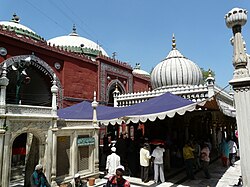
[[File:Ajmer dargah.png|thumb|[[Ajmer Sharif Dargah|Tomb of Khwaja Moinuddin Chishti]], renowned saint of Chishti order]] | [[File:Ajmer dargah.png|thumb|[[Ajmer Sharif Dargah|Tomb of Khwaja Moinuddin Chishti]], renowned saint of Chishti order]] | ||
In the 20th century, the order has spread outside Afghanistan and the Indian subcontinent. Chishti teachers have established centers in the [[United Kingdom]], [[United States]], [[Canada]], [[Australia]], Eastern and Southern Africa. | |||
In the | |||
==Guiding principles== | ==Guiding principles== | ||
The Chishti [[shaykh]]s have stressed the importance of keeping a distance from worldly power.<ref>Sufi martyrs of love By Carl W. Ernst, Bruce B. Lawrence, p. 4.</ref> A ruler could be a patron or a disciple, but he or she was always to be treated as just another devotee. A Chishti teacher should not attend the court or be involved in matters of state, as this will corrupt the soul with worldly matters. In his last discourse to his | The Chishti [[shaykh]]s have stressed the importance of keeping a distance from worldly power.<ref>Sufi martyrs of love By Carl W. Ernst, Bruce B. Lawrence, p. 4.</ref> A ruler could be a patron or a disciple, but he or she was always to be treated as just another devotee. A Chishti teacher should not attend the court or be involved in matters of state, as this will corrupt the soul with worldly matters. In his last discourse to his followers, Khawaja Moinuddin Chishti said: | ||
{{cquote|Never seek any help, charity, or favors from anybody except God. Never go to the courts of kings, but never refuse to bless and help the needy | {{cquote|Never seek any help, charity, or favors from anybody except God. Never go to the courts of kings, but never refuse to bless and help the needy & the poor, the widow, and the orphan, if they come to your door.<ref>{{cite book | last = Chishti | first = Hakim Moinuddin | title = The Book of Sufi Healing | publisher = Inner Traditions International | location = Rochester | year = 1991 | isbn = 0-89281-324-5 }}</ref>|20px|20px}} | ||
[[File:Qawwali hazrat nizamuddin delhi.jpg|thumb|Qawwali at Nizamuddin Auliya's shrine]] | [[File:Qawwali hazrat nizamuddin delhi.jpg|thumb|[[Qawwali]] at [[Nizamuddin Dargah|Nizamuddin Auliya's shrine]]]] | ||
Chishti practice is also notable for ''[[Sama (Sufism)|Sama]]'': evoking the divine presence by listening to and losing oneself in a form of music and poetry, usually [[Qawwali]].<ref name="Carl W. Ernst p. 5">Sufi martyrs of love By Carl W. Ernst, Bruce B. Lawrence, p. 5.</ref> The Chishti, and some other Sufi orders, believe that Sama can help devotees forget self in the love of [[Allah]]. However, the order also insists that followers observe the full range of Muslim obligations; it does not dismiss them as mere legalism, as some strands of Sufism have done.<ref name="Carl W. Ernst p. 5"/> | Chishti practice is also notable for ''[[Sama (Sufism)|Sama]]'': evoking the divine presence by listening to and losing oneself in a form of music and poetry, usually [[Qawwali]].<ref name="Carl W. Ernst p. 5">Sufi martyrs of love By Carl W. Ernst, Bruce B. Lawrence, p. 5.</ref> The Chishti, and some other Sufi orders, believe that Sama can help devotees forget self in the love of [[Allah]]. However, the order also insists that followers observe the full range of Muslim obligations; it does not dismiss them as mere legalism, as some strands of Sufism have done.<ref name="Carl W. Ernst p. 5"/> | ||
However some [[Qadiriyya|Qadiris]] point out that the Chishti Order and [[Moinuddin Chishti]] never permitted musical instruments, and cite a Chishti, Muhammad Ibn Mubarak Kirmani, the Mureed of Khwaja Fareed al-Deen Ganj-e-Shakar, who wrote in his Siyar al-Awliya that [[Nizamuddin Auliya]] said the following:<ref name="qadiri">{{cite web| | However some [[Qadiriyya|Qadiris]] point out that the Chishti Order and [[Moinuddin Chishti]] never permitted musical instruments, and cite a Chishti, Muhammad Ibn Mubarak Kirmani, the Mureed of Khwaja Fareed al-Deen Ganj-e-Shakar, who wrote in his Siyar al-Awliya that [[Nizamuddin Auliya]] said the following:<ref name="qadiri">{{cite web |last1=Musharraf |first1=Hussain |date=21 September 2012 |title=Islam & Music |url=https://www.musharrafhussain.com/islam-and-music/ |access-date=12 June 2020 |website=Dr Musharraf Hussain}}</ref> | ||
{{blockquote| | {{blockquote|"Sama is permissible if a few conditions are met. The singer must be an adult and not a child or a female. The listener must only listen to everything in the remembrance of Allah. The words that are sung must be free from obscenity and indecency and they must not be void. Musical instruments must not be present in the gathering. If all these conditions are met, Sima' is permissible".<br /><br />"...Someone complained to the Sultan of the Mashaa’ikh that some of the dervishes danced in a gathering where there were musical instruments. He said, they did not do good as something impermissible cannot be condoned". | ||
|Siyar al-Awliya<ref name="qadiri"/><ref>{{cite book|title=Siyar-ul-Auliya: History of Chishti Silsila|author=Muhammad bin Mubarak Kirmani|translator=Ghulam Ahmed Biryan|language=Urdu|publisher=Mushtaq Book Corner|location=Lahore}}</ref>}} | |Siyar al-Awliya<ref name="qadiri"/><ref>{{cite book|title=Siyar-ul-Auliya: History of Chishti Silsila|author=Muhammad bin Mubarak Kirmani|translator=Ghulam Ahmed Biryan|language=Urdu|publisher=Mushtaq Book Corner|location=Lahore}}</ref>}} | ||
However, this has been countered by the more historical excerpt of [[Nizamuddin Auliya]]'s quotation:<ref name="qadiri"/> | |||
{{blockquote| | |||
{{blockquote|The hearing, the person that is being heard should be a mature man and not a young boy or a woman. The audible, the sound that is heard, the lyrics should not be indecent or shameful. The hearer should only hear to gain Divine nearness only and nothing else. The instruments can be any. | |||
The hearing is a voice, how can this be Haraam, how can the sounds of lyrics be Haraam? And finally there is the heart being touched and moved by this. How can this be Haraam if it brings the listener closer to Allah?|Nizamuddin Awliya<ref name="qadiri"/><ref>{{cite book|title=Fawa'id al-Fu'aad: Spiritual and Literal Discourses|author=Nizamuddin Auliya|translator=Z. H. Faruqi|date=31 December 1996|isbn=9788124600429|publisher=D.K. Print World Ltd|language=English}}</ref>|title=Fawa'id al Fu'wad|source=Pg 444}} | |||
== Practices == | == Practices == | ||
The Chishtis follow five basic devotional practices ([[dhikr]]).<ref>Nizami, K.A. [http://www.brillonline.nl/subscriber/entry?entry=islam_COM -0141 "Čishtiyya."] ''Encyclopaedia of Islam'', Second Edition. Edited by: P. Bearman, Th. Bianquis, C. E. Bosworth, E. van Donzel, and W. P. Heinrichs. Brill, 2011. Brill Online. Augustana. 6 April 2011.</ref> | The Chishtis follow five basic devotional practices ([[dhikr]]).<ref>Nizami, K.A. [http://www.brillonline.nl/subscriber/entry?entry=islam_COM -0141 "Čishtiyya."]{{Dead link|date=February 2024 |bot=InternetArchiveBot |fix-attempted=yes }} ''Encyclopaedia of Islam'', Second Edition. Edited by: P. Bearman, Th. Bianquis, C. E. Bosworth, E. van Donzel, and W. P. Heinrichs. Brill, 2011. Brill Online. Augustana. 6 April 2011.</ref> | ||
# Reciting the names of Allāh loudly, sitting in the prescribed posture at prescribed times (''dhikr-i jali'') | # Reciting the names of Allāh loudly, sitting in the prescribed posture at prescribed times (''dhikr-i jali'') | ||
# Reciting the names of Allāh silently (''dhikr-i khafī'') | # Reciting the names of Allāh silently (''dhikr-i khafī'') | ||
# Regulating the breath (''pās-i anfās'') | # Regulating the breath (''pās-i anfās'') | ||
# Absorption in | # Absorption in meditation on the Divine (''murā-ḳāba'') | ||
# Forty days or more days of spiritual confinement in a lonely corner or cell for prayer and contemplation (''čilla'') | # Forty days or more days of spiritual confinement in a lonely corner or cell for prayer and contemplation (''čilla'') | ||
| Line 42: | Line 60: | ||
==Literature== | ==Literature== | ||
Early Chishti shaykhs adopted concepts and doctrines outlined in two influential Sufi texts: the ''ʿAwārif al-Maʿārif'' of Shaykh [[Shihab al-Din 'Umar al-Suhrawardi|Shihāb al-Dīn Suhrawardī]] and the ''[[Kashf al-Mahjub|Kashf al-Maḥjūb]]'' of [[Ali Hujwiri|Ali Hujwīrī]]. These texts are still read and respected today. Chishtis also read collections of the sayings, speeches, poems, and letters of the shaykhs. These collections, called ''malfūẓāt'', were prepared by the shaykh's disciples.<ref>Böwering, Gerhard. "Cestiya." Encyclopaedia Iranica. Online Edition. Vol. 5. 1992. Web. <http://www.iranica.com/articles/cestiya>.</ref> | Early Chishti shaykhs adopted concepts and doctrines outlined in two influential Sufi texts: the ''ʿAwārif al-Maʿārif'' of Shaykh [[Shihab al-Din 'Umar al-Suhrawardi|Shihāb al-Dīn Suhrawardī]] and the ''[[Kashf al-Mahjub|Kashf al-Maḥjūb]]'' of [[Ali Hujwiri|Ali Hujwīrī]]. These texts are still read and respected today. Chishtis also read collections of the sayings, speeches, poems, and letters of the shaykhs. These collections, called ''malfūẓāt'', were prepared by the shaykh's disciples.<ref>Böwering, Gerhard. "Cestiya." Encyclopaedia Iranica. Online Edition. Vol. 5. 1992. Web. <http://www.iranica.com/articles/cestiya {{Webarchive|url=https://web.archive.org/web/20110119205253/http://iranica.com/articles/cestiya |date=19 January 2011 }}>.</ref> | ||
==Spiritual lineage== | ==Spiritual lineage== | ||
Sufi orders trace their origins ultimately to the Islamic prophet [[Muhammad]], who is believed to have instructed his successor in mystical teachings and practices in addition to the [[Qur'an]] or hidden within the Qur'an. Opinions differ as to this successor. Almost all Sufi orders trace their origins to [[Ali|'Alī ibn Abī Ṭālib]], Muhammad's cousin | Sufi orders trace their origins ultimately to the Islamic prophet [[Muhammad]], who is believed to have instructed his successor in mystical teachings and practices in addition to the [[Qur'an]] or hidden within the Qur'an. Opinions differ as to this successor. Almost all Sufi orders trace their origins to [[Ali|'Alī ibn Abī Ṭālib]], Muhammad's cousin. | ||
The traditional [[silsila]] (spiritual lineage) of the Chishti order is as follows:<ref> | The traditional [[silsila]] (spiritual lineage) of the Chishti order is as follows:<ref> | ||
| Line 54: | Line 72: | ||
#[[Ali ibn Abu Talib]] | #[[Ali ibn Abu Talib]] | ||
#[[Hasan al-Basri|Al-Ḥasan al-Baṣrī]] (d. 728, an early Persian Muslim theologian) | #[[Hasan al-Basri|Al-Ḥasan al-Baṣrī]] (d. 728, an early Persian Muslim theologian) | ||
#[[Abdul Waahid Bin Zaid|'Abdul Wāḥid | #[[Abdul Waahid Bin Zaid|'Abdul Wāḥid ibn Zaid Abul Faḍl]] (d. 793, an early Sufi saint) | ||
#[[Fudhail Bin Iyadh|Fuḍayl ibn 'Iyāḍ | #[[Fudhail Bin Iyadh|Fuḍayl ibn 'Iyāḍ ibn Mas'ūd ibn Bishr al-Tamīmī]] | ||
#[[Ibrahim Bin Adham|Ibrāhīm | #[[Ibrahim Bin Adham|Ibrāhīm ibn Adham]] (a legendary early Sufi ascetic) | ||
#[[Khwaja Sadid ad-Din Huzaifa al-Marashi]] Basra Iraq | #[[Khwaja Sadid ad-Din Huzaifa al-Marashi]] Basra Iraq | ||
#[[Abu Hubayra al-Basri]] Basra Iraq | #[[Abu Hubayra al-Basri]] Basra Iraq | ||
#[[Khwaja Mumshad | #[[Mumshad Al-Dinawari|Khwaja Uluw Mumshad Al Dīnawarī]] | ||
#[[Abu Ishaq Shamī]] (d. 940, founder of the Chishti order proper) | #[[Abu Ishaq Shamī]] (d. 940, founder of the Chishti order proper) | ||
#[[ | #[[Aḥmad Abdal Chishti]] | ||
#[[Abu Muḥammad Chishti]] | #[[Abu Muḥammad Muhtram Chishti]] | ||
#[[Abu Yusuf Bin Saamaan|Abu Yusuf Nasar-ud-Din Chishtī]] | #[[Abu Yusuf Bin Saamaan|Abu Yusuf Nasar-ud-Din Chishtī]] | ||
#[[Maudood Chishti|Qutab-ud-Din Maudood Chishtī]] | #[[Maudood Chishti|Qutab-ud-Din Maudood Chishtī]] | ||
#[[Shareef Zandani|Haji Sharif Zindani]] (d. 1215) | #[[Shareef Zandani|Haji Sharif Zindani]] (d. 1215) | ||
#[[Usman Harooni]] (d. 1220) | #[[Usman Harooni]] (d. 1220) | ||
#[[Muinuddin Chishti|Mu'īnuddīn Chishtī]] (Moinuddin Chishti) ( | #[[Muinuddin Chishti|Mu'īnuddīn Chishtī]] (Moinuddin Chishti) (1141–1230 or 1142–1236) | ||
#[[Qutbuddin Bakhtiar Kaki|Qutab-ud-Din Bakhtyar Kaki]] ( | #[[Qutbuddin Bakhtiar Kaki|Qutab-ud-Din Bakhtyar Kaki]] (1173–1228) | ||
#[[Fariduddin Ganjshakar|Farīduddīn Mas'ūd]] ("Baba Farid", 1173 or | #[[Fariduddin Ganjshakar|Farīduddīn Mas'ūd]] ("Baba Farid", 1173 or 1175–1266) | ||
After Farīduddīn Mas'ūd, the Chishti order divided into two branches: | After Farīduddīn Mas'ūd, the Chishti order divided into two branches: | ||
*Chishtī Sabri, who follow [[Alauddin Sabir Kaliyari]] (Sabiri/Sabriya branch) | *Chishtī Sabri, who follow [[Alauddin Sabir Kaliyari]] (Sabiri/Sabriya branch) | ||
*Chishtī Nizami who follow [[Nizāmuddīn Auliyā]] | *Chishtī Nizami who follow [[Nizāmuddīn Auliyā]] (Nizami/Nizamiya branch) | ||
==History== | ==History== | ||
| Line 80: | Line 98: | ||
The ''Encyclopedia of Islam'' divides Chishti history into four periods: | The ''Encyclopedia of Islam'' divides Chishti history into four periods: | ||
* Era of the great shaykhs ( | * Era of the great shaykhs ({{Circa|597}}/1200 to 757/1356) | ||
* Era of the provincial khānaḳāhs (8th/14th & 9th/15th centuries) | * Era of the provincial khānaḳāhs (8th/14th & 9th/15th centuries) | ||
* Rise of the Ṣābiriyya branch (9th/15th century onwards) | * Rise of the Ṣābiriyya branch (9th/15th century onwards) | ||
* Revival of the Niẓāmiyya branch (12th/18th century onwards<ref>Nizami, K.A. "Čishtiyya". ''Encyclopaedia of Islam'', Second Edition. Edited by: P. Bearman, Th. Bianquis, C. E. Bosworth, E. van Donzel, and W. P. Heinrichs. Brill, 2011. Brill Online. Augustana. 6 April 2011 <http://www.brillonline.nl/subscriber/entry?entry=islam_COM -0141>.</ref>) | * Revival of the Niẓāmiyya branch (12th/18th century onwards<ref>Nizami, K.A. "Čishtiyya". ''Encyclopaedia of Islam'', Second Edition. Edited by: P. Bearman, Th. Bianquis, C. E. Bosworth, E. van Donzel, and W. P. Heinrichs. Brill, 2011. Brill Online. Augustana. 6 April 2011 <http://www.brillonline.nl/subscriber/entry?entry=islam_COM{{Dead link|date=February 2024 |bot=InternetArchiveBot |fix-attempted=yes }} -0141>.</ref>) | ||
The order was founded by [[Abu Ishaq Shami]] ("the Syrian") who taught Sufism in the town of Chisht, some 95 miles east of Herat in present-day western [[Afghanistan]].<ref>[http://www.dargahsharif.com/CHISHTISM_%20ORIGIN,%20SCHOLARS,%20BAIT,%20BASANT,%20SAMA................htm ORIGIN OF CHISHTIES] {{Webarchive|url=https://web.archive.org/web/20100827204429/http://dargahsharif.com/CHISHTISM_%20ORIGIN,%20SCHOLARS,%20BAIT,%20BASANT,%20SAMA................htm |date=27 August 2010 }}. Retrieved August | The order was founded by [[Abu Ishaq Shami]] ("the Syrian") who taught Sufism in the town of Chisht, some 95 miles east of Herat in present-day western [[Afghanistan]].<ref>[http://www.dargahsharif.com/CHISHTISM_%20ORIGIN,%20SCHOLARS,%20BAIT,%20BASANT,%20SAMA................htm ORIGIN OF CHISHTIES] {{Webarchive|url=https://web.archive.org/web/20100827204429/http://dargahsharif.com/CHISHTISM_%20ORIGIN,%20SCHOLARS,%20BAIT,%20BASANT,%20SAMA................htm |date=27 August 2010 }}. Retrieved 15 August 2008.</ref> Before returning to Syria, where he is now buried next to [[Ibn Arabi]] at [[Jabal Qasioun]],<ref name="Britain 2000, p. 87">The Sufis of Britain: an exploration of Muslim identity By Ron Geaves. Cardiff Academic Press, 2000, p. 87.</ref> Shami initiated, trained and deputized the son of the local emir, Abu Ahmad Abdal.<ref>Encyclopaedia of Indian philosophy, Volume 2 By Vraj Kumar Pandey. Anmol Publications, 2007, p. 78.</ref> Under the leadership of Abu Ahmad's descendants, the ''Chishtiya'', as they are also known, flourished as a regional mystical order.<ref name="Britain 2000, p. 87"/> | ||
The founder of the Chishti Order in South Asia was [[Moinuddin Chishti]]. He was born in the province of Silistan in eastern Persia around 536 AH (1141 CE) into a [[sayyid]] family claiming descent from Muhammad.<ref>Nizami, K.A. "Čishtī, Ḵhwādja Muʿīn al-Dīn Ḥasan". ''Encyclopaedia of Islam'', Second Edition. Edited by: P. Bearman, Th. Bianquis, C. E. Bosworth, E. van Donzel, and W. P. Heinrichs. Brill, 2011. Brill Online. Augustana. 6 April 2011 <http://www.brillonline.nl /subscriber/entry?entry=islam_SIM-1623>.</ref> | The founder of the Chishti Order in South Asia was [[Moinuddin Chishti]]. He was born in the province of Silistan in eastern Persia around 536 AH (1141 CE) into a [[sayyid]] family claiming descent from Muhammad.<ref>Nizami, K.A. "Čishtī, Ḵhwādja Muʿīn al-Dīn Ḥasan". ''Encyclopaedia of Islam'', Second Edition. Edited by: P. Bearman, Th. Bianquis, C. E. Bosworth, E. van Donzel, and W. P. Heinrichs. Brill, 2011. Brill Online. Augustana. 6 April 2011 <http://www.brillonline.nl {{Webarchive|url=https://web.archive.org/web/20151124102048/http://www.brillonline.nl/ |date=24 November 2015 }} /subscriber/entry?entry=islam_SIM-1623>.</ref> When he was just nine, he memorized the Qur'an, thus becoming a [[Hafiz (Quran)|hafiz]]. His father died when he was a teenager; Moinuddin inherited the family grinding mill and orchard. He sold everything and gave the proceeds to the poor. He traveled to [[Balkh]] and [[Samarkand]], where he studied the Qur'an, [[hadith]], and [[fiqh]].<ref>Haeri, Muneera. ''The Chishtis: A Living Light''. Oxford University Press, USA, 2000. Print.</ref> He looked for something beyond scholarship and law and studied under the Chishti shaykh [[Usman Harooni]] (Harvani). He moved to Lahore and then to Ajmer, where he died. His tomb, in Ajmer, is the [[Dargah Sharif]], a popular shrine and pilgrimage site. | ||
Moinuddin was followed by [[Qutbuddin Bakhtiar Kaki|Qutab-ud-Din Bakhtyar Kaki]] and Farīduddīn Mas'ūd '[[Baba Farid]]'. After Fariduddin, the Chishti Order of South Asia split into two branches. Each branch was named after one of Fariduddin's successors. | Moinuddin was followed by [[Qutbuddin Bakhtiar Kaki|Qutab-ud-Din Bakhtyar Kaki]] and Farīduddīn Mas'ūd '[[Baba Farid]]'. After Fariduddin, the Chishti Order of South Asia split into two branches. Each branch was named after one of Fariduddin's successors. | ||
| Line 96: | Line 114: | ||
It was after Nizamuddin Auliya that the Chishti Sufism chain spread throughout the Indian Peninsula. Two prominent lines of transmission arose from Nizamuddin Auliya, one from his disciple [[Nasiruddin Chiragh Dehlavi]] and the other from another disciple, [[Akhi Siraj Aainae Hind]], who migrated to West Bengal from Delhi on Nizamuddin Auliya's order. Siraj Aanae Hind was followed by his notable disciple [[Alaul Haq Pandavi]] settled in Pandava, West Bengal itself. From this chain of transmission another prominent sub-branch of Chishti way emerged known as Ashrafia Silsila after the illustrious saint [[Ashraf Jahangir Semnani]], who was the disciple of [[Alaul Haq Pandavi]] in the thirteen century A.D. Later, yet other traditions branched from the Chishti lineage; in many cases they merged with other popular Sufi orders in South Asia. | It was after Nizamuddin Auliya that the Chishti Sufism chain spread throughout the Indian Peninsula. Two prominent lines of transmission arose from Nizamuddin Auliya, one from his disciple [[Nasiruddin Chiragh Dehlavi]] and the other from another disciple, [[Akhi Siraj Aainae Hind]], who migrated to West Bengal from Delhi on Nizamuddin Auliya's order. Siraj Aanae Hind was followed by his notable disciple [[Alaul Haq Pandavi]] settled in Pandava, West Bengal itself. From this chain of transmission another prominent sub-branch of Chishti way emerged known as Ashrafia Silsila after the illustrious saint [[Ashraf Jahangir Semnani]], who was the disciple of [[Alaul Haq Pandavi]] in the thirteen century A.D. Later, yet other traditions branched from the Chishti lineage; in many cases they merged with other popular Sufi orders in South Asia. | ||
As a result of this merging of the Chishti order with other branches, most Sufi masters now initiate their disciples in all the four major orders of South Asia: Chishti, | As a result of this merging of the Chishti order with other branches, most Sufi masters now initiate their disciples in all the four major orders of South Asia: the Qadiri, Chishti, Naqshbandi, and Suhrawadi Sufi orders. They do however teach devotional practices typical of the order with which they are primarily associated.<ref name=":1" /><ref>Frembgen, Jurgin Wasim. ''Journey to God: Sufis and Dervishes in Islam''. Oxford University Press, USA, 2008, pp. 94–95. {{ISBN|978-0-19-547642-2}}.</ref> | ||
In 1937 the [[Sufi Islam|Sufi]] [[Imam]] Al-Hajj Wali Akram founded the First [[Cleveland]] Mosque, made his Sufi affiliation public and during the 1950s started to introduce new members to the Chishti, making the mosque the first public Sufi center of the United States.<ref>{{cite web|last1=Miller|first1=Rasul|url=https://www.newageislam.com/islamic-personalities/rasul-miller/sufi-al-hajj-wali-akram-20th-century-black-american-muslim-pioneer/d/123600|title=Sufi Al-Hajj Wali Akram: 20th Century Black American Muslim Pioneer|date=18 March 2020|archive-url=https://archive.today/20201128132907/https://www.newageislam.com/islamic-personalities/rasul-miller/sufi-al-hajj-wali-akram-20th-century-black-american-muslim-pioneer/d/123600|archive-date=28 November 2020|url-status=live|access-date=15 May 2021}}</ref><ref>{{cite web|first1=Rasul|last1=Miller|url=https://sapelosquare.com/2020/03/18/the-black-american-sufi-a-history/|title=The Black American Sufi: A History|date=18 March 2020 |archive-url=https://archive.today/20200505082214/https://sapelosquare.com/2020/03/18/the-black-american-sufi-a-history/|archive-date=5 May 2020|url-status=live|access-date=15 May 2021}}</ref> In more recent times, a more contemporary expression of traditional Chishti Sufi practices can be found in the establishment of the [[Ishq-Nuri Tariqa]]<ref>Popular in South Asia, in particular parts of Pakistan, India and Bangladesh. See [[Annemarie Schimmel]], in article 'The Chishti Sufis of South Asia—Tradition and Evolution in the 20th Century' in ''Anderoon: Sufi Journal'', Vol 82, np, nd</ref> in the 1960s, as a branch of the Chishti-Nizami ''silsila''.<ref>Schimmel, as cited above</ref> | |||
In addition, a number of mixed-Sufi type groups or movements in Islam, have also been influenced by the Chishti Order proper.<ref>M Z Akhund 'Sufis in the Subcontinent and their impact on Islamic society' Lahore, Navratna Pubs, Urdu Bazar, 1957. pp 12, 109–115</ref> The best known and most widespread example is of the [[Jamaat Ahle Sunnat]], a [[Sunni]] Muslim sect with a huge international following, which is in essence not a proper Sufi organization, though adopting many Sufi customs and traditions.<ref>Akhund, 114–115</ref> | |||
In addition, a number of mixed-Sufi type groups or movements in Islam, have also been influenced by the Chishti Order proper.<ref>M Z Akhund 'Sufis in the Subcontinent and their impact on Islamic society' Lahore, Navratna Pubs, Urdu Bazar, 1957. pp 12, | |||
==Indo-Islamic rulers== | ==Indo-Islamic rulers== | ||
From the 14th century onwards (during the rule of the [[Tughlaq dynasty|Tughluqs]]), the Chishti Order came to be associated with political prosperity for the Indian subcontinent's Muslim kingdoms. The [[Delhi Sultanate]], [[Bahmani Sultanate]], [[Bengal Sultanate]], and various provincial dynasties associated themselves with Shaikhs of the Chishti Order for good fortune. Shrines of prominent Shaikhs were patronised by ruling dynasties, who made pilgrimages to these sites. Often the founding member of a kingdom paid respects to a Chishti Shaikh as a way of legitimising their new state, and this Shaikh became closely associated with the whole dynasty. For example, fourteen successive Bengal Sultans considered [[Alaul Haq|Shaikh 'Ala Al-Haq]] to be their spiritual master.<ref name=":0">{{Cite book|last=Maxwell.|first=Eaton, Richard | From the 14th century onwards (during the rule of the [[Tughlaq dynasty|Tughluqs]]), the Chishti Order came to be associated with political prosperity for the Indian subcontinent's Muslim kingdoms. The [[Delhi Sultanate]], [[Bahmani Sultanate]], [[Bengal Sultanate]], and various provincial dynasties associated themselves with Shaikhs of the Chishti Order for good fortune. Shrines of prominent Shaikhs were patronised by ruling dynasties, who made pilgrimages to these sites. Often the founding member of a kingdom paid respects to a Chishti Shaikh as a way of legitimising their new state, and this Shaikh became closely associated with the whole dynasty. For example, fourteen successive Bengal Sultans considered [[Alaul Haq|Shaikh 'Ala Al-Haq]] to be their spiritual master.<ref name=":0">{{Cite book|last=Maxwell.|first=Eaton, Richard|title=Temple desecration and Muslim states in medieval India|date=2004|publisher=Hope India Publ|isbn=81-7871-027-7|pages=22–31|oclc=705284564}}</ref> | ||
Several rulers of the [[Mughal Empire|Mughal]] dynasty of South Asia were Chishti devotees, and they associated with the Order in a similar fashion to the Mughals' predecessors. The emperor [[Akbar]] was perhaps the most fervent of them. It is said to be by the blessing of [[Shaikh Salim Chisti|Shaikh Salim Chishti]] that Akbar's first surviving child, the future [[Jahangir]], was born. The child was named Salim after the sheikh and was affectionately addressed by Akbar as ''Sheikhu Baba''.{{Citation needed|date=June 2021}} | Several rulers of the [[Mughal Empire|Mughal]] dynasty of South Asia were Chishti devotees, and they associated with the Order in a similar fashion to the Mughals' predecessors. The emperor [[Akbar]] was perhaps the most fervent of them. It is said to be by the blessing of [[Shaikh Salim Chisti|Shaikh Salim Chishti]] that Akbar's first surviving child, the future [[Jahangir]], was born. The child was named Salim after the sheikh and was affectionately addressed by Akbar as ''Sheikhu Baba''.{{Citation needed|date=June 2021}} | ||
| Line 125: | Line 139: | ||
* [[Shareef Zandani|Haji Shareef zandani]] 612 A.H | * [[Shareef Zandani|Haji Shareef zandani]] 612 A.H | ||
*[[Usman Harooni]] 617 A.H | *[[Usman Harooni]] 617 A.H | ||
* [[Moinuddin Chishti]] | |||
* [[Qutbuddin Bakhtiar Kaki|Qut ul aqtab Qutb ud deen Bakhtiyar kaki]] 635 A.H (Delhi, India) | * [[Qutbuddin Bakhtiar Kaki|Qut ul aqtab Qutb ud deen Bakhtiyar kaki]] 635 A.H (Delhi, India) | ||
* [[Fariduddin Ganjshakar|Fareed ud deen Mas’ood Ganj E Shakar]] 668 A.H (Pak Patan Sharif, Pakistan) | * [[Fariduddin Ganjshakar|Fareed ud deen Mas’ood Ganj E Shakar]] 668 A.H (Pak Patan Sharif, Pakistan) | ||
| Line 143: | Line 158: | ||
* [[Muhammad Shamsuddin Sialvi]] 1300 A.H ([[Sial Sharif]], Pakistan) | * [[Muhammad Shamsuddin Sialvi]] 1300 A.H ([[Sial Sharif]], Pakistan) | ||
* [[Ahamed Mohiyudheen Noorishah Jeelani]] (Noori Maskan, Hyderabad)<ref>[[Ahamed Mohiyudheen Noorishah Jeelani]]</ref>{{Circular reference|date=March 2019}} | * [[Ahamed Mohiyudheen Noorishah Jeelani]] (Noori Maskan, Hyderabad)<ref>[[Ahamed Mohiyudheen Noorishah Jeelani]]</ref>{{Circular reference|date=March 2019}} | ||
* [[Meher Ali Shah]] (Golra Sharif, Pakistan)<ref>Omer Tarin article in 'Muse India' journal online. Special Sufi literature feature,V. No73, | *[[Sayyid Mir Jan]] (supreme leader of the [[Naqshbandiyya]], who also followed the Chishtiyya tradition) | ||
* [[Meher Ali Shah]] (Golra Sharif, Pakistan)<ref>Omer Tarin article in 'Muse India' journal online. Special Sufi literature feature, V. No73, May–June 2017]</ref> | |||
* [[Inayat Khan]] (Vadodara, Gujarat) | * [[Inayat Khan]] (Vadodara, Gujarat) | ||
* Haji [[Imdadullah Muhajir Makki]] (Muzaffarnagar, India/Makkah, Saudi Arabia) | * Haji [[Imdadullah Muhajir Makki]] (Muzaffarnagar, India/Makkah, Saudi Arabia) | ||
==See also== | ==See also== | ||
{{Wikiquote}} | {{Wikiquote}} | ||
{{Portal|Islam}} | |||
* [[Waris Shah]] | * [[Waris Shah]] | ||
* [[Sabri Brothers]] | * [[Sabri Brothers]] | ||
| Line 156: | Line 171: | ||
* [[Hakim Ahmad Shuja]] | * [[Hakim Ahmad Shuja]] | ||
* [[Sufi Ruhaniat International]] | * [[Sufi Ruhaniat International]] | ||
* [[Syed Waheed | * [[Syed Waheed Ashraf]] | ||
==Notes== | ==Notes== | ||
<!--<nowiki> | <!--<nowiki> | ||
See http://en. | See http://en.Bharatpedia.org/wiki/Bharatpedia:Footnotes for an explanation of how to generate footnotes using the <ref> and </ref> tags. | ||
</nowiki>--> | </nowiki>--> | ||
{{reflist}} | {{reflist}} | ||
| Line 167: | Line 181: | ||
==References== | ==References== | ||
* Haeri, Muneera (2000) ''The Chishtis: a living light'' Oxford University Press, Oxford, UK, {{ISBN|0-19-579327-7}} | * Haeri, Muneera (2000) ''The Chishtis: a living light'' Oxford University Press, Oxford, UK, {{ISBN|0-19-579327-7}} | ||
* Ernst, Carl W. and Lawrence, Bruce B. (2002) ''Sufi Martyrs of Love: The Chishti Order in South Asia and Beyond'' Palgrave Macmillan, New York, {{ISBN|1-4039-6026-7}}. [https://books.google.com/books?id=9gOiT_wIIlcC& | * Ernst, Carl W. and Lawrence, Bruce B. (2002) ''Sufi Martyrs of Love: The Chishti Order in South Asia and Beyond'' Palgrave Macmillan, New York, {{ISBN|1-4039-6026-7}}. [https://books.google.com/books?id=9gOiT_wIIlcC&q=Chishti+Order Excerpts] | ||
* Farīdī, Iḥtishāmuddīn (1992) ''Tārīk̲h̲-i iblāg̲h̲-i Cisht'' Āl Inḍiyā Baz-i Ḥanafī, Delhi, [http://worldcat.org/oclc/29752219 OCLC 29752219] in [[Urdu]] with biographies | * Farīdī, Iḥtishāmuddīn (1992) ''Tārīk̲h̲-i iblāg̲h̲-i Cisht'' Āl Inḍiyā Baz-i Ḥanafī, Delhi, [http://worldcat.org/oclc/29752219 OCLC 29752219] in [[Urdu]] with biographies | ||
* Āryā, Ghulām | * Āryā, Ghulām 'Alī (2004) ''Ṭarīqah-i Chishtīyah dar Hind va Pākistān: ta’līf-i Ghulām‘alī Āryā'' Zavvār, Tehran, {{ISBN|964-401-200-3}} in Persian | ||
* Chopra, R.M., "SUFISM", 2016, Anuradha Prakashan, New Delhi. {{ISBN|978-93-85083-52-5}}. | * Chopra, R.M., "SUFISM", 2016, Anuradha Prakashan, New Delhi. {{ISBN|978-93-85083-52-5}}. | ||
{{Sufi}} | {{Sufi}} | ||
{{Portal bar|Religion|Islam|Education|Psychology}} | |||
{{Authority control}} | {{Authority control}} | ||
| Line 179: | Line 193: | ||
[[Category:Chishti Order| ]] | [[Category:Chishti Order| ]] | ||
[[Category:Sufism in Afghanistan]] | [[Category:Sufism in Afghanistan]] | ||
[[Category:Sufism in India]] | [[Category:Sufism in India]] | ||
Latest revision as of 21:44, 14 February 2026
 Seal emblem of the Chishti order | |
| Founder | |
|---|---|
| Abu Ishaq Shami |
| Part of a series on Islam Sufism |
|---|
 |
The Chishti order (Persian: چشتیه, romanized: Čištiya) is a Sufi order of Sunni Islam named after the town of Chisht, Afghanistan where it was initiated by Abu Ishaq Shami. The order was brought to Herat and later spread across South Asia by Mu'in al-Din Chishti in the city of Ajmer.
The Chishti order is known for its emphasis on love, tolerance, and openness.[1] The Chishti order is primarily followed in Afghanistan and the Indian subcontinent. The Chishti order was the first of the four main Sufi orders that became well-established in South Asia, which are the Qadiri, Chishti, Naqshbandi and Suhrawardi Sufi orders.[2] Khwaja Muinuddin Chishti introduced the Chishti Order in Ajmer (Rajasthan, India) sometime in the middle of the 12th century. He was eighth in the line of succession from the founder of the Chishti Order, Abu Ishaq Shami. There are now several branches of the order, which has been the most prominent South Asian Sufi brotherhood since the 12th century.[3]

In the 20th century, the order has spread outside Afghanistan and the Indian subcontinent. Chishti teachers have established centers in the United Kingdom, United States, Canada, Australia, Eastern and Southern Africa.
Guiding principles[edit | edit source]
The Chishti shaykhs have stressed the importance of keeping a distance from worldly power.[4] A ruler could be a patron or a disciple, but he or she was always to be treated as just another devotee. A Chishti teacher should not attend the court or be involved in matters of state, as this will corrupt the soul with worldly matters. In his last discourse to his followers, Khawaja Moinuddin Chishti said:
Never seek any help, charity, or favors from anybody except God. Never go to the courts of kings, but never refuse to bless and help the needy & the poor, the widow, and the orphan, if they come to your door.[5]

Chishti practice is also notable for Sama: evoking the divine presence by listening to and losing oneself in a form of music and poetry, usually Qawwali.[6] The Chishti, and some other Sufi orders, believe that Sama can help devotees forget self in the love of Allah. However, the order also insists that followers observe the full range of Muslim obligations; it does not dismiss them as mere legalism, as some strands of Sufism have done.[6]
However some Qadiris point out that the Chishti Order and Moinuddin Chishti never permitted musical instruments, and cite a Chishti, Muhammad Ibn Mubarak Kirmani, the Mureed of Khwaja Fareed al-Deen Ganj-e-Shakar, who wrote in his Siyar al-Awliya that Nizamuddin Auliya said the following:[7]
"Sama is permissible if a few conditions are met. The singer must be an adult and not a child or a female. The listener must only listen to everything in the remembrance of Allah. The words that are sung must be free from obscenity and indecency and they must not be void. Musical instruments must not be present in the gathering. If all these conditions are met, Sima' is permissible".
"...Someone complained to the Sultan of the Mashaa’ikh that some of the dervishes danced in a gathering where there were musical instruments. He said, they did not do good as something impermissible cannot be condoned".
However, this has been countered by the more historical excerpt of Nizamuddin Auliya's quotation:[7]
The hearing, the person that is being heard should be a mature man and not a young boy or a woman. The audible, the sound that is heard, the lyrics should not be indecent or shameful. The hearer should only hear to gain Divine nearness only and nothing else. The instruments can be any. The hearing is a voice, how can this be Haraam, how can the sounds of lyrics be Haraam? And finally there is the heart being touched and moved by this. How can this be Haraam if it brings the listener closer to Allah?
Practices[edit | edit source]
The Chishtis follow five basic devotional practices (dhikr).[10]
- Reciting the names of Allāh loudly, sitting in the prescribed posture at prescribed times (dhikr-i jali)
- Reciting the names of Allāh silently (dhikr-i khafī)
- Regulating the breath (pās-i anfās)
- Absorption in meditation on the Divine (murā-ḳāba)
- Forty days or more days of spiritual confinement in a lonely corner or cell for prayer and contemplation (čilla)
_sitting,_busy_in_Zikr_(remembering_Allah).JPG)
Literature[edit | edit source]
Early Chishti shaykhs adopted concepts and doctrines outlined in two influential Sufi texts: the ʿAwārif al-Maʿārif of Shaykh Shihāb al-Dīn Suhrawardī and the Kashf al-Maḥjūb of Ali Hujwīrī. These texts are still read and respected today. Chishtis also read collections of the sayings, speeches, poems, and letters of the shaykhs. These collections, called malfūẓāt, were prepared by the shaykh's disciples.[11]
Spiritual lineage[edit | edit source]
Sufi orders trace their origins ultimately to the Islamic prophet Muhammad, who is believed to have instructed his successor in mystical teachings and practices in addition to the Qur'an or hidden within the Qur'an. Opinions differ as to this successor. Almost all Sufi orders trace their origins to 'Alī ibn Abī Ṭālib, Muhammad's cousin.
The traditional silsila (spiritual lineage) of the Chishti order is as follows:[12]
- Muḥammad
- Ali ibn Abu Talib
- Al-Ḥasan al-Baṣrī (d. 728, an early Persian Muslim theologian)
- 'Abdul Wāḥid ibn Zaid Abul Faḍl (d. 793, an early Sufi saint)
- Fuḍayl ibn 'Iyāḍ ibn Mas'ūd ibn Bishr al-Tamīmī
- Ibrāhīm ibn Adham (a legendary early Sufi ascetic)
- Khwaja Sadid ad-Din Huzaifa al-Marashi Basra Iraq
- Abu Hubayra al-Basri Basra Iraq
- Khwaja Uluw Mumshad Al Dīnawarī
- Abu Ishaq Shamī (d. 940, founder of the Chishti order proper)
- Aḥmad Abdal Chishti
- Abu Muḥammad Muhtram Chishti
- Abu Yusuf Nasar-ud-Din Chishtī
- Qutab-ud-Din Maudood Chishtī
- Haji Sharif Zindani (d. 1215)
- Usman Harooni (d. 1220)
- Mu'īnuddīn Chishtī (Moinuddin Chishti) (1141–1230 or 1142–1236)
- Qutab-ud-Din Bakhtyar Kaki (1173–1228)
- Farīduddīn Mas'ūd ("Baba Farid", 1173 or 1175–1266)
After Farīduddīn Mas'ūd, the Chishti order divided into two branches:
- Chishtī Sabri, who follow Alauddin Sabir Kaliyari (Sabiri/Sabriya branch)
- Chishtī Nizami who follow Nizāmuddīn Auliyā (Nizami/Nizamiya branch)
History[edit | edit source]

The Encyclopedia of Islam divides Chishti history into four periods:
- Era of the great shaykhs (c. 597/1200 to 757/1356)
- Era of the provincial khānaḳāhs (8th/14th & 9th/15th centuries)
- Rise of the Ṣābiriyya branch (9th/15th century onwards)
- Revival of the Niẓāmiyya branch (12th/18th century onwards[13])
The order was founded by Abu Ishaq Shami ("the Syrian") who taught Sufism in the town of Chisht, some 95 miles east of Herat in present-day western Afghanistan.[14] Before returning to Syria, where he is now buried next to Ibn Arabi at Jabal Qasioun,[15] Shami initiated, trained and deputized the son of the local emir, Abu Ahmad Abdal.[16] Under the leadership of Abu Ahmad's descendants, the Chishtiya, as they are also known, flourished as a regional mystical order.[15]
The founder of the Chishti Order in South Asia was Moinuddin Chishti. He was born in the province of Silistan in eastern Persia around 536 AH (1141 CE) into a sayyid family claiming descent from Muhammad.[17] When he was just nine, he memorized the Qur'an, thus becoming a hafiz. His father died when he was a teenager; Moinuddin inherited the family grinding mill and orchard. He sold everything and gave the proceeds to the poor. He traveled to Balkh and Samarkand, where he studied the Qur'an, hadith, and fiqh.[18] He looked for something beyond scholarship and law and studied under the Chishti shaykh Usman Harooni (Harvani). He moved to Lahore and then to Ajmer, where he died. His tomb, in Ajmer, is the Dargah Sharif, a popular shrine and pilgrimage site.
Moinuddin was followed by Qutab-ud-Din Bakhtyar Kaki and Farīduddīn Mas'ūd 'Baba Farid'. After Fariduddin, the Chishti Order of South Asia split into two branches. Each branch was named after one of Fariduddin's successors.
- Nizamuddin Auliya – the Chishti Nizami branch
- Alauddin Sabir Kaliyari – the Chishti-Sabiri branch
It was after Nizamuddin Auliya that the Chishti Sufism chain spread throughout the Indian Peninsula. Two prominent lines of transmission arose from Nizamuddin Auliya, one from his disciple Nasiruddin Chiragh Dehlavi and the other from another disciple, Akhi Siraj Aainae Hind, who migrated to West Bengal from Delhi on Nizamuddin Auliya's order. Siraj Aanae Hind was followed by his notable disciple Alaul Haq Pandavi settled in Pandava, West Bengal itself. From this chain of transmission another prominent sub-branch of Chishti way emerged known as Ashrafia Silsila after the illustrious saint Ashraf Jahangir Semnani, who was the disciple of Alaul Haq Pandavi in the thirteen century A.D. Later, yet other traditions branched from the Chishti lineage; in many cases they merged with other popular Sufi orders in South Asia.
As a result of this merging of the Chishti order with other branches, most Sufi masters now initiate their disciples in all the four major orders of South Asia: the Qadiri, Chishti, Naqshbandi, and Suhrawadi Sufi orders. They do however teach devotional practices typical of the order with which they are primarily associated.[2][19]
In 1937 the Sufi Imam Al-Hajj Wali Akram founded the First Cleveland Mosque, made his Sufi affiliation public and during the 1950s started to introduce new members to the Chishti, making the mosque the first public Sufi center of the United States.[20][21] In more recent times, a more contemporary expression of traditional Chishti Sufi practices can be found in the establishment of the Ishq-Nuri Tariqa[22] in the 1960s, as a branch of the Chishti-Nizami silsila.[23]
In addition, a number of mixed-Sufi type groups or movements in Islam, have also been influenced by the Chishti Order proper.[24] The best known and most widespread example is of the Jamaat Ahle Sunnat, a Sunni Muslim sect with a huge international following, which is in essence not a proper Sufi organization, though adopting many Sufi customs and traditions.[25]
Indo-Islamic rulers[edit | edit source]
From the 14th century onwards (during the rule of the Tughluqs), the Chishti Order came to be associated with political prosperity for the Indian subcontinent's Muslim kingdoms. The Delhi Sultanate, Bahmani Sultanate, Bengal Sultanate, and various provincial dynasties associated themselves with Shaikhs of the Chishti Order for good fortune. Shrines of prominent Shaikhs were patronised by ruling dynasties, who made pilgrimages to these sites. Often the founding member of a kingdom paid respects to a Chishti Shaikh as a way of legitimising their new state, and this Shaikh became closely associated with the whole dynasty. For example, fourteen successive Bengal Sultans considered Shaikh 'Ala Al-Haq to be their spiritual master.[26]
Several rulers of the Mughal dynasty of South Asia were Chishti devotees, and they associated with the Order in a similar fashion to the Mughals' predecessors. The emperor Akbar was perhaps the most fervent of them. It is said to be by the blessing of Shaikh Salim Chishti that Akbar's first surviving child, the future Jahangir, was born. The child was named Salim after the sheikh and was affectionately addressed by Akbar as Sheikhu Baba.[citation needed]
Akbar also credited the Chishti Shaikhs with his victory at the Siege of Chittorgarh.[26] Akbar had vowed to visit the Chishti dargah, the tomb of Moinuddin Chishti, at Ajmer if he were victorious. He fulfilled his vow by visiting the dargah with his musicians, who played in honor of the sheikh.
Shah Jahan's daughter, Jahanara Begum Sahib, was also a devout follower of the Chishti Order. Shah Jahan's son Aurangzeb patronised various Chishti shrines.
-
 The passing of Shah Jahan; attending him, his daughter Princess Jahanara.
 -
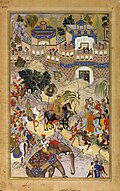 The Mughal Emperor Akbar was a great patron of the Chishti Order.


Other notable Chishti shaykhs[edit | edit source]
- Qutb ud deen Modood Chishti 527 A.H
- Haji Shareef zandani 612 A.H
- Usman Harooni 617 A.H
- Moinuddin Chishti
- Qut ul aqtab Qutb ud deen Bakhtiyar kaki 635 A.H (Delhi, India)
- Fareed ud deen Mas’ood Ganj E Shakar 668 A.H (Pak Patan Sharif, Pakistan)
- Naseer ud deen Mahmood Charagh Dehlavi 757 A.H (Delhi, India)
- Tajuddin Chishti (Chishtian Sharif, Pakistan)
- Amir Khusro (Delhi, India)
- Akhi Siraj Aainae Hind (Dist. Malda, West Bengal, India)
- Alaul Haq Pandavi (Dist. Malda, West Bengal, India)
- Nur Qutb Alam (Dist. Malda, West Bengal, India)
- Ashraf Jahangir Semnani[27] (Kichaucha, Uttar Pradesh, India)
- Burhanuddin Gharib (Maharashtra, India)
- Bande Nawaz (Gulbarga, India)
- Salim Chishti (Fatehpur Sikri, India)
- Noor Muhammad Maharvi1205 A.H (Mahar Sharif, Pakistan)
- Muhammad Suleman Taunsvi 1267 A.H (Taunsa Sharif, Pakistan)
- Ata Hussain Fani Chishti (Bihar, India)
- Khwaja Ghulam Farid (Mithankot, Pakistan)
- Muhammad Shamsuddin Sialvi 1300 A.H (Sial Sharif, Pakistan)
- Ahamed Mohiyudheen Noorishah Jeelani (Noori Maskan, Hyderabad)[28][circular reference]
- Sayyid Mir Jan (supreme leader of the Naqshbandiyya, who also followed the Chishtiyya tradition)
- Meher Ali Shah (Golra Sharif, Pakistan)[29]
- Inayat Khan (Vadodara, Gujarat)
- Haji Imdadullah Muhajir Makki (Muzaffarnagar, India/Makkah, Saudi Arabia)
See also[edit | edit source]
- Waris Shah
- Sabri Brothers
- Nusrat Fateh Ali Khan
- Hakim Ahmad Shuja
- Sufi Ruhaniat International
- Syed Waheed Ashraf
Notes[edit | edit source]
- ↑ Ernst, Carl W. and Lawrence, Bruce B. (2002) Sufi Martyrs of Love: The Chishti Order in South Asia and Beyond Palgrave Macmillan, New Yorks 1234567 4039-6026-7
- ↑ 2.0 2.1 Bennett, Clinton; Ramsey, Charles M., eds. (2012). South Asian Sufis: Devotion, Deviation, and Destiny. London: Continuum International Pub. ISBN 978-1-4411-8474-0.
- ↑ Rozehnal, Robert. Islamic Sufism Unbound: Politics and Piety in Twenty-First Century Pakistan. Palgrave MacMillan, 2007. Print.
- ↑ Sufi martyrs of love By Carl W. Ernst, Bruce B. Lawrence, p. 4.
- ↑ Chishti, Hakim Moinuddin (1991). The Book of Sufi Healing. Rochester: Inner Traditions International. ISBN 0-89281-324-5.
- ↑ 6.0 6.1 Sufi martyrs of love By Carl W. Ernst, Bruce B. Lawrence, p. 5.
- ↑ 7.0 7.1 7.2 7.3 Musharraf, Hussain (21 September 2012). "Islam & Music". Dr Musharraf Hussain. Retrieved 12 June 2020.
- ↑ Muhammad bin Mubarak Kirmani. Siyar-ul-Auliya: History of Chishti Silsila (in Urdu). Translated by Ghulam Ahmed Biryan. Lahore: Mushtaq Book Corner.
{{cite book}}: CS1 maint: unrecognized language (link) - ↑ Nizamuddin Auliya (31 December 1996). Fawa'id al-Fu'aad: Spiritual and Literal Discourses. Translated by Z. H. Faruqi. D.K. Print World Ltd. ISBN 9788124600429.
- ↑ Nizami, K.A. -0141 "Čishtiyya."[permanent dead link] Encyclopaedia of Islam, Second Edition. Edited by: P. Bearman, Th. Bianquis, C. E. Bosworth, E. van Donzel, and W. P. Heinrichs. Brill, 2011. Brill Online. Augustana. 6 April 2011.
- ↑ Böwering, Gerhard. "Cestiya." Encyclopaedia Iranica. Online Edition. Vol. 5. 1992. Web. <http://www.iranica.com/articles/cestiya Archived 19 January 2011 at the Wayback Machine>.
- ↑ Muhammad Zakariya Kandhalvi. Mashaikh-e-Chisht. Trans. Majlisul Ulama of South Africa., available at Scribd
- ↑ Nizami, K.A. "Čishtiyya". Encyclopaedia of Islam, Second Edition. Edited by: P. Bearman, Th. Bianquis, C. E. Bosworth, E. van Donzel, and W. P. Heinrichs. Brill, 2011. Brill Online. Augustana. 6 April 2011 <http://www.brillonline.nl/subscriber/entry?entry=islam_COM[permanent dead link] -0141>.
- ↑ ORIGIN OF CHISHTIES Archived 27 August 2010 at the Wayback Machine. Retrieved 15 August 2008.
- ↑ 15.0 15.1 The Sufis of Britain: an exploration of Muslim identity By Ron Geaves. Cardiff Academic Press, 2000, p. 87.
- ↑ Encyclopaedia of Indian philosophy, Volume 2 By Vraj Kumar Pandey. Anmol Publications, 2007, p. 78.
- ↑ Nizami, K.A. "Čishtī, Ḵhwādja Muʿīn al-Dīn Ḥasan". Encyclopaedia of Islam, Second Edition. Edited by: P. Bearman, Th. Bianquis, C. E. Bosworth, E. van Donzel, and W. P. Heinrichs. Brill, 2011. Brill Online. Augustana. 6 April 2011 <http://www.brillonline.nl Archived 24 November 2015 at the Wayback Machine /subscriber/entry?entry=islam_SIM-1623>.
- ↑ Haeri, Muneera. The Chishtis: A Living Light. Oxford University Press, USA, 2000. Print.
- ↑ Frembgen, Jurgin Wasim. Journey to God: Sufis and Dervishes in Islam. Oxford University Press, USA, 2008, pp. 94–95. ISBN 978-0-19-547642-2.
- ↑ Miller, Rasul (18 March 2020). "Sufi Al-Hajj Wali Akram: 20th Century Black American Muslim Pioneer". Retrieved 15 May 2021.
{{cite web}}: CS1 maint: deprecated archival service (link) - ↑ Miller, Rasul (18 March 2020). "The Black American Sufi: A History". Retrieved 15 May 2021.
{{cite web}}: CS1 maint: deprecated archival service (link) - ↑ Popular in South Asia, in particular parts of Pakistan, India and Bangladesh. See Annemarie Schimmel, in article 'The Chishti Sufis of South Asia—Tradition and Evolution in the 20th Century' in Anderoon: Sufi Journal, Vol 82, np, nd
- ↑ Schimmel, as cited above
- ↑ M Z Akhund 'Sufis in the Subcontinent and their impact on Islamic society' Lahore, Navratna Pubs, Urdu Bazar, 1957. pp 12, 109–115
- ↑ Akhund, 114–115
- ↑ 26.0 26.1 Maxwell., Eaton, Richard (2004). Temple desecration and Muslim states in medieval India. Hope India Publ. pp. 22–31. ISBN 81-7871-027-7. OCLC 705284564.
{{cite book}}: CS1 maint: multiple names: authors list (link) - ↑ *Hayate Makhdoom Syed Ashraf Jahangir Semnani(1975) Second Edition (2017) ISBN 978-93-85295-54-6, Maktaba Jamia Ltd, Shamshad Market, Aligarh 202002, India
- ↑ Ahamed Mohiyudheen Noorishah Jeelani
- ↑ Omer Tarin article in 'Muse India' journal online. Special Sufi literature feature, V. No73, May–June 2017]
References[edit | edit source]
- Haeri, Muneera (2000) The Chishtis: a living light Oxford University Press, Oxford, UK, ISBN 0-19-579327-7
- Ernst, Carl W. and Lawrence, Bruce B. (2002) Sufi Martyrs of Love: The Chishti Order in South Asia and Beyond Palgrave Macmillan, New York, ISBN 1-4039-6026-7. Excerpts
- Farīdī, Iḥtishāmuddīn (1992) Tārīk̲h̲-i iblāg̲h̲-i Cisht Āl Inḍiyā Baz-i Ḥanafī, Delhi, OCLC 29752219 in Urdu with biographies
- Āryā, Ghulām 'Alī (2004) Ṭarīqah-i Chishtīyah dar Hind va Pākistān: ta’līf-i Ghulām‘alī Āryā Zavvār, Tehran, ISBN 964-401-200-3 in Persian
- Chopra, R.M., "SUFISM", 2016, Anuradha Prakashan, New Delhi. ISBN 978-93-85083-52-5.