







WikiDwarfBOT (talk | contribs) robot: add new article |
No edit summary |
||
| Line 1: | Line 1: | ||
{{Short description|Chola emperor from 985 | {{Short description|Chola emperor from 985 to 1014}} | ||
{{Use dmy dates|date=November 2022}} | {{Use dmy dates|date=November 2022}} | ||
{{Use Indian English|date=September 2013}} | {{Use Indian English|date=September 2013}} | ||
{{Infobox royalty | {{Infobox royalty | ||
| regnal name | | regnal name = Rāja Rāja Cola (or) Rāja Rāja I | ||
| title | | title = Rājakēsari Varman,<br />Ponniyin Selvan, Mum'muṭi Coḻa,{{sfn|Vidya Dehejia|1990|p=51}} Sivapathasekaran, Thirumurai Kanda Chola, [[Tailapa II|Taila]] Kula Kaalan, Telungu kula kaalan, [[Pandiya]] Kula Sani, [[Chera|Kerala]]ndhagan, [[Sinhalese|Sinhala]]ndhagan, [[Kshatriya|Kṣatriya]] Śikhāmaṇi | ||
| image | | image = Raraja detail.png | ||
| image_size | | image_size = 250px | ||
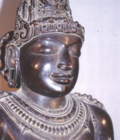
| caption | | caption = Detail of the bronze portrait of Rajaraja Chola at the [[Brihadisvara Temple]].<ref>{{cite news |last1=Sivaraman |first1=R. |title=Idols of Raja Raja Chola, consort recovered from Gujarat |url=https://www.thehindu.com/news/national/tamil-nadu/idols-of-raja-raja-chola-consort-recovered-from-gujarat/article24040723.ece |work=The Hindu |date=30 May 2018 |language=en-IN}}</ref><ref>{{cite news |last1=Srinivasan |first1=G. |title=Tamil Nadu elated Chola era idols' recovery from Gujarat {{!}} Tamil Nadu elated Chola era idols' recovery from Gujarat |url=https://www.deccanchronicle.com/nation/current-affairs/310518/tamil-nadu-elated-chola-era-idols-recovery-from-gujarat.html |work=www.deccanchronicle.com |date=31 May 2018 |language=en}}</ref> | ||
| succession | | succession = [[Chola Empire|Chola Emperor]] | ||
| reign | | reign = June/July 985{{endash}}January or February 1014 | ||
| predecessor | | predecessor = [[Uttama]] | ||
| successor | | successor = [[Rajendra I]] | ||
| birth_name | | birth_name = Arul Mozhi Varman | ||
| birth_date | | birth_date = {{Birth date|947|11|3|df=y}} | ||
| birth_place | | birth_place = [[Thanjavur]], [[Chola Empire]] (modern-day [[Tamil Nadu]], India) | ||
| death_date | | death_date = {{death date and age|1014|1||947|11|3|df=yes}} | ||
| death_place | | death_place = Thanjavur, Chola Empire | ||
| spouse | | spouse = *Thiripuvana Madeviyar | ||
*Lokamahadevi | *Lokamahadevi | ||
*Cholamahadevi | *Cholamahadevi | ||
| Line 25: | Line 25: | ||
*Latamahadevi | *Latamahadevi | ||
*Prithivimahadevi | *Prithivimahadevi | ||
| issue | | issue = * [[Rajendra I]] | ||
* Arulmozhi | * Araiyan Rajarajan | ||
* Arulmozhi Chandramalli alias Gangamadevi | |||
* Mathevadigal | * Mathevadigal | ||
| house | | house = | ||
| father | | father = [[Parantaka II]] | ||
| mother | | mother = Vanavan Mahadevi | ||
| signature | | signature = Raja Raja Chola I.svg | ||
| religion | | religion = [[Hinduism]]<br />''[[#Religious policy|See details]]'' <!-- Added as per [[Napoleon]] --> | ||
| succession2 | | succession2 = King of [[Anuradhapura]] | ||
| reign2 | | reign2 = {{circa|992|January/February 1014}} | ||
| predecessor2 = [[Mahinda V]] | | predecessor2 = [[Mahinda V]] | ||
| successor2 | | successor2 = [[Rajendra Chola|Rajendra I]] | ||
| dynasty | | dynasty = [[Chola dynasty|Chola]] | ||
}} | }} | ||
{{Chola history}} | {{Chola history}} | ||
''' | '''Rājarāja I''' ([[Middle Tamil]]: ''Rājarāja Cola''; ''Rājarāja Śōḷa''; 3 November 947 – January/February 1014),{{sfn|Vidya Dehejia|1990|p=51}}{{sfn|K. A. N. Sastri|1992|p=1}} also known as '''Rajaraja the Great''', was a [[Chola Empire|Chola]] emperor who reigned from 985 to 1014. He was known for his conquests of [[South India|southern India]] and the [[Anuradhapura kingdom]] of [[Sri Lanka]], as well as increasing Chola influence across the Indian Ocean. Rajaraja's birth name is variously given as Arul Mozhi Varman and Arulmoli Varman. | ||
Rajaraja's empire encompassed vast territories, including regions of the [[Pandya dynasty|Pandya country]], the [[Chera dynasty|Chera country]], and northern Sri Lanka. He also extended his influence over strategic islands such as [[Lakshadweep]], [[Thailand|Thiladhunmadulu]] atoll, and parts of the [[Maldives]] in the Indian Ocean. His conquests were not limited to the south; he also launched successful campaigns against the [[Western Ganga dynasty|Western Gangas]] and the [[Western Chalukya Empire|Western Chalukyas]], extending Chola authority as far as the [[Tungabhadra River]]. In the east, Rajaraja faced fierce opposition from the [[Telugu Chodas|Telugu Chola]] king Jata Choda Bhima over control of [[Vengi]]. This region held significant strategic importance due to its access to resources and trade routes. The conflict between the two rulers intensified as they vied for dominance in the region, resulting in significant battles and shifting allegiances.<ref name="sen2">{{Cite book|last=Sen|first=Sailendra|title=A Textbook of Medieval Indian History|publisher=Primus Books|year=2013|isbn=978-9-38060-734-4|pages=46–49}}</ref><ref name="India's Past p.51">A Journey through India's Past by Chandra Mauli Mani p.51 (Northern Book Centre, 2006)</ref>{{sfn|M. G. S. Narayanan|2013|p=115-117}} | |||
Rajaraja I | Rajaraja I commissioned the construction of the [[Brihadisvara Temple|Rajarajeshwaram Temple]] in the Chola capital of [[Thanjavur]], revered as one of the most prominent examples of the medieval South Indian architectural style.<ref>''The Hindus: An Alternative History'' by Wendy Doniger, p. 347.</ref> Additionally, during his reign, important Tamil literary works by poets such as Appar, Sambandar, and Sundarar were gathered and compiled into a single collection known as the ''[[Thirumurai]]''. This earned him the title of 'Thirumurai Kanda Cholar' ({{Literal translation|The One Who Found ''Thirumurai''}}).<ref name="India's Past p.51" /><ref>''Indian Thought: A Critical Survey'' by K. Damodaran, p. 246.</ref> He initiated a project of land survey and assessment in 1000 which led to the reorganisation of Tamil country into individual units known as ''valanadus''. Rajaraja died in 1014, and was succeeded by his son Rajendra Chola I. | ||
== Early life == | == Early life == | ||
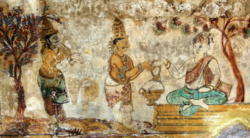
[[File:Rajaraja mural.png|thumb|Rajaraja and his brother [[Aditha Chola II|Aditha Karikalan]] meeting their guru | [[File:Rajaraja mural-2 (cropped).jpg|thumb|Mural of Rajaraja]] | ||
Rajaraja was | [[File:Rajaraja mural.png|thumb|Rajaraja and his brother [[Aditha Chola II|Aditha Karikalan]] meeting their guru|250x250px]] | ||
Rajaraja was the son of the Chola king [[Parantaka II]], also known as Sundara Chola, and his wife Vanavan.{{sfn|Vidya Dehejia|2009|p=42}} As recorded in the [[Thiruvalangadu]] copper-plate inscription, his birth name was Arun Mozhi Varman, meaning "The Word of Sun Clan".{{sfn|Vidya Dehejia|1990|p=51}}{{sfn|A. K. Seshadri|1998|p=31}} He was born around 947 during the Tamil month of , under the Sadhayam star.<ref>{{cite book|url=https://books.google.com/books?id=4tG1AAAAIAAJ&q=rajaraja+947 |title=Tamil Civilization: Quarterly Research Journal of the Tamil University |volume=3 |publisher=Tamil University |year=1985 |pages=40–41}}</ref> The [[Government of Tamil Nadu]] recognises his birthdate as 3 November 947.<ref name="outlookindia.com">{{Cite web|url=https://www.outlookindia.com/national/why-tamil-nadu-celebrating-king-raja-raja-chola-s-birthday-is-a-masterstroke-in-symbolism-news-234268|title=Why Tamil Nadu Celebrating King Raja Raja Chola's Birthday Is A Masterstroke In Symbolism|date=2 November 2022}}</ref> Rajaraja had an elder brother, [[Aditha Karikalan|Aditha II]],{{sfn|K. A. N. Sastri|1992|p=1}} and an elder sister, [[Kundavai Pirāttiyār|Kundavai]].{{sfn|A. K. Seshadri|1998|p=32}} | |||
Rajaraja's | Rajaraja's accession marked the end of a period of competing claims to the Chola throne, following the reign of his great-grandfather [[Parantaka I]]. After Parantaka I, his elder son [[Gandaraditya]] became king. However, upon Gandaraditya's death, his son Madhurantakan was still a minor, so the throne passed to Parantaka I's younger son, [[Arinjaya Chola|Arinjaya]]. Arinjaya soon died, and his son Parantaka II (Sundara Chola) succeeded him. It was decided that Sundara Chola would be succeeded by [[Uttama (Chola dynasty)|Madhurantakan]], likely due to Sundara's preference. However, according to the Thiruvalangadu inscription of Rajaraja's son, [[Rajendra I]], the succession plan may have been made by Rajaraja himself.{{sfn|K. A. N. Sastri|1992|p=1}} | ||
Aditha died under mysterious circumstances | Aditha II died under mysterious circumstances, with inscriptions suggesting he may have been assassinated. Shortly afterwards, Sundara Chola also died, enabling Madhurantakan to assume the throne with the title Uttama Chola. Following Uttama Chola's death, Arul Moli Varman ascended the throne in mid-985{{sfn|K. A. N. Sastri|1992|p=1}} and adopted the regnal name Rajaraja, meaning "King among Kings."{{sfn|Vidya Dehejia|1990|p=49}} | ||
== Military conquests == | == Military conquests == | ||
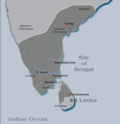
[[File: | [[File:Rajaraja territories.png|center|thumb|363x363px|Chola empire during the reign of Rajaraja I]] | ||
Rajaraja inherited a kingdom | When Rajaraja came to power, he inherited a small kingdom centered around the Thanjavur–Tiruchirappalli region, the heart of traditional Chola territory.{{sfn|Vidya Dehejia|1990|p=51}} He transformed this kingdom from one that was recovering from attacks by the [[Rashtrakuta Empire]] into one that was a well-organised empire with a powerful army and navy. Under his rule, the northern kingdom of [[Vengi]] became closely allied with the Cholas, and their influence expanded along the eastern coast all the way up to [[Kalinga (region)|Kalinga]] in the north.{{sfn|K. A. N. Sastri|1992|p=1}} | ||
[[Rajaraja Chola]] Thiruvalangadu plates states that, Arulmolivarman : | |||
{{cquote|(performed [[tulabhara]] captured the town Vilinda; conquered the [[Pandya]] Amarabujanga and burnt the lord of [[Sri Lanka|Lanka]]; defeated [[Satyashraya]]; killed Andhra [[Jata Choda Bhima|Bhima]]; conquered the country of Parasurama(i.e.,[[Chera]]) and subdued the kings of [[Western Ganga dynasty|Ganga]], [[Kalinga (region)|Kalinga]], [[Vengi]], Magatha, Aratta ,odda,Surashtra and [[Western Chalukya|Chalukya]]).<ref name="Chakravarti 1933">{{Cite book |last=Chakravarti |first=N. p |url=http://archive.org/details/in.ernet.dli.2015.69621 |title=Epigraphia Indica Vol.22 |date=1933}}</ref> | |||
}} | |||
The Larger Leiden plates States that [[Rajaraja]], | |||
{{cquote|"conquered the [[Pandya]], [[Tulunadu|Tulu]], [[Chera kingdom|Kerala]], [[Sri Lanka|Simhalendra]] and [[Satyashraya]] ; destroyed ships at Kandalur-Salai , captured Vengainadu([[Vengi]]), Gangapadi, Nulambapadi, Tadigaipadi, Kudamalainadu, [[Kollam]], [[Kalinga (region)|Kalingam]], and Ilam([[Sri Lanka]] ) ; and removed the splendour of the Seliyas(i.e.,[[Pandyas]])."<ref name="Chakravarti 1933" /> | |||
}} | |||
=== Against Kandalur Salai === | === Against Kandalur Salai === | ||
{{Main|Battle of Kandalur Salai}} | {{Main|Battle of Kandalur Salai}} | ||
[[File:Suchindram inscription of Rajaraja I.jpg|thumb| | [[File:Suchindram inscription of Rajaraja I.jpg|thumb|Inscription of Rajaraja in [[Suchindram]], near [[Kanyakumari]]]] | ||
Rajaraja's earliest inscriptions | Rajaraja's earliest inscriptions commemorate a significant triumph at Kandalur Salai, located in present-day Kerala, around 988. He is acclaimed as 'Kāndalūr śālai Kalam-arutta', which translates to 'the one who destroyed Kandalur Salai'.{{sfn|S.R. Balasubrahmanyam|1977|p=3}} | ||
Originally, this area was under the control of the [[Ay dynasty|Ay chief]], who served as a vassal to the Pandya king of [[Madurai]]. However, it remains uncertain whether warriors from the Chera or Pandya dynasties were involved in this conflict. The Thiruvalangadu inscription suggests that Rajaraja's general captured [[Vizhinjam]] (Viḷinam), which could have been part of the Kandalur Salai campaign. It appears that this engagement involved the Chola navy, or possibly a joint operation involving both the navy and the army.{{sfn|M. G. S. Narayanan|2013|pp=115–118}} | |||
=== Conquest of Kerala and the Pandyas === | === Conquest of Kerala and the Pandyas === | ||
Rajaraja's inscriptions begin to appear in [[Kanyakumari district]] in the 990s and in [[Thiruvananthapuram district]] in the early 1000s. The Chola subjugation of Kerala can be dated to the early years of the 11th century.{{sfn|M. G. S. Narayanan|2013|pp=115–118}} The Senur inscription, dated to 1005 and attributed to Rajaraja, records his military achievements. It mentions the destruction of the Pandya capital, Madurai, as well as the conquest of several regions. These include defeating the formidable rulers of Kollam (Venad), Kolla-desham (Mushika), and Kodungallur (the Chera Perumals of Makotai).{{sfn|M. G. S. Narayanan|2013|pp=115–118}}{{sfn|K. A. N. Sastri|1992|p=2}}<ref name="Chakravarti 1933" /> Some triumphs in the region of Malainadu were possibly achieved by Rajaraja's son, Rajendra Chola.{{sfn|M. G. S. Narayanan|2013|pp=115–117}} | |||
Following his victory over the Pandyas, Rajaraja assumed the title of Pandya Kulashani, which translates to 'Thunderbolt to the Race of the Pandyas'. As a result of his conquest, the territory of the Pandyas became recognised as "Rajaraja Mandalam" or "Rajaraja Pandinadu".{{sfn|K. A. N. Sastri|1992|p=238}} When recounting Rajaraja's military expedition in Trisanku Kastha (the southern region), the Thiruvalangadu Grant of Rajendra I mentions the capture of a certain royal figure named Amarabhujanga.{{sfn|V. Ramamurthy|1986|pp=288–289}} However, the specific identity of this individual—whether he was a prince of the Pandya dynasty, a general serving the Pandya king, or a prince of the Kongu Chera dynasty—remains a matter of debate.{{sfn|M. G. S. Narayanan|2013|pp=115–117}}{{sfn|V. Ramamurthy|1986|pp=288–289}} According to the ''Kongu Desa Rajakkal,'' a historical record of the [[Kongu Nadu]] region, it is suggested that this general eventually changed his loyalty to Rajaraja. He is said to have participated in the ritual of ''kanakabhisheka,'' where gold is poured over the Chola king, symbolising an act of royal anointment or coronation.{{sfn|V. Ramamurthy|1986|pp=288–289}} | |||
Once Rajaraja had consolidated his authority in the southern regions, he took on the title of Mummudi Chola. This title, which means "Three Crowned", symbolised his power over three important Tamil kingdoms: the Cholas, the Pandyas, and the Cheras.{{sfn|Vidya Dehejia|1990|p=51}} | |||
=== Conquest of northern Sri Lanka === | |||
{{Main|Chola conquest of Anuradhapura}} | |||
[[File:Polonnaruwa 0305.jpg|left|thumb|Remains of a [[Shiva]] temple, erected following Rajaraja's capture of [[Polonnaruwa]] and its renaming to [[Jananathamangalam]], which indicate the Chola emperor's conquest in the region]] | |||
During the reign of King Mahinda V, the Sinhalese kingdom of Anuradhapura experienced a significant military revolt around 982 CE, primarily as a consequence of the monarch's economic policies. The armed forces of the Anuradhapura capital predominantly consisted of Tamil mercenaries recruited from coastal regions. By 982, tensions escalated into a full-fledged uprising led by these mercenaries, resulting in a protracted civil conflict. The ensuing turmoil compelled the vulnerable Sinhala ruler to seek refuge in the Rohana principality, thereby plunging the capital city of Anuradhapura into an extended period of civil unrest lasting approximately eleven years, marked by widespread disorder and lawlessness. | |||
{{sfn|K. A. N. Sastri|1992|p=3}} | |||
The disruption of central governance exacerbated the financial strain on the kingdom, particularly in meeting the obligations to the Tamil mercenaries. Consequently, the mercenaries, feeling aggrieved and disillusioned, turned their allegiance towards the Chola empire. This strategic shift left Anuradhapura vulnerable to the incursions of the Chola forces, who exploited the internal strife to mount invasions in 993. These events, documented in historical sources, underscore the intricate interplay of economic policies, military dynamics, and regional power struggles during this period in the history of Anuradhapura. | |||
{{sfn|Gunawardena|2005|p=71}}{{sfn|K. A. N. Sastri|1992|p=3}} | |||
In 993, Rajaraja achieved the conquest of Anuradhapura, known as Pihiti rata in local context, situated in Sri Lanka. This territory was subsequently designated as Ila-mandalam in Chola historical records.{{sfn|K. A. N. Sastri|1992|p=2}} The military campaign led to the sacking of Anuradhapura by the Chola army, resulting in the acquisition of the northern portion of Sri Lanka by the Chola empire. As part of their administrative efforts, the Cholas established a provincial capital at the strategic military outpost of [[Polonnaruwa]], renaming it Jananathamangalam in honour of Rajaraja's title.{{sfn|K. A. N. Sastri|1992|p=3}} | |||
Under Chola administration, the official Tali Kumaran{{clarify|reason=what is this?|date=June 2025}} oversaw the construction of a significant [[Shiva]] temple known as Rajarajeshwara, meaning "Lord of Rajaraja", within the town of Mahatirtha, now recognised as modern-day Mantota. Consequently, Mahatirtha was renamed Rajarajapura in commemoration of the Chola monarch's conquest and establishment of authority in the region.{{sfn|K. A. N. Sastri|1992|p=3}} | |||
The Thiruvalangadu Plates directly compare Rajaraja's campaign to the invasion of Lanka by the legendary hero Rama: | |||
{{cquote | {{cquote | ||
| quote="Rama built with the aid of monkeys, a causeway across the sea, and then with great difficulties defeated the king of Lanka | | quote = "Rama built with the aid of monkeys, a causeway across the sea, and then with great difficulties defeated the king of Lanka using sharp-edged arrows. But Rama was excelled by this king whose powerful army crossed the ocean by ships and burnt up the king of Lanka." | ||
| source = Thiruvalangadu Copper Plates{{sfn|Vidya Dehejia|1990|p=51}} | | source = Thiruvalangadu Copper Plates{{sfn|Vidya Dehejia|1990|p=51}} | ||
| align = center | | align = center | ||
| width = 75% | | width = 75% | ||
}} | }} | ||
=== Chalukyan conflict === | === Chalukyan conflict === | ||
In 998 | In 998, Rajaraja annexed Gangapadi, Nolambapadi, and Tadigaipadi (present-day Karnataka).<ref name="whatisindia.com">{{Cite web |title=South Indian Inscriptions Volume 2 - Rajarajesvara Temple Inscriptions at Tanjavur @ whatisindia.com |url=https://www.whatisindia.com/inscriptions/south_indian_inscriptions/volume_2/introduction.html |access-date=2025-07-28 |website=www.whatisindia.com}}</ref> During this campaign, he subdued the [[Nolamba dynasty]], who were previously vassals of the Ganga dynasty.<ref>Seminar on Social and Cultural History of Dharmapuri district p.46</ref><ref>{{cite book|url=https://books.google.com/books?id=7WQ9AQAAIAAJ&q=nolambas+rashtrakutas|title=The Noḷambas: a political and cultural study, c750 to 1050 A.D.|author=M. S. Krishna Murthy|publisher=University of Mysore|year=1980|page=98}}</ref> These territories were initially under the suzerainty of the Rashtrakutas, who had been defeated by the Western Chalukyas in 973. Consequently, the Cholas found themselves in direct conflict with the Chalukyas.<ref name="ReferenceA">Ancient Indian History and Civilization by Sailendra Nath Sen p.398</ref> | ||
===Battle of Gangavadi=== | |||
By 1004, Rajaraja had conquered the Gangavadi province.<ref>{{cite book|title=The Making of Southern Karnataka: Society, Polity and Culture in the Early Medieval Period|author=Malini Adiga|publisher=Orient BlackSwan, 2006|page=239}}</ref> He established control over the western part of Gangavadi, ruled by the Changalvas, and over Kodagu, governed by the Kongalvas, who were then made vassals of the Chola Empire.<ref name=manya>{{cite book|title=History of Indian Administration: Medieval period|author=Baij Nath Puri|publisher=Bharatiya Vidya Bhavan, 1975|page=51}}</ref> In 1004 AD Raja Raja Chola encamped in [[WesternGangadynasty|Gangavadi]] province, and soon [[Westernchalukyadynasty|Chalukya]] army invaded. In the [[Battle of Gangavadi]], Raja Raja Chola defeated the invading Chalukya army and secured [[WesternGanga dynasty|Gangavadi]] Province.<ref>{{Cite book |last=Anirudh Kanisetti |url=http://archive.org/details/anirudh-kanisetti-lords-of-earth-and-sea-a-history-of-the-chola-empire-juggernaut-books-2025 |title=Lords Of Earth And Sea A History Of The Chola Empire (2025) |date=2025}}</ref> | |||
===Battle of Annigeri=== | |||
[[Raja Raja Chola]] led the campaign in Ratta Padi in 1003–1004 AD and achieved victory in many battles. [[Raja Raja Chola I]] defeated [[Satyashraya]] in the [[Battle of Annigeri]] and successfully conquered Annigeri Province. In this battle Satyashraya was assisted by his brother Dasavarman and General Dandanayaka Kesava. Dandanayaka Kesava was governor of the Belvola-300 and Puligere-300 divisions, which are located in [[Annigeri]] Province. The Tiruvalangadu plates of [[Rajendra Chola]] state that Raja Raja defeated [[Satyashraya]] who "fled to avoid misery from the attack of his (i.e., Arulmolivarman's) ocean-like army; (still) misery found a (permanent) abode in him. In this battle Satyashraya's brother, Prince Dasavarman, was killed, and Chalukya general Dandanayaka Kesava was taken prisoner. After Raja Raja Chola returned to his capital with booty of some gold flowers and treasures, which he dedicated to the temple of [[Thanjavur]].<ref>{{cite book|title=Mysore Gazetteer, Volume 2, Part 2|author=Benjamin Lewis Rice|publisher=Government Press, 1930 – Karnataka (India)|page=1075}}</ref><ref name="B.R Gopal 1981">{{Cite book |last=B.R Gopal |url=http://archive.org/details/sgw.chalukyasofkalya0000brgo |title=The Chalukyas Of Kalyana And The Kalachuris |date=1981 |publisher=Karnataka University Dharwad |others=Servants of Knowledge |language=English}}</ref><ref>{{Cite book |last=Sivaramamurti |first=C. |url=http://archive.org/details/in.gov.ignca.29374 |title=Chola temples Tanjavur |date=1960}}</ref> | |||
===Siege of Unkal=== | |||
Raja Raja Chola diverted attention from [[Vengi]] affairs to the [[Satyashraya]] to counteroffensive and sent an army under Crown Prince [[Rajendra Chola]] in Chalukya Country. Rajendra marched with a 900,000-strong army and Captured Santalige, Kadambalige, [[Banavasi]], [[Kogali]] and besieged the fort of Unkallu in the modern Unkal district located in the Dharwad district. In this ensuing battle, the Cholas defeated the Chalukyas, and the Chalukya commander, Lenka Keta, was killed. After Rajendra Chola successfully captured Unkallu Fort and then encamped at Donur.<ref>{{Cite book |last=Murari |first=Krishna |url=https://books.google.com/books?id=TeK1AAAAIAAJ |title=The Cāḷukyas of Kalyāṇi, from Circa 973 A.D. to 1200 A.D.: Based Mainly on Epigraphical Sources |date=1977 |publisher=Concept Publishing Company |language=en}}</ref><ref>{{Cite book |last=S. Ramakrishnan |first=General Editor |url=http://archive.org/details/struggleforempir05bhar |title=History and Culture of the Indian People, Volume 05, The Struggle For Empire |date=2001 |publisher=Bharatiya Vidya Bhavan |others=Public Resource}}</ref> | |||
===Battle of Donur=== | |||
{{Main|Battle of Donur}} | |||
Following the Siege of Unkallu Fort, Rajendra battled against Satyashraya, who was opposing him in Donur. In the Battle of Donur, [[Rajendra chola]] defeated [[Satyashraya]] and successfully raided [[Banavasi]], [[Donur]] (in the Bijapur region), [[Unkal]] (near modern Hubli), [[Kudala Sangama]] and parts of the [[Raichur]] Doab and secured [[Western Ganga dynasty|Gangavadi]] and Nolambavadi. But this conquest and all raids in Chalukya country only lasted until [[Satyashraya]] reconquered all territories up to Thungapathra.<ref>{{Cite book |last=Murari |first=Krishna |url=https://books.google.com/books?id=TeK1AAAAIAAJ |title=The Cāḷukyas of Kalyāṇi, from Circa 973 A.D. to 1200 A.D.: Based Mainly on Epigraphical Sources |date=1977 |publisher=Concept Publishing Company |language=en}}</ref><ref>{{Cite book |url=http://archive.org/details/bmshri.karnatakathrough0000unse |title=Karnataka Through The Ages |date=1968 |publisher=The Government Of Mysore |others=Servants of Knowledge}}</ref> | |||
An inscription attributed to Irivabedanga Satyashraya from Dharwar acknowledges his allegiance to the Western Chalukyas and highlights the Chola incursion. He accuses Rajendra Chola of leading a massive force of 955,000 soldiers and causing havoc in Donuwara([[Donur]] in [[Bijapur]] district), blurring the ethical boundaries of warfare prescribed by the [[Dharmaśāstra|''Dharmaśāstras'']].<ref name="Studying early India: archaeology, texts and historical issues, page 198">''Studying early India: archaeology, texts and historical issues'', p. 198</ref> Historians such as James Heitzman and Wolfgang Schenkluhn interpret this confrontation as indicative of personal animosity between the rulers of the [[Chola]] and [[Western Chalukya]] kingdoms, akin to historical conflicts between the [[Chalukyas of Badami]] and the [[Pallavas of Kanchi]].<ref name="The world in the year 1000, page 311">''The world in the year 1000'', p. 311</ref><ref>''History of India: a new approach'' by Kittu Reddy, p. 146</ref> | |||
=== Vengi kingdom === | |||
Meanwhile, the Vengi kingdom was under the rule of Jata Choda Bhima, a member of the [[Telugu Chodas|Telugu Cholas]] branch.<ref name=manya /> However, Rajaraja emerged victorious in battle against Bhima, and Saktivarman, an Eastern Chalukya prince, was appointed as a viceroy under the Chola Dynasty.<ref name="ReferenceA" /> Despite a brief period of Bhima's recapture of [[Kanchi]] in 1001, Rajaraja swiftly restored Saktivarman to power.<ref>{{cite book|url=https://books.google.com/books?id=qLwKAQAAIAAJ&q=raja+raja+chola+kalinga|title=The History and Culture of the Indian People: The age of imperial Kanauj|author=Ramesh Chandra Majumdar|publisher=Ramesh Chandra Majumdar|year=1951|page=154}}</ref><ref name="Venkataramanayya 1950">{{Cite book |last=Venkataramanayya |first=N[elaturi |url=http://archive.org/details/venkataramanayya-n.-the-eastern-calukyas-of-vengi |title=The Eastern Calukyas of Vengi |date=1950}}</ref> Notably, Rajaraja cemented an alliance between the Chola Dynasty and the Eastern Chalukya kingdom by arranging the marriage of his daughter, Kundavai, to the next viceroy of Vengi, Vimaladitya. This strategic union ensured the future succession of Rajaraja's descendants to the throne of the [[eastern Chalukya kingdom]].<ref name="Cholas I">{{Cite book |url=http://archive.org/details/CholasI |title=Cholas I}}</ref>[[Satyashraya]] retaliated by invading the [[Vengi]] country in 1006 A.D. and placed Saktivaiman on the Vengi Throne. Raja Raja Chola diverted the Chalukyas to send a big army under Prince Rajendra Chola in Chalukya country. So [[Satyashraya]], without having reinforcement to deal with the Chola army, called back his general Bayal Nambi, who advanced up to [[Chebrollu]]. Satyastraya did not permanently recapture Vengi. He made attempts, but the Cholas successfully defended their influence.<ref name="B.R Gopal 1981"/><ref name="Venkataramanayya 1950"/> | |||
=== Victory over Hoysalas === | |||
[[Narsipura|Narasipur]], dated to 1006, records that Rajaraja's general Aprameya killed Hoysala generals and a minister identified as Naganna.<ref name="Epigraphia Indica, Volume 30, page 248">''Epigraphia Indica, Volume 30, page 248''</ref><ref name="Kitabistam,Allahabad">{{Cite book |url=http://archive.org/details/historicalinscri035270mbp |title=Historical Inscriptions Of Southern INida |publisher=Kitabistam,Allahabad |others=BRAOU, Digital Library Of India}}</ref> Additionally, a similar inscription in [[Channapatna]] describes Rajaraja defeating the Hoysalas.General Aprameya defeated Hoysala leaders manjaga, kaliga(or kali – ganga),Nigavarma and others in the [[Battle of Kalavur]] .winning by his valour in the plain of Kalavur a name to endure for ever.<ref name="Cholas I"/> | |||
=== Kalinga conquest === | === Kalinga conquest === | ||
The invasion of the kingdom of Kalinga occurred after the conquest of Vengi. This conquest marked the northern boundary of the Chola Empire at that time and established their control over the entirety of south and south-east India.<ref>{{cite web | title=Cholas I | url=https://archive.org/details/CholasI/page/n252/mode/1up }}</ref><ref name="Kitabistam,Allahabad"/><ref name="Chakravarti 1933" /><ref>{{Cite book |last=Sivaramamurti |first=C. |url=http://archive.org/details/in.gov.ignca.29374 |title=Chola temples Tanjavur |date=1960}}</ref> | |||
The invasion of the kingdom of Kalinga occurred after the conquest of Vengi.<ref | |||
=== Conquest of Kuda-malai-nadu === | === Conquest of Kuda-malai-nadu === | ||
In multiple historical accounts, there are mentions of Rajaraja's conquest of a place called "Kuda-malai-nadu" around the year 1000.{{sfn|M. G. S. Narayanan|2013|p=115-117}}<ref>{{cite book|title=A Journey through India's Past (Great Hindu Kings after Harshavardhana)|author=Chandra Mauli Mani|publisher=Northern Book Centre, 2009 – India – 132 pages|page=51}}</ref> In certain inscriptions found in Karnataka, the term "Kudagu-malai-nadu" is used instead of "Kuda-malai-nadu". Scholars generally believe that this region corresponds to Coorg (Kudagu).{{sfn|M. G. S. Narayanan|2013|p=115-117}}<ref>{{cite book|title=Epigraphia Indica, Volume 22|publisher=Archaeological Survey of India |date=1935 |page=225}}</ref> | |||
The king's conquest of Malainadu is described in the Vikrama Chola Ula, where it is said that he achieved it in just one day, crossing 18 mountain passes. According to the Kulottunga Chola Ula, Rajaraja was depicted as beheading 18 people and burning down Udagai. Additionally, the Kalingathupparani references the establishment of Chadaya Nalvizha in Udiyar Mandalam, the seizure of Udagai, and the plundering of several elephants from the area. The Tiruppalanam inscription from 999 records the king's offering of an idol obtained as spoils from Malainadu.{{sfn|M. G. S. Narayanan|2013|p=115-118}}<ref name="whatisindia.com"/><ref name="Cholas I"/> | |||
=== Naval expedition === | === Naval expedition and Conquest of the Maldives === | ||
{{ | The naval campaigns of Rajaraja formed a reassertion of Chola power in the Indian Ocean.{{sfn|M. G. S. Narayanan|2013|p=115-117}} | ||
{{blockquote | |||
| quote="A naval campaign led to the conquest of the Maldive Islands, the Malabar Coast, and northern Sri Lanka, all of which were essential to the Chola control over trade with Southeast Asia and with Arabia and eastern Africa. These were the transit areas, ports of call for the Arab traders and ships to Southeast Asia and China, which were the source of the valuable spices sold at a high profit to Europe." | | quote="A naval campaign led to the conquest of the Maldive Islands, the Malabar Coast, and northern Sri Lanka, all of which were essential to the Chola control over trade with Southeast Asia and with Arabia and eastern Africa. These were the transit areas, ports of call for the Arab traders and ships to Southeast Asia and China, which were the source of the valuable spices sold at a high profit to Europe." | ||
| author = Romila Thapar | | author = Romila Thapar | ||
| Line 112: | Line 153: | ||
| align = center | | align = center | ||
}} | }} | ||
The Cholas controlled the area around | The Cholas controlled the area around [[Bay of Bengal]] with [[Nagapattinam]] as the main port. The [[Chola Navy]] also played a major role in the invasion of Sri Lanka.{{sfn|Milo Kearney|2003|p=70}} The success of Rajaraja allowed his son [[Rajendra Chola]] to lead the [[Chola invasion of Srivijaya]], carrying out naval raids in South-East Asia and briefly occupying [[Kedah|Kadaram]].<ref name="sen2" /><ref>Nagapattinam to Suvarnadwipa: Reflections on the Chola Naval Expeditions to Southeast Asia by Hermann Kulke, K Kesavapany, Vijay Sakhuja p.230</ref> | ||
Rajaraja I and Rajendra I are described as the greatest Chola rulers because of these conquests.<ref>[[Satish Chandra (historian)|Chandra, Satish]]. ''Medieval India: From Sultanat to the Mughals. Vol. 2''. Har-Anand Publications, 1997. ISBN 978-8124105221.</ref>{{page needed|date=June 2025}} | |||
== Personal life == | == Personal life == | ||
Rajaraja married several women, including the following: Vanathi aka Thiripuvāna Mādēviyār, Dantisakti Vitanki aka Lokamadevi, Panchavan Madeviyar, Chola Mahadevi, Trailokya Mahadevi, Lata Mahadevi, Prithvi Mahadevi, Meenavan Mahadevi, Viranarayani and Villavan Mahadevi.{{sfn|S.R. Balasubrahmanyam|1977|p=6}}<ref>{{cite book|url=https://books.google.com/books?id=hlnaAAAAMAAJ&q=raja+raja+cholan+kundavai|title=Documentation on Women, Children, and Human Rights|publisher=Sandarbhini, Library and Documentation Centre|year=1994}}</ref><ref>{{cite book|url=https://books.google.com/books?id=vEVuAAAAMAAJ&q=rajendra+chola+mother|title=Studies in Indian place names|publisher=Place Names Society of India|page=58|year=1954}}</ref> He had at least three daughters and two sons. The older son, Rajendra, was born to Thiripuvāna Mādēviyār.<ref name="Early Chola art, page 183">''Early Chola art, page 183''</ref>{{full citation needed|date=June 2025}}<ref name="A Topographical List of Inscriptions in the Tamil Nadu and Kerala States: Thanjavur District, page 180">''A Topographical List of Inscriptions in the Tamil Nadu and Kerala States: Thanjavur District, page 180''</ref>{{full citation needed|date=June 2025}} The younger son was named Araiyan Rajarajan, and the identity of his mother is unknown.{{citation needed|date=April 2024}} He had his first daughter [[Kundavai]] with Lokamadevi who eventually married [[Eastern Chalukyas|Chalukya]] prince Vimaladithan.{{citation needed|date=April 2024}} Rajaraja had two other daughters.{{citation needed|date=April 2024}} Rajaraja died in 1014 in the [[Tamil calendar|Tamil month]] of Maka and was succeeded by Rajendra Chola I.<ref>{{cite book|url=https://books.google.com/books?id=sUghAAAAMAAJ&q=raja+raja+chola+died+month|title=Rāja Rāja, the great|publisher=Ananthacharya Indological Research Institute|year=1987|page=28}}</ref> | |||
Rajaraja married | |||
== Administration == | == Administration == | ||
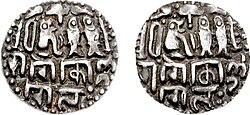
[[File:Chola Kings. Rajaraja I. 985-1014 CE Uncertain Tamilnadu mint. Chola, conqueror of the Gangas in Tamil, seated tiger with two fish.jpg|thumb|Imperial | [[File:Chola Kings. Rajaraja I. 985-1014 CE Uncertain Tamilnadu mint. Chola, conqueror of the Gangas in Tamil, seated tiger with two fish.jpg|thumb|Imperial coin of Chola King Rajaraja I (985–1014). Uncertain [[Tamilnadu]] mint. Legend "Chola, conqueror of the Gangas" in Tamil, seated tiger with two fish.]] | ||
[[File:Seal of Rajaraja I.jpg|thumb|Imperial | [[File:Seal of Rajaraja I.jpg|thumb|Imperial seal of Rajaraja I]] | ||
Before the reign of Rajaraja I, | Before the reign of Rajaraja I, portions of the Chola territory were ruled by hereditary lords and princes who were in a loose alliance with the Chola rulers.<ref name="Practice p.172">Precolonial India in Practice : Society, Region, and Identity in Medieval Andhra by Austin Cynthia Talbot Assistant Professor of History and Asian Studies University of Texas p.172</ref> Rajaraja initiated a project of land survey and assessment in 1000 which led to the reorganisation of the empire into units known as ''valanadus''.<ref name="Early Medieval India p.590">''A History of Ancient and Early Medieval India: From the Stone Age to the 12th century'' by Upinder Singh, p. 590.</ref><ref name="India p.76">''Administrative System in India: Vedic Age to 1947'' by U. B. Singh, p. 76.</ref> From the reign of Rajaraja I until the reign of [[Vikrama Chola]] in 1133, the hereditary lords and local princes were either replaced or turned into dependent officials.<ref name="Practice p.172" /> This led to the king exercising closer control over the different parts of the empire.<ref name="Practice p.172" /> Rajaraja strengthened the local self-governments and installed a system of audit and control by which the village assemblies and other public bodies were held to account while retaining their autonomy.<ref>Life/Death Rhythms of Ancient Empires – Climatic Cycles Influence Rule of Dynasties by Will Slatyer p.236</ref><ref name="The First Spring p.68">The First Spring: The Golden Age of India by Abraham Eraly p.68</ref>{{sfn|Geeta Vasudevan|2003|pp=62–63}} To promote trade, he sent the first Chola mission to [[Northern Song dynasty|China]].<ref>Tamil Nadu, a real history by K. Rajayyan p.112</ref> Furthermore, his elder sister Kundavai assisted him in the administration and management of temples.<ref name="Ancient system of oriental medicine, page 96">''Ancient system of oriental medicine, page 96''</ref> | ||
== Officials == | == Officials == | ||
[[File:Rajaraja mural-2.jpg|left|thumb|296x296px|Mural depicting Rajaraja and his guru [[Karuvurar|Karuvuruvar]] found in the Brihadisvara temple, Tamil Nadu | [[File:Rajaraja mural-2.jpg|left|thumb|296x296px|Mural depicting Rajaraja and his guru [[Karuvurar|Karuvuruvar]] found in the Brihadisvara temple, Tamil Nadu (11th century)<ref>{{cite book|url=https://books.google.com/books?id=7RTqAAAAMAAJ&q=chola+Karuvurar|title=A History of Fine Arts in India and the West|author=Edith Tömöry|publisher=Orient Longman|year=1982|page=246|isbn=978-0-86131-321-1 }}</ref><ref>{{cite book|url=https://books.google.com/books?id=YIlHAQAAIAAJ&q=chola+Karuvurar|title=Encyclopaedia of Indian paintings|author=Rakesh Kumar|publisher=Anmol Publications |year=2007|page=4|isbn=9788126131228}}</ref>]] | ||
[[Rajendra Chola I]] | Towards the end of his reign, Rajaraja appointed [[Rajendra Chola I]] as co-regent, who served as the supreme commander of the northern and northwestern territories. Under his rule, the administrative system was expanded, resulting in a greater number of offices and officials documented in Chola records compared to previous eras.<ref name="Early Medieval India p.590" /> Villavan Muvendavelan, one of Rajaraja's top officials, figures in many of his inscriptions.<ref>South Indian inscriptions, India. Archaeological Survey, India. Dept. of Archaeology p.477</ref> Other officials named in inscriptions include the [[Bana kingdom|Bana]] prince Narasimhavarman, the general Senapathi [[Krishnan Raman]], the Samanta chief [[Vallavaraiyan Vandiyadevan]], the revenue official Irayiravan Pallavarayan, and Kuruvan Ulagalandan, who organised the country-wide land surveys.<ref>South India heritage: an introduction by Prema Kasturi, Chithra Madhavan p.96</ref> | ||
== Religious policy == | == Religious policy == | ||
<!-- When you change title here, please correct in infox ''| religion = '' --> | <!-- When you change the title here, please correct in infox ''| religion = '' --> | ||
Rajaraja was a follower of [[Shaivism]] | Rajaraja was a follower of the [[Shaivism|Shaivite]] denomination of [[Hinduism]], but he also dedicated several temples to [[Vishnu]].{{citation needed|date=April 2024}} Rajaraja called himself ''Shivapada Shekhara'' ([[IAST]]: Śivapāda Śekhara), literally, 'the one who places his crown at the feet of Shiva'.{{sfn|R. S. Sharma|2003|p=270}} | ||
The Buddhist monastery of [[Chudamani Vihara]] was constructed in the 11th century in [[Nagapattinam]] by the Sailendra king of Srivijaya, Sri Mara Vijayattungavarman, with the support of Rajaraja I. It was named Chudamani (or Chulamani) Vihara after King Sri Mara's father.{{sfn|Kulke|Kesavapany|Sakhuja|2009|p=67}}<ref name=srivijaya2>{{cite book|title=Aspects of Indian history and culture|author1=C. E. Ramachandran|author2=K. V. Raman, Indian History and Culture Society|publisher=Books & Books, 1984|page=11}}</ref> According to the small Leyden grant{{clarify|need to explain what it is – another inscription?|date=June 2025}}, this Vihara was known as Rajaraja-perumpalli during the reign of Kulottunga I.<ref>{{cite book|title=Middle Chola Temples: Rajaraja I to Kulottunga I, A.D. 985–1070|author=S. R. Balasubrahmanyam|publisher=Thomson Press (India), 1975|pages=115–116}}</ref> | |||
== Arts and architecture == | == Arts and architecture == | ||
[[File:Raraja detail.png|left|thumb|Bronze | [[File:Raraja detail.png|left|thumb|Bronze portrait of Raraja Cholan, 11th century.<ref>{{cite news |last1=Ramesh |first1=N. |title=Tamil Nadu: 50 years on, stolen bronze idols worth Rs 150 crore recovered |url=https://www.newindianexpress.com/states/tamil-nadu/2018/May/31/tamil-nadu-50-years-on-stolen-bronze-idols-worth-rs-150-crore-recovered-1821718.html |work=The New Indian Express |date=31 May 2018 |language=en}}</ref>]] | ||
After hearing short excerpts of the ''[[Tevaram]]'' in his court, Rajaraja embarked on a mission to recover the hymns.<ref>{{cite book|url=https://books.google.com/books?id=WOG1AAAAIAAJ&q=raja+raja+chola+thevaram|title=Raja Raja Chola, the high point of history|author=S. V. S.|publisher=Authors Guild of India Madras Chapter|year=1985|page=54}}</ref> He sought the help of [[Nambiyandar Nambi]].{{sfn|John E. Cort|1998|p=178}} It is believed that by divine intervention Nambi found the presence of scripts, in the form of [[cadijam]] leaves half-eaten by [[white ant]]s in a chamber inside the second precinct in [[Thillai Nataraja Temple, Chidambaram]].{{sfn|Norman Cutler|1987|p=50}}{{sfn|John E. Cort|1998|p=178}} The ''brahmanas'' ([[Dikshitars]]) in the temple opposed the mission, but Rajaraja intervened by consecrating the images of the saint-poets through the streets of Chidambaram.{{sfn|Norman Cutler|1987|p=50}}{{sfn|Geeta Vasudevan|2003|pp=109–110}} Rajaraja thus became known as 'Tirumurai Kanda Cholan', meaning 'One who saved the ''Tirumurai''<nowiki/>'. In his work ''Nambiyandar Nambi Puranam'' (alias ''Tirumurai Kanda Puranam''), Nambi identifies his patron as "Rasarasamannan-Abhayakula-sekharan" ({{Literal translation|King Rajaraja, the best of the race of Abhaya}}).<ref>{{cite book|title=Tillai and Nataraja|author=B. Natarajan|publisher=Mudgala Trust, 1994|page=212}}</ref> At that time, Shiva temples only had images of god forms, but after the advent of Rajaraja, the images of the [[Nayanar saints]] were also placed inside the temple.{{sfn|Geeta Vasudevan|2003|pp=109–110}} Nambi organised the hymns of three saint poets—[[Sambandar]], [[Appar]], and [[Sundarar]]—as the first seven books. He included [[Manickavasagar]]'s "Tirukovayar" and "Tiruvacakam" as the 8th book, and the hymns of nine other saints as the 9th book. The "[[Tirumantiram|Tirumandiram]]" of Tirumular was designated as the 10th book, while 40 hymns by 12 other poets constituted the 11th book. Additionally, Nambi added Tirutotanar Tiruvanthathi, the sacred [[anthathi]] of the labours of the 63 Nayanar saints, along with his own hymns as the 12th book.{{sfn|Kamil Zvelebil|1974|p=191}}{{Overly detailed inline|date=July 2025}} The initial seven books were later recognised as the ''Tevaram''.{{sfn|Kamil Zvelebil|1974|p=191}} With the addition of [[Sekkizhar]]'s Periya Puranam (1135) as the twelfth book, the entire Saiva canon became known as ''Tirumurai'', the holy scripture. Consequently, Saiva literature now encompasses approximately 600 years of religious, philosophical, and literary development.{{sfn|Kamil Zvelebil|1974|p=191}} | |||
There are no existing contemporary portraits or statues of Rajaraja. The bronze figure purportedly depicting him at the Thanjavur temple is spurious and of recent origin.{{sfn|K. A. N. Sastri|1992|p=2}} | |||
=== | === Brihadisvara Temple === | ||
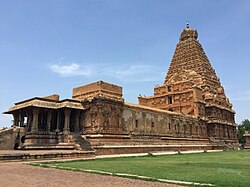
[[File:Brihadeeswarar Kovil.jpg|thumb|200px|[[Brihadisvara Temple, Thanjavur|Brihadisvara Temple]] built by Rajaraja I, a UNESCO [[World Heritage Site]]]] | [[File:Brihadeeswarar Kovil.jpg|thumb|200px|[[Brihadisvara Temple, Thanjavur|Brihadisvara Temple]] built by Rajaraja I, a UNESCO [[World Heritage Site]]]] | ||
{{Main|Brihadisvara Temple, Thanjavur}} | {{Main|Brihadisvara Temple, Thanjavur}} | ||
During 1010, Rajaraja built the Peruvudaiyar Temple (also known as Periya Kovil, RajaRajeswara Temple, and Rajarajeswaram) in [[Thanjavur]] and dedicated it to Shiva. The temple and the capital were centres of both religious and economic activity.{{sfn|Geeta Vasudevan|2003|p=46}}<ref>{{cite web |url=http://tamilnadu.com/travel/tanjavur-periya-kovil.html |title=Tamil Nadu – Thanjavur Periya Kovil – 1000 Years, Six Earthquakes, Still Standing Strong |publisher=Tamilnadu.com |date=27 January 2014 |access-date=4 December 2015 |archive-date=26 December 2015 |archive-url=https://web.archive.org/web/20151226001353/http://tamilnadu.com/travel/tanjavur-periya-kovil.html |url-status=dead }}</ref> The temple is one of the largest temples in India and is an example of [[Dravidian architecture]] of the [[Chola dynasty|Chola period]].{{sfn|John Keay|2000|p=xix}}<ref>{{cite web|title=Endowments to the Temple|url=http://asi.nic.in/asi_monu_whs_cholabt_endowments.asp|publisher=Archaeological Survey of India}}</ref> Along with [[Gangaikonda Cholapuram]] temple and [[Airavatesvara temple]], Peruvudaiyar temple is part of the [[UNESCO]] [[World Heritage Site]] known as the "[[Great Living Chola Temples]]".<ref>{{cite web|url=http://tamilnadu.com/temples/tanjavur-periya-kovil.html|title=Tanjavur Periya Kovil Tamil Nadu|publisher=Tamilnadu.com|date=5 December 2012|access-date=4 December 2015|archive-date=10 February 2014|archive-url=https://web.archive.org/web/20140210124501/http://tamilnadu.com/temples/tanjavur-periya-kovil.html|url-status=dead}}</ref> | |||
== Coins == | == Coins == | ||
[[File:Gold coin of Raja Raja Chola I.JPG|left|thumb|Copper | [[File:Gold coin of Raja Raja Chola I.JPG|left|thumb|Copper coin of Rajaraja I]] | ||
Prior to Rajaraja's reign, Chola coins featured the tiger emblem on the obverse, along with the fish and bow emblems representing the Pandya and Chera Dynasties, while the reverse side displayed the name of the King. However, a new type of coin emerged during Rajaraja's rule. These new coins showcased the figure of the standing king on the obverse side, while the reverse side depicted a seated goddess.<ref>Antiquities of India: An Account of the History and Culture of Ancient Hindustan by Lionel D. Barnett p.216</ref> The coins spread across much of southern India and were copied by Sri Lankan kings.<ref>Coins of India by C. J. Brown p.63</ref> | |||
== Inscriptions == | == Inscriptions == | ||
[[File:Vatteluttu.png|thumb|200px|A typical lithic inscription of the Chola period]] | [[File:Vatteluttu.png|thumb|200px|A typical lithic inscription of the Chola period]] | ||
Due to Rajaraja's desire to record his military achievements, he recorded the important events of his life in | Due to Rajaraja's desire to record his military achievements, he recorded the important events of his life in stone.{{citation needed|date=June 2025}} An inscription in [[Tamil language|Tamil]] from [[Mulbagal]] in Karnataka shows his accomplishments as early as the 19th year.{{citation needed|date=June 2025}} An excerpt from such a ''[[Meikeerthi]]'', an inscription recording great accomplishments, follows: | ||
{{cquote | {{cquote | ||
| quote = Hail Prosperity! In the 21st year of (the reign of) the illustrious Ko Raja Rajakesari Varma, alias the illustrious Rajaraja Deva, who, while both the goddess of fortune and the great goddess of the earth, who had become his exclusive property, gave him pleasure, was pleased to destroy the kalam at Kandalur and conquered by his army, which was victorious in great battles, Vengai-nadu, Ganga-padi, Nulamba-padi, Tadigai-padi, Kudamalai-nadu, Kollam, Kalingam and Ira-mandalam, which is famed in the eight directions; who, while his beauty was increasing, and while he was resplendent (to such an extent) that he was always worthy to be worshipped, deprived the Seriyas of their splendour, and (in words) in the twenty-first year of Chola Arumoli, who possesses the river Ponni, whose waters are full of waves.{{sfn|B. Lewis Rice|1905|p=107}} | | quote = Hail Prosperity! In the 21st year of (the reign of) the illustrious Ko Raja Rajakesari Varma, alias the illustrious Rajaraja Deva, who, while both the goddess of fortune and the great goddess of the earth, who had become his exclusive property, gave him pleasure, was pleased to destroy the kalam at Kandalur and conquered by his army, which was victorious in great battles, Vengai-nadu, Ganga-padi, Nulamba-padi, Tadigai-padi, Kudamalai-nadu, Kollam, Kalingam and Ira-mandalam, which is famed in the eight directions; who, while his beauty was increasing, and while he was resplendent (to such an extent) that he was always worthy to be worshipped, deprived the Seriyas of their splendour, and (in words) in the twenty-first year of Chola Arumoli, who possesses the river Ponni, whose waters are full of waves.{{sfn|B. Lewis Rice|1905|p=107}} | ||
| author = | | author = | ||
| source = | | source = | ||
| width = 75% | | width = 75% | ||
| align = center | | align = center | ||
| Line 191: | Line 226: | ||
}} | }} | ||
Rajaraja recorded all the grants made to the Thanjavur temple and his achievements. He also preserved the records of his predecessors. An inscription of his reign found at Tirumalavadi records an order of the king to the effect that the central shrine of the Vaidyanatha temple at the place should be rebuilt and that, before pulling down the walls, the inscriptions engraved on them should be copied in a book. The records were subsequently re-engraved on the walls from the book after the rebuilding was finished.{{sfn|Eugen Hultzsch|1890|p=8}} | Rajaraja recorded all the grants made to the Thanjavur temple and his achievements. He also preserved the records of his predecessors. An inscription of his reign found at Tirumalavadi records an order of the king to the effect that the central shrine of the Vaidyanatha temple at the place should be rebuilt and that, before pulling down the walls, the inscriptions engraved on them should be copied in a book. The records were subsequently re-engraved on the walls from the book after the rebuilding was finished.{{sfn|Eugen Hultzsch|1890|p=8}}{{better source needed|date=June 2025}} | ||
== In popular culture == | == In popular culture == | ||
[[File:Rajaraja Statue.jpg|thumb|250x250px|20th | [[File:Rajaraja Statue.jpg|thumb|250x250px|20th-century sculpture of Rajaraja in [[Thanjavur]]]] | ||
*''[[Ponniyin Selvan: I]] | *''[[Ponniyin Selvan: I]]'' – a 2022 film based on [[Kalki Krishnamurthy]]'s 1955 novel ''[[Ponniyin Selvan]]'', which deals with the succession troubles during the reign of Sundara Chola and the death of the elder prince, [[Aditha Karikalan]], portrayed by Tamil actor [[Vikram (actor)|Vikram]]. The role of the younger prince, Arulmozhi Varman, also known as Ponniyin Selvan and the future Rajaraja I, was played by Tamil actor [[Ravi Mohan]].<ref>{{Cite web |title=Ponniyin Selvan: All About Jayam Ravi's Character Arun Mozhi Varman |url=https://www.moviecrow.com/News/31147/ponniyin-selvan-jayam-ravi-character-ps1 |access-date=2022-10-09 |website=moviecrow.com}}</ref> The sequel, ''[[Ponniyin Selvan: II]]'', was released in 2023. | ||
*''[[Rajaraja Cholan]]'' | *''[[Rajaraja Cholan]]'' – a 1973 [[Tamil language|Tamil]] film starring [[Sivaji Ganesan]].<ref>{{cite news|title=Cine Quiz|url=http://www.hindu.com/cp/2008/09/26/stories/2008092650150400.htm|archive-url=https://web.archive.org/web/20080927045514/http://www.hindu.com/cp/2008/09/26/stories/2008092650150400.htm|archive-date=27 September 2008|access-date=9 July 2011|newspaper=[[The Hindu]]|date=26 September 2008}}</ref> | ||
*''[[Ponniyin Selvan]]'' by [[Kalki Krishnamurthy|Kalki]] revolves around the early life of Rajaraja, the mysteries surrounding the death of | *''[[Ponniyin Selvan]]'' – a novel by [[Kalki Krishnamurthy|Kalki]], which revolves around the early life of Rajaraja, the mysteries surrounding the death of Aditha Karikalan, and the subsequent accession of Uththama Chola to the Chola throne.<ref>{{cite news|title=Mani is likely to drop Ponniyin Selvan|url=https://timesofindia.indiatimes.com/others/news-interviews/Mani-is-likely-to-drop-Ponniyin-Selvan/articleshow/8141844.cms|archive-url=https://web.archive.org/web/20130616095442/http://articles.timesofindia.indiatimes.com/2011-05-02/news-interviews/29495509_1_mani-ratnam-priyanka-chopra-ponniyin-selvan|archive-date=16 June 2013|newspaper=[[The Times of India]]|url-status=live|access-date=11 February 2013}}</ref> | ||
*''Nandipurathu Nayagi'' by [[Vembu Vikiraman]] revolves around the ascension of Uttama Chola to the throne and Rajaraja's naval expedition. | *''Nandipurathu Nayagi'' {{Clarify|date=April 2024}} by [[Vembu Vikiraman]] revolves around the ascension of Uttama Chola to the throne and Rajaraja's naval expedition. | ||
*''Rajaraja Cholan'' by Kathal Ramanathan. | *''Rajaraja Cholan'' {{Clarify|date=April 2024}} by Kathal Ramanathan. | ||
*''Kandalur Vasantha Kumaran Kathai'' by [[Sujatha (writer)|Sujatha]] which | *''Kandalur Vasantha Kumaran Kathai''{{Clarify|date=April 2024}} by [[Sujatha (writer)|Sujatha]], which deals with the situations leading Rajaraja to invade Kandalur. | ||
*''Rajakesari'' and ''Cherar Kottai'' by Gokul Seshadri deal with the Kandalur invasion and its after-effects. | *''Rajakesari'' and ''Cherar Kottai'' {{Clarify|date=April 2024}} by Gokul Seshadri deal with the Kandalur invasion and its after-effects. | ||
* ''[[Bharat Ek Khoj]]'' | * ''[[Bharat Ek Khoj]]'' – a 1988 historical drama that depicts Rajaraja Chola (played by [[Om Puri]]) in episodes 22 and 23.<ref>{{cite news|title=What makes Shyam special|url=http://www.hindu.com/thehindu/fr/2003/01/17/stories/2003011700990100.htm |archive-url=https://web.archive.org/web/20030627193719/http://www.hindu.com/thehindu/fr/2003/01/17/stories/2003011700990100.htm |archive-date=27 June 2003 |newspaper=[[The Hindu]]|date=17 January 2003|access-date=6 June 2013}}</ref> | ||
*''Kaviri Mainthan'' | *''Kaviri Mainthan'' – a 2007 novel by Anusha Venkatesh. | ||
* | *''Udayaar'' – a book by Tamil author [[Balakumaran]], which deals with Rajaraja's later years and Rajendra Chola I's ascension. | ||
== See also == | == See also == | ||
*[[List of Tamil monarchs]] | *[[List of Tamil monarchs]] | ||
*[[Chola Military]] | |||
*[[Chola Navy]] | |||
== References == | == References == | ||
| Line 219: | Line 254: | ||
* {{cite book|author=B. Lewis Rice|author-link=B. Lewis Rice|title=Epigraphia Carnatica|volume=10, Part I|url=https://books.google.com/books?id=sscUAAAAYAAJ|year=1905|publisher=Mysore Archaeological Survey}} | * {{cite book|author=B. Lewis Rice|author-link=B. Lewis Rice|title=Epigraphia Carnatica|volume=10, Part I|url=https://books.google.com/books?id=sscUAAAAYAAJ|year=1905|publisher=Mysore Archaeological Survey}} | ||
* {{cite book|author=Eugen Hultzsch|title=South Indian inscriptions (1983 reprint)|url=https://books.google.com/books?id=StdtAAAAMAAJ|year=1890|publisher=Archaeological Survey of India}} | * {{cite book|author=Eugen Hultzsch|title=South Indian inscriptions (1983 reprint)|url=https://books.google.com/books?id=StdtAAAAMAAJ|year=1890|publisher=Archaeological Survey of India}} | ||
* {{cite book |last=Gunawardena | first= Charles A. |title=Encyclopedia of Sri Lanka|url=https://books.google.com/books?id=hWLQSMPddikC|year=2005|publisher=Sterling Publishers Pvt. Ltd|isbn=978-1-932705-48-5}} | |||
* {{cite book|author=Geeta Vasudevan|year=2003|title=Royal Temple of Rajaraja: An Instrument of Imperial Chola Power|publisher=Abhinav Publications|isbn=0-00-638784-5}} | * {{cite book|author=Geeta Vasudevan|year=2003|title=Royal Temple of Rajaraja: An Instrument of Imperial Chola Power|publisher=Abhinav Publications|isbn=0-00-638784-5}} | ||
* {{cite book|author=John E. Cort|title=Open boundaries: Jain communities and culture in Indian history|year=1998|publisher=State University of New York Press|location=Albany|url=https://books.google.com/books?id=WWfnXbVWjKcC&q=tevaram&pg=PA178|isbn=978-0-7914-3786-5}} | * {{cite book|author=John E. Cort|title=Open boundaries: Jain communities and culture in Indian history|year=1998|publisher=State University of New York Press|location=Albany|url=https://books.google.com/books?id=WWfnXbVWjKcC&q=tevaram&pg=PA178|isbn=978-0-7914-3786-5}} | ||
* {{cite book|author=John Keay|year=2000|title=India, a History|publisher=Harper Collins Publishers|location=London|isbn=0-00-638784-5}} | * {{cite book|author=John Keay|year=2000|title=India, a History|publisher=Harper Collins Publishers|location=London|isbn=0-00-638784-5}} | ||
* {{cite book|author=K. A. N. Sastri|author-link=K. A. Nilakanta Sastri|year=1984|title=The Cholas|publisher=University of Madras|location=Madras|orig-date=1935}} | * {{cite book|author=K. A. N. Sastri|author-link=K. A. Nilakanta Sastri|year=1984|title=The Cholas|publisher=University of Madras|location=Madras|orig-date=1935}} | ||
* {{cite book|author=K. A. N. Sastri|author-link=K. A. Nilakanta Sastri|chapter=The Cōḷas|editor1=R. S. Sharma|editor2=K. M. Shrimali|title=A Comprehensive history of India: A.D. | * {{cite book|author=K. A. N. Sastri|author-link=K. A. Nilakanta Sastri|chapter=The Cōḷas|editor1=R. S. Sharma|editor2=K. M. Shrimali|title=A Comprehensive history of India: A.D. 985–1206|url=https://books.google.com/books?id=ahFuAAAAMAAJ|year=1992|publisher=People's Publishing House|isbn=978-81-7007-121-1}} | ||
* {{cite book|author=K. A. N. Sastri|author-link=K. A. Nilakanta Sastri|year=2000|title=A History of South India|publisher=Oxford University Press|location=New Delhi|isbn=0-19-560686-8|orig-date=1955}} | * {{cite book|author=K. A. N. Sastri|author-link=K. A. Nilakanta Sastri|year=2000|title=A History of South India|publisher=Oxford University Press|location=New Delhi|isbn=0-19-560686-8|orig-date=1955}} | ||
* {{cite book|author=Kamil Zvelebil|author-link=Kamil Zvelebil|title=A History of Indian literature|volume=10 (Tamil Literature)|year=1974|publisher=Otto Harrasowitz|url=https://books.google.com/books?id=OQ33i496MsIC&pg=PA130|isbn=3-447-01582-9}} | * {{cite book|author=Kamil Zvelebil|author-link=Kamil Zvelebil|title=A History of Indian literature|volume=10 (Tamil Literature)|year=1974|publisher=Otto Harrasowitz|url=https://books.google.com/books?id=OQ33i496MsIC&pg=PA130|isbn=3-447-01582-9}} | ||
| Line 234: | Line 270: | ||
* {{cite book |author=R. S. Sharma |author-link=Ram Sharan Sharma |title=Early Medieval Indian Society |url=https://books.google.com/books?id=i_sIE1sO5kwC&pg=PA270 |year=2003 |publisher=Orient Blackswan |isbn=978-81-250-2523-8}} | * {{cite book |author=R. S. Sharma |author-link=Ram Sharan Sharma |title=Early Medieval Indian Society |url=https://books.google.com/books?id=i_sIE1sO5kwC&pg=PA270 |year=2003 |publisher=Orient Blackswan |isbn=978-81-250-2523-8}} | ||
* {{cite book |author=S.R. Balasubrahmanyam |title=Middle Chola Temples: Rajaraja I to Kulottunga I |publisher=Oriental |year=1977 |isbn=9789060236079 |url=https://books.google.com/books?id=dufVAAAAMAAJ }} | * {{cite book |author=S.R. Balasubrahmanyam |title=Middle Chola Temples: Rajaraja I to Kulottunga I |publisher=Oriental |year=1977 |isbn=9789060236079 |url=https://books.google.com/books?id=dufVAAAAMAAJ }} | ||
* {{cite journal |last=Spencer |first = George W. |date=May 1976 | title = The Politics of Plunder: The Cholas in Eleventh-Century Ceylon | journal = The Journal of Asian Studies |volume=35 |issue=3 |pages=405–419 | doi = 10.2307/2053272 | jstor = 2053272|s2cid = 154741845 }} | |||
* {{cite news|author=T. S. Subramanian|title=Unearthed stone ends debate|url=https://www.thehindu.com/todays-paper/tp-features/tp-fridayreview/Unearthed-stone-ends-debate/article15940697.ece|newspaper=The Hindu|date=2009-11-27}} | * {{cite news|author=T. S. Subramanian|title=Unearthed stone ends debate|url=https://www.thehindu.com/todays-paper/tp-features/tp-fridayreview/Unearthed-stone-ends-debate/article15940697.ece|newspaper=The Hindu|date=2009-11-27}} | ||
* {{cite book|author=V. Ramamurthy|editor=N. Mahalingam|title=History of Kongu|url=https://books.google.com/books?id=SP03AQAAIAAJ|year=1986|publisher= | * {{cite book|author=V. Ramamurthy|editor=N. Mahalingam|title=History of Kongu|url=https://books.google.com/books?id=SP03AQAAIAAJ|year=1986|publisher=International Society for the Investigation of Ancient Civilization}} | ||
* {{cite book|author=Vidya Dehejia|title=The Body Adorned: Sacred and Profane in Indian Art|url=https://archive.org/details/bodyadorneddisso0000dehe|url-access=registration|page=[https://archive.org/details/bodyadorneddisso0000dehe/page/42 42]|year=2009|publisher=Columbia University Press|isbn=978-0-231-51266-4}} | * {{cite book|author=Vidya Dehejia|title=The Body Adorned: Sacred and Profane in Indian Art|url=https://archive.org/details/bodyadorneddisso0000dehe|url-access=registration|page=[https://archive.org/details/bodyadorneddisso0000dehe/page/42 42]|year=2009|publisher=Columbia University Press|isbn=978-0-231-51266-4}} | ||
* {{cite book|author=Vidya Dehejia|title=Art of the Imperial Cholas|url=https://books.google.com/books?id=23F7vTn3hBMC&pg=PA49|year=1990|publisher=Columbia University Press|isbn=978-0-231-51524-5}} | * {{cite book|author=Vidya Dehejia|title=Art of the Imperial Cholas|url=https://books.google.com/books?id=23F7vTn3hBMC&pg=PA49|year=1990|publisher=Columbia University Press|isbn=978-0-231-51524-5}} | ||
| Line 241: | Line 278: | ||
== External links == | == External links == | ||
* | * {{Commons category-inline|Rajaraja I}} | ||
{{S-start}} | {{S-start}} | ||
| Line 248: | Line 285: | ||
{{DEFAULTSORT:Rajaraja 01}} | {{DEFAULTSORT:Rajaraja 01}} | ||
[[Category:940s births]] | [[Category:940s births]] | ||
[[Category:1014 deaths]] | [[Category:1014 deaths]] | ||
| Line 259: | Line 290: | ||
[[Category:10th-century Hindus]] | [[Category:10th-century Hindus]] | ||
[[Category:11th-century Hindus]] | [[Category:11th-century Hindus]] | ||
[[Category:10th-century Indian monarchs]] | |||
[[Category:11th-century Indian monarchs]] | |||
[[Category:Chola dynasty]] | |||
[[Category:Chola emperors]] | |||
[[Category:Hindu monarchs]] | |||
[[Category:Indian Shaivites]] | |||
Revision as of 10:41, 26 March 2026
| Rajaraja I | |||||
|---|---|---|---|---|---|
| Rājakēsari Varman, Ponniyin Selvan, Mum'muṭi Coḻa,[1] Sivapathasekaran, Thirumurai Kanda Chola, Taila Kula Kaalan, Telungu kula kaalan, Pandiya Kula Sani, Keralandhagan, Sinhalandhagan, Kṣatriya Śikhāmaṇi | |||||
 | |||||
| Chola Emperor | |||||
| Reign | June/July 985–January or February 1014 | ||||
| Predecessor | Uttama | ||||
| Successor | Rajendra I | ||||
| King of Anuradhapura | |||||
| Reign | c. 992 – c. January/February 1014 | ||||
| Predecessor | Mahinda V | ||||
| Successor | Rajendra I | ||||
| Born | Arul Mozhi Varman 3 November 947 Thanjavur, Chola Empire (modern-day Tamil Nadu, India) | ||||
| Died | January 1014 (aged 66) Thanjavur, Chola Empire | ||||
| Spouse |
| ||||
| Issue |
| ||||
| |||||
| Dynasty | Chola | ||||
| Father | Parantaka II | ||||
| Mother | Vanavan Mahadevi | ||||
| Religion | Hinduism See details | ||||
| Signature |  | ||||
| List of Chola kings and emperors | ||||||||||||||||||||||||||||
|---|---|---|---|---|---|---|---|---|---|---|---|---|---|---|---|---|---|---|---|---|---|---|---|---|---|---|---|---|
| Early Cholas | ||||||||||||||||||||||||||||
| Interregnum (c. 200 – c. 848) | ||||||||||||||||||||||||||||
| Medieval Cholas | ||||||||||||||||||||||||||||
|
||||||||||||||||||||||||||||
| Later Cholas | ||||||||||||||||||||||||||||
|
||||||||||||||||||||||||||||
| Related dynasties | ||||||||||||||||||||||||||||
|
||||||||||||||||||||||||||||
| Chola society | ||||||||||||||||||||||||||||
Rājarāja I (Middle Tamil: Rājarāja Cola; Rājarāja Śōḷa; 3 November 947 – January/February 1014),[1][4] also known as Rajaraja the Great, was a Chola emperor who reigned from 985 to 1014. He was known for his conquests of southern India and the Anuradhapura kingdom of Sri Lanka, as well as increasing Chola influence across the Indian Ocean. Rajaraja's birth name is variously given as Arul Mozhi Varman and Arulmoli Varman.
Rajaraja's empire encompassed vast territories, including regions of the Pandya country, the Chera country, and northern Sri Lanka. He also extended his influence over strategic islands such as Lakshadweep, Thiladhunmadulu atoll, and parts of the Maldives in the Indian Ocean. His conquests were not limited to the south; he also launched successful campaigns against the Western Gangas and the Western Chalukyas, extending Chola authority as far as the Tungabhadra River. In the east, Rajaraja faced fierce opposition from the Telugu Chola king Jata Choda Bhima over control of Vengi. This region held significant strategic importance due to its access to resources and trade routes. The conflict between the two rulers intensified as they vied for dominance in the region, resulting in significant battles and shifting allegiances.[5][6][7]
Rajaraja I commissioned the construction of the Rajarajeshwaram Temple in the Chola capital of Thanjavur, revered as one of the most prominent examples of the medieval South Indian architectural style.[8] Additionally, during his reign, important Tamil literary works by poets such as Appar, Sambandar, and Sundarar were gathered and compiled into a single collection known as the Thirumurai. This earned him the title of 'Thirumurai Kanda Cholar' (lit. 'The One Who Found Thirumurai').[6][9] He initiated a project of land survey and assessment in 1000 which led to the reorganisation of Tamil country into individual units known as valanadus. Rajaraja died in 1014, and was succeeded by his son Rajendra Chola I.
Early life
.jpg)

Rajaraja was the son of the Chola king Parantaka II, also known as Sundara Chola, and his wife Vanavan.[10] As recorded in the Thiruvalangadu copper-plate inscription, his birth name was Arun Mozhi Varman, meaning "The Word of Sun Clan".[1][11] He was born around 947 during the Tamil month of , under the Sadhayam star.[12] The Government of Tamil Nadu recognises his birthdate as 3 November 947.[13] Rajaraja had an elder brother, Aditha II,[4] and an elder sister, Kundavai.[14]
Rajaraja's accession marked the end of a period of competing claims to the Chola throne, following the reign of his great-grandfather Parantaka I. After Parantaka I, his elder son Gandaraditya became king. However, upon Gandaraditya's death, his son Madhurantakan was still a minor, so the throne passed to Parantaka I's younger son, Arinjaya. Arinjaya soon died, and his son Parantaka II (Sundara Chola) succeeded him. It was decided that Sundara Chola would be succeeded by Madhurantakan, likely due to Sundara's preference. However, according to the Thiruvalangadu inscription of Rajaraja's son, Rajendra I, the succession plan may have been made by Rajaraja himself.[4]
Aditha II died under mysterious circumstances, with inscriptions suggesting he may have been assassinated. Shortly afterwards, Sundara Chola also died, enabling Madhurantakan to assume the throne with the title Uttama Chola. Following Uttama Chola's death, Arul Moli Varman ascended the throne in mid-985[4] and adopted the regnal name Rajaraja, meaning "King among Kings."[15]
Military conquests

When Rajaraja came to power, he inherited a small kingdom centered around the Thanjavur–Tiruchirappalli region, the heart of traditional Chola territory.[1] He transformed this kingdom from one that was recovering from attacks by the Rashtrakuta Empire into one that was a well-organised empire with a powerful army and navy. Under his rule, the northern kingdom of Vengi became closely allied with the Cholas, and their influence expanded along the eastern coast all the way up to Kalinga in the north.[4]
Rajaraja Chola Thiruvalangadu plates states that, Arulmolivarman :
(performed tulabhara captured the town Vilinda; conquered the Pandya Amarabujanga and burnt the lord of Lanka; defeated Satyashraya; killed Andhra Bhima; conquered the country of Parasurama(i.e.,Chera) and subdued the kings of Ganga, Kalinga, Vengi, Magatha, Aratta ,odda,Surashtra and Chalukya).[16]
The Larger Leiden plates States that Rajaraja,
"conquered the Pandya, Tulu, Kerala, Simhalendra and Satyashraya ; destroyed ships at Kandalur-Salai , captured Vengainadu(Vengi), Gangapadi, Nulambapadi, Tadigaipadi, Kudamalainadu, Kollam, Kalingam, and Ilam(Sri Lanka ) ; and removed the splendour of the Seliyas(i.e.,Pandyas)."[16]
Against Kandalur Salai

Rajaraja's earliest inscriptions commemorate a significant triumph at Kandalur Salai, located in present-day Kerala, around 988. He is acclaimed as 'Kāndalūr śālai Kalam-arutta', which translates to 'the one who destroyed Kandalur Salai'.[17]
Originally, this area was under the control of the Ay chief, who served as a vassal to the Pandya king of Madurai. However, it remains uncertain whether warriors from the Chera or Pandya dynasties were involved in this conflict. The Thiruvalangadu inscription suggests that Rajaraja's general captured Vizhinjam (Viḷinam), which could have been part of the Kandalur Salai campaign. It appears that this engagement involved the Chola navy, or possibly a joint operation involving both the navy and the army.[18]
Conquest of Kerala and the Pandyas
Rajaraja's inscriptions begin to appear in Kanyakumari district in the 990s and in Thiruvananthapuram district in the early 1000s. The Chola subjugation of Kerala can be dated to the early years of the 11th century.[18] The Senur inscription, dated to 1005 and attributed to Rajaraja, records his military achievements. It mentions the destruction of the Pandya capital, Madurai, as well as the conquest of several regions. These include defeating the formidable rulers of Kollam (Venad), Kolla-desham (Mushika), and Kodungallur (the Chera Perumals of Makotai).[18][19][16] Some triumphs in the region of Malainadu were possibly achieved by Rajaraja's son, Rajendra Chola.[20]
Following his victory over the Pandyas, Rajaraja assumed the title of Pandya Kulashani, which translates to 'Thunderbolt to the Race of the Pandyas'. As a result of his conquest, the territory of the Pandyas became recognised as "Rajaraja Mandalam" or "Rajaraja Pandinadu".[21] When recounting Rajaraja's military expedition in Trisanku Kastha (the southern region), the Thiruvalangadu Grant of Rajendra I mentions the capture of a certain royal figure named Amarabhujanga.[22] However, the specific identity of this individual—whether he was a prince of the Pandya dynasty, a general serving the Pandya king, or a prince of the Kongu Chera dynasty—remains a matter of debate.[20][22] According to the Kongu Desa Rajakkal, a historical record of the Kongu Nadu region, it is suggested that this general eventually changed his loyalty to Rajaraja. He is said to have participated in the ritual of kanakabhisheka, where gold is poured over the Chola king, symbolising an act of royal anointment or coronation.[22]
Once Rajaraja had consolidated his authority in the southern regions, he took on the title of Mummudi Chola. This title, which means "Three Crowned", symbolised his power over three important Tamil kingdoms: the Cholas, the Pandyas, and the Cheras.[1]
Conquest of northern Sri Lanka

During the reign of King Mahinda V, the Sinhalese kingdom of Anuradhapura experienced a significant military revolt around 982 CE, primarily as a consequence of the monarch's economic policies. The armed forces of the Anuradhapura capital predominantly consisted of Tamil mercenaries recruited from coastal regions. By 982, tensions escalated into a full-fledged uprising led by these mercenaries, resulting in a protracted civil conflict. The ensuing turmoil compelled the vulnerable Sinhala ruler to seek refuge in the Rohana principality, thereby plunging the capital city of Anuradhapura into an extended period of civil unrest lasting approximately eleven years, marked by widespread disorder and lawlessness. [23]
The disruption of central governance exacerbated the financial strain on the kingdom, particularly in meeting the obligations to the Tamil mercenaries. Consequently, the mercenaries, feeling aggrieved and disillusioned, turned their allegiance towards the Chola empire. This strategic shift left Anuradhapura vulnerable to the incursions of the Chola forces, who exploited the internal strife to mount invasions in 993. These events, documented in historical sources, underscore the intricate interplay of economic policies, military dynamics, and regional power struggles during this period in the history of Anuradhapura. [24][23]
In 993, Rajaraja achieved the conquest of Anuradhapura, known as Pihiti rata in local context, situated in Sri Lanka. This territory was subsequently designated as Ila-mandalam in Chola historical records.[19] The military campaign led to the sacking of Anuradhapura by the Chola army, resulting in the acquisition of the northern portion of Sri Lanka by the Chola empire. As part of their administrative efforts, the Cholas established a provincial capital at the strategic military outpost of Polonnaruwa, renaming it Jananathamangalam in honour of Rajaraja's title.[23]
Under Chola administration, the official Tali Kumaran[clarification needed] oversaw the construction of a significant Shiva temple known as Rajarajeshwara, meaning "Lord of Rajaraja", within the town of Mahatirtha, now recognised as modern-day Mantota. Consequently, Mahatirtha was renamed Rajarajapura in commemoration of the Chola monarch's conquest and establishment of authority in the region.[23]
The Thiruvalangadu Plates directly compare Rajaraja's campaign to the invasion of Lanka by the legendary hero Rama:
"Rama built with the aid of monkeys, a causeway across the sea, and then with great difficulties defeated the king of Lanka using sharp-edged arrows. But Rama was excelled by this king whose powerful army crossed the ocean by ships and burnt up the king of Lanka."
— Thiruvalangadu Copper Plates[1]
Chalukyan conflict
In 998, Rajaraja annexed Gangapadi, Nolambapadi, and Tadigaipadi (present-day Karnataka).[25] During this campaign, he subdued the Nolamba dynasty, who were previously vassals of the Ganga dynasty.[26][27] These territories were initially under the suzerainty of the Rashtrakutas, who had been defeated by the Western Chalukyas in 973. Consequently, the Cholas found themselves in direct conflict with the Chalukyas.[28]
Battle of Gangavadi
By 1004, Rajaraja had conquered the Gangavadi province.[29] He established control over the western part of Gangavadi, ruled by the Changalvas, and over Kodagu, governed by the Kongalvas, who were then made vassals of the Chola Empire.[30] In 1004 AD Raja Raja Chola encamped in Gangavadi province, and soon Chalukya army invaded. In the Battle of Gangavadi, Raja Raja Chola defeated the invading Chalukya army and secured Gangavadi Province.[31]
Battle of Annigeri
Raja Raja Chola led the campaign in Ratta Padi in 1003–1004 AD and achieved victory in many battles. Raja Raja Chola I defeated Satyashraya in the Battle of Annigeri and successfully conquered Annigeri Province. In this battle Satyashraya was assisted by his brother Dasavarman and General Dandanayaka Kesava. Dandanayaka Kesava was governor of the Belvola-300 and Puligere-300 divisions, which are located in Annigeri Province. The Tiruvalangadu plates of Rajendra Chola state that Raja Raja defeated Satyashraya who "fled to avoid misery from the attack of his (i.e., Arulmolivarman's) ocean-like army; (still) misery found a (permanent) abode in him. In this battle Satyashraya's brother, Prince Dasavarman, was killed, and Chalukya general Dandanayaka Kesava was taken prisoner. After Raja Raja Chola returned to his capital with booty of some gold flowers and treasures, which he dedicated to the temple of Thanjavur.[32][33][34]
Siege of Unkal
Raja Raja Chola diverted attention from Vengi affairs to the Satyashraya to counteroffensive and sent an army under Crown Prince Rajendra Chola in Chalukya Country. Rajendra marched with a 900,000-strong army and Captured Santalige, Kadambalige, Banavasi, Kogali and besieged the fort of Unkallu in the modern Unkal district located in the Dharwad district. In this ensuing battle, the Cholas defeated the Chalukyas, and the Chalukya commander, Lenka Keta, was killed. After Rajendra Chola successfully captured Unkallu Fort and then encamped at Donur.[35][36]
Battle of Donur
Following the Siege of Unkallu Fort, Rajendra battled against Satyashraya, who was opposing him in Donur. In the Battle of Donur, Rajendra chola defeated Satyashraya and successfully raided Banavasi, Donur (in the Bijapur region), Unkal (near modern Hubli), Kudala Sangama and parts of the Raichur Doab and secured Gangavadi and Nolambavadi. But this conquest and all raids in Chalukya country only lasted until Satyashraya reconquered all territories up to Thungapathra.[37][38]
An inscription attributed to Irivabedanga Satyashraya from Dharwar acknowledges his allegiance to the Western Chalukyas and highlights the Chola incursion. He accuses Rajendra Chola of leading a massive force of 955,000 soldiers and causing havoc in Donuwara(Donur in Bijapur district), blurring the ethical boundaries of warfare prescribed by the Dharmaśāstras.[39] Historians such as James Heitzman and Wolfgang Schenkluhn interpret this confrontation as indicative of personal animosity between the rulers of the Chola and Western Chalukya kingdoms, akin to historical conflicts between the Chalukyas of Badami and the Pallavas of Kanchi.[40][41]
Vengi kingdom
Meanwhile, the Vengi kingdom was under the rule of Jata Choda Bhima, a member of the Telugu Cholas branch.[30] However, Rajaraja emerged victorious in battle against Bhima, and Saktivarman, an Eastern Chalukya prince, was appointed as a viceroy under the Chola Dynasty.[28] Despite a brief period of Bhima's recapture of Kanchi in 1001, Rajaraja swiftly restored Saktivarman to power.[42][43] Notably, Rajaraja cemented an alliance between the Chola Dynasty and the Eastern Chalukya kingdom by arranging the marriage of his daughter, Kundavai, to the next viceroy of Vengi, Vimaladitya. This strategic union ensured the future succession of Rajaraja's descendants to the throne of the eastern Chalukya kingdom.[44]Satyashraya retaliated by invading the Vengi country in 1006 A.D. and placed Saktivaiman on the Vengi Throne. Raja Raja Chola diverted the Chalukyas to send a big army under Prince Rajendra Chola in Chalukya country. So Satyashraya, without having reinforcement to deal with the Chola army, called back his general Bayal Nambi, who advanced up to Chebrollu. Satyastraya did not permanently recapture Vengi. He made attempts, but the Cholas successfully defended their influence.[33][43]
Victory over Hoysalas
Narasipur, dated to 1006, records that Rajaraja's general Aprameya killed Hoysala generals and a minister identified as Naganna.[45][46] Additionally, a similar inscription in Channapatna describes Rajaraja defeating the Hoysalas.General Aprameya defeated Hoysala leaders manjaga, kaliga(or kali – ganga),Nigavarma and others in the Battle of Kalavur .winning by his valour in the plain of Kalavur a name to endure for ever.[44]
Kalinga conquest
The invasion of the kingdom of Kalinga occurred after the conquest of Vengi. This conquest marked the northern boundary of the Chola Empire at that time and established their control over the entirety of south and south-east India.[47][46][16][48]
Conquest of Kuda-malai-nadu
In multiple historical accounts, there are mentions of Rajaraja's conquest of a place called "Kuda-malai-nadu" around the year 1000.[7][49] In certain inscriptions found in Karnataka, the term "Kudagu-malai-nadu" is used instead of "Kuda-malai-nadu". Scholars generally believe that this region corresponds to Coorg (Kudagu).[7][50]
The king's conquest of Malainadu is described in the Vikrama Chola Ula, where it is said that he achieved it in just one day, crossing 18 mountain passes. According to the Kulottunga Chola Ula, Rajaraja was depicted as beheading 18 people and burning down Udagai. Additionally, the Kalingathupparani references the establishment of Chadaya Nalvizha in Udiyar Mandalam, the seizure of Udagai, and the plundering of several elephants from the area. The Tiruppalanam inscription from 999 records the king's offering of an idol obtained as spoils from Malainadu.[51][25][44]
The naval campaigns of Rajaraja formed a reassertion of Chola power in the Indian Ocean.[7]
"A naval campaign led to the conquest of the Maldive Islands, the Malabar Coast, and northern Sri Lanka, all of which were essential to the Chola control over trade with Southeast Asia and with Arabia and eastern Africa. These were the transit areas, ports of call for the Arab traders and ships to Southeast Asia and China, which were the source of the valuable spices sold at a high profit to Europe."
— Romila Thapar, "Encyclopaedia Britannica".
The Cholas controlled the area around Bay of Bengal with Nagapattinam as the main port. The Chola Navy also played a major role in the invasion of Sri Lanka.[52] The success of Rajaraja allowed his son Rajendra Chola to lead the Chola invasion of Srivijaya, carrying out naval raids in South-East Asia and briefly occupying Kadaram.[5][53]
Rajaraja I and Rajendra I are described as the greatest Chola rulers because of these conquests.[54][page needed]
Personal life
Rajaraja married several women, including the following: Vanathi aka Thiripuvāna Mādēviyār, Dantisakti Vitanki aka Lokamadevi, Panchavan Madeviyar, Chola Mahadevi, Trailokya Mahadevi, Lata Mahadevi, Prithvi Mahadevi, Meenavan Mahadevi, Viranarayani and Villavan Mahadevi.[55][56][57] He had at least three daughters and two sons. The older son, Rajendra, was born to Thiripuvāna Mādēviyār.[58][full citation needed][59][full citation needed] The younger son was named Araiyan Rajarajan, and the identity of his mother is unknown.[citation needed] He had his first daughter Kundavai with Lokamadevi who eventually married Chalukya prince Vimaladithan.[citation needed] Rajaraja had two other daughters.[citation needed] Rajaraja died in 1014 in the Tamil month of Maka and was succeeded by Rajendra Chola I.[60]
Administration


Before the reign of Rajaraja I, portions of the Chola territory were ruled by hereditary lords and princes who were in a loose alliance with the Chola rulers.[61] Rajaraja initiated a project of land survey and assessment in 1000 which led to the reorganisation of the empire into units known as valanadus.[62][63] From the reign of Rajaraja I until the reign of Vikrama Chola in 1133, the hereditary lords and local princes were either replaced or turned into dependent officials.[61] This led to the king exercising closer control over the different parts of the empire.[61] Rajaraja strengthened the local self-governments and installed a system of audit and control by which the village assemblies and other public bodies were held to account while retaining their autonomy.[64][65][66] To promote trade, he sent the first Chola mission to China.[67] Furthermore, his elder sister Kundavai assisted him in the administration and management of temples.[68]
Officials

Towards the end of his reign, Rajaraja appointed Rajendra Chola I as co-regent, who served as the supreme commander of the northern and northwestern territories. Under his rule, the administrative system was expanded, resulting in a greater number of offices and officials documented in Chola records compared to previous eras.[62] Villavan Muvendavelan, one of Rajaraja's top officials, figures in many of his inscriptions.[71] Other officials named in inscriptions include the Bana prince Narasimhavarman, the general Senapathi Krishnan Raman, the Samanta chief Vallavaraiyan Vandiyadevan, the revenue official Irayiravan Pallavarayan, and Kuruvan Ulagalandan, who organised the country-wide land surveys.[72]
Religious policy
Rajaraja was a follower of the Shaivite denomination of Hinduism, but he also dedicated several temples to Vishnu.[citation needed] Rajaraja called himself Shivapada Shekhara (IAST: Śivapāda Śekhara), literally, 'the one who places his crown at the feet of Shiva'.[73]
The Buddhist monastery of Chudamani Vihara was constructed in the 11th century in Nagapattinam by the Sailendra king of Srivijaya, Sri Mara Vijayattungavarman, with the support of Rajaraja I. It was named Chudamani (or Chulamani) Vihara after King Sri Mara's father.[74][75] According to the small Leyden grant[clarification needed], this Vihara was known as Rajaraja-perumpalli during the reign of Kulottunga I.[76]
Arts and architecture
After hearing short excerpts of the Tevaram in his court, Rajaraja embarked on a mission to recover the hymns.[78] He sought the help of Nambiyandar Nambi.[79] It is believed that by divine intervention Nambi found the presence of scripts, in the form of cadijam leaves half-eaten by white ants in a chamber inside the second precinct in Thillai Nataraja Temple, Chidambaram.[80][79] The brahmanas (Dikshitars) in the temple opposed the mission, but Rajaraja intervened by consecrating the images of the saint-poets through the streets of Chidambaram.[80][81] Rajaraja thus became known as 'Tirumurai Kanda Cholan', meaning 'One who saved the Tirumurai'. In his work Nambiyandar Nambi Puranam (alias Tirumurai Kanda Puranam), Nambi identifies his patron as "Rasarasamannan-Abhayakula-sekharan" (lit. 'King Rajaraja, the best of the race of Abhaya').[82] At that time, Shiva temples only had images of god forms, but after the advent of Rajaraja, the images of the Nayanar saints were also placed inside the temple.[81] Nambi organised the hymns of three saint poets—Sambandar, Appar, and Sundarar—as the first seven books. He included Manickavasagar's "Tirukovayar" and "Tiruvacakam" as the 8th book, and the hymns of nine other saints as the 9th book. The "Tirumandiram" of Tirumular was designated as the 10th book, while 40 hymns by 12 other poets constituted the 11th book. Additionally, Nambi added Tirutotanar Tiruvanthathi, the sacred anthathi of the labours of the 63 Nayanar saints, along with his own hymns as the 12th book.[83]Template:Overly detailed inline The initial seven books were later recognised as the Tevaram.[83] With the addition of Sekkizhar's Periya Puranam (1135) as the twelfth book, the entire Saiva canon became known as Tirumurai, the holy scripture. Consequently, Saiva literature now encompasses approximately 600 years of religious, philosophical, and literary development.[83]
There are no existing contemporary portraits or statues of Rajaraja. The bronze figure purportedly depicting him at the Thanjavur temple is spurious and of recent origin.[19]
Brihadisvara Temple

During 1010, Rajaraja built the Peruvudaiyar Temple (also known as Periya Kovil, RajaRajeswara Temple, and Rajarajeswaram) in Thanjavur and dedicated it to Shiva. The temple and the capital were centres of both religious and economic activity.[84][85] The temple is one of the largest temples in India and is an example of Dravidian architecture of the Chola period.[86][87] Along with Gangaikonda Cholapuram temple and Airavatesvara temple, Peruvudaiyar temple is part of the UNESCO World Heritage Site known as the "Great Living Chola Temples".[88]
Coins

Prior to Rajaraja's reign, Chola coins featured the tiger emblem on the obverse, along with the fish and bow emblems representing the Pandya and Chera Dynasties, while the reverse side displayed the name of the King. However, a new type of coin emerged during Rajaraja's rule. These new coins showcased the figure of the standing king on the obverse side, while the reverse side depicted a seated goddess.[89] The coins spread across much of southern India and were copied by Sri Lankan kings.[90]
Inscriptions

Due to Rajaraja's desire to record his military achievements, he recorded the important events of his life in stone.[citation needed] An inscription in Tamil from Mulbagal in Karnataka shows his accomplishments as early as the 19th year.[citation needed] An excerpt from such a Meikeerthi, an inscription recording great accomplishments, follows:
Hail Prosperity! In the 21st year of (the reign of) the illustrious Ko Raja Rajakesari Varma, alias the illustrious Rajaraja Deva, who, while both the goddess of fortune and the great goddess of the earth, who had become his exclusive property, gave him pleasure, was pleased to destroy the kalam at Kandalur and conquered by his army, which was victorious in great battles, Vengai-nadu, Ganga-padi, Nulamba-padi, Tadigai-padi, Kudamalai-nadu, Kollam, Kalingam and Ira-mandalam, which is famed in the eight directions; who, while his beauty was increasing, and while he was resplendent (to such an extent) that he was always worthy to be worshipped, deprived the Seriyas of their splendour, and (in words) in the twenty-first year of Chola Arumoli, who possesses the river Ponni, whose waters are full of waves.[91]


Rajaraja recorded all the grants made to the Thanjavur temple and his achievements. He also preserved the records of his predecessors. An inscription of his reign found at Tirumalavadi records an order of the king to the effect that the central shrine of the Vaidyanatha temple at the place should be rebuilt and that, before pulling down the walls, the inscriptions engraved on them should be copied in a book. The records were subsequently re-engraved on the walls from the book after the rebuilding was finished.[92][better source needed]
In popular culture

- Ponniyin Selvan: I – a 2022 film based on Kalki Krishnamurthy's 1955 novel Ponniyin Selvan, which deals with the succession troubles during the reign of Sundara Chola and the death of the elder prince, Aditha Karikalan, portrayed by Tamil actor Vikram. The role of the younger prince, Arulmozhi Varman, also known as Ponniyin Selvan and the future Rajaraja I, was played by Tamil actor Ravi Mohan.[93] The sequel, Ponniyin Selvan: II, was released in 2023.
- Rajaraja Cholan – a 1973 Tamil film starring Sivaji Ganesan.[94]
- Ponniyin Selvan – a novel by Kalki, which revolves around the early life of Rajaraja, the mysteries surrounding the death of Aditha Karikalan, and the subsequent accession of Uththama Chola to the Chola throne.[95]
- Nandipurathu Nayagi [clarification needed] by Vembu Vikiraman revolves around the ascension of Uttama Chola to the throne and Rajaraja's naval expedition.
- Rajaraja Cholan [clarification needed] by Kathal Ramanathan.
- Kandalur Vasantha Kumaran Kathai[clarification needed] by Sujatha, which deals with the situations leading Rajaraja to invade Kandalur.
- Rajakesari and Cherar Kottai [clarification needed] by Gokul Seshadri deal with the Kandalur invasion and its after-effects.
- Bharat Ek Khoj – a 1988 historical drama that depicts Rajaraja Chola (played by Om Puri) in episodes 22 and 23.[96]
- Kaviri Mainthan – a 2007 novel by Anusha Venkatesh.
- Udayaar – a book by Tamil author Balakumaran, which deals with Rajaraja's later years and Rajendra Chola I's ascension.
See also
References
- ↑ 1.0 1.1 1.2 1.3 1.4 1.5 Vidya Dehejia 1990, p. 51.
- ↑ Sivaraman, R. (30 May 2018). "Idols of Raja Raja Chola, consort recovered from Gujarat". The Hindu.
- ↑ Srinivasan, G. (31 May 2018). "Tamil Nadu elated Chola era idols' recovery from Gujarat | Tamil Nadu elated Chola era idols' recovery from Gujarat". www.deccanchronicle.com.
- ↑ 4.0 4.1 4.2 4.3 4.4 K. A. N. Sastri 1992, p. 1.
- ↑ 5.0 5.1 Sen, Sailendra (2013). A Textbook of Medieval Indian History. Primus Books. pp. 46–49. ISBN 978-9-38060-734-4.
- ↑ 6.0 6.1 A Journey through India's Past by Chandra Mauli Mani p.51 (Northern Book Centre, 2006)
- ↑ 7.0 7.1 7.2 7.3 M. G. S. Narayanan 2013, p. 115-117.
- ↑ The Hindus: An Alternative History by Wendy Doniger, p. 347.
- ↑ Indian Thought: A Critical Survey by K. Damodaran, p. 246.
- ↑ Vidya Dehejia 2009, p. 42.
- ↑ A. K. Seshadri 1998, p. 31.
- ↑ Tamil Civilization: Quarterly Research Journal of the Tamil University. Vol. 3. Tamil University. 1985. pp. 40–41.
- ↑ "Why Tamil Nadu Celebrating King Raja Raja Chola's Birthday Is A Masterstroke In Symbolism". 2 November 2022.
- ↑ A. K. Seshadri 1998, p. 32.
- ↑ Vidya Dehejia 1990, p. 49.
- ↑ 16.0 16.1 16.2 16.3 Chakravarti, N. p (1933). Epigraphia Indica Vol.22.
- ↑ S.R. Balasubrahmanyam 1977, p. 3.
- ↑ 18.0 18.1 18.2 M. G. S. Narayanan 2013, pp. 115–118.
- ↑ 19.0 19.1 19.2 K. A. N. Sastri 1992, p. 2.
- ↑ 20.0 20.1 M. G. S. Narayanan 2013, pp. 115–117.
- ↑ K. A. N. Sastri 1992, p. 238.
- ↑ 22.0 22.1 22.2 V. Ramamurthy 1986, pp. 288–289.
- ↑ 23.0 23.1 23.2 23.3 K. A. N. Sastri 1992, p. 3.
- ↑ Gunawardena 2005, p. 71.
- ↑ 25.0 25.1 "South Indian Inscriptions Volume 2 - Rajarajesvara Temple Inscriptions at Tanjavur @ whatisindia.com". www.whatisindia.com. Retrieved 28 July 2025.
- ↑ Seminar on Social and Cultural History of Dharmapuri district p.46
- ↑ M. S. Krishna Murthy (1980). The Noḷambas: a political and cultural study, c750 to 1050 A.D. University of Mysore. p. 98.
- ↑ 28.0 28.1 Ancient Indian History and Civilization by Sailendra Nath Sen p.398
- ↑ Malini Adiga. The Making of Southern Karnataka: Society, Polity and Culture in the Early Medieval Period. Orient BlackSwan, 2006. p. 239.
- ↑ 30.0 30.1 Baij Nath Puri. History of Indian Administration: Medieval period. Bharatiya Vidya Bhavan, 1975. p. 51.
- ↑ Anirudh Kanisetti (2025). Lords Of Earth And Sea A History Of The Chola Empire (2025).
- ↑ Benjamin Lewis Rice. Mysore Gazetteer, Volume 2, Part 2. Government Press, 1930 – Karnataka (India). p. 1075.
- ↑ 33.0 33.1 B.R Gopal (1981). The Chalukyas Of Kalyana And The Kalachuris. Servants of Knowledge. Karnataka University Dharwad.
- ↑ Sivaramamurti, C. (1960). Chola temples Tanjavur.
- ↑ Murari, Krishna (1977). The Cāḷukyas of Kalyāṇi, from Circa 973 A.D. to 1200 A.D.: Based Mainly on Epigraphical Sources. Concept Publishing Company.
- ↑ S. Ramakrishnan, General Editor (2001). History and Culture of the Indian People, Volume 05, The Struggle For Empire. Public Resource. Bharatiya Vidya Bhavan.
{{cite book}}:|first=has generic name (help) - ↑ Murari, Krishna (1977). The Cāḷukyas of Kalyāṇi, from Circa 973 A.D. to 1200 A.D.: Based Mainly on Epigraphical Sources. Concept Publishing Company.
- ↑ Karnataka Through The Ages. Servants of Knowledge. The Government Of Mysore. 1968.
{{cite book}}: CS1 maint: others (link) - ↑ Studying early India: archaeology, texts and historical issues, p. 198
- ↑ The world in the year 1000, p. 311
- ↑ History of India: a new approach by Kittu Reddy, p. 146
- ↑ Ramesh Chandra Majumdar (1951). The History and Culture of the Indian People: The age of imperial Kanauj. Ramesh Chandra Majumdar. p. 154.
- ↑ 43.0 43.1 Venkataramanayya, N[elaturi (1950). The Eastern Calukyas of Vengi.
- ↑ 44.0 44.1 44.2 Cholas I.
- ↑ Epigraphia Indica, Volume 30, page 248
- ↑ 46.0 46.1 Historical Inscriptions Of Southern INida. BRAOU, Digital Library Of India. Kitabistam,Allahabad.
{{cite book}}: CS1 maint: others (link) - ↑ "Cholas I".
- ↑ Sivaramamurti, C. (1960). Chola temples Tanjavur.
- ↑ Chandra Mauli Mani. A Journey through India's Past (Great Hindu Kings after Harshavardhana). Northern Book Centre, 2009 – India – 132 pages. p. 51.
- ↑ Epigraphia Indica, Volume 22. Archaeological Survey of India. 1935. p. 225.
- ↑ M. G. S. Narayanan 2013, p. 115-118.
- ↑ Milo Kearney 2003, p. 70.
- ↑ Nagapattinam to Suvarnadwipa: Reflections on the Chola Naval Expeditions to Southeast Asia by Hermann Kulke, K Kesavapany, Vijay Sakhuja p.230
- ↑ Chandra, Satish. Medieval India: From Sultanat to the Mughals. Vol. 2. Har-Anand Publications, 1997. ISBN 978-8124105221.
- ↑ S.R. Balasubrahmanyam 1977, p. 6.
- ↑ Documentation on Women, Children, and Human Rights. Sandarbhini, Library and Documentation Centre. 1994.
- ↑ Studies in Indian place names. Place Names Society of India. 1954. p. 58.
- ↑ Early Chola art, page 183
- ↑ A Topographical List of Inscriptions in the Tamil Nadu and Kerala States: Thanjavur District, page 180
- ↑ Rāja Rāja, the great. Ananthacharya Indological Research Institute. 1987. p. 28.
- ↑ 61.0 61.1 61.2 Precolonial India in Practice : Society, Region, and Identity in Medieval Andhra by Austin Cynthia Talbot Assistant Professor of History and Asian Studies University of Texas p.172
- ↑ 62.0 62.1 A History of Ancient and Early Medieval India: From the Stone Age to the 12th century by Upinder Singh, p. 590.
- ↑ Administrative System in India: Vedic Age to 1947 by U. B. Singh, p. 76.
- ↑ Life/Death Rhythms of Ancient Empires – Climatic Cycles Influence Rule of Dynasties by Will Slatyer p.236
- ↑ The First Spring: The Golden Age of India by Abraham Eraly p.68
- ↑ Geeta Vasudevan 2003, pp. 62–63.
- ↑ Tamil Nadu, a real history by K. Rajayyan p.112
- ↑ Ancient system of oriental medicine, page 96
- ↑ Edith Tömöry (1982). A History of Fine Arts in India and the West. Orient Longman. p. 246. ISBN 978-0-86131-321-1.
- ↑ Rakesh Kumar (2007). Encyclopaedia of Indian paintings. Anmol Publications. p. 4. ISBN 9788126131228.
- ↑ South Indian inscriptions, India. Archaeological Survey, India. Dept. of Archaeology p.477
- ↑ South India heritage: an introduction by Prema Kasturi, Chithra Madhavan p.96
- ↑ R. S. Sharma 2003, p. 270.
- ↑ Kulke, Kesavapany & Sakhuja 2009, p. 67.
- ↑ C. E. Ramachandran; K. V. Raman, Indian History and Culture Society. Aspects of Indian history and culture. Books & Books, 1984. p. 11.
- ↑ S. R. Balasubrahmanyam. Middle Chola Temples: Rajaraja I to Kulottunga I, A.D. 985–1070. Thomson Press (India), 1975. pp. 115–116.
- ↑ Ramesh, N. (31 May 2018). "Tamil Nadu: 50 years on, stolen bronze idols worth Rs 150 crore recovered". The New Indian Express.
- ↑ S. V. S. (1985). Raja Raja Chola, the high point of history. Authors Guild of India Madras Chapter. p. 54.
- ↑ 79.0 79.1 John E. Cort 1998, p. 178.
- ↑ 80.0 80.1 Norman Cutler 1987, p. 50.
- ↑ 81.0 81.1 Geeta Vasudevan 2003, pp. 109–110.
- ↑ B. Natarajan. Tillai and Nataraja. Mudgala Trust, 1994. p. 212.
- ↑ 83.0 83.1 83.2 Kamil Zvelebil 1974, p. 191.
- ↑ Geeta Vasudevan 2003, p. 46.
- ↑ "Tamil Nadu – Thanjavur Periya Kovil – 1000 Years, Six Earthquakes, Still Standing Strong". Tamilnadu.com. 27 January 2014. Archived from the original on 26 December 2015. Retrieved 4 December 2015.
- ↑ John Keay 2000, p. xix.
- ↑ "Endowments to the Temple". Archaeological Survey of India.
- ↑ "Tanjavur Periya Kovil Tamil Nadu". Tamilnadu.com. 5 December 2012. Archived from the original on 10 February 2014. Retrieved 4 December 2015.
- ↑ Antiquities of India: An Account of the History and Culture of Ancient Hindustan by Lionel D. Barnett p.216
- ↑ Coins of India by C. J. Brown p.63
- ↑ B. Lewis Rice 1905, p. 107.
- ↑ Eugen Hultzsch 1890, p. 8.
- ↑ "Ponniyin Selvan: All About Jayam Ravi's Character Arun Mozhi Varman". moviecrow.com. Retrieved 9 October 2022.
- ↑ "Cine Quiz". The Hindu. 26 September 2008. Archived from the original on 27 September 2008. Retrieved 9 July 2011.
- ↑ "Mani is likely to drop Ponniyin Selvan". The Times of India. Archived from the original on 16 June 2013. Retrieved 11 February 2013.
- ↑ "What makes Shyam special". The Hindu. 17 January 2003. Archived from the original on 27 June 2003. Retrieved 6 June 2013.
Bibliography
- A. K. Seshadri (1998). Sri Brihadisvara: The Great Temple of Thānjavūr. Nile.
- B. Lewis Rice (1905). Epigraphia Carnatica. Vol. 10, Part I. Mysore Archaeological Survey.
- Eugen Hultzsch (1890). South Indian inscriptions (1983 reprint). Archaeological Survey of India.
- Gunawardena, Charles A. (2005). Encyclopedia of Sri Lanka. Sterling Publishers Pvt. Ltd. ISBN 978-1-932705-48-5.
- Geeta Vasudevan (2003). Royal Temple of Rajaraja: An Instrument of Imperial Chola Power. Abhinav Publications. ISBN 0-00-638784-5.
- John E. Cort (1998). Open boundaries: Jain communities and culture in Indian history. Albany: State University of New York Press. ISBN 978-0-7914-3786-5.
- John Keay (2000). India, a History. London: Harper Collins Publishers. ISBN 0-00-638784-5.
- K. A. N. Sastri (1984) [1935]. The Cholas. Madras: University of Madras.
- K. A. N. Sastri (1992). "The Cōḷas". In R. S. Sharma; K. M. Shrimali (eds.). A Comprehensive history of India: A.D. 985–1206. People's Publishing House. ISBN 978-81-7007-121-1.
- K. A. N. Sastri (2000) [1955]. A History of South India. New Delhi: Oxford University Press. ISBN 0-19-560686-8.
- Kamil Zvelebil (1974). A History of Indian literature. Vol. 10 (Tamil Literature). Otto Harrasowitz. ISBN 3-447-01582-9.
- Milo Kearney (2003). The Indian Ocean in World History. Routledge. ISBN 0-415-31277-9.
- Kulke, Hermann; Kesavapany, K.; Sakhuja, Vijay (2009). Nagapattinam to Suvarnadwip: Reflections on the Chola Naval Expeditions to Southeast Asia. Singapore: Institute of south-east Asian Studies. ISBN 978-981-230-938-9.
- M. G. S. Narayanan (2013) [1972]. Perumals of Kerala: Brahmin Oligarchy and Ritual Monarchy. Kerala: CosmoBooks. ISBN 978-81-88765-07-2.
- Norman Cutler (1987). Songs of experience: the poetics of Tamil devotion. USA: Library of Congress Cataloging-in-Publication-Data. ISBN 0-253-35334-3.
- R. Rajalakshmi (1983). Tamil Polity, c. A.D. 600-c. A.D. 1300. Ennes.
- R. Nagaswamy (2010). Brhadisvara Temple: Form and Meaning. Aryan Books International. ASIN 817305388X.
- R. S. Sharma (2003). Early Medieval Indian Society. Orient Blackswan. ISBN 978-81-250-2523-8.
- S.R. Balasubrahmanyam (1977). Middle Chola Temples: Rajaraja I to Kulottunga I. Oriental. ISBN 9789060236079.
- Spencer, George W. (May 1976). "The Politics of Plunder: The Cholas in Eleventh-Century Ceylon". The Journal of Asian Studies. 35 (3): 405–419. doi:10.2307/2053272. JSTOR 2053272. S2CID 154741845.
- T. S. Subramanian (27 November 2009). "Unearthed stone ends debate". The Hindu.
- V. Ramamurthy (1986). N. Mahalingam (ed.). History of Kongu. International Society for the Investigation of Ancient Civilization.
- Vidya Dehejia (2009). The Body Adorned: Sacred and Profane in Indian Art. Columbia University Press. p. 42. ISBN 978-0-231-51266-4.
- Vidya Dehejia (1990). Art of the Imperial Cholas. Columbia University Press. ISBN 978-0-231-51524-5.
External links
| Preceded by Uttama Chola |
Rajaraja I 985–1014 |
Succeeded by Rajendra Chola I |