

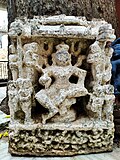



No edit summary |
small adjust citations for consistency and fixed typos as per guidelines |
||
| Line 1: | Line 1: | ||
{{short description|Gajapati | {{short description|Gajapati emperor from 1434 to 1466}} | ||
{{Multiple issues| | |||
{{More footnotes needed|date=November 2023}} | |||
{{Unreliable sources|date=October 2025}} | |||
}} | |||
{{Use dmy dates|date=June 2024}} | |||
{{Use Indian English|date=June 2024}} | |||
{{Infobox royalty | {{Infobox royalty | ||
| type = Emperor | | type = Emperor | ||
| name = Kapilendra Deva | | name = Kapilendra Deva | ||
| title=Gajapati | | title = [[Gajapati (title)|Gajapati]] <br> Virashree <br> Rajadhiraja<br> Brhamarvara <br> Gaudeshwara <br> Karnata Kalabargeswara | ||
| more = | | more = | ||
| image = Gajapati Kapilendradeva.jpg | | image = Gajapati Kapilendradeva.jpg | ||
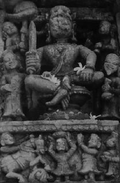
| caption = | | caption = Gajapati Kapilendra Deva depicted holding a sword and seated in a dominating Lakulisha position at Kapileswar Temple in Old Bhubaneswar. | ||
| succession = | | succession = 1st [[Gajapati Empire|Gajapati Emperor]] | ||
| reign = 1434 | | reign = 1434 – 25 November 1466 | ||
| coronation = 29 June 1435<br>[[ | | coronation = 29 June 1435{{Efn|Asadh Krishna Navami tithi, 1492 Vikram Samvat}}, [[Bhubaneswar]] | ||
| | | predecessor = Bhanudeva IV<br>{{small|([[Eastern Ganga dynasty|King of Trikalinga]])}} | ||
| | | successor = [[Purushottama Deva]] | ||
| full name = | | succession1 = [[Gajapati Empire|King of Gauda]] | ||
| house = [[ | | reign1 = 1450 – 25 November 1466 | ||
| spouse=Rupambika | | succession2 = [[Gajapati Empire|King of Karnata and Kalabarga]] | ||
| father =Jageswara | | reign2 = 1464 – 25 November 1466 | ||
| mother =Belama | | issue = [[Hamvira Deva]] <br> [[Purushottama Deva]] | ||
| birth_date = | | full name = | ||
| birth_place = | | regnal name = Shree Shree Gajapati Kapilendra Deva | ||
| death_date = | | house = [[Suryavamsha]] | ||
| death_place =Banks of [[Krishna River]] | | spouse = Rupambika <br> Parvati Devi, etc. | ||
| place of burial = | | father = Jageswara | ||
| religion = [[Hinduism]] | | mother = Belama | ||
| birth_date = | |||
| birth_place = | |||
| death_date = 25 November 1466 | |||
| death_place = Banks of [[Krishna River]] <br>(modern day Andhra Pradesh) | |||
| place of burial = | |||
| religion = [[Hinduism]] | |||
{{Infobox military person | |||
| embed = yes | |||
| allegiance = | |||
| branch = | |||
| rank = | |||
| battles = [[Battle of Devarakonda]] | |||
}} | |||
}} | }} | ||
== | '''Kapilendra Deva'''{{efn|{{langx|or|କପିଳେନ୍ଦ୍ର ଦେବ}}}} (died 25 November 1466)<ref name="sen2">{{Cite book|title=A Textbook of Medieval Indian History|last=Sen|first=Sailendra|publisher=Primus Books|year=2013|isbn=978-9-38060-734-4|pages=121–122}}</ref><ref>{{Cite book |last=Das |first=Manmatha Nath |url=http://archive.org/details/in.ernet.dli.2015.32999 |title=Glimpses Of Kalinga History |date=1949}}</ref> was the founder of the [[Gajapati Empire]] that ruled parts of eastern and southern India with present-day [[Odisha]] as the center of the kingdom.<ref>{{cite book |last1=Mishra |first1=Patit Paban |title=The Encyclopedia of Empire |chapter=Eastern Ganga and Gajapati empires |chapter-url=https://onlinelibrary.wiley.com/doi/abs/10.1002/9781118455074.wbeoe402 |publisher=[[Wiley-Blackwell]]|date=11 January 2016 |pages=1–4 |doi=10.1002/9781118455074.wbeoe402 |isbn=9781118455074 }}</ref><ref>{{citation|url=https://www.jstor.org/stable/44147183 |publisher=Indian History Congress |quote="empire...Suryavamsi Gajapatis"|last=Panda |first=Shishir Kumar | title=Gajapati Kingship and the Cult of Jagannatha: A Study on the Chhamu Chitaus (Royal Letters) | journal=Proceedings of the Indian History Congress |date=2008 | volume=69 | pages=225–229 | jstor=44147183 }}</ref>{{sfn|Majumdar|Pusalker|Majumdar|1960|p=365}}<ref>{{citation |title=Kshatriyaization and social change: A Study in Orissa setting |publisher=Popular Prakashan |url=https://core.ac.uk/download/pdf/83630303.pdf |first=Hermann |last=Kulke |page=402 |quote="Suryavamsa...kings of the Suryavamsa(1435-1540)" |date=1976 |access-date=2021-03-27 |archive-date=2021-06-24 |archive-url=https://web.archive.org/web/20210624203426/https://core.ac.uk/download/pdf/83630303.pdf |url-status=dead }}</ref> Kapilendra was the most powerful Hindu king of his time, and under him Orissa became an empire stretching from the [[Hooghly River|lower Ganga]] in the north to the [[Kaveri]] in the south.<ref>{{Cite book |editor-last=Majumdar |editor-first=R. C. |url=http://archive.org/details/delhisultanate00bhar |title=History and Culture of the Indian People, Volume 6: The Delhi Sultanate |date=1967 |publisher=Bharatiya Vidya Bhavan}}</ref> He was known for his aggressive military campaigns, He defeated the Muslim forces like the Sultan of [[Jaunpur Sultanate|Jaunpur]] [[Mahmud Shah (Sultan of Bengal)|(Mahmud Shah]]), [[Bahmani Sultanate]] and the young ruler of Bengal [[Shamsuddin Ahmad Shah|Samsuddin Ahmad Shah]] who were continuously preparing to invade Odisha and had continuous rivalries with powerful kings such as [[Deva Raya II]] of [[Vijayanagara Empire|Vijayanagara]] along with [[Reddy dynasty|Reddys]] of [[Rajahmundry|Rajmahendri]].<ref name=":0" /><ref name=":1" /><ref name=":2" /><ref name=":4">{{Cite web |title=Gajapati Kapilendra Deva |url=https://www.goodreads.com/book/show/199136692-gajapati-kapilendra-deva |access-date=2025-01-10 |website=Goodreads |language=en}}</ref> | ||
Kapilendra reduced the taxation and warned the nobles not to oppress the people. He was a devoted worshipper of [[Jagannath]] but the Siva temples did not miss his benefactions. Kapilendra was a patron of arts and letters and the renaissance in [[Odia literature]] may be traced from his reign. He imparted fresh vigour and life to a declining kingdom and left it to his son Purushottama, in a prosperous condition.<ref>{{Cite book |last=Mukherjee |first=Prabhat |url=https://books.google.com/books?id=1o8BAAAAMAAJ |title=The History of the Gajapati Kings of Orissa and Their Successors |date=1953 |publisher=General Trading Company |language=en}}</ref> After his death his youngest son [[Purushottama Deva]] became the successor by the wish of his father which led to a civil war with his elder brother [[Hamvira Deva]].<ref name=":4"/> | |||
== | ==Early life== | ||
There are multiple popular theories about the origin of Kapilendra Deva's family and his initial life. Records from the ''[[Madala Panji]]'' of the [[Jagannath Temple]] in [[Puri]] state that he was known as Kapila Rauta and belonged to the Surya Vamsa line. He used to graze cattle along with a Brahmin named Kasia. Due to a divine symbol of cobra (naga) seated by his head covering him from the sunlight while he was resting, Kasia predicted that Kapila would become a king one day. Later Kapila went to Puri where he used to beg near the [[Vimala Temple]] of the Puri [[Jagannath Temple, Puri|Jagannath temple]] complex and was later adopted by the last [[Eastern Ganga dynasty]] ruler Bhanudeva following a divine dream. He was later appointed in his younger days as a military general of the Ganga forces and was assigned the task to fight the Muslim forces of Bengal. Another version of the Madala Panji maintains the same account with regards to the origin of Kapilendra Deva but changes his name to Kapila Samantara who was at the service of the Ganga king Bhanudeva IV and stayed inside the palace. When the kingdom of Bhanudeva was threatened by an invasion, Kapila Samantara gave a good account of himself as a brave soldier and after the death of Bhanudeva, Kapila became the ruler of Odisha assuming the name Kapilendra Deva.<ref name=":5">{{Cite web|url=https://shodhganga.inflibnet.ac.in/jspui/bitstream/10603/227677/9/09_chapter%203.pdf|title=Kapilendra Deva and his times|website=www.shodhganga.inflibnet.ac.in|last=Bhuyan|first=Annapurna|publisher=Utkal University|year=1999|access-date=30 June 2021}}</ref> | |||
=== | ===Inscriptions=== | ||
[[File:Kapilendra Deva.jpg|thumb|A detached sculpture of Gajapati Kapilndra Deva found at Gadagadeswar Temple of Cuttack city.]] | |||
Raghudevapuram copper plate grant of Raghudeva Narendra who was the governor of [[Rajamahendravaram]] Rajya and also a nephew of Kapilendra Deva gives valuable details about the family's history. Their lineage can be traced back to Kapilendra Deva's grandfather Kapileswara who was holding the position of a Nayaka. Kapileswara Nayaka was thus in the military service of the Gangas and occupied the position of a lieutenant in the army. He had a son named Jageswara who was also in the service and possessed a great number of elephants. Jageswara was married to Belama and they had three sons named Balarama, Kapilendra and Parashurama Harichandana. Raghudeva Narendra was the son of Parashurama.{{sfn|Subrahmanyam|1957|pp=30-31}}<ref>{{Cite web|url=https://shodhganga.inflibnet.ac.in/jspui/bitstream/10603/227677/9/09_chapter%203.pdf|title=Kapilendra Deva and his times|website=www.shodhganga.inflibnet.ac.in|last=Bhuyan|first=Annapurna|publisher=Utkal University|year=1999|page=31|access-date=30 June 2021}}</ref> | |||
== | == Suppressing internal rebellions== | ||
[[File:Kapilendra Deva 1.png|alt= | [[File:Lingaraj Temple Inscription of Kapilendra Deva 1.png|alt=Lingaraj Temple Inscription of Kapilendra Deva issuing warning to the vassal kings for complete loyalty to him or else lose their property and be banished from the kingdom|thumb|250x250px|Lingaraj Temple Inscription of Kapilendra Deva issuing warning to the vassal kings for complete loyalty to him or else lose their property and be banished from the kingdom]] | ||
Due to the weakening administration of the [[Eastern Ganga dynasty]], Kapilendra Deva ascended the throne with internal support while the last ruler of the dynasty, Bhanu Deva IV was on a military expedition in the southern territories. He was declared as the new Monarch with a ''[[Rajyabhisheka]]'' ceremony at [[Bhubaneswar]]. Since the ascension was through a coup or rebellion, some vassal kings from Odisha such as Matsarvamshi of Oddadi, Shilavamshis of Nandapur, and Bishnukundina of Panchadhara refused to acknowledge his authority and declared themselves independent. Around the same time, the [[Sultanate of Jaunpur]] also posed an external threat to his realm. He appointed his able minister Gopinath Mahapatra to deal with the Jaunpur threat, which he successfully executed, and Kapilendra Deva himself suppressed the internal rebels with force. The rebels were suppressed by the year 1440 CE. The rebellious troubles that he dealt with by force are proven by his [[Lingaraja Temple|Lingaraj Temple]] declaration in which he ordered the rebels to accept his rule or be toppled from power.<ref>{{Cite web|url=http://shodhganga.inflibnet.ac.in/bitstream/10603/118610/9/09_chapter%202.pdf|title=Society and culture as depicted in literature of the Gajapati period, Chapter II - Political history|website=www.shodhganga.inflibnet.ac.in|pages=15–16|access-date=12 August 2017}}</ref> | |||
=== Coronation === | |||
The chronicle [[Madala Panji]] detailed the event of Kapilendra Deva's coronation as [[Gajapati (title)|Gajapati]] of the realm succeeding Bhanu Deva IV, the last ruler of the [[Eastern Ganga dynasty|Eastern Ganga]]s. It mentioned that the coronation took place at Bhubaneswar on '''2 kākara śukḷa 4 aṅka 2'''. The date with respect to the [[Odia calendar]] corresponds to the Gregorian calendar on 29 June 1435. Thus with the coronation of Kapilendra Deva as the Gajapati of the Odradesa realm, he started his era known as ''Kapilabda'' and laid the foundation of the Suryavamsa dynasty.{{sfn|Subrahmanyam|1957|p=34}} | |||
=== Kapilendra Deva's Odia military === | |||
[[File:Kapilendra Deva 1.png|alt=Kapilendra Deva Routray depicted holding a sword and seated in a dominating Lakulisha position at Kapileswar Temple in Old Bhubaneswar|thumb|250x250px|Kapilendra Deva with a sword at Kapileswar Temple in Old Bhubaneswar]] | |||
Different historical sources give varied accounts about the Odishan military commanded by the Gajapatis. According to the Muslim text Buhan-m-Mansir, Kapilendra had an elephant force numbering two hundred thousand (2,00,000). This number of war elephants is usually a very huge number compared even to any military of the existing kingdoms during the times of Kapilendra Deva himself in India. Nizzamuddin writes that the Gajapati encamped on the Godavari river banks with an infantry of seven hundred thousand (700,000). Another Muslim source documents that Kapilendra Deva raided Bidar with only 10,000 foot soldiers while being assisted by the Vellamati chiefs of Telangana.<ref>{{Cite web|url=http://shodhganga.inflibnet.ac.in/bitstream/10603/191019/10/10_chapter%205.pdf|title=MILITARY SYSTEM UNDER THE SURYAVAMSI GAJAPATIS|website=www.shodhganga.inflibnet.ac.in|access-date=10 October 2018}}</ref> | |||
== Conquests == | |||
The military hegemony of Odisha had declined during the last line of Eastern Ganga dynasty rulers which provided enough opportunity for the rising powers in its neighborhood. When Kapilendra Deva took over the throne, hostile Muslim powers like the Sultan of [[Jaunpur Sultanate|Jaunpur]] [[Mahmud Shah (Sultan of Bengal)|(Mahmud Shah]]), [[Bahmani Sultanate]] and the young ruler of Bengal [[Shamsuddin Ahmad Shah|Samsuddin Ahmad Shah]] were continuously preparing to invade Odisha. [[Rivalry|Rival]] [[Hindus|Hindu]] powers such as [[Deva Raya II]] of [[Vijayanagara Empire|Vijayanagara]] along with [[Reddy dynasty|Reddys]] of [[Rajahmundry|Rajmahendri]] had [[conquered]] advancing as far as the [[Simhachalam Hill Range|Simhanchalam]] territory in the south. Along with suppressing internal rebellions, Kapilendra Deva first defeated the Jaunpur forces and then contained the [[Bengal]] forces with the help of his minister Gopinath Mahapatra after which only he initiated his aggressive military campaigns of the Southern and Deccan parts of India.<ref name=":0">{{Cite book|title=History of Odisha|publisher=Kalyani Publishers|year=2004|isbn=81-272-1367-5|location=New Delhi|pages=86–94}}</ref><ref>{{Cite book|title=Odia Jatira Itihaasa O Sanskruti, Part – 1|publisher=Vidyapuri|year=2012|isbn=978-81-7411-656-7|location=Cuttack|pages=177–181}}</ref><ref name=":1">{{Cite web|url=http://shodhganga.inflibnet.ac.in/bitstream/10603/127087/8/08_chapter%203.pdf|title=RELATIONS WITH THE GAJAPATHIS|website=www.shodhganga.inflibnet.ac.in|access-date=12 August 2017}}</ref><ref name=":2">{{Cite web|url=http://shodhganga.inflibnet.ac.in/bitstream/10603/118610/9/09_chapter%202.pdf|title=Society and culture as depicted in literature of the Gajapati period, Chapter II - Political History|website=www.shodhganga.inflibnet.ac.in|pages=15–21|access-date=12 August 2017}}</ref> | |||
=== Conquest of Gauda region in Bengal === | |||
The Gopinathpur inscription of 1447 CE describes his campaign against the [[Sultan of Bengal]] who tried to raid Odisha but was beaten back by the Gajapati army led by Gopinath Mahapatra, the minister of Kapilendra Deva.{{sfn|Subrahmanyam|1957|p=35}} The Gajapati army conquered territories of Bengal to the west of Ganga river including the fort of [[Gar Mandaran]].{{sfn|Majumdar|Pusalker|Majumdar|1960|p=366}} Historian R. Subramaniam describes that the title 'Brhamarbara' retained by Kapilendra Deva from the days of his service at the Ganga king's court clearly signifies his control over Brhamarkuta<ref name=":4"/> region of Bengal. An inscription in the Jagannath temple of Puri that is dated to the year 1450 CE narrates the conquest of [[Gauda Kingdom|Gauda]] by Kapilendra Deva after defeating Malika Parisa (Malik Padsah) which in short refers to the contemporary Persianate [[Sultan of Bengal]] by the name [[Mahmud Shah of Bengal|Nasiruddin Mahmud Shah]]. The region east of the river Ganga<ref name=":4" /> and until modern Burdhawan district was known as the Jaleswar division<ref name=":5" /> which was handed over to the later ruler of Bengal Ali Vardi Khan by the Marathas during their time.<ref name=":4" /> Kapilendra Deva's aide Jalesara Narendra Mahapatra was appointed as the governor of this region. After this victory, Kapilendra Deva accepts the title epithet of ''Gaudeswara'' meaning the Lord of the [[Gauda Kingdom|Gauda kingdom]].<ref name=":4" />{{Better source needed|date=December 2022}}<ref>{{Cite book|url=https://books.google.com/books?id=C_LT5Q-f3YEC&q=Gajapatis+of+Orissa&pg=PA2|title=Medieval Orissa: A Socio-economic Study by By Shishir Kumar Panda|publisher=Mittal Publications|year=1991|isbn=81-7099-261-3|location=New Delhi|pages=11}}</ref> Katakarajavanshavalli records state about the holy dip of the Gajapati himself in the river [[Ganges]] and the ''[[Dāna]]'' of Tulasipur ''shasan'' villages to the Brahmins there. This clearly indicates that Kapilendra Deva was in control of regions beyond the river Ganga to its East.{{citation needed|date=October 2025}} | |||
* ''' | === The conquest of Rajamahendri === | ||
[[File:Kondavid-drug near Guntur. 19 February 1804. Signed 'W.R.'.jpg|thumb|1804 picture of Kondavidu Fort near Guntur]] | |||
* '''First Campaign in 1444 CE -''' The first campaign against the alliance of [[Vijayanagara Empire]] and [[Rajahmundry|Rajamahendri]] [[Reddy]]s was unsuccessful as [[Odia people|Odia]] forces had to face a two front war with both the Jaunpur Muslim forces in the north and the [[Rivalry|rival]] [[Vijayanagara Empire|Vijayanagara]] [[Hindus|Hindu]] forces under the able leadership of the [[Deva Raya II]]'s able general Mallapa. Kapilendra Deva first diverted his attention in dealing with the invasion in the northern frontiers and hence the campaign in the south was abandoned. | |||
* '''Second Campaign in 1446 CE and Capture of [[Kondaveedu Fort|Kondavidu]] by Hamvira Deva -''' The Odia forces returned in the year 1446 CE led by the Prince [[Hamvira Deva]] or Hamvira Kumara Mahapatra, the eldest son of Kapilendra Deva. The political alliance between the [[Vijayanagara Empire]] and the [[Reddi Kingdom|Reddy Kingdom]] had ceased to exist as [[Deva Raya II]] had died and the power passed on to a weaker successor in [[Mallikarjuna Raya]]. Kapilendra took advantage of this position in the kingdom of Rajahmundry and sent his son [[Hamvira Deva|Hamvira]] with a large army and succeeded in defeating the Reddis very easily. The kingdom of Rajahmundry was thus brought under the sway of Kapilendra before A. D. 1448.<ref>{{Cite book |last1=କୃଷ୍ଣଚନ୍ଦ୍ର ପାଣିଗ୍ରାହୀ |url=http://archive.org/details/history-of-orissa-1986 |title=History of Orissa |last2=Krishna Chandra Panigrahi |last3=Kr̥ṣṇacandra Pāṇigrāhī |last4=Krishna Chandra Panigrahi |last5=Kr̥ṣṇacandra Pāṇigrāhī |date=1986 |publisher=State Committee for Compilation of History of the Freedom Movement Orissa}}</ref> | |||
=== Conquest of Kondavidu === | |||
The territory to the south of the [[Krishna River|Krishna]] was under the political sway of the [[Vijayanagara dynasty|Vijayanagar kings]] till 1453. This fact is borne out by an inscription of Mallikarjuna dated 1453, at Matamuru in the Guntur district.<ref>{{Cite book |last=KHALIQ |first=AHMED NIZAMI |url=http://archive.org/details/dli.bengal.10689.12483 |title=A COMPREHENSIVE HISTORY OF INDIA VOL.5 |date=1970 |publisher=PEOPLE’S PUBLISHING HOUSE,NEW DELHI}}</ref> After August 1453, Kapilendra's army crossed the Krishna and occupied [[Kondavidu]]. Ganadeva Rautraya a relation of Kapilendra, was appointed as the governor of [[Kondavidu]], [[Addanki]] and [[Vinukonda]]. Therefore, almost the whole of the Guntur district passed into the hands of the Gajapati Kingdom between 1453 and 1454. The epigraph records conclusively proves that by A.D. 1454 Kapilendra had become the master of the former Reddi kingdoms of Rajahmundry and Kondavidu.<ref>{{Cite book |last=Mukherjee |first=Prabhat |url=https://books.google.com/books?id=kIy1AAAAIAAJ |title=The History of the Gajapati Kings of Orissa and Their Successors |date=1953 |publisher=General Trading Company |language=en}}</ref> | |||
Dr. Venkataramanaya, points out that some of the Telugu chiefs transferred their allegiance to Kapilendra. when the power of the Raya of Vijayanagara declined on the banks of the Krishna . We learn from chatu verse that Pushapati Tammaraju occupied many forts including [[Bellamkonda]], [[Vadapalli]], Ramgarajukonda as an overlord Kapilendra.<ref>{{Cite book |last=Subrahmanyam |first=R. |title=The Suryavamsi Gajapatis of Orissa}}</ref> | |||
== | === Malwa expeditions === | ||
[[File: | [[File:Indien2012 1356 Mahur Fort.jpg|thumb|Mahur fort captured by Gajapati Kapilendra Deva]] | ||
The | *'''Conquest of Mahur -''' The Veligalani plates and Chiruvrolu inscriptions records the prowess of the Gajapati during the Malwa expeditions. Although there is not much mention of a war, but it does show geopolitical scenario in the region during the march of Gajapati Kapilendra Deva's forces as is described by the fear of the Gajapati army among the rulers of Vijayanagara, Gulbarga and Malwa.{{sfn|Subrahmanyam|1957|p=51}} The text ''Gaṅgādāsapratāpavilāsam'' and the cāṭu verses mentions the conquest of the Mahur fort in 1457 CE during the Malwa expeditions. It describes the campaign where Kapilendra Deva's forces marched against the dominions of the [[Turco-Persian tradition|Turko-Persian]] [[Malwa Sultanate|Malwa]] and [[Bahmani Sultanate|Bahmani]] Sultanates and wrested control of the forts of [[Mahur, Maharashtra|Mahur]] and Bedadakota(Bidar).{{sfn|Subrahmanyam|1957|p=52}} | ||
=== Conquest of | === Conquest of Telangana === | ||
The | [[File:Devarakonda Fort On The Hill Surrounded by Pond & Sky Shines On It.jpg|thumb|Devarakonda Fort]] | ||
The political situation in [[Telangana]] provided an opportunity for the Gajapati army to intervene and conquer the territory. The Velama rulers of [[Devarakonda]] in Telangana and the [[Bahmani sultanate|Bahmani Sultan]] [[Alau'd-din Ahmad Shah]] had cordial relations in the initial stages but on the event of war between the [[Vijayanagara Empire]] and the [[Bahmani Sultanate]], the [[Velama]] rulers backed the [[Bahmani Sultanate]] and sought to fight the [[Vijayanagara Empire]]. In an act of revenge the Bahmani sultan invaded the Telegana region and the Bahmani commander Sanjar Khan extracted vengeance on the common people. Native Hindus were sold as slaves. In 1456 CE, Humayun Shah ascended the throne of the Bahmani sultanate and his general Sikander Khan suppressed the rebel Velama chiefs after occupying [[Devarakonda]]. Kapilendra Deva was invited by the Velama chiefs to rescue them from the Bahmani sultans. In 1458 CE, a battle ensued at [[Devarakonda]] between Odia forces led by Prince [[Hamvira Deva]] and the Bahmani forces.<ref>{{Cite book|url=https://archive.org/stream/in.ernet.dli.2015.281018/2015.281018.History-Of#page/n383/mode/2up|title=History Of Orissa 1930 Vol.1, From the Earliest Times to the British Period|publisher=Prabasi Press|year=1930|location=120-2, Upper Circular Road, Calcutta|pages=291, 292, 293, 294}}</ref> As a result of this battle Odia forces came out victorious and Telangana region became a feudal state of the Gajapati empire with the Velama chiefs as the vassal rulers. The victory over the [[Bahmani Sultanate]] forces at [[Devarakonda]] in 1458 CE enabled Kapilendra Deva to assume the title of ''Kalavargeśvara'' which meant the Lord of [[Kalaburagi]].{{sfn|Subrahmanyam|1957|p=54}} | |||
=== | === Invasion of Bidar === | ||
{{Main|Gajapati invasion of Bidar}} | |||
{{AI-generated|section=Invasion|date=March 2026|reason=[[Special:Diff/1186969346|this 2023 edit]]; note [[BP:AISIGNS]] in undue emphasis on significance, vocab distro typical of 2023-24 LLM text etc}} | |||
[[File:Bidar Fort P10.jpg|thumb|Bidar Fort]] | |||
In 1461, Kapilendra Deva orchestrated a significant military campaign during the reign of [[Nizam-Ud-Din Ahmad III|Nizam Shah Bahmani]]. The primary aim of this strategic maneuver was to capture Berar, with a specific focus on the town of [[Achalpur]] in what is now modern-day [[Maharashtra]]. Backed by Kakatiya chiefs, Kapilendra Deva led his forces into a consequential military confrontation against the Bahmani Sultanate. Despite their initial intentions, the Gajapati forces, under Kapilendra Deva's leadership had to retreat. This sudden withdrawal stemmed from Jaunpur Sultan [[Husain Shah of Jaunpur|Husain Sharqi]]'s invasion of Orissa. After capturing [[Tirhut division|Tirhut]], he sent detachments to conquer Orissa. This compelled Kapilendra to retract from Bahmani territories, compelling him to seek peace. This turn of events forced the surrender of the Gajapati forces.{{sfn|Subrahmanyam|1957|p=56-58}} The outcome of this campaign, set against the backdrop of Nizam Shah Bahmani's rule, left a lasting imprint on the historical tapestry of the region, shaping the narrative of Kapilendra Deva's military endeavors.<ref>{{Cite book |last=Haque |first=Mohammed Anwarul |url=https://books.google.com/books?id=Co8eAAAAMAAJ |title=Muslim Administration in Orissa, 1568-1751 A.D. |date=1980 |publisher=Punthi Pustak |pages=34 |language=en}}</ref> | |||
=== | === Subjugation of the Vijayanagara Empire and Expansion === | ||
[[File:Udayagiri Fort (33).jpg|alt=Udayagiri fort situated in Nellore district was first built by conquering forces of Kapilendra Deva as the military headquarters of his empire's southern parts.|thumb|260x260px|[[Udayagiri, Nellore district|Udayagiri]] fort situated in Nellore district was first built by the conquering forces of Kapilendra Deva as the military headquarters of his Gajapati empire's southern territories.]] | |||
From the documents of the ''Gangadasa Bilasa Charitam'', it is known that Kapilendra Deva ordered prince [[Hamvira Deva]] to conquer [[Vijayanagara Empire|Vijayanagara]] and the [[Bahmani sultanate]]. Hamvira Deva successfully captured the imperial capital city of [[Vijayanagara]] and forced it's weak emperor [[Mallikarjuna Raya]] to pay yearly tribute. Hamvira Deva's general Tamavupala conquered the southern states of [[Udayagiri, Andhra Pradesh|Udayagiri]] and [[Chandragiri]] in the year 1460 CE. The inscriptions of [[Ranganathaswamy Temple, Srirangam|Srirangam Temple]] near [[Tiruchirappalli|Trichinapalli]] dictate that Hamvira Deva conquered as far as Trichinapalli, [[Thanjavur|Tanjore]] and [[Arcot, Vellore|Arcot]] in south before stopping his advance. Hamvira Deva's son Dakshina Kapileswara Kumara became the governor of the southernmost territories of Chandragiri in the year 1464 CE after its conquest.<ref>{{Cite web|url=http://shodhganga.inflibnet.ac.in/bitstream/10603/94396/8/08_chapter%202.pdf|title=Some aspects of administration and society in Medieval Andhra AD 1038 to 1538 under the later Eastern Gangas and the Suryavamsa Gajapatis, Chapter II, Section II - The Suryavamsa Gajapatis. Kapilesvara (A.D.1434 - 1538)|website=www.shodhganga.inflibnet.ac.in|pages=38–43|access-date=12 August 2017}}</ref> | |||
By 1464 CE, Kapilendra Deva was the undisputed master of an [[Gajapati Empire|empire]] stretching from the [[Ganges]] in the north to [[Tiruchirappalli]] in the south along the coast. Thus he could proudly assume the imperial titles of ''Gajapati Gauḍeśvara Navakoṭi Karṇāṭa Kalavargeśvara'' with due justification. According to the historian [[R. C. Majumdar]], Kapilendra Deva was the most powerful Hindu monarch of his time and under him Odisha became an empire stretching from the lower Ganga in the north to the Kaveri in the south.{{sfn|Majumdar|Pusalker|Majumdar|1960|p=367}} The Gopinathpur inscription aptly describes his position in 1464 CE:{{sfn|Subrahmanyam|1957|p=58}} | |||
''Kṛtvā saṃyati Māḷāvendra-jayinaṃ senādhināthaṃ tu yaṃ Gauḍendrasya nitāntam Utkala-patha-prasthāna rodhārgaḷaṃ Śrīkhaṃṇḍādri payodharopāri karaṃ nirmāya Sānaṃdaṃ Kapileśvaro viharate Karṇāṭa-rājya-śriyā'' | |||
== | == Imperial consolidation == | ||
[[File: | [[File:Gajapati Empire of Kapliendra Deva Routaray.jpg|thumb|Extent of Odisha under Kapilendra Deva{{sfn|Subrahmanyam|1957|pp=56-58}}]] | ||
The [[Gajapati Empire]] which reached its height in 1464 CE under Kapilendra Deva was organised into two administrative divisions of ''Dandapata'' and ''Rajya''. Most of the core regions of the empire in the north came under his direct control which were divided into Dandapathas (the division continuing from the Eastern Gangas) under a Governor (parikśa) or were controlled by the feudatory [[Samanta|''Samanta rajas'']]. The southern parts of the empire were divided into Rajyas which were ruled by Governors.{{sfn|Subrahmanyam|1957|p=132}} | |||
== Construction and Culture == | |||
Kapilendra Deva patronized [[Vaishnavism|Vaishnavite Hinduism]] and expanded the [[Jagannath temple]] at [[Puri]]. Although his entire life was spent in warfare, the Jagannath temple became the center for an efflorescence of drama and dance ([[Odissi]]) and other forms of art during Gajapati rule.<ref>{{cite web |url=http://www.indiadivine.org/articles/232-sanskrit-poets-scholars-orissa.html |title=Sanskrit Poets and Scholars of Orissa |access-date=2011-03-21 |url-status=dead |archive-url=https://archive.today/20120804040129/http://www.indiadivine.org/articles/232-sanskrit-poets-scholars-orissa.html |archive-date=2012-08-04 }}</ref> He was a great patron of Vedic culture and himself wrote a Sanskrit play called '''Parshuram Bijaya.''' He constructed the [[Shaivite|Shaivite Hindu]] [[Kapilesvara Siva Temple|Kapilesvara Temple]] in [[Bhubaneswar]] which displays his tolerance towards every sectarian belief under the Hindu domain. It was during the rule of Kapilendra Deva when Odia was officially used as an administrative language and the poet [[Sarala Das]] wrote the Odia Mahabharata. Several learned poets and writers were promoted by him.<ref>{{Cite book|title=History of Odisha|publisher=Kalyani Publishers|year=2004|isbn=81-272-1367-5|location=New Delhi}}</ref> Sanskrit poets also flourished during this era like [[Viswanatha Kaviraja|Visvanatha Kaviraja]] who wrote ''[[Sahityadarpana|Sahitya Darpana]] and Chandrakala Natika along with other works,'' Narsingha Mishra Vajapeyi wrote ''Samksepasariraka vartika and'' Kalidasa Chayani wrote ''Suddhichandrika.''<ref>{{Cite web|url=http://www.harekrsna.com/sun/features/07-07/features727.htm|title=Sanskrit Poets and Scholars of Orissa By: Dr. Bhagaban Panda|website=www.harekrsna.com|access-date=19 November 2019}}</ref> | |||
Kapilendra Deva had declared himself as a servant-ruler of the [[Lord Jagannath]] which is also reflected in his regnal title ''Routaray'' meaning the Lord's servant-king. The Narendra tank in the [[Jagannath Temple, Puri|Puri Jagannath temple]] premises was constructed by Kapilendra Deva in the memory of his martyred younger brother, Veer Narendra Deva. Fourteen out of sixteen [[ghat]]s of the tank are named after his fourteen nephews. The two concentric defensive stone walls known as ''Kurma Prachira'' (the inner wall measuring 400’ x 278’) and ''Meghanada Prachira'' (the outer wall measuring 665’ x 644’ with height varying from 20’ to 24’) were constructed during the reign of Kapilendra Deva. The ''[[Chandan Yatra|Chandan Jatra]]'' festival of Lord Jagannath was initiated during his rule. He himself donated a large amount of jewelry and utensils to the Puri temple during the 41 anka of his rule. The Gajapati pledged to donate equal amount of wealth and rights to the [[Brahmin]]s. He ordered the abolition of Chaukidari tax paid by [[Brahmin]]s previously and also banned the resumption of waste and pasture lands.<ref>{{Cite book|url=https://archive.org/details/in.gov.ignca.34817/page/n249|title=Orissa in the Making by B.C.Mazumdar|publisher=University of Calcutta|year=1925|location=University of Calcutta|pages=213, 214}}</ref> He had ordered his officials to ''follow the path of justice, righteousness and [[Historical Vedic religion|Hindu]] spiritual teachings'' and had warned them that they will face the punishment of exile if they failed to do so.<ref>{{Cite book|url=https://archive.org/details/in.ernet.dli.2015.32999/page/n229|title=Glimpses of Kalinga History|publisher=Century Publishers|year=1949|location=Calcutta|pages=218, 219}}</ref> During his rule, two Dadhivamana temples were constructed, one each in the village of Kaunrpur and Gopinathpur in [[Cuttack district|Cuttack]] district. Kapilendra Deva was a builder of a welfare state and had ordered not to commit atrocities or impose excessive hardships on the people of his empire.{{citation needed|date=October 2025}} | |||
[[ | |||
<gallery> | |||
File:Narendra Tank, Puri, Odisha.JPG|alt=Narendra tank at Puri dug during the rule of Kapilendra Deva|Narendra Tank, Puri (dug during the rule of Kapilendra Deva) | |||
File:Meghanad wall.jpeg|alt=Meghanada wall fortifying the Puri Jagannath temple constructed during the rule of Kapilendra Deva|Meghanada wall fortifying the Jagannath Temple, Puri (constructed during the rule of Kapilendra Deva) | |||
File:Monuments of ekamrakhetra.JPG|alt=Kapileswar Temple at old Bhubaneswar built during Kapilendra Deva|Kapileswar Temple, Old Bhubaneswar (built during Kapilendra Deva) | |||
File:Kapilesvara temple (7).jpg|Kapilesvara Temple, Bhubaneswar | |||
File:Kurumbera Fort 2.jpg|alt=Kuruma Bedha or Kurumbera fort compound built during the rule of Kapilendra Deva Routray and which is today within the territorial limits of West Bengal state.|Kurumbera Fort (Kuruma Bedha), compound built during the rule of Kapilendra Deva Routray | |||
File:Kurumbera Fort, Keshiari, West Bengal 04.jpg|Kurumbera Fort, Keshiari, West Bengal | |||
File:Kurumbera fort, a medieval heritage structure situated in Gaganeshwar village, West Medinipur 34.jpg|Kurumbera Fort, medieval heritage structure in Gaganeshwar village, West Medinipur | |||
File:Chambers of the Kurumbera fort , Gaganeshwar.jpg|Chambers of Kurumbera Fort, Gaganeshwar | |||
File:Udayagiri Fort (7).jpg|Udayagiri Fort, Nellore, Andhra Pradesh | |||
</gallery> | |||
== Notes == | |||
{{notelist}} | |||
==References== | == References == | ||
{{reflist}} | {{reflist}} | ||
=== Bibliography === | === Bibliography === | ||
* {{cite book |editor1-last=Majumdar |editor1-first=RC |editor1-link=R. C. Majumdar |editor2-last=Pusalker |editor2-first=A. D. |editor3-last=Majumdar |editor3-first=A. K. |date=1960 |title=[[The History and Culture of the Indian People]] |volume=VI: The Delhi Sultanate |location=Bombay |publisher=Bharatiya Vidya Bhavan |pages=365–372}} | * {{cite book |editor1-last=Majumdar |editor1-first=RC |editor1-link=R. C. Majumdar |editor2-last=Pusalker |editor2-first=A. D. |editor3-last=Majumdar |editor3-first=A. K. |date=1960 |title=[[The History and Culture of the Indian People]] |volume=VI: The Delhi Sultanate |location=Bombay |publisher=Bharatiya Vidya Bhavan |pages=365–372}} | ||
* {{cite book |editor1-last=Subrahmanyam |editor1-first=R |date=1957 |title=The Sūryavaṁśi Gajapatis of Orissa | * {{cite book |editor1-last=Subrahmanyam |editor1-first=R |date=1957 |title=The Sūryavaṁśi Gajapatis of Orissa |location=Waltair |publisher= Andhra University |oclc=613268261 }} | ||
{{S-start}} | {{S-start}} | ||
| Line 120: | Line 146: | ||
[[Category:15th-century Indian monarchs]] | [[Category:15th-century Indian monarchs]] | ||
[[Category: | [[Category:Gajapati emperors]] | ||
Revision as of 19:50, 25 March 2026
 | This article has multiple issues. Please help improve it or discuss these issues on the talk page. (Learn how and when to remove these template messages)
|


| Kapilendra Deva | |||||
|---|---|---|---|---|---|
| Gajapati Virashree Rajadhiraja Brhamarvara Gaudeshwara Karnata Kalabargeswara | |||||
 Gajapati Kapilendra Deva depicted holding a sword and seated in a dominating Lakulisha position at Kapileswar Temple in Old Bhubaneswar. | |||||
| 1st Gajapati Emperor | |||||
| Reign | 1434 – 25 November 1466 | ||||
| Coronation | 29 June 1435[lower-alpha 1], Bhubaneswar | ||||
| Predecessor | Bhanudeva IV (King of Trikalinga) | ||||
| Successor | Purushottama Deva | ||||
| King of Gauda | |||||
| Reign | 1450 – 25 November 1466 | ||||
| King of Karnata and Kalabarga | |||||
| Reign | 1464 – 25 November 1466 | ||||
| Died | 25 November 1466 Banks of Krishna River (modern day Andhra Pradesh) | ||||
| Spouse | Rupambika Parvati Devi, etc. | ||||
| Issue | Hamvira Deva Purushottama Deva | ||||
| |||||
| House | Suryavamsha | ||||
| Father | Jageswara | ||||
| Mother | Belama | ||||
| Religion | Hinduism | ||||
| Military career | |||||
| Battles/wars | Battle of Devarakonda | ||||
Kapilendra Deva[lower-alpha 2] (died 25 November 1466)[1][2] was the founder of the Gajapati Empire that ruled parts of eastern and southern India with present-day Odisha as the center of the kingdom.[3][4][5][6] Kapilendra was the most powerful Hindu king of his time, and under him Orissa became an empire stretching from the lower Ganga in the north to the Kaveri in the south.[7] He was known for his aggressive military campaigns, He defeated the Muslim forces like the Sultan of Jaunpur (Mahmud Shah), Bahmani Sultanate and the young ruler of Bengal Samsuddin Ahmad Shah who were continuously preparing to invade Odisha and had continuous rivalries with powerful kings such as Deva Raya II of Vijayanagara along with Reddys of Rajmahendri.[8][9][10][11]
Kapilendra reduced the taxation and warned the nobles not to oppress the people. He was a devoted worshipper of Jagannath but the Siva temples did not miss his benefactions. Kapilendra was a patron of arts and letters and the renaissance in Odia literature may be traced from his reign. He imparted fresh vigour and life to a declining kingdom and left it to his son Purushottama, in a prosperous condition.[12] After his death his youngest son Purushottama Deva became the successor by the wish of his father which led to a civil war with his elder brother Hamvira Deva.[11]
Early life
There are multiple popular theories about the origin of Kapilendra Deva's family and his initial life. Records from the Madala Panji of the Jagannath Temple in Puri state that he was known as Kapila Rauta and belonged to the Surya Vamsa line. He used to graze cattle along with a Brahmin named Kasia. Due to a divine symbol of cobra (naga) seated by his head covering him from the sunlight while he was resting, Kasia predicted that Kapila would become a king one day. Later Kapila went to Puri where he used to beg near the Vimala Temple of the Puri Jagannath temple complex and was later adopted by the last Eastern Ganga dynasty ruler Bhanudeva following a divine dream. He was later appointed in his younger days as a military general of the Ganga forces and was assigned the task to fight the Muslim forces of Bengal. Another version of the Madala Panji maintains the same account with regards to the origin of Kapilendra Deva but changes his name to Kapila Samantara who was at the service of the Ganga king Bhanudeva IV and stayed inside the palace. When the kingdom of Bhanudeva was threatened by an invasion, Kapila Samantara gave a good account of himself as a brave soldier and after the death of Bhanudeva, Kapila became the ruler of Odisha assuming the name Kapilendra Deva.[13]
Inscriptions

Raghudevapuram copper plate grant of Raghudeva Narendra who was the governor of Rajamahendravaram Rajya and also a nephew of Kapilendra Deva gives valuable details about the family's history. Their lineage can be traced back to Kapilendra Deva's grandfather Kapileswara who was holding the position of a Nayaka. Kapileswara Nayaka was thus in the military service of the Gangas and occupied the position of a lieutenant in the army. He had a son named Jageswara who was also in the service and possessed a great number of elephants. Jageswara was married to Belama and they had three sons named Balarama, Kapilendra and Parashurama Harichandana. Raghudeva Narendra was the son of Parashurama.[14][15]
Suppressing internal rebellions

Due to the weakening administration of the Eastern Ganga dynasty, Kapilendra Deva ascended the throne with internal support while the last ruler of the dynasty, Bhanu Deva IV was on a military expedition in the southern territories. He was declared as the new Monarch with a Rajyabhisheka ceremony at Bhubaneswar. Since the ascension was through a coup or rebellion, some vassal kings from Odisha such as Matsarvamshi of Oddadi, Shilavamshis of Nandapur, and Bishnukundina of Panchadhara refused to acknowledge his authority and declared themselves independent. Around the same time, the Sultanate of Jaunpur also posed an external threat to his realm. He appointed his able minister Gopinath Mahapatra to deal with the Jaunpur threat, which he successfully executed, and Kapilendra Deva himself suppressed the internal rebels with force. The rebels were suppressed by the year 1440 CE. The rebellious troubles that he dealt with by force are proven by his Lingaraj Temple declaration in which he ordered the rebels to accept his rule or be toppled from power.[16]
Coronation
The chronicle Madala Panji detailed the event of Kapilendra Deva's coronation as Gajapati of the realm succeeding Bhanu Deva IV, the last ruler of the Eastern Gangas. It mentioned that the coronation took place at Bhubaneswar on 2 kākara śukḷa 4 aṅka 2. The date with respect to the Odia calendar corresponds to the Gregorian calendar on 29 June 1435. Thus with the coronation of Kapilendra Deva as the Gajapati of the Odradesa realm, he started his era known as Kapilabda and laid the foundation of the Suryavamsa dynasty.[17]
Kapilendra Deva's Odia military

Different historical sources give varied accounts about the Odishan military commanded by the Gajapatis. According to the Muslim text Buhan-m-Mansir, Kapilendra had an elephant force numbering two hundred thousand (2,00,000). This number of war elephants is usually a very huge number compared even to any military of the existing kingdoms during the times of Kapilendra Deva himself in India. Nizzamuddin writes that the Gajapati encamped on the Godavari river banks with an infantry of seven hundred thousand (700,000). Another Muslim source documents that Kapilendra Deva raided Bidar with only 10,000 foot soldiers while being assisted by the Vellamati chiefs of Telangana.[18]
Conquests
The military hegemony of Odisha had declined during the last line of Eastern Ganga dynasty rulers which provided enough opportunity for the rising powers in its neighborhood. When Kapilendra Deva took over the throne, hostile Muslim powers like the Sultan of Jaunpur (Mahmud Shah), Bahmani Sultanate and the young ruler of Bengal Samsuddin Ahmad Shah were continuously preparing to invade Odisha. Rival Hindu powers such as Deva Raya II of Vijayanagara along with Reddys of Rajmahendri had conquered advancing as far as the Simhanchalam territory in the south. Along with suppressing internal rebellions, Kapilendra Deva first defeated the Jaunpur forces and then contained the Bengal forces with the help of his minister Gopinath Mahapatra after which only he initiated his aggressive military campaigns of the Southern and Deccan parts of India.[8][19][9][10]
Conquest of Gauda region in Bengal
The Gopinathpur inscription of 1447 CE describes his campaign against the Sultan of Bengal who tried to raid Odisha but was beaten back by the Gajapati army led by Gopinath Mahapatra, the minister of Kapilendra Deva.[20] The Gajapati army conquered territories of Bengal to the west of Ganga river including the fort of Gar Mandaran.[21] Historian R. Subramaniam describes that the title 'Brhamarbara' retained by Kapilendra Deva from the days of his service at the Ganga king's court clearly signifies his control over Brhamarkuta[11] region of Bengal. An inscription in the Jagannath temple of Puri that is dated to the year 1450 CE narrates the conquest of Gauda by Kapilendra Deva after defeating Malika Parisa (Malik Padsah) which in short refers to the contemporary Persianate Sultan of Bengal by the name Nasiruddin Mahmud Shah. The region east of the river Ganga[11] and until modern Burdhawan district was known as the Jaleswar division[13] which was handed over to the later ruler of Bengal Ali Vardi Khan by the Marathas during their time.[11] Kapilendra Deva's aide Jalesara Narendra Mahapatra was appointed as the governor of this region. After this victory, Kapilendra Deva accepts the title epithet of Gaudeswara meaning the Lord of the Gauda kingdom.[11][better source needed][22] Katakarajavanshavalli records state about the holy dip of the Gajapati himself in the river Ganges and the Dāna of Tulasipur shasan villages to the Brahmins there. This clearly indicates that Kapilendra Deva was in control of regions beyond the river Ganga to its East.[citation needed]
The conquest of Rajamahendri

- First Campaign in 1444 CE - The first campaign against the alliance of Vijayanagara Empire and Rajamahendri Reddys was unsuccessful as Odia forces had to face a two front war with both the Jaunpur Muslim forces in the north and the rival Vijayanagara Hindu forces under the able leadership of the Deva Raya II's able general Mallapa. Kapilendra Deva first diverted his attention in dealing with the invasion in the northern frontiers and hence the campaign in the south was abandoned.
- Second Campaign in 1446 CE and Capture of Kondavidu by Hamvira Deva - The Odia forces returned in the year 1446 CE led by the Prince Hamvira Deva or Hamvira Kumara Mahapatra, the eldest son of Kapilendra Deva. The political alliance between the Vijayanagara Empire and the Reddy Kingdom had ceased to exist as Deva Raya II had died and the power passed on to a weaker successor in Mallikarjuna Raya. Kapilendra took advantage of this position in the kingdom of Rajahmundry and sent his son Hamvira with a large army and succeeded in defeating the Reddis very easily. The kingdom of Rajahmundry was thus brought under the sway of Kapilendra before A. D. 1448.[23]
Conquest of Kondavidu
The territory to the south of the Krishna was under the political sway of the Vijayanagar kings till 1453. This fact is borne out by an inscription of Mallikarjuna dated 1453, at Matamuru in the Guntur district.[24] After August 1453, Kapilendra's army crossed the Krishna and occupied Kondavidu. Ganadeva Rautraya a relation of Kapilendra, was appointed as the governor of Kondavidu, Addanki and Vinukonda. Therefore, almost the whole of the Guntur district passed into the hands of the Gajapati Kingdom between 1453 and 1454. The epigraph records conclusively proves that by A.D. 1454 Kapilendra had become the master of the former Reddi kingdoms of Rajahmundry and Kondavidu.[25]
Dr. Venkataramanaya, points out that some of the Telugu chiefs transferred their allegiance to Kapilendra. when the power of the Raya of Vijayanagara declined on the banks of the Krishna . We learn from chatu verse that Pushapati Tammaraju occupied many forts including Bellamkonda, Vadapalli, Ramgarajukonda as an overlord Kapilendra.[26]
Malwa expeditions

- Conquest of Mahur - The Veligalani plates and Chiruvrolu inscriptions records the prowess of the Gajapati during the Malwa expeditions. Although there is not much mention of a war, but it does show geopolitical scenario in the region during the march of Gajapati Kapilendra Deva's forces as is described by the fear of the Gajapati army among the rulers of Vijayanagara, Gulbarga and Malwa.[27] The text Gaṅgādāsapratāpavilāsam and the cāṭu verses mentions the conquest of the Mahur fort in 1457 CE during the Malwa expeditions. It describes the campaign where Kapilendra Deva's forces marched against the dominions of the Turko-Persian Malwa and Bahmani Sultanates and wrested control of the forts of Mahur and Bedadakota(Bidar).[28]
Conquest of Telangana

The political situation in Telangana provided an opportunity for the Gajapati army to intervene and conquer the territory. The Velama rulers of Devarakonda in Telangana and the Bahmani Sultan Alau'd-din Ahmad Shah had cordial relations in the initial stages but on the event of war between the Vijayanagara Empire and the Bahmani Sultanate, the Velama rulers backed the Bahmani Sultanate and sought to fight the Vijayanagara Empire. In an act of revenge the Bahmani sultan invaded the Telegana region and the Bahmani commander Sanjar Khan extracted vengeance on the common people. Native Hindus were sold as slaves. In 1456 CE, Humayun Shah ascended the throne of the Bahmani sultanate and his general Sikander Khan suppressed the rebel Velama chiefs after occupying Devarakonda. Kapilendra Deva was invited by the Velama chiefs to rescue them from the Bahmani sultans. In 1458 CE, a battle ensued at Devarakonda between Odia forces led by Prince Hamvira Deva and the Bahmani forces.[29] As a result of this battle Odia forces came out victorious and Telangana region became a feudal state of the Gajapati empire with the Velama chiefs as the vassal rulers. The victory over the Bahmani Sultanate forces at Devarakonda in 1458 CE enabled Kapilendra Deva to assume the title of Kalavargeśvara which meant the Lord of Kalaburagi.[30]
Invasion of Bidar

In 1461, Kapilendra Deva orchestrated a significant military campaign during the reign of Nizam Shah Bahmani. The primary aim of this strategic maneuver was to capture Berar, with a specific focus on the town of Achalpur in what is now modern-day Maharashtra. Backed by Kakatiya chiefs, Kapilendra Deva led his forces into a consequential military confrontation against the Bahmani Sultanate. Despite their initial intentions, the Gajapati forces, under Kapilendra Deva's leadership had to retreat. This sudden withdrawal stemmed from Jaunpur Sultan Husain Sharqi's invasion of Orissa. After capturing Tirhut, he sent detachments to conquer Orissa. This compelled Kapilendra to retract from Bahmani territories, compelling him to seek peace. This turn of events forced the surrender of the Gajapati forces.[31] The outcome of this campaign, set against the backdrop of Nizam Shah Bahmani's rule, left a lasting imprint on the historical tapestry of the region, shaping the narrative of Kapilendra Deva's military endeavors.[32]
Subjugation of the Vijayanagara Empire and Expansion
.jpg)
From the documents of the Gangadasa Bilasa Charitam, it is known that Kapilendra Deva ordered prince Hamvira Deva to conquer Vijayanagara and the Bahmani sultanate. Hamvira Deva successfully captured the imperial capital city of Vijayanagara and forced it's weak emperor Mallikarjuna Raya to pay yearly tribute. Hamvira Deva's general Tamavupala conquered the southern states of Udayagiri and Chandragiri in the year 1460 CE. The inscriptions of Srirangam Temple near Trichinapalli dictate that Hamvira Deva conquered as far as Trichinapalli, Tanjore and Arcot in south before stopping his advance. Hamvira Deva's son Dakshina Kapileswara Kumara became the governor of the southernmost territories of Chandragiri in the year 1464 CE after its conquest.[33]
By 1464 CE, Kapilendra Deva was the undisputed master of an empire stretching from the Ganges in the north to Tiruchirappalli in the south along the coast. Thus he could proudly assume the imperial titles of Gajapati Gauḍeśvara Navakoṭi Karṇāṭa Kalavargeśvara with due justification. According to the historian R. C. Majumdar, Kapilendra Deva was the most powerful Hindu monarch of his time and under him Odisha became an empire stretching from the lower Ganga in the north to the Kaveri in the south.[34] The Gopinathpur inscription aptly describes his position in 1464 CE:[35]
Kṛtvā saṃyati Māḷāvendra-jayinaṃ senādhināthaṃ tu yaṃ Gauḍendrasya nitāntam Utkala-patha-prasthāna rodhārgaḷaṃ Śrīkhaṃṇḍādri payodharopāri karaṃ nirmāya Sānaṃdaṃ Kapileśvaro viharate Karṇāṭa-rājya-śriyā
Imperial consolidation

The Gajapati Empire which reached its height in 1464 CE under Kapilendra Deva was organised into two administrative divisions of Dandapata and Rajya. Most of the core regions of the empire in the north came under his direct control which were divided into Dandapathas (the division continuing from the Eastern Gangas) under a Governor (parikśa) or were controlled by the feudatory Samanta rajas. The southern parts of the empire were divided into Rajyas which were ruled by Governors.[36]
Construction and Culture
Kapilendra Deva patronized Vaishnavite Hinduism and expanded the Jagannath temple at Puri. Although his entire life was spent in warfare, the Jagannath temple became the center for an efflorescence of drama and dance (Odissi) and other forms of art during Gajapati rule.[37] He was a great patron of Vedic culture and himself wrote a Sanskrit play called Parshuram Bijaya. He constructed the Shaivite Hindu Kapilesvara Temple in Bhubaneswar which displays his tolerance towards every sectarian belief under the Hindu domain. It was during the rule of Kapilendra Deva when Odia was officially used as an administrative language and the poet Sarala Das wrote the Odia Mahabharata. Several learned poets and writers were promoted by him.[38] Sanskrit poets also flourished during this era like Visvanatha Kaviraja who wrote Sahitya Darpana and Chandrakala Natika along with other works, Narsingha Mishra Vajapeyi wrote Samksepasariraka vartika and Kalidasa Chayani wrote Suddhichandrika.[39]
Kapilendra Deva had declared himself as a servant-ruler of the Lord Jagannath which is also reflected in his regnal title Routaray meaning the Lord's servant-king. The Narendra tank in the Puri Jagannath temple premises was constructed by Kapilendra Deva in the memory of his martyred younger brother, Veer Narendra Deva. Fourteen out of sixteen ghats of the tank are named after his fourteen nephews. The two concentric defensive stone walls known as Kurma Prachira (the inner wall measuring 400’ x 278’) and Meghanada Prachira (the outer wall measuring 665’ x 644’ with height varying from 20’ to 24’) were constructed during the reign of Kapilendra Deva. The Chandan Jatra festival of Lord Jagannath was initiated during his rule. He himself donated a large amount of jewelry and utensils to the Puri temple during the 41 anka of his rule. The Gajapati pledged to donate equal amount of wealth and rights to the Brahmins. He ordered the abolition of Chaukidari tax paid by Brahmins previously and also banned the resumption of waste and pasture lands.[40] He had ordered his officials to follow the path of justice, righteousness and Hindu spiritual teachings and had warned them that they will face the punishment of exile if they failed to do so.[41] During his rule, two Dadhivamana temples were constructed, one each in the village of Kaunrpur and Gopinathpur in Cuttack district. Kapilendra Deva was a builder of a welfare state and had ordered not to commit atrocities or impose excessive hardships on the people of his empire.[citation needed]
-
 Narendra Tank, Puri (dug during the rule of Kapilendra Deva)
 -
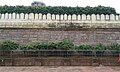 Meghanada wall fortifying the Jagannath Temple, Puri (constructed during the rule of Kapilendra Deva)
 -
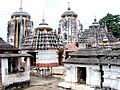 Kapileswar Temple, Old Bhubaneswar (built during Kapilendra Deva)
 -
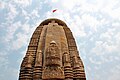 Kapilesvara Temple, Bhubaneswar
 -
 Kurumbera Fort (Kuruma Bedha), compound built during the rule of Kapilendra Deva Routray
 -
 Kurumbera Fort, Keshiari, West Bengal
 -
 Kurumbera Fort, medieval heritage structure in Gaganeshwar village, West Medinipur
 -
 Chambers of Kurumbera Fort, Gaganeshwar
 -
 Udayagiri Fort, Nellore, Andhra Pradesh


.jpg)


.jpg)
Notes
References
- ↑ Sen, Sailendra (2013). A Textbook of Medieval Indian History. Primus Books. pp. 121–122. ISBN 978-9-38060-734-4.
- ↑ Das, Manmatha Nath (1949). Glimpses Of Kalinga History.
- ↑ Mishra, Patit Paban (11 January 2016). "Eastern Ganga and Gajapati empires". The Encyclopedia of Empire. Wiley-Blackwell. pp. 1–4. doi:10.1002/9781118455074.wbeoe402. ISBN 9781118455074.
- ↑ Panda, Shishir Kumar (2008), "Gajapati Kingship and the Cult of Jagannatha: A Study on the Chhamu Chitaus (Royal Letters)", Proceedings of the Indian History Congress, 69, Indian History Congress: 225–229, JSTOR 44147183,
empire...Suryavamsi Gajapatis
- ↑ Majumdar, Pusalker & Majumdar 1960, p. 365.
- ↑ Kulke, Hermann (1976), Kshatriyaization and social change: A Study in Orissa setting (PDF), Popular Prakashan, p. 402, archived from the original (PDF) on 24 June 2021, retrieved 27 March 2021,
Suryavamsa...kings of the Suryavamsa(1435-1540)
- ↑ Majumdar, R. C., ed. (1967). History and Culture of the Indian People, Volume 6: The Delhi Sultanate. Bharatiya Vidya Bhavan.
- ↑ 8.0 8.1 History of Odisha. New Delhi: Kalyani Publishers. 2004. pp. 86–94. ISBN 81-272-1367-5.
- ↑ 9.0 9.1 "RELATIONS WITH THE GAJAPATHIS" (PDF). www.shodhganga.inflibnet.ac.in. Retrieved 12 August 2017.
- ↑ 10.0 10.1 "Society and culture as depicted in literature of the Gajapati period, Chapter II - Political History" (PDF). www.shodhganga.inflibnet.ac.in. pp. 15–21. Retrieved 12 August 2017.
- ↑ 11.0 11.1 11.2 11.3 11.4 11.5 "Gajapati Kapilendra Deva". Goodreads. Retrieved 10 January 2025.
- ↑ Mukherjee, Prabhat (1953). The History of the Gajapati Kings of Orissa and Their Successors. General Trading Company.
- ↑ 13.0 13.1 Bhuyan, Annapurna (1999). "Kapilendra Deva and his times" (PDF). www.shodhganga.inflibnet.ac.in. Utkal University. Retrieved 30 June 2021.
- ↑ Subrahmanyam 1957, pp. 30-31.
- ↑ Bhuyan, Annapurna (1999). "Kapilendra Deva and his times" (PDF). www.shodhganga.inflibnet.ac.in. Utkal University. p. 31. Retrieved 30 June 2021.
- ↑ "Society and culture as depicted in literature of the Gajapati period, Chapter II - Political history" (PDF). www.shodhganga.inflibnet.ac.in. pp. 15–16. Retrieved 12 August 2017.
- ↑ Subrahmanyam 1957, p. 34.
- ↑ "MILITARY SYSTEM UNDER THE SURYAVAMSI GAJAPATIS" (PDF). www.shodhganga.inflibnet.ac.in. Retrieved 10 October 2018.
- ↑ Odia Jatira Itihaasa O Sanskruti, Part – 1. Cuttack: Vidyapuri. 2012. pp. 177–181. ISBN 978-81-7411-656-7.
- ↑ Subrahmanyam 1957, p. 35.
- ↑ Majumdar, Pusalker & Majumdar 1960, p. 366.
- ↑ Medieval Orissa: A Socio-economic Study by By Shishir Kumar Panda. New Delhi: Mittal Publications. 1991. p. 11. ISBN 81-7099-261-3.
- ↑ କୃଷ୍ଣଚନ୍ଦ୍ର ପାଣିଗ୍ରାହୀ; Krishna Chandra Panigrahi; Kr̥ṣṇacandra Pāṇigrāhī; Krishna Chandra Panigrahi; Kr̥ṣṇacandra Pāṇigrāhī (1986). History of Orissa. State Committee for Compilation of History of the Freedom Movement Orissa.
- ↑ KHALIQ, AHMED NIZAMI (1970). A COMPREHENSIVE HISTORY OF INDIA VOL.5. PEOPLE’S PUBLISHING HOUSE,NEW DELHI.
- ↑ Mukherjee, Prabhat (1953). The History of the Gajapati Kings of Orissa and Their Successors. General Trading Company.
- ↑ Subrahmanyam, R. The Suryavamsi Gajapatis of Orissa.
- ↑ Subrahmanyam 1957, p. 51.
- ↑ Subrahmanyam 1957, p. 52.
- ↑ History Of Orissa 1930 Vol.1, From the Earliest Times to the British Period. 120-2, Upper Circular Road, Calcutta: Prabasi Press. 1930. pp. 291, 292, 293, 294.
{{cite book}}: CS1 maint: location (link) - ↑ Subrahmanyam 1957, p. 54.
- ↑ 31.0 31.1 Subrahmanyam 1957, p. 56-58. Cite error: Invalid
<ref>tag; name "FOOTNOTESubrahmanyam195756-58" defined multiple times with different content - ↑ Haque, Mohammed Anwarul (1980). Muslim Administration in Orissa, 1568-1751 A.D. Punthi Pustak. p. 34.
- ↑ "Some aspects of administration and society in Medieval Andhra AD 1038 to 1538 under the later Eastern Gangas and the Suryavamsa Gajapatis, Chapter II, Section II - The Suryavamsa Gajapatis. Kapilesvara (A.D.1434 - 1538)" (PDF). www.shodhganga.inflibnet.ac.in. pp. 38–43. Retrieved 12 August 2017.
- ↑ Majumdar, Pusalker & Majumdar 1960, p. 367.
- ↑ Subrahmanyam 1957, p. 58.
- ↑ Subrahmanyam 1957, p. 132.
- ↑ "Sanskrit Poets and Scholars of Orissa". Retrieved 21 March 2011.
{{cite web}}: CS1 maint: deprecated archival service (link) - ↑ History of Odisha. New Delhi: Kalyani Publishers. 2004. ISBN 81-272-1367-5.
- ↑ "Sanskrit Poets and Scholars of Orissa By: Dr. Bhagaban Panda". www.harekrsna.com. Retrieved 19 November 2019.
- ↑ Orissa in the Making by B.C.Mazumdar. University of Calcutta: University of Calcutta. 1925. pp. 213, 214.
- ↑ Glimpses of Kalinga History. Calcutta: Century Publishers. 1949. pp. 218, 219.
Bibliography
- Majumdar, RC; Pusalker, A. D.; Majumdar, A. K., eds. (1960). The History and Culture of the Indian People. Vol. VI: The Delhi Sultanate. Bombay: Bharatiya Vidya Bhavan. pp. 365–372.
- Subrahmanyam, R, ed. (1957). The Sūryavaṁśi Gajapatis of Orissa. Waltair: Andhra University. OCLC 613268261.
Kapilendra Deva
| ||
| Regnal titles | ||
|---|---|---|
| Preceded by Bhanu Deva IV |
Gajapati of Odisha 1434–1467 |
Succeeded by Purushottama Deva |