


imported>Benz07 No edit summary |
No edit summary |
||
| Line 1: | Line 1: | ||
{{ | {{Short description|Indian revolutionary (1894–1934)}} | ||
{{Use Indian English|date=January 2025}} | |||
{{Use Indian English|date= | {{Use dmy dates|date=January 2025}} | ||
{{Use dmy dates|date= | |||
{{Infobox person | {{Infobox person | ||
| honorific_prefix = Master Da | | honorific_prefix = Master Da | ||
| name = Surya Sen | | name = Surya Sen | ||
| native_name = | |||
| image = Surya_Sen_before_1934.jpg | | image = Surya_Sen_before_1934.jpg | ||
| caption = | | caption = Sen in 1924 | ||
| birth_date = {{Birth date|1894|03|22|df=yes}} | | birth_date = {{Birth date|1894|03|22|df=yes}} | ||
| birth_place = [[Raozan | | birth_place = [[Raozan Upazila|Noapara]], [[Bengal Presidency|Bengal]], British Raj | ||
| death_date = {{Death date and age|1934|1|12|1894|03|22|df=yes}} | | death_date = {{Death date and age|1934|1|12|1894|03|22|df=yes}} | ||
| death_cause = [[Execution by hanging]] | | death_cause = [[Execution by hanging]] | ||
| death_place = [[Chittagong]], [[Bengal Presidency]], [[ | | death_place = [[Chittagong Central Jail]], [[Chittagong]], [[Bengal Presidency|Bengal]], British Raj | ||
| criminal_penalty = [[Capital punishment]] | |||
| criminal_status = Executed | |||
| spouse = | |||
| mother = | |||
| father = | |||
| movement = [[Indian Independence movement]] | | movement = [[Indian Independence movement]] | ||
| | | party = [[Indian National Congress]] | ||
| known for = [[Chittagong armoury raid]] | | known for = [[Chittagong armoury raid]] | ||
| organization = [[Indian National Congress]] [[Anushilan Samiti]] | | organization = [[Indian National Congress]], [[Jugantar]], [[Anushilan Samiti]] | ||
| signature = Signature of Surya Sen aka Masterda.jpg | |||
}} | }} | ||
{{Anushilan Samiti}} | {{Anushilan Samiti}} | ||
'''Surya Sen''', also | '''Surya Sen''', also known as '''Surya Kumar Sen''' (22 March 1894{{snd}}12 January 1934), was an [[Revolutionary movement for Indian independence|Indian revolutionary]] who played a significant role in the [[Indian independence movement]] against [[British Raj|British colonial rule]]. He is best known for leading the [[Chittagong Armoury Raid]] in 1930.<ref>{{cite book |last1=Bowman |first1=John S. |title=Columbia Chronologies of Asian History and Culture |date=5 September 2000 |publisher=Columbia University Press |isbn=978-0-231-50004-3 |page=740 |url=https://books.google.com/books?id=cYoHOqC7Yx4C&dq=%22Surya+Sen+indian+revolutionary%22&pg=PA740}}</ref> | ||
Sen | |||
Sen was a schoolteacher by profession and was popularly known as '''''Master Da''''' ("da" is an [[honorific]] suffix derived from "dada", meaning "elder brother" in the [[Bengali language]]). He was influenced by the nationalist ideals in 1916 while he was a student of B.A. at Berhampore College (now [[Krishnath College|Murshidabad Maharaja Krishnath University]]).<ref>{{cite book |last=Shah |first=Mohammad |year=2012 |chapter=Surya Sen, Mastarda |chapter-url=http://en.banglapedia.org/index.php?title=Surya_Sen,_Mastarda |editor1-last=Islam |editor1-first=Sirajul |editor1-link=Sirajul Islam |editor2-last=Jamal |editor2-first=Ahmed A. |title=Banglapedia: National Encyclopedia of Bangladesh |edition=Second |publisher=[[Asiatic Society of Bangladesh]]}}</ref> In 1918, he was selected as president of the [[Indian National Congress]]'s Chittagong branch.<ref>{{Cite book |title=Subhas Chandra Bose and Middle Class Radicalism: A Study in Indian Nationalism, 1928-1940 |last=Chakrabarti |first=Bidyut |publisher=I. B. Tauris & Co. Ltd |year=1990 |isbn=1850431493 |pages=108}}</ref> Sen was known for recruiting a group of young and passionate revolutionaries known as the Chittagong group. The group included [[Ananta Singh]], [[Ganesh Ghosh]], and [[Lokenath Bal]], and fought against the British stationed in [[Chittagong]].<ref name="Chandra2016p251">{{cite book |last1=Chandra |first1=Bipan |author1-link=Bipan Chandra |last2=Mukherjee |first2=Mridula |author2-link=Mridula Mukherjee |last3=Mukherjee |first3=Aditya |last4=Mahajan |first4=Sucheta |last5=Panikkar |first5=K.N. |author5-link=K. N. Panikkar |year=2016 |orig-year=First published 1987 |title=India's Struggle for Independence |edition=Revised and updated |publisher=Penguin Books |page=251 |isbn=978-0-14-010781-4}}</ref> | |||
He was an active participant in the [[Non-co-operation movement]] and was later arrested and imprisoned for two years, from 1926 to 1928, for his revolutionary activities. A brilliant and inspirational organiser, Sen was fond of saying, "[[Humanism]] is a special virtue of a revolutionary."<ref name="Chandra2016p251" /> | |||
After the Chittagong raid in 1930 and a fierce battle where over 80 [[British Indian Army]] soldiers and 12 [[revolutionaries]] were killed, Sen and other surviving revolutionaries dispersed into small groups and hid in neighbouring villages, launching raids on government personnel and property. Sen was arrested on 16 February 1933 when he was hiding in his close family member's house of Khirodprova Biswas.<ref>{{Cite book |last=অনন্ত সিংহ |first=প্রথম খন্ড |title=অগ্নিগর্ভ চট্টগ্রাম |publisher=বিদ্যোদয় লাইব্রেরি |location=কলকাতা |pages=৭}}</ref> He was tried and was hanged on 12 January 1934.<ref>{{Cite news |date=15 August 1933 |title=Death Sentence On Terrorists |page=9 |work=The Glasgow Herald |url=https://books.google.com/books?id=Vu49AAAAIBAJ&dq=%22Surya+Sen%22&pg=PA9 |access-date=7 January 2022}}</ref> Many of his fellow revolutionaries were also caught and sentenced to long periods of imprisonment.<ref name="Chandra2016p252">{{cite book |last1=Chandra |first1=Bipan |author1-link=Bipan Chandra |last2=Mukherjee |first2=Mridula |author2-link=Mridula Mukherjee |last3=Mukherjee |first3=Aditya |last4=Mahajan |first4=Sucheta |last5=Panikkar |first5=K.N. |author5-link=K. N. Panikkar |year=2016 |orig-year=First published 1987 |title=India's Struggle for Independence |edition=Revised and updated |publisher=Penguin Books |page=252 |isbn=978-0-14-010781-4}}</ref> | |||
==Early life== | ==Early life== | ||
[[File:Surya Sen wanted 22 June 1932.jpg|left|thumb|291x291px|Sen wanted for 10,000 taka, poster distributed by the Inspector-General of the Police Division of Chittagong in 1932.|alt=]] | [[File:Surya Sen wanted 22 June 1932.jpg|left|thumb|291x291px|Sen wanted for 10,000 taka, poster distributed by the Inspector-General of the Police Division of Chittagong in 1932.|alt=]] | ||
Sen was born on 22 March 1894<ref name="Vijay Kumar">{{cite book|author=Kumar, Vijay |date=2008 |title=हर दिन पावन |publisher= | Sen was born on 22 March 1894 in a [[Bengalis|Bengali]] [[Baidya]] family at Noapara, under [[Raozan Upazila]] in [[Chittagong]], [[Bengal Presidency]], [[British India]] (now in [[Bangladesh]]). His father, Ramaniranjan Sen, was a teacher. In 1916, when he was a B.A. student at [[Krishnath College|Berhampore College]] (now [[Krishnath College]]) of [[Murshidabad district|Murshidabad]], he learned about the Indian freedom movement from one of his teachers, Shatishchandra Chakrabarti. When Sen came to Chittagong in 1918, he started teaching at the local National School, becoming famous with the honorific ''Master da''. Later, he left his job and became the president of the Chittagong branch of the Indian National Congress.<ref>{{Cite news |script-title=bn:মাস্টারদা সূর্য সেনের জন্ম |url=https://www.jagonews24.com/feature/article/841773 |work=Jago News 24 |language=bn |archive-url=https://web.archive.org/web/20230323052714/https://www.jagonews24.com/feature/article/841773 |archive-date=23 March 2023 |access-date=16 June 2023}}</ref><ref>{{Cite web |last=Mahotsav |first=Amrit |title=Surya Sen |url=https://amritmahotsav.nic.in/unsung-heroes-detail.htm |archive-url=https://web.archive.org/web/20230524092718/https://amritmahotsav.nic.in/unsung-heroes-detail.htm?12659 |archive-date=24 May 2023 |access-date=16 June 2023 |website=Azadi Ka Amrit Mahotsav, Ministry of Culture, Government of India |language=English}}</ref> | ||
Sen actively participated in the Non-Cooperation Movement. He looted the treasury of the Assam-Bengal Railway for cash money to fuel the movement, for which he was imprisoned with fellow revolutionary Ambika Chakrabarty for two years. Both were released towards the end of 1928 and resumed their activities.<ref name="Vijay Kumar">{{cite book |author=Kumar, Vijay |date=2008 |title=हर दिन पावन |publisher=लोकहित प्रकाशन |isbn=9788189606350}}</ref><ref>{{cite web |url=https://abhipedia.abhimanu.com/Article/State/NTE3MDcEEQQVV/Surya-Sen-West-Bengal-State |title=Surya Sen |publisher=abhipedia.com |access-date=16 June 2021}}</ref><ref>{{Cite news |last=Karan |first=Rewati |date=22 March 2022 |title=Surya Sen — Chittagong's 'Master da' who led the raid that broke the 'armed might' of British |url=https://theprint.in/theprint-profile/surya-sen-chittagongs-master-da-who-led-the-raid-that-broke-the-armed-might-of-british/882011/ |access-date=30 March 2022 |work=ThePrint |language=en-US}}</ref>[[File:Masterda Surya Sen's elder brother Chandra kumar Sen and his wife, Birajmohini devi, sister in law of Surya Sen.jpg|thumb|Surya Sen's elder brother, Chandra kumar Sen, and his wife, Birajmohini devi, sister-in-law of Surya Sen]] | |||
== Chittagong armoury raid == | == Chittagong armoury raid == | ||
{{main|Chittagong armoury raid}} | {{main|Chittagong armoury raid}} | ||
Sen led a group of revolutionaries on 18 April 1930 to raid the | Sen led a group of revolutionaries on 18 April 1930 to raid the armouries of police and auxiliary forces in Chittagong.<ref name="chandra">{{cite book |last1=Chandra |first1=Bipan |author1-link=Bipan Chandra |last2=Mukherjee |first2=Mridula |author2-link=Mridula Mukherjee |last3=Mukherjee |first3=Aditya |last4=Mahajan |first4=Sucheta |last5=Panikkar |first5=K.N. |author5-link=K. N. Panikkar |year=2016 |orig-year=First published 1987 |title=India's Struggle for Independence |edition=Revised and updated |publisher=Penguin Books |pages=251–252 |isbn=978-0-14-010781-4}}</ref> The plan was elaborate and included seizing arms from the armoury as well as destruction of communication system of the city (including telephone, telegraph, and railway), thereby isolating Chittagong from the rest of [[British Raj]].<ref name="chandra"/> However, although the group gained the arms, they failed to capture the ammunition. They hoisted the [[Indian National Flag]] on the premises of the armoury, and then escaped. A few days later, a large fraction of the revolutionary group was cornered on Jalalabad Hill by a [[British Indian Army]] detachment. In the ensuing fight, twelve [[revolutionaries]] died, many were arrested, while some managed to flee, including Sen.<ref name="Chandra2016p252"/> | ||
==Arrest and death== | ==Arrest and death== | ||
Sen stayed in hiding, and kept moving from one place to another. Sometimes he took up a job as a workman, a farmer, a priest, a house worker or even hid as a pious Muslim. This is how he avoided being captured by the British. | Sen stayed in hiding, and kept moving from one place to another. Sometimes he took up a job as a workman, a farmer, a priest, a house worker or even hid as a pious Muslim. This is how he avoided being captured by the British.<ref>{{Cite book |last=Pradhāna |first=Rāmacandra |url=https://books.google.com/books?id=ZELmNAkC8R0C |title=Raj to Swaraj: A Textbook on Colonialism and Nationalism in India |date=2008 |publisher=Macmillan India |isbn=978-0-230-63406-0 |language=en}}</ref> [[File:Surya Sen 1978 stamp of India.jpg|thumb|Surya Sen 1978 stamp of India]] | ||
[[File:Masterda Surya Sen's letter to his elder brother, Chandra kumar Sen.jpg|thumb|Masterda Surya Sen's letter to his elder brother, Chandra kumar Sen]] [[File:Surya Sen's letter to his sister in law, Birajmohini devi.jpg|thumb|Surya Sen's letter to his sister-in-law, Birajmohini devi]] | |||
He hid in the house of a friend. His relative named Netra Sen lived not far away.<ref name="Aurobindo Bhawan 2021. p. 36">Srinvantu magazine (Aurobindo Bhawan, 8, Shakespeare Sarani, Kolkata - 700 071. ed. 8 March 2021. p. 36)</ref> But Netra Sen informed the British of his hiding place, and the police came and captured him in February 1933.<ref name="Aurobindo Bhawan 2021. p. 36"/> Before Netra Sen could be rewarded by the British, revolutionaries named Kironmoy Sen along with Rabindra Nandi came into his house and beheaded him with a ''da'' (a long knife).<ref>{{Cite web |url=https://cmsadmin.amritmahotsav.nic.in/district-reopsitory-detail.htm |title=Kiranmoy Nanda's Role in the Freedom Struggle |website=Amrit Mahotsav |publisher=Government of India |access-date=12 January 2025 |last1=Mahotsav |first1=Amrit}}</ref><ref name=":1">{{Cite magazine |title=Chittagong British Armoury Raid 1930: Revolutionary, Surya Sen led the attack on April 18 |url=https://www.indiatoday.in/education-today/gk-current-affairs/story/chittagong-british-armoury-raid-1930-revolutionary-surya-sen-led-the-attack-on-april-18-1792463-2021-04-19 |magazine=India Today |date=19 April 2021 |access-date=30 March 2022}}</ref><ref>{{cite news |last1=বসু |first1=ঋজু |date=15 August 2021 |title=75th Independence Day: ধর্মের ছোঁয়াচ ছাড়া বিয়ের স্বাধীনতা |url=https://www.anandabazar.com/west-bengal/kolkata/granddaughter-of-freedom-fighter-kiranmoy-sen-breaking-all-stereotypes-of-inter-religion-marriage/cid/1298446 |work=Ananda Bazar Patrika |access-date=29 March 2022}}</ref> As Netra Sen's wife was a big supporter of Surya Sen, she never disclosed the names of the revolutionaries who killed Netra Sen. Before his eventual hanging on 12 January 1934 with another revolutionary named [[Tarakeswar Dastidar]], both Sen and Dastidar underwent [[torture]] at the hands of the [[Indian Imperial Police|police]].<ref name=":1" /> | |||
His last letter was written to his friends and said, "Death is knocking at my door. My mind is flying away towards eternity. At such a pleasant, at such a grave, at such a solemn moment, what shall I leave behind you? Only one thing, that is my dream, a golden dream – the dream of free India. Never forget the date, 18th of April, 1930, the day of the eastern Rebellion in Chittagong. Write in red letters in the core of your hearts the names of the patriots who have sacrificed their lives at the altar of India's freedom."<ref>Srinvantu magazine (Aurobindo Bhawan, 8, Shakespeare Sarani, Kolkata - 700 071. ed. 8 March 2021. p. 37)</ref> | |||
<gallery mode="packed-overlay" heights="180" caption="The gallows in Chattogram (Chittagong) [[Chattogram Central Jail|Central Jail]], where Indian revolutionary freedom fighter '''Surya Sen''' was hanged. The government of Bangladesh (East Bengal) has designated it a historical monument."> | |||
<gallery mode="packed-overlay" heights="180" caption="The gallows in Chittagong Central Jail, where Sen was hanged. The | |||
File:HangplatformLeft.jpg | File:HangplatformLeft.jpg | ||
File:Hangplatform left.JPG | File:Hangplatform left.JPG | ||
| Line 57: | Line 59: | ||
==In popular media== | ==In popular media== | ||
Indian film director [[Ashutosh Gowariker]] directed the film ''[[Khelein Hum Jee Jaan Sey]]'' (2010) about Sen's life. Actor [[Abhishek Bachchan]] played the role of Sen.<ref>{{cite news |title=Ashutosh Gowariker's Khelein Hum Jee Jaan Sey to be released on December 3 |url=http://www.dnaindia.com/entertainment/report_ashutosh-gowariker-s-khelein-hum-jee-jaan-sey-to-be-released-on-December-3-1374400 |work=Daily News & Analysis |date=22 April 2010 |access-date=11 October 2011}}</ref> Another film ''[[Chittagong (film)|Chittagong]]'' (2012) directed by [[Bedabrata Pain]] was about Sen's armoury raid. [[Manoj Bajpayee]] played the leading role.<ref>{{cite news |title='Chittagong': Manoj Bajpayee took no money for the film |url= | Indian film director [[Ashutosh Gowariker]] directed the film ''[[Khelein Hum Jee Jaan Sey]]'' (2010) about Sen's life. Actor [[Abhishek Bachchan]] played the role of Sen.<ref>{{cite news |title=Ashutosh Gowariker's Khelein Hum Jee Jaan Sey to be released on December 3 |url=http://www.dnaindia.com/entertainment/report_ashutosh-gowariker-s-khelein-hum-jee-jaan-sey-to-be-released-on-December-3-1374400 |work=Daily News & Analysis |date=22 April 2010 |access-date=11 October 2011}}</ref> Another film, ''[[Chittagong (film)|Chittagong]]'' (2012), directed by [[Bedabrata Pain]], was about Sen's armoury raid. [[Manoj Bajpayee]] played the leading role.<ref>{{cite news |title='Chittagong': Manoj Bajpayee took no money for the film |url=https://timesofindia.indiatimes.com/us |archive-url=https://archive.today/20130103100119/http://articles.timesofindia.indiatimes.com/2012-09-28/news-interviews/34147404_1_actor-manoj-bajpayee-nasa-scientist-bedabrata-pain-film |url-status=live |archive-date=3 January 2013 |date=28 September 2012 |work=[[The Times of India]] |access-date=28 September 2012}}</ref> | ||
==Legacy== | |||
Surya Sen is considered one of the leading revolutionaries in British India, and is a highly respected figure in both Bangladesh and India. Residential halls have been named after him at both the University of Dhaka<ref>{{Cite web |url=https://du.ac.bd/history/HSS |title=Home :: Dhaka University}}</ref> and the University of Chittagong.<ref>{{Cite web |url=https://cu.ac.bd/suryasenhall/sushall.php |title=University of Chittagong}}</ref> Kolkata has a metro railway station and a street named after him as well.<ref>{{Cite web |title=Masterda Surya Sen Metro Station Kolkata |url=https://routemaps.info/station/masterda-surya-sen-kolkata |access-date=30 March 2022 |website=routemaps.info |language=en}}</ref> | |||
[[Surya Sen Park]] contains a bust of him.<ref>{{cite journal|url=https://journal.southindianhistorycongress.org/journals/articles/2018/SIHC_2018_063.pdf|title=The Role of Surya Sen in the Freedom Movement of India|journal=Proceedings of the South Indian History Congress|publisher=[[South Indian History Congress]]|volume=38|year=2018|pages=249-251|issn=2229-3671}}</ref> | |||
== See also == | == See also == | ||
* [[Pritilata Waddedar]], | * [[Pritilata Waddedar]], Indian revolutionary and nationalist | ||
* | * [[Bhagat Singh]], Indian revolutionary and nationalist | ||
* [[Udham Singh]], Indian revolutionary and nationalist | |||
== References == | == References == | ||
| Line 67: | Line 75: | ||
==External links== | ==External links== | ||
* [http://www.srichinmoylibrary.com/books/1399/1/37 Chittagong's Greatest Revolutionary Hero: Surjya Sen] | * [http://www.srichinmoylibrary.com/books/1399/1/37 Chittagong's Greatest Revolutionary Hero: Surjya Sen] {{Webarchive|url=https://web.archive.org/web/20120222131617/http://www.srichinmoylibrary.com/books/1399/1/37 |date=22 February 2012 }} | ||
* [https://en.banglapedia.org/index.php/Surya_Sen,_Mastarda Surya Sen] in [[Banglapedia]] | |||
{{Indian independence movement}} | {{Indian independence movement}} | ||
{{Indian Revolutionary Movement}} | {{Indian Revolutionary Movement}} | ||
{{Authority control}} | {{Authority control}} | ||
{{DEFAULTSORT:Sen, | {{DEFAULTSORT:Sen, Surya}} | ||
[[Category:1894 births]] | [[Category:1894 births]] | ||
[[Category:1934 deaths]] | [[Category:1934 deaths]] | ||
[[Category: | [[Category:Surya Sen|*]] | ||
[[Category:Executed Indian revolutionaries]] | |||
[[Category:Executed Indian | [[Category:20th-century executions by British India]] | ||
[[Category: | |||
[[Category:People executed by British India by hanging]] | [[Category:People executed by British India by hanging]] | ||
[[Category:People from Chittagong]] | [[Category:People from Chittagong]] | ||
[[Category:University of Calcutta alumni]] | [[Category:University of Calcutta alumni]] | ||
[[Category:Anti-British establishment revolutionaries from East Bengal]] | [[Category:Anti-British establishment revolutionaries from East Bengal]] | ||
[[Category:Indian independence armed struggle activists]] | [[Category:Indian independence armed struggle activists]] | ||
[[Category:Krishnath College alumni]] | |||
Latest revision as of 01:10, 23 March 2026
Master Da Surya Sen | |
|---|---|
 Sen in 1924 | |
| Born | 22 March 1894 |
| Died | 12 January 1934 (aged 39) |
| Cause of death | Execution by hanging |
| Organization | Indian National Congress, Jugantar, Anushilan Samiti |
| Known for | Chittagong armoury raid |
| Political party | Indian National Congress |
| Movement | Indian Independence movement |
| Criminal penalty | Capital punishment |
| Criminal status | Executed |
| Signature | |
 | |
| Anushilan Samiti |
|---|
 |
| Influence |
| Anushilan Samiti |
| Notable events |
| Related topics |
Surya Sen, also known as Surya Kumar Sen (22 March 1894 – 12 January 1934), was an Indian revolutionary who played a significant role in the Indian independence movement against British colonial rule. He is best known for leading the Chittagong Armoury Raid in 1930.[1]
Sen was a schoolteacher by profession and was popularly known as Master Da ("da" is an honorific suffix derived from "dada", meaning "elder brother" in the Bengali language). He was influenced by the nationalist ideals in 1916 while he was a student of B.A. at Berhampore College (now Murshidabad Maharaja Krishnath University).[2] In 1918, he was selected as president of the Indian National Congress's Chittagong branch.[3] Sen was known for recruiting a group of young and passionate revolutionaries known as the Chittagong group. The group included Ananta Singh, Ganesh Ghosh, and Lokenath Bal, and fought against the British stationed in Chittagong.[4]
He was an active participant in the Non-co-operation movement and was later arrested and imprisoned for two years, from 1926 to 1928, for his revolutionary activities. A brilliant and inspirational organiser, Sen was fond of saying, "Humanism is a special virtue of a revolutionary."[4]
After the Chittagong raid in 1930 and a fierce battle where over 80 British Indian Army soldiers and 12 revolutionaries were killed, Sen and other surviving revolutionaries dispersed into small groups and hid in neighbouring villages, launching raids on government personnel and property. Sen was arrested on 16 February 1933 when he was hiding in his close family member's house of Khirodprova Biswas.[5] He was tried and was hanged on 12 January 1934.[6] Many of his fellow revolutionaries were also caught and sentenced to long periods of imprisonment.[7]
Early life[edit | edit source]

Sen was born on 22 March 1894 in a Bengali Baidya family at Noapara, under Raozan Upazila in Chittagong, Bengal Presidency, British India (now in Bangladesh). His father, Ramaniranjan Sen, was a teacher. In 1916, when he was a B.A. student at Berhampore College (now Krishnath College) of Murshidabad, he learned about the Indian freedom movement from one of his teachers, Shatishchandra Chakrabarti. When Sen came to Chittagong in 1918, he started teaching at the local National School, becoming famous with the honorific Master da. Later, he left his job and became the president of the Chittagong branch of the Indian National Congress.[8][9]
Sen actively participated in the Non-Cooperation Movement. He looted the treasury of the Assam-Bengal Railway for cash money to fuel the movement, for which he was imprisoned with fellow revolutionary Ambika Chakrabarty for two years. Both were released towards the end of 1928 and resumed their activities.[10][11][12]

Chittagong armoury raid[edit | edit source]
Sen led a group of revolutionaries on 18 April 1930 to raid the armouries of police and auxiliary forces in Chittagong.[13] The plan was elaborate and included seizing arms from the armoury as well as destruction of communication system of the city (including telephone, telegraph, and railway), thereby isolating Chittagong from the rest of British Raj.[13] However, although the group gained the arms, they failed to capture the ammunition. They hoisted the Indian National Flag on the premises of the armoury, and then escaped. A few days later, a large fraction of the revolutionary group was cornered on Jalalabad Hill by a British Indian Army detachment. In the ensuing fight, twelve revolutionaries died, many were arrested, while some managed to flee, including Sen.[7]
Arrest and death[edit | edit source]
Sen stayed in hiding, and kept moving from one place to another. Sometimes he took up a job as a workman, a farmer, a priest, a house worker or even hid as a pious Muslim. This is how he avoided being captured by the British.[14]


He hid in the house of a friend. His relative named Netra Sen lived not far away.[15] But Netra Sen informed the British of his hiding place, and the police came and captured him in February 1933.[15] Before Netra Sen could be rewarded by the British, revolutionaries named Kironmoy Sen along with Rabindra Nandi came into his house and beheaded him with a da (a long knife).[16][17][18] As Netra Sen's wife was a big supporter of Surya Sen, she never disclosed the names of the revolutionaries who killed Netra Sen. Before his eventual hanging on 12 January 1934 with another revolutionary named Tarakeswar Dastidar, both Sen and Dastidar underwent torture at the hands of the police.[17]
His last letter was written to his friends and said, "Death is knocking at my door. My mind is flying away towards eternity. At such a pleasant, at such a grave, at such a solemn moment, what shall I leave behind you? Only one thing, that is my dream, a golden dream – the dream of free India. Never forget the date, 18th of April, 1930, the day of the eastern Rebellion in Chittagong. Write in red letters in the core of your hearts the names of the patriots who have sacrificed their lives at the altar of India's freedom."[19]
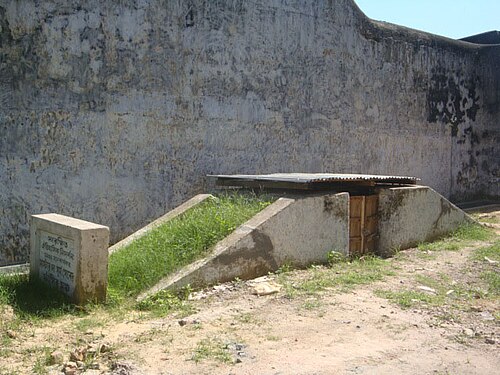
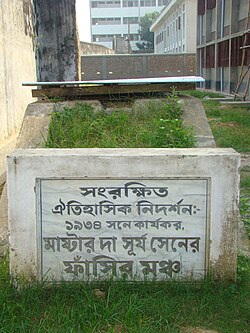
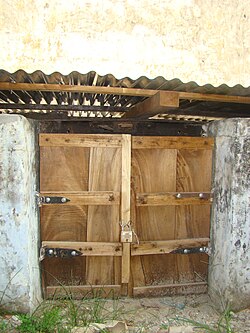
- The gallows in Chattogram (Chittagong) Central Jail, where Indian revolutionary freedom fighter Surya Sen was hanged. The government of Bangladesh (East Bengal) has designated it a historical monument.
-
-
-


In popular media[edit | edit source]
Indian film director Ashutosh Gowariker directed the film Khelein Hum Jee Jaan Sey (2010) about Sen's life. Actor Abhishek Bachchan played the role of Sen.[20] Another film, Chittagong (2012), directed by Bedabrata Pain, was about Sen's armoury raid. Manoj Bajpayee played the leading role.[21]
Legacy[edit | edit source]
Surya Sen is considered one of the leading revolutionaries in British India, and is a highly respected figure in both Bangladesh and India. Residential halls have been named after him at both the University of Dhaka[22] and the University of Chittagong.[23] Kolkata has a metro railway station and a street named after him as well.[24]
Surya Sen Park contains a bust of him.[25]
See also[edit | edit source]
- Pritilata Waddedar, Indian revolutionary and nationalist
- Bhagat Singh, Indian revolutionary and nationalist
- Udham Singh, Indian revolutionary and nationalist
References[edit | edit source]
- ↑ Bowman, John S. (5 September 2000). Columbia Chronologies of Asian History and Culture. Columbia University Press. p. 740. ISBN 978-0-231-50004-3.
- ↑ Shah, Mohammad (2012). "Surya Sen, Mastarda". In Islam, Sirajul; Jamal, Ahmed A. (eds.). Banglapedia: National Encyclopedia of Bangladesh (Second ed.). Asiatic Society of Bangladesh.
- ↑ Chakrabarti, Bidyut (1990). Subhas Chandra Bose and Middle Class Radicalism: A Study in Indian Nationalism, 1928-1940. I. B. Tauris & Co. Ltd. p. 108. ISBN 1850431493.
- ↑ 4.0 4.1 Chandra, Bipan; Mukherjee, Mridula; Mukherjee, Aditya; Mahajan, Sucheta; Panikkar, K.N. (2016) [First published 1987]. India's Struggle for Independence (Revised and updated ed.). Penguin Books. p. 251. ISBN 978-0-14-010781-4.
- ↑ অনন্ত সিংহ, প্রথম খন্ড. অগ্নিগর্ভ চট্টগ্রাম. কলকাতা: বিদ্যোদয় লাইব্রেরি. pp. ৭.
- ↑ "Death Sentence On Terrorists". The Glasgow Herald. 15 August 1933. p. 9. Retrieved 7 January 2022.
- ↑ 7.0 7.1 Chandra, Bipan; Mukherjee, Mridula; Mukherjee, Aditya; Mahajan, Sucheta; Panikkar, K.N. (2016) [First published 1987]. India's Struggle for Independence (Revised and updated ed.). Penguin Books. p. 252. ISBN 978-0-14-010781-4.
- ↑ মাস্টারদা সূর্য সেনের জন্ম. Jago News 24 (in Bengali). Archived from the original on 23 March 2023. Retrieved 16 June 2023.
- ↑ Mahotsav, Amrit. "Surya Sen". Azadi Ka Amrit Mahotsav, Ministry of Culture, Government of India. Archived from the original on 24 May 2023. Retrieved 16 June 2023.
- ↑ Kumar, Vijay (2008). हर दिन पावन. लोकहित प्रकाशन. ISBN 9788189606350.
- ↑ "Surya Sen". abhipedia.com. Retrieved 16 June 2021.
- ↑ Karan, Rewati (22 March 2022). "Surya Sen — Chittagong's 'Master da' who led the raid that broke the 'armed might' of British". ThePrint. Retrieved 30 March 2022.
- ↑ 13.0 13.1 Chandra, Bipan; Mukherjee, Mridula; Mukherjee, Aditya; Mahajan, Sucheta; Panikkar, K.N. (2016) [First published 1987]. India's Struggle for Independence (Revised and updated ed.). Penguin Books. pp. 251–252. ISBN 978-0-14-010781-4.
- ↑ Pradhāna, Rāmacandra (2008). Raj to Swaraj: A Textbook on Colonialism and Nationalism in India. Macmillan India. ISBN 978-0-230-63406-0.
- ↑ 15.0 15.1 Srinvantu magazine (Aurobindo Bhawan, 8, Shakespeare Sarani, Kolkata - 700 071. ed. 8 March 2021. p. 36)
- ↑ Mahotsav, Amrit. "Kiranmoy Nanda's Role in the Freedom Struggle". Amrit Mahotsav. Government of India. Retrieved 12 January 2025.
- ↑ 17.0 17.1 "Chittagong British Armoury Raid 1930: Revolutionary, Surya Sen led the attack on April 18". India Today. 19 April 2021. Retrieved 30 March 2022.
- ↑ বসু, ঋজু (15 August 2021). "75th Independence Day: ধর্মের ছোঁয়াচ ছাড়া বিয়ের স্বাধীনতা". Ananda Bazar Patrika. Retrieved 29 March 2022.
- ↑ Srinvantu magazine (Aurobindo Bhawan, 8, Shakespeare Sarani, Kolkata - 700 071. ed. 8 March 2021. p. 37)
- ↑ "Ashutosh Gowariker's Khelein Hum Jee Jaan Sey to be released on December 3". Daily News & Analysis. 22 April 2010. Retrieved 11 October 2011.
- ↑ "'Chittagong': Manoj Bajpayee took no money for the film". The Times of India. 28 September 2012. Retrieved 28 September 2012.
{{cite news}}: CS1 maint: deprecated archival service (link) - ↑ "Home :: Dhaka University".
- ↑ "University of Chittagong".
- ↑ "Masterda Surya Sen Metro Station Kolkata". routemaps.info. Retrieved 30 March 2022.
- ↑ "The Role of Surya Sen in the Freedom Movement of India" (PDF). Proceedings of the South Indian History Congress. 38. South Indian History Congress: 249–251. 2018. ISSN 2229-3671.
External links[edit | edit source]
- Chittagong's Greatest Revolutionary Hero: Surjya Sen Archived 22 February 2012 at the Wayback Machine
- Surya Sen in Banglapedia
- Pages using the JsonConfig extension
- 1894 births
- 1934 deaths
- Surya Sen
- Executed Indian revolutionaries
- 20th-century executions by British India
- People executed by British India by hanging
- People from Chittagong
- University of Calcutta alumni
- Anti-British establishment revolutionaries from East Bengal
- Indian independence armed struggle activists
- Krishnath College alumni