




formatting fix |
Vishvaksena (talk | contribs) Tags: Mobile edit Mobile web edit |
||
| Line 1: | Line 1: | ||
{{Other uses|Chandelvaṃśa (dynasty) {{!}}Chandel Dynasty}} | |||
{{Other uses| | |||
{{Use dmy dates|date=April 2019}} | {{Use dmy dates|date=April 2019}} | ||
{{Use Indian English|date=April 2019}} | {{Use Indian English|date=April 2019}} | ||
'''Chandel''' | '''Chandel''' (synonym:Mādhav, Vrishni & [[Chedi]]) <ref>{{Cite book |last=Dikshit |first=R. K. |url=https://books.google.co.in/books?id=a9j9ZJGJOV0C&pg=PA130&redir_esc=y#v=onepage&q=V%E1%B9%9B%E1%B9%A3%E1%B9%87%C4%ABs&f=false |title=The Candellas of Jejākabhukti |date=1976 |publisher=Abhinav Publications |isbn=978-81-7017-046-4 |language=en}}</ref><ref>{{Cite book|url=https://books.google.co.in/books?id=GwzlFdW6kloC&pg=PA412&dq=Offshoot+of+Yadavas+Chand&hl=en&newbks=1&newbks_redir=0&source=gb_mobile_search&sa=X&ved=2ahUKEwiLpu_LxZT-AhUQTWwGHQt_AJoQ6AF6BAgDEAM|title=History Of The Later Harappans And Silpakara Movement (2 Vols.)|last=Viyogi|last2=Ansari|first2=Naval & M. Anawar|date=2010|publisher=Gyan Publishing House|isbn=978-81-7835-751-5|language=en}}</ref>({{lang-hi|चन्द+ऐल-चन्देल|lit=[[Moon]] god and Ael, direct descendant of [[Ila|Ila goddess]]}})<ref><nowiki>https://books.google.co.in/books?id=5jpuAAAAMAAJ&q=%E0%A4%9A%E0%A4%A8%E0%A5%8D%E0%A4%A6%E0%A5%87%E0%A4%B2+%E0%A4%95%E0%A4%BE+%E0%A4%85%E0%A4%B0%E0%A5%8D%E0%A4%A5&dq=%E0%A4%9A%E0%A4%A8%E0%A5%8D%E0%A4%A6%E0%A5%87%E0%A4%B2+%E0%A4%95%E0%A4%BE+%E0%A4%85%E0%A4%B0%E0%A5%8D%E0%A4%A5&hl=en&newbks=1&newbks_redir=0&source=gb_mobile_search&sa=X&ved=2ahUKEwjbnqyeyamDAxVVw6ACHaS1C_sQ6AF6BAgMEAM#%E0%A4%9A%E0%A4%A8%E0%A5%8D%E0%A4%A6%E0%A5%87%E0%A4%B2</nowiki></ref><ref><nowiki>https://books.google.co.in/books?id=6xQ-AAAAMAAJ&q=%E0%A4%9A%E0%A4%A8%E0%A5%8D%E0%A4%A6%E0%A5%87%E0%A4%B2+%E0%A4%B6%E0%A4%AC%E0%A5%8D%E0%A4%A6+%E0%A4%95%E0%A4%BE+%E0%A4%85%E0%A4%B0%E0%A5%8D%E0%A4%A5&dq=%E0%A4%9A%E0%A4%A8%E0%A5%8D%E0%A4%A6%E0%A5%87%E0%A4%B2+%E0%A4%B6%E0%A4%AC%E0%A5%8D%E0%A4%A6+%E0%A4%95%E0%A4%BE+%E0%A4%85%E0%A4%B0%E0%A5%8D%E0%A4%A5&hl=en&newbks=1&newbks_redir=0&source=gb_mobile_search&sa=X&ved=2ahUKEwjRopyDyamDAxUnyqACHVmCApQQ6AF6BAgFEAM#%E0%A4%9A%E0%A4%A8%E0%A5%8D%E0%A4%A6%E0%A5%87%E0%A4%B2%20%E0%A4%85%E0%A4%B0%E0%A5%8D%E0%A4%A5</nowiki></ref> is a clan of the [[Rajput]] or [[Kshatriya|Kshatriy caste]]. Chandels are the highest clan among the Kshatriyas and is the lord of the [[Moon|Chandravansh]]. Families belonging to this clan ruled many states in India and occupied various feudal estates. The most notable of these Chandel family is [[Chandelas of Jejakabhukti|Chandel dynasty of Jejakabhukti]], who ruled many almost entire India from 8th to 15th century from their capital in [[Jejakabhukti|Jejakabhukti region]]. Chandels and it's branches saved Hindus from invaders like Turks, Afghans and Mughals during Aurangzeb even during there decline period.<ref>{{Cite book |last=Yaman ) |first=डॉ अशोक कुमार ‘यमन’ ( Dr Ashok Kumar |url=https://books.google.co.in/books?id=eT1YEAAAQBAJ&dq=chandel+are+chandravanshi+cv+vaidya&pg=PA13&redir_esc=y#v=onepage&q=chandel%20are%20chandravanshi%20cv%20vaidya&f=false |title=मध्यकालीन भारतीय संगीत का इतिहास ( Madhyakalin Bharatiya Sangeet ka Itihas ) |date=2022-01-08 |publisher=Kalpana Prakashan |language=hi}}</ref><ref> name=":0">{{cite book |url=https://books.google.com/books?id=mcvhwD5QZKEC&pg=PA172 |title=Frontiers in Migration Analysis |author=R. B. Mandal |publisher=Concept |year=1981 |page=172 }}</ref><ref>{{Cite book|url=https://books.google.co.in/books?id=TKvEEAAAQBAJ&pg=PA321&dq=%E0%A4%9A%E0%A4%A8%E0%A5%8D%E0%A4%A6%E0%A5%87%E0%A4%B2+%E0%A4%B0%E0%A4%BE%E0%A4%9C%E0%A4%B5%E0%A4%82%E0%A4%B6+%E0%A4%95%E0%A5%80+%E0%A4%B8%E0%A5%8D%E0%A4%A5%E0%A4%BE%E0%A4%AA%E0%A4%A8%E0%A4%BE+%E0%A4%B9%E0%A5%88%E0%A4%B9%E0%A4%AF%E0%A4%B5%E0%A4%82%E0%A4%B6%E0%A5%80+%E0%A4%B0%E0%A4%BE%E0%A4%9C%E0%A4%BE+%E0%A4%9A%E0%A4%A8%E0%A5%8D%E0%A4%A6%E0%A5%8D%E0%A4%B0%E0%A4%B5%E0%A4%B0%E0%A5%8D%E0%A4%AE%E0%A4%A8+%E0%A4%9A%E0%A4%A8%E0%A5%8D%E0%A4%A6%E0%A5%87%E0%A4%B2&hl=en&newbks=1&newbks_redir=0&source=gb_mobile_search&sa=X&ved=2ahUKEwi5woqH9ceDAxWwklYBHUfNA58Q6AF6BAgGEAM#v=onepage&q=%E0%A4%9A%E0%A4%A8%E0%A5%8D%E0%A4%A6%E0%A5%87%E0%A4%B2%20&f=false|title=Raja Bhoj Parmaron Ki Gorvanshiya Virasat|last=sakalle|first=Jairam Sitaram Pawar & Vinayak|date=2023-06-13|publisher=Blue Rose Publishers|language=hi}}</ref><ref>{{Cite book |last=Taṇḍana |first=Premanārāyaṇa |url=https://books.google.co.in/books?id=a0shAAAAMAAJ&q=%E0%A4%9A%E0%A5%87%E0%A4%A6%E0%A4%BF+%E0%A4%AF%E0%A4%BE+%E0%A4%9A%E0%A4%A8%E0%A5%8D%E0%A4%A6%E0%A5%87%E0%A4%B2&dq=%E0%A4%9A%E0%A5%87%E0%A4%A6%E0%A4%BF+%E0%A4%AF%E0%A4%BE+%E0%A4%9A%E0%A4%A8%E0%A5%8D%E0%A4%A6%E0%A5%87%E0%A4%B2&hl=en&newbks=1&newbks_redir=0&source=gb_mobile_search&sa=X&ved=2ahUKEwieq52v2LaBAxWG1GEKHX_kClE4ChDoAXoECAQQAw#%E0%A4%9A%E0%A5%87%E0%A4%A6%E0%A4%BF%20%E0%A4%AF%E0%A4%BE%20%E0%A4%9A%E0%A4%A8%E0%A5%8D%E0%A4%A6%E0%A5%87%E0%A4%B2 |title=ब्रजभाषा सूर-कोश: Nirdeśaka Dīnadayālu Gupta |date=1962 |publisher=Lakhanaū Viśvavidyālaya |language=hi}}</ref><ref>{{Cite book |last=Kapoor |first=Badrinath |url=https://books.google.com/books/about/Brihat_Pramanik_Hindi_Kosh.html?id=hkmDkkI5JYYC |title=Brihat Pramanik Hindi Kosh |date=2006-09-01 |publisher=Lokbharti Prakashan |isbn=978-81-8031-057-7 |language=hi}}</ref><ref>{{Cite book |last=Verma |first=Dr Shyam Bahadur |url=https://books.google.com/books/about/Prabhat_Brihat_Hindi_Shabdakosh_Vol_1.html?id=hr9Zl_7g8HAC |title=Prabhat Brihat Hindi Shabdakosh (Vol-1): Bestseller Book by Dr Shyam Bahadur Verma: Prabhat Brihat Hindi Shabdakosh) |date=2010-01-01 |publisher=Prabhat Prakashan |isbn=978-81-7315-769-1 |language=hi}}</ref><ref>{{Cite book |last=Thakur ‘Bipin’ |first=Dr Bindeshwari Prasad |url=https://books.google.co.in/books?id=2Ht3EAAAQBAJ&pg=PA502&dq=%E0%A4%9A%E0%A4%A8%E0%A5%8D%E0%A4%A6%E0%A5%87%E0%A4%B2+%E0%A4%B6%E0%A4%BF%E0%A4%B6%E0%A5%81%E0%A4%AA%E0%A4%BE%E0%A4%B2&hl=en&newbks=1&newbks_redir=0&source=gb_mobile_search&sa=X&ved=2ahUKEwiikYfu2baBAxUddfUHHTlyCisQ6AF6BAgGEAM#v=onepage&q=%E0%A4%9A%E0%A4%A8%E0%A5%8D%E0%A4%A6%E0%A5%87%E0%A4%B2%20%E0%A4%B6%E0%A4%BF%E0%A4%B6%E0%A5%81%E0%A4%AA%E0%A4%BE%E0%A4%B2&f=false |title=BHARTIYA SANSKRITI KE GAKAAR PRATEEK |publisher=Sarv Bhasha Trust |isbn=978-93-93605-21-4 |language=hi}}</ref><ref name="MajumdarBhavan1951">{{cite book |author=[[Ramesh Chandra Majumdar]] |title=The History and Culture of the Indian People: The age of imperial unity; 2d ed. 1953 |url=https://books.google.com/books?id=-3dDAAAAYAAJ |year=1951 |publisher=Bharatiya Vidya Bhavan}}</ref><ref>{{Cite book |last=Society |first=Bihar and Orissa Research |url=https://books.google.co.in/books?id=IahEAQAAMAAJ&q=kharavela+chakravarti&dq=kharavela+chakravarti&hl=en&newbks=1&newbks_redir=0&source=gb_mobile_search&sa=X&ved=2ahUKEwjgorSBt66BAxWSPXAKHWHvDBAQ6AF6BAgNEAM#kharavela%20chakravarti |title=Journal of the Bihar and Orissa Research Society |date=1917 |publisher=The Society |language=en}}</ref><ref>{{Cite book|url=https://books.google.co.in/books?id=UOIJAQAAMAAJ&q=could+not+subjugate+the+freedom+lover+Bundelas+and+Chandelas&dq=could+not+subjugate+the+freedom+lover+Bundelas+and+Chandelas&hl=en&newbks=1&newbks_redir=0&source=gb_mobile_search&sa=X&ved=2ahUKEwjpsfrJuoaEAxWHXGwGHde0BM0Q6AF6BAgGEAM#Mughal%20Chandelas|title=Management in Government|date=2008|publisher=Department of Administrative Reforms, Ministry of Home Affairs|language=en}}</ref> | ||
== | ==Subclans & Branches== | ||
Mahobia, Kahluria, Gidhauriya, Chand, Burhuri & Banafar etc are the subclans while Kalachuris, Meghas & Pallavas etc are separate branches of Chandel Rajputs. | |||
=== | ==Origin== | ||
{{ | |||
[[File: | ===Early text and inscriptions=== | ||
The | The '''[[Chandelas of Jejakabhukti|Chandelas]]''' are Bramh-Kshatriyas and synonym and evolved version of [[Kuru Kingdom|Chandravansha]] and [[Kuru Kingdom |Kuru]] clan of [[Rajputs]].{{sfn|R. K. Dikshit|1976|p=3}} Historians Such as CV Vaidya and [[Gaurishankar Hirachand Ojha|GS Ojha]] consider these Chandel Rajput to be of Pure [[Lunar dynasty|Chandra]] lineage and Highest clan among [[Kshatriya|Kshatriyas]].<ref>{{Cite book |last=Yaman ) |first=डॉ अशोक कुमार ‘यमन’ ( Dr Ashok Kumar |url=https://books.google.com/books?id=eT1YEAAAQBAJ&dq=chandel+are+chandravanshi+cv+vaidya&pg=PA13 |title=मध्यकालीन भारतीय संगीत का इतिहास ( Madhyakalin Bharatiya Sangeet ka Itihas ) |date=2022-01-08 |publisher=Kalpana Prakashan |language=hi}}</ref><ref>{{Cite book |last=Pandey |first=Dhanpati |url=https://books.google.com/books?id=EGR2yLsj1DcC&dq=chandel+are+chandravanshi+cv+vaidya&pg=PA220 |title=Pracheen Bharat Ka Rajneetik Aur Sanskritik Itihas |date=1998 |publisher=Motilal Banarsidass Publishe |isbn=978-81-208-2380-8 |language=hi}}</ref><ref>{{Cite book |last=Lal |first=Lallu |url=https://books.google.com/books?id=G4AIAAAAQAAJ&dq=%E0%A4%9A%E0%A4%82%E0%A4%A6%E0%A5%87%E0%A4%B2+%E0%A4%B6%E0%A4%BF%E0%A4%B6%E0%A5%81%E0%A4%AA%E0%A4%BE%E0%A4%B2&pg=PA122 |title=Premasāgara |date=1882 |publisher=Navalakiśora |language=hi}}</ref> | ||
According to 6th century inscriptions of [[Bilaspur State]] and [[Chedi Kingdom]], a Chandel king Chandravarman became the king of [[Chanderi|Chandeli]], his ancestors rulled Chedi Kingdom continuosly after [[Chedi Kingdom|Chandela]] king [[Shishupala]] of Mahabharata. According ballads, he became the 5th king of Chanderi after the Chandela king [[Hariharvarman]] (Harihar Chand in Pahadi) who was also the ancestors of Bir Chand (founder of Kahlur state in 632 A.D.).<ref>{{Cite book |last=Brentnall |first=Mark |url=https://books.google.com/books?id=ayYbAvECXQwC&q=chandel+&pg=PA33 |title=The Princely and Noble Families of the Former Indian Empire: Himachal Pradesh |date=2004 |publisher=Indus Publishing |isbn=978-81-7387-163-4 |language=en}}</ref><ref>{{Cite book |last=Pāṇḍeya |first=Trilocana |url=https://books.google.com/books?id=oZYKAQAAIAAJ&q=%E0%A4%9A%E0%A4%82%E0%A4%A6%E0%A5%87%E0%A4%B2+%E0%A4%B6%E0%A4%BF%E0%A4%B6%E0%A5%81%E0%A4%AA%E0%A4%BE%E0%A4%B2 |title=Kumāūm̐ kā loka sāhitya |date=1962 |publisher=Alamoṛā Buka Ḍipo |language=hi}}</ref> | |||
The epigraphic records of the dynasty, as well as contemporary texts such as ''Balabhadra-vilasa'' and ''Prabodha-chandrodaya'', suggest that the Chandelas belonged to the legendary [[Lunar dynasty]] (''Chandravansha'').{{sfn|R. K. Dikshit|1976|p=3}} A 954 CE [[Khajuraho]] inscription states that the dynasty's first king [[Chandravarman (Chandel ruler)|Chandravarman]] was a descendant of sage Chandratreya (Lord Chandra), who was a son of [[Atri]]. A 1002 CE Khajuraho inscription gives a slightly different account, in which Chandratreya is mentioned as a son of Indu (the Moon) and a grandson of Atri.{{sfn|R. K. Dikshit|1976|p=4}} The 1195 CE Baghari inscription and the 1260 CE Ajaygadh inscription contain similar accounts.{{sfn|R. K. Dikshit|1976|p=5}} The ''Balabhadra-vilasa'' also names [[Atri]] among the ancestors of the Chandelas. | |||
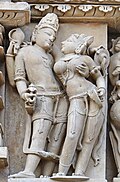
[[File:Le temple de Parshvanath (Khajuraho) (8638391942).jpg |thumb|left|upright|Loving couple, [[Khajuraho]].]] | |||
===Local Fairytales=== | |||
The ''Mahoba-Khanda'' legend of the dynasty's origin goes like this: Hemaraja, a priest of the [[Gahadavala|Gaharwar]] king of [[Varanasi|Benares]], had a beautiful daughter named Hemavati. Once, while Hemavati was bathing in a pond, the moon god [[Chandra]] saw her and made love to her. Hemavati was worried about the dishonour of being an unwed mother, but Chandra assured her that their son would become a great king. This child was the dynasty's progenitor Chandravarma. Chandra presented him with a [[philosopher's stone]] and taught him politics.<ref name="Asopa1976">{{cite book |author=Jai Narayan Asopa |title=Origin of the Rajputs |url=https://books.google.com/books?id=I_KznQEACAAJ |year=1976 |publisher=Bharatiya Publishing House |page=208}}</ref>{{sfn|R. K. Dikshit|1976|p=3}} The dynasty's own records do not mention Hemavati, Hemaraja or Indrajit. Such legends appear to be later bardic inventions. In general, the ''Mahoba-Khanda'' is a historically unreliable text.{{sfn|R. K. Dikshit|1976|p=4}} ''Prithviraj Raso'' is also considered an historically unreliable text.<ref>{{cite book | editor=K Ayyappap Panikkar | title=Medieval Indian literature: an anthology (Volume 1) | author = Vijayendra Snatak | chapter = Medieval Hindi Literature | chapter-url=https://books.google.com/books?id=KYLpvaKJIMEC&pg=PA142 |year=1997 | publisher=Sahitya Akademi | isbn=978-81-260-0365-5 | page=142}}</ref><ref>{{cite book |title=Serving empire, serving nation: James Tod and the Rajputs of Rajasthan |first=Jason |last=Freitag |publisher=BRILL |year=2009 |isbn=978-90-04-17594-5 |url=https://books.google.com/books?id=Ib93BhAu43gC |pages=3–5}}</ref><ref>{{cite book |author=R. V. Somani |url=https://books.google.com/books?id=NcIBAAAAMAAJ |title=History of Mewar, from Earliest Times to 1751 A.D. |publisher=Mateshwari |year=1976 |oclc=2929852 |page= 30}}</ref> | |||
[[File:Celestial dancer (Devata) mid-11th century, Chandela period, Madhya Pradesh.jpg|thumb|Celestial dancer (Devata) mid-11th century, Chandela period, Madhya Pradesh. [[Metropolitan Museum of Art]].]] | |||
===British theory & debunk=== | |||
The British indologist [[Vincent Arthur Smith|V. A. Smith]] theorised that the Chandelas were of either [[Bhar]] or [[Gondi people|Gond]] origin, this theory was not supported by some scholars including [[Chintaman Vinayak Vaidya|C V Vaidya]] because this Bhar and Gond Origin theory was based on Marriage of Durgavati to a king of Gond kingdom Dalpat shah who was a Gond and son of King Amandas Gond according to Akbarnama.<ref name="Beveridge 1907">{{Cite book|last=Beveridge|first=H.|url=http://archive.org/details/in.ernet.dli.2015.55649|title=The Akbarnama Of Abul Fazl Vol.2|date=1907}}</ref> After the decline of Kalchuri Rajput remaining Kalchuri Rajput kingdom adopted tribal's which lead to the beginning of Gond Kingdom in which Dalpat Shah Gond was a son of Gond King Amandas Gond.<ref>{{Cite web|date=2021-08-16|title=Rani Durgavati: The symbol of syncretic culture between Rajputs and Tribals|url=https://timesofindia.indiatimes.com/blogs/voices/rani-durgavati-the-symbol-of-syncretic-culture-between-rajputs-and-tribals/|access-date=2022-01-17|website=Times of India Blog|language=en-US}}</ref><ref name="Beveridge 1907" /> Historian R. K. Dikshit also not find Bhar and Gond Origin theory convincing: he argues that Maniya was not a tribal deity.<ref>{{Cite book|last=Dikshit|first=R.K.|url=https://books.google.com/books?id=a9j9ZJGJOV0C&pg=PA130|title=The Candellas of Jejākabhukti|date=1976|publisher=Abhinav Publications|isbn=978-81-7017-046-4|pages=8|language=en}}</ref> Also, the dynasty's association with Gond territory is not necessarily indicative of a common descent: the dynasty's progenitor may have been posted as a governor in these territories.<ref>{{Cite book|last=Dikshit|first=R. K.|url=https://books.google.com/books?id=a9j9ZJGJOV0C&pg=PA130|title=The Candellas of Jejākabhukti|date=1976|publisher=Abhinav Publications|isbn=978-81-7017-046-4|pages=7|language=en}}</ref> | |||
==History== | |||
===Mahameghvahana Dynasty=== | |||
'''[[Mahameghavahana dynasty]]''', Rule: 1st century BC to early 4th century BC<ref name="Sahu">{{Cite journal|last=Sahu|first=J. K.|date=1977|journal=Proceedings of the Indian History Congress|volume=38|pages=49–54|issn=2249-1937|jstor=44139050|title=The Meghas of Kosala}}</ref><ref>{{Cite web|url=https://shodhganga.inflibnet.ac.in/bitstream/10603/187259/13/13_chapter%202.pdf|title=The Meghas of Kosala|last=Sahu|first=J.K.|date=1977|website=shodhganga}}</ref>) was an ancient Indian dynasty of Kalinga after the fall of the Maurya Empire.<ref>For a map of their territory see: {{cite book |last1=Schwartzberg |first1=Joseph E. |title=A Historical atlas of South Asia |date=1978 |publisher=University of Chicago Press |location=Chicago |page=145, map XIV.1 (f)|isbn=0226742210 |url=https://dsal.uchicago.edu/reference/schwartzberg/pager.html?object=182}}</ref> In the 1st century BCE, Mahameghavahanavarman, a Chandel king of the [[Chedi Empire|Chedi]], conquered [[Kalinga]] and [[Kosala]].<ref>{{Cite book|url=https://archive.org/details/in.ernet.dli.2015.282457|title=Tribes in Ancient India|last=L Bhagawandas Gandhi|date=1927}}</ref> He belonged to the [[Chandel (Rajput clan)|Chedi-Chandel Yadav clan]] of the Chandravanshi Kshatriyas.<ref>{{Cite book |last=Taṇḍana |first=Premanārāyaṇa |url=https://books.google.co.in/books?id=a0shAAAAMAAJ&q=%E0%A4%9A%E0%A5%87%E0%A4%A6%E0%A4%BF+%E0%A4%AF%E0%A4%BE+%E0%A4%9A%E0%A4%A8%E0%A5%8D%E0%A4%A6%E0%A5%87%E0%A4%B2&dq=%E0%A4%9A%E0%A5%87%E0%A4%A6%E0%A4%BF+%E0%A4%AF%E0%A4%BE+%E0%A4%9A%E0%A4%A8%E0%A5%8D%E0%A4%A6%E0%A5%87%E0%A4%B2&hl=en&newbks=1&newbks_redir=0&source=gb_mobile_search&sa=X&ved=2ahUKEwieq52v2LaBAxWG1GEKHX_kClE4ChDoAXoECAQQAw#%E0%A4%9A%E0%A5%87%E0%A4%A6%E0%A4%BF%20%E0%A4%AF%E0%A4%BE%20%E0%A4%9A%E0%A4%A8%E0%A5%8D%E0%A4%A6%E0%A5%87%E0%A4%B2 |title=ब्रजभाषा सूर-कोश: Nirdeśaka Dīnadayālu Gupta |date=1962 |publisher=Lakhanaū Viśvavidyālaya |language=hi}}</ref><ref>{{Cite book |last=Dikshit |first=R. K. |url=https://books.google.co.in/books?id=a9j9ZJGJOV0C&pg=PA130&redir_esc=y#v=onepage&q=V%E1%B9%9B%E1%B9%A3%E1%B9%87%C4%ABs&f=false |title=The Candellas of Jejākabhukti |date=1976 |publisher=Abhinav Publications |isbn=978-81-7017-046-4 |language=en}}</ref><ref>{{Cite book |last=Verma |first=Dr Shyam Bahadur |url=https://books.google.com/books/about/Prabhat_Brihat_Hindi_Shabdakosh_Vol_1.html?id=hr9Zl_7g8HAC |title=Prabhat Brihat Hindi Shabdakosh (Vol-1): Bestseller Book by Dr Shyam Bahadur Verma: Prabhat Brihat Hindi Shabdakosh) |date=2010-01-01 |publisher=Prabhat Prakashan |isbn=978-81-7315-769-1 |language=hi}}</ref> <ref>{{Cite book |last=Kapoor |first=Badrinath |url=https://books.google.com/books/about/Brihat_Pramanik_Hindi_Kosh.html?id=hkmDkkI5JYYC |title=Brihat Pramanik Hindi Kosh |date=2006-09-01 |publisher=Lokbharti Prakashan |isbn=978-81-8031-057-7 |language=hi}}</ref><ref>{{Cite book |last=Thakur ‘Bipin’ |first=Dr Bindeshwari Prasad |url=https://books.google.co.in/books?id=2Ht3EAAAQBAJ&pg=PA502&dq=%E0%A4%9A%E0%A4%A8%E0%A5%8D%E0%A4%A6%E0%A5%87%E0%A4%B2+%E0%A4%B6%E0%A4%BF%E0%A4%B6%E0%A5%81%E0%A4%AA%E0%A4%BE%E0%A4%B2&hl=en&newbks=1&newbks_redir=0&source=gb_mobile_search&sa=X&ved=2ahUKEwiikYfu2baBAxUddfUHHTlyCisQ6AF6BAgGEAM#v=onepage&q=%E0%A4%9A%E0%A4%A8%E0%A5%8D%E0%A4%A6%E0%A5%87%E0%A4%B2%20%E0%A4%B6%E0%A4%BF%E0%A4%B6%E0%A5%81%E0%A4%AA%E0%A4%BE%E0%A4%B2&f=false |title=BHARTIYA SANSKRITI KE GAKAAR PRATEEK |publisher=Sarv Bhasha Trust |isbn=978-93-93605-21-4 |language=hi}}</ref><ref name="MajumdarBhavan1951">{{cite book |author=[[Ramesh Chandra Majumdar]] |title=The History and Culture of the Indian People: The age of imperial unity; 2d ed. 1953 |url=https://books.google.com/books?id=-3dDAAAAYAAJ |year=1951 |publisher=Bharatiya Vidya Bhavan}}</ref><ref>{{Cite book |last=Society |first=Bihar and Orissa Research |url=https://books.google.co.in/books?id=IahEAQAAMAAJ&q=kharavela+chakravarti&dq=kharavela+chakravarti&hl=en&newbks=1&newbks_redir=0&source=gb_mobile_search&sa=X&ved=2ahUKEwjgorSBt66BAxWSPXAKHWHvDBAQ6AF6BAgNEAM#kharavela%20chakravarti |title=Journal of the Bihar and Orissa Research Society |date=1917 |publisher=The Society |language=en}}</ref><ref>{{Cite book |url=https://books.google.co.in/books?id=M2Pr0PCTYV4C&q=kharavela+Agramahishi&dq=kharavela+Agramahishi&hl=en&newbks=1&newbks_redir=0&source=gb_mobile_search&sa=X&ved=2ahUKEwjY4Ze-tq6BAxXYO3AKHaXqBHwQ6AF6BAgOEAM#kharavela%20Agramahishi |title=Journal of the Andhra Historical Research Society |date=1946 |publisher=Andhra Historical Research Society |language=en}}</ref> | |||
===Bilaspur State=== | |||
According to Bilaspur Past and Present, Bilaspur Gazetteer and Ganesh Singh's book Chandravansh Vilas and Shashivansh Vinod confirm that the foundation of Kahlur Princely State was laid by Chandel prince Bir Chand (Birvarman), His father who reigned [[Chedi Kingdom|Chedi]] to northern [[Mahismati]] region from Chanderi, Hariharvarman Chandel (Harihar Chand) [[Chanderi]]) made his son Govindvarman Chandel the king of [[Chanderi]] and in old age came north with his son Birvarman and other 3.<ref>{{cite book |url=https://books.google.com/books?id=ayYbAvECXQwC&pg=PA50 |title=The Princely and Noble Families of the Former Indian Empire: Himachal Pradesh |author=Mark Brentnall |publisher=Indus |year=2005 |isbn=9788173871634 |page=50 52 }}</ref> | |||
===Chand dynasty=== | |||
[[File:Fort and the capital city of Kali Kumaon, Champawat, 1815.jpg|right|250px|thumb|Fort and the capital city of Kali Kumaon, [[Champawat]], 1815.]] | |||
The '''Chand Dynasty''' [[Hindi|संस्कृत]]: चन्द राजवंश), sometimes '''Chandel of Kumaon'''<ref>{{Cite book |last1=Viyogi |url=https://books.google.com/books?id=GwzlFdW6kloC&dq=Chandel+or+Chand+of+Kumaon&pg=PA412 |title=History Of The Later Harappans And Silpakara Movement (2 Vols.) |last2=Ansari |first2=Naval & M. Anawar |date=2010 |publisher=Gyan Publishing House |isbn=978-81-7835-751-5 |language=en}}</ref> or '''Chand Kingdom''', was a Chandel dynasty of [[Kumaon Kingdom|Kumaon]], which was established by displacing the [[Katyuri kings]]. The Chands ruled over the [[Kumaon Kingdom|Kumaon]] and parts of the Farwestern [[Nepal]] called [[Doti]] (present-day [[Sudurpashchim Province]]).<ref>{{Cite journal |last=Acharya |first=Baburam |date=December 1, 1976 |title=Prithvi Narayan Shah |journal=Regmi Research Series |pages=225}}</ref> Thee dynasty was founded by Somvanshi Chandel Yadava prince Som Chand (Somvarman, the son of Kabirvarman Chandel or Kabir Chand).<ref>{{Cite book |last=Handa |first=O. C. |url=https://books.google.com/books?id=XTfmGNfaoC4C |title=Art & Architecture of Uttarakhand |date=July 2009 |publisher=Pentagon Press |isbn=978-81-8274-417-2 |language=en}}</ref><ref>{{Cite book|url=https://books.google.com/books?id=eS6gtbhj9cIC |title=Census of India, 1991: Una |date=1995 |publisher=Controller of Publications |language=hi}}</ref><ref>{{Cite book|last=Tyagi |first=Nutan |date=1991 |title= Hill Resorts of U.P. Himalaya|publisher=Indus publications |pages=63|isbn=9788185182629 |url=https://books.google.com/books?id=fcrieQdY3Y0C&dq=Chand+dynasty+rajput&pg=PA63}}</ref> | |||
===Chandelas of Jejakabhukti=== | |||
The [[Chandelas of Jejakabhukti]] or ''Chandelas of Mahoba'' was a famous [[Hindu]] [[Rajput]] dynasty , which independently ruled Central India from the 8th to the 13th century. The Chandelas of Mahoba was founded by the [[Haihaya|Haihayavanshi Chandel]] king [[Nannuka|Chandravarman]]. They ruled from [[Mahoba]], [[Jejakabhukti]], [[Uttar Pradesh]]. The [[Chandel (Rajput clan)|Chandel]] emperors of [[Kalinjar]] were not only successful conquerors and efficient rulers but also had more inclination towards architecture, religion and love. | |||
[[File:Map of Candellas around 1200 CE.jpg| thumb|Map of Chandel dynasty in 1200 CE... The Chandel Empire during its decline around 1202 A.D.]] | |||
{{sfn| Early Rulers of Khajur (Second Revised Edition)}}{{sfn| Edwin Thomas Atkinson|1971|p=504}}{{sfn|Kuśa rājavaṃśa pradīpa|kr̥shṇapāla Siṃha, Rāma Sahāya Brahma Bhaṭṭa, Baśīra Ahamada | 1976|p=55}}{{sfn|Nimara ka samskrtika itihasa|Ramnarayan Upadhyay |1980|p=17}} | |||
===Chandels of Mirzapur=== | ===Chandels of Mirzapur=== | ||
Bijaigarh in modern [[Mirzapur district]] of Eastern [[Uttar Pradesh]] was ruled by a family of Chandel Rajputs who traced their line to the Burhur Chandels of Rewa. They were notable for their conflict with the [[Bhumihar]]s of [[Benares state]] and for participating in the [[Indian rebellion of 1857]].<ref>{{cite journal |last1=Downs |first1=Troy |title=Rajput revolt in Southern Mirzapur, 1857–58 |journal=Journal of South Asian Studies |date=1992 | Bijaigarh in modern [[Mirzapur district]] of Eastern [[Uttar Pradesh]] was ruled by a family of Chandel Rajputs who traced their line to the Burhur Chandels of Rewa. They were notable for their conflict with the [[Bhumihar]]s of [[Benares state]] and for participating in the [[Indian rebellion of 1857]].<ref>{{cite journal |last1=Downs |first1=Troy |title=Rajput revolt in Southern Mirzapur, 1857–58 |journal=Journal of South Asian Studies |date=1992 |pages=29-46 |url=http://dx.doi.org/10.1080/00856409208723166}}</ref> | ||
=== | ===Zaildari=== | ||
A group of Chandel families claiming a common origin once held the [[zaildar]]is of Ghund, Madhan, and [[Theog]] in present-day [[Himachal Pradesh]]. According to their tradition, their ancestor migrated from [[Chanderi]] to [[Kahlur|Bilaspur]]. After three generations, his descendants moved to Ram Sarai in the [[Garhwal division|Garhwal region]]. After another four generations, four brothers from the family moved to the [[Shimla district|Shimla region]]. | |||
The eldest brother became administrator of Madhan; the third youngest - Jai Chand - became the administrator of Theog; and the youngest became the administrator of Ghund.<ref>{{cite book |url=https://books.google.com/books?id=ayYbAvECXQwC&pg=PA284 |title=The Princely and Noble Families of the Former Indian Empire: Himachal Pradesh |author=Mark Brentnall |publisher=Indus |year=2005 |isbn=9788173871634 |page=284 }}</ref> | |||
== References == | ==References== | ||
{{reflist}} | {{reflist}} | ||
=== Bibliography === | ===Bibliography=== | ||
* {{cite book |author=R. K. Dikshit |url=https://books.google.com/books?id=a9j9ZJGJOV0C&pg=PA3 |title=The Candellas of Jejākabhukti |publisher=Abhinav |year=1976 |isbn = 9788170170464}} | * | ||
* {{cite book |last=Sen |first=Shailendra Nath |url=https://books.google.com/books?id=Wk4_ICH_g1EC&pg=PA172 |title=Ancient Indian History and Civilization |publisher=New Age International |year=1999 |isbn=9788122411980 }} | {{cite book|author=R. K. Dikshit|url=https://books.google.com/books?id=a9j9ZJGJOV0C&pg=PA3|title=The Candellas of Jejākabhukti|publisher=Abhinav|year=1976|isbn=9788170170464}} | ||
*{{cite book|last=Sen|first=Shailendra Nath|url=https://books.google.com/books?id=Wk4_ICH_g1EC&pg=PA172|title=Ancient Indian History and Civilization|publisher=New Age International|year=1999|isbn=9788122411980}} | |||
{{Rajput Groups of India}} | {{Rajput Groups of India}} | ||
| Line 43: | Line 72: | ||
[[Category:Rajput clans of Bihar]] | [[Category:Rajput clans of Bihar]] | ||
[[Category:Rajput clans of Himachal Pradesh]] | [[Category:Rajput clans of Himachal Pradesh]] | ||
[[Category:Rajput clans of Kumaon]] | |||
Revision as of 14:25, 29 March 2026
Chandel (synonym:Mādhav, Vrishni & Chedi) [1][2](Hindi: चन्द+ऐल-चन्देल, lit. 'Moon god and Ael, direct descendant of Ila goddess')[3][4] is a clan of the Rajput or Kshatriy caste. Chandels are the highest clan among the Kshatriyas and is the lord of the Chandravansh. Families belonging to this clan ruled many states in India and occupied various feudal estates. The most notable of these Chandel family is Chandel dynasty of Jejakabhukti, who ruled many almost entire India from 8th to 15th century from their capital in Jejakabhukti region. Chandels and it's branches saved Hindus from invaders like Turks, Afghans and Mughals during Aurangzeb even during there decline period.[5][6][7][8][9][10][11][12][13][14]
Subclans & Branches
Mahobia, Kahluria, Gidhauriya, Chand, Burhuri & Banafar etc are the subclans while Kalachuris, Meghas & Pallavas etc are separate branches of Chandel Rajputs.
Origin
Early text and inscriptions
The Chandelas are Bramh-Kshatriyas and synonym and evolved version of Chandravansha and Kuru clan of Rajputs.[15] Historians Such as CV Vaidya and GS Ojha consider these Chandel Rajput to be of Pure Chandra lineage and Highest clan among Kshatriyas.[16][17][18]
According to 6th century inscriptions of Bilaspur State and Chedi Kingdom, a Chandel king Chandravarman became the king of Chandeli, his ancestors rulled Chedi Kingdom continuosly after Chandela king Shishupala of Mahabharata. According ballads, he became the 5th king of Chanderi after the Chandela king Hariharvarman (Harihar Chand in Pahadi) who was also the ancestors of Bir Chand (founder of Kahlur state in 632 A.D.).[19][20]
The epigraphic records of the dynasty, as well as contemporary texts such as Balabhadra-vilasa and Prabodha-chandrodaya, suggest that the Chandelas belonged to the legendary Lunar dynasty (Chandravansha).[15] A 954 CE Khajuraho inscription states that the dynasty's first king Chandravarman was a descendant of sage Chandratreya (Lord Chandra), who was a son of Atri. A 1002 CE Khajuraho inscription gives a slightly different account, in which Chandratreya is mentioned as a son of Indu (the Moon) and a grandson of Atri.[21] The 1195 CE Baghari inscription and the 1260 CE Ajaygadh inscription contain similar accounts.[22] The Balabhadra-vilasa also names Atri among the ancestors of the Chandelas.
_(8638391942).jpg)
Local Fairytales
The Mahoba-Khanda legend of the dynasty's origin goes like this: Hemaraja, a priest of the Gaharwar king of Benares, had a beautiful daughter named Hemavati. Once, while Hemavati was bathing in a pond, the moon god Chandra saw her and made love to her. Hemavati was worried about the dishonour of being an unwed mother, but Chandra assured her that their son would become a great king. This child was the dynasty's progenitor Chandravarma. Chandra presented him with a philosopher's stone and taught him politics.[23][15] The dynasty's own records do not mention Hemavati, Hemaraja or Indrajit. Such legends appear to be later bardic inventions. In general, the Mahoba-Khanda is a historically unreliable text.[21] Prithviraj Raso is also considered an historically unreliable text.[24][25][26]
_mid-11th_century,_Chandela_period,_Madhya_Pradesh.jpg)
British theory & debunk
The British indologist V. A. Smith theorised that the Chandelas were of either Bhar or Gond origin, this theory was not supported by some scholars including C V Vaidya because this Bhar and Gond Origin theory was based on Marriage of Durgavati to a king of Gond kingdom Dalpat shah who was a Gond and son of King Amandas Gond according to Akbarnama.[27] After the decline of Kalchuri Rajput remaining Kalchuri Rajput kingdom adopted tribal's which lead to the beginning of Gond Kingdom in which Dalpat Shah Gond was a son of Gond King Amandas Gond.[28][27] Historian R. K. Dikshit also not find Bhar and Gond Origin theory convincing: he argues that Maniya was not a tribal deity.[29] Also, the dynasty's association with Gond territory is not necessarily indicative of a common descent: the dynasty's progenitor may have been posted as a governor in these territories.[30]
History
Mahameghvahana Dynasty
Mahameghavahana dynasty, Rule: 1st century BC to early 4th century BC[31][32]) was an ancient Indian dynasty of Kalinga after the fall of the Maurya Empire.[33] In the 1st century BCE, Mahameghavahanavarman, a Chandel king of the Chedi, conquered Kalinga and Kosala.[34] He belonged to the Chedi-Chandel Yadav clan of the Chandravanshi Kshatriyas.[35][36][37] [38][39][12][40][41]
Bilaspur State
According to Bilaspur Past and Present, Bilaspur Gazetteer and Ganesh Singh's book Chandravansh Vilas and Shashivansh Vinod confirm that the foundation of Kahlur Princely State was laid by Chandel prince Bir Chand (Birvarman), His father who reigned Chedi to northern Mahismati region from Chanderi, Hariharvarman Chandel (Harihar Chand) Chanderi) made his son Govindvarman Chandel the king of Chanderi and in old age came north with his son Birvarman and other 3.[42]
Chand dynasty

The Chand Dynasty संस्कृत: चन्द राजवंश), sometimes Chandel of Kumaon[43] or Chand Kingdom, was a Chandel dynasty of Kumaon, which was established by displacing the Katyuri kings. The Chands ruled over the Kumaon and parts of the Farwestern Nepal called Doti (present-day Sudurpashchim Province).[44] Thee dynasty was founded by Somvanshi Chandel Yadava prince Som Chand (Somvarman, the son of Kabirvarman Chandel or Kabir Chand).[45][46][47]
Chandelas of Jejakabhukti
The Chandelas of Jejakabhukti or Chandelas of Mahoba was a famous Hindu Rajput dynasty , which independently ruled Central India from the 8th to the 13th century. The Chandelas of Mahoba was founded by the Haihayavanshi Chandel king Chandravarman. They ruled from Mahoba, Jejakabhukti, Uttar Pradesh. The Chandel emperors of Kalinjar were not only successful conquerors and efficient rulers but also had more inclination towards architecture, religion and love.

Chandels of Mirzapur
Bijaigarh in modern Mirzapur district of Eastern Uttar Pradesh was ruled by a family of Chandel Rajputs who traced their line to the Burhur Chandels of Rewa. They were notable for their conflict with the Bhumihars of Benares state and for participating in the Indian rebellion of 1857.[52]
Zaildari
A group of Chandel families claiming a common origin once held the zaildaris of Ghund, Madhan, and Theog in present-day Himachal Pradesh. According to their tradition, their ancestor migrated from Chanderi to Bilaspur. After three generations, his descendants moved to Ram Sarai in the Garhwal region. After another four generations, four brothers from the family moved to the Shimla region.
The eldest brother became administrator of Madhan; the third youngest - Jai Chand - became the administrator of Theog; and the youngest became the administrator of Ghund.[53]
References
- ↑ Dikshit, R. K. (1976). The Candellas of Jejākabhukti. Abhinav Publications. ISBN 978-81-7017-046-4.
- ↑ Viyogi; Ansari, Naval & M. Anawar (2010). History Of The Later Harappans And Silpakara Movement (2 Vols.). Gyan Publishing House. ISBN 978-81-7835-751-5.
- ↑ https://books.google.co.in/books?id=5jpuAAAAMAAJ&q=%E0%A4%9A%E0%A4%A8%E0%A5%8D%E0%A4%A6%E0%A5%87%E0%A4%B2+%E0%A4%95%E0%A4%BE+%E0%A4%85%E0%A4%B0%E0%A5%8D%E0%A4%A5&dq=%E0%A4%9A%E0%A4%A8%E0%A5%8D%E0%A4%A6%E0%A5%87%E0%A4%B2+%E0%A4%95%E0%A4%BE+%E0%A4%85%E0%A4%B0%E0%A5%8D%E0%A4%A5&hl=en&newbks=1&newbks_redir=0&source=gb_mobile_search&sa=X&ved=2ahUKEwjbnqyeyamDAxVVw6ACHaS1C_sQ6AF6BAgMEAM#%E0%A4%9A%E0%A4%A8%E0%A5%8D%E0%A4%A6%E0%A5%87%E0%A4%B2
- ↑ https://books.google.co.in/books?id=6xQ-AAAAMAAJ&q=%E0%A4%9A%E0%A4%A8%E0%A5%8D%E0%A4%A6%E0%A5%87%E0%A4%B2+%E0%A4%B6%E0%A4%AC%E0%A5%8D%E0%A4%A6+%E0%A4%95%E0%A4%BE+%E0%A4%85%E0%A4%B0%E0%A5%8D%E0%A4%A5&dq=%E0%A4%9A%E0%A4%A8%E0%A5%8D%E0%A4%A6%E0%A5%87%E0%A4%B2+%E0%A4%B6%E0%A4%AC%E0%A5%8D%E0%A4%A6+%E0%A4%95%E0%A4%BE+%E0%A4%85%E0%A4%B0%E0%A5%8D%E0%A4%A5&hl=en&newbks=1&newbks_redir=0&source=gb_mobile_search&sa=X&ved=2ahUKEwjRopyDyamDAxUnyqACHVmCApQQ6AF6BAgFEAM#%E0%A4%9A%E0%A4%A8%E0%A5%8D%E0%A4%A6%E0%A5%87%E0%A4%B2%20%E0%A4%85%E0%A4%B0%E0%A5%8D%E0%A4%A5
- ↑ Yaman ), डॉ अशोक कुमार ‘यमन’ ( Dr Ashok Kumar (8 January 2022). मध्यकालीन भारतीय संगीत का इतिहास ( Madhyakalin Bharatiya Sangeet ka Itihas ) (in हिन्दी). Kalpana Prakashan.
- ↑ name=":0">R. B. Mandal (1981). Frontiers in Migration Analysis. Concept. p. 172.
- ↑ sakalle, Jairam Sitaram Pawar & Vinayak (13 June 2023). Raja Bhoj Parmaron Ki Gorvanshiya Virasat (in हिन्दी). Blue Rose Publishers.
- ↑ Taṇḍana, Premanārāyaṇa (1962). ब्रजभाषा सूर-कोश: Nirdeśaka Dīnadayālu Gupta (in हिन्दी). Lakhanaū Viśvavidyālaya.
- ↑ Kapoor, Badrinath (1 September 2006). Brihat Pramanik Hindi Kosh (in हिन्दी). Lokbharti Prakashan. ISBN 978-81-8031-057-7.
- ↑ Verma, Dr Shyam Bahadur (1 January 2010). Prabhat Brihat Hindi Shabdakosh (Vol-1): Bestseller Book by Dr Shyam Bahadur Verma: Prabhat Brihat Hindi Shabdakosh) (in हिन्दी). Prabhat Prakashan. ISBN 978-81-7315-769-1.
- ↑ Thakur ‘Bipin’, Dr Bindeshwari Prasad. BHARTIYA SANSKRITI KE GAKAAR PRATEEK (in हिन्दी). Sarv Bhasha Trust. ISBN 978-93-93605-21-4.
- ↑ 12.0 12.1 Ramesh Chandra Majumdar (1951). The History and Culture of the Indian People: The age of imperial unity; 2d ed. 1953. Bharatiya Vidya Bhavan.
- ↑ Society, Bihar and Orissa Research (1917). Journal of the Bihar and Orissa Research Society. The Society.
- ↑ Management in Government. Department of Administrative Reforms, Ministry of Home Affairs. 2008.
- ↑ 15.0 15.1 15.2 R. K. Dikshit 1976, p. 3.
- ↑ Yaman ), डॉ अशोक कुमार ‘यमन’ ( Dr Ashok Kumar (8 January 2022). मध्यकालीन भारतीय संगीत का इतिहास ( Madhyakalin Bharatiya Sangeet ka Itihas ) (in हिन्दी). Kalpana Prakashan.
- ↑ Pandey, Dhanpati (1998). Pracheen Bharat Ka Rajneetik Aur Sanskritik Itihas (in हिन्दी). Motilal Banarsidass Publishe. ISBN 978-81-208-2380-8.
- ↑ Lal, Lallu (1882). Premasāgara (in हिन्दी). Navalakiśora.
- ↑ Brentnall, Mark (2004). The Princely and Noble Families of the Former Indian Empire: Himachal Pradesh. Indus Publishing. ISBN 978-81-7387-163-4.
- ↑ Pāṇḍeya, Trilocana (1962). Kumāūm̐ kā loka sāhitya (in हिन्दी). Alamoṛā Buka Ḍipo.
- ↑ 21.0 21.1 R. K. Dikshit 1976, p. 4.
- ↑ R. K. Dikshit 1976, p. 5.
- ↑ Jai Narayan Asopa (1976). Origin of the Rajputs. Bharatiya Publishing House. p. 208.
- ↑ Vijayendra Snatak (1997). "Medieval Hindi Literature". In K Ayyappap Panikkar (ed.). Medieval Indian literature: an anthology (Volume 1). Sahitya Akademi. p. 142. ISBN 978-81-260-0365-5.
- ↑ Freitag, Jason (2009). Serving empire, serving nation: James Tod and the Rajputs of Rajasthan. BRILL. pp. 3–5. ISBN 978-90-04-17594-5.
- ↑ R. V. Somani (1976). History of Mewar, from Earliest Times to 1751 A.D. Mateshwari. p. 30. OCLC 2929852.
- ↑ 27.0 27.1 Beveridge, H. (1907). The Akbarnama Of Abul Fazl Vol.2.
- ↑ "Rani Durgavati: The symbol of syncretic culture between Rajputs and Tribals". Times of India Blog. 16 August 2021. Retrieved 17 January 2022.
- ↑ Dikshit, R.K. (1976). The Candellas of Jejākabhukti. Abhinav Publications. p. 8. ISBN 978-81-7017-046-4.
- ↑ Dikshit, R. K. (1976). The Candellas of Jejākabhukti. Abhinav Publications. p. 7. ISBN 978-81-7017-046-4.
- ↑ Sahu, J. K. (1977). "The Meghas of Kosala". Proceedings of the Indian History Congress. 38: 49–54. ISSN 2249-1937. JSTOR 44139050.
- ↑ Sahu, J.K. (1977). "The Meghas of Kosala" (PDF). shodhganga.
- ↑ For a map of their territory see: Schwartzberg, Joseph E. (1978). A Historical atlas of South Asia. Chicago: University of Chicago Press. p. 145, map XIV.1 (f). ISBN 0226742210.
- ↑ L Bhagawandas Gandhi (1927). Tribes in Ancient India.
- ↑ Taṇḍana, Premanārāyaṇa (1962). ब्रजभाषा सूर-कोश: Nirdeśaka Dīnadayālu Gupta (in हिन्दी). Lakhanaū Viśvavidyālaya.
- ↑ Dikshit, R. K. (1976). The Candellas of Jejākabhukti. Abhinav Publications. ISBN 978-81-7017-046-4.
- ↑ Verma, Dr Shyam Bahadur (1 January 2010). Prabhat Brihat Hindi Shabdakosh (Vol-1): Bestseller Book by Dr Shyam Bahadur Verma: Prabhat Brihat Hindi Shabdakosh) (in हिन्दी). Prabhat Prakashan. ISBN 978-81-7315-769-1.
- ↑ Kapoor, Badrinath (1 September 2006). Brihat Pramanik Hindi Kosh (in हिन्दी). Lokbharti Prakashan. ISBN 978-81-8031-057-7.
- ↑ Thakur ‘Bipin’, Dr Bindeshwari Prasad. BHARTIYA SANSKRITI KE GAKAAR PRATEEK (in हिन्दी). Sarv Bhasha Trust. ISBN 978-93-93605-21-4.
- ↑ Society, Bihar and Orissa Research (1917). Journal of the Bihar and Orissa Research Society. The Society.
- ↑ Journal of the Andhra Historical Research Society. Andhra Historical Research Society. 1946.
- ↑ Mark Brentnall (2005). The Princely and Noble Families of the Former Indian Empire: Himachal Pradesh. Indus. p. 50 52. ISBN 9788173871634.
- ↑ Viyogi; Ansari, Naval & M. Anawar (2010). History Of The Later Harappans And Silpakara Movement (2 Vols.). Gyan Publishing House. ISBN 978-81-7835-751-5.
- ↑ Acharya, Baburam (1 December 1976). "Prithvi Narayan Shah". Regmi Research Series: 225.
- ↑ Handa, O. C. (July 2009). Art & Architecture of Uttarakhand. Pentagon Press. ISBN 978-81-8274-417-2.
- ↑ Census of India, 1991: Una (in हिन्दी). Controller of Publications. 1995.
- ↑ Tyagi, Nutan (1991). Hill Resorts of U.P. Himalaya. Indus publications. p. 63. ISBN 9788185182629.
- ↑ Early Rulers of Khajur (Second Revised Edition).
- ↑ Edwin Thomas Atkinson 1971, p. 504.
- ↑ Kuśa rājavaṃśa pradīpa & kr̥shṇapāla Siṃha, Rāma Sahāya Brahma Bhaṭṭa, Baśīra Ahamada 1976, p. 55.
- ↑ Nimara ka samskrtika itihasa & Ramnarayan Upadhyay 1980, p. 17.
- ↑ Downs, Troy (1992). "Rajput revolt in Southern Mirzapur, 1857–58". Journal of South Asian Studies: 29–46.
- ↑ Mark Brentnall (2005). The Princely and Noble Families of the Former Indian Empire: Himachal Pradesh. Indus. p. 284. ISBN 9788173871634.
Bibliography
R. K. Dikshit (1976). The Candellas of Jejākabhukti. Abhinav. ISBN 9788170170464.
- Sen, Shailendra Nath (1999). Ancient Indian History and Civilization. New Age International. ISBN 9788122411980.