


m Removing protection template from an unprotected page |
ArianneNies1 (talk | contribs) Updated article with clearer structure |
||
| Line 1: | Line 1: | ||
{{short description|Founder of Swaminarayan Sampradaya}} | {{short description|Founder of Swaminarayan Sampradaya (1781-1830)}} | ||
{{Other uses}} | {{Other uses}} | ||
{{pp|small=yes}} | |||
{{EngvarB|date=February 2015}} | {{EngvarB|date=February 2015}} | ||
{{Use dmy dates|date=February 2015}} | {{Use dmy dates|date=February 2015}} | ||
| Line 10: | Line 10: | ||
| religion = [[Hinduism]] | | religion = [[Hinduism]] | ||
| birth_date = 3 April 1781{{sfnp|Williams|2001|p=13}} | | birth_date = 3 April 1781{{sfnp|Williams|2001|p=13}} | ||
| birth_place = [[Chhapaiya]], [[Oudh]] (present-day [[Uttar Pradesh]], India) | | birth_place = [[Chhapaiya]], [[Oudh State|Kingdom of Oudh]] (present-day [[Uttar Pradesh]], India) | ||
| birth_name = Ghanshyam Pande | | birth_name = Ghanshyam Pande | ||
| death_date = {{death date and age|1830|6|1|1781|4|3|df=yes}} | | death_date = {{death date and age|1830|6|1|1781|4|3|df=yes}} | ||
| death_place = [[Gadhada]] (present-day [[Gujarat]], India) | | death_place = [[Gadhada]], [[Baroda State]] (present-day [[Gujarat]], India) | ||
| guru = [[Swami Ramanand]] | | guru = [[Swami Ramanand]] | ||
| founder = [[Swaminarayan | | founder = [[Swaminarayan Sampradaya]] | ||
| successor = Ayodhyaprasad and Raghuvira{{sfnp|Williams|2001|p=35}} | |||
}} | }} | ||
'''Swaminarayan''' ([[IAST]]: ''{{IAST|Svāmīnārāyaṇa}}''; 3 April 1781 – 1 June 1830), also known as '''Sahajanand Swami''', was a [[yogi]] and [[Asceticism|ascetic]] believed by followers to be a manifestation of [[Krishna]]{{sfnp|Kim|2010}}{{sfnp|Jones|2005|p=8890}}{{sfnp|Olson|2007|p=336}} or the highest [[Theophany|manifestation]] of [[Purushottama]],{{sfnp|Williams|2018|page=81}}<ref>{{Cite book |title=Gurus of modern yoga |date=2013 |first1=Mark |last1=Singleton |first2=Ellen |last2=Goldberg |isbn=978-0-19-993871-1 |location=New York, NY |oclc=861692270}}</ref> around whom the [[Swaminarayan Sampradaya]] developed. | |||
'''Swaminarayan''' ([[IAST]]: ''{{IAST|Svāmīnārāyaṇa}}'' | |||
In 1800, he was initiated into the '' | In 1800, he was initiated into the ''Uddhava'' ''[[sampradaya]]'' by his guru, [[Swami Ramanand]], and was given the name Sahajanand Swami. Despite opposition, in 1802, Ramanand handed over the leadership of the Uddhava Sampradaya to him before his death.{{Sfnp|Williams|2018|page=17}} According to the Swaminarayan tradition, Sahajanand Swami became known as Swaminarayan, and the Uddhava Sampradaya became known as the Swaminarayan Sampradaya, after a gathering in which he taught the [[Swaminarayan Mantra]] to his followers. | ||
He emphasized "moral, personal, and social betterment,"{{sfnp|Jones|2005|p=8889}} and ''[[ahimsa]]'' | He emphasized "moral, personal, and social betterment,"{{sfnp|Jones|2005|p=8889}} and ''[[ahimsa]]''.{{sfnp|Williams|2018|p=27}} He is also remembered within the sect for undertaking reforms for women{{sfnp|Raval|2012}} and the poor,{{sfnp|Mangalnidhidas|2016}} and performing large-scale non-violent [[yajna|yajñas]] (fire sacrifices).{{sfnp|Paramtattvadas|Williams|Amrutvijaydas|2016}} | ||
During his lifetime, Swaminarayan [[Institutionalisation|institutionalized]] his charisma and beliefs in various ways.{{sfnp|Schreiner|2001}} He | During his lifetime, Swaminarayan [[Institutionalisation|institutionalized]] his charisma and beliefs in various ways.{{sfnp|Schreiner|2001}} He built six mandirs to facilitate devotional worship of God by his followers,{{sfnp|S.Patel|2017|p=65}}{{sfnp|Trivedi|2015|p=353}}{{sfnp|Hatcher|2020}} and encouraged the creation of a scriptural tradition,{{sfnp|Schreiner|2001}}{{sfnp|Paramtattvadas|2017|p=64}}{{sfnp|Williams|2018|p=200}} including the ''[[Shikshapatri]]'', which he wrote in 1826.{{sfnp|Parikh|2016}} In 1826, through a legal document titled the [[Desh Vibhag Lekh|Lekh]], Swaminarayan created two dioceses, the [[Laxmi Narayan Dev Gadi|Laxmi Narayan Dev Gadi (Vadtal Gadi)]] and [[Nar Narayan Dev Gadi|Nar Narayan Dev Gadi (Ahmedabad Gadi)]], with a hereditary leadership of [[acharya]]s and their wives,<ref group="web">{{Cite web |date=3 October 2017 |title=When One Million People Believe Your Husband Is a God |url=https://www.vice.com/en/article/when-one-million-people-believe-your-husband-is-a-god/ |access-date=2021-06-25 |website=Vice.com |language=en}}</ref> beginning with two of his nephews whom he formally adopted,{{sfnp|Williams|2001|p=35}} who were authorized to install statues of deities in temples and to initiate ascetics.{{sfnp|Schreiner|2001}} | ||
==Biography== | ==Biography== | ||
| Line 31: | Line 31: | ||
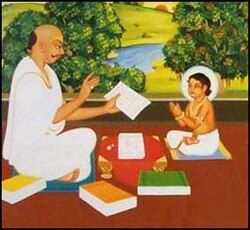
[[File:Dharmadev and Bhaktimata.jpg|thumb|Dharmadev teaching Ghanshyam from the scriptures]] | [[File:Dharmadev and Bhaktimata.jpg|thumb|Dharmadev teaching Ghanshyam from the scriptures]] | ||
Swaminarayan was born on 3 April 1781 ([[Chaitra]] Sud 9, [[Samvat]] 1837) in [[Chhapaiya]], a village near [[Ayodhya]] in present-day Indian state of [[Uttar Pradesh]] | Swaminarayan was born on 3 April 1781 ([[Chaitra]] Sud 9, [[Samvat]] 1837) in [[Chhapaiya]], a village near [[Ayodhya]], then under the [[Nawab of Awadh|Nawab of Oudh]], in present-day Indian state of [[Uttar Pradesh]].{{sfnp|Williams|2001|p=13}} Born into the [[Brahmin]] or [[caste system in India|priestly caste]] of Sarvariya, Swaminarayan was named ''Ghanshyam Pande'' by his parents, Hariprasad Pande (father, also known as Dharmadev) and Premvati Pande (mother, also known as Bhaktimata and Murtidevi).{{sfnp|Williams|2001|p=13}} The birth of Swaminarayan coincided with the Hindu festival of [[Rama Navami]], celebrating the birth of [[Rama]]. The ninth lunar day in the fortnight of the [[Lunar phase|waxing moon]] in the [[Hindu calendar|month]] of [[Chaitra]] (March–April), is celebrated as both Rama Navami and [[Swaminarayan Jayanti]] by Swaminarayan followers. This celebration also marks the beginning of a ritual calendar for the followers.<ref name = "Williams141">{{harvp|Williams|2001|p=141}}</ref> | ||
Swaminarayan had an elder brother, Rampratap Pande, and a younger brother, Ichcharam Pande.<ref name="isbn8190131834">{{cite book | author=Makarand R. Paranjape | title=Dharma and development: the future of survival | publisher=Samvad India | year=2005 | url=https://books.google.com/books?id=SorXAAAAMAAJ |access-date=12 September 2009|page = 111 | isbn=978-81-901318-3-4}}</ref> He is said to have mastered the [[Hindu texts|scriptures]], including the [[Vedas]], the [[Upanishads]], the [[Puranas]], the ''[[Ramayana]]'', and the ''[[Mahabharata]]'' by the age of seven.<ref name="isbn8176500917">{{cite book | author=M. Gupta | title=Let's Know Hindu Gods and Goddesses | publisher=Star Publications | year=2004 | url=https://books.google.com/books?id=uscjONr3_MUC&q=poor+sahajanand+swami&pg=PT26 |access-date=15 May 2009|page = 33 | isbn=978-81-7650-091-3}}</ref> | Swaminarayan had an elder brother, Rampratap Pande, and a younger brother, Ichcharam Pande.<ref name="isbn8190131834">{{cite book | author=Makarand R. Paranjape | title=Dharma and development: the future of survival | publisher=Samvad India | year=2005 | url=https://books.google.com/books?id=SorXAAAAMAAJ |access-date=12 September 2009|page = 111 | isbn=978-81-901318-3-4}}</ref> He is said to have mastered the [[Hindu texts|scriptures]], including the [[Vedas]], the [[Upanishads]], the [[Puranas]], the ''[[Ramayana]]'', and the ''[[Mahabharata]]'' by the age of seven.<ref name="isbn8176500917">{{cite book | author=M. Gupta | title=Let's Know Hindu Gods and Goddesses | publisher=Star Publications | year=2004 | url=https://books.google.com/books?id=uscjONr3_MUC&q=poor+sahajanand+swami&pg=PT26 |access-date=15 May 2009|page = 33 | isbn=978-81-7650-091-3}}</ref> | ||
| Line 40: | Line 38: | ||
[[File:Nilkanth Varni.JPG|thumb|left|Nilkanth Varni during his travels]] | [[File:Nilkanth Varni.JPG|thumb|left|Nilkanth Varni during his travels]] | ||
After the death of his parents, Ghanshyam Pande left his home on 29 June 1792 (Ashadh Sud 10, Samvat 1849) at the age of 11.<ref name="NV">{{cite web|url=http://www.sksst.org/sampraday/index.asp|title=Sampradat history: Nilkanth Varni|publisher=Shree Kutch Satsang Swaminarayan Temple|location=Harrow, England|access-date=2009-07-06|url-status=dead|archive-url=https://web.archive.org/web/20090630090513/http://www.sksst.org/sampraday/index.asp|archive-date=30 June 2009|df=dmy-all}}</ref> He took the name Nilkanth Varni while on his journey. Nilkanth Varni travelled across India and parts of [[Nepal]] in search of an [[ashram]], or hermitage, that practiced what he considered a correct understanding of [[Vedanta]], [[Samkhya]], [[Yoga]], and [[Pancaratra]] | After the death of his parents, Ghanshyam Pande left his home on 29 June 1792 (Ashadh Sud 10, Samvat 1849) at the age of 11.<ref name="NV">{{cite web|url=http://www.sksst.org/sampraday/index.asp|title=Sampradat history: Nilkanth Varni|publisher=Shree Kutch Satsang Swaminarayan Temple|location=Harrow, England|access-date=2009-07-06|url-status=dead|archive-url=https://web.archive.org/web/20090630090513/http://www.sksst.org/sampraday/index.asp|archive-date=30 June 2009|df=dmy-all}}</ref> He took the name Nilkanth Varni while on his journey. Nilkanth Varni travelled across India and parts of [[Nepal]] in search of an [[ashram]], or hermitage, that practiced what he considered a correct understanding of [[Vedanta]], [[Samkhya]], [[Yoga]], and [[Pancaratra]].<ref name="Williams15">{{harvp|Williams|2001|p=15}}</ref> To find such an ashram, Nilkanth Varni asked the following five questions on the basic Vaishnava Vedanta categories:<ref name="Williams 2001 36">{{harvp|Williams|2001|p=36}}</ref> | ||
* What is ''{{IAST|[[Jiva]]}}''? | * What is ''{{IAST|[[Jiva]]}}''? | ||
* What is ''{{IAST|[[Ishvara]]}}''? | * What is ''{{IAST|[[Ishvara]]}}''? | ||
| Line 47: | Line 45: | ||
* What is ''{{IAST|[[Parabrahman]]}}''? | * What is ''{{IAST|[[Parabrahman]]}}''? | ||
While on his journey, Nilkanth Varni mastered ''[[Raja Yoga|Astanga yoga]]'' (eightfold yoga) in a span of nine months under the guidance of an aged yogic master named Gopal Yogi.<ref name=isbn8176501905/> In Nepal, it is said that he met King [[Rana Bahadur Shah]] and cured him of his stomach illness. As a result, the king freed all the ascetics he had imprisoned.<ref name="GujGaz">{{cite book | author=Gujarat (India) | title=Gujarat State Gazetteers: Bhavnagar | publisher=Directorate of Govt. Print., Stationery and Publications, Gujarat State | year=1969 | url=https://books.google.com/books?id=ySkbAAAAIAAJ&q=nepal+king+swaminarayan |access-date=15 May 2009|page = 577}}</ref> Nilkanth Varni visited the [[Jagannath Temple (Puri)|Jagannath Temple]] in [[Puri]] as well as temples in [[Badrinath]], [[Rameswaram]], [[Nashik]], [[Dwarka]] and [[Pandharpur]].<ref name= NV/> | While on his journey, Nilkanth Varni mastered ''[[Raja Yoga|Astanga yoga]]'' (eightfold yoga) in a span of nine months under the guidance of an aged yogic master named Gopal Yogi.<ref name=isbn8176501905/> In Nepal, it is said that he met King [[Rana Bahadur Shah]] and cured him of his stomach illness. As a result, the king freed all the ascetics he had imprisoned.<ref name="GujGaz">{{cite book | author=Gujarat (India) | title=Gujarat State Gazetteers: Bhavnagar | publisher=Directorate of Govt. Print., Stationery and Publications, Gujarat State | year=1969 | url=https://books.google.com/books?id=ySkbAAAAIAAJ&q=nepal+king+swaminarayan |access-date=15 May 2009|page = 577}}</ref> Nilkanth Varni visited the [[Jagannath Temple (Puri)|Jagannath Temple]] in [[Puri]] as well as temples in [[Badrinath]], [[Rameswaram]], [[Nashik]], [[Dwarka]], and [[Pandharpur]].<ref name= NV/> | ||
In 1799, after a seven-year journey, Nilkanth's travels as a [[yogi]] eventually concluded in Loj, a village in the [[Junagadh district]] of Gujarat. In Loj, Nilkanth Varni met [[Muktanand Swami]], a senior disciple of [[Ramanand Swami]]. Muktanand Swami, who was 22 years older than Nilkanth, answered the | In 1799, after a seven-year journey, Nilkanth's travels as a [[yogi]] eventually concluded in Loj, a village in the [[Junagadh district]] of Gujarat. In Loj, Nilkanth Varni met [[Muktanand Swami]], a senior disciple of [[Ramanand Swami]]. Muktanand Swami, who was 22 years older than Nilkanth, answered the five questions to Nilkanth's satisfaction.<ref>{{harvp|Williams|2001|p=75}}</ref> Nilkanth decided to stay for the opportunity to meet Ramanand Swami, whom he met a few months after his arrival in Gujarat.<ref>{{harvp|Williams|2001|pp=16, 17}}</ref> He later claimed in the [[Vachnamrut]] that during this period, he took up a severe penance to eliminate his mother's flesh and blood from his body so that the sign of his physical attachment to family, was completely removed.<ref name="Williams15"/> | ||
=== Leadership as Sahajanand Swami === | === Leadership as Sahajanand Swami === | ||
| Line 59: | Line 57: | ||
Nilkanth Varni received ''[[sannyasa]]'' initiation from Ramanand Swami on 20 October 1800, and with it was granted the names ''Sahajanand Swami'' and ''Narayan Muni'' to signify his new status.<ref name="Williams17"/> | Nilkanth Varni received ''[[sannyasa]]'' initiation from Ramanand Swami on 20 October 1800, and with it was granted the names ''Sahajanand Swami'' and ''Narayan Muni'' to signify his new status.<ref name="Williams17"/> | ||
At the age of 21, Sahajanand Swami was appointed successor to Ramanand Swami as the leader of the [[Uddhav Sampraday]]a<ref name = "Williams17">{{harvp|Williams|2001|p=17}}</ref> by [[Ramanand Swami]], prior to his death. The | At the age of 21, Sahajanand Swami was appointed successor to Ramanand Swami as the leader of the [[Uddhav Sampraday|Uddhava Sampraday]]a<ref name = "Williams17">{{harvp|Williams|2001|p=17}}</ref> by [[Ramanand Swami]], prior to his death. His sucessessional was initially opposed by some members of the group who split off, but was soon accepted as the leader of the satsang and as a manifestation of god.{{Sfn|Williams|2018|p=17-18}} The Uddhava Sampradaya henceforth came to be known as the [[Swaminarayan Sampraday]]a.<ref name = "Williams240">{{harvp|Williams|2001|p=240}}</ref> According to sources he proclaimed the worship of one sole deity, [[Krishna]] or Narayana.<ref name="isbn81-206-0833-X">{{cite book | ||
|title=Tribes and Castes of the Central Provinces of India | |title=Tribes and Castes of the Central Provinces of India | ||
|publisher=Asian Educational Services, India | |publisher=Asian Educational Services, India | ||
| Line 67: | Line 65: | ||
|volume=1 | |volume=1 | ||
|url=https://books.google.com/books?id=P_t3zmwNQVwC&q=%22Krishna%22++%22Swami+Narayan%22&pg=PA326 | |url=https://books.google.com/books?id=P_t3zmwNQVwC&q=%22Krishna%22++%22Swami+Narayan%22&pg=PA326 | ||
}}</ref> Krishna was considered by him his own [[ista devata]]. In contrast with the [[Vaishnava]] sect known as the [[Radha-vallabha]] [[Sampradaya]],<ref name="Beck2005">{{cite book|author=Guy L. Beck|title=Alternative Krishnas: Regional and Vernacular Variations on a Hindu Deity|url=https://books.google.com/books?id=0SJ73GHSCF8C&pg=PA65|date=24 March 2005|publisher=SUNY Press|isbn=978-0-7914-6415-1|pages=65–}}</ref> he had a more puritanical approach, rather than the theological views of Krishna that are strongly capricious in character and imagery. While being a worshipper of Krishna, Swaminarayan rejected licentious elements in [[Krishnology]] in favor of worship in the mood of majesty, alike to earlier | }}</ref> Krishna was considered by him his own [[ista devata|ishtadevata]]. In contrast with the [[Vaishnava]] sect known as the [[Radha-vallabha]] [[Sampradaya]],<ref name="Beck2005">{{cite book|author=Guy L. Beck|title=Alternative Krishnas: Regional and Vernacular Variations on a Hindu Deity|url=https://books.google.com/books?id=0SJ73GHSCF8C&pg=PA65|date=24 March 2005|publisher=SUNY Press|isbn=978-0-7914-6415-1|pages=65–}}</ref> he had a more puritanical approach, rather than the theological views of Krishna that are strongly capricious in character and imagery. While being a worshipper of Krishna, Swaminarayan rejected licentious elements in [[Krishnology]] in favor of worship in the mood of majesty, alike to earlier Vaishnava teachers, [[Ramanuja]] and [[Yamunacharya]].<ref name="isbn0-8028-3456-6">{{cite book | ||
|author=Aldwinckle, Russell Foster | |author=Aldwinckle, Russell Foster | ||
|title=More than man: a study in christology | |title=More than man: a study in christology | ||
| Line 79: | Line 77: | ||
}}</ref> | }}</ref> | ||
===Manifestation | ===Manifestation belief=== | ||
According to Swaminarayan-tradition, Sahajanand Swami was later known as ''Swaminarayan'' after the [[mantra]] he taught at a gathering, in Faneni, a fortnight after the death of Ramanand Swami.<ref name="isbn8170032040">{{cite book | author= Anil Kumar Sarkar | title=Yoga, mathematics, and computer sciences: in change confronting the dawn of the twenty-first century | publisher=South Asian Publishers | year=1997 | url=https://books.google.com/books?id=NNXWAAAAMAAJ |isbn=978-81-7003-204-5 |access-date=12 September 2009|page = 53}}</ref> | According to Swaminarayan-tradition, Sahajanand Swami was later known as ''Swaminarayan'' after the [[mantra]] "swaminarayan" which he taught at a gathering, in Faneni, a fortnight after the death of Ramanand Swami.<ref name="isbn8170032040">{{cite book | author= Anil Kumar Sarkar | title=Yoga, mathematics, and computer sciences: in change confronting the dawn of the twenty-first century | publisher=South Asian Publishers | year=1997 | url=https://books.google.com/books?id=NNXWAAAAMAAJ |isbn=978-81-7003-204-5 |access-date=12 September 2009|page = 53}}</ref> According to this tradition he gave his followers this new mantra, known as the [[Swaminarayan mantra]], to repeat in their rituals.<ref name="Williams17"/> When chanting this mantra, some devotees went into [[samadhi]],<ref name = "Williams21,240">{{harvp|Williams|2001|pp= 21, 240}}</ref>{{refn|group=note|The word [[samadhi]] has different meanings in Hinduism. It may refer to a form [[yoga|yogic]] deep meditation. As a cause of death, it refers to the act of consciously and intentionally [[Samadhi#As leaving the body|leaving one's body]] at the time of death.<ref name="Williams240"/>}} and claimed that they could see their personal gods.<ref name=isbn8176501905/><ref name="isbn8120810023">{{cite book | author= Kirin Narayan |author-link=Kirin Narayan | title=Storytellers, Saints and Scoundrels | publisher=Motilal Banarsidass Publ. | year=1992 | url=https://books.google.com/books?id=rmfR4nQvbSsC&q=sahajanand+samadhi&pg=PA141 |isbn=978-81-208-1002-0 |access-date=8 May 2009|page = 141}}</ref><ref>{{harvp|Williams|2001|p=21}}</ref> | ||
As early as 1804, Swaminarayan, who was reported to have performed miracles, was described as a manifestation of God in the first work written by a disciple and | As early as 1804, Swaminarayan, who was reported to have performed miracles, was described as a [[Avatar|manifestation of God]] in the first work written by a disciple and paramahamsa, [[Nishkulanand Swami]].<ref name="Williams17" /><ref name="isbn8171548741">{{cite book | author= Takashi Shinoda | title=The other Gujarat | publisher=Popular Prakashan | year=2002 | url=https://books.google.com/books?id=KZNfS7mikMoC |isbn=978-81-7154-874-3 |access-date=27 June 2009|page = 9}}</ref>{{refn|group=note|In his discourses recorded in the Vachanamrut, Swaminarayan mentions that humans would not be able to withstand meeting god in his divine form, hence God takes human form (simultaneously living in his abode) so people can approach, understand and love him in the form of an [[Avatar]].<ref name="isbn0813540682">{{cite book | author= Carl Olson | title=The many colors of Hinduism: a thematic-historical introduction | publisher=Rutgers University Press | year=2007 | url=https://books.google.com/books?id=RVWKClYq4TUC |isbn=978-0-8135-4068-9 |access-date=12 September 2009|page = 336}}</ref>}} This work, the ''Yama Danda'', was the first piece of literature written within the Swaminarayan sect.<ref name = "Williams76">{{harvp|Williams|2001|pp= 17, 76, 189}}</ref> Swaminarayan himself is said to have intimated that he was a manifestation of God in a meeting with [[Reginald Heber]], the Lord [[Bishop]] of [[Calcutta]], in 1825.<ref name="isbn0754638561"/>{{Rp|81}} | ||
Some of Swaminarayan's followers believe he was an incarnation of | Some of Swaminarayan's followers believe he was an incarnation of [[Krishna]].<ref name= isbn0813540682/> The images and stories of Swaminarayan and Krishna have coincided in the liturgy of the sect. The story of the birth of Swaminarayan parallels that of Krishna's birth from the scripture [[Bhagavata Purana]].<ref name = "Williams77">{{harvp|Williams|2001|p =77}}</ref> Most of his followers believe that Swaminarayan is the complete manifestation of Narayana or [[Purashottam|Purushottama]] Narayana - the Supreme Being and superior to other avatars.<ref name="Williams17"/> | ||
The belief of many followers that their founder was the incarnation of the Supreme God has also drawn criticism.<ref name="auto1">{{cite book |author= Schmidt, Richard M. |title= Sages, Saints, and Seers: A Breviary of Spiritual Masters |publisher= Morehouse Publishing | year=2015|page=114 |isbn= 9780819229267 }}</ref> According to Professor Raymond B. Williams, Swaminarayan was criticized because he received large gifts from his followers and dressed and traveled as a [[Maharaja]] even though he had taken the vows of renunciation of the world. Swaminarayan responded that he accepts gifts for the emancipation of his followers.<ref>{{harvp|Williams|2001|p=81}}</ref> | The belief of many followers that their founder was the incarnation of the Supreme God has also drawn criticism.<ref name="auto1">{{cite book |author= Schmidt, Richard M. |title= Sages, Saints, and Seers: A Breviary of Spiritual Masters |publisher= Morehouse Publishing | year=2015|page=114 |isbn= 9780819229267 }}</ref> According to Professor Raymond B. Williams, Swaminarayan was criticized because he received large gifts from his followers and dressed and traveled as a [[Maharaja]] even though he had taken the vows of renunciation of the world. Swaminarayan responded that he accepts gifts for the emancipation of his followers.<ref>{{harvp|Williams|2001|p=81}}</ref> | ||
=== | ===Teaching=== | ||
Swaminarayan encouraged his followers to combine devotion and [[dharma]] to lead a pious life. Using Hindu texts and rituals to form the base of his organisation, Swaminarayan founded what in later centuries would become a global organisation with strong [[Gujarati people|Gujarati]] roots.<ref name="isbn0028644824">{{cite book |author1=Cybelle Shattuck |author2=Nancy D. Lewis | title=The pocket idiot's guide to Hinduism | publisher=Alpha Books | year=2003 | url=https://books.google.com/books?id=73DZBQLjgn0C |isbn=978-0-02-864482-0 |access-date=12 September 2009|pages = 163–165}}</ref> He was particularly strict on the separation of sexes in temples.<ref name="isbn0559113714">{{cite book | author= Robert Vane Russell | title=The Tribes and Castes of the Central Provinces of India | publisher=BiblioBazaar | year=2009 | orig-year = 1916| url=https://books.google.com/books?id=AHIk_afStI0C |isbn=978-0-559-11371-0 |access-date=12 September 2009|page = 404}}</ref> Swaminarayan was against the consumption of meat, alcohol or drugs, adultery, suicide, animal sacrifices, criminal activities and the appeasement of ghosts and [[Tantra|tantric]] rituals.<ref name="isbn0422609102">{{cite book | editor=Richard Burghart | volume=Hinduism in Great Britain | author = Rohit Barrot| title = Caste and sect in Swaminaran Movement| publisher=Routledge | pages= 67–70| year=1987 | url=https://books.google.com/books?id=nUsOAAAAQAAJ&pg=PA67 |access-date=8 May 2009 | isbn=978-0-422-60910-4}}</ref><ref>{{harvp|Williams|2001|pp= 162}}</ref><ref name="isbn8120817788">{{cite book | author= David Gordon White | title=Tantra in practice | publisher=Motilal Banarsidass Publ. | year=2001 | url=https://books.google.com/books?id=hayV4o50eUEC |isbn=978-81-208-1778-4 |access-date=12 September 2009|page = 269}}</ref><ref>{{harvp|Williams|2001|pp=77, 165}}</ref> Alcohol consumption was forbidden by him even for medicinal purposes.<ref name = chit/> | Swaminarayan encouraged his followers to combine devotion and [[dharma]] to lead a pious life. Using Hindu texts and rituals to form the base of his organisation, Swaminarayan founded what in later centuries would become a global organisation with strong [[Gujarati people|Gujarati]] roots.<ref name="isbn0028644824">{{cite book |author1=Cybelle Shattuck |author2=Nancy D. Lewis | title=The pocket idiot's guide to Hinduism | publisher=Alpha Books | year=2003 | url=https://books.google.com/books?id=73DZBQLjgn0C |isbn=978-0-02-864482-0 |access-date=12 September 2009|pages = 163–165}}</ref> He was particularly strict on the separation of sexes in temples.<ref name="isbn0559113714">{{cite book | author= Robert Vane Russell | title=The Tribes and Castes of the Central Provinces of India | publisher=BiblioBazaar | year=2009 | orig-year = 1916| url=https://books.google.com/books?id=AHIk_afStI0C |isbn=978-0-559-11371-0 |access-date=12 September 2009|page = 404}}</ref> Swaminarayan was against the consumption of meat, alcohol or drugs, adultery, suicide, animal sacrifices, criminal activities and the appeasement of ghosts and [[Tantra|tantric]] rituals.<ref name="isbn0422609102">{{cite book | editor=Richard Burghart | volume=Hinduism in Great Britain | author = Rohit Barrot| title = Caste and sect in Swaminaran Movement| publisher=Routledge | pages= 67–70| year=1987 | url=https://books.google.com/books?id=nUsOAAAAQAAJ&pg=PA67 |access-date=8 May 2009 | isbn=978-0-422-60910-4}}</ref><ref>{{harvp|Williams|2001|pp= 162}}</ref><ref name="isbn8120817788">{{cite book | author= David Gordon White | title=Tantra in practice | publisher=Motilal Banarsidass Publ. | year=2001 | url=https://books.google.com/books?id=hayV4o50eUEC |isbn=978-81-208-1778-4 |access-date=12 September 2009|page = 269}}</ref><ref>{{harvp|Williams|2001|pp=77, 165}}</ref> Alcohol consumption was forbidden by him even for medicinal purposes.<ref name = chit/> Many of his followers took vows before becoming his disciple. He stated that four elements need to be conquered for ultimate salvation: dharma, [[bhakti]] (devotion), [[jnana|gnana]] (knowledge) and [[vairagya]] (detachment).{{sfnp|Olson|2007|p=336}} Doctrinally, Swaminarayan was close to eleventh century philosopher [[Ramanuja]] and was critical of [[Adi Shankara]]'s concept of [[Advaita]], or monistic [[Nonduality (spirituality)|non-dualism]]. Swaminarayan's [[ontology]] maintained that the supreme being is not formless and that God always has a divine form.<ref name =w79>{{harvp|Williams|2001|p=79}}</ref> Swaminarayan's philosophy asserts that Parabrahman and Aksharabrahman are two distinct eternal realities.{{Sfn|Williams|2018|pp=82-91}} | ||
===Relations with other religions and the British Government=== | ===Relations with other religions and the British Government=== | ||
| Line 96: | Line 94: | ||
Swaminarayan strived to maintain good relationships with people of other religions, sometimes meeting prominent leaders. His followers cut across religious boundaries, including people of [[Muslim]] and [[Parsi]] backgrounds.<ref name=isbn8176501905/><ref name="isbn8183240526">{{cite book | author=J. J. Roy Burman | title=Gujarat Unknown | publisher=Mittal Publications | year=2005 | url=https://books.google.com/books?id=VemsIky3QzEC |access-date=13 June 2009|page = 18 | isbn=978-81-8324-052-9}}</ref> Swaminarayan's personal attendants included [[Khoja]] Muslims.<ref name=isbn8176501905/> In [[Kathiawad]], many Muslims wore [[Satsangi#Kanthi|kanthi]] necklaces given by Swaminarayan.<ref name="isbn8120606515">{{cite book |author1=Behramji Merwanji Malabari |author2=Krishnalal M. Jhaveri |author3=Malabari M. B | title=Gujarat and the Gujaratis | publisher=Asian Educational Services | year=1997 | url=https://books.google.com/books?id=Lyd8jPbN218C&q=muktanand+swami |isbn=978-81-206-0651-7 |access-date=7 May 2009|pages = 263–269}}</ref> He also had a meeting with [[Reginald Heber]], Lord [[Bishop]] of [[Calcutta]] and a leader of [[Christians]] in India at the time.<ref name=isbn0754638561/> Bishop Heber mentions in his account of the meeting that about two hundred disciples of Swaminarayan accompanied him as his bodyguards mounted on horses and carrying [[Matchlock]]s and swords. Bishop Heber himself had about a hundred horse guards accompanying him (fifty horses and fifty muskets) and mentioned that it was humiliating for him to see two religious leaders meeting at the head of two small armies, his being the smaller contingent.<ref name="RussLai">{{cite book |author1=R.V. Russell |author2=R.B.H. Lai | title=Tribes and Castes of the Central Provinces of India | publisher=Asian Educational Services | year=1916 | url=https://books.google.com/books?id=P_t3zmwNQVwC&q=swami+meeting+with+heber|isbn= 978-81-206-0833-7|access-date=7 May 2009|pages = 328, 329}}</ref><ref name="Williams69">{{harvp|Williams|2001|p =69}}</ref> As a result of the meeting, both leaders gained mutual respect for one another.<ref name= Williams69/> | Swaminarayan strived to maintain good relationships with people of other religions, sometimes meeting prominent leaders. His followers cut across religious boundaries, including people of [[Muslim]] and [[Parsi]] backgrounds.<ref name=isbn8176501905/><ref name="isbn8183240526">{{cite book | author=J. J. Roy Burman | title=Gujarat Unknown | publisher=Mittal Publications | year=2005 | url=https://books.google.com/books?id=VemsIky3QzEC |access-date=13 June 2009|page = 18 | isbn=978-81-8324-052-9}}</ref> Swaminarayan's personal attendants included [[Khoja]] Muslims.<ref name=isbn8176501905/> In [[Kathiawad]], many Muslims wore [[Satsangi#Kanthi|kanthi]] necklaces given by Swaminarayan.<ref name="isbn8120606515">{{cite book |author1=Behramji Merwanji Malabari |author2=Krishnalal M. Jhaveri |author3=Malabari M. B | title=Gujarat and the Gujaratis | publisher=Asian Educational Services | year=1997 | url=https://books.google.com/books?id=Lyd8jPbN218C&q=muktanand+swami |isbn=978-81-206-0651-7 |access-date=7 May 2009|pages = 263–269}}</ref> He also had a meeting with [[Reginald Heber]], Lord [[Bishop]] of [[Calcutta]] and a leader of [[Christians]] in India at the time.<ref name=isbn0754638561/> Bishop Heber mentions in his account of the meeting that about two hundred disciples of Swaminarayan accompanied him as his bodyguards mounted on horses and carrying [[Matchlock]]s and swords. Bishop Heber himself had about a hundred horse guards accompanying him (fifty horses and fifty muskets) and mentioned that it was humiliating for him to see two religious leaders meeting at the head of two small armies, his being the smaller contingent.<ref name="RussLai">{{cite book |author1=R.V. Russell |author2=R.B.H. Lai | title=Tribes and Castes of the Central Provinces of India | publisher=Asian Educational Services | year=1916 | url=https://books.google.com/books?id=P_t3zmwNQVwC&q=swami+meeting+with+heber|isbn= 978-81-206-0833-7|access-date=7 May 2009|pages = 328, 329}}</ref><ref name="Williams69">{{harvp|Williams|2001|p =69}}</ref> As a result of the meeting, both leaders gained mutual respect for one another.<ref name= Williams69/> | ||
Swaminarayan enjoyed a good relationship with the [[ | Swaminarayan enjoyed a good relationship with the government of the ruling [[East India Company]]. The first temple he built, in [[Ahmedabad]], was built on {{convert|5000|acre|ha|sigfig=1|order=flip}} of land given by the company government. The company officers gave it a 101-gun salute when it was opened.<ref name = "FTimes">{{cite news|title=The foundations of devotion |url=http://www.accessmylibrary.com/coms2/summary_0286-22598178_ITM|publisher=Asia Africa Intelligence Wire, [[Financial Times]]|date= 2003-03-04|access-date=2009-03-12}}</ref><ref name="Williams29"/> It was in an 1825 meeting with Reginald Heber that Swaminarayan is said to have intimated that he was a manifestation of Krishna.<ref name="isbn0754638561" /> In 1830, Swaminarayan had a meeting with [[Sir John Malcolm]], [[Governor of Bombay]] (1827 to 1830). According to Malcolm, Swaminarayan had helped bring some stability to a region that was considered lawless.<ref name = Will7>{{harvp|Williams|2001|p=7}}</ref> During the meeting with Malcolm, Swaminarayan gave him a copy of the Shikshapatri. This copy of the Shikshapatri is currently housed at the [[Bodleian Library]] at [[University of Oxford]].<ref name = "Williams57">{{harvp|Williams|2001|p =57}}</ref> | ||
It has been observed that the [[Pax Britannica]] in Gujarat went hand-in-hand with the Pax Swaminarayan, as both were significant in ending the violent and chaotic period Gujarat had experienced in the years before. Many of the social reforms and values that Swaminarayan preached were highly regarded by the ruling British government.{{Sfn|Williams|2018|p=4-35}} | |||
===Relations with local Kathi rulers=== | |||
Swaminarayan maintained a close relationship with the [[Kathi people|Kathi]] rulers of [[Kathiawar|Kathiawad]], earning him the title "''Kathiya Bhagwan''" (the god revered by Kathis) due to his adoption of their attire, [[dialect]], and customs.<ref>{{Cite book |last=Panjavani |first=Mulji |title=અક્ષરધામ ગઢપુર |year=1993 |edition=1st |location=Gadhada |page=12 |language=gu |trans-title=Akshardham Gadhapur}}</ref><ref>{{Cite book |last=Khachar |first=Pradyumn |url=https://archive.org/details/itihasvaridhi122/page/n24/mode/1up |title=ઇતિહાસ વારિધી |publisher=Saurashtra University, Rajkot |year=2015 |edition=1st |page=42 |language=gu |trans-title=Ocean of History |quote=શ્રીજી મહારાજ કાઠી દરબારો સાથે એટલા બધા ઓતપ્રોત થઈ ગયા હતા કે આમજનતા તો તેમને કાઠિયા ભગવાન તરીકે પણ ઓળખવા માંડી હતી, કારણકે શ્રીજી મહારાજે કાઠી દરબારો સાથે આત્મીયજન કે સગાસ્નેહી જેવો જ નાતો, ગઢડા, સાળીંગપુર, લોયા, કારીયાણી વગેરે ગામોમાં જાળવ્યો હતો અને દરબારોના ખૂબ માનપાન અને તેઓની રહેણીકરણી ને સમજી શ્રીજી મહારાજ સબંધ જાળવતા. એટલુંજ નહી શ્રીજી મહારાજ કાઠી દરબારો જેવા વસ્ત્રો પહેરતા, ઘોડા ઉપર બેસતા અને ઘોડા ખેલવતા, અરે એટલું જ નહીં કાઠીઓની ભાષાના શબ્દો વાપરતા અને કાઠી ભોજનનો અવારનવાર સ્વાદ ચાખી દરબારોને બિરદાવતા અને તેમના નીતિ નિયમો, પોશાક અને બોલીને વખાણતા અને દરબારો સાથે ચોપાટ ખેલતા હતા.}}</ref> The Kathis served as key allies, offering him protection against opposition from local religious figures. Manilal Bhalaja observes that the Kathis left their homes to safeguard Swaminarayan.<ref>{{Cite book |last=Bhalja |first=Manilal |title=સ્વામી સહજાનંદ |year=2011 |edition=3rd |location=Ahmedabad |page=42 |language=gu |trans-title=Swami Sahajananda}}</ref><ref>{{Cite book |last=Vyas |first=Rashmiben |title=ઓગણીસમી સદીમાં ગુજરાતમાં સ્વામિનારાયણ સંપ્રદાયનું પ્રદાન |edition=1st |location=Rajkot |page=66 |language=gu |trans-title=The contribution of the Swaminarayan Sect in Gujarat in nineteenth century}}</ref><ref>{{Cite book |last=Khachar |first=Pradyumn |url=https://archive.org/details/itihasvaridhi122/page/n25/mode/1up |title=ઇતિહાસ વારિધી |publisher=Saurashtra University, Rajkot |year=2015 |edition=1st |page=43 |language=gu |trans-title=Ocean of History |quote=શ્રીજી મહારાજ ઉત્તરપ્રદેશના અને સરવરિયા બ્રાહ્મણ વળી પાછા કાઠિયાવાડમાં આવતા વેંત માત્ર ૨૦ વર્ષની નાની વયે ઉચ્ચ પદ પ્રાપ્ત કરી લેતા કાઠિયાવાડ, ગુજરાતના સાધુઓ, બ્રાહ્મણો અને આર્યસમાજીઓ નારાજ હતા તેથી તેઓ જયારે પણ તક મળે ત્યારે શ્રીજી મહારાજનો વિરોધ કરવાની તક ચૂકતા નહીં, આવા કેટલાક પ્રસંગો આપણને પ્રાપ્ત થાય છે તેવા સમયે શ્રીજી મહારાજનું રક્ષણ કરનાર શિસ્તબદ્ધ કાઠી દરબારો જ તેમના વફાદાર સૈનિક તરીકેનું કાર્ય કરતા હતા. સહજાનંદ સ્વામીના મણિલાલ ભાલજા લખે છે કાઠી દરબારો પોતાના ઘરબાર છોડી શ્રીજી મહારાજ સાથે જ તેમનું અંગરક્ષણ કરવા ફરતા રહેતા હતા.}}</ref> Additionally, they provided him with refuge during a period of concealment.<ref>{{Cite book |last=Khachar |first=Pradyumn |title=સ્વામિનારાયણ સંપ્રદાયમાં કાઠી દરબારોનું પ્રદાન |year=2006 |edition=1st |publication-place=Junagadh |page=12 |language=gu |trans-title=The contribution of Kathi Darbar's in the Swaminarayan Sect}}</ref><ref>{{Cite book |last=Khachar |first=Pradyumn |url=https://archive.org/details/itihasvaridhi122/page/n25/mode/1up |title=ઇતિહાસ વારિધી |publisher=Saurashtra University, Rajkot |year=2015 |edition=1st |page=44 |language=gu |trans-title=Ocean of History |quote=એક સમયે શ્રીજી મહારાજને કોઈપણ કારણોસર છાના છૂપા રહેવાની જરૂરત હતી એવા સમયે બ્રિટીશરો અને દેશી રજવાડાની ખફગી વહોરી તેમને આશ્રય આપતા બધા ડરે ત્યારે બોટાદના દાહા ખાચરે કોઈપણ સત્તાની શેહશરમ કે ડર રાખ્યા વિના શ્રીજી મહારાજને પોતાના દરબારગઢમાં અજ્ઞાત વેશે દરબારગઢમાં રાખવા તૈયાર થઈ ગયા અને સફળતાપૂર્વક રાખ્યા પણ ખરા. શ્રીજી મહારાજ મોટા ઝિંઝાવદરમાં અલૈયા ખાચરના દરબારગઢમાં પણ અજ્ઞાતવાસમાં રહ્યા હતા.}}</ref> The Kathis also played a significant role in resolving conflicts during Swaminarayan's temple construction, often facing interference from [[Princely state|princely states]]. A notable instance occurred when Voldan Dhadhal, a Kathi chieftain of Refada, intervened to counter opposition from Thakor Wajesinhji, the ruler of [[Bhavnagar State|Bhavnagar state]], ensuring the successful completion of [[Swaminarayan Mandir, Gadhada|Gopinathji Mandir of Gadhada]].<ref>{{Cite book |last=Panjavani |first=Mulji |title=અક્ષરધામ ગઢપુર |year=1993 |edition=1st |location=Gadhada |page=69 |language=gu |trans-title=Akshardham Gadhapur}}</ref><ref>{{Cite book |last=Khachar |first=Pradyumn |url=https://archive.org/details/itihasvaridhi122/page/n26/mode/1up |title=ઇતિહાસ વારિધી |publisher=Saurashtra University, Rajkot |year=2015 |edition=1st |page=44-45 |language=gu |trans-title=Ocean of History |quote=જયારે ગઢડામાં મંદિર બંધાતુ હતુ અને શ્રીજી મહારાજનો વસવાટ ગઢડામાં હતો તે વખતે ગઢડા ભાવનગર રાજય નીચે આવતુ હોવાથી ભાવનગર રાજયની અમુક પ્રકારની રૂકાવટ રહેતી હતી, તે સમયે રેફડા ગામના વોળદાન ઘાધલે (રેફડિયા) ભાવનગર દરબાર વજેસિંહજીને કડક અને ગુઢ શબ્દોમાં કહી દીધુ કે જો સ્વામિનારાયણને કનડગત કરશો તો ભાવનગર રાજયને ઉજજડ કરી નાંખીશ. આ સમયે વોળદાને બરવાળાના ફાટેલ વાણિયા ઘેલાશાને બાન પકડેલ કે જે ઘેલાશાથી રજવાડાઓ પણ ફફડી ઉઠતા. તેથી વોળદાનની આ ધમકીની સારી એવી અસર થઈ હતી અને મંદિરનું કામ ફટાફટ ઉકલી ગયુ.}}</ref> | |||
===Temples and ascetics=== | ===Temples and ascetics=== | ||
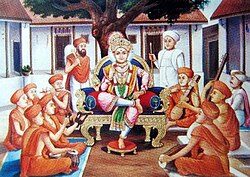
[[File:Shreeji Maharaj.jpg|250px|right|thumb|Swaminarayan and | [[File:Shreeji Maharaj.jpg|250px|right|thumb|Swaminarayan and the Paramahamsas in [[Gadhada]]]] | ||
{{Main|List of Swaminarayan temples|Swaminarayan ascetics}} | {{Main|List of Swaminarayan temples|Swaminarayan ascetics}} | ||
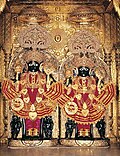
Swaminarayan ordered the construction of several [[Hindu temple]]s and he had built six huge temples by himself and installed the idols of various deities such as [[Radha Krishna]] | Swaminarayan ordered the construction of several [[Hindu temple]]s and he had built six huge temples by himself and installed the idols of various deities such as [[Radha Krishna]], [[Nara-Narayana]], [[Laxminarayan Dev|Laksmi Narayana]], [[Gopinath (god)|Gopinath]], [[Radha Ramana]], and [[Madanamohana]]. The images in the temples built by Swaminarayan provide evidence of the priority of Krishna.<ref name="isbn0754638561">{{cite book | author=Raymond Brady Williams | title=Williams on South Asian religions and immigration | publisher=Ashgate | year=2004 | url=https://books.google.com/books?id=nkVBOfE1KkAC | ol=9414082M |access-date=7 May 2009 | isbn=978-0-7546-3856-8}}</ref>{{rp|81}}<ref name="Williams96">{{harvp|Williams|2001|p=96}}</ref> Disciples of Swaminarayan composed devotional poems which are widely sung by the tradition during festivals.<ref>{{harvp|Williams|2001|p=189}}</ref><ref name="Mohan">{{cite book |author=Mohan Lal |title=Encyclopaedia of Indian Literature |publisher=Sahitya Akademi |url=https://books.google.com/books?id=KnPoYxrRfc0C |year=1992 |page=4255 |isbn=978-81-260-1221-3 }}</ref> Swaminarayan introduced fasting and devotion among followers.<ref>{{harvp|Williams|2004|p=162}}</ref> He conducted the festivals of [[Vasant Panchami]], [[Holi]], and [[Krishna Janmashtami|Janmashtami]] with organization of the traditional folk dance [[Dandiya Raas|raas]].<ref name=isbn8176501905/> | ||
The [[Shri Swaminarayan Mandir, Ahmedabad|first temple]] Swaminarayan constructed was in [[Ahmedabad]] in 1822, with the land for construction given by the | The [[Shri Swaminarayan Mandir, Ahmedabad|first temple]] Swaminarayan constructed was in [[Ahmedabad]] in 1822, with the land for construction given by the Company Government.<ref name="ST">{{cite web|url=http://www.shriswaminarayan.org/Temples.php|title=Swaminarayan temples|publisher=Shri Swaminarayan Temple (ISSO OF CHICAGO)|access-date=2009-07-06|url-status=dead|archive-url=https://web.archive.org/web/20090524025055/http://www.shriswaminarayan.org/Temples.php|archive-date=24 May 2009|df=dmy-all}}</ref><ref name = FTimes/> Following a request of devotees from [[Bhuj]], Swaminarayan asked his follower Vaishnavananand to build a [[Shri Swaminarayan Mandir, Bhuj|temple]] there. Construction commenced in 1822, and the temple was built within a year.<ref name= ST/> A [[Shri Swaminarayan Mandir, Vadtal|temple]] in [[Vadtal]] followed in 1824,<ref name= ST/> a [[Shri Swaminarayan Mandir, Dholera|temple]] in [[Dholera]] in 1826,<ref name= ST/> a [[Shri Swaminarayan Mandir, Junagadh|temple]] in [[Junagadh]] in 1828<ref name= ST/> and a [[Shri Swaminarayan Mandir, Gadhada|temple]] in [[Gadhada]], also in 1828.<ref name= ST/> By the time of his death, Swaminarayan had also ordered construction of temples in [[Muli (India)|Muli]], [[Dholka]] and [[Jetalpur]].<ref name="Williams29">{{harvp|Williams|2001|p=29}}</ref> | ||
From early on, ascetics have played a major role in the Swaminarayan sect. They contribute towards growth and development of the movement, encouraging people to follow a pious and religious life.<ref>{{harvp|Williams|2001|p=107}}</ref> Tradition maintains that Swaminarayan initiated 500 ascetics as ''[[paramhansas]]'' in a single night. | From early on, ascetics have played a major role in the Swaminarayan sect. They contribute towards growth and development of the movement, encouraging people to follow a pious and religious life.<ref>{{harvp|Williams|2001|p=107}}</ref> Tradition maintains that Swaminarayan initiated 500 ascetics as ''[[paramhansas|paramahamsas]]'' in a single night. Paramahamsa is a title of honour sometimes applied to Hindu spiritual teachers who are regarded as having attained enlightenment. Paramahamsas were the highest order of ''[[sannyasi]]'' in the sect.<ref>{{harvp|Williams|2001|p=22}}</ref> Prominent paramahamsas included [[Muktanand Swami]], [[Gopalanand Swami]], [[Brahmanand Swami]], [[Gunatitanand Swami]], [[Premanand Swami]], [[Nishkulanand Swami]], and [[Nityanand Swami (Paramhansa)|Nityanand Swami]].<ref>{{harvp|Williams|2001|pp=187, 189}}</ref> | ||
===Ahmedabad and Vadtal Gadi=== | ===Ahmedabad and Vadtal Gadi=== | ||
Prior to his death, Swaminarayan decided to establish a line of [[acharya]]s or preceptors, as his successors.<ref>{{harvp|Williams|2001|p=34}}</ref> He established two ''gadis'' (seats of leadership). One seat was established at Ahmedabad ([[Nar Narayan Dev Gadi]]) and the other one at Vadtal ([[Laxmi Narayan Dev Gadi]]) on 21 November 1825. Swaminarayan appointed an acharya to each of these ''gadis'' to pass on his message to others and to preserve his fellowship, the Swaminarayan Sampradaya. These acharyas came from his immediate family after sending representatives to search them out in [[Uttar Pradesh]].<ref name=":3">{{cite book|url=https://archive.org/details/introductiontosw0000will|url-access=registration|title=An Introduction to Swaminarayan Hinduism|last=Brady Williams|first=Raymond|publisher=Cambridge University Press|year=2001|isbn=9780521654227|pages=[https://archive.org/details/introductiontosw0000will/page/173 173]}}</ref> He formally adopted a son from his brothers and appointed | Prior to his death, Swaminarayan decided to establish a line of [[acharya]]s or preceptors, as his successors.<ref>{{harvp|Williams|2001|p=34}}</ref> He established two ''gadis'' (seats of leadership). One seat was established at Ahmedabad ([[Nar Narayan Dev Gadi]]) and the other one at Vadtal ([[Laxmi Narayan Dev Gadi]]) on 21 November 1825. Swaminarayan appointed an acharya to each of these ''gadis'' to pass on his message to others and to preserve his fellowship, the Swaminarayan Sampradaya. These acharyas came from his immediate family after sending representatives to search them out in [[Uttar Pradesh]].<ref name=":3">{{cite book|url=https://archive.org/details/introductiontosw0000will|url-access=registration|title=An Introduction to Swaminarayan Hinduism|last=Brady Williams|first=Raymond|publisher=Cambridge University Press|year=2001|isbn=9780521654227|pages=[https://archive.org/details/introductiontosw0000will/page/173 173]}}</ref> He formally adopted a son each from his two brothers and appointed them to the office of acharya. [[Ayodhyaprasad]], the son of Swaminarayan's elder brother Rampratap, and [[Raghuvir (spiritual leader)|Raghuvira]], the son of his younger brother Ichcharam, were appointed ''acharyas'' of the [[Ahmedabad]] Gadi and the [[Vadtal]] ([[Kheda district]]) Gadi respectively.<ref>{{harvp|Williams|2001|pp=35–37}}</ref> Swaminarayan decreed that the office should be hereditary so that ''acharyas'' would maintain a direct line of blood descent from his family.<ref>{{harvp|Williams|2001|p=35}}</ref> The administrative division of his followers into two territorial dioceses is set forth in minute detail in a document written by Swaminarayan called [[Desh Vibhaag Lekh|Desh Vibhag Lekh]].<ref name="Williams 2001 36"/> Swaminarayan stated to all the devotees and saints to obey both the Acharyas and [[Gopalanand Swami]] who was considered as the main pillar and chief ascetic<ref>{{harvp|Williams|2001|pp=59}}</ref> for the sampradaya.<ref>{{cite book | last=Dave |first=Ramesh | title=Sahajanand charitra | publisher=BAPS | location= University of California | year=1978 | pages=199–200 | isbn=978-8175261525}}</ref> | ||
The current acharya of the Ahmedabad Gadi is [[Koshalendraprasad Pande]] and Ajendraprasad Pande, of the Vadtal Gadi.<ref>{{cite web|url=http://www.swaminarayan.info/AcharyaShri.aspx|title=Narnarayan Devgadi DevGadi Acharyas|year=2008|publisher=Ahmedabad Gadi Official site|access-date=2009-09-14|url-status=dead|archive-url=https://web.archive.org/web/20090331115229/http://www.swaminarayan.info/AcharyaShri.aspx|archive-date=31 March 2009|df=dmy-all}}</ref><ref>{{cite web|url=http://www.swaminarayanvadtalgadi.org/acharya |title=Acharya Maharajshree Janmotsav Celebration – Junagadh|date=2015-04-09}}</ref><ref>{{Cite web|url=https://www.newsgram.com/spread-swaminarayan-sampraday-across-globe/|title=Spread of Swaminarayan Sampraday across Globe|last=NewsGram|date=2016-04-18|website=NewsGram|language=en-US|access-date=2019-07-15}}</ref> | The current acharya of the Ahmedabad Gadi is [[Koshalendraprasad Pande]] and Ajendraprasad Pande, of the Vadtal Gadi.<ref>{{cite web|url=http://www.swaminarayan.info/AcharyaShri.aspx|title=Narnarayan Devgadi DevGadi Acharyas|year=2008|publisher=Ahmedabad Gadi Official site|access-date=2009-09-14|url-status=dead|archive-url=https://web.archive.org/web/20090331115229/http://www.swaminarayan.info/AcharyaShri.aspx|archive-date=31 March 2009|df=dmy-all}}</ref><ref>{{cite web|url=http://www.swaminarayanvadtalgadi.org/acharya |title=Acharya Maharajshree Janmotsav Celebration – Junagadh|date=2015-04-09}}</ref><ref>{{Cite web|url=https://www.newsgram.com/spread-swaminarayan-sampraday-across-globe/|title=Spread of Swaminarayan Sampraday across Globe|last=NewsGram|date=2016-04-18|website=NewsGram|language=en-US|access-date=2019-07-15|archive-date=15 July 2019|archive-url=https://web.archive.org/web/20190715224921/https://www.newsgram.com/spread-swaminarayan-sampraday-across-globe/|url-status=dead}}</ref> | ||
===Death=== | ===Death=== | ||
{{Further|Swaminarayan Hinduism}} | {{Further|Swaminarayan Hinduism}} | ||
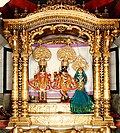
[[File:Madan Mohan Dev Dholera.jpg | [[File:Madan Mohan Dev Dholera.jpg|thumb|[[Madan Mohan]] and Radha (centre and right) with Swaminarayan in the form of Hari Krishna (left), installed by Swaminarayan on the central altar in [[Dholera]] (1826)]] | ||
In 1830, Swaminarayan gathered his followers and announced his departure. He later died on 1 June 1830 (Jeth sud 10, Samvat 1886),<ref name="Williams29"/> and it is believed by followers that, at the time of his death, Swaminarayan left Earth for [[Akshardham (philosophy)|Akshardham]], his abode.<ref name="isbn8176501905">{{cite book |author1=Dinkar Joshi |author2=Yogesh Patel | title=Glimpses of Indian Culture | publisher=Star Publications | year=2005 | url=https://books.google.com/books?id=-fw-0iBvmMAC&q=satsangi+jivan&pg=PA93| pages=92–93 | access-date=7 May 2009 | isbn=978-81-7650-190-3}}</ref><ref>{{harvp|Williams|2001|p=93}}</ref> He was cremated according to Hindu rites at Lakshmi Wadi in [[Gadhada]].<ref>{{harvp|Williams|2001|pp=34–36}}</ref> | In 1830, Swaminarayan gathered his followers and announced his departure. He later died on 1 June 1830 (Jeth sud 10, Samvat 1886),<ref name="Williams29"/> and it is believed by followers that, at the time of his death, Swaminarayan left Earth for [[Akshardham (philosophy)|Akshardham]], his abode.<ref name="isbn8176501905">{{cite book |author1=Dinkar Joshi |author2=Yogesh Patel | title=Glimpses of Indian Culture | publisher=Star Publications | year=2005 | url=https://books.google.com/books?id=-fw-0iBvmMAC&q=satsangi+jivan&pg=PA93| pages=92–93 | access-date=7 May 2009 | isbn=978-81-7650-190-3}}</ref><ref>{{harvp|Williams|2001|p=93}}</ref> He was cremated according to Hindu rites at Lakshmi Wadi in [[Gadhada]].<ref>{{harvp|Williams|2001|pp=34–36}}</ref> | ||
| Line 122: | Line 125: | ||
===Women=== | ===Women=== | ||
Swaminarayan insisted that education was the inherent right of all people, including women, despite considerable criticism from those in his own contemporary society who "loathed the uplift of lower [[caste]] women".<ref name="dl">{{Cite book|url= | Swaminarayan insisted that education was the inherent right of all people, including women, despite considerable criticism from those in his own contemporary society who "loathed the uplift of lower [[caste]] women".<ref name="dl">{{Cite book|url=https://ecommons.cornell.edu/handle/1813/106|title=Inherent Faith and Negotiated Power: Swaminarayan Women in the United States|last=Rudert|first=A.|year=2004|publisher=Cornell University|access-date=2009-05-10|chapter-url=https://ecommons.library.cornell.edu/bitstream/1813/106/2/thesis.pdf|chapter=1}}</ref> At that time, influential and wealthy individuals educated their girls through private and personal tuition. Male followers of Swaminarayan made arrangements to educate their female family members. The literacy rate among females began to increase during Swaminarayan's time, and they were able to give discourses on spiritual subjects.<ref name=":2">{{Cite book|chapter-url=http://www.oxfordscholarship.com/view/10.1093/acprof:oso/9780199463749.001.0001/acprof-9780199463749-chapter-4|last=Mallison|first=Françoise|pages=49–57|doi=10.1093/acprof:oso/9780199463749.003.0004|publisher=Oxford University Press|isbn=9780199086573|date=April 2016|title=Swaminarayan Hinduism|chapter=Gujarati Socio-religious Context of Swaminarayan Devotion and Doctrine}}</ref> Members of the sect consider Swaminarayan a pioneer of education of females in India.<ref name="W165" /><ref name="isbn0674024826">{{cite book|url=https://books.google.com/books?id=JLMQh4oc38gC&q=swaminarayan+malcolm+law|title=The clash within|publisher=Harvard University Press|year=2007|isbn=978-0-674-02482-3|location=Boston|pages=322, 323|author=Martha Craven Nussbaum|access-date=5 May 2009}}</ref><ref name="isbn8126123052">{{cite book|url=https://books.google.com/books?id=RZCv3d2XUeUC|title=Encyclopaedia of Historiography|publisher=Anmol Publications Pvt. Ltd.|year=2006|isbn=978-81-261-2305-6|pages=145, 146|author=M M Rahman|access-date=10 June 2009}}</ref><ref>{{cite web|url=http://vadtal.com/lord-swaminarayan.html#12|title=education of females|publisher=Shree Swaminarayan Temple: Sansthan Vadtal|access-date=2009-07-06|url-status=dead|archive-url=https://web.archive.org/web/20090501010011/http://www.vadtal.com/lord-swaminarayan.html#12|archive-date=1 May 2009|df=dmy-all}}</ref><ref>{{cite web|url=http://www.swaminarayan.org/lordswaminarayan/biography/4.htm|title=Swaminarayan's Life - Biography: Uplift of Women|publisher=www.swaminarayan.org|access-date=2008-06-07}}</ref> | ||
According to the author Raymond Brady Williams, "Swaminarayan is an early representative of the practice of advocacy of women's rights without personal involvement with women".<ref name="Williams01">{{harvp|Williams|2001|p=169}}</ref> To counter the practice of ''[[Sati (practice)|sati]]'' (self-immolation by a widow on her husband's funeral pyre), Swaminarayan argued that, as human life was given by God, it could be taken only by God, and that ''sati'' had no Vedic sanction. He went to the extent to call ''sati'' nothing but suicide. Swaminarayan offered parents help with [[dowry]] expenses to discourage female infanticide, calling infanticide a sin.<ref name="W165">{{harvp|Williams|2001|pp= 165, 167}}</ref><ref name="isbn0674024826" /> For calling a halt to these prevailing practices, Swaminarayan's "contemporaries naturally saw in him a pioneer of a reformed and purified Hinduism, and Swaminarayan Hinduism an 'ingrazi dharma' or British religion."<ref name=":2" /> | According to the author Raymond Brady Williams, "Swaminarayan is an early representative of the practice of advocacy of women's rights without personal involvement with women".<ref name="Williams01">{{harvp|Williams|2001|p=169}}</ref> To counter the practice of ''[[Sati (practice)|sati]]'' (self-immolation by a widow on her husband's funeral pyre), Swaminarayan argued that, as human life was given by God, it could be taken only by God, and that ''sati'' had no Vedic sanction. He went to the extent to call ''sati'' nothing but suicide. Swaminarayan offered parents help with [[dowry]] expenses to discourage female infanticide, calling infanticide a sin.<ref name="W165">{{harvp|Williams|2001|pp= 165, 167}}</ref><ref name="isbn0674024826" /> For calling a halt to these prevailing practices, Swaminarayan's "contemporaries naturally saw in him a pioneer of a reformed and purified Hinduism, and Swaminarayan Hinduism an 'ingrazi dharma' or British religion."<ref name=":2" /> | ||
| Line 136: | Line 139: | ||
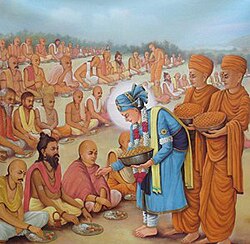
After assuming the leadership of the sampradaya, Swaminarayan worked to assist the poor by distributing food and drinking water.<ref name="TimesCass">{{cite news|title=Times Music cassette on Swaminarayan serial launched |url=http://timesofindia.indiatimes.com/articleshow/1742150037.cms |publisher=[[Times of India]]|date= 2006-01-19|access-date=2009-03-30}}</ref> He undertook several social service projects and opened almshouses for the poor. Swaminarayan organized food and water relief to people during times of drought.<ref>{{cite web|url=http://www.vadtal.com/lord-swaminarayan.html#9|title=Food and Water for the Needy|publisher=Shree Swaminarayan Temple: Sansthan Vadtal|access-date=2009-07-06|url-status=dead|archive-url=https://web.archive.org/web/20090501010011/http://www.vadtal.com/lord-swaminarayan.html#9|archive-date=1 May 2009|df=dmy-all}}</ref> | After assuming the leadership of the sampradaya, Swaminarayan worked to assist the poor by distributing food and drinking water.<ref name="TimesCass">{{cite news|title=Times Music cassette on Swaminarayan serial launched |url=http://timesofindia.indiatimes.com/articleshow/1742150037.cms |publisher=[[Times of India]]|date= 2006-01-19|access-date=2009-03-30}}</ref> He undertook several social service projects and opened almshouses for the poor. Swaminarayan organized food and water relief to people during times of drought.<ref>{{cite web|url=http://www.vadtal.com/lord-swaminarayan.html#9|title=Food and Water for the Needy|publisher=Shree Swaminarayan Temple: Sansthan Vadtal|access-date=2009-07-06|url-status=dead|archive-url=https://web.archive.org/web/20090501010011/http://www.vadtal.com/lord-swaminarayan.html#9|archive-date=1 May 2009|df=dmy-all}}</ref> | ||
Some suggest that Swaminarayan worked towards ending the [[caste system]], allowing everyone into the Swaminarayan Sampradaya. However partaking in the consumption food of lower castes and caste pollution was not supported by him.<ref name = chit/> A political officer in Gujarat, ''Mr. Williamson'' reported to Bishop Herber that Swaminarayan had "destroyed the yoke of caste."<ref name = Williams01/> He instructed his | Some suggest that Swaminarayan worked towards ending the [[caste system]], allowing everyone into the Swaminarayan Sampradaya. However partaking in the consumption food of lower castes and caste pollution was not supported by him.<ref name = chit/> A political officer in Gujarat, ''Mr. Williamson'' reported to Bishop Herber that Swaminarayan had "destroyed the yoke of caste."<ref name = Williams01/> He instructed his paramahamsas to collect alms from all sections of society and appointed people from the lower strata of society as his personal attendants. Members of the lower castes were attracted to the movement as it improved their social status.<ref name="isbn0422609102"/><ref name=isbn8126123052/> Swaminarayan would eat along with the lower Rajput and Khati castes but not any lower.<ref>Williams 2001, p. 170</ref> He allowed dalits and lower caste people to visit places of worship.<ref name="jstor.org">{{cite journal|jstor=4379024|title=Class Base of Swaminarayan Sect|journal=Economic and Political Weekly|volume=23|issue=37|pages=1907–1912|last1=Hardiman|first1=David|year=1988}}</ref> However, [[Dalit]]s - those outside of the caste system - were formally excluded from Swaminarayan temples.<ref>The Camphor Flame: Popular Hinduism and Society in India Christopher John Fuller P. 173</ref> Members of a lower caste are prohibited from wearing a full sect mark (tilak chandlo) on their forehead.<ref>{{harvp|Williams|2001|pp=170–171}}</ref> Even now, however, for the vast majority of Gujarat's lower-caste, Untouchable and tribal population, the sect is out of bounds.<ref>{{cite book |last=Shah |first=A.M. |title= The Structure of Indian Society: Then and Now |publisher= Routledge India |location= India | year=2010 |page=103 |isbn= 9780415586221 }}</ref> | ||
[[Reginald Heber]], the Lord Bishop of Calcutta, noted that disciples of Swaminarayan cut across all castes, and even included Muslims. He writes "they all pray to one God with no difference of castes. They live as if they were brothers."<ref name=":5">{{Cite book|title=Narrative of a Journey Through the Upper Provinces of India|url=https://archive.org/details/narrativeajourn21hebegoog|last=Heber|first=Reginald|publisher=Carey, Lea, and Carey|year=1828|location=Boston|pages=[https://archive.org/details/narrativeajourn21hebegoog/page/n119 109]}}</ref> Furthermore, in a meeting with Swaminarayan, he noted that "[Swaminarayan] did not regard the subject as of much importance, but that he wished not to give offense (to ancient Hindu system); that people might eat separately or together in this world, but that above "oopur" pointing to heaven, those distinctions would cease."<ref name=":5" /> Swaminarayan worked thus to dispel the myth that [[moksha]] (salvation) was not attainable by everyone.<ref>{{harvp|Williams|2001|p=162}}</ref> He taught that the soul is neither male nor female, nor yoked to any specific caste.<ref name="isbn0422609102" /><ref>{{harvp|Williams|2001|pp=57, 77}}</ref> | [[Reginald Heber]], the Lord Bishop of Calcutta, noted that disciples of Swaminarayan cut across all castes, and even included Muslims. He writes "they all pray to one God with no difference of castes. They live as if they were brothers."<ref name=":5">{{Cite book|title=Narrative of a Journey Through the Upper Provinces of India|url=https://archive.org/details/narrativeajourn21hebegoog|last=Heber|first=Reginald|publisher=Carey, Lea, and Carey|year=1828|location=Boston|pages=[https://archive.org/details/narrativeajourn21hebegoog/page/n119 109]}}</ref> Furthermore, in a meeting with Swaminarayan, he noted that "[Swaminarayan] did not regard the subject as of much importance, but that he wished not to give offense (to ancient Hindu system); that people might eat separately or together in this world, but that above "oopur" pointing to heaven, those distinctions would cease."<ref name=":5" /> Swaminarayan worked thus to dispel the myth that [[moksha]] (salvation) was not attainable by everyone.<ref>{{harvp|Williams|2001|p=162}}</ref> He taught that the soul is neither male nor female, nor yoked to any specific caste.<ref name="isbn0422609102" /><ref>{{harvp|Williams|2001|pp=57, 77}}</ref> | ||
=== Animal sacrifices and yajnas === | === Animal sacrifices and yajnas === | ||
Swaminarayan was against animal sacrifices.<ref name="isbn069112048X">{{cite book | author=Christopher John Fuller | title=The camphor flame | publisher=Princeton University Press| year=2004 | url=https://books.google.com/books?id=To6XSeBUW3oC&q=incarnation+of+swaminarayan&pg=PA171 | page=171 | access-date=8 May 2009 | isbn=978-0-691-12048-5}}</ref> | Swaminarayan was against animal sacrifices.<ref name="isbn069112048X">{{cite book | author=Christopher John Fuller | title=The camphor flame | publisher=Princeton University Press| year=2004 | url=https://books.google.com/books?id=To6XSeBUW3oC&q=incarnation+of+swaminarayan&pg=PA171 | page=171 | access-date=8 May 2009 | isbn=978-0-691-12048-5}}</ref> To solve this problem, Swaminarayan conducted several large-scale yajnas involving priests from [[Varanasi]]. Swaminarayan was successful in reinstating [[ahimsa]] through several such large-scale yajnas. Swaminarayan stressed [[lacto vegetarianism]] among his followers and forbade meat consumption, codifying the conduct in the [[Shikshapatri]].<ref name = chit/><ref name=isbn8126123052/><ref>{{harvp|Williams|2001|pp=24, 159}}</ref><ref name="isbn0813540569">{{cite book | author=Prema A. Kurien | title=A place at the multicultural table: the development of an American Hinduism | publisher=Rutgers University Press | year=2007 | url=https://books.google.com/books?id=ONMxZc5_saYC&pg=PA105 |pages=105|access-date=8 May 2009 | isbn=978-0-8135-4056-6| author-link=Prema A. Kurien }} Page 105</ref> | ||
==Scriptures== | ==Scriptures== | ||
| Line 149: | Line 152: | ||
===Shikshapatri=== | ===Shikshapatri=== | ||
{{Main|Shikshapatri}} | {{Main|Shikshapatri}} | ||
Swaminarayan wrote the ''Shikshapatri'' on 11 February 1826.<ref>{{cite web|url=http://www.swaminarayan.org/scriptures/shikshapatri/index.htm|title=Shikshapatri|publisher=BAPS Swamiranayan Sanstha|access-date=10 February 2012}}</ref> While the original [[Sanskrit]] manuscript is not available, it was translated into [[Gujarati (language)|Gujarati]] by [[Nityanand Swami (Paramhansa)|Nityanand Swami]] under the direction of Swaminarayan and is revered in the sect.<ref name = chit>{{cite book |author=M. G. Chitkara |title=Hindutva |publisher=APH Pub. Corp |year=1997 |chapter= Swaminarayan, Pramod Mahajan, Bal Thackeray |pages=227–228 |isbn=978-81-7024-798-2}}</ref><ref name="digitalshikshapatriproject">{{cite web|url=http://www.shikshapatri.org.uk/~imagedb/content.php/psjm|title=The Digital Shikshapatri|author=Digital Shikshapatri Project|access-date=21 June 2013|archive-date=7 February 2012|archive-url=https://web.archive.org/web/20120207021200/http://www.shikshapatri.org.uk/~imagedb/content.php/psjm|url-status=dead}}</ref> The Gazetteer of the [[Bombay Presidency]] summarised it as a book of social laws that his followers should follow.<ref name="isbn8170247985">{{cite book | author=M. G. Chitkara | title=Hindutva | publisher=APH| page= 230| year=1997 | url=https://books.google.com/books?id=zqkBNr4U7cwC&q=swaminarayan+ahmedabad |access-date=5 May 2009 | isbn=978-81-7024-798-2}}</ref> A commentary on the practice and understanding of [[dharma]], it is a small booklet containing 212 Sanskrit verses, outlining the basic tenets that Swaminarayan believed his followers should uphold in order to live a well-disciplined and moral life.<ref name="WShastra">{{harvp|Williams|2001|pp=187–190}}</ref> The oldest copy of this text is preserved at the [[Bodleian Library]] of [[Oxford University]] and it is one of the very few presented by Sahajanand Swami himself. [[Tejendraprasad Pande|Acharya Tejendraprasad]] of Ahmedabad has indicated in a letter that he is not aware of any copy from the hand of Sahajanand older than this text.<ref name="digitalshikshapatriproject"/> | Swaminarayan wrote the ''Shikshapatri'' on 11 February 1826.<ref>{{cite web|url=http://www.swaminarayan.org/scriptures/shikshapatri/index.htm|title=Shikshapatri|publisher=BAPS Swamiranayan Sanstha|access-date=10 February 2012}}</ref> While the original [[Sanskrit]] manuscript is not available, it was translated into [[Gujarati (language)|Gujarati]] by [[Nityanand Swami (Paramhansa)|Nityanand Swami]] under the direction of Swaminarayan and is revered in the sect.<ref name = chit>{{cite book |author=M. G. Chitkara |title=Hindutva |publisher=APH Pub. Corp |year=1997 |chapter= Swaminarayan, Pramod Mahajan, Bal Thackeray |pages=227–228 |isbn=978-81-7024-798-2}}</ref><ref name="digitalshikshapatriproject">{{cite web|url=http://www.shikshapatri.org.uk/~imagedb/content.php/psjm|title=The Digital Shikshapatri|author=Digital Shikshapatri Project|access-date=21 June 2013|archive-date=7 February 2012|archive-url=https://web.archive.org/web/20120207021200/http://www.shikshapatri.org.uk/~imagedb/content.php/psjm|url-status=dead}}</ref> The Gazetteer of the [[Bombay Presidency]] summarised it as a book of social laws that his followers should follow.<ref name="isbn8170247985">{{cite book | author=M. G. Chitkara | title=Hindutva | publisher=APH| page= 230| year=1997 | url=https://books.google.com/books?id=zqkBNr4U7cwC&q=swaminarayan+ahmedabad |access-date=5 May 2009 | isbn=978-81-7024-798-2}}</ref> A commentary on the practice and understanding of [[dharma]], it is a small booklet containing 212 Sanskrit verses, outlining the basic tenets that Swaminarayan believed his followers should uphold in order to live a well-disciplined and moral life.<ref name="WShastra">{{harvp|Williams|2001|pp=187–190}}</ref> The oldest copy of this text is preserved at the [[Bodleian Library]] of [[Oxford University]] and it is one of the very few presented by Sahajanand Swami himself. [[Tejendraprasad Pande|Acharya Tejendraprasad]] of Ahmedabad has indicated in a letter that he is not aware of any copy from the hand of Sahajanand older than this text.<ref name="digitalshikshapatriproject"/> Swaminarayan in various places of Shikshapatri describes Krishna as the greatest entity.<ref name=":6">{{Cite web|url=https://standagainstswaminarayan.today/2016/06/03/is-swaminarayan-god-no-swaminarayan-is-not-the-god/|archive-url=https://web.archive.org/web/20180903230816/https://standagainstswaminarayan.today/2016/06/03/is-swaminarayan-god-no-swaminarayan-is-not-the-god/|url-status=dead|archive-date=3 September 2018|title=Swaminarayan message|date=2016-06-03|website=www.standagainstswaminarayan.today}}</ref><ref>{{Cite web|url=http://www.shikshapatri.org.uk/~imagedb/hms/mss_browse.php?reset=1&expand=638,639|title=The Digital Shiksapatri|access-date=30 May 2018|archive-date=21 May 2017|archive-url=https://web.archive.org/web/20170521092427/http://www.shikshapatri.org.uk/~imagedb/hms/mss_browse.php?reset=1&expand=638,639|url-status=dead}}</ref> | ||
Swaminarayan in various places of Shikshapatri describes | |||
===Vachanamrut=== | ===Vachanamrut=== | ||
{{Main|Vachanamrut}} | {{Main|Vachanamrut}} | ||
The Vachanamrut (IAST: ''Vacanāmṛta,'' lit. "immortalising ambrosia in the form of words") is a sacred Hindu text consisting of 273 religious discourses delivered by Swaminarayan from 1819 to 1829 CE and is considered the principal theological text within the [[Swaminarayan Sampradaya]].<ref name=":0" />{{Rp|6}} Compiled by four of his senior disciples, Swaminarayan edited and approved the scripture. As followers believe Swaminarayan to be Parabrahman, or God, the Vachanamrut is considered a direct revelation from God and thus the most precise interpretation of the [[Upanishads]], [[Bhagavad Gita]], and other important Hindu scriptures.<ref name=":0" />{{Rp|13–14, 45}}<ref name=":1" />{{Rp|173 | The Vachanamrut (IAST: ''Vacanāmṛta,'' lit. "immortalising ambrosia in the form of words") is a sacred Hindu text consisting of 273 religious discourses delivered by Swaminarayan from 1819 to 1829 CE and is considered the principal theological text within the [[Swaminarayan Sampradaya]].<ref name=":0" />{{Rp|6}} Compiled by four of his senior disciples, Swaminarayan edited and approved the scripture. As followers believe Swaminarayan to be Parabrahman, or God, the Vachanamrut is considered a direct revelation from God and thus the most precise interpretation of the [[Upanishads]], [[Bhagavad Gita]], and other important Hindu scriptures.<ref name=":0" />{{Rp|13–14, 45}}<ref name=":1" />{{Rp|173}} This scripture is read by followers regularly and discourses are conducted daily in Swaminarayan temples around the world.<ref name=":14">{{Cite book|last=Brear|first=Douglas|title=Transmission of a Swaminarayan Hindu scripture in the British East Midlands|publisher=Columbia University Press|year=1996|isbn=0-231-10779-X|editor-last=Williams|editor-first=Raymond Brady|edition=Columbia University Press|location=New York|oclc=34984234}}</ref>{{Rp|21–27}} | ||
===Satsangi Jeevan=== | ===Satsangi Jeevan=== | ||
{{Main|Satsangi Jeevan}} | {{Main|Satsangi Jeevan}} | ||
Satsangi Jeevan is the authorised biography of Swaminarayan.<ref name=":0">{{Cite web|title=Shree Swaminarayanw Temple Cardiff – Scriptures |url=http://www.swaminarayanwales.org.uk/Scriptures/scriptures.asp|url-status=dead|archive-url=https://web.archive.org/web/20080915161142/http://www.swaminarayanwales.org.uk/Scriptures/scriptures.asp|archive-date=15 September 2008|df=dmy-all}}</ref> The book contains information on the life and teachings of Swaminarayan.<ref>{{Cite book|title=Hindutva|last=Chitkara|first=M. G.|publisher=APH|year=1997|pages=228}}</ref> It is written by Shatanand Swami and completed in Vikram Samvat 1885.<ref name=":0" /> Swaminarayan decided to make Gadhada his permanent residence on the insistence of Dada Khachar and his sisters.<ref>{{Cite web|url=http://www.swaminarayan.nu/mandirs/index.shtml|title=Six Temples|website=www.swaminarayan.nu|access-date=2016-07-27}}</ref> Swaminarayan instructed Shatanand Swami to write a book on his life and pastimes.<ref name=":1">{{Cite web|url=http://www.swaminarayan.info/ShastraDetails.aspx?ID=JgBTAGgAYQBzAHQAcgBhAEkARAA9ADIANAA%3d-cmJRLAFZpY0%3d | Satsangi Jeevan is the authorised biography of Swaminarayan.<ref name=":0">{{Cite web|title=Shree Swaminarayanw Temple Cardiff – Scriptures |url=http://www.swaminarayanwales.org.uk/Scriptures/scriptures.asp|url-status=dead|archive-url=https://web.archive.org/web/20080915161142/http://www.swaminarayanwales.org.uk/Scriptures/scriptures.asp|archive-date=15 September 2008|df=dmy-all}}</ref> The book contains information on the life and teachings of Swaminarayan.<ref>{{Cite book|title=Hindutva|last=Chitkara|first=M. G.|publisher=APH|year=1997|pages=228}}</ref> It is written by Shatanand Swami and completed in Vikram Samvat 1885.<ref name=":0" /> Swaminarayan decided to make Gadhada his permanent residence on the insistence of Dada Khachar and his sisters.<ref>{{Cite web|url=http://www.swaminarayan.nu/mandirs/index.shtml|title=Six Temples|website=www.swaminarayan.nu|access-date=2016-07-27}}</ref> Swaminarayan instructed Shatanand Swami to write a book on his life and pastimes.<ref name=":1">{{Cite web |url=http://www.swaminarayan.info/ShastraDetails.aspx?ID=JgBTAGgAYQBzAHQAcgBhAEkARAA9ADIANAA%3d-cmJRLAFZpY0%3d |title=The resource cannot be found |access-date=27 July 2016 |archive-date=27 May 2011 |archive-url=https://web.archive.org/web/20110527183603/http://www.swaminarayan.info/ShastraDetails.aspx?ID=JgBTAGgAYQBzAHQAcgBhAEkARAA9ADIANAA%3d-cmJRLAFZpY0%3d |url-status=dead }}</ref> | ||
To enable Shatanand Swami to write from His childhood, Swaminarayan had blessed Shatanand Swami with Sanjay Drishti - special power to see the entire past right from His childhood.<ref name=":1" /> | To enable Shatanand Swami to write from His childhood, Swaminarayan had blessed Shatanand Swami with Sanjay Drishti - special power to see the entire past right from His childhood.<ref name=":1" /> | ||
| Line 199: | Line 176: | ||
According to the biographer Raymond Williams, when Swaminarayan died, he had a following of 1.8 million people. In 2001, Swaminarayan centres existed on four continents, and the congregation was recorded to be five million, the majority in the homeland of Gujarat.<ref>{{harvp|Williams|2001|p=68}}</ref><ref name="isbn1576079058">{{cite book | author=Rinehart, Robin|title=Contemporary Hinduism | publisher=ABC-CLIO | year=2004 | url=https://books.google.com/books?id=hMPYnfS_R90C&q=Contemporary+Hinduism&pg=PP1 |access-date=10 May 2009|page = 215 | isbn=978-1-57607-905-8}}</ref><ref>Marcus J. Banks (1985). Review: ''A New Face of Hinduism: The Swaminarayan Religion''. By Raymond Brady Williams. Cambridge University Press: Cambridge, 1984. Pp. xiv, 217. ''Modern Asian Studies'' 19 pp 872-874</ref> The newspaper [[Indian Express]] estimated members of the Swaminarayan sect of Hinduism to number over 20 million (2 crore) worldwide in 2007.<ref name="express">{{cite news|title=Niche Faiths|url=http://www.indianexpress.com/news/niche-faiths/31939/4|publisher=[[Indian Express]]|date= 2007-05-26|access-date=2009-05-06}}</ref> | According to the biographer Raymond Williams, when Swaminarayan died, he had a following of 1.8 million people. In 2001, Swaminarayan centres existed on four continents, and the congregation was recorded to be five million, the majority in the homeland of Gujarat.<ref>{{harvp|Williams|2001|p=68}}</ref><ref name="isbn1576079058">{{cite book | author=Rinehart, Robin|title=Contemporary Hinduism | publisher=ABC-CLIO | year=2004 | url=https://books.google.com/books?id=hMPYnfS_R90C&q=Contemporary+Hinduism&pg=PP1 |access-date=10 May 2009|page = 215 | isbn=978-1-57607-905-8}}</ref><ref>Marcus J. Banks (1985). Review: ''A New Face of Hinduism: The Swaminarayan Religion''. By Raymond Brady Williams. Cambridge University Press: Cambridge, 1984. Pp. xiv, 217. ''Modern Asian Studies'' 19 pp 872-874</ref> The newspaper [[Indian Express]] estimated members of the Swaminarayan sect of Hinduism to number over 20 million (2 crore) worldwide in 2007.<ref name="express">{{cite news|title=Niche Faiths|url=http://www.indianexpress.com/news/niche-faiths/31939/4|publisher=[[Indian Express]]|date= 2007-05-26|access-date=2009-05-06}}</ref> | ||
== | === Reception === | ||
The manifestation belief and Swaminarayan's teachings were criticized by Hindu reformist leader [[Swami Dayananda Saraswati|Dayananda Saraswati]] (1824–1883). He questioned the acceptance of Swaminarayan as the Supreme Being and was disapproving towards the idea that visions of Swaminarayan could form a path to attaining perfection. Accused of deviating from the [[Veda]]s, his followers were criticised for the illegal collection of wealth and the "practice of frauds and tricks."<ref>{{cite book |author=Narayan, Kirin |title=Storytellers, Saints and Scoundrels |publisher=Motilal Banarsidass, India |location= |year=1992|pages=141–143 |isbn=81-208-1002-3}}</ref> In the views of Dayananda, published as early as 1875, it was a "historical fact" that Swaminarayan decorated himself as Narayana in order to gain followers.<ref>{{cite book |author=Narayan, Kirin |title=Storytellers, Saints and Scoundrels |publisher=Motilal Banarsidass |location= |year=1992 |page=143 |isbn=81-208-1002-3}}</ref> | |||
In 1918, [[Mahatma Gandhi]] in the letter to his nephew, expressed that Swaminarayan's values didn't align perfectly with his interpretation of [[Vaishnavism]] and the love taught by Swaminarayana was all about sentimentalism. According to Gandhi, Swaminarayan had not grasped the essence of non-violence.<ref name="isbn8171548741" /><ref name="jstor.org" /> In 1924, Gandhi applauded efforts of Swaminaryan and added that "what was accomplished in Gujarat by one person, Sahajanand [Swaminarayan], could not be accomplished by the power of the State".<ref>{{cite book|url=https://books.google.com/books?id=EIKGAAAAIAAJ|title=The Collected Works of Mahatma Gandhi: Mar. 1922-May 1924|page=469|author=Mahatma Gandhi|date=1967 }}</ref> | |||
== See also == | == See also == | ||
| Line 215: | Line 194: | ||
{{refbegin}} | {{refbegin}} | ||
<!-- H --> | <!-- H --> | ||
* {{Cite book | last =Hatcher | first =Brian | year =2020 | title =Hinduism before reform | publisher =Harvard University Press | isbn =978-0-674-24713-0 | location =Cambridge, Massachusetts | oclc =1138500516 | * {{Cite book | last =Hatcher | first =Brian | year =2020 | title =Hinduism before reform | publisher =Harvard University Press | isbn =978-0-674-24713-0 | location =Cambridge, Massachusetts | oclc =1138500516 }} | ||
<!-- J --> | <!-- J --> | ||
* {{cite book | last =Jones | first =Lindsay | year =2005 | title =Encyclopedia of Religion | publisher =Thomson Gale | location =Farmington Hills | isbn =978-0-02-865984-8}} | * {{cite book | last =Jones | first =Lindsay | year =2005 | title =Encyclopedia of Religion | publisher =Thomson Gale | location =Farmington Hills | isbn =978-0-02-865984-8}} | ||
<!-- K --> | <!-- K --> | ||
* {{Cite journal|last=Kim|first=Hanna|date=2010-02-19|title=Public Engagement and Personal Desires: BAPS Swaminarayan Temples and their Contribution to the Discourses on Religion|journal=International Journal of Hindu Studies|language=en|volume=13|issue=3|pages=357–390|doi=10.1007/s11407-010-9081-4|s2cid=4980801|issn=1022-4556}} | * {{Cite journal|last=Kim|first=Hanna|date=2010-02-19|title=Public Engagement and Personal Desires: BAPS Swaminarayan Temples and their Contribution to the Discourses on Religion|journal=International Journal of Hindu Studies|language=en|volume=13|issue=3|pages=357–390|doi=10.1007/s11407-010-9081-4|s2cid=4980801|issn=1022-4556}} | ||
<!-- M --> | <!-- M --> | ||
| Line 228: | Line 205: | ||
<!-- P --> | <!-- P --> | ||
* {{Cite book|last1=Paramtattvadas|first1=Sadhu|last2=Williams|first2=Raymond Brady|last3=Amrutvijaydas|first3=Sadhu|date=April 2016|title=Swaminarayan and British Contacts in Gujarat in the 1820s|publisher=Oxford University Press|pages=58–93|doi=10.1093/acprof:oso/9780199463749.003.0005|isbn=9780199086573}} | * {{Cite book|last1=Paramtattvadas|first1=Sadhu|last2=Williams|first2=Raymond Brady|last3=Amrutvijaydas|first3=Sadhu|date=April 2016|title=Swaminarayan and British Contacts in Gujarat in the 1820s|publisher=Oxford University Press|pages=58–93|doi=10.1093/acprof:oso/9780199463749.003.0005|isbn=9780199086573}} | ||
* {{Cite book|last=Paramtattvadas|first=Swami|title=An introduction to Swaminarayan Hindu theology|publisher=Cambridge University Press|year=2017|isbn=978-1-107-15867-2|location=Cambridge, United Kingdom|oclc= | * {{Cite book|last=Paramtattvadas|first=Swami|title=An introduction to Swaminarayan Hindu theology|publisher=Cambridge University Press|year=2017|isbn=978-1-107-15867-2|location=Cambridge, United Kingdom|oclc=964861190}} | ||
* {{Cite book|last=Parikh|first=Vibhuti|date=April 2016|chapter=The Swaminarayan Ideology and Kolis in Gujarat|title=Swaminarayan Hinduism|pages=94–114|doi=10.1093/acprof:oso/9780199463749.003.0006|publisher=Oxford University Press|isbn=9780199086573|chapter-url=http://www.oxfordscholarship.com/view/10.1093/acprof:oso/9780199463749.001.0001/acprof-9780199463749-chapter-6}} | * {{Cite book|last=Parikh|first=Vibhuti|date=April 2016|chapter=The Swaminarayan Ideology and Kolis in Gujarat|title=Swaminarayan Hinduism|pages=94–114|doi=10.1093/acprof:oso/9780199463749.003.0006|publisher=Oxford University Press|isbn=9780199086573|chapter-url=http://www.oxfordscholarship.com/view/10.1093/acprof:oso/9780199463749.001.0001/acprof-9780199463749-chapter-6}} | ||
* {{Cite journal|last=Patel|first=Shruti|title=Beyond the Lens of Reform: Religious Culture in Modern Gujarat|journal=The Journal of Hindu Studies|year=2017 |volume=10|pages=47–85|doi=10.1093/jhs/hix005 | url =https://www.academia.edu/33003837|ref={{sfnref|S.Patel|2017}}}} | * {{Cite journal|last=Patel|first=Shruti|title=Beyond the Lens of Reform: Religious Culture in Modern Gujarat|journal=The Journal of Hindu Studies|year=2017 |volume=10|pages=47–85|doi=10.1093/jhs/hix005 | url =https://www.academia.edu/33003837|ref={{sfnref|S.Patel|2017}}}} | ||
| Line 246: | Line 223: | ||
{{reflist|group=web}} | {{reflist|group=web}} | ||
== | == Further reading == | ||
{{ | * {{Cite book | last =Heber | first =Reginald | year =1828 | title =Narrative of a Journey Through the Upper Provinces of India, from Calcutta To Bombay, Volume 2 | url =https://books.google.com/books?id=ANU7AAAAcAAJ&q=swaamee+Reginald+Heber+Lord+Bishop+of+Calcutta}} | ||
{{ | * {{cite book | last =Killingley | first =Dermot | year =2003 | chapter =Hinduism | editor-last =Ridgeon | editor-first =Lloyd V. J. | title =Major world religions: from their origins to the present | publisher =RoutledgeCurzon | location =London | isbn =978-0-415-29796-7}} | ||
{{sister project links}} | |||
{{Navboxes | {{Navboxes | ||
|title = Swaminarayan | |title = Swaminarayan | ||
| Line 294: | Line 256: | ||
[[Category:Vishishtadvaita Vedanta]] | [[Category:Vishishtadvaita Vedanta]] | ||
[[Category:Hindu reformers]] | [[Category:Hindu reformers]] | ||
[[Category:Deified Indian men]] | |||
Revision as of 22:34, 25 February 2026
Swaminarayan | |
|---|---|
 Illustration of Swaminarayan writing the Shikshapatri | |
| Personal | |
| Born | Ghanshyam Pande 3 April 1781[1] |
| Died | 1 June 1830 (aged 49) |
| Religion | Hinduism |
| Founder of | Swaminarayan Sampradaya |
| Religious career | |
| Guru | Swami Ramanand |
| Successor | Ayodhyaprasad and Raghuvira[2] |
Swaminarayan (IAST: Svāmīnārāyaṇa; 3 April 1781 – 1 June 1830), also known as Sahajanand Swami, was a yogi and ascetic believed by followers to be a manifestation of Krishna[3][4][5] or the highest manifestation of Purushottama,[6][7] around whom the Swaminarayan Sampradaya developed.
In 1800, he was initiated into the Uddhava sampradaya by his guru, Swami Ramanand, and was given the name Sahajanand Swami. Despite opposition, in 1802, Ramanand handed over the leadership of the Uddhava Sampradaya to him before his death.[8] According to the Swaminarayan tradition, Sahajanand Swami became known as Swaminarayan, and the Uddhava Sampradaya became known as the Swaminarayan Sampradaya, after a gathering in which he taught the Swaminarayan Mantra to his followers.
He emphasized "moral, personal, and social betterment,"[9] and ahimsa.[10] He is also remembered within the sect for undertaking reforms for women[11] and the poor,[12] and performing large-scale non-violent yajñas (fire sacrifices).[13]
During his lifetime, Swaminarayan institutionalized his charisma and beliefs in various ways.[14] He built six mandirs to facilitate devotional worship of God by his followers,[15][16][17] and encouraged the creation of a scriptural tradition,[14][18][19] including the Shikshapatri, which he wrote in 1826.[20] In 1826, through a legal document titled the Lekh, Swaminarayan created two dioceses, the Laxmi Narayan Dev Gadi (Vadtal Gadi) and Nar Narayan Dev Gadi (Ahmedabad Gadi), with a hereditary leadership of acharyas and their wives,[web 1] beginning with two of his nephews whom he formally adopted,[2] who were authorized to install statues of deities in temples and to initiate ascetics.[14]
Biography
Childhood as Ghanshyam

Swaminarayan was born on 3 April 1781 (Chaitra Sud 9, Samvat 1837) in Chhapaiya, a village near Ayodhya, then under the Nawab of Oudh, in present-day Indian state of Uttar Pradesh.[1] Born into the Brahmin or priestly caste of Sarvariya, Swaminarayan was named Ghanshyam Pande by his parents, Hariprasad Pande (father, also known as Dharmadev) and Premvati Pande (mother, also known as Bhaktimata and Murtidevi).[1] The birth of Swaminarayan coincided with the Hindu festival of Rama Navami, celebrating the birth of Rama. The ninth lunar day in the fortnight of the waxing moon in the month of Chaitra (March–April), is celebrated as both Rama Navami and Swaminarayan Jayanti by Swaminarayan followers. This celebration also marks the beginning of a ritual calendar for the followers.[21]
Swaminarayan had an elder brother, Rampratap Pande, and a younger brother, Ichcharam Pande.[22] He is said to have mastered the scriptures, including the Vedas, the Upanishads, the Puranas, the Ramayana, and the Mahabharata by the age of seven.[23]
Travels as Nilkanth Varni

After the death of his parents, Ghanshyam Pande left his home on 29 June 1792 (Ashadh Sud 10, Samvat 1849) at the age of 11.[24] He took the name Nilkanth Varni while on his journey. Nilkanth Varni travelled across India and parts of Nepal in search of an ashram, or hermitage, that practiced what he considered a correct understanding of Vedanta, Samkhya, Yoga, and Pancaratra.[25] To find such an ashram, Nilkanth Varni asked the following five questions on the basic Vaishnava Vedanta categories:[26]
- What is Jiva?
- What is Ishvara?
- What is Maya?
- What is Brahman?
- What is Parabrahman?
While on his journey, Nilkanth Varni mastered Astanga yoga (eightfold yoga) in a span of nine months under the guidance of an aged yogic master named Gopal Yogi.[27] In Nepal, it is said that he met King Rana Bahadur Shah and cured him of his stomach illness. As a result, the king freed all the ascetics he had imprisoned.[28] Nilkanth Varni visited the Jagannath Temple in Puri as well as temples in Badrinath, Rameswaram, Nashik, Dwarka, and Pandharpur.[24]
In 1799, after a seven-year journey, Nilkanth's travels as a yogi eventually concluded in Loj, a village in the Junagadh district of Gujarat. In Loj, Nilkanth Varni met Muktanand Swami, a senior disciple of Ramanand Swami. Muktanand Swami, who was 22 years older than Nilkanth, answered the five questions to Nilkanth's satisfaction.[29] Nilkanth decided to stay for the opportunity to meet Ramanand Swami, whom he met a few months after his arrival in Gujarat.[30] He later claimed in the Vachnamrut that during this period, he took up a severe penance to eliminate his mother's flesh and blood from his body so that the sign of his physical attachment to family, was completely removed.[25]
Leadership as Sahajanand Swami

According to the sect, Nilkanth's understanding of the metaphysical and epistemological concepts of the pancha-tattvas (five eternal elements), together with his mental and physical discipline, inspired senior swamis of Ramanand Swami.[31]
Nilkanth Varni received sannyasa initiation from Ramanand Swami on 20 October 1800, and with it was granted the names Sahajanand Swami and Narayan Muni to signify his new status.[32]
At the age of 21, Sahajanand Swami was appointed successor to Ramanand Swami as the leader of the Uddhava Sampradaya[32] by Ramanand Swami, prior to his death. His sucessessional was initially opposed by some members of the group who split off, but was soon accepted as the leader of the satsang and as a manifestation of god.[33] The Uddhava Sampradaya henceforth came to be known as the Swaminarayan Sampradaya.[34] According to sources he proclaimed the worship of one sole deity, Krishna or Narayana.[35] Krishna was considered by him his own ishtadevata. In contrast with the Vaishnava sect known as the Radha-vallabha Sampradaya,[36] he had a more puritanical approach, rather than the theological views of Krishna that are strongly capricious in character and imagery. While being a worshipper of Krishna, Swaminarayan rejected licentious elements in Krishnology in favor of worship in the mood of majesty, alike to earlier Vaishnava teachers, Ramanuja and Yamunacharya.[37]
Manifestation belief
According to Swaminarayan-tradition, Sahajanand Swami was later known as Swaminarayan after the mantra "swaminarayan" which he taught at a gathering, in Faneni, a fortnight after the death of Ramanand Swami.[38] According to this tradition he gave his followers this new mantra, known as the Swaminarayan mantra, to repeat in their rituals.[32] When chanting this mantra, some devotees went into samadhi,[39][note 1] and claimed that they could see their personal gods.[27][40][41]
As early as 1804, Swaminarayan, who was reported to have performed miracles, was described as a manifestation of God in the first work written by a disciple and paramahamsa, Nishkulanand Swami.[32][42][note 2] This work, the Yama Danda, was the first piece of literature written within the Swaminarayan sect.[44] Swaminarayan himself is said to have intimated that he was a manifestation of God in a meeting with Reginald Heber, the Lord Bishop of Calcutta, in 1825.[45]:81
Some of Swaminarayan's followers believe he was an incarnation of Krishna.[43] The images and stories of Swaminarayan and Krishna have coincided in the liturgy of the sect. The story of the birth of Swaminarayan parallels that of Krishna's birth from the scripture Bhagavata Purana.[46] Most of his followers believe that Swaminarayan is the complete manifestation of Narayana or Purushottama Narayana - the Supreme Being and superior to other avatars.[32]
The belief of many followers that their founder was the incarnation of the Supreme God has also drawn criticism.[47] According to Professor Raymond B. Williams, Swaminarayan was criticized because he received large gifts from his followers and dressed and traveled as a Maharaja even though he had taken the vows of renunciation of the world. Swaminarayan responded that he accepts gifts for the emancipation of his followers.[48]
Teaching
Swaminarayan encouraged his followers to combine devotion and dharma to lead a pious life. Using Hindu texts and rituals to form the base of his organisation, Swaminarayan founded what in later centuries would become a global organisation with strong Gujarati roots.[49] He was particularly strict on the separation of sexes in temples.[50] Swaminarayan was against the consumption of meat, alcohol or drugs, adultery, suicide, animal sacrifices, criminal activities and the appeasement of ghosts and tantric rituals.[51][52][53][54] Alcohol consumption was forbidden by him even for medicinal purposes.[55] Many of his followers took vows before becoming his disciple. He stated that four elements need to be conquered for ultimate salvation: dharma, bhakti (devotion), gnana (knowledge) and vairagya (detachment).[5] Doctrinally, Swaminarayan was close to eleventh century philosopher Ramanuja and was critical of Adi Shankara's concept of Advaita, or monistic non-dualism. Swaminarayan's ontology maintained that the supreme being is not formless and that God always has a divine form.[56] Swaminarayan's philosophy asserts that Parabrahman and Aksharabrahman are two distinct eternal realities.[57]
Relations with other religions and the British Government

Swaminarayan strived to maintain good relationships with people of other religions, sometimes meeting prominent leaders. His followers cut across religious boundaries, including people of Muslim and Parsi backgrounds.[27][58] Swaminarayan's personal attendants included Khoja Muslims.[27] In Kathiawad, many Muslims wore kanthi necklaces given by Swaminarayan.[59] He also had a meeting with Reginald Heber, Lord Bishop of Calcutta and a leader of Christians in India at the time.[45] Bishop Heber mentions in his account of the meeting that about two hundred disciples of Swaminarayan accompanied him as his bodyguards mounted on horses and carrying Matchlocks and swords. Bishop Heber himself had about a hundred horse guards accompanying him (fifty horses and fifty muskets) and mentioned that it was humiliating for him to see two religious leaders meeting at the head of two small armies, his being the smaller contingent.[60][61] As a result of the meeting, both leaders gained mutual respect for one another.[61]
Swaminarayan enjoyed a good relationship with the government of the ruling East India Company. The first temple he built, in Ahmedabad, was built on 2,000 hectares (5,000 acres) of land given by the company government. The company officers gave it a 101-gun salute when it was opened.[62][63] It was in an 1825 meeting with Reginald Heber that Swaminarayan is said to have intimated that he was a manifestation of Krishna.[45] In 1830, Swaminarayan had a meeting with Sir John Malcolm, Governor of Bombay (1827 to 1830). According to Malcolm, Swaminarayan had helped bring some stability to a region that was considered lawless.[64] During the meeting with Malcolm, Swaminarayan gave him a copy of the Shikshapatri. This copy of the Shikshapatri is currently housed at the Bodleian Library at University of Oxford.[65]
It has been observed that the Pax Britannica in Gujarat went hand-in-hand with the Pax Swaminarayan, as both were significant in ending the violent and chaotic period Gujarat had experienced in the years before. Many of the social reforms and values that Swaminarayan preached were highly regarded by the ruling British government.[66]
Relations with local Kathi rulers
Swaminarayan maintained a close relationship with the Kathi rulers of Kathiawad, earning him the title "Kathiya Bhagwan" (the god revered by Kathis) due to his adoption of their attire, dialect, and customs.[67][68] The Kathis served as key allies, offering him protection against opposition from local religious figures. Manilal Bhalaja observes that the Kathis left their homes to safeguard Swaminarayan.[69][70][71] Additionally, they provided him with refuge during a period of concealment.[72][73] The Kathis also played a significant role in resolving conflicts during Swaminarayan's temple construction, often facing interference from princely states. A notable instance occurred when Voldan Dhadhal, a Kathi chieftain of Refada, intervened to counter opposition from Thakor Wajesinhji, the ruler of Bhavnagar state, ensuring the successful completion of Gopinathji Mandir of Gadhada.[74][75]
Temples and ascetics

Swaminarayan ordered the construction of several Hindu temples and he had built six huge temples by himself and installed the idols of various deities such as Radha Krishna, Nara-Narayana, Laksmi Narayana, Gopinath, Radha Ramana, and Madanamohana. The images in the temples built by Swaminarayan provide evidence of the priority of Krishna.[45]:81[76] Disciples of Swaminarayan composed devotional poems which are widely sung by the tradition during festivals.[77][78] Swaminarayan introduced fasting and devotion among followers.[79] He conducted the festivals of Vasant Panchami, Holi, and Janmashtami with organization of the traditional folk dance raas.[27]
The first temple Swaminarayan constructed was in Ahmedabad in 1822, with the land for construction given by the Company Government.[80][62] Following a request of devotees from Bhuj, Swaminarayan asked his follower Vaishnavananand to build a temple there. Construction commenced in 1822, and the temple was built within a year.[80] A temple in Vadtal followed in 1824,[80] a temple in Dholera in 1826,[80] a temple in Junagadh in 1828[80] and a temple in Gadhada, also in 1828.[80] By the time of his death, Swaminarayan had also ordered construction of temples in Muli, Dholka and Jetalpur.[63]
From early on, ascetics have played a major role in the Swaminarayan sect. They contribute towards growth and development of the movement, encouraging people to follow a pious and religious life.[81] Tradition maintains that Swaminarayan initiated 500 ascetics as paramahamsas in a single night. Paramahamsa is a title of honour sometimes applied to Hindu spiritual teachers who are regarded as having attained enlightenment. Paramahamsas were the highest order of sannyasi in the sect.[82] Prominent paramahamsas included Muktanand Swami, Gopalanand Swami, Brahmanand Swami, Gunatitanand Swami, Premanand Swami, Nishkulanand Swami, and Nityanand Swami.[83]
Ahmedabad and Vadtal Gadi
Prior to his death, Swaminarayan decided to establish a line of acharyas or preceptors, as his successors.[84] He established two gadis (seats of leadership). One seat was established at Ahmedabad (Nar Narayan Dev Gadi) and the other one at Vadtal (Laxmi Narayan Dev Gadi) on 21 November 1825. Swaminarayan appointed an acharya to each of these gadis to pass on his message to others and to preserve his fellowship, the Swaminarayan Sampradaya. These acharyas came from his immediate family after sending representatives to search them out in Uttar Pradesh.[85] He formally adopted a son each from his two brothers and appointed them to the office of acharya. Ayodhyaprasad, the son of Swaminarayan's elder brother Rampratap, and Raghuvira, the son of his younger brother Ichcharam, were appointed acharyas of the Ahmedabad Gadi and the Vadtal (Kheda district) Gadi respectively.[86] Swaminarayan decreed that the office should be hereditary so that acharyas would maintain a direct line of blood descent from his family.[87] The administrative division of his followers into two territorial dioceses is set forth in minute detail in a document written by Swaminarayan called Desh Vibhag Lekh.[26] Swaminarayan stated to all the devotees and saints to obey both the Acharyas and Gopalanand Swami who was considered as the main pillar and chief ascetic[88] for the sampradaya.[89]
The current acharya of the Ahmedabad Gadi is Koshalendraprasad Pande and Ajendraprasad Pande, of the Vadtal Gadi.[90][91][92]
Death

In 1830, Swaminarayan gathered his followers and announced his departure. He later died on 1 June 1830 (Jeth sud 10, Samvat 1886),[63] and it is believed by followers that, at the time of his death, Swaminarayan left Earth for Akshardham, his abode.[27][93] He was cremated according to Hindu rites at Lakshmi Wadi in Gadhada.[94]
Social views
Women
Swaminarayan insisted that education was the inherent right of all people, including women, despite considerable criticism from those in his own contemporary society who "loathed the uplift of lower caste women".[95] At that time, influential and wealthy individuals educated their girls through private and personal tuition. Male followers of Swaminarayan made arrangements to educate their female family members. The literacy rate among females began to increase during Swaminarayan's time, and they were able to give discourses on spiritual subjects.[96] Members of the sect consider Swaminarayan a pioneer of education of females in India.[97][98][99][100][101]
According to the author Raymond Brady Williams, "Swaminarayan is an early representative of the practice of advocacy of women's rights without personal involvement with women".[102] To counter the practice of sati (self-immolation by a widow on her husband's funeral pyre), Swaminarayan argued that, as human life was given by God, it could be taken only by God, and that sati had no Vedic sanction. He went to the extent to call sati nothing but suicide. Swaminarayan offered parents help with dowry expenses to discourage female infanticide, calling infanticide a sin.[97][98] For calling a halt to these prevailing practices, Swaminarayan's "contemporaries naturally saw in him a pioneer of a reformed and purified Hinduism, and Swaminarayan Hinduism an 'ingrazi dharma' or British religion."[96]
Professor David Harman observed that Swaminarayan "criticized the popular shakta cults and 'gosai' and 'nath' ascetics for the contemptuous and instrumental way in which they viewed and treated women. These cults were often responsible for gross sexual abuse of women."[103] Hardiman added that Swaminarayan's view towards women was not in line with this type of misogyny and was rooted in his desire to prevent ill-treatment of women along with promoting celibacy for ascetics.[103] Swaminarayan "forbade all sadhus and sadhvis (that is, male and female ascetics) of his sect from having any contact whatsoever with members of the opposite sex."[103] This strict precept was one he likely internalized "after travelling as an ascetic throughout India [when] he was reported to vomit if approached by even the shadow of a woman".[104] To help his male ascetic followers maintain their vow of celibacy, Swaminarayan taught “the woman who attracts attention is made up of bones, blood vessels, spittle, blood, mucus and feces; she is simply a collection of these things, and there is nothing to be attractive.[103][105]
Members of the faith are defensive of the fact that some practices seem to restrict women and make gender equality in leadership impossible.[106] They are only permitted to enter special sections of the temple reserved for women or have to go to separate women's temples.[103] As with practices of niddah in Orthodox Judaism, concepts of pollution associated with the menstrual cycle lead to the exclusion of women from the temples and daily worship during the affected time.[107] Swaminarayan also directed male devotees not to listen to religious discourses given by women.[99]
In the case of widows, Swaminarayan directed those who could not follow the path of chastity to remarry. For those who could, he lay down strict rules which included them being under the control of male members of the family. This may seem regressive, however, it gave them "a respected and secure place in the social order" of the time.[108] Swaminarayan restricted widows "to live always under the control of male members of their family and prohibited them from receiving instruction in any science from any man excepting their nearest relations."[99]
Caste system and the poor

After assuming the leadership of the sampradaya, Swaminarayan worked to assist the poor by distributing food and drinking water.[109] He undertook several social service projects and opened almshouses for the poor. Swaminarayan organized food and water relief to people during times of drought.[110]
Some suggest that Swaminarayan worked towards ending the caste system, allowing everyone into the Swaminarayan Sampradaya. However partaking in the consumption food of lower castes and caste pollution was not supported by him.[55] A political officer in Gujarat, Mr. Williamson reported to Bishop Herber that Swaminarayan had "destroyed the yoke of caste."[102] He instructed his paramahamsas to collect alms from all sections of society and appointed people from the lower strata of society as his personal attendants. Members of the lower castes were attracted to the movement as it improved their social status.[51][99] Swaminarayan would eat along with the lower Rajput and Khati castes but not any lower.[111] He allowed dalits and lower caste people to visit places of worship.[112] However, Dalits - those outside of the caste system - were formally excluded from Swaminarayan temples.[113] Members of a lower caste are prohibited from wearing a full sect mark (tilak chandlo) on their forehead.[114] Even now, however, for the vast majority of Gujarat's lower-caste, Untouchable and tribal population, the sect is out of bounds.[115]
Reginald Heber, the Lord Bishop of Calcutta, noted that disciples of Swaminarayan cut across all castes, and even included Muslims. He writes "they all pray to one God with no difference of castes. They live as if they were brothers."[116] Furthermore, in a meeting with Swaminarayan, he noted that "[Swaminarayan] did not regard the subject as of much importance, but that he wished not to give offense (to ancient Hindu system); that people might eat separately or together in this world, but that above "oopur" pointing to heaven, those distinctions would cease."[116] Swaminarayan worked thus to dispel the myth that moksha (salvation) was not attainable by everyone.[117] He taught that the soul is neither male nor female, nor yoked to any specific caste.[51][118]
Animal sacrifices and yajnas
Swaminarayan was against animal sacrifices.[119] To solve this problem, Swaminarayan conducted several large-scale yajnas involving priests from Varanasi. Swaminarayan was successful in reinstating ahimsa through several such large-scale yajnas. Swaminarayan stressed lacto vegetarianism among his followers and forbade meat consumption, codifying the conduct in the Shikshapatri.[55][99][120][121]
Scriptures

Swaminarayan propagated general Hindu texts.[49] He held the Bhagavata Purana in high authority.[122] However, there are many texts that were written by Swaminarayan or his followers that are regarded as shastras or scriptures within the Swaminarayan sect. Notable scriptures throughout the sect include the Shikshapatri and the Vachanamrut. Other important works and scriptures include the Satsangi Jeevan, Swaminarayan's authorized biography, the Muktanand Kavya, the Nishkulanand Kavya and the Bhakta Chintamani.[123]
Shikshapatri
Swaminarayan wrote the Shikshapatri on 11 February 1826.[124] While the original Sanskrit manuscript is not available, it was translated into Gujarati by Nityanand Swami under the direction of Swaminarayan and is revered in the sect.[55][125] The Gazetteer of the Bombay Presidency summarised it as a book of social laws that his followers should follow.[126] A commentary on the practice and understanding of dharma, it is a small booklet containing 212 Sanskrit verses, outlining the basic tenets that Swaminarayan believed his followers should uphold in order to live a well-disciplined and moral life.[123] The oldest copy of this text is preserved at the Bodleian Library of Oxford University and it is one of the very few presented by Sahajanand Swami himself. Acharya Tejendraprasad of Ahmedabad has indicated in a letter that he is not aware of any copy from the hand of Sahajanand older than this text.[125] Swaminarayan in various places of Shikshapatri describes Krishna as the greatest entity.[127][128]
Vachanamrut
The Vachanamrut (IAST: Vacanāmṛta, lit. "immortalising ambrosia in the form of words") is a sacred Hindu text consisting of 273 religious discourses delivered by Swaminarayan from 1819 to 1829 CE and is considered the principal theological text within the Swaminarayan Sampradaya.[129]:6 Compiled by four of his senior disciples, Swaminarayan edited and approved the scripture. As followers believe Swaminarayan to be Parabrahman, or God, the Vachanamrut is considered a direct revelation from God and thus the most precise interpretation of the Upanishads, Bhagavad Gita, and other important Hindu scriptures.[129]:13–14, 45[130]:173 This scripture is read by followers regularly and discourses are conducted daily in Swaminarayan temples around the world.[131]:21–27
Satsangi Jeevan
Satsangi Jeevan is the authorised biography of Swaminarayan.[129] The book contains information on the life and teachings of Swaminarayan.[132] It is written by Shatanand Swami and completed in Vikram Samvat 1885.[129] Swaminarayan decided to make Gadhada his permanent residence on the insistence of Dada Khachar and his sisters.[133] Swaminarayan instructed Shatanand Swami to write a book on his life and pastimes.[130]
To enable Shatanand Swami to write from His childhood, Swaminarayan had blessed Shatanand Swami with Sanjay Drishti - special power to see the entire past right from His childhood.[130]
Once written by Shatanand Swami, this book was verified and authenticated by Swaminarayan. He was much pleased to read the book. Swaminarayan then asked his disciples to do Katha of Satsangi Jeevan.[130]
Legacy
Schisms
Decades after his death, several divisions occurred with different understandings of succession. This included the establishment of Bochasanwasi Shri Akshar Purushottam Swaminarayan Sanstha (BAPS), the founder of which left the Vadtal Gadi in 1905, and Maninagar Swaminarayan Gadi Sansthan, the founder of which left the Ahmedabad Gadi in the 1940s. The followers of BAPS hold Gunatitanand Swami as the spiritual successor to Swaminarayan, asserting that on several occasions Swaminarayan revealed to devotees that Gunatitanand Swami was Aksharbrahm manifest. Followers of BAPS believe that the acharyas were given administrative leadership of the sect while Gunatitanand Swami was given spiritual leadership by Swaminarayan.[134] The current spiritual and administrative leader of BAPS is Mahant Swami Maharaj. The followers of the Maninagar Swaminarayan Gadi Sansthan hold Gopalanand Swami as the successor to Swaminarayan.[135][136] The current leader of this sect is Purushottampriyadasji Maharaj.[137]
Growth

According to the biographer Raymond Williams, when Swaminarayan died, he had a following of 1.8 million people. In 2001, Swaminarayan centres existed on four continents, and the congregation was recorded to be five million, the majority in the homeland of Gujarat.[138][139][140] The newspaper Indian Express estimated members of the Swaminarayan sect of Hinduism to number over 20 million (2 crore) worldwide in 2007.[141]
Reception
The manifestation belief and Swaminarayan's teachings were criticized by Hindu reformist leader Dayananda Saraswati (1824–1883). He questioned the acceptance of Swaminarayan as the Supreme Being and was disapproving towards the idea that visions of Swaminarayan could form a path to attaining perfection. Accused of deviating from the Vedas, his followers were criticised for the illegal collection of wealth and the "practice of frauds and tricks."[142] In the views of Dayananda, published as early as 1875, it was a "historical fact" that Swaminarayan decorated himself as Narayana in order to gain followers.[143]
In 1918, Mahatma Gandhi in the letter to his nephew, expressed that Swaminarayan's values didn't align perfectly with his interpretation of Vaishnavism and the love taught by Swaminarayana was all about sentimentalism. According to Gandhi, Swaminarayan had not grasped the essence of non-violence.[42][112] In 1924, Gandhi applauded efforts of Swaminaryan and added that "what was accomplished in Gujarat by one person, Sahajanand [Swaminarayan], could not be accomplished by the power of the State".[144]
See also
Notes
- ↑ The word samadhi has different meanings in Hinduism. It may refer to a form yogic deep meditation. As a cause of death, it refers to the act of consciously and intentionally leaving one's body at the time of death.[34]
- ↑ In his discourses recorded in the Vachanamrut, Swaminarayan mentions that humans would not be able to withstand meeting god in his divine form, hence God takes human form (simultaneously living in his abode) so people can approach, understand and love him in the form of an Avatar.[43]
References
- ↑ 1.0 1.1 1.2 Williams (2001), p. 13.
- ↑ 2.0 2.1 Williams (2001), p. 35.
- ↑ Kim (2010).
- ↑ Jones (2005), p. 8890.
- ↑ 5.0 5.1 Olson (2007), p. 336.
- ↑ Williams (2018), p. 81.
- ↑ Singleton, Mark; Goldberg, Ellen (2013). Gurus of modern yoga. New York, NY. ISBN 978-0-19-993871-1. OCLC 861692270.
{{cite book}}: CS1 maint: location missing publisher (link) - ↑ Williams (2018), p. 17.
- ↑ Jones (2005), p. 8889.
- ↑ Williams (2018), p. 27.
- ↑ Raval (2012).
- ↑ Mangalnidhidas (2016).
- ↑ Paramtattvadas, Williams & Amrutvijaydas (2016).
- ↑ 14.0 14.1 14.2 Schreiner (2001).
- ↑ S.Patel (2017), p. 65.
- ↑ Trivedi (2015), p. 353.
- ↑ Hatcher (2020).
- ↑ Paramtattvadas (2017), p. 64.
- ↑ Williams (2018), p. 200.
- ↑ Parikh (2016).
- ↑ Williams (2001), p. 141
- ↑ Makarand R. Paranjape (2005). Dharma and development: the future of survival. Samvad India. p. 111. ISBN 978-81-901318-3-4. Retrieved 12 September 2009.
- ↑ M. Gupta (2004). Let's Know Hindu Gods and Goddesses. Star Publications. p. 33. ISBN 978-81-7650-091-3. Retrieved 15 May 2009.
- ↑ 24.0 24.1 "Sampradat history: Nilkanth Varni". Harrow, England: Shree Kutch Satsang Swaminarayan Temple. Archived from the original on 30 June 2009. Retrieved 6 July 2009.
- ↑ 25.0 25.1 Williams (2001), p. 15
- ↑ 26.0 26.1 Williams (2001), p. 36
- ↑ 27.0 27.1 27.2 27.3 27.4 27.5 Dinkar Joshi; Yogesh Patel (2005). Glimpses of Indian Culture. Star Publications. pp. 92–93. ISBN 978-81-7650-190-3. Retrieved 7 May 2009.
- ↑ Gujarat (India) (1969). Gujarat State Gazetteers: Bhavnagar. Directorate of Govt. Print., Stationery and Publications, Gujarat State. p. 577. Retrieved 15 May 2009.
- ↑ Williams (2001), p. 75
- ↑ Williams (2001), pp. 16, 17
- ↑ "Swaminarayan: Life" (PDF). Shri Swaminarayan Mandir - Somerset, NJ (Vadtaldham). Retrieved 6 July 2009. [dead link]
- ↑ 32.0 32.1 32.2 32.3 32.4 Williams (2001), p. 17
- ↑ Williams 2018, p. 17-18.
- ↑ 34.0 34.1 Williams (2001), p. 240
- ↑ Tribes and Castes of the Central Provinces of India. Vol. 1. Asian Educational Services, India. 1995. p. 326. ISBN 978-81-206-0833-7.
- ↑ Guy L. Beck (24 March 2005). Alternative Krishnas: Regional and Vernacular Variations on a Hindu Deity. SUNY Press. pp. 65–. ISBN 978-0-7914-6415-1.
- ↑ Aldwinckle, Russell Foster (1976). More than man: a study in christology. Grand Rapids, Mich: Eerdmans. p. 223. ISBN 978-0-8028-3456-0.
- ↑ Anil Kumar Sarkar (1997). Yoga, mathematics, and computer sciences: in change confronting the dawn of the twenty-first century. South Asian Publishers. p. 53. ISBN 978-81-7003-204-5. Retrieved 12 September 2009.
- ↑ Williams (2001), pp. 21, 240
- ↑ Kirin Narayan (1992). Storytellers, Saints and Scoundrels. Motilal Banarsidass Publ. p. 141. ISBN 978-81-208-1002-0. Retrieved 8 May 2009.
- ↑ Williams (2001), p. 21
- ↑ 42.0 42.1 Takashi Shinoda (2002). The other Gujarat. Popular Prakashan. p. 9. ISBN 978-81-7154-874-3. Retrieved 27 June 2009.
- ↑ 43.0 43.1 Carl Olson (2007). The many colors of Hinduism: a thematic-historical introduction. Rutgers University Press. p. 336. ISBN 978-0-8135-4068-9. Retrieved 12 September 2009.
- ↑ Williams (2001), pp. 17, 76, 189
- ↑ 45.0 45.1 45.2 45.3 Raymond Brady Williams (2004). Williams on South Asian religions and immigration. Ashgate. ISBN 978-0-7546-3856-8. OL 9414082M. Retrieved 7 May 2009.
- ↑ Williams (2001), p. 77
- ↑ Schmidt, Richard M. (2015). Sages, Saints, and Seers: A Breviary of Spiritual Masters. Morehouse Publishing. p. 114. ISBN 9780819229267.
- ↑ Williams (2001), p. 81
- ↑ 49.0 49.1 Cybelle Shattuck; Nancy D. Lewis (2003). The pocket idiot's guide to Hinduism. Alpha Books. pp. 163–165. ISBN 978-0-02-864482-0. Retrieved 12 September 2009.
- ↑ Robert Vane Russell (2009) [1916]. The Tribes and Castes of the Central Provinces of India. BiblioBazaar. p. 404. ISBN 978-0-559-11371-0. Retrieved 12 September 2009.
- ↑ 51.0 51.1 51.2 Rohit Barrot (1987). Richard Burghart (ed.). Caste and sect in Swaminaran Movement. Vol. Hinduism in Great Britain. Routledge. pp. 67–70. ISBN 978-0-422-60910-4. Retrieved 8 May 2009.
- ↑ Williams (2001), pp. 162
- ↑ David Gordon White (2001). Tantra in practice. Motilal Banarsidass Publ. p. 269. ISBN 978-81-208-1778-4. Retrieved 12 September 2009.
- ↑ Williams (2001), pp. 77, 165
- ↑ 55.0 55.1 55.2 55.3 M. G. Chitkara (1997). "Swaminarayan, Pramod Mahajan, Bal Thackeray". Hindutva. APH Pub. Corp. pp. 227–228. ISBN 978-81-7024-798-2.
- ↑ Williams (2001), p. 79
- ↑ Williams 2018, pp. 82-91.
- ↑ J. J. Roy Burman (2005). Gujarat Unknown. Mittal Publications. p. 18. ISBN 978-81-8324-052-9. Retrieved 13 June 2009.
- ↑ Behramji Merwanji Malabari; Krishnalal M. Jhaveri; Malabari M. B (1997). Gujarat and the Gujaratis. Asian Educational Services. pp. 263–269. ISBN 978-81-206-0651-7. Retrieved 7 May 2009.
- ↑ R.V. Russell; R.B.H. Lai (1916). Tribes and Castes of the Central Provinces of India. Asian Educational Services. pp. 328, 329. ISBN 978-81-206-0833-7. Retrieved 7 May 2009.
- ↑ 61.0 61.1 Williams (2001), p. 69
- ↑ 62.0 62.1 "The foundations of devotion". Asia Africa Intelligence Wire, Financial Times. 4 March 2003. Retrieved 12 March 2009.
- ↑ 63.0 63.1 63.2 Williams (2001), p. 29
- ↑ Williams (2001), p. 7
- ↑ Williams (2001), p. 57
- ↑ Williams 2018, p. 4-35.
- ↑ Panjavani, Mulji (1993). અક્ષરધામ ગઢપુર [Akshardham Gadhapur] (in ગુજરાતી) (1st ed.). Gadhada. p. 12.
{{cite book}}: CS1 maint: location missing publisher (link) - ↑ Khachar, Pradyumn (2015). ઇતિહાસ વારિધી [Ocean of History] (in ગુજરાતી) (1st ed.). Saurashtra University, Rajkot. p. 42.
શ્રીજી મહારાજ કાઠી દરબારો સાથે એટલા બધા ઓતપ્રોત થઈ ગયા હતા કે આમજનતા તો તેમને કાઠિયા ભગવાન તરીકે પણ ઓળખવા માંડી હતી, કારણકે શ્રીજી મહારાજે કાઠી દરબારો સાથે આત્મીયજન કે સગાસ્નેહી જેવો જ નાતો, ગઢડા, સાળીંગપુર, લોયા, કારીયાણી વગેરે ગામોમાં જાળવ્યો હતો અને દરબારોના ખૂબ માનપાન અને તેઓની રહેણીકરણી ને સમજી શ્રીજી મહારાજ સબંધ જાળવતા. એટલુંજ નહી શ્રીજી મહારાજ કાઠી દરબારો જેવા વસ્ત્રો પહેરતા, ઘોડા ઉપર બેસતા અને ઘોડા ખેલવતા, અરે એટલું જ નહીં કાઠીઓની ભાષાના શબ્દો વાપરતા અને કાઠી ભોજનનો અવારનવાર સ્વાદ ચાખી દરબારોને બિરદાવતા અને તેમના નીતિ નિયમો, પોશાક અને બોલીને વખાણતા અને દરબારો સાથે ચોપાટ ખેલતા હતા.
- ↑ Bhalja, Manilal (2011). સ્વામી સહજાનંદ [Swami Sahajananda] (in ગુજરાતી) (3rd ed.). Ahmedabad. p. 42.
{{cite book}}: CS1 maint: location missing publisher (link) - ↑ Vyas, Rashmiben. ઓગણીસમી સદીમાં ગુજરાતમાં સ્વામિનારાયણ સંપ્રદાયનું પ્રદાન [The contribution of the Swaminarayan Sect in Gujarat in nineteenth century] (in ગુજરાતી) (1st ed.). Rajkot. p. 66.
- ↑ Khachar, Pradyumn (2015). ઇતિહાસ વારિધી [Ocean of History] (in ગુજરાતી) (1st ed.). Saurashtra University, Rajkot. p. 43.
શ્રીજી મહારાજ ઉત્તરપ્રદેશના અને સરવરિયા બ્રાહ્મણ વળી પાછા કાઠિયાવાડમાં આવતા વેંત માત્ર ૨૦ વર્ષની નાની વયે ઉચ્ચ પદ પ્રાપ્ત કરી લેતા કાઠિયાવાડ, ગુજરાતના સાધુઓ, બ્રાહ્મણો અને આર્યસમાજીઓ નારાજ હતા તેથી તેઓ જયારે પણ તક મળે ત્યારે શ્રીજી મહારાજનો વિરોધ કરવાની તક ચૂકતા નહીં, આવા કેટલાક પ્રસંગો આપણને પ્રાપ્ત થાય છે તેવા સમયે શ્રીજી મહારાજનું રક્ષણ કરનાર શિસ્તબદ્ધ કાઠી દરબારો જ તેમના વફાદાર સૈનિક તરીકેનું કાર્ય કરતા હતા. સહજાનંદ સ્વામીના મણિલાલ ભાલજા લખે છે કાઠી દરબારો પોતાના ઘરબાર છોડી શ્રીજી મહારાજ સાથે જ તેમનું અંગરક્ષણ કરવા ફરતા રહેતા હતા.
- ↑ Khachar, Pradyumn (2006). સ્વામિનારાયણ સંપ્રદાયમાં કાઠી દરબારોનું પ્રદાન [The contribution of Kathi Darbar's in the Swaminarayan Sect] (in ગુજરાતી) (1st ed.). Junagadh. p. 12.
{{cite book}}: CS1 maint: location missing publisher (link) - ↑ Khachar, Pradyumn (2015). ઇતિહાસ વારિધી [Ocean of History] (in ગુજરાતી) (1st ed.). Saurashtra University, Rajkot. p. 44.
એક સમયે શ્રીજી મહારાજને કોઈપણ કારણોસર છાના છૂપા રહેવાની જરૂરત હતી એવા સમયે બ્રિટીશરો અને દેશી રજવાડાની ખફગી વહોરી તેમને આશ્રય આપતા બધા ડરે ત્યારે બોટાદના દાહા ખાચરે કોઈપણ સત્તાની શેહશરમ કે ડર રાખ્યા વિના શ્રીજી મહારાજને પોતાના દરબારગઢમાં અજ્ઞાત વેશે દરબારગઢમાં રાખવા તૈયાર થઈ ગયા અને સફળતાપૂર્વક રાખ્યા પણ ખરા. શ્રીજી મહારાજ મોટા ઝિંઝાવદરમાં અલૈયા ખાચરના દરબારગઢમાં પણ અજ્ઞાતવાસમાં રહ્યા હતા.
- ↑ Panjavani, Mulji (1993). અક્ષરધામ ગઢપુર [Akshardham Gadhapur] (in ગુજરાતી) (1st ed.). Gadhada. p. 69.
{{cite book}}: CS1 maint: location missing publisher (link) - ↑ Khachar, Pradyumn (2015). ઇતિહાસ વારિધી [Ocean of History] (in ગુજરાતી) (1st ed.). Saurashtra University, Rajkot. p. 44-45.
જયારે ગઢડામાં મંદિર બંધાતુ હતુ અને શ્રીજી મહારાજનો વસવાટ ગઢડામાં હતો તે વખતે ગઢડા ભાવનગર રાજય નીચે આવતુ હોવાથી ભાવનગર રાજયની અમુક પ્રકારની રૂકાવટ રહેતી હતી, તે સમયે રેફડા ગામના વોળદાન ઘાધલે (રેફડિયા) ભાવનગર દરબાર વજેસિંહજીને કડક અને ગુઢ શબ્દોમાં કહી દીધુ કે જો સ્વામિનારાયણને કનડગત કરશો તો ભાવનગર રાજયને ઉજજડ કરી નાંખીશ. આ સમયે વોળદાને બરવાળાના ફાટેલ વાણિયા ઘેલાશાને બાન પકડેલ કે જે ઘેલાશાથી રજવાડાઓ પણ ફફડી ઉઠતા. તેથી વોળદાનની આ ધમકીની સારી એવી અસર થઈ હતી અને મંદિરનું કામ ફટાફટ ઉકલી ગયુ.
- ↑ Williams (2001), p. 96
- ↑ Williams (2001), p. 189
- ↑ Mohan Lal (1992). Encyclopaedia of Indian Literature. Sahitya Akademi. p. 4255. ISBN 978-81-260-1221-3.
- ↑ Williams (2004), p. 162
- ↑ 80.0 80.1 80.2 80.3 80.4 80.5 "Swaminarayan temples". Shri Swaminarayan Temple (ISSO OF CHICAGO). Archived from the original on 24 May 2009. Retrieved 6 July 2009.
- ↑ Williams (2001), p. 107
- ↑ Williams (2001), p. 22
- ↑ Williams (2001), pp. 187, 189
- ↑ Williams (2001), p. 34
- ↑ Brady Williams, Raymond (2001). An Introduction to Swaminarayan Hinduism. Cambridge University Press. pp. 173. ISBN 9780521654227.
- ↑ Williams (2001), pp. 35–37
- ↑ Williams (2001), p. 35
- ↑ Williams (2001), pp. 59
- ↑ Dave, Ramesh (1978). Sahajanand charitra. University of California: BAPS. pp. 199–200. ISBN 978-8175261525.
- ↑ "Narnarayan Devgadi DevGadi Acharyas". Ahmedabad Gadi Official site. 2008. Archived from the original on 31 March 2009. Retrieved 14 September 2009.
- ↑ "Acharya Maharajshree Janmotsav Celebration – Junagadh". 9 April 2015.
- ↑ NewsGram (18 April 2016). "Spread of Swaminarayan Sampraday across Globe". NewsGram. Archived from the original on 15 July 2019. Retrieved 15 July 2019.
- ↑ Williams (2001), p. 93
- ↑ Williams (2001), pp. 34–36
- ↑ Rudert, A. (2004). "1" (PDF). Inherent Faith and Negotiated Power: Swaminarayan Women in the United States. Cornell University. Retrieved 10 May 2009.
- ↑ 96.0 96.1 Mallison, Françoise (April 2016). "Gujarati Socio-religious Context of Swaminarayan Devotion and Doctrine". Swaminarayan Hinduism. Oxford University Press. pp. 49–57. doi:10.1093/acprof:oso/9780199463749.003.0004. ISBN 9780199086573.
- ↑ 97.0 97.1 Williams (2001), pp. 165, 167
- ↑ 98.0 98.1 Martha Craven Nussbaum (2007). The clash within. Boston: Harvard University Press. pp. 322, 323. ISBN 978-0-674-02482-3. Retrieved 5 May 2009.
- ↑ 99.0 99.1 99.2 99.3 99.4 M M Rahman (2006). Encyclopaedia of Historiography. Anmol Publications Pvt. Ltd. pp. 145, 146. ISBN 978-81-261-2305-6. Retrieved 10 June 2009.
- ↑ "education of females". Shree Swaminarayan Temple: Sansthan Vadtal. Archived from the original on 1 May 2009. Retrieved 6 July 2009.
- ↑ "Swaminarayan's Life - Biography: Uplift of Women". www.swaminarayan.org. Retrieved 7 June 2008.
- ↑ 102.0 102.1 Williams (2001), p. 169
- ↑ 103.0 103.1 103.2 103.3 103.4 Hardiman, David (10 September 1988). "Class Base of Swaminarayan Sect". Economic and Political Weekly. 23 (37): 1907–1912. JSTOR 4379024.
- ↑ McKean, Lisa (1996). Divine Enterprise: Gurus and the Hindu Nationalist Movement. University Of Chicago Press; New edition. p. 18. ISBN 9780226560106.
- ↑ Williams (2001), p. 152
- ↑ Williams (2001), p. 165
- ↑ Kurien, Prema (2007). A Place at the Multicultural Table: The Development of an American Hinduism. University Of Chicago Press; New edition. p. 102. ISBN 9780813540566.
- ↑ Williams (2001), p. 167
- ↑ "Times Music cassette on Swaminarayan serial launched". Times of India. 19 January 2006. Retrieved 30 March 2009.
- ↑ "Food and Water for the Needy". Shree Swaminarayan Temple: Sansthan Vadtal. Archived from the original on 1 May 2009. Retrieved 6 July 2009.
- ↑ Williams 2001, p. 170
- ↑ 112.0 112.1 Hardiman, David (1988). "Class Base of Swaminarayan Sect". Economic and Political Weekly. 23 (37): 1907–1912. JSTOR 4379024.
- ↑ The Camphor Flame: Popular Hinduism and Society in India Christopher John Fuller P. 173
- ↑ Williams (2001), pp. 170–171
- ↑ Shah, A.M. (2010). The Structure of Indian Society: Then and Now. India: Routledge India. p. 103. ISBN 9780415586221.
- ↑ 116.0 116.1 Heber, Reginald (1828). Narrative of a Journey Through the Upper Provinces of India. Boston: Carey, Lea, and Carey. pp. 109.
- ↑ Williams (2001), p. 162
- ↑ Williams (2001), pp. 57, 77
- ↑ Christopher John Fuller (2004). The camphor flame. Princeton University Press. p. 171. ISBN 978-0-691-12048-5. Retrieved 8 May 2009.
- ↑ Williams (2001), pp. 24, 159
- ↑ Prema A. Kurien (2007). A place at the multicultural table: the development of an American Hinduism. Rutgers University Press. p. 105. ISBN 978-0-8135-4056-6. Retrieved 8 May 2009. Page 105
- ↑ Julius Lipner (1998). Hindus: Their Religious Beliefs and Practices. Routledge. p. 124. ISBN 978-0-415-05182-8. Retrieved 12 September 2009.
- ↑ 123.0 123.1 Williams (2001), pp. 187–190
- ↑ "Shikshapatri". BAPS Swamiranayan Sanstha. Retrieved 10 February 2012.
- ↑ 125.0 125.1 Digital Shikshapatri Project. "The Digital Shikshapatri". Archived from the original on 7 February 2012. Retrieved 21 June 2013.
- ↑ M. G. Chitkara (1997). Hindutva. APH. p. 230. ISBN 978-81-7024-798-2. Retrieved 5 May 2009.
- ↑ "Swaminarayan message". www.standagainstswaminarayan.today. 3 June 2016. Archived from the original on 3 September 2018.
- ↑ "The Digital Shiksapatri". Archived from the original on 21 May 2017. Retrieved 30 May 2018.
- ↑ 129.0 129.1 129.2 129.3 "Shree Swaminarayanw Temple Cardiff – Scriptures". Archived from the original on 15 September 2008.
- ↑ 130.0 130.1 130.2 130.3 "The resource cannot be found". Archived from the original on 27 May 2011. Retrieved 27 July 2016.
- ↑ Brear, Douglas (1996). Williams, Raymond Brady (ed.). Transmission of a Swaminarayan Hindu scripture in the British East Midlands (Columbia University Press ed.). New York: Columbia University Press. ISBN 0-231-10779-X. OCLC 34984234.
- ↑ Chitkara, M. G. (1997). Hindutva. APH. p. 228.
- ↑ "Six Temples". www.swaminarayan.nu. Retrieved 27 July 2016.
- ↑ "Swaminarayan". Archived from the original on 3 June 2010. Retrieved 15 February 2010.
- ↑ The camphor flame: popular Hinduism and society in India. Princeton, New Jersey: Princeton University Press. 2004. p. 172. ISBN 978-0-691-12048-5.
- ↑ Williams (2001), p. 52
- ↑ "Guruparampara". Swaminarayangadi.com.
- ↑ Williams (2001), p. 68
- ↑ Rinehart, Robin (2004). Contemporary Hinduism. ABC-CLIO. p. 215. ISBN 978-1-57607-905-8. Retrieved 10 May 2009.
- ↑ Marcus J. Banks (1985). Review: A New Face of Hinduism: The Swaminarayan Religion. By Raymond Brady Williams. Cambridge University Press: Cambridge, 1984. Pp. xiv, 217. Modern Asian Studies 19 pp 872-874
- ↑ "Niche Faiths". Indian Express. 26 May 2007. Retrieved 6 May 2009.
- ↑ Narayan, Kirin (1992). Storytellers, Saints and Scoundrels. Motilal Banarsidass, India. pp. 141–143. ISBN 81-208-1002-3.
- ↑ Narayan, Kirin (1992). Storytellers, Saints and Scoundrels. Motilal Banarsidass. p. 143. ISBN 81-208-1002-3.
- ↑ Mahatma Gandhi (1967). The Collected Works of Mahatma Gandhi: Mar. 1922-May 1924. p. 469.
Sources
- Printed sources
- Hatcher, Brian (2020). Hinduism before reform. Cambridge, Massachusetts: Harvard University Press. ISBN 978-0-674-24713-0. OCLC 1138500516.
- Jones, Lindsay (2005). Encyclopedia of Religion. Farmington Hills: Thomson Gale. ISBN 978-0-02-865984-8.
- Kim, Hanna (19 February 2010). "Public Engagement and Personal Desires: BAPS Swaminarayan Temples and their Contribution to the Discourses on Religion". International Journal of Hindu Studies. 13 (3): 357–390. doi:10.1007/s11407-010-9081-4. ISSN 1022-4556. S2CID 4980801.
- Mangalnidhidas, Sadhu (April 2016). Sahajanand Swami's Approach to Caste. Oxford University Press. pp. 115–128. doi:10.1093/acprof:oso/9780199463749.003.0007. ISBN 9780199086573.
- Olson, Carl Olson (2007). The many colors of Hinduism: a thematic-historical introduction. Rutgers University Press. p. 336. ISBN 978-0-8135-4068-9. Retrieved 12 September 2009.
- Paramtattvadas, Sadhu; Williams, Raymond Brady; Amrutvijaydas, Sadhu (April 2016). Swaminarayan and British Contacts in Gujarat in the 1820s. Oxford University Press. pp. 58–93. doi:10.1093/acprof:oso/9780199463749.003.0005. ISBN 9780199086573.
- Paramtattvadas, Swami (2017). An introduction to Swaminarayan Hindu theology. Cambridge, United Kingdom: Cambridge University Press. ISBN 978-1-107-15867-2. OCLC 964861190.
- Parikh, Vibhuti (April 2016). "The Swaminarayan Ideology and Kolis in Gujarat". Swaminarayan Hinduism. Oxford University Press. pp. 94–114. doi:10.1093/acprof:oso/9780199463749.003.0006. ISBN 9780199086573.
- Patel, Shruti (2017). "Beyond the Lens of Reform: Religious Culture in Modern Gujarat". The Journal of Hindu Studies. 10: 47–85. doi:10.1093/jhs/hix005.
- Raval, Suresh (2012). Renunciation, Reform and Women in Swaminarayan Hinduism. Ahmedabad, Gujarat, India: Shahibaug Swaminarayan Aksharpith.
- Schreiner, Peter (2001), "Institutionalization of Charisma: The Case of Sahajananda", in Dalmia, Vasudha; Malinar, Angelika; Christof, Martin (eds.), Charisma and canon : Essays on the Religious History of the Indian Subcontinent, Oxford University Press
- Trivedi (2015). Bhagwan Swaminarayan: the story of his life (2nd ed.). Ahmedabad: Swaminarayan Aksharpith. ISBN 978-81-7526-594-3. OCLC 957581656.
- Williams, Raymond (2001). Introduction to Swaminarayan Hinduism. Cambridge University Press. ISBN 978-0-521-65422-7.
- Williams, Raymond (2004). Williams on South Asian Religions and Immigration: Collected Works. Ashgate Publishing Ltd. ISBN 978-0-7546-3856-8.
- Williams, Raymond Brady (2018). An introduction to Swaminarayan Hinduism (Third ed.). Cambridge, United Kingdom: Cambridge University Press. ISBN 978-1-108-42114-0. OCLC 1038043717.
- Web-sources
- ↑ "When One Million People Believe Your Husband Is a God". Vice.com. 3 October 2017. Retrieved 25 June 2021.
Further reading
- Heber, Reginald (1828). Narrative of a Journey Through the Upper Provinces of India, from Calcutta To Bombay, Volume 2.
- Killingley, Dermot (2003). "Hinduism". In Ridgeon, Lloyd V. J. (ed.). Major world religions: from their origins to the present. London: RoutledgeCurzon. ISBN 978-0-415-29796-7.
Swaminarayan | |||||||||||||||||||||||||||||||||
|---|---|---|---|---|---|---|---|---|---|---|---|---|---|---|---|---|---|---|---|---|---|---|---|---|---|---|---|---|---|---|---|---|---|
| |||||||||||||||||||||||||||||||||


- Pages using the JsonConfig extension
- Good articles
- 1781 births
- 1830 deaths
- 19th-century Hindu philosophers and theologians
- Indian Hindu spiritual teachers
- Indian theologians
- Indian Vaishnavites
- People considered avatars by their followers
- Regional Hindu gods
- 18th-century Hindus
- 19th-century Hindus
- Scholars from Uttar Pradesh
- Swaminarayan Sampradaya
- Vaishnava saints
- Vaishnavite religious leaders
- Vishishtadvaita Vedanta
- Hindu reformers
- Deified Indian men