










→Indigenous peoples: "generally understood as" is a MOS:WEASEL phrase. Use "broad groups" instead |
LucasRowan (talk | contribs) m Updated article with clearer structure |
||
| Line 1: | Line 1: | ||
{{Short description|Country in Oceania}} | {{Short description|Country in Oceania}} | ||
{{About|the country|the continent|Australia (continent) | {{About|the country|the continent|Australia (continent)|other uses}} | ||
{{Distinguish|Australasia|Austria}} | {{Distinguish|Australasia|Austrasia|Austria}} | ||
{{Featured article}} | {{Featured article}} | ||
{{ | {{protection padlock|small=yes}} | ||
{{ | {{Pp-move}} | ||
<!-- PLEASE USE AUSTRALIAN ENGLISH THROUGHOUT, i.e. use "centre" instead of "center", "neighbour" rather than "neighbor", etc., and maximise the use of "-is-" and "-ys-" (as in "organise" and "analyse") rather than "-iz-" or "-yz-" ("organize", "analyze"). An exception applies to proper nouns that have standardised non-Australian spellings in their name, such as the "World Trade Organization" and not the "World Trade Organisation". The dash style is a spaced en dash (write {{Ndash}}), and not a spaced or unspaced em dash. The relevant Manual of Style guidelines for this are located at [[MOS:ENGVAR]]. --> | |||
{{Use Australian English|date=December 2024}} | |||
{{Use dmy dates|date=December 2024}} | |||
{{Infobox country | {{Infobox country | ||
| conventional_long_name = Commonwealth of Australia | | conventional_long_name = Commonwealth of Australia | ||
| common_name = Australia | | common_name = Australia | ||
| image_flag = Flag of Australia (converted).svg | | image_flag = Flag of Australia (converted).svg | ||
| alt_flag = A blue field with the Union Flag in the upper hoist quarter, a large white seven-pointed star in the lower hoist quarter, and constellation of five white stars in the fly – one small five-pointed star and four, larger, seven-pointed stars | | alt_flag = A blue field with the Union Flag in the upper hoist quarter, a large white seven-pointed star in the lower hoist quarter, and constellation of five white stars in the fly – one small five-pointed star and four, larger, seven-pointed stars | ||
| image_coat = Coat of | | image_coat = Coat of arms of the Commonwealth of Australia.svg | ||
| alt_coat = <!--alt text for coat of arms--> | | alt_coat = <!--alt text for coat of arms--> | ||
| national_anthem = "[[Advance Australia Fair]]"{{Lower|0.2em|{{Refn|Australia | | national_anthem = "[[Advance Australia Fair]]"{{Lower|0.2em|{{Refn|Australia also has a [[royal anthem]], "[[God Save the King]]", which may be played in place of or alongside the national anthem when members of the [[House of Windsor|royal family]] are present. If not played alongside the royal anthem, the national anthem is instead played at the end of an official event.<ref>{{Cite web |title=Australian National Anthem |url=https://www.pmc.gov.au/honours-and-symbols/australian-national-symbols/australian-national-anthem |url-status=live |archive-url=https://web.archive.org/web/20231027193111/https://www.pmc.gov.au/honours-and-symbols/australian-national-symbols/australian-national-anthem |archive-date=27 October 2023 |access-date=9 January 2024 |website=Department of Prime Minister and Cabinet|date=19 January 2022 }}</ref>|name="anthem explanation"|group="N"}}<!--end lower:-->}}<br /> <div style="display:inline-block;margin-top:0.4em;">{{Center|[[File:U.S. Navy Band, Advance Australia Fair (instrumental).ogg]]}}</div> | ||
| image_map = Australia with AAT (orthographic projection).svg | | image_map = {{Switcher|[[File:Australia with AAT (orthographic projection).svg|frameless|alt=Orthographic map of Australia]]|Show globe (Australian States and Territories)|[[File:Territorial waters - Australia.svg|upright=1.15|frameless]]|Show territories with boundaries of [[Exclusive economic zone of Australia|Australia's exclusive economic zone]]|default=1}} | ||
| map_caption = {{Legend|#316831|Commonwealth of Australia}} | | map_caption = {{Legend|#316831|Commonwealth of Australia}} | ||
{{Legend|#8DC78C|[[ | {{Legend|#8DC78C|[[States and territories of Australia|External territories of Australia]]}} | ||
| alt_map = A map of the eastern hemisphere centred on Australia, using an orthographic projection | | alt_map = A map of the eastern hemisphere centred on Australia, using an orthographic projection | ||
| capital = [[Canberra]] | | capital = [[Canberra]] | ||
| coordinates = | | coordinates = {{Coord|35|18|29|S|149|07|28|E|type:city_region:AU}} | ||
| largest_city = [[Sydney]] (metropolitan)<br/>[[Melbourne]] (urban){{ | | largest_city = [[Sydney]] (metropolitan)<br />[[Melbourne]] (urban){{Refn|Sydney is the largest city based on Australian Bureau of Statistics (ABS) Greater Capital City Statistical Areas (GCCSAs). These represent labour markets and the functional area of Australian capital cities.<ref>{{cite web |title=Regional population, 2021-22 financial year |url=https://www.abs.gov.au/statistics/people/population/regional-population/2021-22 |date=20 April 2023 |publisher=Australian Bureau of Statistics |access-date=27 May 2023 |archive-date=20 April 2023 |archive-url=https://web.archive.org/web/20230420020126/https://www.abs.gov.au/statistics/people/population/regional-population/2021-22 |url-status=live }}</ref> Melbourne is larger based on ABS Significant Urban Areas (SUAs). These represent Urban Centres, or groups of contiguous Urban Centres, that contain a population of 10,000 people or more.<ref>{{cite news |last=Turnbull |first=Tiffanie |date=17 April 2023 |title=Melbourne overtakes Sydney as Australia's biggest city |url=https://www.bbc.com/news/world-australia-65261720 |access-date=27 May 2023 |work=[[BBC News]] |archive-date=21 May 2023 |archive-url=https://web.archive.org/web/20230521093900/https://www.bbc.com/news/world-australia-65261720 |url-status=live }}</ref>|group="N"}}<!-- See discussion on the talk page --> | ||
| languages_type = [[National language]] | | languages_type = [[National language]] | ||
| languages = [[ | | languages = [[English language|English]] | ||
| demonym = {{Hlist|[[Australians|Australian]]|Aussie (colloquial){{Refn|Pronounced "Ozzy"|group="N"}}<ref>{{Cite web |title=Aussie |url=https://www.macquariedictionary.com.au/features/word/search/?search_word_type=Dictionary&word=aussie |url-access=subscription |access-date=8 February 2024 |website=[[Macquarie Dictionary]] |date=16 October 2023 |archive-date=10 June 2024 |archive-url=https://web.archive.org/web/20240610132406/https://www.macquariedictionary.com.au/?time=1718025846039 |url-status=live }}</ref><ref>{{Cite book |title=Collins English Dictionary |year=2009 |publisher=[[HarperCollins]] |location=Bishopbriggs, Glasgow |isbn=978-0-0078-6171-2 |page=18 |title-link=Collins English Dictionary }}</ref><!--end hlist:-->}} | |||
| religion = {{Ublist | |||
| religion = {{Ublist | |||
|title = [[Religion in Australia|Various]] | |title = [[Religion in Australia|Various]] | ||
|43.9% [[Christianity in Australia|Christianity]] | |43.9% [[Christianity in Australia|Christianity]] | ||
| Line 37: | Line 35: | ||
|2.4% [[Buddhism in Australia|Buddhism]] | |2.4% [[Buddhism in Australia|Buddhism]] | ||
|1.7% [[Religion in Australia#Other religions|other]] | |1.7% [[Religion in Australia#Other religions|other]] | ||
|7.2% unanswered{{Refn|The religion question is optional in the Australian | |7.2% unanswered{{Refn|The religion question is optional in the Australian census.|group="N"}} | ||
}} | }} | ||
| religion_year = 2021 | | religion_year = [[2021 Australian census|2021]] | ||
| religion_ref = <ref name=" | | religion_ref = <ref name="Australian Bureau of Statistics-2022a"/> | ||
| government_type = [[ | | government_type = [[Federalism|Federal]] parliamentary [[constitutional monarchy]] | ||
| leader_title1 = [[Monarchy of Australia|Monarch]] | | leader_title1 = [[Monarchy of Australia|Monarch]] | ||
| leader_name1 = [[Charles III]] | | leader_name1 = [[Charles III]] | ||
| leader_title2 = {{Nowrap|[[Governor-General of Australia|Governor-General]]}} | | leader_title2 = {{Nowrap|[[Governor-General of Australia|Governor-General]]}} | ||
| leader_name2 = [[ | | leader_name2 = [[Sam Mostyn]] | ||
| leader_title3 = [[Prime Minister of Australia|Prime Minister]] | | leader_title3 = [[Prime Minister of Australia|Prime Minister]] | ||
| leader_name3 = [[Anthony Albanese]] | | leader_name3 = [[Anthony Albanese]] | ||
| Line 51: | Line 49: | ||
| upper_house = [[Australian Senate|Senate]] | | upper_house = [[Australian Senate|Senate]] | ||
| lower_house = [[Australian House of Representatives|House of Representatives]] | | lower_house = [[Australian House of Representatives|House of Representatives]] | ||
| sovereignty_type = | | sovereignty_type = Independence | ||
| sovereignty_note = from the | | sovereignty_note = from the United Kingdom | ||
| established_event1 = [[Federation of Australia|Federation | | established_event1 = [[Federation of Australia|Federation]] | ||
| established_date1 = 1 January 1901 | | established_date1 = 1 January 1901 | ||
| established_event2 = [[Statute of Westminster Adoption Act 1942|Statute of Westminster Adoption Act]] | | established_event2 = [[Balfour Declaration of 1926|Balfour Declaration]] | ||
| | | established_date2 = 15 November 1926 | ||
| | | established_event3 = [[Statute of Westminster Adoption Act 1942|Statute of Westminster Adoption Act]] | ||
| | | established_date3 = 9 October 1942 | ||
| area_km2 = 7, | | established_event4 = [[Australia Acts]] | ||
| established_date4 = 3 March 1986 | |||
| area_km2 = 7,688,287 | |||
| area_footnote = <ref name="Organisation for Economic Co-operation and Development (OECD)">{{Cite web|title=Surface water and surface water change|access-date=11 October 2020|publisher=[[Organisation for Economic Co-operation and Development]] (OECD)|url=https://stats.oecd.org/Index.aspx?DataSetCode=SURFACE_WATER|archive-date=24 March 2021|archive-url=https://web.archive.org/web/20210324133453/https://stats.oecd.org/Index.aspx?DataSetCode=SURFACE_WATER|url-status=live}}</ref><ref name="Geoscience Australia-2014a">{{Cite web|url=https://www.ga.gov.au/scientific-topics/national-location-information/dimensions/area-of-australia-states-and-territories|title=Area of Australia - States and Territories|date=27 June 2014|website=Geoscience Australia|access-date=18 February 2024|archive-date=18 January 2024|archive-url=https://web.archive.org/web/20240118174336/https://www.ga.gov.au/scientific-topics/national-location-information/dimensions/area-of-australia-states-and-territories|url-status=live}}</ref><ref>{{Cite CIA World Factbook |country=Australia |section=Geography |access-date=16 August 2024}}</ref> | |||
| area_rank = 6th | | area_rank = 6th | ||
| percent_water = 1.79 (2015)<ref | | percent_water = 1.79 (2015)<ref name="Organisation for Economic Co-operation and Development (OECD)"/> | ||
| population_estimate = | | population_estimate = 27,840,775<ref name="Australian Bureau of Statistics website-2024">{{Cite web|url=https://www.abs.gov.au/statistics/people/population/population-clock-pyramid|title=Population clock and pyramid|work=[[Australian Bureau of Statistics]] website|date=5 March 2024|publisher=Commonwealth of Australia|access-date=5 March 2024|archive-date=8 February 2024|archive-url=https://web.archive.org/web/20240208102513/https://www.abs.gov.au/statistics/people/population/population-clock-pyramid|url-status=live}} The population estimate shown is automatically calculated daily at 00:00 UTC and is based on data obtained from the population clock on the date shown in the citation.</ref> | ||
| population_census = {{IncreaseNeutral}} 25,890,773<ref>{{Cite web |url= https://www.abs.gov.au/statistics/people/population/national-state-and-territory-population/mar-2022 |title= National, state and territory population|publisher=Australian Bureau of Statistics|date=26 September 2022 |access-date=26 September 2022}}</ref> | | population_census = {{IncreaseNeutral}} 25,890,773<ref>{{Cite web|url=https://www.abs.gov.au/statistics/people/population/national-state-and-territory-population/mar-2022|title=National, state and territory population|publisher=Australian Bureau of Statistics|date=26 September 2022|access-date=26 September 2022|archive-date=21 November 2022|archive-url=https://web.archive.org/web/20221121204624/https://www.abs.gov.au/statistics/people/population/national-state-and-territory-population/mar-2022|url-status=live}}</ref> | ||
| population_estimate_year = {{CURRENTYEAR}} | | population_estimate_year = {{CURRENTYEAR}} | ||
| population_estimate_rank = | | population_estimate_rank = 54th | ||
| population_census_year = 2021 | | population_census_year = 2021 | ||
| population_density_km2 = {{#expr:{{Data Australia|poptoday}} / 7692024 round 1}} | | population_density_km2 = {{#expr:{{Data Australia|poptoday}} / 7692024 round 1}} | ||
| population_density_rank = | | population_density_rank = 237th | ||
| GDP_PPP = {{ | | GDP_PPP = {{increase}} $1.982 trillion<ref name="www.imf.org-2025">{{cite web |url=https://data.imf.org/en/Data-Explorer?datasetUrn=IMF.RES:WEO(9.0.0)|title=World Economic Outlook Database, October 2025 Edition. (Australia) |publisher=[[International Monetary Fund]] |website=www.imf.org |date=22 April 2025 |access-date=26 May 2025}}</ref> | ||
| GDP_PPP_year = | | GDP_PPP_year = 2025 | ||
| GDP_PPP_rank = | | GDP_PPP_rank = 22nd | ||
| GDP_PPP_per_capita = {{ | | GDP_PPP_per_capita = {{increase}} $71,431<ref name="www.imf.org-2025" /> | ||
| GDP_PPP_per_capita_rank = | | GDP_PPP_per_capita_rank = 26th | ||
| GDP_nominal = {{ | | GDP_nominal = {{increase}} $1.830 trillion<ref name="www.imf.org-2025" /> | ||
| GDP_nominal_year = | | GDP_nominal_year = 2025 | ||
| GDP_nominal_rank = | | GDP_nominal_rank = 15th | ||
| GDP_nominal_per_capita = {{ | | GDP_nominal_per_capita = {{increase}} $65,946<ref name="www.imf.org-2025" /> | ||
| GDP_nominal_per_capita_rank = | | GDP_nominal_per_capita_rank = 13th | ||
| Gini = 32. | | Gini = 32.4 | ||
| Gini_year = | | Gini_year = 2020 | ||
| Gini_change = decrease <!--increase/decrease/steady--> | | Gini_change = decrease <!--increase/decrease/steady--> | ||
| Gini_ref = <ref>{{Cite web |url=https:// | | Gini_ref = <ref>{{Cite web |title=Australia Gini Coefficient, 1995 – 2023 {{!}} CEIC Data |url=https://www.ceicdata.com/en/indicator/australia/gini-coefficient |access-date=4 March 2024 |website=www.ceicdata.com |archive-date=4 March 2024 |archive-url=https://web.archive.org/web/20240304002624/https://www.ceicdata.com/en/indicator/australia/gini-coefficient |url-status=live }}</ref> | ||
| HDI = 0. | | HDI = 0.958<!--number only--> | ||
| HDI_year = | | HDI_year = 2023<!-- Please use the year to which the data refers, not the publication year--> | ||
| HDI_change = increase<!--increase/decrease/steady--> | | HDI_change = increase<!--increase/decrease/steady--> | ||
| HDI_ref = <ref | | HDI_ref = <ref>{{Cite web |date=6 May 2025 |title=Human Development Report 2025 |url=https://hdr.undp.org/system/files/documents/global-report-document/hdr2025reporten.pdf|url-status=live |archive-url=https://web.archive.org/web/20250506051232/https://hdr.undp.org/system/files/documents/global-report-document/hdr2025reporten.pdf |archive-date=6 May 2025 |access-date=6 May 2025 |publisher=[[United Nations Development Programme]] }}</ref> | ||
| HDI_rank = | | HDI_rank = 7th | ||
| currency = [[Australian dollar]] ($) | | currency = [[Australian dollar]] ([[$]]) | ||
| currency_code = AUD | | currency_code = AUD | ||
| time_zone = [[Time in Australia| | | time_zone = [[Time in Australia|AWST, ACST, AEST]]<ref name="time" group="N">There are minor variations from three basic time zones; see [[Time in Australia]].</ref> | ||
| utc_offset = +8; +9.5; +10 | | utc_offset = +8; +9.5; +10 | ||
| time_zone_DST = [[Time in Australia|ACDT, AEDT]]<ref name="time" group="N"/> | |||
| time_zone_DST = [[Time in Australia| | | utc_offset_DST = +10.5; +11 | ||
| date_format = {{Abbr|dd|day}}/{{Abbr|mm|month}}/{{Abbr|yyyy|year}}<ref>{{Cite web |last=Australian Government |date=March 2023 |title=Dates and time |url=https://www.stylemanual.gov.au/grammar-punctuation-and-conventions/numbers-and-measurements/dates-and-time |access-date=6 May 2023 |website=Style Manual}}</ref> | | DST_note = [[Daylight saving time|DST]] not observed in Qld, WA and NT | ||
| date_format = {{Abbr|dd|day}}/{{Abbr|mm|month}}/{{Abbr|yyyy|year}}<ref>{{Cite web |last=Australian Government |date=March 2023 |title=Dates and time |url=https://www.stylemanual.gov.au/grammar-punctuation-and-conventions/numbers-and-measurements/dates-and-time |access-date=6 May 2023 |website=Style Manual |archive-date=29 May 2023 |archive-url=https://web.archive.org/web/20230529074659/https://www.stylemanual.gov.au/grammar-punctuation-and-conventions/numbers-and-measurements/dates-and-time |url-status=live }}</ref> | |||
| drives_on = left | | drives_on = left | ||
| calling_code = [[Telephone numbers in Australia|+61]] | | calling_code = [[Telephone numbers in Australia|+61]] | ||
| Line 100: | Line 102: | ||
}} | }} | ||
'''Australia''', officially the '''Commonwealth of Australia''', is a country comprising [[mainland Australia|the mainland]] of the [[Australia (continent)|Australian continent]], the island of [[Tasmania]] and [[list of islands of Australia|numerous smaller islands]].{{Refn|[[Australian Antarctic Territory|42% of the Antarctic continent is also claimed by the country]]; however this is only recognised by the UK, France, New Zealand and Norway.<ref name="Scott 2021">{{Harvnb|Scott|2021|p=491}}</ref>|group="N"}} It has a total area of {{cvt|7,688,287|km2}}, making it the [[list of countries and dependencies by area|sixth-largest country in the world]] and the largest in [[Oceania]]. Australia is the world's flattest and driest inhabited continent. It is a [[megadiverse countries|megadiverse country]], and its size gives it a wide variety of landscapes and [[Climate of Australia|climates]] including [[deserts of Australia|deserts]] in the [[Outback|interior]] and [[forests of Australia|tropical rainforests]] along the [[Eastern states of Australia|coast]]. | |||
'''Australia''', officially the '''Commonwealth of Australia''', | |||
The ancestors of [[Aboriginal Australians]] began arriving from | The ancestors of [[Aboriginal Australians]] began arriving from [[Southeast Asia]] 50,000 to 65,000 years ago, during the [[Last Glacial Period]]. By the time of British settlement, Aboriginal Australians spoke more than 250 distinct languages and had one of the oldest living cultures in the world.<ref name="Flood 2019-2">{{Harvnb|Flood|2019|pp=161, 237}}</ref> [[history of Australia|Australia's written history]] commenced with [[European maritime exploration of Australia|Dutch exploration]] of most of the coastline in the 17th century. British colonisation began in 1788 with the establishment of the penal [[colony of New South Wales]]. By the mid-19th century, most of the continent had been explored by European settlers and five additional self-governing [[Crown colony|British colonies]] were established, each gaining [[responsible government]] by 1890. The [[Federation of Australia|colonies federated]] in 1901, forming the Commonwealth of Australia. This continued a process of increasing autonomy from the United Kingdom, highlighted by the ''[[Statute of Westminster Adoption Act 1942]]'', and culminating in the [[Australia Acts]] of 1986. | ||
Australia is a [[ | Australia is a [[constitutional monarchy]] with a [[parliamentary democracy]], and a [[federation]] comprising [[states and territories of Australia|six states and ten territories]]. Its population of almost {{#expr:{{Data Australia|poptoday}} / 1000000 round 0}} million is highly urbanised and heavily concentrated on the eastern seaboard.<ref name="Australian Bureau of Statistics-2023">{{Cite web |date=20 April 2023 |title=Regional population |url=https://www.abs.gov.au/statistics/people/population/regional-population/latest-release |access-date=23 April 2023 |website=Australian Bureau of Statistics |archive-date=10 October 2023 |archive-url=https://web.archive.org/web/20231010145251/https://www.abs.gov.au/statistics/people/population/regional-population/latest-release |url-status=live }}</ref> [[Canberra]] is the nation's capital, while [[List of cities in Australia by population|its most populous cities]] are [[Sydney]] and [[Melbourne]], each with a population of more than five million. [[Culture of Australia|Australia's culture]] is diverse, and the country has one of the [[List of sovereign states by immigrant and emigrant population|highest foreign-born populations in the world]]. It has a highly [[developed economy]] and one of the [[List of countries by GNI (PPP) per capita|highest per capita incomes globally]]. Its abundant natural resources and well-developed [[List of the largest trading partners of Australia|international trade relations]] are crucial to [[Economy of Australia|the country's economy]]. It [[International rankings of Australia|ranks highly]] for quality of life, health, education, economic freedom, civil liberties and political rights. | ||
Australia | Australia is a [[middle power]], and has the world's [[List of countries by military expenditures|thirteenth-highest military expenditure]]. It is a member of international groups including: the [[United Nations]], the [[G20]], the [[OECD]], the [[World Trade Organization]], [[Asia-Pacific Economic Cooperation]], the [[Pacific Islands Forum]], the [[Pacific Community]] and the [[Commonwealth of Nations]]. Australia also participates in the defence, intelligence and security alliances [[ANZUS]], [[AUKUS]], and [[Five Eyes]]. It is a [[major non-NATO ally]] of the United States. | ||
== Etymology == | ==Etymology== | ||
{{Main|Name of Australia}} | {{Main|Name of Australia}} | ||
The name ''Australia'' (pronounced {{IPAc-en|ə|ˈ|s|t|r|eɪ|l|i|ə}} in [[Australian English]]<ref> | The name ''Australia'' (pronounced {{IPAc-en|ə|ˈ|s|t|r|eɪ|l|i|ə}} in [[Australian English]])<ref>{{Harvnb|Bernard|1989|p=61}}</ref> is derived from the Latin {{Lang|la|[[Terra Australis Incognita]]}} ({{Gloss|unknown southern land}}), a name used for a hypothetical continent in the Southern Hemisphere since ancient times.<ref name="National Library of Australia-2024">{{Cite web |date=30 April 2024 |title=Where the name 'Australia' came from |url=https://www.library.gov.au/research/research-guides-0/where-name-australia-came |access-date=14 February 2024 |website=National Library of Australia}}</ref> Several 16th-century cartographers used the word ''Australia'' on maps, but not to identify modern Australia.<ref>{{Cite web |last1=Clarke |first1=Jacqueline |last2=Clarke |first2=Philip |date=10 August 2014 |title=Putting 'Australia' on the map |url=http://theconversation.com/putting-australia-on-the-map-29816 |access-date=15 January 2022 |website=The Conversation |archive-date=2 March 2022 |archive-url=https://web.archive.org/web/20220302195128/https://theconversation.com/putting-australia-on-the-map-29816 |url-status=live }}</ref> | ||
When the Dutch began visiting and mapping Australia in the 17th century, they called the continent [[New Holland (Australia)|''New Holland'']]. The name ''Australia'' was popularised by the explorer [[Matthew Flinders]], who circumnavigated the continent in 1803. However, when his account of his voyage was published in 1814, the name ''Terra Australis'' was used.<ref name="National Library of Australia-2024" /> | |||
Governor of New South Wales [[Lachlan Macquarie]] officially recommended the name ''Australia'' to replace ''New Holland'' in December 1817. The [[Admiralty (United Kingdom)|British Admiralty]] adopted the name in 1824, and the [[Parliament of the United Kingdom|British Parliament]] used it in legislation in 1828.<ref name="National Library of Australia-2024" /> The United Kingdom [[United Kingdom Hydrographic Office|Hydrographic Office]] used the new name in ''The Australia Directory'' of 1830.<ref>{{Harvnb|Coman|2007|p=40}}</ref> The name "[[Commonwealth]] of Australia" for the new federation of the six former colonies was formalised in the ''[[Constitution of Australia|Commonwealth of Australia Constitution Act 1900]]'' (UK).<ref name="National Library of Australia-2024" /> | |||
Colloquial names for Australia include " | Colloquial names for Australia include "Oz", "Straya" and "[[Down Under]]".<ref>{{Cite web |title="Straya", "Oz", and "Down Under" |url=https://macquariedictionary.com.au/ |url-access=subscription |access-date=12 February 2024 |website=[[Macquarie Dictionary]]}}</ref> | ||
== History == | ==History== | ||
{{Main|History of Australia}} | {{Main|History of Australia}} | ||
{{For timeline|Timeline of Australian history}} | {{For timeline|Timeline of Australian history}} | ||
=== Indigenous | === Indigenous prehistory === | ||
{{Main|Prehistory of Australia|Indigenous Australians}} | {{Main|Prehistory of Australia|Indigenous Australians}} | ||
[[Indigenous Australians]] comprise two broad groups: | |||
* [[Aboriginal Australians]], who are the various [[Indigenous peoples]] of the Australian mainland and many of its islands, including [[Aboriginal Tasmanians|Tasmania]] | |||
* [[Torres Strait Islanders]], who are a distinct [[Melanesia]]n people of [[Torres Strait Islands]] | |||
Human habitation of the Australian continent is estimated to have begun 50,000 to 65,000 years ago,<ref name="Veth">{{Harvnb|Veth|O'Connor|2013|pp=18–19}}</ref><ref name="Clarkson-2017">{{Cite journal |last1=Clarkson |first1=Chris |last2=Jacobs |first2=Zenobia |last3=Marwick |first3=Ben |last4=Fullagar |first4=Richard |last5=Wallis |first5=Lynley |last6=Smith |first6=Mike |last7=Roberts |first7=Richard G. |last8=Hayes |first8=Elspeth |last9=Lowe |first9=Kelsey |last10=Carah |first10=Xavier |last11=Florin |first11=S. Anna |last12=McNeil |first12=Jessica |last13=Cox |first13=Delyth |last14=Arnold |first14=Lee J. |last15=Hua |first15=Quan |display-authors=1 |year=2017 |title=Human occupation of northern Australia by 65,000 years ago |journal=Nature |volume=547 |issue=7663 |pages=306–310 |bibcode=2017Natur.547..306C |doi=10.1038/nature22968 |issn=0028-0836 |pmid=28726833 |s2cid=205257212 |hdl-access=free |last16=Huntley |first16=Jillian |last17=Brand |first17=Helen E. A. |last18=Manne |first18=Tiina |last19=Fairbairn |first19=Andrew |last20=Shulmeister |first20=James |last21=Lyle |first21=Lindsey |last22=Salinas |first22=Makiah |last23=Page |first23=Mara |last24=Connell |first24=Kate |last25=Park |first25=Gayoung |last26=Norman |first26=Kasih |last27=Murphy |first27=Tessa |last28=Pardoe |first28=Colin |hdl=2440/107043|url=https://ro.uow.edu.au/smhpapers/4803 }}</ref><ref name="Williams-2021">{{cite journal |last1=Williams |first1=Martin A. J. |last2=Spooner |first2=Nigel A. |last3=McDonnell |first3=Kathryn |last4=O'Connell |first4=James F. |date=January 2021 |title=Identifying disturbance in archaeological sites in tropical northern Australia: Implications for previously proposed 65,000-year continental occupation date |journal=Geoarchaeology |volume=36 |issue=1 |pages=92–108 |bibcode=2021Gearc..36...92W |doi=10.1002/gea.21822 |issn=0883-6353 |s2cid=225321249 |url=https://onlinelibrary.wiley.com/doi/10.1002/gea.21822 |url-access=subscription |access-date=16 October 2023 |archive-date=4 October 2023 |archive-url=https://web.archive.org/web/20231004091731/https://onlinelibrary.wiley.com/doi/10.1002/gea.21822 |url-status=live }}</ref><ref>{{Cite journal |last=Allen |first=Jim |last2=O"Connell |first2=James F. |date=29 June 2025 |title=Recent DNA Studies Question a 65 kya Arrival of Humans in Sahul |journal=Archaeology in Oceania |doi=10.1002/arco.70002|doi-access=free }}</ref> with the migration of people by [[land bridge]]s and short sea crossings from what is now Southeast Asia.<ref name="Veth" /> It is uncertain how many waves of immigration may have contributed to these ancestors of modern Aboriginal Australians.<ref name="Malaspinas-2016" /><ref>{{Cite web |last=Dorey |first=Fran |title=When did modern humans get to Australia? |url=https://australian.museum/learn/science/human-evolution/the-spread-of-people-to-australia |publisher=Australian Museum |access-date=21 August 2020 |archive-date=17 August 2020 |archive-url=https://web.archive.org/web/20200817140725/https://australian.museum/learn/science/human-evolution/the-spread-of-people-to-australia/ |url-status=live }}</ref> The [[Madjedbebe]] rock shelter in [[Arnhem Land]] is possibly the oldest site showing the presence of humans in Australia.<ref name="Clarkson-2017" /><ref name="Williams-2021" /><ref>{{Harvnb|Flood|2019|p=217}}</ref> The oldest human remains found are the [[Lake Mungo remains]], which have been dated to approximately 42,000 years ago.<ref>{{Harvnb|Flood|2019|pp=219–220}}</ref> | |||
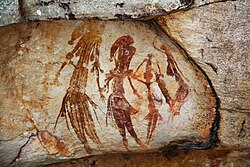
[[File:Bradshaw rock paintings.jpg|thumb|upright=1.0|right|[[Aboriginal rock art]] in the [[Kimberley (Western Australia)|Kimberley]] region of Western Australia]] | [[File:Bradshaw rock paintings.jpg|thumb|upright=1.0|right|[[Aboriginal rock art]] in the [[Kimberley (Western Australia)|Kimberley]] region of Western Australia]] | ||
Aboriginal Australian culture is one of the oldest continuous cultures on Earth.<ref>{{Harvnb|Flood|2019|p=161}}</ref><ref>{{cite web | title=DNA confirms Aboriginal culture one of Earth's oldest | website=Australian Geographic | date=23 September 2011 | url=https://www.australiangeographic.com.au/news/2011/09/dna-confirms-aboriginal-culture-one-of-earths-oldest/ | access-date=9 February 2024 | archive-date=20 January 2024 | archive-url=https://web.archive.org/web/20240120022657/https://www.australiangeographic.com.au/news/2011/09/dna-confirms-aboriginal-culture-one-of-earths-oldest/ | url-status=live }}</ref><ref>{{cite web | last=Jozuka | first=Emiko | title=Aboriginal Australians are Earth's oldest civilization: DNA study | website=CNN | date=22 September 2016 | url=https://www.cnn.com/2016/09/22/asia/indigenous-australians-earths-oldest-civilization/index.html#:~:text=A%20new%20genomic%20study%20has,stretching%20back%20roughly%2075%2C000%20years. | access-date=9 February 2024 | archive-date=4 March 2024 | archive-url=https://web.archive.org/web/20240304225419/https://www.cnn.com/2016/09/22/asia/indigenous-australians-earths-oldest-civilization/index.html#:~:text=A%20new%20genomic%20study%20has,stretching%20back%20roughly%2075%2C000%20years. | url-status=live }}</ref><ref name="Malaspinas-2016">{{cite journal |last1=Malaspinas |first1=Anna-Sapfo |last2=Westaway |first2=Michael C. |last3=Muller |first3=Craig |last4=Sousa |first4=Vitor C. |last5=Lao |first5=Oscar |last6=Alves |first6=Isabel |last7=Bergström |first7=Anders |last8=Athanasiadis |first8=Georgios |last9=Cheng |first9=Jade Y. |last10=Crawford |first10=Jacob E. |last11=Heupink |first11=Tim H. |last12=Macholdt |first12=Enrico |last13=Peischl |first13=Stephan |last14=Rasmussen |first14=Simon |last15=Schiffels |first15=Stephan |display-authors=1 |date=21 September 2016 |title=A genomic history of Aboriginal Australia |journal=Nature |publisher=Springer Science and Business Media LLC |volume=538 |issue=7624 |pages=207–214 |bibcode=2016Natur.538..207M |doi=10.1038/nature18299 |issn=0028-0836 |pmid=27654914 |hdl-access=free |hdl=10754/622366 |last16=Subramanian |first16=Sankar |last17=Wright |first17=Joanne L. |last18=Albrechtsen |first18=Anders |last19=Barbieri |first19=Chiara |last20=Dupanloup |first20=Isabelle |last21=Eriksson |first21=Anders |last22=Margaryan |first22=Ashot |last23=Moltke |first23=Ida |last24=Pugach |first24=Irina |last25=Korneliussen |first25=Thorfinn S. |last26=Levkivskyi |first26=Ivan P. |last27=Moreno-Mayar |first27=J. Víctor |last28=Ni |first28=Shengyu |last29=Racimo |first29=Fernando |last30=Sikora |first30=Martin|pmc=7617037 }}</ref> At the time of first European contact, Aboriginal Australians belonged to wide range of societies, with diverse economies spread across at least [[Australian Aboriginal languages|250 different language groups]].<ref>{{Cite journal |last=Williams |first=Elizabeth |year=2015 |title=Complex hunter-gatherers: a view from Australia |journal=Antiquity |publisher=Cambridge University Press |volume=61 |issue=232 |pages=310–321 |doi=10.1017/S0003598X00052182 |s2cid=162146349}}</ref><ref>{{Harvnb|Sáenz|Embrick|Rodríguez|2015|p=602}}</ref><ref name="Flood 2019-2"/> Estimates of the Aboriginal population before British settlement range from 300,000 to 3 million.<ref>{{Cite web |last1=Bradshaw |first1=Corey J. A. |last2=Williams |first2=Alan N |last3=Saltré |first3=Frédérik |last4=Norman |first4=Kasih |last5=Ulm |first5=Sean |date=30 April 2021 |title=The First Australians grew to a population of millions, much more than previous estimates |url=https://theconversation.com/the-first-australians-grew-to-a-population-of-millions-much-more-than-previous-estimates-142371 |access-date= |website=[[The Conversation (website)|The Conversation]]}}</ref> Aboriginal Australians cultures were (and remain) deeply connected with the land and the environment, with stories of [[The Dreaming]] maintained through [[oral tradition]], [[Songline|songs]], dance and paintings.<ref name="Mawson-2021">{{Cite journal |last=Mawson |first=Stephanie |date=2021 |title=The Deep Past of Pre-Colonial Australia |journal=The Historical Journal |volume=64 |issue=5 |pages=1483–1491 |doi=10.1017/S0018246X20000369 |issn=0018-246X |doi-access=free}}</ref> Certain groups engaged in [[fire-stick farming]],<ref>{{Cite web |last=Wyrwoll |first=Karl-Heinz |date=11 January 2012 |title=How Aboriginal burning changed Australia's climate |url=http://theconversation.com/how-aboriginal-burning-changed-australias-climate-4454 |access-date=1 November 2023 |website=The Conversation |archive-date=15 July 2023 |archive-url=https://web.archive.org/web/20230715015907/https://theconversation.com/how-aboriginal-burning-changed-australias-climate-4454 |url-status=live }}</ref><ref>{{Cite web |last=Williams |first=Robbie |date=21 June 2023 |title=Before the colonists came, we burned small and burned often to avoid big fires. It's time to relearn cultural burning |url=http://theconversation.com/before-the-colonists-came-we-burned-small-and-burned-often-to-avoid-big-fires-its-time-to-relearn-cultural-burning-201475 |access-date=1 November 2023 |website=The Conversation |archive-date=8 March 2024 |archive-url=https://web.archive.org/web/20240308085331/https://theconversation.com/before-the-colonists-came-we-burned-small-and-burned-often-to-avoid-big-fires-its-time-to-relearn-cultural-burning-201475 |url-status=live }}</ref> [[fish farming]],<ref>{{Cite web |last1=Bates |first1=Badger |last2=Westaway |first2=Michael |last3=Jackson |first3=Sue |date=15 December 2022 |title=Aboriginal people have spent centuries building in the Darling River. Now there are plans to demolish these important structures |url=http://theconversation.com/aboriginal-people-have-spent-centuries-building-in-the-darling-river-now-there-are-plans-to-demolish-these-important-structures-195966 |access-date=1 November 2023 |website=The Conversation |archive-date=1 November 2023 |archive-url=https://web.archive.org/web/20231101042204/https://theconversation.com/aboriginal-people-have-spent-centuries-building-in-the-darling-river-now-there-are-plans-to-demolish-these-important-structures-195966 |url-status=live }}</ref><ref>{{Cite web |last=Clark |first=Anna |author-link=Anna Clark (Australian historian) |date=31 August 2023 |title=Friday essay: traps, rites and kurrajong twine – the incredible ingenuity of Indigenous fishing knowledge |url=http://theconversation.com/friday-essay-traps-rites-and-kurrajong-twine-the-incredible-ingenuity-of-indigenous-fishing-knowledge-210467 |url-status=live |archive-url=https://web.archive.org/web/20240211091555/https://theconversation.com/friday-essay-traps-rites-and-kurrajong-twine-the-incredible-ingenuity-of-indigenous-fishing-knowledge-210467 |archive-date=11 February 2024 |access-date=1 November 2023 |website=The Conversation }}</ref> and built [[Indigenous architecture#Australia|semi-permanent shelters]].<ref>{{Harvnb|Flood|2019|pp=239–240}}</ref> These practices have variously been characterised as "[[hunter-gatherer]]", "[[Agriculture|agricultural]]", "natural cultivation" and "intensification".<ref name="Mawson-2021"/><ref>{{Cite journal |last=Bender |first=Barbara |date=1978 |title=Gatherer-hunter to farmer: A social perspective |url=http://www.tandfonline.com/doi/abs/10.1080/00438243.1978.9979731 |journal=World Archaeology |volume=10 |issue=2 |pages=204–222 |doi=10.1080/00438243.1978.9979731 |issn=0043-8243 |url-access=subscription}}</ref><ref>{{Cite web |last=Gammage |first=Bill |date=19 September 2023 |title=Colonists upended Aboriginal farming, growing grain and running sheep on rich yamfields, and cattle on arid grainlands |url=http://theconversation.com/colonists-upended-aboriginal-farming-growing-grain-and-running-sheep-on-rich-yamfields-and-cattle-on-arid-grainlands-207118 |access-date=1 November 2023 |website=The Conversation |archive-date=12 February 2024 |archive-url=https://web.archive.org/web/20240212095624/https://theconversation.com/colonists-upended-aboriginal-farming-growing-grain-and-running-sheep-on-rich-yamfields-and-cattle-on-arid-grainlands-207118 |url-status=live }}</ref><ref name="Flood 2019">{{Harvnb|Flood|2019|pp=62, 64–65}}</ref> | |||
Torres Strait Islander people first settled their islands at least 2,500 years ago.<ref name="Veth-2">{{Harvnb|Veth|O'Connor|2013|pp=34–35}}</ref><ref>{{Cite web |date=2023 |orig-date=1998 |title=Torres Strait Islands |url=https://www.britannica.com/place/Torres-Strait-Islands |archive-url=https://web.archive.org/web/20240615102021/https://www.britannica.com/place/Torres-Strait-Islands |archive-date=15 June 2024 |access-date=17 November 2024 |website=[[Encyclopædia Britannica]] |quote=Torres Strait Islands, island group in the Torres Strait, north of Cape York Peninsula, Queensland, Australia, and south of the island of New Guinea. ... They have been inhabited for at least 2,500 years. The present-day inhabitants are primarily of Melanesian origin, with some mixture of Polynesians and Southeast Asians.}}</ref> Culturally and linguistically distinct from mainland Aboriginal peoples, they were seafarers and obtained their livelihood from seasonal horticulture and the resources of their reefs and seas. Agriculture also developed on some islands and villages appeared by the 1300s.<ref name="Veth-2" /> By the mid-18th century in northern Australia, [[Makassan contact with Australia|contact, trade and cross-cultural engagement]] had been established between local Aboriginal groups and [[Makassar people|Makassan]] [[trepanging|trepangers]], visiting from present-day Indonesia.<ref>{{Harvnb|Konishi|Nugent|2013|pp=51–54}}</ref><ref>{{cite journal |last=Macknight |first=Charles Campbell |year=2011 |title=The view from Marege': Australian knowledge of Makassar and the impact of the trepangindustry across two centuries |journal=[[Aboriginal History]] |volume=35 |pages=134 |doi=10.22459/AH.35.2011.06 |jstor=24046930 |doi-access=free}}</ref><ref>{{Cite journal |last=Russell |first=Denise |date=22 March 2004 |title=Aboriginal-Makassan interactions in the eighteenth and nineteenth centuries in northern Australia and contemporary sea rights claims |url=http://lryb.aiatsis.gov.au/PDFs/aasj04.1_%20makassan.pdf |journal=Australian Aboriginal Studies |publisher=Australian Institute of Aboriginal and Torres Strait Islander Studies |volume=2004 |issue=1 |pages=3–17 |issn=0729-4352 |archive-url=https://web.archive.org/web/20190306230858/http://lryb.aiatsis.gov.au/PDFs/aasj04.1_%20makassan.pdf |archive-date=6 March 2019 |access-date=21 April 2019}}</ref> | |||
===European exploration and colonisation=== | |||
{{Main|European maritime exploration of Australia|European land exploration of Australia|History of Australia (1788–1850)}} | |||
[[File:Landing of Lieutenant James Cook at Botany Bay, 29 April 1770 (painting by E Phillips Fox).jpg|alt=Landing of Lieutenant James Cook at Botany Bay, 29 April 1770|left|thumb|Landing of [[James Cook]] at [[Botany Bay]] on 29 April 1770]] | |||
The [[Dutch East India Company]] ship, ''[[Duyfken]]'', captained by [[Willem Janszoon]], made the first documented European landing in Australia in 1606.<ref>{{Harvnb|Konishi|Nugent|2013|p=47}}</ref> Later that year, [[Luís Vaz de Torres]] sailed to the north of Australia through [[Torres Strait]], along New Guinea's southern coast.<ref>{{Cite web |date=1967 |title=Torres, Luis Vaez de (?–?) |url=https://adb.anu.edu.au/biography/torres-luis-vaez-de-2741 |access-date=16 February 2025 |website=Australian Dictionary of Biography, National Centre of Biography, Australian National University}}</ref> [[Abel Tasman]]'s voyage of 1642 was the first known European expedition to reach [[Van Diemen's Land]]. On his second voyage of 1644, he mapped the north coast of Australia south of New Guinea. Following Tasman's voyages, the Dutch were able to make almost complete maps of Australia's northern and western coasts and much of its southern and south-eastern Tasmanian coasts. They named the continent [[New Holland (Australia)|New Holland]].<ref>{{Harvnb|Konishi|Nugent|2013|p=49}}</ref> | |||
In 1770, Captain [[James Cook]] sailed along and mapped the east coast, which he named "[[New South Wales]]" and claimed for Great Britain.<ref>{{Harvnb|Konishi|Nugent|2013|pp=55–59}}</ref> in 1786, the British government announced its intention to establish a [[penal colony]] in New South Wales.<ref>{{Harvnb|Christopher|Maxwell-Stewart|2013|pp=77–78}}</ref> On 26 January 1788, the [[First Fleet]] commanded by Captain [[Arthur Phillip]], arrived at [[Sydney Cove]], Port Jackson. A camp was established and the [[Flag of Great Britain|Union Flag]] raised. The date later became [[Australia Day|Australia's national day]].<ref>{{Harvnb|Macintyre|2020|pp=21–22}}</ref> | |||
Most early settlers were [[convicts in Australia|convicts]], [[penal transportation|transported]] for petty crimes and [[convict assignment|assigned]] as labourers or servants to "free settlers" (willing immigrants). Once [[emancipist|emancipated]], convicts tended to integrate into colonial society. Aboriginal resistance, convict rebellions and [[Bushranger|bushranging]] were sometimes suppressed under martial law.<ref>{{Harvnb|Kercher|2020|pp=26–27}}</ref><ref>{{Harvnb|Finnane|2013|pp=391–399}}</ref> The 1808 [[Rum Rebellion]], carried out by officers of the [[New South Wales Corps|New South Wales Corp]], led to a temporary [[military junta]].<ref>{{Harvnb|Macintyre|2020|pp=53–54}}</ref> During the next two decades, social and economic reforms, together with the establishment of a [[New South Wales Legislative Council|Legislative Council]] and [[Supreme Court of New South Wales|Supreme Court]], saw the penal colony transition to a civil society.<ref>{{Harvnb|Karskens|2013|pp=115–120}}</ref> | |||
The indigenous population declined for 150 years following settlement, mainly due to infectious disease.<ref>{{ | <!-- Please take note of talk page discussion (archive 21, Colonial expansion, treaties and land rights) before editing -->The indigenous population declined for 150 years following European settlement, mainly due to infectious disease.<ref>{{Harvnb|Flood|2019|pp=82–83, 147–159}}</ref> British colonial authorities did not sign any treaties with [[Aboriginal Australians#Groups and sub-groups|Aboriginal groups]].<ref>{{Harvnb|Flood|2019|pp=42, 111, 147–159, 300}}</ref><ref>{{cite web |author=Rule of Law Education Centre |title=European Settlement and Terra Nullius |url=https://www.ruleoflaw.org.au/education/australian-colonies/terra-nullius/ |access-date=26 January 2024 |archive-date=26 January 2024 |archive-url=https://web.archive.org/web/20240126110348/https://www.ruleoflaw.org.au/education/australian-colonies/terra-nullius/ |url-status=live }}</ref> As settlement expanded, tens of thousands of Indigenous people and thousands of settlers were killed in [[Australian frontier wars|frontier conflicts]], which many historians argue included acts of [[Genocide of Indigenous Australians|genocide]] by settlers.<ref name="Reynolds 2022">{{Harvnb|Reynolds|2022|pp=103–104, 134, 138–141, 182–192, 241–242}}</ref><ref>{{cite journal |last1=Rogers |first1=Thomas James |last2=Bain |first2=Stephen |title=Genocide and frontier violence in Australia |journal=Journal of Genocide Research |date=2016 |volume=18 |pages=83–100 |doi=10.1080/14623528.2016.1120466 |quote=Since Curthoys' assertion in 2008 of a general reluctance to engage directly with the question of genocide in the Australian context, there is now a substantial body of Australian scholarship prepared to utilize genocide frameworks in analysing violence on the Australian frontiers, and to conclude that genocide did indeed occur}}</ref> Settlers dispossessed surviving Indigenous peoples of most of their land.<ref name="Reynolds 2022"/> | ||
=== Colonial expansion === | ===Colonial expansion=== | ||
{{Main|History of Australia (1788–1850)|History of Australia (1851–1900)}} | {{Main|History of Australia (1788–1850)|History of Australia (1851–1900)}} | ||
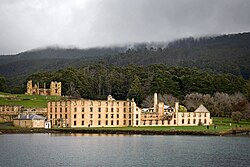
[[File:PortArthurPenitentiary.jpg|thumb|upright=1.0|right|alt=A calm body of water is in the foreground. The shoreline is about 200 metres away. To the left, close to the shore, are three tall [[Eucalyptus|gum trees]]; behind them on an incline are ruins, including walls and watchtowers of light-coloured stone and brick, what appear to be the foundations of walls, and grassed areas. To the right lie the outer walls of a large rectangular four-storey building dotted with regularly spaced windows. Forested land rises gently to a peak several kilometres back from the shore.|Tasmania's [[Port Arthur, Tasmania|Port Arthur]] penal settlement is one of eleven UNESCO World Heritage-listed [[Australian Convict Sites]].]] | [[File:PortArthurPenitentiary.jpg|thumb|upright=1.0|right|alt=A calm body of water is in the foreground. The shoreline is about 200 metres away. To the left, close to the shore, are three tall [[Eucalyptus|gum trees]]; behind them on an incline are ruins, including walls and watchtowers of light-coloured stone and brick, what appear to be the foundations of walls, and grassed areas. To the right lie the outer walls of a large rectangular four-storey building dotted with regularly spaced windows. Forested land rises gently to a peak several kilometres back from the shore.|Tasmania's [[Port Arthur, Tasmania|Port Arthur]] penal settlement is one of eleven UNESCO World Heritage-listed [[Australian Convict Sites]].]] | ||
In | In 1803, a settlement was established in [[Van Diemen's Land]] (present-day [[Tasmania]]),<ref>{{Harvnb|Davison|Hirst|Macintyre|1998|pages=464–465, 628–629}}</ref> and in 1813, [[Gregory Blaxland]], [[William Lawson (explorer)|William Lawson]] and [[William Wentworth]] [[1813 crossing of the Blue Mountains|crossed the Blue Mountains]] west of Sydney, opening the interior to European settlement.<ref>{{Cite Australian Dictionary of Biography |volume=1 |year=1966 |title=Gregory Blaxland (1778–1853) |id2=blaxland-gregory-1795 |first=Jill |last=Conway |access-date=30 August 2025}}</ref> The British claim was extended to the whole Australian continent in 1827 when Major [[Edmund Lockyer]] established a settlement on [[King George Sound]] (modern-day [[Albany, Western Australia|Albany]]).<ref>{{Cite web |date=1967 |title=Lockyer, Edmund (1784–1860) |url=https://adb.anu.edu.au/biography/lockyer-edmund-2366 |access-date=16 February 2025 |website=Australian Dictionary of Biography, National Centre of Biography, Australian National University}}</ref> The [[Swan River Colony]] (present-day [[Perth]]) was established in 1829, evolving into the largest Australian colony by area, [[History of Western Australia|Western Australia]].<ref>{{Harvnb|Davison|Hirst|Macintyre|1998|p=678}}</ref> Separate colonies were carved from New South Wales: Tasmania in 1825, [[British colonisation of South Australia|South Australia]] in 1836, [[Colony of Victoria|Victoria]] in 1851, and [[Colony of Queensland|Queensland]] in 1859.<ref>{{Harvnb|Davison|Hirst|Macintyre|1998|p=464}}</ref> South Australia and Victoria were founded as free colonies – they never accepted transported convicts.<ref>{{Harvnb|Davison|Hirst|Macintyre|1998|p=598}}</ref> Growing [[Australasian Anti-Transportation League|opposition to the convict system]] culminated in its abolition in the eastern colonies by the 1850s. Initially a free colony, Western Australia accepted convicts from 1850 to 1868.<ref>{{Harvnb|Macintyre|2020|pp=79–83, 113}}</ref> | ||
The six colonies individually gained [[responsible government]] between 1855 and 1890, managing most of their own affairs while remaining part of the [[British Empire]].<ref>{{Harvnb|Davison|Hirst|Macintyre|1998|p=556}}</ref> The Colonial Office in London retained control of some matters, notably foreign affairs.<ref>{{Harvnb|Davison|Hirst|Macintyre|1998|pages=138–39}}</ref> The colonial parliaments progressively extended voting rights to adult men from 1856, with [[women's suffrage]] on equal terms following between the 1890s and 1900s. Some colonies introduced racial restrictions on voting from 1885.<ref>{{Harvnb|Curthoys|Mitchell|2013|pp=164–169}}</ref> | |||
In the mid-19th century, explorers such as [[Burke and Wills expedition|Burke and Wills]] | In the mid-19th century, explorers such as [[Burke and Wills expedition|Burke and Wills]] charted Australia's interior.<ref>{{Harvnb|Macintyre|2020|pp=109–110}}</ref> A [[Australian gold rushes|series of gold rushes]] beginning in the early 1850s led to an influx of new migrants from [[Chinese Australians|China]], North America and continental Europe,<ref>{{Harvnb|Jupp|2001|pp=35–36}}</ref> as well as outbreaks of [[bushranger|bushranging]] and civil unrest; the latter peaked in 1854 when [[Ballarat]] miners launched the [[Eureka Rebellion]] against gold licence fees.<ref>{{Harvnb|Davison|Hirst|Macintyre|1998 |pages=227–29}}</ref> The 1860s saw the rise of [[blackbirding]], where [[South Sea Islanders]] were coerced or abducted into [[indentured labour]], mainly by Queensland colonists.<ref>[https://www.slq.qld.gov.au/discover/exhibitions/australian-south-sea-islanders "Australian South Sea Islanders"] {{Webarchive|url=https://web.archive.org/web/20231210065156/https://www.slq.qld.gov.au/discover/exhibitions/australian-south-sea-islanders |date=10 December 2023 }}, State Library of Queensland. Retrieved 21 February 2024.</ref><ref>{{Cite web |last=Higginbotham |first=Will |date=17 September 2017 |title=Blackbirding: Australia's history of luring, tricking and kidnapping Pacific Islanders |url=https://www.abc.net.au/news/2017-09-17/blackbirding-australias-history-of-kidnapping-pacific-islanders/8860754 |url-status=live |archive-url=https://web.archive.org/web/20240126044712/https://www.abc.net.au/news/2017-09-17/blackbirding-australias-history-of-kidnapping-pacific-islanders/8860754 |archive-date=26 January 2024 |website=ABC News}}</ref> | ||
From 1886, Australian colonial governments began | From 1886, Australian colonial governments began [[Stolen Generations|removing many Aboriginal children]] from their families and communities, justified on the grounds of child protection and [[forced assimilation]] policies.<ref>{{Harvnb|Banivanua Mar|Edmonds|2013|pp=355–358, 363–364}}</ref><ref>{{Cite web |last=Marlow |first=Karina |date=1 December 2016 |title=Explainer: the Stolen Generations |url=https://www.sbs.com.au/nitv/article/explainer-the-stolen-generations/5ust2jtjy |access-date= |website=NITV }}</ref><ref>{{Cite web |last=O'Loughlin |first=Michael |date=22 June 2020 |title=The Stolen Generation |url=https://australian.museum/learn/first-nations/stolen-generation/ |website=[[Australian Museum]]}}</ref> The [[Second Boer War]] (1899–1902) marked the largest overseas deployment of [[colonial forces of Australia|Australia's colonial forces]].<ref>{{Cite web |date=2 June 2021 |title=Australia and the Boer War, 1899–1902 |url=https://www.awm.gov.au/articles/atwar/boer |access-date= |website=Australian War Memorial |archive-date=24 March 2018 |archive-url=https://web.archive.org/web/20180324185402/https://www.awm.gov.au/articles/atwar/boer |url-status=live }}</ref><ref>{{Harvnb|Macintyre|2020|p=149}}</ref> | ||
=== Federation to the World Wars === | ===Federation to the World Wars=== | ||
{{Main|History of Australia (1901–1945)}} | {{Main|History of Australia (1901–1945)}} | ||
{{See also|Federation of Australia|Military history of Australia during World War I|Military history of Australia during World War II}} | {{See also|Federation of Australia|Military history of Australia during World War I|Military history of Australia during World War II}} | ||
[[File:Opening of the first parliament.jpg|thumb | [[File:Opening of the first parliament.jpg|thumb|''[[The Big Picture (painting)|The Big Picture]]'', a painting by [[Tom Roberts]], depicts the opening of the first Australian Parliament in 1901.]] | ||
On 1 January 1901, [[Federation of Australia|federation of the colonies]] was achieved after a decade of planning, [[Constitutional Convention (Australia)|constitutional conventions]] and [[1898–1900 Australian constitutional referendums|referendums]], resulting in the establishment of the Commonwealth of Australia as a nation | On 1 January 1901, [[Federation of Australia|federation of the colonies]] was achieved after a decade of planning, [[Constitutional Convention (Australia)|constitutional conventions]] and [[1898–1900 Australian constitutional referendums|referendums]], resulting in the establishment of the Commonwealth of Australia as a nation under the new [[Constitution of Australia|Australian Constitution]].<ref>{{Harvnb|Davison|Hirst|Macintyre|1998 |pages=243–44}}</ref> | ||
From 1901, Australia was a self-governing [[dominion]] within the British Empire.<ref>{{Cite web|title=History of the Commonwealth|url=http://www.commonwealthofnations.org/commonwealth/history/|website=Commonwealth Network|publisher=Commonwealth of Nations|access-date=16 February 2015|archive-date=25 April 2020|archive-url=https://web.archive.org/web/20200425043631/http://www.commonwealthofnations.org/commonwealth/history/|url-status=live}}</ref> It was one of the founding members of the [[League of Nations]] in 1920,<ref>{{Cite web |title=The Covenant of the League of Nations |url=https://www.ungeneva.org/en/about/league-of-nations/covenant |archive-url=https://web.archive.org/web/20240127003532/https://www.ungeneva.org/en/about/league-of-nations/covenant |archive-date=27 January 2024 |access-date=8 February 2024 |website=The United Nations Office at Geneva }}</ref> and the [[Member states of the United Nations|United Nations]] in 1945.<ref>{{Cite web |title=Growth in United Nations membership |url=https://www.un.org/en/about-us/growth-in-un-membership |url-status=live |archive-url=https://web.archive.org/web/20240201204200/https://www.un.org/en/about-us/growth-in-un-membership |archive-date=1 February 2024 |access-date=8 February 2024 |website=United Nations }}</ref> The ''[[Statute of Westminster 1931]]'' ended the ability of the UK to legislate for Australia at the federal level without Australia's consent. Australia [[Statute of Westminster Adoption Act 1942|adopted it]] in 1942, but it was backdated to 1939 to confirm the validity of legislation passed during World War II.<ref>{{Harvnb|Davison|Hirst|Macintyre|1998|p=609}}</ref> | |||
The | The [[Australian Capital Territory]] was formed in 1911 as the location for the future federal capital of [[Canberra]]. While it was being constructed, [[Melbourne]] served as the temporary capital from 1901 to 1927.<ref>{{Harvnb|Souter|2000|pp=206–217}}</ref> The [[Northern Territory]] was transferred from the control of South Australia to the Commonwealth in 1911.<ref>{{Harvnb|Souter|2000|pp=|p=230}}</ref> Australia took over the administration of the [[Territory of Papua]] (which had previously been a British colony) in 1905 and of the [[Territory of New Guinea]] (formerly [[German New Guinea]]) in 1920. The two were unified as the [[Territory of Papua and New Guinea]] in 1949 and gained independence from Australia in 1975.<ref>{{Cite journal |last=McDermott |first=Peter M |date=2009 |title=Australian Citizenship and the Independence of Papua New Guinea |url=https://austlii.edu.au/cgi-bin/viewdoc/au/journals/UNSWLawJl/2009/3.html |url-status=live |journal=UNSW Law Journal |volume=32 |issue=1 |pages=50–2 |archive-url=https://web.archive.org/web/20240208072215/https://austlii.edu.au/cgi-bin/viewdoc/au/journals/UNSWLawJl/2009/3.html |archive-date=8 February 2024 |access-date=8 February 2024 |via=[[Austlii]]}}</ref> | ||
[[File:Darwin 42.jpg|thumb|The 1942 [[Bombing of Darwin]], the first of | [[File:Darwin 42.jpg|thumb|The 1942 [[Bombing of Darwin]], the first of more than 100 [[Air raids on Australia, 1942–1943|Japanese air raids on Australia]] during [[World War II]]]] | ||
In 1914, Australia joined the [[Allies of World War I|Allies]] in | In 1914, Australia joined the [[Allies of World War I|Allies]] in the First World War, and took part in the fighting on several fronts.<ref>{{Cite web |date=2 June 2021 |title=First World War 1914–18 |url=https://www.awm.gov.au/articles/atwar/first-world-war |url-status=live |archive-url=https://web.archive.org/web/20240120020555/https://www.awm.gov.au/articles/atwar/first-world-war |archive-date=20 January 2024 |access-date= |website=Australian War Memorial}}</ref> Of the 324,000 men who served overseas, about 60,000 were killed and another 152,000 were wounded.<ref>{{Harvnb|Garton|Stanley|2013|p=40}}</ref> Many Australians regard the defeat of the [[Australian and New Zealand Army Corps]] (ANZAC) at [[Gallipoli Campaign|Gallipoli]] in 1915 as the "baptism of fire" that forged the [[Anzac spirit|new nation's identity]].<ref name="Macintyre 2020">{{Harvnb|Macintyre|2020|pp=168–170}}</ref><ref>{{Cite web |date=17 January 2024 |title=The Anzac legend |url=https://anzacportal.dva.gov.au/wars-and-missions/ww1/personnel/anzac-legend |website=Department of Veterans' Affairs |access-date=9 February 2024 |archive-date=4 March 2024 |archive-url=https://web.archive.org/web/20240304225421/https://anzacportal.dva.gov.au/wars-and-missions/ww1/personnel/anzac-legend |url-status=live }}</ref> The [[Landing at Anzac Cove|beginning of the campaign]] is commemorated annually on [[Anzac Day]], a date which rivals [[Australia Day]] as the nation's most important.<ref name="Macintyre 2020" /><ref>{{Harvnb|Dennis|Grey|Morris|Prior|2008|pp=32, 38}}</ref> | ||
From 1939 to 1945, Australia joined the [[Allies of World War II|Allies]] in fighting the Second World War. Australia's [[Australian Defence Force|armed forces]] fought in the [[Pacific War|Pacific]], [[European Theatre of World War II|European]] and [[Mediterranean and Middle East theatre of World War II|Mediterranean and Middle East]] [[List of theaters and campaigns of World War II|theatres]].<ref>{{ | From 1939 to 1945, Australia joined the [[Allies of World War II|Allies]] in fighting the Second World War. Australia's [[Australian Defence Force|armed forces]] fought in the [[Pacific War|Pacific]], [[European Theatre of World War II|European]] and [[Mediterranean and Middle East theatre of World War II|Mediterranean and Middle East]] [[List of theaters and campaigns of World War II|theatres]].<ref>{{Harvnb|Macintyre|2020|pp=198–205}}</ref> The shock of Britain's [[fall of Singapore|defeat in Singapore]] in 1942, followed soon after by the [[bombing of Darwin]] and [[Air raids on Australia, 1942–43|other Japanese attacks on Australian soil]], led to a widespread belief in Australia that [[Proposed Japanese invasion of Australia during World War II|a Japanese invasion was imminent]], and a shift from the United Kingdom to the [[Australia–United States relations|United States]] as Australia's principal ally and security partner.<ref>{{Harvnb|Davison|Hirst|Macintyre|1998|pages=22–23}}</ref> Since 1951, Australia has been allied with the United States under the [[ANZUS]] treaty.<ref>{{Harvnb|Davison|Hirst|Macintyre|1998|p=30}}</ref> | ||
=== Post-war and contemporary eras === | ===Post-war and contemporary eras=== | ||
{{Main|History of Australia (1945–present)}} | {{Main|History of Australia (1945–present)}} | ||
[[File:Dutch Migrant 1954 MariaScholte=50000thToAustraliaPostWW2.jpg|thumb|left|[[Post-war immigration to Australia|Postwar migrants]] from Europe arriving in Australia in 1954]] | [[File:Dutch Migrant 1954 MariaScholte=50000thToAustraliaPostWW2.jpg|thumb|left|[[Post-war immigration to Australia|Postwar migrants]] from Europe arriving in Australia in 1954]] | ||
In the decades following World War II, Australia | In the three decades following World War II, Australia experienced significant increases in living standards, leisure time and suburban development.<ref>{{Harvnb|Macintyre|2020|pp=208–209, 228–229}}</ref> Governments encouraged a [[Post-war immigration to Australia|large wave of immigration from across Europe]] and called these migrants "[[New Australians]]". High immigration was justified to Australians using the slogan "populate or perish",<ref>{{Harvnb|Macintyre|2020|pp=210–212}}</ref> and from the 1960s the [[white Australia policy]] was gradually relaxed.<ref>{{Harvnb|Macintyre|2020|pp=237–238}}</ref> | ||
A member of the [[Western Bloc]] during the [[Cold War]], Australia participated in the [[Australia in the Korean War|Korean War]] and the [[Military history of Australia during the Malayan Emergency|Malayan Emergency]] during the 1950s and the [[Military history of Australia during the Vietnam War|Vietnam War]] from 1962 to | A member of the [[Western Bloc]] during the [[Cold War]], Australia participated in the [[Australia in the Korean War|Korean War]] and the [[Military history of Australia during the Malayan Emergency|Malayan Emergency]] during the 1950s and the [[Military history of Australia during the Vietnam War|Vietnam War]] from 1962 to 1973.<ref>{{Harvnb|Dean|Moss|2021|pp=1–2}}</ref><ref>{{Cite web |date=30 October 2023 |title=Vietnam War 1962–75 |url=https://www.awm.gov.au/articles/event/vietnam |access-date=17 February 2025 |website=Australian War Memorial}}</ref> Tensions over communist influence in society led to [[1951 Australian Communist Party ban referendum|unsuccessful attempts]] by the [[Menzies Government (1949–1966)|Menzies Government]] to ban the [[Communist Party of Australia]], and a [[Australian Labor Party split of 1955|bitter split]] in the [[Australian Labor Party|Labor Party]] in 1955.<ref>{{Harvnb|Macintyre|2020|pp=223–225}}</ref> | ||
As a result of a [[Australian referendum, 1967 (Aboriginals)|1967 referendum]], the | As a result of a [[Australian referendum, 1967 (Aboriginals)|1967 referendum]], the federal government gained the power to legislate with regard to Aboriginal Australians, and Aboriginal Australians were fully included in the [[Census in Australia|census]].<ref>{{Harvnb|Broome|2019|pp=221–222}}</ref> [[Aboriginal title|Pre-colonial land interests]] (referred to as [[Native title in Australia|native title]] in Australia) was recognised in law for the first time when the [[High Court of Australia]] held in ''[[Mabo v Queensland (No 2)]]'' that Australia was not ''[[terra nullius]]'' ({{Gloss|land belonging to no one}}) at the time of European settlement.<ref>{{Cite web |last=Galloway |first=Kate |date=26 April 2017 |title=Australian politics explainer: the Mabo decision and native title |url=http://theconversation.com/australian-politics-explainer-the-mabo-decision-and-native-title-74147 |access-date=25 January 2024 |website=The Conversation |archive-date=25 January 2024 |archive-url=https://web.archive.org/web/20240125000636/http://theconversation.com/australian-politics-explainer-the-mabo-decision-and-native-title-74147 |url-status=live }}</ref><ref>{{Harvnb|Davison|Hirst|Macintyre|1998|pages=5–7, 402}}</ref><ref>{{Harvnb|Secher|2004|pp=703–709}}</ref> | ||
Following the | Following the abolition of the last vestiges of the [[White Australia policy]] in 1973,<ref>{{Cite web |url= http://www.border.gov.au/about/corporate/information/fact-sheets/08abolition |title= Fact Sheet – Abolition of the 'White Australia' Policy|location= Commonwealth of Australia|publisher= National Communications Branch, Department of Immigration and Citizenship|work= Australian Immigration |access-date= 27 March 2013 |archive-date= 19 September 2015 |archive-url= https://web.archive.org/web/20150919131355/http://www.border.gov.au/about/corporate/information/fact-sheets/08abolition |url-status= dead}}</ref> Australia's demography and culture transformed as a result of a large and ongoing wave of non-European immigration, mostly from Asia.<ref>{{Harvnb|Davison|Hirst|Macintyre|1998|pages=338–39, 442–43, 681–82}}</ref> The late 20th century also saw an increasing focus on foreign policy ties with other [[Asia–Pacific|Asia{{En dash}}Pacific]] nations.<ref>{{Harvnb|Akami|Milner|2013|pp=552–560}}</ref> The [[Australia Acts]] of 1986 severed the remaining constitutional ties between Australia and the United Kingdom while maintaining the monarch in her independent capacity as [[Queen of Australia]].<ref>{{Cite web|url=https://www.foundingdocs.gov.au/item-did-32.html|title=Australia Act 1986 (Cth)|access-date=25 July 2020|work=Documenting a Democracy|publisher=Museum of Australian Democracy at Old Parliament House|archive-date=22 April 2019|archive-url=https://web.archive.org/web/20190422204352/https://www.foundingdocs.gov.au/item-did-32.html|url-status=live}}</ref><ref>{{Cite web |last=Twomey |first=Anne |date=January 2008 |title=The States, the Commonwealth and the Crown—the Battle for Sovereignty |url=https://www.aph.gov.au/About_Parliament/Senate/Powers_practice_n_procedures/pops/pop48/battlesovereignty |access-date= |website=Parliament of Australia |series=Papers on Parliament No. 48 |archive-date=9 September 2022 |archive-url=https://web.archive.org/web/20220909014023/https://www.aph.gov.au/About_Parliament/Senate/Powers_practice_n_procedures/pops/pop48/battlesovereignty |url-status=live }}</ref> In a [[1999 Australian republic referendum|1999 constitutional referendum]], 55% of voters rejected [[Republicanism in Australia|abolishing the monarchy]] and becoming a republic.<ref>{{Cite web |title=1999: Republic referendum: Queen and/or Country |url=https://moadoph.gov.au/explore/democracy/1999-republic-referendum |access-date=10 February 2024 |website=Museum of Australian Democracy at Old Parliament House |archive-date=17 January 2024 |archive-url=https://web.archive.org/web/20240117083033/https://www.moadoph.gov.au/explore/democracy/1999-republic-referendum |url-status=live }}</ref> | ||
Following the [[September 11 attacks]] on the United States, Australia joined the United States in fighting the [[Military history of Australia during the War in Afghanistan|Afghanistan War]] from 2001 to 2021 and the [[Australian contribution to the 2003 invasion of Iraq|Iraq War]] from 2003 to 2009.<ref>{{Cite | Following the [[September 11 attacks]] on the United States, Australia joined the United States in fighting the [[Military history of Australia during the War in Afghanistan|Afghanistan War]] from 2001 to 2021 and the [[Australian contribution to the 2003 invasion of Iraq|Iraq War]] from 2003 to 2009.<ref>{{Cite web |date=24 September 2024 |title=Post 9/11, Afghanistan and Iraq |url=https://www.awm.gov.au/articles/event/afghanistan |access-date=18 February 2025 |website=Australian War Memorial}}</ref> The nation's trade relations also became increasingly oriented towards East Asia in the 21st century, with China becoming the nation's [[List of the largest trading partners of Australia|largest trading partner]] by a large margin.<ref>{{Cite web |url=https://www.dfat.gov.au/sites/default/files/fifty-years-of-Australias-trade.pdf |title=Fifty years of Australia's trade |website=Department of Foreign Affairs and Trade |access-date=11 January 2022 |archive-date=6 December 2022 |archive-url=https://web.archive.org/web/20221206235853/http://www.dfat.gov.au/sites/default/files/fifty-years-of-Australias-trade.pdf |url-status=live }}</ref> | ||
In response to the [[COVID-19 pandemic in Australia|COVID-19 pandemic]], from March 2020 [[COVID-19 lockdowns|lockdowns]] and other restrictions on public gatherings and movement across the national and state borders were implemented by the Federal, state and territory governments. Following the rollout of vaccines in 2021, these restrictions were gradually eased. In October 2023, Australia declared that COVID-19 was no longer a communicable disease incident of national significance.<ref>{{Harvnb|COVID 19 Response Inquiry Panel|2024|pp=50–56}}</ref> | |||
== Geography == | ==Geography== | ||
{{Main|Geography of Australia|Environment of Australia}} | {{Main|Geography of Australia|Environment of Australia}} | ||
{{See also|Environmental issues in Australia}} | {{See also|Environmental issues in Australia}} | ||
=== General characteristics === | ===General characteristics=== | ||
[[File:Reliefmap of Australia.png|thumb|upright=1.3|right|alt=Map showing the topography of Australia, showing some elevation in the west and very high elevation in mountains in the | [[File:Reliefmap of Australia.png|thumb|upright=1.3|right|alt=Map showing the topography of Australia, showing some elevation in the west and very high elevation in mountains in the south-east|Topographic map of Australia. Dark green represents the lowest elevation and dark brown the highest]] | ||
[[ | Australia consists of the mainland Australian continent, the island of Tasmania, numerous smaller offshore islands, and the remote offshore territories of [[Ashmore and Cartier Islands]], [[Christmas Island]], [[Cocos (Keeling) Islands]], [[Coral Sea Islands]], [[Heard Island and McDonald Islands|Heard and McDonald Islands]], and [[Norfolk Island]].<ref>{{Cite web |date=27 June 2024 |title=Remote Offshore Territories |url=https://www.ga.gov.au/scientific-topics/national-location-information/dimensions/remote-offshore-territories |archive-url=https://web.archive.org/web/20250220230344/http://web.archive.org/screenshot/https://www.ga.gov.au/scientific-topics/national-location-information/dimensions/remote-offshore-territories |archive-date=20 February 2025 |access-date=21 February 2025 |website=Australian Government, Geoscience Australia}}</ref> Australia also claims about 42% of Antarctica as the [[Australian Antarctic Territory]], but this claim is only recognised by four other countries.<ref name="Scott 2021"/> | ||
Mainland Australia lies between latitudes [[9th parallel south|9°]] and [[44th parallel south|44° south]], and longitudes [[112th meridian east|112°]] and [[154th meridian east|154° east]].<ref name="Geoscience Australia-2014a" /> Surrounded by the Indian and Pacific oceans, Australia is separated from Asia by the [[Arafura Sea|Arafura]] and [[Timor Sea|Timor]] seas, with the [[Coral Sea]] lying off the Queensland coast, and the [[Tasman Sea]] lying between Australia and New Zealand. The [[Great Barrier Reef]], the world's largest coral reef, lies a short distance off the north-east coast and extends for more than {{Cvt|2300|km}}.<ref>{{Harvnb|Blewett|2012|p=58}}</ref> | |||
The mainland is the world's smallest continent and the country is the [[List of countries and outlying territories by total area|sixth-largest by total area]].<ref name="Blewett 2012">{{Harvnb|Blewett|2012|p=17}}</ref> Australia is sometimes considered the world's [[List of islands by area|largest island]]<ref>{{Harvnb|Henderson|Johnson|2016|p=1}}</ref> and is often dubbed the "island continent".<ref>{{Harvnb|Blewett|2012|pp=1, 10, 27}}</ref> It has {{Cvt|35877|km}} of coastline (excluding all offshore islands),<ref name="Blewett 2012"/> and claims an [[Exclusive economic zone of Australia|exclusive economic zone]] of {{Convert|8148250|km2|sqmi}}. This exclusive economic zone does not include the [[Australian Antarctic Territory]].<ref>{{Cite web |title=Oceans and Seas – Geoscience Australia |url=http://www.ga.gov.au/education/geoscience-basics/dimensions/oceans-seas.jsp |archive-url=https://web.archive.org/web/20090620022412/http://www.ga.gov.au/education/geoscience-basics/dimensions/oceans-seas.jsp |archive-date=20 June 2009 |publisher=Geoscience Australia}}</ref> | |||
| | |||
| | |||
| | |||
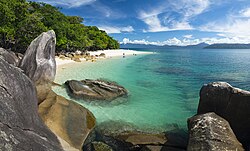
[[File:Uluru, helicopter view, cropped.jpg|thumb|upright=1.0|right|[[Uluru]] in the semi-arid region of Central Australia]] | [[File:Fitzroy Island.jpg|thumb|upright=1.0|left|[[Fitzroy Island (Queensland)|Fitzroy Island]], one of the 600 islands within the main archipelago of the [[Great Barrier Reef]]]]Most of Australia is arid or semi-arid.<ref name="Blewett 2012-3">{{Harvardnb|Blewett|2012|p=|pp=28-30}}</ref> In 2021, Australia had 10% of the global permanent meadows and pastureland.<ref>{{Cite book |url=https://www.fao.org/documents/card/en?details=cc8166en |title=World Food and Agriculture: Statistical Yearbook 2023 |date=2023 |publisher=[[Food and Agriculture Organization of the United Nations]] |isbn=978-92-5-138262-2 |doi=10.4060/cc8166en |archive-url=https://web.archive.org/web/20231215161116/https://www.fao.org/documents/card/en?details=cc8166en |archive-date=15 December 2023 |url-status=live}}</ref> [[Forest cover]] is around 17% of Australia's land area.<ref>{{Cite book |url=https://openknowledge.fao.org/server/api/core/bitstreams/a6e225da-4a31-4e06-818d-ca3aeadfd635/content |title=Terms and Definitions FRA 2025 Forest Resources Assessment, Working Paper 194 |publisher=Food and Agriculture Organization of the United Nations |year=2023}}</ref><ref>{{Cite web |title=Global Forest Resources Assessment 2020, Australia |url=https://fra-data.fao.org/assessments/fra/2020/AUS/home/overview |website=Food Agriculture Organization of the United Nations}}</ref> The Australian mainland is relatively flat, with an average height of {{Convert|325|m|ft}} compared with {{Convert|870|m|ft}} for all continents.<ref>{{Harvnb|Blewett|2012|p=234}}</ref> The [[Great Dividing Range]] runs along most of eastern Australia, dividing the central lowlands from the eastern highlands.<ref name="Geoscience Australia-2014">{{Cite web |date=15 May 2014 |title=Highest Mountains |url=http://www.ga.gov.au/education/geoscience-basics/landforms/highest-mountains.html |url-status=live |archive-url=https://web.archive.org/web/20120321184228/http://ga.gov.au/education/geoscience-basics/landforms/highest-mountains.html |archive-date=21 March 2012 |access-date=2 February 2012 |publisher=Geoscience Australia}}</ref> At {{Cvt|2228|m}}, [[Mount Kosciuszko]] is the highest mountain on the mainland. Taller are [[Mawson Peak]], at {{Cvt|2745|m}}, on Heard Island, and, in the Australian Antarctic Territory, [[Mount McClintock]] and [[Mount Menzies]], at {{Cvt|3492|m}} and {{Cvt|3355|m}} respectively.<ref name="Geoscience Australia-2014" />[[File:Uluru, helicopter view, cropped.jpg|thumb|upright=1.0|right|[[Uluru]] in the semi-arid region of Central Australia]]The [[Murray–Darling basin|Murray-Darling]] is the major river system, draining most of inland New South Wales and Southern Queensland towards [[Lake Alexandrina (South Australia)|Lake Alexandrina]] and the sea in South Australia. There are also smaller coastal river systems, inland drainage systems such as the [[Lake Eyre basin|Lake Eyre]] system, and salt lake systems in central and western Australia.<ref>{{Harvnb|Henderson|Johnson|2016|pp=18–19}}</ref> Australia's rivers have the lowest discharge into the sea of any continent. The mainland's flat, arid profile also makes its rivers slow-moving, resulting in a build up of salt on the land.<ref>{{Harvnb|Blewett|2012|pp=30, 229}}</ref> Salinisation adversely affects Australia's soil which is, on average, poor in nutrients compared with world standards.<ref>{{Harvnb|Blewett|2012|pp=229, 253}}</ref> | ||
Australia's population is concentrated on the coastal fringes. About 95% of the population lives within 100 km of the coast; the world average is 39%.<ref name="Blewett 2012-2">{{Harvnb|Blewett|2012|p=16}}</ref> Australia's [[List of countries and dependencies by population density|population density]] is 3.5 inhabitants per square kilometre,<ref name="Australian Bureau of Statistics-2023"/> which is one of the lowest in the world.<ref name="Blewett 2012-2" /> However, there is a large concentration of the population in cities along the temperate south-eastern coastline, and population density exceeds 38 inhabitants per square kilometre in central Melbourne.<ref name="Australian Bureau of Statistics-2023" /> | |||
=== Geology === | ===Geology=== | ||
{{Main|Geology of Australia}} | {{Main|Geology of Australia}} | ||
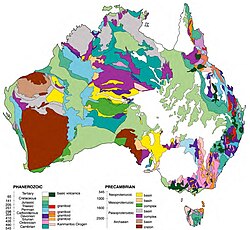
[[File:Ausgeolbasic.jpg|thumb|upright=1.2|right|Basic geological regions of Australia (by age)]] | |||
Formerly part of the [[Rodinia]] and [[Gondwana]] [[supercontinent]]s,<ref>{{Harvnb|Henderson|Johnson|2016|pp=109–110}}</ref> Australia completely separated from Antarctica about 35 million years ago and continued drifting northwards.<ref name="Kennett">{{Harvnb|Kennett|Chopping|Blewett|2018|p=4}}</ref> When the [[Last Glacial Period]] ended, rising sea levels separated the Australian mainland from New Guinea about 8,000 years ago and from [[Tasmania]] about 6,000 years ago.<ref name="Kennett" /> | |||
Australia lies well within the [[Australian plate|Australian tectonic plate]]. The mainland is relatively stable geologically, with no major mountain building, active volcanoes or tectonic faults.<ref>{{Harvnb|Henderson|Johnson|2016|p=11}}</ref> However, the Australian plate is moving north-northeast at a rate of about 6 to 7 cm a year and is currently in collision with the [[Eurasian plate]] and [[Pacific plate]].<ref name="Kennett-2">{{Harvnb|Kennett|Chopping|Blewett|2018|p=6}}</ref> The resulting intratectonic stresses lead to relatively high seismic activity for a geologically stable landmass. There were 18 earthquakes with a [[Moment magnitude scale|moment magnitude]] of greater than 6 between 1901 and 2017.<ref name="Kennett-2" /> The [[1989 Newcastle earthquake|Newcastle earthquake]] of 1989 was Australia's deadliest, killing 13 people.<ref>{{Harvnb|Henderson|Johnson|2016|p=15}}</ref> There were active volcanoes on the eastern mainland as recently as 4,600 years ago,<ref name="Kennett-3">{{Harvnb|Kennett|Chopping|Blewett|2018|p=8}}</ref> and this is reflected in Aboriginal place names and creation stories.<ref>Johnson, Sian (21 March 2020). [https://www.abc.net.au/news/2020-03-21/indigenous-stories-from-times-of-volcanic-eruptions/12003576 How Gunditjmara words and traditions hold stories of Victoria's rich volcanic history] ''[[ABC News (Australia)|ABC News]]''. Retrieved 25 March 2025.</ref> Currently, [[volcanism]] occurs in the remote [[Heard Island and McDonald Islands]].<ref>{{Harvnb|Blewett|2012|p=22}}</ref> | |||
The Australian | The Australian continental crust was created in three cycles from the oldest [[Archean|Archaean]] [[craton]]s in the west to the younger [[Orogenic belt|orogenic]] formations in the east (built about 541 million to 252 million years ago).<ref name="Kennett-3" /><ref>{{Harvnb|Henderson|Johnson|2016|p=130}}</ref> The oldest Australian surface rocks date to the Archaean period. Some in Western Australia are older than 3.7 billion years and others in South Australia are over 3.1 billion years old. The oldest zircon crystals on Earth, dating back 4.4 billion years, have been found in Western Australia. However, about 80 per cent of Australia is covered by sedimentary rocks and [[regolith]] that are less than 250 million years old.<ref name="Kennett-3" /> | ||
=== Climate === | ===Climate=== | ||
{{Main|Climate of Australia}} | {{Main|Climate of Australia}} | ||
[[File:Koppen-Geiger Map v2 AUS 1991–2020.svg|thumb|[[Köppen climate classification|Köppen climate types]] of Australia<ref>{{Cite journal|last1=Beck|first1=Hylke E.|last2=Zimmermann|first2=Niklaus E. |last3=McVicar|first3=Tim R.|last4=Vergopolan|first4=Noemi|last5=Berg|first5=Alexis|last6=Wood|first6=Eric F.|title=Present and future Köppen-Geiger climate classification maps at 1-km resolution |journal=Scientific Data|date=30 October 2018|volume=5|issue=1|page=180214|doi=10.1038/sdata.2018.214|pmid=30375988|pmc=6207062|bibcode=2018NatSD...580214B}}</ref>]] | |||
[[File:Kakadu 2534.jpg|thumb|right|A [[billabong]] in the [[Kakadu National Park]], [[Northern Territory]]. The monsoon climate of northern Australia is hot and humid in summer.]] | |||
The Australian climate ranges from wet tropical in the northeast and northwest to arid in the centre. The coastal south is temperate and humid with winter freezing and snow in the southeastern highlands and Tasmania. The climate is influenced by Australia's position in the "[[horse latitudes]]", which tends to bring arid conditions.<ref name="Henderson">{{Harvnb|Henderson|Johnson|2016|pp=18–20}}</ref> Overall, the Australian mainland is the driest inhabited continent, with an average annual rainfall of {{Convert|470|mm|in}}.<ref name="Blewett 2012-3" /> About 70% of the country is arid or semi-arid,<ref name="Blewett 2012-3" /> and about 18% is desert.<ref>{{Cite web |date=15 May 2014 |title=Deserts |url=http://www.ga.gov.au/scientific-topics/national-location-information/landforms/deserts |url-status=live |archive-url=https://web.archive.org/web/20140605132206/http://www.ga.gov.au/education/geoscience-basics/landforms/deserts.html |archive-date=5 June 2014 |access-date=13 August 2018 |work=Geoscience Australia |publisher=Australian Government}}</ref> | |||
The climate is also influenced by various systems such as the [[El Niño–Southern Oscillation]], the [[Indian Ocean Dipole]] and the [[Antarctic oscillation|Southern Annular Mode]].<ref name="Australian Government, Bureau of Meteorology">{{Cite web |title=State of the Climate 2024 |url=http://www.bom.gov.au/state-of-the-climate |archive-url=https://web.archive.org/web/20250225033319/http://web.archive.org/screenshot/http://www.bom.gov.au/state-of-the-climate/ |archive-date=25 February 2025 |access-date=25 February 2025 |website=Australian Government, Bureau of Meteorology}}</ref> Australia has unusual variability in rainfall within years and between years, leading to frequent droughts and flooding. Cyclones and rain depressions are common in tropical Australia. The summer monsoon brings significant rainfall to northern Australia and low pressure cells bring winter rainfall in the south. The hottest regions are in the northwest of the country and the coolest in the southeast. Bushfire conditions are common in southern Australia.<ref name="Henderson" /> | |||
[[ | [[Climate change]] from increased [[greenhouse gas emissions]] has led to a 1.5 °C rise in Australian temperatures since 1910 and an increase in extreme heat and heavy rainfall events. There has been a reduction in rainfall from April to October in southern Australia since 1970 and a longer bushfire season since the 1950s. Rainfall has increased in northern Australia since the 1970s. The number of tropical cyclones has fallen since 1982 and alpine snow has decreased since the late 1950s. Sea levels are rising around Australia and the surrounding oceans are becoming more acidic.<ref name="Australian Government, Bureau of Meteorology" /> | ||
=== Biodiversity === | ===Biodiversity=== | ||
{{See also|Fauna of Australia|Flora of Australia|Fungi of Australia}} | {{See also|Fauna of Australia|Flora of Australia|Fungi of Australia}} | ||
[[File:Koala climbing tree.jpg|thumb|upright=1.0| | [[File:Koala climbing tree.jpg|thumb|upright=1.0|right|alt=A koala holding onto a eucalyptus tree with its head turned so both eyes are visible|[[Koala]] and ''[[Eucalyptus]]'']] | ||
Australia is one of 17 [[megadiverse countries]].<ref>{{Cite journal |last1=Evans |first1=Megan C. |last2=Watson |first2=James E. M. |last3=Fuller |first3=Richard A. |last4=Venter |first4=Oscar |last5=Bennett |first5=Simon C. |last6=Marsack |first6=Peter R. |last7=Possingham |first7=Hugh P. |date=April 2011 |title=The Spatial Distribution of Threats to Species in Australia |journal=BioScience |volume=61 |issue=4 |page=282 |doi=10.1525/bio.2011.61.4.8 |doi-access=free}}</ref> Because of its long geographic isolation, much of Australia's [[Biota (ecology)|biota]] is unique.<ref>{{Harvnb|Nipperess|2015|pp=7–9}}</ref> About 94% of its [[Amphibians of Australia|amphibians]], 93% of its [[List of reptiles of Australia|reptiles]] and [[Flora of Australia|flowering plants]], 69% of its [[Mammals of Australia|mammals]] and 46% of its [[Birds of Australia|birds]] are [[Endemism|endemic]].<ref>{{Harvnb|Nipperess|2015|p=4}}</ref> Australia has a wide range of [[ecosystem]]s of which 89 regions and 419 subregions are recognised in the Australian bioregion framework.<ref>{{Harvnb|Murphy|van Leeuwen|2021|p=55}}</ref><ref>{{Cite web |date=16 June 2023 |title=Australia's bioregion framework |url=https://www.dcceew.gov.au/environment/land/nrs/science/ibra/australias-bioregion-framework |archive-url=https://web.archive.org/web/20250303050656/https://www.dcceew.gov.au/environment/land/nrs/science/ibra/australias-bioregion-framework |archive-date=3 March 2025 |access-date=3 March 2025 |website=Department of Climate Change, Energy, the Environment and Water}}</ref> | |||
In January 2025, there were 168,386 named species on the Australian National Species List.<ref>{{Cite web |title=NSL Stats |url=https://test-web.biodiversity.org.au/nsl/stats |archive-url=https://web.archive.org/web/20250228050842/https://test-web.biodiversity.org.au/nsl/stats |archive-date=28 February 2025 |access-date=28 February 2025 |website=Australian National Species List}}</ref> However, it is estimated that 70% of Australian species have not been discovered and classified and that there may be 600,000 Australian native species.<ref name="Murphy"/> In general, knowledge of [[vertebrate]]s and flowering plants is better than for [[invertebrate]]s and [[Fungus|fungi]]. It is estimated that less that 10% of [[Fungi of Australia|Australia's fungi]] and insects have been named.<ref name="Murphy">{{Harvnb|Murphy|van Leeuwen|2021|pp=14–15}}</ref> | |||
About 10% of the world's known plant species are found in Australia.<ref>{{Harvnb|Murphy|van Leeuwen|2021|p=22}}</ref> Many of these have adapted to the arid climate, variable rainfall and nutrient-poor soil. [[Deserts and xeric shrublands|Deserts and xeric shrubland]] cover about 70% of the mainland. [[Acacia]], [[banksia]] and [[eucalypt]]s have spread over much of Australia. Many plants have hard and long-living leaves, and are rich in carbon, poor in nutrients, and well adapted to bushfires.<ref>{{Harvnb|Nipperess|2015|pp=9–11}}</ref> | |||
About two-thirds of the world's 330 species of [[marsupial]]s are native to Australia.<ref>{{Cite web |date=2 November 2018 |title=What is a marsupial? |url=https://australian.museum/learn/species-identification/ask-an-expert/what-is-a-marsupial/ |archive-url=https://web.archive.org/web/20250228055517/https://australian.museum/learn/species-identification/ask-an-expert/what-is-a-marsupial/ |archive-date=28 February 2025 |access-date=28 February 2025 |website=Australian Museum}}</ref> Australian [[placental mammals]] (overwhelmingly bats, rats and mice) also make up almost 47% of the world's land mammal species.<ref>{{Harvnb|Nipperess|2015|p=9}}</ref> Australia has about 10% of the world's known reptile species.<ref>{{Harvnb|Murphy|van Leeuwen|2021|p=37}}</ref> There are also about 320,500 invertebrate species, of which insects are the largest class, accounting for more than 75% of all animal species.<ref>{{Harvnb|Murphy|van Leeuwen|2021|p=45}}</ref> Australia has over 15,000 known species of fungi, although it is possible that tens of thousands more exist.<ref>{{Harvnb|Murphy|van Leeuwen|2021|p=53}}</ref> | |||
Australia's wildlife show many adaptations to their environments. As the leaves of most plants are poor in nutrients, Australia has a high proportion of birds, insects and marsupials, such as the [[honey possum]], that feed on nectar and pollen. The [[koala]] is an exception, specialising in feeding on eucalyptus leaves.<ref>{{Cite web |date=3 July 2018 |title=World-first mapping of complete Koala genome brings hope for the icon's future |url=https://australian.museum/blog/science/world-first-mapping-of-complete-koala-genome-brings-hope-for-the-icons-future/ |archive-url=https://web.archive.org/web/20250302071105/https://australian.museum/blog/science/world-first-mapping-of-complete-koala-genome-brings-hope-for-the-icons-future/ |archive-date=2 March 2025 |access-date=2 March 2025 |website=Australian Museum}}</ref><ref name="Nipperess 2015">{{Harvnb|Nipperess|2015|pp=9–12}}</ref> Nutritionally poor flora and variable rainfall also favour animals with lower energy requirements, including snakes, lizards, and hopping marsupials such as the [[kangaroo]] and [[wallaby]]. There is, however, evidence of [[convergent evolution]] of Australia's marsupials and the placental mammals of other continents living in similar environments. For example, the extinct [[thylacine]] (Tasmanian tiger) had similarities with the placental wolf, [[marsupial mole]]s with the [[golden mole]]s of Africa, and [[Hopping mouse|hopping mice]] with the hopping rodents of other arid regions.<ref name="Nipperess 2015" /> | |||
There were major extinctions of Australia's vertebrates, including its [[Australian megafauna|megafauna]], around 46 thousand years ago, and there is an ongoing scientific debate over the role of human activity and climate change in these extinctions. The contraction of the range of the Tasmanian tiger and [[Tasmanian devil]] to that island around 4,000 to 5,000 years ago is also consistent with changes on the mainland including an increasing human population, the introduction of the [[dingo]], and the greater use of fire and new stone tool technologies.<ref>{{Harvnb|Nipperess|2015|pp=12–13}}</ref><ref>{{Cite web |last1=Burrell |first1=Sue |last2=Eldridge |first2=Mark |date=11 July 2024 |title=Dingo |url=https://australian.museum/learn/animals/mammals/dingo/ |archive-url=https://web.archive.org/web/20250302234032/https://australian.museum/learn/animals/mammals/dingo/ |archive-date=2 March 2025 |access-date=3 March 2025 |website=The Australian Museum}}</ref> | |||
Over the past two centuries, Australia has lost more mammal species than any other continent. Overall, 100 Australian species are listed as extinct or extinct in the wild. In June 2021, over 1,000 animal and plant species were listed by Australian governments as endangered or critically endangered.<ref>{{Harvnb|Murphy|van Leeuwen|2021|pp=12, 18}}</ref> The major threats to endangered species are landscape change, ecosystem disruption, introduced species such as the [[Cats in Australia|feral cat]] and [[Red foxes in Australia|red fox]], and climate change.<ref>{{Harvnb|Nipperess|2015|pp=16–17}}</ref> | |||
The federal ''[[Environment Protection and Biodiversity Conservation Act 1999]]'' is the legal framework for the protection of threatened species.<ref>{{Cite web |date=5 February 2025 |title=Environment Protection and Biodiversity Conservation Act 1999 (EPBC Act) |url=https://www.dcceew.gov.au/environment/epbc |archive-url=https://web.archive.org/web/20250303035240/https://www.dcceew.gov.au/environment/epbc |archive-date=3 March 2025 |access-date=3 March 2025 |website=Department of Climate Change, Energy, the Environment and Water}}</ref> The [[National Reserve System]] is Australia's network of protected areas. As at 30 June 2022, it covered over 22% of Australia's land mass.<ref>{{Cite web |title=National Reserve System |url=https://www.dcceew.gov.au/environment/land/nrs |archive-url=https://web.archive.org/web/20250303040635/https://www.dcceew.gov.au/environment/land/nrs |archive-date=3 March 2025 |access-date=3 March 2025 |website=Department of Climate Change, Energy, the Environment and Water}}</ref> ''Australia's Strategy for Nature 2024–2030'' is the national biodiversity plan that aims to reverse biodiversity loss in Australia by 2030 and meet the county's obligations under the [[Convention on Biological Diversity|United Nations Convention on Biological Diversity]] and other international agreements.<ref>{{Cite web |date=30 September 2024 |title=Australia's Strategy for Nature 2024–2030 |url=https://www.dcceew.gov.au/environment/biodiversity/conservation/publications/australias-strategy-for-nature |archive-url=https://web.archive.org/web/20250303041458/https://www.dcceew.gov.au/environment/biodiversity/conservation/publications/australias-strategy-for-nature |archive-date=3 March 2025 |access-date=3 March 2025 |website=Department of Climate Change, Energy, the Environment and Water}}</ref><ref>{{Cite web |date=21 February 2025 |title=UN Convention on Biological Diversity |url=https://www.dcceew.gov.au/environment/biodiversity/international/un-convention-biological-diversity |archive-url=https://web.archive.org/web/20250303042129/https://www.dcceew.gov.au/environment/biodiversity/international/un-convention-biological-diversity |archive-date=3 March 2025 |access-date=3 March 2025 |website=Department of Climate Change, Energy, the Environment and Water}}</ref> | |||
==Government and politics== | |||
{{Main|Australian Government|Politics of Australia|Monarchy of Australia}} | |||
{{Multiple image | {{Multiple image | ||
| caption_align = center | | caption_align = center | ||
| total_width = | | total_width = 400 | ||
| image1 = King Charles III (July 2023).jpg | | image1 = King Charles III (July 2023).jpg | ||
| caption1 = [[Charles III]] | | caption1 = [[Charles III]]<br /><small>[[Monarchy of Australia|King of Australia]] </small> | ||
| image2 = | | image2 = Sam Mostyn 2024.jpg | ||
| caption2 = [[ | | caption2 = [[Sam Mostyn]]<br /><small>[[Governor-General of Australia|Governor-General]] </small> | ||
| image3 = Anthony Albanese portrait ( | | image3 = Anthony Albanese portrait (re-crop).jpg | ||
| caption3 = [[Anthony Albanese]] | | caption3 = [[Anthony Albanese]]<br /><small>[[Prime Minister of Australia|Prime Minister]] </small> | ||
}} | }} | ||
Australia is a | Australia is a [[constitutional monarchy]], a [[parliamentary democracy]] and a [[federation]].<ref>{{Cite web |date=12 January 2024 |title=Australian system of government |url=https://peo.gov.au/understand-our-parliament/how-parliament-works/system-of-government/australian-system-of-government |access-date= |website=Parliamentary Education Office |archive-date=14 February 2024 |archive-url=https://web.archive.org/web/20240214204120/https://peo.gov.au/understand-our-parliament/how-parliament-works/system-of-government/australian-system-of-government |url-status=live }}</ref> The country has maintained its mostly unchanged [[Constitution of Australia|constitution]] alongside a stable [[Liberal democracy|liberal democratic]] political system since [[Federation of Australia|Federation]] in 1901. It is one of the world's oldest federations, in which power is divided between the federal and [[States and territories of Australia|state]] governments. The [[Politics of Australia|Australian system of government]] combines elements derived from the political systems of the United Kingdom (a [[Fusion of powers|fused executive]], constitutional monarchy and [[Party discipline|strong party discipline]]) and the United States ([[federalism]], a [[written constitution]] and [[bicameralism|strong bicameralism]] with a Senate in which states have equal representation), resulting in a distinct hybrid.<ref name="Thompson-1980">{{Cite journal |last=Thompson |first=Elaine |year=1980 |title=The 'Washminster' Mutation |journal=[[Australian Journal of Political Science|Politics]] |volume=15 |issue=2 |page=32 |doi=10.1080/00323268008401755}}</ref><ref>{{Cite web |date=14 December 2023 |title=What is the Washminster system? |url=https://peo.gov.au/understand-our-parliament/your-questions-on-notice/questions/what-is-the-washminster-system |access-date= |website=Parliamentary Education Office |archive-date=15 February 2024 |archive-url=https://web.archive.org/web/20240215070719/https://peo.gov.au/understand-our-parliament/your-questions-on-notice/questions/what-is-the-washminster-system |url-status=live }}</ref> | ||
[[Separation of powers in Australia|Federal government power is partially separated]] between three groups:<ref>{{Cite web |title=Separation of powers: Parliament, Executive and Judiciary |url=https://peo.gov.au/understand-our-parliament/how-parliament-works/system-of-government/separation-of-powers-parliament-executive-and-judiciary/ |url-status=live |archive-url=https://web.archive.org/web/20231031132705/https://peo.gov.au/understand-our-parliament/how-parliament-works/system-of-government/separation-of-powers-parliament-executive-and-judiciary/ |archive-date=31 October 2023 |access-date=8 November 2023 |website=Parliamentary Education Office |publisher= }}</ref> | |||
* Legislature: the bicameral [[Parliament of Australia|Parliament]], comprising the [[Monarchy of Australia|monarch]], the [[Australian Senate|Senate]], and the [[Australian House of Representatives|House of Representatives]] | |||
* Executive: the [[Australian Government]], led by the prime minister (the leader of the party or coalition with a majority in the House of Representatives), their chosen [[Cabinet of Australia|Cabinet]] and other ministers; formally appointed by the governor-general<ref name="The World Factbook">{{Cite CIA World Factbook |country=Australia |section=Government |access-date=16 August 2024}}</ref> | |||
* Judiciary: the [[High Court of Australia|High Court]] and other [[Australian court hierarchy|federal courts]] | |||
Following elections on 3 May 2025, the prime minister is [[Anthony Albanese]] of the [[Australian Labor Party]].<ref>{{Cite web |last=Worthington |first=Brett |date=3 May 2025 |title=Anthony Albanese and Labor claim landslide election win as Peter Dutton loses seat |url=https://www.abc.net.au/news/2025-05-03/federal-election-anthony-albanese-wins/105247712 |website=Australia Broadcasting Corporation}}</ref> [[Charles III]] reigns as [[King of Australia]] and is represented in Australia by the [[Governor-General of Australia|governor-general]] at the federal level and by the [[Governors of the Australian states|governors]] at the state level, who by [[Chapter II of the Constitution of Australia#Section 63: Provisions referring to Governor-General|section 63]] of the Constitution and convention act on the advice of their ministers.<ref>{{Harvnb|Davison|Hirst|Macintyre|1998|pages=287–88}}</ref><ref name="Governor-General of Australia">{{Cite web |url=http://www.gg.gov.au/governorgeneral/category.php?id=2 |archive-url=https://web.archive.org/web/20080804130529/http://www.gg.gov.au/governorgeneral/category.php?id=2 |archive-date=4 August 2008 |title=Governor-General's Role|publisher=Governor-General of Australia |access-date=23 April 2010}}</ref> Thus, in practice the governor-general acts as a legal figurehead for the actions of the [[Prime Minister of Australia|prime minister]] and the Cabinet. The governor-general may in some situations exercise [[reserve power]]s: powers exercisable in the absence of, or contrary to, ministerial advice. When these powers may be exercised is governed by convention and their precise scope is unclear. The most notable exercise of these powers was the dismissal of the [[Whitlam government]] in the [[1975 Australian constitutional crisis|constitutional crisis of 1975]].<ref>{{Cite web|publisher=Parliament of Australia|date=23 January 1998 |access-date=18 June 2010|url=http://www.aph.gov.au/library/pubs/rn/1997-98/98rn25.htm |title=The Reserve Powers of the Governor-General|author=Downing, Susan |archive-url=https://web.archive.org/web/20100726170040/http://www.aph.gov.au/library/pubs/rn/1997-98/98rn25.htm |archive-date=26 July 2010 |url-status=dead}}</ref> | |||
[[File:Canberra (AU), Parliament House -- 2019 -- 1746.jpg|alt=A large white and cream coloured building with grass on its roof. The building is topped with a large flagpole.|right|thumb|[[Parliament House, Canberra|Parliament House]], [[Canberra]], [[Australian Capital Territory]]]] | |||
In the Senate (the upper house), there are 76 senators: twelve each from the states and two each from the mainland territories (the Australian Capital Territory and the Northern Territory).<ref name="Australian Broadcasting Corporation">{{Cite web |url=http://www.abc.net.au/elections/federal/2007/guide/senatecomposition.htm |title=Senate Summary|publisher=Australian Broadcasting Corporation |access-date=23 April 2010 |archive-url=https://web.archive.org/web/20100506235552/http://www.abc.net.au/elections/federal/2007/guide/senatecomposition.htm |archive-date=6 May 2010 |url-status=live}}</ref> The House of Representatives (the lower house) has 150 members elected from single-member [[Divisions of the Australian House of Representatives|electoral divisions]], commonly known as "electorates" or "seats", allocated to states on the basis of population, with each of the current states guaranteed a minimum of five seats.<ref>{{Cite web |last=Muller |first=Damon |date=26 April 2023 |title=The process for, and consequences of, changing the size of the Commonwealth Parliament: a quick guide |url=https://www.aph.gov.au/About_Parliament/Parliamentary_departments/Parliamentary_Library/pubs/rp/rp2223/Quick_Guides/ChangingSizeCommonwealthParliament |url-status=live |archive-url=https://web.archive.org/web/20230511175801/https://www.aph.gov.au/About_Parliament/Parliamentary_departments/Parliamentary_Library/pubs/rp/rp2223/Quick_Guides/ChangingSizeCommonwealthParliament |archive-date=11 May 2023 |access-date= |website=Parliament of Australia }}</ref> The lower house has a maximum term of three years, but this is not fixed and governments usually dissolve the house early for an election at some point in the 6 months before the maximum.<ref>{{Cite book |last=Joint Standing Committee on Electoral Matters |url=https://www.aph.gov.au/Parliamentary_Business/Committees/Joint/Completed_Inquiries/em/elect04/report |title=The 2004 Federal Election |date=10 October 2005 |publisher=Parliament of Australia |isbn=978-0-642-78705-7 |at=paras. 7.26–7.27 |chapter=Parliamentary terms |chapter-url=https://www.aph.gov.au/Parliamentary_Business/Committees/Joint/Completed_Inquiries/em/elect04/chapter7 |access-date=25 January 2024 |archive-date=25 January 2024 |archive-url=https://web.archive.org/web/20240125005940/https://www.aph.gov.au/Parliamentary_Business/Committees/Joint/Completed_Inquiries/em/elect04/report |url-status=live }}</ref> Elections for both chambers are generally held simultaneously with senators having overlapping six-year terms except for those from the territories, whose terms are not fixed but are tied to the electoral cycle for the lower house. Thus, only 40 of the 76 places in the Senate are put to each election unless the cycle is interrupted by a [[double dissolution]].<ref name="Australian Broadcasting Corporation" /> | |||
Australia's [[electoral system of Australia|electoral system]] uses [[Instant-runoff voting|preferential voting]] for the House of Representatives and all state and territory lower house elections (with the exception of Tasmania and the ACT which use the [[Hare-Clark system]]). The Senate and most state upper houses use the [[single transferable vote|proportional system]] which combines preferential voting with [[proportional representation]] for each state. [[Compulsory voting|Voting and enrolment is compulsory]] for all enrolled citizens 18 years and older in every jurisdiction.<ref>{{Cite web |url=http://www.aec.gov.au/pdf/voting/compulsory_voting.pdf |title=Compulsory Voting in Australia|last=Evans|first=Tim|year=2006|publisher=Australian Electoral Commission|page=4 |access-date=21 June 2009 |archive-url=https://web.archive.org/web/20090611200653/http://www.aec.gov.au/pdf/voting/compulsory_voting.pdf |archive-date=11 June 2009 |url-status=live}}</ref><ref>{{Cite web |url=https://aec.gov.au/FAQs/Enrolment.htm#compulsory |title=Is it compulsory to enrol, regardless of age or disability?|work=Enrolment – Frequently Asked Questions|publisher=Australian Electoral Commission |access-date=11 September 2021 |archive-url=https://web.archive.org/web/20210524015925/https://aec.gov.au/FAQs/Enrolment.htm |archive-date=24 May 2021 |url-status=live}}</ref><ref>{{Cite book |first=Judith |last=Brett |title=From Secret Ballot to Democracy Sausage: How Australia Got Compulsory Voting |publisher=Text Publishing Co |year=2019 |isbn=978-1-9256-0384-2}}</ref> The party with majority support in the House of Representatives forms the government and its leader becomes prime minister. The governor-general appoints the prime minister and may dismiss one who has lost the confidence of parliament or acts illegally.<ref>{{Cite web |url=http://www.gg.gov.au/content.php/page/id/3/title/governor-generals-role |archive-url=https://web.archive.org/web/20121014171300/http://www.gg.gov.au/content.php/page/id/3/title/governor-generals-role |archive-date=14 October 2012 |title=Governor-General's Role|publisher=Governor-General of the Commonwealth of Australia |access-date=13 January 2012}}</ref> As Australia is a [[Westminster system|Westminster]] parliamentary democracy with a powerful and elected upper house, its system has sometimes been called a "Washminster mutation",<ref name="Thompson-1980" /> or semi-parliamentary.<ref>{{Cite journal |last1=Ganghof |first1=S |title=A new political system model: Semi-parliamentary government |journal=European Journal of Political Research |date=May 2018 |volume=57 |issue=2 |pages=261–281 |doi=10.1111/1475-6765.12224 |doi-access=free }}</ref> | |||
There are two major political groups that have usually formed government federally: the [[Australian Labor Party]] <!-- NOTE TO EDITORS: The name of the party is spelt "Labor" (i.e., no "u") even though the usual Australian spelling is "labour". --> and the [[Coalition (Australia)|Coalition]] which is a grouping of the [[Liberal Party of Australia|Liberal Party]] and its minor partner, the [[National Party of Australia|National Party]].<ref>{{Cite web |url=http://www.abc.net.au/elections/federal/2007/guide/glossary.htm#coalition |title=Glossary of Election Terms |publisher=Australian Broadcasting Corporation |access-date=23 April 2010 |archive-date=6 March 2021 |archive-url=https://web.archive.org/web/20210306034515/http://www.abc.net.au/elections/federal/2007/guide/glossary.htm#coalition |url-status=live }}</ref><ref>{{Cite web |url=http://www.abc.net.au/elections/federal/2007/results/sop.htm |title=State of the Parties|publisher=Australian Broadcasting Corporation |access-date=23 April 2010 |archive-url=https://web.archive.org/web/20100418163914/http://www.abc.net.au/elections/federal/2007/results/sop.htm |archive-date= 18 April 2010 |url-status=live}}</ref> At the state level of government, the relationship between the Nationals and the Liberal Party differs, with the parties [[Liberal National Party of Queensland|merged in Queensland]] and the [[Country Liberal Party|Northern Territory]] (federal parliamentarians, however, sit in either the Liberal or National party room); in coalition in New South Wales, Victoria and Western Australia; and in competition with the Liberals in South Australia and Tasmania.<ref>{{Cite web |date=30 July 2008 |title=The Liberal-National Party – a new model party? |url=https://www.abc.net.au/news/2008-07-30/the-liberal-national-party---a-new-model-party/457812 |access-date=8 September 2021 |website=ABC News |archive-date=7 October 2022 |archive-url=https://web.archive.org/web/20221007033647/https://www.abc.net.au/news/2008-07-30/the-liberal-national-party---a-new-model-party/457812 |url-status=live }}</ref> Within Australian political culture, the Labor Party is considered [[centre-left]] and the Coalition is considered [[centre-right]].<ref>{{Cite book|last1=Fenna|first1=Alan|last2=Robbins|first2=Jane|last3=Summers|first3=John |title=Government Politics in Australia|publisher=Pearson Higher Education AU|location=London|year=2013|isbn=978-1-4860-0138-5|page=139}}</ref> Independent members and several minor parties have achieved representation in Australian parliaments, mostly in upper houses. The [[Australian Greens]] have been the third largest party by both vote and membership since 2004.<ref>{{Cite web|url=https://www.smh.com.au/politics/federal/old-greens-wounds-reopen-as-members-vote-on-directly-electing-leader-20200422-p54m5r.html|title=Old Greens wounds reopen as members vote on directly electing leader|last=Harris|first=Rob|date=22 April 2020|newspaper=The Sydney Morning Herald|access-date=24 April 2020|archive-date=22 April 2020|archive-url=https://web.archive.org/web/20200422080256/https://www.smh.com.au/politics/federal/old-greens-wounds-reopen-as-members-vote-on-directly-electing-leader-20200422-p54m5r.html|url-status=live}}</ref><ref>{{Cite book |last1=Jackson |first1=Stewart |title=The Australian Greens: from activism to Australia's third party |date=2016 |publisher=Melbourne University Press |isbn=978-0-5228-6794-7}}</ref> | |||
===States and territories=== | |||
{{Main|States and territories of Australia}} | |||
[[File:Australia states and territories labelled.svg|thumb|upright=1.5|right|Australia's states and territories]] | |||
[[ | Australia has six states – [[New South Wales]] (NSW), [[Victoria (state)|Victoria]] (Vic), [[Queensland]] (Qld), [[Western Australia]] (WA), [[South Australia]] (SA) and [[Tasmania]] (Tas) – and two mainland self-governing territories – the [[Australian Capital Territory]] (ACT) and the [[Northern Territory]] (NT).<ref>{{Cite web |date=14 December 2023 |title=What's the difference between a territory and a state parliament? |url=https://peo.gov.au/understand-our-parliament/your-questions-on-notice |access-date= |website=Parliamentary Education Office |archive-date=18 March 2024 |archive-url=https://web.archive.org/web/20240318145108/https://peo.gov.au/understand-our-parliament/your-questions-on-notice |url-status=live }}</ref> | ||
The states have the general power to make laws except in the few areas where the constitution grants the Commonwealth (the federal level of government) exclusive powers.<ref>{{Cite book |last=Pyke |first=John |title=Government powers under a Federal Constitution: constitutional law in Australia |date=2020 |publisher=Lawbook Co |isbn=978-0-455-24415-0 |edition=2nd |location=Pyrmont, NSW |pages=405–6}}</ref><ref>{{Cite web |date=19 July 2022 |title=Three levels of government: governing Australia |url=https://peo.gov.au/understand-our-parliament/how-parliament-works/three-levels-of-government/three-levels-of-government-governing-australia |access-date=25 January 2024 |website=Parliamentary Education Office |archive-date=4 January 2024 |archive-url=https://web.archive.org/web/20240104073724/https://peo.gov.au/understand-our-parliament/how-parliament-works/three-levels-of-government/three-levels-of-government-governing-australia |url-status=live }}</ref> The Commonwealth can only make laws on topics listed in the constitution but its laws prevail over those of the states to the extent of any inconsistency.<ref>{{Cite book |last=Pyke |first=John |title=Government powers under a Federal Constitution: constitutional law in Australia |date=2020 |publisher=Lawbook Co |isbn=978-0-455-24415-0 |edition=2nd |location=Pyrmont, NSW |pages=528–30, 577–80}}</ref><ref>{{Cite Legislation AU|Cth|act|coaca430|Australian Constitution|109}}. "When a law of a State is inconsistent with a law of the Commonwealth, the latter shall prevail, and the former shall, to the extent of the inconsistency, be invalid."</ref> Since Federation, the Commonwealth's power relative to the states [[Australian constitutional law#Growth of federal power|has significantly increased]] due to the increasingly wide interpretation given to listed Commonwealth powers{{snd}}and because of the states' [[Fiscal imbalance in Australia|heavy financial reliance]] on Commonwealth grants.<ref>{{Cite book |last=Pyke |first=John |title=Government powers under a Federal Constitution: constitutional law in Australia |date=2020 |publisher=Lawbook Co |isbn=978-0-455-24415-0 |edition=2nd |location=Pyrmont, NSW |pages=607–9}}</ref><ref>{{Cite book |last=Beck |first=Luke |title=Australian constitutional law: concepts and cases |date=2020 |publisher=Cambridge university press |isbn=978-1-108-70103-7 |location=Port Melbourne, VIC |pages=521–8}}</ref> | |||
Each state and major mainland territory has [[Parliaments of the Australian states and territories|its own parliament]] – [[unicameral]] in the Northern Territory, the ACT and Queensland, and bicameral in the other states. The lower houses are known as the [[Legislative Assembly]] (the [[House of Assembly]] in South Australia and Tasmania); the upper houses are known as the [[Legislative council|Legislative Council]]. The [[head of government|head of the government]] in each state is the [[Premiers of the Australian states|premier]] and in each territory the [[Chief Minister|chief minister]]. The King is represented in each state by a [[Governors of the Australian states|governor]]. At the Commonwealth level, the King's representative is the governor-general.<ref name="Governor-General of Australia"/> | |||
The Commonwealth government directly administers the internal [[Jervis Bay Territory]] and the external territories: the [[Ashmore and Cartier Islands]], the [[Coral Sea Islands]], the [[Heard Island and McDonald Islands]], the [[Australian Indian Ocean Territories|Indian Ocean territories]] (Christmas Island and the Cocos (Keeling) Islands), [[Norfolk Island]],{{Refn|Norfolk Island previously was self-governed, however this was revoked in 2015.<ref>{{Cite web |archive-url=https://web.archive.org/web/20080806021653/http://ag.gov.au/www/agd/agd.nsf/Page/Territories_of_AustraliaNorfolk_IslandAdministrator_of_Norfolk_Island|url=http://ag.gov.au/www/agd/agd.nsf/Page/Territories_of_AustraliaNorfolk_Island|publisher=Australian Government Attorney-General's Department |title=Administrator of Norfolk Island |archive-date=6 August 2008}}</ref><ref>{{Cite news|url=https://www.theguardian.com/australia-news/2015/may/12/norfolk-island-loses-its-parliament-as-canberra-takes-control|title=Norfolk Island loses its parliament as Canberra takes control|first1=Monica|last1=Tan|author2=Australian Associated Press|date=12 May 2015|newspaper=The Guardian|access-date=21 October 2015|archive-date=28 October 2015|archive-url=https://web.archive.org/web/20151028072820/http://www.theguardian.com/australia-news/2015/may/12/norfolk-island-loses-its-parliament-as-canberra-takes-control|url-status=live}}</ref>}} and the [[Australian Antarctic Territory]].{{Refn|This [[Territorial claims in Antarctica|Antarctic claim]] is recognised by only by New Zealand, the United Kingdom, France, and Norway.}}<ref>{{Cite web |title=Australian Territories |url=https://www.infrastructure.gov.au/territories-regions-cities/australian-territories |access-date=16 February 2024 |website=Department of Infrastructure, Transport, Regional Development, Communications and the Arts |archive-date=8 March 2024 |archive-url=https://web.archive.org/web/20240308213252/https://www.infrastructure.gov.au/territories-regions-cities/australian-territories |url-status=live }}</ref><ref name="The World Factbook"/> The remote [[Macquarie Island]] and [[Lord Howe Island]] are part of Tasmania and New South Wales respectively.<ref>{{Cite news|title=Macquarie Island research station to be closed in 2017|url=https://www.abc.net.au/news/2016-09-13/macquarie-island-research-station-to-be-closed-in-2017/7839640|work=ABC News|date=13 September 2016|access-date=19 October 2019|archive-date=25 October 2019|archive-url=https://web.archive.org/web/20191025034637/https://www.abc.net.au/news/2016-09-13/macquarie-island-research-station-to-be-closed-in-2017/7839640|url-status=live}}</ref><ref>{{Cite web |last=Southerden |first=Louise |date=8 November 2017 |title=Which island should you visit - Lord Howe or Norfolk? A guide to both |url=https://www.smh.com.au/traveller/inspiration/a-tale-of-two-islands-lord-howe-v-norfolk-20171107-gzg8tz.html |access-date= |website=The Sydney Morning Herald |archive-date=16 February 2024 |archive-url=https://web.archive.org/web/20240216030715/https://www.smh.com.au/traveller/inspiration/a-tale-of-two-islands-lord-howe-v-norfolk-20171107-gzg8tz.html |url-status=live }}</ref> | |||
===Foreign relations=== | |||
{{Main|Foreign relations of Australia}} | |||
[[File:Diplomatic missions of Australia.png|thumb|right|upright=1.3|[[List of diplomatic missions of Australia|Diplomatic missions of Australia]]]] | |||
Australia is a [[middle power]],<ref>{{Cite report |url=https://power.lowyinstitute.org/downloads/lowy-institute-2023-asia-power-index-key-findings-report.pdf |title=Lowy Institute Asian Power Index |date=2023 |page=29 |isbn=978-0-6480189-3-3 |access-date=4 February 2024 |archive-url=https://web.archive.org/web/20240220212559/https://power.lowyinstitute.org/downloads/lowy-institute-2023-asia-power-index-key-findings-report.pdf |archive-date=20 February 2024 |url-status=live}}</ref> whose foreign relations has three core bi-partisan pillars: commitment to the US alliance, engagement with the [[Indo-Pacific]] and support for international institutions, rules and co-operation.<ref>{{Cite web |last=Gyngell |first=Allan |date=31 July 2022 |title=A new Australian foreign policy agenda under Albanese |url=https://eastasiaforum.org/2022/07/31/a-new-australian-foreign-policy-agenda-under-albanese/ |access-date= |website=East Asia Forum |archive-date=17 February 2024 |archive-url=https://web.archive.org/web/20240217023926/https://eastasiaforum.org/2022/07/31/a-new-australian-foreign-policy-agenda-under-albanese/ |url-status=live }}</ref><ref name="Australian Government-2017">{{Cite report |url=https://www.dfat.gov.au/sites/default/files/2017-foreign-policy-white-paper.pdf |title=2017 Foreign Policy White Paper |date=2017 |publisher=Australian Government |pages=1–8 |access-date=17 February 2024 |archive-date=19 January 2024 |archive-url=https://web.archive.org/web/20240119034716/https://www.dfat.gov.au/sites/default/files/2017-foreign-policy-white-paper.pdf |url-status=live }}</ref><ref>{{Cite book |last=Firth |first=Stewart |title=Australia in international politics: an introduction to Australian foreign policy |date=2011 |publisher=Allen & Unwin |isbn=978-1-74237-263-1 |edition=3rd |location=Crows Nest, NSW |pages=332–8}}</ref> Through the [[ANZUS]] pact and its status as a [[major non-NATO ally]], Australia maintains a [[Australia–United States relations|close relationship with the US]], which encompasses strong defence, security and trade ties.<ref>{{Cite web |title=Australia and the United States |url=https://usa.embassy.gov.au/australia-and-united-states |access-date=17 February 2024 |website=Australian Embassy and Consulates |archive-date=17 February 2024 |archive-url=https://web.archive.org/web/20240217023926/https://usa.embassy.gov.au/australia-and-united-states |url-status=live }}</ref><ref>{{Cite web |last=Bureau of Political-Military Affairs |date=20 January 2021 |title=Major Non-NATO Ally Status |url=https://www.state.gov/major-non-nato-ally-status/ |access-date=25 January 2024 |website=[[United States Department of State]] |archive-date=27 February 2022 |archive-url=https://web.archive.org/web/20220227062358/https://www.state.gov/major-non-nato-ally-status/ |url-status=live }}</ref> In the Indo-Pacific, the country seeks to increase its trade ties through the open flow of trade and capital, while managing the rise of Chinese power by supporting the existing rules-based order.<ref name="Australian Government-2017" /> Regionally, the country is a member of the [[Pacific Islands Forum]], the [[Pacific Community]], the [[Association of Southeast Asian Nations#ASEAN Plus Three and ASEAN Plus Six|ASEAN+6 mechanism]] and the [[East Asia Summit]]. Internationally, the country is a member of the [[United Nations]] (of which it was a founding member), the [[Commonwealth of Nations]], the [[OECD]] and the [[G20]]. This reflects the country's generally strong commitment to [[multilateralism]].<ref>{{Cite web |last=Page |first=Mercedes |date=31 May 2022 |title=Multilateralism matters again |url=https://www.lowyinstitute.org/the-interpreter/multilateralism-matters-again |access-date= |website=The Interpreter |publisher=Lowy Institute |archive-date=15 February 2024 |archive-url=https://web.archive.org/web/20240215011829/https://www.lowyinstitute.org/the-interpreter/multilateralism-matters-again |url-status=live }}</ref><ref>{{Cite web |last=Watson |first=Mark R |date=30 October 2023 |title=Australia and the Quad: A Watering Can or a Hammer? |url=https://www.nbr.org/publication/australia-and-the-quad-a-watering-can-or-a-hammer/ |access-date=15 February 2024 |website=The National Bureau of Asian Research |archive-date=15 February 2024 |archive-url=https://web.archive.org/web/20240215011829/https://www.nbr.org/publication/australia-and-the-quad-a-watering-can-or-a-hammer/ |url-status=live }}</ref> | |||
=== | Australia is a member of several defence, intelligence and security groupings including the [[Five Eyes]] intelligence alliance with the United States, United Kingdom, Canada and New Zealand; the ANZUS alliance with the United States and New Zealand; the [[AUKUS]] security treaty with the United States and United Kingdom; the [[Quadrilateral Security Dialogue]] with the United States, India and Japan; the [[Five Power Defence Arrangements]] with New Zealand, the United Kingdom, Malaysia and Singapore; and the [[Reciprocal Access Agreement|Reciprocal Access]] defence and security agreement with Japan.<ref>{{Cite web|last=Caloca|first=Natalie|url=https://www.cfr.org/in-brief/australias-growing-defense-and-security-role-indo-pacific#:~:text=Beyond%20AUKUS%2C%20Australia%20is%20otherwise%20deeply%20integrated,Philippines%20in%20the%20tumultuous%20South%20China%20Sea|title=Australia's Growing Defense and Security Role in the Indo-Pacific|website=[[Council on Foreign Relations]]|date=1 August 2024|access-date=22 January 2025}}</ref><ref>{{Cite web|url=https://www.reuters.com/world/asia-pacific/japan-australia-sign-defence-cooperation-pact-2022-01-06/|title=Japan, Australia sign defence pact for closer cooperation|website=[[Reuters]]|date=6 January 2022|access-date=22 January 2025}}</ref><ref>{{Cite web|url=https://www.nlb.gov.sg/main/article-detail?cmsuuid=39e900b6-73cb-4a4e-a3fb-19c44fe3fff6|title=The Five Power Defence Arrangement comes into force|website=[[National Library Board]]|access-date=22 January 2025}}</ref> | ||
{{ | |||
[[ | |||
[[File:P20220524AS-1533 (52245766080).jpg|thumb|Australian Prime Minister [[Anthony Albanese]] with American President [[Joe Biden]] in 2022]] | |||
Australia has pursued the cause of international [[trade liberalisation]].<ref>{{Cite book|last=Capling|first=Ann |title=Australia and the Global Trade System: From Havana to Seattle|publisher=Cambridge University Press|year=2013|isbn=978-0-5217-8525-9|page=116}}</ref> It led the formation of the [[Cairns Group]] and [[Asia-Pacific Economic Cooperation]],<ref>{{Cite journal|author=Gallagher, P. W.|title=Setting the agenda for trade negotiations: Australia and the Cairns group|journal=Australian Journal of International Affairs|volume=42|issue=1 April 1988|pages=3–8|doi=10.1080/10357718808444955|year=1988}}</ref><ref>{{Cite web|url=http://www.apec2007.org/aa.htm|title=APEC and Australia|publisher=APEC 2007|date=1 June 2007|access-date=23 April 2010|archive-date=21 April 2021|archive-url=https://web.archive.org/web/20210421170701/http://www.apec2007.org/aa.htm|url-status=dead}}</ref> and is a member of the [[OECD|Organisation for Economic Co-operation and Development]] (OECD) and the [[World Trade Organization]] (WTO).<ref>{{Cite web |url=http://www.oecd.org/about/0,3347,en_33873108_33873229_1_1_1_1_1,00.html |title=Australia:About|publisher=Organisation for Economic Co-operation and Development |access-date=23 April 2010 |archive-url=https://web.archive.org/web/20100420083545/http://www.oecd.org/about/0%2C3347%2Cen_33873108_33873229_1_1_1_1_1%2C00.html |archive-date=20 April 2010 |url-status=live}}</ref><ref>{{Cite web |url=http://www.wto.org/english/thewto_e/countries_e/australia_e.htm |title=Australia – Member information|publisher=World Trade Organization |access-date=23 April 2010 |archive-url=https://web.archive.org/web/20100525011833/http://www.wto.org/english/thewto_e/countries_e/australia_e.htm |archive-date=25 May 2010 |url-status=live}}</ref> Beginning in the 2000s, Australia entered into the [[Comprehensive and Progressive Agreement for Trans-Pacific Partnership]] and the [[Regional Comprehensive Economic Partnership]] multilateral [[free trade agreement]]s as well as bilateral free trade agreements with the [[Australia–United States Free Trade Agreement|United States]], [[China–Australia Free Trade Agreement|China]], [[Japan–Australia Economic Partnership Agreement|Japan]], [[Australia–Korea Free Trade Agreement|South Korea]], [[Indonesia–Australia Comprehensive Economic Partnership Agreement|Indonesia]], the [[Australia–United Kingdom Free Trade Agreement|United Kingdom]] and [[Closer Economic Relations|New Zealand]], with the most recent deal signed in 2023 with the UK.<ref>{{Cite web |title=Australia's free trade agreements (FTAs) |url=https://www.dfat.gov.au/trade/agreements/trade-agreements |url-status=live |archive-url=https://web.archive.org/web/20240119034906/https://www.dfat.gov.au/trade/agreements/trade-agreements |archive-date=19 January 2024 |access-date=25 January 2024 |website=Department of Foreign Affairs and Trade}}</ref> | |||
Australia maintains a deeply integrated relationship with neighbouring New Zealand, with free mobility of citizens between the two countries under the [[Trans-Tasman Travel Arrangement]] and free trade under the [[Closer Economic Relations]] agreement.<ref>{{Cite web |title=Trans-Tasman Roadmap to 2035 |url=https://www.dfat.gov.au/geo/new-zealand/trans-tasman-roadmap-2035 |url-status=live |archive-url=https://web.archive.org/web/20230726060824/https://www.dfat.gov.au/geo/new-zealand/trans-tasman-roadmap-2035 |archive-date=26 July 2023 |access-date=7 February 2024 |website=Department of Foreign Affairs and Trade}}</ref> The most favourably viewed countries by the Australian people in 2021 include New Zealand, the United Kingdom, Japan, Germany, Taiwan, Thailand, the United States and South Korea.<ref>{{Cite web|url=https://poll.lowyinstitute.org/files/lowyinsitutepoll-2021.pdf|title=2021 Lowy Institute Poll|last=Kassam|first=Natasha|date=2021|publisher=Lowy Institute|access-date=16 January 2022|archive-date=19 March 2022|archive-url=https://web.archive.org/web/20220319051732/https://poll.lowyinstitute.org/files/lowyinsitutepoll-2021.pdf|url-status=live}}</ref> It also maintains an [[International aid|international aid program]] under which some 75 countries receive assistance.<ref>{{Cite web |title=Australian Aid |url=https://www.dfat.gov.au/about-us/publications/Pages/australian-aid |website=Department of Foreign Affairs and Trade |access-date=15 February 2024 |archive-date=15 February 2024 |archive-url=https://web.archive.org/web/20240215012143/https://www.dfat.gov.au/about-us/publications/Pages/australian-aid |url-status=live }}</ref> Australia ranked fourth in the [[Center for Global Development]]'s 2021 [[Commitment to Development Index]].<ref>{{Cite web|url=https://www.cgdev.org/publication/commitment-development-index-2021|title=The Commitment to Development Index 2021|last1=Mitchell|first1=Ian|last2=Robinson|first2=Lee|last3=Cichocka|first3=Beata|last4=Ritchie|first4=Euan|date=13 September 2021|access-date=17 August 2022|publisher=[[Center for Global Development]]|location=[[Washington, D.C.]]|archive-date=5 October 2022|archive-url=https://web.archive.org/web/20221005091011/https://www.cgdev.org/publication/commitment-development-index-2021|url-status=live}}</ref> | |||
The | The power over foreign policy is highly concentrated in the prime minister and the [[National Security Committee (Australia)|national security committee]], with major decision such as joining the [[2003 invasion of Iraq]] made without prior Cabinet approval.<ref>{{Cite web |last=Lee |first=David |date=31 December 2023 |title=Cabinet papers 2003: Howard government sends Australia into the Iraq war |url=http://theconversation.com/cabinet-papers-2003-howard-government-sends-australia-into-the-iraq-war-217812 |access-date=17 February 2024 |website=The Conversation |archive-date=17 February 2024 |archive-url=https://web.archive.org/web/20240217023925/http://theconversation.com/cabinet-papers-2003-howard-government-sends-australia-into-the-iraq-war-217812 |url-status=live }}</ref><ref>{{Cite book |last=Firth |first=Stewart |title=Australia in international politics: an introduction to Australian foreign policy |date=2011 |publisher=Allen & Unwin |isbn=978-1-74237-263-1 |edition=3rd |location=Crows Nest, NSW |pages=78–84}}</ref> Similarly, the Parliament does not play a formal role in foreign policy and the power to declare war lies solely with the executive government.<ref>{{Cite web |last=Appleby |first=Gabrielle |date=2 September 2014 |title=Explainer: Australia's war powers and the role of parliament |url=http://theconversation.com/explainer-australias-war-powers-and-the-role-of-parliament-31112 |access-date=17 February 2024 |website=The Conversation |archive-date=6 September 2023 |archive-url=https://web.archive.org/web/20230906181159/https://theconversation.com/explainer-australias-war-powers-and-the-role-of-parliament-31112 |url-status=live }}</ref> The [[Department of Foreign Affairs and Trade (Australia)|Department of Foreign Affairs and Trade]] supports the executive in its policy decisions.<ref>{{Cite web |date=June 2013 |title=Capability review: Department of Foreign Affairs and Trade |url=https://www.apsc.gov.au/capability-review-department-foreign-affairs-and-trade |access-date=20 December 2024 |website=Australian Public Service Commission |publisher= |page=2}}</ref> | ||
=== | ===Military=== | ||
{{Main| | {{Main|Australian Defence Force}} | ||
[[File:HMAS Arunta and Canberra sailing in formation with other warships.jpg|thumb|upright=1.0|right|[[HMAS Canberra (L02)|HMAS ''Canberra'']] (L02), a [[Canberra-class landing helicopter dock|''Canberra''-class]] [[landing helicopter dock]], and [[HMAS Arunta (FFH 151)|HMAS ''Arunta'']], an [[Anzac-class frigate|''Anzac''-class]] [[frigate]], sailing in formation]] | |||
Australia | The two main institutions involved in the management of Australia's armed forces are the [[Australian Defence Force]] (ADF) and the [[Department of Defence (Australia)|Department of Defence]], together known as "[[Australian Defence Organisation|Defence]]".<ref>{{Cite web |title=Organisation structure |url=https://www.defence.gov.au/about/who-we-are/organisation-structure |url-status=live |archive-url=https://web.archive.org/web/20231103154937/https://www.defence.gov.au/about/who-we-are/organisation-structure |archive-date=3 November 2023 |access-date=16 February 2024 |website=Australian Government: Defence}}</ref> The Australian Defence Force is the military wing, headed by the [[Chief of the Defence Force (Australia)|chief of the defence force]], and contains three branches: the [[Royal Australian Navy]], the [[Australian Army]] and the [[Royal Australian Air Force]]. In 2021, it had 84,865 currently serving personnel (including 60,286 regulars and 24,581 reservists).<ref>{{Cite web |date=29 June 2022 |title=Australian Defence Force service |url=https://www.abs.gov.au/articles/australian-defence-force-service |url-status=live |archive-url=https://web.archive.org/web/20231119193626/https://www.abs.gov.au/articles/australian-defence-force-service |archive-date=19 November 2023 |website=[[Australian Bureau of Statistics]]}}</ref> The Department of Defence is the civilian wing and is headed by the secretary of defence. These two leaders collective manage Defence as a [[diarchy]], with shared and joint responsibilities.<ref>{{Cite report |url=https://www.defence.gov.au/sites/default/files/2023-10/Defence-Annual-Report-2022-23.pdf |title=Defence Annual Report 2022–23 |date=18 September 2023 |publisher=Australian Government: Defence |page=23 |isbn=978-1-925890-47-1 |issn=1323-5036 |archive-url=https://web.archive.org/web/20231217203427/https://www.defence.gov.au/sites/default/files/2023-10/Defence-Annual-Report-2022-23.pdf |archive-date=17 December 2023 |url-status=live}}</ref> The titular role of [[Commander-in-Chief|commander-in-chief]] is held by the [[Governor-General of Australia|governor-general]]; however, actual command is vested in the chief of the Defence Force.<ref>{{Cite Legislation AU|Cth|act|da190356|Defence Act 1903|9}}</ref> The executive branch of the Commonwealth government has overall control of the military through the [[Minister for Defence (Australia)|minister of defence]], who is subject to the decisions of Cabinet and its [[National Security Committee (Australia)|National Security Committee]].<ref>{{Cite report |url=https://ad-aspi.s3.ap-southeast-2.amazonaws.com/import/12_53_35_PM_ASPI_defence_almanac_2011_12.pdf?VersionId=vNzXEQtA5bqdxWO9r60xyDAD45g2_d1H |title=Australian Defence Almanac: 2011–2012 |last=Khosa |first=Raspal |date=July 2011 |publisher=Australian Strategic Policy Institute |pages=2, 12 |archive-url=https://web.archive.org/web/20231002182101/https://ad-aspi.s3.ap-southeast-2.amazonaws.com/import/12_53_35_PM_ASPI_defence_almanac_2011_12.pdf?VersionId=vNzXEQtA5bqdxWO9r60xyDAD45g2_d1H |archive-date=2 October 2023 |url-status=live}}</ref> Major [[Australian intelligence agencies]] include the [[Australian Secret Intelligence Service]] (foreign intelligence), the [[Australian Signals Directorate]] (signals intelligence) and the [[Australian Security Intelligence Organisation]] (domestic security). | ||
== | In 2022, defence spending was 1.9% of [[GDP]], representing the world's [[List of countries by military expenditures|13th-largest defence budget]].<ref>{{cite web |date=April 2023 |title=Trends in World Military Expenditure, 2022 |url=https://www.sipri.org/sites/default/files/2023-04/2304_fs_milex_2022.pdf |archive-url=https://web.archive.org/web/20230423231601/https://www.sipri.org/sites/default/files/2023-04/2304_fs_milex_2022.pdf |archive-date=23 April 2023 |access-date=29 April 2023 |publisher=[[Stockholm International Peace Research Institute]] |url-status=live }}</ref> In 2024, the ADF had active operations in the Middle East and the Indo-Pacific (including security and aid provisions); was contributing to UN forces in relation to [[United Nations Mission in South Sudan|South Sudan]], [[United Nations Disengagement Observer Force|Syria–Israel peacekeeping]], and [[Operation Argos|North Korea]]; and domestically was assisting in [[natural disaster]] relief and [[Operation Resolute|assisting in preventing asylum-seekers from entering the country]].<ref>{{Cite web |title=Operations |url=https://www.defence.gov.au/defence-activities/operations |url-status=live |archive-url=https://web.archive.org/web/20240130011529/https://www.defence.gov.au/defence-activities/operations |archive-date=30 January 2024 |access-date=25 February 2024 |website=[[Australian Defence Organisation|Defence]] |publisher=[[Australian Government]]}}</ref> | ||
[[ | |||
===Human rights=== | |||
{{See also|Human rights in Australia}} | |||
Australia has generally strong protections for [[civil and political rights]], and the country has signed up to a wide range of international rights treaties.<ref>{{Cite web |title=Australia: Events of 2023 |url=https://www.hrw.org/world-report/2024/country-chapters/australia |access-date=30 August 2024 |website=World Report 2024 |publisher=[[Human Rights Watch]]}}</ref> Important documents protecting human rights include the [[Australian Constitution|Constitution]], the ''[[Racial Discrimination Act 1975]]'', the ''[[Sex Discrimination Act 1984]]'', the ''[[Disability Discrimination Act 1992]]'', and the ''[[Age Discrimination Act 2004]]''.<ref>{{cite web |title=Legal - Legislation |url=https://humanrights.gov.au/our-work/legal/legislation |access-date=3 September 2023 |website=Australian Human Rights Commission}}</ref> [[Same-sex marriage in Australia|Same-sex marriage]] has been legal in the nation since 2017.<ref>{{cite news |date=26 June 2013 |title=The 20 most and least gay-friendly countries in the world |url=https://www.pri.org/stories/2013-06-26/20-most-and-least-gay-friendly-countries-world |access-date=31 December 2017 |work=Public Radio International}}</ref><ref>{{cite web |title=Same-Sex Marriage Around the World |url=https://www.pewresearch.org/religion/fact-sheet/gay-marriage-around-the-world/ |access-date=3 September 2023 |website=Pew Research Center}}</ref> Unlike other comparable Western democracies, Australia does not have a single federal [[charter of rights]] in the Constitution or under legislation; however, the ACT, Victoria, and Queensland have state-based ones.<ref>{{Cite web|url=https://humanrights.gov.au/sites/default/files/free_equal_hra_2022_-_2_pager_rgb_0.pdf|title=A Human Rights Act for Australia|website=[[Australian Human Rights Commission]]|page=1|access-date=19 May 2025}}</ref> | |||
International organisations such as [[Human Rights Watch]] and [[Amnesty International]] have expressed concerns in areas including [[Immigration detention in Australia|asylum-seeker policy]], [[Indigenous deaths in custody]], the lack of entrenched [[Charter of rights|rights protection]], and [[Laws governing public demonstrations in Australia|laws restricting protesting]].<ref>{{Cite web |date=28 March 2023 |title=Amnesty International Report 2022/23: The state of the world's human rights |url=https://www.amnesty.org.au/amnesty-international-report-2022-23-the-state-of-the-worlds-human-rights/ |access-date=25 January 2024 |website=[[Amnesty International Australia]]}}</ref><ref>{{Cite web |date=11 January 2024 |title=Australia: Setbacks, Inaction on Key Rights Issues |url=https://www.hrw.org/news/2024/01/11/australia-setbacks-inaction-key-rights-issues |access-date=25 January 2024 |website=[[Human Rights Watch]]}}</ref> | |||
== Economy == | ==Economy== | ||
{{Main|Economy of Australia}} | {{Main|Economy of Australia}} | ||
{{Further|Economic history of Australia|Tourism in Australia}} | {{Further|Economic history of Australia|Tourism in Australia}} | ||
[[File:Sydney central business district skyline, August 2021.jpg|thumb|The [[Sydney central business district|central business district | [[File:Sydney central business district skyline, August 2021.jpg|thumb|The [[Sydney central business district|central business district of Sydney]] is the [[financial centre]] of Australia.]] | ||
Australia's [[ | Australia's [[mixed economy|mixed-market economy]] is highly [[Developed economy|developed]] and rich in [[Mining in Australia|natural resources]].<ref>{{Cite web|last=Russell|first=Clyde|url=https://www.reuters.com/article/uk-column-russell-commodities-australia-idUKKBN2BM0WC |title=Column: Resource-rich Australia shows vagaries of any commodity supercycle|date=30 March 2021|work=[[Reuters]] |access-date=14 August 2022}}</ref> It is the world's [[List of countries by GDP (nominal)|fourteenth-largest by nominal terms]], and the [[List of countries by GDP (PPP)|18th-largest]] by [[purchasing power parity|PPP]]. {{As of|2021}}, Australia has the [[List of countries by wealth per adult|second-highest amount of wealth per adult]], after [[Luxembourg]],<ref>{{Cite web |title=Global Wealth Databook 2021|url=https://www.credit-suisse.com/media/assets/corporate/docs/about-us/research/publications/global-wealth-databook-2021.pdf |access-date=14 August 2022|publisher=[[Credit Suisse]]}}</ref> and the [[List of countries by financial assets per capita|thirteenth-highest financial assets per capita]],<ref>{{Cite web|last1=Carrera|first1=Jordi Bosco|last2=Grimm|first2=Michaela|last3=Halzhausen|first3=Arne|last4=Pelaya|first4=Patricia|url=https://www.allianz.com/content/dam/onemarketing/azcom/Allianz_com/economic-research/publications/specials/en/2021/october/2021_10_07_Global-Wealth-Report.pdf |title=ALLIANZ GLOBAL WEALTH REPORT 2021|date=7 October 2021|publisher=[[Allianz]] |access-date=14 August 2022}}</ref> as well as one of the [[List of countries by GNI (PPP) per capita|highest per capita incomes globally]].<ref>{{Cite web |date=2024 |title=IMF report for selected countries: Gross domestic product per capita, constant prices purchasing power parity; 2021 international dollar |url=https://www.imf.org/en/Publications/WEO/weo-database/2024/October/weo-report?c=512,914,612,171,614,311,213,911,314,193,122,912,313,419,513,316,913,124,339,638,514,218,963,616,223,516,918,748,618,624,522,622,156,626,628,228,924,233,632,636,634,238,662,960,423,935,128,611,321,243,248,469,253,642,643,939,734,644,819,172,132,646,648,915,134,652,174,328,258,656,654,336,263,268,532,944,176,534,536,429,433,178,436,136,343,158,439,916,664,826,542,967,443,917,544,941,446,666,668,672,946,137,546,674,676,548,556,678,181,867,682,684,273,868,921,948,943,686,688,518,728,836,558,138,196,278,692,694,962,142,449,564,565,283,853,288,293,566,964,182,359,453,968,922,714,862,135,716,456,722,942,718,724,576,936,961,813,726,199,733,184,524,361,362,364,732,366,144,146,463,528,923,738,578,537,742,866,369,744,186,925,869,746,926,466,112,111,298,927,846,299,582,487,474,754,698,&s=NGDPRPPPPC,&sy=2024&ey=2024&ssm=0&scsm=1&scc=0&ssd=1&ssc=0&sic=0&sort=country&ds=.&br=1 |access-date=14 February 2025 |website=International Monetary Fund}}</ref> It has a labour force of some 13.5 million, with an unemployment rate of 3.5% as of June 2022.<ref>{{Cite web|website=Australian Bureau of Statistics|url=https://www.abs.gov.au/statistics/labour/employment-and-unemployment/labour-force-australia/latest-release |title=Labour Force, Australia|date=14 July 2022 |access-date=14 August 2022}}</ref> According to the [[Australian Council of Social Service]], the [[Poverty in Australia|poverty rate of Australia]] exceeds 13.6% of the population, encompassing over 3.2 million.<ref>{{Cite web |date=21 February 2020 |title=Report shows three million people in poverty in Australia and why we must act to support each other |url=https://www.acoss.org.au/media_release/report-shows-three-million-people-in-poverty-in-australia-and-why-we-must-act-to-support-each-other/ |website=ACOSS}}</ref> It also estimated that there were 774,000 (17.7%) children under the age of 15 living in relative poverty.<ref>{{Cite web|url=https://povertyandinequality.acoss.org.au/poverty/|title=Poverty – Poverty and Inequality}}</ref> The [[Australian dollar]] is the national currency, which is also used by three island states in the Pacific: [[Kiribati]], [[Nauru]], and [[Tuvalu]].<ref>{{Cite web |url=https://www.adb.org/sites/default/files/publication/30205/ado2013-small-island-economies.pdf |title=Small island economies|year=2013|publisher=[[Asian Development Bank]] |access-date=14 August 2022|quote=All three countries use the Australian dollar as legal tender.}}</ref> | ||
[[Australian government debt]], about $963 billion, exceeds 45.1% of the country's total GDP, and is the world's [[List of countries by government debt|eighth-highest]].<ref>{{Cite web|last=Dossor|first=Rob|url=https://www.aph.gov.au/About_Parliament/Parliamentary_Departments/Parliamentary_Library/pubs/rp/BudgetReview202122/CommonwealthDebt |title=Commonwealth debt|publisher=[[Parliament of Australia]] |access-date=14 August 2022}}</ref> Australia had the [[List of countries by household debt|second-highest level]] of [[household debt]] in the world in 2020, after Switzerland.<ref>{{Cite web |url=https://www.imf.org/external/datamapper/HH_LS@GDD/AUS/CHE |title=Household debt, loans and debt securities|publisher=[[International Monetary Fund]] |access-date=14 August 2022}}</ref> [[Australian property market|Its house prices]] are among the highest in the world, especially in the large urban areas.<ref>{{Cite web|last=Neubauer|first=Ian|url=https://www.aljazeera.com/economy/2022/4/6/australians-home-ownership-dream-turns-soar-as-prices-soar |title='Ridiculous prices': Australians' home ownership dreams turn sour|work=[[Al Jazeera]]|date=6 April 2022 |access-date=14 August 2022}}</ref> The large service sector accounts for about 71.2% of total GDP, followed by the industrial sector (25.3%), while | [[Australian government debt]], about $963 billion in June 2022, exceeds 45.1% of the country's total GDP, and is the world's [[List of countries by government debt|eighth-highest]].<ref>{{Cite web|last=Dossor|first=Rob|url=https://www.aph.gov.au/About_Parliament/Parliamentary_Departments/Parliamentary_Library/pubs/rp/BudgetReview202122/CommonwealthDebt |title=Commonwealth debt|publisher=[[Parliament of Australia]] |access-date=14 August 2022}}</ref> Australia had the [[List of countries by household debt|second-highest level]] of [[household debt]] in the world in 2020, after Switzerland.<ref>{{Cite web |url=https://www.imf.org/external/datamapper/HH_LS@GDD/AUS/CHE |title=Household debt, loans and debt securities|publisher=[[International Monetary Fund]] |access-date=14 August 2022}}</ref> [[Australian property market|Its house prices]] are among the highest in the world, especially in the large urban areas.<ref>{{Cite web|last=Neubauer|first=Ian|url=https://www.aljazeera.com/economy/2022/4/6/australians-home-ownership-dream-turns-soar-as-prices-soar |title='Ridiculous prices': Australians' home ownership dreams turn sour|work=[[Al Jazeera English|Al Jazeera]]|date=6 April 2022 |access-date=14 August 2022}}</ref> The large service sector accounts for about 71.2% of total GDP, followed by the industrial sector (25.3%), while [[Agriculture in Australia|its agriculture sector]] makes up 3.6% of total GDP.<ref>{{Cite web |url=https://www.cia.gov/the-world-factbook/countries/australia |archive-url=https://web.archive.org/web/20210109090604/https://www.cia.gov/the-world-factbook/countries/australia |url-status=dead |archive-date=9 January 2021 |title=Australia. CIA – The World Factbook |work=[[The World Factbook]]|publisher=[[Central Intelligence Agency]] |access-date=22 January 2011}}</ref> Australia is the world's [[List of countries by exports|21st-largest exporter]]<ref>{{Cite web |title=List of importing markets for the product exported by Australia in 2021 |url=https://www.trademap.org/Country_SelProductCountry.aspx?nvpm=1%7c036%7c%7c%7c%7cTOTAL%7c%7c%7c2%7c1%7c1%7c2%7c1%7c%7c2%7c1%7c1%7c1 |access-date=14 August 2022 |publisher=[[International Trade Centre]]}}</ref> and [[List of countries by imports|24th-largest importer]].<ref>{{Cite web |url=https://www.trademap.org/Country_SelProductCountry.aspx?nvpm=1%7c036%7c%7c%7c%7cTOTAL%7c%7c%7c2%7c1%7c1%7c1%7c1%7c%7c2%7c1%7c1%7c1 |title=List of supplying markets for the product imported by Australia in 2021|publisher=[[International Trade Centre]] |access-date=14 August 2022}}</ref> China is Australia's [[List of the largest trading partners of Australia|largest trading partner]], accounting for roughly 40% of the country's exports and 17.6% of its imports.<ref>{{Cite web |url=https://www.cnbc.com/2020/12/29/trade-war-with-china-australias-economy-after-covid-19-pandemic.html |title=Australia's growth may 'never return' to its pre-virus path after trade trouble with China, says economist|last=Tan|first=Weizhen|date=29 December 2020|publisher=[[CNBC]] |access-date=10 February 2021}}</ref> Other major export markets include Japan, the United States, and South Korea.<ref>{{Cite web |url=https://www.dfat.gov.au/publications/trade-and-investment/trade-and-investment-glance-2020 |title=Trade and investment at a glance 2020|publisher=[[Department of Foreign Affairs and Trade (Australia)|Department of Foreign Affairs and Trade]] |access-date=14 August 2022}}</ref> | ||
Australia has high levels of competitiveness and economic freedom, and was ranked | Australia has high levels of competitiveness and economic freedom, and was ranked tenth in the [[Human Development Index]] in 2022.<ref>{{Cite web |last=United Nations Development Programme |date=September 2022 |title=United Nations Development Programme, The 2021/2022 Human Development Report: Uncertain times, unsettled lives, Shaping our future in a transforming world (p 272) |url=https://hdr.undp.org/content/human-development-report-2021-22 |access-date=13 August 2023 |website=United Nations}}</ref> {{As of|2022}}, it is ranked twelfth in the [[Index of Economic Freedom]].<ref>{{Cite web |title=Country Rankings |url=https://www.heritage.org/index/ranking |url-status=unfit |archive-url=https://web.archive.org/web/20200430170123/https://www.heritage.org/index/ranking |archive-date=30 April 2020 |access-date=14 August 2022 |publisher=[[The Heritage Foundation]]}}</ref> It attracted 9.5 million international tourists in 2019,<ref>{{Cite web |url=https://statistics.jnto.go.jp/en/graph/#graph--inbound--travelers--transition |title=Trends in the Visitor Arrivals to Japan by Year|publisher=JNTO |access-date=11 December 2020}}</ref> and was [[World Tourism rankings|ranked thirteenth]] among the countries of [[Asia-Pacific]] in 2019 for inbound tourism.<ref name="UNWTO World Tourism Barometer-2020">{{Cite journal|date=August–September 2020|publisher=UNWTO |title=Statistical Annex|journal=UNWTO World Tourism Barometer|volume=18|issue=5|page=18|doi=10.18111/wtobarometereng.2020.18.1.5|doi-access=free}}</ref> The 2021 ''[[Travel and Tourism Competitiveness Report]]'' ranked Australia seventh-highest in the world out of 117 countries.<ref>{{Cite web |title=The Travel & Tourism Development Index 2021 |date=May 2022|publisher=[[World Economic Forum]]|url=https://www3.weforum.org/docs/WEF_Travel_Tourism_Development_2021.pdf |access-date=31 July 2022}}</ref> Its international tourism receipts in 2019 amounted to $45.7 billion.<ref name="UNWTO World Tourism Barometer-2020"/> | ||
=== Energy === | ===Energy=== | ||
{{Main|Energy policy of Australia|Renewable energy in Australia}} | {{Main|Energy policy of Australia|Renewable energy in Australia}} | ||
In | In 2021–22, Australia's generation of electricity was sourced from [[Bituminous coal|black coal]] (37.2%), [[brown coal]] (12%), [[natural gas]] (18.8%), [[Hydroelectricity|hydro]] (6.5%), [[Wind power|wind]] (11.1%), [[Solar power|solar]] (13.3%), [[Bioenergy|bio-energy]] (1.2%) and others (1.7%).<ref>{{Cite web |title=Australian electricity generation - fuel mix |url=https://www.energy.gov.au/energy-data/australian-energy-statistics/data-charts/australian-electricity-generation-fuel-mix |access-date=5 February 2024 |website=energy.gov.au}}</ref><ref>{{Cite web |title=Australian electricity generation renewable sources |url=https://www.energy.gov.au/energy-data/australian-energy-statistics/data-charts/australian-electricity-generation-renewable-sources |access-date=5 February 2024 |website=energy.gov.au}}</ref> Total consumption of energy in this period was sourced from coal (28.4%), oil (37.3%), gas (27.4%) and renewables (7%).<ref>{{Cite web |title=Australian energy mix by state and territory 2021-22 |url=https://www.energy.gov.au/energy-data/australian-energy-statistics/data-charts/australian-energy-mix-state-and-territory-2021-22 |access-date=5 February 2024 |website=energy.gov.au}}</ref> From 2012 to 2022, the energy sourced from renewables has increased 5.7%, while energy sourced from coal has decreased 2.6%. The use of gas also increased by 1.5% and the use of oil stayed relatively stable with a reduction of only 0.2%.<ref>{{Cite web |title=Energy consumption |url=https://www.energy.gov.au/energy-data/australian-energy-statistics/energy-consumption |access-date=5 February 2024 |website=energy.gov.au}}</ref> | ||
In 2020, Australia produced 27.7% of its electricity from renewable sources,<ref>{{Cite web |last1=Clean Energy Council Australia |title=Clean Energy Australia Report 2021 |url=https://assets.cleanenergycouncil.org.au/documents/resources/reports/clean-energy-australia/clean-energy-australia-report-2021.pdf |access-date=3 June 2021 |website=Clean Energy Australia}}</ref> exceeding the [[Renewable energy target|target]] set by the Commonwealth government in 2009 of 20% renewable energy by 2020.<ref>{{Cite web |title=Renewable Energy Target Scheme Design |url=http://www.climatechange.gov.au/renewabletarget/pubs/RET-scheme-design.pdf |url-status=dead |archive-url=https://web.archive.org/web/20090515035607/http://www.climatechange.gov.au/renewabletarget/pubs/RET-scheme-design.pdf |archive-date=15 May 2009 |access-date=15 May 2009}}</ref> A new target of 82% per cent renewable energy by 2030 was set in 2022<ref>{{Cite news |date=5 August 2023 |title=Australia will fall well short of 82 per cent renewable energy by 2030, analysts predict, as problems mount |url=https://www.abc.net.au/news/2023-08-06/australia-likely-to-fall-short-of-82pc-renewable-energy-target/102689392 |access-date=5 February 2024 |work=ABC News}}</ref> and a target for [[net zero emissions]] by 2050 was set in 2021.<ref>{{Cite news |last=Evans |first=Jake |date=26 October 2021 |title=What is the government's plan to get Australia to net zero? |url=https://www.abc.net.au/news/2021-10-26/how-will-australia-reach-net-zero-by-2050-and-2030-targets/100565342 |access-date=11 February 2024 |work=[[ABC News (Australia)]]}}</ref> | |||
=== Science and technology === | ===Science and technology=== | ||
In 2019, Australia spent | In 2019, Australia spent $35.6 billion on [[research and development]], allocating about 1.79% of GDP.<ref>{{Cite web |date=9 March 2021 |title=Research and Experimental Development, Businesses, Australia, 2019–20 financial year |url=https://www.abs.gov.au/statistics/industry/technology-and-innovation/research-and-experimental-development-businesses-australia/latest-release |access-date=20 May 2022 |website=Australian Bureau of Statistics}}</ref> A 2022 study by the industry lobby group, The Tech Council of Australia, stated that the Australian technology sector combined contributes $167 billion a year to the economy and employs 861,000 people.<ref>{{Cite web |date=12 April 2022 |title=Australia wants a place in ranks of global tech nations |url=https://www.afr.com/technology/australia-wants-a-place-in-ranks-of-global-tech-nations-20220328-p5a8kh |access-date=20 May 2022 |website=Australian Financial Review }}</ref> In 2022, [[startup ecosystem]]s in Sydney and Melbourne were valued at $34 billion.<ref>{{Cite web |date=23 September 2021 |title=Sydney's startup ecosystem is worth $24 billion, Melbourne's $10.5bn |url=https://www.startupdaily.net/2021/09/sydneys-startup-ecosystem-is-worth-24-billion-melbournes-10-5bn |access-date=20 May 2022 |website=Startup Daily }}</ref> Australia ranked 22nd in the [[Global Innovation Index]] 2025.<ref>{{Cite web |title=Australia ranking in the Global Innovation Index 2025|url=https://www.wipo.int/gii-ranking/en/australia|access-date=2025-10-20 |website=www.wipo.int|language=en}}</ref><ref>{{Cite book |last1=Dutta |first1=Soumitra |url=https://www.wipo.int/web-publications/global-innovation-index-2025/en/index.html |title=Global Innovation Index 2025: Innovation at a Crossroads |last2=Lanvin |first2=Bruno |publisher=[[World Intellectual Property Organization]] |year=2025 |isbn=978-92-805-3797-0 |page=19 |language=en |doi=10.34667/tind.58864 |access-date=2025-10-17}}</ref> | ||
With only 0.3% of the world's population, Australia contributed 4 | With only 0.3% of the world's population, Australia contributed over 4% of the world's published research in 2020,<ref name="Berthold-2021">{{Cite web |last=Berthold |first=Emma |date=17 May 2021 |title=Science in Australia |url=https://www.science.org.au/curious/policy-features/science-australia |access-date=24 July 2022 |website=Curious }}</ref> making it one of the top 10 research contributors in the world.<ref>{{Cite web |title=Research Output {{!}} Australian Innovation System Monitor |url=https://publications.industry.gov.au/publications/australianinnovationsystemmonitor/science-and-research/research-output/index.html |access-date=24 July 2022 |website=publications.industry.gov.au}}</ref> [[CSIRO]], Australia's national science agency, contributes 10% of all research in the country, while the rest is carried out by universities.<ref name="Berthold-2021"/> Australian achievements include the invention of [[atomic absorption spectroscopy]],<ref>{{Cite web |last=Hannaford |first=Peter |title=Alan Walsh 1916–1998 |url=http://www.science.org.au/academy/memoirs/walsh2.htm |url-status=dead |archive-url=https://web.archive.org/web/20070224214248/http://www.science.org.au/academy/memoirs/walsh2.htm |archive-date=24 February 2007 |access-date=5 December 2022 |website=AAS Biographical Memoirs |publisher=[[Australian Academy of Science]]}}</ref> the essential components of [[Wi-Fi]] technology,<ref>{{Cite web |title= Wi-fi |url=https://www.nma.gov.au/defining-moments/resources/wi-fi |access-date=6 December 2022 |website=National Museum of Australia |publisher= }}</ref> and the development of the first commercially successful [[polymer banknote]].<ref>{{Cite web |date=25 November 2014 |title=Proceeds of crime: how polymer banknotes were invented |url=https://blog.csiro.au/proceeds-of-crime-how-polymer-banknotes-were-invented |access-date=6 December 2022 |website=CSIROscope }}</ref> {{As of|2026}}, 14 Australian scientists have been awarded the [[Nobel Prize]] in physics, chemistry or medicine,<ref>{{Cite web |title=Nobel Australians |url=https://www.science.org.au/education/history-australian-science/nobel-australians |access-date=21 December 2024 |website=[[Australian Academy of Science]]}}</ref> and two have been awarded the [[Fields Medal]].<ref>{{Cite web |last=Watson |first=Laura |date=1 August 2018 |title=AMSI Congratulates Australia's Second Ever Fields Medallist |url=https://amsi.org.au/2018/08/02/amsi-congratulates-australias-second-ever-fields-medallist/ |access-date=21 December 2024 |website=[[Australian Mathematical Sciences Institute]]}}</ref> | ||
Facilities supporting space exploration include the [[Square Kilometre Array]] and [[Australia Telescope Compact Array]] radio telescopes, telescopes such as the [[Siding Spring Observatory]], and ground stations such as the [[Canberra Deep Space Communication Complex]].<ref>{{Cite web |last=Williams |first=Dave |title=Australia's part in 50 years of space exploration with NASA |url=http://theconversation.com/australias-part-in-50-years-of-space-exploration-with-nasa-24530 |access-date=13 December 2022 |website=The Conversation |date=19 March 2014 }}</ref> | |||
== Demographics == | ==Demographics== | ||
{{Main|Demographics of Australia}} | {{Main|Demographics of Australia}} | ||
Australia is highly urbanised, with 67% of the population living in the Greater Capital City Statistical Areas (metropolitan areas of the state and mainland territorial capital cities) in 2018.<ref>{{Cite news|url=https://www.abs.gov.au/ausstats/[email protected]/mf/3218.0 |title=Main Features – Main Features |publisher= | The population of Australia is estimated to be {{data Australia|poptoday|formatnum}} as of {{CURRENTDAY}} {{CURRENTMONTHNAME}} {{CURRENTYEAR}}.<ref name="Australian Bureau of Statistics website-2024"/> It is the 54th<ref>{{Cite web|url=https://www.nationsonline.org/oneworld/population-by-country.htm|title=From the World's most populated countries to the least populated nations - Nations Online Project|first=klaus kästle-|last=nationsonline.org|website=www.nationsonline.org}}</ref> most populous country in the world and the most populous [[Oceania]]n country. | ||
Australia has a [[population density]] of 3.4 persons per square kilometre of total land area, which makes it one of the [[List of countries by population density|most sparsely populated countries in the world]]. The population is heavily concentrated on the east coast, and in particular in the south-eastern region between [[South East Queensland]] to the north-east and [[Adelaide]] to the south-west.<ref name="Australian Bureau of Statistics-2023"/> | |||
Australia is also highly urbanised, with 67% of the population living in the Greater Capital City Statistical Areas (metropolitan areas of the state and mainland territorial capital cities) in 2018.<ref>{{Cite news|url=https://www.abs.gov.au/ausstats/[email protected]/mf/3218.0 |title=Main Features – Main Features |publisher=Commonwealth of Australia |agency=[[Australian Bureau of Statistics]] |date=27 March 2019|work=3218.0 – Regional Population Growth, Australia, 2017–18}}</ref> Metropolitan areas with more than one million inhabitants are [[Sydney]], [[Melbourne]], [[Brisbane]], [[Perth]] and [[Adelaide]].<ref name="Australian Bureau of Statistics-2023" /> | |||
In common with many other developed countries, Australia is experiencing a demographic shift towards an older population, with more retirees and fewer people of working age. In 2021, the [[median age|average age]] of the population was 39 years.<ref>{{Cite web |date=28 June 2022 |title=Population: Census |url=https://www.abs.gov.au/statistics/people/population/population-census/latest-release |publisher=[[Australian Bureau of Statistics]]}}</ref> | |||
===Cities=== | |||
{{Main|List of cities in Australia by population|List of cities in Australia}} | |||
Australia has five cities (including their suburbs) that have populations larger than one million people. The majority of Australia's population lives near coastlines.<ref>{{cite web |url=http://www.cultureandrecreation.gov.au/articles/beach/ |archive-url=https://web.archive.org/web/20100226144234/http://www.cultureandrecreation.gov.au/articles/beach/ |archive-date=26 February 2010 |title=The Beach |work=Australian Government: Culture Portal |publisher=Department of the Environment, Water, Heritage and the Arts, Commonwealth of Australia |date=17 March 2008 }}</ref> | |||
{{Largest cities of Australia}} | {{Largest cities of Australia}} | ||
=== Ancestry and immigration === | === Ancestry and immigration === | ||
{{Main|Immigration to Australia}} | {{Main|Immigration to Australia}} | ||
Today, Australia has the world's [[List of sovereign states and dependent territories by immigrant population|eighth-largest]] immigrant population, with immigrants accounting for 30% of the population, the | [[File:Australian Residents by Country of Birth 2021 Census.svg|thumb|upright=1.2| Australian residents by country of birth (2021 census)]] | ||
Between 1788 and the [[Second World War]], the vast majority of [[settlers]] and [[immigrants]] came from the [[Anglo-Celtic Australians|British Isles]] (principally [[English Australians|England]], [[Irish Australians|Ireland]] and [[Scottish Australians|Scotland]]), although Australia had significant immigration from [[Chinese Australians|China]] and [[German Australians|Germany]] during the 19th century. Following Federation in 1901, the [[white Australia policy]] was strengthened, restricting further migration from these areas. However, this policy was relaxed following WW2, and in the decades following, Australia received [[Post-war immigration to Australia|a large wave of immigration]] from across [[European Australians|Europe]], with many more immigrants arriving from [[Southern Europe|Southern]] and [[Eastern Europe]] than in previous decades. All overt racial discrimination ended in 1973, with [[Multiculturalism in Australia|multiculturalism]] becoming official policy.<ref>{{Cite web |url=http://www.immi.gov.au/facts/06evolution.htm |title=The Evolution of Australia's Multicultural Policy |access-date=18 September 2007|year=2005|publisher=Department of Immigration and Multicultural and Indigenous Affairs |archive-url=https://web.archive.org/web/20060219130703/http://www.immi.gov.au/facts/06evolution.htm |archive-date=19 February 2006}}</ref> Subsequently, there has been a large and continuing wave of immigration from across the world, with [[Asian Australians|Asia]] being the largest source of immigrants in the 21st century.<ref name="Australian Government Department of Home Affairs-2019">{{Cite web |url=https://www.homeaffairs.gov.au/research-and-stats/files/report-migration-program-2018-19.pdf |title=2018–19 Migration Program Report|website=Australian Government Department of Home Affairs|date=30 June 2019}}</ref> | |||
Today, Australia has the world's [[List of sovereign states and dependent territories by immigrant population|eighth-largest]] immigrant population, with immigrants accounting for 30% of the population, the highest proportion among major [[Western world|Western]] nations.<ref>{{Cite news |url=https://www.abs.gov.au/statistics/people/population/migration-australia/2019-20#australia-s-population-by-country-of-birth |title=Main Features – Australia's Population by Country of Birth|publisher=Commonwealth of Australia |agency=[[Australian Bureau of Statistics]] |date=23 April 2021 |work=3412.0 – Migration, Australia, 2019–20}}</ref><ref>{{Cite web |title=International migrant stock 2017: maps |website=United Nations, Department of Economic and Social Affairs, Population Division|url=https://www.un.org/en/development/desa/population/migration/data/estimates2/estimatesmaps.shtml?1t1 |access-date=15 January 2022 |url-status=dead |archive-url=https://web.archive.org/web/20181209122006/https://www.un.org/en/development/desa/population/migration/data/estimates2/estimatesmaps.shtml?1t1 |archive-date= 9 December 2018 }}</ref> In 2022–23, 212,789 permanent migrants were admitted to Australia, with a net migration population gain of 518,000 people inclusive of non-permanent residents.<ref>{{Cite web |date=15 December 2023 |title=Overseas Migration |url=https://www.abs.gov.au/statistics/people/population/overseas-migration/latest-release |access-date=7 February 2024 |website=Australian Bureau of Statistics }}</ref><ref>{{Cite web |date=2023 |title=Australia's Migration Trends 2022–23 |url=https://www.homeaffairs.gov.au/research-and-stats/files/migration-trends-2022-23.PDF |publisher=Department of Home Affairs}}</ref> Most entered on skilled visas,<ref name="Australian Government Department of Home Affairs-2019"/> however the immigration program also offers visas for family members and [[refugee]]s.<ref>{{Cite web |title=Net Overseas Migration |url=https://www.abs.gov.au/ausstats/[email protected]/Latestproducts/3412.0Main%20Features52018-19?opendocument&tabname=Summary&prodno=3412.0&issue=2018-19&num=&view= |access-date=4 May 2020 |publisher=Australian Bureau of Statistics}}</ref> | |||
The [[Australian Bureau of Statistics]] | The [[Australian Bureau of Statistics]] asks each Australian resident to nominate up to two [[ancestry|ancestries]] each [[Census in Australia|census]] and the responses are classified into broad ancestry groups.<ref name="Australian Bureau of Statistics-2022">{{Cite web |date=28 June 2022 |title=Understanding and using Ancestry data |url=https://www.abs.gov.au/statistics/detailed-methodology-information/information-papers/understanding-and-using-ancestry-data |url-status=live |archive-url=https://web.archive.org/web/20240209190954/https://www.abs.gov.au/statistics/detailed-methodology-information/information-papers/understanding-and-using-ancestry-data |archive-date=9 February 2024 |website=Australian Bureau of Statistics}}</ref><ref name="Australian Bureau of Statistics-2019">{{Cite web | url=https://www.abs.gov.au/statistics/classifications/australian-standard-classification-cultural-and-ethnic-groups-ascceg/latest-release | title=Australian Standard Classification of Cultural and Ethnic Groups (ASCCEG), 2019 |website=Australian Bureau of Statistics | date=18 December 2019 |url-status=live |archive-url= https://web.archive.org/web/20231121023512/https://www.abs.gov.au/statistics/classifications/australian-standard-classification-cultural-and-ethnic-groups-ascceg/latest-release |archive-date= 21 November 2023 }}</ref> At the 2021 census, the most commonly nominated ancestry groups as a proportion of the total population were:<ref>[https://www.abs.gov.au/statistics/people/people-and-communities/cultural-diversity-census/2021/Cultural%20diversity%20data%20summary.xlsx Cultural diversity data summary]. 2021. Australian Bureau of Statistics.</ref> 57.2% [[European Australians|European]] (including 46% [[Northwestern Europe#Ethnographic definitions|North-West European]] and 11.2% [[Southern Europe|Southern]] and [[Eastern Europe]]an), 33.8% [[Demographics of Oceania|Oceanian]],{{Refn|group="N"|Includes those who nominate "Australian" as their ancestry.<ref name="Australian Bureau of Statistics-2022a"/> The Australian Bureau of Statistics has stated that most who nominate "Australian" as their ancestry have at least partial [[Anglo-Celtic Australian|Anglo-Celtic]] [[European Australian|European]] ancestry.<ref name="1301.0 – Year Book Australia, 1995">{{Cite news|url=http://www.abs.gov.au/Ausstats/[email protected]/94713ad445ff1425ca25682000192af2/49f609c83cf34d69ca2569de0025c182!OpenDocument |title=Feature Article – Ethnic and Cultural Diversity in Australia (Feature Article) |publisher=Commonwealth of Australia |agency=[[Australian Bureau of Statistics]] |work=1301.0 – Year Book Australia, 1995}}</ref>}} 17.4% [[Asian Australians|Asian]] (including 6.5% [[South Asia|Southern]] and [[Central Asia#Demographics|Central Asian]], 6.4% [[East Asia|North-East Asian]], and 4.5% [[Southeast Asia|South-East Asian]]), 3.2% [[Demographics of the Middle East and North Africa|North African and Middle Eastern]], 1.4% [[Americas#Demography|Peoples of the Americas]], and 1.3% [[Sub-Saharan Africa#Demographics|Sub-Saharan African]]. At the 2021 census, the most commonly nominated individual ancestries as a proportion of the total population were:{{Refn|group="N"|Each person may nominate more than one ancestry, so the total may exceed 100%.<ref name="Australian Bureau of Statistics-2022"/>}}<ref name="Australian Bureau of Statistics-2022a"/> <!-- Only ancestries with >1% are listed. --> | ||
{{Columns-list|colwidth=12em| | {{Columns-list|colwidth=12em| | ||
* [[English Australian|English]] (33%) | * [[English Australian|English]] (33%) | ||
* [[Australians|Australian]] (29.9%){{Refn|group="N"|The Australian Bureau of Statistics has stated that most who nominate "Australian" as their ancestry have at least partial [[Anglo-Celtic Australian|Anglo-Celtic]] [[European Australian|European]] ancestry.<ref name=" | * [[Australians|Australian]] (29.9%){{Refn|group="N"|The Australian Bureau of Statistics has stated that most who nominate "Australian" as their ancestry have at least partial [[Anglo-Celtic Australian|Anglo-Celtic]] [[European Australian|European]] ancestry.<ref name="1301.0 – Year Book Australia, 1995"/>}} | ||
* [[Irish Australian|Irish]] (9.5%) | * [[Irish Australian|Irish]] (9.5%) | ||
* [[Scottish Australian|Scottish]] (8.6%) | * [[Scottish Australian|Scottish]] (8.6%) | ||
| Line 362: | Line 392: | ||
* [[German Australian|German]] (4%) | * [[German Australian|German]] (4%) | ||
* [[Indian Australian|Indian]] (3.1%) | * [[Indian Australian|Indian]] (3.1%) | ||
* [[Aboriginal Australians|Aboriginal]] (2.9%){{Refn|group="N"|Those who nominated their ancestry as "Australian Aboriginal". Does not include [[Torres Strait Islanders]]. This relates to nomination of ancestry and is distinct from persons who identify as Indigenous (Aboriginal or Torres Strait Islander) which is a separate question.}} | * [[Aboriginal Australians|Aboriginal]] (2.9%){{Refn|group="N"|Those who nominated their ancestry as "Australian Aboriginal". Does not include [[Torres Strait Islanders]]. This relates to nomination of ancestry and is distinct from persons who identify as Indigenous (Aboriginal or Torres Strait Islander), which is a separate question.}} | ||
* [[Greek Australian|Greek]] (1.7%) | * [[Greek Australian|Greek]] (1.7%) | ||
* [[Filipino Australian|Filipino]] (1.6%) | * [[Filipino Australian|Filipino]] (1.6%) | ||
| Line 370: | Line 400: | ||
}} | }} | ||
At the 2021 census, 3.8% of the Australian population identified as being [[Indigenous Australians|Indigenous]] | At the 2021 census, 3.8% of the Australian population identified as being [[Indigenous Australians|Indigenous]] – [[Aboriginal Australians]] and [[Torres Strait Islanders]].{{Refn|group="N"|Indigenous identification is separate to the ancestry question on the Australian Census and persons identifying as Aboriginal or Torres Strait Islander may identify any ancestry.}}<ref name="Australian Bureau of Statistics-2019"/> | ||
=== Language === | ===Language=== | ||
{{Main|Languages of Australia}} | {{Main|Languages of Australia}} | ||
English has no legal status in Australia but it is the ''[[de facto]]'' official and national language due to its widespread established use.<ref>{{Cite web |title=Pluralist Nations: Pluralist Language Policies? |url=http://www.immi.gov.au/media/publications/multicultural/confer/04/speech18b.htm |url-status=dead |archive-url=https://web.archive.org/web/20081220020910/http://www.immi.gov.au/media/publications/multicultural/confer/04/speech18b.htm |archive-date=20 December 2008 |access-date=11 January 2009 |work=1995 Global Cultural Diversity Conference Proceedings, Sydney |publisher=[[Department of Immigration and Citizenship]]}} "English has no de jure status but it is so entrenched as the common language that it is de facto the official language as well as the national language."</ref><ref>{{Cite journal |last=Ward |first=Rowena |date=2019 |title='National' and 'Official' Languages Across the Independent Asia-Pacific |journal=Journal of Multidisciplinary International Studies |volume=16 |issue=1/2 |pages=83–4 |doi=10.5130/pjmis.v16i1-2.6510 | doi-access=free |quote=The use of English in Australia is one example of both a de facto national and official language: it is widely used and is the language of government and the courts, but has never been legally designated as the country's official language.}}</ref> [[Australian English]] is a major variety of the language with a distinctive accent and lexicon,<ref>{{Cite web |last=Moore |first=Bruce |title=The Vocabulary Of Australian English |url=http://www.nma.gov.au/libraries/attachments/exhibitions/vocabulary_of_australian_english/files/5471/Vocabulary%20of%20Australian%20English.pdf |url-status=dead |archive-url=https://web.archive.org/web/20110320004658/http://www.nma.gov.au/libraries/attachments/exhibitions/vocabulary_of_australian_english/files/5471/Vocabulary%20of%20Australian%20English.pdf |archive-date=20 March 2011 |access-date=5 April 2010 |publisher=National Museum of Australia}}</ref> and differs slightly from other varieties of English in grammar and spelling.<ref>"The Macquarie Dictionary", Fourth Edition. The Macquarie Library Pty Ltd, 2005.</ref> [[General Australian]] serves as the standard dialect.<ref>{{Cite web |last=Lalande |first=Line |date=4 May 2020 |title=Australian English in a nutshell |url=https://www.noslangues-ourlanguages.gc.ca/en/blogue-blog/australian-english-eng |publisher=Government of Canada}}</ref> The Australian [[sign language]] known as [[Auslan]] was used at home by 16,242 people at the time of the 2021 census.<ref>{{Cite web |title=Census of Population and Housing: Cultural diversity data summary, 2021, TABLE 5. LANGUAGE USED AT HOME BY STATE AND TERRITORY |url=https://www.abs.gov.au/statistics/people/people-and-communities/cultural-diversity-census/2021#data-downloads |publisher=[[Australian Bureau of Statistics]] |access-date=7 May 2021}}</ref> | |||
At the 2021 census, English was the only language spoken in the home for 72% of the population. The next most common languages spoken at home were [[Mandarin Chinese|Mandarin]] (2.7%), [[Arabic language|Arabic]] (1.4%), [[Vietnamese language|Vietnamese]] (1.3%), [[Cantonese]] (1.2%) and [[Punjabi language|Punjabi]] (0.9%).<ref>{{Cite web |title=2021 Australia, Census All persons QuickStats |url=https://www.abs.gov.au/census/find-census-data/quickstats/2021/AUS |website=Australian Bureau of Statistics |url-status=live |archive-url=https://web.archive.org/web/20240315155123/https://www.abs.gov.au/census/find-census-data/quickstats/2021/AUS |archive-date= 15 March 2024 }}</ref> | |||
More than 250 [[Australian Aboriginal languages]] are thought to have existed at the time of first European contact.<ref>{{Cite book|url=https://www.arts.gov.au/what-we-do/indigenous-arts-and-languages/indigenous-languages-and-arts-program/national-indigenous-languages-report |title=National Indigenous Languages Report |publisher=Commonwealth of Australia |year=2020 |location=Canberra |pages=13}}</ref> The National Indigenous Languages Survey (NILS) for 2018–19 found that more than 120 Indigenous language varieties were in use or being revived, although 70 of those in use were endangered.<ref>National Indigenous Language Report (2020). pp. 42, 65</ref> The 2021 census found that 167 Indigenous languages were spoken at home by 76,978 Indigenous Australians – Yumplatok ([[Torres Strait Creole]]), [[Djambarrpuyngu]] (a [[Yolŋu languages|Yolŋu language]]) and [[Pitjantjatjara dialect|Pitjantjatjara]] (a [[Western Desert language]]) were among the most widely spoken.<ref>{{Cite web |date=28 June 2022 |title=Aboriginal and Torres Strait Islander people: Census |url=https://www.abs.gov.au/statistics/people/aboriginal-and-torres-strait-islander-peoples/aboriginal-and-torres-strait-islander-people-census/2021 |access-date=7 May 2023 |website=Australian Bureau of Statistics}}</ref> NILS and the Australian Bureau of Statistics use different classifications for Indigenous Australian languages.<ref>National Indigenous Languages Report (2020). p. 46</ref> | |||
=== Religion === | ===Religion=== | ||
{{Main|Religion in Australia}} | {{Main|Religion in Australia}} | ||
At the 2021 | [[File:St Mary's Cathedral as viewed from Hyde Park, Sydney b.jpg|thumb|[[St Mary's Cathedral, Sydney|St Mary's Cathedral]] in Sydney belongs to the [[Catholic Church]], Australia's largest religious denomination.]] | ||
Australia has no [[state religion]]; section 116 of the [[Australian Constitution]] prohibits federal legislation | |||
that would establish any religion, impose any religious observance, or prohibit the free exercise of any religion.<ref>{{Cite web |title=About Australia: Religious Freedom |url=http://www.dfat.gov.au/facts/religion.html |archive-url=https://web.archive.org/web/20110806061716/http://www.dfat.gov.au/facts/religion.html |archive-date=6 August 2011 |access-date=31 December 2011 |publisher=Dfat.gov.au}}</ref> However, the states still retain the power to pass religiously discriminatory laws.<ref>{{Cite journal |last=Puls |first=Joshua |date=1998 |title=The Wall of Separation: Section 116, the First Amendment and Constitutional Religious Guarantees |url=https://www.austlii.edu.au/au/journals/FedLRev/1998/6.pdf |journal=Federal Law Review |page=160 |via=Austlii}}</ref> | |||
At the 2021 census, 38.9% of the population identified as having [[Irreligion in Australia|no religion]],<ref name="Australian Bureau of Statistics-2022a">{{Cite web |date=2022 |title=General Community Profile |url=https://www.abs.gov.au/census/find-census-data/community-profiles/2021/AUS/download/GCP_AUS.xlsx |series=2021 Census of Population and Housing |publisher=[[Australian Bureau of Statistics]] |type=[[Excel]] file}}</ref> up from 15.5% in 2001.<ref>{{Cite web | url=https://www.abs.gov.au/census/find-census-data/quickstats/2001/0 | title=2001 Australia, Census All persons QuickStats |website=Australian Bureau of Statistics |url-status=live |archive-url=https://web.archive.org/web/20240308064233/https://www.abs.gov.au/census/find-census-data/quickstats/2001/0 |archive-date= 8 March 2024 }}</ref> The largest religion is [[Christianity]] (43.9% of the population).<ref name="Australian Bureau of Statistics-2022a"/> The largest Christian denominations are the [[Catholic Church in Australia|Catholic Church]] (20% of the population) and the [[Anglican Church of Australia]] (9.8%). Non-British immigration since the [[Second World War]] has led to the growth of non-Christian religions, the largest of which are [[Islam]] (3.2%), [[Hinduism]] (2.7%), [[Buddhism]] (2.4%), [[Sikhism]] (0.8%), and [[Judaism]] (0.4%).<ref>{{Cite web |date=7 April 2022 |title=Religious affiliation in Australia |url=https://www.abs.gov.au/articles/religious-affiliation-australia |access-date= |website=Australian Bureau of Statistics }}</ref><ref name="Australian Bureau of Statistics-2022a"/> | |||
In 2021, just under 8,000 people declared an affiliation with traditional Aboriginal religions.<ref name=" | In 2021, just under 8,000 people declared an affiliation with traditional Aboriginal religions.<ref name="Australian Bureau of Statistics-2022a"/> In [[Australian Aboriginal mythology]] and the [[animist]] framework developed in Aboriginal Australia, the [[Dreaming (spirituality)|Dreaming]] is a [[sacred]] era in which ancestral [[totem]]ic spirit beings formed [[Creation myth|The Creation]]. The Dreaming established the laws and structures of society and the ceremonies performed to ensure continuity of life and land.<ref>{{Harvnb|Flood|2019|pp=163–169}}</ref> | ||
=== Health === | ===Health=== | ||
{{See also|Health care in Australia}} | {{See also|Health care in Australia}} | ||
Australia's life expectancy of 83 years (81 years for males and 85 years for females) | Australia's life expectancy of 83 years (81 years for males and 85 years for females)<ref>{{Cite web |url=https://data.worldbank.org/indicator/SP.DYN.LE00.IN?locations=AU |title=Life expectancy at birth, total (years) – Australia|publisher=[[World Bank]] |access-date=17 August 2022}}</ref> is the [[List of countries by life expectancy|fifth-highest in the world]]. It has the highest rate of skin cancer in the world,<ref>{{Cite web |url=http://www.health.gov.au/internet/skincancer/publishing.nsf/Content/fact-2 |title=Skin cancer – key statistics|year=2008|publisher=[[Department of Health and Ageing]] |archive-url=https://web.archive.org/web/20140208171642/http://www.health.gov.au/internet/skincancer/publishing.nsf/Content/fact-2 |archive-date=8 February 2014}}</ref> while [[Tobacco smoking|cigarette smoking]] is the largest preventable cause of death and disease, responsible for 7.8% of the total mortality and disease. Ranked second in preventable causes is [[hypertension]] at 7.6%, with obesity third at 7.5%.<ref>{{Cite web |url=http://www.aihw.gov.au/publications/hwe/bodaiia03/bodaiia03-c05.pdf |title=Risks to health in Australia|website=Australian Institute of Health and Welfare|date=26 February 2011 |archive-url=https://web.archive.org/web/20110226105813/http://www.aihw.gov.au/publications/hwe/bodaiia03/bodaiia03-c05.pdf |archive-date=26 February 2011}}</ref><ref>{{Cite web |date=19 February 2011 |title=quitnow – Smoking – A Leading Cause of Death |url=http://quitnow.info.au/internet/quitnow/publishing.nsf/Content/warnings-graph |access-date=15 January 2022 |archive-url=https://web.archive.org/web/20110219073743/http://quitnow.info.au/internet/quitnow/publishing.nsf/Content/warnings-graph |archive-date=19 February 2011 |url-status=dead}}</ref> Australia ranked 35th in the world in 2012 for its proportion of obese women<ref>{{Cite web |title= Global prevalence of adult obesity | date=January 2012 |url=http://www.iaso.org/site_media/uploads/Global_prevalence_of_adult_obesity_Ranking_by_country_2012.pdf |access-date=15 January 2022 |archive-url=https://web.archive.org/web/20120829014750/http://www.iaso.org/site_media/uploads/Global_prevalence_of_adult_obesity_Ranking_by_country_2012.pdf |archive-date=29 August 2012 |url-status=dead}}</ref> and near the top of [[Developed country|developed nations]] for its proportion of [[Obesity in Australia|obese]] adults;<ref>{{Cite web |url=http://www.health.gov.au/internet/main/Publishing.nsf/Content/health-pubhlth-strateg-hlthwt-obesity.htm |title=About Overweight and Obesity|publisher=Department of Health and Ageing |archive-url=https://web.archive.org/web/20100507033011/http://www.health.gov.au/internet/main/publishing.nsf/Content/health-pubhlth-strateg-hlthwt-obesity.htm |archive-date=7 May 2010 |url-status=dead |access-date=11 May 2010}}</ref> 63% of its adult population is either overweight or obese.<ref>{{Cite web |url=http://www.aihw.gov.au/overweight-and-obesity |title=Overweight and obesity|date=25 February 2021 |publisher=Australian Institute of Health and Welfare}}</ref> | ||
Australia spent around 9.91% of its total GDP to health care in 2021.<ref>{{Cite web |url=https://data.worldbank.org/indicator/SH.XPD.CHEX.GD.ZS?locations=AU |title=Current healthcare expenditure (% of GDP) – Australia|publisher=[[World Bank]] |access-date=17 August 2022}}</ref> It introduced a [[National health insurance|national insurance scheme]] in 1975.<ref name="Biggs-2004">{{Cite web |url=http://www.aph.gov.au/library/intguide/SP/medicare.htm |title=Medicare – Background Brief|last=Biggs|first=Amanda|date=29 October 2004|publisher=Commonwealth of Australia|location=Canberra, ACT|work=Parliament of Australia: Parliamentary Library |access-date=16 April 2010 |archive-url=https://web.archive.org/web/20100414012007/http://www.aph.gov.au/library/intguide/SP/medicare.htm |archive-date=14 April 2010 |url-status=dead}}</ref> Following a period in which access to the scheme was restricted, the scheme became [[Universal health care|universal]] once more in 1981 under the name of [[Medicare (Australia)|Medicare]].<ref>{{Cite web |date=5 June 2020 |title=International Health Care System Profiles: Australia |url=https://www.commonwealthfund.org/international-health-policy-center/countries/australia |access-date=7 February 2024 |website=The Commonwealth Fund }}</ref> The program is nominally funded by an income tax surcharge known as the [[Medicare levy]], currently at 2%.<ref>{{Cite web |url=https://www.ato.gov.au/Individuals/Medicare-levy |title=Medicare levy|publisher=Australian Taxation Office|date=18 October 2017 |access-date=9 April 2018 |url-status=dead |archive-url=https://web.archive.org/web/20130629085049/http://www.ato.gov.au/Individuals/Medicare-levy/ |archive-date=29 June 2013}}</ref> The states manage hospitals and attached outpatient services, while the Commonwealth funds the [[Pharmaceutical Benefits Scheme]] (subsidising the costs of medicines) and [[general practice]].<ref name="Biggs-2004"/> | |||
=== Education === | ===Education=== | ||
{{Main|Education in Australia}} | {{Main|Education in Australia}} | ||
School attendance, or registration for [[Homeschooling in Australia|home schooling]],<ref>{{Cite news|last1=Townsend|first1=Ian |title=Thousands of parents illegally home schooling|url= | [[File:Parkville - University of Melbourne (Ormond College).jpg|thumb|upright|Australia has the highest ratio of international students per capita in the world, with Melbourne ranking fifth among the 2023 ''[[QS World University Rankings#QS Best Student Cities|QS Best Student Cities]]'' ([[University of Melbourne]] pictured).]] | ||
School attendance, or registration for [[Homeschooling in Australia|home schooling]],<ref>{{Cite news|last1=Townsend|first1=Ian |title=Thousands of parents illegally home schooling|url=https://www.abc.net.au/news/2012-01-28/thousands-of-parents-illegally-home-schooling/3798008 |access-date=2 December 2015|work=ABC News|date=30 January 2012}}</ref> is [[Compulsory education|compulsory]] throughout Australia. Education is primarily the responsibility of the individual states and territories; however, the Commonwealth has significant influence through funding agreements.<ref>{{Cite web |title=The Australian Education System |url=https://www.dfat.gov.au/sites/default/files/australian-education-system-foundation.pdf |access-date=6 February 2024 |publisher=Department of Foreign Affairs and Trade |pages=7–9}}</ref> Since 2014, [[Australian Curriculum|a national curriculum]] developed by the Commonwealth has been implemented by the states and territories.<ref>{{Cite web |last=Ross |first=Emily |date=18 November 2021 |title=Why do Australian states need a national curriculum, and do teachers even use it? |url=http://theconversation.com/why-do-australian-states-need-a-national-curriculum-and-do-teachers-even-use-it-171745 |access-date=6 February 2024 |website=The Conversation }}</ref> Attendance rules vary between states, but in general children are required to attend school from the age of about 5 until about 16.<ref>{{Cite web |url=http://www.immi.gov.au/living-in-australia/settle-in-australia/everyday-life/education |title=Education|publisher=Department of Immigration and Citizenship |access-date=14 January 2012 |archive-url=https://web.archive.org/web/20140218220904/http://www.immi.gov.au/living-in-australia/settle-in-australia/everyday-life/education |archive-date=18 February 2014}}</ref><ref>{{Cite web |url=http://www.dfat.gov.au/facts/education_in_australia.html |archive-url=https://web.archive.org/web/20110514101140/http://www.dfat.gov.au/facts/education_in_australia.html |archive-date=14 May 2011 |title=Our system of education|publisher=Australian Government: Department of Foreign Affairs and Trade |access-date=13 January 2012}}</ref> In some states (Western Australia, Northern Territory and New South Wales), children aged 16–17 are required to either attend school or participate in vocational training, such as an [[apprenticeship]].<ref>{{Cite web |url=http://det.wa.edu.au/schoolsandyou/detcms/navigation/parents-and-community/schooling/?oid=Category-id-3869597 |archive-url=https://web.archive.org/web/20120321204923/http://det.wa.edu.au/schoolsandyou/detcms/navigation/parents-and-community/schooling/?oid=Category-id-3869597 |archive-date=21 March 2012 |title=The Department of Education – Schools and You – Schooling|website=det.wa.edu.au |access-date=31 December 2011}}</ref><ref>{{Cite web |title=Education Act (NT) – Section 20 |url=http://www.austlii.edu.au/au/legis/nt/consol_act/ea104/s20.html|website=austlii.edu.au}}</ref><ref>{{Cite web |title=Education Act 1990 (NSW) – Section 21 |url=http://www.austlii.edu.au/au/legis/nsw/consol_act/ea1990104/s21b.html|work=austlii.edu.au}}</ref><ref>{{Cite web |title=Minimum school leaving age jumps to 17|url=http://news.theage.com.au/breaking-news-national/minimum-school-leaving-age-jumps-to-17-20090128-7r4d.html|publisher=The Age |access-date=30 May 2013|date=28 January 2009}}</ref> According to the 2022 [[PISA]] evaluations, Australian 15-year-olds ranked ninth in the OECD for reading and science and tenth for maths. However, less than 60% of Australian students achieved the National Proficiency Standard – 51% in maths, 58% in science and 57% in reading.<ref>{{Cite web |date=4 December 2023 |title=PISA 2022 Results (Volume I and II) - Country Notes: Australia |url=https://www.oecd.org/en/publications/2023/11/pisa-2022-results-volume-i-and-ii-country-notes_2fca04b9/australia_aa76963a.html |access-date=31 July 2024 |publisher=OECD }}</ref><ref>{{Cite news |last=Long |first=Claudia |date=6 December 2023 |title=Australia is now in the world's top 10 academic performers – but the data paints a complex picture |url=https://www.abc.net.au/news/2023-12-05/pisa-international-school-rankings-in-maths-science-reading/103185468 |access-date=31 July 2024 |work=ABC News Australia}}</ref> | |||
Australia has an adult literacy rate that was estimated to be 99% in 2003.<ref | Australia has an adult literacy rate that was estimated to be 99% in 2003.<ref>{{Cite web |url=https://www.cia.gov/library/publications/the-world-factbook/fields/2103.html#136 |title=Literacy|work=CIA World Factbook |access-date=10 October 2013 |archive-date=24 November 2016 |archive-url=https://web.archive.org/web/20161124171442/https://www.cia.gov/library/publications/the-world-factbook/fields/2103.html#136 |url-status=dead}}</ref> However, a 2011–2012 report for the Australian Bureau of Statistics found that 44% of the population does not have high literary and numeracy competence levels, interpreted by others as suggesting that they do not have the "skills needed for everyday life".<ref>{{Cite web |date=9 October 2013 |title=Programme for the International Assessment of Adult Competencies, Australia |url=https://www.abs.gov.au/statistics/people/education/programme-international-assessment-adult-competencies-australia/latest-release |website=Australian Bureau of Statistics}}</ref><ref>{{Cite news|url=https://www.abc.net.au/radionational/programs/backgroundbriefing/2013-09-22/4962902 |title=A literacy deficit|website=abc.net.au|date=22 September 2013 |access-date=10 October 2013}}</ref><ref>{{Cite web |date=12 April 2021 |title=Australia's adult literacy crisis |url=https://ala.asn.au/stories/australias-adult-literacy-crisis/ |access-date=26 January 2024 |website=Adult Learning Australia }}</ref> | ||
Australia has 37 government-funded universities and three private universities, as well as a number of other specialist institutions that provide approved courses at the higher education level.<ref>{{Cite web |url=http://www.ausitaleem.com.pk/australian-education-system.shtml |title=Australian Education {{pipe}} Australian Education System {{pipe}} Education {{pipe}} Study in Australia|publisher=Ausitaleem.com.pk |access-date=31 December 2011 |url-status=dead |archive-url=https://web.archive.org/web/20120119063252/http://www.ausitaleem.com.pk/australian-education-system.shtml |archive-date=19 January 2012}}</ref> The OECD places Australia among the most expensive nations to attend university.<ref>[http://www.oecd.org/dataoecd/44/35/37376068.pdf Education at a Glance 2006] {{Webarchive |url=https://web.archive.org/web/20160102101942/http://www.oecd.org/dataoecd/44/35/37376068.pdf|date=2 January 2016}} Organisation for Economic Co-operation and Development</ref> There is a state-based system of vocational training, known as [[Technical and further education|TAFE]], and many trades conduct apprenticeships for training new tradespeople.<ref>{{Cite web |url=http://www.australianapprenticeships.gov.au/about/default.asp |title=About Australian Apprenticeships|publisher=Australian Government |access-date=23 April 2010 |archive-url=https://web.archive.org/web/20091111234035/http://www.australianapprenticeships.gov.au/about/default.asp |archive-date=11 November 2009}}</ref> About 58% of Australians aged from 25 to 64 have vocational or tertiary qualifications<ref>{{Cite web|website=Australian Bureau of Statistics|url=http://www.abs.gov.au/ausstats/[email protected]/94713ad445ff1425ca25682000192af2/1a79e7ae231704f8ca256f720082feb9!OpenDocument |title=Year Book Australia 2005 |url-status=live |archive-url=https://web.archive.org/web/20160409132916/http://www.abs.gov.au/ausstats/abs%40.nsf/94713ad445ff1425ca25682000192af2/1a79e7ae231704f8ca256f720082feb9%21OpenDocument |archive-date=9 April 2016 |date=21 January 2005 }}</ref> and the tertiary graduation rate of 49% is the highest among OECD countries. | Australia has 37 government-funded universities and three private universities, as well as a number of other specialist institutions that provide approved courses at the higher education level.<ref>{{Cite web |url=http://www.ausitaleem.com.pk/australian-education-system.shtml |title=Australian Education {{pipe}} Australian Education System {{pipe}} Education {{pipe}} Study in Australia|publisher=Ausitaleem.com.pk |access-date=31 December 2011 |url-status=dead |archive-url=https://web.archive.org/web/20120119063252/http://www.ausitaleem.com.pk/australian-education-system.shtml |archive-date=19 January 2012}}</ref> The OECD places Australia among the most expensive nations to attend university.<ref>[http://www.oecd.org/dataoecd/44/35/37376068.pdf Education at a Glance 2006] {{Webarchive |url=https://web.archive.org/web/20160102101942/http://www.oecd.org/dataoecd/44/35/37376068.pdf|date=2 January 2016}} Organisation for Economic Co-operation and Development</ref> There is a state-based system of vocational training, known as [[Technical and further education|TAFE]], and many trades conduct apprenticeships for training new tradespeople.<ref>{{Cite web |url=http://www.australianapprenticeships.gov.au/about/default.asp |title=About Australian Apprenticeships|publisher=Australian Government |access-date=23 April 2010 |archive-url=https://web.archive.org/web/20091111234035/http://www.australianapprenticeships.gov.au/about/default.asp |archive-date=11 November 2009}}</ref> About 58% of Australians aged from 25 to 64 have vocational or tertiary qualifications<ref>{{Cite web|website=Australian Bureau of Statistics|url=http://www.abs.gov.au/ausstats/[email protected]/94713ad445ff1425ca25682000192af2/1a79e7ae231704f8ca256f720082feb9!OpenDocument |title=Year Book Australia 2005 |url-status=live |archive-url=https://web.archive.org/web/20160409132916/http://www.abs.gov.au/ausstats/abs%40.nsf/94713ad445ff1425ca25682000192af2/1a79e7ae231704f8ca256f720082feb9%21OpenDocument |archive-date=9 April 2016 |date=21 January 2005 }}</ref> and the tertiary graduation rate of 49% is the highest among OECD countries. 38% of Australia's population has attained a higher education qualification, which is among the highest percentages in the world.<ref>{{cite web |last1=Sauter |first1=Michael B. |last2=Hess |first2=Alexander E. M. |url=https://finance.yahoo.com/news/the-most-educated-countries-in-the-world.html |title=The Most Educated Countries in the World |work=[[Yahoo Finance]] |date=24 September 2012 |access-date=2025-11-13}}</ref><ref>{{cite magazine |last=Grossman |first=Samantha |date=27 September 2012 |title=And the World's Most Educated Country Is ... |url=https://newsfeed.time.com/2012/09/27/and-the-worlds-most-educated-country-is/ |magazine=[[Time (magazine)|Time]] |access-date=14 November 2015}}</ref><ref>{{cite web |url=http://www.censusdata.abs.gov.au/census_services/getproduct/census/2016/quickstat/036 |title=2016 Census QuickStats: Australia |publisher=[[Australian Bureau of Statistics]] |archive-date=20 June 2018 |url-status=dead |archive-url=https://web.archive.org/web/20180620052901/http://www.censusdata.abs.gov.au/census_services/getproduct/census/2016/quickstat/036 |access-date=14 February 2018 }}</ref> | ||
Australia has the highest ratio of [[International students in Australia|international students]] per head of population in the world by a large margin, with 812,000 international students enrolled in the nation's universities and vocational institutions in 2019.<ref>{{ | Australia has the highest ratio of [[International students in Australia|international students]] per head of population in the world by a large margin, with 812,000 international students enrolled in the nation's universities and vocational institutions in 2019.<ref>{{cite web |last=Salt |first=Bernard |author-link=Bernard Salt |title=Student market a hot commodity |url=https://www.theaustralian.com.au/business/property/booming-student-market-a-valuable-property/news-story/6bb3823260aa3443f0c26909406d089b |work=[[The Australian]] |date=2019-10-16 |access-date=2025-11-13 |url-access=subscription |archive-url=https://web.archive.org/web/20210906073529/https://www.theaustralian.com.au/business/property/booming-student-market-a-valuable-property/news-story/6bb3823260aa3443f0c26909406d089b |archive-date=2021-09-06 |url-status=live}}</ref><ref>{{cite web |last=Onselen |first=Leith van |url=https://www.macrobusiness.com.au/2019/11/australian-universities-double-down-on-international-students |title=Australian universities double down on international students |date=31 October 2019 |website=MacroBusiness}}</ref> Accordingly, in 2019, international students represented on average 26.7% of the student bodies of Australian universities. International education therefore represents one of the country's largest exports and has a pronounced influence on the country's demographics, with a significant proportion of international students remaining in Australia after graduation on various skill and employment visas.<ref>{{cite news |last=Gothe-Snape |first=Jackson |url=https://www.abc.net.au/news/2018-07-27/temporary-graduate-visa-485-boom/10035390 |title=Record number of international students sticking around on visas with full work rights |date=27 July 2018 |newspaper=[[ABC News (Australia)|ABC News]]}}</ref> Education is Australia's third-largest export, after iron ore and coal, and contributed more than $28 billion to the economy in the 2016–17 financial year.<ref group="N">That is, 1 July 2016 to 30 June 2017.</ref><ref name="Berthold-2021"/> | ||
== Culture == | ==Culture== | ||
{{Main|Culture of Australia}} | {{Main|Culture of Australia}} | ||
=== Arts === | [[File:Sydney Australia. (21339175489).jpg|thumb|The [[Sydney Opera House]] was completed in 1973 and declared a UNESCO [[World Heritage Site]] in 2007, making it the youngest building to have received the designation.<ref>''[[Architect Magazine]]'' (August 2007), '''96''' (11), p. 14</ref>]] | ||
{{Main|Australian art|Australian literature|Theatre of Australia|Dance in Australia}} | Contemporary Australian culture is diverse<ref>{{Cite web |date=2024 |title=Culturally and linguistically Diverse Australian |url=https://www.aihw.gov.au/reports-data/population-groups/cald-australians/overview |url-status=live |archive-url=https://web.archive.org/web/20240219224057/https://www.aihw.gov.au/reports-data/population-groups/cald-australians/overview |archive-date=19 February 2024 |access-date=20 February 2024 |website=Australian Government, Australian Institute of Health and Welfare}}</ref> and reflects [[Australian Aboriginal culture|the country's Indigenous traditions]], [[British culture|British]] and [[Irish culture|Irish heritage]], and post-1945 history of [[multiculturalism in Australia|multicultural immigration]].<ref>{{Harvnb|Jupp|2001|pp=74–77, 796–802, 808–812}}</ref><ref>{{Harvnb|Teo|White|2003|pp=118–20}}</ref> The [[culture of the United States]] has also been influential.<ref>{{Cite journal |last1=White |first1=Richard |date=1 January 1983 |title=A Backwater Awash: The Australian Experience of Americanisation |journal=Theory, Culture and Society |volume=1 |issue=3 |pages=108–122 |doi=10.1177/026327648300100309 |s2cid=144339300}}</ref> The evolution of Australian culture since British colonisation has given rise to distinctive cultural traits.<ref>{{Harvnb|Davison|Hirst|Macintyre|1998|pages=98–99}}</ref><ref>{{Harvnb|Teo|White|2003|pp=125–27}}</ref> | ||
[[File:Sidney Nolan Snake.jpg|thumb|[[Sidney Nolan]]'s ''[[Snake (Nolan)|Snake]]'' mural (1970) | |||
Australia has | Many Australians identify [[egalitarianism]], [[mateship]], irreverence and a lack of formality as part of their [[national identity]].<ref>{{Cite web |title=Cultural life |url=https://www.britannica.com/place/Australia/Cultural-life |access-date=5 February 2024 |website=www.britannica.com }}</ref><ref>{{Cite web |date=2016 |title=Australian Culture: Core Concepts |url=https://culturalatlas.sbs.com.au/australian-culture/australian-culture-core-concepts |access-date=5 February 2024 |website=Cultural Atlas }}</ref><ref>{{Cite web |title=Australian Citizenship: Our Common Bond |url=https://immi.homeaffairs.gov.au/citizenship-subsite/files/our-common-bond-testable.pdf |publisher=Australian Government |page=36}}</ref> These find expression in [[Australian slang]], as well as [[Australian comedy|Australian humour]], which is often characterised as dry, irreverent and ironic.<ref>{{Cite web |last=Luu |first=Chi |date=7 February 2018 |title=Small Poppy Syndrome: Why are Australians so Obsessed With Nicknaming Things? |url=https://daily.jstor.org/australians-obsessed-nicknaming/ |access-date=12 February 2024 |website=JSTOR Daily }}</ref><ref>{{Cite journal |last1=Kidd |first1=Evan |last2=Kemp |first2=Nenagh |author-link2=Nenagh Kemp |last3=Kashima |first3=Emiko S. |last4=Quinn |first4=Sara |date=June 2016 |title=Language, Culture, and Group Membership: An Investigation Into the Social Effects of Colloquial Australian English |url=http://journals.sagepub.com/doi/10.1177/0022022116638175 |journal=Journal of Cross-Cultural Psychology |volume=47 |issue=5 |pages=713–733 |doi=10.1177/0022022116638175 |issn=0022-0221 |s2cid=147360478 |url-access=subscription |hdl-access=free |hdl=11858/00-001M-0000-002E-24A7-F}}</ref> New citizens and visa holders are required to commit to "Australian values", which are identified by the [[Department of Home Affairs (Australia)|Department of Home Affairs]] as including: a respect for the freedom of the individual; recognition of the rule of law; opposition to racial, gender and religious discrimination; and an understanding of the "[[:wikt:fair go|fair go]]", which is said to encompass the equality of opportunity for all and compassion for those in need.<ref>{{Cite web |title=Meeting our requirements: Australian values |url=https://immi.homeaffairs.gov.au/help-support/meeting-our-requirements/australian-values |access-date=6 February 2024 |publisher=Department of Home Affairs}}</ref> What these values mean, and whether Australians uphold them, has been debated since before Federation.<ref>{{Cite web |last=Snow |first=Deborah |date=18 January 2019 |title=Australian values: what the bloody hell are they? |url=https://www.smh.com.au/national/australian-values-what-the-bloody-hell-are-they-20190118-p50s76.html |access-date=6 February 2024 |website=The Sydney Morning Herald }}</ref><ref>{{Cite journal |last=Dyrenfurth |first=Nick |date=June 2007 |title=John Howard's Hegemony of Values: The Politics of 'Mateship' in the Howard Decade |url=http://www.tandfonline.com/doi/abs/10.1080/10361140701319994 |journal=Australian Journal of Political Science |volume=42 |issue=2 |pages=211–230 |doi=10.1080/10361140701319994 |s2cid=154041199 |issn=1036-1146 |url-access=subscription}}</ref><ref>{{Cite web |last=Crowe |first=Shaun |date=14 January 2015 |title=Book review: Mateship – A Very Australian History |url=http://theconversation.com/book-review-mateship-a-very-australian-history-35858 |access-date=6 February 2024 |website=The Conversation }}</ref><ref>{{Cite news |last=Zhuang |first=Yan |date=19 November 2021 |title=What Does Mateship Mean to You? |url=https://www.nytimes.com/2021/11/19/world/asia/what-does-mateship-mean-to-you.html |newspaper=[[The New York Times]]}}</ref> | ||
===Arts=== | |||
{{Main|Australian art|Australian literature|Theatre of Australia|Dance in Australia|Music of Australia}} | |||
[[File:Sidney Nolan Snake.jpg|thumb|Held at the [[Museum of Old and New Art]] in Hobart, Tasmania, [[Sidney Nolan]]'s ''[[Snake (Nolan)|Snake]]'' mural (1970) is inspired by the Aboriginal creation myth of the [[Rainbow Serpent]], as well as desert flowers in bloom after a drought.<ref>"Sidney Nolan's Rainbow Serpent is larger than life" (16 June 2012), ''The Australasian''.</ref>]] | |||
Australia has more than 100,000 [[Indigenous Australian art#Stone art|Aboriginal rock art]] sites,<ref>Tacon, Paul S. C.; Ouzman, Sven (2004). "Worlds within stone: the inner and outer rock-art landscapes of northern Australia and southern Africa". In Nash, George; Chippindale, Christopher (ed.). ''The Figured Landscapes of Rock-Art: Looking at Pictures in Place''. Cambridge University Press. pp. 39–68. 9780521524247.</ref> and traditional designs, patterns and stories infuse [[contemporary Indigenous Australian art]], "the last great art movement of the 20th century" according to critic [[Robert Hughes (critic)|Robert Hughes]];<ref>{{Cite news |url=https://www.nytimes.com/2005/11/06/arts/06iht-aborigine.html |title=Powerful growth of Aboriginal art |last=Henly |first=Susan Gough |date=6 November 2005 |newspaper=[[The New York Times]]}}</ref> its exponents include [[Emily Kame Kngwarreye]].<ref>Smith, Terry (1996). "Kngwarreye Woman, Abstract Painter", p. 24 in ''Emily Kngwarreye – Paintings'', North Ryde NSW: Craftsman House / G + B Arts International. {{ISBN|978-90-5703-681-1}}.</ref> Early colonial artists showed a fascination with the unfamiliar land.<ref name="www.artgallery.nsw.gov.au"/> The [[impressionism|impressionistic]] works of [[Arthur Streeton]], [[Tom Roberts]] and other members of the 19th-century [[Heidelberg School]] – the first "distinctively Australian" movement in Western art – gave expression to nationalist sentiments in the lead-up to Federation.<ref name="www.artgallery.nsw.gov.au">{{Cite web |title=Collection {{pipe}} Art Gallery of NSW|url=https://www.artgallery.nsw.gov.au/collection/ |access-date=15 January 2022|website=www.artgallery.nsw.gov.au}}</ref> While the school remained influential into the 1900s, [[modern art|modernists]] such as [[Margaret Preston]] and [[Clarice Beckett]], and, later, [[Sidney Nolan]], explored new artistic trends.<ref name="www.artgallery.nsw.gov.au"/> The landscape remained central to the work of Aboriginal watercolourist [[Albert Namatjira]],<ref>Sayers, Andrew (2001). ''Australian Art''. Melbourne: Oxford University Press. pp. 78–88. {{ISBN|978-0-19-284214-5}}.</ref> as well as [[Fred Williams (artist)|Fred Williams]], [[Brett Whiteley]] and other post-war artists whose works, eclectic in style yet uniquely Australian, moved between the [[figurative art|figurative]] and the [[abstract art|abstract]].<ref name="www.artgallery.nsw.gov.au"/><ref>{{Cite web |title=Brett Whiteley: nature :: Art Gallery NSW|url=https://www.artgallery.nsw.gov.au/exhibitions/brett-whiteley-nature/ |access-date=15 January 2022|website=www.artgallery.nsw.gov.au}}</ref> | |||
Australian literature grew slowly in the decades following European settlement though Indigenous [[oral tradition]]s, many of which have since been recorded in writing, are much older.<ref>Sarwal, Amit; Sarwal, Reema (2009). ''Reading Down Under: Australian Literary Studies Reader''. SSS Publications. p. xii. {{ISBN|978-8-1902-2821-3}}.</ref> In the 19th century, [[Henry Lawson]] and [[Banjo Paterson]] captured the experience of [[Australian bush|the bush]] using a distinctive Australian vocabulary.<ref>Mulligan, Martin; Hill, Stuart (2001). ''Ecological Pioneers: A Social History of Australian Ecological Thought and Action''. Cambridge University Press. {{ISBN|978-0-5210-0956-0}}, p. 72.</ref> Their works are still popular; Paterson's [[bush poetry|bush poem]] "[[Waltzing Matilda]]" (1895) is regarded as Australia's unofficial national anthem.<ref>O'Keeffe, Dennis (2012). ''Waltzing Matilda: The Secret History of Australia's Favourite Song''. [[Allen & Unwin]]. p. back cover. {{ISBN|978-1-7423-7706-3}}.</ref> [[Miles Franklin]] is the namesake of Australia's [[Miles Franklin Award|most prestigious literary prize]], awarded annually to the best novel about Australian life.<ref>{{Cite web |date=27 February 2012 |title=The Miles Franklin Literary Award – australia.gov.au |url=http://australia.gov.au/about-australia/australian-story/miles-franklin-literary-award |access-date=15 January 2022 |archive-url=https://web.archive.org/web/20120227135804/http://australia.gov.au/about-australia/australian-story/miles-franklin-literary-award |archive-date=27 February 2012 |url-status=dead}}</ref> Its first recipient, [[Patrick White]], went on to win the [[Nobel Prize in Literature]] in 1973.<ref>[http://www.australia.gov.au/about-australia/australian-story/australias-nobel-laureates Australia's Nobel Laureates and the Nobel Prize] {{Webarchive |url=https://web.archive.org/web/20160819205739/http://www.australia.gov.au/about-australia/australian-story/australias-nobel-laureates |date=19 August 2016 }}, australia.gov.au. Retrieved 17 April 2015.</ref> Australian [[Booker Prize]] winners include [[Peter Carey (novelist)|Peter Carey]], [[Thomas Keneally]] and [[Richard Flanagan]].<ref>{{Cite web|last=Hughes-d'Aeth|first=Tony |title=Australia's Booker prize record suggests others will come in Flanagan's wake|url=http://theconversation.com/australias-booker-prize-record-suggests-others-will-come-in-flanagans-wake-33025 |access-date=15 January 2022|website=The Conversation |date=15 October 2014 }}</ref> Australian public intellectuals have also written seminal works in their respective fields, including feminist [[Germaine Greer]] and philosopher [[Peter Singer]].<ref>Williams, Robyn (12 November 2016). [https://www.abc.net.au/news/2016-11-12/three-books-australian-authors-changed-20th-century/8008380 "Three Australian books that changed history"], ABC Radio National. Retrieved 12 November 2016.</ref> | |||
[[Australian | [[File:ACDC-Hughes-long ago.jpg|thumb|upright|Arising from the [[Pub rock (Australia)|Australian pub rock]] scene, [[AC/DC]] ranks among the world's [[List of best-selling music artists|best-selling music acts]].]] | ||
In the performing arts, Aboriginal peoples have traditions of religious and secular song, dance and rhythmic music often performed in [[corroboree]]s.<ref name="Flood 2019"/> At the beginning of the 20th century, [[Nellie Melba]] was one of the world's leading opera singers,<ref>{{Cite web |url=http://www.themonthly.com.au/encounters-shane-maloney-nellie-melba-enrico-caruso--160 |title=Nellie Melba & Enrico Caruso |work=[[The Monthly]]|author=Maloney, Shane |date= January 2006 |access-date=23 April 2010}}</ref> and later popular music acts such as the [[Bee Gees]], [[AC/DC]], [[INXS]] and [[Kylie Minogue]] achieved international recognition.<ref>{{Cite web |last=Compagnoni |first=Tom |date=4 September 2022 |title=The 43-year-old invention behind 2022's biggest music sensation |url=https://www.smh.com.au/culture/music/the-sydney-invention-that-transformed-the-sound-of-music-20220904-p5bf93.html |website=The Sydney Morning Herald}}</ref> Many of Australia's performing arts companies receive funding through the Australian government's [[Australia Council for the Arts|Australia Council]].<ref>{{Cite web |url=http://www.australiacouncil.gov.au/__data/assets/pdf_file/0019/13753/Australia_Council_for_the_Arts_-_Funding_Guide_2010.pdf |year=2010 |title=Arts funding guide 2010 |publisher=[[Australia Council]] |access-date=14 June 2010 |archive-url=https://web.archive.org/web/20100705002654/http://www.australiacouncil.gov.au/__data/assets/pdf_file/0019/13753/Australia_Council_for_the_Arts_-_Funding_Guide_2010.pdf |archive-date=5 July 2010 |url-status=dead}}</ref> There is a symphony orchestra in each state,<ref>{{Cite web |url=http://www.australiacouncil.gov.au/__data/assets/pdf_file/0011/50231/LECG_Orchestras_Review_evaluation_summary.pdf |title=Evaluation of the Orchestras Review 2005 funding package implementation |access-date=23 April 2010 |publisher=Australia Council |url-status=dead |archive-url=https://web.archive.org/web/20110314080534/http://www.australiacouncil.gov.au/__data/assets/pdf_file/0011/50231/LECG_Orchestras_Review_evaluation_summary.pdf |archive-date=14 March 2011 }}</ref> and a national opera company, [[Opera Australia]],<ref>{{Cite web |url=http://www.australiacouncil.gov.au/the_arts/artists_and_orgs/artists/opera_australia |title=Opera Australia |publisher=Australia Council |access-date=23 April 2010 |url-status=dead |archive-url=https://web.archive.org/web/20080723135113/http://www.australiacouncil.gov.au/the_arts/artists_and_orgs/artists/opera_australia |archive-date=23 July 2008 }}</ref> well known for its famous [[soprano]] [[Joan Sutherland]].<ref>{{Cite web |url=http://www.cultureandrecreation.gov.au/articles/music/opera |archive-url=https://web.archive.org/web/20110406111552/http://www.cultureandrecreation.gov.au/articles/music/opera |archive-date=6 April 2011 |title=Opera in Australia |publisher=Department of the Environment, Water, Heritage and the Arts |date=5 March 2007}}</ref> Ballet and dance are represented by [[The Australian Ballet]] and various state companies. Each state has a publicly funded theatre company.<ref>{{Cite web |url=http://www.minister.dbcde.gov.au/brandis/media/media_releases/2007/35_per_cent_increase_in_funding_for_australias_major_performing_arts_companies |title=35 per cent increase in funding for Australia's major performing arts companies |author=Brandis, George |publisher=Department of Communications, Information Technology and the Arts |date=8 May 2007 |access-date=23 April 2010 |author-link=George Brandis |archive-url=https://webarchive.nla.gov.au/awa/20071112025600/http://pandora.nla.gov.au/pan/36698/20071112-1356/www.minister.dcita.gov.au/brandis/media/media_releases/2007/35_per_cent_increase_in_funding_for_australias_major_performing_arts_companies.html |archive-date=12 November 2007}}{{Cbignore|bot=medic}}</ref> | |||
===Media=== | |||
{{Main|Cinema of Australia|Television in Australia|Media of Australia}} | |||
[[File:The Story of the Kelly Gang 1906.jpg|thumb|left|Actor playing the [[bushranger]] and outlaw [[Ned Kelly]] in ''[[The Story of the Kelly Gang]]'' (1906), the world's first feature-length narrative film]] | |||
''[[The Story of the Kelly Gang]]'' (1906), the world's first [[feature film|feature-length]] narrative film, spurred a boom in Australian cinema during the [[silent film]] era.<ref>{{Cite web |url=http://portal.unesco.org/en/ev.php-URL_ID=37899&URL_DO=DO_TOPIC&URL_SECTION=201.html |title=Return of the Kelly Gang |work=[[UNESCO Courier]] |author=Chichester, Jo |publisher=[[UNESCO]] |year=2007 |access-date=1 February 2009 |archive-url=https://web.archive.org/web/20100204220758/http://portal.unesco.org/en/ev.php-URL_ID%3D37899%26URL_DO%3DDO_TOPIC%26URL_SECTION%3D201.html |archive-date= 4 February 2010 |url-status=dead}}</ref> After World War I, [[Hollywood (film industry)|Hollywood]] monopolised the industry,<ref>{{Cite web |url=http://www.afc.gov.au/downloads/policies/early%20history_final1.pdf |title=The first wave of Australian feature film production |access-date=23 April 2010 |archive-url=https://web.archive.org/web/20090706104843/http://www.afc.gov.au/downloads/policies/early%20history_final1.pdf |archive-date=6 July 2009}}</ref> and by the 1960s, Australian film production had effectively ceased.<ref>{{Cite web |work=Australian Government: Culture Portal |url=http://www.cultureandrecreation.gov.au/articles/film |archive-url=https://web.archive.org/web/20110327002350/http://www.cultureandrecreation.gov.au/articles/film |archive-date=27 March 2011 |title=Culture.gov.au – "Film in Australia" |publisher=Department of the Environment, Water, Heritage and the Arts, Commonwealth of Australia |date=22 November 2007}}</ref> With the benefit of government support, the [[Australian New Wave]] of the 1970s brought provocative and successful films, many exploring themes of national identity, such as ''[[Picnic at Hanging Rock (film)|Picnic at Hanging Rock]]'', ''[[Wake in Fright]]'' and ''[[Gallipoli (1981 film)|Gallipoli]]'',<ref>{{Cite journal |last=Krausz |first=Peter |date=2002 |title=Australian Identity: A Cinematic Roll Call |url=http://students.adelaidehs.sa.edu.au/Subjects/Issues/australianidentity.pdf |journal=Australian Screen Education Online |issue=29 |pages=24–29 |issn=1443-1629 |access-date=22 January 2016 |archive-date=3 March 2016 |archive-url=https://web.archive.org/web/20160303200657/http://students.adelaidehs.sa.edu.au/Subjects/Issues/australianidentity.pdf |url-status=dead }}</ref> while ''[[Crocodile Dundee]]'' and the [[Ozploitation]] movement's ''[[Mad Max (franchise)|Mad Max]]'' series became international blockbusters.<ref>Moran, Albert; Vieth, Errol (2009). ''The A to Z of Australian and New Zealand Cinema''. Scarecrow Press. {{ISBN|978-0-8108-6347-7}}, p. 35.</ref> In a film market flooded with foreign content, Australian films delivered a 7.7% share of the local box office in 2015.<ref>{{Cite web|last=Quinn|first=Karl|date=4 December 2015 |title=Australian film has had its biggest year at the box office ever. Why? |url=https://www.smh.com.au/entertainment/movies/australian-film-has-had-its-biggest-year-at-the-box-office-ever-why-20151204-glfut3.html |access-date=15 January 2022|website=The Sydney Morning Herald }}</ref> The [[AACTA Awards|AACTAs]] are Australia's premier film and television awards, and notable [[List of Australian Academy Award winners and nominees|Academy Award winners from Australia]] include [[Geoffrey Rush]], [[Nicole Kidman]], [[Cate Blanchett]] and [[Heath Ledger]].<ref>[http://www.news.com.au/entertainment/awards/ten-great-australian-moments-at-the-oscars/story-e6frfpli-1226841441307 "Ten Great Australian Moments at the Oscars"] {{Webarchive |url=https://web.archive.org/web/20140308090335/http://www.news.com.au/entertainment/awards/ten-great-australian-moments-at-the-oscars/story-e6frfpli-1226841441307 |date=8 March 2014 }} (26 February 2014), news.com.au. Retrieved 7 February 2016.</ref> | |||
[[File:The Story of the Kelly Gang 1906.jpg|thumb|Actor playing the [[bushranger]] [[Ned Kelly]] in ''[[The Story of the Kelly Gang]]'' (1906), the world's first feature-length narrative film]] | |||
''[[The Story of the Kelly Gang]]'' (1906), the world's first [[feature film|feature-length]] narrative film, spurred a boom in | |||
Australia has two public broadcasters (the [[Australian Broadcasting Corporation]] and the multicultural [[Special Broadcasting Service]]), three commercial television networks, several pay-TV services,<ref name= | Australia has two public broadcasters (the [[Australian Broadcasting Corporation]] and the multicultural [[Special Broadcasting Service]]), three commercial television networks, several pay-TV services,<ref name="Country profile-2009">{{Cite news|url=http://news.bbc.co.uk/2/hi/1250188.stm|publisher=BBC News |title=Country profile: Australia|date=13 October 2009 |access-date=7 April 2010}}</ref> and numerous public, non-profit television and radio stations. Each major city has at least one daily newspaper,<ref name="Country profile-2009"/> and there are two national daily newspapers, ''[[The Australian]]'' and ''[[The Australian Financial Review]]''.<ref name="Country profile-2009"/> In 2024, [[Reporters Without Borders]] placed Australia 39th on a list of 180 countries ranked by [[freedom of the press|press freedom]], behind New Zealand (19th) and the United Kingdom (23rd), but ahead of the United States (55th).<ref>{{Cite web |year=2024 |title=Press Freedom Index 2024 |url=https://rsf.org/en/index |url-status=live |archive-url=https://web.archive.org/web/20160424043201/https://rsf.org/en/ranking_table |archive-date=24 April 2016 |access-date=30 November 2024 |publisher=[[Reporters Without Borders]]}}</ref> This relatively low ranking is primarily because of the limited diversity of commercial media ownership in Australia;<ref>{{Cite web |title=Media Ownership In Australia – 1999 {{pipe}} AustralianPolitics.com|url=https://australianpolitics.com/1999/12/01/media-ownership-in-australia.html |access-date=15 January 2022|website=australianpolitics.com}}</ref> most print media are under the control of [[News Corp Australia]] (59%) and [[Nine Entertainment]] (23%).<ref>{{Cite web |last=Minter |first=Elizabeth |date=12 April 2021 |title=Media concentration by Murdoch, Nine and Stokes, and ABC cuts, a danger to democracy – report |url=https://michaelwest.com.au/media-concentration-by-murdoch-nine-and-stokes-and-abc-cuts-a-danger-to-democracy-report/ |access-date=7 February 2024 |website=Michael West }}</ref> | ||
=== Cuisine === | ===Cuisine=== | ||
{{Main|Australian cuisine}} | {{Main|Australian cuisine}} | ||
Australia is a leading exporter and consumer of [[wine]].<ref | [[File:Shiraz Wein.jpg|thumb|[[South Australian wine]]s]] | ||
Most Indigenous Australian groups subsisted on a diet of native fauna and flora, otherwise called [[bush tucker]].<ref>{{Cite web |url=http://www.teachers.ash.org.au/bushtucker |title=Bush Tucker Plants, or Bush Food |publisher=Teachers.ash.org.au |access-date=26 April 2011| archive-url=https://web.archive.org/web/20110511094258/http://www.teachers.ash.org.au/bushtucker/| archive-date= 11 May 2011 | url-status=live}}</ref> It has increased in popularity among non-Indigenous Australians since the 1970s, with examples such as [[Backhousia citriodora|lemon myrtle]], the [[Macadamia|macadamia nut]] and [[kangaroo meat]] now widely available.<ref>Lockhart, Jessica Wynne (4 August 2023). [https://www.smithsonianmag.com/travel/the-next-superfoods-may-come-from-australia-180982660/ "The Next Superfoods May Come From Australia"], ''[[Smithsonian (magazine)|Smithsonian]]''. Retrieved 5 February 2024.</ref><ref>McCubbing, Gus (4 November 2022). [https://www.afr.com/companies/agriculture/bush-food-industry-worth-80m-but-could-double-by-2025-study-20221104-p5bvn3#:~:text=The%20bush%20food%20industry%2C%20according,potential%20to%20double%20by%202025. "Bush food industry worth $80m but could double by 2025: study"], ''[[Australian Financial Review]]''. Retrieved 5 February 2024.</ref> | |||
The first colonists introduced [[British cuisine|British]] and [[Irish cuisine]] to the continent.<ref>{{Cite web |url=http://www.cultureandrecreation.gov.au/articles/foodanddrink/ |archive-url=https://web.archive.org/web/20100326134155/http://www.cultureandrecreation.gov.au/articles/foodanddrink/ |archive-date=26 March 2010 |title=Australian food and drink|publisher=Department of the Environment, Water, Heritage and the Arts |date=23 September 2008}}</ref><ref>{{Cite web |url=http://www.sbs.com.au/food/cuisineindex/RecipeByCuisineMain/383 |title=Modern Australian recipes and Modern Australian cuisine|publisher=[[Special Broadcasting Service]] |access-date=23 April 2010| archive-url=https://web.archive.org/web/20100503111747/http://www.sbs.com.au/food/cuisineindex/RecipeByCuisineMain/383| archive-date= 3 May 2010 | url-status=live}}</ref> This influence is seen in dishes such as [[fish and chips]], and in the [[Meat pie (Australia and New Zealand)|Australian meat pie]], which is related to the British [[steak pie]]. Also during the colonial period, Chinese migrants paved the way for a distinctive [[Australian Chinese cuisine]].<ref>{{Cite book|last=Jonsen|first=Helen |title=Kangaroo's Comments and Wallaby's Words: The Aussie Word Book|publisher=Hippocrene Books|year=1999|isbn=978-0-7818-0737-1|page=23}}</ref> | |||
Post-war migrants transformed Australian cuisine, bringing with them their culinary traditions and contributing to new [[fusion cuisine|fusion]] dishes.<ref>Newton, John (2018). ''The Getting of Garlic: Australian Food from Bland to Brilliant, with Recipes Old and New''. NewSouth Publishing. {{ISBN|9781742244365}}, pp. 32, 230–231.</ref> Italians introduced espresso coffee and, along with Greeks, helped develop Australia's café culture, of which the [[flat white]] and [[avocado toast]] are now considered Australian staples.<ref>Waters, Cara (15 June 2015). [https://www.theguardian.com/lifeandstyle/australia-food-blog/2015/jun/15/smashed-avo-anyone-five-australian-creations-taking-the-world-by-storm "Smashed avo, anyone? Five Australian creations taking the world by storm"], ''The Guardian''. Retrieved 6 February 2024.</ref><ref>{{Cite news|url=https://www.independent.co.uk/life-style/flat-white-coffee-culture-antipodean-mcdonalds-advert-starbucks-latte-a8246111.html |title=How the flat white conquered the coffee scene|work=[[The Independent]]|date=9 April 2018 |access-date=4 October 2018}}</ref> [[pavlova (food)|Pavlovas]], [[lamington]]s, [[Vegemite]] and [[Anzac biscuits]] are also often called iconic Australian foods.<ref>{{Cite book|last=Santich|first=Barbara |title=Bold Palates: Australia's Gastronomic Heritage|publisher=Wakefield Press|year=2012|isbn=978-1-7430-5094-1|page=290}}</ref> | |||
Australia is a leading exporter and consumer of [[wine]].<ref>{{Cite web |url=https://www.wineaustralia.com/report-downloads/08d4027a-e89e-469d-bf9a-a5b548237ea4 |title=Australian wine: Production, sales and inventory report, 2018–19|date=12 February 2020|website=wineaustralia.com|publisher=Wine Australia |access-date=11 April 2020 |archive-date=11 April 2020 |archive-url=https://web.archive.org/web/20200411112731/https://www.wineaustralia.com/report-downloads/08d4027a-e89e-469d-bf9a-a5b548237ea4 |url-status=dead}}</ref> [[Australian wine]] is produced mainly in the southern, cooler parts of the country.<ref>{{Cite web|url=https://www.cellarmasters.com.au/discover/wine-regions/australia|publisher=Cellarmasters|title=Wine Regions of Australia|access-date=2 April 2021|archive-date=14 April 2021|archive-url=https://web.archive.org/web/20210414225154/https://www.cellarmasters.com.au/discover/wine-regions/australia|url-status=dead}}</ref> The nation also ranks highly in [[List of countries by beer consumption per capita|beer consumption]],<ref>[http://www.kirinholdings.co.jp/english/ir/news_release051215_4.html Per Capita Beer Consumption by Country (2004)] {{Webarchive|url=https://web.archive.org/web/20080623213209/http://www.kirinholdings.co.jp/english/ir/news_release051215_4.html |date=23 June 2008 }}, Table 3, Kirin Research Institute of Drinking and Lifestyle – Report Vol. 29–15 December 2005, Kirin Holdings Company.</ref> with each state and territory hosting numerous breweries. | |||
=== Sport and recreation === | ===Sport and recreation=== | ||
{{Main|Sport in Australia}} | {{Main|Sport in Australia}} | ||
Australia is one of five nations to have participated in every [[Summer Olympics]] of the modern era,<ref>{{Cite book|last=Oxlade|first=Chris|author-link=Chris Oxlade (writer)| | [[File:2017 AFL Grand Final panorama during national anthem.jpg|thumb|The [[Melbourne Cricket Ground]] is strongly associated with the history and development of [[cricket]] and [[Australian rules football]], Australia's two most popular spectator sports.<ref>{{Cite web |date=14 September 2009 |title=National Sports Museum – Heritage Listing |url=http://www.nsm.org.au/The%2520MCG/Heritage%2520Listing.aspx?p=1 |archive-url=https://web.archive.org/web/20090914092919/http://www.nsm.org.au/The%20MCG/Heritage%20Listing.aspx?p=1 |url-status=dead |archive-date=14 September 2009 |access-date=15 January 2022 |website= }}</ref>]] | ||
The most popular sports in Australia by adult participation are: swimming, athletics, cycling, soccer, golf, tennis, basketball, surfing, netball and cricket.<ref>{{Cite web |date=October 2023 |title=Clearinghouse for sport: Ausplay National Sport and Activity Physical Participation Report 2022-23, p 9 |url=https://www.clearinghouseforsport.gov.au/__data/assets/pdf_file/0004/1122754/AusPlay-National-Sport-and-Physical-Activity-Participation-Report-October-2023.pdf |access-date=11 May 2024 |website=Australian Sports Commission}}</ref> | |||
Australia is one of five nations to have participated in every [[Summer Olympics]] of the modern era,<ref>{{Cite book |last=Oxlade |first=Chris |author-link=Chris Oxlade (writer) |url=https://archive.org/details/olympics0000oxla/page/61 |title=Olympics |author2=Ballheimer, David |publisher=DK |year=2005 |isbn=978-0-7566-1083-8 |series=DK Eyewitness |page=[https://archive.org/details/olympics0000oxla/page/61 61]}}</ref> and has hosted the Games twice: [[1956 Summer Olympics|1956]] in Melbourne and [[2000 Summer Olympics|2000]] in Sydney.<ref>{{Harvnb|Davison|Hirst|Macintyre|1998|pages=479–80}}</ref> It is also set to host the [[2032 Summer Olympics|2032 Games]] in [[Brisbane]].<ref>{{Cite web |date=21 July 2021 |title=Brisbane announced as 2032 Olympic Games host city at IOC meeting in Tokyo |url=https://www.abc.net.au/news/2021-07-21/brisbane-queensland-announced-as-2032-olympic-games-host-city/100311320 |access-date=22 July 2021 |work=[[ABC News (Australia)]]}}</ref> Australia has also participated in every [[Commonwealth Games]],<ref>{{Cite web |title=Flag Bearers |url=http://www.commonwealthgames.org.au/page/65/by-games |url-status=dead |archive-url=https://web.archive.org/web/20140726210627/http://www.commonwealthgames.org.au/page/65/by-games |archive-date=26 July 2014 |access-date=23 April 2010 |publisher=Australian Commonwealth Games Association}}</ref> hosting the event in [[1938 British Empire Games|1938]], [[1962 British Empire and Commonwealth Games|1962]], [[1982 Commonwealth Games|1982]], [[2006 Commonwealth Games|2006]] and [[2018 Commonwealth Games|2018]].<ref>{{Cite web |title=Past Commonwealth Games |url=http://www.thecgf.com/games/games_index.asp?linkresults=1 |url-status=dead |archive-url=https://web.archive.org/web/20100315102922/http://www.thecgf.com/games/games_index.asp?linkresults=1 |archive-date=15 March 2010 |access-date=23 April 2010 |publisher=Commonwealth Games Federation}}</ref> | |||
The [[Australia national cricket team|Australian national cricket team]] competed against [[England cricket team|England]] in both the first [[Test cricket|Test]] match (1877) and the first [[One Day International]] (1971), and against [[New Zealand cricket team|New Zealand]] in the first [[Twenty20 International]] (2004), winning all three games.<ref>{{Cite book |last1=Harte |first1=Chris |title=The Penguin History of Australian Cricket |last2=Whimpress |first2=Bernard |publisher=Viking |year=2008 |isbn=9780670072880 |edition=3rd |location=Camberwell, Vic |pages=92–94, 528, 722}}</ref> It has also won the men's [[Cricket World Cup]] a record six times.<ref>{{Cite news |date=20 November 2023 |title=Australia stuns India to claim record-extending sixth Cricket World Cup crown in Ahmedabad |url=https://www.abc.net.au/news/2023-11-19/live-updates-cricket-world-cup-final-india-vs-australia/103124084 |access-date=20 November 2023 |publisher=Australian Broadcasting Corporation}}</ref> | |||
Australia has professional leagues for [[football in Australia|four football codes]], whose relative popularity is [[Barassi Line|divided geographically]].<ref>{{Cite web |last=Fujak |first=Hunter |date=15 July 2022 |title=The Barassi Line: a globally unique divider splitting Australia's footy fans |url=http://theconversation.com/the-barassi-line-a-globally-unique-divider-splitting-australias-footy-fans-185132 |access-date=4 February 2024 |website=The Conversation }}</ref> Originating in Melbourne in the 1850s, [[Australian rules football]] attracts the most television viewers in all states except New South Wales and Queensland, where [[rugby league]] holds sway, followed by [[rugby union]].<ref>{{Cite web |url=https://www.researchgate.net/publication/273772263|date=21 December 2013 |title=The 'Barassi Line': Quantifying Australia's Great Sporting Divide |access-date=16 August 2018}}</ref> [[Association football|Soccer]], while ranked fourth in television viewers and resources, has the highest overall participation rates.<ref>{{Cite book|last1 = Skinner |first1 = James |last2 = Zakus H. |first2 = Dwight | last3 = Edwards |first3 = Allan | editor-first= Brown|editor-last = Adam|title = Football and Community in the Global Context: Studies in Theory and Practice|publisher = Routledge|year = 2013|pages = 92–93|chapter = Coming in from the Margins: Ethnicity, Community Support and the Rebranding of Australian Soccer |isbn = 978-1-317-96905-1}}</ref> | |||
== | The [[surf lifesaving]] movement originated in Australia in the early 20th century, following the relaxation of laws prohibiting daylight bathing on Australian beaches. The volunteer lifesaver is one of the country's icons.<ref>{{Cite book|last=Booth|first=Douglas|author-link=Doug Booth |title=Australian Beach Cultures: The History of Sun, Sand and Surf|publisher=Routledge|year=2012|isbn=978-0-7146-8178-8|page=39}}</ref><ref>{{cite web |title=Surf Life Saving |url=http://www.cultureandrecreation.gov.au/articles/surflifesaving/ |website=Culture and Recreation Portal |publisher=[[Australian Government Department of Communications, Information Technology and the Arts]] |archive-url=https://web.archive.org/web/20060511163956/http://www.cultureandrecreation.gov.au/articles/surflifesaving/ |archive-date=11 May 2006 |access-date=1 March 2026}}</ref> | ||
==See also== | |||
{{Portal|Australia|Oceania|Countries | |||
}} | |||
* [[Outline of Australia]] | * [[Outline of Australia]] | ||
== Notes == | ==Notes== | ||
{{Reflist|group="N"}} | {{Reflist|group="N"}} | ||
== References == | ==References== | ||
{{Reflist}} | {{Reflist}} | ||
* {{Free-content attribution | |||
| title = World Food and Agriculture – Statistical Yearbook 2023 | |||
| author = FAO | |||
| publisher = FAO | |||
| documentURL = https://www.fao.org/documents/card/en?details=cc8166en | |||
| licence statement URL = https://commons.wikimedia.org/whttps://commons.wikimedia.org/wiki/File:World_Food_and_Agriculture_-_Statistical_Yearbook_2023.pdf | |||
| license = CC BY-SA IGO 3.0 | |||
}} | |||
== Bibliography == | ==Bibliography== | ||
{{Refbegin}} | {{Refbegin}} | ||
* {{Cite book |title=The Cambridge History of Australia, Volume 2: The Commonwealth of Australia. |last2=Milner |first2=Anthony |date=2013 |publisher=Cambridge University Press |isbn=9781107011540 |editor-last=Bashford |editor-first=Alison |location=Port Melbourne |editor-last2=Macintyre |editor-first2=Stuart |last1=Akami |first1=Tomoko |chapter=Australia in the Asia-Pacific Region}} | |||
* {{Cite book |last1=Banivanua Mar |first1=Tracey |title=The Cambridge History of Australia, Volume 1, Indigenous and Colonial Australia |date=2013 |publisher=Cambridge University Press |isbn=978-1-1070-1153-3 |editor-last=Bashford |editor-first=Alison |chapter=Indigenous and settler relations |editor-last2=Macintyre |editor-first2=Stuart |last2=Edmonds |first2=Penelope}} | |||
* {{Cite book|last=Bernard|first=J. L. R.|title=The Pocket Macquarie Dictionary |year=1989|edition=1st|publisher=Jacaranda Press|isbn=978-0701633578}} | |||
* {{Cite book |title=Shaping a Nation: a Geology of Australia |publisher=Australian National University |year=2012 |isbn=978-1-921862-82-3 |editor-last=Blewett |editor-first=Richard |location=Canberra}} | |||
* {{Cite book |last=Broome |first=Richard |title=Aboriginal Australians |publisher=Allen and Unwin |year=2019 |isbn=9781760528218 |edition=5th |location=Crows Nest, NSW}} | |||
* {{Cite book |last1=Christopher |first1=Emma |title=The Cambridge History of Australia, Volume 1, Indigenous and Colonial Australia |date=2013 |publisher=Cambridge University Press |isbn=978-1-1070-1153-3 |editor-last=Bashford |editor-first=Alison |chapter=Convict transportation in global context c. 1700–88 |editor-last2=Macintyre |editor-first2=Stuart|last2=Maxwell-Stewart|first2=Hamish}} | |||
* {{Cite book|last=Coman|first=Brian J.|title=A Loose Canon: Essays on History, Modernity and Tradition|date=2007|publisher=Connor Court Publishing Pty Ltd|isbn=978-0-9802-9362-3}} | |||
* {{Cite book |author=((COVID 19 Response Inquiry Panel)) |title=Commonwealth Government COVID‑19 Response Inquiry Report |date=2024 |publisher=Commonwealth of Australia, Department of the Prime Minister and Cabinet |isbn=978-1-925365-58-0 |location=Canberra}} | |||
* {{Cite book |last1=Curthoys |first1=Ann |title=The Cambridge History of Australia, Volume 1, Indigenous and Colonial Australia |date=2013 |publisher=Cambridge University Press |isbn=978-1-1070-1153-3 |editor-last=Bashford |editor-first=Alison |chapter=The advent of self-government |editor-last2=Macintyre |editor-first2=Stuart|last2=Mitchell|first2=Jessie}} | |||
* {{Cite book |title=The Oxford Companion to Australian History|publisher=Oxford University Press|location=Melbourne|year=1998|isbn=978-0-1955-3597-6|last1=Davison|first1=Graeme|last2=Hirst|first2=John|author-link2=John Hirst (historian)|last3=Macintyre|first3=Stuart|author-link3=Stuart Macintyre}} | * {{Cite book |title=The Oxford Companion to Australian History|publisher=Oxford University Press|location=Melbourne|year=1998|isbn=978-0-1955-3597-6|last1=Davison|first1=Graeme|last2=Hirst|first2=John|author-link2=John Hirst (historian)|last3=Macintyre|first3=Stuart|author-link3=Stuart Macintyre}} | ||
* {{Cite book|first=James|last=Jupp|year=2001 |title=The Australian people: an encyclopedia of the nation, its people, and their origins|publisher=Cambridge University Press|isbn=978-0-5218-0789-0| | * {{Cite book |title=Fighting Australia's Cold War |date=2021 |publisher=ANU Press |isbn=978-1-76046-482-0 |editor-last=Dean |editor-first=Peter |location=Canberra |chapter=Introduction |editor-last2=Moss |editor-first2=Tristan |chapter-url=https://press-files.anu.edu.au/downloads/press/n9414/pdf/introduction.pdf |access-date=9 February 2024 |archive-date=12 January 2024 |archive-url=https://web.archive.org/web/20240112170033/https://press-files.anu.edu.au/downloads/press/n9414/pdf/introduction.pdf |url-status=live }} | ||
* {{Cite book|first1= | * {{Cite book |last1=Dennis |first1=Peter |title=The Oxford Companion to Australian Military History |last2=Grey |first2=Jeffrey |last3=Morris |first3=Ewan |last4=Prior |first4=Robin |last5=Bou |first5=Jean |publisher=Oxford University Press |year=2008 |isbn=978-0-1955-1784-2 |edition=2nd |location=Melbourne |author2-link=Jeffrey Grey}} | ||
* {{cite book | last = Finnane | first = Mark | year = 2013 | chapter = Law and regulation | editor1-last = Bashford | editor1-first = Alison | editor2-last = Macintyre | editor2-first = Stuart | title = The Cambridge History of Australia | volume = 1, Indigenous and Colonial Australia | publisher = Cambridge University Press | isbn = 978-1-1070-1153-3}} | |||
* {{cite book | last=Flood | first=Josephine | title=Original Australians | publisher=Allen & Unwin | edition=2 | publication-place=Crows Nest | year=2019 | isbn=978-1-76052-707-5}} | |||
* {{Cite book |title=The Cambridge History of Australia, Volume 2: The Commonwealth of Australia. |date=2013 |publisher=Cambridge University Press |isbn=9781107011540 |editor-last=Bashford |editor-first=Alison |location=Port Melbourne |editor-last2=Macintyre |editor-first2=Stuart|last1=Garton|first1=Stephen|chapter=The Great War and its aftermath, 1914-22|last2=Stanley|first2=David}} | |||
* {{Cite book |last1=Henderson |first1=Robert |title=Geology of Australia |last2=Johnson |first2=David |publisher=Cambridge University Press |year=2016 |isbn=9781107432413 |edition=3rd |location=Port Melbourne}} | |||
* {{Cite book|first=James|last=Jupp|year=2001 |title=The Australian people: an encyclopedia of the nation, its people, and their origins|publisher=Cambridge University Press|isbn=978-0-5218-0789-0}} | |||
* {{Cite book |last=Karskens |first=Grace |title=The Cambridge History of Australia, Volume 1, Indigenous and Colonial Australia |date=2013 |publisher=Cambridge University Press |isbn=978-1-1070-1153-3 |editor-last=Bashford |editor-first=Alison |chapter=The early colonial presence, 1788–1822 |editor-last2=Macintyre |editor-first2=Stuart}} | |||
* {{Cite book |last1=Kennett |first1=Brian |title=The Australian Continent: A Geophysical Synthesis |last2=Chopping |first2=Richard |last3=Blewett |first3=Richard |publisher=Australian National University Press |year=2018 |isbn=9781760462468 |location=Canberra}} | |||
* {{Cite book |last=Kercher |first=Bruce |title=An Unruly Child: A History of Law in Australia |publisher=Taylor & Francis |isbn=9781000248470 |location=London and New York |publication-date=2020}} | |||
* {{Cite book |last1=Konishi |first1=Shino |title=The Cambridge History of Australia, Volume 1, Indigenous and Colonial Australia |date=2013 |publisher=Cambridge University Press |isbn=978-1-1070-1153-3 |editor-last=Bashford |editor-first=Alison |chapter=Newcomers, c. 1600-1800 |editor-last2=Macintyre |editor-first2=Stuart |last2=Nugent |first2=Maria}} | |||
* {{Cite book |last=Macintyre |first=Stuart |title=A Concise History of Australia |date=2020 |publisher=Cambridge University Press |isbn=9781108728485 |edition=5th |location=Port Melbourne}} | |||
* {{cite report |last1=Murphy |first1=H |last2=van Leeuwen |first2=S |date=2021 |title=Australia state of the environment 2021: biodiversity |url=https://soe.dcceew.gov.au/sites/default/files/2022-07/soe2021-biodiversity.pdf |doi=10.26194/ren9-3639}} | |||
* {{cite book |last=Nipperess |first=David A. |date=2015 |chapter=A separate creation: diversity, distinctiveness and conservation of Australian wildlife |title=Austral Ark: The State of Wildlife in Australia and New Zealand |editor-last1=Stow |editor-first1=Adam |editor-last2=Maclean |editor-first2=Norman |editor-last3=Holwell |editor-first3=Gregory I. |publisher=Cambridge University Press |isbn=978-1107033542}} | |||
* {{Cite book |last=Reynolds |first=Henry |title=Forgotten War |publisher=NewSouth Publishing |year=2022 |isbn=9781742237596 |edition=2nd |location=Sydney}} | |||
* {{Cite book |last1=Sáenz |first1=Rogelio |url=https://books.google.com/books?id=v_bLCQAAQBAJ&pg=PA602 |title=The International Handbook of the Demography of Race and Ethnicity |last2=Embrick |first2=David G. |last3=Rodríguez |first3=Néstor P. |date=3 June 2015 |publisher=Springer |isbn=978-9-0481-8891-8 |pages= |access-date=17 July 2023 |archive-url=https://web.archive.org/web/20240610132454/https://books.google.com/books?id=v_bLCQAAQBAJ&pg=PA602#v=onepage&q&f=false |archive-date=10 June 2024 |url-status=live}} | |||
* {{Cite journal |last=Scott |first=Shirley |date=2021 |title=The Irrelevance of Non-recognition to Australia's Antarctic Territory Title |url=https://www.cambridge.org/core/services/aop-cambridge-core/content/view/395CC47418FA66136D0AF5F46DF4C9C2/S0020589321000051a.pdf/irrelevance_of_nonrecognition_to_australias_antarctic_territory_title.pdf |journal=International & Comparative Law Quarterly |volume=70 |issue=April 2021 |pages=491–503 |doi=10.1017/S0020589321000051}} | |||
* {{Cite journal |last=Secher |first=Ulla |date=2004 |title=The Reception of Land Law into the Australian Colonies post-Mabo |url=https://www.unswlawjournal.unsw.edu.au/wp-content/uploads/2017/09/27-3-18.pdf |journal=UNSW Law Journal |volume=27 |issue=3 |via=University of New South Wales}} | |||
* {{Cite book |title=Australian painting 1788–1990|publisher=Oxford University Press|location=Melbourne|year=1991|isbn=978-0-1955-4901-0|author1=Smith, Bernard|author2=Smith, Terry|ref=Smith|url=https://trove.nla.gov.au/work/6028116/}} | * {{Cite book |title=Australian painting 1788–1990|publisher=Oxford University Press|location=Melbourne|year=1991|isbn=978-0-1955-4901-0|author1=Smith, Bernard|author2=Smith, Terry|ref=Smith|url=https://trove.nla.gov.au/work/6028116/}} | ||
* {{Cite book |last=Souter |first=Gavin |title=Lion and Kangaroo: the Initiation of Australia |publisher=Text Publishing |year=2000 |isbn=1876485434 |edition=2nd |location=Melbourne}} | |||
* {{Cite book|last1=Teo|first1=Hsu-Ming |last2=White|first2=Richard|year=2003 |title=Cultural history in Australia|publisher=University of New South Wales Press|isbn=978-0-8684-0589-6}} | * {{Cite book|last1=Teo|first1=Hsu-Ming |last2=White|first2=Richard|year=2003 |title=Cultural history in Australia|publisher=University of New South Wales Press|isbn=978-0-8684-0589-6}} | ||
* {{Cite book |last1=Veth |first1=Peter |title=The Cambridge History of Australia, Volume 1, Indigenous and Colonial Australia |date=2013 |publisher=Cambridge University Press |isbn=978-1-1070-1153-3 |editor-last=Bashford |editor-first=Alison |chapter=The past 50,000 years: an archaeological view |editor-last2=Macintyre |editor-first2=Stuart |last2=O'Connor |first2=Sue}} | |||
{{Refend}} | {{Refend}} | ||
== Further reading == | ==Further reading== | ||
{{Further|Bibliography of Australian history}} | {{Further|Bibliography of Australian history}} | ||
{{Refbegin}} | {{Refbegin}} | ||
* Denoon, Donald, et al. (2000). ''A History of Australia, New Zealand, and the Pacific''. Oxford: Blackwell. {{ISBN|0- | * Blainey, Geoffrey (2015). The Story of Australia's People, Volume 1: The Rise and Fall of Ancient Australia, Penguin Books Australia Ltd., Vic. {{ISBN|978-0-6700-7871-4}} | ||
* Denoon, Donald, et al. (2000). ''A History of Australia, New Zealand, and the Pacific''. Oxford: Blackwell. {{ISBN|978-0-631-17962-7}}. | |||
* Goad, Philip and Julie Willis (eds.) (2011). ''The Encyclopedia of Australian Architecture''. Port Melbourne, Victoria: Cambridge University Press. {{ISBN|978-0-5218-8857-8}}. | * Goad, Philip and Julie Willis (eds.) (2011). ''The Encyclopedia of Australian Architecture''. Port Melbourne, Victoria: Cambridge University Press. {{ISBN|978-0-5218-8857-8}}. | ||
* Hughes, Robert (1986). ''The Fatal Shore: The Epic of Australia's Founding''. Knopf. {{ISBN|0- | * Hughes, Robert (1986). ''The Fatal Shore: The Epic of Australia's Founding''. Knopf. {{ISBN|978-0-394-50668-5}}. | ||
* Powell, J.M. (1988). ''An Historical Geography of Modern Australia: The Restive Fringe''. Cambridge: Cambridge University Press. {{ISBN|0- | * {{Cite book |last1=Johnson |first1=Louise C. |title=The Story of Australia: A New History of People and Place |last2=Luckins |first2=Tanja |last3=Walker |first3=David |publisher=Routledge |year=2022 |isbn=9781760297084 |location=London and New York}} | ||
* Robinson, G.M., Loughran, R.J., and Tranter, P.J. (2000). ''Australia and New Zealand: Economy, Society and Environment''. London: Arnold; New York: Oxford University Press. {{ISBN|0- | * [[John Milne|Milne, John (1886)]]. [https://www.gutenberg.org/ebooks/69580 Colonial facts and fictions: Humorous sketches]. United Kingdom: Chatto and Windus. | ||
* {{Cite book |last=Kemp |first=David |title=The Land of Dreams: How Australians Won Their Freedom, 1788–1860 |url={{GBurl|id=LUVvDwAAQBAJ}} |year=2018 |publisher=Melbourne University Publishing |isbn=978-0-5228-7334-4 |oclc=1088319758}} | |||
* Powell, J.M. (1988). ''An Historical Geography of Modern Australia: The Restive Fringe''. Cambridge: Cambridge University Press. {{ISBN|978-0-521-25619-3}} | |||
* Robinson, G.M., Loughran, R.J., and Tranter, P.J. (2000). ''Australia and New Zealand: Economy, Society and Environment''. London: Arnold; New York: Oxford University Press. {{ISBN|978-0-340-72033-2}} paperback, {{ISBN|978-0-340-72032-5}} hardback. | |||
{{Refend}} | {{Refend}} | ||
== External links == | ==External links== | ||
{{Spoken Wikipedia|date=17 January 2006|AustraliaPart1.ogg|AustraliaPart2.ogg}} | |||
{{Sister project links|auto=yes|collapsible=collapsed}} | |||
* [https://web.archive.org/web/20260114050308/https://www.cia.gov/the-world-factbook/countries/australia/ Australia profile] on ''[[The World Factbook]]'' | |||
* [https://www.bbc.com/news/world-asia-15674351 Australia profile] from [[BBC News]] | |||
* [https://www.oecd.org/australia/ Australia profile] from the [[Organisation for Economic Co-operation and Development|OECD]] | |||
* {{Wikiatlas|Australia}} | * {{Wikiatlas|Australia}} | ||
* {{Osmrelation-inline|80500}} | * {{Osmrelation-inline|80500}} | ||
* [https | |||
* [ | '''Government''' | ||
* [ | * [https://www.aph.gov.au/ Parliament of Australia] | ||
* [ | * [https://www.dfat.gov.au/ Department of Foreign Affairs and Trade] | ||
* | * [https://www.naa.gov.au/ National Archives of Australia] | ||
* [https://www.abs.gov.au/ Australian Bureau of Statistics] | |||
'''Travel''' | |||
* {{Official website|https://www.australia.com/}} of Tourism Australia | |||
{{Prone to spam|date=May 2021}} | {{Prone to spam|date=May 2021}} | ||
<!-- {{No more links}} | <!-- {{No more links}} | ||
| Line 495: | Line 584: | ||
Please be cautious adding more external links. | Please be cautious adding more external links. | ||
Wikipedia is not a collection of links and should not be used for advertising. | |||
Excessive or inappropriate links will be removed. | Excessive or inappropriate links will be removed. | ||
See [[ | See [[Wikipedia:External links]] and [[Wikipedia:Spam]] for details. | ||
If there are already suitable links, propose additions or replacements on | If there are already suitable links, propose additions or replacements on | ||
| Line 512: | Line 601: | ||
{{Commonwealth realms}} | {{Commonwealth realms}} | ||
{{The Commonwealth}} | {{The Commonwealth}} | ||
{{English official language clickable map}} | |||
{{Pacific Islands Forum (PIF)}} | |||
}} | }} | ||
{{Coord|25|S|133|E|type:country_region:AU_scale:20000000|display=title}} | {{Authority control}}{{Coord|25|S|133|E|type:country_region:AU_scale:20000000|display=title}} | ||
[[Category:Australia| ]] | [[Category:Australia| ]] | ||
[[Category: | [[Category:Countries and territories where English is an official language]] | ||
[[Category: | [[Category:Countries in Australasia]] | ||
[[Category:Countries in Oceania]] | |||
[[Category:G20 members]] | [[Category:G20 members]] | ||
[[Category:CPTPP]] | |||
[[Category:Geographical articles missing image alternative text]] | |||
[[Category:Member states of the Commonwealth of Nations]] | |||
[[Category:Member states of the United Nations]] | [[Category:Member states of the United Nations]] | ||
[[Category:OECD members]] | [[Category:OECD members]] | ||
[[Category:States and territories established in 1901]] | |||
Latest revision as of 14:48, 21 March 2026
Commonwealth of Australia | |
|---|---|
.svg) Flag
 Coat of arms
| |
| Anthem: "Advance Australia Fair"[N 1] | |
.svg)  Commonwealth of Australia
| |
| Capital | Canberra 35°18′29″S 149°07′28″E / 35.30806°S 149.12444°E |
| Largest city | Sydney (metropolitan) Melbourne (urban)[N 2] |
| National language | English |
| Religion |
|
| Demonyms |
|
| Government | Federal parliamentary constitutional monarchy |
• Monarch | Charles III |
| Sam Mostyn | |
| Anthony Albanese | |
| Legislature | Parliament |
| Senate | |
| House of Representatives | |
| Independence from the United Kingdom | |
| 1 January 1901 | |
| 15 November 1926 | |
| 9 October 1942 | |
| 3 March 1986 | |
| Area | |
• Total | 7,688,287 km2 (2,968,464 sq mi)[7][8][9] (6th) |
• Water (%) | 1.79 (2015)[7] |
| Population | |
• 2026 estimate | 27,840,775[10] (54th) |
• 2021 census |  25,890,773[11] 25,890,773[11] |
• Density | [convert: invalid number] (237th) |
| GDP (PPP) | 2025 estimate |
• Total |  $1.982 trillion[12] (22nd) $1.982 trillion[12] (22nd) |
• Per capita | $71,431[12] (26th) |
| GDP (nominal) | 2025 estimate |
• Total | $1.830 trillion[12] (15th) |
• Per capita | $65,946[12] (13th) |
| Gini (2020) |  32.4[13] 32.4[13]medium inequality |
| HDI (2023) | 0.958[14] very high (7th) |
| Currency | Australian dollar ($) (AUD) |
| Time zone | UTC+8; +9.5; +10 (AWST, ACST, AEST[N 5]) |
• Summer (DST) | UTC+10.5; +11 (ACDT, AEDT[N 5]) |
| DST not observed in Qld, WA and NT | |
| Date format | dd/mm/yyyy[15] |
| Calling code | +61 |
| ISO 3166 code | AU |
| Internet TLD | .au |
Australia, officially the Commonwealth of Australia, is a country comprising the mainland of the Australian continent, the island of Tasmania and numerous smaller islands.[N 6] It has a total area of 7,688,287 km2 (2,968,464 sq mi), making it the sixth-largest country in the world and the largest in Oceania. Australia is the world's flattest and driest inhabited continent. It is a megadiverse country, and its size gives it a wide variety of landscapes and climates including deserts in the interior and tropical rainforests along the coast.
The ancestors of Aboriginal Australians began arriving from Southeast Asia 50,000 to 65,000 years ago, during the Last Glacial Period. By the time of British settlement, Aboriginal Australians spoke more than 250 distinct languages and had one of the oldest living cultures in the world.[17] Australia's written history commenced with Dutch exploration of most of the coastline in the 17th century. British colonisation began in 1788 with the establishment of the penal colony of New South Wales. By the mid-19th century, most of the continent had been explored by European settlers and five additional self-governing British colonies were established, each gaining responsible government by 1890. The colonies federated in 1901, forming the Commonwealth of Australia. This continued a process of increasing autonomy from the United Kingdom, highlighted by the Statute of Westminster Adoption Act 1942, and culminating in the Australia Acts of 1986.
Australia is a constitutional monarchy with a parliamentary democracy, and a federation comprising six states and ten territories. Its population of almost Expression error: Unrecognized punctuation character "[". million is highly urbanised and heavily concentrated on the eastern seaboard.[18] Canberra is the nation's capital, while its most populous cities are Sydney and Melbourne, each with a population of more than five million. Australia's culture is diverse, and the country has one of the highest foreign-born populations in the world. It has a highly developed economy and one of the highest per capita incomes globally. Its abundant natural resources and well-developed international trade relations are crucial to the country's economy. It ranks highly for quality of life, health, education, economic freedom, civil liberties and political rights.
Australia is a middle power, and has the world's thirteenth-highest military expenditure. It is a member of international groups including: the United Nations, the G20, the OECD, the World Trade Organization, Asia-Pacific Economic Cooperation, the Pacific Islands Forum, the Pacific Community and the Commonwealth of Nations. Australia also participates in the defence, intelligence and security alliances ANZUS, AUKUS, and Five Eyes. It is a major non-NATO ally of the United States.
Etymology[edit | edit source]
The name Australia (pronounced /əˈstreɪliə/ in Australian English)[19] is derived from the Latin Terra Australis Incognita (Template:Gloss), a name used for a hypothetical continent in the Southern Hemisphere since ancient times.[20] Several 16th-century cartographers used the word Australia on maps, but not to identify modern Australia.[21]
When the Dutch began visiting and mapping Australia in the 17th century, they called the continent New Holland. The name Australia was popularised by the explorer Matthew Flinders, who circumnavigated the continent in 1803. However, when his account of his voyage was published in 1814, the name Terra Australis was used.[20]
Governor of New South Wales Lachlan Macquarie officially recommended the name Australia to replace New Holland in December 1817. The British Admiralty adopted the name in 1824, and the British Parliament used it in legislation in 1828.[20] The United Kingdom Hydrographic Office used the new name in The Australia Directory of 1830.[22] The name "Commonwealth of Australia" for the new federation of the six former colonies was formalised in the Commonwealth of Australia Constitution Act 1900 (UK).[20]
Colloquial names for Australia include "Oz", "Straya" and "Down Under".[23]
History[edit | edit source]
Indigenous prehistory[edit | edit source]
Indigenous Australians comprise two broad groups:
- Aboriginal Australians, who are the various Indigenous peoples of the Australian mainland and many of its islands, including Tasmania
- Torres Strait Islanders, who are a distinct Melanesian people of Torres Strait Islands
Human habitation of the Australian continent is estimated to have begun 50,000 to 65,000 years ago,[24][25][26][27] with the migration of people by land bridges and short sea crossings from what is now Southeast Asia.[24] It is uncertain how many waves of immigration may have contributed to these ancestors of modern Aboriginal Australians.[28][29] The Madjedbebe rock shelter in Arnhem Land is possibly the oldest site showing the presence of humans in Australia.[25][26][30] The oldest human remains found are the Lake Mungo remains, which have been dated to approximately 42,000 years ago.[31]

Aboriginal Australian culture is one of the oldest continuous cultures on Earth.[32][33][34][28] At the time of first European contact, Aboriginal Australians belonged to wide range of societies, with diverse economies spread across at least 250 different language groups.[35][36][17] Estimates of the Aboriginal population before British settlement range from 300,000 to 3 million.[37] Aboriginal Australians cultures were (and remain) deeply connected with the land and the environment, with stories of The Dreaming maintained through oral tradition, songs, dance and paintings.[38] Certain groups engaged in fire-stick farming,[39][40] fish farming,[41][42] and built semi-permanent shelters.[43] These practices have variously been characterised as "hunter-gatherer", "agricultural", "natural cultivation" and "intensification".[38][44][45][46]
Torres Strait Islander people first settled their islands at least 2,500 years ago.[47][48] Culturally and linguistically distinct from mainland Aboriginal peoples, they were seafarers and obtained their livelihood from seasonal horticulture and the resources of their reefs and seas. Agriculture also developed on some islands and villages appeared by the 1300s.[47] By the mid-18th century in northern Australia, contact, trade and cross-cultural engagement had been established between local Aboriginal groups and Makassan trepangers, visiting from present-day Indonesia.[49][50][51]
European exploration and colonisation[edit | edit source]
.jpg)
The Dutch East India Company ship, Duyfken, captained by Willem Janszoon, made the first documented European landing in Australia in 1606.[52] Later that year, Luís Vaz de Torres sailed to the north of Australia through Torres Strait, along New Guinea's southern coast.[53] Abel Tasman's voyage of 1642 was the first known European expedition to reach Van Diemen's Land. On his second voyage of 1644, he mapped the north coast of Australia south of New Guinea. Following Tasman's voyages, the Dutch were able to make almost complete maps of Australia's northern and western coasts and much of its southern and south-eastern Tasmanian coasts. They named the continent New Holland.[54]
In 1770, Captain James Cook sailed along and mapped the east coast, which he named "New South Wales" and claimed for Great Britain.[55] in 1786, the British government announced its intention to establish a penal colony in New South Wales.[56] On 26 January 1788, the First Fleet commanded by Captain Arthur Phillip, arrived at Sydney Cove, Port Jackson. A camp was established and the Union Flag raised. The date later became Australia's national day.[57]
Most early settlers were convicts, transported for petty crimes and assigned as labourers or servants to "free settlers" (willing immigrants). Once emancipated, convicts tended to integrate into colonial society. Aboriginal resistance, convict rebellions and bushranging were sometimes suppressed under martial law.[58][59] The 1808 Rum Rebellion, carried out by officers of the New South Wales Corp, led to a temporary military junta.[60] During the next two decades, social and economic reforms, together with the establishment of a Legislative Council and Supreme Court, saw the penal colony transition to a civil society.[61]
The indigenous population declined for 150 years following European settlement, mainly due to infectious disease.[62] British colonial authorities did not sign any treaties with Aboriginal groups.[63][64] As settlement expanded, tens of thousands of Indigenous people and thousands of settlers were killed in frontier conflicts, which many historians argue included acts of genocide by settlers.[65][66] Settlers dispossessed surviving Indigenous peoples of most of their land.[65]
Colonial expansion[edit | edit source]

In 1803, a settlement was established in Van Diemen's Land (present-day Tasmania),[67] and in 1813, Gregory Blaxland, William Lawson and William Wentworth crossed the Blue Mountains west of Sydney, opening the interior to European settlement.[68] The British claim was extended to the whole Australian continent in 1827 when Major Edmund Lockyer established a settlement on King George Sound (modern-day Albany).[69] The Swan River Colony (present-day Perth) was established in 1829, evolving into the largest Australian colony by area, Western Australia.[70] Separate colonies were carved from New South Wales: Tasmania in 1825, South Australia in 1836, Victoria in 1851, and Queensland in 1859.[71] South Australia and Victoria were founded as free colonies – they never accepted transported convicts.[72] Growing opposition to the convict system culminated in its abolition in the eastern colonies by the 1850s. Initially a free colony, Western Australia accepted convicts from 1850 to 1868.[73]
The six colonies individually gained responsible government between 1855 and 1890, managing most of their own affairs while remaining part of the British Empire.[74] The Colonial Office in London retained control of some matters, notably foreign affairs.[75] The colonial parliaments progressively extended voting rights to adult men from 1856, with women's suffrage on equal terms following between the 1890s and 1900s. Some colonies introduced racial restrictions on voting from 1885.[76]
In the mid-19th century, explorers such as Burke and Wills charted Australia's interior.[77] A series of gold rushes beginning in the early 1850s led to an influx of new migrants from China, North America and continental Europe,[78] as well as outbreaks of bushranging and civil unrest; the latter peaked in 1854 when Ballarat miners launched the Eureka Rebellion against gold licence fees.[79] The 1860s saw the rise of blackbirding, where South Sea Islanders were coerced or abducted into indentured labour, mainly by Queensland colonists.[80][81]
From 1886, Australian colonial governments began removing many Aboriginal children from their families and communities, justified on the grounds of child protection and forced assimilation policies.[82][83][84] The Second Boer War (1899–1902) marked the largest overseas deployment of Australia's colonial forces.[85][86]
Federation to the World Wars[edit | edit source]

On 1 January 1901, federation of the colonies was achieved after a decade of planning, constitutional conventions and referendums, resulting in the establishment of the Commonwealth of Australia as a nation under the new Australian Constitution.[87]
From 1901, Australia was a self-governing dominion within the British Empire.[88] It was one of the founding members of the League of Nations in 1920,[89] and the United Nations in 1945.[90] The Statute of Westminster 1931 ended the ability of the UK to legislate for Australia at the federal level without Australia's consent. Australia adopted it in 1942, but it was backdated to 1939 to confirm the validity of legislation passed during World War II.[91]
The Australian Capital Territory was formed in 1911 as the location for the future federal capital of Canberra. While it was being constructed, Melbourne served as the temporary capital from 1901 to 1927.[92] The Northern Territory was transferred from the control of South Australia to the Commonwealth in 1911.[93] Australia took over the administration of the Territory of Papua (which had previously been a British colony) in 1905 and of the Territory of New Guinea (formerly German New Guinea) in 1920. The two were unified as the Territory of Papua and New Guinea in 1949 and gained independence from Australia in 1975.[94]

In 1914, Australia joined the Allies in the First World War, and took part in the fighting on several fronts.[95] Of the 324,000 men who served overseas, about 60,000 were killed and another 152,000 were wounded.[96] Many Australians regard the defeat of the Australian and New Zealand Army Corps (ANZAC) at Gallipoli in 1915 as the "baptism of fire" that forged the new nation's identity.[97][98] The beginning of the campaign is commemorated annually on Anzac Day, a date which rivals Australia Day as the nation's most important.[97][99]
From 1939 to 1945, Australia joined the Allies in fighting the Second World War. Australia's armed forces fought in the Pacific, European and Mediterranean and Middle East theatres.[100] The shock of Britain's defeat in Singapore in 1942, followed soon after by the bombing of Darwin and other Japanese attacks on Australian soil, led to a widespread belief in Australia that a Japanese invasion was imminent, and a shift from the United Kingdom to the United States as Australia's principal ally and security partner.[101] Since 1951, Australia has been allied with the United States under the ANZUS treaty.[102]
Post-war and contemporary eras[edit | edit source]

In the three decades following World War II, Australia experienced significant increases in living standards, leisure time and suburban development.[103] Governments encouraged a large wave of immigration from across Europe and called these migrants "New Australians". High immigration was justified to Australians using the slogan "populate or perish",[104] and from the 1960s the white Australia policy was gradually relaxed.[105]
A member of the Western Bloc during the Cold War, Australia participated in the Korean War and the Malayan Emergency during the 1950s and the Vietnam War from 1962 to 1973.[106][107] Tensions over communist influence in society led to unsuccessful attempts by the Menzies Government to ban the Communist Party of Australia, and a bitter split in the Labor Party in 1955.[108]
As a result of a 1967 referendum, the federal government gained the power to legislate with regard to Aboriginal Australians, and Aboriginal Australians were fully included in the census.[109] Pre-colonial land interests (referred to as native title in Australia) was recognised in law for the first time when the High Court of Australia held in Mabo v Queensland (No 2) that Australia was not terra nullius (Template:Gloss) at the time of European settlement.[110][111][112]
Following the abolition of the last vestiges of the White Australia policy in 1973,[113] Australia's demography and culture transformed as a result of a large and ongoing wave of non-European immigration, mostly from Asia.[114] The late 20th century also saw an increasing focus on foreign policy ties with other Asia–Pacific nations.[115] The Australia Acts of 1986 severed the remaining constitutional ties between Australia and the United Kingdom while maintaining the monarch in her independent capacity as Queen of Australia.[116][117] In a 1999 constitutional referendum, 55% of voters rejected abolishing the monarchy and becoming a republic.[118]
Following the September 11 attacks on the United States, Australia joined the United States in fighting the Afghanistan War from 2001 to 2021 and the Iraq War from 2003 to 2009.[119] The nation's trade relations also became increasingly oriented towards East Asia in the 21st century, with China becoming the nation's largest trading partner by a large margin.[120]
In response to the COVID-19 pandemic, from March 2020 lockdowns and other restrictions on public gatherings and movement across the national and state borders were implemented by the Federal, state and territory governments. Following the rollout of vaccines in 2021, these restrictions were gradually eased. In October 2023, Australia declared that COVID-19 was no longer a communicable disease incident of national significance.[121]
Geography[edit | edit source]
General characteristics[edit | edit source]

Australia consists of the mainland Australian continent, the island of Tasmania, numerous smaller offshore islands, and the remote offshore territories of Ashmore and Cartier Islands, Christmas Island, Cocos (Keeling) Islands, Coral Sea Islands, Heard and McDonald Islands, and Norfolk Island.[122] Australia also claims about 42% of Antarctica as the Australian Antarctic Territory, but this claim is only recognised by four other countries.[16]
Mainland Australia lies between latitudes 9° and 44° south, and longitudes 112° and 154° east.[8] Surrounded by the Indian and Pacific oceans, Australia is separated from Asia by the Arafura and Timor seas, with the Coral Sea lying off the Queensland coast, and the Tasman Sea lying between Australia and New Zealand. The Great Barrier Reef, the world's largest coral reef, lies a short distance off the north-east coast and extends for more than 2,300 km (1,400 mi).[123]
The mainland is the world's smallest continent and the country is the sixth-largest by total area.[124] Australia is sometimes considered the world's largest island[125] and is often dubbed the "island continent".[126] It has 35,877 km (22,293 mi) of coastline (excluding all offshore islands),[124] and claims an exclusive economic zone of 8,148,250 square kilometres (3,146,060 sq mi). This exclusive economic zone does not include the Australian Antarctic Territory.[127]

Most of Australia is arid or semi-arid.[128] In 2021, Australia had 10% of the global permanent meadows and pastureland.[129] Forest cover is around 17% of Australia's land area.[130][131] The Australian mainland is relatively flat, with an average height of 325 metres (1,066 ft) compared with 870 metres (2,850 ft) for all continents.[132] The Great Dividing Range runs along most of eastern Australia, dividing the central lowlands from the eastern highlands.[133] At 2,228 m (7,310 ft), Mount Kosciuszko is the highest mountain on the mainland. Taller are Mawson Peak, at 2,745 m (9,006 ft), on Heard Island, and, in the Australian Antarctic Territory, Mount McClintock and Mount Menzies, at 3,492 m (11,457 ft) and 3,355 m (11,007 ft) respectively.[133]

The Murray-Darling is the major river system, draining most of inland New South Wales and Southern Queensland towards Lake Alexandrina and the sea in South Australia. There are also smaller coastal river systems, inland drainage systems such as the Lake Eyre system, and salt lake systems in central and western Australia.[134] Australia's rivers have the lowest discharge into the sea of any continent. The mainland's flat, arid profile also makes its rivers slow-moving, resulting in a build up of salt on the land.[135] Salinisation adversely affects Australia's soil which is, on average, poor in nutrients compared with world standards.[136]
Australia's population is concentrated on the coastal fringes. About 95% of the population lives within 100 km of the coast; the world average is 39%.[137] Australia's population density is 3.5 inhabitants per square kilometre,[18] which is one of the lowest in the world.[137] However, there is a large concentration of the population in cities along the temperate south-eastern coastline, and population density exceeds 38 inhabitants per square kilometre in central Melbourne.[18]
Geology[edit | edit source]

Formerly part of the Rodinia and Gondwana supercontinents,[138] Australia completely separated from Antarctica about 35 million years ago and continued drifting northwards.[139] When the Last Glacial Period ended, rising sea levels separated the Australian mainland from New Guinea about 8,000 years ago and from Tasmania about 6,000 years ago.[139]
Australia lies well within the Australian tectonic plate. The mainland is relatively stable geologically, with no major mountain building, active volcanoes or tectonic faults.[140] However, the Australian plate is moving north-northeast at a rate of about 6 to 7 cm a year and is currently in collision with the Eurasian plate and Pacific plate.[141] The resulting intratectonic stresses lead to relatively high seismic activity for a geologically stable landmass. There were 18 earthquakes with a moment magnitude of greater than 6 between 1901 and 2017.[141] The Newcastle earthquake of 1989 was Australia's deadliest, killing 13 people.[142] There were active volcanoes on the eastern mainland as recently as 4,600 years ago,[143] and this is reflected in Aboriginal place names and creation stories.[144] Currently, volcanism occurs in the remote Heard Island and McDonald Islands.[145]
The Australian continental crust was created in three cycles from the oldest Archaean cratons in the west to the younger orogenic formations in the east (built about 541 million to 252 million years ago).[143][146] The oldest Australian surface rocks date to the Archaean period. Some in Western Australia are older than 3.7 billion years and others in South Australia are over 3.1 billion years old. The oldest zircon crystals on Earth, dating back 4.4 billion years, have been found in Western Australia. However, about 80 per cent of Australia is covered by sedimentary rocks and regolith that are less than 250 million years old.[143]
Climate[edit | edit source]


The Australian climate ranges from wet tropical in the northeast and northwest to arid in the centre. The coastal south is temperate and humid with winter freezing and snow in the southeastern highlands and Tasmania. The climate is influenced by Australia's position in the "horse latitudes", which tends to bring arid conditions.[148] Overall, the Australian mainland is the driest inhabited continent, with an average annual rainfall of 470 millimetres (19 in).[128] About 70% of the country is arid or semi-arid,[128] and about 18% is desert.[149]
The climate is also influenced by various systems such as the El Niño–Southern Oscillation, the Indian Ocean Dipole and the Southern Annular Mode.[150] Australia has unusual variability in rainfall within years and between years, leading to frequent droughts and flooding. Cyclones and rain depressions are common in tropical Australia. The summer monsoon brings significant rainfall to northern Australia and low pressure cells bring winter rainfall in the south. The hottest regions are in the northwest of the country and the coolest in the southeast. Bushfire conditions are common in southern Australia.[148]
Climate change from increased greenhouse gas emissions has led to a 1.5 °C rise in Australian temperatures since 1910 and an increase in extreme heat and heavy rainfall events. There has been a reduction in rainfall from April to October in southern Australia since 1970 and a longer bushfire season since the 1950s. Rainfall has increased in northern Australia since the 1970s. The number of tropical cyclones has fallen since 1982 and alpine snow has decreased since the late 1950s. Sea levels are rising around Australia and the surrounding oceans are becoming more acidic.[150]
Biodiversity[edit | edit source]

Australia is one of 17 megadiverse countries.[151] Because of its long geographic isolation, much of Australia's biota is unique.[152] About 94% of its amphibians, 93% of its reptiles and flowering plants, 69% of its mammals and 46% of its birds are endemic.[153] Australia has a wide range of ecosystems of which 89 regions and 419 subregions are recognised in the Australian bioregion framework.[154][155]
In January 2025, there were 168,386 named species on the Australian National Species List.[156] However, it is estimated that 70% of Australian species have not been discovered and classified and that there may be 600,000 Australian native species.[157] In general, knowledge of vertebrates and flowering plants is better than for invertebrates and fungi. It is estimated that less that 10% of Australia's fungi and insects have been named.[157]
About 10% of the world's known plant species are found in Australia.[158] Many of these have adapted to the arid climate, variable rainfall and nutrient-poor soil. Deserts and xeric shrubland cover about 70% of the mainland. Acacia, banksia and eucalypts have spread over much of Australia. Many plants have hard and long-living leaves, and are rich in carbon, poor in nutrients, and well adapted to bushfires.[159]
About two-thirds of the world's 330 species of marsupials are native to Australia.[160] Australian placental mammals (overwhelmingly bats, rats and mice) also make up almost 47% of the world's land mammal species.[161] Australia has about 10% of the world's known reptile species.[162] There are also about 320,500 invertebrate species, of which insects are the largest class, accounting for more than 75% of all animal species.[163] Australia has over 15,000 known species of fungi, although it is possible that tens of thousands more exist.[164]
Australia's wildlife show many adaptations to their environments. As the leaves of most plants are poor in nutrients, Australia has a high proportion of birds, insects and marsupials, such as the honey possum, that feed on nectar and pollen. The koala is an exception, specialising in feeding on eucalyptus leaves.[165][166] Nutritionally poor flora and variable rainfall also favour animals with lower energy requirements, including snakes, lizards, and hopping marsupials such as the kangaroo and wallaby. There is, however, evidence of convergent evolution of Australia's marsupials and the placental mammals of other continents living in similar environments. For example, the extinct thylacine (Tasmanian tiger) had similarities with the placental wolf, marsupial moles with the golden moles of Africa, and hopping mice with the hopping rodents of other arid regions.[166]
There were major extinctions of Australia's vertebrates, including its megafauna, around 46 thousand years ago, and there is an ongoing scientific debate over the role of human activity and climate change in these extinctions. The contraction of the range of the Tasmanian tiger and Tasmanian devil to that island around 4,000 to 5,000 years ago is also consistent with changes on the mainland including an increasing human population, the introduction of the dingo, and the greater use of fire and new stone tool technologies.[167][168]
Over the past two centuries, Australia has lost more mammal species than any other continent. Overall, 100 Australian species are listed as extinct or extinct in the wild. In June 2021, over 1,000 animal and plant species were listed by Australian governments as endangered or critically endangered.[169] The major threats to endangered species are landscape change, ecosystem disruption, introduced species such as the feral cat and red fox, and climate change.[170]
The federal Environment Protection and Biodiversity Conservation Act 1999 is the legal framework for the protection of threatened species.[171] The National Reserve System is Australia's network of protected areas. As at 30 June 2022, it covered over 22% of Australia's land mass.[172] Australia's Strategy for Nature 2024–2030 is the national biodiversity plan that aims to reverse biodiversity loss in Australia by 2030 and meet the county's obligations under the United Nations Convention on Biological Diversity and other international agreements.[173][174]
Government and politics[edit | edit source]
.jpg)

.jpg)
Australia is a constitutional monarchy, a parliamentary democracy and a federation.[175] The country has maintained its mostly unchanged constitution alongside a stable liberal democratic political system since Federation in 1901. It is one of the world's oldest federations, in which power is divided between the federal and state governments. The Australian system of government combines elements derived from the political systems of the United Kingdom (a fused executive, constitutional monarchy and strong party discipline) and the United States (federalism, a written constitution and strong bicameralism with a Senate in which states have equal representation), resulting in a distinct hybrid.[176][177]
Federal government power is partially separated between three groups:[178]
- Legislature: the bicameral Parliament, comprising the monarch, the Senate, and the House of Representatives
- Executive: the Australian Government, led by the prime minister (the leader of the party or coalition with a majority in the House of Representatives), their chosen Cabinet and other ministers; formally appointed by the governor-general[179]
- Judiciary: the High Court and other federal courts
Following elections on 3 May 2025, the prime minister is Anthony Albanese of the Australian Labor Party.[180] Charles III reigns as King of Australia and is represented in Australia by the governor-general at the federal level and by the governors at the state level, who by section 63 of the Constitution and convention act on the advice of their ministers.[181][182] Thus, in practice the governor-general acts as a legal figurehead for the actions of the prime minister and the Cabinet. The governor-general may in some situations exercise reserve powers: powers exercisable in the absence of, or contrary to, ministerial advice. When these powers may be exercised is governed by convention and their precise scope is unclear. The most notable exercise of these powers was the dismissal of the Whitlam government in the constitutional crisis of 1975.[183]
,_Parliament_House_--_2019_--_1746.jpg)
In the Senate (the upper house), there are 76 senators: twelve each from the states and two each from the mainland territories (the Australian Capital Territory and the Northern Territory).[184] The House of Representatives (the lower house) has 150 members elected from single-member electoral divisions, commonly known as "electorates" or "seats", allocated to states on the basis of population, with each of the current states guaranteed a minimum of five seats.[185] The lower house has a maximum term of three years, but this is not fixed and governments usually dissolve the house early for an election at some point in the 6 months before the maximum.[186] Elections for both chambers are generally held simultaneously with senators having overlapping six-year terms except for those from the territories, whose terms are not fixed but are tied to the electoral cycle for the lower house. Thus, only 40 of the 76 places in the Senate are put to each election unless the cycle is interrupted by a double dissolution.[184]
Australia's electoral system uses preferential voting for the House of Representatives and all state and territory lower house elections (with the exception of Tasmania and the ACT which use the Hare-Clark system). The Senate and most state upper houses use the proportional system which combines preferential voting with proportional representation for each state. Voting and enrolment is compulsory for all enrolled citizens 18 years and older in every jurisdiction.[187][188][189] The party with majority support in the House of Representatives forms the government and its leader becomes prime minister. The governor-general appoints the prime minister and may dismiss one who has lost the confidence of parliament or acts illegally.[190] As Australia is a Westminster parliamentary democracy with a powerful and elected upper house, its system has sometimes been called a "Washminster mutation",[176] or semi-parliamentary.[191]
There are two major political groups that have usually formed government federally: the Australian Labor Party and the Coalition which is a grouping of the Liberal Party and its minor partner, the National Party.[192][193] At the state level of government, the relationship between the Nationals and the Liberal Party differs, with the parties merged in Queensland and the Northern Territory (federal parliamentarians, however, sit in either the Liberal or National party room); in coalition in New South Wales, Victoria and Western Australia; and in competition with the Liberals in South Australia and Tasmania.[194] Within Australian political culture, the Labor Party is considered centre-left and the Coalition is considered centre-right.[195] Independent members and several minor parties have achieved representation in Australian parliaments, mostly in upper houses. The Australian Greens have been the third largest party by both vote and membership since 2004.[196][197]
States and territories[edit | edit source]

Australia has six states – New South Wales (NSW), Victoria (Vic), Queensland (Qld), Western Australia (WA), South Australia (SA) and Tasmania (Tas) – and two mainland self-governing territories – the Australian Capital Territory (ACT) and the Northern Territory (NT).[198]
The states have the general power to make laws except in the few areas where the constitution grants the Commonwealth (the federal level of government) exclusive powers.[199][200] The Commonwealth can only make laws on topics listed in the constitution but its laws prevail over those of the states to the extent of any inconsistency.[201][202] Since Federation, the Commonwealth's power relative to the states has significantly increased due to the increasingly wide interpretation given to listed Commonwealth powers – and because of the states' heavy financial reliance on Commonwealth grants.[203][204]
Each state and major mainland territory has its own parliament – unicameral in the Northern Territory, the ACT and Queensland, and bicameral in the other states. The lower houses are known as the Legislative Assembly (the House of Assembly in South Australia and Tasmania); the upper houses are known as the Legislative Council. The head of the government in each state is the premier and in each territory the chief minister. The King is represented in each state by a governor. At the Commonwealth level, the King's representative is the governor-general.[182]
The Commonwealth government directly administers the internal Jervis Bay Territory and the external territories: the Ashmore and Cartier Islands, the Coral Sea Islands, the Heard Island and McDonald Islands, the Indian Ocean territories (Christmas Island and the Cocos (Keeling) Islands), Norfolk Island,[207] and the Australian Antarctic Territory.[208][209][179] The remote Macquarie Island and Lord Howe Island are part of Tasmania and New South Wales respectively.[210][211]
Foreign relations[edit | edit source]

Australia is a middle power,[212] whose foreign relations has three core bi-partisan pillars: commitment to the US alliance, engagement with the Indo-Pacific and support for international institutions, rules and co-operation.[213][214][215] Through the ANZUS pact and its status as a major non-NATO ally, Australia maintains a close relationship with the US, which encompasses strong defence, security and trade ties.[216][217] In the Indo-Pacific, the country seeks to increase its trade ties through the open flow of trade and capital, while managing the rise of Chinese power by supporting the existing rules-based order.[214] Regionally, the country is a member of the Pacific Islands Forum, the Pacific Community, the ASEAN+6 mechanism and the East Asia Summit. Internationally, the country is a member of the United Nations (of which it was a founding member), the Commonwealth of Nations, the OECD and the G20. This reflects the country's generally strong commitment to multilateralism.[218][219]
Australia is a member of several defence, intelligence and security groupings including the Five Eyes intelligence alliance with the United States, United Kingdom, Canada and New Zealand; the ANZUS alliance with the United States and New Zealand; the AUKUS security treaty with the United States and United Kingdom; the Quadrilateral Security Dialogue with the United States, India and Japan; the Five Power Defence Arrangements with New Zealand, the United Kingdom, Malaysia and Singapore; and the Reciprocal Access defence and security agreement with Japan.[220][221][222]
.jpg)
Australia has pursued the cause of international trade liberalisation.[223] It led the formation of the Cairns Group and Asia-Pacific Economic Cooperation,[224][225] and is a member of the Organisation for Economic Co-operation and Development (OECD) and the World Trade Organization (WTO).[226][227] Beginning in the 2000s, Australia entered into the Comprehensive and Progressive Agreement for Trans-Pacific Partnership and the Regional Comprehensive Economic Partnership multilateral free trade agreements as well as bilateral free trade agreements with the United States, China, Japan, South Korea, Indonesia, the United Kingdom and New Zealand, with the most recent deal signed in 2023 with the UK.[228]
Australia maintains a deeply integrated relationship with neighbouring New Zealand, with free mobility of citizens between the two countries under the Trans-Tasman Travel Arrangement and free trade under the Closer Economic Relations agreement.[229] The most favourably viewed countries by the Australian people in 2021 include New Zealand, the United Kingdom, Japan, Germany, Taiwan, Thailand, the United States and South Korea.[230] It also maintains an international aid program under which some 75 countries receive assistance.[231] Australia ranked fourth in the Center for Global Development's 2021 Commitment to Development Index.[232]
The power over foreign policy is highly concentrated in the prime minister and the national security committee, with major decision such as joining the 2003 invasion of Iraq made without prior Cabinet approval.[233][234] Similarly, the Parliament does not play a formal role in foreign policy and the power to declare war lies solely with the executive government.[235] The Department of Foreign Affairs and Trade supports the executive in its policy decisions.[236]
Military[edit | edit source]

The two main institutions involved in the management of Australia's armed forces are the Australian Defence Force (ADF) and the Department of Defence, together known as "Defence".[237] The Australian Defence Force is the military wing, headed by the chief of the defence force, and contains three branches: the Royal Australian Navy, the Australian Army and the Royal Australian Air Force. In 2021, it had 84,865 currently serving personnel (including 60,286 regulars and 24,581 reservists).[238] The Department of Defence is the civilian wing and is headed by the secretary of defence. These two leaders collective manage Defence as a diarchy, with shared and joint responsibilities.[239] The titular role of commander-in-chief is held by the governor-general; however, actual command is vested in the chief of the Defence Force.[240] The executive branch of the Commonwealth government has overall control of the military through the minister of defence, who is subject to the decisions of Cabinet and its National Security Committee.[241] Major Australian intelligence agencies include the Australian Secret Intelligence Service (foreign intelligence), the Australian Signals Directorate (signals intelligence) and the Australian Security Intelligence Organisation (domestic security).
In 2022, defence spending was 1.9% of GDP, representing the world's 13th-largest defence budget.[242] In 2024, the ADF had active operations in the Middle East and the Indo-Pacific (including security and aid provisions); was contributing to UN forces in relation to South Sudan, Syria–Israel peacekeeping, and North Korea; and domestically was assisting in natural disaster relief and assisting in preventing asylum-seekers from entering the country.[243]
Human rights[edit | edit source]
Australia has generally strong protections for civil and political rights, and the country has signed up to a wide range of international rights treaties.[244] Important documents protecting human rights include the Constitution, the Racial Discrimination Act 1975, the Sex Discrimination Act 1984, the Disability Discrimination Act 1992, and the Age Discrimination Act 2004.[245] Same-sex marriage has been legal in the nation since 2017.[246][247] Unlike other comparable Western democracies, Australia does not have a single federal charter of rights in the Constitution or under legislation; however, the ACT, Victoria, and Queensland have state-based ones.[248]
International organisations such as Human Rights Watch and Amnesty International have expressed concerns in areas including asylum-seeker policy, Indigenous deaths in custody, the lack of entrenched rights protection, and laws restricting protesting.[249][250]
Economy[edit | edit source]

Australia's mixed-market economy is highly developed and rich in natural resources.[251] It is the world's fourteenth-largest by nominal terms, and the 18th-largest by PPP. As of 2021[update], Australia has the second-highest amount of wealth per adult, after Luxembourg,[252] and the thirteenth-highest financial assets per capita,[253] as well as one of the highest per capita incomes globally.[254] It has a labour force of some 13.5 million, with an unemployment rate of 3.5% as of June 2022.[255] According to the Australian Council of Social Service, the poverty rate of Australia exceeds 13.6% of the population, encompassing over 3.2 million.[256] It also estimated that there were 774,000 (17.7%) children under the age of 15 living in relative poverty.[257] The Australian dollar is the national currency, which is also used by three island states in the Pacific: Kiribati, Nauru, and Tuvalu.[258]
Australian government debt, about $963 billion in June 2022, exceeds 45.1% of the country's total GDP, and is the world's eighth-highest.[259] Australia had the second-highest level of household debt in the world in 2020, after Switzerland.[260] Its house prices are among the highest in the world, especially in the large urban areas.[261] The large service sector accounts for about 71.2% of total GDP, followed by the industrial sector (25.3%), while its agriculture sector makes up 3.6% of total GDP.[262] Australia is the world's 21st-largest exporter[263] and 24th-largest importer.[264] China is Australia's largest trading partner, accounting for roughly 40% of the country's exports and 17.6% of its imports.[265] Other major export markets include Japan, the United States, and South Korea.[266]
Australia has high levels of competitiveness and economic freedom, and was ranked tenth in the Human Development Index in 2022.[267] As of 2022[update], it is ranked twelfth in the Index of Economic Freedom.[268] It attracted 9.5 million international tourists in 2019,[269] and was ranked thirteenth among the countries of Asia-Pacific in 2019 for inbound tourism.[270] The 2021 Travel and Tourism Competitiveness Report ranked Australia seventh-highest in the world out of 117 countries.[271] Its international tourism receipts in 2019 amounted to $45.7 billion.[270]
Energy[edit | edit source]
In 2021–22, Australia's generation of electricity was sourced from black coal (37.2%), brown coal (12%), natural gas (18.8%), hydro (6.5%), wind (11.1%), solar (13.3%), bio-energy (1.2%) and others (1.7%).[272][273] Total consumption of energy in this period was sourced from coal (28.4%), oil (37.3%), gas (27.4%) and renewables (7%).[274] From 2012 to 2022, the energy sourced from renewables has increased 5.7%, while energy sourced from coal has decreased 2.6%. The use of gas also increased by 1.5% and the use of oil stayed relatively stable with a reduction of only 0.2%.[275]
In 2020, Australia produced 27.7% of its electricity from renewable sources,[276] exceeding the target set by the Commonwealth government in 2009 of 20% renewable energy by 2020.[277] A new target of 82% per cent renewable energy by 2030 was set in 2022[278] and a target for net zero emissions by 2050 was set in 2021.[279]
Science and technology[edit | edit source]
In 2019, Australia spent $35.6 billion on research and development, allocating about 1.79% of GDP.[280] A 2022 study by the industry lobby group, The Tech Council of Australia, stated that the Australian technology sector combined contributes $167 billion a year to the economy and employs 861,000 people.[281] In 2022, startup ecosystems in Sydney and Melbourne were valued at $34 billion.[282] Australia ranked 22nd in the Global Innovation Index 2025.[283][284]
With only 0.3% of the world's population, Australia contributed over 4% of the world's published research in 2020,[285] making it one of the top 10 research contributors in the world.[286] CSIRO, Australia's national science agency, contributes 10% of all research in the country, while the rest is carried out by universities.[285] Australian achievements include the invention of atomic absorption spectroscopy,[287] the essential components of Wi-Fi technology,[288] and the development of the first commercially successful polymer banknote.[289] As of 2026[update], 14 Australian scientists have been awarded the Nobel Prize in physics, chemistry or medicine,[290] and two have been awarded the Fields Medal.[291]
Facilities supporting space exploration include the Square Kilometre Array and Australia Telescope Compact Array radio telescopes, telescopes such as the Siding Spring Observatory, and ground stations such as the Canberra Deep Space Communication Complex.[292]
Demographics[edit | edit source]
The population of Australia is estimated to be Template:Data Australia as of 27 September 2026.[10] It is the 54th[293] most populous country in the world and the most populous Oceanian country.
Australia has a population density of 3.4 persons per square kilometre of total land area, which makes it one of the most sparsely populated countries in the world. The population is heavily concentrated on the east coast, and in particular in the south-eastern region between South East Queensland to the north-east and Adelaide to the south-west.[18]
Australia is also highly urbanised, with 67% of the population living in the Greater Capital City Statistical Areas (metropolitan areas of the state and mainland territorial capital cities) in 2018.[294] Metropolitan areas with more than one million inhabitants are Sydney, Melbourne, Brisbane, Perth and Adelaide.[18]
In common with many other developed countries, Australia is experiencing a demographic shift towards an older population, with more retirees and fewer people of working age. In 2021, the average age of the population was 39 years.[295]
Cities[edit | edit source]
Australia has five cities (including their suburbs) that have populations larger than one million people. The majority of Australia's population lives near coastlines.[296] Template:Largest cities of Australia
Ancestry and immigration[edit | edit source]

Between 1788 and the Second World War, the vast majority of settlers and immigrants came from the British Isles (principally England, Ireland and Scotland), although Australia had significant immigration from China and Germany during the 19th century. Following Federation in 1901, the white Australia policy was strengthened, restricting further migration from these areas. However, this policy was relaxed following WW2, and in the decades following, Australia received a large wave of immigration from across Europe, with many more immigrants arriving from Southern and Eastern Europe than in previous decades. All overt racial discrimination ended in 1973, with multiculturalism becoming official policy.[297] Subsequently, there has been a large and continuing wave of immigration from across the world, with Asia being the largest source of immigrants in the 21st century.[298]
Today, Australia has the world's eighth-largest immigrant population, with immigrants accounting for 30% of the population, the highest proportion among major Western nations.[299][300] In 2022–23, 212,789 permanent migrants were admitted to Australia, with a net migration population gain of 518,000 people inclusive of non-permanent residents.[301][302] Most entered on skilled visas,[298] however the immigration program also offers visas for family members and refugees.[303]
The Australian Bureau of Statistics asks each Australian resident to nominate up to two ancestries each census and the responses are classified into broad ancestry groups.[304][305] At the 2021 census, the most commonly nominated ancestry groups as a proportion of the total population were:[306] 57.2% European (including 46% North-West European and 11.2% Southern and Eastern European), 33.8% Oceanian,[N 7] 17.4% Asian (including 6.5% Southern and Central Asian, 6.4% North-East Asian, and 4.5% South-East Asian), 3.2% North African and Middle Eastern, 1.4% Peoples of the Americas, and 1.3% Sub-Saharan African. At the 2021 census, the most commonly nominated individual ancestries as a proportion of the total population were:[N 8][4]
At the 2021 census, 3.8% of the Australian population identified as being Indigenous – Aboriginal Australians and Torres Strait Islanders.[N 11][305]
Language[edit | edit source]
English has no legal status in Australia but it is the de facto official and national language due to its widespread established use.[308][309] Australian English is a major variety of the language with a distinctive accent and lexicon,[310] and differs slightly from other varieties of English in grammar and spelling.[311] General Australian serves as the standard dialect.[312] The Australian sign language known as Auslan was used at home by 16,242 people at the time of the 2021 census.[313]
At the 2021 census, English was the only language spoken in the home for 72% of the population. The next most common languages spoken at home were Mandarin (2.7%), Arabic (1.4%), Vietnamese (1.3%), Cantonese (1.2%) and Punjabi (0.9%).[314]
More than 250 Australian Aboriginal languages are thought to have existed at the time of first European contact.[315] The National Indigenous Languages Survey (NILS) for 2018–19 found that more than 120 Indigenous language varieties were in use or being revived, although 70 of those in use were endangered.[316] The 2021 census found that 167 Indigenous languages were spoken at home by 76,978 Indigenous Australians – Yumplatok (Torres Strait Creole), Djambarrpuyngu (a Yolŋu language) and Pitjantjatjara (a Western Desert language) were among the most widely spoken.[317] NILS and the Australian Bureau of Statistics use different classifications for Indigenous Australian languages.[318]
Religion[edit | edit source]

Australia has no state religion; section 116 of the Australian Constitution prohibits federal legislation that would establish any religion, impose any religious observance, or prohibit the free exercise of any religion.[319] However, the states still retain the power to pass religiously discriminatory laws.[320]
At the 2021 census, 38.9% of the population identified as having no religion,[4] up from 15.5% in 2001.[321] The largest religion is Christianity (43.9% of the population).[4] The largest Christian denominations are the Catholic Church (20% of the population) and the Anglican Church of Australia (9.8%). Non-British immigration since the Second World War has led to the growth of non-Christian religions, the largest of which are Islam (3.2%), Hinduism (2.7%), Buddhism (2.4%), Sikhism (0.8%), and Judaism (0.4%).[322][4]
In 2021, just under 8,000 people declared an affiliation with traditional Aboriginal religions.[4] In Australian Aboriginal mythology and the animist framework developed in Aboriginal Australia, the Dreaming is a sacred era in which ancestral totemic spirit beings formed The Creation. The Dreaming established the laws and structures of society and the ceremonies performed to ensure continuity of life and land.[323]
Health[edit | edit source]
Australia's life expectancy of 83 years (81 years for males and 85 years for females)[324] is the fifth-highest in the world. It has the highest rate of skin cancer in the world,[325] while cigarette smoking is the largest preventable cause of death and disease, responsible for 7.8% of the total mortality and disease. Ranked second in preventable causes is hypertension at 7.6%, with obesity third at 7.5%.[326][327] Australia ranked 35th in the world in 2012 for its proportion of obese women[328] and near the top of developed nations for its proportion of obese adults;[329] 63% of its adult population is either overweight or obese.[330]
Australia spent around 9.91% of its total GDP to health care in 2021.[331] It introduced a national insurance scheme in 1975.[332] Following a period in which access to the scheme was restricted, the scheme became universal once more in 1981 under the name of Medicare.[333] The program is nominally funded by an income tax surcharge known as the Medicare levy, currently at 2%.[334] The states manage hospitals and attached outpatient services, while the Commonwealth funds the Pharmaceutical Benefits Scheme (subsidising the costs of medicines) and general practice.[332]
Education[edit | edit source]
.jpg)
School attendance, or registration for home schooling,[335] is compulsory throughout Australia. Education is primarily the responsibility of the individual states and territories; however, the Commonwealth has significant influence through funding agreements.[336] Since 2014, a national curriculum developed by the Commonwealth has been implemented by the states and territories.[337] Attendance rules vary between states, but in general children are required to attend school from the age of about 5 until about 16.[338][339] In some states (Western Australia, Northern Territory and New South Wales), children aged 16–17 are required to either attend school or participate in vocational training, such as an apprenticeship.[340][341][342][343] According to the 2022 PISA evaluations, Australian 15-year-olds ranked ninth in the OECD for reading and science and tenth for maths. However, less than 60% of Australian students achieved the National Proficiency Standard – 51% in maths, 58% in science and 57% in reading.[344][345]
Australia has an adult literacy rate that was estimated to be 99% in 2003.[346] However, a 2011–2012 report for the Australian Bureau of Statistics found that 44% of the population does not have high literary and numeracy competence levels, interpreted by others as suggesting that they do not have the "skills needed for everyday life".[347][348][349]
Australia has 37 government-funded universities and three private universities, as well as a number of other specialist institutions that provide approved courses at the higher education level.[350] The OECD places Australia among the most expensive nations to attend university.[351] There is a state-based system of vocational training, known as TAFE, and many trades conduct apprenticeships for training new tradespeople.[352] About 58% of Australians aged from 25 to 64 have vocational or tertiary qualifications[353] and the tertiary graduation rate of 49% is the highest among OECD countries. 38% of Australia's population has attained a higher education qualification, which is among the highest percentages in the world.[354][355][356]
Australia has the highest ratio of international students per head of population in the world by a large margin, with 812,000 international students enrolled in the nation's universities and vocational institutions in 2019.[357][358] Accordingly, in 2019, international students represented on average 26.7% of the student bodies of Australian universities. International education therefore represents one of the country's largest exports and has a pronounced influence on the country's demographics, with a significant proportion of international students remaining in Australia after graduation on various skill and employment visas.[359] Education is Australia's third-largest export, after iron ore and coal, and contributed more than $28 billion to the economy in the 2016–17 financial year.[N 12][285]
Culture[edit | edit source]
.jpg)
Contemporary Australian culture is diverse[361] and reflects the country's Indigenous traditions, British and Irish heritage, and post-1945 history of multicultural immigration.[362][363] The culture of the United States has also been influential.[364] The evolution of Australian culture since British colonisation has given rise to distinctive cultural traits.[365][366]
Many Australians identify egalitarianism, mateship, irreverence and a lack of formality as part of their national identity.[367][368][369] These find expression in Australian slang, as well as Australian humour, which is often characterised as dry, irreverent and ironic.[370][371] New citizens and visa holders are required to commit to "Australian values", which are identified by the Department of Home Affairs as including: a respect for the freedom of the individual; recognition of the rule of law; opposition to racial, gender and religious discrimination; and an understanding of the "fair go", which is said to encompass the equality of opportunity for all and compassion for those in need.[372] What these values mean, and whether Australians uphold them, has been debated since before Federation.[373][374][375][376]
Arts[edit | edit source]

Australia has more than 100,000 Aboriginal rock art sites,[378] and traditional designs, patterns and stories infuse contemporary Indigenous Australian art, "the last great art movement of the 20th century" according to critic Robert Hughes;[379] its exponents include Emily Kame Kngwarreye.[380] Early colonial artists showed a fascination with the unfamiliar land.[381] The impressionistic works of Arthur Streeton, Tom Roberts and other members of the 19th-century Heidelberg School – the first "distinctively Australian" movement in Western art – gave expression to nationalist sentiments in the lead-up to Federation.[381] While the school remained influential into the 1900s, modernists such as Margaret Preston and Clarice Beckett, and, later, Sidney Nolan, explored new artistic trends.[381] The landscape remained central to the work of Aboriginal watercolourist Albert Namatjira,[382] as well as Fred Williams, Brett Whiteley and other post-war artists whose works, eclectic in style yet uniquely Australian, moved between the figurative and the abstract.[381][383]
Australian literature grew slowly in the decades following European settlement though Indigenous oral traditions, many of which have since been recorded in writing, are much older.[384] In the 19th century, Henry Lawson and Banjo Paterson captured the experience of the bush using a distinctive Australian vocabulary.[385] Their works are still popular; Paterson's bush poem "Waltzing Matilda" (1895) is regarded as Australia's unofficial national anthem.[386] Miles Franklin is the namesake of Australia's most prestigious literary prize, awarded annually to the best novel about Australian life.[387] Its first recipient, Patrick White, went on to win the Nobel Prize in Literature in 1973.[388] Australian Booker Prize winners include Peter Carey, Thomas Keneally and Richard Flanagan.[389] Australian public intellectuals have also written seminal works in their respective fields, including feminist Germaine Greer and philosopher Peter Singer.[390]

In the performing arts, Aboriginal peoples have traditions of religious and secular song, dance and rhythmic music often performed in corroborees.[46] At the beginning of the 20th century, Nellie Melba was one of the world's leading opera singers,[391] and later popular music acts such as the Bee Gees, AC/DC, INXS and Kylie Minogue achieved international recognition.[392] Many of Australia's performing arts companies receive funding through the Australian government's Australia Council.[393] There is a symphony orchestra in each state,[394] and a national opera company, Opera Australia,[395] well known for its famous soprano Joan Sutherland.[396] Ballet and dance are represented by The Australian Ballet and various state companies. Each state has a publicly funded theatre company.[397]
Media[edit | edit source]

The Story of the Kelly Gang (1906), the world's first feature-length narrative film, spurred a boom in Australian cinema during the silent film era.[398] After World War I, Hollywood monopolised the industry,[399] and by the 1960s, Australian film production had effectively ceased.[400] With the benefit of government support, the Australian New Wave of the 1970s brought provocative and successful films, many exploring themes of national identity, such as Picnic at Hanging Rock, Wake in Fright and Gallipoli,[401] while Crocodile Dundee and the Ozploitation movement's Mad Max series became international blockbusters.[402] In a film market flooded with foreign content, Australian films delivered a 7.7% share of the local box office in 2015.[403] The AACTAs are Australia's premier film and television awards, and notable Academy Award winners from Australia include Geoffrey Rush, Nicole Kidman, Cate Blanchett and Heath Ledger.[404]
Australia has two public broadcasters (the Australian Broadcasting Corporation and the multicultural Special Broadcasting Service), three commercial television networks, several pay-TV services,[405] and numerous public, non-profit television and radio stations. Each major city has at least one daily newspaper,[405] and there are two national daily newspapers, The Australian and The Australian Financial Review.[405] In 2024, Reporters Without Borders placed Australia 39th on a list of 180 countries ranked by press freedom, behind New Zealand (19th) and the United Kingdom (23rd), but ahead of the United States (55th).[406] This relatively low ranking is primarily because of the limited diversity of commercial media ownership in Australia;[407] most print media are under the control of News Corp Australia (59%) and Nine Entertainment (23%).[408]
Cuisine[edit | edit source]

Most Indigenous Australian groups subsisted on a diet of native fauna and flora, otherwise called bush tucker.[409] It has increased in popularity among non-Indigenous Australians since the 1970s, with examples such as lemon myrtle, the macadamia nut and kangaroo meat now widely available.[410][411]
The first colonists introduced British and Irish cuisine to the continent.[412][413] This influence is seen in dishes such as fish and chips, and in the Australian meat pie, which is related to the British steak pie. Also during the colonial period, Chinese migrants paved the way for a distinctive Australian Chinese cuisine.[414]
Post-war migrants transformed Australian cuisine, bringing with them their culinary traditions and contributing to new fusion dishes.[415] Italians introduced espresso coffee and, along with Greeks, helped develop Australia's café culture, of which the flat white and avocado toast are now considered Australian staples.[416][417] Pavlovas, lamingtons, Vegemite and Anzac biscuits are also often called iconic Australian foods.[418]
Australia is a leading exporter and consumer of wine.[419] Australian wine is produced mainly in the southern, cooler parts of the country.[420] The nation also ranks highly in beer consumption,[421] with each state and territory hosting numerous breweries.
Sport and recreation[edit | edit source]

The most popular sports in Australia by adult participation are: swimming, athletics, cycling, soccer, golf, tennis, basketball, surfing, netball and cricket.[423]
Australia is one of five nations to have participated in every Summer Olympics of the modern era,[424] and has hosted the Games twice: 1956 in Melbourne and 2000 in Sydney.[425] It is also set to host the 2032 Games in Brisbane.[426] Australia has also participated in every Commonwealth Games,[427] hosting the event in 1938, 1962, 1982, 2006 and 2018.[428]
The Australian national cricket team competed against England in both the first Test match (1877) and the first One Day International (1971), and against New Zealand in the first Twenty20 International (2004), winning all three games.[429] It has also won the men's Cricket World Cup a record six times.[430]
Australia has professional leagues for four football codes, whose relative popularity is divided geographically.[431] Originating in Melbourne in the 1850s, Australian rules football attracts the most television viewers in all states except New South Wales and Queensland, where rugby league holds sway, followed by rugby union.[432] Soccer, while ranked fourth in television viewers and resources, has the highest overall participation rates.[433]
The surf lifesaving movement originated in Australia in the early 20th century, following the relaxation of laws prohibiting daylight bathing on Australian beaches. The volunteer lifesaver is one of the country's icons.[434][435]
See also[edit | edit source]
Notes[edit | edit source]
- ↑ Australia also has a royal anthem, "God Save the King", which may be played in place of or alongside the national anthem when members of the royal family are present. If not played alongside the royal anthem, the national anthem is instead played at the end of an official event.[1]
- ↑ Sydney is the largest city based on Australian Bureau of Statistics (ABS) Greater Capital City Statistical Areas (GCCSAs). These represent labour markets and the functional area of Australian capital cities.[2] Melbourne is larger based on ABS Significant Urban Areas (SUAs). These represent Urban Centres, or groups of contiguous Urban Centres, that contain a population of 10,000 people or more.[3]
- ↑ The religion question is optional in the Australian census.
- ↑ Pronounced "Ozzy"
- ↑ 5.0 5.1 There are minor variations from three basic time zones; see Time in Australia.
- ↑ 42% of the Antarctic continent is also claimed by the country; however this is only recognised by the UK, France, New Zealand and Norway.[16]
- ↑ Includes those who nominate "Australian" as their ancestry.[4] The Australian Bureau of Statistics has stated that most who nominate "Australian" as their ancestry have at least partial Anglo-Celtic European ancestry.[307]
- ↑ Each person may nominate more than one ancestry, so the total may exceed 100%.[304]
- ↑ The Australian Bureau of Statistics has stated that most who nominate "Australian" as their ancestry have at least partial Anglo-Celtic European ancestry.[307]
- ↑ Those who nominated their ancestry as "Australian Aboriginal". Does not include Torres Strait Islanders. This relates to nomination of ancestry and is distinct from persons who identify as Indigenous (Aboriginal or Torres Strait Islander), which is a separate question.
- ↑ Indigenous identification is separate to the ancestry question on the Australian Census and persons identifying as Aboriginal or Torres Strait Islander may identify any ancestry.
- ↑ That is, 1 July 2016 to 30 June 2017.
References[edit | edit source]
- ↑ "Australian National Anthem". Department of Prime Minister and Cabinet. 19 January 2022. Archived from the original on 27 October 2023. Retrieved 9 January 2024.
- ↑ "Regional population, 2021-22 financial year". Australian Bureau of Statistics. 20 April 2023. Archived from the original on 20 April 2023. Retrieved 27 May 2023.
- ↑ Turnbull, Tiffanie (17 April 2023). "Melbourne overtakes Sydney as Australia's biggest city". BBC News. Archived from the original on 21 May 2023. Retrieved 27 May 2023.
- ↑ 4.0 4.1 4.2 4.3 4.4 4.5 4.6 "General Community Profile" (Excel file). 2021 Census of Population and Housing. Australian Bureau of Statistics. 2022.
- ↑ "Aussie". Macquarie Dictionary. 16 October 2023. Archived from the original on 10 June 2024. Retrieved 8 February 2024.
- ↑ Collins English Dictionary. Bishopbriggs, Glasgow: HarperCollins. 2009. p. 18. ISBN 978-0-0078-6171-2.
- ↑ 7.0 7.1 "Surface water and surface water change". Organisation for Economic Co-operation and Development (OECD). Archived from the original on 24 March 2021. Retrieved 11 October 2020.
- ↑ 8.0 8.1 "Area of Australia - States and Territories". Geoscience Australia. 27 June 2014. Archived from the original on 18 January 2024. Retrieved 18 February 2024.
- ↑ "Australia § Geography". The World Factbook (2024 ed.). Central Intelligence Agency. Retrieved 16 August 2024.
- ↑ 10.0 10.1 "Population clock and pyramid". Australian Bureau of Statistics website. Commonwealth of Australia. 5 March 2024. Archived from the original on 8 February 2024. Retrieved 5 March 2024. The population estimate shown is automatically calculated daily at 00:00 UTC and is based on data obtained from the population clock on the date shown in the citation.
- ↑ "National, state and territory population". Australian Bureau of Statistics. 26 September 2022. Archived from the original on 21 November 2022. Retrieved 26 September 2022.
- ↑ 12.0 12.1 12.2 12.3 "World Economic Outlook Database, October 2025 Edition. (Australia)". www.imf.org. International Monetary Fund. 22 April 2025. Retrieved 26 May 2025.
- ↑ "Australia Gini Coefficient, 1995 – 2023 | CEIC Data". www.ceicdata.com. Archived from the original on 4 March 2024. Retrieved 4 March 2024.
- ↑ "Human Development Report 2025" (PDF). United Nations Development Programme. 6 May 2025. Archived (PDF) from the original on 6 May 2025. Retrieved 6 May 2025.
- ↑ Australian Government (March 2023). "Dates and time". Style Manual. Archived from the original on 29 May 2023. Retrieved 6 May 2023.
- ↑ 16.0 16.1 Scott 2021, p. 491
- ↑ 17.0 17.1 Flood 2019, pp. 161, 237
- ↑ 18.0 18.1 18.2 18.3 18.4 "Regional population". Australian Bureau of Statistics. 20 April 2023. Archived from the original on 10 October 2023. Retrieved 23 April 2023.
- ↑ Bernard 1989, p. 61
- ↑ 20.0 20.1 20.2 20.3 "Where the name 'Australia' came from". National Library of Australia. 30 April 2024. Retrieved 14 February 2024.
- ↑ Clarke, Jacqueline; Clarke, Philip (10 August 2014). "Putting 'Australia' on the map". The Conversation. Archived from the original on 2 March 2022. Retrieved 15 January 2022.
- ↑ Coman 2007, p. 40
- ↑ ""Straya", "Oz", and "Down Under"". Macquarie Dictionary. Retrieved 12 February 2024.
- ↑ 24.0 24.1 Veth & O'Connor 2013, pp. 18–19
- ↑ 25.0 25.1 Clarkson, Chris; et al. (2017). "Human occupation of northern Australia by 65,000 years ago". Nature. 547 (7663): 306–310. Bibcode:2017Natur.547..306C. doi:10.1038/nature22968. hdl:2440/107043. ISSN 0028-0836. PMID 28726833. S2CID 205257212.
- ↑ 26.0 26.1 Williams, Martin A. J.; Spooner, Nigel A.; McDonnell, Kathryn; O'Connell, James F. (January 2021). "Identifying disturbance in archaeological sites in tropical northern Australia: Implications for previously proposed 65,000-year continental occupation date". Geoarchaeology. 36 (1): 92–108. Bibcode:2021Gearc..36...92W. doi:10.1002/gea.21822. ISSN 0883-6353. S2CID 225321249. Archived from the original on 4 October 2023. Retrieved 16 October 2023.
- ↑ Allen, Jim; O"Connell, James F. (29 June 2025). "Recent DNA Studies Question a 65 kya Arrival of Humans in Sahul". Archaeology in Oceania. doi:10.1002/arco.70002.
- ↑ 28.0 28.1 Malaspinas, Anna-Sapfo; et al. (21 September 2016). "A genomic history of Aboriginal Australia". Nature. 538 (7624). Springer Science and Business Media LLC: 207–214. Bibcode:2016Natur.538..207M. doi:10.1038/nature18299. hdl:10754/622366. ISSN 0028-0836. PMC 7617037. PMID 27654914.
- ↑ Dorey, Fran. "When did modern humans get to Australia?". Australian Museum. Archived from the original on 17 August 2020. Retrieved 21 August 2020.
- ↑ Flood 2019, p. 217
- ↑ Flood 2019, pp. 219–220
- ↑ Flood 2019, p. 161
- ↑ "DNA confirms Aboriginal culture one of Earth's oldest". Australian Geographic. 23 September 2011. Archived from the original on 20 January 2024. Retrieved 9 February 2024.
- ↑ Jozuka, Emiko (22 September 2016). "Aboriginal Australians are Earth's oldest civilization: DNA study". CNN. Archived from the original on 4 March 2024. Retrieved 9 February 2024.
- ↑ Williams, Elizabeth (2015). "Complex hunter-gatherers: a view from Australia". Antiquity. 61 (232). Cambridge University Press: 310–321. doi:10.1017/S0003598X00052182. S2CID 162146349.
- ↑ Sáenz, Embrick & Rodríguez 2015, p. 602
- ↑ Bradshaw, Corey J. A.; Williams, Alan N; Saltré, Frédérik; Norman, Kasih; Ulm, Sean (30 April 2021). "The First Australians grew to a population of millions, much more than previous estimates". The Conversation.
- ↑ 38.0 38.1 Mawson, Stephanie (2021). "The Deep Past of Pre-Colonial Australia". The Historical Journal. 64 (5): 1483–1491. doi:10.1017/S0018246X20000369. ISSN 0018-246X.
- ↑ Wyrwoll, Karl-Heinz (11 January 2012). "How Aboriginal burning changed Australia's climate". The Conversation. Archived from the original on 15 July 2023. Retrieved 1 November 2023.
- ↑ Williams, Robbie (21 June 2023). "Before the colonists came, we burned small and burned often to avoid big fires. It's time to relearn cultural burning". The Conversation. Archived from the original on 8 March 2024. Retrieved 1 November 2023.
- ↑ Bates, Badger; Westaway, Michael; Jackson, Sue (15 December 2022). "Aboriginal people have spent centuries building in the Darling River. Now there are plans to demolish these important structures". The Conversation. Archived from the original on 1 November 2023. Retrieved 1 November 2023.
- ↑ Clark, Anna (31 August 2023). "Friday essay: traps, rites and kurrajong twine – the incredible ingenuity of Indigenous fishing knowledge". The Conversation. Archived from the original on 11 February 2024. Retrieved 1 November 2023.
- ↑ Flood 2019, pp. 239–240
- ↑ Bender, Barbara (1978). "Gatherer-hunter to farmer: A social perspective". World Archaeology. 10 (2): 204–222. doi:10.1080/00438243.1978.9979731. ISSN 0043-8243.
- ↑ Gammage, Bill (19 September 2023). "Colonists upended Aboriginal farming, growing grain and running sheep on rich yamfields, and cattle on arid grainlands". The Conversation. Archived from the original on 12 February 2024. Retrieved 1 November 2023.
- ↑ 46.0 46.1 Flood 2019, pp. 62, 64–65
- ↑ 47.0 47.1 Veth & O'Connor 2013, pp. 34–35
- ↑ "Torres Strait Islands". Encyclopædia Britannica. 2023 [1998]. Archived from the original on 15 June 2024. Retrieved 17 November 2024.
Torres Strait Islands, island group in the Torres Strait, north of Cape York Peninsula, Queensland, Australia, and south of the island of New Guinea. ... They have been inhabited for at least 2,500 years. The present-day inhabitants are primarily of Melanesian origin, with some mixture of Polynesians and Southeast Asians.
- ↑ Konishi & Nugent 2013, pp. 51–54
- ↑ Macknight, Charles Campbell (2011). "The view from Marege': Australian knowledge of Makassar and the impact of the trepangindustry across two centuries". Aboriginal History. 35: 134. doi:10.22459/AH.35.2011.06. JSTOR 24046930.
- ↑ Russell, Denise (22 March 2004). "Aboriginal-Makassan interactions in the eighteenth and nineteenth centuries in northern Australia and contemporary sea rights claims" (PDF). Australian Aboriginal Studies. 2004 (1). Australian Institute of Aboriginal and Torres Strait Islander Studies: 3–17. ISSN 0729-4352. Archived from the original (PDF) on 6 March 2019. Retrieved 21 April 2019.
- ↑ Konishi & Nugent 2013, p. 47
- ↑ "Torres, Luis Vaez de (?–?)". Australian Dictionary of Biography, National Centre of Biography, Australian National University. 1967. Retrieved 16 February 2025.
- ↑ Konishi & Nugent 2013, p. 49
- ↑ Konishi & Nugent 2013, pp. 55–59
- ↑ Christopher & Maxwell-Stewart 2013, pp. 77–78
- ↑ Macintyre 2020, pp. 21–22
- ↑ Kercher 2020, pp. 26–27
- ↑ Finnane 2013, pp. 391–399
- ↑ Macintyre 2020, pp. 53–54
- ↑ Karskens 2013, pp. 115–120
- ↑ Flood 2019, pp. 82–83, 147–159
- ↑ Flood 2019, pp. 42, 111, 147–159, 300
- ↑ Rule of Law Education Centre. "European Settlement and Terra Nullius". Archived from the original on 26 January 2024. Retrieved 26 January 2024.
- ↑ 65.0 65.1 Reynolds 2022, pp. 103–104, 134, 138–141, 182–192, 241–242
- ↑ Rogers, Thomas James; Bain, Stephen (2016). "Genocide and frontier violence in Australia". Journal of Genocide Research. 18: 83–100. doi:10.1080/14623528.2016.1120466.
Since Curthoys' assertion in 2008 of a general reluctance to engage directly with the question of genocide in the Australian context, there is now a substantial body of Australian scholarship prepared to utilize genocide frameworks in analysing violence on the Australian frontiers, and to conclude that genocide did indeed occur
- ↑ Davison, Hirst & Macintyre 1998, pp. 464–465, 628–629
- ↑ Conway, Jill (1966). "Gregory Blaxland (1778–1853)". Australian Dictionary of Biography. Vol. 1. National Centre of Biography, Australian National University. ISBN 978-0-522-84459-7. ISSN 1833-7538. OCLC 70677943. Retrieved 30 August 2025.
- ↑ "Lockyer, Edmund (1784–1860)". Australian Dictionary of Biography, National Centre of Biography, Australian National University. 1967. Retrieved 16 February 2025.
- ↑ Davison, Hirst & Macintyre 1998, p. 678
- ↑ Davison, Hirst & Macintyre 1998, p. 464
- ↑ Davison, Hirst & Macintyre 1998, p. 598
- ↑ Macintyre 2020, pp. 79–83, 113
- ↑ Davison, Hirst & Macintyre 1998, p. 556
- ↑ Davison, Hirst & Macintyre 1998, pp. 138–39
- ↑ Curthoys & Mitchell 2013, pp. 164–169
- ↑ Macintyre 2020, pp. 109–110
- ↑ Jupp 2001, pp. 35–36
- ↑ Davison, Hirst & Macintyre 1998, pp. 227–29
- ↑ "Australian South Sea Islanders" Archived 10 December 2023 at the Wayback Machine, State Library of Queensland. Retrieved 21 February 2024.
- ↑ Higginbotham, Will (17 September 2017). "Blackbirding: Australia's history of luring, tricking and kidnapping Pacific Islanders". ABC News. Archived from the original on 26 January 2024.
- ↑ Banivanua Mar & Edmonds 2013, pp. 355–358, 363–364
- ↑ Marlow, Karina (1 December 2016). "Explainer: the Stolen Generations". NITV.
- ↑ O'Loughlin, Michael (22 June 2020). "The Stolen Generation". Australian Museum.
- ↑ "Australia and the Boer War, 1899–1902". Australian War Memorial. 2 June 2021. Archived from the original on 24 March 2018.
- ↑ Macintyre 2020, p. 149
- ↑ Davison, Hirst & Macintyre 1998, pp. 243–44
- ↑ "History of the Commonwealth". Commonwealth Network. Commonwealth of Nations. Archived from the original on 25 April 2020. Retrieved 16 February 2015.
- ↑ "The Covenant of the League of Nations". The United Nations Office at Geneva. Archived from the original on 27 January 2024. Retrieved 8 February 2024.
- ↑ "Growth in United Nations membership". United Nations. Archived from the original on 1 February 2024. Retrieved 8 February 2024.
- ↑ Davison, Hirst & Macintyre 1998, p. 609
- ↑ Souter 2000, pp. 206–217
- ↑ Souter 2000, p. 230
- ↑ McDermott, Peter M (2009). "Australian Citizenship and the Independence of Papua New Guinea". UNSW Law Journal. 32 (1): 50–2. Archived from the original on 8 February 2024. Retrieved 8 February 2024 – via Austlii.
- ↑ "First World War 1914–18". Australian War Memorial. 2 June 2021. Archived from the original on 20 January 2024.
- ↑ Garton & Stanley 2013, p. 40
- ↑ 97.0 97.1 Macintyre 2020, pp. 168–170
- ↑ "The Anzac legend". Department of Veterans' Affairs. 17 January 2024. Archived from the original on 4 March 2024. Retrieved 9 February 2024.
- ↑ Dennis et al. 2008, pp. 32, 38
- ↑ Macintyre 2020, pp. 198–205
- ↑ Davison, Hirst & Macintyre 1998, pp. 22–23
- ↑ Davison, Hirst & Macintyre 1998, p. 30
- ↑ Macintyre 2020, pp. 208–209, 228–229
- ↑ Macintyre 2020, pp. 210–212
- ↑ Macintyre 2020, pp. 237–238
- ↑ Dean & Moss 2021, pp. 1–2
- ↑ "Vietnam War 1962–75". Australian War Memorial. 30 October 2023. Retrieved 17 February 2025.
- ↑ Macintyre 2020, pp. 223–225
- ↑ Broome 2019, pp. 221–222
- ↑ Galloway, Kate (26 April 2017). "Australian politics explainer: the Mabo decision and native title". The Conversation. Archived from the original on 25 January 2024. Retrieved 25 January 2024.
- ↑ Davison, Hirst & Macintyre 1998, pp. 5–7, 402
- ↑ Secher 2004, pp. 703–709
- ↑ "Fact Sheet – Abolition of the 'White Australia' Policy". Australian Immigration. Commonwealth of Australia: National Communications Branch, Department of Immigration and Citizenship. Archived from the original on 19 September 2015. Retrieved 27 March 2013.
- ↑ Davison, Hirst & Macintyre 1998, pp. 338–39, 442–43, 681–82
- ↑ Akami & Milner 2013, pp. 552–560
- ↑ "Australia Act 1986 (Cth)". Documenting a Democracy. Museum of Australian Democracy at Old Parliament House. Archived from the original on 22 April 2019. Retrieved 25 July 2020.
- ↑ Twomey, Anne (January 2008). "The States, the Commonwealth and the Crown—the Battle for Sovereignty". Parliament of Australia. Papers on Parliament No. 48. Archived from the original on 9 September 2022.
- ↑ "1999: Republic referendum: Queen and/or Country". Museum of Australian Democracy at Old Parliament House. Archived from the original on 17 January 2024. Retrieved 10 February 2024.
- ↑ "Post 9/11, Afghanistan and Iraq". Australian War Memorial. 24 September 2024. Retrieved 18 February 2025.
- ↑ "Fifty years of Australia's trade" (PDF). Department of Foreign Affairs and Trade. Archived (PDF) from the original on 6 December 2022. Retrieved 11 January 2022.
- ↑ COVID 19 Response Inquiry Panel 2024, pp. 50–56
- ↑ "Remote Offshore Territories". Australian Government, Geoscience Australia. 27 June 2024. Archived from the original on 20 February 2025. Retrieved 21 February 2025.
- ↑ Blewett 2012, p. 58
- ↑ 124.0 124.1 Blewett 2012, p. 17
- ↑ Henderson & Johnson 2016, p. 1
- ↑ Blewett 2012, pp. 1, 10, 27
- ↑ "Oceans and Seas – Geoscience Australia". Geoscience Australia. Archived from the original on 20 June 2009.
- ↑ 128.0 128.1 128.2 Blewett 2012, pp. 28-30
- ↑ World Food and Agriculture: Statistical Yearbook 2023. Food and Agriculture Organization of the United Nations. 2023. doi:10.4060/cc8166en. ISBN 978-92-5-138262-2. Archived from the original on 15 December 2023.
- ↑ Terms and Definitions FRA 2025 Forest Resources Assessment, Working Paper 194. Food and Agriculture Organization of the United Nations. 2023.
- ↑ "Global Forest Resources Assessment 2020, Australia". Food Agriculture Organization of the United Nations.
- ↑ Blewett 2012, p. 234
- ↑ 133.0 133.1 "Highest Mountains". Geoscience Australia. 15 May 2014. Archived from the original on 21 March 2012. Retrieved 2 February 2012.
- ↑ Henderson & Johnson 2016, pp. 18–19
- ↑ Blewett 2012, pp. 30, 229
- ↑ Blewett 2012, pp. 229, 253
- ↑ 137.0 137.1 Blewett 2012, p. 16
- ↑ Henderson & Johnson 2016, pp. 109–110
- ↑ 139.0 139.1 Kennett, Chopping & Blewett 2018, p. 4
- ↑ Henderson & Johnson 2016, p. 11
- ↑ 141.0 141.1 Kennett, Chopping & Blewett 2018, p. 6
- ↑ Henderson & Johnson 2016, p. 15
- ↑ 143.0 143.1 143.2 Kennett, Chopping & Blewett 2018, p. 8
- ↑ Johnson, Sian (21 March 2020). How Gunditjmara words and traditions hold stories of Victoria's rich volcanic history ABC News. Retrieved 25 March 2025.
- ↑ Blewett 2012, p. 22
- ↑ Henderson & Johnson 2016, p. 130
- ↑ Beck, Hylke E.; Zimmermann, Niklaus E.; McVicar, Tim R.; Vergopolan, Noemi; Berg, Alexis; Wood, Eric F. (30 October 2018). "Present and future Köppen-Geiger climate classification maps at 1-km resolution". Scientific Data. 5 (1): 180214. Bibcode:2018NatSD...580214B. doi:10.1038/sdata.2018.214. PMC 6207062. PMID 30375988.
- ↑ 148.0 148.1 Henderson & Johnson 2016, pp. 18–20
- ↑ "Deserts". Geoscience Australia. Australian Government. 15 May 2014. Archived from the original on 5 June 2014. Retrieved 13 August 2018.
- ↑ 150.0 150.1 "State of the Climate 2024". Australian Government, Bureau of Meteorology. Archived from the original on 25 February 2025. Retrieved 25 February 2025.
- ↑ Evans, Megan C.; Watson, James E. M.; Fuller, Richard A.; Venter, Oscar; Bennett, Simon C.; Marsack, Peter R.; Possingham, Hugh P. (April 2011). "The Spatial Distribution of Threats to Species in Australia". BioScience. 61 (4): 282. doi:10.1525/bio.2011.61.4.8.
- ↑ Nipperess 2015, pp. 7–9
- ↑ Nipperess 2015, p. 4
- ↑ Murphy & van Leeuwen 2021, p. 55
- ↑ "Australia's bioregion framework". Department of Climate Change, Energy, the Environment and Water. 16 June 2023. Archived from the original on 3 March 2025. Retrieved 3 March 2025.
- ↑ "NSL Stats". Australian National Species List. Archived from the original on 28 February 2025. Retrieved 28 February 2025.
- ↑ 157.0 157.1 Murphy & van Leeuwen 2021, pp. 14–15
- ↑ Murphy & van Leeuwen 2021, p. 22
- ↑ Nipperess 2015, pp. 9–11
- ↑ "What is a marsupial?". Australian Museum. 2 November 2018. Archived from the original on 28 February 2025. Retrieved 28 February 2025.
- ↑ Nipperess 2015, p. 9
- ↑ Murphy & van Leeuwen 2021, p. 37
- ↑ Murphy & van Leeuwen 2021, p. 45
- ↑ Murphy & van Leeuwen 2021, p. 53
- ↑ "World-first mapping of complete Koala genome brings hope for the icon's future". Australian Museum. 3 July 2018. Archived from the original on 2 March 2025. Retrieved 2 March 2025.
- ↑ 166.0 166.1 Nipperess 2015, pp. 9–12
- ↑ Nipperess 2015, pp. 12–13
- ↑ Burrell, Sue; Eldridge, Mark (11 July 2024). "Dingo". The Australian Museum. Archived from the original on 2 March 2025. Retrieved 3 March 2025.
- ↑ Murphy & van Leeuwen 2021, pp. 12, 18
- ↑ Nipperess 2015, pp. 16–17
- ↑ "Environment Protection and Biodiversity Conservation Act 1999 (EPBC Act)". Department of Climate Change, Energy, the Environment and Water. 5 February 2025. Archived from the original on 3 March 2025. Retrieved 3 March 2025.
- ↑ "National Reserve System". Department of Climate Change, Energy, the Environment and Water. Archived from the original on 3 March 2025. Retrieved 3 March 2025.
- ↑ "Australia's Strategy for Nature 2024–2030". Department of Climate Change, Energy, the Environment and Water. 30 September 2024. Archived from the original on 3 March 2025. Retrieved 3 March 2025.
- ↑ "UN Convention on Biological Diversity". Department of Climate Change, Energy, the Environment and Water. 21 February 2025. Archived from the original on 3 March 2025. Retrieved 3 March 2025.
- ↑ "Australian system of government". Parliamentary Education Office. 12 January 2024. Archived from the original on 14 February 2024.
- ↑ 176.0 176.1 Thompson, Elaine (1980). "The 'Washminster' Mutation". Politics. 15 (2): 32. doi:10.1080/00323268008401755.
- ↑ "What is the Washminster system?". Parliamentary Education Office. 14 December 2023. Archived from the original on 15 February 2024.
- ↑ "Separation of powers: Parliament, Executive and Judiciary". Parliamentary Education Office. Archived from the original on 31 October 2023. Retrieved 8 November 2023.
- ↑ 179.0 179.1 "Australia § Government". The World Factbook (2024 ed.). Central Intelligence Agency. Retrieved 16 August 2024.
- ↑ Worthington, Brett (3 May 2025). "Anthony Albanese and Labor claim landslide election win as Peter Dutton loses seat". Australia Broadcasting Corporation.
- ↑ Davison, Hirst & Macintyre 1998, pp. 287–88
- ↑ 182.0 182.1 "Governor-General's Role". Governor-General of Australia. Archived from the original on 4 August 2008. Retrieved 23 April 2010.
- ↑ Downing, Susan (23 January 1998). "The Reserve Powers of the Governor-General". Parliament of Australia. Archived from the original on 26 July 2010. Retrieved 18 June 2010.
- ↑ 184.0 184.1 "Senate Summary". Australian Broadcasting Corporation. Archived from the original on 6 May 2010. Retrieved 23 April 2010.
- ↑ Muller, Damon (26 April 2023). "The process for, and consequences of, changing the size of the Commonwealth Parliament: a quick guide". Parliament of Australia. Archived from the original on 11 May 2023.
- ↑ Joint Standing Committee on Electoral Matters (10 October 2005). "Parliamentary terms". The 2004 Federal Election. Parliament of Australia. paras. 7.26–7.27. ISBN 978-0-642-78705-7. Archived from the original on 25 January 2024. Retrieved 25 January 2024.
- ↑ Evans, Tim (2006). "Compulsory Voting in Australia" (PDF). Australian Electoral Commission. p. 4. Archived (PDF) from the original on 11 June 2009. Retrieved 21 June 2009.
- ↑ "Is it compulsory to enrol, regardless of age or disability?". Enrolment – Frequently Asked Questions. Australian Electoral Commission. Archived from the original on 24 May 2021. Retrieved 11 September 2021.
- ↑ Brett, Judith (2019). From Secret Ballot to Democracy Sausage: How Australia Got Compulsory Voting. Text Publishing Co. ISBN 978-1-9256-0384-2.
- ↑ "Governor-General's Role". Governor-General of the Commonwealth of Australia. Archived from the original on 14 October 2012. Retrieved 13 January 2012.
- ↑ Ganghof, S (May 2018). "A new political system model: Semi-parliamentary government". European Journal of Political Research. 57 (2): 261–281. doi:10.1111/1475-6765.12224.
- ↑ "Glossary of Election Terms". Australian Broadcasting Corporation. Archived from the original on 6 March 2021. Retrieved 23 April 2010.
- ↑ "State of the Parties". Australian Broadcasting Corporation. Archived from the original on 18 April 2010. Retrieved 23 April 2010.
- ↑ "The Liberal-National Party – a new model party?". ABC News. 30 July 2008. Archived from the original on 7 October 2022. Retrieved 8 September 2021.
- ↑ Fenna, Alan; Robbins, Jane; Summers, John (2013). Government Politics in Australia. London: Pearson Higher Education AU. p. 139. ISBN 978-1-4860-0138-5.
- ↑ Harris, Rob (22 April 2020). "Old Greens wounds reopen as members vote on directly electing leader". The Sydney Morning Herald. Archived from the original on 22 April 2020. Retrieved 24 April 2020.
- ↑ Jackson, Stewart (2016). The Australian Greens: from activism to Australia's third party. Melbourne University Press. ISBN 978-0-5228-6794-7.
- ↑ "What's the difference between a territory and a state parliament?". Parliamentary Education Office. 14 December 2023. Archived from the original on 18 March 2024.
- ↑ Pyke, John (2020). Government powers under a Federal Constitution: constitutional law in Australia (2nd ed.). Pyrmont, NSW: Lawbook Co. pp. 405–6. ISBN 978-0-455-24415-0.
- ↑ "Three levels of government: governing Australia". Parliamentary Education Office. 19 July 2022. Archived from the original on 4 January 2024. Retrieved 25 January 2024.
- ↑ Pyke, John (2020). Government powers under a Federal Constitution: constitutional law in Australia (2nd ed.). Pyrmont, NSW: Lawbook Co. pp. 528–30, 577–80. ISBN 978-0-455-24415-0.
- ↑ Australian Constitution (Cth) s 109. "When a law of a State is inconsistent with a law of the Commonwealth, the latter shall prevail, and the former shall, to the extent of the inconsistency, be invalid."
- ↑ Pyke, John (2020). Government powers under a Federal Constitution: constitutional law in Australia (2nd ed.). Pyrmont, NSW: Lawbook Co. pp. 607–9. ISBN 978-0-455-24415-0.
- ↑ Beck, Luke (2020). Australian constitutional law: concepts and cases. Port Melbourne, VIC: Cambridge university press. pp. 521–8. ISBN 978-1-108-70103-7.
- ↑ "Administrator of Norfolk Island". Australian Government Attorney-General's Department. Archived from the original on 6 August 2008.
- ↑ Tan, Monica; Australian Associated Press (12 May 2015). "Norfolk Island loses its parliament as Canberra takes control". The Guardian. Archived from the original on 28 October 2015. Retrieved 21 October 2015.
- ↑ Norfolk Island previously was self-governed, however this was revoked in 2015.[205][206]
- ↑ This Antarctic claim is recognised by only by New Zealand, the United Kingdom, France, and Norway.
- ↑ "Australian Territories". Department of Infrastructure, Transport, Regional Development, Communications and the Arts. Archived from the original on 8 March 2024. Retrieved 16 February 2024.
- ↑ "Macquarie Island research station to be closed in 2017". ABC News. 13 September 2016. Archived from the original on 25 October 2019. Retrieved 19 October 2019.
- ↑ Southerden, Louise (8 November 2017). "Which island should you visit - Lord Howe or Norfolk? A guide to both". The Sydney Morning Herald. Archived from the original on 16 February 2024.
- ↑ Lowy Institute Asian Power Index (PDF) (Report). 2023. p. 29. ISBN 978-0-6480189-3-3. Archived (PDF) from the original on 20 February 2024. Retrieved 4 February 2024.
- ↑ Gyngell, Allan (31 July 2022). "A new Australian foreign policy agenda under Albanese". East Asia Forum. Archived from the original on 17 February 2024.
- ↑ 214.0 214.1 2017 Foreign Policy White Paper (PDF) (Report). Australian Government. 2017. pp. 1–8. Archived (PDF) from the original on 19 January 2024. Retrieved 17 February 2024.
- ↑ Firth, Stewart (2011). Australia in international politics: an introduction to Australian foreign policy (3rd ed.). Crows Nest, NSW: Allen & Unwin. pp. 332–8. ISBN 978-1-74237-263-1.
- ↑ "Australia and the United States". Australian Embassy and Consulates. Archived from the original on 17 February 2024. Retrieved 17 February 2024.
- ↑ Bureau of Political-Military Affairs (20 January 2021). "Major Non-NATO Ally Status". United States Department of State. Archived from the original on 27 February 2022. Retrieved 25 January 2024.
- ↑ Page, Mercedes (31 May 2022). "Multilateralism matters again". The Interpreter. Lowy Institute. Archived from the original on 15 February 2024.
- ↑ Watson, Mark R (30 October 2023). "Australia and the Quad: A Watering Can or a Hammer?". The National Bureau of Asian Research. Archived from the original on 15 February 2024. Retrieved 15 February 2024.
- ↑ Caloca, Natalie (1 August 2024). "Australia's Growing Defense and Security Role in the Indo-Pacific". Council on Foreign Relations. Retrieved 22 January 2025.
- ↑ "Japan, Australia sign defence pact for closer cooperation". Reuters. 6 January 2022. Retrieved 22 January 2025.
- ↑ "The Five Power Defence Arrangement comes into force". National Library Board. Retrieved 22 January 2025.
- ↑ Capling, Ann (2013). Australia and the Global Trade System: From Havana to Seattle. Cambridge University Press. p. 116. ISBN 978-0-5217-8525-9.
- ↑ Gallagher, P. W. (1988). "Setting the agenda for trade negotiations: Australia and the Cairns group". Australian Journal of International Affairs. 42 (1 April 1988): 3–8. doi:10.1080/10357718808444955.
- ↑ "APEC and Australia". APEC 2007. 1 June 2007. Archived from the original on 21 April 2021. Retrieved 23 April 2010.
- ↑ "Australia:About". Organisation for Economic Co-operation and Development. Archived from the original on 20 April 2010. Retrieved 23 April 2010.
- ↑ "Australia – Member information". World Trade Organization. Archived from the original on 25 May 2010. Retrieved 23 April 2010.
- ↑ "Australia's free trade agreements (FTAs)". Department of Foreign Affairs and Trade. Archived from the original on 19 January 2024. Retrieved 25 January 2024.
- ↑ "Trans-Tasman Roadmap to 2035". Department of Foreign Affairs and Trade. Archived from the original on 26 July 2023. Retrieved 7 February 2024.
- ↑ Kassam, Natasha (2021). "2021 Lowy Institute Poll" (PDF). Lowy Institute. Archived (PDF) from the original on 19 March 2022. Retrieved 16 January 2022.
- ↑ "Australian Aid". Department of Foreign Affairs and Trade. Archived from the original on 15 February 2024. Retrieved 15 February 2024.
- ↑ Mitchell, Ian; Robinson, Lee; Cichocka, Beata; Ritchie, Euan (13 September 2021). "The Commitment to Development Index 2021". Washington, D.C.: Center for Global Development. Archived from the original on 5 October 2022. Retrieved 17 August 2022.
- ↑ Lee, David (31 December 2023). "Cabinet papers 2003: Howard government sends Australia into the Iraq war". The Conversation. Archived from the original on 17 February 2024. Retrieved 17 February 2024.
- ↑ Firth, Stewart (2011). Australia in international politics: an introduction to Australian foreign policy (3rd ed.). Crows Nest, NSW: Allen & Unwin. pp. 78–84. ISBN 978-1-74237-263-1.
- ↑ Appleby, Gabrielle (2 September 2014). "Explainer: Australia's war powers and the role of parliament". The Conversation. Archived from the original on 6 September 2023. Retrieved 17 February 2024.
- ↑ "Capability review: Department of Foreign Affairs and Trade". Australian Public Service Commission. June 2013. p. 2. Retrieved 20 December 2024.
- ↑ "Organisation structure". Australian Government: Defence. Archived from the original on 3 November 2023. Retrieved 16 February 2024.
- ↑ "Australian Defence Force service". Australian Bureau of Statistics. 29 June 2022. Archived from the original on 19 November 2023.
- ↑ Defence Annual Report 2022–23 (PDF) (Report). Australian Government: Defence. 18 September 2023. p. 23. ISBN 978-1-925890-47-1. ISSN 1323-5036. Archived (PDF) from the original on 17 December 2023.
- ↑ Defence Act 1903 (Cth) s 9
- ↑ Khosa, Raspal (July 2011). Australian Defence Almanac: 2011–2012 (PDF) (Report). Australian Strategic Policy Institute. pp. 2, 12. Archived (PDF) from the original on 2 October 2023.
- ↑ "Trends in World Military Expenditure, 2022" (PDF). Stockholm International Peace Research Institute. April 2023. Archived (PDF) from the original on 23 April 2023. Retrieved 29 April 2023.
- ↑ "Operations". Defence. Australian Government. Archived from the original on 30 January 2024. Retrieved 25 February 2024.
- ↑ "Australia: Events of 2023". World Report 2024. Human Rights Watch. Retrieved 30 August 2024.
- ↑ "Legal - Legislation". Australian Human Rights Commission. Retrieved 3 September 2023.
- ↑ "The 20 most and least gay-friendly countries in the world". Public Radio International. 26 June 2013. Retrieved 31 December 2017.
- ↑ "Same-Sex Marriage Around the World". Pew Research Center. Retrieved 3 September 2023.
- ↑ "A Human Rights Act for Australia" (PDF). Australian Human Rights Commission. p. 1. Retrieved 19 May 2025.
- ↑ "Amnesty International Report 2022/23: The state of the world's human rights". Amnesty International Australia. 28 March 2023. Retrieved 25 January 2024.
- ↑ "Australia: Setbacks, Inaction on Key Rights Issues". Human Rights Watch. 11 January 2024. Retrieved 25 January 2024.
- ↑ Russell, Clyde (30 March 2021). "Column: Resource-rich Australia shows vagaries of any commodity supercycle". Reuters. Retrieved 14 August 2022.
- ↑ "Global Wealth Databook 2021" (PDF). Credit Suisse. Retrieved 14 August 2022.
- ↑ Carrera, Jordi Bosco; Grimm, Michaela; Halzhausen, Arne; Pelaya, Patricia (7 October 2021). "ALLIANZ GLOBAL WEALTH REPORT 2021" (PDF). Allianz. Retrieved 14 August 2022.
- ↑ "IMF report for selected countries: Gross domestic product per capita, constant prices purchasing power parity; 2021 international dollar". International Monetary Fund. 2024. Retrieved 14 February 2025.
- ↑ "Labour Force, Australia". Australian Bureau of Statistics. 14 July 2022. Retrieved 14 August 2022.
- ↑ "Report shows three million people in poverty in Australia and why we must act to support each other". ACOSS. 21 February 2020.
- ↑ "Poverty – Poverty and Inequality".
- ↑ "Small island economies" (PDF). Asian Development Bank. 2013. Retrieved 14 August 2022.
All three countries use the Australian dollar as legal tender.
- ↑ Dossor, Rob. "Commonwealth debt". Parliament of Australia. Retrieved 14 August 2022.
- ↑ "Household debt, loans and debt securities". International Monetary Fund. Retrieved 14 August 2022.
- ↑ Neubauer, Ian (6 April 2022). "'Ridiculous prices': Australians' home ownership dreams turn sour". Al Jazeera. Retrieved 14 August 2022.
- ↑ "Australia. CIA – The World Factbook". The World Factbook. Central Intelligence Agency. Archived from the original on 9 January 2021. Retrieved 22 January 2011.
- ↑ "List of importing markets for the product exported by Australia in 2021". International Trade Centre. Retrieved 14 August 2022.
- ↑ "List of supplying markets for the product imported by Australia in 2021". International Trade Centre. Retrieved 14 August 2022.
- ↑ Tan, Weizhen (29 December 2020). "Australia's growth may 'never return' to its pre-virus path after trade trouble with China, says economist". CNBC. Retrieved 10 February 2021.
- ↑ "Trade and investment at a glance 2020". Department of Foreign Affairs and Trade. Retrieved 14 August 2022.
- ↑ United Nations Development Programme (September 2022). "United Nations Development Programme, The 2021/2022 Human Development Report: Uncertain times, unsettled lives, Shaping our future in a transforming world (p 272)". United Nations. Retrieved 13 August 2023.
- ↑ "Country Rankings". The Heritage Foundation. Archived from the original on 30 April 2020. Retrieved 14 August 2022.
- ↑ "Trends in the Visitor Arrivals to Japan by Year". JNTO. Retrieved 11 December 2020.
- ↑ 270.0 270.1 "Statistical Annex". UNWTO World Tourism Barometer. 18 (5). UNWTO: 18. August–September 2020. doi:10.18111/wtobarometereng.2020.18.1.5.
- ↑ "The Travel & Tourism Development Index 2021" (PDF). World Economic Forum. May 2022. Retrieved 31 July 2022.
- ↑ "Australian electricity generation - fuel mix". energy.gov.au. Retrieved 5 February 2024.
- ↑ "Australian electricity generation renewable sources". energy.gov.au. Retrieved 5 February 2024.
- ↑ "Australian energy mix by state and territory 2021-22". energy.gov.au. Retrieved 5 February 2024.
- ↑ "Energy consumption". energy.gov.au. Retrieved 5 February 2024.
- ↑ Clean Energy Council Australia. "Clean Energy Australia Report 2021" (PDF). Clean Energy Australia. Retrieved 3 June 2021.
- ↑ "Renewable Energy Target Scheme Design" (PDF). Archived from the original (PDF) on 15 May 2009. Retrieved 15 May 2009.
- ↑ "Australia will fall well short of 82 per cent renewable energy by 2030, analysts predict, as problems mount". ABC News. 5 August 2023. Retrieved 5 February 2024.
- ↑ Evans, Jake (26 October 2021). "What is the government's plan to get Australia to net zero?". ABC News (Australia). Retrieved 11 February 2024.
- ↑ "Research and Experimental Development, Businesses, Australia, 2019–20 financial year". Australian Bureau of Statistics. 9 March 2021. Retrieved 20 May 2022.
- ↑ "Australia wants a place in ranks of global tech nations". Australian Financial Review. 12 April 2022. Retrieved 20 May 2022.
- ↑ "Sydney's startup ecosystem is worth $24 billion, Melbourne's $10.5bn". Startup Daily. 23 September 2021. Retrieved 20 May 2022.
- ↑ "Australia ranking in the Global Innovation Index 2025". www.wipo.int. Retrieved 20 October 2025.
- ↑ Dutta, Soumitra; Lanvin, Bruno (2025). Global Innovation Index 2025: Innovation at a Crossroads. World Intellectual Property Organization. p. 19. doi:10.34667/tind.58864. ISBN 978-92-805-3797-0. Retrieved 17 October 2025.
- ↑ 285.0 285.1 285.2 Berthold, Emma (17 May 2021). "Science in Australia". Curious. Retrieved 24 July 2022.
- ↑ "Research Output | Australian Innovation System Monitor". publications.industry.gov.au. Retrieved 24 July 2022.
- ↑ Hannaford, Peter. "Alan Walsh 1916–1998". AAS Biographical Memoirs. Australian Academy of Science. Archived from the original on 24 February 2007. Retrieved 5 December 2022.
- ↑ "Wi-fi". National Museum of Australia. Retrieved 6 December 2022.
- ↑ "Proceeds of crime: how polymer banknotes were invented". CSIROscope. 25 November 2014. Retrieved 6 December 2022.
- ↑ "Nobel Australians". Australian Academy of Science. Retrieved 21 December 2024.
- ↑ Watson, Laura (1 August 2018). "AMSI Congratulates Australia's Second Ever Fields Medallist". Australian Mathematical Sciences Institute. Retrieved 21 December 2024.
- ↑ Williams, Dave (19 March 2014). "Australia's part in 50 years of space exploration with NASA". The Conversation. Retrieved 13 December 2022.
- ↑ nationsonline.org, klaus kästle-. "From the World's most populated countries to the least populated nations - Nations Online Project". www.nationsonline.org.
- ↑ "Main Features – Main Features". 3218.0 – Regional Population Growth, Australia, 2017–18. Commonwealth of Australia. Australian Bureau of Statistics. 27 March 2019.
- ↑ "Population: Census". Australian Bureau of Statistics. 28 June 2022.
- ↑ "The Beach". Australian Government: Culture Portal. Department of the Environment, Water, Heritage and the Arts, Commonwealth of Australia. 17 March 2008. Archived from the original on 26 February 2010.
- ↑ "The Evolution of Australia's Multicultural Policy". Department of Immigration and Multicultural and Indigenous Affairs. 2005. Archived from the original on 19 February 2006. Retrieved 18 September 2007.
- ↑ 298.0 298.1 "2018–19 Migration Program Report" (PDF). Australian Government Department of Home Affairs. 30 June 2019.
- ↑ "Main Features – Australia's Population by Country of Birth". 3412.0 – Migration, Australia, 2019–20. Commonwealth of Australia. Australian Bureau of Statistics. 23 April 2021.
- ↑ "International migrant stock 2017: maps". United Nations, Department of Economic and Social Affairs, Population Division. Archived from the original on 9 December 2018. Retrieved 15 January 2022.
- ↑ "Overseas Migration". Australian Bureau of Statistics. 15 December 2023. Retrieved 7 February 2024.
- ↑ "Australia's Migration Trends 2022–23" (PDF). Department of Home Affairs. 2023.
- ↑ "Net Overseas Migration". Australian Bureau of Statistics. Retrieved 4 May 2020.
- ↑ 304.0 304.1 "Understanding and using Ancestry data". Australian Bureau of Statistics. 28 June 2022. Archived from the original on 9 February 2024.
- ↑ 305.0 305.1 "Australian Standard Classification of Cultural and Ethnic Groups (ASCCEG), 2019". Australian Bureau of Statistics. 18 December 2019. Archived from the original on 21 November 2023.
- ↑ Cultural diversity data summary. 2021. Australian Bureau of Statistics.
- ↑ 307.0 307.1 "Feature Article – Ethnic and Cultural Diversity in Australia (Feature Article)". 1301.0 – Year Book Australia, 1995. Commonwealth of Australia. Australian Bureau of Statistics.
- ↑ "Pluralist Nations: Pluralist Language Policies?". 1995 Global Cultural Diversity Conference Proceedings, Sydney. Department of Immigration and Citizenship. Archived from the original on 20 December 2008. Retrieved 11 January 2009. "English has no de jure status but it is so entrenched as the common language that it is de facto the official language as well as the national language."
- ↑ Ward, Rowena (2019). "'National' and 'Official' Languages Across the Independent Asia-Pacific". Journal of Multidisciplinary International Studies. 16 (1/2): 83–4. doi:10.5130/pjmis.v16i1-2.6510.
The use of English in Australia is one example of both a de facto national and official language: it is widely used and is the language of government and the courts, but has never been legally designated as the country's official language.
- ↑ Moore, Bruce. "The Vocabulary Of Australian English" (PDF). National Museum of Australia. Archived from the original (PDF) on 20 March 2011. Retrieved 5 April 2010.
- ↑ "The Macquarie Dictionary", Fourth Edition. The Macquarie Library Pty Ltd, 2005.
- ↑ Lalande, Line (4 May 2020). "Australian English in a nutshell". Government of Canada.
- ↑ "Census of Population and Housing: Cultural diversity data summary, 2021, TABLE 5. LANGUAGE USED AT HOME BY STATE AND TERRITORY". Australian Bureau of Statistics. Retrieved 7 May 2021.
- ↑ "2021 Australia, Census All persons QuickStats". Australian Bureau of Statistics. Archived from the original on 15 March 2024.
- ↑ National Indigenous Languages Report. Canberra: Commonwealth of Australia. 2020. p. 13.
- ↑ National Indigenous Language Report (2020). pp. 42, 65
- ↑ "Aboriginal and Torres Strait Islander people: Census". Australian Bureau of Statistics. 28 June 2022. Retrieved 7 May 2023.
- ↑ National Indigenous Languages Report (2020). p. 46
- ↑ "About Australia: Religious Freedom". Dfat.gov.au. Archived from the original on 6 August 2011. Retrieved 31 December 2011.
- ↑ Puls, Joshua (1998). "The Wall of Separation: Section 116, the First Amendment and Constitutional Religious Guarantees" (PDF). Federal Law Review: 160 – via Austlii.
- ↑ "2001 Australia, Census All persons QuickStats". Australian Bureau of Statistics. Archived from the original on 8 March 2024.
- ↑ "Religious affiliation in Australia". Australian Bureau of Statistics. 7 April 2022.
- ↑ Flood 2019, pp. 163–169
- ↑ "Life expectancy at birth, total (years) – Australia". World Bank. Retrieved 17 August 2022.
- ↑ "Skin cancer – key statistics". Department of Health and Ageing. 2008. Archived from the original on 8 February 2014.
- ↑ "Risks to health in Australia" (PDF). Australian Institute of Health and Welfare. 26 February 2011. Archived from the original (PDF) on 26 February 2011.
- ↑ "quitnow – Smoking – A Leading Cause of Death". 19 February 2011. Archived from the original on 19 February 2011. Retrieved 15 January 2022.
- ↑ "Global prevalence of adult obesity" (PDF). January 2012. Archived from the original (PDF) on 29 August 2012. Retrieved 15 January 2022.
- ↑ "About Overweight and Obesity". Department of Health and Ageing. Archived from the original on 7 May 2010. Retrieved 11 May 2010.
- ↑ "Overweight and obesity". Australian Institute of Health and Welfare. 25 February 2021.
- ↑ "Current healthcare expenditure (% of GDP) – Australia". World Bank. Retrieved 17 August 2022.
- ↑ 332.0 332.1 Biggs, Amanda (29 October 2004). "Medicare – Background Brief". Parliament of Australia: Parliamentary Library. Canberra, ACT: Commonwealth of Australia. Archived from the original on 14 April 2010. Retrieved 16 April 2010.
- ↑ "International Health Care System Profiles: Australia". The Commonwealth Fund. 5 June 2020. Retrieved 7 February 2024.
- ↑ "Medicare levy". Australian Taxation Office. 18 October 2017. Archived from the original on 29 June 2013. Retrieved 9 April 2018.
- ↑ Townsend, Ian (30 January 2012). "Thousands of parents illegally home schooling". ABC News. Retrieved 2 December 2015.
- ↑ "The Australian Education System" (PDF). Department of Foreign Affairs and Trade. pp. 7–9. Retrieved 6 February 2024.
- ↑ Ross, Emily (18 November 2021). "Why do Australian states need a national curriculum, and do teachers even use it?". The Conversation. Retrieved 6 February 2024.
- ↑ "Education". Department of Immigration and Citizenship. Archived from the original on 18 February 2014. Retrieved 14 January 2012.
- ↑ "Our system of education". Australian Government: Department of Foreign Affairs and Trade. Archived from the original on 14 May 2011. Retrieved 13 January 2012.
- ↑ "The Department of Education – Schools and You – Schooling". det.wa.edu.au. Archived from the original on 21 March 2012. Retrieved 31 December 2011.
- ↑ "Education Act (NT) – Section 20". austlii.edu.au.
- ↑ "Education Act 1990 (NSW) – Section 21". austlii.edu.au.
- ↑ "Minimum school leaving age jumps to 17". The Age. 28 January 2009. Retrieved 30 May 2013.
- ↑ "PISA 2022 Results (Volume I and II) - Country Notes: Australia". OECD. 4 December 2023. Retrieved 31 July 2024.
- ↑ Long, Claudia (6 December 2023). "Australia is now in the world's top 10 academic performers – but the data paints a complex picture". ABC News Australia. Retrieved 31 July 2024.
- ↑ "Literacy". CIA World Factbook. Archived from the original on 24 November 2016. Retrieved 10 October 2013.
- ↑ "Programme for the International Assessment of Adult Competencies, Australia". Australian Bureau of Statistics. 9 October 2013.
- ↑ "A literacy deficit". abc.net.au. 22 September 2013. Retrieved 10 October 2013.
- ↑ "Australia's adult literacy crisis". Adult Learning Australia. 12 April 2021. Retrieved 26 January 2024.
- ↑ "Australian Education | Australian Education System | Education | Study in Australia". Ausitaleem.com.pk. Archived from the original on 19 January 2012. Retrieved 31 December 2011.
- ↑ Education at a Glance 2006 Archived 2 January 2016 at the Wayback Machine Organisation for Economic Co-operation and Development
- ↑ "About Australian Apprenticeships". Australian Government. Archived from the original on 11 November 2009. Retrieved 23 April 2010.
- ↑ "Year Book Australia 2005". Australian Bureau of Statistics. 21 January 2005. Archived from the original on 9 April 2016.
- ↑ Sauter, Michael B.; Hess, Alexander E. M. (24 September 2012). "The Most Educated Countries in the World". Yahoo Finance. Retrieved 13 November 2025.
- ↑ Grossman, Samantha (27 September 2012). "And the World's Most Educated Country Is ..." Time. Retrieved 14 November 2015.
- ↑ "2016 Census QuickStats: Australia". Australian Bureau of Statistics. Archived from the original on 20 June 2018. Retrieved 14 February 2018.
- ↑ Salt, Bernard (16 October 2019). "Student market a hot commodity". The Australian. Archived from the original on 6 September 2021. Retrieved 13 November 2025.
- ↑ Onselen, Leith van (31 October 2019). "Australian universities double down on international students". MacroBusiness.
- ↑ Gothe-Snape, Jackson (27 July 2018). "Record number of international students sticking around on visas with full work rights". ABC News.
- ↑ Architect Magazine (August 2007), 96 (11), p. 14
- ↑ "Culturally and linguistically Diverse Australian". Australian Government, Australian Institute of Health and Welfare. 2024. Archived from the original on 19 February 2024. Retrieved 20 February 2024.
- ↑ Jupp 2001, pp. 74–77, 796–802, 808–812
- ↑ Teo & White 2003, pp. 118–20
- ↑ White, Richard (1 January 1983). "A Backwater Awash: The Australian Experience of Americanisation". Theory, Culture and Society. 1 (3): 108–122. doi:10.1177/026327648300100309. S2CID 144339300.
- ↑ Davison, Hirst & Macintyre 1998, pp. 98–99
- ↑ Teo & White 2003, pp. 125–27
- ↑ "Cultural life". www.britannica.com. Retrieved 5 February 2024.
- ↑ "Australian Culture: Core Concepts". Cultural Atlas. 2016. Retrieved 5 February 2024.
- ↑ "Australian Citizenship: Our Common Bond" (PDF). Australian Government. p. 36.
- ↑ Luu, Chi (7 February 2018). "Small Poppy Syndrome: Why are Australians so Obsessed With Nicknaming Things?". JSTOR Daily. Retrieved 12 February 2024.
- ↑ Kidd, Evan; Kemp, Nenagh; Kashima, Emiko S.; Quinn, Sara (June 2016). "Language, Culture, and Group Membership: An Investigation Into the Social Effects of Colloquial Australian English". Journal of Cross-Cultural Psychology. 47 (5): 713–733. doi:10.1177/0022022116638175. hdl:11858/00-001M-0000-002E-24A7-F. ISSN 0022-0221. S2CID 147360478.
- ↑ "Meeting our requirements: Australian values". Department of Home Affairs. Retrieved 6 February 2024.
- ↑ Snow, Deborah (18 January 2019). "Australian values: what the bloody hell are they?". The Sydney Morning Herald. Retrieved 6 February 2024.
- ↑ Dyrenfurth, Nick (June 2007). "John Howard's Hegemony of Values: The Politics of 'Mateship' in the Howard Decade". Australian Journal of Political Science. 42 (2): 211–230. doi:10.1080/10361140701319994. ISSN 1036-1146. S2CID 154041199.
- ↑ Crowe, Shaun (14 January 2015). "Book review: Mateship – A Very Australian History". The Conversation. Retrieved 6 February 2024.
- ↑ Zhuang, Yan (19 November 2021). "What Does Mateship Mean to You?". The New York Times.
- ↑ "Sidney Nolan's Rainbow Serpent is larger than life" (16 June 2012), The Australasian.
- ↑ Tacon, Paul S. C.; Ouzman, Sven (2004). "Worlds within stone: the inner and outer rock-art landscapes of northern Australia and southern Africa". In Nash, George; Chippindale, Christopher (ed.). The Figured Landscapes of Rock-Art: Looking at Pictures in Place. Cambridge University Press. pp. 39–68. 9780521524247.
- ↑ Henly, Susan Gough (6 November 2005). "Powerful growth of Aboriginal art". The New York Times.
- ↑ Smith, Terry (1996). "Kngwarreye Woman, Abstract Painter", p. 24 in Emily Kngwarreye – Paintings, North Ryde NSW: Craftsman House / G + B Arts International. ISBN 978-90-5703-681-1.
- ↑ 381.0 381.1 381.2 381.3 "Collection | Art Gallery of NSW". www.artgallery.nsw.gov.au. Retrieved 15 January 2022.
- ↑ Sayers, Andrew (2001). Australian Art. Melbourne: Oxford University Press. pp. 78–88. ISBN 978-0-19-284214-5.
- ↑ "Brett Whiteley: nature :: Art Gallery NSW". www.artgallery.nsw.gov.au. Retrieved 15 January 2022.
- ↑ Sarwal, Amit; Sarwal, Reema (2009). Reading Down Under: Australian Literary Studies Reader. SSS Publications. p. xii. ISBN 978-8-1902-2821-3.
- ↑ Mulligan, Martin; Hill, Stuart (2001). Ecological Pioneers: A Social History of Australian Ecological Thought and Action. Cambridge University Press. ISBN 978-0-5210-0956-0, p. 72.
- ↑ O'Keeffe, Dennis (2012). Waltzing Matilda: The Secret History of Australia's Favourite Song. Allen & Unwin. p. back cover. ISBN 978-1-7423-7706-3.
- ↑ "The Miles Franklin Literary Award – australia.gov.au". 27 February 2012. Archived from the original on 27 February 2012. Retrieved 15 January 2022.
- ↑ Australia's Nobel Laureates and the Nobel Prize Archived 19 August 2016 at the Wayback Machine, australia.gov.au. Retrieved 17 April 2015.
- ↑ Hughes-d'Aeth, Tony (15 October 2014). "Australia's Booker prize record suggests others will come in Flanagan's wake". The Conversation. Retrieved 15 January 2022.
- ↑ Williams, Robyn (12 November 2016). "Three Australian books that changed history", ABC Radio National. Retrieved 12 November 2016.
- ↑ Maloney, Shane (January 2006). "Nellie Melba & Enrico Caruso". The Monthly. Retrieved 23 April 2010.
- ↑ Compagnoni, Tom (4 September 2022). "The 43-year-old invention behind 2022's biggest music sensation". The Sydney Morning Herald.
- ↑ "Arts funding guide 2010" (PDF). Australia Council. 2010. Archived from the original (PDF) on 5 July 2010. Retrieved 14 June 2010.
- ↑ "Evaluation of the Orchestras Review 2005 funding package implementation" (PDF). Australia Council. Archived from the original (PDF) on 14 March 2011. Retrieved 23 April 2010.
- ↑ "Opera Australia". Australia Council. Archived from the original on 23 July 2008. Retrieved 23 April 2010.
- ↑ "Opera in Australia". Department of the Environment, Water, Heritage and the Arts. 5 March 2007. Archived from the original on 6 April 2011.
- ↑ Brandis, George (8 May 2007). "35 per cent increase in funding for Australia's major performing arts companies". Department of Communications, Information Technology and the Arts. Archived from the original on 12 November 2007. Retrieved 23 April 2010.
- ↑ Chichester, Jo (2007). "Return of the Kelly Gang". UNESCO Courier. UNESCO. Archived from the original on 4 February 2010. Retrieved 1 February 2009.
- ↑ "The first wave of Australian feature film production" (PDF). Archived from the original (PDF) on 6 July 2009. Retrieved 23 April 2010.
- ↑ "Culture.gov.au – "Film in Australia"". Australian Government: Culture Portal. Department of the Environment, Water, Heritage and the Arts, Commonwealth of Australia. 22 November 2007. Archived from the original on 27 March 2011.
- ↑ Krausz, Peter (2002). "Australian Identity: A Cinematic Roll Call" (PDF). Australian Screen Education Online (29): 24–29. ISSN 1443-1629. Archived from the original (PDF) on 3 March 2016. Retrieved 22 January 2016.
- ↑ Moran, Albert; Vieth, Errol (2009). The A to Z of Australian and New Zealand Cinema. Scarecrow Press. ISBN 978-0-8108-6347-7, p. 35.
- ↑ Quinn, Karl (4 December 2015). "Australian film has had its biggest year at the box office ever. Why?". The Sydney Morning Herald. Retrieved 15 January 2022.
- ↑ "Ten Great Australian Moments at the Oscars" Archived 8 March 2014 at the Wayback Machine (26 February 2014), news.com.au. Retrieved 7 February 2016.
- ↑ 405.0 405.1 405.2 "Country profile: Australia". BBC News. 13 October 2009. Retrieved 7 April 2010.
- ↑ "Press Freedom Index 2024". Reporters Without Borders. 2024. Archived from the original on 24 April 2016. Retrieved 30 November 2024.
- ↑ "Media Ownership In Australia – 1999 | AustralianPolitics.com". australianpolitics.com. Retrieved 15 January 2022.
- ↑ Minter, Elizabeth (12 April 2021). "Media concentration by Murdoch, Nine and Stokes, and ABC cuts, a danger to democracy – report". Michael West. Retrieved 7 February 2024.
- ↑ "Bush Tucker Plants, or Bush Food". Teachers.ash.org.au. Archived from the original on 11 May 2011. Retrieved 26 April 2011.
- ↑ Lockhart, Jessica Wynne (4 August 2023). "The Next Superfoods May Come From Australia", Smithsonian. Retrieved 5 February 2024.
- ↑ McCubbing, Gus (4 November 2022). "Bush food industry worth $80m but could double by 2025: study", Australian Financial Review. Retrieved 5 February 2024.
- ↑ "Australian food and drink". Department of the Environment, Water, Heritage and the Arts. 23 September 2008. Archived from the original on 26 March 2010.
- ↑ "Modern Australian recipes and Modern Australian cuisine". Special Broadcasting Service. Archived from the original on 3 May 2010. Retrieved 23 April 2010.
- ↑ Jonsen, Helen (1999). Kangaroo's Comments and Wallaby's Words: The Aussie Word Book. Hippocrene Books. p. 23. ISBN 978-0-7818-0737-1.
- ↑ Newton, John (2018). The Getting of Garlic: Australian Food from Bland to Brilliant, with Recipes Old and New. NewSouth Publishing. ISBN 9781742244365, pp. 32, 230–231.
- ↑ Waters, Cara (15 June 2015). "Smashed avo, anyone? Five Australian creations taking the world by storm", The Guardian. Retrieved 6 February 2024.
- ↑ "How the flat white conquered the coffee scene". The Independent. 9 April 2018. Retrieved 4 October 2018.
- ↑ Santich, Barbara (2012). Bold Palates: Australia's Gastronomic Heritage. Wakefield Press. p. 290. ISBN 978-1-7430-5094-1.
- ↑ "Australian wine: Production, sales and inventory report, 2018–19". wineaustralia.com. Wine Australia. 12 February 2020. Archived from the original on 11 April 2020. Retrieved 11 April 2020.
- ↑ "Wine Regions of Australia". Cellarmasters. Archived from the original on 14 April 2021. Retrieved 2 April 2021.
- ↑ Per Capita Beer Consumption by Country (2004) Archived 23 June 2008 at the Wayback Machine, Table 3, Kirin Research Institute of Drinking and Lifestyle – Report Vol. 29–15 December 2005, Kirin Holdings Company.
- ↑ "National Sports Museum – Heritage Listing". 14 September 2009. Archived from the original on 14 September 2009. Retrieved 15 January 2022.
- ↑ "Clearinghouse for sport: Ausplay National Sport and Activity Physical Participation Report 2022-23, p 9" (PDF). Australian Sports Commission. October 2023. Retrieved 11 May 2024.
- ↑ Oxlade, Chris; Ballheimer, David (2005). Olympics. DK Eyewitness. DK. p. 61. ISBN 978-0-7566-1083-8.
- ↑ Davison, Hirst & Macintyre 1998, pp. 479–80
- ↑ "Brisbane announced as 2032 Olympic Games host city at IOC meeting in Tokyo". ABC News (Australia). 21 July 2021. Retrieved 22 July 2021.
- ↑ "Flag Bearers". Australian Commonwealth Games Association. Archived from the original on 26 July 2014. Retrieved 23 April 2010.
- ↑ "Past Commonwealth Games". Commonwealth Games Federation. Archived from the original on 15 March 2010. Retrieved 23 April 2010.
- ↑ Harte, Chris; Whimpress, Bernard (2008). The Penguin History of Australian Cricket (3rd ed.). Camberwell, Vic: Viking. pp. 92–94, 528, 722. ISBN 9780670072880.
- ↑ "Australia stuns India to claim record-extending sixth Cricket World Cup crown in Ahmedabad". Australian Broadcasting Corporation. 20 November 2023. Retrieved 20 November 2023.
- ↑ Fujak, Hunter (15 July 2022). "The Barassi Line: a globally unique divider splitting Australia's footy fans". The Conversation. Retrieved 4 February 2024.
- ↑ "The 'Barassi Line': Quantifying Australia's Great Sporting Divide". 21 December 2013. Retrieved 16 August 2018.
- ↑ Skinner, James; Zakus H., Dwight; Edwards, Allan (2013). "Coming in from the Margins: Ethnicity, Community Support and the Rebranding of Australian Soccer". In Adam, Brown (ed.). Football and Community in the Global Context: Studies in Theory and Practice. Routledge. pp. 92–93. ISBN 978-1-317-96905-1.
- ↑ Booth, Douglas (2012). Australian Beach Cultures: The History of Sun, Sand and Surf. Routledge. p. 39. ISBN 978-0-7146-8178-8.
- ↑ "Surf Life Saving". Culture and Recreation Portal. Australian Government Department of Communications, Information Technology and the Arts. Archived from the original on 11 May 2006. Retrieved 1 March 2026.
 This article incorporates text from a free content work. Licensed under CC BY-SA IGO 3.0. Text taken from World Food and Agriculture – Statistical Yearbook 2023, FAO, FAO.

Bibliography[edit | edit source]
- Akami, Tomoko; Milner, Anthony (2013). "Australia in the Asia-Pacific Region". In Bashford, Alison; Macintyre, Stuart (eds.). The Cambridge History of Australia, Volume 2: The Commonwealth of Australia. Port Melbourne: Cambridge University Press. ISBN 9781107011540.
- Banivanua Mar, Tracey; Edmonds, Penelope (2013). "Indigenous and settler relations". In Bashford, Alison; Macintyre, Stuart (eds.). The Cambridge History of Australia, Volume 1, Indigenous and Colonial Australia. Cambridge University Press. ISBN 978-1-1070-1153-3.
- Bernard, J. L. R. (1989). The Pocket Macquarie Dictionary (1st ed.). Jacaranda Press. ISBN 978-0701633578.
- Blewett, Richard, ed. (2012). Shaping a Nation: a Geology of Australia. Canberra: Australian National University. ISBN 978-1-921862-82-3.
- Broome, Richard (2019). Aboriginal Australians (5th ed.). Crows Nest, NSW: Allen and Unwin. ISBN 9781760528218.
- Christopher, Emma; Maxwell-Stewart, Hamish (2013). "Convict transportation in global context c. 1700–88". In Bashford, Alison; Macintyre, Stuart (eds.). The Cambridge History of Australia, Volume 1, Indigenous and Colonial Australia. Cambridge University Press. ISBN 978-1-1070-1153-3.
- Coman, Brian J. (2007). A Loose Canon: Essays on History, Modernity and Tradition. Connor Court Publishing Pty Ltd. ISBN 978-0-9802-9362-3.
- COVID 19 Response Inquiry Panel (2024). Commonwealth Government COVID‑19 Response Inquiry Report. Canberra: Commonwealth of Australia, Department of the Prime Minister and Cabinet. ISBN 978-1-925365-58-0.
- Curthoys, Ann; Mitchell, Jessie (2013). "The advent of self-government". In Bashford, Alison; Macintyre, Stuart (eds.). The Cambridge History of Australia, Volume 1, Indigenous and Colonial Australia. Cambridge University Press. ISBN 978-1-1070-1153-3.
- Davison, Graeme; Hirst, John; Macintyre, Stuart (1998). The Oxford Companion to Australian History. Melbourne: Oxford University Press. ISBN 978-0-1955-3597-6.
- Dean, Peter; Moss, Tristan, eds. (2021). "Introduction" (PDF). Fighting Australia's Cold War. Canberra: ANU Press. ISBN 978-1-76046-482-0. Archived (PDF) from the original on 12 January 2024. Retrieved 9 February 2024.
- Dennis, Peter; Grey, Jeffrey; Morris, Ewan; Prior, Robin; Bou, Jean (2008). The Oxford Companion to Australian Military History (2nd ed.). Melbourne: Oxford University Press. ISBN 978-0-1955-1784-2.
- Finnane, Mark (2013). "Law and regulation". In Bashford, Alison; Macintyre, Stuart (eds.). The Cambridge History of Australia. Vol. 1, Indigenous and Colonial Australia. Cambridge University Press. ISBN 978-1-1070-1153-3.
- Flood, Josephine (2019). Original Australians (2 ed.). Crows Nest: Allen & Unwin. ISBN 978-1-76052-707-5.
- Garton, Stephen; Stanley, David (2013). "The Great War and its aftermath, 1914-22". In Bashford, Alison; Macintyre, Stuart (eds.). The Cambridge History of Australia, Volume 2: The Commonwealth of Australia. Port Melbourne: Cambridge University Press. ISBN 9781107011540.
- Henderson, Robert; Johnson, David (2016). Geology of Australia (3rd ed.). Port Melbourne: Cambridge University Press. ISBN 9781107432413.
- Jupp, James (2001). The Australian people: an encyclopedia of the nation, its people, and their origins. Cambridge University Press. ISBN 978-0-5218-0789-0.
- Karskens, Grace (2013). "The early colonial presence, 1788–1822". In Bashford, Alison; Macintyre, Stuart (eds.). The Cambridge History of Australia, Volume 1, Indigenous and Colonial Australia. Cambridge University Press. ISBN 978-1-1070-1153-3.
- Kennett, Brian; Chopping, Richard; Blewett, Richard (2018). The Australian Continent: A Geophysical Synthesis. Canberra: Australian National University Press. ISBN 9781760462468.
- Kercher, Bruce (2020). An Unruly Child: A History of Law in Australia. London and New York: Taylor & Francis. ISBN 9781000248470.
- Konishi, Shino; Nugent, Maria (2013). "Newcomers, c. 1600-1800". In Bashford, Alison; Macintyre, Stuart (eds.). The Cambridge History of Australia, Volume 1, Indigenous and Colonial Australia. Cambridge University Press. ISBN 978-1-1070-1153-3.
- Macintyre, Stuart (2020). A Concise History of Australia (5th ed.). Port Melbourne: Cambridge University Press. ISBN 9781108728485.
- Murphy, H; van Leeuwen, S (2021). Australia state of the environment 2021: biodiversity (PDF) (Report). doi:10.26194/ren9-3639.
- Nipperess, David A. (2015). "A separate creation: diversity, distinctiveness and conservation of Australian wildlife". In Stow, Adam; Maclean, Norman; Holwell, Gregory I. (eds.). Austral Ark: The State of Wildlife in Australia and New Zealand. Cambridge University Press. ISBN 978-1107033542.
- Reynolds, Henry (2022). Forgotten War (2nd ed.). Sydney: NewSouth Publishing. ISBN 9781742237596.
- Sáenz, Rogelio; Embrick, David G.; Rodríguez, Néstor P. (3 June 2015). The International Handbook of the Demography of Race and Ethnicity. Springer. ISBN 978-9-0481-8891-8. Archived from the original on 10 June 2024. Retrieved 17 July 2023.
- Scott, Shirley (2021). "The Irrelevance of Non-recognition to Australia's Antarctic Territory Title" (PDF). International & Comparative Law Quarterly. 70 (April 2021): 491–503. doi:10.1017/S0020589321000051.
- Secher, Ulla (2004). "The Reception of Land Law into the Australian Colonies post-Mabo" (PDF). UNSW Law Journal. 27 (3) – via University of New South Wales.
- Smith, Bernard; Smith, Terry (1991). Australian painting 1788–1990. Melbourne: Oxford University Press. ISBN 978-0-1955-4901-0.
- Souter, Gavin (2000). Lion and Kangaroo: the Initiation of Australia (2nd ed.). Melbourne: Text Publishing. ISBN 1876485434.
- Teo, Hsu-Ming; White, Richard (2003). Cultural history in Australia. University of New South Wales Press. ISBN 978-0-8684-0589-6.
- Veth, Peter; O'Connor, Sue (2013). "The past 50,000 years: an archaeological view". In Bashford, Alison; Macintyre, Stuart (eds.). The Cambridge History of Australia, Volume 1, Indigenous and Colonial Australia. Cambridge University Press. ISBN 978-1-1070-1153-3.
Further reading[edit | edit source]
- Blainey, Geoffrey (2015). The Story of Australia's People, Volume 1: The Rise and Fall of Ancient Australia, Penguin Books Australia Ltd., Vic. ISBN 978-0-6700-7871-4
- Denoon, Donald, et al. (2000). A History of Australia, New Zealand, and the Pacific. Oxford: Blackwell. ISBN 978-0-631-17962-7.
- Goad, Philip and Julie Willis (eds.) (2011). The Encyclopedia of Australian Architecture. Port Melbourne, Victoria: Cambridge University Press. ISBN 978-0-5218-8857-8.
- Hughes, Robert (1986). The Fatal Shore: The Epic of Australia's Founding. Knopf. ISBN 978-0-394-50668-5.
- Johnson, Louise C.; Luckins, Tanja; Walker, David (2022). The Story of Australia: A New History of People and Place. London and New York: Routledge. ISBN 9781760297084.
- Milne, John (1886). Colonial facts and fictions: Humorous sketches. United Kingdom: Chatto and Windus.
- Kemp, David (2018). The Land of Dreams: How Australians Won Their Freedom, 1788–1860. Melbourne University Publishing. ISBN 978-0-5228-7334-4. OCLC 1088319758.
- Powell, J.M. (1988). An Historical Geography of Modern Australia: The Restive Fringe. Cambridge: Cambridge University Press. ISBN 978-0-521-25619-3
- Robinson, G.M., Loughran, R.J., and Tranter, P.J. (2000). Australia and New Zealand: Economy, Society and Environment. London: Arnold; New York: Oxford University Press. ISBN 978-0-340-72033-2 paperback, ISBN 978-0-340-72032-5 hardback.
External links[edit | edit source]
- Australia profile on The World Factbook
- Australia profile from BBC News
- Australia profile from the OECD
 Wikimedia Atlas of Australia
 Geographic data related to Australia at OpenStreetMap
Government
- Parliament of Australia
- Department of Foreign Affairs and Trade
- National Archives of Australia
- Australian Bureau of Statistics
Travel
- www
.australia of Tourism Australia.com
Template:Countries and territories of Oceania Template:Commonwealth realms
| |||||||||||||||||||||||||||||||||||||||||||||

- Free-content attribution
- Free content from FAO
- Australia
- Countries and territories where English is an official language
- Countries in Australasia
- Countries in Oceania
- G20 members
- CPTPP
- Geographical articles missing image alternative text
- Member states of the Commonwealth of Nations
- Member states of the United Nations
- OECD members
- States and territories established in 1901