




>GreenC bot Rescued 3 archive links. Wayback Medic 2.5 |
Enhanced content and organization |
||
| Line 1: | Line 1: | ||
{{short description|Culture of the Catholics of Mangalore district}} | |||
{{Use Indian English|date=February 2017}} | {{Use Indian English|date=February 2017}} | ||
{{Use dmy dates|date=March 2020}} | {{Use dmy dates|date=March 2020}} | ||
The ''' | The '''culture of [[Mangalorean Catholics]]''' has been shaped by their [[Christianisation in Goa]], [[History of Mangalorean Catholics|their migrations]]& [[Captivity of Mangalorean Catholics at Seringapatam|their captivity]]. They adopted elements of the local [[Mangalorean]] culture, but retained many of their [[Konkani people|Konkani]] customs and values. The [[ethnic]] Mangalorean houses of the [[aging population|older generation]] have spacious [[portico]]s, [[red oxide]] cemented floors, [[terra cotta]] roofs layered with the once famous [[Mangalore tile]]s. The houses are usually accompanied by their own private [[well]]s or [[pond]]s, and are normally attached to [[orchard]]s of [[coconut tree]]s, [[jackfruit]] trees, [[ice apple]] trees, [[Alphonso mango]] trees, [[areca nut]] trees etc. | ||
==Architecture== | ==Architecture== | ||
| Line 7: | Line 8: | ||
{{main|Architecture of Mangalorean Catholics}} | {{main|Architecture of Mangalorean Catholics}} | ||
[[File:Mangalore tile.svg|thumb|left|Mangalore tile]] | [[File:Mangalore tile.svg|thumb|left|Mangalore tile]] | ||
A German missionary, [[Georg Plebst]], set up the first tile factory at Mangalore in 1860. It was called the [[Basel Mission tile factory]].<ref name="tile"/> In the course of time, Mangalorean Catholics learnt the technique of preparing [[Mangalore tiles]] and the [[Albuquerque tile factory]], the first Indian [[Mangalore tiles|Mangalore tile]] manufacturing factory was started in South Canara by Pascal Albuquerque, a Mangalorean Catholic, at [[Panemangalore, Karnataka|Panemangalore]] in 1868. Since then, Mangalorean Catholics have been actively involved in manufacturing these red Mangalore tiles. After the opening of the Albuquerque tile factory, the [[Alvares tile factory]] was established in Mangalore by Simon Alvares, a Mangalorean Catholic from Bombay, in 1878.<ref name="sm2">{{harvnb|Somerset|Bond|Wright|p=[https://books.google.com/books?id=8WNEcgMr11kC& | A German missionary, [[Georg Plebst]], set up the first tile factory at Mangalore in 1860. It was called the [[Basel Mission tile factory]].<ref name="tile"/> In the course of time, Mangalorean Catholics learnt the technique of preparing [[Mangalore tiles]] and the [[Albuquerque tile factory]], the first Indian [[Mangalore tiles|Mangalore tile]] manufacturing factory was started in South Canara by Pascal Albuquerque, a Mangalorean Catholic, at [[Panemangalore, Karnataka|Panemangalore]] in 1868. Since then, Mangalorean Catholics have been actively involved in manufacturing these red Mangalore tiles. After the opening of the Albuquerque tile factory, the [[Alvares tile factory]] was established in Mangalore by Simon Alvares, a Mangalorean Catholic from Bombay, in 1878.<ref name="sm2">{{harvnb|Somerset|Bond|Wright|p=[https://books.google.com/books?id=8WNEcgMr11kC&pg=PA517 511]|Ref=24}}</ref> In 1991–92, out of 12 tile manufacturing factories in Mangalore, 6 were owned by Christians.<ref>{{harvnb|Giriappa|1994|p=[https://books.google.com/books?id=k8j7tyiCAFkC&pg=PA62 62]|Ref=appa}}</ref> These tiles, prepared from hard clay, were in great demand throughout India, Myanmar, and Sri Lanka, and were even shipped to East Africa, the Middle-East, Europe, and Australia. These were the only tiles to be recommended for Government buildings in India,<ref name="sm1">{{harvnb|Somerset|Bond|Wright|p=[https://books.google.com/books?id=8WNEcgMr11kC&pg=PA509 510]|Ref=24}}</ref> and still define Mangalore's skyline and characterise its urban setting.<ref name="tile">{{cite news | ||
|url= http://www.hinduonnet.com/thehindu/mp/2007/02/17/stories/2007021701030100.htm | |url= http://www.hinduonnet.com/thehindu/mp/2007/02/17/stories/2007021701030100.htm | ||
|title= Tiles for style | |title= Tiles for style | ||
| Line 17: | Line 18: | ||
|archive-url= https://web.archive.org/web/20090110164144/http://www.hinduonnet.com/thehindu/mp/2007/02/17/stories/2007021701030100.htm | |archive-url= https://web.archive.org/web/20090110164144/http://www.hinduonnet.com/thehindu/mp/2007/02/17/stories/2007021701030100.htm | ||
|archive-date= 10 January 2009 | |archive-date= 10 January 2009 | ||
|url-status= | |url-status= usurped | ||
}}</ref> Urban and rural housing follows the old traditional variety of laterite-brick structures with [[Mangalore tiles|Mangalore tile]] roofing with steep slopes. Inside the house, a spacious hall is present while a large verandah is present in front of the house.<ref name="sc118">{{harvnb|South Kanara District Gazetteer|1973|p=118|Ref=sc}}</ref> | }}</ref> Urban and rural housing follows the old traditional variety of laterite-brick structures with [[Mangalore tiles|Mangalore tile]] roofing with steep slopes. Inside the house, a spacious hall is present while a large verandah is present in front of the house.<ref name="sc118">{{harvnb|South Kanara District Gazetteer|1973|p=118|Ref=sc}}</ref> | ||
| Line 29: | Line 30: | ||
|date=11 August 2007 | |date=11 August 2007 | ||
|newspaper=[[The Hindu]] | |newspaper=[[The Hindu]] | ||
|url-status=dead | |url-status=dead | ||
|archive-url=https:// | |archive-url=https://web.archive.org/web/20121103043142/http://www.hindu.com/mp/2007/08/11/stories/2007081150880400.htm | ||
|archive-date= | |archive-date=3 November 2012 | ||
}}</ref> ''Sanna-Dukra Maas'' ([[Sanna (dish)|Sanna]] – [[idli]] fluffed with toddy or yeast; Dukra Maas – Pork) is one of the most popular dish of the Mangalorean Catholic community.<ref name="DAJ">{{cite web |url=http://www.daijiworld.com/chan/exclusive_arch.asp?ex_id=726 |title=What's in a Name? |access-date=2008-03-04 |author=Stephen D'Souza |publisher=[[Daiji World|Daijiworld Media Pvt Ltd Mangalore]] |url-status=dead |archive-url=https:// | }}</ref> ''Sanna-Dukra Maas'' ([[Sanna (dish)|Sanna]] – [[idli]] fluffed with toddy or yeast; Dukra Maas – Pork) is one of the most popular dish of the Mangalorean Catholic community.<ref name="DAJ">{{cite web |url=http://www.daijiworld.com/chan/exclusive_arch.asp?ex_id=726 |title=What's in a Name? |access-date=2008-03-04 |author=Stephen D'Souza |publisher=[[Daiji World|Daijiworld Media Pvt Ltd Mangalore]] |url-status=dead |archive-url=https://web.archive.org/web/20120208022637/http://www.daijiworld.com/chan/exclusive_arch.asp?ex_id=726 |archive-date=8 February 2012}}</ref> ''Rosachi Kadi'' (Ros Curry), a fish curry made with coconut milk (ros), is a traditional curry served during the Ros ceremony.<ref name="foodkadi">{{cite news | ||
|url=http://www.hinduonnet.com/thehindu/mp/2002/06/17/stories/2002061701160400.htm | |url=http://www.hinduonnet.com/thehindu/mp/2002/06/17/stories/2002061701160400.htm | ||
|author=Arun Bhatia | |author=Arun Bhatia | ||
| Line 41: | Line 42: | ||
|archive-url=https://web.archive.org/web/20090822222123/http://www.hinduonnet.com/thehindu/mp/2002/06/17/stories/2002061701160400.htm | |archive-url=https://web.archive.org/web/20090822222123/http://www.hinduonnet.com/thehindu/mp/2002/06/17/stories/2002061701160400.htm | ||
|archive-date=22 August 2009 | |archive-date=22 August 2009 | ||
|url-status= | |url-status=usurped | ||
}}</ref> ''[[Patrode]]'', a dish of colocasia leaves stuffed with rice, [[dal]], jaggery, coconut, and spices is also popular.<ref>{{harvnb|Sen|2004|p=[https://books.google.com/books?id=YIyV_5wrplMC&pg=PA110 | }}</ref> ''[[Patrode]]'', a dish of colocasia leaves stuffed with rice, [[dal]], jaggery, coconut, and spices is also popular.<ref>{{harvnb|Sen|2004|p=[https://books.google.com/books?id=YIyV_5wrplMC&pg=PA110 110]|Ref=sen}}</ref> ''[[Kuswar]]'' are sweet delicacies prepared during Christmas and includes around 22 varieties of sweets.<ref>{{cite news | ||
|url=http://www.hinduonnet.com/thehindu/mp/2006/11/25/stories/2006112500760100.htm | |url=http://www.hinduonnet.com/thehindu/mp/2006/11/25/stories/2006112500760100.htm | ||
|title=Santa, cakes and kuswar | |title=Santa, cakes and kuswar | ||
| Line 50: | Line 51: | ||
|archive-url=https://web.archive.org/web/20090910061534/http://www.hinduonnet.com/thehindu/mp/2006/11/25/stories/2006112500760100.htm | |archive-url=https://web.archive.org/web/20090910061534/http://www.hinduonnet.com/thehindu/mp/2006/11/25/stories/2006112500760100.htm | ||
|archive-date=10 September 2009 | |archive-date=10 September 2009 | ||
|url-status= | |url-status=usurped | ||
}}</ref> Fish and rice form the staple diet of most Mangalorean Catholics.<ref name="sc121">{{harvnb|South Kanara District Gazetteer|1973|p=121|Ref=sc}}</ref> Par-boiled rice, also known as red rice, is the traditional rice eaten<ref>{{cite news | }}</ref> Fish and rice form the staple diet of most Mangalorean Catholics.<ref name="sc121">{{harvnb|South Kanara District Gazetteer|1973|p=121|Ref=sc}}</ref> Par-boiled rice, also known as red rice, is the traditional rice eaten<ref>{{cite news | ||
|url=http://www.hinduonnet.com/thehindu/mp/2002/06/17/stories/2002061700920300.htm | |url=http://www.hinduonnet.com/thehindu/mp/2002/06/17/stories/2002061700920300.htm | ||
|archive-url=https://web.archive.org/web/20020821061358/http://www.hinduonnet.com/thehindu/mp/2002/06/17/stories/2002061700920300.htm | |archive-url=https://web.archive.org/web/20020821061358/http://www.hinduonnet.com/thehindu/mp/2002/06/17/stories/2002061700920300.htm | ||
|url-status= | |url-status=usurped | ||
|archive-date=21 August 2002 | |archive-date=21 August 2002 | ||
|title=Taste of Mangalore | |title=Taste of Mangalore | ||
| Line 65: | Line 66: | ||
{{main|Mangalorean Catholic names and surnames}} | {{main|Mangalorean Catholic names and surnames}} | ||
Bilingual names, having variants in both Konkani and English, like ''Zuãuñ'' ([[John (first name)|John]]) and ''Mornel'' ([[Magdalene (given name)|Magdalene]]) are common among Mangalorean Catholics.<ref name="maff"/><ref name="maffei"/> Most Mangalorean Catholic names for males follow the second [[declension]]. Among women, the names follow the first declension, while among young girls, the names follow the second declension.<ref name="maff"/> The Mangalorean Catholic variant of many first names is the Mangalorean Catholic Konkani version of its Portuguese counterpart which was borrowed from the [[Portuguese language]] (examples include ''Zâbel'' from the Portuguese ''Isabel'', ''Zuãuñ'' from the Portuguese ''João'', ''Pedru'' from the Portuguese ''Pedro'', and ''Zoze'' from the Portuguese ''José''). [[List of Portuguese surnames|Portuguese surnames]] like [[De Souza|D'Souza]] and [[Pinto (disambiguation)|Pinto]] are abundant among Mangalorean Catholics, and generally follow the second declension.<ref name="maff9"/> Some families use their original [[List of Goud Saraswat Brahmin surnames|Goud Saraswat Brahmin surnames]] such as [[Prabhu]], [[Kamat]], [[Pai (surname)|Pai]], and [[Shenoy]]. Other European surnames are also found.<ref name="maff9">{{harvnb|Maffei|2003|p=[https://books.google.com/books?id=lZv6UyynBPgC& | Bilingual names, having variants in both Konkani and English, like ''Zuãuñ'' ([[John (first name)|John]]) and ''Mornel'' ([[Magdalene (given name)|Magdalene]]) are common among Mangalorean Catholics.<ref name="maff"/><ref name="maffei"/> Most Mangalorean Catholic names for males follow the second [[declension]]. Among women, the names follow the first declension, while among young girls, the names follow the second declension.<ref name="maff"/> The Mangalorean Catholic variant of many first names is the Mangalorean Catholic Konkani version of its Portuguese counterpart which was borrowed from the [[Portuguese language]] (examples include ''Zâbel'' from the Portuguese ''Isabel'', ''Zuãuñ'' from the Portuguese ''João'', ''Pedru'' from the Portuguese ''Pedro'', and ''Zoze'' from the Portuguese ''José''). [[List of Portuguese surnames|Portuguese surnames]] like [[De Souza|D'Souza]] and [[Pinto (disambiguation)|Pinto]] are abundant among Mangalorean Catholics, and generally follow the second declension.<ref name="maff9"/> Some families use their original [[List of Goud Saraswat Brahmin surnames|Goud Saraswat Brahmin surnames]] such as [[Prabhu]], [[Kamat]], [[Pai (surname)|Pai]], and [[Shenoy]]. Other European surnames are also found.<ref name="maff9">{{harvnb|Maffei|2003|p=[https://books.google.com/books?id=lZv6UyynBPgC&pg=PA39 39]|Ref=maf}}</ref> | ||
{| class="wikitable" | {| class="wikitable" | ||
| Line 123: | Line 124: | ||
|Male | |Male | ||
|- | |- | ||
|colspan=5 align="center"|Sources: ''English-Konkani Dictionary'' (2001)<ref name="maffei">{{harvnb|Maffei|2001|p=[https://books.google.com/books?id=YheuhLoHKsUC&pg=PA541 | |colspan=5 align="center"|Sources: ''English-Konkani Dictionary'' (2001)<ref name="maffei">{{harvnb|Maffei|2001|p=[https://books.google.com/books?id=YheuhLoHKsUC&pg=PA541 541]|Ref=ma}}</ref> and ''A Konkani Grammar'' (2003)<ref name="maff">{{harvnb|Maffei|2003|p=[https://books.google.com/books?id=lZv6UyynBPgC&pg=PA38 38]|Ref=maf}}</ref> | ||
|} | |} | ||
| Line 143: | Line 144: | ||
|title= Ethnologue report for Konkani, Goan (ISO 639-3: gom) | |title= Ethnologue report for Konkani, Goan (ISO 639-3: gom) | ||
|access-date=2008-09-25 | |access-date=2008-09-25 | ||
|publisher=[[Ethnologue]]}}</ref> It is largely derived from the Bardeskaar ([[North Goa]]n) dialect and bears a good degree of [[mutually intelligible|intelligibility]] with the modern Bardeskaar Christian dialect and to a slightly lesser extent with the standard Konkani dialect. This dialect has a significant infusion of [[Tulu language|Tulu]] and [[Kannada language|Kannada]] loanwords. Some Kannada | |publisher=[[Ethnologue]]}}</ref> It is largely derived from the Bardeskaar ([[North Goa]]n) dialect and bears a good degree of [[mutually intelligible|intelligibility]] with the modern Bardeskaar Christian dialect and to a slightly lesser extent with the standard Konkani dialect. This dialect has a significant infusion of [[Tulu language|Tulu]] and [[Kannada language|Kannada]] loanwords. Some Kannada root words which have disappeared from the Goan dialects due to the influence of Portuguese have re-entered the Mangalorean Canara language lexicon. It is significantly different from the dialect spoken by the [[Goud Saraswat Brahmin]]s in South Canara.<ref>{{harvnb|Asiatic Society of Bombay|Royal Asiatic Society of Great Britain|Ireland Bombay Branch|1853|p=[https://books.google.com/books?id=K-_tQUYzIzwC&pg=PA300 300], |Ref=as}}</ref> The Mangalorean Catholic dialect is much closer to the Goan Bardezi dialect.<ref>{{harvnb|Kelley|Dimock|Kachru |1992|p=219|Ref=kelly}}</ref> 350–400 Portuguese lexical items are found in the Mangalorean Catholic dialect.<ref>{{harvnb|Abbi|Gupta|Kidwai|1997|p=[https://books.google.com/books?id=tcfJY7kANo8C&pg=PA53 53]|Ref=lin}}</ref> | ||
lexicon. It is significantly different from the dialect spoken by the [[Goud Saraswat Brahmin]]s in South Canara.<ref>{{harvnb|Asiatic Society of Bombay|Royal Asiatic Society of Great Britain|Ireland Bombay Branch|1853|p=[https://books.google.com/books?id=K-_tQUYzIzwC&pg=PA300 | |||
The origin of their literature dates to 1883, when Angelus Francis Xavier Maffei, an Italian Jesuit, published the first ''English-Konkani Dictionary'' in Mangalore.<ref>{{cite news | The origin of their literature dates to 1883, when Angelus Francis Xavier Maffei, an Italian Jesuit, published the first ''English-Konkani Dictionary'' in Mangalore.<ref>{{cite news | ||
| Line 157: | Line 156: | ||
|access-date= 2008-09-07 | |access-date= 2008-09-07 | ||
|newspaper=[[The Hindu]]}}</ref> In 1912, the first Konkani periodical, ''Konknni Dirvem'' (Konkani Treasure), was published in Mangalore by Louis Mascarenhas.<ref>{{cite web | |newspaper=[[The Hindu]]}}</ref> In 1912, the first Konkani periodical, ''Konknni Dirvem'' (Konkani Treasure), was published in Mangalore by Louis Mascarenhas.<ref>{{cite web | ||
|url= http://www.daijiworld.com/news/news_disp.asp?n_id=32675&n_tit=News+headlines |title= Rich Tributes Paid to Pioneer Konkani Poet Louis Mascarenhas |access-date= 2008-03-01 |author= Melka Miyar |publisher= Daijiworld Media Pvt Ltd Mangalore}}</ref> Popular Konkani periodicals published in Mangalore include ''Raknno'' (1938) by Mons Sylvester Menezes,<ref>{{harvnb|George|1992|p=[https://books.google.com/books?id=m1R2Pa3f7r0C& | |url= http://www.daijiworld.com/news/news_disp.asp?n_id=32675&n_tit=News+headlines |title= Rich Tributes Paid to Pioneer Konkani Poet Louis Mascarenhas |access-date= 2008-03-01 |author= Melka Miyar |publisher= Daijiworld Media Pvt Ltd Mangalore}}</ref> Popular Konkani periodicals published in Mangalore include ''Raknno'' (1938) by Mons Sylvester Menezes,<ref>{{harvnb|George|1992|p=[https://books.google.com/books?id=m1R2Pa3f7r0C&pg=PA216 216]|Ref=geo}}</ref> ''Konkan Daiz'' (Heritage of Konkani) (1958),<ref name="sar288">{{harvnb|Saradesāya|2000|p=288|Ref=sar}}</ref> and ''Kannik'' (Donation) (1965) by Raymond Miranda.<ref name="sar289">{{harvnb|Saradesāya|2000|p=[https://books.google.com/books?id=1YILeUD_oZUC&pg=PA290 289]|Ref=sar}}</ref> In [[Mumbai|Bombay]], periodicals like ''Sukh-Dukh'' (1948) by G.M.B. Rodrigues, ''Konknni Yuvak'' (1949) by [[George Fernandes]], ''Poinnari'' (1950) by V.J.P. Saldanha, and ''Divo'' (1995) by J.B. Moraes were published.<ref>{{cite web | ||
|url=http://www.goakonkaniakademi.org/konkaniweb/language-literature.htm | |url=http://www.goakonkaniakademi.org/konkaniweb/language-literature.htm | ||
|title=Konkani Language and Literature | |title=Konkani Language and Literature | ||
| Line 192: | Line 191: | ||
|access-date= 2008-11-03 | |access-date= 2008-11-03 | ||
|date=27 July 2007 | |date=27 July 2007 | ||
|publisher=Indian Catholic}}</ref> | |publisher=Indian Catholic}}{{dead link|date=May 2025|bot=medic}}{{cbignore|bot=medic}}</ref> | ||
==Traditions and festivals== | ==Traditions and festivals== | ||
| Line 210: | Line 209: | ||
Mangalorean Catholics have retained many Indian customs and traditions and reveal their existence especially during the celebration of a marriage.<ref name="sf52"/> Their culture is more traditional and Indian.{{citation needed|date=November 2013}} Though the Portuguese traded quite frequently in Mangalore, and most of the priests arriving in the region were Portuguese, there did not develop a community identified with Portugal and Portuguese culture.{{citation needed|date=November 2013}} They have no uniform rituals since they belong to both the patrilineal Brahmin stock and to the matrilineal non-Brahmin stock.<ref name="sf7">{{harvnb|Silva|Fuchs|1965|p=7|Ref=2}}</ref> It were mainly these Pagan marriage rites which the Portuguese during the [[Goan Inquisition]] found objectionable and prohibited it in a ''Manual of Rules and Regulations of the Holy Office of the Inquisition in the Kingdoms of Portugal'', published in 1640 by Bishop D. Franciscode Castro.<ref>{{harvnb|Silva|Fuchs|1965|p=12|Ref=2}}</ref> | Mangalorean Catholics have retained many Indian customs and traditions and reveal their existence especially during the celebration of a marriage.<ref name="sf52"/> Their culture is more traditional and Indian.{{citation needed|date=November 2013}} Though the Portuguese traded quite frequently in Mangalore, and most of the priests arriving in the region were Portuguese, there did not develop a community identified with Portugal and Portuguese culture.{{citation needed|date=November 2013}} They have no uniform rituals since they belong to both the patrilineal Brahmin stock and to the matrilineal non-Brahmin stock.<ref name="sf7">{{harvnb|Silva|Fuchs|1965|p=7|Ref=2}}</ref> It were mainly these Pagan marriage rites which the Portuguese during the [[Goan Inquisition]] found objectionable and prohibited it in a ''Manual of Rules and Regulations of the Holy Office of the Inquisition in the Kingdoms of Portugal'', published in 1640 by Bishop D. Franciscode Castro.<ref>{{harvnb|Silva|Fuchs|1965|p=12|Ref=2}}</ref> | ||
''Ros'' ([[anointing]]) ceremony, conducted one or two days before a wedding, celebrates the last day of virginity of the bride and bridegroom and involves the parents' blessing of the bride and groom, who are anointed with ''ros'', a mixture of [[coconut milk]] and [[coconut oil]], while a cross is inscribed on the bride's forehead.<ref>{{harvnb|D'Sa|1972|p=79|Ref=1}}</ref><ref>{{harvnb|Silva|Fuchs|1965|p=25|Ref=2}}</ref> Later, it is followed by the ''Resper'' (Nuptial Blessing in Church)<ref>{{harvnb|D'Sa|1972|p=82|Ref=1}}</ref> and finally the ''Vordik''{{Ref label|e|e|none}} (wedding) and ''Voran'' (wedding party).<ref name="sf10">{{harvnb|Silva|Fuchs|1965|p=10|Ref=2}}</ref> Other traditions include ''Soirik'' or ''Sairikecho Malo'' ([[betrothal]]),<ref name="sar73"/><ref>{{harvnb|D'Sa|1972|p=73|Ref=1}}</ref> ''Voulik'' ([[wedding invitation]])<ref name="sf10"/> and exchange of ''Paan Pod'' or ''Bido''{{Ref label|a|a|none}} ([[betel leaves]]) during marriage ceremonies,<ref name="sf18">{{harvnb|Silva|Fuchs|1965|p=18|Ref=2}}</ref> which was called ''badalchen'' (changing hands).{{Ref label|b|b|none}}<ref name="sar73"/> Indian traditions include adorning the bride with the ''Sado'' (wedding [[sari]])<ref name="sf19"/> and ''Pirduk''{{Ref label|d|d|none}} (wedding necklace),<ref name="sf19">{{harvnb|Silva|Fuchs|1965|p=19|Ref=2}}</ref> the wearing of which indicates her ''Ayaponn'' (destiny),<ref>{{harvnb|Saradesāya|2000|p=[https://books.google.com/books?id=1YILeUD_oZUC&pg=PA73 | ''Ros'' ([[anointing]]) ceremony, conducted one or two days before a wedding, celebrates the last day of virginity of the bride and bridegroom and involves the parents' blessing of the bride and groom, who are anointed with ''ros'', a mixture of [[coconut milk]] and [[coconut oil]], while a cross is inscribed on the bride's forehead.<ref>{{harvnb|D'Sa|1972|p=79|Ref=1}}</ref><ref>{{harvnb|Silva|Fuchs|1965|p=25|Ref=2}}</ref> Later, it is followed by the ''Resper'' (Nuptial Blessing in Church)<ref>{{harvnb|D'Sa|1972|p=82|Ref=1}}</ref> and finally the ''Vordik''{{Ref label|e|e|none}} (wedding) and ''Voran'' (wedding party).<ref name="sf10">{{harvnb|Silva|Fuchs|1965|p=10|Ref=2}}</ref> Other traditions include ''Soirik'' or ''Sairikecho Malo'' ([[betrothal]]),<ref name="sar73"/><ref>{{harvnb|D'Sa|1972|p=73|Ref=1}}</ref> ''Voulik'' ([[wedding invitation]])<ref name="sf10"/> and exchange of ''Paan Pod'' or ''Bido''{{Ref label|a|a|none}} ([[betel leaves]]) during marriage ceremonies,<ref name="sf18">{{harvnb|Silva|Fuchs|1965|p=18|Ref=2}}</ref> which was called ''badalchen'' (changing hands).{{Ref label|b|b|none}}<ref name="sar73"/> Indian traditions include adorning the bride with the ''Sado'' (wedding [[sari]])<ref name="sf19"/> and ''Pirduk''{{Ref label|d|d|none}} (wedding necklace),<ref name="sf19">{{harvnb|Silva|Fuchs|1965|p=19|Ref=2}}</ref> the wearing of which indicates her ''Ayaponn'' (destiny),<ref>{{harvnb|Saradesāya|2000|p=[https://books.google.com/books?id=1YILeUD_oZUC&pg=PA73 74]|Ref=sar}}</ref> the ''Onpnni'' or ''Opsun divnchen'' (giving away the bride formally by the father or the guardian of the bride),<ref name="dsa86"/> ''Porthoponn'' (re-invitation to the bride's house),<ref name="dsa86">{{harvnb|D'Sa|1972|p=86|Ref=1}}</ref> and singing of ''Honvious'' (hymns).<ref name="sar73"/> Some other traditions include ''Novemjeevon'' (partaking of the food prepared from new corn) and ''Novem'' (blessing of new harvests).<ref name="sar73">{{harvnb|Saradesāya|2000|p=[https://books.google.com/books?id=1YILeUD_oZUC&pg=PA73 73]|Ref=sar}}</ref> | ||
[[File:St. Lawrence Shrine (Karkala).jpg|thumb|left|The [[St. Lawrence Shrine|St. Lawrence Church]] in [[Karkala]], where the Attur festival is celebrated]] | [[File:St. Lawrence Shrine (Karkala).jpg|thumb|left|The [[St. Lawrence Shrine|St. Lawrence Church]] in [[Karkala]], where the Attur festival is celebrated]] | ||
| Line 227: | Line 226: | ||
[[File:Mangalorean Catholic sado.JPG|200px|thumb|right|A typical Mangalorean Catholic wedding [[sari]] (''sado'')]] | [[File:Mangalorean Catholic sado.JPG|200px|thumb|right|A typical Mangalorean Catholic wedding [[sari]] (''sado'')]] | ||
Mangalorean Catholic men used to wear | Mangalorean Catholic men used to wear white or black coats (similar to the [[bandhgala]]) with buttons. The turbans were usually flattened like the [[Coorg]]i turbans (''urmal'').<ref name="sf31" /> The ''urmal'' is a long white piece of cloth with a golden hem and is tied around the head like a turban.<ref name="sf31" /> In modern times, this mode has changed. Only a few old men can be seen wearing this traditional dress on church going occasions.<ref name="sc119">{{harvnb|South Kanara District Gazetteer|1973|p=119|Ref=sc}}</ref> Before marriage, women used to wear white skirts over which sarees and blouses were worn. The dress was a sign of her virginity and she wore it on the day of ''ros'' or ''roce'' ceremony.<ref name="sf31">{{harvnb|Silva|Fuchs|1965|p=31|Ref=2}}</ref><ref name="dsa77">{{harvnb|D'Sa.|1972|p=77|Ref=1}}</ref><ref name="sc120" /> Gold ornaments in those days were absent. Married women used to wear sarees the general way.<ref name="sc120">{{harvnb|South Kanara District Gazetteer|1973|p=120|Ref=sc}}</ref> | ||
The Mangalorean Catholic bride's [[sari]] is known as a {{ | The Mangalorean Catholic bride's [[sari]] is known as a {{Transliteration|kn|sado}}.<ref name="sf32">{{harvnb|Silva|Fuchs|1965|p=32|Ref=2}}</ref> It is usually a red coloured [[Banarasi|Benaresi sari]], which are made of finely woven silk and are decorated with elaborate engravings.<ref name="sf19"/> The bride is also presented with another sari by her own people which is called ''dharma sado'', which was worn on other festive occasions. Some brides also wear a white sari during the nuptial blessing in church.{{citation needed|date=November 2013}} Ornaments worn by the bride in ancient times included {{Transliteration|kn|kanti}}, {{Transliteration|kn|chakrasar}}, {{Transliteration|kn|kap}}, {{Transliteration|kn|karap}}, {{Transliteration|kn|mugud}}, {{Transliteration|kn|kanto}}, and {{Transliteration|kn|dantoni}}.<ref name="dsa77"/> Except {{Transliteration|kn|datoni}} none of these ornaments are in use in the modern generation.<ref name="dsa77"/> Present-day brides wear a few gold ornaments, some rings on the fingers, earrings and at least two of the golden combs known as {{Transliteration|kn|dantoni}} that consisted of two ordinary combs and the upper part of each one was plate with gold, that are worn in the hair on both sides of the headover the ears. On the way to church she wears some white and red flowers stuck in the hair. In the centre of the forehead, a ''bang'' (gold chain) was placed with a pendant.<ref name="ReferenceA">{{harvnb|Silva|Fuchs|1965|p=21|Ref=2}}</ref> A widow had to wear a black sari all her life, and was not allowed to wear ornaments.<ref name="sf52">{{harvnb|Silva|Fuchs|1965|p=52|Ref=2}}</ref> | ||
Two more combs were worn by the bride, with a figure of a fish in gold inserted in each comb and were therefore called {{ | Two more combs were worn by the bride, with a figure of a fish in gold inserted in each comb and were therefore called {{Transliteration|kn|masli}} (fish). The hair is well combed and parted in the middle of the forehead. This fashion is strictly observed. A girl parting her hair in any other manner was regarded a loose girl. In the centre of the forehead where the hair is parted, a gold chain was placed with a pendant. This chain was called ''bang''. None of these ornaments are worn on ordinary days.<ref name="sf32"/> Every bride formerly wore three pairs of gold bangles; in addition she wore bangles of red glass.<ref name="ReferenceA"/> | ||
The bridegroom's dress in the early times consisted of a | The bridegroom's dress in the early times consisted of a breechcloth (''[[dhoti]]''), a shawl to cover his shoulders and a red [[handkerchief]] on the head (''leis''). The groom's dress was gradually improved. Later, his dress consisted of a white or yellow breechcloth (dhoti) with a red and gold [[hem]] ({{Transliteration|kn|todop}}), and a coat ({{Transliteration|kn|kutav}}) and a towel on the head.<ref name="sf31"/><ref name="dsa77"/> The bridegroom wore a {{Transliteration|kn|chakrasar}} (neck chain) around his neck. He wore a pair of sandals or at least a pair of socks.<ref name="dsa78">{{harvnb|D'Sa|1972|p=78|Ref=1}}</ref> Nowadays, most Mangalorean Catholic couples have a [[White wedding]], where in the groom typically wears a black [[Suit (clothing)|suit]], while the bride wears a white [[dress]].<ref name="DAJAnilds">{{cite web|url=http://www.daijiworld.com/chan/exclusive_arch.asp?ex_id=1019|title=Weddings then, now and in Future...|last=D'Souza|first=Anil|date=27 January 2009|publisher=[[Daiji World|Daijiworld Media Pvt Ltd Mangalore]]|access-date=2009-06-20|url-status=dead|archive-url=https://web.archive.org/web/20090401002651/http://daijiworld.com/chan/exclusive_arch.asp?ex_id=1019|archive-date=1 April 2009}}</ref> | ||
==Historical Society== | ==Historical Society== | ||
[[File:Mangalorean Catholic house.jpg|200px|thumb|right|A traditional house of a Mangalorean Catholic family, constructed using olden-style architecture.]] | [[File:Mangalorean Catholic house.jpg|200px|thumb|right|A traditional house of a Mangalorean Catholic family, constructed using olden-style architecture.]] | ||
Mangalorean Catholics had retained the same caste system which their ancestors had in Goa. They were divided into four castes — [[Roman Catholic Brahmin|Bāmaṇs]], [[Roman Catholic Kshatriya|Charodis]], [[Shudra]]s, and Gaudis. The | Mangalorean Catholics had retained the same caste system which their ancestors had in Goa. They were divided into four castes — [[Roman Catholic Brahmin|Bāmaṇs]], [[Roman Catholic Kshatriya|Charodis]], [[Shudra]]s, and Gaudis. The Bāmaṇs (the Konkani word for Brahmins) were converts from the [[Brahmin]] caste (priestly class), and especially included the [[Saraswat Brahmin]] converts from Goa. The Charodis, the largest group, were converts from the [[Kshatriya]] (warrior class) and [[Vaishya]] (merchant class) castes. The artisan converts formed the third biggest group and were known as [[Shudra]]s (labour class). The converts from the fisher-caste residing around Ullal, Kuloor and other places around the sea coast were called Gaudis, and formed the fourth group.<ref name="Gaudi"/> Other minor castes, included the [[Padval]]s, who the historian Severine Silva, in his book "The Marriage Customs of the Christians in South Canara, India", assumes to be local [[Tulu Jains|Jain]] converts.<ref name="sf7"/> | ||
[[File:Pais Prabhu.JPG|260px|thumb|left|An extended Catholic family in Mangalore, belonging to the Bāmaṇ caste. Circa. 1929.]] | [[File:Pais Prabhu.JPG|260px|thumb|left|An extended Catholic family in Mangalore, belonging to the Bāmaṇ caste. Circa. 1929.]] | ||
It was difficult for the few priests who had accompanied the Christian emigrants to South Canara to look after them properly. Thus, the {{ | It was difficult for the few priests who had accompanied the Christian emigrants to South Canara to look after them properly. Thus, the {{Transliteration|kn|gurkar}} system came into existence. Gurkars were Mangalorean Catholic men of good moral character who were selected as headmen in Christian settlements. They were entrusted the work of social and religious supervision of the community.<ref name="sf9">{{harvnb|Silva|Fuchs|1965|p=9|Ref=2}}</ref> After migration, the only possible occupation of a Mangalorean Catholic was agriculture, since they were skilled farmers.<ref name="Gaudi">{{harvnb|Silva|Fuchs|1965|p=5|Ref=2}}</ref> Every farmer practised carpentry but it was quite primitive and unskilled. Other crafts and industries were non-existent.<ref name="sf16">{{harvnb|Silva|Fuchs|1965|p=16|Ref=2}}</ref> By the later half of the 19th century Mangalorean Catholics were involved in the [[Mangalore tile]] industry, Coffee plantations and trade in plantation products. The [[Eucharist in the Catholic Church|mass]] was celebrated in Latin; but the [[sermon]], the [[cathecism]], and the explication of the mysteries were delivered to the congregation in Konkani.<ref>{{harvnb|The Oriental Herald|1824|p=[https://books.google.com/books?id=ihgYAAAAYAAJ&pg=PA17 17]|Ref=or}}</ref> | ||
A widow had to remain indoors practically for the rest of her life. Canon Law did allow remarriage for widows and therefore there was no direct prohibition for widows to remarry in the society of the Christians of South Canara, but few women had the courage to go against the strict conventions of their community. A widow who remarried was looked down upon, pitied and shunned as unlucky. But she was not ill-treated or made an outcast. No stigma was attached to her husband.<ref name="sf52"/> | A widow had to remain indoors practically for the rest of her life. Canon Law did allow remarriage for widows and therefore there was no direct prohibition for widows to remarry in the society of the Christians of South Canara, but few women had the courage to go against the strict conventions of their community. A widow who remarried was looked down upon, pitied and shunned as unlucky. But she was not ill-treated or made an outcast. No stigma was attached to her husband.<ref name="sf52"/> | ||
| Line 254: | Line 253: | ||
|url=http://www.hinduonnet.com/thehindu/mp/2005/12/10/stories/2005121001110100.htm | |url=http://www.hinduonnet.com/thehindu/mp/2005/12/10/stories/2005121001110100.htm | ||
|archive-url=https://web.archive.org/web/20090129124057/http://www.hinduonnet.com/thehindu/mp/2005/12/10/stories/2005121001110100.htm | |archive-url=https://web.archive.org/web/20090129124057/http://www.hinduonnet.com/thehindu/mp/2005/12/10/stories/2005121001110100.htm | ||
|url-status= | |url-status=usurped | ||
|archive-date=29 January 2009 | |archive-date=29 January 2009 | ||
|title=Golden notes from Silver Band | |title=Golden notes from Silver Band | ||
| Line 261: | Line 260: | ||
|access-date=2008-09-14 | |access-date=2008-09-14 | ||
|author=M. Raghuram | |author=M. Raghuram | ||
}}</ref> The well known Konkani hymn ''Riglo Jezu Molliant'' (Jesus entered the Garden of Gethsemene) was written by Joachim Miranda, a Goan Catholic priest, during the 18th century, when he was held captive by Tippu Sultan, on his Canara mission.<ref>{{harvnb|Ayyappapanicker|1997|p=[https://books.google.com/books?id=KYLpvaKJIMEC&pg=RA1-PA277 | }}</ref> The well known Konkani hymn ''Riglo Jezu Molliant'' (Jesus entered the Garden of Gethsemene) was written by Joachim Miranda, a Goan Catholic priest, during the 18th century, when he was held captive by Tippu Sultan, on his Canara mission.<ref>{{harvnb|Ayyappapanicker|1997|p=[https://books.google.com/books?id=KYLpvaKJIMEC&pg=RA1-PA277 277]|Ref=ayy}}</ref> Other popular Konkani hymns composed by Mangalorean Catholics are ''Aika Cristanv Jana'', ''Utha Utha Praniya'', and ''Sorgim Thaun''.<ref name="sar251">{{harvnb|Saradesāya|2000|p=[https://books.google.com/books?id=1YILeUD_oZUC&pg=PA290 251]|Ref=sar}}</ref> The ghumat was a popular musical instrument played especially during weddings.<ref name="sf47">{{harvnb|Silva|Fuchs|1965|p=47|Ref=2}}</ref> The instrument has the form of an earthen pot but is open at both sides. One end is covered with the skin of some wild animal, and the other is left open.<ref>{{harvnb|Naimpalli|2005|p=[https://books.google.com/books?id=Z63zvthhbhAC&pg=PA18 18]|Ref=nai}}</ref> The tradition of {{Transliteration|kn|voviyos}} (wedding songs), sung by women during a ''Ros'', is important to this community. The procedure is that one of the elderly lady, usually the {{Transliteration|kn|yejman}} (wife of the master of ceremonies, who is known as {{Transliteration|kn|yejmani}}) who knows the {{Transliteration|kn|voviyos}} leads the song while the rest of the women sing along with her. Only women whose husbands are still living may sing. In ancient times the wedding songs expressed very lofty sentiments and gave vent to the feelings of the people about the marriage partners and their families, invoking the blessing of God on them.<ref>{{harvnb|Silva|Fuchs|1965|p=26|Ref=2}}</ref> | ||
{{Rquote|right|''Goiam thaun aili mai, Ruzai Saibin,''<br />There came a Mother from Goa, Our Lady (Queen) of the Rosary, | {{Rquote|right|''Goiam thaun aili mai, Ruzai Saibin,''<br />There came a Mother from Goa, Our Lady (Queen) of the Rosary, | ||
| Line 293: | Line 292: | ||
|isbn=978-81-208-1765-4 | |isbn=978-81-208-1765-4 | ||
|publisher=Motilal Banarsidass Publications | |publisher=Motilal Banarsidass Publications | ||
|url=https://books.google.com/?id=tcfJY7kANo8C | |url=https://books.google.com/books?id=tcfJY7kANo8C | ||
|access-date=2009-01-22 | |access-date=2009-01-22 | ||
|ref=lin | |ref=lin | ||
| Line 303: | Line 302: | ||
|volume=4 | |volume=4 | ||
|publisher=Bombay Education Society's Press | |publisher=Bombay Education Society's Press | ||
|url=https://books.google.com/?id=K-_tQUYzIzwC | |url=https://books.google.com/books?id=K-_tQUYzIzwC | ||
|access-date=2008-09-20 | |access-date=2008-09-20 | ||
|ref=as | |ref=as | ||
| Line 315: | Line 314: | ||
|publisher=Sahitya Akademi | |publisher=Sahitya Akademi | ||
|isbn=81-260-0365-0 | |isbn=81-260-0365-0 | ||
|url=https://books.google.com/?id=KYLpvaKJIMEC | |url=https://books.google.com/books?id=KYLpvaKJIMEC | ||
|access-date=2008-09-20 | |access-date=2008-09-20 | ||
|ref=ayy | |ref=ayy | ||
| Line 346: | Line 345: | ||
|author-link=Francis Buchanan-Hamilton | |author-link=Francis Buchanan-Hamilton | ||
|title= A Journey from Madras Through the Countries of Mysore, Canara, and Malabar: For the Express Purpose of Investigating the State of Agriculture, Arts and Commerce, the Religion, Manners, and Customs, the History Natural and Civil, and Antiquities | |title= A Journey from Madras Through the Countries of Mysore, Canara, and Malabar: For the Express Purpose of Investigating the State of Agriculture, Arts and Commerce, the Religion, Manners, and Customs, the History Natural and Civil, and Antiquities | ||
|url=https://books.google.com/?id=bK4Ba6824koC | |url=https://books.google.com/books?id=bK4Ba6824koC | ||
|orig-year=1807 | |orig-year=1807 | ||
|access-date=2008-09-04 | |access-date=2008-09-04 | ||
| Line 363: | Line 362: | ||
|access-date = 2009-05-25 | |access-date = 2009-05-25 | ||
|ref = pious | |ref = pious | ||
|archive-url = https:// | |archive-url = https://web.archive.org/web/20110722073241/http://www.nanzan-u.ac.jp/SHUBUNKEN/publications/afs/pdf/a253.pdf | ||
|archive-date = | |archive-date = 22 July 2011 | ||
|url-status = dead | |url-status = dead | ||
}} | }} | ||
| Line 376: | Line 375: | ||
|first=S. | |first=S. | ||
|title=Rural Industrialisation in Backward Areas | |title=Rural Industrialisation in Backward Areas | ||
|url=https://books.google.com/?id=k8j7tyiCAFkC | |url=https://books.google.com/books?id=k8j7tyiCAFkC | ||
|publisher=Daya books | |publisher=Daya books | ||
|isbn=81-7035-125-1 | |isbn=81-7035-125-1 | ||
| Line 409: | Line 408: | ||
*{{cite book | *{{cite book | ||
|author1=James Scurry |author2=William Whiteway |title=The Captivity, Sufferings, and Escape of James Scurry, who was Detained a Prisoner During Ten Years, in the Dominions of Hyder Ali and Tippoo Saib | |author1=James Scurry |author2=William Whiteway |title=The Captivity, Sufferings, and Escape of James Scurry, who was Detained a Prisoner During Ten Years, in the Dominions of Hyder Ali and Tippoo Saib | ||
|url=https://books.google.com/?id=SMoEAAAAYAAJ | |url=https://books.google.com/books?id=SMoEAAAAYAAJ | ||
|access-date=2009-01-18 | |access-date=2009-01-18 | ||
|ref=jam | |ref=jam | ||
| Line 415: | Line 414: | ||
|year=1824}} | |year=1824}} | ||
*{{cite book | *{{cite book | ||
|last= | |last=Catalini | ||
|first= | |first=Jordanus | ||
|author-link= | |author-link=Jordan Catala | ||
|author2=Henry Yule | |author2=Henry Yule | ||
|publisher=Adamant Media Corporation | |publisher=Adamant Media Corporation | ||
|url=https://books.google.com/?id=nhcH4E3li3AC | |url=https://books.google.com/books?id=nhcH4E3li3AC | ||
|title=Mirabilia Descripta: The Wonders of the East | |title=Mirabilia Descripta: The Wonders of the East | ||
|isbn=1-4021-9555-9 | |isbn=1-4021-9555-9 | ||
| Line 438: | Line 437: | ||
|last=Kurzon | |last=Kurzon | ||
|first=Dennis | |first=Dennis | ||
|url=https://books.google.com/?id=p5iK3CmIW6EC | |url=https://books.google.com/books?id=p5iK3CmIW6EC | ||
|title=Where East Looks West: Success in English in Goa and on the Konkan Coast | |title=Where East Looks West: Success in English in Goa and on the Konkan Coast | ||
|year=2004 | |year=2004 | ||
| Line 459: | Line 458: | ||
|publisher=Asian Educational Services | |publisher=Asian Educational Services | ||
|location=Mangalore | |location=Mangalore | ||
|url=https://books.google.com/?id=lZv6UyynBPgC | |url=https://books.google.com/books?id=lZv6UyynBPgC | ||
|title=A Konkani Grammar | |title=A Konkani Grammar | ||
|isbn=978-81-206-0087-4 | |isbn=978-81-206-0087-4 | ||
| Line 470: | Line 469: | ||
|publisher=Asian Educational Services | |publisher=Asian Educational Services | ||
|year=1990 | |year=1990 | ||
|url=https://books.google.com/?id=YheuhLoHKsUC | |url=https://books.google.com/books?id=YheuhLoHKsUC | ||
|title=English-konkani Dictionary | |title=English-konkani Dictionary | ||
|isbn=81-206-0626-4 | |isbn=81-206-0626-4 | ||
| Line 480: | Line 479: | ||
|last=Naimpalli | |last=Naimpalli | ||
|first=Sadanand | |first=Sadanand | ||
|url=https://books.google.com/?id=Z63zvthhbhAC | |url=https://books.google.com/books?id=Z63zvthhbhAC | ||
|title=Theory and Practice of Tabla | |title=Theory and Practice of Tabla | ||
|publisher=Popular Prakashan | |publisher=Popular Prakashan | ||
| Line 500: | Line 499: | ||
|title=Hindu and Christian in South-east India: Aspects of Religious Continuity and Change, 1800–1900 | |title=Hindu and Christian in South-east India: Aspects of Religious Continuity and Change, 1800–1900 | ||
|publisher=Routledge | |publisher=Routledge | ||
|url=https://books.google.com/?id=qbf83q7MjlYC | |url=https://books.google.com/books?id=qbf83q7MjlYC | ||
|isbn=978-0-913215-55-5 | |isbn=978-0-913215-55-5 | ||
|ref=odd2 | |ref=odd2 | ||
| Line 533: | Line 532: | ||
|title=A Gazetteer of the World: Or, Dictionary of Geographical Knowledge, Compiled from the Most Recent Authorities, and Forming a Complete Body of Modern Geography — Physical, Political, Statistical, Historical, and Ethnographical | |title=A Gazetteer of the World: Or, Dictionary of Geographical Knowledge, Compiled from the Most Recent Authorities, and Forming a Complete Body of Modern Geography — Physical, Political, Statistical, Historical, and Ethnographical | ||
|publisher=A. Fullarton | |publisher=A. Fullarton | ||
|url=https://books.google.com/?id=sLgNAAAAQAAJ | |url=https://books.google.com/books?id=sLgNAAAAQAAJ | ||
|access-date=2009-01-20 | |access-date=2009-01-20 | ||
|ref=rgs | |ref=rgs | ||
| Line 541: | Line 540: | ||
|first=Manohararāya | |first=Manohararāya | ||
|publisher=Sahitya Akademi | |publisher=Sahitya Akademi | ||
|url=https://books.google.com/?id=1YILeUD_oZUC | |url=https://books.google.com/books?id=1YILeUD_oZUC | ||
|title=A History of Konkani Literature: From 1500 to 1992 | |title=A History of Konkani Literature: From 1500 to 1992 | ||
|isbn=81-7201-664-6 | |isbn=81-7201-664-6 | ||
| Line 550: | Line 549: | ||
|first=Colleen Taylor | |first=Colleen Taylor | ||
|publisher=Greenwood Publishing Group | |publisher=Greenwood Publishing Group | ||
|url=https://books.google.com/?id=YIyV_5wrplMC | |url=https://books.google.com/books?id=YIyV_5wrplMC | ||
|title=Food Culture in India | |title=Food Culture in India | ||
|isbn=0-313-32487-5 | |isbn=0-313-32487-5 | ||
| Line 581: | Line 580: | ||
|ref=1 | |ref=1 | ||
|volume=31 | |volume=31 | ||
|archive-url=https:// | |archive-url=https://web.archive.org/web/20110722073241/http://www.nanzan-u.ac.jp/SHUBUNKEN/publications/afs/pdf/a253.pdf | ||
|archive-date= | |archive-date=22 July 2011 | ||
|url-status=dead | |url-status=dead | ||
}} | }} | ||
| Line 598: | Line 597: | ||
|author2=Bond, E. W. |author3=Wright, Arnold |author4= Wright, Playne | |author2=Bond, E. W. |author3=Wright, Arnold |author4= Wright, Playne | ||
|title=Southern India: Its History, People, Commerce, and Industrial Resources | |title=Southern India: Its History, People, Commerce, and Industrial Resources | ||
|url=https://books.google.com/?id=8WNEcgMr11kC | |url=https://books.google.com/books?id=8WNEcgMr11kC | ||
|publisher=Asian Educational Services | |publisher=Asian Educational Services | ||
|isbn=81-206-1344-9 | |isbn=81-206-1344-9 | ||
| Line 635: | Line 634: | ||
|year= 1834 | |year= 1834 | ||
|location= London, Great Britain | |location= London, Great Britain | ||
|url=https://books.google.com/?id=b34BAAAAQAAJ&pg=PR3 | |url=https://books.google.com/books?id=b34BAAAAQAAJ&pg=PR3 | ||
|edition= New | |edition= New | ||
|volume=1 | |volume=1 | ||
| Line 643: | Line 642: | ||
*{{cite book | *{{cite book | ||
|title=The Gentleman's Magazine | |title=The Gentleman's Magazine | ||
|url=https://books.google.com/?id=CnSrSlq_ckcC | |url=https://books.google.com/books?id=CnSrSlq_ckcC | ||
|publisher=F. Jefferies | |publisher=F. Jefferies | ||
|volume=CIII | |volume=CIII | ||
| Line 651: | Line 650: | ||
*{{cite book | *{{cite book | ||
|title=The Oriental Herald | |title=The Oriental Herald | ||
|url=https://books.google.com/?id=ihgYAAAAYAAJ | |url=https://books.google.com/books?id=ihgYAAAAYAAJ | ||
|volume=3 | |volume=3 | ||
|access-date=2008-10-15 | |access-date=2008-10-15 | ||
Latest revision as of 15:58, 30 August 2025
The culture of Mangalorean Catholics has been shaped by their Christianisation in Goa, their migrations& their captivity. They adopted elements of the local Mangalorean culture, but retained many of their Konkani customs and values. The ethnic Mangalorean houses of the older generation have spacious porticos, red oxide cemented floors, terra cotta roofs layered with the once famous Mangalore tiles. The houses are usually accompanied by their own private wells or ponds, and are normally attached to orchards of coconut trees, jackfruit trees, ice apple trees, Alphonso mango trees, areca nut trees etc.
Architecture[edit | edit source]

A German missionary, Georg Plebst, set up the first tile factory at Mangalore in 1860. It was called the Basel Mission tile factory.[1] In the course of time, Mangalorean Catholics learnt the technique of preparing Mangalore tiles and the Albuquerque tile factory, the first Indian Mangalore tile manufacturing factory was started in South Canara by Pascal Albuquerque, a Mangalorean Catholic, at Panemangalore in 1868. Since then, Mangalorean Catholics have been actively involved in manufacturing these red Mangalore tiles. After the opening of the Albuquerque tile factory, the Alvares tile factory was established in Mangalore by Simon Alvares, a Mangalorean Catholic from Bombay, in 1878.[2] In 1991–92, out of 12 tile manufacturing factories in Mangalore, 6 were owned by Christians.[3] These tiles, prepared from hard clay, were in great demand throughout India, Myanmar, and Sri Lanka, and were even shipped to East Africa, the Middle-East, Europe, and Australia. These were the only tiles to be recommended for Government buildings in India,[4] and still define Mangalore's skyline and characterise its urban setting.[1] Urban and rural housing follows the old traditional variety of laterite-brick structures with Mangalore tile roofing with steep slopes. Inside the house, a spacious hall is present while a large verandah is present in front of the house.[5]
Cuisine[edit | edit source]
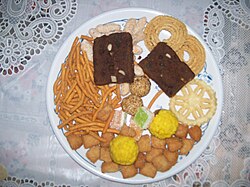
.jpg)
Coconut and curry leaves are common ingredients to most curries.[6] Sanna-Dukra Maas (Sanna – idli fluffed with toddy or yeast; Dukra Maas – Pork) is one of the most popular dish of the Mangalorean Catholic community.[7] Rosachi Kadi (Ros Curry), a fish curry made with coconut milk (ros), is a traditional curry served during the Ros ceremony.[8] Patrode, a dish of colocasia leaves stuffed with rice, dal, jaggery, coconut, and spices is also popular.[9] Kuswar are sweet delicacies prepared during Christmas and includes around 22 varieties of sweets.[10] Fish and rice form the staple diet of most Mangalorean Catholics.[11] Par-boiled rice, also known as red rice, is the traditional rice eaten[12] and preferred over raw rice.[11]
Names and surnames[edit | edit source]
Bilingual names, having variants in both Konkani and English, like Zuãuñ (John) and Mornel (Magdalene) are common among Mangalorean Catholics.[13][14] Most Mangalorean Catholic names for males follow the second declension. Among women, the names follow the first declension, while among young girls, the names follow the second declension.[13] The Mangalorean Catholic variant of many first names is the Mangalorean Catholic Konkani version of its Portuguese counterpart which was borrowed from the Portuguese language (examples include Zâbel from the Portuguese Isabel, Zuãuñ from the Portuguese João, Pedru from the Portuguese Pedro, and Zoze from the Portuguese José). Portuguese surnames like D'Souza and Pinto are abundant among Mangalorean Catholics, and generally follow the second declension.[15] Some families use their original Goud Saraswat Brahmin surnames such as Prabhu, Kamat, Pai, and Shenoy. Other European surnames are also found.[15]
| Mangalorean Catholic variant | English variant | Portuguese variant | Meaning | Sex |
|---|---|---|---|---|
| Mâri | Mary | Maria | Beloved | Female |
| Monku | Monica | Mónica | To advise | Female |
| Motes | Matthew | Mateus | Gift from God | Male |
| Nâtu | Natalia | Natalia | Birthday | Female |
| Pedru | Peter | Pedro | Stone | Male |
| Šila | Sylvester | Silas | Wooded | Male |
| Zâbel | Elizabeth | Isabel | My God is my oath | Female |
| Zoze | Joseph | José | The Lord will add | Male |
| Sources: English-Konkani Dictionary (2001)[14] and A Konkani Grammar (2003)[13] | ||||
Language and literature[edit | edit source]

Mangalorean Catholics speak the Konkani language, which they retained as their mother tongue despite the migration. The Konkani language is central to the community's identity. Konkani is an Indo-Aryan language belonging to the Indo-European family of languages, which is spoken predominantly on the west coast of India.[16] They speak a dialect of Konkani, known as Mangalorean Catholic Konkani, which the Ethnologue identifies as the Mangalore dialect.[17] It is largely derived from the Bardeskaar (North Goan) dialect and bears a good degree of intelligibility with the modern Bardeskaar Christian dialect and to a slightly lesser extent with the standard Konkani dialect. This dialect has a significant infusion of Tulu and Kannada loanwords. Some Kannada root words which have disappeared from the Goan dialects due to the influence of Portuguese have re-entered the Mangalorean Canara language lexicon. It is significantly different from the dialect spoken by the Goud Saraswat Brahmins in South Canara.[18] The Mangalorean Catholic dialect is much closer to the Goan Bardezi dialect.[19] 350–400 Portuguese lexical items are found in the Mangalorean Catholic dialect.[20]
The origin of their literature dates to 1883, when Angelus Francis Xavier Maffei, an Italian Jesuit, published the first English-Konkani Dictionary in Mangalore.[21] In 1912, the first Konkani periodical, Konknni Dirvem (Konkani Treasure), was published in Mangalore by Louis Mascarenhas.[22] Popular Konkani periodicals published in Mangalore include Raknno (1938) by Mons Sylvester Menezes,[23] Konkan Daiz (Heritage of Konkani) (1958),[24] and Kannik (Donation) (1965) by Raymond Miranda.[25] In Bombay, periodicals like Sukh-Dukh (1948) by G.M.B. Rodrigues, Konknni Yuvak (1949) by George Fernandes, Poinnari (1950) by V.J.P. Saldanha, and Divo (1995) by J.B. Moraes were published.[26] Modern literature is diverse and includes themes such as Indian Politics in books like What Ails the Socialists by George Fernandes, historical awakening, in books such as Sarasvati's Children: A History of the Mangalorean Christians by Alan Machado Prabhu,[27] and sexual desires, in The Revised Kama Sutra: A Novel of Colonialism and Desire by Richard Crasta.[28]
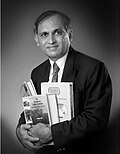
The Mangalorean genealogist Michael Lobo published the first genealogical Encyclopaedia of the Mangalorean Catholic community in 1999. This genealogical Encyclopaedia, currently exceeding 6000 pages, covers over a thousand families, each of which is researched as far as its ancestry can be traced. Three offshoots have thus far been launched, which include Mangaloreans Worldwide — An International Directory (1999), Distinguished Mangalorean Catholics (2000), and The Mangalorean Catholic Community — A Professional History / Directory (2002).[29] In 2000, the Diocese of Mangalore released the first Konkani Bible in Kannada script, which was made available online on 26 July 2007.[30]
Traditions and festivals[edit | edit source]

Roman Catholic traditions include the Sakrament (Seven Sacraments) and include Povitr-Snan (Baptism), Thiravnni (Confirmation), Krist-Prasad (Eucharist), Prachit (Penance), Piddestanchi Makhnni (Anointing of the Sick), Iazokanchi Sonskornni (Holy Orders) and Logn (Matrimony).[31]
Mangalorean Catholics have retained many Indian customs and traditions and reveal their existence especially during the celebration of a marriage.[32] Their culture is more traditional and Indian.[citation needed] Though the Portuguese traded quite frequently in Mangalore, and most of the priests arriving in the region were Portuguese, there did not develop a community identified with Portugal and Portuguese culture.[citation needed] They have no uniform rituals since they belong to both the patrilineal Brahmin stock and to the matrilineal non-Brahmin stock.[33] It were mainly these Pagan marriage rites which the Portuguese during the Goan Inquisition found objectionable and prohibited it in a Manual of Rules and Regulations of the Holy Office of the Inquisition in the Kingdoms of Portugal, published in 1640 by Bishop D. Franciscode Castro.[34]
Ros (anointing) ceremony, conducted one or two days before a wedding, celebrates the last day of virginity of the bride and bridegroom and involves the parents' blessing of the bride and groom, who are anointed with ros, a mixture of coconut milk and coconut oil, while a cross is inscribed on the bride's forehead.[35][36] Later, it is followed by the Resper (Nuptial Blessing in Church)[37] and finally the Vordik[e] (wedding) and Voran (wedding party).[38] Other traditions include Soirik or Sairikecho Malo (betrothal),[39][40] Voulik (wedding invitation)[38] and exchange of Paan Pod or Bido[a] (betel leaves) during marriage ceremonies,[41] which was called badalchen (changing hands).[b][39] Indian traditions include adorning the bride with the Sado (wedding sari)[42] and Pirduk[d] (wedding necklace),[42] the wearing of which indicates her Ayaponn (destiny),[43] the Onpnni or Opsun divnchen (giving away the bride formally by the father or the guardian of the bride),[44] Porthoponn (re-invitation to the bride's house),[44] and singing of Honvious (hymns).[39] Some other traditions include Novemjeevon (partaking of the food prepared from new corn) and Novem (blessing of new harvests).[39]
.jpg)
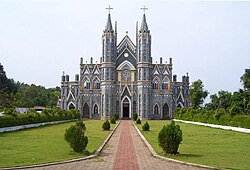
In addition to common Christian festivals like Christmas, Good Friday, and Easter, the community celebrates many other festivals of religious and historical significance. Monti Fest is one of the major festivals, celebrated on 8 September. It combines the Nativity of the Blessed Virgin Mary and blessing of Novem (new crops). The festival derives its name from the Monte Mariano Church at Farangipet in South Canara, and was initiated by Joachim Miranda, a Goan Catholic priest at Farangipet in 1763. Though Tipu Sultan destroyed the churches of Canara, he spared Monte Mariano Church in deference to the friendship of his father Hyder Ali with Father Miranda.[45] Attur Jatre or Attur Fest (Attur festival) is the feast of St. Lawrence, celebrated in the St. Lawrence Shrine on the outskirts of Karkala in South Canara. This shrine, in existence since 1759, is said to have a history of miracles. Eucharistic Procession (Evkaristik Purshanv in Konkani) is an annual religious procession led by the Bishop of Mangalore from Milagres Church to Rosario Cathedral. The procession, held on the first Sunday of the New Year of the Gregorian calendar, seeks blessings for the new year.[7]
Costumes and Ornaments[edit | edit source]

Mangalorean Catholic men used to wear white or black coats (similar to the bandhgala) with buttons. The turbans were usually flattened like the Coorgi turbans (urmal).[46] The urmal is a long white piece of cloth with a golden hem and is tied around the head like a turban.[46] In modern times, this mode has changed. Only a few old men can be seen wearing this traditional dress on church going occasions.[47] Before marriage, women used to wear white skirts over which sarees and blouses were worn. The dress was a sign of her virginity and she wore it on the day of ros or roce ceremony.[46][48][49] Gold ornaments in those days were absent. Married women used to wear sarees the general way.[49]
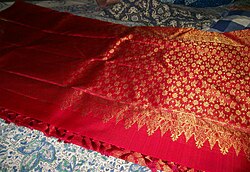
The Mangalorean Catholic bride's sari is known as a sado.[50] It is usually a red coloured Benaresi sari, which are made of finely woven silk and are decorated with elaborate engravings.[42] The bride is also presented with another sari by her own people which is called dharma sado, which was worn on other festive occasions. Some brides also wear a white sari during the nuptial blessing in church.[citation needed] Ornaments worn by the bride in ancient times included kanti, chakrasar, kap, karap, mugud, kanto, and dantoni.[48] Except datoni none of these ornaments are in use in the modern generation.[48] Present-day brides wear a few gold ornaments, some rings on the fingers, earrings and at least two of the golden combs known as dantoni that consisted of two ordinary combs and the upper part of each one was plate with gold, that are worn in the hair on both sides of the headover the ears. On the way to church she wears some white and red flowers stuck in the hair. In the centre of the forehead, a bang (gold chain) was placed with a pendant.[51] A widow had to wear a black sari all her life, and was not allowed to wear ornaments.[32]
Two more combs were worn by the bride, with a figure of a fish in gold inserted in each comb and were therefore called masli (fish). The hair is well combed and parted in the middle of the forehead. This fashion is strictly observed. A girl parting her hair in any other manner was regarded a loose girl. In the centre of the forehead where the hair is parted, a gold chain was placed with a pendant. This chain was called bang. None of these ornaments are worn on ordinary days.[50] Every bride formerly wore three pairs of gold bangles; in addition she wore bangles of red glass.[51]
The bridegroom's dress in the early times consisted of a breechcloth (dhoti), a shawl to cover his shoulders and a red handkerchief on the head (leis). The groom's dress was gradually improved. Later, his dress consisted of a white or yellow breechcloth (dhoti) with a red and gold hem (todop), and a coat (kutav) and a towel on the head.[46][48] The bridegroom wore a chakrasar (neck chain) around his neck. He wore a pair of sandals or at least a pair of socks.[52] Nowadays, most Mangalorean Catholic couples have a White wedding, where in the groom typically wears a black suit, while the bride wears a white dress.[53]
Historical Society[edit | edit source]

Mangalorean Catholics had retained the same caste system which their ancestors had in Goa. They were divided into four castes — Bāmaṇs, Charodis, Shudras, and Gaudis. The Bāmaṇs (the Konkani word for Brahmins) were converts from the Brahmin caste (priestly class), and especially included the Saraswat Brahmin converts from Goa. The Charodis, the largest group, were converts from the Kshatriya (warrior class) and Vaishya (merchant class) castes. The artisan converts formed the third biggest group and were known as Shudras (labour class). The converts from the fisher-caste residing around Ullal, Kuloor and other places around the sea coast were called Gaudis, and formed the fourth group.[54] Other minor castes, included the Padvals, who the historian Severine Silva, in his book "The Marriage Customs of the Christians in South Canara, India", assumes to be local Jain converts.[33]

It was difficult for the few priests who had accompanied the Christian emigrants to South Canara to look after them properly. Thus, the gurkar system came into existence. Gurkars were Mangalorean Catholic men of good moral character who were selected as headmen in Christian settlements. They were entrusted the work of social and religious supervision of the community.[55] After migration, the only possible occupation of a Mangalorean Catholic was agriculture, since they were skilled farmers.[54] Every farmer practised carpentry but it was quite primitive and unskilled. Other crafts and industries were non-existent.[56] By the later half of the 19th century Mangalorean Catholics were involved in the Mangalore tile industry, Coffee plantations and trade in plantation products. The mass was celebrated in Latin; but the sermon, the cathecism, and the explication of the mysteries were delivered to the congregation in Konkani.[57]
A widow had to remain indoors practically for the rest of her life. Canon Law did allow remarriage for widows and therefore there was no direct prohibition for widows to remarry in the society of the Christians of South Canara, but few women had the courage to go against the strict conventions of their community. A widow who remarried was looked down upon, pitied and shunned as unlucky. But she was not ill-treated or made an outcast. No stigma was attached to her husband.[32]
Songs and music[edit | edit source]

On 26–27 January 2008, a Konkani cultural event, Konkani Nirantari, held in Mangalore by a Mangalorean Catholic organisation, Mandd Sobhann, entered the Guinness Book of World Records for non-stop singing of Konkani hymns. Mandd Sobhann members sang for 40 hours, surpassing the old record of 36 hours held by a Brazilian musical troupe, Communidade Evangelica Luterana São Paulo (Lutheran Evangelical Community of São Paulo) of Universidade Luterana do Brasil (Lutheran University of Brazil).[58] The Silver Band, started in 1906 by Lawrence D'Souza in Mangalore, is one of the oldest and most popular brass bands in Mangalore.[59] The well known Konkani hymn Riglo Jezu Molliant (Jesus entered the Garden of Gethsemene) was written by Joachim Miranda, a Goan Catholic priest, during the 18th century, when he was held captive by Tippu Sultan, on his Canara mission.[60] Other popular Konkani hymns composed by Mangalorean Catholics are Aika Cristanv Jana, Utha Utha Praniya, and Sorgim Thaun.[61] The ghumat was a popular musical instrument played especially during weddings.[62] The instrument has the form of an earthen pot but is open at both sides. One end is covered with the skin of some wild animal, and the other is left open.[63] The tradition of voviyos (wedding songs), sung by women during a Ros, is important to this community. The procedure is that one of the elderly lady, usually the yejman (wife of the master of ceremonies, who is known as yejmani) who knows the voviyos leads the song while the rest of the women sing along with her. Only women whose husbands are still living may sing. In ancient times the wedding songs expressed very lofty sentiments and gave vent to the feelings of the people about the marriage partners and their families, invoking the blessing of God on them.[64]
Goiam thaun aili mai, Ruzai Saibin,
There came a Mother from Goa, Our Lady (Queen) of the Rosary, Meklya kesanim mai, Dev li somdirak
Adorned with long lovely hair, She made her abode here (in South Canara).— Folk song taken "Bardesachi Sima" (boundary of Bardez) from The Marriage customs of the Christians in South Canara, India by Severine Silva and Stephen Fuchs, [65]
Aprosachi vatli, kasgran petli, ruzai mai betli, hea rosalagim.
The Ros brass plate is made by brass smith, our Lady of Rosary is here at this ros ceremonyDimbi ami galeam, santa kuru kadeam, kurpa ami magieam amchea Jezulagim
Let us kneel, make sign of the cross, and pray for God's graceAkashim mod, narl kubear telacho kuris hokleachea kopalar
Clouds in the sky, coconut on the tree, oily sign of cross on the forehead of the bride— Voviyos taken from The Tradition of Voviyo article by Maurice D’Mello[66]
Notes[edit | edit source]
- ↑ 1.0 1.1 Babu, Savitha Suresh (17 February 2007). "Tiles for style". The Hindu. Archived from the original on 10 January 2009. Retrieved 5 April 2008.
- ↑ Somerset, Bond & Wright, p. 511
- ↑ Giriappa 1994, p. 62
- ↑ Somerset, Bond & Wright, p. 510
- ↑ South Kanara District Gazetteer 1973, p. 118
- ↑ "Typically home". The Hindu. 11 August 2007. Archived from the original on 3 November 2012. Retrieved 9 July 2008.
- ↑ 7.0 7.1 Stephen D'Souza. "What's in a Name?". Daijiworld Media Pvt Ltd Mangalore. Archived from the original on 8 February 2012. Retrieved 4 March 2008.
- ↑ Arun Bhatia (17 June 2002). "Anyone for shark curry?". The Hindu. Archived from the original on 22 August 2009. Retrieved 26 October 2008.
- ↑ Sen 2004, p. 110
- ↑ "Santa, cakes and kuswar". The Hindu. 25 November 2006. Archived from the original on 10 September 2009. Retrieved 29 August 2008.
- ↑ 11.0 11.1 South Kanara District Gazetteer 1973, p. 121
- ↑ "Taste of Mangalore". The Hindu. 17 June 2002. Archived from the original on 21 August 2002. Retrieved 3 November 2008.
- ↑ 13.0 13.1 13.2 Maffei 2003, p. 38
- ↑ 14.0 14.1 Maffei 2001, p. 541
- ↑ 15.0 15.1 Maffei 2003, p. 39
- ↑ Caroline V Menezescaroline Menezescaroline. "The question of Konkbani?" (PDF). The National Institute for Japanese language (Tokyo, Japan). Archived from the original (PDF) on 8 April 2008. Retrieved 10 February 2008.
- ↑ "Ethnologue report for Konkani, Goan (ISO 639-3: gom)". Ethnologue. Retrieved 25 September 2008.
- ↑ Asiatic Society of Bombay, Royal Asiatic Society of Great Britain & Ireland Bombay Branch 1853, p. 300,
- ↑ Kelley, Dimock & Kachru 1992, p. 219
- ↑ Abbi, Gupta & Kidwai 1997, p. 53
- ↑ Nagesh Prabhu (2 February 2007). "New English-Konkani dictionary ready". The Hindu. Archived from the original on 20 September 2007. Retrieved 7 September 2008.
- ↑ Melka Miyar. "Rich Tributes Paid to Pioneer Konkani Poet Louis Mascarenhas". Daijiworld Media Pvt Ltd Mangalore. Retrieved 1 March 2008.
- ↑ George 1992, p. 216
- ↑ Saradesāya 2000, p. 288
- ↑ Saradesāya 2000, p. 289
- ↑ "Konkani Language and Literature". Goa Konkani Akademi. Archived from the original on 28 August 2008. Retrieved 14 September 2008.
- ↑ Frederick Noronha (29 April 2008). "Migration, Myths And Mangalore: A Writer Pieces Together The Story". South Asia Religious News. Archived from the original on 21 July 2011. Retrieved 28 February 2009.
- ↑ "The Revised Kama Sutra". RichardCrasta.com. Archived from the original on 30 September 2008. Retrieved 14 September 2008.
- ↑ Richie Lasrado. "Dr. Michael Lobo: Probing family roots and history". Daijiworld Media Pvt Ltd Mangalore. Retrieved 20 October 2008.
- ↑ "Entire Konkani Bible is available online". Indian Catholic. 27 July 2007. Retrieved 3 November 2008.[dead link]
- ↑ Ancy Paladka. "40 Mangalorean Catholic Konkani prayers in Roman Script". Konkani Sahitya Kala Foundation. Archived from the original on 24 October 2009. Retrieved 22 June 2009.
- ↑ 32.0 32.1 32.2 Silva & Fuchs 1965, p. 52
- ↑ 33.0 33.1 Silva & Fuchs 1965, p. 7
- ↑ Silva & Fuchs 1965, p. 12
- ↑ D'Sa 1972, p. 79
- ↑ Silva & Fuchs 1965, p. 25
- ↑ D'Sa 1972, p. 82
- ↑ 38.0 38.1 Silva & Fuchs 1965, p. 10
- ↑ 39.0 39.1 39.2 39.3 Saradesāya 2000, p. 73
- ↑ D'Sa 1972, p. 73
- ↑ Silva & Fuchs 1965, p. 18
- ↑ 42.0 42.1 42.2 Silva & Fuchs 1965, p. 19
- ↑ Saradesāya 2000, p. 74
- ↑ 44.0 44.1 D'Sa 1972, p. 86
- ↑ John B. Monteiro. "Monti Fest Originated at Farangipet – 240 Years Ago!". Daijiworld Media Pvt Ltd Mangalore. Archived from the original on 25 January 2008. Retrieved 15 January 2008.
- ↑ 46.0 46.1 46.2 46.3 Silva & Fuchs 1965, p. 31
- ↑ South Kanara District Gazetteer 1973, p. 119
- ↑ 48.0 48.1 48.2 48.3 D'Sa. 1972, p. 77
- ↑ 49.0 49.1 South Kanara District Gazetteer 1973, p. 120
- ↑ 50.0 50.1 Silva & Fuchs 1965, p. 32
- ↑ 51.0 51.1 Silva & Fuchs 1965, p. 21
- ↑ D'Sa 1972, p. 78
- ↑ D'Souza, Anil (27 January 2009). "Weddings then, now and in Future..." Daijiworld Media Pvt Ltd Mangalore. Archived from the original on 1 April 2009. Retrieved 20 June 2009.
- ↑ 54.0 54.1 Silva & Fuchs 1965, p. 5
- ↑ Silva & Fuchs 1965, p. 9
- ↑ Silva & Fuchs 1965, p. 16
- ↑ The Oriental Herald 1824, p. 17
- ↑ "Mangalore: Guinness Adjudicator Hopeful of Certifying Konkani Nirantari". Daijiworld Media Pvt Ltd Mangalore. 25 January 2008. Retrieved 1 February 2008.
- ↑ M. Raghuram (10 December 2005). "Golden notes from Silver Band". The Hindu. Archived from the original on 29 January 2009. Retrieved 14 September 2008.
- ↑ Ayyappapanicker 1997, p. 277
- ↑ Saradesāya 2000, p. 251
- ↑ Silva & Fuchs 1965, p. 47
- ↑ Naimpalli 2005, p. 18
- ↑ Silva & Fuchs 1965, p. 26
- ↑ Silva & Fuchs 1965, p. 8
- ↑ Maurice D’Mello. "The Tradition of Voviyo". Konkani Sahitya Kala Foundation. Archived from the original (DOC, 77 KB) on 13 July 2011. Retrieved 12 March 2008.
References[edit | edit source]
- Anvita Abbi; R. S. Gupta; Ayesha Kidwai (1 January 2001). Linguistic Structure and Language Dynamics in South Asia: Papers from the Proceedings of SALA XVIII Roundtable. Motilal Banarsidass Publications. ISBN 978-81-208-1765-4. Retrieved 22 January 2009.
- Asiatic Society of Bombay; Royal Asiatic Society of Great Britain, Ireland Bombay Branch (1853). Journal of the Asiatic Society of Bombay. Vol. 4. Bombay Education Society's Press. ISBN 1-150-56345-1. Retrieved 20 September 2008.
- Ayyappapanicker, K.; Akademi, Sahitya (1997). Medieval Indian Literature: An Anthology. Sahitya Akademi. ISBN 81-260-0365-0. Retrieved 20 September 2008.
- Baptista, Elsie Wilhelmina (1967). The East Indians: Catholic Community of Bombay, Salsette and Bassein. Bombay East Indian Association.
- Bowring, Lewin B. (1893). Haidar Ali and Tipu Sultan and the Struggle with the Musalman Powers of the South. IDARAH-I ADABIYAT-I DELLI. ISBN 978-81-206-1299-0. Archived from the original on 17 August 2011. Retrieved 20 May 2011.
- Buchanan, Francis (1988) [1807]. A Journey from Madras Through the Countries of Mysore, Canara, and Malabar: For the Express Purpose of Investigating the State of Agriculture, Arts and Commerce, the Religion, Manners, and Customs, the History Natural and Civil, and Antiquities. Asian Educational Services. ISBN 81-206-0386-9. Retrieved 4 September 2008.
- Pious Society of St. Paul; Catholic Church Bishops' Conference of India (1972). The Catholic Directory for India (PDF). St. Paul Publications. Archived from the original (PDF) on 22 July 2011. Retrieved 25 May 2009.
- D'Souza, Edwin J. F. (2004). V.J.P. Saldanha (Makers of Indian literature). Sahitya Akademi. ISBN 978-81-260-2028-7.
- Farias, Kranti K. (1999). The Christian Impact on South Kanara. Church History Association of India.
- Forrest, George W. (1887). Selections from the Letters, Despatches, and Other State Papers Preserved in the Bombay Secretariat. Vol. 2. Bombay: Government Central Press.
- George, K. M. (1992). Modern Indian Literature, an Anthology: An Anthology: Surveys and Poems. Vol. I. Sahitya Akademi. ISBN 978-81-7201-324-0.
- Giriappa, S. (1 January 1994). Rural Industrialisation in Backward Areas. Daya books. ISBN 81-7035-125-1. Retrieved 31 January 2009.
- Gupta, Anirudha (1991). Minorities on India's West Coast: History & Society. Kalinga Publications. ISBN 81-85163-22-7.
- Heras Institute of Indian History and Culture (1983). Indica. Vol. 20. St. Xavier's College (Bombay).
- Hunter, William Wilson; James Sutherland Cotton; Richard Burn; William Stevenson Meyer; Great Britain India Office (1909). The Imperial Gazetteer of India. Clarendon Press. Retrieved 7 January 2009.
- James Scurry; William Whiteway (1824). The Captivity, Sufferings, and Escape of James Scurry, who was Detained a Prisoner During Ten Years, in the Dominions of Hyder Ali and Tippoo Saib. H. Fisher. Retrieved 18 January 2009.
- Catalini, Jordanus; Henry Yule (17 August 2001). Mirabilia Descripta: The Wonders of the East. Adamant Media Corporation. ISBN 1-4021-9555-9. Retrieved 8 July 2008.
- Kelley, Gerald B.; Edward C. Dimock; Braj B. Kachru (1992). Dimensions of Sociolinguistics in South Asia: Papers in Memory of Gerald B. Kelley. Oxford & IBH Pub. Co. ISBN 978-81-204-0573-8.
- Kurzon, Dennis (2004). Where East Looks West: Success in English in Goa and on the Konkan Coast. Multilingual Matters. ISBN 1-85359-673-6. Retrieved 5 December 2008.
- Lobo, Michael (1999). Mangaloreans World-wide: An International Directory of the Mangalorean Catholic Community. Camelot Publishers. ISBN 81-87609-00-1.
- Maffei, Angelus Francis Xavier (14 September 2003). A Konkani Grammar. Mangalore: Asian Educational Services. ISBN 978-81-206-0087-4. Retrieved 22 January 2009.
- Maffei, Angelus Francis Xavier (1990) [1883]. English-konkani Dictionary. Mangalore: Asian Educational Services. ISBN 81-206-0626-4. Retrieved 24 August 2008.
- Naimpalli, Sadanand (2005). Theory and Practice of Tabla. Popular Prakashan. ISBN 81-7991-149-7. Retrieved 15 September 2008.
- Nair, P. Thankappan (2004). South Indians in Kolkata: History of Kannadigas, Konkanis, Malayalees, Tamilians, Telugus, South Indian Dishes, and Tippoo Sultan's Heirs in Calcutta. Punthi Pustak. ISBN 81-86791-50-7.
- Oddie, Geoffrey A. (1991). Hindu and Christian in South-east India: Aspects of Religious Continuity and Change, 1800–1900. Routledge. ISBN 978-0-913215-55-5. Retrieved 15 October 2008.
- Oddie, Geoffrey A. (1991). Religion in South Asia: Religious Conversion and Revival Movements in South Asia in Medieval and Modern Times. Manohar. ISBN 0-7007-0103-6.
- Pai, C. C. A.; Supriya (1981). Konknni Huminnyom (Konkani Riddles): an Anthropological Analysis of the Konkany Riddles of Mangalore Catholics. Satabdi Prakasan.
- Prabhu, Alan Machado (1999). Sarasvati's Children: A History of the Mangalorean Christians. I.J.A. Publications. ISBN 978-81-86778-25-8.
- Royal Geographical Society (Great Britain) (1856). A Gazetteer of the World: Or, Dictionary of Geographical Knowledge, Compiled from the Most Recent Authorities, and Forming a Complete Body of Modern Geography — Physical, Political, Statistical, Historical, and Ethnographical. A. Fullarton. Retrieved 20 January 2009.
- Saradesāya, Manohararāya (1 January 2000). A History of Konkani Literature: From 1500 to 1992. Sahitya Akademi. ISBN 81-7201-664-6.
- Sen, Colleen Taylor (2004). Food Culture in India. Greenwood Publishing Group. ISBN 0-313-32487-5. Retrieved 29 August 2008.
- Silva, Severine; Stephen Fuchs (1965). "The Marriage Customs of the Christians in South Canara, India" (PDF). 2. 24. Asian Folklore Studies, Nanzan University (Japan). Retrieved 8 July 2008.
{{cite journal}}: Cite journal requires|journal=(help)[permanent dead link] - D'Sa, Victor (1972). "The Marriage Customs of the Christians in South Canara (India)" (PDF). 1. 31. Asian Folklore Studies, Nanzan University (Japan): 71–87. Archived from the original (PDF) on 22 July 2011. Retrieved 5 June 2009.
{{cite journal}}: Cite journal requires|journal=(help) - Silva, Severine (1957). History of Christianity in Canara. Vol. I. Coompta, North Canara: Star of Kanara Press.
- Somerset, Playne; Bond, E. W.; Wright, Arnold; Wright, Playne (2004). Southern India: Its History, People, Commerce, and Industrial Resources. Asian Educational Services. ISBN 81-206-1344-9. Retrieved 18 June 2008.
- "History" (PDF). South Kanara District Gazetteer. Karnataka State Gazetteer. Vol. 12. Gazetteer Department (Government of Karnataka). 1973. pp. 33–85. Retrieved 27 October 2008.
- "People" (PDF). South Kanara District Gazetteer. Karnataka State Gazetteer. Vol. 12. Gazetteer Department (Government of Karnataka). 1973. pp. 86–125. Retrieved 26 October 2008.
- Wellesley, Arthur (Arthur Wellesley Wellington); John Gurwood (1834). The dispatches of Field Marshal the Duke of Wellington, during his various campaigns in India, Denmark, Portugal, Spain, the Low Countries, and France, from 1799 to 1818. Vol. 1 (New ed.). London, Great Britain: John Murray. Retrieved 1 July 2009.
compiled from official and authentic documents by Lieutenant Colonel Gurwood
- The Gentleman's Magazine. Vol. CIII. F. Jefferies. 1833. Retrieved 15 October 2008.
- The Oriental Herald. Vol. 3. s.n. 1824. Retrieved 15 October 2008.