


>Bahnfrend Fix |
No edit summary |
||
| Line 1: | Line 1: | ||
{{Short description|Class of 755 Indian 4-6-2 locomotives}} | |||
{{More citations needed|date=December 2024}} | |||
{{Infobox locomotive | {{Infobox locomotive | ||
| name | | name = Indian WP | ||
| powertype | | powertype = Steam | ||
| image | | image = 682 IndiaDelhiMuseum 19931226.jpg | ||
| alt | | alt = WP/P class no. 7200 at the National Rail Museum, New Delhi, in 1993 | ||
| caption | | caption = [[Baldwin Locomotive Works|Baldwin]]-built WP/P class no. 7200 from 1947, at the [[National Rail Museum, New Delhi]], in 1993 | ||
| designer | | designer = | ||
| builder | | builder = {{flag icon|USA}} [[Baldwin Locomotive Works]] (116)<br />{{flag icon|Canada|1957}} [[Canadian Locomotive Company]] (200)<br />{{flag icon|Canada|1957}} [[Montreal Locomotive Works]] (120)<br />{{flag icon|Poland}} [[Fablok]], (30)<br />{{flag icon|Austria}} [[Lokomotivfabrik Floridsdorf]] (30)<br />{{flag icon|India}} [[Chittaranjan Locomotive Works]] (259) | ||
| ordernumber | | ordernumber = | ||
| serialnumber | | serialnumber = | ||
| buildmodel | | buildmodel = | ||
| builddate | | builddate = 1947–1967 | ||
| totalproduction | | totalproduction = 755 | ||
| rebuilder | | rebuilder = | ||
| rebuilddate | | rebuilddate = | ||
| numberrebuilt | | numberrebuilt = | ||
| whytetype | | whytetype = [[4-6-2]] | ||
| uicclass | | uicclass = 2′C1′ h2 | ||
| gauge | | gauge = {{RailGauge|5ft6in|lk=on}} | ||
| leadingdiameter | | leadingdiameter = {{convert|3|ft|7|in|m|3|abbr=on}} | ||
| driverdiameter | | driverdiameter = {{convert|5|ft|7|in|m|3|abbr=on}} | ||
| trailingdiameter = {{convert|3|ft|7|in|m|3|abbr=on}} | | trailingdiameter = {{convert|3|ft|7|in|m|3|abbr=on}} | ||
| minimumcurve | | minimumcurve = | ||
| wheelbase | | wheelbase = | ||
| length | | length = {{convert|77|ft|5+3/8|in|m|2|abbr=on}} over [[Buffer (rail transport)|buffers]] | ||
| width | | width = | ||
| height | | height = | ||
| axleload | | axleload = {{convert|18.5|LT|t ST}} | ||
| weightondrivers | | weightondrivers = | ||
| locoweight | | locoweight = {{convert|101.5|LT|t ST}} | ||
| tenderweight | | tenderweight = {{convert|72.0|LT|t ST}} | ||
| locotenderweight = | | locotenderweight = | ||
| tendertype | | tendertype = | ||
| fueltype | | fueltype = [[Coal]] | ||
| fuelcap | | fuelcap = {{convert|15|LT|t ST}} | ||
| watercap | | watercap = {{convert|5500|impgal|abbr=on}} | ||
| sandcap | | sandcap = | ||
| boiler | | boiler = | ||
| boilerpressure | | boilerpressure = {{convert|210|psi|MPa|2|abbr=on}} | ||
| feedwaterheater | | feedwaterheater = | ||
| firearea | | firearea = {{convert|46|sqft|m2|abbr=on}} | ||
| tubearea | | tubearea = | ||
| fluearea | | fluearea = | ||
| tubesandflues | | tubesandflues = | ||
| fireboxarea | | fireboxarea = | ||
| totalsurface | | totalsurface = {{convert|2920|sqft|m2|abbr=on}} | ||
| superheatertype | | superheatertype = | ||
| superheaterarea | | superheaterarea = | ||
| cylindercount | | cylindercount = Two, outside | ||
| cylindersize | | cylindersize = {{convert|20+1/4|x|28|in|mm|0|abbr=on}} | ||
| valvegear | | valvegear = [[Walschaerts valve gear|Walschaerts]] | ||
| valvetype | | valvetype = {{convert|12|in|mm|0|abbr=on}} [[Piston valve (steam engine)|piston valves]] | ||
| valvetravel | | valvetravel = {{convert|7+1/2|in|mm|0|abbr=on}} | ||
| valvelap | | valvelap = | ||
| valvelead | | valvelead = | ||
| transmission | | transmission = | ||
| maxspeed | | maxspeed = {{cvt|115|km/h|mph}} | ||
| poweroutput | | poweroutput = {{convert|2680|HP|kW|0|abbr=on}} drawbar (est.) at {{convert|74|mph|km/h|0|abbr=on}} | ||
| tractiveeffort | | tractiveeffort = {{convert|30600|lbf|kN|2|abbr=on}} | ||
| factorofadhesion = | | factorofadhesion = | ||
| trainheating | | trainheating = | ||
| locobrakes | | locobrakes = Originally vacuum, later modified to air | ||
| locobrakeforce | | locobrakeforce = | ||
| trainbrakes | | trainbrakes = Originally vacuum, later modified to air | ||
| safety | | safety = | ||
| operator | | operator = [[Indian Railways]] | ||
| operatorclass | | operatorclass = | ||
| powerclass | | powerclass = | ||
| numinclass | | numinclass = | ||
| fleetnumbers | | fleetnumbers = 7000–7754 | ||
| officialname | | officialname = | ||
| nicknames | | nicknames = | ||
| axleloadclass | | axleloadclass = | ||
| locale | | locale = India | ||
| deliverydate | | deliverydate = 1947 | ||
| firstrundate | | firstrundate = 1947 | ||
| lastrundate | | lastrundate = Late 1990s | ||
| retiredate | | retiredate = Late 1990s | ||
| withdrawndate | | withdrawndate = Late 1990s | ||
| preservedunits | | preservedunits = 9 | ||
| restoredate | | restoredate = | ||
| scrapdate | | scrapdate = | ||
| currentowner | | currentowner = | ||
| disposition | | disposition = 9 preserved, remainder [[scrap]]ped | ||
| notes | | notes = {{sfn|Sampson|1972|page=484}}{{sfn|Hughes|1979|page=24}}{{Additional citations needed|date=December 2024}} | ||
}} | }} | ||
The '''Indian locomotive class WP''' | The '''Indian locomotive class WP''' are a class of {{whyte|4-6-2}} "Pacific" passenger steam locomotives used in India introduced in 1947 for passenger services. The class were assigned the newly-implemented (and current) [[Locomotives of India#Classification|classification letter]] for broad gauge locomotives, ''W'' from the previously used ''X'', when the class and the post-war broad gauge locomotive designs for Indian railways it was part of were introduced. | ||
WP class locomotives were capable of going up to {{convert|110|km/h|mph|0|abbr=on}} and had bullet-nose casings fitted on their smokeboxes, which would often have a star painted on it. | |||
[[File:WP7200.jpg|thumb|WP no. 7200, New Delhi]] | |||
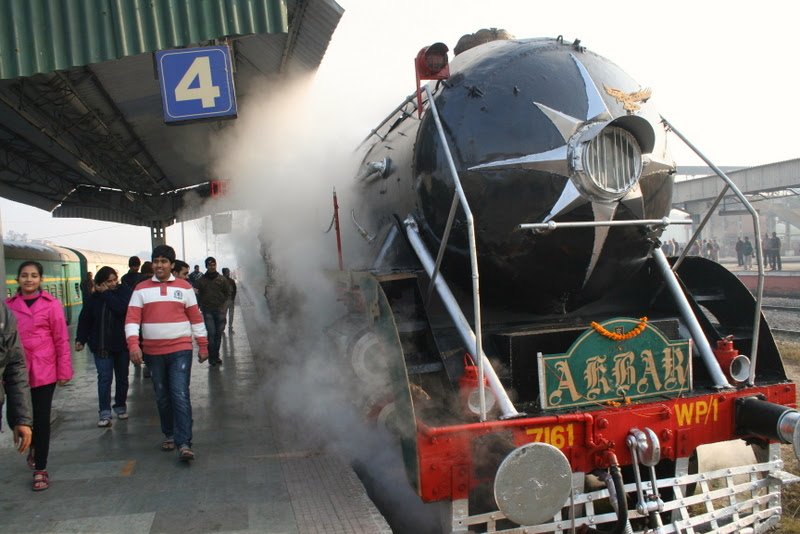
[[File:Steam Engine renamed Akbar.jpg|thumb|WP no. 7161, renamed ''Akbar'']] | |||
== History== | == History== | ||
[[File:Fablok_35lat_5000Lokomotyw_1959.JPG|thumb | [[File:Fablok_35lat_5000Lokomotyw_1959.JPG|thumb|alt=Fablok-built WPs in 1959|[[Fablok]]-built WPs in 1959]] | ||
A total of 755 WPs were built between 1947 and 1967, bearing fleet numbers 7000 to 7754. The first batch of sixteen, numbers 7200–7215, came from the [[Baldwin Locomotive Works]], USA in 1947, and these were classed WP/P | A total of 755 WPs were built between 1947 and 1967, bearing fleet numbers 7000 to 7754. The first batch of sixteen, numbers 7200–7215, came from the [[Baldwin Locomotive Works]], USA in 1947, and these were classed WP/P, with ''P'' for Prototype.{{sfn|Hughes|1979|pp=23-24}} | ||
A main production batch of 300 locomotives followed in 1949, with production split between Baldwin (100), [[Montreal Locomotive Works]] (120), and [[Canadian Locomotive Company]] (80). The locomotives in this group were numbered 7216–7515, but the running numbers were issued in blocks as the locomotives were issued to the pre-nationalisation companies, and so bore no relation to the manufacturers' serial numbers, or even the manufacturer.{{sfn|Hughes|1996|p=16}} | A main production batch of 300 locomotives followed in 1949, with production split between [[Baldwin Locomotive Works]] (100), [[Montreal Locomotive Works]] (120), and [[Canadian Locomotive Company]] (80). The locomotives in this group were numbered 7216–7515, but the running numbers were issued in blocks as the locomotives were issued to the pre-nationalisation companies, and so bore no relation to the manufacturers' serial numbers, or even the manufacturer.{{sfn|Hughes|1996|p=16}} | ||
A further 180 locomotives were built between 1955 and 1959, with production split between Canadian Locomotive Company (120), [[Fablok|Fabryka Lokomotyw]], of [[Chrzanów]], Poland (30), and [[Lokomotivfabrik Floridsdorf]] of [[Vienna]], Austria (30). | A further 180 locomotives were built between 1955 and 1959, with production split between [[Canadian Locomotive Company]] (120), [[Fablok|Fabryka Lokomotyw]], of [[Chrzanów]], Poland (30), and [[Lokomotivfabrik Floridsdorf]] of [[Vienna]], Austria (30).{{sfn|Hughes|1979|page=24}} | ||
Between 1963 and 1966, 259 more were built, but these were ordered from [[Chittaranjan Locomotive Works]] (CLW), and were manufactured in India, and classified WP/I.{{sfn|Hughes|1996|p=16}} The WP/Is were 5 tonnes heavier.{{citation needed|date=July 2011}} | Between 1963 and 1966, 259 more were built, but these were ordered from [[Chittaranjan Locomotive Works]] (CLW), and were manufactured in India, and classified WP/I.{{sfn|Hughes|1996|p=16}} The WP/Is were 5 tonnes heavier.{{citation needed|date=July 2011}} The first WP/I locomotive rolled out from [[Chittaranjan Locomotive Works]] (CLW) in February of 1963 and was named Vivenkananda.{{sfn|Hughes|1979|page=24}} | ||
{{clear left}} | {{clear left}} | ||
The WP was Indian | The WP was the Indian Railways' fastest locomotive in the 1960s and 1970s. Before the widespread introduction of diesel and electric locomotives, several prestigious trains, such as the [[Taj Express]], the [[Grand Trunk Express]], Howrah-Madras Mail, [[Frontier Mail]] and the Air-Conditioned Express were once hauled by WP class locomotives. | ||
The entire WP class remained in service into the 1980s. Several WPs remained in service until withdrawal 1990s. | |||
==Technical specifications== | ==Technical specifications== | ||
*Boiler: {{convert|5|ft|11|in|m|2|abbr=on}} diameter{{citation needed|date=July 2011}} | *Boiler: {{convert|5|ft|11|in|m|2|abbr=on}} diameter{{citation needed|date=July 2011}} | ||
*Heating | *Heating surface: {{convert|3082|sqft|m2|abbr=on}}{{citation needed|date=July 2011}} | ||
*Maximum | *Maximum train load: 680 tonnes{{citation needed|date=July 2011}} | ||
==Class table== | ==Class table== | ||
{| class=wikitable style=text-align:center | {| class="wikitable sortable" style=text-align:center | ||
|+ Table of orders and numbers | |+ Table of orders and numbers | ||
! Year !! Manufacturer !! Serial Nos. !! Qty !! First Nos. !! All-India Nos. !! Notes | ! Year !! Manufacturer !! Serial Nos. !! Qty !! First Nos. !! All-India Nos. !! Notes | ||
|- | |- | ||
| 1947 || Baldwin || 73408–73423 || 16 || — || 7200–7215 || Prototypes | | 1947 || [[Baldwin Locomotive Works|Baldwin]] || 73408–73423 || 16 || — || 7200–7215 || Prototypes | ||
|- | |||
| 1949 || [[Baldwin Locomotive Works|Baldwin]] || 74294–74393 || 100 || 1–100 || || In range 7216–7515 | |||
|- | |||
| 1949 || [[Canadian Locomotive Company|Canadian]] || 2544–2623 || 80 || C251–C330 || || In range 7216–7515 | |||
|- | |||
| 1949 || [[Montreal Locomotive Works|Montreal]] || 77200–77259<br />77345–74399<br />77576–77580 || 120 || M1–M120 || || In range 7216–7515 | |||
|- | |||
| 1955–56 || [[Canadian Locomotive Company|Canadian]] || 2730–2849 || 120 || — || 7516–7635 || | |||
|- | |||
| 1958–59 || [[Fablok]] || 4997–5006<br />5031–5050 || 30 || 3000–3029 || 7000–7029 || | |||
|- | |||
| 1957 || [[Lokomotivfabrik Floridsdorf|Floridsdorf]] || 17827–17856 || 30 || 3030–3059 || 7030–7059 || | |||
|- | |||
| 1963 || [[Chittaranjan Locomotive Works|Chittaranjan]] || — || 36 || — || 7060–7095 || 7060 named Vivenkananda | |||
|- | |||
| 1963–64 || [[Chittaranjan Locomotive Works|Chittaranjan]] || — || 50 || — || 7096–7145 || | |||
|- | |||
| 1964–65 || [[Chittaranjan Locomotive Works|Chittaranjan]] || — || 33 || — || 7146–7178 || | |||
|- | |- | ||
| | | 1965 || [[Chittaranjan Locomotive Works|Chittaranjan]] || — || 73 || — || 7179–7199<br />7636–7687 || | ||
|- | |- | ||
| | | 1966 || [[Chittaranjan Locomotive Works|Chittaranjan]] || — || 37 || — || 7688–7724 || | ||
|- | |- | ||
| | | 1966 || [[Chittaranjan Locomotive Works|Chittaranjan]] || — || 30 || — || 7725–7754 || | ||
|- | |- | ||
| | |} | ||
==Preservation== | |||
Nine WP class locomotives have been preserved. Among them, one built by Baldwin, number 7200, in 1947 and another by Fablok in 1959 are part of the collection of the [[National Rail Museum, New Delhi]].<ref>{{Cite web |url=http://www.irfca.org/~shankie/nrm/outdoor_page_2.htm |title=Pressing ahead with the outdoor exhibits |access-date=2014-05-27 |archive-url=https://web.archive.org/web/20160303220656/http://www.irfca.org/~shankie/nrm/outdoor_page_2.htm |archive-date=2016-03-03 |url-status=dead }}</ref> | |||
WP7200 received a complete overhaul at Amritsar works in April 2015 and is now kept at Rewari shed near New Delhi for excursion service. Apart from 7200, the remaining eight engines include 7278 constructed by Montreal Locomotive Works and preserved at Charbagh Loco Works, 7581 built by Canadian Locomotive Company is preserved at Sonepur DRM, 7656 built by Chittaranjan Locomotive Works is preserved at Jhansi Institute Railway, and 7000 built by Fablok is preserved in Bhusaval shed. | |||
7411 is preserved in Burdwan and awaiting transfer to the Chennai Museum. The engine is missing its builder's plates, thus its builder is not known, however, records indicating its 1949 allocation to the then still existing [[Great Indian Peninsula Railway]] (GIPR){{sfn|Hughes|1979|page=27}} suggest it is a product of one of the North American builders. 7015 built by Fablok is another Polish-built preserved WP and has been restored to full mainline running order and runs mainline heritage excursion special trains, being preserved at Rewari shed; 7161 is another locomotive built by Chittaranjan which has been fully restored to full working order on mainline excursions, being preserved at Siliguri. One additional engine is believed to be in existence; however, its details and whereabouts are not known. | |||
{|class=wikitable style=text-align:center | |||
! Working !! Class !! Number !! Location !! Built !! Zone !! Builders !! Build No !! Name | |||
|- | |- | ||
| | | Yes||WP/P||7200||Rewari Steam Shed||1947||NW||[[Baldwin Locomotive Works|Baldwin]]||73408||Shahanshah/Azad | ||
|- | |- | ||
| | | No||WP||7278||Charbagh Loco Works||1949||NR||[[Montreal Locomotive Works|Montreal]]|||| | ||
|- | |- | ||
| | | No||WP||7411||Burdwan Loco Shed||1949||ER||[[Baldwin Locomotive Works|Baldwin]]/[[Canadian Locomotive Company|Canadian]]/[[Montreal Locomotive Works|Montreal]]|||| | ||
|- | |- | ||
| | | No||WP||7581||DRM Office, Sonepur||1955||ECR||[[Canadian Locomotive Company|Canadian]]|||| | ||
|- | |- | ||
| | | No||WP||7000||Rewari Steam Shed||1958||CR||[[Fablok]]||4997||Shaktiman | ||
|- | |- | ||
| | | Yes||WP||7015||Rewari Steam Shed||1958||NW||[[Fablok]]||5036|| | ||
|- | |- | ||
| | | Yes||WP/I||7161||Rewari Steam Shed||1965||NW||[[Chittaranjan Locomotive Works|Chittaranjan]]||||Akbar | ||
|- | |- | ||
| | | No||WP/I||7656||Senior Institute, Jhansi||1968||NCR||[[Chittaranjan Locomotive Works|Chittaranjan]]|||| | ||
|- | |- | ||
| No||WP||7???||?||19??||?||Possibly [[Lokomotivfabrik Floridsdorf|Floridsdorf]]||?|| | |||
|} | |} | ||
==See also== | ==See also== | ||
* | *{{section link|Rail transport in India|History}} | ||
*[[Indian Railways]] | *[[Indian Railways]] | ||
*[[Locomotives of India]] | *[[Locomotives of India]] | ||
| Line 161: | Line 190: | ||
{{refbegin}} | {{refbegin}} | ||
*{{Hughes-SII}} | *{{Hughes-SII}} | ||
*{{Hughes-SteamLocosIndia3}} | |||
*{{Hughes-IndianLocos4}} | *{{Hughes-IndianLocos4}} | ||
*{{Marshall-IBGSR}} | *{{Marshall-IBGSR}} | ||
* {{cite book |last=Sampson |first=Henry |author-link= |date=1972 |title=Jane's World Railways, 1971-1972 |url=https://archive.org/details/janesworldrailwa00samp/mode/2up |location=London |publisher=Haymarket Publishing Group |page= |isbn= |url-access=registration |series=[[Janes World Railways]]|via=[[Internet Archive]]}}{{ISBN missing|date=December 2024}} | |||
{{refend}} | {{refend}} | ||
| Line 168: | Line 199: | ||
{{commons category}} | {{commons category}} | ||
*[http://www.irfca.org/faq/faq-loco-steam.html Indian steam locomotives] | *[http://www.irfca.org/faq/faq-loco-steam.html Indian steam locomotives] | ||
*[https://web.archive.org/web/20061113132424/http://www5.brinkster.com/sundar/WP.htm The WP class locomotive] | *[https://web.archive.org/web/20061113132424/http://www5.brinkster.com/sundar/WP.htm The WP class locomotive] (archived 13 November 2006) | ||
*[http://www.irfca.org/~shankie/wpglory/wpglorymain.htm The WP glory] | *[http://www.irfca.org/~shankie/wpglory/wpglorymain.htm The WP glory] | ||
*[http://www.railpictures.net/viewphoto.php?id=166940&PHPSESSID=a7584420f5875cb58a024a24bb27e65b Image of WP pacific in service] | *[http://www.railpictures.net/viewphoto.php?id=166940&PHPSESSID=a7584420f5875cb58a024a24bb27e65b Image of WP pacific in service] | ||
*[https://www.youtube.com/watch?v=HKnP10nc39A Video of preserved WP/P 7200] | *[https://www.youtube.com/watch?v=HKnP10nc39A Video of preserved WP/P 7200] on [[YouTube]] | ||
{{Broad gauge locomotives of India |state=collapsed}} | {{Broad gauge locomotives of India |state=collapsed}} | ||
| Line 184: | Line 215: | ||
[[Category:Steam locomotives of India|WP]] | [[Category:Steam locomotives of India|WP]] | ||
[[Category:4-6-2 locomotives]] | [[Category:4-6-2 locomotives]] | ||
[[Category:2′C1′ h2 locomotives]] | |||
[[Category:5 ft 6 in gauge locomotives]] | [[Category:5 ft 6 in gauge locomotives]] | ||
[[Category:Passenger locomotives]] | [[Category:Passenger locomotives]] | ||
Latest revision as of 01:31, 19 March 2026
 | This article needs additional citations for verification. (December 2024) |
| Indian WP | |||||||||||||||||||||||||||||||||||||||||||||||||||
|---|---|---|---|---|---|---|---|---|---|---|---|---|---|---|---|---|---|---|---|---|---|---|---|---|---|---|---|---|---|---|---|---|---|---|---|---|---|---|---|---|---|---|---|---|---|---|---|---|---|---|---|
 Baldwin-built WP/P class no. 7200 from 1947, at the National Rail Museum, New Delhi, in 1993 | |||||||||||||||||||||||||||||||||||||||||||||||||||
| |||||||||||||||||||||||||||||||||||||||||||||||||||
| |||||||||||||||||||||||||||||||||||||||||||||||||||
| |||||||||||||||||||||||||||||||||||||||||||||||||||
| |||||||||||||||||||||||||||||||||||||||||||||||||||
| [1][2]Template:Additional citations needed | |||||||||||||||||||||||||||||||||||||||||||||||||||




.svg)
The Indian locomotive class WP are a class of 4-6-2 "Pacific" passenger steam locomotives used in India introduced in 1947 for passenger services. The class were assigned the newly-implemented (and current) classification letter for broad gauge locomotives, W from the previously used X, when the class and the post-war broad gauge locomotive designs for Indian railways it was part of were introduced. WP class locomotives were capable of going up to 110 km/h (68 mph) and had bullet-nose casings fitted on their smokeboxes, which would often have a star painted on it.


History[edit | edit source]

A total of 755 WPs were built between 1947 and 1967, bearing fleet numbers 7000 to 7754. The first batch of sixteen, numbers 7200–7215, came from the Baldwin Locomotive Works, USA in 1947, and these were classed WP/P, with P for Prototype.[3]
A main production batch of 300 locomotives followed in 1949, with production split between Baldwin Locomotive Works (100), Montreal Locomotive Works (120), and Canadian Locomotive Company (80). The locomotives in this group were numbered 7216–7515, but the running numbers were issued in blocks as the locomotives were issued to the pre-nationalisation companies, and so bore no relation to the manufacturers' serial numbers, or even the manufacturer.[4]
A further 180 locomotives were built between 1955 and 1959, with production split between Canadian Locomotive Company (120), Fabryka Lokomotyw, of Chrzanów, Poland (30), and Lokomotivfabrik Floridsdorf of Vienna, Austria (30).[2]
Between 1963 and 1966, 259 more were built, but these were ordered from Chittaranjan Locomotive Works (CLW), and were manufactured in India, and classified WP/I.[4] The WP/Is were 5 tonnes heavier.[citation needed] The first WP/I locomotive rolled out from Chittaranjan Locomotive Works (CLW) in February of 1963 and was named Vivenkananda.[2]
The WP was the Indian Railways' fastest locomotive in the 1960s and 1970s. Before the widespread introduction of diesel and electric locomotives, several prestigious trains, such as the Taj Express, the Grand Trunk Express, Howrah-Madras Mail, Frontier Mail and the Air-Conditioned Express were once hauled by WP class locomotives.
The entire WP class remained in service into the 1980s. Several WPs remained in service until withdrawal 1990s.
Technical specifications[edit | edit source]
- Boiler: 5 ft 11 in (1.80 m) diameter[citation needed]
- Heating surface: 3,082 sq ft (286.3 m2)[citation needed]
- Maximum train load: 680 tonnes[citation needed]
Class table[edit | edit source]
| Year | Manufacturer | Serial Nos. | Qty | First Nos. | All-India Nos. | Notes |
|---|---|---|---|---|---|---|
| 1947 | Baldwin | 73408–73423 | 16 | — | 7200–7215 | Prototypes |
| 1949 | Baldwin | 74294–74393 | 100 | 1–100 | In range 7216–7515 | |
| 1949 | Canadian | 2544–2623 | 80 | C251–C330 | In range 7216–7515 | |
| 1949 | Montreal | 77200–77259 77345–74399 77576–77580 |
120 | M1–M120 | In range 7216–7515 | |
| 1955–56 | Canadian | 2730–2849 | 120 | — | 7516–7635 | |
| 1958–59 | Fablok | 4997–5006 5031–5050 |
30 | 3000–3029 | 7000–7029 | |
| 1957 | Floridsdorf | 17827–17856 | 30 | 3030–3059 | 7030–7059 | |
| 1963 | Chittaranjan | — | 36 | — | 7060–7095 | 7060 named Vivenkananda |
| 1963–64 | Chittaranjan | — | 50 | — | 7096–7145 | |
| 1964–65 | Chittaranjan | — | 33 | — | 7146–7178 | |
| 1965 | Chittaranjan | — | 73 | — | 7179–7199 7636–7687 |
|
| 1966 | Chittaranjan | — | 37 | — | 7688–7724 | |
| 1966 | Chittaranjan | — | 30 | — | 7725–7754 |
Preservation[edit | edit source]
Nine WP class locomotives have been preserved. Among them, one built by Baldwin, number 7200, in 1947 and another by Fablok in 1959 are part of the collection of the National Rail Museum, New Delhi.[5]
WP7200 received a complete overhaul at Amritsar works in April 2015 and is now kept at Rewari shed near New Delhi for excursion service. Apart from 7200, the remaining eight engines include 7278 constructed by Montreal Locomotive Works and preserved at Charbagh Loco Works, 7581 built by Canadian Locomotive Company is preserved at Sonepur DRM, 7656 built by Chittaranjan Locomotive Works is preserved at Jhansi Institute Railway, and 7000 built by Fablok is preserved in Bhusaval shed.
7411 is preserved in Burdwan and awaiting transfer to the Chennai Museum. The engine is missing its builder's plates, thus its builder is not known, however, records indicating its 1949 allocation to the then still existing Great Indian Peninsula Railway (GIPR)[6] suggest it is a product of one of the North American builders. 7015 built by Fablok is another Polish-built preserved WP and has been restored to full mainline running order and runs mainline heritage excursion special trains, being preserved at Rewari shed; 7161 is another locomotive built by Chittaranjan which has been fully restored to full working order on mainline excursions, being preserved at Siliguri. One additional engine is believed to be in existence; however, its details and whereabouts are not known.
| Working | Class | Number | Location | Built | Zone | Builders | Build No | Name |
|---|---|---|---|---|---|---|---|---|
| Yes | WP/P | 7200 | Rewari Steam Shed | 1947 | NW | Baldwin | 73408 | Shahanshah/Azad |
| No | WP | 7278 | Charbagh Loco Works | 1949 | NR | Montreal | ||
| No | WP | 7411 | Burdwan Loco Shed | 1949 | ER | Baldwin/Canadian/Montreal | ||
| No | WP | 7581 | DRM Office, Sonepur | 1955 | ECR | Canadian | ||
| No | WP | 7000 | Rewari Steam Shed | 1958 | CR | Fablok | 4997 | Shaktiman |
| Yes | WP | 7015 | Rewari Steam Shed | 1958 | NW | Fablok | 5036 | |
| Yes | WP/I | 7161 | Rewari Steam Shed | 1965 | NW | Chittaranjan | Akbar | |
| No | WP/I | 7656 | Senior Institute, Jhansi | 1968 | NCR | Chittaranjan | ||
| No | WP | 7??? | ? | 19?? | ? | Possibly Floridsdorf | ? |
See also[edit | edit source]
References[edit | edit source]
Notes[edit | edit source]
- ↑ Sampson 1972, p. 484.
- ↑ 2.0 2.1 2.2 Hughes 1979, p. 24.
- ↑ Hughes 1979, pp. 23-24.
- ↑ 4.0 4.1 Hughes 1996, p. 16.
- ↑ "Pressing ahead with the outdoor exhibits". Archived from the original on 2016-03-03. Retrieved 2014-05-27.
- ↑ Hughes 1979, p. 27.
Bibliography[edit | edit source]
- Hughes, Hugh (1976). Steam in India. Truro, Cornwall: D. Bradford Barton Ltd. ISBN 0851532586.
- Template:Hughes-SteamLocosIndia3
- Template:Hughes-IndianLocos4
- Template:Marshall-IBGSR
- Sampson, Henry (1972). Jane's World Railways, 1971-1972. Janes World Railways. London: Haymarket Publishing Group – via Internet Archive.[ISBN missing]
External links[edit | edit source]
- Indian steam locomotives
- The WP class locomotive (archived 13 November 2006)
- The WP glory
- Image of WP pacific in service
- Video of preserved WP/P 7200 on YouTube
| Steam |
|      | ||||||||
|---|---|---|---|---|---|---|---|---|---|---|
| Diesel |
| |||||||||
| DC electric |
| |||||||||
| AC electric |
| |||||||||
| Dual (AC and DC) electric |
| |||||||||
| Dual mode |
| |||||||||